Official Paper

NICL Assistant Prelims Memory Based Paper (Held On: 27 August 2026 Shift 1) (Previous Year Paper)

100 questions · 60 minutes · with answers · free

English Language (30 questions)

1

Directions: In the following question, some part of the sentence may have an error. Find out which part of the sentence has an error and select the appropriate option. If a sentence is free from errors, select option 'No error'.

He is talking to the /(A) manager about the /(B) losses as though nothing /(C) has happened. /(D) No error /(E)

  1. ((a))

    A

  2. ((b))

    B

  3. ((c))

    C

  4. ((d))

    D

  5. ((e))

    E

Show Answer
Answer: ((d))

D

The correct answer is 'D' i.e. error lies in part D of the sentence.

Key Points

In part D of the sentence, the usage of 'has happened' is incorrect instead, use 'had happened'

  • According to grammar, we use the past simple tense after 'as if/as though' to say that how something appears now does match with reality.
  • It means 'the action is performed in the past'
  • Let's see an example-
  • They are acting as if nothing had happened. (The speaker knows something has happened.)

So the correct sentence is- He is talking to the manager about the losses as though nothing had happened.

2

Directions: In the following question, some part of the sentence may have an error. Find out which part of the sentence has an error and select the appropriate option. If a sentence is free from errors, select option 'No error'.

Your application is (A)/ bound to failing if (B)/ you don't get the (C)/ divisional director's approval.(D)/ No error (E)

  1. ((a))

    A

  2. ((b))

    B

  3. ((c))

    C

  4. ((d))

    D

  5. ((e))

    E

Show Answer
Answer: ((b))

B

The correct answer is 'B' i.e. error lies in part B of the sentence.

Key Points

In part B of the sentence, the usage of 'failing' is incorrect instead use 'fail'

  • According to the rule of grammar, whenever we use 'Bound to/Certain to' it means 'we need to use an infinitive' because it means 'something is going to happen in near future.'
  • Let's see an example-
  • The new timetable is bound to annoy some of the teachers when they see it.

So the correct sentence is- Your application is bound to fail if you don't get the divisional director's approval.

Additional Information

  • Whenever infinitive is used it means 'the action of the main verb' is going to happen first then, the action of the infinitive verb is performed.
  • Let's see an example-
  • We expect to promote trainees within two or three days. (The first action is 'Expect' and then the second action is 'Promote')
3

Directions: In the following question, some part of the sentence may have an error. Find out which part of the sentence has an error and select the appropriate option. If a sentence is free from errors, select option 'No error'.

Davy took a year (A) out to see the world (B) and broad his (C) experience of life. (D) No error (E)

  1. ((a))

    A

  2. ((b))

    B

  3. ((c))

    C

  4. ((d))

    D

  5. ((e))

    E

Show Answer
Answer: ((c))

C

The correct answer is 'C' i.e. error lies in part C of the sentence.

Key Points

In part C of the sentence, the usage of 'Broad' is incorrect instead, use 'Broaden'

  • According to the rule of parallelism, Whenever the 'verb/adjective/noun/adverb' is joined with coordinate conjunction then use the same type of 'Verb/adjective/noun/adverb'. In the case of 'Verb' if it is in the past tense then use the second form of the verb.
  • Let's see an example-
  • The tribes emphasized collective survival, mutual aid, and responsibility for one another.

So the correct sentence is- Davy took a year out to see the world and broaden his experience of life.

4

Directions: In the following question, some part of the sentence may have an error. Find out which part of the sentence has an error and select the appropriate option. If a sentence is free from errors, select option 'No error'.

Don't provoke your (A) younger brother. You (B) can see he's on the (C) point of lose his temper. (D) No error (E)

  1. ((a))

    A

  2. ((b))

    B

  3. ((c))

    C

  4. ((d))

    D

  5. ((e))

    E

Show Answer
Answer: ((d))

D

The correct answer is 'D' i.e. error lies in part D of the sentence.

Key Points

  • According to the rule of grammar, whenever the preposition is written we need to write a prepositional object and this can be only noun/pronoun/gerund.
  • In the given sentence, 'Lose' is a verb hence we have to make it in gerund form which is 'v1+ing' so in part D replace 'lose' with 'losing'

So the correct sentence isDon't provoke your younger brother. You can see he's on the point of losing his temper.

Additional Information

  • 'On the point of' and 'On the verge of' are used to show future actions. These both mean 'that something is about to happen'. They can be followed by either an -ing form or noun.
  • Let's see an example-
  • ​Because of the erosion of their habitats, some species are on the verge of extinction.
5

Directions: In the following question, some part of the sentence may have an error. Find out which part of the sentence has an error and select the appropriate option. If a sentence is free from errors, select option 'No error'.

A Biden-led US would rejoin the Paris /(A) Agreement on climate change and spent /(B) big on research on clean energy and /(C) emission mitigation technologies. /(D) No error. /(E)

  1. ((a))

    A

  2. ((b))

    B

  3. ((c))

    C

  4. ((d))

    D

  5. ((e))

    E

Show Answer
Answer: ((b))

B

The Correct answer is 'B' i.e. error lies in part B of the sentence

Key Points

In part B of the sentence, the usage of 'spent' is incorrect Instead, use 'spend'

  • In the given sentence, 'would' is an auxiliary verb and the main verb is 'rejoin' and the coordinating conjunction 'and' joins another verb which is 'spent' hence, whenever 'and' coordinating conjunction joins a verb it is the possibility that this verb is the main verb for the auxiliary verb which is written before the coordinating conjunction. The same thing has happened in this sentence.
  • The verb 'spent' is the V2 form of the verb 'spend' which is incorrect with the auxiliary verbs will/shall/can/could we always write the main verb in the V1 form.

**Correct sentence: "**A Biden-led US would rejoin the Paris Agreement on climate change and spend big on research on clean energy and emission mitigation technologies. " 

6

In the following question, two columns are given, containing three phrases each. A phrase from the first column may or may not connect with a phrase from the second column to make a grammatically and contextually correct sentence. There are four options, three of which display the sequence(s) in which the phrases can be joined to form a correct sentence. If none of the phrases make a correct sentence, mark ‘None of these’ as your answer. 

Column 1Column 2
A. We can bring continuous physiological monitoringD. the majority of chronic diseases, improving health in our country tremendously.
B.  Changing behaviors could eliminateE. which is why the government has been working on other models of care.
C. The incentives are largely misaligned,F.  to our patients in their homes.
  1. ((a))

    A-D

  2. ((b))

    A-F

  3. ((c))

    C-D

  4. ((d))

    B-F

  5. ((e))

    None of these

Show Answer
Answer: ((b))

A-F

The correct answer is Option 2.

Key Points

  • The correct answer is option 2) i.e. A-F.
  • Let's join the phrases to make contextually and grammatically meaningful sentences.
  • The correct sequences are:
  • A talks about physiological monitoring and F tells where it can be brought to. So, A-F.
  • B talks about changing behaviours and D talks about what they could eliminate. So, B-D.
  • C talks about the nature of incentives and E talks about what the government is doing as a response to this. So, C-E.

Only A-F is given in the options. Hence, only option 2 is correct.

7

The question below contains four scattered segments of a sentence. Indicate the sequence which correctly assembles the segments and completes the sentence.

  1. and the defendant’s alibi cleared him of all charges.
  2. because the prosecution did not produce conclusive evidence
  3. the case was closed in favor of the defendant
  4. that the defendant was in the murder site during the murder
  1. ((a))

    CBDA

  2. ((b))

    CBAD

  3. ((c))

    ABCD

  4. ((d))

    ACDB

  5. ((e))

    BCDA

Show Answer
Answer: ((a))

CBDA

 Key PointsThe first part of the sentence is clearly C as that introduces the scenario. Since B starts with because that is a clue that it comes after the introductory phrase. Once B ends with inconclusive evidence, it is necessary that the next part should explain what the evidence was. And it follows that A is the last part of the sentence.

8

The question below contains four scattered segments of a sentence. Indicate the sequence which correctly assembles the segments and completes the sentence.

  1. religious views, political choice and choice of way of life
  2. some topics such as
  3. the right answer is only one’s opinion.
  4. are so controversial  and there is no right and wrong;
  1. ((a))

    CDAB

  2. ((b))

    BDCA

  3. ((c))

    ABCD

  4. ((d))

    BADC

  5. ((e))

    DCBA

Show Answer
Answer: ((d))

BADC

It is evident that ‘B’ is the start of the sentence as it introduces the topic. The start of the statement ends in ‘such as’ and there for the next part of the sentence must have examples of the topics in ‘A’. This is followed by ‘D’ and it ends in semicolon. The next part of the sentence which is also the final part is  ‘C’. 

9

The question below contains four scattered segments of a sentence. Indicate the sequence which correctly assembles the segments and completes the sentence.

  1. Close to a billion dollars
  2. In terms of equity
  3. To support the growth in retail business
  4. Is being planned to be raised
  1. ((a))

    A B C D

  2. ((b))

    A D B C

  3. ((c))

    C B D A

  4. ((d))

    C B A D

  5. ((e))

    B C A D

Show Answer
Answer: ((b))

A D B C

Here, ‘to be raised in terms of equity’ cannot start the sentence since the question ‘what is to be raised’ is not answered. A and C can be used to start the sentence. We can see that D must follow A because the money ‘has to be raised’. 2 and 4 are the options that do this. In option 4, ‘in terms of equity’ does not mean anything as money Is to be raised in ‘terms of equity’ hence, B should follow D.

Thus, the correct sequence is ADBC.

Directions: Read the given passage carefully to answer the following questions. Each question will have five alternatives as its answer. Choose the correct option as your answer.

In a small, bustling village situated near the foothills of the Himalayas, lived three brothers: Dev, Rohan, and Amit. Following the passing of their parents, the trio shared their ancestral home. However, their daily life was far from peaceful. Constant arguments broke out over household finances, with each brother accusing the others of not contributing their fair share to the monthly expenses. Dev, the eldest, managed the grocery bills; Rohan handled the utility costs, while Amit took care of maintenance. Yet, every single evening ended in heated debates regarding receipts, rising inflation, and misplaced funds. Realising that their fractured relationship was deteriorating rapidly, their uncle suggested they seek guidance from an elderly monk residing in a nearby hill monastery. Hoping to find a resolution to their monetary discord, the three brothers visited a monastery nestled quietly _________ the pine trees. Upon entering the serene courtyard, the tranquil atmosphere immediately blanketed them, temporarily hushing their loud grievances. The head monk greeted them warmly and invited them to sit on simple woven mats. Dev immediately laid out their troubles, explaining how financial stress had soured their brotherhood. The monk listened patiently, closed his eyes for a brief moment, and then offered a simple piece of wisdom: "Money is merely a tool for living, not the foundation of a home.

When you measure a relationship purely through ledger balances, someone will always feel bankrupt." He then asked them to share a meal prepared by the novices. The simple act of eating together in total silence allowed the brothers to reflect on the monk's words. Recognising the foolishness of their endless squabbling over temporary coins, they apologised to one another and promised to establish a joint household fund built on trust rather than suspicion. When the brothers finally arrived back at their ancestral home that evening, a profound sense of calm replaced the usual tension. Dev took out the family ledger, but instead of calculating debts, he simply divided the monthly budget equally without a single complaint. Rohan and Amit readily agreed, and for the first time in years, all three were genuinely pleased with the outcome. Their visit to the monastery had taught them that no financial balance sheet could ever replace the priceless value of familial peace.

10

According to the passage, which brother was responsible for managing the utility costs?

  1. ((a))

    Dev

  2. ((b))

    Rohan

  3. ((c))

    Amit

  4. ((d))

    The head monk

  5. ((e))

    Their uncle

Show Answer
Answer: ((b))

Rohan

The correct answer is Option 2.


Key Points

  • The passage explicitly details the specific household responsibilities assigned to each of the three brothers to manage their shared expenses.
  • According to the text, Dev was in charge of the grocery bills, Rohan was responsible for the utility costs, and Amit looked after the maintenance.
  • The question specifically asks for the brother who managed the utility costs, which is identified as Rohan.
  • Thus, Option B is the correct choice.

Therefore, the correct answer is B.


Relevant Sentence: "Dev, the eldest, managed the grocery bills; Rohan handled the utility costs, while Amit took care of maintenance."


Additional Information

  • Dev: As the eldest brother, his specific financial duty was managing the grocery bills.
  • Amit: The third brother was tasked with handling the maintenance of their ancestral home.
  • The head monk: He did not manage any household costs but provided the brothers with spiritual wisdom to resolve their conflicts.
  • Their uncle: He was the one who observed the deteriorating relationship and suggested they seek guidance from the monk.
11

Why did the three brothers visit the elderly monk at the hill monastery?

  1. ((a))

    To ask for a loan to clear their debts

  2. ((b))

    To learn how to manage a commercial business

  3. ((c))

    To seek guidance and resolve their monetary disputes upon their uncle's advice

  4. ((d))

    To join the monastery as novices

  5. ((e))

    To distribute their ancestral home equally among themselves

Show Answer
Answer: ((c))

To seek guidance and resolve their monetary disputes upon their uncle's advice

The correct answer is Option C.


Key Points

  • According to the passage, the brothers were constantly arguing over household finances and expenses.
  • The text states, "Realising that their fractured relationship was deteriorating rapidly, their uncle suggested they seek guidance from an elderly monk residing in a nearby hill monastery."
  • The brothers followed this advice "Hoping to find a resolution to their monetary discord."
  • Therefore, the primary reason for their visit was to seek a solution to their financial disputes based on their uncle's recommendation.

Therefore, the correct answer is C.


Correct Answer: To seek guidance and resolve their monetary disputes upon their uncle's advice.


Additional Information

  • A: "To ask for a loan..." – Incorrect. The passage mentions they were arguing over how to spend their own money, not that they needed to borrow any.
  • B: "To learn how to manage a commercial business" – Incorrect. Their issues were related to household expenses, not a business.
  • D: "To join the monastery as novices" – Incorrect. They visited for guidance, not to become monks themselves.
  • E: "To distribute their ancestral home..." – Incorrect. While they shared the home, the conflict was specifically about monthly bills and finances, not the ownership of the property.
12

According to the passage, what specific advice did the head monk offer to the brothers regarding money?

  1. ((a))

    Money should be saved continuously for future emergencies.

  2. ((b))

    Money is a tool for living, not the foundation of a home.

  3. ((c))

    Household expenses must always be split into exact thirds without exception.

  4. ((d))

    Ledger balances must be checked every evening to avoid theft.

  5. ((e))

    The eldest brother should always have total control over all financial funds.

Show Answer
Answer: ((b))

Money is a tool for living, not the foundation of a home.

The correct answer is Option B.


Key Points

  • According to the passage, when the brothers visited the monastery, the head monk offered them a specific piece of wisdom regarding their financial disputes.
  • The text explicitly states: "Money is merely a tool for living, not the foundation of a home."
  • The monk further explained that measuring relationships purely through ledger balances leads to emotional bankruptcy.
  • Therefore, Option B directly reflects the monk's advice as mentioned in the passage.

Therefore, the correct answer is B.


Correct Sentence from Passage: "The monk listened patiently... and then offered a simple piece of wisdom: 'Money is merely a tool for living, not the foundation of a home.'"


Additional Information

  • A: The passage does not mention saving for emergencies; it focuses on the brothers' current squabbles.
  • C: While the brothers eventually decided to divide the budget equally, this was their own resolution following the monk's philosophical advice, not the specific advice the monk gave.
  • D: The monk actually discouraged focusing too much on ledger balances, suggesting it ruins relationships.
  • E: The passage does not suggest that the eldest brother should have total control; in fact, the brothers moved toward a joint fund based on trust.
13

Why did the brothers decide to visit the monastery?

  1. ((a))

    To donate a portion of their savings to charity

  2. ((b))

    To seek advice from an elderly monk on their monetary discord

  3. ((c))

    To take a peaceful break from their daily village chores

  4. ((d))

    To work as volunteers in the monastery’s kitchen

  5. ((e))

    To perform religious rituals for their ancestors

Show Answer
Answer: ((b))

To seek advice from an elderly monk on their monetary discord

The correct answer is Option B.


Key Points

  • According to the passage, the three brothers (Dev, Rohan, and Amit) were constantly arguing over household finances and expenses.
  • The text states: "Realising that their fractured relationship was deteriorating rapidly, their uncle suggested they seek guidance from an elderly monk residing in a nearby hill monastery."
  • It further clarifies their intent: "Hoping to find a resolution to their monetary discord, the three brothers visited a monastery..."
  • Therefore, the primary reason for their visit was to resolve their financial disputes through the monk's advice.

Therefore, the correct answer is B.


Additional Information

  • Option A: The passage does not mention anything about donating savings to charity.
  • Option C: While the monastery was peaceful, their motive was to solve a conflict, not just to take a break from chores.
  • Option D: They ate a meal prepared by novices, but they did not go there to volunteer in the kitchen.
  • Option E: Although they lived in their ancestral home, the visit was prompted by financial arguments, not religious rituals for ancestors.
14

Which of the following words best fits the blank given in the sentence taken from the passage? "Hoping to find a resolution to their monetary discord, the three brothers visited a monastery nestled quietly _________ the pine trees."

  1. ((a))

    under

  2. ((b))

    amidst

  3. ((c))

    across

  4. ((d))

    beyond

  5. ((e))

    inside

Show Answer
Answer: ((b))

amidst

The correct answer is 'amidst'.


Key Points

  • The word "amidst" means in the middle of or surrounded by. (के बीच में)
  • In the context of the passage, the monastery is located in the middle of or surrounded by pine trees.
  • The other options: "under," "across," "beyond," and "inside" do not fit the spatial context of being surrounded by a forest or grove of trees as naturally as "amidst."

​Therefore, the correct answer is 'Option B'.

Complete Sentence: Hoping to find a resolution to their monetary discord, the three brothers visited a monastery nestled quietly amidst the pine trees.

Additional Information

  • Under (के नीचे): means directly below something.
  • Across (के पार): means from one side to the other side of something.
  • Beyond (के परे): means at or to the further side of.
  • Inside (के भीतर): means within the inner part or surface of something.
15

According to the passage, which of the following statements is/are correct?

A. Dev was the youngest brother who managed the grocery bills.

B. The quiet meal prepared by the novices was eaten in complete silence.

C. After returning home, Dev divided the monthly budget equally without any complaints.

  1. ((a))

    Only A

  2. ((b))

    Only B

  3. ((c))

    Both B and C

  4. ((d))

    Both A and C

  5. ((e))

    All A, B, and C

Show Answer
Answer: ((c))

Both B and C

The correct answer is Option 3.


Key Points

  • Statement A: Dev was the youngest brother who managed the grocery bills.
  • This statement is incorrect. The passage explicitly states, "Dev, the eldest, managed the grocery bills."
  • Statement B: The quiet meal prepared by the novices was eaten in complete silence.
  • This statement is correct. The passage mentions, "The simple act of eating together in total silence allowed the brothers to reflect on the monk's words."
  • Statement C: After returning home, Dev divided the monthly budget equally without any complaints.
  • This statement is correct. The passage states, "Dev took out the family ledger, but instead of calculating debts, he simply divided the monthly budget equally without a single complaint."

Therefore, the correct answer is: ‘Both B and C’.

16

Which of the following words is most similar in meaning to the word "arrived" as used in the context of the passage?

  1. ((a))

    departed

  2. ((b))

    reached

  3. ((c))

    vacated

  4. ((d))

    scattered

  5. ((e))

    delayed

Show Answer
Answer: ((b))

reached

The correct answer is: Option (B) i.e. reached.

Key Points

  • The word "arrived" means to reach a destination or to get to a place at the end of a journey. (पहुँचना)
  • Example: The train arrived at the station exactly on time.
  • "Reached" refers to arriving at a destination or attaining a particular place or state. (पहुँचना)
  • Example: After a long hike, the group finally reached the summit of the mountain.
  • Hence, we can infer that the word most similar in meaning to 'arrived' is 'reached'.

Therefore, the correct answer is: reached.

Additional Information

Here are the other options explained along with their Hindi meanings and example sentences:

  • Departed (प्रस्थान किया): To leave a place, especially to start a journey.
  • Example: The flight departed from the airport two hours late.
  • Vacated (खाली किया): To leave a place that one previously occupied.
  • Example: The tenants vacated the apartment at the end of the month.
  • Scattered (बिखरा हुआ): Thrown or dropped in various different directions.
  • Example: The wind scattered the dry leaves all over the garden.
  • Delayed (विलंबित): To make someone or something late or slow.
  • Example: The heavy traffic delayed our arrival at the wedding ceremony.
17

Which of the following words is most similar in meaning to the word "pleased" as used in the context of the passage?

  1. ((a))

    dissatisfied

  2. ((b))

    anxious

  3. ((c))

    delighted

  4. ((d))

    indifferent

  5. ((e))

    irritated

Show Answer
Answer: ((c))

delighted

The correct answer is: Option (C) i.e. delighted.

Key Points

  • The word "pleased" means feeling or showing pleasure and satisfaction, especially with a particular situation or outcome. (प्रसन्न)
  • Example: The teacher was very pleased with the student's improvement in the final exams.
  • "Delighted" refers to being highly pleased or feeling great pleasure and satisfaction; it is a direct synonym for pleased in the context of a positive outcome. (आनंदित)
  • Example: She was delighted to receive the invitation to the prestigious award ceremony.
  • Hence, we can infer that the word most similar in meaning to 'pleased' is 'delighted'.

Therefore, the correct answer is: delighted.

Additional Information

Here are the other options explained along with their Hindi meanings and example sentences:

  • Dissatisfied (असंतोषी): Not content or happy with something.
  • Example: The customer was dissatisfied with the poor quality of the service provided.
  • Anxious (चिंतित): Feeling or showing worry, nervousness, or unease about something with an uncertain outcome.
  • Example: He felt anxious about the results of his medical tests.
  • Indifferent (उदासीन): Having no particular interest or sympathy; unconcerned.
  • Example: They were completely indifferent to the political changes happening in the country.
  • Irritated (चिढ़ा हुआ): Showing or feeling slight anger; annoyed.
  • Example: She became irritated by the constant noise coming from the construction site next door.
18

Which of the following words is most similar in meaning to the word "discord" as used in the context of the passage?

  1. ((a))

    harmony

  2. ((b))

    conflict

  3. ((c))

    unity

  4. ((d))

    silence

  5. ((e))

    agreement

Show Answer
Answer: ((b))

conflict

The correct answer is: Option (B) i.e. conflict.

Key Points

  • The word "discord" refers to a lack of agreement or harmony between people, often resulting in tension or arguments. (कलह/अनबन)
  • Example: The discord between the two business partners eventually led to the closure of the company.
  • "Conflict" refers to a serious disagreement or argument, typically a protracted one, which aligns perfectly with the brothers' situation in the passage. (संघर्ष/विवाद)
  • Example: The ongoing conflict over the property line caused a rift between the neighbors.
  • Hence, we can infer that the word most similar in meaning to 'discord' is 'conflict'.

Therefore, the correct answer is: conflict.

Additional Information

Here are the other options explained along with their Hindi meanings and example sentences:

  • Harmony (सामंजस्य): The state of being in agreement or concord.
  • Example: The team worked in perfect harmony to complete the project ahead of schedule.
  • Unity (एकता): The state of being united or joined as a whole.
  • Example: National unity is essential for the progress of any country.
  • Silence (मौन): The complete absence of sound or speaking.
  • Example: A heavy silence fell over the room after the shocking news was delivered.
  • Agreement (सहमति): Harmony or accordance in opinion or feeling.
  • Example: They finally reached an agreement after hours of negotiation.
19

In the following sentence, four words printed in bold are given. One of these words printed in bold might either be wrongly spelt or inappropriate to the context of the sentence. Find out the word that is inappropriate or wrongly spelt, if any.  If the words printed in bold are correctly spelt and appropriate to the context of the sentence then mark 'No error’ as your answer.

To accommodate Angelica was becoming a very precarious situation because Linda was acquiesing now but she could become harrowed later.

  1. ((a))

    accommodate

  2. ((b))

    precarious

  3. ((c))

    acquiesing

  4. ((d))

    harrowed

  5. ((e))

    no error

Show Answer
Answer: ((c))

acquiesing

The correct answer is acquiesing.

Key Points

Acquiescing: accepting something reluctantly but without protest

This word has been misspelt in the given sentence and needs to be replaced with acquiescing.

Thus the correct answer is option 3. 

Additional Information

Meaning of the other words:

  • Accommodate means to provide a living space, a lodging for someone.
  • Precarious means to be in a very likely to fall at anytime situation, to not be securely fastened.
  • Harrowed means to be frustrated, to be distressed.
20

In the following sentence, four words printed in bold are given. One of these words printed in bold might either be wrongly spelt or inappropriate to the context of the sentence. Find out the word that is inappropriate or wrongly spelt, if any. If the words printed in bold are correctly spelt and appropriate to the context of the sentence then mark 'No error’ as your answer.

The search party excavated the sarcophagus, only to find that the excursion had been a complete waste because the mummy had completely disenfranchised

  1. ((a))

    excavated

  2. ((b))

    sarcophagus

  3. ((c))

    excursion

  4. ((d))

    disenfranchised

  5. ((e))

    no error

Show Answer
Answer: ((d))

disenfranchised

The correct answer is disenfranchised.

Key Points

To be disenfranchised means to have one's privilege, immunity taken away, especially when it comes to political rights - like the right to vote. This needs to be replaced with disintegrated which means to break into small parts due to decay.

Thus, the correct answer is option 4. 

Additional Information

Meaning of the other options:

  • Excavated: made a hole by digging, usually used in archaeological terms
  • Sarcophagus: coffin made of stone, which usually has inscriptions of scriptures
  • Excursion: a trip taken usually for leisure or fun
21

In the following sentence, four words printed in bold are given. One of these words printed in bold might either be wrongly spelt or inappropriate to the context of the sentence. Find out the word that is inappropriate or wrongly spelt, if any. If the words printed in bold are correctly spelt and appropriate to the context of the sentence then mark 'No error’ as your answer.

The apparent reason for Ajay's adamant disconduct was that he had grown up in an orphanage with no father or mother-figure to guide him towards the righteous path.

  1. ((a))

    apparent

  2. ((b))

    disconduct

  3. ((c))

    orphanage

  4. ((d))

    righteous

  5. ((e))

    no error

Show Answer
Answer: ((b))

disconduct

The correct answer is disconduct.

Key Points

The word disconduct is a word that is supposed to be an antonym for the word conduct but is not an actual word and thus needs to be replaced with misconduct which means misbehaviour or bad behaviour.

Thus, the correct answer is option 3.

Additional Information

Meaning of the other words:

  • Apparent means that which is evidently visible.
  • An orphanage is a shelter home for children that are orphans or have no caretakers.
  • Righteous means to be morally just or right.
22

In the following questions, some part of the sentence is underlined. Which of the options given below the sentence should replace the part underlined to make the sentence grammatically correct? If the sentence is correct as it is given then choose option 4 ‘No Correction required’ as the answer.

They were scared of see the lion coming towards them and did not know what to do.

  1. ((a))

    Scared to see

  2. ((b))

    Scared of saw

  3. ((c))

    Scared that they saw

  4. ((d))

    No correction required

  5. ((e))

    Scared on see

Show Answer
Answer: ((a))

Scared to see

The correct answer is '1' i.e. Scared to see .

Key Points

  • The phrase "scared of see" in the given sentence is grammatically incorrect.
  • After the preposition "scared", the correct form of the verb should be infinitive (to + base verb).
  • Thus, the correct phrase should be "scared to see" instead of "scared of see".

Correct sentence: They were scared to see the lion coming towards them and did not know what to do.

Additional Information

  • Common Errors:
  • Using incorrect verb forms with prepositions, e.g., "scared of see".
  • Confusion between infinitive and gerund forms in sentences.
  • Examples:
  • Incorrect: She is afraid of go to the doctor.
  • Correct: She is afraid to go to the doctor.
23

In the question below, a part of the sentence is underlined. Below are given alternatives to the underlined part which may improve the sentence. Choose the correct alternative. In case no improvement is needed choose ‘No improvement.’

It takes much long time for the train to reach this station from the last junction.

  1. ((a))

    a very long time 

  2. ((b))

    the very long time

  3. ((c))

    long time time 

  4. ((d))

    an very long time

  5. ((e))

     No improvement

Show Answer
Answer: ((a))

a very long time 

The correct answer is '1' i.e. a very long time .

Key Points

  • The sentence given in the question uses the phrase "much long time," which is grammatically incorrect.
  • The correct phrase should be "a very long time" to express the idea of a significant duration.
  • Option 1, "a very long time," is the grammatically correct and appropriate replacement for the underlined part.
  • Other options either repeat the mistake or use incorrect grammar.

Correct sentence: It takes a very long time for the train to reach this station from the last junction.

Additional Information

  • Usage of "a very long time":
  • "A very long time" is a phrase used to describe an extended period.
  • It is commonly used in both formal and informal contexts.
  • Incorrect Alternatives:
  • "The very long time" is incorrect because the definite article "the" is unnecessary here.
  • "Long time time" is repetitive and grammatically incorrect.
  • "An very long time" is incorrect because "very" cannot be preceded by "an."
24

A phrase in the following sentence has been underlined. Choose the most appropriate phrase from the given alternatives to improve the sentence. Pick ‘No improvement’ in case no improvement is required.

Karan took online tests on Mathematics while preparing for the final exams.

  1. ((a))

    take online tests

  2. ((b))

    gave online tests

  3. ((c))

    has been giving online tests

  4. ((d))

    taken online tests 

  5. ((e))

    No improvement

Show Answer
Answer: ((e))

No improvement

The correct answer is '5' i.e. No improvement.

Key Points

  • The phrase "Karan took online tests on Mathematics while preparing for the final exams" is already grammatically correct and conveys the intended meaning effectively.
  • The verb "took" is in the past tense, aligning with the context of the sentence that describes a completed action in the past.
  • None of the alternative options improve the sentence. Instead, they either change the tense unnecessarily or alter the intended meaning.

Correct sentence: Karan took online tests on Mathematics while preparing for the final exams.

Additional Information

  • Using "take online tests" (Option 1) would incorrectly change the sentence to present tense, which does not fit the context of past actions.
  • Using "gave online tests" (Option 2) is not standard English usage. The correct expression is "took online tests."
  • Using "has been giving online tests" (Option 3) shifts the sentence to a continuous tense, which is unnecessary and changes the intended meaning.
  • Using "taken online tests" (Option 4) is grammatically incorrect because the past participle "taken" requires an auxiliary verb like "has" or "had."

Directions: In the following passage, some words have been deleted. Select the most appropriate option to fill in each blank.

Every neighborhood seems to possess a derelict house that local folklore imbues with sinister origins. For our childhood circle, it was the Blackwood manor, a Victorian structure whose rotting timbers seemed to (A) ________ an aura of perpetual dread. On a dare one October twilight, we pushed open the rusted wrought-iron gate, the high-pitched shriek of its hinges serving to (B) ________ our collective pulse. Stepping across the threshold, the stale stench of mildew and damp wallpaper hung heavy, while the fading dusk outside cast (C) ________ shadows across the fractured floorboards.

Our whispered bravado dissolved entirely when a rhythmic tapping began echoing from the sealed attic overhead. Paralyzed by fear, we watched in horror as a heavy door at the end of the corridor slowly swung open without a draft to (D) ________ its movement. The sudden sensation of cold air brushing against our necks convinced us that our trespass had not gone (E) ________. Abandoning our flashlights, we bolted into the night, leaving behind our youthful arrogance and carrying away a visceral terror that time could never fully (F) ________.

25

Which of the following is the most appropriate option to fill in the blank labelled as (A)?

  1. ((a))

    absorb

  2. ((b))

    disguise

  3. ((c))

    neutralize

  4. ((d))

    exude

  5. ((e))

    eliminate

Show Answer
Answer: ((d))

exude

The correct answer is 'exude'.


Key Points

  • The sentence describes the ominous atmosphere radiating from the decaying structure: "For our childhood circle, it was the Blackwood manor, a Victorian structure whose rotting timbers seemed to (A) ________ an aura of perpetual dread."
  • The verb in blank (A) follows the infinitive marker "to" (after "seemed to") and takes "an aura of perpetual dread" as its direct object, requiring a verb that means to emit, radiate, give off, or project an atmosphere.
  • "Exude" means to display an emotion or quality strongly and openly, or to radiate/give off an aura, making "exude an aura" the natural literary collocation.
  • Other options ("absorb", "disguise", "neutralize", "eliminate") mean to take in/soak up, conceal/camouflage, counteract, or remove completely, all of which would hide or suppress the dread rather than project it.

Therefore, the correct answer is 'Option 4'.


Complete Passage: Every neighborhood seems to possess a derelict house that local folklore imbues with sinister origins. For our childhood circle, it was the Blackwood manor, a Victorian structure whose rotting timbers seemed to (A) exude an aura of perpetual dread. On a dare one October twilight, we pushed open the rusted wrought-iron gate, the high-pitched shriek of its hinges serving to (B) ________ our collective pulse. Stepping across the threshold, the stale stench of mildew and damp wallpaper hung heavy, while the fading dusk outside cast (C) ________ shadows across the fractured floorboards. Our whispered bravado dissolved entirely when a rhythmic tapping began echoing from the sealed attic overhead. Paralyzed by fear, we watched in horror as a heavy door at the end of the corridor slowly swung open without a draft to (D) ________ its movement. The sudden sensation of cold air brushing against our necks convinced us that our trespass had not gone (E) ________. Abandoning our flashlights, we bolted into the night, leaving behind our youthful arrogance and carrying away a visceral terror that time could never fully (F) ________.


Additional Information

  • Absorb (अवशोषित करना/सोखना): Take in or soak up (energy, liquid, or other substance).
  • Disguise (छिपाना/भेष बदलना): Give (someone or something) a different appearance in order to conceal identity.
  • Neutralize (निष्प्रभावी करना): Render (something) harmless or ineffective.
  • Eliminate (हटाना/समाप्त करना): Completely remove or get rid of.
26

Which of the following is the most appropriate option to fill in the blank labelled as (B)?

  1. ((a))

    quicken

  2. ((b))

    steady

  3. ((c))

    pacify

  4. ((d))

    suppress

  5. ((e))

    soothe

Show Answer
Answer: ((a))

quicken

The correct answer is 'quicken'.


Key Points

  • The sentence portrays the rising tension and fear upon entering the spooky estate: "On a dare one October twilight, we pushed open the rusted wrought-iron gate, the high-pitched shriek of its hinges serving to (B) ________ our collective pulse."
  • The verb in blank (B) follows the infinitive marker "to" (after "serving to") and takes "our collective pulse" as its direct object, requiring a word that means to accelerate, speed up, or make race due to fright or suspense.
  • "Quicken" means to make or become faster or more rapid, forming the standard literary expression "to quicken someone's pulse".
  • Other options ("steady", "pacify", "suppress", "soothe") mean to stabilize, calm down/appease, subdue, or ease/relieve, all of which describe calming a heartbeat rather than the physiological reaction to terror.

Therefore, the correct answer is 'Option 1'.


Complete Passage: Every neighborhood seems to possess a derelict house that local folklore imbues with sinister origins. For our childhood circle, it was the Blackwood manor, a Victorian structure whose rotting timbers seemed to (A) exude an aura of perpetual dread. On a dare one October twilight, we pushed open the rusted wrought-iron gate, the high-pitched shriek of its hinges serving to (B) quicken our collective pulse. Stepping across the threshold, the stale stench of mildew and damp wallpaper hung heavy, while the fading dusk outside cast (C) ________ shadows across the fractured floorboards. Our whispered bravado dissolved entirely when a rhythmic tapping began echoing from the sealed attic overhead. Paralyzed by fear, we watched in horror as a heavy door at the end of the corridor slowly swung open without a draft to (D) ________ its movement. The sudden sensation of cold air brushing against our necks convinced us that our trespass had not gone (E) ________. Abandoning our flashlights, we bolted into the night, leaving behind our youthful arrogance and carrying away a visceral terror that time could never fully (F) ________.


Additional Information

  • Steady (स्थिर करना): Make or become steady, balanced, or calm.
  • Pacify (शांत करना): Quell the anger, agitation, or excitement of.
  • Suppress (दबाना/रोकना): Forcibly put an end to; hold back.
  • Soothe (शांत करना/दिलासा देना): Gently calm (a person or their feelings); reduce pain.
27

Which of the following is the most appropriate option to fill in the blank labelled as (C)?

  1. ((a))

    comforting

  2. ((b))

    grotesque

  3. ((c))

    radiant

  4. ((d))

    cheerful

  5. ((e))

    luminous

Show Answer
Answer: ((b))

grotesque

The correct answer is 'grotesque'.


Key Points

  • The sentence evokes the unsettling visual atmosphere inside the dilapidated manor: "Stepping across the threshold, the stale stench of mildew and damp wallpaper hung heavy, while the fading dusk outside cast (C) ________ shadows across the fractured floorboards."
  • The adjective filling blank (C) modifies "shadows" in a gothic, eerie horror context characterized by decaying wood and dread, requiring a descriptor that conveys distorted, unnatural, bizarre, or monstrous shapes.
  • "Grotesque" means comically or repulsively ugly or distorted, perfectly capturing the misshapen, frightening shadows cast inside a haunted house.
  • Other options ("comforting", "radiant", "cheerful", "luminous") mean soothing, brightly shining, happy/pleasant, or full of light, all of which convey bright, warm, and positive emotions entirely inconsistent with the dark and suspenseful tone of the narrative.

Therefore, the correct answer is 'Option 2'.


Complete Passage: Every neighborhood seems to possess a derelict house that local folklore imbues with sinister origins. For our childhood circle, it was the Blackwood manor, a Victorian structure whose rotting timbers seemed to (A) exude an aura of perpetual dread. On a dare one October twilight, we pushed open the rusted wrought-iron gate, the high-pitched shriek of its hinges serving to (B) quicken our collective pulse. Stepping across the threshold, the stale stench of mildew and damp wallpaper hung heavy, while the fading dusk outside cast (C) grotesque shadows across the fractured floorboards. Our whispered bravado dissolved entirely when a rhythmic tapping began echoing from the sealed attic overhead. Paralyzed by fear, we watched in horror as a heavy door at the end of the corridor slowly swung open without a draft to (D) ________ its movement. The sudden sensation of cold air brushing against our necks convinced us that our trespass had not gone (E) ________. Abandoning our flashlights, we bolted into the night, leaving behind our youthful arrogance and carrying away a visceral terror that time could never fully (F) ________.


Additional Information

  • Comforting (दिलासा देने वाला/सुखद): Serving to alleviate a person's feelings of grief or distress.
  • Radiant (चमकदार/दीप्तिमान): Sending out light; shining or glowing brightly.
  • Cheerful (हंसमुख/प्रसन्न): Noticeably happy and optimistic.
  • Luminous (चमकीला/प्रकाशमान): Full of or shedding light; bright or shining, especially in the dark.
28

Which of the following is the most appropriate option to fill in the blank labelled as (D)?

  1. ((a))

    hinder

  2. ((b))

    arrest

  3. ((c))

    propel

  4. ((d))

    confine

  5. ((e))

    stifle

Show Answer
Answer: ((c))

propel

The correct answer is 'propel'.


Key Points

  • The sentence describes an eerie, seemingly supernatural occurrence where a heavy door opens on its own: "Paralyzed by fear, we watched in horror as a heavy door at the end of the corridor slowly swung open without a draft to (D) ________ its movement."
  • The verb in blank (D) follows the infinitive marker "to" (after "without a draft to") and takes "its movement" as its direct object, requiring a verb that means to drive, push forward, cause, or power the motion.
  • "Propel" means to drive, push, or cause to move in a particular direction, fitting the idea that there was no wind or draft pushing the heavy door open.
  • Other options ("hinder", "arrest", "confine", "stifle") mean to create difficulties for, stop/check, restrict/limit, or suppress/smother, all of which mean stopping, restraining, or obstructing movement rather than generating or causing it.

Therefore, the correct answer is 'Option 3'.


Complete Passage: Every neighborhood seems to possess a derelict house that local folklore imbues with sinister origins. For our childhood circle, it was the Blackwood manor, a Victorian structure whose rotting timbers seemed to (A) exude an aura of perpetual dread. On a dare one October twilight, we pushed open the rusted wrought-iron gate, the high-pitched shriek of its hinges serving to (B) quicken our collective pulse. Stepping across the threshold, the stale stench of mildew and damp wallpaper hung heavy, while the fading dusk outside cast (C) grotesque shadows across the fractured floorboards. Our whispered bravado dissolved entirely when a rhythmic tapping began echoing from the sealed attic overhead. Paralyzed by fear, we watched in horror as a heavy door at the end of the corridor slowly swung open without a draft to (D) propel its movement. The sudden sensation of cold air brushing against our necks convinced us that our trespass had not gone (E) ________. Abandoning our flashlights, we bolted into the night, leaving behind our youthful arrogance and carrying away a visceral terror that time could never fully (F) ________.


Additional Information

  • Hinder (बाधा डालना/रुकावट पैदा करना): Make it difficult for (someone) to do something or for (something) to happen.
  • Arrest (रोकना/अवरुद्ध करना): Stop or check (progress or a process).
  • Confine (सीमित करना/रोकना): Keep or restrict someone or something within certain limits of space, scope, or time.
  • Stifle (दबाना/दम घोंटना): Prevent or constrain (an activity or idea); smother.
29

Which of the following is the most appropriate option to fill in the blank labelled as (E)?

  1. ((a))

    unnoticed

  2. ((b))

    unpunished

  3. ((c))

    unverified

  4. ((d))

    unrecorded

  5. ((e))

    unresolved

Show Answer
Answer: ((a))

unnoticed

The correct answer is 'unnoticed'.


Key Points

  • The sentence describes the terrifying realization that an unseen presence in the house was aware of their intrusion: "The sudden sensation of cold air brushing against our necks convinced us that our trespass had not gone (E) ________."
  • The adjective filling blank (E) follows the linking verb "had not gone", forming the idiomatic collocation "to go unnoticed" (meaning to occur without being detected or observed).
  • "Unnoticed" means not observed, seen, or paid attention to, conveying that something or someone had detected their unauthorized presence.
  • Other options ("unpunished", "unverified", "unrecorded", "unresolved") mean without suffering a penalty, not proved true, not documented, or without a conclusion, none of which fit the immediate sensory detection of an intruder by a supernatural presence.

Therefore, the correct answer is 'Option 1'.


Complete Passage: Every neighborhood seems to possess a derelict house that local folklore imbues with sinister origins. For our childhood circle, it was the Blackwood manor, a Victorian structure whose rotting timbers seemed to (A) exude an aura of perpetual dread. On a dare one October twilight, we pushed open the rusted wrought-iron gate, the high-pitched shriek of its hinges serving to (B) quicken our collective pulse. Stepping across the threshold, the stale stench of mildew and damp wallpaper hung heavy, while the fading dusk outside cast (C) grotesque shadows across the fractured floorboards. Our whispered bravado dissolved entirely when a rhythmic tapping began echoing from the sealed attic overhead. Paralyzed by fear, we watched in horror as a heavy door at the end of the corridor slowly swung open without a draft to (D) propel its movement. The sudden sensation of cold air brushing against our necks convinced us that our trespass had not gone (E) unnoticed. Abandoning our flashlights, we bolted into the night, leaving behind our youthful arrogance and carrying away a visceral terror that time could never fully (F) ________.


Additional Information

  • Unpunished (अदंडित/बिना सजा पाए): Not penalized for an offense or wrongdoing.
  • Unverified (असत्यापित): Not demonstrated or proved to be true, accurate, or justified.
  • Unrecorded (अलिखित/अदर्ज): Not recorded or kept on record.
  • Unresolved (अनसुलझा): Not resolved, cleared up, or concluded.
30

Which of the following is the most appropriate option to fill in the blank labelled as (F)?

  1. ((a))

    heighten

  2. ((b))

    fabricate

  3. ((c))

    reinforce

  4. ((d))

    revive

  5. ((e))

    erase

Show Answer
Answer: ((e))

erase

The correct answer is 'erase'.


Key Points

  • The concluding sentence describes the permanent, indelible psychological impact of the frightening experience: "Abandoning our flashlights, we bolted into the night, leaving behind our youthful arrogance and carrying away a visceral terror that time could never fully (F) ________."
  • The modal construction "could never fully" takes a base verb in blank (F) governing "visceral terror" as its antecedent object, requiring a word that means to wipe away, eliminate, blot out, or remove from memory over time.
  • "Erase" means to remove all traces of, rub out, or obliterate from mind or memory, perfectly fitting the notion of a lifelong fear that time cannot eliminate.
  • Other options ("heighten", "fabricate", "reinforce", "revive") mean to intensify, invent/forge, strengthen, or bring back to life, none of which pair logically with the natural fading effect that passage of time usually has on memories ("that time could never fully erase").

Therefore, the correct answer is 'Option 5'.


Complete Passage: Every neighborhood seems to possess a derelict house that local folklore imbues with sinister origins. For our childhood circle, it was the Blackwood manor, a Victorian structure whose rotting timbers seemed to (A) exude an aura of perpetual dread. On a dare one October twilight, we pushed open the rusted wrought-iron gate, the high-pitched shriek of its hinges serving to (B) quicken our collective pulse. Stepping across the threshold, the stale stench of mildew and damp wallpaper hung heavy, while the fading dusk outside cast (C) grotesque shadows across the fractured floorboards. Our whispered bravado dissolved entirely when a rhythmic tapping began echoing from the sealed attic overhead. Paralyzed by fear, we watched in horror as a heavy door at the end of the corridor slowly swung open without a draft to (D) propel its movement. The sudden sensation of cold air brushing against our necks convinced us that our trespass had not gone (E) unnoticed. Abandoning our flashlights, we bolted into the night, leaving behind our youthful arrogance and carrying away a visceral terror that time could never fully (F) erase.


Additional Information

  • Heighten (बढ़ाना/तीव्र करना): Make or become more intense.
  • Fabricate (गढ़ना/बनाना): Invent or concoct (something), typically with deceitful intent; construct or manufacture.
  • Reinforce (सुदृढ़ करना/मजबूत बनाना): Strengthen or support with additional material or evidence.
  • Revive (पुनर्जीवित करना): Restore to life, consciousness, or vigor.

Reasoning Ability (35 questions)

Direction: Read the following information carefully and answer the questions given below:

Eight girls: Isha, Ishani, Ishita, Ishika, Ipshita, Ishu, Imma, and Ishprit live in a building but not necessarily in the same order. The lowermost floor is numbered 1, the floor above is numbered as 2, and so on till the topmost floor is numbered 8.

Ishprit lives on the third floor. Only three people live between Ipshita and Ishita. Ishika lives immediately above Ipshita, but not on the top floor. Ishani lives on an even floor below Ishu. Only two girls live between Imma and Ishu, where Imma lives above. Isha does not live on any of the even-numbered floors.

31

Who lives on the three floors below Ishprit?

  1. ((a))

    Imma

  2. ((b))

    Isha

  3. ((c))

    Ishita

  4. ((d))

    None

  5. ((e))

    None of these

Show Answer
Answer: ((d))

None

Eight girls: Isha, Ishani, Ishita, Ishika, Ipshita, Ishu, Imma, and Ishprit.

1) Ishprit lives on the third floor.

2) Only three people live between Ipshita and Ishita.

3) Ishika lives immediately above Ipshita, but not on the top floor.

Girls
FloorsCase ICase IICase III
8
7Ishika
6IpshitaIshika
5IpshitaIshita
4
3IshpritIshpritIshprit
2IshitaIshika
1IshitaIpshita


4) Ishani lives on an even floor below Ishu.

5) Only two girls live between Imma and Ishu, where Imma lives above.

Case III eliminate here as the condition of Imma and Ishu is not possible.

Girls
FloorsCase ICase II
8Imma
7IshikaImma
6IpshitaIshika
5IshuIpshita
4IshaniIshu
3IshpritIshprit
2IshitaIshani
1Ishita


6) Isha does not live on any of the even-numbered floors.

Case II eliminates here as Isha will not live on any even-numbered floors.

The final arrangement is:

FloorsGirls
8Imma
7Ishika
6Ipshita
5Ishu
4Ishani
3Ishprit
2Ishita
1Isha


Hence, No one lives on the third floor below Ishprit.

32

Who lives immediately above Ishita?

  1. ((a))

    Ishprit

  2. ((b))

    Ishika

  3. ((c))

    Ishani

  4. ((d))

    Ipshita

  5. ((e))

    None of these

Show Answer
Answer: ((a))

Ishprit

Eight girls: Isha, Ishani, Ishita, Ishika, Ipshita, Ishu, Imma, and Ishprit.

1) Ishprit lives on the third floor.

2) Only three people live between Ipshita and Ishita.

3) Ishika lives immediately above Ipshita, but not on the top floor.

Girls
FloorsCase ICase IICase III
8
7Ishika
6IpshitaIshika
5IpshitaIshita
4
3IshpritIshpritIshprit
2IshitaIshika
1IshitaIpshita


4) Ishani lives on an even floor below Ishu.

5) Only two girls live between Imma and Ishu, where Imma lives above.

Case III eliminate here as the condition of Imma and Ishu is not possible.

Girls
FloorsCase ICase II
8Imma
7IshikaImma
6IpshitaIshika
5IshuIpshita
4IshaniIshu
3IshpritIshprit
2IshitaIshani
1Ishita


6) Isha does not live on any of the even-numbered floors.

Case II eliminates here as Isha will not live on any even-numbered floors.

The final arrangement is:

FloorsGirls
8Imma
7Ishika
6Ipshita
5Ishu
4Ishani
3Ishprit
2Ishita
1Isha


Hence, Ishprit lives immediately above Ishita.

33

Who lives below Ishu?

  1. ((a))

    Ipshita

  2. ((b))

    Ishani

  3. ((c))

    Ishika

  4. ((d))

    Imma

  5. ((e))

    None of these

Show Answer
Answer: ((b))

Ishani

Eight girls: Isha, Ishani, Ishita, Ishika, Ipshita, Ishu, Imma, and Ishprit.

1) Ishprit lives on the third floor.

2) Only three people live between Ipshita and Ishita.

3) Ishika lives immediately above Ipshita, but not on the top floor.

Girls
FloorsCase ICase IICase III
8
7Ishika
6IpshitaIshika
5IpshitaIshita
4
3IshpritIshpritIshprit
2IshitaIshika
1IshitaIpshita


4) Ishani lives on an even floor below Ishu.

5) Only two girls live between Imma and Ishu, where Imma lives above.

Case III eliminate here as the condition of Imma and Ishu is not possible.

Girls
FloorsCase ICase II
8Imma
7IshikaImma
6IpshitaIshika
5IshuIpshita
4IshaniIshu
3IshpritIshprit
2IshitaIshani
1Ishita


6) Isha does not live on any of the even-numbered floors.

Case II eliminates here as Isha will not live on any even-numbered floors.

The final arrangement is:

FloorsGirls
8Imma
7Ishika
6Ipshita
5Ishu
4Ishani
3Ishprit
2Ishita
1Isha


Hence, Ishani lives below Ishu.

34

Which of the following combination is not true?

  1. ((a))

    Ishprit - 3rd floor

  2. ((b))

    Ishu - 5th floor

  3. ((c))

    Ishika - 7th floor

  4. ((d))

    Ishani - 4th floor

  5. ((e))

    Isha - 8th floor

Show Answer
Answer: ((e))

Isha - 8th floor

Eight girls: Isha, Ishani, Ishita, Ishika, Ipshita, Ishu, Imma, and Ishprit.

1) Ishprit lives on the third floor.

2) Only three people live between Ipshita and Ishita.

3) Ishika lives immediately above Ipshita, but not on the top floor.

Girls
FloorsCase ICase IICase III
8
7Ishika
6IpshitaIshika
5IpshitaIshita
4
3IshpritIshpritIshprit
2IshitaIshika
1IshitaIpshita


4) Ishani lives on an even floor below Ishu.

5) Only two girls live between Imma and Ishu, where Imma lives above.

Case III eliminate here as the condition of Imma and Ishu is not possible.

Girls
FloorsCase ICase II
8Imma
7IshikaImma
6IpshitaIshika
5IshuIpshita
4IshaniIshu
3IshpritIshprit
2IshitaIshani
1Ishita


6) Isha does not live on any of the even-numbered floors.

Case II eliminates here as Isha will not live on any even-numbered floors.

The final arrangement is:

FloorsGirls
8Imma
7Ishika
6Ipshita
5Ishu
4Ishani
3Ishprit
2Ishita
1Isha


Hence, Isha lives on the 8th floor is not true.

35

Who lives on the floor just below the topmost floor?

  1. ((a))

    Imma

  2. ((b))

    Ishika

  3. ((c))

    Ipshita

  4. ((d))

    Ishani

  5. ((e))

    Ishita

Show Answer
Answer: ((b))

Ishika

Eight girls: Isha, Ishani, Ishita, Ishika, Ipshita, Ishu, Imma, and Ishprit.

1) Ishprit lives on the third floor.

2) Only three people live between Ipshita and Ishita.

3) Ishika lives immediately above Ipshita, but not on the top floor.

Girls
FloorsCase ICase IICase III
8
7Ishika
6IpshitaIshika
5IpshitaIshita
4
3IshpritIshpritIshprit
2IshitaIshika
1IshitaIpshita


4) Ishani lives on an even floor below Ishu.

5) Only two girls live between Imma and Ishu, where Imma lives above.

Case III eliminate here as the condition of Imma and Ishu is not possible.

Girls
FloorsCase ICase II
8Imma
7IshikaImma
6IpshitaIshika
5IshuIpshita
4IshaniIshu
3IshpritIshprit
2IshitaIshani
1Ishita


6) Isha does not live on any of the even-numbered floors.

Case II eliminates here as Isha will not live on any even-numbered floors.

The final arrangement is:

FloorsGirls
8Imma
7Ishika
6Ipshita
5Ishu
4Ishani
3Ishprit
2Ishita
1Isha


Hence, Ishika lives on the floor just below the topmost most floor.

Directions: Study the following information carefully to answer the given questions.

↓ 7 Z O δ η 9 3 P H α J 1 γ W K C 4 6 β √ B D 2 ε F 5 ©

36

How many such consonants are there in the above arrangement, each of which is immediately preceded by letter and immediately followed by a number?

  1. ((a))

    2

  2. ((b))

    3

  3. ((c))

    4

  4. ((d))

    5

  5. ((e))

    1

Show Answer
Answer: ((a))

2

Left side ↓ 7 Z O δ η 9 3 P H α J 1 γ W K C 4 6 β √ B D 2 ε F 5 ©  Right side

i) Consonants which are immediately preceded by letter and immediately followed by a number

↓ 7 Z O δ η 9 3 P H α J 1 γ W K C 4 6 β √ B D 2 ε F 5 ©  

Hence, there are two consonants which are immediately preceded by letter and immediately followed by a number.

37

If each symbol is converted into a numeral starting from 1 in increasing order, and all the numerals are converted into English alphabets starting from A, then in obtained series how many number of English letters are more than the Numerals?

  1. ((a))

    Seven

  2. ((b))

    Nine

  3. ((c))

    Eight

  4. ((d))

    Six

  5. ((e))

    Ten

Show Answer
Answer: ((e))

Ten

Given series:

Left side ↓ 7 Z O δ η 9 3 P H α J 1 γ W K C 4 6 β √ B D 2 ε F 5 © Right side

Each symbol is converted into a numeral, and all the numerals are converted into English letters

Then the series:

1 A  Z O 2 3 B C P H 4 J D 5 W K C E F 6 7 B D G 8 F H 9

The number of numerals after changing symbols in numerals = 9.

Total Alphabet in Series after changing numerals are converted into English letters = 19

Therefore, English letters are 10 more than Numerals.

38

If elements in the second half of the series reversed then find the 13th element to the right of 8th element from left end of the given series?

  1. ((a))

    D

  2. ((b))

    η

  3. ((c))

    β

  4. ((d))

  5. ((e))

    B

Show Answer
Answer: ((e))

B

Given series:

Left side ↓ 7 Z O δ η 9 3 P H α J 1 γ W K C 4 6 β √ B D 2 ε F 5 © Right side

Elements in the second half of the series reversed then new series is given below

Left side ↓ 7 Z O δ η 9 3 P H α J 1 γ © 5  F ε 2 D B √ β 6 4 C K W Right side

8th element from left is 3.

13th element to the right of 8th element is B.

39

If it is possible to make a meaningful word with the fourth, the tenth, the fifteenth, the twenty-third elements, from the left end then which of the following will be the first letter of that word? If no such word can be made, give X as your answer and if more than one such word can be made, give M as your answer.

  1. ((a))

    H

  2. ((b))

    D

  3. ((c))

    M

  4. ((d))

    X

  5. ((e))

    W

Show Answer
Answer: ((b))

D

Given letter-number-symbol series:

Left side ↓ 7 Z O δ η 9 3 P H α J 1 γ W K C 4 6 β √ B D 2 ε F 5 © Right side

The fourth, tenth, fifteenth, and twenty-three elements are O, H, W and D.

Meaningful word formed from the given letters is "DHOW"

Hence, D is the answer.

40

7 P Z 3 is related to 5 β F √ in the same way O 3 η 9 is to which of the following?

  1. ((a))

    2 6 B √

  2. ((b))

    ε √ D B

  3. ((c))

    2 6 B β

  4. ((d))

    2 6 β √

  5. ((e))

    2 4 √ B

Show Answer
Answer: ((b))

ε √ D B

Left side ↓ 7 Z O δ η 9 3 P H α J 1 γ W K C 4 6 β √ B D 2 ε F 5 © Right side

Logic: In first pair, the corresponding elements of both the terms occupy the 2nd, 9th, 3rd and 8th position from the beginning and end of the given sequence.

In second pair, the corresponding elements of both the terms occupy the 4th, 8th, 6th and 7th

position from the beginning and end of the given sequence.

Hence, sequence ε √ D B follows above logic.

41

Directions: In the question below are given three statements followed by two conclusions I and II. You have to take the given statements to be true even if they seem to be at variance from commonly known facts. Read all the conclusions and then decide which of the given conclusions logically follows from the given statements disregarding commonly known facts.

Statements:

Some Stars are Sun.

No Sun is a Moon.

All Moons are Planets.

Conclusions:

I. Some stars are Planets.

II. No Moon is a Star.

  1. ((a))

    Only I follows

  2. ((b))

    Either I or II follows

  3. ((c))

    Both I and II follow

  4. ((d))

    Only II follows

  5. ((e))

    None follows

Show Answer
Answer: ((e))

None follows

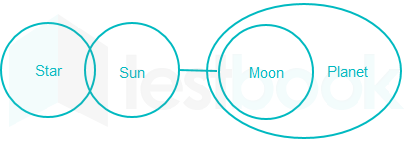
The least possible Venn diagram for the given statements is as follows,

Conclusions:

I. Some stars are Planets → False (it is possible but not definite.)

II. No Moon is a Star → False (it is possible but not definite.)

Hence, neither conclusion I nor II follows.

42

Directions: In the question below are given three statements followed by three conclusions I, II, and III. You have to take the given statements to be true even if they seem to be at variance from commonly known facts. Read all the conclusions and then decide which of the given conclusions logically follows from the given statements disregarding commonly known facts.

Statements:

All dark is bright.

No bright is white.

Some white is grey.

Conclusions:

I. No dark is white.

II. Some grey is bright.

  1. ((a))

    Only I follows

  2. ((b))

    Either I or II follows

  3. ((c))

    Only II follows

  4. ((d))

    Both I and II follow

  5. ((e))

    None follow

Show Answer
Answer: ((a))

Only I follows

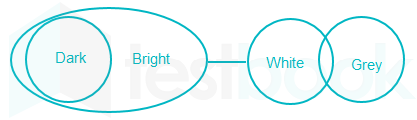
The least possible Venn diagram for the given statements is as follows, Conclusions:

I. No dark is white → true (it is definite because all dark is bright and No bright is white.)

II. Some grey is bright → false (it is possible but not definite because there is no relation between grey and bright)

Hence, only conclusion I follows.

43

Direction : In the question given below are some statements followed by some conclusions. You have to take the given statements to be true even if they seem to be at variance with commonly known facts. Read all the conclusions and then decide which of the given conclusions logically follows from the given statements disregarding commonly known facts. 

Statements :

Few pets are cats.

Only cats are dogs.

No cats are rabbits.

Conclusions :

I. Some cats are dogs.

II. All pets being rabbits is a possibility.

  1. ((a))

    Only conclusion I follows

  2. ((b))

    Only conclusion II follows

  3. ((c))

    Both conclusion I and II follows

  4. ((d))

    Either conclusion I or II follows

  5. ((e))

    None follows

Show Answer
Answer: ((a))

Only conclusion I follows

The least possible Venn diagram for the given statements is as follows,

Conclusions :

I. Some cats are dogs - True (as it is clearly shown in the figure that all dogs are cats, therefore some cats are dogs).

II. All pets being rabbits is a possibility - False (it is not possible because few pets are cats and no cats are rabbits).

Hence, only conclusion I follows.

Directions: Study the information given below carefully and answer the questions that follow:

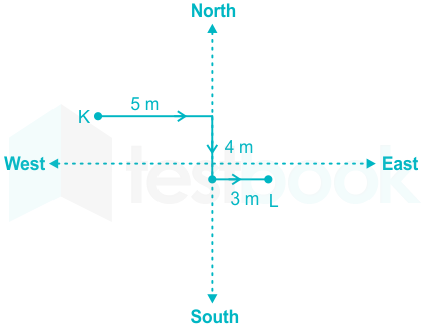
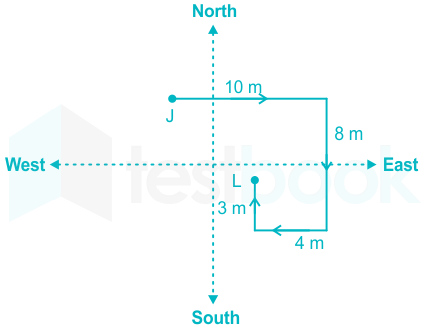
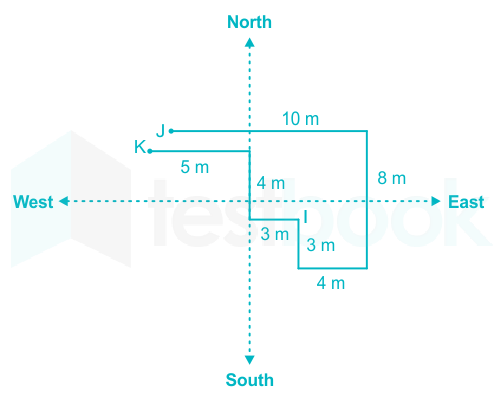
A walks for 5m from point K towards east. He then takes a right and a left turn and walked for 4m and 3m respectively and finally reaches point L. B starts walking from point J and walks for 10m towards the east. He then takes three consecutive right turns and walks 8m, 4m and 3m respectively and reaches L.

44

What is the shortest distance between K and J?

  1. ((a))

    √5 m

  2. ((b))

    2 m

  3. ((c))

    √6 m

  4. ((d))

    3 m

  5. ((e))

    √7 m

Show Answer
Answer: ((a))

√5 m

A walks for 5m from point K towards east. He then takes a right and a left turn and walked for 4m and 3m respectively and finally reaches point L. 

B starts walking from point J and walks for 10m towards the east. He then takes three consecutive right turns and walks 8m, 4m and 3m respectively and reaches L.


KJ2 = 12 + 22

KJ2 = 1 + 4

KJ = √5 m

Hence, the shortest distance between K and J is √5 m.

45

What is the direction of point J with respect to point K?

  1. ((a))

    South-east

  2. ((b))

    North-east

  3. ((c))

    South-west

  4. ((d))

    North-west

  5. ((e))

    None of these

Show Answer
Answer: ((b))

North-east

A walks for 5m from point K towards east. He then takes a right and a left turn and walked for 4m and 3m respectively and finally reaches point L. 

B starts walking from point J and walks for 10m towards the east. He then takes three consecutive right turns and walks 8m, 4m and 3m respectively and reaches L.


Hence, J is in north-east direction with respect to point K.

46

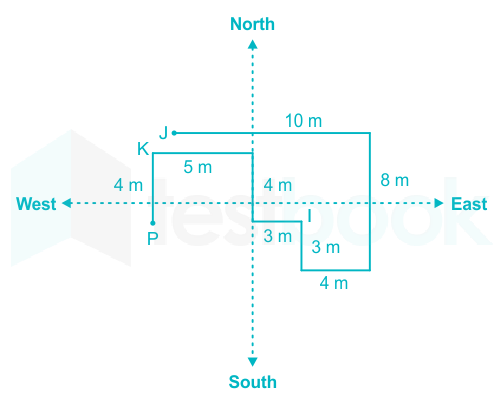
If P is 4 m south K, then what is the distance between L and P?

  1. ((a))

    10 m

  2. ((b))

    7 m

  3. ((c))

    12 m

  4. ((d))

    8 m

  5. ((e))

    14 m

Show Answer
Answer: ((d))

8 m

A walks for 5m from point K towards east. He then takes a right and a left turn and walked for 4m and 3m respectively and finally reaches point L. 

B starts walking from point J and walks for 10m towards the east. He then takes three consecutive right turns and walks 8m, 4m and 3m respectively and reaches L.

If P is 4 m south K, 

5 + 3 = 8 m

Hence, the distance between P and L is 8 m.

Direction: Study the following information carefully and answer the questions given below:

Nine items viz. Soap, Shampoo, Socks, Stationery, Skirt, Spinach, Snacks, Scissors, and Stapler were purchased one after another but not necessarily in the same order.

Socks were purchased just before Scissors. Two items were purchased between Socks and Stationery. Not more than two items were purchased before Spinach. Only one item was purchased between Stationery and Spinach. Shampoo was purchased before Soap. Soap was purchased just before Skirt which was not purchased in the last. Two items were purchased between Soap and Stapler.

47

Find the odd one out:

  1. ((a))

    Soap - Stapler

  2. ((b))

    Socks - Stationery

  3. ((c))

    Scissors - Skirt

  4. ((d))

    Spinach - Soap

  5. ((e))

    Snacks - Scissors

Show Answer
Answer: ((c))

Scissors - Skirt

Given:

Nine items - Soap, Shampoo, Socks, Stationery, Skirt, Spinach, Snacks, Scissors, and Stapler were purchased one after another but not necessarily in the same order.

Let the item which was purchased first be 1 and which was purchased last be 9.

Now,

1) Not more than two items were purchased before Spinach.

2) Only one item was purchased between Stationery and Spinach. 

The possibilities are -

Order of Items PurchasedCase ICase IICase IIICase IV
1StationerySpinach
2Spinach
3SpinachSpinachStationery
4Stationery
5Stationery
6
7
8
9


  1. Two items were purchased between Socks and Stationery.  

  2. Socks were purchased just before Scissors.

The possibilities are -

Order of Items PurchasedCase ICase IICase IIICase IV
1StationerySpinach
2Spinach
3SpinachSpinachStationery
4SocksStationery
5ScissorsStationery
6Socks
7SocksScissors
8SocksScissors
9Scissors


5) Soap was purchased just before Skirt which was not purchased in the last.

  1. Two items were purchased between Soap and Stapler.

This is not possible in Cases III and IV so they get eliminated.

The possibilities are -

Order of Items PurchasedCase ICase II
1StationerySoap
2Skirt
3SpinachSpinach
4SocksStapler
5ScissorsStationery
6Soap
7Skirt
8Socks
9StaplerScissors


7) Shampoo was purchased before Soap. This condition can be satisfied only in Case I.

Thus, the final arrangement is -

Order of Items PurchasedCase I
1Stationery
2Shampoo
3Spinach
4Socks
5Scissors
6Soap
7Skirt
8Snacks
9Stapler


All except Scissors - Skirt, have two items between them.

Hence, the correct answer is Scissors - Skirt.

48

Which item was bought immediately after the item which was bought two items after Stationery?

  1. ((a))

    Shampoo

  2. ((b))

    Spinach

  3. ((c))

    Soap

  4. ((d))

    Socks

  5. ((e))

    Scissors

Show Answer
Answer: ((d))

Socks

Given:

Nine items - Soap, Shampoo, Socks, Stationery, Skirt, Spinach, Snacks, Scissors, and Stapler were purchased one after another but not necessarily in the same order.

Let the item which was purchased first be 1 and which was purchased last be 9.

Now,

1) Not more than two items were purchased before Spinach.

2) Only one item was purchased between Stationery and Spinach. 

The possibilities are -

Order of Items PurchasedCase ICase IICase IIICase IV
1StationerySpinach
2Spinach
3SpinachSpinachStationery
4Stationery
5Stationery
6
7
8
9


  1. Two items were purchased between Socks and Stationery.  

  2. Socks were purchased just before Scissors.

The possibilities are -

Order of Items PurchasedCase ICase IICase IIICase IV
1StationerySpinach
2Spinach
3SpinachSpinachStationery
4SocksStationery
5ScissorsStationery
6Socks
7SocksScissors
8SocksScissors
9Scissors


5) Soap was purchased just before Skirt which was not purchased in the last.

  1. Two items were purchased between Soap and Stapler.

This is not possible in Cases III and IV so they get eliminated.

The possibilities are -

Order of Items PurchasedCase ICase II
1StationerySoap
2Skirt
3SpinachSpinach
4SocksStapler
5ScissorsStationery
6Soap
7Skirt
8Socks
9StaplerScissors


7) Shampoo was purchased before Soap. This condition can be satisfied only in Case I.

Thus, the final arrangement is -

Order of Items PurchasedCase I
1Stationery
2Shampoo
3Spinach
4Socks
5Scissors
6Soap
7Skirt
8Snacks
9Stapler


Socks were bought immediately after the item which was bought two items after Stationery.

Hence, the correct answer is Socks.

49

Which item was bought exactly between Spinach and Stapler?

  1. ((a))

    There is no such item

  2. ((b))

    Soap

  3. ((c))

    Scissors

  4. ((d))

    Skirt

  5. ((e))

    Socks

Show Answer
Answer: ((b))

Soap

Given:

Nine items - Soap, Shampoo, Socks, Stationery, Skirt, Spinach, Snacks, Scissors, and Stapler were purchased one after another but not necessarily in the same order.

Let the item which was purchased first be 1 and which was purchased last be 9.

Now,

1) Not more than two items were purchased before Spinach.

2) Only one item was purchased between Stationery and Spinach. 

The possibilities are -

Order of Items PurchasedCase ICase IICase IIICase IV
1StationerySpinach
2Spinach
3SpinachSpinachStationery
4Stationery
5Stationery
6
7
8
9


  1. Two items were purchased between Socks and Stationery.  

  2. Socks were purchased just before Scissors.

The possibilities are -

Order of Items PurchasedCase ICase IICase IIICase IV
1StationerySpinach
2Spinach
3SpinachSpinachStationery
4SocksStationery
5ScissorsStationery
6Socks
7SocksScissors
8SocksScissors
9Scissors


5) Soap was purchased just before Skirt which was not purchased in the last.

  1. Two items were purchased between Soap and Stapler.

This is not possible in Cases III and IV so they get eliminated.

The possibilities are -

Order of Items PurchasedCase ICase II
1StationerySoap
2Skirt
3SpinachSpinach
4SocksStapler
5ScissorsStationery
6Soap
7Skirt
8Socks
9StaplerScissors


7) Shampoo was purchased before Soap. This condition can be satisfied only in Case I.

Thus, the final arrangement is -

Order of Items PurchasedCase I
1Stationery
2Shampoo
3Spinach
4Socks
5Scissors
6Soap
7Skirt
8Snacks
9Stapler


Soap was bought exactly between Spinach and Stapler

Hence, the correct answer is Soap.

50

How many items were bought between Shampoo and Soap?

  1. ((a))

    None

  2. ((b))

    One

  3. ((c))

    Two

  4. ((d))

    Three

  5. ((e))

    More than three

Show Answer
Answer: ((d))

Three

Given:

Nine items - Soap, Shampoo, Socks, Stationery, Skirt, Spinach, Snacks, Scissors, and Stapler were purchased one after another but not necessarily in the same order.

Let the item which was purchased first be 1 and which was purchased last be 9.

Now,

1) Not more than two items were purchased before Spinach.

2) Only one item was purchased between Stationery and Spinach. 

The possibilities are -

Order of Items PurchasedCase ICase IICase IIICase IV
1StationerySpinach
2Spinach
3SpinachSpinachStationery
4Stationery
5Stationery
6
7
8
9


  1. Two items were purchased between Socks and Stationery.  

  2. Socks were purchased just before Scissors.

The possibilities are -

Order of Items PurchasedCase ICase IICase IIICase IV
1StationerySpinach
2Spinach
3SpinachSpinachStationery
4SocksStationery
5ScissorsStationery
6Socks
7SocksScissors
8SocksScissors
9Scissors


5) Soap was purchased just before Skirt which was not purchased in the last.

  1. Two items were purchased between Soap and Stapler.

This is not possible in Cases III and IV so they get eliminated.

The possibilities are -

Order of Items PurchasedCase ICase II
1StationerySoap
2Skirt
3SpinachSpinach
4SocksStapler
5ScissorsStationery
6Soap
7Skirt
8Socks
9StaplerScissors


7) Shampoo was purchased before Soap. This condition can be satisfied only in Case I.

Thus, the final arrangement is -

Order of Items PurchasedCase I
1Stationery
2Shampoo
3Spinach
4Socks
5Scissors
6Soap
7Skirt
8Snacks
9Stapler


Three items were bought between Shampoo and Soap.

Hence, the correct answer is Three.

51

Which item was purchased second from the last?

  1. ((a))

    Socks

  2. ((b))

    Stapler

  3. ((c))

    Skirt

  4. ((d))

    Snacks

  5. ((e))

    Scissors

Show Answer
Answer: ((d))

Snacks

Given:

Nine items - Soap, Shampoo, Socks, Stationery, Skirt, Spinach, Snacks, Scissors, and Stapler were purchased one after another but not necessarily in the same order.

Let the item which was purchased first be 1 and which was purchased last be 9.

Now,

1) Not more than two items were purchased before Spinach.

2) Only one item was purchased between Stationery and Spinach. 

The possibilities are -

Order of Items PurchasedCase ICase IICase IIICase IV
1StationerySpinach
2Spinach
3SpinachSpinachStationery
4Stationery
5Stationery
6
7
8
9


  1. Two items were purchased between Socks and Stationery.  

  2. Socks were purchased just before Scissors.

The possibilities are -

Order of Items PurchasedCase ICase IICase IIICase IV
1StationerySpinach
2Spinach
3SpinachSpinachStationery
4SocksStationery
5ScissorsStationery
6Socks
7SocksScissors
8SocksScissors
9Scissors


5) Soap was purchased just before Skirt which was not purchased in the last.

  1. Two items were purchased between Soap and Stapler.

This is not possible in Cases III and IV so they get eliminated.

The possibilities are -

Order of Items PurchasedCase ICase II
1StationerySoap
2Skirt
3SpinachSpinach
4SocksStapler
5ScissorsStationery
6Soap
7Skirt
8Socks
9StaplerScissors


7) Shampoo was purchased before Soap. This condition can be satisfied only in Case I.

Thus, the final arrangement is -

Order of Items PurchasedCase I
1Stationery
2Shampoo
3Spinach
4Socks
5Scissors
6Soap
7Skirt
8Snacks
9Stapler


Snacks were purchased second from the last.

Hence, the correct answer is Snacks.

52

Find the odd one out.

  1. ((a))

    BEH

  2. ((b))

    HKN

  3. ((c))

    NQT

  4. ((d))

    TVX

  5. ((e))

    KNQ

Show Answer
Answer: ((d))

TVX

Option 1: B + 3 = E, E + 3 = H

Option 2: H + 3 = K, K + 3 = N

Option 3: N + 3 = Q, Q + 3 = T

Option 4: T + 2 = V, V + 2 = X

Option 5: K + 3 = N, N + 3 = Q

Hence, the correct answer is TVX.

Direction: Study the following information to answer the given questions:

Eight persons A, B, C, D, E, F, G and H are sitting around the square table. Four of them are on the corners while four are in the middle of the sides. Persons on each corner face towards the center while persons on each side face away from the center.

E does not sit on any side. Two persons sit between H and C. A and G are immediate left of each other. F sits opposite to B, who sits immediate left of H. D sits opposite to A.

53

Which of the following statement is correct?

  1. ((a))

    B sits at the corner

  2. ((b))

    C sits immediate right of D

  3. ((c))

    E sits opposite to H

  4. ((d))

    A is adjacent to E

  5. ((e))

    All are correct

Show Answer
Answer: ((c))

E sits opposite to H

Persons: A, B, C, D, E, F, G and H.

  1. F sits opposite to B, who sits immediate to the left of H.

  2. Two persons sit between H and C. 

  1. A and G are immediate to the left of each other.

  2. D sits opposite to A. 

  1. E does not sit on any side. So, case 2 would be invalid as it contradicts the given statement. 

Hence, statement 3) is correct.

54

Four are the same in a certain way thus forming a group. Which among the following does not belong to the group?

  1. ((a))

    C

  2. ((b))

    G

  3. ((c))

    F

  4. ((d))

    B

  5. ((e))

    D

Show Answer
Answer: ((e))

D

Persons: A, B, C, D, E, F, G and H.

  1. F sits opposite to B, who sits immediate to the left of H.

  2. Two persons sit between H and C. 

  1. A and G are immediate to the left of each other.

  2. D sits opposite A. 

  1. E does not sit on any side. So, case 2 would be invalid as it contradicts the given statement. 

All sit on the sides except D.

Hence, D does not belong to the group.

55

____ sits third to the left of E.

  1. ((a))

    H

  2. ((b))

    B

  3. ((c))

    D

  4. ((d))

    G

  5. ((e))

    A

Show Answer
Answer: ((d))

G

Persons: A, B, C, D, E, F, G and H.

  1. F sits opposite to B, who sits immediate to the left of H.

  2. Two persons sit between H and C. 

  1. A and G are immediate to the left of each other.

  2. D sits opposite to A. 

  1. E does not sit on any side. So, case 2 would be invalid as it contradicts the given statement. 

Hence, G sits third to the left of E.

56

How many persons sit between D and F when counted from the left of D?

  1. ((a))

    Three

  2. ((b))

    Two

  3. ((c))

    One

  4. ((d))

    Five

  5. ((e))

    Four

Show Answer
Answer: ((b))

Two

Persons: A, B, C, D, E, F, G and H.

  1. F sits opposite to B, who sits immediate to the left of H.

  2. Two persons sit between H and C. 

  1. A and G are immediate to the left of each other.

  2. D sits opposite to A. 

  1. E does not sit on any side. So, case 2 would be invalid as it contradicts the given statement. 

Hence, two persons sit between D and F when counted from the left of D.

57

Who sits immediate to the right of H?

  1. ((a))

    E

  2. ((b))

    D

  3. ((c))

    C

  4. ((d))

    G

  5. ((e))

    A

Show Answer
Answer: ((d))

G

Persons: A, B, C, D, E, F, G and H.

  1. F sits opposite B, who sits immediate to the left of H.

  2. Two persons sit between H and C. 

  1. A and G are immediate to the left of each other.

  2. D sits opposite to A. 

  1. E does not sit on any side. So, case 2 would be invalid as it contradicts the given statement. 

Hence, G sits immediate right of H.

58

If it is possible to make only one four letter meaningful word without repetition of the letter with the third, fourth, sixth and seventh letter of word 'CHARACTER' , which would be the second letter of the word from the right? If more than one such word can be formed, give X as the answer. If no such word can be formed, give K as your answer.

  1. ((a))

    R

  2. ((b))

    C

  3. ((c))

    A

  4. ((d))

    X

  5. ((e))

    K

Show Answer
Answer: ((a))

R

Given word: CHARACTER

The third, fourth, sixth and seventh letter of word are: A, R, C, and T. 

A meaning full four letter word from this is: CART

The second letter from the right end of the word CART is R. 

Hence, the correct answer is "R".

59

Directions: In the following question assuming the given statements to be True, find which of the conclusion among given conclusions is/are definitely true and then give your answers accordingly.

Statements: B ≤ E ≤ M; A > P ≥ X; A = B

Conclusions:

I. X ≤ E

II. M ≥ P

  1. ((a))

    Only II is True

  2. ((b))

    Only I is True

  3. ((c))

    Both I and II are True

  4. ((d))

    None is True

  5. ((e))

    Either I or II is True

Show Answer
Answer: ((d))

None is True

Given statements: B ≤ E ≤ M; A > P ≥ X; A = B

On combining: X ≤ P < A = B ≤ E ≤ M

Conclusions:

I. X ≤ E → False (X ≤ P < A = B ≤ E → X < E)

II. M ≥ P → False (P < A = B ≤ E ≤ M → P < M)

Thus, neither conclusion I nor conclusion II is true.

60

Directions: In the following question assuming the given statements to be True, find which of the conclusion among given conclusions is/are definitely true and then give your answers accordingly.

Statements: C > T ≥ W; J < Q ≤ W; K > C

Conclusions:

I. C > J

II. Q ≤ T

  1. ((a))

    Only II is True

  2. ((b))

    Only I is True

  3. ((c))

    Both I and II are True

  4. ((d))

    None is True

  5. ((e))

    Either I or II is True

Show Answer
Answer: ((c))

Both I and II are True

Given statements: C > T ≥ W; J < Q ≤ W; K > C

On combining: K > C > T ≥ W ≥ Q > J

Conclusions:

I. C > J → True (C > T ≥ W ≥ Q > J → C > J)

II. Q ≤ T → True (T ≥ W ≥ Q → T ≥ Q)

Thus, both conclusions I and II are true.

61

Directions: In the following question assuming the given statements to be True, find which of the conclusion among given conclusions is/are definitely true and then give your answers accordingly.

Statements: U < F ≤ P; N > Q ≥ W; F = W

Conclusions:

I. N ≥ U

II. U < Q

  1. ((a))

    Only II is True

  2. ((b))

    Only I is True

  3. ((c))

    Both I and II are True

  4. ((d))

    None is True

  5. ((e))

    Either I or II is True

Show Answer
Answer: ((a))

Only II is True

Given statements: U < F ≤ P; N > Q ≥ W; F = W

On combining:  U < F = W ≤ P; W = F ≤ Q < N

Conclusions:

I. N ≥ U → False (U < F = W and W = F ≤ Q < N → U < N)

II. U < Q → True (U < F = W and W = F ≤ Q → U < Q)

Thus, only conclusion II is true.

Directions: Study the following information carefully and answer the questions given below

There are eight members A, B, C, D, E, F, G, and H in the family. A is the son of B. D is the sister of C. F is the mother of E. H is the son of C. D’s mother F has only one son. A is married to C. A is the son-in-law of G. There is an equal number of males and females in the family.

62

If B is married to Z, then how is Z related to C?

  1. ((a))

    Father

  2. ((b))

    Daughter in law

  3. ((c))

    Mother

  4. ((d))

    Father in law

  5. ((e))

    Mother in law

Show Answer
Answer: ((d))

Father in law

Given:

Family members: A, B, C, D, E, F, G, H

From the given information,

  1. A is the son of B. D is the sister of C. F is the mother of E.

  2. H is the son of C. D’s mother F has only one son.

  3. A is married to C. A is the son-in-law of G.

  4. There is an equal number of males and females in the family.

Hence, Z is the father in law of C.

63

Who is the maternal uncle of H?

  1. ((a))

    D

  2. ((b))

    E

  3. ((c))

    F

  4. ((d))

    G

  5. ((e))

    C

Show Answer
Answer: ((b))

E

Given:

Family members: A, B, C, D, E, F, G, H

From the given information,

  1. A is the son of B. D is the sister of C. F is the mother of E.

  2. H is the son of C. D’s mother F has only one son.

  3. A is married to C. A is the son-in-law of G.

  4. There is an equal number of males and females in the family.

Hence, E is the maternal uncle of H.

64

Which of the following statements are correct?

I. F is the grandmother of H.

II. G is a male.

III. E is the daughter of G.

  1. ((a))

    Only I and III is correct

  2. ((b))

    Only II and III is correct

  3. ((c))

    Only I and II is correct

  4. ((d))

    All are correct

  5. ((e))

    None of these

Show Answer
Answer: ((c))

Only I and II is correct

Given:

Family members: A, B, C, D, E, F, G, H

From the given information,

I. F is the grandmother of H → True (F is the mother of E, E and C are siblings and H is the son of C)

II. G is a male → True (F is the mother of E. Since F is a female, G is a male)

III. E is the daughter of G → False (D’s mother F has only one son. Since C and D are females. Thus E is a male)

Hence, only I and II are correct.

65

If 2 is added to every digit placed at even position in the number 72349576, then which digit will be 8th from the right end?

  1. ((a))

    7

  2. ((b))

    9

  3. ((c))

    3

  4. ((d))

    6

  5. ((e))

    4

Show Answer
Answer: ((a))

7

Given number – 72349876

Digit72349576
Position12345678


By adding 2 to every digit placed at even position, we get 74369778

Now, 8th digit from the right end is 7.

Hence, the correct answer is ‘7’.

Quantitative Aptitude (35 questions)

Direction: Refer to the graph and answer the given question.

Number of tickets sold by two websites Goibibo and Makemytrip on five days to people travelling to Mumbai on particular airlines: 

66

Total number of tickets sold by both the websites Goibibo and makemytrip together on Tuesday is what percent more than that sold by both websites together on Monday?

  1. ((a))

    125%

  2. ((b))

    75%

  3. ((c))

    25%

  4. ((d))

    50%

  5. ((e))

    100%

Show Answer
Answer: ((e))

100%

Total number of tickets sold by both the websites Goibibo and makemytrip together on Tuesday = 6000 + 3000 = 9000

Total number of tickets sold by both the websites Goibibo and makemytrip together on Monday = 2500 + 2000 = 4500

∴ Required percent = (9000 – 4500)/4500 × 100 = 100%

67

What is the average number of tickets sold by goibibo on Sunday, Tuesday and Thursday?

  1. ((a))

    4500

  2. ((b))

    4000

  3. ((c))

    4150

  4. ((d))

    5250

  5. ((e))

    4900

Show Answer
Answer: ((b))

4000

Total number of tickets sold by goibibo on Sunday = 1500

Total number of tickets sold by goibibo on Tuesday = 6000

Total number of tickets sold by goibibo on Thursday = 4500

∴ Required average = (1500 + 6000 + 4500)/3

⇒ 12000/3 = 4000

68

What is the difference between the total number of tickets sold on Monday and Tuesday by goibibo and the total number of tickets sold on the same days together by makemytrip?

  1. ((a))

    3500

  2. ((b))

    4050

  3. ((c))

    4150

  4. ((d))

    5250

  5. ((e))

    4900

Show Answer
Answer: ((a))

3500

total number of tickets sold on Monday and Tuesday by goibibo = 2500 + 6000 = 8500

total number of tickets sold on Monday and Tuesday by makemytrip = 2000 + 3000 = 5000

∴ Required difference = 8500 – 5000 = 3500

69

What is the respective ratio between the total number of tickets sold by both the websites together on Sunday and that on Monday?

  1. ((a))

    9 : 7

  2. ((b))

    9 : 11

  3. ((c))

    7 : 9

  4. ((d))

    11 : 9

  5. ((e))

    13 : 11

Show Answer
Answer: ((d))

11 : 9

Total number of tickets sold by goibibo and makemytip on Sunday = 1500 + 4000 = 5500

Total number of tickets sold by goibibo and makemytip on Monday = 2500 + 2000 = 4500

∴ Required ratio = 5500 : 4500

⇒ 11 : 9

70

Number of tickets sold by makemytrip decreased by what percent from Sunday to Monday?

  1. ((a))

    40%

  2. ((b))

    25%

  3. ((c))

    20%

  4. ((d))

    50%

  5. ((e))

    45%

Show Answer
Answer: ((d))

50%

Total number of tickets sold by makemytrip on Sunday = 4000

Total number of tickets sold by makemytrip on Monday = 2000

∴ Required percent = (4000 – 2000)/4000 × 100 = 50%

71

What should come in place of the question mark '?' in the following number series?

14, 28, 112, ?, 5376

  1. ((a))

    896

  2. ((b))

    784

  3. ((c))

    672

  4. ((d))

    724

  5. ((e))

    698

Show Answer
Answer: ((c))

672

The pattern of the above series is as follows,

14 × 2 = 28

28 × 4 = 112

112 × 6 = 672 = ?

672 × 8 = 5376

72

What should come in place of the question mark '?' in the following number series?

30, 15, 15, 22.5, ?

  1. ((a))

    56.25

  2. ((b))

    40

  3. ((c))

    33.75

  4. ((d))

    45

  5. ((e))

    33.25

Show Answer
Answer: ((d))

45

The pattern of the above series is as follows,

30 × 0.5 = 15

15 × 1 = 15

15 × 1.5 = 22.5

22.5 × 2 = 45 = ?

73

What should come in place of the question mark '?' in the following number series?

4096, 2048, 512, ?, 4

  1. ((a))

    32

  2. ((b))

    64

  3. ((c))

    128

  4. ((d))

    256

  5. ((e))

    80

Show Answer
Answer: ((b))

64

The pattern of the above series is as follows,

4096 ÷ 2 = 2048

2048 ÷ 4 = 512

512 ÷ 8 = 64 = ?

64 ÷ 16 = 4

74

What should come in place of the question mark '?' in the following number series?

6, 7, 15, 46, ?, 926

  1. ((a))

    165

  2. ((b))

    175

  3. ((c))

    185

  4. ((d))

    195

  5. ((e))

    205

Show Answer
Answer: ((c))

185

The pattern of the above series is as follows,

6 × 1 + 1 = 7

7 × 2 + 1 = 15

15 × 3 + 1 = 46

46 × 4 + 1 = 185 = ?

185 × 5 + 1 = 926

75

What should come in the place of the question mark '?' in the following number series?

14, 27, 49, ?, 165, 313

  1. ((a))

    87

  2. ((b))

    91

  3. ((c))

    93

  4. ((d))

    95

  5. ((e))

    89

Show Answer
Answer: ((e))

89

The pattern of the above series is as follows,

14 × 2 – 1 = 27

27 × 2 – 5 = 49

49 × 2 – 9 = 89

89 × 2 – 13 = 165

165 × 2 – 17 = 313

76

What should come in the place of the question mark '?' in the following number series?

24, 25, 39, ?, 202.5, 610.5

  1. ((a))

    78.5

  2. ((b))

    82.5

  3. ((c))

    80

  4. ((d))

    82.25

  5. ((e))

    85

Show Answer
Answer: ((c))

80

The pattern of the above series is as follows,

24 × 1 + 1 = 25

25 × 1.5 + 1.5 = 39

39 × 2 + 2 = 80 = ?

80 × 2.5 + 2.5 = 202.5

202.5 × 3 + 3 = 610.5

77

Pipe P and Q can fill a tank in 5 hours and 12 hours respectively. If pipe P is opened at 8:00 a.m. and pipe Q is opened at 10:10 a.m. then, at what time will the tank be full?

  1. ((a))

    12 : 10 P.M.

  2. ((b))

    12 : 20 P.M.

  3. ((c))

    11 : 20 P.M.

  4. ((d))

    11 : 10 P.M.

  5. ((e))

    None of above

Show Answer
Answer: ((a))

12 : 10 P.M.

Given:

Pipe P fills a tank = 5 hours

Pipe Q fills a tank = 12 hours

Calculation:

Let the total capacity of a tank = 60 units

Tank filled by pipe P in 1 hour = 60/5

= 12 units

Tank filled by pipe Q in 1 hour = 60/12

= 5 units

Tank filled by pipe P from 8:00 a.m. to 10:00 a.m. = 24 units

Tank filled by pipe P from 10:00 a.m. to 10:10 a.m. = 2 units [i.e. (12/60) × 10]

Remaining tank to be filled = 60 – 26

= 34 units

Tank filled in 1 hour, when both the pipes are open (from 10: 10 a.m. to 11:10 a.m.) =17 units

Tank filled in next 1 hour, when both the pipes are opened from 11:10 a.m. to 12:10 p.m. = 17 units.

∴ The tank will be filled at 12:10 P.m.

78

A can do a particular work in 6 days. B can do the same work in 8 days. A and B signed to do it for Rs. 3200. They completed the work in 3 days with the help of C. How much is to be paid to C?

  1. ((a))

    Rs. 500

  2. ((b))

    Rs. 600

  3. ((c))

    Rs. 450

  4. ((d))

    Rs. 350

  5. ((e))

    Rs. 400

Show Answer
Answer: ((e))

Rs. 400

Given: The 

Amount of work A can do in 1 day = 1/6

Amount of work B can do in 1 day = 1/8

Calculation:

Amount of work A + B can do in 1 day = 1/6 + 1/8 = 7/24

Amount of work A + B + C can do in 1 day = 1/3

Amount of work C can do in 1 day = 1/3 - 7/24 = 1/24

Work done by A in 1 day : work done by B in 1 day : work done by C in 1 day

⇒ 1/6 : 1/8 : 1/24 = 4 : 3 : 1

Amount to be paid to C = 3200 × (1/8) = Rs.400

∴ The amount to be paid to C is Rs. 400.

79

Sanket’s age is 62.5% of his Mother’s age and 25% of his father’s age. If the age of his father 8 years back was 32 years then find the age of his mother 8 years hence?

  1. ((a))

    24 years

  2. ((b))

    16 years

  3. ((c))

    8 years

  4. ((d))

    32 years

  5. ((e))

    30 years

Show Answer
Answer: ((a))

24 years

GIVEN:

⇒ Sanket : Mother = 5x : 8x      ----(1)

⇒ Sanket : Father = 1x : 4x      ----(2)

CONCEPT:

1. Ratio balancing.

2. Difference between the ages of two people will remain the same.

CALCULATION:

Making ratio common.

⇒ Sanket : Mother : Father = 5x : 8x : 20x      ----(3)

Age of father 8 years back = 32 years.

Father’s present age = 40 years.

⇒ 20x = 40 years

⇒ 1x = 2 years

⇒ Present age of mother = 16 years.

⇒ Age of mother after 8 years = 24 years.

80

The sum of three numbers is 4425. If the ratio of first to the second number is 4 ∶ 3 and second to the third number is 6 ∶ 11, then what is the third number?

  1. ((a))

    1452

  2. ((b))

    1947

  3. ((c))

    2241

  4. ((d))

    2052

  5. ((e))

    1785

Show Answer
Answer: ((b))

1947

Given:

The sum of three numbers is 4425.

Ratio of first to the second number is 4 ∶ 3.

Ratio of second to the third number is 6 ∶ 11.

Formula:

If ratio of A and B is = x ∶ y

∴ A / B = x / y

Calculation:

Ratio of first and second number = 4 ∶ 3 = 4 × 2 ∶ 3 × 2 = 8 ∶ 6

Ratio of second and third number = 6 ∶ 11

∴ Ratio between the three numbers = 8 ∶ 6 ∶ 11

Let, first number = 8x

Second number = 6x

Third number = 11x

According to the question,

⇒ 8x + 6x + 11x = 4425

⇒ x = 4425 / 25

⇒ x = 177

∴ The third number = 11 × 177 = 1947

81

If the length of a rectangle is increased by 30%, then its perimeter would become 191m and if the breadth of the rectangle is increased by 25% then its perimeter would become 170m. What is the area of the rectangle?

  1. ((a))

    1320 m2

  2. ((b))

    1420 m2

  3. ((c))

    1220 m2

  4. ((d))

    2013 m2

  5. ((e))

    None

Show Answer
Answer: ((a))

1320 m2

Concept:

Area of rectangle = Length × Breadth

Perimeter of rectangle = 2 × (Length + Breadth)

Given: 

Let be assume a is length of rectangle and b is breadth of rectangle

According to question

⇒ 2 × (1.3a + b) = 191

⇒ 1.3a + b = 95.5      ---(1)

⇒ 2 × (a + 1.25b) = 170

⇒ a + 1.25b = 85      ---(2)

from  (1) and (2)

a = 55, b = 24

Now, 

Area of rectangle = Length × Breadth

⇒ a × b

⇒ 55 × 24 = 1320m2

∴ Thearea of re​ctangle is 1320m2.

82

What will come in the place of ‘?’ in the following question?

125 ÷ 25 ÷ 5 × 100 + 200 = ?

  1. ((a))

    200

  2. ((b))

    300

  3. ((c))

    250

  4. ((d))

    100

  5. ((e))

    None of these.

Show Answer
Answer: ((b))

300

Concept used:

Follow BODMAS rule to solve this question, as per the order given below,

Calculation:

125 ÷ 25 ÷ 5 × 100 + 200 = ?

⇒ 5 ÷ 5 × 100 + 200 = ?

⇒ 1 × 100 + 200 = ?

⇒ ? = 300

∴ The value of ? is 300.

83

What will come in place of the question mark ‘?’ in the following question?

108 ÷ 9 + 12 × 6 – 20 = ?2

  1. ((a))

    4

  2. ((b))

    5

  3. ((c))

    6

  4. ((d))

    7

  5. ((e))

    8

Show Answer
Answer: ((e))

8

Given:

The given equation is:

108 ÷ 9 + 12 × 6 – 20 = ?2

Concept Used:       

Follow BODMAS rule to solve this question, as per the order given below

Calculation;

108 ÷ 9 + 12 × 6 – 20 = ?2

12 + 12 × 6 – 20 = ?2

12 + 72 – 20 = ?2

84 – 20 = ?2

64 = ?2

?2 = 82

? = 8

 The required value of "?" in the given equation is 8

84

What will come in the place of the question mark ‘?’ in the following question?

70% of (2/3) of 630 =?

  1. ((a))

    350

  2. ((b))

    200

  3. ((c))

    294

  4. ((d))

    250

  5. ((e))

    None of these

Show Answer
Answer: ((c))

294

Given:

​70% of (2/3) of 630 =?

Concept used:

Calculation:

70% of (2/3) of 630 =?

⇒ (70/100) × (2/3) × 630 =?

⇒ ? = 294

∴ 294 will come in place of the question mark ('?').

85

What will come in place of the question mark (?) in the following question?

3640 ÷ 14 ×16 + 340 = ?

  1. ((a))

    7000

  2. ((b))

    0.70

  3. ((c))

    450

  4. ((d))

    4500

  5. ((e))

    None of these

Show Answer
Answer: ((d))

4500

CONCEPT :

CALCULATION :

 3640 ÷ 14 ×16 + 340 = ?

260 × 16 + 340  

⇒  4160 + 340  

⇒  4500

86

What will come in the place of ‘?’ in the following question? 

√324 ÷ (3 × 6) – √196 ÷ √49 + 5 = ?2

  1. ((a))

    2

  2. ((b))

    3

  3. ((c))

    4

  4. ((d))

    1

  5. ((e))

    0

Show Answer
Answer: ((a))

2

Concept used:

Calculation:

√324 ÷ (3 × 6) – √196 ÷ √49 + 5 = ?2

⇒ 18 ÷ (3 × 6) – 14 ÷ 7 + 5 = ?2

⇒ 18 ÷ 18 – 2 + 5  = ?2

⇒ 1– 2 + 5 = ?2

⇒ ? = √4 = 2

∴ The value of '?' is 2.

87

What will come in the place of the question mark ‘?’ in the following question?

77 + 85 × 9 ÷ 17 × 7 – 157 = ?

  1. ((a))

    225

  2. ((b))

    235

  3. ((c))

    245

  4. ((d))

    265

  5. ((e))

    275

Show Answer
Answer: ((b))

235

Concept:

Follow BODMAS rule to solve this question, as per the order given below.

Step - 1: Parts of an equation enclosed in 'Brackets' must be solved first, and following BODMAS rule in the bracket –

Step - 2: Any mathematical 'Of' or 'Exponent' must be solved next.

Step - 3: Next, the parts of the equation that contain 'Division' and 'Multiplication' are calculated.

Step - 4: Last but not the least, the parts of the equation that contain 'Addition' and 'Subtraction' should be calculated.

Calculation:

77 + 85 × (9/17) × 7 – 157 = ?

⇒ 77 + (85 × 9 × 7)/17 – 157 = ?

⇒ 77 + (5355)/17 – 157 = ?

⇒ 77 + 315 – 157 = ?

⇒ 392 – 157 = ?

⇒ ? = 235

88

What will come in the place of the question mark ‘?’ in the following question?

96 of 7 ÷ 14 + 54 of 6 – 18 = ?

  1. ((a))

    354

  2. ((b))

    364

  3. ((c))

    374

  4. ((d))

    392

  5. ((e))

    344

Show Answer
Answer: ((a))

354

Concept used:

Follow BODMAS rule to solve this question, as per the order given below,

Calculation:

(96 × 7)/14 + (54 × 6) – 18 = ?

⇒ 672/14 + 324 – 18 = ?

⇒ 48 + 324 – 18 = ?

⇒ 372 – 18 = ?

⇒ 354 = ?

∴ The value of ? is 354

89

What will come in the place of the question mark ‘?’ in the following question? 

8.33% of 1728 + 7.14% of 196 = ?

  1. ((a))

    168

  2. ((b))

    188

  3. ((c))

    144

  4. ((d))

    158

  5. ((e))

    225

Show Answer
Answer: ((d))

158

GIVEN:

8.33% of 1728 + 7.14% of 196 = ?

FORMULA USED:

These types of questions, the knowledge of conversion from percentage to fraction should be known.

Fraction1/111/121/131/14
Percentage (%)9.098.337.697.14


Concept :

Follow BODMAS rule to solve this question, as per the order given below.

Step - 1: Parts of an equation enclosed in 'Brackets' must be solved first, and following BODMAS rule in the bracket -

Step - 2: Any mathematical 'Of' or 'Exponent' must be solved next.

Step - 3: Next, the parts of the equation that contain 'Division' and 'Multiplication' are calculated.

Step - 4: Last but not the least, the parts of the equation that contain 'Addition' and 'Subtraction' should be calculated.

CALCULATION:

8.33% of 1728 = (1/12) × 1728 = 144

7.14% of 196 = (1/14) × 196 = 14

Given expression is

8.33% of 1728 + 7.14% of 196 = ?

⇒ 144 + 14 = ?

⇒ 158 = ?

∴ ? = 158

90

What will come in the place of the question mark ‘?’ in the following question?

(x) × {(729.5 + 820.5) – 550 } = 4280

  1. ((a))

    4.18

  2. ((b))

    4.28

  3. ((c))

    4.208

  4. ((d))

    4.802

  5. ((e))

    3.82

Show Answer
Answer: ((b))

4.28

Concept used:

Follow BODMAS rule to solve this question, as per the order given below,

Calculation:

(x) × {(729.5 + 820.5) – 550 } = 4280

⇒ (x) × {1550 – 550 } = 4280

⇒ (x) × {1000} = 4280

⇒ ( x ) × 1000 = 4280

⇒ x = 4280/1000

⇒ x = 4.28

∴ The value of ? is 4.28

91

What value will come in the place of the question mark ‘?’ in the following question?

(50 + 22) ÷ 0.24 ÷ 15 = ?

  1. ((a))

    20

  2. ((b))

    10

  3. ((c))

    41

  4. ((d))

    29

  5. ((e))

    25

Show Answer
Answer: ((a))

20

Concept used:

Calculation:

(50 + 22) ÷ 0.24 ÷ 15 = ?

⇒ 72 ÷ 0.24 ÷ 15 = ?

⇒ 72 × (100/24) ÷ 15 = ?

⇒ 300 ÷ 15 = ?

∴ ? = 20

92

What will come in the place of the question mark ‘?’ in the following question?

√? + 1/6 of 216 + ∛512 = 108

  1. ((a))

    256

  2. ((b))

    4096

  3. ((c))

    16

  4. ((d))

    4

  5. ((e))

    216

Show Answer
Answer: ((b))

4096

Concept used:

The concept of BODMAS will be used

Calculations:

Given expression is

√? + 1/6 of 216 + ∛512 = 108

⇒ √? + 36 + ∛512 = 108

⇒ 108 - 8 - 36 = √?

⇒ 64 = √?

⇒ ? = 642

∴ ? = 4096.

93

If the markup price of an article is Rs. 400 and the discount percentage is given on an article is 12.5%. What will be the selling price of an article?

  1. ((a))

    Rs. 380

  2. ((b))

    Rs. 350

  3. ((c))

    Rs. 270

  4. ((d))

    Rs. 300

  5. ((e))

    Rs. 275

Show Answer
Answer: ((b))

Rs. 350

Given:

Markup price = Rs. 400

Discount percentage = 12.5%

Formula used:

Selling price = Markup price × [(100 - discount percentage)/100]

Calculation:

Selling price = 400 × [(100 – 12.5)/100]

⇒ 400 × (87.5/100)

⇒ 4 × 87.5

⇒ Rs. 350

∴ The selling price of an article is Rs. 350

94

A train 300 m long passes a pole in 15 seconds and crosses another train of the same length traveling in the opposite direction in 8 seconds. Calculate the speed of the other train in km/h.

  1. ((a))

    200 km/h

  2. ((b))

    198 km/h

  3. ((c))

    190 km/h

  4. ((d))

    222 km/h

  5. ((e))

    None of the above

Show Answer
Answer: ((b))

198 km/h

Length of train = 300 m

Time is taken by train to pass a pole = 15 seconds

Time taken to cross another train of the same length = 8 seconds

Calculations:

Speed of the 1st train = 300/15 = 20 m/s

Let the speed of 2nd train be x

Relative speed = (20 + x) m/s

Length of 1st train + length of 2nd train = 300 + 300 = 600 m

In the second scenario the equation is

⇒ 600/(20 + x) = 8

⇒ 600 = 160 + 8x

⇒ 600 – 160 = 8x

⇒ 440 = 8x

⇒ x = 55 m/s

∴ Speed of the train = 55 × 18/5 = 198 km/h.

The speed of the train is 198 km/h.

95

L started a business with Rs. 15,000 and was joined afterwards by M with Rs. 25,000. After how many months did the M join if the profit at the end of year were divided in the ratio 6 : 5 ?

  1. ((a))

    4 months

  2. ((b))

    8 months

  3. ((c))

    9 months

  4. ((d))

    6 months

  5. ((e))

    2 months

Show Answer
Answer: ((d))

6 months

Given:

L’s capital = Rs. 15,000

M’s capital = Rs. 25,000

Formula used:

shares of profit = amount invested × time period

Calculation:

Ratio of the shares of profit = Sohan : Mohan

 ⇒Sohan invested amount × time period of capital invested : Mohan invested amount × Time period of capital invested

⇒ 15,000 × 12 months : 25,000 × t = 6 : 5

⇒ t = 6 months

Mohan joined business for 6 months. ∴, He joined the business after 6 months i.e (12 – 6).

96

A man can row at 5 km/hr in still water. If the velocity of current is 1 km/hr and it takes him 1 hour to row to a place and come back, how far is the place?

  1. ((a))

    2.5 km

  2. ((b))

    3 km

  3. ((c))

    2.4 km

  4. ((d))

    3.6 km

  5. ((e))

    4.5 km

Show Answer
Answer: ((c))

2.4 km

Given:

Speed of boat in still water = 5km/hr

Speed of current = 1km/hr

Total time taken = 1 hour

Assumption:

Let the distance be N km

Formula used:

⇒ Time taken to travel upstream = distance/speed = N/4

⇒ Time taken to travel downstream = distance/speed = N/6

Calculation:

⇒ Speed upstream = 5 – 1 = 4km/hr

⇒ Speed downstream = 5 + 1 = 6km/hr

According to question.

⇒ (N/6) + (N/4) = 1

⇒ 5N = 12

⇒ N = 2.4

∴ Distance is 2.4 km

97

If 6 liters of water is evaporated on boiling from 18 liters of sugar solution containing 9% sugar, then find the percentage of sugar in the remaining solution. 

  1. ((a))

    15%

  2. ((b))

    10%

  3. ((c))

    20%

  4. ((d))

    13.5%

  5. ((e))

    12.5%

Show Answer
Answer: ((d))

13.5%

GIVEN:

Initial solution = 18 l

Water evaporated = 6 l

Sugar % = 9%

CONCEPT:

When the solution is boiled only water evaporates and the amount of sugar remains the same.

CALCULATION:

Amount of sugar,

9% of 18 = 1.62 

After evaporation,

Remaining solution = 18 - 6 = 12 l

% of sugar in remaining solution,

⇒ 1.62/12 × 100

= 13.5%


Alternate Method 

Water in Initial Solution = (100 - 9)% of 18 = 91% of 18 = 16.38

Water Evaporated = 6 Litre

Remaining Water = 16.38 - 6 = 10.38

Remaining Solution = 18 - 6 = 12

Remaining Sugar = 12 - 10.38 = 1.62

Required% = (1.62/12) × 100 = 13.5%

98

Nalini wants Rs. 7280 as compound interest on her investment of Rs. 10,000 for 3 years. At what rate of percentage should she invest?

  1. ((a))

    10%

  2. ((b))

    20%

  3. ((c))

    15%

  4. ((d))

    25%

  5. ((e))

    12%

Show Answer
Answer: ((b))

20%

Given:

C.I. = Rs 7280

P = Rs 10,000

T = 3 years

Formula used:

A = P × (1 + (r/n))nt

Where, A = Amount, P = Principal amount, r = Rate of interest, n = number of times its getting compounded, t = time

Calculation:

A = 10,000 + 7280

⇒ A = 17280

⇒ 17280 = 10000 × (1 + (r/100)) 3

⇒ 1.728 = (1 + (r/100))3

⇒ 1.2 = (1 + (r/100))   (∵ Taking cube root)

⇒ r = 20%

∴ Rate of interest is 20%


Hint

1.23 = 1.728

Find amount from interest given and solve the rest of question

99

Average of 5 numbers is 66.4. The average of first 2 numbers is 67 and average of last 2 numbers is 75. Find the middle number. 

  1. ((a))

    48

  2. ((b))

    75

  3. ((c))

    40

  4. ((d))

    62

  5. ((e))

    50

Show Answer
Answer: ((a))

48

Given:

Average of 5 number = 66.4

Average of the first 2 numbers = 67

Average of last 2 numbers = 75

Formula used:

Average = Sum of numbers/Number of units

Calculation:

Sum of all 5 numbers = 66.4 × 5 = 332

Sum of first 2 numbers = 2 × 67 = 134

Sum of last 2 numbers = 2 × 75 = 150

Middle number = 332 – (134 + 150)

⇒ 332 – 284

⇒ 48

∴ The middle number is 48

100

A man spends 40% of his monthly salary on food, 20% on entertainment, 10% on house rent and 15% on travel. If he saves Rs. 3,000 in the month, then his monthly salary is

  1. ((a))

    Rs. 40,000

  2. ((b))

    Rs. 30,000

  3. ((c))

    Rs. 20,000

  4. ((d))

    Rs. 10,000

  5. ((e))

    Rs. 50,000 

Show Answer
Answer: ((c))

Rs. 20,000

Given: 

Monthly expenditure of man on food = 40%

Monthly expenditure of man on entertainment = 20%

Monthly expenditure of man on house rent = 10%

Monthly expenditure of man on travel = 15%

Monthly savings = Rs. 3,000

Formula Used:

Income = Total Expenditures + Savings

Percentage = (Value/Total value) × 100

Calculation:

Monthly salary of man = 100%

Total monthly expenditures = 40% + 20% + 10% + 15% = 85%

Monthly saving = 100% – 85% = 15%

⇒ 15 = (3,000/Monthly income) × 100 

⇒ Monthly income = Rs. 20,000

∴ Monthly salary of man is Rs. 20,000.

Attempt this paper under real exam conditions

Timed interface, section switching, instant scoring, and question-by-question analytics — free.

Start Timed Attempt