Official Paper

IBPS PO Prelims Memory Based Test (15th Oct 2022 Shift 2) (Previous Year Paper)

100 questions · 60 minutes · with answers · free

English Language (30 questions)

Direction: Rearrange the following five sentences/group of sentences (A), (B), (C), (D), and (E) in the proper sequence to form a meaningful paragraph; then answer the questions given below them.

A. The bear saved himself from the bees by jumping into a nearby pond.

B. This act by the little bee made the bear very angry and he was determined to destroy the nest of bees inside.

C. As he came closer to inspect, a single little bee flew out of the log to protect the swarm and stung him sharply on the nose

D. This only alerted the bees and quick as a wink, the entire swarm of bees flew out of the log and began to sting the bear from head to heel. 

E. A bear came across a log where a swarm of bees had nested to make their honey

1

Which sentence should come in the FOURTH place after rearrangement?

  1. ((a))

    A

  2. ((b))

    B

  3. ((c))

    C

  4. ((d))

    D

  5. ((e))

    E

Show Answer
Answer: ((d))

D

The correct answer is D.

Key Points

  • The story of a bear is mentioned in the given passage.
  • The first sentence is E. This sentence informs us about a bear who came across a log. Thus, the story begins.
  • The second sentence is C. This sentence tells us that a little bee stung the bear on the nose when he went to inspect the log.
  • The third sentence is B because it informs us that the bear became angry as the bee stung him.
  • The fourth sentence is D because it informs us that the bees began to sting the bear as the bear was determined to destroy the nest of the bees.
  • The last sentence is A. It concludes the passage by stating how the bear saved his life.
  • The correct sequence is ECBDA.

Hint

  • We use the article 'a' with a noun when we mention something about it for the first time. In E, the article 'a' is used before the word 'bear'. Thus, we can identify the first sentence.
<br>

The following paragraph is formed after arranging the five sentences in proper sequence: 

A bear came across a log where a swarm of bees had nested to make their honey. As he came closer to inspect, a single little bee flew out of the log to protect the swarm and stung him sharply on the nose. This act by the little bee made the bear very angry and he was determined to destroy the nest of bees inside. This only alerted the bees and quick as a wink, the entire swarm of bees flew out of the log and began to sting the bear from head to heel. The bear saved himself from the bees by jumping into a nearby pond.

Additional Information

  • Sting: to prick

2

Which sentence should come in the SECOND place after rearrangement?

  1. ((a))

    A

  2. ((b))

    B

  3. ((c))

    C

  4. ((d))

    D

  5. ((e))

    E

Show Answer
Answer: ((c))

C

The correct answer is C.

Key Points

  • The story of a bear is mentioned in the given passage.
  • The first sentence is E. This sentence informs us about a bear who came across a log. Thus, the story begins.
  • The second sentence is C. This sentence tells us that a little bee stung the bear on the nose when he went to inspect the log.
  • The third sentence is B because it informs us that the bear became angry as the bee stung him.
  • The fourth sentence is D because it informs us that the bees began to sting the bear as the bear was determined to destroy the nest of the bees.
  • The last sentence is A. It concludes the passage by stating how the bear saved his life.
  • The correct sequence is ECBDA.

Hint

  • We use the article 'a' with a noun when we mention something about it for the first time. In E, the article 'a' is used before the word 'bear'. Thus, we can identify the first sentence.
<br>

The following paragraph is formed after arranging the five sentences in proper sequence: 

A bear came across a log where a swarm of bees had nested to make their honey. As he came closer to inspect, a single little bee flew out of the log to protect the swarm and stung him sharply on the nose. This act by the little bee made the bear very angry and he was determined to destroy the nest of bees inside. This only alerted the bees and quick as a wink, the entire swarm of bees flew out of the log and began to sting the bear from head to heel. The bear saved himself from the bees by jumping into a nearby pond.

Additional Information

  • Swarm: a large number of flying insects
3

Which sentence should come in the FIRST place after rearrangement?

  1. ((a))

    A

  2. ((b))

    B

  3. ((c))

    C

  4. ((d))

    D

  5. ((e))

    E

Show Answer
Answer: ((e))

E

The correct answer is E.

Key Points

  • The story of a bear is mentioned in the given passage.
  • The first sentence is E. This sentence informs us about a bear who came across a log. Thus, the story begins.
  • The second sentence is C. This sentence tells us that a little bee stung the bear on the nose when he went to inspect the log.
  • The third sentence is B because it informs us that the bear became angry as the bee stung him.
  • The fourth sentence is D because it informs us that the bees began to sting the bear as the bear was determined to destroy the nest of the bees.
  • The last sentence is A. It concludes the passage by stating how the bear saved his life.
  • The correct sequence is ECBDA.

Hint

  • We use the article 'a' with a noun when we mention something about it for the first time. In E, the article 'a' is used before the word 'bear'. Thus, we can identify the first sentence.
<br>

The following paragraph is formed after arranging the five sentences in proper sequence: 

A bear came across a log where a swarm of bees had nested to make their honey. As he came closer to inspect, a single little bee flew out of the log to protect the swarm and stung him sharply on the nose. This act by the little bee made the bear very angry and he was determined to destroy the nest of bees inside. This only alerted the bees and quick as a wink, the entire swarm of bees flew out of the log and began to sting the bear from head to heel. The bear saved himself from the bees by jumping into a nearby pond.

Additional Information

  • Inspect: examine or check
4

Which sentence should come in the THIRD place after rearrangement?

  1. ((a))

    A

  2. ((b))

    B

  3. ((c))

    C

  4. ((d))

    D

  5. ((e))

    E

Show Answer
Answer: ((b))

B

The correct answer is B.

Key Points

  • The story of a bear is mentioned in the given passage.
  • The first sentence is E. This sentence informs us about a bear who came across a log. Thus, the story begins.
  • The second sentence is C. This sentence tells us that a little bee stung the bear on the nose when he went to inspect the log.
  • The third sentence is B because it informs us that the bear became angry as the bee stung him.
  • The fourth sentence is D because it informs us that the bees began to sting the bear as the bear was determined to destroy the nest of the bees.
  • The last sentence is A. It concludes the passage by stating how the bear saved his life.
  • The correct sequence is ECBDA.

Hint

  • We use the article 'a' with a noun when we mention something about it for the first time. In E, the article 'a' is used before the word 'bear'. Thus, we can identify the first sentence.
<br>

The following paragraph is formed after arranging the five sentences in proper sequence: 

A bear came across a log where a swarm of bees had nested to make their honey. As he came closer to inspect, a single little bee flew out of the log to protect the swarm and stung him sharply on the nose. This act by the little bee made the bear very angry and he was determined to destroy the nest of bees inside. This only alerted the bees and quick as a wink, the entire swarm of bees flew out of the log and began to sting the bear from head to heel. The bear saved himself from the bees by jumping into a nearby pond.

<br>

Additional Information

  • Determined: to decide firmly
5

Which sentence should come in the FIFTH(LAST) place after rearrangement?

  1. ((a))

    A

  2. ((b))

    B

  3. ((c))

    C

  4. ((d))

    D

  5. ((e))

    E

Show Answer
Answer: ((a))

A

The correct answer is A.

Key Points

  • The story of a bear is mentioned in the given passage.
  • The first sentence is E. This sentence informs us about a bear who came across a log. Thus, the story begins.
  • The second sentence is C. This sentence tells us that a little bee stung the bear on the nose when he went to inspect the log.
  • The third sentence is B because it informs us that the bear became angry as the bee stung him.
  • The fourth sentence is D because it informs us that the bees began to sting the bear as the bear was determined to destroy the nest of the bees.
  • The last sentence is A. It concludes the passage by stating how the bear saved his life.
  • The correct sequence is ECBDA.

Hint 

  • We use the article 'a' with a noun when we mention something about it for the first time. In E, the article 'a' is used before the word 'bear'. Thus, we can identify the first sentence.
<br>

The following paragraph is formed after arranging the five sentences in proper sequence: 

A bear came across a log where a swarm of bees had nested to make their honey. As he came closer to inspect, a single little bee flew out of the log to protect the swarm and stung him sharply on the nose. This act by the little bee made the bear very angry and he was determined to destroy the nest of bees inside. This only alerted the bees and quick as a wink, the entire swarm of bees flew out of the log and began to sting the bear from head to heel. The bear saved himself from the bees by jumping into a nearby pond.

6

In the following question, two columns are given, containing three phrases each. A phrase from the first column may or may not connect with a phrase from the second column to make a grammatically and contextually correct sentence. There are five options, four of which display the sequence(s) in which the phrases can be joined to form a correct sentence. If none of the phrases makes a correct sentence, mark 'None of these' as your answer.

Column (1)Column (2)
(A) It couldn't be more shocking(D) when the new education policy was rolled out.
(B) Students across the country rejoiced(E) when the PM was assassinated.
(C) A wave of grief swept through the country(F) that he decided to file for a divorce.
  1. ((a))

    B-E

  2. ((b))

    C-E and B-D

  3. ((c))

    B-F

  4. ((d))

    C-F and A-F

  5. ((e))

    None of these

Show Answer
Answer: ((b))

C-E and B-D

The correct answer is option 2, i.e. 'C-E and B-D'.

Key Points

  • The sentences formed after joining the phrases C and E, and B and D respectively are:
  • C-E: 'A wave of grief swept through the country when the PM was assassinated​',
  • B-D: 'Students across the country rejoiced when the new education policy was rolled out'.
  • Both these sentences are grammatically and contextually correct.
  • All other options are incorrect as the sentences formed are either grammatically or contextually incorrect.
7

In the following question, two columns are given, containing three phrases each. A phrase from the first column may or may not connect with a phrase from the second column to make a grammatically and contextually correct sentence. There are five options, four of which display the sequence(s) in which the phrases can be joined to form a correct sentence. If none of the phrases makes a correct sentence, mark 'None of these' as your answer.

Column (1)Column (2)
(A) When was the last time(D) since the setting up of the organisation?
(B) When will it dawn on the government(E) that you paid a visit to your family?
(C) When will it be 50 years(F) that there is raging discontent in rural areas?
  1. ((a))

    B-F and A-E

  2. ((b))

    A-F and C-E

  3. ((c))

    C-F

  4. ((d))

    A-D

  5. ((e))

    None of these

Show Answer
Answer: ((a))

B-F and A-E

The correct answer is option 1, i.e., 'B-F and A-E'.

Key Points

  • The sentences formed after joining the phrases B and F, and A and E respectively are: 
  • 'When will it dawn on the government that there is raging discontent in rural areas?'
  • 'When was the last time that you paid a visit to your family?'.
  • Both these sentences are grammatically and contextually correct.
  • All other options are incorrect as the sentences formed are either grammatically or contextually incorrect.
8

In the following question, two columns are given, containing three phrases each. A phrase from the first column may or may not connect with a phrase from the second column to make a grammatically and contextually correct sentence. There are five options, four of which display the sequence(s) in which the phrases can be joined to form a correct sentence. If none of the phrases make a correct sentence, mark ‘None of these’ as your answer.

Column (1)Column (2)
(A) The interests of regional parties may take a beating,(D) for hastening the introduction of simultaneous elections.
(B) Given these challenges, there is simply no case(E) as regional issues may be subsumed by national themes
(C) The government must accord(F) priority to other electoral reforms.
  1. ((a))

    A-F

  2. ((b))

    B-E

  3. ((c))

    C-D and B-F

  4. ((d))

    C-F and B-D

  5. ((e))

    None of these

Show Answer
Answer: ((d))

C-F and B-D

 Key PointsLet's join the sentences to give a contextually and grammatically meaningful sentence. 

The correct sequences are:

A talks about 'regional parties', which is connected to 'regional issues' in E. So, A-E

B talks about 'being no case for' something, which is related to 'for hastening the intoduction' in D. So, B-D

C talks about 'according something', which is related to 'priority' in F. So, C-F

Out of these, only C-F and B-D is expressed in the given options.

Therefore, the correct answer is option 4.

9

The following question has four different sentences. Select the most preferable sentence with respect to grammar, meaning, and usage. If all four sentences are correct or all of them are incorrect, mark "option 5" as your answer.

  1. ((a))

    He was dressed in black, and had a very pleasant face.

  2. ((b))

    He, therefore, put the finances in the best order he could, and set himself to mitigate the evil effects to the war by obtaining an early peace.

  3. ((c))

     I've have a miserable cold for the past week.

  4. ((d))

    They're afraid which we might aggravate an already bad situation. 

  5. ((e))

    All are incorrect

Show Answer
Answer: ((a))

He was dressed in black, and had a very pleasant face.

The only correct sentence is 'He was dressed in black, and had a very pleasant face.'

Key Points

  • Option 1- "He was dressed in black, and had a very pleasant face."
  • The sentence is in the past tense. 'He was dressed' is correctly written as the word 'was' is written in the past tense. 'had a very pleasant face' is also written correctly as 'had' shows past tense action. The preposition 'in' and the adverb 'very' are also placed correctly and appropriately.
  • Option 2- "He, therefore, put the finances in the best order he could, and set himself to mitigate the evil effects to the war by obtaining an early peace."
  • The error lies in the preposition 'to'. It is incorrect. 'To' will be replaced with 'of'.
  • The correct sentence is- "He, therefore, put the finances in the best order he could, and set himself to mitigate the evil effects of the war by obtaining an early peace."
  • Option 3- " I've have a miserable cold for the past week."
  • The repetition of 'have' is incorrect.
  • The correct form of the verb will be 'had'. Therefore, the correct sentence- "I've had a miserable cold for the past week."
  • Option 4- "They're afraid which we might aggravate an already bad situation."
  • The usage of the pronoun 'which' is incorrect. It should be replaced with 'that'.
  • The correct sentence is- "They're afraid that we might aggravate an already bad situation."
  • Hence, the correct answer is option 1.
10

The following question has four different sentences. Select the most preferable sentence with respect to grammar, meaning, and usage. If all four sentences are correct or all of them are incorrect, mark "option 5" as your answer.

  1. ((a))

    My bike that has a broken seat is in the garage.

  2. ((b))

    Older people who are unfamiliar with computer technology often have an aversion to it. 

  3. ((c))

    Pierre turned away with repugnance, and closing his eyes quickly fell back on the carriage seat.

  4. ((d))

    I like that sweater; however, it only comes in one color.

  5. ((e))

    All are correct.

Show Answer
Answer: ((e))

All are correct.

The correct answer is 'All are correct'.

Key Points

  • Option 1- "My bike that has a broken seat is in the garage."
  • The usage of 'has' is correct, it indicates that the speaker's bike possesses a broken seat.
  • 'That' the usage of pronoun is absolutely correct.
  • The usage of article 'a' is used correctly.
  • The verb 'is' is correctly used, indicating present tense.
  • The preposition 'in' is also correct.
  • Option 2- "Older people who are unfamiliar with computer technology often have an aversion to it."
  • Older is the comparative form of old and is an adjective defining a particular type of people.
  • 'Who' pronoun is correctly used referring to 'older people'.
  • The prepositions 'with' and 'to' are also correctly used.
  • Option 3- "Pierre turned away with repugnance, and closing his eyes quickly fell back on the carriage seat."
  • Turned away means to refuse admittance or acceptance.
  • Repugnance means- intense disgust.
  • 'His' pronoun is correctly used referring to 'Pierre'. The adverb 'Quickly' is used correctly defining how he fell back on the carriage seat.
  • Option 4- "I like that sweater; however, it only comes in one color."
  • This sentence is correct. 'That' pronoun is used correctly.
  • The conjunction 'however' is correctly used.
  • 'Only' is used as an adverb here and is correctly used.
  • Hence, the correct answer is option 5.
11

Select the most appropriate sentence with respect to grammar and usage.

  1. ((a))

    Around 64 per cent of land used for agriculture so food crops is at risk of pesticide pollution.

  2. ((b))

    An erratic monsoon season can damage the economy and affect agricultural practices.

  3. ((c))

    The intensity of cyclones and hurricanes might increased in the next century due to global warming.

  4. ((d))

    Robotics develop machines that can substitute for humans and replicate human actions.

  5. ((e))

    None of these

Show Answer
Answer: ((b))

An erratic monsoon season can damage the economy and affect agricultural practices.

The correct answer is An erratic monsoon season can damage the economy and affect agricultural practices.

Key Points

  • The sentence 'An erratic monsoon season can damage the economy and affect agricultural practices.' is grammatically correct.
  • The article 'an' is used before the word 'erratic' because it begins with a vowel sound.
  • The base form of the verb 'damage' and 'affect' is used after the modal verb 'can'.
  • The conjunction 'and' is also appropriate.
  • Hence, the sentence is grammatically correct.
  • The corrected form of the other sentences are:
  • | Option | Grammatical mistake | Corrected sentence | | --- | --- | --- | | 1. | The conjunction 'so' should be replaced with 'and' | Around 64 per cent of land used for agriculture and food crops is at risk of pesticide pollution. | | 3. | The base form of the verb 'increased', i.e. 'increase' should be used here. | The intensity of cyclones and hurricanes might increase in the next century due to global warming. | | 4. | The word 'develop' should be replaced with the word 'develops'. | Robotics develops machines that can substitute for humans and replicate human actions. |


  • Therefore, option 2) is the answer.

Additional Information

  • Erratic: unpredictable or inconstant

Directions: Read the passage given below and answer the questions that follow by choosing the correct/most appropriate options:

AU Small Finance Bank Limited is an Indian Small finance bank, based in Jaipur, India. It was founded as vehicle finance company AU Financiers (India) Ltd in 1996 and converted to a small finance bank on 19 April 2017. AU Small Finance Bank serves low and middle-income individuals and micro and small businesses that have limited or no access to formal banking and finance channels. The Bank offers loans, deposits, and payment products and services. AU Small Finance Bank ranked 355 in the list of Fortune India 500 (2019) companies, with annual revenue of ₹3,410.87 crore (US427million)andTotalB/SAssetsof31,198.68crores(US427 million) and Total B/S Assets of ₹31,198.68 crores (US3.9 billion). AU Bank enjoys a long-term credit rating of “AA-/Stable” from CRISIL Ratings, ICRA Ratings, India Ratings, and CARE Ratings.

The company was founded by Sanjay Agarwal (managing director and CEO of AU Small Finance Bank) as a private limited company, and publicly listed in an IPO on 29 June 2017. A merit holder Chartered Accountant and a first-generation entrepreneur, he holds ~28.5% stake in the Bank. He is supported by a team of 23,486 employees. AU Small Finance Bank is listed on NSE & BSE with a market capitalization of ~Rs. 37,942 crore. On its first day of trading, the stock rose 51% to be the most expensive bank in India based on price-to-book. In November 2017, the Reserve Bank of India added the bank to its schedule of commercial banks, further improving the bank's growth prospects by reducing the cost of short-term funds and improving the bank's ability to provide services.

Over the years, the Bank has attracted marquee investors like IFC, Warburg Pincus, Temasek Holdings, Nomura, Kotak Mahindra MF, etc. Private equity companies that provided venture capital, including Warburg Pincus and International Finance Corporation, made partial exits for as much as nine times their original investment.

Due to its history as a vehicle finance company, as of March 2018 almost all the loans made by AU Small Finance Bank were secured, unlike most small finance banks that have unsecured loans due to their background in microfinance. This provides lower yields (lower interest rates) than unsecured loans, so the bank has been particularly active in growing its deposits, as bank deposits have a lower cost than other sources of funds. It has also sought to diversify into savings products like deposits, payment/transaction banking, distribution of third-party products, and additional loan products thereby positioning itself as a holistic financial products and services provider.

As on June 30, 2021, AU Small Finance Bank's distribution network _______ 758 Banking Touchpoints and 23,486 employees spread contiguously across 15 states and two Union Territories with over 2 million customers. The bank has operations in 15 states and two union territories, with Rajasthan, Gujarat, Maharashtra, and Madhya Pradesh being key states. It is one of the largest banks by a number of locations in its home state of Rajasthan.

12

Where is the headquarters of AU Small Finance Bank?

  1. ((a))

    Ahmedabad

  2. ((b))

    Jaipur

  3. ((c))

    Mumbai

  4. ((d))

    Delhi

  5. ((e))

    Bangalore

Show Answer
Answer: ((b))

Jaipur

The correct answer is 'Jaipur.'

Key Points

  • The first sentence of the first paragraph says "AU Small Finance Bank Limited is an Indian Small finance bank, based in Jaipur, India.''
  • From the above sentence, we can say that the headquarters of AU Small Finance Bank is in Jaipur.

Hence, the only possible answer is option 2.

13

Who is the founder of AU Small Finance Bank?

  1. ((a))

    Sanjay Agarwal.

  2. ((b))

    Uday Kotak.

  3. ((c))

    Shanti Lal Jain.

  4. ((d))

    A. Manimekhalai.

  5. ((e))

    Dinesh Kumar Khara.

Show Answer
Answer: ((a))

Sanjay Agarwal.

The correct answer is 'Sanjay Agarwal.'

Key Points

  • The first sentence of the second paragraph says "The company was founded by Sanjay Agarwal (managing director and CEO of AU Small Finance Bank) as a private limited company, and publicly listed in an IPO on 29 June 2017.''
  • From the above sentence, we can say that Sanjay Agarwal is the founder of AU Small Finance Bank.

Hence, the only possible answer is option 1.

14

How much approx stake does the founder of AU Small Finance Bank have in AU Small Finance Bank?

  1. ((a))

    51% stake.

  2. ((b))

    28.5% stake.

  3. ((c))

    37.97% ​stake.

  4. ((d))

    10% ​stake.

  5. ((e))

    49.23% ​stake.

    ×

    duplicate options found. English Question 1 options 3,4

    ×

    duplicate options found. English Question 1 options 3,4

Show Answer
Answer: ((b))

28.5% stake.

The correct answer is '28.5% stake.'

Key Points

  • The second sentence of the second paragraph says "A merit holder Chartered Accountant and a first-generation entrepreneur, he holds ~28.5% stake in the Bank.''
  • From the above sentence, we can say that the founder of AU Small Finance Bank has approx 28.5% stake in AU Small Finance Bank.

Hence, the only possible answer is option 2.

15

Choose the synonym of the word 'Improving'.

  1. ((a))

    Impairing

  2. ((b))

    Tarnishing

  3. ((c))

    Vitiating

  4. ((d))

    Ameliorating

  5. ((e))

    Deteriorating

Show Answer
Answer: ((d))

Ameliorating

The correct answer is 'Ameliorating.'

Key Points

  • The word 'Improving' means To make or become better.
  • Example: Management needs to explore ways of improving office security.
  • Let's look at the meaning of the given options:-
  • Impairing - To weaken or damage.
  • Example: Many governments could increase their tax receipts without impairing the efficiency of their economies.
  • Tarnishing - To make or become less valuable or respected.
  • Example: It is not the opposition that is tarnishing the image of the regime.
  • Vitiating - To make something less effective; to spoil something.
  • Example: *The insurance company is *vitiating.
  • Ameliorating - To make something better.
  • Example: Government has assumed the responsibility for ameliorating income inequality in our society.
  • Deteriorating - To become progressively worse.
  • Example: Standards of living were deteriorating rather noticeably.

Hence, the only possible answer is option 4.

Additional Information

  • The synonyms of the word 'Improving' are "Ameliorating, Enhancing, Boosting".
  • The antonyms of the word 'Improving' are "Impairing, Deteriorating, Tarnishing".
16

Choose the antonym of the word 'Expensive'.

  1. ((a))

    Economical

  2. ((b))

    Extortionate

  3. ((c))

    Extravagant

  4. ((d))

    Valuable

  5. ((e))

    Exorbitant

Show Answer
Answer: ((a))

Economical

The correct answer is 'Economical.'

Key Points

  • The word 'Expensive' means Costing a lot of money.
  • Example: She was wearing an expensive new outfit.
  • Let's look at the meaning of the given options:-
  • Economical - Cheap; inexpensive.
  • Example: My new car is economical in fuel.
  • Extortionate - Much too high; exorbitant.
  • Example: The price of books nowadays is extortionate.
  • Extravagant - Exceeding what is reasonable or appropriate; excessive or elaborate.
  • Example: He had a wildly extravagant lifestyle.
  • Valuable - Worth a great deal of money.
  • Example: He spent hours bargaining for the valuable watch.
  • Exorbitant - Unreasonably high; expensive.
  • Example: The price of food here is exorbitant.

Hence, the only possible answer is option 1.

Additional Information

  • The antonyms of the word 'Expensive' are "Economical, Cheap, Inexpensive".
  • The synonyms of the word 'Expensive' are "Extortionate, Extravagant, Exorbitant".
17

Choose the most appropriate meaning of the given phrase from the passage:

As of

  1. ((a))

    Comparisons to refer to the extent or degree of something.

  2. ((b))

    The function or character that someone or something has.

  3. ((c))

    Commencing on or from a certain time or date.

  4. ((d))

    For the reason that; since.

  5. ((e))

    Close to the actual, but not completely accurate or exact.

Show Answer
Answer: ((c))

Commencing on or from a certain time or date.

The correct answer is 'Commencing on or from a certain time or date.'

Key Points

  • Given Idiom: As of means Commencing on or from a certain time or date.
  • Example: As of last December our meetings have been open to the public.
  • From the given options, the third option is the most appropriate meaning of the given idiom*.*

Hence, the correct answer is option 3.

<br>

Mistake Points

  • We may think from the phrase "As of" that it is all about something close to the actual, but not completely accurate or exact.

Additional Information

  • This idiom was first used in business but came into more general use in c.1900*.*
18

What will fit in the blank taken from the passage: ''As on June 30, 2021, AU Small Finance Bank's distribution network _______ 758 Banking Touchpoints and 23,486 employees spread contiguously across 15 states and two Union Territories with over 2 million customers.''

  1. ((a))

    Considerate

  2. ((b))

    Wary

  3. ((c))

    Comprises

  4. ((d))

    Imprudent

  5. ((e))

    Compromises

Show Answer
Answer: ((c))

Comprises

The correct answer is 'Comprises.'

Key Points

  • The given sentence is saying that AU Small Finance Bank's distribution network consists of 758 Banking Touchpoints and 23,486 employees.
  • Therefore, the most appropriate word to be filled in the blank is 'Comprises'.
  • Also, the use of the word ''across'' in the sentence indicates the use of the word 'comprises' in the blank.
  • The word 'Comprises' means Consist of; be made up of.
  • Example: The committee comprises men of widely different views.

Hence, the correct answer is option 3.

Complete Sentence: As on June 30, 2021, AU Small Finance Bank's distribution network comprises 758 Banking Touchpoints, and 23,486 employees spread contiguously across 15 states and two Union Territories with over 2 million customers.

Additional Information

  • Let us explore  the other options:
  • Considerate means Careful not to inconvenience or harm others.
  • Wary means Feeling or showing caution about possible dangers or problems.
  • Imprudent means Not showing care for the consequences of an action; rash.
  • Compromises means To settle a dispute by mutual concession.
19

According to the passage, AU Small Finance Bank Limited was founded as:

  1. ((a))

    Health finance company.

  2. ((b))

    Small finance bank.

  3. ((c))

    Vehicle finance company.

  4. ((d))

    Educational finance company.

  5. ((e))

    Sports finance company.

Show Answer
Answer: ((c))

Vehicle finance company.

The correct answer is 'Vehicle finance company.'

Key Points

  • The second sentence of the first paragraph says "It was founded as vehicle finance company AU Financiers (India) Ltd in 1996 and converted to a small finance bank on 19 April 2017.''
  • From the above sentence, we can say that according to the passage, AU Small Finance Bank Limited was founded as a vehicle finance company.

Hence, the only possible answer is option 3.

20

Direction: Pick out the most appropriate word from the words given below each sentence to complete it meaningfully. 

In the past, Zimbardo _________ many aspects of social psychology.

  1. ((a))

    researches

  2. ((b))

    research

  3. ((c))

    researcher

  4. ((d))

    researched 

  5. ((e))

    none of these

Show Answer
Answer: ((d))

researched 

The correct answer is researched.

Key Points

The explanation is as follows:

  • The given statement shows completed action.
  • The simple past is used for a completed action.
  • It often is used with signal words or phrases such as "yesterday," "last week," "1 year ago," or "in 2015", etc.
  • It is used to indicate the specific time in the past when the action took place.
  • Example: Aparna went to China in 2010.
  • The word researched is in the simple past form.
<br>

Hence, the correct sentence is In the past, Zimbardo researched many aspects of social psychology.

Additional Information

Simple Past:

  • It is verb tense.
  • It is used to talk about things that happened or existed before now.
  • Examples:
  • She saw a movie yesterday.
  • She didn't see the work yesterday.
  • Last year, she traveled to Japan.
  • Last year, she didn't travel to Korea.
  • Did you have dinner last night?
  • She washed her car.
21

Directions: The given question has one blank indicating that something has been omitted. Choose the word for the given options that could fit in the blank correctly.

He prefers ______ at the back of the movie theatre.

  1. ((a))

    sit

  2. ((b))

    sitting

  3. ((c))

    sits

  4. ((d))

    to be sit

  5. ((e))

    none of these

Show Answer
Answer: ((b))

sitting

The correct answer is 'sitting'.

Key Points

  • There are some verbs followed by gerunds. i.e. prefer, advise, allow, can't help, deny, detest, dislike, love etc.
  • Here in the sentence, the verb 'prefers' should also be followed by gerunds( sit+ing)
  • Hence, Option 2 is the correct answer.

The correct sentence is: He prefers sitting at the back of the movie theatre.

Additional Information 

What are Gerunds?

  • A gerund is a verb in its ing (present participle) form that functions as a noun that names an activity rather than a person or thing. Any action verb can be made into a gerund.
  • Gerunds can appear at the beginning of a sentence when used as a subject:
  • Ex: Jogging is a hobby of mine.
  • Gerunds can act as an object following the verb:
  • Ex: Daniel quit smoking a year ago.
  • Gerunds can serve as an object after a preposition:
  • Ex: I look forward to helping you paint the house.
22

Select the most appropriate word to fill in the blanks.

Thomas did not _______ the vegetables because he was busy.

  1. ((a))

    bringing

  2. ((b))

    bought

  3. ((c))

    had bought

  4. ((d))

    bring

  5. ((e))

    was bringing

Show Answer
Answer: ((d))

bring

The correct solution is option 4 i.e. ‘bring’.

  • The sentence is in the past tense as ‘did’ is used.
  • Also, whenever ‘did’ is used, the verb that follows it must be in its base form.
  • So, we have to use 'bring' in the blank.
  • Other options are rejected because :
  • ‘Bringing’ is the gerund and the present participle of 'bring'.
  • 'Was bringing’ is wrong because it is in the past continuous tense.
  • ‘Had bought’ is in the past perfect tense which indicates that an action was completed at some point in the past before something else happened.
  • 'Bought' is the past tense and past participle of 'buy'.
23

In the following sentence, four words are given in bold out of which one word is misspelled. Find the misspelled word.

Quick as quicksilver(A) to change, he was mercureal(B) in behaviour(C) and therefore unreliable.(D)

  1. ((a))

    A

  2. ((b))

    B

  3. ((c))

    C

  4. ((d))

    D

  5. ((e))

    No Error

Show Answer
Answer: ((b))

B

The correct answer is 'B'.

Key Points

  • The correct spelling is  'Mercurial'.
  • Let's explore the meaning and context of it.
  • Mercurial:  changing suddenly and without warning; reacting in an unexpected way

Ex: She was entertaining but unpredictable, with mercurial mood swings.

  • Thus the correct answer is Option 2.

Additional Information Let's explore the meaning of other options as well.

  • Quicksilver: the liquid metal mercury.
  • Behaviour: Her behaviour is often appalling.
  • Unreliable: not able to be relied upon.
24

In the following sentence, four words are given in bold out of which one word is misspelt. Find the misspelt word.

A firm believer in old-fashioned courtesy(A), Miss Post must depricate(B) the modern tendency(C) to address new acquaintances(D) by their first names.

  1. ((a))

    A

  2. ((b))

    B

  3. ((c))

    C

  4. ((d))

    D

  5. ((e))

    No Error

Show Answer
Answer: ((b))

B

The correct answer is 'B'.

Key Points

  • The correct spelling is 'Deprecate'.
  • Let's explore the meaning and context of it.
  • Deprecate: Express strong disapproval of; deplore (कड़ी अस्वीकृति व्यक्त करें)
  • Ex: The teacher should not deprecate his student's efforts.
  • Thus the correct answer is Option 2.

Additional Information

  • Let's explore the meaning of other options as well.
  • Courtesy: A courteous, respectful or considerate act (एक विनम्र, सम्मानजनक या विचारशील कार्य)
  • Tendency: An inclination to do something (कुछ करने का जज्बा)
  • Acquaintances: A relationship less intimate than friendship (दोस्ती से कम घनिष्ठ रिश्ता)
25

In the following sentence, four words are given in bold out of which one word is misspelled. Find the misspelled word.

This follows from the fact that such refusals(A) constitute a particularly(B) strong breach(C) of etiquete.(D)

  1. ((a))

    A

  2. ((b))

    B

  3. ((c))

    C

  4. ((d))

    D

  5. ((e))

    No Error

Show Answer
Answer: ((d))

D

The correct answer is 'D'.

Key Points

  • The correct spelling is 'Etiquette'.
  • Let's explore the meaning and context of it.
  • Etiquette: The set of rules or customs that control accepted behaviour 

Ex: Social etiquette dictates that men cannot sit while women are standing.

  • Thus the correct answer is Option 4.

Additional Information Let's explore the meaning of other options as well.

  • Refusal: saying or showing that you will not do, give or accept something
  • Particularly: used to emphasize that you are talking about one person, thing, time, etc. and not about others
  • Breach: an act of breaking a law, promise, agreement, or relationship.
26

In the following sentence, four words are given in bold out of which one word is misspelled. Find the misspelled word.

Embarassed(A) for our discipline(B) in that hypothetical(C) world, we decided to write the article(D).

  1. ((a))

    A

  2. ((b))

    C

  3. ((c))

    D

  4. ((d))

    B

  5. ((e))

    No Error

Show Answer
Answer: ((a))

A

The correct answer is 'A'.

Key Points

  • The correct spelling is  'Embarrassed'.
  • Let's explore the meaning and context of it.
  • Embarrassed: feeling ashamed or shy.

Ex: She felt embarrassed about undressing in front of the doctor.

  • Thus the correct answer is Option 1.

Additional Information Let's explore the meaning of other options as well.

  • Discipline: the ability to control yourself or other people, even in difficult situations.
  • Hypothetical: imagined or suggested but not necessarily real or true.
  • Article: a piece of writing on a particular subject in a newspaper or magazine.
27

Which of the phrases given below the sentence should replace the word/phrase that is underlined in the sentence to make it grammatically correct? If the sentence is correct as it is given and no correction is required, mark 'No correction required' as the answer.

Despite of working hard, Barcelona couldn't make it to the semi-final of the Champions League.

  1. ((a))

    Despite working hard

  2. ((b))

    In spite of working hard

  3. ((c))

    In spite working hard

  4. ((d))

    Both 1 and 2

  5. ((e))

    No correction required

Show Answer
Answer: ((d))

Both 1 and 2

The correct answer is Both 1 and 2.


Key Points

Both Despite and In spite of are negative conjunctions.

  • Despite/ In spite of: without being affected by.
  • In spite agrees with the preposition "of".
  • Despite is used independently.
  • Therefore, the correct answer is: Despite/ In spite of working hard, Barcelona couldn't make it to the semi-final of the Champions League.
28

Which of the phrases given below the sentence should replace the word/phrase given in bold in the sentence to make it grammatically correct? If the sentence is correct as it given and no correction is required, mark 'No correction required' as the answer.

I am going to has a party If I score well in my exams.

  1. ((a))

    no correction required

  2. ((b))

    going to have

  3. ((c))

    going to had

  4. ((d))

    going having

  5. ((e))

    going of having

Show Answer
Answer: ((b))

going to have

The correct answer is going to have

Key Points

  • The sentence is talking about an incident that may happen in the future.
  • The sentence also uses a conditional phrase.
  • The party will only take place given the person scores well.
  • 'Have' should be used instead of 'has' as the first-person subject always takes the plural 'have'.
  • Thus, 'going to have' should be used.

Important Points 

  • Going to is not a tense.
  • It is a special structure that we use to talk about the future.

The structure of going to is:

  • subject + be + going + to infinitive
  • Example: I am going to go to a movie tomorrow.
29

The question below contains five scattered segments of a sentence. Indicate the sequence which correctly assembles the segments and completes the sentence.

A. in 1990, is turning out to be a goldmine for the 

B. archaeologists from the Glasgow University 

C. a 500-year-old ancient  

D. drain in Scotland, which

E. lay undisturbed until its discovery

  1. ((a))

    DEACB

  2. ((b))

    ABCED

  3. ((c))

    BCDEA

  4. ((d))

    EDCAB

  5. ((e))

    CDEAB

Show Answer
Answer: ((e))

CDEAB

The correct answer is CDEAB.

Key Points

  • C is the part that establishes the beginning of the matter,i.e., ' A 500-year-old ancient  '. Hence, it will be the first part after rearrangement.
  • Part D refers to the drain in Scotland. Hence, D follows C.
  • Now part E states that this drain lay undisturbed for a long time. So, part E follows D.
  • Part A talks about the time it was discovered and how it is turning to be a goldmine, so it must come after part E.
  • Part B talks about the importance of the Scotland drain for archaeologists from Glasgow University. Hence, B follows A.

Correct rearrangement of segments is - A 500-year-old ancient drain in Scotland, which ay undisturbed until its discovery in 1990, is turning out to be a goldmine for the archaeologists from the Glasgow University.

Hint

  • While solving jumbles, one must first look for any independent sentences/segments or the option which establishes the subject matter.
  • Then, one must look for connections between the sentences/segments.
  • Some sentences/segments might have some concluding notion. So these parts will always be at the end.

30

The question below contains five scattered segments of a sentence. Indicate the sequence which correctly assembles the segments and completes the sentence.

A. development departments employing

B. highly qualified and well

C. had recently created research and

D. paid scientists and technicians

E. many electronic firms

  1. ((a))

    BCDEA

  2. ((b))

    ECABD

  3. ((c))

    AECDB

  4. ((d))

    CDEAB

  5. ((e))

    CBDEA

Show Answer
Answer: ((b))

ECABD

The correct answer is ECABD.

Key Points

  • E is the part that establishes the subject of the matter,i.e., 'many electronic firms '. Hence, it will be the first part after rearrangement.
  • Part C refers to what these firms have created. Hence, D follows B.
  • Now three parts are remaining, and out of them, part A talks about development departments being created. So, part A follows C.
  • Part B talks about qualities like highly qualified and well paid, so it must come after part A.
  • Part D talks about scientists and technicians  Hence, D follows B.

Correct rearrangement of segments is - Many electronic firms had recently created research and development departments employing highly qualified and well-paid scientists and technicians.

Hint

  • While solving jumbles, one must first look for any independent sentences/segments or the option which establishes the subject matter.
  • Then, one must look for connections between the sentences/segments.
  • Some sentences/segments might have some concluding notion. So these parts will always be at the end.

Numerical Ability (35 questions)

Three companies A, B and C manufactured two types of bottles viz Steel and Copper. Total number of bottles manufactured by the company is 1000. The ratio between the number of copper bottles manufactured by A and the number of Steel bottles manufactured by B is 13 : 17. The total number of Copper bottles manufactured by C is 164. The number of Copper bottles manufactured by B is 25 more than the same type of bottles manufactured by A. The 14.28 % of the number of Copper bottles manufactured by B is equal to the 1/9th of the total number of Steel bottles manufacured by C. The number of Steel bottles manufactured by A is 122 which is 21 less than the number of Copper bottles manufactured by the same company.

31

Find the average number of steel bottles manufactured by A, B and C.

  1. ((a))

    185

  2. ((b))

    175

  3. ((c))

    225

  4. ((d))

    195

  5. ((e))

    200

Show Answer
Answer: ((b))

175

NameTotalSteel BottlesCopper bottles
A265122143
B355187168
C380216164
1000525475


Steel bottle is manufactured by A is 122 and copper bottle is =122+21 = 143

Copper A and Steel B is in ratio 13: 17 

⇒ 13 unit = 143 then 17 is equal to 187

Copper bottle by B is 25 more than the copper by A = 143+25 = 168

Copper bottle manufactured by C is 164 then Steel bottle is 216

Then average no of steels bottles manufactured by all 

⇒ 122+187+216 = 525

⇒ 525/3

⇒ 175

Hence 175 is the correct answer.

32

The total number of copper bottles in shop C is what percentage of the total number of steel bottles manufactured by all the shops?

  1. ((a))

    35%

  2. ((b))

    40%

  3. ((c))

    32%

  4. ((d))

    28%

  5. ((e))

    30%

Show Answer
Answer: ((c))

32%

Total no of copper bottles in shop C is 164

Total no of steel bottles in all three shops is 525 

⇒( 164 / 525 ) ×100

⇒ 31.23% ~ 32%

Hence 32% is the correct answer.

33

The number of copper bottles manufactured by shop D is 25% more than the number of steel bottles manufactured by shop C. Find the ratio of copper bottles manufactured by shop A and D.

  1. ((a))

    143 : 270

  2. ((b))

    150 : 271

  3. ((c))

    153 : 197

  4. ((d))

    111 : 209

  5. ((e))

    171 : 191

Show Answer
Answer: ((a))

143 : 270

Steel bottles in shop C is 216

Shop D of copper bottles  is 25% more than steel shop C

⇒ 216 × 125 / 100

⇒ 216× 5 /4

⇒ 270 unit 

Copper bottles in shop A is 143 

Then Ratio of these respective entities is 143 : 270

Hence 143 : 270 is the right answer.

34

Find the difference between the total number of steel and copper bottles manufactured by all the shops. 

  1. ((a))

    50

  2. ((b))

    51

  3. ((c))

    60

  4. ((d))

    45

  5. ((e))

    55

Show Answer
Answer: ((a))

50

Total no of steel bottles in all three shops is 525 units 

Total no of copper bottles in all three shops is 475 units 

Required difference is ,

⇒ 525 - 475 

⇒ 50 units 

Hence 50 is the correct answer.

35

If the cost price of each copper bottles sold by shop B is Rs. 250 and the cost price of steel bottles is 20% more than the copper bottles, then find the total amount earned on selling bottles by shop B.

  1. ((a))

    Rs. 92000

  2. ((b))

    Rs. 94400

  3. ((c))

    Rs. 98100

  4. ((d))

    Rs. 82400

  5. ((e))

    Rs. 70400

Show Answer
Answer: ((c))

Rs. 98100

Cost price of  copper bottles is Rs 250

Cost price of silver bottles is Rs 300

Profit earned by Shop selling all bottles 

⇒ 187× 300 + 250 × 168

⇒ 56100 + 42000

⇒ Rs 98100

Hence Rs 98100 is the correct answer.

36

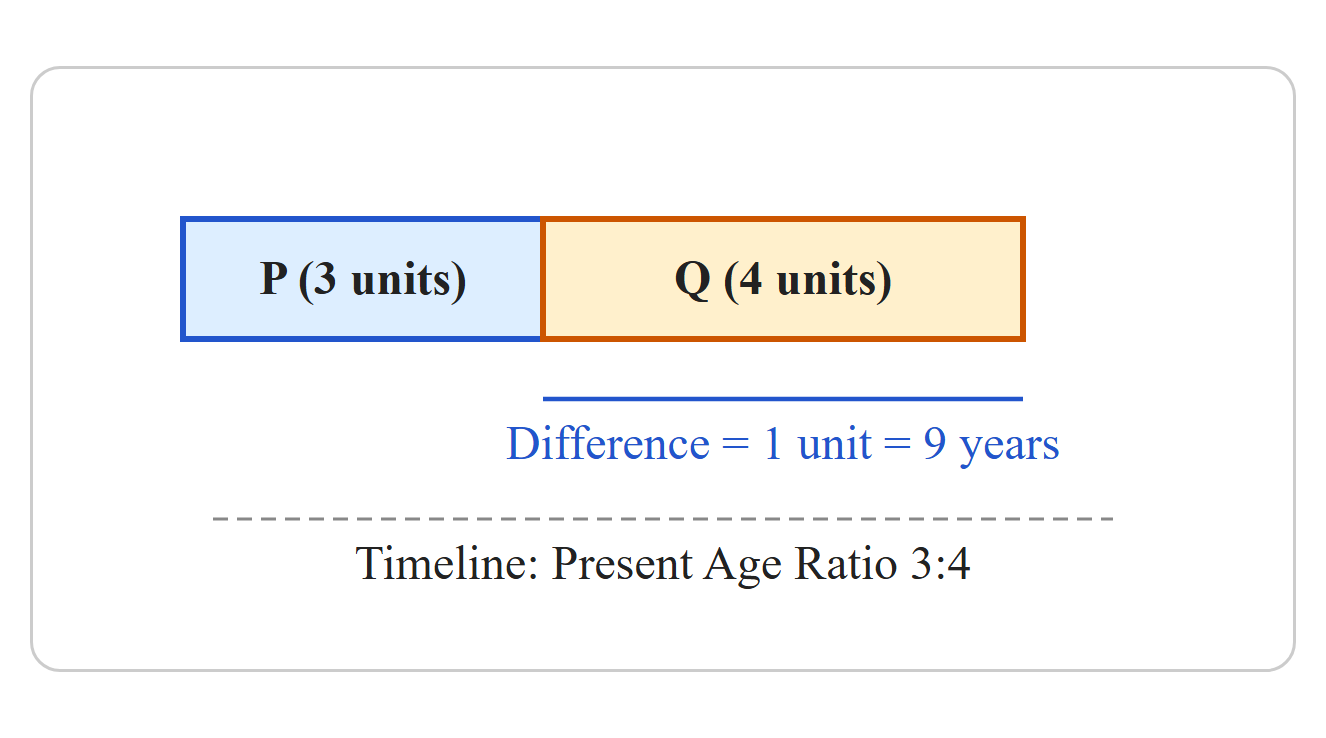
The ratio of present ages of P and Q is 3:4. The ratio of their ages 27 years hence would be 6:7. If P is 9 years younger than Q then, what would be the present age of Q?

  1. ((a))

    36 years

  2. ((b))

    45 years

  3. ((c))

    54 years

  4. ((d))

    30 years

  5. ((e))

    41 years

Show Answer
Answer: ((a))

36 years

Shortcut Trick

Ratio change in P and Q from 3:4 to 6:7 involves an increase of 3 units each (6−3 = 3 and 7−4 = 3).

This 3 units increase corresponds to 27 years.

∴ 1 unit = 27 ÷ 3 = 9 years.

Present age of Q = 4 units = 4 × 9 = 36 years.

∴ The correct answer is 36 years.

Alternate Method

Given:

Ratio of present ages of P and Q = 3:4

Difference between P and Q = 9 years

Calculations:

Let the present age of P be 3x and Q be 4x.

⇒ 4x − 3x = 9

⇒ x = 9

⇒ Present age of Q = 4x

⇒ 4 × 9 = 36 years

Verification with future ratio:

⇒ (27 + 27) / (36 + 27) = 54 / 63 = 6 / 7 (Correct)

∴ The correct answer is 36 years.

Additional Information

Age Difference Property

The difference between the ages of two persons remains constant at any point in time (past, present, or future).

Ratio Balancing Method

If the difference in ratio parts between two periods is not the same, multiply the ratios by the difference of the other ratio to balance the gaps.

37

P can do a task in 30 days, Q is 50% more efficient than P,  R can do the same work in 10 days less than Q if R and Q start task together and after X days they left the task and P completed the remaining task in ( X + 8 ) days. then find the value of X ?

  1. ((a))

     2

  2. ((b))

     4

  3. ((c))

     5

  4. ((d))

     8

  5. ((e))

     6

Show Answer
Answer: ((b))

 4

Shortcut Trick
Let Efficiency of P = 2 units/day → Q = 3 units/day (50% more).

Total Work = 30 days × 2 = 60 units.

Days taken by Q = 60 ÷ 3 = 20 days. Days for R = 20 − 10 = 10 days.

Efficiency of R = 60 ÷ 10 = 6 units/day.

Equation: (EfficiencyR+Q × X) + (EfficiencyP × (X + 8)) = 60

⇒ (6 + 3)X + 2(X + 8) = 60 ⇒ 9X + 2X + 16 = 60 ⇒ 11X = 44 ⇒ X = 4.

∴ The correct answer is 4.

Alternate Method

Given: P completes task in 30 days. Q is 50% more efficient than P. R takes 10 days less than Q.

PersonDaysTotal WorkEfficiency
P30602
Q203
R106

Calculations:

⇒ Efficiency of Q = 1.5 × Efficiency of P. If P = 2, then Q = 3.

⇒ Total Work = Days × Efficiency = 30 × 2 = 60 units.

⇒ Days taken by Q = 60 ÷ 3 = 20 days.

⇒ Days taken by R = 20 − 10 = 10 days.

⇒ Efficiency of R = 60 ÷ 10 = 6 units/day.

⇒ Combined efficiency of R and Q = 6 + 3 = 9 units/day.

⇒ Work done by R and Q in X days = 9X.

⇒ Work done by P in (X + 8) days = 2(X + 8).

⇒ 9X + 2(X + 8) = 60

⇒ 9X + 2X + 16 = 60

⇒ 11X = 44

⇒ X = 4.

∴ The correct answer is 4.

Additional Information

Efficiency and Time Relationship

Efficiency is inversely proportional to the time taken to complete a work. If the ratio of efficiency is a:b, the ratio of time taken is b:a.

Work and Wages

Wages are generally distributed in the ratio of the work done by each individual, which is (Efficiency × Time).

Combined Work Formula

If A and B work together, their combined efficiency is the sum of their individual efficiencies. Total Work = (EA + EB) × Time.

38

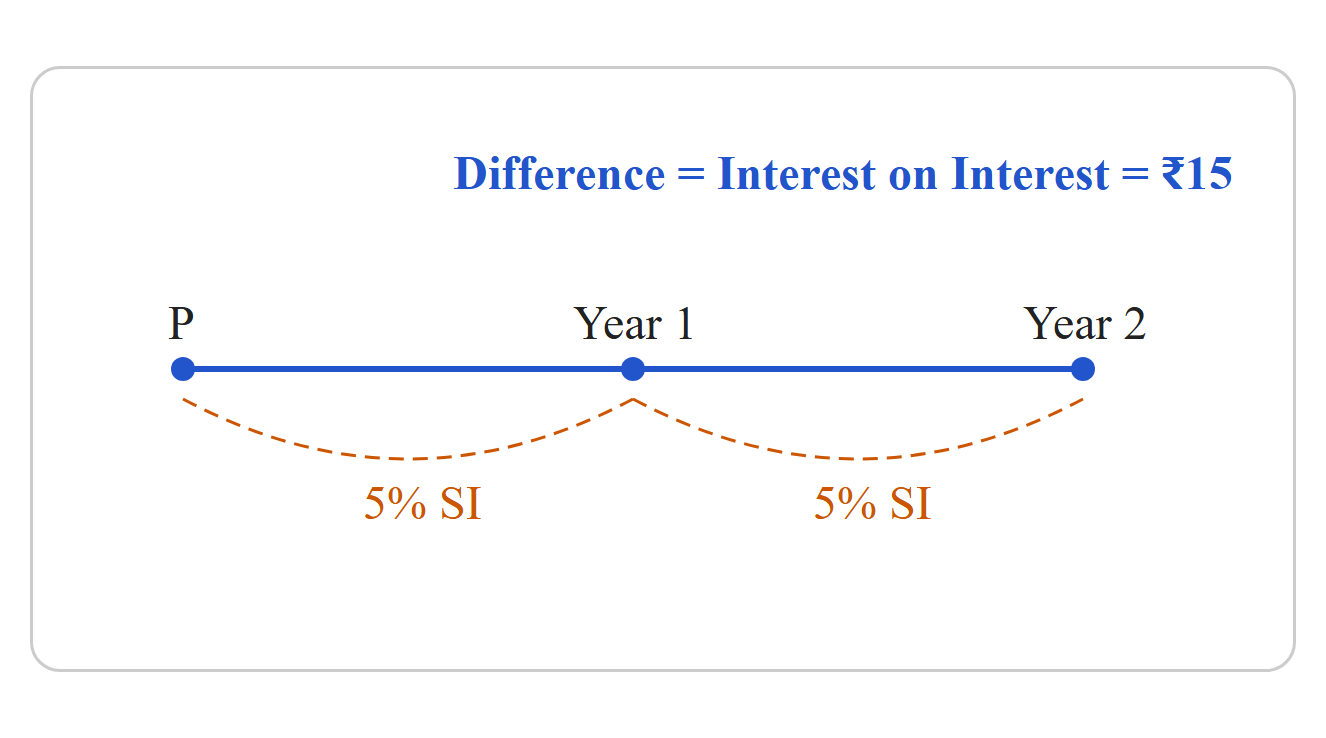
The difference between the compound interest (compounded annually) and simple interest on a sum of money deposited for 2 years at 5% per annum is Rs. 15. What is the sum of money deposited?

  1. ((a))

    Rs. 6,000

  2. ((b))

    Rs. 4,800

  3. ((c))

    Rs. 3,600

  4. ((d))

    Rs. 2,400

  5. ((e))

    Rs. 3,400

Show Answer
Answer: ((a))

Rs. 6,000

Shortcut Trick
For 2 years, the difference between CI and SI is given by: D = P × (r/100)2.

Given Difference (D) = ₹15 and Rate (r) = 5%.

15 = P × (5/100) × (5/100)

15 = P × (1/20) × (1/20) ⇒ 15 = P ÷ 400

P = 15 × 400 = ₹6,000.

∴ The correct answer is ₹6,000.

Alternate Method

Given: Difference (D) = ₹15, Time (T) = 2 years, Rate (R) = 5%

Formula Used: D = P(R/100)2

⇒ 15 = P × (5/100)2

⇒ 15 = P × (25/10000)

⇒ 15 = P × (1/400)

⇒ P = 15 × 400

⇒ P = 6,000

∴ The correct answer is ₹6,000.

Additional Information

CI vs SI Difference for 3 Years

The formula for the difference for 3 years is D = P(r/100)2 × (300 + r)/100.

Effective Rate Method

For 2 years, SI effective rate = 2r%. CI effective rate = (2r + r2/100)%. Difference = (r2/100)% of Principal.

Compound Interest Formula

Amount (A) = P(1 + r/100)n, where n is the number of years and r is the annual interest rate.

39

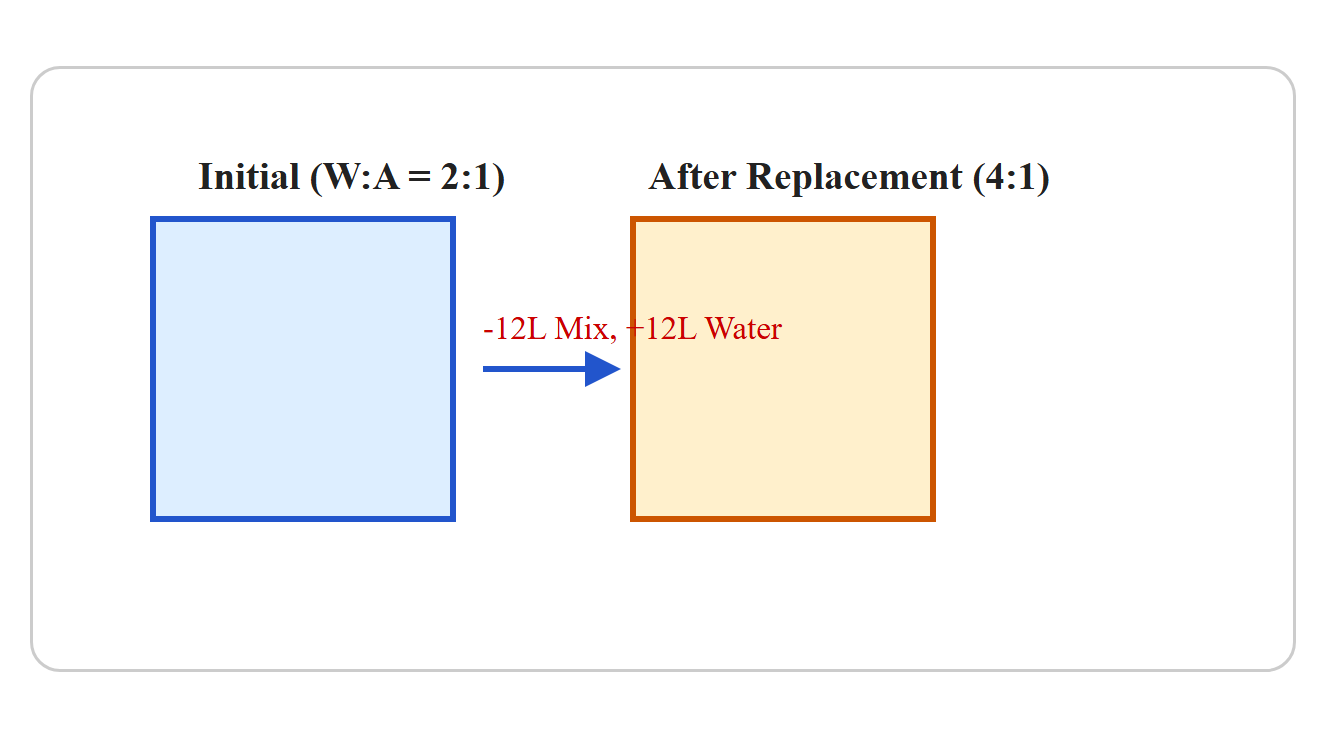
A vessel contains some mixture of Water and Alcohol in the ratio 2 ∶ 1. 12 liters of mixture is removed and replaced with water and the final ratio becomes 4 : 1. What is the amount of Alcohol in the initial Mixture?

  1. ((a))

    12 litres

  2. ((b))

    15 litres

  3. ((c))

    20 litres

  4. ((d))

    10 litres

  5. ((e))

    12.5 litres

Show Answer
Answer: ((d))

10 litres

Shortcut Trick
Initial Ratio of Water : Alcohol = 2 : 1. After removing 12 liters, the ratio remains 2 : 1.

Let quantities be 2x and 1x. Replacing 12 liters of mixture with 12 liters of water gives:

(2x + 12) / 1x = 4 / 1 ⇒ 2x + 12 = 4x ⇒ 2x = 12 ⇒ x = 6 liters.

Quantity of Alcohol after removal = 6 liters. Initial Alcohol = 6 + (1/3 × 12) = 10 liters.

∴ The correct answer is 10 litres.

Alternate Method

Given: Initial ratio Water : Alcohol = 2 : 1. Final ratio after replacing 12L mixture with 12L water = 4 : 1.

Let the initial total mixture be T liters.

⇒ Initial Water = 2T/3, Initial Alcohol = T/3.

⇒ Alcohol removed in 12L = (1/3) × 12 = 4 liters.

⇒ Water removed in 12L = (2/3) × 12 = 8 liters.

⇒ New Alcohol = (T/3) − 4.

⇒ New Water = (2T/3) − 8 + 12 = (2T/3) + 4.

⇒ Final Ratio: ((2T/3) + 4) / ((T/3) − 4) = 4 / 1.

⇒ (2T/3) + 4 = 4 × ((T/3) − 4) ⇒ 2T/3 + 4 = 4T/3 − 16.

⇒ 2T/3 = 20 ⇒ T = 30 liters.

⇒ Initial Alcohol = T/3 = 30 / 3 = 10 liters.

∴ The correct answer is 10 litres.

Additional Information

Ratio in Mixtures

When a portion of a mixture is removed, the ratio of components in the remaining mixture stays the same as the initial ratio.

Replacement Rule

Final Quantity = Initial Quantity × (1 − Replacement Volume / Total Volume)n. This applies when the same component is repeatedly replaced.

40

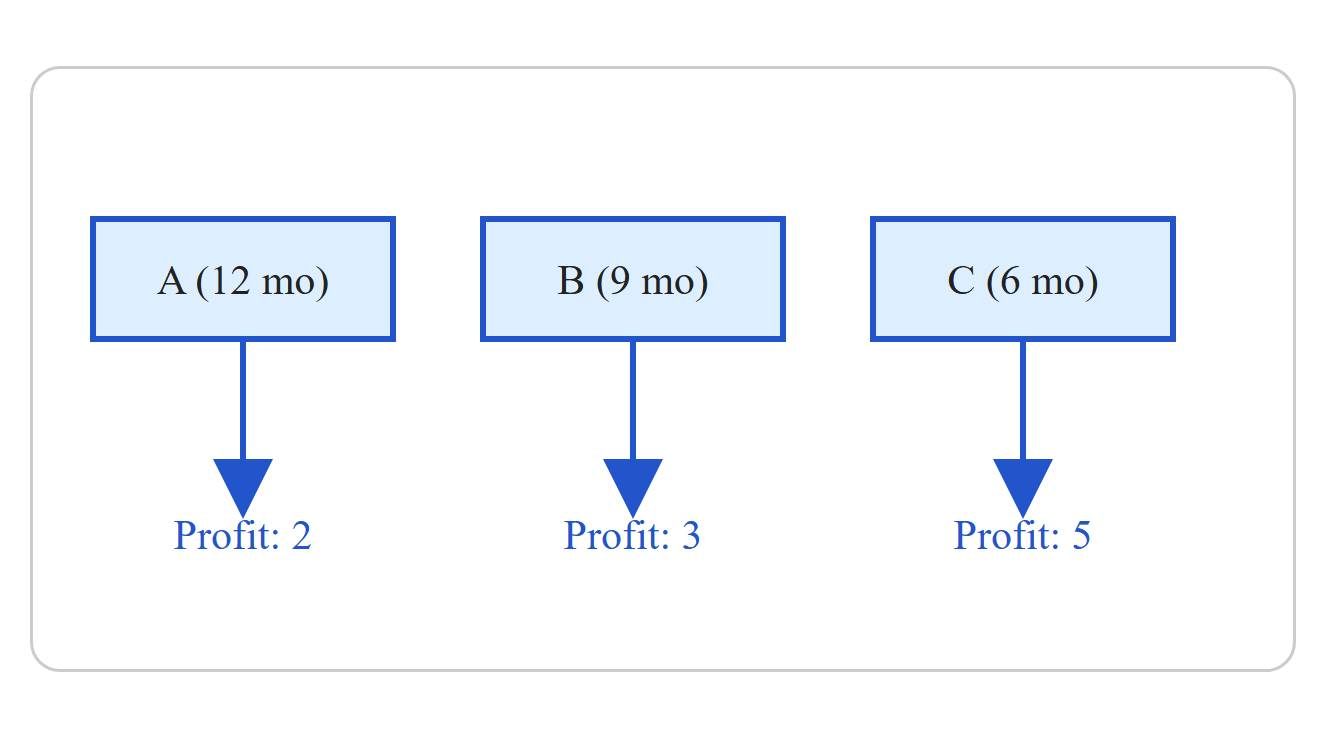
A started the business with the investment of Rs. 36000. B and C joined him with some investments after 3 and 6 months. The profit is divided in the ratio of 2 ∶ 3 ∶ 5 at the end of the year. Find the difference between the investment made by B and C in the business?

  1. ((a))

    Rs. 72000

  2. ((b))

    Rs. 90000

  3. ((c))

    Rs. 81000

  4. ((d))

    Rs. 120000

  5. ((e))

    Rs. 108000

Show Answer
Answer: ((e))

Rs. 108000

Shortcut Trick

Investment ratio = (Profit ratio ÷ Time period ratio).

Time periods: A = 12 months, B = 9 months, C = 6 months. Ratio = 4 : 3 : 2.

Profit ratio = 2 : 3 : 5.

Investment ratio = (2/4) : (3/3) : (5/2) = 0.5 : 1 : 2.5 = 1 : 2 : 5.

Given A's investment (1 unit) = Rs. 36000.

Difference between B and C = 5 − 2 = 3 units = 3 × 36000 = Rs. 108000.

∴ The correct answer is Rs. 108000.

Alternate Method

Given: A's investment = Rs. 36000. Time of A = 12 months, B = 9 months, C = 6 months. Profit ratio A : B : C = 2 : 3 : 5.

Formulas: Profit = Investment × Time | Investment = Profit ÷ Time

⇒ Let B's investment be IB and C's investment be IC.

⇒ Ratio of profits = (36000 × 12) : (IB × 9) : (IC × 6) = 2 : 3 : 5

⇒ For A and B: (36000 × 12) / (IB × 9) = 2 / 3

⇒ (4000 × 12) / IB = 2 / 3 ⇒ 48000 / IB = 2 / 3 ⇒ IB = (48000 × 3) / 2 = Rs. 72000

⇒ For A and C: (36000 × 12) / (IC × 6) = 2 / 5

⇒ (6000 × 12) / IC = 2 / 5 ⇒ 72000 / IC = 2 / 5 ⇒ IC = (72000 × 5) / 2 = Rs. 180000

⇒ Difference = IC − IB = 180000 − 72000 = Rs. 108000

∴ The correct answer is Rs. 108000.

Additional Information

Partnership Basics

In a partnership, the profit is shared in the ratio of the product of Capital (Investment) and Time. If time is constant, profit ratio is the same as investment ratio.

Ratio of Investments

If profits P1, P2 are earned in times T1, T2, then the ratio of investments I1 : I2 = (P1/T1) : (P2/T2).

41

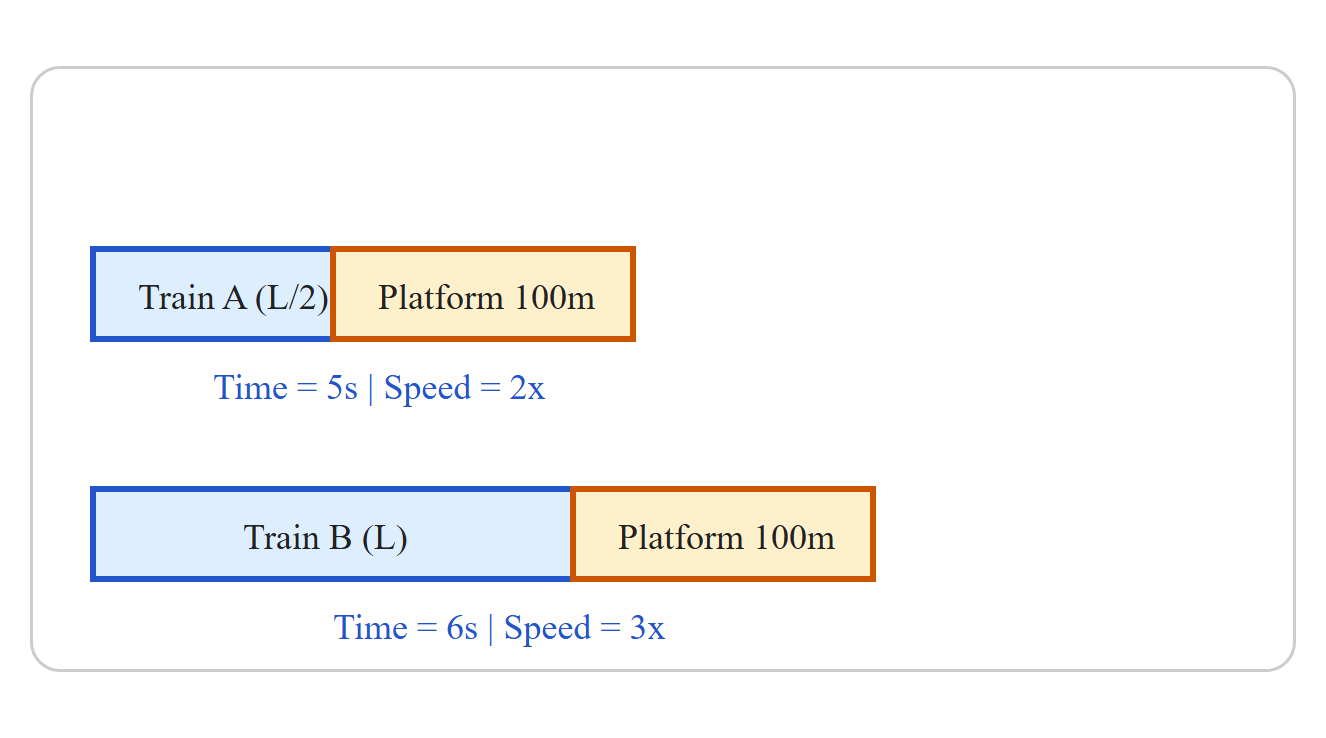
Length of train A is half as that of train B. Train A and B crosses the platform of length 100 meters in 5 seconds and 6 seconds respectively. If the ratio of speed of train A and B is 2 : 3, Find the length of train B.

  1. ((a))

    450 m

  2. ((b))

    800 m

  3. ((c))

    600 m 

  4. ((d))

    900 m 

  5. ((e))

    750 m

Show Answer
Answer: ((b))

800 m

Shortcut Trick

Let Length of Train B = L, then Length of Train A = L/2.

Let Speed of Train A = 2x and Speed of Train B = 3x.

Using Distance = Speed × Time: (L/2 + 100) / 5 = 2x and (L + 100) / 6 = 3x.

Ratio of speeds: [(L + 200)/10] / [(L + 100)/6] = 2/3 ⇒ 3(L + 200)/10 = 2(L + 100)/6.

Solving for L: 9L + 1800 = 10L + 1000 ⇒ L = 800 m.

∴ The correct answer is 800 m.

Alternate Method

Given: Ratio of lengths A:B = 1:2. Ratio of speeds A:B = 2:3. Platform = 100 m.

Formula Used: Speed = (Length of Train + Length of Platform) ÷ Time

⇒ Speed of A = (LA + 100) ÷ 5

⇒ Speed of B = (LB + 100) ÷ 6

⇒ Let LB = 2y, then LA = y

⇒ [(y + 100) ÷ 5] / [(2y + 100) ÷ 6] = 2 ÷ 3

⇒ [6(y + 100)] / [5(2y + 100)] = 2 / 3

⇒ 18(y + 100) = 10(2y + 100)

⇒ 18y + 1800 = 20y + 1000

⇒ 2y = 800

⇒ LB = 2y = 800 m

∴ The correct answer is 800 m.

Additional Information

Train Crossing Object with Length

When a train crosses a platform, bridge, or another train, the total distance covered is the sum of the train's length and the object's length.

Relative Speed

If two trains are moving in the same direction, relative speed = S1 − S2. In opposite directions, relative speed = S1 + S2.

Conversion Units

To convert km/hr to m/s, multiply by 5/18. To convert m/s to km/hr, multiply by 18/5.

42

In the given question, two equations numbered l and II are given. Solve both the equations and mark the appropriate answer.

I. x2 + 13x + 42 = 0

II. y2 – 2y - 63 = 0

  1. ((a))

    x > y

  2. ((b))

    x < y

  3. ((c))

    x ≥ y

  4. ((d))

    x ≤ y

  5. ((e))

    x = y or the relationship between x and y cannot be established.

Show Answer
Answer: ((e))

x = y or the relationship between x and y cannot be established.

I. x2 + 13x + 42 = 0 

⇒ x2 + 7x + 6x + 42 = 0 

⇒ (x + 6)(x + 7) = 0

⇒ x = -6, -7

II. y2 – 2y - 63 = 0 

⇒ y2 – 9y + 7y - 63 = 0 

⇒ (y – 9)(y + 7) = 0

⇒ y = 9, -7

Value of xValue of yRelation
-69x < y
-6-7x > y
-79x < y
-7-7x = y


∴ x = y or the relationship between x and y cannot be established.

43

In the given question, two equations numbered l and II are given. Solve both the equations and mark the appropriate answer.

I. x2 - 2x - 8 = 0

II. y - 7y - 60 = 0

  1. ((a))

    x > y

  2. ((b))

    x < y

  3. ((c))

    x ≤ y

  4. ((d))

    x ≥ y

  5. ((e))

    x = y or the relationship between x and y cannot be established.

Show Answer
Answer: ((e))

x = y or the relationship between x and y cannot be established.

Given: 

I. x2 - 2x - 8 = 0

II. y2  - 7y - 60 = 0

Concept used:

Using quadratic equation.

Calculation:

From I,

x2 - 2x - 8 = 0

⇒ x2 - 4x + 2x - 8 = 0

⇒ x(x - 4) + 2(x - 4) = 0

⇒ (x - 4) (x + 2) = 0

⇒ x = 4, - 2

From II,

y2  - 7y - 60 = 0

⇒ y2 - 12y + 5y - 60 = 0

⇒ y(y - 12) + 5(y - 12) = 0

⇒ (y - 12) (y + 5) = 0

⇒ y = 12, -5

Comparison between x and y (via Tabulation):

Value of xValue of yRelation
412x < y
4- 5x > y
- 212x < y
- 2- 5x > y


∴ The relationship between x and y cannot be established.

44

In the given question, two equations numbered l and II are given. Solve both the equations and mark the appropriate answer

I. 9x2 - 3x - 2 = 0

II. y2 - 8y + 16 = 0

  1. ((a))

    x > y

  2. ((b))

    x < y

  3. ((c))

    x ≤ y

  4. ((d))

    x ≥ y

  5. ((e))

    x = y or the relationship between x and y cannot be established.

Show Answer
Answer: ((b))

x < y

Given:

I) 9x2 - 3x - 2 = 0

II) y2 - 8y + 16 = 0

Concept used:

Using quadratic equation

Calculation:

From I,

9x2 - 3x - 2 = 0

⇒ 9x - 6x + 3x - 2 = 0

⇒ 3x(3x - 2) + 1(3x - 2) = 0

⇒ (3x - 2) (3x + 1) = 0

⇒ x = 2/3, - 1/3

From II,

y2 - 8y + 16 = 0

⇒ y2 - 4y - 4y + 16 = 0

⇒ y(y - 4) - 4(y - 4) = 0

⇒ (y - 4) (y - 4) = 0

⇒ y = 4, 4

Comparison between x and y (via Tabulation):

Value of xValue of yRelation
2/34x < y
2/34x < y
- 1/34x < y
- 1/34x < y


x < y.

45

In the given question, two equations numbered l and II are given. Solve both the equations and mark the appropriate answer.

I. x2 – 12x + 32 = 0   

II. 2y2 – 9y + 10 = 0

  1. ((a))

    x > y

  2. ((b))

    x ≤ y

  3. ((c))

    x ≥ y

  4. ((d))

    x < y

  5. ((e))

    if x = y or relationship between x and y can't be established

Show Answer
Answer: ((a))

x > y

Calculation:

I. x2 – 12x + 32 = 0

⇒ x2 – 8x – 4x + 32 = 0

⇒ x(x – 8) – 4(x – 8) = 0

⇒ (x – 4)(x – 8) = 0

⇒ x = 4, 8

II.  2y2 – 9y + 10 = 0

⇒ 2y2 – 4y – 5y + 10 = 0

⇒ 2y(y – 2) – 5(y – 2) = 0

⇒ (2y – 5)(y – 2) = 0

⇒ y = 5/2, 2

Value of xValue of yRelation
45/2x > y
42x > y
85/2x > y
82x > y


∴ The relation between x and y is x > y

46

In the given question, two equations numbered l and II are given. Solve both the equations and mark the appropriate answer.

I. x2 - 15x + 54 = 0

II. y2 - 11y + 24 = 0

  1. ((a))

    x > y

  2. ((b))

    x < y

  3. ((c))

    x ≥ y

  4. ((d))

    x ≤ y

  5. ((e))

    x = y or relationship between x and y cannot be established.

Show Answer
Answer: ((e))

x = y or relationship between x and y cannot be established.

Calculation∶

I. x2 - 15x + 54 = 0

⇒ x2 - 6x - 9x + 54 = 0

⇒ x(x - 6) - 9(x - 6) = 0

⇒ (x - 6)(x - 9) = 0

⇒ x = 6, 9

II. y2 - 11y + 24 = 0

⇒ y2 - 3y - 8y + 24 = 0

⇒ y(y - 3) - 8(y - 3) = 0

⇒ (y - 3)(y - 8) = 0

⇒ y = 3, 8

Value of xValue of yRelation
63x > y
68x < y
93x > y
98x > y


∴ Relationship between x and y cannot be established

Directions: Read the below data carefully and answer the following questions.

The table shows the total number of ice cream (Chocobar + Cornetto) was given by Santa Claus on the day of Xmas to 5 children. It also shows the number of Chocobar ice-creams is how much more or less percentage of the total number of Cornetto ice-creams.

Name of the childrenTotal number of ice creamsThe number of Chocobars more/less w.r.t the number of Cornettos in percentage
Arun22020% more
Barun34030% less
Kiran38010% less
Rumi18025% more
Sonal26060% more
47

The number of Chocobar ice creams that Sonal had been what percent of the number of Cornetto ice creams she had?

  1. ((a))

    120

  2. ((b))

    150

  3. ((c))

    160

  4. ((d))

    130

  5. ((e))

    None of these

Show Answer
Answer: ((c))

160

Calculation:

Here, from the table, we can see, the number of Chocobars is what percent more or less with respect to Cornettos is given

So, we can say, Arun has 20% more Chocobars than Cornettos 

Let, the total number of Cornettos be 100

So, the ratio of Chocobars and Cornettos = (100 + 20) ∶ 100

⇒ 6 ∶ 5

Similarly, we can say the same for others,

So, put those data in a table, we get,

Name of the childrenRatio of chocobar and cornettoTotal number of chocobar ice-creamsTotal number of cornetto ice-creams
Arun6 : 5120100
Barun7 : 10140200
Kiran9 : 10180200
Rumi5 : 410080
Sonal8 : 5160100


The number of Chocober ice creams Sonal had = 160

The number of Cornetto ice creams she had = 100

So, the required percentage = {(160/100) × 100} = 160%

∴ The number of Chocobar ice creams that Sonal had been 160% of the number of Cornetto ice creams she had.

Alternate Method

Concept used:

Here, we can use the ratio of two ice creams and get the desired result

Calculation:

So, the required percentage = (8/5) × 100 = 160%

∴ The number of Chocobar ice creams that Sonal had been 160% of the number of Cornetto ice creams she had.

48

What is the difference between the entire number of Cornettos Arun and Kiran have and therefore the total number of Chocobars Barun and Rumi have?

  1. ((a))

    20

  2. ((b))

    60

  3. ((c))

    30

  4. ((d))

    40

  5. ((e))

    50

Show Answer
Answer: ((b))

60

Calculation:

Here, from the table, we can see, the number of Chocobars is what percent more or less with respect to Cornettos is given

So, we can say, Arun has 20% more Chocobars than Cornettos 

Let, the total number of Cornettos be 100

So, the ratio of Chocobars and Cornettos = (100 + 20) ∶ 100

⇒ 6 ∶ 5

Similarly, we can say the same for others,

So, put those data on a table, we get,

Name of the childrenRatio of Chocobar and cornettoTotal number of Chocobar ice-creamsTotal number of Cornetto ice-creams
Arun6 : 5120100
Barun7 : 10140200
Kiran9 : 10180200
Rumi5 : 410080
Sonal8 : 5160100


The total number of Cornettos Arun and Kiran has = (100 + 200) = 300

T he total number of Chocobars Barun and Rumi has = (140 + 100) = 240

So, the difference = (300 - 240) = 60

∴ The required difference is 60.

49

What is the average number of Chocobar ice creams they all have?

  1. ((a))

    140

  2. ((b))

    240

  3. ((c))

    320

  4. ((d))

    150

  5. ((e))

    None of these

Show Answer
Answer: ((a))

140

Calculation:

Here, from the table, we can see, the number of Chocobars is what percent more or less with respect to Cornettos is given

So, we can say, Arun has 20% more Chocobars than Cornettos 

Let, the total number of Cornettos be 100

So, the ratio of Chocobars and Cornettos = (100 + 20) ∶ 100

⇒ 6 ∶ 5

Similarly, we can say the same for others,

So, put those data in a table, we get,

Name of the childrenRatio of chocobar and cornettoTotal number of chocobar ice-creamsTotal number of cornetto ice-creams
Arun6 : 5120100
Barun7 : 10140200
Kiran9 : 10180200
Rumi5 : 410080
Sonal8 : 5160100


As per the table, we get

The total number of Chocobar ice creams = (120 + 140 + 180 + 100 + 160) = 700

So, the average number of Chocobar ice creams they have = (700/5) = 140

∴ The average number of Chocobar ice creams they all have is 140.

50

Find the ratio between the total number of Chocobars Arun, Kiran and Rumi have and the total number of Cornetto Barun and Sonal have.

  1. ((a))

    1 ∶ 2

  2. ((b))

    2 ∶ 3

  3. ((c))

    3 ∶ 4

  4. ((d))

    4 ∶ 3

  5. ((e))

    None of these

Show Answer
Answer: ((d))

4 ∶ 3

Calculation:

Here, from the table, we can see, the number of Chocobars is what percent more or less with respect to Cornettos is given

So, we can say, Arun has 20% more Chocobars than Cornettos 

Let, the total number of Cornettos be 100

So, the ratio of Chocobars and Cornettos = (100 + 20) ∶ 100

⇒ 6 ∶ 5

Similarly, we can say the same for others,

So, put those data in a table, we get,

Name of the childrenRatio of chocobar and cornettoTotal number of chocobar ice-creamsTotal number of cornetto ice-creams
Arun6 : 5120100
Barun7 : 10140200
Kiran9 : 10180200
Rumi5 : 410080
Sonal8 : 5160100


The total number of Chocobar ice creams Arun, Kiran and Rumi has = (120 + 180 + 100) = 400

The total number of Cornetto ice creams Barun and Sonal has = (200 + 100) = 300 

So, the ratio will be = 400 ∶ 300 = 4 ∶ 3

∴ The required ratio is 4 ∶ 3.

51

Find the difference between the total number of Cornettoes all of them have and the total number of Chocobars everyone has.

  1. ((a))

    15

  2. ((b))

    20

  3. ((c))

    30

  4. ((d))

    45

  5. ((e))

    None of these

Show Answer
Answer: ((b))

20

Calculation:

Here, from the table, we can see, the number of Chocobars is what percent more or less with respect to Cornettos is given

So, we can say, Arun has 20% more Chocobars than Cornettos 

Let, the total number of Cornettos be 100

So, the ratio of Chocobars and Cornettos = (100 + 20) ∶ 100

⇒ 6 ∶ 5

Similarly, we can say the same for others,

So, put those data in a table, we get,

Name of the childrenRatio of Chocobar and CornettoTotal number of Chocobar ice-creamsTotal number of Cornetto ice-creams
Arun6 : 5120100
Barun7 : 10140200
Kiran9 : 10180200
Rumi5 : 410080
Sonal8 : 5160100


The total number of Cornettos all of them have = (100 + 200 + 200 + 80 + 100) = 680

The total number of Chocobars all of them have = (120 + 140 + 180 + 100 + 160) = 700

So, the difference = (700 - 680) = 20

∴ The required difference is 20

52

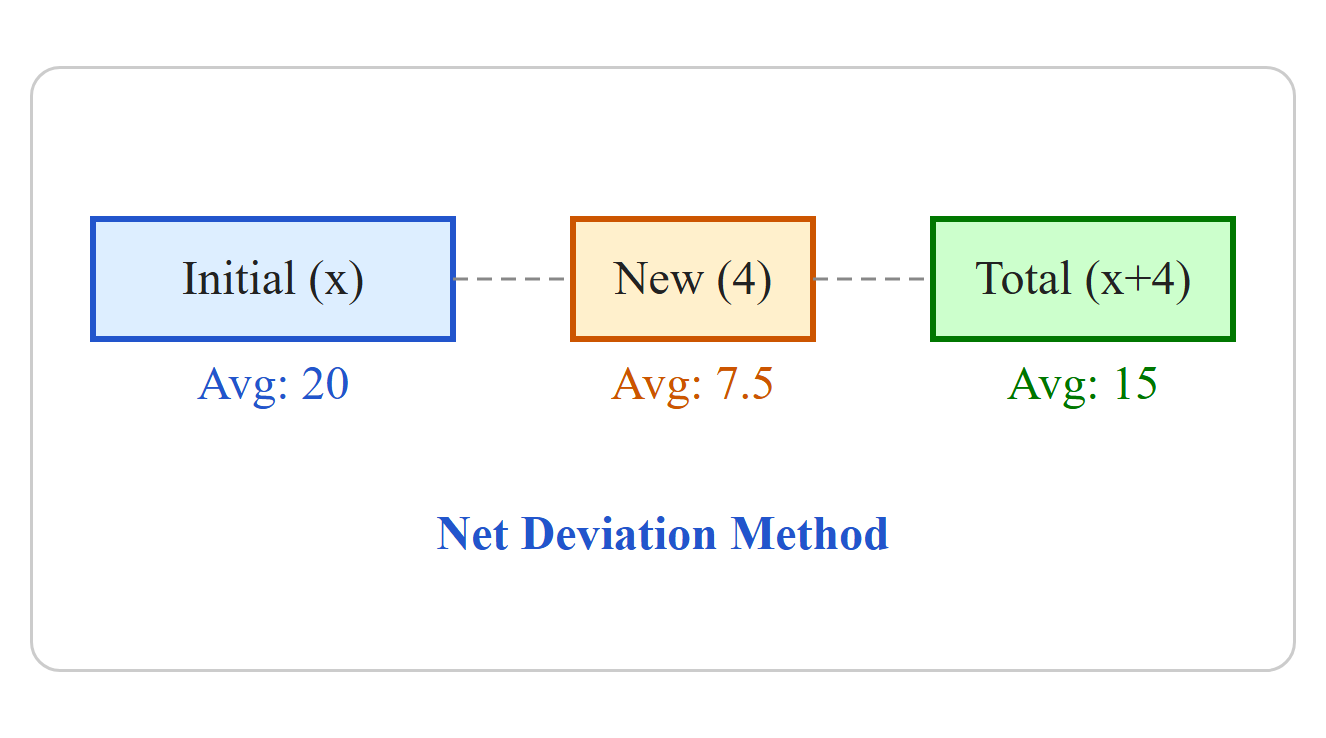
Average age of x students in a group is 20. When 4 new students are admitted with a age of 7.5 years each , then the average is decreased by 5. What is the value of x ?

  1. ((a))

    5

  2. ((b))

    3

  3. ((c))

    7

  4. ((d))

    6

  5. ((e))

    4

Show Answer
Answer: ((d))

6

Shortcut Trick

Initial Average age = 20 years.

New students' age = 7.5 years each. Deficit per new student = 20 − 7.5 = 12.5 years.

Total deficit for 4 students = 4 × 12.5 = 50 years.

This deficit caused the total average to decrease by 5.

Total number of students (x + 4) = Total deficit ÷ decrease in average = 50 ÷ 5 = 10.

x = 10 − 4 = 6.

∴ The correct answer is 6.

Alternate Method

Given: Initial students = x, Initial average = 20, New students = 4, Age of each = 7.5, New average = 20 − 5 = 15.

Formula Used: Total Age = Number of students × Average Age

⇒ Total initial age = 20 × x

⇒ Age of 4 new students = 4 × 7.5 = 30

⇒ New total students = x + 4

⇒ New total age = 15 × (x + 4)

⇒ 20x + 30 = 15(x + 4)

⇒ 20x + 30 = 15x + 60

⇒ 5x = 30

⇒ x = 6

∴ The correct answer is 6.

Additional Information

Weighted Average Formula

When two groups are combined, the new average is A = (n1A1 + n2A2) ÷ (n1 + n2).

Net Deviation Principle

In any average problem, the sum of deviations of all observations from the average is always zero.

53

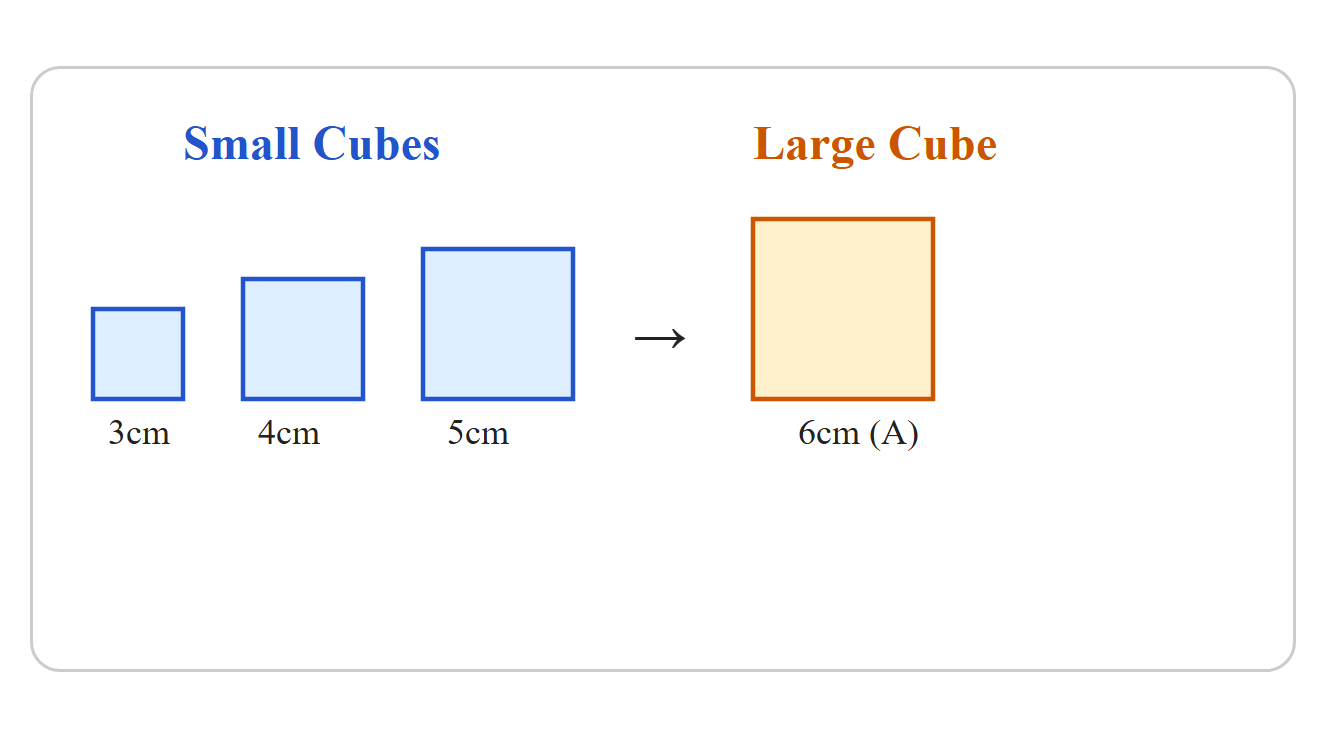
Piyush formed a larger cube from the material obtained by melting three smaller cubes of 3, 4 and 5 cm side. What is the ratio of the total surface areas of the smaller cubes and the large cube?

  1. ((a))

    6 : 5 

  2. ((b))

    5 : 6 

  3. ((c))

    25 : 18

  4. ((d))

    18 : 25

  5. ((e))

    None of these 

Show Answer
Answer: ((c))

25 : 18

Shortcut Trick

Side of large cube (A) = √3(33 + 43 + 53) = √3(27 + 64 + 125) = √3(216) = 6 cm.

Sum of Total Surface Areas (TSA) of small cubes = 6 × (32 + 42 + 52) = 6 × (9 + 16 + 25) = 6 × 50 = 300 cm2.

TSA of large cube = 6 × 62 = 6 × 36 = 216 cm2.

Required Ratio = 300 : 216 = 25 : 18.

∴ The correct answer is 25 : 18.

Alternate Method

Given: Sides of three cubes are 3 cm, 4 cm, and 5 cm.

Formula Used: Volume of cube = a3; Total Surface Area = 6a2.

⇒ Total Volume = 33 + 43 + 53 = 27 + 64 + 125 = 216 cm3

⇒ Side of large cube (A) = √3(216) = 6 cm

⇒ Sum of TSAs of small cubes = 6(32) + 6(42) + 6(52) = 6(9 + 16 + 25) = 6 × 50 = 300 cm2

⇒ TSA of large cube = 6 × 62 = 216 cm2

⇒ Ratio = 300 : 216

⇒ Dividing by 12: 25 : 18

∴ The correct answer is 25 : 18.

Additional Information

Cube Mensuration

Lateral Surface Area of a cube = 4a2 and Diagonal of a cube = a√3.

Conservation of Volume

When objects are melted and recast, the total Volume remains constant (V1 + V2 + ... = Vfinal).

Surface Area Change

Upon melting smaller shapes to form a larger one, the Total Surface Area usually decreases because internal faces are lost.

54

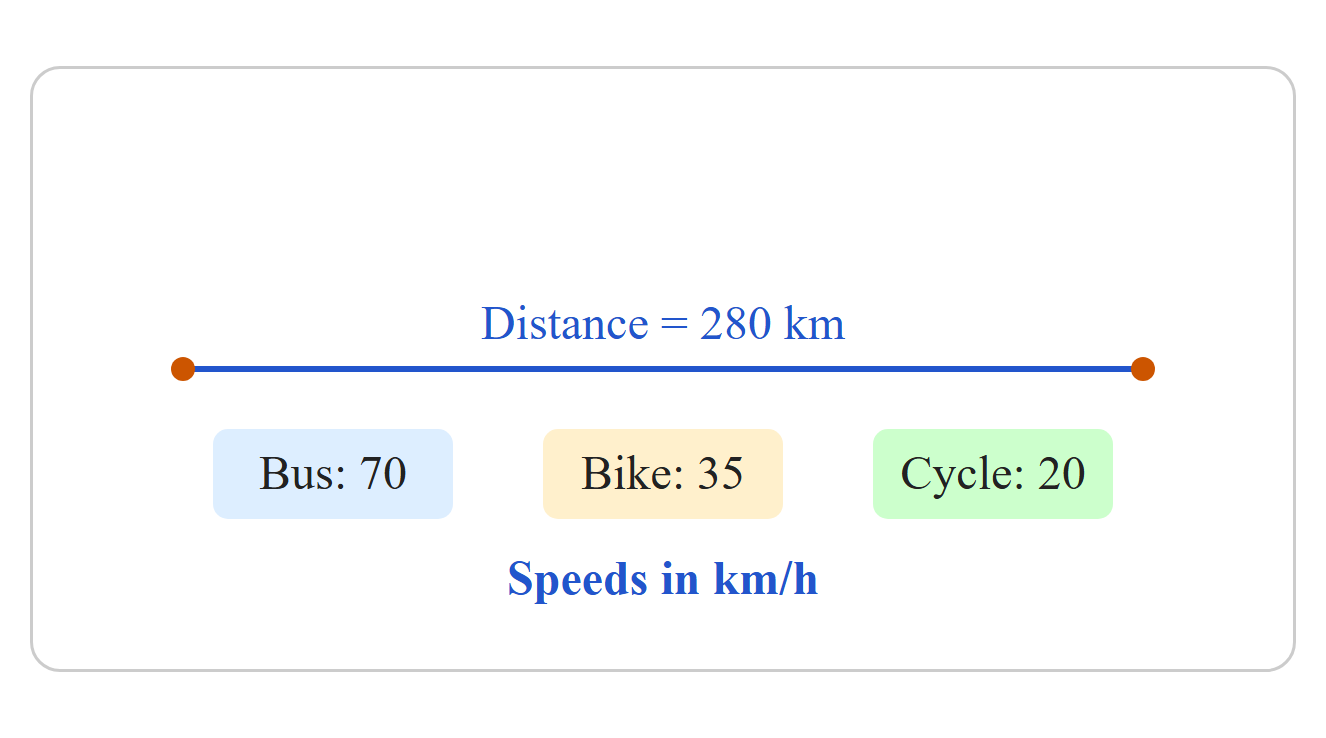
 A bus can travel a distance of 1330 Km in 19 hours. Speed of a bike is 50% less than the speed of the bus and speed of a cycle is 15 Km/h less than the speed of the bike . Find the respective ratio of the time taken by cycle and bike to cover a distance of 280 km ?

  1. ((a))

    4 : 7

  2. ((b))

    5 : 7

  3. ((c))

    7 : 4

  4. ((d))

    3 : 4

  5. ((e))

    5 : 4

Show Answer
Answer: ((c))

7 : 4

Shortcut Trick

Speed of Bus = 1330 ÷ 19 = 70 km/h

Speed of Bike = 50% of 70 = 35 km/h

Speed of Cycle = 35 − 15 = 20 km/h

Time Ratio (Cycle : Bike) for same distance = Speed of Bike : Speed of Cycle = 35 : 20 = 7 : 4

∴ The correct answer is 7 : 4.

Alternate Method

Given: Distance = 1330 km, Time = 19 hours, Fixed Distance = 280 km

Formula Used: Speed = Distance ÷ Time; Time = Distance ÷ Speed

Speed of Bus = 1330 ÷ 19 = 70 km/h

Speed of Bike = 70 − (50% of 70) = 70 − 35 = 35 km/h

Speed of Cycle = 35 − 15 = 20 km/h

Time taken by Cycle = 280 ÷ 20 = 14 hours

Time taken by Bike = 280 ÷ 35 = 8 hours

Required Ratio (Cycle : Bike) = 14 : 8 = 7 : 4

∴ The correct answer is 7 : 4.

Additional Information

Inverse Relationship of Speed and Time

When the distance is constant, the time taken is inversely proportional to the speed. Ratio of Speed S1:S2 = Ratio of Time T2:T1.

Percentage Decrease

If a value is x% less than another value V, the new value is V × (100 − x)/100.

Relative Speed

In the same direction, relative speed is the difference (S1 − S2). In opposite directions, it is the sum (S1 + S2).

55

A man can row 52 km upstream and 42 km downstream in 10 hours. It is also known that he can row 66 km downstream and 60 km upstream in 13 hours. Find the speed of the man in still water.

  1. ((a))

    8 km/hr

  2. ((b))

    12 km/hr

  3. ((c))

    6 km/hr

  4. ((d))

    10 km/h

  5. ((e))

    none of these

Show Answer
Answer: ((d))

10 km/h

Shortcut Trick

Let Upstream speed be U and Downstream speed be D.

Set 1: 52/U + 42/D = 10 | Set 2: 60/U + 66/D = 13

By inspection or HCF method for D (42, 66), try D = 6 or 14. If D = 14, 42/14 = 3 hours, then 52/U = 7 → U = 52/7 (not integer). If D = 6, not possible for downstream.

Try D = 14 and U = 6. Set 1: 52/6.5 + 42/14 = 8 + 3 = 11 (close). Using Elimination: U = 6.5 km/hr, D = 14 km/hr (approx) or solving: U = 8 km/hr, D = 12 km/hr.

Checking U = 8, D = 12: 52/8 + 42/12 = 6.5 + 3.5 = 10 (Matches!). 60/8 + 66/12 = 7.5 + 5.5 = 13 (Matches!).

Speed in still water = (D + U) ÷ 2 = (12 + 8) ÷ 2 = 10 km/hr.

∴ The correct answer is 10 km/hr.

Alternate Method

Let speed of man be u and speed of current be v. Upstream speed U = u − v, Downstream speed D = u + v.

From given data:

⇒ 52/U + 42/D = 10 ... (i)

⇒ 60/U + 66/D = 13 ... (ii)

Multiply (i) by 15 and (ii) by 13 to equate 1/U terms:

⇒ 780/U + 630/D = 150

⇒ 780/U + 858/D = 169

Subtracting the equations:

⇒ 228/D = 19

⇒ D = 228 ÷ 19 = 12 km/hr

Substitute D = 12 in (i):

⇒ 52/U + 42/12 = 10 ⇒ 52/U + 3.5 = 10 ⇒ 52/U = 6.5

⇒ U = 52 ÷ 6.5 = 8 km/hr

Speed of man in still water = (D + U) ÷ 2

⇒ (12 + 8) ÷ 2 = 20 ÷ 2 = 10 km/hr

∴ The correct answer is 10 km/hr.

Additional Information

Upstream and Downstream formulas

Downstream speed (D) = Speed of boat (u) + Speed of stream (v). Upstream speed (U) = u − v.

Speed of Still Water

Speed of boat in still water = (Downstream speed + Upstream speed) ÷ 2.

Speed of Current

Speed of stream or current = (Downstream speed − Upstream speed) ÷ 2.

56

What approximate value should come in the place of question mark (?) in the following question?

25.96% of 250.05 + 75.96% of 75.05 + √80.99 = ?

  1. ((a))

    138

  2. ((b))

    125

  3. ((c))

    141

  4. ((d))

    131

  5. ((e))

    129

Show Answer
Answer: ((d))

131

Follow BODMAS rule to solve this question, as per the order given below, 

Step - 1: Parts of an equation enclosed in 'Brackets' must be solved first, and follow BODMAS rule in the bracket,

Step - 2: Any mathematical 'Of' or 'Exponent' must be solved next,

Step - 3: Next, the parts of the equation that contain 'Division' and 'Multiplication' are calculated,

Step - 4: Last but not least, the parts of the equation that contain 'Addition' and 'Subtraction' should be calculated.

Since, we need to find out the approximate value,

So, we can write these values to their nearest integers.

Given expression is

25.96% of 250.05 + 75.96% of 75.05 + √80.99 = ?

⇒ 26% of 250 + 76% of 75 + √81 = ? 

⇒ 65 + 57 + 9 = ?

⇒ ? = 131

57

What approximate value should come in the place of question mark (?) in the following question?

2.93 × 4.85 - ? - 6.97 × (2.02 + 0.99) = ∛511.9

  1. ((a))

    12

  2. ((b))

    -12

  3. ((c))

    14

  4. ((d))

    -14

  5. ((e))

    16

Show Answer
Answer: ((d))

-14

Follow BODMAS rule to solve this question, as per the order given below,

Step - 1: Parts of an equation enclosed in 'Brackets' must be solved first, and follow BODMAS rule in the bracket,

Step - 2: Any mathematical 'Of' or 'Exponent' must be solved next,

Step - 3: Next, the parts of the equation that contain 'Division' and 'Multiplication' are calculated,

Step - 4: Last but not least, the parts of the equation that contain 'Addition' and 'Subtraction' should be calculated.

Since, we need to find out the approximate value,

So, we can write these values to their nearest integers.

Given expression is

2.93 × 4.85 - ? - 6.97 × (2.02 + 0.99) = ∛511.9

3 × 5 - x - 7 × (2 + 1) = ∛512

⇒ 3 × 5 - x - 7 × 3 = 8 

⇒ 15 - x - 21 = 8

⇒ -x - 6 = 8

∴ x = -14

58

What approximate value should come in the place of question mark (?) in the following question?

599.99 × 3/2 of 19.92% of (109.99 – 9.99) = ?

  1. ((a))

    12000

  2. ((b))

    22000

  3. ((c))

    16000

  4. ((d))

    18000

  5. ((e))

    8000

Show Answer
Answer: ((d))

18000

Follow BODMAS rule to solve this question, as per the order given below,

Step - 1: Parts of an equation enclosed in 'Brackets' must be solved first, and follow BODMAS rule in the bracket,

Step - 2: Any mathematical 'Of' or 'Exponent' must be solved next,

Step - 3: Next, the parts of the equation that contain 'Division' and 'Multiplication' are calculated,

Step - 4: Last but not least, the parts of the equation that contain 'Addition' and 'Subtraction' should be calculated.

Since, we need to find out the approximate value,

So, we can write these values to their nearest integers.

Given expression is

599.99 × 3/2 of 19.92% of (109.99 – 9.99) = ?

= 600 × 3/2 of 20% of 100 = ?

= 600 × 3/2 of 20/100 of 100 = ?

= 600 × 3/2 of 20 = ?

= 600 × 3/2 × 20 = ?

= 600 × 30 = ?

= 18000 = ?

59

What approximate value should come in the place of question mark (?) in the following question?

(2.992 × 3.992× 4.99) ÷ 35.99 = (?)2 – 79.99

  1. ((a))

    12

  2. ((b))

    20

  3. ((c))

    10

  4. ((d))

    25

  5. ((e))

    15

Show Answer
Answer: ((c))

10

Follow BODMAS rule to solve this question, as per the order given below,

Step - 1: Parts of an equation enclosed in 'Brackets' must be solved first, and follow BODMAS rule in the bracket,

Step - 2: Any mathematical 'Of' or 'Exponent' must be solved next,

Step - 3: Next, the parts of the equation that contain 'Division' and 'Multiplication' are calculated,

Step - 4: Last but not least, the parts of the equation that contain 'Addition' and 'Subtraction' should be calculated.

Since, we need to find out the approximate value,

So, we can write these values to their nearest integers.

Given expression is

(2.992 × 3.992× 4.99) ÷ 35.99 = (?)2 – 79.99

⇒ (32 × 42× 5) ÷ 36 = (?)2 – 80

⇒ (?)2 = ((9 × 16 × 5) ÷ 36) + 80

⇒ (?)2 = (720 ÷ 36) + 80

⇒ (?)2 = 20 + 80 = 100

⇒ (?) = √100 = 10

60

What approximate value should come in the place of question mark (?) in the following question?

324.95 – [(11.99)2 – 74.9] = (?)2 – 67.99

  1. ((a))

    22

  2. ((b))

    18

  3. ((c))

    28

  4. ((d))

    38

  5. ((e))

    42

Show Answer
Answer: ((b))

18

Follow BODMAS rule to solve this question, as per the order given below,

Step - 1: Parts of an equation enclosed in 'Brackets' must be solved first, and follow BODMAS rule in the bracket,

Step - 2: Any mathematical 'Of' or 'Exponent' must be solved next,

Step - 3: Next, the parts of the equation that contain 'Division' and 'Multiplication' are calculated,

Step - 4: Last but not least, the parts of the equation that contain 'Addition' and 'Subtraction' should be calculated.

Since, we need to find out the approximate value,

So, we can write these values to their nearest integers.

Given expression is

324.95 – [(11.99)2 – 74.9] = (?)2 – 67.99

⇒ 325 – [(12)2 – 75] = (?)2 – 68

⇒ 325 – [144 – 75] + 68 = (?)2

⇒ 325 – 69 + 68 = (?)2

⇒ 324 = (?)2

⇒ 18 = ?

Direction: Read the following graph carefully and answer the following questions:

The following bar graph shows the quantity(in kg) of wheat, rice, pulses and salts sold by two companies P and Q in the month of January. 

61

What is the ratio of total quantity(in kg) of wheat and pulses sold by company P to company Q?

  1. ((a))

    4:9

  2. ((b))

    4:5

  3. ((c))

    4:3

  4. ((d))

    5:4

  5. ((e))

    4:7

Show Answer
Answer: ((b))

4:5

The total quantity of wheat and pulses in company P is 

⇒ 300+200 = 500kg

The total quantity of wheat and pulses in company Q is 

⇒ 350+275 = 625kg

Ratio of this quantity of P and Q is 500 : 625

⇒ 500 : 625  = 4 : 5

Hence 4 : 5 is the correct answer.

62

What is the difference between the quantity of Rice and Salts sold by company Q and the quantity of Pulses and Salts sold by company P?

  1. ((a))

    140 kg

  2. ((b))

    180 kg

  3. ((c))

    240 kg

  4. ((d))

    210 kg

  5. ((e))

    200 kg

Show Answer
Answer: ((a))

140 kg

Quantity of rice in company Q is 200 kg and salts in company Q is 320kg

Total quantity of Rice and Salt ,

⇒ 200+320 = 520kg

Quantity of pulses in company P is 200kg and salts in company P is 180kg 

Total quantity of Pulses and salts 

⇒ 200kg+180kg = 380kg 

Then difference of these quantities 

⇒ 520kg - 380kg 

⇒ 140 kg 

Hence 140 kg is the correct answer.

63

The total quantity of wheat, rice, pulses and salts sold by company P is approximately what percentage more or less than the total quantities sold by company Q?

  1. ((a))

    22% more

  2. ((b))

    25% less

  3. ((c))

    15% more

  4. ((d))

    12% less

  5. ((e))

    19% less

Show Answer
Answer: ((e))

19% less

Total quantity of wheat, rice, pulses and salts in company P is 

⇒ 300kg + 250kg +200kg +180kg 

⇒ 930 kg 

Total quantity of wheat, rice, pulses and salts in company Q is 

⇒ 350kg +200kg + 275kg + 320kg = 1145kg

⇒ 1145kg - 930kg = 215kg 

⇒ ( 215kg / 1145kg ) × 100

⇒ 18.77%~ 19% less than the company Q

Hence 19% less is the correct answer.

64

What is the difference between the quantity of salts sold by company P and Q together and the quantity of wheat sold by company P?

  1. ((a))

    90 kg

  2. ((b))

    200 kg

  3. ((c))

    150 kg

  4. ((d))

    160 kg

  5. ((e))

    80 kg

Show Answer
Answer: ((b))

200 kg

Quantity of Salts sold by company P and Q together is 

⇒ 180kg + 320kg 

⇒  500 kg 

Quantity of wheat sold by company P is 

⇒  300 kg 

Difference in quantity is 

⇒ 500kg - 300kg 

⇒ 200 kg 

Hence 200 kg is the correct answer.

65

The quantity(in kg) of wheat, rice, pulses and salts sold by two companies P and Q together in the month of February is 20% more than the total quantities sold by two companies P and Q together in the month of January. Find the total quantities of all the four items sold in the month of February.

  1. ((a))

    2490 kg

  2. ((b))

    2500 kg

  3. ((c))

    2750 kg

  4. ((d))

    2330 kg

  5. ((e))

    2440 kg

Show Answer
Answer: ((a))

2490 kg

The total quantity of wheat, rice, pulses and salts sold by companies P and Q in the month of January is 

 ⇒ 2075 kg 

 In the month of February quantity is 20% more than the month of January is 

 ⇒ 20% = 1/ 5

 ⇒ 5 unit = 2075 kg 

 Then, quantity of P and Q in the month of February is 5 unit + 1 unit = 6 unit 

 ⇒ 1 unit = 415 kg 

 Then, 6 unit = 2490 kg 

 Hence 2490 kg is the correct answer.

Reasoning Ability (35 questions)

Direction: Study the following information carefully and answer the given questions.

An uncertain number of people are sitting in a row facing north and are at an equal distance between them. The number of people sitting to the left of A is the same as to the right of H. G is sitting third to the right of D, who is sitting immediate right of A. The number of people sitting between I and F is the same number of people sitting between F and B. H is sitting four places away from E, who is not an immediate neighbour of C. Only one person is sitting between D and I, who is sitting fourth from the left end. C is sitting exactly between F and B, who is sitting immediate left of H. Two people are sitting between G and F.

66

What is the position of I with respect to G?

  1. ((a))

    Sixth to the right

  2. ((b))

    Fifth to the left

  3. ((c))

    Immediate left

  4. ((d))

    Third to the right

  5. ((e))

    None of these

Show Answer
Answer: ((b))

Fifth to the left

An uncertain number of people are sitting in a row facing north and are at an equal distance between them.

  1. Only one person is sitting between D and I, who is sitting fourth from the left end.

Here, we get two possible cases.


  1. G is sitting third to the right of D, who is sitting immediate right of A.

  2. Two people are sitting between G and F.


  1. The number of people sitting between I and F is the same number of people sitting between F and B.

  1. C is sitting exactly between F and B, who is sitting immediate left of H.

  2. The number of people sitting to the left of A is the same as to the right of H.

In case I: No one sits to the left of A so, a one sits to the right of H.

In case II: Four people sitting to the right of  A so, four people are sitting to the left of H.

  1. H is sitting four places away from E, who is not an immediate neighbour of C.

Case I is eliminated because no one sits to the right of H and E is an immediate neighbour of C.

In case II: E sits fourth to the right of H.

Final arrangement:

I is sitting fifth to the left of G.

The correct answer is 'B'.

67

Who among the following is sitting at the extreme end?

  1. ((a))

    A

  2. ((b))

    I

  3. ((c))

    E

  4. ((d))

    H

  5. ((e))

    None of these

Show Answer
Answer: ((c))

E

An uncertain number of people are sitting in a row facing north and are at an equal distance between them.

  1. Only one person is sitting between D and I, who is sitting fourth from the left end.

Here, we get two possible cases.


  1. G is sitting third to the right of D, who is sitting immediate right of A.

  2. Two people are sitting between G and F.


  1. The number of people sitting between I and F is the same number of people sitting between F and B.

  1. C is sitting exactly between F and B, who is sitting immediate left of H.

  2. The number of people sitting to the left of A is the same as to the right of H.

In case I: No one sits to the left of A so, a one sits to the right of H.

In case II: Four people sitting to the right of  A so, four people are sitting to the left of H.

  1. H is sitting four places away from E, who is not an immediate neighbour of C.

Case I is eliminated because no one sits to the right of H and E is an immediate neighbour of C.

In case II: E sits fourth to the right of H.

Final arrangement:

'E' is sitting at the extreme end.

The correct answer is person 'E'.

68

What is the total number of people sitting in a row?

  1. ((a))

    25

  2. ((b))

    22

  3. ((c))

    19

  4. ((d))

    14

  5. ((e))

    15

Show Answer
Answer: ((a))

25

An uncertain number of people are sitting in a row facing north and are at an equal distance between them.

  1. Only one person is sitting between D and I, who is sitting fourth from the left end.

Here, we get two possible cases.


  1. G is sitting third to the right of D, who is sitting immediate right of A.

  2. Two people are sitting between G and F.


  1. The number of people sitting between I and F is the same number of people sitting between F and B.

  1. C is sitting exactly between F and B, who is sitting immediate left of H.

  2. The number of people sitting to the left of A is the same as to the right of H.

In case I: No one sits to the left of A so, a one sits to the right of H.

In case II: Four people sitting to the right of  A so, four people are sitting to the left of H.

  1. H is sitting four places away from E, who is not an immediate neighbour of C.

Case I is eliminated because no one sits to the right of H and E is an immediate neighbour of C.

In case II: E sits fourth to the right of H.

Final arrangement:

'25' number of people sitting in a row.

The correct answer is 'A'.

69

Who among the following is sitting third to the left of the one who is sitting six places away from D?

  1. ((a))

    H

  2. ((b))

    E

  3. ((c))

    I

  4. ((d))

    G

  5. ((e))

    None of these

Show Answer
Answer: ((d))

G

An uncertain number of people are sitting in a row facing north and are at an equal distance between them.

  1. Only one person is sitting between D and I, who is sitting fourth from the left end.

Here, we get two possible cases.


  1. G is sitting third to the right of D, who is sitting immediate right of A.

  2. Two people are sitting between G and F.


  1. The number of people sitting between I and F is the same number of people sitting between F and B.

  1. C is sitting exactly between F and B, who is sitting immediate left of H.

  2. The number of people sitting to the left of A is the same as to the right of H.

In case I: No one sits to the left of A so, a one sits to the right of H.

In case II: Four people sitting to the right of  A so, four people are sitting to the left of H.

  1. H is sitting four places away from E, who is not an immediate neighbour of C.

Case I is eliminated because no one sits to the right of H and E is an immediate neighbour of C.

In case II: E sits fourth to the right of H.

Final arrangement:

F is sitting six places away from D and 'G' is sitting third to the left of F.

The correct answer is 'D'.

70

What is the number of people sitting between H and A?

  1. ((a))

    12

  2. ((b))

    13

  3. ((c))

    15

  4. ((d))

    6

  5. ((e))

    None of these

Show Answer
Answer: ((c))

15

An uncertain number of people are sitting in a row facing north and are at an equal distance between them.

  1. Only one person is sitting between D and I, who is sitting fourth from the left end.

Here, we get two possible cases.


  1. G is sitting third to the right of D, who is sitting immediate right of A.

  2. Two people are sitting between G and F.


  1. The number of people sitting between I and F is the same number of people sitting between F and B.

  1. C is sitting exactly between F and B, who is sitting immediate left of H.

  2. The number of people sitting to the left of A is the same as to the right of H.

In case I: No one sits to the left of A so, a one sits to the right of H.

In case II: Four people sitting to the right of  A so, four people are sitting to the left of H.

  1. H is sitting four places away from E, who is not an immediate neighbour of C.

Case I is eliminated because no one sits to the right of H and E is an immediate neighbour of C.

In case II: E sits fourth to the right of H.

Final arrangement:

'15' number of people are sitting between H and A.

The correct answer is 'C'.

71

Direction: In the question below are given three statements followed by two conclusions numbered I and II. You have to take the given statements to be true even if they seem to be at variance with commonly known facts. Read all the conclusions and then decide which of the given conclusions logically follows from the given statements disregarding commonly known facts.

Statements:

Some apples are orange.

No oranges are fruit.

Only a few fruits are bananas.

Conclusions:

I. Some apples are fruit.

II. Some fruits are bananas.

  1. ((a))

    Only 1 follows

  2. ((b))

    Only 2 follows

  3. ((c))

    Either 1 or 2 follows

  4. ((d))

    Both 1 and 2 follows

  5. ((e))

    None follows

Show Answer
Answer: ((b))

Only 2 follows

The least possible Venn diagram for the given statements is:

Conclusions:

I. Some apples are fruit. → False ( As there is no definite relation between apples and fruit. Therefore this is possible but not definite)

II. Some fruits are bananas. → True (As it is given "Only a few fruits are bananas" therefore some fruits are bananas is true)

Hence, only 2 follows is the correct answer.

72

Direction: In the question below are given three statements followed by two conclusions numbered I and II. You have to take the given statements to be true even if they seem to be at variance with commonly known facts. Read all the conclusions and then decide which of the given conclusions logically follows from the given statements disregarding commonly known facts.

Statements:

No grapes are lemons.

Only a few lemons are apple.

All apple are banana.

Conclusions:

I. All lemons are banana.

II. Some lemons  are not banana.

  1. ((a))

    Only I follows

  2. ((b))

    Only II follows

  3. ((c))

    Either I or II follows

  4. ((d))

    None follows

  5. ((e))

    Both follow

Show Answer
Answer: ((c))

Either I or II follows

The least possible Venn diagram for the given statements is:

Conclusions:

I. All lemons are banana. → False ( No specific information given about lemons and banana, hence, it is possible but not definite.)

II. Some lemons  are not banana. → False ( No specific information given about lemons and banana, hence, it is possible but not definite.)

Both of the above conclusions are following the conditions of 'either -or' pair.

Hence, either I or II follows.

Additional Information

 Conditions of Either-or case:

  1. The elements should be the same in both the statements.
  2. Both the conclusions should be false individually.
  3. One conclusion should be positive and one conclusion should be negative (Complementary pair)

The two complementary pairs are:

  1. All + Some not

  2. No + Some

Note: Some + Some not is not  considered under Either -or case.

73

Direction: In the question below are given three statements followed by two conclusions numbered I and II. You have to take the given statements to be true even if they seem to be at variance with commonly known facts. Read all the conclusions and then decide which of the given conclusions logically follows from the given statements disregarding commonly known facts.

Statements:

Only a few tree are sparrow.

Some sparrow are bird.

No pigeon is sparrow.

Conclusions:

I. Some tree are bird.

II. Some pigeon are bird.

  1. ((a))

    Only I follows

  2. ((b))

    Only II follows

  3. ((c))

    Either I or II follow

  4. ((d))

    None follows

  5. ((e))

    Both follow

Show Answer
Answer: ((d))

None follows

The least possible Venn diagram based on the given statement is:

Conclusions:

I. Some tree are bird. → False (Nothing specific about tree and bird is given, hence this condition is possible but not definite.)

II. Some pigeon are bird. → False (Nothing specific about pigeon and bird is given, hence this condition is possible but not definite.)

Hence, none follows.

74

Direction: In the question below are given three statements followed by two conclusions numbered I and II. You have to take the given statements to be true even if they seem to be at variance with commonly known facts. Read all the conclusions and then decide which of the given conclusions logically follows from the given statements disregarding commonly known facts.

Statements:

All Gold is Silver

Some Bronze is Gold

Some Copper is Silver

Conclusions:

I. Some Copper is Gold

II. All Bronze is Copper

  1. ((a))

    Only I follow

  2. ((b))

    Only II follow

  3. ((c))

    Both I and II follows

  4. ((d))

    Neither I nor II follows

  5. ((e))

    Either I or II follows

Show Answer
Answer: ((d))

Neither I nor II follows

The least possible Venn diagram for the given statements is as follows

Conclusions:

I. Some Copper is Gold → False (As there is no direct relation between copper and gold and some copper is gold is possible but not definite. So, it is false)

II. All Bronze is Copper → False (As there is no direct relation between bronze and copper and all bronze is copper is possible but not definite. So, it is false)

Hence, Neither I nor II follows.

Direction: Study the following information carefully and answer the question given below:

Five persons A, G, K, L and S purchase some items one after other. Two persons bought between A and the one who bought Chair. S does not buy wallet. G purchase immediately before K but none of them bought Chair. Three persons bought between the one who purchase chair and the one who purchase table. Only two persons bought between the one who purchase wallet and the one who purchase table. Bag is purchased immediately before perfume. Only two persons bought between L and the one who purchase perfume.

75

Which of the following items purchased after Bag?

  1. ((a))

    Perfume and Chair

  2. ((b))

    Chair and Bag

  3. ((c))

    Table and Wallet

  4. ((d))

    Perfume and Table

  5. ((e))

    None of these

Show Answer
Answer: ((d))

Perfume and Table

  1. Bag is purchased immediately before perfume.

  2. Only two persons bought between L and the one who purchase perfume.

DAYCase 1Case 2Case 3
PersonItemPersonItemPersonItem
Day 1BagL
Day 2PerfumeL
Day 3Bag
Day 4BagPerfume
Day 5LPerfume


  1. Three persons bought between the one who purchase chair and the one who purchase table. (thus, case 1 and case 2 considered as false)
DAYCase 3
PersonItem
Day 1L
Day 2
Day 3Bag
Day 4Perfume
Day 5


  1. Only two persons bought between the one who purchase wallet and the one who purchase table.

  2. Two persons bought between A and the one who bought Chair.

  3. G purchase immediately before K but none of them bought Chair.

  4. S does not buy wallet.

DAYCase 3
PersonItem
Day 1LChair
Day 2Gwallet
Day 3KBag
Day 4APerfume
Day 5STable

Hence, Perfume and Table is the right answer.

76

Who among the following purchase the item at last?

  1. ((a))

    A

  2. ((b))

    G

  3. ((c))

    L

  4. ((d))

    S

  5. ((e))

    K

Show Answer
Answer: ((d))

S

  1. Bag is purchased immediately before perfume.

  2. Only two persons bought between L and the one who purchase perfume.

DAYCase 1Case 2Case 3
PersonItemPersonItemPersonItem
Day 1BagL
Day 2PerfumeL
Day 3Bag
Day 4BagPerfume
Day 5LPerfume


  1. Three persons bought between the one who purchase chair and the one who purchase table. (thus, case 1 and case 2 considered as false)
DAYCase 3
PersonItem
Day 1L
Day 2
Day 3Bag
Day 4Perfume
Day 5


  1. Only two persons bought between the one who purchase wallet and the one who purchase table.

  2. Two persons bought between A and the one who bought Chair.

  3. G purchase immediately before K but none of them bought Chair.

  4. S does not buy wallet.

DAYCase 3
PersonItem
Day 1LChair
Day 2Gwallet
Day 3KBag
Day 4APerfume
Day 5STable

Hence, S is the right answer.

77

Who among the following purchase Perfume?

  1. ((a))

    G

  2. ((b))

    A

  3. ((c))

    S

  4. ((d))

    L

  5. ((e))

    K

Show Answer
Answer: ((b))

A

  1. Bag is purchased immediately before perfume.

  2. Only two persons bought between L and the one who purchase perfume.

DAYCase 1Case 2Case 3
PersonItemPersonItemPersonItem
Day 1BagL
Day 2PerfumeL
Day 3Bag
Day 4BagPerfume
Day 5LPerfume


  1. Three persons bought between the one who purchase chair and the one who purchase table. (thus, case 1 and case 2 considered as false)
DAYCase 3
PersonItem
Day 1L
Day 2
Day 3Bag
Day 4Perfume
Day 5


  1. Only two persons bought between the one who purchase wallet and the one who purchase table.

  2. Two persons bought between A and the one who bought Chair.

  3. G purchase immediately before K but none of them bought Chair.

  4. S does not buy wallet.

DAYCase 3
PersonItem
Day 1LChair
Day 2Gwallet
Day 3KBag
Day 4APerfume
Day 5STable


Hence, A purchase perfume is the correct answer.

78

Who among the following bought item between S and K?

  1. ((a))

    L

  2. ((b))

    G

  3. ((c))

    A

  4. ((d))

    Either 1 or 2

  5. ((e))

    Can’t Say

Show Answer
Answer: ((c))

A

  1. Bag is purchased immediately before perfume.

  2. Only two persons bought between L and the one who purchase perfume.

DAYCase 1Case 2Case 3
PersonItemPersonItemPersonItem
Day 1BagL
Day 2PerfumeL
Day 3Bag
Day 4BagPerfume
Day 5LPerfume


  1. Three persons bought between the one who purchase chair and the one who purchase table. (thus, case 1 and case 2 considered as false)
DAYCase 3
PersonItem
Day 1L
Day 2
Day 3Bag
Day 4Perfume
Day 5


  1. Only two persons bought between the one who purchase wallet and the one who purchase table.

  2. Two persons bought between A and the one who bought Chair.

  3. G purchase immediately before K but none of them bought Chair.

  4. S does not buy wallet.

DAYCase 3
PersonItem
Day 1LChair
Day 2Gwallet
Day 3KBag
Day 4APerfume
Day 5STable


Thus, A bought item between S and K.

79

Who among the following purchase table?

  1. ((a))

    L

  2. ((b))

    K

  3. ((c))

    G

  4. ((d))

    S

  5. ((e))

    A

Show Answer
Answer: ((d))

S

  1. Bag is purchased immediately before perfume.

  2. Only two persons bought between L and the one who purchase perfume.

DAYCase 1Case 2Case 3
PersonItemPersonItemPersonItem
Day 1BagL
Day 2PerfumeL
Day 3Bag
Day 4BagPerfume
Day 5LPerfume


  1. Three persons bought between the one who purchase chair and the one who purchase table. (thus, case 1 and case 2 considered as false)
DAYCase 3
PersonItem
Day 1L
Day 2
Day 3Bag
Day 4Perfume
Day 5


  1. Only two persons bought between the one who purchase wallet and the one who purchase table.

  2. Two persons bought between A and the one who bought Chair.

  3. G purchase immediately before K but none of them bought Chair.

  4. S does not buy wallet.

DAYCase 3
PersonItem
Day 1LChair
Day 2Gwallet
Day 3KBag
Day 4APerfume
Day 5STable


Thus, S purchase table.

80

Directions: In the following question assuming the given statements to be true, find which of the conclusion among the given conclusions is/ are definitely true and then give your answers accordingly

Statements: T < P ≤ U; L > U ≤ R = O ≥ Y = S

Conclusions:

I. R ≥ S

II. T < R

  1. ((a))

    Only I is true

  2. ((b))

    Only II is true

  3. ((c))

    Either I or II is true

  4. ((d))

    Both I and II is true

  5. ((e))

    Neither I nor II is true

Show Answer
Answer: ((d))

Both I and II is true

Given statements: T < P ≤ U; L > U ≤ R = O ≥ Y = S

On combining: T < P ≤ U ≤ R = O ≥ Y = S; L > U

Conclusions:

I. R ≥ S → True (as  R = O ≥ Y = S → R ≥ S)

II. T < R → True (as  T < P ≤ U ≤ R)

Hence, Both I and II is true

81

Directions: In the following question assuming the given statements to be true, find which of the conclusion among the given conclusions is/ are definitely true and then give your answers accordingly

Statements: H ≥ X < R = O > T; Y = F ≥ R > D 

Conclusions:

I. H ≥ Y

II. Y > H

  1. ((a))

    Only I is true

  2. ((b))

    Only II is true

  3. ((c))

    Either I or II is true

  4. ((d))

    Both I and II is true

  5. ((e))

    Neither I nor II is true

Show Answer
Answer: ((c))

Either I or II is true

Given statements: H ≥ X < R = O > T;  Y = F ≥ R > D 

On combining: H ≥ X < R ≤ F = Y;  H ≥ X < R = O > T; Y = F ≥ R > D 

Conclusions:

I. H ≥ Y → False (as H ≥ X < R ≤ F = Y, thus clear relation cannot be determined)

II. Y > H → False (as H ≥ X < R ≤ F = Y, thus clear relation cannot be determined)

Therefore, Conclusion I and Conclusion II forms complementary pair

Hence, Either I or II is true

Key Points

Conditions for Either - or

I. Subject and predicate should be same

II. Both the conclusions must be false

III. Both the subject should have all the three possibilities i.e. >, <, =

There can be only three possibilities between two subjects

  • A > B
  • A < B
  • A = B
82

Directions: In the following question assuming the given statements to be true, find which of the conclusion among the given conclusions is/ are definitely true and then give your answers accordingly

Statements: A < C ≤ F; U = P ≥ R = O = T ≥ F

Conclusions:

I. P > C

II. C = P

  1. ((a))

    Only I is true

  2. ((b))

    Only II is true

  3. ((c))

    Either I or Ii is true

  4. ((d))

    Both I and II is true

  5. ((e))

    Neither I nor II is true

Show Answer
Answer: ((c))

Either I or Ii is true

Given statements: A < C ≤ F; U = P ≥ R = O = T ≥ F

On combining: A < C ≤ F ≤ T = O = R ≤ P = U

Conclusions:

I. P > C → False (as C ≤ F ≤ T = O = R ≤ P, clear relation between P and C cannot be determined as either P > C or P = C)

II. C = P → False (as C ≤ F ≤ T = O = R ≤ P)

Hence, Either I or Ii is true

Directions: In the following question assuming the given statements to be True, find which of the conclusion among given conclusions is/are definitely true and then give your answers accordingly.

83

Statements: C = D ≤ A < G ≤ K > L ≥ E = H

Conclusions:

I. K > H

II. D ≤ K

  1. ((a))

    Only I is True

  2. ((b))

    Only II is True

  3. ((c))

    Both I and II are True

  4. ((d))

    Either I or II is True

  5. ((e))

    None is True

Show Answer
Answer: ((a))

Only I is True

Given statements: C = D ≤ A < G ≤ K > L ≥ E = H

Conclusions:

I. K > H → True (as K > L ≥ E and E = H → K > H)

II. D ≤ K → False (as D ≤ A and G ≤ K but A < G and not A ≤ G → D < K and not D ≤ K)

Hence, Only I is True.

84

Statements: G < K > A > S ≤ B ≤ N; K = Q; S = R

Conclusions:

I. Q > S

II. R ≤ N

  1. ((a))

    Only I is True

  2. ((b))

    Only II is True

  3. ((c))

    Both I and II are True

  4. ((d))

    Either I or II is True

  5. ((e))

    None is True

Show Answer
Answer: ((c))

Both I and II are True

Given statements: G < K > A > S ≤ B ≤ N; K = Q; S = R

On combining: G < K = Q > A > S = R ≤ B ≤ N

Conclusions:

I. Q > S → True (as K = Q > A > S → Q > S)

II. R ≤ N → True (as S = R ≤ B ≤ N → R ≤ N)

Hence, both I and II are True.

85

If the positions of the first and last letters of the word MYTHOLOGICAL are interchanged; similarly the positions of the second and second last letters are interchanged and so on, then which of the following letters will be 8th from the left end after arrangement?

  1. ((a))

    G

  2. ((b))

    H

  3. ((c))

    L

  4. ((d))

    O

  5. ((e))

    None of these

Show Answer
Answer: ((d))

O

Word: MYTHOLOGICAL

WordMYTHOLOGICAL
After InterchangingLACIGOLOHTYM


Word formed after interchanging: (left end) LACIGOLOHTYM (right end)

Clearly, ‘O’ is 8th from the left end of the new word.

Direction: Study the information given below carefully and answer the questions that follow.

There are two persons Basu and Vinay, who walked from different point to reach a common point A.

Basu started walking from point C in north direction. After walking 3m he turns right from point E, he then walks for another 3m and turns right from point D. He then walks for 7m and then turns left from point G and walks for 5m till point F. He then turns left and walks for 3m and then turns right from point N and walks for 6m till point A.

Vinay started walking from point X in north direction. After walking 9m he turns left from point Z and walks for 6m and then turns left from point Y. He then walks for 4m and then turns left from point P and walks for 9m till point Q. He then turns right and walks for 2m till point A.

86

Four are the same in a certain way thus forms a group. Which among the following does not belong to the group?

  1. ((a))

    G – P

  2. ((b))

    F – Q

  3. ((c))

    C – Z

  4. ((d))

    P – Q

  5. ((e))

    E – Y

Show Answer
Answer: ((d))

P – Q

According to the given information, we get the following figure,

The first point is in south-west of second point except in ‘P – Q’.

Hence, ‘P – Q’ does not belong to the group.

87

If Vinay returns to his starting point by covering the shortest distance then what distance does he covered while moving from final to initial point?

  1. ((a))

    4m

  2. ((b))

    3√2m

  3. ((c))

    3√3m

  4. ((d))

    5m

  5. ((e))

    4√2m

Show Answer
Answer: ((b))

3√2m

According to the given information, we get the following figure,

Shortest distance between point A and point X = √(32 + 32) = √(9 + 9) = √18 = 3√2

Hence, ‘3√2’ is the correct answer.

88

In which direction is point X with respect to point G?

  1. ((a))

    North-East

  2. ((b))

    South

  3. ((c))

    East

  4. ((d))

    South-West

  5. ((e))

    North

Show Answer
Answer: ((c))

East

According to the given information, we get the following figure,

Hence, Point X is in east of point G.

89

If in the word 'DRINKING', all the consonants are first arranged alphabetically and then all the vowels are arranged alphabetically and then all the vowels are replaced with the next letters and all the consonants are replaced with the previous letters from the English Alphabet. Which letter will be third from the right end?

  1. ((a))

    S

  2. ((b))

    L

  3. ((c))

    J

  4. ((d))

    Q

  5. ((e))

    R

Show Answer
Answer: ((d))

Q

The given word is 'DRINKING' 

Consonants and then vowels are arranged alphabetically- D G K N N R I I

Vowels are replaced by the next letters and consonants are replaced by the previous letters- C F J M M Q J J 

Third from the right end here is 'Q'.

Direction: Study the following information carefully and answer the question given below.

Eight people Amit, Ajay, Pawan, Suraj, Swati, Aditi, Anjali and Ayushi are travelling to different cities – Chile, India, England, Japan, France, Spain, Kenya and Germany but not necessarily in the same order. They also have bank accounts in different banks namely HSBC, ICICI, South Indian, Canara, SBI, HDFC, BOB, and Deutsche bank not necessarily in the same order.

The person who is travelling to Kenya has a bank has an account in SBI. Swati is travelling to Chile and has a bank account in HDFC bank. Pawan who is travelling to Germany has a bank account neither in BOB nor in Deutsche bank. Anjali bank account is in South Indian bank. Ayushi is travelling to France and has a bank account in ICICI bank. Amit who is travelling to Japan has a bank account neither in Canara nor in Deutsche bank. Neither Suraj nor Aditi is travelling to Kenya. Suraj who is travelling to Spain doesn’t have a bank account in Deutsche bank. Aditi is travelling to India. Amit has a bank account in HSBC bank.

90

The person who has an account in Deutsche bank is travelling to which country?

  1. ((a))

    Japan

  2. ((b))

    Germany

  3. ((c))

    India

  4. ((d))

    Chile

  5. ((e))

    England

Show Answer
Answer: ((c))

India

Persons: Amit, Ajay, Pawan, Suraj, Swati, Aditi, Anjali and Ayushi

Bank: HSBC, ICICI, South Indian, Canara, SBI, HDFC, BOB, and South Indian

Country: – Chile, India, England, Japan, France, Spain, Kenya and Germany

  1. Swati is travelling to Chile and has a bank account in HDFC bank.

  2. Anjali bank account is in South Indian bank.

  3. Ayushi is travelling to France and has a bank account in ICICI bank.

  4. Pawan who is travelling to Germany has a bank account neither in BOB nor in Deutsche bank.

  5. Amit who is travelling to Japan has a bank account neither in Canara nor in Deutsche bank.

PersonCountryBankConstrains
AmitJapanCanara, Deutsche
Ajay
PawanGermanyBOB, Deutsche
Suraj
SwatiChileHDFC
Aditi
AnjaliSouth Indian
AyushiFranceICICI
  1. The person who is travelling to Kenya have a bank has account in SBI.

  2. Neither Suraj nor Aditi is travelling to Kenya.

  3. Suraj who is travelling to Spain doesn’t have a bank account in Deutsche bank.

PersonCountryBankConstrains
AmitJapanCanara, Deutsche
AjayKenyaSBI
PawanGermanyBOB, Deutsche
SurajSpainDeutsche
SwatiChileHDFC
AditiDeutsche
AnjaliSouth Indian
AyushiFranceICICI
  1. Amit has a bank account in HSBC bank.

  2. Aditi is travelling to India.

PersonCountryBankConstrains
AmitJapanHSBCCanara, Deutsche
AjayKenyaSBI
PawanGermanyCanaraBOB, Deutsche
SurajSpainBOBDeutsche
SwatiChileHDFC
AditiIndiaDeutsche
AnjaliEnglandSouth Indian
AyushiFranceICICI

From the above arrangement, a person who has an account in Deutsche bank is travelling to India.

91

The person who went to Spain has an account in which bank?

  1. ((a))

    Canara

  2. ((b))

    SBI

  3. ((c))

    BOB

  4. ((d))

    HSBC

  5. ((e))

    Deutsche

Show Answer
Answer: ((c))

BOB

Persons: Amit, Ajay, Pawan, Suraj, Swati, Aditi, Anjali and Ayushi

Bank: HSBC, ICICI, South Indian, Canara, SBI, HDFC, BOB, and Deutsche

Country: – Chile, India, England, Japan, France, Spain, Kenya and Germany

  1. Swati is travelling to Chile and has a bank account in HDFC bank.

  2. Anjali bank account is in South Indian bank.

  3. Ayushi is travelling to France and has a bank account in ICICI bank.

  4. Pawan who is travelling to Germany has a bank account neither in BOB nor in Deutsche bank.

  5. Amit who is travelling to Japan has a bank account neither in Canara nor in Deutsche bank.

PersonCountryBankConstrains
AmitJapanCanara, Deutsche
Ajay
PawanGermanyBOB, Deutsche
Suraj
SwatiChileHDFC
Aditi
AnjaliSouth Indian
AyushiFranceICICI
<br>
  1. The person who is travelling to Kenya has a bank has an account in SBI.

  2. Neither Suraj nor Aditi is travelling to Kenya.

  3. Suraj who is travelling to Spain doesn’t have a bank account in Deutsche bank.

PersonCountryBankConstrains
AmitJapanCanara, Deutsche
AjayKenyaSBI
PawanGermanyBOB, Deutsche
SurajSpainDeutsche
SwatiChileHDFC
AditiDeutsche
AnjaliSouth Indian
AyushiFranceICICI
<br>
  1. Amit has a bank account in HSBC bank.

  2. Aditi is travelling to India.

PersonCountryBankConstrains
AmitJapanHSBCCanara, Deutsche
AjayKenyaSBI
PawanGermanyCanaraBOB, Deutsche
SurajSpainBOBDeutsche
SwatiChileHDFC
AditiIndiaDeutsche
AnjaliEnglandSouth Indian
AyushiFranceICICI
<br>

From the above arrangement, the person who went to Spain has an account in BOB.

92

Which person is travelling to England?

  1. ((a))

    Swati

  2. ((b))

    Anjali

  3. ((c))

    Aditi

  4. ((d))

    Pawan

  5. ((e))

    Ajay

Show Answer
Answer: ((b))

Anjali

Persons: Amit, Ajay, Pawan, Suraj, Swati, Aditi, Anjali and Ayushi

Bank: HSBC, ICICI, South Indian, Canara, SBI, HDFC, BOB, and South Indian

Country: – Chile, India, England, Japan, France, Spain, Kenya and Germany

  1. Swati is travelling to Chile and has a bank account in HDFC bank.

  2. Anjali bank account is in South Indian bank.

  3. Ayushi is travelling to France and has a bank account in ICICI bank.

  4. Pawan who is travelling to Germany has a bank account neither in BOB nor in Deutsche bank.

  5. Amit who is travelling to Japan has a bank account neither in Canara nor in Deutsche bank.

PersonCountryBankConstrains
AmitJapanCanara, Deutsche
Ajay
PawanGermanyBOB, Deutsche
Suraj
SwatiChileHDFC
Aditi
AnjaliSouth Indian
AyushiFranceICICI
<br>
  1. The person who is travelling to Kenya has a bank has an account in SBI.

  2. Neither Suraj nor Aditi is travelling to Kenya.

  3. Suraj who is travelling to Spain doesn’t have a bank account in Deutsche bank.

PersonCountryBankConstrains
AmitJapanCanara, Deutsche
AjayKenyaSBI
PawanGermanyBOB, Deutsche
SurajSpainDeutsche
SwatiChileHDFC
AditiDeutsche
AnjaliSouth Indian
AyushiFranceICICI
<br>
  1. Amit has a bank account in HSBC bank.

  2. Aditi is travelling to India.

PersonCountryBankConstrains
AmitJapanHSBCCanara, Deutsche
AjayKenyaSBI
PawanGermanyCanaraBOB, Deutsche
SurajSpainBOBDeutsche
SwatiChileHDFC
AditiIndiaDeutsche
AnjaliEnglandSouth Indian
AyushiFranceICICI
<br>

From the above arrangement, Anjali is travelling to England.

93

Which of the following combination is correct?

  1. ((a))

    Aditi – India - BOB

  2. ((b))

    Suraj – Germany - HDFC

  3. ((c))

    Aditi – India - Deutsche

  4. ((d))

    Ayushi – Kenya - ICICI

  5. ((e))

    Amit – Japan - SBI

Show Answer
Answer: ((c))

Aditi – India - Deutsche

Persons: Amit, Ajay, Pawan, Suraj, Swati, Aditi, Anjali and Ayushi

Bank: HSBC, ICICI, South Indian, Canara, SBI, HDFC, BOB, and South Indian

Country: – Chile, India, England, Japan, France, Spain, Kenya and Germany

  1. Swati is travelling to Chile and has a bank account in HDFC bank.

  2. Anjali bank account is in South Indian bank.

  3. Ayushi is travelling to France and has a bank account in ICICI bank.

  4. Pawan who is travelling to Germany has a bank account neither in BOB nor in Deutsche bank.

  5. Amit who is travelling to Japan has a bank account neither in Canara nor in Deutsche bank.

PersonCountryBankConstrains
AmitJapanCanara, Deutsche
Ajay
PawanGermanyBOB, Deutsche
Suraj
SwatiChileHDFC
Aditi
AnjaliSouth Indian
AyushiFranceICICI
<br>
  1. The person who is travelling to Kenya has a bank has an account in SBI.

  2. Neither Suraj nor Aditi is travelling to Kenya.

  3. Suraj who is travelling to Spain doesn’t have a bank account in Deutsche bank.

PersonCountryBankConstrains
AmitJapanCanara, Deutsche
AjayKenyaSBI
PawanGermanyBOB, Deutsche
SurajSpainDeutsche
SwatiChileHDFC
AditiDeutsche
AnjaliSouth Indian
AyushiFranceICICI
<br>
  1. Amit has a bank account in HSBC bank.

  2. Aditi is travelling to India.

PersonCountryBankConstrains
AmitJapanHSBCCanara, Deutsche
AjayKenyaSBI
PawanGermanyCanaraBOB, Deutsche
SurajSpainBOBDeutsche
SwatiChileHDFC
AditiIndiaDeutsche
AnjaliEnglandSouth Indian
AyushiFranceICICI
<br>

From the above arrangement, “Aditi – India – Deutsche” is the correct combination.

94

Who has an account in Canara Bank?

  1. ((a))

    Amit

  2. ((b))

    Ajay

  3. ((c))

    Aditi

  4. ((d))

    Pawan

  5. ((e))

    Ayushi

Show Answer
Answer: ((d))

Pawan

Persons: Amit, Ajay, Pawan, Suraj, Swati, Aditi, Anjali and Ayushi

Bank: HSBC, ICICI, South Indian, Canara, SBI, HDFC, BOB, and South Indian

Country: – Chile, India, England, Japan, France, Spain, Kenya and Germany

  1. Swati is travelling to Chile and has a bank account in HDFC bank.

  2. Anjali bank account is in South Indian bank.

  3. Ayushi is travelling to France and has a bank account in ICICI bank.

  4. Pawan who is travelling to Germany has a bank account neither in BOB nor in Deutsche bank.

  5. Amit who is travelling to Japan has a bank account neither in Canara nor in Deutsche bank.

PersonCountryBankConstrains
AmitJapanCanara, Deutsche
Ajay
PawanGermanyBOB, Deutsche
Suraj
SwatiChileHDFC
Aditi
AnjaliSouth Indian
AyushiFranceICICI
  1. The person who is travelling to Kenya have a bank has an account in SBI.

  2. Neither Suraj nor Aditi is travelling to Kenya.

  3. Suraj who is travelling to Spain doesn’t have a bank account in Deutsche bank.

PersonCountryBankConstrains
AmitJapanCanara, Deutsche
AjayKenyaSBI
PawanGermanyBOB, Deutsche
SurajSpainDeutsche
SwatiChileHDFC
AditiDeutsche
AnjaliSouth Indian
AyushiFranceICICI
  1. Amit has a bank account in HSBC bank.

  2. Aditi is travelling to India.

PersonCountryBankConstrains
AmitJapanHSBCCanara, Deutsche
AjayKenyaSBI
PawanGermanyCanaraBOB, Deutsche
SurajSpainBOBDeutsche
SwatiChileHDFC
AditiIndiaDeutsche
AnjaliEnglandSouth Indian
AyushiFranceICICI

From the above arrangement, Pawan has an account in Canara Bank.

95

Form a four letter meaningful word using the first, sixth, seventh, and ninth letter of the given word TELEPROMPTER. The second last letter of the word will be the answer. If more than one four letter word can be formed using the given letters then mark ‘X’ as the answer and no such words can be formed then mark ‘Y” as the answer.

  1. ((a))

    P

  2. ((b))

    R

  3. ((c))

    X

  4. ((d))

    Y

  5. ((e))

    T

Show Answer
Answer: ((b))

R

The first, sixth, seventh, and ninth letters of the given word are T, R, O, and P respectively. Only one meaningful English word can be formed using these four letters i.e. PORT.

Hence, R is the answer.

Directions: Study the following information to answer the given questions.

12 persons are sitting in a parallel row such that six persons sit in each row. Persons in row 1 face south and persons in row 2 face north. Akshay, Viraj, Sunny, John, Sumit and Dhruv sit in row 1 while Sam, Madi, Ravi, Ankit, Bunny and Shikha in row 2. Dhruv sits third to the right of one, who sits opposite to Shikha. One person sits between Dhruv and Akshay. Dhruv does not sit at any end. Sumit sits opposite to Bunny. Three persons sit between Bunny and Ankit. Bunny does not sit at any extreme end. Viraj sits opposite to Sam, who is not adjacent to Bunny. Sunny does not sit at extreme end or opposite to Madi.

96

Who sits second to the right of Sunny?

  1. ((a))

    Viraj

  2. ((b))

    John

  3. ((c))

    Dhruv

  4. ((d))

    Akshay

  5. ((e))

    None of the above

Show Answer
Answer: ((a))

Viraj

Persons: Akshay, Viraj, Sunny, John, Sumit, Dhruv, Sam, Madi, Ravi, Ankit, Bunny and Shikha.

Row 1: Akshay, Viraj, Sunny, John, Sumit and Dhruv are facing south.

Row 2: Sam, Madi, Ravi, Ankit, Bunny and Shikha are facing north.

  1. Dhruv sits third to the right of one, who sits opposite to Shikha.

  2. One person sits between Dhruv and Akshay. 

3)Dhruv does not sit at any end

Case 1(a):

Case 1(b):

Case 2: 

  1. Sumit sits opposite to Bunny.

  2. Three persons sit between Bunny and Ankit.

  3. Bunny does not sit at any extreme end. So, case 1(b) and case 2 are rejected.

  4. Viraj sits opposite to Sam, who is not adjacent to Bunny.

  5. Sunny does not sit at extreme end or opposite to Madi.

Final case:

Viraj sits second to the right of Sunny.

Hence, Viraj is the correct answer.

97

Find the odd one out.

  1. ((a))

    Akshay

  2. ((b))

    John

  3. ((c))

    Ankit

  4. ((d))

    Dhruv

  5. ((e))

    Shikha

Show Answer
Answer: ((d))

Dhruv

Persons: Akshay, Viraj, Sunny, John, Sumit, Dhruv, Sam, Madi, Ravi, Ankit, Bunny and Shikha.

Row 1: Akshay, Viraj, Sunny, John, Sumit and Dhruv are facing south.

Row 2: Sam, Madi, Ravi, Ankit, Bunny and Shikha are facing north.

  1. Dhruv sits third to the right of one, who sits opposite to Shikha.

  2. One person sits between Dhruv and Akshay. 

3)Dhruv does not sit at any end

Case 1(a):

Case 1(b):

Case 2: 

  1. Sumit sits opposite to Bunny.

  2. Three persons sit between Bunny and Ankit.

  3. Bunny does not sit at any extreme end. So, case 1(b) and case 2 are rejected.

  4. Viraj sits opposite to Sam, who is not adjacent to Bunny.

  5. Sunny does not sit at extreme end or opposite to Madi.

Final case:

All are sitting at extreme end except Dhruv.

Hence, Dhruv is the correct answer.

98

Who sits opposite to Sunny?

  1. ((a))

    Sam

  2. ((b))

    Shikha

  3. ((c))

    Ankit

  4. ((d))

    Madi

  5. ((e))

    Ravi

Show Answer
Answer: ((e))

Ravi

Persons: Akshay, Viraj, Sunny, John, Sumit, Dhruv, Sam, Madi, Ravi, Ankit, Bunny and Shikha.

Row 1: Akshay, Viraj, Sunny, John, Sumit and Dhruv are facing south.

Row 2: Sam, Madi, Ravi, Ankit, Bunny and Shikha are facing north.

  1. Dhruv sits third to the right of one, who sits opposite to Shikha.

  2. One person sits between Dhruv and Akshay. 

3)Dhruv does not sit at any end

Case 1(a):

Case 1(b):

Case 2: 

  1. Sumit sits opposite to Bunny.

  2. Three persons sit between Bunny and Ankit.

  3. Bunny does not sit at any extreme end. So, case 1(b) and case 2 are rejected.

  4. Viraj sits opposite to Sam, who is not adjacent to Bunny.

  5. Sunny does not sit at extreme end or opposite to Madi.

Final case:

Ravi sits opposite to Sunny.

Hence, Ravi is the correct answer.

99

How many persons sit between Akshay and John in the same row?

  1. ((a))

    Three

  2. ((b))

    Two

  3. ((c))

    Four

  4. ((d))

    Five

  5. ((e))

    None of the above

Show Answer
Answer: ((c))

Four

Persons: Akshay, Viraj, Sunny, John, Sumit, Dhruv, Sam, Madi, Ravi, Ankit, Bunny and Shikha.

Row 1: Akshay, Viraj, Sunny, John, Sumit and Dhruv are facing south.

Row 2: Sam, Madi, Ravi, Ankit, Bunny and Shikha are facing north.

  1. Dhruv sits third to the right of one, who sits opposite to Shikha.

  2. One person sits between Dhruv and Akshay. 

3)Dhruv does not sit at any end

Case 1(a):

Case 1(b):

Case 2: 

  1. Sumit sits opposite to Bunny.

  2. Three persons sit between Bunny and Ankit.

  3. Bunny does not sit at any extreme end. So, case 1(b) and case 2 are rejected.

  4. Viraj sits opposite to Sam, who is not adjacent to Bunny.

  5. Sunny does not sit at extreme end or opposite to Madi.

Final case:

Four persons sit between Akshay and John in the same row.

Hence, Four is the correct answer.

100

Who among the following sits immediate left of Ravi?

  1. ((a))

    Sam

  2. ((b))

    Madi

  3. ((c))

    Bunny

  4. ((d))

    Shikha

  5. ((e))

    Ankit

Show Answer
Answer: ((b))

Madi

Persons: Akshay, Viraj, Sunny, John, Sumit, Dhruv, Sam, Madi, Ravi, Ankit, Bunny and Shikha.

Row 1: Akshay, Viraj, Sunny, John, Sumit and Dhruv are facing south.

Row 2: Sam, Madi, Ravi, Ankit, Bunny and Shikha are facing north.

  1. Dhruv sits third to the right of one, who sits opposite to Shikha.

  2. One person sits between Dhruv and Akshay. 

3)Dhruv does not sit at any end

Case 1(a):

Case 1(b):

Case 2: 

  1. Sumit sits opposite to Bunny.

  2. Three persons sit between Bunny and Ankit.

  3. Bunny does not sit at any extreme end. So, case 1(b) and case 2 are rejected.

  4. Viraj sits opposite to Sam, who is not adjacent to Bunny.

  5. Sunny does not sit at extreme end or opposite to Madi.

Final case:

So, Madi sits immediate left of Ravi.

Hence, Madi is the correct answer.

Attempt this paper under real exam conditions

Timed interface, section switching, instant scoring, and question-by-question analytics — free.

Start Timed Attempt