Official Paper

IBPS PO Mains 26 November 2022 Memory Based Paper (Previous Year Paper)

155 questions · 180 minutes · with answers · free

Reasoning & Computer Aptitude (45 questions)

Direction: Read the following information and answer the given questions:

Ten persons Anu, Banu, Cathy, Dani, Emi, Fath, Guna, Hari, Imu and Jeni are born in five different months viz., January, August, April, June and December in the same year. No two persons whose names start with consecutive alphabet are neighbors. Two persons were born in one month such that ten persons were born in five months. They all are born in different dates viz.; each month consist of one odd numbered date and one even numbered date. The odd numbered date ranges between 1 - 15 and even numbered date ranges between 16 - 30. Each one likes different fruits namely Papaya, Apple, Kiwi, Mango, Strawberry, Grapes, Banana, Guava, Pear and Plums but not necessary in the same order.

Anu born in one of the months, which does not have 30 days. There are only two persons were born between Anu and the one who likes Grapes. The one who likes Kiwi born immediately after Fath, who does not born in first or last months of the year. There are three persons were born between Emi and the one who likes Banana, who is elder than Emi. Fath and the one who likes Kiwi are born in the same month. Anu was born in smallest odd numbered date. The one who likes Guava born in 18th of August. As many persons born before the one who likes Mango is one more than the number of persons born after Emi, who does not like grapes. Fath and Anu do not like Mango. There are four persons were born between Imu and Cathy, who was born in April. Jeni was born in a date which is divisible by both 7 and 4. The one who likes Strawberry does not born in same month as the one who likes Plums. Fath was born 200 days before Guna and Dani was born 3 days after Fath. The number of persons born between Hari and Dani is same as the number of persons born between Dani and Guna. Hari does not like Banana and is elder than the one who likes Mango. Guna does not born in the month which has 30 days. The one who likes Pear does not born in odd numbered date. More than three persons were born between Cathy and the one who likes Pear. The one who likes Papaya does not born in January and does not born in the same month as Guna was born. Guna and Hari are born in same dates. The one who likes Strawberry was born before Jeni and not the eldest person. Hari does not born immediately after Anu. Cathy was born in smallest two-digit prime number. The one who like pear was born in largest possible even number. Emi and Banu were born on possible two-digit odd prime number.

1

If Kiwi and Plum interchange their position, then who was born immediately after the one who likes Plum?

  1. ((a))

    Guna

  2. ((b))

    Anu

  3. ((c))

    Imu

  4. ((d))

    Dani

  5. ((e))

    Cathy

Show Answer
Answer: ((b))

Anu

Persons: Anu, Banu, Cathy, Dani, Emi, Fath, Guna, Hari, Imu and Jeni.

Fruits: Papaya, Apple, Kiwi, Mango, Strawberry, Grapes, Banana, Guava, Pear and Plums.

1. Anu born in one of the months, which does not have 30 days. 2. Anu was born in smallest odd numbered date. i.e., 1. 3. There are only two persons were born between Anu and the one who likes Grapes.

Case 1Case 2
MonthDateDatePersonsFruitsDatePersonFruits
JanuaryOdd01Anu
Even
AprilOdd
EvenGrapes
JuneOdd
Even
AugustOdd01Anu
Even
DecemberOdd
EvenGrapes


Case 3Case 4
MonthDatePersonsFruitsDatePersonsFruits
JanuaryOdd
Even
AprilOdd
EvenGrapes
JuneOdd
EvenGrapes
AugustOdd01Anu
Even
DecemberOdd01Anu
Even


3. The one who likes Kiwi born immediately after Fath, who does not born in first or last months of the year. 4. Fath and the one who likes Kiwi are born in the same month. 5. The one who likes Guava born in 18th of August. 


Case 1Case 2aCase 2b
MonthDateDatePersonsFruitsDatePersonFruitsDatePersonFruits
JanuaryOdd01Anu
Even
AprilOddFath
EvenGrapesKiwi
JuneOddFathFath
EvenKiwiKiwi
AugustOdd01Anu01Anu
Even18Guava18Guava18Guava
DecemberOdd
EvenGrapesGrapes


Case 3Case 4
MonthDatePersonsFruitsDatePersonsFruits
JanuaryOdd
Even
AprilOddFath
EvenGrapesKiwi
JuneOddFath
EvenGrapes
AugustOdd01Anu
Even18Guava18Guava
DecemberOdd01Anu
Even


  1. There are three persons were born between Emi and the one who likes Banana, who is elder than Emi. 7. As many persons born before the one who likes Mango is one more than the number of persons born after Emi, who does not like grapes. 8. Fath and Anu do not like Mango.
  2. Four persons were born between Imu and Cathy, who was born in April. 

​10. Cathy was born in smallest two-digit prime number. i.e., 11. So, Case 2a and Case 4 are eliminated.

Case 1Case 2bCase 3a
MonthDateDatePersonsFruitsDatePersonFruitsDatePersonFruits
JanuaryOdd01Anu
Even
AprilOdd11CathyMango11CathyMango11CathyMango
EvenGrapesGrapes
JuneOddFathBananaFathBananaFathBanana
EvenKiwiKiwiKiwi
AugustOdd01Anu01Anu
Even18ImuGuava18ImuGuava18ImuGuava
DecemberOddEmiEmiEmi
EvenGrapes


11.  The number of persons born between Hari and Dani is same as the number of persons born between Dani and Guna. 12. Hari does not like Banana and is elder than the one who likes Mango. 13. Guna does not born in the month which has 30 days. 14.  Hari does not born immediately after Anu. So, Case 1 is eliminated.

Case 2bCase 3a
MonthDateDatePersonFruitsDatePersonFruits
JanuaryOdd
EvenHariHari
AprilOdd11CathyMango11CathyMango
EvenGrapes
JuneOddFathBananaFathBanana
EvenDaniKiwiDaniKiwi
AugustOdd01Anu01Anu
Even18ImuGuava18ImuGuava
DecemberOddEmiEmi
EvenGunaGrapesGuna


15.  The one who likes Pear does not born in odd numbered date. 16. More than three persons were born between Cathy and the one who likes Pear. So, Case 2b is eliminated. 17.  The one who likes Strawberry was born before Jeni and not the eldest person.  18. The one who likes Papaya does not born in January and does not born in the same month as Guna was born.  19.  The one who likes Strawberry does not born in same month as the one who likes Plums.

Case 3a
MonthDateDatePersonFruits
JanuaryOddBanuApple
EvenHariStrawberry
AprilOdd11CathyMango
EvenJeniGrapes
JuneOddFathBanana
EvenDaniKiwi
AugustOdd01AnuPapaya
Even18ImuGuava
DecemberOddEmiPlum
EvenGunaPear


20. The one who like pear was born in largest possible even number between 16 to 30. i.e., 30 21. Guna and Hari are born in same dates. 22. Fath was born 200 days before Guna and Dani was born 3 days after Fath.

Therefore, Guna = December 30; Fath = June 13; Dani = June 16.

MonthDatePersonFruits
JanuaryBanuApple
30HariStrawberry
April11CathyMango
JeniGrapes
June13FathBanana
16DaniKiwi
August01AnuPapaya
18ImuGuava
DecemberEmiPlum
30GunaPear


23. Emi and Banu were born on possible two-digit odd prime number between 11 to 15. i.e., 11 and 13. 24.  Jeni was born in a date which is divisible by both 7 and 4 between 15 to 30. i.e., 28.

The final arrangement is,

MonthDatePersonFruits
January11/13BanuApple
30HariStrawberry
April11CathyMango
28JeniGrapes
June13FathBanana
16DaniKiwi
August01AnuPapaya
18ImuGuava
December11/13EmiPlum
30GunaPear

If Kiwi and Plum interchange their position, then Anu was born immediately after the one who likes Plum.
2

Which of the following is true about Hari?

I. He was born in the month having even numbered days.

II. Four people were born between Hari and Anu.

III. He likes Kiwi.

  1. ((a))

    Only I

  2. ((b))

    Only II

  3. ((c))

    Only III

  4. ((d))

    Both I and II

  5. ((e))

    Both II and III

Show Answer
Answer: ((b))

Only II

Persons: Anu, Banu, Cathy, Dani, Emi, Fath, Guna, Hari, Imu and Jeni.

Fruits: Papaya, Apple, Kiwi, Mango, Strawberry, Grapes, Banana, Guava, Pear and Plums.

1. Anu born in one of the months, which does not have 30 days. 2. Anu was born in smallest odd numbered date. i.e., 1. 3. There are only two persons were born between Anu and the one who likes Grapes.

Case 1Case 2
MonthDateDatePersonsFruitsDatePersonFruits
JanuaryOdd01Anu
Even
AprilOdd
EvenGrapes
JuneOdd
Even
AugustOdd01Anu
Even
DecemberOdd
EvenGrapes


Case 3Case 4
MonthDatePersonsFruitsDatePersonsFruits
JanuaryOdd
Even
AprilOdd
EvenGrapes
JuneOdd
EvenGrapes
AugustOdd01Anu
Even
DecemberOdd01Anu
Even


3. The one who likes Kiwi born immediately after Fath, who does not born in first or last months of the year. 4. Fath and the one who likes Kiwi are born in the same month. 5. The one who likes Guava born in 18th of August. 


Case 1Case 2aCase 2b
MonthDateDatePersonsFruitsDatePersonFruitsDatePersonFruits
JanuaryOdd01Anu
Even
AprilOddFath
EvenGrapesKiwi
JuneOddFathFath
EvenKiwiKiwi
AugustOdd01Anu01Anu
Even18Guava18Guava18Guava
DecemberOdd
EvenGrapesGrapes


Case 3Case 4
MonthDatePersonsFruitsDatePersonsFruits
JanuaryOdd
Even
AprilOddFath
EvenGrapesKiwi
JuneOddFath
EvenGrapes
AugustOdd01Anu
Even18Guava18Guava
DecemberOdd01Anu
Even


  1. There are three persons were born between Emi and the one who likes Banana, who is elder than Emi. 7. As many persons born before the one who likes Mango is one more than the number of persons born after Emi, who does not like grapes. 8. Fath and Anu do not like Mango.
  2. Four persons were born between Imu and Cathy, who was born in April. 

​10. Cathy was born in smallest two-digit prime number. i.e., 11. So, Case 2a and Case 4 are eliminated.

Case 1Case 2bCase 3a
MonthDateDatePersonsFruitsDatePersonFruitsDatePersonFruits
JanuaryOdd01Anu
Even
AprilOdd11CathyMango11CathyMango11CathyMango
EvenGrapesGrapes
JuneOddFathBananaFathBananaFathBanana
EvenKiwiKiwiKiwi
AugustOdd01Anu01Anu
Even18ImuGuava18ImuGuava18ImuGuava
DecemberOddEmiEmiEmi
EvenGrapes


11.  The number of persons born between Hari and Dani is same as the number of persons born between Dani and Guna. 12. Hari does not like Banana and is elder than the one who likes Mango. 13. Guna does not born in the month which has 30 days. 14.  Hari does not born immediately after Anu. So, Case 1 is eliminated.

Case 2bCase 3a
MonthDateDatePersonFruitsDatePersonFruits
JanuaryOdd
EvenHariHari
AprilOdd11CathyMango11CathyMango
EvenGrapes
JuneOddFathBananaFathBanana
EvenDaniKiwiDaniKiwi
AugustOdd01Anu01Anu
Even18ImuGuava18ImuGuava
DecemberOddEmiEmi
EvenGunaGrapesGuna


15.  The one who likes Pear does not born in odd numbered date. 16. More than three persons were born between Cathy and the one who likes Pear. So, Case 2b is eliminated. 17.  The one who likes Strawberry was born before Jeni and not the eldest person.  18. The one who likes Papaya does not born in January and does not born in the same month as Guna was born.  19.  The one who likes Strawberry does not born in same month as the one who likes Plums.

Case 3a
MonthDateDatePersonFruits
JanuaryOddBanuApple
EvenHariStrawberry
AprilOdd11CathyMango
EvenJeniGrapes
JuneOddFathBanana
EvenDaniKiwi
AugustOdd01AnuPapaya
Even18ImuGuava
DecemberOddEmiPlum
EvenGunaPear


20. The one who like pear was born in largest possible even number between 16 to 30. i.e., 30 21. Guna and Hari are born in same dates. 22. Fath was born 200 days before Guna and Dani was born 3 days after Fath.

Therefore, Guna = December 30; Fath = June 13; Dani = June 16.

MonthDatePersonFruits
JanuaryBanuApple
30HariStrawberry
April11CathyMango
JeniGrapes
June13FathBanana
16DaniKiwi
August01AnuPapaya
18ImuGuava
DecemberEmiPlum
30GunaPear


23. Emi and Banu were born on possible two-digit odd prime number between 11 to 15. i.e., 11 and 13. 24.  Jeni was born in a date which is divisible by both 7 and 4 between 15 to 30. i.e., 28.

The final arrangement is,

MonthDatePersonFruits
January11/13BanuApple
30HariStrawberry
April11CathyMango
28JeniGrapes
June13FathBanana
16DaniKiwi
August01AnuPapaya
18ImuGuava
December11/13EmiPlum
30GunaPear

I. He was born in the month having odd numbered days.

II. Four people were born between Hari and Anu.

III. He likes Strawberry.

So, Only II is true.

3

Who likes Grapes?

  1. ((a))

    The one who born on April 28

  2. ((b))

    The one who born immediately after the one who likes Banana

  3. ((c))

    The one who born before Fathi

  4. ((d))

    Only I and III

  5. ((e))

    All I, II and III

Show Answer
Answer: ((d))

Only I and III

Persons: Anu, Banu, Cathy, Dani, Emi, Fath, Guna, Hari, Imu and Jeni.

Fruits: Papaya, Apple, Kiwi, Mango, Strawberry, Grapes, Banana, Guava, Pear and Plums.

1. Anu born in one of the months, which does not have 30 days. 2. Anu was born in smallest odd numbered date. i.e., 1. 3. There are only two persons were born between Anu and the one who likes Grapes.

Case 1Case 2
MonthDateDatePersonsFruitsDatePersonFruits
JanuaryOdd01Anu
Even
AprilOdd
EvenGrapes
JuneOdd
Even
AugustOdd01Anu
Even
DecemberOdd
EvenGrapes


Case 3Case 4
MonthDatePersonsFruitsDatePersonsFruits
JanuaryOdd
Even
AprilOdd
EvenGrapes
JuneOdd
EvenGrapes
AugustOdd01Anu
Even
DecemberOdd01Anu
Even


3. The one who likes Kiwi born immediately after Fath, who does not born in first or last months of the year. 4. Fath and the one who likes Kiwi are born in the same month. 5. The one who likes Guava born in 18th of August. 


Case 1Case 2aCase 2b
MonthDateDatePersonsFruitsDatePersonFruitsDatePersonFruits
JanuaryOdd01Anu
Even
AprilOddFath
EvenGrapesKiwi
JuneOddFathFath
EvenKiwiKiwi
AugustOdd01Anu01Anu
Even18Guava18Guava18Guava
DecemberOdd
EvenGrapesGrapes


Case 3Case 4
MonthDatePersonsFruitsDatePersonsFruits
JanuaryOdd
Even
AprilOddFath
EvenGrapesKiwi
JuneOddFath
EvenGrapes
AugustOdd01Anu
Even18Guava18Guava
DecemberOdd01Anu
Even


  1. There are three persons were born between Emi and the one who likes Banana, who is elder than Emi. 7. As many persons born before the one who likes Mango is one more than the number of persons born after Emi, who does not like grapes. 8. Fath and Anu do not like Mango.
  2. Four persons were born between Imu and Cathy, who was born in April. 

​10. Cathy was born in smallest two-digit prime number. i.e., 11. So, Case 2a and Case 4 are eliminated.

Case 1Case 2bCase 3a
MonthDateDatePersonsFruitsDatePersonFruitsDatePersonFruits
JanuaryOdd01Anu
Even
AprilOdd11CathyMango11CathyMango11CathyMango
EvenGrapesGrapes
JuneOddFathBananaFathBananaFathBanana
EvenKiwiKiwiKiwi
AugustOdd01Anu01Anu
Even18ImuGuava18ImuGuava18ImuGuava
DecemberOddEmiEmiEmi
EvenGrapes


11.  The number of persons born between Hari and Dani is same as the number of persons born between Dani and Guna. 12. Hari does not like Banana and is elder than the one who likes Mango. 13. Guna does not born in the month which has 30 days. 14.  Hari does not born immediately after Anu. So, Case 1 is eliminated.

Case 2bCase 3a
MonthDateDatePersonFruitsDatePersonFruits
JanuaryOdd
EvenHariHari
AprilOdd11CathyMango11CathyMango
EvenGrapes
JuneOddFathBananaFathBanana
EvenDaniKiwiDaniKiwi
AugustOdd01Anu01Anu
Even18ImuGuava18ImuGuava
DecemberOddEmiEmi
EvenGunaGrapesGuna


15.  The one who likes Pear does not born in odd numbered date. 16. More than three persons were born between Cathy and the one who likes Pear. So, Case 2b is eliminated. 17.  The one who likes Strawberry was born before Jeni and not the eldest person.  18. The one who likes Papaya does not born in January and does not born in the same month as Guna was born.  19.  The one who likes Strawberry does not born in same month as the one who likes Plums.

Case 3a
MonthDateDatePersonFruits
JanuaryOddBanuApple
EvenHariStrawberry
AprilOdd11CathyMango
EvenJeniGrapes
JuneOddFathBanana
EvenDaniKiwi
AugustOdd01AnuPapaya
Even18ImuGuava
DecemberOddEmiPlum
EvenGunaPear


20. The one who like pear was born in largest possible even number between 16 to 30. i.e., 30 21. Guna and Hari are born in same dates. 22. Fath was born 200 days before Guna and Dani was born 3 days after Fath.

Therefore, Guna = December 30; Fath = June 13; Dani = June 16.

MonthDatePersonFruits
JanuaryBanuApple
30HariStrawberry
April11CathyMango
JeniGrapes
June13FathBanana
16DaniKiwi
August01AnuPapaya
18ImuGuava
DecemberEmiPlum
30GunaPear


23. Emi and Banu were born on possible two-digit odd prime number between 11 to 15. i.e., 11 and 13. 24.  Jeni was born in a date which is divisible by both 7 and 4 between 15 to 30. i.e., 28.

The final arrangement is,

MonthDatePersonFruits
January11/13BanuApple
30HariStrawberry
April11CathyMango
28JeniGrapes
June13FathBanana
16DaniKiwi
August01AnuPapaya
18ImuGuava
December11/13EmiPlum
30GunaPear

Jeni likes grapes who was born before Fathi and the one who born on April 28.

So, both I and III is the answer.

4

The one who likes plum was born on

  1. ((a))

    December 11

  2. ((b))

    December 13

  3. ((c))

    January 11

  4. ((d))

    January 09

  5. ((e))

    Cannot be determined

Show Answer
Answer: ((e))

Cannot be determined

Persons: Anu, Banu, Cathy, Dani, Emi, Fath, Guna, Hari, Imu and Jeni.

Fruits: Papaya, Apple, Kiwi, Mango, Strawberry, Grapes, Banana, Guava, Pear and Plums.

1. Anu born in one of the months, which does not have 30 days. 2. Anu was born in smallest odd numbered date. i.e., 1. 3. There are only two persons were born between Anu and the one who likes Grapes.

Case 1Case 2
MonthDateDatePersonsFruitsDatePersonFruits
JanuaryOdd01Anu
Even
AprilOdd
EvenGrapes
JuneOdd
Even
AugustOdd01Anu
Even
DecemberOdd
EvenGrapes


Case 3Case 4
MonthDatePersonsFruitsDatePersonsFruits
JanuaryOdd
Even
AprilOdd
EvenGrapes
JuneOdd
EvenGrapes
AugustOdd01Anu
Even
DecemberOdd01Anu
Even


3. The one who likes Kiwi born immediately after Fath, who does not born in first or last months of the year. 4. Fath and the one who likes Kiwi are born in the same month. 5. The one who likes Guava born in 18th of August. 


Case 1Case 2aCase 2b
MonthDateDatePersonsFruitsDatePersonFruitsDatePersonFruits
JanuaryOdd01Anu
Even
AprilOddFath
EvenGrapesKiwi
JuneOddFathFath
EvenKiwiKiwi
AugustOdd01Anu01Anu
Even18Guava18Guava18Guava
DecemberOdd
EvenGrapesGrapes


Case 3Case 4
MonthDatePersonsFruitsDatePersonsFruits
JanuaryOdd
Even
AprilOddFath
EvenGrapesKiwi
JuneOddFath
EvenGrapes
AugustOdd01Anu
Even18Guava18Guava
DecemberOdd01Anu
Even


  1. There are three persons were born between Emi and the one who likes Banana, who is elder than Emi. 7. As many persons born before the one who likes Mango is one more than the number of persons born after Emi, who does not like grapes. 8. Fath and Anu do not like Mango.
  2. Four persons were born between Imu and Cathy, who was born in April. 

​10. Cathy was born in smallest two-digit prime number. i.e., 11. So, Case 2a and Case 4 are eliminated.

Case 1Case 2bCase 3a
MonthDateDatePersonsFruitsDatePersonFruitsDatePersonFruits
JanuaryOdd01Anu
Even
AprilOdd11CathyMango11CathyMango11CathyMango
EvenGrapesGrapes
JuneOddFathBananaFathBananaFathBanana
EvenKiwiKiwiKiwi
AugustOdd01Anu01Anu
Even18ImuGuava18ImuGuava18ImuGuava
DecemberOddEmiEmiEmi
EvenGrapes


11.  The number of persons born between Hari and Dani is same as the number of persons born between Dani and Guna. 12. Hari does not like Banana and is elder than the one who likes Mango. 13. Guna does not born in the month which has 30 days. 14.  Hari does not born immediately after Anu. So, Case 1 is eliminated.

Case 2bCase 3a
MonthDateDatePersonFruitsDatePersonFruits
JanuaryOdd
EvenHariHari
AprilOdd11CathyMango11CathyMango
EvenGrapes
JuneOddFathBananaFathBanana
EvenDaniKiwiDaniKiwi
AugustOdd01Anu01Anu
Even18ImuGuava18ImuGuava
DecemberOddEmiEmi
EvenGunaGrapesGuna


15.  The one who likes Pear does not born in odd numbered date. 16. More than three persons were born between Cathy and the one who likes Pear. So, Case 2b is eliminated. 17.  The one who likes Strawberry was born before Jeni and not the eldest person.  18. The one who likes Papaya does not born in January and does not born in the same month as Guna was born.  19.  The one who likes Strawberry does not born in same month as the one who likes Plums.

Case 3a
MonthDateDatePersonFruits
JanuaryOddBanuApple
EvenHariStrawberry
AprilOdd11CathyMango
EvenJeniGrapes
JuneOddFathBanana
EvenDaniKiwi
AugustOdd01AnuPapaya
Even18ImuGuava
DecemberOddEmiPlum
EvenGunaPear


20. The one who like pear was born in largest possible even number between 16 to 30. i.e., 30 21. Guna and Hari are born in same dates. 22. Fath was born 200 days before Guna and Dani was born 3 days after Fath.

Therefore, Guna = December 30; Fath = June 13; Dani = June 16.

MonthDatePersonFruits
JanuaryBanuApple
30HariStrawberry
April11CathyMango
JeniGrapes
June13FathBanana
16DaniKiwi
August01AnuPapaya
18ImuGuava
DecemberEmiPlum
30GunaPear


23. Emi and Banu were born on possible two-digit odd prime number between 11 to 15. i.e., 11 and 13. 24.  Jeni was born in a date which is divisible by both 7 and 4 between 15 to 30. i.e., 28.

The final arrangement is,

MonthDatePersonFruits
January11/13BanuApple
30HariStrawberry
April11CathyMango
28JeniGrapes
June13FathBanana
16DaniKiwi
August01AnuPapaya
18ImuGuava
December11/13EmiPlum
30GunaPear


The one who likes plum was born on December 11 or 13. 

So, cannot be determined.

Direction: Study the following information carefully and answer the given questions.

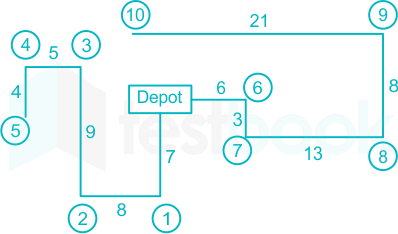
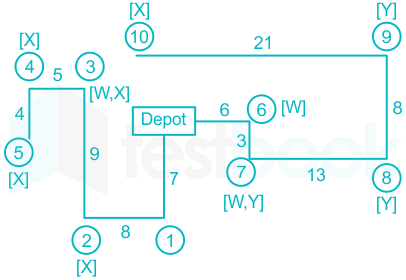
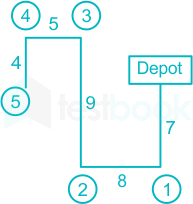
Two buses i.e., bus P and bus Q start their journey from a common depot. Both buses complete their individual journey. Bus P moved 7 km towards south and reached stoppage 1. Then turned right and moved 8 km and reached stoppage 2. From there Bus P turned right and covered 9 km to reach stoppage 3. Then it turned to its left and covered 5 km to reach stoppage 4 and finally, it took a left turn and went 4 km to reach stoppage 5.

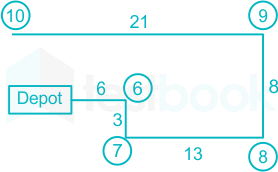
Bus Q went 6 km to east and reached stoppage 6. Then it turned to its right and moved 3 km to reach stoppage 7. It travelled 13 km towards left and went to stoppage 8. From there bus Q turned left and covered 8 km to reach stoppage 9. Finally, it moves towards to its left and went 21 km to reach stoppage 10.

Now these stoppages are assigned names according to the below given conditions:

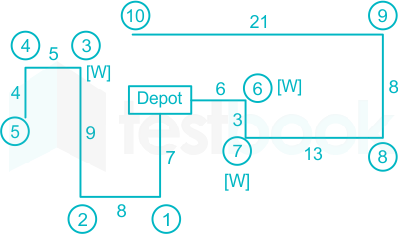
‘W’ is assigned to the first stoppage if distance between the consecutive stoppages is a prime number.

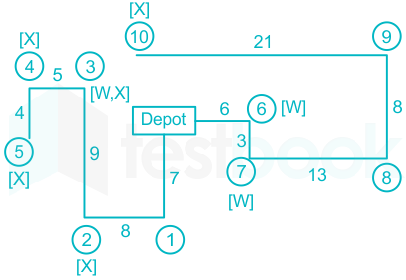
‘X’ is assigned to the stoppage which is in north west or south west direction of the depot.

‘Y’ is assigned to the stoppage which is in north east or south east direction of the depot.

‘Z’ is assigned to the stoppage if distance between the stoppage and depot is even number.

Note: Multiple names can be assigned to a single stoppage.

5

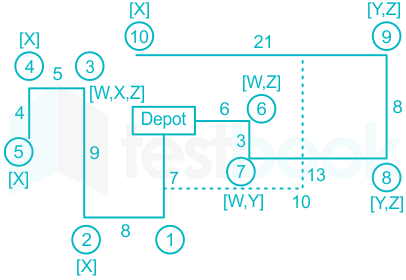
Bus X starts journey from depot and goes 5 km south and takes a left turn and travel 10 km. Then it takes a left turn and reaches somewhere between stoppage 9 and 10. What will be the distance from that point to stoppage 9? 

  1. ((a))

    16 km

  2. ((b))

    9 km

  3. ((c))

    10 km

  4. ((d))

    13 km

  5. ((e))

    15 km

Show Answer
Answer: ((b))

9 km

Bus P moved 7 km towards south and reached stoppage 1. Then turned right and moved 8 km and reached stoppage 2. From there Bus P turned right and covered 9 km to reach stoppage 3. Then it turned to its left and covered 5 km to reach stoppage 4 and finally, it took a left turn and went 4 km to reach stoppage 5.

Bus Q went 6 km to east and reached stoppage 6. Then it turned to its right and moved 3 km to reach stoppage 7. It travelled 13 km towards left and went to stoppage 8. From there bus Q turned left and covered 8 km to reach stoppage 9. Finally, it moves towards its left and went 21 km to reach stoppage 10.

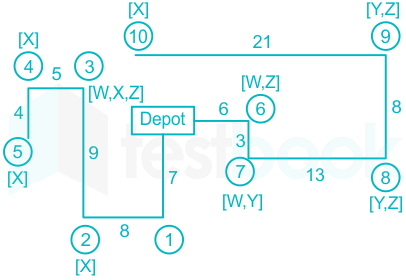
Now combining the two images we get,

1) ‘W’ is assigned to the first stoppage if distance between the consecutive stoppages is a prime number.

2) ‘X’ is assigned to the stoppage which is in north west or south west direction of the depot.

3) ‘Y’ is assigned to the stoppage which is in north east or south east direction of the depot.

4) ‘Z’ is assigned to the stoppage if distance between the stoppage and depot is even number which means if we want to calculate the distance between depot and stoppage 2, we would get (8 + 7) = 15 km which is not even number. Again, the distance between depot and stoppage 3 is (8 + 7 + 9) = 24 km which is even number. Therefore, stoppage 3 would be named as Z.


Now, 

Hence the distance is = (6 + 13 - 10)= 9 km.

6

Find the odd one out.

  1. ((a))

    Stoppage 5 - Stoppage 10

  2. ((b))

    Stoppage 3 - Stoppage 9

  3. ((c))

    Stoppage 2 - Stoppage 6

  4. ((d))

    Stoppage 1 - Stoppage 10

  5. ((e))

    Stoppage 5 - Stoppage 6

Show Answer
Answer: ((d))

Stoppage 1 - Stoppage 10

Bus P moved 7 km towards south and reached stoppage 1. Then turned right and moved 8 km and reached stoppage 2. From there Bus P turned right and covered 9 km to reach stoppage 3. Then it turned to its left and covered 5 km to reach stoppage 4 and finally, it took a left turn and went 4 km to reach stoppage 5.

Bus Q went 6 km to east and reached stoppage 6. Then it turned to its right and moved 3 km to reach stoppage 7. It travelled 13 km towards left and went to stoppage 8. From there bus Q turned left and covered 8 km to reach stoppage 9. Finally, it moves towards its left and went 21 km to reach stoppage 10.

Now combining the two images we get,

1) ‘W’ is assigned to the first stoppage if distance between the consecutive stoppages is a prime number.

2) ‘X’ is assigned to the stoppage which is in north west or south west direction of the depot.

3) ‘Y’ is assigned to the stoppage which is in north east or south east direction of the depot.

4) ‘Z’ is assigned to the stoppage if distance between the stoppage and depot is even number which means if we want to calculate the distance between depot and stoppage 2, we would get (8 + 7) = 15 km which is not even number. Again, the distance between depot and stoppage 3 is (8 + 7 + 9) = 24 km which is even number. Therefore, stoppage 3 would be named as Z.


Hence, the correct answer is Stoppage 1 - Stoppage 10 as except this every pair shows inclination from south to east.

7

which of the following stoppage assigned maximum names?

  1. ((a))

    Stoppage 3

  2. ((b))

    Stoppage 8

  3. ((c))

    Stoppage 9

  4. ((d))

    Stoppage 7

  5. ((e))

    Stoppage 1

Show Answer
Answer: ((a))

Stoppage 3

Bus P moved 7 km towards south and reached stoppage 1. Then turned right and moved 8 km and reached stoppage 2. From there Bus P turned right and covered 9 km to reach stoppage 3. Then it turned to its left and covered 5 km to reach stoppage 4 and finally, it took a left turn and went 4 km to reach stoppage 5.

Bus Q went 6 km to east and reached stoppage 6. Then it turned to its right and moved 3 km to reach stoppage 7. It travelled 13 km towards left and went to stoppage 8. From there bus Q turned left and covered 8 km to reach stoppage 9. Finally, it moves towards its left and went 21 km to reach stoppage 10.

Now combining the two images we get,

  1. ‘W’ is assigned to the first stoppage if distance between the consecutive stoppages is a prime number.

  1. ‘X’ is assigned to the stoppage which is in north west or south west direction of the depot.

  1. ‘Y’ is assigned to the stoppage which is in north east or south east direction of the depot.

  1. ‘Z’ is assigned to the stoppage if distance between the stoppage and depot is even number which means if we want to calculate the distance between depot and stoppage 2, we would get (8 + 7) = 15 km which is not even number. Again, the distance between depot and stoppage 3 is (8 + 7 + 9) = 24 km which is even number. Therefore, stoppage 3 would be named as Z.


Hence, stoppage 3 assigned maximum names.

Direction: Study the following information carefully and answer the given questions.

21 persons work in a bank at a different post. Posts are in decreasing order i.e. ED, DGM, AGM, Manager, AM and Clerk. It is known that on any post the number of person posted is one more than the number of person posted in the immediate senior post. For example: If 4 person works as AM then 5 person works as Clerk. E, H and D work at the same post. S is senior to V and C. Neither X nor Q is a manager. P, L, M and W work at the same post. V is just senior to X. C is senior to A. U and T are senior to L. R is senior to T but junior to F and G. V is just junior to N. R and N do not work at the same post. Q is senior to W. B is senior to O. C and Q works at the same post. A does not work as clerk, P does not work as AM and T does not work as AGM. S is senior to R but junior to G. Now these persons are transferred to three departments i.e. HR, Marketing and Legal using the below-given conditions of

  1. No transfer happens for the person who belongs to the two highest positions and they become leaders in legal, Marketing and HR respectively according to the alphabetical order.
  2. Persons whose name starts with a letter that comes before M in alphabetical order and he/she works with a person whose name starts with a vowel went to HR (excluding the vowels).
  3. Persons whose name starts with a letter which comes after M in alphabetical order and he/she works at a post which has even number of persons went to Marketing.
  4. Rest will go to the Legal department.
8

Find the odd one out:

  1. ((a))

    A

  2. ((b))

    D

  3. ((c))

    E

  4. ((d))

    F

  5. ((e))

    H

Show Answer
Answer: ((d))

F

Given:

Persons = 21

6 posts in decreasing order -  ED, DGM, AGM, Manager, AM and Clerk.

On any post, the number of person posted is one more than the number of person posted in the immediate senior post. It means there are 6 Clerks, 5 AMs, 4 Managers, 3 AGMs, 2 DGMs and 1 ED. 6+5+4+3+2+1 = 21.

Now,

  1. P, L, M and W work at the same post. They can be Managers, AMs or Clerks.

2) P does not work as AM. So, only two possibilities left.

Case I -

PostsPersons
ED (1)
DGM (2)
AGM (3)
Manager (4)
AM (5)
Clerk (6)P, L, M, W


Case II -

PostsPersons
ED (1)
DGM (2)
AGM (3)
Manager (4)P, L, M, W
AM (5)
Clerk (6)


3) Q is senior to W. Q can be ED, DGM, AGM in both cases and Manager, AM in Case I.

4) Neither X nor Q is a manager. So, one possibility within case I gets eliminated.

  1. C and Q works at the same post. 

  2. S is senior to V and C. It means C and Q are not at EDs.

  3. S is senior to R but junior to G. It means C and Q are not DGMs. 

The possibilities are -

Case I (a) -

PostsPersons
ED (1)
DGM (2)
AGM (3)
Manager (4)
AM (5)C, Q
Clerk (6)P, L, M, W


Case I (b) -

PostsPersons
ED (1)
DGM (2)
AGM (3)C, Q
Manager (4)
AM (5)
Clerk (6)P, L, M, W


Case II -

PostsPersons
ED (1)
DGM (2)
AGM (3)C, Q
Manager (4)P L, M, W
AM (5)
Clerk (6)


  1. U and T are senior to L.

  2. T does not work as AGM.

  3. R is senior to T but junior to F and G. Combining 7) and 10) we get, G > S > R > T > L. This is not possible in Case II so it gets eliminated.

Case I (a) -

PostsCase iCase iiCase iiiCase ivCase v
ED (1)GGGG
DGM (2)SSSG
AGM (3)RRSS
Manager (4)TRRR
AM (5)C, QC, Q, TC, Q, TC, Q, TC, Q, T
Clerk (6)P, L, M, WP, L, M, WP, L, M, WP, L, M, WP,  L, M, W


Case I (b) -

PostsCase iCase v
ED (1)GG
DGM (2)SS
AGM (3)C, Q, RC, Q
Manager (4)TR
AM (5)T
Clerk (6)P, L, M, WP,  L, M, W


11) C is senior to A.

  1. A does not work as clerk. Case I (a) gets completely eliminated. In case I (b), A can be Manager or AM. We will place it later.

  2. V is just senior to X. Combining this condition with 4) and 6) we get, V can be AGM, Manager and AM. X can be AM or clerk.

14) V is just junior to N. So, N can be DGM or AGM.

  1. R and N do not work at the same post. According to condition 10), F is senior to R.

14) E, H and D work at the same post. They can be AM. They cannot be managers as then we will not be able to place N, V and X consecutive-wise.

15) B is senior to O. Also, from condition 8), U is senior to L.

Combining all the above conditions, case v gets eliminated as if N is placed with S, then F will not get placed and if N is placed with C and Q then either B or U couldn't be placed.

So, the final arrangement is -

Case I (b) -

PostsCase i
ED (1)G
DGM (2)S, F
AGM (3)C, Q, R
Manager (4)T, N, B, U
AM (5)A, E, H, D, V
Clerk (6)P, L, M, W, X, O


Now these persons are transferred to three departments i.e. HR, Marketing and Legal using the below-given conditions of

  1. No transfer happens for the person who belongs to the two highest positions and they become leaders in legal, Marketing and HR respectively according to the alphabetical order. → The two highest positions are ED and DGM. The persons on these posts in alphabetical order are F, G and S. So the leader of the legal department is F, Marketing is G and HR is S.
  2. Persons whose name starts with a letter that comes before M in alphabetical order and he/she works with a person whose name starts with a vowel went to HR (excluding the vowels). → Such persons are L (with O), H, D with (with A and E), B (with U).
  3. Persons whose name starts with a letter which comes after M in alphabetical order and he/she works at a post which has even number of persons went to Marketing. → Posts having even number of persons are Manager and Clerk. Among them, T, N, U, P, W, X, O went to Marketing.
  4. Rest will go to the Legal department. → They are C, Q, R, A, E, V and M. 

Among the given options, all except F are AMs.

Hence, the correct answer is F.

9

Which of the following is true?

  1. ((a))

    Atleast two of the clerks is transferred to legal department.

  2. ((b))

    Atleast one of the AMs is transferred to marketing department.

  3. ((c))

    Atleast one of the AGMs is transferred to HR department.

  4. ((d))

    At least one of the DGMs is transferred to marketing department.

  5. ((e))

    Atleast one of the Managers is transferred to HR department.

Show Answer
Answer: ((e))

Atleast one of the Managers is transferred to HR department.

Given:

Persons = 21

6 posts in decreasing order -  ED, DGM, AGM, Manager, AM and Clerk.

On any post, the number of person posted is one more than the number of person posted in the immediate senior post. It means there are 6 Clerks, 5 AMs, 4 Managers, 3 AGMs, 2 DGMs and 1 ED. 6+5+4+3+2+1 = 21.

Now,

  1. P, L, M and W work at the same post. They can be Managers, AMs or Clerks.

2) P does not work as AM. So, only two possibilities left.

Case I -

PostsPersons
ED (1)
DGM (2)
AGM (3)
Manager (4)
AM (5)
Clerk (6)P, L, M, W


Case II -

PostsPersons
ED (1)
DGM (2)
AGM (3)
Manager (4)P, L, M, W
AM (5)
Clerk (6)


3) Q is senior to W. Q can be ED, DGM, AGM in both cases and Manager, AM in Case I.

4) Neither X nor Q is a manager. So, one possibility within case I gets eliminated.

  1. C and Q works at the same post. 

  2. S is senior to V and C. It means C and Q are not at EDs.

  3. S is senior to R but junior to G. It means C and Q are not DGMs. 

The possibilities are -

Case I (a) -

PostsPersons
ED (1)
DGM (2)
AGM (3)
Manager (4)
AM (5)C, Q
Clerk (6)P, L, M, W


Case I (b) -

PostsPersons
ED (1)
DGM (2)
AGM (3)C, Q
Manager (4)
AM (5)
Clerk (6)P, L, M, W


Case II -

PostsPersons
ED (1)
DGM (2)
AGM (3)C, Q
Manager (4)P L, M, W
AM (5)
Clerk (6)


  1. U and T are senior to L.

  2. T does not work as AGM.

  3. R is senior to T but junior to F and G. Combining 7) and 10) we get, G > S > R > T > L. This is not possible in Case II so it gets eliminated.

Case I (a) -

PostsCase iCase iiCase iiiCase ivCase v
ED (1)GGGG
DGM (2)SSSG
AGM (3)RRSS
Manager (4)TRRR
AM (5)C, QC, Q, TC, Q, TC, Q, TC, Q, T
Clerk (6)P, L, M, WP, L, M, WP, L, M, WP, L, M, WP,  L, M, W


Case I (b) -

PostsCase iCase v
ED (1)GG
DGM (2)SS
AGM (3)C, Q, RC, Q
Manager (4)TR
AM (5)T
Clerk (6)P, L, M, WP,  L, M, W


11) C is senior to A.

  1. A does not work as clerk. Case I (a) gets completely eliminated. In case I (b), A can be Manager or AM. We will place it later.

  2. V is just senior to X. Combining this condition with 4) and 6) we get, V can be AGM, Manager and AM. X can be AM or clerk.

14) V is just junior to N. So, N can be DGM or AGM.

  1. R and N do not work at the same post. According to condition 10), F is senior to R.

14) E, H and D work at the same post. They can be AM. They cannot be managers as then we will not be able to place N, V and X consecutive-wise.

15) B is senior to O. Also, from condition 8), U is senior to L.

Combining all the above conditions, case v gets eliminated as if N is placed with S, then F will not get placed and if N is placed with C and Q then either B or U couldn't be placed.

So, the final arrangement is -

Case I (b) -

PostsCase i
ED (1)G
DGM (2)S, F
AGM (3)C, Q, R
Manager (4)T, N, B, U
AM (5)A, E, H, D, V
Clerk (6)P, L, M, W, X, O


Now these persons are transferred to three departments i.e. HR, Marketing and Legal using the below-given conditions of

  1. No transfer happens for the person who belongs to the two highest positions and they become leaders in legal, Marketing and HR respectively according to the alphabetical order. → The two highest positions are ED and DGM. The persons on these posts in alphabetical order are F, G and S. So the leader of the legal department is F, Marketing is G and HR is S.
  2. Persons whose name starts with a letter that comes before M in alphabetical order and he/she works with a person whose name starts with a vowel went to HR (excluding the vowels). → Such persons are L (with O), H, D with (with A and E), B (with U).
  3. Persons whose name starts with a letter which comes after M in alphabetical order and he/she works at a post which has even number of persons went to Marketing. → Posts having an even number of persons are Manager and Clerk. Among them, T, N, U, P, W, X, O went to Marketing.
  4. Rest will go to the Legal department. → They are C, Q, R, A, E, V and M. 

B who is the manager is transferred to the HR department.

Hence, the correct answer is Atleast one of the Managers is transferred to the HR department.

10

Who among the following is not the manager?

  1. ((a))

    B

  2. ((b))

    C

  3. ((c))

    N

  4. ((d))

    T

  5. ((e))

    U

Show Answer
Answer: ((b))

C

Given:

Persons = 21

6 posts in decreasing order -  ED, DGM, AGM, Manager, AM and Clerk.

On any post, the number of person posted is one more than the number of person posted in the immediate senior post. It means there are 6 Clerks, 5 AMs, 4 Managers, 3 AGMs, 2 DGMs and 1 ED. 6+5+4+3+2+1 = 21.

Now,

  1. P, L, M and W work at the same post. They can be Managers, AMs or Clerks.

2) P does not work as AM. So, only two possibilities left.

Case I -

PostsPersons
ED (1)
DGM (2)
AGM (3)
Manager (4)
AM (5)
Clerk (6)P, L, M, W


Case II -

PostsPersons
ED (1)
DGM (2)
AGM (3)
Manager (4)P, L, M, W
AM (5)
Clerk (6)


3) Q is senior to W. Q can be ED, DGM, AGM in both cases and Manager, AM in Case I.

4) Neither X nor Q is a manager. So, one possibility within case I gets eliminated.

  1. C and Q works at the same post. 

  2. S is senior to V and C. It means C and Q are not at EDs.

  3. S is senior to R but junior to G. It means C and Q are not DGMs. 

The possibilities are -

Case I (a) -

PostsPersons
ED (1)
DGM (2)
AGM (3)
Manager (4)
AM (5)C, Q
Clerk (6)P, L, M, W


Case I (b) -

PostsPersons
ED (1)
DGM (2)
AGM (3)C, Q
Manager (4)
AM (5)
Clerk (6)P, L, M, W


Case II -

PostsPersons
ED (1)
DGM (2)
AGM (3)C, Q
Manager (4)P L, M, W
AM (5)
Clerk (6)


  1. U and T are senior to L.

  2. T does not work as AGM.

  3. R is senior to T but junior to F and G. Combining 7) and 10) we get, G > S > R > T > L. This is not possible in Case II so it gets eliminated.

Case I (a) -

PostsCase iCase iiCase iiiCase ivCase v
ED (1)GGGG
DGM (2)SSSG
AGM (3)RRSS
Manager (4)TRRR
AM (5)C, QC, Q, TC, Q, TC, Q, TC, Q, T
Clerk (6)P, L, M, WP, L, M, WP, L, M, WP, L, M, WP,  L, M, W


Case I (b) -

PostsCase iCase v
ED (1)GG
DGM (2)SS
AGM (3)C, Q, RC, Q
Manager (4)TR
AM (5)T
Clerk (6)P, L, M, WP,  L, M, W


11) C is senior to A.

  1. A does not work as clerk. Case I (a) gets completely eliminated. In case I (b), A can be Manager or AM. We will place it later.

  2. V is just senior to X. Combining this condition with 4) and 6) we get, V can be AGM, Manager and AM. X can be AM or clerk.

14) V is just junior to N. So, N can be DGM or AGM.

  1. R and N do not work at the same post. According to condition 10), F is senior to R.

14) E, H and D work at the same post. They can be AM. They cannot be managers as then we will not be able to place N, V and X consecutive-wise.

15) B is senior to O. Also, from condition 8), U is senior to L.

Combining all the above conditions, case v gets eliminated as if N is placed with S, then F will not get placed and if N is placed with C and Q then either B or U couldn't be placed.

So, the final arrangement is -

Case I (b) -

PostsCase i
ED (1)G
DGM (2)S, F
AGM (3)C, Q, R
Manager (4)T, N, B, U
AM (5)A, E, H, D, V
Clerk (6)P, L, M, W, X, O


Now these persons are transferred to three departments i.e. HR, Marketing and Legal using the below-given conditions of

  1. No transfer happens for the person who belongs to the two highest positions and they become leaders in legal, Marketing and HR respectively according to the alphabetical order. → The two highest positions are ED and DGM. The persons on these posts in alphabetical order are F, G and S. So the leader of the legal department is F, Marketing is G and HR is S.
  2. Persons whose name starts with a letter that comes before M in alphabetical order and he/she works with a person whose name starts with a vowel went to HR (excluding the vowels). → Such persons are L (with O), H, D with (with A and E), B (with U).
  3. Persons whose name starts with a letter which comes after M in alphabetical order and he/she works at a post which has even number of persons went to Marketing. → Posts having even number of persons are Manager and Clerk. Among them, T, N, U, P, W, X, O went to Marketing.
  4. Rest will go to the Legal department. → They are C, Q, R, A, E, V and M. 

Among the given options, C is not the manager.

Hence, the correct answer is C.

11

In which department is U transferred to?

  1. ((a))

    HR

  2. ((b))

    Marketing

  3. ((c))

    Legal

  4. ((d))

    None of these, U will be the leader of Legal.

  5. ((e))

    None of these, U will be the leader of HR.

Show Answer
Answer: ((b))

Marketing

Given:

Persons = 21

6 posts in decreasing order -  ED, DGM, AGM, Manager, AM and Clerk.

On any post, the number of person posted is one more than the number of person posted in the immediate senior post. It means there are 6 Clerks, 5 AMs, 4 Managers, 3 AGMs, 2 DGMs and 1 ED. 6+5+4+3+2+1 = 21.

Now,

  1. P, L, M and W work at the same post. They can be Managers, AMs or Clerks.

2) P does not work as AM. So, only two possibilities left.

Case I -

PostsPersons
ED (1)
DGM (2)
AGM (3)
Manager (4)
AM (5)
Clerk (6)P, L, M, W


Case II -

PostsPersons
ED (1)
DGM (2)
AGM (3)
Manager (4)P, L, M, W
AM (5)
Clerk (6)


3) Q is senior to W. Q can be ED, DGM, AGM in both cases and Manager, AM in Case I.

4) Neither X nor Q is a manager. So, one possibility within case I gets eliminated.

  1. C and Q works at the same post. 

  2. S is senior to V and C. It means C and Q are not at EDs.

  3. S is senior to R but junior to G. It means C and Q are not DGMs. 

The possibilities are -

Case I (a) -

PostsPersons
ED (1)
DGM (2)
AGM (3)
Manager (4)
AM (5)C, Q
Clerk (6)P, L, M, W


Case I (b) -

PostsPersons
ED (1)
DGM (2)
AGM (3)C, Q
Manager (4)
AM (5)
Clerk (6)P, L, M, W


Case II -

PostsPersons
ED (1)
DGM (2)
AGM (3)C, Q
Manager (4)P L, M, W
AM (5)
Clerk (6)


  1. U and T are senior to L.

  2. T does not work as AGM.

  3. R is senior to T but junior to F and G. Combining 7) and 10) we get, G > S > R > T > L. This is not possible in Case II so it gets eliminated.

Case I (a) -

PostsCase iCase iiCase iiiCase ivCase v
ED (1)GGGG
DGM (2)SSSG
AGM (3)RRSS
Manager (4)TRRR
AM (5)C, QC, Q, TC, Q, TC, Q, TC, Q, T
Clerk (6)P, L, M, WP, L, M, WP, L, M, WP, L, M, WP,  L, M, W


Case I (b) -

PostsCase iCase v
ED (1)GG
DGM (2)SS
AGM (3)C, Q, RC, Q
Manager (4)TR
AM (5)T
Clerk (6)P, L, M, WP,  L, M, W


11) C is senior to A.

  1. A does not work as clerk. Case I (a) gets completely eliminated. In case I (b), A can be Manager or AM. We will place it later.

  2. V is just senior to X. Combining this condition with 4) and 6) we get, V can be AGM, Manager and AM. X can be AM or clerk.

14) V is just junior to N. So, N can be DGM or AGM.

  1. R and N do not work at the same post. According to condition 10), F is senior to R.

14) E, H and D work at the same post. They can be AM. They cannot be managers as then we will not be able to place N, V and X consecutive-wise.

15) B is senior to O. Also, from condition 8), U is senior to L.

Combining all the above conditions, case v gets eliminated as if N is placed with S, then F will not get placed and if N is placed with C and Q then either B or U couldn't be placed.

So, the final arrangement is -

Case I (b) -

PostsCase i
ED (1)G
DGM (2)S, F
AGM (3)C, Q, R
Manager (4)T, N, B, U
AM (5)A, E, H, D, V
Clerk (6)P, L, M, W, X, O


Now these persons are transferred to three departments i.e. HR, Marketing and Legal using the below-given conditions of

  1. No transfer happens for the person who belongs to the two highest positions and they become leaders in legal, Marketing and HR respectively according to the alphabetical order. → The two highest positions are ED and DGM. The persons on these posts in alphabetical order are F, G and S. So the leader of the legal department is F, Marketing is G and HR is S.
  2. Persons whose name starts with a letter that comes before M in alphabetical order and he/she works with a person whose name starts with a vowel went to HR (excluding the vowels). → Such persons are L (with O), H, D with (with A and E), B (with U).
  3. Persons whose name starts with a letter which comes after M in alphabetical order and he/she works at a post which has even number of persons went to Marketing. → Posts having even number of persons are Manager and Clerk. Among them, T, N, U, P, W, X, O went to Marketing.
  4. Rest will go to the Legal department. → They are C, Q, R, A, E, V and M. 

U is transferred to the marketing department.

Hence, the correct answer is Marketing.

Directions: Read the following information carefully and answer the questions given below.

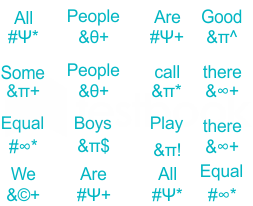
In a certain code language,

12

Choose a word whose code is similar to 'Some'?

  1. ((a))

    Small

  2. ((b))

    Pass

  3. ((c))

    Long

  4. ((d))

    Tale

  5. ((e))

    None of these

Show Answer
Answer: ((d))

Tale

In the first place there are only two symbols - # and &.

Here, in the first line two symbols are start with & and the other two start with #. If we notice the fourth line, we will see the common codes for ‘all’ and ‘are’ . Both starts with vowel and the starting symbol #. In second line all words start with consonant and symbols are start with &. Therefore, # is used when the first letter is vowel and the & is used when the first letter is consonant.

For the second place there are multiple symbol - π, ∞, θ, Ψ, ©

This symbol represents the number of letters in each word-

No. of letterCode
2©
3Ψ
4π
5
6θ


For the third place the symbols are - *, ^, $, +, !

If we look the similar code and check them with a respective letter,  we find that the last symbol is used according to the last letter.

LetterCode
L*
E+
D^
S/Y$/!
Y/S!/$


All - #Ψ*People - &θ+are - #Ψ+good - &π^
Some - &π+People - &θ+call - &π*there - &∞+
Equal - #∞*Boys - &π$ / &π!Play - &π$ / &π!there - &∞+
We - &©+are - #Ψ+all - #Ψ*Equal - #∞*


Hence, the correct answer is 'Tale' as this word starts with consonant and consists of four letters like "Some" and both are ended with "E".

13

What is the possible code for 'we are going'?

  1. ((a))

    &©+    #Ψ+    &∞*

  2. ((b))

    &©+    #Ψ+    &∞+

  3. ((c))

    &©+    #Ψ+    &∞~

  4. ((d))

    &©+    #Ψ+    &∞$

  5. ((e))

    &©+    #Ψ+    &∞^

Show Answer
Answer: ((c))

&©+    #Ψ+    &∞~

In the first place there are only two symbols - # and &.

Here, in the first line two symbols are start with & and the other two start with #. If we notice the fourth line, we will see the common codes for ‘all’ and ‘are’ . Both starts with vowel and the starting symbol #. In second line all words start with consonant and symbols are start with &. Therefore, # is used when the first letter is vowel and the & is used when the first letter is consonant.

For the second place there are multiple symbol - π, ∞, θ, Ψ, ©

This symbol represents the number of letters in each word-

No. of letterCode
2©
3Ψ
4π
5
6θ


For the third place the symbols are - *, ^, $, +, !

If we look the similar code and check them with a respective letter,  we find that the last symbol is used according to the last letter.

LetterCode
L*
E+
D^
S/Y$/!
Y/S!/$


All - #Ψ*People - &θ+are - #Ψ+good - &π^
Some - &π+People - &θ+call - &π*there - &∞+
Equal - #∞*Boys - &π$ / &π!Play - &π$ / &π!there - &∞+
We - &©+are - #Ψ+all - #Ψ*Equal - #∞*


Hence, the possible code for 'we are going' is &©+    #Ψ+    &∞~.

14

What is the code for 'All'?

  1. ((a))

    #Ψ*

  2. ((b))

    #Ψ+

  3. ((c))

    &θ+

  4. ((d))

    &π^

  5. ((e))

    Either 1 or 2

Show Answer
Answer: ((a))

#Ψ*

In the first place there are only two symbols - # and &.

Here, in the first line two symbols are start with & and the other two start with #. If we notice the fourth line, we will see the common codes for ‘all’ and ‘are’ . Both starts with vowel and the starting symbol #. In second line all words start with consonant and symbols are start with &. Therefore, # is used when the first letter is vowel and the & is used when the first letter is consonant.

For the second place there are multiple symbol  π, ∞, θ, Ψ, ©

This symbol represents the number of letters in each word-

No. of letterCode
2©
3Ψ
4π
5
6θ


For the third place the symbols are - *, ^, $, +, !

If we look the similar code and check them with a respective letter,  we find that the last symbol is used according to the last letter.

LetterCode
L*
E+
D^
S/Y$/!
Y/S!/$

So codes

All - #Ψ*People - &θ+are - #Ψ+good - &π^
Some - &π+People - &θ+call - &π*there - &∞+
Equal - #∞*Boys - &π$ / &π!Play - &π$ / &π!there - &∞+
We - &©+are - #Ψ+all - #Ψ*Equal - #∞*


Hence, the code for 'all' is #Ψ.*

15

Direction: Read the given information carefully and answer the following questions:

Statement: A cotton dress manufacturing company Z has planned to import the materials for its production from Country A which is a leading cotton producer in the world and the top exporter of Cotton materials. The manufacturing company Z has ordered material in huge quantities worth $45 million because of the increasing demand for cotton-based dress material in its company.

Which among the following option(s) will weaken the given statement?

i) Company Z has earned more profit this year when compared to the previous two years.

ii) People do not like to wear cotton dresses in the winter season.

iii) Country A took most of the orders for the cotton materials when compared to Country B.

  1. ((a))

    Only I 

  2. ((b))

    Only II and III

  3. ((c))

    Only III

  4. ((d))

    Only I and III

  5. ((e))

    Only II

Show Answer
Answer: ((e))

Only II

Country A which is the leading producer and leading exporter of cotton in the world has exported materials to company Z because of the huge number of orders from that company. The company got orders with a net value of $45 million because of the increasing demand for cotton-based dress materials in its company.

I. Company Z has procured more profit this year therefore this is a big profit for their company. So, this does not weaken the statement.

II. As people do not like to wear cotton dresses the sale of cotton dresses may fall. So, they may face a huge loss. So, this will weaken the statement.

III. This statement states about the winter season which is not mentioned in the passage and also it mentions that people don’t like the cotton materials which leads to a huge loss for the company which will make the given statement a weaker direction.

Hence, Only II will weaken the statement.

Direction: Study the information given carefully and answer the question given below.

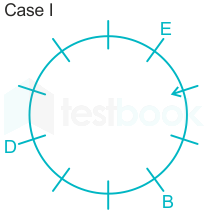
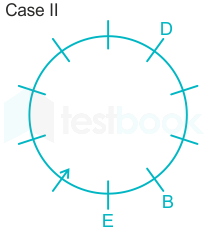
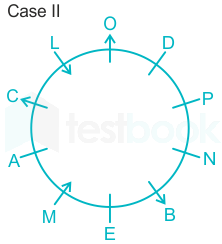
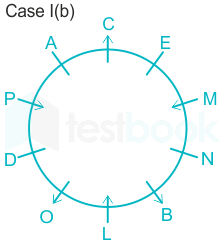
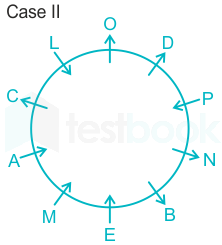
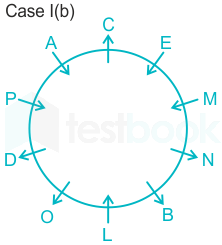
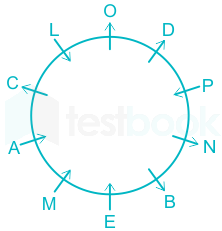
Ten people A, B, C, D, E, L, M, N, O, and P are sitting around a circular table but not necessarily in the same order. Five of them are facing inside while others are facing outside. No two persons, whose names start with consecutive alphabets sit adjacent to each other.

E sits immediate right of the one who faces D. B does not face towards L. One person sits between C and M. Immediate neighbours of L are facing outside. Two persons sit between B and D. O faces the same direction as B. Both D and N face opposite directions as P. E sits fourth to the right of L. A is an immediate neighbour of C, who faces outside. One person sits between E and A. Both immediate neighbours of A face opposite directions to each other. Neither P nor O sits adjacent to B. E sits third to the left of P. A does not sit second to the right of E.

16

What is the position of P with respect to C?

  1. ((a))

    Fifth to the right

  2. ((b))

    Fourth to the right

  3. ((c))

    Second to the left

  4. ((d))

    Second to the right

  5. ((e))

    Third to the left

Show Answer
Answer: ((b))

Fourth to the right

  1. Two persons sit between B and D.

  2. E sits immediate right of the one, who faces D.


<br>
  1. E sits fourth to the right of L.

  2. Immediate neighbours of L are facing outside.

  3. B does not face L. (It means two persons can sit opposite to each but not face the same direction).


<br>
  1. One person sits between E and A.  As A is not an immediate neighbour of B.

  2. A is an immediate neighbour of C who faces outside.

  3. One person sits between C and M. E sits third to the left of P.


<br>
  1. Both immediate neighbours of A face opposite directions to each other.

  2. Neither P nor O sits adjacent to B.

  3. O faces the same direction as B.


<br>
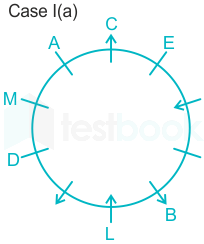
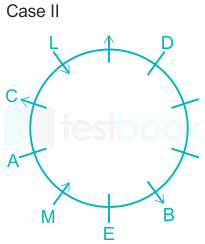
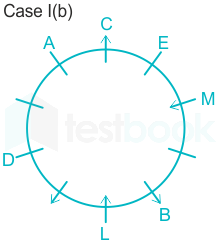
  1. E sits third to the left of P. Therefore, case I (a) will be cancelled.

13) Both D and N face opposite directions as P.


<br>

Therefore, A and E face inside as equal number of persons face inside and outside.


<br>
  1. A does not sit second to the right of E. Therefore, Case I (b) will be cancelled.

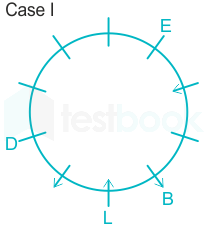
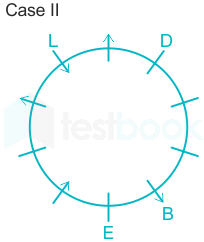
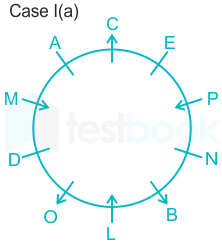
The final solution is,

Hence, P sits fourth to the right of C.

17

Who sits opposite to D?

  1. ((a))

    C

  2. ((b))

    M

  3. ((c))

    A

  4. ((d))

    E

  5. ((e))

    L

Show Answer
Answer: ((b))

M

  1. Two persons sit between B and D.

  2. E sits immediate right of the one, who faces D.


<br>
  1. E sits fourth to the right of L.

  2. Immediate neighbours of L are facing outside.

  3. B does not face L. (It means two persons can sit opposite to each but not face the same direction).


<br>
  1. One person sits between E and A.  As A is not an immediate neighbour of B.

  2. A is an immediate neighbour of C who faces outside.

  3. One person sits between C and M. E sits third to the left of P.


<br>
  1. Both immediate neighbours of A face opposite directions to each other.

  2. Neither P nor O sits adjacent to B.

  3. O faces the same direction as B.


<br>
  1. E sits third to the left of P. Therefore, case I (a) will be cancelled.

13) Both D and N face opposite directions as P.


<br>

Therefore, A and E face inside as equal number of persons face inside and outside.


<br>
  1. A does not sit second to the right of E. Therefore, Case I (b) will be cancelled.

The final solution is,

Hence, M sits opposite to D.

Direction: Study the following information carefully and answer the given questions.

Nine people A, B, C, D, E, F, G, H, and J live in a nine-storey building such that the bottommost floor is numbered as 1 and the topmost floor is numbered as 9 but not necessarily in the same order. They can speak nine different languages – Assamese, Bengali, Gujrati, Odia, Sanskrit, English, Telegu, Hindi, and Kannada but not necessarily in the same order.

H cannot speak Kannada. F lives above H. Two persons live below G. The number of persons, who live above the person, who speaks Sanskrit is equal to the number of persons, who live below A. G speaks either Telegu or Hindi. E's floor number is half of C's floor number. One person lives between G and the one, who speaks Sanskrit. D lives immediately above J. D neither speaks Telegu nor Kannada. One person lives between A and the one, who can speak Gujrati. The one, who can speak Assamese does not live on a prime numbered floor. C does not live immediately above or immediately below G’s floor. The one, who speaks English lives three floors above J. One person lives between C and B, who can speak Odia. The one, who can speak Assamese lives immediately above the, one who can speak Bengali.

18

Who lives immediately above the one, who can speak Sanskrit?

  1. ((a))

    H

  2. ((b))

    E

  3. ((c))

    F

  4. ((d))

    A

  5. ((e))

    B

Show Answer
Answer: ((e))

B

Nine people: A, B, C, D, E, F, G, H, and J

Nine languages: Assamese, Bengali, Gujrati, Odia, Sanskrit, English, Telegu, Hindi, and Kannada

  1. Two persons live below G. Therefore. G lives on floor number three.

2) One person lives between G and the one, who speaks Sanskrit. The person, who speaks Sanskrit is either on floor one or on floor five.

3) The number of persons, who live above the person, who speaks Sanskrit is equal to the number of persons, who live below A. Therefore, A lives either on 9th floor or on 5th floor.

Case ICase II
FloorPersonLanguagePersonLanguage
9A
8
7
6
5ASanskrit
4
3GG
2
1Sanskrit


4) One person lives between A and the one, who can speak Gujrati. 

5) G speaks either Telegu or Hindi.

Case ICase II
FloorPersonLanguagePersonLanguage
9A
8
7GujratiGujrati
6
5ASanskrit
4
3GTelegu / HindiGTelegu / Hindi
2
1Sanskrit


6) E's floor number is half of C's floor number.

7) C does not live immediately above or immediately below G’s floor.

8) One person lives between C and B, who can speak Odia. 

Case ICase II
FloorPersonLanguagePersonLanguage
9A
8CC
7GujratiGujrati
6BOdiaBOdia
5ASanskrit
4EE
3GTelegu / HindiGTelegu / Hindi
2
1Sanskrit


  1. D lives immediately above J.

  2. The one, who speaks English lives three floors above J.

  3. The one, who can speak Assamese lives immediately above the one, who can speak Bengali.

  4. The one, who can speak Assamese does not live on a prime numbered floor.

Case ICase II
FloorPersonLanguagePersonLanguage
9AAssameseAssamese
8CBengaliCBengali
7GujratiGujrati
6BOdiaBOdia
5ASanskrit
4EEnglishEEnglish
3GTelegu / HindiGTelegu / Hindi
2DD
1JSanskritJ


  1. F lives above H.

  2. D neither speaks Telegu nor Kannada. Therefore, D speaks Hindi.

  3. H cannot speak Kannada. Thus, the case I will be canceled.

Case ICase II
FloorPersonLanguagePersonLanguage
9AAssameseFAssamese
8CBengaliCBengali
7FGujratiHGujrati
6BOdiaBOdia
5HASanskrit
4EEnglishEEnglish
3GTeleguGTelegu
2DHindiDHindi
1JSanskritJ

The final solution is,

FloorPersonLanguage
9FAssamese
8CBengali
7HGujrati
6BOdia
5ASanskrit
4EEnglish
3GTelegu
2DHindi
1JKannada

 Hence, B lives immediately above the one, who can speak Sanskrit.

19

Which of the following combination is correct?

  1. ((a))

    3rd floor - G - Hindi

  2. ((b))

    1st floor - D - Telegu

  3. ((c))

    5th floor - H - Kannada

  4. ((d))

    7th floor - F - Gujrati

  5. ((e))

    9th floor - F - Assamese

Show Answer
Answer: ((e))

9th floor - F - Assamese

Nine people: A, B, C, D, E, F, G, H, and J

Nine languages: Assamese, Bengali, Gujrati, Odia, Sanskrit, English, Telegu, Hindi, and Kannada

  1. Two persons live below G. Therefore. G lives on floor number three.

2) One person lives between G and the one, who speaks Sanskrit. The person, who speaks Sanskrit is either on floor one or on floor five.

3) The number of persons, who live above the person, who speaks Sanskrit is equal to the number of persons, who live below A. Therefore, A lives either on 9th floor or on 5th floor.

Case ICase II
FloorPersonLanguagePersonLanguage
9A
8
7
6
5ASanskrit
4
3GG
2
1Sanskrit


4) One person lives between A and the one, who can speak Gujrati. 

5) G speaks either Telegu or Hindi.

Case ICase II
FloorPersonLanguagePersonLanguage
9A
8
7GujratiGujrati
6
5ASanskrit
4
3GTelegu / HindiGTelegu / Hindi
2
1Sanskrit


6) E's floor number is half of C's floor number.

7) C does not live immediately above or immediately below G’s floor.

8) One person lives between C and B, who can speak Odia. 

Case ICase II
FloorPersonLanguagePersonLanguage
9A
8CC
7GujratiGujrati
6BOdiaBOdia
5ASanskrit
4EE
3GTelegu / HindiGTelegu / Hindi
2
1Sanskrit


  1. D lives immediately above J.

  2. The one, who speaks English lives three floors above J.

  3. The one, who can speak Assamese lives immediately above the one, who can speak Bengali.

  4. The one, who can speak Assamese does not live on a prime numbered floor.

Case ICase II
FloorPersonLanguagePersonLanguage
9AAssameseAssamese
8CBengaliCBengali
7GujratiGujrati
6BOdiaBOdia
5ASanskrit
4EEnglishEEnglish
3GTelegu / HindiGTelegu / Hindi
2DD
1JSanskritJ


  1. F lives above H.

  2. D neither speaks Telegu nor Kannada. Therefore, D speaks Hindi.

  3. H cannot speak Kannada. Thus, the case I will be canceled.

Case ICase II
FloorPersonLanguagePersonLanguage
9AAssameseFAssamese
8CBengaliCBengali
7FGujratiHGujrati
6BOdiaBOdia
5HASanskrit
4EEnglishEEnglish
3GTeleguGTelegu
2DHindiDHindi
1JSanskritJ

The final solution is,

FloorPersonLanguage
9FAssamese
8CBengali
7HGujrati
6BOdia
5ASanskrit
4EEnglish
3GTelegu
2DHindi
1JKannada

 Hence, 9th floor - F - Assamese is the correct combination.

20

How many persons live between A and C?

  1. ((a))

    Five

  2. ((b))

    Four

  3. ((c))

    Three

  4. ((d))

    Two

  5. ((e))

    One

Show Answer
Answer: ((d))

Two

Nine people: A, B, C, D, E, F, G, H, and J

Nine languages: Assamese, Bengali, Gujrati, Odia, Sanskrit, English, Telegu, Hindi, and Kannada

  1. Two persons live below G. Therefore. G lives on floor number three.

2) One person lives between G and the one, who speaks Sanskrit. The person, who speaks Sanskrit is either on floor one or on floor five.

3) The number of persons, who live above the person, who speaks Sanskrit is equal to the number of persons, who live below A. Therefore, A lives either on 9th floor or on 5th floor.

Case ICase II
FloorPersonLanguagePersonLanguage
9A
8
7
6
5ASanskrit
4
3GG
2
1Sanskrit


4) One person lives between A and the one, who can speak Gujrati. 

5) G speaks either Telegu or Hindi.

Case ICase II
FloorPersonLanguagePersonLanguage
9A
8
7GujratiGujrati
6
5ASanskrit
4
3GTelegu / HindiGTelegu / Hindi
2
1Sanskrit


6) E's floor number is half of C's floor number.

7) C does not live immediately above or immediately below G’s floor.

8) One person lives between C and B, who can speak Odia. 

Case ICase II
FloorPersonLanguagePersonLanguage
9A
8CC
7GujratiGujrati
6BOdiaBOdia
5ASanskrit
4EE
3GTelegu / HindiGTelegu / Hindi
2
1Sanskrit


  1. D lives immediately above J.

  2. The one, who speaks English lives three floors above J.

  3. The one, who can speak Assamese lives immediately above the one, who can speak Bengali.

  4. The one, who can speak Assamese does not live on a prime numbered floor.

Case ICase II
FloorPersonLanguagePersonLanguage
9AAssameseAssamese
8CBengaliCBengali
7GujratiGujrati
6BOdiaBOdia
5ASanskrit
4EEnglishEEnglish
3GTelegu / HindiGTelegu / Hindi
2DD
1JSanskritJ


  1. F lives above H.

  2. D neither speaks Telegu nor Kannada. Therefore, D speaks Hindi.

  3. H cannot speak Kannada. Thus, the case I will be canceled.

Case ICase II
FloorPersonLanguagePersonLanguage
9AAssameseFAssamese
8CBengaliCBengali
7FGujratiHGujrati
6BOdiaBOdia
5HASanskrit
4EEnglishEEnglish
3GTeleguGTelegu
2DHindiDHindi
1JSanskritJ

The final solution is,

FloorPersonLanguage
9FAssamese
8CBengali
7HGujrati
6BOdia
5ASanskrit
4EEnglish
3GTelegu
2DHindi
1JKannada

 Hence, two persons live between A and C.

21

Who among the following persons speaks Gujrati?

  1. ((a))

    H

  2. ((b))

    F

  3. ((c))

    D

  4. ((d))

    J

  5. ((e))

    E

Show Answer
Answer: ((a))

H

Nine people: A, B, C, D, E, F, G, H, and J

Nine languages: Assamese, Bengali, Gujrati, Odia, Sanskrit, English, Telegu, Hindi, and Kannada

  1. Two persons live below G. Therefore. G lives on floor number three.

  2. One person lives between G and the one, who speaks Sanskrit. The person, who speaks Sanskrit is either on floor one or on floor five.

  3. The number of persons, who live above the person, who speaks Sanskrit is equal to the number of persons, who live below A. Therefore, A lives either on 9th floor or on 5th floor.

Case ICase II
FloorPersonLanguagePersonLanguage
9A
8
7
6
5ASanskrit
4
3GG
2
1Sanskrit


4) One person lives between A and the one, who can speak Gujrati. 

5) G speaks either Telegu or Hindi.

Case ICase II
FloorPersonLanguagePersonLanguage
9A
8
7GujratiGujrati
6
5ASanskrit
4
3GTelegu / HindiGTelegu / Hindi
2
1Sanskrit


6) E's floor number is half of C's floor number.

7) C does not live immediately above or immediately below G’s floor.

8) One person lives between C and B, who can speak Odia. 

Case ICase II
FloorPersonLanguagePersonLanguage
9A
8CC
7GujratiGujrati
6BOdiaBOdia
5ASanskrit
4EE
3GTelegu / HindiGTelegu / Hindi
2
1Sanskrit


  1. D lives immediately above J.

  2. The one, who speaks English lives three floors above J.

  3. The one, who can speak Assamese lives immediately above the one, who can speak Bengali.

  4. The one, who can speak Assamese does not live on a prime numbered floor.

Case ICase II
FloorPersonLanguagePersonLanguage
9AAssameseAssamese
8CBengaliCBengali
7GujratiGujrati
6BOdiaBOdia
5ASanskrit
4EEnglishEEnglish
3GTelegu / HindiGTelegu / Hindi
2DD
1JSanskritJ


  1. F lives above H.

  2. D neither speaks Telegu nor Kannada. Therefore, D speaks Hindi.

  3. H cannot speak Kannada. Thus, the case I will be canceled.

Case ICase II
FloorPersonLanguagePersonLanguage
9AAssameseFAssamese
8CBengaliCBengali
7FGujratiHGujrati
6BOdiaBOdia
5HASanskrit
4EEnglishEEnglish
3GTeleguGTelegu
2DHindiDHindi
1JSanskritJ

The final solution is,

FloorPersonLanguage
9FAssamese
8CBengali
7HGujrati
6BOdia
5ASanskrit
4EEnglish
3GTelegu
2DHindi
1JKannada

 Hence, H speaks Gujrati.

22

Direction: Study the information given carefully and answer the question given below.

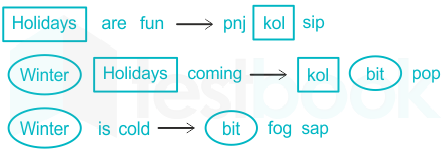
I) In a certain code language, “Holidays are fun” is coded as “pnj kol sip” and “winter holidays coming” is coded as “kol bit pop” and “Winter is cold” is coded as “bit fog sap”.

II) In a certain code language, “They are coming” is coded as “pop top gig” and “How are they” is coded as “top sun gig”.

What is the code for “Coming”?

  1. ((a))

    Only I is sufficient

  2. ((b))

    Only II is sufficient

  3. ((c))

    Both are not sufficient to answer the question

  4. ((d))

    Both are necessary to answer the question

  5. ((e))

    Either I or II is sufficient

Show Answer
Answer: ((e))

Either I or II is sufficient

Statement I: “Holidays are fun” is coded as “pnj kol sip”

                    “Winter holidays coming” is coded as “kol bit pop”

                    “Winter is cold” is coded as “bit fog sap”


WordCode
HolidaysKol
WinterBit
ComingPop


Statement I is alone sufficient to answer the question.

Statement II: “They are coming” is coded as “pop top gig”

                     “How are they” is coded as “top sun gig”

The code for ‘They’ and ‘Are’ are ‘top’ and ‘gig’.

Therefore, the code for ‘coming’ is ‘pop’.

Statement II is alone sufficient to answer the question.

Hence, the correct option is 5.

23

Direction: Study the information given carefully and answer the question given below.

Six people A, B, C, D, E, and f are sitting in a row facing north. What is the position of C with respect to F?

Statement I: A sits second from one end. One person sits between A and B. C sits immediately left of D. F sits to the right of C.

Statement II: B sits third from one of the ends. F who does not sit at the corner is one of the positions right to B. One person sits between D and F. Two people sit between D and A.

  1. ((a))

    Only I is sufficient

  2. ((b))

    Only II is sufficient

  3. ((c))

    Both are not sufficient to answer the question

  4. ((d))

    Both are necessary to answer the question

  5. ((e))

    Either I or II is sufficient

Show Answer
Answer: ((d))

Both are necessary to answer the question

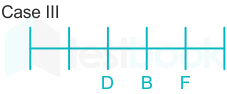
Statement I: A sits second from one end. One person sits between A and B. C sits immediately left of D.

<br>

F sits to the right of C. 

Hence, Statement I alone is not sufficient to answer the question.

Statement II: B sits third from one of the ends. F who does not sit at the corner is one of the positions right to B.  


<br>

One person sits between D and F. So, case II will be cancelled.


<br>

Two people sit between D and A.

<br>

Hence, Statement II alone is not sufficient to answer the question.

If we combine the both statements we get,


So by merging both statement C is third left of F.

Therefore, both statements are necessary to answer the question.

24

Direction: Study the following information carefully and answer the given questions.

X is in which direction with respect to Q?

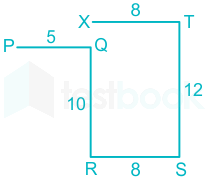
Statement I: P is 5 meter west of Q. R is 10 meter south of Q. S is 8 meter east of R. T is 12 meter north of S. X is 8 meter west of T.

Statement II: V is 8 meter south of Q. V is 4 meter west of U which is 10 meter south of W. Y is 2 meter west of W. Distance between X and Y is 2 meters.

  1. ((a))

    Statement I is alone sufficient

  2. ((b))

    Statement II is alone sufficient

  3. ((c))

    Both statements are together necessary to answer the question

  4. ((d))

    Both statement are together not sufficient to answer the question

  5. ((e))

    Either I or II is sufficient to answer the question

Show Answer
Answer: ((a))

Statement I is alone sufficient

According to statement I:

Therefore, X is in the north direction with respect to Q.

Hence, Statement I is alone sufficient to answer the question.

According to statement II:

<br>

Here, we only know the distance between X and Y but the direction is not mentioned. So, we cannot draw point X in statement II.

Hence, Statement II alone is not sufficient to answer the question.

Hence, the correct option is 1.

Direction: Study the information given carefully and answer the question given below.

P @ Q means P is the father of Q.

P # Q means P is the mother of Q.

P $ Q means P is the husband of Q.

P % Q means P is the wife of Q.

P & Q means P is the son of Q.

P * Q means P is the daughter of Q.

P = Q means P is the sister of Q.

P + Q means P is the brother of Q.

25

In expression 'R # P = S # Q + J (?) T; R % M @ S % T'

What will come in the place of the '?' to satisfy J is the child of T?

  1. ((a))

    &

  2. ((b))
  3. ((c))
  4. ((d))

    Either 1 or 2

  5. ((e))

    Either 2 or 3

Show Answer
Answer: ((d))

Either 1 or 2

P is
Symbol@#$%&*=+
MeaningFatherMotherHusbandWifeSonDaughterSisterBrother
of Q


  1. R # P means R is mother of P.

  2. P = S means P is sister of S.

  3. S # Q means S is mother of Q.

  4. Q + J means Q is brother of J.

  5. R % M means R is the wife of M.

  6. M @ S means M is the father of S.

  7. S % T means S is the wife of T

When we use sign & the J is Son of T and when * is used in that case J is daughter of T.

Hence, 'either option 1 or 2' will be the correct answer.

26

In expression 'M * S $ R # A + B $ N' How N is related to M?

  1. ((a))

    Sister

  2. ((b))

    Brother

  3. ((c))

    Cousin

  4. ((d))

    Daughter

  5. ((e))

    Sister-in-law

Show Answer
Answer: ((e))

Sister-in-law

P is
Symbol@#$%&*=+
MeaningFatherMotherHusbandWifeSonDaughterSisterBrother
of Q
  1. M * S means M is daughter of S.

  2. S $ R means S is husband of R.

  3. R # A means R is mother of A.

  4. A + B means A is brother of B.

  5. B $ N means B is husband of N.


N is the sister-in-law of M.

Hence, the correct answer is sister-in-law.

27

In expression 'P % B @ N= Q $ S # T; Q + M @ C'

How is T related to C?

  1. ((a))

    Sister

  2. ((b))

    Brother

  3. ((c))

    Cousin

  4. ((d))

    Sister-in-law

  5. ((e))

    Mother

Show Answer
Answer: ((c))

Cousin

P is
Symbol@#$%&*=+
MeaningFatherMotherHusbandWifeSonDaughterSisterBrother
of Q


  1. P % B means P is wife of B.

  2. B @ N means B is father of N.

  3. N = Q means N is sister of Q.

  4. Q $ S means Q is husband of S.

  5. S # T means S is mother of T.

  1. Q + M means Q is brother of M.

  2. M @ C means M is father of C.

Combining we get,

Hence, T is the cousin of C.

28

Directions: In the question below are given a statement followed by two courses of action numbered I and II. A course of action is a step or administrative decision to be taken for imprvement, follow-up or further action in regard to the problem, policy etc. On the basis of the information given in the statement to be true, then decide which of the suggested courses of action logically follow(s) for pursuing. 

Now a days children are more attracted towards playing mobile and computer games rather than playing outdoor games. These games offer a remarkable graphical interface with illuminating images of cars, soldiers, fighters, and players which attracts the interest of children towards this technology and there are thousands of games on one platform. But it has a very bad effect on children’s health. It leads to obesity, muscular strain, and eye damage. Overall, this is not a beneficial trend as it can isolate a child from society and make them unhealthy.

Course of action:

I) Children should play outdoor games to keep their body and mind fit and fine.

II) Parents should stop using mobile so that the children could not play mobile games.

III) Parents should tell their children to focus only on study not any kind of games.

  1. ((a))

    Only II and III follow

  2. ((b))

    Only I follows

  3. ((c))

    Only II follows

  4. ((d))

    Only I and III follow

  5. ((e))

    All I, II and III follow

Show Answer
Answer: ((b))

Only I follows

I) Children should play outdoor games to keep their body and mind fit and fine – This action is true as outdoor games keep one’s healthy and prevent many health problems like obesity, muscular strain etc.

II) Parents should stop using mobile so that their children could not play mobile games – This action is false as parents should prohibit their children from playing mobile games but stopping using mobile is not an option.

III) Parents should tell their children to focus only on study not any kind of games**– This action is false** as playing is also important for children. It helps in the development of children’s mind. 

Hence, the correct option is 2.

Direction: Study the following information and answer the following questions.


Cognizant has reduced the maximum bench time for employees, opening up the possibility of higher numbers of exits in the coming months. The company has shrunk the bench time from 60 days to 35 days for those employees who aren't on billable projects. After 35 days, they could be asked to leave. The formal exit process may take another 60 to 90 days.


(A) Cognizant pays its employees even when they are not on billable projects.

(B) More layoffs will take place in Cognizant in the coming days.

(C) Headcounts in Cognizant are definitely going to shrink in the days to come globally.

(D) The company is trying to reduce its overhead expenses incurred on the employees.

(E) Pay and perk is set to decrease for Cognizant employees in the coming years.

29

Which of the following among (A), (B), (C), (D) and (E) has been assumed in the given information?

  1. ((a))

    Only (B) 

  2. ((b))

    Only (C)

  3. ((c))

    Only (D)

  4. ((d))

    Only (A)

  5. ((e))

    Only (E)

Show Answer
Answer: ((d))

Only (A)

An assumption is something that is supposed. Let's have a look at all statements given:

(A) Cognizant pays its employees even when they are not on billable projects - This is the assumption behind the decision taken by Cognizant. This is what bench time is all about.

(B) More layoffs will take place in Cognizant in the coming days - This is not the assumption rather it is the effect of the decision taken by Cognizant.

(C) Headcounts in Cognizant are definitely going to shrink in the days to come globally - This is also not the assumption just a definite statement about the future. 

(D) The company is trying to reduce its overhead expenses incurred on the employees - This is also not the assumption as many employees can also be on billable projects. 

(E) Pay and perk is set to decrease for Cognizant employees in the coming years - The passage is talking about bench time only and not anything about increased cost or decreased profit that can result in the reduction of pay and perk. So, this is also not the assumption.


Hence, the correct answer is Only (A).

30

Which of the following among (A), (B). (C), (D) and (E) will be the effect of the reduction in the bench time by Cognizant?

  1. ((a))

    Only (B)

  2. ((b))

    Only (D)

  3. ((c))

    Only (A)

  4. ((d))

    Only (C)

  5. ((e))

    Only (E)

Show Answer
Answer: ((a))

Only (B)

Let's have a look at all statements given:

(A) Cognizant pays its employees even when they are not on billable projects - This is the assumption behind the decision taken by Cognizant not the effect. This is what bench time is all about.

(B) More layoffs will take place in Cognizant in the coming days - This will be the effect of the decision taken by Cognizant.

(C) Headcounts in Cognizant are definitely going to shrink in the days to come globally - This will not be the effect as if the employees exit after completion of bench time then new employees can also be hired suitable for billable projects going on.

(D) The company is trying to reduce its overhead expenses incurred on the employees - This is also not the effect as many employees can also be on billable projects. 

(E) Pay and perk is set to decrease for Cognizant employees in the coming years - The passage is talking about benchmark time only and not anything about increased cost or decreased profit that can result in the reduction of pay and perk. So, this also will not an effect.


Hence, the correct answer is Only (B).

Direction: Study the following information carefully and answer the given questions.

9 persons P to X belongs to three different states (Tripura, Manipur, and Assam) of different ages. Not more than 4 and not less than 2 persons belong to each state. If it is given for example B and the one who is 10yrs belong to the same state then that means B is not 10 years. P and V do not belong to the same state. S does not belong to Tripura and Assam. Q and the one who is 18yrs old belong to the same state and these are the only persons belonging to that state. U and the one who is 29 yrs old belong to the same state and U's age is an odd number. W and the one who is 54 yrs old belong to the same state. V and the one who is 64 yrs belong to the same state. P is the eldest person in his/her respective state. The one who is 53 yrs belongs to Tripura. S age is twice of Q. V's age is 7 years less than W's age. R is not the youngest person. The minimum age is 18 yrs. V is elder than Q. P and S do not belong to the same state. V and T belong to the same state where T is elder than V. U is 5 yrs elder than Q and one of the ages is 51 yrs.

31

What is the age of V?

  1. ((a))

    37

  2. ((b))

    54

  3. ((c))

    35

  4. ((d))

    29

  5. ((e))

    61

Show Answer
Answer: ((b))

54

Given:

9 persons - P, Q, R, S, T, U, V, W, X

3 states - Tripura, Manipur, and Assam

Maximum 4 and minimum 2 persons belong to each state. 

The minimum age is 18 yrs. 

Now,

1) S does not belong to Tripura and Assam. It means S belongs to Manipur.

2) Q and the one who is 18yrs old belong to the same state and these are the only persons belonging to that state. It means one state has 4 persons, one has 3 and the other one has 2 persons. We cannot determine the state of Q and the one who is 18 yrs old yet.

StatesPersons
Tripura
ManipurS
Assam


3) U and the one who is 29 yrs old belong to the same state and U's age is an odd number.

4) U is 5 yrs elder than Q and one of the ages is 51 yrs. If Q is 51 then U will be 51+5=56 which is an even number. This contradicts condition 3). So the age of U is 51 years and the age of Q is 46 years. We cannot determine the state of U for now.

5) The one who is 53 yrs belongs to Tripura. It means Q who is 46 years old and the one who is 18 yrs old belongs to Assam.

StatesPersons
Tripura(53)
ManipurS
AssamQ (46), (18)


6) S age is twice of Q. Age of S = 46*2 = 92 years.

  1. P and S do not belong to the same state. 

8) P is the eldest person in his/her respective state. It means P lives in Tripura. The age of P can be 53 or can't be 53.

Case I -

StatesPersons
TripuraP (53)
ManipurS (92)
AssamQ (46), (18)


Case II -

StatesPersons
TripuraP, (53)
ManipurS (92)
AssamQ (46), (18)


9) P and V do not belong to the same state.

10) V and T belong to the same state. It means they both belong to Manipur.

11) V and the one who is 64 yrs belong to the same state. T should be either 61 years old or 64 years old.

Case I (a) -

StatesPersons
TripuraP (53)
ManipurS (92), V, T (61), (64)
AssamQ (46), (18)


Case I (b) -

StatesPersons
TripuraP (53)
ManipurS (92), V, (61), T (64)
AssamQ (46), (18)


Case II (a) -

StatesPersons
TripuraP, (53)
ManipurS (92), V, T (61), (64)
AssamQ (46), (18)


Case II (b) -

StatesPersons
TripuraP, (53)
ManipurS (92), V, (61), T (64)
AssamQ (46), (18)


  1. V is elder than Q. Combining this condition with condition 3) we get that V's age cannot be 29 so U and the one whose age is 29 belong to Tripura. There can be 3 persons in Tripura only as there are 4 persons in Manipur. 

13) W and the one who is 54 yrs old belong to the same state. They belong to Manipur as this is the only possible case here. W's age can be either 61 or 64. V's age is 54 (more than 46).

14) V's age is 7 years less than W's age. So, 54 + 7= 61 is the age of W and 64 is the age of T.

15) R is not the youngest person. So, R's age is 29 and X, the remaining one, is the youngest person. P's age is 53 (eldest in the state).

The final arrangement is - 

StatesPersons
TripuraP (53), U (51), R (29)
ManipurS (92), V (54), W (61), T (64),
AssamQ (46), X (18)


The age of V is 54 years.

The correct answer is 54.

32

Who among the following belongs to Assam?

  1. ((a))

    P

  2. ((b))

    R

  3. ((c))

    T

  4. ((d))

    U

  5. ((e))

    X

Show Answer
Answer: ((e))

X

Given:

9 persons - P, Q, R, S, T, U, V, W, X

3 states - Tripura, Manipur, and Assam

Maximum 4 and minimum 2 persons belong to each state. 

The minimum age is 18 yrs. 

Now,

1) S does not belong to Tripura and Assam. It means S belongs to Manipur.

2) Q and the one who is 18yrs old belong to the same state and these are the only persons belonging to that state. It means one state has 4 persons, one has 3 and the other one has 2 persons. We cannot determine the state of Q and the one who is 18 yrs old yet.

StatesPersons
Tripura
ManipurS
Assam


3) U and the one who is 29 yrs old belong to the same state and U's age is an odd number.

4) U is 5 yrs elder than Q and one of the ages is 51 yrs. If Q is 51 then U will be 51+5=56 which is an even number. This contradicts condition 3). So the age of U is 51 years and the age of Q is 46 years. We cannot determine the state of U for now.

5) The one who is 53 yrs belongs to Tripura. It means Q who is 46 years old and the one who is 18 yrs old belongs to Assam.

StatesPersons
Tripura(53)
ManipurS
AssamQ (46), (18)


6) S age is twice of Q. Age of S = 46*2 = 92 years.

  1. P and S do not belong to the same state. 

8) P is the eldest person in his/her respective state. It means P lives in Tripura. The age of P can be 53 or can't be 53.

Case I -

StatesPersons
TripuraP (53)
ManipurS (92)
AssamQ (46), (18)


Case II -

StatesPersons
TripuraP, (53)
ManipurS (92)
AssamQ (46), (18)


9) P and V do not belong to the same state.

10) V and T belong to the same state. It means they both belong to Manipur.

11) V  and the one who is 64 yrs belong to the same state. T should be either 61 years old or 64 years old.

Case I (a) -

StatesPersons
TripuraP (53)
ManipurS (92), V, T (61), (64)
AssamQ (46), (18)


Case I (b) -

StatesPersons
TripuraP (53)
ManipurS (92), V, (61), T (64)
AssamQ (46), (18)


Case II (a) -

StatesPersons
TripuraP, (53)
ManipurS (92), V, T (61), (64)
AssamQ (46), (18)


Case II (b) -

StatesPersons
TripuraP, (53)
ManipurS (92), V, (61), T (64)
AssamQ (46), (18)


  1. V is elder than Q. Combining this condition with condition 3) we get that V's age cannot be 29 so U and the one whose age is 29 belong to Tripura. There can be 3 persons in Tripura only as there are 4 persons in Manipur. 

13) W and the one who is 54 yrs old belong to the same state. They belong to Manipur as this is the only possible case here. W's age can be either 61 or 64. V's age is 54 (more than 46).

14) V's age is 7 years less than W's age. So, 54 + 7= 61 is the age of W and 64 is the age of T.

15) R is not the youngest person. So, R's age is 29 and X, the remaining one, is the youngest person. P's age is 53 (eldest in the state).

The final arrangement is - 

StatesPersons
TripuraP (53), U (51), R (29)
ManipurS (92), V (54), W (61), T (64),
AssamQ (46), X (18)


Among the given options, X belongs to Assam.

The correct answer is X.

33

Sum of ages of R and S is:

  1. ((a))

    125

  2. ((b))

    59

  3. ((c))

    88

  4. ((d))

    121

  5. ((e))

    53

Show Answer
Answer: ((d))

121

Given:

9 persons - P, Q, R, S, T, U, V, W, X

3 states - Tripura, Manipur, and Assam

Maximum 4 and minimum 2 persons belong to each state. 

The minimum age is 18 yrs. 

Now,

1) S does not belong to Tripura and Assam. It means S belongs to Manipur.

2) Q and the one who is 18yrs old belong to the same state and these are the only persons belonging to that state. It means one state has 4 persons, one has 3 and the other one has 2 persons. We cannot determine the state of Q and the one who is 18 yrs old yet.

StatesPersons
Tripura
ManipurS
Assam


3) U and the one who is 29 yrs old belong to the same state and U's age is an odd number.

4) U is 5 yrs elder than Q and one of the ages is 51 yrs. If Q is 51 then U will be 51+5=56 which is an even number. This contradicts condition 3). So the age of U is 51 years and the age of Q is 46 years. We cannot determine the state of U for now.

5) The one who is 53 yrs belongs to Tripura. It means Q who is 46 years old and the one who is 18 yrs old belongs to Assam.

StatesPersons
Tripura(53)
ManipurS
AssamQ (46), (18)


6) S age is twice of Q. Age of S = 46*2 = 92 years.

  1. P and S do not belong to the same state. 

8) P is the eldest person in his/her respective state. It means P lives in Tripura. The age of P can be 53 or can't be 53.

Case I -

StatesPersons
TripuraP (53)
ManipurS (92)
AssamQ (46), (18)


Case II -

StatesPersons
TripuraP, (53)
ManipurS (92)
AssamQ (46), (18)


9) P and V do not belong to the same state.

10) V and T belong to the same state. It means they both belong to Manipur.

11) V and the one who is 64 yrs belong to the same state. T should be either 61 years old or 64 years old.

Case I (a) -

StatesPersons
TripuraP (53)
ManipurS (92), V, T (61), (64)
AssamQ (46), (18)


Case I (b) -

StatesPersons
TripuraP (53)
ManipurS (92), V, (61), T (64)
AssamQ (46), (18)


Case II (a) -

StatesPersons
TripuraP, (53)
ManipurS (92), V, T (61), (64)
AssamQ (46), (18)


Case II (b) -

StatesPersons
TripuraP, (53)
ManipurS (92), V, (61), T (64)
AssamQ (46), (18)


  1. V is elder than Q. Combining this condition with condition 3) we get that V's age cannot be 29 so U and the one whose age is 29 belong to Tripura. There can be 3 persons in Tripura only as there are 4 persons in Manipur. 

13) W and the one who is 54 yrs old belong to the same state. They belong to Manipur as this is the only possible case here. W's age can be either 61 or 64. V's age is 54 (more than 46).

14) V's age is 7 years less than W's age. So, 54 + 7= 61 is the age of W and 64 is the age of T.

15) R is not the youngest person. So, R's age is 29 and X, the remaining one, is the youngest person. P's age is 53 (eldest in the state).

The final arrangement is - 

StatesPersons
TripuraP (53), U (51), R (29)
ManipurS (92), V (54), W (61), T (64),
AssamQ (46), X (18)


R +S = 29 + 92 = 121.

The correct answer is 121.

34

Find the odd man out:

  1. ((a))

    S

  2. ((b))

    T

  3. ((c))

    U

  4. ((d))

    V

  5. ((e))

    W

Show Answer
Answer: ((c))

U

Given:

9 persons - P, Q, R, S, T, U, V, W, X

3 states - Tripura, Manipur, and Assam

Maximum 4 and minimum 2 persons belong to each state. 

The minimum age is 18 yrs. 

Now,

1) S does not belong to Tripura and Assam. It means S belongs to Manipur.

2) Q and the one who is 18yrs old belong to the same state and these are the only persons belonging to that state. It means one state has 4 persons, one has 3 and the other one has 2 persons. We cannot determine the state of Q and the one who is 18 yrs old yet.

StatesPersons
Tripura
ManipurS
Assam


3) U and the one who is 29 yrs old belong to the same state and U's age is an odd number.

4) U is 5 yrs elder than Q and one of the ages is 51 yrs. If Q is 51 then U will be 51+5=56 which is an even number. This contradicts condition 3). So the age of U is 51 years and the age of Q is 46 years. We cannot determine the state of U for now.

5) The one who is 53 yrs belongs to Tripura. It means Q who is 46 years old and the one who is 18 yrs old belongs to Assam.

StatesPersons
Tripura(53)
ManipurS
AssamQ (46), (18)


6) S age is twice of Q. Age of S = 46*2 = 92 years.

  1. P and S do not belong to the same state. 

8) P is the eldest person in his/her respective state. It means P lives in Tripura. The age of P can be 53 or can't be 53.

Case I -

StatesPersons
TripuraP (53)
ManipurS (92)
AssamQ (46), (18)


Case II -

StatesPersons
TripuraP, (53)
ManipurS (92)
AssamQ (46), (18)


9) P and V do not belong to the same state.

10) V and T belong to the same state. It means they both belong to Manipur.

11) V and the one who is 64 yrs belong to the same state. T should be either 61 years old or 64 years old.

Case I (a) -

StatesPersons
TripuraP (53)
ManipurS (92), V, T (61), (64)
AssamQ (46), (18)


Case I (b) -

StatesPersons
TripuraP (53)
ManipurS (92), V, (61), T (64)
AssamQ (46), (18)


Case II (a) -

StatesPersons
TripuraP, (53)
ManipurS (92), V, T (61), (64)
AssamQ (46), (18)


Case II (b) -

StatesPersons
TripuraP, (53)
ManipurS (92), V, (61), T (64)
AssamQ (46), (18)


  1. V is elder than Q. Combining this condition with condition 3) we get that V's age cannot be 29 so U and the one whose age is 29 belong to Tripura. There can be 3 persons in Tripura only as there are 4 persons in Manipur. 

13) W and the one who is 54 yrs old belong to the same state. They belong to Manipur as this is the only possible case here. W's age can be either 61 or 64. V's age is 54 (more than 46).

14) V's age is 7 years less than W's age. So, 54 + 7= 61 is the age of W and 64 is the age of T.

15) R is not the youngest person. So, R's age is 29 and X, the remaining one, is the youngest person. P's age is 53 (eldest in the state).

The final arrangement is - 

StatesPersons
TripuraP (53), U (51), R (29)
ManipurS (92), V (54), W (61), T (64),
AssamQ (46), X (18)


Among the given options, all except U belong to Manipur.

The correct answer is U.

Direction: Study the information given carefully and answer the question given below.

‘A # B’ means ‘A is either smaller than or equal to B.’

<br>

‘A $ B’ means ‘A is neither smaller than nor equal to B.’

<br>

‘A + B’ means ‘A is either greater than or equal to B.’

<br>

‘A @ B’ means ‘A is neither greater than nor equal to B.’

<br>

‘A * B’ means ‘A is neither greater than nor smaller than B.’

35

Statement: S @ T $ Q + R; Q * P @ W

Conclusion:

I) R # W

II) W $ R

  1. ((a))

    Only I follows

  2. ((b))

    Only II follows

  3. ((c))

    Both I and II follow

  4. ((d))

    Either I or II follows

  5. ((e))

    Neither I or II follows

Show Answer
Answer: ((b))

Only II follows

As per the information given,

A is
Symbol#$+@*
Meaning><=
to B

Given Statement: S @ T $ Q + R; Q * P @ W

On converting: S < T > Q ≥ R; Q = P < W

On combining: S < T > Q = P ≥ R, S < T > Q = P < W, R ≤ Q = P < W


Conclusions:

I. R # W → R ≤ W → False (as R ≤ Q = P < W, therefore R < W)

II. W $ R → W > R → True (as R ≤ Q = P < W, therefore R < W).

Hence, only conclusions II follows.

36

Statement: S @ T $ Q + R; Q * P @ W

Conclusion:

I) R # W

II) W $ R

III) R @ T

  1. ((a))

    Only II follow

  2. ((b))

    Only I and II follow

  3. ((c))

    Only III follow

  4. ((d))

    Only II and III follow

  5. ((e))

    Only I follow

Show Answer
Answer: ((d))

Only II and III follow

As per the information given,

A is
Symbol#$+@*
Meaning><=
to B

Given Statement: S @ T $ Q + R; Q * P @ W

On converting: S < T > Q ≥ R; Q = P < W

On combining: S < T > Q = P ≥ R, S < T > Q = P < W, R ≤ Q = P < W


Conclusions:

I. R # W → R ≤ W → False (as R ≤ Q = P < W, therefore R < W)

II. W $ R → W > R → True (as R ≤ Q = P < W, therefore R < W).

III. R @ T → R < T → True (as T > Q = P ≥ R, therefore R < T)

Hence, only conclusions II and III follows.

37

Statement: U @ V + W # Y * X; V + P $ Q

Conclusion:

I) P # X

II) Q @ U

III) W # X

  1. ((a))

    Only II follow

  2. ((b))

    Only III follow

  3. ((c))

    Only I follow

  4. ((d))

    All follows

  5. ((e))

    None follow

Show Answer
Answer: ((b))

Only III follow

As per the information given,

A is
Symbol#$+@*
Meaning><=
to B

Given Statement: U @ V + W # Y * X; V + P $ Q

On converting: U < V ≥ W ≤ Y = X; V ≥ P > Q

On combining: U < V ≥ P > Q; Q < P ≤ V ≥ W ≤ Y = X


Conclusions:

I. P # X → P ≤ X → False (as P ≤ V ≥ W ≤ Y = X, therefore no specific relation mentioned between P and X)

II. Q @ U → Q < U → False (as U < V ≥ P > Q, therefore no specific relation mentioned between Q and U)

III. W # X → W ≤ X → True (as W ≤ Y = X, therefore W ≤ X)

Hence, only conclusions III follow.

38

Direction: In the question the statement is given followed by some inferences. You must consider the statement to be true even if it seems to be at variance from commonly known facts. 

There is considerable reduction in the number of people affected by water-borne diseases in City X during this rainy season. Waterborne diseases are caused by drinking contaminated or dirty water. Contaminated water can cause many types of diarrheal diseases, including Cholera, and other serious illnesses such as Guinea worm disease, Typhoid, and Dysentery. The government has opened four new civil hospitals in City X in the beginning of the year to treat these diseases by providing better Health Services. These hospitals strive to help people improve their productivity and reduce risks of diseases and injury in a cost-effective way.

Which of the following statement can be inferred from the passage?

  1. ((a))

    The people affected by the water borne diseases has reduced over past few years.

  2. ((b))

    The hospital helps the poor people who were suffering from water borne diseases with better health services.

  3. ((c))

    Government opened new hospitals to provide cost effective health services.

  4. ((d))

    As people spend more money to treat this disease, Government opened new hospitals to provide treatment in cost effective way.

  5. ((e))

    Drinking contaminated water cause water borne diseases including diarrheal disease..

Show Answer
Answer: ((c))

Government opened new hospitals to provide cost effective health services.

There is considerable reduction in the number of people affected by water-borne diseases in City X during this rainy season. Waterborne diseases are caused by drinking contaminated or dirty water. Contaminated water can cause many types of diarrheal diseases, including Cholera, and other serious illnesses such as Guinea worm disease, Typhoid, and Dysentery. The government has opened four new civil hospitals in City X in the beginning of the year to treat this disease by providing better Health Services. These hospitals strive to help people improve their productivity and reduce risks of diseases and injury in a cost-effective way.

I. The number of people affected by water-borne diseases in City X during this rainy season and not over the past years. So, this can't be inferred from the passage.

II. The hospitals strive to help people improve their productivity and reduce risks of diseases and injury in a cost-effective way. But we cannot conclude that the people taking treatment are poor or rich. So, this cannot be inferred.

III. The government has opened four new civil hospitals in City X in the beginning of the year to treat this disease by providing better Health Services. These hospitals strive to help people improve their productivity and reduce risks of diseases and injury in a cost-effective way. So, this can be inferred.

IV. The hospital help people improve their productivity and reduce risks of diseases and injury in a cost-effective way. From this we cannot conclude that before this people had spent more money for their treatment. So, this cannot be inferred.

V. Drinking contaminated water cause water borne diseases including diarrheal disease. This is true but this is not the main inference to be taken.

Hence, Option III is the answer.

39

Directions: Read the passage and answer the following question.

Statement: Prime Minister Narendra Modi is all set tomorrow to launch three mega flagship schemes aimed at transforming urban India, including the much talked about Smart Cities proposal, with a whopping Rs 4 lakh crore kitty having been lined up for the projects. Urban Development Minister States and local bodies will play a key role in the execution of these schemes, the minister said, adding that there will also be a lot of scope for private participation.

"Effective management of growing urbanization is a major challenge towards the making of resurgent India. Resource management is a major challenge. The government, through these schemes, is looking to bring about a transformation of urban India with the critical goal of making the country an economic hub. Speaking at the event, Modi said, " The decision to make cities smart will be taken not by governments but by the people of the city, the local administration. Let there be competition between the cities in that smart cities come up".

Which of the following will be an effect of the initiative taken by the government?

  1. ((a))

    Millions of job will be created and scarcity of houses will be removed in urban and rural areas.

  2. ((b))

    Quality of life will improve in rural and urban areas.

  3. ((c))

    Enhanced citizen and government engagement beside implementation of reforms in urban governance would be the focus under the scheme.

  4. ((d))

    Ensuring water supply to each household, sewer connections, sanitation and solid waste management in rural and urban governance would be the focus under the scheme.

  5. ((e))

    All of the above

Show Answer
Answer: ((c))

Enhanced citizen and government engagement beside implementation of reforms in urban governance would be the focus under the scheme.

The passage is talking about the Smart city scheme that will be implemented by the government. So anything related to rural areas is out of scope; further creation of jobs in the rural sector has not been mentioned in the given passage.

The passage does not specify the activities planned by the government under the smart city scheme. Thus, options 1 and 4 will get eliminated.

Again, option 2 includes the impact of the scheme in the rural areas which is beyond the scope of the scheme.

This statement "The decision to make cities smart will be taken not by governments but by the people of the city" indicates that the scheme will involve citizen participation in some respect. Thus, enhanced citizen and government engagement is a possible effect of the scheme.

Also, the scheme is meant for cities and effective management of urbanization. Therefore, one of the effects would be the implementation of reforms in urban governance.

Hence, Option 3 is the correct answer.

40

Directions: In the question below is given a statement followed by two Inferences I and II. You have to assume everything in the statement to be true on the basis of the information given in the statement, decide which of the given inferences can be deduced.

Statement: China launched the second of the three modules needed to complete its new space station. This was the most recent development in Beijing's ambitious space project. A long march 5B rocket launched the unmanned spaceship with the call sign Wentian from the Wenchang launch facility on China's tropical island success.

Inferences :

I. China will launch another unmanned spaceship into space.

II. China is building a space project to infest other countries.

  1. ((a))

    Only inference I can be inferred

  2. ((b))

    Only inference II can be inferred

  3. ((c))

    Both inference I and II can be inferred

  4. ((d))

    Neither inference I nor II can be inferred

  5. ((e))

    Either inference I or II can be inferred

Show Answer
Answer: ((a))

Only inference I can be inferred

Given statement:  China launched the second of the three modules needed to complete its new space station. This was the most recent development in Beijing's ambitious space project. A long march 5B rocket launched the unmanned spaceship with call sign Wentian from the Wenchang launch facility on China's tropical island success.

Inference I: "China will launch another unmanned spaceship into the space" can be inferred as it is a three series space module and the second of them has been released, hence another launch is also planned to take place.

Inference II: "China is building the space project to infest other countries" cannot be inferred, it may be true in general known facts but since no mention of other countries is there we cannot directly take it as a possibility according to the passage.

Hence, Only I can be inferred.

Direction: Study the following information carefully and answer the given questions.

Ten persons sits in two parallel rows with 5 persons in each row. Row 1 has A, B, C, D and E facing north and row 2 has P, Q, R, S and T facing south. These persons belong to a three-generation family. A sits 2nd from one of the ends. R faces immediate neighbour of A’s niece. E's mother-in-law sits opposite to the one who sits 3rd to the right of A. One person sits between A and her sister-in-law. B is married to E who has one child. R sits to the right of T. Q is married. A’s son sits immediate right of A. B’s father faces A who has two children one son and one daughter. P and her granddaughter Q are not sitting together. Three persons sits between B and the person sitting opposite to Q's father. C and D are unmarried. C does not sit next to E.

41

How C is related to Q?

  1. ((a))

    Mother

  2. ((b))

    Son

  3. ((c))

    Cousin

  4. ((d))

    Sister

  5. ((e))

    None of these

Show Answer
Answer: ((c))

Cousin

  1. A sits 2nd from one of the ends.

  2. E's mother-in-law sits opposite to the one who sits 3rd to the right of A.

  3. One person sits between A and her sister-in-law. Therefore, A is female.


<br>
  1. Three persons sits between B and the person sitting opposite to Q's father.

  2. A’s son sits immediate right of A.


<br>
  1. C and D are unmarried. Therefore, neither C nor D is an immediate neighbour of B and so E will be A’s sister-in-law.

  2. C does not sit next to E. Therefore, C would be at the corner and D would be A’s son.


<br>
  1. B is married to E who has one child. Therefore, B is male.

  2. B’s father faces A who has two children one son and one daughter.


<br>

E is sister-in-law of A. Therefore, B is the brother of A.

  1. R faces immediate neighbour of A’s niece. Therefore, C is A’s niece and daughter of B and E. We also know that R is B’s father.

  2. R sits to the right of T.


<br>

<br>
  1. P and her granddaughter Q are not sitting together. Therefore, case I will be cancelled.

Clearly S is Q’s father.


<br>
  1. Q is married. Therefore, T is the husband of Q.

The final solution is,


<br>

 Hence, C is cousin of Q.

42

Find the odd one according to their position.

  1. ((a))

    S

  2. ((b))

    R

  3. ((c))

    P

  4. ((d))

    C

  5. ((e))

    B

Show Answer
Answer: ((b))

R

  1. A sits 2nd from one of the ends.

  2. E's mother-in-law sits opposite to the one who sits 3rd to the right of A.

  3. One person sits between A and her sister-in-law. Therefore, A is female.


<br>
  1. Three persons sits between B and the person sitting opposite to Q's father.

  2. A’s son sits immediate right of A.


<br>
  1. C and D are unmarried. Therefore, neither C nor D is an immediate neighbour of B and so E will be A’s sister-in-law.

  2. C does not sit next to E. Therefore, C would be at the corner and D would be A’s son.


<br>
  1. B is married to E who has one child. Therefore, B is male.

  2. B’s father faces A who has two children one son and one daughter.


<br>

E is sister-in-law of A. Therefore, B is the brother of A.

  1. R faces immediate neighbour of A’s niece. Therefore, C is A’s niece and daughter of B and E. We also know that R is B’s father.

  2. R sits to the right of T.


<br>

<br>
  1. P and her granddaughter Q are not sitting together. Therefore, case I will be cancelled.

Clearly S is Q’s father.


<br>
  1. Q is married. Therefore, T is the husband of Q.

The final solution is,


<br>

 Hence, the correct answer is R.

43

How T is related to A?

  1. ((a))

    Son

  2. ((b))

    Husband

  3. ((c))

    Brother

  4. ((d))

    Farher

  5. ((e))

    Son-in-law

Show Answer
Answer: ((e))

Son-in-law

  1. A sits 2nd from one of the ends.

  2. E's mother-in-law sits opposite to the one who sits 3rd to the right of A.

  3. One person sits between A and her sister-in-law. Therefore, A is female.


<br>
  1. Three persons sits between B and the person sitting opposite to Q's father.

  2. A’s son sits immediate right of A.


<br>
  1. C and D are unmarried. Therefore, neither C nor D is an immediate neighbour of B and so E will be A’s sister-in-law.

  2. C does not sit next to E. Therefore, C would be at the corner and D would be A’s son.


<br>
  1. B is married to E who has one child. Therefore, B is male.

  2. B’s father faces A who has two children one son and one daughter.


<br>

E is sister-in-law of A. Therefore, B is the brother of A.

  1. R faces immediate neighbour of A’s niece. Therefore, C is A’s niece and daughter of B and E. We also know that R is B’s father.

  2. R sits to the right of T.


<br>

<br>
  1. P and her granddaughter Q are not sitting together. Therefore, case I will be cancelled.

Clearly S is Q’s father.


<br>
  1. Q is married. Therefore, T is the husband of Q.

The final solution is,


<br>

 Hence, T is the son-in-law of A.

44

Who sits opposite to the one who sits immediate left of R?

  1. ((a))

    A

  2. ((b))

    B

  3. ((c))

    C

  4. ((d))

    D

  5. ((e))

    E

Show Answer
Answer: ((d))

D

  1. A sits 2nd from one of the ends.

  2. E's mother-in-law sits opposite to the one who sits 3rd to the right of A.

  3. One person sits between A and her sister-in-law. Therefore, A is female.


<br>
  1. Three persons sits between B and the person sitting opposite to Q's father.

  2. A’s son sits immediate right of A.


<br>
  1. C and D are unmarried. Therefore, neither C nor D is an immediate neighbour of B and so E will be A’s sister-in-law.

  2. C does not sit next to E. Therefore, C would be at the corner and D would be A’s son.


<br>
  1. B is married to E who has one child. Therefore, B is male.

  2. B’s father faces A who has two children one son and one daughter.


<br>

E is sister-in-law of A. Therefore, B is the brother of A.

  1. R faces immediate neighbour of A’s niece. Therefore, C is A’s niece and daughter of B and E. We also know that R is B’s father.

  2. R sits to the right of T.


<br>

<br>
  1. P and her granddaughter Q are not sitting together. Therefore, case I will be cancelled.

Clearly S is Q’s father.


<br>
  1. Q is married. Therefore, T is the husband of Q.

The final solution is,


<br>

 Hence, D sits opposite to the one who sits immediate left of R.

45

How P is related to E?

  1. ((a))

    Father-in-law

  2. ((b))

    Mother -in-law

  3. ((c))

    Sister-in-law

  4. ((d))

    Daughter

  5. ((e))

    Daughter-in-law

Show Answer
Answer: ((b))

Mother -in-law

  1. A sits 2nd from one of the ends.

  2. E's mother-in-law sits opposite to the one who sits 3rd to the right of A.

  3. One person sits between A and her sister-in-law. Therefore, A is female.


<br>
  1. Three persons sits between B and the person sitting opposite to Q's father.

  2. A’s son sits immediate right of A.


<br>
  1. C and D are unmarried. Therefore, neither C nor D is an immediate neighbour of B and so E will be A’s sister-in-law.

  2. C does not sit next to E. Therefore, C would be at the corner and D would be A’s son.


<br>
  1. B is married to E who has one child. Therefore, B is male.

  2. B’s father faces A who has two children one son and one daughter.


<br>

E is sister-in-law of A. Therefore, B is the brother of A.

  1. R faces immediate neighbour of A’s niece. Therefore, C is A’s niece and daughter of B and E. We also know that R is B’s father.

  2. R sits to the right of T.


<br>

<br>
  1. P and her granddaughter Q are not sitting together. Therefore, case I will be cancelled.

Clearly S is Q’s father.


<br>
  1. Q is married. Therefore, T is the husband of Q.

The final solution is,


<br>

 Hence, P is the mother-in-law of E.

General Awareness (40 questions)

46

In September 2022, the Monetary Policy Committee of Reserve Bank of India has decided to increase Bank Rate to the_____.

  1. ((a))

    5.7

  2. ((b))

    6.15

  3. ((c))

    6.1

  4. ((d))

    6.3

  5. ((e))

    5.65

Show Answer
Answer: ((b))

6.15

The correct answer is 6.15

Key Points

  • The Monetary Policy Committee of the Reserve Bank of India has decided to increase Bank Rate to the 6.15 percent, with immediate effect.
  • The repo rate is the interest rate at which the central bank lends to commercial banks.
  • The RBI has raised the repo rate by 1.9 percent since May 2022.
  • RBI also projected real GDP growth for 2022-23 at 7.0 percent.

Additional Information

  • RBI:
  • Governor - Shaktikanta Das.
  • Headquarters - Mumbai.
  • Founded: 1 April 1935, Kolkata.
  • The Bank publishes two statutory reports, the Annual Report of the Bank and the Report on Trend and Progress of Banking in India.
  • It also publishes Financial Stability Report.
47

Minicoy Thundi Beach and Kadmat Beach, are the proud entrants in the coveted list of Blue Beaches, an eco-label given to the cleanest beaches in the world. These two beaches are located in which of the following UT?

  1. ((a))

    Puducherry

  2. ((b))

    Nicobar

  3. ((c))

    Lakshadweep

  4. ((d))

    Andaman 

  5. ((e))

    Daman and Diu

Show Answer
Answer: ((c))

Lakshadweep

The correct answer is Lakshadweep.

Key Points

  • Minicoy Thundi Beach and Kadmat Beach, in Lakshadweep are the proud entrants in the coveted list of Blue Beaches, an eco-label given to the cleanest beaches in the world.
  • As of October 2022, the tally of total blue flag-endorsed beaches in India stands at 12.
  • Both beaches have designated staff for beach cleanliness, maintenance, safety, and security of swimmers.
  • Further, they comply with all the 33 criteria mandated by the Foundation for Environment Education (FEE).
  • Blue Beaches: Thundi and Kadmat beaches
  • Thundi Beach is one of the most scenic beaches in the Lakshadweep archipelago with hues of white sand mixed with turquoise & blue shade water by the lagoon, a paradise for swimmers and tourists.
  • While Kadmat Beach is popular with cruise tourists who visit the island for water sports. It is a paradise for nature lovers with its pearl white sand, blue lagoon waters, moderate climate and friendly locals.
  • The other Indian beaches in the blue list are
  • Kappad: Kerala,
  • Shivrajpur: Gujarat,
  • Ghoghla: Diu,
  • Kasarkod and Padubidri: Karnataka,
  • Rushikonda: Andhra Pradesh,
  • Golden: Odisha,
  • Radhanagar: Andaman and Nicobar,
  • Eden in Puducherry and
  • Kovalam in Tamil Nadu.
  • Blue Flag tag- The Blue Flag is an eco-label (certification) awarded to beaches, marinas and sustainable boat tourism operators that meet a comprehensive set of requirements.
48

What is the name of the web-based application which has been launched by RBI Governor Shaktikanta Das on 6th Oct 2022, to make the supervisory processes more robust?

  1. ((a))

    SAKSHAM

  2. ((b))

    URJA

  3. ((c))

    UNION

  4. ((d))

    DAKSH

  5. ((e))

    PRAWAH

Show Answer
Answer: ((d))

DAKSH

The correct answer is DAKSH.

Key Points 

  • The RBI Governor Shaktikanta Das on 6th Oct 2022 launched a web-based application called 'DAKSH', to make the supervisory processes more robust.
  • It will monitor compliance requirements in a more focused manner with the objective of further improving the compliance culture in Supervised Entities like Banks & NBFCs.
  • It will also enable cyber incident reporting & analysis.

Additional Information

  • RBI released the 'Quarterly Statistics on Deposits and Credit of SCBs for June 2022'.
  • RBI imposed certain restrictions on Kerala-based Thodupuzha Urban Co-operative Bank for a period of six months due to its deteriorating financial condition.
  • The Competition Commission of India (CCI) has approved HSBC’s acquisition of L&T Investment Management Ltd., the investment manager for L&T Mutual Fund.
  • The $425 million deal involves HSBC buying the entity from its parent L&T Finance Holdings Ltd. (LTFH).
  • RBI:
  • RBI 25th Governor: Shaktikanta Das
  • RBI Headquarters: Mumbai
  • RBI Founded: 1 April 1935, Kolkata
49

Tennis player Carlos Alcaraz has won the title match of US Open 2022, he defeated Casper Rood. Casper Rood belongs to which of the following country?

  1. ((a))

    Spain

  2. ((b))

    USA

  3. ((c))

    Greece

  4. ((d))

    Norway

  5. ((e))

    Germany

Show Answer
Answer: ((d))

Norway

The Correct answer is Norway

Key Points

  • Tennis player Carlos Alcaraz has won the title match of US Open 2022, he is from Spain.
  • In the men's singles final, the Spanish player defeated Casper Rood of Norway 6-4, 2-6, 7-6, 6-3.
  • With this win, Alcaraz has also become the world's number one tennis player.
  • This is Alcaraz's 51st Tour level win this season.
  • Carlos Alcaraz has become the youngest player after Pete Sampras to win the US Open title.
  • Sampras became the youngest champion in 1990.
  • At the same time, Alcaraz was successful in winning the Grand Slam title, becoming the second youngest player in Spain after the legendary Rafael Nadal.
  • Nadal won the French Open title in 2005.
  • In addition, Alcaraz is the fourth player from Spain to become the world's number one player after his coaches Juan Carlos Ferrero, Carlos Moya, and Rafael Nadal.

Additional Information

  • US Open 2022
  • The 2022 US Open was the 142nd edition of the tennis US Open.
  • It was the fourth and final Tennis Major (Grand Slam event) of the year.
  • It was held on outdoor hard courts at the USTA Billie Jean King National Tennis Center in New York City.
  • Carlos Alcaraz and Inga Swistek won the men's and women's singles titles respectively.
50

Rishi Sunak became the ______UK's next prime minister on October 25, after meeting King Charles at Buckingham Palace.

  1. ((a))

    54th

  2. ((b))

    53rd

  3. ((c))

    50th

  4. ((d))

    57th

  5. ((e))

    58th

Show Answer
Answer: ((d))

57th

​The correct answer is '57th'.

Key Points

  • Rishi Sunak will become the 57th UK's next prime minister on October 25, after meeting King Charles at Buckingham Palace.
  • He will become the UK's first British Asian Prime Minister.
  • 42-year-old Rishi Sunak becomes Britain's third Prime Minister in less than two months as Boris Johnson and Liz Truss have resigned from their posts.
  • Rishi Sunak is a British politician who is Prime Minister-designate of the United Kingdom and has served as Leader of the Conservative Party since 24 October 2022.
  • He previously served as Chancellor of the Exchequer and Chief Secretary to the Treasury.
  • He has also been the Member of Parliament (MP) for Richmond (Yorks) since 2015.

Additional Information

  • Former UK Prime Minister Liz Truss resigned from the post just six weeks after her appointment. She became the shortest-serving prime minister in British history, just for 45 days.
  • George Canning previously held the record, serving 119 days in 1827 when he died.
51

PM Narendra Modi inaugurated the first greenfield airport, Donyi Polo Airport, in which of the following states?

  1. ((a))

    Assam

  2. ((b))

    Arunachal Pradesh

  3. ((c))

    West Bengal

  4. ((d))

    Sikkim

  5. ((e))

    Nagaland

Show Answer
Answer: ((b))

Arunachal Pradesh

The correct answer is Arunachal Pradesh.

Key Points

  • PM Narendra Modi inaugurated the Donyi Polo Airport at Itanagar in Arunachal Pradesh on 19 November 2022.
  • It is the first Greenfield Airport in the state.
  • It is equipped with ultra-modern facilities to ensure all-weather operations.
  • The name of the airport is given after Donyi and Polo, i.e. Sun and Moon.

Additional Information

  • ​Arunachal Pradesh is popularly known as the Land of the Dawn-lit Mountains.
  • Arunachal Pradesh is India's remotest state and the first Indian state to greet the rising sun.
  • It was formed from the erstwhile North-East Frontier Agency region and became a state on 20 February 1987.
  • It borders the states of Assam and Nagaland to the south.
  • Solung is the most popular festival of the Adis of Arunachal Pradesh which is celebrated on September 1 every year.
  • Capital: Itanagar
  • Chief minister: Pema Khandu
52

India ranked 132 out of 191 countries in the 2021 Human Development Index (HDI), according to a report released by the United Nations Development Programme (UNDP). Who among the following was on top as per the HDI Index 2022?

  1. ((a))

    Bhutan

  2. ((b))

    Sri Lanka

  3. ((c))

    Bangladesh

  4. ((d))

    Nepal

  5. ((e))

    Pakistan

Show Answer
Answer: ((b))

Sri Lanka

The correct answer is 'Bangladesh'

Key Points

  • India ranked 132 out of 191 countries in the 2021 human development index (HDI), according to a report released by the United Nations Development Programme (UNDP).
  • Among India’s neighbours, Sri Lanka (73rd), China (79th), Bangladesh (129th) and Bhutan (127th), Nepal (143rd) and Pakistan (161th). are ranked above India.
  • Switzerland remained at the top spot, followed by Norway and Iceland.
  • India ranked 131 in the 2020 index.

Additional Information

  • ​Important Ranking and Index:
  • India ranks 135 among a total of 146 countries in the Global Gender Gap Index 2022.
  • Austrian capital Vienna has been ranked as the world's most liveable city in the report 'Global Liveability Index 2022'.
  • Vienna replaced New Zealand's Auckland city as the most liveable city.
  • Kerala has been ranked first in Asia in Affordable Talent in Global Startup Ecosystem Report (GSER) 2022.
  • India has jumped six positions to 37th rank on the annual World Competitiveness Index for the year 2022.
  • Denmark has been ranked at the top while Switzerland has been ranked at second position.
  • According to a report by the United Nations Conference on Trade and Development (UNCTAD), around 7.3% of Indians owned some form of digital currency in 2021.
  • The website of the Ministry of Home Affairs (MHA) has been ranked first under the Central Ministries Portal in National e-Governance Service Delivery Assessment.
53

Which city has been declared the first 'cultural and tourism capital' of Shanghai Cooperation Organization (SCO) in July 2022?

  1. ((a))

    Islamabad

  2. ((b))

    Beijing

  3. ((c))

    Varanasi

  4. ((d))

    Ujjain

  5. ((e))

    None of the above

Show Answer
Answer: ((c))

Varanasi

The correct answer is Varanasi.

Key Points

  • Varanasi will be the first city in Shanghai Cooperation Organisation (SCO) region to be granted the rotating title of ‘Cultural & Tourism capital of SCO’.
  • It will become the Capital for 2022-23 under a new rotating initiative by the SCO to promote people-to-people contacts and tourism among the member states.

Additional Information

  • The Shanghai Cooperation Organisation (SCO) is a Eurasian political, economic and security alliance.
  • In terms of geographic scope and population, it is the world's largest regional organization.
  • It covers approximately 60% of the area of Eurasia, 40% of the world's population, and more than 30% of global GDP.
  • The SCO currently comprises eight Member States (China, India, Kazakhstan, Kyrgyzstan, Russia, Pakistan, Tajikistan and Uzbekistan).
  • The Shanghai Cooperation Organisation:
  • Headquarters: Beijing, China
  • Founded: 15 June 2001
  • Found ers: Russia, China, Uzbekistan, Kazakhstan, Tajikistan, Kyrgyzstan​​
54

Prime Minister Shri Narendra Modi laid the foundation stone of the C-295 transport aircraft manufacturing facility - the country’s first in the private sector—in Vadodara, Gujarat. The C-295 aircraft has been manufactured by Airbus Defence and Space S.A., Spain, and which of the following Indian companies?

  1. ((a))

    TATA Advanced Systems Limited

  2. ((b))

    Hindustan Aeronautics Limited (HAL) 

  3. ((c))

    BAE Systems India Services Pvt Ltd

  4. ((d))

    Boeing India Pvt Ltd

  5. ((e))

    Electronics Corporation of India Ltd

Show Answer
Answer: ((a))

TATA Advanced Systems Limited

The correct answer is 'TATA Advanced Systems Limited'

In News 

  • Prime Minister Shri Narendra Modi laid the foundation stone of the C-295 transport aircraft manufacturing facility - the country’s first in the private sector - in Vadodara, Gujarat on October 30, 2022.
  • The facility will manufacture C-295 aircraft for the Indian Air Force (IAF) through collaboration between Tata Advanced Systems Limited and Airbus Defence and Space S.A., Spain.
  • This is the first project of its kind in which a military aircraft will be manufactured in India by a private company.
  • The total cost of the project is Rs 21,935 crore.
  • The aircraft can be used for civilian purposes as well.
  • Sixteen (16) aircraft will be delivered in flyaway condition.
  • They are scheduled to be received between September 2023 and August 2025.
  • Remaining forty (40) will be manufactured at the Vadodara manufacturing facility. The first Made in India aircraft is expected in September 2026.

Important Points

  • The C-295 is a transport aircraft of 5-10 tonne capacity with contemporary technology that will replace the aging Avro aircraft of IAF.
  • Robust and reliable, it is a versatile and efficient tactical transport aircraft that can perform a number of different missions.
  • The aircraft, with a flight endurance of up to 11 hours, can carry out multi-role operations under all weather conditions.
  • It can routinely operate day as well as night combat missions from desert to maritime environments.
  • It has a rear ramp door for quick reaction and para-dropping of troops and cargo.
  • Short take-off/land from semi-prepared surfaces is another of its features.
55

The Nobel Prize in economics 2022 has been given to US economists Ben S. Bernanke, Douglas Diamond, Philip H. Dybvig. What was the topic of their research?

  1. ((a))

    On the reduction of the risk of financial crises developing into short-term depressions.

  2. ((b))

    On the reduction of the risk of financial crises developing into short-term boom.

  3. ((c))

    On the reduction of the risk of medical crises developing into long-term depressions.

  4. ((d))

    On the reduction of the risk of financial crises developing into long-term depressions.

  5. ((e))

    On the reduction of the risk of medical crises developing into long-term boom.

Show Answer
Answer: ((d))

On the reduction of the risk of financial crises developing into long-term depressions.

The correct answer is 'On the reduction of the risk of financial crises developing into long-term depressions.'

Key Point

  • The Nobel Prize in economics 2022 has been given to US economists Ben S. Bernanke, Douglas Diamond, Philip H. Dybvig.
  • The trio's research reduces the risk of financial crises developing into long-term depressions with severe consequences for society.
  • Bernanke’s work - Former US Federal Reserve chairman Ben Bernanke analysed the Great Depression of the 1930s.
  • Among other things, he showed how bank runs were a decisive factor in the crisis becoming so deep and prolonged.
  • Using historical sources and statistical methods, his analysis showed which factors were important in the drop in gross domestic product.
56

14th World Spice Congress (WSC), organized by Spices Board India in association with various trade and export forums, is scheduled to be held in which of the following cities during February 2023?

  1. ((a))

    Kochi

  2. ((b))

    Navi Mumbai

  3. ((c))

    Surat

  4. ((d))

    Trivandrum

  5. ((e))

    New Delhi

Show Answer
Answer: ((b))

Navi Mumbai

The correct answer is 'Navi Mumbai'.

Key Points

  • The world’s largest exclusive business platform for the spice sector, 14th World Spice Congress (WSC), organized by Spices Board India in association with various trade and export forums, is scheduled to be held at CIDCO Exhibition and Convention Centre in Navi Mumbai, Maharashtra during 16-18 February 2023.
  • Over 1000 delegates from more than 50 countries are expected to participate in the event.
  • This biennial event organized by Spices Board India remains the premier platform that brings the global spice industry together to deliberate on the problems and prospects in the spices sector.
  • The event looks forward to deliberations on aspects such as production, processing, value addition, quality and safety, trade, and supply chain management of spices in the new normal situation.
  • The Regulatory Authorities from major importing countries and Ministry of Trade and Export Promotion agencies of the G20 member countries are expected to have deliberations with Indian Spice Industry.
  • The theme chosen for the current edition of WSC is ‘Vision 2030: SPICES’ (Sustainability– Productivity – Innovation – Collaboration- Excellence and Safety).

Additional Information

  • The Spices Board is the Indian government regulatory and export promotion agency for Indian spices, headquartered in Kochi.
  • Spices Board was constituted in 1987 under Spices Board Act 1986 with the responsibility of production/development of cardamom and export promotion of 52 spices shown in the schedule of the Act.
57

In November 2022, RBI imposed a penalty of how many rupees for Vakrangee Ltd. for non-compliance with some provisions related to White Label ATM (WLA) directions?

  1. ((a))

    Rs. 1.5 crores

  2. ((b))

    Rs. 1.67 crores

  3. ((c))

    Rs. 1.75 crores

  4. ((d))

    Rs. 1.76 crores

  5. ((e))

    Rs. 1.78 crores

Show Answer
Answer: ((d))

Rs. 1.76 crores

The correct answer is Rs. 1.76 crores.

Key Points

  • RBI has imposed heavy penalties on several financial entities for violation of various norms.
  • The penalties went as high as Rs. 1.76 crores for Vakrangee Ltd, which was fined for non-compliance with some provisions related to White Label ATM (WLA) directions.
  • It has imposed a Rs 30 lakh penalty on The Jammu and Kashmir State Co-operative Bank Ltd; Rs 5 lakh each on LIC Housing Finance.

Important Points

  • The Nagar Sahakari Bank Ltd, Maharajganj, Uttar Pradesh has been levied a fine of ₹4 lakh while an Rs. 2 lakh fine was imposed on Karnataka-based the City Co-operative Bank Ltd and Uttar Pradesh-based Banda Urban Co-operative Bank Ltd.

Additional Information

  • The central bank also launched the first pilot of the Digital Rupee with nine banks, including SBI, HDFC Bank and ICICI Bank, issuing the virtual currency for transactions in government securities.
  • The pilot project will involve nine banks: State Bank of India (SBI), Bank of Baroda, Union Bank of India, HDFC Bank, ICICI Bank, Kotak Mahindra Bank, Yes Bank, IDFC First Bank, and HSBC.
58

Which Bank has received the RBI’s approval to open a special vostro account with Gazprombank of Russia for trade settlement in Indian rupees?

  1. ((a))

    Indusind Bank

  2. ((b))

    SBI Bank

  3. ((c))

    HDFC Bank

  4. ((d))

    ICICI Bank

  5. ((e))

    UCO bank

Show Answer
Answer: ((e))

UCO bank

The correct answer is UCO bank

Key Points

  • UCO Bank has received the RBI’s approval to open a special vostro account with Gazprombank of Russia for trade settlement in Indian rupees.
  • With this, it has become the first bank to receive RBI’s approval to settle trade in Indian currency.
  • On 11 July 2022, RBI issued a circular allowing trade settlements between India and other countries in rupee.

Additional Information

  • ​UCO Bank is one of the nationalised banks in India.
  • It is under the ownership of the Ministry of Finance, Government of India.
  • Based on 2020 data, it is ranked 80 on the Fortune India 500 list.
  • UCO Bank:
  • Headquarters: Kolkata
  • CEO: Soma Sankara Prasad (1 Jan 2022–)
  • Founded: 6 January 1943
  • Founder: Ghanshyam Das Birla
59

In April 2022, SEBI has reduced the time taken for the listing of public issue units of REIT and InvIT to ____________ from the present 12 days. 

  1. ((a))

    5 days

  2. ((b))

    6 days

  3. ((c))

    7 days

  4. ((d))

    8 days

  5. ((e))

    10 days

Show Answer
Answer: ((b))

6 days

The correct answer is ‘6 days’

Key Points

  • Market regulator SEBI has reduced the time taken for the listing of such emerging investment vehicles to six working days from the present 12 days.
  • The decision is taken to streamline the process of public issue of units of REIT and InvIT.
  • The new rule will apply to a public issue of units of Real Estate Investment Trust (REIT) and Infrastructure Investment Trust (InvIT), which opens on or after June 1.
  • The move is aimed at making the existing process of issuance of such emerging investment vehicles simpler and more cost-effective.
  • The regulator has asked Self Certified Syndicate Banks (SCSBs), stock exchanges, depositories, and intermediaries to coordinate to ensure completion of listing (through the public issue) and commencement of trading of units of REIT and InvIT within six working days from the date of closure of the issue.
  • REITs and InvITs are relatively new investment instruments in the Indian context but are extremely popular in global markets.
  • While a REIT comprises a portfolio of commercial real assets, a major portion of which is already leased out, InvITs comprise a portfolio of infrastructure assets, such as highways and power transmission assets.
  • As of March 2021, a total of 15 InvITs and four REITs were registered and of these, six InvITs and three REITs were listed on the stock exchanges.
60

The world-famous International Sand Art Festival will take place in December 2022 in Odisha at the Chandrabhaga Beach, which is located near to____.

  1. ((a))

    Balukhand

  2. ((b))

    Padamapur

  3. ((c))

    Batighara

  4. ((d))

    Konark

  5. ((e))

    Puri

Show Answer
Answer: ((d))

Konark

The correct answer is Konark.

Key Points

  • The ninth edition of the International Sand Art Festival has begun at the Chandrabhaga Beach of Konark in Odisha’s Puri district.
  • Sudarsan Pattnaik, world-renowned sand artist and Padmashree Awardee, has been appointed as Chief Curator of the festival.
  • Every year, the festival is celebrated with great fervour in the first week of December.
  • The sand art Festival displays Spectacular sand art by skilful artists from India and around the world.

Additional Information

  • World-recognised sand artists from Mexico, Spain, Singapore, France, Norway, Germany, Netherlands, etc.
  • The theme of the 2020 event is 'Environment and covid-19.
  • 70 artists from across India.
  • The International Sand Art Festival was started in 2015 on Chandrabhaga beach, a short distance from Konark.​
  • 12th International Sand Art Festival, 2022 scheduled to be held on 1st – 5th December 2022 at Chandrabhaga Beach near Konark, Dist. Puri, Odisha.

Important Points

  • About Odisha.
  • ​Capital-Bhubaneswar.
  • Chief-Minister-Naveen Patnaik
  • Governor-Ganeshi Lal
  • Odisha is famous for its heritage sites and enthralling view
61

Which of the following mutual fund company has launched India’s first Auto Index Fund in September 2022?

  1. ((a))

    SBI Mutual Fund

  2. ((b))

    HDFC Mutual Fund

  3. ((c))

    Navi Mutual Fund

  4. ((d))

    ICICI Prudential Mutual Fund

  5. ((e))

    None of the above

Show Answer
Answer: ((d))

ICICI Prudential Mutual Fund

The correct answer is ICICI Prudential Mutual Fund.

Key Points

  • ICICI Prudential Mutual Fund has launched India’s first Auto Index Fund: ICICI Prudential Nifty Auto Index Fund.
  • It is an open-ended index scheme replicating Nifty Auto Index.
  • It is designed to reflect the behaviour & performance of the automobile segment of the financial market

Additional Information

  • ICICI Prudential Mutual Fund is the second largest asset management company in India.
  • ICICI Prudential Mutual Fund was established in 1993.
  • The AMC is a joint venture between ICICI Bank in India and Prudential Plc, one of the UK’s largest players in the financial services sectors.
  • CEO: Nimesh Shah (26 Jul 2007–)
  • Headquarters: Mumbai
62

Which of the following Indian bank has become the first to issue an e- Bank Guarantee?

  1. ((a))

    SBI Bank

  2. ((b))

    ICICI Bank

  3. ((c))

    HDFC Bank

  4. ((d))

    Axis Bank Bank

  5. ((e))

    Union Bank

Show Answer
Answer: ((c))

HDFC Bank

The correct answer is HDFC Bank.

Key Points

  • HDFC Bank, India’s largest private sector bank, became the first bank in the country to issue an Electronic Bank Guarantee (e-BG) in partnership with National E-Governance Services Limited (NeSL).
  • The paper-based, time-consuming process has been eliminated with the new electronic bank guarantees that can be processed, stamped, verified, and delivered instantly with enhanced security.
  • e-BG has been developed in consultation with NeSL, CVC-CBI committee, and IBA to simplify the process and eliminate the possibility of fraud and manipulation.

Additional Information HDFC Bank Limited

Founded InAugust 1994
Chairman, CEOAtanu Chakraborty, Sashidhar Jagdishan
Awards in 2022Best Bank In India: Euromoney Awards for Excellence 2022
63

The lemon and lime-flavored soft drink 'Sprite' has become a billion-dollar brand in the Indian market.'Sprite' is owned by which of the company?

  1. ((a))

    Pepsico Inc.

  2. ((b))

    The Coca-Cola Company

  3. ((c))

    Bisleri International private limited

  4. ((d))

    Parle Agro

  5. ((e))

    None of these

Show Answer
Answer: ((b))

The Coca-Cola Company

The correct answer is The Coca-Cola Company.

Key Points

  • Sprite is an American-owned brand of clear, lemon, and lime-flavored soft drink created by The Coca-Cola Company.
  • The Sprite brand name was created by T. C. Bud Evans, a Houston-based bottler who also distributed Coca-Cola products, circa 1955 for a line of drinks with flavors such as strawberry and orange; the rights to the name were acquired by The Coca-Cola Company in 1960.
  • The lemon-lime drink known today as Sprite was developed in West Germany in 1959 as Fanta Klare Zitrone ('Fanta Clear Lemon' in English) and was introduced in the United States under the Sprite name in 1961 as a competitor to 7 Up.
  • In July 2022, The Coca-Cola Company announced that Sprite will discontinue its green bottles on August 1 and switch to clear plastic bottles.
  • The green plastic contains green polyethylene terephthalate (PET), an additive that cannot be recycled into new bottles.

Additional Information The Coca-Cola Company

Founded OnJanuary 29, 1892
HeadquartersAtlanta, Georgia, U.S.
Chairman and CEOJames Quincey
RevenueUS$37.27 billion (2019)
64

Which of the following will be the 12th company to get the status of the 'Maharatna' company?

  1. ((a))

    Container Corporation of India Limited

  2. ((b))

    Power Finance Corporation Limited

  3. ((c))

    Hindustan Aeronautics Limited

  4. ((d))

    Rural Electrification Corporation Limited

  5. ((e))

    Coal India Limited

Show Answer
Answer: ((d))

Rural Electrification Corporation Limited

The correct answer is ​Rural Electrification Corporation Limited.

Key Points

  • Rural Electrification Corporation Limited (REC) has been accorded the status of a ‘Maharatna’ Central Public Sector Enterprise, thus giving REC greater operational and financial autonomy.
  • An order to this effect was issued on 21st September by the Department of Public Enterprises, under the Ministry of Finance.
  • Incorporated in 1969, REC is an NBFC focusing on Power Sector Financing and Development across India.
  • Shri Vivek Kumar Dewangan, CMD, REC said that REC achieved this feat owing to its adaptability, resilience, and consistent performance even during the global covid-19 pandemic.
  • REC has played a key role in the success of the flagship schemes of the Government of India such as DDUGJY and SAUBHAGYA and has contributed towards achieving village and household electrification in the country.
  • The Deen Dayal Upadhyaya Gram Jyoti Yojana (DDUGJY) is an Indian government scheme intending to provide an uninterrupted power supply to the rural parts of India.
  • Saubhagya Scheme or Pradhan Mantri Sahaj Bijli Har Ghar Yojana is an Indian government project to provide electricity to non-electrified rural households.

Additional Information List of Maharatna Companies in India 2022

1. Bharat Heavy Electricals Limited
2. Bharat Petroleum Corporation Limited
3. Coal India Limited
4. GAIL (Gas Authority of India) Limited
5. Hindustan Petroleum Corporation Limited
6. Indian Oil Corporation Limited
7. NTPC ( National Thermal Power Corporation) Limited
8. Oil & Natural Gas Corporation Limited
9. Power Grid Corporation of India Limited
10. Steel Authority of India Limited
11. Power Finance Corporation
12. Rural Electrification Corporation Limited
65

Which of the following state has passed the bill to ban online gambling and to regulate online games  keeping in view the well-being of citizens?

  1. ((a))

    Uttar Pradesh

  2. ((b))

    New Delhi 

  3. ((c))

    Tamil Nadu

  4. ((d))

    Kerala

  5. ((e))

    Karnataka

Show Answer
Answer: ((c))

Tamil Nadu

The correct answer is Tamil Nadu.

Key Points

  • The Tamil Nadu Assembly passed a Bill moved by Chief Minister M.K. Stalin in October to prohibit online gambling and to regulate online games in the State.
  • The Bill seeks to replace an Ordinance promulgated by Governor R.N. Ravi recently banning online gambling and regulating online gaming.
  • According to the Statement of Objects and Reasons of the Bill, online gambling and online games are addictive in nature and increase the threat to public order manifold, while posing difficulties in terms of designing appropriate regulation.
  • The Tamil Nadu government had constituted a four-member panel under Justice (retd) K Chandru to examine the adverse effects of online rummy and to enact fresh legislation on online games.
66

The Competition Commission of India has approved the merger between Sony Pictures Networks India (SPN) and which of the following Indian media network?

  1. ((a))

    Viacom 18 Media Private Limited

  2. ((b))

    The Walt Disney Company India

  3. ((c))

    Zee Entertainment Enterprises Ltd 

  4. ((d))

    9X Media India

  5. ((e))

    DD Network India

Show Answer
Answer: ((c))

Zee Entertainment Enterprises Ltd 

The correct answer is Zee Entertainment Enterprises Ltd.

Key Points

  • The Competition Commission of India (CCI) on October 2, 2022, approved the merger of Zee Entertainment Enterprises Ltd with Sony Pictures Networks India Pvt. Ltd. and Bangla Entertainment Pvt. Ltd, both part of the Sony Group Corp.
  • 53% of the merged entity would be owned by Sony India shareholders and the rest by Zee’s holders.
  • The merged entity will remain a publicly listed entity in India with Goenka as MD & CEO, while NP Singh, MD & CEO of SPN, is likely to be on the board of the company.
  • The combined entity will own 75 TV channels, 2 video streaming services (ZEE5 and Sony LIV), two film studios (Zee Studios and Sony Pictures Films India), and a digital content studio (Studio NXT), making it the largest entertainment network in India, bigger than Star & Disney India.
  • The merger will also have over Rs 13,600 crore in revenues and an employee count of over 4,000.
  • On October 28th, Sony and Zee media groups voluntarily agreed to sell their three Hindi Channels- Big Magic, Zee Action, and Zee Classic to address possible anti-competition concerns arising from the merger deal.

Additional Information Competition Commission of India 

Formation14 October 2003
HeadquartersNew Delhi
Current ChairmanAshok Kumar Gupta
First ChairmanDhanendra Kumar
67

Which of the following is true about Social Stock Exchange?

A) The idea of SSE was first floated by Finance Minister Nirmala Sitharaman in her Budget speech for the financial year 2021-2022.

B) The idea of the Social Stock Exchange (SSE) is to provide social enterprises with an additional avenue to raise funds.

C) Sebi has asked social enterprises raising funds using SSE to disclose the Annual Impact Report (AIR) within 60 days from the end of the financial year.

  1. ((a))

    A, B & C

  2. ((b))

    A & C only 

  3. ((c))

    B & C only

  4. ((d))

    B only

  5. ((e))

    C only 

Show Answer
Answer: ((d))

B only

The correct answer is B only.

Key Points

  • Social Stock Exchange SSE is a novel concept in India and such a course is meant to serve the private and non-profit sectors by channeling greater capital to them.
  • The idea of SSE was first floated by Finance Minister Nirmala Sitharaman in her Budget speech for the financial year 2019-20.
  • The Listed NPO will have to submit a statement of the utilization of funds to SSE, as mandated under Sebi's rules within 45 days from the end of the quarter.
  • Sebi has asked social enterprises raising funds using SSE to disclose the Annual Impact Report (AIR) within 90 days from the end of the financial year, capturing the qualitative and quantitative aspects of the social impact generated by the entity and where applicable, the impact that is generated by the project or solution for which funds have been raised on SSE.
  • In addition, NPOs need to make disclosure of financial statements for the last three financial years, details of past social impact and risks that they see to its work, and how it proposes to mitigate these.
  • The social enterprises will have to engage in a social activity out of 16 broad activities listed by the regulator.
  • ​The eligible activities include eradicating hunger, poverty, malnutrition, and inequality; promoting healthcare, supporting education, employability, and livelihoods; gender equality empowerment of women and LGBTQIA+ communities; and supporting incubators of social enterprise.
68

Prime Minister has launched National Logistics Policy, according to the policy India aims to be among the top 25 countries in the Logistics Performance Index ranking by which year?

  1. ((a))

    2025

  2. ((b))

    2023

  3. ((c))

    2024

  4. ((d))

    2027

  5. ((e))

    2030

Show Answer
Answer: ((e))

2030

The correct answer is 2030.

Key Points

  • Prime Minister, Shri Narendra Modi launched the National Logistics Policy in New Delhi on 17th September. India had taken yet another important step towards becoming a developed nation with the National Logistics Policy.
  • The policy aspires to reduce the cost of logistics in India to be comparable to global benchmarks by 2030, endeavor to be among the top 25 countries by 2030 in the Logistics Performance Index ranking, and create a data-driven decision support mechanism for an efficient logistics ecosystem.
  • The implementation of the National Logistics Policy would bring down logistics costs, give a boost to international trade, help in making India ‘atmanirbhar’ or self-reliant, usher in prosperity in the nation, and present new opportunities to our startups.
  • The policy would be highly beneficial to the farmers of the country, helping them to take their produce to the markets at a faster pace and reduce wastage and delay.  This would bring down prices in the economy - said Piyush Goyal, Union Minister of Commerce and Industry.
  • The Policy will be implemented through a Comprehensive Logistics Action Plan (CLAP).

The interventions proposed under the CLAP are divided into eight key action areas:(i) Integrated Digital Logistics Systems (ii) Standardization of physical assets and benchmarking service quality standards (iii) Logistics Human Resources Development and Capacity Building (iv) State Engagement (v) EXIM (Export-Import) Logistics (vi) Service Improvement framework (vii) Sectoral Plan for Efficient Logistics (viii) Facilitation of Development of Logistics Parks.

69

Commercial Papers are issued in multiple of _______

  1. ((a))

    Rs. 1 lakh

  2. ((b))

    Rs. 3 lakh

  3. ((c))

    Rs. 5 lakh

  4. ((d))

    Rs. 10 lakh

  5. ((e))

    Rs. 50,000

Show Answer
Answer: ((c))

Rs. 5 lakh

The correct answer is Rs. 5 lakh.

Key Points

  • Commercial paper, also called CP, is a short-term debt instrument issued by companies to raise funds generally for a time period of up to one year.

  • They can be issued in denominations of Rs 5 lakh or multiples thereof.

  • It is an unsecured money market instrument issued in the form of a promissory note and was introduced in India for the first time in 1990.

  • Companies that enjoy high ratings from rating agencies often use CPs to diversify their sources of short-term borrowings. This gives investors an additional instrument.

  • CPs have a minimum maturity of seven days and a maximum of up to one year from the date of issue.

  • Since such instruments are not backed by collateral, only firms with high ratings from a recognized credit rating agency can sell such commercial papers at a reasonable price.

  • CPs are usually sold at a discount to their face value, and carry higher interest rates than bonds.

70

In October 2022, Genetic Engineering Appraisal Committee approved the commercial cultivation of genetically modified seeds of which of the following?

  1. ((a))

    Sesame

  2. ((b))

    Soya

  3. ((c))

    Mustard

  4. ((d))

    Canola

  5. ((e))

    Sunflower 

Show Answer
Answer: ((c))

Mustard

The correct answer is Mustard.

Key Points

  • The Genetic Engineering Appraisal Committee (GEAC) which functions under the Union Environment Ministry, yet again cleared the proposal for the commercial cultivation of genetically modified (GM) mustard.
  • Though the GEAC had cleared the proposal in 2017, the Ministry vetoed it and suggested that the GEAC hold more studies on the GM crop.
  • A GEAC meeting held on October 18 allowed the environmental release of two varieties of genetically engineered mustard so that it can be used for developing new parental lines and hybrids under the supervision of the Indian Council of Agriculture Research (ICAR).
  • The approval is for a limited period of four years and is renewable for two years at a time based on the compliance report.
  • Commercial use of DMH-11 will be subject to the Seed Act and related rules and regulations.

Additional Information Genetic Engineering Appraisal Committee (GEAC)

  • The Genetic Engineering Appraisal Committee (GEAC) functions in the Ministry of Environment, Forest and Climate Change (MoEF&CC).
  • As per Rules, 1989, it is responsible for the appraisal of activities involving large-scale use of hazardous microorganisms and recombinants in research and industrial production from the environmental angle.
  • The committee is also responsible for the appraisal of proposals relating to the release of genetically engineered (GE) organisms and products into the environment including experimental field trials.
71

As per the Union Budget 2022-2023, the Productivity Linked Incentive (PLI) scheme in 14 sectors has targeted to create 60 lakh new jobs and an additional production of  Rs. 30 lakh crore during next 5 years.PLI scheme was launched by PM Modi on 11 November 2020 in how many key sectors?

  1. ((a))

    9 ​sectors

  2. ((b))

    10 sectors

  3. ((c))

    11 ​sectors

  4. ((d))

    12 ​sectors

  5. ((e))

    13 ​sectors

Show Answer
Answer: ((b))

10 sectors

The correct answer is 10 sectors.

Key Points

Union Budget 2022-2023:

  • Finance Minister Nirmala Sitharaman announced that the Productivity Linked Incentive (PLI) scheme in 14 sectors for achieving the vision of Atma Nirbhar Bharat has received an excellent response, with the potential to create 60 lakh new jobs, and an additional production of  Rs. 30 lakh crore during next 5 years.
  • The PLI Scheme for electronics manufacturing, the Union Cabinet chaired by Prime Minister Narendra Modi, on 11 November 2020, has introduced the Production-Linked Incentive (PLI) Scheme in 10 key sectors.
  • In Union Budget 2022-23 Productivity Linked Incentive (PLI) sectors have increased to 14 sectors.
  • The objective is to make domestic manufacturing globally competitive and to create global Champions in manufacturing.

Important Points

  • In the Union Budget 2021-22, presented on 1st February 2021, the Union Finance Minister announced an outlay of INR 1.97 Lakh Crores for the Production-Linked Incentive (PLI) Schemes for 13 key sectors.
  • This means that minimum production in India as a result of PLI Schemes is expected to be over US$ 500 billion in 5 years.
72

Who among the following can not open the savings account in the Schedule Commercial bank?

a. Municipal Corporations/Committees

b. Panchayat Samities 

c. Metropolitan Development Authorities 

d. State Governmnet

  1. ((a))

    c and d

  2. ((b))

    Only a

  3. ((c))

    b and c

  4. ((d))

    a, b, and c

  5. ((e))

    Only d

Show Answer
Answer: ((d))

a, b, and c

The correct answer is 'a, b, and c

Key Points

  • As per the Reserve Bank of India (RBI), growth in Scheduled Commercial Banks (SCBs) deposits moderated to 10 percent year-on-year in March 2022, compared to an increase of 11.9 percent a year ago.
  • During 2021-2022, current, savings and term deposits rose by 10.9 percent, 13.3 percent and 7.9 percent, respectively.
  • However, the data showed that consistent with the monetary and liquidity conditions, interest rates on term deposits moderated further during fiscal 2021-22.
  • The share of term deposits bearing over 6 percent interest rate came down to 14.4 percent in March 2022 (31 percent a year ago; 78.7 percent two years ago).
  • The share of Current Account and Savings Account (CASA) deposits in total deposits has been increasing over the years and stood at 44.8 percent in March 2022 as compared with 41.7 percent three years ago.
  • Large size deposits (i.e., Rs 1 crore and above) nearly accounted for 40 per cent share in total term deposits.
  • According to the data, seven states -- Maharashtra, National Capital Territory (NCT) of Delhi, Uttar Pradesh, Karnataka, Tamil Nadu, West Bengal, and Gujarat -- together accounted for 63.3 percent of bank deposits in fiscal 2021-22.
73

Who among the following was appointed as the Chief Information Commissioner (CIC) in March 2020?

  1. ((a))

    Ajay Bhusan Pandey

  2. ((b))

    Satish Kumar Sharma

  3. ((c))

    Amita Pandove

  4. ((d))

    Bimal Julka

  5. ((e))

    None of these

Show Answer
Answer: ((d))

Bimal Julka

The correct answer is Bimal Julka.

Key Points

  • Bimal Julka succeeded Sudhir Bhargava as Chief Information Commissioner in March 2020.
  • He was selected by the high-powered selection committee headed by Narendra Modi.

In News

  • Yashvardhan Kumar Sinha has been recently appointed as the Chief Information Commissioner (CIC). (as of JUly 2022)
  • The post of CIC was held by Bimal Julka, Prior to the appointment of Yashvardhan Kumar Sinha.

Additional Information

  • The first Chief Information Commissioner of India was Wajahat Habibullah.
  • The first woman Chief Information Commissioner was Deepak Sandhu.
  • The Chief Information Commissioner and an information commissioner holds office for three years or until they attain the age of 65 years.
  • They are not eligible for re-appointment.
  • The Central Information Commission has been constituted with effect from 12-10-2005 under the Right to Information Act, 2005.
  • The jurisdiction of the Commission extends over all Central Public Authorities.
74

Which bank has entered into an agreement to buy a 2 percent stake in asset reconstruction company NARCL for Rs 55 crore in March 2022?

  1. ((a))

    Reserve Bank of India

  2. ((b))

    Punjab National Bank

  3. ((c))

    State Bank of India

  4. ((d))

    Punjab & Sind Bank

  5. ((e))

    Either Option 1 or 2

Show Answer
Answer: ((d))

Punjab & Sind Bank

The correct answer is Punjab & Sind Bank.

Key Points

  • Punjab & Sind Bank has entered into an agreement to buy a 2 percent stake in asset reconstruction company NARCL for Rs 55 crore.
  • The equity investment would be done in tranches, with the first investment of Rs 28.18 crore expected to be completed by March 31, 2022.
  • The financial investment is being done to ensure prompt resolution, including recovery of NPA (non-performing assets) accounts.

Additional Information

  • Punjab & Sind Bank is an Indian nationalised bank.
  • It is under the ownership of Ministry of Finance, Government of India with its head office located in New Delhi.
  • Punjab & Sind Bank​:
  • ​Headquarters: New Delhi, India
  • Founder: Vir Singh
  • Founded: 24 June 1908
75

The Union Minister for Finance & Corporate Affairs, Smt. Nirmala Sitharaman, tabled the Union Budget 2022–23. Consider the following statements about the Union Budget.

a. India’s economic growth is estimated at 9.2% to be the highest among all large economies.

b. 1600 crore outlay for implementation of the Ken – Betwa link project.

c. Udyam, e-shram, NCS and ASEEM portals to be interlinked.

  1. ((a))

    Only c

  2. ((b))

    b and c

  3. ((c))

    a and c

  4. ((d))

    Only a

  5. ((e))

    Only b

Show Answer
Answer: ((c))

a and c

The correct answer is 'a and c'.

<br>

Key Points

  • The Union Minister for Finance & Corporate Affairs, Smt. Nirmala Sitharaman, tabled the Union Budget 2022–23.
  • India’s economic growth estimated at 9.2% to be the highest among all large economies. Hence statement 1 is correct.
  • 60 lakh new jobs to be created under the productivity linked incentive scheme in 14 sectors.
  • 1400 crore outlay for implementation of the Ken – Betwa link project. Hence statement 2 is not correct.
  • Udyam, e-shram, NCS and ASEEM portals to be interlinked. Hence statement 1 is correct.
  • **Finance Minister of India **Smt Nirmala Sitharaman. Budget is presented  every year on the very first day of February.
76

The Reserve Bank Of India(RBI) has released a concept note on the CBDC. It is a digital form of currency notes issued by the central bank. Both the C in the acronym stands for _______ and __________respectively.

  1. ((a))

    Currency, Central

  2. ((b))

    Central, Credit

  3. ((c))

    Credit, Central

  4. ((d))

    Credit, Currency

  5. ((e))

    Central, Currency

Show Answer
Answer: ((e))

Central, Currency

The correct answer is Central, Currency.

Key Points

  • Digital rupee (e₹), also known as Central Bank Digital Currency (CBDC), is a digital form of currency notes issued by the central bank, Reserve Bank of India.
  • Union Finance Minister Nirmala Sitharaman had earlier announced that the RBI will launch a CBDC in 2022-23, which is the first official statement from the Union government on the much-anticipated digital currency's launch.
  • CBDC:
  • Central bank digital currencies are digital tokens, similar to cryptocurrency, issued by a central bank.
  • They are pegged to the value of that country’s fiat currency.
  • Many countries are developing CBDCs, and some have even implemented them.
  • Because so many countries are researching ways to transition to digital currencies, it’s important to understand what they are and what they mean for society.
77

Indian rocket startup _____________ has raised $51 million in a funding round led by Singapore sovereign investor GIC, which it plans to use to begin commercial satellite launches by the middle of next year.

  1. ((a))

    Asteria Aerospace

  2. ((b))

    Hampson Industries

  3. ((c))

    Skyroot Aerospace

  4. ((d))

    Aadyah Aerospace

  5. ((e))

    Newtech Aerospace

Show Answer
Answer: ((c))

Skyroot Aerospace

The correct answer is 'Skyroot Aerospace'.

Key Points 

  • Indian rocket startup Skyroot Aerospace has raised $51 million in a funding round led by Singapore sovereign investor GIC.
  • The startup plans to use it to begin commercial satellite launches by the middle of next year.
  • The funding follows the Indian government's push to get the country's private sector to complement its state-run space programme known for its affordable launches and missions.
  • Skyroot is making India's first privately developed space launch vehicles - built with an all-carbon fibre structure that can launch up to 800 kg (1,760 pounds) of payloads to low-Earth orbit.
  • It already has an agreement with the state-run Indian Space Research Organisation (ISRO) for sharing facilities and expertise.
  • The company aims to have its first commercial launch in mid-2023.
  • GIC's India managing director, Mayank Rawat, will join Skyroot's board after the funding.
  • In the past few years, however, more than a dozen Indian firms developing satellites, rockets and related support systems have come up.

Additional Information 

  • Skyroot Aerospace Private Limited is an Indian private aerospace manufacturer and commercial launch service provider headquartered in Hyderabad.
  • The company was founded by former engineers and scientists from ISRO in 2018.
  • It aims to develop and launch its own series of small lift launch vehicles especially crafted for the small satellite market.
78

_________________ and Indian Banks’ Association (IBA) are jointly organising FIBAC – our annual banking conference on November 2 and 3 in Mumbai.

  1. ((a))

    Confederation of Indian Industry (CII)

  2. ((b))

    Reserve Bank of India (RBI)

  3. ((c))

    Federation of Indian Chambers of Commerce and Industry (FICCI)

  4. ((d))

    State Bank of India (SBI)

  5. ((e))

    Associated Chambers of Commerce and Industry of India (ASSOCHAM)

Show Answer
Answer: ((c))

Federation of Indian Chambers of Commerce and Industry (FICCI)

The correct answer is **'**Federation of Indian Chambers of Commerce and Industry'.

Key Points

  • Federation of Indian Chambers of Commerce and Industry (FICCI) and Indian Banks’ Association (IBA) are jointly organising FIBAC – our annual banking conference on 2nd and 3rd November at Hotel Trident, Nariman Point, Mumbai.
  • The proposed theme for FIBAC 2022 is 'Helping India step change its growth: How tech enabled banking can contribute to realization of $5tn economy goal’.
  • The Boston Consulting Group (BCG) is the Knowledge Partner for the conference.
  • This annual flagship conference has become the marquee event in the calendar of members of entire banking and financial sector fraternity in the country and even draws participation from different parts of the world.
  • Over the years, the conference has truly positioned itself as one of its kind in terms of knowledge dissemination and relationship building. This conference of industry stalwarts and global thought leaders will highlight some of the key emerging issues related to the banking industry.
  • Key success strategies will be discussed and a roadmap for the future of the Indian banking industry will be laid out.

Additional Information

  • While adressing FIBAC 2022, RBI Governor Shaktikanta Das said that the e-rupee launch is a landmark moment in the history of currency in the country as it will transform the way business is done and transactions are conducted.
  • Mr. Das said that the RBI wants to solve all aspects of Central Bank Digital Currency (CBDC) before launch.
  • He added that the central bank hopes to launch digitized Kisan Credit Card loans in a full-fledged manner by the calendar year 2023.
79

On October 19, 2022, the ‘Mission Schools of Excellence’ project was launched in Gandhinagar, Gujarat. Who among the following has launched this project?

  1. ((a))

    PM Narendra Modi

  2. ((b))

    President Droupadi Murmu

  3. ((c))

    Vice President Jagdeep Dhankar

  4. ((d))

    Home Minister Amit Shah

  5. ((e))

    S. Jayshankar

Show Answer
Answer: ((a))

PM Narendra Modi

The correct answer is PM Narendra Modi.

Key Points

  • PM Modi on 19th Oct 2022 launched the ‘Mission Schools of Excellence’ project in Gandhinagar, Gujarat.
  • The Mission has been conceived with a total outlay of Rs10,000 Crores & it is partially funded by the World Bank.
  • It will help strengthen the education infrastructure in Gujarat by setting up new & smart classrooms, computer labs and overall upgradation of the infrastructure of schools.

Additional Information

  • Gujarat is a state along the western coast of India.
  • Its coastline of about 1,600 km is the longest in the country, most of which lies on the Kathiawar peninsula.
  • Gujarat is the fifth-largest Indian state by area and the ninth-most populous state.
  • Gujarat:
  • Capital: Gandhinagar
  • Governor: Acharya Devvrat
  • Chief Minister: Bhupendrabhai Patel
  • Population: 6.27 crores (2013)
80

SIDBI partnered with _______ co-operative bank to empower MSMEs.

  1. ((a))

    Shivalik Mercantile

  2. ((b))

    Saraswat

  3. ((c))

    Abhyudaya

  4. ((d))

    Bharat

  5. ((e))

    SVC

Show Answer
Answer: ((e))

SVC

The correct answer is SVC.

Key Points

  • SVC Co-operative Bank Ltd and Small Industries Development Bank in India (SIDBI) have partnered for the first time to empower MSMEs.
  • As per the agreement, SIDBI will extend refinance facility to SVC Bank to facilitate an improved flow of credit to MSMEs.
  • The agreement was signed by Ashish Singhal, MD, SVC Bank and Sanjeev Gupta, GM, SIDBI in Mumbai on July 28 2022.
  • This is the first such agreement executed with a UCB. SIDBI will sign more such Agreements with other UCBs and RRBs across various states.

Additional Information

  • SIDBI is the Principal Financial Institution for Promotion, Financing and Development of the Micro, Small, and Medium Enterprise (MSME) sector as well as for coordination of functions of institutions engaged in similar activities.
  • It has recently decided to extend refinance assistance to eligible scheduled Urban Co-operative Banks (UCBs) and Regional Rural Banks (RRBs).
  • SIDBI Headquarters- Lucknow

CMD- Sivasubramanian Ramann

81

The Government of India has announced to issue sovereign green bonds of how much in the first half of FY23?

  1. ((a))

    $3.1 Billion

  2. ((b))

    $3.2 Billion

  3. ((c))

    $3.3 Billion

  4. ((d))

    $3.4 Billion

  5. ((e))

    $3.5 Billion

Show Answer
Answer: ((c))

$3.3 Billion

The correct answer is ‘$3.3 billion’


Key Points


  • India will issue at least 240 billion rupees ($3.3 billion) in sovereign green bonds as the country marks a shift towards a low-carbon economy.
  • The debut sale will take place in the first half of the fiscal year that starts on April 1, and a decision to sell more green debt will depend on the response to the initial issuance.
  • The South Asian country’s maiden foray into the green bond space comes as it plans to fund renewable energy projects that will help meet its goal of net-zero emissions by 2070.
  • The government is expecting lower yields on green bonds, as otherwise, it sees little purpose in issuing them.
  • The yield on the 10-year sovereign bond closed at 6.85% on March 14, 2022.
  • The planned issuance comes amid a global boom in sustainable investments.
  • India is the world’s third-biggest emitter of greenhouse gases and plans to more than quadruple its renewable power generation capacity by 2030.
  • Indian renewable energy companies raised debt worth 17.6 billion rupees in February, the most in nearly a year.
82

The RBI allowed large modern currency chests to increase the service charges on cash deposited by non-chest bank branches from the existing rate to a maximum of ₹________ per packet

  1. ((a))

    6

  2. ((b))

    7

  3. ((c))

    8

  4. ((d))

    9

  5. ((e))

    10

Show Answer
Answer: ((c))

8

  • The Reserve Bank of India allowed large modern currency chests to increase the service charges on cash deposited by non-chest bank branches from the existing rate of ₹5 per packet of 100 pieces to a higher rate subject to a maximum of ₹8 per packet.
  • For this, only a currency chest (CC) that fulfils the minimum standards will be eligible to be classified as a large modern CC.
83

Which bank recently won the global 'Celent Model Bank' award for building a best-in-class Enterprise Payments Hub (EPH)?

  1. ((a))

    Kotak Mahindra Bank

  2. ((b))

    HDFC Bank

  3. ((c))

    ICICI Bank

  4. ((d))

    Axis Bank

  5. ((e))

    IndusInd Bank

Show Answer
Answer: ((e))

IndusInd Bank

The correct answer is ‘IndusInd Bank’


Key Points


  • IndusInd Bank has been awarded the global 'Celent Model Bank' award for building a best-in-class Enterprise Payments Hub (EPH).
  • It has won the award in the 'Payments System Transformation' category.
  • The award acknowledges the Bank's outstanding journey in creating a cloud-based central payments hub that is capable of seamlessly processing high transaction loads originating across all forms of payment instructions, and across all originating client touchpoints.
  • The 'Celent Model Bank' is awarded for best practices of technology usage in different areas that are critical to success in banking.
  • It is the main award that a financial institution can receive from Celent – a leading research and advisory firm focused on technology for financial institutions, globally.
  • With this, IndusInd Bank has joined ranks with a few other banks globally, who have been conferred with this award.


Additional Information 

  • Under the Enterprise Payments Hub (EPH) initiative, IndusInd Bank has successfully designed a solution that will cut down on transaction costs, minimize system outages, and improve operation as well as customer experience, across all transaction points.
  • It is developed on a micro services stack with each payment having its pod-based architecture. This allows payments to auto-scale independently depending on the transaction peak.
  • It also features capabilities like warehousing of transactions including replay, centralised limit management and reconciliation controls.
84

The Reserve Bank of India (RBI) has imposed a penalty of Rs 57.50 lakh on  _____________ for non-compliance with the directions.

  1. ((a))

    Kotak Mahindra Bank

  2. ((b))

    State Bank of India

  3. ((c))

    Axis Bank

  4. ((d))

    Indian Overseas Bank (IOB)

  5. ((e))

    Union Bank of India

Show Answer
Answer: ((d))

Indian Overseas Bank (IOB)

The correct answer is Indian Overseas Bank (IOB).

Key Points

  • The Reserve Bank of India (RBI) on 24 June 2022 imposed a monetary penalty of ₹57.50 lakh on Indian Overseas Bank (IOB) for non-compliance with certain directions.
  • The penalty was related to the directions issued by RBI on Frauds – Classification and Reporting by commercial banks and select financial institutions.

Additional Information

  • RBI on May 27, 2022, imposed a penalty of Rs 45 lakh on Japan-based MUFG Bank for non-compliance with the directions on 'time-bound implementation and strengthening of SWIFT-related operational controls'.
  • The Competition Commission of India (CCI) has approved HSBC’s acquisition of L&T Investment Management Ltd., the investment manager for L&T Mutual Fund.
  • The $425 million deal involves HSBC buying the entity from its parent L&T Finance Holdings Ltd. (LTFH).
  • The acquisition is being executed through HSBC Asset Management (India) Pvt. Ltd.
  • RBI 25th Governor: Shaktikanta Das
  • RBI Headquarters: Mumbai
  • RBI Founded: 1 April 1935, Kolkata.
85

The Reserve Bank of India (RBI) has cancelled the licence of ______________ citing inadequate capital & earning prospects in September 2022.

  1. ((a))

    The Laxmi Co-operative Bank Ltd

  2. ((b))

    Jila Sahakari Kendriya Bank

  3. ((c))

    Goa State Co-operative Bank

  4. ((d))

    Warud Urban Co-operative Ban

  5. ((e))

    None of the above

Show Answer
Answer: ((a))

The Laxmi Co-operative Bank Ltd

The correct answer is The Laxmi Co-operative Bank Ltd.

Key Points

  • The Reserve Bank of India (RBI) on 22 Sept 2022 cancelled the licence of The Laxmi Co-operative Bank Ltd in Maharashtra citing inadequate capital & earning prospects.
  • After this, depositors will be entitled to receive deposit insurance claim amount up to a monetary ceiling of Rs 5 lakh.
  • On 10 Aug 2022, RBI had also cancelled the licence of Pune-based Rupee Co-operative Bank Ltd.

Additional Information

  • RBI released the 'Quarterly Statistics on Deposits and Credit of SCBs for June 2022'.
  • RBI imposed certain restrictions on Kerala-based Thodupuzha Urban Co-operative Bank for a period of six months due to its deteriorating financial condition.
  • The Competition Commission of India (CCI) has approved HSBC’s acquisition of L&T Investment Management Ltd., the investment manager for L&T Mutual Fund.
  • The $425 million deal involves HSBC buying the entity from its parent L&T Finance Holdings Ltd. (LTFH).
  • RBI:
  • RBI 25th Governor: Shaktikanta Das
  • RBI Headquarters: Mumbai
  • RBI Founded: 1 April 1935, Kolkata

English Language (35 questions)

86

In the following question, a situation is described followed by a list of words. Identify the correct word that can be used to describe the passage/ a part of the passage and mark the answer accordingly.

A geostationary orbit, also referred to as a geosynchronous equatorial orbit (GEO), is a circular geosynchronous orbit 35,786 kilometers (22,236 miles) above Earth's equator and following the direction of Earth's rotation.

An object in such an orbit has an orbital period equal to the Earth's rotational period, one sidereal day, and so to ground observers, it appears motionless, in a fixed position in the sky. The concept of a geostationary orbit was popularized by the science fiction writer Arthur C. Clarke. Communications satellites are often placed in a geostationary orbit so that Earth-based satellite antennas (located on Earth) do not have to rotate to track them but can be pointed permanently at the position in the sky where the satellites are located.

  1. ((a))

    Pedestrian

  2. ((b))

    Technical

  3. ((c))

    Euphemistic

  4. ((d))

    Laudatory

  5. ((e))

    Populist

Show Answer
Answer: ((b))

Technical

The correct answer is 'Technical'.

Key Points

  • This passage explains what a geostationary orbit is.
  • In doing so, it employs a highly technical language.
  • Thus, this passage is technical in nature.

Additional Information

  • Let's look at the meaning of the options given:
  • Pedestrian: When a passage appears neither interesting nor complex, it has a pedestrian tone of writing. In other words, this kind of tone is used when the RC passage talks about commonplace things and ideas.
  • Technical: A technical tone is recognized by the usage of words especially pertaining to a particular subject matter/ field of study that an ordinary person or someone not familiar with the field may have a problem understanding.
  • This type of tone is generally used to discuss the core ideas of particular fields of study. Such passages are generally accompanied by a lot of facts and figures.
  • For example: Quantum computers are well suited to simulating similarly intricate systems like economic market forces, astrophysical dynamics, or genetic mutation patterns in organisms, to name only a few.
  • Laudatory: Laudatory tone is used to praise a person/thing and also to discuss a particular subject with justifications.
  • Populist: A populist tone is used to discuss theories and characteristics exhibited by the general populace. The author of the passage utilizes a populist tone to explain the features and behavior of common people.
  • Euphemistic: It implies a tone where you express your disliking or disagreement without being offensive or blunt.
  • In this kind of tone, there is a use of indirect and implicit statements.
  • Example: 'We're letting you go' is a euphemistic way of saying 'You're fired.'

Thus, this passage can be described as technical.

87

Directions: Read the given paragraph and select the option which can be inferred from the given paragraph.

The Cluster Development Programme has a great potential to transform the entire horticulture ecosystem by creating last-mile connectivity with the use of multimodal transport for efficient and timely evacuation and transportation of horticulture produce. The CDP will also create cluster-specific brands, while helping the economy, to integrate them into national and global value chains, thereby providing higher remuneration to farmers. The CDP will benefit around 10 lakh farmers and related stakeholders along the value chain. The CDP aims to improve exports of targeted crops by about 20% and create cluster-specific brands to enhance the competitiveness of cluster crops. A lot of investment will also come in the horticulture sector through CDP.

  1. ((a))

    The Cluster Development Programme is a cash cow for the economy and farmers.

  2. ((b))

    The horticulture sector will feel the pinch of this programme. 

  3. ((c))

    The horticulture sector plays second fiddle to the economy.

  4. ((d))

    The CDP is inconsequential to the farmers.

  5. ((e))

    None of these.

Show Answer
Answer: ((a))

The Cluster Development Programme is a cash cow for the economy and farmers.

The correct answer is option (1) i.e "The Cluster Development Programme is a cash cow for the economy and farmers."

Key Points

  • It is given that:
  • "The CDP will also create cluster-specific brands, while helping the economy, to integrate them into national and global value chains, thereby providing higher remuneration to farmers."
  • " A lot of investment will also come in the horticulture sector through CDP."
  • From these sentences it is clear that the CDP is beneficial and profitable for farmers and economy.

Hence, the correct answer is "The Cluster Development Programme is a cash cow for the economy and farmers."

Additional Information

  • A cash cow: An activity or business which provides continuous profit.
  • Example: the IPL is a cash cow for BCCI.
88

Directions: Read the given paragraph and select the option which can be inferred from the given paragraph. 

The Ministry of Culture is organizing the fourth edition of e- auction of prestigious and memorable gifts presented to Prime Minister Shri Narendra Modi which is scheduled from 17th September to 2nd October, 2022. Briefing the media, Union Minister of Culture, Tourism and DoNER, Shri G. Kishan Reddy said, “In 2019 these items were auctioned for people by open bidding. That time 1805 gifts were put on auction in the first round, and in second round 2772 gift items were put on auction. In 2021, also e-auction was organized in September and we had 1348 items on auction. This year approximately 1200 mementos and gift items have been put on e-auction. The display of the mementos have been done at the National Gallery of Modern Art, New Delhi. These items can also be viewed on the website”.

  1. ((a))

    The purpose of the auction is to raise fund for a cultural event. 

  2. ((b))

    The ministry brought under the hammer such gifts in the past also.  

  3. ((c))

    The articles are created by local craftsmen.

  4. ((d))

    With the help of the auction the ministry wants to pay its way.

  5. ((e))

    The ministry organized this auction because its ministers want to retire with a golden handshake.

Show Answer
Answer: ((b))

The ministry brought under the hammer such gifts in the past also.  

The correct answer is option(2) i.e. "The ministry brought under the hammer such gifts in the past also."

Key Points

  • It is given that:
  • "the auction is scheduled from 17th September to 2nd October, 2022."
  • “In 2019 these items were auctioned for people by open bidding."
  • Which means it is not the first time to organize an auction.

Hence, the correct answer is "The ministry brought under the hammer such gifts in the past also."

Additional Information

  • Bring under the hammer: to sell something at an auction.
  • example: the paintings will be brought under the hammer.
89

Directions: Read the given paragraph and select the option which can be inferred from the given paragraph.

It is true that whenever there is a conference of big platforms like G-20 in the world, it has its own diplomatic and geo-political implications. It's also natural. But for India, this summit is not just a diplomatic meeting. India sees this as a new responsibility for itself. India sees this as the world's faith in itself. Today, there is an unprecedented curiosity in the world to know India, to understand India. Today, India is being studied in a new light. Our current successes are being assessed. Unprecedented hopes are being expressed about our future. In such a situation, it is the responsibility of us countrymen to do much better than these hopes and expectations.

  1. ((a))

    By organizing this conference India is skating on thin ice.

  2. ((b))

    Indians should roll up sleeves and continue their endeavour. 

  3. ((c))

    The world is indifferent to India's achievements.

  4. ((d))

    G-20 platforms is barmecide feast for the hosting country.

  5. ((e))

    None of these.

Show Answer
Answer: ((b))

Indians should roll up sleeves and continue their endeavour. 

The correct answer is option (2) i.e. "Indians should roll up sleeves and continue their endeavour."

Key Points

  • It is given that:
  • In such a situation, it is the responsibility of us countrymen to do much better than these hopes and expectations.
  • Which means the citizens should continue their endeavour.

Hence, the correct answer is Indians should roll up sleeves and continue their endeavour.

Additional Information

  • Roll up sleeves: to prepare for hard work.
  • Example: Indians should roll up sleeves and continue their endeavour.
90

Directions: Read the given paragraph and select the option which can be inferred from the given paragraph. 

In October, after the Colombian government was sued over its plan to sterilize or kill the animals, a federal court ruled that the hippos can be recognized as people or "interested persons" with legal rights in the U.S. But the order doesn't carry any weight in Colombia where the hippos live, a legal expert said.

  1. ((a))

    The Colombian government is abide by the ruling of the Federal court.

  2. ((b))

    The government is hoping against hope to control the population of the animal.

  3. ((c))

    The hippos are the bone of contention between the Colombian government and a court.

  4. ((d))

    The Federal court has turned a deaf ear to the situation.

  5. ((e))

    None of these.

Show Answer
Answer: ((c))

The hippos are the bone of contention between the Colombian government and a court.

he correct answer is option (3) i.e "the hippos are the bone of contention between the Colombian government and a court."

Key Points

  • The statement says, "the Colombian government was sued over its plan to sterilize or kill the animals, a federal court ruled that the hippos can be recognized as people or "interested persons" with legal rights".
  • It is clear the Colombian government and the federal court have opposite views on the issue of hippos.
  • Bone of contention means "issue of disagreement."

Additional Information

  • Abide by: follow a rule.
  • Example: all the players should abide by the rules of the game.
  • Hoping against hope: hope for a thing which is unlikely to happen.
  • Example: I am hoping against hope that my friend will return my money.
  • Turn a deaf ear to something: to ignore someone when he/she is complaining.
  • Example: the politician turned a deaf ear to the complaint.

Directions: Read the following passage carefully and answer the questions that follow.

Excluding the volatile food and energy components, so-called core prices accelerated from a month earlier, rising by a larger-than-forecast 0.6%. The measure jumped 5.5% from a year earlier, the biggest advance since 1991. The increase in the CPI was led by higher prices for shelter and used vehicles. Food costs also contributed. Energy prices, which were a key driver of inflation through most of 2021, fell last month. The data bolster expectations that the Fed will begin raising interest rates in March, a sharp policy adjustment from the timeline projected just a few months ago. Rock-solid inflation has proven more stubborn and widespread than the central bank predicted amid unprecedented demand for goods along with capacity constraints related to the supply of both labor and materials. Meanwhile, the unemployment rate has now fallen below 4%. Against this evolving backdrop, some Fed policy makers have said that it could be appropriate to begin shrinking the central bank’s balance sheet soon after raising rates. Market expectations for Fed tightening expected in March and 2022 as a whole were largely unchanged after the report. Yields on 10-year Treasuries fluctuated while S&P 500 futures maintained gains and the dollar extended its decline on the day. The energy index declined 0.4% from November, the first monthly decline since April as gasoline prices slided. Food inflation climbed 0.5%, a slight deceleration from the previous month due to falling costs for meats. Shelter costs which are considered to be a more structural component of the CPI and make up about a third of the overall index—rose 0.4% from the prior month. Other gauges of home prices and rents have surged last year, likely presaging a sharp acceleration in the report’s housing metrics this year and offering an enduring tailwind to inflation.

91

Which of the following option conveys the same meaning as the underlined sentence given in italics in the paragraph?

  1. ((a))

    Had the prices for shelter and used vehicles remained constant the CPI would not have changed.

  2. ((b))

    Surge in the shelter and used vehicle price created domino effect and caused upward pressure on CPI.

  3. ((c))

    Costs for the shelter and the used vehicles increased as a result of accelerated CPI.

  4. ((d))

    The CPI is the sole indicator of fluctuation in prices of ​shelter and used vehicles.

  5. ((e))

    None of the above.

Show Answer
Answer: ((b))

Surge in the shelter and used vehicle price created domino effect and caused upward pressure on CPI.

The correct answer is option 2 i.e. "surge in the shelter and used vehicle price created domino effect and caused upward pressure on CPI."

Key Points

  • "The increase in the CPI was led by higher prices for shelter and used vehicles."
  • From the sentence it becomes clear that the factors responsible for increase is CPI are higher prices for shelter and used vehicles.
  • Domino effect is the situation in which one event (generally a bad event) causes the similar events to happen.
  • Here, surge (sudden increase) in the shelter and used vehicle price caused the similar event (increased CPI) to happen.

Hence, the correct answer is "surge in the shelter and used vehicle price created domino effect and caused upward pressure on CPI."

92

Which of the following is true in the context of the passage?

A) Rising prices of all the commodities intensify the inflation.

B) The inflation is difficult to control because there is sudden acceleration in demands against the constant supply. 

C) The Doller is impervious to the inflation.

D) The shelter costs make up about fifty percentage of the CPI.

  1. ((a))

    C only 

  2. ((b))

    A and C only

  3. ((c))

    B and C only

  4. ((d))

    A and D only

  5. ((e))

    None is true.

Show Answer
Answer: ((e))

None is true.

The correct answer is option 5 i.e. " None is true.."

Key Points

(A) "rising prices of all the commodities intensify the inflation."

  • In the passage it is mentioned that "prices of some commodities like energy and meats are falling."
  • Hence, according to the context of the passage this statement is not true.

B) "The inflation is difficult to control because there is sudden acceleration in demands against the constant supply."

  • In the passage it is mentioned that "High inflation has proven more stubborn and widespread than the central bank predicted amid unprecedented demand for goods along with capacity constraints related to the supply of both labor and materials."
  • Here, the demand has been increased but at the same time there are restrictions on supply.
  • Hence, according to the context of the passage this statement is not true.

C) "The doller is impervious to the inflation."

  • In the passage it is mentioned that "Yields on 10-year Treasuries fluctuated while S&P 500 futures maintained gains and the dollar extended its decline on the day."
  • It means the doller is declining.
  • Hence, according to the context of the passage this statement is not true.

D) "The shelter costs make up about fifty percentage of the CPI."

  • In the passage it is mentioned that "Shelter costs which are considered to be a more structural component of the CPI and make up about a third of the overall index"
  • Hence, according to the context of the passage this statement is not true.

Hence, the correct answer is "none is true"

93

In which of the following sentences the word tailwind is used correctly?

A) Inflation and deflation are tailwind with each other.

B) The new educational policy will definitely provide tailwind to the technical education.

C) Scientists are worried about the tailwind originating from the Sun.

  1. ((a))

    A and B only

  2. ((b))

    B and C only

  3. ((c))

    C only

  4. ((d))

    A only

  5. ((e))

    B only

Show Answer
Answer: ((e))

B only

The correct answer is option (5) i.e. only B

Key Points

  • Tailwind: 
  • Make something more powerful or effective,
  • Help to increase.
  • In the passage: "Other gauges of home prices and rents have surged last year, likely presaging a sharp acceleration in the report’s housing metrics this year and offering an enduring tailwind to inflation."
  • Which means surged gauges are increasing inflation.
  • Sentence (A): "Inflation and deflation are tailwind with each other."
  • Here, the word tailwind doesn't make the sentence meaningful.
  • Sentence (B) "The new educational policy will definitely provide tailwind to the technical education."
  • Means, the new educational policy will make technical education more effective.
  • Sentence (C): "Scientists are worried about the tailwinds originating from the Sun."
  • Here, the word tailwind doesn't make the sentence meaningful.

​​Hence, the correct answer is "Only B".

94

Choose the word which is most nearly the same in meaning of the word 'Rock-solid'.

  1. ((a))

    High

  2. ((b))

    Obnoxious 

  3. ((c))

    Invariable

  4. ((d))

    Explicit

  5. ((e))

    Delectable 

Show Answer
Answer: ((c))

Invariable

The correct answer is option (3) i.e Invariable.

Key Points

  • Rock-solid:
  • Meaning:
  • firm and fix
  • can not be changed
  • In passage: "Rock-solid inflation has proven more stubborn and widespread than the central bank predicted."
  • Rock-solid inflation means the inflation is firm and unlikely to change.
  • Invariable:
  • Meaning:
  • constant
  • unchanging
    • Example: "Fundamental rights are invariable provisions."

Additional Information

  • High: excessive.
  • Example: Unemployment rate is record high this year.
  • Obnoxious: extremely unpleasant.
  • Example: The vehicle was makings an obnoxious noise.
  • Explicit: direct and clear.
  • Example: The teacher drew an explicit diagram.
  • Delectable: (food) tasty, extremely good to taste.
  • Example: As soon as she ate delectable cake her anger vanished into thin air.
95

The italic sentence given in the passage may or may not contain any grammatical mistake. Find out which part of the sentence has an error and mark that part as your answer. Select "no error" if the sentence is error free.

  1. ((a))

    0.4% from November

  2. ((b))

    the first monthly decline since April 

  3. ((c))

    The energy index declined

  4. ((d))

    as gasoline prices slided

  5. ((e))

    No error

Show Answer
Answer: ((d))

as gasoline prices slided

The correct answer is option (4) i.e as gasoline prices slided.

Key Points

  • "The energy index declined 0.4% from November, the first monthly decline since April as gasoline prices slided"
  • According to the sentence drop in the prices of gasoline leads to decline in energy index.
  • Grammatically the incorrect part of the sentence is "as gasoline prices slided"
  • Price slide: drop in price.
  • V3 of slide is slid (not slided)
  • Hence, the correct sentence is: "The energy index declined 0.4% from November, the first monthly decline since April as gasoline prices slid"
96

A sentence with some jumbled up words and a blank is given. You are required to rearrange the words and fill the blank to form a meaningful sentence.

I took note of the considerations (A) of the automobile under the pressure of evolution (B) competition and observed that the value of a car had come to be ________ around certain intensified (C).

  1. ((a))

    come - BCA

  2. ((b))

    resolved - CAB

  3. ((c))

    centered - BCA

  4. ((d))

    come - BAC

  5. ((e))

    resolve - ABC

Show Answer
Answer: ((c))

centered - BCA

The correct answer is option (3) i.e centered - BCA

Key Points

  • In the sentence we have: 
  • Two nouns: considerations and evolution.
  • One modifier: intensified.
  • "I took note of the (A) of the automobile"
  • In this phrase (A) is preceded by article "the", which means it should be filled by a noun or an adjective.
  • This blank can not be filled with a modifier because it is not followed by any other word. (modifiers are used for modification of other words like nouns or verbs)
  • Hence, (A) can be filled with either "considerations" or "evolution".
  • "under the pressure of (B) competition"
  • As this blank is followed by a noun (competition), we can use the modifier (intensified) here.
  • "under the pressure of intensified competition"
  • "around certain (C)"
  • (C) must be filled with one of the nouns (considerations or evolution)
  • As there is no indefinite article here, "evolution" can not fill the blank.
  • Correct syntax: "a certain evolution or certain evolutions."
  • Hence, (C) will be replaced by "considerations" and (A) will be replaced by "evolution"
  • "the value of a car had come to be ________ around certain "considerations."
  • The blank will be filled with "centered". (as no other option makes sense)
  • The correct syntax is: 
  • "I took note of the evolution of the automobile under the pressure of intensified competition and observed that the value of a car had come to be centered around certain consideration."

Additional Information

  • centered around: deals mainly with.
  • come around:
  1. Become conscious again
  2. Happen again
  3. Go and visit

Important Points

  • Modifiers:
  • Definition: "words used for modification of other words."
  • Example: 
  1. "under the pressure of intensified competition."
  2. "under the pressure of healthy competition."
  • here, "intensified" and "healthy" words modify "competition" hence they are modifiers.
97

A sentence with some jumbled up words and a blank is given. You are required to rearrange the words and fill the blank to form a meaningful sentence.

If you are a customer (A), the internet’s promise of cheaper (B) prices and faster services can end your role of _______ the contact between the producer and middleman(C).

  1. ((a))

    renewal - BCA

  2. ((b))

    breaking - CAB

  3. ((c))

    assisting - BCA

  4. ((d))

    breaking - BAC

  5. ((e))

    assisting - CBA

Show Answer
Answer: ((e))

assisting - CBA

The correct answer is option (5) i.e assisting - CBA

Key Points

  • In the sentence we have: 
  • Two nouns: customer and middleman.
  • One modifier: cheaper.
  • "If you are a (A)", 
  • As (A) is preceded an article any noun can replace it.
  • Hence, ​grammatically this phrase is correct.
  • "the internet’s promise of ​*(B)** prices and faster services"*
  • As (B) is followed by a noun an appropriate modifier can fill it.
  • "cheaper" is a suitable modifier for "price"
  • Hence, ​grammatically this phrase is correct.
  • "contact between the producer and middleman(C)."
  • between and_.
  • "and" is a coordinating conjunction and it is use to join grammatically equal elements.
  • grammatically equal elements:
  • Noun and noun.
  • Verb and verb.
  • Gerund and gerund, etc
  • Hence, grammatically this phrase is correct.
  • "faster services can end your role of _______ the contact between the producer and middleman"
  • Here, the blank is preceded by "of" hence it should be filled with "verb+ing"
  • Hence, option 1 gets eliminated.
  • One can break contact or assist contact.
  • Hence, grammatically assisting and breaking both can fill the blank.
  • To make this sentence meaningful just read the following phrase:
  • "If you are a customer, the internet can end your role between the producer and middleman." (just to focus on main idea some words are eliminated)
  • This sentence makes no logic as a customer doesn't play any role between a producer and a middleman,
  • A middleman is a connecting link between customers and producer.
  • From the given option we can choose "assisting" for "connecting"
  • Hence, the correct syntax is:
  • "If you are a middleman, the internet’s promise of cheaper prices and faster services can end your role of assisting the contact between the producer and customer."
98

A sentence with some jumbled up words and a blank is given. You are required to rearrange the words and fill the blank to form a meaningful sentence.

India will step forward where global distress (A) for food, grain and other materials are demands (B) and it will do it in a manner that is helpful to the global economy which will not take an ________ advantage of countries in concerned (C).

  1. ((a))

    disproportionate - BCA

  2. ((b))

    undue - BCA

  3. ((c))

    any - BCA

  4. ((d))

    appropriate - BAC

  5. ((e))

    undue - CBA

Show Answer
Answer: ((b))

undue - BCA

The correct answer is option (2) i.e. undue - BCA

Key Points

  • ​In the sentence we have: 
  • Two nouns: demands and distress.
  • One modifier: concerned.
  • "India will step forward where global distress (A) for food"
  • The phrase, distress for, is grammatically incorrect.
  • If we use "distress" here then it will disturb the subject verb agreement. 
  • "global (A) for food, grain and other materials are..."
  • Here "are" is a verb and (A) is a subject.
  • "concerned" is a modifier, hence it can't be placed at the first position.
  • Hence, the correct phrase is: "India will step forward where global demands for food, grain and other materials are..."
  • "where global demands for food, grain and other materials are (B)." 
  • (B) will be filled with the modifier.
  • The noun (for which the modifier has been used) is "demands"
  • "concerned demand" (modifier + noun)
  • ​Hence, the correct phrase is: "where global demands for food, grain and other materials are concerned."
  • "will not take an advantage of countries in (C)." (some phrases are omitted to focus on word swap) 
  • Here, both the nouns can be fit grammatically.
  • But according to the context "distress" makes the sentence meaningful.
  • Hence, the correct phrase is "will not take an advantage of countries in distress"
  • "will not take an ________ advantage of countries in distress."
  • ​as the blank preceded by "an", it should be filled with one of the following types of nouns:
  1. ​noun beginning with a vowel;
  2. ​noun beginning with a mute "h";
  3. ​noun beginning with a consonant with a vowel sound.
  • Hench, option 1 gets eliminated.
  • "any" itself is a determiner hence, it can't be preceded by an article.
  • Hence, option 3 gets eliminated.
  • Now., the only option remains with "BCA" is option 3.
  • ​As it starts with a vowel sound word, it will fill the blank grammatically.
  • "undue advantage" makes the phrase meaningful.
  • Hence the correct syntax is ""will not take an undue advantage of countries in distress."
  • The correct syntax is: 
  • "India will step forward where global demands for food, grain and other materials are concerned and it will do it in a manner that is helpful to the global economy which will not take an undue advantage of countries in destress."

Additional InformationUndue: inappropriate

99

A sentence with some jumbled up words and a blank is given. You are required to rearrange the words and fill the blank to form a meaningful sentence.

In 2014 India attempted (A) one of the most comprehensive (B) and ambitious programs of urban ________ ever introduced (C) anywhere in the world.

  1. ((a))

    Management - BCA

  2. ((b))

    rejuvenation - BCA

  3. ((c))

    construction - BCA

  4. ((d))

    rejuvenation - CBA

  5. ((e))

    managing - CBA

Show Answer
Answer: ((d))

rejuvenation - CBA

The correct answer is option (4) i.e rejuvenation - CBA

Key Points

  • ​In the sentence we have:
  • Two verbs: attempted and introduced.
  • One modifier: comprehensive.
  • "In 2014 India (A) one of the most"
  • Grammatically both the verbs can be fit here.
  • Both the verbs make the phrase meaningful.
  • Hence, we can't decide anything.
  • "one of the most comprehensive and ambitious programs."
  • "​**Comprehensive"** is a modifier used for programs.
  • It makes the phrase grammatically correct and meaningful.
  • "ever (C) anywhere in the world."
  • ​Grammatically both the verbs can be fit here.
  • Both the verbs make the phrase meaningful.
  • Hence, we can't decide anything.
  • "ambitious programs of urban ________ ever introduced/attempted."
  • Management, rejuvenation and construction all this words can fill the blank.
  • In the phrase "urban" is used as a modifier, hence the blank must be filled with a noun.
  • "managing" is either a verb or a modifier.
  • Hence, option 5 gets eliminated.
  • As option 5 gets eliminated and no other option, except 4, has (B) on the second position, the correct answer is option 4.
  • The correct syntax is:
  • "In 2014 India introduced one of the most comprehensive and ambitious programs of urban rejuvenation ever attempted anywhere in the world."

Additional Information

  • Comprehensive: including everything, exhaustive.
  • Rejuvenation: renewal or revitalization.
100

In the following question two sentences are given which are fragmented into seven phrases denoted by (A), (B), (C), (D), (E), (F) and (G). By using all the seven phrases, each only once, you have to frame two meaningful and grammatically correct sentences. The correct order of the phrases is your answer.

I) to work smoothly with professionals such as lawyers and accountant (A)/corporations can use the internet (B)/ who remain outside the company walls (C)

II) impact of terrorism is particularly (D)/ local economy (E)/ the long term(F)/ hard on the poor and on the(G)

  1. ((a))

    II-DFEG, I-BAC

  2. ((b))

    II-DGFE, I-BCA

  3. ((c))

    II-FDGE, I-BAC

  4. ((d))

    II-EGFD, I-ABC

  5. ((e))

    No arrangement required.

Show Answer
Answer: ((c))

II-FDGE, I-BAC

The correct answer is option (3) i.e. II-FDGE, I-BAC

Key Points

Sentence - I

  • I) to work smoothly with professionals such as lawyers and accountant (A)/corporations can use the internet (B)/ who remain outside the company walls (C)
  • Both (A) and (B) can be the first phrase of the sentence.
  • "who remain outside the company walls (C)"
  • "who" is a relative pronoun used for "professionals".
  • Hence, the correct arrangement will be (A)→(C).
  • Now, phrase (B) can not be the last phrase. [(A)→(C)→(B) doesn't make any sense]
  • Hence, the correct rearrangement of the phrases is (B)→(A)→(C).

​Sentence - II

  • II) impact of terrorism is particularly (D)/ local economy (E)/ the long term(F)/ hard on the poor and on the(G).
  • "impact of terrorism is particularly"
  • This phrase can't be the first phase because "impact" is a singular noun so it must be preceded by an article. (an or the)
  • Since, this phrase doesn't contain any article, it can't be the first phrase.
  • "local economy" 
  • In this phrase:
  • "economy" is a noun.
  • "local" is a modifier used for economy.
  • The noun is in singular form hence there should be an article for economy.
  • If we consider this phrase as the first, then it will make the sentence grammatically incorrect.
  • This phrase can't be the first phrase.
  • "the long term"
  • In this phrase:
  • "the" is an article.
  • "long term" is a modifier.
  • This phrase can come at the first position.
  • "hard on the poor and on the"
  • In this phrase:
  • "hard" is a modifier.
  • "the poor" is a noun.
  • "and" is coordinating conjunction.
  • "hard" is not modifier of the poor, and with "poor" the clause is complete.
  • Hence, this phrase can not be the first one.
  • As it ends with an article without followed by a noun it can't be the last one.
  • (F) can be followed by (D) or (E).
  • (E) can't be the second phrase because none of the remaining phrases can follow it.
  • Hence, (D) will be the second phrase.
  • "impact of terrorism is particularly" this phrase must be followed by a modifier.
  • "hard on the poor and on the" will be the third phrase.
  • Hence, the correct arrangement is (F)→(D)→(G)→(E)
  • The correct syntax is:
  • I) Corporations can use the internet to work smoothly with professionals such as lawyers and accountant who remain outside the company walls.
  • II) The long term impact of terrorism is particularly hard on the poor and on the local economy.

Hence, the correct answer is II-FDGE, I-BAC.

101

In the following question two sentences are given which are fragmented into seven phrases denoted by (A), (B), (C), (D), (E), (F) and (G). By using all the seven phrases, each only once, you have to frame two meaningful and grammatically correct sentences. The correct order of the phrases is your answer.

I) it is a living example of journey from(A)/ is not a story only of a legal text and legal interpretation, (B) a turbulent past to a promising future (C) the story of Indian Constitution (D)

II) in primitive society was the barter system (G)/ where direct exchange of goods took place ((E) the initial form of trade (F)

  1. ((a))

    I-BCAD, II-GFE

  2. ((b))

    I-DABC, II-GEF

  3. ((c))

    I-DACE, II-FGE

  4. ((d))

    I-DBAC, II-FGE

  5. ((e))

    No rearrangement required.

Show Answer
Answer: ((d))

I-DBAC, II-FGE

The correct answer is option (4) i.e I-DBAC, II-FGE

Key Points

Sentence -I

  • I) it is a living example of journey from(A)/ is not a story only of a legal text and legal interpretation, (B) a turbulent past to a promising future (C) the story of Indian Constitution (D)
  • (A) and (C) make a pair [(A)→(C)]
  • (D) is a noun clause which forms pair with (B) [(D)→(B)]
  • (C) and (D) can't make a pair hence the correct arrangement is D→B→A→C.

Sentence - II

  • II) in primitive society was the barter system (G)/ where direct exchange of goods took place ((E) the initial form of trade (F).
  • (G) can't be the first phrase of the sentence because "was" (a verb) must be preceded by a subject. ("was" is not used for "primitive society".)
  • In phrase (E), "where" is used as a relative pronoun for "primitive society".
  • Hence, the pair will be [(G)→(E)]
  • As (G) can't be the first phrase, the correct arrangements is (F)→(G)→(E)
  • The syntax is:
  • I) The story of Indian Constitution is not a story only of a legal text and legal interpretation, it is a living example of journey from a turbulent past to a promising future.
  • II) The initial form of trade in primitive society was the barter system where direct exchange of goods took place.

Hence, the correct answer is I-DBAC, II-FGE.

102

In the following question two sentences are given which are fragmented into seven phrases denoted by (A), (B), (C), (D), (E), (F) and (G). By using all the seven phrases, each only once, you have to frame two meaningful and grammatically correct sentences. The correct order of the phrases is your answer.

I) the 75 years is beckoned to (A)/ what we have achieved in (B)/ the direction in which the country is moving(C).  

II) agreement between Government of India and Government of France on the purchase of (D)/ shall be governed by the security agreement (E)/ as per the article 10 of the intergovernmental (F)/ Rafale aircraft, the protection of classified information(G)

  1. ((a))

    II-DGEF, I-BAC

  2. ((b))

    II-FDEG, I-ABC

  3. ((c))

    II-FDGE, I-ABC

  4. ((d))

    II-FDGE, I-BAC

  5. ((e))

    No rearrangement is required.

Show Answer
Answer: ((d))

II-FDGE, I-BAC

The correct answer is option (4) i.e II-FDGE, I-BAC

Key Points

Sentence - I

  • I) the 75 years is beckoned to (A)/ what we have achieved in (B)/ the direction in which the country is moving(C).  ​
  • Phrase (A) forms pair with both (B) and (C). [(A)⇔(B) or (A)→(C)]
  • Phrases (B) and (C) can't form a pair.
  • Hence, the correct arrangement of the phrases is (B)→(A)→(C)

​​Sentence - II

  • ​II) agreement between Government of India and Government of France on the purchase of (D)/ shall be governed by the security agreement (E)/ as per the article 10 of the intergovernmental (F)/ Rafale aircraft, the protection of classified information(G)
  • Phrase (D) ends with "on the purchase of" which must be followed by a noun. Hence, phrases (D) and (G) forms a pair [(D)→(G)]
  • Phrase (E) can't be the first phrase, but it can follow (G) [(D)→(G)→(E)]
  • Phrase (F) ends with "intergovernmental" which is a modifier, hence,
  • This phrase can't be the last one, and
  • It must be followed by appreciate word (noun /verb).
  • "intergovernmental" is an appropriate modifier for "agreement" (noun).
  • Hence, the correct rearrangement of the phrases is F→D→G→E
  • The correct syntax is:
  • I) What we have achieved in the 75 years is beckoned to  the direction in which the country is moving.
  • II) As per the article 10 of the intergovernmental agreement between Government of India and Government of France on the purchase of Rafale aircraft, the protection of classified information shall be governed by the security agreement.

Hence, the correct answer is II-FDGE, I-BAC

103

In the following question two sentences are given which are fragmented into seven phrases denoted by (A), (B), (C), (D), (E), (F) and (G). By using all the seven phrases, each only once, you have to frame two meaningful and grammatically correct sentences. The correct order of the phrases is your answer.

I) challenges of post pandemic economic recovery(A)/ rising costs and the shrinking availability(B)/ the world is already struggling with(C)/ of fuel, of food and of fertilizers(D).

II) economies the world over are contracting and their(E)/ things are big different this time(F)/ economic forecasts are shrinking(G)

  1. ((a))

    I-BCDA, II-FEG

  2. ((b))

    I-CABD, II-FEG

  3. ((c))

    I-CABD, II-GFE

  4. ((d))

    I-ABDC, II-EGF

  5. ((e))

    No rearrangement required.

Show Answer
Answer: ((b))

I-CABD, II-FEG

The correct answer is option (2) i.e. I-CABD, II-FEG

Key Points

Sentence - I

  • I) challenges of post pandemic economic recovery(A)/ rising costs and the shrinking availability(B)/ the world is already struggling with(C)/ of fuel, of food and of fertilizers(D).
  • ​Phrase (B) ends with "availability" and phrase (D) starts with "of food" makes them pair. [(B)→(D)]
  • Phrase (C) ends with "with", hence it can be followed by either (A) or (B).
  • ​(C)→(B)→(D) in this arrangement no place is available for (A)
  • Hence, the only possible arrangement is (C)→(A)→(B)→(D)

Sentence - II

  • II) economies the world over are contracting and their(E)/ things are big different this time(F)/ economic forecasts are shrinking(G)
  • Phrase (E) ends with "their" (of economics) and phrase (G) starts with "economic forecasts". Hence, they form a pair [(C)→(G)]
  • Hence, the final arrangement is (F)→(E)→(G)

The correct syntax is:

  • I) the world is already struggling with challenges of post pandemic economic recovery, rising costs and the shrinking availability of fuel, of food and of fertilizers.
  • II) things are big different this time economies the world over are contracting and their economic forecasts are shrinking.

Hence, the correct answer is I-CABD, II-FEG.

104

Direction: In the following question two columns are given containing three sentences each. In the first column A, B and C sentences are given with one blank in any of the sentences and in the second column D, E and F sentences are given. A sentence from the first column may or may not connect with a sentence from another column to form a grammatically and contextually correct match. You have to select the option that indicate the word which will be filled in the blank and pair/pairs of the sentences that can be joined to form a grammatically and contextually correct match.

column - Icolumn - II
(A) The constitutional arrangements for sharing power depend(D) Such sex-selective abortion led to a decline in child sex ratio in the country to merely 919. ​
(B) The ________ of women among the highly paid and valued jobs is still very small.(E)  on how the ruling parties follow them.
(C) In many parts of India parents prefer to have sons and find ways to have girl child aborted before she is born.(F) on an average an Indian woman works one hour more than an average man everyday. Yet much of her work is not paid and therefore often not valued.
  1. ((a))

    superiority, A-E, C-D

  2. ((b))

    control, B-E

  3. ((c))

    mention, A-E, B-D

  4. ((d))

    participation, A-E

  5. ((e))

    None of these.

Show Answer
Answer: ((d))

participation, A-E

The correct answer is option (4) i.e participation, A-E

Key Points

  • The correct syntax is:
  • "The participation of women among the highly paid and valued jobs is still very small.
  • In terms of pairs, sentence A in column I and sentence E in column II connect to form a grammatically and contextually correct match.
  • The complete sentence is "The constitutional arrangements for sharing power depend on how the ruling parties follow them."
  • The other options do not work either because the words do not correctly complete the sentence in column I or the pairs do not form grammatically and contextually correct matches.
105

Direction: In the following question two columns are given containing three sentences each. In the first column A, B and C sentences are given with one blank in any of the sentences and in the second column D, E and F sentences are given. A sentence from the first column may or may not connect with a sentence from another column to form a grammatically and contextually correct match. You have to select the option that indicate the word which will be filled in the blank and pair/pairs of the sentences that can be joined to form a grammatically and contextually correct match.

column - Icolumn - II
(A) Germany, a powerful empire in the early years of the twentieth century, fought the first world war _______ the Austrian empire and against the allies.(D) the process began many centuries ago; but under the colonial rule it become more systematic and extensive. ​
(B) The disappearance of forests is referred to as deforestation. It is not a recent problem.(E) restricting villagers' access to forests. Now wood could only be cut for specified purposes and only for specific forests under close supervision.
(C) In the nineteenth century, when it became important to control territories and not just people, the Dutch enacted Forest law in Java,(F) all joined the war enthusiastically hoping to gain from a quick victory. Little did they realize that the war would stretch on, eventually draining Europe all its resources.
  1. ((a))

    involving, A-F, C-E, B-D

  2. ((b))

    alongside, A-F, C-E

  3. ((c))

    with the help of, A-E, B-D

  4. ((d))

    beside, A-F, C-E

  5. ((e))

    None of these.

Show Answer
Answer: ((b))

alongside, A-F, C-E

The correct answer is option (2) i.e alongside, A-F, C-E

Key Points

  • The correct syntax is:
  • "Germany, a powerful empire in the early years of the twentieth century, fought the first world war alongside the Austrian Empire and against the Allies. All joined the war enthusiastically hoping to gain from a quick victory. Little did they realize that the war would stretch on, eventually draining Europe all its resources."
  • "In the nineteenth century, when it become important to control territories and not just people, the Dutch enacted Forest law in Java, restricting villagers' access to forests. Now wood could only be cut for specified purposes and only for specific forests under close supervision."
  • In the given context, the word "alongside" appropriately fills the blank in sentence (A), creating the phrase "fought the first world war alongside the Austrian Empire and against the Allies." This makes grammatical and contextual sense.
  • Additionally, when we pair sentence (A) with a sentence (F), it forms a coherent and meaningful connection. Sentence (F) states that "all joined the war enthusiastically hoping to gain from a quick victory." This aligns with the context of sentence (A), where Germany fought alongside the Austrian empire and against the Allies during the first world war.
  • Furthermore, when we pair sentence (C) with a sentence (E), it forms another meaningful connection. Sentence (C) explains how the Dutch enacted the Forest law in Java, and sentence (E) provides further details about the impact of this law, restricting villagers' access to forests and implementing close supervision.

Hence, option 2) alongside, A-F, C-E is the correct choice as it provides the word for the blank and the pair of sentences that form grammatically and contextually correct matches.

106

Direction: in the following question two columns are given containing three sentences each. In the first column A, B and C sentences are given with one blank in any of the sentences and in the second column D, E and F sentences are given. A sentence from the first column may or may not connect with a sentence from another column to form a grammatically and contextually correct match. You have to select the option that indicate the word which will be filled in the blank and pair/pairs of the sentences that can be joined to form a grammatically and contextually correct match.

column - Icolumn - II
(A) The life history of the poor pastoralists who depended only on their livestock was different. Most often, they did not have the resources to ________bad times,(D) Yamanouchi Pharmaceuticals of Japan and Microsoft have made web-based information system an important part of improving quality and speed of answer to customers' technical questions.
(B) A group of several thousand people marched towards the eastern part of the city and stormed the fortress-prison, the Bastille,(E) in times of war and famine, they lost nearly everything.
(C) Knowledge management can be used to make response to customers faster.(F) where they hoped to find hoarded ammunition. In the armed fight that followed, the commander of the Bastille was killed and the prisoners released.
  1. ((a))

    combat, A-F, B-D

  2. ((b))

    safeguard, A-E, B-F, C-D

  3. ((c))

    face, A-D, B-F

  4. ((d))

    tide over, C-D, A-E

  5. ((e))

    None of these.

Show Answer
Answer: ((d))

tide over, C-D, A-E

The correct answer is option (4) i.e. tide over, C-D, A-E

Key Points

  • The correct syntax is:
  • "The life history of the poor pastoralists who depended only on their livestock was different. Most often, they did not have the resources to tide over bad times. In times of war and famine, they lost nearly everything."
  • "Knowledge management can be used to make response to customers faster. Yamanouchi Pharmaceuticals of Japan and Microsoft have made web-based information system an important part of improving quality and speed of answer to customers' technical questions."

Hence, the correct answer is tide over, C-D, A-E

Additional Information

  • tide over: help or assistant in difficult time or manage difficult situation.
  • example: tide over bad time. (manage bad time)
107

Direction: In the following question two columns are given containing three sentences each. In the first column A, B and C sentences are given with one blank in any of the sentences and in the second column D, E and F sentences are given. A sentence from the first column may or may not connect with a sentence from another column to form a grammatically and contextually correct sentence. You have to select the option that indicate the word which will be filled in the blank and pair/pairs of the sentences that can be joined to form a grammatically and contextually correct sentence.

column - Icolumn - II
(A) Advertising today costs companies a lot of money. There are some companies - cold drinks, for example, who want everyone to see their advertising.(D) But most companies want to get their advertising to one group of people or another. Toy companies want children or the parents of young children to see their advertising.
(B) The first challenge addressed by the new executive committee was to ________ the administrative organization of GM.(E) Congratulating the country on this achievement, the health minister praised the remarkable progress in effectively lowering the MMR.
(C) In a new milestone, there has been a significant decline in the maternity mortality ratio (MMR) in the country.(F) The company had historically been a decentralized collection of standalone businesses units, brought under the GM umbrella by William Durant.
  1. ((a))

    manage, A-E, B-D

  2. ((b))

    restructure, A-D, C-E

  3. ((c))

    examine, C-D, A-F

  4. ((d))

    restructuring, A-D, C-E, B-F

  5. ((e))

    None of these.

Show Answer
Answer: ((b))

restructure, A-D, C-E

The correct answer is option (2) i.e. restructure, A-D, C-E

Key Points

  • The correct  syntax is:
  • "Advertising today costs companies a lot of money. There are some companies - cold drinks, for example, who want everyone to see their advertising but most companies want to get their advertising to one group of people or another. Toy companies want children or the parents of young children to see their advertising."
  • "In a new milestone, there has been a significant decline in the maternity mortality ratio (MMR) in the country, congratulating the country on this achievement, the health minister praised the remarkable progress in effectively lowering the MMR."
  • "The first challenge addressed by the new executive committee was to restructure the administrative organization of GM. The company had historically been a decentralized collection of standalone businesses units, brought under the GM umbrella by William Durant.

Hence, the correct answer is restructure, A-D, C-E.

Direction: In the following passage Four blanks are given, each of which has been numbered. Against each number seven words are suggested, one or more than one of them can fill the blank appropriately. You have to select the option that contains the correct word/words.

On Tuesday the White House announced that it will host the Summit for Democracy and as (1) by many experts China, the self proclaimed democratic nation, trying to put a spoke in US' (2). China claims that in the country elections are regularly held after every 5 years for the country's parliament called National Peoples Congress but the actual meaning of democracy seems to be (3) to the Chinese leaders because before contesting the election a candidate needs approval of the Chinese Communist Party (CCP). Only those who are member of the CCP or 8 smaller parties allied to it were allowed to contest election held in 2002-03 and the government always formed by the Communist Party. Clearly China do not want to adopt democracy, it just wants to display itself as a democratic nation because it is not a secret that democracy is the most prevalent form of government in the world today and China wants to (4) but superficially.

108

Which word(s) will be appropriate for (1)?

i) Discomfitured.

ii) Anticipated.

iii) Deserved.

iv) Soothed.

v) Impaled.

vi) Expected. 

vii) Entangled.

  1. ((a))

    ii, vi and v only

  2. ((b))

    iv and v only.

  3. ((c))

    i, ii and vi only.

  4. ((d))

    ii and vi only.

  5. ((e))

    vi and v only.

Show Answer
Answer: ((d))

ii and vi only.

The correct answer is option 4 i.e. ii and vi only.

Key Points

  • Meanings of all the given words:
  • i) Discomfiture: An awkward or uncomfortable feeling.
  • ii) Anticipated: To guess that something is going to happen in the future.
  • iii) Deserved: If someone deserves something that means the person is worthy of that thing.
  • iv) Soothed: Make comfortable or calmer.
  • v) Impaled: Push a sharp pointed object through something.
  • vi) Expected: To believe or hope that something will happen.
  • vii) Entangled: Involved or cough in difficult situation.
  • The blank must be filled with an option which indicates an action done by "experts".
  • From the given words  Anticipated and Expected can fill the blank logically.

Hence, the correct answer is option 4 i.e. ii and vi only.

109

Which word(s) will be appropriate for (2)?

i) Plan.

ii) Summit.

iii) Wheel.

iv) Interest.

v) Premises.

vi) Efforts.

vii) manifestation.

  1. ((a))

    i and ii only.

  2. ((b))

    vi only.

  3. ((c))

    iii only.

  4. ((d))

    ii only.

  5. ((e))

    i, ii and vi only.

Show Answer
Answer: ((c))

iii only.

The correct answer is option 3 i.e. iii only.

Key Points

  • Meanings of all the given words:
  • i) Plan: An idea of or preparation for something.
  • ii) Summit: (in the context of the passage) An important meeting.
  • iv) Interest: concern or desire.
  • v) Premises: area of a building.
  • vi) Efforts: Endeavours.
  • vii) manifestation: making something noticeable.
  • In this question we are required to not only fill the blank but also complete an idiom.
  • In the passage it is mentioned that the US is organizing a summit on democracy and China do not want to adopt democracy. It means there is conflict of interest of the two countries and there is a possibility that one country ruin efforts of another country.
  • "China trying to put a spoke in US' ............".
  • Here, the idiom is "put a spoke in someone's wheel".
  • Put a spoke in someone's wheel: to disrupt someone, try to destroy someone's plan.
  • So, the correct word which can fill the black is "Wheel".

Hence, the correct answer is option 3 i.e. iii only.

110

Which word(s) will be appropriate for (3)?

i) Scourge.

ii) Pretentious.

iii) Fundamental.

iv) Greek.

v) Indigenous.

vi) Incomprehensible.

vii) Agreeable.

  1. ((a))

    vi only.

  2. ((b))

    i and iii only

  3. ((c))

    iii and vi only.

  4. ((d))

    i and vi only.

  5. ((e))

    iv and vi only.

Show Answer
Answer: ((e))

iv and vi only.

The correct option is option 5 i.e. iv and vi only.

Key Points

  • Meaning of all the given words:
  • i) Scourge: severe punishment.
  • ii) Pretentious: trying to impress other with false claims.
  • iii) Fundamental: Basic and important.
  • iv) Greek: Name of a country.
  • Greek to someone: impossible to understand
  • v) Indigenous: Any living thing which is native to a particular area.
  • vi) Incomprehensible: Impossible to understand.
  • vii) Agreeable: Acceptable.
  • "the actual meaning of democracy seems to be ________ to the Chinese leaders".
  • According to the paragraph the leaders don't understand the meaning of democracy.
  • "Something greek to someone" means the person is unable to understand meaning of the thing.
  • Incomprehensible: impossible to understand.
  • As the Chinese leader don't understand meaning of democracy, option iv and vi can fill the blank logically.

Hence, the correct answer is (iv) and (vi) only.

111

Which word(s) will be appropriate for (4)?

i) Block it.

ii) Balance it.

iii) persuade.

iv) Harp on the same string.

v) Outlaw.

vi) Compensate.

vii) Jump on the bandwagon.

  1. ((a))

    i only.

  2. ((b))

    vii only.

  3. ((c))

    i and v only.

  4. ((d))

    i, ii and v only.

  5. ((e))

    ii only.

Show Answer
Answer: ((b))

vii only.

The correct answer is option (2) i.e (vii) only.

Key Points

  • Meaning of the given words/phrases:
  • i) Block it: obstruct something.
  • ii) Balance it: stabilize something.
  • iii) Persuade: motivate or compel someone to do or believe something.
  • iv) Harp on the same string: repeatedly say the same thing.
  • v) Outlaw: ban or disallow something.
  • vi) Compensate: to pay somebody for their loss.
  • vii) Jump on the bandwagon: join or support others in doing a popular thing.
  • "democracy is the most prevalent form of government in the world today and China wants to (4) but superficially."
  • ​As democracy is prevalent China too want to display itself as a democratic nation.
  • Hence, Jump on the bandwagon (join or support others in doing a popular thing) can fill the blank logically.

Hence, the correct answer is (vii) only.

112

Directions: In the following questions two columns are given. In column-I three sentences are given, each of them consists a blank which may or may not be filled with sentence or word provided in column-II. You are required to fill the blanks in the sentence to make it meaningful and grammatically correct.  

Column-IColumn-II
(E) India ______ saving lives and livelihoods by its willingness to take short-term pain for long-term gain.(i) standstill
(F) The lockdowns and social distancing norms brought the already slowing global economy to a _______.(ii) focused in
(G) India was the only country among _______ markets to receive equity FII inflows in 2020.(iii) emerging
  1. ((a))

    G-(iii) and E-(ii)

  2. ((b))

    F-(i) only

  3. ((c))

    E-(ii) F-(i) and G-(iii)

  4. ((d))

    F-(i) and G-(iii)

  5. ((e))

    G-(iii) only

Show Answer
Answer: ((d))

F-(i) and G-(iii)

The correct answer is option (4) i.e. F-(i) and G-(iii)

Key Points

  • Meaning of the words given in column-II (in the context of the respective sentences):
  • (i) Standstill: stop completely.
  • (ii) Emerging: developing or growing.
  • "The lockdowns and social distancing norms brought the already slowing global economy to a standstill."
  • Which means the already slowing economy stopped completely.
  • Hence, the word "standstill" can fill the black appropriately.
  • "India was the only country among emerging markets to receive equity FII inflows in 2020."
  • Which means India is the only developing market which received equity FII inflows in 2020.
  • Hence, the word "emerging" can fill the black appropriately.

Additional Information

  • "India ______ saving lives and livelihoods by its willingness to take short-term pain for long-term gain."
  • Here " focused in" can't fill the blank appropriately.
  • The correct syntax is:
  • "India focused on saving lives and livelihoods by its willingness to take short-term pain for long-term gain."
  • Focus on: give attention to or concentrate on.
113

Directions: In the following questions two columns are given. In column-I three sentences are given, each of them consists a blank which may or may not be filled with sentence or word provided in column-II. You are required to fill the blanks in the sentence to make it meaningful and grammatically correct.  

Column-IColumn-II
(E) The economic shock of the pandemic has been _____ well by the commercial banking system.(i) indicators
(F) Macroeconomic stability______ suggest that the Indian economy is well placed to take on the challenges of 2022-23.(ii) weathered
(G) 44 Indian start-ups have ______ unicorn status in 2021 taking overall tally of unicorns to 83.(iii) achieved
  1. ((a))

    E-(ii), F-(i) and G-(iii)

  2. ((b))

    G-(iii) only

  3. ((c))

    E-(ii) only

  4. ((d))

    G-(ii) and G-(iii)

  5. ((e))

    E-(ii) and G-(ii) only

Show Answer
Answer: ((a))

E-(ii), F-(i) and G-(iii)

The correct answer is option (1) i.e. E-(ii), F-(i) and G-(iii).

Key Points

  • Meaning of the words given in column-II (in the context of the respective sentences):
  • (i) Indicator: signal or something which gives an idea about something else.
  • (ii) Weathered: [V3 of weather]  to deal successfully with a problem or manage something without being hurt.
  • (iii) Achieve: to get something.
  • "The economic shock of the pandemic has been weathered well by the commercial banking system."
  • "Macroeconomic stability indicators suggest that the Indian Economy is well placed to take on the challenges of 2022-23."
  • "44 Indian start-ups have achieved unicorn status in 2021 taking overall tally of unicorns to 83."
114

Directions: In the following questions two columns are given. In column-I three sentences are given, each of them consists a blank which may or may not be filled with sentence or word provided in column-II. You are required to fill the blanks in the sentence to make it meaningful and grammatically correct.  

Column-IColumn-II
(E) Doctors understand the need to control costs but feel _____ in rules and layers of management.(i) benefits
(F) Customers are the main people who ______ from the increased efficiency of information technology.(ii) battle
(G) For the past few days, Assam is also ______ great challenges and difficulties in the form of floods.(iii) buried
  1. ((a))

    F-(i) only

  2. ((b))

    F-(ii) and G-(ii) only 

  3. ((c))

    F-(i), E-(iii) and G-(ii)

  4. ((d))

    E-(iii) only

  5. ((e))

    G-(ii) only

Show Answer
Answer: ((d))

E-(iii) only

The correct answer is option (4) i.e E-(iii) only.

Key Points

  • Meaning of the words given in column-II (in the context of the respective sentences):
  • (i) Benefits: get advantage.
  • (ii) Battle: try very hard to manage extremely difficult situation.
  • (iii) Buried: if someone feels buried means one is feeling helpless and can't do what one wants to do.
  • "Doctors understand the need to control costs but feel buried in rules and layers of management."
  • Which means the doctors too understand that the costs are very high but they can't do anything and hence feeling helpless i.e feel buried.

Important Points

  • "Customers are the main people who ______ from the increased efficiency of information technology."
  • Here the noun "Customers" is in plural form hence use of "benefits" (verb + s) will make it grammatically incorrect.
  • The correct syntax is: "Customers are the main people who benefit from the increased efficiency of information technology."
  • "For the past few days, Assam is also ______ great challenges and difficulties in the form of floods."
  • "For the past few days" indicates that something started in the past and is still continue, such conditions are denoted by verb + ing.
  • The correct syntax is: "For the past few days, Assam is also battling great challenges and difficulties in the form of floods."
115

Directions: In the following questions two columns are given. In column-I three sentences are given, each of them consists a blank which may or may not be filled with sentence or word provided in column-II. You are required to fill the blanks in the sentence to make it meaningful and grammatically correct.  

Column-IColumn-II
(E) Our seas and coastal borders are great ______ of our economic self-reliance and also provide impetus to it.(i) engineering
(F) You will be happy to know that our government has ______ the compliances, which were hindering the ease of doing business.(ii) custodians
(G) every sector related to our growth engine is ______at full capacity today.(iii) abolished
  1. ((a))

    E-(i)

  2. ((b))

    F- (iii) and G - (i)

  3. ((c))

    E-(ii) and F- (iii)

  4. ((d))

    G - (iii) only

  5. ((e))

    None of these.

Show Answer
Answer: ((c))

E-(ii) and F- (iii)

The correct answer is option (3) i.e. E-(ii) and F- (iii) 

Key Points

  • Meaning of the words given in column-II (in the context of the respective sentences):
  • (i) Engineering: to devise or arrange something.
  • (ii) Custodians: caretaker and protector.
  • (iii) Abolished: to end a law or a system officially.
  • (E) "Our seas and coastal borders are great custodians of our economic self-reliance and also provide impetus to it."
  • (F) "You will be happy to know that our government has abolished the compliances, which were hindering the ease of doing business."

Important Points

  • (G) "every sector related to growth engine of our country is running/working at full capacity today."
  • Though the word engineering (verb + ing) is grammatically correct, it doesn't make the sentence meaningful.

Directions: Read the following passage carefully and answer the questions that follow. 

As the COVID-19 pandemic worsened in countries across the globe, most governments took the precaution of closing their schools in an attempt to contain the spread of the virus. In Japan, each week of school closures represents about 22 hours of face-to-face compulsory instruction time at lower secondary school. 

The capacity of schools to innovate, adapt and support staff varies from country to country and school to school. Yet it is these school capacities that can prove to be valuable assets for responding to crises and uncertain times, as well as building resilience when facing challenges in delivering instruction. School closures have forced many schools to “(_______)” and come up with innovative and pragmatic solutions in order to deliver teaching and ensure learning can happen remotely. The good news is that in spite of the challenges that the transition to remote teaching may have entailed for some teachers, a climate of openness to innovation was present in most OECD schools. School leaders and teachers may also be able to tap into online resources that could facilitate the dissemination of information, instructional material and remote learning across schools. For example, familiarity with online training can prepare teachers for communicating and sharing information with the school community through online platforms. In Japan, 9% of teachers participated in online courses/seminars in the 12 months prior to the survey, which is lower than the average of the OECD countries participating in TALIS (36%). These online courses/seminars proved to be very helpful for the teachers during the crisis.

Although the absence of in-person lessons can be somewhat compensated by the use of online platforms and other technology-rich activities, access to the necessary digital devices is not equally distributed across the population. In particular, students from socio-economically disadvantaged backgrounds who lack the means to access to these devices may be severely affected by the COVID-19 crisis, increasing learning inequalities as a result. The conditions for creating an adequate climate for home schooling not only rely on access to technology, but also on whether an appropriate physical space for learning exists at home. Much like access to computers, access to a quiet place to study may also have deteriorated during the crisis due to similar needs by parents for teleworking, and siblings for home schooling.

The relationship between schools, parents and the larger school community is vital to provide contextualised and pertinent quality education. An open and fluid interaction between the school staff and parents has become now more important than ever.

116

Which of the following phrases can fill the blank given in the passage? 

  1. ((a))

    Come to a halt.

  2. ((b))

    Think that every cloud has a silver lining.

  3. ((c))

    Think outside the box

  4. ((d))

    Dot the i's and cross the t's.

  5. ((e))

    Gain ground.

Show Answer
Answer: ((c))

Think outside the box

The correct answer is option (3) i.e. "think outside the box."

Key Points

  • Think outside the box:
  • Meaning: tackle a problem with an innovative and extraordinary approach.
  • Example: "her modus operandi is distinct because she always thinks out side the box."
  • School closures have forced many schools to “(_______)” and come up with innovative and pragmatic solutions in order to deliver teaching and ensure learning can happen remotely.
  • According to the sentence the schools are required to think innovative and adopt an extraordinary approach.
  • Hence, the phrase, "think outside the box" can fill the blank appropriately.
  • School closures have forced many schools to "think outside the box" and come up with innovative and pragmatic solutions in order to deliver teaching and ensure learning can happen remotely.

Additional Information

  • Meaning of all the phrases given in the options:
    1. Come to a halt:
  • Meaning: stop working.
  • Example: due to the strike the manufacturing came to a halt.
    1. Every cloud has silver line:
  • Meaning: every bad or unpleasant situation has some advantages or positive side.
  • Example: APJ Abdul Kalam sir wanted to become an air force pilot but he failed. After few years he became a rocket scientist, indeed, every cloud has a silver lining.
    1. Dot the i's and cross the t's:
  • Meaning: to pay great attention to every details.
  • Example: we have every details of the task, now it is time to dot the i's and cross the t's.
    1. Gain ground:
  • Meaning: to make progress and become more successful.
  • Example: when he joined the company he knew nothing about marketing but gradually he is gaining ground.
117

What does the author want to convey by citing " An open and fluid interaction between the school staff and parents has become now more important than ever."?

  1. ((a))

    Interaction between the school staff and parents is necessary to facilitate the dissemination of information and instructional material.

  2. ((b))

    Such interactions are intended to decide who will take responsibility of students' academic performance during online learning.

  3. ((c))

    During the pandemic digital devices play an important role in holistic development of students and therefore school staff should organize a seminar for parents to teach them how to use this technology.

  4. ((d))

    Students from socio-economically disadvantaged backgrounds may be severely affected by the COVID-19 crisis hence to drag them back in the mainstream education an open and fluid interaction between the school staff and parents is necessary.

  5. ((e))

    This period of crisis can either strain or strengthen the relationship between parents and school staff and therefore it is necessary to for both of them to communicate and cooperate with each other for a healthy educational system.

Show Answer
Answer: ((e))

This period of crisis can either strain or strengthen the relationship between parents and school staff and therefore it is necessary to for both of them to communicate and cooperate with each other for a healthy educational system.

The correct answer is option (5) i.e. "this period of crisis can either strain or strengthen the relationship between parents and school staff and therefore it is necessary to for both of them to communicate and cooperate with each other for a healthy educational system."

Key Points

  • The preceding sentence states that, "The relationship between schools, parents and the larger school community is vital to provide contextualised and pertinent quality education."
  • The main focus of the author is on "education".
  • The author knows that the period of crisis can negatively affect the education system.
  • If all the stakeholders come together and coordinate with each other then the difficult situation will be tackled successfully.
  • And for this coordination communication and cooperation between parents and school staff is necessary

Additional Information

  • Fluid interaction: smooth, easy and hindrance-free communication.
118

What, according to the author, are the requirements for quality education?

A) Well structured syllabus

B) Capacity building.

C) Financial assistance.

D) Digital device.

E) Suitable environment.

  1. ((a))

    A and C only.

  2. ((b))

    B, C and D only.

  3. ((c))

    B, D and E only.

  4. ((d))

    C only

  5. ((e))

    A, B, C and D only.

Show Answer
Answer: ((c))

B, D and E only.

The correct answer is option (3) i.e. B, D and E only.

Key Points

  • (B) Capacity building.
  • "school capacities that can prove to be valuable assets for responding to crises and uncertain times"
  • which means during this difficult time capacity building is essential to maintain quality of education.
  • (D) Digital device:
  • "Although the absence of in-person lessons can be somewhat compensated by the use of online platforms and other technology-rich activities, access to the necessary digital devices is not equally distributed across the population. In particular, students from socio-economically disadvantaged backgrounds who lack the means to access to these devices may be severely affected by the COVID-19 crisis, increasing learning inequalities as a result."
  • Hence, we can say that digital devices are required for quality education.
  • (E) Suitable environment:
  • "The conditions for creating an adequate climate for home schooling not only rely on access to technology, but also on whether an appropriate physical space for learning exists at home. Much like access to computers, access to a quiet place to study may also have deteriorated during the crisis."
  • Hence, we can say that suitable environment is required for quality education.

​​Hence, the correct answer is Capacity building, Digital device and Suitable environment  are the requirements for quality education.

119

Which of the following is definitely true in the context of the passage?

A) All the educational institutions across the globe are facing the same challenges.

B) The chaotic situation opened up new vistas for teachers.

C) Education through online platform is equally beneficial for all the students.

D) Education of those who have access to digital devices remained unaffected.

  1. ((a))

    A and D only

  2. ((b))

    B only.

  3. ((c))

    A, B and C only

  4. ((d))

    C only

  5. ((e))

    D only

Show Answer
Answer: ((b))

B only.

The correct answer is option (2) i.e. "only B".

Key Points

(B) the chaotic situation opened up new vistas for teachers:

  • It is given that:
  • "School closures have forced many schools to come up with innovative and pragmatic solutions in order to deliver teaching and ensure learning can happen remotely."
  • Hence, sentence B is correct.

Important Points

  • New vistas: New possibilities

Additional Information

  • All the educational institutions across the globe are facing the same challenges.
  • It is given that "The capacity of schools to innovate, adapt and support staff varies from country to country and school to school."
  • Different schools have different capacities, hence it is obvious that they are facing different challenges.
  • Hence, this statement is false.
  • Education through online platform is equally beneficial for all the students.
  • It is given that " Although the absence of in-person lessons can be somewhat compensated by the use of online platforms and other technology-rich activities, access to the necessary digital devices is not equally distributed across the population. In particular, students from socio-economically disadvantaged backgrounds who lack the means to access to these devices may be severely affected by the COVID-19 crisis, increasing learning inequalities as a result."
  • Hence, this statement is false.
  • Education of those who have access to digital devices remained unaffected. 
  • It is given that "The conditions for creating an adequate climate for home schooling not only rely on access to technology, but also on whether an appropriate physical space for learning exists at home. Much like access to computers, access to a quiet place to study may also have deteriorated during the crisis due to similar needs by parents for teleworking, and siblings for home schooling."
  • Which means students who have digital devices but lack an appropriate space for study get affected due to the crisis.
  • Hence, this statement is false.
120

Which of the following phrase can replace the phrase given in bold in the passage?

  1. ((a))

    Weal and woe.

  2. ((b))

    Cloven hoof.

  3. ((c))

    Yeoman's service.

  4. ((d))

    Come in handy.

  5. ((e))

    Pass the buck.

Show Answer
Answer: ((d))

Come in handy.

The correct answer is option (4) i.e Come in handy.

Key Points

  • Phrase given in bold: "proved to be very helpful".
  • Come in handy: if something come in handy which means the thing turns to be very useful when we need it the most".
  • Hence, "Come in handy" can replace the phrase given in bold.

Additional Information

  • Weal and woe:
  • Meaning: happiness and sadness, good or bad.
  • Example: "he accepted weal and woe of life with the same moderation."
  • Cloven hoof:
  • Meaning: evil or bad intention.
  • Example: "India is aware about cloven hoof of the Pakistan army."
  • Yeoman's service:
  • Meaning: great, hard and valuable work with good intention.
  • Example: "Singh did a Yeoman's service by providing free food to the orphan."
  • Pass the buck: 
  • Meaning: shift your responsibility to someone else.
  • Example: "It is your responsibility, don't try to pass the buck."

Data Analysis & Interpretation (35 questions)

Directions: Given table below shows the data about the cost price, the marked price, and the selling price of 4 articles (A, B, C, and D) sold by a trader.

ArticlesMarked Price (Rs.)Selling Price (Rs.)Cost Price (Rs.)
AX2 - Y2 + XY - 225Y24X + 5Y + 120
BX2 + 12Y + 7X + 160X2 + Y2 + 752Y2
C(Y/2)3Y2 + XY - 5YXY
D2XY - 10YXY + 100Y2

Note: The profit made on article D is Rs. 200 and the discount offered on article C is 20%.

121

Find the difference between the discounts given on articles A and C.

  1. ((a))

    Rs. X2 - Y2 + XY

  2. ((b))

    Rs. XY/5

  3. ((c))

    Rs. 2X + 3Y2

  4. ((d))

    Rs. X + Y + 220

  5. ((e))

    Rs. 100Y/X

Show Answer
Answer: ((b))

Rs. XY/5

Given data:

ArticlesMarked Price (Rs.)Selling Price (Rs.)Cost Price (Rs.)
AX2 - Y2 + XY - 225Y24X + 5Y + 120
BX2 + 12Y + 7X + 160X2 + Y2 + 752Y2
C(Y/2)3Y2 + XY - 5YXY
D2XY - 10YXY + 100Y2

The profit made on article D is Rs. 200,

So,

⇒ XY + 100 - Y2 = 200

⇒ XY - Y2 = 100

⇒ X = (100 + Y2)/Y................................................................................. (1)

The discount offered on article C is 20%,

So,

⇒ (100 - 20)/100) x (Y3/8) = Y2 + XY - 5Y

⇒ Y3/10 = Y2 + XY - 5Y......................................................................... (2)

Putting the value of X from equation (1) into equation (2), we get

⇒ Y3/10 = Y2 + Y x ((100 + Y2)/Y) - 5Y

⇒ Y3/10 = Y2 + 100 + Y2 - 5Y

⇒ Y3 = 20Y2 + 1000 - 50Y

⇒ Y3 - 20Y2 - 1000 + 50Y = 0

⇒ (Y - 20) x (Y2 + 50) = 0

We get imaginary roots for (Y2 + 50) = 0,

So,

⇒ Y - 20 = 0

⇒ Y = 20.

Putting value of Y in equation (1),

⇒ X = (100 + (20)2)/20 = 500/20 = 25

So,

X = 25.

Putting the values of X and Y in the table above.

ArticlesMarked Price (Rs.)Selling Price (Rs.)Cost Price (Rs.)
A500400320
B12001100800
C1000800500
D800600400

The discount given on article C is (1000 - 800) = Rs. 200.

The discount given on article A is (500 - 400) = Rs. 100.

So the difference between the discounts is (200 - 100) = Rs. 100.

From the given options XY/5 = 100

Hence, the difference between the discounts given on articles A and C is Rs. XY/5.

122

What is the percentage profit made on the sale of articles B and D together?

  1. ((a))

    XY/3%

  2. ((b))

    (X2 - Y - XY)/3%

  3. ((c))

    (3XY - Y2)%

  4. ((d))

    (X2 - Y2 - 5Y)/3%

  5. ((e))

    None of these

Show Answer
Answer: ((d))

(X2 - Y2 - 5Y)/3%

Given data:

ArticlesMarked Price (Rs.)Selling Price (Rs.)Cost Price (Rs.)
AX2 - Y2 + XY - 225Y24X + 5Y + 120
BX2 + 12Y + 7X + 160X2 + Y2 + 752Y2
C(Y/2)3Y2 + XY - 5YXY
D2XY - 10YXY + 100Y2

The profit made on article D is Rs. 200,

So,

⇒ XY + 100 - Y2 = 200

⇒ XY - Y2 = 100

⇒ X = (100 + Y2)/Y................................................................................. (1)

The discount offered on article C is 20%,

So,

⇒ (100 - 20)/100) x (Y3/8) = Y2 + XY - 5Y

⇒ Y3/10 = Y2 + XY - 5Y......................................................................... (2)

Putting the value of X from equation (1) into equation (2), we get

⇒ Y3/10 = Y2 + Y x ((100 + Y2)/Y) - 5Y

⇒ Y3/10 = Y2 + 100 + Y2 - 5Y

⇒ Y3 = 20Y2 + 1000 - 50Y

⇒ Y3 - 20Y2 - 1000 + 50Y = 0

⇒ (Y - 20) x (Y2 + 50) = 0

We get imaginary roots for (Y2 + 50) = 0,

So,

⇒ Y - 20 = 0

⇒ Y = 20.

Putting value of Y in equation (1),

⇒ X = (100 + (20)2)/20 = 500/20 = 25

So,

X = 25.

Putting the values of X and Y in the table above.

ArticlesMarked Price (Rs.)Selling Price (Rs.)Cost Price (Rs.)
A500400320
B12001100800
C1000800500
D800600400

Total cost price of articles B and D is (800 + 400) = Rs. 1200.

Total selling price of articles B and D is (1100 + 600) = Rs. 1700.

So the profit percentage is ((1700 - 1200)/1200) x 100 = 125/3%.

From the given option (X2 - Y2 - 5Y)/3% = (625 - 400 - 100)/3 = 125/3%

Hence, the percentage profit made on the sale of articles B and D together is (X2 - Y2 - 5Y)/3**%.**

123

What is the average of the total profits obtained after sale of all four articles?

  1. ((a))

    Rs. XY + 2X

  2. ((b))

    Rs. 12X - 1.5Y

  3. ((c))

    Rs. 4X + 5Y + 20

  4. ((d))

    Rs. 35 x (X - Y)

  5. ((e))

    None of these

Show Answer
Answer: ((c))

Rs. 4X + 5Y + 20

Given data:

ArticlesMarked Price (Rs.)Selling Price (Rs.)Cost Price (Rs.)
AX2 - Y2 + XY - 225Y24X + 5Y + 120
BX2 + 12Y + 7X + 160X2 + Y2 + 752Y2
C(Y/2)3Y2 + XY - 5YXY
D2XY - 10YXY + 100Y2

The profit made on article D is Rs. 200,

So,

⇒ XY + 100 - Y2 = 200

⇒ XY - Y2 = 100

⇒ X = (100 + Y2)/Y................................................................................. (1)

The discount offered on article C is 20%,

So,

⇒ (100 - 20)/100) x (Y3/8) = Y2 + XY - 5Y

⇒ Y3/10 = Y2 + XY - 5Y......................................................................... (2)

Putting the value of X from equation (1) into equation (2), we get

⇒ Y3/10 = Y2 + Y x ((100 + Y2)/Y) - 5Y

⇒ Y3/10 = Y2 + 100 + Y2 - 5Y

⇒ Y3 = 20Y2 + 1000 - 50Y

⇒ Y3 - 20Y2 - 1000 + 50Y = 0

⇒ (Y - 20) x (Y2 + 50) = 0

We get imaginary roots for (Y2 + 50) = 0,

So,

⇒ Y - 20 = 0

⇒ Y = 20.

Putting value of Y in equation (1),

⇒ X = (100 + (20)2)/20 = 500/20 = 25

So,

X = 25.

Putting the values of X and Y in the table above.

ArticlesMarked Price (Rs.)Selling Price (Rs.)Cost Price (Rs.)
A500400320
B12001100800
C1000800500
D800600400

Sum of the selling prices of all four articles is (400 + 1100 + 800 + 600) = Rs. 2900.

Sum of the cost prices of all four articles is (320 + 800 + 500 + 400) = Rs. 2020.

So the total profit earned is Rs. 880.

The average of the total profits is 880/4 = Rs. 220.

From the given options (4X + 5Y + 20) = (100 + 100 + 20) = Rs. 220.

Hence the average total profits obtained after the sale of all four articles is Rs. 4X + 5Y + 20.

124

Find the percentage of the overall discount given on sale of all four articles together.

  1. ((a))

    6X/7%

  2. ((b))

    6Y/7%

  3. ((c))

    (4X - 10)/7%

  4. ((d))

    (4Y - 10)/7%

  5. ((e))

    None of these

Show Answer
Answer: ((b))

6Y/7%

Given data:

ArticlesMarked Price (Rs.)Selling Price (Rs.)Cost Price (Rs.)
AX2 - Y2 + XY - 225Y24X + 5Y + 120
BX2 + 12Y + 7X + 160X2 + Y2 + 752Y2
C(Y/2)3Y2 + XY - 5YXY
D2XY - 10YXY + 100Y2

The profit made on article D is Rs. 200,

So,

⇒ XY + 100 - Y2 = 200

⇒ XY - Y2 = 100

⇒ X = (100 + Y2)/Y................................................................................. (1)

The discount offered on article C is 20%,

So,

⇒ (100 - 20)/100) x (Y3/8) = Y2 + XY - 5Y

⇒ Y3/10 = Y2 + XY - 5Y......................................................................... (2)

Putting the value of X from equation (1) into equation (2), we get

⇒ Y3/10 = Y2 + Y x ((100 + Y2)/Y) - 5Y

⇒ Y3/10 = Y2 + 100 + Y2 - 5Y

⇒ Y3 = 20Y2 + 1000 - 50Y

⇒ Y3 - 20Y2 - 1000 + 50Y = 0

⇒ (Y - 20) x (Y2 + 50) = 0

We get imaginary roots for (Y2 + 50) = 0,

So,

⇒ Y - 20 = 0

⇒ Y = 20.

Putting value of Y in equation (1),

⇒ X = (100 + (20)2)/20 = 500/20 = 25

So,

X = 25.

Putting the values of X and Y in the table above.

ArticlesMarked Price (Rs.)Selling Price (Rs.)Cost Price (Rs.)
A500400320
B12001100800
C1000800500
D800600400

The sum of the marked prices of all four articles is (500 + 1200 + 1000 + 800) = Rs. 3500.

The sum of the selling prices of all four articles is (400 + 1100 + 800 + 600) = Rs. 2900.

So the percentage of the discount given on all four articles together is ((MP - SP)/MP) x 100 = ((3500 - 2900)/3500) x 100 = 120/7%.

Hence, the overall discount given on all four articles together is 120/7%.

From the given options 6Y/7% = 120/7%.

Hence, the overall discount given on all four articles together is 6Y/7%.

A hollow Cylinder (C1) is full of water with a radius of 14cm and another cylinder (C2) with a radius of 7cm is placed inside the C1, then the quantity of water, which remain in the cylinder (C1) is 9240cm3. The height of both cylinders (C1) and (C2) is the same.

125

Find the height of the cylinders? (in cm)

  1. ((a))

    10cm

  2. ((b))

    11cm

  3. ((c))

    14cm

  4. ((d))

    20cm

  5. ((e))

    25cm

Show Answer
Answer: ((d))

20cm

Shortcut Trick

Remaining water volume = π × (R12 − R22) × h

9240 = (22/7) × (142 − 72) × h

9240 = (22/7) × (196 − 49) × h ⇒ 9240 = (22/7) × 147 × h

9240 = 22 × 21 × h ⇒ 9240 = 462 × h ⇒ h = 20 cm

∴ The correct answer is 20 cm.

Alternate Method

Given: Radius of cylinder 1 (R1) = 14 cm, Radius of cylinder 2 (R2) = 7 cm, Remaining volume = 9240 cm3.

Formula Used: Volume of Cylinder = πr2h

Calculations:

⇒ Volume of water in C1 = π × (14)2 × h = 196πh

⇒ Volume occupied by C2 = π × (7)2 × h = 49πh

⇒ Remaining water volume = Volume of C1 − Volume of C2

⇒ 9240 = 196πh − 49πh

⇒ 9240 = 147πh

⇒ 9240 = 147 × (22/7) × h

⇒ 9240 = 21 × 22 × h

⇒ 9240 = 462 × h

⇒ h = 9240 ÷ 462 = 20 cm

∴ The correct answer is 20 cm.

Additional Information

Volume of Hollow Cylinder

The volume of a hollow cylinder or the space between two concentric cylinders is given by V = π(R2 − r2)h, where R is the outer radius and r is the inner radius.

Surface Area of Cylinder

Curved Surface Area (CSA) = 2πrh and Total Surface Area (TSA) = 2πr(h + r).

Archimedes Principle in Cylinders

When an object is submerged in a liquid-filled cylinder, the volume of displaced liquid equals the volume of the submerged part of the object.

126

If the radius of cylinder (C2) increased by 3.5cm, and the height of both cylinders will remain the same, then how much quantity of water will remain in the cylinder (C1)?

  1. ((a))

    4070cm3

  2. ((b))

    3850cm3

  3. ((c))

    5390cm3

  4. ((d))

    4850 m3

  5. ((e))

    None of the above

Show Answer
Answer: ((c))

5390cm3

Shortcut Trick

From given data, Initial Remaining Water = π × (R12 − R22) × h = 9240 cm3.

⇒ 22/7 × (142 − 72) × h = 9240 ⇒ 22/7 × 147 × h = 9240 ⇒ h = 20 cm.

New radius (R2′) = 7 + 3.5 = 10.5 cm.

New Remaining Water = π × (142 − 10.52) × 20 = 22/7 × (196 − 110.25) × 20.

⇒ 22/7 × 85.75 × 20 = 22 × 12.25 × 20 = 5390 cm3.

∴ The correct answer is 5390 cm3.

Alternate Method

Given: Radius of C1 (R1) = 14 cm, Radius of C2 (R2) = 7 cm, Remaining Water = 9240 cm3.

Formula Used: Volume of Cylinder = πr2h

⇒ Volume of C1 − Volume of C2 = 9240

⇒ π(14)2h − π(7)2h = 9240

⇒ (22/7) × h × (196 − 49) = 9240

⇒ (22/7) × h × 147 = 9240

⇒ 462h = 9240 ⇒ h = 20 cm

⇒ New radius of C2 = 7 + 3.5 = 10.5 cm

⇒ Volume of C1 = (22/7) × 14 × 14 × 20 = 12320 cm3

⇒ New Volume of C2 = (22/7) × 10.5 × 10.5 × 20 = 6930 cm3

⇒ Remaining Water = 12320 − 6930 = 5390 cm3

∴ The correct answer is 5390 cm3.

Additional Information

Hollow Cylinder Volume

The volume of material or liquid between two concentric cylinders is given by V = π(R2 − r2)h, where R is the outer radius and r is the inner radius.

Total Surface Area of Cylinder

The total surface area of a solid cylinder includes the curved surface and the two circular bases: TSA = 2πrh + 2πr2.

Units Conversion

1 liter = 1000 cm3. This is useful when volume calculations in cubic centimeters need to be expressed in liquid capacity.

Directions: Answer the question based on the information given below:

Stella, Tom, and Charlie started their journey at 8 a.m., 9 a.m., and 10 a.m. respectively. The ratio of the speed of Stella, Tom, and Charlie is s: 1.25s: 0.5s respectively. After starting his journey Tom meets Stella after 4 hours. After meeting each other both of them returned to Charlie.

127

If the speed of Tom is 4kmph, then how much distance Tom will travel from his starting point in 5 hours?

  1. ((a))

    20km

  2. ((b))

    15km

  3. ((c))

    12km

  4. ((d))

    16km

  5. ((e))

    None of these

Show Answer
Answer: ((c))

12km

Shortcut Trick

Speed of Tom = 4 kmph.

Tom meets Stella after 4 hours of his journey (at 1 p.m.).

Distance from start at meeting point = 4 kmph × 4 hr = 16 km.

After meeting, Tom returns back (towards start) for 1 more hour (Total 5 hr − 4 hr spent going).

Distance returned = 4 kmph × 1 hr = 4 km.

Final distance from starting point = 16 km − 4 km = 12 km.

∴ The correct answer is 12 km.

Alternate Method

Given:

Speed of Tom = 4 kmph.

Tom starts at 9 a.m. and meets Stella after 4 hours.

Total time of travel for Tom = 5 hours.

Calculations:

⇒ Distance covered by Tom to meet Stella = Speed × Time = 4 kmph × 4 hr = 16 km.

⇒ At this point (1 p.m.), Tom is 16 km away from the starting point.

⇒ After meeting, Tom returns back for the remaining time.

⇒ Remaining time = Total time − Time to meet = 5 hr − 4 hr = 1 hr.

⇒ Distance covered while returning = Speed × Remaining time = 4 kmph × 1 hr = 4 km.

⇒ Net distance from starting point = Initial distance − Return distance = 16 km − 4 km = 12 km.

∴ The correct answer is 12 km.

Additional Information

Relative Speed in Opposite Direction

When two objects move towards each other, their relative speed is the sum of their individual speeds (S1 + S2).

Distance from Starting Point

It refers to the displacement or the net straight-line distance from the origin, calculated as (Forward Distance − Backward Distance).

Speed, Time, and Distance Relationship

Distance = Speed × Time. Ensure all units are consistent (km/h and hours or m/s and seconds).

128

At what time Tom will meet Charlie?

  1. ((a))

    2pm

  2. ((b))

    3pm

  3. ((c))

    3.30pm

  4. ((d))

    1pm

  5. ((e))

    None of these

Show Answer
Answer: ((b))

3pm

Shortcut Trick

Speed ratio Stella : Tom : Charlie = 1 : 1.25 : 0.5 = 4 : 5 : 2.

Tom meets Stella at 1 p.m. (9 a.m. + 4 hrs). Distance from start = 5 × 4 = 20 units.

At 1 p.m., Charlie (started at 10 a.m.) has traveled for 3 hrs: 2 × 3 = 6 units.

Gap between Tom and Charlie at 1 p.m. = 20 − 6 = 14 units. Relative speed = 5 + 2 = 7 units/hr.

Meeting time = 1 p.m. + (14 ÷ 7) = 3 p.m.

∴ The correct answer is 3pm.

Alternate Method

Given: Start times: Stella (8 a.m.), Tom (9 a.m.), Charlie (10 a.m.). Speed ratio Stella : Tom : Charlie = s : 1.25s : 0.5s.

⇒ Let Speed of Stella = X. Then Speed of Tom = 1.25X and Speed of Charlie = 0.5X.

⇒ Tom meets Stella after 4 hours of his journey (9 a.m. to 1 p.m.).

⇒ Distance covered by Tom until 1 p.m. = 1.25X × 4 = 5X.

⇒ Distance covered by Charlie until 1 p.m. (from 10 a.m.) = 0.5X × 3 = 1.5X.

⇒ Distance between Tom and Charlie at 1 p.m. = 5X − 1.5X = 3.5X.

⇒ Since Tom returns, they move towards each other. Relative speed = 1.25X + 0.5X = 1.75X.

⇒ Time taken to meet = 3.5X ÷ 1.75X = 2 hours.

⇒ Meeting time = 1 p.m. + 2 hours = 3 p.m.

∴ The correct answer is 3pm.

Additional Information

Relative Speed Concept

When two objects move towards each other, relative speed is the sum of their speeds (S1 + S2). When they move in the same direction, it is the difference (S1 − S2).

Meeting Time Formula

Time = Distance between objects ÷ Relative speed. Ensure both objects are moving during the calculated time interval.

129

The question consists of three statements numbered “I”, "II", and “III” given below it. You have to decide whether the data provided in the statements are sufficient to answer the question or not and choose the correct option accordingly.

The speed of the boat traveling upstream is 24km/hr. The boat can travels P km in Q hours while traveling upstream and 144 km in Q hours while traveling downstream. Time taken by the boat to travel 216 km upstream in R hours more than that while traveling the same distance downstream. What is the ratio of the speed of the stream and the speed of the boat respectively?

Statement I: P - Q3 + R3 > 102

Statement II: Time taken by boat to cover P km distance downstream is 8/3 hours.

Statement III: P + Q + R > 14

  1. ((a))

    The data given in Statement I alone is sufficient to answer the question

  2. ((b))

    The data given in Statement II alone is sufficient to answer the question

  3. ((c))

    The data given in Statement III alone is sufficient to answer the question

  4. ((d))

    The data given either in Statement I alone or Statement II alone is sufficient to answer the question

  5. ((e))

    None of these

Show Answer
Answer: ((b))

The data given in Statement II alone is sufficient to answer the question

Shortcut Trick

Given Upstream Speed (u) = 24 km/hr.

From Statement II: Time for P km downstream = 8/3 hrs ⇒ P/v = 8/3 (where v is downstream speed).

Using Upstream P km in Q hrs: P/24 = Q and Downstream 144 km in Q hrs: 144/v = Q.

Equating Q: P/24 = 144/v ⇒ P × v = 144 × 24. Since P = 8v/3, we get (8v/3) × v = 3456 ⇒ v2 = 1296 ⇒ v = 36 km/hr.

Speed of Boat (B) = (v + u)/2 = (36 + 24)/2 = 30 km/hr; Speed of Stream (S) = (v − u)/2 = (36 − 24)/2 = 6 km/hr.

∴ The correct answer is 1 : 5.

Alternate Method

Given: Upstream speed (u) = 24 km/hr. Let Downstream speed = v.

⇒ Q = P / 24 and Q = 144 / v. Therefore, P / 24 = 144 / v ⇒ P × v = 3456.

⇒ R = (216 / 24) − (216 / v) = 9 − (216 / v).

Statement I & III: Provide inequalities which do not yield unique values for P, Q, or R.

Statement II: Time downstream for P km is 8/3 hrs.

⇒ P / v = 8 / 3 ⇒ P = 8v / 3.

⇒ (8v / 3) × v = 3456 ⇒ v2 = (3456 × 3) / 8 = 432 × 3 = 1296.

⇒ v = √1296 = 36 km/hr.

⇒ Speed of Boat (B) = (36 + 24) / 2 = 30 km/hr.

⇒ Speed of Stream (S) = (36 − 24) / 2 = 6 km/hr.

⇒ Ratio S : B = 6 : 30 = 1 : 5.

∴ The correct answer is 1 : 5.

Additional Information

Boat and Stream Speed Formulas

Speed of Boat in still water (B) = (Downstream Speed + Upstream Speed) ÷ 2. Speed of Stream (S) = (Downstream Speed − Upstream Speed) ÷ 2.

Data Sufficiency Strategy

Check if the number of independent equations matches the number of variables. Statement II provides the necessary second equation to solve for v.

130

The question consists of three statements numbered “I”, "II", and “III” given below it. You have to decide whether the data provided in the statements are sufficient to answer the question or not and choose the correct option accordingly.

What is the difference between MP of Article A and SP of Article B?

Statement I: CP of Article A is 224 less than the SP of Article B. Discount given in Article A is 30% and the profit earned in Article B is 40%.

Statement II: SP of Article A is Rs. 140 more than Article B. On Article A, a markup of Rs. 264 is given.

Statement III: Discount allowed on Article B is Rs. 56 more than the profit earned on Article A.

  1. ((a))

    The data given in Statement I and Statement II together is sufficient to answer the question

  2. ((b))

    The data given in Statement III alone is sufficient to answer the question

  3. ((c))

    The data given in Statement II alone is sufficient to answer the question

  4. ((d))

    The data given in Statement I alone is sufficient to answer the question

  5. ((e))

    None of these

Show Answer
Answer: ((a))

The data given in Statement I and Statement II together is sufficient to answer the question

Shortcut Trick

From Statement I: CPA = SPB − 224 and SPA = 0.7 × MPA.

From Statement II: SPA = SPB + 140 and MPA = CPA + 264.

Combining them: 0.7 × (CPA + 264) = SPB + 140.

Substitute CPA: 0.7 × (SPB − 224 + 264) = SPB + 140 ⇒ 0.7 × (SPB + 40) = SPB + 140.

This linear equation solves for SPB, then CPA, then MPA, allowing us to find (MPA − SPB).

∴ The correct answer is The data given in Statement I and Statement II together is sufficient to answer the question.

Alternate Method

Given: Difference between Marked Price (MP) of A and Selling Price (SP) of B is required.

Formula: SP = MP × (1 − Discount%); MP = CP + Markup.

⇒ From I: CPA = SPB − 224; DiscountA = 30%.

⇒ From II: SPA = SPB + 140; MPA = CPA + 264.

⇒ Relation for A: SPA = MPA × 0.70.

⇒ Substituting values: (SPB + 140) = (CPA + 264) × 0.70.

⇒ (SPB + 140) = (SPB − 224 + 264) × 0.70.

⇒ SPB + 140 = 0.7 × (SPB + 40) ⇒ SPB + 140 = 0.7SPB + 28.

⇒ 0.3SPB = −112 (This gives a numerical value for SPB and subsequently MPA).

∴ The correct answer is The data given in Statement I and Statement II together is sufficient to answer the question.

Additional Information

Data Sufficiency Principles

A question is solvable if the number of independent equations matches the number of unknown variables involved in the target expression.

Marked Price and Discount

MP = CP + Markup and SP = MP − Discount. The relation between CP and MP is established through Markup percentage or absolute Markup value.

Profit and Selling Price

SP = CP × (1 + Profit%). In Statement I, the 40% profit on Article B allows expressing CPB in terms of SPB, though not needed for the specific A-B comparison.

131

The question consists of three statements numbered “I”, "II", and “III” given below it. You have to decide whether the data provided in the statements are sufficient to answer the question or not and choose the correct option accordingly.

Two mixtures (A and B) are in the ratio of 3: 2. Mixture A contains x% of milk and a% of water. Mixture B contains y% of milk and b% of water. If mixture B is mixed with mixture A, then the final quantity of milk becomes 23% of the total mixture. Find the quantity of milk in final quantity, if (x + y) = 45

Statement I: (x -y) = 5

Statement II: The initial quantity of mixture A is 60 litres.

Statement III: if 15litre of mixture is taken out of mixture A and mixed with mixture B, then the total quantity of water in mixture B is 43.25 litres.

  1. ((a))

    The data given in either Statement II alone or Statement III alone is sufficient

  2. ((b))

    The data given in Statement II and Statement III together is sufficient to answer the question

  3. ((c))

    The data given in Statement I and Statement III together is sufficient to answer the question

  4. ((d))

    The data given in Statement I alone is sufficient to answer the question

  5. ((e))

    The data given in Statement II alone is sufficient to answer the question

Show Answer
Answer: ((a))

The data given in either Statement II alone or Statement III alone is sufficient

Shortcut Trick

Ratio of Mixture A to Mixture B = 3 : 2. Resultant milk % = 23%.

Using Weighted Average: (3 × x + 2 × y) / 5 = 23 ⇒ 3x + 2y = 115.

Given (x + y) = 45. Solving these: x = 25 and y = 20.

To find the quantity of milk (not just %), we need the total volume of the mixture.

Statement II gives Volume A = 60L → Total Volume = 100L. Statement III also allows calculating volumes using water content. Either is sufficient.

∴ The correct answer is The data given in either Statement II alone or Statement III alone is sufficient.

Alternate Method

Given: Ratio A:B = 3:2. (x + y) = 45. Final Milk % = 23%.

Step 1: Find x and y.

⇒ Total Milk % = (3x + 2y) / 5 = 23

⇒ 3x + 2y = 115

⇒ 2(x + y) + x = 115 ⇒ 2(45) + x = 115 ⇒ x = 25, y = 20.

Step 2: Check Statements for Total Quantity.

Statement I: (x − y) = 5. Since we already found x=25, y=20, this provides no new info about quantity. (Insufficient)

Statement II: Mixture A = 60L. Since A:B = 3:2, A=3k=60 ⇒ k=20. Total Volume = 5k = 100L. Quantity of milk = 23% of 100 = 23L. (Sufficient)

Statement III: 15L from A + Mixture B gives 43.25L water. Water in A = (100 − 25)% = 75%. Water in B = (100 − 20)% = 80%. Let B = VB. ⇒ 15×0.75 + VB×0.80 = 43.25. This allows us to find VB and thus total volume. (Sufficient)

∴ The correct answer is The data given in either Statement II alone or Statement III alone is sufficient.

Additional Information

Weighted Average Formula

The resultant concentration C of a mixture is given by C = (n1c1 + n2c2) / (n1 + n2), where n is quantity and c is concentration.

Data Sufficiency in Mixtures

To find an absolute quantity (litres/kg), at least one absolute value must be provided in the statements; ratios or percentages alone are insufficient.

Alligation Rule

Quantity 1 / Quantity 2 = (Concentration 2 − Average) / (Average − Concentration 1).

132

A right circular cylindrical tank of radius 'R' meters and height (R + 7) meters contains oil. The entire quantity of oil is taken out from the cylindrical tank and poured into 'N' number of hemispherical bowls, such that each bowl is filled with its maximum capacity. If the maximum capacity of each bowl is 11R3 /42 m3, then which of the following (i, ii, iii, and iv) are the possible values of 'N'? (R and N are positive integers).

i. 13

ii. 8

iii. 16

iv. 17

  1. ((a))

    Only i and ii

  2. ((b))

    Only i, ii, and iv

  3. ((c))

    Only i and iii

  4. ((d))

    Only iii

  5. ((e))

    Only i

Show Answer
Answer: ((c))

Only i and iii

Shortcut Trick Equate Total Volume of cylinder to N × Volume of one bowl. π × R2 × (R + 7) = N × (11R3 / 42) (22 / 7) × R2 × (R + 7) = N × (11R3 / 42) ⇒ 12 × (R + 7) = N × R N = 12 × (1 + 7/R). Since N and R are integers, R must be a factor of (12 × 7) = 84. Possible N = 12 + 84/R. For R = 84, N = 13; For R = 21, N = 16. ∴ The correct answer is Only i and iii. Alternate Method

Given: Radius of cylinder = R, Height = R + 7, Bowl capacity = 11R3 / 42. Formula: Volume of Cylinder = πr2h ⇒ Volume of Cylinder = (22 / 7) × R2 × (R + 7) ⇒ Total oil = N × (11R3 / 42) ⇒ (22 / 7) × R2 × (R + 7) = N × (11R3 / 42) ⇒ 2 × (R + 7) / 1 = N × R / 6 ⇒ 12 × (R + 7) = N × R ⇒ N = 12 + 84/R ⇒ Case 1: If R = 84, N = 12 + 1 = 13 (Value i is possible) ⇒ Case 2: If R = 21, N = 12 + 4 = 16 (Value iii is possible) ⇒ Case 3: For N = 8, 8 = 12 + 84/R ⇒ 84/R = −4 (Not possible as R > 0) ⇒ Case 4: For N = 17, 17 = 12 + 84/R ⇒ 84/R = 5 ⇒ R = 16.8 (Not an integer) ∴ The correct answer is Only i and iii. Additional Information Volume of Cylinder The volume is given by V = πr2h, where r is the radius and h is the height. Volume of Hemisphere The capacity of a hemispherical bowl is V = (2/3)πr3. Integer Constraint When solving equations for N and R as positive integers, the divisor must perfectly divide the numerator to result in a whole number.

Direction: From the two pie charts given below, pie chart (A) provides the percentage distribution of the runs scored by the three batsmen and pie chart (B) provides the percentage distribution of the of the balls faced by the same batsmen.


The strike rate of a batsmen = (Total runs scored/Total number of balls faced) x 100

Note:

  1. The total number of balls faced by B is 180 and his strike rate is 33.33% in a match.

  2. The total number of balls played by C is 50% less than the total number of balls played by A and the central angle Z% is 1980.  

  3. The strike rate of A is 25.

  4. If A played the the same number of balls as that of B, then his strike rate is twice the strike rate of B.

133

If the total number of balls faced by A is same as the balls faced by C, and the total number of runs scored by B is same as the total number of runs scored by C, find the difference between the strike rates of B and A?

  1. ((a))

    1100/9%

  2. ((b))

    50%

  3. ((c))

    550/9%

  4. ((d))

    650/9%

  5. ((e))

    None of the above

Show Answer
Answer: ((d))

650/9%

The strike rate of a batsmen = (Total runs scored/Total number of balls faced) x 100

The total number of balls faced by B is 180 and his strike rate is 33.33% in a match,

33.33 = Total runs scored by B/180 x 100

100/3 x 180/100 = 60.

So the total runs scored by B = 60.

If A played the the same number of balls as that of B, then his strike rate is twice the strike rate of B,

So the strike rate of A becomes 66.66%.

So in 180 balls, the runs scored by A by 66.66% strike rate is 66.66 x 180/100 = 120 runs.

The strike rate of A is 25,

So the ratio of runs scored to that of the balls faced by A is 1:4.

So the total number of balls faced by A is 120 x 4 = 480 balls.

The total number of balls played by C is 50% less than the total number of balls played by A,

So the total number of balls played by A is 480/2 = 240 balls.

The central angle Z% is 1980,

Since 3600 = 100%,

So, 1980 = (1980/3600) x 100 = 55%,

So,

Z% = 55%.

So,

X% + Y% = 45%...................................................... (1)

But the total runs scored by A and B are 120 + 60 = 180,

So,

45% = 180,

So,

100% = 180 x 100/45 = 400.

So the total runs scored by C is 400 - (120 + 60) = 220.

So putting the data in the tabular form:

BatsmenRuns scoredBalls faced
A120480
B60180
C220240

The total number of balls faced by A is same as the balls faced by C,

So the total number of balls faced by A is 240,

So the new strike rate of A is 120/240 x 100 = 50%.

The total number of runs scored by B is same as the total number of runs scored by C,

So the total number of runs scored by B is 220,

So the strike rate of B is 220/180 x 100 = 122.22 = 1100/9%

So the difference is 1100/9 - 50 = 650/9%.

Hence, the correct answer is 4.

134

If C is dealing only in boundaries (fours and sixes) and he had hit 25 fours in his innings, find the total number of dot balls in his whole innings?

  1. ((a))

    169

  2. ((b))

    195

  3. ((c))

    189

  4. ((d))

    149

  5. ((e))

    144

Show Answer
Answer: ((b))

195

The strike rate of a batsmen = (Total runs scored/Total number of balls faced) x 100

The total number of balls faced by B is 180 and his strike rate is 33.33% in a match,

33.33 = Total runs scored by B/180 x 100

100/3 x 180/100 = 60.

So the total runs scored by B = 60.

If A played the the same number of balls as that of B, then his strike rate is twice the strike rate of B,

So the strike rate of A becomes 66.66%.

So in 180 balls, the runs scored by A by 66.66% strike rate is 66.66 x 180/100 = 120 runs.

The strike rate of A is 25,

So the ratio of runs scored to that of the balls faced by A is 1:4.

So the total number of balls faced by A is 120 x 4 = 480 balls.

The total number of balls played by C is 50% less than the total number of balls played by A,

So the total number of balls played by A is 480/2 = 240 balls.

The central angle Z% is 1980,

Since 3600 = 100%,

So, 1980 = (1980/3600) x 100 = 55%,

So,

Z% = 55%.

So,

X% + Y% = 45%...................................................... (1)

But the total runs scored by A and B are 120 + 60 = 180,

So,

45% = 180,

So,

100% = 180 x 100/45 = 400.

So the total runs scored by C is 400 - (120 + 60) = 220.

So putting the data in the tabular form:

BatsmenRuns scoredBalls faced
A120480
B60180
C220240

C is dealing only in boundaries (fours and sixes) and he had hit 25 fours in his innings,

So the total number of runs scored by hitting fours is 4 x 25 = 100,

The total number of runs scored by hitting sixes are 220 - 100 = 120,

So the total number of sixes hit by C is 120/6 = 20,

So the total number of balls faced are 25 + 20 = 45,

So the total number of dot balls are 240 - 45 = 195.

Hence, the correct answer is 2.

135

Find the difference between the central angles made by the total number of runs scored A and the total number of balls faced by B? 

  1. ((a))

    360

  2. ((b))

    720

  3. ((c))

    540

  4. ((d))

    640

  5. ((e))

    None of the above

Show Answer
Answer: ((a))

360

The strike rate of a batsmen = (Total runs scored/Total number of balls faced) x 100

The total number of balls faced by B is 180 and his strike rate is 33.33% in a match,

33.33 = Total runs scored by B/180 x 100

100/3 x 180/100 = 60.

So the total runs scored by B = 60.

If A played the the same number of balls as that of B, then his strike rate is twice the strike rate of B,

So the strike rate of A becomes 66.66%.

So in 180 balls, the runs scored by A by 66.66% strike rate is 66.66 x 180/100 = 120 runs.

The strike rate of A is 25,

So the ratio of runs scored to that of the balls faced by A is 1:4.

So the total number of balls faced by A is 120 x 4 = 480 balls.

The total number of balls played by C is 50% less than the total number of balls played by A,

So the total number of balls played by A is 480/2 = 240 balls.

The central angle Z% is 1980,

Since 3600 = 100%,

So, 1980 = (1980/3600) x 100 = 55%,

So,

Z% = 55%.

So,

X% + Y% = 45%...................................................... (1)

But the total runs scored by A and B are 120 + 60 = 180,

So,

45% = 180,

So,

100% = 180 x 100/45 = 400.

So the total runs scored by C is 400 - (120 + 60) = 220.

So putting the data in the tabular form:

BatsmenRuns scoredBalls faced
A120480
B60180
C220240

The total number of runs scored by all batsmen are 400,

So,

400 = 3600,

So the total number of runs scored by A in degrees = 3600 x (120/400) = 1080.

And the total number of balls faced by all the batsmen are 900.

So,

900 = 3600,

So the total number of balls faced by B in degrees = 3600 x (180/900) = 720.

So, the difference between the central angles made by the total number of runs scored A and the total number of balls faced by B is 1080 - 720 = 360.

Hence, the correct answer is 1.

136

The question consists of three statements numbered “I”, "II", and “III” given below it. You have to decide whether the data provided in the statements are sufficient to answer the question or not and choose the correct option accordingly.

Who is the elder person between A and C?

Statement I: The age of A after sixteen years is equal to the summation of the ages of 3/4th of the present age of C and 3/5th of the present age of B.

Statement II:  B is 27 years elder than his son and A is 32 years elder than B's son.

Statement III:  Six fifth of the present age of A is equal to the age of C 8 years hence.

  1. ((a))

    Only Statement I is sufficient

  2. ((b))

    Only Statement I and II together are sufficient

  3. ((c))

    Both Statement I and Statement II together are sufficient

  4. ((d))

    Statement I, II and III are together is sufficient

  5. ((e))

    All the statements together are not sufficient

Show Answer
Answer: ((d))

Statement I, II and III are together is sufficient

Shortcut Trick

From Statement II, we get A = B + 5 (Since A is 32 years older and B is 27 years older than the same person).

From Statement III, we get a direct linear relationship: 1.2A = C + 8.

From Statement I, we get a relation between A, B, and C: A + 16 = 0.75C + 0.6B.

Since we have 3 distinct linear equations for 3 variables (A, B, C), we can solve for their unique values and determine the elder person.

∴ The correct answer is Statement I, II and III are together is sufficient.

Alternate Method

Given: Three statements involving ages of A, B, C, and B's son.

⇒ From Statement II: Let B's son be S. Then B = S + 27 and A = S + 32.

⇒ This implies A − B = (S + 32) − (S + 27) = 5, so B = A − 5.

⇒ From Statement III: (6/5)A = C + 8C = 1.2A − 8.

⇒ Substitute B and C in Statement I: A + 16 = (3/4)(1.2A − 8) + (3/5)(A − 5).

A + 16 = 0.9A − 6 + 0.6A − 3.

A + 16 = 1.5A − 90.5A = 25A = 50 years.

⇒ Using A = 50 in Stmt III: C = 1.2(50) − 8 = 60 − 8 = 52 years.

⇒ Comparing A and C: C (52) > A (50). Thus, C is elder.

∴ The correct answer is Statement I, II and III are together is sufficient.

Additional Information

Data Sufficiency Rules

To find n unknown variables, we generally require n independent linear equations. If statements provide fewer equations than variables, the data is insufficient.

Ages and Comparisons

When comparing ages, focus on the relative difference. If A − B = k, where k is positive, A is elder. If k is negative, B is elder.

Linear Relationship

A statement like 'X years hence' means adding X to the present age (P + X), and 'X years ago' means subtracting (P − X).

137

The cost price of an article is Rs. P and the article is marked up by Q%. The shopkeeper gave a discount of 25% because of which the profit earned is Rs. (Q + 20). If the article is marked up by (Q + 5)% and the same percentage of discount is given, the profit earned is Rs. (Q + 65), then which of the statement(s) is/are correct?

  1. ((a))

    0.25P = 1.2Q - 132

  2. ((b))

    0.5P = 15Q

  3. ((c))

    P = 30 + 22Q

  4. ((d))

    P = 20Q

  5. ((e))

    None of the above

Show Answer
Answer: ((b))

0.5P = 15Q

Shortcut Trick

Let CP = P. Marked Price MP1 = P × (1 + Q/100).

SP1 = MP1 × 0.75 = 0.75P(1 + Q/100). Profit1 = SP1 − P = Q + 20.

In case 2: SP2 = 0.75P(1 + (Q+5)/100). Profit2 = SP2 − P = Q + 65.

Difference in Profit = Profit2 − Profit1 = 45.

0.75P × (5/100) = 450.0375P = 45P = 1200.

Substitute P in Case 1: 0.75(1200)(1 + Q/100) − 1200 = Q + 20900 + 9Q − 1200 = Q + 208Q = 320Q = 40.

∴ The correct answer is 0.5P = 15Q.

Alternate Method

Given → CP = P, MP1 = P(100+Q)/100, MP2 = P(105+Q)/100, Discount = 25%. Formulas: SP = MP × (100 − D%)/100 | Profit = SP − CP.

CP (P)

SP

MP

Profit 25% Disc

⇒ Case 1: 0.75 × P(1 + Q/100) − P = Q + 20 ⇒ 0.75P + 0.0075PQ − P = Q + 20 ⇒ 0.0075PQ − 0.25P = Q + 20 --- (i) ⇒ Case 2: 0.75 × P(1 + (Q+5)/100) − P = Q + 65 ⇒ 0.75P + 0.0075PQ + 0.0375P − P = Q + 65 ⇒ 0.0075PQ − 0.25P + 0.0375P = Q + 65 --- (ii) ⇒ Subtract (i) from (ii): 0.0375P = 45 ⇒ P = 1200. ⇒ Putting P=1200 in (i): 0.0075(1200)Q − 0.25(1200) = Q + 20 ⇒ 9Q − 300 = Q + 20 ⇒ 8Q = 320 ⇒ Q = 40. ⇒ Check option (2): 0.5P = 0.5(1200) = 600; 15Q = 15(40) = 600.

∴ The correct answer is 0.5P = 15Q.

Additional Information

Markup and Discount Relationship

Profit% = Markup% − Discount% − (Markup% × Discount%)/100. This helps relate CP and SP directly.

Effective SP Calculation

When a discount is applied on a marked-up price, SP = CP × (1 + Markup/100) × (1 − Discount/100).

Directions: Answer the question based on the information given below:

X men can complete a work in Y days. Y women can complete the work in X days. 20 men and 16 women working together can complete the same work in 53 1/3 days.

138

20 men and 24 women started working together. They worked together for 0.6D days. After that B number of boys did the work in 0.45D days, then the whole work is completed which B number of boys can complete it in D days. What is the value of D?

  1. ((a))

    42

  2. ((b))

    40

  3. ((c))

    36

  4. ((d))

    45

  5. ((e))

    None of these

Show Answer
Answer: ((b))

40

Shortcut Trick

Efficiency of 1 Man = Efficiency of 1 Woman = 1/1920 of total work.

Combined efficiency of 20 Men and 24 Women = 44 units/day.

Work done in 0.6D days = 44 × 0.6D = 26.4D units.

Remaining work done by B boys in 0.45D days = 0.45 × (Work done by B boys in D days) = 0.45 × 1920 = 864 units.

Total Work 1920 = 26.4D + 864 ⇒ 26.4D = 1056 ⇒ D = 40.

∴ The correct answer is 40 days.

Alternate Method

Given:

Efficiency of X men in Y days = 1 work ⇒ 1 man efficiency = 1/XY

Efficiency of Y women in X days = 1 work ⇒ 1 woman efficiency = 1/XY

20 men and 16 women complete work in 160/3 days.

Formula Used:

Total Work = (Number of persons × Efficiency × Days)

Calculations:

⇒ (20/XY + 16/XY) × 160/3 = 1

⇒ 36/XY = 3/160

⇒ XY = (36 × 160) / 3 = 1920 units (Total Work)

⇒ Efficiency of 1 man = 1 unit/day; Efficiency of 1 woman = 1 unit/day

⇒ Work done by (20 men + 24 women) in 0.6D days = (20 + 24) × 0.6D = 26.4D

B boys complete work in D days ⇒ B × Efficiencyboy × D = 1920

⇒ Work done by B boys in 0.45D days = (B × Efficiencyboy × D) × 0.45 = 1920 × 0.45 = 864

⇒ Total Work = 26.4D + 864

⇒ 1920 = 26.4D + 864

⇒ 26.4D = 1056

⇒ D = 1056 / 26.4 = 40 days

∴ The correct answer is 40 days.

Additional Information

Work Equivalence Formula

M1D1H1/W1 = M2D2H2/W2 is used to compare work done by different groups of people.

Efficiency and Time

Efficiency is inversely proportional to the time taken to complete a task. Total Work = Efficiency × Time.

Combined Efficiency

When different groups work together, their individual efficiencies (work done per unit time) are added directly.

139

(G +24) girls and (10 men and 14 women) together can complete the work in 16 days. If G girls worked together the same work would have completed in 26 days. What is the value of G?

  1. ((a))

    75

  2. ((b))

    65

  3. ((c))

    70

  4. ((d))

    80

  5. ((e))

    None of these

Show Answer
Answer: ((d))

80

Shortcut Trick

Total Work = 1920 units (from 36 × 160/3).

Work done by 10 men + 14 women in 16 days = (10 + 14) × 16 = 384 units.

Work left for (G + 24) girls = 1920 − 384 = 1536 units.

Efficiency of 1 girl = 1920 / 26G. Efficiency of (G + 24) girls = 1536 / 16 = 96.

Set equation: (G + 24) × (1920 / 26G) = 96 ⇒ (G + 24) / G = (96 × 26) / 1920 = 1.3.

G + 24 = 1.3G ⇒ 0.3G = 24 ⇒ G = 80.

∴ The correct answer is 80.

Alternate Method

Given:

X men in Y days ⇒ 1 man-day = 1/XY work.

Y women in X days ⇒ 1 woman-day = 1/XY work.

20 men + 16 women in 160/3 days.

Formula: Total Work = (M1 × D1 + W1 × D1)

Calculations:

⇒ Efficiency of 1 man = Efficiency of 1 woman = 1/XY.

⇒ (20/XY + 16/XY) × 160/3 = 1 ⇒ 36/XY × 160/3 = 1 ⇒ XY = 1920.

⇒ Total work = 1920 units. 1 man or 1 woman efficiency = 1 unit/day.

⇒ G girls complete 1920 units in 26 days ⇒ Efficiency of 1 girl = 1920 / (26G).

⇒ (G + 24) × (1920/26G) + (10 + 14) = 1920 / 16

⇒ (G + 24) × (1920/26G) + 24 = 120

⇒ (G + 24) × (1920/26G) = 96

⇒ (G + 24) / 26G = 96 / 1920 = 1 / 20

⇒ 20(G + 24) = 26G ⇒ 20G + 480 = 26G

⇒ 6G = 480 ⇒ G = 80.

∴ The correct answer is 80.

Additional Information

Total Work Equivalence

When efficiencies of different groups are same, Total Work = (Total Personnel) × (Days). In this case, 1 man and 1 woman have the same efficiency.

Efficiency Formula

Efficiency = Total Work ÷ Time Taken. For multiple people, Total Efficiency = Σ(Individual Efficiencies).

Man-Days Concept

M1D1H1/W1 = M2D2H2/W2. This formula is used to compare work done by different sets of people under varying conditions.

140

15 Men and 12 Women can complete the work in how many days?

  1. ((a))

    72 2/5

  2. ((b))

    72 1/5

  3. ((c))

    71 /3/7

  4. ((d))

    71 1/9

  5. ((e))

    75 1/3

Show Answer
Answer: ((d))

71 1/9

Shortcut Trick

Since X men take Y days and Y women take X days, their efficiencies are equal.

Work done by 20 men + 16 women = 36 units of effort per day.

Total Work = 36 × (160/3) = 1920 units.

Effort of 15 men + 12 women = 27 units per day.

Required Time = 1920 ÷ 27 = 640/9 days.

∴ The correct answer is 71 1/9 days.

Alternate Method

Given:

Time taken by X men = Y days ⇒ 1 man's 1-day work = 1/(XY)

Time taken by Y women = X days ⇒ 1 woman's 1-day work = 1/(YX)

Since 1/(XY) = 1/(YX), the efficiency of 1 man is equal to the efficiency of 1 woman.

Calculations:

⇒ (20 + 16) × (160/3) = (15 + 12) × Required Days

⇒ 36 × (160/3) = 27 × Required Days

⇒ 12 × 160 = 27 × Required Days

⇒ 1920 = 27 × Required Days

⇒ Required Days = 1920/27

⇒ Required Days = 640/9 = 71 1/9 days

∴ The correct answer is 71 1/9 days.

Additional Information

Man-Days Concept

Total Work is often calculated as Total Persons × Days. If M1D1 = M2D2, we can find unknown time or workforce.

Efficiency Substitution

If efficiency of different groups (men, women, boys) is established as equal, they can be added directly as a single unit type.

Work and Wages

Wages are distributed in the ratio of the work done, which is (Efficiency × Time).

141

Aman, Preeti, and Shristi started a partnership with an investment of Rs. X - 1200, Rs. X and Rs. X + 1800 respectively. If the profit of Preeti is invested in a scheme at the rate of 18% p.a simple interest for 5 years, then the interest received is Rs. 3600. If the total profit of the business is Rs. 4800 more than twice the profit of Preeti, then which of the following statement(s) is/are true?

I. Sum of the Investment of Aman and Preeti is equal to the investment of Shristi

II. Value of X is a multiple of 18

III. Aman gets 18.75% of the total profit

  1. ((a))

    Only I and II

  2. ((b))

    Only II and III

  3. ((c))

    Only I

  4. ((d))

    Only I and III

  5. ((e))

    All I, II, and III

Show Answer
Answer: ((d))

Only I and III

Shortcut Trick

Interest of Preeti = 18% × 5 = 90% of her profit. ⇒ 90% = ₹3600, so Preeti's profit = ₹4000.

Total Profit = 2 × 4000 + 4800 = ₹12800. Ratio of profits of Aman : Preeti : Shristi = (X−1200) : X : (X+1800).

Sum of parts = 3X + 600. Using Preeti's share: X / (3X + 600) = 4000 / 12800 = 5/16. ⇒ 16X = 15X + 3000 ⇒ X = 3000.

Investments: Aman = 1800, Preeti = 3000, Shristi = 4800. (1800 + 3000 = 4800, True). Aman's % = 1800 / 9600 × 100 = 18.75% (True).

∴ The correct answer is Only I and III.

Alternate Method

Given: Interest on Preeti's profit = ₹3600 at 18% for 5 years. Total profit = 2 × Preeti's profit + 4800.

⇒ Preeti's Profit (Pp) × 18 × 5 / 100 = 3600

⇒ Pp × 0.9 = 3600 ⇒ Pp = ₹4000

⇒ Total Profit = (2 × 4000) + 4800 = ₹12800

⇒ Total Investment Ratio = (X−1200) + X + (X+1800) = 3X + 600

⇒ (X / (3X + 600)) = 4000 / 12800 = 5 / 16

⇒ 16X = 15X + 3000 ⇒ X = 3000

⇒ Investment of Aman = 1800, Preeti = 3000, Shristi = 4800

⇒ Statement I: 1800 + 3000 = 4800 (True)

⇒ Statement II: X = 3000 (3000 ÷ 18 = 166.66, False)

⇒ Statement III: Aman's profit share = (1800 / 9600) × 12800 = ₹2400. % Share = (2400 / 12800) × 100 = 18.75% (True)

∴ The correct answer is Only I and III.

Additional Information

Partnership Profit Sharing Rule

Profit is divided in the ratio of the product of Investment and Time. Ratio = (I1 × T1) : (I2 × T2).

Simple Interest Formula

Simple Interest (SI) = (Principal × Rate × Time) / 100. In this case, the profit acts as the principal.

Percentage Calculation

Percentage of share = (Individual value / Total value) × 100.

142

a, b, and c are three integers. The sum of a and b is 61. If b is divided by a, then the quotient is 2 and the remainder is 7. If cn - 2 is the largest value of the negative integer. Then which of the following will definitely lie within (cn - n + a) and (b - a)?

  1. ((a))

    15

  2. ((b))

    11

  3. ((c))

    28

  4. ((d))

    23

  5. ((e))

    43

Show Answer
Answer: ((d))

23

a + b = 61............................................................... (1)

We know,

Dividend - (Divisor x Quotient) = Remainder

So,

b - a x 2 = 7

b - 2a = 7............................................................... (2)

from equations (1) and (2),

3a = 54

a = 18.

Put this in equation (1),

18 + b = 61

b = 43.

So,

b - a = 25.

 cn - 2 is the largest value of the negative integer,

So,

 cn - 2 = - 1

 cn = 1,

Case I:

For n = 0,

C can have any number of values.

Example: 20 = 1, 30 = 1, etc.

So,

cn - n + a = 1 - 0 + 18 = 19.

Case II:

For n = 1,

C should be equal to 1.

So,

cn - n + a = 1 - 1 + 18 = 18.

So,

The number should lie between 19 and 25.

Hence the value 23 definitely lies between 19 and 25.

143

The question consists of three statements numbered “I”, "II", and “III” given below it. You have to decide whether the data provided in the statements are sufficient to answer the question or not and choose the correct option accordingly.

Two boats A and B are rowing in two different rivers M and N respectively. Find the distance covered by Boat B in 12 hours traveling downstream.

Statement I: Boat A can cover 96 km upstream in 4 hours. Two boats A and B can cover 360km downstream in 6 hours. 

Statement II: Sum of Speed of Streams in both the rivers is 7 km/hr.

Statement III: The distance covered by Boat B in Y hours downstream is 150km more than the distance covered by Boat B in (Y + 5) traveling upstream.

  1. ((a))

    The data given in Statement I alone is sufficient to answer the question

  2. ((b))

    The data given in Statement I and Statement II together is sufficient to answer the question

  3. ((c))

    The data given in Statement II and Statement III together is sufficient to answer the question

  4. ((d))

    The data given in Statement I and Statement III together is sufficient to answer the question

  5. ((e))

    None of these

Show Answer
Answer: ((e))

None of these

Shortcut Trick

To find the downstream distance of Boat B in 12 hours, we need the downstream speed of Boat B (Speed of B + Speed of Stream N).

Statement I gives upstream speed of A and the sum of downstream speeds of A and B.

Statement II gives the sum of stream speeds but not individual values.

Statement III involves an unknown variable Y, making it impossible to solve for specific speeds without more data.

Even combining all statements, the individual speed of Boat B and Stream N cannot be isolated.

∴ The correct answer is None of these.

Alternate Method

Given: Boats A and B in rivers M and N. Time = 12 hours downstream for B.

Formula Used: Downstream Speed = Boat Speed + Stream Speed; Upstream Speed = Boat Speed − Stream Speed; Distance = Speed × Time

⇒ From Statement I: Upstream A = 96/4 = 24 km/hr. Downstream (A + B) = 360/6 = 60 km/hr.

⇒ Let Speed of A = ua, Stream M = vm, Speed of B = ub, Stream N = vn.

⇒ ua − vm = 24 and (ua + vm) + (ub + vn) = 60.

⇒ From Statement II: vm + vn = 7 km/hr.

⇒ From Statement III: (ub + vn)×Y − (ub − vn)×(Y + 5) = 150.

⇒ This simplifies to: 2×vn×Y − 5(ub − vn) = 150. Too many variables (ub, vn, Y).

⇒ Data is insufficient to find the specific value of (ub + vn).

∴ The correct answer is None of these.

Additional Information

Downstream and Upstream Speeds

Downstream Speed (D) = u + v and Upstream Speed (U) = u − v, where u is boat speed in still water and v is stream speed.

Data Sufficiency in Boats

To find a specific distance, the speed in that direction (either u+v or u-v) must be uniquely determinable from the equations.

Speed-Distance Relation

Distance = Speed × Time. If time is given as 12 hours, the downstream speed (ub + vn) is mandatory.

Directions: Answer the question based on the information given below:

Three persons P, Q, and R started their journey at 9: 30 a.m, 11: 00 a.m., and 2:00 p.m. respectively. The speed of Q is 52 m/sec. Q reached the destination on the same day at 7: 30 p.m. Q is the fastest person and R is not the slowest person.

144

The speed of P is 15% less than the speed of Q, then at what, time P will reach his destination?

I. After 6 hours with respect to Q

II. At 7: 30 p.m.

III. After 7 hours with respect to R

  1. ((a))

    Only I

  2. ((b))

    Only II

  3. ((c))

    Only III

  4. ((d))

    Only I and II

  5. ((e))

    None of these

Show Answer
Answer: ((b))

Only II

Shortcut Trick

Speed of Q = 25 m/sec = 90 kmph. Time taken by Q (11:00 a.m. to 7:30 p.m.) = 8.5 hr. Distance = 90 × 8.5 = 765 km.

Speed of P = 85% of 90 = 76.5 kmph. Time taken by P = 765 ÷ 76.5 = 10 hr.

Arrival of P = 9:30 a.m. + 10 hr = 7:30 p.m.

Statement II is correct as it matches the arrival time.

∴ The correct answer is Only II.

Alternate Method

Given: Start times: P (9:30 a.m.), Q (11:00 a.m.), R (2:00 p.m.). Speed of Q = 52 m/s. Q arrives at 7:30 p.m. Speed of P = Speed of Q − 15%.

⇒ Speed of Q = 25 m/sec = 25 × (18/5) = 90 kmph

⇒ Time taken by Q = 11:00 a.m. to 7:30 p.m. = 8 hours 30 minutes = 8.5 hours

⇒ Total Distance = Speed × Time = 90 × 8.5 = 765 km

⇒ Speed of P = 90 − (15% of 90) = 90 − 13.5 = 76.5 kmph

⇒ Time taken by P = Distance ÷ Speed = 765 ÷ 76.5 = 10 hours

⇒ Arrival time of P = 9:30 a.m. + 10 hours = 7:30 p.m.

⇒ Evaluating Statement I: P reaches at 7:30 p.m., Q reaches at 7:30 p.m. Difference is 0 hours. Statement I is false.

⇒ Evaluating Statement II: P reaches at 7:30 p.m. Statement II is correct.

⇒ Evaluating Statement III: No speed or time data is given for R to determine his arrival. Statement III is insufficient.

∴ The correct answer is Only II.

Additional Information

Unit Conversion

To convert speed from m/sec to kmph, multiply by 18/5. To convert kmph to m/sec, multiply by 5/18.

Time, Speed, and Distance Relationship

Distance = Speed × Time. For a constant distance, Speed is inversely proportional to Time (S1/S2 = T2/T1).

Percentage Decrease

A 15% decrease in a value x is calculated as x × (100 − 15)/100 = 0.85x.

145

Which of the following statement(s) can be true?

I. R reached his destination in 5 hours and P reached his destination in 3 hours

II. R reached his destination in 3 hours and P reached his destination in 5 hours

III. If the distance increased by 90km, and the speed of P is 1/5th of the speed of Q, then R reached the new distance at 3: 30 p.m.

  1. ((a))

    Only I

  2. ((b))

    Only II

  3. ((c))

    Only III

  4. ((d))

    Only I and II

  5. ((e))

    None of these

Show Answer
Answer: ((e))

None of these

Three persons P, Q, and R started their journey at 9: 30 a.m, 11: 00 a.m., and 2:00 p.m. respectively.

The speed of Q is 52 m/sec = 90 kmph.

Q reached the destination on the same day at 7: 30 p.m.,

So the total distance covered by Q is 8.5 x 90 = 765 km.

Q is the fastest person and R is not the slowest person.

So, we can say P is the slowest person.

Checking for the statements that can be are true:

I. R reached his destination in 5 hours and P reached his destination in 3 hours,

If R has to reach the destination in 5 hours,

then the speed of R should be 765/5 = 153 kmph,

and the speed of P should be 765/3 = 255 kmph.

But the speeds of R and P must be less than Q,

So the statement cannot be true.

II. R reached his destination in 3 hours and P reached his destination in 5 hours

If R has to reach the destination in 3 hours,

then the speed of R should be 765/3 = 255 kmph,

and the speed of P should be 765/5 = 153 kmph.

But the speeds of R and P must be less than Q,

So the statement cannot be true.

III. If the distance increased by 90km, and the speed of P is 1/5th of the speed of Q, then R reached the new distance at 3: 30 p.m.

So the total distance is 765 + 90 = 855 km,

Speed of P = 1/5 x 90 = 18 kmph.

It means the speed of R should be between 18 kmph and 90 kmph.

If R reaches at 3.30 p.m.,

Total time taken by R is 1.5 hours,

So,

the speed of R is 855/1.5 = 570 kmph.

So the statement cannot be true.

Hence, the correct answer is none of these.

Given below there are three number series (I, II, and III). One of the numbers in each series (I, II, and III) is wrong or (odd one out). 

Series I: 590, 615, 651, 711, 795, 927

Series II: 64, 164, 285, 510, 546, 770

Series III: 18, 25.5, 40.5, 63, 93, 131

146

If the correct number of the series (i), (ii), and (iii) are represented as (X, Y, and Z) respectively, then which of the following equations is/are  correct?

I. (X - Z) + 5 = Y - 152 + 2

II. (252 - Y) = (X + Z) - 785

III. Z + 300 - (X + Y) = 940

  1. ((a))

    Only I

  2. ((b))

    Only II

  3. ((c))

    Only I and III

  4. ((d))

    Only III

  5. ((e))

    None of the above

Show Answer
Answer: ((e))

None of the above

Series I: 590, 615, 651, 711, 795, 927

Logic used:

591 + (12 x 2) = 615

615 + (12 x 3) = 651

651 + (12 x 5) = 711

711 + (12 x 7) = 795

795 + (12 x 11) = 927

The wrong number in the series is (590).

Series II: 64, 164, 285, 510, 546, 770

Logic used:

64 + (6 + 4)2 = 164

164 + (1 + 6 + 4)2 = 285

285 + (2 + 8 + 5)2 = 510

510 + (5 + 1 + 0)2  = 546

546 + (5 + 4 + 6)2 = 771

The wrong number in the series is (770).

Series III: 18, 25.5, 40.5, 63, 93, 131

18 + 7.5 = 25.5

25.5 + 15 = 40.5

40.5 + 22.5 = 63

63 + 30 = 93

93 + 37.5 = 130.5

The wrong number in the series is (131).

Value of X, Y, and Z are 591, 771, and 130.5 respectively.

In equation (I):(X - Z) + 5 = Y - 152 + 2

⇒ (591 - 130.5) + 5 = 771 - 225 + 2

⇒ 460.5 + 5 = 548

⇒ 465.5 ≠ 548

So, equation (I) is not correct.

In equation (II):(252 - Y) = (X + Z) - 785

⇒ (625 - 771) = (591 + 130.5) - 785

⇒ - 146 ≠  - 63.5

So, equation (II) is not correct.

In equation (III): Z + 300 - (X + Y) = 940

⇒ 130.5 + 300 - (591 + 771)  = 940

⇒ 430.5 - 1362  = 940

⇒ - 931.5 ≠  940

So, equation (III) is not correct.

Hence, the correct answer is none of the above.

147

If the wrong number of the series (i), (ii), and (iii) are represented as (P, Q, and R) respectively, then which of the following equations is/are correct?

  1. ((a))

    Q - (P + R) = 40

  2. ((b))

    P < Q > R

  3. ((c))

    (R + P) < Q

  4. ((d))

    Both 1 and 3

  5. ((e))

    Both 2 and 3

Show Answer
Answer: ((e))

Both 2 and 3

Series I: 590, 615, 651, 711, 795, 927

Logic used:

591 + (12 x 2) = 615

615 + (12 x 3) = 651

651 + (12 x 5) = 711

711 + (12 x 7) = 795

795 + (12 x 11) = 927

The wrong number in the series is (590).

Series II: 64, 164, 285, 510, 546, 770

Logic used:

64 + (6 + 4)2 = 164

164 + (1 + 6 + 4)2 = 285

285 + (2 + 8 + 5)2 = 510

510 + (5 + 1 + 0)2  = 546

546 + (5 + 4 + 6)2 = 771

The wrong number in the series is (770).

Series III: 18, 25.5, 40.5, 63, 93, 131

18 + 7.5 = 25.5

25.5 + 15 = 40.5

40.5 + 22.5 = 63

63 + 30 = 93

93 + 37.5 = 130.5

The wrong number in the series is (131).

Value of P, Q, and R are 590, 771, and 131 respectively.

In option (1): Q - (P + R) = 40

771 - (590 + 131) = 40

771 - 721 = 50

So, option (1) is incorrect.

In option (2): P < Q > R

590 < 771 > 131

So, option 2 is correct.

In option (3): (R + P) < Q

(131 + 590) < 771

721 < 771

So, option 3 is correct.

Hence, the correct answer is both 2 and 3.

148

Another number series, whose first term is 23, follows the same logic as followed in series (ii). L and K are the fifth and third terms of the new series respectively, then what is the value of (L - K)?

  1. ((a))

    225

  2. ((b))

    275

  3. ((c))

    290

  4. ((d))

    288

  5. ((e))

    280

Show Answer
Answer: ((d))

288

Series I: 590, 615, 651, 711, 795, 927

Logic used:

591 + (12 x 2) = 615

615 + (12 x 3) = 651

651 + (12 x 5) = 711

711 + (12 x 7) = 795

795 + (12 x 11) = 927

The wrong number in the series is (590).

Series II: 64, 164, 285, 510, 546, 770

Logic used:

64 + (6 + 4)= 164

164 + (1 + 6 + 4)2 = 285

285 + (2 + 8 + 5)2 = 510

510 + (5 + 1 + 0) = 546

546 + (5 + 4 + 6)2 = 771

The wrong number in the series is (770).

Series III: 18, 25.5, 40.5, 63, 93, 131

18 + 7.5 = 25.5

25.5 + 15 = 40.5

40.5 + 22.5 = 63

63 + 30 = 93

93 + 37.5 = 130.5

The wrong number in the series is (131).

First term of the series is 23, so the number series will be:

23

23 + (2 + 3)= 48

48 + (4 + 8)2 = 192 = K

192 + (1 + 9 + 2)2 = 336

336 + (3 + 3 + 6) = 480 = L

So, the value of (L - K) is (480 - 192) = 288

Hence, the correct answer is 288.

Directions: Answer the question based on the information given below:

Solve the given equations and answer the questions based on it.

A. (a × a) – 3a - √(4a2) = -6

B. ((b2) - √81b2) = -4 × (5)

C. (c2 √625c6) / 5c3 + (4 × 7) = 39c

D. d2 – (3 × 5) d = {7 × (-8)}

149

Find the LCM of all the larger roots of the equations A, B, C, and D.

  1. ((a))

    720

  2. ((b))

    120

  3. ((c))

    360

  4. ((d))

    840

  5. ((e))

    None of these

Show Answer
Answer: ((d))

840

A. (a × a) – 3a - √(4a2) = -6

a2 - 3a - 2a + 6 = 0

a2 - 5a + 6 = 0

(a - 2) x (a - 3) = 0

So the roots of the equation are 2 and 3.

B. ((b2) - √81b2) = -4 × (5)

b2 - 9b + 20 = 0

(b - 4) x (b - 5) = 0

So the roots of the equation are 4 and 5.

C. (c2 √625c6) / 5c3 + (4 × 7) = 39c

(c2 25c3)/5c3 + 28 = 39c

5c2 - 39c + 28 = 0

(c - 7) x (5c - 4) = 0

So the roots of the equation are 4/5 and 7.

D. d2 – (3 × 5) d = {7 × (-8)}

d2 –  15d + 56 = 0

(d - 7) x (d - 8) = 0

​The largest root of A, B, C, and D 3, 5, 7, and 8 respectively.

Making the factors of 3, 5, 7, and 8.

3 = 1 x 3,

5 = 1 x 5,

7 = 1 x 7,

8 = 1 x 2 x 2 x 2

LCM = 3 x 5 x 7 x 8 = 840.

So the LCM is 840.

Hence, the correct answer is 4.

150

In which of the given equation(s) the difference between larger root and smaller root is 1?

  1. ((a))

    Only B and D

  2. ((b))

    Only A and B

  3. ((c))

    Only A and D

  4. ((d))

    Only A, B, and D

  5. ((e))

    All A, B, C, and D

Show Answer
Answer: ((d))

Only A, B, and D

A. (a × a) – 3a - √(4a2) = -6

a2 - 3a - 2a + 6 = 0

a2 - 5a + 6 = 0

(a - 2) x (a - 3) = 0

So the roots of the equation are 2 and 3.

B. ((b2) - √81b2) = -4 × (5)

b2 - 9b + 20 = 0

(b - 4) x (b - 5) = 0

So the roots of the equation are 4 and 5.

C. (c2 √625c6) / 5c3 + (4 × 7) = 39c

(c2 25c3)/5c3 + 28 = 39c

5c2 - 39c + 28 = 0

(c - 7) x (5c - 4) = 0

So the roots of the equation are 4/5 and 7.

D. d2 – (3 × 5) d = {7 × (-8)}

d2 –  15d + 56 = 0

(d - 7) x (d - 8) = 0

The difference between the roots of A is 1,

The difference between the roots of B is 1,

The difference between the roots of C is not equal to 1,

The difference between the roots of D is 1.

The difference between the highest and the lowest root is 1 for A, B, and D.

Hence, the correct answer is 4.

151

Solve the given equations and answer the question.

I.√(100 x4 + 125 x4) + 7x + 41/2 = -4x

II. .3√(64y3) × 2y + 19y + 72 = -3y + √1600

If the smallest root of equation II is multiplied by 2, then which among the following(s) is/are true?

(i) Resultant > (-4)

(ii) Resultant + 21 (1/2) = Multiple of 5

(iii) Resultant is less than the smallest root of equation I

  1. ((a))

    Only iii

  2. ((b))

    Only i

  3. ((c))

    Only ii

  4. ((d))

    Only ii and iii

  5. ((e))

    All i, ii, and iii

Show Answer
Answer: ((a))

Only iii

I.√(100 x4 + 125 x4) + 7x + 41/2 = -4x

So,

√(225x4) + 7x + 41/2 = -4x

15x2 + 11x + 2 = 0

(5x + 2) x (3x + 1) = 0

So the roots are - 6/15 and -5/15.

II. .3√(64y3) × 2y + 19y + 72 = -3y + √1600

4y × 2y + 19y + 49 = -3y + 40

8y2 + 22y + 9 =0

(4y + 9) x (2y + 1) = 0

So the roots are -9/4 and -1/2.

Solving for solution:

If the smallest root of equation II is multiplied by 2,

The root becomes 2 x (-9/4) = -9/2.

So the resultant value is -9/2 or  -4.5.

(i) Resultant > (-4)

-4.5 < (-4)

So the statement is false.

(ii) Resultant + 21 (1/2) = Multiple of 5

LHS = -4.5 + 10.5 = 6

It is not the multiple of 5.

So the statement is false.

(iii) Resultant is less than the smallest root of equation I

-4.5 < 2/5

So the statement is true.

Hence, only statement (iii) is true.

Directions: Answer the question based on the information given below:

The table below shows the percentage of poems published out of the total poems and stories published from 2011 till 2013 and the number of poems published starting from 2011 till 2013.

YearsPercentage of Poems published out of total poems and stories publishedNumber of Poems published
2011M%702
Till 2012N%1640
Till 2013K%1910

Note: I. K = N - M

II. N + K = 95

III. N + M = 115

152

What is the total number of poems and stories published in year 2011, 2012, and 2013 together?

  1. ((a))

    3980

  2. ((b))

    3960

  3. ((c))

    3950

  4. ((d))

    3970

  5. ((e))

    None of these

Show Answer
Answer: ((a))

3980

According to the question:

K = N - M ------equation (1)

N + K = 95

⇒ K = 95 - N -------equation (2)

N + M = 115

⇒ M = 115 - N --------equation (3)

Putting the value of K and M in equation (1), we get:

⇒ 95 - N = N - 115 + N

⇒ -3N = -115 - 95

⇒ N = 70

Putting the value of N in equation (2), we get:

⇒ K = 95 - 70

⇒ K = 25

Putting the value of N in equation (3), we get:

⇒ M = 115 - 70

⇒ M = 45

So, the value of M, N, and K is 45, 70, and 25 respectively.

Now, number of poems published in the year 2012 ⇒ (1640 - 702) = 938

Number of poems published in the years 2013 ⇒ (1910 - 1640) = 270

Number of stories published in the year 2011:

45% = 702, so 55% = 858

Number of stories published in the year 2012:

70% = 938, so 30% = 402

Number of stories published in the year 2013:

25% = 270, so 75% = 810

YearsPercentage of Poems published out of total poems and stories publishedNumber of Poems publishedNumber of Stories published
201145%702858
201270%938402
201325%270810

Total number of poems and stories published in the year 2011 ⇒ (702 + 858) = 1560

Total number of poems and stories published in the year 2012 ⇒ (938 + 402) = 1340

Total number of poems and stories published in the year 2013 ⇒ (270 + 810) = 1080

So, the total number of poems and stories published in all three years ⇒ (1560 + 1340 + 1080) = 3980

Hence, the correct answer is 3980.

153

What is the difference between the number of stories published in 2011 and 2013?

  1. ((a))

    N/ 2 + 13

  2. ((b))

    M + 3

  3. ((c))

    K x 2 - 2

  4. ((d))

    (N - M) + 23

  5. ((e))

    All of the above

Show Answer
Answer: ((e))

All of the above

According to the question:

K = N - M ------equation (1)

N + K = 95

⇒ K = 95 - N -------equation (2)

N + M = 115

⇒ M = 115 - N --------equation (3)

Putting the value of K and M in equation (1), we get:

⇒ 95 - N = N - 115 + N

⇒ -3N = -115 - 95

⇒ N = 70

Putting the value of N in equation (2), we get:

⇒ K = 95 - 70

⇒ K = 25

Putting the value of N in equation (3), we get:

⇒ M = 115 - 70

⇒ M = 45

So, the value of M, N, and K is 45, 70, and 25 respectively.

Now, number of poems published in the year 2012 ⇒ (1640 - 702) = 938

Number of poems published in the years 2013 ⇒ (1910 - 1640) = 270

Number of stories published in the year 2011:

45% = 702, so 55% = 858

Number of stories published in the year 2012:

70% = 938, so 30% = 402

Number of stories published in the year 2013:

25% = 270, so 75% = 810

YearsPercentage of Poems published out of total poems and stories publishedNumber of Poems publishedNumber of Stories published
201145%702858
201270%938402
201325%270810

Number of stories published in 2013 = 810

Number of stories published in 2011 = 858

Required difference = (858 - 810) = 48

In option (1): N/ 2 + 13

(70 /2) + 13 = 48

So, option (1) is correct.

In option (2): M + 3

(45 + 3) = 48

So, option (2) is correct.

In option (3): K x 2 - 2

(25 x 2) - 2 = 48

So, option (3) is correct.

In option (1): (N - M) + 23

(70 - 45) + 23 = 48

So, option (4) is correct.

Hence, the correct answer is all of the above.

154

Number of poems published in 2014 was (7M + 9), Number of poems published in year 2014 is how much more less than the number of poems published in year 2013?

  1. ((a))

    K + 24

  2. ((b))

    N - 42

  3. ((c))

    M + 9

  4. ((d))

    Both 1 and 3

  5. ((e))

    Both 2 and 3

Show Answer
Answer: ((e))

Both 2 and 3

According to the question:

K = N - M ------equation (1)

N + K = 95

⇒ K = 95 - N -------equation (2)

N + M = 115

⇒ M = 115 - N --------equation (3)

Putting the value of K and M in equation (1), we get:

⇒ 95 - N = N - 115 + N

⇒ -3N = -115 - 95

⇒ N = 70

Putting the value of N in equation (2), we get:

⇒ K = 95 - 70

⇒ K = 25

Putting the value of N in equation (3), we get:

⇒ M = 115 - 70

⇒ M = 45

So, the value of M, N, and K is 45, 70, and 25 respectively.

Now, number of poems published in the year 2012 ⇒ (1640 - 702) = 938

Number of poems published in the years 2013 ⇒ (1910 - 1640) = 270

Number of stories published in the year 2011:

45% = 702, so 55% = 858

Number of stories published in the year 2012:

70% = 938, so 30% = 402

Number of stories published in the year 2013:

25% = 270, so 75% = 810

YearsPercentage of Poems published out of total poems and stories publishedNumber of Poems publishedNumber of Stories published
201145%702858
201270%938402
201325%270810

Number of poems published in 2014 = (7M + 9), so (45 x 7) + 9 = 324

Number of poems published in 2013 = 270

Required difference = (324 - 270) = 54

In option (1): M + 9

So, (45 + 9) = 54

So, option (1) is correct.

In option (2): N - 42

So, 70 - 16 = 54

So, option (2) is correct.

Hence, the correct answer is both 2 and 3.

155

The respective ratio between the number of stories published in 2018 and 2012 is 3K : (N -3). If the total number of stories published in the year 2018 is 40% of the total number of poems and stories together published in the year 2018, the number of poems published in 2011 is what percent more than the number of poems published in year 2018?

  1. ((a))

    K/5 - 1

  2. ((b))

    4M - 3N / 5

  3. ((c))

    0.17N - 3

  4. ((d))

    Both 1 and 3

  5. ((e))

    None of these

Show Answer
Answer: ((a))

K/5 - 1

According to the question:

K = N - M ------equation (1)

N + K = 95

⇒ K = 95 - N -------equation (2)

N + M = 115

⇒ M = 115 - N --------equation (3)

Putting the value of K and M in equation (1), we get:

⇒ 95 - N = N - 115 + N

⇒ -3N = -115 - 95

N = 70

Putting the value of N in equation (2), we get:

⇒ K = 95 - 70

K = 25

Putting the value of N in equation (3), we get:

⇒ M = 115 - 70

M = 45

So, the value of M, N, and K is 45, 70, and 25 respectively.

Now, number of poems published in the year 2012 ⇒ (1640 - 702) = 938

Number of poems published in the years 2013 ⇒ (1910 - 1640) = 270

Number of stories published in the year 2011:

45% = 702, so 55% = 858

Number of stories published in the year 2012:

70% = 938, so 30% = 402

Number of stories published in the year 2013:

25% = 270, so 75% = 810

YearsPercentage of Poems published out of total poems and stories publishedNumber of Poems publishedNumber of Stories published
201145%702858
201270%938402
201325%270810

The respective ratio between the number of stories published in 2018 and 2012 is 3K : (N -3).

So, the required ratio will be 75: 67

So, the number of stories published in 2018 will be 450

According to the question:

If the total number of stories published in 2018 is 40% of the total number of poems and stories together published in the year 2018,

so, the total number of poems published in the year 2018 will be 40% = 450, so 60% = 675.

The number of poems published in 2011 = 702

Required difference ⇒ (702 - 675) = 27

Required percentage ⇒ 27/ 675 x 100 = 4%

In option (1): K/5 - 1

⇒ 25 /5 -1

⇒ 5 - 1= 4

So, option (1) is correct

Hence, the correct answer is K/5 - 1.

Attempt this paper under real exam conditions

Timed interface, section switching, instant scoring, and question-by-question analytics — free.

Start Timed Attempt