Official Paper

ICAR Technician 4 March 2022 Shift 3 (Previous Year Paper)

100 questions · 90 minutes · with answers · free

General Knowledge (25 questions)

1

According to Asian Development Bank, India’s GDP is expected to grow by _____ in 2022.

  1. ((a))

    8.5%

  2. ((b))

    10%

  3. ((c))

    7.5%

  4. ((d))

    6%

Show Answer
Answer: ((c))

7.5%

The correct answer is 7.5%.

  • According to Asian Development Bank, India’s GDP is expected to grow by 7.5% in 2022.

Key Points

  • The Asian Development Bank (ADB) has forecasted India’s GDP growth to moderate to 7.5% in 2022-23 from an estimated 8.9% in 2021-22.
  • It will reach up to 8% in 2023-2024.

Additional Information

  • About ADB:-
  • The Asian Development Bank is a regional development bank established on 19 December 1966, which is headquartered in the Ortigas Center located in the city of Mandaluyong, Metro Manila, Philippines.
  • The company also maintains 31 field offices around the world to promote social and economic development in Asia.
  • India was a founding member of ADB in 1966 and is now the bank's fourth-largest shareholder.

2

In November 2021, which bank partnered with Jamshedpur Football Club to promote football in the country?

  1. ((a))

    HDFC

  2. ((b))

    SBI

  3. ((c))

    ICICI

  4. ((d))

    PNB

Show Answer
Answer: ((b))

SBI

The correct answer is SBI.

  • In November 2021, SBI bank partnered with Jamshedpur Football Club to promote football in the country.

Key Points

  • The State Bank of India has entered into a strategic partnership with the Jamshedpur football club, which is owned by Tata Steel.
  • The aim is to support and promote the sport in the country.
  • This is the first of its kind of agreement done by SBI in the game of football.
  • The SBI will become one of the principal sponsors of the JFC, through this agreement, thereby having the SBI logo on Jersey.
  • The JRD Tata Sports Complex was set up in Jharkhand by Tata Steels.
  • It conducts ISL (Indian Super League) and promotes the sport of Football in India.
  • The brands(SBI and JFC) will actively engage with fans via the first team and also during the broadcast of the Indian Super League (ISL).

Additional Information

  • State Bank of India:
  • The Imperial Bank of India was renamed the State Bank of India in 1955.
  • The Imperial Bank was formed as a joint-stock bank in January 1921 by amalgamating the Presidency Banks of Bombay, Calcutta, and Madras.
  • The Imperial Bank had the status of a quasi-central bank from its inception.
  • The headquarters of the State Bank of India is in Mumbai.
  • The Chairperson of the State Bank of India is Dinesh Kumar Khara.
3

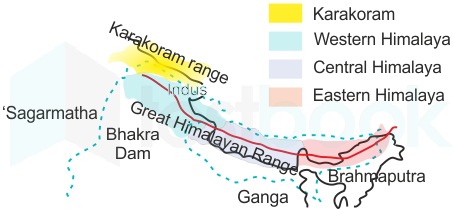
Where is Pangong Tso lake situated?

  1. ((a))

    Himachal and Uttarakhand Himalayas

  2. ((b))

    Darjeeling and Sikkim Himalayas

  3. ((c))

    Arunachal Himalayas

  4. ((d))

    North-western Himalayas

Show Answer
Answer: ((d))

North-western Himalayas

The correct answer is North-western Himalayas.

  • Pangong Tso lake is situated in North-western Himalayas.

In News

  • Pangong Tso lake in eastern Ladakh has often been in the news, most famously during the Doklam standoff and the recent Galwan clash.

Key Points

  • Pangong Tso Lake located in Ladakh Union territory is an endorheic lake in the Himalayas situated at a height of about 4,350 m.
  • It is a long narrow, deep, endorheic (landlocked) lake situated at a height of more than 14,000 ft in the Ladakh Himalayas(North-western Himalayas).
  • It is geographically situated in a disputed territory, claimed both by India and China.
  • This lake is about 5 km wide and about 134 km long with about 60% of the length extending into Tibet.
  • Pangong Lake in Kashmir is the world's highest brackish lake at 4,350 m above sea level.
  • In winter the lake freezes completely, despite being saline water.

4

In December 2021, which football player set a record by scoring 800 goals?

  1. ((a))

    David Beckham

  2. ((b))

    Cristiano Ronaldo

  3. ((c))

    Neymar

  4. ((d))

    Lionel Messi

Show Answer
Answer: ((b))

Cristiano Ronaldo

The correct answer is Cristiano Ronaldo.

  • In December 2021, Cristiano Ronaldo set a record by scoring 800 goals.

Key Points

  • Cristiano Ronaldo became the first player to score 800 top-level goals.
  • The goals were made during Manchester United's 3-2 win over Arsenal.
  • Manchester United is a football club in England founded in 1878.
  • Ronaldo has won five Ballon d'Or awards.
  • Ronaldo has won four European Golden Shoes.

Additional Information

  • Cristiano Ronaldo plays from the year 2018-to 2021 for the club Juventus FC.
  • Portuguese forwarder Cristiano Ronaldo is the captain of the national team of Portugal.
  • Ronaldo joined Juventus in 2018, before that he was playing for the Real Madrid CF.
5

Which of the following is not a product of combustion reaction?

  1. ((a))

    oxygen

  2. ((b))

    carbon dioxide

  3. ((c))

    heat

  4. ((d))

    Water

Show Answer
Answer: ((a))

oxygen

The correct answer is oxygen.

  • oxygen is not a product of a combustion reaction.

Key Points

Combustion Reaction:

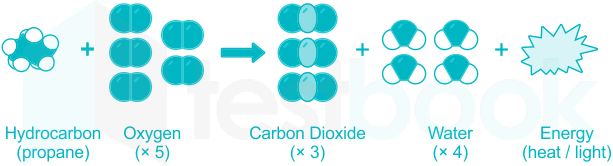
  • Combustion is a process in which substances react with oxygen to produce water and heat.
  • The combustion process is an exothermic process.

Combustion | BioNinja

  • The process requires the presence of oxygen without which the combustion will cease.
  • The substances that burn during combustion are known as fuel.
  • Fuel can be solid like wood, liquid-like kerosene, and gaseous like CNG.
  • Some fuels burn with flame whereas others do not.
  • Examples of combustion are:

CH4 + 2O2 → CO2 + 2H2O

C2H6 + 7/2 O2 → 2CO2 + 3H2O

C +  O2 → CO2 

  • The oxygen is the oxidizer whereas the fuel is the reductant.
6

Who among the following was NOT an extremist leader?

  1. ((a))

    Bal Gangadhar Tilak

  2. ((b))

    Bipin Chandra Pal

  3. ((c))

    Gopal Krishna Gokhale

  4. ((d))

    Aurobindo Ghosh

Show Answer
Answer: ((c))

Gopal Krishna Gokhale

The correct answer is Gopal krishna Gokhale.

  • Gopal krishna Gokhale was not an extremist leader.

Key Points

  • Gopal Krishna Gokhale was the political guru of Mahatma Gandhi.
  • Gokhale was the founder of the Servants of India Society.
  • In 1905, when Gokhale was elected president of the Indian National Congress.
  • Notable work of Gokhale: English weekly newspaper, The Hitavada.

Additional Information

  • The Congress split into two parts - Moderates and Extremists in the year 1907 at the Surat Session of Congress, which was also popularly known as 'Surat Split'.
  • Extremists are not satisfied with the methods and achievements of moderates.
  • They were three groups of extremists. They are the Maharashtrian group led by Bal Gangadhar Tilak, the Bengal group led by Bipin Chandra Pal and Aurobindo Ghosh, and the Punjab group led by Lala Lajpat Rai.
  • The most prominent leaders of the Extremists were Bal Gangadhar Tilak, Lala Lajpat Rai, and Bipin Chandra Pal, who are known collectively as the Lal-Bal-Pal trio.
7

In 1905, who announced the partition of Bengal?

  1. ((a))

    Lord Simon

  2. ((b))

    Lord Wavell

  3. ((c))

    Lord Curzon

  4. ((d))

    Lord Linlithgow

Show Answer
Answer: ((c))

Lord Curzon

The correct answer is Lord Curzon.

  • In 1905, Lord Curzon announced the partition of Bengal.

Key Points

  • Bengal was partitioned by the British viceroy Lord Curzon.
  • Lord Curzon announced the partition of Bengal on 20th July 1905.
  • The partition came into effect on 16th October 1905.
  • At that time of partition, Bengal was the biggest province of British India including Bihar and parts of Orissa.
  • The British argued that the division was for administrative convenience.
  • The partition of the Bengal is an example of the British policy of divide and rule.
  • The main reason for the partition of Bengal was to destroy the political influence of the educated middle class among whom the Bengali intelligentsia was the most prominent.
  • The swadeshi movement started to protest against the partition of Bengal.
  • Bengal partition was finally cancelled by Lord Hardinge in 1911.

Additional Information

  • Lord Wavell
  • He was the Viceroy of India from 1944-1947.
  • Lord Linlithgow
  • He was the Viceroy of India from 1936-1944.
8

What is the name of the savings scheme for women started by Federal Bank in December 2021?

  1. ((a))

    Nari Samman

  2. ((b))

    Mahila Mitra Plus

  3. ((c))

    Mahila Sahayata

  4. ((d))

    Women Help

Show Answer
Answer: ((b))

Mahila Mitra Plus

The correct answer is Mahila Mitra Plus.

  • The name of the savings scheme for women started by Federal Bank in December 2021 is Mahila Mitra Plus.

Key Points

  • Mahila Mitra Plus:
  • It is a savings account exclusively for women, endowed with exciting features like complementary insurance, a special rate on home loans, free RTGS / NEFT facility.
  • It also provides two ZERO balance kids’ accounts, and Debit Card offers.
  • Eligibility: Resident Woman
  • Services Provided are:
  • Complimentary Insurance up to 80.75 L
  • Special rates on Home Loan – 0.60% lower than Bank’s card rate.
  • Free RTGS / NEFT facility.
  • 50% concession on processing fee for home loans.
  • Two free FedFirst SB account in the name of minor children, with no min. balance stipulation.

Additional Information

  • Federal Bank Limited is a major Indian commercial bank in the private sector headquartered at Aluva Kerala.
9

According to December 2021, the ZyCov-D vaccine has been included in the Corona vaccinations. In how many Indian states will it be started?

  1. ((a))

    Five

  2. ((b))

    Seven

  3. ((c))

    Eight

  4. ((d))

    Six

Show Answer
Answer: ((b))

Seven

The correct answer is Seven.

  • According to December 2021,  the ZyCov-D vaccine has been included in the Corona vaccinations in 7 Indian states.

Key Points

  • ZyCoV-D is a DNA plasmid-based COVID-19 vaccine developed by Indian pharmaceutical company Cadila Healthcare, with support from the Biotechnology Industry Research Assistance Council.
  • ZyCoV-D is the world’s first plasmid DNA vaccine against coronavirus.
  • It uses a section of genetic material from the virus that gives instructions as either DNA or RNA to make the specific protein that the immune system recognizes and responds to.
  • It is a three-dose specialized needle-free vaccine, given in the interval of 4 weeks between each dose.
  • It is approved for emergency use in India.
  • The 7 states are **Bihar, Jharkhand, Maharashtra, Punjab, Tamil Nadu, Uttar Pradesh and West Bengal.**​
10

To which dynasty is Khizr Khan related?

  1. ((a))

    Lodi

  2. ((b))

    Tomar

  3. ((c))

    Khilji

  4. ((d))

    Sayyid

Show Answer
Answer: ((d))

Sayyid

The correct answer is Sayyid dynasty.

  • Khizr Khan was related to Sayyid.

Key Points

  • Sayyid Dynasty (1414-1451 A.D.)
  • Sayyid Dynasty was founded by Khizr Khan in 1414 A.D.
  • It was the fourth dynasty of the Delhi Sultanate.
  • Sultans of Sayyid Dynasty - 
  • Khizr Khan (1414-1421A.D)
  • Founder of the Sayyid Dynasty.
  • Was the Governor of Multan.
  • Died in 1421.
  • Mubarak Shah(1421-1434 A.D)
  • First Sultan ruler to appoint Hindu nobles in the court of Delhi.
  • Constructed “Mubarakbad” City on the banks of the river Jamuna.
  • Muhammad Shah (1434-1445 A.D)
  • Defeated the ruler of Malwa with the help of Bahlul Lodi the Governor of Lahore.
  • Conferred Bahlul Lodi with the title Khan-i-Khanan.
  • Ala-ud-din Shah (1445-1451 A.D)
  • Was removed from the throne by Bahlul Lodi in 1457 A.D.
  • Delhi was captured by him and he was sent to Badaun.
  • Died in Badaun in 1478 A.D.
11

In 2021, Walmart and Flipkart have tied up with which state government to support MSMEs?

  1. ((a))

    Uttar Pradesh

  2. ((b))

    Himachal Pradesh

  3. ((c))

    Madhya Pradesh

  4. ((d))

    Andhra Pradesh

Show Answer
Answer: ((c))

Madhya Pradesh

The correct answer is Madhya Pradesh.

  • In 2021, Walmart and Flipkart have tied up with the Madhya Pradesh state government to support MSMEs.

Key Points

  • Walmart and its subsidiary Flipkart have signed an MoU with the Department of Micro, Small, and Medium Enterprises, Government of Madhya Pradesh.
  • The aim is to create an ecosystem of capacity building for MSMEs in Madhya Pradesh.
  • Under this MoU, Walmart, Flipkart, and MSME Department will assist MSMEs to digitize their business and enable them to sell their products through online retail.
  • The initiative came under the Walmart Vriddhi Supplier Development Programme (Walmart Vriddhi).
  • It is in the tie-up with the knowledge partner Swasti, which aims to train around 50000 Indian MSMEs with business skills to become successful as suppliers to Walmart, and sellers on global marketplace platforms like Flipkart.
  • Walmart and Flipkart have partnered with various states including Haryana and Tamil Nadu, under this programme.
12

According to NITI Aayog in 2021, which is the only state in India wherein 50% of the population is living in poverty?

  1. ((a))

    Bihar

  2. ((b))

    Madhya Pradesh

  3. ((c))

    Uttar Pradesh

  4. ((d))

    Haryana

Show Answer
Answer: ((a))

Bihar

The correct answer is Bihar.

  • According to NITI Aayog in 2021,  Bihar is the only state in India wherein 50% of the population is living in poverty.

Key Points

  • NITI Aayog’s Multidimensional Poverty Index:
  • The report is developed on the basis of the National Family Health Survey 2015-16.
  • It will facilitate the formulation of sectoral policies and targeted interventions.
  • It has three equally weighted dimensions namely health, education and standard of living, which are represented by twelve indicators that are nutrition, child and adolescent mortality, antenatal care, years of schooling, school attendance, cooking fuel, sanitation, drinking water, electricity, housing, assets and bank accounts
  • In this index, the states of Bihar, Jharkhand, Uttar Pradesh, Madhya Pradesh and Meghalaya have emerged as the poorest states in India with over 50% of the population in Bihar classified as multidimensionally poor.
  • The index revealed that 51.9% of Bihar’s population is poor.
  • Kerala, Goa, Sikkim, Tamil Nadu and Punjab have registered the lowest poverty across India and are at the bottom of the index.
  • The union territories of Puducherry have 1.72% of its population as poor, Lakshadweep 1.82%, Andaman & Nicobar Islands 4.30%, Delhi 4.79% and Chandigarh 5.97%.
13

Which of the following does NOT belong to the three broad styles of Indian architecture?

  1. ((a))

    Dravida – Southern style

  2. ((b))

    Nagara – Northern style

  3. ((c))

    Maratha – Eastern style

  4. ((d))

    Vesara – Mixed style

Show Answer
Answer: ((c))

Maratha – Eastern style

The correct answer is Maratha – Eastern style.

Key Points

  • The temple architecture in India is not the same everywhere.
  • Basically, there are three styles of temple architecture in India:
  1. Nagara Style (North India)
  2. Dravida Style (South India)
  3. Vasara style (Mix of Nagara and Dravida style)
  • Nagara Style:
  1. Built on a stone platform with steps leading up to it.
  2. Have a tower or Shikhara.
  3. Have Grabhagriha ( A place for the idols of god and goddess).
  4. Examples: Kandariya Mahadeo temple at Khajuraho, Lakshamana temple
  • Dravida Style:
  1. Generally enclosed within a compounded wall.
  2. The entrance gateway is known as Gopuram.
  3. The shape of the Temple tower is known as Vimana (similar to Shikhara in Nagara style).
  4. Large water tanks are common in the temple complex.
  5. Examples: Brahadeeshwara temple, Rajarajeswara temple.
  • Vasara style:
  1. This style of temple architecture is a mix of Nagara and Dravid styles.
  2. Examples: Dodda Basappa Temple, Hoysala Temple.

Hence, Maratha architecture is not a type of Indian architecture.

14

Which of the following statement about matter is INCORRECT?

  1. ((a))

    There are two fundamental states of matter.
  2. ((b))

    Matter is made up of particles called atoms and molecules.

  3. ((c))

    Everything in the universe is made up of matter and energy.

  4. ((d))

    Matter is anything that has mass and occupies space.

Show Answer
Answer: ((a))

There are two fundamental states of matter.

The correct answer is There are two fundamental states of matter.

Key Points

  • The matter is made up of particles called atoms and molecules.
  • Everything in the universe is made up of matter and energy.
  • The matter is anything that has mass and occupies space.
  • There are four natural states of matter: Solids, liquids, gases, and plasma.
  • Solids:
  • Molecules are arranged in repeating, regular patterns.
  • Molecules are fixed in place or in another case they vibrate in a certain area.
  • Types: crystalline, noncrystalline (amorphous), quasi-crystalline.
  • Liquid:
  • In a liquid, particles will flow or glide over one another.
  • No regular pattern follows.
  • They are roaming apart by a low attractive force between them.
  • It gets the shape of their containers.
  • Gas:
  • In gases, the particles move rapidly in all directions, frequently colliding with each other.
  • Molecules are so apart, therefore the attractive force is negligible.
  • Plasma:
  • With an exciting position (high temperature) atoms lose their electrons and that electron is mixed up with nuclei which results in plasma.
  • Plasma consists of charged particles.
  • The fifth state is the Bose-Einstein condensates, which are man-made.
  • Scientists, Eric Cornell and Carl Weiman discover BEC matter by a combination of lasers and magnets.
  • At a temperature of absolute zero (0 K, − 273.15 °C, or − 459.67 °F; K = kelvin), it separates atoms or subatomic particles.
  • It is an exotic quantum phenomenon, observed in dilute atomic gases for the first time in 1995.
  • BEC only exists for “bosons” – particles with a total spin that is an integer multiple of h, the Planck constant divided by 2 pi.
15

According to Asian Development Bank poverty data, what was the unemployment rate of India in 2020?

  1. ((a))

    5.1%

  2. ((b))

    7.1%

  3. ((c))

    6.1%

  4. ((d))

    8.1%

Show Answer
Answer: ((b))

7.1%

The correct answer is 7.1%.

Key Points

  • According to Asian Development Bank poverty data, the unemployment rate of India in 2020 was 7.1%.

Additional Information

  • Asian Development Bank (ADB):
  • The Asian Development Bank (ADB) envisions a prosperous, inclusive, resilient, and sustainable Asia and the Pacific while sustaining its efforts to eradicate extreme poverty in the region.
  • The headquarters of the Asian Development Bank is located in Manila, Philippines.
  • The current president of ADB is Masatsugu Asakawa. (as of April 2022)
  • ADB assists its members, and partners, by providing loans, technical assistance, grants, and equity investments to promote social and economic development.
  • ADB maximizes the development impact of its assistance by facilitating policy dialogues, providing advisory services, and mobilizing financial resources through co-financing operations that tap official, commercial, and export credit sources.
  • From 31 members at its establishment in 1966, ADB has grown to encompass 68 members, of which 49 are from within Asia and the Pacific and 19 outside.
16

In November 2021, which state announced the repeal of the three-capital law?

  1. ((a))

    Chhattisgarh

  2. ((b))

    Andhra Pradesh

  3. ((c))

    Himachal Pradesh

  4. ((d))

    Telangana

Show Answer
Answer: ((b))

Andhra Pradesh

The correct answer is Andhra Pradesh.

In News

  • In November 2021, Andhra Pradesh has announced the repeal of the three-capital law.

Key Points

  • The Andhra Pradesh legislative assembly on November 22, passed a Bill to repeal the controversial AP Decentralisation and Inclusive Development of All Regions Act, 2020, which was intended to establish three capitals for the state.
  • Under the three capital law, Andhra Pradesh had three capitals:
  • Amaravati as a legislative capital,
  • Kurnool in the Rayalaseema region became a judicial capital city with the location of the high court,
  • Visakhapatnam in the north-coastal region would become an executive capital city.

Additional Information

  • Andhra Pradesh:
  • Andhra Pradesh is bordered by Telangana, Chhattisgarh, Tamil Nadu, Karnataka, and Orissa.
  • Y. S. Jaganmohan Reddy is the current CM of Andhra Pradesh.
  • Biswabhusan Harichandan is the current governor of Andhra Pradesh.
  • Amaravati is the capital of Andhra Pradesh.
17

Which of the following groups of Indian sportspersons has received medals in Olympic 2020?

  1. ((a))

    Neeraj Chopra, Tarundeep Rai and Pranati Nayak

  2. ((b))

    Bajrang Punia, PV Sindhu and Ravi Kumar Dahiya

  3. ((c))

    Mirabai Chanu, Deepika Kumari and Atanu Das

  4. ((d))

    Lovlina Borgohain, Sumit Nagar and Diksha Dagar

Show Answer
Answer: ((b))

Bajrang Punia, PV Sindhu and Ravi Kumar Dahiya

The correct answer is Bajrang Punia, PV Sindhu and Ravi Kumar Dahiya.

Key Points

  • PV Sindhu became the first Indian woman and only the second Indian athlete, after Sushil Kumar, to win two individual Olympic medals.
  • PV Sindhu beat China’s He Bing Jiao to win the bronze medal in the women’s singles.
  • Tokyo Olympics bound athletes wrestler Bajrang Punia bagged the top honour Sportsperson of the Year at the FICCI India Sports Awards 2020.
  • The athlete has had an impressive 2019-20 season.
  • Won the Sportsperson of the Year awards in wrestling.
  • Ravi Kumar Dahiya won the silver medal in Men's 57kg wrestling.

Additional Information

  • Mirabai Chanu won the silver medal in the Tokyo 2020 Olympics in the women’s 49kg.
  • Neeraj Chopra became India’s second individual Olympic champion after Abhinav Bindra.
  • He won the Gold medal in the javelin throw.
  • It was India’s first track-and-field medal at any Olympic Games.
  • Lovlina Borgohain won a Bronze medal in women’s welterweight (64-69kg).
18

Where is the Jawaharlal Nehru Manipur Dance Academy (JNMDA) situated?

  1. ((a))

    Ukhrul

  2. ((b))

    Imphal

  3. ((c))

    Shirui

  4. ((d))

    Tamenglong

Show Answer
Answer: ((b))

Imphal

The correct answer is Imphal.

  • The Jawaharlal Nehru Manipur Dance Academy (JNMDA) is situated in Imphal, Manipur.

Key Points

  • Jawaharlal Nehru Manipur Dance Academy:
  • It is a constituent unit of the Sangeet Natak Akademi, New Delhi.
  • The institute is a premier institution for teaching Manipuri Dance and Music and allied subjects like Thang-Ta.
  • It was established in 1954.

Additional Information

  • Sangeet Natak Akademi:
  • The Sangeet Natak Akademi was founded on 31 May 1952.
  • It is also known as the National Academy for Music, Dance, and Drama.
  • In India, it functions as the headquarters of performing arts.
  • It presents the Sangeet Natak Akademi Awards which is the highest Indian recognition given to performing/practising artists.
19

Which of the following facts about Census 2011 is INCORRECT?

  1. ((a))

    State with highest population growth rate – Uttar Pradesh

  2. ((b))

    State with highest sex ratio – Kerala

  3. ((c))

    State with highest population – Uttar Pradesh

  4. ((d))

    State with highest population density – Chandigarh

Show Answer
Answer: ((d))

State with highest population density – Chandigarh

The correct answer is State with highest population density – Chandigarh.

Key Points

  • Census of India, 2011:
  • Total Population of India was 1,210,193,422.
  • The Sex Ratio (females per thousand males) in India was 940.
  • The population density was reported at 382 persons per sq. km.
  • Total districts covered- 640.
  • Crude Birth Rate- 21.8.
  • Crude Death Rate 7.1 per thousand population
  • Infant Mortality Rate was 44 per thousand live births
  • The literacy rate of the country is 74.04 per cent. (82.14 for males and 65.46 for females).
  • The state with the highest literacy is Kerala (94.0%)
  • The state with the lowest literacy is Bihar (61.8%)
  • state with the highest female literacy rate- Kerala (92.1%)
  • The state with the lowest female literacy is Bihar(51.5%)
  • The state that has the highest decadal growth is Meghalaya (27.9%)
  • State having highest Population  Uttar Pradesh (19,98,12,341)
  • The state has the lowest Population is Sikkim (6,10,577)
  • State with Highest Population Density Bihar (1106). Hence Option 4 is incorrect.
  • State with Lowest Population Density  Arunachal Pradesh (17)
  • The state has the highest Sex Ratio is Kerala (1,084)
  • The state has the lowest Sex Ratio  is Haryana (879)
  • The highest Death Rate among states is in Odisha (98 per thousand).
  • The lowest Death Rate among states is in Kerala— 16 per thousand.
  • The decadal growth rate in Population is 17.7%.
  • The state has the lowest population decadal growth rate in Nagaland (–0.6%).
20

Who among the following was awarded the 56th Jnanpith Award for 2020?

  1. ((a))

    Mamoni Raisom Goswami

  2. ((b))

    Nilmani Phookan Jr.

  3. ((c))

    Damodar Mauzo

  4. ((d))

    Birendra Kumar Bhattacharya

Show Answer
Answer: ((b))

Nilmani Phookan Jr.

The correct answer is Nilmani Phookan Jr.

  • Nilmani Phookan Jr. was awarded the 56th Jnanpith Award for 2020.

Key Points

  • Nilmani Phookan Jr’s contribution to Indian literature:
  • Phookan is based out of Guwahati.
  • He was awarded the Padma Shri in 1990 and received the Sahitya Akademi Fellowship in 2002.
  • Written poems such as Surya Henu Nami Ahe Ei Nodiyedi, Gulapi Jamur Lagna, and Kobita.

Additional Information

  • Damodar Mauzo has won the 57th Jnanpith Award for 2021.
  • He is notable for his novels, such as Karmelin, and Tsunami Simon, and short stories, such as Teresa’s Man and Other Stories from Goa.
  • Birendra Kumar Bhattacharya won the Jnanpith Award in 1979.
  • Mamoni Raisom Goswami won the Jnanpith Award in 2000.
21

Which of the following is a mismatch of Buddhist architecture?

  1. ((a))

    Toran – Temple Gate

  2. ((b))

    Shikhar – Temple Peak

  3. ((c))

    Stupa – Temple Mound

  4. ((d))

    Pagoda - Temple Cone

Show Answer
Answer: ((d))

Pagoda - Temple Cone

The correct answer is Pagoda - Temple Cone.

Key Points

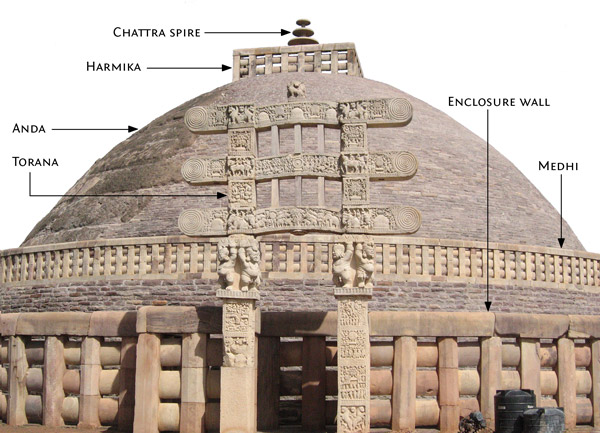
  • Buddhist stupa - Symbolic representation of the Buddha’s burial mound.
  • A burial mound is an artificial hill of earth and stones built over the remains of the dead.
  • Terms associated with the architecture of a Buddhist Stupa:
  • A hemispherical mound (anda)
  • Temple Peak (Shikhar).
  • A square railing (harmika)
  • A central pillar supporting a triple-umbrella form (chatter)
  • Enclosure wall with decorated gateways (toranas) at the cardinal directions
  • A circular terrace (Medhi)
  • Pagoda is a tower with roofs curving upward at the division of each of several stories and erected as a temple or memorial.

Sanchi Stupa | Elevation

22

Which European country has approved the Sacro Capsule in December 2021?

  1. ((a))

    Denmark

  2. ((b))

    Finland

  3. ((c))

    Sweden

  4. ((d))

    Switzerland

Show Answer
Answer: ((d))

Switzerland

The correct answer is Switzerland.

  • Switzerland has approved the Sacro Capsule in December 2021.

Key Points

  • Switzerland has approved the use of a suicide aid machine called Sarco Capsule.
  • Sarco is a 3D printed capsule.
  • It has been developed by Exit International, an international non-profit based in Australia.
  • The pod helps in assisted suicide.
  • Assisted suicide is legal in Switzerland.
  • In this pod, death will happen 5-10 minutes after losing consciousness.

Additional Information

  • Switzerland
  • Capital - Bern
  • Currency – Swiss Franc
  • Geneva (a worldwide center for diplomacy) is located in Switzerland.
23

At which place in Haryana will a new  nuclear power plant be set up by 2024?

  1. ((a))

    Jind

  2. ((b))

    Rewari

  3. ((c))

    Gorakhpur

  4. ((d))

    Sirsa

Show Answer
Answer: ((c))

Gorakhpur

The correct answer is Gorakhpur.

  • Gorakhpur in Haryana will a new  nuclear power plant be set up by 2024.

Key Points

  • India will have nine nuclear reactors by 2024
  • The first nuclear power plant in northern India will come up in Gorakhpur of Haryana.
  • By 2024, India will have nine nuclear reactors plus 12 new additional ones which were approved with a capacity of 9000 MW.
  • India is counting on its nuclear program to help meet its Paris climate commitments to reduce the emissions intensity of its economy by a third from 2005 levels by 2030.

Additional Information

  • Nuclear energy: It is the energy in the nucleus of an atom.
  • Nuclear energy is generated by nuclear fusion and nuclear fission reactions.
  • Nuclear energy plants do not release carbon emissions but there are other disadvantages:
  • Disadvantages of nuclear energy plants:
  1. ​It causes thermal pollution.
  2. Its wastes are radioactive materials
  3. It requires a large amount of water.
24

In November 2021, which state’s chief minister launched three solar power projects worth Rs. 5,250 crore?

  1. ((a))

    Rajasthan

  2. ((b))

    Gujarat

  3. ((c))

    Tamil Nadu

  4. ((d))

    Madhya Pradesh

Show Answer
Answer: ((d))

Madhya Pradesh

The correct answer is Madhya Pradesh.

  • In November 2021, Madhya Pradesh's chief minister launched three solar power projects worth Rs. 5,250 crore.

Key Points

  • Madhya Pradesh's Chief Minister Shivraj Singh Chouhan and Union Minister for Power and New and Renewable Energy R.K. Singh laid the foundation stone of 1500 MW capacity solar power parks in Agar, Shajapur, and Neemuch districts.
  • The project is of the cost of Rs 5250 crores.
  • The ministers also signed contracts with private investors for the Pradhan Mantri Kusum yojana while Urja Saksharta Abhiyaan was also launched for the purpose of public awareness in the field of energy conservation.
  • The scheme is fast-moving towards fulfilling the target of PM Narendra Modi of meeting 50 per cent of the country’s energy requirement by 2030 with solar energy.
  • In these solar projects of 1500 MW, 2 units of 550 MW in Agar, 3 units of 450 MW in Shajapur and 3 units of 500 MW capacity in Neemuch districts will be installed.
  • Power generation from the projects will start in March 2023.
25

Which of the following medicine is used to treat infection?

  1. ((a))

    tranquilizer

  2. ((b))

    antibiotic

  3. ((c))

    antipyretic

  4. ((d))

    antiseptic

Show Answer
Answer: ((b))

antibiotic

The correct answer is antibiotic.

  • ​Antibiotic is used to treat the infection.

Key Points

  • ​Antibiotics are medicines used to prevent and treat bacterial infections.
  • Antibiotic resistance occurs when bacteria change in response to the use of these medicines.
  • The bacteria, not humans or animals, become antibiotic-resistant.
  • These bacteria may infect humans and animals, and the infections they cause are harder to treat than those caused by non-resistant bacteria.
  • Antibiotic resistance is one of the biggest threats to global health, food security, and development today.

Mathematics (25 questions)

26

tanθ+secθ1tanθsecθ+1÷(1+tan2θ1+secθ);\frac{{\tanθ + \secθ - 1}}{{\tanθ - \secθ + 1}} \div \left( {1 + \frac{{{{\tan }^2}θ }}{{1 + \secθ }}} \right){\rm{;}}is equal to ________ if 0° < θ < 90° .

  1. ((a))

    sin θ + cos θ 

  2. ((b))

    1 + sin θ

  3. ((c))

    sin θ cos θ

  4. ((d))

    1 + cos θ

Show Answer
Answer: ((b))

1 + sin θ

Given:

tanθ+secθ1tanθsecθ+1÷(1+tan2θ1+secθ);\frac{{\tanθ + \secθ - 1}}{{\tanθ - \secθ + 1}} ÷ \left( {1 + \frac{{{{\tan }^2}θ }}{{1 + \secθ }}} \right){\rm{;}}

Concept used:

sec2θ - tan2θ = 1

Calculation:

tanθ+secθ1tanθsecθ+1÷(1+tan2θ1+secθ);\frac{{\tanθ + \secθ - 1}}{{\tanθ - \secθ + 1}} ÷ \left( {1 + \frac{{{{\tan }^2}θ }}{{1 + \secθ }}} \right){\rm{;}}

⇒ tanθ+secθ(sec2θtan2θ)tanθsecθ+1÷(1+secθ+tan2θ1+secθ);\frac{{\tanθ + \secθ - (sec^2θ - tan^2θ)}}{{\tanθ - \secθ + 1}} ÷ \left( {\frac{{{{1+secθ + tan }^2}θ }}{{1 + \secθ }}} \right){\rm{;}}

⇒ tanθ+secθ(secθtanθ)(secθ+tanθ)tanθsecθ+1÷(1+secθ+sec2θ11+secθ);\frac{{\tanθ + \secθ - (secθ - tanθ)(secθ + tanθ)}}{{\tanθ - \secθ + 1}} ÷ \left( {\frac{{{{1+secθ + sec^2θ -1}} }}{{1 + \secθ }}} \right){\rm{;}}

⇒ (tanθ+secθ)[1secθ+tanθ]tanθsecθ+1÷(secθ(1++secθ)1+secθ);\frac{{(\tanθ + \secθ)[1 - secθ + tanθ]}}{{\tanθ - \secθ + 1}} ÷ \left( {\frac{{{{secθ(1+ + secθ)}} }}{{1 + \secθ }}} \right){\rm{;}}

⇒ (tanθ+secθ)÷secθ(\tanθ + \secθ) ÷ secθ

⇒ (sinθcosθ+1cosθ)÷secθ(\frac{sinθ}{cosθ} + \frac{1}{cosθ}) ÷ secθ

⇒ (sinθ+1cosθ)÷secθ(\frac{sinθ + 1}{cosθ}) ÷ secθ

⇒ (sinθ+1)×secθ÷secθ({sinθ + 1)}\times{secθ} ÷ secθ

⇒ 1 + sin θ

∴ Required answer is 1 + sin θ

27

Study the given table and answer the question given below.

P, Q and R in five cities A, B, C, D and E daily sales of newspapers (in thousands) 

newspaper
cityPQR
A640450480
B520600540
C450650520
D750680460
E550620550


Average daily sales of newspaper R in all the given five cities is what percent more than 20% of the sum of total daily sales of newspaper P in cities A and C and total daily sales of newspaper Q in cities D and E together?

  1. ((a))

    6.5%

  2. ((b))

    5.9%

  3. ((c))

    7.2%

  4. ((d))

    6.69%

Show Answer
Answer: ((d))

6.69%

Calculation:

Total sales of R in five cities = 480 + 540 + 520 + 460 + 550

⇒ 2550

Average = 2550/5 = 510

Total of P in city A and C = 640 + 450

⇒ 1090

Total of Q in city D and E = 680 + 620

⇒ 1300

Total of these two = 1090 + 1300

⇒ 2390

20% of 2390 = 2390 × 1/5

⇒ 478

Now, difference = 510 - 478

⇒ 32

Required % = (32/478) × 100

⇒ 6.69%

∴ Required answer is 6.69%

28

Let x be the smallest number which when divided by 12, 18, 20, 27 and 30 leaves remainder 2 in each case and x is divisible by 47. If y is the HCF of x and 1932, then what is the sum of the digits of y?

  1. ((a))

    11

  2. ((b))

    7

  3. ((c))

    10

  4. ((d))

    5

Show Answer
Answer: ((c))

10

Given:

x be the smallest number which when divided by 12, 18, 20, 27 and 30 leaves the remainder 2 in each case

Concept used:

LCM method to get the number

Calculation:

LCM of 12, 18, 20, 27, 30 = 540

So, the required number x will be in the form of (540m + 2), where m is a natural number

Now according to the question, the number x is divisible by 47 

Now we can check one by one by putting m = 1, 2, 3, 4......... which will be the smallest number divisible by 47

Taking m = 1

We get 542 which is not divisible by 47

Taking m = 2

We get 1082 which is also not divisible by 47

Taking m = 3

We get 1622 which is also not divisible by 47

Taking m = 4

We get 2162 which is divisible by 47.

Now,

2162 = 46 × 47

1932 = 46 × 42

HCF of 2162 and 1932 is 46 i.e y

So, sum of the numbers = 4 + 6 = 10

∴ The sum of the digits of y is 10

29

In a class of 90 students, 60% are girls and rest are boys. The average score of all the students in English is 129. If the average marks of boys is 35% less than that of girls, then find the average marks of boys.

  1. ((a))

    96.8

  2. ((b))

    97.5

  3. ((c))

    90

  4. ((d))

    95

Show Answer
Answer: ((b))

97.5

Shortcut Trick

Ratio of Girls to Boys = 60 : 40 = 3 : 2.

Let average marks of Girls = 100 units, then Boys = 65 units (35% less).

Weighted Average = [(3 × 100) + (2 × 65)] ÷ (3 + 2) = 430 ÷ 5 = 86 units.

86 units = 129 ⇒ 1 unit = 1.5.

Average marks of Boys = 65 × 1.5 = 97.5.

∴ The correct answer is 97.5.

Alternate Method

Given: Total students = 90. Girls = 60% of 90 = 54. Boys = 40% of 90 = 36.

Formula: Total Marks = Average × Number of Students.

⇒ Let the average marks of Girls be x.

⇒ Average marks of Boys = x − 35% of x = 0.65x.

⇒ Total marks = (54 × x) + (36 × 0.65x) = 129 × 90.

⇒ 54x + 23.4x = 11610.

⇒ 77.4x = 11610.

⇒ x = 11610 ÷ 77.4 = 150.

⇒ Average marks of Boys = 0.65 × 150 = 97.5.

∴ The correct answer is 97.5.

Additional Information

Weighted Average Formula

The combined average of two groups is (n1A1 + n2A2) ÷ (n1 + n2), where n is the quantity and A is the average.

Percentage to Decimal Conversion

To decrease a value by 35%, multiply the original value by (100 − 35) ÷ 100 = 0.65.

Alligation Method

The ratio of the two quantities is inversely proportional to the difference between their individual averages and the mean average.

30

Pipes A and B can fill a tank in 18 h and 30 h respectively, while C alone can empty the full tank in x h. All three pipes are kept open for 3 h, then B is closed. And after 3 h, C is also closed. The total time taken to fill the tank completely is 21 h. What is the value of x?

  1. ((a))

    18

  2. ((b))

    211221\frac{1}{2}

  3. ((c))

    221222\frac{1}{2}

  4. ((d))

    20

Show Answer
Answer: ((c))

221222\frac{1}{2}

Given:

Pipes A and B can fill a tank in 18 h and 30 h respectively

Total time = 21 hours

Concept used:

If a pipe can complete a work alone in x hour, then the efficiency (part of the work completed in one day) = 1/x

Calculation:

Pipe A can fill 1/18 in 1 hour

Pipe B can fill 1/30 in 1 hour

Pipe C can empty 1/x in 1 hour

According to the question,

3(1/18 + 1/30 - 1/x) + 3(1/18 - 1/x) + 15/18 = 1 [Here 1 is total work]

⇒ 1/6 + 1/10 - 3/x + 1/6 - 3/x + 5/6 = 1

⇒ - (6/x) + 7/6 + 1/10 = 1

⇒  - (6/x) + [(35 + 3)/30] = 1

⇒  - (6/x) + 19/15 = 1

⇒ 6/x = 19/15 - 1

⇒ 6/x = (19 - 15)/15

⇒ 4x = 6 × 15

⇒ x = 90/4 = 221222\frac{1}{2}

∴ The value of x is 221222\frac{1}{2}

31

A trader makes a profit of 25% when he sells an article at a discount of 10% on its marked price. If he allows a discount of 22% on the same marked price of the article, then what is his profit percentage?

  1. ((a))

    813%8\frac{1}{3}\%

  2. ((b))

    7913%7\frac{9}{13}\%

  3. ((c))

    12%

  4. ((d))

    13%

Show Answer
Answer: ((a))

813%8\frac{1}{3}\%

Given:

Profit% = 25%

Discount% = 10%, 22%

Concept used:

SP = CP + CP × Profit%

SP = MP - MP × Discount%

Profit % = (Profit/CP) × 100

Calculation:

Let CP of the article be 36a

So, SP = 36a + 36a × 25/100

⇒ 45a

according to the question,

45a × 10/9 = MP of the article

⇒ 50a

Now,

New SP = 50a - 50a × 22/100

⇒ 39a

Profit = 39a - 36a

⇒ 3a

Profit % = (3a/36a) × 100

⇒ 813%8\frac{1}{3}\%

∴ Required answer is 813%8\frac{1}{3}\%

32

In ΔABC, BD is the bisector of B which meets AC at D. If AB = 5 cm, AD = 3 cm and BD = 7 cm, then what is the length (in cm) of DC?

  1. ((a))

    14716\frac{{147}}{{16}}

  2. ((b))

    10912\frac{{109}}{{12}}

  3. ((c))

    374\frac{{37}}{{4}}

  4. ((d))

    718\frac{{71}}{{8}}

Show Answer
Answer: ((a))

14716\frac{{147}}{{16}}

Given:

AB = 5 cm

AD = 3 cm

BD = 7 cm

Concept used:

If AD is the angle bisector of ∠A then,

AD2 = AB × AC - BD × DC

An angle bisector of a triangle divides the opposite side into two segments that are proportional to the other two sides

AB/AC = BD/DC

Calculation:

Let DC be x

So,

5/BC = 3/x

⇒ BC = 5x/3

According to the concept,

72 = (5x/3) × 5 - 3x

⇒ 49 = (25x/3) - 3x 

⇒ 49 = (25x - 9x)/3

⇒ 49 = 16x/3

⇒ 147 = 16x

⇒ x = 147/16

So, DC = 147/16 cm

∴ The length (in cm) of DC is 147/16 cm

33

X is inversely proportional to Y\sqrt { Y}  and directly proportional to W. When X = 8, W = 5, then Y = 20.25. When X = 18, W = 3, then what is the value of Y?

  1. ((a))

    1.44

  2. ((b))

    3.24

  3. ((c))

    2.56

  4. ((d))

    1.96

Show Answer
Answer: ((a))

1.44

Given:

X is inversely proportional to Y\sqrt { Y}  and directly proportional to W

When X = 8, W = 5, then Y = 20.25

Concept used:

If x ∝ 1/y

The general equation for inverse variation is x = k/y

If x ∝ y

The general equation for inverse variation is x/y = k

Here k is the constant of proportionality

Calculation:

x ∝ w × 1/√y

Now,

x = k × w/√y

⇒ 8 = k × 5/√20.25

⇒ 8 = k × 5/4.5

⇒ k = 36/5 = 7.2

Now,

18 = 7.2 × 3/√y

⇒ √y = 21.6/18

⇒ √y = 1.2

⇒ (√y)2 = 1.22

⇒ y = 1.44

∴ Required value of Y is 1.44

34

A person earns Rs. 69,440 is borrowed where the interest is 12.5% compounded annually. If the loan is to be paid in three equal annual installments, then what is the total interest paid in the scheme?

  1. ((a))

    Rs. 18,040

  2. ((b))

    Rs. 18,010

  3. ((c))

    Rs. 18,230

  4. ((d))

    Rs. 18,100

Show Answer
Answer: ((a))

Rs. 18,040

Given:

Principal = Rs. 69440

Rate = 12.5% per annum

Time = 3 years

Formula used:

For Installment at CI,

P = x/{1 + (R/100)} + x/{1 + (R/100)}2 + x/{1 + (R/100)}3...... + x/{1 + (R/100)}n

where,

P = Money borrowed or Principal.

x = value of each instalment

R = Rate (%)

n = number of years

Calculation:

Let value of one instalment be x.

x/{1 + (R/100)} + x/{1 + (R/100)}2 + x/{1 + (R/100)}3 = 69440 

⇒ x/{1 + 12.5/100) + x/(1 + 12.5/100)2 + x/(1 + 12.5/100)3 = 69440 

⇒ x/(1 + 1/8) + x/(1 + 1/8)2 + x/(1 + 1/8)3 = 69440

⇒ x/(9/8) + x/(9/8)2 + x/(9/8)3 = 69440

⇒ 8x/9 + 64x/81 + 512x/729 = 69440

⇒ (648x + 576x + 512x)/729 = 69440

⇒ 1736x/729 = 69440

⇒ x = Rs. 29160

So, annual installment is Rs. 29160

Total amount paid = 29160 × 3 = 87480

Total interest paid = 87480 - 69440

⇒ Rs. 18040

∴ Total interest paid in the scheme is Rs. 18040

35

If the 5 digit number 658xy is divisible by 7 and 33, then what is the value of (x2 - y2 + xy)?

  1. ((a))

    3

  2. ((b))

    -1

  3. ((c))

    1

  4. ((d))

    0

Show Answer
Answer: ((b))

-1

Given:

5 digit number 658xy is divisible by 7 and 33

Concept used:

When a number is divisible by 3, 7, 11 then it will be divisible by 231

Calculation:

33 = 3 × 11

So we will first evaluate: LCM (3, 7, 11) = 231

The largest possible value of 658xy is 65899

When we divide 65899 by 231 we obtain 64 as the remainder.

So required number = 65899 – 64 = 65835

So, x = 3 and y = 5

Now,

(x2 - y2 + xy) = (32 - 52 + 3 × 5)

⇒ (x2 - y2 + xy) = (9 - 25 + 15)

⇒ (x2 - y2 + xy) = - 1

∴ Required answer is - 1

36

The cost of 3 mangoes and 4 oranges is Rs. 70. If the price of a mango is increased by 20% and that of an orange is decreased by 12%, then the cost of 5 mangoes and 7 oranges is becomes Rs.124.36. What is the initial (price) of 2 mangoes and 3 oranges?

  1. ((a))

    Rs. 49.50

  2. ((b))

    Rs. 48

  3. ((c))

    Rs. 51.50

  4. ((d))

    Rs. 52

Show Answer
Answer: ((a))

Rs. 49.50

Given:

The cost of 3 mangoes and 4 oranges is Rs. 70.

After increase and decrease in the price of mango and orange the cost of 5 mangoes and 7 oranges is becomes Rs.124.36

Calculation:

Let price of 1 mango be 100a and 1 orange be 100b

So, 300a + 400b = Rs. 70      ----(i)

After increase and decrease in the price of mango and orange,

Mango = 120a

Orange = 88b

600a + 616b = 124.36      ----(ii)

By multiplying 2 with eq (i) we get

600a + 800b = 140      ----(iii)

By subtracting eq (ii) from eq (iii) we get

184b = 15.64

⇒ b = 15.64/184

⇒ 100b = (15.64/184) × 100 = 8.5

⇒ 400b = 8.5 × 4 = 34

Putting the value of 400b in the eq (I) we get

300a = 70 - 34

⇒ 300a = 36

⇒ 100a = 12

Now,

Price of 2 mangoes and 3 oranges = 2 × 12 + 3 × 8.5

⇒ 24 + 25.5

⇒ 49.5

∴ The initial (price) of 2 mangoes and 3 oranges is 49.5

37

A, B and C started a business with their capital in the ratio of  15:12:13\frac{1}{5}:\frac{1}{2}:\frac{1}{3}. At the end of every 4 months, C decreases his capital by 50% and A increases his capital by 50% and there is no change in B's capital. At the end of the year, A's share in the total profit was Rs. 2.85 lakh. What was the share of C in the total profit?

  1. ((a))

    Rs. 1,50,000

  2. ((b))

    Rs. 1,45,000

  3. ((c))

    Rs. 1,55,000

  4. ((d))

    Rs. 1,75,000

Show Answer
Answer: ((d))

Rs. 1,75,000

Shortcut Trick

Initial Ratio A:B:C = 1/5 : 1/2 : 1/3 = 6 : 15 : 10 (LCM 30)

Profit ratio is based on Investment × Time (3 periods of 4 months each).

A (total units) = 6 + 9 + 13.5 = 28.5

C (total units) = 10 + 5 + 2.5 = 17.5

Profit Ratio A : C = 28.5 : 17.5 = 57 : 35

57 units = Rs. 2.85 lakh ⇒ 35 units = Rs. 1.75 lakh

∴ The correct answer is Rs. 1,75,000.

Alternate Method

Given:

Initial ratio of capitals A : B : C = 1/5 : 1/2 : 1/3

A's profit share = Rs. 2.85 lakh = Rs. 2,85,000

Changes occur every 4 months (Total 3 cycles in a year).

A 6 9 13.5

B 15 (No Change)

C 10 5 2.5

0-4 mo 4-8 mo 8-12 mo Profit Share Ratio: A (57) : B (90) : C (35)

Step 1: Simplify initial capital ratios.

⇒ LCM(5, 2, 3) = 30

⇒ A : B : C = (1/5 × 30) : (1/2 × 30) : (1/3 × 30) = 6 : 15 : 10

Step 2: Calculate effective capital for each 4-month period.

⇒ Total Capital of A = (6 × 4) + (6 + 50% of 6) × 4 + (9 + 50% of 9) × 4

⇒ Total Capital of A = (6 × 4) + (9 × 4) + (13.5 × 4) = 4 × (6 + 9 + 13.5) = 4 × 28.5 = 114 units

⇒ Total Capital of B = 15 × 12 = 180 units

⇒ Total Capital of C = (10 × 4) + (10 − 50% of 10) × 4 + (5 − 50% of 5) × 4

⇒ Total Capital of C = (10 × 4) + (5 × 4) + (2.5 × 4) = 4 × (10 + 5 + 2.5) = 4 × 17.5 = 70 units

Step 3: Find the profit sharing ratio.

⇒ Ratio A : B : C = 114 : 180 : 70

⇒ Ratio A : B : C = 57 : 90 : 35

Step 4: Calculate C's share using A's share.

⇒ A's share = 57 units = Rs. 2,85,000

⇒ 1 unit = 2,85,000 ÷ 57 = 5,000

⇒ C's share = 35 units = 35 × 5,000 = Rs. 1,75,000

∴ The correct answer is Rs. 1,75,000.

Additional Information

Profit Sharing Rule in Partnership

Profit Share = Capital × Time. If capitals change over time, Profit Ratio = ∑(Capitali × Timei).

Working and Sleeping Partner

A working partner handles the business and often receives a fixed percentage or salary before the remaining profit is divided.

Ratio Simplification

To convert a fractional ratio like 1/x : 1/y : 1/z into a linear ratio, multiply each term by the LCM of denominators (x, y, z).

38

The length, breadth and height of a solid metal cuboid are 64 cm, 48 cm, and 36 cm respectively. It is melted and cut into 8 cubes of the same volume. What is the sum of the lateral surface areas (in cm2) of 3 such cubes?

  1. ((a))

    5184

  2. ((b))

    6912

  3. ((c))

    10368

  4. ((d))

    8640

Show Answer
Answer: ((b))

6912

Given:

The length, breadth, and height of a solid metal cuboid are 64 cm, 48 cm, and 36 cm respectively.

Concept used:

The volume of cuboid = lbh

Where l = length, b = breadth and h = height

The volume of cube = a3

The lateral surface area of cube = 4 × a2

Where a = side of cube

Calculation:

According to the question,

lbh = 8 × a3

⇒ 64 × 48 × 36 = 8 × a3

⇒ a3 = 13824

⇒ a = 24

The lateral surface area of the cube = 4a2 

Sum of the lateral surface areas of 3 such cubes 

⇒ 4a2 + 4a2 + 4a2 = 12a2

⇒ 12 × 242 

⇒ 6912 cm2

∴ The sum of the lateral surface areas (in cm2) of 3 such cubes is 6912

39

If a=(5.4)3+(4.5)3(5.4)2(4.5)2a = \frac{{{{\left( {5.4} \right)}^3} + {{\left( {4.5} \right)}^3}}}{{{{\left( {5.4} \right)}^2} - {{\left( {4.5} \right)}^2}}} and b=(1.03ˉ÷0.93)×1.36b = {(1.0\bar 3 \div 0.\overline{93}) \times 1.\overline {36} }, then (a - b) is equal to:

  1. ((a))

    28.5

  2. ((b))

    26.4

  3. ((c))

    25.5

  4. ((d))

    27.9

Show Answer
Answer: ((b))

26.4

Given:

a=(5.4)3+(4.5)3(5.4)2(4.5)2a = \frac{{{{\left( {5.4} \right)}^3} + {{\left( {4.5} \right)}^3}}}{{{{\left( {5.4} \right)}^2} - {{\left( {4.5} \right)}^2}}}

b=(1.03ˉ÷0.93)×1.36b = {(1.0\bar 3 \div 0.\overline{93}) \times 1.\overline {36} }

Concept used:

0.ab=ab990.\overline {ab} =\frac{ab}{99}

c.ab=cabc99c.\overline {ab} =\frac{cab - c}{99}

c.ab=cabca90c.a\overline {b} =\frac{cab - ca}{90}

(a3 + b3) = (a + b)[(a - b)2 + ab]

(a2 - b2) = (a + b)(a - b)

Calculation:

a=(5.4)3+(4.5)3(5.4)2(4.5)2a = \frac{{{{\left( {5.4} \right)}^3} + {{\left( {4.5} \right)}^3}}}{{{{\left( {5.4} \right)}^2} - {{\left( {4.5} \right)}^2}}}

⇒ a=(5.4;+;4.5)[(5.44.5)2+5.4×4.5](5.4+4.5)(5.44.5)a = \frac{{{{ {(5.4;+;{4.5})[(5.4-4.5)^2+5.4\times4.5]}}}{{}}}}{{{{\left( {5.4+4.5} \right)(5.4-4.5)}} {{}}}}

⇒ a=[(5.44.5)2+5.4×4.5](5.44.5)a = \frac{{{{ {[(5.4-4.5)^2+5.4\times4.5]}}}{{}}}}{{{{(5.4-4.5)}} {{}}}}

⇒ a=(5.44.5)+5.4×4.50.9a = (5.4 - 4.5) + \frac{5.4 \times 4.5}{0.9}

⇒ a = 0.9 + 27

⇒ a = 27.9

b=[(1.03ˉ÷0.93)×1.36]b = \left[ {(1.0\bar 3 \div 0.\overline{93}) \times 1.\overline {36} } \right]

⇒ b=(9390÷9399×13599)b = \left( {\frac{93}{90} \div \frac{93}{99} \times \frac{135}{99} } \right)

⇒ b=(9390×9993×13599)b = \left( {\frac{93}{90} \times \frac{99}{93} \times \frac{135}{99} } \right)

⇒ b=(13590)b = \left( { \frac{135}{90} } \right)

⇒ b = 1.5

Now (a - b) = (27.9 - 1.5)

⇒ 26.4

∴ Required answer is 26.4.

40

A chord AB and a diameter CD of a circle (with center O) intersect each other at a point P(outside the circle) and BP is equal to the radius of the circle. If ∠APC = 35°, then what is the measure of ∠AOC?

  1. ((a))

    108°

  2. ((b))

    105°

  3. ((c))

    110°

  4. ((d))

    100°

Show Answer
Answer: ((b))

105°

Shortcut Trick

For a circle, when a secant passing through the center and another secant intersecting the circle meet at an external point P.

If the external segment of the intersecting secant is exactly equal to the radius of the circle (BP = r).

Then, the central angle subtended by the larger arc is always exactly three times the external angle at P.

Direct formula for this specific case: ∠AOC = 3 × ∠APC

⇒ ∠AOC = 3 × 35° = 105°

∴ The correct answer is 105°.

Alternate Method

Given:

Center of the circle is O, and its radius is r. So, OA = OB = OC = OD = r.

Secant PAB and secant PCD (passing through the center) intersect at external point P.

BP = radius of the circle = r, and ∠APC = 35°.

Code
      105°  35°  35°  r r r         O P C D A B  ∠AOC = 3 × ∠P = 105°

Calculations:

⇒ In ΔOBP, OB = r (radius of the circle) and BP = r (given).

⇒ Since OB = BP, ΔOBP is an isosceles triangle.

⇒ Angles opposite to equal sides are equal, so ∠BOP = ∠BPO = 35°.

⇒ Using the exterior angle theorem in ΔOBP, the exterior angle at B is ∠OBA.

⇒ ∠OBA = ∠BOP + ∠BPO = 35° + 35° = 70°.

⇒ In ΔOAB, sides OA and OB are both radii, so OA = OB = r.

⇒ Since ΔOAB is an isosceles triangle, ∠OAB = ∠OBA = 70°.

⇒ Now, looking at ΔOAP, the exterior angle at O is ∠AOC.

⇒ By the exterior angle theorem, ∠AOC = ∠OAP + ∠APO.

⇒ ∠AOC = 70° + 35° = 105°.

∴ The correct answer is 105°.

Additional Information

Secant Angle Theorem

When two secants intersect outside a circle, the measure of the angle formed is half the difference of the measures of the intercepted arcs: ∠P = (m(arc AC) − m(arc BD)) ÷ 2.

Exterior Angle Theorem

The exterior angle of a triangle is exactly equal to the sum of the two opposite interior angles. Formula: ∠Ext = ∠Int1 + ∠Int2

Isosceles Triangle Property

If two sides of a triangle are equal, then the angles opposite to those sides are also strictly equal in measure.

41

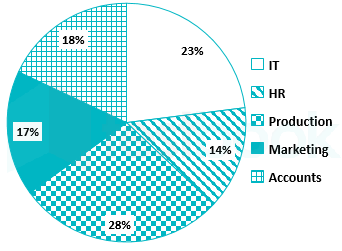
Study the given pie chart and answer the question given below.

Percentage breakup of employees working in different departments of a company

Departmentthe ratio of men and women
malefemale

Information technology (IT)
1112
Account54
Marketing89
Production43
Human Resource (HR)95

Total number of employees = 1800

If 10% of the men working in the Accounts department are transferred to the HR department, and one-fourth of the female employees working in the Production department is transferred to the Marketing department, then the number of male employees working in the HR department is what percent less than the number of female employees working in the Marketing department? (correct to one decimal place)

  1. ((a))

    18.6%

  2. ((b))

    16.7%

  3. ((c))

    20.1%

  4. ((d))

    17.2%

Show Answer
Answer: ((b))

16.7%

Calculation:

Total employees working in the Accounts department = 1800 × 18/100

⇒ 324

Total men in Accounts department = 324 × 5/9

⇒ 180

So, 10% of the men = 180 × 10/100 = 18

Total employees working in the HR department = 1800 × 14/100

⇒ 252

Total men in Accounts department = 252 × /14

⇒ 162

After increase total men = 162 + 18 = 180

Total employees working in the Production department = 1800 × 28/100

⇒ 504

Total female in Accounts department = 504 × 3/7

⇒ 216

1/4th of the female = 216 × 1/4

⇒ 54

Total employees working in the Marketing department = 1800 × 17/100

⇒ 306

Total female in Marketing department = 306 × 9/17

⇒ 162

After increase total female = 162 + 54 = 216

Difference = 216 - 180 = 36

Required % = (36/216) × 100

⇒ 16.7%

∴ Required answer is 16.7%

42

There are six numbers. The sixth number is 3313%33\frac{1}{3}\%  greater than the average of the first five numbers. If the average of all the six numbers is 345634\frac{5}{6}, then find the sixth number.

  1. ((a))

    39

  2. ((b))

    45

  3. ((c))

    42

  4. ((d))

    44

Show Answer
Answer: ((d))

44

Given:

Average = 345634\frac{5}{6}

Concept used:

Average = Sum of elements/No. of elements

Calculation:

3313%33\frac{1}{3}\%  = 1/3

Let the average of 1st five numbers be 3x

So, the sixth number = 3x + 3x × 1/3 = 4x

According to the question,

3x × 5 + 4x = 345634\frac{5}{6} × 6

⇒ 15x + 4x = (209/6) × 6

⇒ 19x = 209

⇒ x = 11

So, sixth number is 11 × 4 = 44

∴ Required answer is 44

43

A certain sum of money invested at simple interest at the rate of 15% p.a. in a 3233\frac{2}{3} year become Rs. 18,600. What will be the same amount if it is invested for 2 years compounded at the same rate of interest, where the interest is compounded 8-monthly?

  1. ((a))

    Rs. 15,972

  2. ((b))

    Rs. 15,992

  3. ((c))

    Rs. 15,792

  4. ((d))

    Rs. 15,982

Show Answer
Answer: ((a))

Rs. 15,972

Given:

Amount = Rs. 18600

Rate of Interest = 15%

Time = 3233\frac{2}{3} Years

Formula used:

S.I = PRT/100

Amount = Principal + S.I

In C.I

Amount = P(1 + R/100)n

P = Principal

R = Rate

T = Time

Calculation:

Let the Principal be Rs. x

S.I = Rs. (18600 – x)

According to the question,

(x × 15 × 11)/(100 × 3) = 18600 – x

⇒ 55x/100 = 186000 – x

⇒ 55x = 1860000 – 100x

⇒ 155x = 186000

⇒ x = 12000

Now, for compound interest compunded 8 monthly,

Interest rate = 15 × 8/12 = 10%

n = 24/8 = 3

So,

12000(1 + 10/100)3

⇒ 12000(1 + 1/10)3

⇒ 12000(11/10)3

⇒ 12000 × 1331/1000

⇒ 15972

∴ Required amount is Rs. 15972

44

The time taken by a boat to cover a certain distance downstream is two-third of the time taken by the boat to cover the same distance upstream. If twice the speed of the boat in still water is 10 km/h more than 7 times the speed of the stream, then what is the speed (in km/h) of the current?

  1. ((a))

    3133\frac{1}{3}

  2. ((b))

    2122\frac{1}{2}

  3. ((c))

    4

  4. ((d))

    2

Show Answer
Answer: ((a))

3133\frac{1}{3}

Given:

The time taken by a boat to cover a certain distance downstream is two-third of the time taken by the boat to cover the same distance upstream.

The speed of the boat in still water is 10 km/h more than 7 times the speed of the stream

Concept used:

v + u = downstream

v - u = upstream

v = speed of the boat

u = speed of the stream

Speed ∝ 1/time

Calculation:

According to the question,

2v = 7u + 10

⇒ 2v - 7u = 10

Let the time taken by the boat upstream be 3x

So, the time taken by the boat downstream = 2x

Upstream speed = 2x and downstream speed = 3x

So,

v + u = 3x      ----(i)

v - u = 2x      ----(ii)

By adding (ii) with (i) we get,

2v = 5x

⇒ v = 5x/2

Putting value of v in eq (i) we get,

u = x/2

Now,

2 × 5x/2 - 7 × x/2 = 10

⇒ 5x - 7x/2 = 10

⇒ (10x - 7x)/2 = 10

⇒ (3x)/2 = 10

⇒ x = 20/3

So, u = 20/3 ÷ 2

⇒ 20/3 × 1/2 = 10/3

⇒ 3133\frac{1}{3}

∴ Required speed of the stream is 3133\frac{1}{3} km/h

45

If 3x12x=3,x0\rm 3{\rm{x}} - \frac{1}{{2{\rm{x}}}} = \sqrt 3 ,x \ne 0, then what is the value of 8x3127x3\rm 8{x^3} - \frac{1}{{27{x^3}}}?

  1. ((a))

    1039\frac{{10\sqrt 3 }}{9}

  2. ((b))

    1033\frac{{10\sqrt 3 }}{3}

  3. ((c))

    10√3 

  4. ((d))

    2039\frac{{20\sqrt 3 }}{9}

Show Answer
Answer: ((d))

2039\frac{{20\sqrt 3 }}{9}

Given:

3x12x=3\rm 3{\rm{x}} - \frac{1}{{2{\rm{x}}}} = √ 3

Concept used:

if (a - 1/b) = q

So, a3 - 1/b3 = q3 + 3.a.1/b(q)

Calculation:

3x12x=3\rm 3{\rm{x}} - \frac{1}{{2{\rm{x}}}} = √ 3

⇒ 2x13x=233\rm 2{\rm{x}} - \frac{1}{{3{\rm{x}}}} = \frac{2√ 3}{3} [By multiplying both sides with 2/3]

⇒ 2x13x=23\rm 2{\rm{x}} - \frac{1}{{3{\rm{x}}}} = \frac{2}{√ 3}

8x3127x3=(2x)31(3x)3\rm 8{x^3} - \frac{1}{{27{x^3}}} = \rm {(2x)^3} - \frac{1}{{(3{x)^3}}}

⇒ 8x3127x3=(23)3+3×2x×13x(23)\rm 8{x^3} - \frac{1}{{27{x^3}}} = \rm {(\frac{2}{√3})^3} + 3\times2x\times\frac{1}{{3{x}}}(\frac{2}{√3})

⇒ 8x3127x3=833+43\rm 8{x^3} - \frac{1}{{27{x^3}}} = \rm {\frac{8}{3√3}} + \frac{4}{√3}

⇒ 8x3127x3=8;+;1233\rm 8{x^3} - \frac{1}{{27{x^3}}} = \rm {\frac{8 ;+ ;12}{3√3}}

⇒ 8x3127x3=2033\rm 8{x^3} - \frac{1}{{27{x^3}}} = \rm {\frac{20}{3√3}}

⇒ 8x3127x3=2039\rm 8{x^3} - \frac{1}{{27{x^3}}} = \rm {\frac{20√3}{9}} [By multiplying both sides with √3]

∴ Required answer is 2039\frac{{20√ 3 }}{9}

46

Two trains P and Q leave from station A and B respectively at the same time and move towards each other. After crossing each other, P and Q take x h and 8 h to reach B and A respectively. If the speed of Q is 25% more than that of P, then what is the value of x?

  1. ((a))

    12

  2. ((b))

    121212\frac{1}{2}

  3. ((c))

    10

  4. ((d))

    101210\frac{1}{2}

Show Answer
Answer: ((b))

121212\frac{1}{2}

Given:

Time taken by P after meeting = x hrs

Time taken by Q after meeting = 8 hrs

Concept used:

(Speed of T1/Speed of T2)2 = Time taken by T2/Time taken by T1

Here T1 and T2 = train 1 and train2

Calculation:

AB Distance cover by train Q = S2t2

& BC Distance cover by train P = S1t1

Let the speed of P be 4 units

Speed of Q = 4 × (5/4) = 5 units

According to the concept,

(4/5)2 = 8/x 

⇒ 16/25 = 8/x 

⇒ x = 25/2 

⇒ x = 121212\frac{1}{2}

∴ The value of x is 121212\frac{1}{2}

47

In an election, there are three candidates A, B and C. A got 35% of the total votes and B got 54% of the remaining votes. C got 5382 votes. By how many votes did the winner win over his nearest candidate?

  1. ((a))

    18

  2. ((b))

    23

  3. ((c))

    17

  4. ((d))

    21

Show Answer
Answer: ((a))

18

Shortcut Trick

Let the total number of votes be 100%.

Votes of A = 35%, Remaining votes = 100% − 35% = 65%.

Votes of B = 54% of 65% = 35.1%.

Votes of C = 65% − 35.1% = 29.9%.

Given 29.9% = 5382 ⇒ 1% = 180 ⇒ 0.1% = 18.

Winning margin = Winner (B) − Nearest (A) = 35.1% − 35% = 0.1% = 18.

∴ The correct answer is 18 votes.

Alternate Method

Given:

Candidate A got 35% of the total votes.

Candidate B got 54% of the remaining votes.

Candidate C got 5382 votes.

Formula Used:

Total Votes = A's votes + B's votes + C's votes

Calculation:

⇒ Let the total votes be x.

⇒ Votes obtained by A = 35% of x = 0.35x

⇒ Remaining votes after A's share = x − 0.35x = 0.65x

⇒ Votes obtained by B = 54% of 0.65x = 0.54 × 0.65x = 0.351x

⇒ Votes obtained by C = Remaining votes − B's votes

⇒ Votes obtained by C = 0.65x − 0.351x = 0.299x

⇒ We are given that C got 5382 votes.

⇒ 0.299x = 5382

⇒ x = 5382 ÷ 0.299 = 18000

⇒ Votes obtained by A = 0.35 × 18000 = 6300

⇒ Votes obtained by B = 0.351 × 18000 = 6318

⇒ The winner is B (6318 votes) and his nearest candidate is A (6300 votes).

⇒ Winning margin = 6318 − 6300 = 18 votes

∴ The correct answer is 18 votes.

Additional Information

Winning Margin Concept

In any election problem, the winning margin or majority is calculated as the absolute difference between the votes secured by the winner and the first runner-up (the nearest candidate).

Successive Percentage Calculation

When percentages are distributed successively on the remaining amounts, the effective percentage of the final part is the product of the fractional remaining parts. E.g., y% of remaining (100−x)% = [y × (100−x)] ÷ 100.

Valid and Invalid Votes

If a certain percentage of votes are declared invalid, the valid votes become the new base (100%) for calculating the share of the candidates, unless stated otherwise.

48

5 men and 12 women can complete a certain work in 2 days while 3 men and 4 women can also complete the same work in 5 days. How many men will be required to complete the same work in 8 days?

  1. ((a))

    6

  2. ((b))

    8

  3. ((c))

    5

  4. ((d))

    4

Show Answer
Answer: ((c))

5

Given:

5 men and 12 women can complete a work in 2 days

3 men and 4 women can complete it in 5 days.

Calculation:

According to question,

(5 men + 12 women) × 2 = (3 men + 4 women) × 5 

⇒ 10 men +  24 women = 15 men + 20 women

⇒ 5 men = 4 women

⇒ men/women = 4/5

So, men : women = 4 : 5 i.e ratio of efficiency 

Now, total work = (5 × 4 + 12 × 5) × 2

⇒ (20 + 60) × 2

⇒ 160 units

So, to complete 160 units in 8 days total men need = 160/(8 × 4) [Each man has an efficiency of 4 so we will multiply 4 with the time]

⇒ 5

∴ Required number of men is 5.

49

A test tube has a hemispherical base of diameter 10.5 cm on which a cylinder of the same diameter and height 15 cm is placed. If 1386 cm3 of water is poured into the tube, how far down (in cm) will the water reach from the edge (top edge) of the tube? (π=227)\left( {\pi = \frac{{22}}{7}} \right)

  1. ((a))

    2

  2. ((b))

    2.5

  3. ((c))

    3

  4. ((d))

    3.5

Show Answer
Answer: ((b))

2.5

Given:

Diametere of the hemisphere = 10.5 cm

Height of the cylinder = 15 cm

Volume of water = 1386 cm3

Concept used:

Volume of the hemisphere = (2/3) × π × (r)3

Volume of the cylinder = πr2h

r = radius

h = height

Calculation:

The radius of the hemisphere = 5.25 cm

Volume of the hemisphere = (2/3) × π × (5.25)3

⇒ 303.1875 cm3

If we pour water into the testtube then it will fill the hemisphere completely,

So the remaining portion of the water will fill some portion of the cylinder

Remaining portion = 1386 - 303.1875

⇒ 1082.8125

Now,

Let the height of the portion of the cylinder be h

1082.8125 = 22/7 × (5.25)2 × h

⇒ h = 12.5

The total height of the cylinder is 15 cm

Difference = 15 - 12.5 = 2.5 cm

∴ The water will reach 2.5 cm from the edge (top edge) of the tube?

50

A trader sells article A, at 30% profit and article B at 20% loss and earns Rs 865. If he sells A at 20% loss and B at 26% profit, he received Rs. 64 less. If he sells both A and B for Rs. 840, then what will be his loss/gain percentage?

  1. ((a))

    5% gain

  2. ((b))

    5% loss

  3. ((c))

    2.5% gain

  4. ((d))

    2.5% loss

Show Answer
Answer: ((a))

5% gain

Given:

A trader sells article A at 30% profit and article B at 20% loss and earns Rs 865. If he sells A at 20% loss and B at 26% profit, he received Rs. 64 less.

Concept used:

Profit = Sales price - Cost price

Profit% = (Profit/Cost price) × 100

Calculation:

Let the cost price of article A be 100a, and article B be 100b

So,

130a + 80b = 865      ----(i)

80a + 126b = 801      ----(ii)

By multiplying 8 with eq (i) and 13 with eq (ii) we get

1040a + 640b = 6920      ----(iii)

1040a + 1638b = 10413      ----(iv)

By subtracting (iii) from (iv) we get

998b = 3493

⇒ b = 3493/998

⇒ b = 3.5

So, 100b = 350

Now, putting the value of b in eq (i) we get

130a = 865 - 80 × 3.5

⇒ 130a = 585

⇒ a = 4.5

⇒ 100a = 450

Total cost price of the A and B = 450 + 350 = 800

Profit = 840 - 800 = 40

Profit% = (40/800) × 100 = 5%

∴ His gain percentage is 5%

Science (25 questions)

51

The refractive index of crown and dense flint glass are 1.52 and 1.65, respectively. A ray of light travels from dense flint glass to crown glass. The refractive index of crown glass with respect to dense flint glass is _____ and the light ray bends _____ the normal in dense flint glass.

  1. ((a))

    0.92; towards

  2. ((b))

    1.09; towards

  3. ((c))

    0.92; away from

  4. ((d))

    1.09; away from

Show Answer
Answer: ((c))

0.92; away from

The correct answer is 0.92; away from.

Concept:

Refraction of Light: 

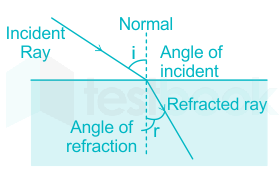
  • The bending of the ray of light passing from one medium to the other medium is called refraction.

https://storage.googleapis.com/tb-img/production/20/05/F1_J.K_8.5.20_Pallavi_D3.png

Refractive Index (n):

  • n = sin i / sin r, where 'i' =  angle of incidence  and 'r' = angle of refraction.
  • Also, n = c/v, where c = speed of light in a vacuum, and v = speed of light in a medium.

Explanation:​

Relative refractive index:

  • It refers to the refractive index of one material medium with respect to another one.
  • n21=n2n1n_{21}= \frac{n_{2}}{n_{1}}

Refractive index of glass (dense flint) with respect to turpentine oil:

n=Refractive index of crown glass Refractiev index of dense flint glass=1.521.65=0.92n= \frac{Refractive \ index \ of \ crown\ glass \ }{Refractiev \ index\ of\ dense \ flint\ glass}= \frac{1.52}{1.65}= 0.92

  • Greater the refractive index, the denser the medium.
  • Thus, flint glass (1.65) is denser than crown glass (1.52).
  • When the ray of light moves from a denser to a rarer medium, the refracted ray moves away from the normal.
  • When the ray of light moves from a rarer to a denser medium, the refracted ray moves towards the normal.
  • Thus, when a light ray will move from ice to glass, it will move towards the normal.

The refractive index of crown glass with respect to dense flint glass is 0.92 and the light ray bends away from the normal in the dense flint glass.

52

The length of a cylindrical metal wire is increased by 50% with no change of volume. Its resistance increases by:

  1. ((a))

    125%

  2. ((b))

    150%

  3. ((c))

    75%

  4. ((d))

    50%

Show Answer
Answer: ((a))

125%

The correct answer is 125 %.

Concept:

Resistance (R): 

  • Resistance is a measure of the opposition to current flow in an electrical circuit.
  • It is measured in ohms, symbolized by the Greek letter omega (Ω).
  • R=ρlAR = \frac{ρ l}{A} where ρ is resistivity, l is length, and A is the area of the cross-section of the wire.

Explanation: 

Suppose original length = L, Area of cross-section = A, radius of wire = r and Resistance = R

Since the wire is the same, the resistivity ρ will be the same.

After the increase in length, let us take new length = L', radius of wire = r' and new resistance = R'

L' = 150 L/ 100 = 3L/2 ( since there is 50% increase)

The volume of the wire remains the same ( given).

So, Volume of Original Wire = volume of new wire 

π r2 L = π r ' 2 L'

r2L = r' 2 L'

r' 2 = r2 L /  L'

r' 2 = 2 r2  / 3

Increase in resistance = ρLAρLAρLA\frac{\frac{\rho L'}{A'}-\frac{\rho L}{A}}{\frac{\rho L}{A}} × 100

=ρLπr2ρLπr2ρLπr2×100=\frac{\frac{\rho L'}{\pi r^2} - \frac{\rho L}{\pi r^2}}{ \frac{\rho L}{\pi r^2} } \times 100

=3×3ρL2×2πr2ρLπr2ρLπr2×100=\frac{\frac{3 \times 3 \rho L}{2 \times 2 \pi r^2} - \frac{\rho L}{\pi r^2}}{ \frac{\rho L}{\pi r^2} } \times 100

=94ρLπr2ρLπr2ρLπr2×100=\frac{\frac{9}{4}\frac{\rho L}{\pi r^2} - \frac{\rho L}{\pi r^2}}{ \frac{\rho L}{\pi r^2} } \times 100

=9ρL4ρL4πr2ρLπr2×100=\frac{\frac{9 \rho L - 4 \rho L}{4\pi r^2}}{ \frac{\rho L}{\pi r^2} } \times 100

=5ρL4πr2×πr2ρL×100=125%= \frac{5 \rho L}{4 \pi r^2} \times \frac{\pi r^2}{ \rho L} \times 100 = 125\%

Thus, the increase in length is 125%.

53

Three resistors A(10 Ω), B(15 Ω) and C(30 Ω) are connected in parallel. This combination is connected in series to three other resistors D(10 Ω), F(15 Ω) and G(30 Ω) and a 12 V battery of negligible internal resistance. Let PB and PF be the rate of energy dissipated in resistors B and F, respectively. Then the ration (PF/PB) is:

  1. ((a))

    9

  2. ((b))

    3

  3. ((c))

    6

  4. ((d))

    1/3

Show Answer
Answer: ((a))

9

The correct answer is 9.

Concept:

Resistance (R): 

  • Resistance is a measure of the opposition to current flow in an electrical circuit.
  • It is measured in ohms, symbolized by the Greek letter omega (Ω).
  • R=ρlAR = \frac{ρ l}{A} where ρ is resistivity, l is length, and A is the area of the cross-section of the wire.

Resistance in series:

  • When resistors are connected end-to-end in a circuit, they are said to be in "series."
  • R = R1 + R2 + R3....
  • Current remains the same across all the resistors connected in series.

Resistance in parallel: 

  • When both ends of resistors are connected, they are said to be in parallel.
  • 1/R = 1/R1 + 1/R2 = 1/R3 ....
  • The potential difference across all the resistors connected in parallel remains the same.

Electric Power:

  • The energy consumed per unit of time or the rate of doing work is called power.
  • Power = work done / time taken = Vq / t = VI = V2/R = I2R

Explanation:

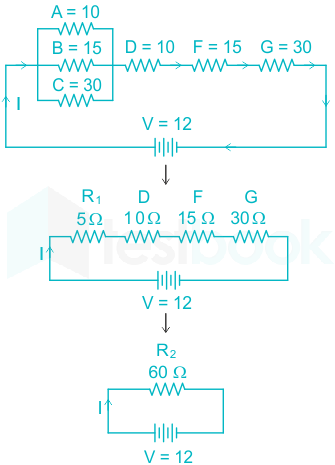
Resistors A (10 Ω), B (15 Ω), and C (30 Ω) are connected in parallel. Let their equivalent resistance is R1.

Equivalent resistance, 1/R1 = 1/10 + 1/15 + 1/30 = 3+2+1/30 = 6/30 = 1/5 Ω

R1 = 5 Ω

Now, the  resistors R1, D (10 Ω), F (15 Ω ), and G (30 Ω ) are in series. Their equivalent resistance is R2.

R2 = 5 + 10 + 15 + 30 = 60 Ω 

Equivalent current, I in the circuit = V/R2 = 12/ 60 = 1/5 A

Potential difference across A = IR1 =  = 5/5 = 1 V

P= I2F = 15/ 5 × 5  = 15/25 Watt = 3/5 Watt (since current remains same in series combination)

PB = V2/B = 1 × 1 /  15 = 1/15 Watt  (since voltage remains same in parallel combination)

The ratio (PF/PB) = 3 × 15 / 5   = 3 × 3 = 9.

54

Hot water tanks in boilers are made of copper, not iron. Which of the following is the correct reason for this?

  1. ((a))

    Iron is not a thermal conductor.

  2. ((b))

    Copper is stronger than iron.

  3. ((c))

    Iron is not malleable and cannot be shaped as water tank.

  4. ((d))

    Copper does not react with water at all.

Show Answer
Answer: ((d))

Copper does not react with water at all.

The correct answer is Copper does not react with water at all.

Concept:

Metals:

  • The elements that tend to lose electrons are called metals.
  • They are rigid, hard, and usually exist in a solid-state at room temperature.
  • They are lustrous, malleable, and ductile.

Explanation:

  • Metals react with water to form metal oxides or hydroxides.
  • Not all metals react with water in the same way. 
  • Sodium metal catches fire in reaction to water.
  • magnesium reacts with hot water.
  • Iron reacts with steam.
  • Lead and copper do not react with water.

​Iron will react with hot water and rust over time but copper does not react with water and will remain intact. 

Thus, hot water tanks in boilers are made of copper, not iron because copper does not react with water at all.

Additional Information

Chemical properties of metals:

    • Metal + Oxygen → Metal oxide
  • The metal reacts with an acid to form a salt.
  • Metal + Acid → Salt + Hydrogen gas
  • Metals react with water to form oxides or hydroxides.
  • Metal + water → Metal oxide/ hydroxide
  • Metals do not react with alkalis.
  • Metal + Alkali → No reaction
55

An object 1.0 cm in height is placed at a distance of 15.0 cm in front of a concave mirror of focal length 30.0 cm on its principal axis. Following New Cartesian sign convention, the image is formed at v = _____ and its height. hI= ____.

  1. ((a))

    100 cm; (2/3) cm

  2. ((b))

    -30 cm; 2.0 cm

  3. ((c))

    -10.0 cm; (2/3) cm

  4. ((d))

    30 cm; 2.0 cm

Show Answer
Answer: ((d))

30 cm; 2.0 cm

The correct answer is 30 cm; 2.0 cm.

Concept:

Spherical mirror:

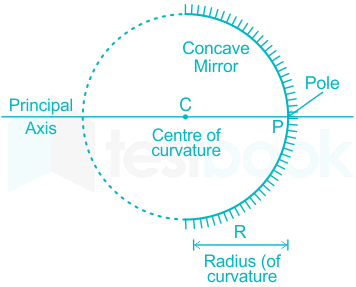
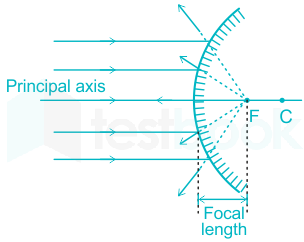
  • A spherical mirror is a mirror that has the shape of a piece cut out of a spherical surface.
  • There are two types of spherical mirrors: concave, and convex.

Mirror formula:1f=1v+1u\frac{1}{f} = \frac{1}{v} + \frac{1}{u}, where f = focal length, v = image distance and u = object distance.

Magnification: m = HiHo=vu\frac{Hi}{Ho} = \frac{-v}{u} , where Hi = height of image, Ho = height of object, v = image distance, and u = object distance.

Concave mirror: 

  • It is part of a whole spherical mirror that reflects light from the hollow part.
  • It is a converging mirror because it converges the incident rays at a point.

Explanation:

Given, u = -15 cm        f = -30 cm              h = 1 cm 

1f=1v+1u\frac{1}{f} = \frac{1}{v} + \frac{1}{u}

130=1v+115\frac{1}{-30} = \frac{1}{v} + \frac{1}{-15}

130=1v115\frac{1}{-30} = \frac{1}{v} - \frac{1}{15}

1v=130+115\frac{1}{v} = \frac{1}{-30} + \frac{1}{15}

1v=1+230\frac{1}{v} = \frac{-1 + 2}{30}

1v=130\frac{1}{v} = \frac{1}{30}

v = 30 cm

m = HiHo=vu\frac{Hi}{Ho} = \frac{-v}{u} =  

Hi = 2 cm

Following New Cartesian Sign Convention, the image is formed at v = 30 cm and its height HI = 2 cm.

Additional Information

Convex mirror: 

  • It is part of a whole spherical mirror that reflects light from the bulged-out part.
  • It diverges the incident rays.

56

A metal compound, on heating strongly in limited supply of air, produces a colourless, odourless gas which is also present in our exhaled breath. This metal is also used for protecting iron from corrosion by applying it layer over iron surface. Which is this compound?

  1. ((a))

    Zinc oxide

  2. ((b))

    Chromium oxide

  3. ((c))

    Aluminium oxide

  4. ((d))

    Zinc carbonate

Show Answer
Answer: ((d))

Zinc carbonate

The correct answer is Zinc carbonate.

Concept:

Chemical reaction:

  • It is a process in which one or more substances, the reactants, are converted to one or more different substances, the products.
  • A chemical reaction rearranges the constituent atoms of the reactants to create different substances as products.

Explanation:

  • We exhale carbon dioxide gas while breathing.
  • So, the colorless, odorless gas released when the given metal compound is heated is carbon dioxide.
  • Iron objects are usually electroplated with Zinc metal to protect them from corrosion.
  • So, the metal compound should be Zinc carbonate.
  • The following reaction takes place when zinc carbonate is heated (in the limited supply of air):
  • ZnCO3 + Heat → ZnO + CO2
57

Where can we find Bowman's capsule?

  1. ((a))

    At the top of a moss plant

  2. ((b))

    In sporulating bacteria

  3. ((c))

    Near synapses of neurons

  4. ((d))

    At the end of a nephron

Show Answer
Answer: ((d))

At the end of a nephron

The correct answer is At the end of a nephron.

Concept:

Excretory system: 

  • Excretion is the process of removing wastes and excess water from the body.
  • Organs of excretion include the skin, liver, large intestine, lungs, and kidneys. Together, these organs make up the excretory system

Explanation:

Kidneys:

  • The paired kidneys are often considered the main organs of excretion.
  • The primary function of the kidneys is the elimination of excess water and wastes from the bloodstream by the production of the liquid waste known as urine.
  • The main structural and functional units of the kidneys are tiny structures called nephrons.
  • Nephrons filter materials out of the blood, return to the blood what is needed, and excrete the rest as urine.
  • The kidneys are organs of the urinary system, which also includes the ureters, bladder, and urethra - organs that transport, store, and eliminate urine, respectively.

Structure of nephron:

  • It is a long tubule with a series of associated blood vessels.
  • The upper end of the tubule is an enlarged cuplike structure called the Bowman’s capsule.
  • Below the Bowman’s capsule, the tubule coils to form the proximal tubule, and then it follows a hairpin turn called the loop of Henle.
  • After the loop of Henle, the tubule coils once more as the distal tubule.
  • It then enters a collecting duct, which also receives urine from other distal tubules.
  • Within the Bowman’s capsule is a coiled ball of capillaries known as a glomerulus.

Thus, Bowman's capsule is found at the end of the nephron.

58

Which of the following is NOT an abiotic factor affecting animal life?

  1. ((a))

    Temperature

  2. ((b))

    Wind

  3. ((c))

    Rainfall

  4. ((d))

    Thunder

Show Answer
Answer: ((d))

Thunder

The correct answer is Thunder.

Concept:

Ecology:

  • The term ecology is derived from the Greek word ‘oikos’ meaning ‘house’, combined with the word ‘logy’ meaning the ‘science of’ or ‘the study of ’.
  • Ecology is the study of the earth as a ‘household’, of plants, human beings, animals, and micro-organisms.
  • They all live together as interdependent components.
  • The interactions of a particular group of organisms with abiotic factors within a particular habitat resulting in clearly defined energy flows and material cycles on land, water, and air, are called ecological systems.

Explanation:

Abiotic factors:

  • They refer to all the non-living components like physical conditions (temperature, pH, humidity, salinity, sunlight, etc.) and chemical agents (different gases and mineral nutrients present in the air, water, soil, etc.) in an ecosystem.

Abiotic factors affecting the life of living organisms:

  • Rainfall,
  • Temperature,
  • Sunlight,
  • Wind
  • Atmospheric humidity,
  • Soil conditions, inorganic substances (carbon dioxide, water, nitrogen, calcium, phosphorus, potassium, etc.).

Thus, thunder is not an abiotic factor affecting animal life.

59

When a coil is moved through a non-uniform (changing) magnetic field, a current is induced in the coil. The induced current is found to be a maximum when the direction of motion of the coil makes an angle of ______ with the direction of the magnetic field.

  1. ((a))

    30° 

  2. ((b))

    90°

  3. ((c))

  4. ((d))

    60°

Show Answer
Answer: ((b))

90°

The correct answer  is 90°.

Concept:

Electromagnetic induction:

  • When a conductor is set to move inside a magnetic field or a magnetic field is set to be changing around a conductor, an electric current is induced in the conductor.
  • This process is called electromagnetic induction.
  • Electromagnetic induction can be explained with the help of Fleming’s Right-Hand Rule.

Fleming’s Right-Hand Rule:

  • If we arrange our thumb, forefinger, and middle finger of the right-hand perpendicular to each other, then the thumb points towards the direction of the magnetic force, and the forefinger points towards the direction of the magnetic field, and the middle finger points towards the induced current in the coil.

Explanation:

E.M.F. induced in a coil 'e' = N × B × A × w × sin ωt. 

The induced emf is affected by the following factors:

  • The induced e.m.f. is directly proportional to N, the total number of turns in the coil.
  • The induced e.m.f. is directly proportional to A, the area of the cross-section of the coil.
  • The induced e.m.f. is directly proportional to B, the strength of the magnetic field in which the coil is rotating.
  • The induced e.m.f. is directly proportional to 'ω', the angular velocity of the coil.
  • The induced e.m.f. also varies with time and depends on instant 't'.
  • The induced current is the highest when the direction of motion of the coil is at right angles (90 °)to the magnetic field.
  • The induced current is minimum when the direction of motion of the coil is 180 ° to the magnetic field.
60

Aqueous solution of which of the following salts will turn red litmus blue?

  1. ((a))

    MgCl2

  2. ((b))

    NH4Cl

  3. ((c))

    CH3COONa

  4. ((d))

    Mg(NO3)2

Show Answer
Answer: ((c))

CH3COONa

The correct answer is CH3COONa.

Concept:

pH scale:

  • A scale developed to measure the concentration of hydrogen ions in a solution is known as the pH scale.
  • pH scale ranges from 0 (highly acidic) to 14 (highly alkaline).
  • The pH of a neutral solution is 7.

Acids:

  • They are sour in taste.
  • They turn blue litmus red.
  • Its pH value ranges from 1 to 7 on the pH scale.

Bases:

  • They are bitter in taste and soapy to touch.
  • They turn red litmus blue.
  • Its pH value ranges from 7 to 14 on the pH scale.

Explanation:

Aqueous solution of Sodium acetate (CH3COONa):

  • Sodium acetate reacts with water to form sodium hydroxide and acetic acid.
  • CH3COONa + H2O → CH3COOH + NaOH
  • Sodium hydroxide (NaOH) is a strong base while acetic acid (CH3COONa) is a weak acid.
  • So, the aqueous solution of Sodium acetate will be basic in nature.
  • It will turn red litmus blue.

CH3COONa+H2O→CH3COOH+NaO

61

Two lenses L1 and L2 of powers, (20/3) D and -(10/3) D respectively, separated by 45 cm are arranged parallel to each other in vertical planes. An object is placed 30 cm left to L1, vertically on the common axis of the lenses. The distance between the original object and the final image is;

  1. ((a))

    60 cm

  2. ((b))

    90 cm

  3. ((c))

    85 cm

  4. ((d))

    65 cm

Show Answer
Answer: ((d))

65 cm

The correct answer is 65.

Concept:

Lens:

  • The transparent curved surface which is used to refract the light and make an image of any object placed in front of it is called a lens.
  • A convex lens can converge a beam of parallel rays to a point on the other side of the lens

Power of lens:

  • It is equal to the reciprocal of the focal length of the lens/mirror in meters.
  • Power (P) = 1/f, where f is the focal length of the lens/mirror.
  • P = 100f\frac{100}{f} where f is the focal length in centimeters.
  • The unit of power of a lens is Dioptre when the focal length of the lens is taken in meters (m).
  • The focal length of the concave lens is negative and hence its power is also negative.
  • The focal length of the convex lens is positive and hence its power is also positive.

Lens formula: 1f=1v1u\frac{1}{f}=\frac{1}{v}-\frac{1}{u}  where f is focal length, v is image distance and u is object distance.

Explanation:

For first convex lens, L1

Power = 1f\frac{1}{f}

f = 1p\frac{1}{p} = 3×10020\frac{ 3 × 100}{20} = 3 × 5 = 15 cm

Given: Object distance, u = -30 cm, Focal length, f = 15 cm

 v=?

1f=1v1u\frac{1}{f}=\frac{1}{v}-\frac{1}{u}

115=1v130\frac{1}{15} = \frac{1}{v} - \frac{1}{-30}

115=1v+130\frac{1}{15} = \frac{1}{v} + \frac{1}{30}

115130=1v\frac{1}{15} - \frac{1}{30} = \frac{1}{v}

1v=2130\frac{1}{v} = \frac{2-1}{30}

1v=130\frac{1}{v} = \frac{1}{30}

v = 30 cm

For second convex  lens, L2

f = 1p\frac{1}{p} = 100 × 310\frac{100 \ × \ 3}{-10} = -10 × 3 = -30 cm

Object distance, u = -45-(-30)= -45 + 30 = -15cm, focal length, f = -30cm

v = ?

1f=1v1u\frac{1}{f}=\frac{1}{v}-\frac{1}{u}

130=1v115\frac{1}{-30} = \frac{1}{v} - \frac{1}{-15}

130=1v+115\frac{1}{-30} = \frac{1}{v} + \frac{1}{15}

130115=1v\frac{1}{-30} - \frac{1}{15} = \frac{1}{v}

1v=1230=330\frac{1}{v} = \frac{-1-2}{30} = \frac{-3}{30}

v= -30 / 3 = -10 cm 

Distance between original object and final image = 30 + 45 - 10 = 30 + 35  = 65.

62

Which of the following has radial symmetry?

  1. ((a))

    Hippocampus (Sea horse)

  2. ((b))

    Clonorchis (Liver fluke)

  3. ((c))

    Echinus (Sea urchin)

  4. ((d))

    Musca (House fly)

Show Answer
Answer: ((c))

Echinus (Sea urchin)

The correct answer is Echinus (Sea urchin).

Concept:

  • The animal kingdom is divided into many sub-groups called phyla.
  • The basis for categorization includes:
  • Arrangement of cells
  • Body symmetry
  • Nature of coelom (body cavity)
  • Patterns of digestive, circulatory, or reproductive systems

Explanation:

Body Symmetry:

  • There are 3 types of symmetry: Bilateral, Radial, and Asymmetrical.
  • Bilateral Symmetry:
  • Animals, whose bodies can be divided into left and right halves, are said to be bilaterally symmetrical.
  • For example Platyhelminthes, Annelida, Arthropoda, Chordata, etc.
  • Radial Symmetry:
  • Animals whose bodies can be divided into two equal halves from any plane passing through the center of the body are said to be radially symmetrical.
  • For example Coelenterates, Echinoderms, and Ctenophores.
  • Asymmetrical:
  • ​Few animals cannot be divided into two equivalent parts along with any plane going through the central point of the organism. They are said to be asymmetrical.
  • For example Sponges.
OrganismPhylumSymmetry
Hippocampus (Sea horse)ChordataBilateral
Clonorchis (Liver fluke)PlatyhelminthesBilateral
Echinus (Sea urchin)EchinodermataBilateral ( Larval stage) Radial (Adult)
Musca (House fly)ArthropodaBilateral

Thus, Echinus has radial symmetry.

63

Why is treating viral infections more difficult than treating bacterial infections?

  1. ((a))

    Because viruses are much smaller in size.

  2. ((b))

    Because bacterial are harder to transmit.

  3. ((c))

    Because bacteria cause mild diseases.

  4. ((d))

    Because viruses have fewer targets for drugs.

Show Answer
Answer: ((d))

Because viruses have fewer targets for drugs.

The correct answer is Because viruses have fewer targets for drugs.

Concept:

Infection:

  • An infection occurs when a microorganism enters a person’s body and causes harm.
  • The microorganism uses that person’s body to sustain itself, reproduce, and colonize.
  • These infectious microscopic organisms are known as pathogens, and they can multiply quickly.
  • Examples of pathogens include:
  • bacteria
  • viruses
  • fungi

Explanation:

Treatment of bacterial infections:

  • Bacteria are single-celled organisms.
  • Most bacterial infections can be effectively treated with antibiotics.
  • They either kill bacteria or stop them from multiplying.
  • This helps the body’s immune system to fight the bacteria.

Treatment of viral infections:

  • Unlike bacteria, viruses do not have a cellular structure. They are just genetic material coated by proteins.
  • They enter the host body and invade the cells to multiply by overtaking their DNA replication machinery.
  • So, to kill them we have to kill our cells as well.
  • For most viral infections, treatments can only help with symptoms.
  • Antibodies don't work on viruses. Instead, antiviral medicines are used. But they are available for a few viral infections.

Treating viral infections is more difficult than treating bacterial infections because viruses have fewer म for drugs.

64

Identify the correct statement.

  1. ((a))

    The carrier animal is (Bos indicus) and the milch animal is (Bos bubalis).

  2. ((b))

    Cow is (Bos indicus) and buffalo is (Bos bubalis).

  3. ((c))

    Buffalo is (Bos indicus) and cow is (Bos bubalis).

  4. ((d))

    The milch is (Bos indicus) and the carrier animal is (Bos bubalis).

Show Answer
Answer: ((b))

Cow is (Bos indicus) and buffalo is (Bos bubalis).

The correct answer is Bos indicus is a cow and Bos bubalis is buffalo.

Concept:

Animal Husbandry:

  • Animal husbandry is the scientific management of animal livestock.
  • It includes various aspects such as feeding, breeding, and disease control.
  • Animal-based farming has cattle, goat, sheep, poultry, and fish farming.

Explanation:

Cattle farming:

  • Cattle husbandry is done for milk and draught labor for agricultural work such as tilling, irrigation, and carting.
  • Indian cattle belong to two different species, Bos indicus (cows), and Bos bubalis (buffaloes).
  • Milk-producing females are called milch animals (dairy animals), while those used for farm labor are called draught animals.
65

A cylindrical wire AB consists of two parts AC and CB made of the same material. Parts AC and CB have lengts L and 3L and radii, 3r and r, respectively. A battery is connected across te wire. Let V1 and V2 be the potential differences across AC and CB, respectively. Then (V1/ V2 ) is:

  1. ((a))

    16\frac{1}{6}

  2. ((b))

    19\frac{1}{9}

  3. ((c))

    118\frac{1}{18}

  4. ((d))

    127\frac{1}{27}

Show Answer
Answer: ((d))

127\frac{1}{27}

The correct answer is 1/27.

Resistance:

  • It is the opposition offered to the flow of current passing through a conductor.
  • It is measured in Ohms (Ω).
  • R = ρL/ A where ρ is resistivity, L is the length of conductor and A is the area of cross-section.

Ohm's Law:

  • Ohm’s law states that the amount of electric current through a metal conductor in a circuit is directly proportional to the voltage impressed across it, for any given temperature.
  • V = IR, where V is voltage, I is current and R is resistance.

Explanation:

In the above-drawn circuit, we can refer to the two sections of wire as two different resistors in series. Current remains same in series connection. So, here we will take current = I. 

For Wire AC

length = L, resistivity= ρ , Radius = 3r 

Area of cross-section of wire = π r2 = π (3r)2 = 9 π r2

R1 = ρ L/ A = ρ L / 9 π r2

V1 = I R1 = I ρ L / 9 π r2

For wire CB 

length = 3L, resistivity= ρ , Radius = r 

Area of cross-section of wire = π r2 

R2 = 3ρ L/ A = 3ρ L /  π r2

V2 = I R2 =  3ρ I L /  π r2

Ratio of V1 to V2 = V1/ V2 =  ρIL9πr23ρILπr2\frac{\frac{\rho IL}{9\pi r^2}}{\frac{3\rho I L}{\pi r^2}} = ρIL9πr2\frac{\rho IL}{9\pi r^2} × πr23ρIL\frac{\pi r^2}{3\rho IL} = 1/ 3 × 9 = 1/27 

The ratio (V1 / V2) is 1/27.

66

Atom of an element 'X' has 3 electrons in its M-sell. Which of the following statements about this element is true?

  1. ((a))

    It will form a tri-negative ion to acquire stable configuration.

  2. ((b))

    It will form covalent bonds with five atoms of another element.

  3. ((c))

    It will not form compounds with any element.

  4. ((d))

    It will form a tri-positive ion to acquire stable configuration.

Show Answer
Answer: ((d))

It will form a tri-positive ion to acquire stable configuration.

The correct answer is It will form a tri-positive ion to acquire a stable configuration.

Concept:

Electronic configuration:

  • It can be defined as the distribution of electrons around the nucleus in different energy levels (shells).
  • It was suggested by Bohr and Bury.

Rules for writing the electronic configuration of an atom:​

  • The maximum number of electrons present in a shell is given by the formula 2n2, where ‘n’ is the orbit number or energy level index, 1,2,3, and so on.
  • Hence, the maximum number of electrons in different shells is as follows:
  • The First orbit or K-shell will be = 2 × 12 = 2,
  • The second orbit or L-shell will be = 2 × 22 = 8,
  • The Third orbit or M-shell will be = 2 × 32 = 18,
  • The fourth orbit or N-shell will be= 2 × 42= 32, and so on.
  • The maximum number of electrons that can be accommodated in the outermost orbit is 8.
  • Electrons are not accommodated in a given shell unless the inner shells are filled. That is, the shells are filled in a step-wise manner.

Ions: 

  • An atom or group of atoms that bears one or more positive or negative electrical charges, is called an ion.
  • Cations: Positively charged ions formed by losing electrons.
  • Anions: Negatively charged ions are formed by gaining electrons.

​Explanation:

  • Element X has 3 electrons in the M shell.
  • So, its electronic configuration is 2, 8, 3.
  • An element having less than 4 electrons in its outermost shell tends to lose the electrons to form a cation.

Thus, It will form a tri-positive ion to acquire a stable configuration.

67

If a person with normal vision wears eyeglasses with the type of lens shown in the figure, what will happen?

  1. ((a))

    Light rays coming from a distant source will focus in front of the retina.

  2. ((b))

    Light rays coming from a distant source will focus behind the retina.

  3. ((c))

    Light rays coming from a near source will focus in front of the retina.

  4. ((d))

    Light rays coming from a near source will focus behind the retina.

Show Answer
Answer: ((b))

Light rays coming from a distant source will focus behind the retina.

The correct answer is Light rays coming from a distant source will focus behind the retina. 

Concept:

  • Eye helps us in visualizing objects and also helps us in light perception, color, and depth perception.
  • The human eye consists of the following parts: Sclera, Retina, Cornea, Lens, Pupil, and Optic nerve.

Eye diagram by Firkin | Human eye diagram, Diagram of the eye, Eye structure

Concave lens:

  • A concave lens is a lens that diverges a straight light beam from the source to a diminished, upright, virtual image.
  • It is shaped curved inwards at the center and bulges outwards through the edges.
  • A concave lens is also known as a diverging lens because it makes the light diverge.

Explanation:

  • Our eyes have a convex lens that converges the light rays on the retina.

  • If a person with normal vision wears eyeglasses with a concave lens, it will diverge the light rays and the image will be formed behind the retina.

Additional Information 

Myopia:

  • Myopia is also known as near-sightedness.
  • A person with myopia can see nearby objects clearly but cannot see distant objects distinctly.
  • In myopia, the eyeball is too long for the normal focusing power of the eye. As a result, images of distant objects appear blurred.
  • A concave lens is placed in front of a myopic eye, moving the image back to the retina and clarifying the image.

Hyperopia:

  • Hyperopia is also known as far-sightedness.
  • A person with hyperopia can see distant objects clearly but cannot see nearby objects distinctly.
  • In this condition, nearby objects appear blurry as the light from them is focused behind the retina instead of on it.
  • It can be corrected by a convex lens (converging lens).

68

Select the option which correctly lists the three tissues in terms of ability to provide increasing stiffness to plant.

  1. ((a))

    Sclerenchyma > Parenchyma > collenchyma

  2. ((b))

    Sclerenchyma > Collenchyma > Parenchyma

  3. ((c))

    Parenchyma > Collencyma > Sclerenchyma

  4. ((d))

    Collenchyma > Parenchyma > Sclerenchyma

Show Answer
Answer: ((b))

Sclerenchyma > Collenchyma > Parenchyma

The correct answer is Sclerenchyma > Collenchyma > Parenchyma.

Concept:

Tissue: A group of similar cells that work together to perform a particular function.

Plant tissues are classified into two main categories on the basis of the ability of their cells to divide.

These are meristematic tissue and permanent tissue.

Explanation:

Permanent Tissues:

  • They are a group of cells (living or dead) formed by the meristematic tissue which takes up specific roles and loses their ability to divide.
  • This process of obtaining permanent shape, size, and function is called differentiation.

Simple permanent tissues

  • They are composed of similar types of cells having a common origin and function.
  • It is further divided into three types namely parenchyma, collenchyma, and sclerenchyma.
CharacteristicsParenchymaCollenchymaSclerenchyma
Cell wallThin, made up of celluloseThickened at corners, made up of pectin and hemicelluloseThick all around due to deposition of waterproof lignin
Intercellular spacecells are loosely packedCells have little space in between themNo intercellular spaces
FunctionStorage, photosynthesis, gaseous exchangeProvide mechanical support and elasticity to plantprovides mechanical support to plant
LocationSoft parts of plants like leaves, fruits, flowers, etc.Petiole, leaves, young stemwoody stem, hard nuts, gritty fruits.

Order in terms of ability to provide increased stiffness to plant Sclerenchyma > Collenchyma > Parenchyma.

69

Which of the following is not a greenhouse gas?

  1. ((a))

    Hydrogen

  2. ((b))

    Methane

  3. ((c))

    Nitrous oxide

  4. ((d))

    Carbon dioxide

Show Answer
Answer: ((a))

Hydrogen

The correct answer is Hydrogen.

Concept:

Global warming:

  • It is the increase in the earth's overall temperature over the last one or two centuries due to various human activities.
  • As the human population has increased, so has the volume of fossil fuels burned.
  • Fossil fuels include coal, oil, and natural gas, and burning them causes what is known as the “greenhouse effect” in the earth’s atmosphere.

Explanation:

Greenhouse effect: 

  • The greenhouse effect is when the sun’s rays penetrate the atmosphere, but when that heat is reflected off the surface cannot escape back into space.
  • Gases produced by the burning of fossil fuels prevent the heat from leaving the atmosphere.
  • These greenhouse gasses are carbon dioxide, chlorofluorocarbons, water vapor, methane, and nitrous oxide.
  • The excess heat in the atmosphere has caused the average global temperature to rise over time, otherwise known as global warming.

Thus, Hydrogen is not a greenhouse gas.

70

4 g of hydrogen gas reacts with ‘x’ grams of oxygen gas to form 36 g of water. How many atoms of oxygen will be present in ‘x’ grams of oxygen gas?

  1. ((a))

    6.022 × 10²³

  2. ((b))

    2

  3. ((c))

    24 × 1023

  4. ((d))

    12.044 × 10²³

Show Answer
Answer: ((d))

12.044 × 10²³

Concept:

Mole:

  • It is the SI unit of the amount of substance.
  • One mole contains exactly 6.022×10²³ atoms/molecules.
  • This number is the fixed numerical value of the Avogadro constant (NA).
  • The mass of one mole of a substance in grams is called its molar mass.
  • The molar mass in grams is numerically equal to atomic/molecular/formula mass in u.

So, 1 mole = 6.022 × 10²³ atoms/molecules = Atomic/molecular mass of an element/compound.

Explanation:

Molar mass of Hydrogen gas H2= 2 × 1 = 2g

Molar mass of Oxygen gas O2 = 2 × 16 = 32g

Molar mass of water H2O = 2 + 16 = 18g 

The reaction between hydrogen and oxygen:

  • Hydrogen and oxygen react to form water.
  • 2H2 (g) + O2 (g) → 2H2O (l)
  • 4g of hydrogen reacts with 32g of oxygen to form 36 g of water.

The number of atoms in 32g of Oxygen:

  • 1 mole of O2 = molar mass of O2 = 6.022 × 10²³ molecules of oxygen
  • 32g of O2 has molecules = 6.022 × 10 23
  • 1 Oxygen molecule has 2 atoms of oxygen.
  • The number of oxygen atoms in 32g of O2 = 2 ×  6.022 × 10 23 atoms = 12.044 × 10²³.
71

When silver chloride powder is kept in sunlight for some time, its colour changes from white to grey. What causes this change?

  1. ((a))

    Reaction of silver chloride with carbon dioxide present in air.

  2. ((b))

    Decomposition of silver chloride.

  3. ((c))

    Reaction of silver chloride with oxygen present in air.

  4. ((d))

    Absorption of moisture present in air by silver chloride.

Show Answer
Answer: ((b))

Decomposition of silver chloride.

The correct answer is Decomposition of silver chloride.

Concept:

Chemical reaction:

  • It is a process in which one or more substances, the reactants, are converted to one or more different substances, the products.
  • A chemical reaction rearranges the constituent atoms of the reactants to create different substances as products.

Decomposition reaction:

  • It is defined as the reaction in which a single compound splits into two or more simple substances under suitable conditions.

Types of Decomposition Reactions:

  • Thermal decomposition reaction
  • Electrolytic decomposition reaction
  • Photo decomposition reaction

Explanation:

Photo decomposition:

  • It is a chemical reaction in which a substance is broken down into simple substances by exposure to light (photons)

Decomposition of silver chloride:

  • When silver chloride is exposed to sunlight, it decomposes into silver and chlorine gas.
  • Silver chloride is white in color and silver metal is grey.
  • 2AgCl + Sunlight →  2Ag + Cl2

    So, the cause of the change in color of Silver chloride from white to grey when kept in sunlight is the decomposition of Silver chloride.

Additional InformationThermal decomposition:

  • It is a chemical reaction where a single substance breaks into two or more simple substances when heated.
  • The reaction is usually endothermic because heat is required to break the bonds present in the substance.

Electrolytic decomposition reaction (Electrolysis)

  • Electrolytic decomposition may result when an electric current is passed through an aqueous solution of a compound.
  • A good example is the electrolysis of water.
72

A mixture appears to be homogeneous and its solute particles cannot be separated from the mixture by filtration, but they can be separated by centrifugation. Which of the following is correct about this mixture?

  1. ((a))

    It is a true solution.

  2. ((b))

    Its solute particles will settle down on keeping undisturbed.

  3. ((c))

    Its solute particles can be seen with naked eyes.

  4. ((d))

    It will scatter light.

Show Answer
Answer: ((d))

It will scatter light.

The correct answer is It will scatter light.

Concept:

Mixtures:

  • A mixture is a substance that consists of two or more elements or compounds not chemically combined together

Types of Mixtures:

  • Homogeneous Mixture:
  • Those mixtures, in which the substances are completely mixed together and are indistinguishable from one another, are called homogeneous mixtures.
  • A true solution is a homogeneous mixture.
  • For example Soda water, Soft drinks, lemonade, salt or sugar solution, etc.
  • Heterogeneous Mixture:
  • Those mixtures in which the substances remain separate and one substance is spread throughout the other substance as small particles, droplets, or bubbles are called heterogeneous mixtures.
  • All the suspensions and colloids are heterogeneous mixtures.
  • For Example: - Sugar and sand mixture, muddy river water, soap solution.

Explanation:

Colloids:

  • These mixtures appear to be homogeneous but they are actually heterogeneous.
  • Their particles are very small (1-to 1000 nanometers in size). They cannot be seen with naked eyes.
  • They show the Tyndall effect i.e., they scatter the beam of light passing through them.
  • They don’t settle down when left undisturbed for some time. They are quite stable.
  • They cannot be separated by the filtration process but they can be separated by centrifugation.

73

When copper oxide is treated with hydrochloric acid, copper oxide disappears and the colour of the solution becomes blue-green. Which of the following is the reason for this change?

  1. ((a))

    Neutralisation reaction

  2. ((b))

    Dissolution of copper oxide

  3. ((c))

    Reduction reaction

  4. ((d))

    Combination raction

Show Answer
Answer: ((a))

Neutralisation reaction

The correct answer is Neutralisation reaction.

Concept:

Chemical reaction:

  • It is a process in which one or more substances, the reactants, are converted to one or more different substances, the products.
  • A chemical reaction rearranges the constituent atoms of the reactants to create different substances as products.

Explanation:

Neutralization reaction:

  • In a neutralization reaction, an acid reacts with a base to form salt and water.
  • Acid + Base → Salt + water

​Reaction between Copper oxide and Hydrochloric acid:

  • Copper oxide is a metal oxide and thus basic in nature.
  • Hydrochloric acid is a strong acid.
  • Copper oxide reacts with hydrochloric acid to form copper chloride and water.
  • CuO + 2HCl → CuCl2 + H2O

So, in the case of the reaction of copper oxide and hydrochloric acid, salt which is copper chloride, and water are produced, thus it is an example of a neutralization reaction.

Additional InformationCombination reaction:

  • Two or more elements or compounds combine together to form a single compound.
  • Such reactions are represented by equations of the following form:     A + B → AB.

Reduction reaction:

  • Reduction means losing Oxygen or gaining hydrogen.
  • Reduction is accompanied by oxidation i.e., the addition of oxygen.
  • The reduction and oxidation reaction is termed a redox reaction.
74

An object is placed on the axis of a convex mirror at a point between the pole of the mirror and infinity. The image formed is:

  1. ((a))

    real and diminished

  2. ((b))

    real and enlarged

  3. ((c))

    virtual and diminished

  4. ((d))

    virtual and enlarged

Show Answer
Answer: ((c))

virtual and diminished

The correct answer is virtual and diminished.


Concept:

Spherical mirror:

  • A spherical mirror is a mirror that has the shape of a piece cut out of a spherical surface.
  • There are two types of spherical mirrors: concave, and convex.

Concave mirror: 

  • It is part of a whole spherical mirror that reflects light from the hollow part.
  • It is a converging mirror because it converges the incident rays at a point.

Convex mirror: 

  • It is part of a whole spherical mirror that reflects light from the bulged-out part.
  • It diverges the incident rays.

Explanation:

Image formation by the convex mirror when the object is placed between infinity and pole :

Nature of image: Virtual and erect 

Size of image: Diminished 

Position of image: Behind the mirror between the pole and focus 

Additional Information

Image formed by the convex mirror when the object is at infinity:


Nature of image: Virtual and erect 

Size of image: Highly diminished 

Position of image: Behind the mirror at the focus

75

On what basis did Charles Darwin propose his theory of evolution?

  1. ((a))

    By selecting the fittest organisms from organisms from a generation to produce the next generation

  2. ((b))

    By a detailed study of fossils

  3. ((c))

    By observation of variations in related species

  4. ((d))

    By applying the Laws of Genetics (Mendel's Laws) to natural populations

Show Answer
Answer: ((c))

By observation of variations in related species

The correct answer is By observation of variations in related species.

Concept:

Evolution:  It is the change in the characteristics of a species over several generations and relies on the process of natural selection. 

Explanation:

Charles Darwin's theory of Evolution: 

  • He made a sea voyage on a ship named HMS Beagle around South America, Australia, Africa, and many of the Atlantic and Pacific islands.
  • He observed the plants and animals on his journey and gave the theory of natural selection.
  • In his book, ''On the origin of species" published in 1859, he described how organisms evolve over generations through the inheritance of physical or behavioral traits.
  • The theory starts with the premise that within a population, there is variation in traits, such as the beak shape in one of the Galapagos finches Darwin studied.
  • According to the theory, individuals with traits that enable them to adapt to their environments will help them survive and have more offspring, which will inherit those traits.
  • Individuals with less adaptive traits will less frequently survive to pass them on.
  • Over time, the traits that enable species to survive and reproduce will become more frequent in the population and the population will change or evolve.

Social Science (25 questions)

76

The 19th century indenture has been described as_______.

  1. ((a))

    a new system of slavery

  2. ((b))

    a new system of liberty

  3. ((c))

    a new system of livelihood

  4. ((d))

    a new system of employment

Show Answer
Answer: ((a))

a new system of slavery

The correct answer is a new system of slavery.

Key Points

  • The 19th-century indenture has been described as a new system of slavery.
  • The indentured labour migration from India also illustrates the two-sided nature of the nineteenth-century world.
  • It was a world of faster economic growth as well as great misery, higher incomes for some and poverty for others.
  • In the nineteenth century, hundreds of thousands of Indian and Chinese labourers went to work on plantations, in mines, and in road and railway construction projects around the world.
  • In India, indentured labourers were hired under contracts that promised return travel to India after they had worked five years on their employer’s plantation.
  • Most Indian indentured workers came from the present-day regions of eastern Uttar Pradesh, Bihar, central India and the dry districts of Tamil Nadu.
  • In the mid-nineteenth century, these regions experienced many changes – cottage industries declined, land rents rose, and lands were cleared for mines and plantations.
  • All this affected the lives of the poor.
77

Mandal Commission is officially known by which of the following names?

  1. ((a))

    Socially and Educationally Backward Classes Commission

  2. ((b))

    Commission for the Tribal People’s Rights

  3. ((c))

    Commission for the Protection of Backward Classes in India

  4. ((d))

    Commission for the Deprived Sections of the Society

Show Answer
Answer: ((a))

Socially and Educationally Backward Classes Commission

The correct answer is Socially and Educationally Backward Classes Commission.

Key Points

  • The Mandal commission was set up on 1st 1979 under the prime minister Morarji Desai.
  • Criteria for Reservation based on Educational, Social and Economical.
  • The report was submitted by the Mandal Commission to the President on 31st December 1980.
  • In August 1990 V.P Singh announced the recommendation of the Mandal Commission in Parliament.
  • The SC upheld the 27% reservation for OBCs in 1992.
78

Which of the following statements is correct about Shola grasslands?

  1. ((a))

    Shola grasslands are found in the Terai region.

  2. ((b))

    Shola grasslands are patches of grasslands on hill-slopes.

  3. ((c))

    Shola grasslands are found in semi-arid plains.

  4. ((d))

    Shola grasslands consist of elephant grass.

Show Answer
Answer: ((b))

Shola grasslands are patches of grasslands on hill-slopes.

The correct answer is Shola grasslands are patches of grasslands on hill slopes.

Key Points

  • Grasslands are areas where the vegetation is dominated by grasses.
  • Shola grasslands are found in the Western Ghat, Anamudi, and Nilgiri hills.
  • It is the land of various endangered species of flora and fauna.
  • The highest peak in the South region of India is Anamudi.

Additional Information

  • Nilgiri Hills,is the meeting point of the Western Ghats and the Eastern Ghats.
  • Doddabetta is the highest peak of Nilgiri hills.
79

Which of the following pairs is INCORRECT with respect to the Himalayan ranges and the part of Himalaya it belongs to ?

  1. ((a))

    Greater Himalays – Dhauladhar Range

  2. ((b))

    Outer Himalayas – Shivalik Range

  3. ((c))

    Lesser Himalayas – PirPanjal

  4. ((d))

    Tibetan Himalayas – Jaskar Range

Show Answer
Answer: ((a))

Greater Himalays – Dhauladhar Range

The correct answer is Greater Himalays – Dhauladhar Range.

Key Points

  • The Himalayan Mountains
  • The Himalayas are geologically young and structurally fold mountains.
  • They stretch over the northern borders of India.
  • These mountain ranges run in a west-east direction from the Indus to the Brahmaputra.
  • The Himalayas represent the loftiest and one of the most rugged mountain barriers of the world.
  • They form an arc, which covers a distance of about 2,400 Km.
  • Their width varies from 400 Km in Kashmir to 150 Km in Arunachal Pradesh.
  • The Himalayas consists of three parallel ranges in their longitudinal extent.
  • The northern-most range is known as the Great or Inner Himalayas or the Himadri, lesser Himalayas, and Shivalik.
  • Greater Himalayas 
  • It is also called as Inner Himalayas or Himadri.
  • It is the most continuous range consisting of the loftiest peaks.
  • The average height of these peaks is 6,000 metres.
  • It contains all prominent Himalayan peaks
  • The core of this part of the Himalayas is composed of granite.
  • It is perennially snowbound, and a number of glaciers descend from this range.
  • Himachal or Lesser Himalayas
  • The range lying to the south of the Himadri forms the most rugged mountain system and is known as Himachal or lesser Himalaya.
  • The ranges are mainly composed of highly compressed and altered rocks.
  • The altitude varies between 3,700 and 4,500 metres and the average width is of 50 Km.
  • Pir Panjal,the Dhaula Dhar and the Mahabharat ranges are important ranges in the Himalayas.
  • This range consists of the famous valley of Kashmir, the Kangra and the Kullu Valley in Himachal Pradesh.
  • This region is well-known for its hill stations.
  • Shivalik Range
  • The outermost range of the Himalayas is called the Shiwaliks.
  • They extend over a width of 10-50 Km and have an altitude varying between 900 and 1100 metres.
  • The longitudinal valley lying between lesser Himalayas and the Shiwaliks is known as Duns.
  • Dehra Dun, Kotli Dun and Patli Dun are some of the well-known Duns

Additional Information

  • The longitudinal divisions of the Himalayas
  • These divisions have been demarcated by river valleys.
  • Punjab Himalaya - The part of the Himalayas lying between Indus and Satluj. It is also known as Kashmir and Himachal Himalaya.
  • Kumaon Himalayas -The part of the Himalayas lying between the Satluj and Kali rivers.
  • Nepal Himalayas - The part of the Himalayas lying between  the Kali and Teesta rivers.
  • Assam Himalayas - The part of the Himalayas lying between the Teesta and Dihang rivers.
80

National Income Statistics are computed by which of the following institutions in India?

  1. ((a))

    Ministry of Planning

  2. ((b))

    Ministry of Finance

  3. ((c))

    National Statistical Office

  4. ((d))

    Reserve Bank of India

Show Answer
Answer: ((c))

National Statistical Office

The correct answer is National Statistical Office.

Key Points

  • National Income Statistics
  • National Income measures the total value of goods and services produced within the economy over a period of time.
  • There are three methods for measurement of National Income:
  1. Product Method
  2. Income Method
  3. Expenditure method
  • The national income in India is calculated by the National Statistical Office.
  • Significance of National Income Statistics
  • National Income Statistics are very helpful to the finance minister to formulate policies.
  • It guides him to make the proper and right decisions in regard to taxation and budgets.
  • It provides an instrument for economic planning.
  • It indicates trends of inflation and deflation.
  • It is useful to compare the prosperity of a country at different times.

Additional Information

  • National Statistical Office (NSO)
  • In 2019 government merge the National Sample Survey Office (NSSO) with Central Statistics Office (CSO) to form National Statistical Office (NSO).
  • It works under the ministry Ministry of Statistics and Program Implementation.
  • Headquarters: New Delhi
  • Chairman: G P Samanta
81

For the rural people of India, which of the following sources of credit would be the cheapest and most convenient?

  1. ((a))

    Money lender

  2. ((b))

    Private bank

  3. ((c))

    Cooperative society

  4. ((d))

    Trader

Show Answer
Answer: ((c))

Cooperative society

The correct answer is Cooperative society.

Key Points

  • Co-operative Society
  • Cooperative Society plays an important role in shaping India’s progress by helping the poor, illiterate, and unskilled people.
  • It is a tool for social and economic inclusion.
  • It achieves the common socio-economic goal.
  • It works in remote places where state and private sectors face trouble to reach.

Additional Information

  • Constitutional Provision related to Cooperative Society
  • Cooperative societies are mentioned in article 243ZH-243ZT in Part IX B of the constitution.
  • 97th Constitutional Amendment Act, 2011 gave constitutional status to cooperative societies.
  • It added fundamental rights Article 19 (1) (c) Right to form a cooperative society.
82

When was the Election Commission of India established in India?

  1. ((a))

    25 January 1950

  2. ((b))

    26 November 1950

  3. ((c))

    26 January 1950

  4. ((d))

    15 August 1947

Show Answer
Answer: ((a))

25 January 1950

The correct answer is 25 January 1950.

Key Points

  • Election Commission of India (ECI)
  • It was established on 25 Jan 1950.
  • Part XV (Article 324-329) of the Indian Constitution describes the Power, Function, Tenure, Eligibility, etc. the Election Commission of India.
  • It is an independent body that conducts clean and fair elections.
  • It conducts the Lok Sabha, Rajya Sabha, State Assemblies, President and Vice President elections.
  • Chief Election Commissioner and Election Commissioners are appointed by the President and theirs’s tenure of six years or up to the age of 65 years, whichever is earlier.
  • The ECI has been successfully conducting national and state elections since 1952.​

Additional Information

  • Important Articles 324 to 329
ArticleDescribe
324Power of superintendence, direction, and control of the election
325No person is to be ineligible for inclusion in or to claim to be included in a special, electoral roll-on grounds of religion, race, caste, and sex
326Election to the House of the People and the Legislative Assemblies of States to be based on adult suffrage
327Power of Parliament to make provision for elections to Legislatures.
328Power of Legislature of a state to make provision for elections to such legislature
329Bar to interference by courts in electoral matters notwithstanding anything in this constitution
83

What is the full form of NDMA?

  1. ((a))

    Natural Disaster Management Authority

  2. ((b))

    National Disaster Management Authority

  3. ((c))

    National Disease Management Authority

  4. ((d))

    National Drought Management Authority

Show Answer
Answer: ((b))

National Disaster Management Authority

The correct answer is National Disaster Management Authority.

Key Points

  • National Disaster Management Authority (NDMA)
  • It was founded on 23 Dec 2005 by Disaster Management Act 2005.
  • It is the apex statutory body for disaster management and is headed by the Prime Minister.
  • Its responsibility is to lay down policies in disaster management and approve the national plan etc.
  • National Disaster Response Force (NDRF) is the specialized force for disaster response that works under NDMA and was founded in 2006.
  • State Disaster Management Authority (SDMA) is headed by the Chief Minister of the respective state.
84

On which of the following factors does power output in the wind energy NOT depend upon?

  1. ((a))

    Blade radius

  2. ((b))

    Sunlight

  3. ((c))

    Air density

  4. ((d))

    Wind speed

Show Answer
Answer: ((b))

Sunlight

The correct answer is Sunlight.

  • Sun is the main source of energy on the earth and sunlight is related to Solar Energy.

Key Points

  • Wind Energy
  • It is a renewable and cleaner energy that produces no greenhouse gas emissions.
  • It is produced energy using wind turbines through wind speed, air density, and blade radius.
  • India is the fourth-largest wind energy producer in the world after China, USA, and Germany.
  • India ranked 4th Global wind power installed capacity index.
  • Tamil Nadu is the first in wind energy production and second is Gujarat, third is Maharashtra.
85

Which of the following is NOT one of the reasons why the year 1848 was called a year of hardships and turmoil in Europe?

  1. ((a))

    Unemployment was very high.

  2. ((b))

    Louis Philips was forced to flee.

  3. ((c))

    There was food shortage.

  4. ((d))

    There was drought in Europe.

Show Answer
Answer: ((d))

There was drought in Europe.

The correct answer is option 4.

Key Points

  • Food shortages, economic turmoil and the demand for democratic ideology were the main reasons behind the Revolutions of 1848, spread over European countries.
  • The burdened banks because of the economic distress in 1847 and inability of artisans to compete with mechanized production(as an effect of the Industrial Revolution) increased urban and rural unemployment. Hence the option 1 is correct.
  • Louis Philips was the King of France from 1830 to 1848. The French revolution of 1848 took place in the background of the dictatorship of the monarch, indifference towards the middle class and peasants, suppression of freedom of Press, limiting the power of franchise(power to vote). This widespread revolt made King Louis to flee to England. Hence option 2 is also correct.
  • Food shortage occurred due to the Great Famine of 1848 which is probably due to successive failure of the Potato crop, which was a staple food of that time. This caused unrest in peasants that also affected the Revolutions of 1848. Hence the option 3 is correct.
  • The food shortage is mainly because of Blight disease in potatoes and there are no records of drought.

Hence option 4 is not correct.

86

Which of the following is NOT necessary for a country to score high in the Human Development Index?

  1. ((a))

    Education level of the citizens is high

  2. ((b))

    Life expectancy of the citizens is high

  3. ((c))

    Per capita income is high

  4. ((d))

    Gender ratio is equal

Show Answer
Answer: ((d))

Gender ratio is equal

The correct answer is option 4.

Key Points

  • HDI is a measure of human development in a country.
  • It is calculated based on the following parameters:
  • Life expectancy
  • Education level (avg. years of schooling)
  • Per Capita Income
  • It is developed by a Pakistani economist Mahbub Ul Haq.
  • HDI emphasizes peoples’ capabilities apart from the economic growth in the development of a nation.
  • It does not reflect the inequalities(gender parity), poverty and empowerment issues.

Additional Information

  • IHDI (Inequality adjusted HDI)
  • It considers the inequalities present in the three parameters for calculation of a particular nation.
  • There is also GDI (Gender Development Index) that takes into account the gender disparity.
87

Which Indian state had women chief ministers more times than any other state?

  1. ((a))

    Uttar Pradesh

  2. ((b))

    Delhi

  3. ((c))

    Tamil Nadu

  4. ((d))

    West Bengal

Show Answer
Answer: ((c))

Tamil Nadu

The correct answer is Tamil Nadu**.**

Key Points

  • Tamil Nadu
  • Janaki Ramachandran
  • 7 January 1988 to 30 January 1988
  • J. Jayalalitha took charge 6 times as CM of Tamil Nadu.
  • Served for around 14 years.

Uttar Pradesh

  • First woman CM of UP (and in India) is Sucheta Kripalani (1963-67).
  • Second woman CM of UP is Mayavati  (1995, 97,2002, 2002-03, 2007-12)
  • UP has woman as CM for 5 times.

​Delhi

  • ​First woman CM of Delhi is Sushma Swaraj (1998).
  • Second woman CM of Delhi is Sheila Dixit  (1998-03, 2003-08, 2008-13)
  • Delhi has woman as CM for 5 times.

​ 

Additional Information

  • The other female Chief Ministers in India are:
StateCM                           (no of times as CM)Remarks
UPSucheta Kripalani (1)First ever woman CM (in India)
Mayavati (4)First Dalit woman CM
DelhiSushma Swaraj (1)Term of 52 days
Sheila Dixit (3) & Atishi (1)Longest term for a woman CM(15 years)
Tamil NaduV. N. Janaki Ramachandran (1)Shortest term of 23 days
J. Jayalalithaa (6)2nd longest term (14 years)
West BengalMamata Banerjee (3)
RajasthanVasundhara Raje (2)
BiharRabri Devi (2)
Madhya PradeshUma Bharti (1)
OdishaNandini Satpathy (1)
AssamAnwara Taimur (1)First Muslim woman CM
PunjabRajinder Kaur Bhattal (1)Short term of 83 days
GoaShashikala Kakodkar (1)
88

When was the Fundamental Right to Education implemented in India?

  1. ((a))

    1 April 2006

  2. ((b))

    1 April 2021

  3. ((c))

    1 April 2005

  4. ((d))

    1 April 2010

Show Answer
Answer: ((d))

1 April 2010

The correct answer is 1 April 2010.

 Key Points

  • Right to Education in India was implemented in 2010 through the Article 21A of the Constitution and the Right To Education (RTE) Act.
  • RTE came into effect from 1 April 2010.

Additional Information

  • Article 21-A
  • It is a fundamental right providing free and compulsory education for all children in the age group of 6-14 years.
  • It is inserted in the Constitution by The Constitution (86th Amendment) Act, 2002.
  • Right of Children to Free and Compulsory Education Act, (RTE) 2009
  • Provides free and compulsory education to children in the age 6-14.
  • It is an obligation on the Government to provide and ensure admission, attendance and completion of elementary education.
  • It lays down norms and standards relating to Pupil Teacher Ratios, School-working days, teacher-working hours.
89

Which of the following zones of the Indian Railways does Secunderabad come under?

  1. ((a))

    Central Railway Zone

  2. ((b))

    South-Central Railway Zone

  3. ((c))

    Eastern Railway Zone

  4. ((d))

    South-Eastern Railway Zone

Show Answer
Answer: ((b))

South-Central Railway Zone

The correct answer is South-Central Railway Zone.

Key Points

  • Secunderabad is the headquarters of South-Central Railway zone.
  • It covers the states of Andhra Pradesh, Telangana and some parts of Maharashtra.
  • The divisons under the zone are:
  • Secunderabad(TS), Hyderabad(TS), Vijayawada(AP), Guntakal(AP) & Nanded(MH).​

Additional Information

  • The rail network spans over 68103 Km ranking fourth in the world after the US, China and Russia.​
  • Indian Railways is the largest Public Sector Undertaking in India (in terms of workforce)
  • The network in India is divided into 16 zones
ZoneHeadquarters
Central RailwayyMumbai
Eastern RailwayKolkata
Northern RailwayNew Delhi
Southern  RailwayChennai
Western RailwayMumbai CST
North Frontier  RailwayGuwahati
North Central  RailwayAllahabad
North Eastern  RailwayGorakhpur
North Western RailwayJaipur
East Central RailwayHajipur
East Coast RailwayBhubaneshwar
South East Central  RailwayBilaspur
South Eastern RailwayGarden Reach, Kolkata
South Central RailwaySecunderabad
South Western RailwayHubli
West Central RailwayJabalpur
90

Which of the following groups of people is/are targeted for food security through the Revamped Public Distribution System in India?

  1. ((a))

    People living in remote and backward areas

  2. ((b))

    Poor people living in the urban areas

  3. ((c))

    Senior citizens and disabled people

  4. ((d))

    Children suffering from malnutrition

Show Answer
Answer: ((a))

People living in remote and backward areas

The correct answer is People living in remote and backward areas.

Key Points

  • People living in remote and backward areas are targeted for food security through Revamped Public Distribution System in India.
  • Revamped Public Distribution System (RPDS)
  • RPDS was launched in **June 1992.**​
  • It aims to strengthen and streamline the Public Distribution System (PDS) as well as improve its outreach in remote, hilly, remote, and inaccessible areas where a large section of the poor lives.
  • It covered 1775 those blocks where area-specific programs like Drought Prone Area Programme, Integrated Tribal Development Projects, Desert Development Program were being implemented and in certain hilly areas which were identified by the State Governments.
  • Under this scheme, the beneficiary was to give up to 20 kg of grains per card.

Additional Information

  • PUBLIC DISTRIBUTION SYSTEM (PDS)
  • It was introduced by the British in World War II as a wartime rationing measure.
  • The Public Distribution System (PDS) is a system of management of food scarcity through the distribution of foodgrains at affordable prices.
  • PDS is operated under the joint responsibility of the Central and the State/UT Governments.
  • Under the PDS, wheat, rice, sugar, and kerosene are being allocated to the States/UTs for distribution.
  • Some states/UTs also distribute additional items through the PDS outlets such as pulses, edible oils, iodized salt, spices, etc.
  • PDS comes under the Ministry of Consumer Affairs, Food, and Public Distribution.
  • TARGETED PUBLIC DISTRIBUTION SYSTEM (TPDS)
  • Targeted Public Distribution System (TPDS) was launched in June 1997 with a focus on the poor.
  • Under TPDS beneficiaries are divided into two categories:
  • Households, Below the Poverty line (BPL)
  • Households, Above the Poverty Line (APL)
  • ANTYODAYA ANNA YOJANA (AAY)
  • The aim of AAY is to reduce hunger among the poorest section of the BPL population.
  • It was launched in December 2000 for the poorest of the poor families.
  • Under Antyodaya Anna Yojana, the beneficiaries get 35 kg ration which includes 20 kg wheat and 15 kg rice.
  • Beneficiaries can buy wheat at ₹2 per kg and rice at ₹3 per kg.
91

The LM Singhvi Committee for Revitalization of Panchayati Raj Institution for Democracy and Development was appointed by who among the following?

  1. ((a))

    Rajiv Gandhi

  2. ((b))

    Atal Bihari Bajpai

  3. ((c))

    Indira Gandhi

  4. ((d))

    Morarji Desai

Show Answer
Answer: ((a))

Rajiv Gandhi

The correct answer is Rajiv Gandhi.

Key Points

  • The LM Singhvi Committee for Revitalization of Panchayati Raj Institution for Democracy and Development was appointed by Rajiv Gandhi.
  • L.M. Singhvi was appointed by the Rajiv Gandhi government in 1986.
  • The committee was constituted on 'Revitalisation of Panchayati Raj Institutions for Democracy and Development.'

Important Points

  • Key Recommendations of L.M. Singhvi Committee 
  • ​The panchayat Raj institutions should be constitutionally recognized, protected, and preserved.
  • The Constitutional provisions ensure regular, free, and fair elections to the Panchayati Raj bodies.
  • A Nyaya Panchayat should be established for the people of the village.
  • He emphasized Gram Sabha.
  • More financial resources should be made available to the Gram Panchayat.
  • Special judicial tribunals should be established for all matters related to Panchayati Raj disputes like elections, and dissolution of Panchayat.
92

What happened in Nepal in February 2005?

  1. ((a))

    King Birendra, his wife and many relatives were killed tragically.

  2. ((b))

    Nepal witnessed an extraordinary popular movement to restore democracy.

  3. ((c))

    Nepal had its first parliamentary elections.

  4. ((d))

    King Gyanendra dismissed the Prime Minister and dissolved the popularly elected parliament.

Show Answer
Answer: ((d))

King Gyanendra dismissed the Prime Minister and dissolved the popularly elected parliament.

The correct answer is King Gyanendra dismissed the Prime Minister and dissolved the popularly elected parliament.

Key Points

  • On 1 February 2005, King Gyanendra dismissed the government of Prime Minister Sher Bahadur Deuba for failing to arrange parliamentary elections and unable to restore peace in the country.
  • He also dissolved the popularly elected parliament.

Important Points

  • On 1 June 2001, Raja Birendra, his wife, and several relatives were killed in a mass shooting during a gathering of the royal family at the Narayanhiti Palace.
  • A government-appointed investigative team named Crown Prince Dipendra as the perpetrator of the massacre.
  • Nepal witnessed an extraordinary popular movement to restore democracy in April 2006. 

Although the king formally remained the head of state, actual power was exercised by popularly elected representatives.

  • The first parliamentary elections in Nepal were held in 1959, in which 109 members of the first House of Representatives were elected.

Additional Information

  • Nepal​
  • Capital: Kathmandu
  • Currency: Nepalese rupee
  • Prime minister: Sher Bahadur Deuba (as of march 2022)
  • President: Bidhya Devi Bhandari (as of march 2022)
93

The South-West direction is known as_____.

  1. ((a))

    longitude

  2. ((b))

    an intermediate direction

  3. ((c))

    latitude

  4. ((d))

    a cardinal point

Show Answer
Answer: ((b))

an intermediate direction

The correct answer is an intermediate direction.

Key Points

  • The South-West direction is known as an intermediate direction.
  • The intermediate directions are Northeast (NE), Southeast (SE), Southwest (SW), and Northwest (NW).
  • The Intermediate direction is also known as the Ordinal direction or Intercardinal direction.

Additional Information

  • Latitude
  • It varies from 0° of the equator to 90° North and South at the poles.
  • 1° latitude is equal to approximately 111 km.
  • Longitude
  • It varies from 0° at Greenwich to 180° ​East and west.
  • 1° longitude = 4 minutes
  • A cardinal point
  • Cardinal directions are the four main points of a compass.
  • The cardinal points are North, South, East and West.
94

Whom did Mughal Emperor Akbar made a mansabdar?

  1. ((a))

    Kamal Khan Gakkhar

  2. ((b))

    Kamal Khan Banjara

  3. ((c))

    Kamal Khan Khokhar

  4. ((d))

    Kamal Khan Bhil

Show Answer
Answer: ((a))

Kamal Khan Gakkhar

The correct answer is Kamal Khan Gakkhar.

Key Points

  • Kamal Khan Gakkhar was appointed mansabdar by the Mughal emperor Akbar.
  • Kamal Khan belongs to the Gakhar Khokhar tribe.
  • He was the head of the Gakhar tribe.
  • In Punjab, the Khokhar tribe was very influential during the thirteenth and fourteenth centuries.

Additional Information

  • Mansabdar
  • The word 'mansabdar' refers to a person who holds 'Mansab' which means a post or position.
  • It was a grading system used by the Mughals to fix ranks, salaries, and military responsibilities.
  • The rank and salary are determined by a numerical value called a Jat.
  • The higher the Jat, the more prestigious the position of the noble in the court and the higher his salary.
  • Mansabdars received their salaries in the form of revenue assignments called jagirs.
95

In 1960, the bilingual state of Bombay was divided into which of the following two states?

  1. ((a))

    Maharashtra and Daman

  2. ((b))

    Goa and Gujarat

  3. ((c))

    Maharashtra and Goa

  4. ((d))

    Maharashtra and Gujarat

Show Answer
Answer: ((d))

Maharashtra and Gujarat

The correct answer is Maharashtra and Gujarat.

Key Points

  • Bombay was divided into two states Maharashtra and Gujarat on the basis of language.
  • The Sanyukta Maharashtra Samiti was leading the movement to divide Bombay.
  • Maharashtra and Gujarat were formed on 1 May 1960. (1 May – Maharashtra and Gujarat Day)

Additional Information 

  • Maharashtra (As of July 2022)
  • Capital – Mumbai
  • Governor – Bhagat Singh Koshyari
  • Chief Minister – Eknath Shinde
  • Lok Sabha & Rajya Sabha Seats – 48 & 19
  • Vidhan Sabha & Vidhan Parisad Seats – 288 & 78
  • Important Tourist Sites/Places – Ajanta Cave, Elephanta Cave, Gateway of India, Bibi ka Maqbara, Mahabaleshwar, Sanjay Gandhi (Borivali) National Park, etc.
  • Gujarat (As of July 2022) 
  • Capital – Gandhinagar
  • Governor – Acharya Devvrat (March 2022)
  • Chief Minister – Bhupendra Patel
  • Lok Sabha & Rajya Sabha Seats – 26 & 11
  • Vidhan Sabha & Vidhan Parisad Seats – 182 & 0
  • Important Tourist Sites/Places –  Sabarmati Ashram, Rani ki Vav, Gir national park, Somnath Temple, Statue of Unity, Modhera Sun Temple, etc.
96

A jet stream is a component of which of the following?

  1. ((a))

    Kal-Baisakhi

  2. ((b))

    Monsoon

  3. ((c))

    North-Easterlies

  4. ((d))

    Westerly flow

Show Answer
Answer: ((d))

Westerly flow

The correct answer is Westerly flow.

  • The upper air circulation in the Indian region is dominated by the westerly flow.
  • An important component of this flow is a jet stream.

Key Points

  • Jet Stream:
  • These are narrow belts of high altitude (12000 m) westerly winds in the troposphere.
  • These are located approximately over 27° – 30° north latitudes.

Additional Information 

  • Monsoon: The climate of India is described as monsoon and is influenced by monsoon winds.
  • Kal-Baisakhi: These winds are blowing in the northern plains (Bihar, Jharkhand, WB, Odisha) in the summers. 
  • These winds are associated with violent winds, thunderstorms, and torrential downpours, often accompanied by hail.
  • North–Easterlies: These winds originate from the subtropical high-pressure belt of the northern hemisphere.
97

Who encouraged people to fight against the privilege and finance of the Church without guilt during the French Revolution?

  1. ((a))

    Montesquieu

  2. ((b))

    Diderot

  3. ((c))

    Voltaire

  4. ((d))

    Rousseau

Show Answer
Answer: ((c))

Voltaire

The correct answer is Voltaire.

  • Voltaire was speaking up against the church and he influenced and involved the common people in the French Revolution.

Key Points

  • French Revolution
  • It is the biggest incident in the history of Europe and it began in 1789 and ended in the late 1799.
  • King Louis XVI had helped to independence the thirteen American colonies (American Revolution) from Britain.
  • France had faced a financial crisis and an empty treasury due to a long year of war, supporting allies, and royal extravagance. So, the king increased the tax, and people suffered.
  • In 1795, The national assembly of France approved the new constitution and a committee of 5 members constituted the directory.
  • In 1804, Napoleon became the Emperor of France and was defeated in the waterloo war of 1815.

Additional Information

  • The spirit of the laws book was written by Montesquieu.
  • The social contract book was written by Rousseau.
98

Apart from independent candidates, other candidates for contesting elections in India are chosen by who among the following?

  1. ((a))

    Election Commission of India

  2. ((b))

    Party’s top leadership

  3. ((c))

    Supporters of the party

  4. ((d))

    Government of India

Show Answer
Answer: ((b))

Party’s top leadership

The correct answer is Party’s top leadership.

Key Points

  • In India, Party’s top leadership (Party President and Senior Leader) has decided who candidates will participate in the election.

Additional Information

  • Election Commission of India (ECI)
  • It was established on 25 Jan 1950.
  • Part XV (Article 324-329) of the Indian Constitution describes the Power, Function, Tenure, Eligibility, etc. the Election Commission of India.
  • It is an independent body that conducts clean and fair elections.
  • It conducts the Lok Sabha, Rajya Sabha, State Assemblies, President and Vice President elections.
  • Chief Election Commissioner and Election Commissioners are appointed by the President and theirs’s tenure of six years or up to the age of 65 years, whichever is earlier.
  • The ECI has been successfully conducting national and state elections since 1952.
99

Which of the following pairs is INCORRECT in the context of revolutionary party and the country it belonged to during the Russian Revolution?

  1. ((a))

    Social Democratic Party – Germany

  2. ((b))

    Liberal Party – Argentina

  3. ((c))

    Socialist Revolutionary Party – Russia

  4. ((d))

    Labour Party – Britain

Show Answer
Answer: ((b))

Liberal Party – Argentina

The correct answer is Liberal Party – Argentina.

  • Liberal Party and Labour Party were political parties in Britain.​

Key Points 

  • Russian Revolution
  • This revolution was started in 1917 and its immediate cause was the defeat in the first world war.
  • The first Russian Revolution was started in 1905 and the second in 1917.
  • The slogan of this revolution was ‘Workers of the world unite
  • Bolshevik Revolution was started on 7 March 1917 by Vladimir Lenin.
  • The result of this revolution ended the emperor’s rule, the rise of communism, and rise the of world power.
  • Stalin is the creator of Modern Russia.
100

Which one of the following is not included in the Right to Freedom as per the Indian Constitution?

  1. ((a))

    freedom to practice any religion

  2. ((b))

    Freedom to take out armed processions

  3. ((c))

    freedom to do business

  4. ((d))

    Freedom to live in any part of the country

Show Answer
Answer: ((b))

Freedom to take out armed processions

The correct answer is Freedom to take out armed processions.

Key Points

  • Right to Freedom (Article 19-22)
  • Right to Freedom (Article19 -22) is Fundamental Rights mentioned in the Indian Constitution in part III.
  • From article 19 to article 22 there are different freedoms of rights like freedoms of speech and expression, freedoms of elementary education, etc
  • Following are different rights mentioned under Freedom of Rights :
  1. Article 19 – Freedom of Speech and Expression, Assembly, Association, Movement, Residence, Profession
  2. Article 20 – Protection with respect to conviction of the offense
  3. Article 21 – Right to Life and Personal Liberty
  4. Article 21A - Freedom of Elementary education
  5. Article 22 – Protection against arrest and detention in certain cases
  • Freedom of Speech and expression under Article 19(1) provides that all citizens shall have the following rights
  1. To freedom of speech and expression
  2. To assemble peaceably and without arms
  3. To form associations or unions
  4. To move freely throughout the territory of India
  5. To reside and settle in any part of the territory of India
  6. To practice any profession or to carry on any occupation, trade, or business

Additional Information

  • Fundamental Rights (Article 12-35)
  • Fundamental Rights are the basic human rights guaranteed by the Constitution of India.
  • These are included in Part III of the Indian Constitution from article 19 to article 35
  • There are basically six Fundamental Rights 
  1. Right to Equality (Article 14 to 18)
  2. Right to freedom (Article 19 to 22)
  3. Right against exploitation (Article23 and 24)
  4. Right to freedom of Religion (Article 25 to 28)
  5. Cultural and Educational Rights (Article 29 and 30)
  6. Right to Constitutional Remedies (Article 32)

Attempt this paper under real exam conditions

Timed interface, section switching, instant scoring, and question-by-question analytics — free.

Start Timed Attempt