Concept:
Biot number:
Biot number is defined as the ratio of conductive resistance within the body to convective resistance at the surface.
Bi=convective;resistance;at;surfaceconductive;resistance;within;body=khLc
When the Biot number is less than 0.1 then conductive resistance within the body is negligible which is the condition for the applicability of lumped heat analysis.
In the lumped body, there is no temperature gradient exists, the temperature is the function of only and only time.
Values of the Biot number smaller than 0.1 imply that the heat conduction inside the body is much faster than the heat convection away from its surface, and temperature gradients are negligible inside the body.
Calculation:
Bi < 0.1 → Lumped system analysis
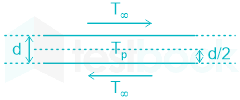
Lc=2d for plate
Bi=khLc
Option (1):
h = 10 W/m2K, k = 100 W/mK,
d = 1 mm = 0.001 m
⇒ Lc=20.001 m
Bi=khLc=2×10010×0.001=20.0001<0.1
Lumped system analysis is applicable
Option (2):
h = 100 W/m2K, K = 100 W/mK, d = 1 m
Lc=21=0.5 m
Bi=khLc=100100×0.5=0.5
Bi > 0.1
The lumped system is not applicable.
Option (3):
h = 100 W/m2K, k = 1000 W/mK, d = 1 mm = 0.001 m
Lc=20.001 m
Bi=khLc=1000×2100×0.001=20.0001<0.1
Lumped system analysis is applicable.
Option (4):
h = 1000 W/m2K, k = 1 W/mK, d = 1 m
Lc=21=0.5 m
Bi=khLc=11000×05=500
Bi > 0.1
Lumped system analysis is not applicable.
Hence, the correct answer is options 1 and 3.