Official Paper

GATE ME 2022 Official Paper: Shift 2 (Previous Year Paper)

65 questions · 180 minutes · with answers · free

General Aptitude (10 questions)

1

Direction: Fill in the blank spaces in the given sentence selecting an appropriate set of words from the following options-

Writing too many things on the ______ while teaching could make the students get ______.

  1. ((a))

    bored / board

  2. ((b))

    board / bored

  3. ((c))

    board / board

  4. ((d))

    bored / bored

Show Answer
Answer: ((b))

board / bored

The correct answer is 'board / bored'.

Key Points

  • The given words are homophones i.e. similar sounding words.
  • Board: a long, thin, flat piece of wood or other hard material, used for floors or other building purposes. (लकड़ी या अन्य कठोर सामग्री का एक लंबा, पतला, सपाट टुकड़ा, जिसका उपयोग फर्श या अन्य भवन उद्देश्यों के लिए किया जाता है।)
  • For eg.- Loose boards creaked as I walked on them.
  • Bored: feeling weary and impatient because one is unoccupied or lacks interest in one's current activity. (थका हुआ और अधीर महसूस करना क्योंकि कोई खाली नहीं है या किसी की वर्तमान गतिविधि में रुचि नहीं है)
  • For eg.- He got bored with staring out of the window.

The complete sentence will be: Writing too many things on the board while teaching could make the students get bored.

  • Hence, option 2 is the correct answer.

Additional Information

  • Creaked: made a harsh, high-pitched sound when being moved or when pressure or weight is applied. (स्थानांतरित होने पर या दबाव या वजन लागू होने पर एक कठोर, तेज आवाज की।)
  • For eg.- The stairs creaked as she went up.

2

Which one of the following is a representation (not to scale and in bold) of all values of x satisfying the inequality 25x(6x53);2-5x\leq-\left(\frac{6x-5}{3}\right); on the real number line?

  1. ((a))

  2. ((b))

  3. ((c))

  4. ((d))

Show Answer
Answer: ((c))

Explanation:

25x(6x53);2-5x≤-\left(\frac{6x-5}{3}\right);

Multiplying 3 on both sides

3(25x)3(6x53);3(2-5x)≤-3\left(\frac{6x-5}{3}\right);

6 - 15x ≤ 5 - 6x

1 ≤ -6x + 15x

1 ≤ 9x 

x ≥ 1/9

Among the given options (3) matches the given condition.

3

If f(x)=2ln(ex)f(x)=2\ln(\sqrt{e^x}), what is the area bounded by f(x) for the interval [0, 2] on the x-axis?

  1. ((a))

    12\frac{1}{2}

  2. ((b))

    1

  3. ((c))

    2

  4. ((d))

    4

Show Answer
Answer: ((c))

2

Explanation:

y=f(x)=2ln(ex)y=f(x)=2\ln(\sqrt{e^x})

The area bounded by the curve y = f(x) and in the interval where x ∈ (0, 2) is given by:

A=022ln(ex)dxA=\int_0^22\ln(\sqrt{e^x})dx

A=022ln(ex/2)dxA=\int_0^22\ln({e^{x/2}})dx

A=022×x2dxA=\int_0^22\times \frac{x}{2}dx

A=[x22]02=[20]=2A=\left[\frac{x^2}{2}\right]_0^2=[2-0]=2

4

A person was born on the fifth Monday of February in a particular year. Which one of the following statements is correct based on the above information?

  1. ((a))

    The 2nd February of that year is a Tuesday

  2. ((b))

    There will be five Sundays in the month of February in that year

  3. ((c))

    The 1st February of that year is a Sunday

  4. ((d))

    All Mondays of February in that year have even dates

Show Answer
Answer: ((a))

The 2nd February of that year is a Tuesday

Explanation:

A non-leap year is of 28 days and has a maximum of 28 days i.e. 4 weeks.

Given that a person was born on the fifth Monday of February in a particular year means the said year is a leap year.

Also, the fifth Monday or any day will correspond to the 29th of February.

Feb 1Feb 8Feb 15Feb 22Feb 29
MondayMondayMondayMondayMonday


Option 1:

The 2nd February of that year is a Tuesday - As 1st February is on Monday, therefore 2nd February will be on Tuesday. (True)

Option 2:

There will be five Sundays in the month of February in that year - Out of all the days, any one day can have 5 counts as the maximum number of days in February is 29. (False)

Option 3:

The 1st February of that year is a Sunday - We have already concluded that 1st February is on Monday. (False)

Option 4:

All Mondays of February in that year have even dates - From the table we can conclude all Mondays do  not have even date as 1st, 15th and 29th is also on Monday. (False)

5

Which one of the groups given below can be assembled to get the shape that is shown above using each piece only once without overlapping with each other? (rotation and translation operations may be used).

  1. ((a))

  2. ((b))

  3. ((c))

  4. ((d))

Show Answer
Answer: ((b))

Explanation:

Option 1:

The above-given image will not be able to produce


 as one more triangle is required.

Option 2:

The above-given image will be able to produce


 as three triangles will make the bottom part whereas the remaining two will make the above part.

Option 3:

The above-given image will not be able to produce


 as there is no scope for trapezium to fit in it.

Option 4:

The above-given image will not be able to produce


 as one more triangle is required.

Thus option 2 is the correct  answer here.

6

Fish belonging to species S in the deep sea have skins that are extremely black (ultra-black skin). This helps them not only to avoid predators but also sneakily attack their prey. However, having this extra layer of black pigment results in lower collagen on their skin, making their skin more fragile.

Which one of the following is the CORRECT logical inference based on the information in the above passage?

  1. ((a))

    Having ultra-black skin is only advantageous to species S

  2. ((b))

    Species S with lower collagen in their skin are at an advantage because it helps them avoid predators

  3. ((c))

    Having ultra-black skin has both advantages and disadvantages to species S

  4. ((d))

    Having ultra-black skin is only disadvantageous to species S but advantageous only to their predators

Show Answer
Answer: ((c))

Having ultra-black skin has both advantages and disadvantages to species S

The correct answer is 'Having ultra-black skin has both advantages and disadvantages to species S'

Key Points

  • Let's refer to the passage:
  • 'This helps them not only to avoid predators but also sneakily attack their prey.'
  • 'However, having this extra layer of black pigment results in lower collagen on their skin, making their skin more fragile.'
  • From the above-mentioned statements, it is evident that the correct logical inference is that 'having ultra-black skin has both advantages and disadvantages to species S'.
  • Hence, option 3 is the correct answer.

Additional Information

  • Collagen: the main structural protein found in skin and other connective tissues, widely used in purified form for cosmetic surgical treatments.
  • For eg.- Vitamin C plays a vital role in the formation of collagen.
7

For the past m days, the average daily production at a company was 100 units per day.

If today’s production of 180 units changes the average to 110 units per day, what is the value of m?

  1. ((a))

    18

  2. ((b))

    10

  3. ((c))

    7

  4. ((d))

    5

Show Answer
Answer: ((c))

7

Explanation:

Average=Sum;of;NumbersTotal;NumbersAverage = \frac{Sum;of;Numbers}{Total;Numbers}

Given:

For the past m days, the average daily production at a company was 100 units per day.

Average=Sum;of;NumbersTotal;NumbersAverage = \frac{Sum;of;Numbers}{Total;Numbers}

100=Sum;of;Numbersm100 = \frac{Sum;of;Numbers}{m}

Sum of numbers = 100m

New Average after today's production = 110

Todays production = 180 units

New;Average=New;Sum;of;NumbersTotal;New;NumbersNew;Average = \frac{New;Sum;of;Numbers}{Total;New;Numbers}

110=100m+180m+1110 = \frac{100m+180}{m+1}

110(m + 1) = 100m + 180

110m  + 110 = 100m + 180

10m = 70

m = 7

8

Consider the following functions for non-zero positive integers, p and q.

f(p,q)=p×p×p×.......×pq terms=pq;;\rm f(p,q)=\frac{p\times p\times p\times.......\times p}{q\ terms}=p^q;;; f(p, 1) = p

g(p,q)=ppppp......up to q termsg(p,q)=p^{p^{p^{p^{p^{..^{..^{..^{up\ to\ q\ terms}}}}}}}}; g(p, 1) = p

Which one of the following options is correct based on the above?

  1. ((a))

    f(2, 2) = g(2, 2)

  2. ((b))

    f(g(2, 2), 2) < f(2, g(2, 2))

  3. ((c))

    g(2, 1) ≠ f(2, 1)

  4. ((d))

    f(3, 2) > g(3, 2)

Show Answer
Answer: ((a))

f(2, 2) = g(2, 2)

Explanation:

f(p,q)=p×p×p×.......×pq terms=pq;\rm f(p,q)=\frac{p\times p\times p\times.......\times p}{q\ terms}=p^q; and 

g(p,q)=ppppp......up to q termsg(p,q)=p^{p^{p^{p^{p^{..^{..^{..^{up\ to\ q\ terms}}}}}}}}

Option 1:

f(2, 2) = 22 ⇒ 4

g(2, 2) = 22 ⇒ 4

f(2, 2) = g(2, 2) ⇒ True

Option 2:

f(g(2, 2), 2) = f(4, 2) = 42 ⇒ 16

f(2, g(2, 2)) = f(2, 4) = 24 ⇒ 16

f(g(2, 2), 2) < f(2, g(2, 2)) ⇒ Not True

Option 3:

g(2, 1) = 21 ⇒ 2

f(2, 1) = 21 ⇒ 2

g(2, 1) ≠ f(2, 1) ⇒ Not True

Option 4:

f(3, 2) = 32 ⇒ 9

g(3, 2) = 32 ⇒ 9

f(3, 2) > g(3, 2) ⇒ Not True

9

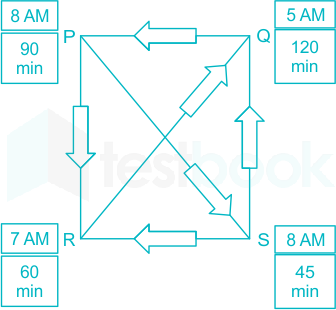
Four cities P, Q, R and S are connected through one-way routes as shown in the figure. The travel time between any two connected cities is one hour. The boxes beside each city name describe the starting time of first train of the day and their frequency of operation. For example, from city P, the first trains of the day start at 8 AM with a frequency of 90 minutes to each of R and S. A person does not spend additional time at any city other than the waiting time for the next connecting train.

If the person starts from R at 7 AM and is required to visit S and return to R, what is the minimum time required?

  1. ((a))

    6 hours 30 minutes

  2. ((b))

    3 hours 45 minutes

  3. ((c))

    4 hours 30 minutes

  4. ((d))

    5 hours 15 minutes

Show Answer
Answer: ((a))

6 hours 30 minutes

Explanation:

The person starts from R at 7 AM and visits S and then return to R, if the follows the routes R → Q → P → S → R.

The person starts from R at 7 AM and reaches Q at 8 AM. At Q, if a person starts at 5 AM, then after each 120 mins, the next train will start. 5 AM → 7 AM → 9 AM.

The person starts from Q at 9 AM and reaches P at 10 AM. At P, if a person starts at 8 AM, then after each 90 mins, the next train will start. 8 AM → 9.30 PM → 11 AM.

The person starts from P at 11 AM and reaches S at 12 PM. At S, if a person starts at 8 AM, then after each 45 mins, the next train will start. 8 AM → 8.45 AM → 9.30 AM → 10.15 AM → 11 AM → 11.45 AM → 12.30 PM.

The person starts from S at 12.30 PM and reaches R at 1.30 PM.

the total time taken is (1.30 PM - 7 AM) = 6 hours 30 minutes.

10

Equal sized circular regions are shaded in a square sheet of paper of 1 cm side length. Two cases, case M and case N, are considered as shown in the figures below. In the case M, four circles are shaded in the square sheet and in the case N, nine circles are shaded in the square sheet as shown.

What is the ratio of the areas of unshaded regions of case M to that of case N?

  1. ((a))

    2 ∶ 3

  2. ((b))

    1 ∶ 1

  3. ((c))

    3 ∶ 2

  4. ((d))

    2 ∶ 1

Show Answer
Answer: ((b))

1 ∶ 1

Explanation:

Both square of case M and N are of radius 1 cm.

Case M:

Let the radius be R

∴ 4R = 1 or R = 1/4 cm.

Area of square = 1 cm2.

Area of circle = 4 × πR2 = π/4 cm2

Area of unshaded region = (1 - π/4) cm2

Case N:

Let the radius be r

∴ 6r = 1 or R = 1/6 cm.

Area of square = 1 cm2.

Area of circle = 9 × πR2 = π/4 cm2

Area of unshaded region = (1 - π/4) cm2

∵ the area of unshaded region in both cases M and N is same, ∴ the ratio is 1 : 1.

Mechanical Engineering (55 questions)

11

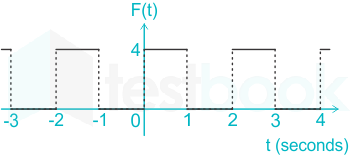
F(t) is a periodic square wave function as shown. It takes only two values, 4 and 0, and stays at each of these values for 1 second before changing. What is the constant term in the Fourier series expansion of F(t)?

  1. ((a))

    1

  2. ((b))

    2

  3. ((c))

    3

  4. ((d))

    4

Show Answer
Answer: ((b))

2

Concept:

Fourier Series is defined as

f(x) = ao2+n=1an cosnπxl+n=1bn sinnπxl\frac{a_o}{2} + \sum_{n = 1}^{\infty } a_n\ cos \frac{n\pi x}{l} + \sum_{n = 1}^{\infty } b_n\ sin \frac{n\pi x}{l}

where, ao=1l llf(x)dxa_o = \frac{1}{l}\ \int_{-l}^{l} f(x) dx

an=1l llf(x) cosnπxl dxa_n = \frac{1}{l}\ \int_{-l}^{l} f(x) \ cos\frac{n\pi x}{l} \ dx

bn=1l llf(x) sinnπxl dxb_n = \frac{1}{l}\ \int_{-l}^{l} f(x) \ sin\frac{n\pi x}{l} \ dx

Calculation:

Given:

f(t) is an even periodic function, Since

f(-t) = f(t)

The constant term in the Fourier series is: ao/2

ao=1l llf(t)dxa_o = \frac{1}{l}\ \int_{-l}^{l} f(t) dx

l = 1

ao=11 11f(t)dxa_o = \frac{1}{1}\ \int_{-1}^{1} f(t) dx

Since the function is not continious, we need to break the integral according to interval

from -1 to 0, f(t) = 0,

from 0 to 1, f(t) = 4

ao=100 dx+014 dxa_o = \int_{-1}^{0} 0\ dx + \int_{0}^{1} 4\ dx = 4

The constant term is:

ao2\frac{a_o}{2} = 4/2 = 2

Mistake PointsAvoid using the integral property of even function because the given function f(t) is not continuous. Though the function given is an even periodic function but it is not continuous

12

Consider a cube of unit edge length and sides parallel to co-ordinate axes, with its centroid at the point (1, 2, 3). The surface integral AF.dA\int_A \vec{F}.d\vec{A} of a vector field F=3xi^+5yj^+6zk^\vec{F}=3x\hat{i}+5y\hat{j}+6z\hat{k} over the entire surface A of the cube is ______.

  1. ((a))

    14

  2. ((b))

    27

  3. ((c))

    28

  4. ((d))

    31

Show Answer
Answer: ((a))

14

Concept:

Gauss divergence theorem: AF.dA=V.FdV\int_{A}F.dA = \int \int_{V}\int \overrightarrow{\bigtriangledown}.\overrightarrow{F} dV

where, AF.dA\int_A \vec{F}.d\vec{A}  is called surface integral

V.FdV\int \int_{V}\int \overrightarrow{\bigtriangledown}.\overrightarrow{F} dV  is called volume integral

.F\overrightarrow{\bigtriangledown}. \overrightarrow{F}  is called divergence of F

 .F\overrightarrow{\bigtriangledown}. \overrightarrow{F}  = δFδx+δFδy+δFδz\frac{\delta F}{\delta x} + \frac{\delta F}{\delta y} + \frac{\delta F}{\delta z}

Calculation:

Given:

V = volume of cube = (1)3

F=3xi^+5yj^+6zk^\vec{F}=3x\hat{i}+5y\hat{j}+6z\hat{k}

.F=δδx(3x)+δδy(5y)+δδz(6z)\overrightarrow{\bigtriangledown}. \overrightarrow{F} = \frac{\delta }{\delta x} (3x) + \frac{\delta }{\delta y} (5y) + \frac{\delta }{\delta z}(6z) = 3 + 5 + 6 = 14

AF.dA=V.FdV\int_{A}F.dA = \int \int_{V}\int \overrightarrow{\bigtriangledown}.\overrightarrow{F} dV

AF.dA=V14 dV\int_{A}F.dA = \int \int_{V}\int 14\ dV = 14 × ( V )

AF.dA\int_A \vec{F}.d\vec{A} = 14

13

Consider the definite integral

12(4x2+2x+6)dx\int^2_1(4x^2+2x+6)dx

Let Ie be the exact value of the integral. If the same integral is estimated using Simpson’s rule with 10 equal subintervals, the value is Is. The percentage error is defined as e = 100 × (Ie - Is)/Ie The value of e is

  1. ((a))

    2.5

  2. ((b))

    3.5

  3. ((c))

    1.2

  4. ((d))

    0

Show Answer
Answer: ((d))

0

Concept:

Simpson's rule is given by -

**xoxo + nh\int_{x_o}^{x_o\ +\ nh} **f(x) dx = h3\frac{h}{3}[{yo + yn}+ 2 {y2 + y4 + ......... + yn-2} + 4 {y1+ y3 + ......... + yn-1}]

h = width of interval / step length

yo, y1 ........ yn  - ordinates corresponding to xo, x1 ........ xn

Error = Exact value - approximate value

Calculation:

Given:

Since the given function is second-degree polynomial.

Simpson's 1/3 rd rule also uses a second degree polynomial for approximation.

Hence there will be no error in the result

The value of Is and Ie will be the same and hence 

e = 100 × (Ie - Is)/Ie = 0

14

Given ex2dx=π\int^{\infty}_{-\infty}e^{-x^2}dx=\sqrt{\pi}

If a and b are positive integers, the value of ea(x+b)2dx\int^{\infty}_{-\infty}e^{-a(x+b)^2}dx is _________.

  1. ((a))

    πa\sqrt{\pi a}

  2. ((b))

    πa\sqrt{\frac{\pi}{a}}

  3. ((c))

    bπab\sqrt{\pi a}

  4. ((d))

    bπab\sqrt{\frac{\pi}{a}}

Show Answer
Answer: ((b))

πa\sqrt{\frac{\pi}{a}}

Explanation:

ea(x+b)2dx\int^{∞}_{-∞}e^{-a(x+b)^2}dx

substitute, x + b = t

dx = dt

at x = -∞ , t = -∞ 

 x = ∞ , t = ∞ 

\(\int^{∞}{-∞}e^{-a(x+b)^2}dx\) = \(\int^{∞}{-∞}e^{-at^2}dt\)    ... (1)

Let substitute, at2 = y2 ⇒ t=yat = \frac{y}{\sqrt a}

on differentiating at2 = y2

2 at dt = 2ydy

dt = ydyat\frac{ydy}{at} = ydyaya\frac{ydy}{a\frac{y}{\sqrt a}} = dya\frac{dy}{\sqrt a}

Now substitute dt in (1)

\(\int^{∞}{-∞}e^{-at^2}dt\) = \(\frac{1}{\sqrt a}\int^{∞}{-∞}e^{-y^2}dy\)

It is given that ex2dx=π\int^{∞}_{-∞}e^{-x^2}dx=\sqrt{\pi}

Hence we get 

1aey2dy\frac{1}{\sqrt a}\int^{∞}_{-∞}e^{-y^2}dy = πa\sqrt \frac{\pi}{a}

15

A polynomial ψ(s) = ansn + an-1sn-1 + ......+ a1s + a0 of degree n > 3 with constant real coefficients an, an-1, ... a0 has triple roots at s = -σ. Which one of the following conditions must be satisfied?

  1. ((a))

    ψ(s) = 0 at all the three values of s satisfying s3 + σ3 = 0

  2. ((b))

    ψ(s) = 0, dψ(s)ds=0\frac{d\psi(s)}{ds}=0 and d2ψ(s)ds2=0\frac{d^2\psi(s)}{ds^2}=0 at s = -σ

  3. ((c))

    ψ(s) = 0, d2ψ(s)ds2=0\frac{d^2\psi(s)}{ds^2}=0 and d4ψ(s)ds4=0\frac{d^4\psi(s)}{ds^4}=0 at s = -σ

  4. ((d))

    ψ(s) = 0, d3ψ(s)ds3=0\frac{d^3\psi(s)}{ds^3}=0  at s = -σ

Show Answer
Answer: ((b))

ψ(s) = 0, dψ(s)ds=0\frac{d\psi(s)}{ds}=0 and d2ψ(s)ds2=0\frac{d^2\psi(s)}{ds^2}=0 at s = -σ

Explanation:

Polynomial, ψ(s) = ansn + an-1sn-1 + ......+ a1s + a0 of degree n > 3

It has triple root at s = -σ 

so, at s = -σ 

ψ(s) will be equal to zero, because it is a root of the polynomial

ψ(s) = ψ(-σ) = 0

Since polynomial ψ(s) has triple root at s = -σ 

So, (s + σ)3 is one factor of polynomial

Since the factor has a cube, it will have an inflexion point in the curve as the x3 has.

Hence first and second-order derivatives will be zero at the point of inflexion.

dψ(s)ds=0\frac{d\psi(s)}{ds}=0d2ψ(s)ds2=0\frac{d^2\psi(s)}{ds^2}=0

16

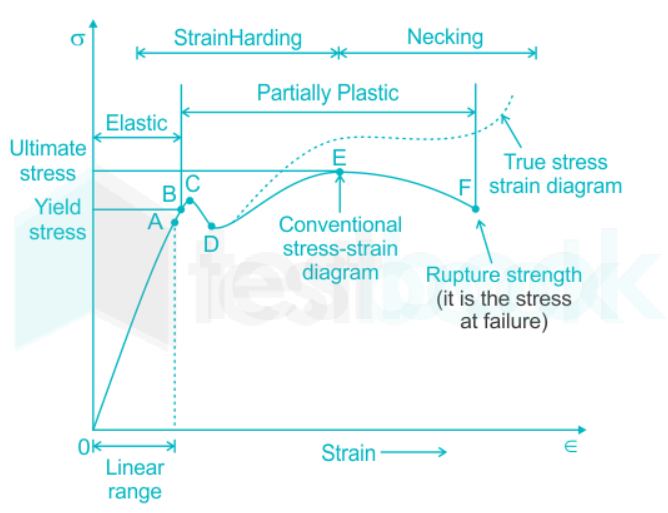
Which one of the following is the definition of ultimate tensile strength (UTS) obtained from a stress-strain test on a metal specimen?

  1. ((a))

    Stress value where the stress-strain curve transitions from elastic to plastic behavior

  2. ((b))

    The maximum load attained divided by the original cross-sectional area

  3. ((c))

    The maximum load attained divided by the corresponding instantaneous cross-sectional area 

  4. ((d))

    Stress where the specimen fractures

Show Answer
Answer: ((b))

The maximum load attained divided by the original cross-sectional area

Explanation:

Ultimate tensile strength is the maximum load that a material can withstand before fracture.

  • In the tensile test, UTS is the maximum load attained divided by the original cross-sectional area of the specimen.

Yield stress is the stress value where the stress-strain curve changes from elastic to plastic behaviour.

True stress is the maximum load attained divided by the corresponding instantaneous cross-sectional at that point.

  • True stress is the load divided by the actual area at that load in a tensile test
  • True strain is the actual strain produced when a load is applied to a material.

Fracture stress is the point where the specimen fractures or ruptures. (point F in figure) 

Tensile test: measures the response of a material to a slowly applied uniaxial force. The yield strength, tensile strength, modulus of elasticity, and ductility are obtained.

17

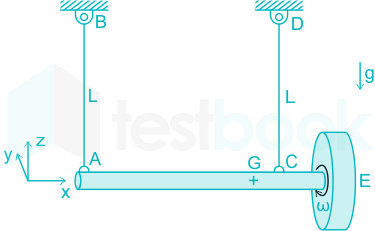
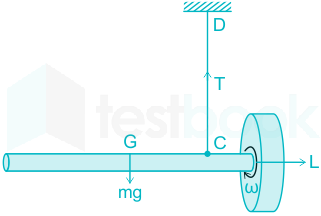
A massive uniform rigid circular disc is mounted on a frictionless bearing at the end E of a massive uniform rigid shaft AE which is suspended horizontally in a uniform gravitational field by two identical light inextensible strings AB and CD as shown, where G is the center of mass of the shaft-disc assembly and g is the acceleration due to gravity. The disc is then given a rapid spin w about its axis in the positive xaxis direction as shown, while the shaft remains at rest. The direction of rotation is defined by using the right-hand thumb rule. If the string AB is suddenly cut, assuming negligible energy dissipation, the shaft AE will

  1. ((a))

    rotate slowly (compared to ω) about the negative z-axis direction 

  2. ((b))

    rotate slowly (compared to ω) about the positive z-axis direction 

  3. ((c))

    rotate slowly (compared to ω) about the positive y-axis direction

  4. ((d))

    rotate slowly (compared to ω) about the negative y-axis direction 

Show Answer
Answer: ((a))

rotate slowly (compared to ω) about the negative z-axis direction 

Explanation:

The rod will rotate slowly rotate around the z-axis and tend towards the negative z-axis direction.

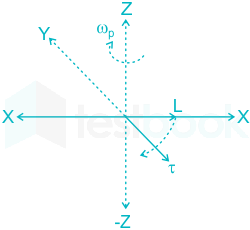
  • It is because the precession(ωp) of the rod is in the clockwise direction when viewed from the top and by using the right-hand thumb rule we can find the axis of precession which is in the downward direction (negative z-axis).

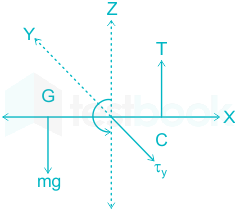
Let's understand from the free body diagram:

If we cut the string AB we will get the gyroscopic effect because the circular disc is rotating about its axis in the x-direction.

  • by using the right-hand thumb rule we can see that due to the angular velocity ω there is angular momentum L in the positive x-direction.

Weight (mg) acting at G (centre of gravity) and tension T in string CD will form a couple.

  • torque is generated due to this couple in the negative y-axis (by the right-hand thumb rule).

The angular momentum acting on the wheel tends to follow the direction of torque.

  • due to this, the rod will start spinning about the z-axis with angular velocity (ωp) in the clockwise direction and it is called gyroscopic precession.
  • Using the right-hand thumb rule we can find the direction of precession which is along the negative z-axis.


 Additional InformationRight-hand thumb rule: curl the fingers of your right hand in the direction of angular velocity (motion) and the thumb will point towards the direction of the angular momentum or torque.

18

A structural member under loading has a uniform state of plane stress which in usual notations is given by σ= 3P, σy = -2P and τxy = √2 P, where P > 0. The yield strength of the material is 350 MPa. If the member is designed using the maximum distortion energy theory, then the value of P at which yielding starts (according to the maximum distortion energy theory) is

  1. ((a))

    70 MPa

  2. ((b))

    90 MPa

  3. ((c))

    120 MPa

  4. ((d))

    75 MPa

Show Answer
Answer: ((a))

70 MPa

Concept:

Maximum distortion energy theory states that the failure or yielding occurs at a point in member when the distortion strain energy per unit volume becomes equal to the limiting distortion strain energy per unit volume at the yielding point.

1 - σ2)2 + (σ2 - σ3)2 + (σ3 - σ1)2 ≤ 2(SyN)22 \left( \frac{S_y}{N} \right)^2

Sy = yield stress, N = factor of saftey

Calculation:

Given:

σx = 3P, σy = -2P and τxy = √2 P

Sy = 350 MPa, N = 1

Principal stress are calculated 

σ1,2 = 12[(σxσy) ± (σx+σy)2+(2τxy)2 ]\frac{1}{2}[ (σ_x - σ_y)\ \pm\ \sqrt{(σ_x + σ_y)^2 + (2 \tau_{xy})^2} \ ]

σ1,2 = 12[(3P2P) ± (3P+2P)2+(2×2P)2 ]\frac{1}{2}[ (3P - 2P)\ \pm\ \sqrt{(3P +2P)^2 + (2 \times \sqrt2 P)^2} \ ]

σ1,2  = 12[P ± 33P ]\frac{1}{2}[ P\ \pm\ \sqrt{33} P\ ]

σ1 = 3.375 P, σ2 = - 2.375 P

According to Maximum distortion energy theory:

(σ1 - σ2)2 + (σ2 - σ3)2 + (σ3 - σ1)2 ≤ 2(SyN)22 \left( \frac{S_y}{N} \right)^2

here σ3 = 0, on simplyfying we get 

σ12 + σ22 - σ1σ2 SyN \frac{S_y}{N}

(3.375 P)2 + ( - 2.375 P)2 - (3.375 P)( - 2.375 P) = (350/1)2

11.4 P2 + 5.64 P2 + 8.015 P2 = 3502

25.055 (P)2 = (350)2

P = 350 / 5 = 70 MPa

19

Fluidity of a molten alloy during sand casting depends on its solidification range. The phase diagram of a hypothetical binary alloy of components A and B is shown in the figure with its eutectic composition and temperature. All the lines in this phase diagram, including the solidus and liquidus lines, are straight lines. If this binary alloy with 15 weight % of B is poured into a mould at a pouring temperature of 800 °C, then the solidification range is

  1. ((a))

    400 °C

  2. ((b))

    250 °C

  3. ((c))

    800 °C

  4. ((d))

    150 °C

Show Answer
Answer: ((d))

150 °C

Explanation:

To find the solidification range at 15 weight % of B we need to draw the point at which solidification is completed on the solidus line (AD).

We can see that point C is the solidification point and temperature can be found using similar triangles.

BE = solidification range

By using similar triangles ABC and ADE

ABBC=AEED\frac{AB}{BC} = \frac{AE}{ED}

AE = 700 - 400 = 300

BC = 15 , ED = 30

AB15=30030\frac{AB}{15} = \frac{300}{30}

AB = 150C

BE = AE - AB

BE = 300 -150 = 150∘C

20

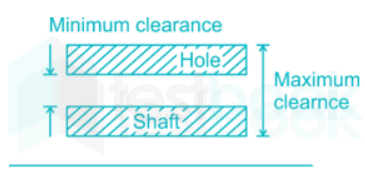
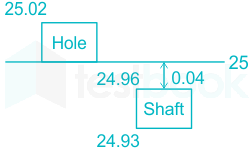
A shaft of diameter \(25^{-0.04}{-0.07}\) mm is assembled in a hole of diameter \(25^{+0.02}{-0.00}\) mm. Match the allowance and limit parameter in Column I with its corresponding quantitative value in Column II for this shaft-hole assembly.

Allowance and limit parameter (Column I)Quantitative value (Column II)
P.Allowance1.0.09 mm
Q.Maximum clearance2.24.96 mm
R.Maximum material limit for hole3.0.04 mm
4.25.0 mm
  1. ((a))

    P - 3, Q - 1, R - 4

  2. ((b))

    P - 1, Q - 3, R - 2

  3. ((c))

    P - 1, Q - 3, R - 4

  4. ((d))

    P - 3, Q - 1, R - 2

Show Answer
Answer: ((a))

P - 3, Q - 1, R - 4

Concept:

Allowance is minimum clearance or maximum interference: 

  • it is the specified difference in dimensions between mating parts; also called functional dimension.

Clearance is the space between mating parts.

  • maximum clearance is the difference between the upper limit of the hole and the lower limit of the shaft.
  • minimum clearance is the difference between the lower limit of the hole and the upper limit of the shaft.


Calculation:

Given:

shaft of diameter 250.070.0425^{-0.04}_{-0.07} mm 

upper limit of shaft = 25 - 0.04 = 24.96 mm

lower limit of shaft = 25 - 0.07 = 24.93 mm

hole of diameter 250.00+0.0225^{+0.02}_{-0.00} mm

upper limit  of hole = 25 + 0.02 = 25.02 mm

lower limit of hole = 25 - 0 = 25 mm

Allowance is the minimum clearance in positive allowance:

  • allowance = 25 - 24.96 = 0.04 mm

Maximum clearance is the difference between the upper limit of the hole and lower shaft limit.

  • maximum clearance = 25.02 - 24.93 = 0.09 mm

​Maximum material limit for the hole in the lower limit of the hole = 25 mm

21

Match the additive manufacturing technique in Column I with its corresponding input material in Column II.

Additive manufacturing technique (Column I)Input Material (Column II)
P.Fused deposition modeling1.Photosensitive liquid resin
Q.Laminated object Manufacturing2.Heat fusible power
R.Selective laser sintering3.Filament of polymer
4.Sheet of thermoplastic or green compacted metal sheet
  1. ((a))

    P - 3, Q - 4, R - 2

  2. ((b))

    P - 1, Q - 2, R - 4

  3. ((c))

    P - 2, Q - 3, R - 1

  4. ((d))

    P - 4, Q - 1, R - 4

Show Answer
Answer: ((a))

P - 3, Q - 4, R - 2

Explanation:

Fused deposition modeling:

  • Fused deposition modeling is an additive manufacturing process in which the melt extrusion method is used to place filaments of thermoplastic polymer and polyacid materials following a certain pattern to produce a three-dimensional physical model. This process uses polymers as raw materials or filaments

Laminated object manufacturing:

  • It is a rapid prototyping system, in it, layers of adhesive-coated paper, plastic or metal laminates are successfully glued together and cut to shape with a knife or laser cutter.
  • solid physical model is made by stacking layers of sheet stock, each an outline of the cross-sectional shape of a CAD model that is sliced into layers.
  • Starting sheet stock includes paper, thermoplastic, cellulose, green compacted metals, or fibre-reinforced materials

Selective laser sintering:

  • It is a type of powder bed fusion wherein a bed of powder polymer, resin or metal is targeted partially (sintering) or fully (melting) by a high power directional heating source such as a laser that results in a solidified layer of fused powder.
22

Which one of the following CANNOT impart linear motion in a CNC machine?

  1. ((a))

    Linear motor

  2. ((b))

    Ball screw

  3. ((c))

    Lead screw

  4. ((d))

    Chain and sprocket

Show Answer
Answer: ((d))

Chain and sprocket

Explanation:

Linear motor: 

  • it converts the rotary motion of the electric motor to a linear motion and because of it, no lead screw is required to convert rotary motion to linear motion.
  • it operates with an AC power supply and servo controller
  • the linear motor primary part is connected to the power supply to produce a magnetic field. By changing the current phase in the coils, the polarity of each coil is changed.
  • the attractive and repelling forces between the coils in the primary part and the magnets in the secondary part cause the primary to move and generate a linear force.

Ball screw: It is a linear drive.

  • A ball screw works in a similar way to a conventional lead screw, but the significant advantage of using a ball screw is that it uses ball bearings running in the helical channel to transmit the load.
  • In high precision applications, it is often necessary to translate the rotary motion from a motor to linear motion for the payload. One way of achieving this is by using a ball screw.

Lead screw: 

  • It is a mechanical linear actuator that is used to convert the rotary motion to linear motion.
  • Its operation relies on the sliding of the screw shaft and the nut threads with no ball bearings between them.
  • the screw shaft and the nut are directly moving against each other on a large contact area, so higher energy losses due to friction are produced.

Chain and sprocket:

  • sprocket is a toothed wheel that fits onto a shaft. It is prevented from rotating on the shaft by a key that fits into keyways in the sprocket and shaft.
  • a chain is used to connect two sprockets and transmit the rotatory motion.
  • one sprocket is the driver sprocket and another sprocket is the driven sprocket.
  • motion and force can be transmitted from the chain of one sprocket to another, therefore from one shaft to another. Chains that are used to transmit motion and force from one sprocket to another are called power transmission chains.
23

Which one of the following is an intensive property of a thermodynamic system?

  1. ((a))

    Mass

  2. ((b))

    Density

  3. ((c))

    Energy

  4. ((d))

    Volume

Show Answer
Answer: ((b))

Density

Explanation:

Intensive property: the properties which are independent of the mass of the system are called intensive properties for example Pressure, Temperature, density, viscosity etc.

Extensive property: the properties which depend on the mass of the system are called extensive properties for example Internal Energy, Energy, Mass, Volume, Entropy etc.

Additional Information

  1. All specific properties are intensive properties because specific properties are divided by per unit mass.
  2. Thermodynamic property is any property that is measurable and whose value describes the state of the system.
  3. Properties are point fiction and these do not depend on the path of the function.
24

Consider a steady flow through a horizontal divergent channel, as shown in the figure, with the supersonic flow at the inlet. The direction of flow is from left to right.

Pressure at location B is observed to be higher than that at an upstream location A. Which among the following options can be the reason?

  1. ((a))

    Since volume flow rate is constant, velocity at B is lower than velocity at A

  2. ((b))

    Normal shock

  3. ((c))

    Viscous effect

  4. ((d))

    Boundary layer separation

Show Answer
Answer: ((b))

Normal shock

Explanation:

Horizontal divergent channel with the supersonic flow at the inlet.

The condition here formed is called Normal shock, where:

  • Pressure at B is greater than the pressure at A, PB > PA
  • Velocity at B is less than the velocity at A, VB < VA

for supersonic flow, Mach number is M > 1

By using the Bernoulli's equation and conservation of momentum the equation obtained for nozzle/diffuser are:

dAA=dPρV2(1M2)\frac{dA}{A} = \frac{dP}{\rho V^2} (1 - M^2)  ..... (1)

dAA=dVV(M21)\frac{dA}{A} = \frac{dV}{V} (M^2 - 1) ....... (2)

It is given that pressure at B is greater than the pressure at A. So adverse pressure gradient will form and cause flow separation.

At point B

  • PB > PA so by equation (1) Mach number is less than 1.
  • M<1 at point B hence subsonic flow occurs at B.
  • the area at B is more than the area at A so from equation (2) we can see the velocity will decrease. i.e VB < VA

At point A

  • supersonic flow is there and at B it is subsonic flow so this causes the formation of normal shock.

Additional InformationNormal flow conditions

  • Velocity at B is greater than the velocity at A ( VB > VA)
  • Pressure at B is lesser than the pressure at A ( PB < PA)
25

Which of the following non-dimensional terms is an estimate of Nusselt number?

  1. ((a))

    Ratio of internal thermal resistance of a solid to the boundary layer thermal resistance

  2. ((b))

    Ratio of the rate at which internal energy is advected to the rate of conduction heat transfer

  3. ((c))

    Non-dimensional temperature gradient 

  4. ((d))

    Non-dimensional velocity gradient multiplied by Prandtl number

Show Answer
Answer: ((c))

Non-dimensional temperature gradient 

Explanation:

Nusselt number: 

it is the ratio of heat flow rate by convection process to the heat flow rate by conduction process.

it is also equal to the dimensionless temperature gradient at the surface, and it provides a measure of the convection heat transfer occurring at the surface.

Nu = QconvQcond\frac{Q_{conv}}{Q_{cond}}

Heat flow in convection, Qconv = hA ΔT

Heat flow in conduction, Qcond = KA ΔTx\frac{KA\ \Delta T}{x}

Nu=QconvQcond=hLKNu = \frac{Q_{conv}}{Q_{cond}} = \frac{hL}{K}

Additional InformationPrandtl number: It is the ratio of momentum diffusivity to thermal diffusivity.

Pr=να=μCpkPr = \frac{\nu}{\alpha} = \frac{\mu C_p}{k}

advection: transfer of heat due to the horizontal movement of fluid in the atmosphere.

26

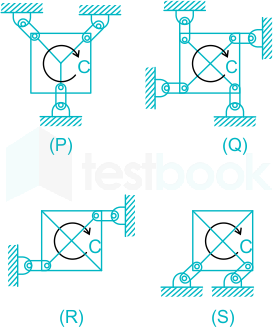
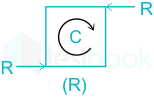
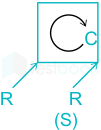
A square plate is supported in four different ways (configurations (P) to (S) as shown in the figure). A couple moment C is applied on the plate. Assume all the members to be rigid and mass-less, and all joints to be frictionless. All support links of the plate are identical.

The square plate can remain in equilibrium in its initial state for which one or more of the following support configurations?

  1. ((a))

    Configuration (P)

  2. ((b))

    Configuration (Q)

  3. ((c))

    Configuration (R)

  4. ((d))

    Configuration (S)

Show Answer
Answer: ((a))

Configuration (P)

Explanation:

To remain in equilibrium all the forces or moments acting on the body should be balanced by the counter-reaction force or moment. 

Here in the given diagram, there is a moment at centroid which must be balanced by the moments produced by the reaction forces at the support to attain equilibrium.

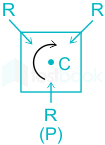
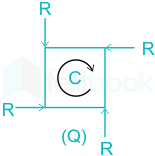
Free body diagram of given configuration:

Configuration (P):

Since the reaction forces are concurrent at the centre of the plate, which cannot produce a balancing moment about the centre. Hence it will not be in equilibrium.

Configuration (Q):

the reaction forces are acting at the corner and generate a counterclockwise moment at the centre. Hence It will be in equilibrium.

Configuration (R)

the reaction forces acting at two corners along the side of the square plate will produce a counterclockwise moment at the centre to balance the moment and thus will remain in equilibrium.

Configuration (S)

In this configuration, one reaction force is concurrent to the centre and thus will not generate any moment at the centre.

The other reaction force will generate a counterclockwise moment at the centre and will balance the moment at the centre. Hence it will be in equilibrium.

27

Consider sand casting of a cube of edge length a. A cylindrical riser is placed at the top of the casting. Assume solidification time, ts ∝ V/A, where V is the volume and A is the total surface area dissipating heat. If the top of the riser is insulated, which of the following radius/radii of riser is/are acceptable?

  1. ((a))

    a3\frac{a}{3}

  2. ((b))

    a2\frac{a}{2}

  3. ((c))

    a4\frac{a}{4}

  4. ((d))

    a6\frac{a}{6}

Show Answer
Answer: ((a))

a3\frac{a}{3}

Concept:

Solidification time is the time required for casting to solidify after pouring. It is expressed by Chvorinov's rule: 

ts=K(VA)2t_s = K \left(\frac{V}{A} \right)^2 where,

ts = solidification time, V = volume of casting

A = surface area of casting, K = solidification factor

For casting the solidification time taken by the riser should be more than the solidification time of the casting.

(ts)Riser ≥ (ts)casting

Calculation:

Given:

ts ∝ V/A

cube of edge length = a

Volume and area of cube:  V = a3, A = 6a2

cylindrical riser with height = h , radius = r

Volume and area of riser: V =  πr2h , A = 2πrh

(ts)Riser ≥ (ts)casting

\(\left(\frac{V}{A}\right){riser} ≥ \left(\frac{V}{A}\right){cube}\)

\(\left(\frac{\pi r^2h}{2\pi rh}\right){riser} ≥ \left(\frac{a^3}{6a^2}\right){cube}\)

r2a6\frac{r}{2}≥ \frac{a}{6}

r ≥ a/3

r = a/3 

from options r = a/2 also satisfies.

Additional Informationfor the optimum condition the height of the riser is equal to the radius of the riser: h = r

28

Which of these processes involve(s) melting in metallic workpieces?

  1. ((a))

    Electrochemical machining

  2. ((b))

    Electric discharge machining

  3. ((c))

    Laser beam machining

  4. ((d))

    Electron beam machining

Show Answer
Answer: ((a))

Electrochemical machining

Explanation:

Electric discharge machining:

  • material is removed by melting or evaporating from the workpiece by a series of rapidly recurring current discharges between two electrodes.
  • the electrodes are separated by dielectric liquid which controls spark discharge.

Laser beam machining:

  • the high power laser beam is directed in a programmed manner towards the material required to be cut.
  • material is removed by melting/ vaporizing due to the high sped laser beam.

Electron beam machining: 

  • the workpiece is placed in the vacuum chamber and a high voltage electron beam is directed towards the workpiece.
  • the energy of the electron beam melts or vaporises the selected region

Electrochemical machining:

  • In ECM metal removal is entirely by metallic ion exchange and so there are no cutting forces and the workpiece is left in an undisturbed stress-free state.
  • It is never subjected to high temperatures which may cause melting of the workpiece. It doesn’t depend at all upon the physical properties of the workpiece.
29

The velocity field in a fluid is given to be V=(4xy)i^+2(x2y2)j^\vec{V}=(4xy)\hat{i}+2(x^2-y^2)\hat{j} Which of the following statement(s) is/are correct?

  1. ((a))

    The velocity field is one-dimensional.

  2. ((b))

    The flow is incompressible.

  3. ((c))

    The flow is irrotational.

  4. ((d))

    The acceleration experienced by a fluid particle is zero at (x = 0, y = 0).

Show Answer
Answer: ((a))

The velocity field is one-dimensional.

Explanation:

V=(4xy)i^+2(x2y2)j^\vec{V}=(4xy)\hat{i}+2(x^2-y^2)\hat{j}

U = 4xy , V = 2(x2 - y2)

δU/δx = 4y , δU/δy = 4x

δV/δx = 4x, δV/δy = -4y

For Incompressible flow: .V=0\overrightarrow{\bigtriangledown } . \overrightarrow{V } = 0

.V=δUδx+δVδy\overrightarrow{\bigtriangledown } . \overrightarrow{V } = \frac{δ U}{δ x} + \frac{δ V}{δ y} = 4y - 4y = 0

hence the flow is incompressible.

For irrotational flow ωz = 0

ωz = 12(δVδxδUδy)\frac{1}{2} \left( \frac{δ V}{δ x} - \frac{δ U}{δ y}\right) =  (4x - 4x) /2 = 0

hence flow is irrotational.

Acceleration at x = 0, y = 0

ax = DUDt=(UδUδx+VδUδy)\frac{DU}{Dt} = \left ( U\frac{δ U}{δ x} + V\frac{δ U}{δ y}\right) = 0

ay = DVDt=(UδVδx+VδVδy)\frac{DV}{Dt} = \left ( U\frac{δ V}{δ x} + V\frac{δ V}{δ y}\right) = 0

Hence acceleration in x and y particle is zero.

30

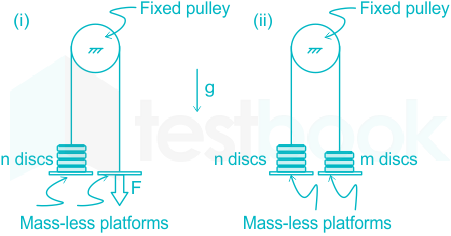
A rope with two mass-less platforms at its two ends passes over a fixed pulley as shown in the figure. Discs with narrow slots and having equal weight of 20 N each can be placed on the platforms. The number of discs placed on the left side platform is n and that on the right side platform is m.

It is found that for n = 5 and m = 0, a force F= 200 N (refer to part (i) of the figure) is just sufficient to initiate upward motion of the left side platform. If the force F is removed then the minimum value of m (refer to part (ii) of the figure) required to prevent downward motion of the left side platform is (in integer).

31

For a dynamical system governed by the equation,

x¨(t)+2ζωnx˙(t)+ωn2x(t)=0\ddot{x}(t)+2 ζ \omega_n \dot{x}(t)+\omega_n^2x(t)=0

the damping ratio ζ is equal to 12πloge2\frac{1}{2\pi}\log_e2. The displacement x of this system is measured during a hammer test. A displacement peak in the positive displacement direction is measured to be 4 mm. Neglecting higher powers (> 1) of the damping ratio, the displacement at the next peak in the positive direction will be _______ mm (in integer).

32

An electric car manufacturer underestimated the January sales of car by 20 units, while the actual sales was 120 units. If the manufacturer uses exponential smoothing method with a smoothing constant of α = 0.2, then the sales forecast for the month of February of the same year is ______ units (in integer). 

33

The demand of a certain part is 1000 parts/year and its cost is Rs. 1000/part. The orders are placed based on the economic order quantity (EOQ). The cost of ordering is Rs. 100/order and the lead time for receiving the orders is 5 days. If the holding cost is Rs. 20/part/year, the inventory level for placing the orders is _______ parts (round off to the nearest integer).

34

Consider 1 kg of an ideal gas at 1 bar and 300 K contained in a rigid and perfectly insulated container. The specific heat of the gas at constant volume cv is equal to 750 J-kg-1K-1. A stirrer performs 225 kJ of work on the gas. Assume that the container does not participate in the thermodynamic interaction. The final pressure of the gas will be ______ bar (in integer).

35

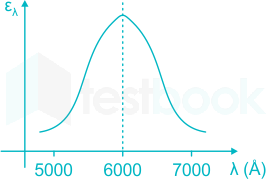
Wien’s law is stated as follows: λmT = C, where C is 2898 μm.K and λm is the wavelength at which the emissive power of a black body is maximum for a given temperature T. The spectral hemispherical emissivity (ελ) of a surface is shown in the figure below (1 Å = 10-10 m). The temperature at which the total hemispherical emissivity will be highest is K (round off to the nearest integer).

36

For the exact differential equation,

dudx=xu22+x2u\frac{du}{dx}=\frac{-xu^2}{2+x^2u}

which one of the following is the solution?

  1. ((a))

    u2 + 2x2 = constant

  2. ((b))

    xu2 + u = constant

  3. ((c))

    12x2u2+2u\frac{1}{2}x^2u^2+2u =  constant

  4. ((d))

    12ux2+2u\frac{1}{2}ux^2+2u  = constant

Show Answer
Answer: ((c))

12x2u2+2u\frac{1}{2}x^2u^2+2u =  constant

Explanation:

dudx=xu22+x2u\frac{du}{dx}=\frac{-xu^2}{2+x^2u}

(2 + x2u) du + (xu2) dx = 0

For exact differential, dPdx=dQdu\frac{dP}{dx} = \frac{dQ}{du}

Q = (2 + x2u), P = (xu2)

dQdx=ddx(2+x2u)\frac{dQ}{dx} =\frac{d}{dx} (2 + x^2u)  = 2ux

dPdu=ddu(xu2)\frac{dP}{du} = \frac{d}{du}(xu^2)  = 2ux

Since dP/du = dQ/dx, hence it is an exact differential.

Thus its solution is given by:

∫Pdx + ∫terms in Q(x,y) not containing x du = C

Cxu2dx+2du=C∫_C xu^2 dx + ∫ 2du = C

x2u22+2u=C\frac{x^2 u^2} {2} + 2u = C

37

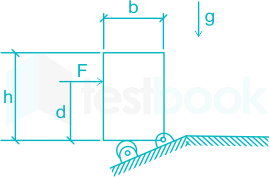
A rigid homogeneous uniform block of mass 1 kg, height h = 0.4 m and width b = 0.3 m is pinned at one corner and placed upright in a uniform gravitational field (g = 9.81 m/s2), supported by a roller in the configuration shown in the figure. A short duration (impulsive) force F, producing an impulse IF is applied at a height of d = 0.3 m from the bottom as shown. Assume all joints to be frictionless. The minimum value of IF required to topple the block is

  1. ((a))

    0.953 Ns

  2. ((b))

    1.403 Ns

  3. ((c))

    0.814 Ns

  4. ((d))

    1.172 Ns

Show Answer
Answer: ((a))

0.953 Ns

Explanation:

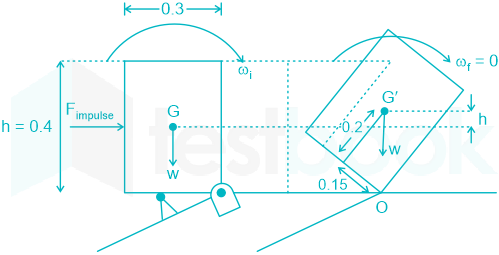
To topple the block we need an impulse force such that the weight will generate a clockwise moment about point O.

This will happen only when a minimum impulse that can rotate the block such that the Centre of gravity of the body will pass through the point O or beyond.

h = 0.4m, b = 0.3 m, m =1kg

OG'0.22+0.152\sqrt{0.2^2 + 0.15^2} = 0.25 m

h' = OG' - h/2 = 0.25 - 0.2 = 0.05 m

Due to force F, the block will topple about A

So By energy balance

(K.E + P.E)initial = (K.E + P.E.)final

12IOω2\frac{1}{2}I_Oω ^2  = 0 + mgh'

Io = 13(h2+b2)\frac{1}{3}(h^2 + b^2) = (0.42 + 0.32)/3 =1/12

12×112×ω2\frac{1}{2}× \frac{1}{12}× ω ^2  = 1 × 9.81 × 0.05

ω2 = 2 × 12 × 9.81 × 0.05

ω = 3.43 rad/s

Now,

Angular impulse = change in angular momentum

IF × d = Io × (ωi - ωf )

IF × 0.3 = 1/12 × ( 3.43 - 0)

IF = 0.953 Ns

38

A linear elastic structure under plane stress conditions is subjected to two sets of loading, I and II. The resulting states of stress at a point corresponding to these two loadings are as shown in the figure below. If these two sets of loading are applied simultaneously, then the net normal component of stress σxx is ________

  1. ((a))

    3σ/2

  2. ((b))

    σ(1 + 1/√2)

  3. ((c))

    σ/2

  4. ((d))

    σ(1 - 1/√2)

Show Answer
Answer: ((a))

3σ/2

Concept:

Normal stress of element under biaxial stress 

σn=σx+σy2+σxσy2 cos (2θ)+τxy sin (2θ)\sigma_n = \frac{σ_{x}+σ_{y}}{2} + \frac{σ_{x}-σ_{y}}{2}\ cos\ (2θ) + τ_{xy}\ sin\ (2θ)

Calculation:

Given:

σx1 = 0, σy1 = σ, τx1, y1 = 0, θ = 45 

 =   

σx = σx1+σx22+σx1σx22 cos (2θ)+τxy sin (2θ)\frac{σ_{x_1}+σ_{x_2}}{2} + \frac{σ_{x_1}-σ_{x_2}}{2}\ cos\ (2θ) + τ_{xy}\ sin\ (2θ)

σx = σ/2

Net normal stress

 + 

 σxx = σ + σx  = σ + σ/2

Additional InformationShear stress of element under biaxial stress

τn=σxσy2 sin 2θ+τxy cos 2θ\tau_n = - \frac{\sigma_x - \sigma_y}{2}\ sin\ 2\theta + \tau_{xy}\ cos\ 2\theta

39

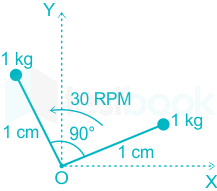
A rigid body in the X-Y plane consists of two point masses (1 kg each) attached to the ends of two massless rods, each of 1 cm length, as shown in the figure. It rotates at 30 RPM counter-clockwise about the Z-axis passing through point O. A point mass of √2 kg, attached to one end of a third massless rod, is used for balancing the body by attaching the free end of the rod to point O. The length of the third rod is ______ cm.

  1. ((a))

    1

  2. ((b))

    √2

  3. ((c))

    1/√2

  4. ((d))

    1/2√2

Show Answer
Answer: ((a))

1

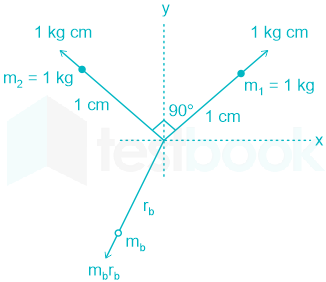
Explanation:

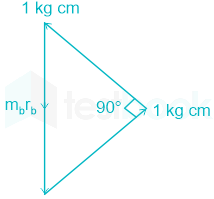
mb = √2 kg, rb = ?

m1 = m2 = 1 kg , r1 = r2 = 1 cm

Resultant balancing force = mbrb = √2 rb

Resultant of forces = (m1r1)2+(m2r2)2\sqrt{(m_1r_1)^2 + (m_2r_2)^2}  = (1)2+(1)2\sqrt{(1)^2 +(1)^2}

√2 rb = (1)2+(1)2\sqrt{(1)^2 +(1)^2}

rb = 1 cm

40

A spring mass damper system (mass m, stiffness k, and damping coefficient c) excited by a force F(t) = B sin ωt, where B, ω and t are the amplitude, frequency and time, respectively, is shown in the figure. Four different responses of the system (marked as (i) to (iv)) are shown just to the right of the system figure. In the figures of the responses, A is the amplitude of response shown in red color and the dashed lines indicate its envelope. The responses represent only the qualitative trend and those are not drawn to any specific scale.

(i) 

  (ii) 

(iii) 

 (iv) 

Four different parameter and forcing conditions are mentioned below.

(P) c > 0 and ω=k/mω=\sqrt{k/m}

(Q) c < 0 and ω ≠ 0

(R) c = 0 and ω=k/m\omega=\sqrt{k/m}

(S) c = 0 and ωk/m\omega \cong\sqrt{k/m}

Which one of the following options gives correct match (indicated by arrow →) of the parameter and forcing conditions to the responses?

  1. ((a))

    P - i, Q - iii, R - iv, S - ii

  2. ((b))

    P - ii, Q - iii, R - iv, S - i

  3. ((c))

    P - i, Q - iv, R - ii, S - iii

  4. ((d))

    P - iii, Q - iv, R - ii, S - i

Show Answer
Answer: ((c))

P - i, Q - iv, R - ii, S - iii

Explanation:

The given system is of forced damped vibration.

(P) c > 0 and ω=k/mω=\sqrt{k/m}

If c > 0 then the damping will be decreasing with time hence the graph will be a decreasing parabola.

c > 0 ⇒ ζ > 1 overdamped condition

(Q) c < 0 and ω ≠ 0

If c < 0 ⇒  ζ < 1 it implies an underdamped condition that means amplitude will be increasing and the curve will be increasing parabola.

R) c = 0 and ω=k/m\omega=\sqrt{k/m}

If c = 0, the system will be of natural spring system, with no damping, acting with an external force.

frequency equal to natural frequency ω = ωn = k/m\sqrt{k/m} then the vibrations will increase suddenly along a straight line with no damping.

(S) c = 0 and ωk/m\omega \cong\sqrt{k/m}

No damping and the amplitude will increase and decrease in a certain period.

Hence , P - i, Q - iv, R - ii, S - iii.

41

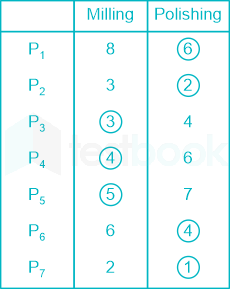
Parts P1 - P7 are machined first on a milling machine and then polished at a separate machine. Using the information in the following table, the minimum total completion time required for carrying out both the operations for all 7 parts is _______ hours.

PartMilling (hours)Polishing (hours)
P186
P232
P334
P446
P557
P664
P721
  1. ((a))

    31

  2. ((b))

    33

  3. ((c))

    30

  4. ((d))

    32

Show Answer
Answer: ((b))

33

Explanation:

By Johnson's rule of sequencing:

  1. Mark the minimum time-consuming operation for each process 

  2. It is given that the first parts are machined in the milling machine. Perform the milling of the parts in a sequence from the marked parts that is part which has minimum time consumption has to be machined first. 

here Priority order is: P3 - P4 - P5

  1. If minimum time is taken by Polishing then the sequence is done in such a way that the minimum time-consuming part is machined last. 

that is the part that has maximum time must be machined first.

hence Priority order is: P1 - P6 - P2 - P7

  1. Final Sequence: P3 - P4 - P5 - P1 - P6 - P2 - P7

  2. Now estimate the time consumed corresponding to the optimal sequence. Hence minimum total completion time = 33 hours

PartMillingMillingMillingPolishingPolishingPolishing
In timeProcessing timeOut timeIn timeProcessing timeOut time
P3033343 + 4 = 7
P4343 + 4 = 7767 + 6 = 13
P5757 + 5 = 1213713 + 7 = 20
P112812 + 8 = 2020620 + 6 = 26
P620620 + 6 = 2626426 + 4 = 30
P226326 + 3 = 2930230 + 2 = 32
P729229 + 2 = 3132132 + 1 = 33
42

A project consists of five activities (A, B, C, D and E). The duration of each activity follows beta distribution. The three time estimates (in weeks) of each activity and immediate predecessor(s) are listed in the table. The expected time of the project completion is ______ weeks (in integer).

ActivityTime estimates (in weeks)Immediate predecessor(s)
Optimistic timeMost likely timePessimistic time
A456None
B135A
C123A
D246C
E345B, D
43

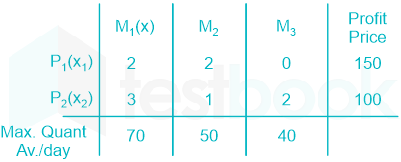
A manufacturing unit produces two products Pl and P2. For each piece of P1 and P2, the table below provides quantities of materials M1, M2, and M3 required, and also the profit earned. The maximum quantity available per day for M1, M2 and M3 is also provided. The maximum possible profit per day is Rs. ______

M1M2M3Profit per piece (Rs.)
P1220150
P2312100
Maximum quantity available per day705040
  1. ((a))

    5000

  2. ((b))

    4000

  3. ((c))

    3000

  4. ((d))

    6000

Show Answer
Answer: ((b))

4000

Explantion:

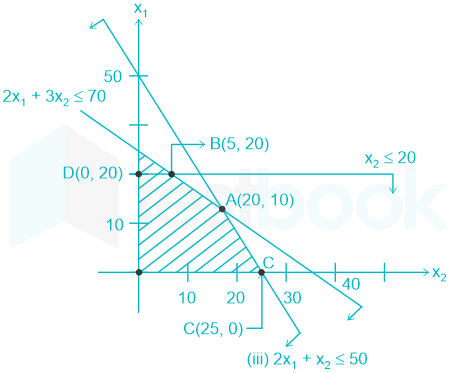
2x1 + 3x2 ≤ 70   ....... (1)

2x1 + x2 ≤ 50   ......... (2)

2x2 ≤ 40 .................. (3)

For Profit Maximization: 

Z = 150x1 + 100x2 

subtract equation 1, 2  we get:

2x2 = 20 ⇒ x2 = 10

substitute in eq 2 we get: 2x1 = 40 ⇒ x1= 20

A = (20, 10)

From eq 1 and 3 we get:

x2 = 20

2x1 + 3 × 20 = 70 ⇒ x1 = 5

B = (5, 20)

Profit at:

A = (20, 10) ⇒ Z = 150 × 20 + 100 × 10 = Rs. 4000

B = (5, 40) ⇒ Z = 150 × 5 + 100 × 20 = Rs. 2750

C = (25,0) ⇒ Z = 150 × 25+ 100 × 0 = Rs. 3750

D = (0,20) ⇒ Z = 150 ×0 + 100 × 20 = Rs. 2000

So, maximum profit of day is  Rs. 4000

44

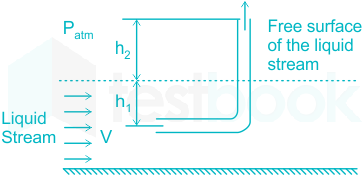
A tube of uniform diameter D is immersed in a steady flowing inviscid liquid stream of velocity V, as shown in the figure. Gravitational acceleration is represented by g. The volume flow rate through the tube is ______.

  1. ((a))

    π4D2V\frac{\pi}{4}D^2V

  2. ((b))

    π4D22gh2\frac{\pi}{4}D^2\sqrt{2gh_2}

  3. ((c))

    π4D22g(h1+h2)\frac{\pi}{4}D^2\sqrt{2g(h_1+h_2)}

  4. ((d))

    π4D2V22gh2\frac{\pi}{4}D^2\sqrt{V^2-2gh_2}

Show Answer
Answer: ((d))

π4D2V22gh2\frac{\pi}{4}D^2\sqrt{V^2-2gh_2}

Explanation:

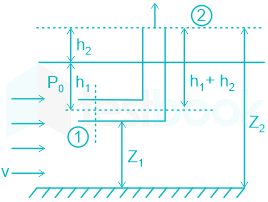
Applying Bernoulli's equation at 1 and 2


P1ρg+z1=P2ρg+V222g+z2\frac{P_1}{{\rho}g}+z_1 = \frac{P_2}{{\rho}g}+\frac{V_2^{2}}{2g}+z_2

Patm+pgh1ρg+V122g+0\frac{P_{atm}+pgh_1}{{\rho}g}+\frac{V_1^2}{2g}+0 = Patmρg+V222g+h1+h2\frac{P_{atm}}{{\rho}g}+\frac{V_2^2}{2g}+h_1 + h_2 [ V1 = V] 

V222g=V122g+h1(h1+h2)\frac{V_2^2}{2g}=\frac{V_1^2}{2g}+h_1 - (h_1 + h_2)

∴ V2=V22gh2V_2= \sqrt{V^2-2gh_2}

∴ Q = A2V2πd24×V22gh2\frac{\pi d^2}{4}\times \sqrt{V^2-2gh_2}

45

The steady velocity field in an inviscid fluid of density 1.5 is given to be V=(y2x2)i^+(2xy)j^\vec{V}=(y^2-x^2)\hat{i}+(2xy)\hat{j} . Neglecting body forces, the pressure gradient at (x =1, y = 1) is ______.

  1. ((a))

    10 ĵ

  2. ((b))

    20 î

  3. ((c))

    -6î - 6ĵ

  4. ((d))

    -4î - 4ĵ

Show Answer
Answer: ((c))

-6î - 6ĵ

Concept:

Navier stoke equation for viscous flow:

ρΔVΔt=δpδx+μ(2u)+ρgxρ \frac{\Delta V}{\Delta t} = - \frac{δ p}{δ x} + μ(\bigtriangledown ^2u) + ρ g_x

V = velocity field, p = pressure, μ = viscosity

Calculation:

Given:

V=(y2x2)i^+(2xy)j^\vec{V}=(y^2-x^2)\hat{i}+(2xy)\hat{j}

u = (y2 - x2) , v = 2xy

x =1, y = 1, ρ = 1.5 kg/m3

for inviscid flow μ(2u)=0\mu(\bigtriangledown^2 u) = 0, body force (ρg) = 0

So the equation for inviscid flow and negligible body force is:

ρ[uδuδx+vδuδy]=δpδxρ \left[u\frac{ δ u}{δ x} + v\frac{δ u}{δ y}\right] = - \frac{δ p}{δ x}

δpδx=\frac{δ p}{δ x} =  - 1.5 [ (y2 - x2) (-2x) + 2xy (2y)]

at x = 1 y = 1 

δp / δx =  - 1.5 [ 0 + 2 × 2 ] = - 6i

Similarly for y direction: 

ρ[uδvδx+vδvδy]=δpδyρ \left[u\frac{ δ v}{δ x} + v\frac{δ v}{δ y}\right] = - \frac{δ p}{δ y}

δp / δy = - 1.5 [ (y2 - x2) (2y) +  2xy (2x)]

at x = 1 y = 1 

δp / δy = - 1.5 [ 0 +  2 × 2] = - 6j

Hence, Pressure gradient is = - 6i - 6j

46

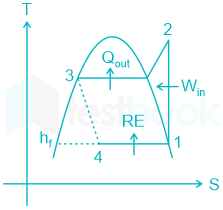
In a vapour compression refrigeration cycle, the refrigerant enters the compressor in saturated vapour state at evaporator pressure, with specific enthalpy equal to 250 kJ/kg. The exit of the compressor is superheated at condenser pressure with specific enthalpy equal to 300 kJ/kg. At the condenser exit, the refrigerant is throttled to the evaporator pressure. The coefficient of performance (COP) of the cycle is 3. If the specific enthalpy of the saturated liquid at evaporator pressure is 50 kJ/kg, then the dryness fraction of the refrigerant at entry to evaporator is ________.

  1. ((a))

    0.2

  2. ((b))

    0.25

  3. ((c))

    0.3

  4. ((d))

    0.35

Show Answer
Answer: ((b))

0.25

Explanation:

hf = 50 kJ/kg

COP = 3, h1 = 250 kJ/kg , h2 = 300 kJ/kg

COP = h1  h4h2  h1\frac{h_1\ -\ h_4}{h_2\ -\ h_1} 

3 = 250  h4300  250\frac{250\ -\ h_4 }{300\ -\ 250} ⇒ h4 = 100 kJ/kg

h4 = hf + x hfg

100 = 50 + x (h1 - hf )

50 = x (250 - 50)

x = 50/200 ⇒ x = 0.25

47

A is a 3 × 5 real matrix of rank 2. For the set of homogeneous equations Ax = 0, where 0 is a zero vector and x is a vector of unknown variables, which of the following is/are true?

  1. ((a))

    The given set of equations will have a unique solution.

  2. ((b))

    The given set of equations will be satisfied by a zero vector of appropriate size.

  3. ((c))

    The given set of equations will have infinitely many solutions.

  4. ((d))

    The given set of equations will have many but a finite number of solutions.

Show Answer
Answer: ((a))

The given set of equations will have a unique solution.

Explanation:

Matrix = [A]3 × 5

Rank of matrix ρ(A) = 2 

number of unknown variable, n = 5

Since, ρ(A) < n

The given equation will have infinitely many solutions including a zero vector of appropriate value.

Additional InformationIf the rank of a matrix is equal to the rank of an augmented matrix and equal to the number of unknowns then the system is consistent and unique.

if the rank of a matrix is not equal to the rank of the augmented matrix then the system is inconsistent and has no solution.

48

If the sum and product of eigenvalues of a 2 × 2 real matrix [3ppq]\begin{bmatrix}3&p\\ p&q\end{bmatrix}  are 4 and -1 respectively, then |p| is _______ (in integer).

49

Given z = x +iy, i = √-1 C is a circle of radius 2 with the centre at the origin. If the contour C is traversed anticlockwise, then the value of the integral 12πc1(zi)(z+4i)dZ\frac{1}{2\pi}\int_c\frac{1}{(z-i)(z+4i)}dZ is ________ (round off to one decimal place.)

50

A shaft of length L is made of two materials, one in the inner core and the other in the outer rim, and the two are perfectly joined together (no slip at the interface) along the entire length of the shaft. The diameter of the inner core is d; and the external diameter of the rim is d0, as shown in the figure. The modulus of rigidity of the core and rim materials are Gi and G0, respectively. It is given that d0 = 2di and Gi = 3G0. When the shaft is twisted by application of a torque along the shaft axis, the maximum shear stress developed in the outer rim and the inner core turn out to be τ0 and τi, respectively. All the deformations are in the elastic range and stress-strain relations are linear. Then the ratio τi0 is (round off to 2 decimal places).

51

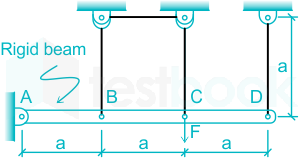
A rigid beam AD of length 3a = 6 m is hinged at frictionless pin joint A and supported by two strings as shown in the figure. String BC passes over two small frictionless pulleys of negligible radius. All the strings are made of the same material and have equal cross-sectional area. A force F = 9 KN is applied at C and the resulting stresses in the strings are within linear elastic limit. The self-weight of the beam is negligible with respect to the applied load. Assuming small deflections, the tension developed in the string at C is KN (round off to 2 decimal places).

52

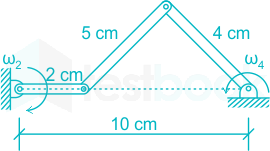
In the configuration of the planar four-bar mechanism at a certain instant as shown in the figure, the angular velocity of the 2 cm long link is ω2 = 5 rad/s. Given the dimensions as shown, the magnitude of the angular velocity ω4 of the 4 cm long link is given by rad/s (round off to 2 decimal places).

53

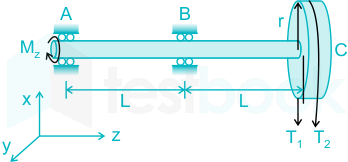
A shaft AC rotating at a constant speed carries a thin pulley of radius r = 0.4 m at the end C which drives a belt. A motor is coupled at the end A of the shaft such that it applies a torque M, about the shaft axis without causing any bending moment. The shaft is mounted on narrow frictionless bearings at A and B where AB = BC = L = 0.5 m. The taut and slack side tensions of the belt are T1 = 300 N and T2 = 100 N, respectively. The allowable shear stress for the shaft material is 80 MPa. The self-weights of the pulley and the shaft are negligible. Use the value of π available in the on-screen virtual calculator. Neglecting shock and fatigue loading and assuming maximum shear stress theory, the minimum required shaft diameter is mm (round off to 2 decimal places).

54

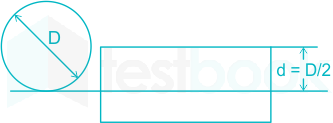
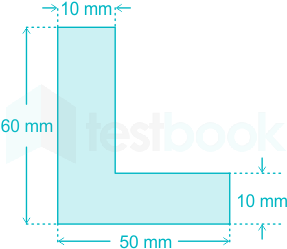
A straight-teeth horizontal slab milling cutter is shown in the figure. It has 4 teeth and diameter (D) of 200 mm. The rotational speed of the cutter is 100 rpm and the linear feed given to the workpiece is 1000 mm/minute. The width of the workpiece (w) is 100 mm, and the entire width is milled in a single pass of the cutter. The cutting force/tooth is given by F = Ktcw, where specific cutting force K = 10 N/mm2, w is the width of cut, and tc is the uncut chip thickness.

The depth of cut (d) is D/2, and hence the assumption of dD<<1\frac{d}{D}<<1 is invalid. The maximum cutting force required is ______ KN (round off to one decimal place).

55

In an orthogonal machining operation, the cutting and thrust forces are equal in magnitude. The uncut chip thickness is 0.5 mm and the shear angle is 15°. The orthogonal rake angle of the tool is 0° and the width of cut is 2 mm. The workpiece material is perfectly plastic and its yield shear strength is 500 MPa. The cutting force is _______ N (round off to the nearest integer).

56

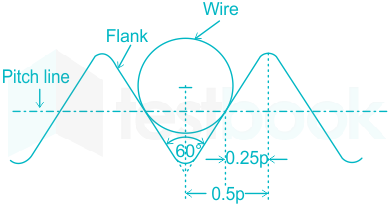
The best size wire is fitted in a groove of a metric screw such that the wire touches the flanks of the thread on the pitch line as shown in the figure. The pitch (p) and included angle of the thread are 4 mm and 60°, respectively. The diameter of the best size wire is _________ mm (round off to 2 decimal places).

57

In a direct current arc welding process, the power source has an open circuit voltage of 100 V and short circuit current of 1000 A. Assume a linear relationship between voltage and current. The arc voltage (V) varies with the arc length (l) as V = 10 + 5l where V is in volts and l is in mm. The maximum available arc power during the process is ______ kVA (in integer).

58

A cylindrical billet of 100 mm diameter and 100 mm length is extruded by a direct extrusion process to produce a bar of L-section. The cross sectional dimensions of this L-section bar are shown in the figure. The total extrusion pressure (p) in MPa for the above process is related to extrusion ratio (r) as

p=Ksσm[0.8+1.5 ln(r)+2ld0]\rm p=K_s σ_m\left[0.8+1.5\ ln(r)+\frac{2l}{d_0}\right]

where σm, is the mean flow strength of the billet material in MPa, l is the portion of the billet length remaining to be extruded in mm, d0 is the initial diameter of the billet in mm, and Ks is the die shape factor.

If the mean flow strength of the billet material is 50 MPa and the die shape factor is 1.05, then the maximum force required at the start of extrusion is _______ kN (round off to one decimal place).

59

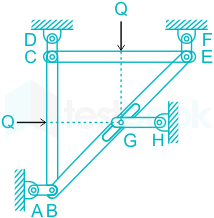
The lengths of members BC and CE in the frame shown in the figure are equal. All the members are rigid and lightweight, and the friction at the joints is negligible. Two forces of magnitude Q > 0 are applied as shown, each at the mid-length of the respective member on which it acts.

Which one or more of the following members do not carry any load (force)?

  1. ((a))

    AB

  2. ((b))

    CD

  3. ((c))

    EF

  4. ((d))

    GH

Show Answer
Answer: ((a))

AB

Explanation:

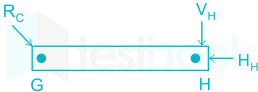
For member GH,

As point G can move in a slot, hence force provided by member BE will be perpendicular to the member.

Referring to FBD,

ΣMH = 0 

⇒ RG = 0

⇒ Force in member GH is zero.

As member AB, CD, and EF are link members, hence they can carry only axial forces.

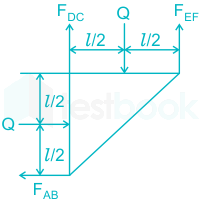
Referring to FBD,

ΣFx = 0

⇒ FAB = Q

ΣME = 0

⇒ - Q × l/2 + FCD × l - Q × l/2 + FAB × l = 0

Putting the value of FAB = 0.

FCD = 0

ΣFy = 0

⇒ FEF = Q

Hence member CD and GH carry zero force.

60

A rigid tank of volume of 8 m3 is being filled up with air from a pipeline connected through a valve. Initially the valve is closed and the tank is assumed to be completely evacuated. The air pressure and temperature inside the pipeline are maintained at 600 kPa and 306 K, respectively. The filling of the tank begins by opening the valve and the process ends when the tank pressure is equal to the pipeline pressure. During the filling process, heat loss to the surrounding is 1000 kJ. The specific heats of air at constant pressure and at constant volume are 1.005 kJ/kg.K and 0.718 kJ/kg.K, respectively. Neglect changes in kinetic energy and potential energy.

The final temperature of the tank after the completion of the filling process is ________ K (round off to the nearest integer).

61

At steady state, 500 kg/s of steam enters a turbine with specific enthalpy equal to 3500 kJ/kg and specific entropy equal to 6.5 kJ-kg-1K-1. It expands reversibly in the turbine to the condenser pressure. Heat loss occurs reversibly in the turbine at a temperature of 500 K. If the exit specific enthalpy and specific entropy are 2500 kJ/kg and 6.3 kJ-kg-1K-1, respectively, the work output from the turbine is _________ MW (in integer).

62

A uniform wooden rod (specific gravity = 0.6, diameter = 4 cm and length = 8 m) is immersed in the water and is hinged without friction at point A on the waterline as shown in the figure. A solid spherical ball made of lead (specific gravity = 11.4) is attached to the free end of the rod to keep the assembly in static equilibrium inside the water. For simplicity, assume that the radius of the ball is much smaller than the length of the rod.

Assume density of water = 103 kg/m3 and π = 3.14.

Radius of the ball is _______ cm (round off to 2 decimal places).

63

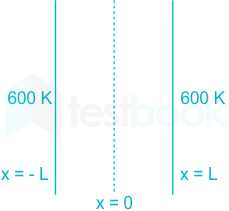
Consider steady state, one-dimensional heat conduction in an infinite slab of thickness 2L (L = 1 m) as shown in the figure. The conductivity (k) of the material varies with temperature as k = CT, where T is the temperature in K, and C is a constant equal to 2 W.m-1K-2. There is a uniform heat generation of 1280 kW/m3 in the slab. If both faces of the slab are maintained at 600 K, then the temperature at x = 0 is _______ K (in integer).

64

Saturated vapor at 200 °C condenses to saturated liquid at the rate of 150 kg/s on the shell side of a heat exchanger (enthalpy of condensation hfg = 2400 kJ/kg). A fluid with Cp = 4 kJ-kg-1K-1. enters at 100 °C on the tube side. If the effectiveness of the heat exchanger is 0.9, then the mass flow rate of the fluid in the tube side is __________ kg/s (in integer).

65

Consider a hydrodynamically and thermally fully-developed, steady fluid flow of 1 kg/s in a uniformly heated pipe with diameter of 0.1 m and length of 40 m. A constant heat flux of magnitude 15000 W/m2 is imposed on the outer surface of the pipe. The bulk-mean temperature of the fluid at the entrance to the pipe is 200 °C. The Reynolds number (Re) of the flow is 85000, and the Prandtl number (Pr) of the fluid is 5. The thermal conductivity and the specific heat of the fluid are 0.08 w.m1K-1 and 2600 J-kg1K-1, respectively. The correlation Nu = 0.023 Re0.8 Pr0.4 is applicable, where the Nusselt Number (Nu) is defined on the basis of the pipe diameter. The pipe surface temperature at the exit is _______ °C (round off to the nearest integer).

Attempt this paper under real exam conditions

Timed interface, section switching, instant scoring, and question-by-question analytics — free.

Start Timed Attempt