Official Paper

GATE ME 2022 Official Paper: Shift 1 (Previous Year Paper)

65 questions · 180 minutes · with answers · free

General Aptitude (10 questions)

1

After playing _________ hours of tennis, I am feeling _________ tired to walk back.

  1. ((a))

    too / too

  2. ((b))

    too / two

  3. ((c))

    two / two

  4. ((d))

    two / too

Show Answer
Answer: ((d))

two / too

The correct answer is 'two / too'.

Key Points

  • The given words are homophones i.e. similar sounding words.
  • Two: equivalent to the sum of one and one; one less than three; 2.
  • For eg.- She ate two buns.
  • Too: to a higher degree than is desirable, permissible, or possible; excessively.
  • For eg.- He was driving too fast.

The complete sentence will be: After playing two hours of tennis, I am feeling too tired to walk back.

  • Hence, option 4 is the correct answer.

Additional Information

  • In linguistics, homonyms, broadly defined, are words that are homographs or homophones, or both.
  • For eg.- Bow-bow, Reed-read, etc.

2

The average of the monthly salaries of M, N and S is ₹ 4000. The average of the monthly salaries of N, S and P is ₹ 5000. The monthly salary of P is ₹ 6000. What is the monthly salary of M as a percentage of the monthly salary of P?
  1. ((a))

    50%

  2. ((b))

    75%

  3. ((c))

    100%

  4. ((d))

    125%

Show Answer
Answer: ((a))

50%

Explanation:

Average of salaries of M, N, and S = Rs. 4000

Sum of salaries of M, N and S = (4000 × 3) = Rs. 12,000.

Average of salaries of N, S, and P = Rs. 5000

Sum of salaries of N, S and P = (5000 × 3) = Rs. 15,000.

Given salary of P is = Rs. 6000

∴ salary of N and S is = 15000 - 6000 = Rs. 9000.

∴ salary of M will be = (Sum of M, N and S) - (Sum of N and S)

∴ salary of M will be = 12,000 - 9,000 = Rs. 3,000

∴ the monthly salary of M as a percentage of the monthly salary of P is:

MP×100;%\frac{M}{P}\times100;\%

30006000×100;%=50;%\frac{3000}{6000}\times100;\%=50;\%

3

A person travelled 80 km in 6 hours. If the person travelled the first part with a uniform speed of 10 kmph and the remaining part with a uniform speed of 18 kmph.

What percentage of the total distance is travelled at a uniform speed of 10 kmph?

  1. ((a))

    28.25

  2. ((b))

    37.25

  3. ((c))

    43.75

  4. ((d))

    50.00

Show Answer
Answer: ((c))

43.75

Explanation:

Let the distance covered be x km with a uniform speed of 10 kmph and (80 - x) km with a uniform speed of 18 kmph.

We know that Time=DistanceSpeedTime =\frac{Distance}{Speed}

(x10)+(80x18)=6\left(\frac{x}{10}\right)+\left(\frac{80-x}{18}\right)=6

9x;+;5(80x)90=6\frac{9x;+;5(80-x)}{90}=6

9x;+;5(80x)90=6\frac{9x;+;5(80-x)}{90}=6

9x;+;5(80x)=540{9x;+;5(80-x)}{}=540

4x=540400=1404x=540-400 =140

x = 35

Therefore the distance of 35 km is covered with a speed of 10 kmph and the distance 45 km is covered with a speed of 18 kmph.

Percentage of the total distance is travelled at a uniform speed of 10 kmph will be:

3580×100;%=43.75;%\frac{35}{80}\times 100;\%=43.75;\%

4

Four girls P, Q, R and S are studying languages in a University. P is learning French and Dutch. Q is learning Chinese and Japanese. R is learning Spanish and French. S is learning Dutch and Japanese.

Given that: French is easier than Dutch; Chinese is harder than Japanese; Dutch is easier than Japanese, and Spanish is easier than French.

Based on the above information, which girl is learning the most difficult pair of languages?

  1. ((a))

    P

  2. ((b))

    Q

  3. ((c))

    R

  4. ((d))

    S

Show Answer
Answer: ((b))

Q

The correct answer is 'Q'.

Key Points

  • Based on the above information, Chinese is harder than Japanese, which is harder than Dutch, which is harder than French, which is harder than Spanish.
  • Or, Chinese > Japanese > Dutch > French > Spanish
  • We can thus conclude that the two most difficult languages are Chinese and Japanese which is the combination of languages studied by 'Q'.
  • Hence, option 2 is the correct answer.

Important Points 

  • In order to solve such questions, it is advised to arrange the 'given that' portion in ascending or descending order and then refer to the given information to find out the correct answer.
5

A block with a trapezoidal cross-section is placed over a block with rectangular cross section as shown above.

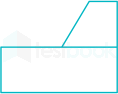
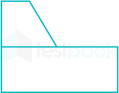
Which one of the following is the correct drawing of the view of the 3D object as viewed in the direction indicated by an arrow in the above figure?

  1. ((a))

  2. ((b))

  3. ((c))

  4. ((d))

Show Answer
Answer: ((a))

Explanation:

If we view the given figure from the direction of the arrow mentioned in the question we will see a trapezium on the right side placed above the rectangle.

6

Humans are naturally compassionate and honest. In a study using strategically placed wallets that appear “lost”, it was found that wallets with money are more likely to be returned than wallets without money. Similarly, wallets that had a key and money are more likely to be returned than wallets with the same amount of money alone. This suggests that the primary reason for this behavior is compassion and empathy.

Which one of the following is the CORRECT logical inference based on the information in the above passage?

  1. ((a))

    Wallets with a key are more likely to be returned because people do not care about money

  2. ((b))

    Wallets with a key are more likely to be returned because people relate to suffering of others

  3. ((c))

    Wallets used in experiments are more likely to be returned than wallets that are really lost

  4. ((d))

    Money is always more important than keys

Show Answer
Answer: ((b))

Wallets with a key are more likely to be returned because people relate to suffering of others

The correct answer is 'Wallets with a key are more likely to be returned because people relate to the suffering of others'.

Key Points

  • Let's refer to the passage:
  • 'Similarly, wallets that had a key and money are more likely to be returned than wallets with the same amount of money alone.'
  • 'This suggests that the primary reason for this behavior is compassion and empathy.'
  • From the above-mentioned statements, it is evident that the correct logical inference is that 'wallets with a key are more likely to be returned because people relate to the suffering of others'.
  • Hence, option 2 is the correct answer.

Additional Information

  • Empathy is the ability to understand and share the feelings of another.
  • For eg.- He had empathy with small children.
7

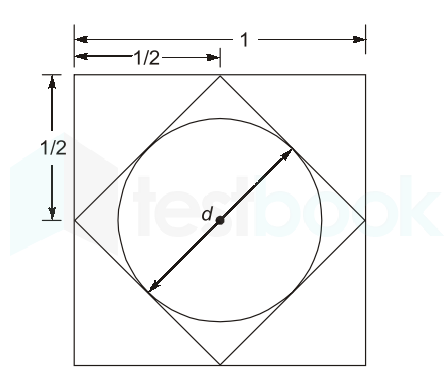
A rhombus is formed by joining the midpoints of the sides of a unit square.

What is the diameter of the largest circle that can be inscribed within the rhombus?

  1. ((a))

    12\frac{1}{\sqrt 2}

  2. ((b))

    122\frac{1}{2\sqrt 2}

  3. ((c))

    √2

  4. ((d))

    2√2

Show Answer
Answer: ((a))

12\frac{1}{\sqrt 2}

Explanation:

The rhombus formed by joining the mid-points of square. The given square has sides of 1 unit.

As per the given figure the side of the Rhombus formed will be equal to the diameter inscribed within it.

The diameter of the largest circle will be:

D=(a2)2;+;(a2)2D=\sqrt{\left(\frac{a}{2}\right)^2;+;\left(\frac{a}{2}\right)^2}

where a = side of the square.

D=(12)2;+;(12)2=12D=\sqrt{\left(\frac{1}{2}\right)^2;+;\left(\frac{1}{2}\right)^2}={\frac{1}{\sqrt{2}}}

8

An equilateral triangle, a square and a circle have equal areas.

What is the ratio of the perimeters of the equilateral triangle to square to circle?

  1. ((a))

    3√3 : 2 : √π

  2. ((b))

    (33):2:π;\sqrt{(3 \sqrt 3}) : 2 : \sqrt \pi;

  3. ((c))

    (33):4:2π;\sqrt{(3 \sqrt 3}) : 4 : 2\sqrt \pi;

  4. ((d))

    (33):2:2π;\sqrt{(3 \sqrt 3}) : 2 : 2\sqrt \pi;

Show Answer
Answer: ((b))

(33):2:π;\sqrt{(3 \sqrt 3}) : 2 : \sqrt \pi;

Concept:

Area of an equilateral triangle:

A=3x24A=\frac{\sqrt {3}x^2}{4}

where x = side of the triangle.

Area of square = a2

where a = side of the square.

Area of circle = πR2

where R = radius of the circle.

The perimeter of equilateral triangle = 3x

The perimeter of square = 4a

The perimeter of circle = 2πR

Calculation:

Given:

Equal area

3x24=a2=πR2\frac{\sqrt {3}x^2}{4}=a^2=π R^2

31/4x2=a=πR=k\frac{ {3^{1/4}}x}{2}=a=\sqrt π R=k

Perimeter ratio

3x;:;4a;:;2πR3x;:;4a;:;2\pi R

3×2k31/4;:;4k;:;2π×kπ3\times\frac{2k}{3^{1/4}};:;4k;:;2\pi \times\frac{k}{\sqrt \pi}

3×131/4;:;2;:;π3\times\frac{1}{3^{1/4}};:;2;:;\sqrt \pi

33/4;:;2;:;π3^{3/4};:;2;:;\sqrt \pi

33;:;2;:;π;\sqrt{3\sqrt{3}};:;2;:;\sqrt \pi;

9

Given below are three conclusions drawn based on the following three statements.

Statement 1: All teachers are professors.

Statement 2: No professor is a male.

Statement 3: Some males are engineers.

Conclusion I: No engineer is a professor.

Conclusion II: Some engineers are professors.

Conclusion III: No male is a teacher.

Which one of the following options can be logically inferred?

  1. ((a))

    Only conclusion III is correct

  2. ((b))

    Only conclusion I and conclusion II are correct

  3. ((c))

    Only conclusion II and conclusion III are correct

  4. ((d))

    Only conclusion I and conclusion III are correct

Show Answer
Answer: ((a))

Only conclusion III is correct

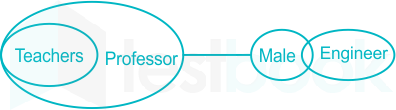
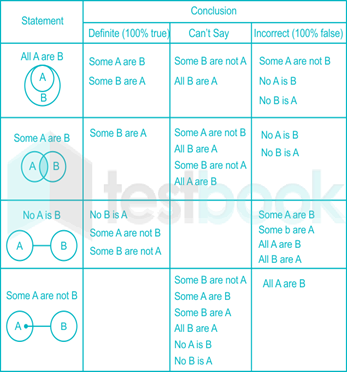
The least possible Venn diagram for the given statement is:

Conclusions:

I. No engineer is a professor → False (There is no direct relation given between Engineer and professor. It is possible but not definite).

II. Some engineers are professors → False (It is possible but not definite).

III. No male is a teacher → True (As all teachers are professors and no professor is male, so no male is a teacher is a definite conclusion).

Hence, the correct answer is "Only conclusion III is correct".

Additional Information 

10

In a 12-hour clock that runs correctly, how many times do the second, minute, and hour hands of the clock coincide, in a 12-hour duration from 3 PM in a day to 3 AM the next day?

  1. ((a))

    11

  2. ((b))

    12

  3. ((c))

    144

  4. ((d))

    2

Show Answer
Answer: ((a))

11

Explanation:

The hands of a clock coincide 11 times in every 12 hours (Since between 11 and 1, they coincide only once, i.e., at 12 o'clock).

AM

12:00,1:05, 2:11, 3:16, 4:22, 5:27, 6:33, 7:38, 8:44, 9:49, 10:55

PM

12:00, 1:05, 2:11, 3:16, 4:22, 5:27, 6:33, 7:38, 8:44, 9:49, 10:55

The hands overlap about every 65 minutes, not every 60 minutes. The hands coincide 22 times in a day.

Mechanical Engineering (55 questions)

11

The limit

p=limxπ(x2+αx+2π2xπ+2sinx)\rm p = \displaystyle\lim_{x \rightarrow \pi} \left( \frac{x^2 + α x + 2 \pi^2}{x - \pi + 2 \sin x} \right)

has a finite value for a real α. The value of α and the corresponding limit p are

  1. ((a))

    α = -3π, and p = π

  2. ((b))

    α = -2π, and p = 2π

  3. ((c))

    α = π, and p = π

  4. ((d))

    α = 2π, and p = 3π

Show Answer
Answer: ((a))

α = -3π, and p = π

Explanation:

p=limxπ(x2+αx+2π2xπ+2sinx)\rm p = \displaystyle\lim_{x \rightarrow π} \left( \frac{x^2 + α x + 2 π^2}{x - π + 2 \sin x} \right)

substitue x = π

p=(π2+απ+2π2ππ+2sinπ)\rm p = \left( \frac{π^2 + α π + 2 π^2}{π - π + 2 \sin π} \right ), sin π = 0

We can see that denominator becomes zero.

Thus for p to have finite value numerator is also zero.

π2 + απ + 2π2 = 0

α = - 3π

**Now,  p=(π2+απ+2π2ππ+2sinπ)=00\rm p = \left( \frac{\pi ^2 + α π + 2 π^2}{\pi - π + 2 \sin \pi} \right ) = \frac{0}{0} **form

Using L'Hospital's rule, we get

p=limxπ(2x + α1 + 2cosx)\rm p = \displaystyle\lim_{x \rightarrow π} \left( \frac{2x\ +\ α }{1\ +\ 2 \cos x} \right )

substituting x = π, α = - 3π

p=(2π  3π1 + 2cosπ)\rm p = \left( \frac{2π\ -\ 3π }{1\ +\ 2 \cos π} \right ) , cosπ = -1

p = π1\frac{-π}{-1}

p = π

12

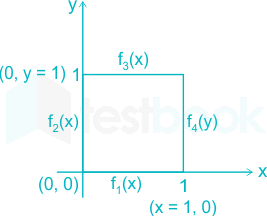
Solution of ∇2T = 0 in a square domain (0 < x < 1 and 0 < y < 1) with boundary conditions:

T(x, 0) = x; T(0, y) = y; T(x, 1) = 1 + x; T(1, y) = 1 + y is

  1. ((a))

    T(x, y) = x - xy + y

  2. ((b))

    T(x, y) = x + y

  3. ((c))

    T(x, y) = -x + y

  4. ((d))

    T(x, y) = x + xy + y

Show Answer
Answer: ((b))

T(x, y) = x + y

Concept:

Laplacian function:

div(gradf) = ∇2f = 2fx2+2fy2+2fz2\frac{\partial^2f}{\partial x^2} + \frac{\partial^2f}{\partial y^2}+\frac{\partial^2f}{\partial z^2}

Calculation:

Given:

∇2T = 0 

Square domain, boundary condition:

T(x, 0) = x; T(0, y) = y; T(x, 1) = 1 + x; T(1, y) = 1 + y

if we will solve it by forming equations it will take a lot of time, hence we will solve it by satisfying boundary conditions to the options.

substituing T(x, 0)= x in all options:

  1. T(x, y) = x - xy + y = x - x.0 + 0 = x
  2. T(x, y) = x + y = x + 0 = x
  3. T(x, y) = -x + y = -x + 0 = -x ⇒ does not satisfy hence eliminated
  4. T(x, y) = x + xy + y = x + x.0 + 0 = x

​substituting T(x, 1) = 1 + x in options

  1. T(x, y) = x - xy + y = x - x.1 + 1 = 1 ⇒ does not satisfy , thus eliminated
  2. T(x, y) = x + y = x + 1 ⇒ It satisfy hence correct option
  3. T(x, y) = x + xy + y  = x + x.1 + 1 = 2x + 1 ⇒ does not satisfy , thus eliminated

Hence, option 2 satisfy all the boundary condition.

Important Points Laplace equation in a square domain (0 < x < 1 and 0 < y < 1) means:

∇2T = 2Tx2+2Ty2\frac{\partial ^2T}{\partial x^2} + \frac{\partial ^2T}{\partial y^2} = 0,  0 < x < 1 and 0 < y < 1

Boundary condition:

f1(x) = T(x, 0) = x 

f2(y) = T(0, y) = y

f3(x) = T(x, 1) = 1 + x

f4(y) = T(1, y) = 1 + y

13

Given a function ϕ=12(x2+y2+z2)\rm ϕ = \frac{1}{2} (x^2 + y^2 + z^2)  in three-dimensional Cartesian space, the value of the surface integral

S n̂ . ∇ϕ dS

where S is the surface of a sphere of unit radius and n̂ is the outward unit normal vector on S, is

  1. ((a))

  2. ((b))

  3. ((c))

    4π/3

  4. ((d))

    0

Show Answer
Answer: ((a))

Concept:

Gauss divergence theorem:

It states that the surface integral of a vector field over a closed surface is equal to the volume integral of the divergence of that vector field over the volume enclosed by the closed surface.

∯S A.dS =  V\int \int \int _V  (∇.A) dV

Calculation:

Given:

ϕ=12(x2+y2+z2)\rm ϕ = \frac{1}{2} (x^2 + y^2 + z^2) , ∯S n̂ . ∇ϕ dS = ?

S = surface of sphere , V = volume of sphere =43πr3\frac{4}{3}π r^3

r = radius of sphere = 1

∇ϕ = ϕxi^+ϕyj^+ϕzk^\frac{\partial \phi }{\partial x} \hat{i} +\frac{\partial \phi }{\partial y} \hat{j}+\frac{\partial \phi }{\partial z} \hat{k}

∇ϕ =  12(2xi^+2yj^+2zk^)\frac{1}{2}(2x\hat{i} +2y\hat{j}+2z\hat{k})

∇ϕ = xi^+yj^+zk^x\hat{i} +y\hat{j}+z\hat{k}

Using Gauss theorem 

∯S n̂ . ∇ϕ dS = V\int \int \int _V  ∇. ∇ϕ dV

=  V\int \int \int _V  ∇. (xi +yj +zk) dV

V\int \int \int _V (1 + 1 + 1)dV

= 3 V\int \int \int _V dV = 3 × 43πr3\frac{4}{3}π r^3

∯S n̂ . ∇ϕ dS  = 4π

14

The Fourier series expansion of x3 in the interval −1 ≤ x < 1 with periodic continuation has

  1. ((a))

    only sine terms

  2. ((b))

    only cosine terms

  3. ((c))

    both sine and cosine terms

  4. ((d))

    only sine terms and a non-zero constant

Show Answer
Answer: ((a))

only sine terms

Explanation:

f(x) = x3

find f(x) is even or odd

put x = -x

f(-x) = - x3

f(x) = -f(-x) hence it is odd function

for odd function, ao = an = 0 

Fourier Series for odd function has only bn term

bn = 1lαα+2lf(x)sinnπxldx\frac{1}{l} \int_{\alpha}^{\alpha+2l}f(x)sin \frac{n\pi x}{l} dx

Hence only sine terms are left in Fourier expansion of x3

Additional Information Fourier Series

f(x) = ao2+n=1ancosnπxl+n=1bnsinnπxl\frac{a_o}{2} + \sum_{n = 1}^{\infty} a_n cos\frac{n\pi x}{l} +\sum_{n = 1}^{\infty} b_n sin\frac{n\pi x}{l}

ao = 1lαα+2lf(x)dx\frac{1}{l} \int_{\alpha}^{\alpha+2l}f(x)dx

an = 1lαα+2lf(x)cosnπxldx\frac{1}{l} \int_{\alpha}^{\alpha+2l}f(x)cos \frac{n\pi x}{l} dx

bn = 1lαα+2lf(x)sinnπxldx\frac{1}{l} \int_{\alpha}^{\alpha+2l}f(x)sin \frac{n\pi x}{l} dx

15

If A = [102k+53k3k+5]\begin{bmatrix} 10 & 2k + 5 \\ 3k - 3 & k + 5 \end{bmatrix}  is a symmetric matrix, the value of k is _______.

  1. ((a))

    8

  2. ((b))

    5

  3. ((c))

    -0.4

  4. ((d))

    1+156112\frac{1 + \sqrt{1561}}{12}

Show Answer
Answer: ((a))

8

Explanation:

A symmetric matrix is one that is equal to its transpose, i.e.

A = AA\ =\ \overline{A}

A=[102k+53k3k+5]A=\begin{bmatrix} 10 & 2k + 5 \\ 3k - 3 & k + 5 \end{bmatrix}

A=[103k  32k+5k+5]\overline{A} = \begin{bmatrix} 10 & 3k\ -\ 3 \\ 2k + 5 & k + 5 \end{bmatrix}

Both the matrix will be equal when the elements of both matrices are the same.

hence, on comparing we get

2k + 5 = 3k - 3

k = 8

16

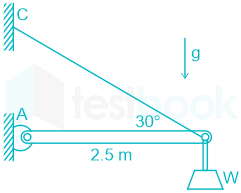
A uniform light slender beam AB of section modulus EI is pinned by a frictionless joint A to the ground and supported by a light inextensible cable CB to hang a weight W as shown. If the maximum value of W to avoid buckling of the beam AB is obtained as βπ2EI, where π is the ratio of circumference to diameter of a circle, then the value of β is

  1. ((a))

    0.0924 m-2

  2. ((b))

    0.0713 m-2

  3. ((c))

    0.1261 m-2

  4. ((d))

    0.1417 m-2

Show Answer
Answer: ((a))

0.0924 m-2

Concept:

Euler's formula for buckling is

P = π2EIL2P\ =\ \frac{\pi^2EI}{L^2} , where P = buckling load

L = length of the column, EI = section modulus

Calculation:

Given:

W = βπ2EI, L = 2.5

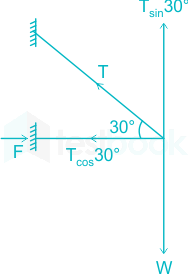
T sin 30  = W

T = 2W

load on beam F = T cos 30∘ 

F = 3√{3} W

To stop buckling of the beam, load on the beam must be equal to Euler's buckling load

π2EIL2\frac{\pi^2EI}{L^2} = ​√3 βπ2EI

β = 13×1(2.5)2\frac{1}{\sqrt3}\times\frac{1}{(2.5)^2}

β = 0.092

17

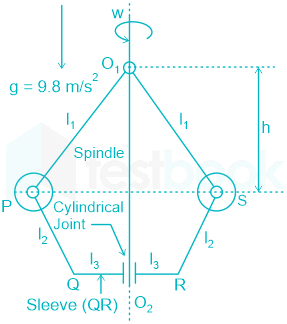
The figure shows a schematic of a simple Watt governor mechanism with the spindle O1O2 rotating at an angular velocity ω about a vertical axis. The balls at P and S have equal mass. Assume that there is no friction anywhere and all other components are massless and rigid. The vertical distance between the horizontal plane of rotation of the balls and the pivot O1 is denoted by h. The value of h = 400 mm at a certain ω. If ω is doubled, the value of h will be _________ mm.

  1. ((a))

    50

  2. ((b))

    100

  3. ((c))

    150

  4. ((d))

    200

Show Answer
Answer: ((b))

100

Concept:

Watt Governor Consist of two balls attached to the spindle through four arms

  • The upper arm meets at the pivot which is on the spindle axis or offset from the spindle axis.
  • The lower arm is connected to the sleeve by a pin joint.

The height of Watt governor is h=gω2h = \frac{g}{ω^2} = 895N2\ =\ \frac{895}{N^2}

where, ω = angular velocity of arm and ball about the spindle axis in rad/s

N = rpm of arm and ball

Calculation: 

Given:

h1 = 400 mm , ω1 = ω 

h2 = ?, ω2 = 2ω 

h=gω2h = \frac{g}{ω^2} \Rightarrow  h1ω2h \propto \frac{1}{\omega^2}

400h2=(2ω)2ω2\frac{400}{h_2} = \frac{(2\omega)^2}{\omega^2}

h2 = 100 mm

Additional Information If Considering the weight of the arm the height of the governor is:

h = (gω2)( w + Wa2w + Wa3 )h\ =\ \left (\frac{g}{\omega^2} \right) \left (\ \frac{w\ +\ \frac{W_a}{2}}{w\ +\ \frac{W_a}{3}}\ \right )

where, w = weight of the ball, Wa = Weight of arm per unit length

18

A square threaded screw is used to lift a load W by applying a force F. Efficiency of square threaded screw is expressed as

  1. ((a))

    The ratio of work done by W per revolution to work done by F per revolution

  2. ((b))

    W/F

  3. ((c))

    F/W

  4. ((d))

    The ratio of work done by F per revolution to work done by W per revolution

Show Answer
Answer: ((a))

The ratio of work done by W per revolution to work done by F per revolution

Explanation:

The efficiency of a square threaded screw is the ratio of work output and work input.

η=Work outputWork input\eta = \frac{Work\ output}{Work\ input}

here,

Work output is equal to Work done by a machine to lift load W per revolution.

Work input is equal to work done by force F to lift load per revolution.

19

A CNC worktable is driven in a linear direction by a lead screw connected directly to a stepper motor. The pitch of the lead screw is 5 mm. The stepper motor completes one full revolution upon receiving 600 pulses. If the worktable speed is 5 m/minute and there is no missed pulse, then the pulse rate being received by the stepper motor is

  1. ((a))

    20 kHz

  2. ((b))

    10 kHz

  3. ((c))

    3 kHz

  4. ((d))

    15 kHz

Show Answer
Answer: ((b))

10 kHz

Concept:

Table speed = BLU × frequency

BLU = basic length unit or the distance travel 

Calculation:

Given:

Table speed = 5 m/minute = 5000/60 mm/sec

pitch = 5 mm 

pulse per revolution = 600

So, in 1 revolution distance travel = 5 mm

So in 600 pulses distance travel = 5 mm

i.e. BLU = 5600\frac{5}{600} mm/pulses

Frequency, f = Table speedBLU\frac{Table\ speed}{BLU} = 5000 × 60060 × 5\frac{5000\ \times\ 600}{60\ \times\ 5}

f = 10000 Hz = 10 kHz

20

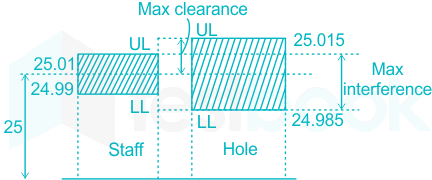
The type of fit between a mating shaft of diameter 25.0+0.0100.01025.0^{\begin{matrix} +0.010 \\ -0.010 \end{matrix}} mm and a hole of diameter 25.0+0.0150.01525.0^{\begin{matrix} +0.015 \\ -0.015 \end{matrix}} is ______.

  1. ((a))

    Clearance

  2. ((b))

    Transition

  3. ((c))

    Interference

  4. ((d))

    Linear

Show Answer
Answer: ((b))

Transition

Explanation:

Transition fit:

  • It appears when there is overlap in the tolerance zones.
  • A fit with small clearance or interference that allows for accurate location of mating parts.
  • It may be a tight fit, push-fit, wringing fit, or press fit.

In transition fit:

Maximum clearance is the difference between the upper limit of hole and the lower limit of shaft.

Maximum interference is the difference between lower limit of the hole and the upper limit of shaft.

Shaft:

Lower limit = 25 - 0.010 = 24.99

Upper limit = 25 + 0.010 = 25.010

Hole:

Lower Limit = 25 - 0.015 = 24.985

Upper Limit = 25 + 0.015 =25.015

Thus we can see that here the fit is transition.

21

In a linear programming problem, if a resource is not fully utilized, the shadow price of that resource is

  1. ((a))

    positive

  2. ((b))

    negative

  3. ((c))

    zero

  4. ((d))

    infinity

Show Answer
Answer: ((c))

zero

Explanation:

Shadow price:

  • The shadow price indicates an additional price to be paid to obtain one additional unit of the resources in order to maximize profit under the resource constraints.
  • It is  also defined as the rate of change in the optimal objective value with respect to the unit change in the availability of a resource or RHS of contraint in linear programming problem.

If a resource is not completely utilized, i.e. there is slack, then its marginal return is zero

Additional InformationThe interpretation of rate of change (increase or decrease) in the value of objective function depends on whether Linear programming problem is of maximization or minimization type.

  • shadow price for a less than or equal to (≤) type constraint will always be positive. This is because increasing the right-hand side resource value cannot decrease the value of objective function.
  • shadow price for a greater than or equal to (≥) type constraint will always be negative because increasing the right-hand side resonance value cannot increase the value of the objective function
22

Which one of the following is NOT a form of inventory?

  1. ((a))

    Raw materials

  2. ((b))

    Work-in-process materials

  3. ((c))

    Finished goods

  4. ((d))

    CNC Milling Machines

Show Answer
Answer: ((d))

CNC Milling Machines

Explanation:

The answer is CNC Milling Machine.

Inventory is the stock of any item or resource that is used in manufacturing products in an organization. Inventories are classified as:

Direct Inventory plays a direct role in the manufacturing of products and becomes an integral part of finished goods. These are further classified as -

  1. Raw Materials are machined or processed before they are ready to be used in the assembly of finished products.
  2. In process Inventories (Work in progress) are semifinished goods at various stages of manufacturing.
  3. Purchased Parts these are purchased items from outside suppliers instead of manufacturing in the factory.
  4. Finished Goods inventories contain finished goods which are ready for dispatch to the customers.

Indirect Inventory is those stock items that are needed for product manufacturing but are not a direct part of the product. For example fuel, oil, transportation, etc

Important Points

Machines come under the asset category, hence CNC Milling Machine is an asset not inventory.

23

The Clausius inequality holds good for

  1. ((a))

    any process

  2. ((b))

    any cycle

  3. ((c))

    only reversible process

  4. ((d))

    only reversible cycle

Show Answer
Answer: ((b))

any cycle

Explanation:

Clausius inequality is a corollary of the second law of thermodynamics which states that for any thermodynamic cycle the cyclic integral of heat transfer from the surface to the absolute temperature of that surface is less than equal to zero.

 (QT)0\oint \left ( \frac{∂ Q}{T} \right )\leq 0  

where,

∂Q represents the heat transfer at a part of the system boundary during a portion of the cycle

T is the absolute temperature at that part of the boundary.

\oint is called cyclic integral which means integration is performed over the entire cycle.

Important PointsFor a reversible cycle (QT)=0\oint \left ( \frac{∂ Q}{T} \right ) = 0

For an irreversible cycle (QT)<0\oint \left ( \frac{∂ Q}{T} \right )< 0

 (QT)>0\oint \left ( \frac{∂ Q}{T} \right ) >0  : It is not possible

24

A tiny temperature probe is fully immersed in a flowing fluid and is moving with zero relative velocity with respect to the fluid. The velocity field in the fluid is V=(2x)i^+(y+3t)j^,\vec V = (2x) \hat i + (y + 3t) \hat j, and the temperature field in the fluid is T = 2x2 + xy + 4t, where x and y are the spatial coordinates, and t is the time. The time rate of change of temperature recorded by the probe at (x = 1, y = 1, t = 1) is _______.

  1. ((a))

    4

  2. ((b))

    0

  3. ((c))

    18

  4. ((d))

    14

Show Answer
Answer: ((c))

18

Concept:

The rate of change of temperature with time in vector field is:

DTDt=Tx.dxdt+Ty.dydt+Tz.dzdt+Tt.dtdt\frac{DT}{Dt} =\frac{\partial T}{\partial x}. \frac{dx}{dt} + \frac{\partial T}{\partial y}. \frac{dy}{dt} + \frac{\partial T}{\partial z}. \frac{dz}{dt} + \frac{\partial T}{\partial t}. \frac{dt}{dt}

where T = temperature, t = time

dxdt\frac{dx}{dt} = u, velocity in x-axis

dydt\frac{dy}{dt} = v, velocity in y-axis

Calculation:

Given:

V=(2x)i^+(y+3t)j^,\vec V = (2x) \hat i + (y + 3t) \hat j, T = 2x2 + xy + 4t

at, x =1, y=1, t=1 to find: DTDt\frac{DT}{Dt}

DTDt=Tx.dxdt+Ty.dydt+Tt.dtdt\frac{DT}{Dt} =\frac{\partial T}{\partial x}. \frac{dx}{dt} + \frac{\partial T}{\partial y}. \frac{dy}{dt} + \frac{\partial T}{\partial t}. \frac{dt}{dt}

dxdt\frac{dx}{dt} = u = 2x, dydt\frac{dy}{dt} = v = y + 3t

Tx\frac{\partial T}{\partial x} = 4x + y , Ty\frac{\partial T}{\partial y} = x, Tt\frac{\partial T}{\partial t} = 4

DTDt\frac{DT}{Dt} = (4x + y).2x + x.(y + 3t) + 4

put  x =1 , y = 1, t =1

DTDt\frac{DT}{Dt} = (4 +1).2 + 1.(1+3) + 4

DTDt\frac{DT}{Dt} = 10 + 4 + 4 = 18

25

In the following two-dimensional momentum equation for natural convection over a surface immersed in a quiescent fluid at temperature T (g is the gravitational acceleration, β is the volumetric thermal expansion coefficient, ν is the kinematic viscosity, u and v are the velocities in x and y directions, respectively, and T is the temperature)

uux+vuy=gβ(TT)+ν2uy2\rm u \frac{\partial u}{\partial x} + v \frac{\partial u}{\partial y} = g β (T - T_∞) + \nu \frac{\partial^2 u}{\partial y^2}

the term gβ(T - T) represent

  1. ((a))

    Ratio of inertial force to viscous force

  2. ((b))

    Ratio of buoyancy force to viscous force

  3. ((c))

    Viscous force per unit mass

  4. ((d))

    Buoyancy force per unit mass

Show Answer
Answer: ((d))

Buoyancy force per unit mass

Explanation:

Natural convection:

  • in natural convection, fluid motion occurs by natural forces such as buoyancy.
  • viscous forces oppose the fluid motion
  • buoyancy forces are expressed in terms of fluid temperature difference through the volume expansion coefficient β =1V(VT)\frac{1}{V}\left ( \frac{\partial V}{\partial T} \right)
  • the term represents buoyancy force per unit mass.

Volume expansion Coefficient:

β =1V(VT)\frac{1}{V}\left ( \frac{\partial V}{\partial T} \right)  = 1ρ(ρT)- \frac{1}{ρ} \left ( \frac{\partial ρ }{\partial T} \right )

β = \(- \frac{1}{ρ} \left ( \frac{ρ {\infty } - ρ }{T{\infty }- T}\right )\)

∞ - ρ) = ρβ (T - T) ..... (1)

The Momentum Conservation equation per unit mass is :

ρ(uux+vuy)=g(ρρ)+ν2uy2\rho \left (\rm u \frac{\partial u}{\partial x} + v \frac{\partial u}{\partial y} \right ) = g (\rho_∞ - \rho ) + \nu \frac{\partial^2 u}{\partial y^2}

substituting equation 1

uux+vuy=gβ(TT)+ν2uy2\rm u \frac{\partial u}{\partial x} + v \frac{\partial u}{\partial y} = g β (T - T_∞) + \nu \frac{\partial^2 u}{\partial y^2}

26

Assuming the material considered in each statement is homogeneous, isotropic, linear elastic, and the deformations are in the elastic range, which one or more of the following statement(s) is/are TRUE?

  1. ((a))

    A body subjected to hydrostatic pressure has no shear stress

  2. ((b))

    If a long solid steel rod is subjected to tensile load, then its volume increases

  3. ((c))

    Maximum shear stress theory is suitable for failure analysis of brittle materials

  4. ((d))

    If a portion of a beam has zero shear force, then the corresponding portion of the elastic curve of the beam is always straight.

Show Answer
Answer: ((a))

A body subjected to hydrostatic pressure has no shear stress

Explanation:

True statement:

A body is subjected to hydrostatic pressure it has no shear stress:

  • according to Pascal's body subjected to hydrostatic pressure has equal stress on the body from all directions.
  • σx = σy = σz , hence shear stress will be zero in all directions.
  • shear stress on the principal plane is  τ=σx  σy2\tau = \frac{\sigma_{x}\ -\ \sigma_y}{2}
  • Mohr circle will become a point, hence every plane will become a principal plane and on all principal planes, shear stress will become zero.

If a long solid steel rod is subjected to tensile load, then its volume increases:

  • on applying a tensile load on the rod the tensile strain is produced in the longitudinal direction.
  • compressive strain is produced in the lateral direction.
  • strain produced in the longitudinal direction is more compared to strain in the lateral direction.
  • hence Volume of the rod increases.

Additional InformationMaximum shear stress theory:

  • It is suitable for ductile metal not for brittle material.
  • for brittle material maximum principal stress theory.

If a portion of a beam has zero shear force, then:

  • when a shear force is zero and the bending moment has constant non-zero value then the elastic curve has a circular value.
  • when shear force and bending moment both are zero then the elastic curve is a straight line.
27

Which of the following heat treatment processes is/are used for surface hardening of steels?

  1. ((a))

    Carburizing

  2. ((b))

    Cyaniding

  3. ((c))

    Annealing

  4. ((d))

    Carbonitriding

Show Answer
Answer: ((a))

Carburizing

Explanation:

Heat treatment are used to impart high mechanical properties. For the surface hardening of steel case hardening methods are used which are:

Carburizing: In this carbon content of the surface layer is increased up to 1% to obtain a hard layer on the workpiece surface after heat treatment.

  • it is applied to the low carbon steel up to 0.18% carbon.
  • low carbon steel is heated up to 870C in the atmosphere containing carbon.
  • Fe + 2CO → FeC + CO2


Cyaniding: A thin layer of high hardness and wear resistance is produced on C-alloy steels.

  • the workpiece is immersed in a molten salt bath containing sodium cyanide (NaCN) which is heated to 820 - 860∘C and followed by water quenching.
  • cyanide bath contains 20-30% of NaCN, 25-50% of Na2CO3.
  • the case obtained by cyaniding is high wear-resistant and endurance limit compared to carburizing.


Carbonitriding: it is also called gas cyaniding.

  • the workpiece is heated to 850∘C in the mixture of ammonia and hydrocarbon for 2 - 10 hours. followed by quenching and tempering at 180∘C
  • the alloying elements form carbides and nitrides with carbon and nitrogen on the surface which increases surface hardness.
  • this process reduces the endurance limit and ductility of steel due to austenite formation in case.

​ 

Additional InformationAnnealing: is heating of steel to austenite temperature and then cooling slowly in the furnace.

  • It reduces the hardness
  • It improves machinability
  • relieve internal stressess
28

Which of the following additive manufacturing technique(s) can use a wire as a feedstock material?

  1. ((a))

    Stereolithography

  2. ((b))

    Fused deposition modeling

  3. ((c))

    Selective laser sintering

  4. ((d))

    Directed energy deposition processes

Show Answer
Answer: ((a))

Stereolithography

Explanation:

Rapid prototyping (RP):

  • is a family of fabrication methods to make engineering prototypes in minimum possible lead times based on a computer-aided design (CAD) model of the item.
  • A number of rapid prototyping techniques are now available that allow a part to be produced in hours or days rather than weeks, given that a computer model of the part has been generated on a CAD system.

The method that use wise as feedstock material are:

  1. Fused-deposition modeling (FDM) is an RP process in which a filament of wax or polymer is extruded onto the existing part surface from a workhead to complete each new layer. The filament is basically a wire of ABS material or other polymer.
  2. Directed Energy Deposition (DED) allows for the creation of objects by melting the material in powder or as a wire with a focused energy source as it is deposited by a nozzle on a surface.

Additional Information

Stereolithography (STL):

  • it is a process for fabricating a solid plastic part out of a photosensitive liquid polymer using a directed laser beam to solidify the polymer. The action of the laser is to harden (cure) the photosensitive polymer where the beam strikes the liquid, forming a solid layer of plastic that adheres to the platform.

Selective laser sintering (SLS):

  • it uses a moving laser beam to sinter heat-fusible powders in areas corresponding to the CAD geometric model one layer at a time to build the solid part.
  • After each layer is completed, a new layer of loose powders is spread across the surface using a counter-rotating roller.
  • The powders are preheated to just below their melting point to facilitate bonding and reduce distortion.
29

Which of the following methods can improve the fatigue strength of a circular mild steel (MS) shaft?

  1. ((a))

    Enhancing surface finish

  2. ((b))

    Shot peening of the shaft

  3. ((c))

    Increasing relative humidity

  4. ((d))

    Reducing relative humidity

Show Answer
Answer: ((a))

Enhancing surface finish

Explanation:

Fatigue strength is the maximum stress level that a material can sustain without failing, for some specified number of cycles.

The process which improves fatigue strength are as follows:

  1. Surface finish: scratches present on the surface will increase the stress concentration and reduce the fatigue strength. Therefore enhancing surface finish will reduce the notches or scratches and help in increasing fatigue strength of the shaft.
  2. Shot peening: It induces surface compressive residual stress on the surface of components by the cold working process. These induced stresses forbid crack propagation on the surface and thus increase the fatigue strength of the material.
  3. Humidity: It can cause corrosion on the surface of mild steel, which will help in crack propagation. Therefore lower relative humidity better the fatigue strength.
  4. Cold Rolling: It strengthens the component by strain hardening by changing the properties below the recrystallization temperature. Thus improving fatigue strength as well as the surface finish of the material.
30

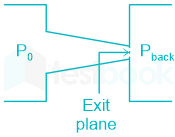
The figure shows a purely convergent nozzle with a steady, inviscid compressible flow of an ideal gas with constant thermophysical properties operating under choked condition. The exit plane shown in the figure is located within the nozzle. If the inlet pressure (P0) is increased while keeping the back pressure (Pback) unchanged, which of the following statements is/are true?

  1. ((a))

    Mass flow rate through the nozzle will remain unchanged

  2. ((b))

    Mach number at the exit plane of the nozzle will remain unchanged at unity

  3. ((c))

    Mass flow rate through the nozzle will increase

  4. ((d))

    Mach number at the exit plane of the nozzle will become more than unity

Show Answer
Answer: ((a))

Mass flow rate through the nozzle will remain unchanged

Explanation:

Choked condition: when the back pressure is equal to the critical Pressure the mass flow rate reaches a maximum value and the flow is said to be choked.

  • Pback = Pcritical

Critical pressure: is the pressure required to increase the fluid velocity to the speed of sound at the exit plane or throat. 

  • properties of a fluid at a location where the Mach number is unity are called critical properties.

Now It is given if we increase the pressure while keeping back pressure unchanged the following will happen:

  • pressure at the exit plane of the converging nozzle  is equal to critical pressure
  • Mach number at the exit plane is unity.
  • the mass flow rate is the maximum (or choked) flow rate. which means that the mass flow rate increased from the previous condition.
  • because the velocity of the flow is sonic at the throat for the maximum flow rate, a back pressure lower than the critical pressure cannot be sensed in the nozzle upstream flow and does not affect the flow rate

Additional InformationMach number: It is the ratio of the speed of fluid to the speed of sound.

  • Ma=VCMa = \frac{V}{C}
  • flow is Subsonic Ma < 1
  • flow is Sonic Ma =1
  • flow is supersonic Ma > 1
31

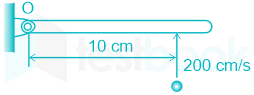
The plane of the figure represents a horizontal plane. A thin rigid rod at rest is pivoted without friction about a fixed vertical axis passing through O. Its mass moment of inertia is equal to 0.1 kg∙cm2 about O. A point mass of 0.001 kg hits it normally at 200 cm/s at the location shown, and sticks to it. Immediately after the impact, the angular velocity of the rod is ___________ rad/s (in integer).

32

A rigid uniform annular disc is pivoted on a knife edge A in a uniform gravitational field as shown, such that it can execute small amplitude simple harmonic motion in the plane of the figure without slip at the pivot point. The inner radius r and outer radius 𝑅 are such that r2 = R2/2, and the acceleration due to gravity is g. If the time period of small amplitude simple harmonic motion is given by T=βπR/gT = β π \sqrt{R/g}  where π is the ratio of circumference to diameter of a circle, then β = ________ (round off to 2 decimal places).

33

Electrochemical machining operations are performed with tungsten as the tool, and copper and aluminum as two different workpiece materials. Properties of copper and aluminum are given in the table below.

MaterialAtomic mass (amu)valencyDensity(g/cm2
Copper6329
Aluminum2732.7


Ignore overpotentials, and assume that current efficiency is 100% for both the

workpiece materials. Under identical conditions, if the material removal rate (MRR) of copper is 100 mg/s, the MRR of aluminum will be ________________ mg/s (round-off to two decimal places).

34

A polytropic process is carried out from an initial pressure of 110 kPa and volume of 5 m3 to a final volume of 2.5 m3. The polytropic index is given by n = 1.2. The absolute value of the work done during the process is _______ kJ (round off to 2 decimal places).

35

A flat plate made of cast iron is exposed to a solar flux of 600 W/m2 at an ambient temperature of 25 °C. Assume that the entire solar flux is absorbed by the plate. Cast iron has a low-temperature absorptivity of 0.21. Use Stefan-Boltzmann constant = 5.669 × 10-8 W/m2-K4. Neglect all other modes of heat transfer except radiation. Under the aforementioned conditions, the radiation equilibrium temperature of the plate is __________ °C (round off to the nearest integer).

36

The value of the integral

(6z2z43z3+7z23z+5)dz\rm \oint \left( \frac{6z}{2z^4 - 3z^3 + 7 z^2 - 3z + 5} \right) dz

evaluated over a counter-clockwise circular contour in the complex plane enclosing only the pole z = i, where 𝑖 is the imaginary unit, is

  1. ((a))

    (-1 + i) π

  2. ((b))

    (1 + i) π

  3. ((c))

    2(1 - i) π

  4. ((d))

    (2 + i) π

Show Answer
Answer: ((a))

(-1 + i) π

Concept:

Residue theorem: if f(z) is an analytic function in a closed curve C except at a finite number of singular points within C then 

  • cf(z)dz=2πi \oint_{c} f(z)dz = 2π i  × (sum of the residues at the singular point within curve C)

Residue for simple pole z = a:

  • Res f(a) = limza[(za)f(z)]\displaystyle \lim_{z \to a}[(z-a)f(z)]

Calculation:

Given:

(6z2z43z3+7z23z+5)dz\rm \oint \left( \frac{6z}{2z^4 - 3z^3 + 7 z^2 - 3z + 5} \right) dz

pole z = i

Check for singularity at pole z = i

f(z) = 2z4 - 3z3 + 7z2 - 3z + 5

f(i) = 2(i)4 - 3(i)3 + 7(i)2 - 3i + 5 

f(i) = 2 ×1 - 3(-i) - 7 - 3i + 5 = 0

since, f(i) = 0 ⇒ z = i  is a singular point

From Residue theorem:

(6z2z43z3+7z23z+5)dz\rm \oint \left( \frac{6z}{2z^4 - 3z^3 + 7 z^2 - 3z + 5} \right) dz = 2πi (Residue at z = i )

Residue at z = i :

Res|z= i  limzi(zi)6z2z43z3+7z23z+5\displaystyle \lim_{z \to i} (z-i) \frac{6z}{2z^4 - 3z^3 + 7 z^2 - 3z + 5}

at z = i , Res = 0/0 form, applying L'hospital rule 

Res|z= i  = limzi12z  6i8z39z2+14z3\displaystyle \lim_{z \to i} \frac{12z\ -\ 6i}{8z^3 - 9z^2 + 14 z - 3 }  = 12i  6i8i39i2+14i3 \frac{12i\ -\ 6i}{8i^3 - 9i^2 + 14 i - 3 }

Res|z= i  = 6i8i+9+14i3 \frac{6i}{-8i + 9 + 14 i - 3 }  = ii + 1 \frac{i}{ i\ +\ 1}

(6z2z43z3+7z23z+5)dz\rm \oint \left( \frac{6z}{2z^4 - 3z^3 + 7 z^2 - 3z + 5} \right) dz = 2πi × ii + 1 \frac{i}{ i\ +\ 1}

⇒  2πi2i + 1=2πi + 1×i  1i  1\frac{2π i^2}{i\ +\ 1} = \frac{-2π}{i\ +\ 1} \times \frac{i\ -\ 1}{i\ -\ 1} = π(i  1)π (i\ -\ 1)

(6z2z43z3+7z23z+5)dz\rm \oint \left( \frac{6z}{2z^4 - 3z^3 + 7 z^2 - 3z + 5} \right) dz = π(i  1)π (i\ -\ 1) = = π(-1 + i)

37

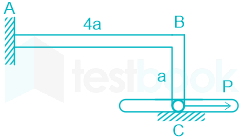
An L-shaped elastic member ABC with slender arms AB and BC of uniform crosssection is clamped at end A and connected to a pin at end C. The pin remains in continuous contact with and is constrained to move in a smooth horizontal slot. The section modulus of the member is same in both the arms. The end C is subjected to a horizontal force P and all the deflections are in the plane of the figure. Given the length AB is 4a and length BC is 𝑎, the magnitude and direction of the normal force on the pin from the slot, respectively, are

  1. ((a))

    3𝑃/8, and downwards

  2. ((b))

    5𝑃/8, and upwards

  3. ((c))

    𝑃/4, and downwards

  4. ((d))

    3𝑃/4, and upwards

Show Answer
Answer: ((a))

3𝑃/8, and downwards

Explanation:

Point C will move in the x- x-direction due to the applied force P. Its deflection will be zero in y- direction.

<br>

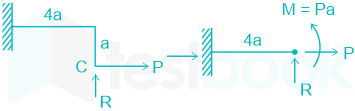
Free body diagram of the given members is

The deflection of point B in the y direction is zero. Then

(δB)R = ML22EI\frac{ML^2}{2EI}  = (Pa)(4a)22EI\frac{(Pa)(4a)^2}{2EI} = 16Pa32EI\frac{16Pa^3}{2EI} and

(δB)MPL33EI\frac{PL^3}{3EI} = F(4a)33EI\frac{F(4a)^3}{3EI}

Total deflection at B is

(δB)Total  16Pa32EI\frac{16Pa^3}{2EI} + F(4a)33EI\frac{F(4a)^3}{3EI} = 0

⇒ R=3P8R=\frac{-3P}{8}

Note that the '- ve' sign indicates downward direction, i.e., R = 3P/8 (↓)

38

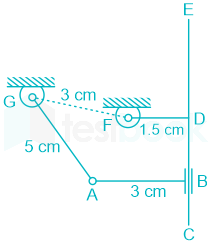
A planar four-bar linkage mechanism with 3 revolute kinematic pairs and 1 prismatic kinematic pair is shown in the figure, where AB ⊥ CE and FD ⊥ CE. The T-shaped link CDEF is constructed such that the slider B can cross the point D, and CE is sufficiently long. For the given lengths as shown, the mechanism is

  1. ((a))

    a Grashof chain with links AG, AB, and CDEF completely rotatable about the ground link FG

  2. ((b))

    a non-Grashof chain with all oscillating links

  3. ((c))

    a Grashof chain with AB completely rotatable about the ground link FG, and oscillatory links AG and CDEF

  4. ((d))

    on the border of Grashof and non-Grashof chains with uncertain configuration(s)

Show Answer
Answer: ((a))

a Grashof chain with links AG, AB, and CDEF completely rotatable about the ground link FG

Concept:

Grashof's law for a four-bar linkage states that the sum of the shortest and longest link lengths should be less than or equal to the sum of the other two link lengths:

where:

S is the shortest link length

L is the longest link length

P and Q are the lengths of the other two links

S+LP+Q{S + L \leq P + Q }

Calculation:

Given the lengths:

  • AG=5,cmAG = 5 , \text{cm}
  • GF=3,cmGF = 3 , \text{cm}
  • FD=1.5,cmFD = 1.5 , \text{cm}
  • AB=3,cmAB = 3 , \text{cm}
  • CE is sufficiently longCE \text{ is sufficiently long}

S=FD=1.5,cmS = FD = 1.5 , \text{cm}

L=AG=5,cmL = AG = 5 , \text{cm}

P=GF=3,cmP = GF = 3 , \text{cm}

Q=AB=3,cmQ = AB = 3 , \text{cm}

Apply Grashof's criterion:

S+LP+Q{ S + L \leq P + Q }

Substituting the values:

1.5+53+3{ 1.5 + 5 \leq 3 + 3 }

Simplifying this:

6.56{ 6.5 \leq 6 }

The inequality does not hold, indicating that the mechanism is non-Grashof.

Despite the non-Grashof nature determined by basic criteria, the specific problem configuration suggests a deeper look:

The given setup involves a slider B and the prismatic joint at D. AB as the crank can fully rotate while oscillating AG and CDEF as the coupler and rocker respectively.

Conclusion:

Given the mechanism setup and the specific constraints that allow the crank AB to fully rotate with AG and CDEF oscillating, the correct answer is:

Answer:

  1. a Grashof chain with links AG, AB, and CDEF completely rotatable about the ground link FG.
39

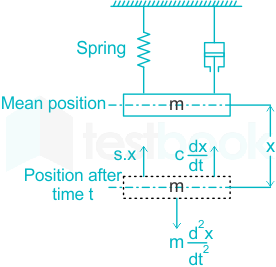
Consider a forced single degree-of-freedom system governed by x¨(t)+2ζωnx˙(t)+ωn2x(t)=ωn2cos(ωt)\rm \ddot x(t) + 2 ζ ω_n \dot x (t) + ω_n^2 x(t) = ω_n^2 \cos (ω t), where ζ and ωn are the damping ratio and undamped natural frequency of the system, respectively, while ω is the forcing frequency. The amplitude of the forced steady state response of this system is given by [(1 − r2)2 + (2ζr)2]-1/2, where 𝑟 = ω/ωn. The peak amplitude of this response occurs at a frequency  ω =  ωp. If  ωd denotes the damped natural frequency of this system, which one of the following options is true?

  1. ((a))

    ωp < ωd < ωn

  2. ((b))

    ωp = ωd < ωn

  3. ((c))

    ωd < ωn = ωp

  4. ((d))

    ωd < ωn < ωp

Show Answer
Answer: ((a))

ωp < ωd < ωn

Concept:

The amplitude in forced damped vibration is:

A=Fo/s(1ω2ωn2)2+(2ζωωn2)A = \frac{F_o/s}{\sqrt{{\left (1-\frac{ω^2}{ω_n^2} \right )^2}+\left (\frac{2\zetaω}{ω_n}^2 \right )}}

where Fo = external force applied


Damped frequency: ωd =   (1  ζ2\sqrt{1\ -\ \zeta^2} )ωn

Calculation:

Given:

𝑟 = ω/ωn

A=Fo/s(1r2)2+(2ζr)2A = \frac{F_o/s}{\sqrt{{\left (1- r^2 \right )^2}+\left (2\zeta r\right )^2}}

x = (1 − r2)2 + (2ζr)2

It is given that peak amplitude occurs at a frequency ω =  ωp

it means,  A → maximum, when the denominator (x) is minimum

Minimize x : dxdr=0\frac{dx}{dr} = 0

dx/dr = 2 (1 − r2). (-2r) + (2ζ)2.(2r) = 0

2 (1 − r2) = (2ζ)2

r2 = 1 - 2ζ2

here r = ωpn

r=ωpωn=1  2ζ2r = \frac{ω_p}{ω_n}= \sqrt{1\ -\ 2\zeta^2}

ω= (1  2ζ2\sqrt{1\ -\ 2\zeta^2} )ωn

Now comparing wit with damped frequency:

ωd =   (1  ζ2\sqrt{1\ -\ \zeta^2} )ωn

We can clearly see that ωd > ωp

We already know that the natural frequency is greater than the damped frequency 

ωn > ωd

Hence, we can say that:

ωn > ωd> ωp

40

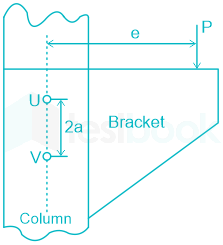
A bracket is attached to a vertical column by means of two identical rivets U and V separated by a distance of 2a = 100 mm, as shown in the figure. The permissible shear stress of the rivet material is 50 MPa. If a load P = 10 kN is applied at an eccentricity e = 3√7 a, the minimum cross-sectional area of each of the rivets to avoid failure is ___________ mm2.

  1. ((a))

    800

  2. ((b))

    25

  3. ((c))

    100√7

  4. ((d))

    200

Show Answer
Answer: ((a))

800

Concept:

Eccentric loaded riveted joint: when the action of the load does not pass through the center of the rivet system thus all rivets are not equally loaded.

Eccentric loading results in secondary shear caused by the tendency of a force to twist the joint about the center of gravity in addition to direct shear or primary shear.

Primary shear force:

  • Fp = F/n where, n = no. of rivet
  • The direction of the force will be opposite to F

Secondary shear force:

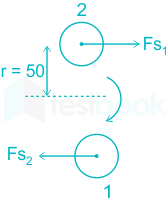
  • Fs = Fei = 1nri2 × ri\frac{Fe}{\sum_{i\ =\ 1}^{n}r_i^2}\ ×\ r_i where,  F = Eccentric load on the joint
  • e = eccentricity of the load i.e. the distance between the line of action of the load and the centroid of the rivet system.
  • The direction of force is perpendicular to radial distance from the center of gravity and in the opposite direction of the couple (Fe).

Resultant of force R = Fp2+Fs2+2FpFscos(θ)√{F_p^2+F_s^2+2F_pF_scos(\theta)}

To avoid failure the permissible shear stress:  τperForceAreaτ_{per}≥ \frac{Force}{Area}

Calculation:

Given:

e = 3√7a, P = 10 kN, 2a = 100 mm

permissible shear stress, τ = 50 MPa 

r = a = 50, e = 3√7 × 50

Primary forces:

Fp = P/2 = 5 kN

Secondary forces:

Pe = Fs (r1+ r22)/ r1

here r1 = r2 and Fs at both the rivet is also equal

Fs = Pe2r\frac{Pe}{2r} = (10 × 3√7 × 50)/(2 × 50)

Fs = 39.68 kN

Since the revet is critical at 1 &2

Resultant force R = 52+39.682\sqrt{5^2 + 39.68^2}  = 40 kN

To avoid failure:

τperForceAreaτ_{per}≥ \frac{Force}{Area}

50 ≥ 40 × 103\ A

A = 800 mm2

41

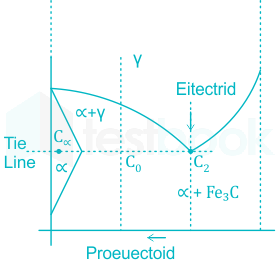
In Fe-Fe3C phase diagram, the eutectoid composition is 0.8 weight % of carbon at 725 ºC. The maximum solubility of carbon in α-ferrite phase is 0.025 weight % of carbon. A steel sample, having no other alloying element except 0.5 weight % of carbon, is slowly cooled from 1000 ºC to room temperature. The fraction of pro-eutectoid α-ferrite in the above steel sample at room temperature is

  1. ((a))

    0.387

  2. ((b))

    0.864

  3. ((c))

    0.475

  4. ((d))

    0.775

Show Answer
Answer: ((a))

0.387

Concept:

Eutectoid composition: it is a reaction when a solid phase converts into two different solid phases.

  • in Fe-Fe3C diagram gamma(γ) austenite at 725C 0.8%C convert to ferrite(α) and cementite (Fe3C)

Lever rule: It is used to determine the mass or mole fraction of each phase of binary equilibrium diagram.

  • if the weight percent of a component is known then at fix temperature one can determine the composition of phases specifically in two phase region.

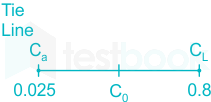
the mass fraction of Liquid, wt. of L =  %wtof=\% wt of = \frac{}{} (\frac{C_o -C_α}{C_L - C_α} \)

the mass fraction of solid, wt of α  =  %wtof=\% wt of = \frac{}{} (\frac{C_L -C_o}{C_L - C_α} \)

Calculation:

Given:

 eutectoid composition, CL = 0.8 weight % 

α-ferrite, Cα = 0.025 weight % 

alloying element C= 0.5 weight % of carbon

Mass fraction of proeutectoid α = CLCoCLCα×100\frac{C_L -C_o}{C_L - C_α} \times 100

0.8  0.50.8  0.025×100\frac{0.8\ -\ 0.5}{0.8\ -\ 0.025} \times 100 = 0.387

42

Activities A to K are required to complete a project. The time estimates and the immediate predecessors of these activities are given in the table. If the project is to be completed in the minimum possible time, the latest finish time for the activity G is ______ hours.

ActivityTime (hours)Immediate predecessors
A2-
B3-
C2-
D4A
E5B
F4B
G3C
H10D, E
I5F
J8G
K3H, I, J
  1. ((a))

    5

  2. ((b))

    10

  3. ((c))

    8

  4. ((d))

    9

Show Answer
Answer: ((b))

10

Explanation:

Network diagram:

The latest finish time of activity G is 10.

Steps to make a Network diagram:

  1. start from those activities which have no preceding time, mark from a common event 1. here it is A,B,C 

  1. Then look for the activity according to the precedence.For example:
  • activity A is followed by D ( A → D)
  • activity B is followed by E, F.
  • activity C  is followed by G.
  • similarly, mark other activities
43

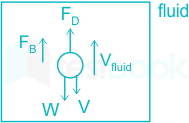
A solid spherical bead of lead (uniform density = 11000 kg/m3) of diameter d = 0.1 mm sinks with a constant velocity V in a large stagnant pool of a liquid (dynamic viscosity = 1.1 × 10⁻³ kg∙m-1∙s-1). The coefficient of drag is given by CD=24Re\rm C_D = \frac{24}{Re} , where the Reynolds number (Re) is defined on the basis of the diameter of the bead. The drag force acting on the bead is expressed as D=(CD)(0.5ρV2)(πd24),\rm D = (C_D) (0.5 \rho V^2) \left( \frac{\pi d^2}{4} \right),  where ρ is the density of the liquid. Neglect the buoyancy force. Using g = 10 m/s2, the velocity V is __________ m/s.

  1. ((a))

    124\frac{1}{24}

  2. ((b))

    16\frac{1}{6}

  3. ((c))

    118\frac{1}{18}

  4. ((d))

    112\frac{1}{12}

Show Answer
Answer: ((c))

118\frac{1}{18}

Concept:

Drag force: It is the force experienced by an object submerged in the fluid due to the motion of fluid or object. The drag force acts in the direction of the fluid motion.

FD = CDAρV2/2

where, CD = Drag coefficient, ρV2/2 = dynamic pressure,

A = projected area of the body on a plane perpendicular to the direction of flow

Calculation:

Given:

​Drag force, D=(CD)(0.5ρV2)(πd24),\rm D = (C_D) (0.5 ρ V^2) \left( \frac{\pi d^2}{4} \right),  ​CD=24Re\rm C_D = \frac{24}{Re} ,

Dynamic viscosity, μ = 1.1 × 10⁻³ kg∙m-1∙s-1

​Density of bead ρ = 11000 kg/m3d = 0.1 mm

Buoyant force Fb = 0, W = weight of body

The net force on the body sinking is:

W - Fb = D ⇒ W = D

Weight of the sphere bead W = mg = Volume × density × g

Volume of sphere = 43πr3\frac{4}{3}\pi r^343π(d2)3\frac{4}{3}\pi \left (\frac{d}{2}\right )^3

W = 43π(d2)3ρg\frac{4}{3}\pi \left (\frac{d}{2}\right )^3 ρ g

For Drag force calculation we need to calculate:

Reynolds number ReρVdμ\frac{ρ V d }{μ} = ρV0.1 × 1031.1 × 03ρ V\frac{0.1\ ×\ 10^{-3}}{1.1\ × \ 0^{-3}}

Re = ρV/11

D=(CD)(0.5ρV2)(πd24)\rm D = (C_D) (0.5 ρ V^2) \left( \frac{\pi d^2}{4} \right)CD=24Re\rm C_D = \frac{24}{Re}

D24 × 11ρV(0.5ρV2)(πd24)\frac{24\ ×\ 11}{ρ V} (0.5 ρ V^2) \left( \frac{\pi d^2}{4} \right) = 132.V.(πd24)\left( \frac{\pi d^2}{4} \right)

Now, W = D

43π(d2)3ρg\frac{4}{3}\pi \left (\frac{d}{2}\right )^3 ρ g =  132 × V (πd24)\left( \frac{\pi d^2}{4} \right)

V = ρgd6 × 33\frac{ρ gd}{6\ \times\ 33} = 11000 × 10 × 0.1 × 1036 × 33\frac{11000\ \times\ 10\ \times\ 0.1\ \times\ 10^{-3}}{6\ \times\ 33}

V = 1/18 m/s

44

Consider steady, one-dimensional compressible flow of a gas in a pipe of diameter 1 m. At one location in the pipe, the density and velocity are 1 kg/m3 and 100 m/s, respectively. At a downstream location in the pipe, the velocity is 170 m/s. If the pressure drop between these two locations is 10 kPa, the force exerted by the gas on the pipe between these two locations is _______ N.

  1. ((a))

    350π2

  2. ((b))

    750π

  3. ((c))

    1000π

  4. ((d))

    3000

Show Answer
Answer: ((b))

750π

Concept:

Linear momentum equation:

  • it states that the vector sum of all external forces acting on a control volume in a fluid flow equals the time rate of change of linear momentum in the control volume.
  • external forces are of two kinds, boundary (surface) forces and body forces.
  • Fp + Fs + Fb = (Mx)out – (Mx)in , where M = momentum = ρAV, V = Velocity, A = area

Boundary forces consist of

  1. Pressure intensities acting normal to a boundary, Fp and
  2. Shear stress es acting tangential to a boundary, Fs.

Body forces are those that depend upon the mass of the fluid in the control volume

Calculation:

Given:

diameter, d = 1m, r = 0.5 m, density ρ1 = 1 kg/m3, V1 = 100 m/s

Δ P = 10 kPa, V2 = 170 m/s 

A = π r2  = 0.25π m2

mass flow rate m˙\dot{m} = ρ1A1V1 = 1× 0.25π × 100 = 25π 

F = force exerted by gas, it is a body force.

Fp = (P1 - P2)A it is a pressure force

Using momentum equation

(P1 - P2) A - F = m˙\dot{m} (V2 - V1)

10 × 103 ×  0.25π - F = 25π  (70)

F = 750π N

45

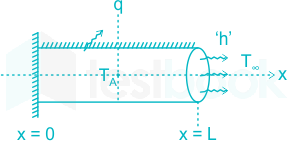
Consider a rod of uniform thermal conductivity whose one end (x = 0) is insulated and the other end (x = L) is exposed to flow of air at temperature T with convective heat transfer coefficient h. The cylindrical surface of the rod is insulated so that the heat transfer is strictly along the axis of the rod. The rate of internal heat generation per unit volume inside the rod is given as 

q˙=cos2πxL\rm \dot q = \cos \frac{2 \pi x}{L}

The steady-state temperature at the mid-location of the rod is given as TA. What will be the temperature at the same location, if the convective heat transfer coefficient increases to 2h?

  1. ((a))

    TA+q˙L2h\rm T_A + \frac{\dot q L}{2h}

  2. ((b))

    2TA

  3. ((c))

    TA

  4. ((d))

    TA(1q˙L4πh)+q˙L4πhTT_A \left( 1 - \frac{\dot q L}{4 \pi h} \right) + \frac{\dot q L}{4 \pi h} T_\infty

Show Answer
Answer: ((c))

TA

Explanation:

Steady-state conduction with internal heat generation:

d2Tdx2+q˙k=0\frac{d^2T}{dx^2} + \frac{\dot{q}}{k} = 0 ......(i)

It is given that the surface of the cylinder is insulated the heat will transfer only in x-direction i.e. 1-D heat transfer.

The temperature will remain the same even if we change the convective heat transfer coefficient.

Proof:

The rate of heat generation is q˙=cos2πxL\rm \dot q = \cos \frac{2 π x}{L}

To find the temperature profile we will differentiate equation (i) and will use boundary conditions.

d2Tdx2=q˙k\frac{d^2T}{dx^2} = - \frac{\dot{q}}{k}

Integrating equation we get,

dTdx=q˙kdx\frac{dT}{dx} = \int -\frac{\dot{q}}{k}dx  = 1kcos2πxLdx-\frac{1}{k}\int\cos \frac{2 π x}{L} dx

dTdx=1k×L2π sin2πxL+c1\frac{dT}{dx} = -\frac{1}{k}\times\frac{L}{2π}\ sin\frac{2 π x}{L} + c_1  ....... (a)

substitute boundary condition:

at x = 0 , dT/dx = 0, sin (0) = 0

we get c1 = 0

Integrating again we get

T=L2πk×L2π cos2πxL+c2T = -\frac{L}{2π k}\times\frac{-L}{2π}\ cos\frac{2 π x}{L} + c_2  ........(b)

at x = L 

Heat conducted = Heat convected 

\(-kA\left(\frac{dT}{dx}\right){x =L} = hA (T{L} - T_{∞})\)

k(1k×L2π sin2πLL)=h(TLT)-k\left(-\frac{1}{k}\times\frac{L}{2π}\ sin\frac{2 π L}{L} \right) = h(T_L - T_{∞})

sin 2π = 0 , LHS = 0 hence

Tx = L = T

substituting in equation b

Tx = L = T =L2πk×L2π cos2πLL+c2T_{x\ =\ L}\ =\ T_\infty\ = -\frac{L}{2π k}\times\frac{-L}{2π}\ cos\frac{2 π L}{L} + c_2

c2 = TL24π2kT_\infty - \frac{L^2}{4π^2 k}

Hence the equation of temperature is:

T=T+L2πk×L2π cos2πxLL24π2kT = T_\infty+ \frac{L}{2π k}\times\frac{L}{2π}\ cos\frac{2 π x}{L} - \frac{L^2}{4π^2 k}

It does not depend on convective heat transfer coefficient h.

Hence on there is no effect on temperature TA if convective heat transfer is increased to 2h.

Confusion Points

  • Generally, the equations of temperature with heat generation that we derive for wall, sphere, cylinder all depend on convective heat transfer.
  • But here due to the given value of heat generation, the general equation after integration gave different results.
46

The system of linear equations in real (x, y) given by

(xy)[252αα1]=(00)\rm \begin{pmatrix} \rm x & \rm y \end{pmatrix} \begin{bmatrix} 2 & 5- 2 α \\ α & 1 \end{bmatrix} = \rm \begin{pmatrix} \rm 0 & \rm 0 \end{pmatrix}

involves a real parameter α and has infinitely many non-trivial solutions for special value(s) of α. Which one or more among the following options is/are non-trivial solution(s) of (x, y) for such special value(s) of α ?

  1. ((a))

    x = 2, y = −2

  2. ((b))

    x = −1, y = 4

  3. ((c))

    x = 1, y = 1

  4. ((d))

    x = 4, y = −2

Show Answer
Answer: ((a))

x = 2, y = −2

Concept:

Solution of homogeneous equation AX = 0:

Consistent Infinite many solutions:  if the rank of a matrix is less than the number of variables then it has infinitely many solutions.

rank(r) < no. of variables(n) ⇒ |A| = 0

Calculation:

Given:

(xy)[252αα1]=(00)\rm \begin{pmatrix} \rm x & \rm y \end{pmatrix} \begin{bmatrix} 2 & 5- 2 α \\ α & 1 \end{bmatrix} = \rm \begin{pmatrix} \rm 0 & \rm 0 \end{pmatrix}

for non-trivial infinite solution: |A| = 0

A = [252αα1]\begin{bmatrix} 2 & 5- 2 α \\ α & 1 \end{bmatrix} ⇒ |A| = 2 - α(5 - 2α) = 0

2 - 5α + 2 = 0

(α - 2) (2α - 1) = 0

α = 2, 1/2

For α = 2 

A = [2121]\begin{bmatrix} 2 & 1 \\ 2 & 1 \end{bmatrix}

(xy)[2121]=(00)\rm \begin{pmatrix} \rm x & \rm y \end{pmatrix} \begin{bmatrix} 2 & 1 \\ 2 & 1 \end{bmatrix} = \rm \begin{pmatrix} \rm 0 & \rm 0 \end{pmatrix}

2x + 2 y = 0

x = -y

Substitute option in this equation.

For α = 1/2

A = [24121]\begin{bmatrix} 2 & 4 \\ \frac{1}{2} & 1 \end{bmatrix}

(xy)[24121]=(00)\rm \begin{pmatrix} \rm x & \rm y \end{pmatrix} \begin{bmatrix} 2 & 4 \\ \frac{1}{2} & 1 \end{bmatrix} = \rm \begin{pmatrix} \rm 0 & \rm 0 \end{pmatrix}

2x + 1/2 y = 0 

4x + y = 0 

from both equations we get,

y = - 4x

Substitute options in equation.

We get, 

option 1. x = 2, y = −2 and

option 2. x = −1, y = 4  satisfies equations.

47

Let a random variable X follow Poisson distribution such that

Prob(X = 1) = Prob(X = 2).

The value of Prob(X = 3) is __________ (round off to 2 decimal places).

48

Consider two vectors

a=5i+7j+2k\rm \vec a = 5 i + 7 j + 2 k

b=3ij+6k\rm \vec b = 3i - j + 6k

Magnitude of the component of a\vec a orthogonal to b\vec b in the plane containing the vectors a\vec a and b\vec{b} is ______ (round off to 2 decimal places).

49

A structure, along with the loads applied on it, is shown in the figure. Self-weight of all the members is negligible and all the pin joints are friction-less. AE is a single member that contains pin C. Likewise, BE is a single member that contains pin D. Members GI and FH are overlapping rigid members. The magnitude of the force carried by member CI is ________ kN (in integer).

50

Two rigid massless rods PR and RQ are joined at frictionless pin-joint R and are resting on ground at P and Q, respectively, as shown in the figure. A vertical force F acts on the pin R as shown. When the included angle 𝜃 < 90°, the rods remain in static equilibrium due to Coulomb friction between the rods and ground at locations P and Q. At 𝜃 = 90°, impending slip occurs simultaneously at points P and Q. Then the ratio of the coefficient of friction at Q to that at P (μQ /μP) is _________ (round off to two decimal places).

51

A cylindrical disc of mass m = 1 kg and radius r = 0.15 m was spinning at 𝜔 = 5 rad/s when it was placed on a flat horizontal surface and released (refer to the figure). Gravity g acts vertically downwards as shown in the figure. The coefficient of friction between the disc and the surface is finite and positive. Disregarding any other dissipation except that due to friction between the disc and the surface, the horizontal velocity of the center of the disc, when it starts rolling without slipping, will be _________ m/s (round off to 2 decimal places).

52

A thin-walled cylindrical pressure vessel has mean wall thickness of t and nominal radius of r. The Poisson’s ratio of the wall material is 1/3. When it was subjected to some internal pressure, its nominal perimeter in the cylindrical portion increased by 0.1% and the corresponding wall thickness became t̅. The corresponding change in the wall thickness of the cylindrical portion, i.e. 100 × (t̅ − t)/t, is ________% (round off to 3 decimal places).

53

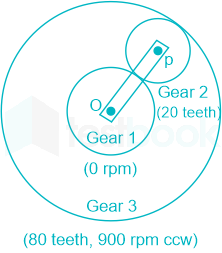
A schematic of an epicyclic gear train is shown in the figure. The sun (gear 1) and planet (gear 2) are external, and the ring gear (gear 3) is internal. Gear 1, gear 3 and arm OP are pivoted to the ground at O. Gear 2 is carried on the arm OP via the pivot joint at P, and is in mesh with the other two gears. Gear 2 has 20 teeth and gear 3 has 80 teeth. If gear 1 is kept fixed at 0 rpm and gear 3 rotates at 900 rpm counter clockwise (ccw), the magnitude of angular velocity of arm OP is __________rpm (in integer).

54

Under orthogonal cutting condition, a turning operation is carried out on a metallic workpiece at a cutting speed of 4 m/s. The orthogonal rake angle of the cutting tool is 5º. The uncut chip thickness and width of cut are 0.2 mm and 3 mm, respectively. In this turning operation, the resulting friction angle and shear angle are 45º and 25º, respectively. If the dynamic yield shear strength of the workpiece material under this cutting condition is 1000 MPa, then the cutting force is _______ N (round off to one decimal place).

55

A 1 mm thick cylindrical tube, 100 mm in diameter, is orthogonally turned such that the entire wall thickness of the tube is cut in a single pass. The axial feed of the tool is 1 m/minute and the specific cutting energy (u) of the tube material is 6 J/mm3. Neglect contribution of feed force towards power. The power required to carry out this operation is _________ kW (round off to one decimal place).

56

A 4 mm thick aluminum sheet of width w = 100 mm is rolled in a two-roll mill of roll diameter 200 mm each. The workpiece is lubricated with a mineral oil, which gives a coefficient of friction, μ = 0.1. The flow stress (σ) of the material in MPa is σ = 207 + 414 𝜀, where 𝜀 is the true strain. Assuming rolling to be a plane strain deformation process, the roll separation force (F) for maximum permissible draft (thickness reduction) is _________ kN (round off to the nearest integer).

Use:

 F=1.15σˉ(1+μL2hˉ)F = 1.15 \barσ \left( 1 + \frac{\mu L}{2 \bar h} \right) wL, where σˉ\bar \sigma is average flow stress, L is roll-workpiece contact length, and hˉ\bar h is the average sheet thickness

57

Two mild steel plates of similar thickness, in butt-joint configuration, are welded by gas tungsten arc welding process using the following welding parameters.

Welding voltage20 V
Welding current150 A
Welding speed5 mm/s


A filler wire of the same mild steel material having 3 mm diameter is used in this welding process. The filler wire feed rate is selected such that the final weld bead is composed of 60% volume of filler and 40% volume of plate material. The heat required to melt the mild steel material is 10 J/mm3. The heat transfer factor is 0.7 and melting factor is 0.6. The feed rate of the filler wire is __________ mm/s (round off to one decimal place).

58

An assignment problem is solved to minimize the total processing time of four jobs (1, 2, 3 and 4) on four different machines such that each job is processed exactly by one machine and each machine processes exactly one job. The minimum total processing time is found to be 500 minutes. Due to a change in design, the processing time of Job 4 on each machine has increased by 20 minutes. The revised minimum total processing time will be ________ minutes (in integer).

59

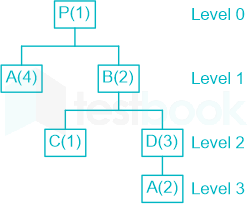
The product structure diagram shows the number of different components required at each level to produce one unit of the final product P. If there are 50 units of on hand inventory of component A, the number of additional units of component A needed to produce 10 units of product P is _________ (in integer).

60

Consider a one-dimensional steady heat conduction process through a solid slab of thickness 0.1 m. The higher temperature side A has a surface temperature of 80 °C, and the heat transfer rate per unit area to low-temperature side B is 4.5 kW/m2. The thermal conductivity of the slab is 15 W/m.K. The rate of entropy generation per unit area during the heat transfer process is ________ W/m2.K (round off to 2 decimal places).

61

In a steam power plant based on Rankine cycle, steam is initially expanded in a high-pressure turbine. The steam is then reheated in a reheater and finally expanded in a low-pressure turbine. The expansion work in the high-pressure turbine is 400 kJ/kg and in the low-pressure turbine is 850 kJ/kg, whereas the pump work is 15 kJ/kg. If the cycle efficiency is 32%, the heat rejected in the condenser is ________ kJ/kg (round off to 2 decimal places).

62

An engine running on an air standard Otto cycle has a displacement volume 250 cm3 and a clearance volume 35.7 cm3. The pressure and temperature at the beginning of the compression process are 100 kPa and 300 K, respectively. Heat transfer during constant-volume heat addition process is 800 kJ/kg. The specific heat at constant volume is 0.718 kJ/kg.K and the ratio of specific heats at constant pressure and constant volume is 1.4. Assume the specific heats to remain constant during the cycle. The maximum pressure in the cycle is ______ kPa (round off to the nearest integer).

63

A steady two-dimensional flow field is specified by the stream function

ψ = kx3y,

where x and y are in meters and the constant k = 1 m-2s-1. The magnitude of acceleration at a point (x, y) = (1 m, 1 m) is ________ m/s2 (round off to 2 decimal places).

64

Consider a solid slab (thermal conductivity, k = 10 W∙m-1∙K-1) with thickness 0.2 m and of infinite extent in the other two directions as shown in the figure. Surface 2, at 300 K, is exposed to a fluid flow at a free stream temperature (T) of 293 K, with a convective heat transfer coefficient (h) of 100 W∙m-2∙K-1. Surface 2 is opaque, diffuse and gray with an emissivity (ε) of 0.5 and exchanges heat by radiation with very large surroundings at 0 K. Radiative heat transfer inside the solid slab is neglected. The Stefan-Boltzmann constant is 5.67 × 10⁻⁸ W∙m-2∙K-4. The temperature T1 of Surface 1 of the slab, under steady-state conditions, is _________ K (round off to the nearest integer).

65

During open-heart surgery, a patient’s blood is cooled down to 25 °C from 37 °C using a concentric tube counter-flow heat exchanger. Water enters the heat exchanger at 4 °C and leaves at 18 °C. Blood flow rate during the surgery is 5 L/minute.

Use the following fluid properties:

FluidDensity (kg/m3)Specific heat (J/kg-K)
Blood10503740
Water10004200


Effectiveness of the heat exchanger is _________ (round off to 2 decimal places).

Attempt this paper under real exam conditions

Timed interface, section switching, instant scoring, and question-by-question analytics — free.

Start Timed Attempt