Official Paper

GATE ME 2021 Official Paper: Shift 2 (Previous Year Paper)

65 questions · 180 minutes · with answers · free

General Aptitude (10 questions)

1

Five persons P, Q, R, S and T are to be seated in a row, all facing the same direction, but not necessarily in the same order. P and T cannot be seated at either end of the row. P should not be seated adjacent to S. R is to be seated at the second position from the left end of the row. The number of distinct seating arrangements possible is:

  1. ((a))

    3

  2. ((b))

    5

  3. ((c))

    2

  4. ((d))

    4

Show Answer
Answer: ((a))

3

Five persons P, Q, R, S and T.

1) R is to be seated at the second position from the left end of the row.

2) P and T cannot be seated at either end of the row.

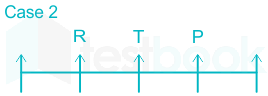
Two cases are possible for this condition.

3) P should not be seated adjacent to S.

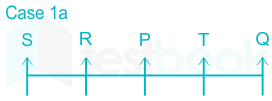
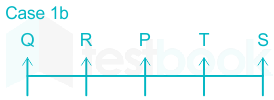
There are two cases in case - 1.

Hence, total of 3 cases are possible.

2

Consider the following sentences:

(i) The number of candidates who appear for the GATE examination is staggering.

(ii) A number of candidates from my class are appearing for the GATE examination.

(iii) The number of candidates who appear for the GATE examination are staggering.

(iv) A number of candidates from my class is appearing for the GATE examination.

Which of the above sentences are grammatically CORRECT?

  1. ((a))

    (ii) and (iii)

  2. ((b))

    (i) and (ii)

  3. ((c))

    (ii) and (iv)

  4. ((d))

    (i) and (iii)

Show Answer
Answer: ((b))

(i) and (ii)

The correct answer is '​(i) and (ii)'.

Key Points

  • 'The no of' is singular and takes singular verb. Thus, 'the number of candidates is staggering' is correct.
  • Similarly, 'A no of' is plural and takes plural verb. Thus, 'a number of candidates are staggering' is correct.
  • Thus, both the statement i and ii is correct.
3

A digital watch X beeps every 30 seconds while watch Y beeps every 32 seconds.

They beeped together at 10 AM.

The immediate next time that they will beep together is _____.

  1. ((a))

    10.42 AM

  2. ((b))

    10.00 PM

  3. ((c))

    10.08 AM

  4. ((d))

    11.00 AM

Show Answer
Answer: ((c))

10.08 AM

Concept:

The Watched will beep together at the time of their Least Common Multiple (LCM).

Calculation:

Given:

Watch X beeps at = 30 sec

Watch Y beeps at = 32 sec

They beep together at = 10.00 AM

LCM of (30 & 32) = 480 sec

And X and Y will beep together after 480 sec or 8 minutes.

So Next beep time = 10.08 AM

4

If ⊕ ÷ ⊙ = 2; 

⊕ ÷ Δ = 3; 

⊙ + Δ = 5; 

Δ × ⊗ = 10,

Then the value of (⊗ - ⊕)2, is

  1. ((a))

    0

  2. ((b))

    1

  3. ((c))

    4

  4. ((d))

    16

Show Answer
Answer: ((b))

1

Explanation:

Given:

⊕ ÷ ⊙ = 2, Δ × ⊗ = 10, ⊙ + Δ = 5; Δ × ⊗ = 10

∵ =2\frac{⊕}{⊙} = 2Δ=3\frac{⊕}{Δ} = 3

∴ Δ=32\frac{⊙ }{Δ}=\frac{3}{2} 

=3Δ2⊙=\frac{3Δ}{2}

now, ⊙ + Δ = 5 

3Δ2+Δ=5\frac{3Δ}{2} + Δ = 5

5Δ = 10

∴ Δ = 2

∵ ⊙ + 2 = 5 

∴ ⊙ = 3

Now,  Δ × ⊗ = 10

2 × ⊗ = 10

∴ ⊗ = 5

Now, =2\frac{⊕}{⊙} = 2

3=2\frac{⊕}{3} = 2

∴ ⊕ = 6

Hence (⊗ - ⊕)2 = (5 - 6)2 = 1

5

The front door of Mr X's house faces East. Mr X leaves the house, walking 50 m straight from the back door that is situated directly opposite to the front door. He then turns to his right, walks for another 50 m and stops. The direction of the point Mr X is now located at with respect to the starting point is ______.

  1. ((a))

    North-West

  2. ((b))

    North-East

  3. ((c))

    South-East

  4. ((d))

    West

Show Answer
Answer: ((a))

North-West

Explanation:

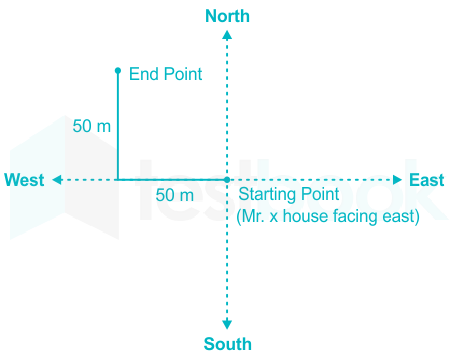
Tracing path followed by Mr. X,

Hence Mr. X will be in North-West direction from the starting point.

6

Given below are two statements 1 and 2, and two conclusions I and II.

Statement 1: All entrepreneurs are wealthy.

Statement 2: All wealthy are risk seekers.

Conclusion I: All risk seekers are wealthy.

Conclusion II: Only some entrepreneurs are risk seekers.

Based on the above statements and conclusions, which one of the following options is CORRECT?

  1. ((a))

    Only conclusion II is correct

  2. ((b))

    Neither conclusion I nor II is correct

  3. ((c))

    Both conclusion I and II are correct

  4. ((d))

    Only conclusion I is correct

Show Answer
Answer: ((b))

Neither conclusion I nor II is correct

Explanation:

The Venn diagram according to the given statements is as follows:

Conclusions:

All risk seekers are wealthy. → False (All wealthy are risk seekers but can't say vice versa is also true)

Only some entrepreneurs are risk seekers → False (All entrepreneurs are wealthy and All wealthy are risk seekers so all entrepreneurs will be risk seekers)

Hence neither conclusion I nor II is correct.

7

A box contains 15 blue balls and 45 black balls. If 2 balls are selected randomly, without replacement, the probability of an outcome in which the first selected is a blue ball and the second selected is a black ball, is ______.

  1. ((a))

    45236\dfrac{45}{236}

  2. ((b))

    14\dfrac{1}{4}

  3. ((c))

    316\dfrac{3}{16}

  4. ((d))

    34\dfrac{3}{4}

Show Answer
Answer: ((a))

45236\dfrac{45}{236}

Concept:

\(P(E) = \frac{Numberoffavorableoutcomes}{Totalnumberofoutcomes}\)

Calculation:

Given:

Number of blue balls = 15, Number of black balls = 45

Total number of balls = 15 + 45 = 60 balls

Balls are drawn from the box at random without replacement.

The probability of drawing first blue ball and second black ball is;

P(E)=15C160C1×45C159C1P(E)= \frac{{{15_{{C_1}}}}}{{{60_{{C_1}}}}}\times \frac{{{45_{{C_1}}}}}{{{59_{{C_1}}}}}

P(E)=15×4560×59P(E) = \frac{15\times45}{60\times59}

P(E)=45236P(E) = \frac{45}{236}

8

The ratio of the area of the inscribed circle to the area of the circumscribed circle of an equilateral triangle is _____

  1. ((a))

    18\frac{1}{8}

  2. ((b))

    16\frac{1}{6}

  3. ((c))

    12\frac{1}{2}

  4. ((d))

    14\frac{1}{4}

Show Answer
Answer: ((d))

14\frac{1}{4}

Explanation:

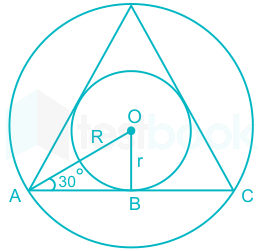
Let the radius of the circumscribed circle is R, and the radius of the inscribed circle is r.

Then area of circumscribed circle = πR2

Then the area of the inscribed circle = πr2

We know the angle between two adjacent sides in an equilateral triangle is 60°.

ΔOAB, Sin30=rRSin 30 =\frac{r}{R}

R = 2r

The ratio of the area of the inscribed circle to the area of the circumscribed circle 

=πr2πR2=\frac{\pi r^2}{\pi R^2}

=πr2π(2r)2=\frac{\pi r^2}{\pi (2r)^2}

=14=\frac{1}{4}

9

Consider a square sheet of side 1 unit. The sheet is first folded along the main diagonal. This is followed by a fold along its line of symmetry. The resulting folded shape is again folded along its line of symmetry. The area of each face of the final folded shape, in square units, equal to _____.

  1. ((a))

    14\dfrac{1}{4}

  2. ((b))

    18\dfrac{1}{8}

  3. ((c))

    132\dfrac{1}{32}

  4. ((d))

    116\dfrac{1}{16}

Show Answer
Answer: ((b))

18\dfrac{1}{8}

Explanation:

let us consider a square sheet of side 1 unit.

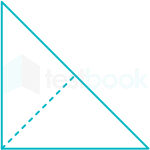
Now fold the sheet along the main diagonal.

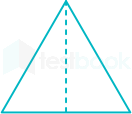
Now fold this along their line of symmetry.

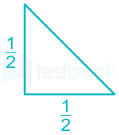
again fold this along their line of symmetry.

The side of the resulting shape = 12\frac{1}{2} unit

 Area of resultant shape =12×side2\frac{1}{2}\times side^2

 Area of resultant shape = 12×12×12\frac{1}{2}\times\frac{1}{2}\times\frac{1}{2}

 Area of resultant shape = 18\frac{1}{8}

10

The world is going through the worst pandemic in the past hundred years. The air travel industry is facing a crisis, as the resulting quarantine requirement for travelers led to weak demand.

In relation to the first sentence above, what does the second sentence do?

  1. ((a))

    The two statements are unrelated

  2. ((b))

    States an effect of the first sentence

  3. ((c))

    Restates an idea from the first sentence

  4. ((d))

    Second sentence entirely contradicts the first sentence

Show Answer
Answer: ((b))

States an effect of the first sentence

The correct answer is States an effect of the first sentence.

Key Points

  • Statement one i.e. the world is going through pandemic is the main cause. Statement two i.e. crisis faced due to that pandemic tells us about the effect of pandemic on air travel industry.
  • Cause and effect is a relationship between events or things, where one is the result of the other or others.
  • Thus, the second sentence states an effect of the first sentence.

Mechanical Engineering (55 questions)

11

Consider an n × n matrix A and a non-zero n × 1 vector p. Their product Ap = α2p, where α ∈ ℜ and α ∉ {-1, 0, 1}. Based on the given information, the eigen value of A2 is:

  1. ((a))

    α2

  2. ((b))

    √α

  3. ((c))

    α

  4. ((d))

    α4

Show Answer
Answer: ((d))

α4

Concept:

If a matrix 'A', having a characteristic root 'λ', then we have a non-zero vector 'X' which satisfies the equation [A - λI][X] = 0 or AX = λX.

Where the non-zero vector 'X' is called characteristic vector or Eigen-vector.

Properties of Eigen Value:

if λ is the eigen value of A , then eigen values of Am is λm

Calculation: 

Given:

Ap = α2p  ... eq (i)

We know that

AX = λX  .... eq (ii)

On comparing eq (i) and eq (ii)

λ = α2 

So the eigen value of matrix A is λ = α2 

Eigen value of A2 = λ2 = α4.

12

If the Laplace transform of function f(t) is given by s+3(s+1)(s+2)\frac{s+3}{(s+1)(s+2)}, then f(0) is

  1. ((a))

    32\dfrac{3}{2}

  2. ((b))

    12\dfrac{1}{2}

  3. ((c))

    0

  4. ((d))

    1

Show Answer
Answer: ((d))

1

Concept:

Laplace Transforms:

L (eat) = 1s  a\frac {1}{s \ - \ a}

L (e-at) = 1s + a\frac {1}{s\ +\ a}

Calculation:

Given:

L [f(t)] = s + 3(s + 1)(s + 2)\frac {s \ + \ 3}{{(s\ +\ 1)}{(s \ + \ 2)}}

The above equation through partial fractions can be written as:

s + 3(s + 1)(s + 2)\frac {s\ +\ 3}{{(s\ + \ 1)}{(s \ + \ 2)}} = A(s + 1)\frac {A}{(s \ + \ 1)} + B(s + 2)\frac {B}{(s \ + \ 2)}

s + 3 = A(s + 2) + B(s + 1)

s + 3 = (A + B)s + 2A + B

Comparing co-efficients on both sides, we get

A + B = 1 and 2A + B = 3

We get, A = 2, B = -1

So, s + 3(s + 1)(s + 2)\frac {s \ + \ 3}{{(s \ + \ 1)}{(s \ +\ 2)}} = 2(s + 1)\frac {2}{(s \ + \ 1)} - 1(s + 2)\frac {1}{(s \ + \ 2)}

f(t) = L-1(2s + 1)\left( {\frac{2}{{s \ + \ 1}}} \right) - L-1(1s + 2)\left( {\frac{1}{{s \ +\ 2}}} \right)

f(t) = 2e-t - e-2t

So, f(0) = 2e-0 - e-0 = 2 - 1 = 1

f(0) = 1

13

The mean and variance, respectively, of a binomial distribution for n independent trials with the probability of success as p, are

  1. ((a))

    np,;np(1p)\sqrt {np},;\sqrt {np(1 - p)}

  2. ((b))

    np,\sqrt {np}, np (1 - 2p)

  3. ((c))

    np, np(1 - p)

  4. ((d))

    np, np

Show Answer
Answer: ((c))

np, np(1 - p)

Explanation:

The binomial distribution of a random variable X is given by,

P(X = k) = nCkpkqnk\rm ^nC_kp^kq^{n-k}

where n is the number of observations, p is the probability of success & q is the probability of failure.p nCkpkqn−knCkpkqn−k

Total probability, p + q = 1

q = 1 - p

Mean = np 

Variance = npq = np(1 - p)

14

The Cast Iron which possesses all the carbon in the combined form as cementite is known as

  1. ((a))

    White Cast Iron

  2. ((b))

    Spheroidal Cast Iron

  3. ((c))

    Malleable Cast Iron

  4. ((d))

    Grey Cast Iron

Show Answer
Answer: ((a))

White Cast Iron

Explanation:

White Cast iron: It is white because carbon is in the form of carbide known as cementite which is the hardest constituent of Iron.

  • The carbon content in White Cast Iron is 1.75 to 2.3%.
  • It has high tensile strength, low compressive strength, and high brittleness.
  • It is used in abrasion-resistant parts where it's brittleness is of minimum concern such as shell liners, slurry pumps, ball mills, lifter bars, extrusion nozzles, cement mixers, pipe fittings, flanges, etc.

Additional Information

Spheroidal Cast Iron: It is also called ductile cast iron or high strength cast iron.

  • This type of cast iron is obtained by adding small amounts of magnesium (0.1 to 0.8%) to the molten grey iron.
  • The addition of magnesium causes the graphite to take the form of small nodules or spheroids instead of the normal angular flakes.

Grey Cast iron: 

  • The carbon content in Grey Cast Iron is 2.5 to 3.5%.
  • It is grey because carbon is present in the form of free Graphite.
  • High compressive strength, low tensile strength, and easily machinable

Malleable cast iron: It is a heat-treated iron-carbon alloy

  • The graphite structure is formed into irregularly shaped spheroidal particles
  • Malleable cast iron is produced from white cast iron by annealing.
  • During annealing treatment graphite nucleates and grows from the Fe3C to form nodules.
15

The size distribution of the powder particles used in powder metallurgy process can be determined by

  1. ((a))

    Laser reflection

  2. ((b))

    Laser scattering

  3. ((c))

    Laser penetration

  4. ((d))

    Laser absorption

Show Answer
Answer: ((b))

Laser scattering

Explanation:

Particle size usually is controlled by screening that is, by passing the metal powder through screens of various mesh sizes in addition to screening several other methods are available for particle size analysis, which are:

  1. Laser scattering from a laser illuminates a sample consisting of particles suspended in a liquid medium. The particles cause the light to be scattered, and a detector then digitizes the signals and computes the particle-size distribution.
  2. Sedimentation, which involves measuring the rate at which particles settle in a fluid.
  3. Microscopic analysis, which may include the use of transmission and scanning electron microscopy.
16

In a CNC machine tool, the function of an interpolator is to generate

  1. ((a))

    reference signal prescribing the shape of the part to be machined

  2. ((b))

    error signal for tool radius compensation during machining

  3. ((c))

    NC code from the part drawing during post processing

  4. ((d))

    signal for the lubrication pump during machining

Show Answer
Answer: ((a))

reference signal prescribing the shape of the part to be machined

Explanation:

In contouring systems:

The machining path is usually constructed from a combination of linear and circular segments. It is only necessary to specify the coordinates of the initial & final points of each segment and the feed rate. The operation of producing the required shape based on this information is termed interpolation & the corresponding unit is the “Interpolator”.

  • So, in CNC machine tool, the function of an interpolator is to generate a reference signal prescribing the shape of the part to be machined.
  • The interpolator coordinates the motion along the machine axes, which are separately driven, to generate the required machining path.
  • An interpolator coordinates these axis motions in such a way that the programmed path is constantly maintained from the beginning to the end of the movement.
  • The two most common types of interpolators are linear and circular.
17

The machining process that involves ablation is

  1. ((a))

    Laser Beam Machining

  2. ((b))

    Electrochemical Machining

  3. ((c))

    Chemical Machining

  4. ((d))

    Abrasive Jet Machining

Show Answer
Answer: ((a))

Laser Beam Machining

Explanation:

Laser beam machining:

  • Laser machining is a technology that uses a laser beam (a narrow beam of intense monochromatic light) to cut required shapes or profiles or patterns in almost all types of materials.
  • In this process, the output of a high-power laser beam is directed in a programmed manner towards the material required to be cut.
  • A lens system focuses the emitted laser beam falls the work surface, removing a small portion of the material by vaporization and high-speed ablation.
  • The process can be used to make precise holes in thin sheets and materials. Laser beam cutting finds its applications in a variety of fields.
  • The fields where the laser beam has been successfully used are cloth and plastic cutting, laser marking, laser welding, laser drilling, cleaning and surface treatments.

Advantages:

  • The ability to cut almost all materials.
  • No limit to cutting paths as the laser point can move in any paths.
  • No cutting lubricants are required.
  • As there is an absence of direct contact between the tool and workpiece; thus, no forces are induced and as a result, it is not necessary to provide the work-holding system to hold the workpiece.
  • The fragile materials are easy to cut on a laser without any support.
  • There is no tooling cost or associated wear costs due to it.
  • The laser produces high-quality cuts without extra finishing requirements.

Important Points

Ablation: 

A complex phenomenon occurring when an energy threshold is reached which causes measurable or observable damage and material removal by vaporization. 


Additional Information

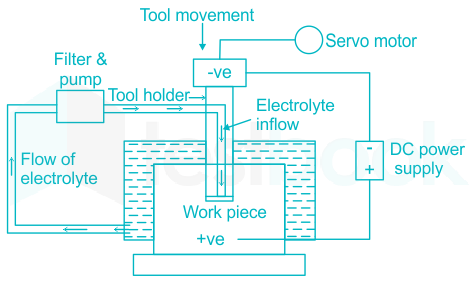
Electrochemical Machining: 

In electrochemical machining, the metal is removed due to electrochemical action i.e. Ion displacement where the workpiece is made anode and the tool is made the cathode. A high current is passed between the tool and workpiece through the electrolyte. Metal is removed by the anodic dissolution and is carried away by the electrolyte.

2 Electrochemical Machining Set-ups 3. ELECTROCHEMICAL ETCHING There... |  Download Scientific Diagram

The tool material used in ECM should have the following property

  • It should have high electrical conductivity
  • It should be easily machinable and it should have high stiffness
  • Its corrosion resistance should be high.

The advantages of ECM include

  • Complex shapes can be made accurately
  • The surface finish is good due to atomic level dissolution
  • Tool wear practically absent
  • Its material removal rate is the highest.


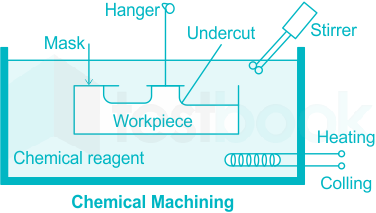
Chemical Machining:

It is a machining process in which material is dissolved and removed from the workpiece by controlled chemical reaction using reactive chemical solution i.e. strong alkaline or acidic reagents.

Since the chemical solutions used can dissolve all of the workpiece material, the parts which are not to be dissolved to be applied with a mask that resists the chemical action of the solution, so that only the unmasked portion gets removed by the chemical solution.

The steps to be followed in a typical chemical machining operation are:

  • Clean the workpiece thoroughly: This step is necessary to ensure that the masking material will adhere to the workpiece well.
  • Apply a chemical resistance mask on the workpiece surface where no material is to be removed.
  • Dip the workpiece surface into a chemical solution called etchant and leave it for sufficient time to get the necessary depth of etching.
  • The etchant is either continuously sprayed on the surface or the part is immersed in a tank of constantly agitating etchant solution.
  • Remove the mask and clean the workpiece.

Advantages of chemical machining:

  • Tooling cost is very low.
  • Complex contour can be easily machined.
  • Hard and brittle material can be machined.
  • A high surface finish is obtained i.e free from the burr.
  • Difficult to machine materials can be easily processed.

Disadvantages of chemical machining:

  • The process is slow; therefore the material removal rate is very low.
  • The manufacturing cost is high.
  • A large floor area is needed.
  • Not possible to produce sharp corners.
  • Workpiece thickness, which can be machined, is limited.


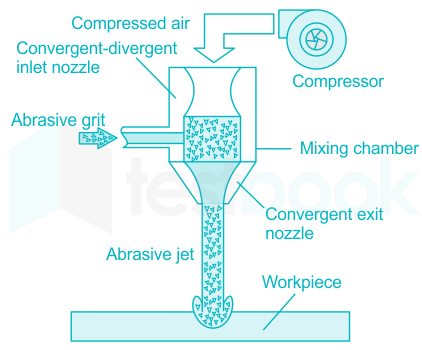
Abrasive jet machining (AJM):

  • Abrasive jet machining (AJM) removes material through the action of a focused stream of abrasive-laden gas.
  • Micro-abrasive particles are propelled by inert gas at velocities of up to 1000 ft/sec.
  • In an abrasive jet, machining material removal takes place due to the impingement of the fine abrasive particles. These particles move with a high-speed air (or gas) stream.
  • The abrasive particles are typically are of 0.025 mm or 25 microns in diameter.
  • When an abrasive particle impinges on the work surface at a high velocity, the impact causes a tiny brittle fracture and the flowing air carries away the dislodgedged small workpiece particle.
  • This process is more suitable when the work material is brittle and fragile.
  • One of the most important factors in the AJM is the distance between the work surface and the tip of the nozzle normally called the nozzle tip distance (NTD).
  • NTD affects not only the material removal rate (MRR) from the work surface but also the shape and size of the cavity produced.
  • When the NTD increases, the velocity of the abrasive particle impinging on the work surface increases due to their acceleration after they leave the nozzle. This in turn increase MRR. With the further increase in NTD, the velocity reduces due to the drag of the atmosphere which initial checks the increase in MRR and finally decreases it.

Applications:

  • For drilling holes of intricate shapes in hard and brittle materials
  • For machining fragile, brittle and heat-sensitive materials

Limitations:

  • MRR is rather low
  • Abrasive particles tend to get embedded particularly if the work material is ductile
  • Tapering occurs due to flaring of the jet
18

A PERT network has 9 activities on its critical path. The standard deviation of each activity on the critical path is 3. The standard deviation of the critical path is

  1. ((a))

    3

  2. ((b))

    9

  3. ((c))

    81

  4. ((d))

    27

Show Answer
Answer: ((b))

9

Concept:

In CPM:

The standard deviation of critical path:

σcp Sum;of;variance;along;critical;path\sqrt {Sum;of;variance;along;critical;path}

σcpσ12+σ22++σ82+σ92\sqrt {σ _1^2 + σ _2^2 + \ldots + σ _8^2 + σ _9^2}

Where, σ1, σ2, ...., σ8, σ9 are the standard deviation of each activity on the critical path   

Calculation:

Given:

σ1, σ2, ...., σ8, σ9 = 3

σcp = σ12+σ22++σ82+σ92\sqrt {σ _1^2 + σ _2^2 + \ldots + σ _8^2 + σ _9^2}

σcp32+32+32+32+32+32+32+32+32\sqrt {3^2 + 3^2 + 3^2 + 3^2 + 3^2 + 3^2 + 3^2 + 3^2 + 3^2}

σcp9×9\sqrt {9 \times 9}  = 9

∴ the standard deviation of the critical path is 9.

19

The allowance provided in between a hole and a shaft is calculated from the difference between

  1. ((a))

    upper limit of the shaft and the lower limit of the hole

  2. ((b))

    lower limit of the shaft and the upper limit of the hole

  3. ((c))

    lower limit of the shaft and the lower limit of the hole

  4. ((d))

    upper limit of the shaft and the upper limit of the hole

Show Answer
Answer: ((a))

upper limit of the shaft and the lower limit of the hole

Explanation:

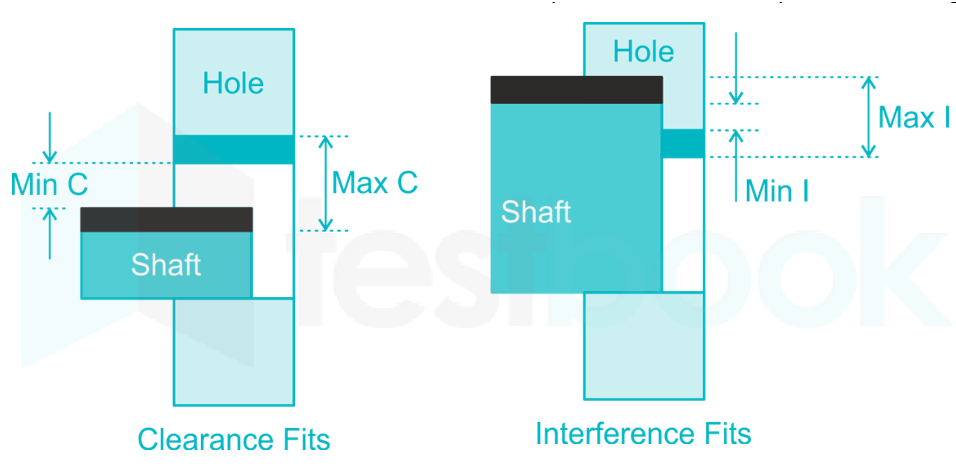
Allowance:

  • Allowance is minimum clearance or maximum interference.
  • It can be negative or positive.
  • It is independent of tolerance.
  • It is the difference between the maximum material limits i.e. it is the difference between the upper limit of the shaft and the lower limit of the hole.

20

In forced convective heat transfer, Stanton number (St), Nusselt number (Nu), Reynolds number (Re) and Prandtl number (Pr) are related as

  1. ((a))

    St=NuRe;PrSt = \frac{Nu}{Re; Pr}

  2. ((b))

    St=Nu;PrReSt = \frac{Nu; Pr}{Re }

  3. ((c))

    St=Nu;RePrSt = \frac{Nu ;Re}{ Pr}

  4. ((d))

    St = Nu Pr Re

Show Answer
Answer: ((a))

St=NuRe;PrSt = \frac{Nu}{Re; Pr}

Explanation:

In forced convective heat transfer, Stanton number (St), Nusselt number (Nu), Reynolds number (Re) and Prandtl number (Pr) are related as

\(St = \frac{{Nu}}{{R{e};Pr}};=\frac{{NusseltNumber}}{{Reynold'sNumber;\times;Prandtl~Number}} \)

Nusselt Number:

Nusselt number is defined as:

Nu=hLckNu = \frac{{h{L_c}}}{k}

where k is the thermal conductivity of the fluid and Lc is the characteristic length.

Nu=QconvQcond=hΔTkΔTL=hLk{N_u} = \frac{{{Q_{conv}}}}{{{Q_{cond}}}} = \frac{{h{\rm{\Delta }}T}}{{k\frac{{{\rm{\Delta }}T}}{L}}} = \frac{{hL}}{k}

Therefore the Nusselt number represents the enhancement of heat transfer through a fluid layer as a result of convection relative to conduction across the same fluid layer.

Reynold Number:

Reynolds number is a dimensionless formula that is used to differentiate laminar flow from turbulent flow.

Reynolds number is given by

Re=ρ;×;V;×;DμRe = \frac{{\rho ;\times; V; \times ;D}}{\mu }

Where,

ρ = Density of fluid, V = velocity of fluid, D = Diameter of pipe, μ = Dynamic viscosity of the fluid

Prandtl Number:

It is defined as the ratio of momentum diffusivity to thermal diffusivity.

Pr=μ;CpK=(μρ)(Kρ;Cp)Pr = \frac{{\mu; {C_p}}}{K} = \frac{{\left( {\frac{\mu }{\rho }} \right)}}{{\left( {\frac{K}{{\rho ;{C_p}}}} \right)}}

Pr=να=momentum;diffusivitythermal;diffusivityPr = \frac{\nu }{\alpha } = \frac{{momentum;diffusivity}}{{thermal;diffusivity}}

δδT=(Pr)1/3;\frac{δ }{{{δ _T}}} = {\left( {Pr} \right)^{1/3}};

where δ is hydrodynamic boundary layer thickness and δT is thermal boundary layer thickness.

If Prandtl number is greater than one, momentum diffusivity dominates and hydrodynamic boundary layer thickness is more than thermal boundary layer thickness.

Heat transfer coefficient (h) is not a property of the fluid, it is an experimentally determined coefficient value that is complex in nature.

Because h depends on various factors such as Properties of fluid, Type of flow, Type of surface, Geometry of surface, Orientation of surface, etc...

21

For a two dimensional, incompressible flow having velocity components u and v in the x and y directions, respectively, the expression δ(u2)δx+δ(uv)δy\frac{\delta(u^2)}{\delta x} + \frac{\delta(uv)}{\delta y} can be simplified to

  1. ((a))

    uδuδx+uδvδyu \frac{\delta u}{\delta x} + u \frac{ \delta v}{\delta y}

  2. ((b))

    uδuδx+vδuδyu \frac{\delta u}{\delta x} + v \frac{ \delta u}{\delta y}

  3. ((c))

    2uδuδx+uδvδy2u \frac{\delta u}{\delta x} + u \frac{ \delta v}{\delta y}

  4. ((d))

    2uδuδx+vδuδy2u \frac{\delta u}{\delta x} + v \frac{ \delta u}{\delta y}

Show Answer
Answer: ((b))

uδuδx+vδuδyu \frac{\delta u}{\delta x} + v \frac{ \delta u}{\delta y}

Concept:

The continuity equation for a two-dimensional flow of an incompressible fluid is

ux+vy=0\frac{{\partial u}}{{\partial x}} + \frac{{\partial v}}{{\partial y}} = 0

Calculation:

Given:

δ(u2)δx+δ(uv)δy\frac{\delta(u^2)}{\delta x} + \frac{\delta(uv)}{\delta y}

After differentiating we get,

2uδuδx+uδvδy+vδuδy2u\frac{\delta u}{\delta x} + u\frac{\delta v}{\delta y}+v\frac{\delta u}{\delta y}

uδuδx+u[δuδx+δvδy]+vδuδyu\frac{\delta u}{\delta x} +u\left[\frac{\delta u}{\delta x}+ \frac{\delta v}{\delta y}\right]+v\frac{\delta u}{\delta y}

According to continuity equation for 2D incompressible flow δuδx+δvδy=0\frac{\delta u}{\delta x}+ \frac{\delta v}{\delta y}= 0

∴ uδuδx+vδuδyu \frac{\delta u}{\delta x} + v \frac{ \delta u}{\delta y}

22

Which of the following is responsible for eddy viscosity (or turbulent viscosity) in a turbulent boundary layer on a flat plate?

  1. ((a))

    Reynolds stresses

  2. ((b))

    Prandtl stresses

  3. ((c))

    Nikuradse stresses

  4. ((d))

    Boussinesq stresses

Show Answer
Answer: ((a))

Reynolds stresses

Explanation:

Reynolds Expression for Turbulent Shear stress:

Reynold's through his experiment developed an expression between two layers of a fluid at a small distance apart, which is given as:

τt=ρuvτ_t=\rho{u'}{v'}

where u', v' = fluctuating component of velocity in the direction of x and y respectively.

u' and v' are both varying and hence τ will also vary. To calculate τ, time average is done on both sides of the equation.

τt=ρˉuˉvˉτ_t=\bar{\rho}\bar{u}'\bar{v}'

23

A two dimensional flow has velocities in x and y directions given by u = 2 xyt and v = -y2t, where t denotes time. The equation for streamline passing through x = 1, y = 1 is

  1. ((a))

    x2y = 1

  2. ((b))

    x2y2 = 1

  3. ((c))

    x/y2 = 1

  4. ((d))

    xy2 = 1

Show Answer
Answer: ((d))

xy2 = 1

Concept: 

A streamline is an imaginary curve drawn in space such that tangent drawn to it at any point will give the velocity of fluid-particle at a given instant of time. 

The equation of streamline for 2-D flow is given as:

dxu=dyv \frac{{{\rm{dx}}}}{{\rm{u}}} = \frac{{{\rm{dy}}}}{{\rm{v}}}

where u and v are the x and y components of the velocity.

Calculation:

Given:

u = 2xyt, v = -y2t

dx2xyt=dyy2tdxx=2dyy\frac{{dx}}{{2xyt}} = \frac{{dy}}{{-y^2t}} \Rightarrow \smallint \frac{{dx}}{x} = - 2\smallint \frac{{dy}}{y}

In x = -2In y + ln C

ln x + ln y2 = ln C

ln xy2 = ln C

xy2 = C

When equation for streamline passing through x = 1, y = 1 then C = 1

∴ xy2 = 1 is the equation of streamline passing through x = 1, y = 1.

24

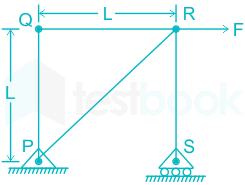
A plane truss PQRD (PQ = RS, and ∠ PQR = 90°) is shown in the figure.

The forces in the members PR and RS respectively, are _______.

  1. ((a))

    F (tensile) and F 2\sqrt{2} (tensile)

  2. ((b))

    2\sqrt{2} (tensile) and F (tensile)

  3. ((c))

    F (compressive) and F 2\sqrt{2} (compressive)

  4. ((d))

    2\sqrt{2} (tensile) and F (compressive)

Show Answer
Answer: ((d))

2\sqrt{2} (tensile) and F (compressive)

Explanation:

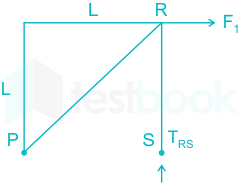
Taking moment about point P

F ×  L - T RS × L = 0

T RS = F

Force in member RS  = F (compressive)

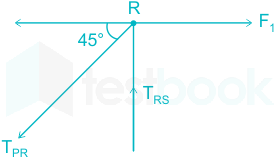
Now FBD of point R

Taking summation of force in Y direction 

-TPR sin45° + TRS = 0

-TPR sin45° + F = 0

TPR = F √ 2

Forces in the members PR  F √ 2 (tensile)

25

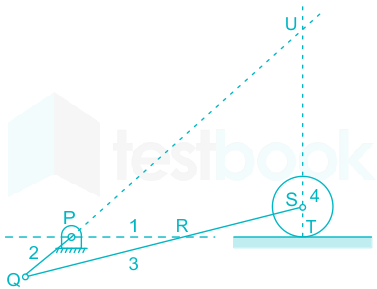
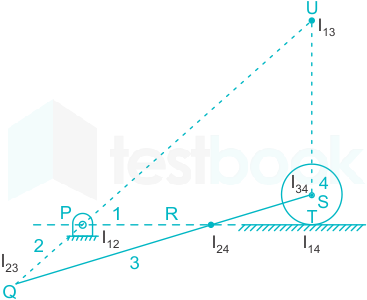
Consider the mechanism shown in the figure. There is rolling contact without slip between the disc and ground.

Select the correct statement about instantaneous centers in the mechanism.

  1. ((a))

    Only points P, Q, S and T are instantaneous centers of mechanism.

  2. ((b))

    Only points P, Q and S are instantaneous centers of mechanism.

  3. ((c))

    All points P, Q, R, S T and U are instantaneous centers of mechanism.

  4. ((d))

    Only points P, Q, R, S, and U are instantaneous centers of mechanism.

Show Answer
Answer: ((c))

All points P, Q, R, S T and U are instantaneous centers of mechanism.

Explanation:

Kennedy’s theorem states that if three bodies have plane motion relative to one another, then there I-centres i.e. instantaneous centre must lie on a straight line.

There are 4 links, so the total number of instantaneous centers will be 

n(n1)2\frac{n(n - 1)}{2} = 4×32\frac{4 \times3}{2} = 6

I - centre:

I13 is the point of intersection of the lines joining I12, I23 and I14, I34, These lines will meet at U, Hence U is an I centre.

Similarly, I24 is the point of intersection of the lines joining I12, I24 and I23, I34, These lines will meet at R, Hence R is an I centre.

I12 = P, I34 = S, I23 = Q, I14 = T, I13 = U, I24 = R

So, All the points P, Q, R, S, T, and U are instantaneous centres of mechanism.

26

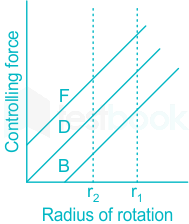
The controlling force curves F, D, and B for a spring-controlled governor are shown in the figure, where r1 and r2 are any two radii of rotation.

The characteristics shown by the curves are

  1. ((a))

    F - Stable; D - Isochronous; B - Unstable

  2. ((b))

    F - Stable; D - Unstable; B - Isochronous

  3. ((c))

    F - Unstable; D - Stable; B - Isochronous

  4. ((d))

    F - Unstable; D - Isochronous; B - Stable

Show Answer
Answer: ((d))

F - Unstable; D - Isochronous; B - Stable

Explanation:

Controlling force curve: 

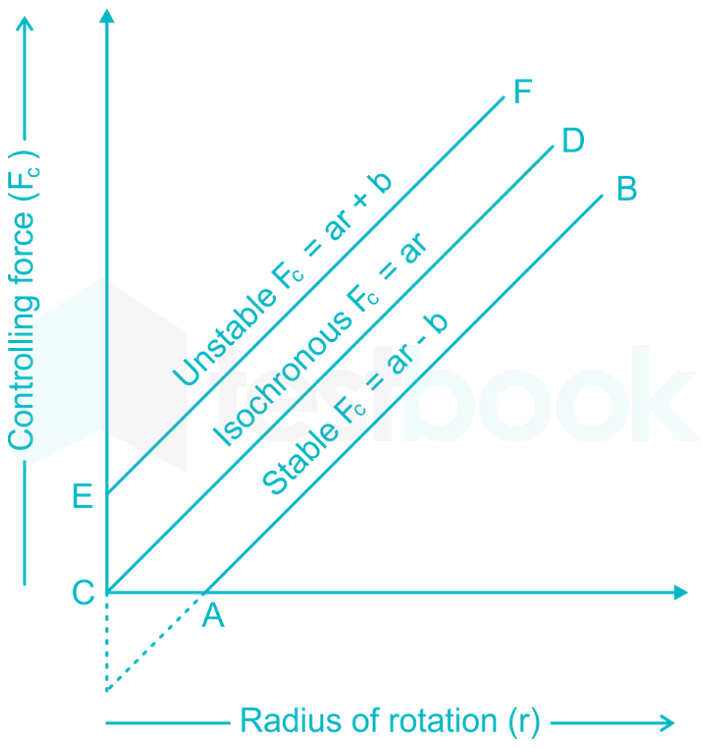
When the graph between the controlling force as ordinate and radius of rotation of the dead weight balls as abscissa is drawn, then the graph obtained is called the controlling force diagram.

Controlling force, Fc = mω2r.

The relation between the controlling force (FC) and the radius of rotation (r) for the spring controlled governors is given by the following equation.

FC = a.r – b 

when 

FC = ar – b  (governor is stable) i.e. B

FC = ar        (governor is Isochronous) i.e D

FC = ar + b  (governor is unstable) i.e F

27

The von Mises stress at a point in a body subjected to forces is proportional to the square root of the

  1. ((a))

    dilatational strain energy per unit volume

  2. ((b))

    distortional strain energy per unit volume

  3. ((c))

    plastic strain energy per unit volume

  4. ((d))

    total strain energy per unit volume

Show Answer
Answer: ((b))

distortional strain energy per unit volume

Explanation:

The Strain Energy of Distortion or Distortion energy per unit volume is given by**:**

Distortion energy per unit volume = (Total Strain energy) - (Energy of dilation)

Total Strain Energy is given by:

\({\rm{U}} = \frac{1}{{2{\rm{E}}}}\left{ {{\rm{\sigma }}_1^2 + {\rm{;\sigma }}_2^2 + {\rm{\sigma }}_3^2 - 2{\rm{\mu }}\left( {{{\rm{\sigma }}_1}{{\rm{\sigma }}_2} + {{\rm{\sigma }}_2}{{\rm{\sigma }}_3} + {{\rm{\sigma }}_3}{{\rm{\sigma }}_1}} \right)} \right}\)

Energy of dilation:

Uv=(12μ)6E×(σ1+σ2+σ3)23U_v=\frac{(1-2\mu)}{6E}\times \frac {(\sigma_1+\sigma_2+\sigma_3)^2}{3}

Distortion energy per unit volume = (Total Strain energy) - (Energy of dilation)

Ud = 1 + μ6E[(σ1σ2)2+(σ2σ3)2+(σ3σ1)2]\frac{1\ +\ \mu}{6E}[(σ_1-σ_2)^2+(σ_2-σ_3)^2+(σ_3-σ_1)^2]..... eq (i)

In simple tension test:

Ud(1 + μ6E)2σym2\left(\frac{1\ +\ \mu}{6E}\right)2σ_{ym}^2 .... eq (ii)

Maximum distortion energy theory (Von mises theory)

  • According to this theory, the failure or yielding occurs at a point in a member when the distortion strain energy per unit volume reaches the limiting distortion energy (i.e. distortion energy at yield point) per unit volume as determined from a simple tension test.
  • von misses stress under triaxial condition is given by:

\({σ _{vm}} = \sqrt{{\frac{1}{2}\left{ {{{\left( {{σ _1} - {σ _2}} \right)}^2} + {{\left( {{σ _2} - {σ _3}} \right)}^2} + {{\left( {{σ _3} - {σ _1}} \right)}^2} } \right}} }\)

Now if we compare von misses stress and distortion energy per unit volume equation then,

Ud =1 + μ3E;×σvm2\frac{1\ +\ \mu}{3E};\times {σ_{vm}^2}

Ud ∝ σ2vm

σvm ∝  Ud\sqrt{U_d}

The von Mises stress at a point in a body subjected to forces is proportional to the square root of the distortional strain energy per unit volume.

28

Value of 45.2\int^{5.2}_4 ln x dx using Simpson's one-third rule with interval size 0.3 is

  1. ((a))

    1.60

  2. ((b))

    1.51

  3. ((c))

    1.06

  4. ((d))

    1.83

Show Answer
Answer: ((d))

1.83

Concept:

Simpson's one-third rule:

I=h3[y0+yn+4(y1+y3+y5)+2(y2+y4)]I = \frac{h}{3}\left[ {{y_0} + {y_n} + 4\left( {{y_1} + {y_3} + {y_5} \ldots } \right) + 2\left( {{y_2} + {y_4} \ldots } \right)} \right]

where n = number of intervals, interval size, h=b  anh = \frac{b\ -\ a}{n}

Calculation:

Given:

f(x) = 45.2\int^{5.2}_4 ln x dx, h = 0.3

b = 5.2, a = 4

n=b  ah=5.2  40.3n = \frac{b\ -\ a}{h} = \frac{5.2\ -\ 4}{0.3} = 4

x44.34.64.95.2
yln 4ln 4.3ln 4.6ln 4.9ln 5.2
y0y1y2y3y4
<br>

I=h3[y0+y4+4(y1+y3)+2(y2)]I = \frac{h}{3}\left[ {{y_0} + {y_4} + 4\left( {{y_1} + {y_3} } \right) + 2\left( {{y_2} } \right)} \right]

I=0.33[(ln4+ln5.2)+4(ln4.3+ln4.9)+2(ln4.6)]I = \frac{0.3}{3}\left[ ({{\ln4} + {\ln5.2})+ 4\left( {{\ln4.3} + {\ln4.9} } \right) + 2\left( {{\ln 4.6} } \right)} \right]

∴ I = 1.8278 ≈ 1.83

29

Value of (1 + i)8, where i=1i = \sqrt{-1}, is equal to

  1. ((a))

    4i

  2. ((b))

    16

  3. ((c))

    16i

  4. ((d))

    4

Show Answer
Answer: ((b))

16

Concept: 

Cartesian form:

Z = x + iy 

Polar form:

Z = r(cos θ + isin θ) 

Exponential form:

Z = re

Where, r = x2+y2\sqrt {{x^2} + {y^2}}  and θ = tan-1(y/x).

Combining all of them

Z = x + iy = r(cos θ + isin θ) = reiθ

According to De-movier's theorem:

Zn = (reiθ)n = rnen

Calculation:

Given:

Let Z = 1 + i

Comparing with cartesian form x = 1 and y = 1

θ = tan-1(y/x) = tan-1(1) = π4\frac{π}{4}

∴ r = x2+y2\sqrt {{x^2} + {y^2}} = 12+12\sqrt{{1^2} + {1^2}} = 2\sqrt{2}

Z = reiθ = 2eiπ4 {\sqrt 2 {e^{i\frac{π }{4}}}}

Zn = (reiθ)n = rneniθ

(1 + i)8 = (2eiπ4)8{\left( {\sqrt 2 {e^{i\frac{π }{4}}}} \right)^8} = 16 × ei2π = 16 (cos 2π + i sin 2π)

(1 + i)8 = 16 × 1 = 16.

30

Consider adiabatic flow of air through a duct. At a given point in the duct, velocity of air is 300 m/s, temperature is 330 K and pressure is 180 kPa. Assume that the air behaves as a perfect gas with constant cp = 1.005 kJ / kg.K. The stagnation temperature at this point is _____________ K (round off to two decimal places).

31

Consider an ideal vapor-compression refrigeration cycle working on R-134a refrigerant. The COP of the cycle is 10 and the refrigeration capacity is 150 kJ/kg. The heat rejected by the refrigerant in the condenser is ___________ kJ/kg (round off to the nearest integer).

32

A rigid tank of volume 50 m3 contains a pure substance as a saturated liquid vapour mixture at 400 kPa. Of the total mass of the mixture, 20% mass is liquid and 80% mass is vapour. Properties at 400 kPa are: Saturation, Temperature, Tsat = 142.61°C; Specific volume of saturated liquid, vf = 0.001084 m3/kg; Specific volume of saturated vapour, vg = 0.46242 m2/kg. The total mass of liquid vapour mixture in the tank is ______ kg (round off to the nearest integer).

33

An object is moving with a Mach number of 0.6 in an ideal gas environment, which is at a temperature of 350 K. The gas constant is 320 J/kg.K and the ratio of specific heat is 1.3. The speed of object is __________ m/s (round off to the nearest integer).

34

A column with one end fixed and one end free has a critical buckling load of 100 N. For the same column, if the free end is replaced with a pinned end then the critical buckling load will be ____________ N (round off to the nearest integer).

35

A steel cubic block of side 200 mm is subjected to hydrostatic pressure of 250 N/mm2. The elastic modulus is 2 × 105 N/mm2 and Poisson's ratio is 0.3 for steel. The side of the block is reduced by ______ mm (round off to two decimal places).

36

The value of 0π/2\int^{\pi/2}_0 0cosθ\int^{cosθ}_0 r sin θ dr dθ is

  1. ((a))

    π 

  2. ((b))

    16\frac{1}{6}

  3. ((c))

    43\frac{4}{3}

  4. ((d))

    0

Show Answer
Answer: ((b))

16\frac{1}{6}

Explanation:

I=0π/20cosθrsinθ;drdθI=\int^{π/2}_0\int^{\cosθ}_0r\sin θ ;drdθ

The order of 'drdθ' decides the priority of integration.

Here the limit of r varies from 0 to cos θ and, the limit of θ varies from 0 to π/2.

I=0π/20cosθ(r;dr)sinθ;dθI=\int^{π/2}_0\int^{\cosθ}_0(r;dr)\sin θ ;dθ

I=0π/2[r22]0cosθsinθ;dθI=\int^{π/2}_0\left[\frac{r^2}{2}\right]_0^{cos\theta}\sin θ ;dθ

I=0π/212cos2θ.sinθ;dθI=\int^{π/2}_0\frac{1}{2}\cos^2 \theta .\sin θ ;dθ

I=120π/2cos2θ.sinθ;dθI=\frac{1}{2}\int^{π/2}_0\cos^2 \theta .\sin θ ;dθ ....eq (1)

We know that;

I=0π/2sinmθcosnθ;dθ=Γ(m + 12)Γ(n + 12)2Γ(m + n + 22)I=\int^{π/2}_0\sin^m θ \cos^n \theta ;dθ=\frac{\Gamma\left(\frac{m\ +\ 1}{2}\right)\Gamma\left(\frac{n\ +\ 1}{2}\right)}{2\Gamma\left(\frac{m\ +\ n\ +\ 2}{2}\right)}

On comparing with eq (1)... m = 1 and n = 2.

I=120π/2cos2θ.sinθ;dθ=Γ(1 + 12)Γ(2 + 12)2Γ(1 + 2 + 22)=Γ(1)Γ(32)2Γ(52)I=\frac{1}{2}\int^{π/2}_0\cos^2 \theta .\sin θ ;dθ=\frac{\Gamma\left(\frac{1\ +\ 1}{2}\right)\Gamma\left(\frac{2\ +\ 1}{2}\right)}{2\Gamma\left(\frac{1\ +\ 2\ +\ 2}{2}\right)}=\frac{\Gamma\left(1\right)\Gamma\left(\frac{3}{2}\right)}{2\Gamma\left(\frac{5}{2}\right)}

Γ(1)Γ(32)2Γ(52)=Γ(1) × 12Γ(12)2 × 32 × 12Γ(12)=13\frac{\Gamma\left(1\right)\Gamma\left(\frac{3}{2}\right)}{2\Gamma\left(\frac{5}{2}\right)}=\frac{\Gamma\left(1\right)\ \times\ \frac{1}{2}\Gamma\left(\frac{1}{2}\right)}{2\ \times\ \frac{3}{2}\ \times\ \frac{1}{2}\Gamma\left(\frac{1}{2}\right)}=\frac{1}{3}

I=120π/2cos2θ.sinθ;dθ=12×13=16I=\frac{1}{2}\int^{π/2}_0\cos^2 \theta .\sin θ ;dθ=\frac{1}{2}\times\frac{1}{3}=\frac{1}{6}

37

Let the superscript T represent the transpose operation. Consider the function f(x)=12xTQxrTxf(x) = \frac{1}{2} x^T Qx-r^Tx, where x and r are n × 1 vectors and Q is a symmetric n × n matrix. the stationery point of f(x) is

  1. ((a))

    r

  2. ((b))

    Q-1 r

  3. ((c))

    rrTr\frac{r}{r^Tr}

  4. ((d))

    QTr

Show Answer
Answer: ((b))

Q-1 r

Concept:

Stationary point is the point at which the derivative of the function f(x) is zero.

Calculation:

Given:

x and r are matrices of order n × 1

Q is a symmetric matrix of order n × n

Let us take n = 2 

x = \(\begin{vmatrix} x_1\ x_2 \end{vmatrix}{2\ \times\ 1}\)r = \(\begin{vmatrix} r_1\ r_2 \end{vmatrix}{2\ \times\ 1}\)Q = ab bc2 × 2\begin{vmatrix} a &b \ b &c \end{vmatrix}_{2\ \times\ 2}

xT=x1x2x^T = \begin{vmatrix} x_1 & x_2 \end{vmatrix} , rT=r1r2r^T = \begin{vmatrix} r_1 & r_2 \end{vmatrix}

f(x)=12xTQxrTxf(x) = \frac{1}{2} x^T Qx-r^Tx

f(x) = 12x1x2ab bcx1 x2\frac{1}{2} \begin{vmatrix} x_1 & x_2 \end{vmatrix} \begin{vmatrix} a &b \ b &c \end{vmatrix} \begin{vmatrix} x_1\ x_2 \end{vmatrix} - r1r2x1 x2\begin{vmatrix} r_1 & r_2 \end{vmatrix} \begin{vmatrix} x_1\ x_2 \end{vmatrix}

f(x) =12\frac{1}{2}([ax_1^2 + cx_2^2 + 2bx_1x_2]\) - [r1x1 + r2x2]

For stationary point derivative of f(x) is equal to 0 such that:

fx1=0\frac{\partial f}{\partial x_1} = 0fx2=0\frac{\partial f}{\partial x_2} = 0

fx1=\frac{\partial f}{\partial x_1} = ax1 + bx2 - r1 = 0

fx2=\frac{\partial f}{\partial x_2} = cx2 + bx1 - r2 = 0

writing above equation in matrix form we get,

⇒ ab bcx1 x2=r1 r2\begin{vmatrix} a &b \ b &c \end{vmatrix} \begin{vmatrix} x_1\ x_2 \end{vmatrix} = \begin{vmatrix} r_1\ r_2 \end{vmatrix}

Qx = r

x = Q-1r

38

Consider the following differential equation

(1+y)dydx=y(1 + y) \frac{dy}{dx} = y

The solution of the equation that satisfies the condition y(1) = 1 is

  1. ((a))

    (1 + y)ey = 2ex

  2. ((b))

    yey = ex

  3. ((c))

    y2ey = ex

  4. ((d))

    2yey = ex + e

Show Answer
Answer: ((b))

yey = ex

Concept:

This is the variable separable form of differential equation.

Calculation:

Given:

(1 + y)dydx\frac{dy}{dx} = y

(1+y)y\frac{(1 + y)}{y}dy = dx

1y\frac{1}{y}dy + 1dy = dx

Integrating both side,

1ydy+;1dy=;dx+C\smallint \frac{1}{y}dy + ;\smallint 1dy = ;\smallint dx + C

lny + y = x + C

at x = 1, y = 1

ln1 + 1 = 1 + C

C = 0

So, lny = (x - y)

y = e(x  y){e^{\left( {x \ - \ y} \right)}} = exey\frac {e^x}{e^y}

yey = ex

39

A factory produces m (i = 1, 2, ..., m) products, each of which requires processing on n (j = 1, 2, ..., n) workstations. Let aij be the amount of processing time that one unit of the ith product requires on the jth workstation. Let the revenue from selling one unit of the ith product be ri and hi be the holding cost per unit per time period for the ith product. The planning horizon consists of T (t = 1, 2,..., T) time periods. The minimum demand that must be satisfied in time period t is dit, and the capacity of the jth workstation in time period t is cjt. Consider the aggregate planning formulation below, with decision variables Sit (amount of product i sold in time period t), Xit (amount of product i manufactured in time period t) and Iit (amount of product i held in inventory at the end of time period t).

\({\rm{max}}\mathop \sum \limits_{t = 1}^T \mathop \sum \limits_{i = 1}^m \left( {{r_i}{S_{it}} - {h_i}{I_{it}}} \right)\)

Subject to

Sit ≥ dit ∀ i, t

< capacity constraint >

< inventory balance constraint >

Xit, Sit, Iit ≥ 0; Ii0 = 0

The capacity constraints and inventory balance constraints for this formulation respectively are

  1. ((a))

    imaijXitcjt  i,t\displaystyle\sum_i^m a_{ij}X_{it} \le c_{jt} \ \forall \ i, t and Iit=Ii,t1+Xitdit  i,tI_{it} = I_{i, t-1} + X_{it} - d_{it} \ \forall \ i, t

  2. ((b))

    imaijXitdit  i,t\displaystyle\sum_i^m a_{ij}X_{it} \le d_{it} \ \forall \ i, t and Iit=Ii,t1+XitSit  i,tI_{it} = I_{i, t-1} + X_{it} - S_{it} \ \forall \ i, t

  3. ((c))

    imaijXitdit  i,t\displaystyle\sum_i^m a_{ij}X_{it} \le d_{it} \ \forall \ i, t and Iit=Ii,t1+SitXit  i,tI_{it} = I_{i, t-1} + S_{it}- X_{it} \ \forall \ i, t

  4. ((d))

    imaijXitcjt  j,t\displaystyle\sum_i^m a_{ij}X_{it} \le c_{jt} \ \forall \ j, t and Iit=Ii,t1+XitSit  i,tI_{it} = I_{i, t - 1} + X_{it} - S_{it} \ \forall \ i, t

Show Answer
Answer: ((d))

imaijXitcjt  j,t\displaystyle\sum_i^m a_{ij}X_{it} \le c_{jt} \ \forall \ j, t and Iit=Ii,t1+XitSit  i,tI_{it} = I_{i, t - 1} + X_{it} - S_{it} \ \forall \ i, t

Explanation:

Product (m) → i ... m

Workstation (n) → j ... n

aij = time, ri = selling price, hi = holding cost

T → t = 1, 2, ... T

dit = demand of the product in time t, cjt = capacity of workstation in time t, Sit = Number of products sold in time t, xit = Number of product produced in time t,

Iit = Number of product i hold in inventory at end of period t

Capacity constraint

aijxit ≤ cjt

Inventory constraint

Iit = Ii, t - 1 + xit - Sit

40

Ambient pressure, temperature and relative humidity at a location are 101 kPa, 300 K, and 60% respectively. The saturation pressure of water at 300 K is 3.6 kPa. The specific humidity of ambient air is _______ g/kg of dry air.

  1. ((a))

    35.1

  2. ((b))

    21.9

  3. ((c))

    13.6

  4. ((d))

    21.4

Show Answer
Answer: ((c))

13.6

Concept:

Let ‘P’ be the atmospheric pressure in (kPa)

‘ϕ’ be the relative humidity, ‘Pv’ be the partial pressure of the air in (kPa), ‘Pvs’ be the saturation pressure of water in (kPa), ‘ω’ be the specific humidity of air in (kg/kg of dry air).

ϕ=PvPvsϕ = \frac{{{P_v}}}{{{P_{vs}}}}

ω=0.622;×Pv(P  Pv)ω = 0.622;\times\frac{{{P_v}}}{{\left( {P\ - \ {P_v}} \right)}}

Given:

Calculation:

P = 101 kPa, ϕ = 0.6, Pvs = 3.6 kPa

ϕ=PvPvs0.6=Pv3.6ϕ = \frac{{{P_{v}}}}{{{P_{vs}}}} \Rightarrow 0.6 = \frac{{P_v}}{{{3.6}}}

Pv = 2.16 kPa

ω=0.622×Pv(P  Pv)ω = 0.622 \times\frac{{{P_v}}}{{\left( {P\ - \ {P_v}} \right)}}

ω=0.622×2.16(101  2.16)\omega = 0.622\times\frac{{2.16}}{{\left( {101 \ - \ 2.16} \right)}}

∴ ω =  0.0135928 kg of water vapor/kg of dry air.

∴ ω = 13.59 gm of water vapor/kg of dry air.

41

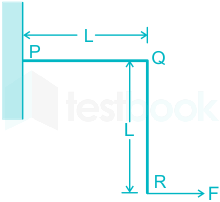
A plane frame PQR (fixed at P and free at R) is shown in the figure. Both members (PQ and QR) have length L, and flexural rigidity, EI. Neglecting the effect of axial stress and transverse shear, the horizontal deflection at free end R, is

  1. ((a))

    2FL32EI\frac{2FL^3}{2EI}

  2. ((b))

    FL32EI\frac{FL^3}{2EI}

  3. ((c))

    4FL33EI\frac{4FL^3}{3EI}

  4. ((d))

    5FL32EI\frac{5FL^3}{2EI}

Show Answer
Answer: ((c))

4FL33EI\frac{4FL^3}{3EI}

Concept:

To find slope and deflection of unsymmetric load Castigliano's theorem is used and the two theorems of Castigliano's for structural analysis are as follows:

Castigliano’s 1st theorem: 

The partial derivative of total strain energy of the system with respect to any particular deflection at a point is equal to the force applied at that point in the same direction as that of the deflection.

Uδ=w\frac{{\partial {\rm{U}}}}{{\partial {\rm{\delta }}}} = {\rm{w}}

Castigliano’s 2nd theorem: 

The partial derivative of strain energy of the system with respect to load at any point is equal to deflection at that point.

Uw=δ\frac{{\partial {\rm{U}}}}{{\partial {\rm{w}}}} = {\rm{\delta }}

Also, the partial derivative of strain energy of the system with respect to the couple at any point is equal to slope at that point.

UM=θ\frac{{\partial {\rm{U}}}}{{\partial {\rm{M}}}} = {\rm{\theta }}

Where U is the strain energy of the system.

Calculation:

Given:

First, we find strain energy of the frame,

U = UPQ + UQR

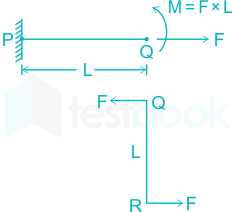
UPQ=M2L2EI=(FL)2L2EI=F2L32EI{U_{PQ}} = \frac{{{M^2}{L}}}{{2EI}}= \frac{{{(FL)^2}{L}}}{{2EI}}= \frac{{{F^2L^3}}}{{2EI}}

To find strain energy of member QR, consider a small element in member QR and Energy stored in the small element:

dU=Mx22EIdxdU = \frac{{M_x^2}}{{2EI}}dx

For member QR: Mx = Fx

\({U_{QR}} = \frac{1}{{2EI}}\mathop \smallint \limits_0^{{L}} {\left( { {M_x}} \right)^2}dx = \frac{1}{{2EI}}\mathop \smallint \limits_0^{L} {(Fx)^2}dx\)

UQR=F2L36EI{U_{QR}} = \frac{{{F^2}{L^3}}}{{6EI}}

U=UPQ+UQR=F2L32EI+F2L36EI=2F2L33EI\begin{array}{l} U = {U_{PQ}} + {U_{QR}} = \frac{{{F^2L^3}}}{{2EI}} + \frac{{{F^2L^3}}}{{6EI}} = \frac{{{2F^2}{L^3}}}{{3EI}} \end{array}

∴ By Castigliano’s theorem horizontal deflection at free end R is

(δH)R=UF=4FL33EI {(\delta _H)_R} = \frac{{\partial U}}{{\partial F}} = \frac{{4F{L^3}}}{{3EI}}

42

A power transmission mechanism consists of a belt drive and a gear train as shown in the figure.

Diameters of pulleys of belt drive and number of teeth (T) on the gears 2 to 7 are indicated in the figure. The speed and direction of rotation of gear 7, respectively, are

  1. ((a))

    255.68 rpm; anticlockwise

  2. ((b))

    255.68 rpm; clockwise

  3. ((c))

    575.28 rpm; anticlockwise

  4. ((d))

    575.28 rpm; clockwise

Show Answer
Answer: ((b))

255.68 rpm; clockwise

Concept:

Velocity Ratio of a belt drive:

The velocity ratio is the ratio of the speed of the driven pulley to that of the driving pulley. The speed is inversely related to the diameter of the pulley.

Velocity ratio = N2N1\frac {N_2}{N_1} = D1D2\frac {D_1}{D_2}

where, N1 = Speed of driver in rpm, N2 = Speed of follower in rpm, D1 = Diameter of the driver, D2 = Diameter of the follower.

Velocity ratio of gear:

In gear drive, the speed is inversely related to the diameter as well as teeth in gear.

Velocity ratio = N2N1\frac {N_2}{N_1} = T1T2\frac {T_1}{T_2}

where, N1 = Speed of the driver, N2 = Speed of the driven, T1 = Number of teeth on the driver, T2 = Number of teeth on the driven.

Note:

  • Two externally mating gear rotates in opposite direction.
  • In open belt drive, the direction of the driven pulley is the same, whereas in crossed belt drive the direction of the driven pulley is opposite.

Calculation:

Given:

D1 = 150 mm, D2 = 250 mm, N1 = 2500 rpm.

T2 = 18, T3 = 44, T4 = 15, T5 = 33, T6 = 36, T7 = 16
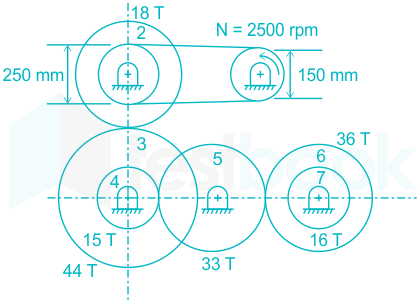
Let, the Clockwise (CW) direction of motion is taken as positive and Counter Clockwise (CCW) as negative.

Between pulley (1) and (2). 

N2N1\frac {N_2}{N_1} =  D1D2\frac {D_1}{D_2}

N22500\frac {N_2}{2500} = 150250\frac {150}{250}

N2 = 1500 rpm (CCW)  .... [∵ N1 = CCW]

Between gear 2 and gear 3:

Pulley 2 and gear 2 mounted on the same shaft, ∴ gear 2 has N2 = 1500 rpm CCW.

N3;=;N4N2\frac{{{N_3} ;= ;{N_4}}}{{{N_2}}} = T2T3\frac {T_2}{T_3}    [∵ N3 = N4 compound gear]

N4 = 1844\frac {18}{44} × 1500 = 613.64 rpm (CW)

Between gear 4 and gear 5:

N5N4\frac {N_5}{N_4} = T4T5\frac {T_4}{T_5}

N5 = 1533\frac {15}{33} × 613.64 = 278.93 rpm (CCW)

Between gear 5 and gear 6:

N6;=;N7N5\frac{{{N_6}; = ;{N_7}}}{{{N_5}}} = T5T6\frac {T_5}{T_6}

N7 = 3336\frac {33}{36} × 278.93 = 255.68 rpm (CW)

∴ N7 = 255.68 rpm (CW)

43

A machine of mass 100 kg is subjected to an external harmonic force with a frequency of 40 rad/s. The designer decides to mount the machine on an isolator to reduce the force transmitted to the foundation. The isolator can be considered as a combination of stiffness (K) and damper (damping factor, ζ) in parallel. The designer has the following four isolators:
  1. k = 640 kN/m, ζ = 0.70 

  2. k = 640 kN/m, ζ = 0.07

  3. k = 22.5 kN/m, ζ = 0.70

  4. k = 22.5 kN/m, ζ = 0.07

Arrange the isolators in the ascending order of the force transmitted to the foundation.

  1. ((a))

    4-3-1-2

  2. ((b))

    3-1-2-4

  3. ((c))

    1-3-2-4

  4. ((d))

    1-3-4-2

Show Answer
Answer: ((a))

4-3-1-2

Concept:

Transmissibility is defined as the ratio of force transmitted to the foundation (FT) to the disturbing force (F).

\(T=\frac{{{F}{T}}}{{{F}{un}}}=\frac{\sqrt{1+{{\left( 2\xi \frac{\omega }{{{\omega }{n}}} \right)}^{2}}}}{\sqrt{{{\left( 1-{{\left( \frac{\omega }{{{\omega }{n}}} \right)}^{2}} \right)}^{2}}+{{\left( 2\xi \frac{\omega }{{{\omega }_{n}}} \right)}^{2}}~}}\)

\({{\omega }{n}}=\sqrt{\frac{{{K}{eq}}}{m}}\)

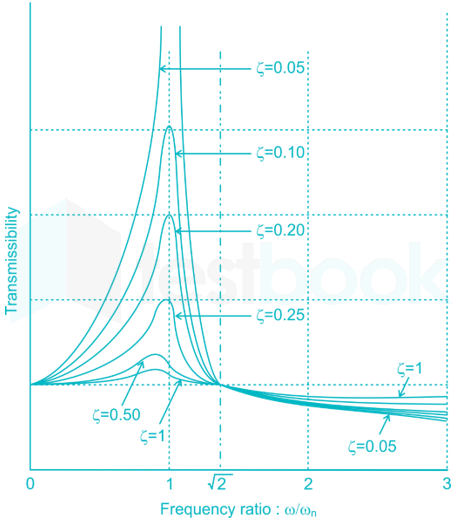
  • When ω/ωn = 0 ⇒ TR = 1, (independent of ζ)
  • When ω/ωn = 1 and ξ = 0 ⇒ TR = ∞, (independent of ζ)
  • When frequency ratio ω/ωn = √2, then all the curves pass through the point TR = 1 for all values of damping factor ξ.
  • When frequency ratio ω/ωn < √2, then TR > 1 for all values of damping factor ξ. This means that the force transmitted to the foundation through elastic support is greater than the force applied.
  • When frequency ratio ω/ωn > √2, then TR < 1 for all values of damping factor ξ. This shows that the force transmitted through elastic support is less than the applied force. Thus vibration isolation is possible only in the range of ω/ωn > √2. Here the force transmitted to the foundation increases as the damping is increased.

Calculation:

Given:

Forced frequency ω = 40 rad/s, m = 100 kg

We know force transmitted is directly proportional to the transmissibility ratio, more is the transmissibility ratio more is force transmitted.

The transmissibility ratio is proportional to the frequency ratio so we find the frequency ratio of each isolator.

  1. For k = 640 kN/m, ζ = 0.70

ωn=km=640×103100=80;rad/sec {\omega _n} = \sqrt {\frac{k}{m}} =\sqrt {\frac{640\times 10^3}{100}}= 80; rad/sec

ωωn=4080=0.5\frac{ \omega}{\omega _n} = \frac{40}{80} = 0.5

  1. For k = 640 kN/m, ζ = 0.07

ωn=km=640×103100=80;rad/sec {\omega _n} = \sqrt {\frac{k}{m}} =\sqrt {\frac{640\times 10^3}{100}}= 80; rad/sec

ωωn=4080=0.5\frac{ \omega}{\omega _n} = \frac{40}{80} = 0.5

  1. For k = 22.5 kN/m, ζ = 0.70

ωn=km=22.5×103100=15;rad/sec {\omega _n} = \sqrt {\frac{k}{m}} =\sqrt {\frac{22.5\times 10^3}{100}}= 15; rad/sec

ωωn=4015=2.66\frac{ \omega}{\omega _n} = \frac{40}{15} = 2.66

4) For k = 22.5 kN/m, ζ = 0.070

ωn=km=22.5×103100=15;rad/sec {\omega _n} = \sqrt {\frac{k}{m}} =\sqrt {\frac{22.5\times 10^3}{100}}= 15; rad/sec

ωωn=4015=2.66\frac{ \omega}{\omega _n} = \frac{40}{15} = 2.66

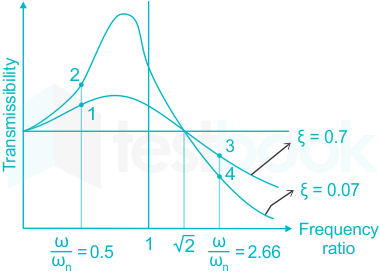
For the different values of ζ  and frequency ratios, the force transmitted graph has been plotted.

The isolators in the ascending order of the force transmitted to the foundation are 4-3-1-2.

44

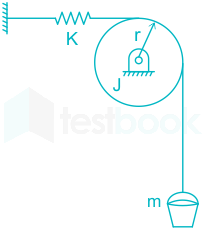
Consider the system shown in the figure. A rope goes over a pulley. A mass, m is hanging from the rope. A spring of stiffness, k is attached at one end of the rope. Assume rope is inextensible, massless and there is no slip between pulley and rope.

The pulley radius is r and its mass moment of inertia is J. Assume that the mass is vibrating harmonically about its static equilibrium position. The natural Frequency of the system is

  1. ((a))

    kr2J+mr2\sqrt{\frac{kr^2}{J + mr^2}}

  2. ((b))

    k/m\sqrt{k/m}

  3. ((c))

    kr2Jmr2\sqrt{\frac{kr^2}{J - mr^2}}

  4. ((d))

    kr2J\sqrt{\frac{kr^2}{J }}

Show Answer
Answer: ((a))

kr2J+mr2\sqrt{\frac{kr^2}{J + mr^2}}

Explanation:

Apply energy method:

Let system is displaced by a small angle 'θ' 

Since the system is in static equilibrium position

So net energy E, and dEdt=0 \frac{dE}{dt} =0

Energy of spring = U=12kx2\Rightarrow U = \frac{1}{2}kx^2

Energy of pulley during rotation U=12Jω2\Rightarrow U = \frac{1}{2}Jω^2

Energy of bucket mass m U=12mv2\Rightarrow U = \frac{1}{2}mv^2

Net energy  

E=12kx2+12Jω2+12mv2E= \frac{1}{2}kx^2 +\frac{1}{2}Jω^2 +\frac{1}{2}mv^2

x = rθ , w = θ˙\dot{\theta}, v = rω   

E=12kr2θ2+12Jθ˙2+12mr2w2E= \frac{1}{2}kr^2θ^2 +\frac{1}{2}J \dot{θ} ^2 +\frac{1}{2}mr^2w^2

E=12kr2θ2+12Jθ˙2+12mr2θ˙2E= \frac{1}{2}kr^2θ^2 +\frac{1}{2}J \dot{θ} ^2 +\frac{1}{2}mr^2\dot{θ}^2

dEdt=12kr2(2θ)θ˙+12J(2θ˙)θ¨+12mr2(2θ˙)θ¨=0\frac{dE}{dt}= \frac{1}{2}kr^2(2θ)\dot{\theta} +\frac{1}{2}J (2\dot{θ})\ddot\theta +\frac{1}{2}mr^2(2\dot{θ})\ddot\theta = 0

dEdt=kr2θθ˙+Jθ˙θ¨+mr2θ˙θ¨=0\frac{dE}{dt}= kr^2θ \dot{\theta} +J \dot{\theta}\ddot\theta +mr^2\dot{\theta}\ddot\theta =0

dEdt=kr2θ+Jθ¨+mr2θ¨=0\frac{dE}{dt}= kr^2θ +J \ddot\theta +mr^2\ddot\theta =0

dEdt=kr2θ+(J+mr2)θ¨=0\frac{dE}{dt}= kr^2θ +(J +mr^2)\ddot\theta =0

kr2θ+(J+mr2)θ¨=0 kr^2θ +(J +mr^2)\ddot\theta =0

θ¨+kr2θ(J+mr2)=0\ddot\theta+ \frac{kr^2θ} {(J +mr^2)} =0

Comparing θ¨+ωn2θ=0\ddot\theta+ {\omega^2_n\theta} {} =0

ωn2=kr2(J+mr2)\omega^2_n = \frac{kr^2} {(J +mr^2)}

ωn=kr2J+mr2\omega_n=\sqrt{\frac{kr^2}{J+ mr^2}}

45

Find the positive real root of x3 - x - 3 = 0 using Newton-Raphson method. If the starting guess (x0) is 2, the numerical value of the root after two iterations (x2) is __________ (round off to two decimal places).

46

Daily production capacity of a bearing manufacturing company is 30000 bearings. The daily demand for the bearing is 15000. The holding cost per year of keeping a bearing in the inventory is Rs. 20. The setup cost for the production of a batch is Rs. 1800. Assuming 300 working days in a year, the economic batch quantity in number of bearings is ________ (in integer).

47

A cast product of a particular material has dimensions 75 mm × 125 mm × 20 mm. The total solidification time for the cast product is found to be 2.0 minutes as calculated using Chvorinov's rule having the index, n = 2. If under the identical casting conditions, the cast product shape is changed to a cylinder having diameter = 50 mm and height = 50 mm, the total solidification time will be _________ minutes (round off to two decimal places).

48

A spot welding operation performed on two pieces of steel yielded a nugget with a diameter of 5 mm and a thickness of 1 mm. The welding time was 0.1 s. The melting energy for the steel is 20 J/mm3. Assuming the heat conversion efficiency as 10% the power required for performing the spot welding operation is _____ kW (round off to two decimal places).

49

A surface grinding operation has been performed on a Cast Iron plate having dimensions 300 mm (length) × 10 mm (width) × 50 mm (height). The grinding was performed using an alumina wheel having a wheel diameter of 150 mm and wheel width of 12 mm. The grinding velocity used is 40 m/s, table speed is 5 m/min, depth of cut per pass is 50 μm and the number of grinding passes is 20. The average tangential and average normal forces for each pass are found to be 40 N and 60 N respectively. The value of the specific grinding energy under the aforesaid grinding conditions is ________ J/mm3 (round off to one decimal place).

50

In a pure orthogonal turning by a zero rake angle single point carbide cutting tool, the shear force has been computed to be 400 N. If the cutting velocity, Vc = 100 m/mm, depth of cut, t = 2.0 mm, feed, s0 = 0.1 mm/revolution and chip velocity, Vf = 20 m/min, then the shear strength, τs of the material will be _____ MPa (round off to two decimal places).

51

The thickness, width and length of a metal slab are 50 mm, 250 mm and 3600 mm, respectively. A rolling operation on this slab reduces the thickness by 10% and increases the width by 3%. The length of the rolled slab is _____ mm. (round off to one decimal place).

52

A 76.2 mm gauge block is used under one end of a 254 mm sine bar with roll diameter of 25.4 mm. The height of gauge blocks required at the other end of the sine bar to measure an angle of 30° is _______ mm (round off to two decimal places).

53

The demand and forecast of an item for five months are given in the table.

MonthDemandForecast
April225200
May220240
June285300
July290270
August250230

The Mean Absolute Percent Error (MAPE) in the forecast is ___________% (round off to two decimal places).

54

A shell and tube heat exchanger is used as a steam condenser. Coolant water enters the tube at 300 K at a rate of 100 kg/s. The overall heat transfer coefficient is 1500 W/m2K, and the total heat transfer area is 400 m2. Steam condenses at a saturation temperature of 350 K. Assume that the specific heat of coolant water is 4000 J/kg-K. The temperature of the coolant water coming out of the condenser is ____________ K (round off to the nearest integer).

55

Ambient air flows over a heated slab having flat, top surface at y = 0. The local temperature (in Kelvin) profile within the thermal boundary layer is given by T(y) = 300 + 200 exp(-5y), where y is the distance measured from the slab surface in meters. If the thermal conductivity of air is 1.0 W/m.K and that of the slab is 100 W/m.K, then the magnitude of temperature gradient |dT/dy| within the slab at y = 0 is ______  K/m (round off to the nearest integer).

56

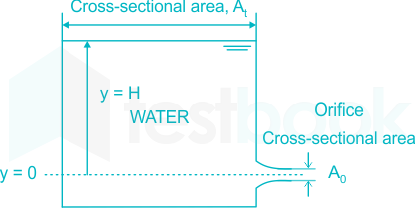
Water flows out from a large tank of cross-sectional area At = 1 m2 through a small rounded orifice of cross-sectional area Ao = 1 cm2, located at y = 0. Initially the water level (H), measured from y = 0, is 1 m. The acceleration due to gravity is 9.8 m/s2.

Neglecting any losses, the time taken by water in the tank to reach a level of y = H / 4 is __________ seconds (round off to one decimal place).

57

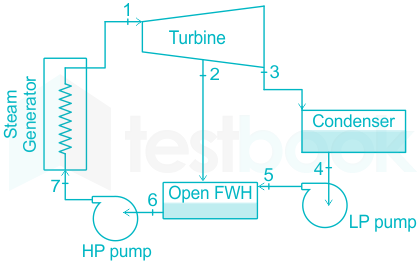
Consider the open feed heater (FWH) shown in the figure given below:

Specific enthalpy of steam at location 2 is 2624 kJ/kg. Specific enthalpy of water at location 5 is 226.7 kJ/kg and specific enthalphy of saturated water at at location 6 is 708.6 kJ/kg. If the mass flow rate of water entering the open feed water heater (at location 5) is 100 kg/s then the mass flow rate of steam at location 2 will be _____ kg/s (round off to one decimal place)

58

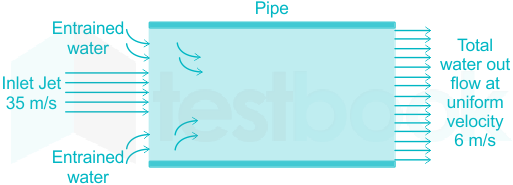
A high velocity water jet of cross section area = 0.01 m2 and velocity = 35 m/s enters a pipe filled with stagnant water. The diameter of the pipe is 0.32 m. This high velocity water jet entrains additional water from the pipe and the total water leaves the pipe with a velocity 6 m/s shown in the figure.

The flow rate of entrained water is ______ liters/s (round off to two decimal places).

59

A vertical shaft Francis turbine rotates at 300 rpm. The available head at the inlet to the turbine is 200 m. The tip speed of the rotor is 40 m/s. Water leaves the runner of the turbine without whirl. Velocity at the exit of the draft tube is 3.5 m/s. The head losses in different components of the turbine are : 

(i) stator and guide vanes : 5.0 m,

(ii) rotor: 10 m, and 

(iii) draft tube: 2 m.

Flow rate through the turbine is 20 m3/s. Take g = 9.8 m/s2. The hydraulic efficiency of the turbine is _____% (round off to one decimal place).

60

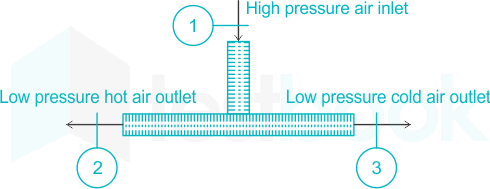
An adiabatic vortex tube, shown in the figure given below is supplied with 5 kg/s of air (inlet 1) at 500 kPa and 300 K. Two separate streams of air are leaving the device from outlets 2 and 3. Hot air leaves the device at a rate of 3 kg/s from outlet 2 at 100 kPa and 340 K, while 2 kg/s of cold air stream is leaving the device from outlet 3 at 100 kPa and 240 K.

Consider constant specific heat of air is 1005 J/kg.K and gas constant is 287 J/kg.K. There is no work transfer across the boundary of this device. The rate of entropy generation is ___________ kW/K (round off to one decimal place).

61

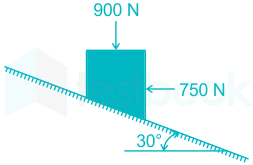
A block of negligible mass rests on a surface that is inclined at 30° to the horizontal plane as shown in the figure. When a vertical force of 900 N and a horizontal force of 750 N are applied, the block is just about to slide.

The coefficient of static friction between the block and surface is _______ (round off to two decimal places).

62

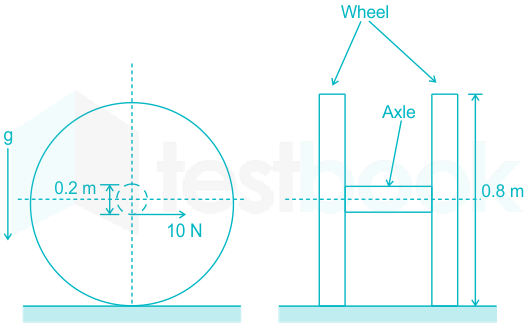
The wheels and axle system lying on a rough surface is shown in the figure.

Each wheel has diameter 0.8 m and mass 1 kg. Assume that the mass of the wheel is concentrated at rim and neglect the mass of the spokes. The diameter of axle is 0.2 m and its mass is 1.5 kg. Neglect the moment of inertia of the axle and assume g = 9.8 m/s2. An effort of 10 N is applied on the axle in the horizontal direction shown at mid span of the axle. Assume that the wheels move on a horizontal surface without slip. The acceleration of the wheel axle system in horizontal direction is _____ m/s2 (round off to one decimal place)

63

A cantilever beam with a uniform flexural rigidity (EI = 200 × 106 Nm2) is loaded with a concentrated force at its free end. The area of the bending moment diagram corresponding to the full length of the beam is 10000 Nm2. The magnitude of the slope of the beam at its free end is ______ micro radian (round off to the nearest integer).

64

The torque provided by an engine is given by T(θ) = 12000 + 2500 sin (2θ) N.m, where θ is the angle turned by the crank from the inner dead centre. The mean speed of the engine is 200 rpm and it drives a machine that provides constant resisting torque. If variation of the speed from the mean speed is not to exceed ±0.5%, the minimum mass moment of inertia of the flywheel should be ________ kg.m2 (round off to the nearest integer).

65

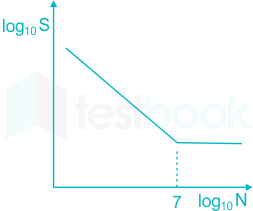
The figure shows the relationship between fatigue strength (S) and fatigue life (N) of a material. The fatigue strength of the material for a life of 1000 cycles is 450 MPa, while its fatigue strength for a life of 106 cycles is 150 MPa.

The life of a cylindrical shaft made of this material subjected to an alternating stress of 200 MPa will then be ____________ cycles (round off to the nearest integer).

Attempt this paper under real exam conditions

Timed interface, section switching, instant scoring, and question-by-question analytics — free.

Start Timed Attempt