Official Paper

GATE ME 2020 Official Paper: Shift 2 (Previous Year Paper)

65 questions · 180 minutes · with answers · free

General Aptitude (10 questions)

1

While I agree ______ his proposal this time, I do not often agree ______ him.

  1. ((a))

    to, with

  2. ((b))

    with, to

  3. ((c))

    with, with

  4. ((d))

    to, to

Show Answer
Answer: ((a))

to, with

Explanation:

In the first blank, the word ‘to’ is the correct word because according to the rule with the words like proposal, idea, suggestion, view, opinion etc. we have to use ‘to’ preposition only.

In the second blank, ‘with’ must be the correct option because while referring to some person ‘with’ is used only by rule.

2

The recent measures to improve the output would ______ the level of production to our satisfaction.

  1. ((a))

    increase

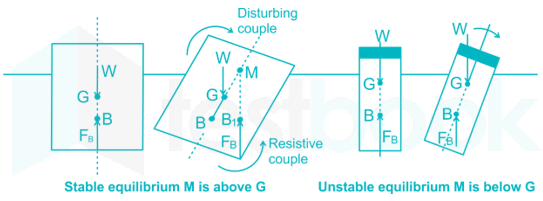
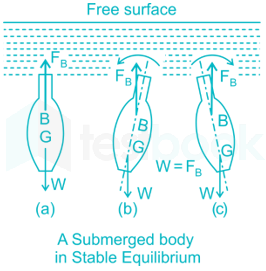
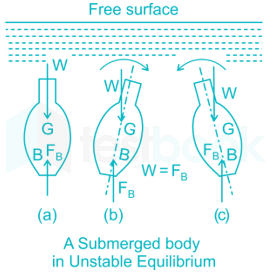
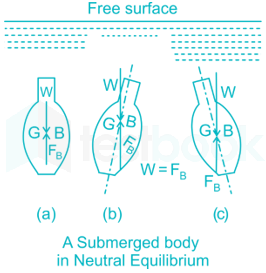
  2. ((b))

    decrease

  3. ((c))

    speed

  4. ((d))

    equalise

Show Answer
Answer: ((a))

increase

The correct answer is option 1 i.e. increase.

Key Points

  • After reading the sentence we can easily comprehend that recent measures have been taken in order to improve the output, now we can ask ourselves how can we increase output? and then let's go through each option one by one.
  • Here "would' is a modal so the word in the blank must be in base form (V1). It is quite obvious that to increase the output we must increase production(output and production are directly proportional) hence, 'decrease' 'speed' and 'equalise' are inappropriate choices.

Complete Sentence: The recent measures to improve the output would increase the level of production to our satisfaction.

3

Select the word that fits the analogy:

White : Whitening ∷ Light : _____

  1. ((a))

    Lightning

  2. ((b))

    Lightening

  3. ((c))

    Lighting

  4. ((d))

    Enlightening

Show Answer
Answer: ((b))

Lightening

The correct answer is option 2 i.e. Lightening.

From the first part of the analogy, it becomes clear that a noun is needed after its corresponding adjective. White is an adjective (color) and it is related to Whitening (noun) that means the act or process of making or becoming white. Similarly, light is also an adjective that means having little weight and it is related to 'lightening' i.e. to reduce in weight or quantity.

The meaning of the rest of the options are given below:

  • Lightning: the flashing of light produced by a discharge of atmospheric electricity.
  • Lighting : illumination or ignition.
  • Enlightening: providing or tending to provide knowledge, understanding, or insight.
4

In one of the greatest innings ever seen in 142 years of Test history, Ben Stokes upped the tempo in a five-and-a-half hour-long stay of 219 balls including 11 fours and 8 sixes that saw him finish on a 135 not out as England squared the five-match series.

Based on their connotations in the given passage, which one of the following meanings DOES NOT match?

  1. ((a))

    upped = increased

  2. ((b))

    squared = lost

  3. ((c))

    tempo = enthusiasm

  4. ((d))

    saw = resulted in

Show Answer
Answer: ((b))

squared = lost

Explanation:

Squared means ‘making the score even/equal’ and the meaning given in the option is incorrect.

“Upped the tempo” means to increase the interest toward the game by playing so long.

“Saw him finish” means playing so long and making so many runs results in making 135 runs and equals the five matches series.

5

There are five levels {P, Q, R, S, T} in a linear supply chain before a product reaches customers, as shown in the figure.

At each of the five levels, the price of the product is increased by 25%. If the product is produced at level P at the cost of Rs. 120 per unit, what is the price paid (in rupees) by the customers?

  1. ((a))

    187.50

  2. ((b))

    234.38

  3. ((c))

    292.96

  4. ((d))

    366.21

Show Answer
Answer: ((d))

366.21

Concept:

Price paid by customer at end = initial cost × (increased percentage)n

Where,

n = no. of levels

Calculation:

Given:

Cost of product at first level P = 120 Rupees.

Also,

It is increased by 25% in each level.

Hence,

Initial cost = 120 Rupees.,

Increased percentage = 25%,

n = 5

Now,

Price paid by customer at end = 120 × 1.255 Rupees

∴ Price paid by customer at end = 366.21 Rupees.

6

Climate change and resilience deal with two aspects – reduction of sources of non-renewable energy resources and reducing vulnerability of climate change aspects. The terms ‘mitigation’ and ‘adaptation’ are used to refer to these aspects, respectively.

Which of the following assertions is best supported by the above information?

  1. ((a))

    Mitigation deals with consequences of climate change.

  2. ((b))

    Adaptation deals with causes of climate change.

  3. ((c))

    Mitigation deals with actions taken to reduce the use of fossil fuels.

  4. ((d))

    Adaptation deals with actions taken to combat green-house gas emissions.

Show Answer
Answer: ((c))

Mitigation deals with actions taken to reduce the use of fossil fuels.

The correct answer is Option 3 i.e. Mitigation deals with actions taken to reduce the use of fossil fuels.

After reading the above paragraph one can easily comprehend that mitigation deals with the steps or action taken to reduce the consumption of non-renewable energy resources like fossil fuels whereas, Adaptation deals with reducing the vulnerability of climate change aspects, now let's go through each option one by one.

  • Option 1 states that- "Mitigation deals with consequences of climate change.", this option is incorrect because it has already been mentioned in the passage that it deals with the steps or action taken to reduce the consumption of non-renewable energy resources like fossil fuels.
  • Option 2 states that- "Adaptation deals with causes of climate change.", this option is incorrect, it has been clearly mentioned in the passage that adaptation deals with reducing the vulnerability of climate change aspect.
  • Option 4 states that- "Adaptation deals with actions taken to combat green-house gas emissions.", adaptation specifically deals with the action taken to reduce vulnerability on climate change aspects, it has nothing to do with green-house gas emissions. Hence, this option is incorrect.
7

Find the missing element in the following figure.

  1. ((a))

    d

  2. ((b))

    e

  3. ((c))

    w

  4. ((d))

    y

Show Answer
Answer: ((a))

d

Assign all the corner letters numbers as.

a = 1, b = 2, c = 3 and so on.

Assume “n = 4” which is at the centre     (by looking at the problem)

5 + 4 = 9

Now, t = 20 and x = 24

∴ x = t + n

⇒ 24 = 20 + n

⇒ n = 4   

∴ Our assumption is correct.

Now, h = 8

Case 1

h + n = unknown

8 + 4 = 12 = L (not in the option)

Case 2

Unknown + n = h

⇒ Unknown + 4 = 8

Unknown = 4 = d

8

It was estimated that 52 men can complete a strip in a newly constructed highway connecting cities P and Q in 10 days. Due to an emergency, 12 men were sent to another project. How many numbers of days, more than the original estimate, will be required to complete the strip?

  1. ((a))

    3 days

  2. ((b))

    5 days

  3. ((c))

    10 days

  4. ((d))

    13 days

Show Answer
Answer: ((a))

3 days

Concept:

M1 × D1 = M2 × D2

Where,

M1 = Number of men in initial condition, M2 = Number of men in final condition

D1 = Number of days required in the initial condition,

D2 = Number of days required in the final condition

Calculation:

Given:

M1 = 52,

D1 = 10, M2 = 52 - 12 = 40,

D2 = ?

52 × 10 = 40 × D­2

D2 = 13 days

Now,

Numbers of days more than the original estimate is equal to:

Number of days required in the final condition - Number of days required in the initial condition

∴ Numbers of days more than the original estimate = D2 D1

∴ Numbers of days more than the original estimate = 13 – 10

∴ Numbers of days more than the original estimate = 3 days

9

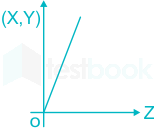
An engineer measures THREE quantities X, Y and Z in an experiment. She finds that they follow a relationship that is represented in the figure below: (the product of X and Y linearly varies with Z)

Then, which of the following statements is FALSE?

  1. ((a))

    For fixed Z; X is proportional to Y

  2. ((b))

    For fixed Y; X is proportional to Z

  3. ((c))

    For fixed X; Z is proportional to Y

  4. ((d))

    XY/Z is constant

Show Answer
Answer: ((a))

For fixed Z; X is proportional to Y

As line passes through the origin

(X × Y) = mZ (where m is the slope of the line)

Case 1:

For constant Z,

X × Y = Constant

X=ConstantY{\rm{X}} = \frac{{{\rm{Constant}}}}{{\rm{Y}}}

X1Y\therefore {\rm{X}} \propto \frac{1}{{\rm{Y}}}

X is inversely proportional to Y.

Case 2:

For constant Y,

X × constant = constant × Z

X = constant × Z

∴ X ∝ Z

X is directly proportional to Z

Case 3:

For constant X,

constant × Y = constant × Z

Y = constant × Z

∴ Y ∝ Z

Y is directly proportional to Z

Case 4:

(X × Y) = mZ

(X × Y) = constant × Z

X×YZ=Constant;\therefore \frac{{{\rm{X}} \times {\rm{Y}}}}{{\rm{Z}}} = {\rm{Constant;}}

10

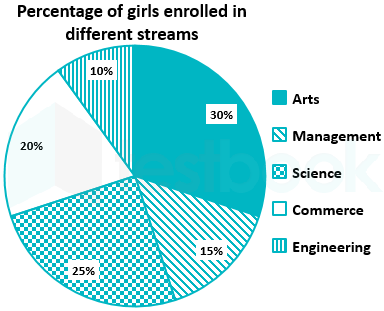
The two pie-charts given below show the data of total students and only girls registered in different streams in a university. If the total number of students registered in the university is 5000, and the total number of the registered girls is 1500; then, the ratio of boys enrolled in Arts to the girls enrolled in Management is ______.

  1. ((a))

    2 : 1

  2. ((b))

    9 : 22

  3. ((c))

    11 : 9

  4. ((d))

    22 : 9

Show Answer
Answer: ((d))

22 : 9

Total number of students in the University = 5000

Total number of girls = 1500

Total number of students in arts (students) arts = 0.2 × 5000 = 1000

Total number of girls in arts (girls) arts = 0.3 × 1500 = 450

∴ Total number of boys in arts (boys) arts = (students)arts – (girls)arts

⇒ (boys)arts = 1000 – 450

⇒ (boys)arts = 550

Total number of girls in management (girls) management = 0.15 × 1500

⇒ (girls) management = 225

\(\therefore \frac{{{{\left( {{\rm{boys}}} \right)}{{\rm{arts}}}}}}{{{{\left( {{\rm{girls}}} \right)}{{\rm{management}}}}}} = \frac{{550}}{{225}} = \frac{{22}}{9} = 22;:9\)

Mechanical Engineering (55 questions)

11

The sum of two normally distributed random variables X and Y is

  1. ((a))

    always normally distributed

  2. ((b))

    normally distributed, only if X and Y are independent

  3. ((c))

    normally distributed, only if X and Y have the same standard deviation

  4. ((d))

    normally distributed, only if X and Y have the same mean

Show Answer
Answer: ((b))

normally distributed, only if X and Y are independent

Explanation:

Normal Sum Theorem:

According to the normal sum theorem, two statistically independent normal variables sum to another normal variable, 

N1(m1,;a12)+N2(m2,a22)=N(m1+m2,a12+a22){N_1}\left( {{m_1},;a_1^2} \right) + {N_2}\left( {{m_2},a_2^2} \right) = N\left( {{m_1} + {m_2},a_1^2 + a_2^2} \right)

When N1(m1,;a12){N_1}\left( {{m_1},;a_1^2} \right) and N2(m2,a22){N_2}\left( {{m_2},a_2^2} \right) are statistically independent. The mean and variance of sum of a statistically independent random variable is the sum of the individual mean and variances.

12

A matrix P is decomposed into its symmetric part S and skew symmetric part V.

If \({\rm{S}} = \left( {\begin{array}{{20}{c}} { - 4}&4&2\ 4&3&{7/2}\ 2&{7/2}&2 \end{array}} \right),{\rm{;V}} = \left( {\begin{array}{{20}{c}} 0&{ - 2}&3\ 2&0&{7/2}\ { - 3}&{ - 7/2}&0 \end{array}} \right)\)

then matrix P is

  1. ((a))

    \(\left( {\begin{array}{*{20}{c}} { - 4}&6&{ - 1}\ 2&3&0\ 5&7&2 \end{array}} \right)\)

  2. ((b))

    \(\left( {\begin{array}{*{20}{c}} { - 4}&2&5\ 6&3&7\ { - 1}&0&2 \end{array}} \right)\)

  3. ((c))

    \(\left( {\begin{array}{*{20}{c}} 4&{ - 6}&1\ { - 2}&{ - 3}&0\ { - 5}&{ - 7}&{ - 2} \end{array}} \right)\)

  4. ((d))

    \(\left( {\begin{array}{*{20}{c}} { - 2}&{9/2}&{ - 1}\ { - 1}&{81/4}&{11}\ { - 2}&{45/2}&{73/4} \end{array}} \right)\)

Show Answer
Answer: ((b))

\(\left( {\begin{array}{*{20}{c}} { - 4}&2&5\ 6&3&7\ { - 1}&0&2 \end{array}} \right)\)

Concept:

Every square matrix is expressed as the sum of symmetric and skew-symmetric matrix. Here, S is symmetric matrix and V is skew-symmetric matrix.

∴ P = S + V

Calculation:

\(P = ;\left[ {\begin{array}{{20}{c}} { - 4}&4&2\ 4&3&{\frac{7}{2}}\ 2&{\frac{7}{2}}&2 \end{array}} \right] + \left[ {\begin{array}{{20}{c}} 0&{ - 2}&3\ 2&0&{\frac{7}{2}}\ { - 3}&{ - \frac{7}{2}}&0 \end{array}} \right]\)

\(\therefore P = ;\left[ {\begin{array}{*{20}{c}} { - 4}&2&5\ 6&3&7\ { - 1}&0&2 \end{array}} \right]\)

13

Let \(I = \mathop \smallint \nolimits_{x = 0}^1 \mathop \smallint \nolimits_{y = 0}^{{x^2}} x{y^2}dydx.\) Then, I may also be expressed as

  1. ((a))

    \(\mathop \smallint \nolimits_{y = 0}^1 \mathop \smallint \nolimits_{x = 0}^{\sqrt y } x{y^2}dxdy\)

  2. ((b))

    \(\mathop \smallint \nolimits_{y = 0}^1 \mathop \smallint \nolimits_{x = \sqrt y }^1 y{x^2}dxdy\)

  3. ((c))

    \(\mathop \smallint \nolimits_{y = 0}^1 \mathop \smallint \nolimits_{x = \sqrt y }^1 x{y^2}dxdy\)

  4. ((d))

    \(\mathop \smallint \nolimits_{y = 0}^1 \mathop \smallint \nolimits_{x = 0}^{\sqrt y } y{x^2}dxdy\)

Show Answer
Answer: ((c))

\(\mathop \smallint \nolimits_{y = 0}^1 \mathop \smallint \nolimits_{x = \sqrt y }^1 x{y^2}dxdy\)

Given:

\(I = \mathop \smallint \nolimits_{x = 0}^1 \mathop \smallint \nolimits_{y = 0}^{{x^2}} x{y^2}dydx\)

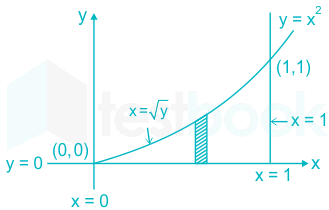
0 ≤ y ≤ x2 (this is represented by vertical strip)

And x varies from 0 to 1.

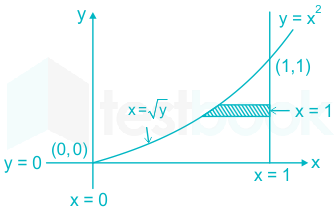
Now if we change the order of integration, we have to draw a horizon strip.

After changing the order of Integration

yx1\sqrt y \le x \le 1

And, 0 ≤ y ≤ 1

∴ \(I = \mathop \smallint \nolimits_{y = 0}^1 \mathop \smallint \nolimits_{x = \sqrt y }^1 x{y^2}dxdy\)

14

The solution of d2ydt2y=1,\frac{{{d^2}y}}{{d{t^2}}} - y = 1, which additionally satisfies \({\left. y \right|{t = 0}} = {\left. {\frac{{dy}}{{dt}}} \right|{t = 0}} = 0\) in the Laplace s-domain is

  1. ((a))

    1s(s+1)(s1)\frac{1}{{s\left( {s + 1} \right)\left( {s - 1} \right)}}

  2. ((b))

    1s(s+1)\frac{1}{{s\left( {s + 1} \right)}}

  3. ((c))

    1s(s1)\frac{1}{{s\left( {s - 1} \right)}}

  4. ((d))

    1s1\frac{1}{{s - 1}}

Show Answer
Answer: ((a))

1s(s+1)(s1)\frac{1}{{s\left( {s + 1} \right)\left( {s - 1} \right)}}

Concept:

Few necessary Laplace transform properties are given below,

L[f"(t)] = s2L[f(t)] - sf(0) - f'(0) 

L[f'(t)] = sL[f(t)]- f(0)

Calculation: 

Here, the given equation is d2ydt2y=1,\frac{{{d^2}y}}{{d{t^2}}} - y = 1,

⇒ L (y" – y) = L(y") - L(y) = L (1)

d2ydt2y=1,\frac{{{d^2}y}}{{d{t^2}}} - y = 1,

The above equation can be written as:

f"(y) – y = 1

Now for calculation the laplace domain of the above equation:

L (y" – y)

∴ L(y") - L(y) = L (1)

[s2L(y) - sy(0) - y'(0)] – [L(y)] = L(1)

s2[L(y)]L(y)]=1s;\therefore {s^2}\left[ {L\left( y \right)} \right] - L\left( y \right)] = \frac{1}{s};

L(y);[s2;;1];=1s;\therefore {\rm{L}}\left( {\rm{y}} \right){\rm{;}}\left[ {{{\rm{s}}^2}{\rm{;}}-{\rm{;}}1} \right]{\rm{;}} = \frac{1}{s};

L(y)=;1s(s21)\therefore {\rm{L}}\left( {\rm{y}} \right) = {\rm{;}}\frac{1}{{s\left( {{s^2} - 1} \right)}}

L(y)=1s(s+1)(s1)\therefore {\rm{L}}\left( {\rm{y}} \right) = \frac{1}{{s\left( {s + 1} \right)\left( {s - 1} \right)}}

15

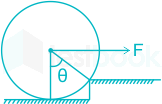
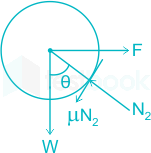
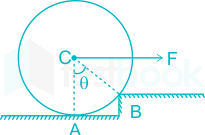
An attempt is made to pull a roller of weight W over a curb (step) by applying a horizontal force F as shown in the figure.

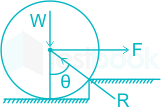
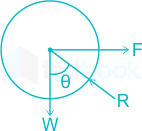
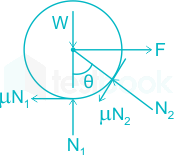
The coefficient of static friction between the roller and the ground (including the edge of the step) is μ. Identify the correct free body diagram (FBD) of the roller when the roller is just about to climb over the step.

  1. ((a))

  2. ((b))

  3. ((c))

  4. ((d))

Show Answer
Answer: ((b))

Explanation:

When the roller is just about to climb the step then, 

  • Static friction at point A is zero because when the cylinder is about to make out of the curb, it will lose its contact at A, the only contact will be at point B.
  • At point B, the roller will be in a state of pure rolling so even the surfaces are rough there will be no friction at point B.
  • Force F, contact force at point B, and weight of the roller W will be concurrent at point C.
<br>

Therefore the free body diagram will be as follows

16

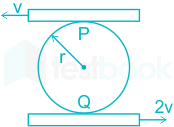
A circular disk of radius r is confined to roll without slipping at P and Q as shown in the figure.

If the plates have velocities as shown, the magnitude of the angular velocity of the disk is

  1. ((a))

    v/r

  2. ((b))

    v/2r

  3. ((c))

    2v/3r

  4. ((d))

    3v/2r

Show Answer
Answer: ((d))

3v/2r

Concept:

For pure rolling of the disc between the plates at the point of contact, the velocity of the disc will be equal to the velocity of the plate.

The velocity of the disc at the point of contact will be equal to the product of distance of the instantaneous centre from the point of rotation and the angular velocity of the disc.

Calculation:

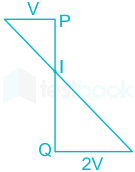
The instantaneous centre of rotation of the disc can be found by drawing the line perpendicular to the velocity and using the proportionality of velocity and distance from the instantaneous centre to create similar triangles

Velocity at point P, V = IP × ω

Velocity at point Q, 2V= IQ × ω

Then from similar triangle

V2V=IPIQ\frac{V}{{2V}} = \frac{{IP}}{{IQ}}

IQ=2;IP \Rightarrow IQ = 2;IP

and the sum of IP + IQ is the diameter of the disc

Then IP + IQ = 2r

⇒ IP + 2 IP = 2r

IP=2r3IP = \frac{{2r}}{3}

Now V = IP × ω

V=2r3×ω \Rightarrow V = \frac{{2r}}{3} \times \omega

ω=3V2r\omega = \frac{{3V}}{{2r}}

17

The equation of motion of a spring-mass-damper system is given by

d2xdt2+3dxdt+9x=10sin(5t)\frac{{{d^2}x}}{{d{t^2}}} + 3\frac{{dx}}{{dt}} + 9x = 10\sin \left( {5t} \right)

The damping factor for the system is

  1. ((a))

    0.25

  2. ((b))

    0.5

  3. ((c))

    2

  4. ((d))

    3

Show Answer
Answer: ((b))

0.5

Concept:

Damping;factor;=ζ=c2km{\rm{Damping;factor;}} = \zeta = \frac{c}{{2\sqrt {km} }}

Where,

ζ = damping factor, c = coefficient of damping, k = spring constant, m = mass

Calculation:

Given:

d2xdt2+3dxdt+9x=10sin(5t)\frac{{{d^2}x}}{{d{t^2}}} + 3\frac{{dx}}{{dt}} + 9x = 10\sin \left( {5t} \right)

By comparing this equation with mx¨+cx˙+kx=F(t)m\ddot x + c\dot x + kx = F(t)

m = 1 kg, c = 3 N s/m, k = 9 N/m,

ζ=32;9×1;{\rm{\zeta }} = \frac{3}{{2;\sqrt {9 \times 1} ;}}

ζ;=36{\rm{\zeta ;}} = \frac{3}{6}

∴ ζ = 0.5

18

The number of qualitatively distinct kinematic inversions possible for a Grashof chain with four revolute pairs is

  1. ((a))

    1

  2. ((b))

    2

  3. ((c))

    3

  4. ((d))

    4

Show Answer
Answer: ((c))

3

Explanation:

The following points are important about the inversion of a kinematic chain:

  • The inversions of a kinematic chain are obtained by fixing different links one at a time.
  • For a kinematic chain consisting of 4 links, the maximum possible kinematic inversions are four.
  • The qualitatively distinct inversions mean that all the inversions should be able to convert the input into a distinct output.


A 4 revolute pair chain is called the Grashof chain if the following condition is satisfied:

l + s < p + q (Class-I four-bar linkage)

i.e. the sum of the shortest and longest link should not be greater than the other two.

If a Grashof chain with 4 revolute pairs is considered then the following three distinct inversions are possible.

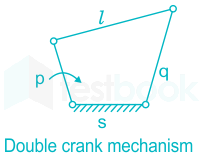
Double crank:

A double-crank results when the shortest link is fixed.

In this mechanism both the driving and the driven links make a complete rotation.

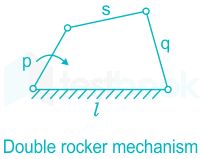
Double rocker:

A double rocker results when the shortest link is made coupler.

In this mechanism, both the driving and the follower links make only oscillations and none of them makes a complete rotation.

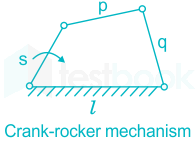
Crank-rocker:

If the link adjacent to the shortest link is fixed then it results in a crank-rocker.

In this mechanism, the driving link makes complete rotation and the driven link makes only oscillation.

Class-II four-bar linkage:

When the sum of the lengths of the largest and the shortest links is more than the sum of the lengths of the other two links, the linkage is known as class-II, four-bar linkage i.e. l + s > p + q.

In such links, fixing of any of the links always results in a rocker-rocker or double rocker mechanisms.

In other words, the mechanism and its inversions give the same type of motion i.e. (not distinct).

19

The process, that uses a tapered horn to amplify and focus the mechanical energy for machining of glass, is

  1. ((a))

    electrochemical machining

  2. ((b))

    electrical discharge machining

  3. ((c))

    ultrasonic machining

  4. ((d))

    abrasive jet machining

Show Answer
Answer: ((c))

ultrasonic machining

Explanation:

The unconventional machining process and their characteristics and the application areas are discussed in the table below:

Type Of MachiningMechanics Of Material RemovalMediumTool MaterialMaterial Application
Ultrasonic machiningBrittle fracture caused by the impact of abrasive grain due to tool vibrating at high frequency (Amplified by tapered horn).SlurryTough and ductile (soft steel)The hard and brittle material, semiconductor, non-metals( eg. Glass and ceramic).
Abrasive Jet MachiningBrittle fracture by impinging abrasive grains at high speed.Air, CO2Abrasives (Al2O3, ­­SiC), Nozzle (WC, sapphire)Hard and Brittle metal and non-metallic material.
Electric discharge machiningMelting and evaporation, aided by cavitation.Dielectric fluidCopper, brass, graphiteAll conducting metals and alloys
Electrochemical machiningElectrolysisConducting electrolyteCopper, brass, steelAll conducting metals and alloys
Electron beam machiningMelting and vapourisationvacuumA beam of an electron moving at high velocityAll material.
Laser beam machiningMelting and vapourisationNormal atmosphereA high power laser beam (Ruby rod)All material.
20

Two plates, each of 6 mm thickness, are to be butt-welded. Consider the following processes and select the correct sequence in increasing order of size of the heat affected zone.

  1. Arc welding
  2. MIG welding
  3. Laser beam welding
  4. Submerged arc welding
  1. ((a))

    1-4-2-3

  2. ((b))

    3-4-2-1

  3. ((c))

    4-3-2-1

  4. ((d))

    3-2-4-1

Show Answer
Answer: ((d))

3-2-4-1

Heat Affected Zone (HAZ):  

  • The area of the base material of metal which is affected by the heat of the welding process. Melting of the base material does not occur here only microstructure is changed.
  • Heat affected zone may range from small to large depending on the rate of heat input. A process with low rates of heat input will result in a large HAZ.
  • The size of HAZ also increases as the speed of the welding process decreases.


Size;of;HAZ;1speed;of;welding{\rm{Size;of;HAZ}}; \propto \frac{1}{{speed;of;welding}}

So, order of welding processes in increasing speed is

Arc welding → Submerged Arc welding → MIG welding → Laser Beam welding

Therefore, the order of size of the heat affected zone in increasing sequence is

Laser Beam welding → MIG welding → Submerged Arc welding → Arc welding 

Important Points

Butt welding:  Joining of metal by its whole cross section side by side.

21

Which one of the following statements about a phase diagram is INCORRECT?

  1. ((a))

    It indicates the temperature at which different phases start to melt

  2. ((b))

    Relative amount of different phases can be found under given equilibrium conditions

  3. ((c))

    It gives information on transformation rates

  4. ((d))

    Solid solubility limits are depicted by it

Show Answer
Answer: ((c))

It gives information on transformation rates

Phase diagram:  

  • The graphical representation of the values of thermodynamic variables when system is in equilibrium. Thermodynamic variables changes as temperature changes.
  • An equilibrium phase diagram presents the phases and phase changes under equilibrium conditions, but it provides no information about the rates of transformation.
  • Although changes in pressure, composition or temperature can cause phase transformations, it is temperature changes that are more important.


Phase diagram classified as.

  1. Unary diagram: If a system consists of just one component e.g. water
  2. Binary diagram: If a system consists of two components. It can be either two metals (Cu and Ni), or a metal and a compound (Fe and Fe3C), or two compounds.
<br>

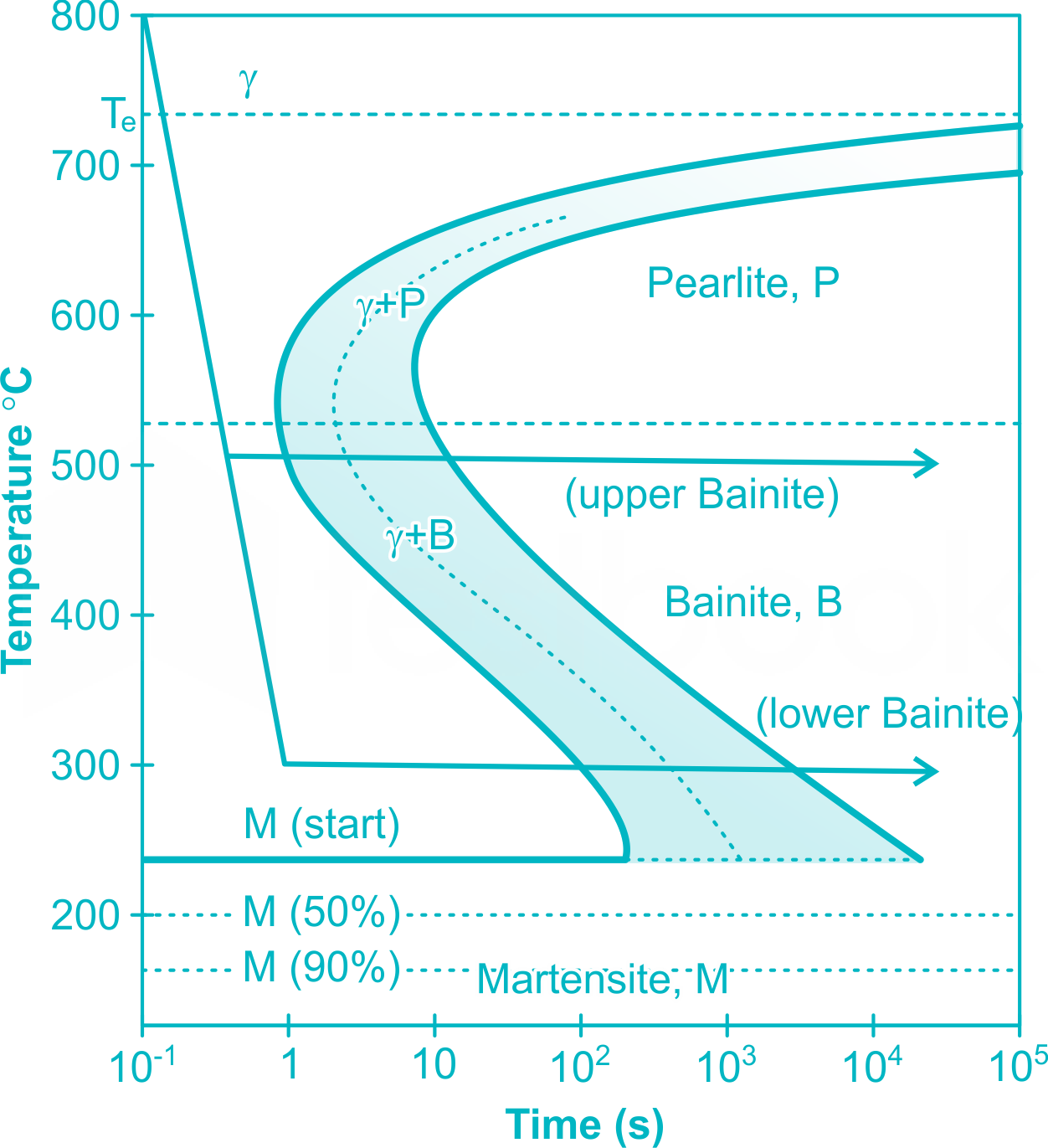
Rate of transformation is explained in Time-Temperature-Transformation (TTT) diagram which is also known as iso-thermal diagram. An alloy has to be cooled rapidly and then kept at a temperature to allow for respective transformation to take place.

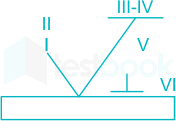
22

The figure below shows a symbolic representation of the surface texture in a perpendicular lay orientation with indicative values (I through VI) marking the various specifications whose definitions are listed below.

P: Maximum Waviness Height (mm); Q: Maximum Roughness Height (mm);

R: Minimum Roughness Height (mm); S: Maximum Waviness Width (mm);

T: Maximum Roughness Width (mm); U: Roughness Width Cutoff (mm);

The correct match between the specifications and the symbols (I to VI) is

  1. ((a))

    I-R, II-Q, III-P, IV-S, V-U, VI-T

  2. ((b))

    I-R, II-P, III-U, IV-S, V-T, VI-Q

  3. ((c))

    I-U, II-S, III-Q, IV-T, V-R, VI-P

  4. ((d))

    I-Q, II-U, III-R, IV-T, V-S, VI-P

Show Answer
Answer: ((a))

I-R, II-Q, III-P, IV-S, V-U, VI-T

Surface texture is the degree of finish conveyed to the machinist by a system of symbols devised by a Standards Association. These symbols provide a standard system of determining and indicating the surface finish.

Surface terms:

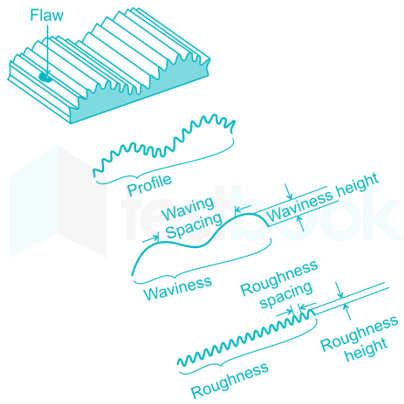
Flaws: Flaws are random irregularities or scratches, holes depression, seams, tear, or inclusions. These are defects caused during the machining operation.

Lay: It is the direction of the surface pattern caused by the machining and is visible to the naked eye.

Roughness: Roughness is the irregular deviation of the surface.

Roughness height: Roughness height, Ra is the deviation of the centerline.

Roughness width: Roughness width is the distance between successive roughness peaks parallel to the nominal surface.

Waviness: Waviness is the recurrent deviation form a flat surface, it is measured and described in terms of the surface between adjacent crests of the waves (waviness width) and height between the crests and valleys of the waves (waviness height).


Standard symbol to represent surface texture:

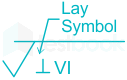
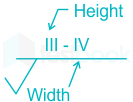
SpecificationsMarking
Placement of maximum roughness width rating to right of the lay symbol
Placement of roughness width cut-off
Placement of maximum value roughness height
Placement of minimum value of roughness height
Placement of maximum waviness height and The maximum waviness width value
23

In Materials Requirement Planning, if the inventory holding cost is very high and the setup cost is zero, which one of the following lot-sizing approaches should be used?

  1. ((a))

    Economic Order Quantity

  2. ((b))

    Lot-for-Lot

  3. ((c))

    Base Stock Level

  4. ((d))

    Fixed Period Quantity, for 2 periods

Show Answer
Answer: ((b))

Lot-for-Lot

Explanation:

Material Requirement Planning:

It is a material control system in inventory handling to assure that the required materials are available when needed.

The major objectives of an MRP system are:

    1. Ensure the availability of materials, components, and products for planned production activity.
    1. Maintain the lowest possible level of inventory.
    1. Plan manufacturing activities, delivery schedules, and purchasing activities.

So, there are various lot-sizing approaches in material requirement planning. Some are discussed below.

APPROACHCHARACTERISTICS
Lot-for-Lot- The lot-for-lot (LFL) is the approach in which we Order the exact amount of the net requirement each period. - The LFL approach minimizes the holding cost by producing just-in-time. - This approach is optimal if setup costs and setup times have been reduced to negligible levels.
Economic Order Quantity- It is the method to determine the size of the order which minimizes total cost. - This approach is optimal if the holding cost is equal to the ordering cost.
Fixed Period Quantity- In this approach, we order for the supply of different quantities of material at a fixed time interval. - In this approach, we divide the Economic Order Quantity (EOQ) into the annual demand and order that many times per year. - This approach is optimal when there is a large fluctuation in demand pattern.
Base Stock Level- In this approach, a minimum amount of inventory is being maintained, and above this point LIFO(last in first out) approach is applied for the maintenance of order. - This approach is optimal when the demand pattern is random.
24

Which of the following conditions is used to determine the stable equilibrium of all partially submerged floating bodies?

  1. ((a))

    Centre of buoyancy must be above the centre of gravity

  2. ((b))

    Centre of buoyancy must be below the centre of gravity

  3. ((c))

    Metacentre must be at a higher level than the centre of gravity

  4. ((d))

    Metacentre must be at a lower level than the centre of gravity

Show Answer
Answer: ((c))

Metacentre must be at a higher level than the centre of gravity

Explanation:

The partially submerged body resembles the floating body, where the weight of the body is balanced by the buoyancy force acting in the upwards direction. The stability of the floating is governed by the metacentre of the floating body.

Metacentre is the point about which a body starts oscillating when the body is tilted by a small angle. It is the point where the line of action of buoyancy will meet the normal axis of the body when the body is given a small angular displacement.

Stability of floating bodies:

Stable equilibrium: Metacentre is above the centre of gravity of the body, then the disturbing couple is balanced by restoring couple, the body will be in stable equilibrium.

Unstable equilibrium: Metacentre is below the centre of gravity of the body, then the disturbing couple is supported by restoring couple, the body will be in unstable equilibrium.

Neutral equilibrium: The metacentre and the centre of gravity coincides at the same point, then the body is in neutral equilibrium.

Stability of submerged bodies: In case of the submerged body the centre of gravity and centre of buoyancy is fixed, therefore the stability or unstability is decided by the relative positions of the centre of buoyancy and the centre of gravity.

Stable equilibrium: For stable equilibrium, the body the centre of buoyancy is above the centre of gravity. The disturbing couple is countered by the restoring couple.

A close up of a logoDescription automatically generated

Unstable equilibrium: For unstable equilibrium, the centre of buoyancy is below the centre of gravity of the body, the disturbing couple is supported by the restoring couple.

A screenshot of a cell phoneDescription automatically generated

Neutral equilibrium: when the centre of gravity and the centre of buoyancy coincide then it is the state of neutral equilibrium.

A screenshot of a cell phoneDescription automatically generated

25

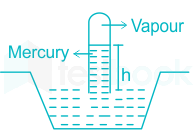
In the space above the mercury column in a barometer tube, the gauge pressure of the vapour is

  1. ((a))

    positive, but more than one atmosphere

  2. ((b))

    negative

  3. ((c))

    zero

  4. ((d))

    positive, but less than one atmosphere

Show Answer
Answer: ((b))

negative

Concept:

The barometer is an instrument used to measure the pressure of air. There are two typed of barometers, the mercury manometer and, aneroid barometer.

Mercury barometer: In a mercury barometer a tube filled with mercury is placed upright with its open end down into a container of more mercury.

Air pressure on the mercury in the container keeps the mercury from draining out of the tube.

Aneroid barometer: An aneroid barometer uses a flexible metal bellows instead of mercury to measure air pressure.

Calculation:

The gauge pressure = Pabs - Patm

At atmospheric pressure the gauge pressure = 0

Now if we write the equation for pressure in vertical column then,

Patm – ρm × g × h – Pvapour = 0

⇒ Patm = ρm × g × h + Pvapour

Now Since At atmospheric pressure the gauge pressure = 0

(Pvapour­)gauge = -ρm × g × h

∴ Gauge pressure of vapour will be negative.

26

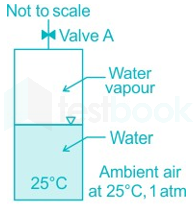
A closed vessel contains pure water, in thermal equilibrium with its vapour at 25°C (Stage #1), as shown.

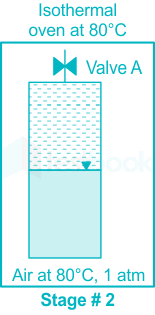
The vessel in this stage is then kept inside an isothermal oven which is having an atmosphere of hot air maintained at 80°C. The vessel exchanges heat with the oven atmosphere and attains a new thermal equilibrium (Stage #2). If the Valve A is now opened inside the oven, what will happen immediately after opening the valve?

  1. ((a))

    Water vapour inside the vessel will come out of the Valve A

  2. ((b))

    Hot air will go inside the vessel through Valve A

  3. ((c))

    Nothing will happen – the vessel will continue to remain in equilibrium

  4. ((d))

    All the vapour inside the vessel will immediately condense 

Show Answer
Answer: ((b))

Hot air will go inside the vessel through Valve A

When the vessel is at 25°C the saturation pressure of the vapour inside the vessel 3.169 kPa is much lesser than the atmospheric pressure.

When this vessel is kept inside the isothermal oven then at 80°C the saturation pressure of vapour at 80°C 47.39 kPa is again lesser than the atmospheric pressure.

Since the pressure inside the vessel is lesser than the atmospheric pressure, then if the valve is open inside the oven which is at atmospheric pressure the hot air from the oven will go inside the vessel through the Valve.


In stage 1:

The pressure will be less than the atmospheric pressure because of the presence of water vapour. 

In stage 2:

The water vapour receives heat and gets superheated since the vessel is placed in an oven at 80°C.

Also, we need to remember that in stage 2 the heating of water vapour takes place at constant volume since the oven has a fixed boundary. 

When volume is constant then pressure is directly proportional to temperature i.e

P ∝ T

where P is the pressure and T is the temperature

∴ P1P2=T1T2\frac{{{{\rm{P}}_1}}}{{{{\rm{P}}_2}}} = \frac{{{{\rm{T}}_1}}}{{{{\rm{T}}_2}}}...(i)

Where P1 = Saturated vapour pressure of the mixture at 25°C = 3.17 kPa (Standard value)

P2 = Pressure of the mixture at 80°C, T1 = Initial temperature of the mixture at 25°C, T2 = Final temperature of the mixture 

T1 = 25 + 273 = 298 K, T2 = 80 + 273 = 353 K 

Substituting in equation (i) and simplifying we will get

3.17P2=298353\frac{{3.17}}{{{{\rm{P}}_2}}} = \frac{{298}}{{353}}

P2 = 3.75 kPa

Note:

P2 is the pressure of the mixture at 80°C after thermal equilibrium is attained.

Therefore, Since the pressure inside the vessel after heating is less than the atmospheric pressure (101.32 kPa) the hot air goes inside the vessel.

27

For an air-standard Diesel cycle,

  1. ((a))

    heat addition is at constant volume and heat rejection is at constant pressure

  2. ((b))

    heat addition is at constant pressure and heat rejection is at constant pressure

  3. ((c))

    heat addition is at constant pressure and heat rejection is at constant volume

  4. ((d))

    heat addition is at constant volume and heat rejection is at constant volume

Show Answer
Answer: ((c))

heat addition is at constant pressure and heat rejection is at constant volume

Explanation:

For the Diesel cycle:

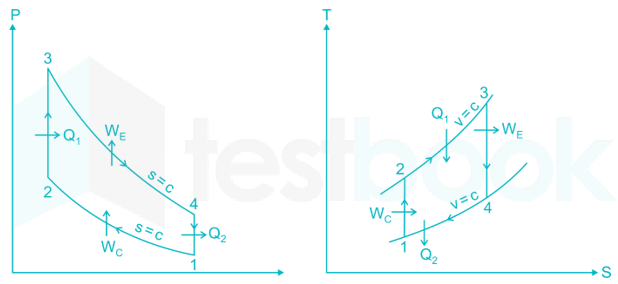
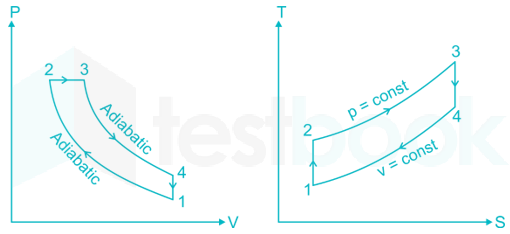
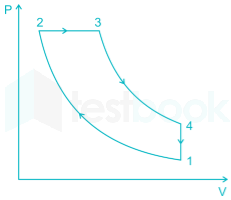
Processes involved in compression engine (diesel; cycle) are:

1-2: Reversible adiabatic compression

2-3: Constant pressure heat addition

3-4: Reversible adiabatic expansion

4-1: Constant volume of heat rejection

Otto  Cycle- Constant volume heat addition. - Constant volume heat rejection.
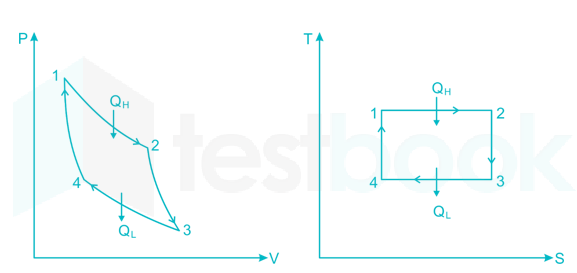
Carnot Cycle- Constant temperature heat addition - Constant temperature heat rejection
Diesel Cycle- Constant pressure heat addition. - Constant volume heat rejection.
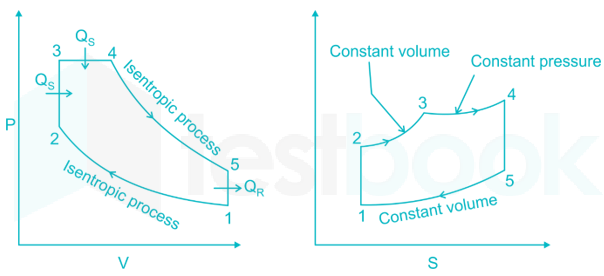
Dual Cycle- Constant volume and constant pressure heat addition. - Constant volume heat rejection

Otto cycle:

Diesel cycle


Dual Cycle:

Carnot Cycle:

28

The values of enthalpies at the stator inlet and rotor outlet of a hydraulic turbomachine stage are h1 and h3 respectively. The enthalpy at the stator outlet (or, rotor inlet) is h2. The condition (h2 – h1) = (h3 – h2) indicates that the degree of reaction of this stage is

  1. ((a))

    zero

  2. ((b))

    50%

  3. ((c))

    75%

  4. ((d))

    100%

Show Answer
Answer: ((b))

50%

Concept:

The degree of reaction of a hydraulic turbomachine is defined as 

DOR=(Enthalpy;drop;in;rotorEnthalpy;Drop;in;rotor;+;Enthalpy;drop;In;stator)DOR = \left( {\frac{{Enthalpy;drop;in;rotor}}{{Enthalpy;Drop;in;rotor ;+ ;Enthalpy;drop;In;stator}}} \right)

Calculation:

Given, enthalpy at the stator inlet = h1, enthalpy at the stator outlet = h2 and enthalpies at the rotor outlet = h3

Enthalpy drop in rotor = h2 - h3

Enthalpy drop in stator = h1 – h2

Then, DOR=(h2;;h3h1;h2;+;h2;;h3)DOR = \left( {\frac{{{h_2}; - ;{h_3}}}{{{h_1} - ;{h_2}; + ;{h_{2;}} - ;{h_3}}}} \right)

Given, (h2 – h1) = (h3 – h2)

⇒ h1 – h2 = h2 – h3

DOR=;h2h32(h2h3)=0.5=50% \Rightarrow DOR = ;\frac{{{h_2} - {h_3}}}{{2\left( {{h_2} - {h_3}} \right)}} = 0.5 = 50\%

29

Let I be a 100-dimensional identity matrix and E be the set of its distinct (no value appears more than once in E) real eigenvalues. The number of elements in E is         .

30

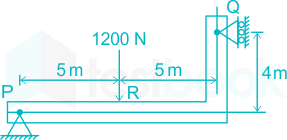
A beam of negligible mass is hinged at support P and has a roller support Q as shown in the figure.

A point load of 1200 N is applied at point R. The magnitude of the reaction force at support Q is _____N.

31

A machine member is subjected to fluctuating stress σ = σo cos (8πt). The endurance limit of the material is 350 MPa. If factor of safety used in the design is 3.5 then the maximum allowable value of σo is____MPa (round off to 2 decimal places).

32

A bolt head has to be made at the end of a rod of diameter d = 12 mm by localized forging (upsetting) operation. The length of the unsupported portion of the rod is 40 mm. To avoid buckling of the rod, a closed forging operation has to be performed with a maximum die diameter of ______mm.

33

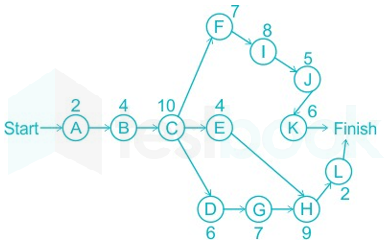
Consider the following network of activities, with each activity named A-L, illustrated in the nodes of the network.

The number of hours required for each activity is shown alongside the nodes. The slack on the activity L, is _____ hours.

34

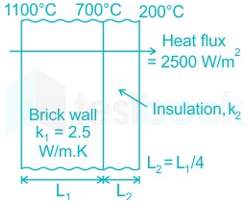
In a furnace, the inner and outer sides of the brick wall (k1 = 2.5 W/m.K) are maintained at 1100°C and 700°C, respectively as shown in figure

The brick wall is covered by an insulating material of thermal conductivity k2. The thickness of the insulation is 1/4th of the thickness of the brick wall. The outer surface of the insulation is at 200°C. The heat flux through the composite walls is 2500 W/m2.

The value of k2 is _____W/m.K (round off to one decimal place).

35

If a reversed Carnot cycle operates between the temperature limits of 27°C and -3°C, then the ratio of the COP of a refrigerator to that of a heat pump (COP of refrigerator/COP of heat pump) based on the cycle is ____ (round off to 2 decimal places).

36

The directional derivative of f(x, y, z) = xyz at point (-1, 1, 3) in the direction of vector î - 2ĵ + 2k̂ is

  1. ((a))

    3î - 3ĵ - k̂

  2. ((b))

    73 - \frac{7}{3}

  3. ((c))

    7/3

  4. ((d))

    7

Show Answer
Answer: ((c))

7/3

Concept:

Directional Derivative = Gradient of function × Unit direction Vector

If F = f(x,y,z) then,

Grad f=(i^fx+j^fy+k^fz)f = \left( {\hat i\frac{{\partial f}}{{\partial x}} + \hat j\frac{{\partial f}}{{\partial y}} + \hat k\frac{{\partial f}}{{\partial z}}} \right)

For the given direction vector a=a1i^+a2j^+a3k^a = {a_1}\hat i + {a_2}\hat j + {a_3}\hat k

Unit direction vector =aa= \frac{{\vec a}}{{\left| {\vec a} \right|}}

and a=a12+a22+a32\left| {\vec a} \right| = \sqrt {a_1^2 + a_2^2 + a_3^2}

Calculation:

Given, f(x,y,z) = xyz

Grad f=(i^fx+j^fy+k^fz)f = \left( {\hat i\frac{{\partial f}}{{\partial x}} + \hat j\frac{{\partial f}}{{\partial y}} + \hat k\frac{{\partial f}}{{\partial z}}} \right)

Grad f=(i^(xyz)x+j^(xyz)y+k^(xyz)z)f = \left( {\hat i\frac{{\partial (xyz)}}{{\partial x}} + \hat j\frac{{\partial (xyz)}}{{\partial y}} + \hat k\frac{{\partial (xyz)}}{{\partial z}}} \right)

Grad;f=yz;i^+xz;j^+xy;k^Grad;f = yz;\hat i + xz;\hat j + xy;\hat k

(Grad f)P = (-1, 1, 3) =1×3;i^+(1)(3)j^+(1)(1)k^ = 1 \times 3;\hat i + \left( { - 1} \right)\left( 3 \right)\hat j + \left( { - 1} \right)\left( 1 \right)\hat k

∴ (Grad f)P =3i^3j^k^ = 3\hat i - 3\hat j - \hat k

Direction vector (a)=i^2j^+2k^\left( {\vec a} \right) = \hat i - 2\hat j + 2\hat k

Unit direction vector =aa=i;^;2j;^+;2k^(1)2+(2)2+(2)2=i^+2j^+2k^3; = \frac{{\vec a}}{{\left| {\vec a} \right|}} = \frac{{\widehat {i;} - ;2\widehat {j;} + ;2\hat k}}{{\sqrt {{{\left( 1 \right)}^2} + {{\left( { - 2} \right)}^2} + {{\left( 2 \right)}^2}} }} = \frac{{\hat i + 2\hat j + 2\hat k}}{3};

∴ Directional Derivative =(3i^3j^k^)×i^2j^+2k^3 = \left( {3\hat i - 3\hat j - \hat k} \right) \times \frac{{\hat i - 2\hat j + 2\hat k}}{3}

D.D=3×1+(3×2)+(1×2)3=73D.D = \frac{{3 \times 1 + \left( { - 3 \times - 2} \right) + \left( { - 1 \times 2} \right)}}{3} = \frac{7}{3}

37

The function f(z) of complex variable z = x + iy, where i=1,i = \sqrt { - 1} , is given as f(z) = (x3 – 3xy2) + i v(x,y). For this function to be analytic, v(x,y) should be

  1. ((a))

    (3xy2 – y3) + constant

  2. ((b))

    (3x2y2 – y3) + constant

  3. ((c))

    (x3 – 3x2y) + constant

  4. ((d))

    (3x2y – y3) + constant

Show Answer
Answer: ((d))

(3x2y – y3) + constant

Concept:

f(z) = u + iv

u = real part

v = imaginary part

If f(z) is an analytic function

\(\left. {\begin{array}{*{20}{c}} {\frac{{\partial u}}{{\partial x}} = \frac{{\partial v}}{{\partial y}}}\ {\frac{{\partial v}}{{\partial x}} = - \frac{{\partial u}}{{\partial y}}} \end{array}} \right} \to C.R;equation\)

dv=vxdx+vydy\therefore dv = \frac{{\partial v}}{{\partial x}}dx + \frac{{\partial v}}{{\partial y}}dy

dv=uydx+uxdydv = \frac{{ - \partial u}}{{\partial y}}dx + \frac{{\partial u}}{{\partial x}}dy (This is an exact differential equation)

Calculation:

Given,

u = x3 – 3xy2

ux=3x23y2\frac{{\partial u}}{{\partial x}} = 3{x^2} - 3{y^2}

uy=6xy\frac{{\partial u}}{{\partial y}} = - 6xy

dv=uydx+uxdydv = \frac{{ - \partial u}}{{\partial y}}dx + \frac{{\partial u}}{{\partial x}}dy

dv=6xy;dx+(3x23y2)dydv = 6xy;dx + \left( {3{x^2} - 3{y^2}} \right)dy

It is an exact differential equation the solution is obtained by treating y as constant in the first term and in the second term only that part is integrated which is not containing x.

Integrating the above equation

v=3x2yy3+constantv = 3{x^2}y - {y^3} + constant

38

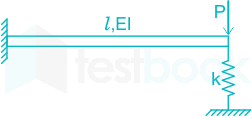
A cantilever of length l, and flexural rigidity El, stiffened by a spring of stiffness k, is loaded by a transverse force P, as shown.

The transverse deflection under the load is

  1. ((a))

    Pl33EI[3EI3EI;+;2kl3]\frac{{P{l^3}}}{{3EI}}\left[ {\frac{{3EI}}{{3EI;+;2k{l^3}}}} \right]

  2. ((b))

    Pl33EI[6EI;;kl36EI]\frac{{P{l^3}}}{{3EI}}\left[ {\frac{{6EI;-;k{l^3}}}{{6EI}}} \right]

  3. ((c))

    Pl33EI[3EI;;kl33EI]\frac{{P{l^3}}}{{3EI}}\left[ {\frac{{3EI;-;k{l^3}}}{{3EI}}} \right]

  4. ((d))

    Pl33EI[3EI3EI;+;kl3]\frac{{P{l^3}}}{{3EI}}\left[ {\frac{{3EI}}{{3EI;+;k{l^3}}}} \right]

Show Answer
Answer: ((d))

Pl33EI[3EI3EI;+;kl3]\frac{{P{l^3}}}{{3EI}}\left[ {\frac{{3EI}}{{3EI;+;k{l^3}}}} \right]

Concept:

The deflection of the beam at the free end due to load P is Δ=Pl33EI\Delta = \frac{{P{l^3}}}{{3EI}}

Since the deflection in beam and spring are equal, therefore stiffness of both i.e. beam and spring are in parallel connection.

For parallel combination:

keq = k1 + k2

where k1 = stiffness of spring and k2 = stiffness of beam.

Calculation:

Given:


Deflection of the beam due to point load P if spring is not there Δ=Pl33EI\Delta = \frac{{P{l^3}}}{{3EI}}

Stiffness k2=PΔ{k_2} = \frac{P}{\Delta }

k2=PPl33EI=3EIl3{k_2} = \frac{P}{{\frac{{P{l^3}}}{{3EI}}}} = \frac{{3EI}}{{{l^3}}}

;keq=k+3EIL3=kL3;+;3EIL3\therefore ;{k_{eq}} = k + \frac{{3EI}}{{{L^3}}} = \frac{{k{L^3};+;3EI}}{{{L^3}}}

∴ Transverse deflection under the load

Δnet=PKeq=PL3KL3+3EI\Rightarrow \Delta_{net}= \frac{P}{{{K_{eq}}}} = \frac{{P{L^3}}}{{K{L^3} + 3EI}}

Δnet=PL33EI;(1KL33EI;+;1) \Rightarrow \Delta_{net} = \frac{{P{L^3}}}{{3EI}};\left( {\frac{1}{{\frac{{K{L^3}}}{{3EI}};+;1}}} \right)

Δ=PL33EI;(3EIKL3;+;3EI)\Rightarrow \Delta = \frac{{P{L^3}}}{{3EI}};\left( {\frac{{3EI}}{{K{L^3};+;3EI}}} \right)

Shortcut Method:

Deflection of beam = Deflection of spring

(P;;R)L33EI=RK\frac{{\left( {P;-;R} \right){L^3}}}{{3EI}} = \frac{R}{K}

(1K+L33EI)R=PL33EI \Rightarrow \left( {\frac{1}{K} + \frac{{{L^3}}}{{3EI}}} \right)R = \frac{{P{L^3}}}{{3EI}}

R=PL33EI×3EIK3EI;+;L3R = \frac{{P{L^3}}}{{3EI}} \times \frac{{3EIK}}{{3EI;+;{L^3}}}

Δnet=RK=PL33EI;(3EI3EI;+;KL3)\Delta_{net} = \frac{R}{K} = \frac{{P{L^3}}}{{3EI}};\left( {\frac{{3EI}}{{3EI;+;K{L^3}}}} \right)

39

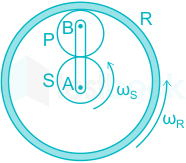
The sun (S) and the planet (P) of an epicyclic gear train shown in the figure have an identical number of teeth.

If the sun (S) and the outer ring (R) gears are rotated in the same direction with angular speed ωS and ωR, respectively, then the angular speed of the arm AB is

  1. ((a))

    34ωR+14ωS\frac{3}{4}{\omega _R} + \frac{1}{4}{\omega _S}

  2. ((b))

    14ωR+34ωS\frac{1}{4}{\omega _R} + \frac{3}{4}{\omega _S}

  3. ((c))

    12ωR12ωS\frac{1}{2}{\omega _R} - \frac{1}{2}{\omega _S}

  4. ((d))

    34ωR14ωS\frac{3}{4}{\omega _R} - \frac{1}{4}{\omega _S}

Show Answer
Answer: ((a))

34ωR+14ωS\frac{3}{4}{\omega _R} + \frac{1}{4}{\omega _S}

Concept:

  • When two gears are in contact they have the same module (m).
  • The module is the ratio of pitch circle diameter (or simply diameter) of gear to the number of teeth of the gear.

m=diameternumber;of;teeths=DTm = \frac{{diameter}}{{number;of;teeths}} = \frac{D}{T}

  • When gears are connected externally they have opposite direction or revolution while when gears are connected internally they have the same direction of revolution.
  • The velocity ratio between two mating gears is given by:

ω2ω1=T1T2\frac{{{\omega _2}}}{{{\omega _1}}} = \frac{{{T_1}}}{{{T_2}}}

where ω is the angular velocity and T is the number of teeth on the gears.

Calculation:

Given:

Number of teeth on the sun (Ts) = Number of teeth on the planet (Tp), Angular velocity of sun = ωs (anticlockwise), Angular velocity of ring = ωr (anticlockwise)
Let Angular velocity of planet = ωp

The radius of the sun, planet, and ring is Rs, Rp, and Rr respectively.

The module of each gear is m.

Now,

Rs + 2Rp = Rr      ----(1)

m=diameternumber;of;teeths=DTm = \frac{{diameter}}{{number;of;teeths}} = \frac{D}{T}

⇒ D = mT

⇒ R = 2mT

Putting the value of R in equation (1)

2mTs + 4mTp = 2mTr

⇒ Ts + 2Tp = Tr

⇒ 3Tp = Tr                   (Tp = Ts)

Let anticlockwise motion be positive.

MotionArmSun (Tp)Planet (Tp)Ring (3Tp)
Let arm fixed Sun → +x0x-xx3- \frac{x}{3}
Arm → +yYx + y-x + yx3+y- \frac{x}{3} + y

ωpωs=TsTp ωpx=TPTp;;ωp=x\begin{array}{l} \frac{{{\omega _p}}}{{{\omega _s}}} = - \frac{{{T_s}}}{{{T_p}}}\ \Rightarrow \frac{{{\omega _p}}}{x} = - \frac{{{T_P}}}{{{T_p}}}; \Rightarrow ;{\omega _p} = - x \end{array}

And,

;ωrωp=TpTr ωr(x)=Tp3Tpωr=x3\begin{array}{l} ;\frac{{{\omega _r}}}{{{\omega _p}}} = \frac{{{T_p}}}{{{T_r}}}\ \Rightarrow \frac{{{\omega _r}}}{{\left( { - x} \right)}} = \frac{{{T_p}}}{{3{T_p}}} \Rightarrow {\omega _r} = \frac{{ - x}}{3} \end{array}

Now, After giving arm +y

x + y = ωs      ----(2)

x3;+;y;=;ωr- \frac{{\rm{x}}}{3}{\rm{;}} + {\rm{;y;}} = {\rm{;}}{{\rm{\omega }}_{\rm{r}}}     ----(3)

Subtracting equation (3) from equation (2)

x+x3=ωsωr 4x3=ωsωr x=34(ωsωr)\begin{array}{l} \Rightarrow x + \frac{x}{3} = {\omega _s} - {\omega _r}\ \Rightarrow \frac{{4x}}{3} = {\omega _s} - {\omega _r}\ \Rightarrow x = \frac{3}{4}({\omega _s} - {\omega _r}) \end{array}

Putting the value of x in equation (2)

y=ωs;34(ωsωr) y=ωs3ωs4+3ωr4 y=ωs4+3ωr4\begin{array}{l} \Rightarrow y = {\omega _s} - ;\frac{3}{4}({\omega _s} - {\omega _r})\ \Rightarrow y = {\omega _s} - \frac{{3{\omega _s}}}{4} + \frac{{3{\omega _r}}}{4}\ \Rightarrow y = \frac{{{\omega _s}}}{4} + \frac{{3{\omega _r}}}{4} \end{array}

40

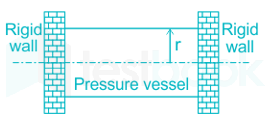
A thin-walled cylinder of radius r and thickness t is open at both ends, and fits snugly between two rigid walls under ambient conditions, as shown in the figure.

The material of the cylinder has Young’s modulus E. Poisson’s ratio v, and coefficient of thermal expansion α. What is the minimum rise in temperature ΔT of the cylinder (assume uniform cylinder temperature with no buckling of the cylinder) required to prevent gas leakage if the cylinder has to store the gas at an internal pressure of p above the atmosphere?

  1. ((a))

    ΔT=3vpr2αtE{\rm{\Delta }}T = \frac{{3vpr}}{{2\alpha tE}}

  2. ((b))

    ΔT=(v14)prαtE{\rm{\Delta }}T = \left( {v - \frac{1}{4}} \right)\frac{{pr}}{{\alpha tE}}

  3. ((c))

    ΔT=vprαtE{\rm{\Delta }}T = \frac{{vpr}}{{\alpha tE}}

  4. ((d))

    ΔT=(v+12)prαtE{\rm{\Delta }}T = \left( {v + \frac{1}{2}} \right)\frac{{pr}}{{\alpha tE}}

Show Answer
Answer: ((c))

ΔT=vprαtE{\rm{\Delta }}T = \frac{{vpr}}{{\alpha tE}}

Concept:

When a thin-walled cylinder is subjected to internal fluid pressure then there are two stresses acting upon the cylinder

Hoop stress in the circumferential direction σh=prt{\sigma _h} = \frac{{pr}}{t}

and longitudinal stress σl=pr2t{\sigma _l} = \frac{{pr}}{{2t}}

Where p is the internal pressure of the fluid in the cylinder above atmospheric pressure, r is the radius of the cylinder and t is the thickness of the cylinder.

If the cylinder is open from the sides then longitudinal stress is zero.

Strain due to these stress

ϵh=1E(σhνσl){\epsilon_h} = \frac{1}{E}\left( {{\sigma _h} - \nu {\sigma _l}} \right)

ϵl=1E(σlνσh){\epsilon_l} = \frac{1}{E}\left( {{\sigma _l} - \nu {\sigma _h}} \right)

ν is Poisson’s ratio.

Thermal strain due to temperature rise is given by

ϵth = αΔT

α is the coefficient of thermal expansion, ΔT is the change in temperature

Calculation:

It is given that both the ends of the cylinder are open therefore the longitudinal stress acting will be equal to zero. 

The longitudinal stress, σlong = 0

The strain in the longitudinal direction will be due to the hoop stress only.

Now the temperature of the cylinder is increased by ΔT, then in order to avoid the leakage, the sum of strains due to increased temperature and the strain due to hoop stress (in the longitudinal direction) should be equal to zero.

Therefore,

∴ ϵth + ϵl = 0      

ϵth=α(ΔT){\epsilon_{th}} = \alpha \left( {{\rm{\Delta }}T} \right)                   

ϵl=1E(0νprt;){\epsilon_l} = \frac{1}{E}\left( {0 - \nu \frac{{pr}}{{t}};} \right)

α(ΔT)+(vprEt;;)=0;;;\therefore \alpha \left( {{\rm{\Delta }}T} \right) + \left( {\frac{{ - vpr}}{{Et;}};} \right) = 0;;;

ΔT=vpratE{\rm{\Delta }}T = \frac{{vpr}}{{atE}}

41

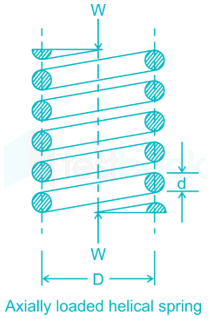
A helical spring has spring constant k. If the wire diameter, spring diameter and the number of coils is all doubled then the spring constant of the new spring becomes

  1. ((a))

    k/2

  2. ((b))

    k

  3. ((c))

    8k

  4. ((d))

    16k

Show Answer
Answer: ((b))

k

Concept:

k = spring constant = Wy\frac{W}{y}

y = deflection of spring = δ(U)δW\frac{{\delta \left( U \right)}}{{\delta W}}

Where U is the strain energy stored in the spring, W is the load applied at the axis of the spin and y is the deflection caused by the load W.

As the strain energy of spring is given by,

SE(U)=12×T×θ{\rm{SE}}\left( {\rm{U}} \right) = \frac{1}{2} \times T \times \theta

Where, torque at the end of spring  T=W×D2T = W \times \frac{D}{2}

Maximum angle of twist θ=TLGJ\theta = \frac{{TL}}{{GJ}}

Where, W = load applied at end, D = diameter of spring, length of spring L = πDn,

n = number of coils, G = torsional rigidity of spring material, J = polar moment of inertia = π32×d4\frac{\pi }{{32}} \times {d^4}  

d = diameter of wire

U=12×(W×D2)×;(32×WD×πDn2×G×π×d4)=4W2D3n;Gd4;\therefore U = \frac{1}{2} \times \left( {W \times \frac{D}{2}} \right) \times ;\left( {\frac{{32 \times WD \times \pi Dn}}{{2 \times G \times \pi \times {d^4}}}} \right) = \frac{{4{W^2}{D^3}n;}}{{G{d^4};}}

Now, y = deflection of spring 

y = δδW;(4W2D3nGd4;)=;8WD3nGd4;\frac{\delta }{{\delta W}};\left( {\frac{{4{W^2}{D^3}n}}{{G{d^4};}}} \right) = ;\frac{{8W{D^3}n}}{{G{d^4};}}   and 

k = spring constant = Wy=Gd48D3n\frac{W}{y} = \frac{{G{d^4}}}{{8{D^3}n}}

Calculation:

Given, d2 = 2d, D2 = 2D, n2 = 2n

k2k1=(2d)4(2D)3×(2n)×D3n;d4=d4D3n×D3nd4=1\therefore \frac{{{k_2}}}{{{k_1}}} = \frac{{{{\left( {2d} \right)}^4}}}{{{{\left( {2D} \right)}^3} \times \left( {2n} \right)}} \times \frac{{{D^3}n;}}{{{d^4}}} = \frac{{{d^4}}}{{{D^3}n}} \times \frac{{{D^3}n}}{{{d^4}}} = 1

∴ k2 = k1   

k2 = k                      (∵ k1 = k)

42

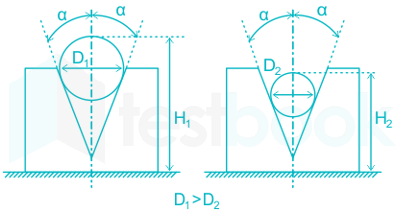
Two rollers of diameters D1 (in mm) and D2 (in mm) are used to measure the internal taper angle in the V-groove of a machined component. The heights H1 (in mm) and H2 (in mm) are measured by using a height gauge after inserting the rollers into the same V-groove as shown in the figure.

Which of the following is the correct relationship to evaluate the angle α as shown in the figure?

  1. ((a))

    sinα=(D1D2)2(H1H2)(D1D2)\sin \alpha = \frac{{\left( {{D_1} - {D_2}} \right)}}{{2\left( {{H_1} - {H_2}} \right) - \left( {{D_1} - {D_2}} \right)}}

  2. ((b))

    cosα=(D1D2)2(H1H2)2(D1D2)\cos \alpha = \frac{{\left( {{D_1} - {D_2}} \right)}}{{2\left( {{H_1} - {H_2}} \right) - 2\left( {{D_1} - {D_2}} \right)}}

  3. ((c))

    cosec;α=(H1H2)(D1D2)2(D1D2)cosec;\alpha = \frac{{\left( {{H_1} - {H_2}} \right) - \left( {{D_1} - {D_2}} \right)}}{{2\left( {{D_1} - {D_2}} \right)}}

  4. ((d))

    sinα=(H1H2)(D1D2)\sin \alpha = \frac{{\left( {{H_1} - {H_2}} \right)}}{{\left( {{D_1} - {D_2}} \right)}}

Show Answer
Answer: ((a))

sinα=(D1D2)2(H1H2)(D1D2)\sin \alpha = \frac{{\left( {{D_1} - {D_2}} \right)}}{{2\left( {{H_1} - {H_2}} \right) - \left( {{D_1} - {D_2}} \right)}}

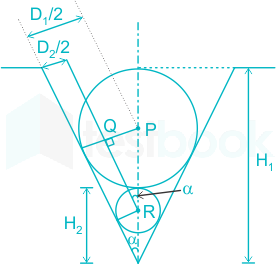
Let us draw both the blocks in one V-groove,

Now if we draw the line parallel to the edge of the V-groove, then sin α can be written as

sinα=PQPR\sin \alpha = \frac{{PQ}}{{PR}}

From the geometry PQ can be written as

PQ=D1D22PQ = \frac{{{D_1} - {D_2}}}{2}

Now, for PR again if we observe the geometry 

PR=(H1D12)(H2D22)=(H1H2)(D1D22)PR = \left( {{H_1} - \frac{{{D_1}}}{2}} \right) - \left( {{H_2} - \frac{{{D_2}}}{2}} \right) = \left( {{H_1} - {H_2}} \right) - \left( {\frac{{{D_1} - {D_2}}}{2}} \right)

sinα=PQPR=(D1D22)(H1H2)(D1D22) \Rightarrow \sin \alpha = \frac{{PQ}}{{PR}} = \frac{{\left( {\frac{{{D_1} - {D_2}}}{2}} \right)}}{{\left( {{H_1} - {H_2}} \right) - \left( {\frac{{{D_1} - {D_2}}}{2}} \right)}}

sinα=(D1D2)2(H1H2)(D1D2)\sin \alpha = \frac{{\left( {{D_1} - {D_2}} \right)}}{{2\left( {{H_1} - {H_2}} \right) - \left( {{D_1} - {D_2}} \right)}}

43

The forecast for the monthly demand of a product is given in the table below.

MonthForecastActual Sales
132.0030.00
231.8032.00
331.8230.00

The forecast is made by using the exponential smoothing method. The exponential smoothing coefficient used in forecasting the demand is

  1. ((a))

    0.10

  2. ((b))

    0.40

  3. ((c))

    0.50

  4. ((d))

    1.00

Show Answer
Answer: ((a))

0.10

Concept:

The forecast for recent data is calculated by

Fn = Fn-1 + α (D – F)n-1   

Where, Fn = Recent Forecast value, Fn-1 = Previous period forecast value,

 Dn-1 = Previous period actual sale value, α = smoothing constant

Calculation:

For 3rd month, Fn = 31.82, Fn-1 = 31.80, Dn-1 = 32

∴ 31.82 = 31.80 + α (32 - 31.80)

31.82 – 31.80 = 0.2 α

0.02 = 0.2 α

α = 0.1

Important Points

α value lies between 0 and 1

When α = 0 means the forecast is stable

Stability: When the forecast pattern is flat, smooth or has less fluctuations. It is preferred for old existing products.

When α = 1 means the forecast is not stable

Responsiveness: When the forecast is fluctuating and swinging pattern. It is preferred for new products.

44

One kg of air in a closed system undergoes an irreversible process from an initial state of p1 = 1 bar (absolute) and T1 = 27°C, to a final state of p2 = 3 bar (absolute) and T2 = 127°C. If the gas constant of air is 287 J/kg.K and the ratio of the specific heats γ = 1.4, then the change in the specific entropy (in J/kg.K) of the air in the process is

  1. ((a))

    -26.3

  2. ((b))

    28.4

  3. ((c))

    172.0

  4. ((d))

    Indeterminate, as the process is irreversible

Show Answer
Answer: ((a))

-26.3

Concept:

The change in entropy of gas at given pressure is,

s2s1=Cpln(T2T1)Rln(P2P1){s_2} - {s_1} = {C_p}\ln \left( {\frac{{{T_2}}}{{{T_1}}}} \right) - R\ln \left( {\frac{{{P_2}}}{{{P_1}}}} \right)

Where, s2 - s1 = change in entropy, Cp = specific heat at constant pressure, R = gas constant

T = temperature, P = pressure

Calculation:

m = 1 kg, P1 = 1 bar, P2 = 3 bar, T1 = 27°C = 27 + 273 = 300 K, T2 = 127°C = 127 + 273 = 400 K

γ = 1.4, R = 287 J/kg.K   

Cp=γRγ1=1.4;×;2871.4;;1=1005;J/kg.K{C_p} = \frac{{\gamma R}}{{\gamma - 1}} = \frac{{1.4; \times ;287}}{{1.4; - ;1}} = 1005;J/kg.K

s2s1=1005×ln(400300)287×ln(31)\therefore {s_2} - {s_1} = 1005 \times \ln \left( {\frac{{400}}{{300}}} \right) - 287 \times \ln \left( {\frac{3}{1}} \right)

s2 - s1 = -26.3 J/kg.K

45

For the integral \(\mathop \smallint \nolimits_0^{\pi /2} \left( {8 + 4\cos x} \right)dx,\) the absolute percentage error in numerical evaluation with the Trapezoidal rule, using only the endpoints, is ______

(round off to one decimal place).

46

A fair coin is tossed 20 times. The probability that ‘head’ will appear exactly 4 times in the first ten tosses, and ‘tail’ will appear exactly 4 times in the next ten tosses is ______ (round off to 3 decimal places).

47

A hollow spherical ball of radius 20 cm floats in still water, with half of its volume submerged. Taking the density of water as 1000 kg/m3, and the acceleration due to gravity as 10 m/s2, the natural frequency of small oscillations of the ball, normal to the water surface is ______ radians/s (round off to 2 decimal places).

48

Uniaxial compression test data for a solid metal bar of length 1 m is shown in the figure.

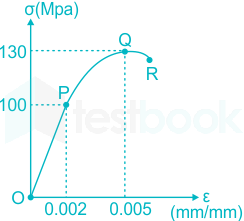
The bar material has a linear elastic response from O to P followed by a nonlinear response. The point P represents the yield point of the material. The rod is pinned at both the ends. The minimum diameter of the bar so that it does not buckle under axial loading before reaching the yield point is _____ mm (round off to one decimal place)

49

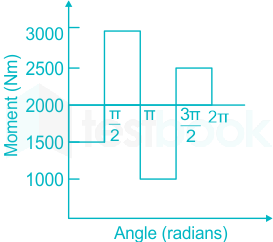
The turning moment diagram of a flywheel fitted to a fictitious engine is shown in the figure.

The mean turning moment is 2000 Nm. The average engine speed is 1000 rpm. For fluctuation in the speed to be within ±2% of the average speed, the mass moment of inertia of the flywheel is _____ kg.m2.

50

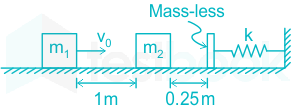
A rigid block of mass m1 = 10 kg having velocity vo = 2 m/s strikes a stationary block of mass m2 = 30 kg after traveling 1 m along a frictionless horizontal surface as shown in the figure.

The two masses stick together and jointly move by a distance of 0.25 m further along the same frictionless surface before they touch the mass-less buffer that is connected to the rigid vertical wall using a linear spring having a spring constant k = 105 N/m. The maximum deflection of the spring is ______ cm (round off to 2 decimal places).

51

A steel spur pinion has a module (m) of 1.25 mm, 20 teeth and 20° pressure angle. The pinion rotates at 1200 rpm and transmits power to a 60 teeth gear. The face width (F) is 50 mm, Lewis form factor Y = 0.322 and a dynamic factor Kv = 1.26. The bending stress (σ) induced in a tooth can be calculated by using the Lewis formula given below.

If the maximum bending stress experienced by the pinion is 400 MPa, the power transmitted is ______ kW (round off to one decimal place).

Lewis formula: σ=KvWtFmY,\sigma = \frac{{{K_v}{W^t}}}{{FmY}}, where Wt is the tangential load acting on the pinion.

52

A mould cavity of 1200 cm3 volume has to be filled through a sprue of 10 cm length feeding a horizontal runner. Cross-sectional area at the base of the sprue is 2 cm2. Consider acceleration due to gravity as 9.81 m/s2. Neglecting frictional losses due to molten metal flow, the time taken to fill the mould cavity is ______ seconds (round off to one decimal place).

53

A cylindrical bar with 200 mm diameter is being turned with a tool having geometry 0° - 9° - 7° - 8° - 15° - 30° - 0.05 inch (Coordinate system, ASA) resulting in a cutting force Fc1. If the tool geometry is changed to 0° - 9° - 7° - 8° - 15° - 0° - 0.05 inch (Coordinate system, ASA) and all other parameters remain unchanged, the cutting force changes to Fc2. Specific cutting energy (in J/mm3) is Uc = Uo (t1)-0.4, where Uo is the specific energy coefficient, and t1 is the uncut thickness in mm. The value of percentage change in cutting force Fc2, i.e. (Fc2Fc1Fc1)×100,\left( {\frac{{{F_{c2}} - {F_{c1}}}}{{{F_{c1}}}}} \right) \times 100, is ______ (round off to one decimal place)

54

There are two identical shaping machines S1 and S2. In machine S2, the width of the workpiece is increased by 10% and the feed is decreased by 10%, with respect to that of S1. If all other conditions remain the same then the ratio of total time per pass in S1 and S2 will be _______ (round off to one decimal place).

55

Bars of 250 mm length and 25 diameter are to be turned on a lathe with a feed of 0.2 mm/rev. Each regrinding of the tool costs Rs. 20. The time required for each tool change is 1 min. Tool life equation is given as VT0.2 = 24 (where cutting speed V is in m/min and tool life T is in min). The optimum tool cost per piece for maximum production rate is Rs. ______ (round off to two decimal places).

56

A point ‘P’ on a CNC controlled XY-stage is moved to another point ‘Q’ using the coordinate system shown in the figure below and rapid positioning command (G00).

A pair of stepping motors with a maximum speed of 800 rpm, controlling both the X and Y motion of the stage, are directly coupled to a pair of lead screws, each with a uniform pitch of 0.5 mm. The time needed to position the point ‘P’ to the point ‘Q’ is ______ minutes. (round off to 2 decimal places).

57

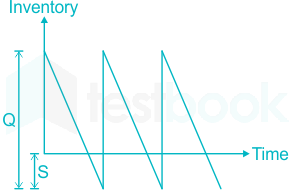
For a single item inventory system, the demand is continuous, which is 10000 per year. The replenishment is instantaneous and backorders (S units) per cycle are allowed as shown in the figure.

As soon as the quantity (Q units) ordered from the supplier is received, the backordered quantity is issued to the customers. The ordering cost is Rs. 300 per order. The carrying cost is Rs. 4 per unit per year. The cost of backordering is Rs. 25 per unit per year. Based on the total cost minimization criteria, the maximum inventory reached in the system is ______ (round off to nearest integer).

58

Consider a flow through a nozzle, as shown in the figure below. The air flow is steady, incompressible and inviscid. The density of air is 1.23 kg/m3. The pressure difference, (p1 - patm) is ______ kPa (round off to two decimal places).

59

Water (density 1000 kg/m3) flows through an inclined pipe of uniform diameter. The velocity, pressure and elevation at section A are VA = 3.2 m/s, PA = 186 kPa and ZA = 24.5 m, respectively, and those at section B are VB = 3.2 m/s, PB = 260 kPa and ZB = 9.1 m, respectively. If acceleration due to gravity is 10 m/s2 then the head lost due to friction is ______ m (round off to one decimal place).

60

The spectral distribution of radiation from a black body at T1 = 3000 K has a maximum at wavelength λmax. The body cools down to a temperature T2. If the wavelength corresponding to the maximum of the spectral distribution at T2 is 1.2 times of the original wavelength λmax, then the temperature T2 is ______ K (round off to the nearest integer).

61

Water flows through a tube of 3 cm internal diameter and length 20 m. The outside surface of the tube is heated electrically so that it is subjected to uniform heat flux circumferentially and axially. The mean inlet and exit temperatures of the water are 10°C and 70°C, respectively. The mass flow rate of the water is 720 kg/h. Disregard the thermal resistance of the tube wall. The internal heat transfer coefficient is 1697 W/m2⋅K. Take specific heat Cp of water as 4.179 kJ/kg⋅K. The inner surface temperature at the exit section of the tube is ______ °C (round off to one decimal place).

62

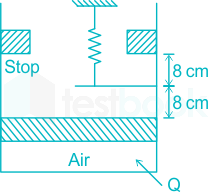
Air is contained in a frictionless piston-cylinder arrangement as shown in the figure.

The atmospheric pressure is 100 kPa and the initial pressure of air in the cylinder is 105 kPa. The area of piston is 300 cm2. Heat is now added and the piston moves slowly from its initial position until it reaches the stops. The spring constant of the linear spring is 12.5 N/mm. Considering the air inside the cylinder as the system, the work interaction is ______ J (round off to the nearest integer).

63

Moist air at 105 kPa, 30°C and 80% relative humidity flows over a cooling coil in an insulated air-conditioning duct. Saturated air exits the duct at 100 kPa and 15°C. The saturation pressures of water at 30°C and 15°C are 4.24 kPa and 1.7 kPa respectively. Molecular weight of water is 18 g/mol and that of air is 28.94 g/mol. The mass of water condensing out from the duct is ______ g/kg of dry air (round off to the nearest integer).

64

In a steam power plant, superheated steam at 10 MPa and 500°C, is expanded isentropically in a turbine until it becomes a saturated vapour. It is then reheated at constant pressure to 500°C. The steam is next expanded isentropically in another turbine until it reaches the condenser pressure of 20 kPa. Relevant properties of steam are given in the following two tables. The work done by both the turbines together is ______ kJ/kg (round off to the nearest integer).

Superheated Steam Table:

Pressure, p (MPa)Temperature, T (°C)Enthalpy, h (kJ/kg)Entropy, s (kJ/kg.K)
105003373.66.5965
15003478.47.7621


Saturated Steam Table:

Pressure, pSat. Temp, Tsat (°C)Enthalpy, h (kJ/kg)Entropy, s (kJ/kg.K)
hfhgsfsg
1 MPa179.91762.92778.12.13866.5965
20 kPa60.06251.382609.70.83197.9085
65

Keeping all other parameters identical, the Compression Ratio (CR) of an air standard diesel cycle is increased from 15 to 21. Take ratio of specific heats = 1.3 and cut-off ratio of the cycle rc = 2.

The difference between the new and the old efficiency values, in percentage,

new|CR=21) – (ηold|CR=15) = ______% (round off to one decimal place).

Attempt this paper under real exam conditions

Timed interface, section switching, instant scoring, and question-by-question analytics — free.

Start Timed Attempt