He is known for his unscrupulous ways. He always sheds ____ tears to deceive people.
((a))
fox's
((b))
crocodile's
((c))
crocodile
((d))
fox
Show Answer
Answer: ((c))
crocodile
The correct answer is Option 3 i.e. Crocodile
"Crocodile tears" is a phrase that means - to put on an insincere show of sorrow. When someone feigns sadness they 'cry crocodile tears' a phrase that comes from an old myth that the animals cry while eating.
Complete sentence: He is known for his unscrupulous ways. He always sheds Crocodile tears to deceive people.
2
Jofra Archer, the England fast bowler, is _____ than accurate.
((a))
more fast
((b))
faster
((c))
less fast
((d))
more faster
Show Answer
Answer: ((a))
more fast
The correct answer is Option 1 i.e. more fast
When two qualities of the same noun are compared, more + positive degree adjective is used. In this sentence, we are comparing the two qualities of the England fast bowler i.e. 'fast' and 'accurate' for such comparison we will use comparative degree ( more + positive degree adjective ).
∴ Use ‘more fast’ rather than ‘faster’.
Let's see an example:
Incorrect- She is prettier than wise.
Correct- She is more pretty than wise.
Complete Sentence: Jofra Archer, the England fast bowler, is more fast than accurate.
3
Select the word that fits the analogy:
Build : Building : Grow :
((a))
Grown
((b))
Grew
((c))
Growth
((d))
Growed
Show Answer
Answer: ((c))
Growth
The correct answer is option 3 i.e. Growth.
From the first part of the analogy, it becomes clear that a noun is needed after its corresponding Verb. 'Build' is a verb and it is related to Building (noun) that means a roofed and walled structure built for permanent use (as for a dwelling) or the art or business of assembling materials into a structure. Similarly, Grow is also a verb and it is related to 'Growth' i.e. the process of growing.
The rest of theoptions are verbs and are not an appropriate fit for our analogy.
4
I do not think you know the case well enough to have opinions. Having said that, I agree with your other point.
What does the phrase “having said that” mean in the given text?
((a))
as opposed to what I have said
((b))
despite what I have said
((c))
in addition to what I have said
((d))
contrary to what I have said
Show Answer
Answer: ((b))
despite what I have said
The correct answer is option 2 i.e. despite what I have said
“Having said that” is a transitional phrase that has become more and more common in spoken language. When people say, “Having said that” it is a signal that they are going to say something which will contrast or disagree with what they said a moment ago.
Let's see an example to develop more clarity:
Their work has been fairly good. Having said that, I still think there's room for improvement.
5
Define [x] as the greatest integer less than or equal to x, for each x ϵ (-∞, ∞). If y = [x], then area under y for x ϵ [1,4] is
((a))
1
((b))
3
((c))
4
((d))
6
Show Answer
Answer: ((d))
6
Concept:
Greatest Integer Function: Greatest Integer Function [x] indicates an integral part of the real number x which is nearest and smaller integer to x. It is also known as floor of x
In general, If Then [x] = n (n ∈ Integer)
Means if x lies in [n, n+1) then the Greatest Integer Function of x will be n.
Example:
x
[x]
0
1
Calculation:
∀ x ϵ (-∞, ∞)
Also, y = [x] for x ϵ [1, 4]
For x ϵ [1, 2), [x] = 1 i.e. y = 1
For x ϵ [2, 3), [x] = 2 i.e. y = 2
For x ϵ [3, 4), [x] = 3 i.e. y = 3
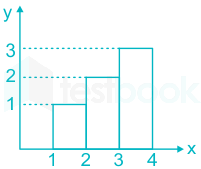
We can plot it as:
∴ Area under y for xϵ [1, 4] = (1 × 1) + (1 × 2) + (1 × 3) = 6
6
Crowd funding deals with mobilisation of funds for a project from a large number of people, who would be willing to invest smaller amounts through web-based platforms in the project.
Based on the above paragraph, which of the following is correct about crowd funding?
((a))
Funds raised through unwilling contributions on web-based platforms.
((b))
Funds raised through large contributions on web-based platforms.
((c))
Funds raised through coerced contributions on web-based platforms.
((d))
Funds raised through voluntary contributions on web-based platforms
Show Answer
Answer: ((d))
Funds raised through voluntary contributions on web-based platforms
The correct answer is Option 4 i.e. Funds raised through voluntary contributions on web-based platforms.
After reading the above paragraph one can easily comprehend that a large number of people voluntarily (proceeding from the will or from one's own choice or consent) invested in small amounts for the crowd-funding, now let's go through each option one by one.
Option 1 states that- "Funds raised through unwilling contributions on web-based platforms.", this option is incorrect because the contribution was made willingly in small amounts by a large number of peoples.
Option 2 states that- "Funds raised through large contributions on web-based platforms.", this option is incorrect, it has been clearly mentioned in the passage that a large number of people invest small amounts. (Large contributions are mentioned nowhere in the paragraph)
Option 3 states that- "Funds raised through coerced contributions on web-based platforms.", Coerced means to compel to an act or choice or to achieve by force or threat, people were not forced to make a contribution in this crowd-funding they willingly invested small amounts. Hence, this option is incorrect as well.
7
P, Q, R, and S are to be uniquely coded using α and β. If P is coded as αα and Q and αβ, then R and S, respectively, can be coded as
((a))
βα and αβ
((b))
ββ and αα
((c))
αβ and β
((d))
βα and ββ
Show Answer
Answer: ((d))
βα and ββ
Explanation:
All different possible codes using α and β are:
αβ, βα, αα, ββ
Given:
P is coded as αα
Q is coded as αβ
∴ R and S can be coded as βα and ββ respectively.
8
The sum of the first n terms in the sequence 8, 88, 888, 8888, ….. is _____.
((a))
8081(10n−1)+89n
((b))
8081(10n−1)−89n
((c))
8180(10n−1)+98n
((d))
8180(10n−1)−98n
Show Answer
Answer: ((d))
8180(10n−1)−98n
Concepts:
Let us consider sequence a1, a2, a3 …. an is an G.P.
Common ratio = r = a1a2=a2a3=…=an−1an
nth term of the G.P. is an = arn−1
Sum of n terms = s = r−1a;(rn−1); where r >1
Sum of n terms = s = 1−ra;(1−rn); where r <1
Sum of infinite GP = s∞=1−ra; |r| < 1
Where a is 1st term and r is common ratio.
Explanation:
8 + 88 + 888 + 8888 + ….
Taking 8 common from each term
⇒ 8 (1 + 11 + 111 + 1111 + ….)
Multiplying and dividing the equation by 9
⇒ 98;[9+99+999+9999;+;….]
⇒ 98;[(10−1)+(100−1)+(1000−1)+(10000−1)+;….]
⇒ 98;[(10+102+103+104+;…+10n)−(1+1+1+1+;….;+;n)]
The above equation is in geometric progression (GP) with a ratio of 10.
∵ the sum of G.P of with first term a, geometric ratio r and number of terms n is given by r−1a(rn−1)
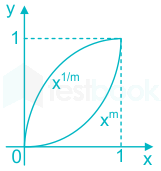
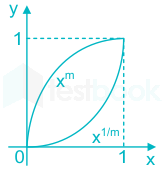
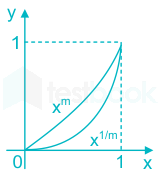
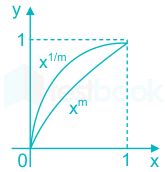
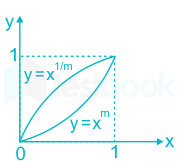
Select the graph that schematically represents BOTH y = xm and y = x1/m properly in the interval 0 ≤ x ≤ 1, for integer values of m, where m > 1.
((a))
((b))
((c))
((d))
Show Answer
Answer: ((a))
Given y = xm where m > 1 & y = x1/m and 0 ≤ x ≤ 1
Let us consider m = 2
In that case:
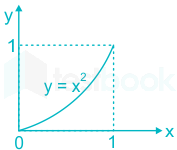
y = x2 graph can be plotted as
[Slope: dxdy=2x⇒x↑→dxdy↑]
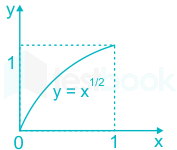
Also y = x0.5 is represented in graph as:
[Slope: dxdy=0.5x−0.5⇒x↑→dxdy↓]
∴ y = xm & y = x1/m is correctly represented by option 1) i.e.
y = xm ⇒ increasing slope
y = x1/m ⇒ decreasing slope
10
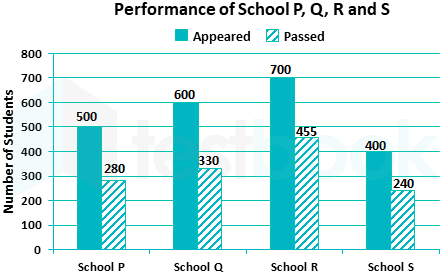
The bar graph shows the data of the students who appeared and passed in an examination for four school P, Q, R and S. The average of success rates (in percentage) of these four schools is _____.
((a))
58.5%
((b))
58.8%
((c))
59.0%
((d))
59.3%
Show Answer
Answer: ((c))
59.0%
Concept:
Average success rate of one school = Total no of passed students/Total no. of students who appeared
The average success rates of these four schools = Sum of Average success rate of all four schools/Total no. of schools
Therefore, The average success rates of these four schools will be
∴ The average success rates of these four schools = 59.0%
Mechanical Engineering (55 questions)
11
Multiplication of real valued square matrices of same dimension is:
((a))
Associative
((b))
Commutative
((c))
Always positive definite
((d))
not always possible to commute
Show Answer
Answer: ((a))
Associative
EXPLANATION:
Let A, B and C be the matrices a, b, and c be scalars and the sizes of matrices are such that the operations can be performed then
The multiplication of real-valued square matrices of the same dimension is:
Associative, which means that for any three matrices A, B, and C of the same dimension, the following holds true: (AB)C = A(BC)
Not Commutative, which means that the order of the matrices matters. In other words, AB is not necessarily equal to BA, unless one or both of the matrices are diagonal or scalar matrices.
Not always positive definite, since the determinant of the product of two matrices is equal to the product of the determinants of the matrices, and the determinant of a matrix is positive if and only if the matrix is invertible. Therefore, the product of two invertible matrices is invertible, and hence positive definite. However, the product of two non-invertible matrices may not be invertible, and hence not positive definite.
The order of the multiplication matters, so it is not always possible to compute the matrices. That is, AB is not necessarily equal to BA, unless one or both of the matrices are diagonal or scalar matrices.
Additional Information
Properties of Matrix addition and scalar multiplication:
Commutative Property of addition
A + B = B + A
Associative Property of addition
A + (B + C) = (A + B) + C
A + O = O + A Where O is the appropriate zero matrix
Distributive Property of addition
c(A + B) = cA + cB
(a + b)C = aC + bC
(ab)C = a(bc)
12
The value of x→1lim(1−xe−c(1−x)1−e−c(1−x)) is
((a))
c
((b))
c + 1
((c))
c+1c
((d))
cc+1
Show Answer
Answer: ((c))
c+1c
Concept:
x→1lim(1−xe−c(1−x)1−e−c(1−x)) = 0/0 form
Hence apply L – Hospital rule
Calculation:
Now,
By applying L – Hospital rule, i.e.
By differentiating both the numerator and denominator
Here, the function f(z) is analytic except z = 0. Since the function is not defined for these two values.
But in question it is asked at all points hence f(z) = log z is not analytic at all points.
15
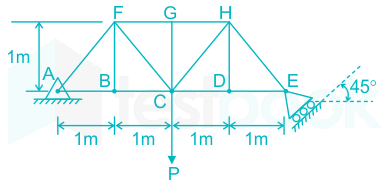
The members carrying zero force (i.e. zero-force members) in the truss shown in the figure, for any lad P > 0 with no appreciable deformation of the truss (i.e. with no appreciable change in angles between the members), are
((a))
BF and DH only
((b))
BF, DH and GC only
((c))
BF, DH, GC, CD and DE only
((d))
BF, DH, GC, FG and GH only
Show Answer
Answer: ((c))
BF, DH, GC, CD and DE only
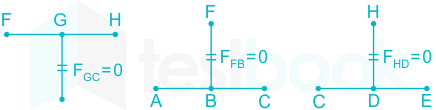
If at a joint 3 members meet out of which 2 are collinear then force in 3rd member will be zero provided there is no load/reaction at that joint.
∴ FGC = 0, FFB = 0 and FHD = 0
i.e. forces in the member GC, FB, HD is equal to zero
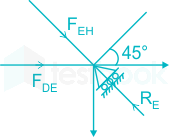
Now, considering joint E:
∵ FEH = RE
There is no horizontal force.
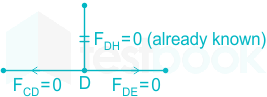
∴ FDE = 0
Also considering joint D, we can say that force in member CD = 0
16
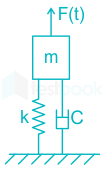
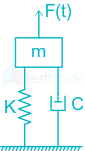
A single-degree-of freedom oscillator is subjected to harmonic excitation F(t) = F0 cos(ωt) as shown in the figure.
The non-zero value of ω, for which the amplitude of the force transmitted to the ground will be F0, is
((a))
2mk
((b))
mk
((c))
m2k
((d))
2mk
Show Answer
Answer: ((c))
m2k
Concept:
In vibration system, transmissibility is given by
\(\epsilon =\frac{{{F}{T}}}{{{F}{O}}}\)
Where FT = maximum force transmitted to the ground
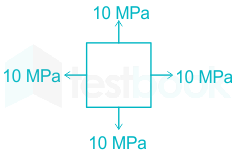
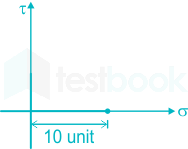
The stress state at a point in a material under plane stress condition is equi-biaxial tension with a magnitude of 10 MPa. If one unit on the σ - τ plane is 1 MPa, the Mohr’s circle representation of the state-of-stress is given by
((a))
a circle with a radius equal to principal stress and its center at the origin of the σ - τ plane
((b))
a point on the σ axis at a distance of 10 units from origin
((c))
a circle with a radius of 10 units on the σ - τ plane
((d))
a point on the τ axis at a distance of 10 units from the origin
Show Answer
Answer: ((b))
a point on the σ axis at a distance of 10 units from origin
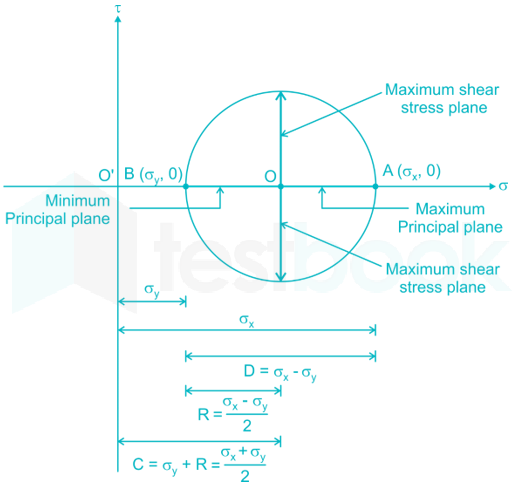
Radius of circle (Mohr’s circle) \(=\sqrt{{{\left( \frac{{{\sigma }{x}}-{{\sigma }{y}}}{2} \right)}^{2}}+\tau _{xy}^{2}}\)
Calculation:
Given state of stress is represented by
∴ σx = 10 MPa. σy = 10 MPa τxy = 0
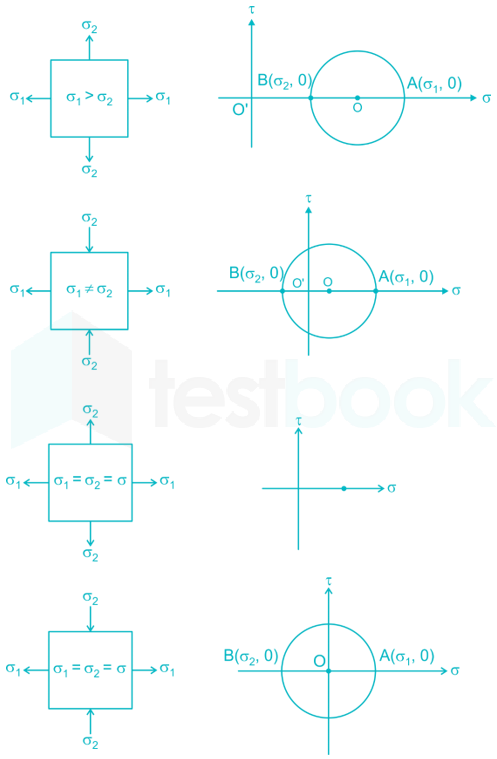
For this the Mohr Circle will be a point:
∴ σ1 = σ2 = 10 MPa
Radius of circle (Mohr’s circle) will be zero.
The co-ordinate of the centre of Mohr’s circle on σ-axis at a distance of 10 units from the origin.
18
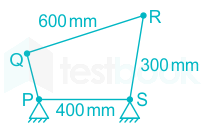
A four-bar mechanism is shown below.
<br>
For the mechanism to be a crank-rocker mechanism, the length of the link PQ can be
((a))
80 mm
((b))
200 mm
((c))
300 mm
((d))
350 mm
Show Answer
Answer: ((a))
80 mm
Concept:
According to Grashof’s Law:
(1) S + L ≤ P + Q (Class I mechanism)
There will be at least one complete revolution between the two links.
If the shortest link is fixed: Double Crank Mechanism
If any of the adjacent links of the shortest link if fixed: Crank rocker mechanism
If the link opposite to shortest link is fixed: Double Rocker Mechanism
(2) S + L > P + Q (Class II mechanism)
Only a double rocker mechanism is possible.
Calculation:
Given:
For getting a crank rocker mechanism, any of the adjacent links of the shortest link should be fixed and S + L ≤ P + Q.
Here fixed link is PS = 400 mm which is not the shortest link.
Let's start with incorrect options first.
Now consider the length of PQ = 350 mm
S + L = 300 + 600 = 900
P + Q = 400 + 350 = 750
S + L > P + Q.
Grashof’s Law not satisfied
Now consider the length of PQ = 300 mm
S + L = 300 + 600 = 900
P + Q = 400 + 300 = 700
S + L > P + Q
Grashof’s Law not satisfied
Now consider the length of PQ = 200 mm
S + L = 200 + 600 = 800
P + Q = 400 + 300 = 700
S + L > P + Q
Grashof’s Law not satisfied
Now consider the length of PQ = 80 mm
S + L = 80 + 600 = 680
P + Q = 400 + 300 = 700
S + L < P + Q
Grashof’s Law is satisfied
Shortest link is PQ (80 mm). Link adjacent to shortest link is fixed i.e. PS. So it will give crank rocker mechanism.
19
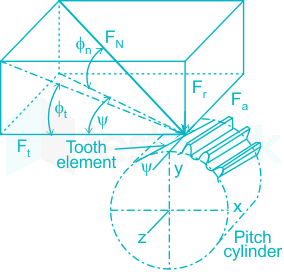
A helical gear with 20° pressure angle and 30° helix angle mounted at the midspan of a shaft that is supported between two bearings at the ends. The nature of the stresses induced in the shaft is
((a))
normal stresses due to bending only
((b))
normal stress due to bending in one plane and axial loading; shear stress due to torsion
((c))
Normal stress due to bending in two planes and axial loading; shear stress due to torsion
((d))
normal stress due to bending in two planes; shear stress due to torsion
Show Answer
Answer: ((c))
Normal stress due to bending in two planes and axial loading; shear stress due to torsion
The resultant force on helix gear i.e. FN can be resolved as:
ϕ = pressure angle
ψ = helix angle
i) FT i.e. Tangential force
ii) FR i.e. Radial force
iii) Fa i.e. Axial force
Fa induces axial stress in the shaft
FT and FR are responsible for bending of shaft in two plane.
Due to FT tangential shear stress will be induced in the shaft.
20
The crystal structure of γ iron (austenite phase) is
((a))
BCC
((b))
FCC
((c))
HCP
((d))
BC
Show Answer
Answer: ((b))
FCC
Explanation:
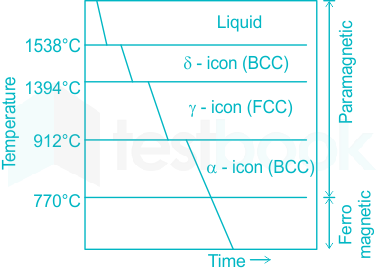
At 1539°C, iron cools from liquid to solid, it is in BCC structure and it is in δ-Ferrite stage.
After cooling in temperature range from 1400°C to 910°C it contains FCCstructure which is also known as γ-Austenite.
After again cooling below 910°C, α-ferrite phase will start.
768°C temperature line in diagram is known as Curie point temp line, because it distinguishes the metal property as Magnetic and non-magnetic.
Above 768°C, the metal is non-magnetic and below 768°C the metal is magnetic.
21
Match the following.
Heat treatment
Effect
P:
Tempering
1.
Strengthening
Q:
Quenching
2.
Toughening
R:
Annealing
3.
Hardening
S:
Normalizing
4.
Softening
((a))
P-2, Q-3, R-4, S-1
((b))
P-1, Q-1, R-3, S-2
((c))
P-3, Q-3, R-1, S-3
((d))
P-4, Q-3, R-2, S-1
Show Answer
Answer: ((a))
P-2, Q-3, R-4, S-1
Concept:
Heat treatment:
Heat treatment operation can be defined as heating a metal or alloy to various definite temperatures, holding these for the various time durations and cooling at various rates to get the desired grain structure and property in the metal or alloy.
PROCESS
FUNCTION
Normalizing
- It produces a uniform grain structure, so that strength could be improved. - It removes cold and hot working stresses.
Annealing
- It softens the material and brings about required changes in properties such as Machinability, Mechanical or Electrical properties.
Quenching
- It increases the strength of the metal and increases wear resistance and hardenability but makes the metal brittle and of low ductility.
Tempering
- It restores ductility and reduces hardness. - Increased toughness is obtained at the expense of high strength.
Case hardening(carburizing)
- It is a process of hardening the outer portion of the metal while the core remains soft and tough.
22
The base of a brass bracket needs rough grinding. For this purpose, the most suitable grinding wheel grade specification is
((a))
C30Q12V
((b))
A50G8V
((c))
C90J4B
((d))
A30D12V
Show Answer
Answer: ((a))
C30Q12V
Concept:
A grinding wheel consists of the abrasive that does the cutting, and the bond that holds the abrasive particles together.
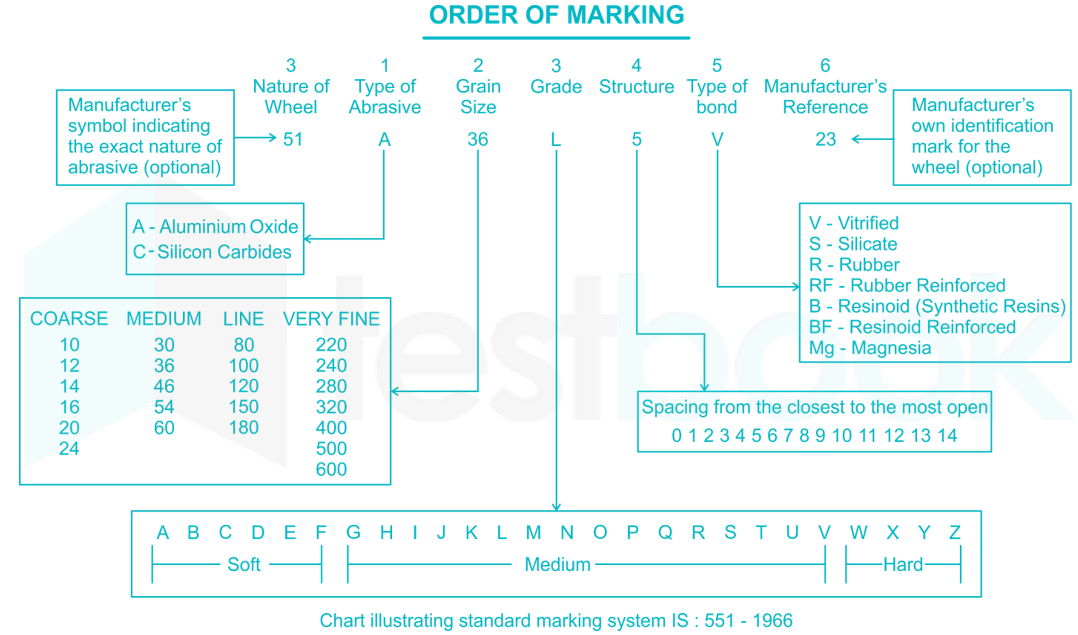
A standard marking system is used to specify and identify grinding wheels.
The following is the sequence of arrangement:
Abrasive type – Grain size – Grade of bond – Structure – Bond type
51
A
46
H
5
V
8
Position 0
Position 1
Position 2
Position 3
Position 4
Position 5
Position 6
Manufacturer’s Symbol for abrasive (Optional)
Type of abrasive grit size
Grain size
Grade
Structure (Optional)
Type of bond
Manufacturer’s own mark (Optional)
Abrasive type: ‘A’ for aluminium oxide, ‘C’ for silicon carbide
Silicon Carbide: It is less hard than diamond and less tough than aluminium oxide. It is used for grinding of material of low tensile strength like cemented carbide, stone and ceramic, grey cast iron, copper, brass, bronze, aluminium, vulcanized rubber, etc.
Aluminium Oxide: Aluminium oxide is tough and fracture resistant. It is preferred for grinding of materials of higher tensile strengths like steel; high carbon and high-speed steel and tough bronze.
Grain size: They are indicated by a number ranging from 10 (coarse) up to 600 (very fine)
Grade of bond: The grades range from ‘A’ indicating light or ‘soft’ bond to ‘Z’ indicating a firm or ‘hard’ bond
A soft bond permits the grains to break away more readily than a hard one and should be used where the abrasive becomes rapidly dulled or blunt, i.e., when grinding hard materials.
A hard bond retains the abrasive grains longer and should be used when grinding soft materials.
Structure: This structure is indicated by a number from 1 to 12. The higher numbers indicate a progressively more open structure. It is the optional specification.
Bond type: V – Vitrified, S – Silicate, B – Resinoid, R – Rubber, E – Shellac, O – Oxychloride
Solution:
Rough cutting of brass, silicon carbide should be used as abrasive, therefore options with Al2O3 as abrasive are eliminated.
Also, brass is a soft material so, the hard wheel is required for its grinding ‘J’ lies in (A-H) range i.e. for the soft wheel so, it can’t be used whereas Q represents hard wheel.
So, we will go for grinding wheel with specification C30Q12V
23
In the Critical Path Method (CPM), the cost-time slope of an activity is given by
((a))
Crash;Time;Crash;Cost−Normal;Cost
((b))
Crash;Time−Normal;Time;Normal;Cost
((c))
Crash;Time−Normal;Time;Crash;Cost
((d))
Normal;Time−Crash;Time;Crash;Cost−Normal;Cost
Show Answer
Answer: ((d))
Normal;Time−Crash;Time;Crash;Cost−Normal;Cost
Concept:
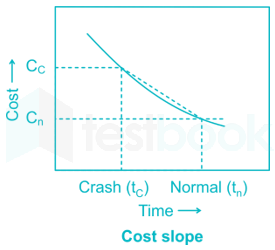
Crash time is the minimum activity duration to which an activity can be compressed by increasing the resources and by increasing the direct cost.
The slope of the line gives the amount of increase in the direct cost per unit time for crashing an activity.
Concept:
Cost Slope: The direct cost curve is a curve that can be approximated by a straight line, depending upon the flatness of the curve. The slope of this straight is the cost slope. It is very helpful in the project cost analysis.
Cs=Normal;Time−Crash;TimeCrash;Cost−Normal;Cost
The activity with minimum cost slope should be crashed first, as it results in optimum crashing of the project.
24
Froude number is the ratio of
((a))
buoyancy forces to viscous forces
((b))
inertia forces to viscous forces
((c))
buoyancy forces to inertia forces
((d))
inertia forces to gravity forces
Show Answer
Answer: ((d))
inertia forces to gravity forces
Concept:
Froude number is the ratio of inertial force to the gravitation force.
\(\text{Froude }!!!!\text{ number}=\text{ }!!!!\text{ }\sqrt{\frac{\text{Inertia force }!!!!\text{ }}{\text{Gravitational force }!!!!\text{ }}}\)
Froude number has the following applications:
Used in cases of river flows, open-channel flows, spillways, surface wave motion created by boats
Biot number → Ratio of internal thermal resistance to boundary layer thermal resistance
Grashof number → Ratio of buoyancy to viscous force
Prandtl number → Ratio of momentum diffusivity (ν) and thermal diffusivity (α). Pr =ν/α
Reynolds number → Ratio of inertia force to viscous force
Nusselt number → Ratio of Convective heat transfer to Conduction heat transfer
Nu=khLc
26
The velocity field of incompressible flow in a Cartesian system is represented by
V=2(x2−y2)i^+vj^+3k^
Which one of the following expressions for v is valid?
((a))
-4xz + 6xy
((b))
-4xy – 4xz
((c))
4xz – 6xy
((d))
4xy + 4xz
Show Answer
Answer: ((b))
-4xy – 4xz
Concept:
If velocity is given as V=ui^+vj^+wk^
Then for incompressible flow continuity equation has to be satisfied,
∂x∂u+∂y∂v+∂z∂w=0
Calculation:
V=2(x2−y2)i^+vj^+3k^
u = 2(x2 – y2)
v = v
w = 3
Putting the values in continuity equation
∂x2∂(x2−y2)+∂y∂v+∂z∂(3)=0
⇒ 4x+;∂y∂v+0=0
⇒ ∂y∂v=;−4x
⇒ v = -4xy + f(x,z)
∴ Out of the given options, option 2 matches our answer.
27
Joule-Thompson coefficient for an ideal gas is
((a))
Higher than zero
((b))
Less than zero
((c))
Zero
((d))
1
Show Answer
Answer: ((c))
Zero
Explanation:
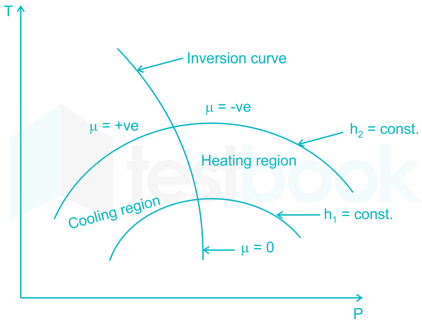
Joule – Thomson coefficient:- When the gas in steady flow passes through a constriction, e.g. in an orifice or valve, it normally experiences a change in temperature. From the first law of thermodynamics, such a process is isenthalpic and one can usefully define a Joule – Thomson coefficient as
μ=(∂P∂T)H
As a measure of the change in temperature which results from a drop in pressure across the construction.
For an ideal gas, μ = 0, because ideal gases neither warm not cool upon being expanded at constant enthalpy.
If μ is +ve, then the temperature will fall during throttling.
If μ is -ve, then the temperature will rise during throttling.
28
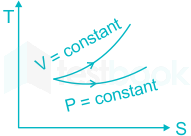
For an ideal gas, a constant pressure line and a constant volume line intersect at a point, in the Temperature (T) versus specific entropy (S) diagram. Cp is the specific heat at constant pressure and Cv is the specific heat at constant volume. The ratio of the slopes of the constant pressure and constant volume lines at the point of intersection is
((a))
CpCp−Cv
((b))
CvCp
((c))
CvCp−Cv
((d))
CpCv
Show Answer
Answer: ((d))
CpCv
Concept:
Combined equations of first and second law of thermodynamics
Tds = du + Pdv
Tds = dh – vdP
These equations are applicable for both reversible and irreversible process and for the closed and open system as well.
du = CvdT
dh = CpdT
Cv = specific heat at constant volume, Cp = specific heat at constant pressure
Calculation:
From first equation
Tds = du + Pdv
For constant volume, dv = 0
And, du = CvdT
∴ 1st equation becomes: Tds = CvdT
dSdTv=c=CvT
From second equation
Tds = dh – vdP
For constant pressure, dP = 0 & dh = CpdT
Tds = CpdT
dSdTp=c=CpT
Therefore, ratio of slope of constant pressure and constant volume lines at point of intersection:
For three vectors A=2j^−3k^,B=−2i^+k^and;C^=3i^−j^, where î, ĵ and k̂ are unit vectors along the axes of a right-handed rectangular/Cartesian coordinate system, the value of (A.(B×C)+6) is _______.
30
A flywheel is attached to an engine to keep its rotational speed between 100 rad/s and 110 rad/s. If the energy fluctuation in the flywheel between these two speeds is 1.05 kJ then the moment of inertia of the flywheel is _______ kg.m2 (round off to 2 decimal places).
31
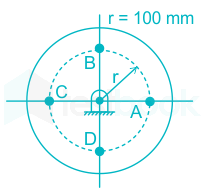
A balanced rigid disc mounted on a rigid rotor has four identical point masses, each of 10 grams, attached to four points on the 100 mm radius circle shown in the figure.
The rotor is driven by a motor at uniform angular speed of 10 rad/s. If one of the masses gets detached then the magnitude of the resultant unbalance force on the rotor is ______N (round off to 2 decimal places).
32
A sheet metal with a stock hardness of 250 HRC has to be sheared using a punch and a die having a clearance of 1 mm between them. If the stock hardness of the sheet metal increases to 400 HRC, the clearance between the punch and the die should be _____mm.
33
A company is hiring to fill four managerial vacancies. The candidates are five men and three women. If every candidate is equally likely to be chosen then the probability that at least one woman will be selected is ______ (round of to 2 decimal places).
34
The compressor of a gas turbine plant, operating on an ideal intercooled Brayton cycle, accomplishes an overall pressure ratio of 6 in a two-stage compression process. Intercooling is used to cool the air coming out from the first stage to the inlet temperature of the first stage, before its entry to the second stage. Air enters the compressor at 300 K and 100 kPa. If the properties of gas are constant, the intercooling pressure for minimum compressor work is ________ kPa (round off to 2 decimal places)
35
In a concentric tube counter-flow heat exchange, hot oil enters at 102°C and leaves at 65°C. Cold water enters at 25°C and leaves at 42°C. The log mean temperature difference (LMTD) is ________ °C (Round off to one decimal place).
36
The evaluation of the definite integral \(\mathop \smallint \nolimits_{ - 1}^{1.4} x\left| x \right|dx\) by using Simpson’s 1/3rd (one –third) rule with step size h = 0.6 yields
((a))
0.914
((b))
1.248
((c))
0.581
((d))
0.592
Show Answer
Answer: ((d))
0.592
Concept:
Number;of;interval=hb−a;
Where,
b is the upper limit, a is the lower limit, h is the step size
where î, ĵ, k̂ are unit vectors along the axes of a right-handed rectangular/Cartesian coordinate system. The surface integral ∫∫f.dS (Where dS is an elemental surface area vector) evaluated over the inner and outer surfaces of a spherical shell formed by two concentric spheres with origin as the centre, and internal and external radii of 1 and 2, respectively, is
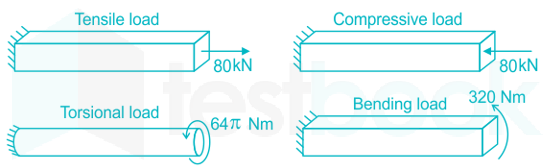
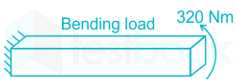
Bars of a square and circular cross-section with 0.5 m length is made of a material with a shear strength of 20 MPa. The square bar cross-section dimension is 4 cm × 4 cm and the cylindrical bar cross-section diameter is 4 cm. The specimens are loaded as shown in the figure.
Which specimen (s) will fail due to the applied load as per the maximum shear stress theory?
((a))
Tensile and compressive load specimens
((b))
Torsional load specimen
((c))
Bending load specimen
((d))
None of the specimens
Show Answer
Answer: ((a))
Tensile and compressive load specimens
Concept:
According to Maximum Shear Stress theory, failure occurs when the maximum shear stress from a combination of principal stresses equals or exceeds the value of its shear strength.
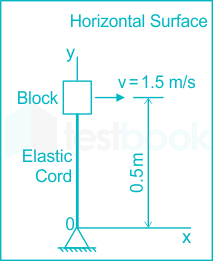
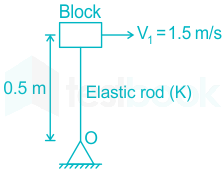
The 2 kg block shown in figure (top view) rests on a smooth horizontal surface and is attached to a massless elastic cord that has a stiffness 5 N/m.
The cord hinged at O is initially unstretched and always remains elastic. The block is given a velocity v of 1.5 m/s perpendicular to the cord. The magnitude of velocity in m/s of the block at the instant the cord is stretched by 0.4 m is
((a))
0.83
((b))
1.07
((c))
1.36
((d))
1.50
Show Answer
Answer: ((c))
1.36
Concept:
The total energy of the chord and block will remain constant. When the chord has stretched the part of the kinetic energy of the block gets converted into the potential energy of the chord.
The kinetic energy of the block is given by KE=21mv2
The potential energy of the chord is given by PE=21kx2
where m is the mass of the block v is the velocity of the block and K is the stiffness of the chord and x is the elongation of the chord
Calculation:
Given, Mass of block (m) = 2 kg, Rod stiffness (k) = 5 N/m, Change in length of rod (x) = 0.4 m
v1 = initial velocity = 1.5 m/s and let v2 be the final velocity
Using conservation of energy
21mv12=21;mv22+21kx2
21×2×(1.5)2=21×2×V22+21×5×(0.4)2
v2 = 1.36 m/s
40
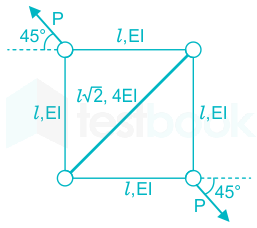
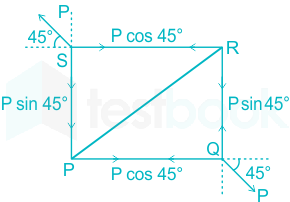
The truss shown in the figure has four members of length l and flexural rigidity EI, and one member of length l2 and flexural rigidity 4EI. The truss is loaded by a pair of forces of magnitude P, as shown in the figure.
The smallest value of P, at which any of the truss members will buckle is
((a))
l22π2EI
((b))
l2π2EI
((c))
l22π2EI
((d))
2l2π2EI
Show Answer
Answer: ((c))
l22π2EI
Considering the forces in whole truss:
So, we can observe that member maximum load is on member PR
So, considering member PR
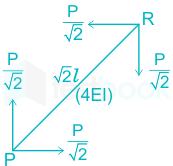
Resultant compressive load at point P and R
=(2P)2+(2P)2=P
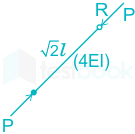
Now, resultant diagram
So minimum value of P for which any member will buckle
(Euler’s crippling load)
P=ℓPR2nπ2EIPR
Where (EI)PR = 4EI, n = 1 (for hinge joint)
ℓPR=2;ℓ
∴P=(2ℓ)2π2(4EI)
P=ℓ22π2EI
41
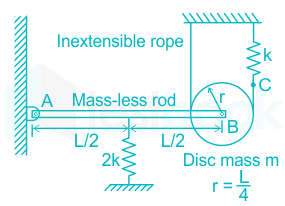
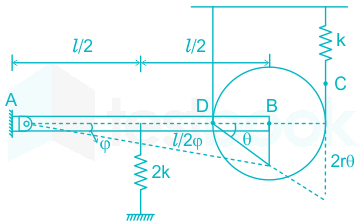
A rigid mass-less rod of length L is connected to a disc (pulley) of mass m and radius r = L/4 through a friction-less revolute joint. The other end of that rod is attached to a wall through a friction-less hinge. A spring of stiffness 2K is attached to the rod at its mid-span. An inextensible rope passes over half the disc periphery and is securely tied to a spring of stiffness k at point C as shown in the figure. There is no slip between the rope and the pulley. The system is in static equilibrium in the configuration shown in the figure and the rope is always taut.
Neglecting the influence of gravity, the natural frequency of the system for small amplitude vibration is
((a))
23mk
((b))
23mk
((c))
3mk
((d))
mk
Show Answer
Answer: ((c))
3mk
When we will rotate disc by θ, rod will rotate by angle ϕ as disc is pure rolling on the string
A strip of thickness 40 mm is to be rolled to thickness of 20 mm using a two-high mill having rolls of diameter 200 mm. coefficient of friction and arc length in mm, respectively are
((a))
0.45 and 38.84
((b))
0.39 and 38.84
((c))
0.39 and 44.72
((d))
0.45 and 44.72
Show Answer
Answer: ((d))
0.45 and 44.72
Concept:
Projected length
L=R!!Δ!!h
Where, Δh = Reduction or Draft, R = Radius of roller
Also, Δh = μ2R
Where μ = coefficient of friction
Calculation:
Given, hi = 40 mm, hf = 20 mm, D = 200 mm
R=2D=100mm
Δh = hi - hf
Δh = 20 mm
Projected length, L=R!!Δ!!h
⇒L=100×20
⇒ L = 44.7213 mm
∵ Δh = μ2R
μ=R!!Δ!!h=10020
∴ μ = 0.4472
43
For an assembly line, the production rate was 4 pieces per hour and the average processing time was 60 minutes. The WIP inventory was calculated. Now, the production rate is kept the same, and the average processing time is brought down by 30 percent. As a result of this change in the processing time, the WIP inventory.
((a))
decreases by 25%
((b))
increase by 25%
((c))
decreases by 30%
((d))
increase by 30%
Show Answer
Answer: ((c))
decreases by 30%
Given,
Processing time, P.T1 = 60 min = 1 hour
Production rate = 4/hr = 4 units per hour
Second case:
Production rate = 4/hour
But processing time reduced by 30%
∴ New processing time, P.T2 = (0.7 × 1) hour
New Production per hour = 4 × 0.7 = 2.8 units.
Thus, Work in progress has been reduced and decrease in
WIP=44−2.8×100=30%
44
A small metal bead (radius 0.5 mm), initially at 100°C, when placed in a stream of fluid at 20°C, attains a temperature of 28°C in 4.35 seconds. The density and specific heat of the metal are 8500 kg/m3 and 400 J/kgK respectively. If the bead is considered as a lumped system, the convective heat transfer coefficient (in W/m2.K) between the metal bead and the fluid stream is
((a))
283.3
((b))
299.8
((c))
149.9
((d))
449.7
Show Answer
Answer: ((b))
299.8
Lumped parameter analysis:
Internal/conductive resistance is very little as compared to surface convective resistance and the temperature distribution is given by
h = heat transfer coefficient, ρ is the density of the metal bead
For sphere: AV=surface;areaVolume;of;body=4πr234πr3=3r
V/A = r/3
Calculation:
Given, Cp = 400 J/kgK, ρ = 8500 kg/m3, t = 4.35 sec, r = 0.5 mm
Ti = 100°C, T∞ = 20°C, T = 28°C
Using equation (1) and putting the given values:
ln(28−20100−20)=(0.5×8500×400h×3×1000)×4.35
⇒h=3000×4.352.302×;0.5×8500×400=299.87;W/m2K;
∴ Heat transfer coefficient = 299.8 W/m2K
45
Consider two exponentially distributed random variables X and Y, both having a mean of 0.50. Let Z = X + Y and r be the correlation coefficient between X and Y. If the variance of Z equals 0, then the value of r is _______ (round off to 2 decimal places).
46
An analytic function of a complex variable z=x+iy;(i=−1) is defined as
f(z) = x2- y2 + iψ (x, y),
where ψ(x,y) is a real function. The value of the imaginary part of f(Z) at z = (1 + i) is _______ (round off to 2 decimal places).
47
In a disc-type axial clutch, the frictional contact takes place within an annular region with outer and inner diameters 250 mm and 50 mm, respectively. An axial force F1 is needed to transmit a torque by new clutch. However, to transmit the same torque, one needs an axial force F2 when the clutch wears out. If contact pressure remains uniform during operation of a new clutch while the wear is assumed to be uniform for an old cultch, and the coefficient of friction does not change, then the ratio F1/F2 is __________ (round off to 2 decimal places.)
48
A cam with a translating flat-face follower is desired to have the follower motion
y (θ) = 4[2πθ – θ2], 0 ≤ θ ≤ 2π
Contact stress considerations dictate that the radius of curvature of the cam profile should not be less than 40 mm anywhere. The minimum permissible base circle radius is _____ mm (round off to one decimal place).
49
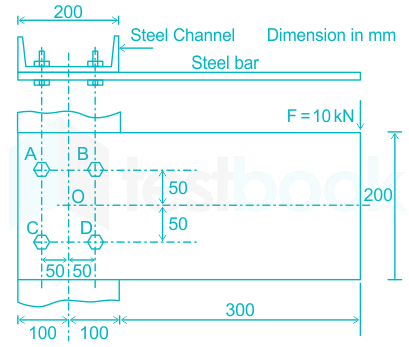
A rectangular steel bar of length 500 mm, width 100mm, and thickness 15 mm is cantilevered to a 200 mm steel channel using 4 bolts, as shown.
For an external load of 10 kN applied at the tip of the steel bar, the resultant shear load on the bolt at B, is _______ kN(round off to one decimal place)
50
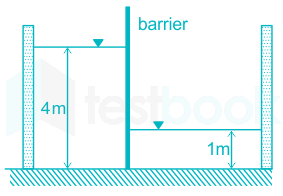
The barrier shown between two water tanks of unit width (1 m) into the plane of the screen is modelled as a cantilever.
Taking the density of water as 1000 kg/m3, and the acceleration due to gravity as 10m/s2, the maximum absolute bending moment developed in the cantilever is ______ kN.m (round off to the nearest integer).
51
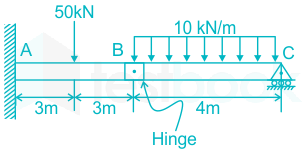
The magnitude of reaction force at joint C of the hinge-beam shown in the figure is ________ kN (round off to 2 decimal places).
52
A slot of 25 mm × 25 mm is to be milled in a workpiece of 300 mm length using a side and face milling cutter of diameter 100 mm, width 25 mm and having 20 teeth.
For a depth of cut 5 mm, feed per tooth 0.1 mm, cutting speed 35 m/min and approach and over-travel distance of 5 mm each, the time required for milling the slot is ______ minutes (round off to one decimal place).
53
The following data applies to basic shaft system:
Tolerance for hole = 0.002 mm,
Tolerance for shaft = 0.001 mm,
Allowance = 0.003 mm,
Basic size = 50 mm,
The maximum hole size is ____ mm (round off to 3 decimal places).
54
A steel part with a surface area of 125 cm2 is to be chrome coated through an electroplating process using chromium acid sulphate as an electrolyte. An increasing current is applied to the part according to the following current time relation:
I = 12 + 0.2t
where, I = current (A) and t = time (minutes). The part is submerged in the plating solution for a duration of 20 minutes for plating purpose. Assuming the cathode efficiency of chromium to be 15% and the plating constant of chromium acid sulphate to be 2.50 × 10⁻² mm3/A.s, the resulting coating thickness on the part surface is ______ μm (round of to one decimal place).
55
In a turning process using orthogonal tool geometry, a chip length of 100 mm is obtained for an uncut chip length of 250 mm.
The shear plane angle is ____ degrees (round off to one decimal place).
56
The thickness of a steel plate with material strength coefficient of 210 MPa, has to be reduced from 20 mm to 15 mm in a single pass in a two-high rolling mill with a roll radius of 450 mm and rolling velocity of 28 m/min. If the plate has a width of 200 mm and its strain hardening exponent, n is 0.25, the rolling force required for the operation is _____ kN (round off to 2 decimal places).
Two business owners Shweta and Ashok run their businesses in two different states. Each of them, independent of the other, produces two products A and B, sells them at Rs. 2,000 per kg and Rs. 3,000 per kg, respectively, and uses Linear Programming to determine the optimal quantity of A and B to maximize their respective daily revenue. Their constraints are as follows: i) for each business owner, the production process is such that the daily production of A has to be at least as much as B, and the upper limit for production of B is 10 kg per day, and ii) the respective state regulations restrict Shveta’s production of A to less than 20 kg per day, and Ashok’s production of A to less than 15 kg per day. The demand of both A and B in both the states is very high and everything produced is sold.
The absolute value of the difference in daily (optimal) revenue of Shweta and Ashok is ______ thousand Rupees (round off to 2 decimal places).
58
Consider two cases as below.
Case 1: A company buys 1000 pieces per year of a certain part from vendor ‘X’ The changeover time is 2 hours and the price is Rs. 10 per piece. The holding cost rate per part is 10% per year.
Case 2: For the same part, another vendor ‘Y’ offers a design where the changeover time is 6 minutes, with a price of Rs. 5 per piece, and a holding cost rate per part of 100% per year. The order size is 800 pieces per year from ‘X’ and 200 pieces per year from ‘Y’
Assume the cost of downtime as Rs. 200 per hour. The percentage reduction in the annual cost for Case 2, as compared to Case 1 is ________(round off to 2 decimal places).
59
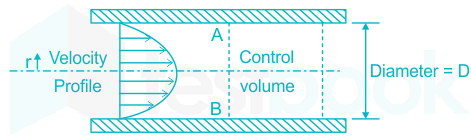
Consider steady, viscous, fully developed flow of a fluid through a circular pipe of internal diameter D. We know that the velocity profile forms a paraboloid about the pipe centre line, given by: V=−C(r2−4D2)m/s, where C is a constant. The rate of kinetic energy (in J/s) at the control surface A-B, as shown in the figure, is proportional to Dn. The value of n is
60
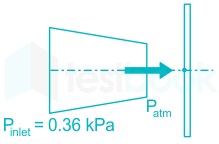
Air discharges steadily through a horizontal nozzle and impinges on a stationary vertical plate as shown in figure.
The inlet and outlet areas of the nozzle are 0.1 m2 and 0.02 m2, respectively. Take air density as constant and equal to 1.2 kg/m3. If the inlet gauge pressure of air is 0.36 kPa, the gauge pressure at point O on the plate (the point where the axis of nozzle touches the plate) is ________ kPa (round off to two decimal places).
61
Air (ideal gas) enters a perfectly insulated compressor at a temperature of 310 K. The pressure ratio of the compressor is 6. Specific heat at constant pressure for air is 1005 J/kg.K and ratio of specific heats at constant pressure and constant volume is 1.4. Assume that specific heats of air are constant. If the isentropic efficiency of the compressor is 85 percent, the difference in enthalpies of air between the exit and the inlet of the compressor is _________kJ/kg (round off to nearest integer).
62
One kg of air, initially at a temperature of 127°C, expands reversibly at a constant pressure until the volume is doubled. If the gas constant of air is 287 J/kg.K, the magnitude of work transfer is_______ kJ (round off to 2 decimal places).
63
For an ideal Rankine cycle operating between pressures of 30 bar and 0.04 bar, the work output from the turbine is 903 kJ/kg and the work input to the feed pump is 3 kJ/kg. The specific steam consumption is kg/kW.h (round off to 2 decimal places).
64
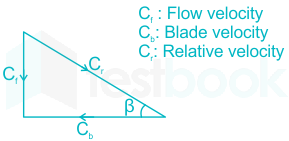
For a Kaplan (axial flow) turbine, the outlet blade velocity diagram at a section is shown in figure.
The diameter at this section is 3 m. The hub and tip diameters of the blade are 2 m and 4 m, respectively. The water volume flow rate is 100 m3/s. The rotational speed of the turbine is 300 rpm. The blade outlet angle β is ______ degrees (round off to one decimal place).
65
The indicated power developed by an engine with compression ratio of 8, is calculated using an air-standard Otto cycle (constant properties). The rate of heat addition is 10 kW. The ratio of specific heats at constant pressure and constant volume is 1.4. The mechanical efficiency of the engine is 80 percent. The brake power output of the engine is_______ kW (round off to one decimal place).