Official Paper

GATE ME 2019 Official Paper: Shift 2 (Previous Year Paper)

65 questions · 180 minutes · with answers · free

General Aptitude (10 questions)

1

Once the team of analysts identifies the problem, we _________ in a better position to comment on the issue. 

Which one of the following choices CANNOT fill the given blank?

  1. ((a))

    will be

  2. ((b))

    were to be

  3. ((c))

    are going to be

  4. ((d))

    might be

Show Answer
Answer: ((b))

were to be

Once the team of analysts identifies the problem, we _________ in a better position to comment on the issue. 

The 1st clause is in the present tense, so 'will be', 'are going to be' or 'might be' are appropriate because these are the verbs representing present or future.

'were to be' can't be used because this is the verb of past tense.

2

A final examination is the _________ of a series of evaluations that a student has to go through. 

  1. ((a))

    culmination

  2. ((b))

    consultation

  3. ((c))

    desperation

  4. ((d))

    insinuation

Show Answer
Answer: ((a))

culmination

  • Culmination (चरम बिंदु): It is the point at which an event or series of events ends, having developed until it reaches this point.
  • Example: Winning first prize was the culmination of years of practice and hard work.
  • Consultation (परामर्श): A meeting to discuss something or to get advice.
  • Example: After consultations with our accountants, we've decided on how to cut costs within the company.
  • Desperation (निराशा): The feeling of needing or wanting something very much or the feeling of being in such a bad situation that you will take any risk to change it. 
  • Example: In desperation, they jumped out of the window to escape the fire.
  • Insinuation (कटाक्ष): the action of suggesting, without being direct, that something unpleasant is true.
  • Example: He looked insulted by her insinuation.

A final examination is the culmination of a series of evaluations that a student has to go through.

3

If IMHO = JNIP; IDK = JEL; and SO = TP, then IDC = ____. 

  1. ((a))

    JDE

  2. ((b))

    JED

  3. ((c))

    JDC

  4. ((d))

    JCD

Show Answer
Answer: ((b))

JED

ABCDE
FGH→I→J
KLM→NO→
PQRST
UVWXY
<br>

MHO = JNIP; IDK = JEL; SO = TP

In this given code, every letter is being replaced by the letter that is immediately next to it.

So I → J, D → E, C → D

∴ IDC = JED

4

The product of three integers X, Y and Z is 192. Z is equal to 4 and P is equal to the average of X and Y. What is the minimum possible value of P? 

  1. ((a))

    6

  2. ((b))

    7

  3. ((c))

    8

  4. ((d))

    9.5

Show Answer
Answer: ((b))

7

The product of three integers X, Y and Z is 192.

X.Y.Z = 192

Z is equal to 4.

⇒ X.Y.(4) = 192 ⇒ X.Y = 48

Possibilities are: (1,48), (2,24), (3,16), (4,12), (6,8)

P is equal to the average of X and Y.

P = (X + Y)/2

Pmin = (X + Y)min/2 = (6 + 8)/2 = 7

5

Are there enough seats here? There are ________ people here than I expected. 

  1. ((a))

    many

  2. ((b))

    most

  3. ((c))

    least

  4. ((d))

    more

Show Answer
Answer: ((d))

more

Here "than" is used which represents the comparison.

Only 'more' is a comparative degree adjective. So 'more' is correct answer.

6

Fiscal deficit was 4% of the GDP in 2015 and that increased to 5% in 2016. If the GDP increased by 10% from 2015 to 2016, the percentage increase in the actual fiscal deficit is ___. 

  1. ((a))

    37.50

  2. ((b))

    35.70

  3. ((c))

    25.00

  4. ((d))

    10.00

Show Answer
Answer: ((a))

37.50

GDP increased by 10% from 2015 to 2016 ⇒ 

Let GDP in 2015 = X

GDP in 2016 = 1.1 X

Fiscal deficit was 4% of the GDP in 2015 and that increased to 5% in 2016 ⇒

FD in 2015 = 0.04 X

FD in 2016 = 0.05 (1.1 X) = 0.055 X

Percentage increase in the actual fiscal deficit:

FD2016FD2015FD2015×100=0.0550.040.04×100=37.5%\frac{{F{D_{2016}} - F{D_{2015}}}}{{F{D_{2015}}}} \times 100 = \frac{{0.055 - 0.04}}{{0.04}} \times 100 = 37.5\%

7

Two pipes P and Q can fill a tank in 6 hours and 9 hours respectively, while a third pipe R can empty the tank in 12 hours. Initially, P and R are open for 4 hours. Then P is closed and Q is opened. After 6 more hours, R is closed. The total time taken to fill the tank (in hours) is ____. 

  1. ((a))

    13.50

  2. ((b))

    14.50

  3. ((c))

    15.50

  4. ((d))

    16.50

Show Answer
Answer: ((b))

14.50

Concept:

Basic Concepts and Pipes & Cisterns formula:

  • If a pipe can fill a tank in a hrs, then the part filled in 1 hr =1/a.
  • If a pipe can empty a tank in b hrs, then the part of the full tank emptied in 1 hr = 1/b.
  • If a pipe can fill a tank in a hrs and the another pipe can empty the full tank in b hrs, then the net part filled in 1 hr, when both the pipes are opened =[1/a - 1/b] ∴ Time taken to fill the tank, when both the pipes are opened = ab/(b - a)
  • If a pipe can fill a tank in a hrs and another can fill the same tank in b hrs, then the net part filled in 1 hr, when both pipes are opened = [1/a + 1/b] ∴ Time taken to fill the tank = ab/(a + b)
  • If a pipe fills a tank in a hrs and another fills the same tank in b hrs, but a third one empties the full tank in c hrs, and all of them are opened together, the net part filled in 1 hr = [1/a+ 1/b-1/c] ∴ Time taken to fill the tank =abc/(bc + ac – ab) hrs.
  • A pipe can fill a tank in a hrs. Due to a leak in the bottom it is filled in b hrs. If the tank is full, the time taken by the leak to empty the tank = ab/(b - a) hrs.

Calculation:

P → 6 hrs (Fill), Q → 9 hrs (Fill), R → 12 hrs (Empty)

In 1 hr, (P + R) can fill: [1/6 - 1/12]

In 4 hrs, (P + R) can fill: 4(16112)=134\left( {\frac{1}{6} - \frac{1}{{12}}} \right) = \frac{1}{3}

After 4 hrs, P is closed and Q is opened for 6 hours:

In 6 hrs, (R + Q) can fill: 6(112+19)=166\left( {-\frac{1}{12} + \frac{1}{{9}}} \right) = \frac{1}{6}

Total tank filled in 10 hours (4 + 6 hrs): (13+16)=12\left( {\frac{1}{3} + \frac{1}{6}} \right) = \frac{1}{2}

After 6 more hours, R is closed. So the remaining 1/2 part of the tank will be filled by Q only.

To fill 1/2 part, Q will take: 9/2 = 4.5 hrs

Total time taken to fill the tank = 10 + 4.5 = 14.5 hrs

8

While teaching a creative writing class in India, I was surprised at receiving stories from the students that were all set in distant places: in the American West with cowboys and in Manhattan penthouses with clinking ice cubes. This was, till an eminent Caribbean writer gave the writers in the once-colonized countries the confidence to see the shabby lives around them as worthy of being “told”. 

The writer of this passage is surprised by the creative writing assignments of his students because of __________.

  1. ((a))

    Some of the students had written stories set in foreign places 

  2. ((b))

    None of the students had written stories set in India 

  3. ((c))

    None of the students had written about ice cubes and cowboys 

  4. ((d))

    Some of the students had written about ice cubes and cowboys 

Show Answer
Answer: ((b))

None of the students had written stories set in India 

"While teaching a creative writing class in India, I was surprised at receiving stories from the students that were all set in distant places"

So the writer of this passage is surprised by the creative writing assignments of his students because none of the students had written stories set in India.

9

Mola is a digital platform for taxis in a city. It offers three types of rides – Pool, Mini, and Prime. The table below presents the number of rides for the past four months. The platform earns one US dollar per ride. What is the percentage share of revenue contributed by Prime to the total revenues of Mola, for the entire duration?

TypeMonth
JanuaryFebruaryMarchApril
Pool170320215190
Mini11022018070
Prime7518012090
  1. ((a))

    38.74

  2. ((b))

    23.97

  3. ((c))

    25.86

  4. ((d))

    16.24

Show Answer
Answer: ((b))

23.97

TypeMonthTotal Revenue
JanuaryFebruaryMarchApril
Pool170320215190895
Mini11022018070580
Prime7518012090465


The percentage share of revenue contributed by Prime to the total revenues of Mola:

PrimePool+Mini+Prime=465895+580+465=0.2397=23.97%\frac{{{\rm{Prime}}}}{{{\rm{Pool + Mini + Prime}}}} = \frac{{465}}{{895 + 580 + 465}} = 0.2397 = 23.97\%

10

X is an online media provider. By offering unlimited and exclusive online content at attractive prices for a loyalty membership, X is almost forcing its customers towards its loyalty membership. If its loyalty membership continues to grow at its current rate, within the next eight years more households will be watching X than cable television. 

Which one of the following statements can be inferred from the above paragraph?

  1. ((a))

    Most households that subscribe to X’s loyalty membership discontinue watching cable television 

  2. ((b))

    Non-members prefer to watch cable television 

  3. ((c))

    Cable television operators don’t subscribe to X’s loyalty membership

  4. ((d))

    The X is cancelling accounts of non-members

Show Answer
Answer: ((a))

Most households that subscribe to X’s loyalty membership discontinue watching cable television 

X is an online media provider. By offering unlimited and exclusive online content at attractive prices for a loyalty membership, X is almost forcing its customers towards its loyalty membership. If its loyalty membership continues to grow at its current rate, within the next eight years more households will be watching X than cable television. 

That means X is offering good deals to its customers and its loyalty membership is growing. Most of the cable television operator is opting to subscribe to X’s loyalty membership.

Most households that subscribe to X’s loyalty membership discontinue watching cable television.

Mechanical Engineering (55 questions)

11

In matrix equation [A]{X} = {R},

\(\left[ {\rm{A}} \right] = \left[ {\begin{array}{{20}{c}} 4&8&4\ 8&{16}&{ - 4}\ 4&{ - 4}&{15} \end{array}} \right],;\left{ X \right} = \left{ {\begin{array}{{20}{c}} 2\ 1\ 4 \end{array}} \right};and;\left{ R \right} = \left{ {\begin{array}{*{20}{c}} {32}\ {16}\ {64} \end{array}} \right}.\)

One of the eigenvalues of matrix [A] is

  1. ((a))

    4

  2. ((b))

    8

  3. ((c))

    15

  4. ((d))

    16

Show Answer
Answer: ((d))

16

Concept:

  • The roots of characteristic equation |A - λI| = 0 are known as Eigen values of matrix A.
  • To each Eigen value of λ if there exists a non-zero vector X such that AX = λX then X is called Eigen vector of matrix A corresponding to the Eigen value λ.

Calculation:

Given:

 \(\left[ A \right] = \left[ {\begin{array}{{20}{c}} 4&8&4\ 8&{16}&{ - 4}\ 4&{ - 4}&{15} \end{array}} \right],;\left{ x \right} = \left{ {\begin{array}{{20}{c}} 2\ 1\ 4 \end{array}} \right};and;\left{ R \right} = \left{ {\begin{array}{*{20}{c}} {32}\ {16}\ {64} \end{array}} \right}\)

\(\left[ A \right]\left{ x \right} = \left{ R \right} = \left[ {\begin{array}{{20}{c}} 4&8&4\ 8&{16}&{ - 4}\ 4&{ - 4}&{15} \end{array}} \right]\left{ {\begin{array}{{20}{c}} 2\ 1\ 4 \end{array}} \right} = \left{ {\begin{array}{{20}{c}} {32}\ {16}\ {64} \end{array}} \right} = 16\left{ {\begin{array}{{20}{c}} 2\ 1\ 4 \end{array}} \right}\)

This is in the form of AX = λX, where λ is Eigenvalue.

∴ One of the Eigenvalue of matrix [A] is 16

12

The directional derivative of the function f(x, y) = x2 + y2 along a line directed from (0,0) to (1,1), evaluated at the point x = 1, y = 1 is

  1. ((a))

    √2

  2. ((b))

    2

  3. ((c))

    2√2

  4. ((d))

    4√2

Show Answer
Answer: ((c))

2√2

Concept:

Directional derivative of a function f along the vector u^\hat u  is given by

DD=f.uuDD = \nabla f.\frac{{\vec u}}{{\left| u \right|}}

grad f or ∇ f is defined by the equation,

grad;f=f=ifx+jfy+kfzgrad;f = \nabla f = i\frac{{\partial f}}{{\partial x}} + j\frac{{\partial f}}{{\partial y}} + k\frac{{\partial f}}{{\partial z}}

Calculation:

f (x, y) = x2 + y2

Line vector from (0,0) to (1,1) is

(1 – 0) î + (1 – 0) ĵ = î + ĵ

f=ix(x2+y2)+j^y(x2+y2)\nabla f = i\frac{\partial }{{\partial x}}\left( {{x^2} + {y^2}} \right) + \hat j\frac{\partial }{{\partial y}}\left( {{x^2} + {y^2}} \right)

f=i^(2x)+j^(2y)(f)1,1=2i^+2j^\nabla f = \hat i\left( {2x} \right) + \hat j\left( {2y} \right) \Rightarrow {\left( {\nabla f} \right)_{1,1}} = 2\hat i + 2\hat j

∴ Directional derivative of f (x, y) at (1, 1) in the direction of î + ĵ is

(f)1,1.(i^+j^)i^+j^{\left( {\nabla f} \right)_{1,1}}.\frac{{\left( {\hat i + \hat j} \right)}}{{\left| {\hat i + \hat j} \right|}}

(2i^+2j^).(i+j^)i^+j^=2+212+12;=42=22 \Rightarrow \left( {2\hat i + 2\hat j} \right).\frac{{\left( {i + \hat j} \right)}}{{\left| {\hat i + \hat j} \right|}} = \frac{{2 + 2}}{{\sqrt {{1^2} + {1^2}} ;}} = \frac{4}{{\sqrt 2 }} = 2\sqrt 2

13

The differential equation dydx+4y=5\frac{{dy}}{{dx}} + 4y = 5 is valid in the domain 0 ≤ x ≤ 1 with y (0) = 2.25 The solution of the differential equation is

  1. ((a))

    y = e-4x + 5

  2. ((b))

    y = e-4x + 1.25

  3. ((c))

    y= e4x + 5

  4. ((d))

    y= e4x + 1.25

Show Answer
Answer: ((b))

y = e-4x + 1.25

Concept:

If the differential equation is in the form of:

dydx+Py=Q\frac{{dy}}{{dx}} + Py = Q

Integrating factor: 

IF=ePdxIF = {e^{\smallint Pdx}}

Solution for equation:

y(IF)=(IF)Qdx+C{\rm{y}}\left( {{\rm{IF}}} \right) = \smallint \left( {{\rm{IF}}} \right){{\rm{Q}}{\rm{}}}{\rm{dx}} + {\rm{C}}

Calculation:

dydx+4y=5\frac{{dy}}{{dx}} + 4y = 5

where 0 ≤ x ≤ 1 and y (0) = 2.25

This differential equation is in the linear form,

dydx+Py=Q\frac{{dy}}{{dx}} + Py = Q

Where P = 4, Q = 5

IF=ePdx=e4dx=e4x\therefore IF = {e^{\smallint Pdx}} = {e^{\smallint 4dx}} = {e^{4x}}

Solution of differential equation

y(e4x)=5.e4x.dx+cy\left( {{e^{4x}}} \right) = \smallint 5.{e^{4x}}.dx + c

ye4x=5e4x4+cy{e^{4x}} = 5\frac{{{e^{4x}}}}{4} + c

Using y (0) = 2.25

2.25×e0=5e04+c=1.25+c2.25 \times {e^0} = 5\frac{{{e^0}}}{4} + c = 1.25 + c

c = 1

ye4x=54e4x+1y=54+e4xy=e4x+1.25\therefore y{e^{4x}} = \frac{5}{4}{e^{4x}} + 1 \Rightarrow y = \frac{5}{4} + {e^{ - 4x}} \Rightarrow y = {e^{ - 4x}} + 1.25

14

An analytic function f (z) of complex variable z = x + iy may be written as f (z) = u (x, y) + iv (x, y). Then, u (x, y) and v (x, y) must satisfy

  1. ((a))

    \(\frac{{\partial u}}{{\partial x}} = \frac{{\partial v}}{{\partial y}}and\frac{{\partial u}}{{\partial y}} = \frac{{\partial v}}{{\partial x}}\)

  2. ((b))

    \(\frac{{\partial u}}{{\partial x}} = \frac{{\partial v}}{{\partial y}}and\frac{{\partial u}}{{\partial y}} = - \frac{{\partial v}}{{\partial x}}\)

  3. ((c))

    \(\frac{{\partial u}}{{\partial x}} = - \frac{{\partial v}}{{\partial y}}and\frac{{\partial u}}{{\partial y}} = \frac{{\partial v}}{{\partial x}}\)

  4. ((d))

    \(\frac{{\partial u}}{{\partial x}} = - \frac{{\partial v}}{{\partial y}}and\frac{{\partial u}}{{\partial y}} = - \frac{{\partial v}}{{\partial x}}\)

Show Answer
Answer: ((b))

\(\frac{{\partial u}}{{\partial x}} = \frac{{\partial v}}{{\partial y}}and\frac{{\partial u}}{{\partial y}} = - \frac{{\partial v}}{{\partial x}}\)

Concept:

Analytic function f(z) = u (x, y) + iv (x, y)

If f(z) = u + iv is analytic function, then u and v must satisfy

Cauchy-Riemann (C-R) equation

udx=dvdy;and dudy=vdx\frac{{\partial u}}{{dx}} = \frac{{dv}}{{dy}};and~\frac{{du}}{{dy}} = - \frac{{\partial v}}{{dx}}

15

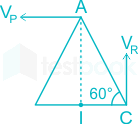
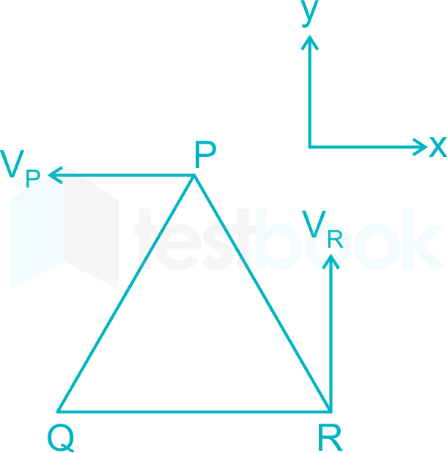
A rigid triangular body, PQR, with sides of equal length of 1 unit moves on a flat plane. At the instant shown, edge QR is parallel to the x-axis, and the body moves such that velocities of points P and R are VP and VR, in the x and y directions, respectively. The magnitude of the angular velocity of the body is

  1. ((a))

    2VR

  2. ((b))

    2VP

  3. ((c))

    VR/√3

  4. ((d))

    VP/√3

Show Answer
Answer: ((a))

2VR

Concept:

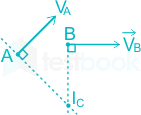
If VA and VB are velocity at point A and B respectively then the I-centre of this system will be finding by the meeting point of perpendicular drawn on the both velocity vector.

If w is the angular velocity of system, then 

VAAIC=VBBIC=ω\frac{{{{\vec V}_A}}}{{A{I_C}}} = \frac{{{{\vec V}_B}}}{{B{I_C}}} = \omega

Calculation:

∵ AI = AC sin 60° = AC × √3/2 = √3/2

CI = AC cos 60° = AC × 1/2 = 1/2 

Vp=(AI)ww=VPAI=23Vp\therefore {V_p} = \left( {AI} \right)w \Rightarrow w = \frac{{{V_P}}}{{AI}} = \frac{2}{{\sqrt 3 }}{V_p}

VR = (CI)w ⇒ w = VR/CI = 2VR

16

Consider a linear elastic rectangular thin sheet of metal, subjected to uniform uniaxial tensile stress of 100 MPa along the length direction. Assume plane stress conditions in the plane normal to the thickness. The Young’s modulus E = 200 MPa and Poisson’s ratio ν = 0.3 are given. The principal strains in the plane of the sheet are

  1. ((a))

    (0.35, −0.15)

  2. ((b))

    (0.5, 0.0)

  3. ((c))

    (0.5, −0.15)

  4. ((d))

    (0.5, −0.5)

Show Answer
Answer: ((c))

(0.5, −0.15)

Concept:

ϵx=σxEμ(σyE+σzE){\epsilon_x} = \frac{{{\sigma _x}}}{E} - \mu \left( {\frac{{{\sigma _y}}}{E} + \frac{{{\sigma _z}}}{E}} \right)

Calculation:

σ1 = 100 MPa, μ = 0.3 and ϵ = 200 MPa

∵ It is uniaxial tensile stress so, σ2 = σ3 = 0

ϵ1=σ1Eμ(σ2E+σ3E){\epsilon_1} = \frac{{{\sigma _1}}}{E} - \mu \left( {\frac{{{\sigma _2}}}{E} + \frac{{{\sigma _3}}}{E}} \right)

ϵ1=σ1E=100200=0.5 \Rightarrow {\epsilon_1} = \frac{{{\sigma _1}}}{E} = \frac{{100}}{{200}} = 0.5

ϵ2=σ2Eμ(σ1E+σ3E)=μσ1E \Rightarrow {\epsilon_2} = \frac{{{\sigma _2}}}{E} - \mu \left( {\frac{{{\sigma _1}}}{E} + \frac{{{\sigma _3}}}{E}} \right) = - \mu \frac{{{\sigma _1}}}{E}

ϵ2=0.3(100200)=0.15(ϵ1,ϵ2)=(0.5,0.15) \Rightarrow {\epsilon_2} = - 0.3\left( {\frac{{100}}{{200}}} \right) = - 0.15\therefore \left( {{\epsilon_1},\epsilon{_2}} \right) = \left( {0.5, - 0.15} \right)

17

A spur gear has pitch circle diameter D and number of teeth T. The circular pitch of the gear is

  1. ((a))

    πDT\frac{{\pi D}}{T}

  2. ((b))

    TD\frac{T}{D}

  3. ((c))

    DT\frac{D}{T}

  4. ((d))

    2πDT\frac{2\pi D}{T}

Show Answer
Answer: ((a))

πDT\frac{{\pi D}}{T}

Explanation:

Circular pitch: It is the distance measured on the circumference of the pitch circle from a point of one tooth to the corresponding point on the next tooth. It is usually denoted by pc. Mathematically,

If the circular diameter is D, and No. of teeth is T

Circular pitch, pc=πm=πDTp_c = \pi m=\frac{{\pi D}}{T}

where m is the module of gear. (m = D/T)

18

Endurance limit of a beam subjected to pure bending decreases with

  1. ((a))

    decrease in the surface roughness and decrease in the size of the beam

  2. ((b))

    increase in the surface roughness and decrease in the size of the beam

  3. ((c))

    increase in the surface roughness and increase in the size of the beam

  4. ((d))

    decrease in the surface roughness and increase in the size of the beam

Show Answer
Answer: ((c))

increase in the surface roughness and increase in the size of the beam

Explanation:

Corrected endurance strength is defined as

σe = Ka Kb Kc Kde

where, σe = Endurance strength and Ka = size factor, Kb = surface factor, Kc = load factor, Kd = Temperature factor

{Ka, Kb, Kc, Kd} < 1

So, with the increases in surface roughness and size of the beam, endurance strength will decrease.

19

A two-dimensional incompressible frictionless flow field is given by u=xi^yj^\vec u = x\hat i - y\hat j. If ρ is the density of the fluid, the expression for pressure gradient vector at any point in the flow field is given as

  1. ((a))

    ρ(xi^+yj^)\rho \left( {x\hat i + y\hat j} \right)

  2. ((b))

    ρ(xi^+yj^) - \rho \left( {x\hat i + y\hat j} \right)

  3. ((c))

    ρ(xi^yj^)\rho \left( {x\hat i - y\hat j} \right)

  4. ((d))

    ρ(x2i^+y2j^) - \rho \left( {{x^2}\hat i + {y^2}\hat j} \right)

Show Answer
Answer: ((b))

ρ(xi^+yj^) - \rho \left( {x\hat i + y\hat j} \right)

Concept:

Euler Equation of Motion:

Fp+Fy=Fi{\vec F_p} + {\vec F_y} = {\vec F_i}

Fp+Fy=ma{\vec F_p} + {\vec F_y} = m\vec a

ut+uux+vuy+wuz=X1ρpx\frac{{\partial u}}{{\partial t}} + u\frac{{\partial u}}{{\partial x}} + v\frac{{\partial u}}{{\partial y}} + w\frac{{\partial u}}{{\partial z}} = X - \frac{1}{\rho }\frac{{\partial p}}{{\partial x}}

vt+uvx+vvy+wvz=Y1ρpy\frac{{\partial v}}{{\partial t}} + u\frac{{\partial v}}{{\partial x}} + v\frac{{\partial v}}{{\partial y}} + w\frac{{\partial v}}{{\partial z}} = Y - \frac{1}{\rho }\frac{{\partial p}}{{\partial y}}

wt+uwx+vwy+wwz=Z1ρpz\frac{{\partial w}}{{\partial t}} + u\frac{{\partial w}}{{\partial x}} + v\frac{{\partial w}}{{\partial y}} + w\frac{{\partial w}}{{\partial z}} = Z - \frac{1}{\rho }\frac{{\partial p}}{{\partial z}}

Where X, Y, and Z are body forces.

P+ρϕ=ρ[DuDt] - ∇ P + \rho ∇ ϕ = \rho \left[ {\frac{{D\vec u}}{{Dt}}} \right]

DDt=t+ux+vy+wz\frac{D}{{Dt}} = \frac{\partial }{{\partial t}} + u\frac{\partial }{{\partial x}} + v\frac{\partial }{{\partial y}} + w\frac{\partial }{{\partial z}}

Assume: flow is incompressible and friction less

Euler’s equation for vector form:

P+ρϕ=ρ[DuDt] - ∇ P + \rho ∇ ϕ = \rho \left[ {\frac{{D\vec u}}{{Dt}}} \right]

P+ρϕ=ρ[ududxi^+vdudyj^+wdudz+dudt] - ∇ P + \rho ∇ ϕ = \rho \left[ {u\frac{{d\vec u}}{{dx}}\hat i + v\frac{{d\vec u}}{{dy}}\hat j + w\frac{{d\vec u}}{{dz}} + \frac{{d\vec u}}{{dt}}} \right]

u=xi^yj^\vec u = x\hat i - y\hat j

-∇P + ρ∇ϕ = ρ [xî + (-y) (-1)ĵ + 0 + 0]

Zero body force in x and y direction.

-∇P + ρ [0î + 0ĵ] = ρ [xî + yî] ⇒ ∇P = -ρ [xî + yĵ]

20

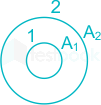
Sphere 1 with a diameter of 0.1 m is completely enclosed by another sphere 2 of diameter 0.4 m. The view factor F12 is

  1. ((a))

    0.0625

  2. ((b))

    0.25

  3. ((c))

    0.5

  4. ((d))

    1.0

Show Answer
Answer: ((d))

1.0

Concept:

View Factor F 1-2  means the fraction of radiation leaving the surface 1 and striking the surface 2.

Following points are important about View Factor

  • Summation rule if a body is exchanging radiation by n surfaces by

          F11 +F12 + ------ F1n= 1

  • Reciprocity theorem A1 F12 = A2 F21​

Calculation:

By summation rule

F1-1 + F1-2 = 1

∵ F1-1 = 0 because no radiation leaving the surface 1 will strike the surface 1.

∴ F1-2 = 1

21

One-dimensional steady state heat conduction takes place through a solid whose cross-sectional area varies linearly in the direction of heat transfer. Assume there is no heat generation in the solid and the thermal conductivity of the material is constant and independent of temperature. The temperature distribution in the solid is

  1. ((a))

    Linear

  2. ((b))

    Quadratic

  3. ((c))

    Logarithmic

  4. ((d))

    Exponential

Show Answer
Answer: ((c))

Logarithmic

Explanation:

Cross-sectional area varies linearly in the direction of heat transfer:

A = cx + B

1 – D steady state with no heat generation

ddt(kAdTdx)=0\frac{d}{{dt}}\left( { - kA\frac{{dT}}{{dx}}} \right) = 0

kAdTdx=c1dT=c1kAdx=c1K(cx+B)dx=c1cKln(cx+B)x1x2 \Rightarrow - kA\frac{{dT}}{{dx}} = {c_1} \Rightarrow \smallint dT = - \smallint \frac{{{c_1}}}{{kA}}dx = - \smallint \frac{{{c_1}}}{{K\left( {cx + B} \right)}}dx = - \frac{{{c_1}}}{{cK}}\ln \left( {cx + B} \right)\left. \right|_{{x_1}}^{{x_2}}

T2T1=CKln(cx2+Bcx1+B); \Rightarrow {T_2} - {T_1} = - \frac{C}{K}\ln \left( {\frac{{c{x_2} + B}}{{c{x_1} + B}}} \right);

i.e. temperature variation is logarithmic.

22

For a simple compressible system, v, s, p and T are specific volume, specific entropy, pressure and temperature, respectively. As per Maxwell’s relations, (vs)p{\left( {\frac{{\partial v}}{{\partial s}}} \right)_p} is equal to

  1. ((a))

    (sT)p{\left( {\frac{{\partial s}}{{\partial T}}} \right)_p}

  2. ((b))

    (pv)T{\left( {\frac{{\partial p}}{{\partial v}}} \right)_T}

  3. ((c))

    (Tv)p - {\left( {\frac{{\partial T}}{{\partial v}}} \right)_p}

  4. ((d))

    (Tp)s{\left( {\frac{{\partial T}}{{\partial p}}} \right)_s}

Show Answer
Answer: ((d))

(Tp)s{\left( {\frac{{\partial T}}{{\partial p}}} \right)_s}

Concept:

For a pure substance undergoing an infinitesimal reversible process.

  1. dU = Tds – pdV
  2. dH = dU + pdV + Vdp = Tds + Vdp
  3. df = dU – Tds – SdT = –pdv – SdT
  4. dG = dH – Tds – SdT = Vdb – Sdt

for dz = Mdx + Ndy

(My)x=(Nx)y{\left( {\frac{{\partial M}}{{\partial y}}} \right)_x} = {\left( {\frac{{\partial N}}{{\partial x}}} \right)_y}

Applying this to the four equations:

dU=Tdspdv(TV)s=(PS)V dH=Tds+vdP(TP)s=(VS)P\begin{array}{l} dU = Tds - pdv \Rightarrow {\left( {\frac{{\partial T}}{{\partial V}}} \right)_s} = - {\left( {\frac{{\partial P}}{{\partial S}}} \right)_V}\ dH = Tds +vdP \Rightarrow {\left( {\frac{{\partial T}}{{\partial P}}} \right)_s} = {\left( {\frac{{\partial V}}{{\partial S}}} \right)_P} \end{array}

df=pdvSdT(PT)V=(SV)T dG=VdpSdT(VT)p=(SP)T\begin{array}{l} df = - pdv - SdT \Rightarrow {\left( {\frac{{\partial P}}{{\partial T}}} \right)_V} = {\left( {\frac{{\partial S}}{{\partial V}}} \right)_T}\ dG = Vdp - SdT \Rightarrow {\left( {\frac{{\partial V}}{{\partial T}}} \right)_p} = - {\left( {\frac{{\partial S}}{{\partial P}}} \right)_T} \end{array}

Calculation:

According to Maxwell’s relation:

(vs)p=(dTdP)s{\left( {\frac{{\partial v}}{{\partial s}}} \right)_p} = {\left( {\frac{{dT}}{{dP}}} \right)_s}

23

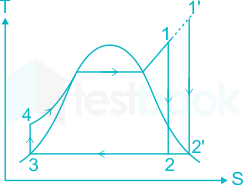
Which one of the following modifications of the simple ideal Rankine cycle increases the thermal efficiency and reduces the moisture content of the steam at the turbine outlet?

  1. ((a))

    Increasing the boiler pressure.

  2. ((b))

    Decreasing the boiler pressure.

  3. ((c))

    Increasing the turbine inlet temperature.

  4. ((d))

    Decreasing the condenser pressure.

Show Answer
Answer: ((c))

Increasing the turbine inlet temperature.

Explanation:

As seen from the diagram when temperature increase from 1 – 1’ then quality of steam increases from 2 – 2’.

Efficiency and Rankine cycle increases with increasing effective mean temperature of heat addition.

Effective mean temperature of heat addition increases by

(a)  High dryness fraction

(b)  High temperature of heat addition

(c)  High pressure of heat addition

Note: This is the advantage of reheating cycle.

24

Hardenability of steel is a measure of

  1. ((a))

    the ability to harden when it is cold worked

  2. ((b))

    the maximum hardness that can be obtained when it is austenitized and then quenched

  3. ((c))

    the depth to which required hardening is obtained when it is austenitized and then

    quenched

  4. ((d))

    the ability to retain its hardness when it is heated to elevated temperatures

Show Answer
Answer: ((c))

the depth to which required hardening is obtained when it is austenitized and then

quenched

Explanation:

Hardness is defined as resistance to plastic deformation or penetration.

Hardenability is defined as the ease with which hardness may be attained by quenching.

It is also defined as the ability to develop maximum hardness by quenching.

It is the process to have a hardened layer of martensite after quenching and also to have a high hardness at the same given depth

Note: Hardness and hardenability is two different properly of material, not consider the same.

25

The fluidity of molten metal of cast alloys (without any addition of fluxes) increases with increase in

  1. ((a))

    viscosity

  2. ((b))

    surface tension

  3. ((c))

    freezing range

  4. ((d))

    degree of superheat

Show Answer
Answer: ((d))

degree of superheat

Explanation:

  • Fluidity is defined as ability of a metal to flow and fill the mold.
  • The higher the pouring temperature, higher the fluidity.
  • Pouring temperature increases with increase in degree of superheat and hence fluidity increases.
26

The cold forming process in which a hardened tool is pressed against a workpiece (when there is relative motion between the tool and the workpiece) to produce a roughened surface with a regular pattern is

  1. ((a))

    Roll forming

  2. ((b))

    Strip rolling

  3. ((c))

    Knurling

  4. ((d))

    Chamfering

Show Answer
Answer: ((c))

Knurling

Explanation:

Knurling: Knurling is a process of impressing a diamond shape pattern on the surface of a workpiece to provide a better gripping surface.

Knurling is the operation of producing straight-lined, diamond-shaped patterns or cross lined patterns on a cylindrical external surface by pressing a tool called knurling tool. Knurling is not a cutting operation but it is a forming operation.


Chamfering: Chamfering is a finishing process to make a bevel, groove or furrow in the machined part.

Roll forming: Roll forming is a continuous bending process in which opposite rolls are used to produce long sections of formed shapes from coil or strip stock.

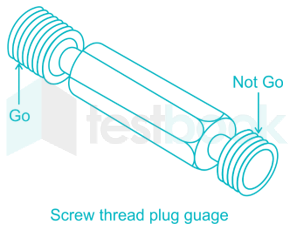
27

The most common limit gage used for inspecting the hole diameter is

  1. ((a))

    Snap gage

  2. ((b))

    Ring gage

  3. ((c))

    Plug gage

  4. ((d))

    Master gage

Show Answer
Answer: ((c))

Plug gage

Explanation:

Plug gauge is a cylindrical bar with highly finished ends of different diameters is used to check hole diameter.

Important points:

  • Snap gauge – For gauging external dimensions
  • Plug gauge – For gauging internal dimensions
  • Taper plug gauge – For gauging taper holes
  • Ring gauge – For gauging external dimensions
  • Gap gauge – For gauging gaps and grooves
  • Radius gauge – For gauging radii
  • Thread pitch gauge – For gauging external dimensions
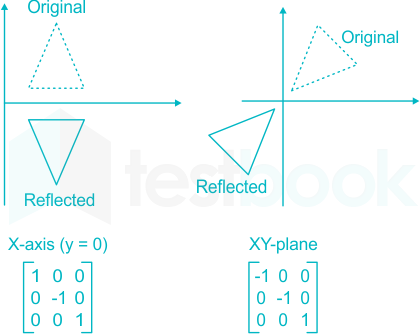
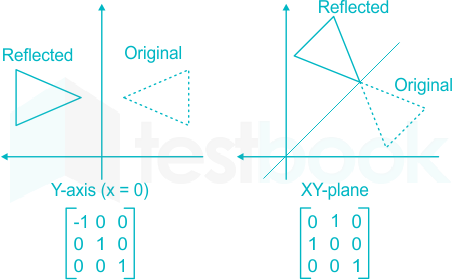
28

The transformation matrix for mirroring a point in x - y plane about the line y = x is given by:

  1. ((a))

    \(\left[ {\begin{array}{*{20}{c}} 1&0\ 0&{ - 1} \end{array}} \right]\)

  2. ((b))

    \(\left[ {\begin{array}{*{20}{c}} { - 1}&0\ 0&1 \end{array}} \right]\)

  3. ((c))

    \(\left[ {\begin{array}{*{20}{c}} 0&1\ 1&0 \end{array}} \right]\)

  4. ((d))

    \(\left[ {\begin{array}{*{20}{c}} 0&{ - 1}\ { - 1}&0 \end{array}} \right]\)

Show Answer
Answer: ((c))

\(\left[ {\begin{array}{*{20}{c}} 0&1\ 1&0 \end{array}} \right]\)

For a reflection in the x-axis:\(\left[ {\begin{array}{*{20}{c}} 1&0\ 0&{ - 1} \end{array}} \right]\)
For a reflection in the y-axis:\(\left[ {\begin{array}{*{20}{c}} { - 1}&0\ 0&1 \end{array}} \right]\)
For a reflection in the origin:\(\left[ {\begin{array}{*{20}{c}} { - 1}&0\ 0&{ - 1} \end{array}} \right]\)
For a reflection in the line y = x:\(\left[ {\begin{array}{*{20}{c}} 0&1\ 1&0 \end{array}} \right]\)


Calculation:

The transformation matrix for mirroring a point about the line Y = X in X – Y plane is \(\left[ {\begin{array}{*{20}{c}} 0&1\ 1&0 \end{array}} \right]\)

29

If x is the mean of data 3, x, 2 and 4, then the mode is________

30

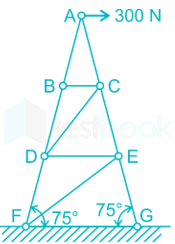
The figure shows an idealized plane truss. If a horizontal force of 300 N is applied at point A, then the magnitude of the force produced in member CD is ______ N.

31

The state of stress at a point in a component is represented by a Mohr’s circle of radius 100 MPa centered at 200 MPa on the normal stress axis. On a plane passing through the same point, the normal stress is 260 MPa. The magnitude of the shear stress on the same plane at the same point is ______ MPa.

32

A wire of circular cross-section of diameter 1.0 mm is bent into a circular arc of radius 1.0 m by application of pure bending moments at its ends. The Young’s modulus of the material of the wire is 100 GPa. The maximum tensile stress developed in the wire is ______ MPa.

33

Water enters a circular pipe of length L = 5.0 m and diameter D = 0.20 m with Reynolds number ReD = 500. The velocity profile at the inlet of the pipe is uniform while it is parabolic at the exit. The Reynolds number at the exit of the pipe is ______.

34

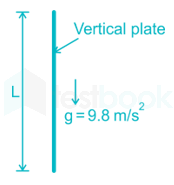
A thin vertical flat plate of height L, and infinite width perpendicular to the plane of the figure, is losing heat to the surroundings by natural convection. The temperatures of the plate and the surroundings, and the properties of the surrounding fluid, are constant. The relationship between the average Nusselt and Rayleigh numbers is given as Nu = K Ra¼, where K is a constant. The length scales for Nusselt and Rayleigh numbers are the height of the plate. The height of the plate is increased to 16L keeping all other factors constant.

If the average heat transfer coefficient for the first plate is h1 and that for the second plate is h2, the value of the ratio h1/h2 is ________.

35

In an electrical discharge machining process, the breakdown voltage across inter electrode gap (IEG) is 200 V and the capacitance of the RC circuit is 50 μF. The energy (in J) released per spark across the IEG is_________

36

Given a vector  \(\vec u = \frac{1}{3}\left( { - {y^3}̂ i + {x^3}̂ j + {z^3}̂ k} \right)\)and n̂ as the unit normal vector to the surface of the hemisphere (x2 + y2 + z2 = 1; z ≥ 0), the value of integral (;×u)n^;dS\smallint \left( {;\nabla \times u} \right) \bullet \hat n;dS evaluated on the curved surface of the hemisphere S is

  1. ((a))

    – π/2

  2. ((b))

    π/3

  3. ((c))

    π/2

  4. ((d))

    π

Show Answer
Answer: ((c))

π/2

Given vector  v=13(y3i^+x3j^+z3k^)\vec v = \frac{1}{3}\left( { - {y^3}\hat i + {x^3}\hat j + {z^3}\hat k} \right)

Bounded by open surface of hemisphere x2 + y2 + z2 = 1

Such that z ≥ 0, and closed curve (x2 + y2 = 1)

We have to find

I=(×u).n^dsI = \smallint \left( {\nabla \times u} \right).\hat nds

⇒ from stokes theorem, we have

!!!s(×u).n^ds=cu.dr\mathop \int!!!\int \nolimits_s \left( {\nabla \times u} \right).\hat nds = \mathop \oint \nolimits_c u.dr

\( \Rightarrow I = \frac{1}{3}\left{ { - \oint {y^3}dx + \oint {x^3}dy} \right}\)

Now, changing the integral with substitution

x = cos θ ⇒ dx = -sin θ dθ

y = sin θ ⇒ dy = cos θ dθ

\(I = \frac{1}{3}\mathop \smallint \nolimits_0^{2\pi } {\sin ^4}\theta d\theta + \mathop \smallint \nolimits_0^{2\pi } \frac{1}{3}{\cos ^4}\theta d\theta \)

I=43(34×12×π2+34×12×π2)=π2I = \frac{4}{3}\left( {\frac{3}{4} \times \frac{1}{2} \times \frac{\pi }{2} + \frac{3}{4} \times \frac{1}{2} \times \frac{\pi }{2}} \right) = \frac{\pi }{2}

37

A differential equation is given as:

x2d2ydx22xdydx+2y=4{x^2}\frac{{{d^2}y}}{{d{x^2}}} - 2x\frac{{dy}}{{dx}} + 2y = 4

The solution of the differential equation in terms of arbitrary constants C1 and C2 is

  1. ((a))

    y = C2x2 + C1x + 2

  2. ((b))

    y=C1x2+C2x+2y = \frac{{{C_1}}}{{{x^2}}} + {C_2}x + 2

  3. ((c))

    y = C1x2 + C2x + 4

  4. ((d))

    y=C1x2+C2x+4y = \frac{{{C_1}}}{{{x^2}}} + {C_2}x + 4

Show Answer
Answer: ((a))

y = C2x2 + C1x + 2

Given differential equation:

x2d2ydx22xdydx+2y=4{x^2}\frac{{{d^2}y}}{{d{x^2}}} - 2x\frac{{dy}}{{dx}} + 2y = 4

is the standard form of Euler-Cauchy DE.

So, let x = ez

⇒ dx = ezdz = x.dz

1dz=xdxi.e.ddz=xddx \Rightarrow \frac{1}{{dz}} = \frac{x}{{dx}}i.e.\frac{d}{{dz}} = x\frac{d}{{dx}}

Similarly, we can obtain x2d2dx2=d2dz2ddz{x^2}\frac{{{d^2}}}{{d{x^2}}} = \frac{{{d^2}}}{{d{z^2}}} - \frac{d}{{dz}}

⇒ xD = θ

⇒ x2D2 = θ (θ - 1)

Making these substitutions in given DE, we get

x2d2ydx22xdydx+2y=4{x^2}\frac{{{d^2}y}}{{d{x^2}}} - 2x\frac{{dy}}{{dx}} + 2y = 4

(θ (θ - 1) – 2θ + 2) y = 4

θ (θ - 1) – 2(θ – 1) = 0

⇒ Solution for this will constitute of CF & PI.

⇒ CF = (θ – 1) (θ – 2) = 0 ⇒ θ = 1 & θ = 2

⇒ y = c1ez + c2e2z = c1x + c2x

also,;PI=1f(θ)eaz=1f(a)eaz4×e0z(θ1)(θ2)=4×e0z(1)(2)=42=2also,;PI = \frac{1}{{f\left( \theta \right)}}{e^{az}} = \frac{1}{{f\left( a \right)}}{e^{az}} \Rightarrow \frac{{4 \times {e^{0z}}}}{{\left( {\theta - 1} \right)\left( {\theta - 2} \right)}} = \frac{{4 \times {e^{0z}}}}{{\left( { - 1} \right)\left( { - 2} \right)}} = \frac{4}{2} = 2

y = CF + PI = c2x2 + c1x + 2

{We can also solve this problem by differentiating option also, if we don’t remember the process.}

38

The derivative of f(x) = cos(x) can be estimated using the approximation f(x)=f(x+h)f(xh)2hf'\left( x \right) = \frac{{f\left( {x + h} \right) - f\left( {x - h} \right)}}{{2h}} . The percentage error is calculated as (Exact;valueApproximate;valueExact;value)×100\left( {\frac{{Exact;value - Approximate;value}}{{Exact;value}}} \right) \times 100. The percentage error in the derivative of f(x) at x = π/6 radian, choosing h = 0.1 radian, is

  1. ((a))

    < 0.1 %

  2. ((b))

    > 0.1 % and < 1 %

  3. ((c))

    > 1 % and < 5 %

  4. ((d))

    > 5 %

Show Answer
Answer: ((b))

> 0.1 % and < 1 %

Concept:

Error%=ExactApproximateExact×100Error\% = \frac{{Exact - Approximate}}{{Exact}} \times 100

Calculation:

f(x)=cosxf(x)=sinxf(π6)=sin(π6)=0.5;(Exact)f\left( x \right) = \cos x \Rightarrow f\left( x \right) = - \sin x \Rightarrow f'\left( {\frac{\pi }{6}} \right) = - \sin \left( {\frac{\pi }{6}} \right) = - 0.5;\left( {Exact} \right)

f(x)=cos(x+h)cos(xh)2h=cos(π6+0.1×180/π)cos(π60.1×180/π)2(0.1)f'\left( x \right) = \frac{{\cos \left( {x + h} \right) - \cos \left( {x - h} \right)}}{{2h}} = \frac{{\cos \left( {\frac{\pi }{6} + 0.1\times 180/\pi} \right) - \cos \left( {\frac{\pi }{6} - 0.1\times 180/\pi} \right)}}{{2\left( {0.1} \right)}}

Using: cos a – cos b = - 2 sin [(a + b)/2] × sin [(a - b)/2]

f(x)=2sin(π6)sin(0.1×180/π)0.2=0.4992f'\left( x \right) = \frac{{ - 2\sin \left( {\frac{\pi }{6}} \right)\sin \left( {0.1\times 180/\pi} \right)}}{{0.2}} = - 0.4992

Error;%=0.5(0.4992)0.5×100=0.16%option;b)Error;\% = \frac{{ - 0.5 - \left( { - 0.4992} \right)}}{{ - 0.5}} \times 100 = 0.16\% \Rightarrow option;b)

39

A ball of mass 3 kg moving with a velocity of 4 m/s undergoes a perfectly-elastic direct-central impact with a stationary ball of mass m. After the impact is over, the kinetic energy of the 3 kg ball is 6 J. The possible value(s) of m is/are

  1. ((a))

    1 kg only

  2. ((b))

    6 kg only

  3. ((c))

    1 kg, 6 kg

  4. ((d))

    1 kg, 9 kg

Show Answer
Answer: ((d))

1 kg, 9 kg

Concept:

For perfectly elastic collision momentum and kinetic energy is conserved and the coefficient of restitution is equal to 1.

Calculation:

Given:

mass of ball = 3 kg

Initial velocity = 4 m/s

Ball undergoes elastic collision, perfectly, with a second ball of mass m.

KE of 3 kg ball after the collision is 6 J.

To find possible value of m.

For perfect elastic collision.

Coefficient of restitution = 1

Velocity;of;separationVelocity;of;aproach=1\frac{{Velocity;of;separation}}{{Velocity;of;aproach}} = 1

(V2V1)u1u2=(V2V1)40=1V2V1=4V1=V24 \Rightarrow \frac{{\left( {{V_2} - {V_1}} \right)}}{{{u_1} - {u_2}}} = \frac{{\left( {{V_2} - {V_1}} \right)}}{{4 - 0}} = 1 \Rightarrow {V_2} - {V_1} = 4 \Rightarrow {V_1} = {V_2} - 4

Also KE before collision = KE after collision

12m1u12+12m2u22=12m1v12+12m2v22 \Rightarrow \frac{1}{2}{m_1}u_1^2 + \frac{1}{2}{m_2}u_2^2 = \frac{1}{2}{m_1}v_1^2 + \frac{1}{2}{m_2}v_2^2

3×(16)2+0=6+12mv22 \Rightarrow \frac{{3 \times \left( {16} \right)}}{2} + 0 = 6 + \frac{1}{2}mv_2^2

⇒ 48 = 12 + mv22 ⇒ mv22 = 36

Also, from conservation of linear momentum we have

m1u1 + m2u2 = m1v1 + m2v2

(3 × 4) + 0 = 3v1 + mv

⇒ 12 = 3v1 + mv

12=3(v24)+mv212+12=(3+m)v2v2=243+m \Rightarrow 12 = 3\left( {{v_2} - 4} \right) + m{v_2} \Rightarrow 12 + 12 = \left( {3 + m} \right){v_2} \Rightarrow {v_2} = \frac{{24}}{{3 + m}}

mv22 = 36

m(243+m)2=36 \Rightarrow m{\left( {\frac{{24}}{{3 + m}}} \right)^2} = 36

⇒ m (48) = 3 (3 + m)2 ⇒ 9 + 6m + m2 = 16 m

⇒ m2 – 10 m + 9 = 0 ⇒ (m - 9) (m - 1) = 0

m = 9 or m = 1

⇒ correct option is d).

40

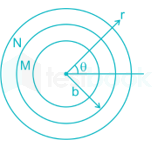
Consider two concentric circular cylinders of different materials M and N in contact with each other at r = b, as shown below. The interface at r = b is frictionless. The composite cylinder system is subjected to internal pressure P. Let \(\left( {u_r^M,u_\theta ^M} \right)and;\left( {\sigma _{rr}^M,\sigma {\theta \theta }^M} \right)\) denote the radial and tangential displacement and stress components, respectively material M. Similarly, \(\left( {u_r^N,u\theta ^N} \right);and;\left( {\sigma _{rr}^N,\sigma _{\theta \theta }^N} \right)\) denote the radial and tangential displacement and stress components, respectively, in material N. The boundary conditions that need to be satisfied at the frictionless interface between the two cylinders are:

  1. ((a))

    urM=urN;and;σrrM=σrrN;onlyu_r^M = u_r^N;and;\sigma _{rr}^M = \sigma _{rr}^N;only

  2. ((b))

    \(u_r^M = u_r^N;and;\sigma {rr}^M = \sigma {rr}^N;and;u\theta ^M = u\theta ^Nand;\sigma _{\theta \theta }^M = \sigma _{\theta \theta }^N\)

  3. ((c))

    uθM=uθN;and;σθθM=σθθN;onlyu_\theta ^M = u_\theta ^N;and;\sigma _{\theta \theta }^M = \sigma _{\theta \theta }^N;only

  4. ((d))

    urrM=urrN;and;σθθM=σθθN;onlyu_{rr}^M = u_{rr}^N;and;\sigma _{\theta \theta }^M = \sigma _{\theta \theta }^N;only

Show Answer
Answer: ((a))

urM=urN;and;σrrM=σrrN;onlyu_r^M = u_r^N;and;\sigma _{rr}^M = \sigma _{rr}^N;only

To analyse the boundary condition of this problem we will consider (assume) that the interface remains in contact after deformation also.

i) Since the pairs are in contact at interface, so the expansion/compression in the cylinders at interface will be such that the interface in contact must remain in contact so uMr = uNr otherwise joint will separate.

ii) Now it is given that the contact is friction less, so there will be no any resistance to relative slip at interface. So, we cannot arrive at any relation between uNθ & uMθ

iii) Now the radial stress caused in cylinder at interface are shown below separately.

From newtons third law, FN = FM as no external forces are at junction. Also the junction area for M & N are same

FNA=FMAσrN=σrM \Rightarrow \frac{{{F_N}}}{A} = \frac{{{F_M}}}{A} \Rightarrow \sigma _r^N = \sigma _r^M

iv) σθ is stress as shown, it will depend on material properly which is different for M & N, so they are not equal.

So correct option is 1

41

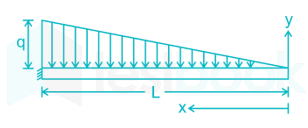
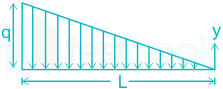
A prismatic, straight, elastic, cantilever beam is subjected to a linearly distributed transverse load as shown below. If the beam length is L, Young’s modulus E, and area moment of inertia I, the magnitude of the maximum deflection is

  1. ((a))

    qL415EI\frac{{q{L^4}}}{{15EI}}

  2. ((b))

    qL430EI\frac{{q{L^4}}}{{30EI}}

  3. ((c))

    qL410EI\frac{{q{L^4}}}{{10EI}}

  4. ((d))

    qL460EI\frac{{q{L^4}}}{{60EI}}

Show Answer
Answer: ((b))

qL430EI\frac{{q{L^4}}}{{30EI}}

Explanation:

To find maximum deflection expression.

Students are advised to memorise the standard results. This δ=qL430EI\delta = \frac{{q{L^4}}}{{30EI}} is a standard result for cantilever beam with UVL.

For derivation of formula refer this

Here w=pxLw = \frac{{px}}{L} per unit length at a distance x from O

EId4ydx4=pxL\therefore EI\frac{{{d^4}y}}{{d{x^4}}} = - \frac{{px}}{L}

EId3ydx3=px22L+C1EI\frac{{{d^3}y}}{{d{x^3}}} = - \frac{{p{x^2}}}{{2L}} + {C_1}

S.F. is zero at x = 0, giving C1 = 0

EId3ydx3=px22L\therefore EI\frac{{{d^3}y}}{{d{x^3}}} = - \frac{{p{x^2}}}{{2L}}

EId2ydx2=px36L+C2EI\frac{{{d^2}y}}{{d{x^2}}} = - \frac{{p{x^3}}}{{6L}} + {C_2}

B.M. is zero at x = 0, giving C2 = 0

EId2ydx2=px36L\therefore EI\frac{{{d^2}y}}{{d{x^2}}} = - \frac{{p{x^3}}}{{6L}}

Integrate again

EIdydx=px424L+C3EI\frac{{dy}}{{dx}} = - \frac{{p{x^4}}}{{24L}} + {C_3}

But;dydx=0;at;x=L,;givingBut;\frac{{dy}}{{dx}} = 0;at;x = L,;giving

0=pL424L+C30 = - \frac{{p{L^4}}}{{24L}} + {C_3}

i.e.,;C3=pL324i.e.,;{C_3} = \frac{{p{L^3}}}{{24}}

dydx=1EI(px424L+pL324)=p24LEI(L4x4)\therefore \frac{{dy}}{{dx}} = \frac{1}{{EI}}\left( { - \frac{{p{x^4}}}{{24L}} + \frac{{p{L^3}}}{{24}}} \right) = \frac{p}{{24LEI}}\left( {{L^4} - {x^4}} \right)

y=p24LEI(L4xx55)+C4y = \frac{p}{{24LEI}}\left( {{L^4}x - \frac{{{x^5}}}{5}} \right) + {C_4}

Now y = 0 at x = L, giving

0=p24EIL(L5L55)+C40 = \frac{p}{{24EIL}}\left( {{L^5} - \frac{{{L^5}}}{5}} \right) + {C_4}

C4=4pL55×24EIL=pL430EI{C_4} = - \frac{{4p{L^5}}}{{5 \times 24EIL}} = - \frac{{p{L^4}}}{{30EI}}

y=p24LEI(L4xx55)pL430EI\therefore y = \frac{p}{{24LEI}}\left( {{L^4}x - \frac{{{x^5}}}{5}} \right) - \frac{{p{L^4}}}{{30EI}}

y=p120EIL(4L55L4x+x5)y = - \frac{p}{{120EIL}}\left( {4{L^5} - 5{L^4}x + {x^5}} \right)

Since the deflection will be maximum at the end O i.e. at x = 0, put this in the above obtained expression to get δ=pL430EI\delta = \frac{{p{L^4}}}{{30EI}}, where negative indicates the deflection is towards negative y axis.
42

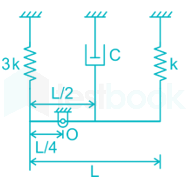
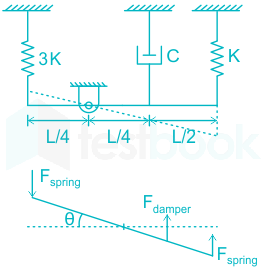
A slender uniform rigid bar of mass m is hinged at O and supported by two springs, with stiffnesses 3k and k, and a damper with damping coefficient c, as shown in the figure. For the system to be critically damped, the ratio ckm\frac{c}{\sqrt {km} } should be

  1. ((a))

    2

  2. ((b))

    4

  3. ((c))

    2√7

  4. ((d))

    4√7

Show Answer
Answer: ((d))

4√7

For small angular rotation θ of the rod, compression in the spring (3k) is

\({\delta 1} = \left( {\frac{L}{4}} \right)\theta \Rightarrow {F_1} = {F{3k}} = {k_1}{\delta _1} = 3k\frac{L}{4}\theta = \frac{3}{4}kL\theta \)

Expansion of damper:

δ2=(L4)θ{\delta _2} = \left( {\frac{L}{4}} \right)\theta

δ˙2=L4θ˙ \Rightarrow {\dot \delta _2} = \frac{L}{4}\dot \theta

F2=Fc=C;δ˙2=CL4θ˙ \Rightarrow {F_2} = {F_c} = C;{\dot \delta _2} = \frac{{CL}}{4}\dot \theta

Expansion of spring with stiffness k is

δ3=(L2+L4)θ=3L4θ{\delta _3} = \left( {\frac{L}{2} + \frac{L}{4}} \right)\theta = \frac{{3L}}{4}\theta

F3=Fk=3L4θk \Rightarrow {F_3} = {F_k} = \frac{{3L}}{4}\theta k

Now taking moment of all forces about O and inertia forces to be zero, we get

Iθ ¨,+34kLθ(L4)+CL4θ˙L4+3L4θk(3L4)=0I\overset{\ddot{\ }}{\mathop{\theta }},+\frac{3}{4}kL\theta \left( \frac{L}{4} \right)+\frac{CL}{4}\dot{\theta }\frac{L}{4}+\frac{3L}{4}\theta k\left( \frac{3L}{4} \right)=0

I=Iabout;centre+m(L4)2=mL212+mL216=7mL248I = {I_{about;centre}} + m{\left( {\frac{L}{4}} \right)^2} = \frac{{m{L^2}}}{{12}} + \frac{{m{L^2}}}{{16}} = \frac{{7m{L^2}}}{{48}}

748mL2θ ¨,+316kL2θ+916kL2θ+CL216θ˙=0\frac{7}{48}m{{L}^{2}}\overset{\ddot{\ }}{\mathop{\theta }},+\frac{3}{16}k{{L}^{2}}\theta +\frac{9}{16}k{{L}^{2}}\theta +\frac{C{{L}^{2}}}{16}\dot{\theta }=0

73mL2θ ¨,+12kL2θ+CL2θ˙=0\Rightarrow \frac{7}{3}m{{L}^{2}}\overset{\ddot{\ }}{\mathop{\theta }},+12k{{L}^{2}}\theta +C{{L}^{2}}\dot{\theta }=0

Comparing with: meqθ̈ + ceqθ̇ +keqθ = 0

\(\Rightarrow \xi =\frac{{{C}{eq}}}{2\sqrt{{{k}{eq}}{{m}_{eq}}}}=\frac{C{{L}^{2}}}{2\sqrt{12k{{L}^{2}}\times \frac{7}{3}m{{L}^{2}}}}=\frac{C{{L}^{2}}}{2\sqrt{12k{{L}^{2}}\times \frac{7}{3}m{{L}^{2}}}}=\frac{1}{2\left( 2\sqrt{7} \right)}\frac{C}{\sqrt{mk}}\)

Also for critical damping ξ = 1

Cmk×147=1\Rightarrow \frac{C}{\sqrt{mk}}\times \frac{1}{4\sqrt{7}}=1

Cmk=47\Rightarrow \frac{C}{\sqrt{mk}}=4\sqrt{7}

43

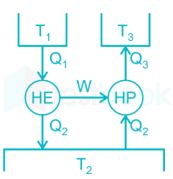
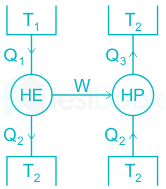
The figure shows a heat engine (HE) working between two reservoirs. The amount of heat (Q2) rejected by the heat engine is drawn by a heat pump (HP). The heat pump receives the entire work output (W) of the heat engine. If temperatures, T1 > T3 > T2, then the relation between the efficiency (η) of the heat engine and the coefficient of performance (COP) of the heat pump is

  1. ((a))

    COP = η

  2. ((b))

    COP = 1 + η

  3. ((c))

    COP = η-1

  4. ((d))

    COP = η -1 – 1

Show Answer
Answer: ((c))

COP = η-1

Concept:

Heat engine:

The efficiency (η) of a heat engine is defined as:

η=Work done by heat engineHeat absorbed from the sourceη = \frac{\text{Work done by heat engine}}{\text{Heat absorbed from the source}}

η=WQ1\therefore η = \frac{W}{Q_1}

Heat pump:

The COP of Heat Pump is given by:

COPHP=Desired;OutputRequired;Input=Q1WCO{P_{HP}} = \frac{{Desired;Output}}{{Required;Input}} = \frac{{{Q_1}}}{W}

Calculation:

Given:

To find a relationship between (η) of a heat engine and COP of a heat pump.

For heat engine \(\eta =\frac{W}{{{Q}{1}}}\) and for heat pump \(COP=\frac{{{Q}{3}}}{W}\)

From energy balance for heat pump ⇒ Q3 = W + Q2

And From energy balance for heat engine ⇒ Q2 = Q1 – W

Q3 = W + Q1 – W = Q

\(\therefore COP_{HP}=\frac{{{Q}{3}}}{W}=\frac{{{Q}{1}}}{W}=\frac{1}{\eta }\)

44

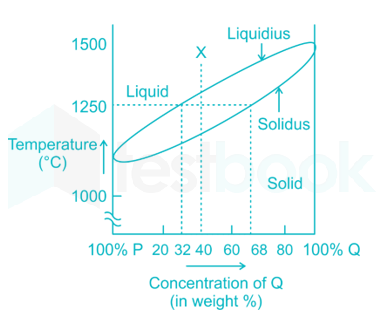
The binary phase diagram of metals P and Q is shown in the figure. An alloy X containing 60% P and 40% Q (by weight) is cooled from liquid to solid state. The fractions of solid and liquid (in weight percent) at 1250°C, respectively, will be

  1. ((a))

    77.8% and 22.2%

  2. ((b))

    22.2% and 77.8%

  3. ((c))

    68.0% and 32.0%

  4. ((d))

    32.0% and 68.0%

Show Answer
Answer: ((b))

22.2% and 77.8%

Concept:

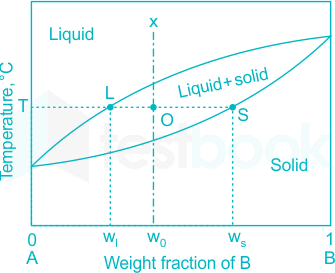
For finding the wt % of liquid present in alloy, we use the lever rule.

The weight fraction of solid-phase:

Xs=wowlwswl{X_s} = \frac{{{w_o} - {w_l}}}{{{w_s} - {w_l}}}

The weight fraction of liquid phase:

Xl=wswowswl{X_l} = \frac{{{w_s} - {w_o}}}{{{w_s} - {w_l}}}

where ws, wo, wl denote the solid, overall and liquid composition.

Calculation:

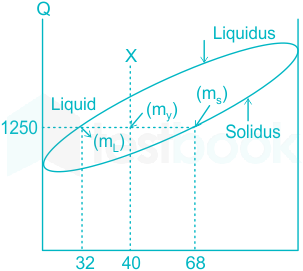
Given an alloy x containing 60% P and 40% Q. To find % of solid and liquid fractions at 1250°C from lever rule, we have 

\({{m}{s}}=\left( \frac{{{m}{y}}-{{m}{L}}}{{{m}{s}}-{{m}_{L}}} \right)\)

ms=40326832=22.22%{{m}_{s}}=\frac{40-32}{68-32}=22.22\%

∵ my, mL & ms are in % ⇒ direct substitution will give result in %.

\(also,~{{m}{liq}}=-\frac{\left( {{m}{y}}-{{m}{s}} \right)}{\left( {{m}{s}}-{{m}_{L}} \right)}=\frac{-40+68}{68-32}=77.8%\)

45

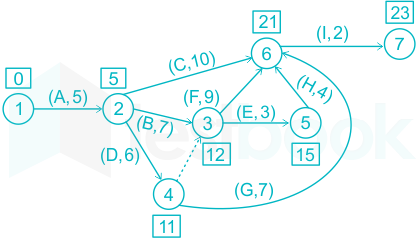
The activities of a project, their duration and the precedence relationships are given in the table. For example, in a precedence relationship “X < Y, Z” means that X is predecessor of activities Y and Z. The time to complete the activities along the critical path is ______ weeks.

ActivityDuration (weeks)Precedence Relationship
A5A < B, C, D
B7B < E, F, G
C10C < I
D6D < G
E3E < H
F9F < I
G7G < I
H4H < I
I2----
  1. ((a))

    17

  2. ((b))

    21

  3. ((c))

    23

  4. ((d))

    25

Show Answer
Answer: ((c))

23

We are asked to calculate the time along critical path. For complete analysis of critical path we need to do forward pass and backward pass computation. In this question only time is asked, and we know that the time along the critical path is maximum of all the paths in our network so we will directly evaluate the maximum time along any path and mark the answer to save time. Also forward and backward pass computation is necessary if we are asked to find critical path or float related parameters.

In this question “<” & “>” symbols are used to just describe the precedence relationship.

i.e. A < B means A occurs before B.

⇒ On constructing the network diagram with the given precedence relationship.

46

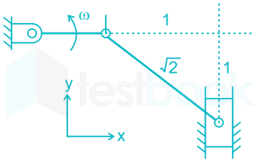
The crank of a slider-crank mechanism rotates counter-clockwise (CCW) with a constant angular velocity ω, as shown. Assume the length of the crank to be r.

Using exact analysis, the acceleration of the slider in the y-direction, at the instant shown, where the crank is parallel to x-axis, is given by

  1. ((a))

    −ω2r

  2. ((b))

    2r

  3. ((c))

    ω2r

  4. ((d))

    −2ω2r

Show Answer
Answer: ((c))

ω2r

Concept:

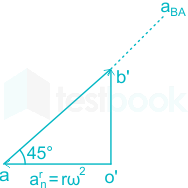
Velocity diagram and Acceleration diagram, Vt=rω{V_t} = r\omega  and ar=rω2{a_r} = r{\omega ^2}

Trigonometric relations: for an isosceles triangle two sides are equal.

To find acceleration of the slider crank using exact analysis.
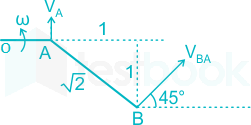
VA → velocity of A w.r.t. O

VBA → velocity of B w.r.t. A.

Velocity component of B along x direction = VBAcos 45

Also due to the constraint on slider VBA along x = 0 (i.e. VBA is along y direction only)

⇒ VBA cos 45 = 0

⇒ VBA = 0

Also, VBA = VB - VA = 0 ⇒ VB = VA

Now, constructing the velocity diagram for given case VA = rω

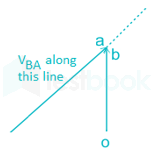
Now Constructing the acceleration diagram:

∵ Point a will have two accelerations:

(i) Radial = rω2 towards 0.

(ii) Tangential aBA = unknown

Also, the tangential, component velocity of A = B, and acceleration will also be equal to y component of B. Also, the tangential acceleration of B will be in the direction shown by VBA in configuration diagram.

⇒ from trigonometry o’b’ = a’o’

⇒ ay = rω2 (upwards, so positive).

47

A horizontal cantilever beam of circular cross-section, length 1.0 m and flexural rigidity EI = 200 N.m2 is subjected to an applied moment MA = 1.0 N.m at the free end as shown in the figure. The magnitude of the vertical deflection of the free end is _______ mm (round off to one decimal place).

48

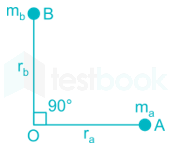
Two masses A and B having mass ma and mb, respectively, lying in the plane of the figure shown, are rigidly attached to a shaft which revolves about an axis through O perpendicular to the plane of the figure. The radii of rotation of the masses ma and mb are ra and rb, respectively. The angle between lines OA and OB is 90°. If ma = 10 kg, mb = 20 kg, ra = 200 mm and rb = 400 mm, then the balance mass to be placed at a radius of 200 mm is ______ kg (round off to two decimal places).

49

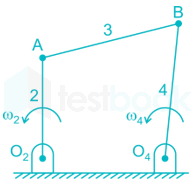
A four bar mechanism is shown in the figure. The link numbers are mentioned near the links. Input link 2 is rotating anticlockwise with a constant angular speed ω2. Length of different links are:

O2O4 = O2A = L, AB = O4B = √2 L

The magnitude of the angular speed of the output link 4 is ω4 at the instant when link 2 makes an angle of 90° with O2O4 as shown. The ratio ω4ω2;\frac{{{\omega _4}}}{{{\omega _2}}};is ______ (round off to two decimal places).

50

The probability that a part manufactured by a company will be defective is 0.05. If 15 such parts are selected randomly and inspected, then the probability that at least two parts will be defective is ______ (round off to two decimal places).

51

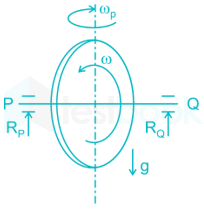
A uniform disc with radius r and a mass of m kg is mounted centrally on a horizontal axle of negligible mass and length of 1.5r. The disc spins counter-clockwise about the axle with angular speed ω, when viewed from the right-hand side bearing, Q. The axle precesses about a vertical axis at ωp = ω/10 in the clockwise direction when viewed from above. Let RP and RQ (positive upwards) be the resultant reaction forces due to the mass and the gyroscopic effect, at bearings P and Q, respectively. Assuming ω2r = 300 m/s2 and g = 10 m/s2, the ratio of the larger to the smaller bearing reaction force (considering appropriate signs) is _______

52

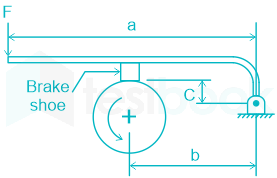
A short shoe external drum brake is shown in the figure. The diameter of the brake drum is 500 mm. The dimensions a = 1000 mm, b = 500 mm and c = 200 mm. The coefficient of friction between the drum and the shoe is 0.35. The force applied on the lever F = 100 N as shown in the figure. The drum is rotating anti-clockwise. The braking torque on the drum is ______ N.m (round off to two decimal places).

53

Water flows through two different pipes A and B of the same circular cross-section but at different flow rates. The length of pipe A is 1.0 m and that of pipe B is 2.0 m. The flow in both the pipes is laminar and fully developed. If the frictional head loss across the length of the pipes is same, the ratio of volume flow rates QB/QA is ______ (round off to two decimal places).

54

The aerodynamic drag on a sports car depends on its shape. The car has a drag coefficient of 0.1 with the windows and the roof closed. With the windows and the roof open, the drag coefficient becomes 0.8. The car travels at 44 km/h with the windows and roof closed. For the same amount of power needed to overcome the aerodynamic drag, the speed of the car with the windows and roof open (round off to two decimal places), is ________ km/h (The density of air and the frontal area may be assumed to be constant).

55

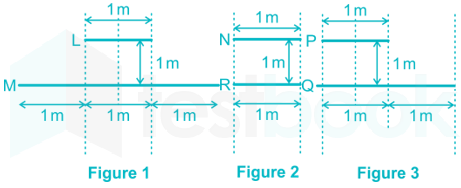
Three sets of parallel plates LM, NR and PQ are given in Figures 1, 2 and 3. The view factor FIJ is defined as the fraction of radiation leaving plate I that is intercepted by plate J. Assume that the values of FLM and FNR are 0.8 and 0.4, respectively. The value of FPQ (round off to one decimal place) is ______.

56

Hot and cold fluids enter a parallel flow double tube heat exchanger at 100°C and 15°C, respectively. The heat capacity rates of hot and cold fluids are Ch = 2000 W/K and Cc = 1200 W/K, respectively. If the outlet temperature of the cold fluid is 45°C, the log mean temperature difference (LMTD) of the heat exchanger is _________ K (round off to two decimal places).

57

Water flowing at the rate of 1 kg/s through a system is heated using an electric heater such that the specific enthalpy of the water increases by 2.50 kJ/kg and the specific entropy increases by 0.007 kJ/kg·K. The power input to the electric heater is 2.50 kW. There is no other work or heat interaction between the system and the surroundings. Assuming an ambient temperature of 300 K, the irreversibility rate of the system is ______ kW (round off to two decimal places).

58

An idealized centrifugal pump (blade outer radius of 50 mm) consumes 2 kW power while running at 3000 rpm. The entry of the liquid into the pump is axial and exit from the pump is radial with respect to impeller. If the losses are neglected, then the mass flow rate of the liquid through the pump is ______ kg/s (round off to two decimal places).

59

An air standard Otto cycle has thermal efficiency of 0.5 and the mean effective pressure of the cycle is 1000 kPa. For air, assume specific heat ratio γ = 1.4 and specific gas constant R = 0.287 kJ/kg.K. If the pressure and temperature at the beginning of the compression stroke are 100 kPa and 300 K, respectively, then the specific net-work output of the cycle is ______ kJ/kg (round off to two decimal places).

60

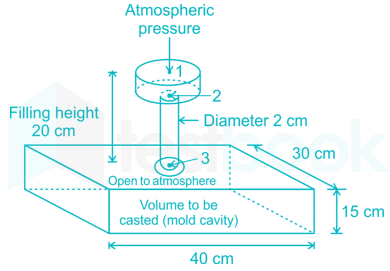
The figure shows a pouring arrangement for casting of a metal block. Frictional losses are negligible. The acceleration due to gravity is 9.81 m/s2. The time (in s, round off to two decimal places) to fill up the mold cavity (of size 40 cm × 30 cm × 15 cm) is____ 

61

A gas tungsten arc welding operation is performed using a current of 250 A and an arc voltage of 20 V at a welding speed of 5 mm/s. Assuming that the arc efficiency is 70%, the net heat input per unit length of the weld will be ______ kJ/mm (round off to one decimal place).

62

The thickness of a sheet is reduced by rolling (without any change in width) using 600 mm diameter rolls. Neglect elastic deflection of the rolls and assume that the coefficient of friction at the roll-workpiece interface is 0.05. The sheet enters the rotating rolls unaided. If the initial sheet thickness is 2 mm, the minimum possible final thickness that can be produced by this process in a single pass is ______ mm (round off to two decimal places).

63

A through hole is drilled in an aluminum alloy plate of 15 mm thickness with a drill bit of diameter 10 mm, at a feed of 0.25 mm/rev and a spindle speed of 1200 rpm. If the specific energy required for cutting this material is 0.7 N.m/mm3, the power required for drilling is ______ W (round off to two decimal places).

64

In an orthogonal machining with a single point cutting tool of rake angle 10°, the uncut chip thickness and the chip thickness are 0.125 mm and 0.22 mm, respectively. Using Merchant’s first solution for the condition of minimum cutting force, the coefficient of friction at the chip-tool interface is ______ (round off to two decimal places).

65

The annual demand of valves per year in a company is 10,000 units. The current order quantity is 400 valves per order. The holding cost is Rs. 24 per valve per year and the ordering cost is Rs. 400 per order. If the current order quantity is changed to Economic Order Quantity, then the saving in the total cost of inventory per year will be Rs. ______ (round off to two decimal places).

Attempt this paper under real exam conditions

Timed interface, section switching, instant scoring, and question-by-question analytics — free.

Start Timed Attempt