Official Paper

GATE ME 2018 Official Paper: Shift 2 (Previous Year Paper)

65 questions · 180 minutes · with answers · free

General Aptitude (10 questions)

1

“The dress _________ her so well that they all immediately _________ her on her appearance.”

The words that best fill the blanks in the above sentence are

  1. ((a))

    complemented, complemented

  2. ((b))

    complimented, complemented

  3. ((c))

    complimented, complimented

  4. ((d))

    complemented, complimented

Show Answer
Answer: ((d))

complemented, complimented

The correct answer is complemented, complimented.

Key Points

  • Let's understand the meaning of the marked words:
  • Complement: add to (something) in a way that enhances or improves it; make perfect.
  • ​Example: B**ecause Jim is a serious man who always thinks before he acts, he is the perfect complement for Lisa who lives by her impulses.
  • Compliment: politely congratulate or praise (someone) for something.
  • ​ExampleI just wanted to compliment you for the wonderful speech you gave tonight.
  • From the above-given explanation, we can say that 'complemented' will be used in the first blank and 'complimented' will be used in the second blank.

Thereforethe correct sentence is: The dress complemented her so well that they all immediately complimented her on her appearance.

2

“The judge’s standing in the legal community, though shaken by false allegations of wrongdoing, remained _________.”

The word that best fills the blank in the above sentence is

  1. ((a))

    undiminished

  2. ((b))

    damaged

  3. ((c))

    illegal

  4. ((d))

    uncertain

Show Answer
Answer: ((a))

undiminished

The correct answer is undiminished.

Key Points

  • Let's understand the meaning of the marked word.
  • Undiminished: not diminished, reduced, or lessened.
  • Example:  Even in his eighties, the man’s eyesight was undiminished and he could see as well as his grandson.
  • Thus, from the above-given explanation, we can say that 'undiminished' will be used in the blank as the sentence is trying to explain that the judge's standing in the legal community is still intact even after false allegations.

Therefore, the correct sentence is: The judge’s standing in the legal community, though shaken by false allegations of wrongdoing, remained undiminished.

Additional Information

  • Let's explore other options:
WordMeaningExamples
Damagedinflict physical harm on (something) so as to impair its value, usefulness, or normal function.It must receive current enough to operate but not enough to become damaged by overheating.
Illegalcontrary to or forbidden by law, especially criminal law.Prostitution is illegal in some countries.
Uncertainnot able to be relied on; not known or definite.The time of departure is still uncertain.
3

Find the missing group of letters in the following series:

BC, FGH, LMNO, _____

  1. ((a))

    UVWXY

  2. ((b))

    TUVWX

  3. ((c))

    STUVW

  4. ((d))

    RSTUV

Show Answer
Answer: ((b))

TUVWX

According to the English alphabet series and its positional value:

The logic follows here is:

In Each term, one letter is increased, and in each term consecutive letters.

In First Term: 2 letters

In Second Term: 3 letters

In Third Term: 4 letters

So;

In Fourth Term: 5 letters

Hence, "TUVWX" is the correct answer.

4

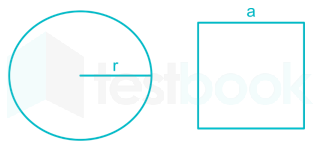
The perimeters of a circle, a square, and an equilateral triangle are equal. Which one of the following statements is true?

  1. ((a))

    The circle has the largest area.

  2. ((b))

    The square has the largest area.

  3. ((c))

    The equilateral triangle has the largest area.

  4. ((d))

    All the three shapes have the same area.

Show Answer
Answer: ((a))

The circle has the largest area.

Explanation:

The perimeter of Circle of radius r = 2πr

The perimeter of a square of side s = 4s

The perimeter of an equilateral triangle of side a = 3a

The perimeters of a circle, a square, and an equilateral triangle are equal.

2πr = 4s = 3a

  • s = 3/4 a = 0.75 a
  • r = 3/2π a = 0.477 a

Area of an equilateral triangle:

Atrg=34a2=0.433a2A_{trg}=\frac{\sqrt 3}{4}a^2=0.433 a^2

Area of square = s2 = (0.75 a)= 0.5625 a2

Area of Circle = 2πr2 = π(0.477 a)2 = 0.714 a2

Acircle > ASquare > Atrg

5

The value of the expression 11+loguvw+11+logvwu+11+logwuv\frac{1}{{1 + {{\log }_u}vw}} + \frac{1}{{1 + {{\log }_v}wu}} + \frac{1}{{1 + {{\log }_w}uv}}is ________.

  1. ((a))

    -1

  2. ((b))

    0

  3. ((c))

    1

  4. ((d))

    3

Show Answer
Answer: ((c))

1

Concept:

Logarithmic Properties:

logaxy=logax+logay{\log _a}xy = {\log _a}x + {\log _a}y

logaxy=logaxlogay{\log _a}\frac{x}{y} = {\log _a}x - {\log _a}y

logaxn=nlogax{\log _a}{x^n} = n{\log _a}x

logab=logcblogca{\log _a}b = \frac{{{{\log }_c}b}}{{{{\log }_c}a}}

logab=1logba{\log _a}b = \frac{1}{{{{\log }_b}a}}

logaa=1{\log _a}a = 1

Calculation:

y=11+loguvw+11+logvwu+11+logwuvy=\frac{1}{{1 + {{\log }_u}vw}} + \frac{1}{{1 + {{\log }_v}wu}} + \frac{1}{{1 + {{\log }_w}uv}}

y=1loguu+loguvw+1logvv+logvwu+1logww+logwuv=1loguuvw+1logvuvw+1logwuvwy=\frac{1}{{\log_uu+ {{\log }_u}vw}} + \frac{1}{{\log_vv + {{\log }_v}wu}} + \frac{1}{{\log_ww + {{\log }_w}uv}}=\frac{1}{\log_uuvw}+\frac{1}{\log_vuvw}+\frac{1}{\log_wuvw}

Using logab=1logba{\log _a}b = \frac{1}{{{{\log }_b}a}}

y=loguvwu+loguvwv+loguvww=loguvwuvw=1y={\log _{uvw}}u + {\log _{uvw}}v + {\log _{uvw}}w={\log _{uvw}}uvw=1

6

Forty students watched films A, B and C over a week. Each student watched either only one film or all three. Thirteen students watched film A, sixteen students watched film B and nineteen students watched film C. How many students watched all three films?

  1. ((a))

    0

  2. ((b))

    2

  3. ((c))

    4

  4. ((d))

    8

Show Answer
Answer: ((c))

4

Each student watched either only one film or all three.

Let a = students who watched only A,

b = students who watched only B,

c = students who watched only C,

x = students who watched A, B and C i.e. all three

Given: P(A) = 13, P(B) = 16, P(C) = 19

a + x = 13

b + x = 16

c + x = 19

a + b + c + 3x = 13 + 16 + 19

a + b + c + 3x = 48

Total strength of class is 40,

a + b + c + x = 40

⇒ 2x = 8

x = 4

So 4 students watched all three films.

7

A wire would enclose an area of 1936 m2, if it is bent into a square. The wire is cut into two pieces. The longer piece is thrice as long as the shorter piece. The long and the short pieces are bent into a square and a circle, respectively. Which of the following choices is closest to the sum of the areas enclosed by the two pieces in square meters?
  1. ((a))

    1096

  2. ((b))

    1111

  3. ((c))

    1243

  4. ((d))

    2486

Show Answer
Answer: ((c))

1243

Concept:

Area of Square of side 'a' = a2

The perimeter of a square of side 'a' = 4s

Area of a circle of radius 'r' = πr2

Circumference of a circle of radius 'r' = 2πr

Calculation:

A wire would enclose an area of 1936 m2 if it is bent into a square. Side of square = ?

a2 = 1936 m⇒ a = 44 m

As wire encloses a square so length of wire = Perimeter of a square

L = 4a = 176 m

The wire is cut into two pieces. The longer piece (k) is thrice as long as the shorter piece (s).

k = 3s and k + s = L = 176 m

3s + s = 176 m ⇒ s = 44 m ⇒ k = 3s = 132 m

So the longer piece is of 132 m length and the shorter piece is of 44 m length.

The long and the short pieces are bent into a square and a circle, respectively.

So the perimeter of a square = Length of Longer wire = 132 m

4a' = 132 m ⇒ a' = 33 m

Area of the square = a2 = 332 = 1089 m2

The perimeter of a circle =  Length of shorter wire = 44 m

2πr = 44 ⇒ r = 7 m

Area of circle = πr2 = 154 m2

Sum of the areas enclosed by the two pieces: Asquare + Acircle = 1089 + 154 = 1243 m2

8

A contract is to be completed in 52 days and 125 identical robots were employed, each operational for 7 hours a day. After 39 days, five-seventh of the work was completed. How many additional robots would be required to complete the work on time, if each robot is now operational for 8 hours a day?

  1. ((a))

    50

  2. ((b))

    89

  3. ((c))

    132

  4. ((d))

    7

Show Answer
Answer: ((d))

7

Concept:

Time and Work - Important Formula:

  • If A can do a piece of work in n days, work done by A in 1 day = 1/n
  • If A does 1/n work in a day, A can finish the work in n days
  • If M1 men can do W1 work in D1 days working H1 hours per day and M2 men can do W2 work in D2 days working H2 hours per day (where all men work at the same rate), then M1D1H1/W1 = M2D2H2/W2
  • If A can do a piece of work in p days and B can do the same in q days, A and B together can finish it in pq/(p+q) days
  • If A is thrice as good as B in work, then
  • The ratio of work done by A and B = 3: 1 and
  • The ratio of time taken to finish a work by A and B = 1 : 3

Calculation:

125 robots operating for 7 hours a day are working for 39 days and completing five-seventh of the work

X robots operating for8 hours a day are working for 52 - 39 = 13  days and completing 1 - 5/7 = 2/7th of the work

M1D1H1W1=M2D2H2W2\frac{{{M_1}{D_1}{H_1}}}{{{W_1}}} = \frac{{{M_2}{D_2}{H_2}}}{{{W_2}}}

125×39×757=X×13×827X=131.25\frac{{125 \times 39 \times 7}}{{\frac{5}{7}}} = \frac{{X \times 13 \times 8}}{{\frac{2}{7}}} \Rightarrow X = 131.25

So, the number of additional robots to be required

= 131.25 – 125 = 6.25 or 7 robots

9

A house has a number which needs to be identified. The following three statements are given that can help in identifying the house number.

  1. If the house number is a multiple of 3, then it is a number from 50 to 59.
  2. If the house number is NOT a multiple of 4, then it is a number from 60 to 69.
  3. If the house number is NOT a multiple of 6, then it is a number from 70 to 79.

What is the house number?

  1. ((a))

    54

  2. ((b))

    65

  3. ((c))

    66

  4. ((d))

    76

Show Answer
Answer: ((d))

76

  • Condition 1: If the house number is a multiple of 3, then it is a number from 50 to 59.
  • Possibilities: 51, 54, 57
  • But if one of these is the right answer, then it should be a multiple of 4 and 6 which is not the case here.
  • Condition 2: If the house number is NOT a multiple of 4, then it is a number from 60 to 69.
  • Possibilities: 61, 63, 65, 66, 67, 69
  • But if one of these is the right answer, it should be multiple of six (i.e. 66) and not a multiple of 3 (but 66 is multiple of 3). So it is not a required sample space.
  • Condition 3: If the house number is NOT a multiple of 6, then it is a number from 70 to 79.
  • Possibilities: 70, 71, 73, 74, 75, 76, 77, 79
  • But if one of these is the right answer, it should be multiple of 4 (i.e. 76) and not a multiple of 3 (i.e. 70, 71, 73, 74, 76, 77, 79).

So 76 is the correct answer.

10

An unbiased coin is tossed six times in a row and four different such trials are conducted. One trial implies six tosses of the coin. If H stands for head and T stands for tail, the following are the observations from the four trials:

(1) HTHTHT (2) TTHHHT (3) HTTHHT (4) HHHT__ __.

Which statement describing the last two coin tosses of the fourth trial has the highest probability of being correct?

  1. ((a))

    Two T will occur.

  2. ((b))

    One H and one T will occur.

  3. ((c))

    Two H will occur.

  4. ((d))

    One H will be followed by one T.

Show Answer
Answer: ((b))

One H and one T will occur.

Concept:

Out of six tosses, the result of four tosses is given as HHHT__ __.

For the last two tosses, the event of occurrence is: HH, HT, TH, TT

  • The probability that two heads will occur, P(HH) = 1/4
  • The probability that two tails will occur, P(TT) = 1/4
  • The probability that one head and one tail will occur, P(HT/TH) = 2/4 = 1/2

P(HT/TH) > P(TT) or P(HH)

"One H and one T will occur" has the highest probability of being correct

Mechanical Engineering (55 questions)

11

The Fourier cosine series for an even function f(x) is given by

f(x)=a0+n=1ancos(nx)f(x) = {a_0} + \sum\limits_{n = 1}^\infty {{a_n}\cos (nx)}

The value of the coefficient a2 for the function f(x) = cos2(x) in [0,π] is

  1. ((a))

    -0.5

  2. ((b))

    0.0

  3. ((c))

    0.5

  4. ((d))

    1.0

Show Answer
Answer: ((c))

0.5

Concept:

The Fourier series for the function f(x) in the interval α < x < α + 2π is given by

\(f\left( x \right) = \frac{{{a_o}}}{2} + \mathop \sum \limits_{n = 1}^\infty {a_n}\cos nx + \mathop \sum \limits_{n = 1}^\infty {b_n}\sin nx\)

where

\({a_o} = \frac{1}{\pi }\mathop \smallint \limits_\alpha ^{\alpha + 2\pi } f\left( x \right)dx;;{a_n} = \frac{1}{\pi }\mathop \smallint \limits_\alpha ^{\alpha + 2\pi } f\left( x \right)\cos nxdx;;{b_n} = \frac{1}{\pi }\mathop \smallint \limits_\alpha ^{\alpha + 2\pi } f\left( x \right)\sin nxdx\)

When f is an even periodic function of period 2L, then its Fourier series contains only cosine (include possibly, the constant term) terms.

\(f\left( x \right) = \frac{{{a_o}}}{2} + \mathop \sum \limits_{n = 1}^\infty {a_n}\frac{{\cos n\pi x}}{L}\)

When f is an odd periodic function of period 2L, then its Fourier series contains only sine terms.

\(f\left( x \right) = \mathop \sum \limits_{n = 1}^\infty {b_n}\sin \frac{{n\pi x}}{L}\)

Calculation:

 f(x) = cos2(x)

f(x)=1+cos2x2=12+cos2x2f(x) = \frac{{1 + \cos 2x}}{2} = \frac{1}{2} + \frac{{\cos 2x}}{2}

On comparing with: \(f\left( x \right) = \frac{{{a_o}}}{2} + \mathop \sum \limits_{n = 1}^\infty {a_n}\frac{{\cos n\pi x}}{L}\)

a0 = 1

a1 = 0

a2 = 1/2

12

The divergence of the vector field u=ex(cosyi^+sinyj^)\vec u = {e^x}\left( {\cos y\hat i + \sin y\hat j} \right)is

  1. ((a))

    0

  2. ((b))

    ex cosy + ex siny

  3. ((c))

    2ex cosy

  4. ((d))

    2ex siny

Show Answer
Answer: ((c))

2ex cosy

Concept:

The divergence of any vector field A\vec A is defined as:

Div=.ADiv= \vec \nabla .\vec A

The nabla operator is defined as:

=i^x+j^y+k^z\vec \nabla ={\hat i\frac{\partial }{{\partial x}} + \hat j\frac{\partial }{{\partial y}}}+\hat k\frac{\partial }{\partial z}

Calculation:

Given:

vector u=ex(cosyi^+sinyj^)\vec u = {e^x}\left( {\cos y\hat i + \sin y\hat j} \right)

Divergence of u will be

Div=.uDiv = \vec \nabla .\vec u

=(ix+jy).(ex.cosyi^+ex.sinyj^)= \left( {i\frac{\partial }{{\partial x}} + j\frac{\partial }{{\partial y}}} \right).\left( {{e^x}.\cos y\hat i + {e^x}.{\rm{siny}}\hat j} \right)

=x(ex.cosy)+y(ex.siny) = \frac{\partial }{{\partial x}}\left( {{e^x}.\cos y} \right) + \frac{\partial }{{\partial y}}\left( {{e^x}.\sin y} \right)

=ex.cosy+ex.cosy = {e^x}.\cos y + {e^x}.\cos y

.u=2excosy\vec \nabla .\vec u = 2{e^x}\cos y

13

Consider a function u which depends on position x and time t. The partial differential Equation ut=2ux2\frac{{\partial u}}{{\partial t}} = \frac{{{\partial ^2}u}}{{\partial {x^2}}}  is known as the:

  1. ((a))

    Wave equation

  2. ((b))

    Heat equation

  3. ((c))

    Laplace equation

  4. ((d))

    Elasticity equation

Show Answer
Answer: ((b))

Heat equation

Explanation:

3-D heat equation is given as below

(2Tdx2+2Ty2+2Tz2)+Q(x,t)K=1αTt\left( {\frac{{{\partial ^2}T}}{{d{x^2}}} + \frac{{{\partial ^2}T}}{{\partial {y^2}}} + \frac{{{\partial ^2}T}}{{\partial {z^2}}}} \right) + \frac{{Q\left( {x,t} \right)}}{K} = \frac{1}{\alpha }\frac{{\partial T}}{{\partial t}}

For 1 – D & without heat generation:

2Tx2=1αTt\frac{{{\partial ^2}T}}{{\partial {x^2}}} = \frac{1}{\alpha }\frac{{\partial T}}{{\partial t}}

Where α ÷ thermal diffusivity.

Wave equation is given by:

2ut2=C2.2ux2\frac{{{\partial ^2}u}}{{\partial {t^2}}} = {C^2}.\frac{{{\partial ^2}u}}{{\partial {x^2}}}      (1-D)

Laplace equation:

2ux2+2uy2+2uz2=0\frac{{{\partial ^2}u}}{{\partial {x^2}}} + \frac{{{\partial ^2}u}}{{\partial {y^2}}} + \frac{{{\partial ^2}u}}{{\partial {z^2}}} = 0     (3-D)

2u=0{\nabla ^2}u = 0

14

If y is the solution of the differential equation y3dydx+x3=0,y(0)=1{y^3}\frac{{dy}}{{dx}} + {x^3} = 0,y\left( 0 \right) = 1, the value of y (-1) is

  1. ((a))

    -2

  2. ((b))

    -1

  3. ((c))

    0

  4. ((d))

    1

Show Answer
Answer: ((c))

0

Concept:

y3dydx+x3=0{y^3}\frac{{dy}}{{dx}} + {x^3} = 0

Given y (0) = 1,      y(-1) = ?

y3dydx+x3=0{y^3}\frac{{dy}}{{dx}} + {x^3} = 0

y3 dy = -x3dx

\(\mathop \smallint \nolimits{y^3}dy = - \mathop \smallint \nolimits {x^3}dx + c\)

y44=x44+C\frac{{{y^4}}}{4} = - \frac{{{x^4}}}{4} + C

x44+y44=C\frac{{{x^4}}}{4} + \frac{{{y^4}}}{4} = C      ----(1)

Now given y (0) = 1

C=(14)+(0)24C = \left( {\frac{1}{4}} \right) + \frac{{{{\left( 0 \right)}^2}}}{4}

C=14C = \frac{1}{4}

y44+x44=14\frac{{{y^4}}}{4} + \frac{{{x^4}}}{4} = \frac{1}{4}                       {By equation (1)}

Y (-1) =?

y44+(1)44=14\frac{{{y^4}}}{4} + \frac{{{{\left( { - 1} \right)}^4}}}{4} = \frac{1}{4}

y44+14=14\frac{{{y^4}}}{4} + \frac{1}{4} = \frac{1}{4}

y44=0y=0\frac{{{y^4}}}{4} = 0 \Rightarrow y = 0

y (-1) = 0

15

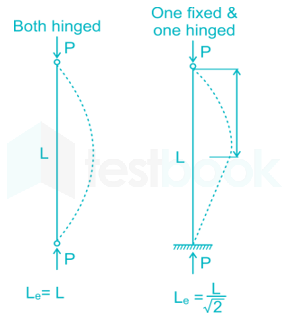
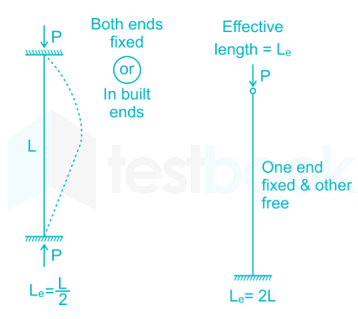
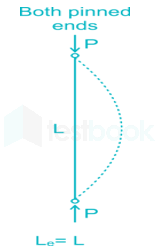
The minimum axial compressive load, P, required to initiate buckling for a pinned-pinned slender column with bending stiffness EI and length L is

  1. ((a))

    P=π2EI4L2P = \frac{{{\pi ^2}EI}}{{4{L^2}}}

  2. ((b))

    P=π2EIL2P = \frac{{{\pi ^2}EI}}{{{L^2}}}

  3. ((c))

    P=3π2EI4L2P = \frac{{{3{\pi ^2}EI}}}{{4{L^2}}}

  4. ((d))

    P=4π2EIL2P = \frac{{{4{\pi ^2}EI}}}{{L^2}}

Show Answer
Answer: ((b))

P=π2EIL2P = \frac{{{\pi ^2}EI}}{{{L^2}}}

Concept:

Ends of the columns:


In this question:

Pmin=π2EILe2{P_{min}} = \frac{{{\pi ^2}EI}}{{L{e^2}}}

Pmin=π2EIL2{P_{min}} = \frac{{{\pi ^2}EI}}{{{L^2}}}

16

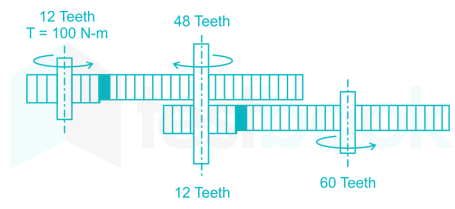
A frictionless gear train is shown in the figure. The leftmost 12-teeth gear is given a torque of 100 N-m. The output torque from the 60-teeth gear on the right in N-m is

  1. ((a))

    5

  2. ((b))

    20

  3. ((c))

    500

  4. ((d))

    2000

Show Answer
Answer: ((d))

2000

Concept:

Power transmitted through the gear remains constant 

PowerP=2πNT60PowerP = \frac{{2\pi NT}}{{60}}

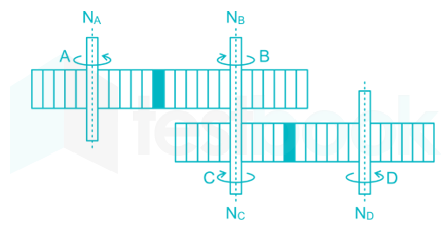
For two mating gears A and B 

NATA = NBTB

where N is the angular speed in rpm and T is the torque

also, 

NAZA = NBZB 

Where Z is the number of teeth on the gear. 

Calculation:

Given, ZA = 12 teeth, ZB = 48 teeth

TA = 100 N-m, ZC = 12, ZD = 60 teeth

TD = ?

∵ Now NAZA = NBZB ⇒ NA × 12 = NB × 48

NA = 4 NB            ----(1)

PowerP=2πNT60PowerP = \frac{{2\pi NT}}{{60}}

PA = PB ⇒ NATA = NBTB

4NB TA = NB TB                                                    [NA = 4 NB    By equation (1)]

TB = 4 × 100 = 400 N-m

Now gear B & C are on the same shaft, therefore torque on gear B & C will be the same.

Thus TC = 400 N-m

Now, NCZC = NDZD

NC × 12 = N0 × 60 ⇒ NC = 5 N­D        ----(2)

NCTC = NDTD

5 ND× 400 = ND TD                                                [NC = 5 N­D By equation (2)]

TD = 2000 N-m

17

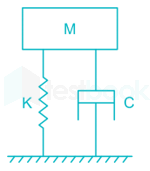
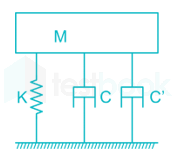
In a single degree of freedom underdamped spring-mass-damper system as shown in the figure, an additional damper is added in parallel such that the system remains underdamped. Which one of the following statements is ALWAYS true?

  1. ((a))

    Transmissibility will increase.                                     

  2. ((b))

    Transmissibility will decrease.

  3. ((c))

    Time period of free oscillations will increase.

  4. ((d))

    Time period of free oscillations will decrease.

Show Answer
Answer: ((c))

Time period of free oscillations will increase.

Concept:

Transmissibility is given by:

ε=1+(2ζωωn)2[1(ωωn)2]2+[2ζωωn]2\varepsilon = \frac{{\sqrt {1 + {{\left( {2\zeta \frac{\omega }{{{\omega _n}}}} \right)}^2}} }}{{\sqrt {{{\left[ {1 - {{\left( {\frac{\omega }{{{\omega _n}}}} \right)}^2}} \right]}^2} + {{\left[ {2\zeta \frac{\omega }{{{\omega _n}}}} \right]}^2}} }}

C=2ζKMζ=C2KMC = 2\zeta \sqrt {KM} \Rightarrow \zeta = \frac{C}{{2\sqrt {KM} }}

Calculation:

After additional damper in parallel ζ=C+C2KM\zeta ' = \frac{{C + C'}}{{2\sqrt {KM} }}

Thus  ζ>ζ\zeta ' > \zeta

Now,  ωd=ωn1ζ2{\omega _d} = {\omega _n}\sqrt {1 - {\zeta ^2}}  

 ζ>ζ\zeta ' > \zeta indicating that ωd<ωd\omega _d' < {\omega _d}

time period(Td)=2πωdtime\ period\left( {{T_d}} \right) = \frac{{2\pi }}{{{\omega _d}}}

Thus, the time period of free oscillation will increase.

18

Pre-tensioning of a bolted joint is used to

  1. ((a))

    strain harden the bolt head

  2. ((b))

    decrease stiffness of the bolted joint

  3. ((c))

    increase stiffness of the bolted joint

  4. ((d))

    prevent yielding of the thread root

Show Answer
Answer: ((c))

increase stiffness of the bolted joint

External tensile load applied to a no preloaded joint transmits entirely to the bolt. The stiffness of a bolted joint without a preload equals the bolt stiffness Ke = Kb. For a preloaded bolted joint, joint stiffness is the sum of bolt & clamped member stiffness ke = Kb + Kc. Therefore, preloading increases the stiffness of the bolted joints, which also increases the resonant frequency of an assembly.

Note:

However, once a joint is preloaded, increasing the magnitude of the preload can not make a joint stiffer.

19

The peak wavelength of radiation emitted by a black body at a temperature of 2000 K is 1.45 μm. If the peak wavelength of emitted radiation changes to 2.90 μm, then the temperature (in K) of the black body is

  1. ((a))

    500

  2. ((b))

    1000

  3. ((c))

    4000

  4. ((d))

    8000

Show Answer
Answer: ((b))

1000

Concept:

From Wein's displacement law 

λmaxT=2898;μmk(constant){\lambda _{max}}T = 2898;\mu m - k\left( {constant} \right)

Thus, λpeakT=λpeakT{\lambda _{peak}}T = \lambda _{peak}'T'

Calculation:

Given, 

Black body λpeak = 1.45 μm at 2000 K.

Now, λpeak=2.90;μm\lambda _{peak}' = 2.90;\mu m

1.45 × 2000 = 2.90 × T'

T' = 1000 K

20

For an ideal gas with constant properties undergoing a quasi-static process, which one of the following represents the change of entropy (Δs) from state 1 to 2?

  1. ((a))

    Δs=CPln(T2T1)Rln(P2P1){\rm{\Delta }}s = {C_P}\ln \left( {\frac{{{T_2}}}{{{T_1}}}} \right) - R\ln \left( {\frac{{{P_2}}}{{{P_1}}}} \right)

  2. ((b))

    Δs=CVln(T2T1)Cpln(V2V1){\rm{\Delta }}s = {C_V}\ln \left( {\frac{{{T_2}}}{{{T_1}}}} \right) - {C_p}\ln \left( {\frac{{{V_2}}}{{{V_1}}}} \right)

  3. ((c))

    Δs=CPln(T2T1)CVln(P2P1){\rm{\Delta }}s = {C_P}\ln \left( {\frac{{{T_2}}}{{{T_1}}}} \right) - {C_V}\ln \left( {\frac{{{P_2}}}{{{P_1}}}} \right)

  4. ((d))

    Δs=CVln(T2T1)+Rln(V1V2){\rm{\Delta }}s = {C_V}\ln \left( {\frac{{{T_2}}}{{{T_1}}}} \right) + R\ln \left( {\frac{{{V_1}}}{{{V_2}}}} \right)

Show Answer
Answer: ((a))

Δs=CPln(T2T1)Rln(P2P1){\rm{\Delta }}s = {C_P}\ln \left( {\frac{{{T_2}}}{{{T_1}}}} \right) - R\ln \left( {\frac{{{P_2}}}{{{P_1}}}} \right)

Explanation:

Entropy change for an ideal gas with constant properties undergoing a quasi-static process:

s2s1=Cpln(V2V1)+Cvln(P2P1){s_2} - {s_1} = {C_p}\ln \left( {\frac{{{V_2}}}{{{V_1}}}} \right) + {C_v}\ln \left( {\frac{{{P_2}}}{{{P_1}}}} \right)

s2s1=Cvln(T2T1)+Rln(V2V1){s_2} - {s_1} = {C_v}\ln \left( {\frac{{{T_2}}}{{{T_1}}}} \right) + R\ln \left( {\frac{{{V_2}}}{{{V_1}}}} \right)

s2s1=Cpln(T2T1)Rln(P2P1){s_2} - {s_1} = {C_p}\ln \left( {\frac{{{T_2}}}{{{T_1}}}} \right) - R\ln \left( {\frac{{{P_2}}}{{{P_1}}}} \right)

21

Select the correct statement for 50% reaction stage in a steam turbine.

  1. ((a))

    The rotor blade is symmetric.

  2. ((b))

    The stator blade is symmetric.

  3. ((c))

    The absolute inlet flow angle is equal to absolute exit flow angle.

  4. ((d))

    The absolute exit flow angle is equal to inlet angle of rotor blade.

Show Answer
Answer: ((d))

The absolute exit flow angle is equal to inlet angle of rotor blade.

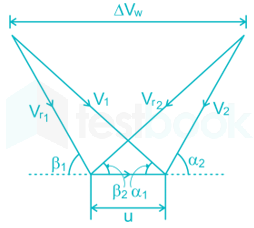
  • 50% reaction stage steam turbine also known as “Parsons turbine”.
  • The velocity triangles for inlet & outlet conditions are symmetrical having.


\(\left{ {\begin{array}{{20}{c}} {{\alpha _1} = {\beta _2}}\ {{\alpha _2} = {\beta _1}} \end{array}} \right};;;;;;;& ;;;;\left{ {\begin{array}{{20}{c}} {{V_{{r_1}}} = {V_2}}\ {{V_{{r_2}}} = {V_1}} \end{array}} \right}\)

22

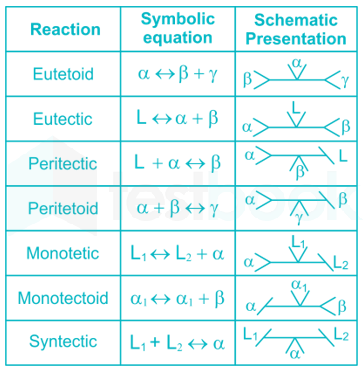
Denoting L as liquid and M as solid in a phase-diagram with the subscripts representing different phases, a eutectoid reaction is described by

  1. ((a))

    M1 → M2 + M3

  2. ((b))

    L1 → M1 + M2

  3. ((c))

    L1 + M1 → M2

  4. ((d))

    M1  → M2 + L3

Show Answer
Answer: ((a))

M1 → M2 + M3

Explanation:

On cooling reaction will tend in forward direction and on heating cycle reaction will reverse in direction.

23

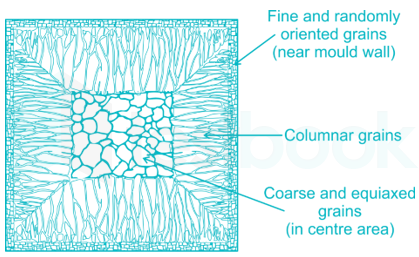
During solidification of pure molten metal, the grains in the casting near the mould wall are

  1. ((a))

    coarse and randomly oriented

  2. ((b))

    fine and randomly oriented

  3. ((c))

    fine and ordered

  4. ((d))

    coarse and ordered

Show Answer
Answer: ((b))

fine and randomly oriented

Explanation:

During solidification of pure molten metal, the grains in the casting near the mould wall are fine and randomly oriented because the rate of solidification is high at the surface of mould during solidification.

24

Match the following products with the suitable manufacturing process

ProductManufacturing Process
PToothpaste tube1Centrifugal casting
QMetallic pipes2Blow moulding
RPlastic bottles3Rolling
SThreaded bolts4Impact extrusion
  1. ((a))

    P-4, Q-3, R-1, S-2

  2. ((b))

    P-2, Q-1, R-3, S-4

  3. ((c))

    P-4, Q-1, R-2, S-3

  4. ((d))

    P-1, Q-3, R-4, S-2

Show Answer
Answer: ((c))

P-4, Q-1, R-2, S-3

Explanation:

Centrifugal casting:

It is used to manufacture hollow products (such as pipes) having a rotationally symmetric hollow space & on-axis coinciding with the axis of rotation of the centrifugal casting machine.

Casting materials: Especially cast iron, cast steel, heavy & light metals.

Blow moulding:

  • Can form intricate shapes, hollow shapes with thin walls.
  • Ideal for mass production.
  • Plastics used: HDPE, LDPE, PET, PP, PS, PVC.
  • End-uses: Plastic bottles & containers of all sizes and shapes; e.g. soft drinks bottles & shampoo bottles.

Rolling: Is the process of reducing the thickness or changing the cross-section of a long workpiece by compressive forces applied through a set of rolls.

  • Products: Structures, rails, threaded bolts by thread rolling.

Impact extrusion:

  • It is similar to indirect extrusion, it is often included in the cold-extrusion category. The descends rapidly on the blank (slug), which is extruded backward.
  • Performed at higher speeds & shorter strokes as compared to conventional extrusion.

Products:

  • Made by this process included toothpaste tubes & battery cases.
  • Can produce thin walled tubular sections, ones having thickness to diameter ratios as small as 0.005.
25

Feed rate in slab milling operation is equal to

  1. ((a))

    rotation per minute (rpm)

  2. ((b))

    product of rpm and number of teeth in the cutter

  3. ((c))

    product of rpm, feed per tooth and number of teeth in the cutter

  4. ((d))

    product of rpm, feed per tooth and number of teeth in contact

Show Answer
Answer: ((c))

product of rpm, feed per tooth and number of teeth in the cutter

Explanation:

Feed rate in slab milling operation is given by, 

f= f× N × Z 

Where ft is the feed per tooth.

N = Spindle rotational speed (in rpm)

Z = Number of teeth in cutter (teeth per rev)

26

Metal removal in electric discharge machining takes place through

  1. ((a))

    ion displacement

  2. ((b))

    melting and vaporization

  3. ((c))

    corrosive reaction

  4. ((d))

    plastic shear

Show Answer
Answer: ((b))

melting and vaporization

Explanation:

The unconventional machining process and their characteristics and the application areas are discussed in the table below:

Type Of MachiningMechanics Of Material RemovalMediumTool MaterialMaterial Application
Ultrasonic machiningBrittle fracture caused by the impact of abrasive grain due to tool vibrating at high frequency (Amplified by tapered horn).SlurryTough and ductile (soft steel)The hard and brittle material, semiconductor, non-metals( eg. Glass and ceramic).
Abrasive Jet MachiningBrittle fracture by impinging abrasive grains at high speed.Air, CO2Abrasives (Al2O3, ­­SiC), Nozzle (WC, sapphire)Hard and Brittle metal and non-metallic material.
Electric discharge machiningMelting and evaporation, aided by cavitation.Dielectric fluidCopper, brass, graphiteAll conducting metals and alloys
Electrochemical machiningElectrolysisConducting electrolyteCopper, brass, steelAll conducting metals and alloys
Electron beam machiningMelting and vapourizationvacuumA beam of an electron moving at high velocityAll material.
Laser beam machiningMelting and vapourizationNormal atmosphereA high power laser beam (Ruby rod)All material.
27

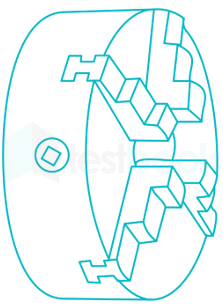
The preferred option for holding an odd-shaped workpiece in a center lathe is

  1. ((a))

    live and dead centres

  2. ((b))

    three jaw chuck

  3. ((c))

    lathe dog

  4. ((d))

    four jaw chuck

Show Answer
Answer: ((d))

four jaw chuck

Explanation:

lathe chuck:

  • A lathe chuck is a holding device which is used for holding the job firmly against the cutting tool.

There are two types of chuck:

Four Jaw Chuck:

  • The four-jaw chuck is also called an independent chuck since each jaw can be adjusted independently.
  • Four jaw chucks are used for a wide range of regular and irregular shapes.
  • A work can be trued to within 0.02 mm accuracy, using this chuck.
  • This type of chuck is much more heavily constructed than the self-centering chuck, and has much greater holding power.
  • Each jaw is moved independently by a square thread screw.
  • The jaws are reversible for holding large diameter jobs.
  • The independent four-jaw chuck has four jaws each working independently of the others in its own slot in the chuck body and actuated by its own separate square threaded screw.
  • By suitable adjustment of the jaws, a workpiece can be set to run either true or eccentric with the machine centre.
  • Finished jobs when held in a four-jaw chuck can be trued with the help of a dial test indicator.

Three Jaw Chuck:

  • It is also known as three jaws universal chuck, self-centring chuck and concentric chuck having three jaws which work at the same time.
  • Three jaw chucks are used to hold only perfect round and regular jobs
28

A local tyre distributor expects to sell approximately 9600 steel belted radial tyres next year. Annual carrying cost is Rs. 16 per tyre and ordering cost is Rs. 75. The economic order quantity of the tyres is

  1. ((a))

    64

  2. ((b))

    212

  3. ((c))

    300

  4. ((d))

    1200

Show Answer
Answer: ((c))

300

Concept:

EOQ=Q=2DCoChEOQ = {Q} = \sqrt {\frac{{2D{C_o}}}{{{C_h}}}}

Where Ch is the holding cost

D is the annual demand

Q is the quantity ordered

Co is the setup or ordering cost

Calculation:

Given, D = 9600 tyres/year, Ch = Rs. 16 tyre/year, Co = Rs. 75

Economic;order(EOQ)=2DCoCh=2×600×75Economic;order\left( {EOQ} \right) = \sqrt {\frac{{2D{C_o}}}{{{C_h}}}} = \sqrt {2 \times 600 \times 75}  = 300 units

29

If \(A = \left[ {\begin{array}{*{20}{c}} 1&2&3\ 0&4&5\ 0&0&1 \end{array}} \right]\)then det(A-1 ) is __________ (correct to two decimal places).

30

A hollow circular shaft of inner radius 10 mm, outer radius 20 mm and length 1 m is to be used as a torsional spring. If the shear modulus of the material of the shaft is 150 GPa, the torsional stiffness of the shaft (in kN-m/rad) is ________ (correct to two decimal places).

31

Fatigue life of a material for a fully reversed loading condition is estimated from σa=1100N0.15{\sigma _a} = 1100{N^{- 0.15}}, where σa is the stress amplitude in MPa and N is the failure life in cycles. The maximum allowable stress amplitude (in MPa) for a life of 1 × 10⁵ cycles under the same loading condition is ________ (correct to two decimal places).

32

The viscous laminar flow of air over a flat plate results in the formation of a boundary layer. The boundary layer thickness at the end of the plate of length L is δL. When the plate length is increased to twice its original length, the percentage change in laminar boundary layer thickness at the end of the plate (with respect to δL) is ________ (correct to two decimal places).

33

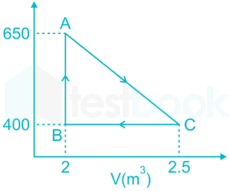
An engine operates on the reversible cycle as shown in the figure. The work output from the engine (in kJ/cycle) is ______ (correct to two decimal places). Take Pressure in KPa.

34

​The arrival of customers over fixed time intervals in a bank follow a Poisson distribution with an average of 30 customers/hour. The probability that the time between successive customer arrival is between 1 and 3 minutes is _______ (correct to two decimal places).

35

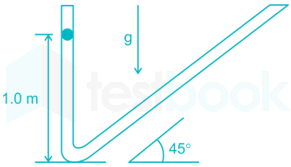
A ball is dropped from rest from a height of 1 m in a frictionless tube as shown in the figure. If the tube profile is approximated by two straight lines (ignoring the curved portion), the total distance travelled (in m) by the ball is __________ (correct to two decimal places).

36

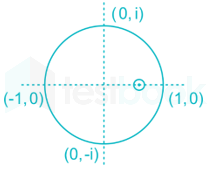
Let z be a complex variable. For a counter-clockwise integration around a unit circle C, centred at origin, C;15z4dz=Aπi\mathop \oint \limits_C^; \frac{1}{{5z - 4}}dz = A\pi i. the value of A is

  1. ((a))

    2/5

  2. ((b))

    1/2

  3. ((c))

    2

  4. ((d))

    4/5

Show Answer
Answer: ((a))

2/5

Concept:

Given C;15z4dz=Aπi\mathop \oint \limits_C^; \frac{1}{{5z - 4}}dz = A\pi i 

C;15z4dz=15C;1z45\mathop \oint \limits_C^; \frac{1}{{5z - 4}}dz = \frac{1}{5}\mathop \oint \limits_C^; \frac{1}{{z - \frac{4}{5}}}

There is a pole at z=45z = \frac{4}{5 }

Thus, \(\mathop \oint \limits_C^; \frac{1}{{5z - 4}}dz = \frac{{2\pi i}}{5}\lim z \to \frac{4}{5}\left{ {\frac{{z - \frac{4}{5}}}{{z - \frac{4}{5}}}} \right}\)

Given,

Aπi=2πi5×1A\pi i = \frac{{2\pi i}}{5} \times 1

A=25A = \frac{2}{5}

37

Let X1 and X2 be two independent exponentially distributed random variables with means 0.5 and 0.25, respectively. Then Y = min (X1, X2) is

  1. ((a))

    exponentially distributed with mean 1⁄6

  2. ((b))

    exponentially distributed with mean 2

  3. ((c))

    normally distributed with mean 3⁄4

  4. ((d))

    normally distributed with mean 1⁄6

Show Answer
Answer: ((a))

exponentially distributed with mean 1⁄6

Explanation:

x1 & x2: two independent exponentially distributed random variables with means 0.5 and 0.25.

A continuous random variable x is said to have an exponential (λ) distribution if it has probability density function.

\({f_x}\left( {x/\lambda } \right) = \left{ {\begin{array}{*{20}{c}} {\lambda {e^{ - \lambda x}}}&{for;x > 0}\ 0&{for;x \le 0} \end{array}} \right.\)

Where, λ > 0, is called the rate of distribution. The mean of the exponential (λ) distribution is calculated using integration by parts as:

\(E\left[ x \right] = \mathop \smallint \limits_0^\infty x\lambda .{e^{ - \lambda x}}dx\)

\(= \lambda \left{ {\left[ {\frac{{ - x.{e^{ - \lambda x}}}}{\lambda }} \right]_0^\infty + \frac{1}{\lambda }\mathop \smallint \limits_0^\infty {e^{ - \lambda x}}.dx} \right}\)

\(= \lambda \left{ {\lambda \left[ {0 + 0} \right] + \frac{1}{\lambda }\left[ {\frac{{ - {e^{ - \lambda x}}}}{\lambda }} \right]_0^\infty } \right}\)

\(= \lambda \left{ {0 + \frac{1}{\lambda }\left[ {0 + \frac{1}{\lambda }} \right]} \right}\)

=λ.1λ2= \lambda .\frac{1}{{{\lambda ^2}}}

E[x]=1λE\left[ x \right] = \frac{1}{\lambda }

Let x1, x2 …..., xn be independent random variables, with xi having exponential (λi) distribution. Then the distribution of min (x1, x2 ……, xn) is exponential (λ1 + λ2 + …. + λn)

Thus, mean of min (x1,x2)=1λ1+λ2\left( {{x_1},{x_2}} \right) = \frac{1}{{{\lambda _1} + {\lambda _2}}}

λ1=1E[x1]=10.5=2{\lambda _1} = \frac{1}{{E\left[ {{x_1}} \right]}} = \frac{1}{{0.5}} = 2

λ2=1E[x2]=10.25=4{\lambda _2} = \frac{1}{{E\left[ {{x_2}} \right]}} = \frac{1}{{0.25}} = 4

Mean of min (x1,x2)=12+4\left( {{x_1},{x_2}} \right) = \frac{1}{{2 + 4}}

λ2=1E[x2]=10.25=4{\lambda _2} = \frac{1}{{E\left[ {{x_2}} \right]}} = \frac{1}{{0.25}} = 4

Thus, y = min (x1, x2) is exponentially distributed with mean (16)\left( {\frac{1}{6}} \right).

38

For a position vector r=xi^+yj^+zk\vec r = x\hat i + y\hat j + zk the norm of the vector can be defined as r=x2+y2+z2\left| {\vec r} \right| = \sqrt {{x^2} + {y^2} + {z^2}}. Given a function ϕ=lnr\phi = \ln \left| {\vec r} \right|, its gradient ∇ϕ is

  1. ((a))

    r\vec r

  2. ((b))

    rr\frac{{\vec r}}{{\left| {\vec r} \right|}}

  3. ((c))

    rrr\frac{{\vec r}}{{\vec r \cdot \vec r}}

  4. ((d))

    rr3\frac{{\vec r}}{{{{\left| {\vec r} \right|}^3}}}

Show Answer
Answer: ((c))

rrr\frac{{\vec r}}{{\vec r \cdot \vec r}}

Explanation:

Position vector r=xi^+yj^+zk\vec r = x\hat i + y\hat j + zk

r=x2+y2+z2\left| {\vec r} \right| = \sqrt {{x^2} + {y^2} + {z^2}}

ϕ=lnr\phi = \ln \left| {\vec r} \right|

\(Gradient;\nabla \phi = \left( {i\frac{\partial }{{\partial x}} + j\frac{\partial }{{\partial y}} + k\frac{\partial }{{\partial z}}} \right).\left{ {\ln \sqrt {{x^2} + {y^2} + {z^2}} } \right}\)

\(= \frac{1}{2}\left{ {i\frac{\partial }{{\partial x}}\ln \left( {{x^2} + {y^2} + {z^2}} \right) + j.\frac{\partial }{{\partial y}}\ln \left( {{x^2} + {y^2} + {z^2}} \right) + k\frac{\partial }{{\partial z}}\ln \left( {{x^2} + {y^2} + {z^2}} \right)} \right}\)

\(= \frac{1}{2}\left{ {i.\frac{{2x}}{{{x^2} + {y^2} + {z^2}}} + j\frac{{2y}}{{{x^2} + {y^2} + {z^2}}} + k\frac{{2z}}{{{x^2} + {y^2} + {z^2}}}} \right}\)

\(\nabla \phi = \left{ {\frac{{xi + yj + zk}}{{{x^2} + {y^2} + {z^2}}}} \right}\)

Gradient;ϕ=rr.rGradient;\nabla \phi = \frac{{\vec r}}{{\vec r.\vec r}}

39

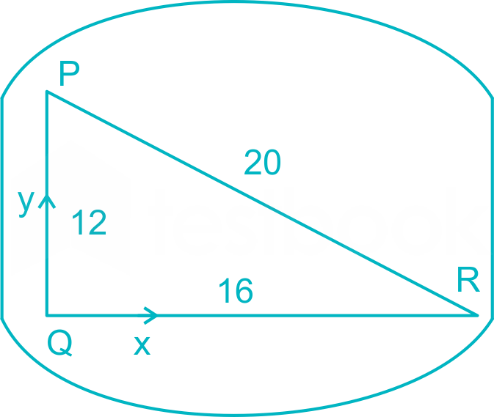
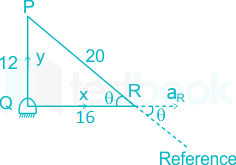
In a rigid body in plane motion, the point R is accelerating with respect to point P at 10∠180° m/s2. If the instantaneous acceleration of point Q is zero, the acceleration (in m/s2) of point R is

  1. ((a))

    8∠233°

  2. ((b))

    10∠225° 

  3. ((c))

    10∠217°

  4. ((d))

    8∠217°

Show Answer
Answer: ((d))

8∠217°

Explanation:

As the acceleration of point Q is zero, so assuming PQR a rigid body hinged at Q.

aRP=aRap{\vec a_{RP}} = {\vec a_R} - {\vec a_p}

Given,

Given: The point R is accelerating with respect to point P at 10∠180° m/s2.

i.e. 10 m/s2 acceleration at 180° of (P) so only radial acceleration exist i.e. ω = constant; α = 0

∴ aRP = (RP) ω2 = 10

⇒ ω2 × 20 = 10

ω=(12)\omega = \left( {\frac{1}{{\sqrt 2 }}} \right)*

Now as α is zero so R w.r.t Q will also have a radial acceleration in the x-axis

aR=(RQ)ω2=16×(12)2=8;m/s2{a_R} = \left( {RQ} \right){\omega ^2} = 16 \times {\left( {\frac{1}{{\sqrt 2 }}} \right)^2} = 8;m/{s^2}

Now our reference is (PR) so the angle will be (180 + θ) *

sinθ=(1220)θ=sin1(35)=37\sin \theta = \left( {\frac{{12}}{{20}}} \right) \Rightarrow \theta = {\sin ^{ - 1}}\left( {\frac{3}{5}} \right) = 37^\circ

180 + 37 = 217°

aR = 8 ∠217°

40

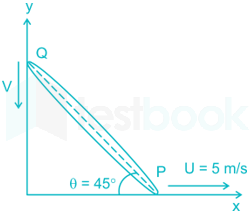
A rigid rod of length 1 m is resting at an angle θ = 45° as shown in the figure. The end P is dragged with a velocity of U = 5 m/s to the right. At the instant shown, the magnitude of the velocity V (in m/s) of point Q as it moves along the wall without losing contact is

  1. ((a))

    5

  2. ((b))

    6

  3. ((c))

    8

  4. ((d))

    10

Show Answer
Answer: ((a))

5

Concept:

A translating body or a body in general plane motion is in pure rotation about its instantaneous centre of rotation.

and the velocity is given by 

V = ω × Distance of instantaneous centre of rotation

Calculation:

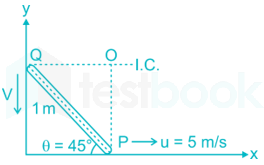
O is the instantaneous centre of the rigid rod, so rod will have pure rotation along the instantaneous centre.

Let rotational speed be = ω (about I.C.)

OP=1sin45=12OP = 1\sin 45^\circ = \frac{1}{{\sqrt 2 }}

OQ=1cos45=12OQ = 1\cos 45^\circ = \frac{1}{{\sqrt 2 }}

VP = rω = OP × ω

5=12ω5 = \frac{1}{{\sqrt 2 }}ω     ----(1)

VQ = OQ × ω

VQ=12ω{V_Q} = \frac{1}{{\sqrt 2 }}ω     ----(2)

By equation (1) & (2):

5 = VQ

VQ = 5 m/s

41

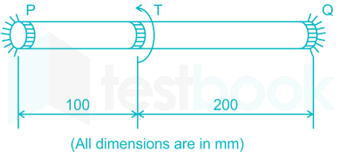
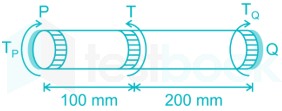
A bar of circular cross-section is clamped at ends P and Q as shown in the figure. A torsional moment 𝑇 = 150 N.m is applied at a distance of 100 mm from end P. The torsional reactions (𝑇P, 𝑇Q) in N.m at the ends P and Q respectively are

  1. ((a))

    (50, 100)

  2. ((b))

    (75, 75)

  3. ((c))

    (100, 50)

  4. ((d))

    (120, 30)

Show Answer
Answer: ((c))

(100, 50)

Concept:

The angle of twist on a shaft is given by 

θ=T×LG×IP\theta=\frac{{{T} \times L}}{{G\times{I_P}}}

Where T is the torque, L is the length of the shaft

G is the modulus of the rigidity and

IP is the polar moment of inertia

Calculation:

Given T = 150 N.m

The torsional reactions at point P are TP  and at point Q it is TQ

TP + TQ = 150      ---- (1)

Since torque is being applied on the same shaft, thus twist of rod will be same.

Thus, TP×100GIP=TQ×200GIP\frac{{{T_P} \times 100}}{{G{I_P}}} = \frac{{{T_Q} \times 200}}{{G{I_P}}}

TP = 2TQ      ----  (2)

By equation (1) & (2):

TQ = 50 N.m

TP = 100 N.m

(TP, TQ) = (100, 50)

42

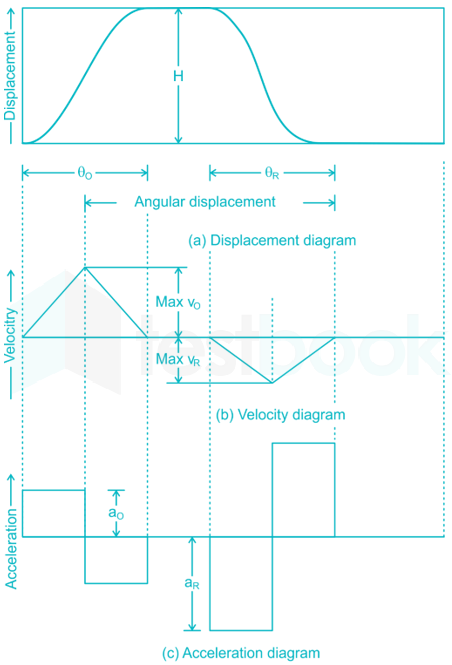
In a cam-follower, the follower rises by h as the cam rotates by δ (radians) at constant angular velocity ω (radians/s). The follower is uniformly accelerating during the first half of the rise period and it is uniformly decelerating in the latter half of the rise period. Assuming that the magnitudes of the acceleration and deceleration are same, the maximum velocity of the follower is

  1. ((a))

    4hωδ\frac{{4h\omega }}{\delta }

  2. ((b))

    hω 

  3. ((c))

    2hωδ\frac{{2h\omega }}{\delta }

  4. ((d))

    2hω

Show Answer
Answer: ((c))

2hωδ\frac{{2h\omega }}{\delta }

Concept:

Uniform Acceleration and Retardation

Under the given situation one can apply the laws of kinematics.

Uniform acceleration and uniform declaration

‘ω’ angular velocity, ‘δ’ angle turned by the cam

Total time of flight (t0)=(δω)\left( {{t_0}} \right) = \left( {\frac{\delta }{\omega }} \right)

S=ut+12at2S = ut + \frac{1}{2}a{t^2}

Calculation:

Applying for the acceleration half

(S=h2)\left( {S = \frac{h}{2}} \right) and (u = 0); t=(t02)t = \left( {\frac{{{t_0}}}{2}} \right)

h2=12a×(t02)2;h2=12×a×(δ2ω)2\Rightarrow \frac{h}{2} = \frac{1}{2}a \times {\left( {\frac{{{t_0}}}{2}} \right)^2};\frac{h}{2} = \frac{1}{2} \times a \times {\left( {\frac{\delta }{{2\omega }}} \right)^2}

a=4hω2δ2\Rightarrow {a = \frac{{4h{\omega ^2}}}{{{\delta ^2}}}}

Now maximum velocity will occur at the end of the acceleration half and after that declaration starts hence velocity will decrease.

[V2 – u2 = 2aS]

Using this equation again for acceleration half.

v2=2as=2×4hω2δ2×h2v=2hωδ{v^2} = 2as = 2 \times \frac{{4h{\omega ^2}}}{{{\delta ^2}}} \times \frac{h}{2} \Rightarrow v = \frac{{2h\omega }}{\delta }

vmaximum=2hωδ{v_{maximum}} = \frac{{2h\omega }}{\delta }

43

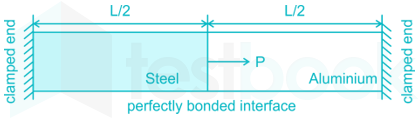
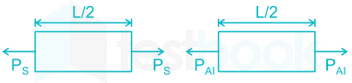
A bimetallic cylindrical bar of cross-sectional area 1 m2 is made by bonding Steel (Young’s modulus = 210 GPa) and Aluminum (Young’s modulus = 70 GPa) as shown in the figure. To maintain tensile axial strain of magnitude 10-6 in Steel bar and compressive axial strain of magnitude 10-6 in Aluminum bar, the magnitude of the required force P (in kN) along the indicated direction is

  1. ((a))

    17

  2. ((b))

    140

  3. ((c))

    210

  4. ((d))

    280

Show Answer
Answer: ((d))

280

Concept:

The axial strain is given by 

ϵ=PAEϵ=\frac{{{P}}}{{{A}{E}}}

Where P is the load acting in the axial direction, A is the cross-sectional area and E is the Modulus of elasticity

Calculation:

ES = 210 GPa

EAI = 70 GPa

Since the magnitude of axial strains in both bars same. Thus,

PsAsEs=PAlAAlEAl\frac{{{P_s}}}{{{A_s}{E_s}}} = \frac{{{P_{Al}}}}{{{A_{Al}}{E_{Al}}}}

Since, AS=AAl=1;m2{A_S} = {A_{Al}} = 1;{m^2}

PS210=PAl70\frac{{{P_S}}}{{210}} = \frac{{{P_{Al}}}}{{70}}

PS = 3 PAl

P = PS + PAI      ----(1)

Now, ϵ = 10-6

PSASES=106\frac{{{P_S}}}{{{A_S}{E_S}}} = {10^{-6}}

PS = 10-6 × 1 × 210 × 109

PS = 210 KN

PAI = 70 KN

P = PAI + PS = 210 + 70 = 280 KN

44

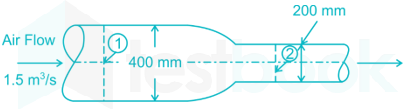
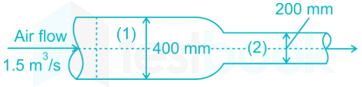
Air flows at the rate of 1.5 m3/s through a horizontal pipe with a gradually reducing cross-section as shown in the figure. The two cross-sections of the pipe have diameters of 400 mm and 200 mm. Take the air density as 1.2 kg/m3 and and assume inviscid incompressible flow. The change in pressure (p2 - p1) (in kPa) between sections 1 and 2 is

  1. ((a))

    -1.28

  2. ((b))

    2.56

  3. ((c))

    -2.13

  4. ((d))

    1.28

Show Answer
Answer: ((a))

-1.28

Concept:

Bernoulli equation between section (1) & (2)

P1ρg+V122g+Z1=P2ρg+V222g+Z2+hL\frac{{{P_1}}}{{\rho g}} + \frac{{V_1^2}}{{2g}} + {Z_1} = \frac{{{P_2}}}{{\rho g}} + \frac{{V_2^2}}{{2g}} + {Z_2} + {h_L}

hL = 0 (Gradually reducing cross-section)

ρ = Constant (incompressible fluid)

Calculation:

ρair = 1.2 kg/m3

P2P1ρg=V122gV222g\frac{{{P_2} - {P_1}}}{{\rho g}} = \frac{{V_1^2}}{{2g}} - \frac{{V_2^2}}{{2g}}

P2P1=ρ2(V12V22){P_2} - {P_1} = \frac{\rho }{2}\left( {V_1^2 - V_2^2} \right)

∴ Q = 1.5 m3/s

A1V1 = A2V2 = 1.5 m3/s

A1=π4d12{A_1} = \frac{\pi }{4}d_1^2

A1=π4(0.4)2=4π100m2{A_1} = \frac{\pi }{4}{\left( {0.4} \right)^2} = \frac{{4\pi }}{{100}}{m^2}

A2=π4(0.2)2=π100{A_2} = \frac{\pi }{4}{\left( {0.2} \right)^2} = \frac{\pi }{{100}}

Thus, V1×4π100=1.5{V_1} \times \frac{{4\pi }}{{100}} = 1.5

V1=1504π{V_1} = \frac{{150}}{{4\pi }}

V2=150π{V_2} = \frac{{150}}{{\pi }}

\({P_2} - {P_1} = \frac{{1.2}}{2}\left{ {{{\left( {\frac{{150}}{{4\pi }}} \right)}^2} - {{\left( {\frac{{150}}{\pi }} \right)}^2}} \right}\)

=0.6×1502(116π21π2)= 0.6 \times {150^2}\left( {\frac{1}{{16{\pi ^2}}} - \frac{1}{{{\pi ^2}}}} \right)

= -1282.346 N/m2 (or pascal)

P2 - P1 = -1.28 KPa

45

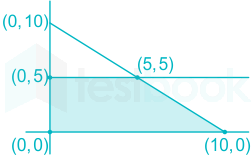
The problem of maximizing z = x1 - x2 subject to constraints x1 + x2 ≤ 10, x1 ≥ 0, x2 ≥ 0 and x2 ≤ 5 has

  1. ((a))

    no solution

  2. ((b))

    one solution

  3. ((c))

    two solutions

  4. ((d))

    more than two solutions

Show Answer
Answer: ((b))

one solution

Explanation:

Maximizing z = x1 - x2

Constraints x1 + x2 ≤ 10

x1 ≥ 0

x2 ≥ 0

x2 ≤ 5

Corner points are: (0, 0) (5, 0), (5, 5), (0, 10).

Z (0, 0) = 0 - 0 = 0

Z (0, 5) = 0 - 5 = -5

Z (5, 5) = 5 - 5 = 0

Z (10, 0) = 10 - 0 = 10

Maximum Z = Z (10, 0) = 10

Thus, problem has one optimum solution.

46

Given the ordinary differential equation d2ydx2+dydx6y=0\frac{{{d^2}y}}{{d{x^2}}} + \frac{{dy}}{{dx}} - 6y = 0 With y (0) = 0 and dydx(0)=1\frac{{dy}}{{dx}}\left( 0 \right) = 1, the value of y(1) is ______ (correct to two decimal places).

47

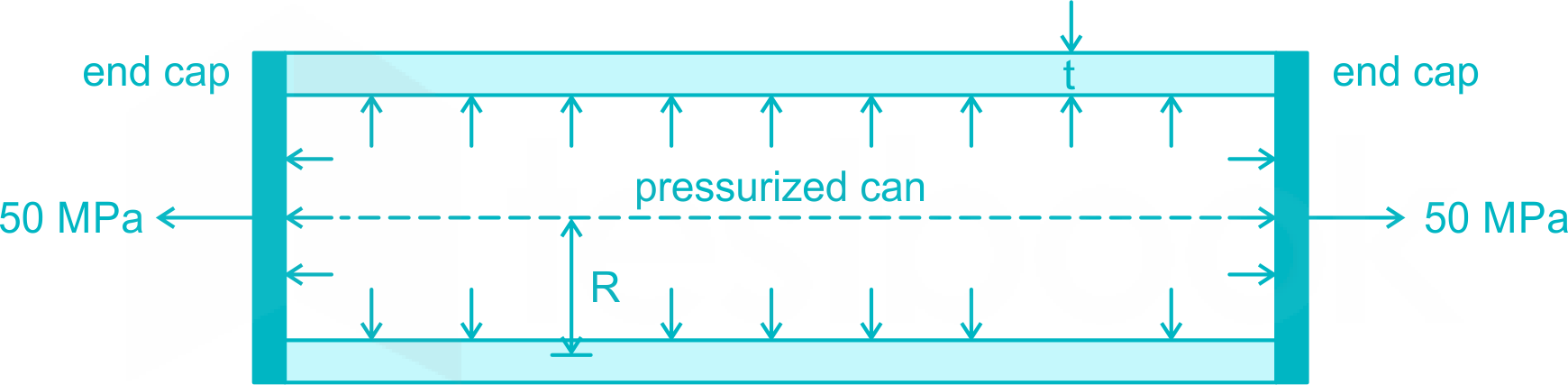
A thin-walled cylindrical can with rigid end caps has a mean radius R = 100 mm and a wall thickness of t = 5 mm. The can is pressurized and an additional tensile stress of 50 MPa is imposed along the axial direction as shown in the figure. Assume that the state of stress in the wall is uniform along its length. If the magnitudes of axial and circumferential components of stress in the can are equal, the pressure (in MPa) inside the can is ___________ (correct to two decimal places).

48

A bar is subjected to a combination of a steady load of 60 kN and a load fluctuating between -10 kN and 90 kN. The corrected endurance limit of the bar is 150 MPa, the yield strength of the material is 480 MPa and the ultimate strength of the material is 600 MPa. The bar cross-section is square with side a. If the factor of safety is 2, the value of a (in mm), according to the modified Goodman’s criterion, is ________ (correct to two decimal places).

49

A force of 100 N is applied to the centre of a circular disc, of mass 10 kg and radius 1 m, resting on a floor as shown in the figure. If the disc rolls without slipping on the floor, the linear acceleration (in m/s2) of the centre of the disc is ________ (correct to two decimal places).

50

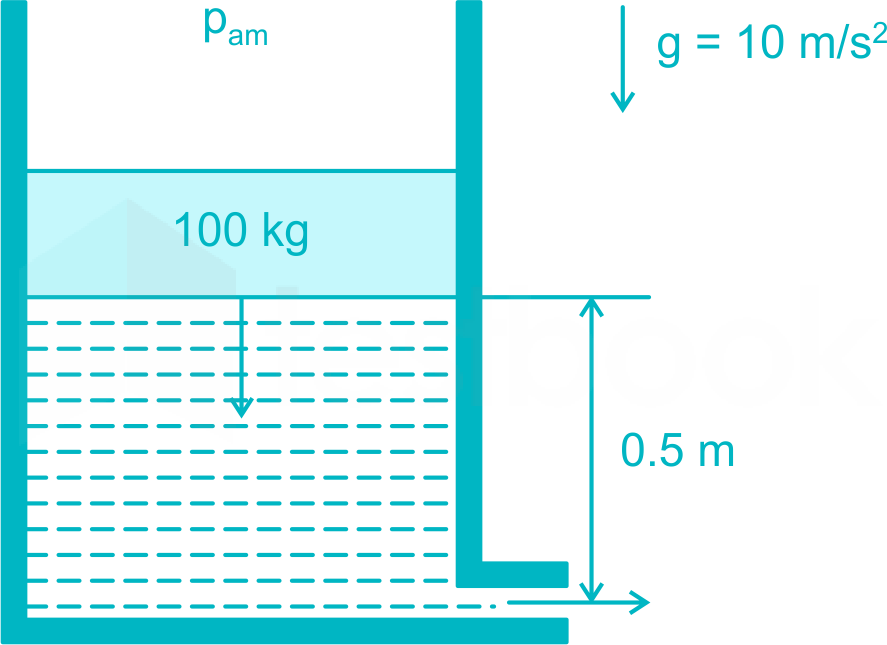
A frictionless circular piston of area 10-2 m2 and mass 100 kg sinks into a cylindrical container of the same area filled with water of density 1000 kg**/**m3 as shown in the figure. The container has a hole of area 10-3 m2 at the bottom that is open to the atmosphere. Assuming there is no leakage from the edges of the piston and considering water to be incompressible, the magnitude of the piston velocity (in m/s) at the instant shown is _____ (correct to three decimal places).

51

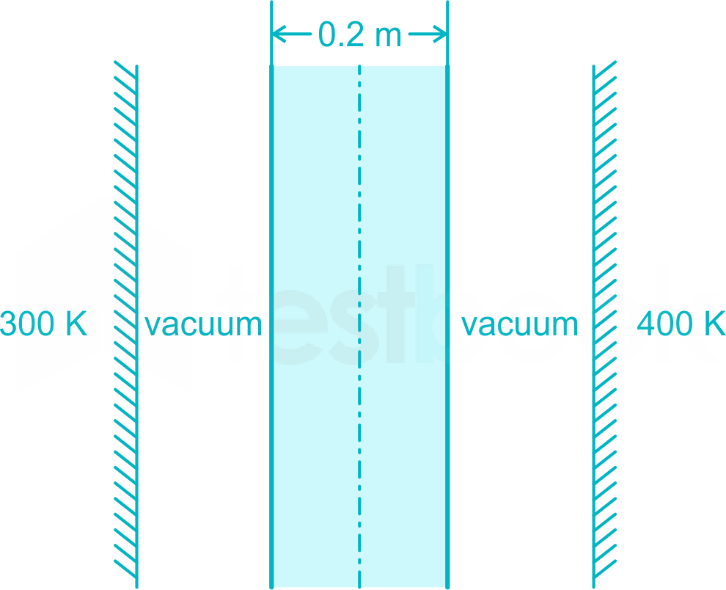
A 0.2 m thick infinite black plate having a thermal conductivity of 3.96 W**/m-K is exposed to two infinite black surfaces at 300 K and 400 K as shown in the figure. At steady state, the surface temperature of the plate facing the cold side is 350 K. The value of Stefan-Boltzmann constant, σ, is 5.67 × 10⁻⁸ W/m2 K4. Assuming 1-D heat conduction, the magnitude of heat flux through the plate (in W/**m2) is ________ (correct to two decimal places).

52

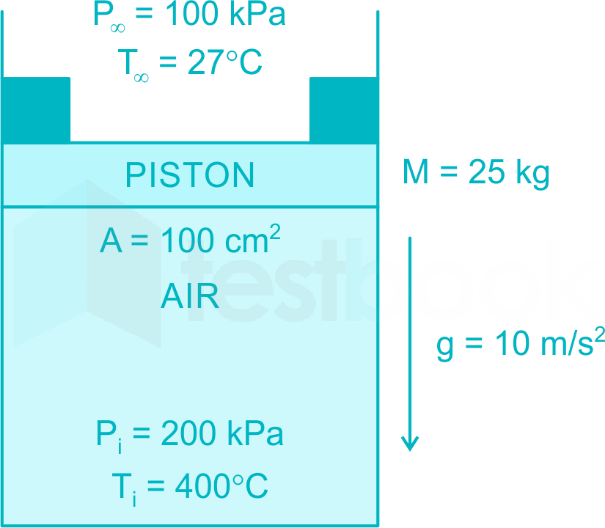
Air is held inside a non-insulated cylinder using a piston (mass M = 25 kg and area A = 100 cm2) and stoppers (of negligible area), as shown in the figure. The initial pressure Pi and temperature Ti of air inside the cylinder are 200 kPa and 400°C, respectively. The ambient pressure P and temperature T are 100 kPa and 27°C, respectively. The temperature of the air inside the cylinder (°C) at which the piston will begin to move is _________ (correct to two decimal places).

53

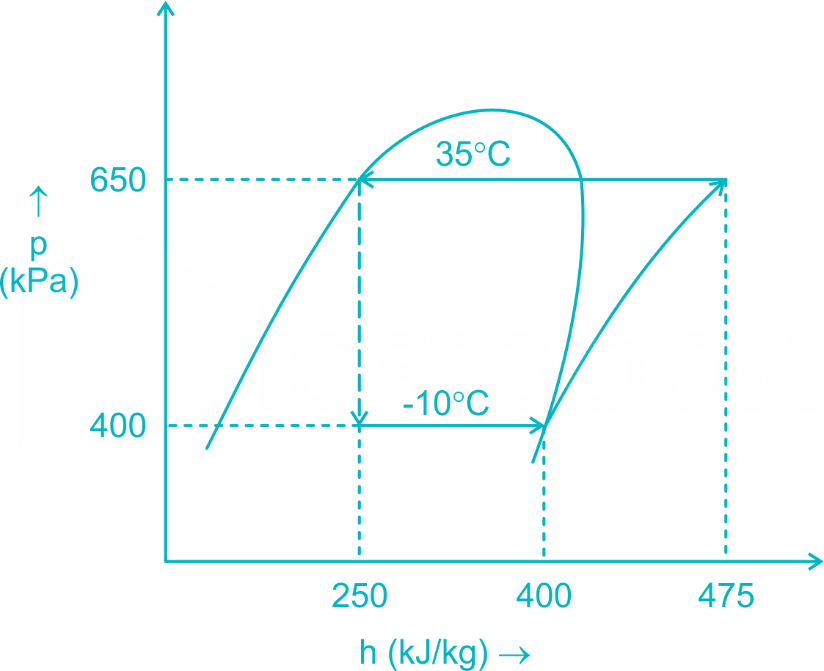
A standard vapor compression refrigeration cycle operating with a condensing temperature of 35°C and an evaporating temperature of -10°C develops 15 kW of cooling. The p-h diagram shows the enthalpies at various states. If the isentropic efficiency of the compressor is 0.75, the magnitude of compressor power (in kW) is _________ (correct to two decimal places).

54

Ambient air is at a pressure of 100 kPa, dry bulb temperature of 30°C and 60% relative humidity. The saturation pressure of water at 30°C is 4.24 kPa. The specific humidity of air (in g/kg of dry air) is ________ (correct to two decimal places).

55

A test is conducted on a one-fifth scale model of a Francis turbine under a head of 2 m and volumetric flow rate of 1 m3/s at 450 rpm. Take the water density and the acceleration due to gravity as 103 kg/m3 and 10 m/s2, respectively. Assume no losses both in model and prototype turbines. The power (in MW) of a full-sized turbine while working under a head of 30 m is _______ (correct to two decimal places).

56

The true stress (in MPa) versus true strain relationship for a metal is given by

σ=1020ε0.4\sigma = 1020{\varepsilon ^{0.4}}

The cross-sectional area at the start of a test (when the stress and strain values are equal to zero) is 100 mm2. The cross-sectional area at the time of necking (in mm2) is ________ (correct to two decimal places)

57

A steel wire is drawn from an initial diameter (di) of 10 mm to a final diameter (df) of 7.5 mm. The half cone angle (α) of the die is 5° and the coefficient of friction (μ) between the die and the wire is 0.1. The average of the initial and final yield stress [(σY)avg] is 350 MPa. The equation for drawing stress σf, (in MPa) is given as:

\({\sigma _f} = {\left( {{\sigma Y}} \right){avg}}\left{ {1 + \frac{1}{{\mu \cot \alpha }}} \right}\left[ {1 - {{\left( {\frac{{{d_f}}}{{{d_i}}}} \right)}^{2\mu \cot \alpha }}} \right]\)

The drawing stress (in MPa) required to carry out this operation is _________ (correct to two decimal places).

58

Following data correspond to an orthogonal turning of a 100 mm diameter rod on a lathe. Rake angle: +15°; Uncut chip thickness: 0.5 mm; nominal chip thickness after the cut: 1.25 mm. The shear angle (in degrees) for this process is _______ (correct to two decimal places).

59

Taylor’s tool life equation is used to estimate the life of a batch of identical HSS twist drills by drilling through holes at constant feed in 20 mm thick mild steel plates. In test 1, a drill lasted 300 holes at 150 rpm while in test 2, another drill lasted 200 holes at 300 rpm. The maximum number of holes that can be made by another drill from the above batch at 200 rpm is ______ (correct to two decimal places).

60

For sand-casting a steel rectangular plate with dimensions 80 mm × 120 mm × 20 mm, a cylindrical riser has to be designed. The height of the riser is equal to its diameter. The total solidification time for the casting is 2 minutes. In Chvorinov’s law for the estimation of the total solidification time, exponent is to be taken as 2. For a solidification time of 3 minutes in the riser, the diameter (in mm) of the riser is __________ (correct to two decimal places).

61

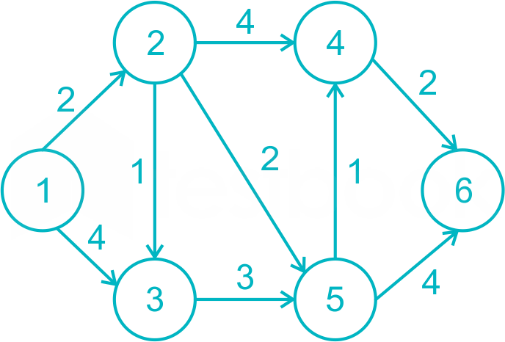
The arc lengths of a directed graph of a project are as shown in the figure. The shortest path length from node 1 to node 6 is _______.

62

A circular hole of 25 mm diameter and depth of 20 mm is machined by EDM process. The material removal rate (in mm3/min) is expressed as

4 × 10⁴ IT-1.23

where I = 300 A and the melting point of the material, T = 1600°C. The time (in minutes) for machining this hole is ________ (correct to two decimal places)

63

A welding operation is being performed with voltage = 30 V and current = 100 A. The cross-sectional area of the weld bead is 20 mm2. The work-piece and filler are of titanium for which the specific energy of melting is 14 J/mm3. Assuming a thermal efficiency of the welding process 70%, the welding speed (in mm/s) is __________ (correct to two decimal places).

64

Steam in the condenser of a thermal power plant is to be condensed at a temperature of 30°C with cooling water which enters the tubes of the condenser at 14°C and exits at 22°C. The total surface area of the tubes is 50 m2, and the overall heat transfer coefficient is 2000 W/m2 K. The heat transfer (in MW) to the condenser is ______ (correct to two decimal places).

65

A vehicle powered by a spark-ignition engine follows air standard Otto cycle (γ = 1.4). The engine generates 70 kW while consuming 10.3 kg/hr of fuel. The calorific value of fuel is 44,000 kJ/kg. The compression ratio is _______ (correct to two decimal places).

Attempt this paper under real exam conditions

Timed interface, section switching, instant scoring, and question-by-question analytics — free.

Start Timed Attempt