A couple has 2 children. The probability that both children are boys if the older one is a boy is
- ((a))
¼
- ((b))
1/3
- ((c))
½
- ((d))
1
Show Answer
½
Probability =
∴ The probability that both children are boys if the order one is a boy = (1/2)
65 questions · 180 minutes · with answers · free
A couple has 2 children. The probability that both children are boys if the older one is a boy is
¼
1/3
½
1
½
Probability =
∴ The probability that both children are boys if the order one is a boy = (1/2)
P looks at Q while Q looks at R. P is married, R is not. The number of pairs of people in which a married person is looking at an unmarried person is
0
1
2
Cannot be determined
1
P is married and P looks at Q. Q looks at R but marriage status of Q is unknown. R is not married at all.
As we do not know the maritial status of Q hence here there are two possible cases.
Case 1: Q is married
In this case the answer will be one pair because in the question it has been asked to find the number of pairs of people in which a married person is looking at an unmarried person. And here P is married and looking at Q who is also married so this pair would not be counted but now Q is looking at R and R is unmarried and hence the number of pairs will be 1.
Case 1: Q is unmarried
Similarly from the above case the pair will be only 1 in this case too as P is looking at Q and Q is not married.
Hence the final answer will be 1 (Including both cases whether the Q is married or not married.)
If you choose plan P, you will have to ________ plan Q, as these two are mutually ________
forgo, exclusive
forget, inclusive
accept, exhaustive
adopt, intrusive
forgo, exclusive
If we choose one option the second option becomes unavailable to us. This is best expressed by the word ‘forgo’. Also, why we need to forgo the second option is because the two plans cannot exist simultaneously. Thus ‘exclusive’ is the correct word to fit the second blank.
The ways in which this game can be played ________ potentially infinite.
is
is being
are
are being
are
The subject of the sentence ‘the ways in which this game’ is plural and hence the blank takes the plural verb ‘are’.
If a and b are integers and a – b is even, which of the following must always be even?
ab
a2 + b2 + 1
a2 + b + 1
ab – b
ab – b
According to the given relation of a – b = even, there is a possibility of odd-odd (or) even-even is equal to even.
From the options, Option (D) is correct.
Since, odd × odd – odd (or) even × even – even → is always even number.
X bullocks and Y tractors take 8 days to plough a field. If we halve the number of bullocks and double the number of tractors, it takes 5 days to plough the same field. How many days will it take X bullocks alone to plough the field?
30
35
40
45
30
Given number of days required that X bullocks and Y tractors to plough a field = 8 days
(I.e. X + Y→ 8D ⇒ 8X + 8Y → 1 day) No of days required that X/2 bullocks and 2Y tractors to plough field = 5
[i.e,
From above equations,
Y = 11X/4 and from 1st equation, X = 30 days
“If you are looking for a history of India, or for an account of the rise and fall of the British Raj, or for the reason of the cleaving the subcontinent into two mutually antagonistic parts and the effects this mutilation will have in the respective sections, and ultimately on Asia, you will to find it in these pages; for though I have spent a lifetime in the country, I lived too near the seat of events, and was too intimately associated with the actors, to get the perspective needed for the impartial recording of these matters.”
Which of the following is closest in meaning to ‘cleaving’?
Deteriorating
Arguing
Departing
Splitting
Splitting
‘Cleaving’ means separating. Thus the correct word that expresses this meaning is ‘splitting’.
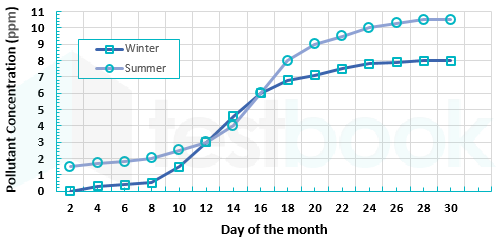
In the graph below, the concentration of a particular pollutant in a lake is plotted over (alternate) days of a month in winter (average temperature 10 °C) and a month in summer (average temperature 30 °C)
Consider the following statements based on the data shown above:
i) Over the given months, the difference between the maximum and the minimum pollutant concentrations is the same in both winter and summer.
ii) There are at least four days in the winter month such that the pollutant concentration on those days are within 1 ppm of the pollutant concentrations on the corresponding days in the winter month.
Which one of the following options is correct?
Only i
Only ii
Both i and ii
Neither I nor ii
Only ii
The difference between the maximum and the minimum pollutant concentrations
(i) in winter = 8 - 0 = 8ppm,
(ii) in summer = 10.5 - 1.5 = 9ppm
∴ (i) is false & (ii) is correct from the graph.
There are 4 women P, Q, R, S and 5 men V, W, X, Y, Z in a group. We are required to form pairs each consisting of one women and one man. P is not to be paired with Z, and Y must necessarily be paired with some. In how many ways can 4 such pairs be formed?
74
76
78
80
78
If P is paired with y; they
Q has 4 choices
R has 3 choices
S has 2 choices
Total 24 choices
(Or)
If Q is paired with y;
Then
P has 3 choices
R has 3 choices
S has 2 choices
Total 18 choices
(Or)
If R is paired with y; then
P has 3 choices
Q has 3 choices
S has 2 choices
Total 18 choices
(Or)
If S is paired with y; then
P has 3 choices
Q has 3 choices
S has 2 choices
Total 18 choices
∴ Total number of ways = 24 + 18 + 18 + 18 = 78
All people in a certain are either ‘Knights’ or ‘Knaves’ and each person knows every other person’s identity. Knights NEVER lie, and knaves ALWAYS lie.
P says “Both of us are knights”, Q says “None of us are knaves”.
Which one of the following can be logically inferred from the above?
Both P and Q are knights
P is a knight; Q is a knave
Both P and Q are knaves
The identities of P, Q cannot be determined
Here let’s check each option,
a) Both P and Q are knights → If both are knights then both must say the truth.
P says “Both of us are knights”, Q says “None of us are knaves”.
Thus can be true.
b) P is a knight; Q is a knave → If P is a knight then P must say the truth.
P says “Both of us are knights”, but Q says “None of us are knaves”.
This cannot be true.
c) Both P and Q are knaves → If both are knaves then both must lie.
P says “Both of us are knights”, Q says “None of us are knaves”.
Thus can be true.
Thus both P and Q are knights or both P and Q are knaves.
Thus identities of P, Q cannot be determined.
Alternate Solution
Essentially both P and Q are saying the same thing. But we cannot infer the truth of the statements. If both are knights, then both are telling the truth. However, if both are knaves then they are lying. Thus the identities of P and Q cannot be determined.
Two coins are tossed simultaneously. The probability (up to two decimal points accuracy) of getting at least one head is ________.
The divergence of the vector –yi + xj is ________.
The determinant of a 2 × 2 matrix is 50. If one Eigen value of the matrix is 10, the other Eigen value is ________.
A sample of 15 data is as follows: 17, 18, 17, 17, 13, 18, 5, 5, 6, 7, 8, 9, 20, 17, 3. the mode of the data is
4
13
17
20
17
Explanation:
Measures of central tendency provide us with a summary that describes some central or middle point of the data.
There are five important measures of central tendency, viz.,
i) arithmetic mean,
ii) median,
iii) mode,
iv) geometric mean, and
v) harmonic mean.
Out of these the last two measures, viz., geometric mean and harmonic mean, have very specific uses and thus less frequently used.
Mode: The word mode has been derived from the French word “la Mode” which signifies the most fashionable values of distribution because it is repeated the highest number of times in the series. The mode is the most frequently observed data value. It is denoted by Mo.
Arithmetic mean:
Median is that positional value of the variable which divides the distribution into two equal parts, one part comprises all values greater than or equal to the median value and the other comprises all values less than or equal to it.
Calculation:
17, 18, 17, 17, 13, 18, 5, 5, 6, 7, 8, 9, 20, 17, 3
Mode refers the most frequently appeared value (which is 17 in this case).
The Laplace transform of tet u(t)is
Concept:
Laplace transform of
Now
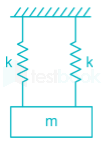
A mass m is attached to two identical springs having spring constant k as shown in the figure. The natural frequency ω of this single degree of freedom system is
Explanation:
Springs are in Parallel so keq. = k + k = 2k
The state of stress at a point is σx = σy = σz = τxz = τzx = τyz = 0 and τxy = τyx = 50 MPa. The maximum normal stress (in MPa) at that point is ________.
For a loaded cantilever beam of uniform cross-section, the bending moment (in N-mm) along the length is M(x) = 5x2 + 10x, where x is the distance (in mm) measured from the free end of the beam. The magnitude of shear force (in N) in the cross-section at x = 10 mm is ________.
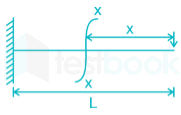
A cantilever beam of length L and flexural modulus EI is subjected to a point load P at the free end. The elastic strain energy stored in the beam due to bending (neglecting transverse shear) is
Concept:
\(Strain;energy = \mathop \smallint \limits_0^L \frac{{{{\left( {{M_{x - x}}} \right)}^2}dx}}{{2EI}}\)
\({U_{X - X}} = \mathop \smallint \limits_0^L \frac{{{{\left( {Px} \right)}^2}}}{{2EI}}dx = \frac{{{P^2}}}{{2EI}}\mathop \smallint \limits_0^L {x^2}dx\)
A steel bar is held by two fixed supports as shown in the figure and is subjected to an increase of temperature ΔT = 100°C. If the coefficient of thermal expansion and Young’s modulus of elasticity of steel are 11 × 10-6 / 0C and 200 GPa, respectively, the magnitude of thermal stress (in MPa) induced in the bar is ________
A machine component made of a ductile material is subjected to a variable loading with σmin = -50 MPa and σmax = 50 MPa. If the corrected endurance limit and the yield strength for the materials are σe = 100 MPa and σy = 300 MPa, respectively, the factor of safety is ________.
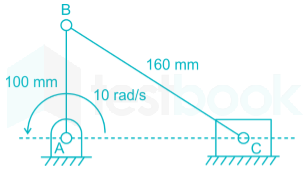
In a slider-crank mechanism, the lengths of the crank and the connecting rod are 100 mm and 160 mm, respectively. The crank is rotating with an angular velocity of 10 radian/s counter-clockwise. The magnitude of the linear velocity (in m/s) of the piston at the instant corresponding to the configuration shown in the figure is ________.
Where C is the point on the slider
Which one of the following statements is TRUE?
Both Pelton and Francis turbines are impulse turbines
Francis turbine is reaction turbine but Kaplan turbine is an impulse turbine
Francis turbine is an axial-flow reaction turbine
Kaplan is an axial-flow reaction turbine
Concept:
Impulse Turbine: If at the inlet of the turbine, the energy available is only kinetic energy, the turbine is known as impulse turbine. e.g. a Pelton wheel turbine.
Reaction Turbine: If at the inlet of the turbine, the water possesses kinetic energy as well as pressure energy, the turbine is known as a reaction turbine. e.g. e Francis and Kaplan turbine.
Tangential flow turbines: In this type of turbines, the water strikes the runner in the direction of the tangent to the wheel. Example: Pelton wheel turbine
Radial flow turbines: In this type of turbines, the water strikes in the radial direction. accordingly, it is further classified as
Axial flow turbine: The flow of water is in the direction parallel to the axis of the shaft. Example: Kaplan turbine and propeller turbine
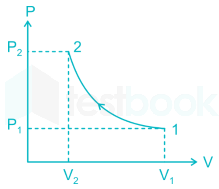
A mass ‘m’ of a perfect gas at pressure P1 and volume V1 undergoes an isothermal process. The final pressure is P2 and volume V2. The work done on the system is considered positive. If R is the gas constant and T is the temperature, then the work done in the process is
Concept:
(-Ve Sign taken because work is done on the system)
For an ideal gas, PV = mRT = const (c)
⇒ PV = C; ∴ P = C/V
\(W = -\mathop \smallint \limits_{{V_1}}^{{V_2}} \frac{C}{V}dV \Rightarrow W = -C\ln \left( {\frac{{{V_2}}}{{{V_1}}}} \right)\)
When work is done on the system (compression), V2 < V1 and P2 > P1
If a mass of moist air contained in a closed metallic vessel is heated, then its
Relative humidity decrease
Relative humidity increase
Specific humidity increases
Specific humidity decreases
Relative humidity decrease
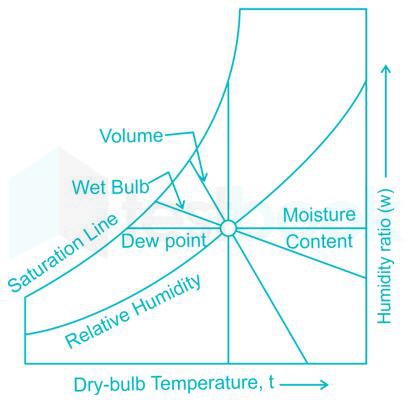
Concept:
A psychrometric chart is represented as shown in the figure.
Calculation:
Given, that moist air is contained in CLOSED VESSEL, so we can say that mass of moist air is constant.
So specific humidity is also same.
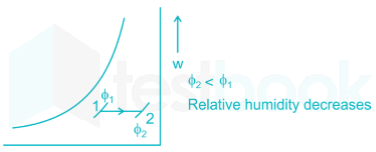
Now as the container is heated, so temperature increases. On psychometry chart, it can be represented by process 1 - 2.
Along the saturation line, RH is 100%. So in this case, RH is decreasing.
For the stability of a floating body the
Centre of buoyancy must coincide with the centre of gravity
Centre of buoyancy must be above the centre of gravity
Centre of gravity must be above the centre of buoyancy
Metacentre must be above the centre of gravity
Explanation:
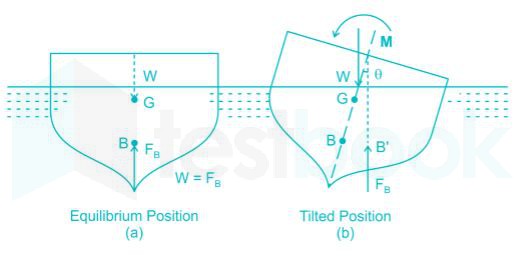
Condition of stable equilibrium for a floating body in terms of metacentric height (GM) as follows:
Condition of stable equilibrium for a submerged body in terms of centre of buoyancy and the centre of gravity:
Consider a laminar flow at zero incidence over a flat plate. The shear stress at the wall is denoted by τw. The axial positions x1 and x2 on the plate are measured from the leading edge in the direction of flow. If x2 > x1, then
\({\tau w}{|{{x_1}}} = {\tau w}{|{{x_2}}} = 0\)
\({\tau w}{|{{x_1}}} = {\tau w}{|{{x_2}}} \ne 0\)
\({\tau w}{|{{x_1}}} > {\tau w}{|{{x_2}}}\)
\({\tau w}{|{{x_1}}} < {\tau w}{|{{x_2}}}\)
\({\tau w}{|{{x_1}}} > {\tau w}{|{{x_2}}}\)
Explanation:
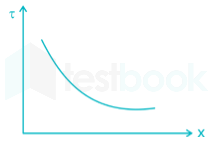
General velocity profile for Laminar flow
\({\tau {wall}} = \mu {\left( {\frac{{\partial u}}{{dy}}} \right){y = 0}} = \frac{{3\mu }}{{2\delta }}\)
Now
as the distance from the leading edge increases, shear stress decreases.
The heat loss from a fin is 6 W. The effectiveness and efficiency of the fin are 3 and 0.75, respectively. The heat loss (in W) from the fin, keeping the entire fin surface at base temperature, is ________.
The emissive power of blackbody is P. If its absolute temperature is doubled, the emissive power becomes
2 P
4 P
8 P
16 P
16 P
Concept:
The radiation energy emitted by a body per unit time is given by:
Eb = ϵAσT4
Where ϵ is emissivity of the body.
σ = The Stefan – Boltzmann constant = 5.67 × 10⁻⁸ W m-2K-4
Calculation:
For a given area E α T4
,
E1 = P(given)
E2 = 16 P
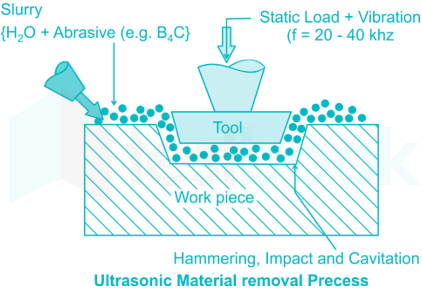
Which one of the following statements is TRUE for the ultrasonic machining (USM) process?
In USM, the tool vibrates at subsonic frequency
USM does not employ magnetostrictive transducer
USM is an excellent process for machining ductile materials
USM often uses a slurry comprising abrasive-particles and water
Concept:
During ultrasonic machining the metal removal is achieved by hammering action of abrasive particles.
In ultrasonic machining, a tool of desired shape vibrates at an ultrasonic frequency (19 ∼ 25 kHz) with an amplitude of around 15 – 50 μm over the workpiece.
Generally, the tool is pressed downward with a feed force, F.
Between the tool and workpiece, the machining zone is flooded with hard abrasive particles generally in the form of a water-based slurry.
As the tool vibrates over the workpiece, the abrasive particles act as the indenters and indent both the work material and the tool.
The abrasive particles, as they indent the work material, would remove the work material, particularly if the work material is brittle (due to crack initiation, propagation and brittle fracture of the material).

Additional Information
(a) Wrong: In USM, the tool vibrates at high may be sonic frequency.
(b) Wrong: USM uses transducers so as to produce low amplitude vibration
(c) Wrong: USM is an excellent process for machining hard and brittle materials.
(d) In USM slurry comprising abrasive particles and water are often uses to remove material from the workpiece by abrasion or impact grinding action.
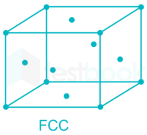
The crystal structure of Aluminium is
Body - centred cubic
Face - centred cubic
Close - packed hexagonal
Body - centred tetragonal
Face - centred cubic
Concept:
Crystal structure of Material
FCC: FCC stands for Face Centered Cubic. In one unit cell,1 atom at each corner, and 1 atom on each face. The crystal structure is used for Ductile materials only.
E.g. Ni, Cu, Ag, Pt, Au, Pb, Al, Austenite or γ-iron
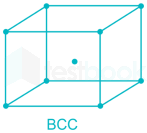
BCC: BCC stands for Body-Centered Cubic. In one unit cell, there is one atom at centre, 1 atom at each corner. The crystal structure is used for Brittle materials only.
E.g. V, Mo, Ta, W, Ferrite or α-iron, δ-ferrite or δ-iron
HCP: HCP stands for Hexagonal Close Packed Crystal Structure.
E.g. Mg, Zn, Ti, Cd, Co
Given the atomic weight of Fe is 56 and that of C is 12, the weight percentage of carbon in cementite (Fe3C) is ________.
If for a single server poisson arrival and exponential service time, the arrival rate is 12 per hour. Which one of the following service rates will provide a steady state finite queue length?
6 per hour
10 per hour
12 per hour
24 per hour
24 per hour
Explanation:
For steady-state μ > λ i.e. service rate should be greater than arrival rate.
where μ = service rate and λ = arrival rate.
As λ = 12.
So for finite queue length μ = 24 is the best option.
The standard deviation of linear dimensions P and Q are 3 μm and 4 μm, respectively. When assembled, the standard deviation (in μm) of the resulting linear dimension (P + Q) is ________.
It is desired to make a product having T-shaped cross-section from a rectangular aluminium block. Which one of the following processes is expected to provide the highest strength of the product?
Welding
Casting
Metal forming
Machining
Metal forming
Explanation:
Generally, Strength — Cold working > Metal Forming > Casting > Machining > Welding
Highest strength is obtained through metal forming processes because due to continuous application of force work hardening occurs.
The surface integral over the surface S of the sphere x2 + y2 + z2 = 9, where F = (x + y)i + (x + z) j + (y + z) k and n is the unit outward surface normal, yields ________.
Consider the differential equation 3y”(x) + 27y(x) = 0 with initial conditions y(0) = 0 and y’(0) = 2000. The value of y at x = 1 is ________.
Consider the matrix \(A = \left[ {\begin{array}{{20}{c}} {50}&{70}\ {70}&{80} \end{array}} \right]\) whose eigenvectors corresponding to eigenvalues \({\lambda _1};and;{\lambda _2};are;{X_1} = \left[ {\begin{array}{{20}{c}} {70}\ {{\lambda _1} - 50} \end{array}} \right]and;{X_2} = \left[ {\begin{array}{*{20}{c}} {{\lambda _2} - 80}\ {70} \end{array}} \right]\) respectively. The value of is ________.
If f(z) = (x2 + ay2) + i bxy is a complex analytic function of z = x + iy, where , then
a = -1, b = -1
a = -1, b = 2
a = 1, b = 2
a = 2, b = 2
a = -1, b = 2
Concept:
f(z) = (x2 + ay2) + i bxy = u(x,y) + iv(x,y)
u(x,y) = x2 + ay2
v(x,y) = bxy
Using C-R equation
So, a = -1, b = 2
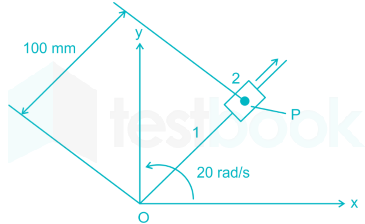
Block 2 slides outward on link 1 with uniform velocity of 6 m/s as shown in the figure. Link 1 is rotating at a constant angular velocity of 20 radian/s counterclockwise. The magnitude of the total acceleration (in m/s2) of point P of the block with respect to fixed point O is ________
The radius of gyration of a compound pendulum about the point of suspension is 100 mm. The distance between the point of suspension and the centre of mass is 250 mm. Considering the acceleration due to gravity as 9.81 m/s2, the natural frequency (in radian/s) of the compound pendulum is ________.
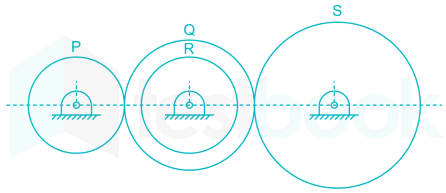
A gear train shown in the figure consists of gears P, Q, R and S. Gear Q and gear R are mounted on the same shaft. All the gears are mounted on parallel shafts and the number of teeth of P, Q, R and S are 24, 45, 30 and 80, respectively. Gear P is rotating at 400 rpm. The speed (in rpm) of the gear S is ________
A helical compression spring made of a wire of circular cross-section is subjected to a compressive load. The maximum shear stress induced in the cross-section of the wire is 24 MPa. For the same compressive load, if both the wire diameter and the mean coil diameter are doubled, the maximum shear stress (in MPa) induced in the cross-section of the wire is ________.
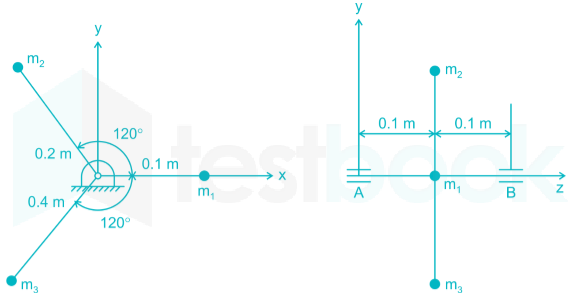
Three masses are connected to a rotating shaft supported on bearings A and B as shown in the figure. The system is in a space where the gravitational effect is absent. Neglect the mass of shaft and rods connecting the masses. For m1 = 10 kg, m2 = 5kg and m3 = 2.5 kg and for a shaft angular speed of 1000 radian/s, the magnitude of the bearing reaction (in N) at location B is ________
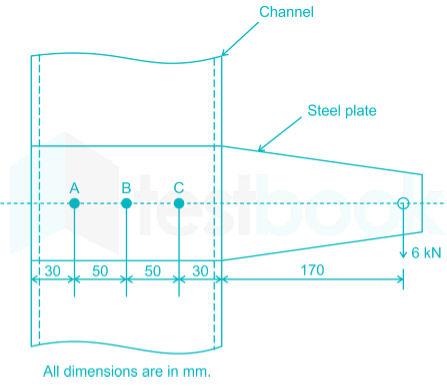
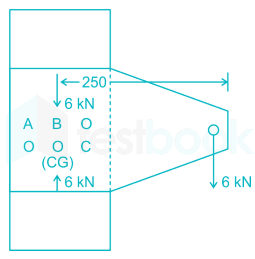
A steel plate, connected to a fixed channel using three identical bolts A, B, and C, carries a load of 6 kN as shown in the figure. Considering the effect of direct load and moment, the magnitude of resultant shear force (in kN) on bolt C is
13
15
17
30
17
Concept:
Eccentric Loading of Riveted Joints:
Direct Load:
Secondary load:
Now, both the load are added vectorially.
Calculation:
Given:
∴ Total resultant shear force
A single-plate clutch has a friction disc with inner and outer radii of 20 mm and 40 mm, respectively. The friction lining in the disc is made in such a way that the coefficient of friction μ varies radially as μ = 0.01r, where r is in the mm. The clutch needs to transmit a friction torque of 18.85 kN-mm. As per uniform pressure theory, the pressure (in MPa) on the disc is ________.
The principal stresses at a point in a critical section of a machine component are σ1 = 60 MPa; σ2 = 5 MPa and σ3 = -40 MPa. For the material of the component, the tensile yield strength is σyt = 200 MPa. According to the maximum shear stress theory, the factor of safety is
1.67
2.00
3.60
4.00
2.00
Concept:
The Maximum Shear Stress Theory was given by Guest and Tresca,
i.e. Maximum shear stress τmax = larger of \(\left| {\left( {{{\bf{\sigma }}_1} - {{\bf{\sigma }}_2}} \right),\left( {{{\bf{\sigma }}_2} - {{\bf{\sigma }}_3}} \right),\left( {{{\bf{\sigma }}_3} - {{\bf{\sigma }}2}} \right)} \right| \le \frac{{{{\bf{S}}{{\bf{yt}}}}}}{{\bf{N}}}\)
Tensile yield strength (Proportionality limit) = Syt = 200 MPa
Calculation:
Given:
σ1 = 60 MPa; σ2 = 5 MPa and σ3 = -40 MPa
σyt = 200 MPa
N = 2
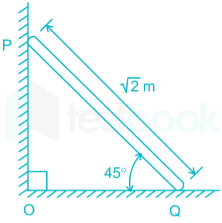
The rod PQ of length and uniformly distributed mass of M = 10 kg, is released from rest at the position shown in the figure. The ends slid along the frictionless faces OP and OQ. Assume acceleration due to gravity, g = 10 m/s2. The mass moment of inertia of the rod about its centre of mass and an axis perpendicular to the plane of the figure is (ML2/12). At this instant, the magnitude of angular acceleration (in radian/s2) of the rod is ________.
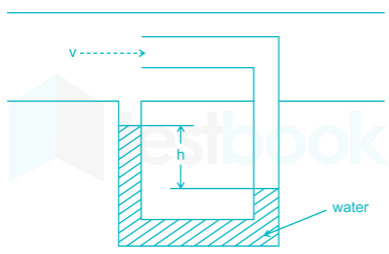
The arrangement shown in the figure measures the velocity V of a gas of density 1 kg/m3 flowing through a pipe. The acceleration due to gravity is 9.81 m/s2. If the monomeric fluid is water (density 1000 kg/m3) and the velocity V is 20 m/s, the differential head h (in mm) between the two arms of the manometer is ________.
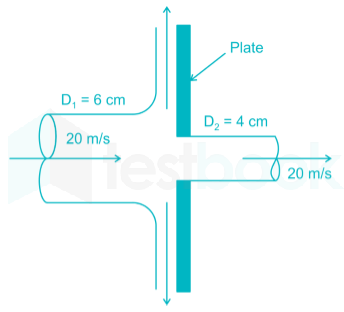
A 60 mm-diameter water jet strikes a plate containing a hold of 40 mm diameter as shown in the figure. Part of the jet passes through the hole horizontally, and the remaining is deflected vertically. The density of water is 1000 kg/m3. If velocities are as indicated in the figure, the magnitude of horizontal force (in N) required to hold the plate is ________.
For the laminar flow of water over a sphere, the drag coefficient CF is defined as CF = F / (ρU2D2), where F is the drag force, ρ is the fluid density, U is the fluid velocity and D is the diameter of the sphere. The density of water is 1000 kg/m3. When the diameter of the sphere is 100 mm and the fluid velocity is 2 m/s, the drag coefficient is 0.5. If water now flows over another sphere of diameter 200 mm under dynamically similar conditions, the drag force (in N) on this sphere is ________.
In the Rankine cycle of a steam power plant the turbine entry and exit enthalpies are 2803 kJ/kg and 1800 kJ/kg, respectively. The enthalpies of water at pump entry and exit are 121 kJ/kg and 124 kJ/kg, respectively. The specific steam consumption (in kg/kWh) of the cycle is ______.
A calorically perfect gas (specific heat at constant pressure 1000 J/kg K) enters and leaves a gas turbine with the same velocity. The temperatures of the gas at turbine entry and exit are 1100 K and 400 K, respectively. The power produced is 4.6 MW and heat escapes at the rate of 300 kJ/s through the turbine casing. The mass flow rate of the gas (in kg/s) through the turbine is
6.14
7.00
7.50
8.00
7.00
Concept:
Steady state energy equation
Calculation:
Applying the steady state flow equation
One kg of an ideal gas (gas constant R = 287 J/kg K) undergoes an irreversible process from state-1 (1 bar, 300 K) to state-2 (2 bar, 300 K). The change is specific entropy (s2-s1) of the gas (in J/kg K) in the process is ________.
The volume and temperature of air (assumed to be an ideal gas) in a closed vessel is 2.87m3 and 300 K, respectively. The gauge pressure indicated by a manometer fitted to the wall of the vessel is 0.5 bar. If the gas constant of air is R = 287 J/kg K and the atmospheric pressure is 1 bar, the mass of air (in kg) in the vessel is
1.67
3.33
5.00
6.66
5.00
V = 2.87 m3; T = 300 K
Pgauge = 0.5 bar; Patm = 1 bar; R = 287 j/Kg-K
PV = mRT (P is absolute pressure)
Pabs = Patm + Pgauge = 0.5 + 1 = 1.5 bar = 150 kPa
\(PV = mRT \Rightarrow m = \frac{{PV}}{{RT}} = \frac{{1502.87}}{{0.287300}}\)
m = 5 Kg
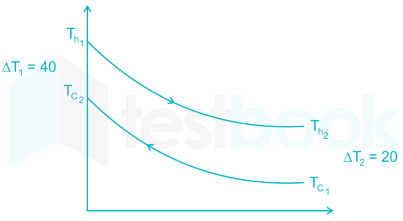
In a counter-flow heat exchanger, water is heated at the rate of 1.5 kg/s from 40° C to 80° C and oil entering at 120°C and leaving 60°C. The specific heats of water and oil are 4.2 kJ/kg-K and 2 kJ/kg-K, respectively. The overall heat transfer coefficient is 400 W/m2.K. The required heat transfer surface area (in m2) is
0.104
0.022
10.4
21.84
21.84
Concept:
Calculation:
Given:
U = 400 W/m2K
ΔTm = LMTD = 28.854°C
Q = UAΔTm
252 × 103 = 400 A × 28.854
A = 21.83 m2
A metal ball of diameter 60 mm is initially at 220°C. The ball is suddenly cooled by an air jet of 20°C. The heat transfer coefficient is 200 W/m2K. The specific heat, thermal conductivity and density of the metal ball are 400 J/kg. 400 W/mK and 9000 kg/m3, respectively. The ball temperature (in °C) after 90 seconds will be approximately
141
163
189
210
141
Concept:
From the lumped parameter analysis
Calculation:
T = 141.3°C
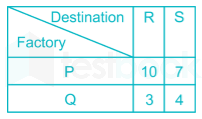
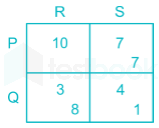
A product made in two factories, P and Q, is transported to two destinations, R and S. The per unit cost of transportation (in Rupees) from factories to destinations are as per the following matrix.
Factory P produces 7 units and factory Q produces 9 units of the product. Each destination requires 8 units. If the north-west corner method provides the total transportation cost as X (in Rupees) and the optimized (the minimum) total transportation cost is Y (in Rupees), in (X – Y), in rupees, is
0
15
28
105
28
Initial solution by North-west corner Rule
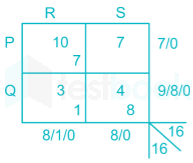
X = 10 × 7 + 3 × 1 + 4 × 8
X = Rs 105
Optimality: As the total number of allocations are m + n -1 = 3 and at independent positions. So optimality can be performed.
Modified distribution (MODI-Method)
1) Cost matrix for allocated cells only and finding ui & vj value taking v1 = 0
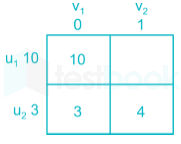
u1 + v1 = 10 ⇒ u1 = 10
u2 + v1 = 3 ⇒ u2 = 3
u2 + v2 = 4 ⇒ v2 = 1
2) Develop ui + vj Matrix for unallocated cells by entering sum of ui & vj value for unallocated cells.
| 11 | |
|---|---|
ui + vj Matrix for unallocated cells.
3) Subtract cell values of ui + vj Matrix from original cost Matrix to get cell evaluation Matrix.
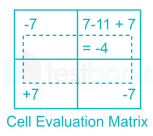
As one cell value is still –ve so, the current solution is not optimum.
Cell Evaluation Matrix: Performing optimality we select the smallest allocation with – ve sign, to be allocated at identified cells. Smallest allocation is 7 Units, which is allocated at identified cell.
So, the new allocations are and the corresponding cost
= 7 × 7 + 3 × 8 + 4 × 1
= Rs 77
Now again we have to check whether the current solution is optimum.
1) cost Matrix for allocated cells and ui & vj value
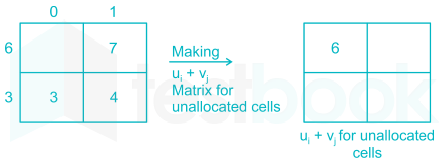
| 4 | |
|---|---|
Cell Evaluation Matrix
As all the cell values are +ve in the cell evaluation Matrix.
So, the current solution is optimum.
So, Y = Rs. 77
And X- Y = 105 – 77 = Rs. 28
A project starts with activity A and ends with activity F. The precedence relation and durations of the activities are as per the following table:
| Activity | Immediate predecessor | Duration (days) |
|---|---|---|
| A | - | 4 |
| B | A | 3 |
| C | A | 7 |
| D | B | 14 |
| E | C | 4 |
| F | D, E | 9 |
The minimum project completion time (in days) is ________.
A rod of length 20 mm is stretched to make a rod of length 40 mm. Subsequently, it is compressed to make a rod of final length 10 mm. Consider the longitudinal tensile strain as positive and compressive strain as negative. The total true longitudinal strain in the rod is
-0.5
– 0.69
– 0.75
– 1.0
– 0.69
Concept:
Concept:
True strain = ln(1 + 1) = ln2
Total true strain = ln 2 + ln 0.25 = -0.693
Maximum Z = 5x1 + 3x2.
Subject to
x1 + 2x2 ≤ 10,
x1 – x2 ≤ 8,
x1, x2 ≥ 0.
In the starting Simplex tableau, x1 and x2 are non-basic variables and the value of Z is zero. The value of Z in the next Simplex tableau is ________.
A strip of 120 mm width and 8 mm thickness is rolled between two 300 mm-diameter rolls to get a strip of 120 mm width and 7.2 mm thickness. The speed of the strip at the exit is 30 m/min. There is no front or back tension. Assuming uniform roll pressure of 200 MPa in the roll bite and 100% mechanical efficiency, the minimum total power (in kW) required to drive the two rolls is ________.
A cylindrical pin of diameter is electroplated. Plating thickness is. Neglecting the gauge tolerance, the diameter (in mm. up to 3 decimal point accuracy) of the GO ring gauge to inspect the plated pin is ________.
During the turning of a 20 mm-diameter steel bar at a spindle speed of 400 rpm, a tool life of 20 minute is obtained. When the same bar is turned at 200 rpm, the tool life becomes 60 minute. Assume that Taylor’s tool life equation is valid. When the bar is turned at 300 rpm, the tool life (in minute) is approximately
25
32
40
50
32
Concept:
According to Taylor’s law
VTn = C
V = πDN m/min
400 × (20)n = 200 × 60n = 300 × Tn
Now 400 × 20n = 300 × Tn
In an orthogonal machining with a tool of 9° orthogonal rake angle, the uncut chip thickness is 0.2 mm. The chip thickness fluctuates between 0.25 mm and 0.4 mm. The ratio of the maximum shear angle to the minimum shear angle during machining is ________.
Timed interface, section switching, instant scoring, and question-by-question analytics — free.
Start Timed Attempt