Official Paper

GATE ME 2016 Official Paper: Shift 3 (Previous Year Paper)

65 questions · 180 minutes · with answers · free

General Aptitude (10 questions)

1

Based on the given statements, select the appropriate option with respect to grammar and usage.

Statements

(i) The height of Mr. X is 6 feet.

(ii) The height of Mr. Y is 5 feet.

  1. ((a))

    Mr. X is longer than Mr. Y.

  2. ((b))

    Mr. X is more elongated than Mr. Y.

  3. ((c))

    Mr. X is taller than Mr. Y.

  4. ((d))

    Mr. X is lengthier than Mr. Y.

Show Answer
Answer: ((c))

Mr. X is taller than Mr. Y.

When we compare the heights of two people the correct word to be used is ‘taller’. Thus option C is the correct answer.

2

The students ___________ the teacher on teachers’ day for twenty years of dedicated teaching.

  1. ((a))

    facilitated

  2. ((b))

    felicitated

  3. ((c))

    fantasized

  4. ((d))

    facillitated

Show Answer
Answer: ((b))

felicitated

Let us look at the meanings of the words:

  1. Facilitated: Helps improve something
  2. Felicitated: Congratulate
  3. Fantasize: Dream about something

The other option is not a word. Thus, the correct word to be used in the blank is ‘felicitated’ that will give the meaning of the teacher being congratulated.

3

After India’s cricket world cup victory in 1985, Shrotria who was playing both tennis and cricket till then, decided to concentrate only on cricket. And the rest is history.

What does the underlined phrase mean in this context?

  1. ((a))

    history will rest in peace

  2. ((b))

    rest is recorded in history books

  3. ((c))

    rest is well known

  4. ((d))

    rest is archaic

Show Answer
Answer: ((c))

rest is well known

The phrase ‘rest is history’ means something that has happened in the past and has become very famous. Thus ‘the rest is well known’ is the correct answer.

4

Given (9 inches) ½ = (0.25 yards) ½, which one of the following statements is TRUE?

  1. ((a))

    3 inches = 0.15 yards

  2. ((b))

    9 inches = 1.5 yards

  3. ((c))

    9 inches = 0.25 yards

  4. ((d))

    81 inches = 0.0625 yards

Show Answer
Answer: ((c))

9 inches = 0.25 yards

Taking squares on both sides,

9 inches = 0.25 yards

5

S, M, E and F are working in shifts in a team to finish a project. M works with twice the efficiency of others but for half as many days as E worked. S and M have 6 hour shifts in a day, whereas E and F have 12 hours shifts. What is the ratio of contribution of M to contribution of E in the project?

  1. ((a))

    1:1

  2. ((b))

    1:2

  3. ((c))

    1:4

  4. ((d))

    2:1

Show Answer
Answer: ((b))

1:2

M has two times efficiency as that of E.

But E works 12 hrs per day and M works for 6 hrs per day i.e. half of working hrs by E.

So the work done per day by both M and E is same.

M worked half of the days that E worked for.

So working contribution by M to E will be 1:2.

6

The Venn diagram shows the preference of the student population for leisure activities.

From the data given, the number of student who like to read books or play sports is

  1. ((a))

    44

  2. ((b))

    51

  3. ((c))

    79

  4. ((d))

    108

Show Answer
Answer: ((d))

108

From Venn diagram

n(A) = no of persons reading books = 13 + 44 + 12 + 7 = 76

n(B) = no of persons playing = 15 + 44 + 7 + 17 = 83

n(A ∩ B) = 44 + 7 = 51

n(A ∪ B) = n(A) + n(B) – n(A ∩ B) = 76 + 83 – 51 = 108

7

Social science disciplines were in existence in an amorphous form until the colonial period when they were intuitionalized. In varying degrees, they were intended to further the colonial interest. In the time of globalization and the economic rise of postcolonial countries like India, conventional ways of knowledge production have become obsolete.

Which of the following can be logically inferred from the above statements?

i) Social science disciplines have become obsolete.

ii) Social science disciplines had a pre – colonial origin

iii) Social science disciplines always promote colonialism

iv) Social science must maintain disciplinary boundaries.

  1. ((a))

    ii only

  2. ((b))

    i and iii only

  3. ((c))

    ii and iv only

  4. ((d))

    iii and iv only

Show Answer
Answer: ((a))

ii only

The passage does not state the boundaries of discipline for social sciences. Neither can this be inferred. Again, the passage only states that the social sciences were institutionalized because of colonial motives. This is not the same as promoting colonialism. Thus this cannot be inferred either. The knowledge production methods have become obsolete and not the discipline. Thus, option 1 is eliminated.

The passage states that social sciences discipline were in an amorphous form till the colonial period. This means that it existed before the colonial age. Thus option 2 can be inferred.

8

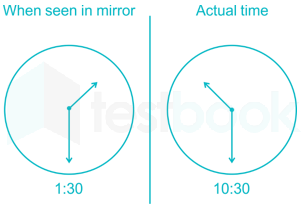
Two and a quarter hours back, when seen in a mirror, the reflection of a wall clock without number markings seemed to show 1:30. What is the actual current time shown by the clock?

  1. ((a))

    8:15

  2. ((b))

    11.15

  3. ((c))

    12.15

  4. ((d))

    12.45

Show Answer
Answer: ((d))

12.45

Two and quarter hours back the time reflected in mirror and the actual time is represented as below,

So now the actual timing will be 10:30 + 2:15 = 12:45.

9

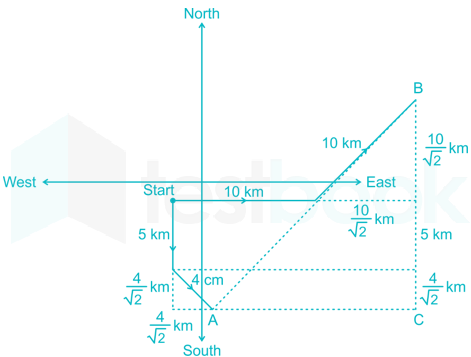
M and N start from the same location. M travels 10 km East and then 10 km North – East. N travels 5 km South and then 4 km South – East. What is the shortest distance (in km) between M and N at the end of their travel?

  1. ((a))

    18.60

  2. ((b))

    22.50

  3. ((c))

    20.61

  4. ((d))

    25.00

Show Answer
Answer: ((c))

20.61

The given information can be represented as follows,

Now;distance;between;A;and;C;=;10+10242=14.24 Now;distance;between;B;and;C;=;5+;102;+;42=14.90 Hence;distance;between;A;and;B;=;(14.24)2+;(14.90)2=20.61\begin{array}{l} {\rm{Now;distance;between;A;and;C;}} = {\rm{;}}10 + \frac{{10}}{{\sqrt 2 }} - \frac{4}{{\sqrt 2 }} = 14.24\ {\rm{Now;distance;between;B;and;C;}} = {\rm{;}}5 + {\rm{;}}\frac{{10}}{{\sqrt 2 }}; + ;\frac{4}{{\sqrt 2 }} = 14.90\ {\rm{Hence;distance;between;A;and;B;}} = {\rm{;}}\sqrt {{{\left( {14.24} \right)}^2} + ;{{\left( {14.90} \right)}^2}} = 20.61 \end{array}

Thus shortest distance between M and N at the end of their travel is 20.61 km

10

A wire of length 340 mm is to be cut into two parts. One of the parts is to be made into a square and the other into a rectangle where sides are in the ratio of 1:2. What is the length of the side of the square (in mm) such that the combined area of the square and the rectangle is a MINIMUM?

  1. ((a))

    30

  2. ((b))

    40

  3. ((c))

    120

  4. ((d))

    180

Show Answer
Answer: ((b))

40

Let’s assume that the piece from which rectangle is made, has length x mm.

Perimeter of rectangle = x

∴ Breadth of rectangle = x/6 and length of rectangle = 2x/6 = x/3

⇒ Area of rectangle =x6×x3=x218= \frac{x}{6} \times \frac{x}{3} = \frac{{{x^2}}}{{18}}

Perimeter of square = 340 – x

Length of square = (340 – x)/4 = 85 – x/4

⇒ Area of square =(85x4)2= {\left( {85 - \frac{x}{4}} \right)^2}

Total area =(85x4)2+x218=f(x)= {\left( {85 - \frac{x}{4}} \right)^2} + \frac{{{x^2}}}{{18}} = f\left( x \right)

Now, f(x)=2×(85x4)×1+2x18=0f'\left( x \right) = 2 \times \left( {85 - \frac{x}{4}} \right) \times - 1 + \frac{{2x}}{{18}} = 0

Solving, we get: x = 180

Length of square = 85 – x/4 = 85 – 45 = 40 mm

Mechanical Engineering (55 questions)

11

A real square matrix A is called skew-symmetric if

  1. ((a))

    AT = A

  2. ((b))

    AT = A-1

  3. ((c))

    AT = -A

  4. ((d))

    AT = A + A-1

Show Answer
Answer: ((c))

AT = -A

Concept:

A symmetric matrix is a square matrix whose transpose equals to it; that is, it satisfies the condition AT = A.

Skew-symmetric or antisymmetric matrix is a square matrix whose transpose equals its negative; that is, it satisfies the condition AT = −A.

\(B = \left[ {\begin{array}{{20}{c}} 0&e&f\ { - e}&0&g\ { - f}&{ - g}&0 \end{array}} \right],{B^T} = \left[ {\begin{array}{{20}{c}} 0&{ - e}&{ - f}\ e&0&{ - g}\ f&g&0 \end{array}} \right] = \left( { - 1} \right)\left[ {\begin{array}{*{20}{c}} 0&e&f\ { - e}&0&g\ { - f}&{ - g}&0 \end{array}} \right] = - B\)

It is a skew-symmetric matrix because of aij = -aji 

To satisfy the above condition, diagonal elements of skew-symmetric matrix are always zero.

12

Ltx0loge(1+4x)e3x1\mathop {{\rm{Lt}}}\limits_{x \to 0} \frac{{{{\log }_e}\left( {1 + 4x} \right)}}{{{e^{3x}} - 1}} is equal to

  1. ((a))

    0

  2. ((b))

    112\frac{1}{{12}}

  3. ((c))

    43\frac{4}{3}

  4. ((d))

    1

Show Answer
Answer: ((c))

43\frac{4}{3}

Concept:

L' hospital’s rule is used for a function who takes 0/0 or ∞/∞ form.

In this, we differentiate numerator and denominator until they take a finite value.

Calculation:

At, x → 0, the function takes a form 0/0, therefore, we can use L’ hospital’s rule

Ltx0loge(1+4x)e3x1=4(1+4x)3e3x\mathop {{\rm{Lt}}}\limits_{x \to 0} \frac{{{{\log }_e}\left( {1 + 4x} \right)}}{{{e^{3x}} - 1}} = \frac{4}{{\left( {1 + 4x} \right)3{e^{3x}}}}

=4(1+0)3e0=43 = \frac{4}{{\left( {1 + 0} \right)3{e^0}}} = \frac{4}{3}

13

Solutions of Laplace’s equation having continuous second-order partial derivatives are called

  1. ((a))

    biharmonic functions

  2. ((b))

    harmonic functions

  3. ((c))

    conjugate harmonic functions

  4. ((d))

    error functions

Show Answer
Answer: ((b))

harmonic functions

Explanation:

Solutions of Laplace’s equation having continuous second-order partial derivatives is given by

d2ϕdx2+d2ϕdy2=0\frac{{{d^2}\phi }}{{d{x^2}}} + \frac{{{d^2}\phi }}{{d{y^2}}} = 0 and it is called as harmonic function (where Φ = any constant).

E.g. Φ = 2xy satisfies d2ϕdx2+d2ϕdy2=0\frac{{{d^2}\phi }}{{d{x^2}}} + \frac{{{d^2}\phi }}{{d{y^2}}} = 0 hence it is called as harmonic function.

Conjugate  of Harmonic function:

If f(z) = u + iv is analytic function then imaginary part v is known as conjugate harmonic functions of u (But converse is not true) and u is conjugate harmonic of (-v).

14

The area (in percentage) under standard normal distribution curve of random variable Z within limits from –3 to +3 is ______ 

15

The root of the function f(x) = x3 + x – 1 obtained after first iteration on application of Newton-Raphson scheme using an initial guess of x0 = 1 is

  1. ((a))

    0.682

  2. ((b))

    0.686

  3. ((c))

    0.750

  4. ((d))

    1.000

Show Answer
Answer: ((c))

0.750

Concept:

According to Newton-Raphson Method

Xn+1=Xnf(Xn)f(Xn){X_{n + 1}} = {X_n} - \frac{{f\left( {{X_n}} \right)}}{{f'\left( {{X_n}} \right)}}

Calculation:

For function f(x) = x3+ x – 1 at x0 = 1

X1=X0f(X0)f(X0)=1(1+11)[3×(1)2+1]{X_1} = {X_0} - \frac{{f\left( {{X_0}} \right)}}{{f'\left( {{X_0}} \right)}} = 1 - \frac{{\left( {1 + 1 - 1} \right)}}{{\left[ {3 \times {{\left( 1 \right)}^2} + 1} \right]}}

=114=34= 1 - \frac{1}{4} = \frac{3}{4}

∴ X1 = 0.75

16

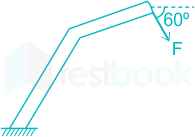
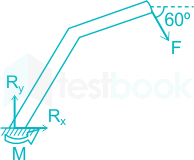
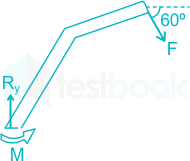
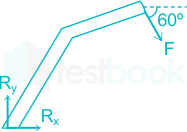
A force F is acting on a bent bar which is clamped at one end as shown in the figure.

The CORRECT free body diagram is

  1. ((a))

  2. ((b))

  3. ((c))

  4. ((d))

Show Answer
Answer: ((a))

Explanation:

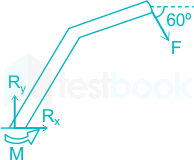
When we draw a free body diagram we remove all the supports and force applied due to that support are drawn and force or moment will apply in that manner so that it resists forces in any direction as well as any tendency of rotation.

Following is the conclusion:

Option (B) is wrong because the ground support is shown which we never show in FBD.

Option (C) is wrong because the X component is not shown.

Option (D) is wrong because the moment produced due to the eccentric force is not shown.

Hence only option (A) is correct.

17

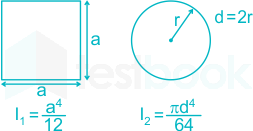
The cross-section of two solid bars made of the same material is shown in the figure. The square cross-section has flexural (bending) rigidity EI1, while the circular cross-section has flexural rigidity EI2. Both sections have the same cross-sectional area. The ratio I1/I2 is

  1. ((a))

    1/π

  2. ((b))

    2/π 

  3. ((c))

    π/3

  4. ((d))

    π/6 

Show Answer
Answer: ((c))

π/3

Concept:

Flexural rigidity = EI

Both the solid material bars are made of the same material

∴ E1 = E2

Calculation:

I1=a412{I_1} = \frac{{{a^4}}}{{12}}

I2=πd464{I_2} = \frac{{\pi {d^4}}}{{64}}

Given:

A1 = A2

a2=π4d2{a^2} = \frac{\pi }{4}{d^2}

d = 2a/√π

Now we are taking the ratio of I1 and I2 and substituting the value of d in I2

I1I2=a412πd4/64=a412π64(2aπ)4\frac{{{I_1}}}{{{I_2}}} = \frac{{\frac{{{a^4}}}{{12}}}}{{\pi {d^4}/64}} = \frac{{\frac{{{a^4}}}{{12}}}}{{\frac{\pi }{{64}}{{\left( {\frac{{2a}}{{\sqrt \pi }}} \right)}^4}}}

I1I2=π3\therefore \frac{{{I_1}}}{{{I_2}}} = \frac{\pi }{3}

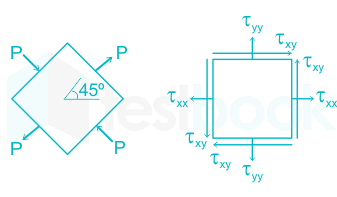
18

The state of stress at a point on an element is shown in figure (a). The same state of stress is shown in another coordinate system in figure (b).

The components (τxx, τyy, τxy) are given by

  1. ((a))

    (p/√2, -p/√2, 0)

  2. ((b))

    (0, 0, p)

  3. ((c))

    (p, -p, p/√2)

  4. ((d))

    (0, 0, p/√2)

Show Answer
Answer: ((b))

(0, 0, p)

Concept:

Normal stress at a plane  with an ∠θ from plane under the action of σx,

τxx=(σx+σy2)+(σxσy2)cos2θ+σxysin2θ;;;;;(1){τ _{xx}} = \left( {\frac{{{σ _x} + {σ _y}}}{2}} \right) + \left( {\frac{{{σ _x} - {σ _y}}}{2}} \right)\cos 2θ + {σ _{xy}}\sin 2θ {{;;;;;}} \ldots \left( 1 \right)

The shear stress at a plane with an ∠θ from plane under the action of σx,

τxy=(σxσy2)sin2θ+σxycos2θ;;;;;(2){τ _{xy}} = - \left( {\frac{{{σ _x} - {σ _y}}}{2}} \right)\sin 2θ + {σ _{xy}}\cos 2θ {{;;;;;}} \ldots \left( 2 \right)

(θ = - 45° as the plane under +P is rotated by 45° anti-clockwise to get the plane under +τxx)

Also,

τxx + τyy = σx + σy      ...(3)

Calculation:

Given:

Since the given plane is the principal plane ⇒ σxy = 0**,** σx = P, σy = - P

By using above equation (1),

τxx=(PP2)+(P(P)2)cos(90)+0=0{τ _{xx}} = \left( {\frac{{P - P}}{2}} \right) + \left( {\frac{{P - \left( { - P} \right)}}{2}} \right)\cos( -90^\circ) + 0 = 0

By using above equation (2),

τxy=[P(P)2]sin(90)0=P{τ _{xy}} = - \left[ {\frac{{P - \left( { - P} \right)}}{2}} \right]\sin \left( {-90^\circ } \right) - 0 = P

By using equation (3),

⇒ τyy = (σx + σy) - τxx = 0

τxx = τyy = 0, τxy = P

Alternate method:

The given plane is the principal plane because σxy = 0

At 45° from the principal plane, the plane of maximum shear occurs on the plane of maximum shear.

τxx=τyy=σ1+σ22=PP2=0{τ _{xx}} = {τ _{yy}} = \frac{{{σ _1} + {σ _2}}}{2} = \frac{{P - P}}{2} = 0

τxy=σ1σ22=P(P)2=P{τ _{xy}} = \frac{{{σ _1} - {σ _2}}}{2} = \frac{{P - \left( { - P} \right)}}{2} = P

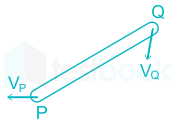
19

A rigid link PQ is undergoing plane motion as shown in the figure (VP and VQ are non-zero). VQP is the relative velocity of point Q with respect to point P

Which one of the following is TRUE?

  1. ((a))

    VQP has components along and perpendicular to PQ

  2. ((b))

    VQP has only one component directed from P to Q

  3. ((c))

    VQP has only one component directed from Q to P

  4. ((d))

    VQP has only one component perpendicular to PQ

Show Answer
Answer: ((d))

VQP has only one component perpendicular to PQ

Explanation:

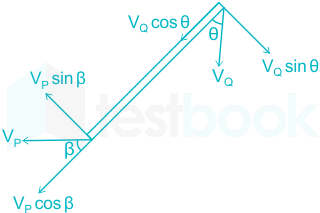
Because PQ is a rigid link so the distance between P and Q can not changes. Therefore, the velocity of Q relative to P is VQP, which has an only component perpendicular to PQ.

∴ VPcosβ = VQcosθ

∴ VQP = VQsinθ – VPsinβ

Hence only one component is present and it is perpendicular to PQ.

20

The number of degrees of freedom in a planar mechanism having n links and j simple hinge joints is

  1. ((a))

    3(n - 3) – 2j

  2. ((b))

    3(n - 1) – 2j

  3. ((c))

    3n – 2j

  4. ((d))

    2j – 3n + 4

Show Answer
Answer: ((b))

3(n - 1) – 2j

Explanation:

The general expression for the number of degree of freedom in a plane mechanism having n links, j simple hinge joints, h number of higher pair and Fr redundant degree of freedom is:

N = 3(n – 1) -2j – h - Fr

21

The static deflection of a spring under gravity, when a mass of 1 kg is suspended from it, is 1 mm. Assume the acceleration due to gravity g = 10 m/s2. The natural frequency of this spring-mass system (in rad/s) is _______

22

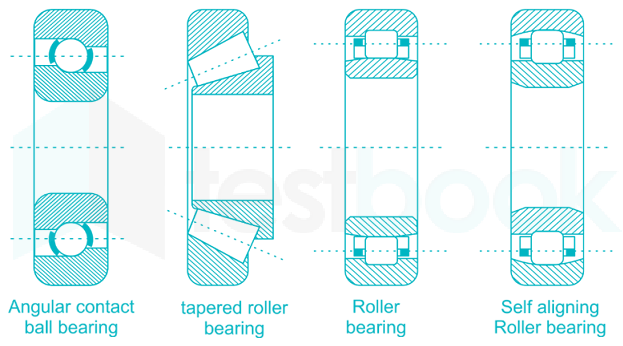
Which of the bearings given below SHOULD NOT be subjected to a thrust load? 

  1. ((a))

    Deep groove ball bearing

  2. ((b))

    Angular contact ball bearing

  3. ((c))

    Cylindrical (straight) roller bearing

  4. ((d))

    Single row tapered roller bearing

Show Answer
Answer: ((c))

Cylindrical (straight) roller bearing

Explanation:

Bearing: It is a mechanical component used to reduce the friction between two rotating or sliding surfaces.

A plain bearing is divided into two halves, usually associated with a crankcase that can be detached or supports the main bearing cap. The plain bearing is wrapped around the journal and pressurized with oil.

Plain bearings are used in main bearings and connecting rod bearing. Its main application is in the piston and connecting rod in engine.

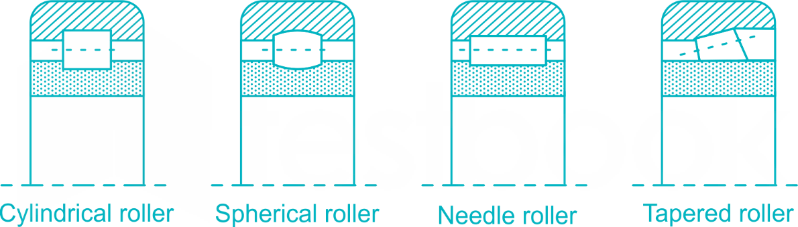
Roller bearing: It is a type of rolling-element bearing that uses cylindrical rollers to maintain the separation between the bearing races. The load-carrying capacity is more than ball bearing.

It is having 4 types:

  1. Cylindrical roller bearing:
  • Cylindrical roller bearings can only support radial loads. Axial loads will cause the ends of the rollers to rub against the sides of the races. In addition, because the rollers are fairly wide,
  • cylindrical roller bearings cannot accommodate much angular misalignment.
  • These bearings have short roller guided in a cage.
  • These bearings are relatively rigid against the radial motion and have the lowest coefficient of friction of any form of heavy-duty rolling contact bearings.
  • Such types of bearings are used in high-speed service.
  1. Spherical roller bearing
  • These bearings are self-aligning bearings.
  • The self-aligning feature is achieved by grinding one of the races in the form of a sphere.
  • These bearings can tolerate angular misalignment in the order of ±112\pm1 \frac 12.
  • When used with a double row of rollers, these can carry thrust load in either direction.
  1. Needle roller bearing
  • These bearings are relatively slender and completely fill the space so that neither a cage nor a retainer is needed.
  • These bearings are used when heavy loads are to be carried with an oscillatory motion.
  • For example, piston pin bearing in heavy-duty diesel engines where the reversal of motions tends to keep the roller in correct alignment.
  1. Taper Roller bearing
  • The roller and raceways of these bearings are truncated cones whose elements intersect at a common point.
  • Such type of bearing can carry both radial and thrust loads.

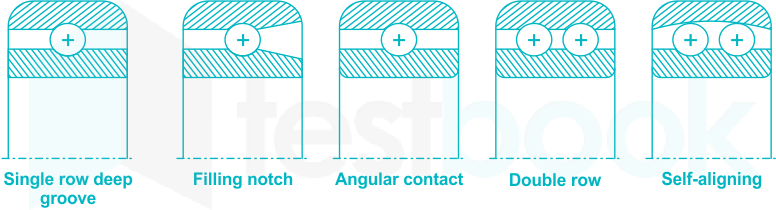
Ball-bearing: It is a type of rolling-element bearing that uses balls to maintain the separation between the bearing races.

It is having 6 types:

  1. Single row deep groove ball bearing
  • During assembly of this bearing, the races are offset and the maximum number of balls are placed between the races.
  • The races are then centred and the balls are symmetrically located by the use of a retainer or cage.
  • These bearings are used due to their high load-carrying capacity and suitability for high running speeds.
  1. Filling notch ball bearing
  • These bearings have notches in the inner and outer races which permits more balls to be inserted.
  • The notch does not extend to the bottom of the raceway and therefore the balls inserted through the notches must be forced in position.
  1. Angular contact bearing
  • These bearings have one side of the outer race cut away to permit the insertion of more balls than in a deep groove bearing but without having a notch cut in both races.
  • This permits the bearing to carry a relatively large axial load in one direction while carrying a relatively large radial load.
  • The angular contact bearing are used in pairs so that thrust load may be carried in either direction.
  1. Double row deep groove ball bearing
  • These bearings may be made with radial or angular contact between the balls and the races.
  • The double row bearing is appreciably narrower than two single-row bearings.
  • The load-carrying capacity of such bearing is slightly less than twice that of a single-row bearing.
  1. Self-aligned bearing
  • These bearings permit shaft deflections with 2-3 degrees.

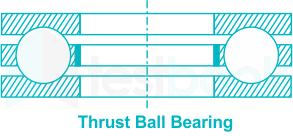
  1. Thrust bearing

  • The thrust bearing is used for carrying thrust loads exclusively and at speeds below 2000 rpm.
  • It doesn't take any radial load.
  • At high speeds, centrifugal force causes the balls to be forced out of the races.
23

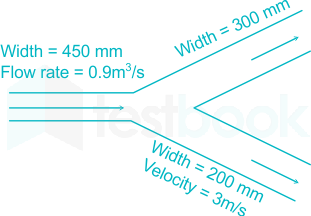
A channel of width 450 mm branches into two sub-channels having width 300 mm and 200 mm as shown in figure. If the volumetric flow rate (taking unit depth) of an incompressible flow through the main channel is 0.9 m3/s and the velocity in the sub-channel of width 200 mm is 3 m/s, the velocity in the sub-channel of width 300 mm is ______m/s

Assume both inlet and otlet to be at the same elevation.

24

For a certain two-dimensional incompressible flow, velocity field is given by 2xy î - y2ĵ . The streamlines for this flow are given by the family of curves

  1. ((a))

    x2y2 = constant

  2. ((b))

    xy2 = constant

  3. ((c))

    2xy – y2 = constant

  4. ((d))

    xy = constant

Show Answer
Answer: ((b))

xy2 = constant

Concept:

Streamline equation for 2-D flow is:

dxu=dyv\frac{{dx}}{u} = \frac{{dy}}{v}

Calculation:

Given,

Velocity as

V=2xyi^y2j^\vec V = 2xy\hat i - {y^2}\hat j

u = 2xy ; ν = -y2

dx2xy=dyy2\frac{{dx}}{{2xy}} = \frac{{dy}}{{ - {y^2}}} \Rightarrow \Rightarrow

dx2x=dyy\frac{{dx}}{{2x}} = - \frac{{dy}}{y}

Integrating on both the sides we will get:

12lnx=lny+lnc\frac{1}{2}\ln x = - \ln y + \ln c

12lnx+lny=lnc \Rightarrow \frac{1}{2}\ln x + \ln y = \ln c

lnx+2lny=2lnc\Rightarrow\ln x + 2\ln y = 2\ln c

ln(xy2) = ln c2

⇒ xy2 = C

25

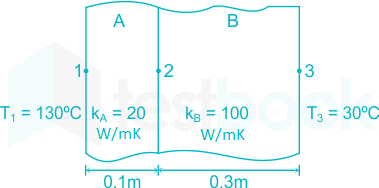
Steady one-dimensional heat conduction takes place across the faces 1 and 3 of a composite slab consisting of slabs A and B in perfect contact as shown in the figure, where kA, kB denote the respective thermal conductivities. Using the data as given in the figure, the interface temperature T2 (in °C) is _______

26

Grashof number signifies the ratio of

  1. ((a))

    inertia force to viscous force

  2. ((b))

    buoyancy force to viscous force

  3. ((c))

    buoyancy force to inertia force

  4. ((d))

    inertia force to surface tension force

Show Answer
Answer: ((b))

buoyancy force to viscous force

Explanation:

The dimensionless parameter, which represents the natural convection effects and is called the Grashof number.

Grashof number, Gr, as the ratio between the buoyancy force and the viscous force:

Gr=gβ(TsT)Lc3ν2Gr = \frac{{g\beta \left( {{T_s} - {T_\infty }} \right)L_c^3}}{{{\nu ^2}}}

Nusselt number is a function of the Grashof number and the Prandtl number alone. Nu = f (Gr, Pr)

Important Non-dimensional numbers:

  • Biot number  → Ratio of internal thermal resistance to boundary layer thermal resistance
  • Grashof number  → Ratio of buoyancy to viscous force
  • Prandtl number  → Ratio of momentum to thermal diffusivities
  • Reynolds number  → Ratio of inertia force to viscous force
27

The INCORRECT statement about the characteristics of critical point of a pure substance is that

  1. ((a))

    there is no constant temperature vaporization process

  2. ((b))

    it has point of inflection with zero slope

  3. ((c))

    the ice directly converts from solid phase to vapor phase

  4. ((d))

    saturated liquid and saturated vapor states are identical

Show Answer
Answer: ((c))

the ice directly converts from solid phase to vapor phase

Explanation:

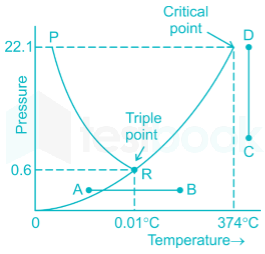
At a critical point, the liquid is directly converted into vapour without having a two-phase transition. So, the enthalpy of vaporization at a critical point is zero. The figure below represents the P-T diagram for a pure substance.

Because at critical point liquid directly convents into the vapour phase. Ice is converted directly into vapour if it is heated at constant pressure which is less than triple point pressure. Hence statement 3 is incorrect.

28

For a heat exchanger, ΔTmax is the maximum temperature difference and ΔTmin is the minimum temperature difference between the two fluids. LMTD is the log mean temperature difference. Cmin and Cmax are the minimum and the maximum heat capacity rates. The maximum possible heat transfer (Qmax) between the two fluids is

  1. ((a))

    Cmin LMTD

  2. ((b))

    Cmin ΔTmax

  3. ((c))

    Cmax ΔTmax

  4. ((d))

    Cmax ΔTmin

Show Answer
Answer: ((b))

Cmin ΔTmax

Concept:

  1. When heat capacity rate is minimum the heat will transfer quickly hence for maximum heat transfer we will take Cmin .
  2. And more the temperature difference greater will be the value of heat transfer.

Cmin = Minimum heat capacity rate

Cmax = Maximum heat capacity rate

∴ For maximum heat transfer:

q˙max=CminΔTmax \Rightarrow {\dot q_{max}} = {C_{min}}{\rm{\Delta }}{T_{max}}

29

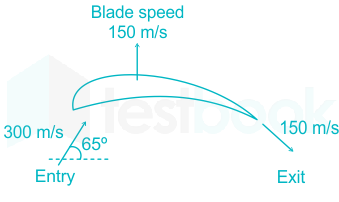
The blade and fluid velocities for an axial turbine are shown in the figure.

The magnitude of absolute velocity at entry is 300 m/s at an angle of 65° to the axial direction, while the magnitude of the absolute velocity at exit is 150 m/s. The exit velocity vector has a component in the downward direction. Given that the axial (horizontal) velocity is the same at entry and exit, the specific work (in kJ/kg) is ______

30

Engineering strain of a mild steel sample is recorded as 0.100%. The true strain is

  1. ((a))

    0.010%

  2. ((b))

    0.055%

  3. ((c))

    0.099%

  4. ((d))

    0.101%

Show Answer
Answer: ((c))

0.099%

Concept:

True strain (ϵT) = ln (1 + ϵ)

Calculation:

Given:

Engineering strain (ϵ)=0.100%=0.100100(\epsilon) = 0.100\% = \frac{{0.100}}{{100}}

True strain (ϵT) = ln (1 + ϵ)

ϵT=ln(1+0.100100)=ln(100.1100);\epsilon_T=\ln\left(1+\frac{0.100}{100}\right)=\ln \left(\frac{100.1}{100}\right);

T = 9.99500 × 10-4

∈T = 9.99500 × 10-4  × 100 = 0.099 %

31

Equal amounts of a liquid metal at the same temperature are poured into three moulds made of steel, copper and aluminium. The shape of the cavity is a cylinder with 15 mm diameter. The size of the moulds are such that the outside temperature of the moulds do not increase appreciably beyond the atmospheric temperature during solidification. The sequence of solidification in the mould from the fastest to slowest is

(Thermal conductivities of steel, copper and aluminium are 60.5, 401 and 237 W/m-K, respectively.

Specific heats of steel, copper and aluminium are 434, 385 and 903 J/kg-K, respectively.

Densities of steel, copper and aluminium are 7854, 8933 and 2700 kg/m3, respectively.)

  1. ((a))

    Copper – Steel - Aluminium

  2. ((b))

    Aluminium – Steel - Copper

  3. ((c))

    Copper – Aluminium - Steel

  4. ((d))

    Steel – Copper - Aluminium

Show Answer
Answer: ((c))

Copper – Aluminium - Steel

Concept:

Solidification rate in the mould in terms of thermal conductively of metal and density of material is

α=kρC\alpha = \frac{k}{{\rho C}}

Hence larger the value of α faster will be the solidification rate

Given:

αsteel = 1.77 × 10⁻⁵

αcopper = 1.165 × 10⁻⁴

αal = 9.72 × 10⁻⁵

Hence from the above value we can see that the copper is having the largest value and steel is having the lowest value

Therefore the order will be:

Copper – aluminium – steel

32

In a wire-cut EDM process the necessary conditions that have to be met for making a successful cut are that

  1. ((a))

    Wire and sample are electrically non-conducting

  2. ((b))

    Wire and sample are electrically conducting

  3. ((c))

    Wire is electrically conducting and sample is electrically non-conducting

  4. ((d))

    Sample is electrically conducting and wire is electrically non-conducting

Show Answer
Answer: ((b))

Wire and sample are electrically conducting

Explanation:

EDM process is summarized as :

  • With the application of voltage, an electric field build-up between the two electrodes at the position of least resistance. The ionization leads to the breakdown of the dielectric which results in the drop of voltage and the beginning of the flow of current.
  • Electrons and ions migrate to anode and cathode respectively at very high current density. A column of vapour begins to form and the localized melting of work commences. The discharge channel continues to expand along with the substantial increase of temperature and pressure.
  • When the power is switched off, the current drops; no further heat is generated, and the discharge column collapses. A portion of molten metal evaporates explosively and/or is ejected away from the electrode surface. With the sudden drop in temperature, the remaining molten and vaporized metal solidifies. A tiny crater is thus generated at the surface.
  • The residual debris is flushed away along with products of decomposition of dielectric fluid. The application of voltage initiates the next pulse and the cycle of events.
<br>

Hence for the above procedure, it is necessary that wire and sample are electrically conducting.

33

Internal gears are manufactured by 

  1. ((a))

    hobbing

  2. ((b))

    shaping with pinion cutter

  3. ((c))

    shaping with rack cutter

  4. ((d))

    milling

Show Answer
Answer: ((b))

shaping with pinion cutter

Explanation:

  • Gear shaping is a generating process. The cutter used is virtually a gear provided with cutting edges. The tool is rotated at the required velocity ratio relative to the gear to be manufactured and anyone manufactured gear tooth space is formed by one complete cutter tooth. This method can be used to produce cluster gears, internal gears, racks, etc with ease, which may not have the possibility to be manufactured in gear hobbing.
  • Gear Hobbing is a continuous generating process in which the tooth flanks of the constantly moving workpiece are formed by equally spaced cutting edges of the hob. The main advantage of this process is its versatility to produce a variety of gears including Spur, Helical, Worm Wheels, Serrations, Splines, etc. The main advantage of the method is the higher production rate of the gears due to continuously indexing.
  • Gear Milling is one of the initial and best known and metal removal process for making gears. This method requires the usage of a milling machine. This method is right now used only for the manufacture of gears requiring very less dimensional accuracy.
  • Gear forming: In gear form cutting, the cutting edge of the cutting tool has a shape identical with the shape of the space between the gear teeth. Two machining operations, milling and broaching can be employed to form cut gear teeth.

Points to remember:

  • Internal gears are manufactured by shaping process with a pinion cutter.
  • Hobbing, milling and shaping with rack cutter is mainly used for external gears.
34

Match the following part programming codes with their respective functions

Part Programming CodesFunctions
P. G01I. Spindle stop
Q. G03II. Spindle rotation, clockwise
R. M03III. Circular interpolation, anticlockwise
S. M05IV. Linear interpolation
  1. ((a))

    P – II, Q – I, R – IV, S - III

  2. ((b))

    P – IV, Q – II, R – III, S - I

  3. ((c))

    P – IV, Q – III, R – II, S - I

  4. ((d))

    P – III, Q – IV, R – II, S - I

Show Answer
Answer: ((c))

P – IV, Q – III, R – II, S - I

Explanation:

Important G codes

  • G00 – Rapid Transverse
  • G01 – Linear Interpolation
  • G02 – Circular Interpolation (CW)
  • G03 – Circular Interpolation (ACW)
  • G04 – Dwell​
  • G – 97 – Spindle Speed

Important M codes

  • M 00 – Program Stop
  • M 03 – Spindle (CW)
  • M 04 – Spindle (CCW)
  • M 05 – Spindle Stop
  • M 08 – Coolant on
  • M 09 – Coolant off
  • M 10 – Clamp-on
  • M 11 – Clamp off
  • M 02 or M 30 – Program stop, reset to start.
35

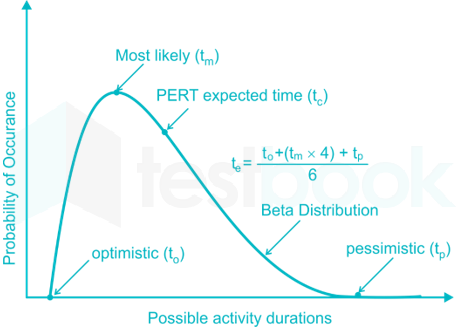
In PERT chart, the activity time distribution is

  1. ((a))

    Normal

  2. ((b))

    Binomial

  3. ((c))

    Poisson

  4. ((d))

    Beta

Show Answer
Answer: ((d))

Beta

Explanation:

CPM does not directly model uncertainty.

PERT was developed to address the needs of projects which are being done for the first time – a challenge to estimate activity duration.

PERT (Program Evaluation and Review Technique) uses 3 cases:

  • Most Optimistic
  • Most Pessimistic
  • Most likely durations


PERT determines the probability for each duration, whereas CPM considers the most likely duration.

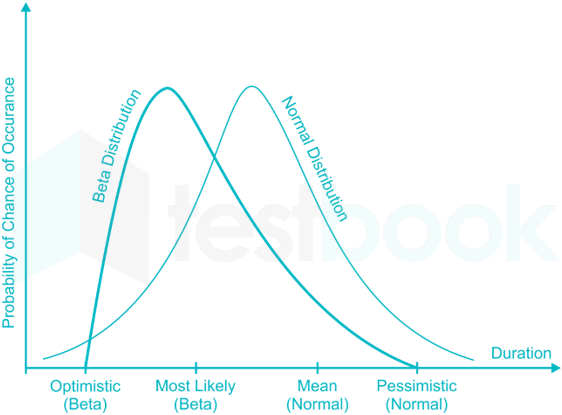
In the standard PERT analysis, the distribution assumed for the activity times is a Beta distribution.

36

The number of linearly independent eigen vectors of matrix \(A = \left[ {\begin{array}{*{20}{c}} 2&1&0\ 0&2&0\ 0&0&3 \end{array}} \right]\) is ________

37

The value of the line integral \(\mathop \smallint \limits_C^{} \bar F;.;\bar r'ds\), where C is a circle of radius 4/√π units is ________

Here, F̅ (x, y) = y î + 2x ĵ and r̅’ is the UNIT tangent vector on the curve C at an arc length s from a reference point on the curve. î and ĵ are the basis vectors in the x-y Cartesian reference. In evaluating the line integral, the curve has to be traversed in the counter-clockwise direction.

38

limxx2+x1x;is\mathop {\lim }\limits_{x \to \infty } \sqrt {{x^2} + x - 1} - x;is

  1. ((a))

    0

  2. ((b))

  3. ((c))

    1/2

  4. ((d))

    -∞

Show Answer
Answer: ((c))

1/2

Concept:

Whenever the ∞ - ∞ form occurs then substitute x as (1/t) and then solve it.

Calculation:

limxx2+x1x\mathop {\lim }\limits_{x \to \infty } \sqrt {{x^2} + x - 1} - x

Let;x=1t,;So,;as;x,;t0Let;x = \frac{1}{t},;So,;as;x \to \infty ,;t \to 0

=limt01t2+1t11t= \mathop {\lim }\limits_{t \to 0} \sqrt {\frac{1}{{{t^2}}} + \frac{1}{t} - 1} - \frac{1}{t}

=limt01+tt21t= \mathop {\lim }\limits_{t \to 0} \frac{{\sqrt {1 + t - {t^2}} - 1}}{t}

Since the function has (0/0) form, we can apply L’ hospital rule,

=limt01+tt21t= \mathop {\lim }\limits_{t \to 0} \frac{{\sqrt {1 + t - {t^2}} - 1}}{t}

\(= \mathop {\lim }\limits_{t \to 0} \left{ {\frac{{\left[ {\frac{{\left( {1 - 2t} \right)}}{{2\sqrt {1 + t - {t^2}} }}} \right]}}{1}} \right}\)

=12= \frac{1}{2}

39

Three cards were drawn from a pack of 52 cards. The probability that they are a king, a queen, and a jack is

  1. ((a))

    165525\frac{{16}}{{5525}}

  2. ((b))

    642197\frac{{64}}{{2197}}

  3. ((c))

    313\frac{3}{{13}}

  4. ((d))

    816575\frac{8}{{16575}}

Show Answer
Answer: ((a))

165525\frac{{16}}{{5525}}

Explanation:

Number of ways in which a king can be drawn from the pack of 52 cards is 4C1{}_{}^4{C_1} since there are 4 kings in a deck of cards

Similarly, a queen and a jack can be drawn in 4C1{}_{}^4{C_1} ways

∴ Number of ways in which a king, a queen and a jack can be drawn is \(= {}{}^4{C_1} \times {}{}^4{C_1} \times {}_{}^4{C_1}\)

Number of ways in which three cards can be drawn from the pack of 52 cards is

=52C3= {}_{}^{52}{C_3}

The;required;probability=sample;space;Total;possible;ways\therefore The;required;probability = \frac{{sample;space;}}{{Total;possible;ways}}

\(\therefore The;required;probability = \frac{{{}{}^4{C_1} \times {}{}^4{C_1} \times {}{}^4{C_1}}}{{{}{}^{52}{C_3}}}\)

=4×4×452×51×506= \frac{{4 \times 4 \times 4}}{{\frac{{52 \times 51 \times 50}}{6}}}

=165525= \frac{{16}}{{5525}}

40

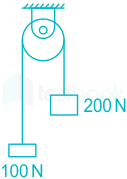
An inextensible massless string goes over a frictionless pulley. Two weights of 100 N and 200 N are attached to the two ends of the string. The weights are released from rest, and start moving due to gravity. The tension in the string (in N) is __________

<br>

41

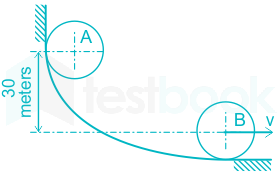
A circular disc of radius 100 mm and mass 1 kg, initially at rest at position A, rolls without slipping down a curved path as shown in the figure. The speed v of the disc when it reaches position B is _________ m/s.

Acceleration due to gravity (g) = 10 m/s2

42

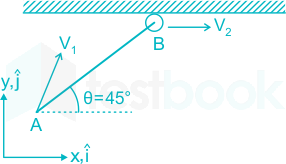
A rigid rod (AB) of length L = √2 m is undergoing translational as well as rotation motion in the x-y plane (see the figure). The point A has the velocity V1 = î + 2ĵ m/s. The end B is constrained to move only along the x direction.

The magnitude of the velocity V2 (in m/s) at the end B is _________

43

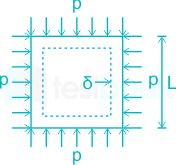
A square plate of dimension L × L is subjected to a uniform pressure load P = 250 MPa on its edges as shown in the figure. Assume plane stress conditions. The Young’s modulus E = 200 GPa.

The deformed shape is a square of dimension L - 2δ. If L = 2 m and δ = 0.001 m, the Poisson’s ratio of the plate material is _________

44

Two circular shafts made of same material, one solid (S) and one hollow (H), have the same length and polar moment of inertia. Both are subjected to same torque. Here, θs is the twist and τs is the maximum shear stress in the solid shaft, whereas θH is the twist and τH is the maximum shear stress in the hollow shaft. Which one of the following is TRUE?

  1. ((a))

    θs = θH and τs = τH

  2. ((b))

    θs > θH and τs > τH

  3. ((c))

    θs < θH and τs < τH

  4. ((d))

    θs = θH and τs < τH

Show Answer
Answer: ((d))

θs = θH and τs < τH

Concept:

τmax;for;solid;shaft=TJ.r{\tau _{max}};for;solid;shaft = \frac{T}{J}.r

τmax;for;hollow;shaft=TJ.r0{\tau _{max}};for;hollow;shaft = \frac{T}{J}.{r_0}

where T = Torque, J = Polar Area Moment, r = radius of solid shaft and r0 = outer radius of hollow shaft

Calculation:

Given:-

LS = LH, TS = TH = T, JS = JH

(Where L = length, T = torque, J = Polar moment of inertia)

∵ JS = JH

πd432=π32[d04di4]\frac{{\pi {d^4}}}{{32}} = \frac{\pi }{{32}}\left[ {d_0^4 - d_i^4} \right]

do>dr0>r\Rightarrow {d_o} > d \Rightarrow {r_0} > r

Now, angle of Twist

θ=TLGJ\theta = \frac{{TL}}{{GJ}}

θS = θH            ----(1) (∵ T, L, G, J all are same for solid and Hollow shaft)

τ=TRJ\tau = \frac{{TR}}{J}

τmax;for;solid;shaft=TJ.r\Rightarrow {\tau _{max}};for;solid;shaft = \frac{T}{J}.r

τmax;for;hollow;shaft=TJ.r0{\tau _{max}};for;hollow;shaft = \frac{T}{J}.{r_0}

∵ r0 > r

max)H > (τmax)S            ----(2)

Hence from (1) and (2) we can see that the correct option is d.

45

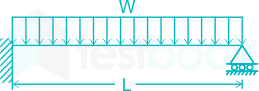
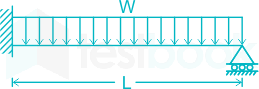
A beam of length L is carrying a uniformly distributed load w per unit length. The flexural rigidity of the beam is EI. The reaction at the simple support at the right end is

  1. ((a))

    WL/2

  2. ((b))

    3WL/8

  3. ((c))

    WL/4

  4. ((d))

    WL/8

Show Answer
Answer: ((b))

3WL/8

Concept:

Deflection in cantilever beam due to

uniformly;distributed;load=WL48EI\to uniformly;distributed;load = \frac{{W{L^4}}}{{8EI}}

point;load;at;end;point=WL33EI\to point;load;at;end;point = \frac{{W{L^3}}}{{3EI}}

Deflection due to uniformly distributed load and deflection due to reaction at simple support will be equal and opposite.

Calculation:

Deflection due to uniform load W over the span of length L will be WL48EI\frac{{W{L^4}}}{{8EI}}

Let R be the reaction at simple support at the right end so it is acting as a point load on beam hence deflection due to it will be RL33EI\frac{{R{L^3}}}{{3EI}}

Net deflection at the simple support will be zero since from both the sides force is equal and opposite. Hence equating them.

WL48EI=RL33EI\frac{{W{L^4}}}{{8EI}} = \frac{{R{L^3}}}{{3EI}}

R=3WL8\therefore R = \frac{{3WL}}{8}

46

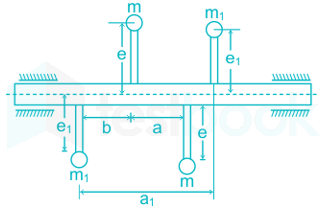
Two masses m are attached to opposite sides of a rigid rotating shaft in the vertical plane. Another pair of equal masses m1 is attached to the opposite sides of the shaft in the vertical plane as shown in figure. Consider m = 1 kg, e = 50 mm, e1 = 20 mm, b = 0.3 m, a = 2 m and a1 = 2.5 m. For the system to be dynamically balanced, m1 should be _______ kg.

47

A single degree of freedom spring-mass system is subjected to a harmonic force of constant amplitude. For an excitation frequency of 3km,\sqrt {\frac{{3k}}{m}} , the ratio of the amplitude of steady state response to the static deflection of the spring is _______

48

A bolted joint has four bolts arranged as shown in figure. The cross sectional area of each bolt is 25 mm2. A torque T = 200 N-m is acting on the joint. Neglecting friction due to clamping force, maximum shear stress in a bolt is __________ MPa.

49

Consider a fully developed steady laminar flow of an incompressible fluid with viscosity μ through a circular pipe of radius R. Given that the velocity at a radial location of R/2 from the centreline of the pipe is U1, the shear stress at the wall is KμU1/R, where K is _________

50

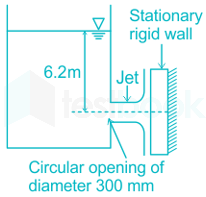
The water jet exiting from a stationary tank through a circular opening of diameter 300 mm impinges on a rigid wall as shown in the figure. Neglect all minor losses and assume the water level in the tank to remain constant. The net horizontal force experienced by the wall is _________ kN. Density of water is 1000 kg/m3.(Take g = 10m/s2)

51

For a two-dimensional flow, the velocity field is u=xx2+y2i^+yx2+y2j^,\vec u = \frac{x}{{{x^2} + {y^2}}}\hat i + \frac{y}{{{x^2} + {y^2}}}\hat j, where î and ĵ are the basis vectors in the x-y Cartesian coordinate system. Identify the CORRECT statements from below.

basis vectors in the x-y Cartesian coordinate system. Identify the CORRECT statements from below.

  1. The flow is incompressible.

  2. The flow is unsteady.

  3. y-component of acceleration, ay=y(x2+y2)2{a_y} = - \frac{y}{{{{\left( {{x^2} + {y^2}} \right)}^2}}}

  4. x-component of acceleration, ax=(x+y)(x2+y2)2{a_x} = \frac{{ - \left( {x + y} \right)}}{{{{\left( {{x^2} + {y^2}} \right)}^2}}}

  1. ((a))
    1. and 3)
  2. ((b))
    1. and 3)
  3. ((c))
    1. and 2)
  4. ((d))
    1. and 4)
Show Answer
Answer: ((b))
  1. and 3)

Concept:

i) For incompressible flowuxx+uxy=0\frac{{\partial {u_x}}}{{\partial x}} + \frac{{\partial {u_x}}}{{\partial y}} = 0

ii) For steady flow u should not be the function of time i.e. u≠ f(t),

Given:

u=xx2+y2i^+y(x2+y2)j^\vec u = \frac{x}{{{x^2} + {y^2}}}\hat i + \frac{y}{{\left( {{x^2} + {y^2}} \right)}}\hat j

\(\Rightarrow {u_x} = \frac{x}{{{x^2} + {y^2}}};& ;{u_y} = \frac{y}{{\left( {{x^2} + {y^2}} \right)}}\)

i) For incompressible flowuxx+uxy=0\frac{{\partial {u_x}}}{{\partial x}} + \frac{{\partial {u_x}}}{{\partial y}} = 0

\(\frac{\partial }{{\partial x}}\left( {\frac{x}{{{x^2} + {y^2}}}} \right) + \frac{\partial }{{\partial y}}\left( {\frac{y}{{{x^2} + {y^2}}}} \right) = \left{ {\frac{1}{{{x^2} + {y^2}}} - \frac{{x.2x}}{{{{\left( {{x^2} + {y^2}} \right)}^2}}}} \right} + \left{ {\frac{1}{{{x^2} + {y^2}}} - \frac{{y.2y}}{{{{\left( {{x^2} + {y^2}} \right)}^2}}}} \right}\)

uxx+uyy=2x2+y22(x2+y2)(x2+y2)2=0\frac{{\partial {u_x}}}{{\partial x}} + \frac{{\partial {u_y}}}{{\partial y}} = \frac{2}{{{x^2} + {y^2}}} - \frac{{2\left( {{x^2} + {y^2}} \right)}}{{{{\left( {{x^2} + {y^2}} \right)}^2}}} = 0

Hence the flow is Incompressible.

ii) For steady flow u should not be the function of time i.e. u≠ f(t), but in the equation it can be clearly seen that u is not the function of time

Hence the flow is Steady.

From here, you can choose the answer by eliminating option.

Since, option 2) is incorrect, therefore (A) & (C) are eliminated.

And out of (B) & (D) only (B) contains option 1.

So correct answer is (B).

52

Two large parallel plates having a gap of 10 mm in between them are maintained at temperatures T1 = 1000 K and T2 = 400 K. Given emissivity values, ε1 = 0.5, ε2 = 0.25 and Stefan-Boltzmann constant σ = 5.67 × 10⁻⁸ W/m2-K4, the heat transfer between the plates (in kW/m2) is ________

53

A cylindrical steel rod, 0.01 m in diameter and 0.2 m in length is first heated to 750°C and then immersed in a water bath at 100°C. The heat transfer coefficient is 250 W/m2-K. The density, specific heat and thermal conductivity of steel are ρ = 7801 kg/m3, c = 473 J/kg-K, and k = 43 W/m-K, respectively. The time required for the rod to reach 300°C is ___________ seconds.

54

Steam at an initial enthalpy of 100 kJ/kg and inlet velocity of 100 m/s, enters an insulated horizontal nozzle. It leaves the nozzle at 200 m/s. The exit enthalpy (in kJ/kg) is _________

55

In a mixture of dry air and water vapor at a total pressure of 750 mm of Hg, the partial pressure of water vapor is 20 mm of Hg. The humidity ratio of the air in grams of water vapor per kg of dry air (gw/kgda) is ________

56

In a 3 – stage air compressor, the inlet pressure is p1, discharge pressure is p4 and the intermediate pressure are p2 and p3 (p2 < p3). The total pressure ratio of the compressor is 10 and the pressure ratio of the stages are equal. If p1 = 100 kPa, the value of the pressure p3 (in kPa) is________

57

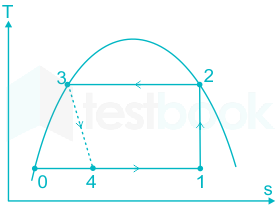
In the vapour compression cycle in the figure, the evaporating and condensing temperatures are 260 K and 310 K, respectively. The compressor takes in liquid-vapour mixture (state 1) and isentropically compresses it to a dry saturated vapour condition (state 2). The specific heat of the liquid refrigerant is 4.8 kJ/kg-K and may be treated as constant. The enthalpy of evaporation for the refrigerant at 310 K is 1054 kJ/kg.

The difference between the enthalpies at state points 1 and 0 (in kJ/kg) is ___________

58

Spot welding of two steel sheets each 2 mm thick is carried out successfully by passing 4 kA of current for 0.2 seconds through the electrodes. The resulting weld nugget formed between the sheets is 5 mm in diameter. Assuming cylindrical shape for the nugget, the thickness of the nugget is _______ mm.

Latent heat of fusion for steel1400 kJ/kg
Effective resistance of the weld joint200 μΩ
Density of steel8000 kg/m3
59

For an orthogonal cutting operation, tool material is HSS, rake angle is 22°, chip thickness is 0.8 mm, speed is 48 m/min and feed is 0.4 mm/rev. The shear plane angle (in degrees) is

  1. ((a))

    19.24

  2. ((b))

    29.70

  3. ((c))

    56.00

  4. ((d))

    68.75

Show Answer
Answer: ((b))

29.70

Concept:

Shear angle is calculated by the following formula.

tanθ=rcosα1rsinα\tan \theta = \frac{{r\cos \alpha }}{{1 - r\sin \alpha }}

Where θ = shear angle**; α** = rake angle

Calculation:

Tool material = HSS; Rake angle α = 22°; Chip thickness (tc) = 0.8 mm; Vc = 48 m/min**;**

Feed = 0.4 mm/rev

Now,

For orthogonal Turning, insert chip thickness = feed

∴ t = 0.4 mm

chip thickness ratio (r) =ttc=0.40.8=0.5= \frac{t}{{{t_c}}} = \frac{{0.4}}{{0.8}} = 0.5

Also,

tanθ=rcosα1rsinα\tan \theta = \frac{{r\cos \alpha }}{{1 - r\sin \alpha }}

tanθ=(0.5)(cos22)1(0.5)sin22\therefore {\rm{tan\theta }} = \frac{{\left( {0.5} \right)\left( {\cos 22} \right)}}{{1 - \left( {0.5} \right)\sin 22}}

tanθ=0.5704\therefore {\rm{tan\theta }} = 0.5704

Where, θ is shear plane angle

∴ θ = tan-1 (.5704)

∴ θ = 29.70°

60

In a sheet metal of 2 mm thickness a hole of 10 mm diameter needs to be punched. The yield strength in tension of the sheet material is 100 MPa and its ultimate shear strength is 80 MPa. The force required to punch the hole (in kN) is _________

61

In a single point turning operation with cemented carbide tool and steel work piece, it is found that the Taylor’s exponent is 0.25. I the cutting speed is reduced by 50% then the tool life changes by _______ times

62

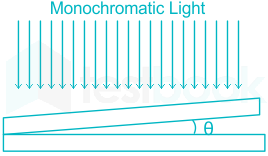
Two optically flat plates of glass are kept at a small angle θ as shown in the figure. Monochromatic light is incident vertically.

If the wavelength of light used to get a fringe spacing of 1 mm is 450 nm, the wavelength of light (in nm) to get a fringe spacing of 1.5 mm is _______

63

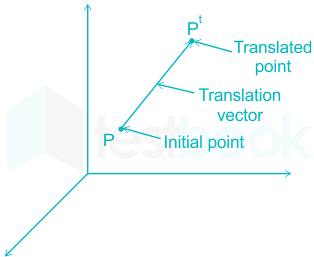
A point P (1, 3, -5) is translated by 2î + 3ĵ - 4k̂ and then rotated counter clockwise by 90° about the z-axis. The new position of the given point is

  1. ((a))

    (-6, 3, -9)

  2. ((b))

    (-6, -3, -9)

  3. ((c))

    (6, 3, -9)

  4. ((d))

    (6, 3, 9)

Show Answer
Answer: ((a))

(-6, 3, -9)

Given:

A point P (1, 3, -5).

It is first translated by (2î + 3ĵ - 4k̂) and then rotated counter clockwise by 90°. About z-axis.

To find new position of the point.

Initial point can be written in vector form as.

Pt = (1 + 2)î + (3 + 3)ĵ - (5 + 4)k̂

Pt = 3î + 6ĵ - 9k̂ (pt = Translated point)

Rotation matrix is

\(R = \left[ {\begin{array}{*{20}{c}} {\cos \theta }&{ - \sin \theta }&0\ {\sin \theta }&{\cos \theta }&0\ 0&0&1 \end{array}} \right]\)

∵ Rotation is counterclockwise:

∴ θ = + 90°

\(R = \left[ {\begin{array}{{20}{c}} {\cos 90}&{ - \sin 90}&0\ {\sin 90}&{\cos 90}&0\ 0&0&1 \end{array}} \right] = \left[ {\begin{array}{{20}{c}} 0&{ - 1}&0\ 1&0&0\ 0&0&1 \end{array}} \right]\)

\({p_{final}} = \left[ {\begin{array}{{20}{c}} 0&{ - 1}&0\ 1&0&0\ 0&0&1 \end{array}} \right]\left[ {\begin{array}{{20}{c}} 3\ 6\ { - 9} \end{array}} \right] = \left[ {\begin{array}{*{20}{c}} { - 6}\ 3\ { - 9} \end{array}} \right]\)

∴ option 1 is correct.

64

The demand for a two-wheeler was 900 units and 1030 units in April 2015 and May 2015, respectively. The forecast for the month of April 2015 was 850 units. Considering a smoothing constant of 0.6, the forecast for the month of June 2015 is

  1. ((a))

    850 units

  2. ((b))

    927 units

  3. ((c))

    965 units

  4. ((d))

    970 units

Show Answer
Answer: ((d))

970 units

Concept:

When smoothing constant is given use the following formula to calculate the forecast.

Ft = α Dt-1 + (1 - α) Ft-1

Calculation:

Given:

DemandForecasts
April900850
May1030880 (calculated below)
June


Calculation:

To find the forecast for the month of June using exponential smoothening.

We know that

Ft = α Dt-1 + (1 - α) Ft-1

Where ft is the forecast of current period, Ft-1 is the forecast of previous period, Dt-1 is the Demand for previous period.

So, for calculation of forecast for June, we need to calculate forecast of May.

FMay = α DA + (1 - α) FA

FMay = (0.6) (900) + (1 – 0.6) 850 = 880,

FJune = (0.6) DMay + (1 – 0.6) FMay

FJune = (0.6) (1030) + (0.4) (880)

∴ FJune = 970

65

A firm uses a turning center, a milling center and a grinding machine to produce two parts. The table below provides the machining time required for each part and the maximum machining time available on each machine. The profit per unit on parts I and II are Rs. 40 and Rs. 100, respectively. The maximum profit per week of the firm is Rs. ________

Type of machineMachining time required for the machine part (minutes)Maximum machining time available per week (minutes)
III
Turning Center1266000
Milling Center4104000
Grinding Machine231800

Attempt this paper under real exam conditions

Timed interface, section switching, instant scoring, and question-by-question analytics — free.

Start Timed Attempt