Official Paper

GATE ME 2016 Official Paper: Shift 2 (Previous Year Paper)

65 questions · 180 minutes · with answers · free

General Aptitude (10 questions)

1

The volume of a sphere of diameter 1 unit is ________ than the volume of a cube of side 1 unit.

  1. ((a))

    least

  2. ((b))

    less

  3. ((c))

    lesser

  4. ((d))

    low

Show Answer
Answer: ((b))

less

The context of the sentence is that it is making a comparison and wants to convey the amount smaller in value. Thus ‘less’ is the correct word to fit the blank. ‘Lesser’ is used when we want to denote smaller in importance.

2

The unruly crowd demanded that the accused be _____________ without trial.

  1. ((a))

    hanged

  2. ((b))

    hanging

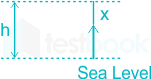
  3. ((c))

    hankering

  4. ((d))

    hung

Show Answer
Answer: ((a))

hanged

The correct word to be used in this context is ‘hanged’ because it means to kill someone by tying a rope from their neck. When we are talking about punishing a criminal, we usually use the word ‘hanged’. ‘Hung’ is the past participle form of the word ‘hang’, but it is usually used in the context of the hanging an object.

3

Choose the statement(s) where the underlined word is used correctly:

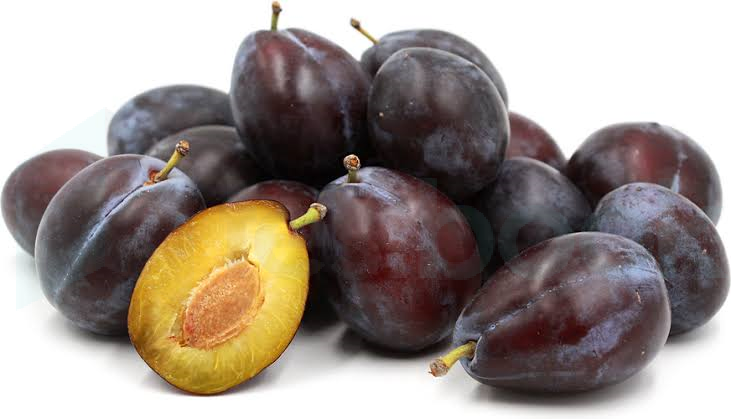
(i) A prone is a dried plum.

(ii) He was lying prone on the floor.

(iii) People who eat a lot of fat are prone to heart disease.

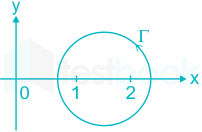
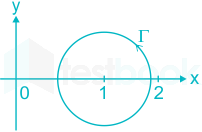
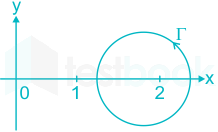
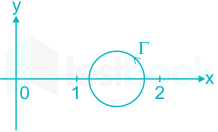
  1. ((a))

    (i) and (iii) only

  2. ((b))

    (iii) only

  3. ((c))

    (i) and (ii) only

  4. ((d))

    (ii) and (iii) only

Show Answer
Answer: ((d))

(ii) and (iii) only

The word ‘prone’ means to be susceptible to something or lying flat. Thus, the correct sentence in which it has been used is (II) and (III).

Prone Position:

In the first sentence, the word to be used is ‘prune’. A prune is a dried plum of any cultivar.

4

Fact: If it rains, then the field is wet.

Read the following statements:

(i) It rains

(ii) The field is not wet

(iii) The field is wet

(iv) It did not rain

Which one of the options given below is NOT logically possible, based on the given fact?

  1. ((a))

    If (iii), then (iv).

  2. ((b))

    If (i), then (iii).

  3. ((c))

    If (i), then (ii).

  4. ((d))

    If (ii), then (iv).

Show Answer
Answer: ((c))

If (i), then (ii).

Explanation:

  • Since the fact states that the field is wet when it rains, option C that states the opposite is not logically possible.
  • This is because the fact states that if it rains, the field will be wet. Therefore, if it is raining (i), then the field must be wet (iii). Option (ii), which states that the field is not wet, contradicts the given fact and is therefore not logically possible.
5

A window is made up of a square portion and an equilateral triangle portion above it. The base of the triangular portion coincides with the upper side of the square. If the perimeter of the window is 6 m, the area of the window in m2 is ___________.

  1. ((a))

    1.43

  2. ((b))

    2.06

  3. ((c))

    2.68

  4. ((d))

    2.88

Show Answer
Answer: ((b))

2.06

One side of triangle and square will be overlapped.

Let the side of triangle and square be ‘a’ m.

So the perimeter will be 5a = 6

So, a = 6/5

Area of square = a2 = (6/5)2 = 36/25 m2.

Area of equilateral triangle of side x =34a2=34×3625= \frac{{\sqrt 3 }}{4}{a^2} = \frac{{\sqrt 3 }}{4} \times \frac{{36}}{{25}} m2.

So area of window =3625×(34+1)=2.06= \frac{{36}}{{25}} \times \left( {\frac{{\sqrt 3 }}{4} + 1} \right) = 2.06 m2

6

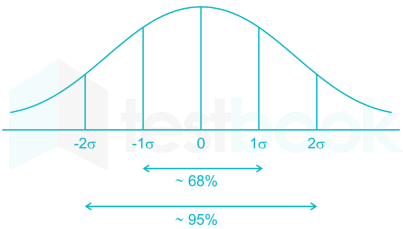
Students taking an exam are divided into two groups, P and Q such that each group has the same number of students. The performance of each of the students in a test was evaluated out of 200 marks. It was observed that the mean of group P was 105, while that of group Q was 85. The standard deviation of group P was 25, while that of group Q was 5. Assuming that the marks were distributed on a normal distribution, which of the following statements will have the highest probability of being TRUE?

  1. ((a))

    No student in group Q scored less marks than any student in group P.

  2. ((b))

    No student in group P scored less marks than any student in group Q.

  3. ((c))

    Most students of group Q scored marks in a narrower range than students in group P.

  4. ((d))

    The median of the marks of group P is 100.

Show Answer
Answer: ((c))

Most students of group Q scored marks in a narrower range than students in group P.

Standard Deviation is a measure that is used to quantify the amount of variation or dispersion of a set of data values.

For P, SD = 25 and m = 105

So the limits will be m – 2s = 55 and m + 2s = 155

For Q, SD = 5 and m = 85

So the limits will be m – 2s = 75 and m + 2s = 95

95% of students in P scores between 55 to 155.

95% of students in Q score between 75 to 95.

For Normal Distribution: Mean = Median = Mode. D is not correct.

A and B cannot be said to be true with certainty.

C is the correct answer. As the SD of Q is less than P, most students of group Q scored marks in a narrower range than students in group P.

7

A smart city integrates all modes of transport, uses clean energy and promotes the sustainable use of resources. It also uses technology to ensure the safety and security of the city, something which critics argue, will lead to a surveillance state.

Which of the following can be logically inferred from the above paragraph?

(i) All smart cities encourage the formation of surveillance states.

(ii) Surveillance is an integral part of a smart city.

(iii) Sustainability and surveillance go hand in hand in a smart city.

(iv) There is a perception that smart cities promote surveillance.

  1. ((a))

    (i) and (iv) only

  2. ((b))

    (ii) and (iii) only

  3. ((c))

    (iv) only

  4. ((d))

    (i) only

Show Answer
Answer: ((c))

(iv) only

Let us examine the inferences one by one:

  1. Smart cities use technology to ensure safety and security but that does not mean they promote surveillance. Thus this does not follow.
  2. There is no information in the passage that helps us infer whether surveillance is an integral part of the smart city. Thus this cannot be inferred.
  3. Though sustainability has been considered as an important part of the smart city, surveillance is only promoted by the technology used indirectly. Thus this cannot be inferred.
  4. The critics sometimes perceive the use of technology in smart cities as a way to surveillance. Thus this is a logical inference.
8

Find the missing sequence in the letter series.

B, FH, LNP, __________.

  1. ((a))

    SUWY

  2. ((b))

    TUVW

  3. ((c))

    TVXZ

  4. ((d))

    TWXZ

Show Answer
Answer: ((c))

TVXZ

The series formed is as follows,

Thus the next term is TVXZ.

9

The binary operation □ is defined as a □ b = ab + (a + b), where a and b are any two real numbers. The value of the identity element of this operation, defined as the number x such that a □ x = a, for any a, is_______.

  1. ((a))

    0

  2. ((b))

    1

  3. ((c))

    2

  4. ((d))

    10

Show Answer
Answer: ((a))

0

Explanation:

The given binary operation is a □ b = ab + (a + b)

⇒ a □ x = ax + (a + x), 

For value of identity, a □ x = a

⇒ a = ax + (a + x)

⇒ x (1 + a) = 0

⇒ x = 0 is the identity element.

10

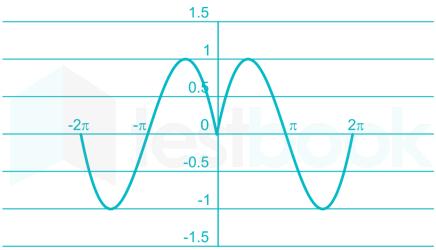
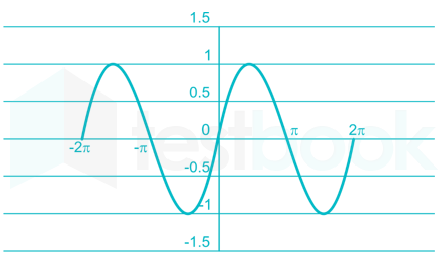
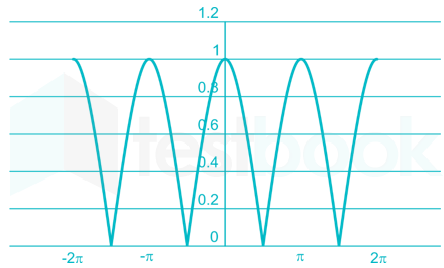
Which of the following curves represents the function y=ln(e[sin(x)])forx<2π?y = \ln\left( {\left| {{e^{\left[ {\left| {\sin \left( {\left| x \right|} \right)} \right|} \right]}}} \right|} \right)for\left| x \right| < 2\pi ?

Here, x represents the abscissa and y represents the ordinate.

  1. ((a))

  2. ((b))

  3. ((c))

  4. ((d))

Show Answer
Answer: ((c))

Here we check for the values of y by putting x as 0, π/2, π.

sin(0) = 0, sin(π/2) = 1, sin(π) = 0

So respective values of y will be,

We get, ln(e0) = y = 0 and ln(e1) = y = 1 and so on.

f(0) = 0, f(π/2) = 1, f(π) = 0, f2π) = 0

So the answer is C.

Mechanical Engineering (55 questions)

11

The condition for which the eigenvalues of the matrix \(A = \left[ {\begin{array}{*{20}{c}} 2&1\ 1&k \end{array}} \right]\) are positive, is

  1. ((a))

    k > 1/2

  2. ((b))

    k > -2

  3. ((c))

    k > 0

  4. ((d))

    k < -1/2

Show Answer
Answer: ((a))

k > 1/2

\(A = \left[ {\begin{array}{*{20}{c}} 2&1\ 1&k \end{array}} \right]\)

Let λ1 and λ2 be the Eigen value of matrix A

|A| = λ1λ2

|A| = 2k -1

∵ λ1 and λ2 are positive i.e., λ1 λ2 > 0

(2k - 1) > 0; ∴ k > 1/2

Note:- Product of the Eigen values of any matrix gives determinant of that matrix.

12

The values of x for which the function

f(x)=x23x4x2+3x4f\left( x \right) = \frac{{{x^2} - 3x - 4}}{{{x^2} + 3x - 4}}

is NOT continuous are

  1. ((a))

    4 and -1

  2. ((b))

    4 and 1

  3. ((c))

    -4 and 1

  4. ((d))

    -4 and -1

Show Answer
Answer: ((c))

-4 and 1

Concept:

A function f(x) is continuous at x = a, if the function is defined at x = a and,

Left limit = Right limit = Function value = Real and finite

A function is said to be differentiable at x =a if,

Left derivative = Right derivative = Well defined

Analysis:

f(x)=x23x4x2+3x4f\left( x \right) = \frac{{{x^2} - 3x - 4}}{{{x^2} + 3x - 4}}

This function is not defined for:

x2 + 3x – 4 = 0

⇒ (x + 4)(x - 1) = 0 i.e.

At x = 1 and x = - 4

∴ This function f(x) is not continuous at x = 1, -4

13

Laplace transform of cos(ωt) is

  1. ((a))

    ss2+ω2\frac{s}{{{s^2} + {\omega ^2}}}

  2. ((b))

    ωs2+ω2\frac{\omega }{{{s^2} + {\omega ^2}}}

  3. ((c))

    ss2ω2\frac{s}{{{s^2} - {\omega ^2}}}

  4. ((d))

    ωs2ω2\frac{\omega }{{{s^2} - {\omega ^2}}}

Show Answer
Answer: ((a))

ss2+ω2\frac{s}{{{s^2} + {\omega ^2}}}

Concept:

Some important Laplace transforms are:

L(tn)=n!sn+1L\left( {{t^n}} \right) = \frac{{n!}}{{{s^{n + 1}}}}

L(tn)=n!sn+1L\left( {{t^n}} \right) = \frac{{n!}}{{{s^{n + 1}}}}

L(tneat)=n!(sa)n+1L\left( {{t^n}{e^{at}}} \right) = \frac{{n!}}{{{{\left( {s - a} \right)}^{n + 1}}}}

\(L\left{ {\cos \omega t} \right} = \frac{s}{{{s^2} + {\omega ^2}}}\)

\(L\left{ {\sin \left( {{\omega }t} \right)} \right} = \frac{\omega }{{{s^2} + {{\omega}^2}}}\)

14

A function f of the complex variable z = x + i y, is given as f(x, y) = u(x, y) + i v(x, y), where u(x, y) = 2kxy and v(x, y) = x2 – y2. The value of k, for which the function is analytic is _____

15

Numerical integration using trapezoidal rule gives the best result for a single variable function, which is

  1. ((a))

    linear

  2. ((b))

    parabolic

  3. ((c))

    logarithmic

  4. ((d))

    hyperbolic

Show Answer
Answer: ((a))

linear

Explanation:

Trapezoidal rule

It integrates a linear function exactly and produces errors for polynomial functions of degree 2 or higher.

\(\mathop \smallint \limits_{{x_0}}^{{x_0} + nh} f\left( x \right)dx = \frac{h}{2}\left[ {\left( {{y_0} + {y_n}} \right) + 2\left( {{y_1} + {y_2} + - - - - {y_{n - 1}}} \right)} \right]\)

Here, the interval is divided into 'n' number of intervals (even or odd) of equal width 'h'

Simpson's rule

It produces exact integrals up to cubic polynomials. Errors in Simpson's estimates arise from the term of degree 4 or higher.

Simpson’s one-third rule

\(\mathop \smallint \limits_{{x_0}}^{{x_0} + nh} f\left( x \right)dx = \frac{h}{3}\left[ {\left( {{y_0} + {y_n}} \right) + 4\left( {{y_1} + {y_3} + - - - - {y_{n - 1}}} \right)} \right] + 2\left( {{y_2} + {y_4} + - - - - {y_{n - 2}}} \right)\)

the given interval must be divided into an even number of equal subintervals.

Simpson’s three-eight rule:

\(\mathop \smallint \limits_{{x_0}}^{{x_0} + nh} f\left( x \right)dx = \frac{{3h}}{8}\left[ {\left( {{y_0} + {y_n}} \right) + 3\left( {{y_1} + {y_2} + {y_4} + {y_5} \pm - - - {y_{n - 1}}} \right)} \right] + 2\left[ {{y_3} + {y_6} + ; - - - - {y_{n - 3}}} \right)]\)

Here, the number of subintervals should be taken as a multiple of 3.

16

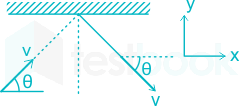
A point mass having mass M is moving with a velocity V at an angle θ to the wall as shown in the figure. The mass undergoes a perfectly elastic collision with the smooth wall and rebounds. The total change (final minus initial) in the momentum of the mass is

  1. ((a))

    -2MV cos θ ĵ

  2. ((b))

    2MV sin θ ĵ

  3. ((c))

    2MV cos θ ĵ

  4. ((d))

    -2MV sin θ ĵ

Show Answer
Answer: ((d))

-2MV sin θ ĵ

Concept:

In an elastic collision with a smooth wall the angle of incidence equals the angle of reflection. The magnitude of velocity equal before and after the collision

Calculation:

Vi=Vcosθ;i^+Vsinθ;j^\vec V_i = V\cos \theta ;\hat i + V\sin \theta ; \hat j

Vf=Vcosθ;i^Vsinθ;j^\overrightarrow {{V_f}} = V\cos \theta ;\hat i - V\sin \theta ;\hat j

Change in momentum = M(VfVi)M\left( {\overrightarrow {{V_f}} - \overrightarrow {{V_i}}} \right)

M(VfVi)=M(2;Vsinθ;j^)M\left( {\overrightarrow {{V_f}} - \overrightarrow {{V_i}}} \right) =M(- 2;V\sin \theta ;\hat j)

ΔP=2MVsinθ;j^\Delta P=-2MV\sin \theta ;\hat j

17

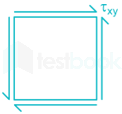
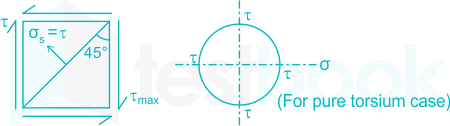
A shaft with a circular cross-section is subjected to pure twisting moment. The ratio of the maximum shear stress to the largest principal stress is

  1. ((a))

    2.0

  2. ((b))

    1.0

  3. ((c))

    0.5

  4. ((d))

    0

Show Answer
Answer: ((b))

1.0

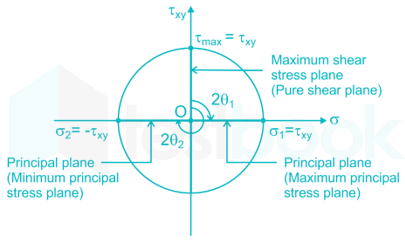
Concept:

Calculation:

For the case of pure torsion, we can see from the above diagram that the largest principal stress is equal to maximum shear stress.

σ1 = σmax = τ, σ2 = σmin = -τ, τmax = τ

The ratio of the maximum shear stress to the largest principal stress i.e. τmax/σmax = 1

18

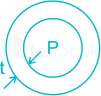
A thin cylindrical pressure vessel with closed-ends is subjected to internal pressure. The ratio of circumferential (hoop) stress to the longitudinal stress is

  1. ((a))

    0.25

  2. ((b))

    0.50

  3. ((c))

    1.0

  4. ((d))

    2.0

Show Answer
Answer: ((d))

2.0

Concept

For thin cylindrical vessel:

Hoop stress, σh=pd2t{\sigma _h} = \frac{{pd}}{{2t}}

Longitudinal stress, σL=pd4t{\sigma _L} = \frac{{pd}}{{4t}}

Calculation:

Given:

The ratio of circumferential (hoop) stress to the longitudinal stress is:

σhσL=2;\frac{{{\sigma _h}}}{{{\sigma _L }}} = 2;

19

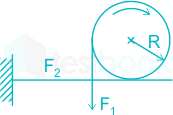
The forces F1 and F2 in a brake band and the direction of rotation of the drum are as shown in the figure. The coefficient of friction is 0.25. The angle of wrap is 3π/2 radians. It is given that R = 1 m and F2 = 1 N. The torque (in N-m) exerted on the drum is ______

20

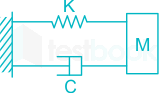
A single degree of freedom mass-spring-viscous damper system with mass m, spring constant k and viscous damping coefficient q is critically damped. The correct relation among m, k, and q is

  1. ((a))

    q=2;k;m;q = \sqrt {2;k;m} ;

  2. ((b))

    q=2k;mq = 2\sqrt {k;m}

  3. ((c))

    q=2;kmq = \sqrt {\frac{{2;k}}{m}}

  4. ((d))

    q=2kmq = 2\sqrt {\frac{k}{m}}

Show Answer
Answer: ((b))

q=2k;mq = 2\sqrt {k;m}

Critical damping constant q=2kmq = 2\sqrt {km}

Concept:

Damping ratio for a single degree of freedom spring-mass system is

ξ=c2mkξ= \frac{c}{2\sqrt{mk}}

For critical damping ξ = 1

For over damped ξ > 1

For underdamped ξ < 1

As in the question ξ is denoted as q and it is a case of the critically damped system so ξ = 1 and the answer will be q=2k;mq = 2\sqrt {k;m}

21

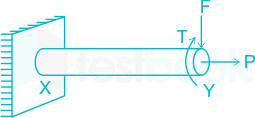
A machine element XY, fixed at end X, is subjected to an axial load P, transverse load F, and a twisting moment T at its free end Y. The most critical point from the strength point of view is

  1. ((a))

    a point on the circumference at location Y

  2. ((b))

    a point at the center at location Y

  3. ((c))

    a point on the circumference at location X

  4. ((d))

    a point at the center at location X

Show Answer
Answer: ((c))

a point on the circumference at location X

Bending Equation:

\({\frac{M}{I} = \frac{{{σ _b}}}{y} \Rightarrow {σ _b} = \frac{M}{I}y = \frac{{32M}}{{\pi {d^3}}} \Rightarrow {σ {\max }} = \frac{{32{M{\max }}}}{{\pi {d^3}}}}\)

The bending moment will be maximum at the fixed end i.e. X so Bending stress will be maximum at X.

Torsion Equation:

TJ=τrτ=TJr=16Tπd3\frac{T}{J} = \frac{\tau }{r} \Rightarrow \tau = \frac{T}{J}r = \frac{{16T}}{{\pi {d^3}}}

At center bending stress and Torsion shear stress are zero.

Because Bending stress and Torsion shear stress directly depends on the radial distance from the centroidal axis. So it will be maximum at the circumference.

Stress due to tensile load P i.e. σ = P/A is constant throughout.

Hence critical section will be at a point on the circumference at location X.

22

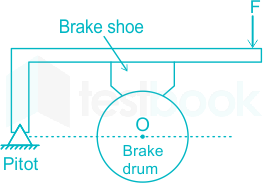
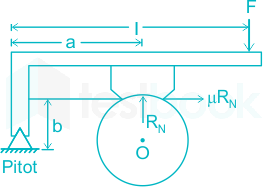
For the brake shown in the figure, which one of the following is TRUE?

  1. ((a))

    Self energizing for clockwise rotation of the drum

  2. ((b))

    Self energizing for anti-clockwise rotation of the drum

  3. ((c))

    Self energizing for rotation in either direction of the drum

  4. ((d))

    Not of the self energizing type

Show Answer
Answer: ((a))

Self energizing for clockwise rotation of the drum

Concept:

When the frictional force helps the applied force in applying the brake, such type of brakes are said to be self-energizing brakes.

Self-energizing brake is the one in which torque due to Fr supports torque due to F.

Calculation:

Given:

The torque due to F is clockwise. The torque due to Fr = μRN is clockwise. So, it is a self-energizing brake.

Let consider clockwise rotation

∑Mpivot = 0

F × ℓ - RN × a + μ RN × b = 0

When the wheel rotates in a clockwise direction we can see that friction is helping the applied force in applying the brake. Hence it is called a self-energizing brake.

23

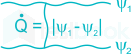
The volumetric flow rate (per unit depth) between two streamlines having stream functions ψ1 and ψ2 is

  1. ((a))

    1 + ψ2|

  2. ((b))

    ψ1ψ2

  3. ((c))

    ψ12

  4. ((d))

    1 – ψ2|

Show Answer
Answer: ((d))

1 – ψ2|

Explanation:

Streamline

  • It is an imaginary line or curve drawn in space such that the tangent drawn at any point to it will give the direction of velocity.
  • As there is no component of velocity in the perpendicular direction, therefore there is no flow across the streamline i.e. there is always flow occurs along the streamline.

Equation of streamline

If the velocity vector is given as:

V=ui^+vj^+wk^\vec V = u\hat i + v\hat j + w\hat k

Then the equation of streamline is given by:

dxu=dyv=dzw\frac{{dx}}{u} = \frac{{dy}}{v} = \frac{{dz}}{w}

The volume flow rate (per unit depth) between two stream line having stream function ψ1 & ψ2 is |ψ1 – ψ2|

24

Assuming constant temperature condition and air to be an ideal gas, the variation in atmospheric pressure with height calculated from fluid statics is

  1. ((a))

    linear

  2. ((b))

    exponential

  3. ((c))

    quadratic

  4. ((d))

    cubic

Show Answer
Answer: ((b))

exponential

Explanation:

From hydrostatic law:

Rate of increase of pressure in a vertical direction equal to the weight density of the fluid at that point.

px=ρg\frac{{\partial p}}{{\partial x}} = - ρ g    ....eq (1)

For a compressible fluid, density (ρ) changes with the change of pressure and temperature. Thus, eq (1) cannot be integrated directly.

∵ Air is an ideal gas so,

ρ = p/RT (∵ PV = mRT)

dpdx=pRTgdpp=gRT;dx \Rightarrow \frac{{dp}}{{dx}} = -\frac{p}{{RT}}g \Rightarrow \frac{{dp}}{p} = -\frac{g}{{RT}};dx

dpp=gRTdxln;p=ghRT; \Rightarrow \smallint \frac{{dp}}{p} = \smallint \frac{g}{{RT}}dx \Rightarrow \ln;p = - \frac{{gh}}{{RT}};

∴ p = e-gh/RT i.e. the atmospheric pressure varies exponentially with height.

25

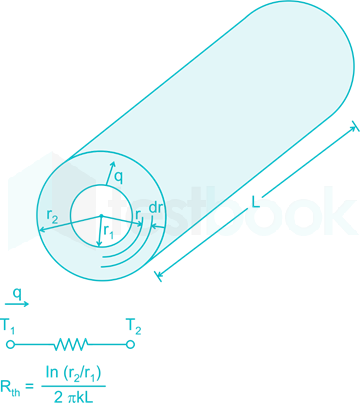
A hollow cylinder has length L, inner radius r1, outer radius r2, and thermal conductivity k. The thermal resistance of the cylinder for radius conduction is

  1. ((a))

    ln;(r2/r1)2πkL\frac{{\ln;\left( {{r_2}/r_1} \right)}}{{2\pi kL}}

  2. ((b))

    ln;(r1/r2)2πkL\frac{{\ln;\left( {{r_1}/{r_2}} \right)}}{{2\pi kL}}

  3. ((c))

    2πkLln;(r2/r1)\frac{{2\pi kL}}{{\ln;\left( {{r_2}/{r_1}} \right)}}

  4. ((d))

    2πkLln;(r1/r2)\frac{{2\pi kL}}{{\ln;\left( {{r_1}/{r_2}} \right)}}

Show Answer
Answer: ((a))

ln;(r2/r1)2πkL\frac{{\ln;\left( {{r_2}/r_1} \right)}}{{2\pi kL}}

Concept:

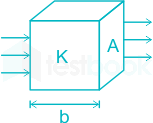
A general expression for thermal resistance in the slab of width b, Thermal conductivity k and cross-sectional area through which heat is passed in A is

Rth=bkA{R_{th}} = \frac{b}{{kA}}

Q=2πKL(T1T2)ln(r2r1)Q = \frac{{2\pi KL\left( {{T_1} - {T_2}} \right)}}{{\ln \left( {\frac{r_2}{{{r_1}}}} \right)}}

Q=(T1T2)RthQ=\frac{\left( {{T_1} - {T_2}} \right)}{R_{th}}

Heat conduction through the plane wallQ=T1T2LkAQ = \frac{{{T_1} - {T_2}}}{{\frac{L}{{kA}}}}
Heat conduction through a hollow cylinderQ=T1T2ln(rori)2πkLQ = \frac{{{T_1} - {T_2}}}{{\frac{{\ln \left( {\frac{{{r_o}}}{{{r_i}}}} \right)}}{{2\pi kL}}}}
Heat conduction through the hollow sphereQ=T1T2rori4πkroriQ = \frac{{{T_1} - {T_2}}}{{\frac{{{r_o} - {r_i}}}{{4\pi k{r_o}{r_i}}}}}
26

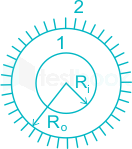
Consider the radiation heat exchange inside an annulus between two very long concentric cylinders. The radius of the outer cylinder is R0 and that of the inner cylinder is Ri. The radiation view factor of the outer cylinder onto itself is

  1. ((a))

    1RiR01 - \sqrt {\frac{{{R_i}}}{{{R_0}}}}

  2. ((b))

    1RiR0\sqrt {1 - \frac{{{R_i}}}{{{R_0}}}}

  3. ((c))

    1(RiR0)1/31 - {\left( {\frac{{{R_i}}}{{{R_0}}}} \right)^{1/3}}

  4. ((d))

    1RiR01 - \frac{{{R_i}}}{{{R_0}}}

Show Answer
Answer: ((d))

1RiR01 - \frac{{{R_i}}}{{{R_0}}}

Concept:

View Factor F 1-2  means the fraction of radiation leaving the surface 1 and striking the surface 2.

Following points are important about View Factor

  • Summation rule if a body is exchanging radiation by n surfaces by

          F11 +F12 + ------ F1n= 1

  • Reciprocity theorem A1 F12 = A2 F21​

Calculation:

Given:

F11 = 0, F12 = 1

A1F12=A2F21F21=2πRiL2πR0L×1=RiR0{A_1}{F_{12}} = {A_2}{F_{21}} \Rightarrow {F_{21}} = \frac{{2\pi {R_i}L}}{{2\pi {R_0}L}} \times 1 = \frac{{{R_i}}}{{{R_0}}}

F21+F22=1F22=1RiR0\because{F_{21}} + {F_{22}} = 1 \Rightarrow {F_{22}} = 1 - \frac{{{R_i}}}{{{R_0}}}

27

The internal energy of an ideal gas is a function of

  1. ((a))

    temperature and pressure

  2. ((b))

    volume and pressure

  3. ((c))

    entropy and pressure

  4. ((d))

    temperature only

Show Answer
Answer: ((d))

temperature only

Explanation:

The enthalpy and internal energy of an ideal gas is a function of temperature only.

H = H (T), U = U(T)

Important Points

dh = CpdT, so specific enthalpy is a function of temperature only.

The ideal gas is defined as a gas that obeys the following equation of state:

Pv = RT

The internal energy of an ideal gas is a function of temperature only. That is, u = u(T)

Using the definition of enthalpy and the equation of state of an ideal gas, h = u + Pv = u + RT

Since R is a constant and u = u(T), it follows that the enthalpy of an ideal gas is also a function of temperature only.

h = h(T)

For all ideal gases:

  • The specific heat at constant volume (cv) is a function of T only.
  • The specific heat at constant pressure (cp) is a function of T only.
  • A relation that connects the specific heats cp, cv , and the gas constant is cp - cv = R
  • The specific heat ratio, γ = cp/cv, is a function of T only and is greater than unity.
28

The heat removal rate from a refrigerated space and the power input to the compressor are 7.2 kW and 1.8 kW, respectively. The coefficient of performance (COP) of the refrigerator is _____

29

Consider a simple gas turbine (Brayton) cycle and a gas turbine cycle with perfect regeneration. In both the cycles, the pressure ratio is 6 and the ratio of the specific heats of the working medium is 1.4. The ratio of minimum to maximum temperatures is 0.3 (with temperatures expressed in K) in the regenerative cycle. The ratio of the thermal efficiency of the simple cycle to that of the regenerative cycle is _______

30

In a single-channel queuing model, the customer arrival rate is 12 per hour and the serving rate is 24 per hour. The expected time that a customer is in queue is ______minutes.

31

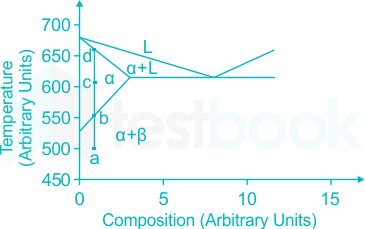
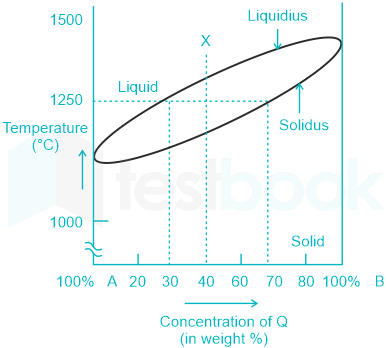
In the phase diagram shown in the figure, four samples of the same composition are heated to temperatures marked by a, b, c and d.

At which temperature will a sample get solutionized the fastest?

  1. ((a))

    a

  2. ((b))

    b

  3. ((c))

    c

  4. ((d))

    d

Show Answer
Answer: ((c))

c

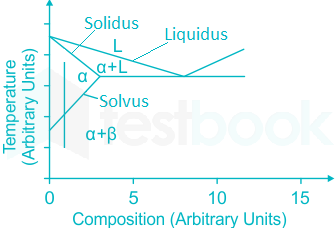
Solutionizing (solution heat treatment), where the alloy is heated to a temperature between solvus i.e.(the line between α and α + β) and solidus i.e. (line between α and α + L) temperatures and kept there till a uniform solid-solution structure is produced.

Hence solutionized sample at the fastest speed will get at point c.

32

The welding process which uses a blanket of fusible granular flux is

  1. ((a))

    tungsten inert gas welding

  2. ((b))

    submerged arc welding

  3. ((c))

    electroslag welding

  4. ((d))

    thermit welding

Show Answer
Answer: ((b))

submerged arc welding

Explanation:

Submerged arc welding: In submerged arc welding the arc is completely submerged into the granular flux powder and forming a blanket.

Tungsten inert gas welding: In this type of welding non-consumable tungsten electrode will be used to generate the arc. A gas shield is provided around the welding.

Electro slag Welding: Welding is started by generating the electric arc and completed by resistance heating effect of slag material and if shielding gas is provided it is called as Electro Gas Welding.

Thermit Welding: Thermit is a mixture of aluminium powder and metal oxide. Aluminium combines with oxygen and intense heat will be released. It is used for repair of railway track.

33

The value of true strain produced in compressing a cylinder to half its original length is

  1. ((a))

    0.69

  2. ((b))

    -0.69

  3. ((c))

    0.5

  4. ((d))

    -0.5

Show Answer
Answer: ((b))

-0.69

Concept:

Engg.Strain(ϵe)=ΔLLi=LfLiLiEngg.Strain\left( ϵ _e \right) = \frac{{{\bf{\Delta L}}}}{{{L_i}}} = \frac{{{L_f} - {L_i}}}{{{L_i}}}

True strain: ∈T = In (1 + ϵe) 

Calculation:

Given: L2 = L1/2

ϵe=(L2L1)L1=0.5L1L1=0.5\epsilon_e= \frac{{\left( {{L_2} - L_1} \right)}}{L_1} = - \frac{{0.5L_1}}{L_1} = - 0.5

True strain

T = In (1 + ϵe) = In (1 – 0.5) = - 0.69

34

The following data is applicable for a turning operation. The length of job is 900 mm, diameter of job is 200 mm, feed rate is 0.25 mm/rev and optimum cutting speed is 300 m/min. The machining time (in min) is ______

35

In an ultrasonic machining (USM) process, the material removal rate (MRR) is plotted as a function of the feed force of the USM tool. With increasing feed force, the MRR exhibit the following behaviour:

  1. ((a))

    increases linearly

  2. ((b))

    decreases linearly

  3. ((c))

    does not change

  4. ((d))

    first increases and then decreases

Show Answer
Answer: ((d))

first increases and then decreases

Explanation:

Ultrasonic machining (USM):

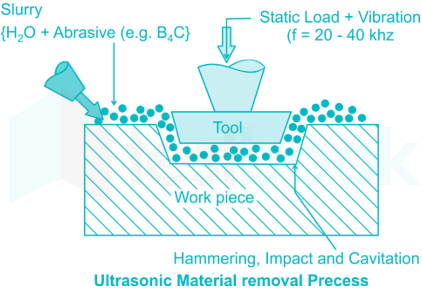
  • Ultrasonic machining is an operation that involves a vibrating tool fluctuating at the ultrasonic frequencies to remove the material from the workpiece.
  • The process involves an abrasive slurry that runs between the tool and the workpiece.
  • It is typically used on brittle materials as well as materials with a high hardness due to microcracking mechanics.

  • In ultrasonic machining, a tool of the desired shape vibrates at an ultrasonic frequency (19 ∼ 25 kHz) with an amplitude of around 15 – 50 μm over the workpiece.
  • Generally, the tool is pressed downward with a feed force, F.
  • Between the tool and workpiece, the machining zone is flooded with hard abrasive particles generally in the form of a water-based slurry.
  • As the tool vibrates over the workpiece, the abrasive particles act as the indenters and indent both the work material and the tool.
  • The abrasive particles, as they indent the work material, would remove the work material, particularly if the work material is brittle (due to crack initiation, propagation and brittle fracture of the material).

USM MRR vs Feed Force:

  • With an increase in the frequency of the tool head, the MRR should increase proportionally. However, there is a slight variation in the MRR with frequency.
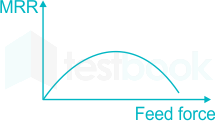
  • MRR increases with increasing feed force but after a certain critical feed force, it decreases because the abrasive grains get crushed under heavy load.
  • With increases in feed force, the material removal rate MRR is first increases and then decreases.

36

A scalar potential φ has the following gradient: ∇ϕ = yz î + xz ĵ + xy k̂. Consider the integral

\(\mathop \smallint \nolimits_c^{} ∇ \varphi .d⃗ r\) on the curve r=xi^+yj^+zk^\vec r = x \hat i + y \hat j + z \hat k 

The curve C is parameterized as follows:\(\left{ {\begin{array}{*{20}{c}} {x = t}\ {y = {t^2}}\ {z = 3{t^2}} \end{array}and;1 \le t \le 3.} \right.\)

The value of the integral is __________.

37

The value of Γ3z5(z1)(z2)dz\mathop \oint \nolimits_{\rm{{\rm Γ}}}^{} \frac{{3z - 5}}{{\left( {z - 1} \right)\left( {z - 2} \right)}}dz along a closed path Γ is equal to (4 π i), where z = x + iy and  i=√-1. The correct path Γ is

  1. ((a))

  2. ((b))

  3. ((c))

  4. ((d))

Show Answer
Answer: ((b))

Concept:

Cauchy’s Integral Formula  - If f(z) is analytic within and on the closed curve C and if zo is any point inside C then

cf(z)zzo=2πif(zo)\oint_c \frac{{f\left( z \right)}}{{z - z_o}} = 2\pi i f(z_o)

f(zo)=12πicf(z)zzof(z_o)=\frac{1}{2\pi i}\oint _c \frac{{f\left( z \right)}}{{z - z_o}}

Cauchy’s Residue Theorem – If f(z) is analytic in a closed curve C except at a finite number of singular point lies inside C then,

\(\mathop \smallint \nolimits_c^{} f\left( z \right)dz = 2\pi i \times ({\rm{sum}},{\rm{of}},{\rm{the}},{\rm{residues ~at}},{\rm{the}},{\rm{singular}},{\rm{points}},{\rm{within}},{\rm{C}})\)

If f(z) has a simple pole at z = a then,

Resf(a)=Ltza[(za)f(z)]{\mathop{\rm Re}\nolimits} s{\rm{ }}f(a){\rm{ = }}\mathop {{\rm{Lt}}}\limits_{z \to a} [(z - a)f(z)]

Calculation:

Γ3z5(z1)(z2)dz=4πi\mathop \oint \nolimits_{\rm{{\rm Γ}}}^{} \frac{{3z - 5}}{{\left( {z - 1} \right)\left( {z - 2} \right)}}dz=4\pi i

13z5(Z1)(Z2)dz=4πi=2πi(2)\mathop \oint \nolimits_1^{} \frac{{3z - 5}}{{\left( {Z - 1} \right)\left( {Z - 2} \right)}}dz = 4\pi i = 2\pi i\left( 2 \right)

∴ Sum of residue must be equal to 2

Res;f(z)z=1=limz1(z1)(3z5)(z1)(z2)=limz1(3z5)(z2)=2;\mathop {{\rm{Res;f}}\left( {\rm{z}} \right)}\limits_{z = 1} = \mathop {\lim }\limits_{z \to 1} \left( {z - 1} \right)\frac{{\left( {3z - 5} \right)}}{{\left( {z - 1} \right)\left( {z - 2} \right)}} =\mathop {\lim }\limits_{z \to 1} \frac{{\left( {3z - 5} \right)}}{{\left( {z - 2} \right)}}= 2;

Res;f(z)z=2=limz2(z2)(3z5)(z1)(z2)=limz2(3z5)(z1)=1\mathop {{\rm{Res;f}}\left( {\rm{z}} \right)}\limits_{z = 2} = \mathop {\lim }\limits_{z \to 2} \left( {z - 2} \right)\frac{{\left( {3z - 5} \right)}}{{\left( {z - 1} \right)\left( {z - 2} \right)}} = \mathop {\lim }\limits_{z \to 2} \frac{{\left( {3z - 5} \right)}}{{\left( {z - 1} \right)}} = 1

13z5(Z1)(Z2)dz=4πi=2πi(2)=2πi(Res f(1))\mathop \oint \nolimits_1^{} \frac{{3z - 5}}{{\left( {Z - 1} \right)\left( {Z - 2} \right)}}dz = 4\pi i = 2\pi i\left( 2 \right)=2\pi i\left( Res ~f(1) \right)

∴ Z = 1 must lies inside C, Z = 2 lies outside C.

38

The probability that a screw manufactured by a company is defective is 0.1 The company sells screws in packets containing 5 screws and gives a guarantee of replacement if one or more screws in the packet are found to be defective. The probability that a packet would have to be replaced is _____

39

The error in numerically computing the integral  \(\mathop \smallint \nolimits_0^{\pi ;} \left( {\sin x + \cos x} \right)dx\) using the trapezoidal rule with three intervals of equal length between 0 and π is _______

40

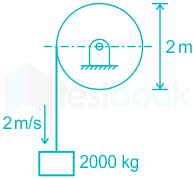
A mass of 2000 kg is currently being lowered at a velocity of 2 m/s from the drum as shown in the figure. The mass moment of inertia of the drum is 150 kg-m2. On applying the brake, the mass is brought to rest in a distance of 0.5 m. The energy absorbed by the brake (in kJ) is _____

41

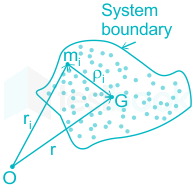
A system of particles in motion has mass center G as shown in the figure. The particle i has mass mi and its position with respect to a fixed point O is given by the position vector ri. The position of the particle with respect to G is given by the vector ρi. The time rate of change of the angular momentum of the system of particles about G is

(The quantity ρ¨i{\ddot \rho _i} indicates the second derivative of ρi with respect to time and likewise for ri)

  1. ((a))

    iri×miρ¨i\sum_i r_i\times m_i \ddot{\rho}_i

  2. ((b))

    iρi×mir¨i\sum_i \rho_i \times m_i \ddot{r}_i

  3. ((c))

    iri×mir¨i\sum_i r_i \times m_i \ddot{r}_i

  4. ((d))

    iρi×miρ¨i\sum_i \rho_i \times m_i \ddot{\rho}_i

Show Answer
Answer: ((b))

iρi×mir¨i\sum_i \rho_i \times m_i \ddot{r}_i

Angular momentum is the moment of linear momentum about given point. The moment of linear momentum is obtained by product of linear momentum & distance perpendicular from the given point. The time rate of change of angular momentum of a system gives toque.

T=dLdtT = \frac{{d\vec L}}{{dt}}

\({T i} = {\vec r{perpendicular}} \times \vec F\)

rperpendicular=ρi{r_{perpendicular}} = \rho_i

F=miai=mir¨i\vec{F}=m_i a_i = m_i \ddot{r}_i

 τi=ρi×mir¨i\therefore \ \tau_i = \rho_i \times m_i \ddot{r}_i

For complete rigid body

τi=iρi×mir¨i\sum \tau_i = \sum_i \rho_i \times m_i \ddot{r}_i

42

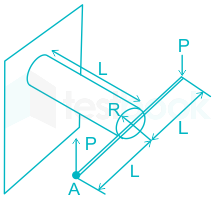
A rigid horizontal rod of length 2L is fixed to a circular cylinder of radius R as shown in the figure. Vertical forces of magnitude P are applied at the two ends as shown in the figure. The shear modulus for the cylinder is G and the Young’s modulus is E.

The vertical deflection at point A is

  1. ((a))

    PL3/(πR4G)

  2. ((b))

    PL3/(πR4E)

  3. ((c))

    2PL3/(πR4E)

  4. ((d))

    4PL3/(πR4G)

Show Answer
Answer: ((d))

4PL3/(πR4G)

Explanation:

We know that θ=TLGJ\theta = \frac{{TL}}{{GJ}}

T = P(2L) = 2PL

L = Length of circular cylinder

G = Shear Modulus of cylinder

J=π32D4=π32(2R)4=π2R4J = \frac{\pi }{{32}}{D^4} = \frac{\pi }{{32}}{\left( {2R} \right)^4} = \frac{\pi }{2}{R^4}

θ=TLGJ=2PL(L)G.π2R4=4PL2πGR4 \Rightarrow \theta = \frac{{TL}}{{GJ}} = \frac{{2PL\left( L \right)}}{{G.\frac{\pi }{2}{R^4}}} = \frac{{4P{L^2}}}{{\pi G{R^4}}}

Deflection Δ = θ.L

∴ Vertical deflection of A

ΔA=θ.L=4PL2πGR4.L=4PL3πR4G{{\bf{\Delta }}_A} = \theta .L = \frac{{4P{L^2}}}{{\pi G{R^4}}}.L = \frac{{4P{L^3}}}{{\pi {R^4}G}}

43

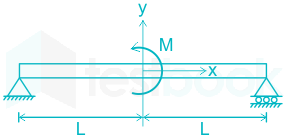
A simply supported beam of length 2L is subjected to a moment M at the mid-point x = 0 as shown in the figure. The deflection in the domain 0 ≤ x ≤ L is given by

w=Mx12EIL(Lx)(x+c)w = \frac{{ - Mx}}{{12EIL}}\left( {L - x} \right)\left( {x + c} \right)

Where E is Young’s modulus, I is the area moment of inertia and c is a constant (to be determined).

The slope at the centre x = 0 is

  1. ((a))

    ML/(2EI)

  2. ((b))

    ML/(3EI)

  3. ((c))

    ML/(6EI)

  4. ((d))

    ML/(12EI)

Show Answer
Answer: ((c))

ML/(6EI)

Given equation of deflection:

w=Mx12EIL(Lx)(x+c)w = - \frac{{Mx}}{{12EIL}}\left( {L - x} \right)\left( {x + c} \right)

=Mx12EIL[Lx+Lcx2cx] = - \frac{{Mx}}{{12EIL}}\left[ {Lx + Lc - {x^2} - cx} \right]

w=;M12EIL[Lx2+Lcxx3cx2]w = ; - \frac{{M}}{{12EIL}}\left[ {L{x^2} + Lcx - {x^3} - c{x^2}} \right]

dwdx=;M12EIL[2Lx+Lc3x22cx]\frac{{dw}}{{dx}} = ; - \frac{{M}}{{12EIL}}\left[ {2Lx + Lc - 3{x^2} - 2cx} \right]

d2wdx2=M12EIL[2L6x2c];\frac{{{d^2}w}}{{d{x^2}}} = - \frac{M}{{12EIL}}\left[ {2L - 6x - 2c} \right];

EId2wdx2=M12L[2L6x2c] \Rightarrow EI\frac{{{d^2}w}}{{d{x^2}}} = - \frac{M}{{12L}}\left[ {2L - 6x - 2c} \right]

As we know:

EId2wdx2=Mx \Rightarrow EI\frac{{{d^2}w}}{{d{x^2}}} = - M_x

Boundary condition

X = L, Mx = 0

M12L[2L6L2c]=0- \frac{M}{{12L}}\left[ {2L - 6L - 2c} \right]=0

∴ c = -2L

Slope,dwdx=M12EIL[2Lx3x2+Lc2cx]\therefore Slope, \frac{{dw}}{{dx}} = - \frac{M}{{12EIL}}\left[ {2Lx - 3{x^2} + Lc - 2{cx}} \right]

Put x = 0 & c = -2L

dwdxx0=ML6EI{\left| {\frac{{dw}}{{dx}}} \right|_{x - 0}} = \frac{{ML}}{{6EI}}

Points to remember:

  • Slope;θ=dwdx.;Slope;\theta = \frac{{dw}}{{dx}}.; Where w is deflection
  • Boundary Moment. M=EId2wdx2M = EI\frac{{{d^2}w}}{{d{x^2}}}
44

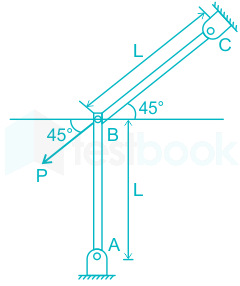
In the figure, the load P = 1 N, length L = 1 m, Young’s modulus E = 70 GPa, and the cross-section of the links is a square with dimension 10 mm × 10 mm. All joints are pin joints.

The stress (in Pa) in the link AB is____________.

(Indicate compressive stress by a negative sign and tensile stress by a positive sign.)

45

A circular metallic rod of length 250 mm is placed between two rigid immovable walls as shown in the figure. The rod is in perfect contact with the wall on the left side and there is a gap of 0.2 mm between the rod and the wall on the right side. If the temperature of the rod is increased by 200° C, the magnitude of axial stress developed in the rod is _____ MPa.

Young’s modulus of the material of the rod is 200 GPa and the coefficient of thermal expansion is 10-5 per °C.

46

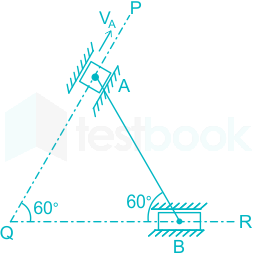
The rod AB, of length 1 m, shown in the figure is connected to two sliders at each end through pins. The sliders can slide along QP and QR. If the velocity VA of the slider at A is 2 m/s, the velocity of the midpoint of the rod at this instant is _________ m/s.

47

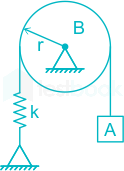
The system shown in the figure consists of block A of mass 5 kg connected to a spring through a massless rope passing over pulley B of radius r and mass 20 kg. The spring constant k is 1500 N/m. If there is no slipping of the rope over the pulley, the natural frequency of the system is ________ rad/s.

48

In a structural member under fatigue loading, the minimum and maximum stresses developed at the critical point are 50 MPa and 150 MPa, respectively. The endurance, yield, and the ultimate strengths of the material are 200 MPa, 300 MPa and 400 MPa, respectively. The factor of safety using modified Goodman criterion is

  1. ((a))

    3/2

  2. ((b))

    8/5

  3. ((c))

    12/7

  4. ((d))

    2

Show Answer
Answer: ((d))

2

Concept:

Modified Goodman line: 

The shaded region represents Modified Goodman's Criteria 
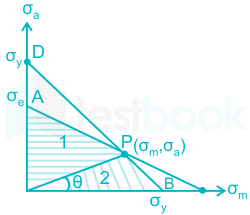
The equation for Modified Goodman line:

It depends upon the condition below, 

\(\frac{{\sigma _a^}}{{\sigma _m^}} = \frac{{{\sigma _e}({\sigma _{ut}} - {\sigma _{yt}})}}{{{\sigma _{ut}}({\sigma _{yt}} - {\sigma _e})}}\)

If, \(\frac{{{\sigma _a}}}{{{\sigma _m}}} > \frac{{\sigma _a^}}{{\sigma _m^}} \Rightarrow Line;AP;will;be;chosen;\)

If, \(\frac{{{\sigma _a}}}{{{\sigma _m}}} < \frac{{\sigma _a^}}{{\sigma _m^}} \Rightarrow Line;PB;will;be;chosen\)

Where,

σa = limiting safe stress amplitude

Se = endurance limit of the component

σm = limiting safe mean stress

Sut = ultimate tensile strength

Syt = Yield strength

FOS = Factor of safety

Calculation:

Given:

σmax = 150 N/mm2, σmin = 50 N/mm2, Se = 200 N/mm2, Sut = 400 N/mm2 and Syt = 300 N/mm2

σm=σmax;+;σmin2150;+;502=100;N/mm2{σ _m} = \frac{{{σ _{max}};+;{σ _{min}}}}{2} ⇒\frac{150;+;50}{2} = 100;N/mm^2

\({{\rm{\sigma }}{\rm{a}}} = \frac{{{{\rm{\sigma }}{{\rm{max}}}} - {{\rm{\sigma }}_{{\rm{min}}}}{\rm{;}}}}{2} = \frac{{150 - 50}}{2} = 50{\rm{;N}}/{\rm{m}}{{\rm{m}}^2}\)

Now, check the condition,

\(\frac{{\sigma _a^}}{{\sigma _m^}} = \frac{{{\sigma _e}({\sigma _{ut}} - {\sigma _{yt}})}}{{{\sigma _{ut}}({\sigma _{yt}} - {\sigma _e})}} = \frac{{200\left( {400 - 300} \right)}}{{400\left( {300 - 200} \right)}} = 0.5\)

σaσm=50100=0.5\frac{{{\sigma _a}}}{{{\sigma _m}}} = \frac{{50}}{{100}} = 0.5

\( ⇒ \frac{{{\sigma _a}}}{{{\sigma _m}}} = \frac{{\sigma _a^}}{{\sigma _m^}} = 0.5\)

⇒ So, any of the among AP and PB can be taken as the boundary for modified Goodman's Criteria

The equation for modified Goodman line for line PB,

σaσyt+σmσyt=1N\frac{{{\sigma _a}}}{{{\sigma _{yt}}}} + \frac{{{\sigma _m}}}{{{\sigma _{yt}}}} = \frac{1}{N}

50300+100300=1N\frac{{50}}{{300}} + \frac{{100}}{{300}} = \frac{1}{N}

∴ FOS = N = 2

49

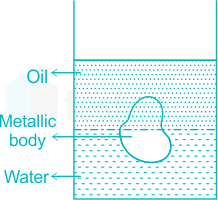
The large vessel shown in the figure contains oil and water. A body is submerged at the interface of oil and water such that 45 percent of its volume is in oil while the rest is in water. The density of the body is ___________ kg/m3.

The specific gravity of oil is 0.7 and density of water is 1000 kg/m3.

Acceleration due to gravity g = 10 m/s2.

50

Consider fluid flow between two infinite horizontal plates which are parallel (the gap between them being 50 mm). The top plate is sliding parallel to the stationary bottom plate at a speed of 3 m/s. The flow between the plates is solely due to the motion of the top plate. The force per unit area (magnitude) required to maintain the bottom plate stationary is __________ N/m2.

Viscosity of the fluid μ = 0.44 kg/m-s and density ρ = 888 kg/m3.

51

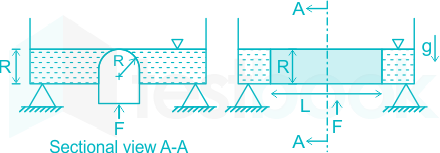
Consider a frictionless, massless and leak-proof plug blocking a rectangular hole of dimensions 2R × L at the bottom of an open tank as shown in the figure. The head of the plug has the shape of a semi-cylinder of radius R. The tank is filled with a liquid of density ρ up to the tip of the plug. The gravitational acceleration is g. Neglect the effect of the atmospheric pressure.

The force F required to hold the plug in its position is

  1. ((a))

    2ρR2gL(1π4)2\rho {R^2}gL\left( {1 - \frac{\pi }{4}} \right)

  2. ((b))

    2ρR2gL(1+π4)2\rho {R^2}gL\left( {1 + \frac{\pi }{4}} \right)

  3. ((c))

    πR2ρgL

  4. ((d))

    π2ρR2gL\frac{\pi }{2}\rho {R^2}gL

Show Answer
Answer: ((a))

2ρR2gL(1π4)2\rho {R^2}gL\left( {1 - \frac{\pi }{4}} \right)

Concept:

The force applied from the bottom should be such that it must balance the force applied due to water above the cap.

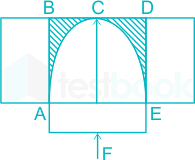
Force F here is vertical hydrostatic force

 F = ρgV

Where V = volume of fluid above the curved surface

So, F = ρgV

V = [Volume of a cuboid  – Volume of hemisphere]

V=[2R×R×LπR22×L]V = \left[ {2R \times R \times L - \frac{{\pi {R^2}}}{2} \times L} \right]

V=2R2L[1π4]V = 2{R^2}L\left[ {1 - \frac{\pi }{4}} \right]

F=ρg×2R2L[1π4]\therefore F = \rho g \times 2{R^2}L\left[ {1 - \frac{\pi }{4}} \right]

F=2ρR2gL(1π4)F = 2\rho {R^2}gL\left( {1 - \frac{\pi }{4}} \right)

52

Consider a parallel-flow heat exchanger with area Ap and a counter-flow heat exchanger with area Ac. In both the heat exchangers, the hot stream flowing at 1 kg/s cools from 80°C to 50°C. For the cold stream in both the heat exchangers, the flow rate and the inlet temperature are 2 kg/s and 10°C, respectively. The hot and cold streams in both the heat exchangers are of the same fluid. Also, both the heat exchangers have the same overall heat transfer coefficient. The ratio AC/Ap is _______
53

Two cylindrical shafts A and B at the same initial temperature are simultaneously placed in a furnace. The surfaces of the shafts remain at the furnace gas temperature at all times after they are introduced into the furnace. The temperature variation in the axial direction of the shafts can be assumed to be negligible. The data related to shafts A and B is given in the following Table.

QuantityShaft AShaft B
Diameter (m)0.40.1
Thermal conductivity (W/m-K)4020
Volumetric heat capacity (J/m3-K)2 × 1062 × 107
 

The temperature at the centreline of the shaft A reaches 400°C after two hours. The time required (in hours) for the centreline of the shaft B to attain the temperature of 400°C is ________

54

A piston-cylinder device initially contains 0.4 m3 of air (to be treated as an ideal gas) at 100 kPa and 80°C. The air is now isothermally compressed to 0.1 m3. The work done during this process is ___________ kJ.

(Take the sign convention such that work done on the system is negative)

55

A reversible cycle receives 40 kJ of heat from one heat source at a temperature of 127°C and 37 kJ from another heat source at 97°C. The heat rejected (in kJ) to the heat sink at 47°C is ________

56

A refrigerator uses R-134a as its refrigerant and operates on an ideal vapour-compression refrigeration cycle between 0.14 MPa and 0.8 MPa. If the mass flow rate of the refrigerant is 0.05 kg/s, the rate of heat rejection to the environment is _______ kW.

Given data:

At P = 0.14 MPa, h = 236.04 kJ/kg, s =0.9322 kJ/kg-K

At P = 0.8 MPa, h = 272.05 kJ/kg (superheated vapour)

At P = 0.8 MPa, h = 93.42 kJ/kg (saturated liquid)

57

The partial pressure of water vapor in a moist air sample of relative humidity 70% is 1.6 kPa, the total pressure being 101.325 kPa. Moist air may be treated as an ideal gas mixture of water vapor and dry air. The relation between saturation temperature (Ts in K) and saturation pressure (ps in kPa) for water is given by In(ps/po) = 14.317 – 5304/Ts, where po = 101.325 kPa. The dry bulb temperature of the moist air sample (in °C) is _______

58

In a binary system of A and B, a liquid of 20% A (80% B) is coexisting with a solid of 70% A (30% B). For an overall composition having 40% A, the fraction of solid is 

  1. ((a))

    0.40

  2. ((b))

    0.50

  3. ((c))

    0.60

  4. ((d))

    0.75

Show Answer
Answer: ((a))

0.40

Fraction of solid (ms)=C0CCSC=40207020=0.4({m_s}) = \frac{{{C_0} - {C_\ell }}}{{{C_S} - {C_\ell }}} = \frac{{40 - 20}}{{70 - 20}} = 0.4

Where; ms = mass fraction of solid

CO = Overall composition

C = Composition of liquid

CS = Composition of solid

Points to remember:

\({m_S} = \frac{{{C_0} - {C_\ell }}}{{{C_S} - {C_\ell }}};& ;{m_\ell } = \frac{{{C_S} - {C_0}}}{{{C_S} - {C_\ell }}}\)

59

Gray cast iron blocks of size 100 mm × 50 mm × 10 mm with a central spherical cavity of diameter 4 mm are sand cast. The shrinkage allowance for the pattern is 3%. The ratio of the volume of the pattern to volume of the casting is _______

60

The voltage – Length characteristics of a direct current arc in an arc welding process is V = (100 + 40 L), where l is the length of the arc (in mm) & and V is arc voltage in volts. During a  welding operation, the arc length varies from 1 and 2 mm and the welding current is in the range 200 - 250 A. Assuming linear power source, the short circuit current is__________ A.

61

For a certain job, the cost of metal cutting is Rs. 18C/V and the cost of tooling is Rs. 270C/(TV), where C is a constant, V is the cutting speed in m/min and T is the tool life in minutes. The Taylor’s tool life equation is VT0.25 = 150. The cutting speed (in m/min) for the minimum total cost is _______

62

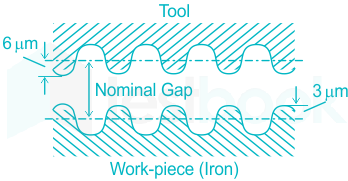
The surface irregularities of electrodes used in an electrochemical machining (ECM) process are 3μm and 6μm as shown in the figure. If the work - piece is of pure iron and 12V DC is applied between the electrodes, the largest feed rate is _______ mm/min.

Conductivity of the electrolyte0.02 ohm-1mm-1
Over-potential voltage1.5 V
Density of iron7860 kg/m3
Atomic weight of iron55.85 gm


Assume the iron to be dissolved as Fe+2 and the Faraday constant to be 96500 Coulomb.

63

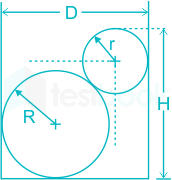
For the situation shown in the figure below the expression for H in terms of r, R and D is

  1. ((a))

    H=D+r2+R2H = D + \sqrt {{r^2} + {R^2}}

  2. ((b))

    H = (R + r) + (D + r)

  3. ((c))

    H=(R+r)+D2R2H = \left( {R + r} \right) + \sqrt {{D^2} - {R^2}}

  4. ((d))

    H=(R+r)+2D(R+r)D2H = \left( {R + r} \right) + \sqrt {2D\left( {R + r} \right) - {D^2}}

Show Answer
Answer: ((d))

H=(R+r)+2D(R+r)D2H = \left( {R + r} \right) + \sqrt {2D\left( {R + r} \right) - {D^2}}

Explanation:

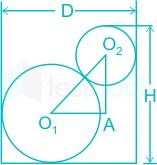
H = (R + r) + O2A

O2A=O1O22O1A2{O_2}A = \sqrt {{O_1}O_2^2 - {O_1}{A^2}}

=(R+r)2(D(R+r))2= \sqrt {{{\left( {R + r} \right)}^2} - {{\left( {D - \left( {R + r} \right)} \right)}^2}}

=R2+r2+2Rr(D2+(R+r)22D(R+r))= \sqrt {{R^2} + {r^2} + 2Rr - \left( {{D^2} + {{\left( {R + r} \right)}^2} - 2D\left( {R + r} \right)} \right)}

=2D(R+r)D2= \sqrt {2D\left( {R + r} \right) - {D^2}}

H=(R+r)+2D(R+r)D2H = \left( {R + r} \right) + \sqrt {2D\left( {R + r} \right) - {D^2}}

64

A food processing company uses 25,000 kg of corn flour every year. The quantity-discount price of corn flour is provided in the table below:

Quantity (kg)Unit price (Rs/kg)
1 – 74970
750 – 149965
1500 and above60


The order processing charges are Rs. 500/order. The handling plus carry-over charge on an annual basis is 20% of the purchase price of the corn flour per kg. The optimal order quantity (in kg) is _______

65

A project consists of 14 activities, A to N. The duration of these activities (in days) are shown in brackets on the network diagram. The latest finish time (in days) for node 10 is _______

Attempt this paper under real exam conditions

Timed interface, section switching, instant scoring, and question-by-question analytics — free.

Start Timed Attempt