Official Paper

GATE ME 2015 Official Paper: Shift 2 (Previous Year Paper)

65 questions · 180 minutes · with answers · free

General Aptitude (10 questions)

1

Choose the most appropriate word from the options given below to complete the following sentence? If the athlete had wanted to come first in the race, he ___________several hours every day.

  1. ((a))

    Should practice

  2. ((b))

    Should have practiced

  3. ((c))

    Practiced

  4. ((d))

    Should be practicing

Show Answer
Answer: ((b))

Should have practiced

The tone of the sentence is that of regret about something that happened.

In such cases, should have + past participle is the correct choice.

Hence 'should have practiced' is the correct answer.

2

Choose the most suitable one-word substitute for the following expression:

Connotation of a road or way

  1. ((a))

    Pertinacious

  2. ((b))

    Viaticum

  3. ((c))

    Clandestine

  4. ((d))

    Ravenous

Show Answer
Answer: ((b))

Viaticum

The connotations of a particular word or name are the ideas or qualities which the word makes you think of.

Hence, the connotation of a road or way can be interpreted as the ideas invoked by a road or way during a journey.

Viaticum means money or supplies for any journey. 

Viaticum and connotation both are associated with a journey.

Hence, viaticum is the most suitable one-word substitute among the given options.

3

Choose the correct verb to fill in the blank below:

Let us ______________.

  1. ((a))

    Introvert

  2. ((b))

    alternate

  3. ((c))

    atheist

  4. ((d))

    altruist

Show Answer
Answer: ((b))

alternate

Introvert, atheist and altruist are nouns whereas alternate is a verb.

WordMeaning
Introverta shy, reticent person.
Alternateto happen or exist one after the other repeatedly
Atheista person who disbelieves or lacks belief in the existence of God or gods.
Altruista person who cares about others and helps them despite not gaining anything by doing this

Thus, the correct statement would be 'Let us alternate'

Hence, alternate is the correct answer.

4

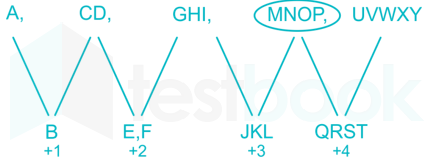
Find the missing sequence in the letter series below:

A, CD, GHI,? , UVWXY

  1. ((a))

    LMN

  2. ((b))

    MNO

  3. ((c))

    MNOP

  4. ((d))

    NOPQ

Show Answer
Answer: ((c))

MNOP

5

If x>y>1, which of the following must be true?

(i) In x > In y

(ii) ex > ey

(iii) y2 > x2

(iv) cos x > cos y

  1. ((a))

    (i) and (ii)

  2. ((b))

    (i) and (iii)

  3. ((c))

    (iii) and (iv)

  4. ((d))

    (ii) and (iv)

Show Answer
Answer: ((a))

(i) and (ii)

From the logarithmic property, 

when x > y 

ln x > ln y if x and y both greater than 1.

and x > y 

ln x < ln y, if both x and y are less than 1.

but when x > y 

ex > ey  for any value of x and y.

but when x > y, x2 > y2

 also cos x < cos y.

6

Ram and Shyam shared a secret and promised to each other that it would remain between them. Ram expressed himself in one of the following ways as given in the choices below. Identify the correct way as per standard English.

  1. ((a))

    It would remain between you and me.

  2. ((b))

    It would remain between I and you

  3. ((c))

    It would remain between you and I

  4. ((d))

    It would remain with me.

Show Answer
Answer: ((a))

It would remain between you and me.

Between is a preposition.

In English, a preposition must be followed by an indirect object pronoun. 

Me is an indirect object pronoun, while I is a subject pronoun. 

Therefore, between has to be followed by me, not I.

Hence, 'It would remain between you and me' is the correct answer.

7

In the following question, the first and the last sentence of the passage are in order and numbered 1 and 6. The rest of the passage is split into 4 parts and numbered as 2,3,4, and 5. These 4 parts are not arranged in proper order. Read the sentences and arrange them in a logical sequence to make a passage and choose the correct sequence from the given options.

  1. One Diwali, the family rises early in the morning.
  2. The whole family, including the young and the old enjoy doing this,
  3. Children let off fireworks later in the night with their friends.
  4. At sunset, the lamps are lit and the family performs various rituals
  5. Father, mother, and children visit relatives and exchange gifts and sweets.
  6. Houses look so pretty with lighted lamps all around.
  1. ((a))

    2, 5, 3, 4 

  2. ((b))

    5, 2, 4, 3 

  3. ((c))

    3, 5, 4,2

  4. ((d))

    4, 5, 2, 3

Show Answer
Answer: ((b))

5, 2, 4, 3 

Statement 2 is about activities enjoyed by the family whereas statement 5 gives information about the activities by the family.

Therefore, statement 2 follows statement 5. i.e., (5 < 2)

Statement 3 is about the activities at night whereas statement 4 talks about activities in the evening.

Therefore, statement 3 follows statement 4. i.e., (4 < 3.) and 4 cannot be the first event (evident from the word 'sunset') and hence option 4 gets eliminated.

Also, statement 3 must be the last part (evident from the word 'night') among the others (2, 3, 4, 5)

Thus, options 2 and 3 get eliminated.

Thus, considering the timeline of events, the best possible logical sequence is 5, 2, 4, 3.

Hence '5, 2, 4, 3'  is the correct answer.

8

From a circular sheet of paper of radius 30cm, a sector of 10% area is removed. If the remaining part is used to make a conical surface, then the ratio of the radius and height of the cone is________.

9

log tan1° +log tan2° +……..+log tan 89° is …….

  1. ((a))

    1

  2. ((b))

    12\frac{1}{{\sqrt 2 }}

  3. ((c))

    0

  4. ((d))

    -1

Show Answer
Answer: ((c))

0

As per trigonometric properties

tan θ = cot (90 - θ) and tan θ . cot θ = 1

thus, tan 89° = cot (90 -89° ) =  cot 1°

similarly, tan 88° = cot 2°, tan 87° = cot 3° ans so on...

also from Logarith properties

log m +log n = log (m × n)

thus, log tan 1° + log tan 89° = log (tan1° × tan89°)

= log (tan1° × cot1°)

= log 1

= 0

similarly, log tan 2° + log tan 88° = log (tan1° × cot1°) = log 1 = 0

thus, log tan1° +log tan2° +……..+log tan 89° = 0.

10

Ms X will be in Bagdogra from 01/05/2014 to 20/05/2014 and from 22/05/2014 to 31/05/2014. On the morning of 21/05/2014, she will reach Kochi via Mumbai Which one of the statements below is logically valid and can be inferred from the above sentences?

  1. ((a))

    Ms. X will be in Kochi for one day, only in May

  2. ((b))

    Ms. X will be in Kochi for only one day in May

  3. ((c))

    Ms. X will be only in Kochi for one day in May

  4. ((d))

    Only Ms. X will be in Kochi for one day in May.

Show Answer
Answer: ((b))

Ms. X will be in Kochi for only one day in May

The statement in the first option suggests that Ms X will be in Kochi for one day, only in May but not in other months. This cannot be a definite inference as we do not have sufficient information about her stay in other months.

The statement in the second option suggests that Ms X will not stay in Kochi for more than one day. This is evident in her itinerary. Hence the second inference is valid.

The statement in the third option suggests that Ms X will not be anywhere but Kochi for one day in May. Now, from the given information we can only conclude that she will be in Kochi for one day but not about the other places she could be during that period. Hence, the third option is not valid.

The statement in the fourth option suggests that no one besides Ms X will be in Kochi for one day.

The given information is only about Ms X, therefore, the fourth option is invalid.

Hence, 'Ms. X will be in Kochi for only one day in May' is the logically valid inference.

Mechanical Engineering (55 questions)

11

At least one eigenvalue of a singular matrix is

  1. ((a))

    Positive

  2. ((b))

    Zero

  3. ((c))

    Negative

  4. ((d))

    Imaginary

Show Answer
Answer: ((b))

Zero

For a singular matrix [A], determinant of matrix |A| = 0

From eigenvalue properties,

Determinant of A i.e.|A| = product of eigenvalues

So, one of the eigenvalues should be zero for a singular matrix.

Important Point:

The sum of eigenvalues = trace of A i.e sum of diagonal elements.

12

At x = 0, the function f(x) = |x| has

  1. ((a))

    A minimum

  2. ((b))

    A maximum

  3. ((c))

    A point of inflexion

  4. ((d))

    neither a maximum nor minimum

Show Answer
Answer: ((a))

A minimum

Explanation:

For negative values of x, f(x) will be positive

For positive values of x, f(x) will be positive

Minimum value of f(x) will occur at x = 0

13

Curl of vector V(x,y,z)  = 2x2i + 3z2j + y3k at x = y = z = 1 is

  1. ((a))

    – 3i

  2. ((b))

    3i

  3. ((c))

    3i – 4j

  4. ((d))

    3i – 6k

Show Answer
Answer: ((a))

– 3i

Concept:

for any vector V(x,y,z) = Vi + Vj + V

Curl of \(V\left( {x,y,z} \right) = \left| {\begin{array}{*{20}{c}} i&j&k\ {\frac{\partial }{{\partial x}}}&{\frac{\partial }{{\partial y}}}&{\frac{\partial }{{\partial z}}}\ {{V_x}}&{{V_y}}&{{V_z}} \end{array}} \right|\)

Analysis:

Given vector V(x,y,z)  = 2x2i + 3z2j + y3k

curl of \(V\left( {x,y,z} \right) = \left| {\begin{array}{*{20}{c}} i&j&k\ {\frac{\partial }{{\partial x}}}&{\frac{\partial }{{\partial y}}}&{\frac{\partial }{{\partial z}}}\ {2{x^2}}&{3{z^2}}&{{y^3}} \end{array}} \right|\) 

= i [3y2 – 6z] + j [0 – 0] + k [0 – 0]

=(3y26z)ix=y=z=1= \left. {\left( {3{y^2} - 6z} \right)i} \right|{_{x = y = z = 1}}

= -3i

14

The Laplace transform of ej5t  is

  1. ((a))

    s5is225\frac{{s - 5i}}{{{s^2} - 25}}

  2. ((b))

    s+5is2+25\frac{{s + 5i}}{{{s^2} + 25}}

  3. ((c))

    s+5is225\frac{{s + 5i}}{{{s^2} - 25}}

  4. ((d))

    s5is2+25\frac{{s - 5i}}{{{s^2} + 25}}

Show Answer
Answer: ((b))

s+5is2+25\frac{{s + 5i}}{{{s^2} + 25}}

Concept:

The Laplace transformation

L(sinωt)=ωS2+ω2L\left( {\sin \omega t} \right) = \frac{\omega }{{{S^2} + {\omega ^2}}} and L(cosωt)=SS2+ω2L\left( {\cos \omega t} \right) = \frac{S}{{{S^2} + {\omega ^2}}}

Calculation:

\(L\left{ {{e^{j5t}}} \right} = L\left( {cos5t + i;sin5t} \right)\)

=L(cos5t)+iL(sin5t)= L\left( {cos5t} \right) + iL\left( {sin5t} \right)

=SS2+52 \frac{S}{{{S^2} + {5^2}}}+i5S2+52i\frac{5}{{{S^2} + {5^2}}}

S+5iS2+25 \frac{S+5i}{{{S^2} + {25}}}

15

Three vendors were asked to supply a very high precision component. The respective probabilities of their meeting the strict design specifications are 0.8, 0.7 and 0.5. Each vendor supplies one component. The probability that out of total three components supplied by the vendors, at least one will meet the design specification is _________

16

A small ball of mass 1 kg moving with a velocity of 12 m/s undergoes a direct central impact with a stationary ball of mass 2 kg. The impact is perfectly elastic. The speed (in m/s) of 2 kg mass ball after the impact will be ________

17

A rod is subjected to a unit-axial load within linear elastic limit. When the change in the stress is 200 MPa, the change in the strain is 0.001. If the Poisson’s ratio of the rod is 0.3, the modulus of rigidity (in GPa) is _____________

18

A gas is stored in a cylindrical tank of inner radius 7 m and wall thickness 50 mm. The gauge pressure of the gas is 2 MPa. The maximum shear stress (in MPa) in the wall is

  1. ((a))

    35

  2. ((b))

    70

  3. ((c))

    140

  4. ((d))

    280

Show Answer
Answer: ((c))

140

Explanation:

Circumferential stress of hoop stress σh 

σ1=σh=pd2t=2×14;2×0.05=280MPa{σ _1} ={σ _h} = \frac{{pd}}{{2t}} = \frac{{2 \times 14;}}{{2 \times 0.05}} = 280MPa

Longitudinal stress σL 

σ2=σL=pd4t=2×14;4×0.05=140MPa{σ _2} ={σ _L} = \frac{{pd}}{{4t}} = \frac{{2 \times 14;}}{{4 \times 0.05}} = 140MPa

As this is the case of a thin cylinder:

Radial stress σr=0{σ _r} =0

Maximum shear stress \({τ _{max}} = \max \left{ {\frac{{{\sigma _1} - {\sigma _2}}}{2},\frac{{{\sigma _1}}}{2},\frac{{{\sigma _2}}}{2}} \right}\)

τmax  = σhσr2=σ12=2802=140 MPa\frac{{σ _h}-{σ _r}}{{2}}=\frac{{σ _1} }{2} = \frac{280}{2}=140~ MPa

Mistake Points 

Maximum In-Plane shear stress/Surface shear stress:

τmax,inplane=σ1σ22τ_{max,inplane}=\frac{{σ _1}-{σ _2}}{{2}}

Maximum wall shear stress/Out plane shear stress/Absolute shear stress:

τmax,abs=σmaxσmin2=σ12τ_{max,abs}=\frac{{σ _{max}}-{σ _{min}}}{{2}}=\frac{σ_1}{2}

19

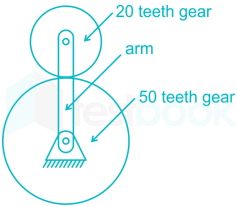
The number of degrees of freedom of the planetary gear train shown in the figure is

  1. ((a))

    0

  2. ((b))

    1

  3. ((c))

    2

  4. ((d))

    3

Show Answer
Answer: ((c))

2

Concept:

From Kutzbach's mobility criterion,

F = 3 (n – 1) – 2 j – h

n = Number of links

j = Number of binary joints

h = Number of higher pair

Calculation:

In the gear train system,

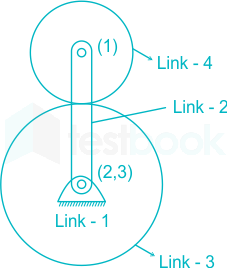
no. of links n = 4, no. of joints j = 3 (1 binary joint and 1 ternary joint by link 1, 2 and 3)

and no. of higher pair h = 1.

F = 3 (4 – 1) – 2× 3 – 1 = 2

A planetary gear train has 2 DOF and hence requires two inputs to get the desired output.

20

In a spring-mass system, the mass is m and the spring constant is k. The critical damping coefficient of the system is 0.1kg/s. In another spring-mass system, the mass is 2m and the spring constant is 8k. The critical damping coefficient (in kg/s) of this system is __________

21

The uniaxial yield stress of a material is 300 MPa. According to von Mises criterion, the shear yield stress (in MPa) of the material is ______

22

If the fluid velocity for a potential flow is given by V(x,y) = u(x,y)i + v(x,y)ĵ  with usual notations, then the slope of the potential line at (x,y) is

  1. ((a))

    vu\frac{v}{u}

  2. ((b))

    uv- \frac{u}{v}

  3. ((c))

    v2u2\frac{{{v^2}}}{{{u^2}}}

  4. ((d))

    uv\frac{u}{v}

Show Answer
Answer: ((b))

uv- \frac{u}{v}

Explanation:

From potential function definition,

u=ϕx;and;v=ϕyu = - \frac{{\partial ϕ }}{{\partial x}};and;v = - \frac{{\partial ϕ }}{{\partial y}}

when, ϕ = ϕ(x,y) 

dϕ=ϕxdx+ϕydydϕ = \frac{{\partial ϕ }}{{\partial x}}dx + \frac{{\partial ϕ }}{{\partial y}}dy

dϕ = - u dx - v dy

Since along potential line, ϕ is constant, so dϕ = 0

0 = - udx - vdy

slope = dydx=uv\frac{{dy}}{{dx}} = - \frac{u}{v}

23

Which of the following statements regarding a Rankine cycle with reheating are TRUE?

(i) increase in the average temperature of heat addition

(ii) reduction in thermal efficiency

(iii) drier steam at the turbine exit

  1. ((a))

    only (i) and (ii) are correct

  2. ((b))

    only (ii) and (iii) are correct

  3. ((c))

    only (i) and (iii) are correct

  4. ((d))

    (i), (ii) and (iii) are correct

Show Answer
Answer: ((c))

only (i) and (iii) are correct

Concept:

In a simple Rankine cycle, after the isentropic expansion in the turbine, steam is directly fed into the condenser for the condensation process. But in the reheat system, two turbines (high-pressure turbine and low-pressure turbine) are employed to improve efficiency.

Steam, after expansion from the high-pressure turbine, is sent again to the boiler and heated until it reaches superheated condition. It is then left to expand in the low-pressure turbine to attain condenser pressure. The reheat cycle has been developed to take advantage of the increased efficiency with higher pressures and yet avoid excessive moisture in the low-pressure stages of the turbine.

With reheat, the mean temperature of heat addition TmTm

increases, and so efficiency and work output increase, but the steam rate decreases.

Explanation:

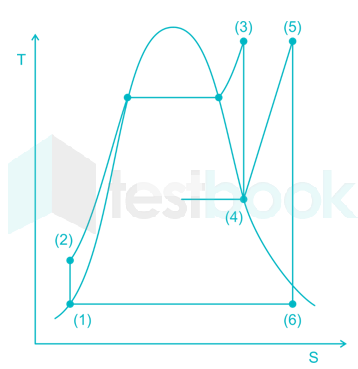
The Rankine cycle with reheating involves the following processes:

  • Isentropic Compression (1-2): Water is pumped from low pressure to high pressure. This process is isentropic, meaning entropy remains constant.
  • Isobaric Heat Addition (2-3): Water is heated in the boiler at constant pressure, transforming it into superheated steam.
  • Isentropic Expansion in High-Pressure Turbine (3-4): The steam expands isentropically in the high-pressure turbine. Entropy remains constant, and the steam's temperature and pressure drop.
  • Isobaric Reheating (4-5): The steam is reheated at constant pressure. This increases the steam's temperature.
  • Isentropic Expansion in Low-Pressure Turbine (5-6): The reheated steam expands isentropically in the low-pressure turbine. Entropy remains constant, and the steam's temperature and pressure drop further.
  • Isobaric Heat Rejection (6-1): The steam condenses at constant pressure in the condenser, rejecting heat and returning to the liquid phase.

Calculation:

Analyzing the statements:

1. Increase in the average temperature of heat addition:

This statement is true. Reheating increases the average temperature at which heat is added to the cycle, leading to higher thermal efficiency.

2. Reduction in thermal efficiency:

This statement is false. Reheating generally improves the thermal efficiency of the Rankine cycle by increasing the average temperature of heat addition.

3. Drier steam at the turbine exit:

This statement is true. Reheating ensures that the steam remains superheated for a longer portion of the expansion process, resulting in drier steam at the turbine exit.

Conclusion:

Based on the above analysis, the correct statements regarding a Rankine cycle with reheating are:

  • (i) Increase in the average temperature of heat addition.
  • (iii) Drier steam at the turbine exit.

Therefore, the correct answer is:

3) only (i) and (iii) are correct.

24

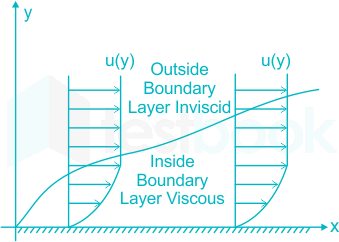
Within a boundary layer for a steady incompressible flow, the Bernoulli equation

  1. ((a))

    holds because the flow is steady

  2. ((b))

    holds because the flow is incompressible

  3. ((c))

    holds because the flow is transitional

  4. ((d))

    does not hold because the flow is frictional

Show Answer
Answer: ((d))

does not hold because the flow is frictional

Explanation:

Pρg+v22g+Z=Constant\frac{P}{\rho g} + \frac{{{v^2}}}{{2g}} + Z = Constant

Bernoulli’s equation:

  • It can be derived from the principle of conservation of energy.
  • It states that, in a steady flow, the sum of all forms of energy in a fluid along a streamline is the same at all points on that streamline.
  • It represented in head form (the total energy per unit weight).

Following assumption are made in deriving Bernoulli’s equation:

Bernoulli’s equation assumptions:

  1. The fluid is ideal, i.e. fluid has zero viscosity
  2. Flow is steady
  3. Flow is continuous
  4. Flow is incompressible
  5. Flow is irrotational
  6. Flow is along a streamline.

Within a boundary layer for a steady incompressible flow, viscosity is present and the viscous forces dominate over inertia forces.

Thus, the Bernoulli equation does not hold within a boundary layer for a steady incompressible flow.

25

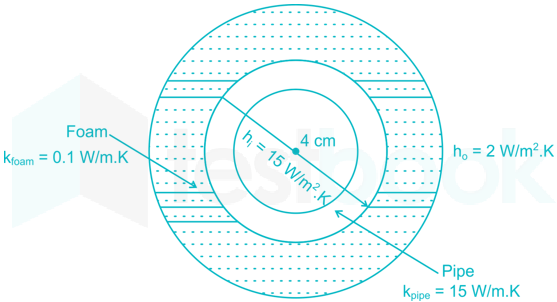
If a foam insulation is added to a 4cm outer diameter pipe as shown in the figure, the critical radius of insulation (in cm) is _____________

26

In the laminar flow of air (Pr = 0.7) over a heated plate if δ and δT denote, respectively, the hydrodynamic and thermal boundary layer thicknesses, then

  1. ((a))

    δ = δT

  2. ((b))

    δ > δT

  3. ((c))

    δ < δT

  4. ((d))

    δ = 0 but δT ≠ 0

Show Answer
Answer: ((c))

δ < δT

Concept:

Prandtl number Pr is defined as the ratio of momentum diffusivity to thermal diffusivity.

Pr=μCpK=(μρ)(KρCp)Pr = \frac{{\mu {C_p}}}{K} = \frac{{\left( {\frac{\mu }{\rho }} \right)}}{{\left( {\frac{K}{{\rho {C_p}}}} \right)}}

Pr=να=momentum;diffusivitythermal;diffusivityPr = \frac{\nu }{\alpha } = \frac{{momentum;diffusivity}}{{thermal;diffusivity}}

In another way, we can define Prandtl number as, the ratio of the rate that viscous forces penetrate the material to the rate that thermal energy penetrates the material.

**δδT=(Pr)1/3;\frac{δ }{{{δ _T}}} = {\left( {Pr} \right)^{1/3}};**where, δ is hydrodynamic boundary layer thickness and δT is thermal boundary layer thickness.

Calculation:

Given:

Pr = 0.7 

from, δδT=(Pr)1/3;\frac{δ }{{{δ _T}}} = {\left( {Pr} \right)^{1/3}};=  0.713=0.88<1{0.7^{\frac{1}{3}}} = 0.88 < 1

thus, δ < δT .

When              Pr < 1               δT > δ 

                        Pr  > 1               δT < δ 

                        Pr  = 1               δt = δ

27

The COP of a Carnot heat pump operating between 6°C and 37°C is ___________

28

The Vander Waals  equation of state is (p+av2)(vb)=RT,\left( {p + \frac{a}{{{v^2}}}} \right)\left( {v - b} \right) = RT, where p is pressure, v is specific volume, T is temperature and R is characteristic gas constant. The SI unit of a is

  1. ((a))

    J/kg. K

  2. ((b))

    m3/kg

  3. ((c))

    m5/kgs2

  4. ((d))

    Pa/kg

Show Answer
Answer: ((c))

m5/kgs2

Explanation:

Vander-Waals equation

  • The equation is basically a modified version of the Ideal Gas Law which states that gases consist of point masses that undergo perfectly elastic collisions. Ideal gas equation fails to explain the behaviour of real gases. Therefore, the Van der Waals equation was devised and it helps us define the physical state of a real gas.
  • Van der Waals equation is an equation relating the relationship between the pressure, volume, temperature, and amount of real gases. For a real gas containing ‘n’ moles, the equation is written as

(p+av2)(vb)=RT\left( {p + \frac{a}{{{v^2}}}} \right)\left( {v - b} \right) = RT

  • The constant "a" provides a correction for the intermolecular forces.
  • Constant b adjusts for the volume occupied by the gas particles. It is a correction for finite molecular size and its value is the volume of one mole of the atoms or molecules.

here, p is pressure in N/m2, v is the specific volume in m3/kg, R is characteristic gas constant in J/kg-K, av2 \frac{a}{{{v^2}}} is called the force of cohesion and b is called the co-volume.

(p+av2p + \frac{a}{{{v^2}}}) both terms should give the same unit since they are getting added

i.e. p = av2 \frac{a}{{{v^2}}} in terms of unit.

Nm2=a(kgm3)2\Rightarrow \frac{N}{{{m^2}}} = a{\left( {\frac{{kg}}{{{m^3}}}} \right)^2}

a(unit)=m6kg2.kg.ms2m2;=m5kgkg2s2=m5kgs2\Rightarrow a\left( {unit} \right) = \frac{{{m^6}}}{{k{g^2}}}.kg.\frac{m}{{{s^2}{m^2};}} = \frac{{{m^5}kg}}{{k{g^2}{s^2}}} = \frac{{{m^5}}}{{kg{s^2}}}

29

A rope-brake dynamometer attached to the crank shaft of an I.C. engine measures a brake power of 10kW when the speed of rotation of the shaft is 400 rad/s. The shaft torque (in N-m) sensed by the dynamometer is _______

30

The atomic packing factor for a material with body centered cubic structure is _______

31

In ECM (Electro Chemical Machining) the material removal is due to

  1. ((a))

    Ion displacement

  2. ((b))

    Corrosion

  3. ((c))

    Fusion

  4. ((d))

    Erosion

Show Answer
Answer: ((a))

Ion displacement

Explanation:

The unconventional machining process and their characteristics and the application areas are discussed in the table below:

Type Of MachiningMechanics Of Material RemovalMediumTool MaterialMaterial Application
Ultrasonic machiningBrittle fracture caused by the impact of abrasive grain due to tool vibrating at high frequency (Amplified by tapered horn).SlurryTough and ductile (soft steel)The hard and brittle material, semiconductor, non-metals( eg. Glass and ceramic).
Abrasive Jet MachiningBrittle fracture by impinging abrasive grains at high speed.Air, CO2Abrasives (Al2O3, ­­SiC), Nozzle (WC, sapphire)Hard and Brittle metal and non-metallic material.
Electric discharge machiningMelting and evaporation, aided by cavitation.Dielectric fluidCopper, brass, graphiteAll conducting metals and alloys
Electrochemical machiningElectrolysis (Ion dissolution)Conducting electrolyteCopper, brass, steelAll conducting metals and alloys
Electron beam machiningMelting and vapourisationvacuumA beam of an electron moving at high velocityAll material.
Laser beam machiningMelting and vapourisationNormal atmosphereA high power laser beam (Ruby rod)All material.
32

Which one of the following statements is TRUE?

  1. ((a))

    The ‘GO’ gauge controls the upper limit of a hole

  2. ((b))

    The ‘NO’ gauge controls the lower limit of a shaft

  3. ((c))

    The ‘GO’ gauge controls the lower limit of a hole 

  4. ((d))

    The ‘NO GO’ gauge controls the lower limit of a hole

Show Answer
Answer: ((c))

The ‘GO’ gauge controls the lower limit of a hole 

The ‘GO’ guage controls the lower limit of a hole and The ‘NO GO’ gauge controls the upper limit of a hole.

Go size = maximum material limit of component = Lower limit of hole

NO GO gauges are designed for minimum material limit of component = upper limit of hole.

Trick to remember:

In 'GO', the plug gauge should enter into the thus hole lower limit of hole is considered while 'NO GO' plug gauge should not enter into hole so upper limit of hole is considered.

33

During the development of a product an entirely new process plan is made based on design logic, examination of geometry and tolerance information. This type of process planning is known as 

  1. ((a))

    Retrieval

  2. ((b))

    Generative

  3. ((c))

    Variant

  4. ((d))

    Group technology based

Show Answer
Answer: ((b))

Generative

A generative manufacturing process different from a traditional manufacturing process develops a product with the addition of material instead of removal of the excess material as in case of a traditional manufacturing process.

In the generative manufacturing process, plans are generated by means of decision logic, formulas, technology algorithm and geometry-based data to perform uniquely the many processing decision for converting a part from raw material to a finished state.

There are two major components of a generative process planning system.

  1. A geometry-based coding scheme.
  2. Process knowledge in the form of decision logic and data.

Geometry-based coding scheme:

The objective of a geometric based coding scheme is to define all geometric features for all process related surfaces together with feature dimensions, locations, tolerances and the surface finish desired on the features.

Advantage of Generative Manufacturing Process:

  • No tools and fixtures are required.
  • No restriction on geometry of the part shape exists.
  • Composite parts and assemblies can be produced in one go.
  • Small batch production of complex parts is economically viable.
34

Annual demand of a product is 50000 units and the ordering cost is Rs. 7000 per order considering the basic economic order quantity model, the economic order quantity is 10000 units. When the annual inventory cost is minimized, the annual inventory holding cost (in Rs.) is _______

35

Sales data of a product is given in the following table:

MonthJanuaryFebruaryMarchAprilMay
Number of units sold1011161925
<br>

Regarding forecast for the month of June, which one of the following statements is TRUE?

  1. ((a))

    Moving average will forecast a higher value compared to regression

  2. ((b))

    Higher the value of order N, the greater will be the forecast value by moving average.

  3. ((c))

    Exponential smoothing will forecast a higher value compared to regression.

  4. ((d))

    Regression will forecast a higher value compared to moving average

Show Answer
Answer: ((d))

Regression will forecast a higher value compared to moving average

Calculation:

Given:

MonthJanuaryFebruaryMarchAprilMay
Number of units sold1011161925
  • When the forecast value shows an increasing trend then the regression will forecast a higher value compared to the moving average.
36

The chance of a student passing an exam is 20%. The chance of a student passing the exam and getting above 90% marks in it is 5% Given that a student passes the examination, the probability that the student gets above 90% marks is

  1. ((a))

    118\frac{1}{{18}}

  2. ((b))

    14\frac{1}{4}

  3. ((c))

    29\frac{2}{9}

  4. ((d))

    518\frac{5}{{18}}

Show Answer
Answer: ((b))

14\frac{1}{4}

Let A → student passes the exam

B → student gets above 90% marks

Given the probability of passing the exam P(A) = 0.2

and probability of passing the exam and getting above 90% marks P(A∩B) = 0.05

From conditional probability, 

the probability of happening of B when A has already happened, i.e. P(BA)=P(AB)P(A){\rm{P}}\left( {\frac{{\rm{B}}}{{\rm{A}}}} \right) = \frac{{{\rm{P}}\left( {{\rm{A}} \cap {\rm{B}}} \right)}}{{P\left( A \right)}}

Required probability of getting above 90% when a student has passed the exam is P(BA)=P(AB)P(A)=5%20%=14{\rm{P}}\left( {\frac{{\rm{B}}}{{\rm{A}}}} \right) = \frac{{{\rm{P}}\left( {{\rm{A}} \cap {\rm{B}}} \right)}}{{P\left( A \right)}} = \frac{{5\% }}{{20\% }} = \frac{1}{4}

37

The surface integral !!!s1π(9xi3yj)\mathop \int!!!\int \limits_s \frac{1}{\pi }\left( {9xi - 3yj} \right).nds over the sphere given by x2 + y2 + z2 = 9 is

38

Consider the following differential equation:

 dydt=5y\frac{{dy}}{{dt}} = - 5y; Initial condition: y = 2 at t = 0

The value of y at t = 3 is

  1. ((a))

    – 5e-10

  2. ((b))

    2e-10

  3. ((c))

    2e-15

  4. ((d))

    -15e2

Show Answer
Answer: ((c))

2e-15

Explanation:

dydt=5y\frac{{dy}}{{dt}} = -5y

dyy=5dt\Rightarrow \frac{{dy}}{y} = - 5dt (variables separable form)

Integrating both side we get,

lny=5t+clny = - 5t + c         _______________(1)

initial condition: y = 2 at t = 0,

from equation (1), 

ln2=5×0+cln2 = - 5 \times 0 + c

c=ln2c = ln2

lny=5t+ln2lny = - 5t + ln2

ln(y2)=5t{\rm{ln}}\left( {\frac{y}{2}} \right) = - 5t

y=2e5ty = 2{e^{ - 5t}}

now at t = 3, y=2e15y = 2{e^{ - 15}}

39

The values of function f(x) at 5 discrete point are given below.

x00.10.20.30.4
f(x)0104090160

Using Trapezoidal rule with step size of 0.1, the value of \(\mathop \smallint \limits_0^{0.4} f\left( x \right);\)dx is ___________.

40

The initial velocity of an object is 40m/s. The acceleration 'a' of the object is given by the following expression: a= - 0.1V; Where V is the instantaneous velocity of the object. The velocity of the object after 3 seconds will

be _______

41

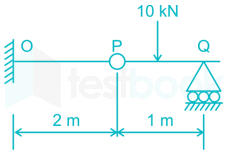
A cantilever beam OP is connected to another beam PQ with a pin joint as shown in the figure. A load of 10kN is applied at the mid-point of PQ. The magnitude of bending moment (in kN-m) at fixed end O is

  1. ((a))

    2.5

  2. ((b))

    5

  3. ((c))

    10

  4. ((d))

    25

Show Answer
Answer: ((c))

10

Concept:

RP+RQ=10

ΣMP = 0, RQ × 1 - 10 × 0.5 = 0

RQ = 5 kN and RP 5 kN (upward force)

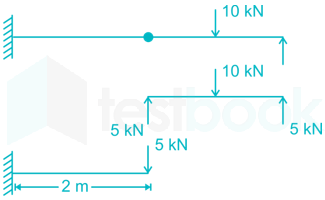
Since this is a case of a propped cantilever, deflection δ at point P will be zero, which will give an opposite 5 kN force acting in the downward direction at point P as shown in the last diagram.

Thus, MO = R× OP = 5 × 2 = 10 kN-m

42

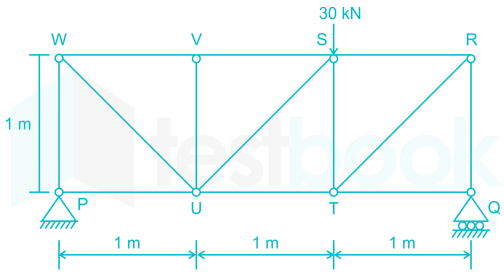
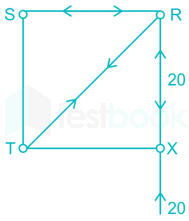
For the truss shown in the figure, the magnitude of the force (in kN) in the member SR is

  1. ((a))

    10

  2. ((b))

    14.14

  3. ((c))

    20

  4. ((d))

    28.28

Show Answer
Answer: ((c))

20

Concept:

Considering equilibrium in the vertical direction,

Rp + RQ = 30 kN

ΣMp =0

RQ × 3 = 2 × 30

⇒ RQ = 20 kN

and Rp = 10 kN

for balance at ‘x’ → FRx = 20 kN

at ‘RT’ → FRT cos 45 = 20

FRT=20cos45\Rightarrow {F_{RT}} = \frac{{20}}{{cos45}}                (1)

Also FSR = FRT cos 45°     (2)

from (1) and (2)

FSR = 20kN

43

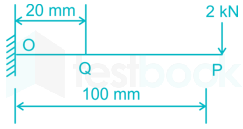
A cantilever beam with square cross-section of 6mm side is subjected to a load of 2kN normal to the top surface as shown in the figure. The young’s modulus of elasticity of the material of the beam is 210 GPa. The magnitude of slope. (in radian) at Q (20 mm from the fixed end) is ________. (enter the value upto 4 decimal places)

44

In a plane stress condition, the components of stress at point are σx = 20 MPa, σy = 80 MPa and τxy = 40 MPa The maximum shear stress ( in MPa) at the point is

  1. ((a))

    20

  2. ((b))

    25

  3. ((c))

    50

  4. ((d))

    100

Show Answer
Answer: ((c))

50

Concept:

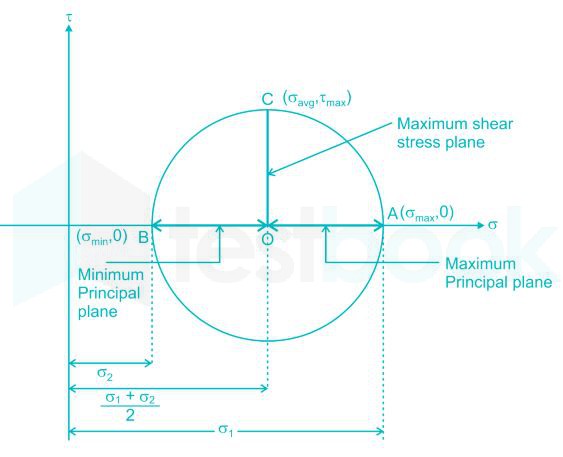
Maximum and minimum values of normal stresses occur on planes of zero shearing stress. The maximum and minimum normal stresses are called the principal stresses, and the planes on which they act are called the principal plane.

σmax,;min=σxx+σyy2±(σxxσyy2)2+τxy2{\sigma _{max,;min}} = \frac{{{\sigma _{xx}} + {\sigma _{yy}}}}{2} \pm \sqrt {{{\left( {\frac{{{\sigma _{xx}} - {\sigma _{yy}}}}{2}} \right)}^2} + \tau _{xy}^2}

But the maximum shear stress planes may or may not contain normal stresses as the case may be.

τmax=σmaxσmin2=(σxxσyy2)2+τxy2{\tau _{max}} = \frac{{{\sigma _{max}} - {\sigma _{min}}}}{2} = \sqrt {{{\left( {\frac{{{\sigma _{xx}} - {\sigma _{yy}}}}{2}} \right)}^2} + \tau _{xy}^2}

Calculation:

σx = 20 MPa, σy = 80 MPa and τxy = 40MPa

τmax=(80202)2+402=50;MPa\tau_{max}= \sqrt {{{\left( {\frac{{80 - 20}}{2}} \right)}^2} + {{40}^2}} =50;MPa


\({\tau _{max}} = \max \left{ {\frac{{{\sigma _1} - {\sigma _2}}}{2},\frac{{{\sigma _1}}}{2},\frac{{{\sigma _2}}}{2}} \right}\)

σ1/σ2=σx+σy2±(σxσy2)2+τxy2{\sigma _1}/{\sigma _2} = \frac{{{\sigma _x} + {\sigma _y}}}{2} \pm \sqrt {{{\left( {\frac{{{\sigma _x} - {\sigma _y}}}{2}} \right)}^2} + \tau _{xy}^2}

σ1/σ2=20+802±(20802)2+402{\sigma _1}/{\sigma _2} = \frac{{20 + 80}}{2} \pm \sqrt {{{\left( {\frac{{20 - 80}}{2}} \right)}^2} + {{40}^2}}

σ1/σ2=50±50{\sigma _1}/{\sigma _2} = 50 \pm 50

σ1=100;MPa;and;σ2=0;MPa{\sigma _1} = 100;MPa;and;{\sigma _2} = 0;MPa

\({\tau _{max}} = \max \left{ {\frac{{100 - 0}}{2},\frac{{100}}{2},0} \right}\)

τmax=50;MPa{\tau _{max}} = 50;MPa

45

In a certain slider-crank mechanism, lengths of crank and connecting rod are equal. If the crank rotates with a uniform angular speed of 14 rad/s and the crank length is 300 mm, the maximum acceleration of the slider (in m/s2) is ___________

46

A single-degree freedom spring-mass system is subjected to a sinusoidal force of 10 N amplitude and frequency ω along the axis of the spring. The stiffness of the spring is 150 N/m, damping factor is 0.2 and the undamped natural frequency is10ω At steady state, the amplitude of vibration (in m) is approximately

  1. ((a))

    0.05

  2. ((b))

    0.07

  3. ((c))

    0.70

  4. ((d))

    0.90

Show Answer
Answer: ((b))

0.07

Concept:

The amplitude ‘A’ of steady-state vibration in harmonic excitation with damper is,

A=xmax=F0(Kmω2)2+(Cω)2A = {x_{max}} = \frac{{{F_0}}}{{\sqrt {{{\left( {K - m{\omega ^2}} \right)}^2} + {{\left( {C\omega } \right)}^2}} }}

Or, A=F0/K(1(ωωn)2)2+(2ξωωn)2A = \frac{{{F_0}/K}}{{\sqrt {{{\left( {1 - {{\left( {\frac{\omega }{{{\omega _n}}}} \right)}^2}} \right)}^2} + {{\left( {2\xi \frac{\omega }{{{\omega _n}}}} \right)}^2}} }}

also, A=δ(1r2)2+(2ξr)2A = \frac{\delta }{{\sqrt {{{\left( {1 - {r^2}} \right)}^2} + {{\left( {2\xi r} \right)}^2}} }}

Where δ is static deflection of spring in m, F0 is sinusoidal force amplitude in N.

, ω is forced frequency and ωn is natural frequency of spring in rad/s

And ξ is damping factor = C/CC = actual damping coefficient/critical damping coefficient.

Calculation:

Given, force amplitude F0 = 10 N, K = 150 N/m, ξ = 0.2 and ωn = 10 ω

From, A=F0/K(1(ωωn)2)2+(2ξωωn)2A = \frac{{{F_0}/K}}{{\sqrt {{{\left( {1 - {{\left( {\frac{\omega }{{{\omega _n}}}} \right)}^2}} \right)}^2} + {{\left( {2\xi \frac{\omega }{{{\omega _n}}}} \right)}^2}} }}

A=10/150(1(ω10ω)2)2+(2×0.2×ω10ω)2A = \frac{{10/150}}{{\sqrt {{{\left( {1 - {{\left( {\frac{{\rm{\omega }}}{{10{\rm{\omega }}}}} \right)}^2}} \right)}^2} + {{\left( {2 \times 0.2 \times \frac{{\rm{\omega }}}{{10{\rm{\omega }}}}} \right)}^2}} }}

A=0.06730.07mA = 0.0673 \approx 0.07 m

47

A hollow shaft of 1m length is designed to transmit a power of 30 kW at 700 rpm. The maximum permissible angle of twist in the shaft is 1°. The inner diameter of the shaft is 0.7 times the outer diameter. The modulus of rigidity is 80 GPa. The outside diameter (in mm) of the shaft is _______

48

A hollow shaft do = 2di where do and di are the outer and inner diameters respectively needs to transmit 20kW power at 3000 RPM. If the maximum permissible shear stress is 30 MPa, dO is

  1. ((a))

    11.29 mm

  2. ((b))

    22.58 mm

  3. ((c))

    33.08 mm

  4. ((d))

    45.16 mm

Show Answer
Answer: ((b))

22.58 mm

Given, P = 20 kW, N = 3000 rpm, τmax= 30 MPa, do = 2di

The power transmitted by the shaft is given by,

P=T.ω=2πNT60P = T.\omega = \frac{{2\pi NT}}{{60}}

20×103=T×2π×30006020 \times {10^3} = T \times \frac{{2\pi \times 3000}}{{60}}

∴ T = 63.662 N-m

From torsion equation 

TJ=τrτ=T.rJ\frac{T}{{{J}}} = \frac{τ }{r}\Rightarrow τ=\frac{T.r}{J}

For hollow shaft: J=π32(d04di4)=π32d04(1k4);where;k=did0=12J=\frac{\pi}{32}(d_0^4-d_i^4)=\frac{\pi}{32}d_0^4(1-k^4); where ; k=\frac{d_i}{d_0}=\frac{1}{2}

τ=T.d02π32d04(1k4)=16Tπd03(1k4)τ=\frac{T.\frac{d_0}{2}}{\frac{\pi}{32}d_0^4(1-k^4)}=\frac{16T}{\pi d_0^3(1-k^4)}

d03=16Tπ×τ(1k4)=16×63.663×103π×30×(1(12)4)d_0^3=\frac{16T}{\pi\timesτ(1-k^4)}=\frac{16\times63.663\times10^3}{\pi \times30\times(1-(\frac{1}{2})^4)}

d0 = 22.59 mm

49

The total emissive power of a surface is 500 W/m2 at a temperature T1 and 1200 W/m2 at a temperature T2. Where the temperatures are in Kelvin. Assuming the emissivity of the surface to be constant, the ratio of the temperatures T1T2\frac{{{T_1}}}{{{T_2}}} is

  1. ((a))

    0.308

  2. ((b))

    0.416

  3. ((c))

    0.803

  4. ((d))

    0.874

Show Answer
Answer: ((c))

0.803

Concept:

The total emissive power of any real surface is given by, E = σ ϵ A T4 in W

and total emissive power per unit area is = σ ϵ T4  in W/m2.

where, σ is Stefan-Boltzmann constant, ϵ is the emissivity of the surface and T is temperature of the surface in K.

If temperature is T1, then

Emissive power E1ϵT14E_1 \propto ϵ T_1^4

Calculation:

Given, emissivity of surface is constant i.e.  ϵ1 = ϵ 2

500=σϵ1T14500 =\sigma ϵ_1 T_1^4                               ____________________(1)

Similarly

1200=σϵ2T141200 = \sigma ϵ_2 T_1^4                            ____________________(2)

from (1) / (2)

(T1T2)4=5001200{\left( {\frac{{{T_1}}}{{{T_2}}}} \right)^4} = \frac{{500}}{{1200}} as ϵ1 = ϵ 2

T1T2=(5001200)1/4=0.803\frac{{{T_1}}}{{{T_2}}} = {\left( {\frac{{500}}{{1200}}} \right)^{1/4}} = 0.803

50

The head loss for a laminar incompressible flow through a horizontal circular pipe is h1. Pipe length and fluid remaining the same, if the average flow velocity doubles and the pipe diameter reduces to half its previous value, the head loss is h2. The ratio h2/h1 is

  1. ((a))

    1

  2. ((b))

    4

  3. ((c))

    8

  4. ((d))

    16

Show Answer
Answer: ((c))

8

Concept:

The head loss in laminar flow through a pipe is given by:

\({h_{L}} = \frac{{32{μ ̅ UL}}}{{ \rho gd^2}}\)

where μ = viscosity, L = length of pipe/plate, U̅ = average velocity, d = diameter of the pipe.

Calculation:

Given:

L2 = L1, μ2 = μ1, U̅2 = 2U̅1, d2 = 0.5d1

The head loss in laminar flow through a pipe is given by:

\({h_{L}} = \frac{{32{μ ̅ UL}}}{{ \rho gd^2}}\)

h2h1=U2ˉU1ˉ×d12d22\frac{h_2}{h_1}= \frac{{{\bar{U_2}}}}{{\bar{U_1}}}\times\frac{{{{d_1^2}}}}{{d_2^2}}

h2h1=2U1ˉU1ˉ×4d12d12=8\frac{h_2}{h_1}= \frac{{{2\bar{U_1}}}}{{\bar{U_1}}}\times\frac{{{{4d_1^2}}}}{{d_1^2}}=8

Additional InformationUsing Darcy-Weisbach equation:

hL=fLV22gdh_L=\frac{fLV^2}{2gd}

where f = friction factor = 64/Re

Reynold's number is given by:

Re=ρVdμRe=\frac{\rho V d}{\mu}

Putting the value of friction factor:

hL=64Re×LV22gd=64μρVd×LV22gdh_L=\frac{64}{Re}\times\frac{LV^2}{2gd}=\frac{64\mu}{\rho V d}\times\frac{LV^2}{2gd}

hL=64μLV2ρgd2h_L=\frac{64\mu LV}{2 \rho gd^2}

When length and viscosity remain same then:

hLVd2h_L\propto\frac{V}{d^2} which is the same as above.

51

For a fully developed laminar flow of water (dynamic viscosity 0.001 Pa-s) through a pipe of radius 5 cm. the axial pressure gradient is – 10 Pa/m. The magnitude of axial velocity (in m/s) at a radial location of 0.2 cm is ________(up to two decimal places).

52

A balanced counter flow heat exchanger has a surface area of 20 m2 and overall heat transfer coefficient of 20 W/m2–K. Air (CP = 1000 J/kg - K) entering at 0.4 kg/s and 280 K is to be preheated by the air leaving the system at 0.4 kg/s and 300 K. The outlet temperature (in K) of the heated air is ___

  1. ((a))

    290

  2. ((b))

    300

  3. ((c))

    320

  4. ((d))

    350

Show Answer
Answer: ((b))

300

Concept:

The total heat transfer rate in the heat exchanger is given by

Q = U.A.θm

Where, U = overall heat transfer coefficient in W/m2-K,

A = effective surface area of heat exchanger in m2,

θm = log mean temperature difference (LMTD)=ΔT1ΔT2ln(ΔT1ΔT2)\left( {LMTD} \right) = \frac{{{\bf{Δ }}{T_1} - {\bf{Δ }}{T_2}}}{{{\bf{ln}}\left( {\frac{{{\bf{Δ }}{T_1}}}{{{\bf{Δ }}{T_2}}}} \right)}}

Also, Q = Cph (Thi-Th0) = Cpc (Tco-Tci)

i.e. heat lost by hot fluid = heat gain by cold fluid

where, Cph and Cpc are heat capacity of hot and cold fluid respectively in kJ/K

Since the heat capacity for hot and cold fluids are same and it is a case of counter flow so the LMTD will be the difference of temperature of either side.

Calculation:

Given, A = 20 m2, U = 20 W/m2-K, Tci = 280 K, Th0 = 300 K

Cph = Cpc = 0.4× 1000 = 400 J/K.

For same heat capacity of hot and cold fluid LMTD = ΔT1 = ΔT2 = Tho-Tci = 300 – 280 = 20 K.

From, Q = U.A.θm = Cph (Thi-Th0) = Cpc (Tco-Tci)

20× 20× 20 = 400× (Tco - 280)

Tco = 300 K

Alternate Method

Effectiveness NTU Method:

For balanced counter flow heat exchanger, the effectiveness is given by-

ϵ=Thi;;ThoThi;;Tci=Tco;;TciThi;;Tci\epsilon=\frac{T_{hi};-;T_{ho}}{T_{hi};-;T_{ci}}=\frac{T_{co};-;T_{ci}}{T_{hi};-;T_{ci}}

Tci = 280 K, Tho = 300 K

NTU=UACminNTU=\frac{UA}{C_{min}}

NTU=20×200.4×1000=1NTU=\frac{20\times 20}{0.4\times 1000}=1

Since the heat exchanger is balanced, 

ϵ=NTU1;+;NTU\epsilon=\frac{NTU}{1;+;NTU}

ϵ=11;+;1=0.5\epsilon=\frac{1}{1;+;1}=0.5

ϵ=Thi;;ThoThi;;Tci\epsilon=\frac{T_{hi};-;T_{ho}}{T_{hi};-;T_{ci}}

0.5=Thi;;300Thi;;2800.5=\frac{T_{hi};-;300}{T_{hi};-;280}

Thi - 280 = 2Thi - 600

Thi = 320 K

For a balanced heat exchanger, the difference between the inlet and outlet always remains constant.

ΔT2 = ΔT1 = Thi - Tco = Tho - Tci

Tho - Tci = 20

Thi - Tco = 320 - Tco

320 - Tco = 20

Tco = 300 K.
53

A cylindrical uranium fuel rod of radius 5 mm in a nuclear reactor is generating heat at the rate of 4× 10⁷ W/m3. The rod is cooled by a liquid (convective heat transfer coefficient 1000 W/m2.K) at 25°C. At steady state, the surface temperature (in K) of the rod is

  1. ((a))

    308

  2. ((b))

    398

  3. ((c))

    418

  4. ((d))

    448

Show Answer
Answer: ((b))

398

Concept: 

For cylinder,

Tw=T+qgR2h{T_w} = {T_∞ } + \frac{{{q_g}R}}{{2h}}

Tc=Tw+qgR24K{T_c} = {T_w} + \frac{{{q_g}{R^2}}}{{4K}}

where Tw is wall or surface temperature in K, Tc is the centre temperature in K, T∞ is surrounding temperature in K,

qg is heat generation in W/m3, h is the heat transfer coefficient in W/m2-K, R is the radius of the cylinder in m.

Calculation:

Given:

R = 5 mm, q= 4×10W/m3 and T= 25° C = 298 K, h = 1000 W/m2K

The surface temp. (Tw)=T+qg2hR\left( {T_w} \right) = {T_∞ } + \frac{{{q_g}}}{{2h}}R

=298+4×1072×1000×5×103= 298 + \frac{{4 × {{10}^7}}}{{2 × 1000}} × 5 × {10^{ - 3}}

Tw = 398 K

54

Work is done on an adiabatic system due to which its velocity changes from 10 m/s to 20 m/s, elevation increases by 20 m and temperature increases by 1 K. The mass of the system is 10 kg Cv = 100J/(kgK) and gravitational acceleration is 10 m/s2. If there is no change in any other component of the energy of the system, the magnitude of total work done (in kJ) on the system is________

55

One kg of air (R = 287 J/kg.K) undergoes an irreversible process between equilibrium state 1 (20° C, 0.9m3) and equilibrium state 2 (20°C, 0.6 m3). The change in entropy s2 – s1 (in J/kg.K) is _________

56

For the same values of peak pressure, peak temperature and heat rejection, the correct order of efficiencies for Otto, Dual and Diesel cycles is

  1. ((a))

    ηOtto > ηDual > ηDiesel 

  2. ((b))

    ηDual > ηDiesel > ηOtto

  3. ((c))

    ηDisel > ηDual > ηOtto

  4. ((d))

    ηDisel  > ηOtto > ηDual

Show Answer
Answer: ((c))

ηDisel > ηDual > ηOtto

For same values of peak pressure and temperature. Diesel cycle is most efficient and Otto cycle is least. Efficiency of dual cycle lies in between.

ηDiesel > ηDual > ηOtto

And for same compression ratio and heat rejection or heat addition,

ηOtto > ηDual > ηDiesel

57

In a Rankine cycle, the enthalpies at turbine entry and outlet are 3159kJ/kg. and 2187 kJ/kg, respectively. If the specific pump work is 2kJ/kg the specific steam consumption (in kg/kWh) of the cycle based on net output is __________

58

A cube and a sphere made of cast iron (each of volume 1000 cm3) were cast under identical conditions. The time taken for Solidifying the cube was 4 seconds. The Solidification time (in s) for the sphere is _________

59

In a two-stage wire drawing operation, the fractional reduction (ratio of change in cross-sectional area to initial cross-sectional area) in the first stage is 0.4. The fractional reduction in the second stage is 0.3. The overall fractional reduction is

  1. ((a))

    0.24

  2. ((b))

    0.58

  3. ((c))

    0.60

  4. ((d))

    1.00

Show Answer
Answer: ((b))

0.58

Concept:

Fractional reductionΔAAi=AiAfAi=1AfAi\frac{{{\rm{\Delta }}A}}{{{A_i}}} = \frac{{{A_i} - {A_f}}}{{{A_i}}} = 1 - \frac{{{A_f}}}{{{A_i}}}

where Ai and Af are the initial and final cross-sectional area respectively.

Fractional reduction1d12do21 - \frac{{d_1^2}}{{d_o^2}} where, d1 and do are the diameters after and before the 1st stage of drawing operation.

also, Fractional reduction1d22d121 - \frac{{d_2^2}}{{d_1^2}} where, d2 is the diameter of the wire after 2nd stage of drawing operation

and the overall fractional reduction1d22do21 - \frac{{d_2^2}}{{d_o^2}} 

Calculation:

Given, Fractional reduction in 1st stage = 0.4 = 1d12do21 - \frac{{d_1^2}}{{d_o^2}} 

which gives, d1 = √0.6 do 

and Fractional reduction in 2nd stage = 0.3 = 1d22d121 - \frac{{d_2^2}}{{d_1^2}}

which gives, d2 = √0.6 × √0.7 do

thus the overall fractional reduction = 1d22do21 - \frac{{d_2^2}}{{d_o^2}}

10.6×0.7=10.42=0.581 - 0.6 \times 0.7 = 1 - 0.42 = 0.58

60

The flow stress (in MPa) of a material is given by σ=500 ϵ0.1\sigma = 500{\ \epsilon^{0.1}} , Where ϵ is true strain. The Young’s modulus of elasticity of the material is 200 GPa. A block of thickness 100 mm made of this material is compressed to 95 mm thickness and then the load is removed. The final dimension of the block (in mm) is _________

61

During a TIG welding process, the arc current and arc voltage were 50 A and 60 V, respectively, when in the welding speed was 150 mm/min. In another process, the TIG welding is carried out at a welding speed of 120 mm/min at the same arc voltage and heat input to the material so that weld quality remains the same. The welding current (in A) for this process is

  1. ((a))

    40.00

  2. ((b))

    44.72

  3. ((c))

    55.90

  4. ((d))

    62.25

Show Answer
Answer: ((a))

40.00

Concept:

Total heat input Q = V.I.t =I2.R.t  in J (W-s)

where V is arc voltage, I is arc current, R is the resistance and t is time in seconds.

Also heat input per unit length q=VIvq = \frac{{VI}}{v}  where v is the welding speed.

Calculation:

given, I1= 50 A, V1 = V2**= 60 V, v= 150 mm/min, v2 =120 mm/min**

 and q2 = q1

V2I2v2=V1I1v1\therefore \frac{{{V_2}{I_2}}}{{{v_2}}} = \frac{{{V_1}{I_1}}}{{{v_1}}}

I2120=50150\frac{{{I_2}}}{{120}} = \frac{{50}}{{150}}

I2=120150×50\therefore {I_2} = \frac{{120}}{{150}} \times 50

I2 = 40 A

62

A single point cutting tool with 0° rake angle is used in an orthogonal machining process. At a cutting speed of 180 m/min, the thrust fore is 490N. If the coefficient of friction between the tool and the chip is 0.7, then the power consumption (in kW) for the machining operation is __________

63

A resistance-capacitance relaxation circuit is used in an electrical discharge machining process. The discharge voltage is 100 V. At a spark cycle time of 25 µs, the average Power input required is 1 kW. The capacitance (in µF) in the circuit is

  1. ((a))

    2.5 

  2. ((b))

    5.0

  3. ((c))

    7.5

  4. ((d))

    10.0

Show Answer
Answer: ((b))

5.0

Concept:           

In EDM process, the energy E in terms of capacitance C and voltage V is given by the relation

E=12Q.C=12C.V2E = \frac{1}{2}Q.C = \frac{1}{2}C.{V^2} in Joule (J). As Q = C.V

Where, Q is the charge in coulomb (C), C is capacitance in μF, and V is voltage in volt (V).

And Power P is the energy per unit time.

 P=12CV2tP = \frac{1}{2}\frac{{C{V^2}}}{t}  in W(J/s) , where t is spark cycle time in s.

Calculation:

Given, discharge voltage V = 100 V, spark time = 25 μs and average power input = 1kW

From, P=12CV2tP = \frac{1}{2}\frac{{C{V^2}}}{t}

1000=12×C×100225×1061000 = \frac{1}{2} \times \frac{{C \times {{100}^2}}}{{25 \times {{10}^{ - 6}}}}

C=50×1000×10610000C = 50 \times 1000 \times \frac{{{{10}^{ - 6}}}}{{10000}}

C=5×106=5;μFC = 5 \times {10^{ - 6}} = 5;\mu F

64

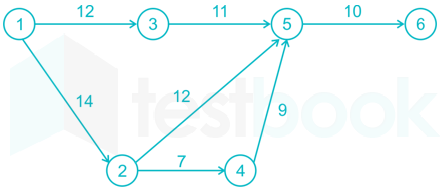
A project consists of 7 activities. The network along with the time durations (in days) for various activities is shown in the figure.

The minimum time (in days) for completion of the project is _____

65

A manufacturer has the following data regarding a product:

Fixed cost per month = Rs. 50000

Variable cost per unit = Rs.200

Selling price per unit = Rs.300

Production capacity = 1500 units per month

If the production is carried out at 80% of the rated capacity that the monthly profit (in Rs.) is ________

Attempt this paper under real exam conditions

Timed interface, section switching, instant scoring, and question-by-question analytics — free.

Start Timed Attempt