Official Paper

GATE ME 2014 Official Paper: Shift 2 (Previous Year Paper)

65 questions · 180 minutes · with answers · free

General Aptitude (10 questions)

1

Choose the most appropriate word from the options given below to complete the following sentence.

Communication and interpersonal skills are ___________ important in their own ways.

  1. ((a))

    each

  2. ((b))

    both

  3. ((c))

    all

  4. ((d))

    either

Show Answer
Answer: ((b))

both

The correct answer is option 2), i.e. both. 

Explanation:

  • Both: We use both to refer to two things or people together.
  • Here, communication skill and interpersonal skill are two different things, that's we will use both for them.

Extra Bites:

Let us try to find the use of words as well- 

  • Each: It is used to refer to individual things in a group or a list of two or more things.
  • E.g. : Each vehicle was being checked by the police.
  • All: It is used to refer to a whole group, with the emphasis that nothing is being left out.
  • E.g. : All kids were asked to stand on the ground.
  • Either: It is used to refer to anyone object out of the two objects. It is used to expresses choice between the two things. 
  • E.g.   : Both these roads go to DB Mall so you can take either way. 

Mistake Point:

Although 'all' also looks appropriate here, 'Both' has already been given in one of the options. So we will prefer 'Both'.

2

Which of the options given below best completes the following sentence?

She will feel much better if she __________.

  1. ((a))

    will get some rest

  2. ((b))

    gets some rest

  3. ((c))

    will be getting some rest

  4. ((d))

    is getting some rest

Show Answer
Answer: ((b))

gets some rest

The correct answer is option 2), i.e. gets some rest. 

Explanation:

  • In the given sentence "if clause" has been used which is a type of conditional clause. Generally, when two actions are given in the Future tense, for the action representing a condition, we use the present indefinite tense, and for the other action, we use future indefinite tense.  "Conditional clause in Present Indefinite tense + Principle clause is in Future indefinite tense (will/shall)"

Extra Bites:

  • In the given sentence, "She will feel much better" is the principal clause (the action taking place later) which is dependent on the conditional clause.
  • A conditional clause has "if" as to show the condition and should be in the present indefinite tense.
3

Choose the most appropriate pair of words from the options given below to complete the following sentence.

She could not _____ the thought of _________ the election to her bitter rival.

  1. ((a))

    bear, loosing

  2. ((b))

    bare, loosing

  3. ((c))

    bear, losing

  4. ((d))

    bare, losing

Show Answer
Answer: ((c))

bear, losing

The correct answer is option 3), i.e. bear, losing. 

Let us try to find the meaning of words given in the option for better understanding- 

  • Bear: (verb) to carry/stand a thought.
  • Bare: (verb) uncover a part of the body or other thing and expose it to view.
  • Loosing: (gerund) the act of setting free or releasing.
  • Losing: (gerund) suffering a loss or failing to keep possession of something.
<br>

Clearly, according to the context of the sentence, the only correct option is option 3), i.e. bear, losing.

4

A regular die has six sides with numbers 1 to 6 marked on its sides. If a very large number of throws show the following frequencies of occurrence:

1 → 0.167; 2 → 0.167; 3 → 0.152; 4 → 0.166; 5 → 0.168; 6 → 0.180. We call this die

  1. ((a))

    irregular

  2. ((b))

    biased

  3. ((c))

    Gaussian

  4. ((d))

    insufficient

Show Answer
Answer: ((b))

biased

For a very large number of throws, the frequency should be same for an unbiased die.

But given frequencies are not same, hence the die is biased

5

Fill in the missing number in the series.

2    3    6    15 ____157.5    630

6

Find the odd one in the following group

Q,W,Z,B   B,H,K,M   W,C,G,J   M,S,V,X

  1. ((a))

    Q,W,Z,B

  2. ((b))

    B,H,K,M

  3. ((c))

    W,C,G,J

  4. ((d))

    M,S,V,X

Show Answer
Answer: ((c))

W,C,G,J

Q, W, Z, B ⇒ Q + 6 → W, W + 3 → Z, Z + 2 → B

B, H, K, M ⇒ B + 6 → H, H + 3 → K, K + 2 → M

W, C, G, J ⇒ W + 6 → C, C + 4 → G, G + 3 → J

M, S, V, X ⇒ M + 6 → S, S + 3 → V, V + 2 → X

All follow the same pattern except "W, C, G, J".

Hence, option 3) is the correct answer.

7

Lights of four colors (red, blue, green, yellow) are hung on a ladder. On every step of the ladder there are two lights. If one of the lights is red, the other light on that step will always be blue. If one of the lights on a step is green, the other light on that step will always be yellow. Which of the following statements is not necessarily correct?

  1. ((a))

    The number of red lights is equal to the number of blue lights

  2. ((b))

    The number of green lights is equal to the number of yellow lights

  3. ((c))

    The sum of the red and green lights is equal to the sum of the yellow and blue lights

  4. ((d))

    The sum of the red and blue lights is equal to the sum of the green and yellow lights

Show Answer
Answer: ((d))

The sum of the red and blue lights is equal to the sum of the green and yellow lights

Let the no. of red lights be equal to X and the no. of green lights be equal to Y.

According to the given condition, there exists a blue light for every red light.

Since there are only two lights on each step of the ladder, we can conclude that for every blue light, there exists only one red light. The same condition can be applied to the pair of green and yellow lights.

Thus, we have, no. of red lights = no. of blue lights = X.

Also, no. of green lights = no. of yellow lights = Y.

Therefore, options 1 and 2 are necessarily correct.

Now, the sum of the red and the green lights = X + Y = the sum of the yellow and the blue lights.

Therefore, option 3 is also necessarily correct.

No. of steps of the ladder that have the blue-red pair may be less than the no. of steps that have the green-yellow pair or vice versa.

Hence, option 4 is not necessarily correct.

8

The sum of eight consecutive odd numbers is 656. The average of four consecutive even numbers is 87. What is the sum of the smallest odd number and second-largest even number?

9

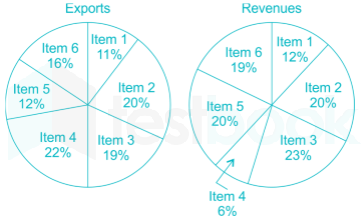
The total exports and revenues from the exports of a country are given in the two charts shown below. The pie chart for exports shows the quantity of each item exported as a percentage of the total quantity of exports. The pie chart for the revenues shows the percentage of the total revenue generated through export of each item. The total quantity of exports of all the items is 500 thousand tonnes and the total revenues are 250 crore rupees. Which item among the following has generated the maximum revenue per kg?

  1. ((a))

    Item 2

  2. ((b))

    Item 3

  3. ((c))

    Item 6

  4. ((d))

    Item 5

Show Answer
Answer: ((d))

Item 5

Given:

The total quantity of exports of all the items = 500 thousand tonnes

The total revenues = 250 crore rupees

Calculation:

Total revenue for item 1 = 12% ×  250 × 107  = 3 × 108 rupees

Total export for item 1 = 11% × 500 × 106 = 55 × 106 kg

Item1revenue per kg = (3/55) × 102  = 5.45 rupees

Total revenue for item 2 = 20% × 250 × 107  = 5 × 108  rupees

Total export for item 2 = 20% × 500 × 106 = 108 kg

Item 2 revenue per kg = 5 rupees

Total revenue for item 3 = 23% × 250 × 107  = 5.75 × 108

Total export for item 3 = 19% × 500 × 106 = 95 × 106 

Item 3 revenue per kg = 6.052 rupees

Total revenue for item 4 = 6% × 250 × 107  = 1.5  × 108

Total export for item 4 = 22% × 500 × 106 = 11 × 107

Item 4 revenue per kg = 1.363 rupees

Total revenue for item 5 = 20% × 250 × 107 = 5 × 108  rupees

Total export for item 5 = 12% × 500 × 106 = 6 × 107  rupees

Item 5 revenue per kg = 8.333 rupees

Total revenue for item 6 = 19% × 250 × 107  = 475  × 106  rupees

Total export for item 6 = 16% × 500 × 106 = 8  × 107  rupees

Item 6 revenue per kg = 5.9375  rupees

∴ Item 5 has generated the maximum revenue per kg

10

It takes 30 minutes to empty a half-full tank by draining it at a constant rate. It is decided to simultaneously pump water into the half-full tank while draining it. What is the rate at which water has to be pumped in so that it gets fully filled in 10 minutes?

  1. ((a))

    4 times the draining rate

  2. ((b))

    3 times the draining rate

  3. ((c))

    2.5 times the draining rate

  4. ((d))

    2 times the draining rate

Show Answer
Answer: ((a))

4 times the draining rate

Given:

A half-full tank by draining pipe = 30 minutes

Calculation:

A full tank can drain = 60 min.

Let 60 litres can be draining in 60 min.

The efficiency of draining pipe = 1

Half tank filled in 10 min. by both = 30/10 = 3

The efficiency of pump water = 3 + 1 = 4 

∴ Pump water is 4 times the draining rate.

Mechanical Engineering (55 questions)

11

One of the eigenvectors of the matrix \(\left[ {\begin{array}{*{20}{c}} { - 5}&2\ { - 9}&6 \end{array}} \right]\) is

  1. ((a))

    \(\left{ {\begin{array}{*{20}{c}} { - 1}\ 1 \end{array}} \right}\)

  2. ((b))

    \(\left{ {\begin{array}{*{20}{c}} { - 2}\ 9 \end{array}} \right}\)

  3. ((c))

    \(\left{ {\begin{array}{*{20}{c}} 2\ { - 1} \end{array}} \right}\)

  4. ((d))

    \(\left{ {\begin{array}{*{20}{c}} 1\ 1 \end{array}} \right}\)

Show Answer
Answer: ((d))

\(\left{ {\begin{array}{*{20}{c}} 1\ 1 \end{array}} \right}\)

Eigen vector should satisfy Ax = λx, where λ is eigen value

Taking \(x = \left[ {\begin{array}{*{20}{c}} { - 1}\ 1 \end{array}} \right]\) (option 1)

Ax = \(\left[ {\begin{array}{{20}{c}} { - 5}&2\ { - 9}&6 \end{array}} \right]\left[ {\begin{array}{{20}{c}} { - 1}\ 1 \end{array}} \right] = \left[ {\begin{array}{*{20}{c}} 7\ {15} \end{array}} \right]\)≠  λx

∴ Option 1 is not correct.

 Taking \(x = \left[ {\begin{array}{*{20}{c}} { - 2}\ 9 \end{array}} \right]\) (option 2)

\(\left[ {\begin{array}{{20}{c}} { - 5}&2\ { - 9}&6 \end{array}} \right]\left[ {\begin{array}{{20}{c}} { - 2}\ 9 \end{array}} \right] = \left[ {\begin{array}{{20}{c}} {28}\ {72} \end{array}} \right] = 4\left[ {\begin{array}{{20}{c}} 7\ {18} \end{array}} \right] \ne λ x\)

∴ Option 2 is not correct.

Taking \(x = \left[ {\begin{array}{*{20}{c}} { 2}\ -1 \end{array}} \right]\)  (option 3)

\(\left[ {\begin{array}{{20}{c}} { - 5}&2\ { - 9}&6 \end{array}} \right]\left[ {\begin{array}{{20}{c}} 2\ { - 1} \end{array}} \right] = \left[ {\begin{array}{{20}{c}} { - 12}\ { - 24} \end{array}} \right] = - 12\left[ {\begin{array}{{20}{c}} 1\ 1 \end{array}} \right] \ne λ x\)

∴ Option 3 is not correct.

Taking \(x = \left[ {\begin{array}{*{20}{c}} { 1}\ 1 \end{array}} \right]\)  (option 4)

\(\left[ {\begin{array}{{20}{c}} { - 5}&2\ { - 9}&6 \end{array}} \right]\left[ {\begin{array}{{20}{c}} 1\ 1 \end{array}} \right] = \left[ {\begin{array}{{20}{c}} { - 3}\ { - 3} \end{array}} \right] = ; - 3\left[ {\begin{array}{{20}{c}} 1\ 1 \end{array}} \right] = λ x\)

Option 4 is the correct answer.

12

limx0(e2x1sin(4x))\rm \lim \limits_{x\to 0}\left( {\frac{{{{\rm{e}}^{2{\rm{x}}}} - 1}}{{\sin \left( {4{\rm{x}}} \right)}}} \right) is equal to

  1. ((a))

    0

  2. ((b))

    0.5

  3. ((c))

    1

  4. ((d))

    2

Show Answer
Answer: ((b))

0.5

\(\rm \lim \limits_{x\to 0}\left( {\frac{{{{\rm{e}}^{2{\rm{x}}}} - 1}}{{\sin \left( {4{\rm{x}}} \right)}}} \right){\rm{is}}\left( {\begin{array}{*{20}{c}} 0\ 0 \end{array}} \right)\)

So, applying L – Hospital rule

limx0(e2x1sin(4x))=limx02e2x4cos(4x)=24=0.5\rm \lim \limits_{x\to 0}\left( {\frac{{{{\rm{e}}^{2{\rm{x}}}} - 1}}{{\sin \left( {4{\rm{x}}} \right)}}} \right) = \lim \limits_{x\to 0}\frac{{2{{\rm{e}}^{2{\rm{x}}}}}}{{4\cos \left( {4{\rm{x}}} \right)}} = \frac{2}{4} = 0.5

13

Curl of vector F=x2z2i^2xy2zj^+2y2z3k^{\rm{\vec F}} = {{\rm{x}}^2}{{\rm{z}}^2}{\rm{\hat i}} - 2{\rm{x}}{{\rm{y}}^2}{\rm{z\hat j}} + 2{{\rm{y}}^2}{{\rm{z}}^3}{\rm{\hat k}} is

  1. ((a))

    (4yz3+2xy2)i^+2x2zj^2y2zk^\left( {4{\rm{y}}{{\rm{z}}^3} + 2{\rm{x}}{{\rm{y}}^2}} \right){\rm{\hat i}} + 2{{\rm{x}}^2}{\rm{z\hat j}} - 2{{\rm{y}}^2}{\rm{z\hat k}}

  2. ((b))

    (4yz3+2xy2)i^2x2zj^2y2zk^\left( {4{\rm{y}}{{\rm{z}}^3} + 2{\rm{x}}{{\rm{y}}^2}} \right){\rm{\hat i}} - 2{{\rm{x}}^2}{\rm{z\hat j}} - 2{{\rm{y}}^2}{\rm{z\hat k}}

  3. ((c))

    2xz2i^4xyzj^+6y2z2k^2{\rm{x}}{{\rm{z}}^2}{\rm{\hat i}} - 4{\rm{xyz\hat j}} + 6{{\rm{y}}^2}{{\rm{z}}^2}{\rm{\hat k}}

  4. ((d))

    2xz2i^+4xyzj^+6y2z2k^2{\rm{x}}{{\rm{z}}^2}{\rm{\hat i}} + 4{\rm{xyz\hat j}} + 6{{\rm{y}}^2}{{\rm{z}}^2}{\rm{\hat k}}

Show Answer
Answer: ((a))

(4yz3+2xy2)i^+2x2zj^2y2zk^\left( {4{\rm{y}}{{\rm{z}}^3} + 2{\rm{x}}{{\rm{y}}^2}} \right){\rm{\hat i}} + 2{{\rm{x}}^2}{\rm{z\hat j}} - 2{{\rm{y}}^2}{\rm{z\hat k}}

Given,

F=x2z2i^2xy2zj^+2y2z3k^ curlF=×F =(i^x+j^y+k^z)×F \begin{array}{l} {\rm{\vec F}} = {{\rm{x}}^2}{{\rm{z}}^2}{\rm{\hat i}} - 2{\rm{x}}{{\rm{y}}^2}{\rm{z\hat j}} + 2{{\rm{y}}^2}{{\rm{z}}^3}{\rm{\hat k}}\ {\rm{curl\vec F}} = \nabla \times {\rm{\vec F}}\ = \left( {{\rm{\hat i}}\frac{\partial }{{\partial {\rm{x}}}} + {\rm{\hat j}}\frac{\partial }{{\partial {\rm{y}}}} + {\rm{\hat k}}\frac{\partial }{{\partial {\rm{z}}}}} \right) \times {\rm{\vec F}}\ \end{array}

\( = \left| {\begin{array}{*{20}{c}} {\rm{i}}&{\rm{j}}&{\rm{k}}\ {\frac{\partial}{\partial {\rm{x}}}}&{\frac{\partial}{\partial {\rm{y}}}}&{\frac{\partial}{\partial {\rm{z}}}}\ {{{\rm{x}}^2}{{\rm{z}}^2}}&{ - 2{\rm{x}}{{\rm{y}}^2}{\rm{z}}}&{2{{\rm{y}}^2}{{\rm{z}}^3}} \end{array}} \right|\ = \left( {4{\rm{y}}{{\rm{z}}^3} + 2{\rm{x}}{{\rm{y}}^2}} \right){\rm{\hat i}} + 2{{\rm{x}}^2}{\rm{z\hat j}} - 2{{\rm{y}}^2}{\rm{z\hat k}}\)

14

A box contains 25 parts of which 10 are defective. Two parts are being drawn simultaneously in a random manner from the box. The probability of both the parts being good is

  1. ((a))

    7/20

  2. ((b))

    42/125

  3. ((c))

    25/29

  4. ((d))

    5/9

Show Answer
Answer: ((a))

7/20

Two parts can be selected from 25 parts 25C2{25_{{{\rm{C}}_2}}} ways

Two parts can be selected from 15 good parts in 15C2{15_{{{\rm{C}}_2}}}ways

∴ Required probability \(= \frac{{{{15}_{{{\rm{C}}2}}}}}{{{{25}{{{\rm{C}}_2}}}}} = \frac{7}{{20}}\)

15

The best approximation of the minimum value attained by e-x sin(100x) for x ≥ 0 is ______

16

A steel cube, with all faces free to deform, has Young’s modulus, E, Poisson’s ratio, ν, and coefficient of thermal expansion, α. The pressure (hydrostatic stress) developed within the cube, when it is subjected to a uniform increase in temperature, ΔT, is given by

  1. ((a))

    0

  2. ((b))

    α(ΔT)E12v\frac{{{\rm{\alpha }}\left( {{\rm{\Delta T}}} \right){\rm{E}}}}{{1 - 2{\rm{v}}}}

  3. ((c))

    α(ΔT)E12v- \frac{{{\rm{\alpha }}\left( {{\rm{\Delta T}}} \right){\rm{E}}}}{{1 - 2{\rm{v}}}}

  4. ((d))

    α(ΔT)E3(12v)\frac{{{\rm{\alpha }}\left( {{\rm{\Delta T}}} \right){\rm{E}}}}{{3\left( {1 - 2{\rm{v}}} \right)}}

Show Answer
Answer: ((a))

0

Explanation:

Since all the faces are free to expand the stresses due to temperature rise is equal to 0.

If the cube is constrained on all six faces, the stress produced in all three directions will be the same.

∴ thermal strain in x-direction = -α(ΔT) = σxEνσyEνσzE\frac{{{\sigma _x}}}{E} - \nu \frac{{{\sigma _y}}}{E} - \nu \frac{{{\sigma _z}}}{E}

σx = σy = σz = σ

σ=α(ΔT)E(12ν)\sigma = - \frac{{\alpha \left( {{\rm{\Delta }}T} \right)E}}{{\left( {1 - 2\nu } \right)}}

17

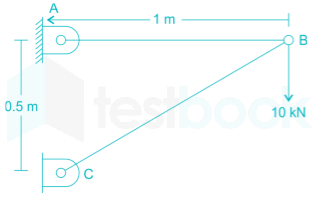
A two-member truss ABC is shown in the figure. The force (in kN) transmitted in member AB is _______

18

A 4-bar mechanism with all revolute pairs has link lengths lf = 20 mm, lin = 40 mm, lco = 50 mm and lout = 60 mm. The suffixes 'f', 'in', 'co' and 'out' denote the fixed link, the input link, the coupler and output link respectively. Which one of the following statements is true about the input and output links?

  1. ((a))

    Both links can execute full circular motion

  2. ((b))

    Both links cannot execute full circular motion

  3. ((c))

    Only the output link cannot execute full circular motion

  4. ((d))

    Only the input link cannot execute full circular motion

Show Answer
Answer: ((a))

Both links can execute full circular motion

Concept:

Grashof’s law:

It states that for a planar four-bar mechanism the sum of shortest and longest link length can’t be greater than the sum of remaining two link length if there has to be continuous relative motion between them.

**L + S ≤ P + Q  (**first check this condition then proceed further)

∴ for continuous relative motion, this relation should be satisfied.

Inversions (arrangement of links) of planar four-bar mechanism.

Case 1: L + S < P + Q

  • When the shortest link is fixed → Double crank mechanism, it means both input and output link can do the complete circular motion.
  • When link adjacent to shorter link is fixed → Crank rocker mechanism, it means one of the links can do complete circular motion and other can partially circular motion (oscillates)
  • When shortest is coupler → Double rocker mechanism, it means both links cannot do complete circular motion ( they can only oscillate).

Case 2: L + S = P + Q

  • All the inversions are similar to case 1.

Case 3: L + S > P + Q

All the inversions result in double rocker mechanism.

Calculation:

Given:

S = 20 mm, L = 60 mm, P= 40 mm, Q = 50 mm and S is fixed.

First, check if there is continuous motion or not i.e. relation L + S ≤ P + Q is satisfied or not.

L + S = 20 + 60 = 80 mm and P + Q = 40 + 50 = 90 mm

As, L + S < P + Q 

∴ Continous motion is possible.

Now as the shortest link is fixed, so there will be a double crank mechanism which means both input and output link can do the complete circular motion.

19

In vibration isolation, which one of the following statements is NOT correct regarding Transmissibility (T)?

  1. ((a))

    T is nearly unity at small excitation frequencies

  2. ((b))

    T can be always reduced by using higher damping at any excitation frequency

  3. ((c))

    T is unity at the frequency ratio of √2

  4. ((d))

    T is infinity at resonance for undamped systems

Show Answer
Answer: ((b))

T can be always reduced by using higher damping at any excitation frequency

In a vibration isolation system, the ratio of the force transmitted to the force applied is known as the isolation factor or transmissibility ratio.

T=1+(2ξωωn)2(2ξωωn)2+(1;ω2ωn2)2;T = \frac{{\sqrt {1 + {{\left( {\frac{{2\xi\omega }}{{{\omega _n}}}} \right)}^2}} }}{{\sqrt {{{\left( {\frac{{2\xi\omega }}{{{\omega _n}}}} \right)}^2} + {{\left( {1 - ;\frac{{{\omega ^2}}}{{{\omega _n}^2}}} \right)}^2};} }}

ωωn=2;\frac{\omega}{{{\omega_n}}} = \sqrt 2 ; or ωωn=0;\frac{\omega}{{{\omega_n}}} =0 ;then T = 1 for all values of damping factor c/cc.

T is infinity at resonance for undamped systems. So at resonance, damping is important.

T is nearly unity at small excitation frequencies

20

In a structure subjected to fatigue loading, the minimum and maximum stresses developed in a cycle are 200 MPa and 400 MPa respectively. The value of stress amplitude (in MPa) is _______

21

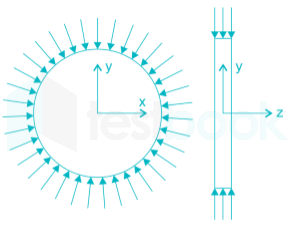
A thin plate of uniform thickness is subject to pressure as shown in the figure below

Under the assumption of plane stress, which one of the following is correct?

  1. ((a))

    Normal stress is zero in the z-direction

  2. ((b))

    Normal stress is tensile in the z-direction

  3. ((c))

    Normal stress is compressive in the z-direction

  4. ((d))

    Normal stress varies in the z-direction

Show Answer
Answer: ((a))

Normal stress is zero in the z-direction

Explanation:

Plane stress

  • Let us consider a thin plate whose thickness is small as compared to other dimensions (say x and y).
  • Let z-axis be perpendicular to the planes of the plate.
  • There is no force acting on the lower and upper planes of the plate.
  • The force applied on the boundary of a plate is in the plane parallel to the x-y plane and is uniformly distributed over the cross-section such that it does not depend on z.
  • These condition of the geometry of the body and the force applied to facilitate us to assume that the component of the stress tensor in the z-direction are zero i.e σzz = τxz = τyz = 0.
  • Only non-zero stress components are σxx, σyy and τxy.
  • These stress components are assumed to be a function of x and y i.e. they do not depend upon z.
  • This idealisation is called plane stress. The stress tensor for plane stress can be written as:

\(\sigma = \left[ {\begin{array}{*{20}{c}} {{\sigma _{xx}}}&{{\tau _{xy}}}&0\ {{\tau _{yx}}}&{{\sigma _{yy}}}&0\ 0&0&0 \end{array}} \right]\)

22

For laminar forced convection over a flat plate, if the free stream velocity increases by a factor of 2, the average heat transfer coefficient

  1. ((a))

    Remains same

  2. ((b))

    Decreases by a factor of √2

  3. ((c))

    Rises by a factor of √2

  4. ((d))

    Rises by a factor of 4

Show Answer
Answer: ((c))

Rises by a factor of √2

Concept:

 Thermal boundary layer theory

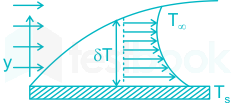
  • Thermal boundary layer develops when the fluid temperature and surface temperature are different.
  • When a fluid at a specific temperature flow over the surface of a flat plate, fluid particles adjacent to the surface exchange energy with the adjoining fluid layer and so on.
  • As a result temperature profile develops in the flow field.
  • So flow region over the surface in which the temperature gradient exists in the direction normal to the area is known as the thermal boundary layer.

δT = thermal boundary layer

It is achieved when Ts - T = 0.99(T- T)

​The equation for laminar thermal boundary layer over a flat plate.

It is given by Paul Heisen’s formula.

Nux=0.332;(Rex)0.5(Pr)0.33N{u_x} = 0.332;{\left( {R{e_x}} \right)^{0.5}}{\left( {Pr} \right)^{0.33}}

where

Nux = Local Nusselt number = hxxk\frac{{{h_x}x}}{k}

Rex = Reynold's number = ρvxμ\frac{{\rho vx}}{\mu }

Pr = Prandtl number = μcpk\frac{{\mu {c_p}}}{k}

And the average Nusselt number can be determined by

Nul=0.664;(Rel)0.5(Pr)0.33N{u_l} = 0.664;{\left( {R{e_l}} \right)^{0.5}}{\left( {Pr} \right)^{0.33}}

Nul = Average Nusselt number = hlLk\frac{{{h_l}L}}{k}

where hl = average heat transfer coefficient.

Calculation:

For a laminar flow ;

N**u = 0.664 (Re)0.5 (Pr)**0.33

hLk=0.664(ρVLμ)0.5(Pr)0.33\frac{{hL}}{k} = 0.664{\left( {\frac{{\rho VL}}{\mu }} \right)^{0.5}}{\left( {{P_r}} \right)^{0.33}}

⇒ h α V0.5

⇒ hVh \propto \sqrt V

So when free stream velocity increase by a factor of 2, then the average heat transfer coefficient rises by a factor of √2

23

The thermal efficiency of an air-standard Brayton cycle in terms of pressure ratio rp and γ=cpcv\gamma={\frac{c_p}{c_v}} is given by

  1. ((a))

    11rpγ11 - \frac{1}{{r_p^{\gamma - 1}}}

  2. ((b))

    11rpγ1 - \frac{1}{{r_p^\gamma }}

  3. ((c))

    11rp1γ1 - \frac{1}{{r_p^{\frac{1}{\gamma }}}}

  4. ((d))

    11rp(γ1)γ1 - \frac{1}{{r_p^{\frac{{\left( {\gamma - 1} \right)}}{\gamma }}}}

Show Answer
Answer: ((d))

11rp(γ1)γ1 - \frac{1}{{r_p^{\frac{{\left( {\gamma - 1} \right)}}{\gamma }}}}

Explanation:

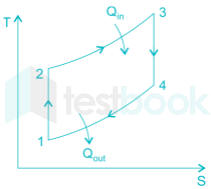
Brayton cycle:

It is also known as the Joule cycle.

It consists of 4 processes

  • 1-2: Reversible adiabatic compression
  • 2-3: Constant pressure heat addition
  • 3-4: Reversible adiabatic expansion
  • 4-1: Constant pressure heat rejection


T-S diagram for the Brayton cycle is shown below


The thermal efficiency of an air-standard Brayton cycle is given by:

 ηt=11rp(γ1)γ\eta _t=1 - \frac{1}{{r_p^{\frac{{\left( {γ - 1} \right)}}{γ }}}}

where, rp=pressure;ratio=P2P1=P3P4{r_p} = pressure;ratio = \frac{{{P_2}}}{{{P_1}}} = \frac{{{P_3}}}{{{P_4}}} and γ = ratio of specific heats.

24

For an incompressible flow field, V\vec V , which one of the following conditions must be satisfied?

  1. ((a))

    V=0\nabla \cdot \vec V = 0

  2. ((b))

    ×V=0\nabla \times \vec V = 0

  3. ((c))

    (V)V=0\left( {\vec V \cdot \nabla } \right)\vec V = 0

  4. ((d))

    Vt+(V)V=0\frac{{\partial \vec V}}{{\partial t}} + \left( {\vec V \cdot \nabla } \right)\vec V = 0

Show Answer
Answer: ((a))

V=0\nabla \cdot \vec V = 0

Explanation:

Any flow must satisfy the continuity equation if continuity equation violates then such flow is not possible.

continuity equation for incompressible flow is

ux+;vy+;wz=0\frac{{\partial u}}{{\partial x}} + ;\frac{{\partial v}}{{\partial y}} + ;\frac{{\partial w}}{{\partial z}} = 0 which is V=0\nabla \cdot \vec V = 0

∴ For an incompressible flow field, divergence must be zero, i.e. V=0\nabla \cdot \vec V = 0

25

A pure substance at 8 MPa and 400 °C is having a specific internal energy of 2864 kJ/kg and a specific volume of 0.03432 m3/kg. Its specific enthalpy (in kJ/kg) is _______

26

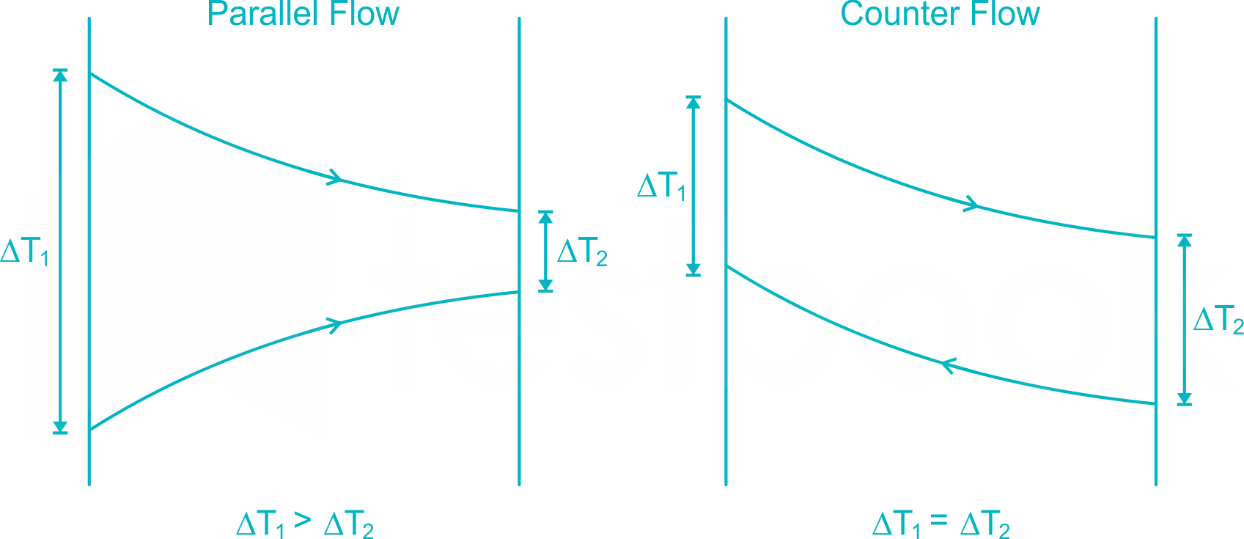
In a heat exchanger, it is observed that ΔT1 = ΔT2, where ΔT1 is the temperature difference between the two single phase fluid streams at one end and ΔT2 is the temperature difference at the other end. This heat exchanger is

  1. ((a))

    a condenser

  2. ((b))

    an evaporator

  3. ((c))

    a counter flow heat exchanger

  4. ((d))

    a parallel flow heat exchanger

Show Answer
Answer: ((c))

a counter flow heat exchanger

Explanation:

In case of the counter-flow heat exchanger when the heat capacities of both the fluids are the same.

i.e. ṁhch = ṁccc


Q = ṁhch(Th1 – Th2) = ṁccc(Tc2 – Tc1)

⇒ (Th1 – Th2) = (Tc2 – Tc1)

⇒ (Th1 – Tc2) = (Th2 – Tc1)

⇒ ΔT1 = ΔT2

<sub>

</sub>

For parallel flow heat exchanger,  ΔT1 will always be greater than ΔT2.

27

The difference in pressure (in N/m2) across an air bubble of diameter 0.001 m immersed in water (surface tension = 0.072 N/m) is _______

28

If there are m sources and n destinations in a transportation matrix, the total number of basic variables in a basic feasible solution is

  1. ((a))

    m + n

  2. ((b))

    m + n + 1

  3. ((c))

    m + n – 1

  4. ((d))

    m

Show Answer
Answer: ((c))

m + n – 1

Explanation:

If xij0,x_{ij}\ge 0,   is the number of units shipped from ith source to jth destination, then the equivalent LPP model will be

Minimize Z=i=1mj=1ncijxijZ = \sum\limits_{i = 1}^m {\sum\limits_{j = 1}^n {{c_{ij}}} } {x_{ij}}

Subjected to:

i=1mxijbi,,(demand) j=1nxijai,,(supply)\begin{array}{l} \sum\limits_{i = 1}^m {{x_{ij}}} \le {b_i},,(demand)\ \sum\limits_{j = 1}^n {{x_{ij}}} \le {a_i},,(\sup ply) \end{array}

If total supply = total demand then it is a balanced transportation problem otherwise it is called an unbalanced transportation problem.

There will be (m + n - 1) basic independent variables out of (m x n) variables.

29

A component can be produced by any of the four processes I, II, III and IV. The fixed cost and the variable cost for each of the processes are listed below. The most economical process for producing a batch of 100 pieces is

ProcessFixed cost (in Rs.)Variable cost per piece (in Rs.)
I203
II501
III402
IV104
  1. ((a))

    I

  2. ((b))

    II

  3. ((c))

    III

  4. ((d))

    IV

Show Answer
Answer: ((b))

II

Concept:

Various costs associated with a production system are:

**Fixed cost:**​

  • The cost which does not change for a given period (lifetime).
  • This cost is independent of the volume of production (means it doesn’t affect by whether the production is large or small).
  • For example, rent, taxes salaries of the supervisor, cost of the machine, insurance cost, etc.

Variable cost:

  • This cost varies directly and proportionally with the output.
  • Higher the output, larger the variable cost.
  • For example, the cost of raw material, cost of labour, etc.

Total Cost:

Total cost is the sum of fixed cost and variable cost.

Calculation:

ProcessFixed cost (in Rs.)Variable cost per piece (in Rs.)Total variable cost (in Rs.) (For 100 pieces)Total Cost (Fixed cost + Variable cost) ( in Rs.)
I203100 × 3 = 30020 + 300 = 320
II501100 × 1 = 10050 + 100 = 150 (min)
III402100 × 2 = 20040 + 200 = 240
IV104100 × 4 = 40010 + 400 = 410

∴ Process II is economical.

30

The flatness of a machine bed can be measured using

  1. ((a))

    Vernier calipers

  2. ((b))

    Auto collimator

  3. ((c))

    Height gauge

  4. ((d))

    Tool maker’s microscope

Show Answer
Answer: ((b))

Auto collimator

Explanation:

Various devices and their properties are mentioned in the table below.

DevicesProperties
Autocollimator- An autocollimator is an optical instrument which is used to measure small angles with high sensitivity. - It is also used for plane surface inspection i.e. to measure straightness, flatness and alignment of a plane surface.
Vernier calliper- It is used to measure outer dimensions of the objects (using the main jaws), inside dimension (using the smaller jaws at the top) and depth (using stem).
Height gauge- It is used for measuring the width of the slot and external dimensions. - It is used with a dial indicator to check hole location, pitch dimensions, concentricity and eccentricity.
Tool maker’s microscope- This is designed for measurement on parts of complex forms e.g. profile of external threads, tools, templates and gauges. - It can also be used for measuring centre-to-centre distances of holes in any planes.
Talysurf- Talysurf is an electronic equipment which is used to measure surface roughness. - It works on carrier modulating principle.
Telescopic gauge- It is an indirect measuring gauge and used to measure any hole, slot or bore. - The shape of this gauge is as T (English letter) with knurling on the backside of the handle.
Transfer callipers- The parts which cannot be measured directly by scale are measured by callipers. - Transfer callipers are the callipers which have adjustable legs so that it can be used to measure confined or recessed areas. for example, T shape, U shape etc.
31

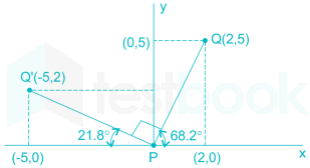
A robot arm PQ with end coordinates P(0,0) and Q(2,5) rotates counter clockwise about P in the XY plane by 90°. The new coordinate pair of the end point Q is

  1. ((a))

    (-2, 5)

  2. ((b))

    (-5, 2)

  3. ((c))

    (-5, -2)

  4. ((d))

    (2, -5)

Show Answer
Answer: ((b))

(-5, 2)

Concept:

Whenever a point (x,y) is rotated an angle θ about the origin the co-ordinates of the new point (x,y) can be obtained as:

\(\left[ {\begin{array}{{20}{c}} {x'}\ {y'} \end{array}} \right] = \left[ {\begin{array}{{20}{c}} {cos\theta }&{ - sin\theta }\ {sin\theta }&{cos\theta } \end{array}} \right]\left[ {\begin{array}{*{20}{c}} x\ y \end{array}} \right]\)

Calculation:

Given:

(x,y) = (2,5) and θ = 90°

putting the values in:

\(\left[ {\begin{array}{{20}{c}} {x'}\ {y'} \end{array}} \right] = \left[ {\begin{array}{{20}{c}} {cos\theta }&{ - sin\theta }\ {sin\theta }&{cos\theta } \end{array}} \right]\left[ {\begin{array}{*{20}{c}} x\ y \end{array}} \right]\)

\(\left[ {\begin{array}{{20}{c}} {x'}\ {y'} \end{array}} \right] = \left[ {\begin{array}{{20}{c}} 0&{ - 1}\ 1&0 \end{array}} \right]\left[ {\begin{array}{*{20}{c}} 2\ 5 \end{array}} \right]\)

\(\left[ {\begin{array}{{20}{c}} {x'}\ {y'} \end{array}} \right] = \left[ {\begin{array}{{20}{c}} { - 5}\ 2 \end{array}} \right]\)

(x',y') = (-5,2)

32

Match the Machine Tools (Group A) with the probable Operations (Group B):

Group AGroup B
P: Centre Lathe1: Slotting
Q: Milling2: Counter-boring
R: Grinding3: Knurling
S: Drilling4: Dressing
  1. ((a))

    P-1, Q-2, R-4, S-3

  2. ((b))

    P-2, Q-1, R-4, S-3

  3. ((c))

    P-3, Q-1, R-4, S-2

  4. ((d))

    P-3, Q-4, R-2, S-1

Show Answer
Answer: ((c))

P-3, Q-1, R-4, S-2

Explanation:

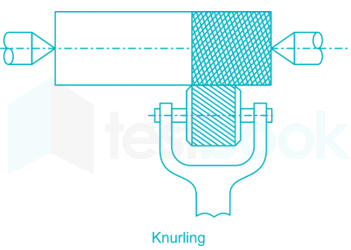
Centre Lathe → Knurling

Milling → Slotting

Grinding → Dressing

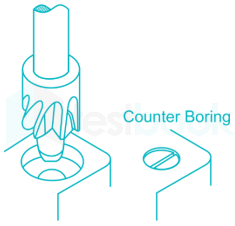
Drilling → Counter-boring

Knurling

Knurling is the operation of producing a straight-lined, diamond-shaped pattern or cross lined pattern on a cylindrical external surface by pressing a tool called knurling tool. Knurling is not a cutting operation but it is a forming operation.

A lathe is used for many operations such as turning, threading, facing, grooving, Knurling, Chamfering, centre drilling

Counter - boring

Counter - boring is an operation of enlarging a hole to a given depth, to house heads of socket heads or cap screws with the help of a counterbore tool.

Dressing:

When the sharpness of grinding wheel becomes dull because of glazing and loading, dulled grains and chips are removed (crushed or fallen) with a proper dressing tool to make sharp cutting edges.

The dressing is the operation of cleaning and restoring the sharpness of the wheel face that has become dull or has lost some of its cutting ability because of loading and glazing.

Slot Milling:

Slot milling is an operation of producing slots like T - slots, plain slots, dovetail slots etc.

33

The following four unconventional machining processes are available in a shop floor. The most appropriate one to drill a hole of square cross section of 6 mm × 6 mm and 25 mm deep is

  1. ((a))

    Abrasive Jet Machining

  2. ((b))

    Plasma Arc Machining

  3. ((c))

    Laser Beam Machining

  4. ((d))

    Electro Discharge Machining

Show Answer
Answer: ((d))

Electro Discharge Machining

Explanation:

Some of the non-conventional machining processes and their shape applications are explained below:

ProcessShape (Job) Application
Ultrasonic MachiningRound and irregular holes, impressions
Abrasive jet MachiningDrilling, cutting, deburring, etching, cleaning
Electric discharge machiningBlind complex cavities, micro holes for nozzles, through cutting of non-circular holes, narrow slots.
Electrochemical machiningBlind complex cavities, curved surfaces, through cutting, large through cutting
Laser beam machiningdrilling fine holes.
Electron beam machiningDrilling fine holes, cutting contours in sheets, cutting narrow slots.

Type Of MachiningMechanics Of Material RemovalMediumTool MaterialMaterial Application
Ultrasonic machiningBrittle fracture caused by the impact of abrasive grain due to tool vibrating at high frequency (Amplified by tapered horn).SlurryTough and ductile (soft steel)The hard and brittle material, semiconductor, non-metals( eg. Glass and ceramic).
Abrasive Jet MachiningBrittle fracture by impinging abrasive grains at high speed.Air, CO2Abrasives (Al2O3, ­­SiC), Nozzle (WC, sapphire)Hard and Brittle metal and non-metallic material.
Electric discharge machiningMelting and evaporation, aided by cavitation.Dielectric fluidCopper, brass, graphiteAll conducting metals and alloys
Electrochemical machiningElectrolysisConducting electrolyteCopper, brass, steelAll conducting metals and alloys
Electron beam machiningMelting and vapourisationvacuumA beam of an electron moving at high velocityAll material.
Laser beam machiningMelting and vapourisationNormal atmosphereA high power laser beam (Ruby rod)All material.
34

The relationship between true strain (εT) and engineering strain (εE) in a uniaxial tension test is given as

  1. ((a))

    εE = ln (1 - εT)

  2. ((b))

    εE = ln (1 + εT)

  3. ((c))

    εT = ln (1 + εE)

  4. ((d))

    εT = ln (1 - εE)

Show Answer
Answer: ((c))

εT = ln (1 + εE)

Concept:

Engineering stress: It is the stress obtained by dividing the load applied to the original cross-section area.

σe=loadinitial;area{\sigma _e} = \frac{{load}}{{initial;area}}

True stress: It is the stress obtained by dividing load applied to instantaneous cross-section area.

σt=loadinstantaneous;area{\sigma _t} = \frac{{load}}{{instantaneous;area}}

Engineering strain: It is the ratio of change in dimension to the original dimension.

ϵeΔLL0\frac{{{\rm{\Delta }}L}}{L_0}

True strain: It is the ratio of instantaneous elongation to instantaneous dimension.

tdLL\frac{{dL}}{L}

Total true strain can be concluded by:

ϵt\(\mathop \smallint \limits_{{L_o}}^{{L_f}} \frac{{dL}}{L}\)

Calculation:

\(\begin{array}{l} {\varepsilon T} = \mathop \smallint \limits{{L_0}}^{{L_f}} \frac{{dL}}{L} = \ln \left[ {\frac{{{L_f}}}{{{L_0}}}} \right]\ \Rightarrow {\varepsilon _T} = \ln \left[ {\frac{{{L_0} + \Delta L}}{{{L_0}}}} \right]\ \Rightarrow {\varepsilon _T} = \ln \left[ {1 + \frac{{\Delta L}}{{{L_0}}}} \right]\ \Rightarrow {\varepsilon _T} = ln\left[ {1 + {\varepsilon _E}} \right] \end{array}\)

35

With respect to metal working, match Group A with Group B:

Group AGroup B
P : Defect in extrusionI : alligatoring
Q : Defect in rollingII : scab
R : Product of skew rollingIII : fish tail
S : Product of rolling through cluster millIV : seamless tube
V : thin sheet with tight tolerance
VI : semi-finished balls of ball bearing
  1. ((a))

    P-II, Q-III, R-VI, S-V

  2. ((b))

    P-III, Q-I, R-VI, S-V

  3. ((c))

    P-III, Q-I, R-IV, S-VI

  4. ((d))

    P-I, Q-II, R-V, S-VI

Show Answer
Answer: ((b))

P-III, Q-I, R-VI, S-V

Explanation:

Mechanical working processes

  • Mechanical working processes are based on permanent changes in the shape of a body, i.e. in the plastic deformation under the action of external forces.
  • Mechanical working processes include rolling, forging, extrusion, drawing and press working (sheet metal working).

Defects in mechanical working processes

Various defects which arise in different mechanical working processes are mentioned below:

ProcessDefects
Extrusion- Piping: also known as tailpipe or fishtailing. - Centre burst: also known as arrowhead cracking or centre burst. - Surface cracking.
Rolling- Surface defects: scale, rust, scratches, cracks and pits etc. - Internal structural defects: wavy edges, zipper cracks, edge cracks, alligatoring, folds, laminations.
Product of skew rolling- Semi-finished balls of the ball bearing.
Product of rolling through cluster mill- Thin sheet with tight tolerance.
Forging- Cold shut, pitting, die shift, dents, burnt and overheated metal, ruptured fibre structure etc.
Drawing- Centre cracking, the formation of seams and surface defects.
Sheet metal operations- Burr and bend, wrinkling, earing, sinking, orange peel effect, strain hardening etc.
36

An analytic function of a complex variable z = x + i y is expressed as f(z) = u(x,y) + i v(x, y), where i=1i = \sqrt { - 1}. If u(x, y) = 2xy, then v(x, y) must be

  1. ((a))

    x2 + y2 constant

  2. ((b))

    x2 – y2 constant

  3. ((c))

    -x2 + y2 + constant

  4. ((d))

    -x2 – y2 + constant

Show Answer
Answer: ((c))

-x2 + y2 + constant

Concept:

if f(z) is an analytic function then Cauchy-Riemann condition will be satisfied.

i.e., \(\frac{{\partial u}}{{\partial x}} = \frac{{\partial v}}{{\partial y}}{\rm{}} & \frac{{\partial u}}{{\partial y}} = - \frac{{\partial v}}{{\partial x}}\)

Calculation:

Given:

u = 2xy​

ux=2yvy=2y\frac{{\partial u}}{{\partial x}} = 2y \Rightarrow \frac{{\partial v}}{{\partial y}} = 2y

uy=2xvx=;2x\frac{{\partial u}}{{\partial y}} = 2x \Rightarrow \frac{{\partial v}}{{\partial x}} = ; - 2x

Now,

dv=vxdx+vydydv = \frac{{\partial v}}{{\partial x}}dx + \frac{{\partial v}}{{\partial y}}dy

dv = -2x dx + 2y dy

Integrating both sides

dv=(2x)dx+2ydy\smallint dv = \smallint \left( { - 2x} \right)dx + \smallint 2ydy

v = -x2 + y2 + constant

Alternate solution

f(z) = u + iv

If u(x,y) is given, then

f(z)=ux(z,0)dziuy(z,0)dz+Constantf\left( z \right) = \smallint {u_x}\left( {z,0} \right)dz - i\smallint {u_y}\left( {z,0} \right)dz + Constant

ux=ux=2y;{u_x} = \frac{{\partial u}}{{\partial x}} = 2y;and uy=uy=2x{u_y} = \frac{{\partial u}}{{\partial y}} = 2x

ux(z,0) = 0, uy(z,0) = 2z

f(z)=i(2z)dz+Constantf\left( z \right) = - i\smallint \left( {2z} \right)dz + Constant

F(z) = -i(z2) + constant

F(z) = -i(x + iy)2 + constant

F(z) = -i{(x2 – y2) + 2ixy)} + constant

F(z) = 2xy + i(-x2 + y2) + constant

v(x,y) = -x2 + y2

<sup>

</sup>

If v(x,y) is given, then

f(z)=vy(z,0)dz+ivx(z,0)dz+Constantf\left( z \right) = \smallint {v_y}\left( {z,0} \right)dz + i\smallint {v_x}\left( {z,0} \right)dz + Constant

37

The general solution of the differential equation dydx=cos(x+y)\frac{{dy}}{{dx}} = \cos \left( {x + y} \right), with c as a constant, is

  1. ((a))

    tan(x+y2)=y+c\tan \left( {\frac{{x + y}}{2}} \right) = y + c

  2. ((b))

    sin(x+y2)=y+c\sin \left( {\frac{{x + y}}{2}} \right) = y + c

  3. ((c))

    cos(x+y2)=x+c\cos \left( {\frac{{x + y}}{2}} \right) = x + c

  4. ((d))

    tan(x+y2)=x+c\tan \left( {\frac{{x + y}}{2}} \right) = x + c

Show Answer
Answer: ((d))

tan(x+y2)=x+c\tan \left( {\frac{{x + y}}{2}} \right) = x + c

Explanation:

dydx=cos(x+y)\frac{{dy}}{{dx}} = \cos \left( {x + y} \right)

Put x + y = v

\(\begin{array}{l} \Rightarrow 1 + \frac{{dy}}{{dx}} = \frac{{dv}}{{dx}}\ \Rightarrow \frac{{dy}}{{dx}} = \frac{{dv}}{{dx}} - 1\ \therefore \frac{{dv}}{{dx}} - 1 = \cos \left( {x + y} \right) = \cos v\ \Rightarrow \frac{{dv}}{{dx}} = \cos v + 1\ \Rightarrow \frac{{dv}}{{\cos v + 1}} = dx\ \Rightarrow \frac{{dv}}{{2{{\cos }^2}\frac{v}{2}}} = dx\ \Rightarrow \mathop \smallint \frac{1}{{2{{\cos }^2}\frac{v}{2}}}dv = x + c\ \Rightarrow \tan \left( {\frac{v}{2}} \right) = x + c\ \Rightarrow \tan \left( {\frac{{x + y}}{2}} \right) = x + c \end{array}\)

38

Consider an unbiased cubic dice with opposite faces coloured identically and each face coloured red, blue or green such that each colour appears only two times on the dice. If the dice is thrown thrice, the probability of obtaining red colour on top face of the dice at least twice is _______

39

The value of \(\mathop \smallint \limits_{2.5}^4 ln\left( x \right)dx\) calculated using the Trapezoidal rule with five subintervals is _______

40

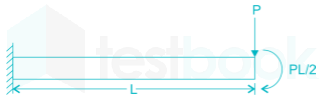
The flexural rigidity (EI) of a cantilever beam is assumed to be constant over the length of the beam shown in figure. If a load P and moment PL/2 are applied at the free end of the beam then the value of the slope at the free end is

  1. ((a))

    12PL2EI\frac{1}{2}\frac{{P{L^2}}}{{EI}}

  2. ((b))

    PL2EI\frac{{P{L^2}}}{{EI}}

  3. ((c))

    32PL2EI\frac{3}{2}\frac{{P{L^2}}}{{EI}}

  4. ((d))

    52PL2EI\frac{5}{2}\frac{{P{L^2}}}{{EI}}

Show Answer
Answer: ((b))

PL2EI\frac{{P{L^2}}}{{EI}}

Concept:

Area moment method

Theorem 1: The difference of slope of any two points of a beam is equal to the area of MEI\frac{M}{{EI}} diagram between those points.

θB – θA = Area of MEI\frac{M}{{EI}} diagram between B and A

Theorem 2: The difference of deflection of two points of a beam is equal to the moment of area of MEI\frac{M}{{EI}} diagram between those points.

YB – YA = Moment of area of MEI\frac{M}{{EI}} diagram between B and A.

Calculation:

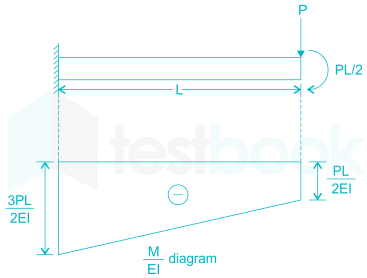
Slope at the free end = Area under MEI\frac{M}{{EI}} diagram

θ=12L[PL2EI+3PL2EI] \Rightarrow \theta = \frac{1}{2}L\left[ {\frac{{PL}}{{2EI}} + \frac{{3PL}}{{2EI}}} \right]

θ=PL2EI \Rightarrow \theta = \frac{{P{L^2}}}{{EI}}

Alternate Method

Slope at the free end = Angular deflection due to load P + Angular deflection due to moment PL/2

\(\theta =\frac{{PL^2}}{{2EI}}+\frac{{(\frac{{PL}}{{2}})\timesL}}{{EI}}\)

\(\theta=\frac{{PL^2}}{{2EI}}+\frac{{PL^2}}{{2EI}}=\frac{{PL^2}}{{EI}}\)

41

A cantilever beam of length, L, with uniform cross-section and flexural rigidity, EI, is loaded uniformly by a vertical load, w per unit length. The maximum vertical deflection of the beam is given by

  1. ((a))

    wL48EI\frac{{w{L^4}}}{{8EI}}

  2. ((b))

    wL416EI\frac{{w{L^4}}}{{16EI}}

  3. ((c))

    wL44EI\frac{{w{L^4}}}{{4EI}}

  4. ((d))

    wL424EI\frac{{w{L^4}}}{{24EI}}

Show Answer
Answer: ((a))

wL48EI\frac{{w{L^4}}}{{8EI}}

Concept:

Area moment method

Theorem 1: The difference of slope of any two points of a beam is equal to the area ofMEI\frac{M}{{EI}} diagram between those points.

θB – θA = Area of MEI\frac{M}{{EI}} diagram between B and A.

Theorem 2: The difference of deflection of two points of a beam is equal to the moment of area ofMEI\frac{M}{{EI}}diagram between those points.

YB – YA = Moment of area ofMEI\frac{M}{{EI}}diagram between B and A.

YB – YA = (Ax̅)

Calculation:

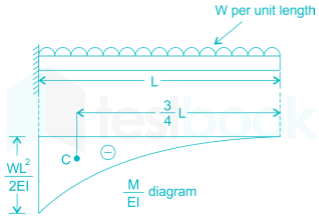
δmax = Ax̅ 

δmax=13×L×WL22EI×34L{δ _{max}} = \frac{1}{3} \times L \times \frac{{W{L^2}}}{{2EI}} \times \frac{3}{4}L

δmax=WL48EI\Rightarrow {δ _{max}} = \frac{{W{L^4}}}{{8EI}}

42

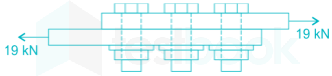
For the three bolt system shown in the figure, the bolt material has shear yield strength of 200 MPa. For a factor of safety of 2, the minimum metric specification required for the bolt is

  1. ((a))

    M8

  2. ((b))

    M10

  3. ((c))

    M12

  4. ((d))

    M16

Show Answer
Answer: ((b))

M10

Concept:

Size designation of screw threads:

  • According to Indian standards, the size of the screw thread is designated by the letter ‘M’ followed by the diameter and pitch, the two being separated by the sign ×.
  • When there is no indication of pitch it means the coarse pitch is used.
  • For example
  • M 8 × 1 indicated bolt of diameter 8 mm and pitch 1 mm.
  • M8 shows a bolt of diameter 8 mm with a coarse pitch.

Calculation:

Given:

Shear strength (τy) = 200 MPa, Factor of safety = 2, Load applied = 19 kN = 19,000 N

Number of bolts = 3

Let diameter of bolt = d

Design;stress=shear;stressFOS=2002=100;MPaDesign;stress = \frac{{shear;stress}}{{FOS}} = \frac{{200}}{2} = 100;MPa

Also, Design;stress=load;appliedtotal;shear;areaDesign;stress = \frac{{load;applied}}{{total;shear;area}}

Total;shear;area=load;applieddesign;stress=19000100×106=1.9×10⁴;m2 \Rightarrow Total;shear;area = \frac{{load;applied}}{{design;stress}} = \frac{{19000}}{{100 \times {{10}^6}}} = 1.9 \times {10^{ - 4}};{m^2}

Shear;area;for;one;bolt;(A)=total;shear;area3=6.33×10⁵;m2Shear;area;for;one;bolt;\left( A \right) = \frac{{total;shear;area}}{3} = 6.33 \times {10^{ - 5}};{m^2}

A=π4d2d=4Aπ=4×6.33×105π=8.97;mm;A = \frac{\pi }{4}{d^2} \Rightarrow d = \sqrt {\frac{{4A}}{\pi }} = \sqrt {\frac{{4 \times 6.33 \times {{10}^{ - 5}}}}{\pi }} = 8.97;mm;

∴ The minimum metric specification required for the bolt is M10.

43

Consider a flywheel whose mass M is distributed almost equally between a heavy, ring-like rim of radius R and a concentric disk-like feature of radius R/2. Other parts of the flywheel, such as spokes, etc, have negligible mass. The best approximation for α, if the moment of inertia of the flywheel about its axis of rotation is expressed as αMR2, is _________

44

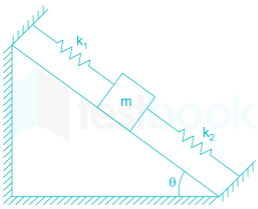
What is the natural frequency of the spring mass system shown below? The contact between the block and the inclined plane is frictionless. The mass of the block is denoted by m and the spring constants are denoted by k1 and k2 as shown below.

  1. ((a))

    k1+k22m\sqrt {\frac{{{k_1} + {k_2}}}{{2m}}}

  2. ((b))

    k1+k24m\sqrt {\frac{{{k_1} + {k_2}}}{{4m}}}

  3. ((c))

    k1k2m\sqrt {\frac{{{k_1} - {k_2}}}{m}}

  4. ((d))

    k1+k2m\sqrt {\frac{{{k_1} + {k_2}}}{m}}

Show Answer
Answer: ((d))

k1+k2m\sqrt {\frac{{{k_1} + {k_2}}}{m}}

Concept:

Let the mass is displaced x downwards in the direction of the wedge.

Spring force F1 = k1x and F2 = k2x acts in the direction opposite to the direction of displacement force.

Net force, F = (k1 + k2)x

As the system is in equilibrium

mẍ + F = 0

⇒ mẍ + (K1 + K2)x = 0

⇒ mẍ +(k1+k2m)x=0 + \left( {\frac{{{k_1} + {k_2}}}{m}} \right)x = 0

ωn=k1+k2m\therefore {\omega _n} = \sqrt {\frac{{{k_1} + {k_2}}}{m}}

45

A disc clutch with a single friction surface has coefficient of friction equal to 0.3. The maximum pressure which can be imposed on the friction material is 1.5 MPa. The outer diameter of the clutch plate is 200 mm and its internal diameter is 100 mm. Assuming uniform wear theory for the clutch plate, the maximum torque (in N.m) that can be transmitted is _______

46

A truck accelerates up a 10° incline with a crate of 100 kg. Value of static coefficient of friction between the crate and the truck surface is 0.3. The maximum value of acceleration (in m/s2) of the truck such that the crate does not slide down is _______

47

Maximum fluctuation of kinetic energy in an engine has been calculated to be 2600 J. Assuming that the engine runs at an average speed of 200 rpm, the polar mass moment of inertia (in kg.m2) of a flywheel to keep the speed fluctuation within ±0.5% of the average speed is _______

48

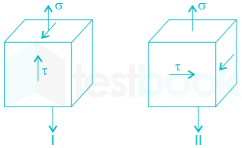
Consider the two states of stress as shown in configurations I and II in the figure below. From the standpoint of distortion energy (Von-Mises) criterion, which one of the following statements is true?

  1. ((a))

    I yields after II

  2. ((b))

    II yields after I

  3. ((c))

    Both yield simultaneously

  4. ((d))

    Nothing can be said about their relative yielding

Show Answer
Answer: ((c))

Both yield simultaneously

Concept:

Maximum distortion energy theory (Von mises theory)

  • According to this theory, the failure or yielding occurs at a point in a member when the distortion strain energy per unit volume reaches the limiting distortion energy (i.e. distortion energy at yield point) per unit volume as determined from simple tension test.
  • Equivalent stress under triaxial condition is given by:

2σeq2=(σx;;σy)2;+;(σy;;σz)2;+;(σz;;σx)2;+;6(τxy2;+;τyz2;+;τzx2)2\sigma_{eq}^2=(\sigma_x;-;\sigma_y)^2;+;(\sigma_y;-;\sigma_z)^2;+;(\sigma_z;-;\sigma_x)^2;+;6(\tau_{xy}^2;+;\tau_{yz}^2;+;\tau_{zx}^2)

Calculation:

Case 1: σx = 0, σy = σ, σz = o, τxy = 0, τyz = τ, τzx = 0

∴ Equivalent stress (σeq)2σeq2=(σx;;σy)2;+;(σy;;σz)2;+;(σz;;σx)2;+;6(τxy2;+;τyz2;+;τzx2)2\sigma_{eq}^2=(\sigma_x;-;\sigma_y)^2;+;(\sigma_y;-;\sigma_z)^2;+;(\sigma_z;-;\sigma_x)^2;+;6(\tau_{xy}^2;+;\tau_{yz}^2;+;\tau_{zx}^2)

Putting all the values in the above equation.

\(% MathType!MTEF!2!1!+- % feaagKart1ev2aqatCvAUfeBSjuyZL2yd9gzLbvyNv2CaerbuLwBLn % hiov2DGi1BTfMBaeXatLxBI9gBaerbd9wDYLwzYbItLDharqqtubsr % 4rNCHbGeaGqiVu0Je9sqqrpepC0xbbL8F4rqqrFfpeea0xe9Lq-Jc9 % vqaqpepm0xbba9pwe9Q8fs0-yqaqpepae9pg0FirpepeKkFr0xfr-x % fr-xb9adbaqaaeGaciGaaiaabeqaamaabaabaaGcbaaeaaaaaaaaa8 % qacqaHdpWCpaWaaSbaaSqaa8qacaWGLbGaamyCaaWdaeqaaOWdbiab % g2da9maakaaapaqaa8qadaWcaaWdaeaapeGaaGymaaWdaeaapeGaaG % OmaaaadaqadaWdaeaapeGaaGOmaiabeo8aZ9aadaahaaWcbeqaa8qa % caaIYaaaaOGaey4kaSIaaiiOaiaaiAdacqaHepaDpaWaaWbaaSqabe % aapeGaaGOmaaaaaOGaayjkaiaawMcaaaWcbeaakiabg2da9maakaaa % paqaa8qadaqadaWdaeaaieWapeGaa83Wd8aadaahaaWcbeqaa8qaca % aIYaaaaOGaey4kaSIaaG4maiaa-r8apaWaaWbaaSqabeaapeGaaGOm % aaaaaOGaayjkaiaawMcaaaWcbeaaaaa!5159! {\sigma {eq}} = \sqrt {\frac{1}{2}\left( {2{\sigma ^2} + ;6{\tau ^2}} \right)} = \sqrt {\left( {{\sigma ^2} + 3{\tau ^2}} \right)} \)(2\sigma{eq}^2=2\sigma^2;+;6\tau^2\)

Case 2: σx = 0, σy = σ, σz = 0, τxy = 0, τyz = 0, τzx = τ

∴ Equivalent stress (σeq)2σeq2=(σx;;σy)2;+;(σy;;σz)2;+;(σz;;σx)2;+;6(τxy2;+;τyz2;+;τzx2)2\sigma_{eq}^2=(\sigma_x;-;\sigma_y)^2;+;(\sigma_y;-;\sigma_z)^2;+;(\sigma_z;-;\sigma_x)^2;+;6(\tau_{xy}^2;+;\tau_{yz}^2;+;\tau_{zx}^2)

Putting all the values in the above equation.

\(% MathType!MTEF!2!1!+- % feaagKart1ev2aqatCvAUfeBSjuyZL2yd9gzLbvyNv2CaerbuLwBLn % hiov2DGi1BTfMBaeXatLxBI9gBaerbd9wDYLwzYbItLDharqqtubsr % 4rNCHbGeaGqiVu0Je9sqqrpepC0xbbL8F4rqqrFfpeea0xe9Lq-Jc9 % vqaqpepm0xbba9pwe9Q8fs0-yqaqpepae9pg0FirpepeKkFr0xfr-x % fr-xb9adbaqaaeGaciGaaiaabeqaamaabaabaaGcbaaeaaaaaaaaa8 % qacqaHdpWCpaWaaSbaaSqaa8qacaWGLbGaamyCaaWdaeqaaOWdbiab % g2da9maakaaapaqaa8qadaWcaaWdaeaapeGaaGymaaWdaeaapeGaaG % OmaaaadaqadaWdaeaapeGaaGOmaiabeo8aZ9aadaahaaWcbeqaa8qa % caaIYaaaaOGaey4kaSIaaiiOaiaaiAdacqaHepaDpaWaaWbaaSqabe % aapeGaaGOmaaaaaOGaayjkaiaawMcaaaWcbeaakiabg2da9maakaaa % paqaa8qadaqadaWdaeaaieWapeGaa83Wd8aadaahaaWcbeqaa8qaca % aIYaaaaOGaey4kaSIaaG4maiaa-r8apaWaaWbaaSqabeaapeGaaGOm % aaaaaOGaayjkaiaawMcaaaWcbeaaaaa!5159! {\sigma {eq}} = \sqrt {\frac{1}{2}\left( {2{\sigma ^2} + ;6{\tau ^2}} \right)} = \sqrt {\left( {{\sigma ^2} + 3{\tau ^2}} \right)} \)(2\sigma{eq}^2=2\sigma^2;+;6\tau^2\)

In both cases, σeq is same, so both yield simultaneously.

49

A rigid link PQ of length 2 m rotates about the pinned end Q with a constant angular acceleration of 12 rad/s2. When the angular velocity of the link is 4 rad/s, the magnitude of the resultant acceleration (in m/s2) of the end P is _______

50

A spur pinion of pitch diameter 50 mm rotates at 200 rad/s and transmits 3 kW power. The pressure angle of the tooth of the pinion is 20°. Assuming that only one pair of the teeth is in contact, the total force (in newton) exerted by a tooth of the pinion on the tooth on a mating gear is _______

51

A spherical balloon with a diameter of 10 m, shown in the figure below is used for advertisements. The balloon is filled with helium (RHe = 2.08 kJ/kg K) at ambient conditions of 15°C and 100 kPa. Assuming no disturbances due to wind, the maximum allowable weight (in newton) of balloon material and rope required to avoid the fall of the balloon (Rair = 0.289 kJ/kg K) is ______

52

A hemispherical furnace of 1 m radius has the inner surface (emissivity, ε = 1) of its roof maintained at 800 K, while its floor (ε = 0.5) is kept at 600 K. Stefan-Boltzmann constant is 5.668 × 10⁻⁸ W/m2. K4. The net radiative heat transfer (in kW) from the roof to the floor is _______

53

Water flows through a 10 mm diameter and 250 m long smooth pipe at an average velocity of 0.1 m/s. The density and the viscosity of water are 997 kg/m3 and 855 × 10-6 N.s/m2, respectively. Assuming fully-developed flow, the pressure drop (in Pa) in the pipe is _______

54

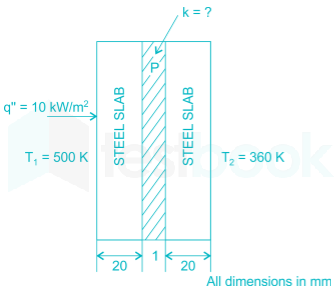
A material P of thickness 1 mm is sandwiched between two steel slabs, as shown in the figure below. A heat flux 10 kW/m2 is supplied to one of the steel slabs as shown. The boundary temperatures of the slabs are indicated in the figure. Assume thermal conductivity of this steel is 10 W/m.K. Considering one-dimensional steady state heat conduction for the configuration, the thermal conductivity (k, in W/m.K) of material P is _______

55

Consider the laminar flow of water over a flat plate of length 1 m. If the boundary layer thickness at a distance of 0.25 m from the leading edge of the plate is 8 mm, the boundary layer thickness (in mm), at a distance of 0.75 m, is _______

56

In an ideal Brayton cycle, atmospheric air (ratio of specific heats, Cp/Cv = 1.4, specific heat at constant pressure = 1.005 kJ/kg.K) at 1 bar and 300 K is compressed to 8 bar. The maximum temperature in the cycle is limited to 1280 K. If the heat is supplied at the rate of 80 MW, the mass flow rate (in kg/s) of air required in the cycle is _______

57

Steam at a velocity of 10 m/s enters the impulse turbine stage with symmetrical blading having blade angle 30°. The enthalpy drop in the stage is 100 kJ. The nozzle angle is 20°. The maximum blade efficiency (in percent) is _______

58

In a concentric counter flow heat exchanger, water flows through the inner tube at 25°C and leaves at 42°C. The engine oil enters at 100°C and flows in the annular flow passage. The exit temperature of the engine oil is 50°C. Mass flow rate of water and the engine oil are 1.5 kg/s and 1 kg/s, respectively. The specific heat of water and oil are 4178 J/kg.K and 2130 J/kg.K, respectively. The effectiveness of this heat exchanger is _______

59

A heat pump with refrigerant R22 is used for space heating between temperature limits of −20°C and 25°C. The heat required is 200 MJ/h. Assume specific heat of vapour at the time of discharge as 0.98 kJ/kg.K. Other relevant properties are given below. The enthalpy (in kJ/kg) of the refrigerant at isentropic compressor discharge is _______

Saturation temperaturePressureSpecific enthalpySpecific entropy
Tsat(°C)P(MN/m2)hf(kJ/kg)hg(kJ/kg)sf(kJ/kg.K)Sg(kJ/kg.K)
-200.2448177.21397.530.91391.7841
251.048230.07413.021.10471.7183
60

A project has four activities P, Q, R and S as shown below.

ActivityNormal duration (days)PredecessorCost slope (Rs./day)
P3-500
Q7P100
R4P400
S5R200
<br>

The normal cost of the project is Rs. 10,000/- and the overhead cost is Rs. 200/- per day. If the project duration has to be crashed down to 9 days, the total cost (in Rupees) of the project is _______

61

Consider the following data with reference to elementary deterministic economic order quantity model

Annul demand of an item100000
Unit price of the item (in Rs.)10
Inventory carrying cost per unit per year (in Rs.)1.5
Unit order cost (in Rs.)30
<br>

The total number of economic orders per year to meet the annual demand is _______

62

For the CNC part programming, match Group A with Group B:

Group AGroup B
P : circular interpolation, counter clock wiseI : G02
Q : dwellII : G03
R : circular interpolation, clock wiseIII : G04
S : point to point counteringIV : G00
  1. ((a))

    P-II, Q-III, R-I, S-IV

  2. ((b))

    P-I, Q-III, R-II, S-IV

  3. ((c))

    P-I, Q-IV, R-II, S-III

  4. ((d))

    P-II, Q-I, R-III, S-IV

Show Answer
Answer: ((a))

P-II, Q-III, R-I, S-IV

Explanation:

Part programming for CNC machine

  • Part programming is a program done for the production of a component by using standard codes known as the part program.
  • Code is nothing but the name of a program written for producing standard movement of the tool.

G-codes: These are the general-purpose codes. Some of the G codes with their purpose are:

G-codePurpose
G00Point to point countering
G01Linear travel
G02Circular interpolation, clockwise
G03Circular interpolation, anti-clockwise
G04Dwell
G05Hold
G08Acceleration
G09Retardation
G17XY plane selection
G18XZ plane selection
G19YZ plane selection

M-codes: These are the miscellaneous codes that tell a machine how to act.

Some of the M-codes with their purpose are:

M-codePurpose
M00Program stop
M01Optional program stop
M03Spindle start clockwise
M04Spindle start anti-clockwise
M05Spindle stop
M06Tool change
M30End of program/return to start
63

A mild steel plate has to be rolled in one pass such that the final plate thickness is 2/3rd of the initial thickness, with the entrance speed of 10 m/min and roll diameter of 500 mm. If the plate widens by 2% during rolling, the exit velocity (in m/min) is _______

64

A hole of 20 mm diameter is to be drilled in a steel block of 40 mm thickness. The drilling is performed at rotational speed of 400 rpm and feed rate of 0.1 mm/rev. The required approach and over run of the drill together is equal to the radius of drill. The drilling time (in minute) is

  1. ((a))

    1.00

  2. ((b))

    1.25

  3. ((c))

    1.50

  4. ((d))

    1.75

Show Answer
Answer: ((b))

1.25

Concept:

Drilling:

  • Drilling is used for producing holes in the components by using a rotating multipoint cutting tool.
  • During producing a hole, it is always recommended to use the smallest size of drill bit first and enlarge the hole slowly by using different size of drill bit until the required size of the hole is produced.
  • Drilling time is given by:

 T=Lf×N{\bf{T}} = \frac{{\bf{L}}}{{{\bf{f}} \times {\bf{N}}}}

where

T = Drilling time in minutes

L = Tool travel = approach (AP) + over run (OR) + thickness of workpiece (t)

f = Feed rate

N = Speed of rotation (rpm)

Calculation:

Given:

Diameter of hole (d) = 20 mm, thickness (t) = 40 mm, N = 400 rpm, feed (f) = 0.1 mm/rev

Approach (AP) + over run (OR) = radius of hole = d2=202=10;mm\frac{d}{2} = \frac{{20}}{2} = 10;mm

∴ Tool travel (L) = AP + OR + t

⇒ L = 10 + 40 = 50 mm

Machining time can be calculated as:

T=Lf×N{\bf{T}} = \frac{{\bf{L}}}{{{\bf{f}} \times {\bf{N}}}}

⇒ T = 500.1;×;400=1.25;minutes\frac{{50}}{{0.1{\rm{;}} \times {\rm{;}}400}} = 1.25{\rm{;minutes}}

65

A rectangular hole of size 100 mm × 50 mm is to be made on a 5 mm thick sheet of steel having ultimate tensile strength and shear strength of 500 MPa and 300 MPa, respectively. The hole is made by punching process. Neglecting the effect of clearance, the punching force (in kN) is

  1. ((a))

    300

  2. ((b))

    450

  3. ((c))

    600

  4. ((d))

    750

Show Answer
Answer: ((b))

450

Concept:

Punching and Blanking:

  • Punching and Blanking are processes used to cut metal materials into any precise form by the use of a punch and die which acts as a tool.
  • In punch and die working, punch size must be less than die size.
  • In blanking, the slug is the part that is used and the remaining is scrap.
  • In punching, the sheared slug is discarded as scrap, leaving the remainder to be used.
  • The punching or blanking force is given by:

F = τs × A

where τ­s = Ultimate shear strength of the material, As = Sheared area

Calculation:

Given:

Length of the hole (l) = 100 mm

Breadth of the hole (b) = 50 mm

Thickness of the hole (t) = 5 mm

Ultimate shear strength of the material (τ­s) = 300MPa

∴ Sheared area (As) = 2 × (l + b) × t

⇒ As = 2 × (100 + 50) × 5

⇒ As = 1500 mm2

Punching force is given by

F = τs × As

F = 300 × 1500

⇒ F = 4,50,000 N = 450 kN

Attempt this paper under real exam conditions

Timed interface, section switching, instant scoring, and question-by-question analytics — free.

Start Timed Attempt