Official Paper

GATE ME 2012 Official Paper (Previous Year Paper)

65 questions · 180 minutes · with answers · free

General Aptitude (10 questions)

1

The cost function for a product in a firm is given by 5q2, where q is the amount of production. The firm can sell the product at a market price of Rs.50 per unit. The number of units to be produced by the Emi such that the profit is maximized is

  1. ((a))

    5

  2. ((b))

    10

  3. ((c))

    15

  4. ((d))

    25

Show Answer
Answer: ((a))

5

As q = total number of quantities produced.

Total cost = 5q2

Total sales = 50q

Profit (P) = total cost – total sales

P = 5q2 – 50q

Differentiating w.r.t q

dPdq=10q50=0\frac{{dP}}{{dq}} = 10q - 50 = 0

q=5010=5q = \frac{{50}}{{10}} = 5

d2Pdq2=10>0\frac{{{d^2}P}}{{d{q^2}}} = 10 > 0

∴ At q = 5, profit (P) is maximum.

2

Choose the most appropriate alternative from the options given below to complete the following sentence:

Suresh's dog is the one ________ was hurt in the stampede.

  1. ((a))

    that

  2. ((b))

    which

  3. ((c))

    who

  4. ((d))

    whom

Show Answer
Answer: ((a))

that

The correct answer is option 1- that

Explanation 

To answer this question, we need to understand the meaning of defining and non-defining clauses. 

  • A defining clause (also called an essential clause or a restrictive clause) gives information essential to the meaning of the sentence. We always use 'that' with defining clauses.

Example: My bike that has a broken seat is in the garage.

  • Unlike defining clauses, non-defining clauses (also called nonessential or nonrestrictive clauses) don’t limit the meaning of the sentence. You might lose interesting details if you remove them, but the meaning of the sentence wouldn’t change. We always use 'which' with non-defining clauses.

Example: The goat was standing on the roof of the house which was abandoned.

In the given sentence, if we consider the first clause, the information given is incomplete and it can only be completed via the introduction of the second clause. Hence, we have to use 'that' in this sentence.

3

Choose the grammatically INCORRECT sentence:

  1. ((a))

    They gave us the money back less the service charges of Three Hundred rupees.

  2. ((b))

    This country's expenditure is not less than that of Bangladesh.

  3. ((c))

    The committee initially asked for a funding of Fifty Lakh rupees, but later settled for a lesser sum.

  4. ((d))

    This country's expenditure on educational reforms is very less

Show Answer
Answer: ((d))

This country's expenditure on educational reforms is very less

The correct answer is option 4. 

Explanation 

As we can see, the question has been framed to test our grammatical knowledge regarding the use of the adjective 'less'. 

  • 'Less' has been used correctly in option 1. Here, 'less' means 'minus'.
  • 'Less' has been used correctly in option 2 as well. It has been used here to compare the country's expenditure to that of Bangladesh.
  • 'Less' has been used correctly in option 3 as well. If we don't use the word 'than' after 'less', we have to use the comparative form of less- 'lesser'.
  • The usage of 'less' is wrong in option 4. 'Less' is generally used as a way of comparing two quantities or amounts. Here, the word 'less' needs to be replaced with the words 'little' or 'low'.
4

Which one of the following options is the closet in meaning to the word given below?

Mitigate

  1. ((a))

    Diminish

  2. ((b))

    Divulge

  3. ((c))

    Dedicate

  4. ((d))

    Denote

Show Answer
Answer: ((a))

Diminish

The correct answer is option 1- Diminish Explanation

Mitigate: make (something bad) less severe, serious, or painful; lessen the gravity of (an offence or mistake)

Diminish: make or become less; decrease in size, degree etc.

Thus we can see that among the options, 'diminish' is closest in meaning to the word 'mitigate'. They are near-synonyms.

The meaning of the other words:

  • Divulge: make known (private or sensitive information)
  • Dedicate: devote (time or effort) to a particular task or purpose
  • Denote: be a sign of, indicate; stand as a name or symbol for
5

Choose the most appropriate alternative from the options given below to complete the following sentence:

Despite several ________ the mission succeeded in its attempt to resolve the conflict.

  1. ((a))

    attempts

  2. ((b))

    setbacks

  3. ((c))

    meetings

  4. ((d))

    delegations

Show Answer
Answer: ((b))

setbacks

The correct answer is option 2- setbacks

Explanation   

Setback: something that happens that delays or prevents a process from developing

From the given context, it is clear that the mission finally resolved the conflict after many failed attempts and obstacles. Thus, 'setback' is the correct word for the given blank.


The meaning of the other words:

  • Attempt: an effort to achieve or complete a difficult task or action
  • Meeting: an assembly of people for a particular purpose, especially for formal discussion
  • Delegation: a group of people who have been sent somewhere to have talks with other people on behalf of a larger group of people.

You may be confused regarding the use of 'attempts' and 'setbacks'. Attempt does not have any negative connotation to it, whereas setback has one. As the sentence is specifically referring to fruitless attempts taken in the past, 'setbacks' would be a more apt choice.

6

Wanted Temporary, Part-time persons for the post of Field Interviewer to conduct personal interviews to collect and collate economic data. Requirements: High School-pass, must be available for Day, Evening, and Saturday work. Transportation paid, expenses reimbursed. which one of the following is the best inference from the above advertisement?

  1. ((a))

    Gender-discriminatory

  2. ((b))

    Xenophobic

  3. ((c))

    Not designed to make the post attractive

  4. ((d))

    Not gender-discriminatory

Show Answer
Answer: ((d))

Not gender-discriminatory

Explanation:

  • Clearly, in the given question there is nothing related to gender is mentioned in the advertisement, eliminating options 1)
  • Xenophobic means having or showing a dislike of or prejudice against people from other countries. There, is no such thing related to people of other countries is mentioned in the advertisement, eliminating it too.
  • The requirements that are mentioned for the post is designed to make the post attractive, Transportation paid, expenses reimbursed are mentioned. So option 4) is the most suitable answer.
7

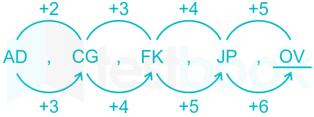
Given the sequence of terms, AD CG FK JP, the next term is

  1. ((a))

    OV

  2. ((b))

    OW

  3. ((c))

    PV

  4. ((d))

    PW

Show Answer
Answer: ((a))

OV

The given sequence is:

8

Which of the following assertions are CORRECT?

P: Adding 7 to each entry in a list adds 7 to the mean of the list

Q: Adding 7 to each entry in a list adds 7 to the standard deviation of the list

R: Doubling each entry in a list doubles the mean of the list

S: Doubling each entry in a list leaves the standard deviation of the list unchanged

  1. ((a))

    P. Q 

  2. ((b))

    Q. R 

  3. ((c))

    P. R

  4. ((d))

    R. S

Show Answer
Answer: ((c))

P. R

Explanation:

Let E(x) represent mean

Then by the property of mean

E(Cx) = cE(x) where c is constant

And E(x + c) = E(x) + E(c) = E(x) + c

 Options P and R always holds true.

Now,

Let Var (x) represent the variance

Then var (x + c) = var (x) + var (c)

 var (x + c) = var (x)    {∵ var (c) = 0}

S.D (x + c) = S.D (x)

Now,

var (cx) =(c2)var (x)

S.D (cx) = (c)S.D (x)

Options Q and S are incorrect.

9

An automobile plant contracted to buy shock absorbers from two suppliers X and Y. X supplies 60% and Y supplies 40% of the shod absorbers. All shock absorbers are subjected to a quality test. The ones that pass the quality test are considered reliable Of X's shock absorbers, 96% are reliable. Of Y's shock absorbers, 72% are reliable. The probability that a randomly chosen shock absorber, which is found to be reliable is made by Y is

  1. ((a))

    0.288

  2. ((b))

    0.334

  3. ((c))

    0.667

  4. ((d))

    0.720

Show Answer
Answer: ((b))

0.334

Calculation: 

Let 100 shock absorbers are supplied

so, X supplies = 60 (60% of 100)

Y supplies = 40 (40% of 100)

Reliable supply by X = 96% of 60 = 57.6

Reliable supply by Y = 72% of 40 = 28.8

Required probability P(Y)=28.857.6+28.8=0.33P\left( Y \right) = \frac{{28.8}}{{57.6 + 28.8}} = 0.33

10

A political party orders an arch for the entrance to the ground in which the annual convention is being held. The profile of the arch follows the equation y = 2x - 0.1x2 where y is the height of the arch in meters. The maximum possible height of the arch is

  1. ((a))

    8 meters

  2. ((b))

    10 meters

  3. ((c))

    12 meters

  4. ((d))

    14 meters

Show Answer
Answer: ((b))

10 meters

Given:

y = 2x – 0.1x2

differentiating w.r.t x

dydx=20.2x=0\frac{{dy}}{{dx}} = 2 - 0.2x = 0

x=20.2=10x = \frac{2}{{0.2}} = 10

(d2ydx2)x=10=0.2<0{\left( {\frac{{{d^2}y}}{{d{x^2}}}} \right)_{x = 10}} = - 0.2 < 0

At x = 10, y will have a maximum value.  

ymax = y(10) = (2 × 10) - 0.1(102) = 10

Mechanical Engineering (55 questions)

11

Which one of the following is Not a decision taken during the aggregate production planning stage?

  1. ((a))

    Scheduling of machines

  2. ((b))

    Amount of labour to be committed

  3. ((c))

    Rate at which production should happen

  4. ((d))

    Inventory to be carried forward

Show Answer
Answer: ((a))

Scheduling of machines

Aggregate production planning:

  • It is planning in which the general level of employment and output is planned to balance supply and demand for a period of fewer than 18 months.
  • It is intermediately ranged capacity planning, used to establish employment levels, output rates, inventory levels, subcontracting and backorders for products that are aggregated.
  • It is not specifically focussed on the individual product but deals with products in aggregate.
12

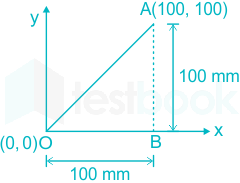
A CNC vertical  milling machine has to cut a straight slot of 10 mm width and 2 mm depth by a cutter of 10 mm diameter between points (0,0) and (100, 100) on the XY plane (dimensions in mm). the feed rate used for milling is 50 mm/min milling time for the slot (in seconds) is

  1. ((a))

    120

  2. ((b))

    170

  3. ((c))

    180

  4. ((d))

    240

Show Answer
Answer: ((b))

170

Concept:

Milling time (t) can be calculated by:

t=distancefeed;ratet = \frac{{distance}}{{feed;rate}}

Calculation:

Given:

OB = 100 mm, AB = 100 mm

Feed;rate;(f)=50mmmin=5060mmsec=0.833;mmsecFeed;rate;\left( f \right) = 50\frac{{mm}}{{min}} = \frac{{50}}{{60}}\frac{{mm}}{{sec}} = 0.833;\frac{{mm}}{{sec}}

Distance travelled by tool (OA)

OA=OB2+AB2=1002+1002=141.421;mmOA = \sqrt {O{B^2} + A{B^2}} = \sqrt {{{100}^2} + {{100}^2}} = 141.421;mm

Milling time (t) is:

t=distancefeed;rate=141.4210.833=169.7;seconds170;secondst = \frac{{distance}}{{feed;rate}} = \frac{{141.421}}{{0.833}} = 169.7;seconds \simeq 170;seconds

13

A solid cylinder of diameter 100 mm and height 50 mm is forged between two frictionless flat dies to a height of 25 mm. The percentage change in diameter is

  1. ((a))

    0

  2. ((b))

    2.07

  3. ((c))

    20.7

  4. ((d))

    41.4

Show Answer
Answer: ((d))

41.4

Concept:

In a forging process

Volume before forging = Volume after forging

In the case of cylinder 

πd12h1 = πd22h2

where d1 = initial diameter, d2 = final diameter, h1 = initial height, h2 = final height

Calculation:

Given:

d1 = 100 mm, h1 = 50 mm, h2 = 25 mm

Volume before forging = Volume after forging

πd12;h1=πd22;h2π d_1^2;{h_1} = π d_2^2;{h_2}

d2=d1×h1h2{d_2} = {d_1} \times \sqrt {\frac{{{h_1}}}{{{h_2}}}}

d2=100×5025=141.42{d_2} = 100 \times \sqrt {\frac{{50}}{{25}}} = 141.42

Percentage;change;in;diameter=d2d1d1×100=141.42100100×100=41.42;%{\rm{Percentage;change;in;diameter}} = \frac{{{{\rm{d}}_2} - {{\rm{d}}_1}}}{{{{\rm{d}}_1}}} \times 100 = \frac{{141.42 - 100}}{{100}} \times 100 = 41.42{\rm{;\% }}

14

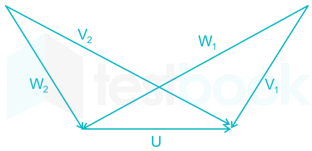
The velocity triangles at the inlet and exit of the rotor of a turbo machine are shown. V denotes the absolute velocity of the fluid, W denotes the relative velocity of the fluid, and U denotes the blade the velocity. Subscripts 1 and 2 refer to inlet and outlet respectively. If V2 = W1 and V1 = W2, then the degree of reaction is

  1. ((a))

    0

  2. ((b))

    1

  3. ((c))

    0.5

  4. ((d))

    0.25

Show Answer
Answer: ((c))

0.5

Concept:

Degree of Reaction (R) can be calculated by:

R=change;in;pressure;energy;inside;runnerchange;in;total;energy;inside;runnerR = \frac{{change;in;pressure;energy;inside;runner}}{{change;in;total;energy;inside;runner}}

Change;in;total;energy;(ΔTE)=V12V222g+U12U222g+W22W122gChange;in;total;energy;\left( {{\rm{\Delta }}TE} \right) = \frac{{V_1^2 - V_2^2}}{{2g}} + \frac{{U_1^2 - U_2^2}}{{2g}} + \frac{{W_2^2 - W_1^2}}{{2g}}

where

V12V222g=kinetic;energy;head\frac{{{\rm{V}}_1^2 - {\rm{V}}_2^2}}{{2{\rm{g}}}} = {\rm{kinetic;energy;head}}

U12U222g=centrifugal;energy;head\frac{{{\rm{U}}_1^2 - {\rm{U}}_2^2}}{{2{\rm{g}}}} = {\rm{centrifugal;energy;head}}

W22W122g=relative;velocity;head\frac{{{\rm{W}}_2^2 - {\rm{W}}_1^2}}{{2{\rm{g}}}} = {\rm{relative;velocity;head}}

U12U222g+W22W122g=change;in;pressure;energy\frac{{{\rm{U}}_1^2 - {\rm{U}}_2^2}}{{2{\rm{g}}}} + \frac{{{\rm{W}}_2^2 - {\rm{W}}_1^2}}{{2{\rm{g}}}} = {\rm{change;in;pressure;energy}}

Calculation:

Given:

U1 = U2, V2 = W1 and V1 = W2

Change;in;pressure;energy=;U12U222g+W22W122g=W22W122g{\rm{Change;in;pressure;energy}} = {\rm{;}}\frac{{{\rm{U}}_1^2 - {\rm{U}}_2^2}}{{2{\rm{g}}}} + \frac{{{\rm{W}}_2^2 - {\rm{W}}_1^2}}{{2{\rm{g}}}} = \frac{{{\rm{W}}_2^2 - {\rm{W}}_1^2}}{{2{\rm{g}}}} {∵ U1 = U2}

Change;in;total;energy;(ΔTE)=V12V222g+U12U222g+W22W122gChange;in;total;energy;\left( {{\rm{\Delta }}TE} \right) = \frac{{V_1^2 - V_2^2}}{{2g}} + \frac{{U_1^2 - U_2^2}}{{2g}} + \frac{{W_2^2 - W_1^2}}{{2g}}

ΔTE=;V12V222g+;W22W122g{\rm{\Delta }}TE = ;\frac{{V_1^2 - V_2^2}}{{2g}} + ;\frac{{W_2^2 - W_1^2}}{{2g}}   {∵ U1 = U2}

ΔTE=;W22W122g+W22W122g{\rm{\Delta }}TE = ;\frac{{W_2^2 - W_1^2}}{{2g}} + \frac{{W_2^2 - W_1^2}}{{2g}}   {∵ V2 = W1 and V1 = W2}

∴ ΔTE=;W22W12g{\rm{\Delta }}TE = ;\frac{{W_2^2 - W_1^2}}{g}

R=change;in;pressure;energy;inside;runnerchange;in;total;energy;inside;runnerR = \frac{{change;in;pressure;energy;inside;runner}}{{change;in;total;energy;inside;runner}}

R=W22W122gW22W12g=12=0.5R = \frac{{\frac{{W_2^2 - W_1^2}}{{2g}}}}{{\frac{{W_2^2 - W_1^2}}{g}}} = \frac{1}{2} = 0.5

15

Which one of the following configurations has the highest fin effectiveness?

  1. ((a))

    Thin, closely spaced fins

  2. ((b))

    Thin, widely spaced fins

  3. ((c))

    Thick widely spaced fins

  4. ((d))

    Thick, closely spaced fins

Show Answer
Answer: ((a))

Thin, closely spaced fins

Explanation:

Effectiveness (ϵ)

Effectiveness is defined as the ratio of heat transfer rate with a fin to heat transfer rate without fin.

\(\epsilon = \frac{{{{\dot Q}{with;fin}};}}{{{{\dot Q}{without;fin}}}}\)

For a long fin

\(\epsilon = \frac{{{{\dot Q}{with;fin}};}}{{{{\dot Q}{without;fin}}}} = \sqrt {\frac{{KP}}{{h{A_c}}}} \)

where K = thermal conductivity of fin, P = perimeter of fin

h = heat transfer coefficient, Ac = cross-section area of fin

From the above formula, we can conclude:

Case 1: If PAc\frac{P}{{{A_c}}} increases, the effectiveness of fin increases.

  • Ac must be small (thin fin) and fins must be closed (not too close).
  • If fins are too closed it will abstract flow of air which will decrease the effectiveness of fin.

Case 2: if K increases, the effectiveness of fin increases.

  • If K is large, the temperature drop along the length will be less.
  • And the temperature drop between fin and surrounding will be more and heat transfer will be more.

Case 3: if h decreases, the effectiveness of fin increases.

  • Fins are more effective under free convection ( h is less).
16

An ideal gas of mass m and temperature T1 undergoes a reversible isothermal process from an initial pressure P1 to a final pressure P2. The heat loss during the process is Q. The entropy change ΔS of the gas is

  1. ((a))

    mRln(P2P1)mR\ln \left( {\frac{{{P_2}}}{{{P_1}}}} \right)

  2. ((b))

    mRln(P1P2)mR\ln \left( {\frac{{{P_1}}}{{{P_2}}}} \right)

  3. ((c))

    mRln(P2P1)QT1mR\ln \left( {\frac{{{P_2}}}{{{P_1}}}} \right) - \frac{Q}{{{T_1}}}

  4. ((d))

    Zero

Show Answer
Answer: ((b))

mRln(P1P2)mR\ln \left( {\frac{{{P_1}}}{{{P_2}}}} \right)

Explanation:

Entropy change for an ideal gas can be calculated by:

S2S1=mcpln(T2T1)mRln(P2P1){S_2} - {S_1} = m{c_p}\ln \left( {\frac{{{T_2}}}{{{T_1}}}} \right) - mRln\left( {\frac{{{P_2}}}{{{P_1}}}} \right)

where m = mass of the gas, cp = specific heat at constant pressure, R = gas constant

T1 = initial temperature, T2 = final temperature, P1 = initial pressure, P2 = final pressure

 As the process is isothermal i.e. T1 = T2

∴ S2S1=mcpln(1)Rln(P2P1){S_2} - {S_1} = m{c_p}\ln \left( 1 \right) - Rln\left( {\frac{{{P_2}}}{{{P_1}}}} \right)  

S2S1=Rln(P1P2){S_2} - {S_1} = Rln\left( {\frac{{{P_1}}}{{{P_2}}}} \right)     {∵ ln(1) = 0} 

Entropy change for an ideal gas can also be calculated by:

S2S1=mcvln(T2T1)+mRln(V2V1){S_2} - {S_1} = m{c_v}\ln \left( {\frac{{{T_2}}}{{{T_1}}}} \right) + mRln\left( {\frac{{{V_2}}}{{{V_1}}}} \right)

where cv = specific heat at constant volume, V1 = initial volume, V2 = final volume

17

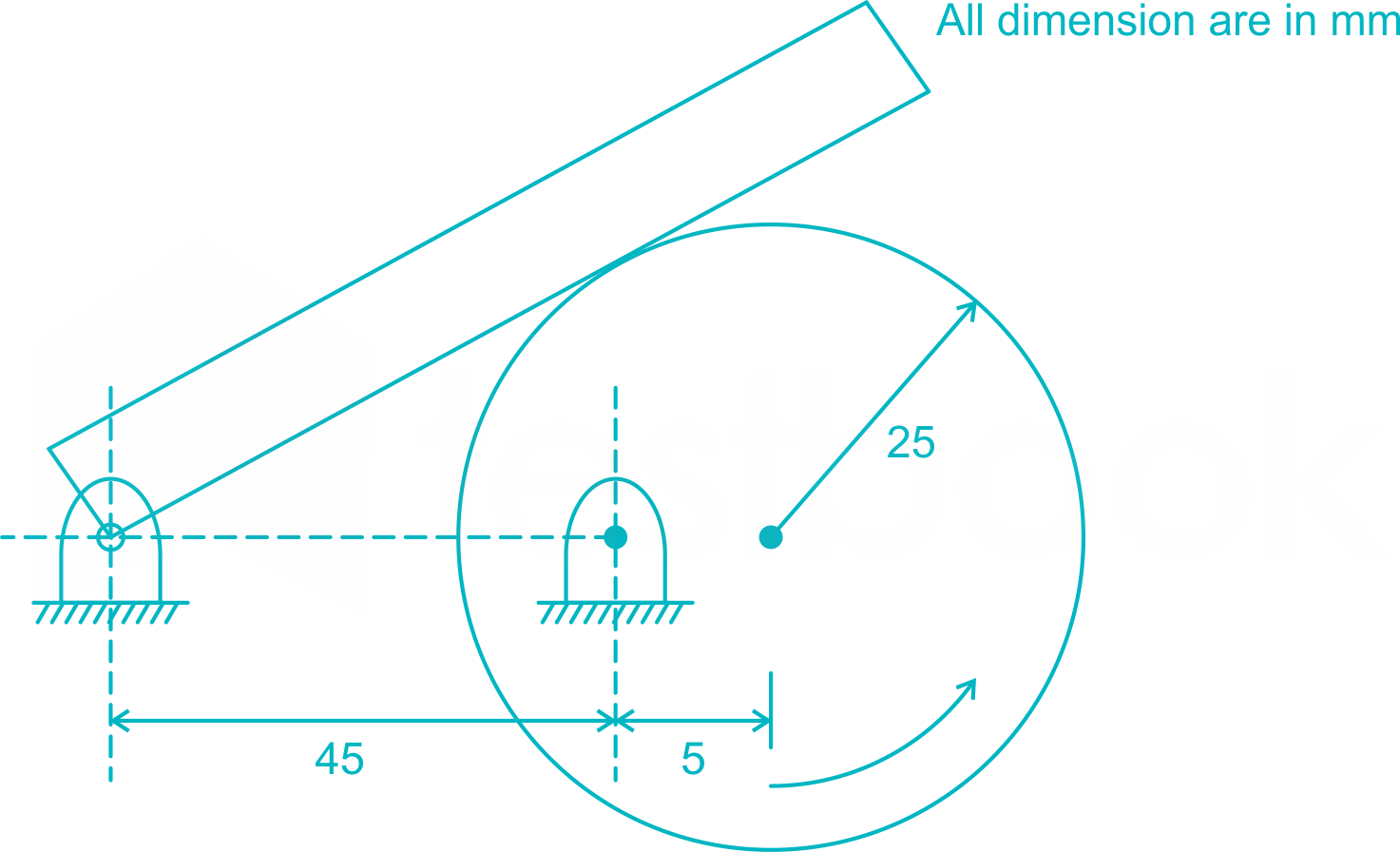
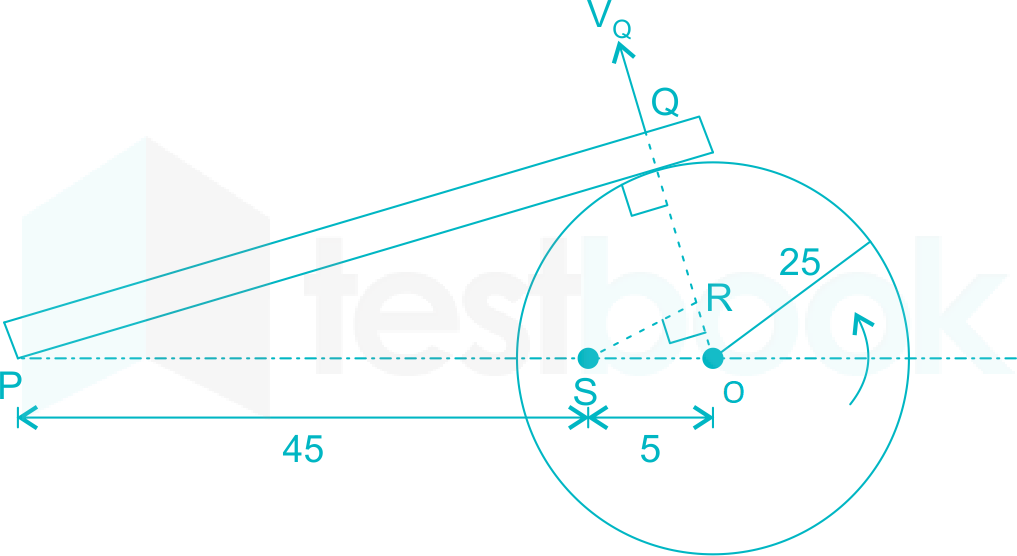
In the mechanism given below, if the angular velocity of the eccentric circular disc is 1 rad/s, the angular velocity (rad/s) of the follower link for the instant shown in the figure is

  1. ((a))

    0.05

  2. ((b))

    0.1

  3. ((c))

    5.0

  4. ((d))

    10.0

Show Answer
Answer: ((b))

0.1

Given:

Angular velocity of disc (ω) = 1 rad/s, PO = 50 mm, PS = 45 mm, OQ = 25 mm, SO = 5 mm

In ΔPQO

PO2 = PQ2 + OQ2 ⇒ PQ2 = PO2 - OQ2

PQ=(50)2(25)2=43.3 mmPQ = \sqrt {{{\left( {50} \right)}^2} - {{\left( {25} \right)}^2}} =43.3\ mm

As ΔPQO ~ ΔSRO

PQSR=POSO\frac{{PQ}}{{SR}} = \frac{{PO}}{{SO}}

43.3SR=505SR=4.33 mm\frac{{43.3}}{{SR}} = \frac{{50}}{{5}} ⇒ SR=4.33\ mm

As point Q and Point R are situated on same link

∴ Velocity of Q = velocity of R

VQ=VR=SR×ω=4.33×1=4.33 m/sec.{V_Q} = {V_R} = SR \times ω = 4.33 \times 1 = 4.33\ m/sec.

Angular velocity of PQ

ωPQ=VQPQ=4.3343.3=0.1 rad/sec.{ω _{PQ}} = \frac{{{V_Q}}}{{PQ}} = \frac{{4.33}}{{43.3}} = 0.1\ rad/sec.

18

A circular solid disc of uniform thickness 20 mm, radius 200 mm and mass 20 kg, is used as flywheel. If it rotates at 600 rpm, the kinetic energy of the flywheel, in joules is

  1. ((a))

    395

  2. ((b))

    790

  3. ((c))

    1580

  4. ((d))

    3160

Show Answer
Answer: ((b))

790

Concept:

Flywheel

 A flywheel is used to control the variation in speed during each cycle of the engine.

The kinetic energy of flywheel can be calculated by:

K.E =12Iw2= \frac{1}{2}I{w^2}

where I = moment of inertia of the flywheel, ω = angular velocity of the flywheel

Calculation:

Given:

Mass of flywheel (m) = 20 kg, radius (r) = 200 mm = 0.2 m, N = 600 rpm

I=mR22=20 × 0.222=0.4;kgm2I = \frac{{m{R^2}}}{2} = \frac{{20 ~\times ~{{0.2}^2}}}{2} = 0.4;kg - {m^2}

\(w = \frac{{2\pi N}}{{60}} = \frac{{2~ \times~ \pi \times 600}}{{60}} = 62.83;rad/s\)

∴ K.E=12Iω2=12×0.4×(62.83)2=789.5;J790;J{\rm{K}}.{\rm{E}} = \frac{1}{2}{\rm{I}}{{\rm{\omega }}^2} = \frac{1}{2} \times 0.4 \times {\left( {62.83} \right)^2} = 789.5{\rm{;J}} \simeq 790{\rm{;J}}

19

A cantilever beam of length L is subjected to a moment M at the free end. The moment of inertia of the beam cross-section about the neutral axis is I and the Young modulus is E. The magnitude of the maximum deflection is.

  1. ((a))

    ML22EI\frac{{M{L^2}}}{{2EI}}

  2. ((b))

    ML2EI\frac{{M{L^2}}}{{EI}}

  3. ((c))

    2ML2EI\frac{{2M{L^2}}}{{EI}}

  4. ((d))

    4ML2EI\frac{{4M{L^2}}}{{EI}}

Show Answer
Answer: ((a))

ML22EI\frac{{M{L^2}}}{{2EI}}

Concept:

EId2ydx2=M{EI}\frac{{{d^2}y}}{{d{x^2}}} = M

Calculation:

By integrating the above equation we get,

EIdydx=Mx+C1EI\frac{{dy}}{{dx}} = Mx + {C_1}

Once again integrating, we get

EI;y=Mx22+C1x+C2EI;y = \frac{{M{x^2}}}{2} + {C_1}x + {C_2}

For cantilever beam at \(x = 0,\frac{{dy}}{{dx}} = 0;& ;x = 0,~y = 0\) (x taken from fixed-end).

From this we get C1 = C= 0,  Hence

y=Mx22EIy = \frac{{M{x^2}}}{{2EI}}  

Deflection will be maximum when x = L

Maximum deflection is

 ymax=ML22EI{y_{max}} = \frac{{M{L^2}}}{{2EI}}

20

For a long slender column of uniform cross section, the ratio of critical buckling to load for the case with both ends clamped to the case with both ends hinged is

  1. ((a))

    1

  2. ((b))

    2

  3. ((c))

    4

  4. ((d))

    8

Show Answer
Answer: ((c))

4

Concept:

Buckling load:

The load at which column buckle is termed as buckling load. Buckling load is given by:

Pb=π2EILe2{P_b} = \frac{{{\pi ^2}E{I_{}}}}{{L_e^2}}

where E = Young’s modulus of elasticity, Imin = Minimum moment of inertia, and Le = Effective length

End conditionsLeBuckling load
Both ends hingedLe = LPb=π2EIL2{P_b} = \frac{{{\pi ^2}E{I_{}}}}{{L^2}}
Both ends fixedLe=L2{L_e} = \frac{L}{2}Pb=4π2EIL2{P_b} = \frac{{{4\pi ^2}E{I_{}}}}{{L^2}}
One end fixed and another end is freeLe = 2LPb=π2EI4L2{P_b} = \frac{{{\pi ^2}E{I_{}}}}{{4L^2}}
One end fixed and another end is hingedLe=L2{L_e} = \frac{L}{{\sqrt 2 }}Pb=2π2EIL2{P_b} = \frac{{{2\pi ^2}E{I_{}}}}{{L^2}}

Calculation:

Given:

Critical Buckling load for column fixed at both ends (Pcr1\(= \frac{{4{\pi ^2}EI}}{{\begin{array}{*{20}{c}} {{L^2}} \end{array}}}\)

Critical Buckling load for a column hinged at both ends (Pcr2) = π2EIL2\frac{{{\pi ^2}EI}}{{{L^2}}}

\(\therefore\frac{(P_{cr})1}{(P{cr})_2}=4\)

21

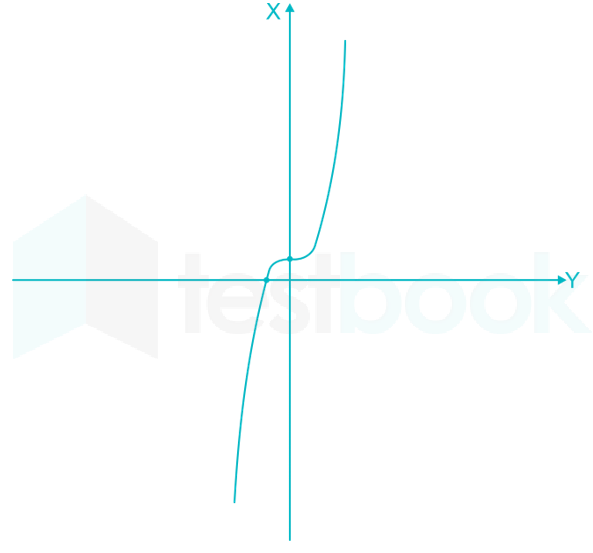
At x = 0, the function f(x) = x3 + 1  has

  1. ((a))

    A maximum value

  2. ((b))

    A minimum value

  3. ((c))

    A singularity

  4. ((d))

    A point of inflection

Show Answer
Answer: ((d))

A point of inflection

The function f(x) = x3 + 1 has a point of inflection at x = 0, since in the graph sign of the curvature (i.e., the concavity) is changed.

Alternate solution:

Given:

f(x) = x3 + 1

f'(x) = 3x2 = 0 ⇒ x = 0 (critical point)

f"(x) = 6x

f"(0) = 0

Now, f'''(x) = 6

f'''(0) = 6  (non zero)

As the first non zero derivative value occurs at third derivative which is an odd number.

function f(x) has point of inflection at x = 0.

22

For the spherical surface x2 + y2 + z2 – 1, the unit outward normal vector at the point (12,12,0)\left( {\frac{1}{{\sqrt 2 }},\frac{1}{{\sqrt 2 }},0} \right) is given by

  1. ((a))

    12i^+12j^;\frac{1}{{\sqrt 2 }}\hat i + \frac{1}{{\sqrt 2 }}\hat j;

  2. ((b))

    12i^12j^\frac{1}{{\sqrt 2 }}\hat i - \frac{1}{{\sqrt 2 }}\hat j

  3. ((c))

    k^\hat k

  4. ((d))

    13i^+13j^+13k^\frac{1}{{\sqrt 3 }}\hat i + \frac{1}{{\sqrt 3 }}\hat j + \frac{1}{{\sqrt 3 }}\hat k

Show Answer
Answer: ((a))

12i^+12j^;\frac{1}{{\sqrt 2 }}\hat i + \frac{1}{{\sqrt 2 }}\hat j;

Concept:

The gradient of a scalar function f(x,y,z) is given by:

grad;f=fxi^+;fyj^+fxk^{\rm{grad;f}} = \frac{{\partial {\rm{f}}}}{{\partial {\rm{x}}}}{\rm{\hat i}} + {\rm{;}}\frac{{\partial {\rm{f}}}}{{\partial {\rm{y}}}}{\rm{\hat j}} + \frac{{\partial {\rm{f}}}}{{\partial {\rm{x}}}}{\rm{\hat k}}

Unit outward normal vector of a function f at a point P is given by:

n=(grad;f)at;pgrad;f{\bf{\vec n}} = \frac{{{{\left( {{\bf{grad}};{\bf{f}}} \right)}_{{\bf{at}};{\bf{p}}}}}}{{\left| {{\bf{grad}};{\bf{f}}} \right|}}

Calculation:

Given:

Spherical surface x2 + y2 + z2 = 1, point P is (12,12,0)\left( {\frac{1}{{\sqrt 2 }},\frac{1}{{\sqrt 2 }},0} \right)

F(x,y,z) = x2 + y2 + z2 – 1 = 0

grad;f=fxi^+;fyj^+fxk^=2xi^+2yj^+2zk^{\rm{grad;f}} = \frac{{\partial {\rm{f}}}}{{\partial {\rm{x}}}}{\rm{\hat i}} + {\rm{;}}\frac{{\partial {\rm{f}}}}{{\partial {\rm{y}}}}{\rm{\hat j}} + \frac{{\partial {\rm{f}}}}{{\partial {\rm{x}}}}{\rm{\hat k}} = 2{\bf{x\hat i}} + 2{\bf{y\hat j}} + 2{\bf{z\hat k}}

(grad f)at P22i^+22j^+0k^=2i^+2j^+0k^\frac{2}{{\sqrt 2 }}{\rm{\hat i}} + \frac{2}{{\sqrt 2 }}{\rm{\hat j}} + 0{\rm{\hat k}} = \sqrt 2 {\rm{\hat i}} + \sqrt 2 {\rm{\hat j}} + 0{\rm{\hat k}}

grad;f=2+2=4=2\left| {{\rm{grad;f}}} \right| = \sqrt {2 + 2} = \sqrt 4 = 2

Unit outward normal vector of function f at point P is given by:

n=(grad;f)at;pgrad;f=2i^+2j^2=12i^+12j^\vec n = \frac{{{{\left( {{\rm{grad;f}}} \right)}_{{\rm{at;p}}}}}}{{\left| {{\rm{grad;f}}} \right|}} = \frac{{\sqrt 2 {\rm{\hat i}} + \sqrt 2 {\rm{\hat j}}}}{2} = \frac{1}{{\sqrt 2 }}{\bf{\hat i}} + \frac{1}{{\sqrt 2 }}{\bf{\hat j}}

23

Match the following metal forming process with their associated stress in the workpiece.

List IList II
PCoining1.Tensile
QWire Drawing2.Shear
RBlanking3.Tensile compressive
SDeep drawing4.Compressive
  1. ((a))

    P – 4, Q – 1, R – 2, S – 3

  2. ((b))

    P – 4, Q – 1, R – 3, S – 2

  3. ((c))

    P – 1, Q – 2, R – 4, S – 3

  4. ((d))

    P – 1, Q – 3, R – 2, S – 4

Show Answer
Answer: ((a))

P – 4, Q – 1, R – 2, S – 3

Various Metal forming process and their properties are explained in the table given below.

Metal forming processProperties
Coining- It is a closed die forging operation which imparts the desired variation in thickness to the thin and flat workpiece by applying a compressive force through a punch.
Wire drawing- The wire drawing operation is mainly used for reducing the diameter of a wire by applying a tensile force on a wire by pulling it through a tapered hole in a die.
Blanking- Blanking is a sheet metal operation of cutting a flat shape from sheet metal. - In this process, the workpiece is stressed beyond its ultimate strength and the stress produced in the metal by applied forces is shear stress.
Deep drawing- Deep drawing is the operation of forming a flat piece of material into a hollow shape using a punch which causes the blank to flow into the die cavity. - As the punch forces the blank into the die cavity, the blank diameter decreases and causes the blank to become thicker at its outer portions. This is due to circumferential compressive stresses to which workpiece is subjected in the outer portion. - The portion of the blank between the wall and the punch surface is subjected to nearly pure tension and tends to stretch and become thinner.
24

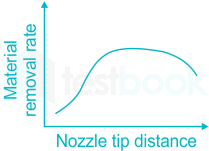
In abrasive jet machining, as the distance between the nozzle tip and the work surface increases, the material removal rate

  1. ((a))

    Increases continuously

  2. ((b))

    Decreases continuously

  3. ((c))

    Decreases, becomes stable and then increases

  4. ((d))

    Increases, becomes stable and then decreases

Show Answer
Answer: ((d))

Increases, becomes stable and then decreases

Explanation:

  • In AJM, the material removal takes place due to the impingement of the fine abrasive particles.
  • These particles move with a high speed air (or gas) stream.
  • When an abrasive particle impinges on the work surface at high velocity, the impact causes a tiny brittle fracture.
  • The following air (or gas) carries away the dislodged small workpiece particle.

Effect of nozzle tip distance on MRR

  • When the nozzle tip distance increases, the velocity of abrasive particles impinging on the work surface increases due to acceleration after they leave the nozzle. This, in turn, increases the MRR.
  • With a further increase in nozzle tip distance, the velocity reduces due to the drag of atmosphere which initially checks the increase in the MRR and finally decreases it.

25

In an interchangeable assemble, shafts of size \({25.000^{\begin{array}{{20}{c}} { + 0.040}\ { - 0.010} \end{array}}}\) mm mate with holes of size \({25.000^{\begin{array}{{20}{c}} { + 0.030}\ { + 0.020} \end{array}}}\) mm. The maximum interference (in microns) in the assembly is

  1. ((a))

    40

  2. ((b))

    30

  3. ((c))

    20

  4. ((d))

    10

Show Answer
Answer: ((c))

20

Concept: 

Maximum interference: Maximum shaft size - minimum hole size

Minimum interference: Minimum shaft size - maximum hole size

Calculation:

Given:

Maximum size of shaft = 25 + 0.040 = 25.040 mm

Minimum size of hole = 25 + 0.020 = 25.020 mm

Maximum interference = Maximum shaft size - minimum hole size

Maximum interference = 25.040 - 25.020  = 0.020 mm = 20 μm

26

During normalizing process of steel, the specimen is heated

  1. ((a))

    Between the upper and lower critical temperature and cooled in still air

  2. ((b))

    Above the upper critical temperature and cooled in furnace

  3. ((c))

    Above the upper critical temperature and cooled in still air

  4. ((d))

    Between the upper and lower critical temperature and cooled in furnace

Show Answer
Answer: ((c))

Above the upper critical temperature and cooled in still air

Explanation:

Various heat treatment process and their methods are described in the table below:

Heat treatment processMethod
NormalisingThe specimen is heated beyond upper critical temperature and then cooled in still air.
AnnealingThe specimen is heated beyond upper critical temperature and held it there for some time and then cooled slowly in furnace.
TemperingThe specimen is reheated to temperature below lower critical temperature followed by any desired rate of cooling.
SpherodizingThe specimen is heated slightly above the lower critical temperature and held at this temperature for some time and then cooled slowly in furnace.
HardeningThe specimen is heated above the upper critical temperature and held at this temperature for some time and then quenched (cooled suddenly) in a suitable cooling medium.
27

Oil flows through a 200 mm diameter horizontal cast iron pipe (friction factor, f = 0.0225) of length 500 m. The volumetric flow rate is 0.2 m3/s. The head loss (in m) due to friction is (assume g = 9.81 m/s2)

  1. ((a))

    116.18

  2. ((b))

    0.116

  3. ((c))

    18.22

  4. ((d))

    232.36

Show Answer
Answer: ((a))

116.18

Concept:

Head loss through due to friction in a pipe is given by:

hf=fLV22gD{h_f} = \frac{{fL{V^2}}}{{2gD}}

where f is the friction factor.

Calculation:

Given:

D = 200 mm = 0.2 m, f = 0.0225, L = 500 m, Q = 0.2 m3/s

Area;(A)=π4D2=π4×(0.2)2=0.0314;m2Area;\left( A \right) = \frac{\pi }{4}{D^2} = \frac{\pi }{4} \times {\left( {0.2} \right)^2} = 0.0314;{m^2}

Discharge (Q) = Area (A) × Velocity (V)

V=QA=0.20.0314=6.369;m/sV = \frac{Q}{A} = \frac{{0.2}}{{0.0314}} = 6.369;m/s

Head loss due to friction is

hf=fLV22gD{h_f} = \frac{{fL{V^2}}}{{2gD}}

hf=0.0225 × 500 × (6.369)22 × 9.81 × 0.2=116.29 m{h_f} = \frac{{0.0225~ \times~ 500 ~\times ~{{\left( {6.369} \right)}^2}}}{{2 ~\times ~9.81 ~\times ~0.2}}=116.29 ~m

Alternate Solution:

Head loss due to friction is,

hf=fLV22gD=fL(QA)22gD=fLQ2(π4D2)2 × 2gD=fLQ212×D5{h_f} = \frac{{fL{V^2}}}{{2gD}} = \frac{{fL{\left(\frac{Q}{A}\right)}^2}}{{2gD}} =\frac{{fL{Q^2}}}{{\left({\frac{\pi}{4}{D^2}}\right)^2~\times ~2gD}} = \frac{{fL{Q^2}}}{{12\times{D^5}}}

hf=fLQ212×D5{h_f} = \frac{{fL{Q^2}}}{{12\times{D^5}}}

hf=0.0225 × 500 × (0.2)212 × (0.2)5=117.18 m{h_f} = \frac{{0.0225~ \times~ 500 ~\times ~{{\left( {0.2} \right)}^2}}}{{12 ~\times ~{\left(0.2\right)^5}}}=117.18 ~m

28

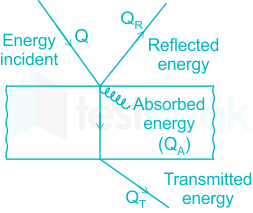
For an opaque surface, the absorptivity (α) , transitivity (τ) and reflectivity (ρ) are related by the equation

  1. ((a))

    α + ρ = τ

  2. ((b))

    ρ + α + τ   = 0

  3. ((c))

    α + ρ = 1

  4. ((d))

    α + ρ = 0

Show Answer
Answer: ((c))

α + ρ = 1

Explanation:

Q = QA + QR + Q­T

1=QAQ+QRQ+QTQ1 = \frac{{{Q_A}}}{Q} + \frac{{{Q_R}}}{Q} + \frac{{{Q_T}}}{Q}

1 = α + ρ + τ 

where

α=QAQ=Absorptivity\alpha = \frac{{{Q_A}}}{Q} = Absorptivity

ρ=QRQ=Reflectivity\rho = \frac{{{Q_R}}}{Q} = Reflectivity

τ=QTQ=Transmissivity\tau = \frac{{{Q_T}}}{Q} = Transmissivity

For an opaque body, transmissivity is zero i.e. τ = 0.

α + ρ = 1

For a transparent body, τ = 1.

α = ρ = 0

For a black body, α = 1.

ρ = τ = 0

29

Steam enters an adiabatic turbine operating at steady state with an enthalpy of 3251.0 kJ/kg and leaves as a saturated mixture at 15 kPa with quality (dryness fraction) 0.9. The enthalpies of the saturated liquid and vapour at 15 kPa are h­f = 225.94 kJ/kg and hg = 2598.3 kJ/kg respectively. The mass flow rate of steam is 10 kg/s. Kinetic and potential energy changes are negligible. The power output of the turbine in MW is:

  1. ((a))

    6.5

  2. ((b))

    8.9

  3. ((c))

    9.1

  4. ((d))

    27.0

Show Answer
Answer: ((b))

8.9

Concept:

Enthalpy of the saturated mixture is given by:

h = hf + x (hg – h­f)

where hf = enthalpy of saturated liquid, hg = enthalpy of saturated vapour, x = dryness fraction

Calculation:

Given:

Mass flow rate of steam = 10 kg/s

Enthalpy of steam at turbine entrance (h1) = 3251 kJ/kg

At the exit, the pressure is 15 kPa, x = 0.9

At P2 = 15 kPa, hf = 225.94 kJ/kg, hg = 2598.3 kJ/kg

Let the enthalpy of the saturated mixture is h2.

h2 = hf + x (hg – h­f)

h2 = 225.94 + 0.9(2598.3 – 225.94)

h2 = 2361.064 kJ/kg

Power output of turbine can be calculated by:

P = ṁ(h1 – h2)

P = 10 × (3251 – 2361.064)

P =  8899.36 kW = 8.89 MW ≃ 8.9 MW

30

The following are the data for two crossed helical gears used for speed reduction:

Gear I: Pitch circle diameter in the plane of rotation 80 mm and helix angle 30°.

Gear II: Pitch circle diameter in the plane of rotation 120 mm and helix angle 22.5°.

If the input speed is 1440 rpm, the output speed in rpm is

  1. ((a))

    1200

  2. ((b))

    900

  3. ((c))

    875

  4. ((d))

    720

Show Answer
Answer: ((b))

900

Concept:

Velocity ratio for helical hears can be calculated by:

N2N1=D1cosψ1D2cosψ2\frac{{{N_2}}}{{{N_1}}} = \frac{{{D_1}\cos {\psi _1}}}{{{D_2}\cos {\psi _2}}}

where D1 and D2 are pitch diameters and ψ1 and ψ2 are respective helix angles.

Calculation:

Given:

D1 = 80 mm, D2 = 120 mm, ψ1 = 30°, ψ2 =22.5°, N1 = 1440 rpm

Velocity ratio 

N2N1=D1cosψ1D2cosψ2=80×cos30120×cos22.5=80×0.866120×0.923=0.625\frac{{{N_2}}}{{{N_1}}} = \frac{{{D_1}\cos {\psi _1}}}{{{D_2}\cos {\psi _2}}} = \frac{{80 \times \cos 30^\circ }}{{120 \times \cos 22.5^\circ }} = \frac{{80 \times 0.866}}{{120 \times 0.923}} = 0.625

N2 = 0.625 × N1 = 0.625 × 1440 = 900 rpm

31

A solid disc of radius r rolls without slipping on the horizontal floor with angular velocity ω and angular acceleration α. The magnitude of acceleration of the point of contact on the disc is

  1. ((a))

    zero

  2. ((b))

  3. ((c))

    (rα)2+(rω2)2\sqrt {{{\left( {r\alpha } \right)}^2} + {{\left( {r{\omega ^2}} \right)}^2}}

  4. ((d))

    2

Show Answer
Answer: ((d))

2

Concept:

Linear velocity V is given by:

V=r×ωV=r×ω

where ω is angular velocity.

Tangential acceleration in the no-slip condition is

dvdt=rdωdt=r×α\frac{{dv}}{{dt}} = r\frac{{dω }}{{dt}} = r×α

at = r × α

Centripetal acceleration is given by:

ac = r × ω2

The instantaneous velocity of the point of contact is zero.

So at the point of contact, Instantaneous tangential acceleration is also zero.

∴ Only centripetal acceleration is there at the point of contact.

Net acceleration of the point of contact is

ac = r × ω2

32

A thin walled spherical shell is subjected to an internal pressure. If the radius of the shell is increased by 1% and the thickness is reduced by 1%, with the internal pressure remaining the same, the percentage change in the circumferential (hoop) stress is

  1. ((a))

    0

  2. ((b))

    1

  3. ((c))

    1.08

  4. ((d))

    2.02

Show Answer
Answer: ((d))

2.02

Concept:

Hoop stress (σh) for a thin spherical shell is given by:

σh=Pd4t=Pr2t{{σ _h}} = \frac{{Pd}}{{4t}}=\frac{{Pr}}{{2t}}

Hoop stress (σh) for thin cylindrical shell is given by:

σh=Pd2t=Prt{{σ _h}} = \frac{{Pd}}{{2t}}=\frac{{Pr}}{{t}}

Calculation:

Given:

Now r' = 1.01r, t' = 0.99t

σh=Pd4t=Pr2t=P×1.01r2×0.99t=1.010.99×Pr2t=1.0202;σh{{σ _h'}} = \frac{{Pd'}}{{4t'}}=\frac{{Pr'}}{{2t'}}= \frac{{P\times 1.01r}}{{2\times 0.99t}}=\frac{{1.01}}{{0.99}}\times \frac{{P r}}{{2 t}}=1.0202 ;σ_h

Percentage change in hoop stress is:

%;change=σhσhσh×100=1.0202σhσhσh×100=2.02%\% ;change = \frac{{\sigma _h' - {\sigma _h}}}{{{\sigma _h}}} \times 100 = \frac{{1.0202\sigma _h - {\sigma _h}}}{{{\sigma _h}}} \times 100 = 2.02\%

33

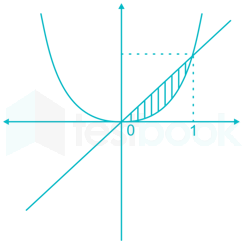
The area enclosed between the straight line y = x and the parabola y = x2 in the x – y plane is____________

  1. ((a))

    1/6

  2. ((b))

    1/4

  3. ((c))

    1/3

  4. ((d))

    1/2

Show Answer
Answer: ((a))

1/6

The given curves are y = x and y = x2

Solving the equations, we get

x  = 0, x = 1

\(Area = \mathop \smallint \limits_0^1 \left( {x - {x^2}} \right)dx\)

=(x22x33)01=1213= \left( {\frac{{{x^2}}}{2} - \frac{{{x^3}}}{3}} \right)_0^1 = \frac{1}{2} - \frac{1}{3}

=16sq;units= \frac{1}{6}sq;units

Alternate Solution:

Concept:

Area of a region can be calculated by:

!!!dxdy\int!!!\int dxdy

Calculation:

Solving equation y = x2 and we get y = x

We get intersection points i.e. (0,0) and (1,1)

Area of the region:

\(\mathop \smallint \limits_{x = 0}^{x = 1} \mathop \smallint \limits_{y = {x^2}}^{y = x} dy.dx\)

\(\mathop \smallint \limits_{x = 0}^{x = 1} \left[ y \right]_{{x^2}}^x.dx;;\)

\(\mathop \smallint \limits_{x = 0;}^{x = 1} \left( {x - {x^2}} \right)dx\)

[x22x33]01=1213=16\left[ {\frac{{{x^2}}}{2} - \frac{{{x^3}}}{3}} \right]_0^1 = \frac{1}{2} - \frac{1}{3} = \frac{1}{6}

34

Consider the function f(x) = |x| in the interval -1 ≤ x ≤ 1. At the point x = 0, f(x) is

  1. ((a))

    Continuous and differentiable

  2. ((b))

    Non – continuous and differentiable

  3. ((c))

    Continuous and non – differentiable

  4. ((d))

    Neither continuous nor differentiable

Show Answer
Answer: ((c))

Continuous and non – differentiable

Concept:

A function f(x) is continuous at x = a if,

Left limit = Right limit = Function value = Real and finite

A function is said to be differentiable at x =a if,

Left derivative = Right derivative = Well defined

Calculation:

Given:

f(x) = |x|

|x| = x for x ≥ 0

|x|= -x for x < 0

At x = 0

Left limit = 0, Right limit = 0, f(0) = 0

As

Left limit = Right limit = Function value = 0

|X| is continuous at x = 0.

Now

Left derivative (at x = 0) = -1

Right derivative (at x = 0) = 1

Left derivative ≠ Right derivative

∴ |x| is not differentiable at x = 0

35

limx0(1cosxx2)\mathop {\lim }\limits_{x \to 0} \left( {\frac{{1 - cosx}}{{{x^2}}}} \right)

  1. ((a))

    1/4

  2. ((b))

    1/2

  3. ((c))

    1

  4. ((d))

    2

Show Answer
Answer: ((b))

1/2

Concept:

We know 

⇒ 1 - cos x = 2 sin2(x/2)​

⇒ limx0sinxx=1\mathop {\lim }\limits_{x \to 0} \frac{{\sin x}}{x} = 1

Calculation:

limx01cosxx2=limx02sin2(x2)x2\mathop {{\rm{lim}}}\limits_{x \to 0} \frac{{1 - {\rm{co}}{{\rm{s}}x}}}{{{x^2}}} = \mathop {{\rm{lim}}}\limits_{x \to 0} \frac{{2{{\sin }^2}\left( {\frac{x}{2}} \right)}}{{{x^2}}}

Multiply and divide the denominator by 4

limx02×sin2(x2)4×(x24)\mathop {\lim }\limits_{x \to 0} \frac{{2 \times {{\sin }^2}\left( {\frac{x}{2}} \right)}}{{4 \times \left( {\frac{{{x^2}}}{4}} \right)}}12limx0(sin(x2)(x2))2=12\frac{1}{2}\mathop {\lim }\limits_{x \to 0} {\left( {\frac{{\sin \left( {\frac{x}{2}} \right)}}{{\left( {\frac{x}{2}} \right)}}} \right)^2} = \frac{1}{2}

36

Calculate the punch size in mm, for a circular blanking operation for which details are given below:

Size of the blank                                                     25 mm

Thickness of the sheet                                            2 mm

Radial clearance between punch and die               0.06 mm

Die allowance                                                          0.05 mm

  1. ((a))

    24.83

  2. ((b))

    24.89

  3. ((c))

    25.01

  4. ((d))

    25.17

Show Answer
Answer: ((a))

24.83

Concept:

Diameter of punch for blanking operation can be calculated by:

Diameter of punch = (diameter of Blank) – (2 × radial clearance) – (die allowance)

Calculation:

Given:

diameter of Blank = 25 mm, radial clearance = 0.06 mm, die allowance = 0.05 mm

Diameter of punch = Diameter of Blank - 2 × radial clearance – die allowance

Diameter of punch = 25 - 2 × 0.06 - 0.05 = 24.83 mm

37

In a single pass rolling process using 410 mm diameter steel rollers, a strip of width 140 mm and thickness 8 mm undergoes 10% reduction of thickness. The angle of bite in radians is

  1. ((a))

    0.006

  2. ((b))

    0.031

  3. ((c))

    0.062

  4. ((d))

    0.600

Show Answer
Answer: ((c))

0.062

Concept:

In a rolling operation change in thickness can be calculated by:

ΔH = D(1 – cosα)

where ΔH = change in thickness, D = roll diameter, α = bite angle

Calculation:

Given:

ΔH = 10 % = 0.1, D = 410 mm

Now,

ΔH = D(1 – cosα)

cosα=1ΔHD=10.1×8410cosα = 1 - \frac{{{\rm{\Delta }}H}}{D} = 1 - \frac{{0.1 \times 8}}{{410}}

α = cos-1(0.998) = 3.57°

α=(3.51×π180) radiansα = (3.51 \times \frac{\pi }{{180}})~radians

α = 0.062 radians

38

In a DC arc welding operation, the voltage-arc length characteristic was obtained as Varc = 20 + 5L where the arc length I was varied between 5 mm and 7 mm. Here Varc, denotes the arc voltage in Volts. The arc current was varied from 400 A to 500 A. Assuming linear power source characteristic, the open circuit voltage and short circuit current for the welding operation are:

  1. ((a))

    45 V, 450 A

  2. ((b))

    75 V, 550 A 

  3. ((c))

    95 V, 950 A 

  4. ((d))

    150 V, 1500 A

Show Answer
Answer: ((c))

95 V, 950 A 

Concept:

VarcOCV+ISCC=1\frac{{{V_{arc}}}}{{OCV}} + \frac{I}{{SCC}} = 1

where OCV = open-circuit voltage, SCC = short circuit current

Calculation:

Given:

Varc  = 20 + 5L

At L = 5 mm

Varc = 20 + 5(5) = 45 V and current (I) = 500 A

At L = 7 mm  

Varc = 20 + 5(7) = 55 V and current (I) = 400 A

Using:

VarcOCV+ISCC=1\frac{{{V_{arc}}}}{{OCV}} + \frac{I}{{SCC}} = 1

45OCV+500SCC=1;;;;;;;;(equation;1)\frac{{45}}{{OCV}} + \frac{{500}}{{SCC}} = 1;;;;;;;;\left( {equation;1} \right)

55OCV+400SCC=1;;;;;;;;(equation;2)\frac{{55}}{{OCV}} + \frac{{400}}{{SCC}} = 1;;;;;;;;\left( {equation;2} \right)

Multiplying equation 1 by '4' and equation 2 by '5' and subtracting equation 1 from equation 2.

We get,

275OCV180OCV=1\frac{{275}}{{OCV}} - \frac{{180}}{{OCV}} = 1

OCV = 275 – 180 = 95 V

Putting the value of OCV in equation 1

We get,

4595+500SCC=1\frac{{45}}{{95}} + \frac{{500}}{{SCC}} = 1

SCC = 950 A

39

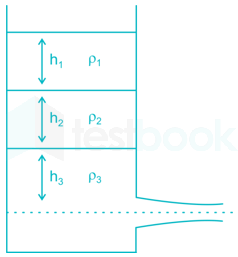
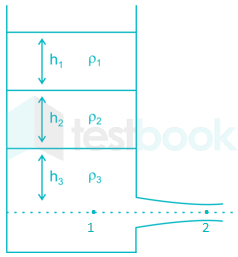
A large tank with a nozzle attached contains three immiscible inviscid fluids as shown. Assuming that the changes in h1, h2 and h3 are negligible, the instantaneous discharge velocity is:

  1. ((a))

    2gh3(1+ρ1h1ρ3h3+ρ2h2ρ3h3)\sqrt {2g{h_3}\left( {1 + \frac{{{\rho _1}{h_1}}}{{{\rho _3}{h_3}}} + \frac{{{\rho _2}{h_2}}}{{{\rho _3}{h_3}}}} \right)}

  2. ((b))

    2g(h1+h2+h3)\sqrt {2g\left( {{h_1} + {h_2} + {h_3}} \right)}

  3. ((c))

    2g(ρ1h1+ρ2h2+ρ3h3ρ1+ρ2+ρ3)\sqrt {2g\left( {\frac{{{\rho _1}{h_1} + {\rho _2}{h_2} + {\rho _3}{h_3}}}{{{\rho _1} + {\rho _2} + {\rho _3}}}} \right)}

  4. ((d))

    ;2g(ρ1h2h3+ρ2h3h1+ρ3h1h2ρ1h1+ρ2h2+ρ3h3);\sqrt {2g\left( {\frac{{{\rho _1}{h_2}{h_3} + {\rho _2}{h_3}{h_1} + {\rho _3}{h_1}{h_2}}}{{{\rho _1}{h_1} + {\rho _2}{h_2} + {\rho _3}{h_3}}}} \right)}

Show Answer
Answer: ((a))

2gh3(1+ρ1h1ρ3h3+ρ2h2ρ3h3)\sqrt {2g{h_3}\left( {1 + \frac{{{\rho _1}{h_1}}}{{{\rho _3}{h_3}}} + \frac{{{\rho _2}{h_2}}}{{{\rho _3}{h_3}}}} \right)}

Explanation:

Total pressure at point 1

P1 = ρ1gh1 + ρ2gh2 + ρ3gh3

Applying Bernoulli’s equation between point 1 and point 2

P1ρ3g+V122g+Z1=P2ρ3g+V222g+Z2\frac{{{P_1}}}{{{\rho _3}g}} + \frac{{{V_1^2}}}{{2g}} + {Z_1} = \frac{{{P_2}}}{{{\rho _3}g}} + \frac{{V_2^2}}{{2g}} + {Z_2}

Here,

Z1 = Z2, V1 = 0, P2 = 0

Putting the values, we get

ρ1gh1+ρ2gh2+ρ3gh3ρ3g+0+0=0+V222g+0\frac{{{\rho _1}g{h_1} + {\rho _2}g{h_2} + {\rho _3}g{h_3}}}{{{\rho _3}g}} + 0 + 0 = 0 + \frac{{V_2^2}}{{2g}} + 0

ρ1ρ3h1+ρ2ρ3h2+h3=V222g\frac{{{\rho _1}}}{{{\rho _3}}}{h_1} + \frac{{{\rho _2}}}{{{\rho _3}}}{h_2} + {h_3} = \frac{{V_2^2}}{{2g}}

V22=2g(ρ1ρ3h1+ρ2ρ3h2+h3)V_2^2 = 2g\left( {\frac{{{\rho _1}}}{{{\rho _3}}}{h_1} + \frac{{{\rho _2}}}{{{\rho _3}}}{h_2} + {h_3}} \right)

V2=2g(ρ1ρ3h1+ρ2ρ3h2+h3){V_2} = \sqrt {2g\left( {\frac{{{\rho _1}}}{{{\rho _3}}}{h_1} + \frac{{{\rho _2}}}{{{\rho _3}}}{h_2} + {h_3}} \right)}

V2=2gh3(ρ1h1ρ3h3+ρ2h2ρ3h3;+1){V_2} = \sqrt {2g{h_3}\left( {\frac{{{\rho _1}{h_1}}}{{{\rho _3}{h_3}}} + \frac{{{\rho _2}{h_2}}}{{{\rho _3}{h_3}}}; + 1} \right)}

40

Water (Cp = 4.18 kJ/kg.K) at 80°C enters a counter flow heat exchanger with a mass flow rate of 0.5 kg/s. Air (Cp = 1 kJ/kg.K) enters at 30°C with a mass flow rate of 2.09 kg/s. If the effectiveness of the heat exchanger is 0.8, the LMTD (in °C) is

  1. ((a))

    40

  2. ((b))

    20

  3. ((c))

    10

  4. ((d))

    5

Show Answer
Answer: ((c))

10

Concept:

The effectiveness of a heat exchanger can be calculated by:

\(ϵ= \frac{{{{\rm{Q}}{{\rm{actual}}}}}}{{{{\rm{Q}}{{\rm{max}}}}}}\)

\({{\rm{Q}}{{\rm{actul}}}} = {{\rm{̇ m}}{\rm{h}}}{{\rm{c}}{{\rm{ph}}}}\left( {{{\rm{T}}{{\rm{h}}1}} - {{\rm{T}}{{\rm{h}}2}}} \right) = {{\rm{̇ m}}{\rm{c}}}{{\rm{c}}{{\rm{pc}}}}\left( {{{\rm{T}}{{\rm{c}}2}} - {{\rm{T}}_{{\rm{c}}1}}} \right)\)

\({{\rm{Q}}{{\rm{max}}}} = {{\rm{C}}{{\rm{min}}}}\left( {{{\rm{T}}{{\rm{h}}1}} - {{\rm{T}}{{\rm{c}}1}}} \right)\)

\(ϵ= \frac{{{{\rm{Q}}{{\rm{actual}}}}}}{{{{\rm{Q}}{{\rm{max}}}}}} = \frac{{{{\rm{C}}{\rm{h}}}\left( {{{\rm{T}}{{\rm{h}}1}} ;- ;{{\rm{T}}{{\rm{h}}2}}} \right)}}{{{{\rm{C}}{{\rm{min}}}}\left( {{{\rm{T}}{{\rm{h}}1}} ;- ;{{\rm{T}}{{\rm{c}}1}}} \right)}} = \frac{{{{\rm{C}}{\rm{c}}}\left( {{{\rm{T}}{{\rm{c}}2}} ;-; {{\rm{T}}{{\rm{c}}1}}} \right)}}{{{{\rm{C}}{{\rm{min}}}}\left( {{{\rm{T}}{{\rm{h}}1}} ;- ;{{\rm{T}}{{\rm{c}}1}}} \right)}}\)

For a balanced heat exchanger:

\({{\rm{̇ m}}{\rm{h}}}{{\rm{c}}{{\rm{ph}}}} = {{\rm{̇ m}}{\rm{c}}}{{\rm{c}}{{\rm{pc}}}} ⇒ {{\rm{C}}{\rm{h}}} = {{\rm{C}}{\rm{c}}} = {{\rm{C}}{{\rm{min}}}} = {{\rm{C}}{{\rm{max}}}}\)

\({\rm{ϵ }} = \frac{{{{\rm{C}}{\rm{h}}}\left( {{{\rm{T}}{{\rm{h}}1}} ;- ;{{\rm{T}}{{\rm{h}}2}}} \right)}}{{{{\rm{C}}{{\rm{min}}}}\left( {{{\rm{T}}{{\rm{h}}1}} ;- ;{{\rm{T}}{{\rm{C}}1}}} \right)}} = \frac{{{{\rm{T}}{{\rm{h}}1}} ;- ;{{\rm{T}}{{\rm{h}}2}}}}{{{{\rm{T}}{{\rm{h}}1}} ;- ;{{\rm{T}}{{\rm{c}}1}}}}\)

\({\rm{ϵ }} = \frac{{{{\rm{C}}{\rm{c}}}\left( {{{\rm{T}}{{\rm{c}}2}} ;- ;{{\rm{T}}{{\rm{c}}1}}} \right)}}{{{{\rm{C}}{{\rm{min}}}}\left( {{{\rm{T}}{{\rm{h}}1}} ;- ;{{\rm{T}}{{\rm{C}}1}}} \right)}} = \frac{{{{\rm{T}}{{\rm{c}}2}}; -; {{\rm{T}}{{\rm{c}}1}}}}{{{{\rm{T}}{{\rm{h}}1}}; - ;{{\rm{T}}{{\rm{c}}1}}}}\)

Log mean temperature difference for the counter-flow heat exchanger is:

LMTD=ΔT1;;ΔT2ln(ΔT1ΔT2){LMTD} = \frac{{{Δ T_1};-;{Δ T_2}}}{{\ln \left( {\frac{{{Δ T_1}}}{{{Δ T_2}}}} \right)}}

where

ΔT1=Th1Tc2;and;ΔT2=Th2Tc1{Δ T_1} = {T_{{h1}}} - {T_{{c2}}};and;{Δ T_2} = {T_{{h2}}} - {T_{{c1}}}

Calculation:

Given:

Th1 = 80 °C, Tc1 = 30 °C, ṁh = 0.5 kg/sec, cph = 4.18 kJ/kg-K, ṁc = 2.09 kg/sec, cpc = 1 kJ/kg-K.

Ch = mhch = 0.5 × 4.18 = 2.04 W/K 

Cc = mccc = 2.09 × 1 = 2.09 W/K

∵ Ch = Cc = 2.09 W/K ⇒ balanced heat exchanger.

Effectiveness (ϵ):

\({\rm{ϵ }} = \frac{{{{\rm{T}}{{\rm{h}}1}} ;- ;{{\rm{T}}{{\rm{h}}2}}}}{{{{\rm{T}}{{\rm{h}}1}} ;- ;{{\rm{T}}{{\rm{c}}1}}}}\)

0.8=(80;;Th2)(80;;30)0.8 = \frac{{\left( {80; - ;{T_{{h2}}}} \right)}}{{\left( {80; -; 30} \right)}}

Th2=40;C{T_{{h2}}} = 40;^\circ C

\({m_h}{c_{{h}}}\left( {{T{{h1}}} - {T_{{h2}}}} \right) = {m_c}{c_{{c}}}\left( {{T{{c2}}} - {T_{{c1}}}} \right)\)

0.5 × 4.18 × (80 - 40) = 1 × 2.09 × (Tc2 - 30)

∴ Tc2 = 70 °C

ΔT1 = Th1 - Tc2 = 80 - 70 = 10 °C

ΔT2 = Th2 - Tc2 = 40 - 30 = 10 °C

In case of counter-flow heat exchanger if ΔT1 = ΔT2 then by L. hospital rule

ΔT1 = ΔT2 = LMTD

LMTD = 10 °C
41

A solid steel cube constrained on all six faces is heated so that the temperature rises uniformly by ΔT. If the thermal coefficient of the material is α, Young’s modulus is E and the Poisson’s ratio is v, the thermal stress developed in the cube due to heating is

  1. ((a))

    α(ΔT)E(12v)-\frac{{\alpha \left( {{\rm{\Delta }}T} \right)E}}{{\left( {1 - 2v} \right)}}

  2. ((b))

    2α(ΔT)E(12v)- \frac{{2\alpha \left( {{\rm{\Delta }}T} \right)E}}{{\left( {1 - 2v} \right)}}

  3. ((c))

    3α(ΔT)E(12v)- \frac{{3\alpha \left( {{\rm{\Delta }}T} \right)E}}{{\left( {1 - 2v} \right)}}

  4. ((d))

    α(ΔT)E3(12v)-\frac{{\alpha \left( {{\rm{\Delta }}T} \right)E}}{{3\left( {1 - 2v} \right)}}

Show Answer
Answer: ((a))

α(ΔT)E(12v)-\frac{{\alpha \left( {{\rm{\Delta }}T} \right)E}}{{\left( {1 - 2v} \right)}}

Explanation:

For a solid cube, strain in x, y and z-axis are:

ϵx=σxEv(σy+σz)E ϵy=σyEv(σx+σz)E ϵz=σzEv(σx+σy)E\begin{array}{l} {\epsilon_x} = \frac{{{\sigma _x}}}{E} - \frac{{v\left( {{\sigma _y} + {\sigma _z}} \right)}}{E}\ {\epsilon_y} = \frac{{{\sigma _y}}}{E} - \frac{{v\left( {{\sigma _x} + {\sigma _z}} \right)}}{E}\ {\epsilon_z} = \frac{{{\sigma _z}}}{E} - \frac{{v\left( {{\sigma _x} + {\sigma _y}} \right)}}{E} \end{array}

From the symmetry of cube, ϵx=ϵy=ϵz=ϵ\epsilon_x =\epsilon_y=\epsilon_z=\epsilon

and σx=σy=σz=σ\sigma_x=\sigma_y=\sigma_z=\sigma

Because of the rise in temperature, the cube will try to expand (tensile strain), and as the walls are constrained so a compressive force will develop on the walls of the cube.

So, σx=σy=σz=σ\sigma_x=\sigma_y=\sigma_z=- \sigma

As the walls are constrained so total strain should be zero.

Tensile strain due to temperature rise + Compressive strain due to compressive force = 0

Volumetric strain of the cube,

ϵv=(12v)E×(σxσyσz)=(12v)E×3σ \epsilon_v= \frac{{\left( {1 - 2v} \right)}}{E} \times \left(- \sigma_x - \sigma_y - \sigma_z\right) =- \frac{{\left( {1 - 2v} \right)}}{E} \times3\sigma

Volumetric thermal strain

ϵv=3α.ΔT\epsilon_v=3\alpha. \Delta T (Thermal tensile Strain)

(12v)E×3σ=3α.ΔT- \frac{{\left( {1 - 2v} \right)}}{E} \times3\sigma = 3\alpha. \Delta T

∴ σ=α.ΔT.E(12v)\sigma = \frac{{ - \alpha .{\rm{\Delta }}T.E}}{{\left( {1 - 2v} \right)}}

42

A solid circular shaft needs to be designed to transmit a torque of 50 Nm. If the allowable shear stress of the material is 140 MPa, assuming a factor of safety of 2, the minimum allowable design diameter in mm is

  1. ((a))

    8

  2. ((b))

    16

  3. ((c))

    24

  4. ((d))

    32

Show Answer
Answer: ((b))

16

Concept:

Maximum permissible shear stress can be calculated using:

τmax=TZp{τ _{max}} = \frac{T}{{{Z_p}}}

where Zp = polar section modulus, T = torque applied

Given:

T = 50 Nm, τallowable = 140 MPa

F0S = 2

τmax=τallowable;FOS=1402=70 MPa{τ _{max}} = \frac{{{τ _{allowable;}}}}{{FOS}} = \frac{{140}}{{2}}=70~MPa

Polar section modulus for the circular road is:

ZP=πd316{Z_P} = \frac{{\pi {d^3}}}{{16}}

Now maximum shear stress is

τmax=TZp{τ _{max}} = \frac{T}{{{Z_p}}}

⇒ Zp=Tτmax{Z_p} = \frac{T}{{{τ _{max}}}}

πd316=Tτmax;\frac{{\pi {d^3}}}{{16}} = \frac{T}{{{τ _{max;}}}}

d=16Tπτmax3=16×50π×70×1063d = \sqrt[3]{{\frac{{16T}}{{\pi {τ _{max}}}}}} = \sqrt[3]{{\frac{{16 \times 50}}{{\pi \times 70 \times {{10}^6}}}}}

d = 0.01537 m = 15.37 mm ≃ 16 mm

43

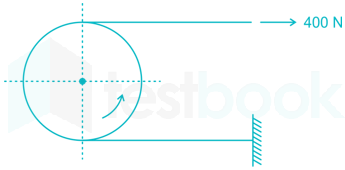
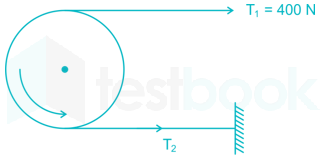
A force of 400 N is applied to the brake drum of 0.5 m diameter in a band brake system as shown in the figure, where the wrapping angle is 180°. If the coefficient of friction between the drum and the band is 0.25, the braking torque applied, in Nm is

  1. ((a))

    100.6

  2. ((b))

    54.4

  3. ((c))

    22.1

  4. ((d))

    15.7

Show Answer
Answer: ((b))

54.4

Concept:

For a brake:

T1T2=eμθ\frac{{{T_1}}}{{{T_2}}} = {e^{\mu \theta }}

where T1 = tension on tight side, T2 = tension on slack side, μ = coefficient of friction, θ = wrapping angle

And braking torque can be calculated by:

BT = (T1 – T2) × R

where R is the radius of the brake drum.

Calculation:

Given:

As the drum is rotating in the anti-clockwise direction, T1 will be tight side & T2 will be slack side.

T1 = 400 N, R = 0.25 m, μ = 0.25

θ = 180° = π radian

Now, we know that

T1T2=eμθ\frac{{{T_1}}}{{{T_2}}} = {e^{\mu \theta }}

400T2=e0.25×π=2.193\frac{{400}}{{{T_2}}} = {e^{0.25 \times \pi }} = 2.193

T2=4002.193=182.375;N \Rightarrow {T_2} = \frac{{400}}{{2.193}} = 182.375;N

Braking torque (BT)

BT = (T1 – T2) × R

BT = (400 – 182.375) × 0.25

BT = 54.40 Nm

44

A box contains 4 red balls and 6 black balls. Three balls are selected randomly from the box one after another without replacement. The probability that the selected set contains one red ball and two black balls is

  1. ((a))

    1/20

  2. ((b))

    1/12

  3. ((c))

    3/10

  4. ((d))

    1/2

Show Answer
Answer: ((d))

1/2

Given:

Total number of red balls = 4

Total number of black balls = 6

Three balls are selected randomly without replacement,

Three cases are possible,

Case 1 - (B, B, R)

Case 2 - (B, R, B)

Case 3 - (R, B, B)

The probability of the selected cases are:

\(P\left( {B, B, R} \right) = \frac{{{6_{{c_1}}} \times {5_{{c_1}}}\times {4_{{c_1}}}}}{{{{10}{{c_1}}\times {9{{c_1}}}\times {8_{{c_1}}}}}} = \frac{{ {\left( {6 \times 5 \times 4} \right)}}}{{\left( {10 \times 9 \times 8} \right)}} = \frac{1}{6}\)

\(P\left( {B, R, B} \right) = \frac{{{6_{{c_1}}} \times {4_{{c_1}}}\times {5_{{c_1}}}}}{{{{10}{{c_1}}\times {9{{c_1}}}\times {8_{{c_1}}}}}} = \frac{{ {\left( {6 \times 4 \times 5} \right)}}}{{\left( {10 \times 9 \times 8} \right)}} = \frac{1}{6}\)

\(P\left( {R, B, B} \right) = \frac{{{4_{{c_1}}} \times {6_{{c_1}}}\times {5_{{c_1}}}}}{{{{10}{{c_1}}\times {9{{c_1}}}\times {8_{{c_1}}}}}} = \frac{{ {\left( {4 \times 6 \times 5} \right)}}}{{\left( {10 \times 9 \times 8} \right)}} = \frac{1}{6}\)

The probability that the selected set contains 1 red ball and 2 black balls is = P(B,B,R)+P(B,R,B)+P(R,B,B)=16+16+16=12P\left( {B, B, R} \right) + P\left( {B, R, B} \right) + P\left( {R, B, B} \right) = \frac{1}{6} + \frac{1}{6} +\frac{1}{6} = \frac{1}{2}

45

Consider the differential equation x2d2ydx2+xdydx4y=0{x^2}\frac{{{d^2}y}}{{d{x^2}}} + x\frac{{dy}}{{dx}} - 4y = 0 with the boundary conditions of y(0) = 0 and y(1) = 1. The complete solution of the differential equation is

  1. ((a))

    x2

  2. ((b))

    sin(πx2)\sin \left( {\frac{{\pi x}}{2}} \right)

  3. ((c))

    exsin(πx2){e^x}\sin \left( {\frac{{\pi x}}{2}} \right)

  4. ((d))

    exsin(πx2){e^{ - x}}\sin \left( {\frac{{\pi x}}{2}} \right)

Show Answer
Answer: ((a))

x2

Concept:

For different roots of the auxiliary equation, the solution (complementary function) of the differential equation is as shown below.

Roots of Auxiliary EquationComplementary Function
m1, m2, m3, … (real and different roots)C1em1x+C2em2x+C3em3x+{C_1}{e^{{m_1}x}} + {C_2}{e^{{m_2}x}} + {C_3}{e^{{m_3}x}} + \ldots
m1, m1, m3, … (two real and equal roots)(C1+C2x)em1x+C3em3x+\left( {{C_1} + {C_2}x} \right){e^{{m_1}x}} + {C_3}{e^{{m_3}x}} + \ldots
m1, m1, m1, m4… (three real and equal roots)(C1+C2x+C3x2)em1x+C4em4x+\left( {{C_1} + {C_2}x + {C_3}{x^2}} \right){e^{{m_1}x}} + {C_4}{e^{{m_4}x}} + \ldots
α + iβ, α – iβ, m3, … (a pair of imaginary roots)eαx(C1cosβx+C2sinβx)+C3em3x+{e^{\alpha x}}\left( {{C_1}\cos \beta x + {C_2}\sin \beta x} \right) + {C_3}{e^{{m_3}x}} + \ldots
α ± i β, α ± i β, m5, … (two pairs of equal imaginary roots)\({e^{\alpha x}}\left( {\left( {{C_1} + {C_2}x} \right)\cos \beta x + \left( {{C_3} + {C_4}x} \right)\sin \beta x} \right) \+ {C_5}{e^{{m_5}x}} + \ldots\)


Calculation:

Given:

x2d2ydx2+xdydx4y=0{x^2}\frac{{{d^2}y}}{{d{x^2}}} + x\frac{{dy}}{{dx}} - 4y = 0

y (0) = 0, y (1) = 1

Cauchy’s D.E

y=xm dydx=mxm1 d2ydx2=m(m1)xm2\begin{array}{l} y = {x^m}\ \frac{{dy}}{{dx}} = m{x^{m - 1}}\ \frac{{{d^2}y}}{{d{x^2}}} = m(m - 1){x^{m - 2}} \end{array}

x2d2ydx2+xdydx4y=0 m(m1)+m4=0 m24=0 m=±2\begin{array}{l} {x^2}\frac{{{d^2}y}}{{d{x^2}}} + x\frac{{dy}}{{dx}} - 4y = 0\ m(m - 1) + m - 4 = 0\ {m^2} - 4 = 0\ m = \pm 2 \end{array}

∴ The required solution is y = C1xm1 + C2xm2 ​= C1 x2 + Cx-2

Boundary condition: 

y(0) = 0, we get C2 = 0

And y(1) = 1, we get C1 = 1

So y = x2 will be the solution.

46

The system of algebraic equations given below has

x  + 2y + z = 4

2x + y + 2z = 5

x – y + z = 1

  1. ((a))

    A unique solution of x = 1, y = 1 and z = 1

  2. ((b))

    Only the two solutions of (x = 1, y = 1 and z = 1) and (x = 2, y = 1 and z = 0)

  3. ((c))

    Infinite number of solutions

  4. ((d))

    No feasible solution

Show Answer
Answer: ((c))

Infinite number of solutions

Concept:

Let

[A] is the Coefficient matrix

[A/B] be Augmented matrix

n = total number of variables

Case 1: ρ(A) = ρ(A/B) = n

In this case, the system will be consistent and will have a unique solution.

Case 2**: ρ(A) = ρ(A/B) < n**

In this case, the system will be consistent and will have infinite solutions.

Case 3**: ρ(A) < ρ(A/B)**

In this case, the system will be inconsistent and will have no solution.

Calculation:

Given:

x  + 2y + z = 4

2x + y + 2z = 5

x – y + z = 1

Here n = 3

Augmented matrix is:

\(\left[ {A/B} \right] = \left[ {\left. {\begin{array}{{20}{c}} 1&2&1\ 2&1&2\ 1&{ - 1}&1 \end{array}} \right|\begin{array}{{20}{c}} 4\ 5\ 1 \end{array}} \right]\)

R2 → R2 – 2R1 and R3 → R3 – R1

\(\left[ {A/B} \right] = \left[ {\left. {\begin{array}{{20}{c}} 1&2&1\ 0&{ - 3}&0\ 0&{ - 3}&0 \end{array}} \right|\begin{array}{{20}{c}} {;;;4}\ { - 3}\ { - 3} \end{array}} \right]\)

R3 → R3 – R2

\($\left[ {A/B} \right] = \left[ {\left. {\begin{array}{{20}{c}} 1&2&1\ 0&{ - 3}&0\ 0&0&0 \end{array}} \right|\begin{array}{{20}{c}} {;;4}\ { - 3}\ {;;0} \end{array}} \right]\)

ρ(A) = ρ(A/B)  = 2 < 3

∴ System will be consistent and will have infinite solutions.

47

The homogeneous state of stress for a metal part undergoing plastic deformation is

\(T = \left[ {\begin{array}{*{20}{c}} {10}&5&0\ 5&{20}&0\ 0&0&{ - 10} \end{array}} \right]\)

Where the stress component values are in MPa. Using von Mises yield criterion, the value of estimated shear yield stress, in MPa is

  1. ((a))

    9.50

  2. ((b))

    16.07

  3. ((c))

    28.52

  4. ((d))

    49.41

Show Answer
Answer: ((b))

16.07

Concept:

Maximum distortion energy theory (Von mises theory)

  • According to this theory, the failure or yielding occurs at a point in a member when the distortion strain energy per unit volume reaches the limiting distortion energy (i.e. distortion energy at yield point) per unit volume as determined from simple tension test.
  • yield stress under triaxial condition is given by:

\({\sigma _{y}} = \sqrt {\frac{1}{2}\left{ {{{\left( {{\sigma _x} - {\rm{;}}{\sigma _y}} \right)}^2} + {{\left( {{\sigma _y} - {\sigma _z}} \right)}^2} + {{\left( {{\sigma _z} - {\sigma _x}} \right)}^2} + 6\left( {τ _{xy}^2 + {\rm{;}}τ _{yz}^2 + τ _{zx}^2} \right)} \right}} \)

Calculation:

Given:

σx = 10 MPa, σy = 20 MPa, σz = -10 MPa, τxy = 5 MPa, τyz = τzx = 0

putting the value in the equation

\({\sigma _{y}} = \sqrt {\frac{1}{2}\left{ {{{\left( {{\sigma _x} - {\rm{;}}{\sigma _y}} \right)}^2} + {{\left( {{\sigma _y} - {\sigma _z}} \right)}^2} + {{\left( {{\sigma _z} - {\sigma _x}} \right)}^2} + 6\left( {τ _{xy}^2 + {\rm{;}}τ _{yz}^2 + τ _{zx}^2} \right)} \right}} \)

\({\sigma _{y}} = \sqrt {\frac{1}{2}\left{ {{{\left( {{10-20}} \right)}^2} + {{\left( {20+10} \right)}^2} + {{\left( {{-10} - {10}} \right)}^2} + 6\left( {5^2 } \right)} \right}} \)

σy = 27.839 MPa 

Shear stress at yield is

 τy=σy3=16.07;MPa{τ _y} = \frac{{{\sigma _{y}}}}{{\sqrt 3 }} = 16.07;MPa

48

Details pertaining to an orthogonal metal cutting process are given below

Chip thickness ratio                                        0.4

Undeformed thickness                                    0.6 mm

Rake angle                                                      +10°

Cutting speed                                                  2.5 m/s

Mean thickness of primary shear zone          25 microns

The shear strain rate in s-1 during the process is

  1. ((a))

    0.1781 × 10⁵

  2. ((b))

    0.77S4 × 105

  3. ((c))

    1.0104 × 10⁵

  4. ((d))

    4.397 × 10⁵

Show Answer
Answer: ((c))

1.0104 × 10⁵

Concept:

Shear angle (ϕ) can be calculated by:

tanϕ=rcosα1rsinα\tan \phi = \frac{{r\cos \alpha }}{{1 - r\sin \alpha }}

Shear strain rate can be calculated by:

ε˙=Vstm\dot \varepsilon = \frac{{{V_s}}}{{{t_m}}}

where Vs = shear velocity and tm = mean chip thickness of the primary zone

And shear velocity can be calculated by:

Vscosα=Vccos(ϕα);\frac{{{V_s}}}{{\cos \alpha }} = \frac{{{V_c}}}{{\cos \left( {\phi - \alpha } \right)}};

where Vc = chip velocity

Calculation:

Given:

r = 0.4

t = 0.6 mm

α = 10°

Vc = 2.5 m/s

tm = 25 μm

Shear angle (ϕ) can be calculated by:

tanϕ=rcosα1rsinα=0.4×cos101(0.4×sin10)=0.4233\tan \phi = \frac{{r\cos \alpha }}{{1 - r\sin \alpha }} = \frac{{0.4 \times \cos 10^\circ }}{{1 - (0.4 \times \sin 10^\circ )}} = 0.4233

ϕ = tan-1(0.4233) = 22.9°

Now, shear velocity (vs)

Vscosα=Vccos(ϕα);\frac{{{V_s}}}{{\cos \alpha }} = \frac{{{V_c}}}{{\cos \left( {\phi - \alpha } \right)}};

Vs=(cos10)×2.5cos(22.910)=2.525{V_s} = \frac{{(\cos 10^\circ ) \times 2.5}}{{\cos \left( {22.9^\circ - 10^\circ } \right)}} = 2.525

Shear strain rate

ε˙=Vstm=2.52525×106=1.01×10⁵;per;second;\dot \varepsilon = \frac{{{V_s}}}{{{t_m}}} = \frac{{2.525}}{{25 \times {{10}^{ - 6}}}} = 1.01 \times {10^5};per;second;

Do not confuse shear strain rate with shear strain.

shear strain can be calculated by:

ε = cot ϕ + tan (ϕ – α)

49

In a single pass drilling operation, a through hole of 15 mm diameter is to be drilled in a steel plate of 50 mm thickness. Drill spindle speed is 500 rpm, feed is 0.2 mm/rev and drill point angle is 118°. Assuming 2 mm clearance at approach and exit, the total drill time in seconds is

  1. ((a))

    35.1

  2. ((b))

    32.4 

  3. ((c))

    31.2

  4. ((d))

    30.1

Show Answer
Answer: ((a))

35.1

Concept:

Machining time in drilling can be calculated by:

Tm=L+AP+OR+Xf×N{T_m} = \frac{{L + AP + OR + X}}{{f \times N}}

where L = thickness of the plate to be drilled

AP = approach

OR = over travel

X = necessary approach

The necessary approach can be calculated using:

X=D2×tanβX = \frac{D}{{2 \times \tan \beta }}

where D = diameter of the hole to be drilled, β = half drill point angle.

Calculation:

Given:

L = 50 mm, D = 15 mm N = 500 rpm, f = 0.2 mm/rev, AP = 2 mm, OR = 2 mm

2β = 118° ⇒ β = 59°

Necessary approach (X)

X=D2×tanβ=152×tan59=4.5;mmX = \frac{D}{{2 \times \tan \beta }} = \frac{{15}}{{2 \times \tan 59^\circ }} = 4.5;mm

Machining time (Tm)

Tm=L+AP+OR+Xf×N{T_m} = \frac{{L + AP + OR + X}}{{f \times N}}

Tm=50+2+2+4.50.2×500=0.585;minute=35.1;seconds{T_m} = \frac{{50 + 2 + 2 + 4.5}}{{0.2 \times 500}} = 0.585;minute = 35.1;seconds

50

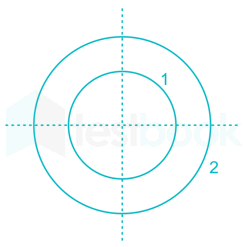
Consider two infinitely long thin concentric tubes of circular cross section as shown in the figure. If D1 and D2 are the diameters of the inner and outer tubes respectively, then the view factor F22 is given by

  1. ((a))

    (D2D1)1\left( {\frac{{{D_2}}}{{{D_1}}}} \right) - 1

  2. ((b))

    Zero

  3. ((c))

    (D1D2)\left( {\frac{{{D_1}}}{{{D_2}}}} \right)

  4. ((d))

    1(D1D2)1 - \left( {\frac{{{D_1}}}{{{D_2}}}} \right)

Show Answer
Answer: ((d))

1(D1D2)1 - \left( {\frac{{{D_1}}}{{{D_2}}}} \right)

Concept:

View factor (Fij) is defined as:

Fij=net;radiant;heat;transfer;from;ithsurface;to;jthsurfacetotal;radiation;emmited;from;surface;i{F_{ij}} = \frac{{net;radiant;heat;transfer;from;{i^{th}}surface;to;{j^{th}}surface}}{{total;radiation;emmited;from;surface;i}}

Reciprocity theorem

AiFij = AjFji

Summation rule

If there are n surfaces, then according to summation rule:

F11 + F12 + F13 + … + F1n = 1

F21 + F22 + F23 + … + F2n = 1

...

Fn1 + Fn2 + Fn3 + … + Fnn = 1

Calculation:

Given:

A1 = πD1L, A2 = πD2L

F11 = 0 {∵ convex surface}

As F11 + F12 = 1

∴ F12 = 1

From reciprocity theorem

A1F12 = A2F21

⇒ F21=A1A2=πD1LπD2L=D1D2{F_{21}} = \frac{{{A_1}}}{{{A_2}}} = \frac{{\pi {D_1}L}}{{\pi {D_2}L}} = \frac{{{D_1}}}{{{D_2}}}

Now F21 + F22 = 1

⇒ F22=1F21=1D1D2{F_{22}} = 1 - {F_{21}} = 1 - \frac{{{D_1}}}{{{D_2}}}

51

An incompressible fluid flows over a flat plate with zero pressure gradient. The boundary layer thickness is 1 mm at a location where the Reynolds number is 1000. If the velocity of the fluid alone is increased by a factor of 4, then the boundary layer thickness at the same location, in mm will be

  1. ((a))

    4

  2. ((b))

    2

  3. ((c))

    0.5

  4. ((d))

    0.25

Show Answer
Answer: ((c))

0.5

Concept:

According to the Blasius equation, for a laminar flow

Boundary layer thickness (δ) can be calculated by:

δ=5xRex\delta = \frac{{5x}}{{\sqrt {R{e_x}} }}

where Rex = Reynold's number = ρVxμ\frac{{\rho Vx}}{\mu } {V = Velocity}

δ1V\therefore \delta \propto \frac{1}{V}

Calculation:

Given:

δ1 = 1 mm, V2 = 4V1

As,,δ1VAs,,\delta \propto \frac{1}{V}

δ1δ2=V2V1\frac{{{\delta _1}}}{{{\delta _2}}} = \sqrt {\frac{{{V_2}}}{{{V_1}}}}

1δ2=41=2\frac{1}{{{\delta _2}}} = \sqrt {\frac{4}{1}} = 2

 δ2 = 0.5 mm

52

A room contains 35 kg of dry air and 0.5 kg of water vapour. The total pressure and temperature of the air in the room are 100 kPa and 25°C respectively. Given that the saturation pressure for water at 25°C is 3.17 kPa, the relative humidity of the air in the room is

  1. ((a))

    67%

  2. ((b))

    55%

  3. ((c))

    83%

  4. ((d))

    71%

Show Answer
Answer: ((d))

71%

Concept:

Specific humidity (ω) can be calculated by:

ω=mvma=0.621×PvPatm  Pv\omega = \frac{{{m_v}}}{{{m_a}}} = 0.621 \times \frac{{{P_v}}}{{{P_{atm}}~ -~ {P_v}}}

where mv = mass of vapour, ma = mass of dry air, Pv = vapour pressure, Patm = atmospheric pressure

Relative humidity (ϕ) can be calculated by:

ϕ=mvmvs=PvPvs\phi = \frac{{{m_v}}}{{{m_{vs}}}} = \frac{{{P_v}}}{{{P_{vs}}}}

where mvs = mass of saturated vapour, Pvs = saturated vapour pressure

Calculation:

Given:

Ma = 35 kg, mv = 0.5 kg, temperature (t) = 25°c, Patm = 100 kPa, Pvs = 3.17 kPa

Specific humidity (ω)

ω=mvma=0.535=170\omega = \frac{{{m_v}}}{{{m_a}}} = \frac{{0.5}}{{35}} = \frac{1}{{70}}

Specific humidity (ω) can also be calculated by:

ω=0.621×PvPatmPv\omega = 0.621 \times \frac{{{P_v}}}{{{P_{atm}} - {P_v}}}

170=0.621×Pv100Pv\frac{1}{{70}} = 0.621 \times \frac{{{P_v}}}{{100 - {P_v}}}

100 – Pv = 43.47 × Pv

44.37 × Pv = 100

Pv=10044.37=2.253;kPa{P_v} = \frac{{100}}{{44.37}} = 2.253;kPa

Relative humidity (ϕ)

ϕ=PvPvs=2.2533.17=0.71=71;%\phi = \frac{{{P_v}}}{{{P_{vs}}}} = \frac{{2.253}}{{3.17}} = 0.71 = 71;\%

53

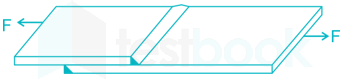
A fillet-welded joint is subjected to transverse loading F as shown in the figure. Both legs of the fillets are of 10 mm size and the weld length is 30 mm. If the allowable shear stress of the weld is 94 MPa, considering the minimum throat area of the weld, the maximum allowable transverse load per weld in kN is

  1. ((a))

    14.44

  2. ((b))

    17.92

  3. ((c))

    19.93

  4. ((d))

    22.16

Show Answer
Answer: ((c))

19.93

Concept:

Strength of double transverse fillet weld can be calculated by:

P = 2 × 0.707 × (h × l) × σper

where h = leg size, l = length of the single weld.

Calculation:

Given:

h = 10 mm, 2l = 30 mm ⇒ l = 15 mm, τper = 94 MPa

Strength of double transverse fillet weld is:

P = 2 × 0.707 × (h × l) × σper

P = 2 × 0.707 × 0.010 × 0.015 × 94 × 106

P = 19937.4 N = 19.93 kN

Do not take l = 30 mm, as it is given total weld length which is 2l.

Strength of parallel fillet weld can be calculated by:

P = 0.707 × (h × l) × τper

The nature of stress in the cross-section of a transverse fillet weld is complex due to the weld being subjected to normal stress, shear stress, and bending moment. So, in order to simplify design, many times shear failure is used as a failure criterion. So we can use the equation of load for parallel fillet welds also and it is not necessary to know tensile stress if only shear stress is known.

54

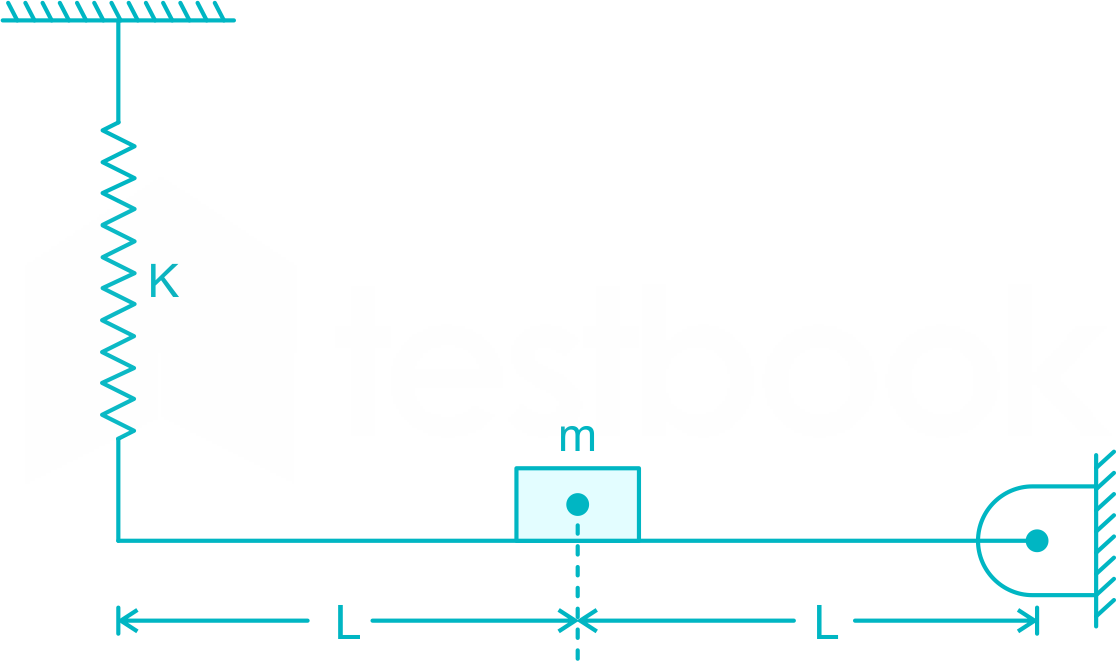
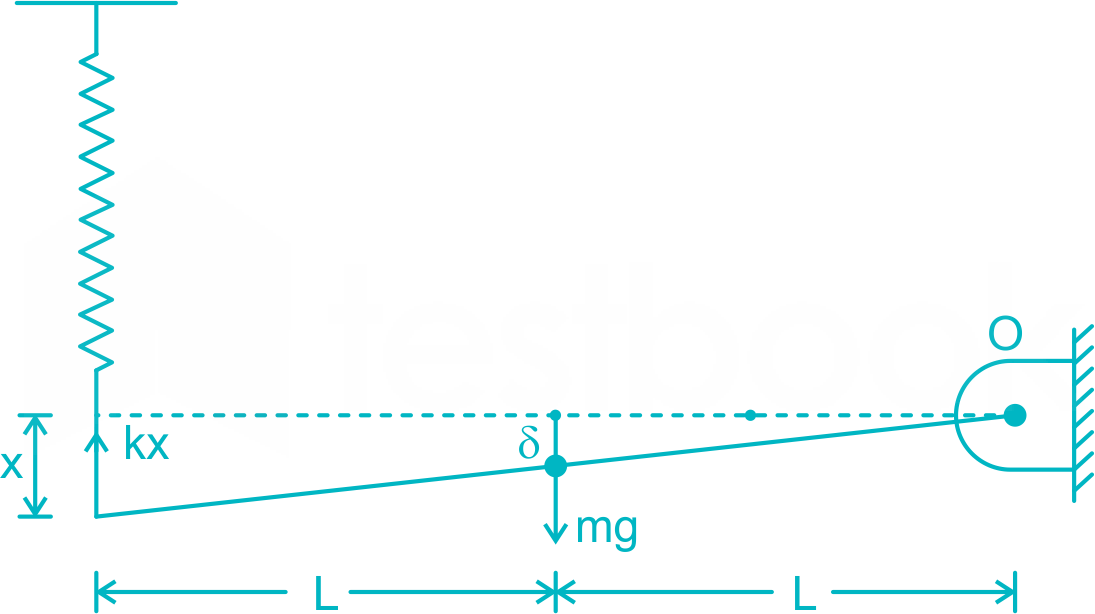
A concentrated mass m is attached at the centre of a rod of length 2L as shown in the figure. The rod is kept in a horizontal equilibrium position by a spring of stiffness k. For very small amplitude of vibration, neglecting the weights of the rod and spring, the undamped natural frequency of the system is:

  1. ((a))

    km\sqrt {\frac{k}{m}}

  2. ((b))

    2km\sqrt {\frac{{2k}}{m}}

  3. ((c))

    k2m\sqrt {\frac{k}{{2m}}}

  4. ((d))

    4km\sqrt {\frac{{4k}}{m}}

Show Answer
Answer: ((d))

4km\sqrt {\frac{{4k}}{m}}

Explanation:

Displacing the rod by a small distance x.

Taking moment about '0'

Kx × 2L = mg × L

x=mg2kx = \frac{{mg}}{{2k}}

From similar triangle property

 x2L=δL\frac{x}{{2L}} = \frac{\delta }{L}

δ=x2=mg4k\delta = \frac{x}{2} = \frac{{mg}}{{4k}}

Using static deflection of the mass 'm'

ωn=gδ=4Km{\omega _n} = \sqrt {\frac{g}{\delta }} = \sqrt {\frac{{4K}}{m}}

55

The state of stress at a point under plane stress condition is

\({\sigma _{xx}} = 40MPa,{\sigma _{yy}} = 100MPa,;{\tau _{xy}} = 40MPa\)

The radius of the Mohr’s circle representing the given state of stress in MPa is

  1. ((a))

    40

  2. ((b))

    50

  3. ((c))

    60

  4. ((d))

    100

Show Answer
Answer: ((b))

50

Concept:

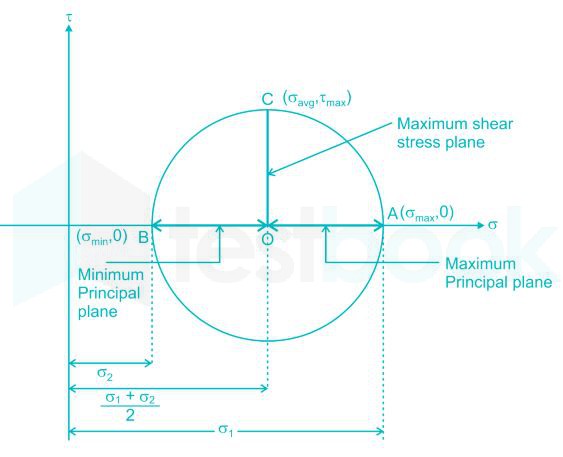
Maximum and minimum values of normal stresses occur on planes of zero shearing stress. The maximum and minimum normal stresses are called the principal stresses, and the planes on which they act are called the principal plane.

σmax,;min=σxx;+;σyy2±(σxx;;σyy2)2+;τxy2{\sigma _{max,;min}} = \frac{{{\sigma _{xx}};+;{\sigma _{yy}}}}{2} \pm \sqrt {{{\left( {\frac{{{\sigma _{xx}};-;{\sigma _{yy}}}}{2}} \right)}^2} +;\tau _{xy}^2}

But the maximum shear stress planes may or may not contain normal stresses as the case may be.

τmax=σmax;;σmin2=(σxx;;σyy2)2+;τxy2{\tau _{max}} = \frac{{{\sigma _{max}};-;{\sigma _{min}}}}{2} = \sqrt {{{\left( {\frac{{{\sigma _{xx}};-;{\sigma _{yy}}}}{2}} \right)}^2} +;\tau _{xy}^2}

which is equal to the radius of the Mohr's Circle.

Calculation:

Given:

\({\sigma _{xx}} = 40MPa, {\sigma _{yy}} = 100MPa,{\tau _{xy}} = 40MPa\)

Radius of Mohr's circle:

 τmax=(σxxσyy2)2+τxy2\tau_{max}= \sqrt {{{\left({\frac{{{\sigma _{xx}} - {\sigma _{yy}}}}{2}} \right)}^2} + \tau _{xy}^2}

(40;;1002)2;+;40250;MPa\therefore\sqrt{\left ( \frac{40;-;100}{2} \right )^2;+;40^2}\Rightarrow50;MPa

56

The inverse Laplace transform of the function F(s)=1s(s+1)F\left( s \right) = \frac{1}{{s\left( {s + 1} \right)}} is given by

  1. ((a))

    f (t) = sin t

  2. ((b))

    f (t) = e-t sint

  3. ((c))

    f(t) = e-t

  4. ((d))

    f(t) = 1 - e-t

Show Answer
Answer: ((d))

f(t) = 1 - e-t

Concept:

If L-1{F(s)} = f(t)

then

L-1F(s – a) = eat.f(t) and L-1{F(s + a)} = e-at.f(t)

Calculation:

F(s)=1s(s+1)=As+B(s+1)F\left( s \right) = \frac{1}{{s\left( {s + 1} \right)}} = \frac{A}{s} + \frac{B}{{\left( {s + 1} \right)}}

1s(s+1)=A(s+1)+B(s)s(s+1)\frac{1}{{s\left( {s + 1} \right)}} = \frac{{A\left( {s + 1} \right) + B\left( s \right)}}{{s\left( {s + 1} \right)}}

A(s + 1) + B(s) = 1

Put s = 0, we get A = 1

Put s = -1, we get B = -1

F(s)=1s(s+1)=1s+1(s+1)F\left( s \right) = \frac{1}{{s\left( {s + 1} \right)}} = \frac{1}{s} + \frac{{ - 1}}{{\left( {s + 1} \right)}}

f(t) = L-1(s)

f(t)=L1(1s1s+1)f\left( t \right) = {L^{ - 1}}\left( {\frac{1}{s} - \frac{1}{{s + 1}}} \right)

f(t) = e0t – e-t    \(\left{\because {{L^{ - 1}}\left( {\frac{1}{s}} \right) = 1} \right}\)

f(t) = 1 – e-t

57

For the matrix \(A = \left[ {\begin{array}{*{20}{c}} 5&3\ 1&3 \end{array}} \right]\), ONE of the normalized eigen vectors is given as

  1. ((a))

    \(\left( {\begin{array}{*{20}{c}} {\frac{1}{2}}\ {\frac{{\sqrt 3 }}{2}} \end{array}} \right)\)

  2. ((b))

    \(\left( {\begin{array}{*{20}{c}} {\frac{1}{{\sqrt 2 }}}\ {\frac{{ - 1}}{{\sqrt 2 }}} \end{array}} \right)\)

  3. ((c))

    \(\left( {\begin{array}{*{20}{c}} {\frac{3}{{\sqrt {10} }}}\ {\frac{{ - 1}}{{\sqrt {10} }}} \end{array}} \right)\)

  4. ((d))

    \(\left( {\begin{array}{*{20}{c}} {\frac{1}{{\sqrt 5 }}}\ {\frac{2}{{\sqrt 5 }}} \end{array}} \right)\)

Show Answer
Answer: ((b))

\(\left( {\begin{array}{*{20}{c}} {\frac{1}{{\sqrt 2 }}}\ {\frac{{ - 1}}{{\sqrt 2 }}} \end{array}} \right)\)

Explanation:

Characteristic equation

\(\left| {A - λ I} \right| = 0 ⇒ \left| {\begin{array}{*{20}{c}} {5 - λ }&3\ 1&{3 - λ } \end{array}} \right| = 0 \)

⇒ (5 - λ)(3 - λ) - 3 = 0;

⇒ λ2 – 8λ + 15 – 3 = 0 ⇒ λ2 – 8λ + 12 = 0

⇒ λ = 2, λ = 6

Eigenvector for λ = 2,

(A – 2I) × X = 0

At, λ = 2

\(\left( {\begin{array}{{20}{c}} 3&3\ 1&1 \end{array}} \right)\left( {\begin{array}{{20}{c}} {{x_1}}\ {{x_2}} \end{array}} \right) = \left( {\begin{array}{*{20}{c}} 0\ 0 \end{array}} \right);\)

⇒ 3x1 + 3x2 = 0;

⇒ x1 = - x2;

The eigenvector will be \(\left[ {\begin{array}{*{20}{c}} {1}\ {-1}\end{array}} \right]\)

Hence the required vector is \(\left[ {\begin{array}{*{20}{c}} {\frac {1}{\sqrt {2}}}\ {- \frac {1}{\sqrt {2}}}\end{array}} \right]\)

Alternate solution:

Eigen vector should satisfy Ax = λx, where λ is eigen value

Taking x = \(\left[ {\begin{array}{*{20}{c}} {\frac{1}{2}}\ {\frac{{\sqrt 3 }}{2}} \end{array}} \right]\) (option 1)

Ax = \(\left[ {\begin{array}{{20}{c}} 5&3\ 1&3 \end{array}} \right]\left[ {\begin{array}{{20}{c}} {\frac{1}{2}}\ {\frac{{\sqrt 3 }}{2}} \end{array}} \right] = \left[ {\begin{array}{*{20}{c}} {\frac{{5 + 3\sqrt 3 }}{2}}\ {\frac{{1 + \sqrt 3 }}{2}} \end{array}} \right]\)≠ λx

∴ Option 1 is not correct.

Taking x = \(\left[ {\begin{array}{*{20}{c}} {\frac{1}{{\sqrt 2 }}}\ {\frac{{ - 1}}{{\sqrt 2 }}} \end{array}} \right]\)(option 2)

Ax = \(\left[ {\begin{array}{{20}{c}} {\frac{{5 - 3}}{{\sqrt 2 }}}\ {\frac{{1 - 3}}{{\sqrt 2 }};} \end{array}} \right] = \left[ {\begin{array}{{20}{c}} {\frac{2}{{\sqrt 2 }}}\ {\frac{{ - 2}}{{\sqrt 2 }}} \end{array}} \right] = 2\left[ {\begin{array}{*{20}{c}} {\frac{1}{{\sqrt 2 }}}\ {\frac{{ - 1}}{{\sqrt 2 }}} \end{array}} \right]\)= λx

∴ Option 2 is correct.

(No need to check other options)

Two steel truss members AC and BC, each having cross sectional area of 100 mm2, are subjected to a horizontal force F as shown in the figure. All the joints are hinged.

58

The maximum force F in kN that can be applied at C such that the axial stress in any of the truss members DOES NOT exceed 100 MPa is 

  1. ((a))

    8.17

  2. ((b))

    11.15

  3. ((c))

    14.14

  4. ((d))

    22.30

Show Answer
Answer: ((b))

11.15

Given:

Area = 100 mm2 = 100 × 10-6 m2

T1sin120=T2sin135=Fsin105\frac{{{T_1}}}{{\sin 120^\circ }} = \frac{{{T_2}}}{{\sin 135^\circ }} = \frac{F}{{\sin 105^\circ }}

T1sin120=Fsin105\frac{{{T_1}}}{{\sin 120^\circ }} = \frac{F}{{\sin 105^\circ }}

T1 = 0.8965F

;T2sin135=Fsin105;\frac{{{T_2}}}{{\sin 135^\circ }} = \frac{F}{{\sin 105^\circ }}

T2 = 0.732F

Maximum force is,

Fmax = Max(T1,T2) =  T1 = 0.8965F

Maximum;stress=Fmaxarea=0.8965F100×106=0.8965F100;MPaMaximum;stress = \frac{{{F_{max}}}}{{area}} = \frac{{0.8965F}}{{100 \times {{10}^{ - 6}}}} = \frac{{0.8965F}}{{100}};MPa

Now,

Maximum stress ≤ 100 MPa

0.8965F100MPa100 MPa\frac{{0.8965F}}{{100}} MPa \le 100~ MPa

F100×1000.8965;F \le \frac{{100 \times 100}}{{0.8965}};

F ≤ 11.154 kN

59

If F = 1 kN , the magnitude of the vertical reaction force developed at the point B in kN is

  1. ((a))

    0.63

  2. ((b))

    0.32

  3. ((c))

    1.26

  4. ((d))

    1.46

Show Answer
Answer: ((a))

0.63

Given:

F = 1 kN

Using Lame’s theorem

T1sin120=T2sin135=Fsin105\frac{{{T_1}}}{{\sin 120^\circ }} = \frac{{{T_2}}}{{\sin 135^\circ }} = \frac{F}{{\sin 105^\circ }}

 Taking, T1sin120=Fsin105Taking,~\frac{{{T_1}}}{{\sin 120^\circ }} = \frac{F}{{\sin 105^\circ }}

T1 = 0.8965F = 0.8965 × 1 = 0.8965 kN

Taking,;T2sin135=Fsin105Taking,;\frac{{{T_2}}}{{\sin 135^\circ }} = \frac{F}{{\sin 105^\circ }}

T2 = 0.732F = 0.732 × 1 = 0.732 kN

The vertical reaction at B (R­B)

RB = T2cos 30° = 0.732 × 0.866 = 0.633 kN

A refrigerator operates between 120 kPa and 800 kPa in an ideal vapour compression cycle with R-134a as the refrigerant. The refrigerant enters the compressor as saturated vapour and leaves the condenser as saturated liquid The mass flow rate of the refrigerant is 0.2 kg/s. Properties for R – 134a are as follows

Saturated R – 134a
P(kPa)T°Chf (kJ/kg)hg (kJ/ kg)Sf (kJ / kg.k)Sg(kJ /kg.k)
120-22.3222.52370.0930.95
80031.3195.5267.30.3540.918


Superheated R – 134a
P(kPa)T°Ch (kJ/ kg)S (kJ / kg.k)
80040276.450.95
60

The power required for the compressor in kW is

  1. ((a))

    5.94

  2. ((b))

    1.83

  3. ((c))

    7.9

  4. ((d))

    39.5

Show Answer
Answer: ((c))

7.9

Concept:

Power required for the compressor (P) is given by:

P = ṁ(h2 – h1)

Calculation:

Given:

ṁ = 2 kg/s

Condition 1 is saturated vapour at 120 kPa. So, h1 = 237 kJ/kg

Condition 2 is superheated vapour at 800 kPa and S1 = S2 = 0.95 kJ/kg.K

h2 = 276.45 kJ/kg

Power required for the compressor (P) is:

P = ṁ(h**2 – h1)**

P = 0.2 × (276.45 – 237) = 7.89 kJ/s ≃ 7.9 kJ/s = 7.9 kW

61

The rate at which heat is extracted in kJ/s from the refrigerated space is

  1. ((a))

    28.3

  2. ((b))

    42.9

  3. ((c))

    34.4

  4. ((d))

    14.6

Show Answer
Answer: ((a))

28.3

Concept:

Heat is being extracted from the refrigerated space in process 4 - 1

Rate of heat extracted (Q̇)

Q̇ = ṁ(h1 – h4)

Calculation:

Given:

ṁ = 0.2 kg/s

Condition 1 is saturated vapour at 120 kPa. So, h1 = 237 kJ/kg

As h3 = h4 and h3 = hf at 800 kPa

h4 = 95.5 kJ/kg

Rate of heat extracted (Q̇)

Q̇ = ṁ(h1 – h4)

Q̇ = 0.2 × (237 – 95.5) = 28.3 kJ/s = 28.3 kW

For a particular project, eight activities are to be carried out. Their relationships with other activities and expected durations are mentioned in the table below.

Activity Predecessors Duration (days)

ActivityPredecessorsDuration(days)
A-3
BA4
CA5
DA4
EB2
FD9
GC, E6
HF, G2
62

The critical path for the project is

  1. ((a))

    A-B-E-G-H

  2. ((b))

    A-C-G-H

  3. ((c))

    A-D-F-H 

  4. ((d))

    A-B-C-F-H

Show Answer
Answer: ((c))

A-D-F-H 

Concept:

Critical path: It is the path in the project which determines the shortest time to complete the project.

In any network, the path which takes maximum time is a critical path.

Various paths in the network are:

A-D-F-H = 18 days

A-B-E-G-H = 17 days

A-C-G-H = 16 days

As path A-D-F-H takes maximum time i.e. 18 days.

A-D-F-H is the critical path.

63

If the duration of activity f alone is changed from 9 to 10 days, then the

  1. ((a))

    Critical path remains the same and the total duration to complete the project

    Changes to 19 days.

  2. ((b))

    Critical path and the total duration to complete the project remain the same.

  3. ((c))

    Critical path changes but the total duration to complete the project remains the same.

  4. ((d))

    Critical path changes and the total duration to complete the project changes to 17 days.

Show Answer
Answer: ((a))

Critical path remains the same and the total duration to complete the project

Changes to 19 days.

As activity F is only in the critical path.

Critical path will remain same i.e. A-D-F-H

Project duration changes to 19 days.

Air enters an adiabatic nozzle at 300 kPa, 500 K with a velocity of 10 m/s. It leaves the nozzle at 100 kPa with a velocity of 180 m/s. The inlet area is 80 cm2. The specific heat of air CP, is 1008 J/kg.K.

64

The exit temperature of the air is

  1. ((a))

    516 K

  2. ((b))

    532 K

  3. ((c))

    484 K

  4. ((d))

    468 K

Show Answer
Answer: ((c))

484 K

Concept:

The steady flow energy equation betweeen two points is given by:

h1+V122+Q=h2+V222+W{h_1} + \frac{{V_1^2}}{2} + Q = {h_2} + \frac{{V_2^2}}{2} + W

Calculation:

Given:

P1 = 300 kPa, T1 = 500 K, V1 = 10 m/s, A1 = 80 cm2 = 80 × 10-4 m2

P2 = 100 kPa, V2 = 180 m/s, Cp = 1008 J/kg.K

Using the steady flow energy equation

h1+V122+Q=h2+V222+W{h_1} + \frac{{V_1^2}}{2} + Q = {h_2} + \frac{{V_2^2}}{2} + W

Here

Q = 0 {∵ adiabatic flow}

W = 0

h1h2=V22V122{h_1} - {h_2} = \frac{{V_2^2 - V_1^2}}{2}

Cp(T1T2)=V22V122{C_p}\left( {{T_1} - {T_2}} \right) = \frac{{V_2^2 - V_1^2}}{2}

1008(500T2)=180210221008\left( {500 - {T_2}} \right) = \frac{{{{180}^2} - {{10}^2}}}{2}

500 – T2 = 16.02

T2 = 483.97 K ≃ 484 K

65

The exit area of the nozzle in cm2 is

  1. ((a))

    90.1

  2. ((b))

    56.3

  3. ((c))

    4.4

  4. ((d))

    12.9

Show Answer
Answer: ((d))

12.9

Concept:

Using continuity equation

ρ1A1V1 = ρ2A2V2

P1RT1×A1V1=P2RT2×A2V2\frac{{{P_1}}}{{{RT_1}}} \times {A_1}{V_1} = \frac{{{P_2}}}{{{RT_2}}} \times {A_2}{V_2}{∵ P = ρRT}

P1T1×A1V1=P2T2×A2V2\frac{{{P_1}}}{{{T_1}}} \times {A_1}{V_1} = \frac{{{P_2}}}{{{T_2}}} \times {A_2}{V_2}

Calculation:

Given:

P1 = 300 kPa, T1 = 500 K, V1 = 10 m/s, A1 = 80 cm2 = 80 × 10-4 m2

P2 = 100 kPa, V2 = 180 m/s, C= 1008 J/kg.K

Using, P1T1×A1V1=P2T2×A2V2\frac{{{P_1}}}{{{T_1}}} \times {A_1}{V_1} = \frac{{{P_2}}}{{{T_2}}} \times {A_2}{V_2}

300×103500×80×104×10=100×103500×A2×180\frac{{300 \times {{10}^3}}}{{500}} \times 80 \times {10^{ - 4}} \times 10 = \frac{{100 \times {{10}^3}}}{{500}} \times {A_2} \times 180

On solving we get,

A2 = 13.33 × 10⁻⁴ m2 = 13.33 cm2 

Option 4 is best suited.

Attempt this paper under real exam conditions

Timed interface, section switching, instant scoring, and question-by-question analytics — free.

Start Timed Attempt