Official Paper

GATE ME 2011 Official Paper (Previous Year Paper)

65 questions · 180 minutes · with answers · free

General Aptitude (10 questions)

1

Choose the word from the options given below that is most nearly opposite in meaning to the given word: Amalgamate

  1. ((a))

    Merge

  2. ((b))

    Split

  3. ((c))

    Collect

  4. ((d))

    Separate

Show Answer
Answer: ((b))

Split

The correct answer is option 2 i.e. Split.

Explanation-

Amalgamate means to unite in or as if in an amalgam, let's have a look at all the given options. 

  • Merge: to cause to combine, unite, or coalesce.
  • Split: to divide lengthwise usually along a grain or seam or by layers
  • Collect: to bring together into one body or place
  • Separate:  to set or keep apart: DISCONNECT, SEVER

Amalgamate means to combine or unite to form one organization or structure. So the best option here is split. Separate on the other hand, although a close synonym, it is too general to be the best antonym in the given question while Merge is the synonym; Collect is not related.

2

Which of the following options is the closest in the meaning to the word below:

Inexplicable

  1. ((a))

    Incomprehensible

  2. ((b))

    Indelible

  3. ((c))

    Inextricable

  4. ((d))

    Infallible

Show Answer
Answer: ((a))

Incomprehensible

The correct answer is option 1 i.e. Incomprehensible.

Explanation-

Inexplicable means incapable of being explained, interpreted or accounted for. 

  • Incomprehensible: impossible to comprehend: UNINTELLIGIBLE.
  • Indelible: that cannot be removed, washed away, or erased.
  • Inextricable: forming a maze or tangle from which it is impossible to get free
  • Infallible: incapable of error: UNERRING

Inexplicable means not explicable; that cannot be explained, understood, or accounted for. So the best synonym here is incomprehensible.

3

If Log (P) = (1/2) Log (Q) = (1/3) Log (R), then which of the following options is TRUE?

  1. ((a))

    P= Q3R2

  2. ((b))

    Q= PR

  3. ((c))

    Q= R3P

  4. ((d))

    R = P2Q2

Show Answer
Answer: ((b))

Q= PR

Explanation:

Let Log (P) = (1/2) Log (Q) = (1/3) Log (R) = l

∴ P = 10k, Q = 102k, R = 103k

Now,

Option 1:

P2=Q3R2

(10k)2 = (102k)3 (103k)2 

102k ≠ 1012k

Option 2:

Q2 = PR

104k = (103k)(10k)

104k = 104k

∴Q2 = PR follows the given relation.

Option 3:

Q2 = R3P ⇒ 102k ≠ 107k

Option 4:

R=P2Q2 ⇒ 103k ≠ 106k

∴ Only option(2) is correct.

4

Choose the most appropriate word (s) from the options given below to complete the following sentence.

I contemplated________Singapore for my vacation but decided against it.

  1. ((a))

    to visit

  2. ((b))

    having to visit

  3. ((c))

    visiting

  4. ((d))

    for a visit

Show Answer
Answer: ((c))

visiting

The correct answer is Option 3 i.e visiting 

Explanation:

Reading the given sentence we find that.

  • The word contemplated is a transitive verb.
  • A transitive verb always needs to transfer it's action on to something which is an object.
  • Hence, here after the transitive verb contemplated we need a noun that will be the object.
  • Out of the given options visiting is a gerund. And therefore it grammatically follows the verb contemplated.

Hence the correct answer is Option 3 i.e visiting.

Important Points

  • gerund is an -ing form of verb which acts as a noun.
  • In the above case, we need a noun after the verb contemplated.
  • And the gerund visiting is the appropriate option as it is a verb acting as a noun.
  • Therefore the action of the verb contemplated is transferred to the gerund visiting.

Thus the correct sentence will be: "I contemplated visiting Singapore for my vacation bu decided against it."

5

Choose the most appropriate word from the options given below to complete the following sentence.

If you are trying to make a strong impression on your audience, you cannot do so by being understated, tentative or_____________.

  1. ((a))

    Hyperbolic

  2. ((b))

    Restrained

  3. ((c))

    Argumentative

  4. ((d))

    Indifferent

Show Answer
Answer: ((b))

Restrained

The correct answer is Option 2 i.e Restrained

Explanation:

Reading the above statement we find that:

  • The tone of the sentence clearly indicates a word similar to understated and tentative.
  • The word should also be an antonym of strong.

Let's look at the meaning of the marked option:

  • Restrained: Not excessively showy or ornate; understated and timid.

Hence from the above meaning, we find that restrained is similar in meaning to understated and tentative, and fits perfectly in the give sentence.

Thus, the correct answer is option 2 Restrained.

Additional Information 

Let's look at the meaning of the other given options. 

  • Hyperbolic: Delibrately; or exaggerated.
  • Argumentative: Given to arguing.
  • Indifferent: Having no particular interest; unconcerned.
6

A container originally contains 10 litres of pure spirit. From this container 1 litre of spirit is replaced with 1 litre of water. Subsequently, 1 litre of the mixture is again replaced with 1 litre of water and this process is repeated one more time. How much spirit is now left in the container?

  1. ((a))

    7.58 litres

  2. ((b))

    7.84 litres

  3. ((c))

    7 litres

  4. ((d))

    7.29 litres

Show Answer
Answer: ((d))

7.29 litres

Concept:

Volume;of;liquid;left=x(x1x)n{\bf{Volume}};{\bf{of}};{\bf{liquid}};{\bf{left}} = {\bf{x}}{\left( {\frac{{{\bf{x}} - 1}}{{\bf{x}}}} \right)^{\bf{n}}}

where x = Original amount of liquid, n = Number of times replaced.

Calculation:

Given:

x = 10 litre, n = 3

Now, we know that

Volume;of;spirit;left=x(x1x)n{\bf{Volume}};{\bf{of}};{\bf{spirit}};{\bf{left}} = {\bf{x}}{\left( {\frac{{{\bf{x}} - 1}}{{\bf{x}}}} \right)^{\bf{n}}}

∴  Volume of spirit left = 10(10110)3=729100=7.2910{\left( {\frac{{10 - 1}}{{10}}} \right)^3} = \frac{{729}}{{100}} = 7.29  litres

7

Based on the given passage which topic would not be included in a unit on bereavement?

Few school curricula include a unit on how to deal with bereavement and grief, and yet all students at some point in their lives suffer from losses through death and parting.

  1. ((a))

    how to write a letter of condolence

  2. ((b))

    what emotional stages are passed through in the healing process

  3. ((c))

    what the leading causes of death are

  4. ((d))

    how to give support to a grieving friend

Show Answer
Answer: ((c))

what the leading causes of death are

The correct answer is Option 3 i.e what the leading causes of death are

Explanation:

Reading the above statement we find that.

  • The given sentence starts by stating how to deal with bereavement and grief after a tragedy occurs and not about precautions.
  • Therefore, irrespective of the causes of death, a school student rarely gets into details of causes
  • Hence it is very clear that the leading causes of death are not included in a unit on bereavement.

Hence, the correct answer is option 3 i.e what the leading causes of death are.

8

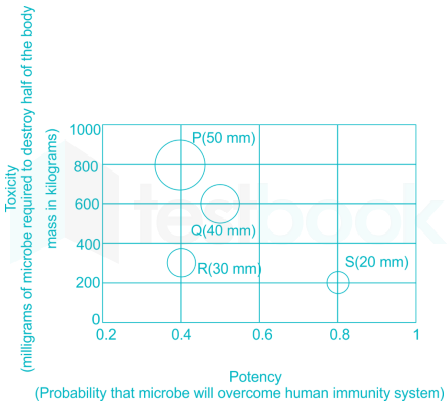
P, Q, R, and S are four types of dangerous microbes recently found in a human habitat. The area of each circle with its diameter printed in brackets represents the growth of a single microbe surviving human immunity system within 24 hours of entering the body. The danger to human beings varies proportionately with the toxicity, potency, and growth attributed to a microbe shown in the figure below.


A pharmaceutical company is contemplating the development of a vaccine against the most dangerous microbe. Which microbe should the company target in its first attempt?

  1. ((a))

    P

  2. ((b))

    Q

  3. ((c))

    R

  4. ((d))

    S

Show Answer
Answer: ((d))

S

Concept:

According to the given information:

Most dangerous microbe ∝ probability that microbe will overcome human immune system.

Most dangerous microbe ∝ area (growth of microbe)

Most dangerous microbe ∝ (quantity required)-1

So,the;most;dangerous;microbe;;Probability;×;AreaQuantity;requiredSo, the;most;dangerous;microbe;\propto;\frac{Probability;\times;Area}{Quantity;required}

So,the;most;dangerous;microbe;=;K;×;Probability;×;AreaQuantity;requiredSo, the;most;dangerous;microbe;=;\frac{K;\times;Probability;\times;Area}{Quantity;required}

So,the;most;dangerous;microbe;=;K;×;Probability;×;πd24;×;Quantity;requiredSo, the;most;dangerous;microbe;=;\frac{K;\times;Probability;\times;\pi{d^2}}{4;\times;Quantity;required}

Calculation:

Given:

For microbe P:

Probability (P) = 0.4, Diameter = 50 mm and Quantity required = 800 milligram of microbe/mass of body in kg.

The;most;dangerous;microbe;=πK4×0.4×502800πK4×54=1.25πK4The;most;dangerous;microbe;=\frac{\pi{K}}{4}\times\frac{0.4\times50^2}{800}\Rightarrow\frac{\pi{K}}{4}\times\frac{5}{4}=1.25\frac{\pi{K}}{4}

For microbe Q:

Probability (Q) = 0.5, Diameter = 40 mm and Quantity required = 600 milligram of microbe/mass of body in kg.

The;most;dangerous;microbe;=πK4×0.5×402600πK4×43=1.33πK4The;most;dangerous;microbe;=\frac{\pi{K}}{4}\times\frac{0.5\times40^2}{600}\Rightarrow\frac{\pi{K}}{4}\times\frac{4}{3}=1.33\frac{\pi{K}}{4}

For microbe R:

Probability (R) = 0.4, Diameter = 30 mm and Quantity required = 300 milligram of microbe/mass of body in kg.

The;most;dangerous;microbe;=πK4×0.4×302300πK4×65=1.2πK4The;most;dangerous;microbe;=\frac{\pi{K}}{4}\times\frac{0.4\times30^2}{300}\Rightarrow\frac{\pi{K}}{4}\times\frac{6}{5}=1.2\frac{\pi{K}}{4}

For microbe S:

Probability (S) = 0.8, Diameter = 20 mm and Quantity required = 200 milligram of microbe/mass of body in kg.

The;most;dangerous;microbe;=πK4×0.8×202200πK4×85=1.6πK4The;most;dangerous;microbe;=\frac{\pi{K}}{4}\times\frac{0.8\times20^2}{200}\Rightarrow\frac{\pi{K}}{4}\times\frac{8}{5}=1.6\frac{\pi{K}}{4}

Microbe S > Microbe Q > Microbe P > Microbe R.

∴ toxicity is more for microbe S and the company should target it in its first attempt.

9

The variable cost (V) of manufacturing a product varies according to the equation V= 4q, where q is the quantity produced. The fixed cost (F) of production of same product reduces with q according to the equation F = 100/q. How many units should be produced to minimize the total cost (V+F)?

  1. ((a))

    5

  2. ((b))

    4

  3. ((c))

    7

  4. ((d))

    6

Show Answer
Answer: ((a))

5

Concept:

Total cost = Fixed cost + Variable cost

To find maxima and minima of a function y = f(x), follow these steps.

Step 1

Find;dydx,;and;putdydx=0.Find;\frac{{dy}}{{dx}},;and;put\frac{{dy}}{{dx}} = 0.

Find the value of x and this value is said to be the stationary point, this is a necessary condition to find the extremum value of a function.

Step 2

Find;d2ydx2;Find;\frac{{{d^2}y}}{{d{x^2}}};

Check the value at the stationary point obtained in Step 1.

A function f(x) has a maxima at x = a if f’(a) = 0 and f”(a) < 0

A function f(x) has a minima at x = a if f’(a) = 0 and f”(a) > 0

A function f(x) has no maxima and minima at x = a if f’(a) = 0 and f”(a) = 0.

Calculation:

Given:

F = 100/q, V = 4q

Total cost (TC) = Fixed cost + Variable cost

;TC=4q;+;100q∴;TC=4q;+;\frac{100}{q}

Step 1:

d(TC)dq=0\frac{{d(TC)}}{{dq}} = 0

d(TC)dq=4;;100q2\frac{d(TC)}{dq}=4;-;\frac{100}{q^2}

∴ q = ± 5

d2(TC)dq2=+ve;for;minima\frac{{d^2(TC)}}{{dq^2}} =+ve;for;minima

d2(TC)dq2=ve;for;maxima\frac{{d^2(TC)}}{{dq^2}} =-ve;for;maxima

d2(TC)dq2=200q3\frac{d^2(TC)}{dq^2}=\frac{200}{q^3}

At q = 5

d2(TC)dq2=200531.6;;(+ve;,;;minima)\frac{d^2(TC)}{dq^2}=\frac{200}{5^3}\Rightarrow1.6;;(+ve;,;∴;minima)

At q = -5

d2(TC)dq2=200531.6;;(ve;,;;maxima)\frac{d^2(TC)}{dq^2}=\frac{200}{5^3}\Rightarrow-1.6;;(-ve;,;∴;maxima)

∴ at q = 5, Total cost (TC) will be minimum.

10

A transporter receives the same number of orders each day. Currently, he has some pending orders (backlog) to be shipped. If he uses 7 trucks, then at the end of the 4th day he can clear all the orders. Alternatively, if he uses only 3 trucks, then all the orders are cleared at the end of the 10th day. What is the minimum number of trucks required so that there will be no pending order at the end of the 5th day?

  1. ((a))

    4

  2. ((b))

    5

  3. ((c))

    6

  4. ((d))

    7

Show Answer
Answer: ((c))

6

Concept:

The transporter receives the same number of order each day and he currently has pending orders.

Let 'x' be the number of daily orders and 'y' be the number of pending orders.

Calculation:

Given:

Condition I:

Use of 7 trucks each day finishes all orders in 4 days.

∴ total numbers of trucks used = 7 + 7 + 7 + 7 ⇒ 28.

Total orders received in 4 days = 4x.

Pending orders = y.

∴ 4x + y = 28      eq(1).

Condition II:

Use of 3 trucks each day finishes all orders in 10 days.

∴ total numbers of trucks used = 3 × 10 ⇒ 30.

Total orders received in 10 days = 10x.

Pending orders = y.

∴ 10x + y = 30      eq(2).

Solving eq (1) and eq (2).

x = 0.33 ⇒ Daily orders

y = 26.66 ⇒ Pending orders.

Condition III:

Use of 'n' trucks each day finishes all orders in 5 days.

∴ total numbers of trucks used = 5 × n ⇒ 5n.

Total orders received in 5 days = 5x.

Pending orders = y.

∴ 5x + y = 5n   

∴ (5 × 0.33)  + (26.66) = 5n

∴ n = 5.66 ≈ 6

∴ minimum 6 number of trucks required so that there will be no pending order at the end of the 5th day.

Mechanical Engineering (55 questions)

11

A streamline and an equipotential line in a flow field

  1. ((a))

    Are parallel to each other

  2. ((b))

    Are perpendicular to each other

  3. ((c))

    Intersect at an acute angle

  4. ((d))

    Are identical

Show Answer
Answer: ((b))

Are perpendicular to each other

Concept:

Streamline: It is an imaginary curve drawn in space such that tangent drawn to it at any point will give the velocity of that fluid particle at a given instant of time. A line along which stream function (ψ) is constant is known as streamline.

Equipotential line: A line along which velocity potential function (ϕ) is constant is known as the equipotential line.

(dydx)ϕ×(dydx)ψ=1{\left( {\frac{{dy}}{{dx}}} \right)_ϕ } \times {\left( {\frac{{dy}}{{dx}}} \right)_ψ } = - 1

Slope of equipotential Line × Slope of stream function = -1

They are orthogonal to each line other.


For a streamline, ψ(x,y)=constantψ(x,y)=constant and the differential of ψ  is zero.

dψ=ψxdx+ψydydψ=\frac{\partialψ}{\partial x}dx+\frac{\partialψ}{\partial y}dy

dψ=vdx+udydψ=-vdx+udy

(yx)ψ=const=vu(\frac{{\partial y}}{{\partial x}} )_{ψ=const}= \frac{v}{u}

For an equipotential line, ϕ(x,y)=constantϕ(x,y)=constant and the differential of ϕ is zero.

dϕ=ϕxdx+ϕydydϕ=\frac{\partialϕ}{\partial x}dx+\frac{\partialϕ}{\partial y}dy

dϕ=udx+vdydϕ=udx+vdy

(yx)ϕ=const=uv(\frac{{\partial y}}{{\partial x}} )_{ϕ=const}= -\frac{u}{v}

\((\frac{{\partial y}}{{\partial x}} ){ψ=const}=- \frac{1}{(\frac{{\partial y}}{{\partial x}} ){ϕ=const}}\)

12

If a mass of moist air in an airtight vessel heated to a higher temperature, then

  1. ((a))

    Specific humidity of the air increases

  2. ((b))

    Specific humidity of the air decreases

  3. ((c))

    Relative humidity of the air increases

  4. ((d))

    Relative humidity of the air decreases

Show Answer
Answer: ((d))

Relative humidity of the air decreases

Concept:

Relative humidity:

  • It is defined as the ratio of the mass of water vapour (mv) in a certain volume of moist air to the mass of water vapour (mvs) in the same volume of saturated air (air having the maximum amount of water vapour without condensing) at the same temperature.
  • It is denoted by ϕ.

\({\rm{RH}}\left( \phi \right) = \frac{{{{\rm{m}}{\rm{v}}}}}{{{{\rm{m}}{{\rm{vs}}}}}}\)

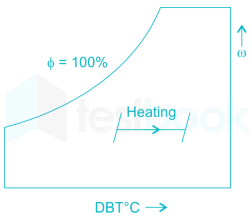
  • If a mass of moist air in an airtight vessel heated to a higher temperature, then the relative humidity of the air decreases.


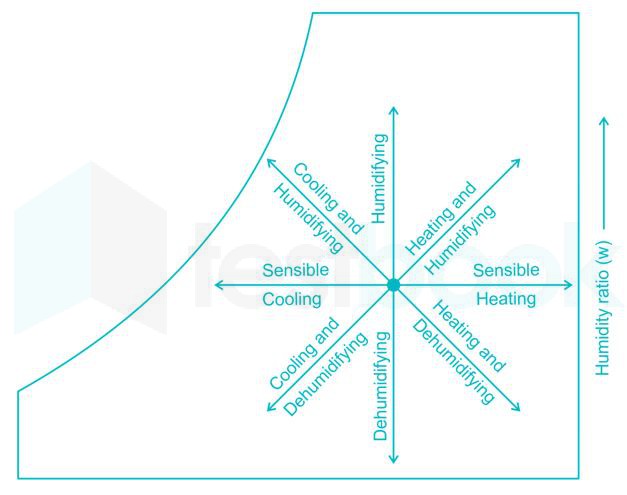
  • Heating and Humidifying: A Simultaneous increase in both the dry bulb temperature and humidity ratio of the air.
  • Cooling and Dehumidifying: It involves the removal of water from the air as the air temperature falls below the dewpoint temperature.
  • Sensible heating: During this process, the moisture content of air remains constant and its temperature increases as it flows over a heating coil.
  • Sensible cooling: During this process, the moisture content of air remains constant, but its temperature decreases as it flows over a cooling coil.
  • In sensible heating/cooling, specific humidity is constant while relative humidity varies. In heating/cooling with chemical humidification/ dehumidification, both specific humidity and relative humidity varies.
13

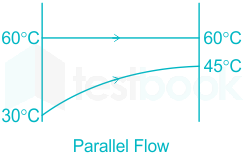
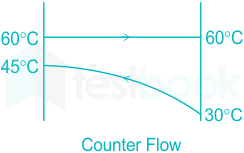
In a condenser of a power plant, the steam condenses at a temperature of 60o C. The cooling water enters at 30o C and leaves at 45o C. The logarithmic mean temperature difference (LMTD) of the condenser is

  1. ((a))

    16.2°C

  2. ((b))

    21.6°C

  3. ((c))

    30°C

  4. ((d))

    37.5°C

Show Answer
Answer: ((b))

21.6°C

Concept:

Flow configuration in the condenser as shown below.

ΔT1 = Th,i - Tc,i,  ΔT2 = Th,o - Tc,o

LMTD=ΔT1  ΔT2lnΔT1ΔT2LMTD=\frac{{\Delta}T_1~-~{\Delta}T_2}{ln{\frac{\Delta{T_1}}{\Delta{T_2}}{}}}


Calculation:

Given:

Th,i = Th,o = 60oC, Tc,i = 30oC, Tc,o = 45oC

 Therefore, ΔT1=30C,ΔT2=15C,{\rm{Δ }}{T_1} = 30^\circ C,{\rm{Δ }}{T_2} = 15^\circ C,

Now, we know that LMTD=ΔT1ΔT2In(ΔT1ΔT2)=3015In(3015)=21.6CLMTD = \frac{{{\rm{Δ }}{T_1} - {\rm{Δ }}{T_2}}}{{In\left( {\frac{{{\rm{Δ }}{T_1}}}{{{\rm{Δ }}{T_2}}}} \right)}} = \frac{{30 - 15}}{{In\left( {\frac{{30}}{{15}}} \right)}} = 21.6^\circ C

14

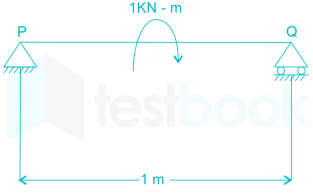
A simply supported beam PQ is loaded by a moment of 1 kN-m at the mid-span of the beam as shown in the figure. The reaction forces RP and RQ at supports P and Q respectively are

  1. ((a))

    1 kN downward, 1 kN upward

  2. ((b))

    0.5 kN upward, 0.5 kN downward

  3. ((c))

    0.5 kN downward, 0.5 kN upward

  4. ((d))

    1 kN upward, 1 kN upward

Show Answer
Answer: ((a))

1 kN downward, 1 kN upward

Concept:

Equilibrium Conditions:

\(\sum {{\rm{F}}{\rm{v}}} = 0{\rm{;and;}}\sum {{\rm{M}}{\rm{P}}} = 0\)

Calculation:

Given:

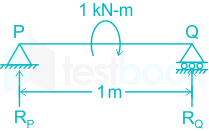
Now, we know that

Balancing vertical forces by 

Fv=0\sum {{\rm{F}}_{\rm{v}}} = 0

RP + RQ = 0       ............ (1)

Now,

Taking moment about point 'P'

MP=0\sum {{\rm{M}}_{\rm{P}}} = 0

1 = RQ × 1 ⇒ RQ = 1 kN (upward)

Then, from equation (1), we get

RP = 0 - 1 

∴ Rp = -1 kN = 1 kN (downward)

15

A double – parallelogram mechanism is shown in the figure. Note that PQ is a single link. The mobility of the mechanism is

  1. ((a))

    -1

  2. ((b))

    0

  3. ((c))

    1

  4. ((d))

    2

Show Answer
Answer: ((c))

1

Concept:

Mobility of the mechanism = Degree of Freedom = [3(l - 1) - 2j - h] - Fr

where, l = no. of links, j = no. of the binary joint, h = no. of higher pairs, Fr = redundant link

Here the middle link is acting as a dummy link.

Calculation:

Given:

l = 4, j = 4, h = 0, Fr = 0

DOF = [3(4 - 1) - 2 × 4 - 0] - 0 = 9 - 8 = 1

So degree of freedom of double – parallelogram mechanism is one.

16

The maximum possible draft in cold rolling of sheet increases with the

  1. ((a))

    Increase in coefficient of friction

  2. ((b))

    Decrease in coefficient of friction

  3. ((c))

    Decrease in roll radius

  4. ((d))

    Increase in roll velocity

Show Answer
Answer: ((a))

Increase in coefficient of friction

Concept:

Maximum possible draft is given by:

Δhmax = μ2R 

where μ = coefficient of friction and R = radius of roller.

The maximum possible draft can be increased by:

  • Increasing the coefficient of friction.
  • increasing the radius of roller.
17

The operation in which oil is permeated into the pores of a powder metallurgy product is known as

  1. ((a))

    Mixing

  2. ((b))

    Sintering

  3. ((c))

    Impregnation

  4. ((d))

    Infiltration

Show Answer
Answer: ((c))

Impregnation

Concept:

Powder Metallurgy (PM): 

  • It is the art and science of producing metal powders and making semifinished and finished objects from an individual, mixed, or alloyed powders with or without the addition of nonmetallic constituents.

Impregnation 

  • It is the secondary operation that is used to improve the self-lubricating capacity of the sintered part in powder metallurgy.
  • In this operation, the inherent pores of the powder metallurgy parts are impregnated with a fluid like oil or grease.
  • Such components have a continuous supply of lubricants by capillary action during their service life.

Infiltration,

  • The pores of the sintered part with some low melting point metal that results in an improvement in hardness and tensile strength.
  • In repressing, the pressure is applied to achieve parts with higher dimensional accuracy.
  • Coining is high pressure compacting operation that results in high strength and dimensional accuracy.
18

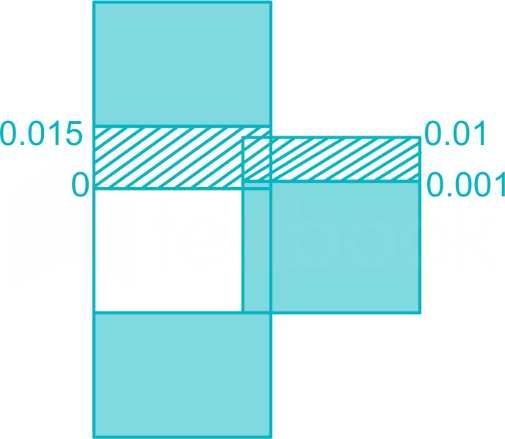
A hole is of dimension ϕ9+0+0.015 mm\phi 9_{ + 0}^{ + 0.015}~mm. The corresponding shaft is of dimension ϕ9+0.001+0.010 mm\phi 9_{ + 0.001}^{ + 0.010}~mm. The resulting assembly has

  1. ((a))

    Loose running fit

  2. ((b))

    Close running fit

  3. ((c))

    Transition fit

  4. ((d))

    Interference fit

Show Answer
Answer: ((c))

Transition fit

Concept:

Fit is a relationship that exists between two mating parts, a hole, and a shaft, with respect to their dimensional difference before assembly.

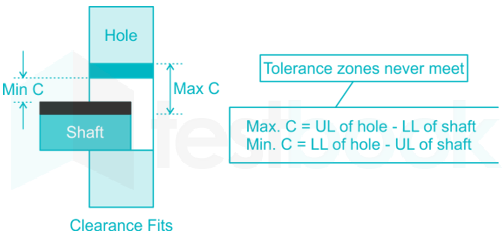
  • Clearance fit: Clearance is the difference between the size of the hole and the size of the shaft which is always positive. Here the tolerance zone of the hole will be above the tolerance zone of the shaft.

Examples: Slide fit, easy sliding fit, running fit, slack running fit, and loose running fit.

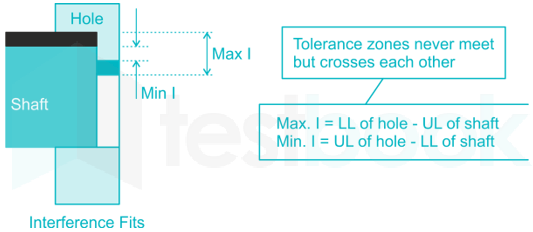
The above-given figure represents the clearance fit because the tolerance zone is not meeting.

  • Interference fit: Interference is the difference between the size of the hole and the size of the shaft which is always negative i.e. shaft is always larger than the hole size. Here the tolerance zone of the hole will be below the tolerance zone of the shaft.

Examples: Shrink fit, heavy drive fit, and light drive fit.

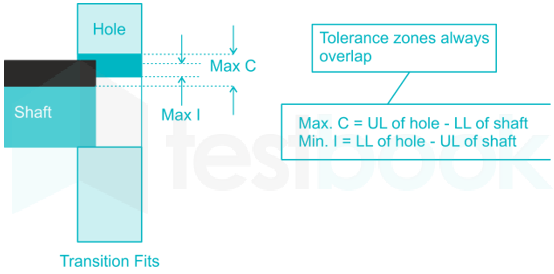
  • Transition fit: It may sometimes provide clearance and sometimes interference. Here the tolerance zones of the hole and shaft will overlap each other.

Examples: Tight fit and push-fit, wringing fit, press fit.

Calculation:

Given:

Hole dimension: \(\phi 9\begin{array}{*{20}{c}} { + 0.015}\ { + 0} \end{array}mm\)

Shaft dimension: \(\phi {9^{\begin{array}{*{20}{c}} { + 0.010}\ { + 0.001} \end{array}}}mm\)

The tolerance zone is overlapping, so it is a transition fit.

19

Heat and work are

  1. ((a))

    Intensive properties

  2. ((b))

    Extensive properties

  3. ((c))

    Point functions

  4. ((d))

    Path functions

Show Answer
Answer: ((d))

Path functions

Explanation:

Heat and work, both are path functions; Their magnitude depends on the path followed during a process as well as the end state.

  • Work and heat are modes of energy transfer.
  • Heat is energy transferred due to temperature differences only.
  • Work is the energy transfer associated with a force acting through a distance.

Relationship between heat and work:

  • Both are recognized at the boundaries of a system as they cross the boundaries; That is, both heat and work are boundary phenomena
  • Systems possess energy, but not heat or work
  • Both are associated with a process, not a state; Unlike properties, heat or work has no meaning at a state
PropertyWork & Heat
It is a state or point functionThey are path functions
They are independent of path historyThey are dependent on path history
They are exact differentialThey are inexact differential

Properties are classified into two types.

  • Intensive property: The properties of the system which are independent of the mass of a system are called Intensive property.
  • E.g. pressure, density, temperature, all specific properties, etc.
  • Extensive property: The properties of the system which are dependent on the mass of a system are called Extensive property.
  • E.g. energy, volume, entropy, etc.
20

A column has a rectangular cross –section of 10 x 20 mm and a length of 1 m. the slenderness ratio of the column is closed to

  1. ((a))

    200

  2. ((b))

    346

  3. ((c))

    477

  4. ((d))

    1000

Show Answer
Answer: ((b))

346

Concept:

Slenderness ratio (λ) is defined as:

λ=Lek\lambda = \frac{{{L_e}}}{{{k}}}

The radius of gyration (k) is given by:

k=IminA k = \sqrt {\frac{{{I_{min}}}}{A}}

where Le = Effective length of the column, k= radius of gyration, Imin = Least moment of Inertia, A = Area of the cross-section

Calculation:

Given:

b = 10 mm, d = 20 mm, L = 1 m = 1000 mm

The radius of gyration (k) is:

k=IminA=db312bd=b212=b12k = \sqrt {\frac{{{I_{min}}}}{A}}=\sqrt{\frac{\frac{db^3}{12}}{bd}}=\sqrt{\frac{b^2}{12}}=\frac{b}{\sqrt{12}}

Slenderness ratio (λ) is:

λ=Lek=12Leb=12×100010=346.41λ= \frac{L_e}{k}= \frac{{\sqrt {12} L_e}}{b} = \frac{{\sqrt {12} \times 1000}}{{10}} = 346.41

21

A series expansion for the function sin θ is

  1. ((a))

    1θ22!+θ44!1 - \frac{{{\theta ^2}}}{{2!}} + \frac{{{\theta^4}}}{{4!}} - \ldots

  2. ((b))

    θθ33!+θ55!\theta - \frac{{{\theta ^3}}}{{3!}} + \frac{{{\theta^5}}}{{5!}} - \ldots

  3. ((c))

    1+θ+θ22!+θ33!+1 + \theta + \frac{{{\theta ^2}}}{{2!}} + \frac{{{\theta^3}}}{{3!}} + \ldots

  4. ((d))

    θ+θ33!+θ55!+\theta + \frac{{{\theta ^3}}}{{3!}} + \frac{{{\theta^5}}}{{5!}} + \ldots

Show Answer
Answer: ((b))

θθ33!+θ55!\theta - \frac{{{\theta ^3}}}{{3!}} + \frac{{{\theta^5}}}{{5!}} - \ldots

Concept:

Taylor expansion series,

f(x)=f(a)+f(a).(xa)+f(a)2!(xa)2+f\left( x \right) = f\left( a \right) + f'\left( a \right).\left( {x - a} \right) + \frac{{f''\left( a \right)}}{{2!}}{\left( {x - a} \right)^2} + \ldots

At a = 0

f (x) = f(0) + x f'(0) + x2f"(0)2!\frac{f"(0)}{2!} + x3f(0)3!\frac{f'''(0)}{3!} + ......

Replace x by θ

f (θ) = f(0) + θ f'(0) + θ2f"(0)2!\frac{f"(0)}{2!} + θ3f(0)3!\frac{f'''(0)}{3!} + ......

f (θ) = sin θ

f(0) = 0, f'(0) = cos 0 = 1, f''(0) = - sin 0 = 0, f'''(0) = - cos 0 = -1

∴ sinθ=θ θ33!+θ55!....\sinθ = θ -~ \frac{{{θ ^3}}}{{3!}}+\frac{{{θ ^5}}}{{5!}} -....

Important Points

cosx=1x22!+x44!\cos x = 1 - \frac{{{x^2}}}{{2!}} + \frac{{{x^4}}}{{4!}} - \ldots

Application:

 sin(x3)=x3x93!+x155!\sin \left( {{x^3}} \right) = {x^3} - \frac{{{x^9}}}{{3!}} + \frac{{{x^{15}}}}{{5!}} - \ldots

 sin(x2)=x2x63!+x105!\sin \left( {{x^2}} \right) = {x^2} - \frac{{{x^6}}}{{3!}} + \frac{{{x^{10}}}}{{5!}} - \ldots

 cos(x3)=1x62!+x124!\cos \left( {{x^3}} \right) = 1 - \frac{{{x^6}}}{{2!}} + \frac{{{x^{12}}}}{{4!}} - \ldots

 cos(x2)=1x42!+x84!\cos \left( {{x^2}} \right) = 1 - \frac{{{x^4}}}{{2!}} + \frac{{{x^8}}}{{4!}} - \ldots

22

Green sand mould indicates that

  1. ((a))

    Polymeric mould has been cured

  2. ((b))

    Mould has been totally dried

  3. ((c))

    Mould is green in colour

  4. ((d))

    Mould contains moisture

Show Answer
Answer: ((d))

Mould contains moisture

Explanation:

Green sand mould indicates that mould contains moisture.

Sand mould

A mould is an assembly of two or more flasks (metallic) or bonded refractory particles with some cavitites.

Types of sand mould

According to the material used in their construction, the moulds are of following types:

Green sand moulds- A green sand mould is composed of a mixture of sand (silica sand, SiO2), clay (which acts as a binder), and water. - The word "green" is associated with condition of wetness or freshness and indicated that it contains moisture. - This type of mould is the cheapest and has the advantage that used sand is readily reclaimed. - As the mould is in the damp condition, is weak and cannot be stored for a longer period. - Hence, such moulds are used for small and medium-sized castings.
Dry sand moulds- Dry sand moulds are basically green sand mould with two essential differences: - The sand used for dry sand moulds contains 1 to 2% cereal flour and 1 to 2% pitch. - The prepared moulds are baked in an oven at 110 to 260°C for several hours. - The additives increase the hot strength due to the evaporation of water as well as by the oxidation and polymerization of the pitch. - Dry sand moulds can be used for large castings. - They give a better surface finish.
Loam sand moulds- Loam sand consists of fine sand plus finely ground refractories, clay graphite and fibrous reinforcements. - It differs from ordinary moulding sand in that the percentage of the clay in it is very high (50%). - This sand is used in pit moulding process for making moulds for very heavy and large parts.
23

What is limθ0sinθθ\mathop {\lim }\limits_{\theta \to 0} \frac{{\sin \theta }}{\theta } equal to?

  1. ((a))

    θ

  2. ((b))

    Sinθ

  3. ((c))

    0

  4. ((d))

    1

Show Answer
Answer: ((d))

1

Concept:

y=limθ0sinθθy=\mathop {\lim }\limits_{\theta \to 0} \frac{{\sin \theta }}{\theta }

It gives 00\frac{0}{0} form

Therefore, by applying L’ Hospital's rule....(differentiate both numerator and denominator)

We will get

y=limθ0cosθ1=cos 01=11=1y=\mathop {\lim }\limits_{\theta \to 0} \frac{{\cos \theta }}{1}=\frac{cos~0}{1}=\frac{1}{1}=1

24

Eigen values of a real symmetric matrix are always

  1. ((a))

    Positive

  2. ((b))

    Negative

  3. ((c))

    Real

  4. ((d))

    Complex

Show Answer
Answer: ((c))

Real

Explanation:

Eigen values of a real symmetric matrix are always real.

Eigen values and Eigen vector of a square matrix

"λ" is called eigen value and "x" is called eigen vector of a square matrix "A", if

Ax = λx

Important Points

Characteristics of eigen values:

  • Tr (A) = Summation of eigen values
  • |A| = Product of eigen values
  • If A = Upper triangular matrix or lower triangular matrix or diagonal matrix, then its eigen values will be diagonal elements.
  • Eigen values of the hermitian matrix and real symmetric matrix are always real.
  • Eigen values of skew symmetric and skew hermitian matrix are either zero or purely imaginary.
  • Eigen values of the orthogonal matrix and unitary matrix have unit modulus.
25

A pipe of 25 mm outer diameter carries steam. The heat transfer coefficient between the cylinder and surroundings is 5 W/m2K . It is proposed to reduce the heat loss from the pipe by adding insulation having a thermal conductivity of 0.05 W/mK. Which one of the following statements is TRUE?

  1. ((a))

    The outer radius of the pipe is equal to the critical radius

  2. ((b))

    The outer radius of the pipe is less than the critical radius

  3. ((c))

    Adding the insulation will reduce the heat loss

  4. ((d))

    Adding the insulation will increase the heat loss

Show Answer
Answer: ((c))

Adding the insulation will reduce the heat loss

Concept:

  • Insulation addition on a wire is to increase the heat transfer rate.
  • The insulation is added only up to a critical radius.
  • Beyond the critical radius, if we add insulation, the heat transfer rate going to decrease.


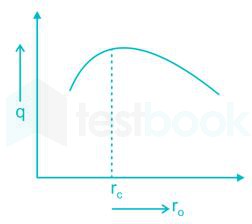
The formula for critical radius for the cylindrical body is, rc=khr_c=\frac{k}{h}

where, k = thermal conductivity of insulation, h = heat transfer coefficient

Calculation:

Given:

k = 0.05 W/mK. h = 5 W/m2K, r = 12.5 mm

rcr=kh=0.055=0.01 m=10 mm{r_{cr}} = \frac{k}{h} = \frac{0.05}{5}=0.01~m=10\ mm

rcr < r

The critical radius is less than the outer radius of the pipe and adding the insulation will reduce the heat loss.

26

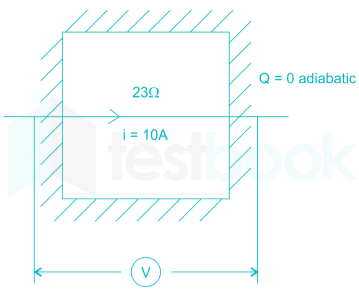
The contents of a well-insulated tank are heated by a resistor of 23 ohm in which 10 A current is flowing. Consider the tank along with its contents as a thermodynamic system. The work done by the system and the heat transfer to the system are positive. The rates of heat (Q), work (W) and change in internal energy (ΔU) during the process in kW are

  1. ((a))

    Q = 0,W =-2.3,ΔU = +2.3

  2. ((b))

    Q=+2.3, W = 0, ΔU = +2.3

  3. ((c))

    Q = -2.3, W = 0, ΔU = -2.3

  4. ((d))

    Q = 0, W = +2.3, ΔU = -2.3

Show Answer
Answer: ((a))

Q = 0,W =-2.3,ΔU = +2.3

Concept:

Increase in internal energy (ΔU) = rate of heat dissipated by a resistor  

ΔU = I2R

where I is current and R is resistance

According to First law of thermodynamics for any process,

δQ = ΔU + δW

Calculation:

Given:

I = 10 A, R = 23 Ω 

Heat transfer,

Q = 0 (well insulated wall),

ΔU  = I2R = 10× 23

ΔU = 2.3 kW

According to First law of thermodynamics for any process,

δQ = du + δW

0 = 2.3 + δW

δW = - 2.3 kW

27

Match the following criteria of material failure, under biaxial stresses σ1{\sigma _1}σ2{\sigma _2} and yield stress σy, with their corresponding graphic representations :

A. Maximum-shear–stress criterionL.
B. Maximum-distortion-energy criterionM.
C. Maximum-normal-stress criterionN
  1. ((a))

    A – L, B – N, C – M

  2. ((b))

    A – N, B – L, C – M

  3. ((c))

    A – M, B – N, C – L

  4. ((d))

    A – N, B – M, C – L

Show Answer
Answer: ((b))

A – N, B – L, C – M

Explanation:

Maximum shear stress theory

(Guest & Tresca’s Theory)

According to this theory, failure of the specimen subjected to any combination of a load when the maximum shearing stress at any point reaches the failure value equal to that developed at the yielding in an axial tensile or compressive test of the same material.
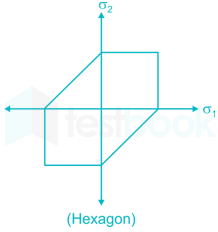
Graphical Representation

\({{\rm{\tau }}{{\rm{max}}}} \le \frac{{{{\rm{\sigma }}{\rm{y}}}}}{2}\) For no failure

\({{\rm{\sigma }}_1} - {{\rm{\sigma }}2} \le \left( {\frac{{{{\rm{\sigma }}{\rm{y}}}}}{{{\rm{FOS}}}}} \right)\) For design

σ1 and σ2 are maximum and minimum principal stress respectively.

Here, τmax = Maximum shear stress

σy = permissible stress

This theory is well justified for ductile materials.

Maximum shear strain energy / Distortion energy theory / Mises – Henky theory.

It states that inelastic action at any point in body, under any combination of stress begging, when the strain energy of distortion per unit volume absorbed at the point is equal to the strain energy of distortion absorbed per unit volume at any point in a bar stressed to the elastic limit under the state of uniaxial stress as occurs in a simple tension/compression test.

 for no failure

 For design
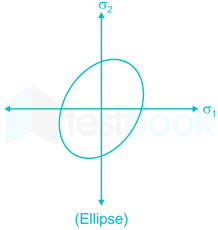
It cannot be applied for material under hydrostatic pressure.

All theories will give the same results if loading is uniaxial.

Maximum principal stress theory (Rankine’s theory)

According to this theory, the permanent set takes place under a state of complex stress, when the value of maximum principal stress is equal to that of yield point stress as found in a simple tensile test.

For the design criterion, the maximum principal stress (σ1) must not exceed the working stress ‘σy’ for the material.

\({{\rm{\sigma }}{1,2}} \le {{\rm{\sigma }}{\rm{y}}}\) for no failure

σ1,2σFOS{{\rm{\sigma }}_{1,2}} \le \frac{{\rm{\sigma }}}{{{\rm{FOS}}}} for design

Note: For no shear failure τ ≤ 0.57 σy

Graphical representation

For brittle material, which does not fail by yielding but fail by brittle fracture, this theory gives a satisfactory result.

The graph is always square even for different values of σ1 and σ2.
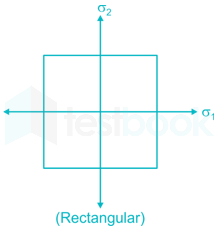
Important Points

Maximum principal strain theory (ST. Venant’s theory)

According to this theory, a ductile material begins to yield when the maximum principal strain reaches the strain at which yielding occurs in simple tension.

ϵ1,2σyE1{\epsilon_{1,2}} \le \frac{{{{\rm{\sigma }}_{\rm{y}}}}}{{{{\rm{E}}_1}}} For no failure in uniaxial loading.

\(\frac{{{{\rm{\sigma }}_1}}}{{\rm{E}}} - {\rm{\mu }}\frac{{{{\rm{\sigma }}_2}}}{{\rm{E}}} - {\rm{\mu }}\frac{{{{\rm{\sigma }}3}}}{{\rm{E}}} \le \frac{{{{\rm{\sigma }}{\rm{y}}}}}{{\rm{E}}}\) For no failure in triaxial loading.

\({{\rm{\sigma }}_1} - {\rm{\mu }}{{\rm{\sigma }}_2} - {\rm{\mu }}{{\rm{\sigma }}3} \le \left( {\frac{{{{\rm{\sigma }}{\rm{y}}}}}{{{\rm{FOS}}}}} \right)\) For design, Here, ϵ = Principal strain

σ1, σ2, and σ3 = Principal stresses   

Graphical Representation

This theory overestimates the elastic strength of ductile material.
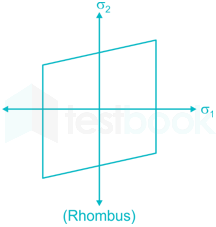
Maximum strain energy theory (Haigh’s theory)

According to this theory, a body complex stress fails when the total strain energy at the elastic limit in simple tension.

Graphical Representation.

  for no failure

 for design

This theory does not apply to brittle material for which elastic limit stress in tension and in compression are quite different.
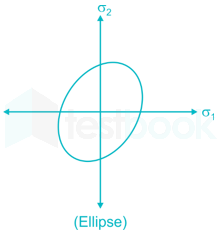
28

The product of two complex numbers 1 + i and 2 - 5i is

  1. ((a))

    7 - 3i

  2. ((b))

    3 - 4i

  3. ((c))

    -3 - 4i

  4. ((d))

    7 + 3i

Show Answer
Answer: ((a))

7 - 3i

Concept:

To multiply two complex numbers, we can use distributive law,

(a+bi)(c+di)=(ac+bdi2)+(ad+bc)i\left( {a + bi} \right)\left( {c + di} \right) = \left( {ac + bd{i^2}} \right) + \left( {ad + bc} \right)i

For avoiding binomials, we can apply i2 = -1

Calculation:

Given:

Two complex numbers 1 + i and 2 – 5i

Product of two numbers is:

(1 + i) × (2 – 5i)

2 – 5i + 2i + 5 = 7 – 3i

29

Cars arrive at a service station according to Poisson’s distribution with a mean rate of 5 per hour. The service time per car is exponential with a mean of 10 minutes. At steady state, the average waiting time in the queue is

  1. ((a))

    10 minutes

  2. ((b))

    20 minutes

  3. ((c))

    25 minutes

  4. ((d))

    50 minutes

Show Answer
Answer: ((d))

50 minutes

Concept:

Waiting time in the queue Wq=LqλW_q=\frac{L_q}{λ} and Lq=ρ21ρL_q=\frac{ρ^2}{1-ρ}

ρ=λμ\rho=\frac{\lambda}{μ}

where, Lq = length of queue, λ = arrival rate, μ = service rate

Calculation:

Given: 

λ = 5 cars per hour, μ = 1 car per 10 minute = 6 cars per hour

⇒ ρ=56\rho =\frac{5}{6}

 Lq=(5/6)21(5/6)=256L_q= \frac{(5/6)^2}{1-(5/6)}=\frac{25}{6}

 Wq=25/65=56W_q=\frac{25/6}{5}=\frac{5}{6} hours = 56×60=50 min\frac{5}{6}\times60=50~min

30

The word kanban is most appropriately associated with

  1. ((a))

    Economic order quantity

  2. ((b))

    Just–in–time production

  3. ((c))

    Capacity planning

  4. ((d))

    Product design

Show Answer
Answer: ((b))

Just–in–time production

Explanation:

Kanban

  • Kanban is a concept that relates to obtaining materials or required items "just in time" for their introduction into the assembly or process.
  • Kanban is a system to signal a need for action.
  • This can be done by cards on a board (which is the traditional way) or by other devices that are used as markers, indicating the need to take action.

Economic order quantity

Economic order quantity is that size of the order which helps in minimizing the total annual cost of inventory in the organization.

When the size of the order increases, the ordering costs (cost of purchasing, inspection, etc.) will decrease whereas the inventory carrying costs (costs of storage, insurance, etc.) will increase. Economic Order Quantity (EOQ) is that size of order which minimizes total annual costs of carrying and cost of ordering.

It is evident from above that the minimum total costs occur at a point where the ordering costs and inventory carrying costs are equal.

Capacity Planning - Capacity planning is determining the production capacity needed by an organisation to meet changing demand for its products, the process of determining the production capacity needed by an organisation to meet changing demand for its products, The ability to receive, holds or absorbs the maximum or optimum amount that can be produced.

Product design - Product design is the conceptualization of an idea about a product and transformation of the idea into a reality. To transform the idea into reality a specification about the product is prepared. this specification is prepared by considering different constraints such as production process, customer expectation etc. In the product design stage, every aspect of the product is analyzed. Also, the final decision regarding the product is taken on the basis of the analysis.

31

If f(x) is an even function and a is a positive real number, then \(\mathop \smallint \limits_{ - a}^a f\left( x \right)dx\) equals

  1. ((a))

    0

  2. ((b))

    a

  3. ((c))

    2a

  4. ((d))

    \(2\mathop \smallint \limits_0^a f\left( x \right)dx\)

Show Answer
Answer: ((d))

\(2\mathop \smallint \limits_0^a f\left( x \right)dx\)

Concept:

If f(x) = f(-x) , For all x ϵ Df  Then the function is even function

where Df = Domain of function


If f(x) = -f(-x) , For all x ϵ Df  Then the function is odd function.

\(\mathop \smallint \limits_{ - a}^a f\left( x \right)dx = \mathop \smallint \limits_{ - a}^0 f\left( x \right)dx + \mathop \smallint \limits_0^a f\left( x \right)dx\)

\(\mathop \smallint \limits_{ - a}^a f\left( x \right)dx = 2\mathop \smallint \limits_0^a f\left( x \right)dx\)

Therefore,

\(\mathop \smallint \limits_{ - a}^a f\left( x \right)dx = \begin{array}{{20}{c}} {\left{ {2\mathop \smallint \limits_0^a f\left( x \right)dx;} \right.}\ {0;} \end{array}\begin{array}{{20}{c}} {f\left( x \right)is\ even}\ {f\left( x \right)is\ odd} \end{array}\)

f (x) is even function.

32

The coefficient of restitution of a perfectly plastic impact is

  1. ((a))

    0

  2. ((b))

    1

  3. ((c))

    2

  4. ((d))

Show Answer
Answer: ((a))

0

Explanation:

Coefficient of restitution (e):

Coefficient of restitution or coefficient of the resilience of a collision is defined as the ratio of the relative velocity of separation after the collision to the relative velocity of the approach before the collision.

Coefficient of restitution (e) =Relative;velocity;after;collosionRelative;velocity;before;collosion=vBvAuAuB\frac{Relative;velocity;after;collosion}{Relative;velocity;before;collosion}=\frac{v_B-v_A}{u_A-u_B}

A perfectly inelastic collision also called perfectly plastic collision is a limiting case of inelastic collision in which the two bodies stick together after impact.

Since both bodies stick together in a perfectly plastic collision. Therefore vA = vB, Thus e = 0

Properties of different types of collision are given in the table below:

Types of CollisionLinear momentumTotal energyKinetic energyCoefficient of restitution
Perfectly elastic collisionConservedConservedConservede = 1
Inelastic collisionConservedConservedNot-Conserved0 < e < 1
Perfectly inelastic collisionConservedConservedNot-Conservede = 0
33

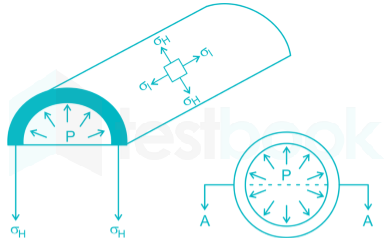
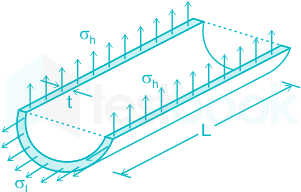
A thin cylinder of inner radius 500 mm and thickness 10 mm is subjected to an internal pressure of 5 MPa. The average circumferential (hoop) stress in MPa is

  1. ((a))

    100

  2. ((b))

    250

  3. ((c))

    500

  4. ((d))

    1000

Show Answer
Answer: ((b))

250

Concept:

The hoop stress in a cylinder is the tensile stress exerted tangentially along the circumference of the cylinder and it is given as,

σh=pd2t\sigma_h=\frac{pd}{2t}

where p = pressure, d = internal diameter, t = thickness of the cylinder.


NOTE: Hoop stress brought changes in diameter.

Calculation:

Given:

p = 5 MPa, ri = 500 mm ⇒ d = 1000 mm, and t = 10 mm

σh=pd2t=5 ×;10002;×;10=250 MPa{\sigma _h} = \frac{{pd}}{{2t}} =\frac{{5~\times;1000}}{{2;\times;10}}= 250\ MPa

![](http://storage.googleapis.com/tb-img/production/19/08/26 June_1.png)

Longitudinal stress is the stress which acts along the length and it is also tensile in nature.

Longitudinal stress = σl=σh2=pd4t\sigma_l=\frac{\sigma_h}{2}= \frac{pd}{4t}

NOTE: Longitudinal stress brought changes in length.

34

Which one among the following welding processes uses non-consumable electrode?

  1. ((a))

    Gas metal arc welding

  2. ((b))

    Submerged arc welding

  3. ((c))

    Gas tungsten arc welding

  4. ((d))

    Flux coated arc welding

Show Answer
Answer: ((c))

Gas tungsten arc welding

Introduction of TIG Welding

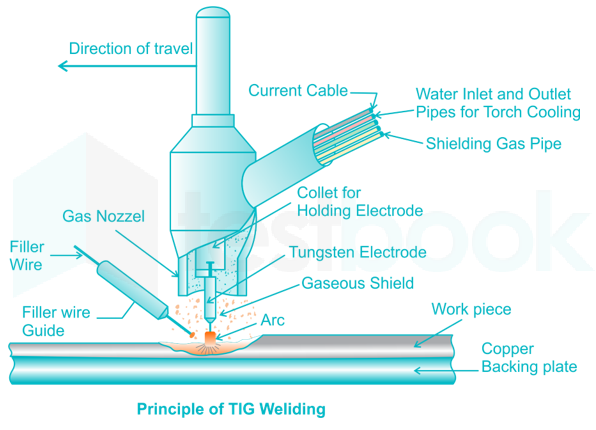
Gas Tungsten Arc Welding (GTAW), also known as tungsten inert gas (TIG) welding is a process that produces an electric arc maintained between a non-consumable tungsten electrode and the part to be welded.

Inert Gas in TIG Welding

The heat-affected zone, the molten metal, and the tungsten electrode are all shielded from atmospheric contamination by a blanket of inert gas fed through the GTAW torch.

Inert gas is inactive or deficient in active chemical properties. The shielding gas serves to blanket the weld and exclude the active properties in the surrounding air. Inert gases, such as Argon and Helium, do not chemically react or combine with other gases.

Submerged arc welding

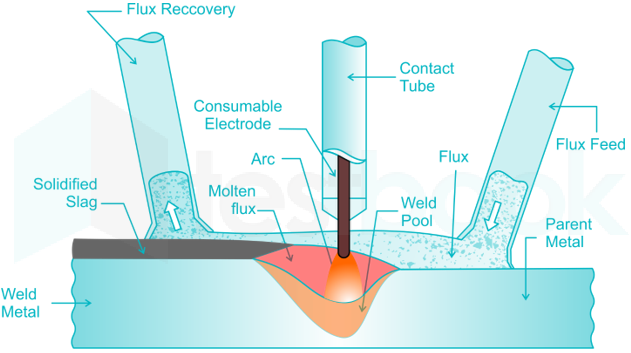
Submerged arc welding is an arc welding process in which heat is generated by an arc which is produced between bare consumable electrode wire and the work-piece. The arc and the weld zone are completely covered under a blanket of granular, fusible flux which melts and provides protection to the weld pool from the atmospheric gases.

The molten flux surrounds the arc thus protecting arc from the atmospheric gases. The molten flux flows down continuously and fresh flux melts around the arc. The molten flux reacts with the molten metal forming slag and improves its properties and later floats on the molten/solidifying metal to protect it from atmospheric gas contamination and retards cooling rate. A process of submerged arc welding is illustrated in Figure.

Flux coated arc welding or shielded metal arc welding

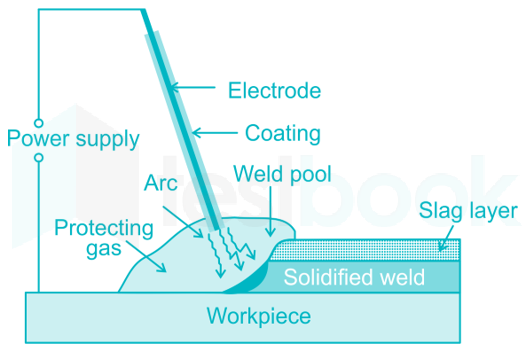
Shielded metal arc welding (SMAW) is a fusion welding process that uses a consumable, flux-coated electrode to create an arc between the electrode and the work piece.

This flux coating is used to protect the molten weld metal from the atmosphere and oxidation. This is necessary because no external shielding gas is used for this welding process.

Molten metal travels from the electrode via the electrical arc and is deposited into the work piece.

The flux coating is also melted, and it surfaces on top of the molten weld pool in the form of slag.

35

The crystal structure of austenite is

  1. ((a))

    Body centered cubic

  2. ((b))

    Face centered cubic

  3. ((c))

    Hexagonal closed packed

  4. ((d))

    Body centered tetragonal

Show Answer
Answer: ((b))

Face centered cubic

Concept:

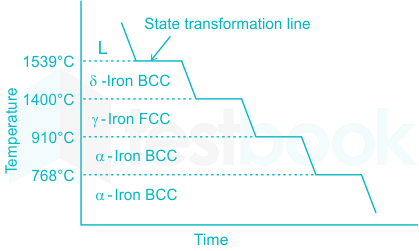
Austenite is an interstitial solution of Carbon in γ iron (Carbon atoms are accommodated at interstitial spaces). The maximum solubility of carbon in γ iron is 2.11%. In pure form, Austenite has an FCC structure. It has larger interatomic spacings (1.02 A° ) than ferrite. Austenite is soft, tough, and highly ductile. It has high tensile strength also. Austenite is non-magnetic at any temperature.

The liquid molten metal of iron on cooling will become solid at 1539°C (δ-iron) having BCC, on further cooling at 1410°C δ-iron is converted to γ – iron called as austenite having FCC and on further cooling, it counts to α – iron called ferrite at 910°C.

36

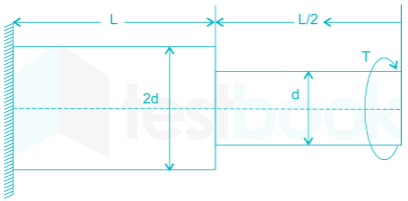
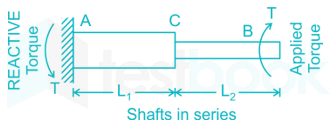
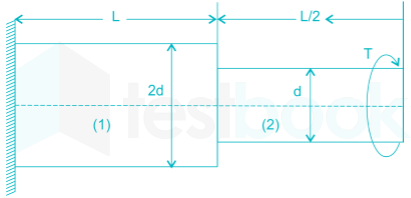
A torque T is applied at the free end of a stepped rod of circular cross-sections as shown in the figure. The shear modulus of the material of the rod is G. The expression for d to produce an angular twist θ at the free end is

  1. ((a))

    (32TLπθG)14{\left( {\frac{{32TL}}{{\pi \theta G}}} \right)^{\frac{1}{4}}}

  2. ((b))

    (18TLπθG)14{\left( {\frac{{18TL}}{{\pi \theta G}}} \right)^{\frac{1}{4}}}

  3. ((c))

    (16TLπθG)14{\left( {\frac{{16TL}}{{\pi \theta G}}} \right)^{\frac{1}{4}}}

  4. ((d))

    (2TLπθG)14{\left( {\frac{{2TL}}{{\pi \theta G}}} \right)^{\frac{1}{4}}}

Show Answer
Answer: ((b))

(18TLπθG)14{\left( {\frac{{18TL}}{{\pi \theta G}}} \right)^{\frac{1}{4}}}

Concept:

For shafts in series, both the shafts carry the same torque T and the total angle of twist at the resisting end is the sum of separate angles of twist of two shafts

  • T1 = T2
  • θ = θ1 + θ2​

The angle of twist θ is given by,

θ=TLGJ\theta = \frac{{TL}}{{GJ}}

where, T = Torque applied, L = length of the shaft, G = Modulus of rigidity  J = Polar section modulus

For the solid circular shaft, J=π32d4J = \frac{\pi }{{32}}{d^4}

Calculation:


Given:

T1 = T2 = T, L1 = L, L2 = L/2, d1 = 2d, d2 = d

θ = θ1 + θ2

θ=T1L1GJ1+T2L2GJ2=TLG×π32×(2d)4+T×L2G×π32×d4=18TLGπd4\theta = \frac{{{T_1}{L_1}}}{{G{J_1}}} + \frac{{{T_2}{L_2}}}{{G{J_2}}} = \frac{{TL}}{{G \times \frac{\pi }{{32}} \times {{\left( {2d} \right)}^4}}} + \frac{{T \times \frac{L}{2}}}{{G \times \frac{\pi }{{32}} \times {d^4}}} = \frac{{18TL}}{{G\pi {d^4}}}

d=(18TLGπθ)14d = {\left( {\frac{{18TL}}{{G\pi \theta }}} \right)^{\frac{1}{4}}}

Shafts in parallel:

  • If two or more shafts are rigidly fixed together such that the applied torque is shared between them then the composite shaft so formed is said to be connected in parallel
  • The angle of twist for both the shafts is the same
  • θ1 = θ2 and T = T1 + T2
37

Figure shows the schematic for the measurement of velocity of air (density = 1.2 kg /m3 ) through a constant–area duct using a pitot tube and a water-tube manometer. The differential head of water (density = 1000 kg /m3) in the two columns of the manometer is 10mm. Take acceleration due to gravity as 9.8m/ s2 . The velocity of air in m/s is

  1. ((a))

    6.4

  2. ((b))

    9.0

  3. ((c))

    12.8

  4. ((d))

    25.6

Show Answer
Answer: ((c))

12.8

Concept:

The velocity of flow is given by:

V=2ghV=\sqrt{2gh} and h=x(ρmρ1)h=x(\frac{ρ_m}{ρ}-1)

where, h = Difference of pressure head,  x = Difference of the manometric fluid level in differential U tube manometer, ρm = density of the manometric fluid, ρ = density of fluid flow through the pipe.

Calculation:

Given:

ρm = 1000 kg/m3, ρ = 1.2 kg/m3, x = 10 mm = 0.01 m

we know that,

h=x(ρmρ1)h=x(\frac{ρ_m}{ρ}-1)

 h=0.01(10001.21)=8.323 mh=0.01(\frac{1000}{1.2}-1)=8.323 ~m

Velocity of flow is:

V=2ghV=\sqrt{2gh}

 V=2×9.8 ×8.323=12.77 m/sV=\sqrt{2\times 9.8~\times8.323}=12.77~ m/s

38

The values of enthalpy of steam at the inlet and outlet of a steam turbine in a Rankine cycle are 2800 kJ/kg and 1800 kJ/kg respectively. Neglecting pump work, the specific steam consumption in kg/kW-hour is

  1. ((a))

    3.60

  2. ((b))

    0.36

  3. ((c))

    0.06

  4. ((d))

    0.01

Show Answer
Answer: ((a))

3.60

Concept:

Work done by the turbine = Enthalpy at the inlet - Enthalpy at the outlet of turbine,

WT = h3 - h4

Work input to the pump,

Wp = Enthalpy at outlet – Enthalpy at the inlet of the pump, 

Wp = h2 – h1

Net work output, Wnet = WT - WP

Specific Steam consumption = 3600Wnet\frac{{3600}}{{{W_{net}}}} kg/kW-hr

Calculation:

Given:

Enthalpy at the inlet of the turbine, h3 = 2800 kJ/kg;

Enthalpy at the outlet of turbine, h4 = 1800 kJ/kg, 

Pump work is negligible, Wp = 0 kJ/kg.

Wnet = WT - WP = (h3 - h4) - 0 = 2800 - 1800 = 1000 kJ/kg.

Specific steam consumption = 3600Wnet\frac{{3600}}{{{W_{net}}}} =11000×3600=3.6= \frac{1}{{1000}} \times 3600 = 3.6 kg/kW-hr.

The specific steam consumption is 3.6 kg/kW-hour.

39

The integral \(\mathop \smallint \limits_1^3 \frac{1}{x}dx\), when evaluated by using Simpson’s 1/3 rule on two equal subintervals each of length 1, equals

  1. ((a))

    1.000

  2. ((b))

    1.098

  3. ((c))

    1.111

  4. ((d))

    1.120

Show Answer
Answer: ((c))

1.111

Concept:

Simpson’s 1/3 rule is given as:

 \(\mathop \smallint \limits_{{x_0}}^{{x_n}} ydx = \frac{h}{3}\left{ {\left( {{y_0} + {y_n}} \right) + 4\left( {{y_1} + {y_3} + {y_5} + \ldots } \right) + 2\left( {{y_2} + {y_4} + {y_6} + \ldots } \right)} \right}\)

where x0 = a, xn = b and h=banh = \frac{{b - a}}{n}

Calculation:

Given:

x0 = a ⇒ 1, xn = b ⇒ 3, n = 2 and h=ban312=1h = \frac{{b - a}}{n} ⇒\frac{3-1}{2}=1

x123
y = 1x\frac{1}{x}10.50.33
yny0y1y2
<br>

By Simpson’s rule:

\(\mathop \smallint \limits_{{x_0}}^{{x_n}} y~dx = \frac{h}{3}\left{ {\left( {{y_0} + {y_2}} \right) + 4\left( {{y_1}} \right)} \right}\)

\(\Rightarrow \mathop \smallint \limits_{{x_0}}^{{x_n}} y~dx = \frac{1}{3}\left{ {\left( {{1} + {0.33}} \right) + 4\left( {{0.5}} \right)} \right}=1.111\)

40

Two identical ball bearings P and Q are operating at loads 30 kN and 45 kN respectively. The ratio of the life of bearing P to the life of bearing Q is

  1. ((a))

    81/16

  2. ((b))

    27/8

  3. ((c))

    9/4

  4. ((d))

    3/2

Show Answer
Answer: ((b))

27/8

Concept:

Load-Life relationship of a Bearing:

L10=(CP)n{L_{10}} = {\left( {\frac{C}{P}} \right)^n}

L10 = Rated bearing life (in million revolutions), C = Dynamic load-carrying capacity, P = Load acting on the bearing

n = 3 for ball bearing and n = 10/3 for roller bearing.

Calculation:

Given:

PP = 30 kN, PQ = 45 kN, n = 3 (∵ ball bearing) and CP = CQ (∵ identical bearing).

L10=(CP)n{L_{10}} = {\left( {\frac{C}{P}} \right)^n}

LPLQ=(PQPP)3(4530)3=(32)3278\therefore \frac{{{L_P}}}{{{L_Q}}} = {\left( {\frac{{{P_Q}}}{{{P_P}}}} \right)^3} \Rightarrow {\left( {\frac{{45}}{{30}}} \right)^3} = {\left( {\frac{3}{2}} \right)^3} \Rightarrow \frac{{27}}{8}

41

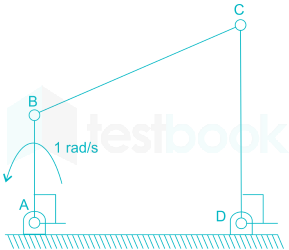
For the four-bar linkage shown in the figure, the angular velocity of link AB is 1 rad/s. the length of link CD is 1.5 times the length of link AB. In the configuration shown, the angular velocity of link CD in rad/s is

  1. ((a))

    3

  2. ((b))

    32\frac{3}{2}

  3. ((c))

    1

  4. ((d))

    23\frac{2}{3}

Show Answer
Answer: ((d))

23\frac{2}{3}

Concept:

The given linkage is a 4-bar mechanism with 4-revolute joints.

When the input and output link is parallel to each other and perpendicular to AD.

VAB = VCD

∴ ωAB × AB = ωCD × CD.

Calculation:

Given:

ωAB = 1 rad/s, CD = 1.5 × AB

VAB = VCD

ωAB × AB = ωCD × CD

∴ 1 × AB = ωCD × 1.5 × AB

∴ ωCD = 23\frac{2}{3} rad/s.

42

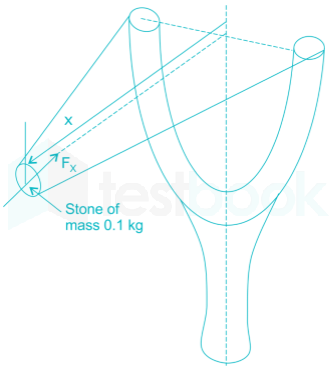
A stone with mass of 0.1 kg is catapulted as shown in the figure. The total force Fx (in N) exerted by the rubber band as a function of distance x (in m) is given by Fx = 300x2. If the stone is displaced by 0.1 m from the un-stretched position (x = 0) of the rubber band, the energy stored in the rubber band is

  1. ((a))

    0.01 J

  2. ((b))

    0.1 J

  3. ((c))

    1 J

  4. ((d))

    10 J

Show Answer
Answer: ((b))

0.1 J

Concept:

When the force applied is continuous in nature, the work done by the force for small displacement "dx" is given by:

\(W =\mathop \smallint \limits_{x_1}^{x_2} {F_x}dx \)

The energy stored in the rubber band is equal to the work done by the stone.

Calculation:

Given:

Fx = 300x2, x1 = 0 m, x2 = 0.1 m.

Energy stored in the bar = Work done by the stone

 \(W=\mathop \smallint \limits_0^{0.1} {F_x}dx = \mathop \smallint \limits_0^{0.1} 300{x^2}dx = \left[ {300 \times \frac{{{x^3}}}{3}} \right]_0^{0.1} = 100 \times {0.1^3} = 0.1\ J\)

43

Consider the differential equation dydx=(1+y2)x\frac{{dy}}{{dx}} = \left( {1 + {y^2}} \right)x. The general solution with constant C is

  1. ((a))

    y=tanx22+tancy = \tan \frac{{{x^2}}}{2} + tanc

  2. ((b))

    y=tan2(x2+c)y = {\tan ^2}\left( {\frac{x}{2} + c} \right)

  3. ((c))

    y=tan2(x2)+cy = {\tan ^2}\left( {\frac{x}{2}} \right) + c

  4. ((d))

    y=tan(x22+c)y = \tan \left( {\frac{{{x^2}}}{2} + c} \right)

Show Answer
Answer: ((d))

y=tan(x22+c)y = \tan \left( {\frac{{{x^2}}}{2} + c} \right)

Concept:

Separation of Variables:

f1(x)g1(y)dx + f2(x)g2(y)dy = 0

f1(x)f2(x)dx;+;g2(y)g1(y)dy;=;C\int \frac{f_1(x)}{f_2(x)}dx;+;\int \frac{g_2(y)}{g_1(y)}dy;=;C

Calculation:

Given:

Differential equation:

dydx=(1+y2)x\frac{{dy}}{{dx}} = \left( {1 + {y^2}} \right)x

By separation of variables:

11+y2dy=xdx\frac{1}{1+y^2}dy=xdx

Integrating on both sides we will get:

tan1y=x22+C⇒ {\tan ^{ - 1}}y = \frac{{{x^2}}}{2} + C

;y=tan(x22+C)\therefore;y = \tan \left( {\frac{{{x^2}}}{2} + C} \right)

44

An unbiased coin is tossed five times. The outcome of each toss is either a head or a tail. The probability of getting at least one head is

  1. ((a))

    132\frac{1}{{32}}

  2. ((b))

    1332\frac{{13}}{{32}}

  3. ((c))

    1632\frac{{16}}{{32}}

  4. ((d))

    3132\frac{{31}}{{32}}

Show Answer
Answer: ((d))

3132\frac{{31}}{{32}}

Concept:

When 'r' is a random variable, then by Binomial distribution

The probability of (r = n) in 'n' observations is given by

P(r=n)=;nCr;prqnr{\bf{P}}\left( {{\bf{r}} = {\bf{n}}} \right) = {;^{\bf{n}}}{{\bf{C}}_{\bf{r}}};{{\bf{p}}^{\bf{r}}}{{\bf{q}}^{{\bf{n}} - {\bf{r}}}} and p + q = 1

where p and q are the probability of success and failure.

Calculation:

Given:

p = Probability of getting head

q = Probability of not getting head = Probability of getting tail

n = 5, p = q = 0.5

Now, we know that

P(r=n)=;nCr;prqnr{\bf{P}}\left( {{\bf{r}} = {\bf{n}}} \right) = {;^{\bf{n}}}{{\bf{C}}_{\bf{r}}};{{\bf{p}}^{\bf{r}}}{{\bf{q}}^{{\bf{n}} - {\bf{r}}}}

Probability of getting at least head = 1 - Probability of getting zero head

∴  P(r1)=;1P(r=0)=15C0(0.5)0(0.5)5=1132=3132{\rm{P}}\left( {{\rm{r}} \geq 1} \right) = {\rm{;}}1 - {\rm{P}}\left( {{\rm{r}} = 0} \right) = 1{ - ^5}{{\rm{C}}_0}{\left( {0.5} \right)^0}{\left( {0.5} \right)^5} = 1 - \frac{1}{{32}} = \frac{{31}}{{32}}

 Alternate Method

The unbiased coin is tossed 5 times.

Sample space = 25 = 32

Probability of getting at least head = 1 - Probability of getting zero head

Now, Probability of getting zero head = Probability of getting tail 5 times

Getting only tail = 1 (T, T, T, T, T)

Probability of getting only tail = 132\frac{1}{{32}}

Probability of getting at least head = 1132=31321 - \frac{1}{{32}} = \frac{{31}}{{32}}

45

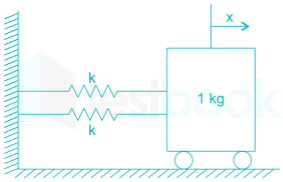
A mass of 1 kg is attached to two identical springs each with stiffness k = 20 kN/m as shown in the figure. Under frictionless condition, the natural frequency of the system in Hz is close to

  1. ((a))

    32

  2. ((b))

    23

  3. ((c))

    16

  4. ((d))

    11

Show Answer
Answer: ((a))

32

Concept:

Natural frequency of the system

ωn=kem rad/s{\omega _n} = \sqrt {\frac{{{k_e}}}{m}}~rad/s and fn=ωn2π Hzf_n=\frac{\omega_n}{2\pi}~Hz

where ke = equivalent stiffness, m = mass attach to the system

Calculation:

Given:

k = 20 kN/m = 20000 N/m, m = 1 kg

As the arrangement of springs are in parallel, 

therefore, ke = k + k = 2 k = 40000 N/m

ωn=40×10001=200{\omega _n} = \sqrt {\frac{{40 \times 1000}}{1}}= 200 rad/s 

And

 fn=2002π=31.83 Hz32 Hzf_n=\frac{200}{2\pi}=31.83~Hz\approx32 ~Hz

46

The shear strength of a sheet metal is 300 MPa. The blanking force required to produce a blank of 100 mm diameter from a 1.5 mm thick sheet is close to

  1. ((a))

    45 kN

  2. ((b))

    70 kN

  3. ((c))

    141 kN

  4. ((d))

    3500 kN

Show Answer
Answer: ((c))

141 kN

Concept:

Blanking force is given by:

F = τ × As

where, τ = shear strength, As = shear area

Calculation:

Given:

τ = 300 MPa, d = 100 mm, t = 1.5 mm

Shear area (As) is:

As = π × d × t 

Blanking force is:

 F=τ×As=300×π×d×tF = τ \times {A_s} = 300 × π \times d\times t

\(F= 300 × π × 100 × 1.5 = 141.371kN \simeq 141 kN\)

47

The ratios of the laminar hydrodynamic boundary layer thickness to thermal boundary layer thickness of flows of two fluids P and Q on a flat plate are 12\frac{1}{2} and 2 respectively. The Reynolds number based on the plate length for both the flows is 104 . The Prandtl and Nusselt numbers for P are 18\frac{1}{8} and 35 respectively. The Prandtl and Nusselt numbers for Q are respectively

  1. ((a))

    8 and 140

  2. ((b))

    8 and 70

  3. ((c))

    4 and 70

  4. ((d))

    4 and 35

Show Answer
Answer: ((a))

8 and 140

Concept:

The Reynolds number for flow over the plate is 104. Therefore, It is a laminar flow.

The relation between Nusselt, Reynolds, and Prandtl No. is given as,

Nu=0.332(Re)12(Pr)13Nu = 0.332{\left( {Re} \right)^{\frac{1}{2}}}{\left( {{\rm{Pr}}} \right)^{\frac{1}{3}}} and 

The relation between the ratio of thickness and Prandtl No. is,

δδt=Pr13\frac{{{\delta }}}{\delta_t } = P_r^{ \frac{1}{3}}

Calculation:

Given:

Re = 104

Fluidδδt\frac{\delta }{\delta_t}NuPr
P1/2351/8
Q2??

For fluid Q, Pr No. is,

2=Pr13Pr=82 = P_r^{ \frac{1}{3}}\Rightarrow Pr = 8

35(Nu)Q=0.332(104)12(18)130.332(104)12(8)13\frac{{35}}{{{{\left( {Nu} \right)}_Q}}} = \frac{{0.332{{\left( {{{10}^4}} \right)}^{\frac{1}{2}}}{{\left( {\frac{1}{8}} \right)}^{\frac{1}{3}}}}}{{0.332{{\left( {{{10}^4}} \right)}^{\frac{1}{2}}}{{\left( 8 \right)}^{\frac{1}{3}}}}}

∴ (Nu)Q = 140

48

The crank radius of a single–cylinder I. C. engine is 60 mm and the diameter of the cylinder is 80 mm. The swept volume of the cylinder in cm3 is

  1. ((a))

    48

  2. ((b))

    96

  3. ((c))

    302

  4. ((d))

    603

Show Answer
Answer: ((d))

603

Concept:

The swept volume of the cylinder  is given by:

Vs=π4×D2×LV_s = \frac \pi4× D^2× L

where D = diameter of cylinder and L = length of stroke

Length of the stroke is given by:

L = 2r

where r = crank radius

Calculation:

Given:

r = 60 mm, D = 80 mm

Length of the stroke (L) is:

L = 2r = 2 × 60 = 120 mm

Swept volume is

Vs=π4×D2×L=π4×802×120=603185.78 mm3=603.185 cm3V_s = \frac \pi4× D^2× L = \frac{\pi }{4} × {80^2} × 120 = 603185.78~ mm^3=603.185\ c{m^3}

49

A pump handling a liquid raises its pressure from 1 bar to 30 bar. Take the density of the liquid as 990 kg /m. The isentropic specific work done by the pump in kJ/kg is

  1. ((a))

    0.10

  2. ((b))

    0.30

  3. ((c))

    2.50

  4. ((d))

    2.93

Show Answer
Answer: ((d))

2.93

Concept:

Work done by the pump is given as,

12dW=v12dP\int_{1}^{2}dW=v\int_{1}^{2}dP

W=v(P2P1)\rm{W}=\rm v(P_2-P_1)

But we know that ρ=mVρ=\frac{m}{V} and for unit mass, ρ=1Vρ=\frac{1}{V} 

means V=1ρV=\frac{1}{ρ}

W=P2;;P1ρ\therefore W=\frac{P_2;-;P_1}{ρ} kJ/kg

Calculation:

Given:

ρ = 990 kg/m3, P2 = 30 bar = 3000 kPa, P1 = 1 bar = 100 kPa

W=P2;;P1ρW=\frac{P_2;-;P_1}{ρ}

W=3000;;100990=2.92 kJ/kg\therefore W=\frac{3000;-;100}{990}=2.92~kJ/kg

50

A spherical steel ball of 12 mm diameter is initially at 1000 K. It is slowly cooled in a surrounding of 300 K. The heat transfer coefficient between the steel ball and the surrounding is 5 W /m2K. The thermal conductivity of steel is 20 W/mK. The temperature difference between the centre and the surface of the steel ball is

  1. ((a))

    Large because conduction resistance is far higher than the convective resistance

  2. ((b))

    Large because conduction resistance is far less than the convective resistance

  3. ((c))

    Small because conduction resistance is far higher than the convective resistance

  4. ((d))

    Small because conduction resistance is far less than the convective resistance

Show Answer
Answer: ((d))

Small because conduction resistance is far less than the convective resistance

Concept:

Biot Number gives an indication of the ratio of internal (conduction) resistance to the surface (convection) resistance. 

Bi=hLck=Rth,conductionRth,convectionBi = \frac{{hL_c}}{k} =\frac{R_{th,conduction}}{R_{th,convection}}

Bi<<1Rth,conductionRth,convection<<1Rth,conduction<<Rth,convectionBi <<1\Rightarrow \frac{R_{th,conduction}}{R_{th,convection}}<<1\Rightarrow R_{th,conduction} <<R_{th,convection}

When the value of Bi is small, it indicates that the system has small conduction resistance i.e. relatively small temperature gradient or the existence of practically uniform temperature within the system. 

The convective resistance then predominates and the transient phenomenon is controlled by the convective heat exchange.

Calculation:

Characteristic dimension, L=VA=43πr34πr2=r3=2 mmL=\frac{V}{A}=\frac{\frac{4}{3}\pi r^3}{4\pi r^2}=\frac{r}{3}=2~mm

Bi=hLk=5×0.00220=0.0005Bi = \frac{{hL}}{k} = 5 \times \frac{{0.002}}{{20}} = 0.0005

For the given condition the Biot number tends to zero, that means conduction resistance is far less than convection resistance.

51

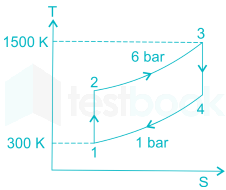
An ideal Brayton cycle, operating between the pressure limits of 1 bar and 6 bar, has minimum and maximum temperatures of 300 K and 1500 K. The ratio of specific heats of the working fluid is 1.4. The approximate final temperatures (in K) at the end of the compression and expansion processes are respectively

  1. ((a))

    500 and 900

  2. ((b))

    900 and 500

  3. ((c))

    500 and 500

  4. ((d))

    900 and 900

Show Answer
Answer: ((a))

500 and 900

Concept:

The Ideal Brayton cycle is shown in the figure.

T1 = Temperature at the start of compression, T2 = Temperature at the end of compression

T3 = Temperature at the start of expansion, T4 =  Temperature at the end of expansion

And T2T1=(P2P1)γ1γ\frac{{{T_2}}}{{{T_1}}} = {\left( {\frac{{{P_2}}}{{{P_1}}}} \right)^{\frac{{γ - 1}}{γ }}} and T3T4=(P2P1)γ1γ\frac{{{T_3}}}{{{T_4}}} = {\left( {\frac{{{P_2}}}{{{P_1}}}} \right)^{\frac{{γ - 1}}{γ }}}

Calculation:

Given:

T1 = 300 K, T3 = 1500 K, P2 = 6 bar, P1 = 1 bar, γ = 1.4

Now, we have

T2=T1(P2P1)γ1γ=300×60.41.4=500 K{T_2} = {T_1}{\left( {\frac{{{P_2}}}{{{P_1}}}} \right)^{\frac{{γ - 1}}{γ }}} = 300 \times {6^{\frac{{0.4}}{{1.4}}}} = 500 ~K

And at the end of the expansion, the temperature is, 

T4=T3(P2P1)γ1γ=15000.461.4=900 K{T_4} = \frac{{{T_3}}}{{{{\left( {\frac{{{P_2}}}{{{P_1}}}} \right)}^{\frac{{γ - 1}}{γ }}}}} = \frac{{1500}}{{\frac{{0.4}}{{{6^{1.4}}}}}} = 900~ K

52

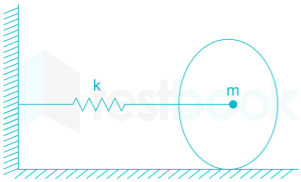
A disc of mass m is attached to a spring of stiffness k as shown in the figure. The disc rolls without slipping on a horizontal surface. The natural frequency of vibration of the system is

  1. ((a))

    12πkm\frac{1}{{2\pi }}\sqrt {\frac{k}{m}}

  2. ((b))

    12π2km\frac{1}{{2\pi }}\sqrt {\frac{{2k}}{m}}

  3. ((c))

    12π2k3m\frac{1}{{2\pi }}\sqrt {\frac{{2k}}{{3m}}}

  4. ((d))

    12π3k2m\frac{1}{{2\pi }}\sqrt {\frac{{3k}}{{2m}}}

Show Answer
Answer: ((c))

12π2k3m\frac{1}{{2\pi }}\sqrt {\frac{{2k}}{{3m}}}

Calculation:

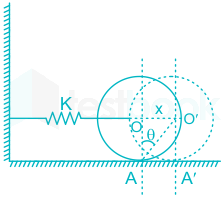
Taking moments about instantaneous centre ‘A’

IA θ¨\ddot \theta  + (kx) r = 0

⇒ (Io + mr2) θ¨\ddot \theta  + k (θr)r = 0

(12mr2+mr2)θ¨+k(θr2)=0 θ¨+kr232mr2θ=0θ¨+2k3mθ=0; fn=12π2k3m\begin{array}{l} \Rightarrow \left( {\frac{1}{2}m{r^2} + m{r^2}} \right)\ddotθ + k\left( {θ {r^2}} \right) = 0 \ \Rightarrow \ddot θ + \frac{{k{r^2}}}{{\frac{3}{2}m{r^2}}}θ = 0 \Rightarrow \ddotθ + \frac{{2k}}{{3m}}θ = 0; \ \therefore {f _n} = \frac{1}{{2\pi }}\sqrt {\frac{{2k}}{{3m}}} \end{array}


Total energy of the system is:

\(\begin{array}{l} E = \frac{1}{2}k{x^2} + \frac{1}{2}m{V^2} + \frac{1}{2}I{\omega ^2}\ E = \frac{1}{2}k{x^2} + \frac{1}{2}m{V^2} + \frac{1}{2}\frac{{M{r^2}}}{2} \times \frac{{{V^2}}}{{{r^2}}}\E = \frac{1}{2}k{x^2} + \frac{3}{2}m{V^2}\ \frac{{dE}}{{dt}} = 0 \Rightarrow {f _n} = \frac{1}{{2\pi }}\sqrt {\frac{k}{{\frac{3}{2}m}}} \ \Rightarrow {f _n} = \frac{1}{{2\pi }}\sqrt {\frac{{2k}}{{3m}}} \end{array}\)

Shortcut Trick

For a cylinder of radius 'r' with surface contact at point 'p',

natural frequency is given by

fn=;12πk(r)232mr2;=;12π;2k3m{{\bf{f}}_{\bf{n}}} = ;\frac{1}{{2{\bf{\pi }}}}\sqrt {\frac{{{\bf{k}} \cdot {{\left( {\bf{r}} \right)}^2}}}{{\frac{3}{2}{\bf{m}}{{\bf{r}}^2}}}} {\rm{;}} = {\rm{;}}\frac{1}{{2{\rm{\pi }}}}{\rm{;}}\sqrt {\frac{{2{\rm{k}}}}{{3{\rm{m}}}}}

53

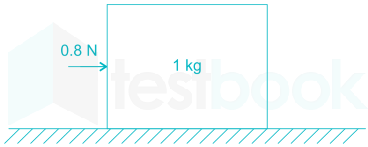
A 1kg block is resting on a surface with co effcient of friction, µ = 0.1. A force of 0.8N is applied to the block as shown in figure. The friction force in Newton is 

  1. ((a))

    0

  2. ((b))

    0.98

  3. ((c))

    1.2

  4. ((d))

    0.8

Show Answer
Answer: ((d))

0.8

Concept:

The friction force is given by:

f = μN

where μ is the coefficient of friction between the surfaces in contact, N is the normal force perpendicular to friction force.

Calculation:

Given:

μ = 0.1, m = 1 kg, F = 0.8 N

Now, we know that

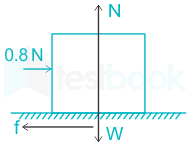
From the FBD as shown below

Normal reaction, N = mg = 1 × 9.81 = 9.81 N

Limiting friction force between the block and the surface, f = μN =  0.1 × 9.81 = 0.98 N

But the applied force is 0.8 N which is less than the limiting friction force.

∴ The friction force for the given case is 0.8 N.

54

Consider the following system of equations

2x1 + x2 + x3 = 0,

x2 – x3 = 0,

x1 + x2 = 0,

This system has

  1. ((a))

    A unique solution

  2. ((b))

    No solution

  3. ((c))

    Infinite number of solutions

  4. ((d))

    Five solutions

Show Answer
Answer: ((c))

Infinite number of solutions

Concept:

For a Homogenous system, AX = O

[A] is the Coefficient matrix

[A/O] be Augmented matrix

[O] is a null matrix and

n = total number of variables

Case 1: ρ(A) = ρ(A/O) = n

In this case, the system possesses only a zero solution (or Trivial solution) i.e unique solution.

Case 2: ρ(A) = ρ(A/O) < n

In this case, the system has an infinite number of non-zero solutions (or Non -Trivial solutions).

Case 3: ρ(A) = ρ(A/O)

Hence, inconsistency does not arise, moreover, zero solution is always a solution to it.

Calculation:

Given:

2x1 + x2 + x3 = 0

x2 – x3 = 0

x1 + x2 = 0

Here n = 3

Now, we know that

For a Homogenous system, AX = O

Augmented matrix is:

\(\left[ {A/O} \right] = \left[ {\left. {\begin{array}{{20}{c}} 2&1&1\ 0&1&-1\ 1&{ 1}&0 \end{array}} \right|\begin{array}{{20}{c}} 0\ 0\ 0 \end{array}} \right]\)

R3 → R3 - (R1/2)

\(\left[ {\left. {\begin{array}{{20}{c}} 2&1&1\ 0&1&{ - 1}\ 0&{1/2}&{-1/2} \end{array}} \right|\begin{array}{{20}{c}} 0\ 0\ 0 \end{array}} \right]\)

R3 → R3 - (R2/2)

\(\left[ {\left. {\begin{array}{{20}{c}} 2&1&1\ 0&1&{ - 1}\ 0&0&0 \end{array}} \right|\begin{array}{{20}{c}} 0\ 0\ 0 \end{array}} \right]\)

As, ρ(A) = ρ(A/O) = 2 < 3

∴ The system is consistent and will have infinite number of solutions.

55

A single–point cutting tool with a 12° rake angle is used to machine a steel workpiece. The depth of cut, i.e. uncut thickness is 0.81 mm. The chip thickness under the orthogonal machining condition is 1.8 mm. The shear angle is approximately.

  1. ((a))

    22°

  2. ((b))

    26°

  3. ((c))

    56°

  4. ((d))

    76°

Show Answer
Answer: ((b))

26°

Concept:

The relation between shear angle (ϕ), chip thickness ratio (r) and rake angle (α) is given by,

tan ϕ=r cosα1rsinαtan~{ϕ}=\frac{r~cos{α}}{1-rsinα} and r=ttcr=\frac{t}{t_c}

where t = uncut thickness, tc = chip thickness

Calculation:

Given:

α = 12°, t = 0.81 mm, tc = 1.8 mm 

Therefore, r=ttc=0.811.8=0.45r=\frac{t}{t_c}=\frac{0.81}{1.8}=0.45

⇒ tan ϕ=0.45×cos1210.45×sin12tan~{ϕ}=\frac{0.45\times cos12}{1-0.45\times sin12}

tan ϕ = 0.485

Therefore, ϕ = 25.90° ≈ 26°

56

Match the following non-traditional machining processes with the corresponding material removal mechanisms :

Machining processMechanism of material removal
P. Chemical machining1. Erosion
Q. Electrochemical machining1. Corrosive reaction
R. Electro–discharge machining1. Ion displacement
S. Ultrasonic machining1. Fusion and vaporization
  1. ((a))

    P-2, Q-3, R-4,S-1

  2. ((b))

    P-2,Q-4,R-3,S-1

  3. ((c))

    P-3, Q-2,R-4,S-1

  4. ((d))

    P-2,Q-3,R-1,S-4

Show Answer
Answer: ((a))

P-2, Q-3, R-4,S-1

Explanation:

The unconventional machining process and its characteristics and the application areas are discussed in the table below:

Type Of MachiningMechanics Of Material RemovalMediumTool MaterialMaterial Application
Ultrasonic machiningBrittle fracture erosion caused by the impact of abrasive grain due to the tool vibrating at high frequency (Amplified by tapered horn).SlurryTough and ductile (soft steel)The hard and brittle material, semiconductor, non-metals( eg. Glass and ceramic).
Chemical MachiningControlled corrosive reaction with acids or alkalisEtchantAcids and alkalis act as a toolAll plain materials with no roughness.
Electric discharge machiningFusion and evaporation, aided by cavitation.Dielectric fluidCopper, brass, graphiteAll conducting metals and alloys
Electrochemical machiningElectrolysis (Ion-displacement)Conducting electrolyteCopper, brass, steelAll conducting metals and alloys
Electron beam machiningMelting and vapourizationvacuumA beam of an electron moving at high velocityAll material.
Laser beam machiningMelting and vapourizationNormal atmosphereA high power laser beam (Ruby rod)All material.
57

A cubic casting of 50 mm side undergoes volumetric solidification shrinkage and volumetric solid contraction of 4% and 6% respectively. No riser is used. Assume uniform cooling in all directions. The side of the cube after solidification and contraction is

  1. ((a))

    48.32 mm

  2. ((b))

    49.90 mm

  3. ((c))

    49.94 mm

  4. ((d))

    49.96 mm

Show Answer
Answer: ((a))

48.32 mm

Concept:

Volumetric solidification shrinkage and volumetric solid contraction cause a decrease in dimensions of the casting.

Calculation:

Given:

Side of the cube, a = 50 mm, a' = Side of the cube after solidification 

Volumetric solidification shrinkage = 4%

Solid contraction = 6%

Volume of cube = (side)3 = 503 = 125000 mm3

After considering both the allowances, the size of the cube is reduced.

V = 125000 × 0.96 × 0.94 = 112800 mm3

(a')3 = 112800

a' =1128003=48.32 mm= \sqrt[3]{{112800}} = 48.32~mm

In an experimental set-up, air flows between two stations P and Q adiabatically. The direction of flow depends on the pressure and temperature conditions maintained at P and Q. The conditions at station P are 150 kPa and 350 K. The temperature at station Q is 300 K.

The following are the properties and relations pertaining to air:

Specific heat at constant pressure, CP =1.005 kJ/kgK;

Specific heat at constant volume, C= 0.718 kJ/kgK;

Characteristic gas constant, R = 0.287 kJ/kgK

Enthalpy, h = CpT

Internal energy, u = CVT

58

If the air has to flow from station P to station Q, the maximum possible value of pressure in kPa at station Q is close to

  1. ((a))

    50

  2. ((b))

    87

  3. ((c))

    128

  4. ((d))

    150

Show Answer
Answer: ((b))

87

Concept:

For the reversible adiabatic process, P – Q:

TQTP=(PQPP)γ1γ\frac{{{T_Q}}}{{{T_P}}} = {\left( {\frac{{{P_Q}}}{{{P_P}}}} \right)^{\frac{{\gamma - 1}}{{\rm{\gamma }}}}}

Calculation:

Given:

TP = 350 K, TQ = 300 K, PP = 150 kPa, γ = 1.4

As, question ask the maximum possible value of pressure at Q, It means minimum loss during the process P-Q.Hence the given process is a reversible adiabatic process

TQTP=(PQPP)γ1γ\frac{{{T_Q}}}{{{T_P}}} = {\left( {\frac{{{P_Q}}}{{{P_P}}}} \right)^{\frac{{\gamma - 1}}{{\rm{\gamma }}}}}

300350=(PQ150)1.411.4\frac{{{300}}}{{{350}}} = {\left( {\frac{{{P_Q}}}{{{150}}}} \right)^{\frac{{1.4 - 1}}{{\rm{1.4 }}}}}

PQ150=0.583\frac{{{P_Q}}}{{150}} = 0.583

PQ = 87.45 kPa

59

If the pressure at station Q is 50 kPa, the change in entropy (SQ - SP) in kJ/kgK is

  1. ((a))
    • 0.155
  2. ((b))

    0

  3. ((c))

    0.160

  4. ((d))

    0.355

Show Answer
Answer: ((c))

0.160

Concept:

The change in entropy for an ideal gas between state P and state Q.

\({S_Q} - {S_P} = {C_p}In\left( {\frac{{{T_Q}}}{{{T_P}}}} \right) - RIn\left( {\frac{{{P_Q}}}{{{P_P}}}} \right)\)

\({S_Q} - {S_P} = {C_v}In\left( {\frac{{{T_Q}}}{{{T_P}}}} \right) + RIn\left( {\frac{{{P_Q}}}{{{P_P}}}} \right)\)

Calculation:

Given:

TP = 350 K, TQ = 300 K, PP = 150 kPa, PQ = 50 kPa, CP =1.005kJ/kgK;

The change in entropy is,

\({S_Q} - {S_P} = {C_p}In\left( {\frac{{{T_Q}}}{{{T_P}}}} \right) - RIn\left( {\frac{{{P_Q}}}{{{P_P}}}} \right)\)

∴ \({S_Q} - {S_P} = {1.005}ln\left( {\frac{{{300}}}{{{350}}}} \right) - 0.287ln\left( {\frac{{{50}}}{{{150}}}} \right)=0.160 ~kJ/kgK\)

One unit of product P1 requires 3 kg of resource R1 and 1 kg of resource R2. One unit of product P2 requires 2 kg of resource R1 and 2 kg of resource R2. The profits per unit by selling product P1 and P2 are Rs. 2000 and Rs. 3000 respectively. The manufacturer has 90 kg of resource R1 and 100 kg of resource R2.

60

The unit worth of resource R2 i.e., dual price of resource R2 in Rs. Per kg is

  1. ((a))

    0

  2. ((b))

    1350

  3. ((c))

    1500

  4. ((d))

    2000

Show Answer
Answer: ((a))

0

Concept:

Unit worth or Dual price or Shadow prize or Marginal prize:

If the RHS of given constraint is increased by 1 unit, then the correcsonding increse in Z value (Profite) is Known as Dula Prize of that constraint. The unit worth of redundent constraint will be zero.
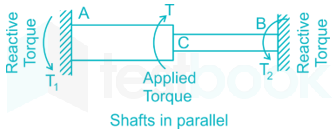
From the given data, the table below can be extracted,

ResourcesP1P2Availability
R13290
R212100
Profit per unit20003000
Number of unitsxy
<br>

Zmax = 2000x + 3000y

Subjected to

3x + 2y ≤ 90   ⇒ x30+y451;;;;;(1)\frac{x}{{30}} + \frac{y}{{45}} \le 1{{;;;;;}} \ldots \left( 1 \right)

x + 2y ≤ 100   ⇒ x100+y501;;;;;(2)\frac{x}{{100}} + \frac{y}{{50}} \le 1{{;;;;;}} \ldots \left( 2 \right)

For the above contraints, Graphical method can be employed to maximize the profite

calulation:

The feasible region cosists of corner points where the optimal solution lies.

The optimal solution is one of the best feasible solution where the objective function value is maximum in case of maximization problem and minimum in minimization problem.

Corner points of the feasible reason are A(30 , 0)  B(0 , 45)

ZA = 2000 × 30 + 3000 × 0 = 60,000

ZB = 2000 × 0 + 3000 × 45 = 1,35,000

Solution is optimal at B, x = 0 , y = 45

Zmax = 1,35,000 for B(0, 45)

To calulate the unit worth of resource R2:

3x + 2y + S1 = 90 , 3 × 0 + 2 × 45 + S1 = 90

S1 = 0 i.e R1 resource is fully utilised .

x + 2y + S2 = 100 , 0 + 2 × 45 + S2 = 100 , S2 = 10

i.e R2 resource is unutilized at optimality. Hence dual price of R2 is zero.

Alternate method:

Concept:

Unit worth or Dual price or Shadow prize or Marginal prize:

If the RHS of given constraint is increased by 1 unit, then the correcsonding increse in Z value (Profite) is Known as Dula Prize of that constraint. The unit worth of redundent constraint will be zero.
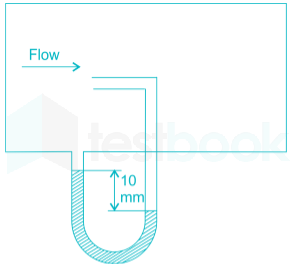
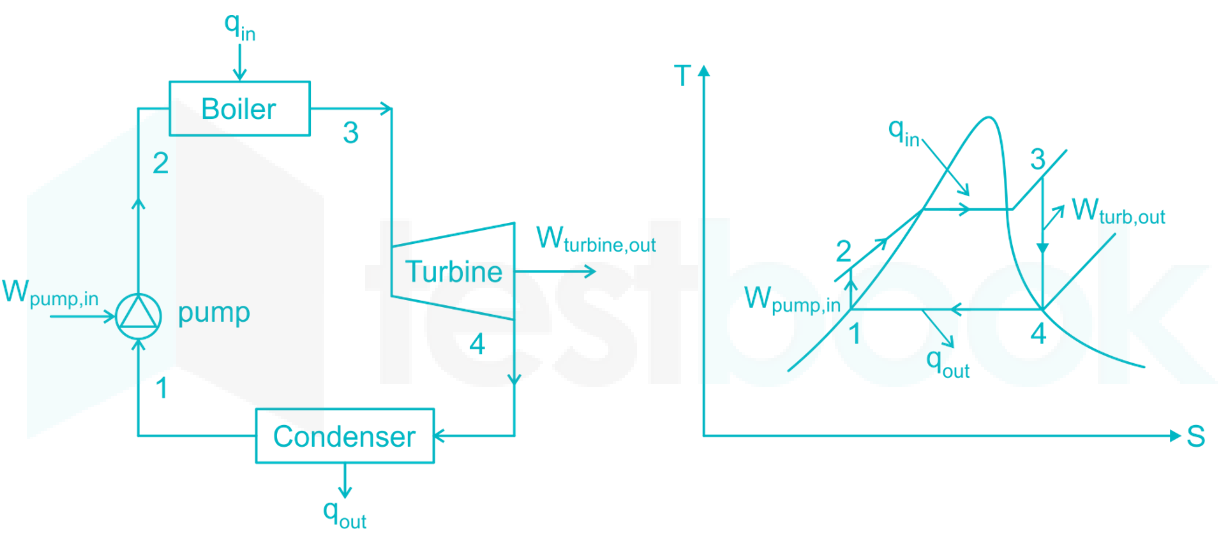
From the given data, the table below can be extracted,

ResourcesP1P2Availability
R13290
R212100
Profit per unit20003000
Number of unitsxy
<br>

Zmax = 2000x + 3000y

Subjected to

3x + 2y ≤ 90   ⇒ x30+y451;;;;;(1)\frac{x}{{30}} + \frac{y}{{45}} \le 1{{;;;;;}} \ldots \left( 1 \right)

x + 2y ≤ 100   ⇒ x100+y501;;;;;(2)\frac{x}{{100}} + \frac{y}{{50}} \le 1{{;;;;;}} \ldots \left( 2 \right)

For the above contraints, Graphical method can be employed to maximize the profite

Explantion:

From the above representation of the feasible region, it can be noticed that the constraint 2 (constraint correspondinmg to R2) is redundent constraint as there will be no effect on feasible region even after decrese of the resource R2.

⇒ R2  resource is unutilized, hence dual price of R2 is zero.

61

The manufacturer can make a maximum profit of Rs.

  1. ((a))

    60000

  2. ((b))

    135000

  3. ((c))

    150000

  4. ((d))

    200000

Show Answer
Answer: ((b))

135000

Explanation:

ResourcesP1P2Availability
R13290
R212100
Profit per unit20003000
Number of unitsxy


Zmax = 2000x + 3000y

Subjected to

3x + 2y ≤ 90   ⇒ x30+y451\frac{x}{{30}} + \frac{y}{{45}} \le 1

x + 2y ≤ 100   ⇒ x100+y501\frac{x}{{100}} + \frac{y}{{50}} \le 1

Zmax = 2000x + 3000y

Corner points satisfying both the constraints are A(30 , 0)  B(0 , 45)

ZA = 2000 × 30 + 3000 × 0 = 60,000

ZB = 2000 × 0 + 3000 × 45 = 1,35,000

A triangular–shaped cantilever beam of uniform–thickness is shown in the figure. The Young’s modulus of the material of the beam is E. A concentrated load P is applied at the free end of the beam.

62

The area moment of inertia about the neutral axis of a cross-section at a distance x measured from the free end is

  1. ((a))

    bxt36l\frac{{bx{t^3}}}{{6l}}

  2. ((b))

    bxt312l\frac{{bx{t^3}}}{{12l}}

  3. ((c))

    bxt324l\frac{{bx{t^3}}}{{24l}}

  4. ((d))

    xt312l\frac{{x{t^3}}}{{12l}}

Show Answer
Answer: ((b))

bxt312l\frac{{bx{t^3}}}{{12l}}

Concept:

Width change per unit length is b/l.

width at distance x:

ωx=blx Ix=(bxl)×t312\begin{array}{l} {\omega _x} = \frac{b}{l}x\ \Rightarrow I_x = \frac{{\left( {\frac{{bx}}{l}} \right) \times {t^3}}}{{12}} \end{array}

63

The maximum deflection of the beam is

  1. ((a))

    24Pl3Ebt3\frac{{24P{l^3}}}{{Eb{t^3}}}

  2. ((b))

    12Pl3Ebt3\frac{{12P{l^3}}}{{Eb{t^3}}}

  3. ((c))

    3Pl3Ebt3\frac{{3P{l^3}}}{{Eb{t^3}}}

  4. ((d))

    6Pl3Ebt3\frac{{6P{l^3}}}{{Eb{t^3}}}

Show Answer
Answer: ((d))

6Pl3Ebt3\frac{{6P{l^3}}}{{Eb{t^3}}}

Concept:

The beam is having uniform thickness t but varying width b,

Therefore, the width at any point in beam is bx=b(xl)b_x=b({\frac{x}{l}})

For deflection Castigliano's theorem is, Δ=δUδP\Delta=\frac{\delta U}{\delta P}

where P = load acting at the end, U = strain energy of the beam,

\(U = \mathop \smallint \limits_0^l \frac{{{{\left( {{M_{x - x}}} \right)}^2}dx}}{{2EI}}\), where, Mx-x = moment at cross-section, E = Young’s modulus, I = MOI = bxt312=bt312l(x)\frac{b_xt^3}{12}=\frac{bt^3}{12l}(x)

Calculation:

Strain energy, \(U = \mathop \smallint \limits_0^l \frac{{{{\left( {Px} \right)}^2}dx}}{{2E\left( {\frac{{b{t^3}x}}{{12l}}} \right)}} = \frac{{3{P^2}{l^3}}}{{Eb{t^3}}}\)

From Castigliano's theorem,

Δ=δUδP=6Pl3Ebt3\Delta=\frac{\delta U}{\delta P}=\frac{6Pl^3}{Ebt^3}

The temperature and pressure of air in a large reservoir are 400 K and 3 bar respectively. A converging–diverging nozzle of exit area 0.005 m2 is fitted to the wall of the reservoir as shown in the figure. The static pressure of air at the exit section for isentropic flow through the nozzle is 50 kPa. The characteristic gas constant and the ratio of specific heats of air are 0.287 kJ/kgK and 1.4 respectively.

64

The density of air in kg/ m3 at the nozzle exit is

  1. ((a))

    0.560

  2. ((b))

    0.600

  3. ((c))

    0.727

  4. ((d))

    0.800

Show Answer
Answer: ((c))

0.727

Concept:

The relation between pressure and temperature for the isentropic process.

T2T2=(P2P1)γ1γ\frac{{{T_2}}}{{{T_2}}} = {\left( {\frac{{{P_2}}}{{{P_1}}}} \right)^{\frac{{γ - 1}}{γ }}}

Calculation:

Given:

T1 = 400 K, P1 = 300 kPa, P2 = 50 kPa, R = 0.289 kJ/kgK

γ  = 1.4, A2 = 0.005 m2

The process followed from entrance to exit is isentropic process, therefore

T2T1=(P2P1)γ1γT2=400(50300)0.41.4=239.5 K\frac{{{T_2}}}{{{T_1}}} = {\left( {\frac{{{P_2}}}{{{P_1}}}} \right)^{\frac{{γ - 1}}{γ }}} \Rightarrow {T_2} = 400{\left( {\frac{{50}}{{300}}} \right)^{\frac{{0.4}}{{1.4}}}} = 239.5~K

From the perfect gas equation

\(\rho = \frac{P}{{RT}}or{\rho _2} = \frac{{{P_2}}}{{R{T_2}}} = \frac{{50}}{{0.287 \times239.5}} \Rightarrow {\rho _2} = 0.727~\frac{{kg}}{{{m^3}}}\)

65

The mass flow rate of air through the nozzle in kg/s is

  1. ((a))

    1.30

  2. ((b))

    1.77

  3. ((c))

    1.85

  4. ((d))

    2.06

Show Answer
Answer: ((d))

2.06

Concept:

The mass flow rate through the nozzle is, m = (ρAV)i = (ρAV)o 

The velocity of flow through nozzle is find from steady flow energy equation,

hi+Vi22+Q=ho+Vo22+Wh_i+\frac{V_i^2}{2}+Q=h_o+\frac{V_o^2}{2}+W

where, Vi = 0 , W = 0 ,Q = 0 ...adiabatic

Therefore, hiho=Vo22Cp(TiTo)=Vo22h_i-h_o=\frac{V_o^2}{2}\Rightarrow C_p(T_i-T_o)=\frac{V_o^2}{2}

Calculation:

Given:

T1 = 400 K, P1 = 300 kPa, P2 = 50 kPa, R = 0.289 kJ/kgK, γ = 1.4, A2 = 0.005 m2, ρ = 0.727 kg/m3

The process followed from entrance to exit is isentropic process, therefore

T2T1=(P2P1)γ1γT2=400(50300)0.41.4=239.5 K\frac{{{T_2}}}{{{T_1}}} = {\left( {\frac{{{P_2}}}{{{P_1}}}} \right)^{\frac{{γ - 1}}{γ }}} \Rightarrow {T_2} = 400{\left( {\frac{{50}}{{300}}} \right)^{\frac{{0.4}}{{1.4}}}} = 239.5~K

Therefore, for exit velocity,

1.005 (400 - 239.5) × 2000 = Vo2 

Vo = 567.98 m/s

The mass flow rate, m = 0.727 × 0.005 × 567.98 = 2.06 kg/sec

Attempt this paper under real exam conditions

Timed interface, section switching, instant scoring, and question-by-question analytics — free.

Start Timed Attempt