Official Paper

GATE EE 2022 Official Paper (Previous Year Paper)

65 questions · 180 minutes · with answers · free

General Aptitude (10 questions)

1

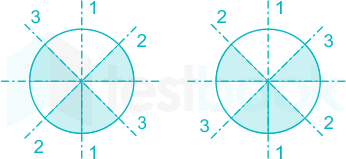
The figure below shows the front and rear view of a disc, which is shaded with identical patterns. The disc is flipped once with respect to any one of the fixed axes 1-1, 2-2 or 3-3 chosen uniformly at random.

What is the probability that the disc DOES NOT retain the same front and rear views after the flipping operation?
  1. ((a))

    0

  2. ((b))

    1/3

  3. ((c))

    2/3

  4. ((d))

    1

Show Answer
Answer: ((c))

2/3

Given:

There are two figures that represent the front and rear view of a disc.

Concept used:

Lines of symmetry are imaginary lines that pass through the center of the shape or object and divide it into identical halves.

Formula used:

Probability to does not retain same view = 1 - Probability to retain the same view

Calculation:

From the front and rear view of the disc, we conclude that the view is only symmetrical about 1-1 axis.

Therefore, the disc will retain the same front and rear views after the flipping operation after flipping about 1-1 axis out of three given axis.

∴ Probability to retain the same front and rear view of the disc = 1/3

∴ The probability that the disc DOES NOT retain the same front and rear views = 1 - 1/3 = 2/3

∴ The probability that the disc DOES NOT retain the same front and rear views after the flipping operation are 2/3.
2

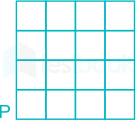
An ant is at the bottom-left corner of a grid (point P) as shown above. It aims to move to the top-right corner of the grid. The ant moves only along the lines marked in the grid such that the current distance to the top-right corner strictly decreases.

Which one of the following is a part of a possible trajectory of the ant during the movement?

  1. ((a))

  2. ((b))

  3. ((c))
  4. ((d))
Show Answer
Answer: ((c))

Given:

An ant is at the bottom-left corner of a grid (point P) in the given figure.

It aims to move to the top-right corner of the grid.

Concept used:

The ant moves only along the lines marked in the grid. We have to justify each option by seeing from the ant's starting position to find the correct option.

Calculation:

The starting position of the ant is point P.

So, options 1 and 2 will be eliminated because there are no starting points at point P.

Also, according to the question, the ant moves only along the lines marked in the grid such that the current distance to the top-right corner strictly decreases.

Hence, option 4 is also incorrect.

If we justify option 3, there is the starting point P and the following line as same as marked in the grid.

Hence, option 3 is the correct answer.

3

As you grow older, an injury to your _________ may take longer to _________.

  1. ((a))

    heel / heel

  2. ((b))

    heal / heel

  3. ((c))

    heal / heal

  4. ((d))

    heel / heal

Show Answer
Answer: ((d))

heel / heal

The correct answer is heel/heal.

Key PointsLet's understand the meanings of these words:

  • Heel: the rounded back part of the foot
  • Heal: cause (a wound, injury, or person) to become sound or healthy again

The sentence conveys the meaning- An injury to your foot may take longer to get healthy again.

Thus, heel is the apt word for blank 1 and heal is the apt word for blank 2.

Complete sentence: As you grow older, an injury to your heel may take longer to heal.

4

Given below are two statements and four conclusions drawn based on the statements.

Statement 1: Some bottles are cups.

Statement 2: All cups are knives. 

Conclusion I: Some bottles are knives.

Conclusion II: Some knives are cups.

Conclusion III: All cups are bottles.

Conclusion IV: All knives are cups.

Which one of the following options can be logically inferred?

  1. ((a))

    Only conclusion I and conclusion II are correct

  2. ((b))

    Only conclusion II and conclusion III are correct

  3. ((c))

    Only conclusion II and conclusion IV are correct

  4. ((d))

    Only conclusion III and conclusion IV are correct

Show Answer
Answer: ((a))

Only conclusion I and conclusion II are correct

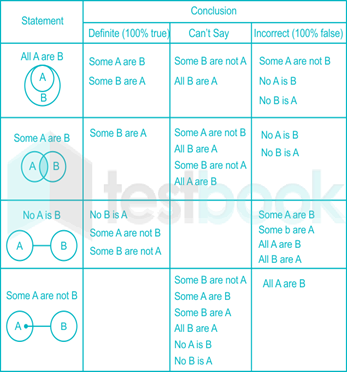
The least possible Venn diagram for the given statement is:

Conclusions:

I. Some bottles are knives → True (As per Venn diagram).

II. Some knives are cups → True (As all the cups are knives then some knives will also be cups is a definite conclusion).

III. All cups are bottles → False (It is possible but not definite).

IV. All knives are cups → False (It is possible but not definite).

Hence, the correct answer is "Option 1".

Additional Information

5

In a 500 m race, P and Q have speeds in the ratio of 3 ∶ 4. Q starts the race when P has already covered 140 m.

What is the distance between P and Q (in m) when P wins the race?

  1. ((a))

    20

  2. ((b))

    40

  3. ((c))

    60

  4. ((d))

    140

Show Answer
Answer: ((a))

20

Given:

Total distance = 500 m

Speed of P : Speed of Q = 3 : 4

Formula used:

Time = Distance/Speed

Calculation:

Let, Speed of P = 3x

Speed of Q = 4x

P already covered distance = 140 m

∴ P's required distance to cover = (500 - 140) = 360 m

Time required for P to cover remaining distance = 360/3x

P cover the distance = 500 m

Q will cover the distance in (360/3x) time = (360/3x) × 4x = (360/3) × 4 = 480 m

∴ Distance between P and Q = (500 - 480) = 20 m

∴​ The distance between P and Q (in m) when P wins the race is 20 m.

6

Altruism is the human concern for the well-being of others. Altruism has been shown to be motivated more by social bonding, familiarity, and identification of belongingness to a group. The notion that altruism may be attributed to empathy or guilt has now been rejected.

Which one of the following is the CORRECT logical inference based on the information in the above passage?

  1. ((a))

    Humans engage in altruism due to guilt but not empathy

  2. ((b))

    Humans engage in altruism due to empathy but not guilt

  3. ((c))

    Humans engage in altruism due to group identification but not empathy

  4. ((d))

    Humans engage in altruism due to empathy but not familiarity

Show Answer
Answer: ((c))

Humans engage in altruism due to group identification but not empathy

The correct answer is Humans engage in altruism due to empathy but not guilt.

Key Points

  • Referring to the above lines, we understand that altruism may be attributed to empathy and has been motivated more by social bonding, familiarity, and identification of belongingness to a group.
  • Thus, option 1 can be negated as it says Humans engage in altruism due to guilt but not empathy.
  • Option 2 can't be the correct answer as it has been said in the passage that empathy and guilt have now been rejected.
  • Option 3 is the correct answer**.** As it has been given in the last line of the passage that empathy and guilt have now been rejected, we can easily infer that Humans do not engage in altruism due to empathy but due to group identification.
  • ​Altruism has been shown to be motivated more by social bonding, familiarity, and identification of belongingness to a group.
  • Option 4 says that Humans engage in altruism due to empathy but not familiarity but it has been mentioned that altruism has been motivated more by social bonding, familiarity, and identification of belongingness to a group.

Thus, the CORRECT logical inference based on the information in the above passage is Humans engage in altruism due to group identification but not empathy.

7

The price of an item is 10% cheaper in an online store S compared to the price at another online store M. Store S charges ₹ 150 for delivery. There are no delivery charges for orders from the store M. A person bought the item from the store S and saved ₹ 100.

What is the price of the item at the online store S (in ₹) if there are no other charges than what is described above?

  1. ((a))

    2500

  2. ((b))

    2250

  3. ((c))

    1750

  4. ((d))

    1500

Show Answer
Answer: ((b))

2250

Given:

The price of an item is 10% cheaper in store S compared to store M.

Delivery charge of store S = ₹ 150

There is no delivery charge of store M.

Calculation:

Let, the price of an item at store S = SP

The price of an item at store M = MP

The price of an item is 10% cheaper in store S compared to store M.

10% = 10/100 = 0.1

According to the question,

SP = (1 - 0.1)MP = 0.9MP

Delivery charge of store S = ₹ 150

There is no delivery charge of store M.

A person bought the item from store S and saved ₹ 100.

Therefore, MP - (SP + 150) = 100

⇒ MP - (0.9MP + 150) = 100

⇒ MP - 0.9MP - 150 = 100

⇒ 0.1MP = 100 + 150 = 250

⇒ MP = 250/0.1 = 2500

∴ The price of an item at store M = ₹ 2500

∴ The price of an item at store S = 0.9 × 2500 = 2250

∴ The price of the item at the online store S (in ₹) if there are no other charges than what is described above is ₹ 2250.

8

The letters P, Q, R, S, T and U are to be placed one per vertex on a regular convex hexagon, but not necessarily in the same order.

Consider the following statements:

  • The line segment joining R and S is longer than the line segment joining P and Q.
  • The line segment joining R and S is perpendicular to the line segment joining P and Q.
  • The line segment joining R and U is parallel to the line segment joining T and Q.

Based on the above statements, which one of the following options is CORRECT?

  1. ((a))

    The line segment joining R and T is parallel to the line segment joining Q and S

  2. ((b))

    The line segment joining T and Q is parallel to the line joining P and U

  3. ((c))

    The line segment joining R and P is perpendicular to the line segment joining U and Q

  4. ((d))

    The line segment joining Q and S is perpendicular to the line segment joining R and P

Show Answer
Answer: ((a))

The line segment joining R and T is parallel to the line segment joining Q and S

Given:

There is a regular convex hexagon in which the letters P, Q, R, S, T, and U are to be placed one per vertex but not necessarily in the same order.

Concept used:

We have to draw the diagram according to the question to find the correct answer from the given options.

Calculation:

According to the question by using given statements, the regular convex hexagon will be like,

From the above diagram, we can easily see that the line segment joining R and T is parallel to the line segment joining Q and S.

Hence, option 1 is correct answer. The line segment joining R and T is parallel to the line segment joining Q and S.

9

Three bells P, Q, and R are rung periodically in a school. P is rung every 20 minutes; Q is rung every 30 minutes and R is rung every 50 minutes.

If all the three bells are rung at 12:00 PM, when will the three bells ring together again the next time?

  1. ((a))

    5:00 PM

  2. ((b))

    5:30 PM

  3. ((c))

    6:00 PM

  4. ((d))

    6:30 PM

Show Answer
Answer: ((a))

5:00 PM

Given:

P bell is rung every 20 minutes.

Q bell is rung every 30 minutes.

R bell is rung every 50 minutes.

All of the three bells are rung at 12:00 PM.

Concept used:

We have to find the LCM of 20, 30, and 50 to find the time which after all three bells will ring together.

Formula used:

1 minute = 1/60 hour

Calculation:

Prime factors of 20 = 2 × 2 × 5

Prime factors of 30 = 2 × 3 × 5

Prime factors of 50 = 2 × 5 × 5

LCM of 20, 30, and 50 = 2 × 2 × 3 × 5 × 5 = 300

∴ All three bells will ring together after 300 minutes.

300 minutes = 300/60 h = 5 hours

∴ All three bells will ring together at (12:00 PM + 5 hours) = 5:00 PM

∴ If all the three bells are rung at 12:00 PM, the three bells will ring together again at 5:00 PM.

10

There are two identical dice with a single letter on each of the faces. The following six letters: Q, R, S, T, U, and V, one on each of the faces. Any of the six outcomes are equally likely. The two dice are thrown once independently at random. What is the probability that the outcomes on the dice were composed only of any combination of the following possible outcomes: Q, U and V ?

  1. ((a))

    1/4

  2. ((b))

    3/4

  3. ((c))

    1/6

  4. ((d))

    5/36

Show Answer
Answer: ((a))

1/4

Given:

There are two identical dice with a single letter on each of the faces: Q, R, S, T, U, V

Formula used:

Probability of outcomes = Total number of favorable outcomes/Total number of possible outcomes

Calculation:

Total faces of each dice = 6

We know that in a single thrown of two dice, the number of possible outcomes = 6 × 6 = 36

Favorable outcomes can be composed of any combination of Q, U, and V are (Q, Q), (U, U), (V, V), (Q, U), (U, Q), (Q, V), (V, Q), (U, V), (V, U).

There are three favorable outcomes that come from each dice.

Total numbers of favorable outcomes can be composed of any combination of Q, U, and V = 9

∴ The probability that the outcomes on the dice can be composed of any combination of Q, U, and V = 9/36 = 1/4

 The probability that the outcomes on the dice were composed only of any combination of the following possible outcomes: Q, U, and V are 1/4.

Electrical Engineering (55 questions)

11

For an ideal MOSFET biased in saturation, the magnitude of the small signal current gain for a common drain amplifier is

  1. ((a))

    0

  2. ((b))

    1

  3. ((c))

    100

  4. ((d))

    infinite

Show Answer
Answer: ((d))

infinite

Concept:

Small signal current gain is defined in common drain amplifier as

AF=IsIg=Source currentGate current\rm A_F = \frac{I_s}{I_g} = \frac{Source \ current}{Gate \ current}

For FET, Ig = 0

∴ Ai=Is0\rm A_i = \frac{I_s}{0} = Infinite

12

The valid positive, negative and zero sequence impedances (in p.u.), respectively, for a 220 kV, fully transposed three-phase transmission line, from the given choices are

  1. ((a))

    1.1, 0.15 and 0.08

  2. ((b))

    0.15, 0.15 and 0.35

  3. ((c))

    0.2, 0.2 and 0.2

  4. ((d))

    0.1, 0.3 and 0.1

Show Answer
Answer: ((b))

0.15, 0.15 and 0.35

Concept:

For a three-phase transmission line, sequence impedances is given as

Z1 = Zs - Zm (+ve sequence impedance)

Z2 = Zs - Zm (-ve sequence impedance)

Z0 = Zs + 2Zm (zero sequence impedance)

Zs = Self impedance, Zm = Mutual impedance

From the above definition of impedances, it is clear that +ve and -ve impedance of transmission line are equal whereas zero sequence impedance is about 2-3 times of +ve sequence impedance.

From the given option, option (b) satisfies the required criteria.

13

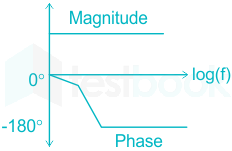
The Bode magnitude plot of a first order stable system is constant with frequency. The asymptotic value of the high frequency phase, for the system, is −180°. This system has

  1. ((a))

    one LHP pole and one RHP zero at the same frequency.

  2. ((b))

    one LHP pole and one LHP zero at the same frequency

  3. ((c))

    two LHP poles and one RHP zero

  4. ((d))

    two RHP poles and one LHP zero

Show Answer
Answer: ((a))

one LHP pole and one RHP zero at the same frequency.

Concept:

From the given bode plot, it is clear that magnitude is constant at all frequencies.

  • Also, it is given a first-order system, hence there exists one finite pole.
  • It can be an all-pass system.
  • The transfer function of the all-pass system is


T.F=1S1+S\rm T.F = \frac{1-S}{1 + S}

Phase angle of T.F is

ϕ = - tan-1ω - tan-1ω

At ω → ∞, ϕ = -180°

It is given in the figure also, at high-frequency phase is equal to -180°.

Therefore, it is an all-pass system having one pole at left and one zero at right at the same frequency.

Therefore, the correct option is (a).

14

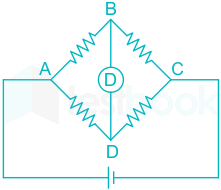
A balanced Wheatstone bridge ABCD has the following arm resistances:

RAB = 1 kΩ ± 2.1% ; RBC = 100 Ω ± 0.5% ; RCD is an unknown resistance;

RDA = 300 Ω ± 0.4%. The value of RCD and its accuracy is

  1. ((a))

    30 Ω ± 3 Ω

  2. ((b))

    30 Ω ± 0.9 Ω

  3. ((c))

    3000 Ω ± 90 Ω

  4. ((d))

    3000 Ω ± 3 Ω

Show Answer
Answer: ((b))

30 Ω ± 0.9 Ω

Concept:

Wheatstone bridge is a device which is usually used for measurement of medium resistance whose value ranges in between 1 ohm to 0.1 Mohm.

Calculation:

Given,

RAB = 1 kΩ ± 2.1 %

RBC = 100 Ω ± 0.5 %

RDA = 300 Ω ± 0.4 %

Under the balanced condition, the product of opposite arms is equal.

∴ RAB × RCD = RBC × RDA

∴ RCD=RBC;×;RDARAB\rm R_{CD}=\frac{R_{BC};\times ;R_{DA}}{R_{AB}}

=(100±0.5%)(300±0.4%)(1000±2.1%)=\frac{(100±0.5\%)(300±0.4\%)}{(1000± 2.1\%)}

= 30 ± 3%

∴ % Error = ± 3%

∴ RCD = 30 ± 30×310030 \times \frac{3}{100} = 30 ± 0.9 Ω

15

The open loop transfer function of a unity gain negative feedback system is given by

G(s)=ks2+4s5\rm G(s) = \frac{k}{s^2 + 4s - 5}

The range of 𝑘 for which the system is stable, is

  1. ((a))

    3

  2. ((b))

    k < 3

  3. ((c))

    k > 5

  4. ((d))

    k < 5

Show Answer
Answer: ((c))

k > 5

Calculation:

Given

T. F = G(S)=kS2+4S5\rm G(S)=\frac{k}{S^2+4S-5}

Routh-Hurwitz criteria can be used to determine the range of k for a stable system.

Characteristic equation , 1 + G(S) = 0

1+kS2+4S5=0\rm 1+\frac{k}{S^2+4S-5}=0

⇒ S2 + 4S - 5 + k = 0

Routh table

S21k - 5
S14
S0k - 5

For a stable system, the element of the first column does not have any sign changes.

For that to happen

k - 5 > 0

or, k > 5

Therefore, option (c) is correct.

16

An inductor having a Q-factor of 60 is connected in series with a capacitor having a Q- factor of 240. The overall Q-factor of the circuit is ________. (round off to nearest integer)

17

Consider a 3 × 3 matrix 𝐴 whose (i, j)-th element, ai, j = (i - j)3 .Then the matrix A will be

  1. ((a))

    symmetric

  2. ((b))

    skew-symmetric

  3. ((c))

    unitary

  4. ((d))

    null

Show Answer
Answer: ((b))

skew-symmetric

Concept:

Square matrix A is said to be skew-symmetric if aij = -aji for all i and j.

In other words, we can say that matrix A is said to be skew-symmetric if the transpose of matrix A is equal to the negative of matrix A i.e, AT = -A.

Also, in a skew-symmetric matrix, the main diagonal elements are zero.

Explanation:

Given A = [aij]3 × 3, aij = (i - j)3

To know about main diagonal elements, put i = j

∴ for i = j ⇒ aij = (i - i)3 = 0 ∀ i

For remaining elements, i ≠ j

∴ For i ≠ j ⇒ aij = (i - j)3 = (-(j - i))3

= -(j - i)3 = -aji

∴ Both the above conditions are satisfied.

Therefore matrix A is skew-symmetric matrix.

18

Two balanced three-phase loads, as shown in the figure, are connected to a 100√3 V, three-phase, 50 Hz main supply. Given Z1 = (18 + j24) Ω and Z2 = (6 + j8) Ω . The ammeter reading, in amperes, is _______. (round off to nearest integer)

19

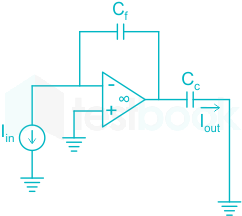
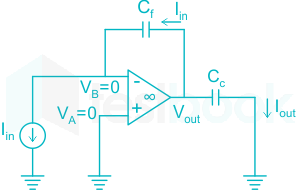
The current gain (Iout/Iin) in the circuit with an ideal current amplifier given below is

  1. ((a))

    CfCc\rm \frac{C_f}{C_c}

  2. ((b))

    CfCc-\rm \frac{C_f}{C_c}

  3. ((c))

    CcCf\rm \frac{C_c}{C_f}

  4. ((d))

    CcCf\rm \frac{-C_c}{C_f}

Show Answer
Answer: ((c))

CcCf\rm \frac{C_c}{C_f}

Concept:

In ideal opp-amp, the input gain is infinity so that the positive side of voltage is zero so the other voltage Vb is also equal to zero

Calculation:

By the figure vout = Iout (Xc)      .........(1)

Xc=1ωcc\rm X_c=\frac{1}{\omega c_c}

VB = 0

Then VoutVBXf=Iin\rm \frac{V_{out}-V_B}{X_f}=I_{in}

Xf=1ωcf\rm X_f=\frac{1}{\omega c_f}

Vout - 0 = Iin (Xf)

Vout = Iin (Xf)     ........(2)

Iin (Xf) = Iout (Xc)

IoutIin=XfXc\rm \frac{I_{out}}{I_{in}}=\frac{X_f}{X_c}

IoutIin=CcCf\rm \frac{I_{out}}{I_{in}}=\frac{C_c}{C_f}

20

The transfer function of a real system, 𝐻(𝑠), is given as:

H(s)=As+Bs2+Cs+DH(s) = \frac{As + B}{s^2 + Cs + D}

where 𝐴, 𝐵, 𝐶 and 𝐷 are positive constants. This system cannot operate as

  1. ((a))

    low pass filter

  2. ((b))

    high pass filter

  3. ((c))

    band pass filter

  4. ((d))

    an integrator

Show Answer
Answer: ((b))

high pass filter

Concept:

To know the information about the type of filter, the magnitude of the transfer function at various frequencies should be known.

  • A low-pass filter should pass the low-frequency component i.e., the gain should be finite at low frequency.
  • A high-pass filter should pass the high-frequency component i.e., the gain should be finite at high frequency.


Explanation:

Let us observe the given transfer function at low and high frequency

H(s)=As+Bs2+Cs+DH(s) = \frac{As + B}{s^2 + Cs + D}

At low frequency, s = 0

∴ H(0)=0+B0+0+D=BD\rm H(0) = \frac{0 + B}{0 + 0 + D} = \frac{B}{D} i.e.  finite

∴ It can be a low pass filter.

At high frequency, s = ∞

∴ H(∞) = As+Bs21+cs+Ds2=0\rm \frac{\frac{A}{s} + \frac{B}{s^2}}{1 + \frac{c}{s} + \frac{D}{s^2}} = 0

Since it is offering zero gain at high frequency, it can not operate as a high pass filter.

Therefore, option (b) is correct.

Note:

For this question as per the official answer key by IIT, the answer is mentioned as B or D, there is a need for a small correction in the question to make the answer options B, that is the term positive constant should not be there in the question, because of that term we can't make the constant A, B, C, and D as zero, so integrator not possible. But we have chosen option B as the best possible answer as it is an MCQ. But in the real exam for both options marks were given.

21

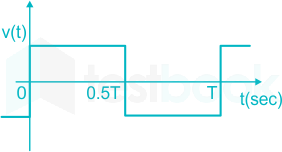
Consider an ideal full-bridge single-phase DC-AC inverter with a DC bus voltage magnitude of 1000 V. The inverter output voltage v(t) shown below, is obtained when diagonal switches of the inverter are switched with 50 % duty cycle. The inverter feeds a load with a sinusoidal current given by, i(t)=10sin(ωtπ3)\rm i(t) = 10 \sin \left( \omega t - \frac{\pi}{3} \right)A, where ω=2πT\rm \omega = \frac{2\pi}{T}. The active power, in watts, delivered to the load is _________. (round off to nearest integer)

22

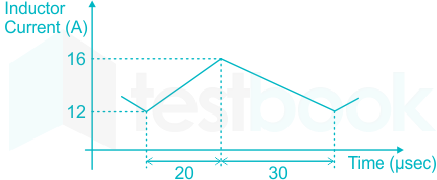
The steady state current flowing through the inductor of a DC-DC buck boost converter is given in the figure below. If the peak-to-peak ripple in the output voltage of the converter is 1 V, then the value of the output capacitor, in µF, is ___________. (round off to nearest integer)

23

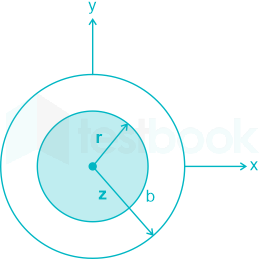
A long conducting cylinder having a radius ‘b’ is placed along the z axis. The current density is J = Jar3ẑ for the region r < b where r is the distance in the radial direction. The magnetic field intensity (H) for the region inside the conductor (i.e. for r < b) is

  1. ((a))

    Ja4r4\rm \frac{J_a}{4} r^4

  2. ((b))

    Ja3r3\rm \frac{J_a}{3} r^3

  3. ((c))

    Ja5r4\rm \frac{J_a}{5} r^4

  4. ((d))

    Jar3

Show Answer
Answer: ((c))

Ja5r4\rm \frac{J_a}{5} r^4

Given:

 J=Jar3z^\rm \vec J = J_a r^3 \hat z

∴ I=sJ.ds;ds=rdrdϕz^\rm I = \int_s \vec J . d \vec s ; d \vec s = r dr d \phi \hat z

⇒ I=Jar3z^.rdrdϕz^\rm I = \int J_a r^3 \hat z . r dr d \phi \hat z

=Jar=0rr4drϕ=02πdϕ\rm = J_a \int_{r = 0}^r r^4 dr \int_{\phi =0}^{2π} d \phi

=Jar550r.ϕ02π=Ja(2π)r55= \rm J_a \left. \frac{r^5}{5}\right|_0^r . \left. \phi \right|_0^{2π} = \frac{J_a (2 π)r^5}{5}

As H.dL=Ienc=sJ.ds\rm \oint \vec H. d \vec L = I_{enc} = \int_s \vec J . d \vec s

⇒ H(2πr) = Ja(2π)r55\rm \frac{J_a (2 \pi)r^5}{5}

⇒ H=Jar45\rm H = \frac{J_a r^4}{5}

24

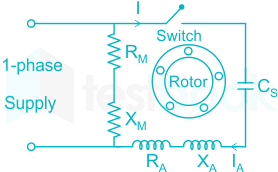
The type of single-phase induction motor, expected to have the maximum power factor during steady state running condition, is

  1. ((a))

    split phase (resistance start)

  2. ((b))

    shaded pole

  3. ((c))

    capacitor start

  4. ((d))

    capacitor start, capacitor run

Show Answer
Answer: ((d))

capacitor start, capacitor run

Concept:

A single phase induction motor is not self starting, To provide starting torque, some modifications are done in the motor so that they have finite torque at starting.

Split phase induction motor: (low starting torque, low power factor)

Current in two windings are not equal therefore, the rotating field is not uniform and the starting torque is small of order of 1.5 to 2 times the rated running torque.

Its performance is noisy and power factor is poor.

→ Because of low starting torques, they are seldom used for drives requiring more than 1 KW.

Capacitor start motor: (High starting torque, low power factor)

  • By choosing a capacitor of the proper rating auxiliary current made to lead by supply.
  • Voltage thus increasing the starting characteristic.
  • Then the capacitor is switched off. So running characteristic is poor.
  • In capacitor start and run motor capacitor is present at both starting and running condition.
  • Therefore its running characteristic is superior among all other 1-phase induction motor.


Shaded pole: low starting torque, low power factor.

25

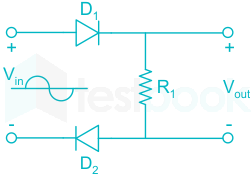
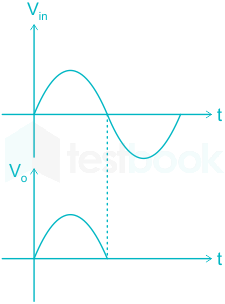
For the circuit shown below with ideal diodes, the output will be

  1. ((a))

    Vout = Vin for Vin > 0

  2. ((b))

    Vout = Vin for Vin​ < 0

  3. ((c))

    Vout = -Vin for Vin​ > 0

  4. ((d))

    Vout = -Vin for Vin​ < 0

Show Answer
Answer: ((a))

Vout = Vin for Vin > 0

Explanation:

For a diode to be forward biased, voltage at anode should be greater that the voltage at cathode.

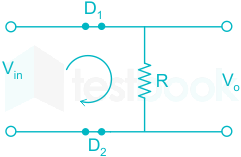
Consider the case when Vin > 0.

Both the diodes will be ON and total source voltage will appear across output voltage

V0 = Vin

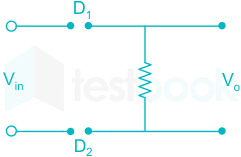
Consider the case for Vin < 0,

Both the diode will be OFF. Hence output voltage will be zero.

The output will be similar to the o/p of half wave rectifier.

26

A MOD 2 and a MOD 5 up-counter when cascaded together results in a MOD ______ counter. (in integer)

27

The maximum clock frequency in MHz of a 4-stage ripple counter, utilizing flip-flops, with each flip-flop having a propagation delay of 20 ns, is ___________. (round off to one decimal place) 

28

The most commonly used relay, for the protection of an alternator against loss of excitation, is

  1. ((a))

    Offset Mho relay

  2. ((b))

    Over current relay

  3. ((c))

    Differential relay

  4. ((d))

    Buchholz relay

Show Answer
Answer: ((a))

Offset Mho relay

Concept:

Loss of Excitation for an Alternator:

  • If excitation of alternator is lost then it will run asynchronously.
  • If it happen for long duration then relative motion between stator field and rotor induces large currents in the rotor body and, therefore, there is high rate of heating of rotor surfaces.
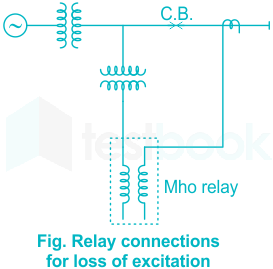
  • So, loss of excitation scheme is arranged to trip after certain time delay with the help of offset mho relay which is operated from AC current and voltage at the generator terminals.

  • The relay setting is so arranged that the relay operates whenever the excitation goes below a certain value and the machine starts running asynchronously.
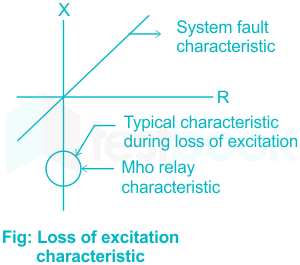
  • Due to failure of excitation, alternator works as an induction generator, drawing reactive power from the grid and hence it operates at leading power factor.
  • As a result of this, the impedance of the induction generator as seen by the relay shifts into the fourth quadrant of the R-X diagram and this impedance swings into off-set mho relay characteristic as shown in the figure given below and the relay will operate.

29

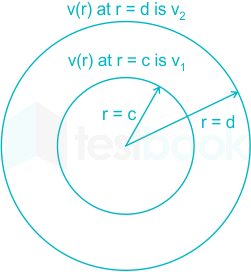
As shown in the figure below, two concentric conducting spherical shells, centered at r = 0 and having radii r = c and r = d are maintained at potentials such that the potential V(r) at r = c is V1 and V2. Assume that V(r) depends only on r, where r is the radial distance. The expression for V(r) in the region between r = c and r = d is

  1. ((a))

    V(r)=cd(V2V1)(dc)rV1c+V2d2V1ddc\rm V(r) = \frac{cd(V_2 - V_1)}{(d-c)r}-\frac{V_1 c + V_2 d - 2V_1 d}{d - c}

  2. ((b))

    V(r)=cd(V1V2)(dc)r+V2dV1cdc\rm V(r) = \frac{cd(V_1 - V_2)}{(d-c)r} + \frac{ V_2 d - V_1 c}{d - c}

  3. ((c))

    V(r)=cd(V1V2)(dc)rV1cV2cdc\rm V(r) = \frac{cd(V_1 - V_2)}{(d-c)r} - \frac{ V_1c - V_2 c}{d - c}

  4. ((d))

    V(r)=cd(V2V1)(dc)rV2cV1cdc\rm V(r) = \frac{cd(V_2 - V_1)}{(d-c)r} - \frac{ V_2c - V_1 c}{d - c}

Show Answer
Answer: ((b))

V(r)=cd(V1V2)(dc)r+V2dV1cdc\rm V(r) = \frac{cd(V_1 - V_2)}{(d-c)r} + \frac{ V_2 d - V_1 c}{d - c}

Concept:

Laplace Equation: It states that the Laplacian of the electric potential field is zero in a source-free region.

2 V = 0

For spherical coordinate system:

2 V = 1r2sinθ[r(r2sinθ1.Vr)]=0\frac{1}{r^2sin\theta}[\frac {\partial}{\partial r}(\frac{r^2sin\theta}{1}.\frac {\partial V}{\partial r})]=0

r2 dvdr{dv \over dr} = A, where A = constant

dvdr{dv \over dr} = Ar2{A \over r^2}

V(r) = Ar+B{-A \over r} + B...............(i)

Case 1: at r = c, V = V1 

Putting values in equation (i), we get:

V1 = Ac+B{-A \over c} + B.....................(ii)

Case 2: at r = d, V = V2 

Putting values in equation (i), we get:

V2 = Ad+B{-A \over d} + B

V1 - V2 = Ac+Ad{-A \over c} + {A \over d}

V1 - V2 = A(cdcd)A({c-d \over cd})

A = (V1V2cd)cd({V_1-V_2 \over c-d})cd...........(iii)

Putting the value of equation (iii) in eq (ii), we will get the value of constant 'B' :

V1 = Ac+B{-A \over c} + B

B = V1+AcV_1+{A \over c}

B = V1 (V1V2cd)cd({V_1-V_2 \over c-d})cd × 1c {1 \over c}

B = V1 + (V1V2cd)d({V_1-V_2 \over c-d})d...............(iv)

Putting values of equation (iii) and (iv) in equation (i), we get:

V(r) = (V1V2cd)cd-({V_1-V_2 \over c-d})cd × 1r {1 \over r} + V1 + (V1V2cd)d({V_1-V_2 \over c-d})d

V(r) = (V1V2)cd(dc)r(V_1-V_2)cd\over(d-c)r + V1 - d(V1V2dc)d({V_1-V_2 \over d-c})

V(r) = (V1V2)cd(dc)r(V_1-V_2)cd\over(d-c)r + V1dV1cV1d+V2ddc{V_1d-V_1c-V_1d+V_2d \over d-c}

V(r)=cd(V1V2)(dc)r+V2dV1cdc\rm V(r) = \frac{cd(V_1 - V_2)}{(d-c)r} + \frac{ V_2 d - V_1 c}{d - c}

30

In the circuit shown below, the switch S is closed at t = 0. The magnitude of the steady state voltage, in volts, across the 6 Ω resistor is _________. (round off to two decimal places)

31

Let R be a region in the first quadrant of the xy plane enclosed by a closed curve C considered in counter-clockwise direction. Which of the following expressions does not represent the area of the region R?

  1. ((a))

    R\iint_R dxdy

  2. ((b))

    c xdy

  3. ((c))

    c ydx

  4. ((d))

    12c(xdyydx)\rm \frac{1}{2} \oint_c (x dy - y dx)

Show Answer
Answer: ((c))

c ydx

Concept:

Area of any region 'R' is given by:

A = R∬_Rdxdy

where A = area

 dx = differential length along x-axis

 by = differential length along y-axis

Area of any region 'R' is also given by " Green's Theorem " which is defined as:

c Mdx + Ndy = R\iint_R (NxMy)dxdy \left(\rm \frac{\partial N}{\partial x} - \frac{\partial M}{\partial y} \right) \rm dx dy

Application:

Option 1: R∬_Rdxdy = Denotes the area of any region 'R' bounded by C

Option 2: From Green's Theorem

c xdy = R(10)dxdy\rm ∬_R (1 - 0) dx dy  = R∬_R dxdy = Denotes the area of any region 'R' bounded by C

Option 3: From Green's Theorem

∮c ydx = R(01)dxdy\rm ∬_R (0 - 1) dx dy = R-∬_R dxdy = Does not denotes the area of any region 'R' bounded by C

Option 4: From Green's Theorem

12c(xdyydx)\rm \frac{1}{2} \oint_c (x dy - y dx) = 12R\frac{1}{2} ∬_R (1 - (-1) dxdy = R∬_R dxdy = Denotes the area of any region 'R' bounded by C

Therefore, option 3 is correct.

32

A single-phase full-bridge diode rectifier feeds a resistive load of 50 Ω from a 200 V, 50 Hz single phase AC supply. If the diodes are ideal, then the active power, in watts, drawn by the load is __________. (round off to nearest integer). 

33

The discrete-time Fourier series representation of a signal x[n] with period N is written as x[n]=k=0N1akej(2knπ/N)\rm x[n] = \sum_{k = 0}^{N - 1} a_k e^{j(2kn\pi/N)}. A discrete-time periodic signal with period N = 3, has the non-zero Fourier series coefficients: a-3 = 2 and a4 = 1. The signal is

  1. ((a))

    2+2e(j2π6n)cos(2π6n)\rm 2 + 2e^{- \left( j \frac{2\pi}{6} n \right) }\cos \left( \frac{2 \pi}{6} n\right)

  2. ((b))

    1+2e(j2π6n)cos(2π6n)\rm 1 + 2e^{ \left( j \frac{2\pi}{6} n \right) }\cos \left( \frac{2 \pi}{6} n\right)

  3. ((c))

    1+2e(j2π3n)cos(2π6n)\rm 1 + 2e^{ \left( j \frac{2\pi}{3} n \right) }\cos \left( \frac{2 \pi}{6} n\right)

  4. ((d))

    2+2e(j2π6n)cos(2π6n)\rm 2 + 2e^{ \left( j \frac{2\pi}{6} n \right) }\cos \left( \frac{2 \pi}{6} n\right)

Show Answer
Answer: ((b))

1+2e(j2π6n)cos(2π6n)\rm 1 + 2e^{ \left( j \frac{2\pi}{6} n \right) }\cos \left( \frac{2 \pi}{6} n\right)

Concept:

Discrete-time Fourier series is given by:

x[n]=k=0N1akej(2knπ/N)\rm x[n] = \sum_{k = 0}^{N - 1} a_k e^{j(2kn\pi/N)}

where N = time period

In discrete-time Fourier series, coefficients are periodic with the same time period of input signal x[n].

Therefore, ak = ak+N

m = any positive integer

Calculation:

Given, N = 3 

a-3 = 2 and a4 = 1

ak = ak+N

a-3 = a-3+3

a-3 = a0 = 2

a1 = a1+3

a1 = a4 = 1

Expanding Fourier series by putting values of k = 0 and 1

x[n]=a0ej(2(0)nπ/3)+a1ej(2(1)nπ/3)\rm x[n] = a_0 e^{j(2(0)n\pi/3)} + a_1 e^{j(2(1)n\pi/3)}

x[n]=a0ej0+a1ej(2nπ/3)\rm x[n] = a_0 e^{j0} + a_1 e^{j(2n\pi/3)}

x[n]=2+1ej(2nπ/3)\rm x[n] = 2 + 1 e^{j(2n\pi/3)}

x[n]=1+1+1ej(2nπ/3)\rm x[n] = 1 +1 + 1 e^{j(2n\pi/3)}

x[n]=1+ej(2nπ/6)ej(2nπ/6)+1ej(2nπ/3)\rm x[n] = 1 + e^{j(2n\pi/6)} e^{j(-2n\pi/6)} + 1 e^{j(2n\pi/3)}

x[n]=1+ej(2nπ/6)×(ej(2nπ/6)+ej(2nπ/6))\rm x[n] = 1 + e^{j(2n\pi/6)} \times (e^{j(2n\pi/6)}+e^{-j(2n\pi/6)})

x[n]=1+ej(2nπ/6)×2ej(2nπ/6)+ej(2nπ/6)2\rm x[n] = 1 + e^{j(2n\pi/6)} \times 2{e^{j(2n\pi/6)}+e^{-j(2n\pi/6)}\over2}

∵ ej(2nπ/6)+ej(2nπ/6)2e^{j(2n\pi/6)}+e^{-j(2n\pi/6)}\over2 = cos(2π6n)cos \left( \frac{2 \pi}{6} n\right)

x[n]=1+2e(j2π6n)cos(2π6n)\rm x[n] =\rm 1 + 2e^{ \left( j \frac{2\pi}{6} n \right) }\cos \left( \frac{2 \pi}{6} n\right)

34

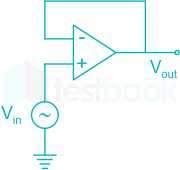
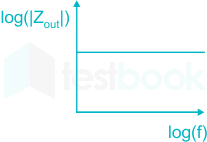
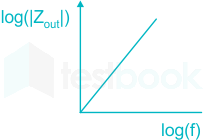
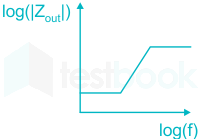
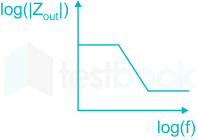
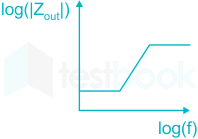
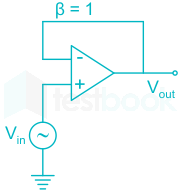
The output impedance of a non-ideal operational amplifier is denoted by Zout. The variation in the magnitude of Zout with increasing frequency, f, in the circuit shown below, is best represented by

  1. ((a))

  2. ((b))

  3. ((c))

  4. ((d))

Show Answer
Answer: ((c))

Output impedence = Zout1+AoLβ\frac{Z_{out}}{1 + A_{oL} β}

Zout = output impedence without feedback

AoL = open loop gain

β = 1

⇒ Output impedence (with feedback) = Zout1+AoL\frac{Z_{out}}{1 + A_{oL}}

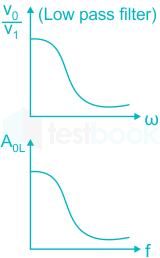
⇒ OP-AMP is behave as a low pass filter.

Low pass filter:

It passes the all small frequencies

⇒ V0Vi\left| \frac{V_0}{V_i} \right| will be maxed at low frequency and V0Vi\left| \frac{V_0}{V_i} \right| will be zero at maximum frequencies

As open loop gain decrease, the output impedence with feedback increases.

so that option (1) 

35

If only 5% of the supplied power to a cable reaches the output terminal, the power loss in the cable, in decibels, is _________. (round off to nearest integer) 

36

Consider a matrix A=[100042011]\rm A = \begin{bmatrix} 1 & 0 & 0 \\ 0 & 4 & -2 \\ 0 & 1 & 1 \end{bmatrix}

The matrix A satisfies the equation 6A-1 = A2 + cA + dI, where c and d are scalars and I is the identity matrix. Then (c + d) is equal to

  1. ((a))

    5

  2. ((b))

    17

  3. ((c))

    -6

  4. ((d))

    11

Show Answer
Answer: ((a))

5

Concept:

for the given square matrix, the characteristic equation will be

|B - AI| = 0

B = Given matrix

I = Unit matrix

[100010001];\begin{bmatrix}1&0&0\\ 0&1&0\\ 0&0&1\end{bmatrix};

A = Characteristic roots

Calculation:

|B - AI| = 0

[100042011]\begin{bmatrix}1&0&0\\ 0&4&-2\\ 0&1&1\end{bmatrix} - A [100010001]\begin{bmatrix}1&0&0\\ 0&1&0\\ 0&0&1\end{bmatrix} = 0

[1A0004A2011A]=0;\rm \begin{bmatrix}1-A&0&0\\ 0&4-A&-2\\ 0&1&1-A\end{bmatrix}=0;

Take the determinant of matrix, then 

(1 - A) [(4 - A) (1 - A) + 2] = 0

(1 - A) [4 - 4A - A + A2 + 2] = 0

(1 - A) [4 - 5A + A2 + 2] = 0

(1 - A) [A2 - 5A + 6] = 0

A2 - 5A + 6 - A3 + 5A2 - 6A = 0

-A3 + 6A2 - 11A + 6 = 0

A3 - 6A2 + 11A = 6

A2 - 6A + 11 = 6A-1       ........(1)

Given 6A-1 = A2 + cA + dI     .........(2)

Compare 1 and 2

c = -6, d = +11

c + d = +5

37

The network shown below has a resonant frequency of 150 kHz and a bandwidth of 600 Hz. The Q-factor of the network is __________. (round off to nearest integer)

38

An LTI system is shown in the figure where

G(s)=100s2+0.1s+100\rm G(s) = \frac{100}{s^2 + 0.1s + 100}

The steady state output of the system, to the input r(t), is given as

y(t) = a + b sin(10t + θ). The value of 'a' and 'b' will be

  1. ((a))

    a = 1, b = 10

  2. ((b))

    a = 10, b = 1

  3. ((c))

    a = 1, b = 100

  4. ((d))

    a = 100, b = 1

Show Answer
Answer: ((a))

a = 1, b = 10

r(t) = 1 + 0.1 sin(10t) → DC component ⇒ 1

G(s)=100s2+0.1s+100\rm G(s) = \frac{100}{s^2 + 0.1s + 100} ⇒ AC component ⇒ 0.1 sin(10t) 

ω ⇒ 10

r(t) = a + b sin(10t + θ)

Transfer function ⇒ |G(jω)|

G(jω)=100ω2+0.1jω+100\rm G(j ω) = \frac{100}{- ω^2 + 0.1 j ω + 100}

First take dc component and put ω = 0 in G(jω)

Then Transfer function = 100100=1\frac{100}{100} = 1

So that value of a = 1

Second take AC component, and put ω = 10 in G(jω)

G(jω)=100100+0.1jωω2ω=10x0.1\rm G(j \omega) = \left| \frac{100}{100 + 0.1 j \omega - \omega^2} \right|_{\omega = 10}^{x 0.1}

Then b = 10

So that a = 1

b = 10

39

The open loop transfer function of unity gain negative feedback system is given as

G(s)=1s(s+1)\rm G(s) = \frac{1}{s(s + 1)}

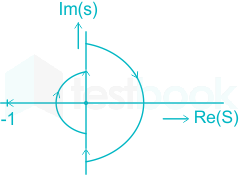
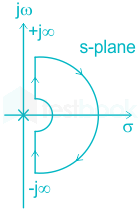
The Nyquist contour in the 𝑠-plane encloses the entire right half plane and a small neighborhood around the origin in the left half plane, as shown in the figure below. The number of encirclements of the point (−1 + j0) by the Nyquist plot of G(s), corresponding to the Nyquist contour, is denoted as N. Then N equals to

  1. ((a))

    0

  2. ((b))

    1

  3. ((c))

    2

  4. ((d))

    3

Show Answer
Answer: ((b))

1

Concept

The number of encirclements of the critical point (-1+j0) is given by

N = P - Z

where N = no. of encirclements of critical point (-1 + j0) in anti-clockwise direction

P = No. of open-loop poles in the right half of s plane

Z = No. of closed-loop poles in the right half of s plane

For stability Z = 0

N = P 

Note: Above formula is valid only when the Nyquist contour is defined for the entire right half of the s-plane and excluding the poles at the origin.

The rotation of the contour must be clockwise and the encirclement of the critical point is in an anti-clockwise direction.

Calculation

Given, G(s)=1s(s+1)\rm G(s) = \frac{1}{s(s + 1)}

The open loop poles are present at s = 0,-1

Closed loop transfer function = 1s2+s+1\frac{1}{s^2 + s + 1}

No. of the closed pole on the right-hand side is 0.

Z = 0

But in the question, Nyquist contour is defined for the entire right half of the s-plane and includes the pole at the origin also.

Hence, the open loop pole at s = 0 is considered as the pole in the right half of the s-plane.

N = P - Z

N = 1 - 0

Z = 1

Mistake Point While applying the formula N = P - Z, check the region of the Nyquist contour whether it includes the origin or not, and then put the value of open-loop poles in the formula accordingly.

40

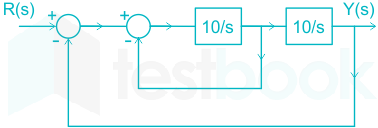
The damping ratio and undamped natural frequency of a closed loop system as shown in the figure, are denoted as 𝜁 and ωn respectively. The values of 𝜁 and ωn are

  1. ((a))

    𝜁 = 0.5 and ωn = 10 rad/s

  2. ((b))

    𝜁 = 0.1 and ωn = 10 rad/s

  3. ((c))

    𝜁 = 0.707 and ωn = 10 rad/s

  4. ((d))

    𝜁 = 0.707 and ωn = 100 rad/s

Show Answer
Answer: ((a))

𝜁 = 0.5 and ωn = 10 rad/s

Concept:

Mason’s gain formula-  It is applied between input and output nodes only

Mason's gain formula

Transfer function ⇒ K=1nMKΔKΔ\rm \frac{\sum_{K = 1}^n M_K Δ_K}{Δ}

n = no. of forward path

MK = Kth forward path gain

ΔK = the value of Δ, which is not touching the Kth FBMK

Δ = Determinant

Δ = 1 -(sum of the loop gain) + (sum of the gain product of two non-touching loops) - (sum of the gain product of non-touching loop) ...so on

Second-order equation of center system:

C(R)C(S)\rm \frac{C(R)}{C(S)}  ⇒ Transfer function ⇒ ωn2s2+2ξωn+ωn2\rm \frac{ω_n^2}{s^2 + 2 ξ ω_n + ω_n^2} ....(1)

Calculation:

The transfer function of given figure:

T.F. ⇒ 10s×10s1+10s+100s\rm \frac{\frac{10}{s} \times \frac{10}{s}}{1 + \frac{10}{s} + \frac{100}{s}}

T.F ⇒ 100s2+10s+100\frac{100}{s^2 + 10s + 100}   ...(2)

Compare equation (1) and (2)

ωn2=100ω_n^2= 100

ωn = 10

2ξωn = 10

ξ = 0.5

41

eA denotes the exponential of a square matrix A. Suppose λ is an eigenvalue and ν is the corresponding eigen-vector of matrix A.

Consider the following two statements:

Statement 1: eλ is an eigenvalue of eA.

Statement 2: ν is an eigen-vector of eA

Which one of the following options is correct?

  1. ((a))

    Statement 1 is true and statement 2 is false

  2. ((b))

    Statement 1 is false and statement 2 is true

  3. ((c))

    Both the statements are correct

  4. ((d))

    Both the statements are false

Show Answer
Answer: ((c))

Both the statements are correct

Concept -

If there exist eigenvector V corresponding to eigenvalue λ then the relation of matrix A is given by

AV = λV

The value of ex=1+x+x22!+x33!+...\rm e^x = 1 + x + \frac{x^2}{2!} + \frac{x^3}{3!} + ...

Calculation:

eA=1+A+A22!+A33!+...\rm e^A = 1 + A + \frac{A^2}{2!} + \frac{A^3}{3!} + ...

multiply by 'V'

eA.V=V+AV+A2V2!+A3V3!+...\rm e^A.V = V+ AV + \frac{A^2V}{2!} + \frac{A^3V}{3!} + ...

AV = λV

eA.V=V+λV+λ2V2!+λ3V3!+...\rm e^A.V = V+ λ V + \frac{λ^2V}{2!} + \frac{λ^3V}{3!} + ...

eA.V=V[1+λ+λ22!+....]\rm e^A.V = V \left[ 1 + λ + \frac{λ^2}{2!} + .... \right]

eA.V = V.eλ

so Both the statement are correct

42

The frequencies of the stator and rotor currents flowing in a three-phase 8-pole induction motor are 40 Hz and 1 Hz, respectively. The motor speed, in rpm, is _________. (round off to nearest integer)

43

Let f(x) = 0xet(t1)(t2)dt\rm \int_0^x e^t (t - 1) (t - 2) dt then f(x) decreases in the interval

  1. ((a))

    𝑥 ∈ (1, 2)

  2. ((b))

    𝑥 ∈ (2, 3)

  3. ((c))

    𝑥 ∈ (0, 1)

  4. ((d))

    𝑥 ∈ (0.5, 1)

Show Answer
Answer: ((a))

𝑥 ∈ (1, 2)

Concept:

Test for Increasing and Decreasing functions:-

Let f(x) be continuous on closed internal (a, b) and differentiable on the open interval i.e a < x < b. Then if,

  1. f'(x) > 0 for all x ∈ (a, b) then f(x) is Increasing on (a, b) 2. f'(x) < 0 or all x ∈ (a, b) then f(x) is Decreasing on (a, b)

Calculation:

f(x)=ddxf(x)<0\rm f'(x)=\frac{d}{dx}f(x)<0

⇒ ex(x1)(x2)ddx(x)[e0(01)(02)]×[ddx(0)]\rm e^x(x-1)(x-2)\frac{d}{dx}(x)-[e^0(0-1)(0-2)]\times\left[\frac{d}{dx}(0)\right]

f'(x) = [ex (x - 1) (x - 2)] - 0 < 0

= (x - 1) (x - 2) < 0

= x > 1 and x < 2

= x ∈ (1, 2)

44

A 280 V, separately excited DC motor with armature resistance of 1 Ω and constant field excitation drives a load. The load torque is proportional to the speed. The motor draws a current of 30 A when running at a speed of 1000 rpm. Neglect frictional losses in the motor. The speed, in rpm, at which the motor will run, if an additional resistance of value 10 Ω is connected in series with the armature, is __________. (round off to nearest integer) 

45

The fuel cost functions in rupees/hour for two 600 MW thermal power plants are given by

Plant 1: C1 = 350 + 6P1 + 0.004 (P1)2

Plant 2: C2 = 450 + aP2 + 0.003 (P2)2

where P1 and P2 are power generated by plant 1 and plant 2, respectively, in MW and a is constant. The incremental cost of power (λ) is 8 rupees per MWh. The two thermal power plants together meet the total power demand of 550 MW. The optimal generation of plant 1 and plant 2 in MW, respectively, are

  1. ((a))

    200, 350

  2. ((b))

    250, 300

  3. ((c))

    325, 225

  4. ((d))

    350, 200

Show Answer
Answer: ((b))

250, 300

Concept

Incremental cost:

The ratio of a small change in input to the corresponding small change in output is called Incremental cost

Incremental cost = dCdP\rm \frac{dC}{dP}

C = Fuel cost

dCdP=λ\rm \frac{dC}{dP}=λ

Calculation:

Given C1 = 350 + 6P1 + 0.004P12\rm P_1^2

dC1dP=6+0.008P1=λ\rm \frac{dC_1}{dP}=6+0.008P_1=λ

Given λ = 8

6 + 0.008P1 = 8

P1 = 250 MW

Total Demand = 500 MW

P1 = 250 MW

P2 = 550 - 250 = 300 MW

(no need to calculate the value of a)

P1 = 250 MW, P2 = 300 MW

46

The voltage at the input of an AC-DC rectifier is given by v(𝑡) = 230√2 sin 𝜔𝑡 where 𝜔 = 2𝜋 × 50 rad/s. The input current drawn by the rectifier is given by

i(t)=10sin(ωtπ3)+4sin(3ωtπ6)+3sin(5ωtπ3)\rm i(t) = 10 \sin \left( \omega t - \frac{\pi}{3} \right) + 4 \sin \left( 3\omega t - \frac{\pi}{6} \right) + 3 \sin \left( 5\omega t - \frac{\pi}{3} \right)

The input power factor, (rounded off to two decimal places), is, __________ lag.

47

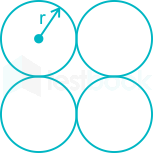
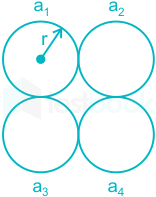
The geometric mean radius of a conductor, having four equal strands with each strand of radius ‘𝑟’, as shown in the figure below, is

  1. ((a))

    4r

  2. ((b))

    1.414r

  3. ((c))

    2r

  4. ((d))

    1.723r

Show Answer
Answer: ((d))

1.723r

Concept:

GMR is defined as the effective distance over which self magnetic flux linkages occur

For a solid conductor with radius r,

GMR = r' = 0.7788r

GMR is less than the physical radius of the conductor.

In the given figure, standard conductor with four identical strands touching each other is given with equal radius r.

GMRa1=(r×2r×2r×22r)14\rm GMR_{a_1} = ( r' \times 2r \times 2r \times 2\sqrt 2 r)^{\frac{1}{4}}

= 1.722 r

Since each strands are identical.

∴ GMR of conductor will be equal to GMR of strand i.e.,

GMRcond = GMRa1

= 1.722 r

Therefore, correct option is (d)

48

If the magnetic field intensity (H) in a conducting region is given by the expression,

H=x2i^+x2y2j^+x2y2z2k^\rm H = x^2 \hat i + x^2 y^2 \hat j + x^2 y^2 z^2 \hat k A/m. The magnitude of the current density, in A/m2, at x = 1 m, y = 2 m, and z = 1 m, is

  1. ((a))

    8

  2. ((b))

    12

  3. ((c))

    16

  4. ((d))

    20

Show Answer
Answer: ((b))

12

Concept

Ampere's law:-

It states that the line integral of magnetic field intensity around any closed path = direct current enclosed by that path

LHdl=sJ.ds\rm \oint_L \vec{H} \vec{dl}=\int_s \vec J.\vec {ds}

s×H.dssJ.ds\rm \int_s \nabla\times \vec H.\vec {ds}\Rightarrow \int_s \vec J.\vec {ds}

×H=J\rm \nabla \times \vec H=\vec J → maxwall's equation

It is the Differential form of ampere's law

Calculation

J=×H\rm \vec J=\nabla\times \vec H

\(\rm |\vec J|=\begin{vmatrix}̂ i&̂ j&̂ k\\ \frac{\partial}{\partial x}&\frac{\partial}{\partial y}&\frac{\partial}{\partial z}\\ x^2& x^2y^2&x^2y^2z^2\end{vmatrix}\)

then solve the matrix

J=^i(2x2yz20)^j(2xy2z20)+^k(2xy20)\rm \vec J=̂ i(2x^2yz^2-0)-̂ j(2xy^2z^2-0)+̂ k(2xy^2-0)

= 4î - 8ĵ +8k̂

j=42+82+82\rm |\vec j|=\sqrt{4^2+8^2+8^2}

= 12

Current Density = 12

49

A 3-phase, 415 V, 4-pole, 50 Hz induction motor draws 5 times the rated current at rated voltage at starting. It is required to bring down the starting current from the supply to 2 times of the rated current using a 3-phase autotransformer. If the magnetizing impedance of the induction motor and no load current of the autotransformer is neglected, then the transformation ratio of the autotransformer is given by ____________. (round off to two decimal places).

50

A charger supplies 100 W at 20 V for charging the battery of a laptop. The power devices, used in the converter inside the charger, operate at a switching frequency of 200 kHz. Which power device is best suited for this purpose?

  1. ((a))

    IGBT

  2. ((b))

    Thyristor

  3. ((c))

    MOSFET

  4. ((d))

    BJT

Show Answer
Answer: ((c))

MOSFET

Explanation:

In this question, it is asked at a switching frequency of as high as 200 kHz, which device will be best suited.

Let's see all the options:-

Thyristor - It has stored charged carrier near its gate-cathode junction. Therefore, for removal of these charge carrier it takes source time. It is not suitable for fast switching.

BJT - It is having law conduction has but high switching loss. Therefore it is not suitable for high switching frequency.

MOSFET & IGBT both devices are suitable for operating at high frequency but compared to MOSFET, IGBT having less suitability at high frequency. Therefore MOSFET is best suited for above mentioned frequency.

51

Let a causal LTI system be governed by the following differential equation

y(t)+14dydt=2x(t)\rm y(t) + \frac{1}{4} \frac{dy}{dt} = 2x(t) where x(𝑡) and y(𝑡) are the input and output respectively.

Its impulse response is

  1. ((a))

    \(\rm 2e^\left( - \frac{1}{4} t \right) u(t)\)

  2. ((b))

    2e4tu(t)\rm 2e^{-4t} u(t)

  3. ((c))

    8e14tu(t)\rm 8e^ {- \frac{1}{4} t} u(t)

  4. ((d))

    8e4tu(t)\rm 8e^{-4t} u(t)

Show Answer
Answer: ((d))

8e4tu(t)\rm 8e^{-4t} u(t)

Concept:

The transfer function for a control system is defined as:

H(s) = Y(s)X(s) {Y(s) \over X(s)}

where H(s) = Transfer function

Y(s) = Output function

X(s) = Input function

The impulse response for a control system is also known as the transfer function of the system.

Explanation:

y(t)+14dydt=2x(t)\rm y(t) + \frac{1}{4} \frac{dy}{dt} = 2x(t)

Taking Laplace Transform on both sides:

∵ dydtdy\over dt = sY(s)

Y(s)+14sY(s)=2X(s)\therefore \rm Y(s) + \frac{1}{4} sY(s) = 2X(s)

Y(s) (1+s4)(1+{s\over 4})  = 2X(s)

Y(s) = 2X(s)

Y(s)X(s){Y(s)\over X(s)} = 8s+4{8\over s+4}

Taking Inverse Laplace Transform on both sides:

1s+a{ 1\over s+a}  = e-at u(t)

y(t)x(t){y(t)\over x(t)} = 8e-4t u(t)

52

Let an input x(t) = 2 sin(10πt) + 5 cos(15πt) + 7 sin(42πt) + 4 cos(45πt) is passed through an LTI system having an impulse response

h(t)=2(sin(10πt)πt)cos(40πt)\rm h(t) = 2 \left( \frac{\sin (10 \pi t)}{\pi t} \right) \cos (40 \pi t)

The output of the system is

  1. ((a))

    2 sin(10πt) + 5 cos(15πt)

  2. ((b))

    5 cos(10πt) + 7 sin(15πt)

  3. ((c))

    7 sin(42πt) + 4 cos(45πt)

  4. ((d))

    2 sin(10πt) + 4 cos(45πt)

Show Answer
Answer: ((c))

7 sin(42πt) + 4 cos(45πt)

Concept:

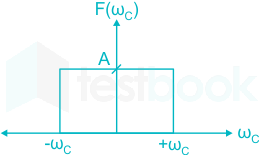
Fourier Transform of any time-domain function f(t) = Asinωctπt {A sin ω_ct \over π t} is defined by:

If f(t) is multiplied by any cosine term, then modified F(ω) is given by:

f(t) cos(ωt) = f(wcw)+f(wc+w)2 {f(w_c-w)+f(w_c+w)\over 2}

Calculation:

Given, f(t) = 2sin10πtπt {2sin 10π t \over π t}

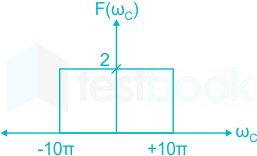
F(ωc) is given as:

f(t) cos(40πt) = f(wc40π)+f(wc+40π)2 {f(w_c-40π )+f(w_c+40π )\over 2}

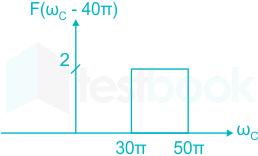
Applying shifting property in F(ω), we get f(ωc - 40π) as:

      ---(i)

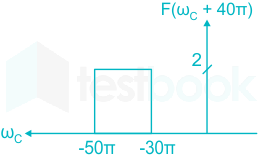
Applying shifting property in F(ω), we get f(ωc + 40π) as:

      ---(ii)

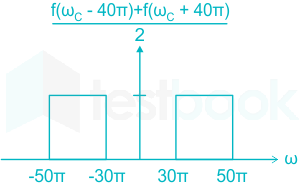
Adding equations (i) and (ii) and dividing their sum by 2, we get:


  • input x(t) = 2 sin(10πt) + 5 cos(15πt) + 7 sin(42πt) + 4 cos(45πt) has four different frequencies 10π , 15π , 42π and 50π .
  • Frequency 10π and 15π lie outside the frequency band of above shown Fourier transform and will not pass, only frequency components 42π and 50π will pass.

Therefore, output y(t) = 7 sin(42πt) + 4 cos(45πt)

53

Let the probability density function of a random variable x be given as

f(x) = ae-2|x|

The value of ‘a’ is __________.

54

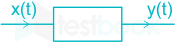
Consider the system as shown below

where y(t) = x(et). The system is

  1. ((a))

    linear and causal.

  2. ((b))

    linear and non-causal.

  3. ((c))

    non-linear and causal.

  4. ((d))

    non-linear and non-causal.

Show Answer
Answer: ((b))

linear and non-causal.

Concept:

A system is said to be linear if it satisfies the homogeneity and superposition principle.

  • If any input x(t) is multiplied by factor 'a' and output y(t) also gets multiplied by the same factor 'a', then the system is said to be following the homogeneity principle.
  • For any input { x1(t) + x2(t) } to a system, if output is { y1(t) + y2(t) }, then the system is said to be following superposition principle.

A system is said to be causal if the output of the system at all instant depends only on past and present values of input.

Application:

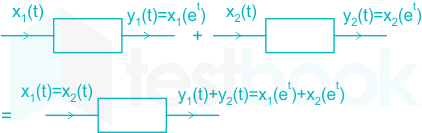
Checking for linearity:

Condition 1: Homogeneity Principle

Condition 2: Superposition Principle

The above system equation satisfies the principle of homogeneity and superposition.

Therefore, y(t) = x(et) is linear.

Checking for causality:

y(0) = x(e0)

y(0) = x(1)

Since the output of the system is depending upon future values of input.

Therefore, y(t) = x(et) is non-causal.

Important Points If any operation is performed on system input x(t), then it makes the system non-linear.

In the above-given problem, operation (et) is being performed on the time period 't' instead of x(t), therefore the system remains to be linear in nature.

Mistake Points If exponential operation 'e' is performed on x(t) in the form of ex(t), then the system becomes non-linear.

55

A star-connected 3-phase, 400 V, 50 kVA, 50 Hz synchronous motor has a synchronous reactance of 1 ohm per phase with negligible armature resistance. The shaft load on the motor is 10 kW while the power factor is 0.8 leading. The loss in the motor is 2 kW. The magnitude of the per phase excitation emf of the motor, in volts, is __________. (round off to nearest integer).

56

Let, f(x, y, z) = 4x2 + 7xy + 3xz2. The direction in which the function f(x, y, z) increases most rapidly at point P = (1, 0, 2) is

  1. ((a))

    20î + 7ĵ 

  2. ((b))

    20î + 7ĵ + 12k̂

  3. ((c))

    20î + 12k̂

  4. ((d))

    20î

Show Answer
Answer: ((b))

20î + 7ĵ + 12k̂

Concept:

The gradient of a function f(x, y, z) is given by:

f=fxi+fyj+fzk\rm ∇ f = \frac{\partial f}{\partial x} i + \frac{\partial f}{\partial y} j + \frac{\partial f}{\partial z} k

where i, j, and k are the unit vectors along the x, y, and z-axis respectively.

The gradient of any function f(x, y, z) represents the direction of the greatest rate of increase of any scalar field function.

Calculation:

Given, f(x, y, z) = 4x2 + 7xy + 3xz2

\(∇ f = \frac{\partial (4x^2 + 7 xy + 3xz^2)}{\partial x} ̂ i + \frac{\partial (4x^2 + 7 xy + 3xz^2)}{\partial y} ̂ j + \frac{\partial (4x^2 + 7 xy + 3xz^2)}{\partial z} ̂ k\)

∇ f = (8x + 7y + 3z2)î + (7x)ĵ + (6xz)k̂

Gradient of a function f(x, y, z) at P = (1, 0, 2) is:

∇ f = 20î + 7ĵ + 12k̂

57

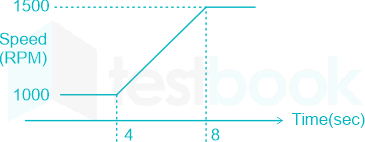
A 4-pole induction motor with the inertia of 0.1 kg-m2 drives a constant load torque of 2 Nm. The speed of the motor is increased linearly from 1000 rpm to 1500 rpm in 4 seconds as shown in the figure below. Neglect losses in the motor. The energy, in joules, consumed by the motor during the speed change is ____________. (round off to nearest integer)

58

In the circuit shown below, the magnitude of the voltage V1 in volts, across the 8 kΩ resistor is __________. (round off to nearest integer)

59

Two generating units rated for 250 MW and 400 MW have governor speed regulations of 6% and 6.4%, respectively, from no load to full load. Both the generating units are operating in parallel to share a load of 500 MW. Assuming free governor action, the load shared in MW, by the 250 MW generating unit is _________. (round off to nearest integer)

60

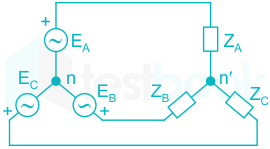
In the circuit shown below, a three-phase star-connected unbalanced load is connected to a balanced three-phase supply of 100√3 V with phase sequence ABC. The star connected load has ZA = 10 Ω and ZB = 20∠60° Ω. The value of ZC in Ω, for which the voltage difference across the nodes n and n′ is zero, is

  1. ((a))

    20∠−30°

  2. ((b))

    20∠30°

  3. ((c))

    20∠−60°

  4. ((d))

    20∠60°

Show Answer
Answer: ((c))

20∠−60°

Calculation:

In the given figure, a γ - connected balanced source is connected to γ - connected unbalanced load.

In a balanced source, voltages are equal in magnitude and phase displaced by 120°.

EA = 100 ∠0°

EB = 100 ∠-120°

EC = 100 ∠120° = 100 ∠-240°

In γ - connection, phase voltage = Line voltage3\rm \frac{Line\ voltage}{\sqrt3}

Given, ZA = 10 Ω = 10 ∠0°, ZB = 20 ∠60°

∴ IA=EAZA=1000100=100 \rm I_A=\frac{E_A}{Z_A}=\frac{100 ∠ 0^{\circ}}{10∠ 0^{\circ}}=10∠ 0^\circ\

∴ IB=EBZB=1001202060=5180 \rm I_B=\frac{E_B}{Z_B}=\frac{100 ∠ -120^{\circ}}{20∠ 60^{\circ}}=5∠ -180^\circ\

Since the potential difference between n and n' is zero

therefore,

IA+IB+IC=0\vec{I_A}+\vec{I_B}+\vec{I_C}=0

⇒ IC=(IA+IB) \vec{I_C}=-(\vec{I_A}+\vec{I_B})\

=(100+5180)=-(10∠ 0^{\circ}+5∠ -180^{\circ})

= 5 ∠180°

∴ ZC=ECIC=1002405180\rm Z_C=\frac{E_C}{I_C}=\frac{100∠ -240^{\circ}}{5∠ 180^{\circ}}

= 20 ∠-60° Ω

Therefore, Correct option is (b)

61

A 20 MVA, 11.2 kV, 4-pole, 50 Hz alternator has an inertia constant of 15 MJ/MVA. If the input and output powers of the alternator are 15 MW and 10 MW, respectively, the angular acceleration in mechanical degree/s2 is __________. (round off to nearest integer)

62

Let E(x,y,z)=2x2i^+5yj^+3zk^\rm \vec E (x, y, z) = 2x^2 \hat i + 5y \hat j + 3 z \hat k The value of ∭V (.E)dV(\vec \nabla . \vec E) dV, where V is the volume enclosed by the unit cube defined by 0 ≤ x ≤ 1, 0 ≤ y ≤ 1, and 0 ≤ z ≤ 1 is

  1. ((a))

    3

  2. ((b))

    8

  3. ((c))

    10

  4. ((d))

    5

Show Answer
Answer: ((c))

10

Concept:

Consider a vector field E(x,y,z)=Exi^+Eyj^+Ezk^\rm \vec E (x, y, z) = E_x \hat i + E_y\hat j + E_z\hat k

Divergence of any vector field (E)(\rm \vec E) is given by:

.E=Exx+Eyy+Ezz\rm \vec \nabla . \vec E = \frac{\partial E_x}{\partial x} + \frac{\partial E_y}{\partial y} + \frac{\partial E_z}{\partial z}

Differential volume for a cartesian coordinate system (x,y,z) is defined as:

dV = dxdydz

Calculation:

.E=(2x2)x+(5y)y+(3z)z\rm \vec \nabla . \vec E = \frac{\partial (2x^2)}{\partial x} + \frac{\partial (5y)}{\partial y} + \frac{\partial (3z)}{\partial z}

.E=4x+5+3\rm \vec \nabla . \vec E = 4x + 5 + 3

.E=4x+8\rm \vec \nabla . \vec E = 4x + 8

v (.E)dV(\vec \nabla . \vec E) dV = ∭v (4x + 8) dxdydz

∭v (.E)dV(\vec \nabla . \vec E) dV = 010101(4x+8)dxdydz\rm \int_0^1\int_0^1\int_0^1 (4x + 8) dx dy dz

∭v (.E)dV(\vec \nabla . \vec E) dV = 01(4x+8)dx01dy01dz\rm \int_0^1 (4x + 8) dx \int_0^1 dy \int_0^1 dz

∭v (.E)dV(\vec \nabla . \vec E) dV = (4x22+8x)01(y)01(z)01\rm \left( \frac{4x^2}{2} + 8x \right) _0^1 (y)_0^1 (z)_0^1

∭v (.E)dV(\vec \nabla . \vec E) dV = 10

63

A 3-phase grid-connected voltage source converter with DC link voltage of 1000 V is switched using sinusoidal Pulse Width Modulation (PWM) technique. If the grid phase current is 10 A and the 3-phase complex power supplied by the converter is given by (−4000 − j3000) VA, then the modulation index used in sinusoidal PWM is ___________. (round off to two decimal places)

64

The steady state output (Vout), of the circuit shown below, will

  1. ((a))

    saturate to +VDD

  2. ((b))

    saturate to -VEE

  3. ((c))

    become equal to 0.1 V

  4. ((d))

    become equal to –0.1 V

Show Answer
Answer: ((b))

saturate to -VEE

Concept:

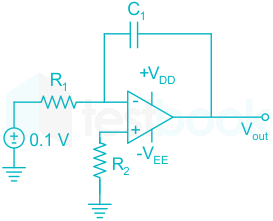
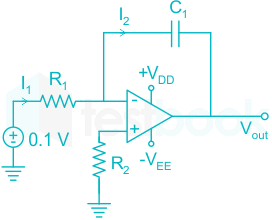
The circuit given in the below figure represents an integration of the input supply.

According to virtual short condition,

V+ = V- = 0

Apply nodal analysis at Inverting terminal,

I1 = I2

0.10R1=C1ddt(0V0)\rm \frac{0.1 - 0}{R_1} = C_1 \frac{d}{dt} (0 - V_0)

0.1R1=C1ddtV0\Rightarrow \frac{0.1}{R_1} = - C_1 \frac{d}{dt} V_0

Integrating on both sides, we get

V0=1R1C10.1 dt\rm V_0 = - \frac{1}{R_1C_1} \int0.1 \ dt

V0=0.1R1C1× t\rm V_0 = - \frac{0.1}{R_1C_1} × \ t

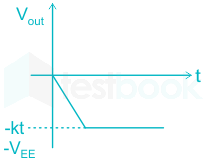
or, V0 = -k × t

The o/p will be constant at -VEE

65

For the ideal AC-DC rectifier circuit shown in the figure below, the load current magnitude is Idc = 15 A and is ripple free. The thyristors are fired with a delay angle of 45°. The amplitude of the fundamental component of the source current, in amperes, is __________. (round off to two decimal places)

Attempt this paper under real exam conditions

Timed interface, section switching, instant scoring, and question-by-question analytics — free.

Start Timed Attempt