Official Paper

GATE EE 2018 Official Paper (Previous Year Paper)

65 questions · 180 minutes · with answers · free

General Aptitude (10 questions)

1

“Since you have gone off the ________, the ________ sand is likely to damage the car.”

The words that best fill the blanks in the above sentence are

  1. ((a))

    course, coarse

  2. ((b))

    course, course

  3. ((c))

    coarse, course

  4. ((d))

    coarse, coarse

Show Answer
Answer: ((a))

course, coarse

The given sentence has two blanks. The first blank needs a word that means 'path' or 'way' and the second blank needs an adjective that can describe the sand.

Option 1 is correct as course means path or way and coarse means rough which logically and grammatically fit the first and the second blank, respectively.

2

“A common misconception among writers is that sentence structure mirrors thought; the more _________ the structure, the more complicated the ideas.”

The word that best fills the blank in the above sentence is

  1. ((a))

    detailed

  2. ((b))

    simple

  3. ((c))

    clear

  4. ((d))

    convoluted

Show Answer
Answer: ((d))

convoluted

Explanation:

Correct answer: Option 4 (convoluted)

The given sentence states that there is a common misunderstanding among existing authors that the quality of sentence structure closely resembles the thought process or even affects it.

'Convoluted' means something that is extremely complex and difficult to follow. It is generally used in the context of an argument or a story. 

The other options (especially 'simple' and 'clear') do not provide a correct meaning if placed in the blank.

Hence, convoluted is the correct answer.

NOTE: 'Detailed' can imply something that is comprehensive. It does not mean complicated. Hence, it cannot be the correct answer.

3

The three roots of the equation f(x) = 0 are x = {-2, 0, 3}. What are the three values of x for which f (x - 3) = 0?

  1. ((a))

    -5, -3, 0

  2. ((b))

    -2, 0, 3

  3. ((c))

    0, 6, 8

  4. ((d))

    1, 3, 6

Show Answer
Answer: ((d))

1, 3, 6

The three roots of the equation f(x) = 0 are x = {-2, 0, 3}

f(x) = (x – (-2)) (x – 0) (x – 3)

⇒ f(x) = x (x + 2) (x – 3)

f(x – 3) = (x – 3) (x – 3 + 2) (x – 3 – 3) = (x – 3) (x – 1) (x – 6)

Given that, f (x - 3) = 0

⇒ (x – 3) (x – 1) (x – 6) = 0

⇒ x = 1, 3, 6

4

For what value of k given below is (k+2)2k3\frac{{{{\left( {k + 2} \right)}^2}}}{{k - 3}} an integer?

  1. ((a))

    4, 8, 18

  2. ((b))

    4, 10, 16

  3. ((c))

    4, 8, 28

  4. ((d))

    8, 26, 28

Show Answer
Answer: ((c))

4, 8, 28

Given function:

f(k)=(k+2)2k3f\left( k \right) = \frac{{{{\left( {k + 2} \right)}^2}}}{{k - 3}}

For k = 4:

f(4)=(4+2)243=36f\left( 4 \right) = \frac{{{{\left( {4 + 2} \right)}^2}}}{{4 - 3}} = 36

For k = 8:

f(8)=(8+2)283=20f\left( 8 \right) = \frac{{{{\left( {8 + 2} \right)}^2}}}{{8 - 3}} = 20

For k = 28:

f(28)=(28+2)2283=36f\left( {28} \right) = \frac{{{{\left( {28 + 2} \right)}^2}}}{{28 - 3}} = 36

5

Functions F (a, b) and G (a, b) are defined as follows:

F (a, b) = (a - b)2 and G (a, b) = |a - b|, where |x| represents the absolute value of x.

What would be the value of G (F (1, 3), G (1, 3))?

  1. ((a))

    2

  2. ((b))

    4

  3. ((c))

    6

  4. ((d))

    36

Show Answer
Answer: ((a))

2

F (a, b) = (a - b)2

F (1, 3) = (1 – 3)2 = 4

G (a, b) = |a - b|

G (1, 3) = |1 – 3| = 2

G (F (1, 3), G (1, 3)) = G (4, 2)

G (4, 2) = |4 – 2| = 2

6

An e-mail password must contain three characters. The password has to contain one numeral from 0 to 9, one upper case and one lower case character from the English alphabet. How many distinct passwords are possible?

  1. ((a))

    6,760

  2. ((b))

    13,520

  3. ((c))

    40,560

  4. ((d))

    1,05,456

Show Answer
Answer: ((c))

40,560

An e-mail password must contain three characters.

One character will be one numeral from 0 to 9.

Number of choices =10C1=10= {10_{{C_1}}} = 10

Second character will be upper case letter from the English alphabet.

Number of choices =26C1=26= {26_{{C_1}}} = 26

Third character will be lower case letter from the English alphabet.

Number of choices =26C1=26= {26_{{C_1}}} = 26

We can arrange these three characters in 3! ways i.e. 6 ways.

Total number of distinct passwords = 10 × 26 × 26 × 6 = 40,560

7

In a certain code, AMCF is written as EQGJ and NKUF is written as ROYJ. How will DHLP be written in that code?

  1. ((a))

    RSTN

  2. ((b))

    TLPH

  3. ((c))

    HLPT

  4. ((d))

    XSVR

Show Answer
Answer: ((c))

HLPT

A M C F → E Q G J (A + 4 = E, M + 4 = Q, C + 4 = G, F + 4 = J)

N K U F → R O Y J (N + 4 = R, K + 4 = O, U + 4 = Y, F + 4 = J)

D H L P → H L P T (D + 4 = H, H + 4 = L, L + 4 = P, P + 4 = T)

8

A class of twelve children has two more boys than girls. A group of three children are randomly picked from this class to accompany the teacher on a field trip. What is the probability that the group accompanying the teacher contains more girls than boys?

  1. ((a))

    411\frac{4}{{11}}

  2. ((b))

    325864\frac{{325}}{{864}}

  3. ((c))

    525864\frac{{525}}{{864}}

  4. ((d))

    512\frac{5}{{12}}

Show Answer
Answer: ((a))

411\frac{4}{{11}}

Total number of children in a class = 12

Given that class has two more boys than girls.

So, number of boys = 7

Number of girls = 5

We need to pick a group of three children randomly so that the group contains more girls than boys.

Case 1: 3 girls and 0 boys

Probability to select 3 girls, P1=5C312C3=10220{P_1} = \frac{{{5_{{C_3}}}}}{{{{12}_{{C_3}}}}} = \frac{{10}}{{220}}

Case 2: 2 girls and 1 boy

Probability to select 2 girls and 1 boy, P2=5C27C112C3=10×7220=70220{P_2} = \frac{{{5_{{C_2}}}{7_{{C_1}}}}}{{{{12}_{{C_3}}}}} = \frac{{10 \times 7}}{{220}} = \frac{{70}}{{220}}

The probability that the group accompanying the teacher contains more girls than boys is,

P=P1+P2=10220+70220=80220=411P = {P_1} + {P_2} = \frac{{10}}{{220}} + \frac{{70}}{{220}} = \frac{{80}}{{220}} = \frac{4}{{11}}

9

A designer uses marbles of four different colours for his designs. The cost of each marble is the same, irrespective of the colour. The table below shows the percentage of marbles of each colour used in the current design. The cost of each marble increased by 25%. Therefore, the designer decided to reduce equal numbers of marbles of each colour to keep the total cost unchanged. What is the percentage of blue marbles in the new design?

BlueBlackRedYellow
40%25%20%15%
  1. ((a))

    35.75

  2. ((b))

    40.25

  3. ((c))

    43.75

  4. ((d))

    46.25

Show Answer
Answer: ((c))

43.75

Let the total number of marbles = 100

Number of blue marbles = 40

Number of black marbles = 25

Number of red marbles = 20

Number of yellow marbles = 15

And the cost of each marble = 1 unit

The total cost of marbles as per current design = 100 units

The cost of each marble after the cost of each marble is increased by 25% = 1.25 unit

Now, the designer decided to reduce equal numbers of marbles of each colour to keep the total cost unchanged.

Let the number of marbles of each colour to reduce = n

Now, the number of blue marbles = 40 – n

Number of black marbles = 25 - n

Number of red marbles = 20 - n

Number of yellow marbles = 15 - n

The total cost remains same as previous.

⇒ [(40 – n) + (25 – n) + (20 – n) + (15 – n)] [1.25] = 100

⇒ 100 – 4n = 80

⇒ n = 5

Now, the number total marbles = 100 – 4(5) = 80

The number of blue marbles = 40 – 5 = 35

The percentage of blue marbles in the new design =3580×100=43.75;%= \frac{{35}}{{80}} \times 100 = 43.75;\%

10

P, Q, R and S crossed a lake in a boat that can hold a maximum of two persons, with only one set of oars. The following additional facts are available.

(i) The boat held two persons on each of the three forward trips across the lake and one person on each of the two return trips.

(ii) P is unable to row when someone else is in the boat.

(iii) Q is unable to row with anyone else except R.

(iv) Each person rowed for at least one trip.

(v) Only one person can row during a trip.

Who rowed twice?

  1. ((a))

    P

  2. ((b))

    Q

  3. ((c))

    R

  4. ((d))

    S

Show Answer
Answer: ((c))

R

P is unable to row when someone else is in the boat. So, P can row during return trip only.

Q is unable to row with anyone else except R. So, Q can row during return and can row forward trip with R.

Trip 1 – Forward trip:

Q and R are involved in this trip and Q rowed the trip.

Trip 1 – Return trip:

R rowed the trip

Trip 2 – Forward trip:

P and R are involved in this trip and R rowed the trip.

Trip 2 – Return trip:

P rowed the trip

Trip 1 – Forward trip:

S rowed the trip

So, R rowed twice.

Electrical Engineering (55 questions)

11

A single-phase 100 kVA, 1000 V / 100 V, 50 Hz transformer has a voltage drop of 5% across its series impedance at full load. Of this, 3% is due to resistance. The percentage regulation of the transformer at full load with 0.8 lagging power factor is

  1. ((a))

    4.8

  2. ((b))

    6.8

  3. ((c))

    8.8

  4. ((d))

    10.8

Show Answer
Answer: ((a))

4.8

Concept:

Voltage regulation is the change in secondary terminal voltage from no load to full load at a specific power factor of load and the change is expressed in percentage.

E2 = no-load secondary voltage

V2 = full load secondary voltage

Voltage regulation for the transformer is given by the ratio of change in secondary terminal voltage from no load to full load to no load secondary voltage.

Voltage regulation =E2V2E2= \frac{{{E_2} - {V_2}}}{{{E_2}}}

It can also be expressed as,

Regulation \(= \frac{{{I_2}{R_{02}}\cos {\phi 2} \pm {I_2}{X{02}}\sin {\phi _2}}}{{{E_2}}}\)

  • sign is used for lagging loads and
  • ve sign is used for leading loads

Per unit Voltage regulation = %R cos ϕ ± %X sin ϕ

Explanation:

Given that,

Voltage drop across series impedance (% Z) = 5%

Voltage drop due to resistance (% R) = 3%

Power factor = 0.8 lagging

We know that, %Z=(%R)2+(%X)2\% Z = \sqrt {{{\left( {\% R} \right)}^2} + {{\left( {\% X} \right)}^2}}

(%X)=(%Z)2(%R)2=5232=4%\Rightarrow \left( {\% X} \right) = \sqrt {{{\left( {\% Z} \right)}^2} - {{\left( {\% R} \right)}^2}} = \sqrt {{5^2} - {3^2}} = 4\%

Voltage regulation = %R cos ϕ ± %X sin ϕ

+ve is for lagging loads

-ve is for leading loads

Voltage regulation = (3) (0.8) + (4) (0.6) = 4.8%

12

In a salient pole synchronous motor, the developed reluctance torque attains the maximum value when the load angle in electrical degrees is

  1. ((a))

    0

  2. ((b))

    45

  3. ((c))

    60

  4. ((d))

    90

Show Answer
Answer: ((b))

45

Concept:

In a salient pole synchronous motor, the power flow is given by,

P=EVXdsinδ+V22[1Xq1Xd]sin2δP = \frac{{EV}}{{{X_d}}}\sin \delta + \frac{{{V^2}}}{2}\left[ {\frac{1}{{{X_q}}} - \frac{1}{{{X_d}}}} \right]\sin 2\delta

The torque equation is given by

T=602πNS[EVXdsinδ+V22[1Xq1Xd]sin2δ]T = \frac{{60}}{{2\pi {N_S}}}\left[ {\frac{{EV}}{{{X_d}}}\sin \delta + \frac{{{V^2}}}{2}\left[ {\frac{1}{{{X_q}}} - \frac{1}{{{X_d}}}} \right]\sin 2\delta } \right]

Here,

EVXdsinδ\frac{{EV}}{{{X_d}}}\sin \delta is electromagnetic torque

andV22[1Xq1Xd]sin2δ=Reluctance;torque.{\rm{and}}\frac{{{V^2}}}{2}\left[ {\frac{1}{{{X_q}}} - \frac{1}{{{X_d}}}} \right]\sin 2\delta = Reluctance;torque.

Explanation:

As we know that Vt = terminal voltage depends on the load.

Xd and Xq depend on the power factor angle which also depends on the load.

So, we cannot change the value of the three-parameter.

The value of sin 2δ always varies in the range +1 to -1.

For the maximum value of TR sin 2δ should be maximum

⇒ sin 2δ = + 1

⇒ 2δ = sin-1 (1) = 90°

⇒ δ = 45°

Torque angle δ is 45° for maximum reluctance torque to be produced in a synchronous motor.

13

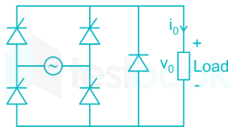
A single phase fully controlled rectifier is supplying a load with an anti-parallel diode as shown in the figure. All switches and diodes are ideal. Which one of the following is true for instantaneous load voltage and current?

  1. ((a))

    \({v_0} \ge 0;& ;{i_0} < 0\)

  2. ((b))

    \({v_0} < 0;& ;{i_0} < 0\)

  3. ((c))

    \({v_0} \ge 0;& ;{i_0} \ge 0\)

  4. ((d))

    \({v_0} \le 0;& ;{i_0} \ge 0\)

Show Answer
Answer: ((c))

\({v_0} \ge 0;& ;{i_0} \ge 0\)

Concept:

Freewheeling diode:

  • A freewheeling diode placed across the inductive load will provide a path for the release of energy stored in the inductor while the load voltage drops to zero.
  • The freewheeling diode prevents the load voltage from becoming negative. Whenever load voltage tends to go negative, FD comes into play.
  • As a result, the load current is transferred from the main thyristor to FD, allowing the thyristor to regain its forward blocking capability.
  • The advantages are input power factor is improved, load current waveform is improved and better load performance.


Explanation:

The given circuit represents a single phase fully controlled rectifier.

Anti-parallel diode works as freewheeling diode. As the freewheeling diode is present in converter, the output voltage can’t be negative whether the converter is working under continuous mode or discontinuous mode. The output current is always unidirectional as it is A.C. to D.C. converter.

Hence, V0 ≥ 0 and i0 ≥ 0 

Note-

For continuous conduction mode : 

V0 ≥ 0 and i0 > 0

14

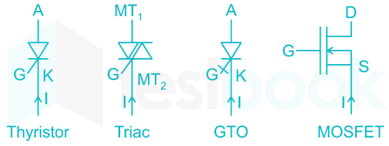
Four power semiconductor devices are shown in the figure along with their relevant terminals. The device(s) that can carry dc current continuously in the direction shown when gated appropriately is (are)

  1. ((a))

    Triac only

  2. ((b))

    Triac and MOSFET

  3. ((c))

    Triac and GTO

  4. ((d))

    Thyristor and Triac

Show Answer
Answer: ((b))

Triac and MOSFET

Thyristor allows the conduction of current from anode to cathode. Hence, the current cant flow in the given direction.

Triac can allow current in both directions. Hence, the current can flow in a given direction.

The MOSFET is a bidirectional device. Hence, the current can flow in a given direction.

GTO is a unidirectional device. Hence, the current can't flow in the given direction.

15

Two wattmeter method is used for measurement of power in a balanced three-phase load supplied from a balanced three-phase system. If one of the wattmeters reads half of the other (both positive), then the power factor of the load is

  1. ((a))

    0.532

  2. ((b))

    0.632

  3. ((c))

    0.707

  4. ((d))

    0.866

Show Answer
Answer: ((d))

0.866

Concept:

In a two-wattmeter method, for lagging load

The reading of first wattmeter (W1) = VL IL cos (30 + ϕ)

The reading of second wattmeter (W2) = VL IL cos (30 - ϕ)

ϕ=tan1(3(W1W2)W1+W2)\phi = {\rm{ta}}{{\rm{n}}^{ - 1}}\left( {\frac{{\sqrt 3 \left( {{W_1} - {W_2}} \right)}}{{{W_1} + {W_2}}}} \right)

Calculation:

Given that,

W2=W12{W_2} = \frac{{{W_1}}}{2}

We know that,

ϕ=tan1(3(W1W2)W1+W2)\phi = {\tan ^{ - 1}}\left( {\frac{{\sqrt 3 \left( {{W_1} - {W_2}} \right)}}{{{W_1} + {W_2}}}} \right)

=tan1(3(W1W12)(W1+W12)) = {\tan ^{ - 1}}\left( {\frac{{\sqrt 3 \left( {{W_1} - \frac{{{W_1}}}{2}} \right)}}{{\left( {{W_1} + \frac{{{W_1}}}{2}} \right)}}} \right)

=tan1(3(2W1W1)2W1+W1)= {\tan ^{ - 1}}\left( {\frac{{\sqrt 3 \left( {2{W_1} - {W_1}} \right)}}{{2{W_1} + {W_1}}}} \right)

=tan1(3W13W1)=tan1(13)=30= {\tan ^{ - 1}}\left( {\frac{{\sqrt 3 {W_1}}}{{3{W_1}}}} \right) = {\tan ^{ - 1}}\left( {\frac{1}{{\sqrt 3 }}} \right) = 30^\circ

Power factor, cos ϕ = cos 30° = 0.866

16

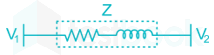
Consider a lossy transmission line with V1 and V2 as the sending and receiving end voltages, respectively. Z and X are the series impedance and reactance of the line, respectively. The steady-state stability limit for the transmission line will be

  1. ((a))

    greater than V1V2X\left| {\frac{{{V_{1{V_2}}}}}{X}} \right|

  2. ((b))

    less than V1V2X\left| {\frac{{{V_1}{V_2}}}{X}} \right|

  3. ((c))

    equal to V1V2X\left| {\frac{{{V_1}{V_2}}}{X}} \right|

  4. ((d))

    equal to V1V2Z\left| {\frac{{{V_1}{V_2}}}{Z}} \right|

Show Answer
Answer: ((b))

less than V1V2X\left| {\frac{{{V_1}{V_2}}}{X}} \right|

Given that,

Sending end voltage = V1

Receiving end voltage = V2

Series impedance = Z

reactance = X

When only X is present:

Pmax1=V1V2X{P_{max1}} = \left| {\frac{{{V_1}{V_2}}}{X}} \right|

When Z is present:

Pmax2=V1V2ZV22Zcosϕ{P_{max2}} = \frac{{{V_1}{V_2}}}{{\left| Z \right|}} - \frac{{V_2^2}}{{\left| Z \right|}}\cos \phi

Pmax2 is less than Pmax1

Hence, the steady-steady stability limit for the transmission line will be less than V1V2X\left| {\frac{{{V_1}{V_2}}}{X}} \right|.

17

The graph of a network has 8 nodes and 5 independent loops. The number of branches of the graph is

  1. ((a))

    11

  2. ((b))

    12

  3. ((c))

    13

  4. ((d))

    14

Show Answer
Answer: ((b))

12

Concept:

Nodal Analysis:

Nodal analysis is a method of analyzing networks with the help of KCL equations.

For a network of N nodes, the number of simultaneous equations to be solved to get the unknowns

= Number of KCL equations

= N - 1

Mesh Analysis:

Mesh analysis is a method of analyzing networks with the help of KVL equations.

For a network having N nodes and B branches, the number of simultaneous equations to be solved to get the unknowns

= Number of KVL equations

= number of independent loop equations

= B - N + 1

Where, B = no of the branch, N = No of node

Calculation:

Given that,

Number of nodes (N) = 8

Number of independent loops (L) = 5

Let the number of branches are B.

We know that,

L = B – N + 1

⇒ 5 = B – 8 + 1 ⇒ B = 12

18

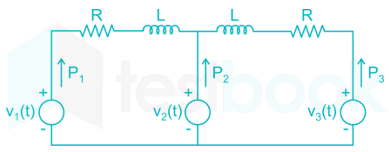
In the figure, the voltages are v1(t) = 100 cos (ωt), v2(t) = 100 cos (ωt + π/18) and v3(t) = 100 cos (ωt + π/36). The circuit is in sinusoidal steady state, and R << ωL. P1, P2 and P3 are the average power outputs. Which one of the following statements is true?

  1. ((a))

    P1 = P2 = P3 = 0

  2. ((b))

    P1 < 0, P2 > 0, P3 > 0

  3. ((c))

    P1 < 0, P2 > 0, P3 < 0

  4. ((d))

    P1 > 0, P2 < 0, P3 > 0

Show Answer
Answer: ((c))

P1 < 0, P2 > 0, P3 < 0

Given that,

V1 (t) = 100 cos ωt

V2(t) = 100 cos(ωt + π/18) = 100 cos(ωt +10)

V3(t) = 100 cos(ωt + π/36) = 100 cos(ωt + 5°)

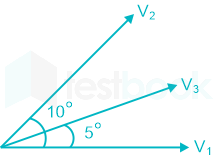
Phasor diagram of all the three voltages as shown in  below fig,

From the above diagram,

V2 (t) is leading V1(t) by 10° and

V3 (t) is leading V1(t) by 5°

V2 (t) is leading V3 (t) by 5°.

We know that active power always flows from a leading angle to a lagging angle.

Hence, current flows from V2 (t) to V1 (t) and V3 (t).

Hence, P2 > 0, P1 < 0 P3 < 0.

19

Match the transfer functions of the second-order systems with the nature of the systems

given below.

Transfer functionsNature of system
P: 15s2+5s+15\frac{{15}}{{{s^2} + 5s + 15}} Q: 25s2+10s+25\frac{{25}}{{{s^2} + 10s + 25}} R: 35s2+18s+35\frac{{35}}{{{s^2} + 18s + 35}}I: Overdamped II: Critically damped III: Underdamped
  1. ((a))

    P-I, Q-II, R-III

  2. ((b))

    P-II, Q-I, R-III

  3. ((c))

    P-III, Q-II, R-I

  4. ((d))

    P-III, Q-I, R-II

Show Answer
Answer: ((c))

P-III, Q-II, R-I

The standard second order system is given by ωn2s2+2ξωns+ωn2\frac{{\omega _n^2}}{{{s^2} + 2\xi {\omega _n}s + \omega _n^2}}

Where ξ is damping ratio.

If ξ = 1, then system is critically damped.

If ξ < 1, then system is under damped.

If ξ > 1, then system is order damped.

P:15s2+5s+15P:\frac{{15}}{{{s^2} + 5s + 15}}

By comparing with standard second order transfer function,

ωn2 = 15 ⇒ ωn = √15

2ξωn=5ξ=5215<12\xi {{\rm{\omega }}_n} = 5 \Rightarrow \xi = \frac{5}{{2\sqrt {15} }} < 1

So, it is underdamped system.

Q:25s2+10s+25Q:\frac{{25}}{{{s^2} + 10s + 25}}

ωn2 = 25 ⇒ ωn = 5

2 ξ ωn = 10 ⇒ ξ = 1

So, it si critically damped system.

R:35s2+18s+35R:\frac{{35}}{{{s^2} + 18s + 35}}

ωn2 = 35 ⇒ ωn = √35

2ξωn=18ξ=935>12\xi {{\rm{\omega }}_n} = 18 \Rightarrow \xi = \frac{9}{{\sqrt {35} }} > 1

So, it is overdamped system.

20

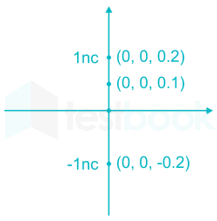
A positive charge of 1 nC is placed at (0, 0, 0.2) where all dimensions are in metres. Consider the x – y plane to be a conducting ground plane. Take 0=8.85×10¹²{ \in _0} = 8.85 \times {10^{ - 12}} F/M. The z component of the E field at (0, 0, 0.1) is closest to

  1. ((a))

    899.18 V/m

  2. ((b))

    -899.18 V/m

  3. ((c))

    999.09 V/m

  4. ((d))

    -999.09 V/m

Show Answer
Answer: ((d))

-999.09 V/m

Given that a positive charge of 1 nc is placed at (0, 0, 0.2).

According to method image charge concept, there will be an image charge below the conducting ground plane.

Electric field is given by

Eˉ=14πε0QRˉRˉ3\bar E = \frac{1}{{4\pi {\varepsilon _0}}}\frac{{Q\bar R}}{{{{\left| {\bar R} \right|}^3}}}

Electric field at point P due to point charge + 1 nc,

Eˉ=14πε01×109[(00)aˉx+(00)aˉy+(0.10.2)aˉz](0.1)3\bar E = \frac{1}{{4\pi {\varepsilon _0}}}\frac{{1 \times {{10}^{ - 9}}\left[ {\left( {0 - 0} \right){{\bar a}_x} + \left( {0 - 0} \right){{\bar a}_y} + \left( {0.1 - 0.2} \right){{\bar a}_z}} \right]}}{{{{\left( {0.1} \right)}^3}}}

=14π×8.85×1012×1×109(0.1)3(0.1)aˉz= \frac{1}{{4\pi \times 8.85 \times {{10}^{ - 12}}}} \times \frac{{1 \times {{10}^{ - 9}}}}{{{{\left( {0.1} \right)}^3}}}\left( { - 0.1} \right){\bar a_z}

= -899.18 V/m

Electric field at point P, due to point charge -1 nc,

Eˉ2=14πε01×109[(00)aˉx+(00)aˉy+(0.1+0.2)aˉz](0.3)3{\bar E_2} = \frac{1}{{4\pi {\varepsilon _0}}}\frac{{ - 1 \times {{10}^{ - 9}}\left[ {\left( {0 - 0} \right){{\bar a}_x} + \left( {0 - 0} \right){{\bar a}_y} + \left( {0.1 + 0.2} \right){{\bar a}_z}} \right]}}{{{{\left( {0.3} \right)}^3}}}

=14π×0.85×1012×(1×109)(0.3)3(0.3)aˉz=99.90;V/m = \frac{1}{{4\pi \times 0.85 \times {{10}^{ - 12}}}} \times \frac{{\left( { - 1 \times {{10}^{ - 9}}} \right)}}{{{{\left( {0.3} \right)}^3}}}\left( {0.3} \right){\bar a_z} = - 99.90;V/m

E̅ = E̅1 + E̅2 = -899.18 V/m – 99.90 V/m

= -999.08 V/m

21

Let f be a real-valued function of a real variable defined as f(x) = x2 for x ≥ 0, and f(x) = -x2 for x < 0.

Which one of the following statements is true?

  1. ((a))

    f(x) is discontinuous at x = 0

  2. ((b))

    f(x) is continuous but not differentiable at x = 0.

  3. ((c))

    f(x) is differentiable but its first derivative is not continuous x = 0.

  4. ((d))

    f(x) is differentiable but its first derivative is not differentiable at x = 0.

Show Answer
Answer: ((d))

f(x) is differentiable but its first derivative is not differentiable at x = 0.

Given that,

A function f(x) is said to be differentiable at x =a if,

Left derivative = Right derivative = Well defined

i.e.,

 limxaf(x)=limxa+f(x)\rm\lim _{x \rightarrow a^{-}} f'(x)=\lim _{x \rightarrow a^{+}} f'(x)

Analysis:

f(x) = x2, x ≥ 0

= -x2, x ≤ 0

f'(x) = 2x, x ≥ 0

= -2x, x < 0

f'(x) = 2|x|

f(x) is continuous but not differentiable at x = 0.

Hence f(x) is differentiable but its first derivative is not differentiable at x = 0.

Option(4) is the correct answer.

22

The value of the directional derivative of the function θ (x, y, z) = xy2 + yz2 + zx2 at the point (2, -1, 1) in the direction of the vector p = i + 2j + 2k is

  1. ((a))

    1

  2. ((b))

    0

  3. ((c))

    -1

  4. ((d))

    2

Show Answer
Answer: ((a))

1

Given that,

ϕ = xy2 + yz2 + zx2

directional vector (p) = I + 2j + 2K

Directional derivative =ϕ.P^=ϕ.PP = \nabla \phi .\hat P = \nabla \phi .\frac{{\vec P}}{{\left| {\vec P} \right|}}

ϕ=ϕxi^+ϕyi^+ϕzk^\nabla \phi = \frac{{\partial \phi }}{{\partial x}}\hat i + \frac{{\partial \phi }}{{\partial y}}\hat i + \frac{{\partial \phi }}{{\partial z}} \hat k

= (y2 + 2xz) î + (2xy + z2) ĵ + (2yz + x2) k̂

∇ϕ at the point (2, -1, 1) is

∇ϕ = ((-1)2 + 2(2)(1)) î + (2(2)(-1) + (1)2) ĵ + (2(-1)(1) + (2)2)k̂

= 5î - 3ĵ + 2k̂

Directional derivative = (5i3j+2k).i+2j+2k12+22+22\left( {5i - 3j + 2k} \right).\frac{{i + 2j + 2k}}{{\sqrt {{1^2} + {2^2} + {2^2}} }}

=56+43=1= \frac{{5 - 6 + 4}}{3} = 1

Hence Option(1) is the Correct Answer.

23

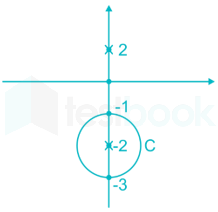
The value of the integral Cz+1z24dz\mathop \oint \limits_C \frac{{z + 1}}{{{z^2} - 4}}dz in counter clockwise direction around a circle C of radius 1 with center at the point z = −2 is

  1. ((a))

    πi2\frac{{\pi i}}{2}

  2. ((b))

    2πi

  3. ((c))

    πi2- \frac{{\pi i}}{2}

  4. ((d))

    – 2πi

Show Answer
Answer: ((a))

πi2\frac{{\pi i}}{2}

Given that,

f(Z)=C;Z+1Z24f\left( Z \right) = \mathop \oint \limits_C^; \frac{{Z + 1}}{{{Z^2} - 4}}

C : |Z – (-2)| = 1

⇒ C : |Z + 2| = 1

poles of f(Z) are z2 – 4 = 0

⇒ Z = ±2

Z = 2 is lies outside the curve C.

f(Z) = 2πi [residue at Z = -2]

\(= 2\pi i;\begin{array}{*{20}{c}} {it}\ {Z \to - 2} \end{array}\left( {Z + 2} \right)\frac{{\left( {Z + 1} \right)}}{{\left( {Z + 2} \right)\left( {Z - 2} \right)}}\)

=2πi×(2+1)(22)=2πi;(14)=πi2= 2\pi i \times \frac{{\left( { - 2 + 1} \right)}}{{\left( { - 2 - 2} \right)}} = 2\pi i;\left( {\frac{{ - 1}}{{ - 4}}} \right) = \frac{{\pi i}}{2}

24

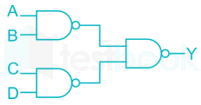
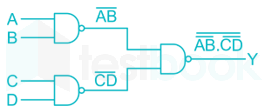
In the logic circuit shown in the figure, Y is given by

  1. ((a))

    Y = ABCD 

  2. ((b))

    Y = (A + B) (C + D)

  3. ((c))

    Y = A + B + C + D

  4. ((d))

    Y = AB + CD

Show Answer
Answer: ((d))

Y = AB + CD

Y=AB.CD=AB+CD=AB+CDY = \overline {\overline {AB} .\overline {CD} } = \overline {\overline {AB} } + \overline {\overline {CD} } = AB + CD

25

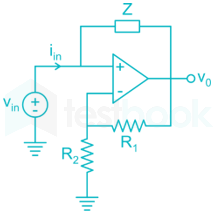
The op-amp shown in the figure is ideal. The input impedance viniin\frac{{{v_{in}}}}{{{i_{in}}}} is given by

  1. ((a))

    zR1R2z\frac{{{R_1}}}{{{R_2}}}

  2. ((b))

    ZR2R1- Z\frac{{{R_2}}}{{{R_1}}}

  3. ((c))

    Z

  4. ((d))

    ZR1R1+R2- Z\frac{{{R_1}}}{{{R_1} + {R_2}}}

Show Answer
Answer: ((b))

ZR2R1- Z\frac{{{R_2}}}{{{R_1}}}

Concept:

Virtual ground -

The concept of the virtual ground is stated as if anyone of the i/p terminals is grounded physically the other i/p terminal will also be at ground potential even though, it is not grounded physically.

  • One key feature of an Op-Amp is the differential input, and when put together in a circuit, this can form a virtual ground.
  • The virtual ground concept is helpful for the analysis of Op Amps. This concept makes Op-Amp circuit analysis much easier.

Calculation:

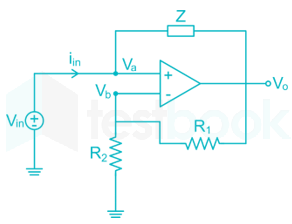
By voltage division, Vb=Vo(R2R1+R2){V_b} = {V_o}\left( {\frac{{{R_2}}}{{{R_1} + {R_2}}}} \right)

By virtual grand concept, Va = Vb = Vin

By applying KCL at Va,

VaVoZiin=0\frac{{{V_a} - {V_o}}}{Z} - {i_{in}} = 0

iin=VaVoZ\Rightarrow {i_{in}} = \frac{{{V_a} - {V_o}}}{Z}

iin=VinVin(R1+R2R2)Z\Rightarrow {i_{in}} = \frac{{{V_{in}} - {V_{in}}\left( {\frac{{{R_1} + {R_2}}}{{{R_2}}}} \right)}}{Z}

iin(Z)=Vin(1R1R21)\Rightarrow {i_{in}}\left( Z \right) = {V_{in}}\left( {1 - \frac{{{R_1}}}{{{R_2}}} - 1} \right)

Viniin=R2ZR1\Rightarrow \frac{{{V_{in}}}}{{{i_{in}}}} = - \frac{{{R_2}Z}}{{{R_1}}}

26

A continuous-time input signal x(t) is an eigenfunction of an LTI system, if the output is

  1. ((a))

    k x(t), where k is an eigenvalue

  2. ((b))

    Keiωt x(t), where k is an eigenvalue and eiωt is a complex exponential signal

  3. ((c))

    x(t) eiωt, where eiωt is a complex exponential signal

  4. ((d))

    k H(ω), where k is an eigenvalue and H(ω) is a frequency response of the system

Show Answer
Answer: ((a))

k x(t), where k is an eigenvalue

A signal is said to be Eigen function if the output is scalar multiple of input signal and that scalar is referred as Eigen value.

Let input signal is x(t) and it is an Eigen function then

output = K x(t) where K is Eigen value.

27

Consider a non-singular 2×2 square matrix A. If trace (A) = 4 and trace(A2) = 5, the determinant of the matrix A is _________ (up to 1 decimal place).

28

Let f be a real-valued function of a real variable defined as f(x) = x – [x], where [x] denotes the largest integer less than or equal to x. The value of \(\mathop \smallint \limits_{0.25}^{1.25} f\left( x \right)dx\) is _______ (up to 2 decimal places).

29

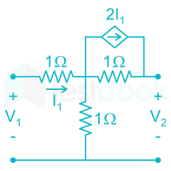
In the two-port network shown, the h11 parameter (where,;h11=V1I1when;V2=0);\left( {where,;{h_{11}} = \frac{{{V_1}}}{{{I_1}}}when;{V_2} = 0} \right); in ohms is _______ (up to decimal places).

30

The series impedance matrix of a short three-phase transmission line in phase coordinates is \(\left[ {\begin{array}{*{20}{c}} {{z_s}}&{{z_m}}&{{z_m}}\ {{z_m}}&{{z_s}}&{{z_m}}\ {{z_m}}&{{z_m}}&{{z_s}} \end{array}} \right]\). If the positive sequence impedance is (1 + j 10) Ω, and the zero sequence is (4 + j 31) Ω, then the imaginary part of Zm ­(in Ω) is _______ (up to 2 decimal places).

31

The positive, negative and zero sequence impedances of a 125 MVA, three-phase, 15.5 kV, star-grounded, 50 Hz generator are j0.1 pu, j0.05 pu and j0.01 pu respectively on the machine rating base. The machine is unloaded and working at the rated terminal voltage. If the grounding impedance of the generator is j0.01 pu, then the magnitude of fault current for a b-phase to ground fault (in kA) is __________ (up to 2 decimal places).

32

A 1000 × 1000 bus admittance matrix for an electric power system has 8000 non-zero elements. The minimum number of branches (transmission lines and transformers) in this system are _____ (up to 2 decimal places).

33

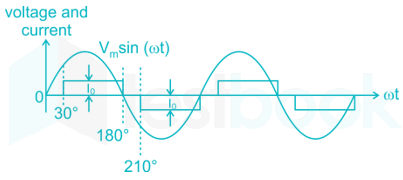
The waveform of the current drawn by a semi-converter from a sinusoidal AC voltage source is shown in the figure. If I0 = 20 A, the rms value of fundamental component of the current is ___________A (up to 2 decimal places).

34

A separately excited dc motor has an armature resistance Ra = 0.05 Ω. The field excitation is kept constant. At an armature voltage of 100 V, the motor produces a torque of 500 Nm at zero speed. Neglecting all mechanical losses, the no-load speed of the motor (in radian/s) for an armature voltage of 150 V is _____ (up to 2 decimal places).

35

Consider a unity feedback system with forward transfer function given by

G(S)=1(s+1)(s+2)G\left( S \right) = \frac{1}{{\left( {s + 1} \right)\left( {s + 2} \right)}}

The steady-state error in the output of the system for a unit-step input is _________ (up to 2 decimal places).

36

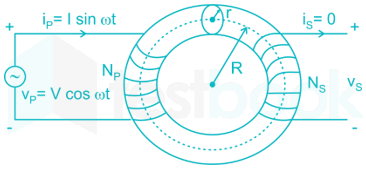
A transformer with toroidal core of permeability μ is shown in the figure. Assuming uniform flux density across the circular core cross-section of radius r R, and neglecting any leakage flux, the best estimate for the mean radius R is

  1. ((a))

    μVr2NP2ωI\frac{{\mu V{r^2}N_P^2\omega }}{I}

  2. ((b))

    μIr2NPNSωV\frac{{\mu I{r^2}{N_P}{N_S}\omega }}{V}

  3. ((c))

    μVr2NP2ω2I\frac{{\mu V{r^2}N_P^2\omega }}{{2I}}

  4. ((d))

    μIr2NP2ω2V\frac{{\mu I{r^2}N_P^2\omega }}{{2V}}

Show Answer
Answer: ((d))

μIr2NP2ω2V\frac{{\mu I{r^2}N_P^2\omega }}{{2V}}

Given a transformer with toroidal care of permeability μ.

radius of the core = r

Mean radius of the core = R

cross sectional area of the core (A) = π r2

mean length of core (L) = 2πR

Vp=Npdϕdt=Npddt(NpipR){V_p} = {N_p}\frac{{d\phi }}{{dt}} = {N_p}\frac{d}{{dt}}\left( {\frac{{{N_p}{i_p}}}{\mathbb{R}}} \right)

=Np2Rddt(Isinωt) = \frac{{N_p^2}}{\mathbb{R}}\frac{d}{{dt}}\left( {I\sin \omega t} \right)

=Np2R×ωIcosωt= \frac{{N_p^2}}{\mathbb{R}} \times \omega I\cos \omega t

Vcosωt=Np2RωIcosωt\Rightarrow V\cos \omega t = \frac{{N_p^2}}{\mathbb{R}}\omega I\cos \omega t

we know that, R=lμA\mathbb{R} = \frac{l}{{\mu A}}

V=Np2ωI(LμA) \Rightarrow V = \frac{{N_p^2\omega I}}{{\left( {\frac{L}{{\mu A}}} \right)}}

V=Np2;μA;ωIL=Np2ωIμπr22πR \Rightarrow V = \frac{{N_p^2;\mu A;\omega I}}{L} = \frac{{N_p^2\omega I\mu \pi {r^2}}}{{2\pi R}}

R=Np2WIμr22V\Rightarrow R = \frac{{N_p^2WI\mu {r^2}}}{{2V}}

37

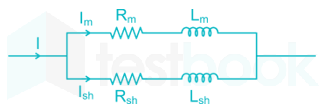
A 0-1 Ampere moving iron ammeter has an internal resistance of 50 mΩ and inductance of 0.1 mH. A shunt coil is connected to extend its range to 0-10 Ampere for all operating frequencies. The time constant in milliseconds and resistance in mΩ of the shunt coil respectively are

  1. ((a))

    2, 5.55

  2. ((b))

    2, 1

  3. ((c))

    2.18, 0.55

  4. ((d))

    11.1, 2

Show Answer
Answer: ((a))

2, 5.55

Given that,

meter current (Im) = 1A

Internal resistance (Rm) = 50 mΩ

Inductance (Lm) = 0.1 mH

required meter current (I) = 10 A

ImIsh=ZshZm=Rsh2+Xsh2Rm2+Xm2\frac{{{I_m}}}{{{I_{sh}}}} = \frac{{{Z_{sh}}}}{{{Z_m}}} = \sqrt {\frac{{R_{sh}^2 + X_{sh}^2}}{{R_m^2 + X_m^2}}}

ImIsh=Rsh2+(ωLsh)2Rm2+(ωLm)2\Rightarrow \frac{{{I_m}}}{{{I_{sh}}}} = \sqrt {\frac{{R_{sh}^2 + {{\left( {\omega {L_{sh}}} \right)}^2}}}{{R_m^2 + {{\left( {\omega {L_m}} \right)}^2}}}}

ImIsh=1+(ωLshRsh)2RshRm1+(ωLmRm)2\Rightarrow \frac{{{I_m}}}{{{I_{sh}}}} = \frac{{\sqrt[{{R_{sh}}}]{{1 + {{\left( {\frac{{\omega {L_{sh}}}}{{{R_{sh}}}}} \right)}^2}}}}}{{{R_m}\sqrt {1 + {{\left( {\frac{{\omega {L_m}}}{{{R_m}}}} \right)}^2}} }}

ImIsh=RshRm.1+(ωτsh)21+(ωτm)2\Rightarrow \frac{{{I_m}}}{{{I_{sh}}}} = \frac{{{R_{sh}}}}{{{R_m}}}.\sqrt {\frac{{1 + {{\left( {\omega {\tau _{sh}}} \right)}^2}}}{{1 + {{\left( {\omega {\tau _m}} \right)}^2}}}}

In order to operate the meter at all frequencies,

τsh=τm{\tau _{sh}} = {\tau _m}

ImIsh=RshRm\Rightarrow \frac{{{I_m}}}{{{I_{sh}}}} = \frac{{{R_{sh}}}}{{{R_m}}}

Rsh=50×103×19=5.55;mΩ \Rightarrow {R_{sh}} = \frac{{50 \times {{10}^{ - 3}} \times 1}}{9} = 5.55;m{\rm{\Omega }}

Time constant of shunt coil,

τsh=τm=LmRm=0.150=2;msec.{\tau _{sh}} = {\tau _m} = \frac{{{L_m}}}{{{R_m}}} = \frac{{0.1}}{{50}} = 2;msec.

38

The positive, negative and zero sequence impedances of a three-phase generator are Z1, Zand Z0 respectively. For a line-to-line fault with fault impedance Zf, the fault current is If1 = kIf, where If is the fault current with zero fault impedance. The relation between Zf and k is

  1. ((a))

    Zf=(Z1+Z2)(1k)k{Z_f} = \frac{{\left( {{Z_1} + {Z_2}} \right)\left( {1 - k} \right)}}{k}

  2. ((b))

    Zf=(Z1+Z2)(1+;k)k{Z_f} = \frac{{\left( {{Z_1} + {Z_2}} \right)\left( {1 + ;k} \right)}}{k}

  3. ((c))

    Zf=(Z1+Z2)k1k{Z_f} = \frac{{\left( {{Z_1} + {Z_2}} \right)k}}{{1 - k}}

  4. ((d))

    Zf=(Z1+Z2)k1+k{Z_f} = \frac{{\left( {{Z_1} + {Z_2}} \right)k}}{{1 + k}}

Show Answer
Answer: ((a))

Zf=(Z1+Z2)(1k)k{Z_f} = \frac{{\left( {{Z_1} + {Z_2}} \right)\left( {1 - k} \right)}}{k}

In line to line fault,

fault current with fault impedance zf is

If1=3Eaz1+z2+zf{I_{{f_1}}} = \frac{{\sqrt 3 {E_a}}}{{{z_1} + {z_2} + {z_f}}}

fault current with zero fault impedance is,

If=3Eaz1+z2{I_f} = \frac{{\sqrt 3 {E_a}}}{{{z_1} + {z_2}}}

Given that, If1=kIf{I_{{f_1}}} = k{I_f}

3Eaz1+z2+zf=kIf1=k3Eaz1+z2\Rightarrow \frac{{\sqrt 3 {E_a}}}{{{z_1} + {z_2} + {z_f}}} = k{I_{{f_1}}} = k\frac{{\sqrt 3 {E_a}}}{{{z_1} + {z_2}}}

⇒ z1 + z2 = k (z1 + z2 + zf)

⇒ z1 + z2 - k z1 - k z2 = k zf

zf=(z1+z2)(1k)k\Rightarrow {z_f} = \frac{{\left( {{z_1} + {z_2}} \right)\left( {1 - k} \right)}}{k}

39

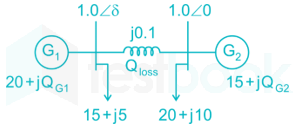
Consider the two-bus power system network with given loads as shown in the figure. All the values shown in the figure are in per unit. The reactive power supplied by generator G1 and G2 are QG1 and QG2 respectively. The per unit values of QG1, QG2, and line reactive power loss (Qloss) respectively are

  1. ((a))

    5.00, 12.68, 2.68

  2. ((b))

    6.34, 10.00, 1.34

  3. ((c))

    6.34, 11.34, 2.68

  4. ((d))

    5.00, 11.34, 1.34

Show Answer
Answer: ((c))

6.34, 11.34, 2.68

At Generator-2, load demand is 20 pu.

G2 is supplying 15 pu and remaining 5 pu is supplied by G1.

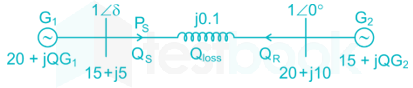
Ps=VsVRXLsinδ{P_s} = \left| {\frac{{{V_s}{V_R}}}{{{X_L}}}} \right|\sin \delta

5=1×10.1sinδ\Rightarrow 5 = \frac{{1 \times 1}}{{0.1}}sin\delta

⇒ δ = 30°

Qs=Vs2XLVsVRXLcosδ{Q_s} = \frac{{V_s^2}}{{{X_L}}} - \frac{{{V_s}{V_R}}}{{{X_L}}}cos\delta

Qs=120.11×10.1cos30=1.339;pu\Rightarrow {Q_s} = \frac{{{1^2}}}{{0.1}} - \frac{{1 \times 1}}{{0.1}}cos30^\circ = 1.339;pu

QR=VsVRXLcosδVR2XL{Q_R} = \left| {\frac{{{V_s}{V_R}}}{{{X_L}}}} \right|cos\delta - \frac{{V_R^2}}{{{X_L}}}

=1×10.1cos30120.1=1.339pu= \frac{{1 \times 1}}{{0.1}}cos30^\circ - \frac{{{1^2}}}{{0.1}} = - 1.339pu

Qloss = Qs - QR

= 2.679 pu

At Generator 1,

QG1 = Qload + QS

= 5 + 1.339 = 6.339 pu

QG2 = Qload + QR

= 10 + 1.339 = 11.339 pu

40

The per-unit power output of a salient-pole generator which is connected to an infinite bus, is given by the expression, P = 1.4 sin δ + 0.15 sin 2δ, where δ is the load angle. Newton- Raphson method is used to calculate the value of δ for P = 0.8 pu. If the initial guess is 30°, then its value (in degree) at the end of the first iteration is

  1. ((a))

    15°

  2. ((b))

    28.48° 

  3. ((c))

    28.74° 

  4. ((d))

    31.20°

Show Answer
Answer: ((c))

28.74° 

P = 1.4 sinδ + 0.15 sin 2δ

P = 0.8

⇒ f(δ) = 1.4 sinδ + 0.15 sin 2δ – 0.8

f'(δ) = 1.4 cosδ + 0.3 cos2δ

Given that, δ0 = 30°

According to Newton-Raphson method,

δ1=δ0f(δ0)f(δ0){\delta _1} = {\delta _0} - \frac{{f\left( {{\delta _0}} \right)}}{{f'\left( {{\delta _0}} \right)}}

f(δ0) = 1.4 sin30° + 0.15 sin 60° - 0.8 = 0.0299

f0) = 1.4 cos30° + 0.3 cos 60° = 1.3624

δ1=δ0f(δ0)f(δ0){\delta _1} = {\delta _0} - \frac{{f\left( {{\delta _0}} \right)}}{{f'\left( {{\delta _0}} \right)}}

=300.02991.3624(180π)=28.74= 30^\circ - \frac{{0.0299}}{{1.3624}}\left( {\frac{{180}}{\pi }} \right) = 28.74^\circ

41

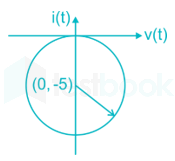
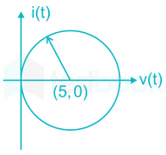
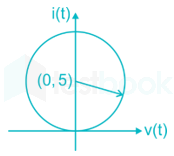
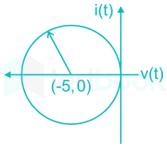
A DC voltage source is connected to a series L-C circuit by turning on the switch S at time t = 0 as shown in the figure. Assume i(0) = 0, v(0) = 0. Which one of the following circular loci represents the plot of i(t) versus v(t)?

  1. ((a))

  2. ((b))

  3. ((c))

  4. ((d))

Show Answer
Answer: ((b))

Concept:

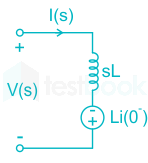
We replace the capacitor with an initial voltage to its s-domain equivalent as shown:

Similarly, an inductor with an initial current of i(0-) is represented as:

Analysis:

Since for the given circuit, the initial voltage and current across the capacitor is zero, the equivalent circuit will have vc(0-) = 0 and i(0-) = 0, and the circuit will be redrawn as:

I(s)=5ss+15I\left( s \right) = \frac{{\frac{5}{s}}}{{s + \frac{1}{5}}}

I(s)=5s2+1I\left( s \right) = \frac{5}{{{s^2} + 1}}

Taking the inverse Laplace transform, we get:

i(t) = 5 sint

The capacitor voltage will now be:

\({V_C}\left( t \right) = \frac{1}{C}\mathop \smallint \limits_0^t 5\sin tdt\)

\(= \frac{1}{1}\mathop \smallint \limits_0^t 5\sin tdt\)

VC(t) = 5(1 – cos t)

The current and voltage are now plotted as shown:

42

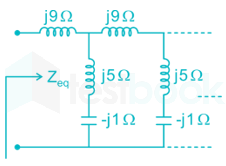
The equivalent impedance Zeq for the infinite ladder circuit shown in the figure is

  1. ((a))

    j12Ω

  2. ((b))

    -j12Ω

  3. ((c))

    j13Ω

  4. ((d))

    13Ω

Show Answer
Answer: ((a))

j12Ω

Given circuit diagram:

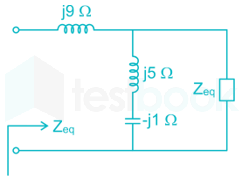
For an infinite ladder, we will replace the common repeating term with the input impedance 

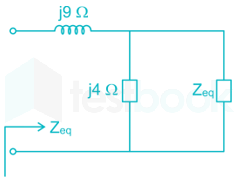
Impedance j5 Ω and -j1 Ω are in series. Therefore the impedance will be j4 Ω 

Now the equivalent impedance Zeq will be

Zeq=j9+zeq(j4)zeq+j4{Z_{eq}} = j9 + \frac{{{z_{eq}}\left( {j4} \right)}}{{{z_{eq}} + j4}}

(zeqj9)(zeq+j4)=zeq(j4)\Rightarrow \left( {{z_{eq}} - j9} \right)\left( {{z_{eq}} + j4} \right) = {z_{eq}}\left( {j4} \right)

zeq2+36j5;zeq=zeq(j4)\Rightarrow z_{eq}^2 + 36 - j5;{z_{eq}} = {z_{eq}}\left( {j4} \right)

zeq2j9zeq+36=0\Rightarrow z_{eq}^2 - j9{z_{eq}} + 36 = 0

(zeqj12)(zeq+j3)=0\Rightarrow \left( {{z_{eq}} - j12} \right)\left( {{z_{eq}} + j3} \right) = 0

zeq=j12;Ω;(or)j3\Rightarrow {z_{eq}} = j12;{\rm{Ω ;}}\left( {or} \right) - j3

Zeq can’t be negative as the given circuit is inductive in nature.

⇒ Zeq = j12 Ω

43

Consider a system governed by the following equations

dx1(t)dt=x2(t)x1(t)\frac{{d{x_1}\left( t \right)}}{{dt}} = {x_2}\left( t \right) - {x_1}\left( t \right)

dx2(t)dt=x1(t)x2(t)\frac{{d{x_2}\left( t \right)}}{{dt}} = {x_1}\left( t \right) - {x_2}\left( t \right)

The initial conditions are such that x1(0)<x2(0)<;.{x_1}\left( 0 \right) < {x_2}\left( 0 \right) < ;\infty . Let x1f=limtx1(t){x_{1f}} = \mathop {\lim }\limits_{t \to \infty } {x_1}\left( t \right) and x2f=limtx2(t){x_{2f}} = \mathop {\lim }\limits_{t \to \infty } {x_2}\left( t \right). Which one of the following is true?

  1. ((a))

    x1f<x2f<{x_{1f}} < {x_{2f}} < \infty

  2. ((b))

    x2f<x1f<{x_{2f}} < {x_{1f}} < \infty

  3. ((c))

    x1f=;x2f<{x_{1f}} = ;{x_{2f}} < \infty

  4. ((d))

    x1f=x2f={x_{1f}} = {x_{2f}} = \infty

Show Answer
Answer: ((c))

x1f=;x2f<{x_{1f}} = ;{x_{2f}} < \infty

dx1(t)dt=x1.(t)=x2(t)x1(t)\frac{{d{x_1}\left( t \right)}}{{dt}} = \mathop {\mathop x\nolimits_1 }\limits^. \left( t \right) = {x_2}\left( t \right) - {x_1}\left( t \right)

dx2(t)dt=x2.(t)=x1(t)x2(t)\frac{{d{x_2}\left( t \right)}}{{dt}} = \mathop {\mathop x\nolimits_2 }\limits^. \left( t \right) = {x_1}\left( t \right) - {x_2}\left( t \right)

\(\left[ {\begin{array}{{20}{c}} {\mathop {\mathop x\nolimits_1 }\limits^. \left( t \right)}\ {\mathop {\mathop x\nolimits_2 }\limits^. \left( t \right)} \end{array}} \right] = \left[ {\begin{array}{{20}{c}} { - 1}&1\ 1&{ - 1} \end{array}} \right];\left[ {\begin{array}{*{20}{c}} {{x_1}\left( t \right)}\ {{x_2}\left( t \right)} \end{array}} \right]\)

\(A = \left[ {\begin{array}{*{20}{c}} { - 1}&1\ 1&{ - 1} \end{array}} \right]\)

ϕ(t)=eat=L1[(sIA)1]\phi \left( t \right) = {e^{at}} = {L^{ - 1}}\left[ {{{\left( {sI - A} \right)}^{ - 1}}} \right]

\(sI - A = \left[ {\begin{array}{{20}{c}} s&0\ 0&s \end{array}} \right] - \left[ {\begin{array}{{20}{c}} { - 1}&1\ 1&{ - 1} \end{array}} \right] = \left[ {\begin{array}{*{20}{c}} {s + 1}&{ - 1}\ { - 1}&{s + 1} \end{array}} \right]\)

\({\left[ {sI - A} \right]^{ - 1}} = \frac{1}{{{{\left( {s + 1} \right)}^2} - 1}}\left[ {\begin{array}{*{20}{c}} {s + 1}&1\ 1&{s + 1} \end{array}} \right]\)

\(= \frac{1}{{s\left( {s + 2} \right)}}\left[ {\begin{array}{*{20}{c}} {s + 1}&1\ 1&{s + 1} \end{array}} \right]\)

\(= \left[ {\begin{array}{*{20}{c}} {\frac{{s + 1}}{{s\left( {s + 2} \right)}}}&{\frac{1}{{s\left( {s + 2} \right)}}}\ {\frac{1}{{s\left( {s + 2} \right)}}}&{\frac{{s + 1}}{{s\left( {s + 2} \right)}}} \end{array}} \right]\)

\(= \left[ {\begin{array}{*{20}{c}} {\frac{1}{{2s}} + \frac{1}{{2\left( {s + 2} \right)}}}&{\frac{1}{{2s}} - \frac{1}{{2\left( {s + 2} \right)}}}\ {\frac{1}{{2s}} - \frac{1}{{2\left( {s + 2} \right)}}}&{\frac{1}{{2s}} - \frac{1}{{2\left( {s + 2} \right)}}} \end{array}} \right]\)

ϕ(t)=L1[(sIA)1]\phi \left( t \right) = {L^{ - 1}}\left[ {{{\left( {sI - A} \right)}^{ - 1}}} \right]

\(= \frac{1}{2}\left[ {\begin{array}{*{20}{c}} {1 + {e^{ - 2t}}}&{1 - {e^{ - 2t}}}\ {1 - {e^{ - 2t}}}&{1 + {e^{ - 2t}}} \end{array}} \right]\)

\(x\left( t \right) = \phi \left( t \right);x\left( 0 \right) = \frac{1}{2}\left[ {\begin{array}{{20}{c}} {1 + {e^{ - 2t}}}&{1 - {e^{ - 2t}}}\ {1 - {e^{ - 2t}}}&{1 + {e^{ - 2t}}} \end{array}} \right]\left[ {\begin{array}{{20}{c}} {{x_1}\left( 0 \right)}\ {{x_2}\left( 0 \right)} \end{array}} \right]\)

\(x\left( t \right) = \frac{1}{2};\left[ {\begin{array}{*{20}{c}} {{x_1}\left( 0 \right) + {x_2}\left( 0 \right) + {e^{ - 2t}}\left( {{x_1}\left( 0 \right) - {x_2}\left( 0 \right)} \right)}\ {{x_1}\left( 0 \right) + {x_2}\left( 0 \right) + {e^{ - 2t}}\left( {{x_2}\left( 0 \right) - {x_1}\left( 0 \right)} \right)} \end{array}} \right]\)

x1f=lttx1(t)=12(x1(0)+x2(0)){x_{1f}} = \mathop {{\rm{lt}}}\limits_{t \to \infty } {x_1}\left( t \right) = \frac{1}{2}\left( {{x_1}\left( 0 \right) + {x_2}\left( 0 \right)} \right)

x2f=lttx2(t)=12(x1(0)+x2(0)){x_{2f}} = \mathop {{\rm{lt}}}\limits_{t \to \infty } {x_2}\left( t \right) = \frac{1}{2}\left( {{x_1}\left( 0 \right) + {x_2}\left( 0 \right)} \right)

Given that, x1(0) < x2 (0) < ∞

⇒ x1f = x2f < ∞
44

The number of roots of the polynomial, s7 + s6 + 7s5 + 14s4 + 31s3 + 73s2 + 25s + 200, in the open left half of the complex plane is

  1. ((a))

    3

  2. ((b))

    4

  3. ((c))

    5

  4. ((d))

    6

Show Answer
Answer: ((a))

3

Concept:

According to RH stability criteria there are two necessary conditions:

First is there should not be any sign changes in the first column of the tabulation and Second Is there should not be any missing coefficients in the equation 1 + G(s) H(s).

The RH criteria can be solved as following:

s3;;;a0;;;;;a2;;;;;;a4{s^3} - - - {\rm{;;;}}{{\rm{a}}_0} \searrow {\rm{;;;;;}} \swarrow {{\rm{a}}_2}{\rm{;;;;;;}}{{\rm{a}}_4}

s2;;;a1;;;;a3;;;;;;;0{s^2} - - - {\rm{;;;}}{{\rm{a}}_1}{\rm{;}} \nearrow {\rm{;;;}} \nwarrow {{\rm{a}}_3}{\rm{;;;;;;;}}0

s1;;;a1a2a0a3a1;=A;;;;;;;;;;0;{s^1} - - - {\rm{;;;}}\frac{{{{\rm{a}}_1}{{\rm{a}}_2} - {{\rm{a}}_0}{{\rm{a}}_3}}}{{{{\rm{a}}_1}}}{\rm{;}} = {\rm{A;;;;;;;;;;}}0{\rm{;}}

s0;;;Aa3A=a3{s^0} - - - {\rm{;;;}}\frac{{{\rm{A}}{{\rm{a}}_3}}}{{\rm{A}}} = {{\rm{a}}_3}

Calculation:

From R-H stability criteria

S7 + S6 + 7 S 5 + 14S4 + 31S3 + 73S2 + 25S + 200

\(\left. {\begin{array}{{20}{c}} {{S^7}}\ {{S^6}}\ {\begin{array}{{20}{c}} {{S^5}}\ {{S^4}}\ {\begin{array}{{20}{c}} {{S^3}}\ {{S^2}}\ {\begin{array}{{20}{c}} {{S^1}}\ {{S^0}} \end{array}} \end{array}} \end{array}} \end{array}} \right|\begin{array}{{20}{c}} {\begin{array}{{20}{c}} 1\ 1\ { - 7} \end{array}}&{\begin{array}{{20}{c}} 7\ {14}\ { - 42} \end{array}}&{\begin{array}{{20}{c}} {31}\ {73}\ { - 175} \end{array}}&{\begin{array}{{20}{c}} {25}\ {200}\ 0 \end{array}}\ 8&{48}&{200}&{}\ {\begin{array}{{20}{c}} {32}\ {24}\ {\begin{array}{{20}{c}} { - 170.66}\ {200} \end{array}} \end{array}}&{\begin{array}{{20}{c}} {96}\ {200}\ {\begin{array}{{20}{c}} 0\ 0 \end{array}} \end{array}}&{\begin{array}{{20}{c}} 0\ 0\ {\begin{array}{{20}{c}} 0\ 0 \end{array}} \end{array}}&{\begin{array}{{20}{c}} {}\ {}\ {\begin{array}{*{20}{c}} {}\ {} \end{array}} \end{array}} \end{array}\)

Number of sign changes = 4

Number of left-hand poles = 7 – 4 = 3

45

If C is a circle |z| = 4 and f(z)=z2(z23z+2)2f\left( z \right) = \frac{{{z^2}}}{{{{\left( {{z^2} - 3z + 2} \right)}^2}}}, then f(z)dz\oint f\left( z \right)dz is

  1. ((a))

    1

  2. ((b))

    0

  3. ((c))

    -1

  4. ((d))

    -2

Show Answer
Answer: ((b))

0

f(z)=z2(z23z+2)2f\left( z \right) = \frac{{{z^2}}}{{{{\left( {{z^2} - 3z + 2} \right)}^2}}}

=z2(z1)2(z2)2 = \frac{{{z^2}}}{{{{\left( {z - 1} \right)}^2}{{\left( {z - 2} \right)}^2}}}

Poles of f(z) are z = 1, 2

Both Z = 1 and 2 are inside the curve |z| = 4

\(\mathop \smallint \limits_C f\left( z \right)dz = 2\pi i\) [sum of residues at z = 1 and z = 2]

If f has a pole of order n at z = a, then Residue of f(z) at z = a is

=1(n1)!dn1dzn1[(za)nf(z)]z=a= \frac{1}{{\left( {n - 1} \right)!}}\frac{{{d^{n - 1}}}}{{d{z^{n - 1}}}}{\left[ {{{\left( {z - a} \right)}^n}f\left( z \right)} \right]_{z = a}}

Residue at z = 1,

Itz1ddz[z2.;(z1)2(z1)2(z2)2]\mathop {{\rm{It}}}\limits_{z \to 1} \frac{d}{{dz}}\left[ {\frac{{{z^2}.;{{\left( {z - 1} \right)}^2}}}{{{{\left( {z - 1} \right)}^2}{{\left( {z - 2} \right)}^2}}}} \right]

=(12)2(2)(1)2(2(1))(12)4=4 = \frac{{{{\left( {1 - 2} \right)}^2}\left( 2 \right) - {{\left( 1 \right)}^2}\left( {2\left( { - 1} \right)} \right)}}{{{{\left( {1 - 2} \right)}^4}}} = 4

Residue at z = 2,

=ltz2ddz[z2(z1)2]= \mathop {{\rm{lt}}}\limits_{z \to 2} \frac{d}{{dz}}\left[ {\frac{{{z^2}}}{{{{\left( {z - 1} \right)}^2}}}} \right]

=;ltz2[(z1)2(2z)z2(2(z1))(z1)4]= ;\mathop {{\rm{lt}}}\limits_{z \to 2} \left[ {\frac{{{{\left( {z - 1} \right)}^2}\left( {2z} \right) - {z^2}\left( {2\left( {z - 1} \right)} \right)}}{{{{\left( {z - 1} \right)}^4}}}} \right]

=(21)24(2(1))(21)4=4;= \frac{{{{\left( {2 - 1} \right)}^2} - 4\left( {2\left( 1 \right)} \right)}}{{{{\left( {2 - 1} \right)}^4}}} = - 4;

\(\mathop \smallint \limits_C f\left( z \right)dz = 2\pi i\left( {4 - 4} \right) = 0\)

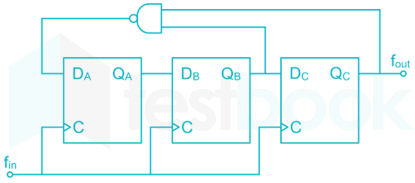
46

Which one of the following statements is true about the digital circuit shown in the figure?

  1. ((a))

    It can be used for dividing the input frequency by 3.

  2. ((b))

    It can be used for dividing the input frequency by 5.

  3. ((c))

    It can be used for dividing the input frequency by 7.

  4. ((d))

    It cannot be reliably used as a frequency divider due to disjoint internal cycles.

Show Answer
Answer: ((b))

It can be used for dividing the input frequency by 5.

From the given circuit diagram,

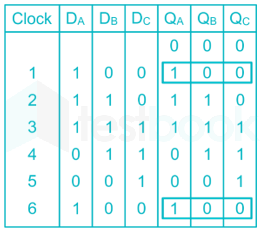
DA=QBQc,;DB=QA,;DC=QB{D_A} = \overline {{Q_B}{Q_c}} ,;{D_B} = {Q_A},;{D_C} = {Q_B}

The output QA, QB, QC is repeating for every 5 clock pulses.

Hence frequency will be divided by 5.

47

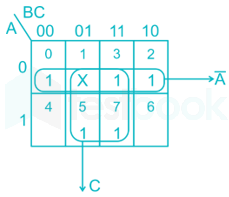
Digital input signals A, B, C with A as the MSB and C as the LSB are used to realize the Boolean function F = m0 + m2 + m3 + m5 + m7, where mi denotes the ith minterm. In addition, F has a don’t care for m1. The simplified expression for F is given by:

  1. ((a))

    AˉCˉ+BˉC+AC\bar A\bar C + \bar BC + AC

  2. ((b))

    Aˉ+C\bar A + C

  3. ((c))

    Cˉ+A\bar C + A

  4. ((d))

    AˉC+BC+ACˉ\bar AC + BC + A\bar C

Show Answer
Answer: ((b))

Aˉ+C\bar A + C

F = m0 + m2 + m3 + m5 + m7

m1 is a don’t care. 

F=Aˉ+CF = \bar A + C

48

Consider the two continuous-time signals defined below:

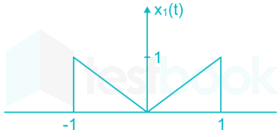
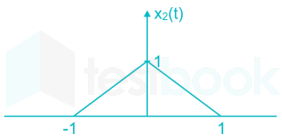
\({x_1}\left( t \right) = \left{ {\begin{array}{{20}{c}} {\left| t \right|, - 1 \le t \le 1;}\ {0,;otherwise;} \end{array},} \right.{x_2}\left( t \right) = \left{ {\begin{array}{{20}{c}} {1 - \left| t \right|, - 1 \le t \le 1;}\ {0,;otherwise;} \end{array}} \right.\)

These signals are sampled with a sampling period of T = 0.25 seconds to obtain discrete time signals x1[n] and x2[n], respectively. Which one of the following statements is true?

  1. ((a))

    The energy of x1[n] is greater than the energy of x2[n].

  2. ((b))

    The energy of x2[n] is greater than the energy of x1[n].

  3. ((c))

    x1[n] and x2 have equal energies.

  4. ((d))

    Neither x1[n] nor x2[n] is a finite-energy signal.

Show Answer
Answer: ((a))

The energy of x1[n] is greater than the energy of x2[n].

Concept:

Energy of the discrete time signal x(n) is,

                         \({E} = \mathop \sum \limits_{n = - \infty }^\infty {\left| {{x}\left( n \right)} \right|^2}\)

Energy of the continuous time signal x(t) is,

                         \(E = \mathop \smallint \limits_{ - \infty }^\infty {\left( {x\left( t \right)} \right)^2}dt\)

Explanation:

\({x_1}\left( t \right) = \left{ {\begin{array}{*{20}{c}} {\left| t \right|}&{ - 1 \le t \le 1}\ 0&{otherwise} \end{array}} \right.\)


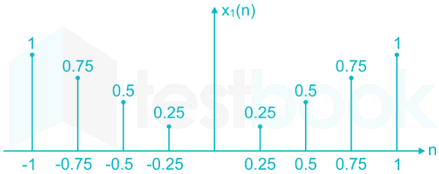
After sampling the above signal for T = 0.25 sec, the discrete signal will be

Energy of \({x_1}\left( n \right) = {E_1} = \mathop \sum \limits_{n = - \infty }^\infty {\left| {{x_1}\left( n \right)} \right|^2}\)

= 02 + 2 [0.252 + 0.52 + 0.752 + 12]

= 3.75

\({x_2}\left( t \right) = \left{ {\begin{array}{*{20}{c}} {1 - \left| t \right|}&{ - 1 \le t \le 1}\ 0&{otherwise} \end{array}} \right.\)

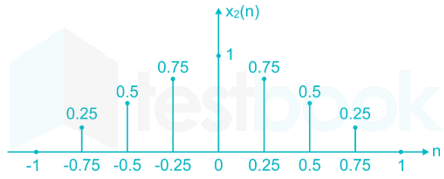
After sampling the above signal for T = 0.25 sec, the discrete signal will be

Energy of \({x_2}\left( n \right) = {E_2} = \mathop \sum \limits_{n = - \infty }^\infty {\left| {{x_2}\left( n \right)} \right|^2}\)

= 12 + 2 [0.752 + 0.52 + 0.252]

= 2.75

⇒ E1 > E2

49

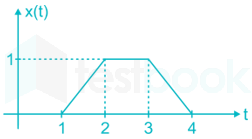
The signal energy of the continuous-time signal

X(t) = [(t – 1) u(t - 1)] – [(t - 2)u(t - 2)] – [(t - 3)u(t – 3)] + [(t - 4)]u(t – 4)] is

  1. ((a))

    11/3

  2. ((b))

    7/3

  3. ((c))

    1/3

  4. ((d))

    5/3

Show Answer
Answer: ((d))

5/3

Concept:

The Energy of the signal is given as,

\(E = \mathop \smallint \limits_{ - \infty }^\infty {\left( {x\left( t \right)} \right)^2}dt\)

Explanation:

x(t) = [(t-1) u (t-1)] – [(t-2) u (t-2)] – [(t-3) u (t-3)] + [(t -4) u (t-4)]

We know that, 

                       r(t) = t u (t)

x(t) = r(t - 1) - r(t - 2) - r(t - 3) + r(t - 4)

Energy of the signal, x(t) is

\(E = \mathop \smallint \limits_{ - \infty }^\infty {\left( {x\left( t \right)} \right)^2}dt\)

\(= \mathop \smallint \limits_1^2 {\left( {t - 1} \right)^2}dt + \mathop \smallint \limits_2^3 {1^2}dt + \mathop \smallint \limits_3^4 {\left( { - t + 4} \right)^2}dt\)

\(= \mathop \smallint \limits_1^2 \left( {{t^2} - 2t + 1} \right)dt + \mathop \smallint \limits_2^3 1;dt + \mathop \smallint \limits_3^4 \left( {{t^2} + 16 - 8t} \right)dt\)

=[t332t22+t]12+[t]23+[t33+16t8t22]34= \left[ {\frac{{{t^3}}}{3} - \frac{{2{t^2}}}{2} + t} \right]_1^2 + \left[ t \right]_2^3 + \left[ {\frac{{{t^3}}}{3} + 16t - \frac{{8{t^2}}}{2}} \right]_3^4

=[131+1]+[32]+[373+1628]= \left[ {\frac{1}{3} - 1 + 1} \right] + \left[ {3 - 2} \right] + \left[ {\frac{{37}}{3} + 16 - 28} \right]

=13+1+37312 = \frac{1}{3} + 1 + \frac{{37}}{3} - 12

=1+3+37363=53= \frac{{1 + 3 + 37 - 36}}{3} = \frac{5}{3}

50

The Fourier transform of a continuous-time signal x(t) is given by X(ω)=1(10+jω)2,<ω<,X\left( \omega \right) = \frac{1}{{{{\left( {10 + j\omega } \right)}^2}}}, - \infty < \omega < \infty , where j=1j = \sqrt { - 1}  and ω denotes frequency. Then the value of |ln x(t)| at t = 1 is _____ (up to 1 decimal place). (In denotes the logarithm to base e)

51

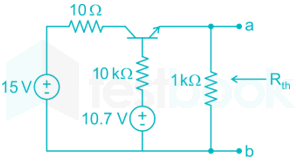
In the circuit shown in the figure, the bipolar junction transistor (BJT) has a current gain 𝛽 = 100. The base-emitter voltage drop is a constant, 𝑉𝐵𝐸 = 0.7 𝑉. The value of the Thevenin equivalent resistance 𝑅𝑇ℎ (in Ω) as shown in the figure is ______ (up to 2 decimal places).

52

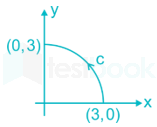
As shown in the figure, 𝐶 is the arc from the point (3, 0) to the point (0, 3) on the circle 𝑥2 + 𝑦2 = 9. The value of the integral \(\mathop \smallint \limits_c \left( {{y^2} + 2yx} \right)dx + \left( {2xy + {x^2}} \right)dy;\) is _____ (up to 2 decimal places).

53

Let f(x) = 3x3 – 7x2 + 5x + 6. The maximum value of f(x) over the interval [0, 2] is _______ (up to 1 decimal place).

54

Let \(A = \left[ {\begin{array}{*{20}{c}} 1&0&{ - 1}\ { - 1}&2&0\ 0&0&{ - 2} \end{array}} \right]\) and B = A3 – A2 – 4A + 5I, where I is the 3 × 3 identity matrix. The determinant of B is _______ (up to 1 decimal place).

55

The capacitance of an air-filled parallel-plate capacitor is 60 pF. When a dielectric slab whose thickness is half the distance between the plates, is placed on one of the plates covering it entirely, the capacitance becomes 86 pF. Neglecting the fringing effects, the relative permittivity of the dielectric is __________ (up to 2 decimal places).

56

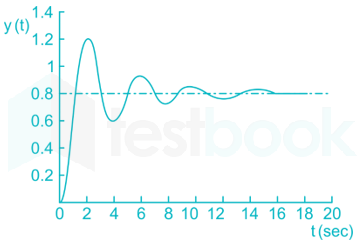
The unit step response y(t) of a unity feedback system with open loop transfer function G(s)H(s)=k(s+1)2(s+2)G\left( s \right)H\left( s \right) = \frac{k}{{{{\left( {s + 1} \right)}^2}\left( {s + 2} \right)}}is shown in the figure. The value of K is _______ (up to 2 decimal places.)

57

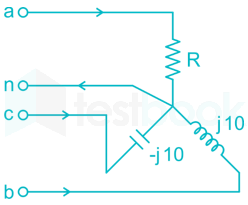
A three-phase load is connected to a three-phase balanced supply as shown in the figure. If Van = 100∠ 0° V, Vbn = 100∠ - 120° V and Vcn =100∠-240° V (angles are considered positive in the anti-clockwise direction), the value of R for zero current in the neutral wire is ___________Ω (up to 2 decimal places).

58

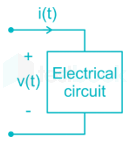
The voltage across the circuit in the figure, and the current through it, are given by the following expressions:

𝑣(𝑡) = 5 – 10 cos (𝜔𝑡 + 60°) V

𝑖(𝑡) = 5 + Xcos (𝜔𝑡) A

 where 𝜔 = 100𝜋 radian/s. If the average power delivered to the circuit is zero, then the value of X (in Ampere) is _____ (up to 2 decimal places).

59

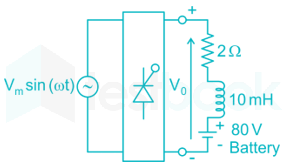
A phase controlled single phase rectifier, supplied by an AC source, feeds power to an R-L-E load as shown in the figure. The rectifier output voltage has an average value given by VO=;Vm2π;(3+cos;α).{V_O} = \frac{{;Vm}}{{2\pi }};\left( {3 + cos;\alpha } \right). Where 𝑉𝑚= 80𝜋 volts and 𝛼 is the firing angle. If the power delivered to the lossless battery is 1600 W, 𝛼 in degree is________ (up to 2 decimal places).

60

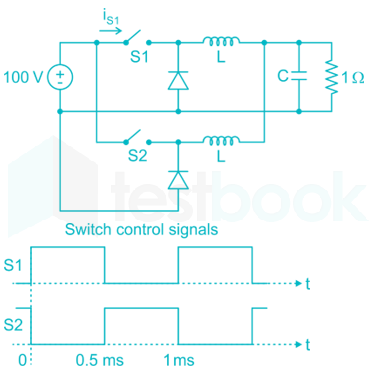
The figure shows two buck converters connected in parallel. The common input dc voltage for the converters has a value of 100 V. The converters have inductors of identical value. The load resistance is 1 Ω. The capacitor voltage has negligible ripple. Both converters operate in the continuous conduction mode. The switching frequency is 1 kHz, and the switch control signals are as shown. The circuit operates in the steady state. Assuming that the converters share the load equally, the average value of iS1, the current of switch S1 (in Ampere), is _____ (up to 2 decimal places).

61

A 3-phase 900 kVA, 3 kV/3\sqrt 3 kV (∆/Y), 50 Hz transformer has primary (high voltage side) resistance per phase of 0.3 Ω and secondary (low voltage side) resistance per phase of 0.02 Ω. Iron loss of the transformer is 10 kW. The full load % efficiency of the transformer operated at unity power factor is _______ (up to 2 decimal places).

62

A 200 V DC series motor, when operating from rated voltage while driving a certain load, draws 10 A current and runs at 1000 r.p.m. The total series resistance is 1 Ω. The magnetic circuit is assumed to be linear. At the same supply voltage, the load torque is increased by 44%. The speed of the motor in r.p.m. (rounded to the nearest integer) is ________

63

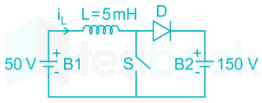
A dc to dc converter shown in the figure is charging a battery bank, B2 whose voltage is constant at 150 V. B1 is another battery bank whose voltage is constant at 50 V. The value of the inductor, L is 5 mH and the ideal switch, S is operated with a switching frequency of 5 kHz with a duty ratio of 0.4. Once the circuit has attained steady-state and assuming the diode D to be ideal, the power transferred from B1 to B2 (in Watt) is ___________ (up to 2 decimal places).

64

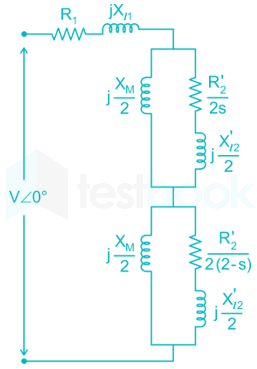
The equivalent circuit of a single-phase induction motor is shown in the figure, where the parameters are R1 = R’2 = Xl1 = X’l2 = 12 Ω, xM = 240 Ω and s is the slip. At no-load, the motor speed can be approximated to be the synchronous speed. The no-load lagging power factor of the motor is___________ (up to 3 decimal places).

65

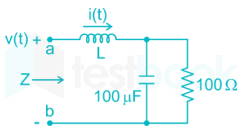
The voltage v(t) across the terminals a and b as shown in the figure, is a sinusoidal voltage having a frequency ω = 100 radian/s. When the inductor current i(t) is in phase with the voltage v(t), the magnitude of the impedance Z (in Ω) seen between the terminals a and b is ________ (up to 2 decimal places).

Attempt this paper under real exam conditions

Timed interface, section switching, instant scoring, and question-by-question analytics — free.

Start Timed Attempt