Choose the option with words that are not synonyms.
((a))
Aversion, dislike
((b))
Luminous, radiant
((c))
Plunder, loot
((d))
Yielding, resistant
Show Answer
Answer: ((d))
Yielding, resistant
Let us look at the meanings of the given words:
Aversion: a strong dislike or disinclination.
Luminous: giving off light; bright or shining.
Plunder: steal goods from (a place or person), typically using force and in a time of war or civil disorder.
Yielding: (of a substance or object) giving way under pressure; not hard or rigid.
Hence option 4 is correct.
2
Saturn is _________ to be seen on a clear night with the naked eye.
((a))
Enough bright
((b))
Bright enough
((c))
As enough bright
((d))
Bright as enough
Show Answer
Answer: ((b))
Bright enough
The word bright is used in order to express the meaning to the required degree or extent and is placed after an adjective, adverb, or verb).
Hence option 2 is correct. The other options are grammatically incorrect.
3
There are five buildings called V, W, X, Y and Z in a row (not necessarily in that order). V is to the West of W. Z is to the East of X and the West of V, W is to the West of Y. Which is the building in the middle?
((a))
V
((b))
W
((c))
X
((d))
Y
Show Answer
Answer: ((a))
V
There are five buildings called V, W, X, Y and Z in a row (not necessarily in that order).
V is to the West of W.
Z is to the East of X and the West of V.
W is to the West of Y.
The building in the middle is V.
4
A test has twenty questions worth 100 marks in total. There are two types of questions. Multiple choice questions are worth 3 marks each and essay questions are worth 11 marks each. How many multiple choice questions does the exam have?
((a))
12
((b))
15
((c))
18
((d))
19
Show Answer
Answer: ((b))
15
A test has twenty questions worth 100 marks in total.
There are two types of questions. Multiple choice questions are worth 3 marks each and essay questions are worth 11 marks each.
Let the number of multiple choice questions are x and the number of essay questions are y.
x + y = 20
and 3x + 11y = 100
By solving the above two equations, we get
x = 15, y = 5
So, the number of multiple choice questions = 15
5
There are 3 red socks, 4 green socks and 3 blue socks. You choose 2 socks. The probability that they are of the same colour is
((a))
1/5
((b))
7/30
((c))
1/4
((d))
4/15
Show Answer
Answer: ((d))
4/15
Explanation:
There are 3 red socks, 4 green socks and 3 blue socks.
We need to select 2 socks.
The probability that both the socks of red colour:
10C23C2=453
The probability that both the socks of green colour:
10C24C2=456
The probability that both the socks of red colour:
10C23C2=453
The probability that both are of the same colour:
=453+456+453=4512=154
6
“We lived in a culture that denied any merit to literary works, considering them important only when they were handmaidens to something seemingly more urgent – namely ideology. This was a country where all gestures, even the most private, were interpreted in political terms.”
The author’s belief that ideology is not as important as literature is revealed by the word:
((a))
‘Culture’
((b))
‘Seemingly’
((c))
‘Urgent’
((d))
‘Political’
Show Answer
Answer: ((b))
‘Seemingly’
Let us look at the meanings of the given words:
Culture: the arts and other manifestations of human intellectual achievement regarded collectively.
Seemingly: so as to give the impression of having a certain quality; apparently; according to the facts as one knows them; as far as one knows.
Urgent: requiring immediate action or attention.
Political: relating to the government or public affairs of a country.
Hence option 2 is correct.
7
There are three boxes. One contains apples, another contains oranges and the last one contains both apples and oranges. All three are known to be incorrectly labelled. If you are permitted to open just one box and then pull out and inspect only one fruit, which box would you open to determine the contents of all three boxes?
((a))
The box labelled ‘Apples’
((b))
The box labelled ‘Apples and Oranges’
((c))
The box labelled ‘Oranges’
((d))
Cannot be determined
Show Answer
Answer: ((b))
The box labelled ‘Apples and Oranges’
There are three boxes labelled as apples, oranges and both apples and oranges. All the boxes are incorrectly labelled.
Case 1: Let we open the box labelled with apples.
If the fruit inspected is orange, we can’t say it is the box with oranges or the box with both apples and oranges.
So, this case is not valid.
Case 2: Let we open the box labelled with oranges.
If the fruit inspected is apple, we can’t say it is the box with apples or the box with both apples and oranges.
So, this case is also not valid.
Case 3: Let we open the box labelled with both apples and oranges.
If the fruit inspected is apple, we can conclude that this box contains apples.
Now, the second box is labelled with orange, but it is incorrectly labelled. So, it can’t be orange and hence this box contains both apples and oranges.
Box 1 contains oranges.
So, we need to choose the third box which is labelled as both apples and oranges in order to determine the contents of all boxes.
8
X is a 30 digit number starting with the digit 4 followed by the digit 7. Then the number X3 will have
((a))
90 digits
((b))
91 digits
((c))
92 digits
((d))
93 digits
Show Answer
Answer: ((a))
90 digits
Calculation:
X is a 30-digit number starting with the digit 4 followed by the digit 7.
Let X = 47 × 1028
Now, X3 = 473 × 1084 = 103823 × 1084
So, X have 90 digits.
9
The number of roots of ex + 0.5 x2 – 2 = 0 in the range [-5, 5] is
((a))
0
((b))
1
((c))
2
((d))
3
Show Answer
Answer: ((c))
2
Let f(x) = ex + 0.5 x2 – 2 = 0
The given range = [-5, 5]
x
-5
-4
-3
-2
-1
0
1
2
3
4
5
f(x)
10.5
6.01
2.54
0.135
-1.132
-1
1.218
7.389
22.58
60.59
158.91
From the graph, we can see that the value of f(x) is zero is occurring twice.
So, the number of roots = 2
One root is in between -2 and -1 and the other is in between 0 to 1.
10
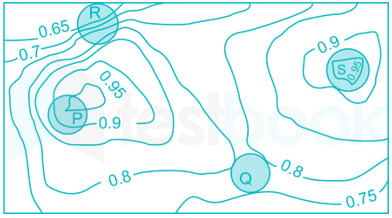
An air pressure contour line joins locations in a region having the same atmospheric pressure. The following is an air pressure contour plot of a geographical region. Contour lines are shown at 0.05 bar intervals in this plot.
If the possibility of a thunderstorm is given by how fast air pressure rises or drops over a region, which of the following regions is most likely to have a thunderstorm?
((a))
P
((b))
Q
((c))
R
((d))
S
Show Answer
Answer: ((c))
R
The possibility of a thunderstorm is given by how fast air pressure rises or drops over a region.
The pressure difference between for the given regions is shown in the below table:
Region
Maximumpressure
Minimumpressure
Pressuredifference
P
0.95
0.9
0.05
Q
0.8
0.75
0.05
R
0.85
0.65
0.2
S
0.95
0.9
0.05
The air difference is maximum for region R. So, Region R is most likely to have a thunderstorm.
Electrical Engineering (55 questions)
11
An urn contains 5 red ball and 5 black balls. In the first draw, one ball is picked at random and discarded without noticing its colour. The probability to get a red ball in the second draw is
((a))
21
((b))
94
((c))
95
((d))
96
Show Answer
Answer: ((a))
21
Concept:
In probability theory, the probability measure of an event is made if another event has already occurred is referred to as conditional probability.
For calculating conditional probability, the probability of the preceding event and the probability of succeeding event is multiplied.
Conditional probability is given by
P(E1/E2)=P(E2)P(E1∩E2)
P(E2/E1)=P(E1)P(E1∩E2)
Where E1 and E2 are the events.
Calculation:
Given:
Urn contains 5 red balls, 5 black balls.
One ball is picked at random.
Case (i): The first ball is red ball
Probability to get a red ball in the second draw is
P1=105×94=92
Case (ii): The first ball is black ball
Probability to get a red ball in the second draw is
P2=105×95=185
Required probability (P) =P1+P2=92+185=21
12
Consider a solid sphere of radius 5 cm made of a perfect electric conductor. If one million electrons are added to this sphere, these electrons will be distributed
((a))
uniformly over the entire volume of the sphere
((b))
uniformly over the outer surface of the sphere
((c))
concentrated around the centre of the sphere
((d))
Along a straight line passing through the centre of the sphere
Show Answer
Answer: ((b))
uniformly over the outer surface of the sphere
For a perfect electric conductor, no charge can be distributed inside the surface of conductor.
If one million electrons are added to the sphere, these electrons will be distributed uniformly over the outer surface of the sphere.
13
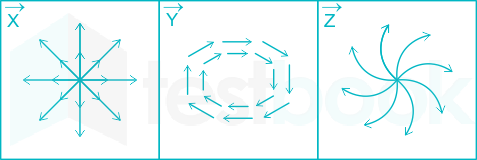
The figures show diagrammatic representations of vector fields X,;Y,;and;Z respectively. Which one of the following choices is true?
((a))
∇.X=0,∇×Y=0,∇×Z=0;
((b))
∇.X=0,∇×Y=0,∇×Z=0
((c))
∇.X=0,∇×Y=0,∇×Z=0
((d))
∇.X=0,∇×Y=0,∇×Z=0
Show Answer
Answer: ((c))
∇.X=0,∇×Y=0,∇×Z=0
Concept:
Divergence of any vector is zero if the total outward flow is equal to the total inward flow.
∇.A=0
Curl of any vector is zero if there is no rotation in space.
∇×A=0
Application:
Vector Xhas no rotation in the space and the outward flow is not equal to inward flow.
∇.X=0,;∇×X=0
The vectorY has circular rotation and the flow is same in both inward and outward direction.
∇.Y=0,;∇×Y=0
Vector Zhas circular rotation and the outward flow is not equal to inward flow.
∇.Z=0,;∇×Z=0
Here, option 3 is correct.
14
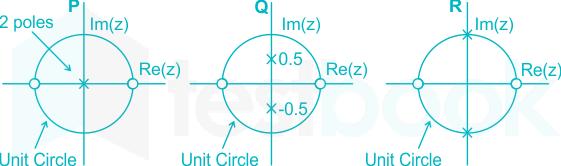
The pole-zero plots of three discrete time systems P, Q and R on the z-plane are shown below.
Which one of the following is TRUE about the frequency selectivity of these system?
((a))
All three are high-pass filters
((b))
All three are band-pass filters
((c))
All three are low-pass filters
((d))
P is a low-pass filter, Q is a band-pass filter and R is a high-pass filter
Show Answer
Answer: ((b))
All three are band-pass filters
Transfer function of P is,
Hp(z)=z2(z−1)(z+1)=z2z2−1
At low frequency, i.e. at z = 1, Hp(z) = 0
At high frequency, i.e. at z = -1, Hp(z) = 0
So, it is a band pass filter.
Transfer function of Q is,
HQ(z)=(z−j0.5)(z+j0.5)(z−1)(z+1)=z2+0.25z2−1
At low frequency, i.e. at z = 1, HQ(z) = 0
At high frequency, i.e. at z = -1, HQ(z) = 0
So, it is a bandpass filter.
Transfer function of R is,
HR(z)=(z−j)(z+j)(z−1)(z+1)=z2+1z2−1
At low frequency, i.e. at z = 1, HR(z) = 0
At high frequency, i.e. at z = -1, HR(z) = 0
So, it is a bandpass filter.
15
If a synchronous motor is running at a leading power factor, its excitation induced voltage (Ef) is
((a))
equal to terminal voltage Vt
((b))
higher than the terminal voltage Vt
((c))
less than terminal voltage Vt
((d))
dependent upon supply voltage Vt
Show Answer
Answer: ((b))
higher than the terminal voltage Vt
Synchronous motor at leading power factor acts as an over excited machine. At this condition, Ef is greater than Vt.
Synchronous motor at lagging power factor acts as a under excited machine. At this condition, Ef is less than Vt.
16
When a unit ramp input is applied to the unity feedback system having closed loop transfer function
R(s)C(s)=s2+as+bKs+b,(a>0,b>0,K>0), The steady state error will be
((a))
0
((b))
ba
((c))
ba+k
((d))
ba−k
Show Answer
Answer: ((d))
ba−k
Closed loop transfer function is,
CLTF=R(s)C(s)=s2+as+bKs+b
Open loop transfer function will be,
OLTF=1−CLTFCLTF=1−s2+as+bKs+bs2+as+bKs+b
=s2+as+b−Ks−bKs+b
=s2+as−KsKs+b=s(s+a−K)Ks+b
Steady state error for ramp input is given by
ess=Kv1
Velocity error coefficient,
\({K_v} = \begin{array}{*{20}{c}}
{It}\
{s \to 0}
\end{array}s.G\left( s \right)\)
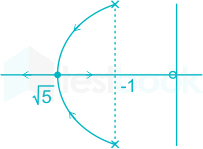
The transfer function C(s) of a compensator is given below.
C(s)=(1+s)(1+10s)(1+0.1s)(1+100s)
The frequency range in which the phase (lead) introduced by the compensator reaches the maximum is
((a))
0.1 < ω < 1
((b))
1 < ω < 10
((c))
10 < ω < 100
((d))
ω > 100
Show Answer
Answer: ((a))
0.1 < ω < 1
C(s)=(1+s)(1+10s)(1+0.1s)(1+100s)
=(s+1)(s+10)(s+0.1)(s+100)
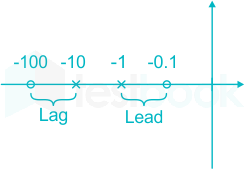
Pole zero diagram of the above transfer function is
It represents a standard lead lag compensator. For a lead lag compensator, maximum lead occurs at initial frequency.
So, maximum lead occurs at 0.1 < ω < 1.
18
Two resistors with nominal resistance values R1 and R2 have additive uncertainties ΔR1 and ΔR2, respectively. When these resistances are connected in parallel, the standard deviation of the error in the equivalent resistance R is
((a))
±(∂R1∂RΔR1)2+(∂R2∂RΔR2)2
((b))
±(∂R2∂RΔR1)2+(∂R1∂RΔR2)2
((c))
±(∂R1∂R)2ΔR2+(∂R2∂R)2ΔR1
((d))
±(∂R1∂R)2ΔR1+(∂R2∂R)2ΔR2
Show Answer
Answer: ((a))
±(∂R1∂RΔR1)2+(∂R2∂RΔR2)2
Nominal resistance values = R1 and R2
Additive uncertainties = ΔR1 and ΔR2
Standard deviation of the error in the equivalent resistance R is
σ=±(∂R1∂R)2σ12+(∂R2∂R)2σ22
=±(∂R1∂R)2(ΔR1)2+(∂R2∂R)2(ΔR2)2
19
A stationary closed Lissajous pattern on an oscilloscope has 3 horizontal tangencies and 2 vertical tangencies for a horizontal input with frequency 3 kHz. The frequency of the vertical input is
((a))
1.5 kHz
((b))
2 kHz
((c))
3 kHz
((d))
4.5 kHz
Show Answer
Answer: ((d))
4.5 kHz
Given that,
Horizontal tangencies (nH) = 3
Vertical tangencies (nV) = 2
Horizontal frequency (fH) = 3 kHz
nHfH = nVfV
⇒fV=nVnHfH=23×3×103=4.5;kHz
20
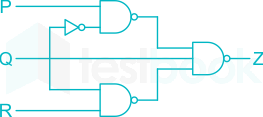
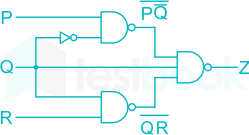
For a 3-input logic circuit shown below, the output Z can be expressed as
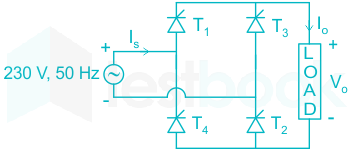
A phase-controlled, single-phase, full bridge converter is supplying a highly inductive DC load. The converter is fed from a 230 V, 50 Hz AC source. The fundamental frequency in Hz of the voltage ripple on the DC side is
((a))
25
((b))
50
((c))
100
((d))
300
Show Answer
Answer: ((c))
100
Explanation:
Single phase full bridge rectifier
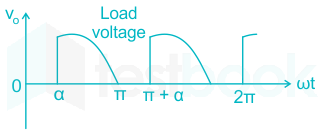
At firing angle 'α' for highly inductive load,
observed from above waveform,
T0=2Tin
⇒ f0 = 2 fin
∴ Ripple frequency at D.C side = 2fin = 2 × 50 = 100 Hz
22
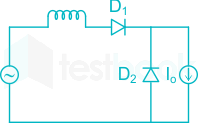
In the circuit shown, the diodes are ideal, the inductance is small and I0 ≠ 0 . Which one of the following statements is true?
((a))
D1 conducts for greater than 180° and D2 conducts for greater than 180°
((b))
D2 conducts for more than 180° and D1 conducts for 180°
((c))
D1 conducts for 180° and D2conducts for 180°
((d))
D1 conducts for more than 180° and D2 conducts for 180°
Show Answer
Answer: ((a))
D1 conducts for greater than 180° and D2 conducts for greater than 180°
The small inductance given in the circuit acts as a source inductance.
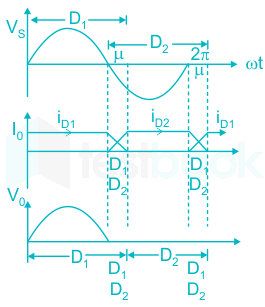
The effect of source inductance is as shown in figure below.
μ is an overlap angle.
Both diodes D1 and D2 conducts for (180 + μ) as shown in the figure.
23
A three-phase voltage source inverter with ideal devices operating in 180° conduction mode is feeding a balanced star-connected resistive load. The DC voltage input is Vdc. The peak of the fundamental component of the phase voltage is
((a))
πVdc
((b))
π2Vdc
((c))
π3Vdc
((d))
π4Vdc
Show Answer
Answer: ((b))
π2Vdc
Concept:
Calculation:
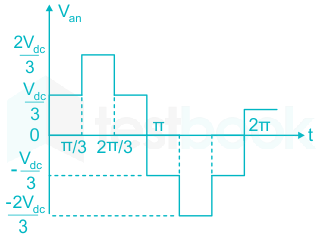
The waveform of output voltage in a three-phase voltage source inverter operating in 180° conduction mode is shown below.
Fourier series expansion of line to neutral voltage is
A 3-phase, 4 pole, 400 V, 50 Hz, squirrel-cage induction motor is operating at a slip of 0.02. The speed of the rotor flux in mechanical rad/sec sensed by stationary observer, is closest to
((a))
1500
((b))
1470
((c))
157
((d))
154
Show Answer
Answer: ((c))
157
Concept:
In a three-phase induction motor,
The stator is stationary, and the rotor is a rotating part
Both the stator field and rotor field rotate with synchronous speed
The rotor rotates with a speed less than synchronous speed
The relative speed between the rotor field and a stator is synchronous speed
The relative speed between the rotor field and stator field is zero
The relative speed between stator filed and stator is synchronous speed
The speed of rotor field flux is synchronous speed (Ns) and the speed of the stator is zero as the stator doesn't rotate.
The speed of rotor field flux with respect to the stator = Ns - 0 = Ns
Calculation:
Given that,
Number of poles (P) = 4
Frequency (f) = 50 Hz
Synchronous speed is given by
Ns=P120f=4120×50=1500;rpm
ωs=602πNs
⇒ωs=602π×1500=157;rad/sec
The speed of the rotor flux is nothing but the synchronous speed.
The speed of the rotor flux = 157 rad/sec
25
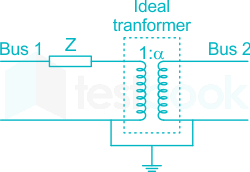
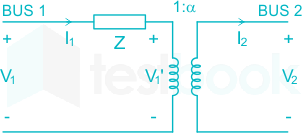
The figure shows the per-phase representation of a phase-shifting transformer connected between buses 1 and 2, where α is a complex number with non-zero real and imaginary parts.
For the given circuit Ybus and Zbus are bus admittance matrix and bus impedance matrix respectively, each of size 2 × 2. Which one of the following statements is true?
Since A ≠ D, the network is asymmetric and hence Ybus and Zbus will also be asymmetric.
26
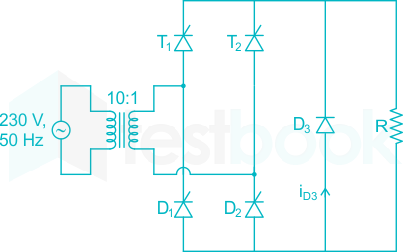
The figure below shows the circuit diagram of a controlled rectifier supplied from a 230 V, 50 Hz, 1-phase voltage source and a 10 : 1 ideal transformer. Assume that all devices are ideal. The firing angles of the thyristors T1 and T2 are 90° and 270° respectively.
The rms value of the current through diode D3 in amperes is ________
27
Assume that in a traffic junction, the cycle of the traffic signal lights is 2 minutes of green (vehicle does not stop) and 3 minutes of red (vehicle stops). Consider that the arrival time of vehicles at the junction is uniformly distributed over 5 minute cycle. The expected waiting time (in minutes) for the vehicle at the junction is ___________ .
28
Consider a function f(x, y, z) given by
f(x, y, z) = (x2 + y2 – 2z2)(y2 + z2)
The partial derivative of this function with respect to x at the point x = 2, y = 1 and z = 3 is _______
29
Let x and y be integers satisfying the following equations
2x2 + y2 = 34
x + 2y = 11
The value of (x + y) is _______.
30
Let y2 – 2y + 1 = x and x+y=5. The value of x+y equals ________. (Give the answer up to three decimal places)
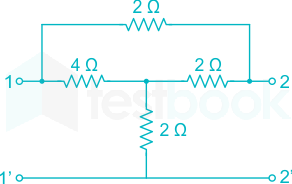
31
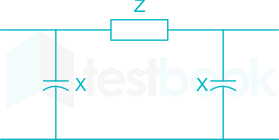
For the given 2-port network, the value of transfer impedance Z21 in ohms is _______.
32
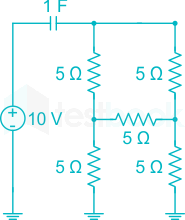
The initial charge in the 1 F capacitor present in the circuit shown is zero. The energy in joules transferred from the DC source until steady state condition is reached equals _________. (Give the answer up to one decimal place.)
33
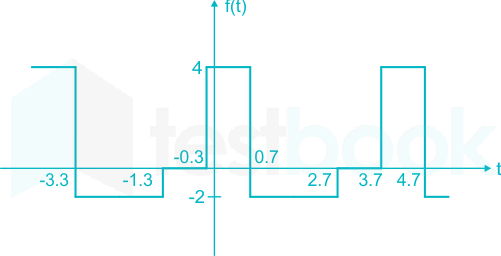
The mean square value of the given periodic waveform f(t) is ________
34
The nominal-π circuit of a transmission line is shown in the figure.
Impedance Z = 100∠80° Ω and reactance X = 3300 Ω. The magnitude of the characteristic impedance of the transmission line, in Ω, is ________. (Give the answer up to one decimal place.)
35
In a load flow problem solved by Newton-Raphson method with polar coordinates, the size of the Jacobian is 100 × 100. If there are 20 PV buses in addition to PQ Buses and a slack bus, the total number of buses in the system is _________.
36
Let \(g\left( x \right) = \left{ {\begin{array}{{20}{c}} { - x,}&{x \le 1}\ {x + 1,}&{x \ge 1} \end{array}} \right.\) and \(f\left( x \right) = \left{ {\begin{array}{{20}{c}} {1 - x,}&{x \le 0}\ {{x^2},}&{x > 0} \end{array}} \right.\).
Consider the composition of f and g, i.e. (fog)(x) = f(g(x)). The number of discontinuities in (fog)(x) present in the interval (-∞, 0) is:
((a))
0
((b))
1
((c))
2
((d))
4
Show Answer
Answer: ((a))
0
Concept:
A function f(x) is said to be continuous at a point x = a, in its domain if,
x→alimf(x)=f(a) exists or its graph is a single unbroken curve.
In other words,
A function f(x) is continuous at x = a if,
Left limit = Right limit = Function value = Real and finite
If A is any square matrix of order n, we can form the matrix [A – λI], where I is the nth order unit matrix. The determinant of this matrix equated to zero i.e. |A – λI| = 0 is called the characteristic equation of A.
The roots of the characteristic equation are called Eigenvalues or latent roots or characteristic roots of matrix A.
Properties of Eigenvalues:
The sum of Eigenvalues of a matrix A is equal to the trace of that matrix A
The product of Eigenvalues of a matrix A is equal to the determinant of that matrix A
If λ is an eigenvalue of a matrix A, then λn will be an eigenvalue of a matrix An.
If λ is an eigenvalue of a matrix A, then kλ will be an eigenvalue of a matrix kA where k is a scalar.
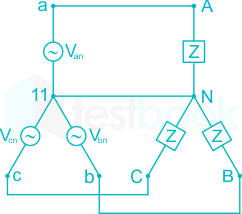
For the star connected 3-phase circuit shown in the figure below, the line-line voltage is 208 V rms and the total power absorbed by the load is 432 W at a power factor of 0.6 leading.
The appropriate value of the impedance Z is
((a))
33∠-53.1° Ω
((b))
60∠53.1° Ω
((c))
60∠-53.1° Ω
((d))
180∠-53.1° Ω
Show Answer
Answer: ((c))
60∠-53.1° Ω
Concept:
Power absorbed (D) = √3 VL IL cos ϕ
Where, VL = line to line voltage , IL = line current
ϕ = power factor angle of the load
Impedance(z)=IphVph
Calculation:
Given that,
Line to line voltage (VL) = 208 V
Power absorbed by the load (P) = 432 W
Power factor (cos ϕ) = 0.6 leading
Power absorbed (D) = √3 × 208 × IL × 0.6 = 432
⇒ IL = 2 A
Impedance(z)=IphVph=23208=60;Ω
Power factor angle (ϕ) = cos-1 (0.6) = 53.1°
As the power factor is leading, ϕ = -53.1°
⇒ Z = 60 ∠-53.1° Ω
40
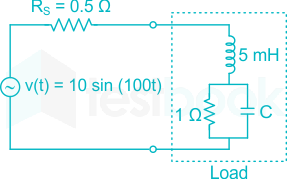
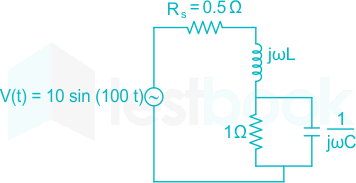
In the circuit shown below, the value of the capacitor C required for maximum power to be transferred to the load is
((a))
1 nF
((b))
1 μF
((c))
1 mF
((d))
10 mF
Show Answer
Answer: ((d))
10 mF
Concept:
Maximum power transfer theorem for AC circuits:
The maximum power transfer theorem states that the maximum power flow through an AC circuit will occur when the load impedance is equal to the complex conjugate of the source impedance as viewed from its output terminals.
When the load impedance matches the Thevenin equivalent resistance of the given circuit, maximum power is transferred to it. i.e.
If RL = Rth, Maximum power is transferred to the Load.
ZL = ZS*
<br>
Calculation:
Given circuit diagram:
Inductive reactance = jωL
Capacitive reactance =jωC1
Load impedance (ZL) will be:
(ZL)=jωL+1+jωC1(1)(jωC1)
=jωL+1+jωC1
=jωL+1+ω2C21−jωC
=jωL−1+ω2C2jωC+1+ω2C21
For maximum power transfer,
Zs = ZL*
⇒0.5=1+ω2C21+j(ωL−1+ω2C2ωC)
As there is no reatance term present in the source, therefore active component of load impedance should be equal to active component of source for maximum power transfer
⇒1+ω2C21=0.5
⇒1+(100)2C21=0.5
⇒ 1 + (100)2 C2 = 2
⇒ (100)2 C2 = 1
⇒C=1001=10;mF
Load variable
The load impedance for maximum power transfer
RL and XL are variable
RL = RS XL = -XS ZL = ZS*
RL only varied and XL = Constant
RL =√(RS2 + (XL + XS)2)
RL only varied and XL = 0
RL =√(RS2 + XS2)
41
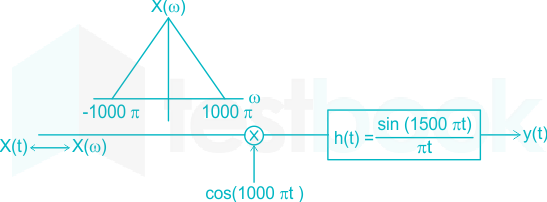
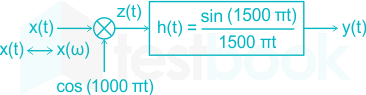
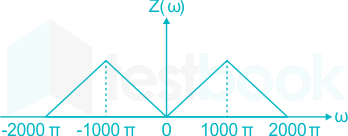
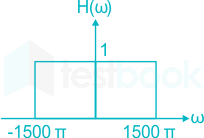
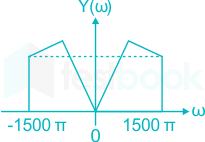
The output y(t) of the following system is to be sampled, so as to reconstruct it from its samples uniquely. The required minimum sampling rate is
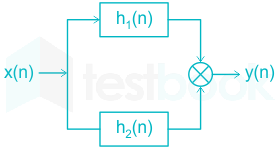
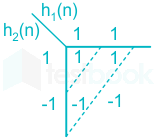
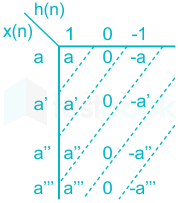
A cascade system having the impulse response \({{\rm{h}}_1}\left( {\rm{n}} \right) = \left{ {\begin{array}{{20}{l}} {1, - 1}\ \uparrow \end{array}} \right}\) and \({{\rm{h}}_2}\left( {\rm{n}} \right) = \left{ {\begin{array}{{20}{l}} {1,{\rm{;}}1}\ \uparrow \end{array}} \right}\) is shown in the figure below, where symbol ↑ denotes the time origin.
The input sequence x(n) for which the cascade system produces an output sequence \({\rm{y}}\left( {\rm{n}} \right) = \left{ {\begin{array}{*{20}{l}} {1,{\rm{;}}2,{\rm{;}}1,{\rm{;}} - 1,{\rm{;}} - 2,{\rm{;}} - 1}\ \uparrow \end{array}} \right}\) is
A 220 V, 10 kW, 900 rpm separately excited DC motor has an armature resistance Ra = 0.02 Ω. When the motor operates at rated speed and with rated terminal voltage, the electromagnetic torque developed by the motor is 70 Nm. Neglecting the rotational losses of the machine, the current drawn by the motor from the 220 V supply is
Option (3) has minimum damping ratio and it will have maximum peak overshoot.
47
For the circuit shown in the figure below, it is given that VCE=2VCC. The transistor has β = 29 and VBE = 0.7 V when the B-E junction is forward biased.
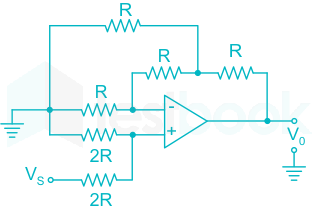
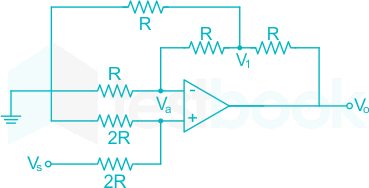
For the circuit shown below, assume that the OPAMP is ideal.
Which one of the following is TRUE?
((a))
Vo = Vs
((b))
Vo = 1.5 Vs
((c))
Vo = 2.5 Vs
((d))
Vo = 5 Vs
Show Answer
Answer: ((c))
Vo = 2.5 Vs
Concept:
Virtual ground -
The concept of the virtual ground is stated as if anyone of the i/p terminals is grounded physically the other i/p terminal will also be at ground potential even though, it is not grounded physically.
One key feature of an Op-Amp is the differential input, and when put together in a circuit, this can form a virtual ground.
The virtual ground concept is helpful for the analysis of Op Amps. This concept makes Op-Amp circuit analysis much easier.
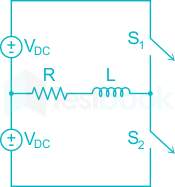
The figure below shows a half-bridge voltage source inverter supplying an RL-load with R = 40 Ω and L=(π0.3)H. The desired fundamental frequency of the load voltage is 50 Hz. The switch control signals of the converter are generated using sinusoidal pulse width modulation with modulation index M = 0.6. At 50 Hz, the RL-load draws an active power of 1.44 kW. The value of DC source voltage VDC in volts is
((a))
3002
((b))
500
((c))
5002
((d))
10002
Show Answer
Answer: ((c))
5002
Concept:
From sinusoidal PWM control technique:
The peak value of fundamental voltage is given as,
Vm1 = MVdc ---(1)
Explanation:
Given that,
RL load: R = 40 Ω, L=π0.3 H
f = 50 Hz
P = 1.44 kW
Modulation index (M) = 0.6
At 50 Hz,
XL = 2πfL = 100 × π0.3 = 30 Ω
Z = R + jXL = 40 + j30
|Z| = 50 Ω
∵ P = 1.44 × 10³
⇒ Irms2R=1440
⇒Irms2R=401440
⇒ Irms = 6 A
we know that,
Z=IrmsVrms
⇒ Vrms = Irms × Z
⇒ Vrms = 6 × 50
⇒ Vrms = 300 V
so, peak value Vm = 300√2
From equation (1)
300√2 = 0.6 VDC
⇒ VDC = 0.6300√2
∴ VDC = 500√2 V
50
A person decides to toss a fair coin repeatedly until he gets a head. He will make at most 3 tosses. Let the random variable Y denote the number of heads. The value of var {Y}, where var{.} denotes the variance, equals.
((a))
87
((b))
6449
((c))
647
((d))
64105
Show Answer
Answer: ((c))
647
Concept:
Random variables:
Random variable assigns a real number to each possible outcome.
Let X be a discreet random variable, then
Expectation E(x) = Σxp(x)
The variance of X = R =E[X2]- (E[X])2
E(x2) = Var(x) + {E(x)}2
Standard;Deviation;σ=Variance
Calculation:
A person decided to toss a fair coin repeatedly until he gets head.
Maximum number of tosses = 3
The event stops if he gets a head (or) at 3 tosses.
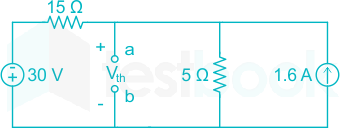
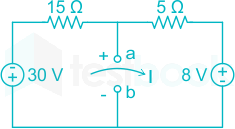
For the network shown below, the Thevenin’s voltage Vab is
((a))
-1.5 V
((b))
-0.5 V
((c))
0.5 V
((d))
1.5 V
Show Answer
Answer: ((a))
-1.5 V
Thevenin’s voltage is the open circuit voltage across the terminals a and b.
By using source transformation,
By using source transformation once again,
By applying KVL
30 + 15 I + 5I + 8 = 0
⇒ I = -1.9 A
By applying KVL
30 + 15I + Vab = 0
⇒ Vab = -15I – 30 = -15(-1.9) - 30
= -1.5 V
52
A 120 V DC shunt motor takes 2 A at no load. It takes 7 A on full load while running at 1200 rpm. The armature resistance is 0.8 Ω and the shunt field resistance is 240 Ω. The no load speed, in rpm is
53
A star-connected, 12.5 kW, 208 V (line), 3-phase, 60 Hz squirrel cage induction motor has following equivalent circuit parameters per phase referred to the stator: R1 = 0.3 Ω, R2 = 0.3 Ω, X1 = 0.41 Ω, X2 = 0.41 Ω. Neglect shunt branch in the equivalent circuit. The starting current (in Ampere) for this motor when connected to an 80 V (line), 20 Hz, 3-phase AC source is ________.
54
A 25 kVA, 400 V, Δ-connected, 3-phase, cylindrical rotor synchronous generator requires a field current of 5 A to maintain the rated armature current under short-circuit condition. For the same field current, the open-circuit voltage is 360 V. Neglecting the armature resistance and magnetic saturation, its voltage regulation (in % with respect to terminal voltage), when the generator delivers the rated load at 0.8 pf leading, at rated terminal voltage is __________.
55
If the primary line voltage rating is 3.3 kV (Y side) of a 25 kVA, Y-Δ transformer (the per phase turns ratio is 5: 1), then the line current rating of the secondary side (in Ampere) is _________.
56
Consider the following system described by the following state space representation.
\(\left[ {\begin{array}{{20}{c}}
{\mathop {\dot x}\nolimits_1 \left( t \right)}\
{\mathop {\dot x}\nolimits_2 \left( t \right)}
\end{array}} \right] = \left[ {\begin{array}{{20}{c}}
0&1\
0&{ - 2}
\end{array}} \right]\left[ {\begin{array}{{20}{c}}
{{x_1}\left( t \right)}\
{{x_2}\left( t \right)}
\end{array}} \right] + \left[ {\begin{array}{{20}{c}}
0\
1
\end{array}} \right]u\left( t \right)\)
\(y\left( t \right) = \left[ {\begin{array}{{20}{c}}
1&0
\end{array}} \right]\left[ {\begin{array}{{20}{c}}
{{x_1}\left( t \right)}\
{{x_2}\left( t \right)}
\end{array}} \right]\)
If u(t) is a unit step input and \(\left[ {\begin{array}{{20}{c}}
{{x_1}\left( 0 \right)}\
{{x_2}\left( 0 \right)}
\end{array}} \right] = \left[ {\begin{array}{{20}{c}}
1\
0
\end{array}} \right]\), the value of output y(t) at t = 1 sec (round off to three decimal places) is ________
57
A 10 ½ digit timer counter possesses a base clock of frequency 100 MHz. When measuring a particular input, the reading obtained is the same in: (i) Frequency mode of operation with a gating time of one second and (ii) Period mode of operation (in the × 10 ns scale). The frequency of the unknown input (reading obtained) in Hz is _____________.
58
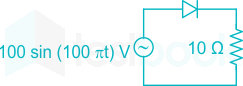
In the circuit shown in the figure, the diode used is ideal. The input power factor is __________. (Give the answer up to two-decimal places.)
59
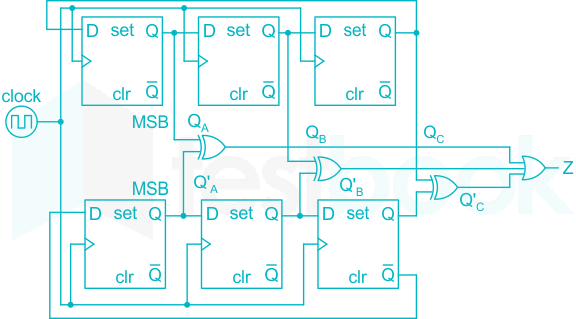
For the synchronous sequential circuit shown below, the output Z is zero for the initial conditions QAQBQC=QA′QB′QC′=100.
The minimum number of clock cycles after which the output Z would again become zero is _______.
60
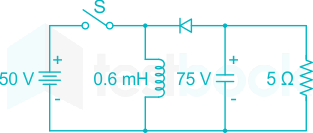
In the circuit shown all elements are ideal and the switch S is operated at 10 kHz and 60% duty ratio. The capacitor is large enough so that the ripple across it is negligible and at steady state acquires a voltage as shown. The peak current in amperes drawn from the 50 V DC source is _________. (Give the answer up to one decimal place.)
61
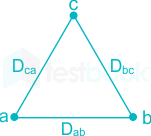
Consider an overhead transmission line with 3-phase, 50 Hz balanced system with conductors located at the vertices of an equilateral triangle of length Dab = Dbc = Dca = 1 m as shown in figure below. The resistances of the conductors are neglected. The geometric mean radius (GMR) of each conductor is 0.01 m. Neglecting the effect of ground, the magnitude of positive sequence reactance in Ω/km (rounded off to three decimal places) is _________
62
A 3-phase, 50 Hz generator supplies power of 3 MW at 17.32 kV to a balanced 3-phase inductive load through an overhead line. The per phase line resistance and reactance are 0.25 Ω and 3.925 Ω respectively. If the voltage at the generator terminal is 17.87 kV, the power factor of the load is ________.
63
Two generating units rated 300 MW and 400 MW have governor speed regulation of 6% and 4% respectively from no load to full load. Both the generating units are operating in parallel to share a load of 600 MW. Assuming free governor action, the load shared by the larger unit is _________MW.
64
A 3-phase, 2-pole, 50 Hz, synchronous generator has a rating 250 MVA, 0.8 pf lagging. The kinetic energy of the machine at synchronous speed is 1000 MJ. The machine is running steadily at synchronous speed and delivering 60 MW power at a power angle of 10 electrical degrees. If the load is suddenly removed, assuming the acceleration is constant for 10 cycle, the value of the power angle after 5 cycles is ________ electrical degrees.
65
A thin soap bubble of radius, R = 1 cm and thickness a = 3.3 μm (a ≪ R), is at a potential of 1 V with respect to a reference point at infinity. The bubble bursts and becomes a single spherical drop of soap (assuming all the soap is contained in the drop) of radius r. The volume of the soap in the thin bubble is 4πR2a and that of the drop is 34πr3. The potential in volts, of the resulting single spherical drop with respect to the same reference point at infinity is ________. (Give the answer up to two decimal places.)