Official Paper

GATE EE 2016 Official Paper: Shift 2 (Previous Year Paper)

65 questions · 180 minutes · with answers · free

General Aptitude (10 questions)

1

The chairman requested the aggrieved shareholders to _________________ him.

  1. ((a))

    bare with

  2. ((b))

    bore with

  3. ((c))

    bear with

  4. ((d))

    bare

Show Answer
Answer: ((c))

bear with

The context of the sentence requires a phrasal verb that will mean to ‘endure’. The phrasal verb from the options with that meaning is ‘bear with’. ‘Bore with’ is in the past tense and cannot be used because the blank is preceded by ‘to’. Thus the base form of the verb needs to be used. ‘Bare’ means to disclose or uncover and thus does not fit the context.

2

Identify the correct spelling out of the given options:

  1. ((a))

    Managable

  2. ((b))

    Manageable

  3. ((c))

    Mangaeble

  4. ((d))

    Managible

Show Answer
Answer: ((b))

Manageable

The correct spelling is ‘manageable’

3

Pick the odd one out in the following:

13, 23, 33, 43, 53

  1. ((a))

    23

  2. ((b))

    33

  3. ((c))

    43

  4. ((d))

    53

Show Answer
Answer: ((b))

33

In the group of given numbers, all are prime numbers but 33 is not.

4

R2D2 is a robot. R2D2 can repair aeroplanes. No other robot can repair aeroplanes.

Which of the following can be logically inferred from the above statements?

  1. ((a))

    R2D2 is a robot which can only repair aeroplanes.

  2. ((b))

    R2D2 is the only robot which can repair aeroplanes.

  3. ((c))

    R2D2 is a robot which can repair only aeroplanes.

  4. ((d))

    Only R2D2 is a robot.

Show Answer
Answer: ((b))

R2D2 is the only robot which can repair aeroplanes.

There are two facts. R2D2 is a robot who can repair aeroplanes and no other robot can do this work. The other functions of R2D2 is not known and thus inference 1 does not follow.

We do not know whether R2D2 can repair anything else other than aeroplanes. Thus option 3 does not follow.

There can be other robots and thus option 4 is eliminated.

Only option 2 is the logical inference that follows.

5

If |9y−6| =3, then y2 −4y/3 is.

  1. ((a))

    0

  2. ((b))

    +1/3

  3. ((c))

    −1/3

  4. ((d))

    undefined

Show Answer
Answer: ((c))

−1/3

9y6=3 9y6=±3\begin{array}{l} \left| {9y - 6} \right| = 3\ 9y - 6 = \pm 3 \end{array}

Case 1:

9y6=3y19y - 6 = 3 \Rightarrow y - 1

Case 2:

9y6=3y=139y - 6 = - 3 \Rightarrow y = \frac{1}{3}

Substitute y=1y = 1

y24y3=13{y^2} - \frac{{4y}}{3} = - \frac{1}{3}

Substitute y=13y = \frac{1}{3}

y24y3=13{y^2} - \frac{{4y}}{3} = - \frac{1}{3}

6

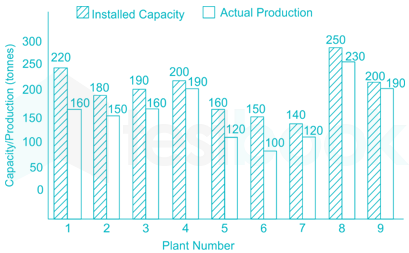
The following graph represents the installed capacity for cement production (in tonnes) and the actual production (in tonnes) of nine cement plants of a cement company. Capacity utilization of a plant is defined as ratio of actual production of cement to installed capacity. A plant with installed capacity of at least 200 tonnes is called a large plant and a plant with lesser capacity is called a small plant. The difference between total production of large plants and small plants, in tonnes is ____.

7

A poll of students appearing for masters in engineering indicated that 60 % of the students believed that mechanical engineering is a profession unsuitable for women. A research study on women with masters or higher degrees in mechanical engineering found that 99 % of such women were successful in their professions.

Which of the following can be logically inferred from the above paragraph?

  1. ((a))

    Many students have misconceptions regarding various engineering disciplines.

  2. ((b))

    Men with advanced degrees in mechanical engineering believe women are well suited to be mechanical engineers.

  3. ((c))

    Mechanical engineering is a profession well suited for women with masters or higher degrees in mechanical engineering.

  4. ((d))

    The number of women pursuing higher degrees in mechanical engineering is small.

Show Answer
Answer: ((c))

Mechanical engineering is a profession well suited for women with masters or higher degrees in mechanical engineering.

Let us examine the options one by one:

  1. Various engineering disciplines have not been talked about in the paragraph and thus this inference does not follow. We cannot make a general statement with respect to various disciplines when only mechanical engineering has been talked about.
  2. The poll taken was for students and the gender of the students participating in the poll has not been mentioned. Thus this inference does not hold.
  3. This inference hold because the research study found that the women with a high degree in mechanical engineering were successful in their profession. Thus it can be a suitable profession for them.
  4. We cannot infer anything about the number of women pursuing mechanical engineering because no information has been provided regarding the same.

Thus option 3 is the answer.

8

Sourya committee had proposed the establishment of Sourya Institutes of Technology (SITs) in line with Indian Institutes of Technology (IITs) to cater to the technological and industrial needs of a developing country.

Which of the following can be logically inferred from the above sentence?

Based on the proposal,

(i) In the initial years, SIT students will get degrees from IIT.

(ii) SITs will have a distinct national objective.

(iii) SIT like institutions can only be established in consultation with IIT.

(iv) SITs will serve technological needs of a developing country.

  1. ((a))

    (iii) and (iv) only.

  2. ((b))

    (i) and (iv) only.

  3. ((c))

    (ii) and (iv) only.

  4. ((d))

    (ii) and (iii) only.

Show Answer
Answer: ((c))

(ii) and (iv) only.

Let us examine the options one by one.

  1. No inference can be drawn about the degrees of the students because no such information has been provided in the passage.
  2. Since the institutes are being set up to cater to the technological development needs, it can be inferred they have a national objective. Thus this options follows
  3. Though SITs re being established in collaboration with IITs it is not always true that they cannot be set up independently. Thus this option does not hold.
  4. The passage states that the SITs are being set up keeping in mind the technological developments. Thus this inference definitely follows.

Hence options 2 and 4 are logical inferences.

9

Shaquille O’ Neal is a 60% career free throw shooter, meaning that he successfully makes 60 free throws out of 100 attempts on average. What is the probability that he will successfully make exactly 6 free throws in 10 attempts?

  1. ((a))

    0.2508

  2. ((b))

    0.2816

  3. ((c))

    0.2934

  4. ((d))

    0.6000

Show Answer
Answer: ((a))

0.2508

n = No. of attempts = 10

x = free throws successfully = 6

p=60%=0.6p = 60\% = 0.6

The probability that he will successfully make exactly 6 free throws in 10 attempts

=ncxpxqnx =10c6(0.6)6×(0.4)4 =210×0.046656×0.0256 =0.2508\begin{array}{l} = {n_{{c_x}}}{p^x}{q^{n - x}}\ = {10_{{c_6}}}{\left( {0.6} \right)^6} \times {\left( {0.4} \right)^4}\ = 210 \times 0.046656 \times 0.0256\ = 0.2508 \end{array}

10

The numeral in the units position of 211870 +146127 × 3424 is__________.

Electrical Engineering (55 questions)

11

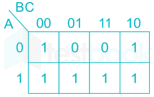
The output expression for the Karnaugh map shown below is

  1. ((a))

    A+BˉA + \bar B

  2. ((b))

    A+CˉA + \bar C

  3. ((c))

    Aˉ+Cˉ\bar A + \bar C

  4. ((d))

    Aˉ+C\bar A + C

Show Answer
Answer: ((b))

A+CˉA + \bar C

Concept:

3 variable K-maps:

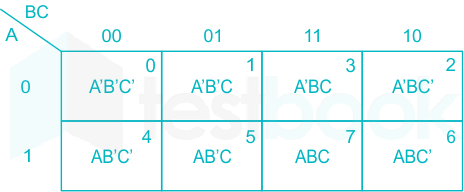
  • For a 3-variable Boolean function, there is a possibility of 8 output minterms.
  • The general representation of all the minterms using 3-variables is shown below.

Calculation:

Given k-map is as shown

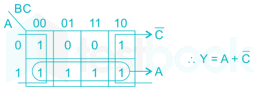
It can be grouped as follows

Therefore in SOP form (sum of products) output is Y = A + C̅

12

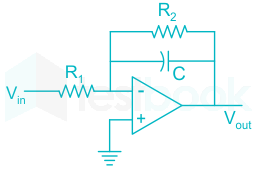
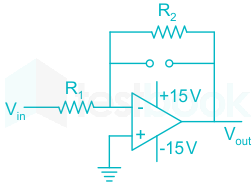
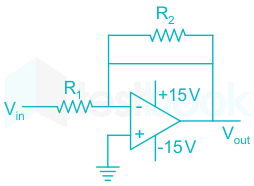
The circuit shown below is an example of a

  1. ((a))

    Low pass filter.

  2. ((b))

    band pass filter.

  3. ((c))

    high pass filter.

  4. ((d))

    notch filter.

Show Answer
Answer: ((a))

Low pass filter.

Concept:

Capacitive reactance(Xc) 

Xc=1ωCX_c = \frac{1}{ω C}

Where C = capacitance in farad, ω = angular frequency in rad/sec

For finding the type of filter find its low frequency and high-frequency response :

At Low-Frequency open circuit, the Capacitors.

At a High-frequency short circuit, the capacitors

For ideal op-amp according to the virtual short concept 

V- = V+

Calculation:

At low frequencies i.e. at ω=;0;Xc=1ωc={\rm{ω }} = {\rm{;}}0{\rm{;}} \Rightarrow {{\rm{X}}_{\rm{c}}} = \frac{1}{{{\rm{ω c}}}} = \infty

∴ The capacitor acts like an open circuit

Due to the virtual short concept V- = V+ = 0 (Virtual Ground)

Apply KCL at node 'a' and we get,

\(\therefore {{\rm{V}}_{{\rm{out}}}} = \frac{{ - {{\rm{R}}_2}}}{{{{\rm{R}}1}}}{{\rm{V}}{{\rm{in}}}}\)

At high frequencies i.e. at ω=Xc=1ωc=0{\rm{ω }} = \infty \Rightarrow {{\rm{X}}_{\rm{c}}} = \frac{1}{{{\rm{ω c}}}} = 0

I.e. capacitor acts like a short circuit

Input directly connected to the output so

;Vout;=;0\therefore {\rm{;}}{{\rm{V}}_{{\rm{out}}}}{\rm{;}} = {\rm{;}}0    (Due to virtual short concept)

So the given circuit passes only low frequencies hence it acts as a low pass filter.

13

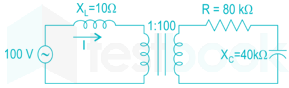
The following figure shows the connection of an ideal transformer with primary to secondary turns ratio of 1:100. The applied primary voltage is 100 V (rms), 50 Hz, AC. The rms value of the current , in ampere, is __________.

14

Consider a causal LTI system characterized by differential equation dy(t)dt+16y(t)=3x(t)\frac{{dy\left( t \right)}}{{dt}} + \frac{1}{6}y\left( t \right) = 3x\left( t \right). The response of the system to the input x(t)=3et3u(t)x\left( t \right) = 3{e^{ - \frac{t}{3}u\left( t \right)}}. Where u(t) denotes the unit step function is

  1. ((a))

    9et3u(t)9{e^{ - \frac{t}{3}}}u\left( t \right)

  2. ((b))

    9et6u(t)9{e^{ - \frac{t}{6}}}u\left( t \right)

  3. ((c))

    9et3u(t)6et6u(t)9{e^{ - \frac{t}{3}}}u\left( t \right) - 6{e^{ - \frac{t}{6}}}u\left( t \right)

  4. ((d))

    54t6u(t)54et3u(t){54^{ - \frac{t}{6}}}u\left( t \right) - 54{e^{ - \frac{t}{3}}}u\left( t \right)

Show Answer
Answer: ((d))

54t6u(t)54et3u(t){54^{ - \frac{t}{6}}}u\left( t \right) - 54{e^{ - \frac{t}{3}}}u\left( t \right)

Concept:

Laplace transform is an important tool for converting differential equations in the time domain to algebraic equations in the frequency domain.

This analysis involves three important processes:

1) The transformation from the time domain to the frequency domain.

2) Manipulate the algebraic equations to form a solution.

3) The inverse transformation from the frequency to the time domain.

Mathematically, the Laplace transform of a function f(t) is defined as:

\(L[f(t)]=F(s)=\mathop \smallint \limits_0^\infty f\left( t \right){e^{ - st}}dt\)

s = σ + jω is the complex frequency 

Applications of the Laplace Transform:

  1. Solve differential equations (both ordinary and partial)

  2. Application in RLC circuit analysis.

Calculation:

Given ddty(t)+16y(t)=3x(t)\frac{{\rm{d}}}{{{\rm{dt}}}}{\rm{y}}\left( {\rm{t}} \right) + \frac{1}{6}{\rm{y}}\left( {\rm{t}} \right) = 3{\rm{x}}\left( {\rm{t}} \right)

Apply Laplace transform we get

sY(s)+16Y(s)=3X(s){\rm{sY}}\left( {\rm{s}} \right) + \frac{1}{6}{\rm{Y}}\left( {\rm{s}} \right) = 3{\rm{X}}\left( {\rm{s}} \right) But X(s)=3(s+13){\rm{X}}\left( {\rm{s}} \right) = \frac{3}{{\left( {{\rm{s}} + \frac{1}{3}} \right)}} 

Y(s)=3X(s)(s+16)=9(s+16)(s+13) Y(s)=9(s+16)(16+13)+9(s+13)(13+16) Y(s)=54s+1654(s+13)\begin{array}{l} \therefore {\rm{Y}}\left( {\rm{s}} \right) = \frac{{3{\rm{X}}\left( {\rm{s}} \right)}}{{\left( {{\rm{s}} + \frac{1}{6}} \right)}} = \frac{9}{{\left( {{\rm{s}} + \frac{1}{6}} \right)\left( {{\rm{s}} + \frac{1}{3}} \right)}}\ {\rm{Y}}\left( {\rm{s}} \right) = \frac{9}{{\left( {{\rm{s}} + \frac{1}{6}} \right)\left( {\frac{{ - 1}}{6} + \frac{1}{3}} \right)}} + \frac{9}{{\left( {{\rm{s}} + \frac{1}{3}} \right)\left( {\frac{{ - 1}}{3} + \frac{1}{6}} \right)}}\ {\rm{Y}}\left( {\rm{s}} \right) = \frac{{54}}{{{\rm{s}} + \frac{1}{6}}} - \frac{{54}}{{\left( {{\rm{s}} + \frac{1}{3}} \right)}} \end{array}

Apply Inverse Laplace transform we get

y(t)=54[e16te13t]u(t){\rm{y}}\left( {\rm{t}} \right) = 54\left[ {{{\rm{e}}^{ - \frac{1}{6}{\rm{t}}}} - {{\rm{e}}^{ - \frac{1}{3}{\rm{t}}}}} \right]{\rm{u}}\left( {\rm{t}} \right)

15

Suppose the maximum frequency in a band-limited signal x(t)x\left( t \right) is 5;kHz5;kHz. Then, the maximum frequency in x(t);cos(2000πt)x\left( t \right);cos\left( {2000\pi t} \right), in kHzkHz, is ________.

16

Consider the function f(z)=z+zf\left( z \right) = z + {z^*} where  is a complex variable and  denotes its complex conjugate. Which one of the following is TRUE?

  1. ((a))

    f(z)f\left( z \right) is both continuous and analytic

  2. ((b))

    f(z)f\left( z \right) is continuous but not analytic

  3. ((c))

    f(z)f\left( z \right) is not continuous but is analytic

  4. ((d))

    f(z)f\left( z \right) is neither continuous nor analytic

Show Answer
Answer: ((b))

f(z)f\left( z \right) is continuous but not analytic

Concept:

Function of a Complex Variable: ω = f (z) = u (x, y) + i v (x, y) Where x, y ϵ R  and  z = x + iy

u (x, y), v (x, y) are real valued functions. 

Analytic function: A function f (z) is said to be Analytic in a region R of z-plane if it is differentiable at every point of R. 

Necessary Condition for function f (z) to be Analytic: 

1. ux, uy, vx, vy\frac{\partial u}{\partial x},\ \frac{\partial u}{\partial y}, \ \frac{\partial v}{\partial x}, \ \frac{\partial v}{\partial y}  exist 2. f (z) to satisfy the Cauchy-Riemann (C-R) equation.

 ux =  vy, uy =  vx\frac{\partial u}{\partial x}\ =\ \ \frac{\partial v}{\partial y}, \ \frac{\partial u}{\partial y}\ =\ - \ \frac{\partial v}{\partial x}

Calculation: 

z;=;x;+;iy;;z;=;x;;iy ;f(z);=;(x;+;iy);+;(x;;iy);=;2x\begin{array}{l} {\rm{z;}} = {\rm{;x;}} + {\rm{;iy;}} \Rightarrow {\rm{;}}{{\rm{z}}^{\rm{*}}}{\rm{;}} = {\rm{;x;}}-{\rm{;iy}}\ \therefore {\rm{;f}}\left( {\rm{z}} \right){\rm{;}} = {\rm{;}}\left( {{\rm{x;}} + {\rm{;iy}}} \right){\rm{;}} + {\rm{;}}\left( {{\rm{x;}} - {\rm{;iy}}} \right){\rm{;}} = {\rm{;}}2{\rm{x}} \end{array}

;f(z)\therefore ;f\left( z \right) is finite everywhere and it is continuous and differentiable.

But it doesn't satisfy the CR equations.

So we can say that f(z)f\left( z \right) is continuous but not analytic.

17

A 3 × 3 matrix  is such that, P3=P{P^3} = P. Then the eigenvalues of P;P; are

  1. ((a))

    1, 2, −1

  2. ((b))

    1,;0.5+j0.866,;0.5j0.8661,;0.5 + j0.866,;0.5 - j0.866

  3. ((c))

    1,;0.5+j0.866,;0.5j0.8661,; - 0.5 + j0.866,; - 0.5 - j0.866

  4. ((d))

    0, 1, −1

Show Answer
Answer: ((d))

0, 1, −1

Concept:

CAYLEY-HAMILTON THEOREM:

Statement: Every square matrix satisfies its own characteristic equation.

The Cayley–Hamilton theorem states that substituting the matrix A for x in polynomial, p(x) = det(xIn – A), results in the zero matrices, such as:

p(A) = 0

It states that a ‘n x n’ matrix A is demolished by its characteristic polynomial det(tI – A), which is monic polynomial of degree n.

Uses of Cayley-Hamilton theorem:

(1) To calculate the positive integral powers of A

(2) To calculate the inverse of a square matrix A

Calculation:

P3=P{P^3} = P

From Cauley Hamilton theorem λ3=λ{\lambda ^3} = \lambda 

λ;(λ21)=0 λ=0,;+1,;1\begin{array}{l} \Rightarrow \lambda ;\left( {{\lambda ^2}-1} \right) = 0\ \lambda = 0,; + 1,; - 1 \end{array}

18

The solution of the differential equation, for t>0t > 0, y(t)+2y(t)+y(t)=0y''\left(t\right) + 2y'\left( t \right) + y\left( t \right) = 0 with initial conditions y(0)=1;and;y(0)=0y' \left(0 \right) = 1;and;y\left(0\right) = 0, is u(t)u\left( t \right) denotes the unit step functions).

  1. ((a))

    tetu(t)t{e^{ - t}}u\left( t \right)

  2. ((b))

    (ettet)u(t)\left( {{e^{ - t}} - t{e^{ - t}}} \right)u\left( t \right)

  3. ((c))

    (et+tetu(t))\left( { - {e^{ - t}} + t{e^{ - t}}u\left( t \right)} \right)

  4. ((d))

    etu(t){e^{ - t}}u\left( t \right)

Show Answer
Answer: ((a))

tetu(t)t{e^{ - t}}u\left( t \right)

Concept:

 Laplace transform of the first two derivatives.

L{y''} = s2Y(s) - sy(0) - y'(0)

L{y'} = sY(s) - y(0)

Calculation:

Given y(t);+;2y(t);+;y(t);=;0{\rm{y''}}\left({\rm{t}} \right){\rm{;}} + {\rm{;}}2{\rm{y'}}\left({\rm{t}} \right){\rm{;}} + {\rm{;y}}\left( {\rm{t}} \right){\rm{;}} = {\rm{;}}0

Apply Laplace transform we get

[s2Y(s);;sy(0);;y(0)];+;2[sy(s);;y(0)];+;Y(s);=;0\left[ {{{\rm{s}}^2}{\rm{Y}}\left( {\rm{s}} \right){\rm{;}}-{\rm{;sy}}\left( 0 \right){\rm{;}}-{\rm{;y'}}\left( 0 \right)\left] {{\rm{;}} + {\rm{;}}2} \right[{\rm{sy}}\left( {\rm{s}} \right){\rm{;}}-{\rm{;y}}\left( 0 \right)} \right]{\rm{;}} + {\rm{;Y}}\left( {\rm{s}} \right){\rm{;}} = {\rm{;}}0

(s2;+;2s;+;1);Y(s);;1;=;0 Y(s)=1(s+1)2y(t)=tetu(t)\begin{array}{l} \left( {{{\rm{s}}^2}{\rm{;}} + {\rm{;}}2{\rm{s;}} + {\rm{;}}1} \right){\rm{;Y}}\left( {\rm{s}} \right){\rm{;}}-{\rm{;}}1{\rm{;}} = {\rm{;}}0\ {\rm{Y}}\left( {\rm{s}} \right) = \frac{1}{{{{\left( {{\rm{s}} + 1} \right)}^2}}} \Rightarrow {\rm{y}}\left( {\rm{t}} \right) = {\rm{t}} \cdot {{\rm{e}}^{ - {\rm{t}}}}{\rm{u}}\left( {\rm{t}} \right) \end{array}

19

The value of the line integral

\(\mathop \smallint \limits_c^; \left( {2x{y^2}dx + 2{x^2} y dy + dz} \right)\)

along a path joining the origin  and the point (1,1,1)  is

  1. ((a))

    0

  2. ((b))

    2

  3. ((c))

    4

  4. ((d))

    6

Show Answer
Answer: ((b))

2

Concept:

When two points (x1, y1. z1) and (x1, y1. z2) are mentioned find the relation in terms of the third variable in terms of x,y, and z:

xx1x2x1=yy1y2y1=zz1z2z1=t\dfrac{{{{x}} - x_1}}{{x_2 - x_1}} = \dfrac{{{{y}} - y_1}}{{y_2 - y_1}} = \dfrac{{{{z}} - z_1}}{{z_2 - z_1}} = {{t}}

Put the value of z,y, and z and use the end-points of one variable.

Calculation:

Given:

I=(2xy2dx+2x2ydy+dz){\rm{I}} = \smallint \left( {2{\rm{x}}{{\rm{y}}^2}{\rm{dx}} + 2{{\rm{x}}^2}{\rm{ydy}} + {\rm{dz}}} \right), A (0, 0, 0) and B(1, 1, 1).

Equation of line i.e. path

x010=y010=z010=t \frac{{{\rm{x}} - 0}}{{1 - 0}} = \frac{{{\rm{y}} - 0}}{{1 - 0}} = \frac{{{\rm{z}} - 0}}{{1 - 0}} = {\rm{t}}

;x;=;y;=;z;=;t;and;t;:;0;;1 \therefore {\rm{;x;}} = {\rm{;y;}} = {\rm{;z;}} = {\rm{;t;and;t;}}:{\rm{;}}0{\rm{;}} \to {\rm{;}}1

\( \therefore {\rm{I}} = \mathop \smallint \limits_0^1 \left( {2{{\rm{t}}^3}{\rm{dt}} + 2{{\rm{t}}^3}{\rm{dt}} + {\rm{dt}}} \right) \)

=4[t44]01+[t]01=1+1=2= 4 \cdot \left[ {\frac{{{{\rm{t}}^4}}}{4}} \right]_0^1 + \left[ {\rm{t}} \right]_0^1 = 1 + 1 = 2

(2xy2dx+2x2ydy+dz)=2 \therefore \smallint \left( {2{\rm{x}}{{\rm{y}}^2}{\rm{dx}} + 2{{\rm{x}}^2}{\rm{ydy}} + {\rm{dz}}} \right) = 2

20

Let f(x) be a real, periodic function satisfying f(-x) = -f(x). The general form of its Fourier series representation would be

  1. ((a))

    \(f\left( x \right) = {a_0} + \mathop \sum \limits_{k = 1}^\infty {a_k}\cos \left( {kx} \right)\)

  2. ((b))

    \(f\left( x \right) = \mathop \sum \limits_{k = 1}^\infty {b_k}\sin \left( {kx} \right)\)

  3. ((c))

    \(f\left( x \right) = {a_0} + \mathop \sum \limits_{k = 1}^\infty {a_{2k}}\cos \left( {kx} \right)\)

  4. ((d))

    \(f\left( x \right) = \mathop \sum \limits_{k = 0}^\infty {a_{2k}} + \sin \left( {2k + 1} \right)x\)

Show Answer
Answer: ((b))

\(f\left( x \right) = \mathop \sum \limits_{k = 1}^\infty {b_k}\sin \left( {kx} \right)\)

Concept

\(\begin{array}{l} {\rm{X}}\left( {\rm{t}} \right) = {a_0} + \mathop \sum \limits_{n = 1}^\infty {a_n}cosn{\omega _0}t + {b_n}sinn{\omega _0}t\ Where;{a_0} = dc;value;of;signal = \mathop \smallint \limits_0^{{T_0}} x\left( t \right)dt\ {a_n} = \frac{2}{{{T_0}}}\mathop \smallint \limits_0^{{T_0}} ;x\left( t \right).cos;n{\omega _0}t;\ {b_n} = \frac{2}{{{T_0}}}\mathop \smallint \limits_0^{{T_0}} ;x\left( t \right).sin;n{\omega 0}t = - {b{ - n}} \to odd;function;w.r.t;n;;; \end{array}\)

Solution:

Given that f(x)=f(x)f\left( { - x} \right) = - f\left( x \right) 

So, cosine term and DC term will be zero. It has only sine terms.

\(\therefore {\rm{f}}\left( {\rm{x}} \right) = \mathop \sum \limits_{{\rm{k}} = 1}^\infty {{\rm{b}}{\rm{k}}} \cdot \sin \left( {{{\rm{k}}{\rm{x}}}} \right)\)

21

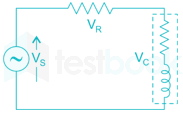
A resistance and a coil are connected in series and supplied from a single phase, 100 V, 50 Hz ac source as shown in the figure below. The rms values of possible voltages across the resistance and coil  respectively, in volts, are

  1. ((a))

    65, 35

  2. ((b))

    50, 50

  3. ((c))

    60, 90

  4. ((d))

    60, 80

Show Answer
Answer: ((d))

60, 80

It is a series RL circuit and

\({{\rm{V}}{\rm{S}}} = \sqrt {{\rm{V}}{\rm{R}}^2 + {\rm{V}}_{\rm{C}}^2}\)

100=(60)2+(80)2\therefore 100 = \sqrt {{{\left( {60} \right)}^2} + {{\left( {80} \right)}^2}}

22

The voltage 'V' and current 'A' across a load are as follows.

V(t) = 100 sin(ωt)

i(t) = 10 sin(ωt - 60°) + 2 sin(3ωt) + 5 sin(5ωt)

The average power consumed by the load, in W, is___________.

23

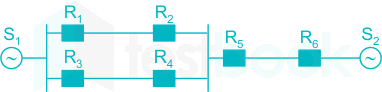
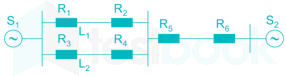
A power system with two generators is shown in the figure below. The system (generators, buses and transmission lines) is protected by six overcurrent relays R1 to R6. Assuming a mix of directional and non-directional relays at appropriate locations, the remote backup relays for R4 are 

  1. ((a))

    R1, R2

  2. ((b))

    R2, R6

  3. ((c))

    R2, R5

  4. ((d))

    R1, R6

Show Answer
Answer: ((d))

R1, R6

Given the network is:

In the given network,

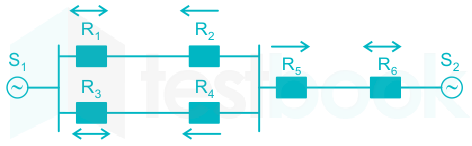
R2, R4, and R5 are directional overcurrent relays. R1, R3 and R6 are non-directional overcurrent relays.

For the fault on line 2 i.e. L2, R3 and R4 must be operated. If R4 is not operated then R1 and R6 will operate.

Therefore, back up for Rare R1 and R6

The relay R3 is directly connected to relay R4, so that relay R3 can’t provide remote backup.

24

A power system has 100 buses including 10 generator buses. For the load flow analysis using Newton-Raphson method in polar coordinates, the size of the Jacobian is

  1. ((a))

    189×189189 \times 189

  2. ((b))

    100×100100 \times 100

  3. ((c))

    90×9090 \times 90

  4. ((d))

    180×180180 \times 180

Show Answer
Answer: ((a))

189×189189 \times 189

Number of buses (n);=100\left( n \right); = 100

Generator busses (m)=10\left( m \right) = 10

Order of Jacobian matrix =(2n1m)×(2n1m)= \left( {2n - 1 - m} \right) \times \left( {2n-1-m} \right)

=(200110)×(200110) =189×189\begin{array}{l} = \left( {200-1-10} \right) \times \left( {200-1-10} \right)\ = 189 \times 189 \end{array}

25

The inductance and capacitance of a 400;kV400;kV, three-phase, 50;Hz50;Hz lossless transmission line are 1.6;mH/km/phase1.6;mH/km/phase and 10;nF/km/phase10;nF/km/phase respectively. The sending end voltage is maintained at 400;kV400;kV. To maintain a voltage of 400;kV400;kV at the receiving end, when the line is delivering 300;MW300;MW load, the shunt compensation required is

  1. ((a))

    capacitive

  2. ((b))

    inductive

  3. ((c))

    resistive

  4. ((d))

    zero

Show Answer
Answer: ((b))

inductive

Surge impedance =LC= \sqrt {\frac{L}{C}}

=1.6×10310×109=400Ω= \sqrt {\frac{{1.6 \times {{10}^{ - 3}}}}{{10 \times {{10}^{ - 9}}}}} = 400{\rm{\Omega }}

Surge impedance loading =V2Zc=(400×103400)2= \frac{{{V^2}}}{{{Z_c}}} = {\left( {\frac{{400 \times {{10}^3}}}{{400}}} \right)^2}

=400;MW= 400;MW

Given Load =300;MW= 300;MW

Load is lesser than surge impedance loading.

So in order to maintain rated voltage at receiving end shunt inductance is required.

26

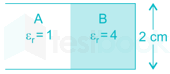
A parallel plate capacitor filled with two dielectrics is shown in the figure below. If the electric field in the region A is 4;kV/cm4;kV/cm, the electric field in the region B, in kV/cmkV/cm, is

  1. ((a))

    1

  2. ((b))

    2

  3. ((c))

    4

  4. ((d))

    16

Show Answer
Answer: ((c))

4

Concept:

Capacitors in Series: When capacitors are connected in series, the equivalent capacitance (Ceq) is less than the smallest individual capacitance in the series combination.

The voltage across each capacitor can be different, but the charge (Q) on each capacitor is the same.

Equivalent Capacitance: 1Ceq=1C1+1C2+1C3++1Cn \frac{1}{C_{eq}} = \frac{1}{C_1} + \frac{1}{C_2} + \frac{1}{C_3} + \cdots + \frac{1}{C_n} \

Voltage Distribution: The total voltage (Vtotal) across the series combination is the sum of the voltages across each capacitor:

Vtotal=V1+V2+V3++Vn  V_{total} = V_1 + V_2 + V_3 + \cdots + V_n \

Here, Vi is the voltage across capacitor (Ci).

Since the same charge (Q) is on each capacitor:

Q=C1V1=C2V2=C3V3==CnVn Q = C_1 V_1 = C_2 V_2 = C_3 V_3 = \cdots = C_n V_n \

Capacitors in Parallel: When capacitors are connected in parallel, the total (equivalent) capacitance (C_{eq}) is the sum of the individual capacitances. The voltage (V) across each capacitor is the same, but the charge on each capacitor can be different.

Equivalent CapacitanceCeq=C1+C2+C3++Cn C_{eq} = C_1 + C_2 + C_3 + \cdots + C_n \

Voltage Distribution: Each capacitor has the same voltage applied to it: Vtotal=V1=V2=V3==Vn  V_{total} = V_1 = V_2 = V_3 = \cdots = V_n \

Each capacitor stores a charge (Qi) given by:  Qi=CiVQ_i = C_i V  

The total stored charge (Qtotal) is the sum of the individual charges:  

Qtotal=Q1+Q2+Q3++Qn Q_{total} = Q_1 + Q_2 + Q_3 + \cdots + Q_n \

Equivalent capacitance: 1Ceq=1Ci \frac{1}{C_{eq}} = \sum \frac{1}{C_i}\

Explanation:

From the given figure, it is clear that two capacitors are connected in parallel. So, the voltage across them is same.

d is also same for both capacitors.

Hence, the electric field is also the same by the following formula.

E=Vd{\rm{E}} = \frac{{{{\rm{ }}}{{\rm{ }}_{\rm{}}}{\rm{V}}}}{{\rm{d}}}

So, electrical filed in the region B is 4 kV/cm
27

A 50;MVA,;10;kV,;50;Hz50;MVA,;10;kV,;50;Hz, star-connected, unloaded three-phase alternator has a synchronous reactance of 1 p.u. and a sub-transient reactance of 0.2;p.u.0.2;p.u. If a 3-phase short circuit occurs close to the generator terminals, the ratio of initial and final values of the sinusoidal component of the short circuit current is ________.

28

Consider a linear time-invariant system with transfer function
H(s)=1(s+1)H\left( s \right) = \frac{1}{{\left( {s + 1} \right)}}

If the input is cos(t)cos\left( t \right) and the steady state output is A;cos(t+a)A;cos\left( {t + a} \right), then the value of A is _________.

29

A three-phase diode bridge rectifier is feeding a constant DC current of 100;A100;A to a highly inductive load. If three-phase, 415;V,;50;Hz415;V,;50;Hz AC source is supplying to this bridge rectifier then the rms value of the current in each diode, in ampere, is _____________.

30

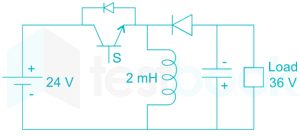
A buck-boost DC-DC converter, shown in the figure below, is used to convert 24;V24;V battery voltage to 36;V36;V DC voltage to feed a load of 72;W72;W. It is operated at 20;kHz20;kHz with an inductor of 2;mH2;mH and output capacitor of 1000;μF1000;\mu F. All devices are considered to be ideal. The peak voltage across the solid-state switch (S), in volt, is ____________.

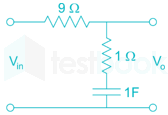
31

For the network shown in the figure below, the frequency (in rad/s) at which the maximum phase lag occurs is, ___________.

32

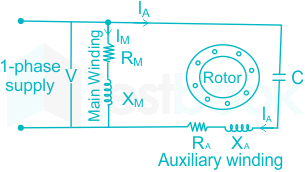
The direction of rotation of a single-phase capacitor run induction motor is reversed by

  1. ((a))

    interchanging the terminals of the AC supply.

  2. ((b))

    interchanging the terminals of the capacitor.

  3. ((c))

    interchanging the terminals of the auxiliary winding.

  4. ((d))

    interchanging the terminals of both the windings.

Show Answer
Answer: ((c))

interchanging the terminals of the auxiliary winding.

Single-phase capacitor run induction motor

  • The direction of rotation of a single-phase capacitor run induction motor is reversed by changing the direction of the rotating magnetic field produced by the main and starter winding or auxiliary winding.
  • This can be accomplished by reversing the polarity of the starter or auxiliary winding.
  • Basically, it is done by interchanging the connections on either end of the starter or auxiliary winding.
  • Sometimes this reversal is only done by the auxiliary winding & sometimes reversal is accomplished by winding, switch, and capacitor. While the order of the switch and the capacitor does not affect the reversal, as long as they are in series connection.

Important Points

Advantages of capacitor run induction motor:

  • A Centrifugal switch is not required.
  • It has high efficiency
  • It has a high power factor because of a permanently connected capacitor.
  • It has a higher pull-out torque


Limitations:

  • Electrolytic capacitors cannot be used for continuous running. Therefore, paper-spaced oil-filled capacitors are used.
  • It has relatively low starting torque compared to the capacitor start induction motor.
33

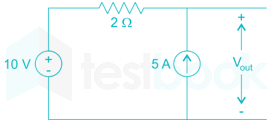
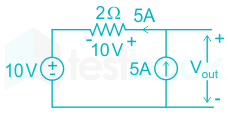
In the circuit shown below, the voltage and current sources are ideal. The voltage Vout across the current source, in volts, is

  1. ((a))

    0

  2. ((b))

    5

  3. ((c))

    10

  4. ((d))

    20

Show Answer
Answer: ((d))

20

Concept:

Kirchoff’s second law:

  • This law is also known as loop rule or voltage law (KVL) and according to it “the algebraic sum of the changes in potential in the complete traversal of a mesh (closed-loop) is zero”, i.e. Σ V = 0.
  • This law represents “conservation of energy” as if the sum of potential changes around a closed loop is not zero, unlimited energy could be gained by repeatedly carrying a charge around a loop.

For any load, current enter through positive polarity and exit from negative polarity and for source it will be reversed.

Calculation:

Apply KVL in the loop as shown below,

The current flow through 2 Ω is 5 A as shown in fig and it will give a drop of 10 V.

From the figure we get,

  • Vout + 10 + 10 = 0

Vout = 20 V

34

The graph associated with an electrical network has 7 branches and 5 nodes. The number of independent KCL equations and the number of independent KVL equations, respectively, are

  1. ((a))

    2 and 5

  2. ((b))

    5 and 2

  3. ((c))

    3 and 4

  4. ((d))

    4 and 3

Show Answer
Answer: ((d))

4 and 3

Concept:

Nodal Analysis:

Nodal analysis is a method of analyzing networks with the help of KCL equations.

For a network of N nodes, the number of simultaneous equations to be solved to get the unknowns

= Number of KCL equations

= N - 1

Mesh Analysis:

Mesh analysis is a method of analyzing networks with the help of KVL equations.

For a network having N nodes and B branches, the number of simultaneous equations to be solved to get the unknowns

= Number of KVL equations

= number of independent loop equations

= B - N + 1

Where, B = no of the branch, N = No of node

Calculation:

Number nodes n = 5

Branches b = 7

Number of KCL equations = 4

Number of KVL equations = 3

35

Two electrodes, whose cross-sectional view is shown in the figure below, are at the same potential.

The maximum electric field will be at the point

  1. ((a))

    A

  2. ((b))

    B

  3. ((c))

    C

  4. ((d))

    D

Show Answer
Answer: ((a))

A

As shown in the figure 

The direction of electric field is always outward  to corresponding surface

Electric field at point D is zero, because it is at the center of electrode.

Electric field at point C have subtractive effect due to second electrode ( i.e. E = E2 - E' )

Electric field at point A have addetive effect due to second electrode ( i.e. E = E1 + E' ) 

So that at point A, the electric field is maximum.

36

The Boolean expression (a+bˉ+c+dˉ)+(b+cˉ)\overline {\left( {a + \bar b + c + \bar d} \right) + \left( {b + \bar c} \right)} simplifies to

  1. ((a))

    1

  2. ((b))

    a.b\overline {a.b}

  3. ((c))

    a.ba.b

  4. ((d))

    0

Show Answer
Answer: ((d))

0

Concept:

De Morgan’s law states that:

(A1.A2An)=(A1+A2++An)\overline {\left( {{A_1}.{A_2} \ldots {A_n}} \right)} = \left( {\overline {{A_1}} + \overline {{A_2}} + \ldots + \overline {{A_n}} } \right)

Also,

(A1+A2++An)=(A1.A2...An)\overline {\left( {{A_1} + {A_2}+ \ldots + {A_n}} \right)} = \left( {\overline {{A_1}} .\overline {{A_2}} ...\overline {{A_n}} } \right)

Analysis:

Given

\({\rm{F}} = \overline {\left( {{\rm{a}} + {\rm{̅ b}} + {\rm{c}} + {\rm{̅ d}}} \right) + \left( {{\rm{b}} + {\rm{̅ c}}} \right)}\)

Applying the De-Morgans theorem in the above function F

\(\begin{array}{l} = \overline {\left( {{\rm{a}} + {\rm{̅ b}} + {\rm{c}} + {\rm{̅ d}}} \right)} \cdot \overline {\left( {{\rm{b}} + {\rm{̅ c}}} \right)} \ \end{array}\)

= a̅.b.c̅.d.b̅. c 

As, b.b̅  = c.c̅ = 0

∴ F = a̅.b.c̅.d.b̅. c  = 0

Hence option (4) is correct

37

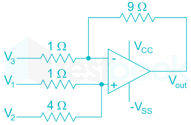
For the circuit shown below, taking the Op-amp as ideal, the output voltage Vout{V_{out}} in terms of the input voltages V1;,;V2;and;V3{V_1};,;{V_2};and;{V_3} is

  1. ((a))

    8V1+7.2V2V38{V_1} + 7.2{V_2}-{V_3}

  2. ((b))

    2V1+8V2V32{V_1} + 8{V_2}-{V_3}

  3. ((c))

    7.2V1+1.8V2V37.2{V_1} + 1.8{V_2}-{V_3}

  4. ((d))

    8V1+2V29V38{V_1} + 2{V_2}-9{V_3}

Show Answer
Answer: ((d))

8V1+2V29V38{V_1} + 2{V_2}-9{V_3}

Concept: 

Virtual ground -

The concept of the virtual ground is stated as if anyone of the i/p terminals is grounded physically the other i/p terminal will also be at ground potential even though, it is not grounded physically.

  • One key feature of an Op-Amp is the differential input, and when put together in a circuit, this can form a virtual ground.
  • The virtual ground concept is helpful for the analysis of Op Amps. This concept makes Op-Amp circuit analysis much easier.

Calculation:

Voltage at Non-inverting terminal, v+=v1(4)4+1+v2(1)1+4{{\rm{v}}_ + } = \frac{{{{\rm{v}}_1}\left( 4 \right)}}{{4 + 1}} + \frac{{{{\rm{v}}_2}\left( 1 \right)}}{{1 + 4}}

v+=(4v1+v2)5{{\rm{v}}_ + } = \frac{{\left( {4{{\rm{v}}_1} + {{\rm{v}}_2}} \right)}}{5}

Voltage at inverting v=v+=(4v1+v25){{\rm{v}}_ - } = {{\rm{v}}_ + } = \left( {\frac{{4{{\rm{v}}_1} + {{\rm{v}}_2}}}{5}} \right)

Apply nodal at inverting terminal we get

\(\begin{array}{l} \left( {\frac{{4{{\rm{v}}_1} + {{\rm{v}}_2}}}{5}} \right) - {{\rm{v}}_3} + \frac{{\left[ {\left( {\frac{{4{{\rm{v}}_1} + {{\rm{v}}2}}}{5}} \right) - {{\rm{v}}{{\rm{out}}}}} \right]}}{9} = 0\ \left( {\frac{{4{{\rm{v}}1} + {{\rm{v}}2}}}{5}} \right)\left[ {1 + \frac{1}{9}} \right] = {{\rm{v}}3} + \frac{{{{\rm{v}}{{\rm{out}}}}}}{9}\ 8{V_1} + 2{V_2}-9{V_3} = {V{out}}\ \therefore ;{V{out}} = 8{V_1} + 2{V_2}-9{V_3} \end{array}\)

38

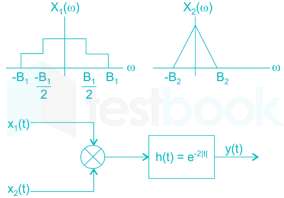
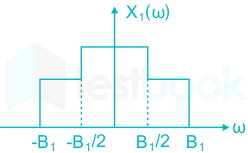
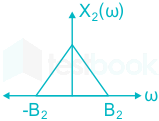
Let x1(t)X1(ω){x_1}\left( t \right) \leftrightarrow {X_1}\left( \omega \right) and x2(t)X2(ω){x_2}\left( t \right) \leftrightarrow {X_2}\left( \omega \right) be two signals whose Fourier Transforms are as shown in the figure below. In the figure, h(t)=e2th\left( t \right) = {e^{ - 2\left| t \right|}} denotes the impulse response.

For the system shown above, the minimum sampling rate required to sample y(t), so that y(t) can be uniquely reconstructed from its samples, is

  1. ((a))

    2B12{B_1}

  2. ((b))

    2(B1+B2)2\left( {{B_1} + {B_2}} \right)

  3. ((c))

    4(B1+B2)4\left( {{B_1} + {B_2}} \right)

  4. ((d))

    \infty

Show Answer
Answer: ((b))

2(B1+B2)2\left( {{B_1} + {B_2}} \right)

Concept:

  • Lower limit of y(t) is sum of lower limit of x(t) & h(t).
  • Upper limit of y(t) is sum of upper limit of x(t) & h(t).

Explanation:

Fourier transform of x1(t) = x1(ω)

Maximum frequency components of

x1(ω) = B, rad/sec

Fourier transform of x2(t) = x2(ω)

maximum frequency component of x2(ω) = B2 rad/sec

∴ x(t) = x1(t). x2(t)

Using multiplication property in Fourier transform,

Fx(t)=x(ω)=12πx1(ω)x2(ω)F{x(t)}=x(ω)=\frac{1}{2\pi}{x_1(ω)*x_2(ω)}

So, maximum frequency component of x(ω) = B1 + B2 rad/sec

Impulse response  h(t)=e2th(t)=e^{-2|t|}

Taking Fourier transform of h(t) is,

H(ω)=44+ω2H(ω)=\frac{4}{4+ω^2}

Maximum frequency component of H(ω) = ∞

∴ y(t) = x(t) * h(t)

Fourier Transform, Y(ω) = x(ω) H(ω)

=12πx1(ω)x2(ω).H(ω)=\frac{1}{2\pi}{x_1(ω) *x_2(ω)}.H(ω)

Highest frequency component of

Y(ω) = min {x(ω), H(ω)}

Y(ω) = min {B1 + B2, ∞}

Y(ω) = B1 + B2

Minimum sampling rate = Nyquist rate

= 2 × maximum frequency component of Y(ω)

= 2 (B1 + B2) rad/sec

39

The value of the integral \(2\mathop \smallint \limits_{ - \infty }^\infty \left( {\frac{{sin2\pi t}}{{\pi t}}} \right)dt\) is equal to

  1. ((a))

    0

  2. ((b))

    0.5

  3. ((c))

    1

  4. ((d))

    2

Show Answer
Answer: ((d))

2

Concept:

Duality Property

If x(t)F.T.x(ω)\rm x(t)\overset{F.T.}{\leftrightarrow}x(\omega)

then x(t)F.T.2πx(ω)\rm x(t)\overset{F.T.}{\leftrightarrow}2\pi x(-\omega)

Fourier time of signal x(t) is defined as,

x(ω)=x(t).ejωtdtx(\omega)=\displaystyle\int^{\infty}_{-\infty}x(t).e^{-j\omega t}dt

putting t = 0;

x(0)=x(t)dtx(0)=\displaystyle\int^{\infty}_{-\infty}x(t) dt

Explanation:

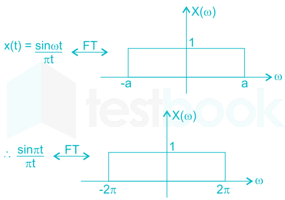
We know that \(\mathop \smallint \limits_{ - \infty }^\infty {\rm{x}}\left( {\rm{t}} \right) \cdot {\rm{dt}} = {\rm{X}}\left( 0 \right)\)

Also we know

Where X(0)=1X\left( 0 \right) = 1

\(\therefore 2\mathop \smallint \limits_{ - \infty }^\infty \left( {\frac{{{\rm{sin}}2{\rm{\pi t}}}}{{{\rm{\pi t}}}}} \right) \cdot {\rm{dt}} = 2{\rm{X}}\left( 0 \right) = 2\left( 1 \right) = 2\)

40

Let y(x)y\left( x \right) be the solution of the differential equation d2ydx24dydx+4y=0\frac{{{d^2}y}}{{d{x^2}}} - 4\frac{{dy}}{{dx}} + 4y = 0 with initial conditions y(0)=0y\left( 0 \right) = 0 and dydxx=0=1{\left. {\frac{{dy}}{{dx}}} \right|_{x = 0}} = 1. Then the value of y(1)y\left( 1 \right) is________.

41

The line integral of the vector field F=5xzi^+(3x2+2y)j^+x2zk^F = 5xz\hat i + \left( {3{x^2} + 2y} \right)\hat j + {x^2}z\hat k  along a path from (0,0,0);to;(1,1,1)\left( {0,0,0} \right);to;\left( {1,1,1} \right) parametrized by (t,;t2,;t)\left( {t,;{t^2},;t} \right) is _____.

42

Let \(P = \left[ {\begin{array}{{20}{c}} 3&1\ 1&3 \end{array}} \right]\) consider the set SS of all vectors \(\left( {\begin{array}{{20}{c}} x\ y \end{array}} \right)\) such that a2+b2=1{a^2} + {b^2} = 1 where \(\left( {\begin{array}{{20}{c}} a\ b \end{array}} \right) = P\left( {\begin{array}{{20}{c}} x\ y \end{array}} \right)\). This SS is

  1. ((a))

    A circle of radius 10\surd 10

  2. ((b))

    A circle of radius 110\frac{1}{{\sqrt {10} }}

  3. ((c))

    An ellipse with major axis along \(\left( {\begin{array}{*{20}{c}} 1\ 1 \end{array}} \right)\)

  4. ((d))

    An ellipse with minor axis along \(\left( {\begin{array}{*{20}{c}} 1\ 1 \end{array}} \right)\)

Show Answer
Answer: ((d))

An ellipse with minor axis along \(\left( {\begin{array}{*{20}{c}} 1\ 1 \end{array}} \right)\)

Given \({\rm{P}} = \left[ {\begin{array}{*{20}{c}} 3&1\ 1&3 \end{array}} \right]\)

\(\left[ {\begin{array}{{20}{c}} {\rm{a}}\ {\rm{b}} \end{array}} \right] = {\rm{P}}\left[ {\begin{array}{{20}{c}} {\rm{x}}\ {\rm{y}} \end{array}} \right] = \left[ {\begin{array}{{20}{c}} 3&1\ 1&3 \end{array}} \right]\left[ {\begin{array}{{20}{c}} {\rm{x}}\ {\rm{y}} \end{array}} \right]\)

∴ a = 3x + y and b = x + 3y

Given a2+b2=1{a^2} + {b^2} = 1

;(3x+y)2+(x+3y)2=1 10x2+10y2+12xy1=0\begin{array}{l} \therefore ;{\left( {3x + y} \right)^2} + {\left( {x + 3y} \right)^2} = 1\ 10{x^2} + 10{y^2} + 12xy-1 = 0 \end{array}

x2+y2+1.2xy0.1=0{x^2} + {y^2} + 1.2xy-0.1 = 0

(x+y)21/8+(xy)21/2=1 \Rightarrow \frac{{{{\left( {x + y} \right)}^2}}}{{1/8}} + \frac{{{{\left( {x - y} \right)}^2}}}{{1/2}} = 1

It represents an ellipse a < b

Major axis is x + y = 0 and minor axis is x – y = 0

∴ So the given equation is the tilted version of ellipse with angle 4545^\circ with minor axis along \(\left( {\begin{array}{*{20}{c}} 1\ 1 \end{array}} \right)\)

43

Let the probability density function of a random variable, XX, be given as:

fx(x)=32e3xu(x)+ae4xu(x)fx\left( x \right) = \frac{3}{2}{e^{ - 3x}}u\left( x \right) + a{e^{4x}}u\left( { - x} \right)

Where u(x)u\left( x \right) is the unit step function.

Then the value of 'a' and \(Prob\left{ {X \le 0} \right};\) respectively, are

  1. ((a))

    2,122,\frac{1}{2}

  2. ((b))

    4,124,\frac{1}{2}

  3. ((c))

    2,142,\frac{1}{4}

  4. ((d))

    4;,144;,\frac{1}{4}

Show Answer
Answer: ((a))

2,122,\frac{1}{2}

Concept:

A probability density function is a function of continuous random variable, whose integral across an interval gives the probability that the value of the variable lies within the same interval.

For a given probability density function f(x) to be valid, the integration of it over the complete range must equal 1.

Mathematically, it must satisfy:

\(\mathop \smallint \limits_{ - \infty }^\infty f\left( x \right) = 1\)

Calculation:

Given fX(x)=32e3xu(x)+ae4xu(x){{\rm{f}}_{\rm{X}}}\left( {\rm{x}} \right) = \frac{3}{2}{{\rm{e}}^{ - 3{\rm{x}}}}{\rm{u}}\left( {\rm{x}} \right) + {\rm{a}} \cdot {{\rm{e}}^{4{\rm{x}}}}{\rm{u}}\left( { - {\rm{x}}} \right) 

We know \(\mathop \smallint \limits_{ - \infty }^\infty {{\rm{f}}_{\rm{x}}}\left( {\rm{x}} \right) \cdot {\rm{dx}} = 1\) 

\(\begin{array}{l} \mathop \smallint \limits_{ - \infty }^0 {\rm{a}} \cdot {{\rm{e}}^{4{\rm{x}}}} + \mathop \smallint \limits_0^\infty \frac{3}{2} \cdot {{\rm{e}}^{ - 3{\rm{x}}}} = 1\ {\rm{a}} \cdot \left[ {\frac{{{{\rm{e}}^{4{\rm{x}}}}}}{4}} \right]{ - \infty }^0 + \frac{3}{2} \cdot \left( {\frac{{{{\rm{e}}^{ - 3{\rm{x}}}}}}{{ - 3}}} \right)0^\infty = 1\ \frac{{\rm{a}}}{4}\left[ {1 - 0} \right] - \frac{1}{2}\left[ {0 - 1} \right] = 1\ \frac{{\rm{a}}}{4} = \frac{1}{2} \Rightarrow {\rm{a}} = 2\ {\rm{P}}\left( {{\rm{X}} \le 0} \right) = \mathop \smallint \limits{ - \infty }^0 {{\rm{f}}{\rm{X}}}\left( {\rm{x}} \right) \cdot {\rm{dx}}\ = \mathop \smallint \limits_{ - \infty }^0 2 \cdot {{\rm{e}}^{4{\rm{x}}}} \cdot {\rm{dx}} = 2 \cdot \left[ {\frac{{{{\rm{e}}^{4{\rm{x}}}}}}{4}} \right]_\infty ^0 = \frac{1}{2}\left[ {1 - 0} \right] = \frac{1}{2} \end{array}\)

44

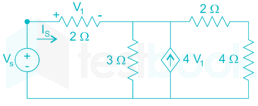
The driving point input impedance seen from the source Vs of the circuit shown below, in Ω, is ______

45

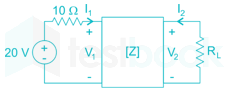
The z-parameters of the two-port network shown in the figure are  Z11 = 40 Ω, Z12 = 60 Ω, Z21 = 80 Ω and Z22 = 100 Ω. The average power delivered to RL = 20 Ω, in watts, is _______.

46

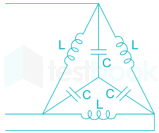
In the balanced 3-phase, 50Hz, the circuit is shown below, the value of inductance (L) is 10mH. The value of the capacitance (C) for which all the line currents are zero, in mF, is ___________.

47

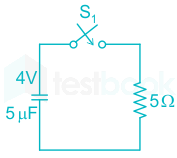
In the circuit shown below, the initial capacitor voltage is 4V. Switch S1 is closed at t = 0. The charge (in μC) lost by the capacitor from t = 25 μs to t = 100 μs is ____________.

48

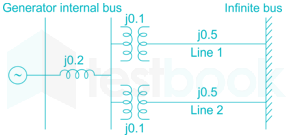
The single line diagram of a balanced power system is shown in the figure. The voltage magnitude at the generator internal bus is constant and 1.0;p.u.1.0;p.u. The p.u.p.u. reactances of different components in the system are also shown in the figure. The infinite bus voltage magnitude is 1.0;p.u.1.0;p.u. A three phase fault occurs at the middle of line 2.

The ratio of the maximum real power that can be transferred during the pre-fault condition to the maximum real power that can be transferred under the faulted condition is _________.

49

The open loop transfer function of a unity feedback control system is given by

G(s)=K(s+1)s(1+Ts)(1+2s),K>0,T>0.G\left( s \right) = \frac{{K\left( {s + 1} \right)}}{{s\left( {1 + Ts} \right)\left( {1 + 2s} \right)}},K > 0,T > 0.

The closed loop system will be stable if,

  1. ((a))

    0>T<4(k+1)k10 > T < \frac{{4\left( {k + 1} \right)}}{{k - 1}}

  2. ((b))

    0>K<4(T+2)T20 > K < \frac{{4\left( {T + 2} \right)}}{{T - 2}}

  3. ((c))

    0<K<T+2T2;0 < K < \frac{{T + 2}}{{T - 2}};

  4. ((d))

    0<T<8(k+1)k10 < T < \frac{{8\left( {k + 1} \right)}}{{k - 1}}

Show Answer
Answer: ((c))

0<K<T+2T2;0 < K < \frac{{T + 2}}{{T - 2}};

Given G(s)=K(s+1)s(1+sT)(1+2s){\rm{G}}\left( {\rm{s}} \right) = \frac{{{\rm{K}}\left( {{\rm{s}} + 1} \right)}}{{{\rm{s}}\left( {1 + {\rm{sT}}} \right)\left( {1 + 2{\rm{s}}} \right)}}

Characteristic equation 1 + G(s) H(s) = 0

As it is a unity feedback control system H(s) = 1

1+G(s)H(s)=1+K(s+1)s(1+Ts)(1+2s)=01+G\left( s \right)H\left( s \right) = 1+\frac{{K\left( {s + 1} \right)}}{{s\left( {1 + Ts} \right)\left( {1 + 2s} \right)}}=0

⇒ s + 2s2 + s2T + 2s3T + Ks + K = 0

⇒ (2T)s3 + (2 + T)s2 + (1 + K)s + K = 0

From R-H stability criteria 

\(\begin{array}{{20}{c}} {{s^3}}\ {{s^2}}\ {{s^1}}\ {{s^0}} \end{array}\left| {\begin{array}{{20}{c}} 2T&2+T\ 1+K&{K}\ \frac{{(2+T) \left( {1 + K} \right) - K(2T)}}{1+K }&0\ K&{} \end{array}} \right.\)

For closed-loop system to be stable 

2T > 0, 1 + K > 0, (2+T)(1+K)K(2T)1+K>0\frac{{(2+T) \left( {1 + K} \right) - K(2T)}}{1+K }>0, K > 0

0<K<T+2T2;0 < K < \frac{{T + 2}}{{T - 2}};

Alternate Method

Consider as3;+;bs2;+;cs;+;d;=;0{\rm{a}}{{\rm{s}}^3}{\rm{;}} + {\rm{;b}}{{\rm{s}}^2}{\rm{;}} + {\rm{;cs;}} + {\rm{;d;}} = {\rm{;}}0 from the R – H criteria the system is stable when

bc;>;ad;;and;a,;b,;c,;d;>;0 ;(2;+;T);(1;+;K);>;2TK 2;+;2K;+;T;+;TK;;2TK;>;0 (2;+;T);+;K(2;;T);>;0 K(2;;T);>;(2;+;T) K>(2+T)(2T)K<(T+2)(T2)\begin{array}{l} {\rm{bc;}} > {\rm{;ad;;and;a}},{\rm{;b}},{\rm{;c}},{\rm{;d;}} > {\rm{;}}0\ \therefore {\rm{;}}\left( {2{\rm{;}} + {\rm{;T}}} \right){\rm{;}}\left( {1{\rm{;}} + {\rm{;K}}} \right){\rm{;}} > {\rm{;}}2{\rm{TK}}\ 2{\rm{;}} + {\rm{;}}2{\rm{K;}} + {\rm{;T;}} + {\rm{;TK;}}-{\rm{;}}2{\rm{TK;}} > {\rm{;}}0\ \left( {2{\rm{;}} + {\rm{;T}}} \right){\rm{;}} + {\rm{;K}}\left( {2{\rm{;}} - {\rm{;T}}} \right){\rm{;}} > {\rm{;}}0\ {\rm{K}}\left( {2{\rm{;}} - {\rm{;T}}} \right){\rm{;}} > {\rm{;}} - \left( {2{\rm{;}} + {\rm{;T}}} \right)\ {\rm{K}} > \frac{{ - \left( {2 + {\rm{T}}} \right)}}{{\left( {2 - {\rm{T}}} \right)}} ⇒ {\rm{K}} < \frac{{\left( {{\rm{T}} + 2} \right)}}{{\left( {{\rm{T}} - 2} \right)}} \end{array}

∴ Condition for stability: 0<K<(T+2T2)0 < {\rm{K}} < \left( {\frac{{{\rm{T}} + 2}}{{{\rm{T}} - 2}}} \right)

50

At no-load condition, a 3-phase, 50 Hz, lossless power transmission line has sending-end and receiving-end voltages of 400 kV and 420 kV respectively. Assuming the velocity of traveling wave to be the velocity of light, the length of the line, in km, is ____________.

51

The power consumption of an industry is 500;kVA,;at;0.8;p.f.500;kVA,;at;0.8;p.f. lagging. A synchronous motor is added to raise the power factor of the industry to unity. If the power intake of the motor is 100;kW100;kW, the p.f.p.f. of the motor is _____________

52

The flux linkage (λ)\left( \lambda \right) and current (i)\left( i \right) relation for an electromagnetic system is λ=(i)/g\lambda = \left( {\sqrt i } \right)/g when I=2AI = 2A and g(air-gap length) =10;cm= 10;cm, the magnitude of mechanical force on the moving part, in NN, is ________.

53

The starting line current of a 415;V,;3phase415;V,;3 - phase, delta connected induction motor is 120;A120;A, when the rated voltage is applied to its stator winding. The starting line current at a reduced voltage of 110;V110;V, in ampere, is _________.

54

A single-phase, 2;kVA,;100/200;V2;kVA,;100/200;V transformer is reconnected as an auto-transformer such that its kVA rating is maximum. The new rating, in kVAkVA, is ______.

55

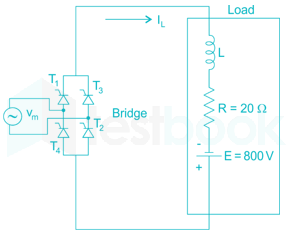
A full-bridge converter supplying an RLE load is shown in figure. The firing angle of the bridge converter is 120º. The supply voltage vm(t)=200π;sin;(100πt);V{v_m}\left( t \right) = 200\pi ;sin;\left( {100\pi t} \right);V, R=20;Ω,;E=800;VR = 20;\Omega ,;E = 800;V. The inductor L is large enough to make the output current IL{I_L} a smooth dc current. Switches are lossless. The real power fed back to the source, in kWkW, is __________.

56

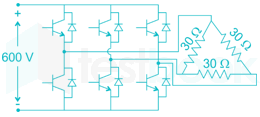
A three-phase Voltage Source Inverter (VSI) as shown in the figure is feeding a delta connected resistive load of 30;Ω/phase30;\Omega /phase. If it is fed from a 600;V600;V battery, with 180o{180^o} conduction of solid-state devices, the power consumed by the load, in kWkW, is __________.

57

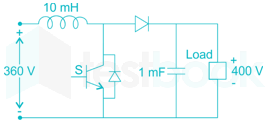
A DC-DC boost converter, as shown in the figure below, is used to boost 360V360V to 400;V400;V, at a power of 4;kW4;kW. All devices are ideal. Considering continuous inductor current, the rms current in the solid state switch (S), in ampere, is _________.

58

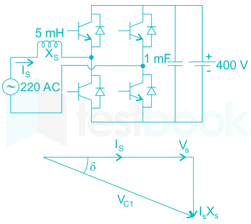
A single-phase bi-directional voltage source converter (VSC) is shown in the figure below. All devices are ideal. It is used to charge a battery at 400;V400;V with power of 5;kW5;kW from a source Vs=220;V{V_s} = 220;V (rms), 50;Hz50;Hz sinusoidal AC mains at unity p.f. If its AC side interfacing inductor is 5;mH5;mH and the switches are operated at 20 kHz, then the phase shift (δ)\left( \delta \right) between AC mains voltage (Vs)\left( {{V_s}} \right) and fundamental AC rms VSC voltage (VC1)\left( {{V_{C1}}} \right), in degree, is _________.

59

Consider a linear time invariant system x˙=Ax\dot x = Ax with initial condition x(0)x\left( 0 \right) at t=0t = 0. Suppose α\alpha and β\beta are eigenvectors of (2×2)\left( {2 \times 2} \right) matrix A corresponding to distinct eigenvalues λ1;and;λ2{\lambda _1};and;{\lambda _2} respectively. Then the response x(t)x\left( t \right) of the system due to initial condition x(0)=αx\left( 0 \right) = \alpha is

  1. ((a))

    eλ1tα{e^{{\lambda _1}t}}\alpha

  2. ((b))

    eλ2tβ{e^{{\lambda _2}t}}\beta

  3. ((c))

    eλ2tα{e^{{\lambda _2}t}}\alpha

  4. ((d))

    eλ1tα+eλ2tβ{e^{{\lambda _1}t}}\alpha + {e^{{\lambda _2}t}}\beta

Show Answer
Answer: ((a))

eλ1tα{e^{{\lambda _1}t}}\alpha

Given x˙=Ax{\rm{\dot x}} = {\rm{Ax}}

sX(s);;x(0);=;A;X(s) X(s);[sI;;A];α;;X(s);=;(sI;;A)1;;α; x(t);=;eAt;α;\begin{array}{l} {\rm{sX}}\left( {\rm{s}} \right){\rm{;}}-{\rm{;x}}\left( 0 \right){\rm{;}} = {\rm{;A;X}}\left( {\rm{s}} \right)\ {\rm{X}}\left( {\rm{s}} \right){\rm{;}}\left[ {{\rm{sI;}} - {\rm{;A}}} \right]{\rm{;\alpha ;}} \Rightarrow {\rm{;X}}\left( {\rm{s}} \right){\rm{;}} = {\rm{;}}{\left( {{\rm{sI;}} - {\rm{;A}}} \right)^{ - 1}}{\rm{;}} \cdot {\rm{;\alpha ;}}\ {\rm{x}}\left( {\rm{t}} \right){\rm{;}} = {\rm{;}}{{\rm{e}}^{{\rm{At}}}}{\rm{;\alpha ;}} \end{array}

The Eigen value corresponding to α\alpha is λ1{\lambda _1}

x(t)=eλ1tα\therefore {\rm{x}}\left( {\rm{t}} \right) = {{\rm{e}}^{{{\rm{\lambda }}_1}{\rm{t}}}} \cdot {\rm{\alpha }}

60

A second-order real system has the following properties:

The damping ratio ξ=0.5\xi = 0.5 and undamped natural frequency ωn=10;rad/s{\omega _n} = 10;rad/s, the steady state value at zero is 1.02.

The transfer function of the system is

  1. ((a))

    1.02s2+5s+100\frac{{1.02}}{{{s^2} + 5s + 100}}

  2. ((b))

    102s2+10s+100\frac{{102}}{{{s^2} + 10s + 100}}

  3. ((c))

    100s2+10s+100\frac{{100}}{{{s^2} + 10s + 100}}

  4. ((d))

    102s2+5s+100\frac{{102}}{{{s^2} + 5s + 100}}

Show Answer
Answer: ((b))

102s2+10s+100\frac{{102}}{{{s^2} + 10s + 100}}

Standard 2nd order system is \({\rm{T}}\left( {\rm{s}} \right) = \frac{{{\rm{K\omega }}{\rm{n}}^2}}{{{{\rm{s}}^2} + 2{\rm{\xi }}{{\rm{\omega }}{\rm{n}}}{\rm{s}} + {\rm{\omega }}_{\rm{n}}^2}}\) 

Given ξ;=;0.5;and;ωn;=;10{\rm{\xi ;}} = {\rm{;}}0.5{\rm{;and;}}{{\rm{\omega }}_{\rm{n}}}{\rm{;}} = {\rm{;}}10

Steady state value T(s)s=0=K=1.02{\left. {{\rm{T}}\left( {\rm{s}} \right)} \right|_{{\rm{s}} = 0}} = {\rm{K}} = 1.02

T(s)=(1.02)(100)s2+10s+100=102s2+10s+100\therefore {\rm{T}}\left( {\rm{s}} \right) = \frac{{\left( {1.02} \right)\left( {100} \right)}}{{{{\rm{s}}^2} + 10{\rm{s}} + 100}} = \frac{{102}}{{{{\rm{s}}^2} + 10{\rm{s}} + 100}}

61

Three single-phase transformers are connected to form a delta-star three-phase transformer of 110;kV/;11;kV110;kV/;11;kV. The transformer supplies at 11;kV11;kV a load of 8;MW8;MW at 0.8;p.f.0.8;p.f. lagging to a nearby plant. Neglect the transformer losses. The ratio of phase currents in delta side to star side is

  1. ((a))

    1:1031:10\surd 3

  2. ((b))

    103:110\surd 3:1

  3. ((c))

    1:101:10

  4. ((d))

    3:10\surd 3:10

Show Answer
Answer: ((a))

1:1031:10\surd 3

∇ - side phase voltage =110;kV= 110;kV

Y – side phase voltage =113kV= \frac{{11}}{{\sqrt 3 }}kV

side;phase;currentYside;phase;current=113(110)=1103\frac{{\nabla - side;phase;current}}{{Y - side;phase;current}} = \frac{{11}}{{\sqrt 3 \left( {110} \right)}} = \frac{1}{{10\sqrt 3 }}

62

The gain at the breakaway point of the root locus of a unity feedback system with open loop transfer function

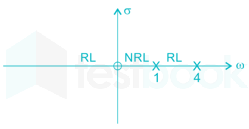
G(s)=Ks(s1)(s4)G\left( s \right) = \frac{{Ks}}{{\left( {s - 1} \right)\left( {s - 4} \right)}} is

  1. ((a))

    1

  2. ((b))

    2

  3. ((c))

    5

  4. ((d))

    9

Show Answer
Answer: ((a))

1

Given G(s)=Ks(s1)(s4){\rm{G}}\left( {\rm{s}} \right) = \frac{{{\rm{Ks}}}}{{\left( {{\rm{s}} - 1} \right)\left( {{\rm{s}} - 4} \right)}}

Characteristic equation is 1 + G(s) H(s) = 0

1+G(s)H(s)=1+Ks(s1)(s4){1+\rm{G}}\left( {\rm{s}} \right)H(s) = 1+ \frac{{{\rm{Ks}}}}{{\left( {{\rm{s}} - 1} \right)\left( {{\rm{s}} - 4} \right)}}

⇒ (s - 1)(s - 4) + Ks = 0

∴ K=(s1)(s4)s {\rm{K}} = \frac{{ - \left( {{\rm{s}} - 1} \right)\left( {{\rm{s}} - 4} \right)}}{{\rm{s}}}

For finding the breakaway point dKds=0 \frac{{{\rm{dK}}}}{{{\rm{ds}}}} = 0

dKds=[s(2s5)(s25s+4)s2]=0⇒ \frac{{{\rm{dK}}}}{{{\rm{ds}}}}=- \left[ {\frac{{{\rm{s}}\left( {2{\rm{s}} - 5} \right) - \left( {{{\rm{s}}^2} - 5{\rm{s}} + 4} \right)}}{{{{\rm{s}}^2}}}} \right] = 0

⇒ s2 - 4 = 0

⇒ s = ± 2

By plotting on s plane 

Centroid = (1+4)01=5\frac{{\left( {1 + 4} \right) - 0}}{1} = 5

∴ The valid break-away point is between 1 and 4.

∴ Valid breakaway point is s=2s = 2

∴ Gain at breakaway point =product;of;distance;from;polesproduct;of;distance;from;zeros= \frac{{{\rm{product;of;distance;from;poles}}}}{{{\rm{product;of;distance;from;zeros}}}}

=(1)(2)2=1= \frac{{\left( 1 \right)\left( 2 \right)}}{2} = 1

63

Two identical unloaded generators are connected in parallel as shown in the figure. Both the generators are having positive, negative and zero sequence impedances of j0.4;p.u.,;j0.3;p.u.;and;j0.15;p.u.j0.4;p.u.,;j0.3;p.u.;and;j0.15;p.u., respectively. If the pre-fault voltage is 1;p.u.1;p.u., for a line-to-ground (L-G) fault at the terminals of the generators, the fault current, in p.u., is ___________.

64

An energy meter, having meter constant of 1200;revolutions/kWh1200;revolutions/kWh, makes 20 revolutions in 30 seconds for a constant load. The load, in kWkW, is _____________.

65

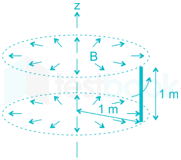
A rotating conductor of 1m length is placed in a radially outward (about the z-axis) magnetic flux density (B) of 1 Tesla as shown in the figure below. The conductor is parallel to and at 1m distance from the z-axis. The speed of the conductor in r.p.m. required to induce a voltage of 1V across it, should be __________.

Attempt this paper under real exam conditions

Timed interface, section switching, instant scoring, and question-by-question analytics — free.

Start Timed Attempt