The man who is now Municipal Commissioner worked as ____________________.
((a))
the security guard at a university
((b))
a security guard at the university
((c))
a security guard at university
((d))
the security guard at the university
Show Answer
Answer: ((b))
a security guard at the university
The sentence is talking about the Municipal Commissioner’s previous profession. There cannot be only one security guard at the University. Thus, the indefinite article should precede the security guard. Since the location where he used to work is specific, definite article ‘the’ needs to precede it. Hence the correct option satisfying this criteria is option 2.
2
Nobody knows how the Indian cricket team is going to cope with the difficult and seamer-friendly wickets in Australia. Choose the option which is closest in meaning to the underlined phrase in the above sentence.
((a))
put up with
((b))
put in with
((c))
put down to
((d))
put up against
Show Answer
Answer: ((a))
put up with
The sentence is speaking about the problem that the Indian cricket team will face in Australia. Thus, the best phrase to replace is ‘put up with’.
3
Find the odd one in the following group of words. mock, deride, praise, jeer
((a))
mock
((b))
deride
((c))
praise
((d))
jeer
Show Answer
Answer: ((c))
praise
The correct answer is praise
Key Points
The words ‘deride’, ‘mock’, ‘jeer’ are synonyms that are negative words meaning to ridicule or make fun of.
The other word ‘praise’ is a positive word that means to ‘express admiration’. Hence it is the odd one out.
4
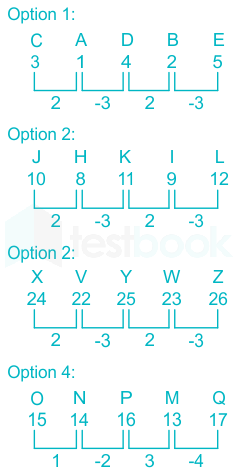
Pick the odd one from the following options.
((a))
CADBE
((b))
JHKIL
((c))
XVYWZ
((d))
ONPMQ
Show Answer
Answer: ((d))
ONPMQ
Option D is generating different pattern and hence it is the odd man out
5
In a quadratic function, the value of the product of the roots (α, β) is 4. Find the value of
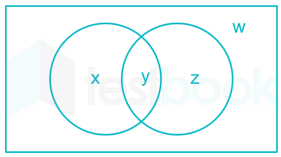
Among 150 faculty members in an institute, 55 are connected with each other through Facebook and 85 are connected through WhatsApp. 30 faculty members do not have Facebook or WhatsApp accounts. The number of faculty members connected only through Facebook accounts is ______________.
Computers were invented for performing only high-end useful computations. However, it is no understatement that they have taken over our world today. The internet, for example, is ubiquitous. Many believe that the internet itself is an unintended consequence of the original invention. With the advent of mobile computing on our phones, a whole new dimension is now enabled. One is left wondering if all these developments are good or, more importantly, required.
Which of the statement(s) below is/are logically valid and can be inferred from the above paragraph?
(i) The author believes that computers are not good for us.
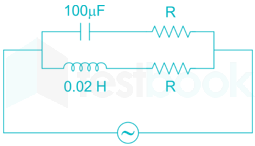
(ii) Mobile computers and the internet are both intended inventions
((a))
(i) only
((b))
(ii) only
((c))
both (i) and (ii)
((d))
neither (i) nor (ii)
Show Answer
Answer: ((d))
neither (i) nor (ii)
The passage states how computers have taken over the world today. The last line of the passage helps us infer that though the author understands how the new developments like computers have helped us, he is dubious as to whether these developments are actually beneficial or required.
The first inference does not hold.
The second inference does not hold because the passage clearly states that many people feel that the internet is an unintended invention.
8
All hill-stations have a lake. Ooty has two lakes.
Which of the statement(s) below is/are logically valid and can be inferred from the above sentences?
(i) Ooty is not a hill-station.
(ii) No hill-station can have more than one lake.
((a))
(i) only
((b))
(ii) only
((c))
both (i) and (ii)
((d))
neither (i) nor (ii)
Show Answer
Answer: ((d))
neither (i) nor (ii)
Let us look at the inferences one by one.
Since all hill stations have lakes and Ooty has two lakes, then Ooty must be a hill station.
The second inference does not follow because there can be no fixed rule as to how many lakes must a hill station have.
Thus none of the inferences follow.
9
In a 2 × 4 rectangle grid shown below, each cell is a rectangle. How many rectangles can be observed in the grid?
((a))
21
((b))
27
((c))
30
((d))
36
Show Answer
Answer: ((c))
30
Data:
number of rows = n = 2
number of columns = m = 4
Formula:
number;of;rectangles=(2n×(n+1))×(2m×(m+1))
Calculation:
number;of;rectangles=(22×(2+1))×(24×(4+1))
number of rectangles = 3 × 10 = 30
10
Choose the correct expression for f(x) given in the graph.
((a))
f(x)=1−∣x−1∣
((b))
f(x)=1+∣x−1∣
((c))
f(x)=2−∣x−1∣
((d))
f(x)=2+∣x−1∣
Show Answer
Answer: ((c))
f(x)=2−∣x−1∣
Putting the values shown is graph, option (C) matches.
Electrical Engineering (55 questions)
11
The maximum value attained by the function f(x)=x(x−1)(x−2) in the interval [1, 2] is _____.
12
Consider a 3×3 matrix with every element being equal to 1. Its only non-zero eigenvalue is ____.
13
The Laplace Transform of is f(t)=e2tsin(5t)u(t)
((a))
s2−4s+295
((b))
s2+55
((c))
s2−4s+29s−2
((d))
s+55
Show Answer
Answer: ((a))
s2−4s+295
Concept:
Bilateral Laplace transform:
\(L\left[ {x\left( t \right)} \right] = x\left( s \right) = ;\mathop \smallint \limits_{ - \infty }^\infty x\left( t \right){e^{ - st}}dt\)
Unilateral Laplace transform:
\(L\left[ {x\left( t \right)} \right] = x\left( s \right) = ;\mathop \smallint \limits_0^\infty x\left( t \right){e^{ - st}}dt\)
Some important Laplace transforms:
f(t)
f(s)
ROC
1.
δ(t)
1
Entire s-plane
2.
e-at u(t)
s+a1
s > - a
3.
e-at u(-t)
s+a1
s < - a
4.
cos ω0 t u(t)
s2+ω02s
s > 0
5.
te-at u(t)
(s+a)21
s > - a
6.
sin ω0t u(t)
s2+ω02ω0
s > 0
7.
u(t)
1/s
s > 0
Frequency shifting property:
If X(s) is the Laplace transform of x(t), then
eatX(s)↔X(s−a)
Calculation:
f(t) = e2t sin (5t) u(t)
L(sin(5t)u(t))=s2+255
By using frequency shifting property,
The Laplace transform of f(t) is
F(s)=(s−2)2+255=s2−4s+295
14
A function y(t) such that y(0) = 1 and y(1) = 3e-1, is a solution of the differential equationdt2d2y+2dtdy+y=0;. Then y(2) is
The value of the integral c∮(z−21)(z2−4z+5)2z+5dz over the contour ∣z∣=1, taken in the anti – clockwise direction, would be
((a))
1324πi
((b))
1348πi
((c))
1324
((d))
1312
Show Answer
Answer: ((b))
1348πi
Concept:
Cauchy’s Theorem:
If f(z) is an analytic function and f’(z) is continuous at each point within and on a closed curve C, then
C∮f(z)dz=0
Cauchy’s Integral Formula:
If f(z) is an analytic function within a closed curve and if a is any point within C, then
f(a)=2πi1C∮z−af(z)dz
fn(a)=2πin!C∮(z−a)n+1f(z)dz
Calculation:
f(z)=∮(z−21)(z2−4z+5)2z+5dz
the poles are \(z; = ;\raise.5ex\hbox{$\scriptstyle 1$}\kern-.1em/ \kern-.15em\lower.25ex\hbox{$\scriptstyle 2$} ,2; \pm ;i\)
Since the contour is ∣z∣=1, hence we will consider only z=21
The value of integral will be
2πi[(z−21)((z−21)(z2−4z+5)2z+5)]z=21
=2πi(41−2+56)
=1348πi
16
The transfer function of a system is R(s)Y(s)=s+2s. The steady state output y(t) is A;cos(2t+ϕ) for the input cos(2t). The values of A;and;ϕ, respectively are
((a))
21,−45∘
((b))
21,+45∘
((c))
2,−45∘
((d))
2,;+45o
Show Answer
Answer: ((b))
21,+45∘
Concept:
For an LTI system, the sinusoidal input produces a sinusoidal output of the same frequency but different amplitude and phase. The amplitude and phase depend upon the transfer function of the system.
For example:
Let, r(t) = cos(ωt) then
y(t) = a cos(ωt + ϕ)
where a = |H(jω)|, ϕ = ∠ H(jω)
H(jω)=X(jω)Y(jω)
Calculation:
H(jω)=jω+2jω
r(t) = cos (2t)
ω = 2
H(jω)=j2+2j2
∣H(jω)∣=21
∠ H(jω) = 90° - 45°
= +45°
y(t)=21cos(2t+45∘)
17
The phase cross-over frequency of the transfer function G(s)=(s+1)3100 in rad/s is
((a))
3
((b))
31
((c))
3
((d))
33
Show Answer
Answer: ((a))
3
Gain margin (GM): The gain margin of the system defines by how much the system gain can be increased so that the system moves on the edge of stability.
It is determined from the gain at the phase cross over frequency.
GM=∣G(jω)H(jω)∣ω=ωpc1
Phase crossover frequency (ωpc): It is the frequency at which phase angle of G(s) H(s) is -180°.
∠G(jω)H(jω)∣ω=ωpc=−180∘
Phase margin (PM): The phase margin of the system defines by how much the phase of the system can increase to make the system unstable.
PM=180∘+∠G(jω)H(jω)∣ω=ωgc=−180∘
It is determined from the phase at the gain cross over frequency.
Gain crossover frequency (ωgc): It is the frequency at which the magnitude of G(s) H(s) is unity.
Consider a continuous-time system with input x(t) and output y(t) given by
y(t) = x(t)cos(t)
This system is
((a))
linear and time-invariant
((b))
non-linear and time-invariant
((c))
linear and time-varying
((d))
non – linear and time-varying
Show Answer
Answer: ((c))
linear and time-varying
Concept:
Linear system
The system is said to be linear if it follows Homogenous and Superposition property.
The system is homogenous if
y(t) = α1x(t)
y(t) = α2x(t)
The system follows Superposition if
y(t) = α1x(t) + α2x(t)
Time invariant system
if y(t - t0) = x(t - t0)
and y(t') = x(t - t0)
Analysis:
For the given signal check linearity property
y(t) = x(t)cos(t)
check homogeneity
y(t) = α1x(t)cos(t)
y(t) = α2x(t)cos(t)
check superposition
y(t) = α1x(t)cos(t) + α2x(t)cos(t)
The system follows both homogeneity and superposition thus the system is Linear.
check the time invariance
y(t - t0) = x(t - t0)cos(t - t0)
and y(t') = x(t - t0)cos(t)
since y(t - t0) ≠ y(t')
System is not time invariant.
Hence option (3) is correct
19
The value of \(\mathop \smallint \limits_{ - \infty }^{ + \infty } {e^{ - t}}\delta \left( {2t - 2} \right)dt\), where δ(t) is the Dirac delta function, is
((a))
2e1
((b))
e2
((c))
e21
((d))
2e21
Show Answer
Answer: ((a))
2e1
Concept:
Shifting property of impulse function
∫−∞∞x(t)δ(t−a)dt=x(a)
Scaling property of impulse function
δ(at)=∣a∣)1δ(t)
Explanation:
Let:
I=∫−∞∞e−tδ(2t−2)dt
I=∫−∞∞e−tδ[2(t−1)]dt
Using scaling property of impulse function in the above equation, we'll get:
I=∫−∞∞e−t∣2∣1δ(t−1)dt
Applying Shifting property of impulse function to the above equation, we'll get:
I=21∫−∞∞e−tδ(t−1)dt
I=21.e−t∣t=1
2e1
20
A temperature in the range of -40° C to 55° C is to be measured with a resolution of 0.1° C. The minimum number of ADC bits required to get a matching dynamic range of the temperature sensor is
((a))
8
((b))
10
((c))
12
((d))
14
Show Answer
Answer: ((b))
10
Concept:
Analog-to-Digital Converters (ADCs) transform an analog voltage to a binary number (a series of 1’s and 0’s).
Then eventually to a digital number (base 10) for reading on a meter, monitor, or chart.
The ADC resolution depends upon the number of bits used to represent the digit number.
As the number of bits increases the resolution of an Analog to Digital Converter improves and the quantization error decreases.
Resolution for n – bit A/D converter will be:
R=2n−1VFS×(2ibi)
Where
R = Resolution
VFS is reference voltage 'or' Full-scale voltage
n = number of bits
2ibi gives output voltage value.
Calculation:
Given that,
Resolution = 0.1° C
Final temp = 55° C
Initial temp = 40° C
calculating the range of temperature
Range of temperature = (Final temp - Initial temp)
= 55° - (-40 °) = 95° C
No of points required = Range of temp/ resolution
= 95/0.1 = 950
The number of bits (n) for ADC is given by
2n > No. of points required
n > log2(No. of points required)
n > 9.891
n = 10
Hence option (2) is correct
21
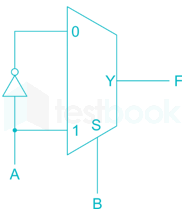
Consider the following circuit which uses a 2–to–1 multiplexer as shown in the figure below. The Boolean expression for output F in terms of A and B is
((a))
A⊕B
((b))
A+B
((c))
A+B
((d))
A⊕B
Show Answer
Answer: ((d))
A⊕B
Concept:
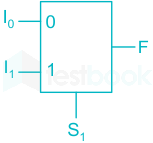
For a 2 × 1 MUX is shown above, the output function F is expressed as:
F = S̅1 I0 + S1I1
i.e. when S1 = 0, I0 is transmitted to the output.
And when S1 = 1, I1 is transmitted to the output.
Calculation:
Given multiplexer
F=A;Bˉ+AB;
=A⊕B
22
A transistor circuit is given below. The Zener diode breakdown voltage is 5.3 V as shown. Take base to emitter voltage drop to be 0.6 V. The value of the current gain β is _________.
23
In cylindrical coordinate system, the potential produced by a uniform ring charge is given by ;ϕ=;f(r,z), where f is a continuous function of r and z. Let E be the resulting electric field. Then the magnitude of ∇×E
((a))
increases with r
((b))
is 0
((c))
is 3
((d))
decreases with z
Show Answer
Answer: ((b))
is 0
∇×E=∂t−∂B
A uniformly charged ring is specified in the question, it can be considered as static. A static electric charge produces an electric field.
For absence of rotating field or magnetic field
∇×E=0
24
A soft-iron toroid is concentric with a long straight conductor carrying a direct current I. If the relative permeability μr of soft-iron is 100, the ratio of the magnetic flux densities at two adjacent points located just inside and just outside the toroid, is _______.
25
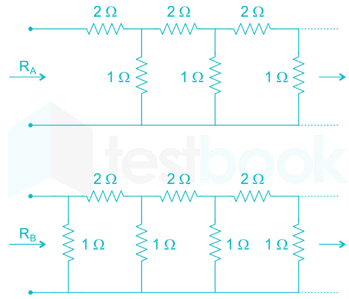
RA and RB are the input resistances of circuits as shown below. The circuits extend infinitely in the direction shown. Which one of the following statements is TRUE?
((a))
RA = RB
((b))
RA = RB = 0
((c))
RA < RB
((d))
RB = RA /(1 + RA)
Show Answer
Answer: ((d))
RB = RA /(1 + RA)
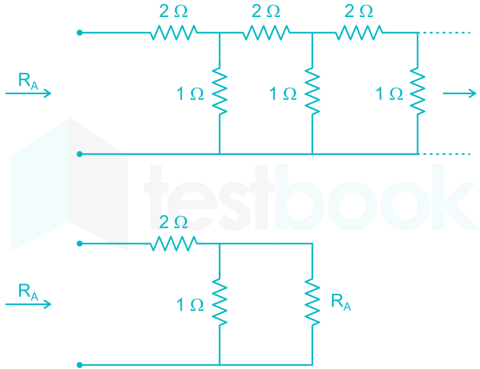
For RA
RA=1+RARA+2
(RA)2 + RA = 2 + 3RA
(RA)2 - 2RA - 2 = 0
On solving we'll get:
RA = 1 ± √3 ----(1)
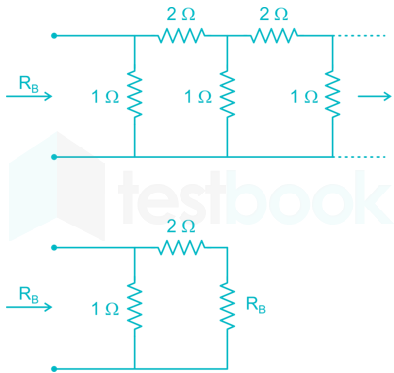
RB=RB+3RB+2
(RB)2 + 2RB - 2 = 0
On solving we'll get:
RB = -1 ± √3 ---(2)
From the given equation
RA ≠ RB & RA , RB ≠ 0
also RA > RB
Hence options (D) is correct
26
In a constant V/f induction motor drive, the slip at the maximum torque
((a))
is directly proportional to the synchronous speed.
((b))
remains constant with respect to the synchronous speed.
((c))
has an inverse relation with the synchronous speed.
((d))
has no relation with the synchronous speed.
Show Answer
Answer: ((c))
has an inverse relation with the synchronous speed.
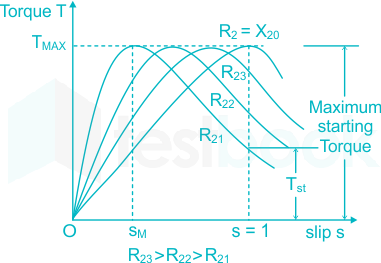
Concept:
From the below diagram we can observe that the maximum torque of an induction motor is independent of rotor resistance
Slip at which maximum torque occurs depends on rotor resistance and they change on adding the additional resistance to the rotor circuit.
The maximum torque of an induction motor is given by
Tmax=2X20kE202
∴ Maximum torque is directly proportional to supply voltage & maximum torque is inversely proportional to rotor reactance.
Hence, the maximum torque is dependent on the supply voltage & reactance of the rotor and is independent of the rotor resistance.
Sm the value of slip corresponding to the maximum torque is
Sm=X20R2
Explanation:
For any voltage and frequency slip corresponding to maximum torque in three phase induction motor is,
Sm=X20R2
where, X ∝ f
Sm ∝ (1/Ns) [ NS ∝ f ]
Thus the slip has inverse relation with the synchronous speed,
27
In the portion of a circuit shown, if the heat generated in 5Ω resistance is 10 calories per second, then the heat generated by the 4Ω resistance, in calories per second, is _______.
28
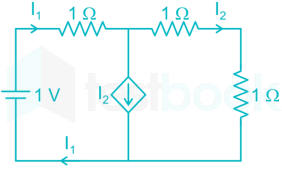
In the given circuit, the current supplied by the battery, in ampere, is _______.
29
In a 100 bus power system, there are 10 generators. In a particular iteration of Newton Raphson load flow technique (in polar coordinates), two of the PV buses are converted to PQ type. In this iteration,
((a))
the number of unknown voltage angles increases by two and the number of unknown voltage magnitudes increases by two.
((b))
the number of unknown voltage angles remains unchanged and the number of unknown voltage magnitudes increases by two.
((c))
the number of unknown voltage angles increases by two and the number of unknown voltage magnitudes decreases by two.
((d))
the number of unknown voltage angles remains unchanged and the number of unknown voltage magnitudes decreases by two.
Show Answer
Answer: ((b))
the number of unknown voltage angles remains unchanged and the number of unknown voltage magnitudes increases by two.
For PV buses, voltage magnitude was known quantity, if changed to PQ type the voltage magnitude becomes unknown. Also the angle was known quantity before and now it is unknown.
Explanation:
A bus in a power system is a line at which the several components of the power system like generators, loads, and feeders, etc., are connected.
The buses in a power system are associated with four quantities, these quantities are the following:
The magnitude of the voltage
Phase angle
Active power
Reactive power
In the load flow studies, two variable are known, and the other two is to determined.
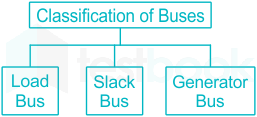
Depends on the quantity to be specified the buses are classified into three categories as follow:
The table shown below shows the types of buses and the associated known and unknown value.
Type of Buses
Specified Quantities
Unknown Quantities
A generation or P-V Bus
P, | V |
Q, δ
Load or P-Q Bus
P, Q
| V |, δ
Slack or Reference Bus
| V |, δ
P, Q
Generation Bus or Voltage Control Bus:
This bus is also called the P-V bus.
on this bus, the voltage magnitude corresponding to generate voltage and true or active power P corresponding to its rating are specified.
Voltage magnitude is maintained constant at a specified value by injection of reactive power.
The reactive power generation Q and phase angle δ of the voltage is to be computed.
Load Bus:
This is also called the P-Q bus
at this bus, the active and reactive power is injected into the network.
The magnitude and phase angle of the voltage is to be computed.
Here the active power P and reactive power Q are specified, and the load bus voltage can be permitted within a tolerable value, i.e., 5 %.
The phase angle of the voltage, i.e.δ is not very important for the load.
Slack, Swing, or Reference Bus:
Slack bus in a power system absorbs or emits active or reactive power from the power system.
The slack bus does not carry any load.
At this bus, the magnitude and phase angle of the voltage is specified.
The phase angle of the voltage is usually set equal to zero.
30
The magnitude of three-phase fault currents at buses A and B of a power system are 10;pu and 8;pu, respectively. Neglect all resistances in the system and consider the pre-fault system to be unloaded. The pre-fault voltage at all buses in the system 1.0;pu is . The voltage magnitude at bus B during a three-phase fault at bus A is 0.8;pu. The voltage magnitude at bus A during a three-phase fault at bus B, in pu, is ________.
31
Consider a system consisting of a synchronous generator working at a lagging power factor, a synchronous motor working at an overexcited condition and a directly grid-connected induction generator. Consider capacitive VAr to be a source and inductive VAr to be a sink of reactive power. Which one of the following statements is TRUE?
((a))
Synchronous motor and synchronous generator are sources and induction generator is a sink of reactive power.
((b))
Synchronous motor and induction generator are sources and synchronous generator is a sink of reactive power.
((c))
Synchronous motor is a source and induction generator and synchronous generator are sinks of reactive power.
((d))
All are sources of reactive power.
Show Answer
Answer: ((a))
Synchronous motor and synchronous generator are sources and induction generator is a sink of reactive power.
Generally, synchronous machines are designed with over-excitation to improve stability.
Synchronous motors are designed with leading power factors and synchronous generators are designed with lagging power factors to improve stability.
An alternator or synchronous generator operating at a lagging power factor means it's overexcited and can supply lagging reactive power (Q) and real power (P). Hence synchronous generator operating at lagging pf is the source of reactive power factor.
Over excited synchronous machine works at leading power factor and can supply reactive power, hence over-excited synchronous motor is source of reactive power
The induction generator needs reactive power to function in the absence of rotor dc excitation. Hence it is sink of reactive power.
32
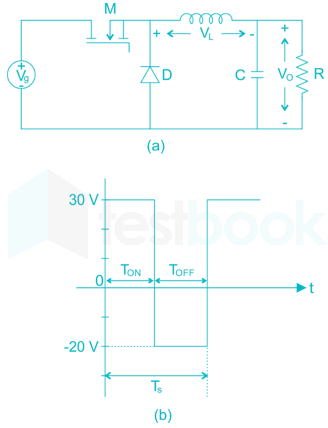
A buck converter, as shown in Figure (a) below, is working in steady state. The output voltage and the inductor current can be assumed to be ripple free. Figure (b) shows the inductor voltage VL during a complete switching interval. Assuming all devices are ideal, the duty cycle of the buck converter is ________.
33
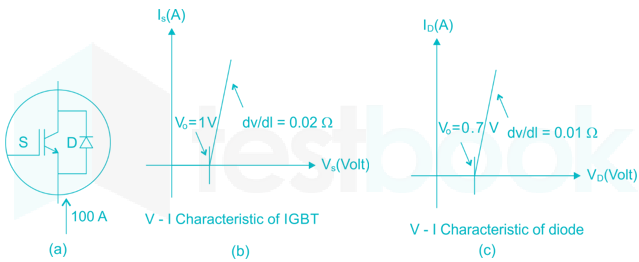
A steady dc current of 100;A is flowing through a power module (S, D) as shown in Figure (a). The V−I characteristics of the IGBT (S) and the diode (D) are shown in Figures (b) and (c), respectively. The conduction power loss in the power module (S, D), in watts, is ________.
34
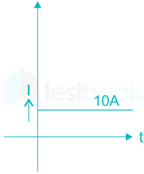
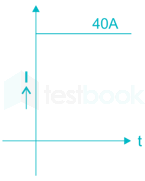
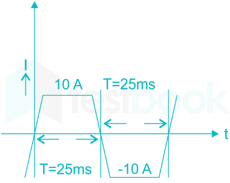
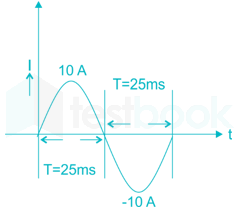
A 4-pole, lap-connected, separately excited dc motor is drawing a steady current of 40;A while running at 600;rpm. A good approximation for the wave shape of the current in an armature conductor of the motor is given by
((a))
((b))
((c))
((d))
Show Answer
Answer: ((c))
Concept:
For lap wound, the number of parallel path (A) is equal to the number of poles (P)
Explanation:
Armature current in the each parallel path = I/A IA=AI
Where,
A= No. of parallel paths
In this case A=4 for lap connected winding
So, current in armature conductor = 10 A
NS=P120f=600rpm
f = 20 H.
so, T = 50 msec with straight line commutation.
When dc current passes through simulator and goes inside armature, its shape will be that of shown is option (C)
35
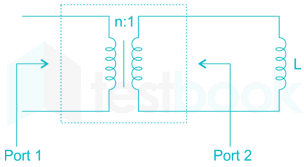
If an ideal transformer has an inductive load element at port 2 as shown in the figure below, the equivalent inductance at port 1 is
((a))
nL
((b))
n2L
((c))
Ln
((d))
Ln2
Show Answer
Answer: ((b))
n2L
Concept:
Transformation ratio of transformer is given by K = V2/V1 = E2/E1 = N2/N1.
Where N1 is the number of primary turns
V1 is the primary voltage
N2 is the number of secondary turns
V2 is the secondary voltage
Step-up transformer:
A transformer that increases the voltage from primary to secondary (more secondary winding turns than primary winding turns) is called a step-up transformer.
Therefore, K > 1
Step down transformer:
A transformer that decreases the voltage from primary to secondary (more primary winding turns than secondary winding turns) is called a step-down transformer.
Therefore, K < 1
Explanation:
Transformation ratio (k) = N1N2=n1
When Port 2 inductance L is referred to Port 1
Then, inductance will be =k2L=n21L=n2L
36
Candidates were asked to come to an interview with 3 pens each. Black, blue, green and red were the permitted pen colors that the candidate could bring. The probability that a candidate comes with all 3 pens having the same colour is _____.
37
Let \(S = \mathop \sum \limits_{n = 0}^\infty n{\alpha ^n}\) where ∣α∣;<;1. the value of α in the range 0<α<1, such that S=2α is _______.
38
Let the eigenvalues of a 2 × 2 matrix A be 1, -2 with eigenvectors x1 and x2 respectively. Then the eigenvalues and eigenvectors of the matrix A3 would, respectively, be
((a))
1, -8: x1, x2
((b))
-1, -2: x1 + x2, x1 - x2;
((c))
1, -2: x1, x2
((d))
2, 0: x1 + x2, x1 - x2;
Show Answer
Answer: ((a))
1, -8: x1, x2
Concept:
If λ is an eigenvalue of a matrix A and k is a scalar then:
1) λm is the eigenvalue of matrix Am (m belongs to N).
2) kλ is an eigenvalue of matrix kA.
3) λ + k is an eigenvalue of the matrix A + kI.
4) λ - k is an eigenvalue of matrix A - kI.
Calculation:
For a given matrix, if the eigenvalues are λ1 and λ2, then the eigenvalues of An will be λ1n;and;λ2n.
1 and -2 will become 1 and -8;
Although the eigenvectors remain the same.
39
Let A be a 4×3 real matrix with rank 2. Which one of the following statement is TRUE?
((a))
Rank of ATA is less than 2.
((b))
Rank of ATA is equal to 2.
((c))
Rank of ATA is greater than 2.
((d))
Rank of ATA can be any number between 1 and 3.
Show Answer
Answer: ((b))
Rank of ATA is equal to 2.
If A is real
rank of (AT;A) = rank of A = rank of AT = rank of AAT
40
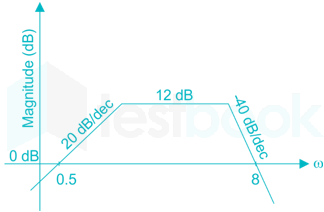
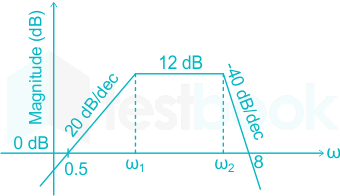
Consider the following asymptotic Bode magnitude plot ( ω is in rad/s).
Which one of the following transfer functions is best represented by the above Bode magnitude plot?
((a))
(1+0.5s)(1+0.25s)22s
((b))
s(1+0.25s)4(1+0.5s)
((c))
(1+2s)(1+4s)2s
((d))
(1+2s)(1+4s)24s
Show Answer
Answer: ((a))
(1+0.5s)(1+0.25s)22s
Here starting slope is +20 db/dec
Hence s1 is at numerator part of T.F.
Now from the straight line equation y = mx + c, we get
Consider the following state-space representation of a linear time-invariant system.
\(\dot x\left( t \right) = \left[ {\begin{array}{{20}{c}} 1&0\ 0&2 \end{array}} \right]x\left( t \right),y\left( t \right) = {c^T}x\left( t \right),c = \left[ {\begin{array}{{20}{c}} 1\ 1 \end{array}} \right]and;x\left( 0 \right) = \left[ {\begin{array}{*{20}{c}} 1\ 1 \end{array}} \right]\)
The value of y(t) for t=loge2 is __________.
42
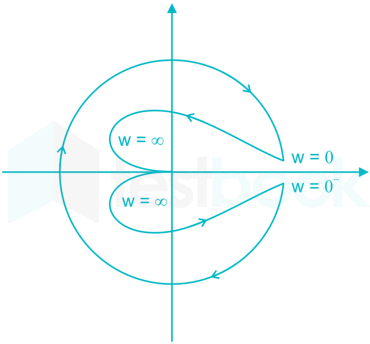
Loop transfer function of a feedback system is G(s)H(s)=s2(s−3)s+3;. Take the Nyquist contour in the clockwise direction. Then, the Nyquist plot of G(s) H(s) encircles −1+j0
((a))
once in clockwise direction
((b))
twice in clockwise direction
((c))
once in anticlockwise direction
((d))
twice in anticlockwise direction
Show Answer
Answer: ((a))
once in clockwise direction
Concept:
Principle arguments
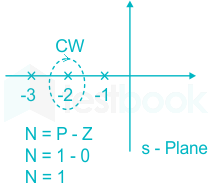
It states that if there are “P” poles and “Z” zeroes for a closed, random selected path then the corresponding G(s)H(s) plane encircles the origin with P – Z times.
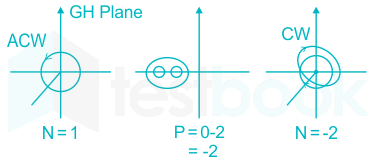
Encirclements in s – plane and GH – plane are shown below.
In GH plane Anti clockwise encirclements are taken as positive and clockwise encirclements are taken as negative.
It is applied to the total RH plane by selecting a closed path with r = ∞
Calculation:
Given transfer function,
G(s)H(s)=s2(s−3)s+3
Substitute s = jω in the above equation,
G(jω)H(jω)=(jω)2(jω−3)jω+3
∠G(jω)H(jω)=tan−13ω−180−(180−tan−14ω)
∠G(jω)H(jω)=tan−13ω+tan−14ω
∣G(jω)H(jω)∣=ω2ω2+9ω2+9=ω21
ω
0
∞
1
|G(jω)H(jω)|
∞
0
1
∠G(jω)H(jω)
0
180°
32.47°
<br>
In the plot G(s)H(s) encircle -1 + j0 once in clockwise direction.
Therefore it is unstable with two right half of s-plane poles
Z = 2, P = 1
N = P - Z = 1 - 2 = -1
Once in clockwise direction
43
Given the following polynomial equation
s3+5.5s2+8.5s+3=0,
the number of roots of the polynomial, which have real parts strictly less than −1, is ________
44
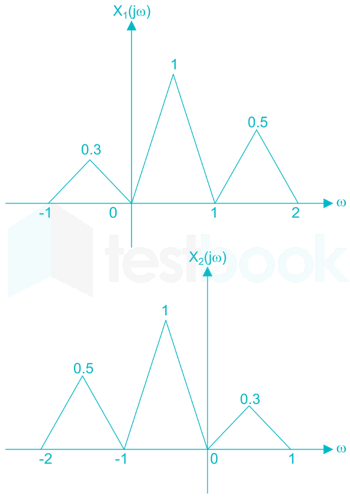
Suppose x1(t) and x2(t) have the Fourier transforms as shown below.
Which one of the following statements is TRUE?
((a))
x1(t) and x2(t) are complex and x1(t)x2(t) is also complex with nonzero imaginary part
((b))
x1(t) and x2(t) are real and x1(t)x2(t) is also real
((c))
x1(t) and x2(t) are complex but x1(t)x2(t) is real
((d))
x1(t) and x2(t) are imaginary but x1(t)x2(t) is real
Show Answer
Answer: ((c))
x1(t) and x2(t) are complex but x1(t)x2(t) is real
X1(jω) and X2(jω) are not conjugate symmetric, hence x1(t),;x2(t) are not real
Now, Fourier transform of x1(t).;x2(t) will be \(\frac{1}{{2x}}{X_1}\left( {j\omega } \right){X_2}\left( {j\omega } \right)\) and by looking at X1(jω) and X2(jω) We can say that \({X_1}\left( {j\omega } \right){X_2}\left( {j\omega } \right)\) will be conjugate symmetric and thus x1(t).x2(t) will be real.
45
The output of a continuous-time, linear time-invariant system is denoted by \(T\left{ {x\left( t \right)} \right}\) where x(t) is the input signal. A signal z(t) is called eigen-signal of the system , when \(T\left{ {z\left( t \right)} \right} = \gamma z\left( t \right)\), where γ is a complex number, in general, and is called an eigenvalue of T. Suppose the impulse response of the system T is real and even. Which of the following statements is TRUE?
((a))
cos(t) is an eigen-signal but sin(t) is not
((b))
cos(t);and;sin(t) are both eigen-signals but with different eigenvalues
((c))
sin(t) is an eigen-signal but cos(t) is not
((d))
cos(t) and sin(t) are both eigen-signals with identical eigenvalues
Show Answer
Answer: ((d))
cos(t) and sin(t) are both eigen-signals with identical eigenvalues
Concept:
A signal is said to be Eigen function if the output is scalar multiple of input signal and that scalar is referred as Eigen value.
Let input signal is x(t) and it is an Eigen function then
output = K x(t) where K is Eigen value.
Explanation:
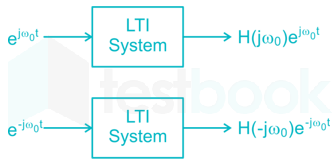
The impulse response is real and even, hence H(jω) will also be real and even.
Output will be 2jH(j1)ejt−H(−j1)e−jt=H(j1)[2jejt−e−jt]=H(j1)sin(t)
So sin(t) and cos(t) are eigen signals with same eigen values.
46
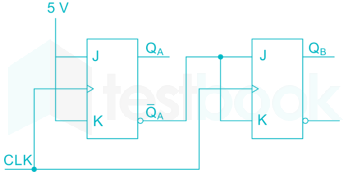
The current state QA QB of a two JK flip-flop system is 00. Assume that the clock rise-time is much smaller than the delay of the JK flip-flop. The next state of the system is
((a))
00
((b))
01
((c))
11
((d))
10
Show Answer
Answer: ((c))
11
In the given circuit
We have,
JA=KA=1
JB=KB=QˉA
Clock
JAKA
JBKB
QAQB
0
11
11
00
1
11
<br>
So next state will be 11
47
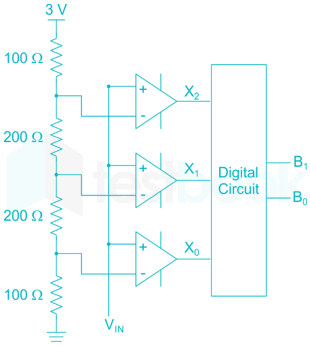
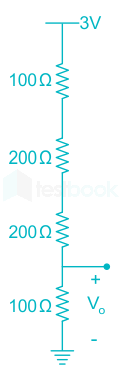
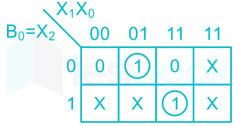
A 2-bit flash Analog to Digital Converter (ADC) is given below. The input is 0≤VIN≤;3 Volts. The expression for the LSB of the output B0 as a Boolean function of X2,;X1, and X0 is
((a))
X0[X2⊕X1]
((b))
X0[X2⊕X1]
((c))
X0[X2⊕X1]
((d))
Xˉ0[X2⊕X1]
Show Answer
Answer: ((a))
X0[X2⊕X1]
Concept:
Here opamp is used as comparator.
For this problem Vsat is considered as logic ‘1’ and - Vsat is considered as logic ‘0’
First, we have to find the voltages with voltage division and we can compare that with the given input voltage level.
Calculation:
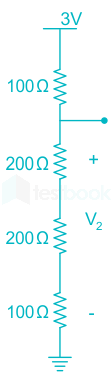
Case 1: Finding V2
V2 = (3 × 500)/600
= 2.5 V
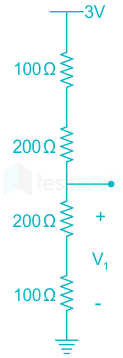
Case 2: Finding V1
V1 = (3 × 300)/600
= 1.5 V
Case 3: Finding V0
V0 = (3 × 100)/600
= 0.5 v
Vin (volts)
X2
X1
X0
0
0
0
0
0.5
0
0
0
1.0
0
0
1
1.5
0
0
1
2.0
0
1
1
2.5
1
1
1
3.0
1
1
1
In the above table, some of the cases are repeating so we can change and rearrange them.
In the circuit shown, switch S2 has been closed for a long time. At time t=0 switch S1 is closed. At t=0+, the rate of change of current through the inductor, in amperes per second, is _____.
50
A three-phase cable is supplying 800;kW and 600;kVAr to an inductive load. It is intended to supply an additional resistive load of 100;kW through the same cable without increasing the heat dissipation in the cable, by providing a three-phase bank of capacitors connected in star across the load. Given the line voltage is 3.3;kV,;50;Hz, the capacitance per phase of the bank, expressed in microfarads, is ________.
51
A 30;MVA, 3-phase, 50;Hz,;13.8;kV, star-connected synchronous generator has positive, negative and zero sequence reactances, 15%,;15%;and;5% respectively. A reactance (Xn) is connected between the neutral of the generator and ground. A double line to ground fault takes place involving phases ′b′;and;′c′, with a fault impedance of j0.1;p.u. The value of Xn (in p.u.) that will limit the positive sequence generator current to 4270;A is _________.
52
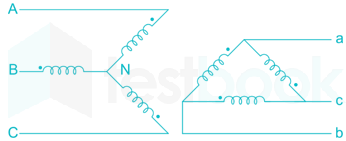
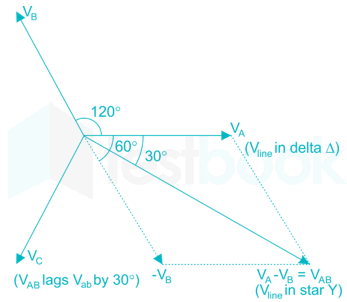
If the star side of the star-delta transformer shown in the figure is excited by a negative sequence voltage, then
((a))
VAB;leads;Vab;by;60o
((b))
VAB;lags;Vab;by;60o
((c))
VAB;leads;Vab;by;30o
((d))
VAB;lags;Vab;by;30o
Show Answer
Answer: ((d))
VAB;lags;Vab;by;30o
53
single-phase thyristor-bridge rectifier is fed from a 230;V,;50;Hz, single-phase AC mains. If it is delivering a constant DC current of 10;A, at firing angle of 30o, then value of the power factor at AC mains is
((a))
0.87
((b))
0.9
((c))
0.78
((d))
0.45
Show Answer
Answer: ((c))
0.78
Concept:
In a single phase thyristor-bridge rectifier,
Displacement factor or displacement power factor, DF=cosα
Current distortion factor, \(CDF=\frac{{{I}{s1}}}{{{I}{s}}}=\frac{2\sqrt{2}}{\pi }\) = 0.9
Input power factor = CDF × DF =π22cosα
Calculation:
input power factor = CDF × DF =π22cosα
=π22cosα=π22cos30∘=0.78
54
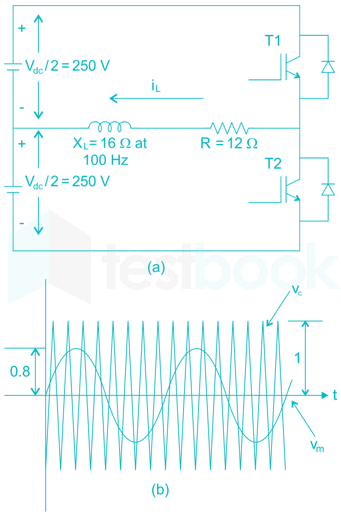
The switches T1 and T2 in Figure (a) are switched in a complementary fashion with sinusoidal pulse width modulation technique. The modulating voltage vm (t) = 0.8 sin (200πt);V and the triangular carrier voltage (Vc) are as shown in Figure (b). The carrier frequency is 5;kHz. The peak value of the 100;Hz component of the load current (iL), in ampere, is ________
55
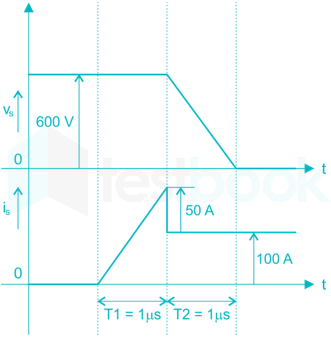
The voltage (Vs) across and the current (is) through a semiconductor switch during a turn ON transition are shown in figure. The energy dissipated during the turn – ON transition, in mJ, is_______.
56
A single-phase 400;V,;50;Hz transformer has an iron loss of 5000;W at the rated condition. When operated at 200;V,;25;Hz, the iron loss is 2000;W. When operated at 416;V,;52;Hz, the value of the hysteresis loss divided by the eddy current loss is ______.
57
A DC shunt generator delivers 45;A at a terminal voltage of 220;V. The armature and the shunt field resistances are 0.01;Ω;and;44;Ω respectively. The stray losses are 375;W. The percentage efficiency of the DC generator is ____________.
58
A three-phase, 50;Hz salient-pole synchronous motor has a per-phase direct-axis reactance (Xd) of 0.8;pu and a per-phase quadrature-axis reactance (Xq) of 0.6;pu. Resistance of the machine is negligible. It is drawing full-load current at 0.8 pf (leading). When the terminal voltage is 1;pu, per-phase induced voltage, in pu, is _________.
59
A single-phase, 22 kVA, 2200/220 V, 50 Hz, distribution transformer is to be connected as an auto-transformer to get an output voltage of 2420 V. Its maximum kVA rating as an auto-transformer is
((a))
22
((b))
24.2
((c))
242
((d))
2420
Show Answer
Answer: ((c))
242
Concept:
The maximum power rating of the autotransformer is (1 + a) times the power rating of the same device when operated as a regular two-winding transformer.
Sauto = (1 + a) S2-w
Turn ratio a=N2N1
Sauto = rating of autotransformer
S2-w = rating of two winding transformer
N1 = number of turn at the primary side
N2 = number of turn at the secondary side
Sauto = (1 + a) S2-w
Calculation:
The required output voltage is 2420 i.e. (2200+220);V
Consider the transformation ratio for Autotransformer is K=N2N1
The kVA rating of autotransformer = 1−K11 × two winding transformers; for step-up transformer
Note: Maximum kVA rating of Auto-transformer occurs in Additive polarity.
60
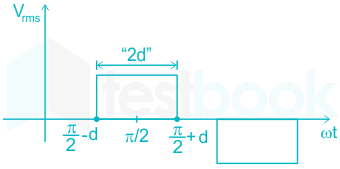
A single-phase full-bridge voltage source inverter (VSI) is fed from a 300;V battery. A pulse of 120o duration is used to trigger the appropriate devices in each half-cycle. The rms value of the fundamental component of the output voltage, in volts, is
((a))
234
((b))
245
((c))
300
((d))
331
Show Answer
Answer: ((a))
234
Concept:
The output voltage of a single-phase full-bridge voltage source inverter is given by,
A single-phase transmission line has two conductors each of 10;mm radius. These are fixed at a center-to-center distance of 1;m in a horizontal plane. This is now converted to a three-phase transmission line by introducing a third conductor of the same radius. This conductor is fixed at an equal distance D from the two single-phase conductors. The three-phase line is fully transposed. The positive sequence inductance per phase of the three-phase system is to be 5% more than that of the inductance per conductor of the single-phase system. The distance D, in meters, is _______.
62
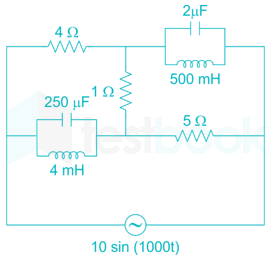
In the circuit shown below, the supply voltage is 10 sin (1000 t) volts. The peak value of the steady-state current through the 1Ω resistor, in amperes, is ______.
63
A dc voltage with ripple is given by V(t) = [100 + 10 sin (ωt) - 5 sin (3ωt)] volts. Measurements of this voltage v(t), made by moving-coil and moving-iron voltmeters, show, readings of V1 and V2 respectively. The value of V2 - V1, in volts, is _________.
64
The circuit below is excited by a sinusoidal source. The value of R, in Ω, for which the admittance of the circuit becomes a pure conductance at all frequencies is _____________.
65
In the circuit shown below, the node voltage VA is ___________ V.