Official Paper

GATE EE 2015 Official Paper: Shift 2 (Previous Year Paper)

65 questions · 180 minutes · with answers · free

General Aptitude (10 questions)

1

Consider a function f(x)=1xf\left( x \right) = 1-\left| x \right| in 1x1- 1 \le x \le 1. The value of xx at which the function attains a maximum, and the maximum value of the function are:

  1. ((a))

    0, –1

  2. ((b))

    –1, 0

  3. ((c))

    0,1

  4. ((d))

    –1, 2

Show Answer
Answer: ((c))

0,1

Given f(x)=1xf\left( x \right) = 1-\left| x \right| in 1x1- 1 \le x \le 1

Since, x>0,;for;all;x\left| x \right| > 0,;for;all;x

So, x\left| x \right|can take minimum value of 0 and maximum value of 1. Also on increasing value of x\left| x \right|, value of f(x)f\left( x \right) decreases. At x=0\left| x \right| = 0, we obtain

f(x)=1xf\left( x \right) = 1 - \left| x \right|

=10=1= 1 - 0 = 1 (function has maximum value)

Again, at x=1\left| x \right| = 1, we obtain

f(x)=1xf\left( x \right) = 1 - \left| x \right|

=11=0= 1 - 1 = 0 (function has minimum value)

Thus, at x=0\left| x \right| = 0 value of f(x)f\left( x \right) is maximum and at x=1\left| x \right| = 1 value of f(x)f\left( x \right) is minimum.

2

Choose the statement where the underlined word is used correctly.

  1. ((a))

    The industrialist had a personnel jet.

  2. ((b))

    I write my experience in my personnel diary.

  3. ((c))

    All personnel are being given the day off.

  4. ((d))

    Being religious is a personnel aspect.

Show Answer
Answer: ((c))

All personnel are being given the day off.

The word ‘personnel’ means 'people who are employed in an organization'.

Out of the given options, this meaning is accurately represented only in the sentence from option 3. The other options are instead referring to the word 'personal'.

Hence, option 3 is the answer.

3

A generic term that includes various items of clothing such as a skirt, a pair of trousers and a shirt is

  1. ((a))

    fabric

  2. ((b))

    textile

  3. ((c))

    fibre

  4. ((d))

    apparel

Show Answer
Answer: ((d))

apparel

Here are the meanings of the given words:

  • Fabric - cloth produced by weaving or knitting fibres
  • Textile - a type of cloth or woven fabric
  • Fibre - a thread or filament from which textile is formed
  • Apparel - clothing in general

We can see that the word that most accurately defines the given set of words is ‘apparel’.

Hence, option 4 is correct.

4

Based on the given statements, select the most appropriate option to solve the given

question. What will be the total weight of 10 poles each of same weight?

Statements:

(I) One fourth of the weight of a pole is 5Kg

(II) The total weight of these poles is 160kg more than the total weight of two poles.

  1. ((a))

    Statement I alone is not sufficient.

  2. ((b))

    Statement II alone is not sufficient.

  3. ((c))

    Either I or II alone is sufficient.

  4. ((d))

    Both statement I and II together are not sufficient.

Show Answer
Answer: ((c))

Either I or II alone is sufficient.

The given problem requires the total weight of 10 poles, each of same weight.

We check the given statements for evaluation of the total weight.

Statement I:

Given that one fourth of weight of a pole is 5 kg.

Let weight of a pole =x;kg= x;kg

x4=5 x=20;kg\begin{array}{l} \frac{x}{4} = 5\ x = 20;kg \end{array}

Total weight of 10 poles =10x=200;kg= 10x = 200;kg

Statement II:

The total weight of 10 poles is 160 kg more than the total weight of two poles.

Let weight of a pole =x;kg= x;kg

So, total weight of 10 poles =10x= 10x

10x=2x+160 8x=160 x=20;kg\begin{array}{l} 10x = 2x + 160\ 8x = 160\ x = 20;kg \end{array}

Hence, total weight of 10 poles =10x=20×10=200;kg= 10x = 20 \times 10 = 200;kg

Thus, the given problem can be solved by using any of the two statements.

5

We _________ our friend’s birthday and we ________ how to make it up to him.

  1. ((a))

    completely forgot --- don’t just know

  2. ((b))

    forgot completely --- don’t just know

  3. ((c))

    completely forgot --- just don’t know

  4. ((d))

    forgot completely --- just don’t know

Show Answer
Answer: ((c))

completely forgot --- just don’t know

'Completely’ and ‘just’ are considered adverbs of emphasis and should be placed in front of the verbs they describe. Even if a verb is in its negative form, for eg. "don't know", the adverb should be placed before the entire form.

The only option that satisfies this criteria in both cases is option C.

Hence, option C is the correct answer.

6

If p,q,r,sp,q,r,s are distinct integers such that:

f(p,q,r,s)=max(p,q,r,s) g(p,q,r,s,)=min;(p,q,r,s) h(p,q,r,s)=remainder;ofp×qr×sif;(p×q)>(r×s) ;(or)remainder;ofr×sp×q;if;(r×s)>(p×q)\begin{array}{l} f\left( {p,q,r,s} \right) = max\left( {p,q,r,s} \right)\ g\left( {p,q,r,s,} \right) = min;\left( {p,q,r,s} \right)\ h\left( {p,q,r,s} \right) = remainder;of\frac{{p \times q}}{{r \times s}}if;\left( {p \times q} \right) > \left( {r \times s} \right)\ ;\left( {or} \right)remainder;of\frac{{r \times s}}{{p \times q}};if;\left( {r \times s} \right) > \left( {p \times q} \right) \end{array}

Also a function fgh;(p,q,r,s)=f(p,q,r,s)×g(p,q,r,s)×h(p,q,r,s)fgh;\left( {p,q,r,s} \right) = f\left( {p,q,r,s} \right) \times g\left( {p,q,r,s} \right) \times h\left( {p,q,r,s} \right)

Also the same operations are valid with two variable function of the form f(p,q)f\left( {p,q} \right).

What is the value of fg(h(2,5,7,3),4,6,8)fg\left( {h\left( {2,5,7,3} \right),4,6,8} \right)?
7

Four branches of a company are located at M,N,O, and P. M is north of N at a distance of 4km; P is south of O at a distance of 2km; N is southeast of O by 1km. What is the distance between M and P in km?
  1. ((a))

    5.34

  2. ((b))

    6.74

  3. ((c))

    28.5

  4. ((d))

    45.49

Show Answer
Answer: ((a))

5.34

From the given data, we draw the schematic as

Let coordinate of N = (0,0)

Coordinate of M = (0,4)

Coordinate of O = (12,12)\left( { - \frac{1}{{\sqrt 2 }},\frac{1}{{\sqrt 2 }}} \right)

Coordinate of P = (12,122)\left( { - \frac{1}{{\sqrt 2 }},\frac{1}{{\sqrt 2 }} - 2} \right)

Hence by distance formula, we obtain

=(x1x2)2+(y1y2)2 =(012)2+(4+212)2 =5.34;km\begin{array}{l} = \sqrt {{{\left( {{x_1} - {x_2}} \right)}^2} + {{\left( {{y_1} - {y_2}} \right)}^2}} \ = \sqrt {{{\left( {0 - \frac{1}{{\sqrt 2 }}} \right)}^2} + {{\left( {4 + 2 - \frac{1}{{\sqrt 2 }}} \right)}^2}} \ = 5.34;km \end{array}

8

Out of the following four sentences, select the most suitable sentence with respect to grammar and usage:

  1. ((a))

    Since the report lacked the needed information, it was of no use to them.

  2. ((b))

    The report was useless to them because there were no needed information in it.

  3. ((c))

    Since the report did not contain the needed information, it was not real useful to them.

  4. ((d))

    Since the report lacked needed information, it would not had been useful to them.

Show Answer
Answer: ((a))

Since the report lacked the needed information, it was of no use to them.

Out of all the given sentences, only the sentence in option 1 is entirely correct with respect to grammar and usage.

Here are the errors in the other sentences:

  • Option 2: The verb 'were' should actually be 'was' since the subject 'information' is singular.
  • Option 3: The word 'real' should instead be 'really' - an adverb to describe the adjective 'useful'.
  • Option 4: 'Would not had been' is an ungrammatical tense construction.
<br>

Hence, the correct answer is option 1.

9

In a triangle PQRPQR, PSPS is the angle bisector of SPR\angle SPR and QPS=60\angle QPS = 60. What is the

length of PSPS?

  1. ((a))

    (q+r)qr\frac{{\left( {q + r} \right)}}{{qr}}

  2. ((b))

    qr(q+r)\frac{{qr}}{{\left( {q + r} \right)}}

  3. ((c))

    (q2+rr)\sqrt {\left( {{q^2} + {r^r}} \right)}

  4. ((d))

    (q+r)2qr\frac{{{{\left( {q + r} \right)}^2}}}{{qr}}

Show Answer
Answer: ((b))

qr(q+r)\frac{{qr}}{{\left( {q + r} \right)}}

We redraw this triangle as

In triangle, the internal bisector of an angle bisect the opposite side in the ratio of the other two sides. So, we have

QSSR=PQPR QSSR=rq QS+SRSR=r+qq SRQR=qr+q SR=qpr+q\begin{array}{l} \frac{{QS}}{{SR}} = \frac{{PQ}}{{PR}}\ \frac{{QS}}{{SR}} = \frac{r}{q}\ \frac{{QS + SR}}{{SR}} = \frac{{r + q}}{q}\ \frac{{SR}}{{QR}} = \frac{q}{{r + q}}\ SR = \frac{{qp}}{{r + q}} \end{array}

By using cosine formula in triangle ΔPSR{\rm{\Delta }}PSR,

cos60=(PR)2+(PS)2(SR)2(PR)(PS) 12=(q)2+(PS)2(qpr+q)2(q)(PS) PS=qrr+q\begin{array}{l} \cos 60^\circ = \frac{{{{\left( {PR} \right)}^2} + {{\left( {PS} \right)}^2} - {{\left( {SR} \right)}^2}}}{{\left( {PR} \right)\left( {PS} \right)}}\ \frac{1}{2} = \frac{{{{\left( q \right)}^2} + {{\left( {PS} \right)}^2} - {{\left( {\frac{{qp}}{{r + q}}} \right)}^2}}}{{\left( q \right)\left( {PS} \right)}}\ PS = \frac{{qr}}{{r + q}} \end{array}

10

If the list of letters, P,R,S,T,UP,R,S,T,U is an arithmetic sequence, which of the following

are also in arithmetic sequence?

I. 2P,;2R,;2S,;2T,;2U2P,;2R,;2S,;2T,;2U

II. P3,;R3,;S;;3,;T3,;U3P-3,;R-3,;S;-;3,;T-3,;U-3

III. P2,;R2,;S2,;T2,;U2{P^2},;{R^2},;{S^2},;{T^2},;{U^2}

  1. ((a))

    I only

  2. ((b))

    I and II

  3. ((c))

    II and III

  4. ((d))

    I and III

Show Answer
Answer: ((b))

I and II

Here P,R,S,T,UP,R,S,T,U are in A.P. So, the difference between two consecutive numbers will be equal, i.e.

d=RP=SR=TS=UTd = R - P = S - R = T - S = U - T

Where dd is common difference for the given A.P. Now, we check the given sequences

Sequence I:

2P,;2R,;2S;,;2T;,;2U2P,;2R,;2S;,;2T;,;2U

The differences between two consecutive numbers are obtained as

D=2R2P=2(RP)=2d D=2S2R=2(SR)=2d D=2T2S=2(TS)=2d\begin{array}{l} D = 2R - 2P = 2\left( {R - P} \right) = 2d\ D = 2S - 2R = 2\left( {S - R} \right) = 2d\ D = 2T - 2S = 2\left( {T - S} \right) = 2d \end{array}

Since, the differences are same in each case, so it is in A.P.

Sequence II:

P3,;R3,;S3,;T3,;V3P - 3,;R - 3,;S - 3,;T - 3,;V - 3

The differences between two consecutive numbers are obtained as

D=(R3)(P3) =RP3+3=RP=d D=(S3)(R3) =SR3+3=SR=d\begin{array}{l} D = \left( {R - 3} \right) - \left( {P - 3} \right)\ = R - P - 3 + 3 = R - P = d\ D = \left( {S - 3} \right) - \left( {R - 3} \right)\ = S - R - 3 + 3 = S - R = d \end{array}

Again, the differences are same in each case, so it is in A.P.

Sequence III:

P2,;R2,;S2,;T2,;V2{P^2},;{R^2},;{S^2},;{T^2},;{V^2}

The differences between two consecutive numbers are obtained as

D=R2P2=(RP)(R+P) =d(R+P) D=S2R2=(SR)(S+R) =d(S+R)\begin{array}{l} D = {R^2} - {P^2} = \left( {R - P} \right)\left( {R + P} \right)\ = d\left( {R + P} \right)\ D = {S^2} - {R^2} = \left( {S - R} \right)\left( {S + R} \right)\ = d\left( {S + R} \right) \end{array}

In this case, the differences are not same, so it is not in A.P.

Thus, sequences I and II will be in A.P.

Electrical Engineering (55 questions)

11

Given f(z)=g(z)+h(z)f\left( z \right) = g\left( z \right) + h\left( z \right), where f, g, h are complex valued functions of a complex variable z. which one of the following statements is TRUE?

  1. ((a))

    If f(z)f\left( z \right) is differential at z0{z_0}, then g(z)g\left( z \right) and h(z)h\left( z \right) are also differentiable at z0{z_0}.

  2. ((b))

    If g(z)g\left( z \right) and h(z)h\left( z \right) are differentiable at z0{z_0}, then f(z)f\left( z \right) is also differentiable at z0{z_0}.

  3. ((c))

    If f(z)f\left( z \right) is continuous at z0{z_0}, then it is differentiable at z0{z_0}.

  4. ((d))

    If f(z)f\left( z \right) is differentiable at z0{z_0}, then so are its real and imaginary parts.

Show Answer
Answer: ((b))

If g(z)g\left( z \right) and h(z)h\left( z \right) are differentiable at z0{z_0}, then f(z)f\left( z \right) is also differentiable at z0{z_0}.

Concept:

Let f(z) = u + iv be the analytic function,

Cauchy-Riemann equations are 

vy = ux

vx = - uy

Calculation:

Given f(z)=g(z)+h(z)f\left( z \right) = g\left( z \right) + h\left( z \right)

Let g(z)=gu(z)+j;gv(z)g\left( z \right) = gu\left( z \right) + j;gv\left( z \right)

h(z)=hu(z)+j;hv(z)h\left( z \right) = hu\left( z \right) + j;hv\left( z \right)

If g and h are differentiable, then it will satisfy C-R equations. So, we have

\(\begin{array}{*{20}{c}} {g{u_x} = g{v_y},}&{g{u_y} = - g{v_x}}\ {h{u_x} = h{v_y},}&{huy = - h{v_x}} \end{array}\)

f(z)=(gu(z)+hu(z))+j;((gv(z)+hv(z))f\left( z \right) = \left( {gu\left( z \right) + hu\left( z \right)} \right) + j;(\left( {gv\left( z \right) + hv\left( z \right)} \right)

By observing the above equations, we get

\(\begin{array}{*{20}{c}} {\left( {g{u_x} + h{u_x}} \right) = \left( {g{v_y} + h{v_y}} \right)}\ {\left( {g{v_y} + h{v_y}} \right) = - \left( {g{v_x} + h{v_x}} \right)} \end{array}\)

Hence, form above two equations f(z) is differentiable (because it satisfies C- R equation).

12

We have a set of 3 linear equations in 3 unknowns. ‘X ≡ Y’ means X and Y are equivalent statements and ‘X ≢ Y’ means X and Y are not equivalent statements.

P: There is a unique solution.

Q: The equations are linearly independent.

R: All eigenvalues of the coefficient matrix are nonzero.

S: The determinant of the coefficient matrix is nonzero.

Which one of the following is TRUE?

  1. ((a))

    P ≡ R ≡ Q ≡ S

  2. ((b))

    P ≡ R ≢ Q ≡ S

  3. ((c))

    P ≡ Q ≢ R ≡ S

  4. ((d))

    P ≢ Q ≢ R ≢ S

Show Answer
Answer: ((a))

P ≡ R ≡ Q ≡ S

Concept:

Consider the system of m linear equations

a11 x1 + a12 x2 + … + a1n xn = b1

a21 x1 + a22 x2 + … + a2n xn = b2

am1 x1 + am2 x2 + … + amn xn = bm

The above equations containing the n unknowns x1, x2, …, xn. To determine whether the above system of equations is consistent or not, we need to find the rank of the following matrices.

\(A = \left[ {\begin{array}{{20}{c}} {{a_{11}}}&{{a_{12}}}& \ldots &{{a_{1n}}}\ {{a_{21}}}&{{a_{22}}}& \ldots &{{a_{2n}}}\ \ldots & \ldots & \ldots & \ldots \ {{a_{m1}}}&{{a_{m2}}}& \ldots &{{a_{mn}}} \end{array}} \right]\) and \(\left[ {A{\rm{|}}B} \right] = \left[ {\begin{array}{{20}{c}} {{a_{11}}}&{{a_{12}}}& \ldots &{{a_{1n}}}&{{b_1}}\ {{a_{21}}}&{{a_{22}}}& \ldots &{{a_{2n}}}&{{b_2}}\ \ldots & \ldots & \ldots & \ldots & \ldots \ {{a_{m1}}}&{{a_{m2}}}& \ldots &{{a_{mn}}}&{{b_m}} \end{array}} \right]\)

A is the coefficient matrix and [A|B] is called an augmented matrix of the given system of equations.

We can find the consistency of the given system of equations as follows:

(i) If the rank of matrix A is equal to rank of an augmented matrix and it is equal to the number of unknowns, then the system is consistent and there is a unique solution.

The rank of A = Rank of augmented matrix = n

(ii) If the rank of matrix A is equal to rank of an augmented matrix and it is less than the number of unknowns, then the system is consistent and there are an infinite number of solutions.

The rank of A = Rank of augmented matrix < n

(iii) If the rank of matrix A is not equal to rank of the augmented matrix, then the system is inconsistent, and it has no solution.

The rank of A ≠ Rank of an augmented matrix

Explanation:

If determinant of coefficient matrix is non-zero then there is a unique solution. If determinant is non – zero. So all the Eigen values are non-zero. If Eigen values are non – zero then question are linearly independent.


we have a set of three linear equations with three variables.

i.e., [A]3×3 [X]3×1 = [B]3×1

Statement P:

In this case,

P(A) = P(A : B) = Number of variables

⇒ P(A) = P(A : B) = 3

∴ three independent rows exist in matrix A irrespective of matrix B.

Also, |A| ≠ 0     ---(i)

Hence, P = Q = S

Statement R:

Let λ1, λ2 & λ3 are eigen values of matrix A

using the properties,

λ1 λ2 λ3 = |A|   ----(ii)

from equation (i) & (ii),

λ1 λ2 λ3 ≠ 0

⇒ λ1 ≠ 0, λ2 ≠ 0 & λ3 ≠ 0

Therefore, from above discussion, it is inferred that,

P = Q = R = S

13

Match the following 

P.Stoke’s Theorem1.∯D.ds = Q
Q.Gauss’s Theorem2.∮f(z)dz = 0
R.Divergence Theorem3.∭(∇ . A)dv = ∯A.ds
S.Cauchy’s Integral Theorem4.∬(∇ × A).ds = ∮A.dl
  1. ((a))

    P – 1, Q – 2, R – 4, S – 3

  2. ((b))

    P – 4, Q – 1, R – 3, S – 2

  3. ((c))

    P – 4, Q – 3, R – 1, S – 2

  4. ((d))

    P – 3, Q – 4, R – 2, S – 1

Show Answer
Answer: ((b))

P – 4, Q – 1, R – 3, S – 2

Stoke’s theorem: The line integral of a vector around closed path L is equal to the integral of curl over the open surface is enclosed by the closed path L.

Adl\oint \vec A \cdot d\vec l=(×A).ds\iint \left( {\vec \nabla \times \vec A} \right).d\vec s

Gauss's theorem: The total flux coming out of a closed surface is equal to the change enclosed.

D.ds=Q\oint D.ds = Q

Divergence theorem: The total outward flux of a vector field F\vec F through a closed surface is equal to the volume integral of the divergence of F\vec F

\(\mathop \oint \limits_s \vec F.d\vec s = \mathop \smallint \limits_v \left( {\vec \nabla .\vec F} \right)dv\)

Cauchy's integral theorem: f(z).dz=0\oint f\left( z \right).dz = 0

14

The Laplace transform of f(t)=2tπf\left( t \right) = 2\sqrt {\frac{t}{\pi }} is  s32{s^{ - \frac{3}{2}}}. The Laplace transform of g(t)=1πtg\left( t \right) = \sqrt {\frac{1}{{\pi t}}} is

  1. ((a))

    3s522\frac{{3{s^{ - \frac{5}{2}}}}}{2}

  2. ((b))

    s12{s^{ - \frac{1}{2}}}

  3. ((c))

    s12{s^{\frac{1}{2}}}

  4. ((d))

    s32{s^{\frac{3}{2}}}

Show Answer
Answer: ((b))

s12{s^{ - \frac{1}{2}}}

Concept:

x(t)LTX(s)x\left( t \right)\mathop \leftrightarrow \limits^{LT} X\left( s \right)

dx(t)dtL.TsX(s)\frac{{dx\left( t \right)}}{{dt}}\mathop \leftrightarrow \limits^{L.T} sX\left( s \right)

sX(s)I.L.Tdx(t)dtsX\left( s \right)\mathop \leftrightarrow \limits^{I.L.T} \frac{{dx\left( t \right)}}{{dt}}

\(L\left{ {\frac{{x\left( t \right)}}{{t}}} \right} = \frac{}{}\mathop \smallint \limits_s^0 \left{ {x\left( t \right)} \right}ds\ \)

Calculation:

Given that Laplace transform f(t)=2tπf\left( t \right) = 2\sqrt {\frac{t}{\pi }} is s32{s^{ - \frac{3}{2}}}

Given as g(t)=1πtg\left( t \right) = \frac{1}{{\sqrt {\pi t} }}

\(\begin{array}{l} \Rightarrow g\left( t \right) = \frac{{2\sqrt {\frac{t}{\pi }} }}{{2t}} = \frac{{f\left( t \right)}}{{2t}}\ L\left{ {g\left( t \right)} \right} = L\left{ {\frac{{f\left( t \right)}}{{2t}}} \right} = \frac{1}{2}\mathop \smallint \limits_s^0 \left{ {f\left( t \right)} \right}ds\ = \frac{1}{2}\mathop \smallint \limits_s^\infty {s^{ - \frac{3}{2}}}ds = \frac{1}{2}\left( {\frac{{{s^{\frac{{ - 3}}{2} + 1}}}}{{\frac{{ - 3}}{2} + 1}}} \right)_s^\infty \ = \frac{1}{2}\left( { - 2} \right)\left[ {0 - {s^{ - \frac{1}{2}}}} \right] = {s^{ - \frac{1}{2}}} = \frac{1}{{\sqrt s }} \end{array}\)

15

Match the following:

Instrument type                                                                        

P)        Permanent magnet moving coil                                                 

Q)        Moving iron connected through current transformer                

R)        Rectifier                                                                                             

S)        Electrodynamometer

Used for

1. DC only 2. AC only 3. DC and AC

  1. ((a))

    P – 1, Q – 2, R – 1, S – 3

  2. ((b))

    P – 1, Q – 3, R – 1, S – 2

  3. ((c))

    P – 1, Q – 2, R – 3, S – 3

  4. ((d))

    P – 3, Q – 1, R – 2, S – 1

Show Answer
Answer: ((c))

P – 1, Q – 2, R – 3, S – 3

  • Permanent Magnet Moving Coil (PMMC) is only used for DC measurements.
  • Moving Iron (MI) type instruments can be used for both AC & DC measurements. But Moving Iron connected through current Transformer block DC supply. So that Moving Iron connected through current Transformer are only used for AC measurements.
  • Rectifier type instruments are used for both AC & DC measurements.
  • Induction type instruments are only used for AC measurements.
16

A – 3 phase balanced load which has a power factor of 0.707 is connected to balanced supply. The power consumed by the load is 5 kW. The power is measured by the two-wattmeter method. The readings of the two watt meters are.

  1. ((a))

    3.94 kW and 1.06 kW

  2. ((b))

    2.50 kW and 2.50 kW

  3. ((c))

    5.00 kW and 0.00 kW

  4. ((d))

    2.96 kW and 2.04 kW

Show Answer
Answer: ((a))

3.94 kW and 1.06 kW

Concept:

In a two-wattmeter method, for lagging load

The reading of first wattmeter (W1) = VL IL cos (30° + ϕ)

The reading of second wattmeter (W2) = VL IL cos (30° - ϕ)

Total power in the circuit (P) = W1 + W2

Calculation:

Given,

Total power consumed by load W1 + W2 = 5 kW

Power factor cos ϕ = 0.707

⇒ ϕ = cos-1 (0.707) = 45° 

The reading of first wattmeter (W1) = VL IL cos (30° + ϕ)

W1 = VL IL cos (30° + 45°) = 0.2588 VL IL

The reading of second wattmeter (W2) = VL IL cos (30° - ϕ)

W2 = VL IL cos (30° - 45°) = 0.966 VL IL

The total power consumed by the load is 

W1 + W2 = 5 kW = (0.2588 + 0.966) VL IL

⇒ VL IL = 4.082 kW

Therfore the reading in each wattmeter is 

W1 = 0.966 VL IL = 0.966 × (4.082 kW) 

W1 = 3.94 kW

W2 = 0.2588 VL IL = 0.2588 × (4.082 kW)

W2 = 1.06 kW

17

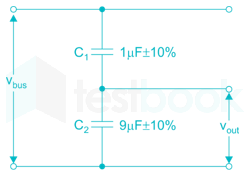
A capacitive voltage divider is used to measure the bus voltage Vbus in a high-voltage 50 Hz AC system as shown in the figure. The measurement capacitors C1 and C2 Have tolerances of ±10% on their normal capacitance values. If the bus voltage Vbus is 100 kV RMS, the maximum RMS output voltage Vout (in kV), considering the capacitor tolerance, is __________

18

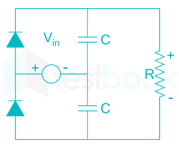
In the following circuit, the input voltage Vin{V_{in}} is 100;sin(100πt)100;sin\left( {100\pi t} \right). For 100πRC=50100\pi RC = 50, the average voltages across RR (in volts) under steady-state is nearest to

  1. ((a))

    100

  2. ((b))

    31.8

  3. ((c))

    200

  4. ((d))

    63.6

Show Answer
Answer: ((c))

200

Concept:

  • Once the capacitor gets charged to a particular voltage, the capacitor behaves like a voltage source of that particular voltage and the diode responsible for the charging of the capacitor will always be off.
  • The voltage across the capacitor will always only depend on the peak to the peak value of the input and not on the shape of the input waveform.
  • If the given input waveform is anything other than a square wave, then during the analysis consider it as a square wave between the same two levels (+Vm, -Vm)

Explanation:

During the positive half cycle, the circuit under steady-state is as shown below.

The voltage across R, |VR| = 2 Vm

During the negative half-cycle, the circuit under steady-state is as shown below.

The voltage across R, |VR| = 2 Vm

The voltage across resistance R = 2 Vm = 2 × 100 = 200 V

19

Two semi-infinite dielectric regions are separated by a plane boundary at y = 0. The dielectric constant of region 1 (y < 0) and region 2 (y > 0) are 2 and 5, Region 1 has a uniform electric field E = 3âx + 4ây + 2âz, where âx, ây, and âz are unit vectors along the x, y, and z axes, respectively. The electric field region 2 is

  1. ((a))

    3âx + 1.6ây + 2âz​

  2. ((b))

    1.2âx + 4ây + 2âz​

  3. ((c))

    1.2âx + 4ây + 0.8âz​

  4. ((d))

    3âx + 10ây + 0.8âz​

Show Answer
Answer: ((a))

3âx + 1.6ây + 2âz​

Given y= 0 or x-z plane

x and z are tangential components, y is normal component

y < 0, ϵ1 = 2

E1 = 3ax + 4ay + 2az

Normal component is En1 = 4ay 

y > 0, ϵ2 = 5

ϵ1 En1 = ϵ2 En2

⇒ En2 = (2/5) (4ay

E2=3ax+25(4ay)+2az{E_2} = 3{a_x} + \frac{2}{5}\left( {4{a_y}} \right) + 2{a_z}

E2 = 3ax + 1.6 ay + 2 az

20

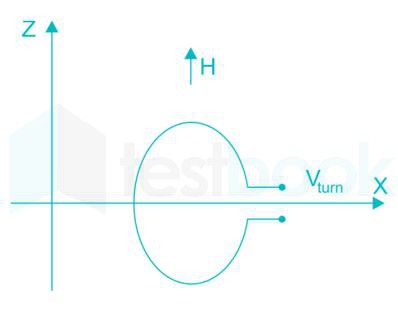
A circular turn of radius 1 m revolves at 60 rpm about its diameter aligned with the x-axis as shown in the figure. The value of μ0 is 4π × 10-7 is SI unit. If a uniform magnetic field intensity H=107z^Am\vec H = {10^7}\hat z\frac{A}{m} is applied, then the peak value of the inducted voltage, Vtum (in volts), is ________.

21

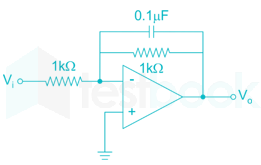
The operational amplifier shown in the figure is ideal. The input voltage (in Volt) is Vi=2sin;(2π;×;2000t){V_i} = 2sin;\left( {2\pi ; \times ;2000t} \right). The amplitude of the output voltage V0{V_0} (in Volt) is_____.

22

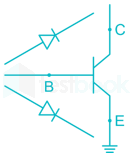
In the following circuit, the transistor is in active mode and VC;=;2V{V_C}; = ;2V. To get VC;=;4V{V_C}; = ;4V, we replace RC{R_C} with \(R{'C}\). Then the ratio \(R{'C};/{R_C}\) is___.

23

Consider the following sum of products expression, F

F=ABC+AˉBˉC+ABˉC+AˉBC+AˉBˉCˉF=ABC+\bar A\bar B C+A\bar BC+\bar ABC+\bar A\bar B\bar C

The equivalent product of sums expression is

  1. ((a))

    F=(A+Bˉ+C)(Aˉ+B+C)(Aˉ+Bˉ+C)F = \left( {A + \bar B + C} \right)\left( {\bar A + B + C} \right)\left( {\bar A + \bar B + C} \right)

  2. ((b))

    F=(A+Bˉ+Cˉ)(A+B+C)(Aˉ+Bˉ+Cˉ)F = \left( {A + \bar B + \bar C} \right)\left( {A + B + C} \right)\left( {\bar A + \bar B + \bar C} \right)

  3. ((c))

    F=(Aˉ+B+Cˉ)(A+Bˉ+Cˉ)(A+B+C)F = \left( {\bar A + B + \bar C} \right)\left( {A + \bar B + \bar C} \right)\left( {A + B + C} \right)

  4. ((d))

    F=(Aˉ+Bˉ+C)(A+B+Cˉ)(A+B+C)F = \left( {\bar A + \bar B + C} \right)\left( {A + B + \bar C} \right)\left( {A + B + C} \right)

Show Answer
Answer: ((a))

F=(A+Bˉ+C)(Aˉ+B+C)(Aˉ+Bˉ+C)F = \left( {A + \bar B + C} \right)\left( {\bar A + B + C} \right)\left( {\bar A + \bar B + C} \right)

Concept:

The SOP representation of the circuit is:

F = Σm (minterms)

Minterm: a minterm of n variables is a product of the variables in which each appears exactly once in true or complemented form.

The POS representation of the circuit:

F = ΠM (max terms)

Maxterm: a maxterm of n variables is a sum of the variables in which each appears exactly once in true or complemented form.

Calculation:

Given,

F=ABC+AˉBˉC+ABˉC+AˉBC+AˉBˉCˉF=ABC+\bar A\bar B C+A\bar BC+\bar ABC+\bar A\bar B\bar C

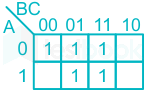
For the function, we form the K-map as:

Hence, the function in the form of minterms is expressed as:

f(A, B, C) = Σm (0,1,3,5,7)

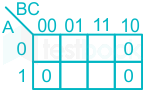
Now, we put 0 in each block of the K-map excluding the blocks corresponding to the terms in the above function.

Grouping the 0’s in K-map, we obtain the max terms as

F = πM(2, 4, 6)

F = πM(2, 4, 6) = (A+Bˉ+C)(Aˉ+B+C)(Aˉ+Bˉ+C)\left( {A + \bar B + C} \right)\left( {\bar A + B + C} \right)\left( {\bar A + \bar B + C} \right)

24

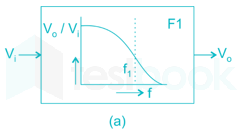
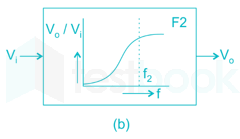
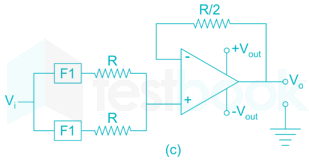
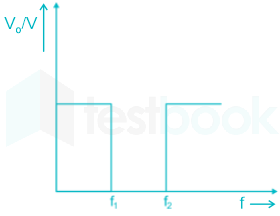
The filters F1 and F2 having characteristics as shown in Figures (a) and (b) are connected as shown in Figure (c).

The cut-off frequencies of F1 and F2 are f1{f_1} and f2{f_2} respectively. If f1;<;f2{f_1}; < ;{f_2}­, the resultant circuit exhibits the characteristics of a

  1. ((a))

    Band-pass filter

  2. ((b))

    Band-stop filter

  3. ((c))

    All pass filter

  4. ((d))

    High-Q-filter

Show Answer
Answer: ((b))

Band-stop filter

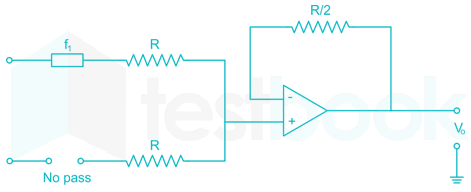
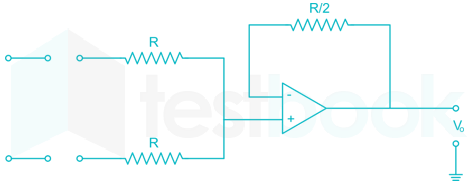
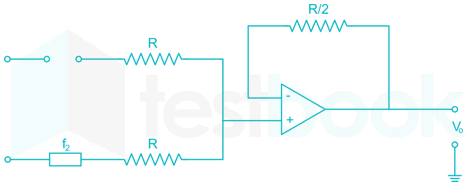
In the given figure, (a) is low pass filter and (b) high pass filter. Also, we have

f1<f2{f_1} < {f_2}

For f<f1f < {f_1}, we have the op- omp circuit as

Again, for f1<f<f2{f_1} < f < {f_2}, the op – amp circuit is

for f>f2f > {f_2}, the op – omp circuit is

Hence, the output graph is

Thus, the resultant circuit represents a band stop filter.

25

When a bipolar junction transistor is operating in the saturation mode, which one of the following statements is TRUE about the state of its collector-base (CB) and the base-emitter (BE) junctions?

  1. ((a))

    The CB junction if forward biased and the BE junction is reverse biased.

  2. ((b))

    The CB junction is reversed and the BE junction is forward biased.

  3. ((c))

    Both the CB and BE junctions are forward biased.

  4. ((d))

    Both the CB and BE junctions are reverse biased.

Show Answer
Answer: ((c))

Both the CB and BE junctions are forward biased.

In Bipolar transistor, saturation mode occurs when

  1. Collector – base (CB) is forward biased.
  2. Base-emitter (BE) is also forward biased.

Hence, for the saturation condition, bath the junction should be in forward-bias, as shown in the figure below.

26

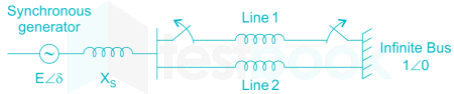
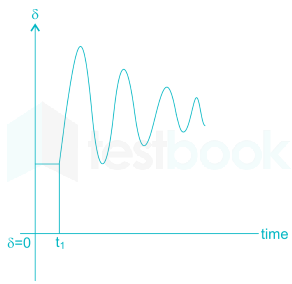
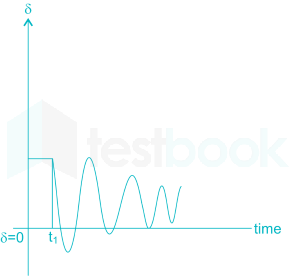
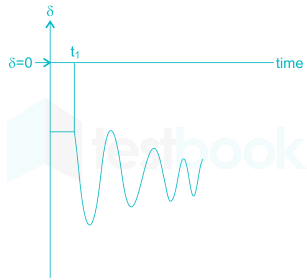
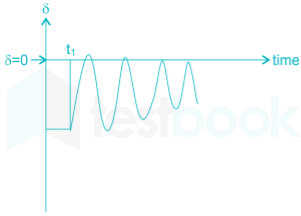
The synchronous generator shown in the figure is supplying active power to an infinite bus via two short, lossless transmission lines, and is initially in steady state. The mechanical power input to the generator and the voltage magnitude E are constant. If one line is tripped at time t1 by opening the circuit breakers at the two ends (although there is no fault), then it is seen that the generator undergoes a stable transient. Which one of the following waveforms of the rotor angle δ shows the transient correctly?

  1. ((a))

  2. ((b))

  3. ((c))

  4. ((d))

Show Answer
Answer: ((a))

Analysis:

In the given line diagram

Line 1 is tripped at time t1 by opening the circuit breakers at the two ends (although there is no fault)

As the line is disconnected the reactance of the system increases

The maximum power transfer increases (as power is inversely proportional to the reactance of the line Pmax=EVXP_{max}=\frac{EV}{X})

It is also given that mechanical power input to the generator and the voltage magnitude E is constant.

Therefore the new electrical power is to be the same as the old power, so δ value should be increased (given in the line reactance diagram the steady-state value of δ before the transient is positive)

The rotor angle transient will be

27

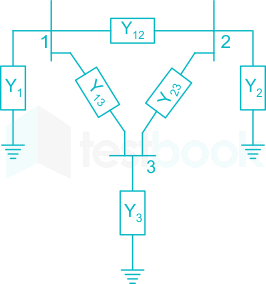
A 3 – bus power system network consists of 3 transmission lines. The bus admittance matrix of the uncompensated system is

\(\left[ {\begin{array}{*{20}{c}} { - j6}&{j3}&{j4}\ {j3}&{ - j7}&{j5}\ {j4}&{j5}&{ - j8} \end{array}} \right]Pu\)

If the shunt capacitance of all transmission lines is 50% compensated, the imaginary part of the 3rd row 3rd column element (in pu) of the bus admittance matrix after compensation is

  1. ((a))

    -j7.0

  2. ((b))

    -j8.5

  3. ((c))

    -j7.5

  4. ((d))

    -j9.0

Show Answer
Answer: ((b))

-j8.5

Concept:

For a 3 bus power system

For the above figure, the admittance matrix is as shown below.

\({y_{bus}} = \left[ {\begin{array}{*{20}{c}} {{y_{11}} + {y_{12}} + {y_{13}}}&{ - {y_{12}}}&{ - {y_{13}}}\ { - {y_{12}}}&{{y_{21}} + {y_{22}} + {y_{23}}}&{ - {y_{23}}}\ { - {y_{31}}}&{ - {y_{23}}}&{{y_{31}} + {y_{32}} + {y_{33}}} \end{array}} \right]\)

Diagonal elements of the Bus Admittance matrix are known as self-admittances and the off-diagonal elements are known as mutual admittances.

Calculation:

Given bus admittance matrix of the uncompensated line is

\(Y=\left[ {\begin{array}{*{20}{c}} { - j6}&{j3}&{j4}\ {j3}&{ - j7}&{j5}\ {j4}&{j5}&{ - j8} \end{array}} \right]Pu\)

By comparing the above matrix with standard 3 bus matrix

y13 = -j4

y32 = -j5

⇒ y31 + y32 + y33 = -j8

⇒ y33­ = j

After compensating, y33=j2{y_{33}} = \frac{j}{2}

Y33(new) = -8.5 j.

28

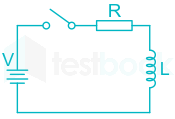
A series RL circuit is excited at t = 0 by closing a switch as shown in the figure. Assuming zero initial conditions, the value of ​​d2idt2at;t=0+\frac{{{d^2}i}}{{d{t^2}}}at;t = {0^ + } is

  1. ((a))

    V/L

  2. ((b))

    -V/R

  3. ((c))

    0

  4. ((d))

    -RV/L2

Show Answer
Answer: ((d))

-RV/L2

Given as zero initial condition:

I(0-) = I(0+) = 0

When the switch is closed the inductor will act as an open circuit

∴ I(0+) = 0

After some time inductor will start charging and at t → ∞

I(∞) = V/R

Now The current through the inductor is given by:

Putting all the value in the above equation

Differentiate the equation first time then we get

Differentiate the equation a second time then we get

Hence option (4) is correct.

29

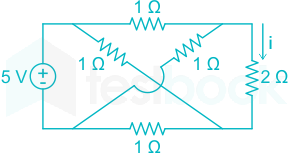
The current i (in Ampere) in the 2 Ω resistor of the given network is _____.

30

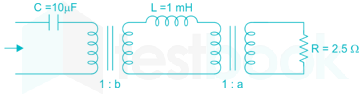
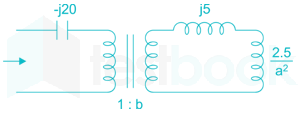
Find the transformer ratios a and b that the impedance Zin is resistive and equal to 2.5 Ω when the network is excited with a sine wave voltage of angular frequency of 5000 rad/s

  1. ((a))

    a = 0.5, b = 2.0

  2. ((b))

    a = 2.0, b = 0.5

  3. ((c))

    a = 1.0, b = 1.0

  4. ((d))

    a = 4.0, b = 0.5

Show Answer
Answer: ((b))

a = 2.0, b = 0.5

Concept:

Referred value in Transformer:

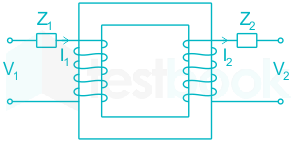
In order to simplify the calculation, it is theoretically possible to transfer the voltage, current, and impedance of one winding to the other winding and combined them to a single value for each quantity.

Considered a transformer has turns ration 'a' which is given by,

a=N2N1=V2V1=I1I2a = \frac{{{N_2}}}{{{N_1}}} = \frac{{{V_2}}}{{{V_1}}} = \frac{{{I_1}}}{{{I_2}}}

Where,

I1 and I2 are primary and secondary current respectively.

V1 and V2 are primary and secondary voltage respectively.

N1 and N2 are numbers of turn in primary and secondary respectively.

For an ideal transformer:

Input Power = Output Power

V12Z1=V22Z2\frac{{V_1^2}}{{{Z_1}}} = \frac{{V_2^2}}{{{Z_2}}}

V22V12=Z2Z1\frac{{V_2^2}}{{V_1^2}} = \frac{{{Z_2}}}{{{Z_1}}}

(V2V1)2=Z2Z1{\left( {\frac{{{V_2}}}{{{V_1}}}} \right)^2} = \frac{{{Z_2}}}{{{Z_1}}}

a2=Z2Z1{a^2} = \frac{{{Z_2}}}{{{Z_1}}}

Equivalent secondary Impedance in terms of primary Impedance:

Z1=Z2a2{Z_1} = \frac{{{Z_2}}}{{{a^2}}}

Equivalent primary Impedance in terms of secondary Impedance:

Z2=a2Z1{Z_2} = {a^2}{Z_1}

Calculation:

Given,

Zin is resistive and equal to 2.5 Ω

Angular frequency ω = 5000 rad/s

Inductive reactance XL = jωL = j 5000 × 1 × 10-3 = j 5 Ω 

Capative reactance XC = 1 / jωC = 1 / j(5000 × 10 × 10-6) = - j 20 Ω 

The input impedance of the transformer from the secondary side of the transformer will be

Z' = XL + R/a2 = j 5 + 2.5/a2

Circuit diagram will be as follows  

The input impedance of the transformer from the primary side of the transformer will be

Zin=1b2[2.5a2+j5]j20⇒ {Z_{in}} = \frac{1}{{{b^2}}}\left[ {\frac{{2.5}}{{{a^2}}} + j5} \right] - j20

Zin=[2.5a2×b2+j5b2]j20⇒ {Z_{in}} = \left[ {\frac{{2.5}}{{{a^2}\times {b^2}}} +\frac{{j5}}{{{b^2}}}} \right] - j20

It is given that the input impedance is resistive, therefore there won't be any reactance term in the input impedance

As there is no reactance in the input impedance, make reactance equal to zero in the above equation

20+5b2=0⇒- 20 + \frac{5}{{{b^2}}} = 0

⇒ b2 = 0.25

⇒ b = 0.5

Now the given resistive term of the input impedance is equal to 2.5 Ω 

2.5a2b2=2.5⇒ \frac{{2.5}}{{{a^2}{b^2}}} = 2.5

2.5a2×0.52=2.5⇒ \frac{{2.5}}{{{a^2}\times{0.5^2}}} = 2.5

⇒ a = 2

Therefore the value of a = 2.0, b = 0.5

31

A shunt – connected DC motor operates at its rated terminal voltage. Its no – load sped is 200 radians/second. At its rated torque of 500 Nm, its speed is 180 radian/second, The motor is used to directly drive a load whose load torque TL depends on its rotational speed (in radian/second), such that \({T_L} = 2.78 \times {\omega T}\). Neglecting rotational losses, the steady – state speed (in radian/second) of the motor, when it drives this load is____________

32

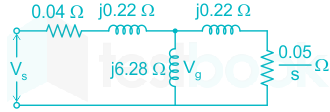
The figure shows the per-phase equivalent circuit of a two-pole three-phase induction motor operating at 50 Hz. The “air-gap” voltage, Vg{V_g} across the magnetizing inductance, is 210 V rms, and the slip, is 0.05. The torque (in Nm) produced by the motor is _______.

33

A 4 – pole, separately excited, wave wound DC machine with negligible armature resistance is rated for 230 V and 5 kW at a speed if 1200 rpm. If the same armature coils are reconnected to forms a lap winding, what is the rated voltage (in volts) and power (in kW) respectively at 1200 rpm of the reconnected machine if the field circuit is left unchanged?

  1. ((a))

    230 and 5

  2. ((b))

    115 and 5

  3. ((c))

    115 and 2.5

  4. ((d))

    230 and 2.5

Show Answer
Answer: ((b))

115 and 5

Wave wound

For wave wound, number of parallel pat (A1) = 2

∴ E1=pϕNz60 A1E_1=\frac{pϕ Nz}{60\ A_1}

⇒ E11A1E_1∝\frac{1}{A_1} {p, ϕ, N & z are constants}

Lap wound

for lap wound,

Number of parallel path = Number of poles

i.e., A2 = P = 4

∴ E21A2E_2∝\frac{1}{A_2}

So,

E2E1=A2A1\frac{E_2}{E_1}=\frac{A_2}{A_1}

⇒ E2=E12E_2=\frac{E_1}{2}

It is given that armature resistance (Ra) = 0

so, E ∝ V

⇒ E2E1=V1V2\frac{E_2}{E_1}=\frac{V_1}{V_2}

⇒ V2=E2E1V1V_2=\frac{E_2}{E_1}V_1

⇒ V2=V12V_2=\frac{V_1}{2}

so, power (p) = V Ia

⇒ Ia=PVI_a=\frac{P}{V}

⇒ Ia1VI_a\propto\frac{1}{V}

so,

Ia2Ia1=V1V2 V2=V12\frac{I_{a_2}}{I_{a_1}}=\frac{V_1}{V_2}\ {V_2=\frac{V_1}{2}}

Ia2=2Ia1I_{a_2}=2I_{a_1}

The power of the machine will remain same as Plap = Pwave

The machine with lap wound armature coils will have rated voltage.

V2=V12=2302=115V_2=\frac{V_1}{2}=\frac{230}{2}=115 V

∴ Plap = Pwave = p = 5 kW

34

An open loop control system results in a response of e2t;(sin5t+cos5t){e^{ - 2t}};\left( {sin5t + cos5t} \right) for a unit impulse. The DC gain of the control system is_______________

35

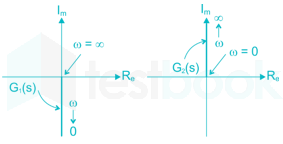
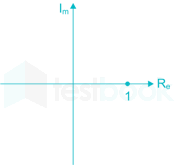
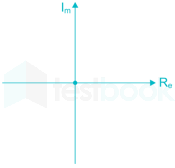
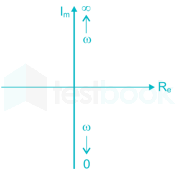
Nyquist plots of two function G1(s){G_1}\left( s \right) and G2(s){G_2}\left( s \right) are shown in figure.

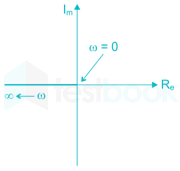
Nyquist plot of the product of G1(s){G_1}\left( s \right) and G2(s){G_2}\left( s \right) is

  1. ((a))

  2. ((b))

  3. ((c))

  4. ((d))

Show Answer
Answer: ((b))

From the Nyquist plot, we have

FG1(S)=K1s FG2(S)=K2s;\begin{array}{l} {F_{G1}}\left( S \right) = \frac{{{K_1}}}{s}\ {F_{G2}}\left( S \right) = {K_2}s; \end{array}

So, the product of FG1{F_{G1}} and FG2{F_{G2}} is obtained as

F(s)=FG1(s).FG2(s) =k1s.k2s=k1k2;\begin{array}{l} F\left( s \right) = {F_{G1}}\left( s \right).{F_{G2}}\left( s \right)\ = \frac{{{k_1}}}{s}.{k_2}s = {k_1}{k_2}; \end{array}

36

The volume enclosed by the surface f(x,y)=exf\left( {x,y} \right) = {e^x} over the triangle bounded by the line x=y;;x=0;;y=1x = y;;x = 0;;y = 1 in the xy plane is ________.

37

Two coins R and S are tossed. The 4 joint events HRHS,;TRTS,HRTS,TRHS{H_R}{H_S},;{T_R}{T_S},{H_R}{T_S},{T_R}{H_S} have probabilities 0.28, 0.18, 0.30, 0.24, respectively, where H represents head and T represents tail. Which one of the following is TRUE?

  1. ((a))

    The coin tosses are independent

  2. ((b))

    R is fair, S is not.

  3. ((c))

    S is fair, R is not.

  4. ((d))

    The coin tosses are dependent

Show Answer
Answer: ((d))

The coin tosses are dependent

Given events HRHS,;TRTS,HRTS,TRHS{H_R}{H_S},;{T_R}{T_S},{H_R}{T_S},{T_R}{H_S}

If coins are independent, corresponding probabilities will be

\(\begin{array}{*{20}{c}} {\frac{1}{2}.\frac{1}{2},\frac{1}{2}.\frac{1}{2}}&{\frac{1}{2}.\frac{1}{2},}&{\frac{1}{2}.\frac{1}{2}} \end{array}\)

=14,14,14,14= \frac{1}{4},\frac{1}{4},\frac{1}{4},\frac{1}{4} respectively

But given probabilities are 0.28, 0.18, 0.3, 0.24 respectively. We cannot decide whether R is fair or S is fair

⇒ The coin tosses are dependent.

38

A differential equation didt0.2i=0\frac{{di}}{{dt}} - 0.2i = 0 is applicable over 10<t<10- 10 < t < 10. If i(4)=10i\left( 4 \right) = 10, then i(5)i\left( { - 5} \right) is _______.

39

Consider a signal defined by

\(x\left( t \right) = \left{ {\begin{array}{*{20}{c}} {{e^{~j10t}}}&{for\left| t \right| \le 1}\ 0&{for\left| t \right| > 1} \end{array}} \right.\)

Its Fourier Transform is

  1. ((a))

    2sin(ω10)ω10\frac{{2\sin \left( {\omega - 10} \right)}}{{\omega - 10}}

  2. ((b))

    2ej10sin(ω10)ω10\frac{{2{e^{j10}}\sin \left( {\omega - 10} \right)}}{{\omega - 10}}

  3. ((c))

    2sinωω10\frac{{2sin\omega }}{{\omega - 10}}

  4. ((d))

    ej10ω2sinωω\frac{{{e^{j10\omega }}2sin\omega }}{\omega }

Show Answer
Answer: ((a))

2sin(ω10)ω10\frac{{2\sin \left( {\omega - 10} \right)}}{{\omega - 10}}

Concept:

The Fourier Transform of a continuous-time signal x(t) is given as:

\(X\left( \omega \right) = \mathop \smallint \limits_{ - \infty}^{\infty} x(t) ~{e^{ - j\omega t}}~dt \)

Analysis:

Given:

x(t) = ej10t  defined from t = -1 to 1. 

\( X\left( \omega \right) = \mathop \smallint \limits_{ - 1}^1 {e^{j10t}}.{e^{ - j\omega t}}dt = \mathop \smallint \limits_{ - 1}^1 {e^{j\left( {10 - \omega } \right)t}}dt\)

X(ω)=ej(10ω)tj(10ω)11=2sin(ω10)(ω10)X(\omega) = \left. {\frac{{{e^{j\left( {10 - \omega } \right)t}}}}{{j\left( {10 - \omega } \right)}}} \right|_{ - 1}^1 = \frac{{2\sin \left( {\omega - 10} \right)}}{{\left( {\omega - 10} \right)}}

40

The coils of a wattmeter have resistances 0.01 Ω and 1000 Ω ; their inductances may be neglected The wattmeter is connected as shown in figure, to measure the power consumed by a load, which draws 25A at power factor 0.8. The voltage across the load terminals is 30 V. The percentage error on the wattmeter reading is –

41

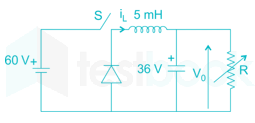
A buck converter feeding a variable resistive load is shown in the figure. The switching frequency of the switch S is 100;kHz100;kHz and the duty ratio is 0.6. The output voltage V0{V_0} is 36V36V. Assume that all the components are ideal, and that the output voltage is ripple-free. The value of RR (in Ohm) that will make the inductor current (iL{i_L}) just continuous is _________.

42

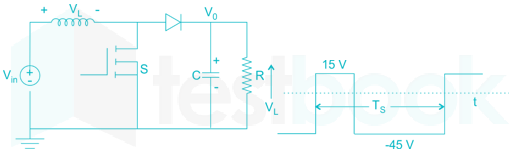
For the switching converter shown in the following figure, assume steady-state operation. Also assume that the component are ideal, the inductor current is always positive and continuous and switching period is TS{T_S}. If the voltage VL{V_L} is as shown, the duty cycle of the switch SS is ________.

43

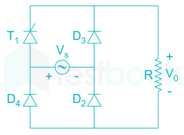
In the given rectifier, the delay angle of the thyristor T1{T_1}­ measured from the positive going zero crossing of Vs;{V_s}; is 3030^\circ. If the input voltage Vs{V_s} is 100;sin(100πt);V100;sin\left( {100\pi t} \right);V, the average voltage across RR (in volt) under steady-state is_______.

44

For the linear time invariant systems that are Bounded Input Bounded stable, which one of the following statement is TRUE?

  1. ((a))

    The impulse response will be integral, but may not be absolutely integrable

  2. ((b))

    The unit impulse response will have finite support

  3. ((c))

    The unit step response will be absolutely integrable

  4. ((d))

    The unit step response will be bounded

Show Answer
Answer: ((d))

The unit step response will be bounded

Concept:

  • BIBO (Bounded Input Bounded output stable system is a type of system in which for given bounded input output is bounded.
  • On applying unit step input to the system then the response which we get is called unit step response.
  • Condition for absolutely integrable.

x(t)dt<\rm\displaystyle\int_{-\infty}^{\infty}|x(t)| dt < \infty

  • Bounded signals are those whose value always remains less than a certain value & finite support implies that the duration of the signal is finite.


Explanation:

  • Since the system is BIBO stable & the unit step function is bounded, the unit step response will also be bounded.

Note:

u(t)dt=1dt=\rm\displaystyle\int_{-\infty}^{\infty}|u(t)| dt = \rm\displaystyle\int_{-\infty}^{\infty}1 dt = \infty

Therefore unit step response is NOT absolutely integrable.

45

The z – transform of a sequence x[n]x\left[ n \right] is given as X(z);=;2z+44/z+3/z2X\left( z \right){\rm{;}} = {\rm{;}}2z + 4-4/z + 3/{z^2}. if y[n] is the first difference of x[n]x\left[ n \right], then Y(z)Y\left( z \right) is given by

  1. ((a))

    2z+28/z+7/z23/z32z + 2 - 8/z + 7/{z^2} - 3/{z^3}

  2. ((b))

    2z+26/z+1z23/z3- 2z + 2 - 6/z + 1{z^2} - 3/{z^3}

  3. ((c))

    2z2+8/z7/z2+3/z3- 2z - 2 + 8/z - 7/{z^2} + 3/{z^3}

  4. ((d))

    4z28/z1/z2+3/z34z - 2 - 8/z - 1/{z^2} + 3/{z^3}

Show Answer
Answer: ((a))

2z+28/z+7/z23/z32z + 2 - 8/z + 7/{z^2} - 3/{z^3}

Concept:

 The first difference of any signal t[n] is t[n] - t[n-1]

Explanation: 

As per the question,

y(n)y\left( n \right) is first difference of x(n)x\left( n \right) 

So, 

      y(n);=;x(n);;x(n1)y\left( n \right){\rm{;}} = {\rm{;}}x\left( n \right){\rm{;}}-{\rm{;}}x\left( {n - 1} \right)

Y(z);=;x(Z)(1z1);=;X(z);;z1;X(z)Y\left( z \right){\rm{;}} = {\rm{;}}x\left( Z \right)\left( {1 - {z^{ - 1}}} \right){\rm{;}} = {\rm{;}}X\left( z \right){\rm{;}}-{\rm{;}}{z^{ - 1}}{\rm{;}}X\left( z \right)

Y(z);=;[2x;+;4;;4z1;+;3z2];;[2;+;4z1;;4z2]; =2x;+;4;;4z1+;3z2;;2;;4z1;;4z2;;3z3 =;2z;+;2;;8z1;+;7z2;;3z3\begin{array}{l} Y\left( z \right){\rm{;}} = {\rm{;}}\left[ {2x{\rm{;}} + {\rm{;}}4{\rm{;}}-{\rm{;}}4{z^{ - 1}}{\rm{;}} + {\rm{;}}3{z^{ - 2}}\left] {{\rm{;}}-{\rm{;}}} \right[2{\rm{;}} + {\rm{;}}4{z^{ - 1}}{\rm{;}} - {\rm{;}}4{z^{ - 2}}} \right]{\rm{;}}\ = 2x{\rm{;}} + {\rm{;}}4{\rm{;}}-{\rm{;}}4{z^{ - 1}} + {\rm{;}}3{z^{ - 2}}{\rm{;}}-{\rm{;}}2{\rm{;}}-{\rm{;}}4{z^{ - 1}}{\rm{;}}-{\rm{;}}4{z^{ - 2}}{\rm{;}}-{\rm{;}}3{z^{ - 3}}\ = {\rm{;}}2z{\rm{;}} + {\rm{;}}2{\rm{;}}-{\rm{;}}8{z^{ - 1}}{\rm{;}} + {\rm{;}}7{z^{ - 2}}{\rm{;}}-{\rm{;}}3{z^{ - 3}} \end{array}

46

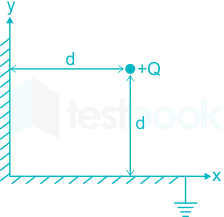
Two semi-infinite conducting sheets are placed at right angles to each other as shown in the figure. A point charge of +Q is placed at a distance of d from both sheets. The net force on the charge is Q24πε0Kd2\frac{{{Q^2}}}{{4\pi {\varepsilon _0}}}\frac{K}{{{d^2}}}, where K is given by

  1. ((a))

    0

  2. ((b))

    14i^14j^ - \frac{1}{4}\hat i - \frac{1}{4}\hat j

  3. ((c))

    18i^18j^ - \frac{1}{8}\hat i - \frac{1}{8}\hat j

  4. ((d))

    12282i^+12282j^\frac{{1 - 2\sqrt 2 }}{{8\sqrt 2 }}\hat i + \frac{{1 - 2\sqrt 2 }}{{8\sqrt 2 }}\hat j

Show Answer
Answer: ((d))

12282i^+12282j^\frac{{1 - 2\sqrt 2 }}{{8\sqrt 2 }}\hat i + \frac{{1 - 2\sqrt 2 }}{{8\sqrt 2 }}\hat j

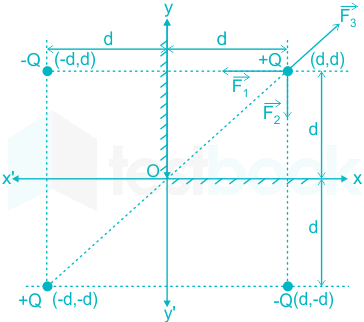
The force F1 acting will be F1=Q×(Q)4πϵ0(2d)2(2da^x2d){F_1} = \frac{{Q \times \left( { - Q} \right)}}{{4\pi \epsilon{_0}{{\left( {2d} \right)}^2}}}\left( {\frac{{2d{{\hat a}_x}}}{{2d}}} \right)

The force F2 acting will be F2=Q×(Q)4πϵ0(2d)2(2da^y2d){F_2} = \frac{{Q \times \left( { - Q} \right)}}{{4\pi \epsilon{_0}{{\left( {2d} \right)}^2}}}\left( {\frac{{2d{{\hat a}_y}}}{{2d}}} \right)

The force F3 acting will be F3=Q×Q4πϵ0(8;d)2(2da^+2dy^8d){F_3} = \frac{{Q \times Q}}{{4\pi \epsilon{_0}{{\left( {\sqrt 8 ;d} \right)}^2}}}\left( {\frac{{2d\hat a + 2d\hat y}}{{\sqrt 8 d}}} \right)

The net force on Q due to the remaining charges will be

F = F1 + F2 + F3

F=Q×(Q)4πϵ0(2d)2(2da^x2d)+Q×(Q)4πϵ0(2d)2(2da^y2d)+Q×Q4πϵ0(8;d)2(2da^+2dy^8d)F = \frac{{Q \times \left( { - Q} \right)}}{{4\pi \epsilon{_0}{{\left( {2d} \right)}^2}}}\left( {\frac{{2d{{\hat a}_x}}}{{2d}}} \right)+\frac{{Q \times \left( { - Q} \right)}}{{4\pi \epsilon{_0}{{\left( {2d} \right)}^2}}}\left( {\frac{{2d{{\hat a}_y}}}{{2d}}} \right)+\frac{{Q \times Q}}{{4\pi \epsilon{_0}{{\left( {\sqrt 8 ;d} \right)}^2}}}\left( {\frac{{2d\hat a + 2d\hat y}}{{\sqrt 8 d}}} \right)

F=14πε0Q2(2d)3[2dax2day+122(2dax+2day)]F= \frac{1}{{4\pi {\varepsilon _0}}}\frac{{{Q^2}}}{{{{\left( {2d} \right)}^3}}}\left[ { - 2d{a_x} - 2d{a_y} + \frac{1}{{2\sqrt 2 }}\left( {2d{a_x} + 2d{a_y}} \right)} \right]

F=14πε0Q2d2;[12282ax+12282ay]F = \frac{1}{{4\pi {\varepsilon _0}}}\frac{{{Q^2}}}{{{d^2}}};\left[ {\frac{{1 - 2\sqrt 2 }}{{8\sqrt 2 }}{a_x} + \frac{{1 - 2\sqrt 2 }}{{8\sqrt 2 }}{a_y}} \right]

By comparing the above equation with Q24πε0Kd2\frac{{{Q^2}}}{{4\pi {\varepsilon _0}}}\frac{K}{{{d^2}}}

K=12282i^+12282j^\Rightarrow K = \frac{{1 - 2\sqrt 2 }}{{8\sqrt 2 }}\hat i + \frac{{1 - 2\sqrt 2 }}{{8\sqrt 2 }}\hat j

47

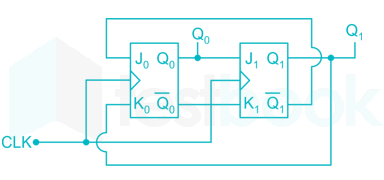
In the following sequential circuit, the initial state (before the first clock pulse) of the circuit is Q1Q0 = 00. The state (Q1Q0) after the 333rd clock pulse is

  1. ((a))

    00

  2. ((b))

    01

  3. ((c))

    10

  4. ((d))

    11

Show Answer
Answer: ((b))

01

Given counter is 

The same clock pulse is given to both the flip-flops, therefore it is synchronous counter.


ClockFlip Flop InputsOutput
J0 = Q̅1K0 = Q1J1 = Q0K1 = Q̅0Q0Q1
0100100
1101010
2011011
3010101
4100100


For every four cycles, the output is repeated 

So, dividing 333 by 4, we get 83.25

So, at 332 (83 × 4 = 332) clock pulse the output will be 0 0 (Q1Q0

At 333rd clock pulse, QQ0 = 0 1

48

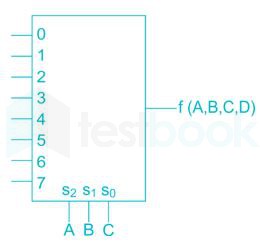
A Boolean function F(A,B,C,D) = π(1, 5,12,15) is to be implemented using an 8×1 multiplexer (A is MSB). The inputs ABC are connected to the select inputs S2S1S0 of the multiplexer respectively.

Which one of the following options gives the correct inputs to pins 0, 1, 2, 3, 4, 5, 6, 7 in order?

  1. ((a))

    D, 0, D, 0, 0, 0, D’, D

  2. ((b))

    D’, 1, D’, 1, 1, 1, D, D’

  3. ((c))

    D, 1, D, 1, 1, 1, D’, D

  4. ((d))

    D’, 0, D’, 0, 0, 0, D, D’

Show Answer
Answer: ((b))

D’, 1, D’, 1, 1, 1, D, D’

Given maxterm

F (A,B,C,D) = π (1,5,12,15)

The minterms of the given max terms will be

f (A,B,C,D) = Σm (0,2,3,4,6,7,8,9,10,11,13,14) 

I0I1I2I3I4I5I6I7
Dˉ(0)\bar D\left( 0 \right)02468101214
D(1)D\left( 1 \right)13579111315
Dˉ\bar D1Dˉ\bar D111DDˉ\bar D


Therefore, the correct inputs to pins 0, 1, 2, 3, 4, 5, 6, 7 in order is D’, 1, D’, 1, 1, 1, D, D’

49

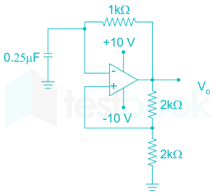
The saturation voltage of the ideal op-amp shown below is ±;10V\pm ;10V. The output voltage V0{V_0} of the following circuit in the steady-state is

  1. ((a))

    Square wave of period 0.55 ms

  2. ((b))

    Triangular wave of period 0.55 ms

  3. ((c))

    Square wave of period 0.25 ms

  4. ((d))

    Triangular wave of period 0.25 ms

Show Answer
Answer: ((a))

Square wave of period 0.55 ms

Concept:

An astable multivibrator is also called a Square wave generator or Free running oscillator.

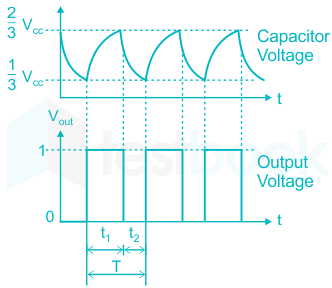
It generates a square wave output.

The output waveform:

It generates a square wave output with time (T ) =  T=2Rclog(1+β)(1β)\ T = 2{R_c}\log \frac{{\left( {1 + \beta } \right)}}{{\left( {1 - \beta } \right)}}

Calculation:

Astable multivibrator produces square wave.

β=R2R1+R2=24=0.5 T=2Rclog(1+β)(1β)=2×1×103×0.25×106×log(1+0.510.5) T=0.55;ms\begin{array}{l} \beta = \frac{{{R_2}}}{{{R_1} + {R_2}}} = \frac{2}{4} = 0.5\ T = 2{R_c}\log \frac{{\left( {1 + \beta } \right)}}{{\left( {1 - \beta } \right)}} = 2 \times 1 \times {10^3} \times 0.25 \times {10^{ - 6}} \times \log \left( {\frac{{1 + 0.5}}{{1 - 0.5}}} \right)\ T = 0.55;ms \end{array}

Square wave of period 0.55 ms.

50

The incremental costs (in rupees/MWh) of operating two generating units are functions of their respective powers P1 and P2 in MW, and are given by

dC1dP1=0.2P1+50 dC2dP2=0.24P2+40\begin{array}{l} \frac{{d{C_1}}}{{d{P_1}}} = 0.2{P_1} + 50\ \frac{{d{C_2}}}{{d{P_2}}} = 0.24{P_2} + 40 \end{array}

Where,

20MWP1150MW 20MWP2150MW\begin{array}{l} 20MW \le {P_1} \le 150MW\ 20MW \le {P_2} \le 150MW \end{array}

For a certain load demand, P1 and P2 have been chosen such that dC1 / dP1 = 76 Rs / MWh and dC2 / dP2 = 68.8 Rs / MWh. If the generations are rescheduled to minimize the total cost, then P2 is________.

51

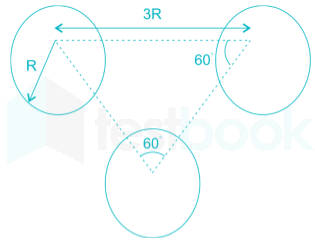
A composite conductor consists of three conductors of radius R each. The conductors are arranged as shown below. The geometric mean radius (GMR) (in cm) of the composite conductor is kR. The value of k is_______.

52

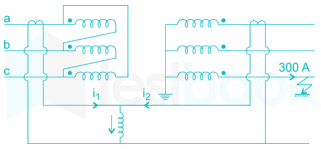
A 3 – Phase transformer rated for 33 kV/ 11kV is connected in delta/star as shown in figure. The current transformers (CTs) on low land high voltage sides have a ratio of 500/5. Find the current i1{i_1} and i2{i_2}, of the fault current is 300 A as shown in figure

  1. ((a))

    i1=13A,i2=0A{i_1} = \frac{1}{{\sqrt 3 A}},{i_2} = 0A

  2. ((b))

    i1=0A{i_1} = 0Ai2=0A{i_2} = 0A

  3. ((c))

    i1=0A,i2=13A{i_1} = 0A,{i_2} = \frac{1}{{\sqrt 3 A}}

  4. ((d))

    i1=13A,i2=13A{i_1} = \frac{1}{{\sqrt 3 A}},{i_2} = \frac{1}{{\sqrt 3 A}}

Show Answer
Answer: ((a))

i1=13A,i2=0A{i_1} = \frac{1}{{\sqrt 3 A}},{i_2} = 0A

i2=0{i_2} = 0

Since entire current flows through fault,    Primary kVA = Secondary kVA

3×33000×IL=3×11000×(300×5500)\sqrt 3 \times 33000 \times {I_L} = \sqrt 3 \times 11000 \times \left( {300 \times \frac{5}{{500}}} \right),     IL=1A{I_L} = 1A

IL=3IPh Iph=i1=13A\begin{array}{l} {I_L} = \sqrt 3 {I_{Ph}}\ {I_{ph}} = {i_1} = \frac{1}{{\sqrt 3 }}A \end{array}

53

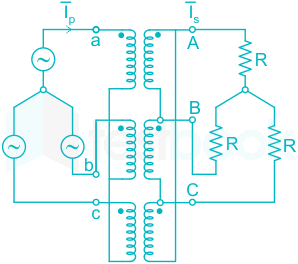
A balanced (positive sequence) three-phase AC voltage source is connected to a balanced, start connected through a star-delta transformer as shown in the figure. The line-to-line voltage rating is 230 V on the star side, and 115 V on the delta side. If the magnetizing current is neglected and Iˉs=1000A,{\bar I_s} = 100\angle 0^\circ A, then what is the value of Iˉp{\bar I_p} in Ampere?

  1. ((a))

    503050\angle 30^\circ

  2. ((b))

    503050\angle - 30^\circ

  3. ((c))

    5033050\sqrt 3 \angle 30^\circ

  4. ((d))

    20030200\angle 30^\circ

Show Answer
Answer: ((a))

503050\angle 30^\circ

Explanation:

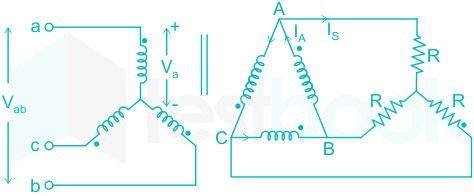
Given figure can be redrawn as,

With primary star (γ) side,

Phase voltage (va) = linevoltage(Vab)3=2303\rm \frac{line voltage (V_{ab})}{\sqrt{3}}=\frac{230}{\sqrt{3}}

At secondary delta (Δ) side,

Phase voltage (VA) = line voltage (VAB) = 115 V

Transformation ratio (k) = VAVa=1152303=0.87\frac{V_A}{V_a}=\frac{115}{\frac{230}{\sqrt{3}}}=0.87

Phase current (IA) on Δ side is,

IA=Is(line)3=1003=57.7I_A=\frac{I_s\rm(line)}{\sqrt{3}}=\frac{100}{\sqrt{3}}=57.7

∴ Is lags IA by 30°

So, IA = 57.7 ∠30°

Now, k=IpIAk=\frac{I_p}{I_A}

⇒ IP = k IA = 0.87 × 57.7∠30°

⇒ = 50.199 ∠30°

Hence, the correct answer is (A).

54

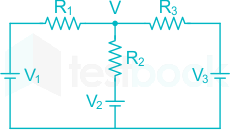
In the given network V1 = 100 ∠0°V, V2 = 100 ∠-120°V, V3 = 100 ∠+120°V. The phasor current i (in Ampere) is

  1. ((a))

    173.2 ∠-60° 

  2. ((b))

    173.2 ∠-120° 

  3. ((c))

    100.0 ∠-60° 

  4. ((d))

    100.0 ∠-120° 

Show Answer
Answer: ((a))

173.2 ∠-60° 

Concept:

Nodal Analysis:

  • Nodal Voltage Analysis uses the “Nodal” equations of Kirchhoff’s first law to find the voltage potentials around the circuit. So by adding together all these nodal voltages the net result will be equal to zero.
  • If there are “n” nodes in the circuit there will be “n-1” independent nodal equations and these alone are sufficient to describe and hence solve the circuit.
  • At each node point write down Kirchhoff’s first law equation(KCL), that is: “the currents entering a node are exactly equal in value to the currents leaving the node” then express each current in terms of the voltage across the branch using Ohm's law.
  • So the nodal analysis is primarily based on the application of KCL and Ohm's law.
  • For “n” nodes, one node will be used as the reference node and all the other voltages will be referenced or measured with respect to this common node.


Let a network and find voltage V using nodal analysis

Applying nodal analysis at node V

VV1R1+VV2R2+VV3R3=0\frac{{V - {V_1}}}{{{R_1}}} + \frac{{V - {V_2}}}{{{R_2}}} + \frac{{V - {V_3}}}{{{R_3}}} = 0

Calculation:

The given circuit diagram 

Given, 

V1 = 100 ∠0°V, V2 = 100 ∠-120°V, V3 = 100 ∠+120°V

Apply nodal analysis at the node where the current i is entering

i=(V1V3)j+(V2V3)j⇒ - i = \frac{{\left( {{V_1} - {V_3}} \right)}}{{ - j}} + \frac{{\left( {{V_2} - {V_3}} \right)}}{j}

Substitute the value of V1, V2, and V3 in the above equation

i=1000100120190+100120100120190⇒ - i = \frac{{100\angle 0^\circ - 100\angle 120^\circ }}{{1\angle - 90^\circ }} + \frac{{100\angle - 120^\circ - 100\angle 120^\circ }}{{1\angle 90^\circ }}

i=10060190+1000190⇒ - i = \frac{{100\angle 60^\circ}}{{1\angle - 90^\circ }} + \frac{{-100\angle 0^\circ }}{{1\angle 90^\circ }}

⇒ i = 173.2 ∠-60°

55

A symmetrical square wave of 50% duty cycle has an amplitude of ±15V and a time period of 0.4π;ms0.4\pi ;ms. This square wave is applied across a series RLC circuit with R=5;Ω,;L=10;mHR = 5;\Omega ,;L = 10;mH and C=4μFC = 4\mu F. The amplitude of the 5000 rad/s component of the capacitor voltage (in Volt) is _________.

56

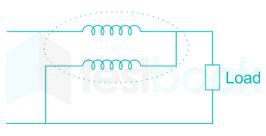
Two identical coils each having inductance LL are placed together on the same core. If an overall inductance of αL\alpha L is obtained by interconnecting these two coils, the minimum value of α\alpha is ________.

57

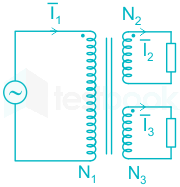
A three-winding transformer is connected to an AC voltage source as shown in the figure. The number of turns are as follows: N1=100,;N2=50,;N3=50{N_1} = 100,;{N_2} = 50,;{N_3} = 50. If the magnetizing current is neglected, and the currents in two windings are Iˉ2=230A;and;Iˉ3=2150A{\bar I_2} = 2\angle 30^\circ A;and;{\bar I_3} = 2\angle 150^\circ A, then what is the value of the current Iˉ1{\bar I_1} in Ampere?

  1. ((a))

    1901\angle 90^\circ

  2. ((b))

    12701\angle 270^\circ

  3. ((c))

    4904\angle 90^\circ

  4. ((d))

    42704\angle 270^\circ

Show Answer
Answer: ((a))

1901\angle 90^\circ

Concept

The MMF balance equation for three winding transformer 

N1 I1 = N2 I2 + N3 I3

Explanation:

The MMF balance equation is,

I1N1=I2N2+I3N3 I1.100=230×50+2150×50 I1=130+1150=190\begin{array}{l} {I_1}{N_1} = {I_2}{N_2} + {I_3}{N_3}\ {I_1}.100 = 2\angle 30 \times 50 + 2\angle 150 \times 50\ {I_1} = 1\angle 30 + 1\angle 150 = 1\angle 90^\circ \end{array}

58

With an armature voltage of 100 V and rated field winding voltage, the speed of a separately excited DC motor driving a fan is 1000 rpm, and its armature current is 10 A. The armature resistance is 1 Ω. The load torque of the fan load is proportional to the square of the rotor. Neglecting rotational losses, the value of the armature voltage (in Volt) which will reduce the rotor speed to 500 rpm is

59

A three-phase, 11 kV, 50 Hz, 2 pole, star connected, cylindrical rotor synchronous motor is connected to an 11 kV, 50 Hz source. Its synchronous reactance is 50 Ω per phase, and its stator resistance is negligible. The motor has a constant field excitation. At a particular load torque, its stator current is 100 A at the unity power factor. If the load torque is increased so that the stator current is 120 A, then the load angle (in degrees) at this load is ________.

60

A 220 V, 3 – phase, 4 – pole, 50 Hz inductor motor of wound rotor type is supplied at rated voltage and frequency. The stator resistance, magnetizing reactance, and core loss are negligible. The maximum torque produced by the rotor is 225% of full load torque and it occurs at 15% slip. The actual rotor resistance is 0.03 Ω/phase. The value of external resistance (in Ohm) which must be inserted in a rotor phase if the maximum torque is to occur at start is__________

61

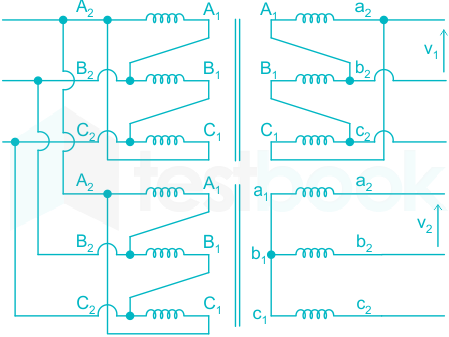
Two three-phase transformers are realized using single-phase transformers as shown in the figure.

The phase different (in degree) between voltage V1;and;V2{V_1};and;{V_2} is _____________.

62

The following discrete-time equations result from the numerical integration of the differential equations of an un-damped simple harmonic oscillator with state variables x and y. the integration time step is h.

xk+1xkh=yk yk+1ykh=xk\begin{array}{l} \frac{{{x_{k + 1}} - {x_k}}}{h} = {y_k}\ \frac{{{y_{k + 1}} - {y_k}}}{h} = - {x_k} \end{array}

For this discrete-time system, which one of the following statements is TRUE?

  1. ((a))

    The system is not stable for h>0h > 0

  2. ((b))

    The system is stable for h>1πh > \frac{1}{\pi }

  3. ((c))

    The system is not stable for 0<h>12π0< h > \frac{1}{{2\pi }}

  4. ((d))

    The system is not stable for 12π<h>1π\frac{1}{{2\pi }}< h > \frac{1}{\pi }

Show Answer
Answer: ((a))

The system is not stable for h>0h > 0

Here integration time step is h, so

xk+1=xk+h yk+1=ykhxk\begin{array}{l} {x_{k + 1}} = {x_k} + h\ {y_{k + 1}} = {y_k} - h{x_k} \end{array}

Again, we may write

yk=xk+1xkh yk+1=xk+1xkhhxk =h+xkxkhhxk =;hxk+1\begin{array}{l} {y_k} = \frac{{{x_{k + 1}} - {x_k}}}{h}\ \Rightarrow {y_{k + 1}} = \frac{{{x_{k + 1}} - {x_k}}}{h} - h{x_k}\ = \frac{{h + {x_k} - {x_k}}}{h} - h{x_k}\ = ; - h{x_{k + 1}} \end{array}

Now, we form the Routh array for the above equation

\(\begin{array}{{20}{c}} {{s^1}}\ {{s^0}} \end{array}\left| {\begin{array}{{20}{c}} { - h}&0\ 1&0 \end{array}} \right.\)

Hence, according to Routh – Hurwitz criterion system is stable for

;h>0 h<0\begin{array}{l} - ;h > 0\ \Rightarrow h < 0 \end{array}

Thus, system is not stable for h>0h > 0

63

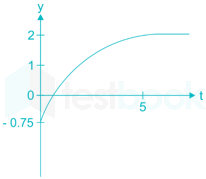
The unit step response of a system with the transfer function G(s)=12s1+sG\left( s \right) = \frac{{1 - 2s}}{{1 + s}} is given by which one of the following waveforms?

  1. ((a))

  2. ((b))

  3. ((c))

  4. ((d))

Show Answer
Answer: ((a))

Concept:

Transfer function:

The transfer function is defined as the ratio of the Laplace transform of the output variable to the input variable with all initial conditions zero.

TF = L[output]L[input]\left. {\frac{{L\left[ {output} \right]}}{{L\left[ {input} \right]}}} \right| Initial conditions = 0

TF = C(s) / R(s)

Calculation:

Given transfer function 

G(s)=12s1+sG\left( s \right) = \frac{{1 - 2s}}{{1 + s}}

Input of the system r(t) = u(t)

Apply laplace transform

R(s) = 1/s

Response of the system of unit step is

C(s) = R(s) × G(s)

⇒ Y(s)=(12s)(1+s).1sY\left( s \right) = \frac{{\left( {1 - 2s} \right)}}{{\left( {1 + s} \right)}}.\frac{1}{s}

⇒ Y(s)=A(s)+B(s+1)Y\left( s \right) = \frac{A}{{\left( s \right)}} + \frac{B}{{\left( {s + 1} \right)}}

A = 1, B = -3

Apply inverse Laplace transform 

⇒ y(t) = u(t) - 3 e-t u(t)

⇒ y(t) = (1 - 3e-t) u(t)

By plotting the above we get as follows

64

An open loop transfer function G(s) of a system is

G(s)=Ks(s+1)(s+2)G\left( s \right) = \frac{K}{{s\left( {s + 1} \right)\left( {s + 2} \right)}}

for a unity feedback system, the breakaway point of the root loci on the real axis occurs at.

  1. ((a))

    –0.42

  2. ((b))

    –1.58

  3. ((c))

    –0.42 and 1.58

  4. ((d))

    None of the above

Show Answer
Answer: ((a))

–0.42

Concept:

Break-in/away points: These exist when there are multiple roots on the root locus diagram.

At the breakpoints gain K is either maximum and/or minimum.

So, the roots of dKds\frac{{dK}}{{ds}} are the breakpoints.

Calculation:

Given open-loop system,

G(s)=Ks(s+1)(s+2)G\left( s \right) = \frac{K}{{s\left( {s + 1} \right)\left( {s + 2} \right)}}

⇒ 1 + G(s) = 0

⇒ 1+Ks(s+1)(s+2)=01+\frac{K}{{s\left( {s + 1} \right)\left( {s + 2} \right)}}=0

⇒ k = - (s3 + 3s2 + 2s)

For finding breakaway point make dKds=0\frac{{dK}}{{ds}} = 0

dKds=3s2+6s+2=0\frac{{dK}}{{ds}} = 3s^2+6s+2=0

The values of s are - 0.42, - 1.577

When we substitute both the values in transfer function only - 0.42 satisfies 

Therefore, the breakaway point of the root loci on the real axis occurs at -0.42

65

For the system governed by the set of equations:

dx1dt=2x1+x2+u dx2dt=2x1+u y=3x1\begin{array}{l} \frac{{d{x_1}}}{{dt}} = 2{x_1} + {x_2} + u\ \frac{{d{x_2}}}{{dt}} = -2{x_1} + u\ y = 3{x_1} \end{array}

the transfer function Y(s)/U(s)Y\left( s \right)/U\left( s \right) is given by

  1. ((a))

    3(s+1)s22s+2\frac{{3\left( {s + 1} \right)}}{{{s^2}-2s + 2}}

  2. ((b))

    s+1s22s+1\frac{{s + 1}}{{{s^2}-2s + 1}}

  3. ((c))

    3(2s+1)s2;2s+1\frac{{3\left( {2s + 1} \right)}}{{{s^2};-2s + 1}}

  4. ((d))

    3(2s+1)s2;2s+2\frac{{3\left( {2s + 1} \right)}}{{{s^2};-2s + 2}}

Show Answer
Answer: ((a))

3(s+1)s22s+2\frac{{3\left( {s + 1} \right)}}{{{s^2}-2s + 2}}

dx1dt=2x1+x2+1,;;;dx2dt=2x1+1\frac{{d{x_1}}}{{dt}} = 2{x_1} + {x_2} + 1,;;;\frac{{d{x_2}}}{{dt}} = - 2{x_1} + 1

y;=;3x1y; = ;3{x_1}

Considering the standard equation

\(\begin{array}{l} {x_i}; = ;Ax; + ;BU,;;y; = ;Cx; + ;DU\ \left[ {\begin{array}{{20}{c}} {{{\dot x}_1}}\ {{{\dot x}_2}} \end{array}} \right] = \left[ {\begin{array}{{20}{r}} 2&1\ { - 2}&0 \end{array}} \right]\left[ {\begin{array}{{20}{c}} {{x_1}}\ {{x_2}} \end{array}} \right] + \left[ {\begin{array}{{20}{c}} 1\ 1 \end{array}} \right]\left[ 1 \right]\ y = \left[ {\begin{array}{{20}{c}} 3&0 \end{array}} \right]\left[ {\begin{array}{{20}{c}} {{x_1}}\ {{x_2}} \end{array}} \right] \end{array}\)

Transform function C(SI;;A)1;BC{\left( {SI;-;A} \right)^{ - 1}};B

\(G\left( s \right) = \left[ {\begin{array}{{20}{c}} 3&0 \end{array}} \right]{\left[ {\left[ {\begin{array}{{20}{c}} s&0\ 0&s \end{array}} \right] - \left[ {\begin{array}{{20}{c}} 2&1\ { - 2}&0 \end{array}} \right]} \right]^{ - 1}}\left[ {\begin{array}{{20}{c}} 1\ 1 \end{array}} \right]\)

\(\Rightarrow \left[ {\begin{array}{{20}{c}} 3&0 \end{array}} \right]{\left[ {\begin{array}{{20}{c}} {s - 2}&{ - 1}\ 2&s \end{array}} \right]^{ - 1}}\)

\( \Rightarrow \frac{1}{{{s^2} - s + 2}}\left[ {\begin{array}{{20}{c}} 3&0 \end{array}} \right]\left[ {\begin{array}{{20}{c}} {s + 1}\ {s - 4} \end{array}} \right]\)

3(s+1)s22s+2\Rightarrow \frac{{3\left( {s + 1} \right)}}{{{s^2}-2s + 2}}

Attempt this paper under real exam conditions

Timed interface, section switching, instant scoring, and question-by-question analytics — free.

Start Timed Attempt