The strategies that the company ________ to sell its products________ house-to-house marketing.
((a))
use, includes
((b))
uses, include
((c))
used, includes
((d))
uses, including
Show Answer
Answer: ((b))
uses, include
In the given statement, the first blank requires a verb whose subject is 'company' which is singular, hence according to the subject verb agreement, 'uses' fits correctly.
The second blank requires a verb whose subject is 'strategies' which is plural, hence according to the subject verb agreement, 'include' fits correctly.
Therefore, option 2 is the correct answer. The complete sentence is: The strategies that the company uses to sell its products include house-to-house marketing.
2
The boat arrived ________ dawn.
((a))
in
((b))
at
((c))
on
((d))
under
Show Answer
Answer: ((b))
at
Let us look at the prepositions that are used to denote time:
“In” usually refers to a period of time. For eg, They managed to complete the job in two weeks.
“At” is used in reference to specific times on the clock or points of time in the day. For eg, The train arrives at 3:30.
“On” is used with dates and named days of the week. For eg, We’re going to the theatre on Wednesday evening.
"Under" is used to talk about measurements of time. For eg, We finished the project in under a year and a half.
“By” is used specifically with an endpoint of time and it means no later than. For eg, Please return these books by Friday.
Hence the correct answer is option 2. The complete sentence is: The boat arrived at dawn.
3
It would take one machine 4 hours to complete a production order and another machine 2 hour to complete the same order. If both machines work simultaneously at their respective constant rates, the time taken to complete the same order is ________ hours.
((a))
2/3
((b))
3/4
((c))
4/3
((d))
7/3
Show Answer
Answer: ((c))
4/3
Let 1st machine does ‘x’ work in 4 hrs.
In 1 hr, the same machine 1 will do: 4x work
Let 2nd machine does x work in 2 hrs
In 1 hr, machine 1 will do: 2x work
In 1 hr, together both will do:
(4x+2x) of the work
Let after ‘t’, the work is completed. We can then write:
(4x+2x)t=x
(43x)t=x
x=34hours
4
Five different books (P, Q, R, S, T) are to be arranged on a shelf. The books R and S are to be arranged first second, respectively from the right side of the shelf. The number of different orders in which P, Q and T may be arranged is ________.
((a))
2
((b))
6
((c))
12
((d))
120
Show Answer
Answer: ((b))
6
According to the question, the arrangement will be as shown:
Now P, Q, T has to come in one of these 3 places
Starting with P, it can come in 3 places.
After placing P, Q can come in 2 places.
After placing P and Q, T can come in 1 place.
Total ways = 3 × 2 × 1 = 6 ways
5
When he did not come home, she ________ him lying dead on the roadside somewhere.
((a))
concluded
((b))
looked
((c))
notice
((d))
pictured
Show Answer
Answer: ((d))
pictured
Let us look at the meaning the various options will have if added in the given sentence.
concluded: arrive at a judgment or opinion by reasoning. This verb would be grammatically and incorrect in the sentence.
looked: regard in a specified way. The preposition 'at' is required with this verb which is not present in the given sentence and the option. Also, this verb would be incorrect in the sentence as 'she' could not have 'looked at him' 'when he did not come home'.
notice: the fact of observing or paying attention to something. This verb would be grammatically incorrect in the sentence as 'she' could not have 'noticed him' 'when he did not come home'.
pictured: forms a mental image of something.
From the meaning, it becomes clear that option 4, 'pictured' will make the meaningful. The complete sentence is: When he did not come home, she pictured him lying dead on the roadside somewhere.
6
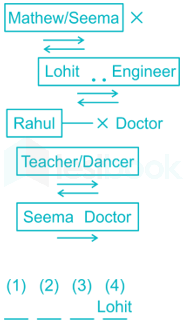
Four people are standing in a line facing you. They are Rahul, Mathew, Seema, and Lohit. One is an engineer, one is a doctor, one a teacher, and another a dancer. You are told that:
Mathew is not standing next to Seema
There are two people standing between Lohit and the engineer
Rahul is not a doctor
The teacher and the dancer are standing next to each other
Seema is turning to her right to speak to the doctor standing next to her
Who among them is an engineer?
((a))
Seema
((b))
Lohit
((c))
Rahul
((d))
Mathew
Show Answer
Answer: ((d))
Mathew
Make packets of the given information
Seema turns right means she is in either of middle to
Seema cannot be at 3, since then Mathew will come at her either left or right
→ Seema = 3rd
→ Mathew = 1st
7
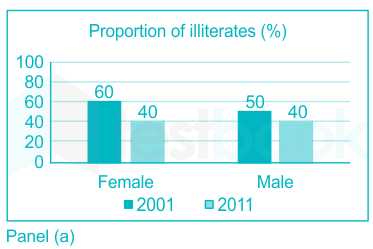
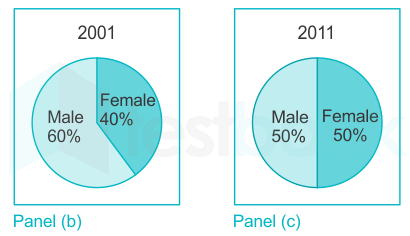
The bar graph in Panel (a) shows the proportion of male and female illiterates in 2001 and 2011. The proportions of males and females in 2001 and 2011 are given in Panel (b) and (c), respectively. The total population did not change during this period.
The percentage increase in the total number of literates from 2001 to 2011 is ________.
((a))
35.43
((b))
34.43
((c))
30.43
((d))
33.43
Show Answer
Answer: ((c))
30.43
Let total population be x
Calculating For 2021,
Number of Males = (60x)/100 = 0.6x
Number of illiterate males = 0.6x × (50/100) = 0.3x
Number of females = 0.4x
Number of illiterate females = 0.4x × (60/100) = 0.24x
Total illiterates = 0.3x + 0.24x = 0.54x
Total Literates = x - Total illiterates
Total Literates = x - 0.54x = 0.46x
Similarly for 2011,
Number of Males = (50x)/100 = 0.5x
Number of illiterate males = 0.5x × (40/100) = 0.2x
Number of females = 0.5x
Number of illiterate females = 0.5x × (40/100) = 0.2x
Total illiterates = 0.2x + 0.2x = 0.4x
Total Literates = x - Total illiterates
Total Literates = x - 0.4x = 0.6x
∴ The Percentage increase in literates from 2001 to 2011 =0.46x(0.6x–0.46x)×100
The Percentage increase in literates from 2001 to 2011 = 30.43%
Alternate Method
Number of Literates in 2011 = (0.5 × 0.6 × x) + (0.5 × 0.6 × x) = 0.6x
Number of Literates in 2001 = (0.6 × 0.5 × x) + (0.4 × 0.4 × x) = 0.46x
∴ Increase in literates from 2001 to 2011 =0.46x(0.6x–0.46x)×100 = 30.43%
8
“Indian history was written by British historians – extremely well documented and researched, but not always impartial. History had to serve its purpose: Everything was made subservient to the glory of the Union Jack. Latter-day Indian scholars presented a contrary picture.”
From the text above, we can infer that:
Indian history written by British historians_______
((a))
was well documented and not researched but was always biased.
((b))
was not well documented and researched and was always biased.
((c))
was well documented and researched but was sometimes biased.
((d))
was not well documented and researched and was sometimes biased.
Show Answer
Answer: ((c))
was well documented and researched but was sometimes biased.
The given excerpt mentions that Indian history which was written by British historians was 'extremely well documented and researched, but not always impartial'. The word 'impartial' means 'treating all rivals or disputants equally; unbiased'. This meaning is accurately expressed in option 3, 'was well documented and researched but was sometimes biased'.
Option 1 is incorrect as it says that the Indian history which was written by British historians was 'always biased'.
Option 2 is incorrect as it says that the Indian history which was written by British historians was 'not well documented and researched and was always biased'.
Option 4 is incorrect as it says that the Indian history which was written by British historians was 'not well documented and researched and was sometimes biased'.
Hence option 3 is the correct answer. The complete sentence is: Indian history written by British historians was well documented and researched but was sometimes biased.
9
Two design consultants, P and Q, started working from 8 AM for a client. The client budgeted a total of USD 3000 for the consultants. P stopped working when the hour hand moved by 210 degrees on the clock. Q stopped working when the hour hand moved by 240 degrees. P took two tea breaks of 15 minutes each during her shift, but took no lunch break. Q took only one lunch break for 20 minutes, but no tea breaks. The market rate for consultants is USD 200 per hour and breaks are not paid. After paying the consultants, the client shall have USD_remaining in the budget.
((a))
000.00
((b))
166.67
((c))
300.00
((d))
433.33
Show Answer
Answer: ((b))
166.67
210° = 7 hrs
Total hours worked by P: 7 hrs
Total break time:
=6015×2=21hrs
Net-work time =7−21
=6.5;hrs=213hrs
For Q
240° = 8 hrs
Works hours for Q = 8 hrs
Break;time=6020hr=31hr
Net work time =8−31=323hr
Total work of P and Q combined will be:
(213+323)
=685hours
Payment for 1 hr = 200
For 685hr=685×200
= 2833.33
Money left = (3000 – 2833.33) $
= 166.67 $
10
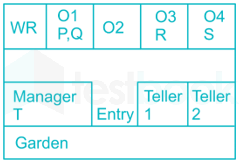
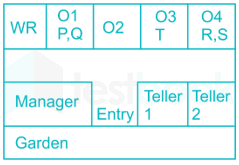
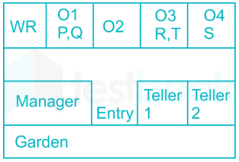
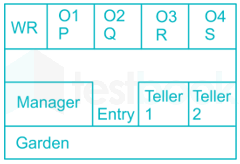
Five people P, Q, R, S and T work in a bank. P and Q don’t like each other but have to share an office till T gets a promotion and moves to the big office next to the garden. R, who is currently sharing an office with T wants to move to the adjacent office with S, the handsome new intern. Given the floor plan, what is the current location of Q, R and T? (O = Office, WR = Washroom)
((a))
((b))
((c))
((d))
Show Answer
Answer: ((c))
At present
P, Q sit together
R, T sit together
Only option ‘c’ satisfies the given conditions.
Electronics and Communication Engineering (55 questions)
11
Which one of the following functions is analytic over the entire complex plane?
((a))
In z
((b))
e1/z
((c))
1−z1
((d))
cos(z)
Show Answer
Answer: ((d))
cos(z)
(i) ln z
At, z = 0
The function is not analytic
(ii) e1/z
Using the expansion formula for ex
ex=1+x+2!x2+3!x3+…
e1/z=1+(z1)+2!1(z21)+3!1(z31)+…
At, z = 0, e1/z is not analytic
(iii) 1−z1
At, z = 1, the function is not analytic
(iv) cos z
expansion of cos z is:
cosz=1−2!z2+4!z4−6!z6;+…
The function cos z is analytic over the entire z.
12
The families of curves represented by the solution of the equation
dxdy=−(yx)n
for n = −1 and n = +1, respectively, are
((a))
Parabolas and Circles
((b))
Circles and Hyperbolas
((c))
Hyperbolas and Circles
((d))
Hyperbolas and Parabolas
Show Answer
Answer: ((c))
Hyperbolas and Circles
dxdy=−(yx)n
At, n = -1
dxdy=−(yx)−1
dxdy=(x−y)
dxdy=(x−y)
ydy=−xdx
Integrating
∫ydy=−∫xdx
⇒ ln y = -ln x + ln c
Ln (xy) = ln c
xy = c
at, n = +1
dxdy=−(yx)
Ydy = -xdx
Integrating
2y2=2−x2+c
x2 + y2 = c
13
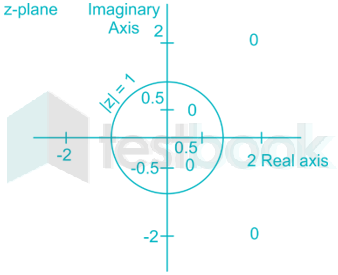
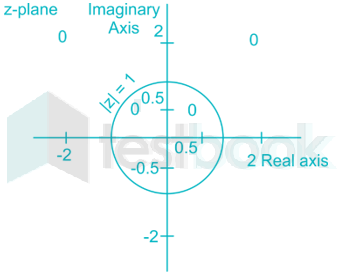
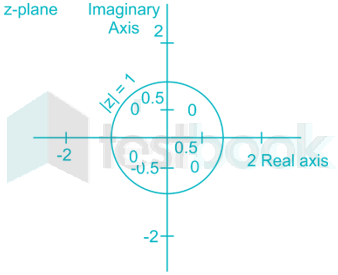
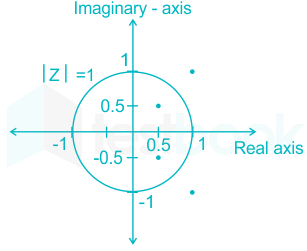
Let H(z) be the z-transform of a real-valued discrete-time signal h[n]. If P(z)=H(z)H(z1) has a zero at z=21+21j, and P(z) has a total of four zeros, which one of the following plots represents all the zeros correctly?
((a))
((b))
((c))
((d))
Show Answer
Answer: ((d))
Given:
P(z)=H(z)H(z1)
P(z1)=H(z1)H(z)
Thus, P(z) = P(z-1)
In such a condition, if z = z0 is a zero then:
\(z_0^,z = \frac{1}{{{z_0}}}\) and \(z = \frac{1}{{z_0^}}\) are also zeroes.
Given, z0=21+j is zero
z=z0∗=21−j is also zero
z=z01=(1+j)(1−j)2(1−j)=22−2j=1−j is also a zero
z=z0∗1=(1−j)(1+j)2=22(1+j)=1+j is also a zero
The corresponding pole-zero plot will be:
14
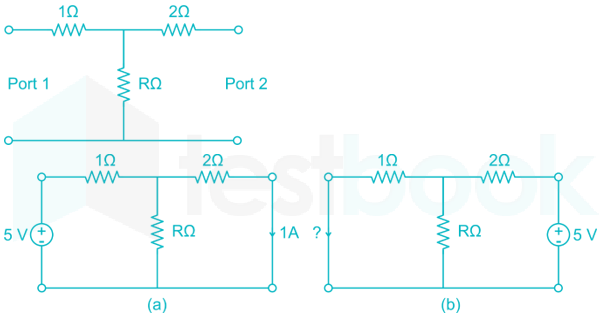
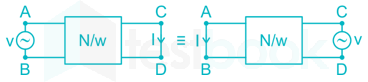
Consider the two-port resistive network shown in the figure. When an excitation of 5 V is applied across Port 1, and Port 2 is shorted, the current through the short circuit at Port 2 is measured to be 1 A (see (a) in the figure).
Now, if an excitation of 5 V is applied across Port 2, and Port 1 is shorted (see (b) in the figure), what is the current through the short circuit at Port 1?
((a))
0.5 A
((b))
1 A
((c))
2 A
((d))
2.5 A
Show Answer
Answer: ((b))
1 A
Reciprocity Theorem:
In any passive linear bilateral network, if a single voltage source ‘V’ in the branch AB produces the current response ‘I’ in the branch CD, then the removal of voltage source from the branch AB and its insertion in the branch CD will produce same current ‘I’ in the branch AB.
In the reciprocity theorem, if the position of excitation and responses are interchanged, then their ratio remains the same.
I1V1=I2V2
[Applicable for linear bilateral network]
Application:
⇒I1V1=I2V2
⇒15=I25
I2 = 1 A
15
Let Y(s) be the unit-step response of a causal system having a transfer function
G(s)=(s+1)(s+3)3−s
that is, Y(s)=sG(s). The forced response of the system is
((a))
u(t) – 2e -t + e-3t u(t)
((b))
2 u(t) – 2e -t + e-3t u(t)
((c))
2u(t)
((d))
u(t)
Show Answer
Answer: ((d))
u(t)
Concept:
The output response of a system is equal to the sum of natural response and forced response.
Forced response: The response generated due to the pole of the input function is called the forced response.
Natural response: The response generated due to the pole of system function is called the natural response.
Calculation:
The output y(s) is given as
y(s)=sG(s)=s(s+1)(s+3)3−s
Converting into partial fractions
y(s)=s(s+1)(s+3)3−s=sA+(s+1)B+(s+3)C
Multiply whole equation LHS and RHS by s and put s = 0
A = 1
Multiply whole equation by (s + 1) and put s = -1
B = -2
Multiply whose equation by (s + 3) and put s = -3
C = 1
y(s)=s1−s+12+s+31
Taking the ILT, we get:
\(y\left( t \right) = \mathop {\underbrace {u(t)}_ \downarrow }\limits_{\begin{array}{{20}{c}} {Forced;response}\ \end{array}} - \mathop {\underbrace {2{e^{ - t}}u\left( t \right) + {e^{ - 3t}}u\left( t \right)}_ \downarrow }\limits_{\begin{array}{{20}{c}} {Transient;response}\ \end{array}}\)
16
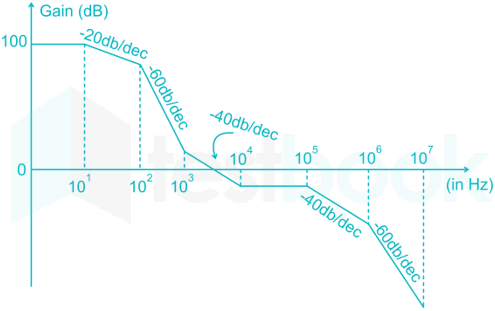
For an LTI system, the Bode plot for its gain is as illustrated in the figure shown. The number of system poles Np and the number of system zeros Nz in the frequency range 1 Hz ≤ f ≤ 107 Hz is
((a))
Np = 5, Nz = 2
((b))
Np = 6, Nz = 3
((c))
Np = 7, Nz = 4
((d))
Np = 4, Nz = 2
Show Answer
Answer: ((b))
Np = 6, Nz = 3
Concept:
The slope of the bode plot decreases by 20 dB/decade at the pole
The slope of the bode plot increases by 20 dB/decade at zero
Application:
Frequency(Hz)
Change ofslope
No-of poles/zeroes
10
-20 dB/dec
1 pole
100
-40 dB/dec
2 pole
1000
+20 dB/decade
1 zero
10,000
+40 dB/decade
2 zero
105
-40 dB/dec
2 pole
106
-20 dB/dec
1 pole
Total poles: 6 = NP
Total zeros: 3 = NZ
17
A linear Hamming code is used to map 4-bit messages to 7-bit code words. The encoder mapping is linear. If the message 0001 is mapped to the code word 0000111, and the message 0011 is mapped to the code word 1100110, then the message 0010 is mapped to
((a))
0010011
((b))
1100001
((c))
1111000
((d))
1111111
Show Answer
Answer: ((b))
1100001
A linear code is an error correcting code.
Any linear combination of codewords is also a code word.
A Hamming code (7, 4) = (n, k) can correct any single bit error. 4-bit data is encoded with 7-bit code-word
Hamming distance is the distance between the code-words.
The minimum distance tells us how many errors can be corrected.
Message
Codeword
0001 0011 0010
0000111 1100110 ?
0010 = (0001) ⊕ → EXOR (0011)
To get the code word, Exor the two code words.
(0000111) ⊕ (1100110)
= 1100001
18
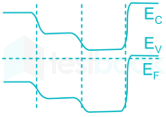
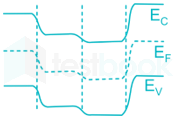
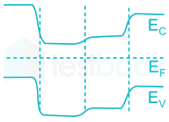
Which one of the following options describes correctly the equilibrium band diagram at T = 300 K of a Silicon p n n +p++ configuration shown in the figure?
((a))
((b))
((c))
((d))
Show Answer
Answer: ((a))
Concept:
Fermi level is straight/aligned at equilibrium
Fermi level is closer valence band for p-type semiconductor and moves into valence band for high doping
Fermi level is closer to conduction band for n-type material and moves into the conduction band for high doping.
Applications:
Since fermi level is not aligned in option (2) and (3). They are eliminated
For p++ region fermi-level will lie inside the valance band. Hence option (4) is eliminated.
Correction option is (1) which satisfies all properties.
19
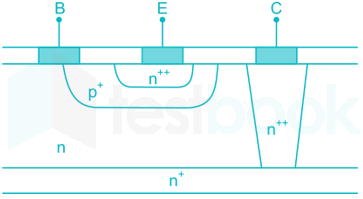
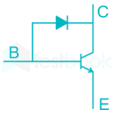
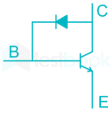
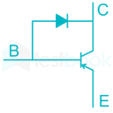
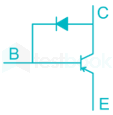
The correct circuit representation of the structure shown in the figure is
((a))
((b))
((c))
((d))
Show Answer
Answer: ((a))
Points to note to solve this question.
Emitter and collector are n-type so the transistor will be n-p-n
∴ Options (3) and (4) are eliminated
The diode is connected between base and collector
Base is n-type
Collector is n++ type
Hence collector will be of n-type and base will be p-type.
20
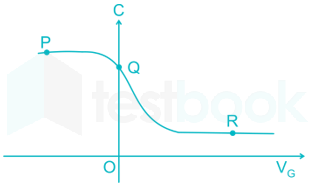
The figure shows the high-frequency C-V curve of a MOS capacitor (at T = 300 K) with ϕms = 0 V and no oxide charges. The flat-band, inversion, and accumulation conditions are represented, respectively, by the points
((a))
P, Q, R
((b))
Q, R, P
((c))
R, P, Q
((d))
Q, P, R
Show Answer
Answer: ((b))
Q, R, P
Flat band voltage is the voltage where there is a no-charge present in the oxide or oxide semiconductor interface.
As the gate voltage Va increase, more electrons are attracted to the oxide-semiconductor interface. A-n type channel is formed.
The inversion takes place at R
For negative gate voltage, more holes are accumulated near the gate.
Accumulations take place at P.
21
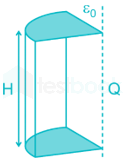
What is the electric flux ∫E.da^ through a quarter-cylinder of height H (as shown in the figure) due to an infinitely long line charge along the axis of the cylinder with a charge density of Q?
((a))
ϵ0HQ
((b))
4ϵ0HQ
((c))
4QHϵ0
((d))
Qϵ04H
Show Answer
Answer: ((b))
4ϵ0HQ
Concept:
Gauss law states that:
∮D.ds=Charge;Enclosed
Analysis:
Charge enclosed = line charge density × height of cylinder
= Q × H = QH
D=ϵE
∮E.ds=ϵ1[QH]
This is the electric flux through the full cylinder.
For quarter-cylinder, flux is obtained by dividing full flux by 4
=4ϵ1[QH]
22
In the table shown, List I and List II, respectively, contain terms appearing on the left-hand side and the right-hand side of Maxwell’s equations (in their standard form). Match the left-hand side with the corresponding right-hand side.
A standard CMOS inverter is designed with equal rise and fall times (βn = βp). If the width of the P MOS transistor in the inverter is increased, what would be the effect on the LOW noise margin (NML) and the HIGH noise margin (NMH) ?
((a))
NML increases and NMH decreases
((b))
NML decreases and NMH increases
((c))
Both NML and NMH increase
((d))
No change in the noise margins
Show Answer
Answer: ((a))
NML increases and NMH decreases
Concept:
The behavior of the CMOS inverter for static conditions of operation is described by the voltage transfer characteristics (VTC) and for dynamic operation, the condition is described by the time response during switching conditions.
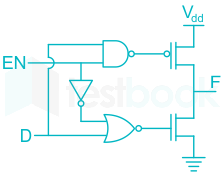
In the circuit shown, what are the values of F for EN = 0 and EN = 1, respectively?
((a))
0 and D
((b))
Hi-Z and D
((c))
0 and 1
((d))
Hi-Z and Dˉ
Show Answer
Answer: ((b))
Hi-Z and D
(1) Concept
NAND gate truth table
A
B
Y
0 0 1 1
0 1 0 1
1 1 1 0
When one of the input is zero then the output = 1
When one of the input = 1, output is the complement of other
(2) NOR-GATE
A
B
Y
0 0 1 1
0 1 0 1
1 0 0 0
When one of the input = 1, output = 0
When one of the input = 0, output is the complement of other input.
(3) NMOS is ON when VG is high and PMOS is ON when VG is low.
Application:
Case I:
When EN = 0
Output of NAND = 1
PMOS = OFF
Output of NOR = 0
NMOS = OFF
Output = Hi – z
Case 2:
When EN = 1
Output of NAND = D̅
If D = 1 D̅ = 0
If D = 0 D̅ = 1 → PMOS OFF
Output of NOR = D̅
So for EN = 1
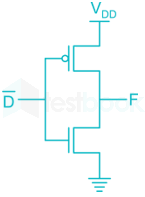
Circuit is
The output F = (D̅)' = D
(Basic inverter operation)
25
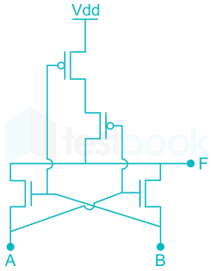
In the circuit shown, A and B are the inputs and F is the output. What is the functionality of the circuit?
((a))
Latch
((b))
XNOR
((c))
SRAM Cell
((d))
XOR
Show Answer
Answer: ((b))
XNOR
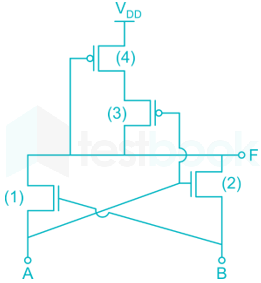
Case A:
A = 0, B = 0
NMOS 1 → OFF
NMOS 2 → OFF
PMOS 3 → ON
PMOS 4 → ON
Output = 1
Case B and Case C
A = 0, B = 1 or
A = 1, B = 0
In both cases either of NMOS is ON and one of the PMOS is OFF.
Case D:
A = 1, B = 1
Both NMOS are ON
NMOS will pass logic high from input A and B
F = 1
Truth table
A
B
Y
0
0
1
0
1
0
1
0
0
1
1
1
This is an EXNOR logic.
26
The value of the contour integral 2;πj1∮(z+z1)2dz evaluated over the unit circle |z| = 1 is _______.
27
The number of distinct eigenvalues of the matrix \(A = \left[ {\begin{array}{{20}{c}} 2&2&3&3\ 0&1&1&1\ {\begin{array}{{20}{c}} 0\ 0 \end{array}}&{\begin{array}{{20}{c}} 0\ 0 \end{array}}&{\begin{array}{{20}{c}} 3\ 0 \end{array}}&{\begin{array}{*{20}{c}} 3\ 2 \end{array}} \end{array}} \right]\) is equal to ______.
28
If X and Y are random variables such that E[2X + Y] = 0 and E[X + 2Y] = 33, then E[X] + E[Y] = ________.
29
The value of the integral \(\mathop \smallint \limits_0^\pi \mathop \smallint \limits_y^\pi \frac{{\sin x}}{x}dx;dy,\) is equal to _______.
30
Let Z be an exponential random variable with mean 1. That is, the cumulative distribution function of Z is given by \({F_z}\left( x \right) = \left{ {\begin{array}{{20}{c}} {1 - {e^{ - x}}}\ 0 \end{array}} \right.;\begin{array}{{20}{c}} {if;x \ge 0}\ {if;x < 0} \end{array}\) Then Pr(Z > 2 |Z > 1), rounded off to two decimal places, is equal to _______.
31
Consider the signal f(t) = 1 + 2 cos(πt) + 3 sin(32πt)+4cos(2πt+4π), where t is in seconds. Its fundamental time period, in seconds, is __________.
32
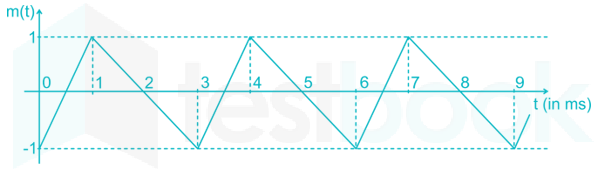
The baseband signal m(t) shown in the figure is phase-modulated to generate the PM signal φ(t) = cos(2πfct + km(t)). The time t on the x-axis in the figure is in milliseconds. If the carrier frequency fc = 50 kHz and k = 10π, then the ratio of the minimum instantaneous frequency (in kHz) to the maximum instantaneous frequency (in kHz) is __________ (rounded off to 2 decimal places).
33
Radiation resistance of a small dipole current element of length "l" at a frequency of 3 GHz is 3 ohms. If the length is changed by 1%, then the percentage change in the radiation resistance, rounded off to two decimal places, is ____________ %.
34
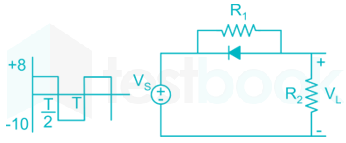
In the circuit shown, Vs is a square wave of period T with maximum and minimum values of 8 V and -10 V, respectively. Assume that the diode is ideal and R1 = R2 = 50 Ω. The average value of VL is ____ volts (rounded off to 1 decimal place).
35
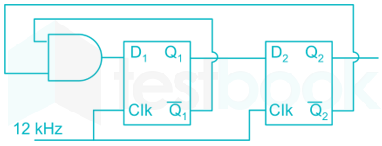
In the circuit shown, the clock frequency, i.e., the frequency of the Clk signal, is 12 kHz.The frequency of the signal at Q2 is ____ kHz.
36
Consider a differentiable function f(x) on the set of real numbers such that f(−1) = 0 and |f′(x)| ≤ 2. Given these conditions, which one of the following inequalities is necessarily true for all x ∈ [−2 , 2] ?
((a))
f(x)≤21;∣x+1∣
((b))
f(x) ≤ 2|x + 1|
((c))
f(x)≤21;∣x∣
((d))
f(x) ≤ 2|x|
Show Answer
Answer: ((b))
f(x) ≤ 2|x + 1|
Given:
f(-1) = 0
|f’(x)| ≤ 2
-2 ≤ f ’(x) ≤ 2
Using Lagrange mean value theorem:
f′(x)=b−af(b)−f(a)
Since value of f (-1) = 0 is given, we take the interval [-1, 2], i.e.
-2 ≤ f’(x) ≤ 2
−2≤2−(−1)f(2)−f(−1)≤2
−2≤3f(2)≤2
-6 ≤ f(2) ≤ 6
We observe that the option 2 satisfies this condition.
37
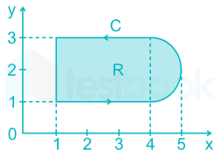
Consider the line integral \(\mathop \smallint \limits_c \left( {xdy - ydx} \right)\) the integral being taken in a counter clockwise direction over the closed curve C that forms the boundary of the region R shown in the figure below. The region R is the area enclosed by the union of a 2 × 3 rectangle and a semi-circle of radius 1. The line integral evaluates to
Given: \(\mathop \smallint \limits_c^; \left( {xdy - ydx} \right)\), i.e.
P = -y
Q = x
∂x∂Q=1;;,;;∂Y∂P=−1
=∫!!!∫(1−(−1))dxdy
⇒2∫!!!∫dxdy
= 2 × Area enclosed
= 2 [Area of rectangle + Area of semicircle]
=2[3×2+21π(1)2]
⇒ 12 + π
38
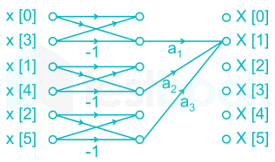
Consider a six-point decimation-in-time Fast Fourier Transform (FFT) algorithm, for which the signal-flow graph corresponding to X[1] is shown in the figure. Let W6=exp(−6j2π). In the figure, what should be the values of the coefficients a1, a2, a3 in terms of W6 so that X[1] is obtained correctly?
((a))
a1=;−1,a2;=;a6,a3;=;W62
((b))
a1=;1,a2;=W62;,a3;=W6;
((c))
a1=;1,a2;=;W61,a3;=W62
((d))
a1=−1,a2;=W62;,a3;=W6
Show Answer
Answer: ((c))
a1=;1,a2;=;W61,a3;=W62
Six point DFT of x(n) is given by:
\(X\left( k \right) = \mathop \sum \limits_{n = 0}^5 x\left( n \right)W_6^{kn}\)
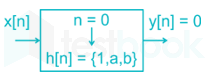
It is desired to find a three-tap causal filter that gives zero signal as an output to an input of the form x[n]=c1exp(−2jπn)+c2exp(2jπn), where c1 and c2 are arbitrary real numbers. The desired three-tap filter is given by h[0] = 1, h[1] = a, h[2] = b and h[n] = 0 for n < 0 or n > 2. What are the values of the filter taps a and b if the output is y[n] = 0 for all n when x[n] is as given above?
((a))
a = 1, b = 1
((b))
a = 0, b = −1
((c))
a = −1, b = 1
((d))
a = 0, b = 1
Show Answer
Answer: ((d))
a = 0, b = 1
h(n) = [1, a, b]
x(n)=C1e−j2π.n+C2ej2π.n
y(n) = 0
In frequency domain
H(ejω) = 1 + ae-jω + be-j 2ω
Input signal is given by:
x(n)=C1e−j2π.n+C2ej2π.n
For exponential input to the system output =H(ejω)x(n)e(jω+Φ)
Since these are two frequencies magnitude of |H(ejω)| has to be evaluated separately.
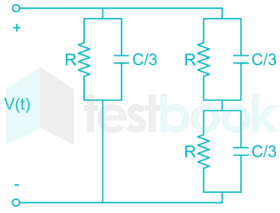
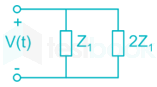
In the circuit shown, if v(t) = 2 sin(1000 t) volts, R = 1 kΩ and C = 1 μF, then the steady-state current i(t), in milliamperes (mA), is
((a))
sin(1000 t) + cos(1000 t)
((b))
2 sin(1000 t) + 2 cos(1000 t)
((c))
3 sin(1000 t) + cos(1000 t)
((d))
sin(1000 t) + 3 cos(1000 t)
Show Answer
Answer: ((c))
3 sin(1000 t) + cos(1000 t)
Concept:
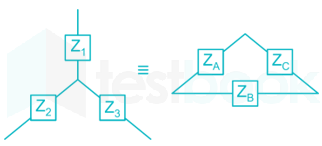
Star to delta transformation
ZA=Z1+Z2+Z3Z1Z2
=sC1+sC1+sC1
ZA=sC3
ZA=s(3C)1
Equivalent capacitance here is C/3 in Δ connection.
Equivalent circuit is then redrawn as:
Let R∣∣3sC1=Z1
Z1=R+3sC1R×3sC1=1+sR3CR
Zeq = Z1 || 2Z1
=32Z1
=32(1+sR3CR)
s = jω
ω = 1000
=32(1+3j((1000)(1000)10−6)1000)
=32×(1+3j)103
=32×(3+j)3×103=j+32×103
i=ZeqV=3+j2×1032sin1000t
=[1000(3+j)sin1000t]A
(3 + j) sin 1000 t mA
i(t) = [3 sin 1000 t + j sin 1000 t] mA
j = 1 ∠ 90
i(t) = 3 sin 1000 t + 1 ∠ 90 sin (1000 t)
= 3 sin 1000 t + sin (1000 t + 90)
i(t) = [3 sin 1000 t + cos 1000 t] mA
41
Consider a causal second-order system with the transfer function G(s)=1+2s+s21 with a unit-step R(s)=s1 as an input. Let C(s) be the corresponding output. The time taken by the system output c(t) to reach 94% of its steady-state value t→∞limc(t), rounded off to two decimal places, is
((a))
5.25
((b))
4.50
((c))
3.89
((d))
2.81
Show Answer
Answer: ((b))
4.50
G(s)=R(s)C(s)=s2+2s+11
C(s)=(s2+2s+1)1×s1
C(s)=s(s+1)21
C(s)=sA+s+1B+(s+1)2C
A = 1
B = -1
C = -1
C(s)=s1−s+11−(s+1)21
Applying inverse laplace transform:
C(t) = 1 – e-t – te-t
at steady state i.e. at t → ∞
t→∞ltC(t)=1−e−∞−te−∞
C(t) = 1
94% of steady state =10094×1
= 0.94.
0.94 = 1 – e-t – te-t
Substitute all options
Let us substitute options
option (a) t= 5.25
1 – e-5.25 – 5.25 e-5.25
⇒1−(e5.251+5.25)
= 0.967
option (b)
t = 4.50
1−(e4.50)(1+4.50)
1 – 0.938
≈ 0.94
42
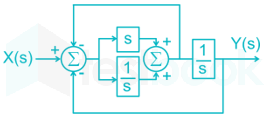
The block diagram of a system is illustrated in the figure shown, where X(s) is the input and Y(s) is the output. The transfer function H(s)=X(s)Y(s) is
((a))
H(s)=s3+s2+s+1s2+1
((b))
H(s)=s3+2s2+s+1s2+1
((c))
H(s)=s2+s+1s+1
((d))
H(s)=2s2+1s2+1
Show Answer
Answer: ((b))
H(s)=s3+2s2+s+1s2+1
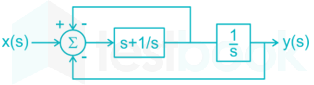
Solving the loop:
1+(s+s1)s+s1=s2+s+1s2+1
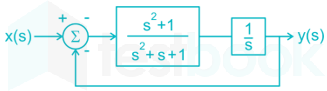
Solving the second loop, we get:
1+s(s2+s+1)s2+1s1(s2+s+1s2+1)
H(s)=s3+2s2+s+1s2+1
43
Let the state-space representation of an LTI system be ẋ(t) = A x(t) + B u(t), y(t) = C x(t) + d u(t) where A, B, C are matrices, d is a scalar, u(t) is the input to the system, and y(t) is its output. Let B = [0 0 1]T and d = 0. Which one of the following options for A and C will ensure that the transfer function of this LTI system is H(s)=s3+3s2+2s+11=?
C = \(\left[ {\begin{array}{*{20}{c}} 1&0&0 \end{array}} \right]\)
44
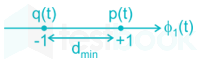
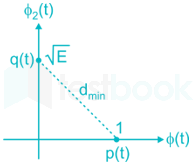
A single bit, equally likely to be 0 and 1, is to be sent across an additive white Gaussian noise (AWGN) channel with power spectral density N0/2. Binary signaling, with 0 ↦ p(t) and 1 ↦ q(t), is used for the transmission, along with an optimal receiver that minimizes the bit-error probability. Let φ1 (t), φ2(t) form an orthonormal signal set. If we choose p(t) = φ1 (t) and q(t) = −φ1 (t), we would obtain a certain bit-error probability Pb. If we keep p(t) = φ1(t), but take q(t)=E φ2 (t) for what value of E would we obtain the same bit-error probability Pb?
((a))
0
((b))
1
((c))
2
((d))
3
Show Answer
Answer: ((d))
3
Concept: In constellation diagram dmin is the minimum distance between two adjacent points and Probability of error is given by Pe=Q(2Nodmin2)
Analysis:P(0)=P(1)=21
Case 1:
p(t) = Φ1(t)
q(t) = -Φ1(t)
The system is binary PSK
Probability of error is given by:
Pe=Q(2Nodmin2)
dmin = 1 – (-1) = 2
Pe=Q(2No4;)=Q(No2;)…(1)
Case 2: When p(t) = Φ1(t)
q(t)=Eϕ2(t)
Since Φ1(t) and Φ2(t) are orthonormal, the signalling scheme is BFSK.
Constellation Diagram:
(dmin)2 = (√E)2 + (1)2
dmin2 = E + 1
Pe=Q(2Nodmin2)
Pe=Q2NoE+1…(2)
Comparing (1) and (2)
No2=2NoE+1
4 = E + 1
E = 3
45
The quantum efficiency (η) and responsivity (R) at a wavelength λ (in μm) in a p-i-n photodetector are related by
((a))
R=1.24η×λ
((b))
R=η×1.24λ
((c))
R=η1.24×λ
((d))
R=η×λ1.24
Show Answer
Answer: ((a))
R=1.24η×λ
Responsivity (R) is defined as the ratio of the photon current to the optical power, i.e.
R=PoptIp
If the electron generation rate is re and photon incident rate is rp, then Responsivity will be:
R=PoptIp=ehνrpre
R=hνe(η)
where η is the quantum efficiency defined as:
η=Incident;photon;rateElectron;generation;rate
R=hνηe[∵hν=λ;μm1.24(eV)]
R=1.24nλWA
46
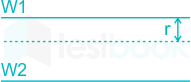
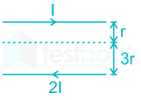
Two identical copper wires W1 and W2, placed in parallel as shown in the figure, carry currents I and 2I, respectively, in opposite directions. If the two wires are separated by a distance of 4r, then the magnitude of the magnetic field B between the wires at a distance r from W1 is
((a))
6;πrμ0I
((b))
5;πr6μ0I
((c))
6;πr5μ0I
((d))
2;πr2μ02I2
Show Answer
Answer: ((c))
6;πr5μ0I
Concept:
The magnetic field at a distance ‘R’ from a current-carrying conductor carrying current I is given by:
B=2πRμ0I
Application:
Since the two wires are carrying current in the opposite direction, the magnetic field due to wire ‘1’ will be:
B1=2πrμ0I
The direction, according the right-hand rule, will be downwards into the plane of the paper/screen.
Magnetic field due to wire ‘2’
Similarly B2=2π(3r)μ0(2I)
B2=2π3r2μ0I
The direction for this is also into the plane of the paper.
Adding the two we get:
B = B1 + B2
=2πrU0I+2π3r2μ0I
=2πru0I[1+32]
B=6πr5u0I
47
The dispersion equation of a waveguide, which relates the wavenumber k to the frequency ω, is k(ω)=(1/;c);ω2−ωo2 where the speed of light c = 3 × 10⁸ m/s, and ωo is a constant. If the group velocity is 2 × 10⁸ m/s, then the phase velocity is
((a))
1.5 × 10⁸ m/s
((b))
2 × 10⁸ m/s
((c))
3 × 10⁸ m/s
((d))
4.5 × 10⁸ m/s
Show Answer
Answer: ((d))
4.5 × 10⁸ m/s
Concept:
Phase velocity:
The rate at which the phase of the wave propagates in space
Vp=βω
Group Velocity:
The velocity with which overall envelope of the wave travels
Vg=dβdω=dkdω
K(ω)=c1ω−ω02…(1)
Vg = 2 × 10⁸ m/s (green)
Vg=dkdω
dωdk=Vg1
differentiating (1)
dωdk=Vg1=2Cω2−ω021×2ω=Vg1
⇒3×10⁸ω2−ω02ω=2×1081
ω2−ω02=32ω
Vp=Kω=ω2−ω02ωc
=(32ω)ωc
Vp=23c=23×108×3=4.5×10⁸m/s
Shortcut:
Group velocity × Phase velocity = c2
2 × 10⁸ × phase velocity = (3 × 10⁸)2
Vp=2×1089×1016
= 4.5 × 10⁸ m/s
48
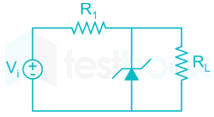
In the circuit shown, the breakdown voltage and the maximum current of the Zener diode are 20 V and 60 mA, respectively. The values of R1 and RL are 200 Ω and 1 kΩ, respectively. What is the range of Vi that will maintain the Zener diode in the ‘on’ state?
((a))
22 V to 34 V
((b))
24 V to 36 V
((c))
18 V to 24 V
((d))
20 V to 28 V
Show Answer
Answer: ((b))
24 V to 36 V
For the zenor diode to be on minimum voltage across it should be 20V.
Vz=VRL=Vi(R1+RLRL)
Vz=Vi(1000+2001000)≥20
Vi≥100020×1200
Vi ≥ 24 V
Only option (B) satisfies this condition.
This objective approach solves time to calculate the upper bound on Vi
49
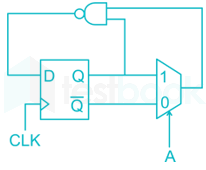
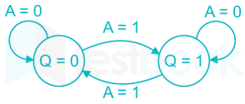
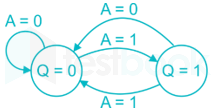
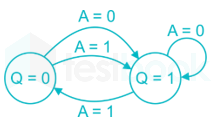
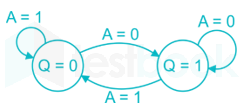
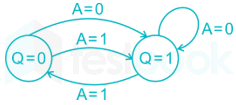
The state transition diagram for the circuit shown is
((a))
((b))
((c))
((d))
Show Answer
Answer: ((c))
Case 1:
When Q = 0
A = 0
NAND: 0 NAND Q̅ = 1
on next Clk pulse: Q will become 1
Case 2:
When Q = 0
A = 1
NAND output: Q NAND Q’
0 NAND 1 = 1
Qn+1 = 1
only option (c) satisfies both the conditions (for objective purpose question can be stopped here)
Case 3:
Q = 1
A = 0
NAND output = 1 NAND Q’
= 1 NAND 0
= 1
Qn+1 = 1
Case 4:
When
Q = 1
A = 1
NAND output: 1 NAND Q
= 1 NAND 1
= 0
Combining the above four cases:
50
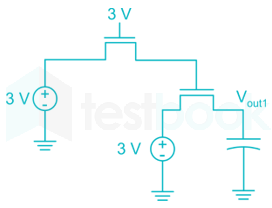
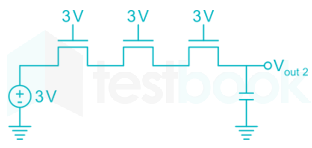
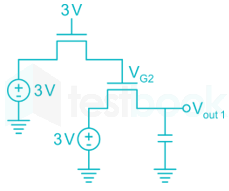
In the circuits shown, the threshold voltage of each nMOS transistor is 0.6 V. Ignoring the effect of channel length modulation and body bias, the values of Vout1 and Vout2, respectively, in volts, are
((a))
1.8 and 1.2
((b))
2.4 and 2.4
((c))
1.8 and 2.4
((d))
2.4 and 1.2
Show Answer
Answer: ((c))
1.8 and 2.4
Concept:
For the pass transistor logic:
VD = VG – VT
Application:
VG2 = VD1 = VG1 - VT
= 3 – 0.6
= 2.4
VD2 = VG2 – VT = Vout 1
= 2.4 - 0.6
= 1.8 = Vout 1
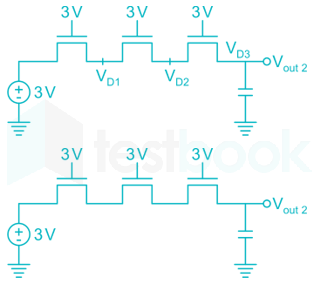
Case 2:
VD = VG1 – VT
= 3 – 0.6 = 2.4
VD2 = VG2 – VT
= 3 – 0.6 = 2.4
VD3 = VG3 – VT = VOut 2
= 3 – 0.6 = 2.4
51
The RC circuit shown below has a variable resistance R (t) given by the following expression:
R(t)=R0(1−Tt)for;0≤t<T
Where R0 = 1Ω, and C = 1 F. We are also given that T = 3 R0C and the source voltage is Vs = 1 V. If the current at time t = 0 is 1 A, then the current I (t), in amperes, at time t = T/2 is _______ (rounded off to 2 decimal places).
52
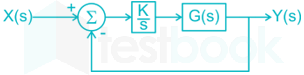
Consider a unity feedback system, as in the figure shown, with an integral compensator sk and open-loop transfer function
G(s)=s2+3s+21
where K > 0. The positive value of K for which there are exactly two poles of the unity feedback system on the jω axis is equal to ______ (rounded off to two decimal places).
53
Consider the homogeneous ordinary differential equation x2dx2d2y−3xdxdy+3y=0, x > 0 with y(x) as a general solution. Given that y(1) = 1 and y(2) = 14 the value of y(1.5), rounded off to two decimal places, is ______.
54
Let h[n] be a length-7 discrete-time finite impulse response filter, given by
h[0] = 4, h[1] = 3, h[2] = 2, h[3] = 1,
h[−1] = −3, h[−2] = −2, h[−3] = −1,
and h[n] is zero for |n| ≥ 4. A length-3 finite impulse response approximation g[n] of h[n] has to be obtained such that
is minimized, where H(ejω) and G(ejω) are the discrete-time Fourier transforms of h[n] and g[n], respectively. For the filter that minimizes E(h, g), the value of 10g[−1] + g[1], rounded off to 2 decimal places, is ________ .
55
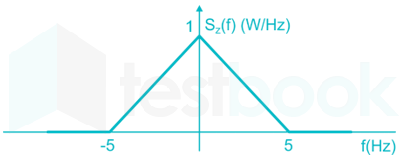
Let a random process Y(t) be described as Y(t) = h(t) ∗ X(t) + Z(t), where X(t) is a white noise process with power spectral density SX(f) = 5 W/Hz. The filter h(t) has a magnitude response given by |H(f)| = 0.5 for −5 ≤ f ≤ 5, and zero elsewhere. Z(t) is a stationary random process, uncorrelated with X(t), with power spectral density as shown in the figure. The power in Y(t), in watts, is equal to ________ W (rounded off to two decimal places).
56
A voice signal m(t) is in the frequency range 5 kHz to 15 kHz. The signal is amplitude-modulated to generate an AM signal f(t) = A(1 + m(t)) cos 2πfct, where fc = 600 kHz. The AM signal f(t) is to be digitized and archived. This is done by first sampling f(t) at 1.2 times the Nyquist frequency, and then quantizing each sample using a 256-level quantizer. Finally, each quantized sample is binary coded using K bits, where K is the minimum number of bits required for the encoding. The rate, in Megabits per second (rounded off to 2 decimal places), of the resulting stream of coded bits is _______ Mbps.
57
A random variable X takes values −1 and +1 with probabilities 0.2 and 0.8, respectively. It is transmitted across a channel which adds noise N, so that the random variable at the channel output is Y = X + N. The noise N is independent of X, and is uniformly distributed over the interval [−2 , 2]. The receiver makes a decision
where the threshold θ ∈ [−1,1] is chosen so as to minimize the probability of error Pr[X̂ ≠ X]. The minimum probability of error, rounded off to 1 decimal place, is_______.
58
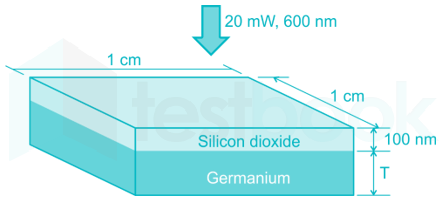
A Germanium sample of dimensions 1 cm × 1 cm is illuminated with a 20 mW, 600 nm laser light source as shown in the figure. The illuminated sample surface has a 100 nm of loss-less Silicon dioxide layer that reflects one-fourth of the incident light. From the remaining light, one-third of the power is reflected from the Silicon dioxide-Germanium interface, one-third is absorbed in the Germanium layer, and one-third is transmitted through the other side of the sample. If the absorption coefficient of Germanium at 600 nm is 3 × 104 cm-1 and the bandgap is 0.66 eV, the thickness of the Germanium layer, rounded off to 3 decimal places, is ______ μm.
59
In an ideal pn junction with an ideality factor of 1 at T=300 K, the magnitude of the reverse-bias voltage required to reach 75% of its reverse saturation current, rounded off to 2 decimal places is ____mV.
Consider a long-channel MOSFET with a channel length 1 μm and width 10 μm. The device parameters are acceptor concentration NA = 5 × 1016 cm-3, electron mobility μn = 800 cm2/V-s, oxide capacitance/area Cox = 3.45 × 10⁻⁷ F/cm2, threshold voltage VT = 0.7 V. The drain saturation current (IDsat) for a gate voltage of 5 V is _____mA (rounded off to two decimal places). [ε0 = 8.854 × 10⁻¹⁴F/cm, εSi = 11.9]
61
A rectangular waveguide of width w and height h has cut-off frequencies for TE10 and TE11 modes in the ratio 1 : 2. The aspect ratio w/h, rounded off to two decimal places, is __________.
62
In the circuit shown, Vs is a 10 V square wave of period, T = 4 ms with R = 500 Ω and C = 10 μF. The capacitor is initially uncharged at t = 0, and the diode is assumed to be ideal. The voltage across the capacitor (Vc) at 3 ms is equal to ____ volts (rounded off to one decimal place).
63
A CMOS inverter, designed to have a mid-point voltage VI equal to half of Vdd, as shown in the figure, has the following parameters:
The ratio of (LW)nto(LW)p is equal to ________ (rounded of 3 decimal places.)
64
In the circuit shown, the threshold voltages of the pMOS (|Vtp|) and nMOS (Vtn) transistors are both equal to 1 V. All the transistors have the same output resistance rds of 6 MΩ. The other parameters are listed below:
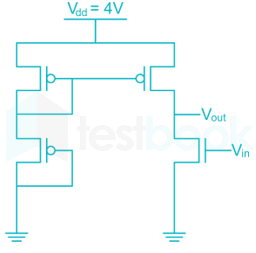
μn and μp are the carrier mobilities, and Cox is the oxide capacitance per unit area. Ignoring the effect of channel length modulation and body bias, the magnitude of the gain of the circuit is ____ (rounded off to 1 decimal place).
65
In the circuit shown, V1 = 0 and V2 = Vdd. The other relevant parameters are mentioned in the figure. Ignoring the effect of channel length modulation and the body effect, the value of Iout is _____mA (rounded off to 1 decimal place).