"By giving him the last _______ of the cake, you will ensure lasting ______ in our house today".
The words that best fill the blanks in the above sentence are
((a))
peas, piece
((b))
piece, peace
((c))
peace, piece
((d))
peace, peas
Show Answer
Answer: ((b))
piece, peace
Correct answer: 2.
The sentence has two blanks. The first blank requires a word which is about a part of the cake**.**
Hence the correct word in this blank is 'piece'. Peas and Peace cannot fill the second blank.
2
"Even though there is a vast scope for its _______, tourism has remained a/an ______ area."
The words that best fill the blanks in the above sentence are
((a))
Improvement, neglected
((b))
Rejection, approved
((c))
Fame, glum
((d))
Interest, disinterested
Show Answer
Answer: ((a))
Improvement, neglected
Correct answer: Option 1.
The sentence implies that there is immense scope in the area of tourism and that it should be improved upon.
'Improvement' and 'neglected' are two words which are opposite to each other.
Note: Option 3 cannot be correct because tourism in itself cannot be famous. A country or place can be famous due to its tourism policies.
3
If the number 715_423 is divisible by 3 (_ denotes the missing digit in the thousandths place), then the smallest whole number in the place of _ is _______.
((a))
0
((b))
2
((c))
5
((d))
6
Show Answer
Answer: ((b))
2
715423
Let the missing number be ‘x’
For divisibility by 3, the sum of all the digits should be divisible by 3.
The sum of all the digits will be:
= 7 + 1 + 5 + x + 4 + 2 + 3 + 13 + x + 9
= 22 + x
Now, the nearest multiple of ‘3’ is 24. We can, therefore, write:
22 + x = 24
x = 24 – 22
x = 2
Cross check:
For x = 2,
The sum of the digits is, therefore:
= 22 + 2 = 24
Since 24 is divisible by 3, the smallest whole number in the place of _ will be 2
4
What is the value of 1+41+161+641+2561+…?
((a))
2
((b))
47
((c))
23
((d))
34
Show Answer
Answer: ((d))
34
Concept:
For a GP of the form:
a + ar + ar2 + ar3 +…..
The sum is given by:
Sum=1−ra
Calculation:
The given sequence is
x(n)=1+41+161+641+2561+…
=1+221+241+261+281+…
The series is GP series with:
a = 1
r=221=41
Sum of the infinite series will be:
Sum=1−ra
=1−411=431
=34
5
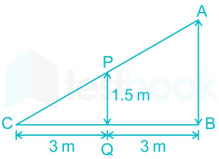
A 1.5 m tall person is standing at a distance of 3 m from a lamp post. The light from the lamp at the top of the post casts her shadow. The length of the shadow is twice her height. What is the height of the lamp post in meters?
((a))
1.5
((b))
3
((c))
4.5
((d))
6
Show Answer
Answer: ((b))
3
The situation can be drawn as:
Since the length of the shadow is twice the height of the girl, we can write:
CQ = 2(1.5) = 3 m
Δ PQC ~ Δ ABC
ABPQ=BCQC
x1.5=63
x=36×1.5=3;m
6
Leila aspires to buy a car worth Rs. 10,00,000 after 5 years. What is the minimum amount in Rupees that she should deposit now in a bank which offers 10% annual rate of interest, if the interest was compounded annually?
((a))
5,00,000
((b))
6,21,000
((c))
6,66,667
((d))
7,50,000
Show Answer
Answer: ((b))
6,21,000
Concept:
The amount in compound interest is given by:
A=P(1+100r)n
P = Principle amount
r = Rate
n = Time (in years)
Calculation:
Putting on the respective given values, we can write:
10,00,000=P(1+10010)5
106=P(1011)5
P=115106×105
= 620921.32
Now, from the given options, the minimum value greater than the above value is:
≈ 6,21,000
7
Two alloys A and B contain gold and copper in the ratios of 2 : 3 and 3 : 7 by mass, respectively. Equal ratio of alloys A and B are melted to make an alloy C. The ratio of gold to copper in alloy C is ____.
((a))
5 : 10
((b))
7 : 13
((c))
6 : 11
((d))
9 : 13
Show Answer
Answer: ((b))
7 : 13
A → Gold : Copper 2 : 3
B → Gold : Copper 3 : 7
Since equal of alloys A and B are melted to make the alloy C, we multiply the ratio of Gold : Copper in A by 2 to get:
A = 4 : 6
Now,
A = 4 : 6 Weight = 4 + 6 = 10 units
B = 3 : 7 Weight = 3 + 7 = 10 units
Weight in the mixture will be:
(4 + 3) : (6 + 7)
= 7 : 13
8
The Cricket Board has long recognized John's potential as a leader of the team. However, his on-field temper has always been a matter of concern for them since his junior days. While this aggression has filled stadiums with die-hard fans, it has taken a toll on his own batting. Until recently, it appeared that he found it difficult to convert his aggression into big scores. Over the past three seasons though, that picture of John has been replaced by a cerebral, calculative and successful batsman-captain. After many years, it appears that the team has finally found a complete captain.
Which of the following statements can be logically inferred from the above paragraph?
i) Even as a junior cricketer, John was considered a good captain.
ii) Finding a complete captain is a challenge.
iii) Fans and the Cricket Board have differing views on what they want in a captain.
iv) Over the past three seasons, John has accumulated big scores.
((a))
(i), (ii) and (iii) only
((b))
(iii) and (iv) only
((c))
(ii) and (iv) only
((d))
(i), (ii), (iii) and (iv)
Show Answer
Answer: ((c))
(ii) and (iv) only
Option (i) which says 'Even as a junior cricketer, John was considered a good captain.' is incorrect as there is no information provided in the passage to support this inference. We do not know if John was a captain as a junior cricketer.
Option (iii) which says 'Fans and the Cricket Board have differing views on what they want in a captain.' is incorrect because while we know that fans love John's aggression from the phrase 'While this aggression has filled stadiums with die-hard fans', but there is no information provided in the passage to support the Cricket Board's view of John.
Option (ii) which says 'Finding a complete captain is a challenge.' is correct as the passage talks about the difficulties John faces while he was the captain. It is very difficult to find a captain who can be 'complete' throughout the captainship.
Option (iv) which says 'Over the past three seasons, John has accumulated big scores.' is correct as it is given in the passage that while earlier John 'found it difficult to convert his aggression into big scores', but 'Over the past three seasons though' he became a 'cerebral, calculative and successful batsman-captain'. From this, inference (iv) can be safely inferred.
Hence the correct answer is option 3.
9
A cab was involved in a hit and run accident at night. You are given the following data about the cabs in the city and the accident.
(i) 85% of cabs in the city are green and the remaining cabs are blue.
(ii) A witness identified the cab involved in the accident as blue.
(iii) It is known that a witness can correctly identify the cab color only 80% of the time.
Which of the following options is closest to the probability that the accident was caused by a blue cab?
((a))
12%
((b))
15%
((c))
41%
((d))
80%
Show Answer
Answer: ((c))
41%
Let,
A = Event that the car accident occurs by a blue car
B = Event that the person correctly identifies the car
The probability that the person correctly identifies the car is:
P (Correct) = 10080
Also, P(Incorrect) = 10020
The probability that the car is blue in color is:
P (Blue) = 10015
The probability that the car is green is:
P (Green) = 10085
The probability that the car accident occurs by a blue car will be:
A coastal region with unparalleled beauty is home to many species of animals. It is dotted with coral reefs and unspoiled white sandy beaches. It has remained inaccessible to tourists due to poor connectivity and lack of accommodation. A company has spotted the opportunity and is planning to develop a luxury resort with helicopter service to the nearest major city airport. Environmentalists are upset that this would lead to the region becoming crowded and polluted like any other major beach resorts.
Which one of the following statements can be logically inferred from the information given in the above paragraph?
((a))
The culture and tradition of the local people will be influenced by the tourists.
((b))
The region will become crowded and polluted due to tourism.
((c))
The coral reefs are on the decline and could soon vanish.
((d))
Helicopter connectivity would lead to an increase in tourists coming to the region.
Show Answer
Answer: ((d))
Helicopter connectivity would lead to an increase in tourists coming to the region.
Options 1, 2, and 3 are incorrect as they are assumptions.
Only option 4 which says 'Helicopter connectivity would lead to an increase in tourists coming to the region.' can be logically inferred from the passage. This is because the passage mentions in the beginning that the coastal region has remained 'inaccessible to tourists due to poor connectivity' which would not be the case once a 'helicopter service to the nearest major city airport' is established.
Hence option 4 is the correct answer.
Electronics and Communication Engineering (55 questions)
11
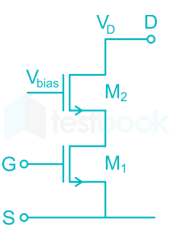
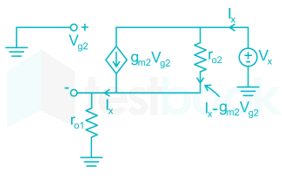
Two identical NMOS transistors M1 and M2 are connected as shown below. The circuit is used as an amplifier with the input connected between G and S terminals and the output taken between D and S terminals. Vbias and VD are so adjusted that both transistors are in saturation. The transconductance of this combination is defined as \({{\rm{g}}{\rm{m}}} = \frac{{\partial {{\rm{i}}{\rm{D}}}}}{{\partial {{\rm{V}}{{\rm{GS}}}};}}\) while the output resistance is \({{\rm{r}}{\rm{o}}} = \frac{{\partial {{\rm{V}}{{\rm{GS}}}};}}{{\partial {{\rm{i}}{\rm{D}}}}}{\rm{;}}\), where iD is the current flowing into the drain of M2. Let gm1, gm2 be the transconductances and r01, r02 be the output resistances of transistors M1 and M2, respectively.
Which of the following statements about estimates for gm and r0 is correct?
In the circuit shown below, the op-amp is ideal and the Zener voltage of the diode is 2.5 volts. At the input, unit step voltage is applied, i.e. VIN (t) = u(t) Volts. Also, at t = 0, the voltage across each of the capacitors is zero.
The time 't', in milliseconds, at which the output voltage VOUT crosses −10 V is:
((a))
2.5
((b))
5
((c))
7.5
((d))
10
Show Answer
Answer: ((c))
7.5
Concept:
A capacitor does not allow a sudden change in voltage, i.e.
VC(0+) = VC(0-)
Application:
Initially, both the capacitor voltages are zero, i.e.
VC1 (0-) = VC2 (0-) = 0 V
At t = 0, when the switch is closed, initially the Zener will be open-circuited and remains the same till the voltage across C2 becomes greater than its breakdown voltage i.e. 2.5 volts.
Applying KCL at node A, we get:
IC=I=1k1−0=1mA
We observe that the current through both the capacitors is constant, and hence it is a case of linear charging of capacitors. As the initial voltage is zero, hence the voltage across C1 and C2 for t > 0 is given as:
\({V_{{C_1}}}\left( t \right) = \frac{1}{{{C_1}}}\mathop \smallint \limits_0^t {I_C}dt = 1000\left| t \right|_0^t\) ---(1)
Since VC1 = VC2, we get:
\({V_{{C_2}}}\left( t \right) = \frac{1}{{{C_2}}}\mathop \smallint \limits_0^t {I_C}~dt = 1000\left| t \right|_0^t\)
Applying KVL starting from point A and ending at output V0, we get:
VA + VC1 + VC2 + V0 = 0 (where VA = 0)
V0 = - (VC1 + VC2)
Cut in voltage of Zener diode = 2.5 V
∴ When VC2(t) = 2.5 V, breakdown of the Zener diode will occur and the voltage will be fixed to the Zener voltage of 2.5 V, i.e.
When VC1(t) = VC2(t) = 2.5 V(Zener turns on)
Using Equation (1), the time required to reach 2.5 V is calculated as:
2.5=1000×t1
∴ t1 = 2.5 ms (Zener : ON)
But we need Vo = -10 V
∴ C1 must continue to charge up to 7.5 V. Since the charging is linear, the time required to charge to another 5 V will be calculated using the same Equation (1) as:
5=1000×t2
t2=5;msec
∴ the total times at which the output Voltage (Vout) crosses (- 10) V will be:
T = t1 + t2 = (2.5 + 5) msec = 7.5 ms
13
A good transimpedance amplifier has
((a))
low input impedance and high output impedance.
((b))
high input impedance and high output impedance.
((c))
high input impedance and low output impedance.
((d))
low input impedance and low output impedance.
Show Answer
Answer: ((d))
low input impedance and low output impedance.
Transresistance or trans-impedance amplifier is normally used as a current to voltage converter which requires low input and low output impedances for its proper operation.
Requirements of input and output impedances for different amplifiers are listed below:
Type of Amplifier
Rin
Rout
Voltage Amplifier
High
Low
Current Amplifier
Low
High
Transconductance
High
High
Transimpedance amplifier
Low
Low
14
Let the input be u and the output is y of a system, and the other parameters are real constants. Identify which among the following systems is not a linear system:
A system is said to be linear if it satisfies to properties:
Additivity:
If states that, if an input x1(t) produces output y1(t) and another input x2(t) also acting along produces output y2(t), then, when path inputs acting on the system simultaneously, produce output y1(t) + y2(t).
If x1(t) → y1(t)
x2(t) → y2(t)
then x1(t) + x2(t) → y1(t) + y2(t)
Homogeneity:
It states that if input is scaled by c, then output also scaled by same amount.
if x1(t) → y1(t)
then cx1(t) → cy1(t): c is any real or Imaginary number
Solution:
y = au + b
y(t) = au(t) + b
u(t) = u1(t) + u2(t)
y(t) = au1(t) + au2(t) + b
y(t) ≠ [au1(t) + b] + [au2(t) + b]
y(t) ≠ y1(t) + y2(t)
Hence the system is non linear
y = au + b is a nonlinear system
15
The Nyquist stability criterion and the Routh criterion both are powerful analysis tools for determining the stability of feedback controllers. Identify which of the following statements is FALSE:
((a))
Both the criteria provide information relative to the stable gain range of the system.
((b))
The general shape of the Nyquist plot is readily obtained from the Bode magnitude plot for all minimum-phase systems.
((c))
The Routh criterion is not applicable in the condition of transport lag, which can be readily handled by the Nyquist criterion.
((d))
The closed-loop frequency response for a unity feedback system cannot be obtained from the Nyquist plot.
Show Answer
Answer: ((d))
The closed-loop frequency response for a unity feedback system cannot be obtained from the Nyquist plot.
Both Nyquist and RH criteria can be used to find the range of gain (k) for the system to be stable
Bode plot can be used to find the transfer function which further can be used to determine the Nyquist Plot.
RH criteria do not give accurate terms in case of exponential terms, an approximation can be obtained using exponential expansion up to 1st degree
Nyquist plots are the continuation of polar plots for finding the stability of the closed-loop control systems by varying ω from −∞ to ∞.
Derivation:
Let us consider O.L.T.F of a unity feedback system as:
G(s)=s(s+a)K
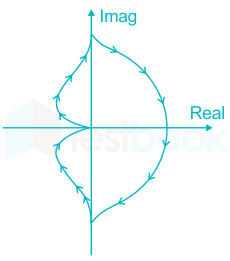
This represents a type = 1 and order – 2 system for which the Nyquist plot will be as shown below:
The closed-loop transfer function for the system is given as:
T(s)=1+G(s)G(s)=1+[s(s+a)K]K/s(s+a)
T(s)=s2+as+KK
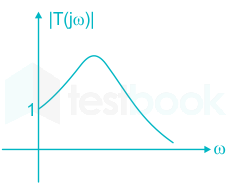
We can draw its Nyquist plot by simply substituting s = jω and obtain polar coordinates of T(jω) for different values of ω as:
T(jω)=(jω)2+jaω+KK
T(0)=0+0+KK=1
T(∞) = 0
So, the statement given in option (D) is false.
16
Consider ps=s3+a2s2+a1s+a0with all real coefficients. It is known that its derivative p'(s) has no real roots. The number of real roots of p(𝑠) is:
((a))
0
((b))
1
((c))
2
((d))
3
Show Answer
Answer: ((b))
1
Concept:
If p(s) has 'n' real roots, then p'(s) will have at least 'n - 1' real roots.
Application:
Given p(s) = s3 + a2 s2 + a1s + a0
p'(s) = 3s2 + 2a2s + a1
Also given that p'(s) has no real roots, therefore, we can write:
n - 1 = 0
n = Number of real roots in p(s)
∴ n = 1
17
In a p-n junction diode at equilibrium, which one of the following statements is NOT TRUE?
((a))
The hole and electron diffusion current components are in the same direction.
((b))
The hole and electron drift current components are in the same direction.
((c))
On an average, holes and electrons drift in opposite direction.
((d))
On an average, electrons drift and diffuse in the same direction.
Show Answer
Answer: ((d))
On an average, electrons drift and diffuse in the same direction.
In a p-n junction at equilibrium, i.e. no bias
The hole electrons flow (drift, diffusion) directions are as follows (convention based on the above PN diagram)
Particle type and flow
Directions of flow
Current
1) Hole diffusion
→
→
2) Hole drift
←
←
3) Electron diffusion
←
→
4) Electron drift
→
←
The concentration of holes on the p-side is much greater than that in the n-side, a very large hole diffusion current tends to flow across the junction from the p to the n material.
Hence an electric field must build up across the junction in such a direction that a hole drift current will tend to flow across the junction from n-side to p-side in order to counterbalance the diffusion current.
After the depletion region is formed and an electric field is a set-up; holes on the p-side and electrons on the n-side move away from the junction.
However, diffusion current components (before the formation of the depletion region) and drift current components (after the formation of the depletion region) are in the same direction.
Electron drift and diffuse currents are in the opposite direction.
Option (d) is not true.
18
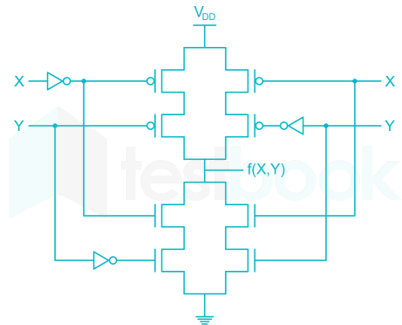
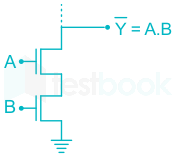
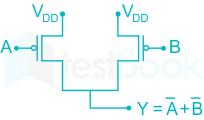
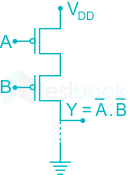
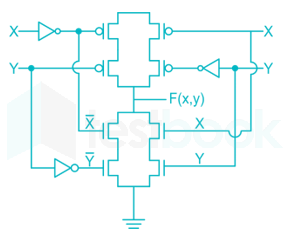
The logic function f(X,Y) realized by the given circuit is
((a))
NOR
((b))
AND
((c))
NAND
((d))
XOR
Show Answer
Answer: ((d))
XOR
Concept:
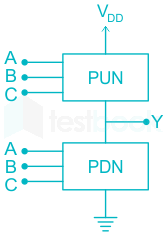
CMOS logic circuit is an extension of a CMOS inverter. It consists of two network transistors, a pull-down network (PDN) constructed of an n-MOS and Pull-up Network (PUN) constructed of P-MOS.
PDN: Since nMOS conducts when the signal gate is high, PDN is activated when the inputs are high.
PUN: It comprises PMOS and conducts when the input signal gate is low.
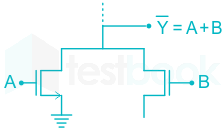
The PDN and PUN are connected in parallel to form OR logic function and they are connected in series to form AND logic as shown:
Application:
xˉ.yˉ+xy=x⊙y = x ⊕ y = XOR
19
A function (A, B, C) defined by three boolean variables A, B, and C when expressed as the sum of products is given by:
F = A̅.B̅.C̅ + A̅.B.C̅ + A.B̅.C̅
where, A̅, B̅, and C̅ are the complements of the respective variables. The product of sums (POS) form of the function F is
((a))
F = (A + B + C) . (A + B̅ + C) . (A̅ + B + C)
((b))
F = (A̅ + B̅ + C̅) . (A̅ + B + C̅) + (A + B̅ + C̅)
((c))
F = (A + B + C̅) . (A + B̅ + C̅) . (A̅ + B + C̅) . (A̅ + B̅ + C) . (A̅ + B̅ + C̅)
((d))
F = (A̅ + B̅ + C) . (A̅ + B + C) . (A + B̅ + C) . (A + B + C̅) . (A + B + C)
Show Answer
Answer: ((c))
F = (A + B + C̅) . (A + B̅ + C̅) . (A̅ + B + C̅) . (A̅ + B̅ + C) . (A̅ + B̅ + C̅)
F = A̅.B̅.C̅ + A̅.B.C̅ + A.B̅.C̅
In terms of minterms, this can be represented as:
F = ∑m (0, 2, 4)
The equivalent maxterm will contain the terms not present in the minterm representation, i.e.
The same function x(t) can also be considered as a periodic function with period T′ = 40. Let bk be the Fourier series coefficients when the period is taken as T’. If \(\mathop \sum \limits_{{\rm{k}} = - \infty }^\infty \left| {{{\rm{a}}{\rm{k}}}} \right|=16{\rm{;}}\), then \(\mathop \sum \limits{{\rm{k}} = - \infty }^\infty \left| {{{\rm{b}}_{\rm{k}}}} \right|{\rm{;}}\)is equal to
((a))
256
((b))
64
((c))
16
((d))
4
Show Answer
Answer: ((c))
16
Given a fundamental period = 10
According to the question, the function is the same but you can consider another period
If the function is the same, the Fourier series coefficient will also be the same, i.e.
Consider the following amplitude modulated signal: s(𝑡) = cos(2000 𝜋𝑡) + 4 cos(2400 𝜋𝑡) + cos(2800 𝜋𝑡).The ratio (accurate to three decimal places) of the power of the message signal to the power of the carrier signal is ________.
26
Consider a binary channel code in which each code word has a fixed length of 5 bits. The Hamming distance between any pair of distinct code words in this code is at least 2. The maximum number of code words such a code can contain is ________.
27
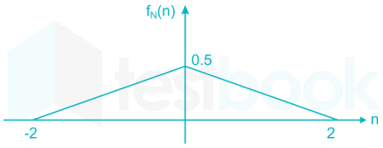
A binary source generates symbols 𝑋 ∈ {−1, 1} which are transmitted over a noisy channel. The probability of transmitting 𝑋 = 1 is 0.5. Input to the threshold detector is 𝑅 = 𝑋 + 𝑁. The probability density function fN(𝑛) of the noise 𝑁 is shown below:
If the detection threshold is zero, then the probability of error (correct to two decimal places) is ________.
28
A p-n step junction diode with a contact potential of 0.65 V has a depletion width of 1 μm at equilibrium. The forward voltage (in volts, correct to two decimal places) at which this width reduces to 0.6 μm is ________.
29
A traffic signal cycles from GREEN to YELLOW, YELLOW to RED and RED to GREEN. In each cycle, GREEN is turned on for 70 seconds, YELLOW is turned on for 5 seconds and the RED is turned on for 75 seconds. This traffic light has to be implemented using a finite state machine (FSM). The only input to this FSM is a clock of 5 second period. The minimum number of flip-flops required to implement this FSM is ________ .
30
There are two photolithography systems: one with the light source of wavelength λ1 = 156 nm (system 1) and another with the light source of wavelength λ2 = 325 nm (System 2). Both photolithography systems are otherwise identical. If the minimum feature sizes that can be realized using System1 and System2 are Lmin1 and Lmin2 respectively, the ratio Lmin1/Lmin2 (correct to two decimal places) is________.
31
A lossy transmission line has resistance per unit length R = 0.05 Ω/m. The line is distortionless and has a characteristic impedance of 50 Ω. The attenuation constant (in Np/m, correct to three decimal places) of the line is _________.
32
Consider matrix \({\rm{A}} = \left[ {\begin{array}{{20}{c}} {\rm{k}}&{2{\rm{k}}}\ {{{\rm{k}}^2} - {\rm{k}}}&{{{\rm{k}}^2}} \end{array}} \right]\) and vector \({\rm{x}} = \left[ {\begin{array}{{20}{c}} {{{\rm{x}}1}}\ {{{\rm{x}}2}} \end{array}} \right]\). The number of distinct real values of k for which the equation Ax = 0 has infinitely many solution is______
33
Let X1, X2, X3 and X4 be independent normal random variables with zero mean and unit variance. The probability that X4 is the smallest among the four is _________.
34
Taylor series expansion of \({\rm{f}}\left( {\rm{x}} \right) = \mathop \smallint \limits_0^{\rm{x}} {{\rm{e}}^{ - \left( {\frac{{{{\rm{t}}^2}}}{2}} \right)}}{\rm{dt}}\) around x = 0 has the form
f(x) = a0 + a1x + a2x2 + ….
The coefficient a2 (correct to two decimal places) is equal to ________
35
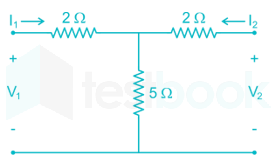
The ABCD matric for a two-port network is defined by:
The parameter B for the given two-port network (in ohms, correct to two decimal places) is ________.
36
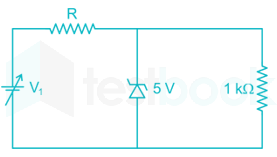
The circuit shown in the figure is used to provide regulated voltage (5 V) across the 1 kΩ resistor. Assume that the Zener diode has a constant reverse breakdown voltage for a current range, starting from a minimum required Zener current, IZmin = 2 mA to its maximum allowable current. The input voltage VI may vary by 5% from its nominal value of 6 V. The resistance of the diode in the breakdown region is negligible.
The value of R and the minimum required power dissipation rating of the diode, respectively, are
((a))
186 Ω and 10 mW
((b))
100 Ω and 40 mW
((c))
100 Ω and 10 mW
((d))
186 Ω and 40 mW
Show Answer
Answer: ((b))
100 Ω and 40 mW
Vin = 6V ± 5 % indicates a variation from 5.7 V to 6.3 V
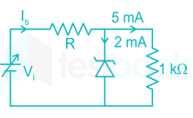
If the load voltage is 5 V, the load current = 5 mA
The source current Is will be:
Is = 2 + 5 = 7 mA
Vi(min) = 5.7 V
R=7.55.7−5=100;Ω
Vi(max)=6.3V
R=7mA6.3−5≅186;Ω
For maximum power dissipation, we take R = 100 Ω
Is=1006.3−5=13;mA
IZ = 13 -5 = 8 mA
Pz = 5 × 8 = 40 mW
∴ The minimum power rating of the device means higher the maximum power dissipation in the circuit.
37
Let c(t) = Ac cos (2πfct) and m(t) = cos (2πfmt). It is given that fc ≫ 5fm. The signal c(t) + m(t) is applied to the input of a non-linear device, whose output vo(t) is related to the input vi(t) as v0(t) = avi(t) + bvi2(t) where a and b are positive constants. The output of the non-linear device is passed through an ideal band-pass filter with center frequency fc and bandwidth 3 fm, to produce an amplitude modulated (AM) wave. If it is desired to have the side band power of the AM wave to be half of the carrier power, then a/b is
When the above signal is passed through the band pass filter with center frequency fc and bandwidth 3 fm, the output will contain:
y(t) = aAc cos(2πfct) + 2bAc cos(2πfc) cos(2πfmt)
The carrier power will be:
Pc=2(aAc)2=2a2Ac2
And the side band power will be:
PSB=22(bAc)2=b2Ac2
PSB=21Pc
b2Ac2=21(2a2Ac2)
b2a2=4
ba=2
38
Consider a white Gaussian noise process N(𝑡) with two-sided power spectral density SN(f) = 0.5 W/Hz as input to a filter with impulse response 0.5;e−t2/2(𝑡 is in seconds) resulting in output Y(t). The power in Y(t), in watts, will be:
((a))
0.11
((b))
0.22
((c))
0.33
((d))
0.44
Show Answer
Answer: ((b))
0.22
Concept: 1. PSD of output = |H(f)|2 PSD of input.
2. Fourier transform of Gaussian Pulse is also Gaussian in nature i.e e−at2↔F.T.aπe−π2f2/a
3. Average Power from PSD can be calculated as \(P = \mathop \smallint \limits_{ - \infty }^{ + \infty } Sy\left( f \right)df \)
Application: Given 2No=0.5;W/Hz
h(t)=0.5;e−t2/2
The output PSD is related to the input PSD as:
Sy(f) = |H(f)|2 SN(f) ----(1)
With h(t)=0.5e−t2/2, the Fourier transform is calculated as:
e−at2↔F.T.aπe−π2f2/a
The Fourier transform of h(t) will be:
0.5e−t2/2↔F.T.0.50.5πe−0.5π2f2
0.5e−2t2↔F.T.0.52πe−2π2f2
Substituting this in Equation (1), we get:
Sy(f)=0.52πe−2π2f22(0.5)
Sy(f)=0.125(2π)e−4π2f2
Sy(f)=4πe−4π2f2
The integration of PSD gives power, i.e. the area under the PSD gives power.
Red (R), Green (G) and Blue (B) Light Emitting Diodes (LEDs) were fabricated using p-n junctions of three different inorganic semiconductors having different band-gaps. The built-in voltages of red, green and blue diodes are VR, VG and VB, respectively. Assume donor and acceptor doping to be the same (NA and ND, respectively) in the p and n sides of all the three diodes.
Which one of the following relationships about the built-in voltages is TRUE?
((a))
VR > VG > VB
((b))
VR < VG < VB
((c))
VR = VG = VB
((d))
VR > VG < VB
Show Answer
Answer: ((b))
VR < VG < VB
The bandgap of LED is related to its wavelength of light as:
Eg=λhc
i.e. Egor;Vbi;∝λ1
Hence, as λ increases, the bandgap, and the build-in potential decreases, i.e.
For λR > λG > λB, the bandgap of the respective diodes will be:
⇒ VR < VG < VB
41
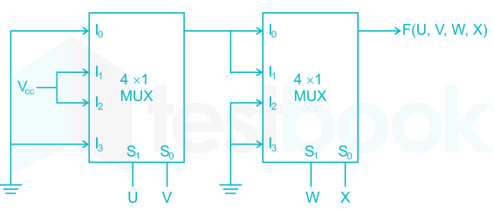
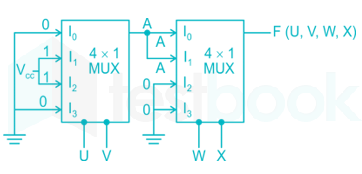
A four-variable boolean function is realized using 4 × 1 multiplexers as shown in the figure.
The minimized expression for F(U, V, W, X) is
((a))
(UV + U̅V̅) W̅
((b))
(UV + U̅V̅) (W̅X̅ + W̅X)
((c))
(UV̅ + U̅V) W̅
((d))
(UV̅ + U̅V) (WX̅ + WX)
Show Answer
Answer: ((c))
(UV̅ + U̅V) W̅
The output of the first multiplexer will be:
A = U̅V̅0 + U̅V.1 + UV̅.1 + UV.0
A = (U̅V + UV̅) ---(1)
Now, the output of second multiplexer will be:
F = A.(W̅ X̅) + A(W̅X) + 0.(WX̅) + 0.(WX)
F = AW̅ (X̅ + X) = AW̅
Subsitutin A from Equation (1), we get:
F = (U̅V + UV̅) W̅
42
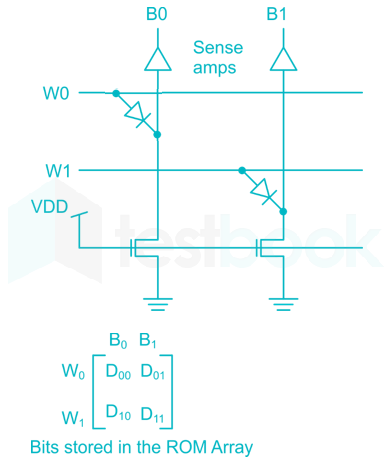
A 2 × 2 ROM array is built with the help of diodes as shown in the circuit below. Here W0 and W1 are signals that select the word lines and B0 and B1 are signals that are output of the sense amps based on the stored data corresponding to the bit lines during the read operation.
During the read operation, the selected word line goes high and the other word line is in a high impedance state. As per the implementation shown in the circuit diagram above, what are the bits corresponding to Dij (where i = 0 or 1 and j = 0 or 1) stored in the ROM?
The distance (in meters) a wave has to propagate in a medium having a skin depth of 0.1 m so that the amplitude of the wave attenuates by 20 dB, is
((a))
0.12
((b))
0.23
((c))
0.46
((d))
2.3
Show Answer
Answer: ((b))
0.23
Concept:
The amplitude of E.M wave when it propagates through a lossy medium is given by:
E=E0e−αz
α = attention factor which is the inverse of the skin depth (δ), i.e.
α=skin;depth;(δ)1
Application:
α=0.11=10;m−1
E = E0 e -αz
E0E=e−αz
20log(E0E)=20log(e−αz)
For the wave to attenuate by 20 dB, we can write:
−20=20log(e−αz)
-1 = log(e-αz)
e-αz = (10)-1
e-αz = 0.1
αz = 2.302
z=α2.302=102.302
= 0.2302 m
44
A curve passes through the point (x = 1, y = 0) and satisfies the differential equation dxdy=2yx2+y2+xy. The equation that describes the curve is
((a))
ln(1+x2y2)=x−1
((b))
21ln(1+x2y2)=x−1
((c))
ln(1+xy)=x−1
((d))
21ln(1+xy)=x−1
Show Answer
Answer: ((a))
ln(1+x2y2)=x−1
dxdy=2yx2+y2+xy
dxdy=2yx2+2y+xy
ydxdy−(x1+21)y2=2x2
y2 = t
2yxdy=dxdt
21dxdt−(x1+21)t=2x2
dxdt−2(x1+21)t=x2
The above is linear differential equation of the form
dxdt=+pt=Q
Integrating factor =e−2∫(x1+21)dx
= e-2ln x. e-x
=elnx−2.e−x
=x2e−x
Solution is given by:
x2t;e−x=∫x2x2e−xdx+c
Substitute t = y2
x2y2e−x=−e−x+c
At, x = 1, y = 0
0 = -e-1 + c
c = e-1 = ye
substituting in the solution
y2.x2e−x=−e−x+e−1
(x2y2+1)e−x=e−1
(1+x2y2)=e−xe−1=ex−1
Taking log both sides
ln(1+x2y2)=x−1
45
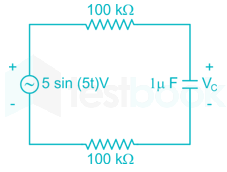
For the circuit given in the figure, the voltage VC (in volts) across the capacitor is
((a))
1.252sin(5t−0.25π)
((b))
1.252sin(5t−0.125π)
((c))
2.52sin(5t−0.25π)
((d))
2.52sin(5t−0.125π)
Show Answer
Answer: ((c))
2.52sin(5t−0.25π)
Concept:
Z = R + Xc
Where Z is the total impedance
R is the resistance of the circuit
Xc is the capacitive reactance of the circuit
Xc=j2πfC1
Where,
f is the frequency of the supply
C is the capacitance of the circuit.
Phasor
A phasor is a vector representation of a sinusoidal function that has both a magnitude and a phase angle.
Representations:
Rectangular form: z = x + jy
Polar form: z = r ∠ ϕ
Exponential form: z = z ejϕ
Calculation:
The capacitive impedance is given by:
XC=ωC1
With ω = 5 and C = 1 μF, we can write:
XC=5×10−61Ω
XC = 200 kΩ
The voltage across the capacitor will be:
VC=5∠0×200−j200(−j200)
VC=5∠0×2−j(1+j)
VC=2.52∠−45∘
In terms of π, the above can be written as:
VC=2.52∠−0.25π
Converting the phasor representation back to the time domain representation, we can write:
Vc(t)=2.52sin(5t−0.25t)
46
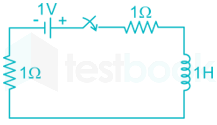
For the circuit given in the figure, the magnitude of the loop current (in amperes, correct to three decimal places), 0.5 seconds after closing the switch is ________.
47
A dc current of 26 μA flows through the circuit shown. The diode in the circuit is forward biased and it has an ideality factor of one. At the quiescent point, the diode has a junction capacitance of 0.5 nF. Its neutral region resistances can be neglected. Assume that the room temperature thermal equivalent voltage is 26 mV.
For ω = 2 × 10⁶ rad/s, the amplitude of the small-signal component of diode current (in μA, correct to one decimal place) is _______.
48
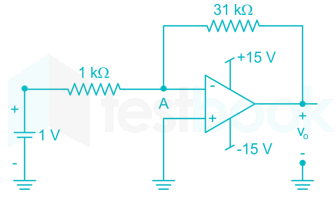
An op-amp based circuit is implemented as shown below.
In the above circuit, assume the op-amp to be ideal. The voltage (in volts, correct to one decimal place) at node A, connected to the negative input of the op-amp as indicated in the figure is ________.
49
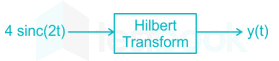
The input 4sinc(2t) is fed to a Hilbert transformer to obtain y(t), as shown in the figure below:
Here sinc(x)=πxsin(πx) The value (accurate to two decimal places) \(\mathop \smallint \limits_{ - \infty }^\infty {\left| {{\rm{y}}\left( {\rm{t}} \right)} \right|^2}{\rm{dt;}}\) is ________.
50
A random variable 𝑋 takes values −0.5 and 0.5 with probabilities 41 and 43, respectively. The noisy observation of 𝑋 is 𝑌 = 𝑋 + 𝑍, where 𝑍 has a uniform probability density over the interval (−1, 1). 𝑋 and 𝑍 are independent. If the MAP rule-based detector outputs X^ as
then the value of 𝛼 (accurate to two decimal places) is _______.
51
For a unity feedback control system with the forward path transfer function
G(s)=s(s+2)K
The peak resonant magnitude Mr of the closed-loop frequency response is 2. The corresponding value of the gain K (correct to two decimal places) is _______.
52
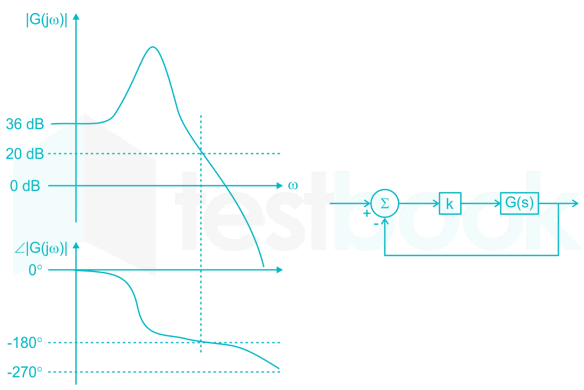
The figure below shows the Bode magnitude and phase plots of a stable transfer function
G(s)=s3+d2s2+d1s+d0n0
Consider the negative unity feedback configuration with gain in the feedforward path. The closed loop is stable for 𝑘 < 𝑘0. The maximum value of 𝑘0 is ______.
53
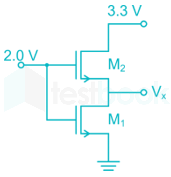
In the circuit shown below, the (𝑊/𝐿) value for M2 is twice that for M1. The two nMOS transistors are otherwise identical. The threshold voltage 𝑉𝑇 for both transistors is 1.0V. Find Vx.
Note that 𝑉𝐺𝑆 for M2 must be > 1.0 V.
Current through the NMOS transistors can be modelled as
A solar cell of area 1.0 cm2, operating at 1.0 sun intensity, has a short circuit current of 20 mA, and an open circuit voltage of 0.65 V. Assuming room temperature operation and thermal equivalent voltage of 26 mV, the open circuit voltage (in volts, correct to two decimal places) at 0.2 sun intensity is ________.
55
A junction is made between p- Si with doping density NA1 = 1015 cm-3 and p Si with doping density NA2 = 1017 cm-3.
At room temperature (T = 300K), the magnitude of the built-in potential (in volts, correct to two decimal places) across this junction will be ________.
56
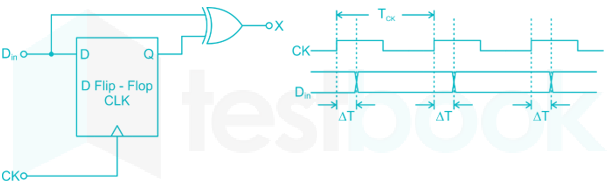
In the circuit shown below, a positive edge-triggered D Flip-Flop is used for sampling input data 𝐷𝑖𝑛 using clock 𝐶𝐾. The XOR gate outputs 3.3 volts for logic HIGH and 0 volts for logic LOW levels. The data bit and clock periods are equal and the value of Δ𝑇/𝑇𝐶𝐾 = 0.15, where the parameters Δ𝑇 and 𝑇𝐶𝐾 are shown in the figure. Assume that the Flip-Flop and the XOR gate are ideal.
If the probability of input data bit (𝐷𝑖𝑛) transition in each clock period is 0.3, the average
value (in volts, accurate to two decimal places) of the voltage at node 𝑋, is _______.
57
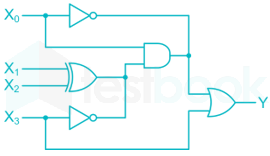
The logic gates shown in the digital circuit below use strong pull-down nMOS transistors for LOW logic level at the outputs. When the pull-downs are off, high-value resistors set the output logic levels to HIGH (i.e. the pull-ups are weak). Note that some nodes are intentionally shorted to implement “wired logic”. Such shorted nodes will be HIGH only if the outputs of all the gates whose outputs are shorted are HIGH.
The number of distinct values of 𝑋3 𝑋2 𝑋1 𝑋0 (out of the 16 possible values) that give 𝑌 = 1 is _______.
58
The cut-off frequency of TE01 mode of an air-filled rectangular waveguide having inner dimensions a cm × b cm (a > b) is twice that of the dominant TE10 mode. When the waveguide is operated at a frequency which is 25% higher than the cut-off frequency of the dominant mode, the guide wavelength is found to be 4 cm. The value of b (in cm, correct to two decimal places) is _______.
59
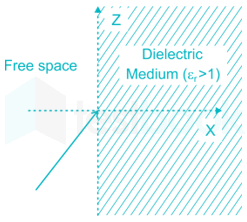
A uniform plane wave traveling in free space and having the electric field.
is incident on a dielectric medium (relative permittivity > 1, relative permeability = 1) as shown in the figure and there is no reflected wave.
The relative permittivity (correct to two decimal places) of the dielectric medium is
___________.
60
The position of a particle (𝑡) is described by the differential equation:
dt2d2y=−dtdy−45y
The initial conditions are y(0) = 1 and dtdyt=0=0. The position (accurate to two decimal places) of the particle at t = π is _______.
61
The contour C given below is on the complex plane z = x + jy, where j=−1
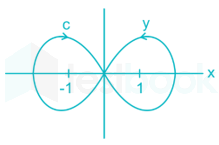
The value of the integral πj1c∮z2−1dz is _______
62
Let r = x2 + y - z and z3 -xy + yz + y3 = 1. Assume that x and y are independent variables. At (x, y, z) = (2, -1, 1), the value (correct to two decimal places) of ∂x∂r; is _________ .
63
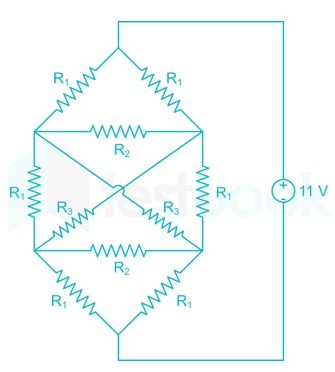
Consider the network shown below with 𝑅1 = 1 Ω, 𝑅2 = 2 Ω and 𝑅3 = 3 Ω. The network is connected to a constant voltage source of 11 V.
The magnitude of the current (in amperes, accurate to two decimal places) through the source is ________.
64
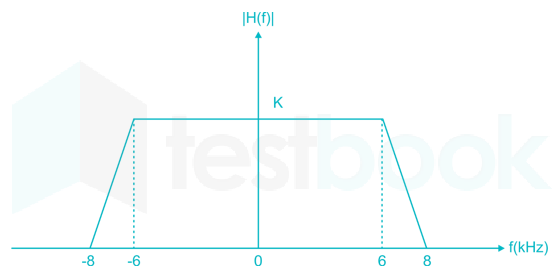
A band-limited low-pass signal x(𝑡) of bandwidth 5 kHz is sampled at a sampling rate 𝑓𝑠. The signal x(𝑡) is reconstructed using the reconstruction filter H(𝑓) whose magnitude response is shown below:
The minimum sampling rate fs(in kHz) for perfect reconstruction of x(t) is _______.
65
Let X[k] = k + 1, 0 ≤ k ≤ 7 be 8-point DFT of a sequence x[n], where
\(X\left[ k \right] = \mathop \sum \limits_{n = 0}^{N - 1} x\left[ n \right]{e^{ - j2\pi nk/N}}\)
The value (correct to two decimal places) of \(\mathop \sum \limits_{n = 0}^3 x\left[ {2n} \right]\) is ______