Official Paper

GATE EC 2017 Official Paper: Shift 1 (Previous Year Paper)

65 questions · 180 minutes · with answers · free

General Aptitude (10 questions)

1

She has a sharp tongue and it can occasionally turn ________

  1. ((a))

    hurtful

  2. ((b))

    left

  3. ((c))

    methodical

  4. ((d))

    vital

Show Answer
Answer: ((a))

hurtful

The correct answer is 'hurtful'.

Key Points

  • 'Sharp tongue' is an idiomatic phrase which means a tendency to speak in a malicious or in highly critical manner
  • ExampleThe mean old lady who lived on the corner made a reputation among us kids with her sharp tongue.
  • Thus, out of all the options, only 'hurtful' fits the blank.
  • Therefore, the correct answer is option 1.

The correct sentence is: She has a sharp tongue and it can occasionally turn hurtful.

2

I ________ made arrangements had I ________ informed earlier

  1. ((a))

    could have, been

  2. ((b))

    would have. being

  3. ((c))

    had, have 

  4. ((d))

    had been, been

Show Answer
Answer: ((a))

could have, been

The correct answer is 'could have, been'.

Key Points

  • The given sentence is an example of the third conditional sentence.
  • Third conditional sentence: It is used to talk about something in the past that did not happen.
  • Structure:
  • if + past perfect, would + have + past participle.
  • Example:
  • If I’d known, I would have worn something nicer.
  • I definitely would’ve remembered if you’d told me!
  • Note: Would have can be replaced with 'could have', 'might have', etc.
  • Thus, 'Could have' will be used in the first blank, and 'been' will be used in the second blank.

Therefore, the correct sentence is: 'I could have made arrangements had I been informed earlier.'

Additional Information

  • Conditional sentence: As the name suggests it is used to tell conditions. This type of sentence has two clauses one is a conditional clause which is used to tell conditions and another is the main clause.
  • Generally, the Conditional clause is succeeded by the main clause but it can be reversed.
3

In the summer, water consumption is known to decrease overall by 25%. A Water Board official states that in the summer household consumption decreases by 20%, while other consumption increases by 70%. Which of the following statements is correct?

  1. ((a))

    The ratio of household to other consumption is 8/17

  2. ((b))

    The ratio of household to other consumption is 1/17 

  3. ((c))

    The ratio of household to other consumption is 17/8 

  4. ((d))

    There are errors in the official's statement.

Show Answer
Answer: ((d))

There are errors in the official's statement.

Let Initial household consumption be “H” and Other consumption be “O”

During Summer

Household consumption = H – 20% of H = 0.8 H

Other consumption = O + 70% of O = 1.7 O

Overall Consumption:

0.8 H + 1.7 O ………(1)

According to the question, the overall consumption reduces by 25 %, i.e.

Overall Consumption will now be:

= (O + H) – 25% of (O + H) = 0.75 (O + H) ..(2)

From Equation (1) and (2), we get:

0.8 H + 1.7 O = 0.75 (O+H)

0.05 H = -0.95 O

HO=0.950.05\frac{H}{O} = - \frac{{0.95}}{{0.05}}

Since the ratio cannot be negative, there are errors in the Official's statement.

4

40% of deaths on city roads may be attributed to drunken driving. The number of degrees needed to represent this as a slice of a pie chart is 

  1. ((a))

    120

  2. ((b))

    144

  3. ((c))

    160

  4. ((d))

    212

Show Answer
Answer: ((b))

144

In a pie chart

360° represents 100%

1% represents 3.6°

40% represents 144°

5

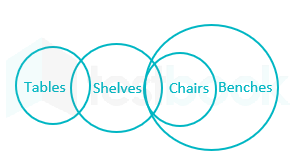
Some tables are shelves. Some shelves are chairs. All chairs are benches. Which of the following conclusions can be deduced from the preceding sentences?

i) At least one bench is a table

ii) At least one shelf is a bench

iii) At least one chair is a table

iv) All benches are chairs

  1. ((a))

    Only i

  2. ((b))

    Only ii

  3. ((c))

    Only ii and iii

  4. ((d))

    Only iv

Show Answer
Answer: ((b))

Only ii

Explanation:

The least possible Venn diagram is:

Conclusion i → False (as it is possible but not definite)

Conclusion ii → True (as some shelves are chairs and all chairs are benches)

Conclusion iii → False (as it is possible but not definite)

Conclusion iv → False (as it is possible but not definite)

Hence, only conclusion ii follows.

6

"If you are looking for a history of India, or for an account of the rise and fall of the British Raj, or for the reason of the cleaving of the subcontinent into two mutually antagonistic parts and the effects, this mutilation will have in the respective sections, and ultimately on Asia, you will not find it in these pages; for though I have spent a lifetime in the country. I lived too near the seat of events, and was too intimately associated with the actors, to get the perspective needed for the impartial recording of these matters".

Here, the word 'antagonistic' is closest in meaning to

  1. ((a))

    Impartial 

  2. ((b))

    Argumentative 

  3. ((c))

    Separated

  4. ((d))

    Hostile

Show Answer
Answer: ((d))

Hostile

The correct answer is 'Hostile'.

Key Points

  • The passage lists the various events that happened in the contemporary history of the Indian subcontinent. The word 'antagonistic' is used to describe the relationship between India and Pakistan after the Partition by the Britishers.
  • Let's explore the meaning of the given word and the marked word
  • Antagonistic: showing or feeling active opposition or hostility toward someone or something.
  • ExampleMy step-brother has always been very antagonistic towards me, never sharing his things or spending any time with me if he can help it.
  • Hostile: unfriendly; antagonistic.
  • Example:  Their hostile looks showed that he was unwelcome.
  • Thus, from the above-given explanation, we can say that 'Hostile' is closest in meaning to the word 'Antagonistic'.
  • Therefore, the correct answer is option 4.

Additional Information

  • Let's explore the meaning of other options:
  • Impartial: not partial or biased
  • Argumentative: having or showing a tendency to disagree or argue with other people in an angry way
  • Separated: divided into constituent or distinct elements.
7

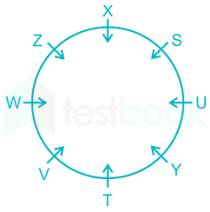
S, T, U, V, W,X, Y and Z are seated around a circular table. T's neighbours are Y and V, Z is seated third to the left of T and second to the right of S. U's neighbours are S and Y and T and W are not seated opposite each other. Who is third to the left of V?

  1. ((a))

    X

  2. ((b))

    W

  3. ((c))

    U

  4. ((d))

    T

Show Answer
Answer: ((a))

X

The seating arrangement considering all given conditions is shown:

From the seating arrangement, person third to the left of V is X

8

Trucks (10 m long) and cars (5 m long) go on a single lane bridge. There must be a gap of at least 20 m after each truck and a gap of at least 15 m after each car. Trucks and cars travel at a speed of 36 km/h. If cars and trucks go alternately, what is the maximum number of vehicles that can use the bridge in one hour?

  1. ((a))

    1440

  2. ((b))

    1200

  3. ((c))

    720

  4. ((d))

    600

Show Answer
Answer: ((a))

1440

Length of truck + gap required = 10 + 20 = 30 m

Length of car + gap required = 5 + 15 = 20 m

Total distance is need for truck and car for passing alternatively = 30 + 20 = 50 m

Lets us call this 50 m as 1 unit

Speed = 36 km/h

So, for 1 hour the distance is 36 km = 36000 meters

Total number of units that can pass are:

3600050=720;units\frac{{36000}}{{50}} = 720;units

Total number of vehicles that can pass = 720 × 2 = 1440

9

There are 3 Indians and 3 Chinese in a group of 6 people. How many subgroups of this group can we choose so that every subgroup has at least one Indian?

  1. ((a))

    56 

  2. ((b))

    52

  3. ((c))

    48

  4. ((d))

    44

Show Answer
Answer: ((a))

56 

Case 1 ( 1 Indian)

The possible subgroups can be

1 Indian with 0 Chinese

1 Indian with 1 Chinese

1 Indian with 2 Chinese

1 Indian with 3 Chinese

Sum of case 1 Possible cases :

Case 2 ( 2 Indians)

The possible subgroups can be

2 Indian with 0 Chinese

2 Indian with 1 Chinese

2 Indian with 2 Chinese

2 Indian with 3 Chinese

Sum of case 2 Possible cases :

Case 3 ( 3 Indians)

The possible subgroups can be

3 Indian with 0 Chinese

3 Indian with 1 Chinese

3 Indian with 2 Chinese

3 Indian with 3 Chinese

Sum of case 2 Possible cases :

Total cases :

24 + 24 + 8 = 56

10

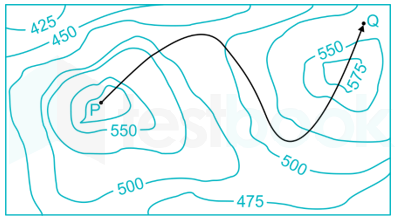
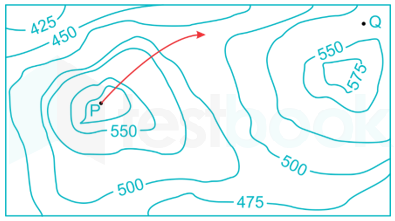
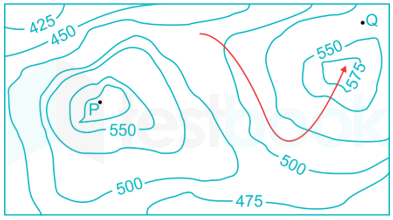
A contour line joins locations having the same height above the mean sea level. The following is a contour plot of a geographical region. Contour lines are shown at 25 m intervals in this plot.
The path from P to Q is best described by

  1. ((a))

    Up-Down-Up-Down

  2. ((b))

    Down-Up-Down-Up

  3. ((c))

    Down-Up-Down

  4. ((d))

    Up-Down-Up

Show Answer
Answer: ((c))

Down-Up-Down

During the first path

550 → 525→500→ 475

The movement is downward

During the second path

475 → 500 → 525 → 550

The movement is upwards

The last path

575 → 550

Path is down

Total path movement from P to Q is

Down → Up → Down

Electronics and Communication Engineering (55 questions)

11

Consider the 5 × 5 matrix

\(A = \left[ {\begin{array}{*{20}{c}} 1&2&3&4&5\ 5&1&2&3&4\ 4&5&1&2&3\ 3&4&5&1&2\ 2&3&4&5&1 \end{array}} \right]\).

It is given that A has only one real eigenvalue. Then the real eigenvalue of A is

  1. ((a))

    -2.5

  2. ((b))

    0

  3. ((c))

    15

  4. ((d))

    25

Show Answer
Answer: ((c))

15

\(A = \left[ {\begin{array}{*{20}{c}} 1&2&3&4&5\ 5&1&2&3&4\ 4&5&1&2&3\ 3&4&5&1&2\ 2&3&4&5&1 \end{array}} \right]\)

The Eigenvalues of a Matrix are given by:

|A – λ I| = 0

\(\left[ {\begin{array}{{20}{c}} {1 - \lambda }\ {\begin{array}{{20}{c}} 5\ {\begin{array}{{20}{c}} 4\ {\begin{array}{{20}{c}} 3\ 2 \end{array}} \end{array}} \end{array}} \end{array}\begin{array}{{20}{c}} 2\ {\begin{array}{{20}{c}} {1 - \lambda }\ {\begin{array}{{20}{c}} 5\ 4\ 3 \end{array}} \end{array}} \end{array}\begin{array}{{20}{c}} 3\ {\begin{array}{{20}{c}} 2\ {\begin{array}{{20}{c}} {1 - \lambda }\ 5\ 4 \end{array}} \end{array}} \end{array}\begin{array}{{20}{c}} 4\ {\begin{array}{{20}{c}} 3\ {\begin{array}{{20}{c}} 2\ {1 - \lambda }\ 5 \end{array}} \end{array}} \end{array}\begin{array}{{20}{c}} 5\ {\begin{array}{{20}{c}} 4\ {\begin{array}{{20}{c}} 3\ 2\ {1 - \lambda } \end{array}} \end{array}} \end{array}} \right] = 0\)

Apply Row Transformation

R1 → R1 + R2 + R3 + R4 + R5

\(\left[ {\begin{array}{{20}{c}} {15 - \lambda }\ {\begin{array}{{20}{c}} 5\ {\begin{array}{{20}{c}} 4\ {\begin{array}{{20}{c}} 3\ 2 \end{array}} \end{array}} \end{array}} \end{array}\begin{array}{{20}{c}} {;15 - \lambda }\ {\begin{array}{{20}{c}} {1 - \lambda }\ {\begin{array}{{20}{c}} 5\ 4\ 3 \end{array}} \end{array}} \end{array}\begin{array}{{20}{c}} {;15 - \lambda ;}\ {\begin{array}{{20}{c}} 2\ {\begin{array}{{20}{c}} {1 - \lambda }\ 5\ 4 \end{array}} \end{array}} \end{array}\begin{array}{{20}{c}} {15 - \lambda ;}\ {\begin{array}{{20}{c}} 3\ {\begin{array}{{20}{c}} 2\ {1 - \lambda }\ 5 \end{array}} \end{array}} \end{array}\begin{array}{{20}{c}} {15 - \lambda }\ {\begin{array}{{20}{c}} 4\ {\begin{array}{{20}{c}} 3\ 2\ {1 - \lambda } \end{array}} \end{array}} \end{array}} \right]\)

\(\left( {15 - \lambda } \right)\left( {\begin{array}{{20}{c}} 1\ {\begin{array}{{20}{c}} 5\ {\begin{array}{{20}{c}} 4\ {\begin{array}{{20}{c}} 3\ 2 \end{array}} \end{array}} \end{array}} \end{array}\begin{array}{{20}{c}} 1\ {\begin{array}{{20}{c}} {;1 - \lambda }\ {\begin{array}{{20}{c}} 5\ 4\ 3 \end{array}} \end{array};} \end{array}\begin{array}{{20}{c}} 1\ {\begin{array}{{20}{c}} 2\ {\begin{array}{{20}{c}} {1 - \lambda }\ 5\ 4 \end{array};} \end{array}} \end{array}\begin{array}{{20}{c}} 1\ {\begin{array}{{20}{c}} 3\ {\begin{array}{{20}{c}} {;2}\ {1 - \lambda }\ 5 \end{array}} \end{array}} \end{array}\begin{array}{{20}{c}} 1\ {\begin{array}{{20}{c}} 4\ {\begin{array}{{20}{c}} 3\ 2\ {;1 - \lambda } \end{array}} \end{array}} \end{array}} \right)\)

It is given that the matrix A has only one real eigenvalue, i.e.

⇒ 15 - λ = 0

⇒ λ = 15

The other 4 eigenvalues are complex conjugates .

12

The rank of the matrix \({\rm{M}} = \left[ {\begin{array}{*{20}{c}} 5&{10}&{10}\ 1&0&2\ 3&6&6 \end{array}} \right]{\rm{is}}\)

  1. ((a))

    0

  2. ((b))

    1

  3. ((c))

    2

  4. ((d))

    3

Show Answer
Answer: ((c))

2

\(\left[ {\begin{array}{*{20}{c}} 5&{10}&{10}\ 1&0&2\ 3&6&6 \end{array}} \right];\)

Converting it into Echelon form, we carry out the following transformations:

R2 ↔ R1

\(\left[ {\begin{array}{*{20}{c}} 1&0&2\ 5&{10}&{10}\ 3&6&6 \end{array}} \right]\)

R2 → R2 – 5R1

R3 → R3 – 3R1

\(\left[ {\begin{array}{*{20}{c}} 1&0&2\ 0&{10}&0\ 0&6&0 \end{array}} \right]\)

R3;;R3610R2{{\rm{R}}_3}{\rm{;}} \to {\rm{;}}{{\rm{R}}_3}{\rm{}} - \frac{6}{{10}}{R_2}

\(\left[ {\begin{array}{*{20}{c}} 1&0&2\ 0&{10}&0\ 0&0&0 \end{array}} \right]\)

Since the number of non-zeros Rows in the above Matrix is 2, the rank of the matrix will be 2.

13

Consider the following statements about the linear dependence of the real valued functions y1 = 1, y2 = x and y3 = x2, over the field of real numbers.

I. y1, y2 and y3 are linearly independent on – 1 ≤ x ≤ 0

II. y1, y2 and y3 are linearly dependent on 0 ≤ x ≤ 1

III. y1, y2 and y3 are linearly independent on 0 ≤ x ≤ 1

IV. y1, y2 and y3 are linearly dependent on – 1 ≤ x ≤ 0

Which one among the following is correct?

  1. ((a))

    Both I and II are true

  2. ((b))

    Both I and III are true

  3. ((c))

    Both II and IV are true

  4. ((d))

    Both III and IV are true

Show Answer
Answer: ((b))

Both I and III are true

Concept:

The linear dependency or Independency of function fi can be found using Wronskion Matrix.

An analytic function is linearly dependent if:

\(\left| {\begin{array}{*{20}{c}} {{f_1}\left( x \right)}&{{f_2}\left( x \right)}&{{f_3}\left( x \right)}\ {f_1'\left( x \right)}&{f_2'\left( x \right)}&{f_3'\left( x \right)}\ {f_1{''}\left( x \right)}&{f_2{''}\left( x \right)}&{f_3{''}\left( x \right)} \end{array}} \right| = 0\)

Application:

\(\left| {\begin{array}{*{20}{c}} 1&x&{{x^2}}\ 0&1&{2x}\ 0&0&2 \end{array}} \right| = 2 \ne 0\)

Determinant ≠ 0

Function y1, y2, y­3 are linearly independent.

14

Three fair cubical dice are thrown simultaneously. The probability that all three dice have the same number of dots on the faces showing up is (up to third decimal place) _______.

15

Consider the following statements for continuous-time linear time invariant (LTI) systems.

I. There is no bounded input bounded output (BIBO) stable system with a pole in the right half of the complex plane.

II. There is no causal and BIBO stable system with a pole in the right half of the complex plane.

Which one among the following is correct?

  1. ((a))

    Both I and II are true

  2. ((b))

    Both I and II are not true

  3. ((c))

    Only I is true

  4. ((d))

    Only II is true

Show Answer
Answer: ((d))

Only II is true

Concept:

An LTI system is stable if and only if the ROC of the impulse function H(s) includes the jω axis.

For Causal System → ROC is to the right side of the rightmost pole.

For Anti Causal System → ROC is to the left side of the left-most pole.

Observations:

  • For a causal system to be stable, the poles must lie on the left half of the complex plane (to include the jω axis)
  • A causal system with a pole on the right side cannot be BIBO stable because it's ROC can never include the jω axis. (Statement (II) is therefore correct)
  • A BIBO system with a pole in the right half of the complex plane is stable if the system is anti-causal, as this will include the jω axis. (Statement (I) is therefore incorrect)
16

Consider a single input single output discrete-time system with x[n] as input and y[n] as output. Where the two are related as

\(y\left[ n \right] = \left{ {\begin{array}{{20}{c}} {;n\left| {x\left[ n \right]} \right|,;}\ {x\left[ n \right] - x\left[ {n - 1} \right],} \end{array}} \right.\begin{array}{{20}{c}} {;for;0 \le n \le 10}\ {otherwise.} \end{array}\)

Which one of the following statements is true about the system?

  1. ((a))

    It is casual and stable

  2. ((b))

    It is causal but not stable

  3. ((c))

    It is not causal but stable

  4. ((d))

    It is neither causal nor stable

Show Answer
Answer: ((a))

It is casual and stable

Concept:

For a system to be causal, the Present output should depend on the present or past input only.

For a system to be Stable, a Bounded input should produce a Bounded Output.

Analysis:

\(y\left( n \right) = \left{ {\begin{array}{{20}{c}} {\begin{array}{{20}{c}} {n|x\left( n \right)|}&{0 \le n \le 10} \end{array}}\ {\begin{array}{*{20}{c}} {x\left( n \right) - x\left( {n - 1} \right)}&{otherwise} \end{array}} \end{array}} \right.\)

For 0 < n < 10,

y(n) = n|x(n)|

Let x(n) is bounded, i.e. for -∞ ≤ n ≤ ∞, x(n) ≤ M, where M is finite.

So, for -∞ ≤ n ≤ ∞, |n.x(n)| will also approach a finite value. Hence in this interval y(n) is bounded. i.e. the system is stable.

Since the output y(n) is depending on the present value of the input only, the system in this interval is also causal.

For n < 0 and n > 10:

y(n) = x(n) - x(n-1).

Let input x(n) is bounded. ∴ y(n) = x(n) - x(n-1) will also be bounded, i.e. it will go to a finite value.

Hence in this interval, the system is said to be stable.

Also, because the output y(n) depends on the present and the past input values only, the system is causal as well in this interval.

∴ After considering both the intervals we can conclude that the system is both stable and causal.

17

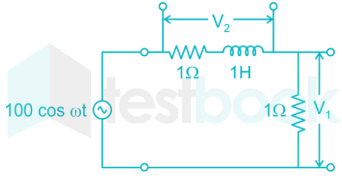
In the circuit shown, the positive angular frequency ω (in radians per second) at which the magnitude of the phase difference between the voltages V1 and V2 equals π /4 radians, is _____.

18

A periodic signal x(t) has a trigonometric Fourier series expansion

\(x\left( t \right) = {a_0} + \mathop \sum \limits_{n = 1}^\infty ({a_n};cos;n;{\omega _0}t + {b_n}\sin n;{\omega _0}t)\)

If x(t) = -x (- t) = -x (t - π/ω0), we can conclude that

  1. ((a))

    an are zero for all n and bn are zero for n even

  2. ((b))

    an are zero for all n and bn are zero for n odd

  3. ((c))

    an are zero for n even and bn are zero for n odd

  4. ((d))

    an are zero for n odd and bn are zero for n even

Show Answer
Answer: ((a))

an are zero for all n and bn are zero for n even

Concept:

For an odd signal x(t) = -x(-t).

The average value of an odd periodic signal is 0.

For half-wave symmetric signal:

x (t ± T/2) = - x(t)

A half-wave symmetric signal only has odd harmonics in its Fourier series representation.

Calculation:

The given function is odd, hence

ao (Average Value) = 0 and an = 0

Also, since x(t) = -x (t – π/ ω0)

It is also half-wave symmetric.

Hence the signal will contain only odd harmonics.

19

A bar of Gallium Arsenide (GaAs) is doped with Silicon such that the Silicon atoms occupy Gallium and Arsenic sites in the GaAs crystal. Which one of the following statements is true?

  1. ((a))

    Silicon atoms act as p-type dopants in Arsenic sites and n-type dopants in Gallium sites

  2. ((b))

    Silicon atoms act as n-type dopants in Arsenic sites and p-type dopants in Gallium sites

  3. ((c))

    Silicon atoms act as p-type dopants in Arsenic as well as Gallium sites

  4. ((d))

    Silicon atoms act as n-type dopants in Arsenic as well as Gallium sites

Show Answer
Answer: ((a))

Silicon atoms act as p-type dopants in Arsenic sites and n-type dopants in Gallium sites

Concept:

If the substituting atom gives one extra electron in the outermost shell then n-type semiconductor is formed. If substituting atom has one electron less in the outermost shell then p-type semiconductor is formed.

Si → 4e- in the outermost shell

Ga → 3e- in the outermost shell

As → 5e- in the outermost shell

Application:

Note:  Here, GaAs is doped with Silicon. So, Silicon is the substituting atom.

For Arsenic sites, Silicon will act as a p-type dopant as it has 1 electron less than Arsenic in its outermost shell.

And for Gallium sites, Silicon will act a n-type dopant as it has 1 electron more than Gallium in its outermost shell.

Si → Ga → 1e- extra → n-type

Si → As → 1e- less → p-type

20

An n- n Silicon device is fabricated with uniform and non-degenerate donor doping concentrations of ND1 = 1 × 1018 cm-3 and ND2 = 1 × 1015 cm-3 corresponding to the n+ and n regions respectively. At the operational temperature T, assume complete impurity ionization, kT/q = 25 mV, and intrinsic carrier concentration to be ni = 1 × 1010 cm-3. What is the magnitude of the built – in potential of this device?

  1. ((a))

    0.748 V

  2. ((b))

    0.460 V

  3. ((c))

    0.288 V

  4. ((d))

    0.173 V

Show Answer
Answer: ((d))

0.173 V

Concept:

The Built-in Potential of a p-n junction diode is given by:

Vo=kTqln(NANDni2){V_o} = \frac{{kT}}{q}\ln \left( {\frac{{{N_A}{N_D}}}{{n_i^2}}} \right)

Where NA = doping density of holes

ND = doping density of electrons

Also, the law of mass-Action states that:

ni2=NANDn_i^2 = {N_A}{N_D}

Calculation:

n+n + 1018/cm3{10^{18}}/c{m^3}nn 1015/cm3{10^{15}}/c{m^3}


n+ = 1018/cm3

n = 1015/cm3

ni = 1010/cm3

The n+ Junction here has more electrons than the n Junction [Analogous to p-n Junction]

Hole concertation in n – region using mass action law will be:

 p=ni2N=10201015p= \frac{{n_i^2}}{N} = \frac{{{{10}^{20}}}}{{{{10}^{15}}}} = NA

Putting on the respective values, we get:

Vo=KT2ln(ND++NAni2)=0.173V{V_o} = \frac{{KT}}{2}{l_n}\left( {\frac{{N_D^ + + {N_A}}}{{n_i^2}}} \right) = 0.173V

21

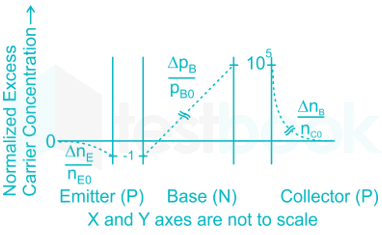
For a narrow base PNP BJT, the excess minority carrier concentrations (ΔnE for emitter, ΔpB for base, ΔnC for collector) normalized to equilibrium minority carrier concentrations (nE0 for emitter, pB0 for base, nC0 for collector) in the quasi-neutral emitter, base and collector regions are shown below. Which one of the following biasing modes is the transistor operating in?

  1. ((a))

    Forward active

  2. ((b))

    Saturation

  3. ((c))

    Inverse active

  4. ((d))

    Cutoff

Show Answer
Answer: ((c))

Inverse active

Observation 1:

Consider the hole concertation in the base, near the collector-base junction.

Minority carrier concertation (∆pb) is high. This is because excess holes are supplied by the collector (P).

This means C.B. Junction is forward Biased.

Observation 2:

The minority hole carrier concertation in a base region near the Emitter – base Junction is low, i.e. holes are extracted from the base.

This indicates that the Emitter Base junction is Reversed Biased.

∴ The mode of operation is Reverse Active.

22

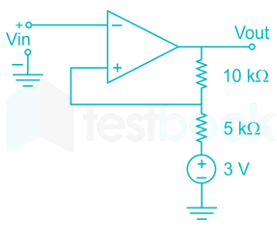
For the operational amplifier circuit shown, the output saturation voltages are ± 15V. The upper and lower threshold voltages for the circuit are, respectively.

  1. ((a))

    +5 V and -5 V

  2. ((b))

    +7 V and -3 V

  3. ((c))

    +3 V and -7 V

  4. ((d))

    +3 V and -3 V

Show Answer
Answer: ((b))

+7 V and -3 V

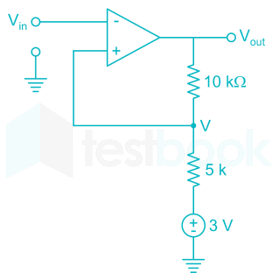
Since the given Op-Amp has a positive-feedback connection, the output will be saturated to either + 15V or -15 V.

Apply KCL at node V, we get:

VVout10+V35+0=0 \frac{{V - {V_{out}}}}{{10}} + \frac{{V - 3}}{5} + 0 = 0

Due to the high input impedance of the Op-Amp, the input current to the Op-amp will be 0.

V=Vout+63V = \frac{{{V_{out}} + 6}}{3}

For an upper saturated voltage output of Vout = +15 V, we get the threshold voltage V of:

V=Vin=15+63V =V_{in}= \frac{{15 + 6}}{3}

V=213=7 VV= \frac{{21}}{3}=7~V

For a lower saturated voltage of Vout =  -15 V, we get the threshold voltage V of:

V=Vin=15+63V = V_{in}=\frac{{ - 15 + 6}}{3}

V==93=3 VV== \frac{{ - 9}}{3}=-3~V

23

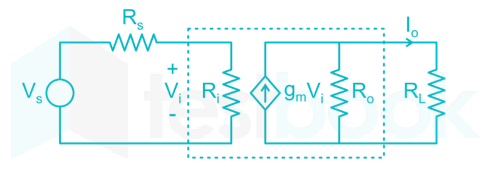
A good transconductance amplifier should have 

  1. ((a))

    high input resistance and low output resistance

  2. ((b))

    low input resistance and high output resistance

  3. ((c))

    high input and output resistance

  4. ((d))

    low input and output resistance

Show Answer
Answer: ((c))

high input and output resistance

Transconductance Amplifier gain =IoutVin = \frac{{{I_{out}}}}{{{V_{in}}}} 

Thus, the input to the transconductance Amplifier is a voltage, and the output is current.

To effectively couple voltage from the source, Rin should be high.

To effectively deliver current to load, Rout should be High.

24

The Miller effect in the context of a Common Emitter amplifier explains

  1. ((a))

    an increase in the low-frequency cutoff frequency 

  2. ((b))

    an increase in the high-frequency cutoff frequency 

  3. ((c))

    a decrease in the low-frequency cutoff frequency

  4. ((d))

    a decrease in the high-frequency cutoff frequency

Show Answer
Answer: ((d))

a decrease in the high-frequency cutoff frequency

The miller effect causes increase in the Input capacitance of Common – Emitter Amplifier

Upper cutoff frequency (fh)1Cinput\left( {{f_h}} \right)\propto \frac{1}{{{C_{input}}}} 

Therefore, there is decrease in upper-cut off frequency & Bandwidth of CE Amplifier

25

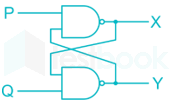
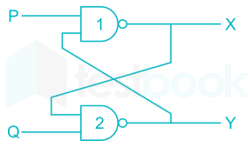
In the latch circuit shown, the NAND gates have non-zero, but unequal propagation delays. The present input conditions is: P = Q = ‘0’. If the input conditions is changed simultaneously to P = Q = ‘1’, the outputs X and Y are

  1. ((a))

    X = ‘1’, Y = ‘1’

  2. ((b))

    either X = ‘1’, Y = ‘0’ or X = ‘0’, Y = ‘1’

  3. ((c))

    either X = ‘1’, Y = ‘1’ or X = ‘0’, Y = ‘0’

  4. ((d))

    X = ‘0’, Y = ‘0’

Show Answer
Answer: ((b))

either X = ‘1’, Y = ‘0’ or X = ‘0’, Y = ‘1’

Let as assume tpd 1 < tpd 2

x changes state first then y changes

1st output of X (P = 1, y = 0) ⇒ X1 = 1

Next output of Y (Q = 1, X1 = 1) ⇒ Y1 = 0

2nd output of X (P = 1, y1 = 0) ⇒ 1

Hence output x = 1 y = 0 (if tpd1 < tpd2)

& Output X = 0 Y = 1 (if tpd2 < tpd1)

26

The clock frequency of an 8085 microprocessor is 5 MHz. If the time required to execute an instruction is 1.4 μs, then the number of T-states needed for executing the instruction is

  1. ((a))

    1

  2. ((b))

    6

  3. ((c))

    7

  4. ((d))

    4

Show Answer
Answer: ((c))

7

Concept:

The time required to execute an instruction is given by:

(No. of T - states) × Tclk

Tclk = Time period of the clock.

Calculation:

Given, clock frequency fclk = 5 MHz

∴ The time period of the clock will be:

Tclk=15=0.2 μ;sec{T_{clk}} = \frac{1}{5} = 0.2~\mu ;sec

We can write:

1.4 = n × 0.2

n = 7

27

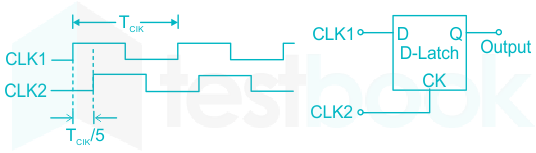
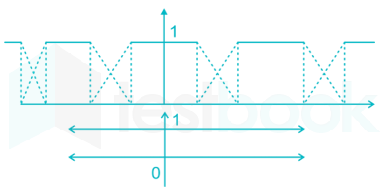
Consider the D-Latch shown in the figure, which is transparent when its clock input CK is high and has zero propagation delay. In the figure, the clock signal CLK1 has a 50% duty cycle and CLK2 is a one-fifth period delayed version of CLK1. The duty cycle at the output of the latch, in percentage is ________.

28

The open loop transfer function G(s)=(s+1)sp(s+2)(s+3)G\left( s \right) = \frac{{\left( {s + 1} \right)}}{{{s^p}\left( {s + 2} \right)\left( {s + 3} \right)}}

Where p is an integer, is conducted in unity feedback configuration as shown in the figure.

Given that the steady state error is zero for unit step input and is 6 for unit ramp input, the value of the parameter p is______.

29

Consider a stable system with the transfer function (s)=sp+b1sp1++bpsq+a1sq1++aq\left( s \right) = \frac{{{s^p} + {b_1}{s^{p - 1}} + \ldots + {b_p}}}{{{s^q} + {a_1}{s^{q - 1}} + \ldots + {a_q}}}

Where b1, …, bp and a1, …, aq are real-valued constants. The slope of the Bode log magnitude curve of G(s) converges to – 60 dB/decade as ω → ∞. A possible pair of values for p and q is

  1. ((a))

    p = 0 and q = 3

  2. ((b))

    p = 1 and q = 7

  3. ((c))

    p = 2 and q = 3

  4. ((d))

    p = 3 and q = 5

Show Answer
Answer: ((a))

p = 0 and q = 3

Concept:

The slope of Bode plot increase of + 20 dB/decade for every zero and decrease by -20 dB/decade for every pole.

Calculation:

Since the final slope of the Bode Plot is – 60 dB/decade:

Poles (q) > Zeros (p) by 3

p – q = 3

Option (A) satisfies this condition.

30

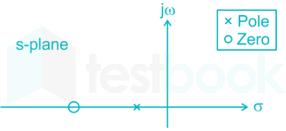
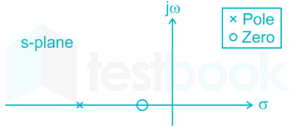
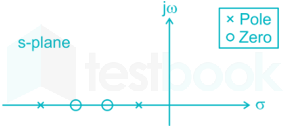
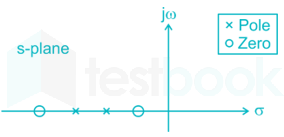
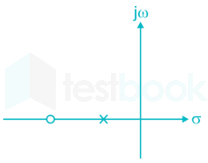
Which of the following can be the pole-zero configuration of a phase-lag controller (lag compensator)?

  1. ((a))

  2. ((b))

  3. ((c))

  4. ((d))

Show Answer
Answer: ((a))

Let H(f) be TF of phase-lag controller

H(f)=s+as+bH\left( f \right) = \frac{{s + a}}{{s + b}}

H(b)=tan1(ωa);tan1(ωb)\angle H\left( b \right) = {\tan^{-1}}\left( {\frac{{\rm{\omega }}}{a}} \right){ - ;{tan^{ - 1}}}\left( {\frac{{\rm{\omega }}}{b}} \right)

For lag Network ∠H(b) = -ve

tan1(ωa)<tan1(ωb){\tan ^{ - 1}}\left( {\frac{{\rm{\omega }}}{a}} \right) < {\tan ^{ - 1}}\left( {\frac{{\rm{\omega }}}{b}} \right)

(ωa)<(ωb)\left( {\frac{{\rm{\omega }}}{a}} \right) < \left( {\frac{{\rm{\omega }}}{b}} \right)

b < a

Pole is near to j ω axis than zero

31

Let (X1, X2) be independent random varibales. X1 has mean 0 and variance 1, while X2 has mean 1 and variance 4. The mutual information I(X1 ; X2) between X1 and X2 in bits is_______.

32

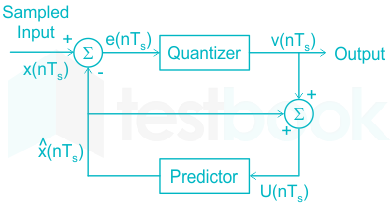
Which one of the following statements about differential pulse code modulation (DPCM) is true?

  1. ((a))

    The sum of message signal sample with its prediction is quantized 

  2. ((b))

    The message signal sample is directly quantized and its prediction is not used

  3. ((c))

    The difference of message signal sample and a random signal is quantized

  4. ((d))

    The difference of message signal sample with its prediction is quantized 

Show Answer
Answer: ((d))

The difference of message signal sample with its prediction is quantized 

DPCM transmitter is as shown:

We observe that the input to quantizer is the difference between the sampled message signal and its predicted value

33

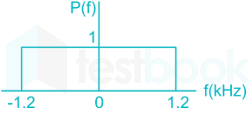
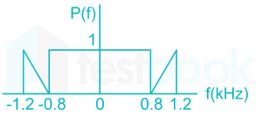
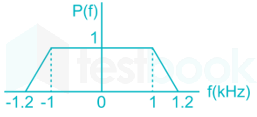
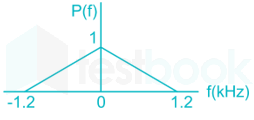
In a digital communication system, the overall pulse shape p(t) at the receiver before the sampler has the Fourier transform P(f). If the symbols are transmitted at the rate of 2000 symbols per second, for which of the following cases is the inter symbol interference zero?

  1. ((a))

  2. ((b))

  3. ((c))

  4. ((d))

Show Answer
Answer: ((b))

Concept:

Nyquist ISI criterium states that for ISI – free response:

\(h\left( {n{T_s}} \right) = \left{ {\begin{array}{*{20}{c}} {1;}&{n = 0}\ {0;}&{n \ne 0} \end{array}} \right.\)

i.e.

\(\frac{1}{{{T_s}}}\mathop \sum \limits_{T = - \infty }^{{T_\infty }} H\left( {b - \frac{k}{{{T_S}}}} \right) = 1\forall ;f\)

\(\mathop \sum \limits_{T = - \infty }^{{T_\infty }} H\left( {b - \frac{k}{{{T_S}}}} \right) = T_s = Constant;\forall ;f\)

Calculation:

fs=1Ts=2k;symbols/secf_s = \frac{1}{{{T_s}}} = 2k;symbols/sec

\(\mathop \sum \limits_{n = - \infty }^{ + \infty } p\left( {f - n;{f_s}} \right) = {T_s}\)

\(\mathop \sum \limits_{n = - \infty }^{ + \infty } P\left( {f - n;2k} \right) = 2k\)

We observe that only option (B) satisfies this condition, i.e.

\(\mathop \sum \limits_{n = - \infty }^{ + \infty } P\left( {b - n2k} \right) = Constant\)

34

The voltage of an electromagnetic wave propagating in a coaxial cable with uniform characterstic impedance is V(l) = e–yl+jωt Volts, where l is the distance along the length of the cable in metres, γ = (0.1 + j40)m–1 is the complex propagation constant, and ω = 2π × 109 rad/s is the angular frequency. The absolute value of the attenuation in the cable in dB/metre is ________.

35

Consider a wireless communication link between a transmitter and a receiver located in free space, with finite and strictly positive capacity. If the effective areas of the transmitter and the receiver antennas, and the distance between them are all doubled, and everything else remains unchanged, the maximum capacity of the wireless link

  1. ((a))

    increases by a factor of 2

  2. ((b))

    decreases by a factor of 2

  3. ((c))

    remains unchanged

  4. ((d))

    decreases by a factor of √2

Show Answer
Answer: ((c))

remains unchanged

Concept:

The capacity of a wireless link is given by Shanon Hartley theorem as:

C=B log2(1+SN)C = B~lo{g_2}\left( {1 + \frac{S}{N}} \right)

Channel capacity depends on (SN)\left( {\frac{S}{N}} \right), and hence on S.

S = Received power at the receiver = Pr

S=Pr=PTGtGr(4;πRλ)2S = {P_r} = \frac{{{P_T}{G_t}{G_r}}}{{{{\left( {\frac{{4;{\bf{\pi }}R}}{\lambda }} \right)}^2}}}

=Pt(Gπλ2Ate)(4πλ2Are)(4πRλ)2= \frac{{{P_t}\left( {\frac{{{G_\pi }}}{{{\lambda ^2}}}{A_{te}}} \right)\left( {\frac{{4\pi }}{{{\lambda ^2}}}{A_{re}}} \right)}}{{{{\left( {\frac{{4\pi R}}{\lambda }} \right)}^2}}}

Calculation:

It is given,

Ate' = 2Ate

Are' = 2 Are

R' = 2 R

Pr=Pt(4π;Ateλ2)(4πλ2Arc)2×2(4πRλ)2(2)2{P_{r'}} = \frac{{{P_t}\left( {\frac{{4\pi ;{A_{te}}}}{{{\lambda ^2}}}} \right)\left( {\frac{{4\pi }}{{{\lambda ^2}}}{A_{rc}}} \right)2 \times 2}}{{{{\left( {\frac{{4\pi R}}{\lambda }} \right)}^2}{{\left( 2 \right)}^2}}}

Pr' = Pr

S' = S

SN=SN\frac{{S'}}{N} = \frac{S}{N}

⇒ C' = C, i.e.

The maximum capacity of the channel remains unchanged.

36

Let f(x)=;ex+x2f\left( x \right) = ;{e^{x + {x^2}}} for real x. From among the following, choose the Taylor series approximation of f(x) around x = 0, which includes all powers of x less than or equal to 3.

  1. ((a))

    1 + x + x2 + x3

  2. ((b))

    1 + x + 32\frac{3}{2} x2 + x3

  3. ((c))

    1 + x + 32\frac{3}{2} x2 + 76\frac{7}{6} x3

  4. ((d))

    1 + x + 3x2 + 7x3

Show Answer
Answer: ((c))

1 + x + 32\frac{3}{2} x2 + 76\frac{7}{6} x3

Concept:

Series expansion of ex=1+x+x22!+x33!+{e^x} = 1 + x + \frac{{{x^2}}}{{2!}} + \frac{{{x^3}}}{{3!}} + \ldots

Calculation:

Series expansion of ex+x2{e^{x + {x^2}}}

ex+x2=1+(x+x2)+(x+x2)22!+(x+x2)33!+{e^{x + {x^2}}} = 1 + \left( {x + {x^2}} \right) + \frac{{{{\left( {x + {x^2}} \right)}^2}}}{{2!}} + \frac{{{{\left( {x + {x^2}} \right)}^3}}}{{3!}} + \ldots

ex+x2=1+x+x2+(x2+x4+2x32)+(x3+x66){e^{x + {x^2}}} = 1 + x + {x^2} + \left( {\frac{{{x^2} + {x^4} + 2{x^3}}}{2}} \right) + \left( {\frac{{{x^3} + {x^6} \ldots }}{6}} \right)

Neglecting higher powers of x, we can write:

=1+x+3x22+76x3= 1 + x + \frac{{3{x^2}}}{2} + \frac{7}{6}{x^3}

37

A three-dimensional region R of a finite volume is described by

x2 + y2 ≤ z3 ; 0 ≤ z ≤ 1,

where x, y, z are real. The volume of R (up to two decimal places) is ________.

38

Let I = \(\mathop \smallint \limits_c \left( {2z;dx + 2y;dy + 2x;dz} \right)\) where x, y, z are real, and let C be the straight line segment from point A: (0, 2, 1) to point B: (4, 1, –1). The value of I is ________.

39

Which one of the following is the general solution of the first order differential equation

dydx=(x+y1)2\frac{{dy}}{{dx}} = {\left( {x + y - 1} \right)^2}, where x, y are real?

  1. ((a))

    y = 1 + x + tan–1 (x + c), where c is a constant.

  2. ((b))

    y = 1 + x + tan(x + c), where c is a constant.

  3. ((c))

    y = 1 – x + tan–1 (x + c), where c is a constant.

  4. ((d))

    y = 1 – x + tan(x + c), where c is a constant.

Show Answer
Answer: ((d))

y = 1 – x + tan(x + c), where c is a constant.

Concept:

Variable separable

Equation of the form dydx=f(ax;+;by;+;c)\frac{dy}{dx}=f(ax;+;by;+;c) can be reduced to variable separable form by putting ax + by + c = t

Calculation:

Given:

dydx=(x+y1)2\frac{{dy}}{{dx}} = {\left( {x + y - 1} \right)^2}

Substitute x + y – 1 = t

1+dydx=dtdx1 + \frac{{dy}}{{dx}} = \frac{{dt}}{{dx}}

dydx=dtdx1\frac{{dy}}{{dx}} = \frac{{dt}}{{dx}} - 1

dtdx1=t2\frac{{dt}}{{dx}} - 1 = {t^2}

dtdx=1+t2\frac{{dt}}{{dx}} = 1 + {t^2}

dt1+t2=dx\smallint \frac{{dt}}{{1 + {t^2}}} = \smallint dx

tan-1 t = x + c

t = x + y – 1

tan-1 (x + y – 1) = x + c

x + y – 1 = tan (x + c)

y = 1 – x + tan (x + c)

40

Starting with x = 1, the solution of the equation x3 + x = 1, after two iterations of Newton-Raphson’s method (up to two decimal places) is ________

41

Let x(t) be a continuous time periodic signal with fundamental period T = 1 seconds. Let {ak} be the complex Fourier series coefficients of x(t), where k is integer valued. Consider the following statements about x(3t):

I. The complex Fourier series coefficients of x(3t) are {ak} where k is integer valued

II. The complex Fourier series coefficients of x(3t) are {3ak} where k is integer valued

III. The fundamental angular frequency of x(3t) is 6π rad/s

For the three statements above, which one of the following is correct?

  1. ((a))

    only II and III are true

  2. ((b))

    only I and III are true

  3. ((c))

    only III is true

  4. ((d))

    only I is true

Show Answer
Answer: ((b))

only I and III are true

Concept:

If x(t) → {ak}, with period = T, then

x(at) → {ak}, with period = T/a

We observe that the Fourier series coefficient are unaffected by time scaling.

Application:

Given, x(t) → {ak}, with period = 1 sec

x(3t) → {ak}, with period = 1/3 sec

∴ The Angular frequency will be:

ω=2πTω = \frac{{2\pi }}{T}

ω=2π13ω= \frac{{2\pi }}{{\frac{1}{3}}}

ω = 6π rad/sec

42

Two discrete-time signals x[n] and h[n] are both non-zero only for n = 0,1,2, and are zero otherwise. It is given that

x[0] = 1, x[1] = 2, x[2] = 1, h[0] = 1

Let y[n] be the linear convolution of x[n] and h[n]. Given that y[1] = 3 and y[2] = 4, the value of the expression (10y[3] + y[4]) is ________.

43

Let h[n] be the impulse response of a discrete-time linear time invariant (LTI) filter. The impulse response is given by

h[0]=13;;h[1]=13;h[2]=13;h\left[ 0 \right] = \frac{1}{3};;h\left[ 1 \right] = \frac{1}{3};h\left[ 2 \right] = \frac{1}{3};  h[n] = 0 for n < 0 and n > 2 

Let H(ω) be the discrete-time Fourier transform (DTFT) of h[n]. where ω is the normalized angular frequency in radians. Given that H(ω0) = 0 and 0 < ω0 < π, the value of ω0 (in radians) is equal to ________.

44

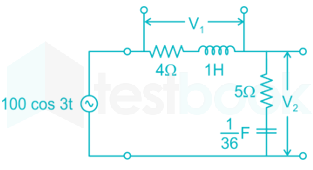
The figure shows an RLC circuit excited by the sinusoidal voltage 100 cos(3t) Volts, where t is in seconds. The ratio amplitude;of;V2amplitude;of;V1\frac{{amplitude;of;{V_2}}}{{amplitude;of;{V_1}}} is ________

45

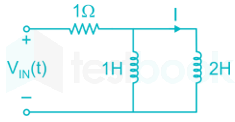
In the circuit shown, the voltage VIN(t) is described by:

\({V_{IN}}\left( t \right); = \left{ {\begin{array}{*{20}{c}} {0,}&{for;t < 0}\ {15;Volts,}&{for;t \ge 0} \end{array}} \right.;\)

where t is in seconds. The time (in seconds) at which the current I in the circuit will reach the value 2 Amperes is ________.

46

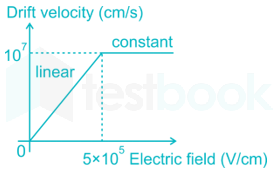
The dependence of drift velocity of electrons on electric field in a semiconductor is shown below. The semiconductor has a uniform electron concentration of n = 1 × 1016 cm–3 and electronic charge q = 1.6 × 10⁻¹⁹ C. If a bias of 5 V is applied across a 1 μm region of this semiconductor, the resulting current density in this region, in kA/cm2, is ________.

47

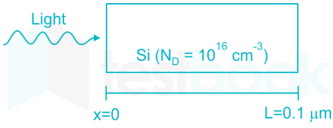
As shown, a uniformly doped Silicon (Si) bar of length L = 0.1 μm with a donor concentration ND = 1016 cm–3 is illuminated at x = 0 such that electron and hole pairs are generated at the rate of GL = GL0(1xL),;0xL{G_{L0}}\left( {1 - \frac{x}{L}} \right),;0 \le x \le L, where GL0 = 1017 cm–3 s–1.

Hole lifetime is 10–4 s, electronic charge q = 1.6 × 10⁻¹⁹ C, hole diffusion coefficient Dp = 100 cm2/s and low level injection condition prevails.

Assuming a linearly decaying steady sate excess hole concentration that goes to 0 at x = L, the magnitude of the diffusion current density at x = L/2, in A/cm2, is ________.

48

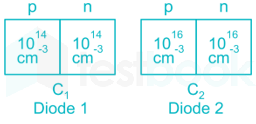
As shown, two Silicon (Si) abrupt p-n junction diodes are fabricated with uniform donor doping concentrations of ND1 = 1014 cm–3 and ND2 = 1016 cm–3 in the n-regions of the diodes, and uniform acceptor doping concentrations of NA1 = 1014 cm–3 and NA2 = 1016 cm–3 in the p-regions of the diodes, respectively. Assuming that the reverse bias voltage is ≫ built-in potentials of the diodes, the ratio C2/C1 of their reverse bias capacitances for the same applied reverse bias, is ________.

49

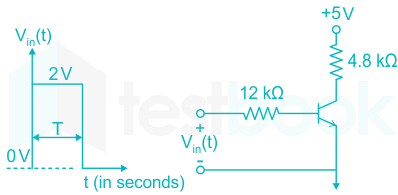
In the figure shown, the npn transistor acts as a switch

For the input Vin(t) as shown in the figure, the transistor switches between the cut-off and saturation regions of operation, when T is large. Assume collector-to-emitter voltage at saturation VCE(sat) = 0.2V and base-to-emitter voltage VBE = 0.7V. The minimum value of the common-base current gain (α) of the transistor for the switching should be ________.

50

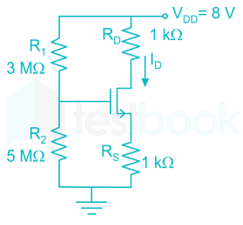
For the circuit shown, assume that the NMOS transistor is in saturation. Its threshold voltage Vtn = 1 V and its transconductance parameter \({\mu n}{C{ox}}\left( {\frac{W}{L}} \right) = 1;mA/{V^2}.\) Neglect channel length modulation and body bias effects. Under these conditions, the drain current ID in mA is ________.

51

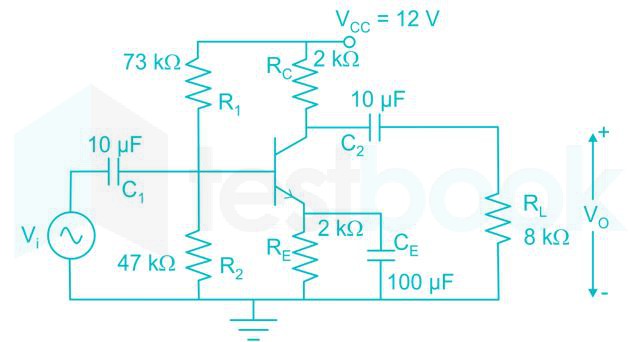
For the DC analysis of the Common-Emitter amplifier shown, neglect the base current and assume that the emitter and collector currents are equal. Given that VT = 25 mV, VBE = 0.7 V, and the BJT output resistance ro is practically infinite. Under these conditions, the mid-band voltage gain magnitude, Av=V0ViA_v=\frac{V_0}{V_i}V/V is ________.

52

The amplifier circuit shown in the figure is implemented using a compensated operational amplifier (op-amp), and has an open-loop voltage gain, A0 = 105 V/V, and an open-loop cut-off frequency. fc = 8 Hz. The voltage gain of the amplifier at 15 kHz, in V/V, is ________.

53

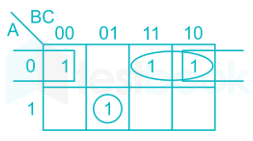
Which one of the following gives the simplified sum of products expression for the Boolean function F = m0 + m2 + m3 + m5, where m0, m2, m3 and m5 are minterms corresponding to the inputs A, B and C and A as the MSB and C as the LSB?

  1. ((a))

    AˉB+AˉBˉCˉ+ABˉC{\rm{\bar AB}} + {\rm{\bar A}}\bar B{\rm{\bar C}} + {\rm{A\bar BC}}

  2. ((b))

    AˉCˉ+AˉB+ABˉC{\rm{\bar A\bar C}} + {\rm{\bar AB}} + {\rm{A\bar BC}}

  3. ((c))

    AˉCˉ+ABˉ+ABˉC{\rm{\bar A\bar C}} + {\rm{A\bar B}} + {\rm{A\bar BC}}

  4. ((d))

    AˉBC+AˉCˉ+ABˉC{\rm{\bar ABC}} + {\rm{\bar A\bar C}} + {\rm{A\bar BC}}

Show Answer
Answer: ((b))

AˉCˉ+AˉB+ABˉC{\rm{\bar A\bar C}} + {\rm{\bar AB}} + {\rm{A\bar BC}}

F = ∑m (0, 2, 3, 5)

F=AˉCˉ+AˉB+ABˉCF = \bar A\bar C + \bar AB + A\bar BC 

F=AˉCˉ+AˉB+ABˉCF = \bar A\bar C + \bar AB + A\bar BC

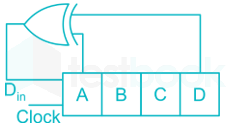
54

A 4-bit shift register circuit configured for right-shift operation, i.e. Din → A, A → B, B → C, C → D, is shown. If the present state of the shift register is ABCD = 1101, the number of clock cycles required to reach the state ABCD = 1111 is ________.

55

The following FIVE instructions were executed on an 8085 microprocessor.

MVI A, 33H

MVI B, 78H

ADD B

CMA

ANI 32H

The Accumulator value immediately after the execution of the fifth instruction is

  1. ((a))

    00H

  2. ((b))

    10H

  3. ((c))

    11H

  4. ((d))

    32H

Show Answer
Answer: ((b))

10H

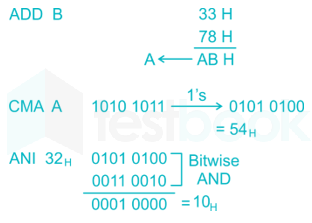
Concept:

MVI → Move immediate data to register

ADD → Contents of operand + content of accumulator & result is stored in the accumulator

CMA → Compliment the contents of the accumulator

ANI → Logically AND the contents of the accumulator with 8-bit data and store data in the accumulator

Calculation:

MVI A, 33H           A ← 33H

MVI B, 78H           B ← 33H

56

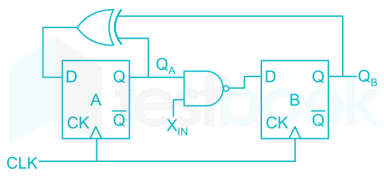
A finite state machine (FSM) is implemented using the D flip-flops A and B, and logic gates, as shown in the figure below. The four possible states of the FSM are QAQB = 00,01,10, and 11.

Assume that XIN is held at a constant logic level throughout the operation of the FSM. When the FSM is initialized to the state QAQB = 00 and clocked, after a few clock cycles, it starts cycling through

  1. ((a))

    all of the four possible states if XIN = 1

  2. ((b))

    three of the four possible states if XIN = 0

  3. ((c))

    only two of the four possible states if XIN = 1

  4. ((d))

    only two of the four possible states if XIN = 0

Show Answer
Answer: ((d))

only two of the four possible states if XIN = 0

Calculation

ABNAND
001
011
101
110


If one input of NAND is 0 output is 1

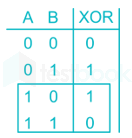
If 1 input of XOR is 1 the other input is inverted to given output

Assume Xin = 0

Input of B flip-flop = 1

QB = 1 always

QB = 1 Input of XOR

Output = QA ⊕ QB

Output = Q̅A

QA toggles between 0 & 1

Output states when Qin = 1

QA QB

\(Toggling \leftarrow \left[ {\begin{array}{*{20}{c}} 0&{1 \to always}\ 1&1 \end{array}} \right.\)

Hence, no. of possible states = 2

When input Xin = 0

57

A linear time invariant (LTI) system with the transfer function

G(s)=K(s2+2s+2)(s23s+2)G\left( s \right) = \frac{{K\left( {{s^2} + 2s + 2} \right)}}{{\left( {{s^2} - 3s + 2} \right)}}

Is connected in unity feedback configuration as shown in the figure

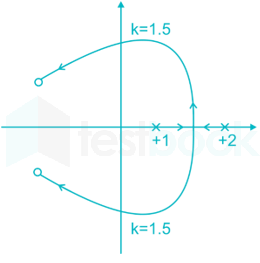
For the closed-loop system shown, the root locus for 0 < K < ∞ intersects the imaginary axis for K = 1.5. The closed-loop system is stable for

  1. ((a))

    K > 1.5

  2. ((b))

    1 > K < 1.5

  3. ((c))

    0 < K < 1

  4. ((d))

    no positive value of K

Show Answer
Answer: ((a))

K > 1.5

G(s)=K(s2+2s+2)(s23s+2)G\left( s \right) = \frac{{K\left( {{s^2} + 2s + 2} \right)}}{{\left( {{s^2} - 3s + 2} \right)}}

Zeroes = -1 + j; -1 -j

Poles = 1, 2

Each pole will terminate at each zero as system gain K is increased

For 0 < K < 1.5

The poles are in right half of s-plane [unstable system]

For K = 1.5

Poles are on imaginary axis [marginally stable system]

K > 1.5

Poles are in the left half of s-Plane [stable system]

58

Which one of the following options correctly describes the locations of the roots of the equation s4 + s2 + 1 = 0 on the complex plane?

  1. ((a))

    Four left half plane (LHP) roots

  2. ((b))

    One right half plane (RHP) root, one LHP root and two roots on the imaginary axis

  3. ((c))

    Two RHP roots and two LHP roots

  4. ((d))

    All four roots are on the imaginary axis

Show Answer
Answer: ((c))

Two RHP roots and two LHP roots

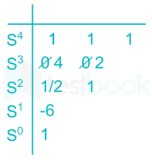
CE: s4 + 0s3 + 1s2 + 0s + 1

Routh array

We have row zero at s3 row

Solving the auxiliary equation, we get:

s4 + s2 + 1 = 0

By differentiating, we get:

4s3 + 2s = 0

The Routh array is modified as shown above.

Observations:

The row of zero indicates symmetric roots about the origin.

2 sign changes below row of zero indicate 2 poles in the right half of the s-plane.

∴ Two poles are on the right side and 2 poles symmetrically lying on left-half.

59

The Nyquist plot of the transfer function G(s)=K(s2+2s+2)(s+2)G\left( s \right) = \frac{K}{{\left( {{s^2} + 2s + 2} \right)\left( {s + 2} \right)}} 

Does not encircle the point (–1 + j0) for K = 10 but does encircle the point (-1 + j0) for K = 100 . Then the closed-loop system (having unity gain feedback) is

  1. ((a))

    stable for K = 10 and stable for K = 100

  2. ((b))

    stable for K = 10 and unstable for K = 100

  3. ((c))

    unstable for K = 10 and stable for K = 100

  4. ((d))

    unstable for K = 100 and unstable for K = 100

Show Answer
Answer: ((b))

stable for K = 10 and unstable for K = 100

Concept:

For Nyquist stability

N = P

P = Number of open-loop poles in RHS of s-plane

N = Number of encirclement about the point (-1 + j0)

N = +ve for anticlockwise

N = -ve for clockwise enduement

Calculation:

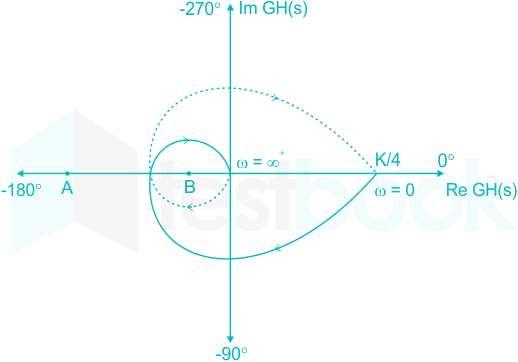
The polar plot is drawn as:

<br>

Let two points A and B representing -1 + j0 for different values of K,

The Nyquist plot is not encircling -1 + j 0 at A, i.e, K = 10

at B, the Nyquist plot is encircling -1 + j 0 i. e, K = 100

Let us now find the stability for K = 10 and K = 100 using Nyquist

Case : 1

K = 10

N = P - Z

Z = P - N

GH(s)=Ks3+4s2+6s+4GH(s)=\dfrac{K}{s^3+4s^2+6s+4}

The Routh table can be drawn as follows:

s316
s244
s150
s040


No sign change, hence P = 0 and also N = 0

∴ Z = 0 → CLTP is stable

Case : 2

Z = P - N

N = -2 (two clockwise encirclement)

∴ Z = 2.

hence, CLTP is unstable.

60

In binary frequency shift keying (FSK), the given signal waveforms are

u0(t) = 5 cos(20000πt); 0 ≤ t ≤ T, and

u1(t) = 5 cos(22000πt); 0 ≤ t ≤ T

where T is the bit-duration interval and t is in seconds. Both u0(t) and u1(t) are zero outside the interval 0 ≤ t ≤ T. With a matched filter (correlator) based receiver, the smallest positive value of T (in milliseconds) required to have u0(t) and u1(t) uncorrelated is

  1. ((a))

    0.25 ms

  2. ((b))

    0.5 ms

  3. ((c))

    0.75 ms

  4. ((d))

    1.0 ms

Show Answer
Answer: ((b))

0.5 ms

Concept:

If two signals are uncorrelated then:

\(\mathop \smallint \limits_0^T {u_0}\left( t \right){u_1}\left( t \right) = 0\)

Calculation:

5cos(20,000;πt).5cos(22,000;πt)dt=0\smallint 5\cos \left( {20,000;\pi t} \right).5\cos \left( {22,000;\pi t} \right)dt = 0

252[cos(42000;πt)+cos(2000;πt)]dt=0\frac{{25}}{2}\smallint \left[ {\cos \left( {42000;\pi t} \right) + \cos \left( {2000;\pi t} \right)} \right]dt = 0

252[sin(42000;πT)42000;π+sin(2000;πT)2000;π]=0\frac{{25}}{2 }\left[ {\frac{{\sin \left( {42000;\pi T} \right)}}{{42000;\pi }} + \frac{{\sin \left( {2000;\pi T} \right)}}{{2000;\pi }}} \right] = 0

Both terms should be individually zero, i.e.

sin 2000 πT = 0

2000;πT=π[smallest] T=12000\begin{array}{l} \Rightarrow 2000;\pi T = \pi \left[ {smallest} \right]\ T = \frac{1}{{2000}} \end{array}

T = 0.5 msec

So, at T = 0.5 msec both terms are zero.

61

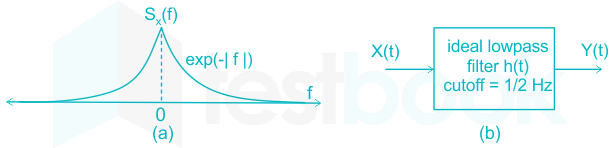
Let X(t) be a wide sense stationary random process with the power spectral density SX(f) as shown in Figure (a), where f is in Hertz (Hz). The random process X(t) is input to an ideal lowpass filter with the frequency response:

\(H\left( f \right) = \left{ {\begin{array}{*{20}{c}} {1,}&{\left| f \right| \le \frac{1}{2}Hz}\ {0,}&{\left| f \right| > \frac{1}{2}Hz} \end{array}} \right.\)

This is as shown in Figure (b). The output of the lowpass filter is Y(t).

Let E be the expectation operator. Consider the following statements:

I. E(X(t)) = E(Y(t))

II. E(X2(t)) = E(Y2(t))

III. E(Y2(t)) = 2

Select the correct option:

  1. ((a))

    only I is true

  2. ((b))

    only II and III are true

  3. ((c))

    only I and II are true

  4. ((d))

    only I and III are true

Show Answer
Answer: ((a))

only I is true

Concept:

(1). E[y(t)]=H(0)E[x(t)]E\left[ {y\left( t \right)} \right] = H\left( 0 \right)E\left[ {x\left( t \right)} \right] 

(2). \(E\left[ {{x^2}\left( t \right)} \right] = \mathop \smallint \limits_{ - \infty }^\infty {S_X}\left( f \right)df \)

Application: 

In the given question,

H(0) = 1

E[y(t)]=E[x(t)]E\left[ {y\left( t \right)} \right] = E\left[ {x\left( t \right)} \right]

\(E\left[ {{x^2}\left( t \right)} \right] = \mathop \smallint \limits_{ - \infty }^\infty {S_X}\left( f \right)df = 2\)

\(E\left[ {{y^2}\left( t \right)} \right] = \mathop \smallint \limits_{ - \infty }^{ + \infty } {S_y}\left( f \right)df\)

\( = \mathop \smallint \limits_{ - \infty }^{ + \infty } {S_x}\left( f \right){\left| {H\left( f \right)} \right|^2}df\)

\( = \mathop \smallint \limits_{ - \frac{1}{2}}^{ + \frac{1}{2}} {S_x}\left( f \right)df\)

2 - 2 e-0.5

Low pass filter does not allow total power to pass from input to output.

Hence,

E[X2(t)] ≠ E[Y2(t)]

62

A continuous time signal x(t) = 4 cos(200πt) + 8 cos(400πt), where t is in seconds, is the input to a linear time invariant (LTI) filter with the impulse response

\(h\left( t \right) = \left{ {\begin{array}{*{20}{c}} {\frac{{2{\rm{sin}}\left( {300\pi t} \right)}}{{\pi t}}}&{t \ne 0}\ {600,}&{t = 0} \end{array}} \right.\)

Let y(t) be the output of this filter. The maximum value of |y(t)| is ________.

63

An optical fiber is kept along the ẑ direction. The refractive indices for the electric fields along the x̂ and ŷ directions in the fiber are nx = 1.5000 and ny = 1.5001, respectively (nx ≠ ny due to the imperfection in the fiber cross-section). The free space wavelength of a light wave propagating in the fiber is 1.5 μm. If the lightwave is circularly polarized at the input of the fiber, the minimum propagation distance after which it becomes linearly polarized, in centimeters, is ________.

64

The expression for an electric field in free space is E=E0(x^+y^+j2z^)ej(ωtkx+ky)E = {E_0}\left( {\hat x + \hat y + j2\hat z} \right){e^{ - j\left( {\omega t - kx + ky} \right)}}, where x,y,z represent the spatial coordinates, t represents time, and ω, k are constants. This electric field

  1. ((a))

    does not represent a plane wave

  2. ((b))

     represents a circularly polarized plane wave propagating normal to the z-axis.

  3. ((c))

     represents an elliptically polarized plane wave propagating along the x-y plane.

  4. ((d))

     represents a linearly polarized plane wave.

Show Answer
Answer: ((c))

 represents an elliptically polarized plane wave propagating along the x-y plane.

Concept:

For plane polarised wave

a^p.E^=0{\hat a_p}.\hat E = 0

Where,

 propagation vector

For circular polarisation

E = Ellal & ϕ = 90°

For elliptical polarization

E ≠ Ellal & ϕ = 90°

Calculation:

Propogation vector a^p=Vˉ(kr)Vˉ(kr)Propogation\space vector\space {\hat a_p} = \frac{{\bar V\left( {kr} \right)}}{{\left| {\bar V\left( {kr} \right)} \right|}}

V̅ (kr) = k(-x̂ + ŷ)

Vˉ(kr)=k2\left| {\bar V\left( {kr} \right)} \right| = k\sqrt 2

a^ϕ=Vˉ(kr)Vˉ(kr)=x^+y^2{\hat a_\phi } = \frac{{\bar V\left( {{k_r}} \right)}}{{\left| {\bar V\left( {{k_r}} \right)} \right|}} = \frac{{ - \hat x + \hat y}}{{\sqrt 2 }}

For plane wave

a^ρ.E^=0{\hat a_\rho }.\hat E = 0

[x^+y^2]E0[x^+y^+j2z^]\left[ { - \frac{{\hat x + \hat y}}{{\sqrt 2 }}} \right]{E_0}\left[ {\hat x + \hat y + j2\hat z} \right]

=E02+E02+j0 = \frac{{ - {E_0}}}{{\sqrt 2 }} + \frac{{{E_0}}}{{\sqrt 2 }} + j0

= 0

Thus, given wave is plane polarised

Given wave is incidence an xy-plane ε in xy plane is llal polarised and along z is llal polarized

E11=Exy=1+1=2{E_{11}} = {\left| E \right|_{xy}} = \sqrt {1 + 1} = \sqrt 2

E=Ez=22=2{E_ \bot } = {\left| E \right|_z} = \sqrt {{2^2}} = 2

E11 ≠ E and ϕ = 90°

Elliptically polarised plane wave

65

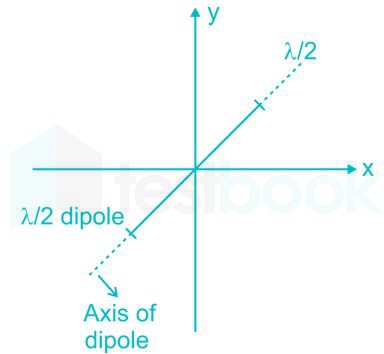
 A half wavelength dipole is kept in the x-y plane and oriented along 45° from the x-axis. Determine the direction of null in the radiation pattern for 0 ≤ Φ ≤ π. Here the angle θ (0 ≤ θ ≤ π) is measured from the z-axis, and the angle Φ (0 ≤ Φ ≤ 2π) is measured from the x-axis in the x-y plane.

  1. ((a))

     θ = 90°, Φ = 45°

  2. ((b))

     θ = 45°, Φ = 90°

  3. ((c))

     θ = 90°, Φ = 135°

  4. ((d))

    θ = 45°, Φ = 135°

Show Answer
Answer: ((a))

 θ = 90°, Φ = 45°

For λ/2 dipole antenna the field radiated is zero along its axis

The direction of null

Occurs at ϕ = 45°

Axis of dipole is in xy-plane

Maximum field is radiated perpendicular to axis of dipole

θ = 90°

Attempt this paper under real exam conditions

Timed interface, section switching, instant scoring, and question-by-question analytics — free.

Start Timed Attempt