Choose the most appropriate word from the options given below to complete the following sentence.
Communication and interpersonal skills are ___________ important in their own ways.
((a))
each
((b))
both
((c))
all
((d))
either
Show Answer
Answer: ((b))
both
The correct answer is option 2), i.e. both.
Explanation:
Both: We use both to refer to two things or people together.
Here, communication skill and interpersonal skill are two different things, that's we will use both for them.
Extra Bites:
Let us try to find the use of words as well-
Each: It is used to refer to individual things in a group or a list of two or more things.
E.g. : Each vehicle was being checked by the police.
All: It is used to refer to a whole group, with the emphasis that nothing is being left out.
E.g. : All kids were asked to stand on the ground.
Either: It is used to refer to anyone object out of the two objects. It is used to expresses choice between the two things.
E.g. : Both these roads go to DB Mall so you can take either way.
Mistake Point:
Although 'all' also looks appropriate here, 'Both' has already been given in one of the options. So we will prefer 'Both'.
2
Which of the options given below best completes the following sentence?
She will feel much better if she __________.
((a))
will get some rest
((b))
gets some rest
((c))
will be getting some rest
((d))
is getting some rest
Show Answer
Answer: ((b))
gets some rest
The correct answer is option 2), i.e. gets some rest.
Explanation:
In the given sentence "if clause" has been used which is a type of conditional clause. Generally, when two actions are given in the Future tense, for the action representing a condition, we use the present indefinite tense, and for the other action, we use future indefinite tense. "Conditional clause in Present Indefinite tense + Principle clause is in Future indefinite tense (will/shall)"
Extra Bites:
In the given sentence, "She will feel much better" is the principal clause (the action taking place later) which is dependent on the conditional clause.
A conditional clause has "if" as to show the condition and should be in the present indefinite tense.
3
Choose the most appropriate pair of words from the options given below to complete the following sentence.
She could not _____ the thought of _________ the election to her bitter rival.
((a))
bear, loosing
((b))
bare, loosing
((c))
bear, losing
((d))
bare, losing
Show Answer
Answer: ((c))
bear, losing
The correct answer is option 3), i.e. bear, losing.
Let us try to find the meaning of words given in the option for better understanding-
Bear: (verb) to carry/stand a thought.
Bare: (verb) uncover a part of the body or other thing and expose it to view.
Loosing: (gerund) the act of setting free or releasing.
Losing: (gerund) suffering a loss or failing to keep possession of something.
<br>
Clearly, according to the context of the sentence, the only correct option is option 3), i.e. bear, losing.
4
A regular die has six sides with numbers 1 to 6 marked on its sides. If a very large number of throws show the following frequencies of occurrence:
1 → 0.167; 2 → 0.167; 3 → 0.152; 4 → 0.166; 5 → 0.168; 6 → 0.180. We call this die
((a))
irregular
((b))
biased
((c))
Gaussian
((d))
insufficient
Show Answer
Answer: ((b))
biased
For a very large number of throws, the frequency should be same for an unbiased die.
But given frequencies are not same, hence the die is biased
5
Fill in the missing number in the series.
2 3 6 15 ____157.5 630
6
Find the odd one in the following group
Q,W,Z,B B,H,K,M W,C,G,J M,S,V,X
((a))
Q,W,Z,B
((b))
B,H,K,M
((c))
W,C,G,J
((d))
M,S,V,X
Show Answer
Answer: ((c))
W,C,G,J
Q, W, Z, B ⇒ Q + 6 → W, W + 3 → Z, Z + 2 → B
B, H, K, M ⇒ B + 6 → H, H + 3 → K, K + 2 → M
W, C, G, J ⇒ W + 6 → C, C + 4 → G, G + 3 → J
M, S, V, X ⇒ M + 6 → S, S + 3 → V, V + 2 → X
All follow the same pattern except "W, C, G, J".
Hence, option 3) is the correct answer.
7
Lights of four colors (red, blue, green, yellow) are hung on a ladder. On every step of the ladder there are two lights. If one of the lights is red, the other light on that step will always be blue. If one of the lights on a step is green, the other light on that step will always be yellow. Which of the following statements is not necessarily correct?
((a))
The number of red lights is equal to the number of blue lights
((b))
The number of green lights is equal to the number of yellow lights
((c))
The sum of the red and green lights is equal to the sum of the yellow and blue lights
((d))
The sum of the red and blue lights is equal to the sum of the green and yellow lights
Show Answer
Answer: ((d))
The sum of the red and blue lights is equal to the sum of the green and yellow lights
Let the no. of red lights be equal to X and the no. of green lights be equal to Y.
According to the given condition, there exists a blue light for every red light.
Since there are only two lights on each step of the ladder, we can conclude that for every blue light, there exists only one red light. The same condition can be applied to the pair of green and yellow lights.
Thus, we have, no. of red lights = no. of blue lights = X.
Also, no. of green lights = no. of yellow lights = Y.
Therefore, options 1 and 2 are necessarily correct.
Now, the sum of the red and the green lights = X + Y = the sum of the yellow and the blue lights.
Therefore, option 3 is also necessarily correct.
No. of steps of the ladder that have the blue-red pair may be less than the no. of steps that have the green-yellow pair or vice versa.
Hence, option 4 is not necessarily correct.
8
The sum of eight consecutive odd numbers is 656. The average of four consecutive even numbers is 87. What is the sum of the smallest odd number and second-largest even number?
9
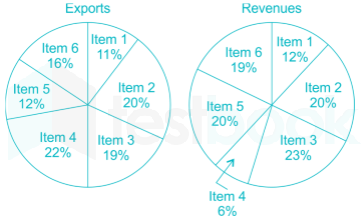
The total exports and revenues from the exports of a country are given in the two charts shown below. The pie chart for exports shows the quantity of each item exported as a percentage of the total quantity of exports. The pie chart for the revenues shows the percentage of the total revenue generated through export of each item. The total quantity of exports of all the items is 500 thousand tonnes and the total revenues are 250 crore rupees. Which item among the following has generated the maximum revenue per kg?
((a))
Item 2
((b))
Item 3
((c))
Item 6
((d))
Item 5
Show Answer
Answer: ((d))
Item 5
Given:
The total quantity of exports of all the items = 500 thousand tonnes
The total revenues = 250 crore rupees
Calculation:
Total revenue for item 1 = 12% × 250 × 107 = 3 × 10⁸ rupees
Total export for item 1 = 11% × 500 × 106 = 55 × 106 kg
Item1revenue per kg = (3/55) × 102 = 5.45 rupees
Total revenue for item 2 = 20% × 250 × 107 = 5 × 10⁸ rupees
Total export for item 2 = 20% × 500 × 106 = 108 kg
Item 2 revenue per kg = 5 rupees
Total revenue for item 3 = 23% × 250 × 107 = 5.75 × 10⁸
Total export for item 3 = 19% × 500 × 106 = 95 × 106
Item 3 revenue per kg = 6.052 rupees
Total revenue for item 4 = 6% × 250 × 107 = 1.5 × 10⁸
Total export for item 4 = 22% × 500 × 106 = 11 × 107
Item 4 revenue per kg = 1.363 rupees
Total revenue for item 5 = 20% × 250 × 107 = 5 × 10⁸ rupees
Total export for item 5 = 12% × 500 × 106 = 6 × 10⁷ rupees
Item 5 revenue per kg = 8.333 rupees
Total revenue for item 6 = 19% × 250 × 107 = 475 × 106 rupees
Total export for item 6 = 16% × 500 × 106 = 8 × 10⁷ rupees
Item 6 revenue per kg = 5.9375 rupees
∴ Item 5 has generated the maximum revenue per kg
10
It takes 30 minutes to empty a half-full tank by draining it at a constant rate. It is decided to simultaneously pump water into the half-full tank while draining it. What is the rate at which water has to be pumped in so that it gets fully filled in 10 minutes?
((a))
4 times the draining rate
((b))
3 times the draining rate
((c))
2.5 times the draining rate
((d))
2 times the draining rate
Show Answer
Answer: ((a))
4 times the draining rate
Given:
A half-full tank by draining pipe = 30 minutes
Calculation:
A full tank can drain = 60 min.
Let 60 litres can be draining in 60 min.
The efficiency of draining pipe = 1
Half tank filled in 10 min. by both = 30/10 = 3
The efficiency of pump water = 3 + 1 = 4
∴ Pump water is 4 times the draining rate.
Electronics and Communication Engineering (55 questions)
11
The determinant of matrix A is 5 and the determinant of matrix B is 40. The determinant of matrix AB is ________.
12
Let X be a random variable that is uniformly chosen from the set of a positive odd number less than 100. The expectation E[x], is
13
For 0 ≤ t < ∞, the maximum value of the function f(t) = e-t – 2e-2t occurs at:
((a))
t = loge 4
((b))
t = loge 2
((c))
t = 0
((d))
t = loge 8
Show Answer
Answer: ((a))
t = loge 4
Concept:
The point of maxima or minima is obtained by solving for the derivative of the function and equating to zero.
Then, to check if the point is a point of maxima ‘or’ minima we check the second derivative at that point.
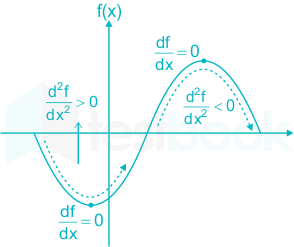
This is explained with the help of the following graph:
If dx2d2f<0; the point will be a point of maxima
If dx2d2f>0, the point will be a point of minima.
Analysis:
Given f(t) = e-t – 2e-2t
f'(t) = -e-t + 4e-2t
Solving for f’(t) = 0, we get:
4e-2t = e-t
et⋅et4=et1
et = 4
t = In 4
f”(t) = e-t – 8 e-2t
At t = In 4, we get
f”(In 4) = e-In 4 – 8 e-2 In 4
=41−168
=41−21
= -0.26
Since, f”(t) < 0 at t = In 4, it is a point of maxima.
14
The value of x→∞lim(1+x1)x
((a))
In 2
((b))
1.0
((c))
e
((d))
∞
Show Answer
Answer: ((c))
e
Putting x = ∞ to the given limiting function, we get:
(1+∞1)∞=1∞
1∞ is one of the indeterminant forms.
We can modify the given limits as:
x→∞lim(1+x1)x=x→∞limeln(1+x1)x
=ex→∞limln(1+x1)x
=ex→∞limx;ln(1+x1)
The above can be written as:
ef(x) --(1)
where:
f(x)=x→∞limx(1+x1) ---(2)
The above can be written as:
x→∞lim1/xln(1+x1)
Putting on the limit of x = ∞, we get:
x→∞lim1/xIn(1+x1)=00
Applying L-Hospitals rule, we get:
=x→∞lim−1/x2(1+x11)(x2−1)
=x→∞lim1+x11=1
Putting this in equation (1), we can write:
ex→∞limx;In;(1+x1)=e1
∴x→∞lim(1+x1)x=e;
15
If the characteristic equation of the differential equation dx2d2y+2αdxdy+y=0 has two equal roots, then the values of α are
((a))
± 1
((b))
0, 0
((c))
± j
((d))
± 1/2
Show Answer
Answer: ((a))
± 1
Concept:
For a second-order differential function, the characteristic equation will have two roots D1 and D2. The roots can have three possible forms, ie.
Real, distinct roots, D1 ≠ D2
Complex Roots, D1, D2 = a + ib
Double roots, D1 = D2 = 0
The solution for the second-order differential equation with equal roots of the characteristic equation is given by:
y=(C1+C2x)eD1x
Calculation:
Solving the given differential equation, we get:
D2 + 2 α D + 1 = 0
Given the roots are equal, which indicates:
(2α)2 – 4(1)(1) = 0
4α2 – 4 = 0
α2 = 1
α = ± 1
16
Norton’s theorem states that a complex network connected to a load can be replaced with an equivalent impedance
((a))
in series with a current source
((b))
in parallel with a voltage source
((c))
in series with a voltage source
((d))
in parallel with a current source
Show Answer
Answer: ((d))
in parallel with a current source
Concept:
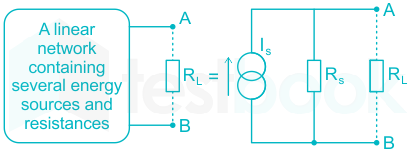
Norton’s Theorem states that “Any linear circuit containing several energy sources and resistances can be replaced by a single constant current source in parallel with a single resistor “.
It is an analytical method used to change a complex circuit into a simple equivalent circuit consisting of a single resistance in parallel with a current source.
Steps to follow for Norton’s Theorem:
Calculate Norton’s current source by removing the load resistor from the original circuit and replacing it with a short circuit.
Calculating the current through a shorted wire.
Calculating the Norton resistance by removing all power sources in the original circuit (voltage sources shorted and current sources open).
Calculating total resistance between the open connection points.
Draw the Norton equivalent circuit, with the Norton current source in parallel with the Norton resistance.
The load resistor re-attaches between the two open points of the equivalent circuit.
17
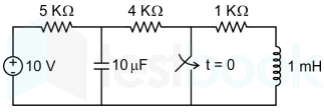
In the figure shown, the ideal switch has been open for a long time.
If it is closed at t=0, then the magnitude of the current (in mA) through the 4kΩ resistor at t = 0+ is _______.
18
A silicon bar is doped with donor impurities ND = 2.25 × 10¹⁵ atoms / cm3. Given the intrinsic carrier concentration of silicon at T = 300 K is ni = 1.5 × 1010 cm-3. Assuming complete impurity ionization, the equilibrium electron and hole concentrations are
((a))
n0 = 1.5 × 1016 cm-3, p0 = 1.5 × 105 cm-3
((b))
n0 = 1.5 × 1010 cm-3, p0 = 1.5 × 1015 cm-3
((c))
n0 = 2.25 × 1015 cm-3, p0 = 1.5 × 1010 cm-3
((d))
n0 = 2.25 × 1015 cm-3, p0 = 1 × 105 cm-3
Show Answer
Answer: ((d))
n0 = 2.25 × 1015 cm-3, p0 = 1 × 105 cm-3
Concept:
For a compensated semiconductor with donor concentration greater than the acceptor concentration, the majority carrier electron concentration is calculated as:
n0=2Nd−Na+(2Nd−Na)2+ni2
With Nd - Na ≫ ni, the above equation becomes:
n0 ≅ Nd - Na
Also, the charge carriers at thermal equilibrium follow mass-action law, i.e.
n0p0=ni2
Application:
Given:
Nd = 2.25 × 1015 cm-3
ni = 1.5 × 1010 cm-3
Na = 0 cm-3
Nd - Na ≫ ni, the majority carrier electron concentration will be:
n0 ≅ Nd - Na = 2.25 × 1015 cm-3
Since the donor concentration is greater than the acceptor concentration, the material will be n-type with the majority carrier electron concentration as:
n0 ≅ Nd - Na
n0 = 2.25 × 1015 cm-3
The minority carrier hole concentration is obtained using mass action law as:
n0p0=ni2
p0=n0ni2
p0=2.25×10152.25×1020
p0 = 105 cm-3
19
An increase in the base recombination of a BJT will increase
((a))
the common-emitter dc current gain β
((b))
the breakdown voltage BVCEO
((c))
the unity gain cut-off frequency fT
((d))
the transconductance gm
Show Answer
Answer: ((b))
the breakdown voltage BVCEO
The Base Recombination in BJT increases by the following:
(i) Increase the doping concentration of Base
(ii) Increase the Base-width
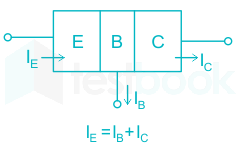
IE = IB + IC
Any of the above two processes will increase recombination in the base, which will increase base current, and reduce the collector current.
Reduced collector current will cause a reduction in β, because β=IBIC
Hence common-emitter current gain will decrease.
Hence, option A is wrong.
Power rating = BVCBO × ICBO
Power rating = BVCEO × ICEO
Since an increase in recombination will cause a decrease in ICBO. Hence ICEO will decrease.
Option D is also incorrect because gm decreases with recombination.
20
In C-MOS technology, shallow P-well or N-well regions can be formed using
((a))
low-pressure chemical vapor deposition
((b))
low energy spattering
((c))
low-temperature dry oxidation
((d))
low energy ion implantation
Show Answer
Answer: ((d))
low energy ion implantation
Low energy ion implantation, because it provides independent control of close and depth.
Ion implantation deposits controlled amount of charged species in a specific region of a semiconductor.
21
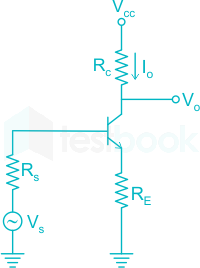
The feedback topology in the amplifier circuit (the base bias circuit is not shown for simplicity) in the figure is
((a))
Voltage shunt feedback
((b))
Current series feedback
((c))
Current shunt feedback
((d))
Voltage series feedback
Show Answer
Answer: ((b))
Current series feedback
In a current series feedback, current is sampled from the output and voltage is feedback to the source.
In the given amplifier circuit, the feedback signal becomes zero by opening the output feedback.
Hence, it is a current series feedback.
Important Points
Procedure to find the type of feedback
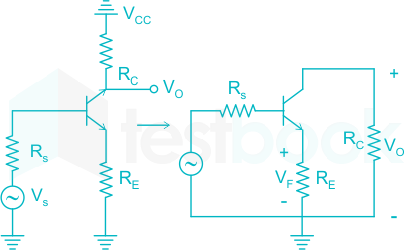
Step - 1: Draw AC Model of circuit capacitor-short circuited DC supply-connect to ground.
Step-2: Identify the feed back element in circuit in above circuit RE is feedback element.
Step-3: If f/b element is already connected to output then it indicate voltage sampling otherwise current sampling. RE directly not connected to output so current sampling.
Step-4: If f/b element is directly connect to input these it indicate shunt mixing otherwise series mixing. Since RE is directly not connected to input so series mixing.
Answer - current-series feedback.
22
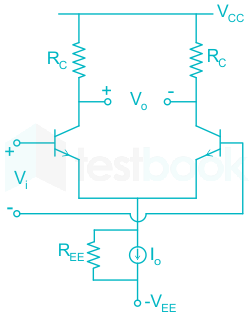
In the differential amplifier shown in the figure, the magnitudes of the common-made & differential-mode gains are Acm and Ad, respectively. If the resistance RE is increased, then
((a))
Acm increases
((b))
Common-mode Rejection Ratio increases
((c))
Ad increases
((d))
Common-mode Rejection ratio decreases
Show Answer
Answer: ((b))
Common-mode Rejection Ratio increases
Differential voltage Gain (Ad) is given by:
Ad = -gmRc
And the Common-mode gain (Acm) is given by:
Acm=2RE−Rc
CMRR=AcmAd
CMRR=2RERcgmRc
=2gmRE
We can observe that with an increase in RE, Acm decreases and CMRR increases.
23
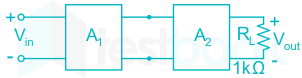
A cascade of two voltage amplifiers A1 & A2 is shown in the figure the open-loop gain Av0, input resistance Rin, and output resistance R0 for A1 and A2 are as follows:
A1: Av0=10, Rin = 10 kΩ, R0 = 1 kΩ
A2 : Av0=5, Rin = 5 kΩ, R0 = 200 Ω
The transfer function Vout/Vin is:
24
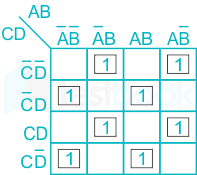
For an n-variable Boolean function, the maximum number of prime implicants is
((a))
2(n - 1)
((b))
n/2
((c))
2n
((d))
2(n-1)
Show Answer
Answer: ((d))
2(n-1)
In a n variable Boolean function, the maximum number of prime implicant is given by:
Pmax=22n=2n−1
Example with n = 4:
Maximum number of prime applicants = 2n-1 = 24 -1 = 8
25
The number of bytes required to represent the decimal number 1856357 in packed BCD (Binary Coded Decimal) form is ________.
26
In a half-subtractor circuit with X and Y as inputs, the Borrow (M) and Difference (N = X - Y) are given by
((a))
M = X ⊕ Y, N = XY
((b))
M = XY, N = X ⊕ Y
((c))
M = X̅Y, N = X ⊕ Y
((d))
M = XY̅, N=X⊕Y
Show Answer
Answer: ((c))
M = X̅Y, N = X ⊕ Y
The Truth Table for a half subtractor is drawn as:
X
Y
Difference (N)
Borrow (M)
0
0
0
0
0
1
1
1
1
0
1
0
1
1
0
0
The Boolean expression for difference can be written as:
N = X̅ Y + XY̅
N = X ⊕ Y
And the Boolean expression for the borrow can be written as:
M = X̅ Y
27
An FIR system is described by the system function
H(s)=1+27z−1+23z−2;;;
The system is
((a))
maximum phase
((b))
minimum phase
((c))
mixed-phase
((d))
zero phase
Show Answer
Answer: ((c))
mixed-phase
Concept:
Minimum phase system is:
1) Stable and causal: All poles of H(z) are inside the unit circle.
2) Stable and causal Inverse: All poles of 1/H(z) are inside the unit circle and all zeroes of H(z) are inside the unit circle.
Thus, to have a minimum phase system, all poles and zeroes of H(z) must be inside the unit circle.
Maximum Phase system is:
Stable and anti causal have a stable and anti causal Inverse.
All poles and zeros are outside the unit circle and ROC Includes the unit circle.
Analysis:
H(z)=1+27z−1+23z−2=0
2z2 + 7z + 3 = 0
2z2 + 6z + z + 3 = 0
2z (z + 3) + 1 (z + 3) = 0
(z + 3) (2z + 1) = 0
z1=−21 (Inside the unit circle)
z2 = -3 (outside the unit circle)
Hence, the given FIR system is a mixed-phase system.
28
Let x[n] = x[-n] Let X(z) be the Z-transform of x[n]. if 1 + j2 is a zero of X(z). Which one of the following must also be a zero of X(z)
((a))
0.2 + j 0.4
((b))
0.2 – j 0.4
((c))
1 + j 2
((d))
1 – j 0.5
Show Answer
Answer: ((b))
0.2 – j 0.4
Concept:
Time reversal property of Z-transform
X[n] ↔ X(z)
X[-n] ↔ X(z-1)
Calculation:
Given that x[n] = x[-n]
⇒ X(z) = X(z-1)
Zero of X(z) = 1 + j2
Then another zero will be:
1+j21=51−j2
=0.2−0.4j
29
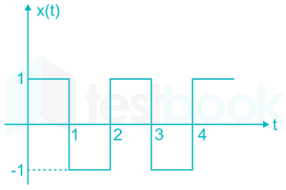
Consider the periodic square wave in figure shown.
Ratio of 7th harmonic power to 5th harmonic power is
30
The natural frequency of an undamped second order system is 40 rad/sec. If the system is damped with a damping ratio 0.3, the damped natural frequency in rad/sec is _____
31
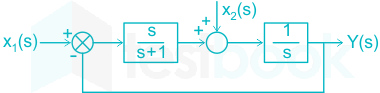
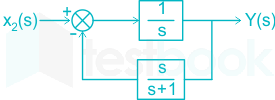
For the following system
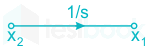
For X1(s) = 0, transfer function X2(s)Y(s)is
((a))
s2s+1
((b))
s+11
((c))
s(s+1)s+2
((d))
s(s+2)s+1
Show Answer
Answer: ((d))
s(s+2)s+1
Given block diagram
For X1(s) = 0 the block diagram can be redrawn as,
X2(s)Y(s) is
X2(s)Y(s)=1+G(s)H(s)G(s)
=s(s+2)s+1
32
The capacity of band-limited additive white Gaussian Noise (AWGN) channel is given by C=Wlog2[1+σ2wP] bits per second (bps), where W is the channel Bandwidth, P is the average power received and σ2 is the one-sided power spectral density of the AWGN.
For a fixed σ2P=1000, the channel capacity (in kbps) with infinite Bandwidth (W → ∞) is approximately
((a))
1.44
((b))
1.08
((c))
0.72
((d))
0.36
Show Answer
Answer: ((a))
1.44
Concept: we can remember the relation y=x→∞limx;log2[1+x1] = log2 e = 1.442
Application: It is given that the capacity of Band-limited AWGN is given by:
C=Wlog2[1+σ2WP]
It is given W →∞
C=W→∞limWlog2[1+σ2WP]
C=W→∞limPWσ2σ2Plog2[1+σ2WP]
C=W→∞limσ2P(PWσ2)log2[1+σ2WP]
Let PWσ2=x
Since W →∞ then x →∞
C=x→∞limσ2P;x;log2[1+x1]
C=σ2Px→∞limlog2[1+x1]x
Considering:
y=x→∞limlog2[1+x1]x
y=x→∞limx;log2[1+x1]
y=x→∞lim1/xlog2[1+x1]
Putting x →∞, we are getting 00 form, hence using the L-hospitals rule, we can write:
y=x→∞lim1+x11(x2−1)log2e;(x2−1)
y = log2 e
C=σ2Plog2e
C=1.44σ2P
C = 1.44 × 1000 bps
C = 1.44 kbps
33
Consider sinusoidal modulation in an AM system. Assuming no over-modulation, the modulation index (𝜇) when the maximum and minimum values of the envelope, respectively, are 3 V and 1 V, is ________.
34
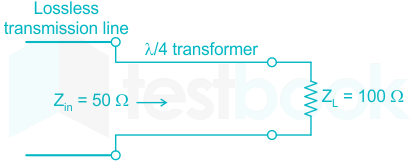
To maximize power transfer, a lossless transmission line is to be matched to a resistive load impedance via a λ/4 transformer as shown.
The characteristic impedance (in Ω) of the λ/4 transformer is _______.
35
Which one of the following field patterns represents a TEM wave traveling in the positive 'x' direction?
((a))
E = +8ŷ, H = -4ẑ
((b))
E = -2ŷ, H = -3ẑ
((c))
E = +2ẑ, H = +2ŷ
((d))
E = -3ŷ, H = +4ẑ
Show Answer
Answer: ((b))
E = -2ŷ, H = -3ẑ
Concept:
A TEM wave traveling in the given direction must satisfy the Poynting theorem, as it describes the magnitude and direction of the flow of energy in electromagnetic waves.
Mathematically, the Poynting vector is the cross-product of the Electric field vector and the magnetic field vector, i.e.
P=E×H;Watt/m2
Analysis:
Option 1:
With E = +8 ŷ and H = -4 ẑ
According to Poynting theorem, the direction of propagation will be:
P̅ = 8 ŷ × (-4ẑ)
P̅ = - 32 x̂
Since the direction of propagation given is +x direction, Option 1 is incorrect.
Option 2:
With E = -2ŷ and H = -3ẑ
P̅ = -2ŷ × (-3ẑ)
P̅ = 6 x̂
Since the direction of propagation given is +x direction, Option 2 is correct.
Option 3:
With E = +2ẑ and H = +2ŷ
P̅ = 2ẑ × (2ŷ)
P̅ = - 4 x̂
Since the direction of propagation given is +x direction, Option 3 is incorrect.
Option 4:
With E = -3ŷ and H = +4ẑ
P̅ = -3ŷ × (4ẑ)
P̅ = - 12 x̂
Since the direction of propagation given is +x direction, Option 4 is incorrect.
The above equations containing the n unknowns x1, x2, …, xn. To determine whether the above system of equations is consistent or not, we need to find the rank of following matrices.
A is the coefficient matrix and [A|B] is called an augmented matrix of the given system of equations.
We can find the consistency of the given system of equations as follows:
(i) If the rank of matrix A is equal to the rank of an augmented matrix and it is equal to the number of unknowns, then the system is consistent and there is a unique solution.
The rank of A = Rank of augmented matrix = n
(ii) If the rank of matrix A is equal to the rank of an augmented matrix and it is less than the number of unknowns, then the system is consistent and there are an infinite number of solutions.
The rank of A = Rank of augmented matrix < n
(iii) If the rank of matrix A is not equal to the rank of the augmented matrix, then the system is inconsistent, and it has no solution.
The rank of A ≠ Rank of an augmented matrix
Calculation:
The given system of equations can be represented in a matrix form as shown below.
Hence, the system is consistent and has infinitely many solutions.
37
The real part of an analytic function f(z) where z = x + iy is given by e-y cos (x). The imaginary part of f(z) is
((a))
ey cos (x)
((b))
e-y sin (x)
((c))
-ey sin (x)
((d))
-e-y sin (x)
Show Answer
Answer: ((b))
e-y sin (x)
Concept:
If f(z) = u + iv is an analytic function, then it satisfies the following:
∂x∂u=y∂v;;and;∂y∂u=−∂x∂v
Calculation:
Given: u = e-y cos x
∂x∂u=−e−ysinx
∂y∂u=−e−ycosx
∂y∂v=−e−ysinx ---(1)
∂x∂v=e−ycosx ---(2)
Integrate equation (1) w.r.t. y, taking x as constant, we get:
v = e-y sin x
38
The maximum value of the determinant among all 2 × 2 real symmetric matrices with trace 24 is _______.
39
If r=xa^x+ya^y+za^z and ∣r∣=r, then div (r2∇ (In r)) = ______
40
A series LCR circuit is operated at a frequency different from its resonant frequency. The operating frequency is such that the current leads the supply voltage. The magnitude of the current is half the value at resonance. If the values of L, C and R are 1 H, 1 F, and 1 Ω, respectively, the operating angular frequency (in rad/s) is _______
41
In the h-parameter model of the 2-port network given is the figure shown, the value of h22 (in S) is _______
42
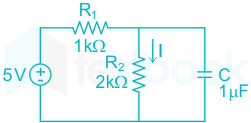
In the figure shown, the capacitor is initially uncharged. Which one of the following expressions describes the current I(t) (in mA) for 𝑡 > 0?
((a))
I(t)=35(1−e−τt),τ=32;msec
((b))
I(t)=25(e−τt),τ=32;msec
((c))
I(t)=35(1−e−τt),τ=3;msec
((d))
I(t)=25(1−e−τt),;τ=3;msec
Show Answer
Answer: ((a))
I(t)=35(1−e−τt),τ=32;msec
Concept:
A capacitor does not allow a sudden change in voltage, i.e.
Vc(0-) = Vc(0+)
Similarly, an inductor does not allow a sudden change in current across it, i.e.
iL(0-) = iL(0+)
Analysis:
For t = 0- the capacitor has no initial voltage, i.e.
Vc(0-) = 0
∴ Vc(0+) = 0V
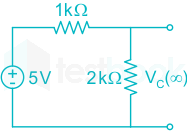
The steady-state voltage across the capacitor can be obtained by open-circuiting the capacitor as shown:
Using voltage division rule:
Vc(∞)=2+15×2=310V
The voltage across the capacitor will be:
VC(t)=VC(∞)−(VC(∞)−VC(0))eReqC−t
∴VC(t)=310−(310−0)eReqC−t
VC(t)=310(1−eτ−t)
τ = Req C = Time constant.
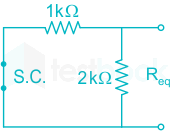
Req = Equivalent impedance across the capacitor which is obtained as:
Req=2+12×1=32k
∴τ=32k×1μ=32msec
Since the capacitor is connected in parallel to the Resistance R2, the voltage across R2 will also be VC(t).
∴ The required current I will be:
I=R2VC(t)
I=3×2k10(1−eτ−t)
I=35(1−eτ−t)mA
τ=32msec
43
In the magnetically coupled circuit shown in the figure, 56 % of the total flux emanating from one coil links the other coil. The value of the mutual inductance (in H) is ______
44
Assume electronic charge q = 1.6 × 10⁻¹⁹ C, kT/q = 25 mV and electron mobility μn = 1000 cm2/V-s. If the concentration gradient of electrons injected into a P-type silicon sample is 1 × 10²¹/cm4, the magnitude of electron diffusion current density (in A/cm2) is _________.
45
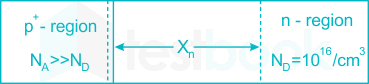
Consider an abrupt p-n junction act (T = 300 K) shown in the figure. The depletion region width Xn on the n-side of the junction is 0.2 μm and the permittivity of silicon (tsi) is 1.044 × 10⁻¹² F/cm.
At the junction, the approximate absolute value of the peak electric field (KV/cm) is ______
46
When a silicon diode having a doping concentration of NA = 9 × 10¹⁶ /cm3 on p-side and ND = 1 × 10¹⁶/cm3 on the n-side is reverse biased, the total depletion width is found to be 3 μm. Given that the permittivity of silicon is 1.04 × 10⁻¹² F/cm, the depletion width on the p-side and the maximum electric field in the depletion region, respectively, are
((a))
2.7 μm and 2.3 × 10⁵ V/cm
((b))
0.3 μm and 4.15 × 10⁵ V/cm
((c))
0.3 μm and 0.42 × 10⁵ V/cm
((d))
2.1 μm and 0.42 × 10⁵ V/cm
Show Answer
Answer: ((b))
0.3 μm and 4.15 × 10⁵ V/cm
Concept:
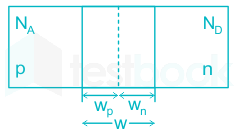
Consider the following p-n junction:
The total depletion with W is the sum of the depletion width on the p-side and n-side, i.e.
W = WP + WN
Where Wp is given by:
WP=NA+NDW⋅ND
And WN is given by:
WN=NA+NAW⋅NA
Calculation:
Given:
NA = 9 × 10¹⁶/cm3
ND = 1016/cm3
W = 3 μm
Wp=NA+NDW⋅ND
WP=9×10¹⁶+10163×1016
WP=103μm=0.3;μm
Wp = 0.3 μm
Peak electric field is given by Poisson’s equation as:
Epeak=EVWpNA
=1.04×10−121.6×10−19×0.3×10−4×9×1016
Epeak = 4.15 × 10⁵ V/cm
If in the question it is mentioned to the find peak electric field using linear approximation then:
Epeak=W−2;V0
Where,
V0 = potential at junction
W = depletion width
Epeak = peak electric field intensity at the junction.
If nothing is mention go with the Poisson’s equation:
Epeak=E−V;WNND=E−VWpNA
47
The diode in the circuit shown has Von = 0.7 Volts but is ideal otherwise.
If Vi = 5 sin (ωt) Volts, the minimum and maximum values of V0 (in Volts) are, respectively,
((a))
−5 and 2.7
((b))
2.7 and 5
((c))
−5 and 3.85
((d))
1.3 and 5
Show Answer
Answer: ((c))
−5 and 3.85
For the complete negative half cycle, the diode will be OFF as it will be reversed biased.
This is as shown:
∴ The minimum voltage will be the minimum value that the input voltage can reach, i.e. -5V
For the positive half cycle, the diode will be On when the voltage across the diode exceeds 2.7 V.
The maximum voltage will be when the input voltage is at its maxima, i.e. at + 5V
The circuit is drawn as:
Applying KVL across the loop, we get:
5 – I × 1k – I× 1k – 0.7 – 2 = 0
2.3 = 2I × 1k
I=2k2.3A
Applying KVL from Vi to V0, we can write:
5−2r2.3×1k=V0
V0 = 5 – 2.15 = 3.85
48
For the n-channel MOS transistor shown in the figure, the threshold voltage VTh is 0.8 V. Neglect channel length modulation effects. When the drain voltage VD = 1.6 V, the drain current ID was found to be 0.5 mA. If VD is adjusted to be 2 V by changing the values of r and VDD, the new value of ID (in mA) is
We observe that the given MOS transistor is in the saturation mode as VDS > VGS - VT
ID1=kn(VGS1−VT)2
kn=(1.6−.8)2ID1
kn=0.78;mA/v
Also VG = VD
Now,
VD2 = 2 V. So, VGS2 = 2 V
ID2=kn(VGS2−VT)2
ID2=0.78;(2−0.8)2;
ID2=1.125;mA
49
For the MOSFETS shown in the figure, the threshold voltage |Vt| = 2 V and K=21μCox(LW)=0.1mA/V2.
The value of ID (in mA) is _________
50
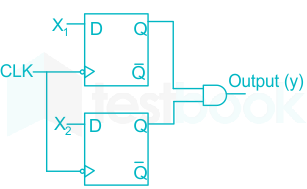
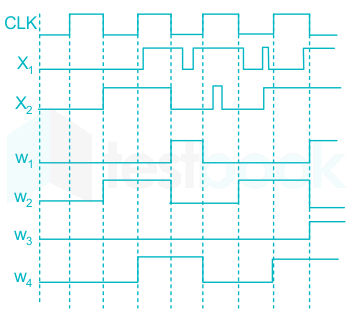
In the circuit shown, choose the correct timing diagram of the output (y) from the given waveforms w1, w2, w3 and w4
<sub>
</sub>
((a))
w1
((b))
w2
((c))
w3
((d))
w4
Show Answer
Answer: ((c))
w3
Consider the given circuit:
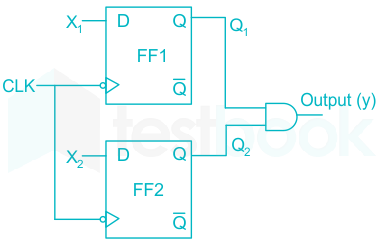
Let Q1 and Q2 be the output of flip flop 1 and flip flop 2.
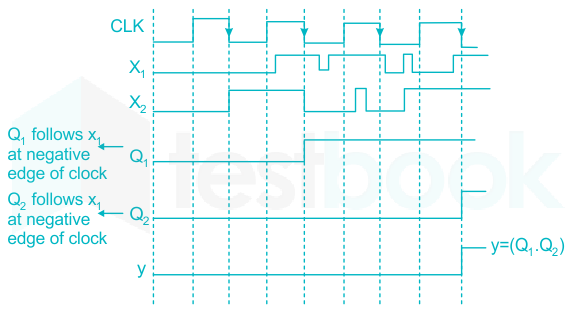
Please note that flip flop is a negative edge triggered, i.e. the output of flip flop only changes at the negative edge of the clock.
The function of the D-flip flop is to follow the input when the flip flop is triggered.
Here, the flip flop is triggered at the negative edge of the flip flop.
The output y is similar w3.
Hence, option C is correct.
51
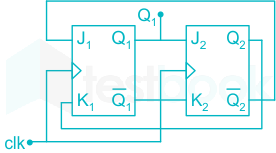
The output of the two flip-flops Q1, Q2 in the figure shown are initialized to 0, 0. The sequence generated at Q1 upon application of the clock signal is
((a))
01110…
((b))
01010…
((c))
00110…
((d))
01100…
Show Answer
Answer: ((d))
01100…
Concept:
The Truth table of JK flip flop is given by:
J
K
Qn+1
0
0
Qn
Hold state
0
1
0
Reset state
1
0
1
Set state
1
1
Q̅n
Toggle state
Analysis:
Initially, Q1 and Q2 are 0, 0.
From the figure:
J1 = Q̅2 , K1 = Q2, J2 = Q1, K2 = Q̅1
Present State
F F Inputs
Next State
Clock
Q1
Q̅1
Q2
Q̅2
J1
K1
J2
K2
Q1+
Q2+
1
0
1
0
1
1
0
0
1
1
0
2
1
0
0
1
1
0
1
0
1
1
3
1
0
1
0
0
1
1
0
0
1
⋮
⋮
⋮
⋮
⋮
⋮
⋮
⋮
⋮
⋮
⋮
Hence the sequence generated at Q1 is 0110…
52
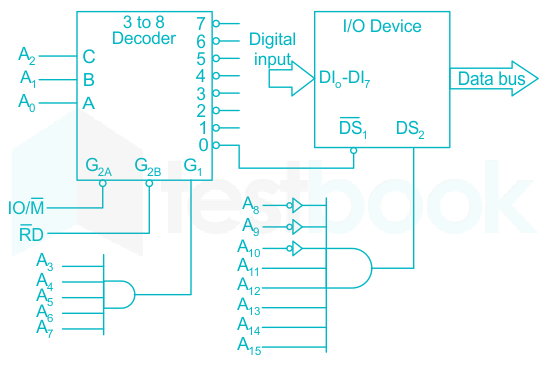
For the 8085 microprocessor, the interfacing circuit to input 8-bit digital data (DI0 – DI7) from an external device is shown in the figure. The instruction for correct data transfer is
((a))
MVI A, F8H
((b))
IN F8 H
((c))
OUT F8H
((d))
LDA F8 F8H
Show Answer
Answer: ((d))
LDA F8 F8H
Let us understand the concept behind the Question:
For the data, digital input of 8-bit to be transformed in output, we need to enable I/O device.
To enable I/O device DS̅1 should be active low & DS2 must be active high.
DS̅1 is active low when output 0 of the decoder 3 × 8 is active low.
Output 0 is active low When A2 = A1 = A0 = 0
But to enable decoder, we need
G2A → active low,
G2B → active low
& G1 → active high
To make G1 active high A5 = Ar = A5 = A6 = A2 = 1
G2A is active low when IO/M̅ = 0, i.e. memory operation is being performed.
G2B is active low when RD̅ = 0, i.e. read operation is performed.
Hence, from the above two statements we have conducted memory read operation is performed.
<br>
To make DS2 high, we need:
The address lines in hexadecimal is F8 F8 H
Hence the correct instrument for data transfer is LDA F8 F8 H, which means load accumulator with the content present at address F8 F8H.
Analyzing the given options:
Instrument IN F8H & OUT F8H is an invalid instruction because memory operation is performed and not I/O operation.
HVI F8H, means transfer the data F8H into the accumulator, but in question, no information is given about the data lines, all the information is concerning to the address lines.
53
Consider a discrete-time signal
\(x\left[ n \right] = \left{ {\begin{array}{*{20}{c}}
{n;;for;;0 \le n \le 10}\
{0;;;;;;;otherwise}
\end{array}} \right.\)
If y[n] is the convolution of x[n] with itself, the value of y[4] is ______
54
The input-output relationship of a causal stable LTI system is given as
y[n] = α y[n – 2] + β x[n]
If the impulse response h[n] of this system satisfies the condition \(\mathop \sum \limits_{n = 0}^\infty h\left[ n \right] = 4,\) the relationship between α and β is
((a))
4α – β = 4
((b))
4α + β = 4
((c))
α = 4β
((d))
α = -4β
Show Answer
Answer: ((b))
4α + β = 4
y[n] = α y[n – 2] + β x[n]
by applying z-transform on both the sides,
Y(z) = αz-2 Y(z)+ β X(z)
Y(z) [1 - αz-2] = β X(z)
X(z)Y(z)=1−αz−2β
H(z)=1−αz−2β
The impulse response can be expressed as
\(H\left( z \right)=\underset{0}{\overset{\infty }{\mathop \sum }},h\left[ n \right]{{z}^{-n}}\)
Put z = 1,
\(H\left( 1 \right)=~\underset{0}{\overset{\infty }{\mathop \sum }},h\left[ n \right]\)
H(1) = 4
1−αβ=4
1−α=4β
4α+β=4
55
The value of the integral \(\mathop \smallint \limits_{ - \infty }^\infty \sin {c^2}\left( {5t} \right)dt\) is ________
56
An unforced linear time-invariant (LTI) system is represented by:
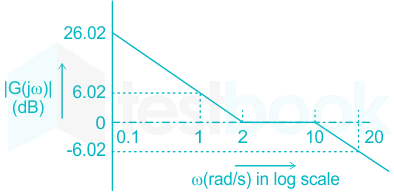
The Bode asymptotic magnitude plot of a minimum phase system is shown in the figure.
If the system is connected in a unity negative feedback configuration the steady-state error of the closed-loop system, to a unit ramp input, is _______.
58
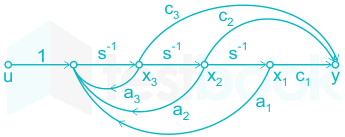
Consider the state space system expressed by the signal flow diagram shown in the figure.
Now, again we cannot comment on stability because we do not know the nature of a1, a2 & a3
Hence, only option A is correct.
59
The input to a 1-bit quantizer is a random variable 𝑋 with pdf (𝑥) = 2𝑒−2𝑥 for 𝑥 ≥ 0 and 𝑓𝑋(𝑥) = 0 for 𝑥 < 0. For outputs to be of equal probability, the quantizer threshold should be_____
60
Coherent orthogonal binary FSK modulation is used to transmit two equiprobable symbol waveforms 𝑠1(𝑡) = 𝛼 cos 2𝜋𝑓1𝑡 and 𝑠2(𝑡) = 𝛼 cos 2𝜋𝑓2𝑡, where 𝛼 = 4 mV. Assume an AWGN channel with two-sided noise power spectral density 2N0=0.5×10⁻¹²;W/Hz. Using an optimal receiver and the relation \(Q\left( v \right) = \frac{1}{{\sqrt {2\pi } }}\mathop \smallint \limits_v^\infty {e^{ - {u^2}/2}}du\), the bit error probability for a data rate of 500 kbps is
((a))
Q(2)
((b))
Q(22)
((c))
Q(4)
((d))
Q(42)
Show Answer
Answer: ((c))
Q(4)
Concept:
FSK Modulation:
In FSK: transmission of 1 is represented as:
s1(t) = Ac cos 2π fHt
Transmission of 0 is represented as:
s2(t) = Ac cos 2π fLt
and the Bit error probability =Q[2N0Ed]
Where Ed is the energy of s1(t) – s2(t)
\({E_d} = \mathop \smallint \limits_0^{{T_b}} { {s_1}\left( t \right) - {s_2}\left( t \right)}^2;dt;\)
\({E_d} = \mathop \smallint \limits_0^{{T_b}} s_1^2\left( t \right)dt + \mathop \smallint \limits_0^{{T_b}} s_2^2\left( t \right)dt - 2\mathop \smallint \limits_0^{{T_b}} {s_1}\left( t \right) - {s_2}\left( t \right)dt\)
Since s1(t) & s2(t) are orthogonal, we cn write:
\(\therefore ;\mathop \smallint \limits_0^{{T_b}} {s_1}\left( t \right) - {s_2}\left( t \right)dt = 0\)
\({E_d} = \mathop \smallint \limits_0^{{T_b}} s_1^2\left( t \right)dt + \mathop \smallint \limits_0^{{T_b}} s_2^2\left( t \right)dt\)
Ed=2Ac2Tb+2Ac2Tb=Ac3Tb
BER=Q(2N0Ac2Tb)
Analysis:
Given:
Ac = α = 4 mV
2N0=0.5×10⁻¹²;w/Hz
N0 = 10-12 w/Hz
Tb=Rb1=800×1031
Tb = 0.2 × 10⁻⁵
Tb = 2 × 10⁻⁶ sec.
BER=Q(2N0Ac2Tb)
BER=Q(2×10⁻¹²(4×10⁻³)2×2×10−6)
BER=Q(2×10−1216×10−6×2×10−6)
BER=Q(16)
BER = Q(4)
61
The power spectral density of a real stationary random process (𝑡) is given by
\({S_X}\left( f \right) = \left{ {\begin{array}{*{20}{c}}
{\frac{1}{W},;;;;;\left| f \right| \le W}\
{0,;;;;;\left| f \right| > W}
\end{array}} \right.;;\)
The value of the expectation E[πX(t)X(t−4W1)] is ______
62
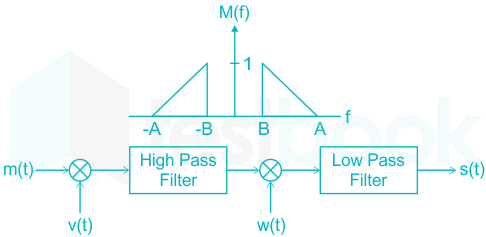
In the figure, M(f) is the Fourier transform of the message signal m(t) where A = 100 Hz and B = 40 Hz. Given v(t) = cos (2πfct) and w(t) = cos (2π(fc + A)t), where fc > A. The cutoff frequencies of both the filters are fc.
The bandwidth of the signal at the output of the modulator (in Hz) is _______
Keep your left-hand thumb in the direction of propagation and then check the. The direction of the finger. If it follows the direction then it is left circular otherwise right circular.
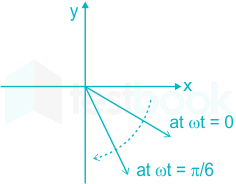
Application: The polarization of a plane wave is the figure traced by the tip of the electric field vector as a function of time, at a fixed point in space.
Given:
E(z,;t)=ax3cos(ωt−kz+30∘)−ay4sin(ωt−kz+45∘)
Fixing a point, i.e. z = 0 (say)
E(0,;t)=ax3cos(ωt+30∘)−ay4sin(ωt+45∘)
Now, when ωt = 0
E=ax3cos30∘−ay4sin(45∘)
E = 2.6 ax – 2.82 ay
Similarly, at;ω=6π(30∘), we get:
E = ax3 cos (60°) - ay 4 sin (75°)
E = 1.5 ax – 3.86 ay
The trace is plotted as:
64
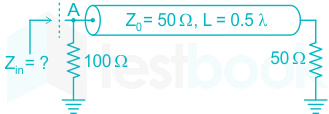
In the transmission line shown, the impedance Zin (in ohms) between node A and the ground is _________.
65
For a rectangular waveguide of internal dimensions a × b (a > b), the cut-off frequency for the TE11 mode is the arithmetic mean of the cut-off frequencies for TE10 mode and TE20 mode. If a = √5 cm, the value of b (in cm) is _______.