Official Paper

GATE CE 2023 Official Paper: Shift 1 (Previous Year Paper)

65 questions · 180 minutes · with answers · free

General Aptitude (10 questions)

1

“I have not yet decided what I will do this evening; I ______ visit a friend.”

  1. ((a))

    mite

  2. ((b))

    would

  3. ((c))

    might

  4. ((d))

    didn’t

Show Answer
Answer: ((c))

might

Explanation:

  • In the sentence, the word "might" is used to convey uncertainty or a potential future action.
  • The speaker hasn't decided on their evening plans but is considering the possibility of visiting a friend. "Might" is a modal verb indicating a conditional or tentative action.
  • Options 1 (mite) is likely a typo or incorrect word, 2 (would) suggests a conditional action but may not fit the context, and 4 (didn't) is past tense and does not align with the uncertainty expressed in the sentence.
  • Therefore, "might" best captures the intended meaning of potential but undecided action.
2

Eject : Insert : : Advance : _______

(By word meaning)

  1. ((a))

    Advent

  2. ((b))

    Progress

  3. ((c))

    Retreat

  4. ((d))

    Loan

Show Answer
Answer: ((c))

Retreat

Explanation:

  • The correct analogy is Advance: Retreat.
  • In the given analogy, "eject" is the opposite action to "insert," just as "retreat" is the opposite of "advance."
  • Ejecting is removing or pushing out, and inserting is placing or pushing in.
  • Similarly, advancing is moving forward, and retreating is moving backward.
  • Options 1 (Advent) and 2 (Progress) do not convey the opposite relationship, and option 4 (Loan) is unrelated to the directional relationship between advance and retreat, making option 3 (Retreat) the appropriate choice based on word meanings and logical pairing.
3

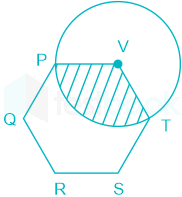
In the given figure, PQRSTV is a regular hexagon with each side of length 5 cm. A circle is drawn with its centre at V such that it passes through P. What is the area (in cm2 ) of the shaded region? (The diagram is representative) 

  1. ((a))

    25π3\frac{25\pi}{3}

  2. ((b))

    20π3\frac{20\pi}{3}

  3. ((c))

  4. ((d))

Show Answer
Answer: ((a))

25π3\frac{25\pi}{3}

Explanation:

Interior angle sum = (n – 2) × 180°

Each angle of a regular Hexagon:

(n2)×180n=\rm \frac{(n-2)\times 180^{\circ}}{n}= 120°

Required area = θ360×π×25=25π3\rm \frac{\theta}{360^{\circ}}\times \pi \times 25=\frac{25\pi}{3}

4

A duck named Donald Duck says “All ducks always lie.”

Based only on the information above, which one of the following statements can be logically inferred with certainty?

  1. ((a))

    Donald Duck always lies.

  2. ((b))

    Donald Duck always tells the truth. 

  3. ((c))

    Donald Duck’s statement is true.

  4. ((d))

    Donald Duck’s statement is false.

Show Answer
Answer: ((d))

Donald Duck’s statement is false.

Explanation:

The statement "Donald Duck always lies" creates a logical paradox. If the statement is true, then Donald Duck must be lying about always lying, which implies he sometimes tells the truth. Conversely, if the statement is false, it means Donald Duck sometimes tells the truth, contradicting the claim. Therefore, the certainty of Donald Duck's truthfulness or falsehood is indeterminate, making options 1 and 2 impossible to ascertain. However, option 4, "Donald Duck’s statement is false," logically follows as it captures the inherent contradiction in the statement, regardless of Donald Duck's overall truthfulness.

5

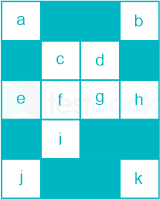
A line of symmetry is defined as a line that divides a figure into two parts in a way such that each part is a mirror image of the other part about that line.

The figure below consists of 20 unit squares arranged as shown. In addition to the given black squares, upto 5 more may be coloured black. Which one among the following options depicts the minimum number of boxes that must be coloured black to achieve two lines of symmetry? (The figure is representative)

  1. ((a))

    d

  2. ((b))

    c, d, i

  3. ((c))

    c, i

  4. ((d))

    c, d, i, f, g

Show Answer
Answer: ((b))

c, d, i

Explanation:

If box d or i is coloured block we get one line of symmetry, i.e., horizontal or vertical. But for two lines of symmetry, we need to at least colour 3 boxes, i.e., c, d, and I.

In another way, 

Both c, d, i and c, d, i, f, g make the figure symmetrical about two lines (horizontal and vertical), but as the minimum number is asked, option (B) is correct.

6

Based only on the truth of the statement ‘Some humans are intelligent’, which one of the following options can be logically inferred with certainty?

  1. ((a))

    No human is intelligent.

  2. ((b))

    All humans are intelligent. 

  3. ((c))

    Some non-humans are intelligent.

  4. ((d))

    Some intelligent beings are humans.

Show Answer
Answer: ((d))

Some intelligent beings are humans.

Explanation:

No human is intelligent - This statement directly contradicts the given information. We know that at least some humans are intelligent; therefore, it cannot be true that no human is intelligent.

All humans are intelligent - The information given does not provide enough evidence to infer this. The fact that some humans are intelligent does not mean that all humans are.

Some non-humans are intelligent - The original statement doesn't provide any information about non-humans, so we can't make any inferences about them based on that statement.

Some intelligent beings are humans - This can be logically inferred from the original statement. If 'some humans are intelligent,' then it necessarily follows that 'some intelligent beings are humans.'

So, the only logical inference that can be made with absolute certainty from the statement 'Some humans are intelligent,' is 'Some intelligent beings are humans.'

7

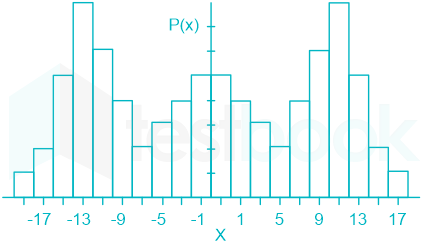
Which one of the options can be inferred about the mean, median, and mode for the given probability distribution (i.e. probability mass function), 𝑃(𝑥), of a variable x?

  1. ((a))

    mean = median ≠ mode

  2. ((b))

    mean = median = mode

  3. ((c))

    mean ≠ median = mode

  4. ((d))

    mean ≠ mode = median 

Show Answer
Answer: ((a))

mean = median ≠ mode

Explanation:

Mean:

  • In probability distribution, the mean, represents the average of a random variable's possible values, weighted by their respective probabilities.
  • It is a measure central to the distribution and indicates the center or average outcome.
  • The mean provides insights into the long-term behavior of the random variable under consideration.

Median:

  • The median is the middle value that separates the higher half from the lower half of a dataset when arranged in ascending order.
  • It is a measure of central tendency and is not affected by extreme values.
  • The median is particularly useful in describing the central position in skewed or asymmetric distributions.

Mode:

  • The mode is the value or values that occur with the highest frequency.
  • It represents the most probable outcome in a set of data. Unlike mean and median.
  • The mode is not necessarily unique and a distribution can be unimodal (one mode), bimodal (two modes), or multimodal (more than two modes).

From the graph 

  • It is a perfectly symmetrical distribution. So, mean = median.
  • It is symmetrical about the y-axis (positive data = negative data). So, mean = median = 0
  • Mode = -13, 13 (Bimodal)
  • Thus, mean = median ≠ mode
8

The James Webb telescope, recently launched in space, is giving humankind unprecedented access to the depths of time by imaging very old stars formed almost 13 billion years ago. Astrophysicists and cosmologists believe that this odyssey in space may even shed light on the existence of dark matter. Dark matter is supposed to interact only via the gravitational interaction and not through the electromagnetic-, the weak- or the strong-interaction. This may justify the epithet “dark” in dark matter.
Based on the above paragraph, which one of the following statements is FALSE?

  1. ((a))

    No other telescope has captured images of stars older than those captured by the James Webb telescope.

  2. ((b))

    People other than astrophysicists and cosmologists may also believe in the existence of dark matter.

  3. ((c))

    The James Webb telescope could be of use in the research on dark matter.

  4. ((d))

    If dark matter was known to interact via the strong-interaction, then the epithet “dark” would be justified.

Show Answer
Answer: ((d))

If dark matter was known to interact via the strong-interaction, then the epithet “dark” would be justified.

Explanation:

The false statement is option 4. If dark matter was known to interact via the strong-interaction, then the epithet “dark” would be justified. 

  • The paragraph explicitly states that dark matter is supposed to interact only via gravitational interaction and not through electromagnetic-, weak-, or strong-interaction.
  • Therefore, the epithet "dark" in dark matter is justified precisely because it does not interact through the strong force or other known interactions.
  • The other options (a, b, c) are not addressed in the paragraph, and their truth or falsity cannot be determined based on the information provided.
9

Let a = 30! , b = 50! , and c = 100! . Consider the following numbers:

loga c, logc a, logb a, loga b

Which one of the following inequalities is CORRECT?

  1. ((a))

    logc a < logb a < loga b < loga c

  2. ((b))

    logc a < loga b < logb a < logb c

  3. ((c))

    logc a < logb a < loga c < loga b

  4. ((d))

    logb a < logc a < loga b < loga c

Show Answer
Answer: ((a))

logc a < logb a < loga b < loga c

Explanation:

Given, a = 30!, b = 50! and c = 100!

We know that 

lognm=logmlogn\rm \log_n m=\frac{\log m}{\log n}

loga c, logc a, loga b, logb a

log100!log30!,log30!log100!,log50!log30!,log30!log50!\rm \frac{\log 100!}{\log 30!},\rm \frac{\log 30!}{\log 100!},\rm \frac{\log 50!}{\log 30!},\rm \frac{\log 30!}{\log 50!}

log30!log100!<log30!log50!<log50!log30!<log100!log30!\rm \frac{\log 30!}{\log 100!}<\rm \frac{\log 30!}{\log 50!}<\rm \frac{\log 50!}{\log 30!}<\rm \frac{\log 100!}{\log 30!}

logc a < logb a < loga b < loga c

10

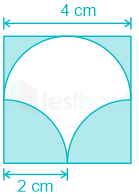
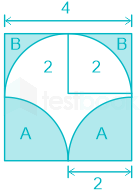
A square of side length 4 cm is given. The boundary of the shaded region is defined by one semi-circle on the top and two circular arcs at the bottom, each of radius 2 cm, as shown.

The area of the shaded region is __________ cm2.

  1. ((a))

    8

  2. ((b))

    4

  3. ((c))

    12

  4. ((d))

    10

Show Answer
Answer: ((a))

8

Explanation:

Area of quadrant,

A = 14π(2)2=π\rm \frac{1}{4}\pi (2)^2=\pi cm2

Area of sector, B = Area of square – Area of quadrant  = 4 – π

So, the total shaded area

= 2A + 2B =2 × π + 2 × (4 – π)

= 2π + 8 – 2π = 8 cm2

Civil Engineering (55 questions)

11

For the integral I=111x2dx\rm I=\displaystyle\int^1_{-1}\frac{1}{x^2}dx

which of the following statements is TRUE?

  1. ((a))

    I = 0

  2. ((b))

    I = 2 

  3. ((c))

    I = -2

  4. ((d))

    The integral does not converge

Show Answer
Answer: ((d))

The integral does not converge

Explanation:

f(x)=1x2\rm f(x)=\frac{1}{x^2} is not defined at x = 0

So, I=101x2dx+011x2dx\rm I=\displaystyle\int^0_{-1}\frac{1}{x^2}dx+\rm \displaystyle\int^1_{0}\frac{1}{x^2}dx

\(\rm =\left(-\frac{1}{x}\right){-1}^0+\rm =\left(-\frac{1}{x}\right){0}^1=\infty\)

1x\rm \frac{1}{x} is not defined at x = 0

Therefore, the integral does not converge.

12

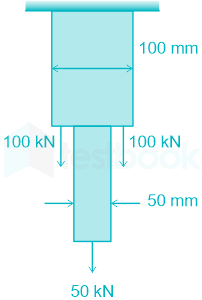
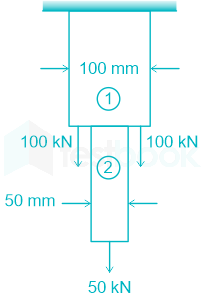
A hanger is made of two bars of different sizes. Each bar has a square cross-section. The hanger is loaded by three-point loads in the mid vertical plane as shown in the figure. Ignore the self-weight of the hanger. What is the maximum tensile stress in N/mm2 anywhere in the hanger without considering stress concentration effects?
  1. ((a))

    15.0

  2. ((b))

    25.0

  3. ((c))

    35.0

  4. ((d))

    45.0

Show Answer
Answer: ((b))

25.0

Explanation:

<br>

Stress in member (1),

(σ1)=P1A1=250×103100×100=25 N/mm2\rm (σ_1)=\frac{P_1}{A_1}=\frac{250\times10^3}{100\times 100}=25 \ N/mm^2

Stress in member (2),

(σ2)=P2A2=50×10350×50=20 N/mm2\rm (σ_2)=\frac{P_2}{A_2}=\frac{50\times10^3}{50\times 50}=20 \ N/mm^2

σmax = 25 N/mm2

13

Creep of concrete under compression is defined as the _________. 

  1. ((a))

    increase in the magnitude of strain under constant stress

  2. ((b))

    increase in the magnitude of stress under constant strain

  3. ((c))

    decrease in the magnitude of strain under constant stress

  4. ((d))

    decrease in the magnitude of stress under constant strain

Show Answer
Answer: ((a))

increase in the magnitude of strain under constant stress

Explanation:

  • Creep under compression is defined as an increase in the magnitude of strain under constant stress.
  • The creep of concrete depends on stress in concrete, the age of loading, and the loading duration (increases with time).
  • But, the rate of creep rapidly decreases with time.
  • Although the exact mechanism of creep is not clear, it is generally attributed to:
  1. Internal movement of adsorbed water
  2. Growth in micro-cracks
  3. Sliding between gel particles (C – S – H gel)
  4. Moisture loss
  • Under constant load, the Creep strain in concrete is Time-dependent as Ec1+Θ \frac{Ec}{1+\Theta }

      Where, Θ\Theta  is age factor

14

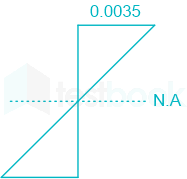
A singly reinforced concrete beam of balanced section is made of M20 grade concrete and Fe415 grade steel bars. The magnitudes of the maximum compressive strain in concrete and the tensile strain in the bars at ultimate state under flexure, as per IS 456 ∶ 2000 are ________, respectively. (round off to four decimal places)

  1. ((a))

    0.0035 and 0.0038

  2. ((b))

    0.0020 and 0.0018 

  3. ((c))

    0.0035 and 0.0041

  4. ((d))

    0.0020 and 0.0031

Show Answer
Answer: ((a))

0.0035 and 0.0038

Explanation:

In a balanced section, the strain diagram under flexure is

0.87fyEs+0.002\rm \frac{0.87f_y}{E_s}+0.002

So, strain in concrete = 0.0035

Strain in steel = 0.87×4152×105+0.002=0.0038\rm \frac{0.87\times415}{2\times10^5}+0.002=0.0038

15

In cement concrete mix design, with the increase in water-cement ratio, which one of the following statements is TRUE?

  1. ((a))

    Compressive strength decreases but workability increases 

  2. ((b))

    Compressive strength increases but workability decreases

  3. ((c))

    Both compressive strength and workability decrease 

  4. ((d))

    Both compressive strength and workability increase

Show Answer
Answer: ((a))

Compressive strength decreases but workability increases 

Explanation:

  • The water–cement ratio is the ratio of the weight of water to the weight of cement used in a concrete mix. A lower ratio leads to higher strength and durability but may make the mix difficult to work with and form.

Workability:

  • The workability of concrete refers to its ease of handling, placing, and compacting during construction.
  • It is influenced by factors such as water content, mix proportions, and aggregate properties.
  • Optimal workability ensures efficient construction processes, proper compaction, and the achievement of desired strength and durability in the final concrete structure.
  • The higher the water-cement ratio weaker the mix and the more workability.

Compressive Strength:

  • The compressive strength of concrete is a measure of its ability to withstand axial loads or forces pushing the material together.
  • As the water-cement ratio increases, the compressive strength decreases.
  • A concrete design mix with a low water/cement ratio and also using larger aggregates results in gains in concrete compressive strength.
16

The specific gravity of a soil is 2.60. The soil is at 50% degree of saturation with a water content of 15%. The void ratio of the soil is _______.

  1. ((a))

    0.35

  2. ((b))

    0.78

  3. ((c))

    0.87

  4. ((d))

    1.28

Show Answer
Answer: ((b))

0.78

Explanation:

Given: Specific gravity, G = 2.6

Saturation, S = 0.5

Water content, w = 0.15

As we know

Se = Gw

⇒ 0.5 × e = 2.6 × 0.15

⇒ e=2.6×0.150.5=0.78\rm e=\frac{2.6\times0.15}{0.5}=0.78

17

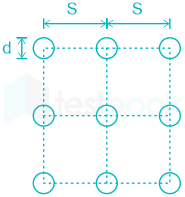
A group of 9 friction piles are arranged in a square grid maintaining equal spacing in all directions. Each pile is of diameter 300 mm and length 7 m. Assume that the soil is cohesionless with effective friction angle 𝜙′ = 32°. What is the center-to-center spacing of the piles (in m) for the pile group efficiency of 60%?

  1. ((a))

    0.582

  2. ((b))

    0.486

  3. ((c))

    0.391

  4. ((d))

    0.677

Show Answer
Answer: ((b))

0.486

Explanation:

By Converse – Labarre formula

ηg=[1θ90(m(n1)+n(m1)mn)]×100\rm \eta_g=\left[1-\frac{θ}{90}\left(\frac{m(n-1)+n(m-1)}{mn}\right)\right]\times100

0.6=1θ90(3×2+3×23×3)\rm ⇒ 0.6=1-\frac{θ}{90}\left(\frac{3\times2+3\times2}{3\times3}\right)

⇒ θ90(6+69)=0.4\rm \frac{θ}{90}\left(\frac{6+6}{9}\right)=0.4

⇒ θ = 27° 

Now, tanθ=dS\rm \tan \theta=\frac{d}{S} where d is diameter and S is spacing.

So, Spacing, S = dtanθ=0.3tan27=0.587\rm \frac{d}{\tan \theta}=\frac{0.3}{\tan 27^{\circ}}=0.587

Alternatively,

Group efficiency = QugnQus\rm \frac{Q_{ug}}{nQ_{us}}

⇒ 0.6=12(γl)tanδ(2S+d)×l×49×12(γl)tanδ(pdl)\rm 0.6=\frac{\frac{1}{2}(\gamma l)\tan \delta(2S+d)\times l\times4}{9\times \frac{1}{2}(\gamma l)\tan \delta (pdl)}

⇒ 0.6(2S+d)×49×πd\rm 0.6\frac{(2S+d)\times4}{9\times \pi d}

⇒ S=12[0.6×9×π×0.340.3]=0.486\rm S=\frac{1}{2}\left[\frac{0.6\times9\times \pi \times 0.3}{4}-0.3\right]=0.486

Note:

As the exact answer of spacing is not matching with the given options by E Converse-Labarre formula, therefore we will use alternative method to find spacing.

18

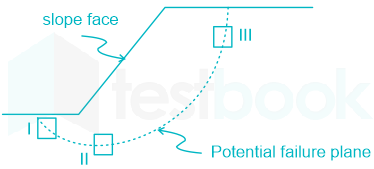
A possible slope failure is shown in the figure. Three soil samples are taken from different locations (I, II and III) of the potential failure plane. Which is the most appropriate shear strength test for each of the sample to identify the failure mechanism? Identify the correct combination from the following options:

P : Triaxial compression test

Q : Triaxial extension test

R : Direct shear or shear box test

S : Vane shear test

  1. ((a))

    I - Q, II - R, III - P

  2. ((b))

    I - R, II - P, III - Q

  3. ((c))

    I - S, II - Q, III - R

  4. ((d))

    I - P, II - R, III - Q 

Show Answer
Answer: ((a))

I - Q, II - R, III - P

Explanation:

Triaxial extension Test:

  • The triaxial extension test is a geotechnical laboratory test used to determine the deformation characteristics of soil under different confining pressures.
  • It involves subjecting a cylindrical soil sample to axial tension while measuring axial and radial strains.
  • This test provides valuable information for soil engineering and slope stability analysis.
  • At location I, σH > σV 

 Triaxial extension (As depth from ground level is less, σv is less).

Direct shear or shear box test:

  • The direct shear test, conducted using a shear box apparatus, evaluates the shear strength of soils.
  • It involves applying horizontal forces to a divided soil sample, measuring deformation, and determining the soil's shear strength parameters, such as cohesion and internal friction angle.
  • At location II, the Failure plane is the same as the direct shear box test i.e. perpendicular to the vertical plane.

Triaxial compression test:

  • The triaxial compression test is a geotechnical laboratory test that assesses the strength and stress-strain behavior of soils under confined conditions.
  • It involves subjecting a cylindrical soil sample to axial compression within a confining pressure chamber, providing insights into soil stability and deformation characteristics.
  • At location III, σv > σh 

 Triaxial compression test.

Vane shear test:

  • The vane shear test is a geotechnical method for measuring the undrained shear strength of cohesive soils.
  • A vane is inserted into the soil and rotated to measure the torque required for shearing. This test helps assess soil stability and bearing capacity.
19

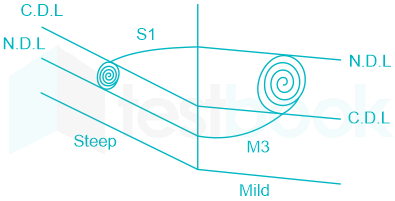
When a supercritical stream enters a mild-sloped (M) channel section, the type of flow profile would become _________.

  1. ((a))

    M1

  2. ((b))

    M2

  3. ((c))

    M3

  4. ((d))

    M1 and M2

Show Answer
Answer: ((c))

M3

Explanation:

  • When a supercritical stream enters a mild-sloped (M) channel section, the type of flow profile would become "subcritical."
  • In mild-sloped channels, the velocity of the flow decreases, transitioning from supercritical to subcritical flow.
  • This change in flow profile occurs as the channel slope counteracts the kinetic energy of the supercritical flow, causing the water to slow down and the flow to become subcritical.
  • When a supercritical stream enters a mild sloped (M) channel section, the type of flow profile will be M3.
  • The depth of flow is less than critical depth of flow in case of M3.

20

Which one of the following statements is TRUE for Greenhouse Gas (GHG) in the atmosphere?

  1. ((a))

    GHG absorbs the incoming short wavelength solar radiation to the earth surface, and allows the long wavelength radiation coming from the earth surface to pass through

  2. ((b))

    GHG allows the incoming long wavelength solar radiation to pass through to the earth surface, and absorbs the short wavelength radiation coming from the earth surface 

  3. ((c))

    GHG allows the incoming long wavelength solar radiation to pass through to the earth surface, and allows the short wavelength radiation coming from the earth surface to pass through

  4. ((d))

    GHG allows the incoming short wavelength solar radiation to pass through to the earth surface, and absorbs the long wavelength radiation coming from the earth surface 

Show Answer
Answer: ((d))

GHG allows the incoming short wavelength solar radiation to pass through to the earth surface, and absorbs the long wavelength radiation coming from the earth surface 

Explanation:

  • Greenhouse gases (GHGs) act as a natural insulation layer for the Earth.
  • These gases, such as carbon dioxide and water vapor, permit short-wavelength solar radiation to penetrate the atmosphere and reach the Earth's surface.
  • Once absorbed by the surface, the Earth emits long-wavelength infrared radiation.
  • GHGs, however, selectively absorb and trap much of this outgoing radiation, preventing its immediate escape into space.
  • This process, known as the greenhouse effect, warms the Earth's surface and plays a vital role in maintaining a habitable climate.
  • Human activities, particularly the burning of fossil fuels, enhance this effect, leading to global warming.
21

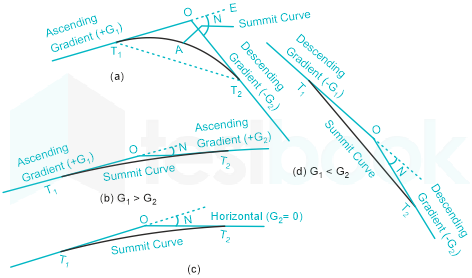
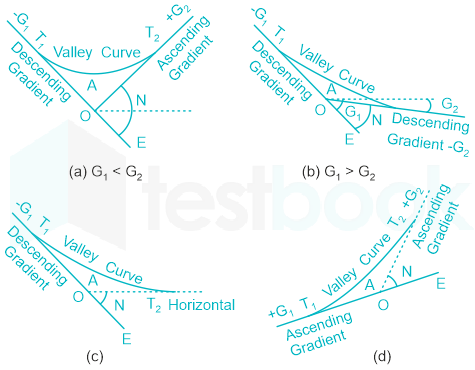
G1 and G2 are the slopes of the approach and departure grades of a vertical curve, respectively.

Given |G1| < |G2| and |G1| ≠ |G2| ≠ 0

Statement 1: +G1 followed by +G2 results in a sag vertical curve.

Statement 2: −G1 followed by −G2 results in a sag vertical curve.

Statement 3: +G1 followed by −G2 results in a crest vertical curve.

Which option amongst the following is true?

  1. ((a))

    Statement 1 and Statement 3 are correct; Statement 2 is wrong

  2. ((b))

    Statement 1 and Statement 2 are correct; Statement 3 is wrong

  3. ((c))

    Statement 1 is correct; Statement 2 and Statement 3 are wrong 

  4. ((d))

    Statement 2 is correct; Statement 1 and Statement 3 are wrong 

Show Answer
Answer: ((a))

Statement 1 and Statement 3 are correct; Statement 2 is wrong

Explanation:

Statements (1) and (3) are correct.

Condition for summit curve (crest vertical curve),

+ve to +ve; +ve to flat

(G1 > G2)

+ve to –ve; –ve to –ve

(G1 < G2)

Condition for valley curve (sag vertical curve),

–ve to –ve; –ve to flat

(G1 > G2)

–ve to +ve; +ve to +ve

(G1 < G2)

22

The direct and reversed zenith angles observed by a theodolite are 56° 00' 00" and 303° 00' 00", respectively. What is the vertical collimation correction?

  1. ((a))

    +1° 00' 00"

  2. ((b))

    −1° 00' 00"

  3. ((c))

    −0° 30' 00"

  4. ((d))

    +0° 30' 00"

Show Answer
Answer: ((d))

+0° 30' 00"

Explanation:

Vertical collimation correction:

  • Vertical collimation correction, refers to the adjustment made to correct for any deviation in the optical line of sight from being perfectly vertical.
  • It accounts for errors in the leveling instrument or the telescope's alignment.
  • The correction is crucial in ensuring accurate measurements of elevations and vertical angles, particularly in tasks such as leveling and height determination in construction, topography, and geodetic surveys.
  • Applying vertical collimation correction helps eliminate systematic errors and enhances the precision of vertical measurements.

Calculation:

Given,

ϕ1 = Observed value of direct zenith angle = 56° 00′ 00′′

ϕ2 = Observed value of reversed zenith angle = 303° 00′ 00′′

So, Vertical collimation correction =

=

= 0.5° = 30’

23

A student is scanning his 10 inch × 10 inch certificate at 600 dots per inch (dpi) to convert it to raster. What is the percentage reduction in number of pixels if the same certificate is scanned at 300 dpi?

  1. ((a))

    62

  2. ((b))

    88

  3. ((c))

    75

  4. ((d))

    50

Show Answer
Answer: ((c))

75

Concept:

  • The concept here is related to the resolution of an image, measured in dots per inch (dpi).
  • Resolution determines the number of pixels in each inch of the image.
  • If the student scans a 10-inch × 10-inch certificate at 600 dpi, the total number of pixels is 600×10×600×10.
  • If the same certificate is scanned at 300 dpi, the total number of pixels becomes 300×10×300×10.
  • The reduction in pixels can be calculated by comparing these two pixel counts, and the percentage reduction is determined by expressing this reduction as a percentage of the original pixel count.

Calculation:

Number of dots as per 600 dpi = (10 × 600)2 = 36000000

Number of dots as per 300 dpi = (10 × 300)2 = 9000000

Percentage reduction in number of pixels

=36000000900000036000000×100=2736×100=75%\rm =\frac{36000000-9000000}{36000000}\times 100=\frac{27}{36}\times 100=75\%

24

If M is an arbitrary real n × n matrix, then which of the following matrices will have non-negative eigenvalues?

  1. ((a))

    M2

  2. ((b))

    MMT

  3. ((c))

    MTM

  4. ((d))

    (MT)2

Show Answer
Answer: ((a))

M2

(*) Marks to all Marks to all

Let us take M=[0110]\rm M=\begin{bmatrix}0&-1\\ 1&0\end{bmatrix} then E. values are λ = ± i

So, Eigen values of M2 are i2 and (– i)2 = –1, – 1

Eigen values of (MT)2 are same i.e. –1, – 1

Now, MMT and MTM are symmetric matrix, so they have also negative eigen values

so no option is correct i.e. wrong options.

Hence, it is marks to all.

25

The following function is defined over the interval [-L, L]:

f(x) = px4 + qx5.

If it is expressed as a Fourier series, 

\(\rm f(x)=a_0 +\displaystyle\sum^\infty_{n=1} \left{a_n \sin\left( \frac{\pi x}{L} \right) +b_n\cos\left( \frac{\pi x}{L} \right) \right} \),

which options amongst the following are true?

  1. ((a))

    an, n = 1, 2, ..., ∞ depend on p

  2. ((b))

    an, n = 1, 2, ..., ∞ depend on q

  3. ((c))

    bn, n = 1, 2, ..., ∞ depend on p

  4. ((d))

    bn, n = 1, 2, ..., ∞ depend on q

Show Answer
Answer: ((a))

an, n = 1, 2, ..., ∞ depend on p

Explanation:

bn=1lllf(x)cos(nπx)ldx=1lll(px4+qx5)cos(nπxl)dx\rm b_n=\frac{1}{l}\int_{-l}^lf(x)\cos\frac{(n\pi x)}{l}dx=\frac{1}{l}\int_{-l}^l(px^4+qx^5)\cos\left(\frac{n\pi x}{l}\right)dx

=1lllpx4cos(nπxl)dx+0=\rm \frac{1}{l}\int_{-l}^lpx^4\cos\left(\frac{n\pi x}{l}\right)dx+0  (∵2nd integral is an odd functions)

​Thus, bn depend on p​

Similarly, 

an=1lllf(x)sin(nπx)ldx=1lll(px4+qx5)sin(nπxl)dx\rm a_n=\frac{1}{l}\int_{-l}^lf(x)\sin\frac{(n\pi x)}{l}dx=\frac{1}{l}\int_{-l}^l(px^4+qx^5)\sin\left(\frac{n\pi x}{l}\right)dx

=0+1lllqx5sin(nπxl)dx=\rm 0+\frac{1}{l}\int_{-l}^lqx^5\sin\left(\frac{n\pi x}{l}\right)dx (∵1st integral is an odd functions)

Thus, an depend on q.

26

Consider the following three structures: 

Structure I: Beam with hinge support at A, roller at C, guided roller at E, and internal hinges at B and D

Structure II: Pin-jointed truss, with hinge support at A, and rollers at B and D

Structure III: Pin-jointed truss, with hinge support at A and roller at C

Which of the following statements is/are TRUE?

  1. ((a))

    Structure I is unstable

  2. ((b))

    Structure II is unstable

  3. ((c))

    Structure III is unstable

  4. ((d))

    All three structures are stable

Show Answer
Answer: ((a))

Structure I is unstable

Explanation:

Structure I

r = 3 (VA, VC, ME)

s = 4 (ΣFy = 0, ΣM = 0, BMB = 0, BMD = 0)

Ds = r – s = 3 – 4 = –1 ⇒ negative implies unstable

Structure II

Rigid body rotation is possible since all four reactions are concurrent at A. Unstable,

Structure III

Shear force at x-x = Panel shear force = VA

There is no member to resist panel shear force.

So unstable.

27

Identify the waterborne diseases caused by viral pathogens:

  1. ((a))

    Acute anterior poliomyelitis

  2. ((b))

    Cholera

  3. ((c))

    Infectious hepatitis

  4. ((d))

    Typhoid fever

Show Answer
Answer: ((a))

Acute anterior poliomyelitis

Explanation:

  • The waterborne diseases caused by viral pathogens among the given options are
  1. Acute anterior poliomyelitis (caused by the poliovirus)
  2. Infectious hepatitis (commonly caused by the hepatitis A virus)
  • Cholera and typhoid fever are typically caused by bacterial pathogens (Vibrio cholerae for cholera and Salmonella typhi for typhoid fever).
  • Infectious hepatitis - This term is broad, but it commonly refers to hepatitis A, B, C, D, and E. Among these, hepatitis A is primarily associated with waterborne transmission.

    1. Typhoid fever- Typhoid fever is caused by the bacterium Salmonella typhi, not a viral pathogen.
28

Which of the following statements is/are TRUE for the Refuse-Derived Fuel (RDF) in the context of Municipal Solid Waste (MSW) management?

  1. ((a))

    Higher Heating Value (HHV) of the unprocessed MSW is higher than the HHV of RDF processed from the same MSW

  2. ((b))

    RDF can be made in the powdered form

  3. ((c))

    Inorganic fraction of MSW is mostly converted to RDF

  4. ((d))

    RDF cannot be used in conjunction with oil

Show Answer
Answer: ((a))

Higher Heating Value (HHV) of the unprocessed MSW is higher than the HHV of RDF processed from the same MSW

Explanation:

  • Option 1) This is generally FALSE. Refuse-Derived Fuel (RDF) is processed from municipal solid waste (MSW) where recyclable and non-combustible materials are removed. Therefore, the Higher Heating Value (HHV) of RDF is typically higher than unprocessed MSW because it is more concentrated in combustible materials.
  • Option 2) This is TRUE. Refuse-Derived Fuel (RDF) can be made in various forms, including pellets, fluff, and even powdered form, according to the requirement of the end-use system.
  • Option 3) This is FALSE. The inorganic fraction of MSW is typically not converted to RDF. Instead, RDF is made from the organic, combustible fraction of MSW. The noncombustible materials like metals and glass are often removed during the processing.
  • Option 4) This is FALSE. RDF can indeed be used in conjunction with various other types of fuel, including coal, gas, and oil. Multifuel systems can burn RDF along with conventional fuels to produce energy.

Thus, among your options, the second statement is true, while the rest are false.

29

The probabilities of occurrences of two independent events A and B are 0.5 and 0.8, respectively. What is the probability of occurrence of at least A or B (rounded off to one decimal place)? ________

30

In the differential equation dydx+α x y=0,α\frac{dy}{dx}+\alpha\ x\ y =0, \alpha is a positive constant. If y = 1.0 at x = 0.0, and y = 0.8 at x = 1.0, the value of α is ________ (rounded off to three decimal places).

31

Consider the fillet-welded lap joint shown in the figure (not to scale). The length of the weld shown is the effective length. The welded surfaces meet at right angle. The weld size is 8 mm, and the permissible stress in the weld is 120 MPa. What is the safe load P (in kN, rounded off to one decimal place) that can be transmitted by this welded joint? ___________

32

A drained direct shear test was carried out on a sandy soil. Under a normal stress of 50 kPa, the test specimen failed at a shear stress of 35 kPa. The angle of internal friction of the sample is ________ degree (round off to the nearest integer).

33

A canal supplies water to an area growing wheat over 100 hectares. The duration between the first and last watering is 120 days, and the total depth of water required by the crop is 35 cm. The most intense watering is required over a period of 30 days and requires a total depth of water equal to 12 cm. Assuming precipitation to be negligible and neglecting all losses, the minimum discharge (in m3 /s, rounded off to three decimal places) in the canal to satisfy the crop requirement is __________________.

34

The ordinates of a one-hour unit hydrograph for a catchment are given below: 

t (hour)01234567
Q (m3/s)09211812520
<br>

Using the principle of superposition, a D-hour unit hydrograph for the catchment was derived from this one-hour unit hydrograph. The ordinates of the D-hour unit hydrograph were obtained as 3 m3/s at t = 1 hour and 10 m3/s at t = 2 hour. The value of D (in integer) is _____________.

35

For a horizontal curve, the radius of a circular curve is obtained as 300 m with the design speed as 15 m/s. If the allowable jerk is 0.75 m/s3 , what is the minimum length (in m, in integer) of the transition curve?___________

36

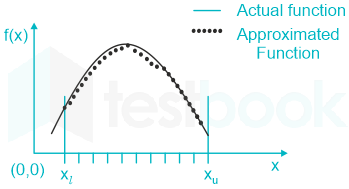
A function f(x), that is smooth and convex-shaped between interval (xl , su) is shown in the figure. This function is observed at odd number of regularly spaced points. If the area under the function is computed numerically, then . 

  1. ((a))

    the numerical value of the area obtained using the trapezoidal rule will be less than the actual

  2. ((b))

    the numerical value of the area obtained using the trapezoidal rule will be more than the actual

  3. ((c))

    the numerical value of the area obtained using the trapezoidal rule will be exactly equal to the actual

  4. ((d))

    with the given details, the numerical value of area cannot be obtained using trapezoidal rule 

Show Answer
Answer: ((a))

the numerical value of the area obtained using the trapezoidal rule will be less than the actual

Explanation:

  • The trapezoidal rule approximates the area under a curve by connecting data points with straight lines.
  • Since these lines are segments of the curve, the rule tends to underestimate the actual area by assuming a linear connection between adjacent points.
  • As a result, it approximates the curve's shape with a series of trapezoids, leading to a conservative estimate that is less than the actual area.
  • The trapezoidal rule tends to overestimate the value if the function is concave and underestimate the value if the function is convex.
  • Since, the given function is convex-shaped parabola, the numerical value of the area obtained using the trapezoidal rule will be less than the actual.
37

Consider a doubly reinforced RCC beam with the option of using either Fe250 plain bars or Fe500 deformed bars in the compression zone. The modulus of elasticity of steel is 2 × 10⁵ N/mm2 . As per IS456 : 2000, in which type(s) of the bars, the stress in the compression steel (fsc) can reach the design strength (0.87 fy) at the limit state of collapse?

  1. ((a))

    Fe250 plain bars only

  2. ((b))

    Fe500 deformed bars only

  3. ((c))

    Both Fe250 plain bars and Fe500 deformed bars

  4. ((d))

    Neither Fe250 plain bars nor Fe500 deformed bars

Show Answer
Answer: ((a))

Fe250 plain bars only

Explanation:

We know, the strain at the compression zone, εsc = 0.035 x Xudcdc\frac{Xu-dc}{dc}

εsc= 0.0035 × Xudcdc \frac{Xu-dc}{dc}

So,  εsc  < 0.0035

But we can consider εsc ≈ 0.0035.

For Fe250,

The yield strain is 0.87fyEs=0.87250200000 \frac{0.87fy}{Es}=\frac{0.87 *250}{200000} =1.0875 x10⁻³  < 0.0035 

When  εsc= 0.0035  fsc = 0.87 fy

For Fe500

The yield strain  = 0.87fyEs+0.002 \frac{0.87fy}{Es}+0.002

0.87500200000+0.002 \frac{0.87*500}{200000}+0.002

= 4.175 × 10⁻³

Hence,  fsc < 0.87 fy

Fe250 will reach 0.87fy

Thus only Fe- 250 is used.

38

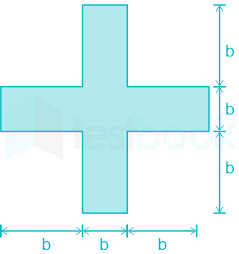
Consider the horizontal axis passing through the centroid of the steel beam cross-section shown in the figure. What is the shape factor (rounded off to one decimal place) for the cross-section? 

  1. ((a))

    1.5

  2. ((b))

    1.7

  3. ((c))

    1.3

  4. ((d))

    2.0

Show Answer
Answer: ((b))

1.7

Explanation:

The plastic section modulus is

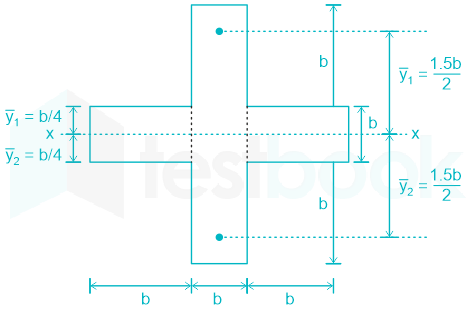
Zp=A2[y1+y2]\rm Z_p=\frac{A}{2}[\overline{y}_1+\overline{y}_2]

=(b×1.5b)[1.5b2+1.5b2]+[2b×b2]×[b4+b4]=2.75b3\rm =(b\times 1.5b)\left[\frac{1.5b}{2}+\frac{1.5b}{2}\right]+\left[2b\times \frac{b}{2}\right]\times \left[\frac{b}{4}+\frac{b}{4}\right]=2.75b^3

The elastic section modulus is

Z=IXXy=[b×(3b)312+2b×b312]1.5b=2918b3\rm Z=\frac{I_{XX}}{y}=\frac{\left[\frac{b\times(3b)^3}{12}+\frac{2b\times b^3}{12}\right]}{1.5b}=\frac{29}{18}b^3

Shape factor is given by

S.F. = ZpZ=2.75b32918b3=1.7\rm \frac{Z_p}{Z}=\frac{2.75b^3}{\frac{29}{18}b^3}=1.7

39

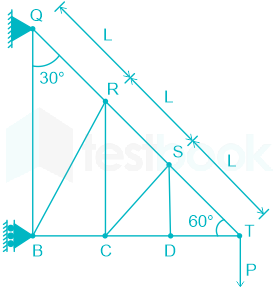
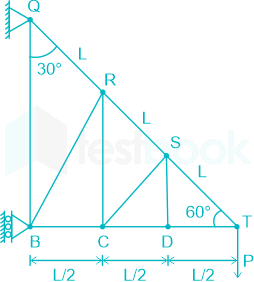
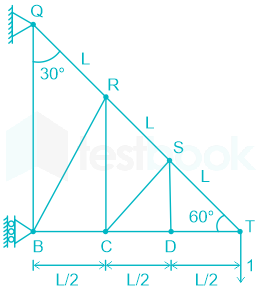
Consider the pin-jointed truss shown in the figure (not to scale). All members have the same axial rigidity, AE. Members QR, RS, and ST have the same length L. Angles QBT, RCT, SDT are all 90°. Angles BQT, CRT, DST are all 30°. The joint T carries a vertical load P. The vertical deflection of joint T is kPLAE\rm \frac{PL}{AE}. What is the value of k?

  1. ((a))

    1.5

  2. ((b))

    4.5

  3. ((c))

    3.0

  4. ((d))

    9.0

Show Answer
Answer: ((b))

4.5

Explanation:

At joint T,

ΣFy = 0

⇒ FTS sin 60° = P

FTS=2P3(T)\rm F_{TS}=\frac{2P}{\sqrt3}(T)

ΣFx = 0

FTS cos 60° = FDT

FDT=2P3(12)=P3(C)\rm F_{DT}=\frac{2P}{\sqrt3}\left(\frac{1}{2}\right)=\frac{P}{\sqrt3}(C)

FTS = FSR = FRQ2P3(T)\rm\frac{2P}{\sqrt3}(T)

FDT = FCD = FBLP3(C)\rm\frac{P}{\sqrt3}(C)

Similarly,

KST = KSR = KRQ = 23(T)\rm\frac{2}{\sqrt3}(T)

kDT=kCD=kBC=13(T)\rm k_{DT}=k_{CD}=k_{BC}=\frac{1}{\sqrt3}(T)

The vertical deflection of joint T

δVT=ΣPkLAE=(2P3)(23)L×3AE+(P3)(13)L2×3AE\rm\therefore \delta_{VT}=\Sigma\frac{PkL}{AE}=\frac{\left(\frac{2P}{\sqrt3}\right)\left(\frac{2}{\sqrt3}\right)L\times3}{AE}+\frac{\left(\frac{P}{\sqrt3}\right)\left(\frac{1}{\sqrt3}\right)\frac{L}{2}\times3}{AE}

δVT=4PLAE+PL2AE=4.5PLAE\rm \delta_{VT}=\frac{4PL}{AE}+\frac{PL}{2AE}=\frac{4.5PL}{AE}

⇒ k = 4.5

40

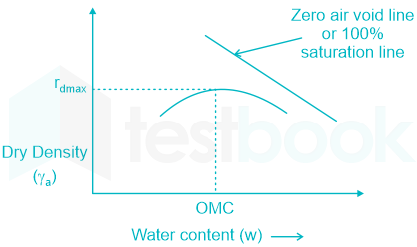
With reference to the compaction test conducted on soils, which of the following is INCORRECT?

  1. ((a))

    Peak point of the compaction curve gives the maximum dry unit weight and optimum moisture content

  2. ((b))

    With increase in the compaction effort, the maximum dry unit weight increases

  3. ((c))

    With increase in the compaction effort, the optimum moisture content decreases

  4. ((d))

    Compaction curve crosses the zero-air-voids curve

Show Answer
Answer: ((d))

Compaction curve crosses the zero-air-voids curve

Explanation:

  • Peak point of the compaction curve gives the maximum dry unit weight and optimum moisture content.
  • With increase in the compaction effort, the maximum dry unit weight increases.
  • With increase in the compaction effort, the optimum moisture content decreases.
  • Compaction curve does not cross the zero-air-voids line.

41

Consider that a force P is acting on the surface of a half-space (Boussinesq’s problem). The expression for the vertical stress (σz) at any point (r, z), within the half-space is given as,

σz=3P2πz3(r2+z2)52\rm \sigma_z=\frac{3P}{2\pi} \frac{z^3}{_{(r^2+z^2)}\frac{5}{2}}

where, r is the radial distance, and z is the depth with downward direction taken as positive. At any given r, there is a variation of σz along z, and at a specific z, the value of σz will be maximum. What is the locus of the maximum σz ?

  1. ((a))

    z2=32r2\rm z^2 =\frac{3}{2}r^2

  2. ((b))

    z3=32r2\rm z^3 =\frac{3}{2}r^2

  3. ((c))

    z2=52r2\rm z^2 =\frac{5}{2}r^2

  4. ((d))

    z3=52r2\rm z^3 =\frac{5}{2}r^2

Show Answer
Answer: ((a))

z2=32r2\rm z^2 =\frac{3}{2}r^2

Explanation:

The expression for the vertical stress (σz) at any point (r, z), within the half-space is

σz=3P2πz3(r2+z2)5/2\rm \sigma_z=\frac{3P}{2\pi}\frac{z^3}{(r^2+z^2)^{5/2}}

The locus of the maximum σz 

dσzdz=0\rm \frac{d\sigma_z}{dz}=0 ⇒ dσz2π=3P2π[(r2+z2)5/23z2z352(r2+z2)3/2.2z(r2+z2)5]=0\rm \frac{d\sigma_z}{2\pi}=\frac{3P}{2\pi}\left[\frac{(r^2+z^2)^{5/2}3z^2-z^3\frac{5}{2}(r^2+z^2)^{3/2}.2z}{(r^2+z^2)^5}\right]=0

⇒ (r2 + z2)3/2 z2[3(r2 + z2) - 5z2] = 0

⇒ 3r2 + 3z2 - 5z2 = 0

⇒ 3r2 = 2z2

⇒ z2=3r22\rm z^2=\frac{3r^2}{2}

42

A square footing of size 2.5 m × 2.5 m is placed 1.0 m below the ground surface on a cohesionless homogeneous soil stratum. Considering that the groundwater table is located at the base of the footing, the unit weights of soil above and below the groundwater table are 18 kN/m3 and 20 kN/m3, respectively, and the bearing capacity factor Nq is 58, the net ultimate bearing capacity of the soil is estimated as 1706 kPa (unit weight of water = 10 kN/m3).

Earlier, a plate load test was carried out with a circular plate of 30 cm diameter in the same foundation pit during a dry season, when the water table was located beyond the plate influence zone. Using Terzaghi’s bearing capacity formulation, what is the ultimate bearing capacity (in kPa) of the plate?

  1. ((a))

    110.16

  2. ((b))

    61.20

  3. ((c))

    204.00

  4. ((d))

    163.20

Show Answer
Answer: ((a))

110.16

Explanation:

The net ultimate bearing capacity is

qnu = qu - σ\rm \overline{\sigma} = qu - γDf

1706 = {1.3 CNC + γDfNq + 0.4BγNγ} - γDf

1706 = 18 × 1 × 58 + 0.4 × 2.5 × 10 Nγ - 18γf

Nγ = 68

For Plate(Surcharge at the plate level is zero)

The ultimate bearing capacity is

qu = 1.3 CNc + γDfNq + 0.3BγNγ

qu = 0 + 0.3 × 0.3 × 18 × 68

qu = 110.16

43

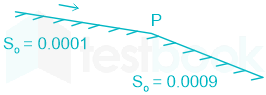
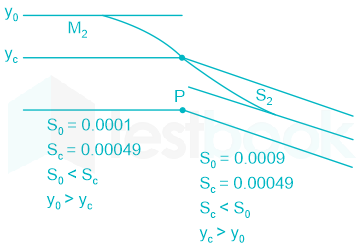
A very wide rectangular channel carries a discharge (Q) of 70 m3/s per meter width. Its bed slope changes from 0.0001 to 0.0009 at a point P, as shown in the figure (not to scale). The Manning’s roughness coefficient of the channel is 0.01. What water surface profile(s) exist(s) near the point P?

  1. ((a))

    M2 and S2

  2. ((b))

    M2 only

  3. ((c))

    S2 only

  4. ((d))

    S2 and hydraulic jump

Show Answer
Answer: ((a))

M2 and S2

Explanation:

For a wide Rectangular channel

R=AP=ByB+2y=Byb=y\rm R = \frac{A}{P}=\frac{B_y}{B+2y}=\frac{B_y}{b}=y

Discharge per unit width, q is given by

⇒ q=1nyy2/3S1/2\rm q = \frac{1}{n}y y^{2/3}S^{1/2}

⇒ q=1ny5/3S1/2\rm q = \frac{1}{n} y^{5/3}S^{1/2}

Calculation of Sc ,

yc=(q2g)1/3\rm y_c=\left(\frac{q^2}{g}\right)^{1/3}

⇒ q=1nyc5/3Sc1/2\rm q=\frac{1}{n}y_c^{5/3}S_c^{1/2}

⇒ q=1n(q2g)5/3Sc1/2\rm q=\frac{1}{n}\left(\frac{q^2}{g}\right)^{5/3}S_c^{1/2}

⇒ q=1nq10/9g5/3SS1/2\rm q=\frac{1}{n}\frac{q^{10/9}}{g^{5/3}}S_S^{1/2}

⇒ Sc1/2=nqg5/9q10/9\rm S_c^{1/2}=\frac{nqg^{5/9}}{q^{10/9}}

⇒ Sc=(ng5/9q1/9)2=(0.01×9.85/9701/9)2\rm S_c=\left(\frac{ng^{5/9}}{q^{1/9}}\right)^2=\left(\frac{0.01\times9.8^{5/9}}{70^{1/9}}\right)^2

= 0.00049 (> 0.0001 and < 0.0009)

44

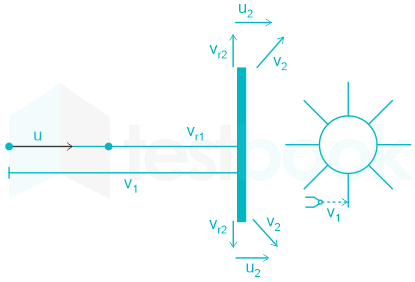
A jet of water having a velocity of 20 m/s strikes a series of plates fixed radially on a wheel revolving in the same direction as the jet at 15 m/s. What is the percentage efficiency of the plates? (round off to one decimal place)

  1. ((a))

    37.5

  2. ((b))

    66.7

  3. ((c))

    50.0

  4. ((d))

    88.9

Show Answer
Answer: ((a))

37.5

Concept:

Efficiency of plates cn be calculated by work done by work done per second to the input water power. 

Given:

v1 = 20 m/s

u = 15 m/s

[u1 = u2 = u]

Efficiency, η = Work done per second / Input water power

=Fx.u12mV12=m[v1u]×u12mv12\rm =\frac{F_x.u}{\frac{1}{2}mV_1^2}=\frac{m[v_1-u]\times u}{\frac{1}{2}mv_1^2}

=[2015]×1512×(20)2=0.375=\frac{[20-15]\times15}{\frac{1}{2}\times (20)^2}=0.375 ≃ 37.5%

Another method:

Efficiency of plates can be calculated by, 

Where, u = velocity of plate = 15 m/s

V = velocity of jet = 20 m/s

45

In the following table, identify the correct set of associations between the entries in Column - 1 and Column-2.

Column - 1Column - 2
P:Reverse OsmosisI:Ponding
Q:Trickling FilterII:Freundlich Isotherm
R:CoagulationIII:Concentration Polarization
S:AdsorptionIV:Charge Neutralization
  1. ((a))

    P - II, Q - I, S - III

  2. ((b))

    Q - III, R - II, S - IV

  3. ((c))

    P - IV, R - I, S - II

  4. ((d))

    P - III, Q - I, R - IV

Show Answer
Answer: ((d))

P - III, Q - I, R - IV

Explanation: 

Reverse Osmosis:

  • Reverse osmosis is a water purification process where a semi-permeable membrane removes impurities.
  • Concentration polarization occurs when retained solutes accumulate on the membrane, hindering water flow.
  • It impacts efficiency and requires measures to minimize fouling, ensuring effective reverse osmosis for water treatment applications

Trickling filter:

  • A trickling filter is a wastewater treatment method using a bed of rocks or synthetic media for microbial treatment.
  • It enhances biological degradation.
  • Ponding refers to water accumulation, often causing surface flooding.
  • In wastewater treatment, trickling filters mitigate ponding by efficiently processing and reducing water contaminants, preventing surface water issues.

Coagulation:

  • Coagulation in water treatment refers to the process of clumping together fine particles to form larger, settleable flocs.
  • Charge neutralization involves adding chemicals to neutralize the electrical charges on particles, aiding coagulation.
  • This reduces repulsion between particles, allowing them to come closer and form larger aggregates for effective removal during water treatment.

Additional Information

  • Adsorption and concentration polarization are related phenomena, particularly in membrane processes.
  • Concentration polarization occurs when solutes accumulate near a membrane surface, leading to reduced mass transport.
  • Adsorption can contribute to concentration polarization as solutes may adsorb onto the membrane surface, impacting transport across the membrane.
46

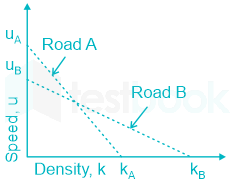
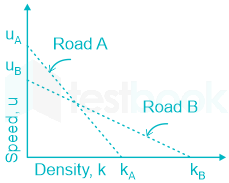
A plot of speed-density relationship (linear) of two roads (Road A and Road B) is shown in the figure.

If the capacity of Road A is CA and the capacity of Road B is CB, what is CACB\rm \frac{ C_A}{C_B }?

  1. ((a))

    kAkB\rm \frac{ k_A}{k_B }

  2. ((b))

    uAuB\rm \frac{ u_A}{u_B }

  3. ((c))

    kAuAkBuB\rm \frac{ k_Au_A}{k_B u_B}

  4. ((d))

    kAuBkBuA\rm \frac{ k_Au_B}{k_B u_A}

Show Answer
Answer: ((c))

kAuAkBuB\rm \frac{ k_Au_A}{k_B u_B}

Explanation:

Now, the capacity of road A,

qmax A=14kAUA\rm q_{max\ A}=\frac{1}{4}k_AU_A

Similarly, the capacity of road B,

qmax B=14kBUB\rm q_{max\ B}=\frac{1}{4}k_BU_B

Now, 

CACB=14×kA×UA14×kB×UB=kAUAkBUB\rm \frac{C_A}{C_B}=\frac{\frac{1}{4}\times k_A\times U_A}{\frac{1}{4}\times k_B\times U_B}=\frac{k_AU_A}{k_BU_B}

47

For the matrix

[A]=[123321312][A]= \begin{bmatrix}1&2&3\\ 3&2&1\\ 3&1&2 \end{bmatrix}

which of the following statements is/are TRUE?

  1. ((a))

    The eigenvalues of [A]T are same as the eigenvalues of [A]

  2. ((b))

    The eigenvalues of [A]-1 are the reciprocals of the eigenvalues of [A]

  3. ((c))

    The eigenvectors of [A]T are same as the eigenvectors of [A]

  4. ((d))

    The eigenvectors of [A]-1 are same as the eigenvectors of [A]

Show Answer
Answer: ((a))

The eigenvalues of [A]T are same as the eigenvalues of [A]

Using standard properties of eigen values eigen vectors,

[A]=[123321312][A]= \begin{bmatrix}1&2&3\\ 3&2&1\\ 3&1&2 \end{bmatrix}

If A is a square matrix, then its eigenvalues are equal to the eigenvalues of its transpose, since they share the same characteristic polynomial.

So, Ax = λx and ATx = λx 

So, statement 1 is correct

Ax = λx

A-1Ax = A-1(λx)

x = λA-1x

A-1x = xλx \over \lambda

So, eigen value and eigon vector of A-1 is xλx \over \lambda

So, statement 2 is correct

If matrix A is n × n and is invertible (meaning it has an inverse, A-1), then A and its inverse A-1  have the same eigenvectors. This is because if v is an eigenvector of A with eigenvalue λ, then A-1v is an eigenvector of A-1 with the same eigenvalue λ. This property holds for invertible matrices.

So, statement 4 is also correct

48

For the function f(x) = ex |sin x|; x ∈ ℝ, which of the following statements is/are TRUE?

  1. ((a))

    The function is continuous at all x

  2. ((b))

    The function is differentiable at all x

  3. ((c))

    The function is periodic

  4. ((d))

    The function is bounded

Show Answer
Answer: ((a))

The function is continuous at all x

Explanation:

Given, 

f(x) = ex |sin x|

Consider,  

At  x = 0,

LHL = –e0 sin0 = 0

RHL = e0 sin 0 = 0

LHL = RHL = f(0) → continuous

At  x = 0,

LHD = –e0 × cos 0 – e0 sin 0 = –1

RHD = e0 cos 0 + e0 sin 0 = +1

LHD ≠ RHD → Not differentiable.

49

Consider the beam shown in the figure (not to scale), on a hinge support at end A and a roller support at end B. The beam has a constant flexural rigidity, and is subjected to the external moments of magnitude M at one-third spans, as shown in the figure. Which of the following statements is/are TRUE?

  1. ((a))

    Support reactions are zero

  2. ((b))

    Shear force is zero everywhere

  3. ((c))

    Bending moment is zero everywhere

  4. ((d))

    Deflection is zero everywhere

Show Answer
Answer: ((a))

Support reactions are zero

Explanation:

ΣFy = 0

∴ VA + VB = 0       ...(i)

ΣMA = 0

⇒ VB × L – M + M = 0

∴ VB = 0

From equation (i), we get

VA = 0

∴ shear force is zero everywhere in the beams, and reactions are also zero.

The bending moment diagram is shown below

So, bending moment is not zero everywhere. Also deflection is not zero everywhere.

50

Which of the following statements is/are TRUE in relation to the Maximum Mixing Depth (or Height) ‘Dmax’ in the atmosphere?

  1. ((a))

    Dmax is always equal to the height of the layer of unstable air

  2. ((b))

    Ventilation coefficient depends on Dmax

  3. ((c))

    A smaller Dmax will have a smaller air pollution potential if other meteorological conditions remain same

  4. ((d))

    Vertical dispersion of pollutants occurs up to Dmax

Show Answer
Answer: ((a))

Dmax is always equal to the height of the layer of unstable air

Maximum Mixing Depth (MMD):

  • The Maximum Mixing Depth (Dmax) in the atmosphere refers to the maximum height reached by vertical air movements, such as turbulence or convection, during a specific time period.
  • It represents the boundary between the mixed layer and the stable layer above. In the context of air pollution, Dmax is crucial, as it determines the vertical extent to which pollutants disperse and mix.
  • Understanding Dmax helps assess the potential impact of pollutants on air quality and human health.
  • The vertical dispersion of pollutants in the atmosphere is influenced by the maximum mixing depth (Dmax), which represents the height to which vertical mixing and turbulent processes extend.
  • Up to Dmax, pollutants experience enhanced dispersion through vertical movement and mixing within the atmospheric boundary layer.
  • The depth of the convective mixing layer in which vertical movement of pollutants is possible, is called the maximum mixing depth (MMD).
  • The ventilation coefficient (Vc) is a parameter used in air quality modeling to estimate the dispersion of pollutants in the atmosphere.
  • It is influenced by factors such as wind speed, atmospheric stability, and the mixing height or maximum mixing depth (Dmax).
  • The relationship between the ventilation coefficient and Dmax is typically positive.
51

Which of the following options match the test reporting conventions with the given material tests in the table?

Test reporting conventionMaterial test
(P)Reported as ratio(I)Solubility of bitumen
(Q)Reported as percentage(II)Softening point of bitumen
(R)Reported in temperature(III)Los Angeles abrasion test
(S)Reported in length(IV)Flash point of bitumen
(V)Ductility of bitumen
(VI)Specific gravity of bitumen
(VII)Thin film oven test
  1. ((a))

    (P) - (VI); (Q) - (I); (R) - (II); (S) - (VII)

  2. ((b))

    (P) - (VI); (Q) - (III); (R) - (IV); (S) - (V)

  3. ((c))

    (P) - (VI); (Q) - (I); (R) - (II); (S) - (V)

  4. ((d))

    (P) - (VI); (Q) - (III); (R) - (IV); (S) - (VII)

Show Answer
Answer: ((a))

(P) - (VI); (Q) - (I); (R) - (II); (S) - (VII)

Explanation:

Solubility of Bitumen:

  • The solubility of bitumen refers to its ability to dissolve in specific solvents, typically organic compounds. Bitumen exhibits low solubility, often requiring elevated temperatures for dissolution, impacting its use in various industrial applications, such as asphalt production.
  • It is represented in terms of the amount of bitumen that can dissolve in a given solvent at a specific temperature, expressed as a percentage or ratio, indicating the solubility characteristics of bitumen in different conditions.

Softening point of bitumen:

  • The softening point of bitumen is the temperature at which it attains a specific level of softness and deformation.
  • It is determined by the ring and ball method. In this test, a steel ball is placed on a bitumen sample, and the temperature is gradually increased until the bitumen softens enough for the ball to sink a specified distance, represented by temperature.

Los Angeles abrasion test:

  • The Los Angeles Abrasion Test is a method to assess the resistance of coarse aggregates to abrasion and degradation.
  • It involves subjecting aggregates to repeated abrasion, simulating the impact of traffic.
  • The percentage of material lost during the test provides a measure of aggregate durability for use in construction.

Ductility of bitumen:

  • The ductility test for bitumen measures its ability to undergo deformation before breaking.
  • A briquette-shaped specimen of bitumen is stretched at a specific rate and temperature until it breaks.
  • The distance the bitumen stretches before rupture, expressed in centimeters, indicates its ductility and suitability for various applications, such as road construction.

Specific gravity of bitumen:

  • Specific gravity of bitumen is a measure of its density about the density of water.
  • It quantifies the mass of a given volume of bitumen compared to an equal volume of water.
  • Specific gravity is crucial for assessing bitumen quality and consistency in construction and industrial applications.

Thin film oven test:

  • The Thin Film Oven Test (TFOT) is a standard procedure used to simulate the aging of asphalt binders during the mixing and laying process.
  • Asphalt samples are exposed to elevated temperatures in a thin film, evaluating their susceptibility to oxidative aging, hardening, and other changes that may affect performance.
52

The differential equation,

dudt+2tu2=1,\rm \frac{du}{dt}+2tu^2=1,

is solved by employing a backward difference scheme within the finite difference framework. The value of 𝑢 at the (𝑛 − 1) th time-step, for some 𝑛, is 1.75. The corresponding time (t) is 3.14 s. Each time step is 0.01 s long. Then, the value of (un - un -1) _________ is (round off to three decimal places).

53

The infinitesimal element shown in the figure (not to scale) represents the state of stress at a point in a body. What is the magnitude of the maximum principal stress (in N/mm2, in integer) at the point? ________

54

An idealised bridge truss is shown in the figure. The force in Member U2L3 is __________ kN (round off to one decimal place).

55

The cross-section of a girder is shown in the figure (not to scale). The section is symmetric about a vertical axis (Y - Y). The moment of inertia of the section about the horizontal axis (X - X) passing through the centroid is _______ cm4 (round off to nearest integer). 

56

A soil having the average properties, bulk unit weight = 19 kN/m3 ; angle of internal friction = 25° and cohesion = 15 kPa, is being formed on a rock slope existing at an inclination of 35° with the horizontal. The critical height (in m) of the soil formation up to which it would be stable without any failure is _________ (round off to one decimal place).

[Assume the soil is being formed parallel to the rock bedding plane and there is no ground water effect.]

57

A smooth vertical retaining wall supporting layered soils is shown in figure. According to Rankine’s earth pressure theory, the lateral active earth pressure acting at the base of the wall is ________ kPa (round off to one decimal place).

58

A vertical trench is excavated in a clayey soil deposit having a surcharge load of 30 kPa. A fluid of unit weight 12 kN/m3 is poured in the trench to prevent collapse as the excavation proceeds. Assume that the fluid is not seeping through the soil deposit. If the undrained cohesion of the clay deposit is 20 kPa and saturated unit weight is 18 kN/m3 , what is the maximum depth of unsupported excavation (in m, rounded off to two decimal places)? ________________

59

A 12-hour storm occurs over a catchment and results in a direct runoff depth of 100 mm. The time-distribution of the rainfall intensity is shown in the figure (not to scale). The 𝜙-index of the storm is (in mm, rounded off to two decimal places) _____________.

60

A hydraulic jump occurs in a 1.0 m wide horizontal, frictionless, rectangular channel, with a pre-jump depth of 0.2 m and a post-jump depth of 1.0 m. The value of g may be taken as 10 m/s2. The values of the specific force at the pre-jump and post-jump sections are same and are equal to (in m3, rounded off to two decimal places) _____________ .

61

In Horton’s equation fitted to the infiltration data for a soil, the initial infiltration capacity is 10 mm/h; final infiltration capacity is 5 mm/h; and the exponential decay constant is 0.5 /h. Assuming that the infiltration takes place at capacity rates, the total infiltration depth (in mm) from a uniform storm of duration 12 h is ____________. (round off to one decimal place)

62

The composition and energy content of a representative solid waste sample are given in the table. If the moisture content of the waste is 26%, the energy content of the solid waste on dry-weight basis is ________ MJ/kg (round off to one decimal place).

ComponentPercent by massEnergy content as-discarded basis (MJ/kg)
Food waste204.5
Paper4516.0
Cardboard514.0
Plastics1032.0
Others208.0
63

A flocculator tank has a volume of 2800 m3. The temperature of water in the tank is 15°C, and the average velocity gradient maintained in the tank is 100/s. The temperature of water is reduced to 5°C, but all other operating conditions including the power input are maintained as the same. The decrease in the average velocity gradient (in %) due to the reduction in water temperature is ________ (round off to nearest integer).

[Consider dynamic viscosity of water at 15°C and 5°C as 1.139 × 10⁻³ N - s/m2 and 1.518 × 10⁻³ N - s/m2 , respectively]

64

The wastewater inflow to an activated sludge plant is 0.5 m3/s, and the plant is to be operated with a food to microorganism ratio of 0.2 mg/mg-d. The concentration of influent biodegradable organic matter of the wastewater to the plant (after primary settling) is 150 mg/L, and the mixed liquor volatile suspended solids concentration to be maintained in the plant is 2000 mg/L. Assuming that complete removal of biodegradable organic matter in the tank, the volume of aeration tank (in m3, in integer) required for the plant is _________.

65

Trigonometric levelling was carried out from two stations P and Q to find the reduced level (R. L.) of the top of hillock, as shown in the table. The distance between Stations P and Q is 55 m. Assume Stations P and Q, and the hillock are in the same vertical plane. The R. L. of the top of the hillock (in m) is ____________ (round off to three decimal places).

StationVertical angle of the top of hillockStaff reading on benchmarkR. L. of benchmark
P18 ̊45ˊ2.340 m100.000 m
Q12 ̊45ˊ1.660 m

Attempt this paper under real exam conditions

Timed interface, section switching, instant scoring, and question-by-question analytics — free.

Start Timed Attempt