Official Paper

GATE CE 2022 Official Paper: Shift 2 (Previous Year Paper)

65 questions · 180 minutes · with answers · free

General Aptitude (10 questions)

1

The movie was funny and I _________.

  1. ((a))

    could help laughing

  2. ((b))

    couldn’t help laughed

  3. ((c))

    couldn’t help laughing

  4. ((d))

    could helped laughed

Show Answer
Answer: ((c))

couldn’t help laughing

The correct answer is 'couldn’t help laughing'.

Key Points

  • From the given statement, it can be inferred that since the movie was funny, the speaker could not resist laughing out loud.
  • The phrase 'couldn’t help laughing' is used when someone is unable to prevent themselves from laughing.

The complete sentence will be: The movie was funny and I couldn’t help laughing.

  • Hence, option 3 is the correct answer.

Additional Information

  • 'Could' is used to indicate the possibility
  • For eg.- This could be possible.
2

x:y:z=12:13:14\rm x : y : z = \frac{1}{2} : \frac{1}{3} : \frac{1}{4}

What is the value of x+zyy\rm \frac{x + z - y}{y} ?

  1. ((a))

    0.75

  2. ((b))

    1.25

  3. ((c))

    2.25

  4. ((d))

    3.25

Show Answer
Answer: ((b))

1.25

**Explanation-**​

x:y:z=12:13:14x:y:z = \frac{1}{2}:\frac{1}{3}:\frac{1}{4}

Let x=k2,y=k3,z=k4x = \frac{k}{2},y = \frac{k}{3},z = \frac{k}{4}

x+zyy=k2+k4k3k3\frac{{x + z - y}}{y} = \frac{{\frac{k}{2} + \frac{k}{4} - \frac{k}{3}}}{{\frac{k}{3}}} = 1.25

∴ (x + z - y) / y = 1.25

3

Both the numerator and the denominator of 3/4 are increased by a positive integer, x, and those of 15/17 are decreased by the same integer. This operation results in the same value for both the fractions.

What is the value of 𝑥?

  1. ((a))

    1

  2. ((b))

    2

  3. ((c))

    3

  4. ((d))

    4

Show Answer
Answer: ((c))

3

Explanation-

Both the numerator and the denominator of 34\frac{3}{4} are increased by a positive integer, x

So the new number will be, 3+x4+x\frac{{3 + x}}{{4 + x}}

Both the numerator and the denominator of 1517\frac{15}{17} are decreased by a positive integer, x

So the new number will be, 15x17x\frac{{15 - x}}{{17 - x}}

This operation results in the same value for both the fractions.

3+x4+x=15x17x\frac{{3 + x}}{{4 + x}} = \frac{{15 - x}}{{17 - x}}

⇒ (3 + x)(17 -x) = (4 + x)(15 - x)

⇒ 14 x + 51 = 11x + 60

⇒ 3x = 9

⇒  x = 3

4

A survey of 450 students about their subjects of interest resulted in the following outcome.

  • 150 students are interested in Mathematics.
  • 200 students are interested in Physics.
  • 175 students are interested in Chemistry.
  • 50 students are interested in Mathematics and Physics.
  • 60 students are interested in Physics and Chemistry.
  • 40 students are interested in Mathematics and Chemistry.
  • 30 students are interested in Mathematics, Physics, and Chemistry.
  • The remaining students are interested in Humanities.

Based on the above information, the number of students interested in Humanities is

  1. ((a))

    10

  2. ((b))

    30

  3. ((c))

    40

  4. ((d))

    45

Show Answer
Answer: ((d))

45

Explanation-

A survey of 450 students about their subjects of interest resulted in the following outcome.

  • 150 students are interested in Mathematics. ⇒ n (M) = 150
  • 200 students are interested in Physics. ⇒ n (P) = 200
  • 175 students are interested in Chemistry. ⇒ n(C) = 175
  • 50 students are interested in Mathematics and Physics. ⇒ n(M U P) = 50
  • 60 students are interested in Physics and Chemistry. ⇒ n(P U C) = 60
  • 40 students are interested in Mathematics and Chemistry. ⇒ n(M U C) = 40
  • 30 students are interested in Mathematics, Physics, and Chemistry. ⇒ n(M U P U C) = 30

The remaining students are interested in Humanities is :

n(M U P U C) = n(M) + n(P) + n(C) - n(M U P) - n(P U C) - n(M U C) + n(M U P U C)

n(M U P U C) = 150 + 200 + 175 - 50 - 60 - 40 + 30 = 405

Total number of students interested in physics, math, and chemistry = 405

The number of students interested in Humanities = 450 - 405 = 45

5

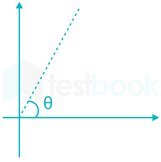
For the picture shown above, which one of the following is the correct picture representing reflection with respect to the mirror shown as the dotted line?

  1. ((a))

  2. ((b))

  3. ((c))

  4. ((d))

Show Answer
Answer: ((a))

6

In the last few years, several new shopping malls were opened in the city. The total number of visitors to the malls is impressive. However, the total revenue generated through sales in the shops in these malls is generally low.

Which one of the following is the CORRECT logical inference based on the information in the above passage?

  1. ((a))

    Fewer people are visiting the malls but spending more

  2. ((b))

    More people are visiting the malls but not spending enough

  3. ((c))

    More people are visiting the malls and spending more

  4. ((d))

    Fewer people are visiting the malls and not spending enough

Show Answer
Answer: ((b))

More people are visiting the malls but not spending enough

The correct answer is 'More people are visiting the malls but not spending enough'.

Key Points

  • Let's refer to the passage:
  • 'The total number of visitors to the malls is impressive.'
  • 'However, the total revenue generated through sales in the shops in these malls is generally low.'
  • From the above-mentioned statements, it is evident that the correct logical inference based on the information in the above passage is that 'more people are visiting the malls but not spending enough'.
  • Hence, option 2 is the correct answer.

Additional Information

  • Revenue is income, especially when of an organization and of a substantial nature.
  • For eg.- Traders have lost £10,000 in revenue since the traffic scheme was implemented.
7

In a partnership business the monthly investment by three friends for the first six months is in the ratio 3 : 4 : 5. After six months, they had to increase their monthly investments by 10%, 15% and 20%, respectively, of their initial monthly investment. The new investment ratio was kept constant for the next six months.

What is the ratio of their shares in the total profit (in the same order) at the end of the year such that the share is proportional to their individual total investment over the year?

  1. ((a))

    22 : 23 : 24

  2. ((b))

    22 : 33 : 50

  3. ((c))

    33 : 46 : 60

  4. ((d))

    63 : 86 : 110

Show Answer
Answer: ((d))

63 : 86 : 110

Explanation:

In a partnership business,  the monthly investment by three friends for the first six months is in the ratio of 3: 4: 5.

Let capitals invested by three friends for six months are C1 = 3x, C2 = 4x, C3 = 5x 

The new investment ratio was kept constant for the next six months.

Profit ratio for first six months = (3x × 6) : (4x × 6) : (5x × 6)

After six months, they had to increase their monthly investments by 10%, 15%, and 20%, respectively, of their initial monthly investment.

Profit ratio for next six months = (1.1 × 3x × 6) : (1.15 ×  4x × 6) : (1.20 × 5x × 6) 

The total ratio of profit = (3x × 6 + (1.1 × 3x × 6) : (4x × 6 + 1.15 ×  4x × 6) : (5x × 6 + 1.20 × 5x × 6) 

P1 ; P2 ; P3 = 6.3 : 8.6 : 11 = 63 : 86 : 110

8

Consider the following equations of straight lines:

Line L1 : 2𝑥 − 3𝑦 = 5

Line L2 : 3𝑥 + 2𝑦 = 8

Line L3 : 4𝑥 − 6𝑦 = 5

Line L4 : 6𝑥 − 9𝑦 = 6

Which one among the following is the correct statement ?

  1. ((a))

    L1 is parallel to L2 and L1 is perpendicular to L3

  2. ((b))

    L2 is parallel to L4 and L2 is perpendicular to L1

  3. ((c))

    L3 is perpendicular to L4 and L3 is parallel to L2

  4. ((d))

    L4 is perpendicular to L2 and L4 is parallel to L3

Show Answer
Answer: ((d))

L4 is perpendicular to L2 and L4 is parallel to L3

Explanation-

When the multiplication of slopes of two lines is equal to -1, then the lines are said to be perpendicular.

 When the slope of two lines is equal, they are said to be parallel lines.

Given data and Calculation-

Line L1 : 2𝑥 − 3𝑦 = 5 , y = 2x53\frac{{2x - 5}}{3}, slope = 2/3

Line L2 : 3𝑥 + 2𝑦 = 8 , y = 83x2\frac{{8 - 3x}}{2}, slope = -3/2

Line L3 : 4𝑥 − 6𝑦 = 5 , y = 4x56\frac{{4x - 5}}{6}, Slope = 4/6

Line L4 : 6𝑥 − 9𝑦 = 6 , y = 6x69\frac{{6x - 6}}{9}, slope = 6/9

Multiplication of Slope L2 and L4 = 3×62×9=1\frac{{ - 3 \times 6}}{{2 \times 9}} = - 1

Slope of L1,L3 and L4 are equal.

So lines L4 and L3 are parallel.

So L4 is perpendicular to L2 and L4 is parallel to L3

9

Given below are two statements and four conclusions drawn based on the statements.

Statement 1: Some soaps are clean.

Statement 2: All clean objects are wet.

Conclusion I: Some clean objects are soaps.

Conclusion II: No clean object is a soap.

Conclusion III: Some wet objects are soaps.

Conclusion IV: All wet objects are soaps.

Which one of the following options can be logically inferred?

  1. ((a))

    Only conclusion I is correct

  2. ((b))

    Either conclusion I or conclusion II is correct

  3. ((c))

    Either conclusion III or conclusion IV is correct

  4. ((d))

    Only conclusion I and conclusion III are correct

Show Answer
Answer: ((d))

Only conclusion I and conclusion III are correct

Explanation-

Statement 1: Some soaps are clean.

Statement 2: All clean objects are wet.

From the above two statements, the Venn diagram can be drawn as-

Conclusion I: Some clean objects are soaps. - It is satisfied in both the probability diagram. So it can be logically inferred.

Conclusion II: No clean object is a soap.- It is not followed.

Conclusion III: Some wet objects are soaps.-It is satisfied in both the probability diagram. So it can be logically inferred.

Conclusion IV: All wet objects are soaps.-It is not followed.

So only conclusions I and III can be logically inferred.

10

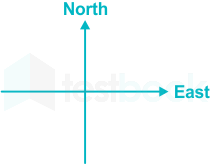
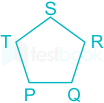
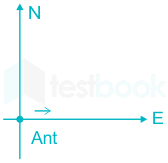
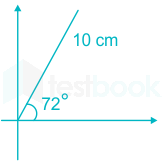
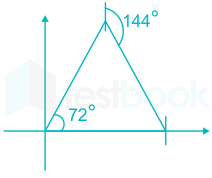
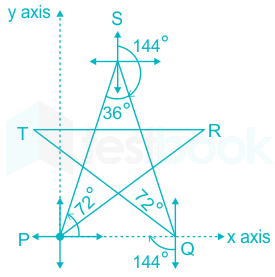
An ant walks in a straight line on a plane leaving behind a trace of its movement. The initial position of the ant is at point P facing east. The ant first turns 72° anticlockwise at P, and then does the following two steps in sequence exactly FIVE times before halting.

  1. moves forward for 10 cm.
  2. turns 144o clockwise.

The pattern made by the trace left behind by the ant is

  1. ((a))

      PQ = QR = RS = ST = TP = 10 cm

  2. ((b))

     PQ =  QR = RS = ST = TU = UP = 10 cm

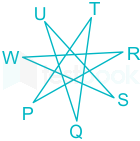
  3. ((c))

     SQ = QT = TR = RP = PS = 10 cm

  4. ((d))

     SW = WR = RP = PT = TQ = QU = US = 10 cm

Show Answer
Answer: ((c))

 SQ = QT = TR = RP = PS = 10 cm

Explanation-

The initial position of the ant is at point P facing east.

The ant first turns 72° anticlockwise at P

moves forward for 10 cm.


turns 144o clockwise.


By repeating the above steps for 5 times, the final path traced by the ant will be

Civil Engineering (55 questions)

11

The function f(x, y) satisfies the Laplace equation

2f(x,y)=0\rm \nabla ^2 f(x, y) = 0

on a circular domain of radius r = 1 with its center at point P with coordinates x = 0, y = 0. The value of this function on the circular boundary of this domain is equal to 3.

The numerical value of f(0, 0) is:

  1. ((a))

    0

  2. ((b))

    2

  3. ((c))

    3

  4. ((d))

    1

Show Answer
Answer: ((c))

3

Explanation-

Given that,

The function f(x, y) satisfies the Laplace equation 2f(x,y)=0\rm \nabla ^2 f(x, y) = 0

on a circular domain of radius r = 1 with its center at point P with coordinates x = 0, y = 0. 

The value of this function on the circular boundary of this domain is equal to 3.

Here it is given that the value of the function is 3 for its domain, which signifies that it is a constant function whose value is 3.

So the value of the function at (0, 0) is 3.

12

(xx22+x33x44+....)\rm \int \left( x - \frac{x^2}{2 } + \frac{x^3}{3} - \frac{x^4}{4} + .... \right)  dx is equal to

  1. ((a))

    11+x\rm \frac{1}{1+x} + Constant

  2. ((b))

    11+x2\rm \frac{1}{1+x^2} + Constant

  3. ((c))

    11x-\rm \frac{1}{1-x} + Constant

  4. ((d))

    11x2-\rm \frac{1}{1-x^2} + Constant

Show Answer
Answer: ((c))

11x-\rm \frac{1}{1-x} + Constant

The Given Question is Wrong, Marks are allotted to all.

Explanation-

Given that, I=(xx22+x33x44+.....I = \int {(x - \frac{{{x^2}}}{2} + \frac{{{x^3}}}{3} - \frac{{{x^4}}}{4} + .....}

I=x22x36+x412x520+I = {\frac{x^2}{2}} - \frac{{{x^3}}}{6} + \frac{{{x^4}}}{{12}} - \frac{{{x^5}}}{{20}} + ......

Expanding the options given,

option 1-

11+x=(1+x)1=1x+x2x3.......\frac{1}{{1 + x}} = {(1 + x)^{ - 1}} = 1 - x + {x^2} - {x^3}.......

option 2-

11+x2=(1+x2)1=1x2+x4x6.......\frac{1}{{1 + {x^2}}} = {(1 + {x^2})^{ - 1}} = 1 - {x^2} + {x^4} - {x^6}.......

option 3-

11x=(1x)1=(1+x+x2+x3.......\frac{{ - 1}}{{1 - x}} = - {(1 - x)^{ - 1}} = - (1 + x + {x^2} + {x^3}.......

option 4-

11x2=(1x2)1=(1+x2+x4+x6.......\frac{{ - 1}}{{1 - {x^2}}} = - {(1 - {x^2})^{ - 1}} = - (1 + {x^2} + {x^4} + {x^6}.......

So none of the options are matching with the correct answer.

13

For a linear elastic and isotropic material, the correct relationship among Young’s modulus of elasticity (E), Poisson’s ratio (ν), and shear modulus (G) is

  1. ((a))

    G=E2(1+ν)\rm G = \frac{E}{2(1 + \nu)}

  2. ((b))

    G=E(1+2ν)\rm G = \frac{E}{(1 + 2\nu)}

  3. ((c))

    E=G2(1+ν)\rm E = \frac{G}{2(1 + \nu)}

  4. ((d))

    E=G(1+2ν)\rm E = \frac{G}{(1 + 2\nu)}

Show Answer
Answer: ((a))

G=E2(1+ν)\rm G = \frac{E}{2(1 + \nu)}

Concept:

Elastic Modulus (E)

When the body is loaded within its elastic limit, the ratio of stress and strain is constant. This constant is known as Elastic modulus or Young's Modulus.

E=StressStrain=σϵ{\rm{E}} = \frac{{{\rm{Stress}}}}{{{\rm{Strain}}}} = \frac{{\rm{\sigma }}}{\epsilon}

Rigidity modulus (G)

When a body is loaded within its elastic limit, the ratio of shear stress and shear strain is constant, this constant is known as the shear modulus.

G=Shear;stress;Shear;strain=τϕ{\rm{G}} = \frac{{{\rm{Shear;stress;}}}}{{{\rm{Shear;strain}}}} = \frac{{\rm{\tau }}}{\phi }

Bulk modulus (K)

When a body is subjected to three mutually perpendicular like stresses of same intensity then the ratio of direct stress and the volumetric strain of the body is known as bulk modulus

K=Direct;stressVolumetric;strain=σδVV{\rm{K}} = \frac{{{\rm{Direct;stress}}}}{{{\rm{Volumetric;strain}}}} = \frac{{\rm{\sigma }}}{{\frac{{{\rm{\delta V}}}}{{\rm{V}}}}}

The relationship between E, K, G, and μ is:

E=2G(1+μ)E = 2G(1 + μ)

G=E2(1+μ)G ={ E\over 2(1 + μ) }

E=3K(12μ)E = 3K (1 – 2μ)

E=9KG3K +;G{\bf{E}} = \frac{{9{\bf{KG}}}}{{3{\bf{K}}\ + ;{\bf{G}}}}

μ=3K  2G2G + 6K{\bf{\mu }} = \frac{{3{\bf{K}}\ -\ 2{\bf{G}}}}{{2{\bf{G}}\ +\ 6{\bf{K}}}}

14

Read the following statements relating to flexure of reinforced concrete beams:

I. In over-reinforced sections, the failure strain in concrete reaches earlier than the yield strain in steel.

II. In under-reinforced sections, steel reaches yielding at a load lower than the load at which the concrete reaches failure strain.

III. Over-reinforced beams are recommended in practice as compared to the under-reinforced beams.

IV. In balanced sections, the concrete reaches failure strain earlier than the yield strain in tensile steel.

Each of the above statements is either True or False.

Which one of the following combinations is correct?

  1. ((a))

    I (True), II (True), III (False), IV (False)

  2. ((b))

    I (True), II (True), III (False), IV (True)

  3. ((c))

    I (False), II (False), III (True), IV (False)

  4. ((d))

    I (False), II (True), III (True), IV (False)

Show Answer
Answer: ((a))

I (True), II (True), III (False), IV (False)

Explanation:

Over reinforced section:

  • An over reinforced section is a type of section in which we use the concrete for its ultimate compressive strength strength.
  • The failure strain of concrete is reached before the yield strain of steel hence reinforced beam section undergoes a compressive failure.
  • The percentage of tensile reinforcement is more than the amount of reinforcement provided for a balanced section. As in this type of section concrete fails first i.e it undergoes a brittle failure
  • The main disadvantage of this section is it undergoes a sudden failure without warning.
  • We will not advice to select this type of section for the structure as it adds an extra cost, by increasing the percentage of reinforcement.

Under reinforced beam:

  • In these type of sections the area of reinforcement is less than limiting area of reinforcement.
  • The failure is due to yielding of steel and hence called ductile failure.
  • Gives sufficient warning before failure and hence preferred for general use.

Balanced section:

  • The area of reinforcement is equal to limiting area of reinforcement.
  • In this type of section the ultimate strength of concrete and steel are reached simultaneously.
  • At the same point of time concrete and steel fails and ultimately structure fails by crushing of concrete.
15

Match all the possible combinations between Column X (Cement compounds) and Column Y (Cement properties):

Column XColumn Y
(i) C3S(P) Early age strength
(ii) C2S(Q) Later age strength
(iii) C3A(R) Flash setting
(S) Highest heat of hydration
(T) Lowest heat of hydration
<br>

Which one of the following combinations is correct?

  1. ((a))

    (i) - (P), (ii) - (Q) and (T), (iii) - (R) and (S)

  2. ((b))

    (i) - (Q) and (T), (ii) - (P) and (S), (iii) - (R)

  3. ((c))

    (i) - (P), (ii) - (Q) and (R), (iii) - (T)

  4. ((d))

    (i) - (T), (ii) - (S), (iii) - (P) and (Q)

Show Answer
Answer: ((a))

(i) - (P), (ii) - (Q) and (T), (iii) - (R) and (S)

Concept:

The following table shows different Bogue’s compounds and their properties.

Bogue’s compoundOther namesComposition (%)Heat of hydrationProperties
Tricalcium silicate (C3S)Alite40 – 50500 J/gm- Early strength - Causes initial setting - A high amount of hydration.
Di-calcium Silicate (C2S)Belite25 - 40260 J/gm- Later strength - Less heat of hydration
Tricalcium Aluminate (C3A)Celite11 – 25865 J/gm- Causes Initial setting - The maximum amount of heat of hydration.
Tetracalcium alumina ferrite (C4AF)Felite9 - 11420 J/gm- Poor cementing value. - Less heat of hydration
16

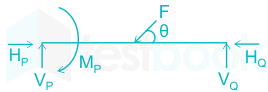
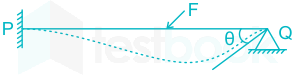
Consider a beam PQ fixed at P, hinged at Q, and subjected to a load F as shown in figure (not drawn to scale). The static and kinematic degrees of indeterminacy, respectively, are

  1. ((a))

    2 and 1

  2. ((b))

    2 and 0

  3. ((c))

    1 and 2

  4. ((d))

    2 and 2

Show Answer
Answer: ((a))

2 and 1

Explanation-

Static indeterminacy-

  • It is defined as the difference between a total number of unknowns (Total member forces+ reactions) and the total number of available equations from the conditions of equilibrium.
  • Degree of static indeterminacy = Total number of unknown forces - Number of equilibrium equations available
  • If the degree of static indeterminacy = 0, it is known as a statically determinate structure.
  • If the degree of static indeterminacy > 0, it is known as statically indeterminate structure.

Kinematic indeterminacy-

  • The degree of kinematic indeterminacy is the minimum number of movements (degrees of freedom, DOF) with which the kinematic configuration of the overall structure can be defined, that is, the number of unknown independent movements of the structure.


Given data and Calculation-

Total number of unknown forces, = (Hp, Vp, Mp , HQ, VQ) = 5

Number of equilibrium equations available = 3

Degree of static indeterminacy = 5 - 3 = 2

As the joint P is fixed, no movement is allowed at that joint, joint Q is hinged so only rotation is allowed at that joint.

So the degree of kinematic indeterminacy = 1 ( Rotation at joint Q)

17

Read the following statements:

(P) While designing a shallow footing in sandy soil, monsoon season is considered for critical design in terms of bearing capacity.

(Q) For slope stability of an earthen dam, sudden drawdown is never a critical condition.

(R) In a sandy sea beach, quicksand condition can arise only if the critical hydraulic gradient exceeds the existing hydraulic gradient.

(S) The active earth thrust on a rigid retaining wall supporting homogeneous cohesionless backfill will reduce with the lowering of water table in the backfill.

Which one of the following combinations is correct?

  1. ((a))

    (P)-True, (Q)-False, (R)-False, (S)-False

  2. ((b))

    (P)-False, (Q)-True, (R)-True, (S)-True

  3. ((c))

    (P)-True, (Q)-False, (R)-True, (S)-True

  4. ((d))

    (P)-False, (Q)-True, (R)-False, (S)-False

Show Answer
Answer: ((a))

(P)-True, (Q)-False, (R)-False, (S)-False

Explanation:

Effect of water table on BC of soil:

  • As the water table rises the moisture content of soil increases, and its BC decreases.
  • This is due to the fact that when water gets into the pores of the soil, its load-carrying capacity decreases as water is nearly incompressible.
  • Monsoon increases the water content of soil and hence is considered critical for designing shallow foundations on both sandy and clayey soil.

∴ Statement 1 is true

Conditions to be checked for the stability of slope of earthen dam:

  • Stability of downstream slope during steady seepage.
  • Stability of upstream slope during sudden drawdown.
  • Stability of upstream and downstream slopes during and immediately after construction.

∴ Statement 2 is false

Quicksand condition:

  • When upward seepage occurs it applies some seepage pressure on the soil and when this seepage pressure is equal to effective stress of soil, the quicksand condition occurs.
  • In this soil loss, all its shear strength and the hydraulic gradient are equal to 1 and such hydraulic gradient is called critical hydraulic gradient.

∴ Statement 3 is false

Effect of water table on active thrust:

  • When we decrease the water table, the BC of soil increases and it increases the effective stress of soil.
  • With the increase, effective stress, active pressure, and hence active thrust also increase.

∴ Statement 4 is false

18

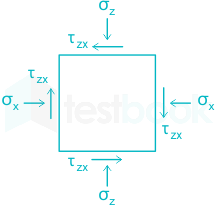
Stresses acting on an infinitesimal soil element are shown in the figure (with σz > σx). The major and minor principal stresses are σ1 and σ2, respectively. Considering the compressive stresses as positive, which one of the following expressions correctly represents the angle between the major principal stress plane and the horizontal plane?

  1. ((a))

    tan1(τzxσ1σx)\rm \tan^{-1} \left( \frac{\tau_{zx}}{\sigma_1 - \sigma_x} \right)

  2. ((b))

    tan1(τzxσ3σx)\rm \tan^{-1} \left( \frac{\tau_{zx}}{\sigma_3 - \sigma_x} \right)

  3. ((c))

    tan1(τzxσ1+σx)\rm \tan^{-1} \left( \frac{\tau_{zx}}{\sigma_1 + \sigma_x} \right)

  4. ((d))

    tan1(τzxσ1+σ3)\rm \tan^{-1} \left( \frac{\tau_{zx}}{\sigma_1 + \sigma_3} \right)

Show Answer
Answer: ((a))

tan1(τzxσ1σx)\rm \tan^{-1} \left( \frac{\tau_{zx}}{\sigma_1 - \sigma_x} \right)

Explanation:

Taking the submission of horizontal forces as 0 ie Σ H = 0

σx × BC - τz × AB + σ1 × Sin θ = 0

σx×(AC×Sin θCos θ)+τzx×(AC×Cos  θCos θ)=σ1×AC×Sin  θCos θσ_x × ({AC× Sin\ θ \over Cos\ θ})+ τ_{zx } × ({AC× Cos\ \ \theta \over Cos\ θ})={σ_1× AC × Sin\ \ θ \over Cos\ θ}

σx × Tan θ + τzx = σ1 × Tan θ 

Tan θ × (σ1 - σx) = τxy

 Tan θ=τxyσ1σxTan\ \theta = {\tau_{xy} \over \sigma _1 -\sigma _x}

19

Match Column X with Column Y:

Column XColumn Y
(P) Horton equation(I) Design of alluvial channel
(Q) Penman method(II) Maximum flood discharge
(R) Chezy’s formula(III) Evapotranspiration
(S) Lacey’s theory(IV) Infiltration
(T) Dicken’s formula(V) Flow velocity
<br>

Which one of the following combinations is correct ?

  1. ((a))

    (P)-(IV), (Q)-(III), (R)-(V), (S)-(I), (T)-(II)

  2. ((b))

    (P)-(III), (Q)-(IV), (R)-(V), (S)-(I), (T)-(II)

  3. ((c))

    (P)-(IV), (Q)-(III), (R)-(II), (S)-(I), (T)-(V)

  4. ((d))

    (P)-(III), (Q)-(IV), (R)-(I), (S)-(V), (T)-(II)

Show Answer
Answer: ((a))

(P)-(IV), (Q)-(III), (R)-(V), (S)-(I), (T)-(II)

Explanation:

Horton equation:  It gives the infiltration of water as is given by

fb=fc+(fofc)ektf_{b}=f_{c}+\left ( f_{o}-f_{c} \right )e^{-kt}

Where, fb = Value of infiltration, fc = equilibrium infiltration and fo= Initial infiltration

Penman equation:  It gives the formula for evapotranspiration which is the sum of evaporation and transpiration

PET=AHn+EaγA+γPET = \frac{AH_{n}+E_{a}\gamma }{A+\gamma }

Chezy formula:  It relates velocity through an open channel to its slope and hydraulic radius by the following formula

V=CRSV = C\sqrt{RS}

Where V = Velocity, C = Chezy constant, R = Hydraulic radius and S = Slope

Dicken formula:  It gave a formula for discharge through the flood plain and is usually applicable for north and central India.

Q = C × A3/4

Where,Q = Flood discharge, C = Constant, A = Area of catchment

Lacey theory: It is used to design of alluvial canal and is based on the following assumptions:

  • The channel is flowing uniformly in the unlimited incoherent alluvial soil of the same character.
  • The silt grade and silt charge are uniforms.
  • The discharge remains constant
20

In a certain month, the reference crop evapotranspiration at a location is 6 mm/day. If the crop coefficient and soil coefficient are 1.2 and 0.8, respectively, the actual evapotranspiration in mm/day is

  1. ((a))

    5.76

  2. ((b))

    7.20

  3. ((c))

    6.80

  4. ((d))

    8.00

Show Answer
Answer: ((a))

5.76

Concept:

Evapotranspiration:

  • The sum of transpiration and evaporation is known as evapotranspiration.
  • Which depends on various factors like type of soil and crop that is being grown on the soil.
  • So, to counter these factors some constants like soil coefficient and crop coefficient are used and we modify the value of evapotranspiration we got from various formula like penmann's equation and the modified evapotranspiration is given by

Eo = E1 × C1 × C2

Where, E0 = Modified evapotranspiration, E1 = Original evapotranspiration, C1 = Crop coefficient, C2 = Soil coeffiicient

Given:

E1 = 6 mm/day, C1 = 1.2, C2 = 0.8

Calculation:

Eo = E1 × C1 × C2

      = 6 × 1.2 × 0.8

E0 = 5.76 mm/day

∴ The evapotranspiration is 5.76 mm/day

21

The dimension of dynamic viscosity is:

  1. ((a))

    ML-1T-1

  2. ((b))

    ML-1T-2

  3. ((c))

    ML-2T-2

  4. ((d))

    ML0T-1

Show Answer
Answer: ((a))

ML-1T-1

Explanation:

From Newton’s law of viscosity

τ=μdudy\tau = \mu \cdot \frac{{du}}{{dy}}

μ = Proportionality constant/ coefficient of viscosity or viscosity

μ = dynamic viscosity (since it involves force)

μ=τdu/dy\therefore \mu = \frac{\tau }{{du/dy}}

Dimensional formula for μ

∴ μ = M.L-1.T-1

Units:

Dynamic Viscosity (μ):

SI system:

μ = N.s/m2 or Pa.s = kg/m.s

CGS system:

μ = Dyne.sec/cm2 = 1 poise

1 N = 105 dynes

1 N.s/m2 = 105 dynes.sec/104 cm2

1 N.s/m2 = 10 dyne.sec/cm2

1 N.s/m2 = 10 poise = 1 Pa.s

Additional Information

Kinematic Viscosity (v): It is the ratio of dynamic viscosity to mass density.

v=Dynamic;viscosityMass;density=μρv = \frac{{Dynamic;viscosity}}{{Mass;density}} = \frac{\mu }{\rho }

Dimensional formula for Kinematic viscosity (ν)

∴ ν = L2T-1

The dimensions of the kinematic viscosity show that they involves the magnitudes of length and time only.

The name kinematic viscosity has been given to the ratio (μ/ρ) because its unit (m2/s) is similar to the unit of kinematic quantities like velocity (m/s) and acceleration (m/s2).

Units

SI system:

m2/sec

CGS system:

cm2/sec or stoke

1 stoke = 1 cm2/sec = 10-4 m2/sec

22

A process equipment emits 5 kg/h of volatile organic compounds (VOCs). If a hood placed over the process equipment captures 95% of the VOCs, then the fugitive emission in kg/h is

  1. ((a))

    0.25

  2. ((b))

    4.75

  3. ((c))

    2.50

  4. ((d))

    0.48

Show Answer
Answer: ((a))

0.25

Explanation:

Fugitive emission:

  • Fugitive emissions are accidental emissions of vapours or gases from pressurised apparatus, either due to faulty equipment, leakage or other unforeseen mishaps.
  • It can also occur through evaporation, in such sources as storage tanks or wastewater treatment facilities.

Total emission = Fugitive emission + Captured emission

Given is that Captured emission is 95 %. So, by using above formula, fugitive(escaped) emission is 100 - 95 = 5 %

And, Fugitive emission = percent of fugitive emission × Total emission

                                        = 0.05 × 5

        Fugitive emission = 0.25 kg/h

Important Points

  • The best way to reduce fugitive emissions is through regular testing and maintenance.
  • Leak detection should be scheduled at regular intervals using gas detection devices, which can measure the amount of vapours escaping, determine what they are and decide on an appropriate course of action.
23

Match the following attributes of a city with the appropriate scale of measurements.

AttributeScale of
measurement
(P) Average temperature (°C) of a city(I) Interval
(Q) Name of a city(II) Ordinal
(R) Population density of a city(III) Nominal
(S) Ranking of a city based on ease of business(IV) Ratio
<br>

Which one of the following combinations is correct?

  1. ((a))

    (P)-(I), (Q)-(III), (R)-(IV), (S)-(II)

  2. ((b))

    (P)-(II), (Q)-(I), (R)-(IV), (S)-(III)

  3. ((c))

    (P)-(II), (Q)-(III), (R)-(IV), (S)-(I)

  4. ((d))

    (P)-(I), (Q)-(II), (R)-(III), (S)-(IV)

Show Answer
Answer: ((a))

(P)-(I), (Q)-(III), (R)-(IV), (S)-(II)

Concept:

The nominal scale of measurement:

The nominal scale, sometimes called the qualitative type, places non-numerical data into categories or classifications.

For example:

  • Placing cats into breed type. For example, a Persian is a breed of cat.
  • Putting cities into states(Name of a city). Example: Jacksonville is a city in Florida.

The ordinal scale of measurement:

Ordinal scales are made up of ordinal data. Some examples of ordinal scales:

For example:

  • High school class rankings: 1st, 2nd, 3rd, etc.
  • Social-economic class: working, middle, upper.
  • Ranking of a city based on ease of business

The interval scale of measurement:

It has values of equal intervals that mean something.

For example:

  • A thermometer might have intervals of ten degrees.

The ratio scale of measurement:

It is exactly the same as the interval scale except that the zero on the scale means: does not exist.

For example: 

  • A weight of zero doesn’t exist;
  • An age of zero doesn’t exist.
  • Population density of a city

Hence, Match the following attributes of a city with the appropriate scale of measurements.

AttributeScale of
measurement
(P) Average temperature (°C) of a city(I) Interval
(Q) Name of a city(II) Nominal
(R) Population density of a city(III) Ratio
(S) Ranking of a city based on ease of business(IV) Ordinal
24

If the magnetic bearing of the Sun at a place at noon is S 2° E, the magnetic declination (in degrees) at that place is

  1. ((a))

    2° E

  2. ((b))

    2° W

  3. ((c))

    4° E

  4. ((d))

    4° W

Show Answer
Answer: ((a))

2° E

Explanation:

At Noon, the sun is exactly over the time median of the place. Thus true bearing of the line joining the sun and the place is either 0° and 360° if it is to the north.

and 180° if it is to the south of the place.

Magnetic bearing of sun at noon = 170°

True bearing = 180° 

True bearing = M.B + declination

180° - 178° = declination

So,

declination = 2° 

Declination is coming out as positive, so it will be in the eastward direction.

25

P and Q are two square matrices of the same order. Which of the following statement(s) is/are correct?

  1. ((a))

    If P and Q are invertible, then [PQ]-1 = Q-1P-1

  2. ((b))

    If P and Q are invertible, then [QP]-1 = P-1Q-1

  3. ((c))

    If P and Q are invertible, then [PQ]-1 = P-1Q-1

  4. ((d))

    If P and Q are not invertible, then [PQ]-1 = Q-1P-1

Show Answer
Answer: ((a))

If P and Q are invertible, then [PQ]-1 = Q-1P-1

Explanation-

If A is a non-singular square matrix, there is an existence of n x n matrix A-1, which is called the inverse of a matrix A such that it satisfies the property:

AA-1 = A-1A = I, where I is  the Identity matrix.

If A and B are the non-singular matrices, then the inverse matrix should have the following properties

  • (A-1)-1 =A
  • (AB)-1 =A-1B-1
  • (ABC)-1 =C-1B-1A-1
  • (A1 A2….An)-1 =An-1An-1-1……A2-1A1-1
  • (AT)-1 =(A-1)T

Given data and Analysis-

P and Q are two square matrices of the same order,

If P and Q are invertible, then [PQ]-1 = Q-1P-1

If P and Q are invertible, then [QP]-1 = P-1Q-1

26

In a solid waste handling facility, the moisture contents (MC) of food waste, paper waste, and glass waste were found to be MCf, MCp, and MCg, respectively. Similarly, the energy contents (EC) of plastic waste, food waste, and glass waste were found to be ECpp, ECf, and ECg, respectively. Which of the following statement(s) is/are correct?

  1. ((a))

    MCf > MCp > MCg

  2. ((b))

    ECpp > ECf > ECg

  3. ((c))

    MCf < MCp < MCg

  4. ((d))

    ECpp < ECf < ECg

Show Answer
Answer: ((a))

MCf > MCp > MCg

Concept:

Plastic waste:

  • Plastic is the general common term for a wide range of synthetic or semi-synthetic organic amorphous solid materials derived from oil and natural gas.
  • Plastic waste, or plastic pollution, is ‘the accumulation of plastic objects (e.g.: plastic bottles and much more) in the Earth’s environment that adversely affects wildlife, wildlife habitat, and humans.’
  • It also refers to the significant amount of plastic that isn’t recycled and ends up in landfills or, in the developing world, thrown into unregulated dumpsites.

Paper waste:

  • It means newspapers, magazines, cardboard, and any other form of paper which is free of contaminated matter and is capable of being recycled.

Glass waste:

  • It is discarded material from the glass manufacturing process or from used consumer products made of glass.

Food waste:

  • Food waste refers to food such as plate waste (i.e., food that has been served but not eaten), spoiled food, or peels and rinds considered inedible that is sent to feed animals, to be composted or anaerobically digested, or to be landfilled or combusted with energy recovery.

Typical data of moisture content of municipal solid waste components are as follows:

ComponentsMoisture(%)
Food Waste70
Paper6
Plastic2
Rubber2
Wood20
Glass2

Typical heat values of municipal solid waste components are as follows:

ComponentsHeat Value(Kj/Kg, Dry weight)
Food Waste4652.02
Paper16747.28
Plastic32564.15
Glass139

Hence, the decreasing order of moisture content in these wastes is MCf > MCp > MCg, where the moisture contents (MC) of food waste, paper waste, and glass waste were found to be MCf, MCp, and MCg, respectively

27

To design an optimum municipal solid waste collection route, which of the following is/are NOT desired:

  1. ((a))

    Collection vehicle should not travel twice down the same street in a day

  2. ((b))

    Waste collection on congested roads should not occur during rush hours in morning or evening

  3. ((c))

    Collection should occur in the uphill direction.

  4. ((d))

    The last collection point on a route should be as close as possible to the waste disposal facility.

Show Answer
Answer: ((a))

Collection vehicle should not travel twice down the same street in a day

Concept:

Municipal solid waste collection route:

  • Efficient routing of collection vehicles helps decrease costs by reducing the labor expended for collection.
  • Proper planning of collection routes also helps conserve energy and minimize working hours and vehicle fuel consumption.
  • It is necessary therefore to develop detailed route configurations and collection schedules for the selected collection system.

Design an optimum municipal solid waste collection route is depends on various rules are as follows:

  • Routes should not be fragmented or overlapping.
  • Each route should be compact, consisting of street segments clustered in the same geographical area.
  • Total collection plus hauling time should be reasonably constant for each route in the community.
  • The collection route should be started as close to the garage or motor pool as possible, taking into account heavily traveled and one-way streets.
  • Heavily traveled streets should not be visited during rush hours.
  • In the case of one-way streets, it is best to start the route near the upper end of the street, working down it through the looping process.
  • Waste on a steep hill should be collected, when practical, on both sides of the street while the vehicle is moving downhill.
  • Higher elevations should be at the start of the route.
  • For collection from one side of the street at a time, it is generally best to route with many anti-clockwise turns around blocks.
  • For collection from both sides of the street at the same time, it is generally best to route with long, straight paths across the grid before looping anticlockwise.
  • For certain block configurations within the route, specific routing patterns should be applied.
  • The last collection point on a route should be as close as possible to the waste disposal facility.
28

For a traffic stream, ν is the space mean speed, k is the density, q is the flow, vf is the free flow speed, and kj is the jam density. Assume that the speed decreases linearly with density.

Which of the following relation(s) is/are correct?

  1. ((a))

    q=kjk(kjνf)k2\rm q = k_j k - \left( \frac{k_j}{\nu_f} \right)k^2

  2. ((b))

    q=νfk(νfkj)k2\rm q = \nu_f k - \left( \frac{\nu_f}{k_j} \right)k^2

  3. ((c))

    q=νfν(νfkj)ν2\rm q = \nu_f \nu - \left( \frac{\nu_f}{k_j} \right)\nu^2

  4. ((d))

    q=kjν(kjνf)ν2\rm q = k_j \nu - \left( \frac{k_j}{\nu_f} \right)\nu^2

Show Answer
Answer: ((a))

q=kjk(kjνf)k2\rm q = k_j k - \left( \frac{k_j}{\nu_f} \right)k^2

Explanation-

Macroscopic stream models represent how the behavior of one parameter of traffic flow changes with respect to another. Most important among them is the relation between speed and density.

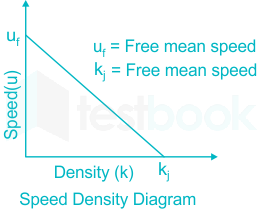
The first and most simple relation between them is proposed by Greenshield. Greenshield assumed a linear speed-density relationship as illustrated in the figure to derive the model. The equation for this relationship is shown below.

  • v=vf(1kkj)v = {v_f}\left( {1 - \frac{k}{{{k_j}}}} \right)
  • where v is the mean speed at density k, vf is the free speed and kj is the jam density.

Traffic flow (q) = flow density (k) × Velocity(V)

Given data and Analysis -

v=vf(1kkj)v = {v_f}\left( {1 - \frac{k}{{{k_j}}}} \right)

Also it can be written as , k=kj(1vvf)k = {k_j}\left( {1 - \frac{v}{{{v_f}}}} \right)

q = k × v

q=k×vf(1kkj)q = k \times {v_f}\left( {1 - \frac{k}{{{k_j}}}} \right)

q=νfk(νfkj)k2\rm q = \nu_f k - \left( \frac{\nu_f}{k_j} \right)k^2

q=v×kj(1vvf)q = v \times {k_j}\left( {1 - \frac{v}{{{v_f}}}} \right)

q=kjν(kjνf)ν2\rm q = k_j \nu - \left( \frac{k_j}{\nu_f} \right)\nu^2

So option 2 and 4 are correct.

29

The error in measuring the radius of a 5 cm circular rod was 0.2%. If the cross-sectional area of the rod was calculated using this measurement, then the resulting absolute percentage error in the computed area is______. (round off to two decimal places)

30

The components of pure shear strain in a sheared material are given in the matrix form:

ε=[1111]ε = \begin{bmatrix} 1 & 1 \\ 1 & -1 \end{bmatrix}

Here, Trace (ε) = 0. Given, P = Trace (ε8) and Q = Trace (ε11).

The numerical value of (P + Q) is ________. (in integer)

31

The inside diameter of a sampler tube is 50 mm. The inside diameter of the cutting edge is kept such that the Inside Clearance Ratio (ICR) is 1.0 % to minimize the friction on the sample as the sampler tube enters into the soil. The inside diameter (in mm) of the cutting edge is _______. (round off to two decimal places)

32

A concentrically loaded isolated square footing of size 2 m × 2 m carries a concentrated vertical load of 1000 kN. Considering Boussinesq’s theory of stress distribution, the maximum depth (in m) of the pressure bulb corresponding to 10 % of the vertical load intensity will be _______. (round off to two decimal places)

33

In a triaxial unconsolidated undrained (UU) test on a saturated clay sample, the cell pressure was 100 kPa. If the deviatoric stress at failure was 150 kPa, then the undrained shear strength of the soil is _________ kPa. (in integer)

34

A flood control structure having an expected life of n years is designed by considering a flood of return period T years. When T = n, and n → ∞, the structure’s hydrologic risk of failure in percentage is ______.(round off to one decimal place)

35

The base length of the runway at the mean sea level (MSL) is 1500 m. If the runway is located at an altitude of 300 m above the MSL, the actual length (in m) of the runway to be provided is _________. (round off to the nearest integer)

36

Consider the polynomial f(x) = x3 - 6x2 + 11x - 6 on the domain S given by 1 ≤ x ≤ 3. The first and second derivatives are f'(x) and f''(x).

Consider the following statements:

I. The given polynomial is zero at the boundary points x = 1 and x = 3.

II. There exists one local maxima of f(x) within the domain S.

III. The second derivative f''(x) > 0 throughout the domain S.

IV. There exists one local minima of f(x) within the domain S.

The correct option is:

  1. ((a))

    Only statements I, II and III are correct.

  2. ((b))

    Only statements I, II and IV are correct

  3. ((c))

    Only statements I and IV are correct.

  4. ((d))

    Only statements II and IV are correct.

Show Answer
Answer: ((b))

Only statements I, II and IV are correct

Explanation:

Given Data and Analysis-

Given polynomial is f(x) = x3 - 6x2 + 11x - 6. where 1 ≤ x ≤ 3.

Statement 1-The given polynomial is zero at the boundary points x = 1 and x = 3.

At x = 1, f(x) = 13 - 6 + 11 - 6=0

At x = 3, f(x) = 33 - 54 + 33 - 6=0

So statement 1 is correct.

f'(x) = 3x2 - 12x + 11

f''(x) = 6x - 12

at x = 1, f''(x) = -6 < 0

for maximum or minimum, f'(x) = 0

⇒ 3x2 - 12x + 11 = 0

⇒ x = 2.577 or 1.422

Both values of x exist within domain.

at x = 2.577, f''(x) ≥ 0, so f(x) will be minimum.

x = 1.492, f''(x) ≤ 0, so f(x) will be maximum.

At x = 1.422 the function will have a maximum value and at x = 2.577 it will have a minimum value.

So statements 2 and 4 are correct.

Statement 3 is wrong as for 1 ≤ x ≤ 2 , f''(x)  is not greater than zero.

37

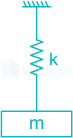
An undamped spring-mass system with mass m and spring stiffness k is shown in the figure. The natural frequency and natural period of this system are ω rad/s and T s, respectively. If the stiffness of the spring is doubled and the mass is halved, then the natural frequency and the natural period of the modified system, respectively, are

  1. ((a))

    2ω rad/s and T/2 s

  2. ((b))

    ω/2 rad/s and 2T s

  3. ((c))

    4ω rad/s and T/4 s

  4. ((d))

    ω rad/s and T s

Show Answer
Answer: ((a))

2ω rad/s and T/2 s

Concept

Natural frequency (Wn) of any undamped single degree of freedom system is given by

Wn = √(k/m) 

Wn in rad/sec

k = Stiffness of system in N/m

m = mass of system in kg

Time period (T) = 2π / Wn

Given data and Calculation-

Given that, Initial mass (m0) = m and stiffness (k0) = k

Natural frequency = ω rad/s 

Natural time period = T s

Final mass m1 = m/2 and Stiffness k1 = 2k

Then, Wn1 = √(k1/m1) = √(4k/m) = 2 √(k/m) = 2 Wn  

T1 = 2π/Wn1 = 2π/(2 Wn) = T/2

38

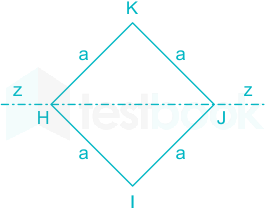
For the square steel beam cross-section shown in the figure, the shape factor about z - z axis is S and the plastic moment capacity is MP. Consider yield stress fy = 250 MPa and a = 100 mm.

The values of S and MP (rounded-off to one decimal place) are

  1. ((a))

    S = 2.0, MP = 58.9 kN-m

  2. ((b))

    S = 2.0, MP = 100.2 kN-m

  3. ((c))

    S = 1.5, MP = 58.9 kN-m

  4. ((d))

    S = 1.5, MP = 100.2 kN-m

Show Answer
Answer: ((a))

S = 2.0, MP = 58.9 kN-m

Concept:

Shape factor SF =ZpZe\frac{Z_p}{Z_e}

Zp  is plastic section modulus,

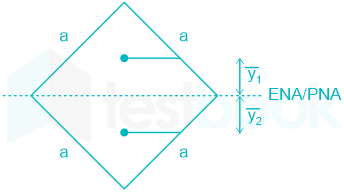
Zp = A2\frac{A}{2} (yˉ1+yˉ2)({\bar y_1} + {\bar y_2}) 

Ze = INAy\frac{{{I_{NA}}}}{y}

yˉ1{\bar y_1} and yˉ2{\bar y_2} are centroids (from PNA) of the area above

PNA & below PNA respectively

INA = Moment of Inertia about ENA.

(2) For a square section

yˉ1=yˉ2=a32{\bar y_1} = {\bar y_2} = \frac{a}{{3\sqrt 2 }} and

y = a2\frac{a}{{\sqrt 2 }}

INA = a412\frac{a^4}{{ 12 }}

calculation : given a = 100 mm,

Z=100×1002(10022+10032) = \frac{{100 × 100}}{2}\left( {\frac{{100}}{{2\sqrt 2 }} + \frac{{100}}{{3\sqrt 2 }}} \right) = 235.7 × 103 mm3

Ze = a112×a2=a362=(100)362=117.85×103mm3\frac{{a'1}}{{12 × \frac{a}{{\sqrt 2 }}}} = \frac{{{a^3}}}{{6\sqrt 2 }} = \frac{{{{(100)}^3}}}{{6\sqrt 2 }} = 117.85 × {10^3}m{m^3}

Shape factor Sf = ZpZe=235.7×10311785×103=2\frac{Z_p}{Z_e}=\frac{235.7×10^3}{11785× 10^3}=2

MP =ZP fy = (235.7 × 10³) mm3 × 250 N/mm2

= 58925 × 103 N.mm

= 58.93140.m (Ans)

39

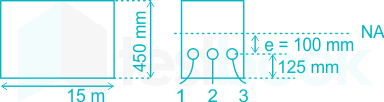
A post-tensioned concrete member of span 15 m and cross-section of 450 mm × 450 mm is prestressed with three steel tendons, each of cross-sectional area 200 mm2. The tendons are tensioned one after another to a stress of 1500 MPa. All the tendons are straight and located at 125 mm from the bottom of the member. Assume the prestress to be the same in all tendons and the modular ratio to be 6. The average loss of prestress, due to elastic deformation of concrete, considering all three tendons is

  1. ((a))

    14.16 MPa

  2. ((b))

    7.08 MPa

  3. ((c))

    28.32 MPa

  4. ((d))

    42.48 MPa

Show Answer
Answer: ((a))

14.16 MPa

Concept:

  1. Loss of prestress in any wire = m fcs where m is modular ratio & fcs is stress in concrete at the level of steel/wire.

  2. The three wires are tensioned one-by-one. so, when wire 2 is tensioned mere is a loss of stress in wire (1) & also when wire (3) is tensioned, there is a loss of stress in wires (1) & (5). There is no loss of stress in the wire(3).


P1, P2, P3 are forces in wires 1,2,3 respectively.

Loss in wire (1) due to P2 and P3 or (P2+P3)

Loss in wire (2) is due to P3 only.

Loss in wire (3) is zero.

3) P1=P2=P3=P=(200×15001000)kN=300,kN{P_1} = {P_2} = {P_3} = P = \left( {\frac{{200 × 1500}}{{1000}}} \right)kN = 300,kN (given)

  1. (P = Area of pre-stress × pre-stress)

Calculation


Total stress, fcs=PA+PeI2{f_{cs}}=\frac{P}{A} + {\frac{{Pe}}{I}^2}

  1. Loss in wire (1) is due to P2+P3 = 2P; substitute 'P' in above with 'gp'

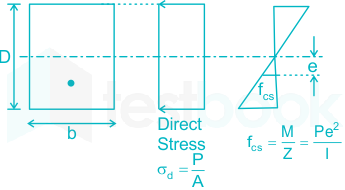
fcs1=2PA+2Pe2I{f_{c{s_1}}} = \frac{{2P}}{A} + \frac{{2P{e^2}}}{I}

=(2×300×100450×450;);+2×300×(100)2450×(450)3123.96+1.76= \left( {\frac{{2 × 300 × 100}}{{450 × 450}};} \right); + \frac{{2 × 300 × {{\left( {100} \right)}^2}}}{{\frac{{450 × {{\left( {450} \right)}^3}}}{{12}}}} - 3.96 + 1.76

= 4.72 N/mm2

Loss L1=mfcs1=6×4.72=28.32,N/mm2{L_1} = m{f_{c{s_1}}} = 6 \times 4.72 = 28.32,N/m{m^2}

L2=mfcs2=6×2.36=14.16,N/mm2{L_2} = m{f_{c{s_2}}} = 6 \times 2.36 = 14.16,N/m{m^2}

L3=mfcs3=6×0=0{L_3} = m{f_{cs}}_{_3} = 6 \times 0 = 0

Ag Loss = =28.32+14.16+03=14.16,N/mm2 = \frac{{28.32 + 14.16 + 0}}{3} = 14.16,N/m{m^2}

Loss in wire (2) is due to P3=P=300,kN.P3 = P = 300,kN.

fcs2,=,300×1000450×450,+,300×1000×(100)2450×(450)312fc{s_2}, = ,\frac{{300 \times 1000}}{{450 \times 450}}, + ,\frac{{300 \times 1000 \times {{\left( {100} \right)}^2}}}{{\frac{{450 \times {{\left( {450} \right)}^3}}}{{12}}}}

40

Match the following in Column X with Column Y:

Column XColumn Y
P.In a triaxial compression test, with increase of axial strain in loose sand under drained shear condition, the volumetric strainI.decreases
Q.In a triaxial compression test, with increase of axial strain in loose sand under undrained shear condition, the excess pore water pressureII.Increase
R.In a triaxial compression test, the pore pressure parameter “B” for a saturated soilIII.remains same
S.For shallow strip footing in pure saturated clay, Terzaghi’s bearing capacity factor (Nq) due to surchargeIV.is always 0.0.
V.is always 1.0.
VI.is always 0.5.
<br>

Which one of the following combinations is correct?

  1. ((a))

    (P)-(I), (Q)-(II), (R)-(V), (S)-(V)

  2. ((b))

    (P)-(II), (Q)-(I), (R)-(IV), (S)-(V)

  3. ((c))

    (P)-(I), (Q)-(III), (R)-(VI), (S)-(IV)

  4. ((d))

    (P)-(I), (Q)-(II), (R)-(V), (S)-(VI)

Show Answer
Answer: ((a))

(P)-(I), (Q)-(II), (R)-(V), (S)-(V)

Explanation:

The relationship b/w volumetric strain and axial strain in case of loose sand and dense sand is given as:

From above, it can be said that volumetric strain decreases on increasing axial strain.

The relationship b/w pore water pressure and axial strain is given as:

From above, it can be said put initially for the same value of strain pore water pressure decreases thereafter increasing.

3. For reberated clay's the bearing capacity factor are given as:

Nc = 5.7

Nq = 1

Nγ = 0

This is because angle of internal friction be ϕ = 0

  1. Skempton's pore pressure parameter 'B' is the ratio of change in pore pressure due to change in cell pressure

B = 0 for dry soils

B = 1 for saturated soils

41

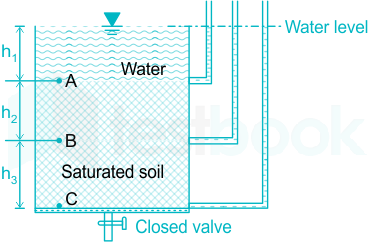
A soil sample is underlying a water column of height h1, as shown in the figure. The vertical effective stresses at points A, B, and C are σ'A, σ'B, σ'respectively. Let γsat and γ' be the saturated and submerged unit weights of the soil sample, respectively, and γbe the unit weight of water. Which one of the following expressions correctly represents the sum (σ'A + σ'B + σ'C) ?

  1. ((a))

    (2h2 + h3)γ'

  2. ((b))

    (h1 + h2 + h3)γ'

  3. ((c))

    (h2 + h3)(γsat - γW)

  4. ((d))

    (h1 + h2 + h3)γsat

Show Answer
Answer: ((a))

(2h2 + h3)γ'

Concept:

  • The pressure of water in the pores of the soil is called pore water pressure (u).
  • Under hydrostatic conditions, no water flow takes place, and the pore pressure at a given point is given by u =γWh ,where h = depth below water table or overlying water surface.
  • At any point in a soil mass, the effective stress (represented by σ ') is related to total stress (σ) and pore water pressure (u) as σ ' = σ - u
  • Both the total stress and pore water pressure can be measured at any point.

Given data and Calculation:

From the given figure,

PointTotal StressPore water pressureEttech’ve smess
Aγωh1γ ωh10
Bγωh1 + γsath2γω(h1 + h2)sat – γω)h2
Cγωh1 + γsat(h2 + h3)γ ω(h1 + h2 + h3)sat – γω)(h2 + h3)
<br>

Sum of the effective stress =

sat – γω)h2 + (γsat – γω)[h2 + h3]

γsat – γω = r’

so sum = 2γ ’h2 + γ ’h3

= (2h2 + h3)γ ’

42

A 100 mg of HNO3 (strong acid) is added to water, bringing the final volume to 1.0 liter. Consider the atomic weights of H, N, and O, as 1 g/mol, 14 g/mol, and 16 g/mol, respectively. The final pH of this water is (Ignore the dissociation of water.)

  1. ((a))

    2.8

  2. ((b))

    6.5

  3. ((c))

    3.8

  4. ((d))

    8.5

Show Answer
Answer: ((a))

2.8

Concept:

  • pH, is the quantitative measure of the acidity or basicity of aqueous or other liquid solutions.
  • pH is the negative logarithm of hydrogen ion concentration.
  • PH = -log10 [H+]

Given data and Calculation:

Weight of HNO3 = 100 mg

atomic weights of

H = 1 g/mol, N = 14 g/mol, O = 16 g/mol

Molecular weight of HNO3 = 1 + 14 + 48 = 63 gm

No. of moles present = 100×10363=0.00158\frac{100 \times 10^{-3}}{63} = 0.00158

PH = -log10 [0.00158] = 2.8

43

In a city, the chemical formula of biodegradable fraction of municipal solid waste (MSW) is C100H250O80N. The waste has to be treated by forced-aeration composting process for which air requirement has to be estimated.

Assume oxygen in air (by weight) = 23 %, and density of air = 1.3 kg/m3. Atomic mass: C = 12, H = 1, O = 16, N = 14.

C and H are oxidized completely whereas N is converted only into NH3 during oxidation.

For oxidative degradation of 1 tonne of the waste, the required theoretical volume of air (in m3/tonne) will be (round off to the nearest integer)

  1. ((a))

    4749

  2. ((b))

    8025

  3. ((c))

    1418

  4. ((d))

    1092

Show Answer
Answer: ((a))

4749

Explanation:

Given,

The chemical formula of the biodegradable fraction of municipal solid waste (MSW) is C100H250O80N.

Oxygen in air (by weight) = 23 %

density of air = 1.3 kg/m3. 

Weight of the waste = 1 tonne 

2C100H250O80N + 243.5O2 → 200CO2 + 247H2O + 2NH3

Molecular weight if MSW = (12 × 100) + (250 × 1) + (16 × 80) + (14)

= 2744 gm

5488 gm of MSW requires (243.5 × 32) gm of O2

1000 kg of MSW requires = 77925488×1000\frac{7792}{5488} \times 1000

= 1419.825 kg of O2

Quantity of air required = 1419.8250.23\frac{1419.825}{0.23}

= 6173.15 kg

Vol. of air required = 6173.151.3\frac{6173.15}{1.3}

= 4748.58

~ 4749 m3/tonne

44

A single-lane highway has a traffic density of 40 vehicles/km. If the time-mean speed and space-mean speed are 40 kmph and 30 kmph, respectively, the average headway (in seconds) between the vehicles is

  1. ((a))

    3.00

  2. ((b))

    2.25

  3. ((c))

    8.33 × 10⁻⁴

  4. ((d))

    6.25 × 10⁻⁴

Show Answer
Answer: ((a))

3.00

Concept:

The relationship 6 / w traffic speed (V), Traffic density (K), and traffic (Q) is given as Q = K × V

Here (V) is space mean speed (SMS)

Also, Time headway (th) is given as :

\(\mathop Q\limits_{\begin{array}{*{20}{c}} \downarrow \ {veh/hr} \end{array}} = \frac{{3600}}{{th(rec)}}\)

Calculation:

Given : V = SMS = 30 Km/hr

K = 40 veh/ Km 

Traffic flow, Q = K × V = 40 × 30 = 1200 Veh/hr

Time headway is given as,

1200=3600tλtλ=3sec1200 = \frac{{3600}}{{{t_\lambda }}} \Rightarrow {t_\lambda } = 3\sec

45

Let y be a non-zero vector of size 2022 × 1. Which of the following statement(s) is/are TRUE?

  1. ((a))

    yyT is a symmetric matrix.

  2. ((b))

    yTy is an eigenvalue of yyT

  3. ((c))

    yyT has a rank of 2022

  4. ((d))

    yyT is invertible

Show Answer
Answer: ((a))

yyT is a symmetric matrix.

Explanation-

Column matrix is a matrix in which all the elements are in a single column.

A column matrix has only one column and multiple rows. The order of a column matrix is n × 1, and it has n elements.

The elements are arranged in a vertical manner, with the number of elements equal to the number of rows in a column matrix.

The following properties of the column matrix, help in a deeper understanding of the column matrix.

  • A column matrix has only one column.
  • A column matrix has numerous rows.
  • The number of elements in a column matrix is equal to the number of rows in the matrix.
  • A column matrix is also a rectangular matrix.
  • The rank of the column matrix is 1.
  • The transpose of a column matrix is a row matrix.
  • The column matrix can be added or subtracted to only a column matrix of the same order.
  • A column matrix can be multiplied with only a row matrix
  • The product of a column matrix with a row matrix gives a singleton matrix.
  • Multiplication of column matrix and its transpose matrix gives a symmetric matrix.
  • Multiplication of transpose and the given matrix is an eigenvalue of Multiplication of column matrix and its transpose matrix.
  • Multiplication of column matrix and its transpose matrix gives a symmetric matrix that has determinant zero.


Given data and Analysis-

Let y be a non-zero vector of size 2022 × 1.

It is a column matrix.

So from the above properties explained,

 yyT is a symmetric matrix and yTy is an eigenvalue of yyT

As the determinant of yyT is zero, it is not invertible.
Alternate MethodConcept-We know that all nonzero eigenvalues of ABAB AB

 and BABA BA

 are the same.

Here, yyTyyT yy^T

 and yTyyTy y^T y

 have the same nonzero eigenvalue. Since yy y

 is nonzero, yyTyyT yy^T

 is a nonzero matrix. Additionally, a 1×11×1 1 \times 1

 matrix has its only entry as its eigenvalue. Hence, yyTyyT yy^T

 has a nonzero eigenvalue, which implies that yyTyyT yy^T

 is an eigenvalue of yTyyTy y^T y

46

Which of the following statement(s) is/are correct?

  1. ((a))

    If a linearly elastic structure is subjected to a set of loads, the partial derivative of the total strain energy with respect to the deflection at any point is equal to the load applied at that point.

  2. ((b))

    If a linearly elastic structure is subjected to a set of loads, the partial derivative of the total strain energy with respect to the load at any point is equal to the deflection at that point

  3. ((c))

    If a structure is acted upon by two force system Pa and Pb, in equilibrium separately, the external virtual work done by a system of forces Pb during the deformations caused by another system of forces Pa is equal to the external virtual work done by the Pa system during the deformation caused by the Psystem.

  4. ((d))

    The shear force in a conjugate beam loaded by the M/EI diagram of the real beam is equal to the corresponding deflection of the real beam.

Show Answer
Answer: ((a))

If a linearly elastic structure is subjected to a set of loads, the partial derivative of the total strain energy with respect to the deflection at any point is equal to the load applied at that point.

Explanation:

Castigliano’s first theorem-

  • For linearly elastic structure, where external forces only cause deformations, the complementary energy is equal to the strain energy.
  • The first partial derivative of the total internal energy (strain energy) in a structure with respect to any particular deflection component at a point is equal to the force applied at that point and in the direction corresponding to that deflection component.
  • This first theorem is applicable to linearly or nonlinearly elastic structures in which the temperature is constant and the supports are unyielding.

Castigliano’s second theorem-

  • The first partial derivative of the total internal energy in a structure with respect to the force applied at any point is equal to the deflection at the point of application of that force in the direction of its line of action.
  • The second theorem of Castigliano is applicable to linearly elastic (Hookean material) structures with constant temperature and unyielding supports.


Principle of Virtual work method-

  • Relations between active forces can be determined directly without reference to the reactive forces.
  • If a structure is acted upon by two force system Pa and Pb, in equilibrium separately, the external virtual work done by a system of forces Pb during the deformations caused by another system of forces Pa is equal to the external virtual work done by the Pa system during the deformation caused by the Pb system.

Conjugate beam method- 

  • The shear force in a conjugate beam loaded by the M/EI diagram of the real beam is equal to the corresponding slope at that point of the real beam.
  • The bending moment in a conjugate beam loaded by the M/EI diagram of the real beam is equal to the corresponding deflection at that point of the real beam.

So from the given options statement 1, 2 & 3 are correct.

47

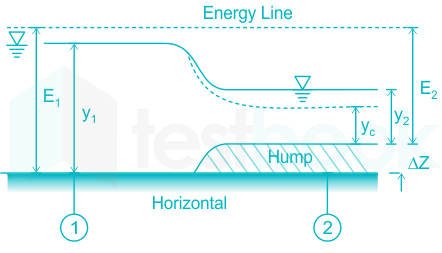
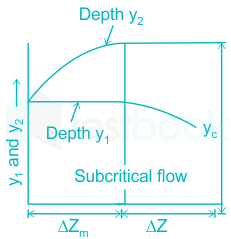
Water is flowing in a horizontal, frictionless, rectangular channel. A smooth hump is built on the channel floor at a section and its height is gradually increased to reach choked condition in the channel. The depth of water at this section is yand that at its upstream section is y1 . The correct statement(s) for the choked and unchoked conditions in the channel is/are

  1. ((a))

    In choked condition, y1 decreases if the flow is supercritical and increases if the flow is subcritical

  2. ((b))

    In choked condition, y2 is equal to the critical depth if the flow is supercritical or subcritical

  3. ((c))

    In unchoked condition, y1 remains unaffected when the flow is supercritical or subcritical

  4. ((d))

    In choked condition, y1 increases if the flow is supercritical and decreases if the flow is subcritical

Show Answer
Answer: ((a))

In choked condition, y1 decreases if the flow is supercritical and increases if the flow is subcritical

Explanation:

Channel transition with hump:


At choked conditions, the flow will be critical.

From the graph shown above, it can be concluded that,

  • In choked conditions, y1 decreases if the flow is supercritical and increases if the flow is subcritical.
  • In choked conditions, y2 is equal to the critical depth if the flow is supercritical or subcritical.
  • In unchoked conditions, y1 remains unaffected when the flow is supercritical or subcritical
48

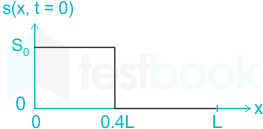
The concentration s(x, t) of pollutants in a one-dimensional reservoir at position x and time t satisfies the diffusion equation

s(x,t)t=D2s(x,t)x2\rm \frac{\partial s(x, t)}{\partial t} = D \frac{\partial^2 s (x, t)}{\partial x^2}

on the domain 0 ≤ x ≤ L, where D is the diffusion coefficient of the pollutants. The initial condition s(x, 0) is defined by the step-function shown in the figure.

The boundary conditions of the problem are given by s(x,t)t=0\rm \frac{\partial s(x, t)}{\partial t} = 0 at the boundary points x = 0 and x = L at all times. Consider D = 0.1 m2/s, s0 = 5 μmol/m, and L = 10 m.

The steady state concentration sˉ(L2)=s(L2,)\bar s \left( \frac{L}{2} \right) = s \left( \frac{L}{2}, \infty \right) at the center x=L2\rm x = \frac{L}{2} of the reservoir (in μmol/m) is _______. (in integer)

49

A pair of six-faced dice is rolled thrice. The probability that the sum of the outcomes in each roll equals 4 in exactly two of the three attempts is ______. (round off to three decimal places)

50

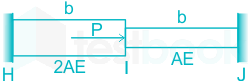
Consider two linearly elastic rods HI and IJ, each of length b, as shown in the figure. The rods are co-linear, and confined between two fixed supports at H and J. Both the rods are initially stress free. The coefficient of linear thermal expansion is α for both the rods. The temperature of the rod IJ is raised by Δ𝑇, whereas the temperature of rod HI remains unchanged. An external horizontal force P is now applied at node I. It is given that α = 10-6 °C-1, Δ𝑇 = 50 °C, b = 2m, AE = 106 N. The axial rigidities of the rods HI and IJ are 2AE and AE, respectively.

To make the axial force in rod HI equal to zero, the value of the external force P (in N) is _________. (round off to the nearest integer)

51

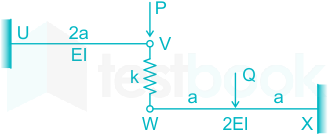
The linearly elastic planar structure shown in the figure is acted upon by two vertical concentrated forces. The horizontal beams UV and WX are connected with the help of the vertical linear spring with spring constant k = 20 kN/m. The fixed supports are provided at U and X. It is given that flexural rigidity EI = 105 kN-m2 , P = 100 kN, and a = 5 m. Force Q is applied at the center of beam WX such that the force in the spring VW becomes zero.

The magnitude of force Q (in kN) is ________. (round off to the nearest integer)

52

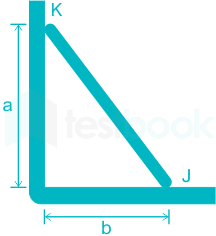
A uniform rod KJ of weight w shown in the figure rests against a frictionless vertical wall at the point K and a rough horizontal surface at point J. It is given that w = 10 kN, a = 4 m and b = 3 m. 

The minimum coefficient of static friction that is required at the point J to hold the rod in equilibrium is ___________. (round off to three decimal places)

53

The activities of a project are given in the following table along with their durations and dependency.

ActivitesDuration (days)Depends on
A10-
B12-
C5A
D14B
E10B, C
<br>

​The total float of the activity E (in days) is ________. (in integer)

54

A group of total 16 piles are arranged in a square grid format. The center-to-center spacing (s) between adjacent piles is 3 m. The diameter (d) and length of embedment of each pile are 1 m and 20 m, respectively. The design capacity of each pile is 1000 kN in the vertical downward direction. The pile group efficiency (ηg) is given by

ηg=1θ90[(n1)m+(m1)nmn]\rm \eta_g = 1 - \frac{\theta}{90} \left[ \frac{(n -1) m + (m - 1)n}{mn} \right]

where m and n are number of rows and columns in the plan grid of pile arrangement, and θ=tan1(ds)\rm \theta = \tan^{-1} \left( \frac{d}{s} \right)

The design value of the pile group capacity (in kN) in the vertical downward direction is __________________. (round off to the nearest integer)

55

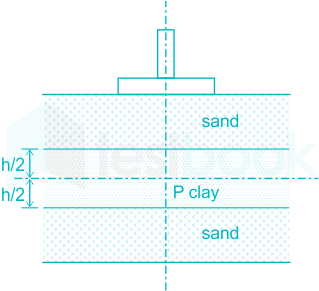
A saturated compressible clay layer of thickness h is sandwiched between two sand layers, as shown in the figure. Initially, the total vertical stress and pore water pressure at point P, which is located at the mid-depth of the clay layer, were 150 kPa and 25 kPa, respectively. Construction of a building caused an additional total vertical stress of 100 kPa at P. When the vertical effective stress at P is 175 kPa, the percentage of consolidation in the clay layer at P is ___________. (in integer)

56

A hydraulic jump takes place in a 6 m wide rectangular channel at a point where the upstream depth is 0.5 m (just before the jump). If the discharge in the channel is 30 m3/s and the energy loss in the jump is 1.6 m, then the Froude number computed at the end of the jump is ___________. (round off to two decimal places) (Consider the acceleration due to gravity as 10 m/s2.)

57

A pump with an efficiency of 80% is used to draw groundwater from a well for irrigating a flat field of area 108 hectares. The base period and delta for paddy crop on this field are 120 days and 144 cm, respectively. Water application efficiency in the field is 80%. The lowest level of water in the well is 10 m below the ground. The minimum required horse power (h.p.) of the pump is ________. (round off to two decimal places)

(Consider 1 h.p. = 746 W; unit weight of water = 9810 N/m3)

58

Two discrete spherical particles (P and Q) of equal mass density are independently released in water. Particle P and particle Q have diameters of 0.5 mm and 1.0 mm, respectively. Assume Stokes’ law is valid.

The drag force on particle Q will be________ times the drag force on particle P. (round off to the nearest integer)

59

At a municipal waste handling facility, 30 metric ton mixture of food waste, yard waste, and paper waste was available. The moisture content of this mixture was found to be 10%. The ideal moisture content for composting this mixture is 50%. The amount of water to be added to this mixture to bring its moisture content to the ideal condition is _______metric ton. (in integer)
60

A sewage treatment plant receives sewage at a flow rate of 5000 m3/day. The total suspended solids (TSS) concentration in the sewage at the inlet of primary clarifier is 200 mg/L. After the primary treatment, the TSS concentration in sewage is reduced by 60%. The sludge from the primary clarifier contains 2% solids concentration. Subsequently, the sludge is subjected to gravity thickening process to achieve a solids concentration of 6%. Assume that the density of sludge, before and after thickening, is 1000 kg/m3.

The daily volume of the thickened sludge (in m3/day) will be_________. (round off to the nearest integer)

61

A sample of air analyzed at 25°C and 1 atm pressure is reported to contain 0.04 ppm of SO2. Atomic mass of S = 32, O = 16.

The equivalent SO2 concentration (in µg/m3 ) will be__________. (round off to the nearest integer)

62

A parabolic vertical crest curve connects two road segments with grades +1.0% and -2.0%. If a 200 m stopping sight distance is needed for a driver at a height of 1.2 m to avoid an obstacle of height 0.15 m, then the minimum curve length should be ______ m. (round off to the nearest integer)  

63

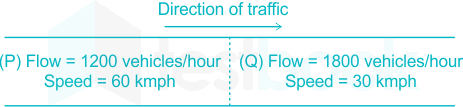
Assuming that traffic on a highway obeys the Greenshields model, the speed of a shockwave between two traffic streams (P) and (Q) as shown in the schematic is _______ kmph. (in integer

64

It is given that an aggregate mix has 260 grams of coarse aggregates and 240 grams of fine aggregates. The specific gravities of the coarse and fine aggregates are 2.6 and 2.4, respectively. The bulk specific gravity of the mix is 2.3.

The percentage air voids in the mix is ________. (round off to the nearest integer)

65

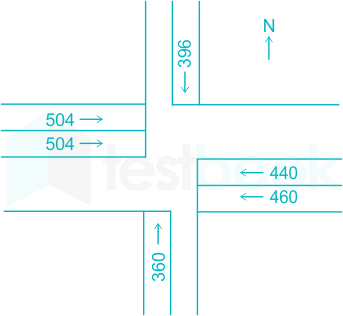
The lane configuration with lane volumes in vehicles per hour of a four-arm signalized intersection is shown in the figure. There are only two phases: the first phase is for the East-West and the West-East through movements, and the second phase is for the North-South and the South-North through movements. There are no turning movements. Assume that the saturation flow is 1800 vehicles per hour per lane for each lane and the total lost time for the first and the second phases together is 9 seconds. 
The optimum cycle length (in seconds), as per the Webster’s method, is _________. (round off to the nearest integer)

Attempt this paper under real exam conditions

Timed interface, section switching, instant scoring, and question-by-question analytics — free.

Start Timed Attempt