Official Paper

GATE CE 2022 Official Paper: Shift 1 (Previous Year Paper)

65 questions · 180 minutes · with answers · free

General Aptitude (10 questions)

1

You should _________ when to say _________.

  1. ((a))

    no / no

  2. ((b))

    no / know

  3. ((c))

    know / know

  4. ((d))

    know / no

Show Answer
Answer: ((d))

know / no

The correct answer is 'know / no'.

Key Points 

  • The given words are homophones i.e. similar sounding words.
  • Know: be aware of through observation, inquiry, or information.
  • For eg.- Most people know that CFCs can damage the ozone layer.
  • No: not any.
  • For eg.- There is no excuse.

The complete sentence will be: You should know when to say no.

  • Hence, option 4 is the correct answer.

Additional Information

  • Ozone: colourless unstable toxic gas with a pungent odour and powerful oxidizing properties, formed from oxygen by electrical discharges or ultraviolet light. It differs from normal oxygen (O2) in having three atoms in its molecule (O3).
2

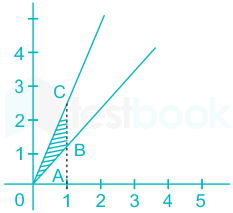
Two straight lines pass through the origin (x0, y0) = (0, 0). One of them passes through the point (x1, y1) = (1, 3) and the other passes through the point (x2, y2) = (1, 2).

What is the area enclosed between the straight lines in the interval [0, 1] on the x-axis?

  1. ((a))

    0.5

  2. ((b))

    1.0

  3. ((c))

    1.5

  4. ((d))

    2.0

Show Answer
Answer: ((a))

0.5

Explanation-

Given that, two straight lines are passing through the origin (0,0).

One of the straight lines is passing through the point (x1, y1) = (1, 3) and the other passes through the point (x2, y2) = (1, 2).

The area enclosed in the interval (0,1) = Area of OAC - Area of OAB.

Area of OAC = 0.5 × 3 × 1 = 1.5 sq. unit

Area of OAB = 0.5 × 2 × 1 = 1 sq. unit

Area enclosed = 1.5 - 1 = 0.5 sq. unit

3

If

p ∶ q = 1 ∶ 2

q ∶ r = 4 ∶ 3

r ∶ s = 4 ∶ 5

and u is 50% more than s, what is the ratio p ∶ u?

  1. ((a))

    2 ∶ 15

  2. ((b))

    16 ∶ 15

  3. ((c))

    1 ∶ 5

  4. ((d))

    16 ∶ 45

Show Answer
Answer: ((d))

16 ∶ 45

Explanation-

Given that,

p ∶ q = 1 ∶ 2 ------ (i)

q ∶ r = 4 ∶ 3  ------ (ii)

r ∶ s = 4 ∶ 5  ----- (iii)

There has to be a common number between Equations 1 and 2, so let's multiply 8 in equation 1 and 4 in equation 2.

Similarly, multiply 3 in equation 3.

So the new equations will be 

p ∶ q = 8 ∶ 16 ------ (iv)

q ∶ r = 16∶ 12  ------ (v)

r ∶ s = 12 ∶ 15  ----- (vi)

From equation iv, v, vi we have p : q : r : s = 8 : 16 : 12 : 15 

Let s = 15, u is 50% more than s so u = 1.5 × 15 = 22.5 

Ratio of p and u, p : u = 8 : 22.5 = 16 : 45

4

Given the statements:

P is the sister of Q.

Q is the husband of R.

R is the mother of S.

T is the husband of P.

Based on the above information, T is ______ of S.

  1. ((a))

    the grandmother

  2. ((b))

    an uncle

  3. ((c))

    the father

  4. ((d))

    a brother

Show Answer
Answer: ((b))

an uncle

Explanation-

Family table-

Given that, P is the sister of Q

Q is the husband of R

R is the mother of S

T is the husband of P.

The family tree diagram will be, 


So from the above tree diagram, T is an "uncle" of S.

5

In the following diagram, the point R is the center of the circle. The lines PQ and ZV are tangential to the circle. The relation among the areas of the squares, PXWR, RUVZ and SPQT is

  1. ((a))

    Area of SPQT = Area of RUVZ = Area of PXWR

  2. ((b))

    Area of SPQT = Area of PXWR - Area of RUVZ

  3. ((c))

    Area of PXWR = Area of SPQT - Area of RUVZ

  4. ((d))

    Area of PXWR = Area of RUVZ x Area of SPQT

Show Answer
Answer: ((b))

Area of SPQT = Area of PXWR - Area of RUVZ

Explanation-

From the figure, for triangle PQR, using Pythagoras theorem, 

PR2 = PQ2 + QR2

From the circle we know, QR = RZ ( Radius of circle)

So, PR2 = PQ2 + RZ2

It is known that area of square = square of the side

So PR2 =  Area of square PXWR

PQ2 =  Area of square SPQT

RZ2 =  Area of square RUVZ

Area of square PXWR = Area of square SPQT + Area of square RUVZ

Area of SPQT = Area of PXWR - Area of RUVZ

6

Healthy eating is a critical component of healthy aging. When should one start eating healthy? It turns out that it is never too early. For example, babies who start eating healthy in the first year are more likely to have better overall health as they get older.

Which one of the following is the CORRECT logical inference based on the information in the above passage?

  1. ((a))

    Healthy eating is important for those with good health conditions, but not for others

  2. ((b))

    Eating healthy can be started at any age, earlier the better

  3. ((c))

    Eating healthy and better overall health are more correlated at a young age, but not older age

  4. ((d))

    Healthy eating is more important for adults than kids

Show Answer
Answer: ((b))

Eating healthy can be started at any age, earlier the better

The correct answer is 'Eating healthy can be started at any age, earlier the better'.

Key Points

  • Let's refer to the passage:
  • 'Healthy eating is a critical component of healthy aging.'
  • 'When should one start eating healthy?'
  • 'It turns out that it is never too early.'
  • From the above-mentioned statements, it is evident that the correct logical inference is that 'eating healthy can be started at any age, earlier the better'.
  • Hence, option 2 is the correct answer.

Additional Information

  • Critical means to have decisive or crucial importance in the success, failure, or existence of something.
  • For eg.- Temperature is a critical factor in successful fruit storage.
7

P invested Rs. 5000 per month for 6 months of a year and Q invested Rs. x per month for 8 months of the year in a partnership business. The profit is shared in proportion to the total investment made in that year.

If at the end of that investment year, Q receives 4/9 of the total profit, what is the value of x (in Rs.)?

  1. ((a))

    2500

  2. ((b))

    3000

  3. ((c))

    4687

  4. ((d))

    8437

Show Answer
Answer: ((b))

3000

Explanation-

Given that,

 P invested Rs. 5000 per month for 6 months of a year.

Q invested Rs. x per month for 8 months of the year.

Total investment by P = 5000 × 6 = 30000 per year

Total investment by Q = 8x per year

Let total profit = P

 Q receives 49\frac{4}{9} of the total profit.

So the profit of Q = 4P9\frac{4P}{9}

Profit of P = 5P9\frac{5P}{9}

The profit is shared in proportion to the total investment made in that year.

So, 5P94P9=300008x\frac{{\frac{{5P}}{9}}}{{\frac{{4P}}{9}}} = \frac{{30000}}{{8x}}

54=300008x\frac{5}{4} = \frac{{30000}}{{8x}}

x = 3000

8

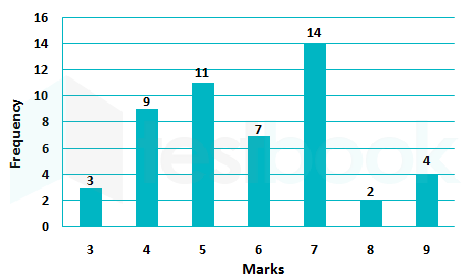
The above frequency chart shows the frequency distribution of marks obtained by a set of students in an exam.

From the data presented above, which one of the following is CORRECT?

  1. ((a))

    mean > mode > median

  2. ((b))

    mode > median > mean

  3. ((c))

    mode > mean > median

  4. ((d))

    median > mode > mean

Show Answer
Answer: ((b))

mode > median > mean

Explanation-

Mean- The arithmetic mean of a given data is the sum of all observations divided by the number of observations.

Median - The value of the middlemost observation, obtained after arranging the data in ascending or descending order, is called the median of the data.

Mode - The value which appears most often in the given data i.e. the observation with the highest frequency is called a mode of data.

Given data and Calculation-

Representing the table in tabular form-

MarksFrequency
33
49
511
67
714
82
94


Mean = (3×3)+(4×9)+(5×11)+(6×7)+(7×14)+(8×2)+(9×4)3+9+11+7+14+2+4\frac{{(3 \times 3) + (4 \times 9) + (5 \times 11) + (6 \times 7) + (7 \times 14) + (8 \times 2) + (9 \times 4)}}{{3 + 9 + 11 + 7 + 14 + 2 + 4}} = 29250292\over50 = 5.84

Median = (n2)th+(n2+1)th2\frac{{{{\left( {\frac{n}{2}} \right)}^{th}} + {{\left( {\frac{n}{2} + 1} \right)}^{th}}}}{2}

(502)th+(502+1)th2=6+62=6\frac{{{{\left( {\frac{{50}}{2}} \right)}^{th}} + {{\left( {\frac{{50}}{2} + 1} \right)}^{th}}}}{2} = \frac{{6 + 6}}{2} = 6

Mode = Mark with higher frequency = 7 

So mode > median > mean.

9

In the square grid shown on the left, a person standing at P2 position is required to move to P5 position.

The only movement allowed for a step involves, “two moves along one direction followed by one move in a perpendicular direction”. The permissible directions for movement are shown as dotted arrows in the right.

For example, a person at a given position Y can move only to the positions marked X on the right.

Without occupying any of the shaded squares at the end of each step, the minimum number of steps required to go from P2 to P5 is

  1. ((a))

    4

  2. ((b))

    5

  3. ((c))

    6

  4. ((d))

    7

Show Answer
Answer: ((b))

5

Explanation-

Given that,

The movement will be from P2 to P5.

At the end of each step, it will not occupy any shaded shape.

So the possible shortest path is given below-

P2 to Q4

Q4 to S3

S3 to T5

T5 to R4

R4 to P5.

So the number of steps required is 5.

10

Consider a cube made by folding a single sheet of paper of appropriate shape. The interior faces of the cube are all blank. However, the exterior faces that are not visible in the above view may not be blank.

Which one of the following represents a possible unfolding of the cube?

  1. ((a))

  2. ((b))

  3. ((c))

  4. ((d))

Show Answer
Answer: ((d))

Explanation:

The Dark Shaded edge is perpendicular to a given line and the Light shaded edge is parallel to the given line so it can be assumed that option 4 is correct but there is no sign of + represented anywhere in the Question.

Hence, the correct answer is "Option 4".

Civil Engineering (55 questions)

11

Consider the following expression:

z = sin (y + it) + cos (y - it)

where z, y, and t are variables, and i = √-1 is a complex number. The partial differential equation derived from the above expression is

  1. ((a))

    2zt2+2zy2=0\frac{\partial^2 z}{\partial t^2}+\frac{\partial^2 z}{\partial y^2}=0

  2. ((b))

    2zt22zy2=0\frac{\partial^2 z}{\partial t^2}-\frac{\partial^2 z}{\partial y^2}=0

  3. ((c))

    ztizy=0\frac{\partial z}{\partial t}-i\frac{\partial z}{\partial y}=0

  4. ((d))

    zt+izy=0\frac{\partial z}{\partial t}+i\frac{\partial z}{\partial y}=0

Show Answer
Answer: ((a))

2zt2+2zy2=0\frac{\partial^2 z}{\partial t^2}+\frac{\partial^2 z}{\partial y^2}=0

Explanation-

Given equation is, z = sin (y + it) + cos (y - it)

Partially differentiating the equation with respect to y, we have 

δzδy=\frac{{\delta z}}{{\delta y}} = cos (y + it) - sin (y - it)

Partially differentiating the equation with respect to y twice, we have

2zy2=\frac{{{\partial ^2}z}}{{\partial {y^2}}} =  -sin (y + it) - cos (y - it)---------(i)

Partially differentiating the equation with respect to t, we have 

δzδt=\frac{{\delta z}}{{\delta t}} =  i cos (y + it) + i sin (y - it)

Partially differentiating the equation with respect to y twice, we have

2zt2=\frac{{{\partial ^2}z}}{{\partial {t^2}}} =  i2 sin (y + it) - i2 cos (y - it)-------(ii)

Value of i2 = -1

So equation (ii) will be, 

2zt2=\frac{{{\partial ^2}z}}{{\partial {t^2}}} =  cos (y - it) + sin (y + it)------(iii)

2zt2+2zy2=\frac{\partial^2 z}{\partial t^2}+\frac{\partial^2 z}{\partial y^2}= -sin (y + it) - cos (y - it)+cos (y - it) + sin (y + it) = 0

So the partial differential equation derived from the above expression is 2zt2+2zy2=0\frac{\partial^2 z}{\partial t^2}+\frac{\partial^2 z}{\partial y^2}=0.

12

For the equation

d3ydx3+x(dydx)3/2+x2y=0\frac{d^3y}{dx^3}+x\left(\frac{dy}{dx}\right)^{3/2}+x^2y=0

the correct description is

  1. ((a))

    an ordinary differential equation of order 3 and degree 2.

  2. ((b))

    an ordinary differential equation of order 3 and degree 3.

  3. ((c))

    an ordinary differential equation of order 2 and degree 3.

  4. ((d))

    an ordinary differential equation of order 3 and degree 3/2.

Show Answer
Answer: ((a))

an ordinary differential equation of order 3 and degree 2.

Explanation-

Order- Order of a differential equation is the order of the highest derivative (also known as differential coefficient) present in the equation.

Degree-

  • The degree of the differential equation is represented by the power of the highest order derivative in the given differential equation.
  • The differential equation must be a polynomial equation in derivatives for the degree to be defined.

Given data and Analysis-

The equation is given as, d3ydx3+x(dydx)3/2+x2y=0\frac{d^3y}{dx^3}+x\left(\frac{dy}{dx}\right)^{3/2}+x^2y=0

⇒ d3ydx3+x2y=x(dydx)3/2\frac{d^3y}{dx^3}+x^2y=x\left(\frac{dy}{dx}\right)^{3/2}

Squaring on both sides the equation will be,

(3yx3)2+x4y2+2x2y3yx3=x2(dydx)3{\left( {\frac{{{\partial ^3}y}}{{\partial {x^3}}}} \right)^2} + {x^4}y^2 + 2x^2y{\frac{{{\partial ^3}y}}{{\partial {x^3}}}}= {x^2}{\left( {\frac{{dy}}{{dx}}} \right)^3}

So highest order = 3

Degree of the highest order derivative = 2

So it is an ordinary differential equation of order 3 and degree 2.

13

The hoop stress at a point on the surface of a thin cylindrical pressure vessel is computed to be 30.0 MPa. The value of maximum shear stress at this point is

  1. ((a))

    7.5 MPa

  2. ((b))

    15.0 MPa

  3. ((c))

    30.0 MPa

  4. ((d))

    22.5 MPa

Show Answer
Answer: ((a))

7.5 MPa

Concepts:

In thin cylindrical shells, there are two principal stresses acts**:**

1. Longitudinal stress: 

σL=pd4t σ_L = \frac{pd}{4t}

2. Hoop Stress:

σh=pd2t σ_h = \frac{pd}{2t}

 Both stresses are tensile in nature.

From the above, it can be said that

σh = 2σL

The maximum in-plane shear stress is given as:

τmax=σhσL2\tau_{max} = \frac{σ _h - σ_L}{2}

Calculation:

Given:

σh = 30 MPa

σL = 30/2 = 15 MPa

Both are tensile in nature.

The maximum shear stress is given as:

τmax=30152\tau_{max} = \frac{30 -15}{2}

τmax = 7.5 MPa

Alternate SolutionWe know, 

The maximum shear stress is given as:

τmax=σhσL2\tau_{max} = \frac{σ _h - σ_L}{2}If we consider 3 - D then minimum Stress = 0

So

⇒  τmax=3002\tau_{max} = \frac{30 -0}{2} = 15 MPa

 Option A or B is the correct answer as per the official Answer

14

In the context of elastic theory of reinforced concrete, the modular ratio is defined as the ratio of

  1. ((a))

    Young’s modulus of elasticity of reinforcement material to Young’s modulus of elasticity of concrete.

  2. ((b))

    Young’s modulus of elasticity of concrete to Young’s modulus of elasticity of reinforcement material.

  3. ((c))

    shear modulus of reinforcement material to the shear modulus of concrete

  4. ((d))

    Young’s modulus of elasticity of reinforcement material to the shear modulus of concrete.

Show Answer
Answer: ((a))

Young’s modulus of elasticity of reinforcement material to Young’s modulus of elasticity of concrete.

Concepts:

Modular Ratio:

Modular Ratio in RCC is defined as the ratio between Modulus of Elasticity of Steel and Modulus of Elasticity of Concrete.  It is donated by m.

M = Es/Ec

Where Es is the modulus of elasticity of steel

Ec is the modulus of elasticity of Concrete.

As per IS 456 codal provisions:

  1. The modulus of elasticity of steel is 2,00 kN/mm2 irrespective of the grade of steel.
  2. In general, concrete does not have a definite value of modulus of elasticity as it is not a perfectly elastic material.  However, the short-term modulus of concrete can be  taken as:

     Ec = 5000√fck

 Where fck is the characteristic strength of concrete.

 3. In the working stress method, the modular ratio is assumed to have a value of 280/3σcbc where σcbc is the permissible compressive stress (in N/mm2) in concrete due to bending.

15

Which of the following equations is correct for the Pozzolanic reaction?

  1. ((a))

    Ca(OH)2 + Reactive Superplasticiser + H2O → C-S-H

  2. ((b))

    Ca(OH)2 + Reactive Silicon dioxide + H2O → C-S-H

  3. ((c))

    Ca(OH)2 + Reactive Sulphates + H2O → C-S-H

  4. ((d))

    Ca(OH)2 + Reactive Sulphur + H2O → C-S-H

Show Answer
Answer: ((b))

Ca(OH)2 + Reactive Silicon dioxide + H2O → C-S-H

Concepts:

The pozzolanic materials are those materials which itself do not possess the cementitious properties but when added in certain proportions in ordinary Portland cement, it reacts with a by-product of hydration of cement i.e. with Calcium Hydroxide (Ca (OH)2 and leads to the formation of CSH gel which posses the cementitious properties.

The pozzolanic reaction is the chemical reaction that occurs in Portland cement upon the addition of Pozzolana and it occurs in between calcium hydroxide and Silicic acid.

The reaction is:

Ca(OH)2 + Reactive Silicon dioxide + H2O → C-S-H

16

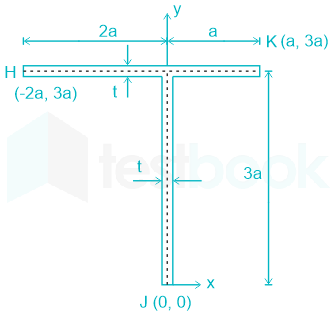
Consider the cross-section of a beam made up of thin uniform elements having thickness t (t << a) shown in the figure. The (x, y) coordinates of the points along the center-line of the cross-section are given in the figure.

The coordinates of the shear center of this cross-section are:

  1. ((a))

    x = 0, y = 3a

  2. ((b))

    x = 2a, y = 2a

  3. ((c))

    x = -a, y = 2a

  4. ((d))

    x = -2a, y = a

Show Answer
Answer: ((a))

x = 0, y = 3a

Concepts:

Shear center:

  • Shear center is a point on the cross-section where the application of loads does not cause its twisting.
  • The shear center position is dependent on the cross-section of the beam.

The following points should be remembered for finding the location of shear center.

  1. For symmetrical sections, the shear center and center of gravity are the same and coincides   with each other.
  2. For unsymmetrical section, the shear center lies on the axis where it has axis of symmetry.
  3. For sections made by joining the thin rectangular sections, then shear center lies on the points of intersection of individual symmetrical axis of this rectangular section. 

In this problem point No. 3 is used to find out the location of shear center.

The horizontal thin rectangular section has axis of symmetry along X-axis as shown in the dotted line and the vertical thin rectangular section has an axis of symmetry Y-axis itself (also shown as dotted line) and their point of intersection lies at (0, 3a).

17

Four different soils are classified as CH, ML, SP, and SW, as per the Unified Soil Classification System. Which one of the following options correctly represents their arrangement in the decreasing order of hydraulic conductivity? 

  1. ((a))

    SW, SP, ML, CH

  2. ((b))

    CH, ML, SP, SW

  3. ((c))

    SP, SW, CH, ML

  4. ((d))

    ML, SP, CH, SW

Show Answer
Answer: ((a))

SW, SP, ML, CH

Concepts:

CH à Clay with High liquid limit > 50 %.

ML à Silt with Low Liquid Limit < 50 %.

SP à Poorly graded sand with fines < 5%.

SW à Well graded sand.

Among the above, Clay and silt are fine-grained soils and Sand is coarse-grained soil.

Generally, coarse-grained soil has higher permeability than fine-grained soil. Among the silt and clay; silt has more permeability than that of Clay. Well-graded soil has better permeability than poorly graded.

Based on these facts, the decreasing order of permeability of soil is:

SW > SP > ML > CH

18

Let σv\sigma_v^{'} and σh\sigma_h^{'} denote the effective vertical stress and effective horizontal stress, respectively. Which one of the following conditions must be satisfied for a soil element to reach the failure state under Rankine’s passive earth pressure condition?

  1. ((a))

    σv\sigma_v^{'} < σh\sigma_h^{'}

  2. ((b))

    σv>σh\sigma_v^{'}>\sigma_h^{'}

  3. ((c))

    σv=σh\sigma_v^{'}=\sigma_h^{'}

  4. ((d))

    σv+σh=0\sigma_v^{'}+\sigma_h^{'}=0

Show Answer
Answer: ((a))

σv\sigma_v^{'} < σh\sigma_h^{'}

Concepts:

The soil that is retained at a slope steeper than it can sustain by virtue of its shearing strength, exerts a force on the retaining wall. This force is called earth pressure.

The ratio of the horizontal stress to the vertical stress is called the coefficient of Earth pressure and the same ratio is called the coefficient of active earth pressure and coefficient of passive Earth pressure when soil is in Rankin’s active and passive state respectively.

If the wall is pushed towards the backfill, the soil is compressed and the soil offers its resistance by virtue of its shearing resistance. Since shearing resistance builds up in the direction of the wall the earth pressure gradually increases and reaches a value where backfill cannot withstand and slip surface is formed and force acting on the wall at this stage is called passive earth pressure. Mathematically, it is given as:

Kp = σhv

Kp > 1 always

∴ σh > σv

Note:

When the wall is moving away from the soil, the soil mass expands, resulting in a decrease in earth pressure due to mobilization of shearing resistance. A portion of the backfill tends to break away from the rest of the soil mass and tends to move downward and outward relative to the wall.  A stage is reached when the entire shearing resistance is mobilized and at this stage, the force acting on the wall is called active earth pressure.

 Mathematically, it is given as:

Ka = σhv

Ka < 1 always

∴ σh < σv

19

With respect to fluid flow, match the following in Column X with Column Y:

Column XColumn Y
A.Viscosity1.Mach number
B.Gravity2.Reynolds number
C.Compressibility3.Euler number
D.Pressure4.Froude number
  1. ((a))

    A - 2, B - 4, C - 1, D - 3

  2. ((b))

    A - 3, B - 4, C - 1, D - 2

  3. ((c))

    A - 4, B - 2, C - 1, D - 3

  4. ((d))

    A - 2, B - 4, C - 3, D - 1

Show Answer
Answer: ((a))

A - 2, B - 4, C - 1, D - 3

Concepts:

Mach number is dimensionless quantity  and it is defined as the ratio of flow velocity past a boundary to the local speed of sound. It is related to compressibility of fluid flow.

Reynolds Number is dimensionless quantity  and it is defined as ratio of inertia force to viscous force in fluid flow. Based on this flow can be considered as either laminar or turbulent.

Froude Number is dimensionless quantity  and it is defined as square root of ratio of inertia force to gravitational force. It governed the fluid flow in open channels.

Euler Number is dimensionless quantity  and it is defined as square root of ratio of inertia force to pressure force. It governs the fluid flow in pipes.

20

Let ψ represent soil suction head and K represent hydraulic conductivity of the soil. If the soil moisture content θ increases, which one of the following statements is TRUE?

  1. ((a))

    ψ decreases and K increases

  2. ((b))

    ψ increases and K decreases

  3. ((c))

    Both ψ and K decrease.

  4. ((d))

    Both ψ and K increase.

Show Answer
Answer: ((a))

ψ decreases and K increases

Concepts:

The following points should be remembered for the hydraulic conductivity of unsaturated soil.

  1. The hydraulic conductivity of the unsaturated soils is the non-linear function of soil suction head (ψ) and soil moisture content (θ).
  2. The hydraulic conductivity for coarse-textured soil is higher than for finer-textured soil.
  3. On increasing the water content, the soil suction head (ψ) decreases, and hydraulic conductivity (K) increases.

It depends on the soil pore geometry as well as the fluid viscosity and density.

The hydraulic conductivity for a given soil becomes lower when the fluid is more viscous than water

21

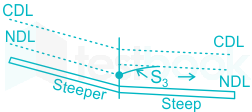
A rectangular channel with Gradually Varied Flow (GVF) has a changing bed slope. If the change is from a steeper slope to a steep slope, the resulting GVF profile is

  1. ((a))

    S3

  2. ((b))

    S1

  3. ((c))

    S2

  4. ((d))

    either S1 or S2, depending on the magnitude of the slopes

Show Answer
Answer: ((a))

S3

Explanation-

  • When two-channel sections have different bed slopes the condition is called a break in grade.
  • Under this situation following conditions must be remembered for drawing the flow profile.
  • CDL is independent of the bed slope.
  • The steeper the slope lesser is the normal depth of flow.
  • Flow always starts from NDL and tries to meet NDL.
  • Subcritical flow has downstream control and supercritical flow has upstream control.
  • Steep slope-


Given data and Analysis-

  • Flow is changed from steeper to sleep.
  • So the Normal depth of flow will increase in a steep slope, as the slope is decreased.
  • CDL will remain the same for both the slope.
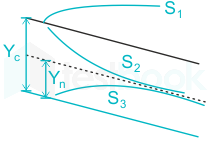
  • So from the figure shown below it can be concluded that flow will be S3 profile.

22

The total hardness in raw water is 500 milligram per liter as CaCO3. The total hardness of this raw water, expressed in milligram equivalent per liter, is

(Consider the atomic weights of Ca, C, and O as 40 g/mol, 12 g/mol, and 16 g/mol, respectively.)

  1. ((a))

    10

  2. ((b))

    100

  3. ((c))

    1

  4. ((d))

    5

Show Answer
Answer: ((a))

10

Concepts:

The total hardness in milligram equivalent per liter is ratio of hardness in milligram per liter as CaCO3 to equivalent weight of CaCO3.

Further, The equivalent weight of CaCO3 is the ratio of molecular weight to valency factor.

Calculation:

The valency factor for CaCO3 is 2 as Ca can loose maximum 2 electrons and converted to Ca+2 and CO32- ions when dissolved in water.

The molecular weight of CaCO3 is = 40 + 12 + 3 × 16 = 100 gm

The equivalent weight of CaCO3­ is = 100 /2 = 50 gm

The total hardness in milligram equivalent per liter  = 500/50 = 10.

23

An aerial photograph is taken from a flight at a height of 3.5 km above mean sea level, using a camera of focal length 152 mm. If the average ground elevation is 460 m above mean sea level, then the scale of the photograph is

  1. ((a))

    1 ∶ 20000

  2. ((b))

    1 ∶ 20

  3. ((c))

    1 ∶ 100000

  4. ((d))

    1 ∶ 2800

Show Answer
Answer: ((a))

1 ∶ 20000

Concept:

  • The scale of a photograph is determined by the focal length of the camera and the flying height above the ground. The focal length is the distance from the middle of the camera lens to the focal plane.
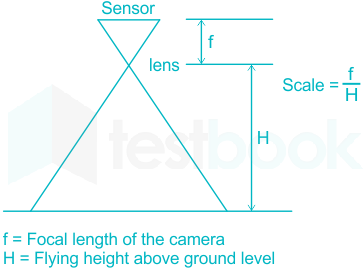
  • The scale of a photo is equal to the ratio between the camera's focal length and the plane's altitude above the ground level (AGL) being photographed. If the focal length and flying altitude above the surface is known, the scale can be calculated using the following formula:

<br>


Scale = fH\rm \frac{f}{H}

f = Focal length of the camera

H = Flying height above ground level

<br>


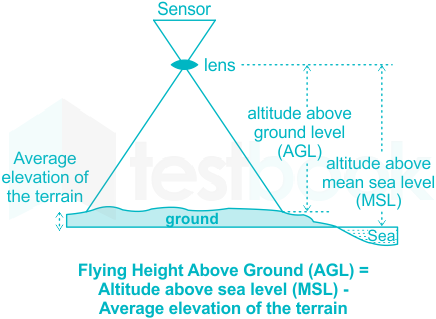
Flying Height Above Ground (AGL) = Altitude above sea level (MSL) - Average elevation of the terrain

Calculation:

Flying height = 3.5 km = 3500 m above mean sea level

focal length of camera = 152 mm

Average ground elevation = 460 mm above mean sea level

Scale = 152(3500460)1000\frac{152}{(3500-460)1000}= 1 ∶ 20000

24

A line between stations P and Q laid on a slope of 1 in 5 was measured as 350 m using a 50 m tape. The tape is known to be short by 0.1 m.

The corrected horizontal length (in m) of the line PQ will be

  1. ((a))

    342.52

  2. ((b))

    349.30

  3. ((c))

    356.20

  4. ((d))

    350.70

Show Answer
Answer: ((a))

342.52

Concept:

Correction for measurement with faulty tape-

Let l be the true length of the tape and l' be the faulty length of the tape, then 

The true length of the tape x True length of tape = Faulty length of tape x Faulty length of tape

Slope Correction-

  • When a measurement is taken along an inclined plane( along the natural slope of the ground), the measured distance is greater than the horizontal distance.
  • The difference between the slope distance and the horizontal distance is called slope correction.
  • This correction is always negative.

  • Where h= difference in elevation between the ends
  • L= Inclined length measure, l=Horizontal length
  • Cs= Correction due to sag.
  • Correction due to slope = L(cos θ - 1)

Calculation:

Slope of line = 1 in 5

tan θ =15\frac{1}{5}

θ =11.31 degree

Correction due to slope = 350 ( cos 11.31 - 1)=-6.8 m

Nominal length of tape = 50 m

Tape is short by 0.1 m, so faulty length of tape = 49.9 m

So true length of line = (350)(49.9)50\frac{(350)(49.9)}{50}=349.3 m

Correction = 349.3-350 = -.7 m

Net correction = -(6.8+.7)=-7.5 m

So corrected length of measured line = 342.5 m

25

The matrix M is defined as

M=[1342]M=\begin{bmatrix}1&3\\ 4&2\end{bmatrix}

and has eigenvalues 5 and −2. The matrix Q is formed as Q = M3 - 4M2 - 2M

Which of the following is/are the eigenvalue(s) of matrix Q?

  1. ((a))

    15

  2. ((b))

    25

  3. ((c))

    -20

  4. ((d))

    -30

Show Answer
Answer: ((a))

15

Concept:

  • Eigenvector of a matrix A is a vector represented by a matrix X such that when X is multiplied with matrix A, then the direction of the resultant matrix remains same as vector X.
  • Mathematically, the above statement can be represented as AX = λX

Properties of eigenvalues-

Eigenvalues of unitary and orthogonal matrices are of unit modulus |λ| = 1

  • If λ1, λ2…….λn are the eigenvalues of A, then kλ1, kλ2…….kλn are eigenvalues of kA
  • If λ1, λ2…….λn are the eigenvalues of A, then 1/λ1, 1/λ2…….1/λn are eigenvalues of A-1
  • If λ1, λ2…….λn are the eigenvalues of A, then λ1k, λ2k…….λnk are eigenvalues of Ak

Eigenvalues of A = Eigen Values of AT (Transpose)

Sum of Eigen Values = Trace of A (Sum of diagonal elements of A)

Product of Eigen Values = |A|

Maximum number of distinct eigenvalues of A = Size of A

Calculation:

The given eigenvalues are 5 and −2.

Q = M3 - 4M2 - 2M

Eigen values of M3 are 125 and -8,4M2  are 100 and 16, 2M are 10 and -4.

SO eigen values of Q, λ1= 125-100-10 = 15,λ2 = -8-16-(-4)=-20

So the eigen values are 15 and -20.

26

For wastewater coming from a wood pulping industry, Chemical Oxygen Demand (COD) and 5-day Biochemical Oxygen Demand (BOD5) were determined. For this wastewater, which of the following statement(s) is/are correct?

  1. ((a))

    COD > BOD5

  2. ((b))

    COD ≠ BOD5

  3. ((c))

    COD < BOD5

  4. ((d))

    COD = BOD5

Show Answer
Answer: ((a))

COD > BOD5

Concept:

BOD, COD, TOC, and TOD all are associated with the organic content of water. COD is related to both the inorganic and organic content of water.

Chemical Oxygen Demand(COD)Biological oxygen demand(BOD)Theoretical Oxygen DemandTotal Organic carbon
The amount of oxygen required by the biodegradable and non-biodegradable organic matter present in wastewater.The amount of oxygen required by the bio-degradable organic matter present in wastewater.Through chemical reaction equations, the exact amount of organic matter present represent Theoretical Oxygen Demand.It is a form of presentation of the amount of organic matter in form of its carbon content.


Chemical Oxygen Demand is always more than Biological Oxygen demand as COD includes both bio-degradable and non-biodegradable organic matter.

If the non-biodegradable matter is absent then COD may be equal to BOD.

But ultimate BOD is more than BOD5.

So COD ≠ BOD5 and COD > BOD5.

<br>

Important Points

  • A high COD/BOD ratio means the amount of COD is more as compared to the amount of BOD.
  • Similarly, High BOD/COD ratio means the amount of BOD is more as compared to the amount of COD.
27

Which of the following process(es) can be used for conversion of salt water into fresh water?

  1. ((a))

    Microfiltration

  2. ((b))

    Electrodialysis

  3. ((c))

    Ultrafiltration

  4. ((d))

    Reverse osmosis

Show Answer
Answer: ((a))

Microfiltration

Concept:

Microfiltration and Ultrafiltration

  • Microfiltration is the process of physically removing suspended solids from water, through a membrane.
  • Ultrafiltration blocks everything microfiltration can with the addition of viruses, requiring a slightly higher pressure to achieve this.
  • UF and MF can be used in the following processes:
  • Treating wastewater
  • Concentrating proteins
  • Chemical process separation
  • Separating oil/water emulsions
  • Removing pathogens from milk

Electrodialysis

  • Electrodialysis (ED) is a membrane technique, during which ions are transported through a semipermeable membrane, under the influence of an electric potential. It is a very versatile technology for the separation of difficult mixtures.
  • ED is very useful for water treatment, aiding in the removal of mineral salts, sulfate, nitrate, etc. from brackish water and seawater. ED is also useful for wastewater reduction or recovery.

Reverse Osmosis

  • Reverse osmosis is the process in which pressure is applied to overcome colligative property and osmotic pressure that is directed by a thermodynamic parameter and a chemical difference of a solvent.
  • This application is mainly applied in the production of potable water in water plants and in industries.
  • It is used for the desalination of brackish water and seawater and it is also used for the treatment of wastewater.
28

A horizontal curve is to be designed in a region with limited space. Which of the following measure(s) can be used to decrease the radius of curvature?

  1. ((a))

    Decrease the design speed.

  2. ((b))

    Increase the superelevation.

  3. ((c))

    Increase the design speed.

  4. ((d))

    Restrict vehicles with higher weight from using the facility.

Show Answer
Answer: ((a))

Decrease the design speed.

Explanation:

In a horizontal curve, e+f = V2/Rg 

 R = V2/g (e + f)

Where

R = Radius of curvature, V = design speed

e = super elevation, f = Coefficient of friction, g = Acceleration due to gravity

Given data and analysis:

It is required to decrease the radius of curvature.

As,  R = V2/g (e + f)

From the above formula, R is directly proportional to velocity and inversely proportional to super-elevation.

So to decrease the radius of curvature decrease the design speed and increase the super-elevation

29

Consider the following recursive iteration scheme for different values of variable P with the initial guess x1 = 1.

xn+1=12(xn+Pxn)x_{n+1}=\frac{1}{2}\left(x_n+\frac{P}{x_n}\right), n = 1, 2, 3, 4, 5

For P = 2, x5 is obtained to be 1.414, rounded-off to three decimal places. For P = 3, x5 is obtained to be 1.732, rounded-off to three decimal places.

If P = 10, the numerical value of x5 is ________. (round off to three decimal places)

30

The Fourier cosine series of a function is given by:

f(x)=n=0fncosnxf(x)=\displaystyle\sum_{n=0}^\infty f_n\cos nx

For f(x) = cos4 x, the numerical value of (f4 + f5) is _______. (round off to three decimal places)

31

An uncompacted heap of soil has a volume of 10000 m3 and void ratio of 1. If the soil is compacted to a volume of 7500 m3 , then the corresponding void ratio of the compacted soil is __________. (round off to one decimal place)

32

A concentrated vertical load of 3000 kN is applied on a horizontal ground surface. Points P and Q are at depths 1 m and 2 m below the ground, respectively, along the line of application of the load. Considering the ground to be a linearly elastic, isotropic, semi-infinite medium, the ratio of the increase in vertical stress at P to the increase in vertical stress at Q is ________. (in integer)

33

At a site, Static Cone Penetration Test was carried out. The measured point (tip) resistance qc was 1000 kPa at a certain depth. The friction ratio (fr) was estimated as 1 % at the same depth.

The value of sleeve (side) friction (in kPa) at that depth was _____ . (in integer)

34

During a particular stage of the growth of a crop, the consumptive use of water is 2.8 mm/day. The amount of water available in the soil is 50 % of the maximum depth of available water in the root zone. Consider the maximum root zone depth of the crop as 80 mm and the irrigation efficiency as 70 %.

The interval between irrigation (in days) will be _________. (round off to the nearest integer)

35

The bearing of a survey line is N31°17'W. Its azimuth observed from north is ______ deg. (round off to two decimal places)

36

The Cartesian coordinates of a point P in a right-handed coordinate system are (1, 1, 1). The transformed coordinates of P due to a 45° clockwise rotation of the coordinate system about the positive x-axis are

  1. ((a))

    (1, 0, √2)

  2. ((b))

    (1, 0, -√2)

  3. ((c))

    (-1, 0, √2)

  4. ((d))

    (-1, 0, -√2)

Show Answer
Answer: ((a))

(1, 0, √2)

Concept:

In 3D, rotations can also be defined as linear transformations, a rotation in 3D can be represented by a matrix equation P'=RP where R is a rotation matrix.

R =  [1000cosθsinθ0sinθcosθ]\begin{bmatrix}1&0&0\\ 0 &\cos \theta&-\sin \theta\\ 0&\sin \theta&\cos \theta\end{bmatrix}

where θ is the angle of rotation with the positive axis in the clockwise direction.

Given Data and Calculation:

Given that, Coordinate of point P = (1,1,1)

The angle of rotation = 45°

New Coordinate will be,

[xyz]=[1000cosθsinθ0sinθcosθ][111]\rm\begin{bmatrix}x'\\ y'\\ z'\end{bmatrix}=\begin{bmatrix}1&0&0\\ 0 &\cos \theta&-\sin \theta\\ 0&\sin \theta&\cos \theta\end{bmatrix}\rm\begin{bmatrix}1\\ 1\\ 1\end{bmatrix}

[1000121201212][111]=[102]\begin{bmatrix}1&0&0\\ 0 &\frac{1}{\sqrt2}&-\frac{1}{\sqrt2}\\ 0&\frac{1}{\sqrt2}&\frac{1}{\sqrt2}\end{bmatrix}\rm\begin{bmatrix}1\\ 1\\ 1\end{bmatrix}=\begin{bmatrix}1\\ 0\\ \sqrt2\end{bmatrix}

So the solution will be 1.rotation matrix.p′=Rp

37

A semi-circular bar of radius R m, in a vertical plane, is fixed at the end G, as shown in the figure. A horizontal load of magnitude P kN is applied at the end H. The magnitude of the axial force, shear force, and bending moment at point Q for θ = 45°, respectively, are

  1. ((a))

    P2kN,p2kN\rm \frac{P}{\sqrt 2}kN, \frac{p}{\sqrt 2}kN and PR2kNm,\rm \frac{PR}{\sqrt 2}kNm,

  2. ((b))

    P2kN,p2kN\rm \frac{P}{\sqrt 2}kN, \frac{p}{\sqrt 2}kN and 0 kNm

  3. ((c))

    0 kN, P2kN,PR2kNm\rm \frac{P}{\sqrt 2}kN, \frac{PR}{\sqrt 2}kNm

  4. ((d))

    P2kN\rm \frac{P}{\sqrt 2}kN, 0 kN, and PR2kNm\frac{PR}{\sqrt 2}kNm

Show Answer
Answer: ((a))

P2kN,p2kN\rm \frac{P}{\sqrt 2}kN, \frac{p}{\sqrt 2}kN and PR2kNm,\rm \frac{PR}{\sqrt 2}kNm,

Concept-

Shear force-

It is defined as the algebraic sum of all the vertical forces, either to the left or to the right hand side of the section. 

Bending moment -

It is defined as the algebraic sum of the moments of all the forces either to the left or to the right of a section

Axial force-

 Axial force can be defined as the force acting on a body in its axial direction.

Given data and calculation:

Let the axial force and shear force acting at section Q is represented by A and V respectively.

Bending at section Q = Force x perpendicular distance = PR2kNm,\rm \frac{PR}{√ 2}kNm,

Net vertical force acting at section Q = 0

Net horizontal force acting at section Q = P

So FBD of the section Q will be as shown in figure below-

By taking components of forces in horizontal and vertical directions the equations obtained are -

A cos 45° - V sin 45° = P

A2V2=P\rm \frac{A}{√2}-\frac{V}{√2}=P      ......(1)

A sin 45° + V cos 45° = 0

A2+V2=0\rm \frac{A}{√2}+\frac{V}{√2}=0       ........(2)

⇒ A2=V2\rm \frac{A}{√2}=-\frac{V}{√2}

⇒ A = -V     .........(3)

A2+A2=P\rm \frac{A}{√2}+\frac{A}{√2}=P

2A=P\rm \sqrt2A=P

⇒ A=P2=V\rm A=\frac{P}{\sqrt2}=-V

So the magnitude of axial force and shear force are P2kN,p2kN\rm \frac{P}{√ 2}kN, \frac{p}{√ 2}kN.

Important Points As the beam is curved and a single horizontal force is acting and the section is not at 90 degrees, bending moment, shear force, and axial force will exist. None of the above three will be zero.

  • The only option that exists which has all the three values as non-zero is option 1. To save time without any calculation tick option 1.
38

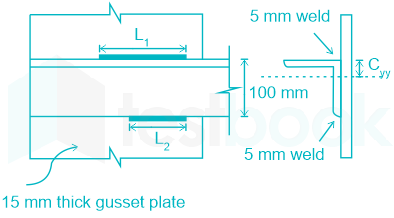
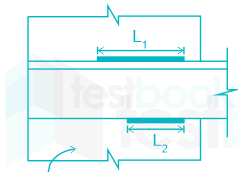
A weld is used for joining an angle section ISA 100 mm × 100 mm × 10 mm to a gusset plate of thickness 15 mm to transmit a tensile load. The permissible stress in the angle is 150 MPa and the permissible shear stress on the section through the throat of the fillet weld is 108 MPa. The location of the centroid of the angle is represented by Cyy in the figure, where Cyy = 28.4 mm. The area of cross-section of the angle is 1903 mm2 . Assuming the effective throat thickness of the weld to be 0.7 times the given weld size, the lengths L1 and L2 (rounded off to the nearest integer) of the weld required to transmit a load equal to the full strength of the tension member are, respectively

  1. ((a))

    541 mm and 214 mm

  2. ((b))

    214 mm and 541 mm

  3. ((c))

    380 mm and 151 mm

  4. ((d))

    151 mm and 380 mm

Show Answer
Answer: ((a))

541 mm and 214 mm

Concept-

Strength of weld = Permissible stress in weld × Effective area of the weld.

Strength of any section = Permissible stress in section × Area of the cross-section

The effective area of the weld = Throat thickness × Effective length

For the angle section, the section is not symmetrical, so the length of the weld will be more along the length which is nearer to the centroid as shown in the figure.

The ratio of the Length L1 and L2 will be given as,

L1L2\frac{L1}{L2}=BCyyCyy\frac{B-Cyy}{Cyy}

Where B= length of the Connecting leg

Cyy = Distance of the centroid from the edge of the angle section

Given Data and Calculation-

Permissible shear stress on the section through the throat of the fillet weld = 108 MPa

permissible stress in the angle = 150 MPa 

Cyy = 28.4 mm

Area of cross-section of the angle = 1903 mm2 

strength of the section = 150 × 1903=285.45 kN

effective size of the weld = 0.7 × 5 = 3.5 mm

Area of the weld required = 285450108\frac{285450}{108}=2643.055 mm2

Length of the weld required = 2643.0553.5\frac{2643.055}{3.5}=755.158 mm

L1L2\frac{L1}{L2}=71.628.4\frac{71.6}{28.4}=2.52

L1 = 2.52L2

3.52L2 = 755.158 mm

L2 = 214.53 mm

L1 = 541 mm

So L1 and L2 are 541 and 214 mm respectively.

 Important Points

  • After Obtaining the length of the weld required check the sum of the weld lengths given in options.
  • Only option 1 and 2 are matching with the required length of the weld, and it is known that L1 will be more than L2. So tick option 1 with out doing further calculation.
39

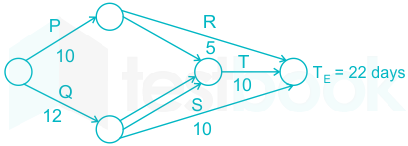
The project activities are given in the following table along with the duration and dependency.

ActivitiesDuration (days)Depends on
P10-
Q12-
R5P
S10Q
T10P, Q
<br>

Which one of the following combinations is correct?

  1. ((a))

    Total duration of the project = 22 days, Critical path is Q → S

  2. ((b))

    Total duration of the project = 20 days, Critical path is Q → T

  3. ((c))

    Total duration of the project = 22 days, Critical path is P → T

  4. ((d))

    Total duration of the project = 20 days, Critical path is P → R

Show Answer
Answer: ((a))

Total duration of the project = 22 days, Critical path is Q → S

Concept-

The critical path method (CPM) is a resource-utilization algorithm for scheduling a set of project activities.

The essential technique for using CPM is to construct a network diagram of the project that includes the following-

  • A list of all activities required to be completed
  • The dependencies between the activities.
  • The estimate of the time duration that each activity will take to complete.

Rules for constructing a network diagram-

  • The direction of the arrows should flow from left to right avoiding mixing of arrows.
  • No single activity can be represented more than once in a network diagram.
  • Before an activity can be undertaken, all activities preceding it must be completed. The logical relationship has to be maintained.
  • Dummy activity must be used when required.
  • A network diagram must have one start and one end event.


Given data and Calculation-

ActivitiesDuration (days)Depends on
P10-
Q12-
R5P
S10Q
T10P, Q


As per the relationships given in the question, the network diagram will be-

So critical path is Q to S and the longest duration will be 22 days.

40

The correct match between the physical states of the soils given in Group I and the governing conditions given in Group II is

Group IGourp II
1.Normally consolidated soilP.Sensitivity > 16
2.Quick clayQ.Dilation angle = 0
3.Sand in critical stateR.Liquid limit > 50
4.Clay of high plasticityS.Over consolidation ratio = 1
  1. ((a))

    1 - S, 2 - P, 3 - Q, 4 - R

  2. ((b))

    1 - Q, 2 - S, 3 - P, 4 - R

  3. ((c))

    1 - Q, 2 - P, 3 - R, 4 - S

  4. ((d))

    1 - S, 2 - Q, 3 - P, 4 - R

Show Answer
Answer: ((a))

1 - S, 2 - P, 3 - Q, 4 - R

Concept:

Normally consolidated soil-

  • Normally consolidated clays are these that are currently experiencing the maximum vertical overburden effective pressure they have ever experienced in their history.
  • Over consolidated clays have experienced higher overburden stress in the past.
  • OCR = (maximum overburden effective stress)/ (Currrent overburden effective stress)
  • So for Normally consolidated soil OCR = 1.


Sensitivity of clay-

  • The ratio of unconfined compression strength of clay in the natural or undisturbed state to that in the remolded state, without any change in the water content is called as sensitivity of soil.
  • St = Su (Undisturbed)/Su (remoulded)
SensitivityClassificationStructure
1Insensitive
2-4Normal sensitiveHoneycomb
4-8SensitiveHoneycomb or flocculent
8-16Extra SensitiveFlocculent
>16Quickunstable
  • So for Quick clay sensitivity is more than 16.

Sand in Critical State- 

  • The dilation angle of sand at the critical state is zero.

Type of clay according to plasticity-

  • According to IS classification of soil clay with a liquid limit of more than 50 is classified as high plasticity, between 35 to 50 is classified as medium plasticity and less than 35 is classified as low plasticity**.**

So the correct option is 1.

41

As per Rankine’s theory of earth pressure, the inclination of failure planes is (45+ϕ2)\left(45+\frac{\phi}{2}\right)^{\circ} with respect to the direction of the minor principal stress. The above statement is correct for which one of the following options?

  1. ((a))

    Only the active state and not the passive state

  2. ((b))

    Only the passive state and not the active state

  3. ((c))

    Both active as well as passive states

  4. ((d))

    Neither active nor passive state

Show Answer
Answer: ((c))

Both active as well as passive states

Explanation:

According to Rankine's Theory of Earth Pressure, the inclination of the failure plane with respect to the minor principal stress direction is given by:

(45+ϕ2) (45^\circ + \frac{\phi}{2})

where:

  • ϕϕ

    = Angle of internal friction of the soil.

Application in Active and Passive States:

The above equation holds true for both active and passive earth pressure states because:

  • In Active Earth Pressure State:
  • The major principal stress acts vertically.
  • The minor principal stress (lateral earth pressure) acts horizontally.
  • The failure plane is inclined at (45+ϕ2) (45^\circ + \frac{\phi}{2}) to the minor principal stress direction.
  • In Passive Earth Pressure State:
  • The major principal stress acts horizontally.
  • The minor principal stress (lateral earth pressure) acts vertically.
  • Again, the failure plane follows the same inclination of (45+ϕ2) (45^\circ + \frac{\phi}{2}) .

Since this failure plane inclination applies to both active and passive earth pressure conditions, the correct answer is:

42

Henry’s law constant for transferring O2 from air into water, at room temperature, is 1.3 (mmol)/lt-atm Given that the partial pressure of O2 in the atmosphere is 0.21 atm, the concentration of dissolved oxygen (mg/liter) in water in equilibrium with the atmosphere at room temperature is

(Consider the molecular weight of O2 as 32 g/mol)

  1. ((a))

    8.7

  2. ((b))

    0.8

  3. ((c))

    198.1

  4. ((d))

    0.2

Show Answer
Answer: ((a))

8.7

Concept-

Henry’s law-

Henry’s law is a gas law that states that at the amount of gas that is dissolved in a liquid is directly proportional to the partial pressure of that gas above the liquid when the temperature is kept constant.

The constant of proportionality for this relationship is called Henry’s law constant (usually denoted by ‘kH‘). The mathematical formula of Henry’s law is given by: C ∝ P (or) C = kH.P

Where, 

‘P’ denotes the partial pressure of the gas in the atmosphere above the liquid. ‘C’ denotes the concentration of the dissolved gas. ‘kH’ is Henry’s law constant of the gas.

If the constant is defined in terms of solubility/pressure, it is referred to as Henry’s law solubility constant (denoted by ‘H’).

On the other hand, if the proportionality constant is defined in terms of pressure/solubility, it is called Henry’s law volatility constant (denoted by ‘kH’).

Given data and Calculation-

Henry's law constant (kH) = 1.3 mmollitatm\frac{mmol}{lit-atm}

Partial pressure of O2 in the atmosphere = 0.21 atm

Molecular weight of O2 = 32 g/mol

O2 dissolved = 1.3 × 0.21 = 0.273 mmol/litre

Molar concentration = givenmassMolecularmass\frac{given- mass}{Molecular- mass}

Mass of O2 = 0.273 × 10-3 × 32 = 8.736 mg/lit

43

In a water sample, the concentrations of Ca2+, Mg2+ and HCO3- are 100 mg/L, 36 mg/L and 122 mg/L, respectively. The atomic masses of various elements are: Ca = 40, Mg = 24, H = 1, C = 12, O = 16.

The total hardness and the temporary hardness in the water sample (in mg/L as CaCO3) will be

  1. ((a))

    400 and 100, respectively.

  2. ((b))

    400 and 300, respectively

  3. ((c))

    500 and 100, respectively

  4. ((d))

    800 and 200, respectively.

Show Answer
Answer: ((a))

400 and 100, respectively.

Concept-

  • Hardness is the concentration of multivalent cations present in the water. It may be induced due to Ca2+, Mg2+, Fe3+, etc.
  • Hardness due to carbonate and bicarbonate of multivalent cations is called carbonate hardness. This hardness is known as temporary hardness as it can be removed by simple boiling or the addition of lime.
  • Total hardness = Carbonate hardness + Noncarbonate Hardness
  • Total hardness as CaCO3 (in mg/L) = [Ca2+]×equivalentweightofCaCO3equivalentweightofCa2++[Mg2+]×equivalentweightofCaCO3equivalentweightofMg2+\frac{{\left[ {C{a^{2 + }}} \right] × {\rm{equivalent weight of CaC}}{{\rm{O}}_3}}}{{{\rm{equivalent weight of C}}{{\rm{a}}^{2 + }}}} + \frac{{\left[ {M{g^{2 + }}} \right] × {\rm{equivalent weight of CaC}}{{\rm{O}}_3}}}{{{\rm{equivalent weight of M}}{{\rm{g}}^{2 + }}}}
  • Carbonate hardness = minimum { Total hardness, Alkalinity}

Given data and Calculation-

Concentrations of Ca2+ = 100 mg/L,eq wt = 20

Concentrations of Mg2+ = 36 mg/L, eq wt = 12

Concentrations of HCO-3 = 122 mg/L

Alkalinity = 122/61 = 2 × 50 = 100 mg/L as CaCO

Total hardness as CaCO3 (in mg/L) = 100×5020+36×5012\frac{{100 \times 50}}{{20}} + \frac{{36 \times 50}}{{12}}=400 mg/L as CaCO3

Carbonate hardness = minimum { 400, 100} = 100 mg/L as CaCO3

44

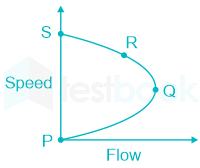
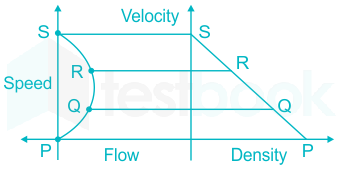
Consider the four points P, Q, R, and S shown in the Greenshields fundamental speed-flow diagram. Denote their corresponding traffic densities by kp, kQ, kR, and ks , respectively. The correct order of these densities is

  1. ((a))

    kP>kQ>kR>ksk_P>k_Q>k_R>k_s

  2. ((b))

    kS>kR>kQ>kPk_S>k_R>k_Q>k_P

  3. ((c))

    kQ>kR>kS>kPk_Q>k_R>k_S>k_P

  4. ((d))

    kQ>kR>kP>kSk_Q>k_R>k_P>k_S

Show Answer
Answer: ((a))

kP>kQ>kR>ksk_P>k_Q>k_R>k_s

Concept-

  • The fundamental relation between flow(q), density(k) and mean speed v is q = k x v

  • When the density is zero, flow will also be zero, since there is no vehicles on the road.
  • When the number of vehicles gradually increases the density as well as flow increases.
  • When more and more vehicles are added, it reaches a situation where vehicles can't move. This is referred to as the jam density or the maximum density. At jam density,  flow will be zero because the vehicles are not moving.
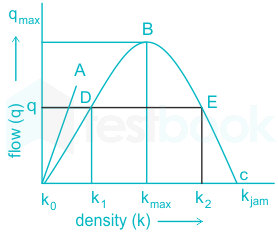
  • There will be some density between zero density and jam density, when the flow is maximum. The relationship is normally represented by a parabolic curve as shown in figure.


Given data and Analysis -


  • At point S, speed is non zero but flow is zero, so density will be zero to get zero flow. So Ks will be minimum.
  • At point P, speed is zero which means it is the jam condition so the density will be maximum.SO Kp will be maximum.
  • So from point S to point P the density will increase gradually.
  • So the correct order of density will be  kP>kQ>kR>ksk_P>k_Q>k_R>k_s.
45

Let max {a, b} denote the maximum of two real numbers a and b. Which of the following statement(s) is/are TRUE about the function f(x) = max{3 - x, x - 1}?

  1. ((a))

    It is continuous on its domain

  2. ((b))

    It has a local minimum at x = 2. 

  3. ((c))

    It has a local maximum at x = 2.

  4. ((d))

    It is differentiable on its domain

Show Answer
Answer: ((a))

It is continuous on its domain

Explanation-

Continuity of a function-

  • A function f(x) is said to be continuous at x=a if limxaf(x)=f(a)\mathop {\lim }\limits_{x \to a} f(x) = f(a).
  • A function is said to be continuous on the interval [a,b] if it is continuous at each point in the interval.

Local maxima and minima-

  • Local maxima and minima are the maxima and minima of the function which arise in a particular interval.
  • Local maxima would be the value of a function at a point in a particular interval for which the values of the function near that point are always less than the value of the function at that point.
  • Whereas local minima would be the value of the function at a point where the values of the function near that point are greater than the value of the function at that point.


Differentiability of a function-

  • If the Left-hand derivative and the Right-hand derivative at a point are equal then the function is said to be differentiable at that point.
  • When there is no sharp edge in the graph of the function the function is differentiable in that domain.


Given data and Calculation-

The given function is f(x) = max{3 - x, x - 1}

The graph of the function will be,

From the above graph, it is clear that it is continuous throughout its domain.

It has a local minimum at x = 2.

As there is a sharp edge at point (2,1) so it is not differentiable at x = 2.

So option 1 and 2 are correct.

46

A horizontal force of P kN is applied to a homogeneous body of weight 25 kN, as shown in the figure. The coefficient of friction between the body and the floor is 0.3. Which of the following statement(s) is/are correct?

  1. ((a))

    The motion of the body will occur by overturning. 

  2. ((b))

    Sliding of the body never occurs. 

  3. ((c))

    No motion occurs for P ≤ 6 kN.

  4. ((d))

    The motion of the body will occur by sliding only.

Show Answer
Answer: ((a))

The motion of the body will occur by overturning. 

Concept-

  • Frictional Force refers to the force generated by two surfaces that contact and slide against each other.
  • The full amount of friction force that a surface can apply upon an object can be easily measured with the use of the given formula:

Ffrict = μ Fnorm , Where μ  = coefficient of friction and Fnorm = Normal reaction


  • When the push or pull force is more than the full amount of friction force then sliding will occur.
  • When the force does not act the centre of gravity of a body, then the body will undergoes rotation which may result in overturn of a body.

Given data and Analysis-


<br>

[FBD of body]

<br>

Applying equilibrium equation in vertical direction, N = W = 25 kN

Minimum force for sliding = Pmin = (fs)max

(fs)max = μ N = 0.3 × 25 = 7.5 kN


<br>

As the force is not acting on C.G of the body, there is a possibility of overturning.

So taking moment about A,

25 × 0.5 = Pmin ×  2

⇒ Pmin = 6.25 kN


  • Force required for overturning is less than the force required for sliding, so first overturning will take place and sliding will never occur.
  • No motion occurs for P ≤ 6 kN, as the minimum force required for overturning is 6.25 KN.
  • So option 1, 2 and 3 are correct.
47

In the context of cross-drainage structures, the correct statement(s) regarding the relative positions of a natural drain (stream/river) and an irrigation canal, is/are

  1. ((a))

    In an aqueduct, natural drain water goes under the irrigation canal, whereas in a super-passage, natural drain water goes over the irrigation canal.

  2. ((b))

    In a level crossing, natural drain water goes through the irrigation canal.

  3. ((c))

    In an aqueduct, natural drain water goes over the irrigation canal, whereas in a super-passage, natural drain water goes under the irrigation canal.

  4. ((d))

    In a canal syphon, natural drain water goes through the irrigation canal.

Show Answer
Answer: ((a))

In an aqueduct, natural drain water goes under the irrigation canal, whereas in a super-passage, natural drain water goes over the irrigation canal.

Concept:

For conveying an irrigation canal across a natural channel is by providing water conveying structure which may:

  • Carry the canal over the natural stream;
  • Carry the canal beneath the natural stream; or
  • Carry the canal at the same level of the natural stream.

Type 1- Cross drainage work carrying the canal over the drain-

  • Aqueduct-
  • In an aqueduct, the canal bed level is above the drainage bed level so the canal is to be constructed above the drainage.
  • Natural drain water goes under the irrigation canal.
  • Syphon Aqueduct-
  • In a syphon aqueduct, canal water is carrier above the drainage but the high flood level (HFL) of drainage is above the canal trough. The drainage water flows under syphonic action and there is no presence of atmospheric pressure in the natural drain.

Type 2- Carry the canal beneath the natural stream-

  • Super passage-
  • Super passage structure carries drainage above canal as the canal bed level is below drainage bed level.
  • Natural drain water goes over the irrigation canal.
  • Canal Syphon-
  • In a canal syphon, drainage is carried over a canal similar to a su  per passage but the full supply level of the canal is above than the drainage trough. so the canal water flows under syphonic action and there is no presence of atmospheric pressure in the canal.

Type 3- Carry the canal at the same level of the natural stream.

  • Level Crossing-
  • When the bed level of the canal is equal to the drainage bed level, the level crossing is to be constructed.
  • Natural drain water goes through the irrigation canal.
48

Consider the differential equation

dydx=4(x+2)y\rm \frac{dy}{dx}=4(x+2)-y

For the initial condition y = 3 at x = 1, the value of 𝑦 at x = 1.4 obtained using Euler’s method with a step-size of 0.2 is _________. (round off to one decimal place)

49

A set of observations of independent variable (x) and the corresponding dependent variable (y) is given below.

x5243
y16101312
<br>

Based on the data, the coefficient a of the linear regression model

y = a + bx is estimated as 6.1

The coefficient b is ______________ . (round off to one decimal place)

50

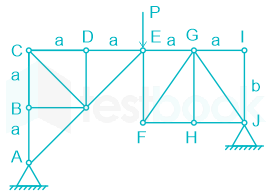
The plane truss shown in the figure is subjected to an external force P. It is given that P = 70 kN, a = 2 m, and b = 3 m.

The magnitude (absolute value) of force (in kN) in member EF is _______. (round off to the nearest integer)

51

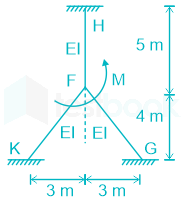
Consider the linearly elastic plane frame shown in the figure. Members HF, FK and FG are welded together at joint F. Joints K, G and H are fixed supports. A counter-clockwise moment M is applied at joint F. Consider flexural rigidity EI = 105 kN-m2 for each member and neglect axial deformations.

If the magnitude (absolute value) of the support moment at H is 10 kN-m, the magnitude (absolute value) of the applied moment M (in kN-m) to maintain static equilibrium is ___________. (round off to the nearest integer)

52

Consider a simply supported beam PQ as shown in the figure. A truck having 100 kN on the front axle and 200 kN on the rear axle, moves from left to right. The spacing between the axles is 3 m. The maximum bending moment at point R is _________ kNm. (in integer)

53

A reinforced concrete beam with rectangular cross section (width = 300 mm, effective depth = 580 mm) is made of M30 grade concrete. It has 1% longitudinal tension reinforcement of Fe 415 grade steel. The design shear strength for this beam is 0.66 N/mm2 . The beam has to resist a factored shear force of 440 kN. The spacing of two-legged, 10 mm diameter vertical stirrups of Fe 415 grade steel is __________mm. (round off to the nearest integer)

54

A square concrete pile of 10 m length is driven into a deep layer of uniform homogeneous clay. Average unconfined compressive strength of the clay, determined through laboratory tests on undisturbed samples extracted from the clay layer, is 100 kPa. If the ultimate compressive load capacity of the driven pile is 632 kN, the required width of the pile is _______ mm. (in integer) (Bearing capacity factor Nc = 9; adhesion factor α = 0.7)

55

A raft foundation of 30 m × 25 m is proposed to be constructed at a depth of 8 m in a sand layer. A 25 m thick saturated clay layer exists 2 m below the base of the raft foundation. Below the clay layer, a dense sand layer exists at the site. A 25 mm thick undisturbed sample was collected from the mid-depth of the clay layer and tested in a laboratory oedometer under double drainage condition. It was found that the soil sample had undergone 50 % consolidation settlement in 10 minutes.

The time (in days) required for 25 % consolidation settlement of the raft foundation will be ________. (round off to the nearest integer)

56

A two-hour duration storm event with uniform excess rainfall of 3 cm occurred on a watershed. The ordinates of streamflow hydrograph resulting from this event are given in the table

Time (hours)01234567
Stream flow (m3/s)1016344031251610
<br>

Considering a constant baseflow of 10 m3/s, the peak flow ordinate (in m3/s) of one-hour unit hydrograph for the watershed is ________ . (in integer)

57

Two reservoirs are connected by two parallel pipes of equal length and of diameters 20 cm and 10 cm, as shown in the figure (not drawn to scale). When the difference in the water levels of the reservoirs is 5 m, the ratio of discharge in the larger diameter pipe to the discharge in the smaller diameter pipe is ____________. (round off to two decimal places)

(Consider only loss due to friction and neglect all other losses. Assume the friction factor to be the same for both the pipes)

58

Depth of water flowing in a 3 m wide rectangular channel is 2 m. The channel carries a discharge of 12 m3/s. Take g = 9.8 m/s2 .

The bed width (in m) at contraction, which just causes the critical flow, is _________ without changing the upstream water level. (round off to two decimal places)

59

A wastewater sample contains two nitrogen species, namely ammonia and nitrate. Consider the atomic weight of N, H, and O as 14 g/mol, 1 g/mol, and 16 g/mol, respectively. In this wastewater, the concentration of ammonia is 34 mg NH3/liter and that of nitrate is 6.2 mg NO3-/liter. The total nitrogen concentration in this wastewater is _______ milligram nitrogen per liter. (round off to one decimal place)

60

A 2% sewage sample (in distilled water) was incubated for 3 days at 27 °C temperature. After incubation, a dissolved oxygen depletion of 10 mg/L was recorded. The biochemical oxygen demand (BOD) rate constant at 27 °C was found to be 0.23 day-1 (at base e).

The ultimate BOD (in mg/L) of the sewage will be_________. (round off to the nearest integer)

61

A water treatment plant has a sedimentation basin of depth 3 m, width 5 m, and length 40 m. The water inflow rate is 500 m3/h. The removal fraction of particles having a settling velocity of 1.0 m/h is_______. (round off to one decimal place)

(Consider the particle density as 2650 kg/m3 and liquid density as 991 kg/m3)

62

A two-phase signalized intersection is designed with a cycle time of 100 s. The amber and red times for each phase are 4 s and 50 s, respectively. If the total lost time per phase due to start-up and clearance is 2 s, the effective green time of each phase is ______s. (in integer)

63

At a traffic intersection, cars and buses arrive randomly according to independent Poisson processes at an average rate of 4 vehicles per hour and 2 vehicles per hour, respectively. The probability of observing at least 2 vehicles in 30 minutes is ______. (round off to two decimal places) 

64

The vehicle count obtained in every 10 minute interval of a traffic volume survey done in peak one hour is given below.

Time Interval (in minutes)Vehicle count
0-1010
10-2011
20-3012
30-4015
40-5013
50-6011

The peak hour factor (PHF) for 10 minute sub-interval is __________. (round off to one decimal place)

65

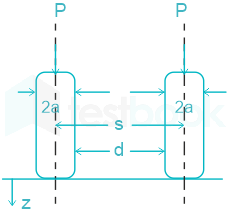
For the dual-wheel carrying assembly shown in the figure, P is the load on each wheel, a is the radius of the contact area of the wheel, s is the spacing between the wheels, and d is the clear distance between the wheels. Assuming that the ground is an elastic, homogeneous, and isotropic half space, the ratio of Equivalent Single Wheel Load (ESWL) at depth z = d/2 to the ESWL at depth z = 2s is ___________. (round off to one decimal place)

(Consider the influence angle to be 45° for the linear dispersion of stress with depth)

Attempt this paper under real exam conditions

Timed interface, section switching, instant scoring, and question-by-question analytics — free.

Start Timed Attempt