Official Paper

GATE CE 2021 Official Paper: Shift 2 (Previous Year Paper)

65 questions · 180 minutes · with answers · free

General Aptitude (10 questions)

1

(i) Arun and Aparna are here.

(ii) Arun and Aparna is here.

(iii) Arun's families is here.

(iv) Arun's family is here.

Which of the above sentences are grammatically CORRECT?

  1. ((a))

    (i) and (iv)

  2. ((b))

    (iii) and (iv)

  3. ((c))

    (ii) and (iv)

  4. ((d))

    (i) and (ii)

Show Answer
Answer: ((a))

(i) and (iv)

Explanation:

According to Rule 1 and Rule 3, (i) and (iv) are correct.

Rules of subject-verb agreement,

Rule 1: Collective nouns such as group, jury, family, audience, population are usually regarded as singular subjects and the verb mostly used is singular except in some cases. 

Rule 2: Nouns connected by the conjunction and in the subject work as the plural subject and take a plural verb.

Rule 3: When the prepositional phrases separate the subjects from the verbs, they have no effect on the verbs.

Rule 4: If the conjunction ‘and’  is replaced by together with/ along with/ accompanied by/ as well as, the verb will have no effect for the later part of these expressions. The words prior to these expressions are the subjects.

Rule 5: The verb in an or, either/or, or neither/nor sentence agrees with the noun or pronoun closest to it.

2

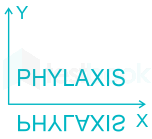
The mirror image of the above text about the x-axis is

  1. ((a))

  2. ((b))

  3. ((c))

  4. ((d))

Show Answer
Answer: ((b))

Explanation:

Given,

Mirror image on X-axis, it should look like the image below

3

Two identical cube shaped dice each with faces numbered 1 to 6 are rolled simultaneously. The probability that an even number is rolled out on each dice is:

  1. ((a))

    136\frac{1}{36}

  2. ((b))

    14\frac{1}{4}

  3. ((c))

    18\frac{1}{8}

  4. ((d))

    112\frac{1}{12}

Show Answer
Answer: ((b))

14\frac{1}{4}

Concept:

Probability=;Probable;OutcomesTotal;OutcomesProbability = ;\frac{{Probable;Outcomes}}{{Total;Outcomes}}

P(AB)=P(A)×P(B)P(A \cap B) = P(A) \times P(B)

Calculation:

Given,

Two cubes numbered 1 to 6.

So, Total outcomes = {1, 2, 3, 4, 5, 6} = 6

Possibility of even number = Favourable outcomes = {2, 4, 6} = 3

The probability that an even number is rolled out  for Cube 1 and Cube 2,

P(A)=36=12 P(B)=36=12\begin{array}{l} P(A) = \frac{3}{6} = \frac{1}{2}\ P(B) = \frac{3}{6} = \frac{1}{2} \end{array}

The probability that an even number is rolled out on each dice is,

 P(AB)=P(A)×P(B)=12×12=14P(A \cap B) = P(A) \times P(B) = \frac{1}{2} \times \frac{1}{2} = \frac{1}{4}

4

⊕ and ⊙ are two operators on numbers p and q such that 

p ⊙ q = p - q, and p ⊕ q = p × q

Then, (9 ⊙ (6⊕ 7)) ⊙ (7 ⊕ (6 ⊙ 5)) =

  1. ((a))
    • 33
  2. ((b))

    40

  3. ((c))
    • 40
  4. ((d))
    • 26
Show Answer
Answer: ((c))
  • 40

Explanation:

given,

p ⊙ q = p - q, and p ⊕ q = p × q, that means

⊙ = - (subtraction) and ⊕ = × (multiplication)

Then,

(9 ⊙ (6⊕ 7)) ⊙ (7 ⊕ (6 ⊙ 5)) = (9 - (6 × 7)) - (7 × (6 - 5)) = (9 - 42) - 7 = - 40

(9 ⊙ (6⊕ 7)) ⊙ (7 ⊕ (6 ⊙ 5)) = - 40

5

Four persons P, Q, R and S are to be seated in a row. R should not be seated at the second position from the left end of the row. The number of distinct seating arrangements possible is:

  1. ((a))

    9

  2. ((b))

    24

  3. ((c))

    6

  4. ((d))

    18

Show Answer
Answer: ((d))

18

Explanation:

Given,

Four people = P, Q, R, S

R shouldn't be seated at the second position from the left end of the row

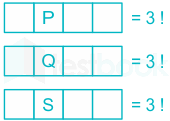
Possible arrangements:

The total number of ways = 3 × 3! = 3 × 3 × 2 = 18

6

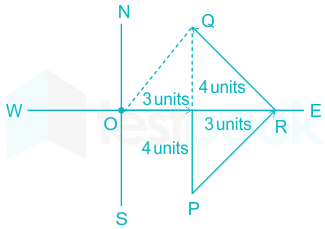
On a planar field, you travelled 3 units East from a point O. Next you travelled 4 units South to arrive at point P. Then you travelled from P in the North-East direction such that you arrive at a point that is 6 units East of point O. Next, you travelled in the North-West direction, so that you arrive at point Q that is 8 units North of point P.

The distance of point Q to point O, in the same units, should be ____

  1. ((a))

    3

  2. ((b))

    6

  3. ((c))

    5

  4. ((d))

    4

Show Answer
Answer: ((c))

5

Calculation:

OQ=(3)2+(4)2=5unitsOQ = \sqrt {{{(3)}^2} + {{(4)}^2}} = 5units

7

The author said, "Musicians rehearse before their concerts. Actors rehearse their roles before the opening of anew play. On the other hand, I find it strange that many public speakers think they can just walk on to the stage and start speaking. In my opinion, it is no less important for public speakers to rehearse their talks."

Based on the above passage, which one of the following is TRUE?

  1. ((a))

    The author is of the opinion that rehearsing is less important for public speakers than for musicians and actors.

  2. ((b))

    The author is of the opinion that rehearsing is more important only for musicians than public speakers.

  3. ((c))

    The author is of the opinion that rehearsing is important for musicians, actors and public speakers.

  4. ((d))

    The author is of the opinion that rehearsal is more important for actors than musicians.

Show Answer
Answer: ((c))

The author is of the opinion that rehearsing is important for musicians, actors and public speakers.

Explanation:

According to the above passage,

  • The author has basically shared his opinion about the importance of rehearsals.
  • He said Actors rehearse for their new play but public speakers just go and speak without any prior practice.
  • But according to his opinion, rehearsals are equally important for actors as well as public speakers.
8
  1. Some football players play cricket.
  2. All cricket players play hockey.

Among the options given below, the statement that logically follows from the two statements 1 and 2 above, is:

  1. ((a))

    Some football players play hockey.

  2. ((b))

    No football player plays hockey

  3. ((c))

    All hockey players play football

  4. ((d))

    All football players play hockey.

Show Answer
Answer: ((a))

Some football players play hockey.

Explanation:

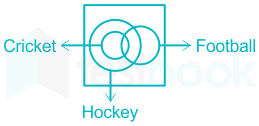
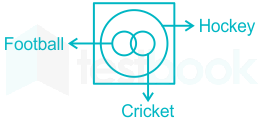
For statement 1, Some football players play cricket, the possible Venn diagram can be, 

For statement 2, Some football players play cricket, the possible Venn diagram can be, 

According to both of them, Option 1, Some football players play hockey can be the possibility.

9

In the figure shown above, PQRS is a square. The shaded portion is formed by the intersection of sectors of circles with radius equal to the side of the square and centrs at S and Q.

The probability that any point picked randomly within the square falls in the shaded area is ________

  1. ((a))

    12\frac{1}{2}

  2. ((b))

    π2\frac{\pi }{2}

  3. ((c))

    4π24 - \frac{\pi }{2}

  4. ((d))

    π21\frac{\pi }{2} - 1

Show Answer
Answer: ((d))

π21\frac{\pi }{2} - 1

Concept:

Required;Probability=;[Shaded;AreaTotal;Area]Required;Probability = ;\left[ {\frac{{Shaded;Area}}{{Total;Area}}} \right]

Total Area = Area of square = (side)2

Shaded area = 2 ×  [Area of sector - (Area of half square or Area of triangle)]

Area of sector = πr24{\frac{{\pi {r^2}}}{4}}

Area of half square or Area of triangle = 12r2{\frac{1}{2}{r^2}}

Calculation:

Given,

Side of square = r

Radius of sector = r

Total Area = Area of square = (side)2 = r2

Shaded area = 2 ×  [Area of sector - (Area of half-square or Area of triangle)] = 2×(πr2412r2)2 \times \left( {\frac{{π {r^2}}}{4} - \frac{1}{2}{r^2}} \right)

Required;Probability=;[2×(πr2412r2)r2]=[r2×(π21)r2]=(π21)Required;Probability = ;\left[ {\frac{{2 \times \left( {\frac{{\pi {r^2}}}{4} - \frac{1}{2}{r^2}} \right)}}{{{r^2}}}} \right] = \left[ {\frac{{{r^2} \times \left( {\frac{\pi }{2} - 1} \right)}}{{{r^2}}}} \right] = \left( {\frac{\pi }{2} - 1} \right)

10

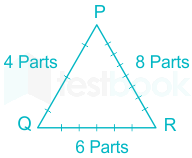
In an equilateral triangle PQR, side PQ is divided into four equal parts, side QR is divided into six equal parts and side PR is divided into eight equal parts. The length of each subdivided part in cm is an integer.

The minimum area of the triangle PQR possible, in cm2, is

  1. ((a))

    48√3

  2. ((b))

    18

  3. ((c))

    24

  4. ((d))

    144√3

Show Answer
Answer: ((d))

144√3

Concept:

Area;of;equilateral;triangle=;34×side2Area;of;equilateral;triangle = ;\frac{{\sqrt 3 }}{4} \times sid{e^2}

Calculation:

Assume the side of ΔPQR = s 

Given that,

(a4,a6,a8)\left( {\frac{a}{4},\frac{a}{6},\frac{a}{8}} \right) is an integer

Minimum area of ΔPQR when s is the LCM (Least Common Multiple of (4, 6, 8)

s = LCM (4, 6, 8) = 24

Area;of;ΔPQR=;34×242;=1443sq.unitsArea;of;\Delta PQR = ;\frac{{\sqrt 3 }}{4} \times {24^2}; = 144\sqrt 3 sq.units

Civil Engineering (55 questions)

11

The value of limxx:ln(x)1+x2\mathop {\lim }\limits_{x \to \infty } \frac{{x {:}ln\left( x \right)}}{{1 + {x^2}}} is:

  1. ((a))

    0

  2. ((b))

    1.0

  3. ((c))

  4. ((d))

    0.5

Show Answer
Answer: ((a))

0

Concept:

L’ Hospital’s Rule:

\(\mathop {\lim }\limits_{x \to a} \left{ {\frac{{f\left( x \right)}}{{g\left( x \right)}}} \right} = \mathop {\lim }\limits_{x \to a} \left{ {\frac{{f'\left( x \right)}}{{g'\left( x \right)}}} \right}\)

This rule is only applicable for 00\frac{0}{0} and \frac{\infty }{\infty } indeterminate forms.

Calculation

As 

limxxln;x1+x2=\mathop {\lim }\limits_{x \to \infty } \frac{{xln;x}}{{1 + {x^2}}} = \frac{\infty }{\infty }

Which is an indeterminate form.

Using L hospitality rule for limxxln;x1+x2\mathop {\lim }\limits_{x \to \infty } \frac{{xln;x}}{{1 + {x^2}}}

We get

limxx×1x+lnx2x=limx1+lnx2x=;Indeterminate;form\mathop {\lim }\limits_{x \to \infty } \frac{{x \times \frac{1}{x} + lnx}}{{2x}} = \mathop {\lim }\limits_{x \to \infty } \frac{{1 + lnx}}{{2x}} = \frac{\infty }{\infty };Indeterminate;form

Again applying the L hospitality rule, we get 

limx1x2=12=0\mathop {\lim }\limits_{x \to \infty } \frac{{\frac{1}{x}}}{2} = \frac{{\frac{1}{\infty }}}{2} = 0

∴ Value of 

limxxln;x1+x2=0\mathop {\lim }\limits_{x \to \infty } \frac{{xln;x}}{{1 + {x^2}}} = 0

12

The rank of the matrix [5050020150500102]\begin{bmatrix} 5 & 0 & -5 & 0 \\ 0 & 2 & 0 & 1 \\ -5 & 0 & 5 & 0 \\ 0 & 1 & 0 & 2 \end{bmatrix} is

  1. ((a))

    1

  2. ((b))

    2

  3. ((c))

    3

  4. ((d))

    4

Show Answer
Answer: ((c))

3

Concept:

Rearrange the rows with leading zeroes on the left and convert them into echelon form

The rank of the matrix = number of non-zeroes row in the echelon form

Calculation:

Given:

 matrix = [5050020150500102]\begin{bmatrix} 5 & 0 & -5 & 0 \\ 0 & 2 & 0 & 1 \\ -5 & 0 & 5 & 0 \\ 0 & 1 & 0 & 2 \end{bmatrix}

Replace R2 with R4 matrix becomes

  [5050010250500201]\begin{bmatrix} 5 & 0 & -5 & 0 \\ 0 & 1 & 0 & 2 \\ -5 & 0 & 5 & 0 \\ 0 & 2 & 0 & 1 \end{bmatrix}

Applying row transformations R3 → R3 + R1 Now the matrix becomes.

  [5050010200000201]\begin{bmatrix} 5 & 0 & -5 & 0 \\ 0 & 1 & 0 & 2 \\ 0 & 0 & 0 & 0 \\ 0 & 2 & 0 & 1 \end{bmatrix}

Applying Row transformation for row 4: R4 → R4 - 2 R2

 [5050010200000003]\begin{bmatrix} 5 & 0 & -5 & 0 \\ 0 & 1 & 0 & 2 \\ 0 & 0 & 0 & 0 \\ 0 & 0 & 0 & -3 \end{bmatrix}

 Replace R3 with R4, the matrix becomes

 [5050010200030000]\begin{bmatrix} 5 & 0 & -5 & 0 \\ 0 & 1 & 0 & 2 \\ 0 & 0 & 0 & -3 \\ 0 & 0 & 0 & 0 \end{bmatrix}

Therefore Number of non zero rows is 3 

∴ The rank of the matrix is 3

13

The unit normal vector to the surface X2 + Y2 + Z2 - 48 = 0 at the point (4, 4, 4) is

  1. ((a))

    15,15,15\frac{1}{\sqrt{5}}, \frac{1}{\sqrt{5}}, \frac{1}{\sqrt{5}}

  2. ((b))

    12,12,12\frac{1}{\sqrt{2}}, \frac{1}{\sqrt{2}}, \frac{1}{\sqrt{2}}

  3. ((c))

    22,22,22\frac{2}{\sqrt{2}}, \frac{2}{\sqrt{2}}, \frac{2}{\sqrt{2}}

  4. ((d))

    13,13,13\frac{1}{\sqrt{3}}, \frac{1}{\sqrt{3}}, \frac{1}{\sqrt{3}}

Show Answer
Answer: ((d))

13,13,13\frac{1}{\sqrt{3}}, \frac{1}{\sqrt{3}}, \frac{1}{\sqrt{3}}

Concept:

Gradient / Normal vector of surface / Slope of surface / Rate of maximum increase or decrease:

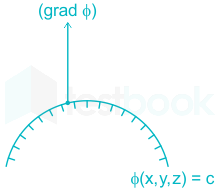
Let ϕ(x, y, z) = C represents any scalar point function, then its gradient is defined as

grad;ϕ=ϕ=i^ϕx+j^ϕy+k^ϕzgrad;\phi = \nabla \phi = \hat i\frac{{\partial \phi }}{{\partial x}} + \hat j\frac{{\partial \phi }}{{\partial y}} + \hat k\frac{{\partial \phi }}{{\partial z}} = Normal vector =i^ϕx = \sum \hat i\frac{{\partial \phi }}{{\partial x}} 

  1. Direction of (grad ϕ) = Direction of Normal vector = Direction of surface

  2. Rate of maximum increase = |grad ϕ|

  3. Unit normal on ϕ=n^=grad;ϕgrad;ϕ'\phi ' = \hat n = \frac{{grad;\phi }}{{\left| {grad;\phi } \right|}} 

Calculation:

Given,

Surface S : x2 + y2 + z2 - 48 = 0

We know that; grad;ϕ=ϕ=i^ϕx+j^ϕy+k^ϕzgrad;\phi = \nabla \phi = \hat i\frac{{\partial \phi }}{{\partial x}} + \hat j\frac{{\partial \phi }}{{\partial y}} + \hat k\frac{{\partial \phi }}{{\partial z}}

∴ grad (S) = 2x î + 2y ĵ + 2z k̂

At point (4,4,4) we get:

grad (S) = 8 î + 8 ĵ + 8 k̂

∴ Unit normal on the sphere will be:

;grad;Sgrad;S8i^;+;8j^;+;8k^82;+;82;+;82 \therefore;\frac{{grad;S}}{{\left| {grad;S} \right|}} \Rightarrow\frac{{8\hat i;+;8\hat j;+;8\hat k}}{{\sqrt {{8^2};+; {8^2};+;{8^2}} }}

= i^ + j^ + k^3= \frac{{\ \hat i \ +\ \hat j \ +\ \hat k}}{{\sqrt{3}}}

14

If A is a square matrix then orthogonality property mandates

  1. ((a))

    AAT = A-1

  2. ((b))

    AAT = 0

  3. ((c))

    AAT = A2

  4. ((d))

    AAT = I

Show Answer
Answer: ((d))

AAT = I

Concept:

Orthogonal matrix: When the product of a matrix to its transpose gives identity matrix.

Suppose A is a square matrix with real elements and of n x n order and AT or A’ is the transpose of A.

AAT = I

Important Points

  • A square matrix such that A2 = I is called the involuntary matrix.
  • A square matrix such that A2 = A is called the Idempotent matrix.
  • Any square matrix A is said to be non-singular if |A| ≠ 0, and a square matrix A is said to be singular if |A| = 0.
  • A square matrix A = [aij] is said to be Hermitian matrix if aij = a̅ij
15

In general, the CORRECT sequence of surveying operations is

  1. ((a))

    Reconnaissance → Data analysis → Field observations → Map making

  2. ((b))

    Data analysis → Reconnaissance  → Field observations → Map making

  3. ((c))

    Reconnaissance  → Field observations → Data analysis → Map making

  4. ((d))

    Field observations → Reconnaissance → Data analysis → Map making

Show Answer
Answer: ((c))

Reconnaissance  → Field observations → Data analysis → Map making

Explanation:

(i) Surveying in the science of determining the relative positions on ground, along with their elevations.

(ii) The relative positions are determined by measuring the horizontal distances, horizontal angles, vertical distances and the vertical angles. for this, various instrument are needed.

(iii) The entire work stages of survey operation in civil engineering may be divided into the following three stages:

  • Field work
  • Office work
  • Care and adjustment of instruments

Field work:

(i) The field work consists of the measurement of all the necessary horizontal and vertical distances, horizontal and vertical angles, elevations, etc. and keeping a systematic record of what has been done in a field book. Field work is further subdivided into;

  • Reconnaissance
  • Field measurements
  • Observationsfield record.

Office Work:

(i) The office work of a surveyor consists of three types based on the field records.

  • Drafting
  • Computing
  • Designing.

​Care and adjustment of instruments:

(i) A great care is required to handle the survey instruments both in field and office. A beginner should always be made familiar with care and adjustment of the instruments and their limitations. Precise instruments like theodolite, level, prismatic compass, etc. need more care than the equipment such as chains, arrows, ranging rods, etc.

So. from the above observation correct sequence of surveying operation is

Reconnaissance  → Field observations → Data analysis → Map making

16

Strain hardening of structural steel means

  1. ((a))

    experiencing higher stress than yield stress with increased deformation

  2. ((b))

    decrease in the stress experienced with increasing strain

  3. ((c))

    strengthening steel member externally for reducing strain experienced

  4. ((d))

    strain occurring before plastic flow of steel material

Show Answer
Answer: ((a))

experiencing higher stress than yield stress with increased deformation

Explanation:

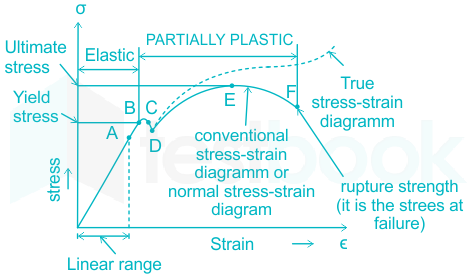
(i) A is Limit of Proportionality: Beyond which linear variation ceases

(ii) B is elastic limit: The maximum stress up to which a specimen regains its original length on the removal of the applied load.

(iii) C is upper yield point: The magnitude of the stress corresponding to C depends on the cross-sectional area, shape of the specimen and type of equipment used to perform the test. It has no practical significance

(iv) D is lower yield point: This is also called actual yield point

(v) DE Represent strain hardening: In this range, further addition of stress (more than yield stress) gives additional strain. However, strain increases with faster rate in this region. The material in this range changes its atomic and crystalline structure, resulting in increased to further deformation.

(vi) E is ultimate point: The stress corresponding to this point is ultimate stress and the corresponding strain is about 20% for mild steel.

(vii) F is fracture point: Stress corresponding to this is called breaking stress and strain is called fracture strain.

(viii) Region between E and F is the necking region in which the area of cross-section is drastically decreased.

17

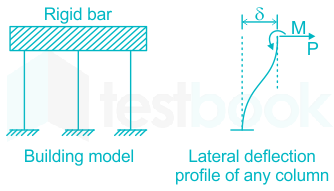
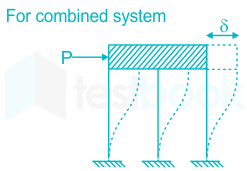
A single-story building model is shown in the figure. The rigid bar of mass 'm' is supported by three massless elastic columns whose ends are fixed against rotation. For each of the columns, the applied lateral force (P) and corresponding moment (M) is also shown in the figure. The lateral deflection (δ) of the bar is given by δ=PL312EI\delta = \dfrac{PL^3}{12 EI}, where L is the effective length of the column, E is Young's modulus of elasticity and I is the area moment of inertia of the column cross-section with respect to its neutral axis.


For the lateral deflection profile of the columns, as shown in the figure, the natural frequency of the system for horizontal oscillation is

  1. ((a))

    1L2EIm rad/s\dfrac{1}{L}\sqrt{\dfrac{2EI}{m}} \ \rm rad/s

  2. ((b))

    26EImL3 rad/s2\sqrt{\dfrac{6EI}{mL^3}} \ \rm rad/s

  3. ((c))

    6EImL3 rad/s6\sqrt{\dfrac{EI}{mL^3}} \ \rm rad/s

  4. ((d))

    2LEIm rad/s\dfrac{2}{L}\sqrt{\dfrac{EI}{m}} \ \rm rad/s

Show Answer
Answer: ((c))

6EImL3 rad/s6\sqrt{\dfrac{EI}{mL^3}} \ \rm rad/s

Explanation

Natural circular frequency (ω) = Km\sqrt {\frac{K}{m}}  rad/second

Or, Circular frequency (f) = ω2π\frac{ω }{{2\pi }} cycle per second

Springs in series and parallel:

Combined stiffness (K) i.e. resistance per unit deflection.

If springs are in series: 1K=1K1+1K2+1K3......+1Kn\frac{1}{K} = \frac{1}{{{K_1}}} + \frac{1}{{{K_2}}} + \frac{1}{{{K_3}}}...... + \frac{1}{{{K_n}}}

If springs are in parallel: K = K1 + K2 + K3 +..........+ Kn

Given,

It is given that for any single column the deflection is

  δ=PL312EIδ = \dfrac{PL^3}{12 EI}

We know 

The stiffness factor is defined as k = P/δ 

 The building Model has 3 columns.

 It is similar to the system of springs in parallel connection. 

 Stiffness (k) = 12EI/L3

So For the combined system Stiffness factor is 

As they are connected parallel. 

Kef = k1 + k2 + k3 = 3 k = 3 × 12EI/L3 = 36EI/L3 

Natural circular frequency (ω) = Km\sqrt {\frac{K}{m}}  rad/second

 ω = 36EIL3m\sqrt {\frac{36EI}{L^3m}}

 ω = 6EIL3m6\sqrt {\frac{EI}{L^3m}}

∴ The natural frequency of the system for horizontal oscillation is ω = 6EIL3m6\sqrt {\frac{EI}{L^3m}}

18

Seasoning of timber for use in construction is done essentially to

  1. ((a))

    increase strength and durability

  2. ((b))

    remove knots from timber logs

  3. ((c))

    cut timber in right season and geometry

  4. ((d))

    smoothen timber surfaces

Show Answer
Answer: ((a))

increase strength and durability

Explanation:

Seasoning of timber increases strength, durability and stiffness but reduces its self-weight due to the reduction in moisture content.

Seasoning of timbers:

A newly fell tree consists of more than 50 % of water by weight, hence cannot be put into service when used for engineering purposes. This process of drying the timber section up to the optimum moisture content is called seasoning.

Seasoning of timber section is done:

  1. To make it more workable.
  2. To increase its resistance against cracking twisting and warping
  3. To increase its resistance against ole forming agencies like termites, insects, fungi, etc.
  4. To maintain its uniform shape and size.
  5. To permit the application of decorative treatment over it.
  6. To reduce its transportation cost.
  7. To ensure its uniform burning when used as fuel.

  • Water in the timber section is present either in the form of sap or in the form of moisture.
  • It is comparatively easy to remove moisture in comparison to the sap.
  • When the timber section is subjected to drying it is the cavity water that gets vaporize first and followed by the wall water.
  • The stage at which entire cavity water is lost and cell water is intact are termed the fibre saturation point.
  • Seasoning of the timber section can be done either naturally or artificially.
  • In natural seasoning there is no control over the factors which control the evaporation thereby tendency of development of cracks is comparatively more.
19

In case of bids in Two-Envelop System, the correct option is

  1. ((a))

    Technical bid is opened first

  2. ((b))

    Either of the two (Technical and Financial) bids can be opened first

  3. ((c))

    Both (Terminal and Financial) bids are opened simultaneously

  4. ((d))

    Financial bid is opened first

Show Answer
Answer: ((a))

Technical bid is opened first

Explanation:

Two Envelop System:

(i) A Two Envelope System separates vendor responses to Formal Solicitations into two sealed bids, or envelopes: a technical proposal and a price proposal. 

(ii) This process is followed in cases where technical specifications, TOR (Terms of Reference) or the technology/process etc are pre-determined. Now only the two things namely: Eligibility criterion of the bidders and the financial offer needs to be evaluated.

(iii) As far as opening the is concerned, obviously the envelop one containing eligibility criterion is opened first and the financial proposal of only those who meet the qualification criterion are opened. And the tender is awarded to the most economical bidder.

Three Envelop System:

(i) In this case the bidder are asked to submit the documents as below:

  • Envelope 1 : Documents related to eligibility criteria.
  • Envelope 2 : Technical bid.
  • Envelope 3 : Financial bid.

(ii) The envelops are opened in sequence, that means first, second and then third. Through the documents submitted in envelop one, the eligibility of the bidder is ascertained.

(iii) Envelop 2 will be opened of only those bidders who meets the qualification criterion. At this stage technical offer of all the Eligible bidders is opened. generally at pre-defined date a conference is arranged to discuss the various offer submitted by various bidders, to discuss the merits and demerits of the technical offers. The bidders who offer the most viable and technologically superior technical solution are declared. All successful bidders at this stage are now asked to modify their financial bids, if required, as the technical specification has changed.

(iv) Envelope 3 will be opened of only those successful bidders at stage 2. And the contract is awarded to the most economical bidder.

20

The most appropriate triaxial test to assess the long-term stability of an excavated clay slope is

  1. ((a))

    unconfined compression test

  2. ((b))

    consolidated drained test

  3. ((c))

    unconsolidated undrained test

  4. ((d))

    consolidated undrained test

Show Answer
Answer: ((b))

consolidated drained test

Explanation:

Types of Triaxial test on the basis of Drainage:

1. Unconsolidated Undrained test (UU test):

  • It is quick test and may complete in 5-10 minutes.
  • In this test water is not allowed to leave the soil either during the consolidation stage (confining stage) nor shear stage (deviator stage).
  • Such tests are suitable for low permeable soil such as clays with fast loading.
  • UU test is carried out for evaluation of short-term stability of the structure.

2. Consolidated Undrained Test (CU test):

  • During the first stage of confining pressure, drainage is allowed from the soil sample. Hence consolidation will take place. But during vertical shear loading, drainage is not permitted.
  • Example: stability analysis of earthen dam during the sudden drawdown.

3. Consolidation Drain test (CD test):

  • Drainage is permitted during the self-pressure (confining pressure) stage and shear stage both.
  • This test is the most time taking and for some soils may take several weeks. So, it is also called ‘slow test;
  • CD test is carried out for evaluation of long-term stability of the structure.
21

As per the Unified Soil Classification System (USCS), the type of soil represented by 'MH' is

  1. ((a))

    Inorganic clays of high plasticity with liquid limit less than 50%

  2. ((b))

    Inorganic clays of low plasticity with liquid limit more than 50%

  3. ((c))

    Inorganic silts of low plasticity with liquid limit less than 50%

  4. ((d))

    Inorganic silts of high plasticity with liquid limit more than 50%

Show Answer
Answer: ((d))

Inorganic silts of high plasticity with liquid limit more than 50%

Explanation:

Classification of fine-grained soil:

(i) In USSC, fine-grained soils are classified on the basis of plasticity chart and compressibility.

(ii) generally, soils are considered as fine soils, when 50% or more of the total material by weight pass 75 μ sieve.

(iii) Liquid limit and plastic limit are determined for 425 μ sieve fraction and corresponding plasticity index is find out

CASE 1: Low plastic soil (Low compressibility) (LL < 35%)

CL → Low plastic inorganic soil

ML → Low plastic inorganic silt

OL → Low plastic organic clay

CASE 2: Medium Plastic soil (medium compressibility) (35% < LL < 50%)

CI → Medium plastic inorganic soil

MI → Medium plastic inorganic silt

OI → Medium plastic organic clay

CASE 3: Highly plastic soils (High compressibility) (LL > 50%)

CH → High plastic inorganic soil

MH → High plastic inorganic silt

OH → High plastic organic clay

22

The ratio of the momentum correction factor to the energy correction factor for a laminar flow in a pipe is

  1. ((a))

    2/3

  2. ((b))

    1

  3. ((c))

    1/2

  4. ((d))

    3/2

Show Answer
Answer: ((a))

2/3

Explanation:

a) Momentum correction factor (β):

The momentum correction factor is defined as the ratio of momentum of the flow per second based on actual velocity to the momentum of the flow per second based on average velocity across a section.

β=;Momentum;per;second;based;on;actual;velocityMomentum;per;second;based;on;average;velocityβ = ;\frac{{Momentum;per;second;based;on;actual;velocity}}{{Momentum;per;second;based;on;average;velocity}}

⇒ β=1AV2u2.dAβ = \frac{1}{{A{V^2}}}\smallint {u^2}.dA

For turbulent flow, the momentum correction factor is slightly higher than one near to 1.2 and

 for laminar, its value is 1.33 = 4/3  --- (1)

b) Kinetic energy correction factor(α): 

  • It is defined as the ratio of kinetic energy/second based on actual velocity to the kinetic energy/second based on average velocity.
  • \(α = \frac{1}{A}\mathop \smallint \limits_A^{} {\left( {\frac{u}{V}} \right)^3}dA\)
  • where A = area, V= average velocity, u= local velocity at distance r.
  • For laminar flow in a circular pipe α = 2  --- (2)

​ (1) divided by (2)

​∴ Ratio of β/α = (4/3)/2 = 2/3

23

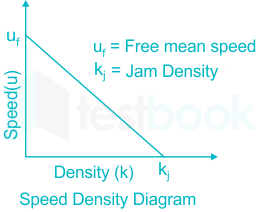
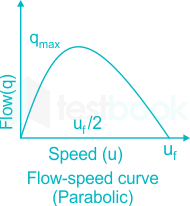
Relationship between traffic speed and density is described using a negatively sloped straight line, If vf is the free-flow speed then the speed at which the maximum flow occurs is

  1. ((a))

    0

  2. ((b))

    vf4\dfrac{v_f}{4}

  3. ((c))

    vf

  4. ((d))

    vf2\dfrac{v_f}{2}

Show Answer
Answer: ((d))

vf2\dfrac{v_f}{2}

Concept:

Free Mean Speed:

From the speed-density diagram, it can be defined as the maximum speed at which the number of vehicles in a unit length is zero i.e. density is zero.

Density:: It can be defined as the number of vehicles per unit length. The unit of measurement is vehicles/km.

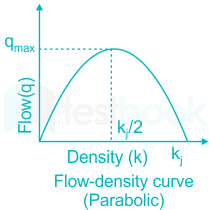
Jam Density: From the speed-density relation and flow-density curve, it can also be seen that it is the maximum density at which there is no flow on the road.


Traffic Flow: The number of vehicles passing through a particular point in certain time interval is defined as traffic flow. Also, number of vehicles counted in one hour is called traffic flow (q).

The relation between k, u and q is given below-

q=k×u;veh/hour{\bf{q}} = {\bf{k}} \times {\bf{u}};{\bf{veh}}/{\bf{hour}}

From the curves above,

As long as the relation between density and speed is linear, it can be seen that maximum flow (or flow capacity) occurs at kj/2 and Vf/2.

∴ Maximum flow occurs at speed Vf/2

Maximum flow is given by

\({{\bf{q}}{{\bf{max}}}} = \left( {\frac{{{{\bf{k}}{\bf{j}}}}}{2}} \right)\left( {\frac{{{{\bf{u}}_{\bf{f}}}}}{2}} \right);{\bf{veh}}/{\bf{hour}}\)

24

Determine the correctness or otherwise of the following Assertion [a] and the Reason [r].

Assertion [a]: One of the best ways to reduce the amount of solid wastes is to reduce the consumption of raw materials.

Reason [r]: Solid wastes are seldom generated when raw materials are converted to goods for consumpton

  1. ((a))

    Both [a] and [r] are false

  2. ((b))

    Both [a] and [r] are true and [r] is the correct reason for [a]

  3. ((c))

    Both [a] and [r] are true but [r] is not the correct reason for [a]

  4. ((d))

    [a] is true but [r] is false

Show Answer
Answer: ((d))

[a] is true but [r] is false

Explanation

a) Reducing solid waste is reducing the amount of garbage that goes into our landfills. These are items we use each day, and then get rid of by putting them into the trash. Solid waste comes from homes, businesses, and industries.

We can reduce the amount of solid waste by reducing the consumption of raw materials: 

Ex:

1) Use a reusable bottle/cup for beverages on-the-go

2) Use reusable grocery bags, and not just for groceries

3) Buy secondhand items and donate used goods

4) Curb your use of paper: mail, receipts, magazines

b) 

  • Both technological processes and consumptive processes result in the formation of solid wastes.
  • Solid waste is generated, in the beginning, with the recovery of raw materials and thereafter at every step in the technological process as the raw material is converted to a product for consumption generation of solid waste during technological processes. Ex: mining, manufacturing, and packaging.

c) The objective of solid waste management is to reduce the quantity of solid waste disposed off on land by the recovery of materials and energy from solid waste. This in turn results in the lesser requirement of raw material and energy as inputs for technological processes.

25

The hardness of a water sample is measured directly by titration with 0.01 M solution of ethylenediamine tetraacetic acid (EDTA) using eriochrome black T (EBT) as an indicator. The EBT reacts and forms complexes with divalent metallic cations present in the water. During titration, the EDTA replaces the EBT in the complex. When the replacement of EBT is complete at the end point of the titration, the colour of the solution changes from

  1. ((a))

    blue to colourless

  2. ((b))

    reddish brown to pinkish yellow

  3. ((c))

    wine red to blue

  4. ((d))

    blue-green to reddish brown

Show Answer
Answer: ((c))

wine red to blue

Explanation

The hardness of water is defined as the concentration of multivalent metallic cations which destroys the surfaced property of soap (Concentration of ions) which reacts with Soap and leads to the formation of a precipitate.

Ca 2+, Mg2+ are major constituents

Al+3, Sr3+, Fe2+ Cu2+ are minor constituents of hardness.

Hardness is classified into two categories:

Carbonate hardness and non-carbonate hardness

Total Hardness (TH) = Carbonate Hardness (CH) + Non-Carbonate Hardness (NCH)

  • Hardness in water can be determined by the determination of amounts of calcium and magnesium ions present in water by filtration
  • Amount of Ca 2+, Mg2+ is determined by titration with versanate solution ( EDTA Method)
  • In the EDTA method water is titrated with ethylene diamine tetraacetic acid using Erichrome Black T (EBT) as an indicator.
  • EBT forms wine red colour and titration changes the colour to blue.
26

The softening point of bitumen has the same unit as that of

  1. ((a))

    distance

  2. ((b))

    viscosity

  3. ((c))

    time

  4. ((d))

    temperature

Show Answer
Answer: ((d))

temperature

Explanation

Softening Point

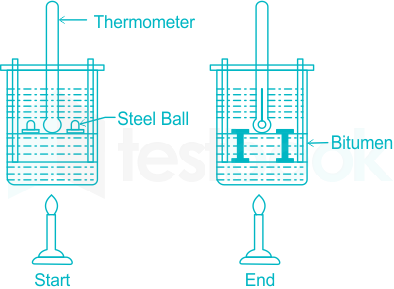
  • The softening point is measured by the ‘Ring and Ball’ test.
  • The softening point is the temperature at which bitumen attains a particular degree of softness under standardized test conditions.
  • The temperature at which a standard steel ball placed on a layer of bitumen kept in a standard ring passes through the bitumen layer and touches the bottom plate kept at a distance of 2.54 cm is the softening point.

  • As a result of oxidation, the hydrogen atom in a bituminous hydrocarbon is combined with atmospheric oxygen, and polymerization takes place along with the formation of water.
  • It has a higher softening point and lower susceptibilities to temperature.

Important Points

Bitumen: Some of the physical properties possess by Bitumen are-

  • It is a viscous liquid; black or brown in color.
  • It consists predominantly of hydrocarbons derived from petroleum crude.
  • It is soluble in carbon disulfide.
  • It is not soluble in water and the specific gravity is less than 1.
  • It is thermoplastic, oxidizes slowly, and is chemically inert.
27

Which of the following statement(s) is/are correct?

  1. ((a))

    Increased levels of carbon monoxide in the indoor environment result in the formation of carboxyhemoglobin and the long term exposure becomes a cause of candiovascular diseases.

  2. ((b))

    Increased levels of volatile organic compounds in the indoor environment will result in the formation of photochemical smog which is a cause of cardiovascular diseases.

  3. ((c))

    Long term exposure to the increased level of photochemical smog becomes a cause of chest constriction and irritation of the mucous membrane.

  4. ((d))

    Volatile organic compounds act as one of the precursors to the formation of photochemical smog in the presence of sunlight.

Show Answer
Answer: ((a))

Increased levels of carbon monoxide in the indoor environment result in the formation of carboxyhemoglobin and the long term exposure becomes a cause of candiovascular diseases.

Explanation:

Photochemical Smog :

(i) This type of smog is also called as Los Angeles type smog (observed in Los Angeles in 1950s)

(ii) It does not require any smoke or fog. The word “smog” is misnoere here.

(iii) Photochemical smog is the chemical reaction of sunlight, nitrogen oxides, and volatile organic compounds in the atmosphere, which leaves airborne particles and ground-level ozone.

(iv) It is formed in the month of summer during the afternoon when there is bright sunlight so that photochemical reactions take place.

(v) Effects of photochemical smog: There are the various effect of photochemical smog

  • Eye irritation: caused by aldehyde, PAN
  • Vegetation damage-caused by O3, NO2, and PAN
  • Visibility reduction
  • Cracking of rubber
  • Fading of eye

Note: Increased levels of carbon monoxide in the indoor environment result in the formation of carboxyhemoglobin and the long-term exposure becomes a cause of cardiovascular diseases and even leads to death.

28

The value (round off to one decimal place) of  \(\mathop \smallint \nolimits_{ - 1}^1 x;{e^{\left| x \right|}}dx\) ______

29

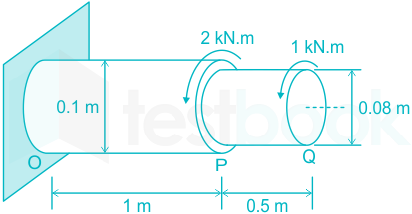
A solid circular torsional member OPQ is subjected to torsional moment as shown in the figure (not to scale). The yield shear strength of the constituent material is 160 MPa.

The absolute maximum shear stress in the member (in MPa, round off to one decimal place) is ______

30

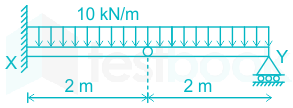
A propped cantilever beam XY, with an internal hinge at the middle,is carrying a uniformly distributed load of 10 kN/m, as shown in the figure.

The vertical reaction at support X (in kN, in integer) is ______

31

The internal (di) and external (d0) diameters of a Shelby sampler are 48 mm and 52 mm, respectively. The area ratio (Ar) of the smapler (in %, round off to two decimal places) is _____

32

A 12-hour unit hydrograph (of 1 cm excess rainfall) of a catchment is of a triangular shape with a base width of 144 hour and a peak discharge of 23 m3 / s. The area of the catchment (in km2, round off to the nearest integer) is ______

33

A lake has maximum depth of 60 m. If the mean atmospheric presssure in the lake region is 91 kPa and the unit weight of the lake water is 9790 N/m3, the absolute pressure (in kPa, round off to two dcimal places) at the maximum depth of the lake is _______

34

In a three-phase signal system design for a four-leg intersection, the critical flow ratios for each phase are 0.18, 0.32, and 0.22. The total loss time in each of the phases is 2 s. As per Webster's formula, the optimal cycle length (in s, round off to the nearest integer) is _______

35

A horizontal angle θ is measured by four different surveyors multiple times and the values reported are given below.

SurveyorAngle θNumber of observations
136° 30’4
236° 00’3
335° 30’8
436° 30’4
<br>

The most probable value of the angle θ (in degree, round off to two decimal places) is ______

36

If k is constant, the general solution of dydxyx=1\frac{dy}{dx} - \frac{y}{x}=1 will be in the form of

  1. ((a))

    y = x ln (kx)

  2. ((b))

    y = k ln (kx)

  3. ((c))

    y = xk ln (k)

  4. ((d))

    y = x ln (x)

Show Answer
Answer: ((a))

y = x ln (kx)

Explanation

Given,

dydxyx=1\dfrac{dy}{dx} - \dfrac{y}{x}=1

Comparing with

dydx+py=q\frac{{dy}}{{dx}} + py = q

We get,

 p = -1/x, q = 1

We know Integrating Factor IF is given by 

IF=epdx=e1xdx=elnx=1/xIF = {e^{\smallint pdx}} = {e^{\smallint \frac{-1}{x}dx}} = {e^{-\ln x}} = 1/x

Now,

General solution can be written as,

y × IF = ∫ q × IF dx + k

y × 1/x = ∫1 × 1/x dx + k

 y/x = ∫ (1/x) dx + k

 y/x = lnx + lnk

 y = x ln(kx)

∴ The general Solution is x ln(kx)

37

The smallest eigenvalue and the corresponding eigenvector of the matrix [2216]\begin{bmatrix} 2 & -2 \\ -1 & 6 \end{bmatrix}, respectively are

  1. ((a))

    1.55 and {2.000.45}1.55 \ \rm and \ \left\lbrace \begin{matrix} 2.00 \\ -0.45 \end{matrix} \right\rbrace

  2. ((b))

    1.55 and {2.000.45}1.55 \ \rm and \ \left\lbrace \begin{matrix} 2.00 \\ 0.45 \end{matrix} \right\rbrace

  3. ((c))

    2.00 and {1.001.00}2.00 \ \rm and \ \left\lbrace \begin{matrix} 1.00 \\ 1.00 \end{matrix} \right\rbrace

  4. ((d))

    1.55 and {2.550.45}1.55 \ \rm and \ \left\lbrace \begin{matrix} -2.55 \\ -0.45 \end{matrix} \right\rbrace

Show Answer
Answer: ((b))

1.55 and {2.000.45}1.55 \ \rm and \ \left\lbrace \begin{matrix} 2.00 \\ 0.45 \end{matrix} \right\rbrace

Explanation:

Eigenvector (X) that corresponding to Eigenvalue (λ) satisfies the equation AX = λX.

Determining eigenvalues first by characteristic Equation 

Given matrix A = [2216]\begin{bmatrix} 2 & -2 \\ -1 & 6 \end{bmatrix}

The characteristic equation for the given matrix is

  |A - λI| = 0

 \(M = \left| {\begin{array}{*{20}{c}} {2 - λ }&-2\ -1&{6 - λ } \end{array}} \right| = 0\)

⇒ (2 - λ) × (6 - λ) - (-2)(-1) = 0 

⇒ 12 - 2 λ - 6 λ + λ2 - 2 = 0 

⇒  λ2 - 8λ + 10 = 0

 λ=8±64402=8±242=4±6λ = \frac{{ - 8 \pm √ {64 - 40} }}{2} = \frac{{ - 8 \pm √ {24} }}{2} = 4 \pm √ 6

⇒ λ = 4 + √6 , 4 - √6 

∴ Eigen values are 4 + √6 & 4 - √6

Smallest Eigen Value = 4 - √6 = 1.55 

Now Determining Eigenvectors corresponding to the eigenvalue λ = 1.55.

For λ = 1.55 The corresponding Eigenvector is 

  \(\left[ {\begin{array}{{20}{c}} {2 - 1.55}&-2\ -1&{6 - 1.55} \end{array}} \right]\left[ {\begin{array}{{20}{c}} {{x_1}}\ {{x_2}} \end{array}} \right] = ;\left[ {\begin{array}{*{20}{c}} 0\ 0 \end{array}} \right]\)

 \(\left[ {\begin{array}{{20}{c}} {0.45}&-2\ -1&{4.45} \end{array}} \right]\left[ {\begin{array}{{20}{c}} {{x_1}}\ {{x_2}} \end{array}} \right] = ;\left[ {\begin{array}{*{20}{c}} 0\ 0 \end{array}} \right]\)

 0.45 x1 - 2 x2 = 0  -- (1)

  -x1 + 4.45 x2 = 0  -- (2)

 Solving (1) and (2) we get.

 x1 = 2 & x2 = 0.45 

 ∴ The eigenvector corresponding to 1.55 is \(\left[ {\begin{array}{*{20}{c}} { 2}\ 0.45 \end{array}} \right]\)

38

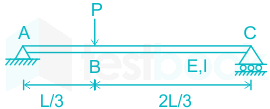
A prismatic steel beam is shown in the figure.

The plastic moment, Mp calculated for the collapse mechanism using static method and kinematic method is

  1. ((a))

    Mp,static <2PL9\frac{2PL}{9} =Mp,kinematic

  2. ((b))

    Mp,static  <2PL9\frac{2PL}{9} ≠ Mp,kinematic

  3. ((c))

    Mp,static = 2PL9\frac{2PL}{9} = Mp,kinematic

  4. ((d))

    Mp,static > 2PL9\frac{2PL}{9} = Mp,kinematic

Show Answer
Answer: ((c))

Mp,static = 2PL9\frac{2PL}{9} = Mp,kinematic

Calculation:

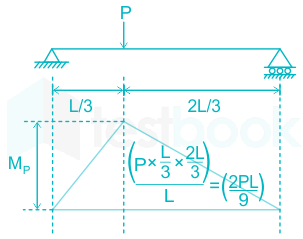
Plastic moment (Mp) using the static method:

ΣFy = 0, RA + RC = P

ΣMC = 0, RA × L = P × 2L/3

RA = 2P/3

So, moment at appoint B, MP = 2P/3 × L/3 = 2PL/9

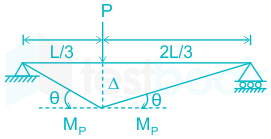
Plstic moment using the kinematic method:

From the comptability condition

L3×θ=2L3×φ\frac{L}{3} \times \theta = \frac{{2L}}{3} \times \varphi

⇒  θ = 2ϕ

Now, External work done = Internal work done 

P×L3×θ=Mp(θ+ϕ)P \times \frac{L}{3} \times \theta = {M_p}\left( {\theta + \phi } \right)

Put the value of θ in the above equation

P×L3×2φ=Mp(2φ+ϕ)P \times \frac{L}{3} \times 2\varphi = {M_p}\left( {2\varphi + \phi } \right)

2PL3×φ=3Mp×φ\frac{{2PL}}{3} \times \varphi = 3{M_p} \times \varphi

Mp=2PL9{M_p} = \frac{{2PL}}{9}

39

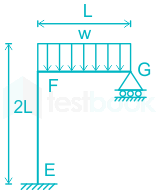
A frame EFG is shown in the figure. All members are prismatic and have equal flexural rigidity. The member FG carries a uniformly distributed load w per unit length. Axial deformation of any member is neglected.

Considering the joint F being rigid, the support reaction at G is

  1. ((a))

    0.482 wL

  2. ((b))

    0.453 wL

  3. ((c))

    0.500 wL

  4. ((d))

    0.375 wL

Show Answer
Answer: ((a))

0.482 wL

Concept:

Application of minimum potential energy:

"Among the all geometrically compatible state of structure which satisfy deflection boundary condition and force equilibrium requirement will have final stable condition when its total potential energy is minimum"

If U is the total strain energy stored in frame. The total strain energy will be minimum, when,

UR=0\frac{{\partial U}}{{\partial R}} = 0

U=M2dx2EIU = \int {\frac{{{M^2}dx}}{{2EI}}}

It is an application of castigliano's theorem and based on principal of least work.

Calculation:
Let R be the propped reaction at G.

∵ We know that, the total strain energy stored in the beam

U=M2dx2EIU = \int {\frac{{{M^2}dx}}{{2EI}}}

Total strain energy stored in beam, U = UGF + UFE

Portion GF:

Mx (x from G) = Rxwx22Rx - \frac{{w{x^2}}}{2}

U=Mx2dx2EIU = \int {\frac{{M_x^2dx}}{{2EI}}}

⇒ UGF=0L(Rxwx22)2dx2EI{U_{GF}} = \int\limits_0^L {\frac{{{{\left( {Rx - \frac{{w{x^2}}}{2}} \right)}^2}dx}}{{2EI}}}

⇒ UGFR=0L2(Rxwx22)(x)dx2EI\frac{{\partial {U_{GF}}}}{{\partial R}} = \int\limits_0^L {\frac{{2\left( {Rx - \frac{{w{x^2}}}{2}} \right)(x)dx}}{{2EI}}}

⇒ UGFR=0L(Rx2wx32)dxEI\frac{{\partial {U_{GF}}}}{{\partial R}} = \int\limits_0^L {\frac{{\left( {R{x^2} - \frac{{w{x^3}}}{2}} \right)dx}}{{EI}}}

UGFR=RL33w2×L44=RL33wL48\frac{{\partial {U_{GF}}}}{{\partial R}} = \frac{{R{L^3}}}{3} - \frac{w}{2} \times \frac{{{L^4}}}{4} = \frac{{R{L^3}}}{3} - \frac{{w{L^4}}}{8}..............(i)

Portion FE:

Mx ( x from F) = RLwL22RL - \frac{{w{L^2}}}{2}

U=Mx2dx2EIU = \int {\frac{{M_x^2dx}}{{2EI}}}

UFE=02L(RLwL22)2dx2EI{U_{FE}} = \int\limits_0^{2L} {\frac{{{{\left( {RL - \frac{{w{L^2}}}{2}} \right)}^2}dx}}{{2EI}}}

UFER=02L2(RLwL22)(L)dx2EI\frac{{\partial {U_{FE}}}}{{\partial R}} = \int\limits_0^{2L} {\frac{{2\left( {RL - \frac{{w{L^2}}}{2}} \right)(L)dx}}{{2EI}}}

UFER=02L(RL2wL32)dxEI\frac{{\partial {U_{FE}}}}{{\partial R}} = \int\limits_0^{2L} {\frac{{\left( {R{L^2} - \frac{{w{L^3}}}{2}} \right)dx}}{{EI}}}

UFER=RL2×2LwL32×2L=2RL3wL4\frac{{\partial {U_{FE}}}}{{\partial R}} = R{L^2} \times 2L - \frac{{w{L^3}}}{2} \times 2L = 2R{L^3} - w{L^4} ....................(ii)

According to the principal of minimum potential energy, the true value of redundant will be when, total potential energy in a frame is minimum

∴  UR=0\frac{{\partial U}}{{\partial R}} = 0 

⇒ UGFR+UFER=0\frac{{\partial {U_{GF}}}}{{\partial R}} + \frac{{\partial {U_{FE}}}}{{\partial R}} = 0

From equation (i) and (ii),

RL33wL48+2RL3wL4=0\frac{{R{L^3}}}{3} - \frac{{w{L^4}}}{8} + 2R{L^3} - w{L^4} = 0

7RL33=98wL4\frac{{7R{L^3}}}{3} = \frac{9}{8}w{L^4}

⇒ R=2756wL=0.482wLR = \frac{{27}}{{56}}wL = 0.482wL
40

A clay layer of thickenss H has a preconsolidation pressure pc and an initial void ratio e0. The initial effective overburden stress at the mid-height of the layer is p0. At the same location, the increment in effective stress due to applied extrenal load is Δp. The comprssion and swelling indices of the clay are Cc and Cs, respectively. If P0 < Pc <(P0 + Δp), then the the correct expression to estimate the consolidation settlement (Sc) of the clay layers is

  1. ((a))

    sc=H1+e0[Cclogpcp0+CslogP0+Δppc]{s_c} = \frac{H}{{1 + {e_0}}}\left[ {{C_c}\log \frac{{{p_c}}}{{{p_0}}} + {C_s}\log \frac{{{P_0} + {{\rm{\Delta }}_p}}}{{{p_c}}}} \right]

  2. ((b))

    \({s_c} = \frac{H}{{1 + {e_0}}}\left[ {{C_c}\log \frac{{{p_0}}}{{{p_c}}} + {C_s}\log \frac{{{P_0} + {{\rm{\Delta }}_p}}}{{{p_c}}}} \right]$\)

  3. ((c))

    \({s_c} = \frac{H}{{1 + {e_0}}}\left[ {{C_s}\log \frac{{{p_0}}}{{{p_c}}} + {C_c}\log \frac{{{P_0} + {{\rm{\Delta }}_p}}}{{{p_c}}}} \right]$\)

  4. ((d))

    sc=H1+e0[Cslogpcp0+CclogP0+Δppc]{s_c} = \frac{H}{{1 + {e_0}}}\left[ {{C_s}\log \frac{{{p_c}}}{{{p_0}}} + {C_c}\log \frac{{{P_0} + {{\rm{\Delta }}_p}}}{{{p_c}}}} \right]

Show Answer
Answer: ((d))

sc=H1+e0[Cslogpcp0+CclogP0+Δppc]{s_c} = \frac{H}{{1 + {e_0}}}\left[ {{C_s}\log \frac{{{p_c}}}{{{p_0}}} + {C_c}\log \frac{{{P_0} + {{\rm{\Delta }}_p}}}{{{p_c}}}} \right]

Explanation:

If pre-consolidation stress pc is greater than effective overburden pressure po but less than po + Δp i.e., pc < po + Δp, the settlement is computed in two parts.

(i) settlement for pressure po to pc

(ii) settlement for pressure pc to (po + Δp)

For the first part, the recompression index (Cc) is applicable, whereas, for the second part, the compression index (Cs) is used.

 Sc=HoCs1+eologpcpo+Sc=HoCc1+eologpo+Δppc{S_c} = \frac{{{H_o}{C_s}}}{{1 + {e_o}}}\log \frac{{{p_c}}}{{{p_o}}} + {S_c} = \frac{{{H_o}{C_c}}}{{1 + {e_o}}}\log \frac{{{p_o} + \Delta p}}{{{p_c}}}

⇒ Sc=Ho1+eo[Cslogpcpo+Cclogpo+Δppc]{S_c} = \frac{{{H_o}}}{{1 + {e_o}}}\left[ {{C_s}\log \frac{{{p_c}}}{{{p_o}}} + {C_c}\log \frac{{{p_o} + \Delta p}}{{{p_c}}}} \right]

41

A rectangular open channel of 6 m width is carrying a discharge of 20 m3/s. Consider the acceleration due to gravity as 9.81 m/s2 and assume water as incompressible and inviscid. The depth of flow in the channel at which the specific energy of the flowing water is minimum for the given discharge will then be:

  1. ((a))

    3.18 m

  2. ((b))

    1.04 m

  3. ((c))

    0.82 m

  4. ((d))

    2.56 m

Show Answer
Answer: ((b))

1.04 m

Hint: In Question, it is asked depth of flow where Specific energy is minimum for the given discharge (Q) which means critical flow condition.

Concept:

Critical flow analysis:

  1. Specific energy is minimum for a given discharge.

  2. Specific force is minimum for a given discharge.

  3. Discharge is maximum for a given specific energy.

  4. Discharge is maximum for a given specific force.

  5. Froude number = Fr = 1

  6. Velocity head is equal to half of the hydraulic depth, V22g=D2\frac{{{{\rm{V}}^2}}}{{2{\rm{g}}}} = \frac{{\rm{D}}}{2}

Relations for critical flow:

General equation valid for the critical flow of any shape of the channel

Q2TgA3=Fr2\frac{{{{\rm{Q}}^2}{\rm{T}}}}{{{\rm{g}}{{\rm{A}}^3}}} = {\rm{F}}_{\rm{r}}^2

For critical flow in a rectangular channel

Yc=critical;depth=(Q2gb2)13{{\rm{Y}}_{\rm{c}}} = {\rm{critical;depth}} = {\left( {\frac{{{{\rm{Q}}^2}}}{{{\rm{g}}{{\rm{b}}^2}}}} \right)^{\frac{1}{3}}}

 We know Q = q × b 

 Yc=(q2g)13{{\rm{Y}}_{\rm{c}}} = {\left( {\frac{{{{\rm{q}}^2}}}{{{\rm{g}}{}}}} \right)^{\frac{1}{3}}}

\({{\rm{E}}{\rm{c}}} = {\rm{Specific;energy}} = \frac{3}{2} × {{\rm{Y}}{\rm{c}}}\)

Calculation:

Given,

 Width of channel (b) = 6 m

 Discharge Q = 20 m3/sec, g = 9.81 m2/sec

 Discharge per unit width q = Q/b = 20/6 = 3.33 m3/sec/m

Critical Depth is: 

 Yc=(q2g)13{{\rm{Y}}_{\rm{c}}} = {\left( {\frac{{{{\rm{q}}^2}}}{{{\rm{g}}{}}}} \right)^{\frac{1}{3}}}

 Yc=(3.3329.81)13{{\rm{Y}}_{\rm{c}}} = {\left( {\frac{{{{\rm{3.33}}^2}}}{{{\rm{9.81}}{}}}} \right)^{\frac{1}{3}}}

 yc = 1.04 m

∴ Depth of flow in the channel at which the specific energy of the flowing water is minimum for the given discharge is 1.04 m

42

Read the statements given below.

(i) Value of the wind profile exponent for the 'very unstable' atmosphere is smaller than the wind profile exponent for the 'neutral' atmosphere.

(ii) Downwind concentration of air pollutants due to an elevated point source will be inversely proportional to the wind speed.

(iii) Value of the wind profile exponent for the 'neutral' atmosphere is smaller than the wind profile exponent for the 'very unstable' atmosphere.

(iv) Downwind concentration of air pollutants due to an elevated point source will be directly proportional to the wind speed.

Select the correct option.

  1. ((a))

    (i) is True and (iv) is True

  2. ((b))

    (iii) is false and (iv) is False

  3. ((c))

    (i) is False and (iii) is True

  4. ((d))

    (ii) is False and (iii) is False

Show Answer
Answer: ((b))

(iii) is false and (iv) is False

Explanation

a) For statement 4 & statement 2

According to Fick's law of diffusion

It is assumed that the plume has a Gaussian distribution in both z ( vertical ) and y (horizontal ) direction

The concentration of a gas or aerosol ( < 20 μ ) calculated at ground level for a distance downward x is given by 

 Cx,y=Qπ×Uσz×σy;e(12(Hσz)2)×e(12(yσy)2){C_{x,y}} = \frac{Q}{{\pi \times U{\sigma _z} \times {\sigma _y};}}{e^{\left( { - \frac{1}{2}{{\left( {\frac{H}{{{\sigma _z}}}} \right)}^2}} \right)}} \times {e^{\left( { - \frac{1}{2}{{\left( {\frac{y}{{{\sigma _y}}}} \right)}^2}} \right)}}

Where,

C is the concentration of pollutant

U is mean wind speed

σy is the standard deviation of horizontal plume concentration, in the crosswind direction

σx is the standard deviation of horizontal plume concentration, in the vertical direction

H is effective stack height (m)

X is the downward distance along the plume mean centerline from a point source (m)

Y – crosswind distance from the centerline of the plume (m)    

 From the relation, we can see that the Downwind concentration of air pollutants due to an elevated point source is not directly proportional to the wind speed.

whereas it is Inversely proportional to Concentration.

Statement 4 is false. Statement 2 is true.

b) 

Category

A – Extremely unstable

B – Moderately unstable

C – Slightly unstable

D – Neutral

E – Slightly stable

F – Moderately Stable

Surface Wind SpeedDayNight
(m/sec)Incoming Solar Radiation
StrongModerateWeakMostly OvercastMostly Clear
< 2AA – BB--
2A – BBCEF
4BB – CCDE
6CC – DDDD
> 6CDDDD


For Neutral (D) Velocity >  For Very unstable (A)

∴ The value of the wind profile exponent for the 'very unstable' atmosphere is smaller than the wind profile exponent for the 'neutral' atmosphere

Statement 4 is false whereas Statement 1 is true.

43

A water filtration unit is made of uniform-size sand particles of 0.4 mm diameter with shape factor of 0.84 and specific gravity of 2.55. The depth of the filter bed is 0.70 m and the porosity is 0.35. The filter bed is to be expanded to a porosity of 0.65 by hydraulic backwash. If the terminal settling velocity of sand particles during during backwash is 4.5 cm/s, the required backwash velocity is

  1. ((a))

    0.69 cm/s

  2. ((b))

    6.35 × 10-3 m/s

  3. ((c))

    5.79 × 10-3 m/s

  4. ((d))

    0.75 cm/s

Show Answer
Answer: ((b))

6.35 × 10-3 m/s

Concept:

The head loss during the backwash (He) is given by

Hb = z × ( 1 – n ) × (S – 1) = ze × ( 1 – ne ) × ( S – 1 )

Where,

ze is the thickness of the expanded sand bed

ne is the porosity of the expanded sand bed

s is the specific gravity of sand

z is the thickness of sand bed and

n is the porosity of the sand bed before expansion

The rate of backwash VB is given by

VB = Vs × ne4.5,

where Vs is the settling velocity of sand

Given by 

Vs=;g(s1)d218v{V_s} = ;\frac{{{\rm{g}}\left( {{\rm{s}} - 1} \right){{\rm{d}}^2}}}{{18{\rm{v}}}}

for laminar condition

where,

d is the size of sand particles and, v is the kinematic viscosity of water

Calculation

Given,

Shape factor = 0.85 , particle diameter (d) = 0.4 mm, Specific Gravity (S) = 2.55

 Depth of filter Bed (z) = 0.75 m , Porosity (η ) = 0.35

 The porosity of expanded bed  ηe = 0.65

 Terminal velocity Vs = 4.5 cm/sec = 4.5 × 10-2 m/sec

 The rate of backwash VB is:

VB = 4.5 × 10-2 × (0.65)4.5

  VB = 6.47 × 10-3 m/sec

44

For a given traverse, latitudes and departures are calculated and it is found that sum of latitudes is equal to +2.1 m and the sum of departures is equal to -2.8 m. The length and bearing of the closing error, respectively, are

  1. ((a))

    2.45 m and 53° 7'48'' NW

  2. ((b))

    0.35 m and 53.13° SE

  3. ((c))

    3.50 m and 53° 7'48'' NW

  4. ((d))

    3.50 m and 53.13° SE

Show Answer
Answer: ((c))

3.50 m and 53° 7'48'' NW

Concept: 

The equation for closing error and bearing of closing error is given by,

e=(ΣL)2+(ΣD)2{\rm{e}} = \sqrt {{{\left( {{\rm{Σ L}}} \right)}^2} + {{\left( {{\rm{Σ D}}} \right)}^2}}

θ=tan1[ΣDΣL]{\rm{\theta }} = {\tan ^{ - 1}}\left[ {\frac{{{\rm{Σ D}}}}{{{\rm{Σ L}}}}} \right]

Where,

e = closing error, θ = bearing of closing error

ΣL = Algebraic sum of latitudes of all lines  

ΣD = Algebraic sum of departures of all lines

Calculation

Given,

Sum of latitude ΣL = + 2.1 m , Sum of Departure ΣD = - 2.8 m

 As the departure is -ve and Latitude is +ve Line lies in IV th Quadrant i.e. in N-W direction

 a) Length of closing error e

   e=(2.1)2+(2.8)2{\rm{e}} = \sqrt {{{\left( {{\rm{2.1}}} \right)}^2} + {{\left( {{\rm{-2.8}}} \right)}^2}}  = 3.5 m

 b) Closing error

  θ=tan1[ΣDΣL]{\rm{\theta }} = {\tan ^{ - 1}}\left[ {\frac{{{\rm{Σ D}}}}{{{\rm{Σ L}}}}} \right] = θ=tan1[2.8 2.1]{\rm{\theta }} = {\tan ^{ - 1}}\left[ {\frac{{{\rm{-2.8}}}}{{{\rm{\ 2.1}}}}} \right] = - 53.13 ° 

 = 53° 7'48'' NW

45

From laboratory investigations, the liquid limit, plastic limit, natural moisture content and flow index of a soil specimen are obtained as 60%, 27%, 32% and 27, respectively. The corresponding toughness index and liquidity index of the soil specimen, respectively, are

  1. ((a))

    0.19 and 6.60

  2. ((b))

    6.60 and 0.19

  3. ((c))

    0.15 and 1.22

  4. ((d))

    1.22 and 0.15

Show Answer
Answer: ((d))

1.22 and 0.15

Explanation

we know, 

a) Toughness Index: Toughness index is defined as the ratio of plasticity index (IP) of the soil to the flow index (IF) of the soil.

The toughness index varies between 0 to 3.

Given,

Liquid Limit (LL) = 60 %, Plastic Limit (PL) = 27%, Water content (w) = 32 %, and Flow indx (If) = 27

 Plasticity Index (PI) = LL - PL = 60 - 27 = 33% 

Toughess;index=Plasticity;indexFlow;index \begin{array}{l} Toughess;index = \frac{{Plasticity;index}}{{Flow;index}}\ \end{array}

Toughness index = 33/27

∴ Toughness index = 1.22

b) Liquidity Index

The Liquidity Index, IL­ is given as:

IL=Wn;PLLL;PL{I_L} = \frac{{{W_n} - ;{PL}}}{{{LL} - ;{PL}}}

Where,

 LL - PL = Plasticity Index

IL=32 ;2760;27{I_L} = \frac{{{32}\ - ;{27}}}{{{60} - ;{27}}} = 5/33 = 0.1515

∴  Liquidity Index is 0.15

46

A function is defined in Cartesian coordinate system as f(x, y) = xey. The value of the directional derivative of the function (in integer) at the point (2, 0) along the direction of the straight line segment from point (2, 0) to point (12,2)\left(\dfrac{1}{2}, 2 \right) is ______

47

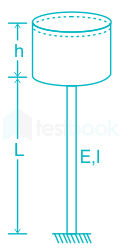
An elevated cylindrical water storage tank is shown in the figure. The tank has inner diameter of 1.5 m. It is supported on a solid steel circular column of diameter 75 mm and total height (L) of 4 m. Take, water density = 1000 kg/m3 and acceleration due to gravity = 10 m/s2.

If elastic modulus (E) of steel is 200 GPa, ignoring self-weight of the tank, for the supporting steel column to remain unbuckled, the maximum depth (h) of the water permissible (in m, round off to one decimal place) is _____

48

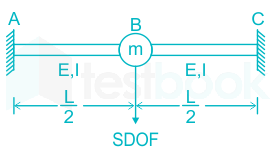
A prismatic fixed-fixed beam, modelled with a total lumped-mass of 10 kg as a single degree of freedom (SDOF) system is shown in the figure.


If the flexural stiffness of the beam is 4π2 kN/m, its natural frequency of vibration (in Hz, in integer) in the flexural mode will be ______

49

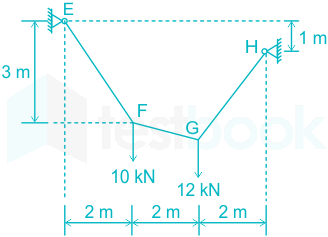
A perfectly flexible and inextensible cable is shown in the figure (not to scale). The external loads at F and G are acting vertically.

The magnitude of tension in the cable segment FG (in kN, round off to two decimal places) is ______

50

A fire hose nozzle directs a steady stream of water of velocity 50 m/s at an angle of 45° above the horizontal. The stream rises initially but then eventually falls to the ground. Assume water as incompressible and inviscid. Consider the density of air and the air friction as negligible, and assume the acceleration due to gravity as 9.81 m/s2. The maximum height (in m, round off to two decimal places) reached by the stream above the hose nozzle will then be ______

51

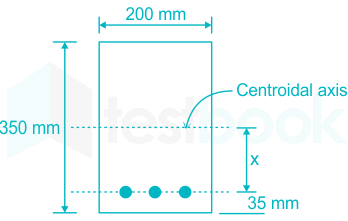
A rectangular cross-section of a reinforced concrete beam is shown in the figure. The diameter of each reinforcing bar is 16 mm. The values of modulus of elasticity of concrete and steel are 2.0 × 104 MPa and 2.1 × 105 MPa, respectively.

The distance of the centroidal axis from the centerline of the reinforcement (x) for the uncracked section (in mm, round off to one decimal place) is ______

52

The activity details for a small project are given in the Table.

ActivityDuration (days)Depends on
A6-
B10A
C14A
D8B
E12C
F8C
G16D, E
H8F, G
K2B
L5G, K
<br>

The total time (in days, in integer) for project completion is ______

53

An equipment has been purchased at an initial cost of Rs. 160000 and has an estimated salvage value of Rs. 10000. The equipment has an estimated life of 5 years. The difference between the book values (in Rs., in integer) obtained at the end of 4th year using straight-line method and the sum of years digit method of depreciation is ______

54

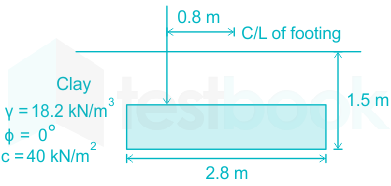
A rectangular footing of size 2.8 m × 3.5 m is embedded in a clay layer and a vertical load is placed with an eccentricity of 0.8 m as shown in the figure (not to scale). Take Bearing capacity factors: Nc = 5.14, Nq = 1.0, and Nγ = 0.0; Shape factors: sc = 1.16, sq = 1.0 and sγ = 1.0; Depth factors: dc = 1.1, dq = 1.0 and dγ = 1.0; and Inclination factors: ic = 1.0 and iq = 1.0 and iγ = 1.0.

Using Meyerhoff's method, the load (in kN, round off to two decimal places) that can be applied on the footing with a factor of safety of 2.5 is _______

55

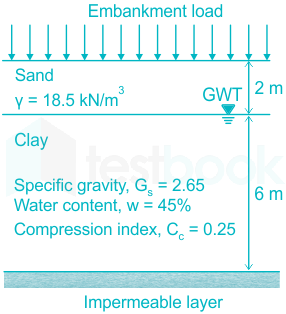
The soil profile at a road construction site is as shown in figure (not to scale). A large embankment is to be constructed at the site. The ground water table (GWT) is located at the surface of the clay layer, and the capillary rise in the sandy soil is negligible. The effective stress at the middle of the clay layer after the application of the embankment loading is 180 kN/m2. Take unit weight of water, γw = 9.81 kN/m3.  

The primary consolidation settlement (in m, round off to two decimal places) of the clay layer resulting from this loading will be ______.

56

Numerically integrate, f(x) = 10x - 20x2 from lower limit a = 0 to upper limit b = 0.5. Use Trapezoidal rule with five equal subdivisions. The value (in units, round off to two decimal places) obtained is ______.

57

The void ratio of a clay soil sample M decreased from 0.575 to 0.510 when the applied pressure is increased from 120 kPa to 180 kPa. For the same increment in pressure, the void ratio of another clay soil sample N decreases from 0.600 to 0.550. If the ratio of hydraulic conductivity of sample M to sample N is 0.125, then the ratio of coefficient of consolidation of sample M to sample N (round off to three decimal places) is _____

58

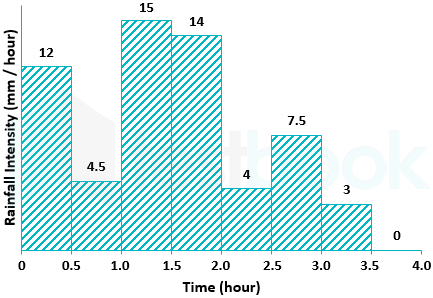
The hyetograph in the figure corresponds to rainfall event of 3 cm.

If the rainfall events has produced a direct runof of 1.6 cm, the φ - index of the event (in mm/hour, round off to one decimal place) would be ________

59

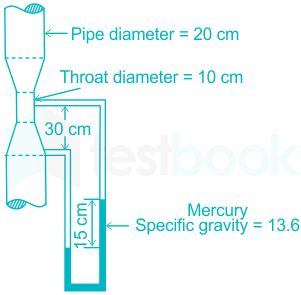
A venturimeter as shown in the figure (not to scale) is connected to measure the flow of water in a vertical pipe of 20 cm diameter.

Assume g = 9.8 m / s2. When the deflection in the mercury manometer is 15 cm, the flow rate (in lps, round off to two decimal places) considering no loss in the venturimeter is _______

60

A reservoir with a live storage of 300 million cubic metre irrigate 40000 hectares (1 hecatre = 104 m2) of a crop with two fillings of the reservoir. If the base period of the crop is 120 days, the duty for this crop (in hectares per cumec, round off to integer) will then be _______

61

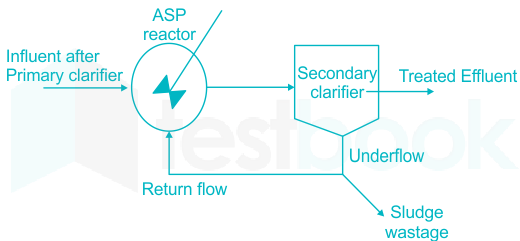
An activated sludge process (ASP) is designed for secondary treatment of 7500 m3/day of municipal wastewater. After primary clarifier, the ultimate BOD of the influent, which enters into ASP reactor is 200 mg/L. Treated effluent after secondary clarifier is required to have an ultimate BOD of 20 mg/L. Mix liquor volatile suspended solids (MLVSS) concentration in the reactor and the underflow is maintained as 3000 mg/L and 12000 mg/L, respectively. The hydraulic retention time and mean cell residence time are 0.2 day and 10 days, respectively. A representative flow diagram of the ASP is shown below.

The underflow volume (in m3/day, round off to one decimal place) of sludge wastage is ______

62

A grit chamber of rectangular cross-section is to be designed to remove particles with diameter of 0.25 mm and specific gravity of 2.70. The terminal settling velocity of the particles is estimated as 2.5 cm/s. The chamber is having a width of 0.50 m and has to carry a peak wastewater flow of 9720 m3/d giving the depth of flow as 0.75 m. If a flow-through velocity of 0.3 m/s has to be maintained using a proportional weir at the outlet end of the chamber, the minimum length of the chamber (in m, in integer) to remove 0.25 mm particles completely is _____

63

In an aggregate mix, the proportions of coarse aggregate, fine aggregate and mineral filter are 55%, 40% and 5%, respectively. The values of bulk specific gravity of the coarse aggregate, fine aggregate and mineral filler are 2.55, 2.65 and 2.70, respectively. The bulk specific gravity of the aggregate mix (round off to two decimal places) is _____

64

The stopping sight distance (SSD) for a level highway is 140 m for the design speed of 90 km/h. The acceleration due to gravity and deceleration rate are 9.81 m/s2 and 3.5 m/s2, respectively. The perception/reaction time (in s, round off to two decimal places) used in the SSD calculation is ______

65

For a 2° curve on a high speed Broad Gauge (BG) rail section, the maximum sanctioned speed is 100 km/h and the equilibrium speed is 80 km/h. Consider dynamic gauge of BG rail as 1750 mm. The degree of curve is defined as the angle subtended at its center by a 30.5 m arc. The cant deficiency for the curve (in mm, round off to integer) is ______

Attempt this paper under real exam conditions

Timed interface, section switching, instant scoring, and question-by-question analytics — free.

Start Timed Attempt