Official Paper

GATE CE 2021 Official Paper: Shift 1 (Previous Year Paper)

65 questions · 180 minutes · with answers · free

General Aptitude (10 questions)

1

Getting to the top is _______ than staying on top.

  1. ((a))

    easier

  2. ((b))

    much easy

  3. ((c))

    more easy

  4. ((d))

    easiest

Show Answer
Answer: ((a))

easier

Explanation:

When the comparison between two things we use the second degree of the adjective.

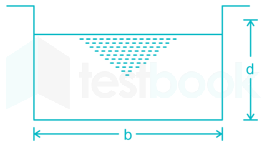
The degree form of easy are;

  • Easy
  • Easier
  • Easiest
2

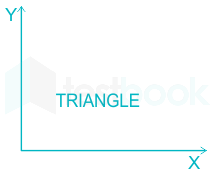
The mirror image of the above text about the x-axis is

  1. ((a))

  2. ((b))

  3. ((c))

  4. ((d))

Show Answer
Answer: ((a))

Explanation:

Mirror image:

The image of an object as seen in a mirror is known as the mirror image. 

In the given figure, the mirror is placed about the x-axis then the upper part of the object is seen downward and the lower part of the object is seen upward. In the given word, Letter I and E will remain unchanged in the mirror image. 

Hence, The mirror image of the figure will appear-


3

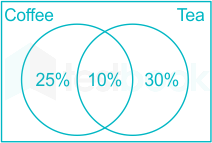
In a company, 35% of the employees drink coffee, 40% of the employees drink tea and 10% of the employees drink both tea and coffee. What % of employees drink neither tea nor coffee?

  1. ((a))

    40

  2. ((b))

    35

  3. ((c))

    25

  4. ((d))

    15

Show Answer
Answer: ((b))

35

Explanation:

Given-

Total employees n(∪) = 100% 

Employees drink coffee = 35% 

Employees drink tea = 40%​

Employees drink Both tea and coffee = 10%

Employees, who drink either tea or coffee n(T ∪ C) = 25% + 10% + 30% = 65%

Employees, who drink either tea or coffee

n(T ∩ C) = n(∪) - n(T ∪ C)

n(T ∩ C) = (100 - 65)%
n(T ∩ C) = 35%.

4

⊕ and ⊙ are two operators on numbers p and q such that pq=p2+q2pqp ⊕ q = \frac{p^2 + q^2}{pq} and pq=p2qp ⊙ q = \frac{p^2}{q}. If x ⊕ y = 2 ⊙ 2, then x =

  1. ((a))

    y

  2. ((b))

    2 y 

  3. ((c))

    3y2\frac{3y}{2}

  4. ((d))

    y2\frac{y}{2}

Show Answer
Answer: ((a))

y

Explanation:

 x ⊕ y = 2 ⊙ 2

x2+y2xy=222\frac{{{x^2} + {y^2}}}{{xy}} = \frac{{{2^2}}}{2}

x+ y2 = 2xy

(x - y)2 = 0

x = y

5

Four persons P, Q, R, and S are to be seated in a row. all facing the same direction, but not necessarily in the same order. P and R cannot sit adjacent to each other. S should be seated to the right of Q. The number of distinct seating arrangements possible is:

  1. ((a))

    6

  2. ((b))

    2

  3. ((c))

    8

  4. ((d))

    4

Show Answer
Answer: ((a))

6

Explanation:

Given,

1). P and R cannot sit adjacent to each other

2). S should be seated to the right of Q

These are total distinct seating arrangements possible followed these two conditions:

PQRS, PQSR, QRSP, RQPS, RQSP, QPSR

6

Statement Either P marries Q or X marries Y

Among the options below, the logical NEGATION of the above statement is:

  1. ((a))

    P does not marry Q and X marries Y.

  2. ((b))

    X does not marry Y and P marries Q

  3. ((c))

    P marries Q and X marries Y

  4. ((d))

    Neither P marries Q nor X marries Y

Show Answer
Answer: ((d))

Neither P marries Q nor X marries Y

Explanation:

Statement Either P marries Q or X marries Y

The given statement explains any of the actions or both the actions follow.

Option 1 follows the statement because one action follows (X marries Y).

Option 2 follows the statement because one action follows (P marries Q).

Option 3 follows the statement because both actions follow (P marries Q and X marries Y).

Option 4 does not follow the statement because any of the actions follow (Neither P marries Q nor X marries Y).

7

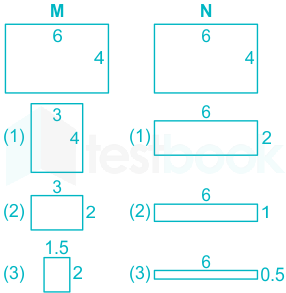
Consider two rectangular sheets, Sheet M and Sheet N of dimensions 6 cm × 4 cm each.

Folding operation 1: The sheet is folded into half by joining the short edges of the current shape.

Folding operation 2: The sheet is folded into half by joining the long edges of the current shape.

Folding operation 1 is carried out on Sheet M three times.

Folding operation 2 is carried out on Sheet N three times.

The ratio of perimeters of the final folded shape of Sheet N to the final folded shape of Sheet M is _______.

  1. ((a))

    5 : 13

  2. ((b))

    7 : 5

  3. ((c))

    13 : 7

  4. ((d))

    3 : 2

Show Answer
Answer: ((c))

13 : 7

Explanation:

Given,

Sheet M and Sheet N of dimensions 6 cm × 4 cm each.

Three times operation 1 performed on sheet M and Three times operation 2 performed on sheet N.

After performing operations,

Perimeter of M:

PM = 2 (2 + 1.5) = 7 cm

Perimeter of N:

PN = 2 (6 + 0.5) = 13 cm

The ratio of perimeters of the final folded shape of Sheet N to the final folded shape of Sheet M:

Ratio = PNPM\frac{{{P_N} }}{{{P_M}}} = 137\frac{{{13} }}{{{7}}}

8

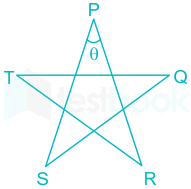
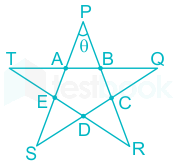
Five line segments of equal lengths PR, PS, QS, QT, and RT are used to form a star as shown in the figure above.

The value of θ, in degrees, is ______.

  1. ((a))

    360

  2. ((b))

    720

  3. ((c))

    1080

  4. ((d))

    450

Show Answer
Answer: ((a))

360

Explanation:

Given

PR = PS = QS = QT = RT

Then ABCDEF will be regular pentagon.

Sum of the angle formed at the pentagon = 5400
Each angle of the pentagon = Sum of the angles of pentagon5\frac{{{Sum \ of \ the \ angles\ of \ pentagon}}}{{{5}}}

5405\frac{{{540}}}{{{5}}} = 1080
Then, ∠EAB = ∠ABC = ∠BCD = ∠CDE = ∠DEA = 1080

∠PAB = 1800 - 1080 = 720

∠PBA = 1800 - 1080 = 720

From ΔPAB,

θ + ∠PAB + ∠PBA = 1800

θ + 720 + 720 = 1800

θ = 1800 - 1440 = 360.

9

A function, λ, is defined by \(\lambda \left( {p,q} \right) = { \begin{array}{*{20}{c}} {{{\left( {p - q} \right)}^2}}&{if;p \ge q.}\ {p + q}&{if;p < q.} \end{array};\)

The value of the expression λ((3+2),(2+3))((2+1))\frac{{\lambda \left( { - \left( { - 3 + 2} \right),\left( { - 2 + 3} \right)} \right)}}{{\left( { - \left( { - 2 + 1} \right)} \right)}} is:

  1. ((a))

    16

  2. ((b))

    163\frac{16}{3}

  3. ((c))

    -1

  4. ((d))

    0

Show Answer
Answer: ((d))

0

Explanation:

Given,

 \(λ \left( {p,q} \right) = { \begin{array}{*{20}{c}} {{{\left( {p - q} \right)}^2}}&{if;p \ge q.}\ {p + q}&{if;p < q.} \end{array};\)

Calculation:

 λ((3+2),(2+3))((2+1))\frac{{λ \left( { - \left( { - 3 + 2} \right),\left( { - 2 + 3} \right)} \right)}}{{\left( { - \left( { - 2 + 1} \right)} \right)}} = λ(1,1)1=λ(1,1)λ \frac{{\left( {1,1} \right)}}{1} = λ \left( {1,1} \right)

So, 1st definition will be applicable as p= q;

Hence,

λ (1,1) = (1 - 1)2 = 0

10

Humans have the ability to construct worlds entirely in their minds, which don't exist in the physical world. So far as we know, no other species possesses this ability. This skill is so important that we have different words to refer to its different flavours, such as imagination, invention and innovation. Based on the above passage, which one of the following is TRUE?

  1. ((a))

    Imagination, invention and innovation are unrelated to the ability to construct mental worlds

  2. ((b))

    The terms imagination, invention and innovation refer to unrelated skills.

  3. ((c))

    No species possess the ability to construct worlds in their minds.

  4. ((d))

    We do not know of any species other than humans who possess the ability to construct mental worlds.

Show Answer
Answer: ((d))

We do not know of any species other than humans who possess the ability to construct mental worlds.

Explanation:

In Option 1 and option 2, the word unrelated is use that is wrong because Imagination, invention and innovation, and the ability to construct mental worlds are related so both options are incorrect.

In option 3 sentence uses no species in which humans are also included so this option is also incorrect.

So, the correct option is 4.

Civil Engineering (55 questions)

11

The rank of matrix \(\left[ {\begin{array}{*{20}{c}} 1&2&2&3\ 3&4&2&5\ 5&6&2&7\ 7&8&2&9 \end{array}} \right]\) is ___.

  1. ((a))

    3

  2. ((b))

    1

  3. ((c))

    4

  4. ((d))

    2

Show Answer
Answer: ((d))

2

Explanation:

\(\left[ {\begin{array}{*{20}{c}} 1&2&2&3\ 3&4&2&5\ 5&6&2&7\ 7&8&2&9 \end{array}} \right]\)

Using,

R2 → R- 3R1,

R3 → R3 - 5R1,

R4 → R4 - 7R1,

A = \(\left[ {\begin{array}{*{20}{c}} 1&2&2&3\ 0&-2&-4&-4\ 0&-4&-8&-8\ 0&-6&-12&-12 \end{array}} \right]\)

Using,

R3 → R3 - 2R2,

R4 → R4 - 3R2,

A = \(\left[ {\begin{array}{*{20}{c}} 1&2&2&3\ 0&-2&-4&-4\ 0&0&0&0\ 0&0&0&0 \end{array}} \right]\)

So, ρ (A) = Number of non zero rows = 2

12

If \(P = \left[ {\begin{array}{{20}{c}} 1&2\ 3&4 \end{array}} \right]\) and \( Q = \left[ {\begin{array}{{20}{c}} 0&1\ 1&0 \end{array}} \right]\) then QT PT is ?

  1. ((a))

    \(\left[ {\begin{array}{*{20}{c}} 1&2\ 3&4 \end{array}} \right]\)

  2. ((b))

    \(\left[ {\begin{array}{*{20}{c}} 2&4\ 1&3 \end{array}} \right]\)

  3. ((c))

    \(\left[ {\begin{array}{*{20}{c}} 2&1\ 4&3 \end{array}} \right]\)

  4. ((d))

    \(\left[ {\begin{array}{*{20}{c}} 1&3\ 2&4 \end{array}} \right]\)

Show Answer
Answer: ((b))

\(\left[ {\begin{array}{*{20}{c}} 2&4\ 1&3 \end{array}} \right]\)

Concept:

Transpose of a Matrix:

If A = [aij]m × n, then the matrix obtained by interchanging the rows and columns of A is called the transpose of A, denoted by A′ or (AT). AT = [aji]n × m

Calculation:

\(PQ = \left[ {\begin{array}{{20}{c}} 1&3 \ 2&4 \end{array}} \right]\left[ {\begin{array}{{20}{c}} 0&1 \ 1&0 \end{array}} \right] = \left[ {\begin{array}{*{20}{c}} 2&4 \ 1&3 \end{array}} \right]\)

\({\left( {PQ} \right)^T} = \left[ {\begin{array}{*{20}{c}} 2&4 \ 1&3 \end{array}} \right]\)

(PQ)T = QTPT

QTPT = \(\left[ {\begin{array}{*{20}{c}} 2&4 \ 1&3 \end{array}} \right]\)

13

The shape of the cumulative distribution function of Gaussian distribution is

  1. ((a))

    Horizontal line

  2. ((b))

    Straight line at 45 degree angle

  3. ((c))

    Bell - shaped

  4. ((d))

    S-shaped

Show Answer
Answer: ((d))

S-shaped

Concept:

Gaussian distribution:   

  • All Gaussian distribution can be standardized to the reference Gaussian distribution, which is called the standard Gaussian distribution. Standardization in general is accomplished by subtracting the center of the distribution from a given element in the distribution and dividing the result by the standard deviation of the distribution.
  • The distribution of a standardized Gaussian distribution—that is, a Gaussian distribution that has its elements standardized in this form—has its center at zero and has a variance of unity.
  • The shape of the cumulative distribution function of Gaussian distribution is S-shaped.
  • If a distribution is normal, then the values of the mean, median, and mode are the same. However, the value of the mean, median, and mode may be different if the distribution is skewed (not Gaussian distribution).
  • The standard deviation of the mean used to check the given data distribution is close to Gaussian distribution.

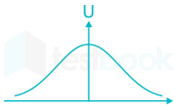
The probability density function of a zero-mean Gaussian variable is as shown:

The probability distribution function of a Gaussian Random Variable is defined as;

f(x)=12πσ2;e(xμ)22σ2f\left( x \right) = \frac{1}{{\sqrt {2\pi {\sigma ^2}} }};{e^{\frac{{{{\left( {x - \mu } \right)}^2}}}{{2{\sigma ^2}}}}}

Given distribution has zero mean i.e. μ = 0, so the above distribution can be written as:

f(x)=12πσ2;ex22σ2f\left( x \right) = \frac{1}{{\sqrt {2\pi {\sigma ^2}} }};{e^{\frac{{{x^2}}}{{2{\sigma ^2}}}}}

14

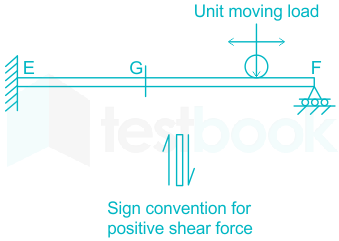
A propped cantilever beam EF is subjected to a unit moving load as shown in the figure (not to scale). The sign convention for positive shear force at the left and right sides of any section is also shown.

The CORRECT qualitative nature of the influence line diagram for shear force at G is

  1. ((a))

  2. ((b))

  3. ((c))

  4. ((d))

Show Answer
Answer: ((b))

Concept:

Muller Breslau Principle:

If an internal stress component (shear force, bending moment etc) or reaction component is allowed to act through a small distance thereby causing deformation of the structure, the curve of the deformed shape represents to some scale, the influence lines for that stress or the reaction component. It is applicable to all structures, determinate or indeterminate.

Note:

  • In the case of determinate systems, the ILD can be obtained directly by allowing unit deformation corresponding to the constraint.
  • For indeterminate structure, it is applicable only when the material is within the elastic limit and obeys Hook's law so that the law of superposition holds good.

Explanation:

15

Gypsum is typically added in cement to

  1. ((a))

    increase workability

  2. ((b))

    enhance hardening

  3. ((c))

    increase heat of hydration

  4. ((d))

    prevent quick setting

Show Answer
Answer: ((d))

prevent quick setting

Explanation:

Gypsum: Gypsum is composed of calcium sulphate (CaSO4) and water (H2O). Its chemical name is calcium sulphate dihydrate (CaSO4.2H2O). Gypsum is mined from sedimentary rock formations around the world. It acts as a retarder in concrete, increases its setting time thus prevent quick setting. 

Additional Information

a) Accelerators are used to increase the rate of gain of strength in the concrete.

It is an admixture that causes an increase in the rate of hydration of the cement and thus shortens the time of setting, increases the rate of strength development, or both.

Calcium chloride is a common accelerator, used to accelerate the time of set and the rate of strength gain.

Example: Calcium Chloride, Silicates, Na2SO4, NaCl, Fluorosilicates, Triethanolamine, etc.

b) Retarder increases the initial setting time of cement while accelerators reduce the setting time of cement.

Some commonly used retards are: CaSO4, Organic retardants include unrefined calcium, sodium, NH4, salts of ligno-sulfonic acids, hydrocarboxylic acids, and carbohydrates.

16

The direct and indirect costs estimated by a contractor for bidding a project is Rs. 160000 and Rs. 20000 respectively. If the markup applied is 10% of the bid price, the quoted price (in Rs.) of the contractor is

  1. ((a))

    196000

  2. ((b))

    182000

  3. ((c))

    200000

  4. ((d))

    198000

Show Answer
Answer: ((c))

200000

Explanation:

Total cost = Direct cost + Indirect cost

Total cost = 160000 + 20000 = 180000

According to question, Mark up applied is 10% of bid price.

Quoted bid price = Total Cost + (10/100 ) ×  Quoted bid price

⇒ 0.9 ×  Quoted bid price = 1,80,000

So,

Quoted price = 1,80,000/0.9 = 2,00,000

Additional Information

Indirect project Cost: Indirect project cost are those expenditures which cannot be clearly allocated to the individual activities of the project, but are assessed as a whole.

The indirect cost rises with an increase in duration. 

Direct Project Cost: These include labour cost, material cost, equipment cost etc.

Direct cost decreases with an increase in duration.

17

In an Oedometer apparatus, specimen of fully saturated clay has been consolidated under a vertical pressure of 50 kN/m2 and is presently at equilibrium. The effective stress and pore water pressure immediately on increasing the vertical stress to 150 kN/m2, respectively are

  1. ((a))

    50 kN/m2 and 100 kN/m2

  2. ((b))

    150 kN/m2 and 0

  3. ((c))

    100 kN/m2 and 50 kN/m2

  4. ((d))

    0 and 150 kN/m2

Show Answer
Answer: ((a))

50 kN/m2 and 100 kN/m2

Explanation

Total stress = Effective stress + Pore pressure

When loading is done initially Total pressure increases.

The decrease in soil volume by squeezing out of the pore water on account of gradual dissipation of excess hydrostatic pressure induced by an imposed total stress is called consolidation.

Total Consolidation of soil is divided into

i) Primary consolidation

  • Primary consolidation begins when soil is fully saturated.
  • (In a saturated soil mass if increase in effective stress is Δσ1 , then initially it will be taken by pore water, Hence increase in pore pressure (Excess Pore Pressure (u) = Δσ1  )
  • Primary consolidation is complete when expulsion of pore water stops. (u = 0). (i.e. decrease in pore water pressure). At this stage primary consolidation is complete for Δσ1.
  • If further load continues to act then effective stress increases causing secondary consolidation.

ii) Secondary consolidation

  • After completion of primary consolidation when expulsion of pore water is stopped and load continues to act, then at very slow rate further volume change may be recorded which is due to plastic readjustment of solids.

∴Correct sequence is

  • i) Increase in Total stress
  • ii) Increase in pore water pressure
  • iii) Decrease in pore water pressure (u = 0)
  • iv) Increase in effective stress.

Calculation:

It is given sample is consolidated to 50 kN/m2 and then suddenly the load has been increased to 150 kN/m2

∴ Change in Total stress Δσ = 100 kN/m2

We know increase in vertical stress will lead to equal increase in pore water pressure

 Δu = 100 kN/m2 

Initially stage of soil

Since soil is in equilibrium at 50 kN/m2 , i.e. (End of the consolidation )

Initial pore water pressure = 0 & Effective stress = 50 kN/m2

∴ Final Pore water pressure u = 100 kN/m2

b) We know

 Total Stress = 150kN/m2

 Effective stress = Total stress – pore water pressure

 = 150 - 100

 = 50 kN/m2

 ∴ Effective Stress = 50 kN/m2

18

A partially - saturated soil sample has a natural moisture content of 25% and a bulk unit weight of 18.5 kN/m3. The specific gravity of soil solids is 2.65 and the unit weight of water is 9.81 kN/m3. The unit weight of the soil sample on full saturation is

  1. ((a))

    21.12 kN/m3

  2. ((b))

    19.03 kN/m3

  3. ((c))

    18.50 kN/m3

  4. ((d))

    20.12 kN/m3

Show Answer
Answer: ((b))

19.03 kN/m3

Concept:

Bulk Unit weight (γb): 

It is defined as the ratio of the total weight of soil to the total volume of the soil mass.

γb=WV=Ws+WwVs+Vw+Va{γ _b} = \frac{W}{V} = \frac{{{W_s} + {W_w}}}{{{V_s} + {V_w} + {V_a}}}

Water Content (w):​

Water content or moisture content of a soil mass is defined as the ratio of the weight of water to the weight of solids (dry weight) of the soil mass.

\({\rm{w = }}\frac{{{{\rm{W}}{\rm{w}}}}}{{{{\rm{W}}{\rm{s}}}}};{\rm{w}} \ge 0\)

It is denoted by the w and is commonly expressed as a percentage. The minimum value for water content is 0. There is no upper limit for water content.

Dry Unit Weight (γ­d):-​

Dry unit weight is defined as the weight of soil solids per unit volume of soil. It is denoted by the letter symbol γd it has the unit of kN/m3.

\({{\rm{γ }}{\rm{d}}}{\rm{ = }}\frac{{{{\rm{W}}{\rm{s}}}}}{{\rm{V}}}{\rm{ = }}\frac{{{{\rm{W}}_{\rm{d}}}}}{{\rm{V}}}\)

It is used as a measure of the denseness of soil. A high value of dry unit weight indicates that more solids are packed in a unit volume of soil hence a more compact soil.

The specific gravity of solids (G):-​

The specific gravity of solids is defined as the ratio of the unit weight of solids to the unit weight of water. It is denoted by the letter G and is a unitless quantity.

\({\rm{G = }}\frac{{{{\rm{γ }}{\rm{s}}}}}{{{{\rm{γ }}{\rm{w}}}}}\)

Note: The relationship between the degree of saturation, water content, specific gravity, and the void ratio is:

s × e = w × G

Calculation:

Given,

w = 25%, γ = 18.5 kN/m3, G = 2.65, γw = 9.81 kN/m3 ​​

We know, s × e = w × G 

γ=(G+se)γw1+e\gamma = \frac{{\left( {G + se} \right){\gamma _w}}}{{1 + e}} = (G+wG)γw1+e \frac{{\left( {G + wG} \right){\gamma _w}}}{{1 + e}} = G(1+w)γw1+e\frac{{G}{\left( {1 + w} \right){\gamma _w}}}{{1 + e}}

γ=G(1+w)γw1+e\gamma = \frac{{G}{\left( {1 + w} \right){\gamma _w}}}{{1 + e}}

18.5 = 2.65×(1+0.25)×9.811+e\frac{{2.65}\times {\left( {1 + 0.25} \right)\times {9.81}}}{{1 + e}}

e = 0.756

For fully saturated soil sample(s=1)

γs=(G+e)γw1+e\gamma_s = \frac{{\left( {G + e} \right){\gamma _w}}}{{1 + e}}

γs=(2.65+0.756)×9.811+0.756\gamma_s = \frac{{\left( {2.65 + 0.756} \right)\times {9.81}}}{{1 + 0.756}}

γs=19.03\gamma_s = 19.03 kN/m3

Important Points

Air content:

Air content is defined as the ratio of the volume of air to the volume of voids. It is denoted by ac.

\({{\bf{a}}{\bf{c}}} = \frac{{{{\bf{V}}{\bf{a}}}}}{{{{\bf{V}}_{\bf{v}}}}} = \frac{{{\bf{Volume\ of\ air}}}}{{{\bf{Volume\ of\ voids}}}}\)

Porosity:

Porosity is defined as the ratio of the volume of voids to the total volume of soil. It is denoted by n. It varies between 0 and 1.

n=VvV=Volume of voidsTotal volume{\bf{n}} = \frac{{{{\bf{V}}_{\bf{v}}}}}{{\bf{V}}} = \frac{{{\bf{Volume\ of\ voids}}}}{{{\bf{Total\ volume}}}}

Percentage air voids:

Percentage air voids are defined as the ratio of the volume of air to the total volume of soil. It is denoted by n­­a.

\({{\bf{n}}{\bf{a}}} = \frac{{{{\bf{V}}{\bf{a}}}}}{{\bf{V}}} \times 100 = \frac{{{\bf{Volume\ of\ air}}}}{{{\bf{Total\ volume}}}} \times 100\)

Degree of Saturation: 

The degree of Saturation of a soil mass is defined as the ratio of the volume of water in the voids to the volume of voids. It is denoted by S.

S=VwVv×100;;;0S100S = \frac{{{V_w}}}{{{V_v}}} \times 100;;;0 \le S \le 100

  • For a fully saturated soil mass Vv = Vw, hence S = 100%
  • For fully dry soil mass Vw = 0, hence S = 0%
19

If water is flowing at the same depth in most hydraulically efficient triangular and rectangular channel sections then the ratio of hydraulic radius of triangular section to that of rectangular section is

  1. ((a))

    2

  2. ((b))

    2\sqrt{2}

  3. ((c))

    1

  4. ((d))

    12\frac{1}{\sqrt{2}}

Show Answer
Answer: ((d))

12\frac{1}{\sqrt{2}}

Concept:

Most efficient channel: A channel is said to be efficient if it carries the maximum discharge for the given cross-section which is achieved when the wetted perimeter is kept a minimum.

a) For a triangular channel,

 The channel with a side slope of 1:1 is the most efficient channel.

Area of triangle A = 1/2 × y × 2 y

Wetted Perimeter P = 2 √2y 

The hydraulic radius for the given section is the ratio of the cross-sectional area to the wetted perimeter of the section. 

R=AP=y222y=y22{\rm{R}} = {\rm{}}\frac{{\rm{A}}}{{\rm{P}}} = \frac{{{{\rm{y}}^2}}}{{2√ 2 {\rm{y}}}} = \frac{{\rm{y}}}{{2√ 2 }} --- (1)

b) Rectangular Section

Area of the flow, A = By

Wetted Perimeter, P = B + 2y

For efficient Rectangular channel y = B/2 → B = 2y

Area A = (2y) × (y) = 2y2

Perimeter (P) = 4y

Hydraulic Radius, R=AP=ByB+2y=2y24y=y2R = \frac{A}{P} = \frac{{By}}{{B + 2y}} = \frac{{2{y^2}}}{{4y}} = \frac{y}{2} ---- (2)

Explanation

The ratio of Hydraulic radius of triangular section to rectangular section is 

R1R2=y22y2=12\frac{{{R_1}}}{{{R_2}}} = \frac{{\frac{y}{{2\sqrt 2 }}}}{{\frac{y}{2}}} = \frac{1}{{\sqrt 2 }}

20

'Kinematic viscosity' is dimensionally represented as

  1. ((a))

    T2L\frac{T^2}{L}

  2. ((b))

    L2T\frac{L^2}{T}

  3. ((c))

    ML2T\frac{M}{L^2T}

  4. ((d))

    MLT\frac{M}{LT}

Show Answer
Answer: ((b))

L2T\frac{L^2}{T}

Explanation:

Kinematic viscosity:

Kinematic viscosity is defined as the ratio of dynamic viscosity and density of the fluid.

kinematic viscosity=dynamic viscocitydensity of fluidkinematic~ viscosity= \frac {dynamic ~ viscocity}{density ~of ~fluid}

ν=μρν = \frac {μ}{ρ }

  • SI unit = m2 / s
  • CGS unit = Stokes or cm2 / s
  • 1 Stoke = 10-4 m2 / s
  • Dimensional Formula: M0L2T-1  or L2/T

Additional Information

Dynamic Viscosity ( µ )

  • Viscosity can be defined as the measure of a fluid's resistance to deformation at a given flow.
  • Caused by friction within a fluid.
  • Result of intermolecular forces between the particles within a fluid.
  • SI unit N-s/m2 or Pa-s.

Shear stress is given by,

Shear;stress=;μ;dudyShear;stress = ;\mu ;\frac{{du}}{{dy}}

where,

µ = Dynamic Viscosity of fluid

uy\frac{u}{y}= Rate of shear deformation

21

Which one of the following statement is correct?

  1. ((a))

    Pyrolysis is an exothermic process, which takes place in the absence of oxygen.

  2. ((b))

    Pyrolysis is an endothermic process, which takes place in the absence of oxygen.

  3. ((c))

    ​Pyrolysis is an endothermic process, which takes place in the abundance of oxygen.

  4. ((d))

    Combustion is an exothermic process, which takes place in the absence of oxygen.

Show Answer
Answer: ((b))

Pyrolysis is an endothermic process, which takes place in the absence of oxygen.

Explanation:

Pyrolysis:

  • It is the process in which most of the organic matter upon heating in an oxygen-free atmosphere splits through a combination of thermal cracking and condensation reactions into gaseous, liquid, and solid fractions.
  • The process typically occurs at temperatures above 430 °C (800 °F) and under pressure.
  • It simultaneously involves the change of physical phase and chemical composition and is an irreversible process. So it is an endothermic process.
  • This method is suitable for the disposal of solid waste which poses high calorific value but is comparatively costlier than other methods of disposal.

Important Points

Other methods for disposal of solid waste: 

Sanitary landfilling method:

  • This is a method of disposal of municipal solid waste.
  • In this method disposal of refuse is being carried out over the low lying area in the layers of approximately 1.5 m thick.
  • Each layer after being disposed of is properly compacted and left for at least 7 days before the application of another layer over it.
  • This entire process is biological in approach.
  • For optimum decomposition moisture content of the refuse must be greater than 60%.
  • This entire process completed within 2-12 months after which the height of the landfill is reduced by 25-40%.

​Composting:

  • This is also a biological method of disposal of solid waste in which decomposition of the organic matter can be carried out either in the presence or absence of oxygen
  • If composting is carried out aerobically mixing of the solid waste is insured either manually or mechanically.
  • Aerobic composting is completed normally within 2-3 months and it is also known as Indore process.
  • If composting is carried out an-aerobically mixing is avoided.
  • Anaerobic composting is completed in normally 5-6 months and is also known as Bangalore process.
  • For optimum composting C/N ratio must be in the range of 30-50.

Pulverisation and Shredding:

  • In real terms, these are not the methods of disposal of solid waste these are only used to convert the heavier solid into the lighter one either by cutting or tearing action (Shredding) or by crossing or grinding action (Pulverisation).

​Autoclave:

  • It is a low heat thermal process that is used for the disposal of biomedical waste in which steam under controlled temperature and pressure conditions is passed over it so as to carry out its disinfection.
22

Which one of the following is correct?

  1. ((a))

    For an effluent sample of a sewage treatment plant, the ratio BOD5day,20°C upon ultimate BOD is more than 1.

  2. ((b))

    A young lake characterized by nutrient content and low plant productivity is called eutrophic lake.

  3. ((c))

    The partially treated effluent from a food processing industry, containing high concentration of biodegradable organics, is being discharged into a flowing river at a point P. If the rate of degradation of the organics is higher than the rate of aeration, then dissolved oxygen of the river water will be lowest at point P.

  4. ((d))

    The most important type of species involved in the degradation of organic matter in the case of activated sludge process based wastewater treatment is chemohetrotrophs.

Show Answer
Answer: ((d))

The most important type of species involved in the degradation of organic matter in the case of activated sludge process based wastewater treatment is chemohetrotrophs.

Explanation:

  • Chemoheterotrophs are microorganism (like bacteria, fungi, protozoa) which use organic matter both as energy source & carbon source and are the most important organism used in ASP.
  • Young lakes having low nutrient & low plant productivity are called oligotrophic lake.
  • Partially treated effluent will lead to greater depletion of D.O. at some distance d/s of the point of disposal.
  • For effluent sample of STP BOD5 /BODu will always be less than one.
23

The liquid forms of particulate air pollutants are

  1. ((a))

    mist and spray

  2. ((b))

    smoke and spray

  3. ((c))

    dust and mist

  4. ((d))

    fly ash and fumes

Show Answer
Answer: ((a))

mist and spray

Explanation;

Classification of pollutants:

Major classesSubclassesTypical members of subclasses
ParticulatesSolidDust, smoke, fumes, fly ash
LiquidMist, spray
OrganicGases HydrocarbonsHexane, benzene, ethylene, methane, butane, butadiene
Aldehydes and ketonesFormaldehyde, acetone
Other organicsChlorinated hydrocarbons, alcohols
InorganicOxides of carbonCO, CO2
Oxides of sulfurSO2, SO3
Oxides of nitrogenNO2, NO
24

The shape of the most commonly designed highway vertical curve is

  1. ((a))

    circular (single radius)

  2. ((b))

    spiral

  3. ((c))

    circular (multiple radii)

  4. ((d))

    parabolic

Show Answer
Answer: ((d))

parabolic

Concept:

  • The ideal vertical curve is a 2° Parabola
  • The most preferred curve for vertical alignment is parabolic.

Important Points

  1. Square parabola is generally preferred due to the best riding quality, simplicity of calculation, and uniform rate of change of gradient.
  2. In a circular curve, sight distance is available throughout the curve is constant.
  3. Cubic parabola is generally preferred in the valley curve.
25

A highway designed for 80 km/h speed has a horizontal curve section with radius 250 m. If the design lateral friction is assumed to develop fully, the required super elevation is

  1. ((a))

    0.05

  2. ((b))

    0.02

  3. ((c))

    0.07

  4. ((d))

    0.09

Show Answer
Answer: ((a))

0.05

Concept:

Superelevation(e): Superelevation inroads is basically provided on the horizontally curved portion of the roads in which the outer edge of the road pavement is raised with respect to the inner edge, thus providing a transverse slope throughout the length of the horizontal curve of the road.

e+f=V2127Re+f = \frac{V^{2}}{127R}

where,

f = lateral friction = 0.15, V = Designed speed,

 R = Radius of curve

Calculation

Given,

Design Speed (V) = 80 kmph

Radius of curve (R) = 250 m, 

Lateral friction is assumed to develop fully i.e. f = 0.15

As, e+f=V2127Re+f = \frac{V^{2}}{127R}

 e+0.15=802127×250e+0.15 = \frac{80^{2}}{127\times 250}

e = 0.052

26

Which of the following is NOT a correct statement?

  1. ((a))

    The first reading from a level station is a 'Fore Sight'.

  2. ((b))

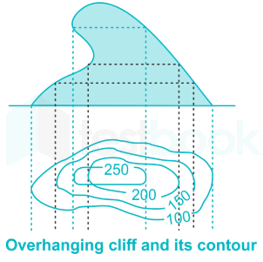
    Contours of different elevations may intersect each other in case of an overhanging cliff

  3. ((c))

    Basic principle of surveying is to work from whole to parts.

  4. ((d))

    Planimeter is used for measuring 'area'.

Show Answer
Answer: ((a))

The first reading from a level station is a 'Fore Sight'.

Explanation:

1. Levelling

  • Operation includes, the line commences with a backsight and closes with a foresight.
  • The first staff reading taken after setting up of instrument is always a Backsight and last staff reading taken before changing the instrument to the other position is always a Foresight.
  • So Statement 1 is False
  1. Contours
  • Vertical cliff: Contour lines of different elevations unite to form one line.
  • Valley: V-shaped contours with convexity towards higher ground
  • Ridge: U - shaped contours with convexity towards lower ground
  • Overhanging cliff: Two contours of different elevation cross each other in this case.
  1. Principle of Surveying
  • Whole to part: In working from whole to part, the error will localise and prevent the accumulation of error while working from part to whole, the error will accumulate. Hence more error in working from part to whole.
  • Location w.r.t at least 2 well-defined control point: The location of a point should be respected to at least 2 well-defined control points.
  1. Planimeter:
  • It is an instrument used in surveying to compute the area of any given plan. Planimeter only needs plan drawn on the sheet to calculate area.
  • Generally, it is very difficult to determine the area of the irregular plot. So, by using planimeter we can easily calculate the area of any shape.
27

Which of the following is/are correct statement(s)?

  1. ((a))

    If the whole circle bearing of a line is 270°, its reduced bearing is 90° NW

  2. ((b))

    Back Bearing of a line is equal to Fore Bearing ± 180° 

  3. ((c))

    In the case of fixed hair stadia tachometry, the staff intercept will be larger, when the staff is held nearer to the observation point.

  4. ((d))

    The boundary of water of a calm water pond will represent contour line.

Show Answer
Answer: ((a))

If the whole circle bearing of a line is 270°, its reduced bearing is 90° NW

Concept:

We know the relationship between FB and BB 

Back bearing (BB) = Fore bearing (FB) ± 180°. 

+ve sign is used if FB is less than 180° and –ve sign is used if FB is more than 180°.

Calculation:

Given,

Fore Bearing of line = 270 °

∴ Back bearing = 270°  – 180° = 90° 

Important Points

  • Whenever there is any station affected by local attraction, then the difference between the fore bearing and back bearing is not equal to 180°
  • If the difference is exactly 180°, the two stations may be considered as not affected by local attraction.
  • If the difference is not 180°, better to go back to the previous station and check the fore bearing.
  • If that reading is the same as earlier, it may be concluded that there is a local attraction at one or both stations.

Additional Information

  • In the case of a fixed hair stadia tachometer, the staff intercept will be smaller, when the staff is held nearer to the observation point.
  • The boundary of water of calm water pond will represent contour line because elevation is some at all point on the calm water surface.
28

Consider the limit:

limx1(11nx1x1)\mathop {\lim }\limits_{x \to 1} (\frac{1}{1n x}-\frac{1}{x-1}) The limit (correct up to one decimal place) is ______.

29

The volume determined from ∫∫∫v 8 xyz dv for V = [2, 3] × [1, 2] × [ 0,1 ] will be (in integer) ________.

30

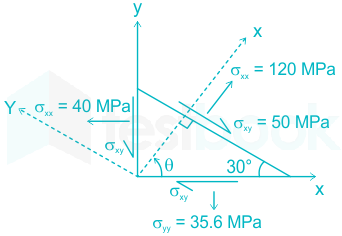
The state of stress in a deformable body is shown in the figure. Consider transformation of the stress from the x - y coordinate system to the X - Y coordinate system. The angle θ , locating the X - axis is assumed to be positive when measured from the X - axis in counter - clockwise direction.

The absolute magnitude of the shear stress component σxy (in MPa, round off to one decimal place) in x - y coordinate system is ______.

31

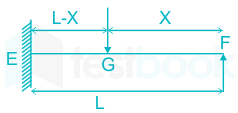
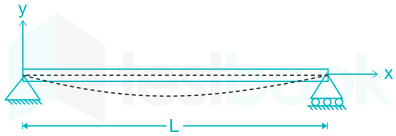
The equation of deformation is derived to be y = x2 - xL for a beam shown in the figure.

The curvature of the beam at the mid-span (in units, in integer) will be ______.

32

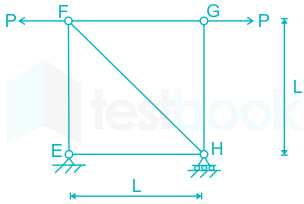
A truss EFGH is shown in the figure, in which all the members have the same axial rigidity R. In the figure, P is the magnitude of external horizontal forces acting at joints F and G.

If R = 500 × 103 kN, P = 150 kN and L = 3 m, the magnitude of the horizontal displacement of joint G (in mm, round off to one decimal place) is _____.

33

The cohesion (x), angle of internal friction (ϕ) and unit weight (γ) of a soil are 15 kPa, 20° and 17.5 kN/m3, respectively. The maximum depth of unsupported excavation in the soil (in m, round off of two decimal places) is ______.

34

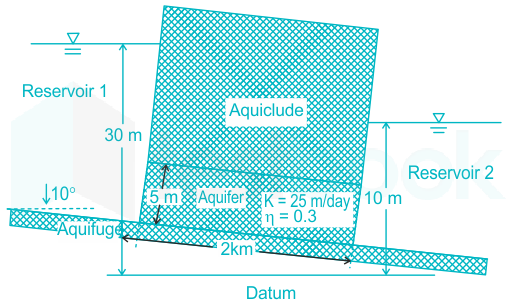
Two reservoirs are connected through a homogeneous and isotropic aquifer having hydraulic conductivity (K) of 25 m/day and effective porosity (η) of 0.3 as shown in the figure (not to scale). Groundwater is flowing in the aquifer at the steady-state.

If the water in Reservoir 1 is contaminated then the time (in days, round off to one decimal place) taken by the contaminated water to reach to Reservoir 2 will be ______.

35

A signalized intersection operates in two phases. The lost time is 3 seconds per phase. The maximum ratios of approach flow to saturation flow for the two phases are 0.37 and 0.40. The optimum cycle length using Webster's method (in seconds, round off to one decimal place) is _____.

36

The solution of the second order differential equation d2ydx2+2dydx+y=0\frac{d^2y}{dx^2}+2 \frac{dy}{dx} + y = 0 with boundary conditions y(0) = 1 and y(1) = 3 is

  1. ((a))

    ex+[3esin(πx2)1]xexe^{-x} +[3esin(\frac{\pi x}{2})-1]xe^{-x}

  2. ((b))

    e-x - (3e - 1) xe-x

  3. ((c))

    e-x + (3e - 1) xe-x

  4. ((d))

    ex[3esin(πx2)1]xexe^{-x} -[3esin(\frac{\pi x}{2})-1]xe^{-x}

Show Answer
Answer: ((c))

e-x + (3e - 1) xe-x

Explanation:

(D2 + 2D + 1)y = 0

y(0) = 1

y(1) = 3

Auxiliary equation is;

m2 + 2m + 1 + 0

m = -1, -1

CF = (C1+C2x)e-x

and PI = 0

Using boundary conditions;

y(0) = 1, C1 = 1

y(1) = 3, C2 = 3e - 1

So the solution of equation is;

y = CF + PI

y = (C1+C2x)e-x + 0

y = {1 + (3e - 1 )x}e-x

y = e-x + (3e - 1) xe-x

37

The value of \(\mathop \smallint \nolimits_0^1 e^x dx\) using the trapezoidal rule with four equal subintervals is

  1. ((a))

    2.718

  2. ((b))

    1.718

  3. ((c))

    2.192

  4. ((d))

    1.727

Show Answer
Answer: ((d))

1.727

Concept:

Trapezoidal rule:

\(I = \mathop \smallint \limits_a^b f\left( x \right);dx\)

Number;of;intervals=bah;{\rm{Number;of;intervals}} = \frac{{{\rm{b}} - {\rm{a}}}}{{\rm{h}}}{\rm{;}}

where b is the upper limit, a is the lower limit, h is the step size or subinterval.

According to the trapezoidal rule

\(\mathop \smallint \limits_{\rm{a}}^{\rm{b}} {\rm{f}}\left( {\rm{x}} \right){\rm{dx}} = \frac{{\rm{h}}}{2}\left[ {{{\rm{y}}{\rm{o}}} + {{\rm{y}}{\rm{n}}} + 2\left( {{{\rm{y}}_1} + {{\rm{y}}_2} + {{\rm{y}}_3}{\rm{;}} \ldots } \right)} \right]\)

Here, the interval [a, b] is divided into n number of intervals of equal width h.

It fits for a 1-degree polynomial.

Calculation:

Given, No. of interval = 4

Here h=104=0.25h = \frac{{1 - 0}}{4} = 0.25 

Calculating all values of f(x), we get:

x00.250.50..751.0
f(x) = ex1e0.25e0.5e0.75e
yy0y1y2y3y4

According to Trapezoidal’s rule

\(\mathop \smallint \limits_{\rm{a}}^{\rm{b}} {\rm{f}}\left( {\rm{x}} \right){\rm{dx}} = \frac{{\rm{h}}}{2}\left[ {{{\rm{y}}{\rm{o}}} + {{\rm{y}}{\rm{n}}} + 2\left( {{{\rm{y}}_1} + {{\rm{y}}_2} + {{\rm{y}}_3}{\rm{;}} \ldots } \right)} \right]\)

\(\mathop \smallint \limits_{\rm{0}}^{\rm{1}}\ e^x\ {\rm{dx}} = \frac{h}{2}\left[ {\left( {{y_0} + {y_4}} \right) + 2\left( {{y_1} + {y_2} + {y_3}} \right)} \right]\)

\(\mathop \smallint \limits_{\rm{0}}^{\rm{1}}\ e^x\ {\rm{dx}} = \frac{0.25}{2}\left[ {\left( {{1} + {e}} \right) + 2\left( {{e^.25} + {e^.50} + {e^.75}} \right)} \right]\)

\(\mathop \smallint \limits_{\rm{0}}^{\rm{1}}\ e^x\ {\rm{dx}} = \frac{0.25}{2}\left[ {\left( {{1} + {e}} \right) + 2\left( {{1.284} + {1.648} + {2.117}} \right)} \right]\)

\(\mathop \smallint \limits_{\rm{0}}^{\rm{1}}\ e^x\ {\rm{dx}} = 1.727\)

38

A 50 mL sample of industrial wastewater is taken into a silica crucible. The empty weight of the crucible is 54.352 g. The crucible with the sample is dried in a hot air oven at 104 °C till a constant weight of 55.129 g. Thereafter, the crucible with the dried sample is fired at 600 °C for 1 h in a muffle furnace, and the weight of the crucible along with residue is determined as 54.783 g. The concentration of total volatile solids is _______.

  1. ((a))

    8620 mg/L

  2. ((b))

    1700 mg/L

  3. ((c))

    6920 mg/L

  4. ((d))

    15540 mg/L

Show Answer
Answer: ((c))

6920 mg/L

Concept:

Estimation of solids:

Total solids mainly can be divided into two suspended solids and dissolved solids-

(1) Suspended solid

Raw water when passed through Whatman filter paper no. 9, the filter paper collects suspended solids which when dried under a hot air oven gives total suspended solids. It is determined by a gravimetric technique.

(2) Dissolved solid

The filtered water when heated at 104° - 105°C for 4 to 5 hours gives dissolved solids, which when subjected to a mettle furnace (600°C - 1000°C for 4 to 5 hours) results in nonvolatile solids, and hence the difference obtained is volatile solid.

Volatile solids = Dissolved solids(heated at 104° - 105°C) - Nonvolatile solids(heated at 600°C - 1000°C)

Calculation:

Given,

Sample size = 50 ml = 50 × 10-3 = 0.050 L

Empty weight of the crucible = 54.352 g

Weight of crucible with the residue sample after drying at 1040C = 55.129 g

Weight of crucible with the residue sample after drying at 6000C = 54.783 g

Volatile solids weight = Dissolved solids(heated at 104° - 105°C) - Nonvolatile solids(heated at 600°C - 1000°C) 

Volatile solids weight = 55.129 - 54.783 = 0.346 g = 346 mg

Concentration of total volatile solids = 3460.050\frac{346}{0.050} = 6920 mg/L.

39

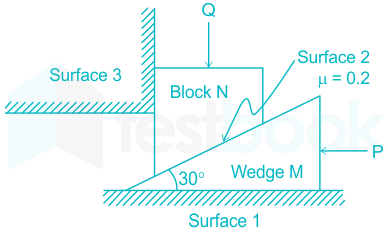
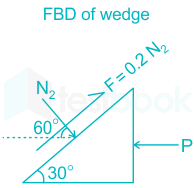
A wedge M and a block N are subjected to forces P and Q as shown in the figure. If force P is sufficiently large, then the block N can be raised. The weights of the wedge and the block are negligible compared to the forces P and Q. The coefficient of friction (μ) along the inclined surface between the wedge and the block is 0.2. All other surfaces are frictionless. The wedge angle is 30°.


The limiting force P, in terms of Q, required for impending motion of block N to just move it in the upward direction is given as P = αQ. The value of the coefficient 'α' (round off to one decimal place) is

  1. ((a))

    0.6

  2. ((b))

    2.0

  3. ((c))

    0.5

  4. ((d))

    0.9

Show Answer
Answer: ((d))

0.9

Explanation:


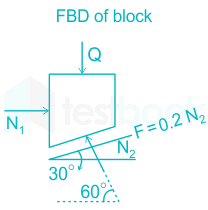
ΣFy = 0 on block

N2 sin60° - 0.2 N2 sin30° - Q = 0

Q = 0.766 N2

Putting in wedge,

ΣFx = 0

0.2 N2 cos30° + N2 cos60° - P = 0

P = 0.67 N2

P=0.67×Q0.766P = 0.67 \times \frac{Q}{{0.766}}

P = 0.875 Q = 0.9 Q

So, 

α = 0.9

40

Contractor X is developing his bidding strategy against Contractor Y. The ratio of Y's bid price to X's cost for the 30 previous bids in which Contractor X has competed against Contractor Y is given in the Table

Ration of Y’s bid Price of X’s costNumber of bids
1.026
1.0412
1.063
1.106
1.123


Based on the bidding behaviour of the Contractor Y, the probability of winning against Contractor Y at a mark up of 8% for the next project is

  1. ((a))

    100%

  2. ((b))

    0%

  3. ((c))

    more than 50% but less than 100%

  4. ((d))

    more than 0% but less than 50%

Show Answer
Answer: ((d))

more than 0% but less than 50%

Explanation:

The ratio of Y's bid price to X's costMark-up of Y's bidNumber of bids
1.022%6
1.044%12
1.066%3
1.1010%6
1.1212%3
Total (Σn) =30

Mean of the bid to total cost ratio;

μ=[1.02×6+1.04×12+1.06×3+1.10×6+1.12×330]=1.058\mu = \left[ {\frac{{1.02 \times 6 + 1.04 \times 12 + 1.06 \times 3 + 1.10 \times 6 + 1.12 \times 3}}{{30}}} \right] = 1.058

Standard deviation,

σ=Σ (xiμ)2N\sigma = \sqrt {\frac{{{\text{Σ }}{{\left( {{x_i} - \mu } \right)}^2}}}{N}}

=6(1.021.058)2+12(1.041.058)2+3(1.061.058)2+6(1.101.058)2+3(1.121.058)230 = \sqrt {\frac{{6{{\left( {1.02 - 1.058} \right)}^2} + 12{{\left( {1.04 - 1.058} \right)}^2} + 3{{\left( {1.06 - 1.058} \right)}^2} + 6{{\left( {1.10 - 1.058} \right)}^2} + 3{{\left( {1.12 - 1.058} \right)}^2}}}{{30}}}

= 0.034

Thus, Z at 8% markup level = (xμσ)\left( {\frac{{x - \mu }}{\sigma }} \right)

(1.081.0580.034)\left( {\frac{{1.08 - 1.058}}{{0.034}}} \right) = 0.0647

From normal deviate table;

ZProbability (%)
0.6072.6
0.7075.8

By interpolation, probability for Z = 0.647

=72.6+(75.872.60.700.60)(0.6470.60) = 72.6 + \left( {\frac{{75.8 - 72.6}}{{0.70 - 0.60}}} \right)\left( {0.647 - 0.60} \right)

= 74.104%

Hence, the probability of winning against the competitor Y at 8% mark-up

= (1 - 0.74104)

= 0.25896

= 25.896%

41

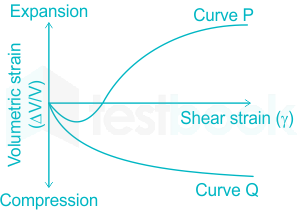
Based on drained triaxial shear tests on sands and clays, the representative variations of volumetric strain (ΔV/V) with the shear strain (γ) is shown in the figure.

Choose the CORRECT option regarding the representative behaviour exhibited by Curve P and Curve Q.

  1. ((a))

    Curve P represents loose sand and normally consolidated clay, while urve Q represents dense sand and overconsolidated clay

  2. ((b))

    Curve P represents dense sand and overconsolidated clay, while Curve Q represents loose sand and normally consolidated clay

  3. ((c))

    Curve P represents dense sand and normally consolidated clay, while Curve Q represents loose sand and overconsolidated clay

  4. ((d))

    Curve P represents loos sand and oveconsolidated clay, while Curve Q represents dense sand and normally consolidated clay

Show Answer
Answer: ((b))

Curve P represents dense sand and overconsolidated clay, while Curve Q represents loose sand and normally consolidated clay

Explanation:

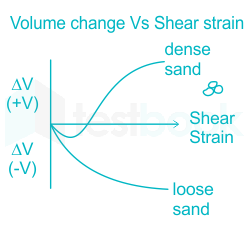
  • In dense sand and overconsolidated clays, the volume of the sample increases on shearing after a small decrease in volume.
  • In loose sand and normal consolidated clays, the volume of the sample continuously decreases on shearing.

42

A fluid flowing steadily in a circular pipe of radius R has a velocity that is everywhere parallel to the axis (centerline) of the pipe. The velocity distribution along the radial direction is Vr=U(1r2R2){{{V_r}}} = U\left( {1 - \frac{{{r^2}}}{{{R^2}}}} \right), where r is the radial distance as measured from the pipe axis and U is the maximum velocity at r = 0. The average velocity of the fluid in the pipe is

  1. ((a))

    (56)U(\frac{5}{6})U

  2. ((b))

    U4\frac{U}{4}

  3. ((c))

    U3\frac{U}{3}

  4. ((d))

    U2\frac{U}{2}

Show Answer
Answer: ((d))

U2\frac{U}{2}

Concept:

Given,

the velocity profile in the pipe as

Vr=U(1r2R2){{{V_r}}} = U\left( {1 - \frac{{{r^2}}}{{{R^2}}}} \right)

Comparing it with the original equation,

Vr=14μ(Px)R2(1r2R2){V_r} = - \frac{1}{{4\mu }}\left( {\frac{{\partial P}}{{\partial x}}} \right){R^2}\left( {1 - \frac{{{r^2}}}{{{R^2}}}} \right)

⇒ U=14μ(Px)R2{U} = - \frac{1}{{4\mu }}\left( {\frac{{\partial P}}{{\partial x}}} \right){R^2}

Given maximum velocity occurs at pipe centerline, that is at r = 0,

⇒ Vr = U(1(0)2R2)=U{U}\left( {1 - \frac{{{{\left( 0 \right)}^2}}}{{{R^2}}}} \right) = {U}

For average velocity(V̅r),

r\(\frac{{\mathop \smallint \nolimits_0^R {V_r}.dA}}{A} = \frac{{\mathop \smallint \nolimits_0^R {U}\left( {1 - \frac{{{r^2}}}{{{R^2}}}} \right);.2\pi r;dr}}{{\pi {R^2}}}\)

⇒  V̅r = \(\frac{{{U} \times\ 2\pi }}{{\pi {R^2}}};\mathop \smallint \limits_0^R \left( {1 - \frac{{{r^2}}}{{{R^2}}}} \right)rdr\)

⇒ V̅r = U× 2ππR2;r22r44R20R\frac{{{U} \times\ 2\pi }}{{\pi {R^2}}};\left| {\frac{{{r^2}}}{2} - \frac{{{r^4}}}{{{4R^2}}}} \right|_0^R

⇒ V̅r  = U× 2ππR2(R22R44R2)\frac{{{U} \times \ 2\pi }}{{\pi {R^2}}}\left( {\frac{{{R^2}}}{2} - \frac{{{R^4}}}{{4{R^2}}}} \right)

⇒ V̅r  = U× 2ππR2(R24)=U2\frac{{{U} \times\ 2\pi }}{{\pi {R^2}}}\left( {\frac{{{R^2}}}{4}} \right) = \frac{{{U}}}{2}

Hence, The average velocity of the fluid in the pipe is U2\frac{U}{2}.

43

A water sample is analyzed for coliform organisms by the multiple - the fermentation method. The results of the confirmed test are as follows:

Sample size (mL)Number of positive results out of 5 tubesNumber of negative results out of 5 tubes
0.0150
0.00132
0.000114

The most probable number (MPN) of coliform organisms for the above results is to be obtained using the following MPN Index.

MPN Index for Various Combinations of Positive Results when Five Tubes used per Dilution of 10.0 mL, 1.0 mL, and 0.1 mL
Combination of positive tubesMPN Index per 100 mL
0 – 2 – 411
1 – 3 – 519
4 – 2 – 022
5 – 3 – 1110

The MPN of coliform organisms per 100 mL is

  1. ((a))

    110000

  2. ((b))

    1100000

  3. ((c))

    110

  4. ((d))

    1100

Show Answer
Answer: ((a))

110000

Concept:

Procedure to find MPN:

  • Select a series where three tubes each have positive results. (not necessary but recommended).
  • Use sample size corresponding to which the MPN value is larger.
  • The MPN index and confidence limit are given corresponding to the sample size of 10 mL, 1 mL, and 0.1 mL.

So if we are selecting sample size as 1 mL, 0.1 mL, and 0.01 mL, then the series of the sample used is one-tenth of the 10, 1, and 0.1 sample size, therefore multiply the MPN index value and confidence limit by 10 and similarly so on.

Calculations:

Since only three sample dilution has been taken.

We will search for a combination of +ve tubes as 5-3-1 in 0.01, 0.001 & 0.0001 ml from the table.

Since the MPN chart given MPN value of 110 per 100 ml for 10 ml, 1 ml & 0.1 ml dilutions than the result so obtained is multiplied by 10 ml0.01 ml\frac {10\ ml}{0.01\ ml} = 1000, to obtain MPN per 100 ml for 0.01, 0.001, 0.0001 ml dilutions.

Hence, MPN per 100 ml = 110 × 1000 = 110000.

Additional Information

Most probable number (MPN):

MPN stands the foremost probable number obtained in multiple tube fermentation tests. In this test, the water sample of different dilution ratios is mixed with lactose broth (nutrient for coliforms) and is incubated for 48 hours. During incubation, coliforms consume lactose broth and reduce it to acids and gasses. The presence of acid or gases in a sample tube indicates a positive test result otherwise negative.

Hence, No of positive tubes = No of tubes in which acid or gasses is detected

44

Ammonia nitrogen is present in a given wastewater sample as the ammonium ion (NH4+) and ammonia (NH3). If pH is the only deciding factor for the proportion of these two constituents, which of the following is a correct statement?

  1. ((a))

    At pH 7.0, NH4+ will be predominant.

  2. ((b))

    At pH below 9.25, NH3 will be predominant.

  3. ((c))

    At pH below 7.0 NH4+ and NH3 will be found in equal measures

  4. ((d))

    At pH 9.25, only NH4+ will be present

Show Answer
Answer: ((a))

At pH 7.0, NH4+ will be predominant.

Concept:

Nitrogen Contents in sewage: The presence of nitrogen in sewage indicates the presence of organic matter, and may occur in one or more of the following forms: Free ammonia (also called Ammonia nitrogen), Albuminoid nitrogen (also called Organic nitrogen), Nitrites and Nitrates.

 Free ammonia (or Ammonia nitrogen):

  • Ammoniacal nitrogen (NH3-N), is a measure for the amount of ammonia present in sewage.
  • Ammonia has chemical formula of NH3 in the unionized state and NH4+ in the ionized state. The ammonia nitrogen is the sum of nitrogen present in both NH3 and NH4+.
  • The free ammonia indicates the very first stage of decomposition of organic matter and the amount will progressively decrease as sewage gets treated.

Ammonia exist in the form of NH4+ & NH3

  1. · At pH < 8, all ammonia is in the form of NH4+
  2. · At pH = 9.5, there are 50% NH3 & 50% NH4+
  3. · At pH > 11, all ammonia is in the form of NH3

∴ Option 1 is correct.

Extra Points 

 Albuminoid nitrogen (or Organic nitrogen): 

  • Organic nitrogen is that nitrogen which describes nitrogen compounds that had its origin in living material.
  • The nitrogen in protein and urea is organic nitrogen. Organic nitrogen can enter sewage as bodily wastes, discarded food material, or as components of cleaning agents.
  • This albuminoid nitrogen indicates quantity of nitrogen present in sewage before the decomposition of organic matter is started.
  • If this organic nitrogen reacts anaerobically then it decomposes to ammonia and if this reacts aerobically it converts to nitrites or nitrates.
45

On a road, the speed-density relationship of a traffic stream is given by u = 70 - 0.7 k (where speed u, is in km/h and density k, is in veh/km). At the capacity condition, the average time headway will be:

  1. ((a))

    1.0 s

  2. ((b))

    2.1 s

  3. ((c))

    1.6 s

  4. ((d))

    0.5 s

Show Answer
Answer: ((b))

2.1 s

Concept:

Time headway:

It is defined as the time interval between the passage of successive vehicles moving in the same lane and measured from head to head as they pass a point on the road.

Time;headway=1traffic;volume=1qhours/vehicleTime;headway = \frac{1}{{traffic;volume}} = \frac{1}{q}hours/vehicle

Where,

q = traffic volume in vehicles/hour

Time Headway is also given by Ht3600qmax \frac{{3600 }}{q_{max}}

where qmax is the Theoretical maximum capacity 

Calculation:

Given

Traffic stream u = 70 - 0.7 k 

 we Know 

Traffic volume = Traffic Density × u

 q = ku

 q = k × ( 70 - 0.7 k )

 q = 70k - 0.7 k2 

For maximum q 

dq/dk = 0

 dqdk=701.4 k=0\frac{{dq}}{{dk}} = 70 - 1.4 \ k = 0

 k = 70/1.4 = 50

 Maximum q = 70k - 0.7 k2 = 70 × 50 - 0.7 × 502

 q = 1750 veh/hr

So Theoretical maximum capacity is 1750 veh/hr

Now Time Head way is 

Time Headway given by Ht = 36001750 \frac{{3600 }}{1750} = 2.057 sec

∴ Time Headway = 2.057 sec ≈ 2.1 sec

46

The values of abscissa (x) and ordinate (y) of a curve are as follows:

XY
2.05.00
2.57.25
3.010.00
3.513.25
4.017.00


By Simpon's 1/3rd rule, the area under the curve (round off to two decimal places) is ______.

47

Vehicular arrival at an isolated intersection follows the Poisson distribution. The mean vehicular arrival rate is 2 vehicle per minute. The probability (round off to two decimal places) that at least 2 vehicles will arrive in any given 1 - minute interval is ____.

48

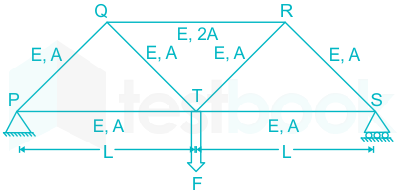
Refer the truss as shown in the figure (not to scale).

If load F =10 3\sqrt{3} KN, moment of inertia, I = 8.33 × 106 mm4, area of cross section, A = 104 mm2, and length, L = 2 m for all the members of the truss, the compressive stress (in KN/m2, in integer) carried by the member Q - R is _____

49

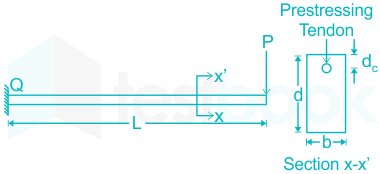
A prismatic cantilever prestressed concrete beam of span length, L = 1.5 m has one straight tendon placed in the cross-section as shown in the following figure (not to scale). The total prestressing force of 50 kN in the tendon is applied at dc = 50 mm from the top in the cross-section of width, b = 200 mm and depth d = 300 mm.

If the concentrated load, W = 5 kN, the resultant stress (in MPa in integer) experienced at point 'Q' will be ______.

50

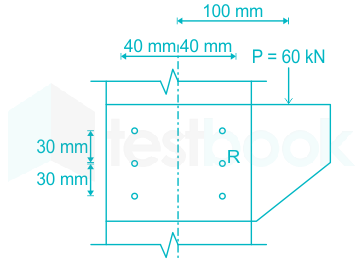
A column is subjected to a total load (P) of 60 kN supported through a bracket connection, as shown in the figure (not to scale)

The resultant force in bolt R (in kN, round off to one decimal place) is ______.

51

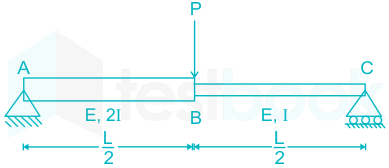
Employ stiffness matrix approach for the simply supported beam as shown in the figure to calculate unknown displacements/rotations. Take length, L = 8 m; modulus of elasticity, E = 3 × 104 N/mm2, moment of inertia, I = 225 × 106 mm4

The mid - span deflection of the beam (in mm, round off to integer) under P = 100 kN in downward will be ____.

52

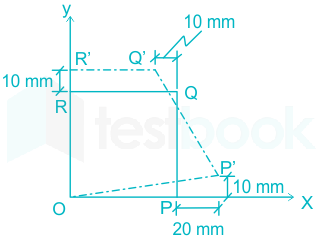
A square plate O - P - Q - R of a linear elastic material with sides 1.0 m is loaded in a state of plane stress. under a given stress condition, the plate deforms to a new configuration O - P' - Q' - R' as shown in the figure (not to scale). Under the given deformation, the edges of the plate remain straight.

The horizontal displacement of the point (0.5 m, 0.5 m) in the plate O - P - Q - R (in mm, round off to one decimal place) is _______.

53

A small project has 12 activities - N, P, Q, R, S, T, U, V, W, X, Y and Z. The relationship among these activities and the duration of these activities are given in the Table.

ActivityDuration (in weeks)Depends upon
N2-
P5N
Q3N
R4P
S5Q
T8R
U7R, S
V2U
W3U
X5T, V
Y1W
Z3X, Y


The total float of the activity "V" (in weeks, in integer) is ______.

54

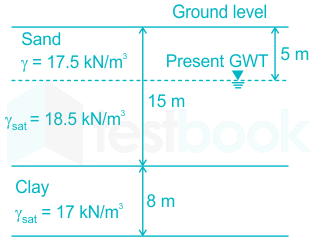
The soil profile at a construction site is shown in the figure (not to scale). Ground water table (GWT) is at 5 m below the ground level at present. An old well data shows that the ground water table was as low as 10 m below the ground level in the past. Take unit weight of water, γw = 9.81 kN/m3 .

The overconsolidation ratio (OCR) (round off to two decimal places) at the mid - point of the clay layer is ________.

55

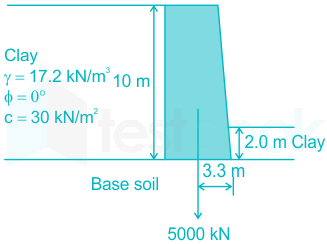
A retaining wall of height 10 m with clay backfill is shown in the figure (not to scale). Weight of the retaining wall is 5000 kN per m acting at 3.3 m from the toe of the retaining wall. The interface friction angle between base of the retaining wall and the base soil is 20°. The depth of clay in front of the retaining wall is 2.0 m. The properties of the clay backfill and the clay placed in front of the retaining wall are the same. Assume that the tension crack is filled with water. Use Rankine's earth pressure theory. Take unit weight of water, γw = 9.81 kN/m3.

The factor of safety (round off to two decimal places) against sliding failure of the retaining wall after ignoring the passive earth pressure will be _______.

56

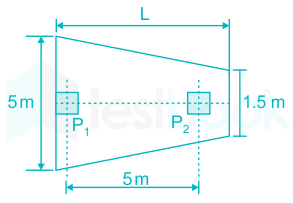
A combined trapezoidal footing of length L supports two identical square columns (P1 and P2) of size 0.5 m × 0.5 m, as shown in the figure. The columns P1 and P2 carry loads of 2000 kN and 1500 kN, respectively.

If the stress beneath the footing is uniform, the length of the combined footing L (in m, round off to two decimal places) is ________.

57

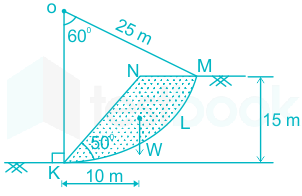
An unsupported slope of height 15 m is shown in the figure (not to scale), in which the slope face makes an angle of 50° with the horizontal. The slope material comprises purely cohesive soil having undrained cohesion 75 kPa. A trail slip circle KLM, with a radius of 25 m, passes through the crest and toe of the slope and it subtends an angle of 60° at its center O. The weight of the active soil mass (W, bounded by KLMN) is 2500 kN/m, which is acting at a horizontal distance of 10 m from the toe of the slope. Consider the water table to be present at a very large depth from the ground surface

Consider the trail slip circle KLM, the factor of safety against the failure of slope under undrained condition (round off to two decimal places) is ________.

58

An unlined canal under regime conditions along with a slit factor of 1 has a width of flow 71.25 m. Assuming the unlined anal as a wide channel, the corresponding average depth of flow (in m, round off to two decimal places) in the canal will be

59

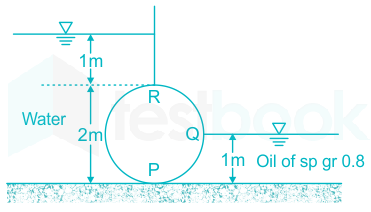
A cylinder (2.0 m diameter, 3.0 m long, and 25 kN weight) is acted upon by water on one side and oil (specific gravity = 0.8) on another side as shown in the figure.

The absolute ratio of the net magnitude of vertical forces to the net magnitude of horizontal forces (round off to two decimal places) is ______.

60

A tube - well of 20 cm diameter fully penetrates a horizontal, homogenous and isotropic confined aquifer of infinite horizontal extent. The aquifer is of 30 m uniform thickness.  steady pumping at the rate of 40 litres/s from the well for a long time results in a steady drawdown of 4 m at the well face. The subsurface flow to the well due to pumping is steady, horizontal and Darcian and the radius of influence of the well is 245 m. The hydraulic conductivity of the aquifer (in m/day, round of to integer) is _______.

61

A baghouse filter has to treat 12 m3/s of waste gas continuously. The baghouse to be divided into 5 sections of equal cloth area such that one section can be shut down for cleaning and/or repairing. while the other 4 section continue to operate. An air- to - cloth of 6.0 m3/min-m2 cloth will provide sufficient treatment to the gas. The individual bags are of 32 cm in diameter and 5 m in length. The total number of bags (in integer) required in the baghouse is ______.

62

A secondary clarifier handles a total flow of 9600 m3/d from the aeration tank of a conventional activated - sludge treatment system. The concentration of solids in the flow from the aeration tank is 3000 mg/L. The clarifier is required to thicken the solids to 12000 mg/L, and hence it is to be designed for a solid flux of 3.2kgm2.h3.2 \frac{kg}{m^2.h}. The surface area of the designed clarifier for thickening (in m2, in integer) is _____.

63

Spot speeds of vehicles observed at a point on a highway are 40, 55, 60, 65 and 80 km/h. The space - mean speed (in km/h, round off to two decimal places) of the observed vehicles is ______.

64

The longitudinal section of a runway provides the following data:

End – to – end runway (m)Gradient (%)
0 to 300+ 1.2
300 to 600- 0.7
600 to 1100+ 0.6
1100 to 1400- 0.8
1400 to 1700- 1.0


The effective gradient of the runway (in %, round off to two decimal places) is ______.

65

Traversing is carried out for a closed traverse PQRS. The internal angles at vertices P, Q, R and S are measured as 92°, 68°, 123° and 77° respectively. If fore bearing of line PQ is 27°, fore bearing of line RS (in degrees, in integer) is ______.

Attempt this paper under real exam conditions

Timed interface, section switching, instant scoring, and question-by-question analytics — free.

Start Timed Attempt