Official Paper

GATE CE 2020 Official Paper: Shift 1 (Previous Year Paper)

65 questions · 180 minutes · with answers · free

General Aptitude (10 questions)

1

It is a common criticism that most of the academicians live in their ____, so they are not aware of the real life challenges.

  1. ((a))

    homes

  2. ((b))

    ivory towers

  3. ((c))

    glass palaces

  4. ((d))

    big flats

Show Answer
Answer: ((b))

ivory towers

Explanation

The correct answer is option 2- ivory towers.

To live in an ivory tower is an idiom which means having no knowledge or experience of the practical problems of everyday life; be detached from the ground realities of life. 

Note:

The context of this sentence refers to the fact that academicians are so caught up in their academic and theoretical arguments, that they often fail to see the practical and real-life challenges that common people face.

2

His hunger for reading is insatiable. He reads indiscriminately. He is most certainly a/an __________ reader.

  1. ((a))

    all-round

  2. ((b))

    precocious

  3. ((c))

    voracious

  4. ((d))

    wise

Show Answer
Answer: ((c))

voracious

Explanation

The correct answer is option 3- voracious.

A voracious reader is one who shows great eagerness and enthusiasm in reading. 

Here, although the sentence 'He reads indiscriminately' refers to the unbiasedness and all-encompassing quality of the reader, the word 'voracious' is a much better fit for the blank than the word 'all-round'.

The meanings of the other words-

All-round: having a great many abilities or uses; versatile

Precocious: (of behaviour or ability) having developed at an earlier age than is usual or expected

Wise: having or showing experience, knowledge, and good judgment

3

Fuse : Fusion ∷ Use: _____

  1. ((a))

    Usage

  2. ((b))

    User

  3. ((c))

    Uses

  4. ((d))

    Usion 

Show Answer
Answer: ((a))

Usage

Explanation

The correct answer is option 1- Usage.

From the first part of the analogy, it becomes clear that a noun is needed after its corresponding verb. 

The noun form of the verb 'use' is 'usage'

Hence it is the correct fit in the second part of the given analogy.

4

If 0, 1, 2, ……., 7, 8, 9 are coded as O, P, Q, … V, W, X then 45 will be coded as:

  1. ((a))

    TS

  2. ((b))

    ST

  3. ((c))

    SS

  4. ((d))

    SU

Show Answer
Answer: ((b))

ST

Explanation:

0123456789
OPQRSTUVWX


Thus 45 = ST

5

The sum of two positive numbers is 100. After subtracting 5 from each number, the product of the resulting numbers is 0. One of the original numbers is 

  1. ((a))

    80

  2. ((b))

    85

  3. ((c))

    90

  4. ((d))

    95

Show Answer
Answer: ((d))

95

Explanation

Let the two numbers be x and y respectively.

Sum = 100 ⇒ x + y = 100

After subtracting 5 from each number, the two numbers becomes (x - 5) and (y - 5).

Product = 0 ⇒ (x - 5) × (y - 5) = 0

⇒ Either x = 5 or y = 5

If x = 5, then y = 95

& If y = 5, then x = 95

So one of the original numbers is 95 and the other is 5.

6

The American psychologist Howard Gardner expounds that human intelligence can be sub-categorised into multiple kinds, in such a way that individuals differ with respect to their relative competence in each kind. Based on this theory, modern educationists insist on prescribing multi-dimensional curriculum and evaluation parameters that enable the development and assessment of multiple intelligences.

Which of the following statements follows from the given text?

  1. ((a))

    Howard Gardner insists that the teaching curriculum and evaluation needs to be multi dimensional.

  2. ((b))

    Howard Gardner wants to develop and assess the theory of multiple intelligences.

  3. ((c))

    Modern educationists want to develop and assess the theory of multiple intelligences.

  4. ((d))

    Modern educationists insist that the teaching curriculum and evaluation parameters need to be multi-dimensional.

Show Answer
Answer: ((d))

Modern educationists insist that the teaching curriculum and evaluation parameters need to be multi-dimensional.

Concept:

The correct answer is option 4

  • Option 1 can be negated from the get-go as Howard Gardner had never insisted that the teaching curriculum and evaluation methodology needed to be multi-dimensional. What he had said was that human intelligence can be sub-categorized into multiple kinds.
  • Option 2 can be negated in a similar fashion as the educationists were directly involved in the development and assessment of multiple intelligences, not Howard Gardner.
  • Option 3 can be negated as the development and assessment of multiple intelligences was not the primary goal of the educationists. The primary goal was to prescribe multi-dimensional curriculums and evaluation parameters. The effect of such a prescription would be seen in the development and assessment of multiple intelligences.

Option 4 follows directly from the second sentence of the passage.

7

Five friends P, Q, R, S and T went camping. At night, they had to sleep in a row inside the tent. P, Q and T refused to sleep next to R since he snored loudly. P and S wanted to avoid

Q as he usually hugged people in sleep.

Assuming everyone was satisfied with the sleeping arrangements, what is the order in which they slept?

  1. ((a))

    RSPTQ

  2. ((b))

    SPRTQ

  3. ((c))

    QRSPT

  4. ((d))

    QTSPR

Show Answer
Answer: ((a))

RSPTQ

Explanation:

The correct answer is option 1- RSPTQ.

From the conditions given in the question, it is evident that-

  • P, Q, and T will not be sleeping adjacent to R
  • P and S will not be sleeping adjacent to Q.**

The only arrangement which satisfies the conditions given above is RSPTQ

8

Insert seven numbers between 2 and 34, such that the resulting sequence including 2 and 34 is an arithmetic progression. The sum of these inserted seven numbers is.

  1. ((a))

    120

  2. ((b))

    124

  3. ((c))

    126

  4. ((d))

    130

Show Answer
Answer: ((c))

126

Explanation

The first number is 2 and the last number = 34

Let the sequence be 2, _, _, _, _, _, _, _, 34.

Let the common difference of the sequence be d.

Total number of terms in sequence = 9

For any A.P.

Tn = a + (n - 1)d.

Where Tn = nth term of an A.P and a = First Term.

∵ 34 is the 9th term of the sequence given above.

⇒ 34 = 2 + (9 - 1)d ⇒ d = 4

Hence the sequence becomes 2, 6, 10, 14, 18, 22, …34

Sum of n terms of an A.P is given as:-

Sn=n2(2a+(n1)d){S_n} = \frac{n}{2}\left( {2a + \left( {n - 1} \right)d} \right)

Sum of seven numbers inserted = sum of A.P – (first term + last term)

=92(2×2+(91)×4)(2+34)=126 = \frac{9}{2}\left( {2 \times 2 + \left( {9 - 1} \right) \times 4} \right) - \left( {2 + 34} \right) = 126

9

The unit’s place in 26591749110016 is

  1. ((a))

    1

  2. ((b))

    3

  3. ((c))

    6

  4. ((d))

    9

Show Answer
Answer: ((a))

1

Concept:

The concept of cyclicity is used to identify the unit digit in any power.

Various cycles of unit digit:

(1) The cycle of 2n is (2, 4, 8, 16, 32) and hence the cycle consists of 4 terms i.e 2 repeats itself after 4 terms.

(2) The cycle of 3n is (3, 9, 27, 81, 243) and hence the cycle consists of 4 terms.
Similarly,

The cycle of 9n is (9, 81, 729) and hence the cycle consists of 2 terms.
Calculation:

Unit digit of 26591749110016 = unit digit of 9110016

Divide 110016 by the number of terms in the cycle, the remainder = 0

Whenever the remainder is 0, the last term of the cycle is considered as a unit digit.

Thus, the unit digit of 9110016 = unit digit of 26591749110016 = 1

10

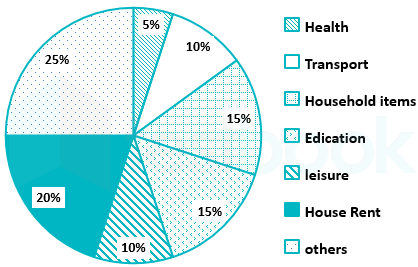
The total expenditure of a family, on different activities in a month, is shown in the pie-chart. The extra money spent on education as compared to transport (in percent) is ____

  1. ((a))

    5

  2. ((b))

    33.3

  3. ((c))

    50

  4. ((d))

    100

Show Answer
Answer: ((c))

50

Explanation:

Let the total expenditure be x.

Money spent on education = 15% = 0.15x

Money spent on transport = 10% = 0.1x

Money;spent;on;education;Money;spent;on;Transport=0.15x0.1x=1.5\Rightarrow \frac{{Money;spent;on;education;}}{{Money;spent;on;Transport}} = \frac{{0.15x}}{{0.1x}} = 1.5

⇒ Money spent on education = 1.5 × Money spent on Transport

i.e. the money spent on education is 50% more than the money spent on transport.

Civil Engineering (55 questions)

11

In the following partial differential equation, θ is a function of t and z, and D and K are functions of θ

D(θ)δ2θδz2+δK(θ)δzδθδt=0D\left( \theta \right)\frac{{{\delta ^2}\theta }}{{\delta {z^2}}} + \frac{{\delta K\left( \theta \right)}}{{\delta z}} - \frac{{\delta \theta }}{{\delta t}} = 0

The above equation is

  1. ((a))

    a second order linear equation

  2. ((b))

    a second degree linear equation

  3. ((c))

    a second order non-linear equation

  4. ((d))

    a second degree non-linear equation

Show Answer
Answer: ((c))

a second order non-linear equation

Concept:

Identification of Non-linear Differential Equation:

Ordinary Differential EquationPartial Differential Equation
1) The degree is more than 1.1) The degree is more than 1.
2) The exponent of the dependent variable is more than 1.2) The exponent of the dependent variable is more than 1.
3) The exponent of any derivative > 1.3) The exponent of any derivative > 1.
4) Product of dependent variable with its any derivative is present.4) Product of dependent variable with its any derivative is present.
5) Product of any two partial derivatives is present


If any differential equation consists at least one of the above properties, then it is called non-linear differential equation and if any differential equation is free from all the above properties, then it is a linear differential equation.

Order and Degree of the Differential equation:

Order: The highest order derivative occurring in a differential equation is known as its order.

Degree: It is the exponent of the highest order derivative when the differential equation is made free from radicals.

e.g. (d2ydx2)2+2(dtdx)3+6=0{\left( {\frac{{{d^2}y}}{{d{x^2}}}} \right)^2} + 2{\left( {\frac{{dt}}{{dx}}} \right)^3} + 6 = 0

Order = 2

Degree = 2

Note: Degree ≠ 3, because it is not the exponent of the highest order derivative.

Calculation:

Given:

D(θ)δ2θδz2+δK(θ)δzδθδtD\left( \theta \right)\frac{{{\delta ^2}\theta }}{{\delta {z^2}}} + \frac{{\delta K\left( \theta \right)}}{{\delta z}} - \frac{{\delta \theta }}{{\delta t}}

Here, the product of the dependent variable D(θ) and its derivative  δ2θδz2\frac{{{\delta ^2}\theta }}{{\delta {z^2}}} is present. Hence it is a non-linear differential equation.

Order = 2 and Degree = 1

Thus the above equation is a non-linear differential equation of Order = 2.

12

The value of limxx2;;5x;+;44x2;+;2x\mathop {\lim }\limits_{x - \infty } \frac{{{x^2};-;5x;+;4}}{{4{x^2};+;2x}} is

  1. ((a))

    0

  2. ((b))

    1/4

  3. ((c))

    1/2

  4. ((d))

    1

Show Answer
Answer: ((b))

1/4

Concept:

To solve limxf(x)g(x)\mathop {\lim }\limits_{x \to ∞ } \frac{{f\left( x \right)}}{{g\left( x \right)}} of this type, divide both numerator and denominator by the variable with the highest power.

Calculation:

Given:

limxx2;;5x;+;44x2;+;2x\mathop {\lim }\limits_{x - ∞ } \frac{{{x^2};-;5x;+;4}}{{4{x^2};+;2x}}

Replacing x with ∞ in above expression, it is an indeterminate form ().\left( {\frac{∞ }{∞ }} \right).

Take out common the highest degree term from numerator and denominator.

;limx(x2[1;;5x;+;4x2]x2[4;+;2x])\therefore ;\mathop {\lim }\limits_{x \to ∞ } \left( {\frac{{{x^2}\left[ {1;-;\frac{5}{x};+;\frac{4}{{{x^2}}}} \right]}}{{{x^2}\left[ {4;+;\frac{2}{x}} \right]}}} \right)

limx1x=0\because\mathop {\lim }\limits_{x \to \infty } \frac{1}{x} = 0

;limx([1;;0;+;0][4;+;0])\therefore;\mathop {{\rm{lim}}}\limits_{x \to ∞ } \left( {\frac{{\left[ {1;-;0;+;0} \right]}}{{\left[ {4;+;0} \right]}}} \right)

14\therefore\frac{1}{4}

13

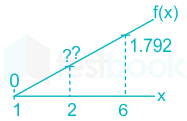
The true value of ln(2) is 0.69. If the value of ln(2) is obtained by linear interpolation between ln(1) and ln(6), the percentage of absolute error (round off to the nearest integer), is

  1. ((a))

    35

  2. ((b))

    48

  3. ((c))

    69

  4. ((d))

    84

Show Answer
Answer: ((b))

48

Explanation

Let f(x) = In (x)

Xf(x)
1In (1) = 0
6In (6) = 1792


Let the approximate value of In (2) be x.

By using linear interpolation,

1.792061=x021\frac{{1.792 - 0}}{{6 - 1}} = \frac{{x - 0}}{{2 - 1}}

⇒ x = 0.358

Thus the percentage error =True;;valueApprox;;valueTrue;value = \frac{{True;;value - Approx;;value}}{{True;value}} =(0.690.3580.69)×100= \left( {\frac{{0.69 - 0.358}}{{0.69}}} \right) \times 100

= 48.11% ≈ 48%

Important Points

  • Because of the log scale involved in actual value it is noted that the error is extremely large under linear scale which makes sense.
14

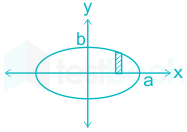
The area of an ellipse represented by an equation x2a2+y2b2=1\frac{{{x^2}}}{{{a^2}}} + \frac{{{y^2}}}{{{b^2}}} = 1 is

  1. ((a))

    πab4\frac{{\pi ab}}{4}

  2. ((b))

    πab2\frac{{\pi ab}}{2}

  3. ((c))

    πab

  4. ((d))

    4πab3\frac{{4\pi ab}}{3}

Show Answer
Answer: ((c))

πab

Concept:

Ellipse x2a2+y2b2=1\frac{{{x^2}}}{{{a^2}}} + \frac{{{y^2}}}{{{b^2}}} = 1

Length major axis of ellipse = 2a

Length of minor axis of ellipse = 2b

Area =!!!R1dydx= \mathop \int!!!\int \limits_R^{} 1 \cdot dy \cdot dx

Calculation:

x2a2+y2b2=1y=b(1x2a2)\frac{{{x^2}}}{{{a^2}}} + \frac{{{y^2}}}{{{b^2}}} = 1 \Rightarrow y = \sqrt {b\left( {1 - \frac{{{x^2}}}{{{a^2}}}} \right)} .

For the first quadrant, take a vertical strip as shown. Here, y coordinate varies from 0 to b(1x2a2)=baa2x2\sqrt {b\left( {1 - \frac{{{x^2}}}{{{a^2}}}} \right)} = \frac{b}{a}\sqrt {{a^2} - {x^2}} .

Also, the x-coordinate varies from 0 to a

∴ Area \(= \mathop \smallint \limits_0^a \mathop \smallint \limits_0^{\frac{b}{a}\sqrt {{a^2} - {x^2}} } \left( 1 \right)dy;dx\)

\(= \mathop \smallint \limits_0^a \left( {\frac{b}{a}\sqrt {{a^2} - {x^2}} } \right)dx\)

=ba[xa2x22+a22sin1(xa)]0a=ba×a22×π2=πab4= \frac{b}{a}\left[ {\frac{{x\sqrt {{a^2} - {x^2}} }}{2} + \frac{{{a^2}}}{2}{{\sin }^{ - 1}}\left( {\frac{x}{a}} \right)} \right]_0^a = \frac{b}{a} \times \frac{{{a^2}}}{2} \times \frac{\pi }{2} = \frac{{\pi ab}}{4}

∴ The total area of ellipse =4×πab4= 4 \times \frac{{\pi ab}}{4} = πab units

Important Points

  1. x2 + y2 = a2 ; Represents a circle centred at (0, 0) and radius ‘a’ units.

  2. x2a2+y2b2=1\frac{{{x^2}}}{{{a^2}}} + \frac{{{y^2}}}{{{b^2}}} = 1; Represents Ellipse with major axis length 2a and minor axis length 2b and vertex at (0,0)

  3. x2a2y2b2=1\frac{{{x^2}}}{{{a^2}}} - \frac{{{y^2}}}{{{b^2}}} = 1; Equation of Hyperbola .

  4. x2a2y2a2=1\frac{{x^2}}{{{a^2}}} - \frac{{{y^2}}}{{{a^2}}} = 1; Equation of Rectangular Hyperbola.

15

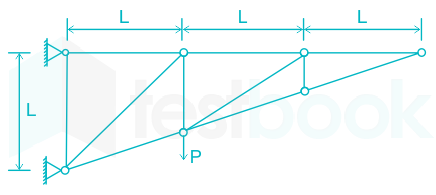
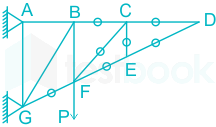
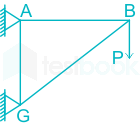
Consider the planar truss shown in the figure (not drawn to the scale)

Neglecting self-weight of the members, the number of zero-force members in the truss under the action of the load P is

  1. ((a))

    6

  2. ((b))

    7

  3. ((c))

    8

  4. ((d))

    9

Show Answer
Answer: ((c))

8

Concept:

Planar Truss: When all the members and nodes of a truss lie within a 2-dimensional plane it is called a planar truss.

Members of a truss carry only axial force. If the member of a truss does not carry any force under some specific load conditions, those members are called zero-force members.

Identification of zero-force members:

  1. If at any joint two members are non-collinear and no load is acting at the joint, then both the members will be zero-force members.

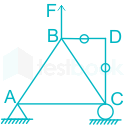
e.g.

In the truss shown above, there are two non-collinear members at joint D and there is no load acting at this joint, hence both the members BD and CD are zero force members.

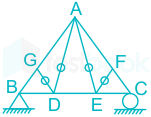
  1. If at a truss joint, 3 members are meeting and two of them are collinear and no load is acting at the joint, then the non-collinear member will be a zero-force member.

e.g.

Calculation:

A 2D truss as shown below:

Using property 1 explained above, at joint D members CD and EC are zero force members. Similarly, EF and EC are zero force members, and at joint C, CF and BC are zero force members,

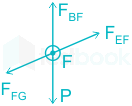
At joint F;

∵ ∑ Fy = 0 ∴ FFG = FEF

∵ ∑ FX = 0   ∴ FBF = P

Thus the truss reduces to

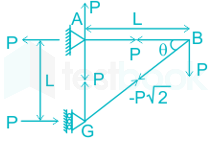
This is an indeterminate truss (indeterminate to 1 degree) . Let the redundant be the vertical reaction at joint G.

θ = 45°

At joint B ; ∑ Fy = 0 ⇒ FBG sin θ + P = 0

FBG=P2\Rightarrow {F_{BG}} = - P\sqrt 2

∑ FX = 0 ⇒ FBA + FBG cos θ = 0

⇒ FBA = P

Negative sign in FBG indicates compression.

At joint A, ∵ ∑ FY = 0 ⇒ FAG = P

∵ ∑ FX = 0 ⇒ RAH = 0

For stability of truss, ∑ Fx = 0

Thus horizontal reaction at G = P.             

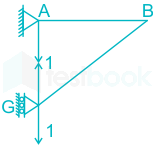
Apply a unit load at G and in the direction of redundant assumed.

By using property 1, explained above FAB = FBG = 0

By using the unit load method redundant R is given as

R=ui(PiLiAiEi)(ui2LiAiEi)R = \frac{{ - \sum {u_i}\left( {\frac{{{P_i}{L_i}}}{{{A_i}{E_i}}}} \right)}}{{\sum \left( {\frac{{u_i^2{L_i}}}{{{A_i}{E_i}}}} \right)}}

Where,

ui = Member force due to the unit load applied.

Pi = Member force due to external load.

R=(1×P×)12×\Rightarrow R = - \frac{{\left( {1 \times P \times \ell } \right)}}{{{1^2} \times \ell }}

⇒ R = -P

∴ Force in GA = P + (-P) × ℓ = 0

Thus we have a total of 8 zero-force members.

Key Points

Force in member GA can also be found using the fact that truss members carry the only axial force and if the axial deflection of any member is zero that member will be a zero force member.

In the given truss, due to hinge at A and G no axial deformation of the member AG is possible.

Hence GA is a zero force member.

16

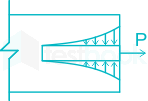
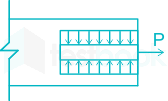
A reinforcing steel bar, partially embedded in concrete, is subjected to a tensile force P. The figure that appropriately represents the distribution of the magnitude of bond stress (represented as hatched region). Along embedded length of the bar, is

  1. ((a))

  2. ((b))

  3. ((c))

  4. ((d))

Show Answer
Answer: ((c))

Concept:

The design bond stress is defined as the shear force per unit nominal surface area of reinforcing bar. The grip of reinforcement and concrete due to adhesion, shrinkage gripping and bearing on account of ribs on the deformed bar is termed as bond.

The stress acts on the interface between bars and surrounding concrete and along the direction parallel to the bars.

The local bond stress varies along the length of the reinforcement while the average bond stress gives the average value throughout its development length. This average bond stress is still used in the working stress method. However, in the limit state method of design, the average bond stress has been designated as design bond stress τbd and the values are given in cl. 26.2.1.1. The same is given below as a ready reference.

The basic requirement of RCC is that steel and surrounding concrete act together and there should be no slippage of the steel bar relative to the surrounding concrete.

The actual bond stress distribution is:

Important Points

As per IS 456: 2000 bond stresses are assumed to be uniform along the length of reinforcement.

Uniform bond stress – Distribution.

Bond stress value for plain bars in tension is given for various grades of concrete as:

Grade of concreteM20M25M30M35M40 & above
τbd1.21.41.51.71.9


  • τbd  = 0.16 (fck)2/3
  • For deformed bars the value of bond stress is increased by 60% and for bars in compression, it is increased by 25%.
17

In a two-dimensional stress analysis, the state of stress at a point P is

\(\left[ \sigma \right] = \left[ {\begin{array}{*{20}{c}} {{\sigma _{xx}}}&{{\tau _{xy}}}\ {{\tau _{xy}}}&{{\sigma _{yy}}} \end{array}} \right]\)

The necessary and sufficient condition for existence of the state of pure shear the point P, is

  1. ((a))

    σxxσyyτxy2=0{\sigma _{xx}}{\sigma _{yy}} - \tau _{xy}^2 = 0

  2. ((b))

    Τxy = 0

  3. ((c))

    σxx + σyy = 0

  4. ((d))

    (σxxσyy)2+4τxy2=0{\left( {{\sigma _{xx}} - {\sigma _{yy}}} \right)^2} + 4\tau _{xy}^2 = 0

Show Answer
Answer: ((c))

σxx + σyy = 0

Concept:

For the state of pure shear, normal stresses on the plane must be equal to zero.

Also, the principal stresses are equal to shear stress.

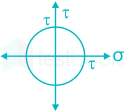
Mohr’s circle for the state of pure shear is

Calculation:

Given:

 \(\sigma = \left[ {\begin{array}{*{20}{c}} {{\sigma _{xx}}}&{{\sigma _{xy}}}\ {{\tau _{xy}}}&{{\sigma _{yy}}} \end{array}} \right]\)

Principal stress =σxx+σyy2±(σ22σyy1)2+τxy2 = \frac{{{\sigma _{xx}} + {\sigma _{yy}}}}{2} \pm \sqrt {{{\left( {\frac{{{\sigma _{22}} - {\sigma _{yy}}}}{1}} \right)}^2} + \tau _{xy}^2}

Shear stress =(σxxσyy2)2+(τxy)2 = \sqrt {{{\left( {\frac{{{\sigma _{xx}} - {\sigma _{yy}}}}{2}} \right)}^2} + {{\left( {{\tau _{xy}}} \right)}^2}}

For the pure shear state of stress –

Principal stress = shear stress

σxx+σyy2±(σxxσyy2)2+τxy2=(σxxσyy2)2+τxy2\Rightarrow \frac{{{\sigma _{xx}} + {\sigma _{yy}}}}{2} \pm \sqrt {{{\left( {\frac{{{\sigma _{xx}} - {\sigma _{yy}}}}{2}} \right)}^2} + \tau _{xy}^2} = \sqrt {{{\left( {\frac{{{\sigma _{xx}} - {\sigma _{yy}}}}{2}} \right)}^2} + \tau _{xy}^2}

⇒ σxx  + σyy = 0

Important Points

In the case of pure shear:

  • The magnitude of principal stresses are equal and they are opposite in nature.
  • Mohr’s circle is centered at origin and radius = τ
  • τmax in-plane (τ) which is also the absolute maximum shear stress.
18

During the process of hydration of cement, due to increase in Dicalcium Silicate (C2S) content in cement clinker, the heat of hydration

  1. ((a))

    increases

  2. ((b))

    decreases

  3. ((c))

    intially decreases and then increases 

  4. ((d))

    does not change

Show Answer
Answer: ((b))

decreases

Concept:

The four major compounds which are constituents of cement are:

a) Tricalcium silicate  (C3S): 3CaO.SiO2

b) Dicalcium silicate (C2S): 2CaO.SiO2

c) Tricalcium Aluminate (C3A): 3CaO.Al2O3

d) Tetra-calcium Alumino Ferrite (C4AF): 4CaO.Al2.Fe2O3

<br>

These compounds are also known as Bogue Compounds.

Hydration of cement:

When water is added to cement a chemical reaction between water and cement takes place leading to the evolution of heat. This is called hydration of cement. The product formed is C-S-H gel.

The heat liberated during this reaction is called the heat of hydration.

  • C3S readily reacts with water, produces more heat of hydration and is responsible for the early strength of concrete.
  • C2S hydrates more slowly and produce less heat of hydration and are responsible for later strength of concrete.
<br>

1. Tricalcium Silicate C3S – (25 – 50%) – Normally 40%

  • It is considered as the best cementing material and is well-burnt cement.
  • It hydrates rapidly generating high heat and develops an early hardness and strength.
  • Raising of C3S content beyond the specified limits increases heat of hydration and solubility of cement in water.
  • The heat of hydration is 500 J/g.
<br>

2. Dicalcium Silicate (C2S) - (25 – 40%) - (Normally 32%)

  • It hydrates and hardens slowly and takes a long time to add to the strength (after a year or more) i.e. it is responsible for ultimate strength.
  • It imparts resistance to chemical attack.
  • Raising of C2S content renders clinkers harder to grind, reduces early strength, decreases resistance to freezing and thawing at an early age and decreases heat of hydration.
  • At an early age, less than a month, C2S has little influence on strength and hardness. While after one year, its contribution to the strength and hardness is proportionately almost equal to C3S.
  • The heat of hydration is 260 J/g.
<br>

3. Tricalcium Aluminate (C3A) - (5 – 11%) -(Normally 10.5%).

  • It rapidly reacts with water and is responsible for the flash set of finely grounded clinkers.
  • The rapidity of action is regulated by the addition of 2-3% of gypsum at the time of grinding the cement.
  • It is most responsible for the initial setting, the high heat of hydration and has a greater tendency to volume changes causing cracking.
  • Raising the C3A content reduces the setting time, weakens resistance to sulphate attack and lowers the ultimate strength, heat of hydration and contraction during air hardening.
  • The heat of hydration of 865 J/g.
<br>

4. Tetracalcium Alumino Ferrite - (C4AF 8 – 14%) (Normally 9%)

  • It is responsible for the flash set but generates less heat.
  • It has the poorest cementing value. Raising C4AF content reduces the strength slightly.
  • The heat of hydration 420 J/g.
<br>

The rate of heat evolution of the principal compound if equal amount of each is considered will be in following descending order: C3A (865 J/g) > C3S (500 J/g) > C4 AF (420 J/g) > C2S (260 J/g) .

Thus by increasing the C2S content the heat of hydration decreases.

Note:

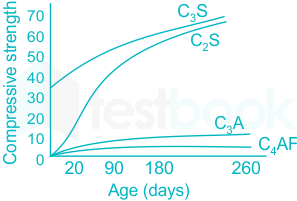
The development of strength of the four principal compounds of cement with age:

The rate of hydration is increased by an increase in the fineness of the cement. However total heat evolved is the same. The rate of hydration of the principal compounds is shown in the figure and will be in the following descending order: C4AF > C3A > C3S > C2S

Important Points

Hydration products of C2S are considered better than that of C3S. It is because of the lesser time formation of lime when C2S hydrates than those in hydration of C3S.

2C3S + 6H → C3S2H3 + 3 Ca(OH)2

2C2S + 4H → C3S2H3 + Ca(OH)2

19

The Los Angeles test for stone aggregates is used to examine

  1. ((a))

    abrasion resistance

  2. ((b))

    crushing strength

  3. ((c))

    soundness

  4. ((d))

    specific gravity

Show Answer
Answer: ((a))

abrasion resistance

Concept:

Los angeles abrasion test is a preferred test for examination of hardness property of the aggregates and has been standardized in India (IS 2386 : Part IV). Abrasion resistance is the property of aggregates by virtue of which they resist surface wear and scratches caused due to rubbing action of another surface or material.

The hardness test is of the following type:

  1. Los Angeles abrasion test 2) Devel abrasion test  3) Dorry abrasion test

Los Angeles Abrasion Test :

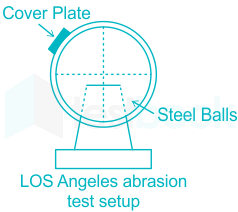
The principle of the Los Angeles Abrasion Test is to find the percentage wear due to relative rubbing action between the aggregate and steel balls used as an abrasive charge. Los Angeles machine consists of circular drum of internal diameter 700 mm and length 520 mm mounted on a horizontal axis enabling it to be rotated. An abrasive charge consisting of cast iron spherical balls of 48 mm diameters and weight 340-445g is placed in the cylinder along with the aggregates.  

The cylinder is then locked and rotated at the speed of 30-33 rpm for a total of 500-1000 revolutions depending upon the gradation of aggregates.

After specified revolutions, the material is sieved through 1.7 mm sieve and passed fraction is expressed as percentage total Weight of the sample.

This value is called the Los Angeles abrasion value. A maximum Value of 40 percent is allowed for WBM base course m Indian conditions. For Bituminous concrete, a maximum value of 35 percent is specified.

Important Points

Some of the important aggregate tests are –

  1. Crushing test: Resistance to crushing under gradually applied crushing load.

  2. Impact test: To determine the toughness of aggregate.

  3. Soundness test: To determine the resistance of aggregates to weathering action.

  4. Abrasion test: To determine the hardness of aggregates

  5. Shape test: Flaky Index, Elongation index and Angularity Number are determined.

  6. Smith Test: To find soluble matter in stone aggregates.

  7. Specific Gravity and Water Adsorption test.

20

Which one of the following statements is NOT correct?

  1. ((a))

    A clay deposit with a liquidity index greater than unity is in a state of plastic consistency

  2. ((b))

    The cohesion of normally consolidated clay is zero when triaxial test 1s conducted under consolidated undrained condition.

  3. ((c))

    The ultimate bearing capacity of a strip foundation supported on the surface of sandy soil increases in direct proportion to the width of footing.

  4. ((d))

    In case of a point load, Boussinesq’s equation predicts higher value of vertical stress at a point directly beneath the load as compared to Westergaard’s equation.

Show Answer
Answer: ((a))

A clay deposit with a liquidity index greater than unity is in a state of plastic consistency

Concept:

(1) Liquidity Index: It is given as -

IL=ωnωpωLωp{I_L} = \frac{{{\omega _n} - {\omega _p}}}{{{\omega _L} - {\omega _p}}}

When IL>Iωnωp>ωLωp{I_L} > I \Rightarrow {\omega _n} - {\omega _p} > {\omega _L} - {\omega _p}

∴ ωn > ωL

Hence the soil is in a state of liquid consistency.

Where, ωn = Natural water content.

ωL = Liquid limit water content.

ωp = Plastic limit water content.

(2) Triaxial Test is the most widely used shear strength test suitable for all types of soil. It is performed in 2 stages on the basis of which, there are 3 types of triaxial test –

(a) Consolidated Drained Test: Drainage is allowed in both stages.

(b**) Consolidated undrained Test**: Drainage is allowed in stage 1 and not allowed in stage 2.

(c**) Unconsolidated Undrained Test:** Drainage is not allowed in any of the stages.

A normally consolidated clay has zero cohesion when tested in CU test because a completely saturated clay under σ̅ = 0 behaves as a slurry.

(3) The ultimate bearing capacity of sandy soil as obtained from the plate load test increases with

an increase in the size of the footing.

qufqup=BfBp\frac{{{q_{uf}}}}{{{q_{up}}}} = \frac{{{B_f}}}{{{B_p}}}

But for clayey soil, the ultimate bearing capacity is independent of the size of the footing.

(4) Boussinesq’s equation:

σz=32πQz2(11+(rz)2)5/2{\sigma _z} = \frac{3}{{2\pi }}\frac{Q}{{{z^2}}}{\left( {\frac{1}{{1 + {{\left( {\frac{r}{z}} \right)}^2}}}} \right)^{5/2}}

Westergaard’s equation:

σz=1πQz2;(11+2(rz)2)3/2{\sigma _z} = \frac{1}{\pi }\frac{Q}{{{z^2}}};{\left( {\frac{1}{{1 + 2{{\left( {\frac{r}{z}} \right)}^2}}}} \right)^{3/2}}

Vertical stress directly below a point load i.e. when r = 0

Boussinesq’s EquationWestergaard’s Equation
σz=32π×Qz2{\sigma _z} = \frac{3}{{2\pi }} \times \frac{Q}{{{z^2}}}σz=1π;Qz2{\sigma _z} = \frac{1}{\pi };\frac{Q}{{{z^2}}}


Hence the stress obtained using Boussinesq’s equation is 1.5 times higher than that of Westergaard’s equation.

Important Points

  • Consistency Index (IC)=ωLωωLωp\left( {{I_C}} \right) = \frac{{{\omega _L} - \omega }}{{{\omega _L} - {\omega _p}}}
  • IL + IC = 1
21

In a soil investigation work at a site, Standard Penetration Test (SPT) was conducted at every 1.5 m interval up to 30 m depth. At 3 m depth, the observed number of hammer blows for three successive 150 mm penetrations were 8, 6 and 9, respectively. The SPT N-value at 3 m depth, is

  1. ((a))

    23

  2. ((b))

    17

  3. ((c))

    15

  4. ((d))

    14

Show Answer
Answer: ((c))

15

Concept:

Bearing Capacity can be calculated based on the following field test:

(a) Standard Penetration Test (S.P.T)

(b) Plate Load test

(c) Static cone penetration test/Static Cone resistance test.

Standard Penetration Test (S.P.T)-

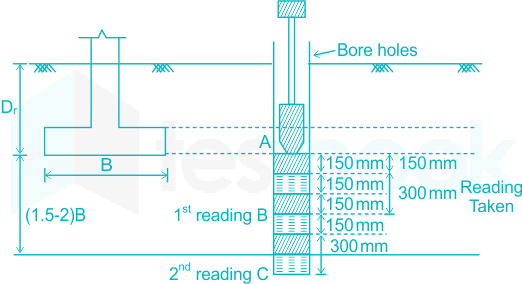
S.P.T. Test procedure

  • Suitable for Granular soil.
  • Split spoon samples are used in the borehole.
  • The borehole is advanced to a depth at which N-value is to be calculated.
  • The split-spoon sampler is allowed to penetrate the soil by applying an impact load of 65 Kg having a free fall of 75 cm.
  • The sampler is allowed to penetrate for 150 mm depth, but reading is not noted i.e.(No. of blows required for 150 mm penetration is not Noted).
  • Then the sampler is allowed to penetrate, further for 300 mm and No. of blows required to penetrate the sampler to this 300 mm is the SPT N-value
  • The next test is carried out at level 750 mm below the previous test reference level.
  • If borehole depth is large, then the interval of the next test is taken at a depth of 2.5 to 2 m or the change of strata.


Calculation of S.P.T N value:

  • Bearing capacity of Granular soil can be calculated by using corrected S.P.T N-values.
  • The values of N – is determined at Number of Selected boreholes and the average value of corrected (N) is calculated.
  • While calculating the average value of (N), any value greater than 50% of the average value is discarded.


e.g. if [N1+N2+N3+N44]=30\left[ {\frac{{{N_1} + {N_2} + {N_3} + {N_4}}}{4}} \right] = 30 and if N3 = 40

Then (N3) is accepted as [30 × 1.5 = 45] and (40 < 45) and if N2 = 48 then (N2) is discarded as 48 is > 45

  • New average is taken as =[N1+N3+N43]= \left[ {\frac{{{N_1} + {N_3} + {N_4}}}{3}} \right]
  • Minimum of all the avg. values of various boreholes are used in the design of foundations.

Calculation:

Given:

The number of blows for each 150 mm penetration is 8, 6, and 9.

The number of blows for the first 150 mm penetration is not considered.

Hence the correct SPT-N value = 6 + 9 = 15

Important Points

The following corrections are applied to the N-values obtained above:-

1. Overburden Correction

  • It is necessary because the N-value will affect it due to the confinement of soil at various depth.
  • Two granular soils possessing the same relative density but having different confining pressures are tested, the one with higher confining pressure will give higher N value.
  • Since the confining pressure increases with depth, the N values at shallow depths are underestimated and the N values at larger depths are overestimated.
  • If N0 = observed S.P.T. value


N1=N0×350(σˉ+70){N_1} = {N_0} \times \frac{{350}}{{\left( {\bar \sigma + 70} \right)}}

Where, σ̅ = Effective stress at the level of the test (KN/m2)

N1 = Corrected N-value of overburden.

  • Overburden correction will not be applied if σ̅ > 280 KN/m2


2. Dilatancy Correction

  • It is applied to the already corrected N-values for overburden pressure. Dilatancy correction is required only if N> 15 in saturated fine sand and silt
  • (N> 15) represents the Dense sand which will tend to dilate under rapid loading (undrained condition) and (-VA) pore water pressure will develop. Hence, observed (N) value will be more because shear resistance will increase.


Corrected N value after Dilatancy Correction :N2=15+12(N115):{N_2} = 15 + \frac{1}{2}\left( {{N_1} - 15} \right)

22

The velocity of flow proportional to the first power of the hydraulic gradient in Darcy’s law. This law applies to 

  1. ((a))

    Laminar flow in porous media

  2. ((b))

    Transitional flow in porous media

  3. ((c))

    Turbulent flow in porous media

  4. ((d))

    Laminar as well as the turbulent flow in porous media

Show Answer
Answer: ((a))

Laminar flow in porous media

Concept:

Darcy’s Law:

The flow of free water through soil is governed by Darcy’s law. As per this law, for laminar flow through homogenous soil, the velocity of flow (v) is given as

ν = ki

where, k = coefficient of permeability, i = hydraulic gradient

ν = discharge velocity or superficial velocity.

Validity of Darcy’s law:

It is valid when the flow through the soil is laminar. This assumption was based on the fact that there is no head loss associated when the water flows through soil due to the formation of turbulent rollers.

For the flow of water through soil, the flow is laminar if Reynold’s number is less than 1.

  • In fine-grained soil, flow is laminar.
  • In coarse-grained soil, the flow becomes turbulent when the size of particles is very large i.e. in gravel range.

Thus the assumed soil mass must be homogenous and fully saturated for the validity of Darcy’s law.

Hence Darcy’s law applies to laminar flow in porous media.

Important Points

Coefficient of Permeability (k):

It is defined as the velocity of flow which would occur under a unit hydraulic gradient. The unit of k is m/sec or cm/sec. It depends upon the particle size and many other factors.

Seepage velocity is different from discharge velocity. Darcy’s law assumes that the flow takes place through the complete cross-section, but in reality, it flows only through the voids between the soil particles.

Seepage velocity calculations:

Seepage velocity (Vs) = q/A⇒ q = Av × Vs

Discharge velocity (V) =qAq=A×V= \frac{q}{A} \Rightarrow q = A \times V

∵ Av × Vs = A × V

Vs=V(AvA)=Vn\Rightarrow {V_s} = \frac{V}{{\left( {\frac{{{A_v}}}{A}} \right)}} = \frac{V}{n} ; n → porosity.

Thus the seepage velocity is always greater than the actual velocity.

23

A body floating in a liquid is in a stable state of equilibrium if its

  1. ((a))

    metacentre lies above its centre of gravity 

  2. ((b))

    metacenter lies below its center of gravity

  3. ((c))

    metacenter coincides with its center of gravity

  4. ((d))

    center of gravity is below its centre of buoyancy 

Show Answer
Answer: ((a))

metacentre lies above its centre of gravity 

Concept:

Metacenter:

It is the point of intersection of the line of action of buoyant force before and after rotation.

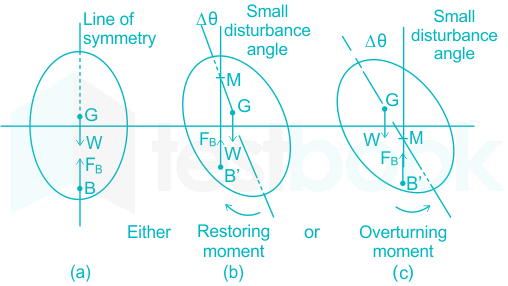
  1. The basic floating position is calculated Aand the body’s center of mass G and center of buoyancy B are computed.
  2. The body is tilted a small angle Δθ, and a new water line is established for the body to float at this angle. The new position B’ of the center of buoyancy is calculated. A vertical line is drawn upward from B’ that intersects the previous line of buoyancy at a point M, called the metacenter, which is independent of Δθ for small angles.
  3. If point M is above G, that is, if the metacentric height MG\overline {MG}  is positive, a restoring value indicates the stability of the body.

Thus, a floating body is said to be in a state of stable equilibrium if the metacenter of this lies above the center of gravity. In other words, the metacentric height is positive.

F1_Neelmani_Deepak_10.04.2020_D5.png

Important Points

Metacentric Height: It is the distance between the center of gravity and the metacenter.

MG=BMBG\overline {MG} = BM - BG

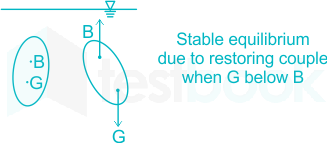
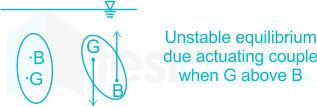
Stability of submerged body:

It is determined based on the location of the center of buoyancy B and the center of gravity G with respect to each other.

1) 

2) 

24

Uniform flow with velocity u makes an angle θ with the y-axis, as shown in the figure

The velocity potential (φ), is

  1. ((a))

    ± U (x sinθ + y cosθ)

  2. ((b))

    ± U (y sinθ – x cosθ)

  3. ((c))

    ± U (x sinθ - y cosθ)

  4. ((d))

    ± U (y sinθ + x cosθ)

Show Answer
Answer: ((a))

± U (x sinθ + y cosθ)

Concept:

Velocity Potential:

It is defined as a scalar function of space and time such that its partial negative derivative with respect to any direction gives the velocity of flow in that direction.

If ϕ = f(x, y, z, t)

ϕx=u;;;ϕy=ν;;;ϕz=ω\Rightarrow \frac{{ - \partial \phi }}{{\partial x}} = u;;;\frac{{ - \partial \phi }}{{\partial y}} = \nu ;;;\frac{{ - \partial \phi }}{{\partial z}} = \omega

If ϕ in a particular direction is constant, the flow will have no velocity component in that direction and hence flow will not occur in that direction.

If Velocity potential satisfies the Laplace equation, the Continuity equation gets satisfied and flow is possible.

2ϕx2+2ϕy2+2ϕz2=0\frac{{{\partial ^2}\phi }}{{\partial {x^2}}} + \frac{{{\partial ^2}\phi }}{{\partial {y^2}}} + \frac{{{\partial ^2}\phi }}{{\partial {z^2}}} = 0

Calculation:

For the given velocity field,

Velocity in x-direction = u sin θ

Velocity in y-direction = u cos θ

From the definition of velocity potential,

ϕx=usinθ\frac{{ - \partial \phi }}{{\partial x}} = u\sin \theta

Integrating on both sides,

ϕ = -u sin θ x + f(y)     ---(i)

Also, ϕy=ucosθ\frac{{\partial \phi }}{{\partial y}} = - u\cos \theta

(usinθx+f(y)y=ucosθ\Rightarrow \frac{{\partial ( - u\sin \theta \cdot x + f\left( y \right)}}{{\partial y}} = - u\cos \theta

⇒ 0 + f’(y) = u cos θ

⇒ f(y) = -(u cos θ) ⋅ y + c      ---(ii)

Thus using equation (i) & (ii),

ϕ = -u sin θ ⋅ x + (-u cos θ) ⋅ y

⇒ ϕ = ± U (x sin θ + y cos θ)

Important Points

The assumption of Irrotational flow leads to the existence of the Velocity potential and velocity potential concept is used for integration of Euler’s equation to yield Bernoulli's equation.

25

The data for an agricultural field for a specific month are given below;

Pan Evaporation = 100 mm

Effective Rainfall = 20 mm (after deducting losses due to runoff and deep percolation)

Crop Coefficient = 0.4

Irrigation Efficiency = 0.5

The amount of irrigation water (in mm) to be applied to the field in that month, is

  1. ((a))

    0

  2. ((b))

    20

  3. ((c))

    40

  4. ((d))

    80

Show Answer
Answer: ((c))

40

Explanation:

Given,

Pan evaporation = 100 mm ; effective rainfall = 20 mm ;

Crop effective = 0.4 ; Irrigation Efficiency = 0.5

Total water required by crop = crop coefficient × pan evaporation = 0.4 × 100 = 40 mm

Effective Rainfall = 20 mm

∴ Additional water required by crop = (40 - 20) = 20 mm

∵ The efficiency of irrigation = Amount;of;water;available;for;useAmount;of;water;applied;in;the;field\frac{{Amount;of;water;available;for;use}}{{Amount;of;water;applied;in;the;field}}

⇒ Amount of water applied =200.5=40;mm= \frac{{20}}{{0.5}} = 40;mm

Important Points

Part of the rainwater percolates below the root zone of the plants and part of the rainwater flows away over the soil surface as run-off. This deep percolation water and run-off water cannot be used by the plants**.** The remaining part is stored in the root zone and can be used by the plants. This remaining part is called effective rainfall.

26

During the chlorination process, aqueous chlorine reacts rapidly with water to form Cl-, HOCl, and H+ as shown below

CI2 (aq) + H2O ⇋ HOCI + CI- + H+

The most active disinfectant in the chlorination process from amongst the following is

  1. ((a))

    H+

  2. ((b))

    HOCI

  3. ((c))

    CI

  4. ((d))

    H2O

Show Answer
Answer: ((b))

HOCI

Concept:

Disinfection is defined as the method of inactivation of harmful microorganisms in water either by the physical or chemical process.

Chlorination is one of the major methods of disinfection.

When chlorine is added to water, the reaction takes place between them.

At pH < 5, chlorine does not react with water and remains as free chlorine or unreacted chlorine.

Reaction of chlorine with water

Out of all these forms of chlorine, HOCl- is the most destructive. It is 80% more effective than OCl- ion.

Hence pH is maintained just below 7 for most effective chlorination.

Important Points

  • Chlorine immediately reacts with ammonia present in water to form chloramines. Out of all chloramines formed dichloramine is predominant. They are less effective than free chlorine but they are stable and remain in the water for a greater duration and hence protect from future contamination.
  • Different forms in which chlorine is added:
<br>

(i) As free chlorine

(ii) Hypochlorites (Bleaching powder)

(iii) Chloramines

(iv) Chlorine dioxide

27

An amount of 35.67 mg HCL is added to distilled water and the total solution volume is made to one litre. The atomic weights of H and CI are I and 35.5, respectively. Neglecting the dissociation of water, the pH of the solution, is

  1. ((a))

    3.50

  2. ((b))

    3.01

  3. ((c))

    2.50

  4. ((d))

    2.01

Show Answer
Answer: ((b))

3.01

Concept:

pH:

It is a measure of the acidity or alkalinity of a solution. It measures the presence of hydrogen ion concentration relative to that of a standard solution. Mathematically, pH is the negative logarithm of the hydrogen ion concentration [H+] present in the solution expressed in molarity.

pH = -log10 [H+]

Molarity:

It is defined as the number of moles of solute per litre of solution.

i.e. Molarity=Moles;of;soluteVolume;of;solution;in;{\rm{Molarity}} = \frac{{Moles;of;solute}}{{Volume;of;solution;in;\ell }}

Calculation:

When HCl is added to water, it dissociates into H+ and Cl-

HCl + H2O ⇌ H+ + Cl- + H2O

Molecular weight of HCl = ( 1 +35.5) = 36.5 gm

Thus, 36.5 gm of HCl dissociates to 1 gm of H+

⇒ 1 gm of HCl dissociates to 136.5;gm\frac{1}{{36.5}};gm of H+

⇒ 35.67 mg of HCl dissociates to (135.5×35.67×103);gm\left( {\frac{1}{{35.5}} \times 35.67 \times {{10}^{ - 3}}} \right);gm of H+

=(136.5×35.67×103)1;moles;of;[H+]= \frac{{\left( {\frac{1}{{36.5}} \times 35.67 \times {{10}^{ - 3}}} \right)}}{1};moles;of;[{H^ + }]

∴ The concentration of H+ in molarity =136.5×35.67×1031;litre=0.977×10³moleslitre= \frac{{\frac{1}{{36.5}} \times 35.67 \times {{10}^{ - 3}}}}{{1;litre}} = 0.977 \times {10^{ - 3}}\frac{{moles}}{{litre}}

∴ pH = -log10 [H+] = -log10 [0.977 × 10⁻³] = 3.01

Important Points

pH > 7 ⇒ Basic solution

pH < 7 ⇒ Acidic solution

pH + p(OH) = 14

pH is measured using a potentiometer in which the potential exerted by [H+] ions is measured.


  • mmole/ℓ =millimoles/ℓ = 10-3 moles/ℓ
28

The probability that a 50 year flood may NOT occur at all during 25 years life of a project (round of to two decimal places) is ______.

29

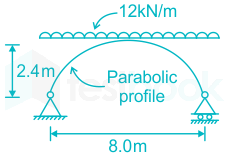
A planar elastic structure is subjected to uniformly distributed load, as shown in the figure (not drawn to the scale)

Neglecting self-weight the maximum bending moment generated in in the structure (in kN.m round off to the nearest integer), is

30

In an urban area, a median is provided to separate the opposing streams of traffic. As per IRC: 86-1983, the desirable minimum width (in m. expressed as integer) of the median, is

31

A road in a hilly terrain is to be laid at a gradient of 4.5%. A horizontal curve of radius 100 m is laid at a location on this road. Gradient needs to be eased due to combination of curved horizontal and vertical profiles of the road. As per IRC, the compensated gradient (in %, round off to one decimal place), is

32

In a drained triaxial compression test, a sample of sand fails at deviator stress of 150 kPa under confining pressure of 50 kPa. The angle of internal friction (in degree, round off to the nearest integer) of the sample, 1s,

33

A fully submerged infinite sandy slope has an inclination of 30° with the horizontal. The saturated unit weight and effective angle of internal friction of sand are 18 kN/m2 and 38°, respectively. The unit weight of water is 10 kN/m2. Assume that the seepage is parallel to the slope. Against shear failure of the slope, the factor of safety (round off to two decimal places) is,

34

A 4 m wide rectangular channel carries 6 m3/s of water. The Manning’s ‘n’ of the open channel is 0.02. Considering g = 9.81 m/s2, the critical velocity of flow (in m/s, round off to two decimal places) in the channel, is.

35

A river has a flow of 1000 million litres per day (MLD), BOD5 of 5 mg/litre and Dissolved Oxygen (DO) level of 8 mg/litre before receiving the wastewater discharge at a location. For the existing environmental conditions, the saturation DO level is 10 mg/litre in the river. Wastewater discharge of 100 MLD with the BOD5 of 200 mg/litre and DO level of 2 mg/litre fall at that location. Assuming complete mixing of wastewater and river water, the immediate DO deficit (in me/litre, round off to two decimal places), is

36

For the Ordinary Differential Equation d2xdt25dxdt+6x=0,\frac{{{d^2}x}}{{d{t^2}}} - 5\frac{{dx}}{{dt}} + 6x = 0, with initial conditions x(0) = 0 and dxdt(0)=10,\frac{{dx}}{{dt}}\left( 0 \right) = 10, the solution is

  1. ((a))

    -5e2t +6e3t

  2. ((b))

    5e2t = + 6e3t

  3. ((c))

    -10e2t + 10e3t

  4. ((d))

    10e2t + 10e+3t

Show Answer
Answer: ((c))

-10e2t + 10e3t

Explanation:

d2xdt25dxdt+6x=0\frac{{{d^2}x}}{{d{t^2}}} - 5\frac{{dx}}{{dt}} + 6x = 0

Above given equation is a linear differential equation of order = 2. Such equations are solved using CF + PI method.

Let D=dxdtD = \frac{{dx}}{{dt}}

d2xdt25dxdt+6x=0 \Rightarrow \frac{{{d^2}x}}{{d{t^2}}} - 5\frac{{dx}}{{dt}} + 6x = 0

⇒ D2x – 5Dx + 6x = 0

⇒ (D2 – 5D + 6)x = 0

Thus auxiliary equation (obtained by replacing D with m) is m2 – 5D + 6 = 0.

Roots of above obtained auxiliary equation are-

m2 – 5D + 6 = 0

⇒ (m – 2) (m - 3) = 0

⇒ m1 = 2 or m2 = 3

When both roots of auxiliary equation are real and distinct

C.F=C1em1t+C2em2tC.F = {C_1}{e^{{m_1}t}} + {C_2}{e^{{m_2}t}}

Thus general solution of above D.E is

x=C1e2t+C2e3tx = {C_1}{e^{2t}} + {C_2}{e^{3t}}

Applying boundary conditions, x(0) = 0

⇒ O = C1 + C2

⇒ C1 = -C2     ---(i)

Using initial condition dxdt(0)=10\frac{{dx}}{{dt}}\left( 0 \right) = 10

dxdt=2Ge2t+3C2e3t\frac{{dx}}{{dt}} = 2G{e^{2t}} + 3{C_2}{e^{3t}}

⇒ 10 = 2C1 + 3C2       ---(ii)

Solving equation (i) & (ii) simultaneously,

C1 = -10 and C2 = 10

Thus, x = -10e2t + 10e3t

37

A continuous function f(x) is defined. If the third derivative at xi is to be computed by using he fourth order central finite divided difference scheme (with step length = h) the correct formula is

  1. ((a))

    f(xi)=f(xi+3)+8f(xi+2)13f(xi+1)+13f(xi1)8f(xi2)+f(xi3)8h3f'''\left( {{x_i}} \right) = \frac{{ - f\left( {{x_{i + 3}}} \right) + 8f\left( {{x_{i + 2}}} \right) - 13f\left( {{x_{i + 1}}} \right) + 13f\left( {{x_{i - 1}}} \right) - 8f\left( {{x_{i - 2}}} \right) + f\left( {{x_{i - 3}}} \right)}}{{8{h^3}}}

  2. ((b))

    f(xi)=f(xi+3)8f(xi+2)13f(xi+1)+13f(xi1)+8f(xi2)+f(xi3)8h3f'''\left( {{x_i}} \right) = \frac{{f\left( {{x_{i + 3}}} \right) - 8f\left( {{x_{i + 2}}} \right) - 13f\left( {{x_{i + 1}}} \right) + 13f\left( {{x_{i - 1}}} \right) + 8f\left( {{x_{i - 2}}} \right) + f\left( {{x_{i - 3}}} \right)}}{{8{h^3}}}

  3. ((c))

    f(xi)=f(xi+3)8f(xi+2)13f(xi+1)+13f(xi1)+8f(xi2)+f(xi3)8h3f'''\left( {{x_i}} \right) = \frac{{ - f\left( {{x_{i + 3}}} \right) - 8f\left( {{x_{i + 2}}} \right) - 13f\left( {{x_{i + 1}}} \right) + 13f\left( {{x_{i - 1}}} \right) + 8f\left( {{x_{i - 2}}} \right) + f\left( {{x_{i - 3}}} \right)}}{{8{h^3}}}

  4. ((d))

    f(xi)=f(xi+3)+8f(xi+2)13f(xi+1)+13f(xi1)8f(xi2)+f(xi3)8h3f'''\left( {{x_i}} \right) = \frac{{f\left( {{x_{i + 3}}} \right) + 8f\left( {{x_{i + 2}}} \right) - 13f\left( {{x_{i + 1}}} \right) + 13f\left( {{x_{i - 1}}} \right) - 8f\left( {{x_{i - 2}}} \right) + f\left( {{x_{i - 3}}} \right)}}{{8{h^3}}}

Show Answer
Answer: ((a))

f(xi)=f(xi+3)+8f(xi+2)13f(xi+1)+13f(xi1)8f(xi2)+f(xi3)8h3f'''\left( {{x_i}} \right) = \frac{{ - f\left( {{x_{i + 3}}} \right) + 8f\left( {{x_{i + 2}}} \right) - 13f\left( {{x_{i + 1}}} \right) + 13f\left( {{x_{i - 1}}} \right) - 8f\left( {{x_{i - 2}}} \right) + f\left( {{x_{i - 3}}} \right)}}{{8{h^3}}}

Explanation:

By using Taylor’s series expansion,

f(x+h)=f(x)+hf(x)+h2f(x)2!+h3f(x)3!+h4f4(x)4!+h5f5(x)5!+h66!f6(x)+h7f7(x)7!+f\left( {x + h} \right) = f\left( x \right) + hf'\left( x \right) + \frac{{{h^2}f''\left( x \right)}}{{2!}} + \frac{{{h^3}f'''\left( x \right)}}{{3!}} + \frac{{{h^4}{f^4}\left( x \right)}}{{4!}} + \frac{{{h^5}{f^5}\left( x \right)}}{{5!}} + \frac{{{h^6}}}{{6!}}{f^6}\left( x \right) + \frac{{{h^7}{f^7}\left( x \right)}}{{7!}} + \ldots

f(xh)=f(x)hf(x)+h2f(x)2!h3f(x)3!+h4f4(x)4!h55!f5(x)+h66!f6(x)h7f7(x)7!+f\left( {x - h} \right) = f\left( x \right) - hf'\left( x \right) + \frac{{{h^2}f''\left( x \right)}}{{2!}} - \frac{{{h^3}f'''\left( x \right)}}{{3!}} + \frac{{{h^4}{f^4}\left( x \right)}}{{4!}} - \frac{{{h^5}}}{{5!}}{f^5}\left( x \right) + \frac{{{h^6}}}{{6!}}{f^6}\left( x \right) - \frac{{{h^7}{f^7}\left( x \right)}}{{7!}} + \ldots

f(x+2h)=f(x)+2hf(x)+4h2f(x)2!+8h3f(x)3!+16h4f4(x)4!+32h5f5(x)5!+64h6f6(x)6!+128h7f7(x)7!+f\left( {x + 2h} \right) = f\left( x \right) + 2hf'\left( x \right) + \frac{{4{h^2}f''\left( x \right)}}{{2!}} + \frac{{8{h^3}f'''\left( x \right)}}{{3!}} + \frac{{16{h^4}{f^4}\left( x \right)}}{{4!}} + \frac{{32{h^5}{f^5}\left( x \right)}}{{5!}} + \frac{{64{h^6}{f^6}\left( x \right)}}{{6!}} + \frac{{128{h^7}{f^7}\left( x \right)}}{{7!}} + \ldots

f(x2h)=f(x)2hf(x)+4h2f(x)2!8h3f(x)3!+16h4f4(x)4!32h5f5(x)5!+64h6f6(x)6!128h7f7(x)7!+f\left( {x - 2h} \right) = f\left( x \right) - 2hf'\left( x \right) + \frac{{4{h^2}f''\left( x \right)}}{{2!}} - \frac{{8{h^3}f'''\left( x \right)}}{{3!}} + \frac{{16{h^4}{f^4}\left( x \right)}}{{4!}} - \frac{{32{h^5}{f^5}\left( x \right)}}{{5!}} + \frac{{64{h^6}{f^6}\left( x \right)}}{{6!}} - \frac{{128{h^7}{f^7}\left( x \right)}}{{7!}} + \ldots

f(x+3h)=f(x)+3hf(x)+9h2f(x)2!+27h3f(x)3!+81h4f4(x)4!+243h5f5(x)5!+729h6f6(x)6!+2187h7f7(x)7!+f\left( {x + 3h} \right) = f\left( x \right) + 3hf'\left( x \right) + \frac{{9{h^2}f''\left( x \right)}}{{2!}} + \frac{{27{h^3}f'''\left( x \right)}}{{3!}} + \frac{{81{h^4}{f^4}\left( x \right)}}{{4!}} + \frac{{243{h^5}{f^5}\left( x \right)}}{{5!}} + \frac{{729{h^6}{f^6}\left( x \right)}}{{6!}} + \frac{{2187{h^7}{f^7}\left( x \right)}}{{7!}} + \ldots

f(x3h)=f(x)3hf(x)+9h2f(x)2!27h3f(x)3!+81h4f4(x)4!243h5f5(x)5!+729h6f6(x)6!2187h7f7(x)7!+f\left( {x - 3h} \right) = f\left( x \right) - 3hf'\left( x \right) + \frac{{9{h^2}f''\left( x \right)}}{{2!}} - \frac{{27{h^3}f'''\left( x \right)}}{{3!}} + \frac{{81{h^4}{f^4}\left( x \right)}}{{4!}} - \frac{{243{h^5}{f^5}\left( x \right)}}{{5!}} + \frac{{729{h^6}{f^6}\left( x \right)}}{{6!}} - \frac{{2187{h^7}{f^7}\left( x \right)}}{{7!}} + \ldots

To find the fourth order approximation of third derivative, we need to eliminate all the lower order derivatives up to 6th.

f(x+h)f(xh)=2hf(x)+2h3f(x)3!+2h5f5(x)5!+2h7f7(x)7!+f\left( {x + h} \right) - f\left( {x - h} \right) = 2hf'\left( x \right) + \frac{{2{h^3}f'''\left( x \right)}}{{3!}} + \frac{{2{h^5}{f^5}\left( x \right)}}{{5!}} + \frac{{2{h^7}{f^7}\left( x \right)}}{{7!}} + \ldots …1)

f(x+2h)f(x2h)=4hf(x)+16h3f(x)3!+64h5f5(x)5!+256h7f7(x)7!+f\left( {x + 2h} \right) - f\left( {x - 2h} \right) = 4hf'\left( x \right) + \frac{{16{h^3}f'''\left( x \right)}}{{3!}} + \frac{{64{h^5}{f^5}\left( x \right)}}{{5!}} + \frac{{256{h^7}{f^7}\left( x \right)}}{{7!}} + \ldots …2)

f(x+3h)f(x3h)=6hf(x)+54h3f(x)3!+486h5f5(x)5!+4374h7f7(x)7!+f\left( {x + 3h} \right) - f\left( {x - 3h} \right) = 6hf'\left( x \right) + \frac{{54{h^3}f'''\left( x \right)}}{{3!}} + \frac{{486{h^5}{f^5}\left( x \right)}}{{5!}} + \frac{{4374{h^7}{f^7}\left( x \right)}}{{7!}} + \ldots …3)

By performing the operation, [2(equation 1) – equation 2], we get

2[f(x + h) – f(x - h)] – [f(x + 2h) - f(x – 2h)]

=12h3f(x)3!60h5f5(x)5!252h7f7(x)7!+ = - \frac{{12{h^3}f'''\left( x \right)}}{{3!}} - \frac{{60{h^5}{f^5}\left( x \right)}}{{5!}} - \frac{{252{h^7}{f^7}\left( x \right)}}{{7!}} + \ldots

=2h3f(x)12h5f5(x)0.05h7f7(x)+ = - 2{h^3}f'''\left( x \right) - \frac{1}{2}{h^5}{f^5}\left( x \right) - 0.05{h^7}{f^7}\left( x \right) + \ldots …4)

By performing the operation [3(equation 1) – equation 3], we get

3[f(x + h) – f(x - h)] – [f(x + 3h) - f(x – 3h)]

=48h33!f(x)480h5f5(x)5!43687!h7f7(x) = - \frac{{48{h^3}}}{{3!}}f'''\left( x \right) - \frac{{480{h^5}{f^5}\left( x \right)}}{{5!}} - \frac{{4368}}{{7!}}{h^7}{f^7}\left( x \right)

= -8h3 f’’’(x) – 4h5 f5(x) – 0.758 h7 f7(x) …5)

By performing the operation [equation 5 – 8 (equation 4)], we get

3[f(x + h) – f(x - h)] – [f(x + 3h) – f(x – 3h)] – 8[2[f(x + h) – f(x - h)] – [f(x + 2h) – f(x – 2h)]] = 8h3 f’’’(x) – 0.358 h7 f7(x)

⇒ 3f(x + h) – 3f(x - h) – f(x + 3h) + f(x – 3h) – 16f(x + h) + 16f(x - h) – 8f(x + 2h) + 8f(x - 2h) = 8h3 f’’’(x) – 0.358h7 f7(x)

⇒ 8h3 f’’’(x) – 0.358 h7 f7(x) = -f(x + 3h) + 8f(x + 2h) – 13f(x + h) + 13f(x - h) -8f(x - 2h) + f(x – 3h)

f(x)[f(x+3h)+8f(x+2h)13f(x+h)+13f(xh)8f(x2h)+f(x3h)8h3]=0.358h4f7(x) \Rightarrow f'''\left( x \right) - \left[ {\frac{{f\left( {x + 3h} \right) + 8f\left( {x + 2h} \right) - 13f\left( {x + h} \right) + 13f\left( {x - h} \right) - 8f\left( {x - 2h} \right) + f\left( {x - 3h} \right)}}{{8{h^3}}}} \right] = 0.358{h^4}{f^7}\left( x \right)

The above equation gives the fourth order (h4) approximation of third derivative.

Therefore, the fourth-order central difference approximation of the third derivative is

f(x)=f(x+3h)+8f(x+2h)13f(x+h)+13f(xh)8f(x2h)+f(x3h)8h3f'''\left( x \right) = \frac{{ - f\left( {x + 3h} \right) + 8f\left( {x + 2h} \right) - 13f\left( {x + h} \right) + 13f\left( {x - h} \right) - 8f\left( {x - 2h} \right) + f\left( {x - 3h} \right)}}{{8{h^3}}}

f(xi)=f(xi+3)+8f(xi+2)13f(xi+1)+13f(xi1)8f(xi2)+f(xi3)8h3f'''\left( {{x_i}} \right) = \frac{{ - f\left( {{x_{i + 3}}} \right) + 8f\left( {{x_{i + 2}}} \right) - 13f\left( {{x_{i + 1}}} \right) + 13f\left( {{x_{i - 1}}} \right) - 8f\left( {{x_{i - 2}}} \right) + f\left( {{x_{i - 3}}} \right)}}{{8{h^3}}}

38

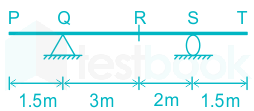
Distributed load(s) of 50 kN/m may occupy any position(s) (either continuously or in patches) on the girder PQRST as shown in the figure (not drawn to the scale)

The maximum negative (hogging) bending moment (in kN.m) that occurs at point R, is:

  1. ((a))

    22.50

  2. ((b))

    56.25

  3. ((c))

    93.75

  4. ((d))

    150.00

Show Answer
Answer: ((b))

56.25

Concept:

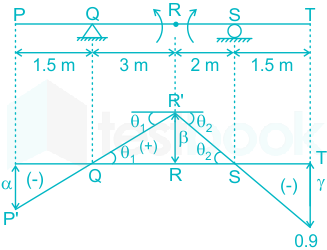
The value of any stress function can be found by drawing a qualitative ILD using the Muller-Breslau principle.

The Muller Breslau Principle for determinate structure states that the ordinate value of an influence line for any stress function on any structure is proportional to the ordinates of the deflected shape that is obtained by removing the restraint offered to correspond to the stress function from the structure and introducing a force that causes a unit displacement in the positive direction.

Given:

This is a determinate structure over which a UDL of 50 kN/m moves. The maximum negative moment is found by drawing ILD for the moment at R.

Using, the Muller-Breslau Principle, ILD is as shown:

θ1 + θ2 = 1 units

for small θ, tan θ ≈ sin θ ≈ θ

In ΔQRR’ and SRR’,

β3+β2=1β=1.2 units\frac{\beta }{3}+\frac{\beta }{2}=1\Rightarrow \beta =1.2~units

Again, ΔPQP’ and ΔQRR’ are similar

β3=α1.5α=0.6 units\therefore \frac{\beta }{3}=\frac{\alpha }{1.5}\Rightarrow \alpha =0.6~units

ΔSTT’ and ΔSRR’ are similar

γ1.5=β2γ=0.9 units\therefore \frac{\gamma }{1.5}=\frac{\beta }{2}\Rightarrow \gamma =0.9~units

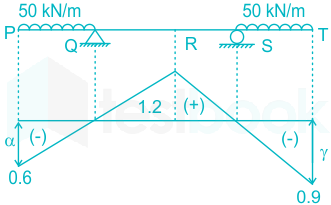
For the maximum negative moment, the UDL should lie from P to Q and from S to T.

Maximum negative bending moment =

50×[12×0.6×1.5]+50 [12×0.9×1.5] 50\times \left[ \frac{1}{2}\times 0.6\times 1.5 \right]+50~\left[ \frac{1}{2}\times 0.9\times 1.5 \right]~ = 56.25 kN/m

Important Points

To find out the value of stress function due to point loads we draw the ILD for that stress function and find out the ordinate of ILD at the location of the points load and the value of stress function is obtained by multiplying the ordinate of ILD with the value of point load and summed up.

The value of the stress function for UDL is obtained by multiplying the area under the ILD for stress function within the range of UDL with the load intensity (w).

39

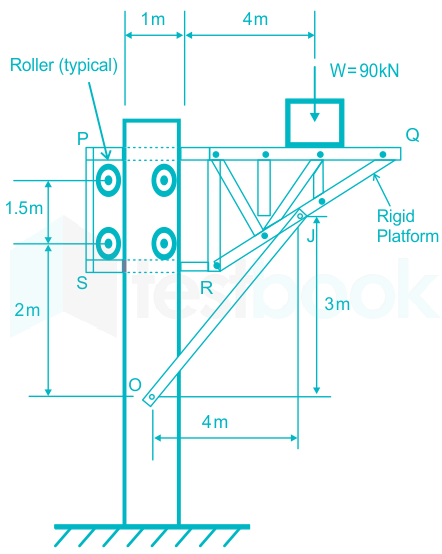
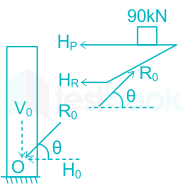
A rigid weightless platform PQRS shown in the figure (not drawn to the scale) can slide freely in the vertical direction. The platform is held in position by the weightless member OJ and four weightless, frictionless rollers. Points O and J are pin connections. A block of 90 kN rests on the platform as shown in the figure.

The magnitude of horizontal component of reaction (in kN) at pin O, is f

  1. ((a))

    90

  2. ((b))

    120

  3. ((c))

    150

  4. ((d))

    180

Show Answer
Answer: ((b))

120

Explanation:

Drawing FBD of the given frame –

sinθ=35;;and;cosθ=45\sin \theta = \frac{3}{5};;and;\cos \theta = \frac{4}{5}

For vertical equilibrium of the frame,

∑ Fy = 0 ⇒ R0 sin θ – 90 = 0

R0=903×5=150;kN \Rightarrow {R_0} = \frac{{90}}{3} \times 5 = 150;kN

At point O, the horizontal component of reaction,

H0=R0cosθ=150×45=120;kN{H_0} = {R_0}\cos \theta = 150 \times \frac{4}{5} = 120;kN

Important Points

  • The equilibrium of the structure is decided based on external force only. The internal member forces do not impact the equilibrium of the structure.
40

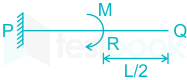
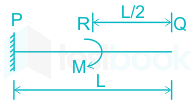
A cantilever beam PQ of uniform flexural rigidity (EI) is subjected to a concentrated moment M at R as shown in the figure.

The deflection at the free end Q is

  1. ((a))

    ML26EI\frac{{M{L^2}}}{{6EI}}

  2. ((b))

    ML24EI\frac{{M{L^2}}}{{4EI}}

  3. ((c))

    3ML28EI\frac{{3M{L^2}}}{{8EI}}

  4. ((d))

    3ML24EI;\frac{{3M{L^2}}}{{4EI;}}

Show Answer
Answer: ((c))

3ML28EI\frac{{3M{L^2}}}{{8EI}}

Concept:

Beam or frame only bends in the region where bending moment acts.

In the given beam RQ will not bend as there is no bending moment in this zone and hence it will not show any curvature.

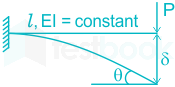
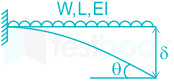
δ=P33EI,;;θ=P22EI\delta = \frac{{P{\ell ^3}}}{{3EI}},;;\theta = \frac{{P{\ell ^2}}}{{2EI}}

Calculation:

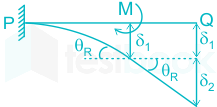
The deflected curve of the beam can be

δQ = δ1 + δ2

Using standard results,

δ1=M(L2)22EI=ML28EI{\delta _1} = \frac{{M{{\left( {\frac{L}{2}} \right)}^2}}}{{2EI}} = \frac{{M{L^2}}}{{8EI}}

δ2=θRL2=M(L2)EI×L2=ML24EI{\delta _2} = {\theta _R} \cdot \frac{L}{2} = \frac{{M\left( {\frac{L}{2}} \right)}}{{EI}} \times \frac{L}{2} = \frac{{M{L^2}}}{{4EI}}

δQ=δ1+δ2=ML28EI+ML24EI=3ML28EI \Rightarrow {\delta _Q} = {\delta _1} + {\delta _2} = \frac{{M{L^2}}}{{8EI}} + \frac{{M{L^2}}}{{4EI}} = \frac{{3M{L^2}}}{{8EI}}

Important Points

Deflection calculations using standard results:

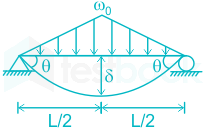
δ=W48EI,;θ=W36EI\delta = \frac{{W{\ell ^4}}}{{8EI}},;\theta = \frac{{W{\ell ^3}}}{{6EI}}
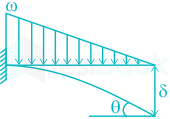
δ=ω0430EI;;θ=ω0324;EI\delta = \frac{{{\omega _0}{\ell ^4}}}{{30EI}};;\theta = \frac{{{\omega _0}{\ell ^3}}}{{24;EI}}
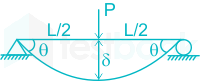
δ=P348EI;;θ=P216EI\delta = \frac{{P{\ell ^3}}}{{48EI}};;\theta = \frac{{P{\ell ^2}}}{{16EI}}
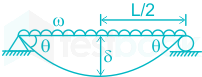
δ=5384ω4EI;;;;;θ=ω324EI\delta = \frac{5}{{384}}\frac{{\omega {\ell ^4}}}{{EI}};;;;;\theta = \frac{{\omega {\ell ^3}}}{{24EI}}
δ=ω0L4120EI;;θ=5192ω03EI\delta = \frac{{{\omega _0}{L^4}}}{{120EI}};;\theta = \frac{5}{{192}}\frac{{{\omega _0}{\ell ^3}}}{{EI}}
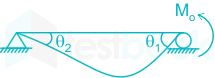
θ1=M03EI;;θ2=M06EI{\theta _1} = \frac{{{M _0}\ell }}{{3EI}};;{\theta _2} = \frac{{{M _0}\ell }}{{6EI}}
θ=M04EI\theta = \frac{{{M _0}\ell }}{{4EI}}
δ=14[P348EI]\delta = \frac{1}{4}\left[ {\frac{{P{\ell ^3}}}{{48EI}}} \right]
δ=15[5384ω04EI]\delta = \frac{1}{5}\left[ {\frac{5}{{384}}\frac{{{\omega _0}{\ell ^4}}}{{EI}}} \right]
41

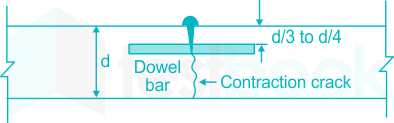
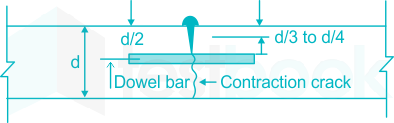
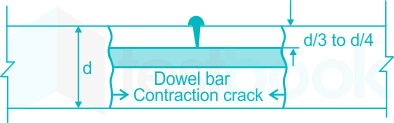
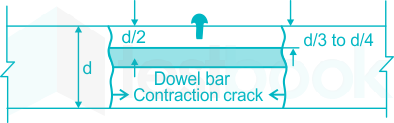
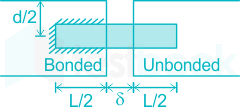
A dowel bar is placed at a contraction joint. When contraction occurs, the concrete slab cracks at predetermined location(s). Identify the arrangement, which shows the correct placement of dowel bar and the place of occurrence of the contraction crack(s).

  1. ((a))

  2. ((b))

  3. ((c))

  4. ((d))

Show Answer
Answer: ((b))

Concept:

Various type of joints provided in the cement concrete pavement are:-

  1. Expansion joints 2) Contraction joints 3) Construction joints

Contraction joints:

It is provided to control crack due to shrinkage and moisture variation. To regulate the cracks or to determine that the cracks form at the predetermined location, the slab is weakened at certain intervals. These locations are called contraction joints.

  • Dowel bars are provided as load transfer devices across transverse joints and they tend to keep the two pavement slabs at same right. They are bonded on one side and free on the other side.
  • Various stresses that develop in a dowel bar are:-


(a) Shearing stress (b) Bending stress (c) Bearing stress

The contraction cracks appear near the centre of the dowel bars. Hence the most correct description is shown in option.

Important Points

Expansion joint: These are provided to allow the expansion of pavement due to a rise in temperature with respect to construction temperature.

The maximum spacing between the expansion joint is 140 m.


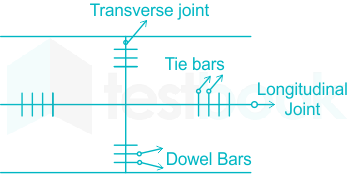
Generally, tie bars are provided at the longitudinal joints. Tie bars are not designed as load transfer devices but ensure that the two slabs remain firmly together. The load is transferred to the adjacent slab by the aggregate interlock.


Dowel bars: They are the load-bearing devices provided at transverse joints.

Tie Bars: They are not load-bearing devices and provided at longitudinal joints.

42

The relationship between traffic flow rate (q) and density (D) is shown in the fugure

The shock wave condition is depicted by

  1. ((a))

    flow with respect to point 1 (q1= qmax)

  2. ((b))

    flow changing from point 2 to point 6 (q2 > q6)

  3. ((c))

    flow changing from point 3 to point 7 (q3 < q7)

  4. ((d))

    flow with respect to point 4 and point 5 (q4 = q5)

Show Answer
Answer: ((b))

flow changing from point 2 to point 6 (q2 > q6)

Concept:

The phenomenon of backing and queueing up on a highway due to sudden reduction in the capacity of the highway due to accident, reduction in the number of lanes due to bridgework, etc is known as Bottleneck condition.

When such a condition exists, and the normal flow is relatively large the speed of the vehicles must be reduced while passing the bottleneck which is approximately noted by turning on of the brake lights of the vehicle which is observed to move upstream as traffic continues to reach this vicinity of the bottleneck. This is called Shockwave in the traffic stream. 

Here the decreasing flow from q2 to q6 depicts the Shockwave condition.

43

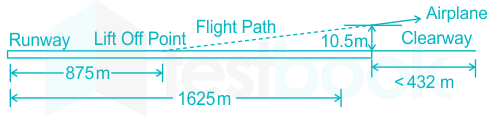
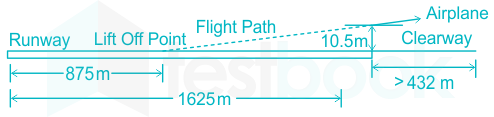
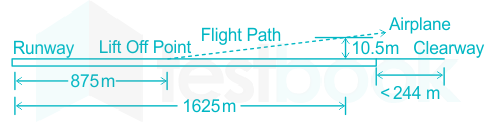
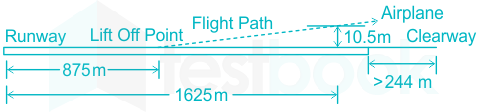
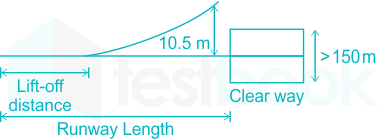
The appropriate design length of a clearway is calculated on the basis of ‘Normal Take-off condition. Which one of the following options correctly depicts the length of the clearway? (Note: None of the options are drawn to scale)

  1. ((a))

  2. ((b))

  3. ((c))

  4. ((d))

Show Answer
Answer: ((a))

Concept:

Clearway:

  • An area beyond the end of the runway, centrally located along the extended centreline of the runway and not less than 150 m in width is known as clearway.
  • Provided as a precautionary measure against engine failure.
  • Clearway length < 0.5 (1.15 × Take off distance - 1.15 × Lift off distance)


The basic runway length is affected by the following factors:

  1. Aircraft characteristics: The most critical aircraft is identified and its take-off and landing weight is noted to find the runway length.

  2. Maximum of the three conditions -

(a) Normal take-off case

(b) Normal landing case

(c) Emergency stop case

  1. Elevation of Airport and Airport Reference Temperature.

(4) The gradient of the Airport.

a) Normal Takeoff case:-

  • Runway length + Clearway = Take-off distance
  • Take off Distance ≥ 115% of Runway length.
  • Width of clear way must be > 150 m.

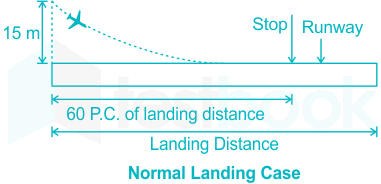
b) Normal Landing case: The landing case requires that aircraft should come to stop within 60% of the landing distance. The runway of full-strength pavement is provided for the entire landing distance.

Calculation:

As per the considerations given above for the normal take-off case -

Clearway ≤ 12×(1.15×takeoff;distance1.15×liftoff;distance)\frac{1}{2} \times \left( {1.15 \times {\rm{takeoff;distance}} - 1.15 \times {\rm{liftoff;distance}}} \right) 

12×(1.15×16251.15×875)\le \frac{1}{2} \times \left( {1.15 \times 1625 - 1.15 \times 875} \right) ≤ 431.25 m

44

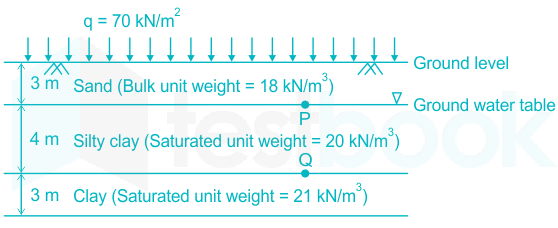
The soil profile at a site up to a depth of 10 m is show in the figure (not drawn to the scale). The soil is preloaded with a uniform surcharge (q) of 70 kN/m2 at the ground level. The water table is at a depth of 3 m below ground level. The soil unit weight of the respective layers is shown in the figure. Consider unit weight of water as 9.81 kN/m3 and assume that the surcharge (q) is applied instantaneously

Immediately after preloading, the effective stresses (in kPa) at points P and Q, respectively, are

  1. ((a))

    124 and 204

  2. ((b))

    36 and 90

  3. ((c))

    36 and 126

  4. ((d))

    54 and 95

Show Answer
Answer: ((d))

54 and 95

Concept:

As the external pressure is applied instantaneously, the soil particles try to occupy positions closer together but as the soil solids and water is incompressible and there is lateral confinement, the readjustment is not possible without expulsion of pore water.

Thus the water is resisting the particle rearrangement and hence excess pore water pressure builds above the static pore water pressure.

∴ Immediately i.e. at t = 0, all of the surcharge load is taken by pore water pressure.

Calculation:

At point P,

Total stress (σ) = q + γtsand × 3

⇒ σ = 70 + 18 × 3 = 124 kN/m2

Pore water Pressure (u) = (Static + Excess) ⇒ u = (0 + 70) = 70 kN/m2

∴ Effective stress (σ̅) = σ - u = 124 - 70 = 54 kN/m2

At point Q,

Total stress (σ) = q + γtsand × 3 + γsat clay × 4

⇒ σ = 70 + 18 × 3 + 20 × 4 = 204 kN/m3

Pore water pressure (u) = static + Excess ⇒ u = 4γw + 70 = 4 × 9.81 + 70 = 109.24

∴ Effective stress (σ̅) = σ - u = 204 - 109.24 = 94.76 kN/m2

Important Points

  • If in place of loading, unloading occurs then there is a negative excess pore water pressure developed at t = 0.
  • In the long term, all of this excess pore water pressure dissipates and is transferred to effective stress.
  • Because effective stress increases a long time after the surcharge application, hence stability in loading is checked long after the application of the load and in case of unloading, it is checked immediately after load removal.
  • Effective stress is a parameter on which compressibility consolidation, settlement, shear strength and bearing capacity depends directly. These parameters do not depend on total stress.
  • Total stress is a physical parameter because its value can be measured using a pressure cell whereas effective stress is not a physical parameter.
45

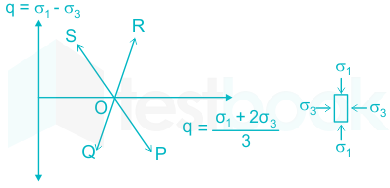
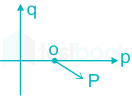
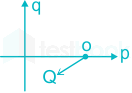
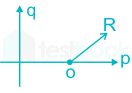
The total stress paths corresponding to different loading conditions, for a soil specimen under the isotropically consolidated stress state (O), are shown below :

Stress PathLoading Condition
OPI-Compression loading (σ1 - increasing ; σ3 - constant)
OQII - Compression unloading (σ1 - constant; σ3 - decreasing)
ORIII - Extension unloading (σ1 - decreasing; σ3 constant)
OSIV - Extension loading (σ1 - constant; σ3 - increasing)


The correct match between the stress path and the listed loading conditions is

  1. ((a))

    OP - I, OQ - II, OR - IV, OS - III

  2. ((b))

    OP - IV, OQ - III, OR - I, OS - II

  3. ((c))

    OP - III, OQ - II, OR - I, OS - IV

  4. ((d))

    OP - I, OQ - III, OR - II, OS - IV

Show Answer
Answer: ((b))

OP - IV, OQ - III, OR - I, OS - II

Concept:

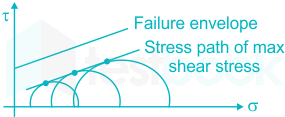
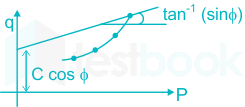
Stress Path: Stress path is the locus of all points depicting a specific stress state as loading gradually progresses through various states of failure.

  • By knowing the stress path, one knows what kind of stress history the soil has gone through and what has lead to failure. Knowledge of this throws insight into the behaviour of soil on loading and how it generally tends towards failure.


STRESS PATH FOR UNLOADING

  • Stress path may be drawn in terms of total stress or effective stress.
  • Maximum stress path is generally made to represent the behaviour of soil and it is generally plotted on a p-q plot.


OP- Extension loading

σ1 - constant; σ3 - increasing


σ1{\sigma _1}101010
σ3{\sigma _3}102030
q=σ1σ3q = {\sigma _1} - {\sigma _3}0-10-20
p=σ1+2;σ33p = \frac{{{\sigma _1} + 2;{\sigma _3}}}{3}1050/370-3


OQ- Extension unloading

σ1 decreasing ; σ3 = constant


σ1{\sigma _1}1050
σ3{\sigma _3}101010
q=σ1σ3q = {\sigma _1} - {\sigma _3}0-5-10
p=σ1+2;σ33p = \frac{{{\sigma _1} + 2;{\sigma _3}}}{3}1053- \frac{5}{3}203- \frac{{20}}{3}


OR- Compression loading

σ1 increasing ; σ3 = constant

σ1{\sigma _1}102030
σ3{\sigma _3}101010
q=σ1σ3q = {\sigma _1} - {\sigma _3}01020
p=σ1+2;σ33p = \frac{{{\sigma _1} + 2;{\sigma _3}}}{3}10403\frac{{40}}{3}503\frac{{50}}{3}


OS- Compression unloading

σ1 constant; σ3 decreasing

σ1{\sigma _1}101010
σ3{\sigma _3}1050
q=σ1σ3q = {\sigma _1} - {\sigma _3}0510
p=σ1+2;σ33p = \frac{{{\sigma _1} + 2;{\sigma _3}}}{3}10203\frac{{20}}{3}103\frac{{10}}{3}


Important Points

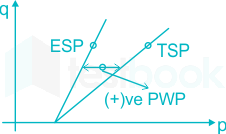
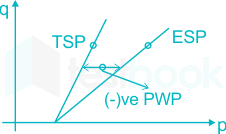
Effective stress path & Total stress path:

The horizontal distance between the two stress paths is the value of pore water pressure.

σˉ1=σ1=u{\bar \sigma _1} = {\sigma _1} = u

σˉ3=σ3u{\bar \sigma _3} = {\sigma _3} - u

(σˉ1σˉ32)=(σ1σ32)\Rightarrow \left( {\frac{{{{\bar \sigma }_1} - {{\bar \sigma }_3}}}{2}} \right) = \left( {\frac{{{\sigma _1} - {\sigma _3}}}{2}} \right)

σˉ1+σˉ32=σ1+σ32u\frac{{{{\bar \sigma }_1} + {{\bar \sigma }_3}}}{2} = \frac{{{\sigma _1} + {\sigma _3}}}{2} - u

u=σ1+σ32σˉ1+σˉ32\Rightarrow u = \frac{{{\sigma _1} + {\sigma _3}}}{2} - \frac{{{{\bar \sigma }_1} + {{\bar \sigma }_3}}}{2} 

46

Water flows at the rate of 12 m3/s in a 6 m wide rectangular channel. A hydraulic jump is formed in the channel at a point where the upstream depth is 30 cm (just before the jump). Considering acceleration due to gravity as 9.81 m/s2 and density of water as 1000 kg/m3, the energy loss in the jump is

  1. ((a))

    114.2 kW

  2. ((b))

    114.2 MW

  3. ((c))

    141.2 h.p

  4. ((d))

    141.2 j/s

Show Answer
Answer: ((a))

114.2 kW

Concept:

A hydraulic jump is formed when the supercritical flow conditions change to subcritical flow. This results in the loss of energy of the flow.

Supercritical stream jumps and tries to meet the alternate depth but due to losses it fails to achieve alternate depth and settles for a depth y2, less than called conjugate depth of y1. Hence y1 and y2 are called conjugate depths.

Considering the channels as horizontal and frictionless and energy is lost only in hydraulic jump, the relationship between conjugate depths are given as -

y2y1=1+8;Fr1212;or;y1y2=1+8Fr2212\frac{{{y_2}}}{{{y_1}}} = \frac{{\sqrt {1 + 8;F_{r1}^2} - 1}}{2};or;\frac{{{y_1}}}{{{y_2}}} = \frac{{\sqrt {1 + 8F_{r2}^2} - 1}}{2}

These equations are called Belanger’s momentum equation.

Also, energy loss in the hydraulic jump in a horizontal frictionless channel is given as:

EL=(y2y1)34y1y2{E_L} = \frac{{{{\left( {{y_2} - {y_1}} \right)}^3}}}{{4{y_1}{y_2}}}

Calculation

Given:

Q = 120 m3/s, B = 6m, y1 = 30 cm

Fr12=Q2TgA3=1202×69.81×(6×0.3)3=15.10\therefore F_{r1}^2 = \frac{{{Q^2}T}}{{g{A^3}}} = \frac{{{{120}^2} \times 6}}{{9.81 \times {{\left( {6 \times 0.3} \right)}^3}}} = 15.10

By using Belanger’s momentum equation,

y2y1=1+8×Fr1212\frac{{{y_2}}}{{{y_1}}} = \frac{{\sqrt {1 + 8 \times F_{r1}^2} - 1}}{2}

y20.3=1+8×15.1012y2=1.505;m\Rightarrow \frac{{{y_2}}}{{0.3}} = \frac{{\sqrt {1 + 8 \times 15.10} - 1}}{2} \Rightarrow {y_2} = 1.505;m

Hence energy loss:

EL=(y2y1)34y1y2=(1.5050.3)4×1.505×0.3=0.9697;m{E_L} = \frac{{{{\left( {{y_2} - {y_1}} \right)}^3}}}{{4{y_1}{y_2}}} = \frac{{\left( {1.505 - 0.3} \right)}}{{4 \times 1.505 \times 0.3}} = 0.9697;m

Converting the energy head loss to energy loss,

Energy loss = ρg × Q × EL

= 1000 × 9.81 × 12 × 0.9697 = 114.16 kW.


  • The above formula is applicable only in a horizontal, frictionless rectangular channel. For any other cross-section, momentum equation and continuity equation is used to derive the formula.
47

A water supply scheme transports 10 MLD (Million Litres per Day) water through a 450 mm diameter pipeline for a distance of 2.5 km. A chlorine dose of 3.50 mg/litre is applied at the starting point of the pipeline to attain a certain level of disinfection at the downstream end. It is decided to increase the flow rate from 10 MLD to 13 MLD in the pipeline. Assume exponent for concentration, n = 0.86. With this increased flow, to attain the same level of disinfection, the chlorine dose (in mg/litre) to be applied at the starting point should be

  1. ((a))

    3.95

  2. ((b))

    4.40

  3. ((c))

    4.75

  4. ((d))

    5.55

Show Answer
Answer: ((c))

4.75

Concept:

Chicks Watson Law:

Chemical inactivation of a specific species of microorganism is a function of disinfection concentration and contact time. Other important factors are the kind of disinfectant, temperature, pH, and the presence of suspended organic matter.

The rate equation for the inactivation of microorganism is given by Chicks-Watson Law

dNdt=K;Cn;N\frac{{dN}}{{dt}} = - K;{C^n};N

K = Rate constant which depends on the type of microorganism, the type of disinfectant and temperature

n = Constant for a particular microorganism and type of disinfectant

C = Disinfectant concentration (weight/volume)

N = Number of microorganism present at any time ‘t’

For the constant concentration of disinfectant,

dNN=KCndt\smallint \frac{{dN}}{N} = - K{C^n}\smallint dt

⇒ In N = -KCnt + C1

At t = 0, N = N0 ⇒ C1 = In N0

lnNN0=KCnt;;N=N0ekCnt\Rightarrow ln\frac{N}{{{N_0}}} = - K{C^n}t; \Rightarrow ;N = {N_0}{e^{ - k{C^n}t}}

For a particular degree of disinfection, NN0=\frac{N}{{{N_0}}} = constant

Cnt = constant

Calculation:

Given:

L1 = 2.5 km, A1=π4×0.452=0.159;m2,;Q1=10;MLD{A_1} = \frac{\pi }{4} \times {0.45^2} = 0.159;{m^2},;{Q_1} = 10;MLD

C1 = 3.50 mg/L

L2 = L1 = 2.5 kM, A2 = A1 = 0.159 m2, Q2 = 13 MLD

And n = 0.86 for both pipes

From the above equation Cn t = constant

C1nt1=C2nt2\Rightarrow C_1^n{t_1} = C_2^n{t_2}

C10.86×(L1V1)=C20.86;(L2V2)\Rightarrow C_1^{0.86} \times \left( {\frac{{{L_1}}}{{{V_1}}}} \right) = C_2^{0.86};\left( {\frac{{{L_2}}}{{{V_2}}}} \right)

C10.86×(L1×A1Q1)=C20.86(L2×A2Q2)\Rightarrow C_1^{0.86} \times \left( {\frac{{{L_1} \times {A_1}}}{{{Q_1}}}} \right) = C_2^{0.86}\left( {\frac{{{L_2} \times {A_2}}}{{{Q_2}}}} \right)

\(\Rightarrow C_{1}^{0.86}\times \frac{1}{{{Q}{1}}}=C{2}^{0.86}\times \frac{1}{{{Q}{2}}}~\left( \because {{L}{1}}={{L}{2}}~\And ~{{A}{1}}={{A}_{2}} \right)\)

\(\Rightarrow {{\left( \frac{{{C}{1}}}{{{C}{2}}} \right)}^{0.86}}=\frac{{{Q}{1}}}{{{Q}{2}}}\Rightarrow {{\left( \frac{3.5}{{{C}_{2}}} \right)}^{0.86}}=\frac{10}{13}\)

C2 = 4.75 mg/L

48

An open traverse PQRST is surveyed using a theodolite and the consecutive coordinates obtained are given in the table.

LineConsecutive Coordinates
Northing (m)Southing (m)Easting (m)Westing (m)
PQ110.2-45.5-
QR80.6--60.1
RS-90.7-70.8
ST-105.455.5-


If the independent coordinates (Nothing, Easting) of station P are (400 m, 200m), the independent coordinates (in m) of station T, are

  1. ((a))

    194.7, 370.1

  2. ((b))

    205.3, 429.9

  3. ((c))

    394.7, 170.1

  4. ((d))

    405.3, 229.9

Show Answer
Answer: ((c))

394.7, 170.1

Concept:

A traverse is a series of connected lines whose length and direction are measured in the field.

They are classified as -

(a) Open transverse: Starts from a point of known location and closes at another point of unknown location.

(b) Closed Traverse: Starts from a point of known location and closes at the same point or another point of known location

  • If closed at some point → Loop traverse
  • If closes at another point → Link traverse


Independent and consecutive coordinates:

  • Consecutive coordinates: Coordinates of endpoints of a line with respect to its initial point are called consecutive co-ordinate or dependent coordinates.
  • Independent coordinates: Coordinates of a point with respect to a common origin are called independent coordinates.

Latitude & Departure:            

  • Latitude: Latitude is the orthographic projection of a line on North-south meridian.
  • (+)ve ⇒ North
  • (-)ve ⇒ South
  • Departure: It is the orthographic projection of a line on the east-west meridian.
  • (+)ve → east
  • (-)ve → west

e.g. Latitude and departure of A:

LA= l1 cos θ1

DA= ℓ1 sin θ1

Total latitude or departure of any point = Latitude or departure of first point + Algebraic sum of latitude or departure of every line up to that point.

Calculation:

∑ ΔL = ∑ Northing - ∑ Southing = (110.2 + 80.6) - (90.7 + 105.2) = -5.3

∑ ΔD = ∑ Easting - ∑ Westing = (45.51 + 55.5) - (60.1 + 70.8)

= -29.9

∴ Independent coordinates of T are,

Northing = 400 + (-5.3) = 394.7 m

Easting = 200 + (-29.9) = 170.1 m.

49

If C represents a line segment between (0, 0, 0) and (1, 1, 1) in the Cartesian coordinate system, the value (expressed as an integer) of the line integral C[(y+z)dx+(x+z)dy+(x+y)dz]\int_{C} \left[ {(y + z)dx + (x + z)dy + (x + y)dz} \right] is________.

50

Consider the system of equations \(\left[ {\begin{array}{{20}{c}} 1&3&2\ 2&2&{ - 3}\ 4&4&{ - 6}\ 2&5&2 \end{array}} \right]\left[ {\begin{array}{{20}{c}} {{x_1}}\ {{x_2}}\ {{x_3}} \end{array}} \right] = \left[ {\begin{array}{*{20}{c}} 1\ 1\ 2\ 1 \end{array}} \right]\) The value of x3 (round off to the nearest integer), is ______.

51

A rigid, uniform, weightless, horizontal bar is connected to three vertical members P. Q and R as shown in the figure (not drawn to the scale). All three members have identical axial stiffness of 10 kN/mm. The lower ends of bars P and R rest on a rigid horizontal surface. When NO load is applied. a gap of 2 mm exists between the lower end of the bar Q and the rigid horizontal surface. When a vertical load W is placed on the horizontal bar in the downward direction, the bar still remains horizontal and gets displaced by 5 mm in the vertically downward direction.

The magnitude of load W (in kN, round off to the nearest integer), is

52

The flange and web plates of the doubly symmetric built-up section are connected by continuous 10 mm thick fillet welds as shown in the figure (not drawn to the scale). The moment of inertia of the section about its principal axis X—-X is 7.73 x 106 mm4. The permissible shear stress in the fillet welds is 100 N/mm2. The design shear strength of the section is governed by the capacity of the fillet welds.

The maximum shear force (in kN, round of to one decimal place) that can be carried by the section, is

53

The singly reinforced concrete beam section shown in the figure (not drawn to the scale) is made of M25 grade concrete and Fe500 grade reinforcing steel. The total cross-sectional area of the tension steel is 942 mm2

As per Limit State Design of IS 456:2000, the design moment capacity (in kN.m, round off to two decimal places) of the beam section, is ,

54

A simply supported prismatic concrete beam of rectangular cross-section, having a span of 8 m. is prestressed with an effective prestressing force of 600 kN. The eccentricity of the prestressing tendon is zero at supports and varies linearly to a value of 'e' at the mid-span. In order to balance an external concentrated load of 12 kN applied at the mid-span, the required value of e (in mm, round off to the nearest integer) of the tendon, is

55

Traffic volume count has been collected on a 2-lane road section which needs up-gradation due to severe traffic flow conditions. Maximum service flow rate per lane is observed as 1280 veh/h at level of service "C”. The Peak Hour Factor is reported as 0.78125. Historical traffic volume count provides Annual Average Daily Traffic as 12270 veh/day. Directional split of the traffic flow is observed to be 60:40. Assuming that traffic stream consists of ‘All Cars’ and all drivers are ‘Regular Commuters’, the number of the extra lanes (s) (round off to the next higher integer) to be provided, is

56

A vertical retaining wall of 5 m height has to support soil having unit weight of 18 kN/m3, effective cohesion of 12 kN/m2. and effective friction angle of 30°. As per Rankine’s earth pressure theory and assuming that a tension crack has occurred, the lateral active thrust on the wall per meter length (in kN/m, round off to two decimal places), is

57

Water flows in the upward direction in a tank through 2.5 m thick sand layer as shown in the figure. The void ratio and specific gravity of sand are 0.58 and 2.7, respectively. The sand is fully saturated. Unit weight of water is 10 kN/m3

The effective stress (in kPa, round off to two decimal places) at point A, located1 m above the base of tank, is

58

A 10 m thick clay layer is resting over a 3 m thick sand layer and is submerged.

A fill of 2 m thick sand with unit weight of 20 kN/m3 is placed above the clay layer to accelerate the rate of consolidation of the clay layer. Coefficient of consolidation of clay is 9 × 10⁻² m2/year and coefficient of volume compressibility of clay is 2.2 × 10⁻⁴ m2 /KN. Assume Taylor’s relation between time factor and average degree of consolidation.


The settlement (in mm. round off to two decimal places) of the clay layer, 10 years after the construction of the fill, is

59

Three reservoirs P, Q, and R are interconnected by pipes as shown in the figure (not drawn to the scale). Piezometric head at the junction S of the pipes is 100 m. Assume acceleration due to gravity as 9.81 m/s2 and density of water as 1000 kg/m3. The length of the pipe from junction S to the inlet of reservoir R is 180 m.

Considering head loss only due to friction (with friction factor of 0.03 for all the pipes), the height of water level in the lowermost reservoir R (in m, round off to one decimal place) with respect to the datum, is

60

In a homogenous unconfined aquifer of area 3.00 km2, the water table was at an elevation of 102.00 m. After a natural recharge of a volume of 0.90 million cubic meters (Mm3), the water table rose to 103.20 m. After this recharge, groundwater pumping took place and the water table dropped down to 101.20 m. The volume of groundwater pumped after the natural recharge. expressed (in Mm3 and round off to two decimal places), is

61

A circular water tank of 2 m diameter has a circular orifice of diameter 0.1 m at the bottom. Water enters the tank steadily at a flow rate of 20 litre/s and escapes through the orifice. The coefficient of discharge of the orifice is 0.8. Consider the acceleration due to gravity as 9.81 m/s2 and neglect frictional losses. The height of the water level (in m, round off to two decimal places) in the tank at the steady state is ,

62

Surface Overflow Rate (SOR) of a primary settling tank (discrete settling) Is 20000 litre/m2 per day. Kinematic viscosity of water in the tank is 1.01 × 10⁻² cm2/s. The specific gravity of the settling particles is 2.64. Acceleration due to gravity is 9.81 m/s2. The minimum diameter (in μm, round off to one decimal place) of the particles that will be removed with 80% efficiency in the tank, is

63

A gaseous chemical has a concentration of 41.6 μmol/m3 in air at 1 atm pressure and temperature 293 K. The universal gas _ constant R is 82.05 × 10⁻⁶ (m3 atm)(mol K). Assuming that ideal gas law is valid, the concentration of the gaseous chemical (in ppm, round off to one decimal place), is

64

A stream with a flow rate of 5 m3/s is having an ultimate BOD of 30 mg/litre. A wastewater discharge of 0.20 m3/s having BOD5 of 500 mg/litre joins the stream at a location and instantaneously gets mixed up completely. The cross-sectional area of the stream is 40 m2 which remains constant. BOD exertion rate constant is 0.3 per day (logarithm base to e). The BOD (in mg/litre, round off to two decimal places) remaining at 3 km downstream from the mixing location, is

65

The lengths and bearings of a traverse PQRS are:

SegmentLength(m)Bearing
PQ4080°
QR5010°
RS30210°


The length of line segment SP (in m, round off to two decimal places), is

Attempt this paper under real exam conditions

Timed interface, section switching, instant scoring, and question-by-question analytics — free.

Start Timed Attempt