Official Paper

GATE CE 2019 Official Paper: Shift 1 (Previous Year Paper)

65 questions · 180 minutes · with answers · free

General Aptitude (10 questions)

1

The lecture was attended by quite ________ students, so the hall was not very ________.

  1. ((a))

    a few, quite

  2. ((b))

    few, quiet

  3. ((c))

    a few, quiet

  4. ((d))

    few, quite

Show Answer
Answer: ((c))

a few, quiet

Correct answer: 3.

A few is the correct answer.

Few is a quantifier used in regards with plural countable nouns.Without the article “a,” few emphasizes a small number of something.Adding the article removes the emphasis—a few means some.

Quiet means silent and hence it is the correct answer.

2

They have come a long way in _______ trust among the users.

  1. ((a))

    creating

  2. ((b))

    created

  3. ((c))

    creation

  4. ((d))

    create

Show Answer
Answer: ((a))

creating

Correct answer: 1.

The sentence requires the -ing form of create in order to make it correct. We generally use continuous aspect: for something happening before and after a given time.

3

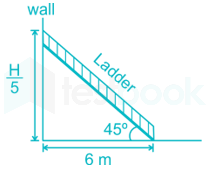
On a horizontal ground, the base of a straight ladder is 6 m away from the base of a vertical pole. The ladder makes an angle of 45° to the horizontal. If the ladder is resting at a point located at one-fifth of the height of the pole from the bottom, the height of the pole is ________ meters.

  1. ((a))

    15

  2. ((b))

    25

  3. ((c))

    30

  4. ((d))

    35

Show Answer
Answer: ((c))

30

A ladder is 6 m away from the base.

tan45=Opposite;SideAdjacent;Side1=H561=H30\tan 45^\circ = \frac{{{\rm{Opposite;Side}}}}{{{\rm{Adjacent;Side}}}} \Rightarrow 1 = \frac{{\frac{H}{5}}}{6} \Rightarrow 1 = \frac{H}{{30}}

∴ H = 30 m

∴ Height of Pole is 30 meters.

4

If E = 10; J = 20; O = 30; and T = 40, what will be P + E + S + T?

  1. ((a))

    51

  2. ((b))

    82

  3. ((c))

    120

  4. ((d))

    164

Show Answer
Answer: ((c))

120

Sequence wise alphabetical code:

A = 1, B = 2, C = 3, D = 4, E = 5, F = 6, G = 7, H = 8, I = 9, J = 10, K = 11, L = 12, M = 13, N = 14, O = 15, P = 16, Q = 17, R = 18, S = 19, T = 20, U = 21, V = 22, W = 23, X = 24, Y = 25, and Z = 26

From above: E = 5, J = 10, O = 15, T = 20

But the given statement is: E = 10, J = 20, O = 30, T = 40

∴ Every value obtained must be multiplied by 2 to get the answer.

P + E + S + T = 2 × [16 + 5 + 19 + 20] = 120

5

The CEO’s decision to quit was as shocking to the Board as it was to _______.

  1. ((a))

    I

  2. ((b))

    me

  3. ((c))

    my

  4. ((d))

    myself

Show Answer
Answer: ((b))

me

The correct answer is 'me'

Key Points

  • The correct answer is 'me'
  • In the given sentence, the usage of 'to' means we need to use a prepositional object and that will be a noun/pronoun. According to the options we need to use a pronoun in an objective case.
  • Let's see an example-
  • To tell you the truth, I'm tired of listening to politicians tell us lies. ("politicians" is a noun and "to" is a preposition.)

Hence, the correct sentence is- The CEO’s decision to quit was as shocking to the Board as it was to me.

6

The new cotton technology, Bollgard-II, with herbicide tolerant traits has developed into a thriving business in India. However, the commercial use of this technology is not legal in India. Notwithstanding that, reports indicate that the herbicide tolerant Bt cotton had been purchased by farmers at an average of Rs. 200 more than the control price of ordinary cotton and planted in 15% of the cotton growing area in the 2017 Kharif season.

Which one of the following statements can be inferred from the given passage?

  1. ((a))

    Farmers want to access the new technology if India benefits from it

  2. ((b))

    Farmers want to access the new technology even if it is not legal

  3. ((c))

    Farmers want to access the new technology for experimental purposes

  4. ((d))

    Farmers want to access the new technology by paying high price

Show Answer
Answer: ((b))

Farmers want to access the new technology even if it is not legal

The paragraph mentions how farmers are trying to purchase the new technology despite its commercial use being illegal in India. Hence, option 2 is the correct answer. 

There is no mention of any benefits of the new technology to India or the farmers' desire to use the new technology experimentally. Therefore, options 1 and 3 cannot be inferred.

Option 4 is false as there is no mention of the willingness of farmers to pay a high price for the new technology.

7

In a sports academy of 300 people, 105 play only cricket, 70 play only hockey, 50 play only football, 25 play both cricket and hockey, 15 play both hockey and football and 30 play both cricket and football. The rest of them play all three sports. What is the percentage of people who play at least two sports?

  1. ((a))

    23.30

  2. ((b))

    25.00

  3. ((c))

    28.00

  4. ((d))

    50.00

Show Answer
Answer: ((b))

25.00

Total players = 300

Count for players playing at least two sports = Total Player – (Player playing only one sport)

Count for players playing at least two sports = 300 – [Player playing only cricket + Player playing only hockey + Player playing only football]

Count for players playing at least two sports = 300 − [105 + 70 + 50] = 75 players

∴ % of players playing at least two sports = 75300×100=25%\frac{{75}}{{300}} \times 100 = 25\%

Important Point:

Below formula can be used to compute any data for the given questions set.

Total players = Player playing only cricket + Player playing only hockey + Player playing only football + Player playing both hockey and cricket + Player playing both football and cricket + Player playing both hockey and football – 2 × (Player playing all three games)

8

“The increasing interest in tribal characters might be a mere coincidence, but the timing is of interest. None of this, though, is to say that the tribal hero has arrived in Hindi cinema, or that the new crop of characters represents the acceptance of the tribal character in the industry. The films and characters are too few to be described as a pattern.”

What does the word ‘arrived’ mean in the paragraph above?

  1. ((a))

    reached a terminus

  2. ((b))

    came to a conclusion

  3. ((c))

    attained a status

  4. ((d))

    went to a place

Show Answer
Answer: ((c))

attained a status

Explanation:

Correct answer: 3

The sentence implies that the tribal hero, hitherto unrecognized in Hindi cinema, has now arrived on the big stage. He is now a specimen of inquiry, of wonder, and of discussion.

Hence the correct meaning of 'arrived' here is attained a status.

9

A square has sides 5 cm smaller than the sides of a second square. The area of the larger square is four times the area of the smaller square. The side of the larger square is ______ cm.

  1. ((a))

    18.50

  2. ((b))

    15.10

  3. ((c))

    10.00

  4. ((d))

    8.50

Show Answer
Answer: ((c))

10.00

Given:

The side of small square is 5 cm less than larger one.

Area of large square is 4 times of area of small square.

Let,

Side of large square = x

side of small square = x - 5

∵ Area of large square = 4 × Area of small square

⇒ x2 = 4 × (x - 5)2

⇒ x2 = 4 (x2 - 10x + 25)

⇒ 3x2 - 40x + 100 = 0

⇒ 3x2 - 30x - 10x + 100 = 0

⇒ 3 × (x - 10) – 10 × (x - 10) = 0

⇒ x - 10 = 0; 3x - 10 = 0

∴ x = 10 or x = 10/3 = 3.33

But x = 3.33 gives negative value of side of smaller square.

∴ x = 10 cm

10

P, Q, R, S and T are related and belong to the same family. P is the brother of S. Q is the wife of P. R and T are the children of the siblings P and S respectively. Which one of the following statements is necessarily FALSE?

  1. ((a))

    S is the aunt of R

  2. ((b))

    S is the aunt of T

  3. ((c))

    S is the sister-in-law of Q

  4. ((d))

    S is the brother of P

Show Answer
Answer: ((b))

S is the aunt of T

From the given information,

Let's check each of the options:

1) S is the aunt of R → Cannot be determined (as the gender of S is not known, it is possible but not definite)

2) S is the aunt of T → Necessarily False (as S is the parent of T)

3) S is the sister-in-law of Q → Cannot be determined (as the gender of S is not known, it is possible but not definite)

4) S is the brother of P → Cannot be determined (as the gender of S is not known, it is possible but not definite).

Hence, the correct answer is S is the aunt of T''.

Civil Engineering (55 questions)

11

Which of one of the following is correct?

  1. ((a))

    \(\begin{array}{{20}{c}} {{\rm{lim}}}\ {x \to 0} \end{array};\left( {\frac{{\sin 4x}}{{\sin 2x}}} \right) = 1;and;\begin{array}{{20}{c}} {{\rm{lim}}}\ {x \to 0} \end{array};\left( {\frac{{\tan ;x}}{x}} \right) = 1\)

  2. ((b))

    \(\begin{array}{{20}{c}} {{\rm{lim}}}\ {x \to 0} \end{array};\left( {\frac{{\sin 4x}}{{\sin 2x}}} \right) = \infty ;and;\begin{array}{{20}{c}} {{\rm{lim}}}\ {x \to 0} \end{array};\left( {\frac{{\tan ;x}}{x}} \right) = 1\)

  3. ((c))

    \(\begin{array}{{20}{c}} {{\rm{lim}}}\ {x \to 0} \end{array};\left( {\frac{{\sin 4x}}{{\sin 2x}}} \right) = 2;and;\begin{array}{{20}{c}} {{\rm{lim}}}\ {x \to 0} \end{array};\left( {\frac{{\tan ;x}}{x}} \right) = \infty \)

  4. ((d))

    \(\begin{array}{{20}{c}} {{\rm{lim}}}\ {x \to 0} \end{array};\left( {\frac{{\sin 4x}}{{\sin 2x}}} \right) = 2;and;\begin{array}{{20}{c}} {{\rm{lim}}}\ {x \to 0} \end{array};\left( {\frac{{\tan ;x}}{x}} \right) = 1\)

Show Answer
Answer: ((d))

\(\begin{array}{{20}{c}} {{\rm{lim}}}\ {x \to 0} \end{array};\left( {\frac{{\sin 4x}}{{\sin 2x}}} \right) = 2;and;\begin{array}{{20}{c}} {{\rm{lim}}}\ {x \to 0} \end{array};\left( {\frac{{\tan ;x}}{x}} \right) = 1\)

Concept:

We have following shortcuts for Limit’s Chapter:

\(\begin{array}{{20}{c}} {{\rm{lim}}}\ {x \to 0} \end{array};\left( {\frac{{\tan ;x}}{x}} \right) = 1;& ;\begin{array}{{20}{c}} {{\rm{lim}}}\ {x \to 0} \end{array};\left( {\frac{{\sin ;x}}{x}} \right) = 1\)

Calculation:

\(\begin{array}{*{20}{c}} {{\rm{lim}}}\ {x \to 0} \end{array};\frac{{\sin 4x}}{{\sin 2x}} = \left( {\frac{0}{0}} \right)form;\)

\( = \begin{array}{*{20}{c}} {{\rm{lim}}}\ {x \to 0} \end{array}\frac{{4.\cos 4x}}{{2.\cos 2x}};\left [{\because from;L'hospital;rule} \right]\)

=42=2= \frac{4}{2} = 2

\(\begin{array}{*{20}{c}} {{\rm{lim}}}\ {x \to 0} \end{array}\frac{{\tan x}}{x};\left( {\frac{0}{0}} \right)\)

\(= \begin{array}{*{20}{c}} {{\rm{lim}}}\ {x \to 0} \end{array}\frac{{{{\sec }^2}x}}{1} = 1;\left[ {\because from;L'hospital;rule} \right]\)

\(\therefore \begin{array}{{20}{c}} {{\rm{lim}}}\ {x \to 0} \end{array};\left( {\frac{{\sin 4x}}{{\sin 2x}}} \right) = 2;and;\begin{array}{{20}{c}} {{\rm{lim}}}\ {x \to 0} \end{array};\left( {\frac{{\tan ;x}}{x}} \right) = 1\)

12

Consider a two-dimensional flow through isotropic soil along x direction and z direction. If h is the hydraulic head, the Laplace’s equation of continuity is expressed as

  1. ((a))

    δhδx+δhδz=0\frac{{\delta h}}{{\delta x}} + \frac{{\delta h}}{{\delta z}} = 0

  2. ((b))

    δ2hδx2+δ2hδxδz+δ2hδz2=0\frac{{{\delta ^2}h}}{{\delta {x^2}}} + \frac{{{\delta ^2}h}}{{\delta x\delta z}} + \frac{{{\delta ^2}h}}{{\delta {z^2}}} = 0

  3. ((c))

    δ2hδx2+δ2hδz2=0\frac{{{\delta ^2}h}}{{\delta {x^2}}} + \frac{{{\delta ^2}h}}{{\delta {z^2}}} = 0

  4. ((d))

    δhδx+δhδxδhδxδhδz+δhδz=0\frac{{\delta h}}{{\delta x}} + \frac{{\delta h}}{{\delta x}}\frac{{\delta h}}{{\delta x}}\frac{{\delta h}}{{\delta z}} + \frac{{\delta h}}{{\delta z}} = 0

Show Answer
Answer: ((c))

δ2hδx2+δ2hδz2=0\frac{{{\delta ^2}h}}{{\delta {x^2}}} + \frac{{{\delta ^2}h}}{{\delta {z^2}}} = 0

Explanation:

For fully saturated soil mass

By applying Darcy’s law

VX=KX.ix=KX.dhdx;{V_X} = {K_{X.}}{i_x} = {K_{X.}}\frac{{dh}}{{dx}};

VZ=KZ.iZ=KX.dhdZ{V_Z} = {K_{Z.}}{i_Z} = {K_{X.}}\frac{{dh}}{{{d_Z}}}

Where, KX.=Permeability;in;X;direction{K_{X.}} = Permeability;in;X;direction

                Kz=Permeability;in;Z;direction{K_z} = Permeability;in;Z;direction

From the continuity equation

δUδx+δVδZ=0\frac{{\delta U}}{{\delta x}} + \frac{{\delta V}}{{\delta Z}} = 0

KX.;δ2hδX2;+KZ.;δ2hδZ2;=0{K_{X.;}}\frac{{{\delta ^2}h}}{{\delta {X^2}}}; + {K_{Z.;}}\frac{{{\delta ^2}h}}{{\delta {Z^2}}}; = 0

For isotropic soil KX = KZ

δ2hδX2;+δ2hδZ2=0\frac{{{\delta ^2}h}}{{\delta {X^2}}}; + \frac{{{\delta ^2}h}}{{\delta {Z^2}}} = 0

13

A simple mass-spring oscillatory system consists of a mass m, suspended from a spring of stiffness k. Considering z as the displacement of the system at any time t, the equation of motion for the free vibration of the system is mz¨+kz=0m\ddot z + kz = 0. The natural frequency of the system is

  1. ((a))

    km\frac{k}{m}

  2. ((b))

    mk\sqrt {\frac{m}{k}}

  3. ((c))

    km\sqrt {\frac{k}{m}}

  4. ((d))

    mk\frac{m}{k}

Show Answer
Answer: ((c))

km\sqrt {\frac{k}{m}}

Explanation:

m.z¨+kz=0m.\ddot z + kz = 0

z¨+km.z=0\ddot z + \frac{k}{m}.z = 0

Comparing with x˙+ωn2x=0;(Standard;Differential;Equation;for;Spring;)\dot x + \omega _n^2x = 0;\left( {Standard;Differential;Equation;for;Spring;} \right)

ωn2=km \Rightarrow \omega _n^2 = \frac{k}{m}

Natural frequency, (ωn)=km\left( {{\omega _n}} \right) = \sqrt {\frac{k}{m}}

14

For a small value of h, the Taylor series expansion for f (x + h) is

  1. ((a))

    f(x)hf(x)+h22f(x)h33f(x)+f\left( x \right) - hf'\left( x \right) + \frac{{{h^2}}}{2}f''\left( x \right) - \frac{{{h^3}}}{3}f'''\left( x \right) + \ldots \infty

  2. ((b))

    f(x)hf(x)+h22f(x)h33!f(x)+f\left( x \right) - hf'\left( x \right) + \frac{{{h^2}}}{2}f''\left( x \right) - \frac{{{h^3}}}{{3!}}f'''\left( x \right) + \ldots \infty

  3. ((c))

    f(x)+hf(x)+h22f(x)+h33f(x)+f\left( x \right) + hf'\left( x \right) + \frac{{{h^2}}}{2}f''\left( x \right) + \frac{{{h^3}}}{3}f'''\left( x \right) + \ldots \infty

  4. ((d))

    f(x)+hf(x)+h22!f(x)+h33!f(x)+f\left( x \right) + hf'\left( x \right) + \frac{{{h^2}}}{{2!}}f''\left( x \right) + \frac{{{h^3}}}{{3!}}f'''\left( x \right) + \ldots \infty

Show Answer
Answer: ((d))

f(x)+hf(x)+h22!f(x)+h33!f(x)+f\left( x \right) + hf'\left( x \right) + \frac{{{h^2}}}{{2!}}f''\left( x \right) + \frac{{{h^3}}}{{3!}}f'''\left( x \right) + \ldots \infty

Explanation:

Taylor’s series method:

The Taylor series can be used to calculate the value of an entire function at every point, if the value of the function, and of all of its derivatives, are known at a single point.

Taylor's series expansion for f (x + h) is

f(x+h)=f(x)+hf(x)+h22!f(x)+h33!+f(x)+f\left( {x + h} \right) = f\left( x \right) + hf'\left( x \right) + \frac{{{h^2}}}{{2!}}f''\left( x \right) + \frac{{{h^3}}}{{3!}} + f'''\left( x \right) + \ldots \infty

15

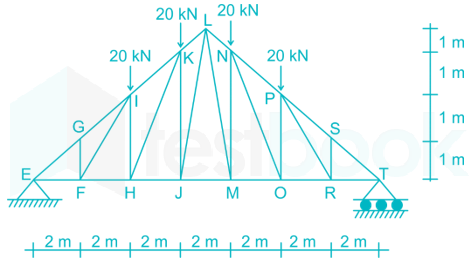
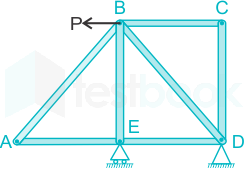
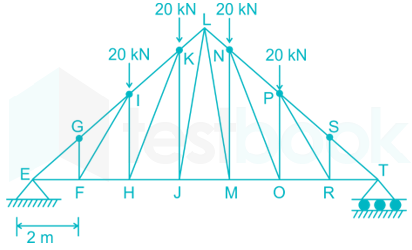
A plane truss is shown in the figure (not drawn to scale).

Which one of the options contains ONLY zero-force members in the truss?

  1. ((a))

    FG, FI, HI, RS

  2. ((b))

    FI, FG, RS, PR

  3. ((c))

    FI, HI, PR, RS

  4. ((d))

    FG, FH, HI, RS

Show Answer
Answer: ((b))

FI, FG, RS, PR

Concept:

Case 1:

Consider the truss given the figure below.

The two members at joint C are connected together at a right angle and there is no external load on the joint.

The free-body diagram of joint C, in the figure below, indicates that the force in each member must be zero in order to maintain equilibrium.

∑Fx = 0, FCB = 0

∑Fy = 0, FCD = 0

Furthermore, as in the case of joint A, in the figure below:

∑FY = 0, FAB sin θ = 0, F AB = 0 kN

∑Fx = 0, - FAE + 0 = 0, FAE = 0 kN

Case 2:

Consider the truss given the figure below.

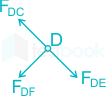
Zero-force members also occur at joints having a geometry as joint D in the figure below.

Here no external load acts on the joint, so that a force summation in the y-direction, shown in the figure below, which is perpendicular to the two collinear members, requires that FDF = 0.

∑Fy = 0, FDF = 0

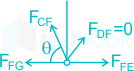
Using this result, FC is also a zero-force member, as indicated by the force analysis of joint F, in the figure below:

∑Fy = 0, FCF sin θ + 0 = 0

∴ FCF = 0

Calculation:

We know that, if three members are meeting at the joint, two of them are collinear and there is no point load acting on the joint, then the third member will carry zero force.

From the above statement,

We can say the GR, FI, RS, PR members will carry zero force

16

An element is subjected to biaxial normal tensile strains of 0.0030 and 0.0020. The normal strain in the plane of maximum shear strain is

  1. ((a))

    0.0010

  2. ((b))

    zero

  3. ((c))

    0.0050

  4. ((d))

    0.0025

Show Answer
Answer: ((d))

0.0025

Concept:

For the plane strain condition:

ϵI=ϵx;+;ϵy2;+;(ϵx;;ϵy2)cos2θ+(γxy2)sin;2θ{ϵ_{{I}}} = \frac{{{ϵ_x};+ ;{ϵ_y}}}{2};+;\left( {\frac{{{ϵ_x};- ;{ϵ_y}}}{2}} \right)\cos 2\theta + \left( {\frac{{{γ _{xy}}}}{2}} \right) \sin;2\theta

ϵII=ϵx;+;ϵy2(ϵx;;ϵy2)cos2θ(γxy2)sin;2θ{ϵ_{{II}}} = \frac{{{ϵ_x};+ ;{ϵ_y}}}{2} - \left( {\frac{{{ϵ_x};- ;{ϵ_y}}}{2}} \right)\cos 2\theta - \left( {\frac{{{γ _{xy}}}}{2}} \right) \sin ;2\theta

γxy=;(ϵx;;ϵy2)sin2θ+(γxy2)cos2θ{γ _{x{y}}} = ; - \left( {\frac{{{ϵ_x};- ;{ϵ_y}}}{2}} \right)\sin 2\theta + \left( {\frac{{{γ _{xy}}}}{2}} \right) \cos2\theta

Calculation:

Given:

ϵx = 0.0030, ϵy = 0.0020, γxy = 0

Shear strain (γxyI){γ _{x{y^I}}}) for γxy=0{γ _{xy}} = 0 would be maximum for θ = 45°

Maximum normal strain in plane of maximum shear strain i.e. θ = 45°

ϵmax=ϵx;+;ϵy2+(ϵx;;ϵy2)cos;90+(γxy2)sin90{ϵ_{max}} = \frac{{{ϵ_x};+ ;{ϵ_y}}}{2} + \left( {\frac{{{ϵ_x};- ;{ϵ_y}}}{2}} \right)\cos;90^\circ + \left( {\frac{{{γ _{xy}}}}{2}} \right) \sin 90^\circ

;ϵmax=ϵx;+;ϵy2\therefore;{ϵ_{max}} = \frac{{{ϵ_x};+ ;{ϵ_y}}}{2}

Maximum normal strain:

εx;+;εy20.0030;+;0.00202=0.005020.0025\frac{{{\varepsilon _x};+;{\varepsilon _y}}}{2} \Rightarrow \frac{{0.0030;+;0.0020}}{2} = \frac{{0.0050}}{2} \Rightarrow 0.0025

17

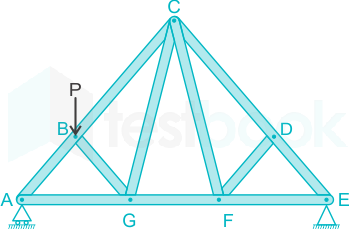
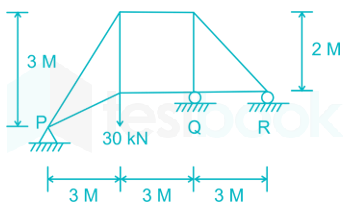
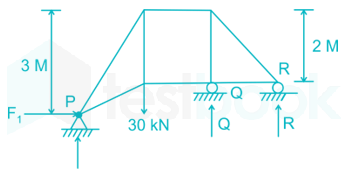
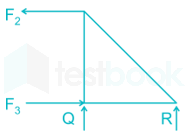
Consider the pin-jointed plane truss shown in the figure (not drawn to scale). Let RP, RQ, and RR denote the vertical reactions (upward positive) applied by the supports at P, Q, and R, respectively, on the truss. The correct combination of (RP, RQ, and RR) is represented by

  1. ((a))

    (30, - 30, 30) kN

  2. ((b))

    (10, 30, - 10) kN

  3. ((c))

    (20, 0, 10) kN

  4. ((d))

    (0.60, -30) kN

Show Answer
Answer: ((a))

(30, - 30, 30) kN

Explanation:


FH=0\sum {F_H} = 0

F1=0..(i){F_1} = 0 \ldots ..\left( i \right)

∑Fv = 0

P = 30 ..(ii)\ldots ..\left( {ii} \right)

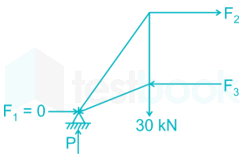
∑FH = 0

F2 = F3 ____(iii)

Mp=0\sum {M_p} = 0

F2 × 3 + 30 × 3 – F3 × 1 = 0

F2 × 3 – F3 × 1 + 90 = 0

2F2 = -90

⇒ F2 = -45

MQ=0\sum {M_Q} = 0

F3 = 2 + R × 3 = 0

-45 × 2 + R × 3 = 0

R = 30

Q + R = 0

⇒ Q = - 30 kN

18

Assuming that there is no possibility of shear buckling in the web, the maximum reduction permitted by IS 800-2007 in the (low shear) design bending strength of a semi-compact steel section due to high shear is

  1. ((a))

    50%

  2. ((b))

    governed by the area of the flange

  3. ((c))

    zero

  4. ((d))

    25%

Show Answer
Answer: ((c))

zero

Concept:

We have for type sections are as follows:

Slender section:

The cross-section in which the elements buckle locally even before the attainment of yield stress is called slender sections.

Plastic section:

Cross-section, which can develop plastic hinge and have the rotation capacity required for the failure of the structure by formation of a plastic mechanism is called the plastic section.

Compact section:

Cross-section which can develop the plastic moment of resistance but have inadequate plastic hinge rotation capacity for the formation of a plastic mechanism before bucking are called a compact section.

Semi-compact section:

The cross-section in which the extreme fiber in compression can reach yield stress but cannot develop the plastic moment of resistance due to local buckling is called semi-compact or a non-compact section.

Low Shear Design:

V ≤ 0.6 × Vd

Design bending strength of a semi-compact section in case of low shear is

⇒ Md1=ZefyγmO\rm{{M_{d1}} = \frac{{{Z_e}{f_y}}}{{{\gamma _{{m_O}}}}}}

High Shear Design

V > 0.6Vd

In the high shear design case, the whole portion of the web is completely involved in resisting against shear.

Design bending strength of a semi-compact section in case of high shear is

⇒ Md2=ZefyγmO\rm{{M_{d2}} = \frac{{{Z_e}{f_y}}}{{{\gamma _{{m_O}}}}}}

For;Low;shear;Design,;No;Moment;reduction;is;recommended;by;IS;8002007\rm {For;Low;shear;Design,;No;Moment;reduction;is;recommended;by;IS;800 - 2007}

19

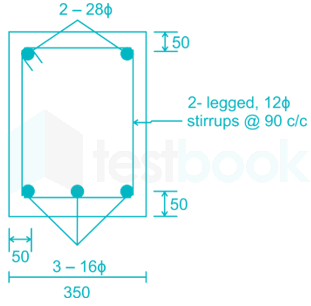
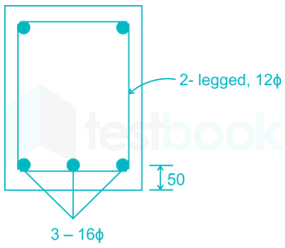
In the reinforced beam section shown in the figure (not drawn to scale), the nominal cover provided at the bottom of the beam as per IS 456-2000, is

  1. ((a))

    36 mm

  2. ((b))

    50 mm

  3. ((c))

    30 mm

  4. ((d))

    42 mm

Show Answer
Answer: ((c))

30 mm

Explanation:

Nominal cover=CoverDiameter;of;main;reinforcement;bar2Diameter;of;stirrup\rm Nominal~cover= \rm{{ Cover}} - \rm\frac{{Diameter; of; main; reinforcement;bar}}{2} - \rm{ Diameter;of;stirrup}

=50;mm162mm12= 50;mm - \frac{{16}}{2}mm - 12

= 50 - 8 - 12 = 50 - 20 = 30 mm

Additional Information

Cover requirements as per IS 456:2000:

  • In order to prevent the reinforcement from corrosion, a layer of concrete should be there in reinforced concrete structures.
  • In actual construction practices, the specified minimum cover is very difficult to maintain. Thus IS 456:2000 specifies tolerance levels ranging from 0 mm to +10 mm i.e. no reduction in the clear cover is permitted but the nominal cover can be increased up to 10 mm.
Exposure ConditionsMinimum concrete gradeNominal cover
MildM2020 mm
ModerateM2530 mm
SevereM3045 mm
Very severeM3550 mm
ExtremeM4075 mm
20

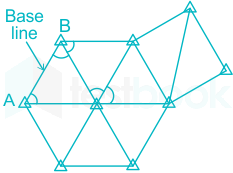
The interior angles of the four triangles are given below:

TriangleInterior Angles
P85°, 50°, 45°
Q100°, 55°, 25°
R100°, 45°, 35°
S130°, 30°, 20°


Which of the triangles are ill-conditioned and should be avoided in Triangulation surveys?

  1. ((a))

    Both Q and S

  2. ((b))

    Both Q and R

  3. ((c))

    Both P and R

  4. ((d))

    Both P and S

Show Answer
Answer: ((a))

Both Q and S

Concept:

If any interior angle of a triangle is more than 120° or less than 30°; then the triangle is called ill-conditioned.

Explanation:

a) Triangle Q:One angle is 25° < 30° Q is ill-conditioned
b) Triangle S:One angle is 130° < 120° S is ill-conditioned
Both Q & S are ill-conditioned triangles.


Additional Information

Triangulation surveying is the tracing and measurement of a series or network of triangles to determine distances and relative positions of points spread over an area, by measuring the length of one side of each triangle and deducing its angles and length of the other two sides by observation from this baseline.

21

The coefficient of average rolling friction of a road is fr and its grade is +G%. If the grade of this road is doubled, what will be the percentage change in the braking distance (for the design vehicle to come to a stop) measured along the horizontal (assume all other parameters are kept unchanged?

  1. ((a))

    0.02Gfr+0.01G×100\frac{{0.02G}}{{{f_r} + 0.01G}} \times 100

  2. ((b))

    frfr+0.02G×100\frac{{{f_r}}}{{{f_r} + 0.02G}} \times 100

  3. ((c))

    frfr+0.01G×100\frac{{{f_r}}}{{{f_r} + 0.01G}} \times 100

  4. ((d))

    0.01Gfr+0.02G×100\frac{{0.01G}}{{{f_r} + 0.02G}} \times 100

Show Answer
Answer: ((d))

0.01Gfr+0.02G×100\frac{{0.01G}}{{{f_r} + 0.02G}} \times 100

Concept:

Braking distance is the distance traveled by the vehicle from the moment when the brake was applied to the moment when the vehicle stops.

Braking distance is also the work done by the frictional force on to the vehicle to stop it completely.

Braking;distance=V22×g×(f+0.01;G)×ηBraking;distance = \frac{{{V^2}}}{{2 \times g \times \left( {f + 0.01;G} \right) \times \eta }}

Where V = Speed of the vehicle before the brake is applied

                f = coefficient of lateral friction

                G = gradient in percentage

                η = braking efficiency

Calculation:

Braking distance for G% gradient

G = +G%

Braking;distance;(d1)=V22g(f1+0.01G)Braking;distance;\left( {{d_1}} \right) = \frac{{{V^2}}}{{2g\left( {{f_1} + 0.01G} \right)}}

Braking distance for 2G% gradient

G = + 2G%

Braking;distance;(d2)=V22g(f+0.01×2G)=V22g(f+0.02G){\rm{Braking;distance;}}\left( {{{\rm{d}}_2}} \right) = \frac{{{V^2}}}{{2g\left( {f + 0.01 \times 2G} \right)}} = \frac{{{V^2}}}{{2g\left( {f + 0.02G} \right)}}

%;change=d1d2d1×100=;V22g(f+0.01G)V22g(f+0.02G)V22g(f+0.01G){\rm{\% ;change}} = \frac{{{d_1} - {d_2}}}{{{d_1}}} \times 100 = ;\frac{{\frac{{{V^2}}}{{2g\left( {f + 0.01G} \right)}} - \frac{{{V^2}}}{{2g\left( {f + 0.02G} \right)}}}}{{\frac{{{V^2}}}{{2g\left( {f + 0.01G} \right)}}}}

1f+0.01G1f+0.01G1f+0.01G=(f+0.02G)(fr+0.01G)f+0.02G=0.01Gf+0.02G×100;\frac{{\frac{1}{{f + 0.01G}} - \frac{1}{{f + 0.01G}}}}{{\frac{1}{{f + 0.01G}}}} = \frac{{\left( {f + 0.02G} \right) - ({f_r} + 0.01G)}}{{f + 0.02G}} = \frac{{0.01G}}{{f + 0.02G}} \times 100;

22

An isolated concrete pavement slab of length L is resting on a frictionless base. The temperature of the top and bottom fiber of the slab are Tt and Tb, respectively. Given: the coefficient of thermal expansion = α and the elastic modulus = E. Assuming Tt > Tb and the unit weight of concrete as zero, the maximum thermal stress is calculated as

  1. ((a))

    Eα(TtTb)2\frac{{E\alpha \left( {{T_t} - {T_b}} \right)}}{2}

  2. ((b))

    Eα (Tt - Tb)

  3. ((c))

    Zero

  4. ((d))

    Lα(Tt - Tb)

Show Answer
Answer: ((c))

Zero

Explanation:

As the base of the slab is frictionless less, the Slab base is free to expand in all directions.

⇒ ∴ Thermal stress = zero

Additional Information

  • When the temperature of material changes there will be a corresponding change in dimension.
  • If a member is free to expand or contract due to the rise or fall of the temperature, no stress will be induced in the member.
  • If the member is constrained (i.e. body is not allowed to expand or contract freely), change in length due to rise or fall of temperature is prevented and stresses are developed in the body which is known as thermal stress.
23

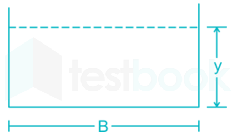
In a rectangular channel, the ratio of the velocity head to the flow depth for critical flow condition is

  1. ((a))

    23\frac{2}{3}

  2. ((b))

    2

  3. ((c))

    12\frac{1}{2}

  4. ((d))

    32\frac{3}{2}

Show Answer
Answer: ((c))

12\frac{1}{2}

Explanation:

We know that velocity head =V22g;..equation;(i)= \frac{{{V^2}}}{{2g}}; \ldots \ldots \ldots \ldots \ldots ..equation;\left( i \right)

Area B × y

Top surface width (T) = B

Q = A × V

Q = B × y × V

For critical flow condition Froude number (Fr)=1\left( {{F_r}} \right) = 1

Q2TgA3=1\Rightarrow \frac{{{Q^2}T}}{{g{A^3}}} = 1

Q2T;=;g×A3{Q^2}T; = ;g \times {A^3}

(B×y×V)2×2T;=;g×A3\left( {B \times y \times V} \right)^2 \times 2T; = ;g \times {A^3}

B2×y2×V2(B)=g(B.y)3{B^2} \times {y^2} \times {V^2}\left( B \right) = g{\left( {B.y} \right)^3}

y=V2g;..equation;(ii) \Rightarrow y = \frac{{{V^2}}}{g}{\rm{;}} \ldots \ldots \ldots \ldots \ldots ..equation;\left( {ii} \right)

Dividing equation 1 & equation 2

Velocity;headdepth=V22gV2g=;12 \Rightarrow \frac{{Velocity;head}}{{depth}} = \frac{{\frac{{{V^2}}}{{2g}}}}{{\frac{{{V^2}}}{g}}} = ;\frac{1}{2}

24

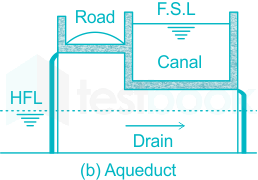
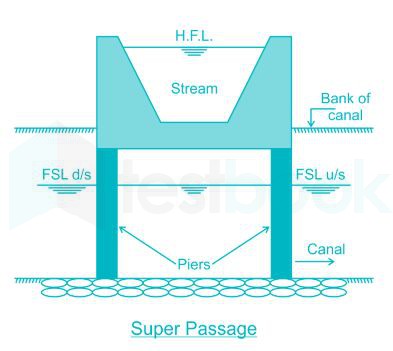
If the path of an irrigation canal is below the bed level of a natural stream, the type of cross drainage structure provided is

  1. ((a))

    Aqueduct

  2. ((b))

    Sluice gate

  3. ((c))

    Super passage

  4. ((d))

    Level crossing

Show Answer
Answer: ((c))

Super passage

Explanation:

Aqueduct:

When the HFL (Highest Flood Level) of the drain is sufficiently below the bottom of the canal such that the drainage water flows freely under gravity, the structure is known as Aqueduct.

Sluice gate: 

It is used to control the flow in a horizontal channel of unit width.

Super passage:

A super passage is just like a bridge in which the natural drain is carried over the canal. A super passage is constructed where the bed of the drain is well above the canal F.S.L (Full Supply Level).

Level Crossing:

The level crossing is an arrangement provided to regulate the flow of water through the drainage and the canal when they cross each other approximately at the same bed level.

25

A catchment may be idealized as a rectangle There are three rain gauges located inside the catchment at arbitrary locations. The average precipitation over the catchment is estimated by two methods: (i) Arithmetic mean (PA) and (ii) Thiessen polygon (PT).

Which of the following statements is correct?

  1. ((a))

    PA is always equal to PT

  2. ((b))

    There is no definite relationship between PA and PT

  3. ((c))

    PA is always greater than PT

  4. ((d))

    PA is always smaller than PT

Show Answer
Answer: ((b))

There is no definite relationship between PA and PT

Concept:

Average precipitation is calculated from any one of the following:

  1. Arithmetic Mean Method
  2. Theisen Polygon Method
  3. Isohyetal Method
  4. Inverse distance weighting (IDW) method
<br>

Arithmetic Mean Method for average precipitation calculation is the simplest method for determining the areal average.

\(\bar P = \frac{1}{N} \times \mathop \sum \limits_{i = 1}^N P\)

where Pi = rainfall at the ith rain gauge station

N = total number of rain gauge stations

Theisen Polygon Method: This method assumes that any point in the watershed receives the same amount of rainfall as that measured at the nearest rain gauge station. Here, rainfall recorded at a gauge can be applied to any point at a distance halfway to the next station in any direction.

Any of the methods among two can be more accurate than other for the given specific and rain and areal characteristics.

26

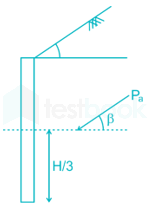
A retaining wall of height H with smooth vertical backface supports a backfill inclined at an angle β with the horizontal. The backfill consists of cohesionless soil having an angle of internal friction ϕ. If the active lateral thrust acting on the wall is Pa, which one of the following statements is TRUE?

  1. ((a))

    Pa acts at a height H/3 from the base of the wall and at an angle β with the horizontal

  2. ((b))

    Pa acts at a height H/3 from the base of the wall and at an angle ϕ with the horizontal

  3. ((c))

    Pa acts at a height H/2 from the base of the wall and at an angle β with the horizontal

  4. ((d))

    Pa acts at a height H/2 from the base of the wall and at an angle ϕ with the horizontal

Show Answer
Answer: ((a))

Pa acts at a height H/3 from the base of the wall and at an angle β with the horizontal

Explanation:

For the retaining with supporting backfill of cohesionless soil having an angle of internal friction ϕ and inclined at an angle β with the horizontal.

Active Earth Pressure (Pa) acts at a height H/3 from the base of the wall and at an angle β with the horizontal.

Additional Information

It is assumed that the vertical stress and the lateral pressure acting on soil element are conjugate stresses i.e. the direction of forces are parallel to the plane on which the other acts.

The earth pressure coefficients are given as:

27

In a soil specimen, the total stress, effective stress, hydraulic gradient, and critical hydraulic gradient are σ, σ’, i and ic, respectively. For initiation of quicksand condition, which one of the following statements is TRUE?

  1. ((a))

    σ’ = 0 and i = iC

  2. ((b))

    σ = 0 and i = iC

  3. ((c))

    σ’ ≠ 0 and i = iC

  4. ((d))

    σ’ ≠ 0 and i ≠ iC

Show Answer
Answer: ((a))

σ’ = 0 and i = iC

Concept:

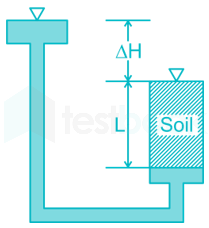
For a structure constructed on cohesionless soil, and in contact with the water body. Due to the difference in the water level across the structure, the hydraulic gradient would be set up resulting in upward seepage. Water movement in upward direction would exert upward thrust on the soil and thereby reducing the effective stress.

If the head causing upward flow is increased, a stage is reached when the effective stress is reduced to zero. The condition so developed is known as quicksand condition. Quicksand is not any special type of sand, but it is a condition of zero effective stress in cohesionless soils.

For Quick sand condition, effective stress in the soil becomes zero (σ = 0)

At the bottom of the soil column,

σ=γ×L\sigma = \gamma \times L

u=γw;(L+ΔH)u = {\gamma _w};\left( {L + {\rm{\Delta }}H} \right)

During the quick sand condition, the effective stress is reduced to zero.

γ×L=γw×(L+ΔH)\gamma \times L = {\gamma _w} \times \left( {L + {\rm{\Delta }}H} \right)

L;(γγw)=γw×ΔHL;\left( {\gamma - {\gamma _w}} \right) = {\gamma _w} \times {\rm{\Delta }}H

L×γb=γw×ΔHL \times {\gamma _b} = {\gamma _w} \times {\rm{\Delta }}H

ΔHL=γbγw=ic;\frac{{{\rm{\Delta }}H}}{L} = \frac{{{\gamma _b}}}{{{\gamma _w}}} = {i_c};

where;{\rm{where;}}ic = critical hydraulic gradient

28

Which one of the following is a secondary pollutant?

  1. ((a))

    Ozone

  2. ((b))

    Carbon Monoxide

  3. ((c))

    Volatile Organic Carbon (VOC)

  4. ((d))

    Hydrocarbon

Show Answer
Answer: ((a))

Ozone

Explanation:

Primary pollutant: 

  • Pollutants that are emitted directly from identifiable sources, either from natural hazardous events like dust storms, volcanoes, etc, or from human activities like burning of wood, coal, oil in homes or industries or automobiles, etc.

Secondary pollutant:

  • The primary pollutants often react with one another or with water vapor, aided and abetted by the sunlight, to form entirely a new set of pollutants, called the secondary pollutants.
  • These are the chemical substances, which are produced from the chemical reactions of natural or anthropogenic pollutants or due to their oxidation, etc., caused by the energy of the sun.

Important Points

Primary PollutantsSecondary Pollutants
Carbon monoxide (CO) Oxides of nitrogen (NOx, NO) Sulfur oxides (SOx) Volatile organic compounds (VOCs) highly Particulate matter (dust, ash, salt particles)Ozone PAN Smog Formaldehyde Sulphuric Acid
29

For a given loading on a rectangular plain concrete beam with an overall depth of 500 mm, the compressive strain and tensile developed at the extreme fibers are of the same magnitude of 2.5 × 10⁻⁴. The curvature in the beam cross-section (in m–1, round off to 3 decimal places), is _______.

30

A completely mixed dilute suspension of sand particles having diameters 0.25, 0.35, 0.40, 0.45 and 0.50 mm are filled in a transparent glass column of diameter 10 cm and height 2.50 m. The suspension is allowed to settle without any disturbance. It is observed that all particles of diameter 0.35 mm settle to the bottom of the column in 30 s. For the same period of 30 s, the percentage removal (round off to integer value) of particles of diameters 0.45 and 0.50 mm from the suspension is ________.

31

The maximum number of vehicles observed in any five-minute period during the break hour is 160. If the total flow in the peak hour is 1000 vehicles, the five-minute peak hour factor (round off to 2 decimal places) is _________.

32

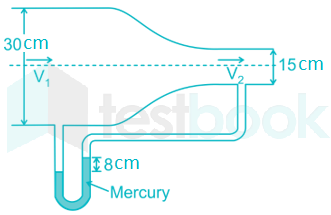
A circular duct carrying water gradually contracts from a diameter of 30 cm to 15 cm. The figure (not drawn to scale) shows the arrangement of differential manometer attached to the duct. When the water flows, the differential manometer shows a deflection of 8 cm of mercury (Hg). The value of the specific gravity of mercury and water are 13.6 and 1.0, respectively. Consider the acceleration due to gravity. g = 9.81 m/s2. Assuming frictionless flow, the flow rate (in m3/s, rounded off to 3 decimal places) through the duct is _______.

33

The probability that the annual maximum flood discharge will exceed 25000 m3/s, at least once in the next 5 years is found to be 0.25. The return period of this flood event (in years, round off to 1 decimal place) is _____.

34

A soil has a specific gravity of its solids equal to 2.65. The mass density of water is 1000 kg/m3. Considering zero air voids and 10% moisture content of the soil sample, the dry density (in kg/m3, a round of to 1 decimal place) would be _________.

35

A concentrated load of 500 kN is applied on an elastic half-space. The ratio of the increase in vertical normal stress at depths of 2 m and 4 m along with the point of the leading, as per Boussinesq’s theory, would be __________.

36

Which one of the following is NOT a correct statement?

  1. ((a))

    The function x\left| x \right| has the global minima at x = 0

  2. ((b))

    The function xx,(x>0)\sqrt[x]{x},\left( {x > 0} \right), has the global minima at x = e

  3. ((c))

    The function xx,(x>0)\sqrt[x]{x},\left( {x > 0} \right), has the global maxima at x = e

  4. ((d))

    The function x3 has neither global minima nor global maxima

Show Answer
Answer: ((b))

The function xx,(x>0)\sqrt[x]{x},\left( {x > 0} \right), has the global minima at x = e

Explanation:

Option 1 & 4 are true, since x\left| x \right| has global minimum at x = 0 and x3 has neither maximum nor minimum

Modulus of x has following graph and hence global minima is at x = 0

x3;{x^3}; has following graph and hence it does not have global maxima or minima at any point

Let, y=xx=x1xy = \sqrt[x]{x} = {x^{\frac{1}{x}}}

lny=lnx1x=lnxxy=elnxx \Rightarrow \ln y = \ln {x^{\frac{1}{x}}} = \frac{{\ln x}}{x} \Rightarrow y = {e^{\frac{{\ln x}}{x}}}

Consider;the;funciton;f(x)=lnxx\therefore Consider;the;funciton;f\left( x \right) = \frac{{\ln x}}{x}

f(x)=0x(1x)lnxx2=01lnxx2=0\Rightarrow f'\left( x \right) = 0 \Rightarrow \frac{{x\left( {\frac{1}{x}} \right) - \ln x}}{{{x^2}}} = 0 \Rightarrow \frac{{1 - \ln x}}{{{x^2}}} = 0

⇒ x = e → stationary point

f(x)=x2[01x][1lnx]2xx4f''\left( x \right) = \frac{{{x^2}\left[ {0 - \frac{1}{x}} \right] - \left[ {1 - \ln x} \right]2x}}{{{x^4}}}

f(x)=x2x+2xlnxx4=3x+2xlnxx4\Rightarrow f''\left( x \right) = \frac{{ - x - 2x + 2x\ln x}}{{{x^4}}} = \frac{{ - 3x + 2x\ln x}}{{{x^4}}}

f(e)=3e+2e(1)e4=ee4=e3<0\therefore f''\left( e \right) = \frac{{ - 3e + 2e\left( 1 \right)}}{{{e^4}}} = \frac{{ - e}}{{{e^4}}} = - {e^{ - 3}} < 0

∴ x = e is a point of maximum

y=elnxxy=Xx\therefore y = {e^{\frac{{lnx}}{x}}} \Rightarrow y = \sqrt[x]{X} has global maximum at x = e

37

A one-dimensional domain is discretized into N sub-domains of width Dx with node numbers i = 0, 1, 2, 3…………, N. If the time scale is discretized in steps of Dt, the forward-time and centered-space finite difference approximation at ith node and nth time step, for the partial differential equation vt=β2vx2\frac{{\partial v}}{{\partial t}} = \beta \frac{{{\partial ^2}v}}{{\partial {x^2}}} is

  1. ((a))

    Vi+1(n+1)Vi(N)Δt=β[Vi+1(n)2Vi(n)+Vi1(n)2Δx]\frac{{V_{i + 1}^{\left( {n + 1} \right)} - V_i^{\left( N \right)}}}{{{\rm{\Delta }}t}} = \beta \left[ {\frac{{V_{i + 1}^{\left( n \right)} - 2V_i^{\left( n \right)} + V_{i - 1}^{\left( n \right)}}}{{2{\rm{\Delta }}x}}} \right]

  2. ((b))

    Vi(n)Vi(n1)2Δt=β[Vi+1(n)2Vi(n)+Vi1(n)2Δx]\frac{{V_i^{\left( n \right)} - V_i^{\left( {n - 1} \right)}}}{{2{\rm{\Delta }}t}} = \beta \left[ {\frac{{V_{i + 1}^{\left( n \right)} - 2V_i^{\left( n \right)} + V_{i - 1}^{\left( n \right)}}}{{2{\rm{\Delta }}x}}} \right]

  3. ((c))

    Vi(n+1)Vi(n)Δt=β[Vi+1(n)2Vi(n)+Vi1(n)(Δx)2]\frac{{V_i^{\left( {n + 1} \right)} - V_i^{\left( n \right)}}}{{{\rm{\Delta }}t}} = \beta \left[ {\frac{{V_{i + 1}^{\left( n \right)} - 2V_i^{\left( n \right)} + V_{i - 1}^{\left( n \right)}}}{{{{\left( {{\rm{\Delta }}x} \right)}^2}}}} \right]

  4. ((d))

    Vi(n)Vi(n)Δt=β[Vi+1(n)2Vi(n)+Vi1(n)(Δx)2]\frac{{V_i^{\left( n \right)} - V_i^{\left( n \right)}}}{{{\rm{\Delta }}t}} = \beta \left[ {\frac{{V_{i + 1}^{\left( n \right)} - 2V_i^{\left( n \right)} + V_{i - 1}^{\left( n \right)}}}{{{{\left( {{\rm{\Delta }}x} \right)}^2}}}} \right]

Show Answer
Answer: ((c))

Vi(n+1)Vi(n)Δt=β[Vi+1(n)2Vi(n)+Vi1(n)(Δx)2]\frac{{V_i^{\left( {n + 1} \right)} - V_i^{\left( n \right)}}}{{{\rm{\Delta }}t}} = \beta \left[ {\frac{{V_{i + 1}^{\left( n \right)} - 2V_i^{\left( n \right)} + V_{i - 1}^{\left( n \right)}}}{{{{\left( {{\rm{\Delta }}x} \right)}^2}}}} \right]

Explanation:

vt=β2vx2\frac{{\partial v}}{{\partial t}} = \beta \frac{{{\partial ^2}v}}{{\partial {x^2}}}

vt=Vi(n+1)Vi(n)Δt\frac{{\partial v}}{{\partial t}} = \frac{{V_i^{\left( {n + 1} \right)}V_i^{\left( n \right)}}}{{{\rm{\Delta }}t}} (using forward time finite difference approximation)

Also, f11(x)=2fdx2=f(x+h)2f(x)+f(xh)h2{f^{11}}\left( x \right) = \frac{{{\partial ^2}f}}{{d{x^2}}} = \frac{{f\left( {x + h} \right) - 2f\left( x \right) + f\left( {x - h} \right)}}{{{h^2}}} 

(Using centered space finite difference approximation)

2vx2=Vi+1(n)2Vi(n)+Vi1(n)(Δx)2\Rightarrow \frac{{{\partial ^2}v}}{{\partial {x^2}}} = \frac{{V_{i + 1}^{\left( n \right)} - 2V_i^{\left( n \right)} + V_{i - 1}^{\left( n \right)}}}{{{{\left( {{\rm{\Delta }}x} \right)}^2}}}

vt=β2vx2\therefore \frac{{\partial v}}{{\partial t}} = \beta \frac{{{\partial ^2}v}}{{\partial {x^2}}} can be represented as

Vi(n+1)Vi(n)Δt=β[Vi+1(n)2Vi(n)+Vi1(n)(Δx)2]\frac{{V_i^{\left( {n + 1} \right)} - V_i^{\left( n \right)}}}{{{\rm{\Delta }}t}} = \beta \left[ {\frac{{V_{i + 1}^{\left( n \right)} - 2V_i^{\left( n \right)} + V_{i - 1}^{\left( n \right)}}}{{{{\left( {{\rm{\Delta }}x} \right)}^2}}}} \right]

38

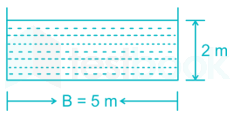
A rectangular open channel has a width of 5m and a bed slope of 0.001. For a uniform flow of depth 2m, the velocity is 2m/s. The Manning’s roughness coefficient for the channel is

  1. ((a))

    0.017

  2. ((b))

    0.050

  3. ((c))

    0.033

  4. ((d))

    0.002

Show Answer
Answer: ((a))

0.017

Explanation:

Given,

width (B) = 5 m

depth (y) = 2 m

Area (B × y) = 5 × 2 = 10 m2

Perimeter (R) = B + 2y = 5 + 2 × 2 = 9 m

Hydraulic;radius;(R)=AreaPerimeterHydraulic;radius;\left( R \right) = \frac{{Area}}{{Perimeter}}

R=109=1.11R = \frac{{10}}{9} = 1.11

By the Manning's equation

Velocity;(V)=1n×R23×S12Velocity;\left( V \right) = \frac{1}{n} \times {R^{\frac{2}{3}}} \times {S^{\frac{1}{2}}}

2=1n(1.11)23(0.001)122 = \frac{1}{n}{\left( {1.11} \right)^{\frac{2}{3}}}{\left( {0.001} \right)^{\frac{1}{2}}}

n=1.072×0.031622=0.0169;0.017n = \frac{{1.072 \times 0.03162}}{2} = 0.0169; \cong 0.017

Manning’s roughness coefficient (n) = 0.017

39

For the following statements:

P – The lateral stress in the soil while being tested in an oedometer is always at-rest.

Q – For a perfectly rigid strip footing at deeper depths in a sand deposit, the vertical normal contact stress at the footing edge is greater than that at its center.

R – The corrections for overburden pressure and dilatancy are not applied to measured SPT-N values in case of clay deposits.

The correct combination of the statements is

  1. ((a))

    P – TRUE; Q – TRUE; R – TRUE

  2. ((b))

    P – FALSE; Q – FALSE; R – TRUE

  3. ((c))

    P – TRUE; Q – TRUE; R – FALSE

  4. ((d))

    P – FALSE; Q – FALSE; R – FALSE

Show Answer
Answer: ((a))

P – TRUE; Q – TRUE; R – TRUE

Concept:

Statement - 1:

The Oedometer test

  • The characteristics of soil during one-dimensional consolidation or swelling can be determined by means of the oedometer test.
  • In the oedometer test, stress is applied to the soil specimen along the vertical axis, while strain in the horizontal directions is prevented.
  • Therefore, the lateral stress in the soil while being tested in an oedometer is always at rest.

Statement - 2:

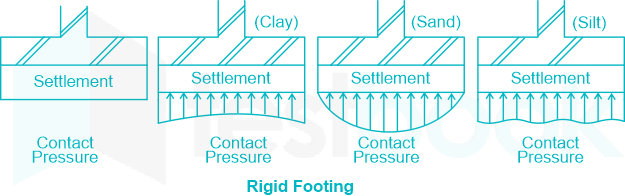
Pressure Distribution for different forms of footings:

Footing typeSoil typeContact pressure distribution
(i) RigidClayMaximum at edges and minimum at the center.
(ii) RigidSandZero at edge and maximum at the center with a near parabolic shape.
(iii) FlexibleAny SoilUniform for the full width

For a perfectly rigid footing resting on the surface of a sand deposit, the contact pressure distribution is zero at the edges and maximum at the center.

However, for a very deep rigid footing on the sand, the contact pressure distribution may tend to become like that of rigid footing on clayey soil, with edge contact stress greater than at its center.

Statement - 3:

Overburden correction is applied to sandy as well as clayey soil but Dilatancy Correction is applied only for granular or sandy soil as sometimes it might not be able to dissipate pore pressure in case of dynamic loading, which results in a higher SPT-N value.

Thus, dilatancy correction is to be applied for granular soil only.

40

Consider two functions: x;=;ψlnϕx; = ;\psi ln\phi and y;=;ϕlnψy; = ;\phi ln\psi . Which one of the following is the correct expression for ∂ψ/∂x?

  1. ((a))

    lnψlnϕlnψ1\frac{{ln\psi }}{{ln\phi ln\psi - 1}}

  2. ((b))

    lnϕlnϕψ1\frac{{ln\phi }}{{ln\phi \psi - 1}}

  3. ((c))

    xlnψlnϕψ1\frac{{xln\psi }}{{ln\phi \psi - 1}}

  4. ((d))

    xlnϕlnϕlnψ1\frac{{xln\phi }}{{ln\phi ln\psi - 1}}

Show Answer
Answer: ((a))

lnψlnϕlnψ1\frac{{ln\psi }}{{ln\phi ln\psi - 1}}

\(x; = ;\psi ln\phi ;& ;y; = \phi ln\psi\)

Partial differentiating both equations with respect to x

1=ψxlnϕ+ψϕ×ϕx\Rightarrow 1 = {\psi _x}\ln \phi + \frac{\psi }{\phi } \times {\phi _x} …………..(i)

0=ϕxlnψ+ϕψ×ψx; \Rightarrow 0 = {\phi _x}\ln \psi + \frac{\phi }{\psi } \times {\psi _x};

ϕψ=ϕx×lnψψx\Rightarrow \frac{\phi }{\psi } = \frac{{ - {\phi _x} \times \ln \psi }}{{{\psi _x}}}

ϕψ×ϕx=;lnψψx\Rightarrow \frac{\phi }{{\psi \times {\phi _x}}} = \frac{{ - ;\ln \psi }}{{{\psi _x}}}

put;(ii)in;(i)put;\left( {ii} \right)in;\left( i \right)

1=ψxlnϕψxlnψ=;ψx×[lnϕ;lnψ1lnψ]1 = {\psi _x}\ln \phi - \frac{{{\psi _x}}}{{ln\psi }} = ;{\psi _x} \times \left[ {\frac{{ln\phi ;ln\psi - 1}}{{\ln \psi }}} \right]

ψx=;lnψlnϕlnψ1{\psi _x} = ;\frac{{ln\psi }}{{ln\phi ln\psi - 1}}

41

The cross-section of a built-up wooden beam as shown in the figure (not drawn to scale) is subjected to a vertical shear force of 8kN. The beam is symmetrical about the neutral axis (N.A.) shown, and the moment of inertia about N.A. is 1.5 × 109 mm4. Considering that the nails at the location P are spaced longitudinally (along the length of the beam) at 60 mm, each of the nails at P will be subjected to the shear force of

  1. ((a))

    240 N

  2. ((b))

    480 N

  3. ((c))

    120 N

  4. ((d))

    60 N

Show Answer
Answer: ((a))

240 N

Explanation

Shear stress acting at a section  ;(τ)=FAyˉIb;\left( \tau \right) = \frac{{FA\bar y}}{{Ib}}

F - Shear force acting at section

A - Area of the region above the section

Y̅ = Distance of centroid of the region from the N.A

I - Moment of inertia

Calculation:

Given:

F = shear force = 8 kN = 8000 N

A = Area of shaded portion = 50 × 100 = 5000 mm2

Y̅ = Distance of centroid of shaded portion form N.A

=2001002=150;mm= 200 - \frac{{100}}{2} = 150;mm

I = 1.5 × 109 mm4

Shear stress acting over the region

 τ=8000×50×1000×1501.5×109×50=0.08;N/mm2\Rightarrow \tau = \frac{{8000 \times 50 \times 1000 \times 150}}{{1.5 \times {{10}^9} \times 50}} = 0.08;N/m{m^2}

⇒ Shear Force resisted by nails at P = shear stress × resisting area

⇒ Shear Force = 0.08 × 60 × 50 = 240 N

42

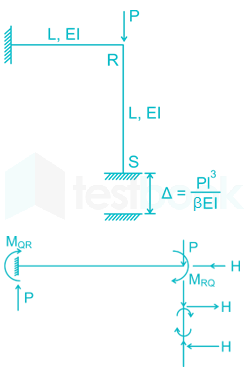
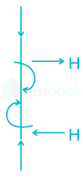
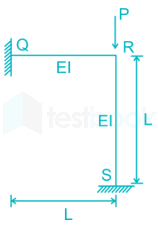
The rigid-jointed plane frame QRS shown in the figure is subjected to a load P at the joint R. Let the axial deformations in the frame be neglected. If the support S undergoes a settlement of Δ=PL3βEI{\rm{\Delta }} = \frac{{P{L^3}}}{{\beta EI}}, the vertical reaction at the support S will become zero when β is equal to

  1. ((a))

    0.1

  2. ((b))

    7.5

  3. ((c))

    3.0

  4. ((d))

    48.0

Show Answer
Answer: ((b))

7.5

Explanation:

Method 1: Moment Distribution method

Assume ‘R’ sinks by Δ

Fixed End Moments are given by

MFQR=6EI×Δ;L2;{M_{{F_{QR}}}} = \frac{{ - 6EI \times {\rm{\Delta ;}}}}{{{L^2}}};

MFRQ=6EI×Δ;L2{M_{{F_{RQ}}}} = \frac{{ - 6EI \times {\rm{\Delta ;}}}}{{{L^2}}}

MFRS=;MFSR=0{M_{{F_{RS}}}} = ;{M_{{F_{SR}}}} = 0

Distribution Factor at R is 0.5 & 0.5 for each end respectively due to symmetricity
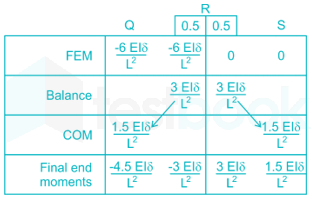
By Analysis of beam QR,
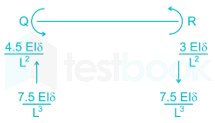
MQ=0\sum {M_Q} = 0

4.5×EI×Δ;L2+3×EI×Δ;L2=P×L\frac{{4.5 \times EI \times {\rm{\Delta ;}}}}{{{L^2}}} + \frac{{3 \times EI \times {\rm{\Delta ;}}}}{{{L^2}}} = P \times L

Δ;=P×L37.5;EI;{\rm{\Delta ;}} = \frac{{{\rm{P}} \times {{\rm{L}}^3}}}{{7.5{\rm{;EI}}}}{\rm{;}}

Method 2: Slope deflection method

MQR=2EIl(θR3Δl){M_{QR}} = \frac{{2EI}}{l}\left( {{\theta _R} - \frac{{3{\rm{\Delta }}}}{l}} \right)

MRQ=2EIl(2θR3Δl){M_{RQ}} = \frac{{2EI}}{l}\left( {2{\theta _R} - \frac{{3{\rm{\Delta }}}}{l}} \right)

MRS=2EIl(2θR){M_{RS}} = \frac{{2EI}}{l}\left( {2{\theta _R}} \right)

If reaction at S is equal to zero

MRQ + MQR + P × l = 0

6EIθRl12EIΔl2+Pl=0\frac{{6EI{\theta _R}}}{l} - \frac{{12EI{\rm{\Delta }}}}{{{l^2}}} + Pl = 0

6EIθRl12EIl2×Pl3βEI+Pl=0\frac{{6EI{\theta _R}}}{l} - \frac{{12EI}}{{{l^2}}} \times \frac{{P{l^3}}}{{\beta EI}} + Pl = 0

6EIθRl12Plβ+PL=0\frac{{6EI{\theta _R}}}{l} - \frac{{12Pl}}{\beta } + PL = 0 -----(i)

From equilibrium of joint

MRQ + MRS = 0

8EIQRl6EIΔl2=0\frac{{8EI{Q_R}}}{l} - \frac{{6EI{\rm{\Delta }}}}{{{l^2}}} = 0

6EIθRl=68(6EIl2×Pl3βEI)\frac{{6EI{\theta _R}}}{l} = \frac{6}{8}\left( {\frac{{6EI}}{{{l^2}}} \times \frac{{P{l^3}}}{{\beta EI}}} \right)

6EIθRl=36;Pl8β\frac{{6EI{\theta _R}}}{l} = \frac{{36;Pl}}{{8\beta }} ----(ii)

⇒ From (i) & (ii)

36Pl8β96Pl8βPl=0\frac{{36Pl}}{{8\beta }} - \frac{{96Pl}}{{8\beta }}Pl = 0

60Pl8β+Pl=0\Rightarrow \frac{{60Pl}}{{8\beta }} + Pl = 0

8β=60\Rightarrow 8\beta = 60

β=608=7.5\beta = \frac{{60}}{8} = 7.5
43

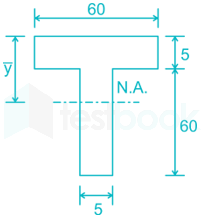
If the section shown in the figure turns from fully-elastic to fully-plastic, the depth of neutral axis (N.A), y̅, decreases by

  1. ((a))

    13.75 mm

  2. ((b))

    15.25 mm

  3. ((c))

    10.75 mm

  4. ((d))

    12.25 mm

Show Answer
Answer: ((a))

13.75 mm

Explanation:

For plastic state

Area in compression = Area in tension

To locate the equal area axis, equate the area of both side

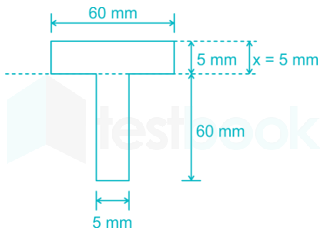
60 × 5 + (x - 5) × 5 = (65 - x) x5

300 + 5x – 25 = 325 – 5x

10x = 325 + 25 – 100 = 50

x = 5 mm from top

⇒ Neutral Axis lies at the intersection web and flange

To calculate the centroidal axis, taking the moment of area about bottom

xˉ=60×5×30+60×5×(60+52)60×5+60×5\bar x = \frac{{60 \times 5 \times 30 + 60 \times 5 \times \left( {60 + \frac{5}{2}} \right)}}{{60 \times 5 + 60 \times 5}}

=9000+18750600=46.25mm;from;bottom= \frac{{9000 + 18750}}{{600}} = 46.25mm;from;bottom

x̅ = 65 – 46.25 = 18.75 mm from top

Difference in NA = 18.75 – 5 = 13.75 mm

44

Sedimentation basin in a water treatment plant is designed for a flow rate of 0.2 m3/s. The basin is rectangular with a length of 32 m, width of 8 m, and depth of 4 m. Assume that the settling velocity of these particles is governed by the Stokes’ law. Given: density of the particles = 2.5g/cm3; density of water = 1 g/cm3; dynamic viscosity of water = 0.01 g/(cm.s); gravitational acceleration = 980 cm/s2. If incoming water contains particles of diameter 25 μm (spherical and uniform), the removal efficiency of these particles is

  1. ((a))

    78%

  2. ((b))

    51%

  3. ((c))

    100%

  4. ((d))

    65%

Show Answer
Answer: ((d))

65%

Explanation:

We know that

Settling velocity

(Vs)=g;×;ρw×(G1);×;d218;μ\left( {{V_s}} \right) = \frac{{g; \times ;{\rho _w} \times \left( {G - 1} \right); \times ;{d^2}}}{{18;\mu }}

Vs=980×(2.511)(25×104)2×118×0.01=0.051;cm/sec{V_s} = \frac{{980 \times \left( {2.51 - 1} \right){{\left( {25 \times {{10}^{ - 4}}} \right)}^2} \times 1}}{{18 \times 0.01}} = 0.051;cm/sec

Given flow rate (Q) = 0.2 m2/sec

We;know;that;surface;overflow;rate;(V0)=Volume;/;timesurface;area;We;know;that;surface;overflow;rate;\left( {{V_0}} \right) = \frac{{Volume;/;time}}{{surface;area}};

V0=Qsurface;area{V_0} = \frac{Q}{{surface;area}}

surface area = B × L = 8 × 32 = 256m2

V0=QBL=(0.2m3;/;sec)256=7.8125×104;m/sec{V_0} = \frac{Q}{{BL}} = \frac{{\left( {0.2{m^3};/;sec} \right)}}{{256}} = 7.8125 \times {10^{ - 4}};m/sec

V0 = 7.8125 × 10⁻² cm/sec

Particle;removal;efficiency;(η)=VsV0×100;Particle;removal;efficiency;\left( \eta \right) = \frac{{{V_s}}}{{{V_0}}} \times 100;

η=0.0510.078×100=65.38%\eta = \frac{{0.051}}{{0.078}} \times 100 = 65.38\%

45

A survey line was measured to be 285.5m with a tape having a nominal length of 30m. On checking, the true length of the tape was found to be 0.05 m too short. If the line lay on a slope of 1 in 10, the reduced length (horizontal length) of the line for plotting of survey work would be

  1. ((a))

    285.6 m

  2. ((b))

    283.6 m

  3. ((c))

    285.0 m

  4. ((d))

    284.5 m
Show Answer
Answer: ((b))

283.6 m

Concept:

True;length;line=ll×measured;length True;length;line = \frac{{l'}}{l} \times measured;length\

Calculation:

Given,

Measured distance (l) = 285.5 m
Length of tape = 30 m

True length of tape = 30 m - 0.05 = 29.95

Correct;length;(l)=29.9530×285.5=285.024;mCorrect;length;\left( l \right) = \frac{{29.95}}{{30}} \times 285.5 = 285.024;m

The line measured on 1/10 slope

Correction due to slope

=h22l=(285.02410)22×285.024=1.425 = \frac{{{h^2}}}{{2l}} = \frac{{{{\left( {\frac{{285.024}}{{10}}} \right)}^2}}}{{2 \times 285.024}} = 1.425

Corrected length = 285.024 – 1.425 = 283.6 m

46

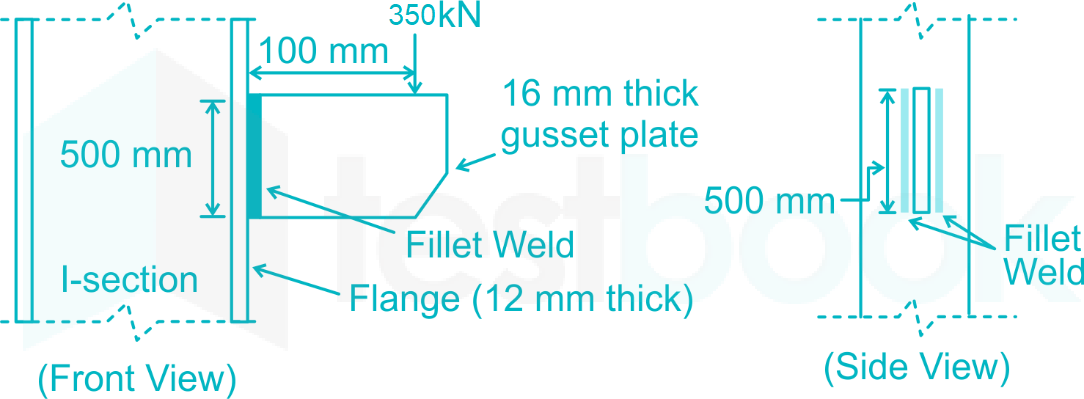
A 16 mm thick gusset plate is connected to the 12mm thick flange plate of an I-section using fillet welds on both sides as shwon in the figure (not drawn to scale). The gusset plate is subjected to a point load of 350 kN acting at a distance of 100 mm from the flange plate. Size of fillet weld is 10 mm.

The maximum resultant stress (in MPa, round off to 1 decimal place) on the fillet weld along the vertical plane would be ________.

47

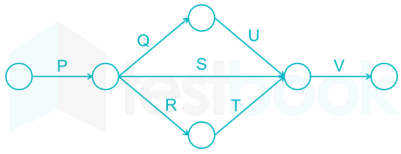
The network of a small construction project awarded to a contractor is shown in the following figure. The normal duration, crash duration, normal cost, and crash cost of all the activities are shown in the table. The indirect cost incurred by the contractor is INR 5000 per day.

ActivityNormal Duration (days)Crash Duration (days)Normal cost (INR)Crash Cost (INR)
P641500025000
Q52600012000
R5380009500
S63700010000
T3260009000
U2140006000
V422000028000


If the project is targeted for completion in 16 days, the total cost (in INR) to be incurred by the contractor would be __________.

48

A box measuring 50 cm × 50 cm × 50 cm is filled to the top with dry coarse aggregate of mass 187.5 kg. The water absorption and specific gravity of the aggregate are 0.5% and 2.5, respectively. The maximum quantity of water (in kg, round off to 2 decimal places) required to fill the box completely is _____.

49

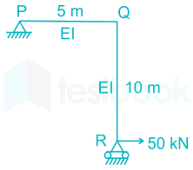
A portal frame shown in figure (not drawn to scale) has hinge support at joint P and roller support at joint R. A point load of 50 kN is acting at joint R in the horizontal direction. The flexural rigidity. EI, of each member, is 106 kNm2. Under the applied load, the horizontal displacement (in mm, round off to 1 decimal place) of joint R would be _____

50

A sample of air analyzed at 0°C and 1 atm pressure is reported to contain 0.02 ppm (parts per million) of NO2. Assume the gram molecular mass of NO2 as 46 and its volume at 0°C and 1 atm pressure as 22.4 liters per mole. The equivalent NO2 concentration (in microgram per cubic meter, round off to 2 decimal places) would be ________.

51

A 0.80 m deep bed of sand filter (length 4m and width 3m) is made of uniform particles (diameter = 0.40 mm, specific gravity = 2.65, shape factor = 0.85) with bed porosity of 0.4. the bed has to be backwashed at a flow rate of 3.60 m3 /min. During backwashing, if the terminal settling velocity of sand particles is 0.05 m/s, the expanded bed depth (in m, round off to 2 decimal places) is ______

52

Wastewater is to be disinfected with 35mg/L of chlorine to obtain 99% kill of microorganisms. The number of micro-organisms remaining alive (Nt) at time t, is modeled by Nt = N0 e–kt, where N0 is a number of micro-organisms at t = 0, and k is the rate of the kill. The wastewater flow rate is 36 m3/h, and k = 0.23 min-1. If the depth and width of the chlorination tank are 1.5 m and 1.0m, respectively, the length of the tank (in m, round off to 2 decimal places) is ________.

53

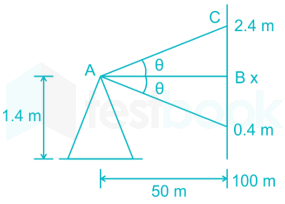
A staff is placed on a benchmark (BM) of reduced level (RL) 100.000 m and a theodolite is placed at a horizontal distance of 50m from the BM to measure the vertical angles. The measured vertical angles from the horizontal at the staff readings of 0.400 m and 2.400 m are found to be the same. Taking the height of the instrument as 1.400 m, the RL (in m) of the theodolite station is _______. 

54

Consider the ordinary differential equation x2d2ydx22xdydx+2y=0.{x^2}\frac{{{d^2}y}}{{d{x^2}}} - 2x\frac{{dy}}{{dx}} + 2y = 0. Given the values of y(1) = 0 and y(2) = 2, the value of y(3) (round off to 1 decimal place), is ________.

55

Average free-flow speed and the jam density observed on a road stretch are 60 km/h and 120 vehicles/km, respectively. For a linear speed-density relationship, the maximum flow on the road stretch (in vehicles/h) is ____.

56

Traffic on a highway is moving at a rate 360 vehicles per hour at a location. If the number of vehicles arriving on this highway follows Poisson distribution, the probability (round off to 2 decimal places) that the headway between successive vehicles lies between 6 and 10 seconds is _____

57

A parabolic vertical curve is being designed to join a road of grade + 5% with a road of grade – 3%. The length of the vertical curve is 400 m measured along the horizontal. The vertical point of curvature (VPC) is located on the road of grade +5%. The difference in height between VPC and vertical point of intersection (VPI) (in m, round off to the nearest integer) is ____

58

Tie bars of 12 mm diameter is to be provided in the concrete pavement slab. The working tensile stress of the tie bars is 230 MPa, the average bond strength between a tie bar and concrete is 2 MPa, and the joint gap between the slab is 10 mm. Ignoring the loss of bond and the tolerance factor, the design length of the tie bars (in mm, round off to the nearest integer) is ________.

59

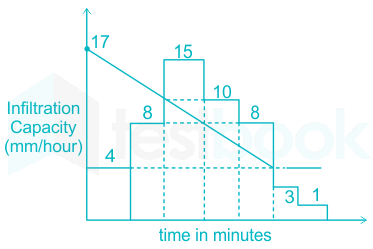
The hyetograph of a storm event of duration 140 minutes is shown in the figure.

Time Interval = 20 minutes

The infiltration capacity at the start of this event (t = 0) is 17 mm/hour, which linearly decreases to 10 mm/hour after 40 minutes duration. As the event progresses, the infiltration rate further drops down linearly to attain a value of 4 mm/hour at t = 100 minutes and remains constant thereafter till the end of the storm event. The value of the infiltration index, f (in mm/hour, round off to 2 decimal places), is _______.

60

Two water reservoirs are connected by a siphon (running full) of total length 5000 m and diameter of 0.10 m, as shown below (figure not drawn to scale).

The inlet leg length of the siphon to its summit is 2000 m. The difference in the water surface levels of the two reservoirs is 5 m. Assume the permissible minimum absolute pressure at the summit of the siphon to be 2.5 m of water when running full. Given: friction factor f = 0.02 throughout, atmospheric pressure = 10.3 m of water, and acceleration due to gravity g = 9.81 m/s2. Considering only major loss using Darcy Weisbach equation the maximum height of the summit of siphon from the water level of the upper reservoir, h (in m round off to 1 decimal place) is ________.

61

Consider a laminar flow in the x-direction between two infinite parallel plates (Couette flow). The lower plate is stationary, and the upper plate is moving with a velocity of 1 cm/s in the x-direction. The distance between the plates is 5mm and the dynamic viscosity of the fluid is 0.01 N-s/m2. If the shear stress on the lower plate is zero, the pressure gradient, px\frac{{\partial p}}{{\partial x}}, (in N/m2 per m, round off to 1 decimal place) is ______.

62

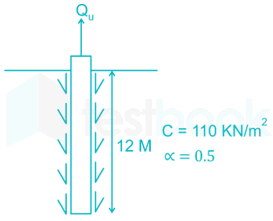
A reinforced concrete circular pile of 12m length and 0.6 m diameter is embedded in stiff clay which has an undrained unit cohesion of 110 kN/m2. The adhesion factor is 0.5. The Net Ultimate Pullout (Uplift) Load for the pile (in kN, round off to 1 decimal place ) is _________.

63

A granular soil has a saturated unit weight of 20 kN/m3 and an effective angle of shearing resistance of 30°. The unit weight of water is 9.81 kN/m3. A slope is to be made on this soil deposit in which the seepage occurs parallel to the slope up to the free surface. Under this seepage condition for a factor of safety of 1.5, the safe slope angle (in degree, round off to 1 decimal place) would be ______.

64

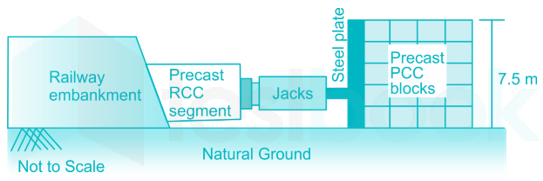
A 3 m × 3 m square precast reinforced concrete segments to be installed by pushing them through an existing railway embankment for making an underpass as shown in the figure. A reaction arrangement using precast PCC blocks placed on the ground is to be made for the jacks.

At each stage, the jacks are required to apply a force of 1875 kN to push the segment. The jacks will react against the rigid steel plate placed against the reaction arrangement. The footprint area of reaction arrangement on the natural ground is 37.5 m2. The unit weight of PCC block is 24 kN/m3 . The properties of the natural ground are: c = 17 kPa ϕ = 25° and γ = 18 kN/m3.

Assuming that the reaction arrangement has a rough interface and has the same properties that of soil, the factor of safety (round off to 1 decimal place) against shear failure is ______

65

A square footing of 4 m sides is placed at 1 m depth in a sand deposit. The dry unit weight (γ) of sand is 15 kN/m3. This footing has an ultimate bearing capacity of 600 kPa. Consider the depth factors; dq = dγ = 1.0 and the bearing capacity factor: Nγ = 18.75. This footing is placed at a depth of 2 m in the same soil deposit. For a factor of safety of 3.0 per Terzaghi’s theory, the safe bearing capacity (in kPa) of this footing would be ______.

Attempt this paper under real exam conditions

Timed interface, section switching, instant scoring, and question-by-question analytics — free.

Start Timed Attempt