Official Paper

GATE CE 2018 Official Paper: Shift 1 (Previous Year Paper)

65 questions · 180 minutes · with answers · free

General Aptitude (10 questions)

1

The driver applied the _______ as soon as she approached the hotel where she wanted to take a ___________?

  1. ((a))

    Brake, Break

  2. ((b))

    Break, Break

  3. ((c))

    Brake, Brake

  4. ((d))

    Break, Brake

Show Answer
Answer: ((a))

Brake, Break

The correct answer is option 1 i.e. Brake, break.

i) Brake is a device which is used for stopping or moving a vehicle.

ii) Break refers to a pause in work or during an activity.

2

“It is no surprise that every society has had codes of behavior; however the nature of these codes is often ________.” The word that best fills the blank in the above sentence is

  1. ((a))

    Unpredictable

  2. ((b))

    Simple

  3. ((c))

    Expected

  4. ((d))

    Strict

Show Answer
Answer: ((a))

Unpredictable

In this sentence, the presence of the conjunction 'however' shows that one part contradicts what is stated in the former part of the sentence.

Since the first part of the sentence is an affirmative statement about codes of behaviour, the next part has to have a contrasting tone. 'Simple', 'expected' and 'strict', all speak in the favour of codes of behaviour. So, the right option is ‘unpredictable’.

3

Hema’s age is 5 years more than twice of Hari’s age. Suresh’s age is 13 years less than 10 times Hari’s age. If Suresh is 3 times as old as Hema, how old is Hema?

  1. ((a))

    14

  2. ((b))

    17

  3. ((c))

    18

  4. ((d))

    19

Show Answer
Answer: ((d))

19

Let Hari’s age (H) = x years

As per the given condition:

Hema’s age (He) = 2x + 5, Suresh’s age (S) = 10x – 13

Suresh is 3 times as old as Hema age i.e. S = 3 × He

∴ 10x – 13 = 3(2x + 5)

⇒ 6x + 15 = 10x – 13

⇒ 15 + 13 = 10x – 6x

⇒ x = 7

∴ Hema’s age = 2x + 5 = 2 × 7 + 5 = 19 years

4

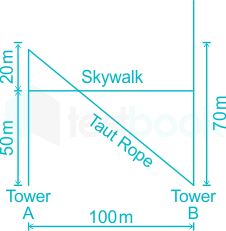
Tower A is 90 m tall and tower B is 140 m tall. They are 100 m apart. A horizontal skywalk connects the floors at 70 m in both the towers. If a tight rope connects the top of tower A to the bottom of tower B, at what distance (in meters) from tower A will the rope intersect the skywalk?

  1. ((a))

    22.22

  2. ((b))

    50

  3. ((c))

    57.87

  4. ((d))

    77.78

Show Answer
Answer: ((a))

22.22

Explanation:

Given**:** Tower A is 90 m, Tower B is 140 m, A and B are 100 m apart

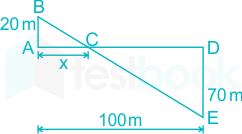
The given situation can be depicted as follows:

From similar triangle theorems:

By proportionality theorem for ΔABC and ΔCDE.

ABAC=DECD20X=70100X\frac{{AB}}{{AC}} = \frac{{DE}}{{CD}} \Rightarrow \frac{{20}}{X} = \frac{{70}}{{100 - X}}

∴ x = 22.22 m

5

The temperature T in a room varies as a function of the outside temperature T0 and the number of persons in the room p, according to the relation T = K (θp + T0), where θ and K are constants. What would be the value of θ, which gives the following data?

T0pT
25232.4
30542.0
  1. ((a))

    0.8

  2. ((b))

    1.0

  3. ((c))

    2.0

  4. ((d))

    10.0

Show Answer
Answer: ((b))

1.0

Explanation:

Given: T = K (θP + T0)

T - Temperature 

T0 -  Outside temperature

p -  Number of persons in the room 

From the tabular data

32.4 = K [2θ + 25]        ……(i)

42.0 = K [5θ + 30]        ……(ii)

Dividing (i) and (ii)

32.442.0=2θ+255θ+302735=2θ+255θ+30θ=1\therefore \frac{{32.4}}{{42.0}} = \frac{{2{\rm{\theta }} + 25}}{{5{\rm{\theta }} + 30}} \Rightarrow \frac{{27}}{{35}} = \frac{{2{\rm{\theta }} + 25}}{{5{\rm{\theta }} + 30}} \Rightarrow {\rm{\theta }} = 1

6

A fruit seller sold a basket of fruits at 12.5% loss. Had he sold it for Rs. 108 more, he would have made a 10% gain. What is the loss in Rupees incurred by the fruit seller?

  1. ((a))

    48

  2. ((b))

    52

  3. ((c))

    60

  4. ((d))

    108

Show Answer
Answer: ((c))

60

Loss;12.5%=12.5100=18{\rm{Loss;}}12.5{\rm{\% }} = \frac{{12.5}}{{100}} = \frac{1}{8}

Multiplying;factor;(f1)=(SP)CP=118=78{\rm{Multiplying;factor; (f_1)}}=\frac{{\left( {{\rm{SP}} } \right)}}{{{\rm{CP}}}}= 1 - \frac{1}{8} = \frac{7}{8}

Profit;10%=10100=110{\rm{Profit;}}10{\rm{\% }} = \frac{{10}}{{100}} = \frac{1}{{10}}

Multiplying;factor=(SP+108)CP=1+110=1110{\rm{Multiplying;factor}} =\frac{{\left( {{\rm{SP}} + 108} \right)}}{{{\rm{CP}}}}= 1 + \frac{1}{{10}} = \frac{{11}}{{10}}

As per given condition,

Selling price (SP) and cost price (CP)

SPCP=f1=78,(SP+108)CP=f2=1110,\frac{{{\rm{SP}}}}{{{\rm{CP}}}} = {{\rm{f}}_1} = \frac{7}{8},\frac{{\left( {{\rm{SP}} + 108} \right)}}{{{\rm{CP}}}} = {{\rm{f}}_2} = \frac{{11}}{{10}},

SPCP+108CP=1110108CP=1110SPCP\frac{{{\rm{SP}}}}{{{\rm{CP}}}} + \frac{{108}}{{{\rm{CP}}}} = \frac{{11}}{{10}} \Rightarrow \frac{{108}}{{{\rm{CP}}}} = \frac{{11}}{{10}} - \frac{{{\rm{SP}}}}{{{\rm{CP}}}}

108CP=111078\frac{{108}}{{{\rm{CP}}}} = \frac{{11}}{{10}} - \frac{7}{8}

108CP=940CP=108×409=480\frac{{108}}{{{\rm{CP}}}} = \frac{9}{{40}} \Rightarrow {\rm{CP}} = \frac{{108 \times 40}}{9} = 480

Loss;in;Rs.;=CP×Loss%=480×12.5100=Rs.;60{\rm{Loss;in;Rs}}.{\rm{;}} = {\rm{CP}} \times {\rm{Loss\% }} = 480 \times \frac{{12.5}}{{100}} = {\rm{Rs}}.{\rm{;}}60

7

The price of a wire made of a super alloy material is proportional to the square of its length. The price of 10 m length of wire is Rs. 1600. What would be the total price (in Rs.) of two wires of lengths 4 m and 6 m?

  1. ((a))

    768

  2. ((b))

    832

  3. ((c))

    1440

  4. ((d))

    1600

Show Answer
Answer: ((b))

832

The price of wire made of super alloy material is proportional to the square of its length.

Price × (length)2

Price = k × l2

Length of wire = 10 m

According to given condition,

1600 = k (10)2 ⇒ 1600 = k (100) ⇒ k = 16

So that price of two wires of length 4 m and 6 m is = k [l21 + l22] = 16[42 + 62]

Total cost = 832

8

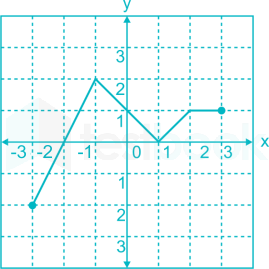
Which of the following function(s) in an accurate description of the graph for the range(s) indicated?

i) y = 2x + 4 for -3 ≤ x ≤ -1

ii) y = |x - 1| for -1 ≤ x ≤ 2

iii) y = ||x| - 1| for -1 ≤ x ≤ 2

iv) y = 1 for 2 ≤ x ≤ 3

  1. ((a))

    (i), (ii) and (iii) only

  2. ((b))

    (i), (ii) and (iv) only

  3. ((c))

    (i) and (iv) only

  4. ((d))

    (ii) and (iv) only

Show Answer
Answer: ((b))

(i), (ii) and (iv) only

Check for each equation:

(i) y = 2x + 4 is true in -3 ≤ x ≤ -1

On putting x = -3, y = -2; x = -2, y = 0; and x = -1, y = 2

(ii) y = |x - 1| is also true

x = -1, y = 2; x = 0, y = 1; and x = 1, y = 0

(iii) y = ||x| - 1| is false for -1 ≤ x ≤ 2

x = -1, y = 0 is not true; x = 0, y = 1 and x = 1, y = 0; and x = 2, y = 1

(iv) y = 1 in (2 ≤ x ≤ 3) always true

Equation (i), (ii) (iv) are true.

9

Consider a sequence of numbers a1, a2, a3, ….an where an=1n1n+2,{a_n} = \frac{1}{n} - \frac{1}{{n + 2}}, for each integer (n > 0). What is the sum of the first 50 terms?

  1. ((a))

    (1+12)150\left( {1 + \frac{1}{2}} \right) - \frac{1}{{50}}

  2. ((b))

    (1+12)+150\left( {1 + \frac{1}{2}} \right) + \frac{1}{{50}}

  3. ((c))

    (1+12)(151+152)\left( {1 + \frac{1}{2}} \right) - \left( {\frac{1}{{51}} + \frac{1}{{52}}} \right)

  4. ((d))

    1(151+152)1 - \left( {\frac{1}{{51}} + \frac{1}{{52}}} \right)

Show Answer
Answer: ((c))

(1+12)(151+152)\left( {1 + \frac{1}{2}} \right) - \left( {\frac{1}{{51}} + \frac{1}{{52}}} \right)

Given: an=1n1n+2{a_n} = \frac{1}{n} - \frac{1}{{n + 2}}

;a1=1111+2=113\therefore ;{a_1} = \frac{1}{1} - \frac{1}{{1 + 2}} = 1 - \frac{1}{3}

Similarly,

Let,;a1+a2+a3++a50=S{\rm{Let}},{\rm{;}}{a_1} + {a_2} + {a_3} + \ldots + {a_{50}} = {\rm{S}}

S=[(113)+(1214)+(1315)++(148150)+(149151)+(150152)]\therefore {\rm{S}} = \left[ {\left( {1 - \frac{1}{3}} \right) + \left( {\frac{1}{2} - \frac{1}{4}} \right) + \left( {\frac{1}{3} - \frac{1}{5}} \right) + \ldots + \left( {\frac{1}{{48}} - \frac{1}{{50}}} \right) + \left( {\frac{1}{{49}} - \frac{1}{{51}}} \right) + \left( {\frac{1}{{50}} - \frac{1}{{52}}} \right)} \right]

All like terms will cancel out and we will be left with 1+121511521 + \frac{1}{2} - \frac{1}{{51}} - \frac{1}{{52}}

a1+a2+a3++a50=(1+12)(151+152)\therefore {a_1} + {a_2} + {a_3} + \ldots + {a_{50}} = \left( {1 + \frac{1}{2}} \right) - \left( {\frac{1}{{51}} + \frac{1}{{52}}} \right)

10

Each of the letters arranged as below represents a unique integer from 1 to 9. The letters are positioned in the figure such that (A × B × C), (B × G × E) and (D × E × F) are equal. Which integer among the following choices cannot be represented by the letters A, B, C, D, E, F and G?

AD
BGE
CF
  1. ((a))

    4

  2. ((b))

    5

  3. ((c))

    6

  4. ((d))

    9

Show Answer
Answer: ((b))

5

Among the given options, only 5 is a prime number.

Thus, if any of A, B, C, D, E, F or G represents 5,

then (A × B × C) = (B × G × E) = (D × E × F) = multiple of 5.

This would imply at least two letters represent 5, which is not possible due to the unique representation by the letters.

Hence 5 cannot be represented by the letters A, B, C, D, E, F and G.

Civil Engineering (55 questions)

11

Which one of the following matrices is singular?

  1. ((a))

    \(\left[ {\begin{array}{*{20}{c}} 2&5\ 1&3 \end{array}} \right]\)

  2. ((b))

    \(\left[ {\begin{array}{*{20}{c}} 3&2\ 2&3 \end{array}} \right]\)

  3. ((c))

    \(\left[ {\begin{array}{*{20}{c}} 2&4\ 3&6 \end{array}} \right]\)

  4. ((d))

    \(\left[ {\begin{array}{*{20}{c}} 4&3\ 6&2 \end{array}} \right]\)

Show Answer
Answer: ((c))

\(\left[ {\begin{array}{*{20}{c}} 2&4\ 3&6 \end{array}} \right]\)

Concept:

Singular Matrix: It is matrix with determinant value zero and hence its inverse does not exist.

Singular matrix has at least one of the eigen values as zero and product of the two singular matrix is also singular matrix.

For 2 × 2 Matrix,

\({\rm{Let;A}} = \left[ {\begin{array}{*{20}{c}} {\rm{a}}&{\rm{b}}\ {\rm{c}}&{\rm{d}} \end{array}} \right],{\rm{;}}\left| {\rm{A}} \right| = {\rm{a}} \times {\rm{d}} - {\rm{b}} \times {\rm{c}}\)

Calculation:

\({\rm{For;A}} = \left[ {\begin{array}{*{20}{c}} 2&5\ 1&3 \end{array}} \right],\left| {\rm{A}} \right| = 6 - 5 = 1\)

\({\rm{For;B}} = \left[ {\begin{array}{*{20}{c}} 3&2\ 2&3 \end{array}} \right],\left| {\rm{B}} \right| = 9 - 4 = 5\)

\({\rm{For;C}} = \left[ {\begin{array}{*{20}{c}} 2&4\ 3&6 \end{array}} \right],\left| C \right| = 12 - 12 = 0\)

\({\rm{For;D}} = \left[ {\begin{array}{*{20}{c}} 4&3\ 6&2 \end{array}} \right],\left| {\rm{D}} \right| = 8 - 18 = - 10\)

∴ Matrix \(\left[ {\begin{array}{*{20}{c}} 2&4\ 3&6 \end{array}} \right]\) is a singular matrix.

12

For the given orthogonal matrix Q,

\(Q = \left[ {\begin{array}{*{20}{c}} {\frac{3}{7}}&{\frac{2}{7}}&{\frac{6}{7}}\ { - \frac{6}{7}}&{\frac{3}{7}}&{\frac{2}{7}}\ {\frac{2}{7}}&{\frac{6}{7}}&{ - \frac{3}{7}} \end{array}} \right]\)

The inverse is __________

  1. ((a))

    \(\left[ {\begin{array}{*{20}{c}} {\frac{3}{7}}&{\frac{2}{7}}&{\frac{6}{7}}\ { - \frac{6}{7}}&{\frac{3}{7}}&{\frac{2}{7}}\ {\frac{2}{7}}&{\frac{6}{7}}&{ - \frac{3}{7};} \end{array}} \right]\)

  2. ((b))

    \(\left[ {\begin{array}{*{20}{c}} { - \frac{3}{7}}&{ - \frac{2}{7}}&{ - \frac{6}{7}}\ {\frac{6}{7}}&{ - \frac{3}{7}}&{ - \frac{2}{7}}\ { - \frac{2}{7}}&{ - \frac{6}{7}}&{\frac{3}{7}} \end{array}} \right]\)

  3. ((c))

    \(\left[ {\begin{array}{*{20}{c}} {\frac{3}{7}}&{ - \frac{6}{7}}&{\frac{2}{7}}\ {\frac{2}{7}}&{\frac{3}{7}}&{\frac{6}{7}}\ {\frac{6}{7}}&{\frac{2}{7}}&{ - \frac{3}{7}} \end{array}} \right]\)

  4. ((d))

    \(\left[ {\begin{array}{*{20}{c}} { - \frac{3}{7}}&{\frac{6}{7}}&{ - \frac{2}{7}}\ { - \frac{2}{7}}&{ - \frac{3}{7}}&{ - \frac{6}{7}}\ { - \frac{6}{7}}&{ - \frac{2}{7}}&{\frac{3}{7}} \end{array}} \right]\)

Show Answer
Answer: ((c))

\(\left[ {\begin{array}{*{20}{c}} {\frac{3}{7}}&{ - \frac{6}{7}}&{\frac{2}{7}}\ {\frac{2}{7}}&{\frac{3}{7}}&{\frac{6}{7}}\ {\frac{6}{7}}&{\frac{2}{7}}&{ - \frac{3}{7}} \end{array}} \right]\)

Concept:

For orthogonal matrix: A × AT = I ⇒ A-1 = AT

Calculation:

For given matrix \(\left( Q \right) = \left[ {;\begin{array}{*{20}{c}} {\frac{3}{7}}&{\frac{2}{7}}&{\frac{6}{7}}\ {\frac{{ - 6}}{7}}&{\frac{3}{7}}&{\frac{2}{7}}\ {\frac{2}{7}}&{\frac{6}{7}}&{\frac{{ - 3}}{7}} \end{array}} \right]\)

∴ Q × QT = 1 ⇒ Q-1 = QT

\({{\rm{Q}}^{ - 1}} = {{\rm{Q}}^{\rm{T}}} = \left[ {{\rm{;}}\begin{array}{*{20}{c}} {\frac{3}{7}}&{\frac{{ - 6}}{7}}&{\frac{2}{7}}\ {\frac{2}{7}}&{\frac{3}{7}}&{\frac{6}{7}}\ {\frac{6}{7}}&{\frac{2}{7}}&{\frac{{ - 3}}{7}} \end{array}} \right]\)

Alternative Method:

Q1=1Q×Adj;[Q]{{\rm{Q}}^{ - 1}} = \frac{1}{{\left| {\rm{Q}} \right|}} \times {\rm{Adj;}}\left[ {\rm{Q}} \right]

\({\rm{Adj;Q;}} = \left[ {\begin{array}{*{20}{c}} {\frac{{ - 21}}{{49}}}&{\frac{{42}}{{49}}}&{\frac{{ - 14}}{{49}}}\ {\frac{{ - 14}}{{49}}}&{\frac{{ - 21}}{{49}}}&{\frac{{ - 42}}{{49}}}\ {\frac{{ - 42}}{{49}}}&{\frac{{ - 14{\rm{;}}}}{{49}}}&{\frac{{21}}{{42}}} \end{array}} \right]\)

Q=37×(9491249)27×(1849449)+67×(3649649)=;1\left| {\rm{Q}} \right| = \frac{3}{7} \times \left( {\frac{{ - 9}}{{49}} - \frac{{12}}{{49}}} \right) - \frac{2}{7} \times \left( {\frac{{18}}{{49}} - \frac{4}{{49}}} \right) + \frac{6}{7} \times \left( {\frac{{ - 36}}{{49}} - \frac{6}{{49}}} \right) = {\rm{;}} - 1

\({{\rm{Q}}^{ - 1}} = \left[ {\begin{array}{*{20}{c}} {\frac{3}{7}}&{\frac{{ - 6}}{7}}&{\frac{2}{7}}\ {\frac{2}{7}}&{\frac{3}{7}}&{\frac{6}{7}}\ {\frac{6}{7}}&{\frac{2}{7}}&{\frac{{ - 3}}{7}} \end{array}} \right]\)

13

At the point x = 0, the function f(x) = x3 has

  1. ((a))

    Local maximum

  2. ((b))

    Local minimum

  3. ((c))

    Both local maximum and minimum

  4. ((d))

    Neither local maximum nor local minimum

Show Answer
Answer: ((d))

Neither local maximum nor local minimum

For the given function: f(x) = x3

From graph, it can be observed that it has neither local maximum non local minimum

Alternative:

f’(x) = 3x2 ⇒ f’(x) = 0 ⇒ 3x2 = 0 ⇒ x = 0

f’’(x) = 6x at x = 0, f’’(x) = 0. (Neither +ve nor -ve)

So it has neither local maximum nor minimum.

14

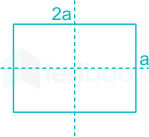
A column of height h with rectangular cross-section of a × 2a has a buckling load of P. If the cross-section is changed to 0.5a × 3a and height changed to 1.5h, the buckling load of the redesigned column will be

  1. ((a))

    P12\frac{P}{{12}}

  2. ((b))

    P4\frac{P}{{4}}

  3. ((c))

    P2\frac{P}{{2}}

  4. ((d))

    3P2\frac{3P}{{2}}

Show Answer
Answer: ((a))

P12\frac{P}{{12}}

Concept:

For column, the buckling load is taken as,

\({\rm{P}} = \frac{{{{\rm{\pi }}^2}{\rm{E;}}{{\rm{I}}{{\rm{min}}}}}}{{{\rm{L}}{\rm{e}}^2}}\)

E = Modulus of Elasticity, Imin = Minimum moment of inertia, and Le = effective length of column.

End ConditionBoth end hingedOne end fixed other freeBoth end fixedOne end fixed and other hinged
Effective length (Le)L2L1/2L2\frac{L}{{\sqrt 2 }}

Calculation:

In first case: Height = h, and cross-sectional area = a × 2a

\({\rm{I}} = \frac{{{\rm{b}}{{\rm{h}}^3}}}{{12}} = {\rm{min}}\left{ {\frac{{2{\rm{a}} \times {{\rm{a}}^3}}}{{12}},\frac{{{\rm{a}} \times {{\left( {2{\rm{a}}} \right)}^3}}}{{12}}} \right. = \frac{{2{{\rm{a}}^4}}}{{12}}\)

P=π2E;(2a×a312);h2=π2Ea46h2{\rm{P}} = \frac{{{{\rm{\pi }}^2}{\rm{E;}}\left( {\frac{{2{\rm{a}} \times {{\rm{a}}^3}}}{{12}}} \right){\rm{;}}}}{{{{\rm{h}}^2}}} = \frac{{{{\rm{\pi }}^2}{\rm{E}}{{\rm{a}}^4}}}{{6{{\rm{h}}^2}}}

\({\rm{I}} = \frac{{{\rm{b}}{{\rm{h}}^3}}}{{12}} = {\rm{min}}\left{ {\frac{{2{\rm{a}} \times {{\rm{a}}^3}}}{{12}},\frac{{{\rm{a}} \times {{\left( {2{\rm{a}}} \right)}^3}}}{{12}}} \right. = \frac{{2{{\rm{a}}^4}}}{{12}}\)

In second case: Height = 1.5 h, and cross-sectional area = 3a × 0.5a

P=π2E;[3a×(0.5a)312](1.5;h)2=112×π2Ea46h2=P12{\rm{P'}} = \frac{{{{\rm{\pi }}^2}{\rm{E;}}\left[ {\frac{{3{\rm{a}} \times {{\left( {0.5{\rm{a}}} \right)}^3}}}{{12}}} \right]}}{{{{\left( {1.5{\rm{;h}}} \right)}^2}}} = \frac{1}{{12}} \times \frac{{{{\rm{\pi }}^2}{\rm{E}}{{\rm{a}}^4}}}{{6{{\rm{h}}^2}}} = \frac{{\rm{P}}}{{12}}

15

A steel column of ISHB 350 @72.4 kg/m is subjected to a factored axial compressive load of 2000 kN. The load is transferred to a concrete pedestal of grade M20 through square base plate. Consider the bearing strength of concrete as 0.45 fck, where fck is the characteristic strength of concrete. Using limit state method and neglecting the self-weight of base plate and steel column, the length of a side of the base plate to be provided is

  1. ((a))

    39 cm

  2. ((b))

    42 cm

  3. ((c))

    45 cm

  4. ((d))

    48 cm

Show Answer
Answer: ((d))

48 cm

Concept:

Bearing plates are provided below the column to transfer the load to the concrete pedestal.

Area required for the base plate = Factored load / Bearing Capacity of concrete

Bearing Capacity of concrete = 0.45 × fck

fck - Characteristic strength of concrete

Calculation:

Given:

Factored load = 2000 kN, Bearing Capacity of concrete = 0.45 × 20 = 9

∴ Area required = 2000000/9 = 222222.222 mm2

Side of plate = √222222.222 = 471.40 mm = 47.1 cm

∴ A plate of 48 cm is to be provided.

16

The Le Chatelier apparatus is used to determine

  1. ((a))

    Compressive strength of cement

  2. ((b))

    Fineness of cement

  3. ((c))

    Setting time of cement

  4. ((d))

    Soundness of cement

Show Answer
Answer: ((d))

Soundness of cement

For quality control of Portland cement, the test essentially done is

1) Le Chatelier Test: This test is used to measure the soundness of OPC due to lime. Lime & Magnesia are two primary compounds responsible for the soundness of cement.

2) Blaine Air Permeability: It is used to measure the fineness of the cement.

4) The Vicat Apparatus: It is used to measure setting time and consistency of concrete.

5) Tensile (Briquette) Testing Machine: It is used to measure the tensile strength of the concrete

17

The deformation in concrete due to sustained loading is

  1. ((a))

    Creep

  2. ((b))

    Hydration

  3. ((c))

    Segregation

  4. ((d))

    Shrinkage

Show Answer
Answer: ((a))

Creep

Creep in concrete: It is defined as deformation of structure under sustained load. It is a long-term pressure or stress on concrete due to which there is a change shape of concrete structure. This deformation usually occurs in the direction of applied force, thus causing permanent deformation in concrete structure.

Segregation: Segregation of concrete is the separation of ingredients of concrete from each other. In the case of segregation, the heavy aggregate particles settle down leaving a sand cement mix on top affecting the quality adversely.

Hydration: The exothermic reaction of cement with water which liberates a considerable quantity of heat and results is setting and hardening of cement is called hydration.

Shrinkage: It is the volumetric changes of concrete structures due to the loss of moisture by evaporation. The total shrinkage of concrete depends upon the constituents of concrete, size of the member and environmental conditions.

18

A solid circular beam with a radius of 0.25 m and length of 2 m is subjected to a twisting moment of 20 kNm about the z-axis at the free end, which is the only load acting as shown in the figure. The shear stress component τxy at point ‘M’ in cross-section of the beam at a distance of 1 m from the fixed end is

A picture containing objectDescription automatically generated

  1. ((a))

    0.0 MPa

  2. ((b))

    0.51 MPa

  3. ((c))

    0.815 MPa

  4. ((d))

    2.0 MPa

Show Answer
Answer: ((a))

0.0 MPa

Concept:

A picture containing objectDescription automatically generated

Here,

τzy = τyz = τmax

τmax = 16T/π d3 = 0.815 MPa

In pure torsion of a circular shaft, there are no shear stress components acting in the plane of the cross-section (the x-y plane). Shear stress only exists on planes perpendicular to the longitudinal axis (z-axis) and acts in directions within the cross-sectional plane (x or y). Thus, the component τxy, which represents shear stress on the x-plane in the y-direction (or vice versa), is zero.

Hence,  τxy = τyx = 0 

Additional Information

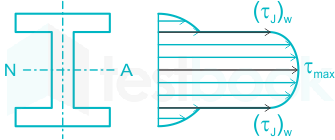
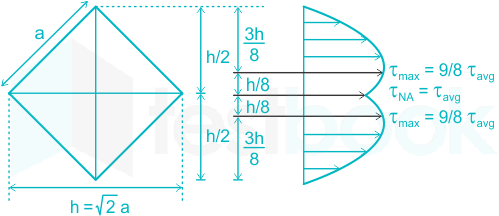
Shear stress distribution:

  • The value of shear stress at any level is given by
  • τ=FAYˉIb{\bf{τ }} = \frac{{{\bf{FA\bar Y}}}}{{{\bf{Ib}}}}
  • where F = Applied/Resisting shear force, I = Moment of Inertia of the complete cross-section about NA, b = width of the required level where shear stress is required,
  • A = Area either above or below the required level, Y = centroidal distance of considered area from NA.
  • Now, as we can see from the equation width 'b' is inversely proportional to the shear stress of the section.
  • So from the top of the beam as the width decreases the shear stress will go on increase up to the neutral axis and beyond the neutral axis as with the increase of width down the shear stress starts decreasing.
  • Shear stress will be maximum at the neutral axis.

  • Shear stress acts parallel to the cross-section of the beam.
  • At extreme fibre, shear stress is zero and at NA, shear stress is non-zero but maximum in some cases like circular, square, rectangle, I-section, T-section beams, etc.
  • Shear stress on a cross-section of the beam varies parabolically.

19

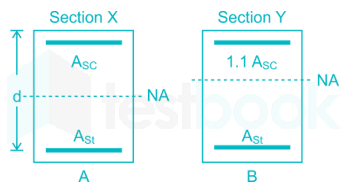
Two rectangular under-reinforced concrete beam sections X and Y are similar in all aspects except that the longitudinal compression reinforcement in section Y is 10% more. Which one of the following is the correct statement?

  1. ((a))

    Section X has less flexural strength and is less ductile than section Y

  2. ((b))

    Section X has less flexural strength but is more ductile than section Y

  3. ((c))

    Sections X and Y have equal flexural strength but different ductility

  4. ((d))

    Sections X and Y have equal flexural strength and ductility.

Show Answer
Answer: ((a))

Section X has less flexural strength and is less ductile than section Y

Both the sections (X and Y) are under reinforced, hence in both the cases the flexural strength (moment of resistance) can be calculated from the tension side and is given by,

Moment of resistance = Tension force × Lever arm

When additional compression reinforcement is placed i.e. in case of section Y, neutral axis will shift upward i.e., towards compression fiber of the section which is above than that of section X.

This shows that the section Y is more under reinforced than Section X. Hence due to the presence of steel in compression side, the rotational capacity (flexural strength or moment of resistance) of the section Y increases (which means ductility increases).

Hence, one can say that Section X has less flexural strength and is less ductile than section Y.

20

The percent reduction in the bearing capacity of a strip footing resting on sand under flooding condition (water level at the base of the footing) when compared to the situation where the water level is at a depth much greater than the width of footing is approximately

  1. ((a))

    0

  2. ((b))

    25

  3. ((c))

    50

  4. ((d))

    100

Show Answer
Answer: ((c))

50

Explanation

Terzaghi’s bearing capacity equation is given as:

Ultimate bearing capacity (qu) = C × Nc + γ × D × Nq + 0.5 γ × B × Nγ

For cohesionless soil c = 0, footing resting on the sand surface so, Df = 0

Case 1: When the water level is at the base of the footing

Bearing capacity \(\left( {{{\rm{q}}{{{\rm{u}}1}}}} \right) = \frac{1}{2} \times {{\rm{\gamma }}{{\rm{sub}}}} \times {\rm{B}} \times {{\rm{N}}{\rm{\gamma }}}\)

Case 2: When the water level is at a much greater depth

Bearing capacity \(\left( {{{\rm{q}}{{{\rm{u}}2}}}} \right) = \frac{1}{2}{{\rm{\gamma }}{{\rm{sat}}}}{\rm{B}}{{\rm{N}}{\rm{\gamma }}}\)

∴ Percentage reduction in bearing capacity of soil \(= \frac{{{{\rm{q}}{{{\rm{u}}2}}} - {{\rm{q}}{{{\rm{u}}1}}}}}{{{{\rm{q}}{{{\rm{u}}1}}}}} \times 100 = \frac{{{{\rm{\gamma }}{{\rm{sat}}}} - {{\rm{\gamma }}{{\rm{sub}}}}}}{{{{\rm{\gamma }}_{{\rm{sat}}}}}} \times 100\)

We know that γsub ≈ 0.5 γsat

∴ Percentage reduction = 50%.

21

The width of a square footing and the diameter of a circular footing are equal. If both the footings are placed on the surface of sandy soil, the ratio of the ultimate bearing capacity of the circular footing to that of the square footing will be

  1. ((a))

    4/3

  2. ((b))

    1

  3. ((c))

    3/4

  4. ((d))

    2/3

Show Answer
Answer: ((c))

3/4

Concept:

For circular footing, ultimate bearing capacity

qu = 1.3 CNc + γDfNq + 0.3 γBNγ

For square footing, ultimate bearing capacity

qu = 1.3 CNc + γDfNq + 0.4 γBNγ

Calculation:

As footing is placed on the surface

Df  = 0

For circular footing, ultimate bearing capacity

qu = 1.3 CNc + xDfNq + 0.3 xBNx

C = 0, D = 0

qu = 0.3x BNx  …… (i)

For square footing, ultimate bearing capacity

qu = 1.3 CNc + x DfNq + 0.4 xBNx

C = 0, Df = 0

qu = 0.4 x BNx  …… (ii)

Divide (i) by (ii)

\(\frac{{{{\left( {{q_u}} \right)}{circular}}}}{{{{\left( {{q_u}} \right)}{square}}}} = \frac{{0.3xB{N_x}}}{{0.4xB{N_x}}} = \frac{3}{4}\)

22

Bernoulli’s equation is applicable for

  1. ((a))

    Viscous and compressible fluid flow

  2. ((b))

    Inviscid and compressible fluid flow

  3. ((c))

    Inviscid and incompressible fluid flow

  4. ((d))

    Viscous and incompressible fluid flow

Show Answer
Answer: ((c))

Inviscid and incompressible fluid flow

Explanation:

Pρg+v22g+Z=Constant\frac{P}{\rho g} + \frac{{{v^2}}}{{2g}} + Z = Constant

Bernoulli’s equation:

  • It can be derived from the principle of conservation of energy.
  • It states that, in a steady flow, the sum of all forms of energy in a fluid along a streamline is the same at all points on that streamline.
  • It represented in head form (the total energy per unit weight).

Following assumption are made in deriving the Bernoulli’s equation:

  1. Fluid is inviscous i.e. zero viscosity.
  2. Flow is in steady-state.
  3. Flow is incompressible.
  4. Flow is irrotational.
  5. Flow is along the streamline.

Important Points

Even if the flow is rotational, we can still apply the Bernoulli’s equation along a streamline.

23

There are 20,000 vehicles, operating in a city with an average annual travel of 12,000 km per vehicle. The NOx emission rate is 2.0 g/km per vehicle. The total annual release of NOx will be,

  1. ((a))

    4,80,000 kg

  2. ((b))

    4,800 kg

  3. ((c))

    480 kg

  4. ((d))

    48 kg

Show Answer
Answer: ((a))

4,80,000 kg

Concept:

Total Annual Emission = Average Annual daily emission per vehicle × Number of Vehicle

Average Annual daily emission per vehicle = Emission per km of travel × Distance traveled (in km)

∴ Total Annual Emission = Number of vehicles × Distance travelled × Rate of emission

Calculation:

Total Annual Emission = Number of vehicles × Distance traveled × Rate of emission

∴ Total Annual Emission = 20000 × 12000 × 2 × 10-3 (kg) = 480000 kg

24

A bitumen sample has been graded as VG30 as per IS 73-2013. The ‘30’ in the grade means that

  1. ((a))

    Penetration of bitumen at 25°C is between 20 and 40 

  2. ((b))

    Viscosity of bitumen at 60°C is between 2400 and 3600 Poise

  3. ((c))

    Ductility of bitumen 27°C is more than 30 cm. 

  4. ((d))

    Elastic recovery at 15°C is more than 30%.

Show Answer
Answer: ((b))

Viscosity of bitumen at 60°C is between 2400 and 3600 Poise

Concept:

Penetration Test: It determines the hardness and softness of the bitumen. The bitumen grade is specified in terms of penetration value. Higher penetration implies softer grade.

Ductility is the property of bitumen that permits it to undergo great deformation or elongation. Use of ductility test is to measure the adhesive property of bitumen and its ability to stretch.

Elastic recovery of any modified bitumen binder is evaluated by the percentage of recoverable strain measured after an elongation during a conventional ductility test.

According to IS 73-2013, Number 30 indicates the range of viscosity of bitumen [(100 ± 20) × 30] in terms of Poise.

Calculation:

For VG 30 Bitumen:

Maximum Viscosity: (100 + 20 = 120) × 30 = 3600 Poise

Minimum Viscosity: (100 - 20 = 80) × 30 = 2400 Poise

25

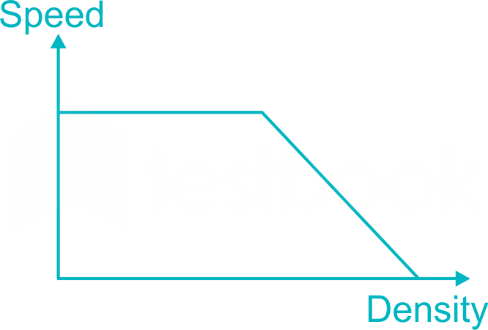
The speed-density relationship for a road section is shown in the figure.

A picture containing objectDescription automatically generated

The shape of flow-density relationship is

  1. ((a))

    Piecewise linear 

  2. ((b))

    Parabolic

  3. ((c))

    Initially linear then parabolic 

  4. ((d))

    Initially parabolic then linear

Show Answer
Answer: ((c))

Initially linear then parabolic 

Concept:

We know, Traffic capacity (q) = velocity (v) × density (k) ⇒ q = kV

For Case 1: When speed is constant, and density of the flow keeps on increasing at the same speed.

q = k × constant

∴ Flow becomes the linear function of density and with increase in density, flow increases linearly.

For Case 2: With decrease in the speed further, density increases linearly.

Here flow becomes the function the speed as well as density and hence flow becomes the parabolic function of density as density is varying with speed.

∴ After that V varies linearly with k, so q will vary parabolically with k.

26

A well-designated signalized intersection is one in which the 

  1. ((a))

    Crossing conflicts are increased 

  2. ((b))

    Total delay is minimized 

  3. ((c))

    Cycle time is equal to the sum of red and green times in all phase 

  4. ((d))

    Cycle time is equal to the sum of red and yellow times in all phase

Show Answer
Answer: ((b))

Total delay is minimized 

Concept:

Intersection is an area shared by two or more roads. Its main function is to guide vehicles to their respective directions. The essence of the intersection control is to resolve crossing conflicts at the intersection for the safe and efficient movement of both vehicular traffic and pedestrians with an objective of minimum

  1. Time sharing: Time shared by each vehicle during crossing the intersection. It includes the stopping time, starting time and time required to cross the intersection. Here we have only control over the delay time as other aspects depend upon the vehicular characteristics and driver characteristics.
  2. Space sharing: It is the space occupied by the vehicle. Generally it relates with the density of vehicle.

So, in a well-designed signalized intersection total delay is minimized to avoid the conflicts with proper time sharing.

27

A flow field is given by  u = y2, v = -xy, w = 0. Value of the z-component of the angular velocity (in radians per unit time up to two decimal places) at the point (0, -1, 1) is_______.

28

The frequency distribution of the compressive strength of 20 concrete cube specimens is given in the table.

f(MPa)Number of specimens with compressive strength equal to f
234
282
22.55
315
294

If μ is the mean strength of the specimens and σ is the standard deviation, the number of specimens (out of 20) with compressive strength less than μ – 3σ is _________.

29

In a fillet weld, the direct shear stress and bending tensile stress are 50 MPa and 150 MPa respectively. As per IS 800: 2007, the equivalent stress (in MPa, up to two decimal places) will be________.

30

In a shrinkage limit test, the volume and mass of a dry soil pat are found to be 50 cm3 and 88 g respectively. The specific gravity of the solids is 2.71 and the density of water is 1 g/cc. The shrinkage limit (in % up to two decimal places) is _____

31

A core cutter of 130 mm height has inner and outer diameter of 100 mm and 106 mm respectively. The area ratio of the core cutter (in % up to two decimal places) is _______.

32

A 1: 50 model of a spillway is to be tested in the laboratory. The discharge in the prototype spillway is 1000 m3/s. The corresponding discharge (in m3/s, up to two decimal places) to be maintained in the model, neglecting variation in acceleration due to gravity, is _________.

33

A 10 m wide rectangular channel carries a discharge of 20 m3/s under critical condition. Using g = 9.81 m/s2, the specific energy (in m, up to two decimal places) is _____.

34

For routing of flood in a given channel using the Muskingum method, two of the routing coefficients are estimated as C0 = - 0.25 and C1 = 0.55. The value of the third coefficient C2 would be ______.

35

A city generates 40 × 106 kg of municipal solid waste (MSW) per year, out of which 10% is recovered/recyclable and the rest goes to landfill. The landfill has a single lift of 3m height and is compacted to a density of 550 kg/m3. If 80% of the landfill is assumed to be MSW, the landfill are (in m2, up to one decimal place) required would be ______.

36

The value of the integral  !!π!! 0,xcos2xdx\underset{0}{\overset{\text{ }!!\pi!!\text{ }}{\mathop \int }},\text{x}{{\cos }^{2}}\text{xdx} is

  1. ((a))

    π28\frac{{{\pi }^{2}}}{8}

  2. ((b))

    π24\frac{{{\pi }^{2}}}{4}

  3. ((c))

    π22\frac{{{\pi }^{2}}}{2}

  4. ((d))

    π2

Show Answer
Answer: ((b))

π24\frac{{{\pi }^{2}}}{4}

\(\mathop{\int }{\text{a}}^{\text{b}}\text{f}\left( \text{x} \right)\text{ }!!!!\text{ dx }!!!!\text{ }=\mathop{\int }{\text{a}}^{\text{b}}\text{f}\left( \text{a}+\text{b}-\text{x} \right)\text{ }!!~!!\text{ dx}\)

Applying the property 

\(\text{I}=\mathop{\int }{0}^{\text{ }!!\pi!!\text{ }}\text{x }!!!!\text{ }{{\left( \cos \text{x} \right)}^{2}}\text{ }!!!!\text{ dx}=\mathop{\int }{0}^{\text{ }!!\pi!!\text{ }}\left( \text{ }!!\pi!!\text{ }-\text{x} \right)\text{ }!!!!\text{ }{{\left( \cos \left( \text{ }!!\pi!!\text{ }-\text{x} \right) \right)}^{2}}\text{ }!!!!\text{ dx}\)

\(\text{I}=\mathop{\int }{0}^{\text{ }!!\pi!!\text{ }}\text{ }!!\pi!!\text{ }!!!!\text{ }{{\left( \cos \text{x} \right)}^{2}}\text{ }!!!!\text{ dx}-\text{ }!!~!!\text{ }\mathop{\int }{0}^{\text{ }!!\pi!!\text{ }}\text{x }!!!!\text{ }{{\left( \cos \text{x} \right)}^{2}}\text{ }!!!!\text{ dx}\)

\(\text{I}=\mathop{\int }_{0}^{\text{ }!!\pi!!\text{ }}\text{ }!!\pi!!\text{ }!!!!\text{ }{{\left( \cos \text{x} \right)}^{2}}\text{ }!!!!\text{ dx}-\text{ }!!~!!\text{ I}\)

\(2\times \text{I}=\mathop{\int }{0}^{\text{ }!!\pi!!\text{ }}\text{ }!!\pi!!\text{ }!!!!\text{ }{{\left( \cos \text{x} \right)}^{2}}\text{ }!!!!\text{ dx}=\text{ }!!\pi!!\text{ }\mathop{\int }{0}^{\text{ }!!\pi!!\text{ }}\frac{1+\cos 2\text{x}}{2}\text{ }!!~!!\text{ dx}\)

\(2\times \text{I}=\text{ }!!\pi!!\text{ }\mathop{\int }{0}^{\text{ }!!\pi!!\text{ }}\frac{1}{2}\text{ }!!~!!\text{ dx}+\text{ }!!\pi!!\text{ }\mathop{\int }{0}^{\text{ }!!\pi!!\text{ }}\frac{\cos 2\text{x}}{2}\text{ }!!~!!\text{ dx}\)

2×I= !! !!  !!π!! 2( !!π!! 0)+12(sin2 !!π!! sin0)= !!π!! 222\times \text{I}=\text{ }!!~!!\text{ }\frac{\text{ }!!\pi!!\text{ }}{2}\left( \text{ }!!\pi!!\text{ }-0 \right)+\frac{1}{2}\left( \sin 2\text{ }!!\pi!!\text{ }-\sin 0 \right)=\frac{{{\text{ }!!\pi!!\text{ }}^{2}}}{2}

\(\therefore \mathbf{I}=\mathop{\int }_{0}^{\mathbf{\pi }}\mathbf{x}{{\left( \cos \mathbf{x} \right)}^{2}}\mathbf{dx}=\frac{{{\mathbf{\pi }}^{2}}}{4}\)

37

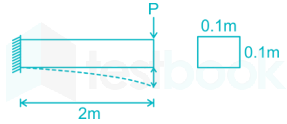
A cantilever beam of length 2 m with a square section of side length 0.1 m is loaded vertically at the free end. The vertical displacement at the free end is 5 mm. The beam is made of steel with Young’s modulus of 2.0 × 10¹¹ N/m2. The maximum bending stress at the fixed end of the cantilever is _______

  1. ((a))

    20.0 MPa

  2. ((b))

    37.5 MPa

  3. ((c))

    60.0 MPa

  4. ((d))

    75.0 MPa

Show Answer
Answer: ((b))

37.5 MPa

Concept:

The cantilever beam having poooint load at the end is shown in the figure.

The maximum deflection of free end is given as, δ=PL33EI\delta = \frac{PL^3}{3EI}

And we know that, the moment equation is, MI=σy=ER\frac{{\text{M}}}{{\text{I}}} = \frac{{σ }}{{\text{y}}} = \frac{{\text{E}}}{{\text{R}}}

Calculation:

Given:

L = 2 m, side (a) = 0.1 m, ymax = 5 mm, E = 2.0 × 10¹¹ N/m2.

The maximum deflection

δ=PL33EI\delta = \frac{PL^3}{3EI}

5×103=P×233×2×1011×I5 \times 10^{-3} = \frac{P \times 2^3}{3\times 2 \times 10^{11} \times I}

PI=375×106 N/mm4\frac PI=375\times10^6 ~N/mm^4

The moment equation

MI=σy=ER\frac{{\text{M}}}{{\text{I}}} = \frac{{σ }}{{\text{y}}} = \frac{{\text{E}}}{{\text{R}}}

\({{{σ}}{{\text{max}}}} = \frac{{\text{M}}}{{\text{z}}} = \frac{{{\text{M}} \times {{\text{y}}{{\text{max}}}}}}{{\text{I}}}\)

σmax=375×106×2×0.12=37.5×10⁶Paσ_{max}=\frac{375 \times 10^6\times2\times0.1}{2}=37.5\times10^6Pa

σmax = 37.5 MPa

38

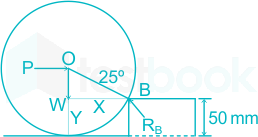
A cylinder of radius 250 mm and weight, W = 10 kN is rolled up an obstacle of height 50 mm by applying a horizontal force P at its center as shown in the figure.

All interfaces are assumed frictionless. The minimum value of P is

  1. ((a))

    4.5 kN 

  2. ((b))

    5.0 kN 

  3. ((c))

    6.0 kN 

  4. ((d))

    7.5 kN

Show Answer
Answer: ((d))

7.5 kN

Free body diagram for the following arrangement are as follows:

OY = 250 - 50 = 200 m

OB = 250 mm

BY=25022002=150{\rm{BY}} = \sqrt {{{250}^2} - {{200}^2}} = 150

Concept:

When the roller will just start to roll up, then it will loose its contact at point X. only contact will be at point B.

At that instant, ∑ MB = 0

Calculation:

∑ MB = 0

P × OY - W × BY = 0

⇒ P × 200 - 10 × 150 = 0

P=10×150200=7.5;kN.\Rightarrow {\rm{P}} = \frac{{10 \times 150}}{{200}} = 7.5{\rm{;kN}}.

39

A plate in equilibrium is subjected to uniform stresses along its edges with magnitude σxx = 30 MPa and σyy = 50 MPa as shown in the figure.

The Young’s modulus of the material is 2 × 10¹¹ N/m2 and the Poisson’s ratio is 0.3. If σzz is negligibly small and assumed to be zero, then the strain εzz is

  1. ((a))

    -120 × 10-6

  2. ((b))

    – 60 × 10-6

  3. ((c))

    0.0 

  4. ((d))

    120 × 10-6

Show Answer
Answer: ((a))

-120 × 10-6

Concept:

The generalized hooks law is given by:

\({{\text{ }!!\varepsilon!!\text{ }}{\text{xx}}}=\text{ }!!~!!\text{ }\frac{{{\text{ }!!\sigma!!\text{ }}{\text{xx}}}}{\text{E}}-\text{ }!!\nu!!\text{ }\frac{{{\text{ }!!\sigma!!\text{ }}{\text{yy}}}}{\text{E}}-\text{ }!!\nu!!\text{ }\frac{{{\text{ }!!\sigma!!\text{ }}{\text{zz}}}}{\text{E}}\)

\({{\text{ }!!\varepsilon!!\text{ }}{\text{yy}}}=\text{ }!!~!!\text{ }\frac{{{\text{ }!!\sigma!!\text{ }}{\text{yy}}}}{\text{E}}-\text{ }!!\nu!!\text{ }\frac{{{\text{ }!!\sigma!!\text{ }}{\text{xx}}}}{\text{E}}-\text{ }!!\nu!!\text{ }\frac{{{\text{ }!!\sigma!!\text{ }}{\text{zz}}}}{\text{E}}\)

\({{\text{ }!!\varepsilon!!\text{ }}{\text{zz}}}=\text{ }!!~!!\text{ }\frac{{{\text{ }!!\sigma!!\text{ }}{\text{zz}}}}{\text{E}}-\text{ }!!\nu!!\text{ }\frac{{{\text{ }!!\sigma!!\text{ }}{\text{yy}}}}{\text{E}}-\text{ }!!\nu!!\text{ }\frac{{{\text{ }!!\sigma!!\text{ }}{\text{xx}}}}{\text{E}}\)

Where

εxx= Strain in x direction due to stresses in x, y, z direction.

εyy = Strain in y direction due to stresses in x, y, z direction.

εzz = Strain in z direction due to stresses in x, y, z direction.

ν = Poisson’s ration = 0.3

E = Young’s modulus = 2 × 10¹¹ N/m2 = = 2 × 1011 × 10-6 N/mm2 = 2 × 10⁵ N/mm2

Calculation:

σxx = 30 MPa = 30 N/mm

σyy = 50 MPa = 50 N/mm

\({{\text{ }!!\varepsilon!!\text{ }}{\text{zz}}}=\text{ }!!~!!\text{ }\frac{{{\text{ }!!\sigma!!\text{ }}{\text{zz}}}}{\text{E}}-\text{ }!!\nu!!\text{ }\frac{{{\text{ }!!\sigma!!\text{ }}{\text{yy}}}}{\text{E}}-\text{ }!!\nu!!\text{ }\frac{{{\text{ }!!\sigma!!\text{ }}{\text{xx}}}}{\text{E}}\)

\({{\varepsilon }_{zz}}=\frac{0}{2\times {{10}^{5}}}-0.3\frac{50}{2\times {{10}^{5}}}-0.3\frac{30}{2\times ~{{10}^{5}}}=-1.2\times {{10}^{-4}}=-120\times {{10}^{-6}}\)

40

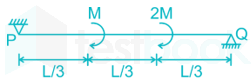
The figure shows a simply supported beam PQ of uniform flexural rigidity EI carrying two moments M and 2M.

The slope at P will be

  1. ((a))

    0

  2. ((b))

    ML9EI\frac{\text{ML}}{9\text{EI}}

  3. ((c))

    ML6EI\frac{\text{ML}}{6\text{EI}}

  4. ((d))

    ML3EI\frac{\text{ML}}{3\text{EI}}

Show Answer
Answer: ((c))

ML6EI\frac{\text{ML}}{6\text{EI}}

For calculation of slope and deflection in simply supported beam mainly conjugate beam method is used.

Conjugate beam method: The slope at any section of a loaded beam relative to the original axis of the beam is equal to the shear force in the conjugate beam at the corresponding section.

For Bending moment diagram first calculate reactions at P and Q support
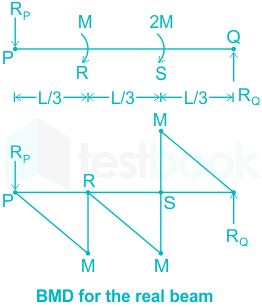
v=0\sum v=0

RP = RQ

Taking moment about point Q

  • RP × L + M + 2M = 0

RP = 3M/L

RQ = 3M/L

For bending moment diagram- Calculating bending moment from left hand side-

BMP = 0

\(\text{B}{{\text{M}}_{\text{LEFT }!!!!\text{ OF }!!!!\text{ R}}}=-\frac{3M}{L}\times \frac{L}{3}=-\text{M }!!~!!\text{ }\)

\(\text{B}{{\text{M}}_{\text{RIGHT }!!!!\text{ OF }!!!!\text{ R}}}=-\frac{3M}{L}\times \frac{L}{3}+\text{M}=0\text{ }!!~!!\text{ }\)

\(\text{B}{{\text{M}}_{\text{LEFT }!!!!\text{ }OFS}}=-\frac{3M}{L}\times \frac{2L}{3}+\text{M}=-\text{M}\)

\(\text{B}{{\text{M}}_{\text{RIGHT }!!!!\text{ }OFS}}=-\frac{3M}{L}\times \frac{2L}{3}+\text{M}+2\text{M}=\text{M}\)

BMQ=3ML×L+M+2M=0\text{B}{{\text{M}}_{\text{Q}}}=-\frac{3M}{L}\times \text{L}+\text{M}+2\text{M}=0

Conjugate beam with loading:

Shear at any section of the conjugate beam is equal to the slope of the real beam-

Shear force at P = Reaction at P (RA’) in the conjugate beam
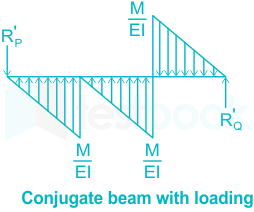
Taking moment about point Q

\(-\text{ }!!!!\text{ R}_{\text{P}}^{\text{ }!!'!!\text{ }}\times \text{ }!!!!\text{ L }!!~!!\text{ }+\frac{1}{2}\times \frac{\text{L}}{3}\times \frac{\text{M}}{\text{EI}}\times \left( \frac{2\text{L}}{3}+\frac{1}{3}\times \frac{\text{L}}{3} \right)+\frac{1}{2}\times \frac{\text{L}}{3}\times \frac{\text{M}}{\text{EI}}\times \left( \frac{\text{L}}{3}+\frac{1}{3}\times \frac{\text{L}}{3} \right)-\frac{1}{2}\times \frac{\text{L}}{3}\times \frac{\text{M}}{\text{EI}}\times \left( \frac{2}{3}\times \frac{\text{L}}{3} \right)=0\)

RP !!!! × !! !! L=7ML254EI+4ML254EIML227EI\text{R}_{\text{P}}^{\text{ }!!'!!\text{ }}\times \text{ }!!~!!\text{ L}=\frac{7\text{M}{{\text{L}}^{2}}}{54\text{EI}}+\frac{4\text{M}{{\text{L}}^{2}}}{54\text{EI}}-\frac{\text{M}{{\text{L}}^{2}}}{27\text{EI}}

RP !!!! =ML6EI\text{R}_{\text{P}}^{\text{ }!!'!!\text{ }}=\frac{\text{ML}}{6\text{EI}}

\(\therefore \text{Slope }!!!!\text{ at }!!!!\text{ point }!!~!!\text{ P}=\text{R}_{\text{P}}^{\text{ }!!'!!\text{ }}=\frac{\text{ML}}{6\text{EI}}\)
41

A 0.5 × 0.5m square concrete pile is to be driven in a homogeneous clayey soil having undrained shear strength, cu = 50 kPa and unit weight, g = 18 kN/m3. The design capacity of the pile is 500 kN. The adhesion factor a is given as 0.75. The length of the pile required for the above design load with a factor of safety of 2.0 is

  1. ((a))

    5.2 m

  2. ((b))

    5.8 m

  3. ((c))

    11.8 m

  4. ((d))

    12.5 m

Show Answer
Answer: ((c))

11.8 m

Concept:

Pile load capacity is given by:

Qu = Qb + Qs

Q = Base resistance at pile tip and Qs = Side friction resistance of pile

Qb = Ab × Fb = c Nc × A­b

Qs = As × Fs = α c × As

Ab = Area at base of the pile, Fb = Bearing capacity of pile tip, As = Surface area of pile, and Fs = Average skin friction, c = having undrained shear strength or Average cohesion, a = Adhesion factor, Nc = Value depends upon the D/B ratio and it varies from 6 to 9.

Design capacity of pile or Safe Load (S­safe) = Ultimate load capacity (Qu)/Factor of safety

Calculation:

Given: 500 = Qu /2 ⇒ Qu = 1000 kN

c = 50 kN, Nc = 9.0 is generally used for the piles, a = 0.75, Ab = side2 (square base) = 0.5 × 0.5 = 0.25 m2

Fb = cNc = 50 × 9 = 450 KN

As = 4 × side × length (Surface area of square pile) = 4 × 0.5 × L = 2L

Fs = αC = 0.75 × 50 = 37.5 KN

1000 = 0.25 × 450 + 2L × 37.5

L = 11.833 m

42

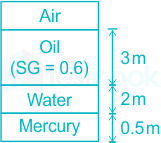
A closed tank contains 0.5 m thick layer of mercury (specific gravity = 13.6) at the bottom, A 2.0 m thick layer of water lies above the mercury layer. A 3.0 m thick layer of oil (specific gravity = 0.6) lies above the water layer. The space above the oil layer contains air under pressure. The gauge pressure at the bottom of the tank is 196.2 kN/m2. The density of water is 1000kg/m3 and the acceleration due to gravity is 9.81 m/s2. The value of pressure in the air space is

  1. ((a))

    92.214 kN/m2

  2. ((b))

    95.644 kN/m2

  3. ((c))

    98.922 kN/m2

  4. ((d))

    99.321 kN/m2

Show Answer
Answer: ((a))

92.214 kN/m2

Explanation:

Layer wise diagram of the closed tank:

Pressure values at the bottom most part of the tank is given by-

Pbase = Pair + (ρgh) oil + (ρgh) water + (ρgh) Hg

196.2 × 103 = Pair + (600 × 3 + 1000 × 2 + 13600 × 0.5) ×9.81

Pair = 92.241 KPa (gauge)

43

A rapid sand filter comprising a number of filter beds is required to produce 99 MLD of potable water. Consider water loss during backwashing as 5%, rate of filtration as 6.0 m/h and length to width ratio of filter bed is 1.35. The width of each filter bed is to be kept equal to 5.2m. One additional filter bed is to be provided to take care of break-down, repair and maintenance. The total number of filter beds required will be

  1. ((a))

    19

  2. ((b))

    20

  3. ((c))

    21

  4. ((d))

    22

Show Answer
Answer: ((c))

21

Total water required (Q) = Potable water + Water used in backwashing/Water lost in backwashing

Water used in backwashing = 5% of Potable water

\(Q~=99+\frac{5}{100}\times 99=103.95MLD\)

Rate of filtration (ROF) = 6 m/h = 6 m3/h/m2 = 6000 L/h/m2

Area of one filter = L × B

L: B = 1.35:1, B = 5.2 m, L = 5.2 × 1.35 = 7.02m, and Area of one filter = 36.54 m2

\(\text{Total }!!!!\text{ area }!!!!\text{ required}=\frac{\text{Q}}{\text{ROF}}=\frac{\frac{103.95\times {{10}^{6}}}{24}}{6000}=721.875\text{ }!!~!!\text{ }{{\text{m}}^{2}}\)

\(\text{Number }!!!!\text{ of }!!!!\text{ filter }!!!!\text{ beds }!!!!\text{ required}=\text{ }!!!!\text{ }\frac{\text{Total }!!!!\text{ area }!!!!\text{ required}}{\text{Area }!!!!\text{ of }!!!!\text{ one }!!!!\text{ filter}}=\frac{721.875}{36.54}=19.755\approx 20\text{ }!!~!!\text{ filters}\)

One additional filter is provided to take care of break-down, repair and maintenance.

Total number of filter beds = 21

44

A priority intersection has a single-lane one-way traffic road crossing an undivided two-lane two-way traffic road. The traffic stream speed on the single-lane road is 20 kmph and the speed on the two-lane road is 50 kmph. The perception-reaction time is 2.5 s; coefficient of longitudinal friction is 0.38 and acceleration due to gravity is 9.81m/s2. A clear sight triangle has to be ensured at this intersection. The minimum lengths of the sides of the sight triangle along the two-lane and the single-lane road, respectively will be,

  1. ((a))

    50 m and 20 m

  2. ((b))

    61 m and 18 m

  3. ((c))

    111 m and 15 m

  4. ((d))

    122 m and 36 m

Show Answer
Answer: ((c))

111 m and 15 m

Concept:

Sight triangle: At uncontrolled intersections the sight lines are obstructed by the structure or any other object at the intersection. The area of unobstructed sight formed by the lines of vision is called the sight triangle.

As per IRC: 66, 1976 at the priority intersections. The sight triangle has a side of 15m along minor road and a distance equal to 8 seconds travelled at the design speed is taken on a major road.

According to the IRC, time = 8 sec

For major road, SSD = 50 × 0.278 × 8 = 111.2 m

The minimum visibility distance along major roads for different speeds are as follows:

Minimum Visibility Distances along major roads at priority intersections
Design speed of major road (kmph)Minimum visibility distance along major roads (meters)
100220
80180
65145
50110
45

The following details refer to a closed traverse.

LineConsecutive coordinate
Northing(m)Southing(m)Easting(m)Westing(m)
PQ-437173-
QR101-558-
RS419--96
SP-83-634

The length and direction (as whole circle bearing) of closure, respectively are

  1. ((a))

    1 m and 90°

  2. ((b))

    2 m and 90°

  3. ((c))

    1 m and 270°

  4. ((d))

    2 m and 270°

Show Answer
Answer: ((a))

1 m and 90°

∑Northing = 101 + 419 = 520 m

∑Southing = 437 + 83 = 520

∑Easting = 173 + 558 = 731 m

∑Westing = 96 + 634 = 730 m

∑L = ∑Northing - ∑Southing = 520 – 520 = 0

∑D = ∑Easting - ∑Westing = 731 – 730 = 1 m

Length;of;closure=(L)2+(D)2=(0)2+(1)2=1;m\therefore {\rm{Length;of;closure}} = \sqrt {{{\left( {\sum {\rm{L}}} \right)}^2} + {{\left( {\sum {\rm{D}}} \right)}^2}} = \sqrt {{{\left( 0 \right)}^2} + {{\left( 1 \right)}^2}} = 1{\rm{;m}}

Direction;of;closure,;θ=tan1(DL)=tan1(10)=90\rm{{\rm{Direction;of;closure}},{\rm{;\theta }} = {\tan ^{ - 1}}\left( {\frac{{\sum {\rm{D}}}}{{\sum {\rm{L}}}}} \right) = {\tan ^{ - 1}}\left( {\frac{1}{0}} \right) = 90^\circ }

46

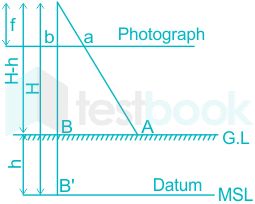
A square area (on the surface of the earth) with side 100 m and uniform height, appears as 1 cm2 on a vertical aerial photograph. The topographic map shows that a contour of 650 m passes through the area. If focal length of camera lens is 150 mm, the height from which the aerial photograph was taken is

  1. ((a))

    800 m

  2. ((b))

    1500 m

  3. ((c))

    2150 m

  4. ((d))

    3150 m

Show Answer
Answer: ((c))

2150 m

Concept:

If focal length of the lens (f) and the flying height (H) above M.S.L. is known, the scale can be found from the relation:

Sh = f / (H - h)

Calculation:

Given:

1 cm2 = 1002 m2

S = 1 cm = 100 m

1 cm = 100 × 100 cm

RF = 1/10,000

h = 650 m (elevation on ground)

f = 150 mm

f = 0.15 m

S = f/ (H-h)

110000=0.15H650\frac{1}{{10000}} = \frac{{0.15}}{{H - 650}}

H = (0.15 × 10000) + 650

H = 2150 m

47

The solution at x = 1, t = 1 of the partial differential equation, 2ux2=252udt2\frac{{{\partial }^{2}}u}{\partial {{x}^{2}}}=25\frac{{{\partial }^{2}}u}{d{{t}^{2}}} subject to initial condition of u(0)=3x,ut(0)=3u\left( 0 \right)=3x,\frac{\partial u}{\partial t}\left( 0 \right)=3 is _____.

  1. ((a))

    1

  2. ((b))

    2

  3. ((c))

    4

  4. ((d))

    6

Show Answer
Answer: ((d))

6

Concept:

It is 1D wave equation in the partial differential equation given by-

2yt2=C22yx2\frac{{{\partial }^{2}}\text{y}}{\partial {{\text{t}}^{2}}}={{\text{C}}^{2}}\frac{{{\partial }^{2}}\text{y}}{\partial {{\text{x}}^{2}}}

Where C2 = T/m, T = Tension in the elastic string, and M = mass per unit length

Calculation:

On comparing the above equation, we get that C = 1/5

f(x) = 3x, g(x) = 3

f (x + ct) = f (x + t/5) = 3 (x + t/5) = 3x + 3t/5

f (x - ct) = f (x - t/5) = 3 (x- t/5) = 3x - 3t/5

\(\text{U}(\left( \text{x},\text{t} \right)=\frac{1}{2}\left{ \text{f}\left( \text{x}+\text{ct} \right)+ \text{f}\left( \text{x}-\text{ct} \right)+ \frac{1}{c } \mathop{\int }_{\text{x}-\text{ct}}^{\text{x}+\text{ct}}\text{g}\left( \text{x} \right)\text{dx} \right}\)

\(=\frac{1}{2}\left{ 6x+5\mathop{\int }_{x-t/5}^{x+t/5}3~dx \right}\)

\(=\frac{1}{2}\left{ 6\text{x}+5\left[ \left( 3\text{x}+\frac{3\text{t}}{5} \right)-\left( 3\text{x}-\frac{3\text{t}}{5} \right) \right] \right}\)

U(x,t)=12(6x+6t)\text{U}\left( \text{x},\text{t} \right)=\frac{1}{2}\left( 6\text{x}+6\text{t} \right)

U(1,1)=12(6×1+6×1)=6\therefore \text{U}\left( 1,1 \right)=\frac{1}{2}\left( 6\times 1+6\times 1 \right)=6

48

The solution (up to three decimal places) at x = 1 of the differential equation d2ydx2+2dydx+y=0\frac{{{{\rm{d}}^2}{\rm{y}}}}{{{\rm{d}}{{\rm{x}}^2}}} + 2\frac{{{\rm{dy}}}}{{{\rm{dx}}}} + {\rm{y}} = 0, subjected to boundary conditions y (0) = 1 and  dy/dx at (0)  = -1 is _______

49

Variation of water depth (y) in a gradually varied open channel flow is given by the first order differential equation

dydx=1e103ln(y)25045e3ln(y)\frac{{{\rm{dy}}}}{{{\rm{dx}}}} = \frac{{1 - {{\rm{e}}^{ - \frac{{10}}{3}\ln \left( {\rm{y}} \right)}}}}{{250 - 45{{\rm{e}}^{ - 3\ln \left( {\rm{y}} \right)}}}}

Given initial conditions: y (x = 0) = 0.8 m. The depth (in m, up to three decimal places) of flow at a downstream section at x = 1 m from one calculation step of Single Step Euler Method is ______.

50

An RCC short column (with lateral ties) of rectangular cross section of 250 mm × 300 mm is reinforced with four numbers of 16 mm diameter longitudinal bars. The grades of steel and concrete are Fe415 and M20 respectively. Neglect eccentricity effect. Considering limit state of collapse in compression (IS 456:2000), the axial load carrying capacity of the column (in kN, up to one decimal place), is _______.

51

An RCC beam of rectangular cross-section has factored shear of 200 kN at its critical section. Its width b is 250 mm and effective depth d is 350 mm. Assume design shear strength, tc of concrete as 0.62N/mm2 and maximum allowable shear stress, tc,max in concrete as 2.8 N/mm2. If two legged 10mm diameter vertical stirrups of Fe250 grade steel are used, then the required spacing (in cm, up to one decimal place) as per limit state method will be ________.

52

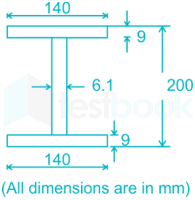
The dimensions of a symmetrical welded I - section are shown in the figure.

The plastic section modulus about the weaker axis (in cm3, up to one decimal place) is______

53

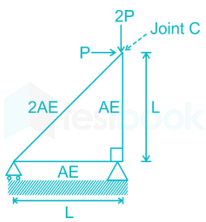
Consider the deformable pin-jointed truss with loading, geometry and section properties as shown in the figure.

Given, E = 2 × 10¹¹ N/m2, A = 10 mm2, L = 1 m and P = 1 kN. The horizontal displacement of Joint C (in mm up to one decimal place) is _______.

54

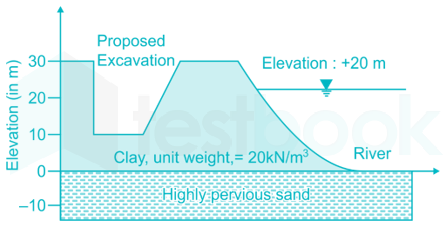
At a construction site, a contractor plans to make an excavation as shown in the figure.

The water level in the adjacent river is at an elevation of +20.0 m. Unit weight of water is 10 kN/m3. The factor of safety (up to two decimal places) against sand boiling for the proposed excavation is ____.

55

A conventional drained triaxial compression test was conducted on a normally consolidated clay sample under an effective confining pressure of 200 kPa. The deviator stress at failure was found to be 400 kPa. An identical specimen of the same clay sample is isotropically consolidated to a confining pressure of 200 kPa and subjected to a standard undrained triaxial compression test. If the deviator stress at failure is 150 kPa, the pore pressure developed (in kPa, up to one decimal place) is _______.

56

The void ratio of a soil is 0.55 at an effective normal stress of 140 kPa. The compression index of the soil is 0.25. In order to reduce the void ratio to 0.4 an increase in the magnitude of effective stress (in kPa, up to one decimal place) should be_______.

57

A rigid smooth retaining wall of height 7 m with vertical backface retains saturated clay as backfill. The saturated unit weight and undrained cohesion of the backfill are 17.2 kN/m3 and 20 kPa respectively. The difference in the active lateral forces on the wall (in kN per meter length of wall, up to two decimal places), before and after the occurrence of tension cracks is _______

58

Rainfall depth over a watershed is monitored through six numbers of well distributed rain gauges. Gauged data are given below

Rain gauge Number:123456
Rainfall depth (mm):470465435525480510
Area of Thiessen Polygon (× 104 m2):9510098808592

The Thiessen mean value (in mm, up to one decimal place) of the rainfall is ______.

59

The infiltration rate f in a basin under ponding condition is given by f = 30 + 10e-2t where, f is in mm/h and t is time in hour. Total depth of infiltration (in mm, up to one decimal place) during the last 20 minutes of a storm of 30 minutes duration is ______.

60

In a laboratory, a flow experiment is performed over a hydraulic structure. The measured values of discharge and velocity are 0.05 m3/s and 0.25 m/s, respectively. If the full-scale structure (30 times bigger) is subjected to a discharge of 270 m3/s, then the time scale (model to full scale (model to full scale) value (up to decimal places) is ______.

61

A water sample analysis data is given below

Ironconcentration, mg/LAtomic Weight
Ca2+6040
Mg2+3024.31
HCO-340061

The carbonate hardness (expressed as mg/L of CaCO3, up to one decimal place) of the following water sample is _____.

62

The ultimate BOD (L0) of a wastewater sample is estimated as 87% of COD. The COD of this wastewater is 300 mg/L. Considering first order BOD reaction rate constant k (use natural log) = 0.23 per day and temperature coefficient q = 1.047 , the BOD value (in mg/L, up to one decimal place) after three days of incubation at 27°C for this wastewater will be ______.

63

A waste activated sludge (WAS) is to be blended with green waste (GW). The carbon (C) and nitrogen (N) contents, per kg of WAS and GW, on dry basis are given in the table

ParameterWASGW
Carbon(g)54360
Nitrogen(g)106

The ratio of WAS to GW required (up to two decimal places) to achieve a blended C: N ratio of 20: 1 on dry basis is _____

64

Given the following data: Design life n = 15 years, Lane distribution factor D = 0.75, Annual rate of growth of commercial vehicles, r = 6%, Vehicle damage factor, F = 4 and Initial traffic in the year of completion of construction = 3000 Commercial Vehicles Per Day(CVPD). As per IRC:37-2012, the design traffic in terms of the cumulative number of standard axles (in million standard axles, up to two decimal places) is _______.

65

An aircraft approaches the threshold of a runway strip at a speed of 200 km/h. The pilot decelerates the aircraft at a rate of 1.697 m/s2 and takes 18 s to exit runway strip. If the deceleration after exiting the runway is 1 m/s2, then the distance (in m, up to one decimal place) of the gate position from the location of exit on the runway is _______.

Attempt this paper under real exam conditions

Timed interface, section switching, instant scoring, and question-by-question analytics — free.

Start Timed Attempt