Official Paper

GATE CE 2017 Official Paper: Shift 2 (Previous Year Paper)

65 questions · 180 minutes · with answers · free

General Aptitude (10 questions)

1

The event would have been successful if you _________ able to come.

  1. ((a))

    Are

  2. ((b))

    Had been

  3. ((c))

    Have been

  4. ((d))

    Would have been

Show Answer
Answer: ((b))

Had been

The sentence is in the perfect continuous tense which can be noticed because of the usage of "been". 

When you see "would have" in a sentence it means that the action didn't actually happen, because something else didn't happen first.

From the sentence we know that the "event" has already happened. 

Hence the correct answer is "had been" as it would convey the correct tense, which is the past perfect continuous.

Option 2 is correct.
2

There was no doubt that their work was through.

Which of the words below is closest in meaning to the underlined word above?

  1. ((a))

    Pretty

  2. ((b))

    Complete

  3. ((c))

    Sloppy

  4. ((d))

    Haphazard

Show Answer
Answer: ((b))

Complete

Let us look at the meanings of all the words:

Through: having finished using or doing something.


Pretty: (of a person, especially a woman or a child) attractive in a delicate way without being truly beautiful.

Complete: finish making or doing.

Sloppy: careless and unsystematic; excessively casual.

Haphazard: lacking any obvious principle of organization.

Example sentence: I've got some work to do but I should be through in an hour if you can wait.

Option 2 is correct.
3

Four cards lie on a table. Each card has a number printed on one side and a colour on the other. The faces visible on the cards are 2, 3, red, and blue.

Proposition: If a card has an even value on one side, then its opposite face is red.

The cards which MUST be turned over to verify the above proposition are

  1. ((a))

    2, red

  2. ((b))

    2, 3, red

  3. ((c))

    2, blue

  4. ((d))

    2, red, blue

Show Answer
Answer: ((c))

2, blue

Faces available on the cards are: 2, 3, red, and blue.

Proposition: If a card has an even value on one side, then its opposite face is red.

We need to check the card with face 2 whether its opposite is red or not. The opposite side will be RED, if the given proposition is TRUE.

No need to check the card with face 3 as it is not even number.

No need to check the card with face red as it can have either even or odd number as its opposite number. (The converse of the given proposition may or may not be true).

We need to check the card with face blue whether its opposite number is even or odd. Its opposite number will be odd, if the given proposition is TRUE.

4

What is the value of x when 81×(1625)x+2÷(35)2x+4=14481 \times {\left( {\frac{{16}}{{25}}} \right)^{x + 2}} \div {\left( {\frac{3}{5}} \right)^{2x + 4}} = 144

  1. ((a))

    1

  2. ((b))

    -1

  3. ((c))

    -2

  4. ((d))

    Cannot be determined

Show Answer
Answer: ((b))

-1

81×(1625)x+2÷(35)2x+4=14481 \times {\left( {\frac{{16}}{{25}}} \right)^{x + 2}} \div {\left( {\frac{3}{5}} \right)^{2x + 4}} = 144

81×(1625)x+2(35)2x+4=144\Rightarrow 81 \times \frac{{{{\left( {\frac{{16}}{{25}}} \right)}^{x + 2}}}}{{{{\left( {\frac{3}{5}} \right)}^{2x + 4}}}} = 144

81×(45)2x+4(35)2x+4=144\Rightarrow 81 \times \frac{{{{\left( {\frac{4}{5}} \right)}^{2x + 4}}}}{{{{\left( {\frac{3}{5}} \right)}^{2x + 4}}}} = 144

81×(43)2x+4=144 81×(43)2x×(43)4=144\begin{array}{l} \Rightarrow 81 \times {\left( {\frac{4}{3}} \right)^{2x + 4}} = 144\ \Rightarrow {81 \times\left( {\frac{4}{3}} \right)^{2x}} \times {\left( {\frac{4}{3}} \right)^4} = 144 \end{array}

(169)x=144256 (169)x=916=(169)1\begin{array}{l} \Rightarrow {\left( {\frac{{16}}{9}} \right)^x} = \frac{{144}}{{256}}\ \Rightarrow {\left( {\frac{{16}}{9}} \right)^x} = \frac{9}{{16}} = {\left( {\frac{{16}}{9}} \right)^{ - 1}} \end{array}

⇒ x = -1

5

Two dice are thrown simultaneously. The probability that the product of the numbers appearing on the top faces of the dice is a perfect square is

  1. ((a))

    1/9

  2. ((b))

    2/9

  3. ((c))

    1/3

  4. ((d))

    4/9

Show Answer
Answer: ((b))

2/9

Two dice are thrown simultaneously.

Total number of possibilities = 62 = 36

The possible perfect squares = 1, 4, 9, 16, 25, 36

Possible outcomes to get the product as 1 = (1, 1)

Possible outcomes to get the product as 4 = (1, 4), (4, 1), (2, 2)

Possible outcomes to get the product as 9 = (3, 3)

Possible outcomes to get the product as 16 = (4, 4)

Possible outcomes to get the product as 25 = (5, 5)

Possible outcomes to get the product as 36 = (6, 6)

Total number of possibilities = 8

Probability = 8/36 = 2/9

6

Bhaichung was observing the pattern of people entering and leaving a car service centre. There was a single window where customers were being served. He saw that people inevitably came out of the centre in the order that they went in. However, the time they spent inside seemed to vary a lot: some people came out in a matter of minutes while for others it took much longer.

From this, what can one conclude?

  1. ((a))

    The centre operates on a first-come-first-served basis, but with variable service times, depending on specific customer needs.

  2. ((b))

    Customers were served in an arbitrary order, since they took varying amounts of time for service completion in the centre.

  3. ((c))

    Since some people came out within a few minutes of entering the centre, the system is likely to operate on a last-come-first-served basis.

  4. ((d))

    Entering the centre early ensured that one would have shorter service times and most people attempted to do this.

Show Answer
Answer: ((a))

The centre operates on a first-come-first-served basis, but with variable service times, depending on specific customer needs.

Explanation:

Option 1 can be safely concluded from the given passage.

Option 2 is incorrect because it says 'Customers were served in an arbitrary order which is not given in the passage.

Option 3 is incorrect because it says 'the system is likely to operate on a last-come-first-served basis' which is not given in the passage.

Option 4 is incorrect because it says 'Entering the center early ensured that one would have shorter service times' which is not given in the passage.

Hence option 1 is correct.
7

A map shows the elevations of Darjeeling, Gangtok, Kalimpong, Pelling, and Siliguri. Kalimpong is at a lower elevation than Gangtok, Pelling is at a lower elevation than Gangtok. Pelling is at a higher elevation than Siliguri. Darjeeling is at a higher elevation than Gangtok.

Which of the following statements can be inferred from the paragraph above?

i. Pelling is at a higher elevation than Kalimpong

ii. Kalimpong is at a lower elevation than Darjeeling

iii. Kalimpong is at a higher elevation than Siliguri

iv. Siliguri is at a lower elevation than Gangtok

  1. ((a))

    Only ii

  2. ((b))

    Only ii and iii

  3. ((c))

    Only ii and iv

  4. ((d))

    Only iii and iv

Show Answer
Answer: ((c))

Only ii and iv

A map shows the elevations of Darjeeling (D), Gangtok (G), Kalimpong (K), Pelling (P), and Siliguri (S).

Kalimpong is at a lower elevation than Gangtok.

⇒ K < G       ----(1)

Pelling is at a lower elevation than Gangtok.

⇒ P < G       ----(2)

Pelling is at a higher elevation than Siliguri.

⇒ S < P        ----(3)

Darjeeling is at a higher elevation than Gangtok.

⇒ G < D       ----(4)

From inequalities (1) and (4), we get

⇒ K < G < D

From inequalities (2) and (3), we get

⇒ S < P < G

i. Pelling is at a higher elevation than Kalimpong (K < P): There is no clear relation between K and P, so it may or may not TRUE.

ii. Kalimpong is at a lower elevation than Darjeeling (K < D): It is TRUE as K < G < D.

iii. Kalimpong is at a higher elevation than Siliguri (S < K): There is no clear relation between S and K, so it may or may not TRUE.

iv. Siliguri is at a lower elevation than Gangtok (S < G): It is TRUE as S < P < G.

8

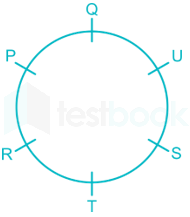
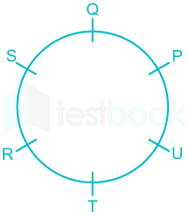
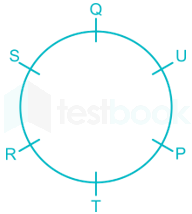
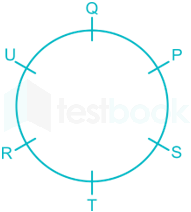
P, Q, R, S, T and U are seated around a circular table. R is seated two places to the right of Q. P is seated three places to the left of R. S is seated opposite U. If P and U now switch seats, which of the following must necessarily be true?

  1. ((a))

    P is immediately to the right of R

  2. ((b))

    T is immediately to the left of P

  3. ((c))

    T is immediately to the left of P or P is immediately to the right of Q

  4. ((d))

    U is immediately to the right of R or P is immediately to the left of T

Show Answer
Answer: ((c))

T is immediately to the left of P or P is immediately to the right of Q

P, Q, R, S, T and U are seated around a circular table.

R is seated two places to the right of Q.

P is seated three places to the left of R.

S is seated opposite U.

According to the above information, there are two possibilities:

Case 1: The arrangement is as shown below.

After switching the seats of P and U, the arrangement becomes

P is immediately right of Q.

Case 2:

The arrangement is as shown below.

After switching the seats of P and U, the arrangement becomes

T is immediately to the left of P.

So, T is immediately to the left of P or P is immediately to the right of Q.

9

Budhan covers a distance of 19 km in 2 hours by cycling one fourth of the time and walking the rest. The next day he cycles (at the same speed as before) for half the time and walks the rest (at the same speed as before) and covers 26 km in 2 hours. The speed in km/h at which Budhan walks is

  1. ((a))

    1

  2. ((b))

    4

  3. ((c))

    5

  4. ((d))

    6

Show Answer
Answer: ((d))

6

Let Budhan cycles at a speed of x km/hr and walks at a speed of y km/hr.

Budhan covers a distance of 19 km in 2 hours by cycling one fourth of the time and walking the rest.

I.e. Budhan cycled for half an hour and had walk for remaining time.

⇒ 0.5x + 1.5y = 19       ----(1)

The next day he cycles (at the same speed as before) for half the time and walks the rest (at the same speed as before) and covers 26 km in 2 hours.

⇒ x + y = 26      ----(2)

By solving the equations (1) and (2), x = 20 km/hr and y = 6 km/hr

So, the speed at which Budhan walks is 6 km/hr.

10

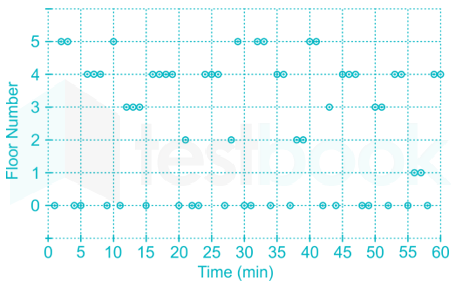
The points in the graph below represent the halts of a lift for durations of 1 minute, over a period of 1 hour.

Which of the following statements are correct?

i. The elevator never moves directly from any non-ground floor to another non-ground floor over the one hour period

ii. The elevator stays on the fourth floor for the longest duration over the one hour period

  1. ((a))

    Only i

  2. ((b))

    Only ii

  3. ((c))

    Both i and ii

  4. ((d))

    Neither i nor ii

Show Answer
Answer: ((d))

Neither i nor ii

At 28th minute and at 39th minute elevator directly moves form second floor to fifth floor.

So, statement (i) is not correct.
Elevator stays at ground floor for 21 minutes whereas it stays for 19 minutes at fourth floor.

So, statement (ii) is not correct.
Civil Engineering (55 questions)

11

Consider the following simultaneous equation (with c1 and c2 beings constants):

3x1 + 2x2 = c1

4x1 + x2 = c2

The characteristic equation for these simultaneous equations is

  1. ((a))

    λ2 – 4λ – 5 = 0

  2. ((b))

    λ2 – 4λ + 5 = 0

  3. ((c))

    λ2 + 4λ – 5 = 0

  4. ((d))

    λ+ 4λ + 5 = 0

Show Answer
Answer: ((a))

λ2 – 4λ – 5 = 0

3x1 + 2x2 = c1

3x1 + x2 = c2

\(\left[ {\begin{array}{*{20}{c}} 3&2\ 4&1 \end{array}} \right] = \left[ {\rm{A}} \right]\)

[A] – λ[I] = 0

\(\left[ {\begin{array}{*{20}{c}} {3 - {\rm{\lambda }}}&4\ 2&{1 - {\rm{\lambda }}} \end{array}} \right] = 0\)

3 + λ2 – 4λ – 8 = 0

λ2 – 4λ – 5 = 0

12

Let w = f(x, y), where x and y are functions of t. Then according to the chain rule dwdt\frac{{{\rm{dw}}}}{{{\rm{dt}}}}{\rm{}} is equal to

  1. ((a))

    dwdxdxdt+dwdydtdt\frac{{{\rm{dw}}}}{{{\rm{dx}}}}\frac{{{\rm{dx}}}}{{{\rm{dt}}}} + \frac{{{\rm{dw}}}}{{{\rm{dy}}}}\frac{{{\rm{dt}}}}{{{\rm{dt}}}}

  2. ((b))

    wxxt+wyyt\frac{{\partial {\rm{w}}}}{{\partial {\rm{x}}}}\frac{{\partial {\rm{x}}}}{{\partial {\rm{t}}}} + \frac{{\partial {\rm{w}}}}{{\partial {\rm{y}}}}\frac{{\partial {\rm{y}}}}{{\partial {\rm{t}}}}

  3. ((c))

    wxdxdt+wydydt\frac{{\partial {\rm{w}}}}{{\partial {\rm{x}}}}\frac{{{\rm{dx}}}}{{{\rm{dt}}}} + \frac{{\partial {\rm{w}}}}{{\partial {\rm{y}}}}\frac{{{\rm{dy}}}}{{{\rm{dt}}}}

  4. ((d))

    dwdxxt+dwdyyt\frac{{{\rm{dw}}}}{{{\rm{dx}}}}\frac{{\partial {\rm{x}}}}{{\partial {\rm{t}}}} + \frac{{{\rm{dw}}}}{{{\rm{dy}}}}\frac{{\partial {\rm{y}}}}{{\partial {\rm{t}}}}

Show Answer
Answer: ((c))

wxdxdt+wydydt\frac{{\partial {\rm{w}}}}{{\partial {\rm{x}}}}\frac{{{\rm{dx}}}}{{{\rm{dt}}}} + \frac{{\partial {\rm{w}}}}{{\partial {\rm{y}}}}\frac{{{\rm{dy}}}}{{{\rm{dt}}}}

w = f (x, y)

Partial differentiation with respect to x and y gives:

dwdt=wxdxdt+wydydt\frac{{{\rm{dw}}}}{{{\rm{dt}}}} = \frac{{\partial {\rm{w}}}}{{\partial {\rm{x}}}}\frac{{{\rm{dx}}}}{{{\rm{dt}}}} + \frac{{\partial {\rm{w}}}}{{\partial {\rm{y}}}}\frac{{{\rm{dy}}}}{{{\rm{dt}}}}

13

Given that the scope of the construction work is well-defined with all its drawings, specifications, quantities and estimates. Which one of the following types of contract would be most preferred?

  1. ((a))

    EPC contract

  2. ((b))

    Percentage rate contract

  3. ((c))

    Item rate contract

  4. ((d))

    Lump sum contract

Show Answer
Answer: ((d))

Lump sum contract

If scope of construction work is well-defined with all its drawings, specification quantities and estimates, then lump sum contract is used.

14

Let G be the specific gravity of soil solids, w the water content in the soil sample, γw the unit weight of water, and γd the dry unit weight of the soil. The equation for the zero air voids line in a compaction test plot is

  1. ((a))

    \({{\rm{\gamma }}{\rm{d}}} = \frac{{{\rm{G}}{{\rm{\gamma }}{\rm{w}}}}}{{1 + {\rm{Gw}}}}\)

  2. ((b))

    \({{\rm{\gamma }}{\rm{d}}} = \frac{{{\rm{G}}{{\rm{\gamma }}{\rm{w}}}}}{{{\rm{Gw}}}}\)

  3. ((c))

    \({{\rm{\gamma }}{\rm{d}}} = \frac{{{{\rm{G}}{\rm{w}}}}}{{1 + {{\rm{\gamma }}_{\rm{w}}}}}\)

  4. ((d))

    \({{\rm{\gamma }}{\rm{d}}} = \frac{{{{\rm{G}}{\rm{w}}}}}{{1 - {{\rm{\gamma }}_{\rm{w}}}}}\)

Show Answer
Answer: ((a))

\({{\rm{\gamma }}{\rm{d}}} = \frac{{{\rm{G}}{{\rm{\gamma }}{\rm{w}}}}}{{1 + {\rm{Gw}}}}\)

Concept:

The dry density (γd) of soil is given by,

\({{\rm{γ }}{\rm{d}}} = \frac{{\left( {1 - {{\rm{η }}{\rm{a}}}} \right){{\rm{G}}{\rm{}}}{{\rm{γ }}{\rm{w}}}}}{{1 + {\rm{e}}}}\)

ηa - Percentage of air voids

G - Specific gravity of soil solids

e - Voids ratio

For zero air voids ⇒ volume of air is zero, hence ηa = 0, ac = 0                       

Also, S + ac = 1

Hence, S = 1      

So above equation becomes, \({{\rm{γ }}{\rm{d}}} = \frac{{\left( {1 - 0} \right){{\rm{G}}{\rm{}}}{{\rm{γ }}{\rm{w}}}}}{{1 + \frac{{{\rm{w}}{{\rm{G}}{\rm{}}}}}{{\rm{S}}}}}\)

⇒ \({{\rm{γ }}{\rm{d}}} = \frac{{{{\rm{G}}{\rm{}}}{{\rm{γ }}{\rm{w}}}}}{{1 + {\rm{w}}{{\rm{G}}{\rm{}}}}}\)

15

Consider the following statements related to the pore pressure parameters. A and B:

P.  A always lies between 0 and 1.0

Q. A can be less than 0 or greater than 1.0

R.  B always lies between 0 and 1.0

S.  B can be less than 0 or greater than 1.0

For these statements, which one of the following options is correct?

  1. ((a))

    P and R

  2. ((b))

    P and S

  3. ((c))

    Q and R 

  4. ((d))

    Q and S

Show Answer
Answer: ((c))

Q and R 

Explanation

Skempton’s Pore Pressure coefficient are A and B,

where,

A → depends upon the degree of saturation and over consolidation ratio

B → depends upon degree of saturation of soil

Value of B lies between 0 and 1. For completely saturated soil, B = 1 and for completely dry soil, B = 0.

Value of A may be as large as 2 to 3 for very loose saturated fine sand and it can be less than zero for over consolidated clay.

16

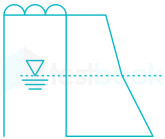
Consider a rigid retaining wall with partially submerged cohesionless backfill with a surcharge. Which one of the following diagrams closely represents the Rankine’s active earth pressure distribution against this wall?

  1. ((a))

  2. ((b))

  3. ((c))

  4. ((d))

Show Answer
Answer: ((b))

Pressure diagram for partially submerged soil with surcharge is shown below:

But no option is matching.

If the water table is at ground table then Option b is the answer.

17

If a centrifugal pump has an impeller speed of N (in rpm) discharge Q (in m3/s) and the total head H (in m), the expression for the specific speed Ns of the pump is given by

  1. ((a))

    Ns=NQ0.5H0.5{{\rm{N}}_{\rm{s}}} = \frac{{{\rm{N}}{{\rm{Q}}^{0.5}}}}{{{{\rm{H}}^{0.5}}}}

  2. ((b))

    Ns=NQ0.5H{{\rm{N}}_{\rm{s}}} = \frac{{{\rm{N}}{{\rm{Q}}^{0.5}}}}{{\rm{H}}}

  3. ((c))

    Ns=NQ0.5H0.75{{\rm{N}}_{\rm{s}}} = \frac{{{\rm{N}}{{\rm{Q}}^{0.5}}}}{{{{\rm{H}}^{0.75}}}}

  4. ((d))

    Ns=NQH0.75;{{\rm{N}}_{\rm{s}}} = \frac{{{\rm{NQ}}}}{{{{\rm{H}}^{0.75}}}}{\rm{;}}

Show Answer
Answer: ((c))

Ns=NQ0.5H0.75{{\rm{N}}_{\rm{s}}} = \frac{{{\rm{N}}{{\rm{Q}}^{0.5}}}}{{{{\rm{H}}^{0.75}}}}

Explanation:

The specific speed is of a fluid machine is a type number representative of its performance. To compare the performance of different pumps (or turbines), it is necessary to have some terms that will be common to all the pumps (or turbines), the term ordinarily used for this purpose is the specific speed. This can be used to predict one pump (or turbine) behavior based on tests of similar, but different sized pumps (or turbines).

NsT{N_{{s_T}}} (specific speed for turbines) = NP12/H54N{P^{\frac{1}{2}}}/{H^{\frac{5}{4}}}

NsP{N_{{s_P}}} (specific speed for the pump) = NQ12/H34N{Q^{\frac{1}{2}}}/{H^{\frac{3}{4}}}

For a turbine, NsT{N_{{s_T}}} is the speed of a member of the same homologous series as the actual turbine, so reduced in size as to generate unit power under a unit head of the fluid. Similarly, for a pump, NsP{N_{{s_P}}} is the speed of a hypothetical pump with reduced size but representing a homologous series so that it delivers unit flow rate at a unit head. The specific speed (Ns{N_s}) is, therefore, not a dimensionless quantity.

18

As per Noise pollution (Regulation and Control) Rules 2000 of India, the day time noise limit for a residential zone expressed in dB (A) Leq is

  1. ((a))

    55

  2. ((b))

    65

  3. ((c))

    75

  4. ((d))

    85

Show Answer
Answer: ((a))

55

As per Noise pollution (Regulation and control) Rules 2000 of India.

Area codeArea/zoneLimits in dB Leq
Day timeNight time
AIndustrial7570
BCommercial area6555
CResidential area5545
DSilence Zone5040
19

Following observations have been made for the elevation and temperature to ascertain the stability of the atmosphere.

Elevation (in m)Temperature (in °C)
1015.5
6015.0
13014.3
<br>

The atmosphere is classified as

  1. ((a))

    Stable

  2. ((b))

    Unstable

  3. ((c))

    Neutral

  4. ((d))

    Inverse

Show Answer
Answer: ((b))

Unstable

Elevation (in m)Temperature (in °C)
1015.5
6015.0
13014.3
<br>

ELR1=ΔTΔh=15.515.06010=0.01cm=;10ckm; ELR2=15.014.313060=0.01Cm=;10ckm\begin{array}{l} {\rm{EL}}{{\rm{R}}_1} = \frac{{{\rm{\Delta T}}}}{{{\rm{\Delta h}}}} = \frac{{15.5 - 15.0}}{{60 - 10}} = 0.01^\circ \frac{{\rm{c}}}{{\rm{m}}} = ;10^\circ \frac{{\rm{c}}}{{{\rm{km}}}};\ {\rm{EL}}{{\rm{R}}_2} = \frac{{15.0 - 14.3}}{{130 - 60}} = 0.01^\circ \frac{{\rm{C}}}{{\rm{m}}} = ;10^\circ \frac{{\rm{c}}}{{{\rm{km}}}} \end{array}

Adiabatic lapse rate (ALR) is 9.8°C/km for dry adiabatic and 6.c/km for wet adiabatic condition.

∵ ELR > ALR

So, it is super adiabatic and the atmosphere is said to be highly unstable.

20

The most important type of species involved in the degradation of organic matter in the case of activated sludge process is

  1. ((a))

    Autotrophs

  2. ((b))

    Heterotrophs

  3. ((c))

    Prototrophs

  4. ((d))

    Photo-Autotrophs

Show Answer
Answer: ((b))

Heterotrophs

Heterotrophs cannot produce organic compounds from inorganic sources and therefore rely on consuming other organisms in the food chain. In activated sludge process, in the presence of food mass and oxygen heterotrophic bacteria converts food mass into biomass.

21

For a broad gauge railway track on a horizontal curve of radius R ( in m) the equilibrium cant e required for a train moving at a speed of V (in km per hour) is

  1. ((a))

    e=1.676V2R{\rm{e}} = 1.676\frac{{{{\rm{V}}^2}}}{{\rm{R}}}

  2. ((b))

    e=1.315V2R{\rm{e}} = 1.315\frac{{{{\rm{V}}^2}}}{{\rm{R}}}

  3. ((c))

    e=0.8V2R{\rm{e}} = 0.8\frac{{{{\rm{V}}^2}}}{{\rm{R}}}

  4. ((d))

    e=0.60V2R{\rm{e}} = 0.60\frac{{{{\rm{V}}^2}}}{{\rm{R}}}

Show Answer
Answer: ((b))

e=1.315V2R{\rm{e}} = 1.315\frac{{{{\rm{V}}^2}}}{{\rm{R}}}

Concept:

Equilibrium cant =GV2127R= \frac{{{\rm{G}}{{\rm{V}}^2}}}{{127{\rm{R}}}}

V - Design speed (kmph)

R - Radius of curvature (m)

For B.G track G = 1.676

Cant=1.676;V2127;Rm e=1.315;V2Rcm\begin{array}{l} {\rm{Cant}} = \frac{{1.676{\rm{;}}{{\rm{V}}^2}}}{{127{\rm{;R}}}}{\rm{m}}\ {\rm{e}} = \frac{{1.315{\rm{;}}{{\rm{V}}^2}}}{{\rm{R}}}{\rm{cm}} \end{array}

22

The safety within a roundabout and the efficiency of a roundabout can be increased respectively by

  1. ((a))

    increasing the entry radius and increasing the exit radius.

  2. ((b))

    increasing the entry radius and decreasing the exit radius.

  3. ((c))

    decreasing the entry radius and increasing the exit radius.

  4. ((d))

    decreasing the entry radius and decreasing the exit radius.

Show Answer
Answer: ((c))

decreasing the entry radius and increasing the exit radius.

The essence of the intersection control is to resolve these conflicts at the intersection for the safe and efficient movement of both vehicular traffic and pedestrians.

The safety within a roundabout and the efficiency of a roundabout can be increased respectively by decreasing the entry radius and increasing the exit radius.

Note:

There are two methods of intersection controls 

  1. time sharing and

  2. space sharing.

The type of intersection control that has to be adopted depends on the traffic volume, road geometry, cost involved, importance of the road etc.

23

The method of orientation used, when the plane table occupies a position not yet located on the map is called as

  1. ((a))

    traversing

  2. ((b))

    radiation

  3. ((c))

    levelling

  4. ((d))

    resection

Show Answer
Answer: ((d))

resection

Resection method of orientation is employed when the plane table occupies a position not yet plotted on the drawing sheet.

24

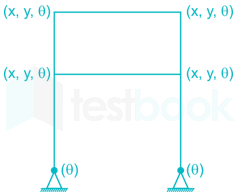
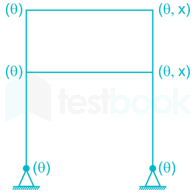
Consider the frame shown in figure.

If the axial and shear deformations in different members of the frame are assumed to be negligible the reduction in the degree of kinematical indeterminacy would be equal to

  1. ((a))

    5

  2. ((b))

    6

  3. ((c))

    7

  4. ((d))

    8

Show Answer
Answer: ((b))

6

Concept:

Total degree of freedom when axial and shear deformations in all members are allowed. 

Dk = 3 + 3 + 3 + 3 + 1 + 1 = 14

When axial and shear deformations are negligible,

The degree of freedom equals to the number of members would be deducted i.e. 6

∴ Kinematic indeterminacy for the frame if axial and shear deformation is considered negligible, (Dk) = 14 - 6 = 8.

Hence, reduction in degree of kinematical indeterminacy = 14 – 8 = 6

Mistake Point:

Kindly do read the Question again as it is asked about the reduction in the degree of kinematical indeterminacy i.e 14 – 8 = 6

25

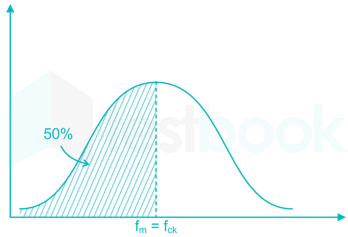
Let the characteristic strength be defined as that value, below which not more than 50% of the results are expected to fall. Assuming a standard deviation of 4 MPa, the target mean strength (in MPa) to be considered in the mix design of a M25 concrete would be

  1. ((a))

    18.42

  2. ((b))

    21.00

  3. ((c))

    25.00

  4. ((d))

    31.58

Show Answer
Answer: ((c))

25.00

Concept:

The correct expression as per IS 456: 2000 to find Target mean strength is:

fcm = fck + (k × σ)

fcm = Target mean strength

fck = Characteristic strength

σ = Standard deviation

 For not more than 50% of results are likely to fall k = 0.

Since characteristic strength has been defined as the value below which not more than 50% of results are likely to fall.

Hence,

Target mean strength = ft = fck + (0× σ) = Characteristic strength (fck) = 25 N/mm2

26

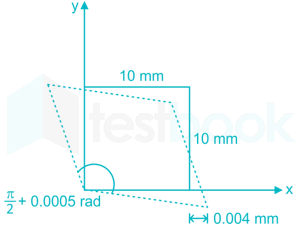
In a material under a state of plane strain, a 10× 10 mm square centred at a point gets deformed as shown in the figure.

If the shear strain γxy at this point is expressed as 0.001 k (in rad.) the value of k is

  1. ((a))

    0.50 

  2. ((b))

    0.25

  3. ((c))

    – 0.25

  4. ((d))

    – 0.50

Show Answer
Answer: ((d))

– 0.50

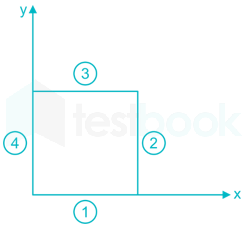
Shear strain in an element is positive when the angle between two positive faces (or two negative faces) is reduced. The strain is negative when the angle between two positive (or two negative) faces increase.

Angle between 1 & 4 is increased by 0.0005 rad.

∴ γxy = – 0.0005 = 0.001 K

∴ K = – 0.5

27

The plate load test was conducted on a clayey strata by using a plate of 0.3m × 0.3m dimensions, and the ultimate load per unit area for the plate was found to be 180 kPa. The ultimate bearing capacity (in kPa) of a 2m wide square footing would be

  1. ((a))

    27

  2. ((b))

    180

  3. ((c))

    1200

  4. ((d))

    2000

Show Answer
Answer: ((b))

180

In plate load test bearing capacity of clay does not depend upon size of footing.

qup (for plate) = quf (for clay) = 180 kPa

28

For a construction project the mean and standard deviation of the completion time are 200 days and 6.1 days respectively. Assume normal distribution and use the value of standard normal deviate z = 1.64 for the 95% confidence level. The maximum time required (in days) for the completion of the project would be ________

29

The divergence of the vector field V = x2 i + 2y3 j + z4 k at x = 1, y = 2, z = 3 is ________

30

A two-faced fair coin has its faces designated as head (H) and tail (T). This coin is tossed three times in succession to record the following outcomes: H.H.H. If the coin is tossed one more time, the probability (up to one decimal place) of obtaining H again given the previous realizations of H, H and H would be ________

31

A sheet pile has an embedment depth of 12 m in a homogeneous soil stratum. The coefficient of permeability of soils is 10 –6 m/s. Difference in the water levels between the two sides of the sheet pile is 4m. The flow net is constructed with five number of flow lines and eleven number of equipotential lines. The quantity of seepage (in cm3/s per m. up to one decimal place) under the sheet piles ________

32

The VPI (vertical point of intersection) is 100 m away (when measured along the horizontal) from the VPC (vertical point of curvature). If the vertical curve is parabolic the length of the curve (in meters and measured along the horizontal) is ________

33

During a storm event in a certain period, the rainfall intensity is 3.5 cm/hour and the ϕ – index is 1.5 cm/hour. The intensity of effective rainfall (in cm/hour up to one decimal place) for this period is ________

34

The infiltration capacity of a soil follows the Horton’s exponential model f = c1 + c2 e–kt

During an experiment, the initial infiltration capacity was observed to be 200 mm/hr. After a long time the infiltration capacity was reduced to 25 mm/h, if the infiltration capacity after 1 hour was 90 mm/h the value of the decay rate constant k (in h–1 up to two decimal places) is______

35

While aligning a hill road with a ruling gradient of 6%, a horizontal curve of radius 50 m is encountered. The grade compensation (in percentage up two equal places) to be provided for this case would be _______

36

The tangent to the curve represented by y = x log x is required to have 45° inclination with the x axis. The coordinates of the tangent point would be

  1. ((a))

    (1, 0)

  2. ((b))

    (0, 1)

  3. ((c))

    (1, 1)

  4. ((d))

    (2,;2)\left( {\sqrt 2 ,;\sqrt 2 } \right)

Show Answer
Answer: ((a))

(1, 0)

Target is having inclination of 45° with x-axis

dydx=tan45 d(xln;x)dx=1 lnx+xx=1\begin{array}{l} \Rightarrow \frac{{dy}}{{dx}} = \tan 45^\circ \ \Rightarrow \frac{{d\left( {xln;x} \right)}}{{dx}} = 1\ \Rightarrow \ln x + \frac{x}{x} = 1 \end{array}

∴ At x = 1, y = 1 × ln1 = 0

37

Consider the following definite integral:

\(I = \mathop \smallint \limits_0^1 \frac{{{{\left( {{{\sin }^{ - 1}}x} \right)}^2}}}{{\sqrt {1 - {x^2}} }}dx\)

The value of the integral is

  1. ((a))

    π324\frac{{{\pi ^3}}}{{24}}

  2. ((b))

    π312\frac{{{\pi ^3}}}{{12}}

  3. ((c))

    π348\frac{{{\pi ^3}}}{{48}}

  4. ((d))

    π364\frac{{{\pi ^3}}}{{64}}

Show Answer
Answer: ((a))

π324\frac{{{\pi ^3}}}{{24}}

Explanation:

\(I = \mathop \smallint \limits_0^1 \frac{{{{\left( {{{\sin }^{ - 1}}x} \right)}^2}}}{{\sqrt {1 - {x^2}} }}dx\)

Put sin-1 x = t

\(\begin{array}{l} \frac{{dx}}{{\sqrt {1 - {x^2}} }} = dt\ = \mathop \smallint \limits_0^{\frac{\pi }{2}} {t^2}dt\ = \left. {\frac{{{t^3}}}{3}} \right]_0^{\frac{\pi }{2}}\ = \frac{{{\pi ^3}}}{{24}} \end{array}\)

38

If \(A = \left[ {\begin{array}{{20}{c}} 1&5\ 6&2 \end{array}} \right]\) and \(B = \left[ {\begin{array}{{20}{c}} 3&7\ 8&4 \end{array}} \right].A{B^T}\) is equal to

  1. ((a))

    \(\left[ {\begin{array}{*{20}{c}} {38}&{28}\ {32}&{56} \end{array}} \right]\)

  2. ((b))

    \(\left[ {\begin{array}{*{20}{c}} 3&{40}\ {42}&8 \end{array}} \right]\)

  3. ((c))

    \(\left[ {\begin{array}{*{20}{c}} {43}&{27}\ {34}&{50} \end{array}} \right]\)

  4. ((d))

    \(\left[ {\begin{array}{*{20}{c}} {38}&{32}\ {28}&{56} \end{array}} \right]\)

Show Answer
Answer: ((a))

\(\left[ {\begin{array}{*{20}{c}} {38}&{28}\ {32}&{56} \end{array}} \right]\)

\(\begin{array}{l} A = \left[ {\begin{array}{{20}{c}} 1&5\ 6&2 \end{array}} \right];\left[ B \right] = \left[ {\begin{array}{{20}{c}} 3&7\ 8&4 \end{array}} \right]\ A{B^T} = \left[ {\begin{array}{{20}{c}} 1&5\ 6&2 \end{array}} \right]\left[ {\begin{array}{{20}{c}} 3&8\ 7&4 \end{array}} \right]\ = \left[ {\begin{array}{{20}{c}} {3 + 35}&{8 + 20}\ {18 + 14}&{48 + 8} \end{array}} \right]\ = \left[ {\begin{array}{{20}{c}} {38}&{28}\ {32}&{56} \end{array}} \right] \end{array}\)

39

Consider the following second-order differential equation:

y” – 4y’ + 3y = 2t – 3t2

The particular solution of the differential equation is

  1. ((a))

    – 2 – 2t – t2

  2. ((b))

    – 2t – t2

  3. ((c))

    2t – 3t2

  4. ((d))

    – 2 – 2t – 3t2

Show Answer
Answer: ((a))

– 2 – 2t – t2

Explanation:

y” – 4y’ + 3y = 2t – 3t2

f(D) = D2 – 4D + 3

P.I=If(D)(2t3t2) =1D24D+3(2t3t2) =[11D13(1D3)](t3t22) (1+D+D2+)(t3t22)13(tD3+D29+)×(t32t22) =(t3t22+13t3)13(13t22+13813)\begin{array}{l} P.I = \frac{I}{{f\left( D \right)}}\left( {2t - 3{t^2}} \right)\ = \frac{1}{{{D^2} - 4D + 3}}\left( {2t - 3{t^2}} \right)\ = \left[ {\frac{1}{{1 - D}} - \frac{1}{{3\left( {1 - \frac{D}{3}} \right)}}} \right]\left( {t - \frac{{3{t^2}}}{2}} \right)\ \left( {1 + D + {D^2} + \ldots } \right)\left( {t - \frac{{3{t^2}}}{2}} \right) - \frac{1}{3}\left( {t - \frac{D}{3} + \frac{{{D^2}}}{9} + \ldots } \right) \times \left( {t - \frac{{32{t^2}}}{2}} \right)\ = \left( {t - \frac{{3{t^2}}}{2} + 1 - 3t - 3} \right) - \frac{1}{3}\left( {1 - \frac{{3{t^2}}}{2} + \frac{1}{3} - 8 - \frac{1}{3}} \right) \end{array}

= – 2 – 2t – t2

40

Group I gives a list of test methods and test apparatus for evaluating some of the properties of Ordinary Portland Cement (OPC) and concrete Group II gives the list of these properties.

Group I

P. Le Chatelier test

Q. Vee – Bee test

R. Blaine air permeability test

S. The Vicat apparatus

Group-II

  1. Soundness of OPC
  2. Consistency and setting time of OPC
  3. Consistency or workability of concrete
  4. Fineness of OPC

The correct match of the items in Group I with items in Group II is

  1. ((a))

    P-1, Q-3, R-4, S-2

  2. ((b))

    P-2, Q-3, R-1, S-4

  3. ((c))

    P-4, Q-2, R-4, S-1

  4. ((d))

    P-1, Q-4, R-2, S-3

Show Answer
Answer: ((a))

P-1, Q-3, R-4, S-2

  1. Le chatelier Test: This test is used to measure the soundness of OPC due to lime. Lime & Magnesia are two primary compounds responsible for soundness of cement.

  2. Vee Bee Test: It is one of the methods of measuring the workability of concrete.

  3. Blaine Air Permeability: It is used to measure fineness of cement.

  4. The Vicat Apparatus: It is used to measure setting time and consistency of concrete.

41

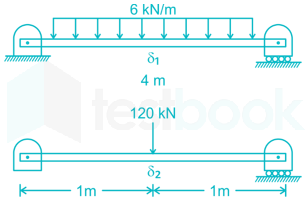
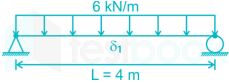
Two prismatic beams having the same flexural rigidity of 1000 kN-m2 are shown in the figures.

If the mid-span deflections of these beams are denoted by δ1 and δ2 (as indicated in the figures), the correct option is

  1. ((a))

    δ1 = δ2

  2. ((b))

    δ1 < δ2

  3. ((c))

    δ1 > δ2

  4. ((d))

    δ1 ≫ δ2

Show Answer
Answer: ((a))

δ1 = δ2

δ1=5384wL4EI =5384×6×4410000;m=20;mm\begin{array}{l} {{\rm{\delta }}_1} = \frac{5}{{384}}\frac{{w{L^4}}}{{EI}}\ = \frac{5}{{384}} \times \frac{{6 \times {4^4}}}{{10000;m}} = 20;mm \end{array}

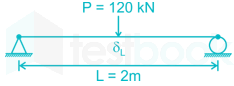
δL=PL348EI =120×2348×10000;m\begin{array}{l} {{\rm{\delta }}_{\rm{L}}} = \frac{{P{L^3}}}{{48EI}}\ = \frac{{120 \times {2^3}}}{{48 \times 10000;m}} \end{array}

= 20 mm

∴ δ1 = δ2

42

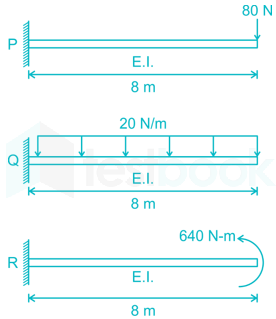
Consider the three prismatic beams with the clamped supports, P, Q and R as shown in the figures.

Given that the modulus of elasticity. E is 2.5 × 10⁴ MPa and the moment of inertia I is 8 × 108 mm4, the correct comparison of the magnitudes of the shear force S and the bending moment M developed at the supports is

  1. ((a))

    SP < SQ < SR, MP = MQ = MR

  2. ((b))

    SP = SQ > SR, MP = MQ > MR

  3. ((c))

    SP < SQ > SR, MP = MQ = MR

  4. ((d))

    SP < SQ < SR, MP = MQ < MR

Show Answer
Answer: ((c))

SP < SQ > SR, MP = MQ = MR

Explanation:

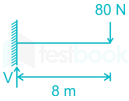
For P:

Σfv = 0

⇒ V = 80 N

∴ Shear force at support = SP = 80 N.

Moment at support = Pl ⇒ 80 × 8 = 640 Nm.

∴ MP = 640 Nm.

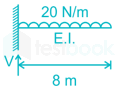
For Q:

Σfv = 0

⇒ V = wx ⇒ 20 × 8 = 160 N

∴ Shear force at support = SQ = 160 N.

Moment at support = MQ ⇒ wx22\frac{wx^2}{2} 

20;×;822640;Nm\therefore \frac{20;\times;8^2}{2}⇒640;Nm

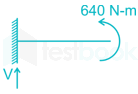
For R:

Σfv = 0

⇒ V = 0 = SR

Moment at support = MR = 640 Nm

Hence,

SP < SQ > SR & MP = MQ = MR

43

Consider the following statements:

P.    Walls of one brick thick are measured in square meters.

Q.   Walls of one brick thick are measured in cubic meters.

R.   No deduction in the brickwork quantity is made for openings in walls up to 0.1m2 area.

S.    For the measurement of excavation from the borrow pit in a fairly uniform ground, deadman

       are left at suitable intervals.

For the above statements, the correct option is

  1. ((a))

    P – False; Q – True: R – False: S – True

  2. ((b))

    P – False; Q – True: R – False: S – False

  3. ((c))

    P – True; Q – False: R – True: S – False

  4. ((d))

    P – True; Q – False: R – True: S – True

Show Answer
Answer: ((d))

P – True; Q – False: R – True: S – True

Explanation:

As per IS 1200 (part 3), 1976, Cl No- 4, brick work is measured in the following way:

Type of Brick work/ Brick work sizeMeasurement
Wall thickness ≤ one brick thickIt is measured in Square meter with stating thickness separately.
One brick thick < Wall thickness ≤ 3 brick thickMultiples of half brick; Where fractions of half-brick occurs, it measures as follow: Up to ¼th brick - actual measurement Exceeding ¼th brick- full half-brick.
Wall thickness > three bricksActual thickness shall be measured.

No deduction is made for following.

  • Opening each up to 0.1 m2.
  • Ends of beams rafters up to 0.05 m2 in section.

When the ground is not uniform levels shall be taken before the start, after site clearance and after the completion of the work and the quantity of excavation in cutting computed from these levels.

44

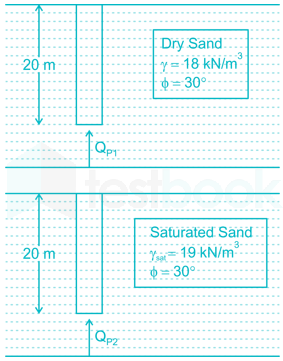
Two identical concrete piles having the plan dimensions 50cm × 50cm are driven into a homogeneous sandy layer as shown in the figures. Consider the bearing capacity factor Nq for ϕ = 30° as 24.

If QP1 and QP2 represent the ultimate point bearing resistances of the piles under dry and submerged conditions, respectively, which one of the following statements is correct?

  1. ((a))

    QP1 > QP2 by about 100%

  2. ((b))

    QP1 < QP2 by about 100%

  3. ((c))

    QP1 > QP2 by about 5%

  4. ((d))

    QP1 < QP2 by about 5%

Show Answer
Answer: ((a))

QP1 > QP2 by about 100%

Concept:

End Bearing Resistance = Effective Stress at Base × Nq

End Bearing Resistance = qNq

QP1 = qNq 

QP2 = qNq 

Find QP1QP2\frac{{{Q_{{P_1}}}}}{{{Q_P}_2}}

Calculation:

QP1= 18 × 20 × Nq  

QP1= 18 × (20Nq ) = 360 Nq

QP2 = qNq 

= (19 – 10) × 20 × Nq 

= 9 × (20 Nq) = 180 Nq

(Assuming γw = 10 kN/m3)

QP1QP2=2\frac{{{Q_{{P_1}}}}}{{{Q_P}_2}} = 2

Hence, by 100%.

45

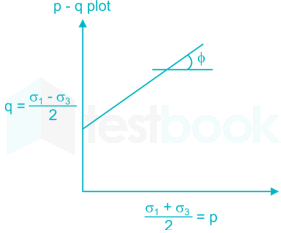
Following are the statements related to the stress paths in a triaxial testing of soils.

P. If σ1 = σ3, the stress point lies at the origin of the p – q plot

Q. If σ1 = σ3, the stress point lies on the p axis of the p – q plot

R. If σ1 > σ3, both the stress points p and q are positive.

For the above statements, the correct combination is

  1. ((a))

    P-False; Q-True; R-True

  2. ((b))

    P-True; Q-False; R-True

  3. ((c))

    P-False; Q-True; R-False

  4. ((d))

    P-True; Q-True; R-False

Show Answer
Answer: ((a))

P-False; Q-True; R-True

When σ1 = σ3

q = 0, p=2σ12=σ1p = \frac{{2{\sigma _1}}}{2} = {\sigma _1}

So stress point lies on p-axis of p-q plot

If σ1 > σ3

q=σ1σ32;so;q>0 p=σ1+σ32;so;p>0\begin{array}{l} q = \frac{{{\sigma _1} - {\sigma _3}}}{2};so;q > 0\ p = \frac{{{\sigma _1} + {\sigma _3}}}{2};so;p > 0 \end{array}

So, stress point p & q are positive.

46

Two cars P and Q are moving in a racing track continuously for two hours. Assume that no other vehicles are using the track during this time. The expressions relating the distance travelled d (in km) and time t (in hour) for both the vehicles are given as

P (d) = 60t

Q (d) = 60t2

Within the first one hour, the maximum space headway would be

  1. ((a))

    15 km at 30 minutes

  2. ((b))

    15 km at 15 minutes

  3. ((c))

    30 km at 30 minutes

  4. ((d))

    30 km at 15 minutes

Show Answer
Answer: ((a))

15 km at 30 minutes

P: d = 60t

Q: d = 60t2

Space Headway (S) = 60t2 – 60t

For space headway to be max,

dsdt=0\frac{{ds}}{{dt}} = 0

120t – 60 = 0

⇒ 60(2t – 1) = 0

⇒ t = ½ hr

Maximum space Headway

= 60 × ½ - 60 × (½)2

= 60 × ½ - 60 × ¼

= 30 – 15 = 15 km

47

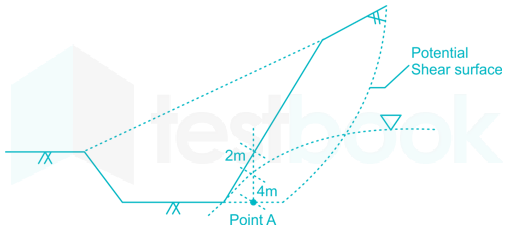
For the construction of a highway a cut is to be made as shown in the figure.

The soil exhibits c’= 20 kPa, ϕ’ = 18°, and the undrained shear strength = 80 kPa. The unit weight of water is 9.81 kN/m3. The unit weights of the soil above and below the ground water table are 18 and 20 kN/m3, respectively. If the shear stress at Point A is 50 kPa, the factors of safety against the shear failure at this point, considering the undrained and drained conditions respectively, would be

  1. ((a))

    1.6 and 0.9

  2. ((b))

    0.9 and 1.6

  3. ((c))

    0.6 and 1.2

  4. ((d))

    1.2 and 0.6

Show Answer
Answer: ((a))

1.6 and 0.9

Case-I: Undrained condition

F.O.S=resisting;shear;strengthActing;shear;stress=;8050=1.6{\rm{F}}.{\rm{O}}.{\rm{S}} = \frac{{{\rm{resisting;shear;strength}}}}{{{\rm{Acting;shear;stress}}}} = ;\frac{{80}}{{50}} = 1.6

Case-II: Drained condition

F.O.S=σˉtanϕ+cActing;shear;stress =[2×18+4(209.81)]×tan18+2050=0.9\begin{array}{l} {\rm{F}}.{\rm{O}}.{\rm{S}} = \frac{{{\rm{\bar \sigma }}\tan \phi ' + c'}}{{{\rm{Acting;shear;stress}}}}\ = \frac{{\left[ {2 \times 18 + 4\left( {20 - 9.81} \right)} \right] \times \tan 18^\circ + 20}}{{50}} = 0.9 \end{array}

48

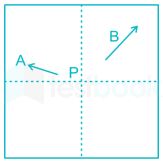
Two towers, A and B standing vertically on a horizontal ground appear in a vertical aerial photograph as shown in the figure.

The length of the image of the tower A on the photograph is 1.5 cm and of the tower B is 2.0 cm. The distance of the top of the tower A as shown in the arrowhead is 4.0 cm and the distance of the top of the tower B is 6.0 cm. as measured from the principal point p of the photograph. If the height of the tower B is 80 m, the height (in meters) of the tower A is ________.

49

A hollow circular shaft has an outer diameter of 100 mm and inner diameter of 50 mm. If the allowable shear stress is 125 MPa, the maximum torque (in kN-m) that the shaft can resist is ________.

50

A simply supported rectangular concrete beam of span 8 m has to be prestressed with a force of 1600 kN. The tendon is of parabolic profile having zero eccentricity at the supports. The beam has to carry an external uniformly distributed load of intensity 30 kN/m. Neglecting the self-weight of the beam, the maximum dip (in meters upto two decimal place) of the tendon at the mid-span to balance the external load should be ________.

51

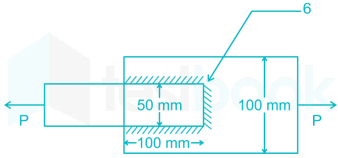
Two plates of 8 mm thickness each are connected by a fillet weld of 6mm thickness as shown in the figure.

The permissible stresses in the plate and the weld are 150 MPa and 110 MPa respectively. Assuming the length of the weld shown in the figure to be the effective length the permissible load P (in kN) is ________

52

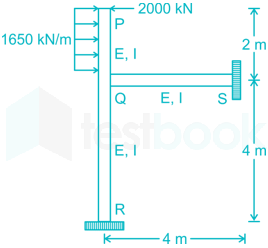
Consider the portal frame shown in the figure and assume the modulus of elasticity, E = 2.5 × 10⁴ MPa and the moment of inertia, I = 8 × 108 mm4 for all the members of the frame.

The rotation (in degrees, up to one decimal place) at the rigid joint Q would be________

53

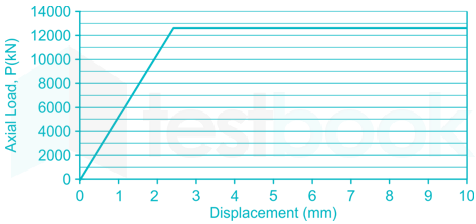
A 2 m long axially loaded mild steel rod of 8 mm diameter exhibits the load-displacement (P – δ) behavior as shown in the figure.

Assume the yield stress of steel as 250 MPa. The complementary strain energy in N-mm) stored in the bar up to its linear elastic behaviour will be ________

54

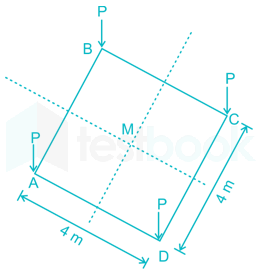
Consider a square-shaped area ABCD on the ground with tis centre at M as shown in the figure. Four concentrated vertical loads of P = 5000 kN are applied on this area, one at each corner.

The vertical stress increment (in kPa up to one decimal place) due to these loads according to the Boussinesq’s equation at a point 5 m right below M is ________.

55

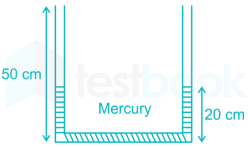
The figure shows a U – tube having a 5 mm × 5 mm square cross-section filled with mercury (specific gravity = 13.6) upto a height of 20 cm in each limb (open to the atmosphere).

If 5 cm3 of water is added to the left limb, the new height (in cm up to two decimal places) of mercury in the right limb will be ________.

56

A 1m wide rectangular channel carries a discharge of 2m3/s. The specific energy-depth diagram is prepared for the channel. It is observed in this diagram that corresponding to a particular specific energy. The subcritical depth is twice the supercritical depth. The subcritical depth (in meters, up to two decimal places) is equal to ________

57

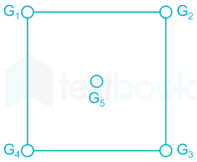
A catchment is idealized as a 25 km × 25 km square. It has five rain gauges, one at each corner and one at the centre, as shown in the figure.

During a month the precipitation at these gauges is measured as G1 = 300 mm, G2 = 285 mm, G3 = 272 m, G4 = 290 mm and G5 = 288 mm. The average precipitation (in mm up to one decimal place) over the catchment during this month by using the Thiessen polygon method is ________.

58

The culturable command area of a canal is 10,000 ha. The area grows only two crops-rice in the Kharif season and wheat in the Rabi season. The design discharge of the canal is based on the rice requirements, which has an irrigated area of 2500 ha, base period of 150 days and delta of 130 cm. The maximum permissible irrigated area (in ha) for wheat, with a base period of 120 days and delta of 50 cm. is ________.

59

Water is pumped at steady uniform flow rate of 0.01 m3/s though a horizontal smooth circular pipe of 100 mm diameter. Given that the Reynold number is 800 and g is 9.81 m/s2, the head loss (in meters upto one decimal place) per km length due to friction would be ________.

60

The composition of a municipal solid waste sample is given below:

ComponentPercent by MassMoisture content (%)Energy Content (kJ/kg. on as – discarded basis)
Food Waste20702500
Paper10410000
Cardboard1048000
Plastics10114000
Garden Trimmings40603500
Wood52014000
Tin Cans52100
<br>

The difference between the energy content of the waste sample calculated on dry basis and as discarded basis (in kJ/kg) would be ________

61

For a given water sample, the ratio between BOD5-day. 20°C and the ultimate BOD is 0.68. The value of the reaction rate constant k (on base e) (in day–1, up to two decimal places) is ________.

62

A municipal corporation is required to treat 1000 m3/day of water. It is found that an overflow rate of 20 m/day will produce a satisfactory removal of the discrete suspended particles at a depth of 3m. The diameter (in meters, rounded to the nearest integer) of a circular settling tank designed for the removal of these particles would be_______

63

The analysis of a water sample produces the following results

IonMilligram per milli- equivalent for the ionConcentration (mg)/L
Ca2+ Mg2+ Na+ K+ Cl- SO42- HCO3-20.0 12.2 23.0 39.1 35.5 48.0 61.060 36.6 92 78.2 71 72 122
<br>

The total hardness (in mg/L as CaCO3) of the water sample is ________.

64

The radii of relative stiffness of the rigid pavement P and Q are denoted by IP and IQ respectively. The geometric and material properties of the concrete slab and underlying soil are given below.

PavementConcreteSoil
Length of SlabBreadth of SlabThickness of SlabModulus of ElasticityPoisson’s RatioSubgrade Reaction Modulus
PLBhEμK
QLB0.5 hEμ2K
<br>

The ratio (up to one decimal place) of IP / IQ is _____.

65

An observer standing on the deck of a ship just sees the top of a lighthouse. The top of the lighthouse is 40m above the sea level and the height of the observer’s eye is 5m above the sea level. The distance (in km. up to one decimal place) of the observer from the lighthouse is ________

Attempt this paper under real exam conditions

Timed interface, section switching, instant scoring, and question-by-question analytics — free.

Start Timed Attempt