Official Paper

GATE CE 2016 Official Paper: Shift 2 (Previous Year Paper)

65 questions · 180 minutes · with answers · free

General Aptitude (10 questions)

1

If I were you, I __________ that laptop. It’s much too expensive.

  1. ((a))

    won’t buy

  2. ((b))

    Shan’t buy

  3. ((c))

    wouldn’t buy

  4. ((d))

    would buy

Show Answer
Answer: ((c))

wouldn’t buy

The correct answer is 'wouldn't buy'.

Key Points

  • The given sentence is an example of a second conditional sentence.
  • The second conditional sentence is a structure used for talking about unreal situations in the present or in the future.
  • Structure:
  • If+past simple, would+ infinitive.
  • Example: 
  • If I won the lottery, I would buy a big house.
  • Thus, from the above-given explanation, it is clear that 'wouldn't buy' will be used in the blank.

Therefore, the correct sentence is: 'If I were you, I wouldn't buy that laptop. It's much too expensive.'

2

He turned a deaf ear to my request. What does the underlined phrasal verb mean?

  1. ((a))

    ignored

  2. ((b))

    appreciated

  3. ((c))

    twisted

  4. ((d))

    returned

Show Answer
Answer: ((a))

ignored

The correct answer is 'Ignored'.

Key Points

  • Let's explore the meaning of the given word and the marked option:
  • ‘Turning a deaf ear' is a phrase which means to pretend to have not heard what was said.
  • ​Example: You can plead all day but he's turning a deaf ear to everyone.
  • Ignored: to avoid or pretend to have no knowledge about something.
  • Example: Ignore those who try to discourage you.
  • Thus, from the above-given explanation, we can say that the correct answer is option 1.

Additional Information

  • Let's explore the meaning of the other words:
  • Appreciated: to like and admire.
  • Twisted: physically turn something or to understand something differently from what is meant i.e to get a negative meaning.
  • Returned: to give back.
3

Choose the most appropriate set of words from the options given below to complete the following sentence.

_________ _______ is a will, _______ is a way.

  1. ((a))

    Wear, there, their

  2. ((b))

    Were, their, there

  3. ((c))

    Where, there, there

  4. ((d))

    Where, their, their

Show Answer
Answer: ((c))

Where, there, there

The correct answer is 'Where, there, there'.

Key Points

  • 'Where there is a will there is a way' is a proverb which means if one really wants to achieve something then he/she will keep on getting ways to it and will be successful in the end. 
  • ExampleThe man drove through eight countries in his car. It is true, where there is a will, there is a way.
  • The famous saying highlights the ‘importance of willpower or strong determination in life’.
  • Therefore, the correct answer is option 3.

The correct sentence is: Where there is a will, there is a way.

4

(x % of y) + (y % of x) is equivalent to.

  1. ((a))

    2 % of xy

  2. ((b))

    2 % of (xy/100)

  3. ((c))

    xy % of 100

  4. ((d))

    100 % of xy

Show Answer
Answer: ((a))

2 % of xy

(x % of y) + (y % of x) 

=x100×y+y100×x= \frac{x}{{100}} \times y + \frac{y}{{100}} \times x

= 2xy/100

= 2% of xy

5

The sum of the digits of a two digit number is 12. If the new number formed by reversing the digits is greater than the original number by 54, find the original number.

  1. ((a))

    39

  2. ((b))

    57

  3. ((c))

    66

  4. ((d))

    93

Show Answer
Answer: ((a))

39

Let the ones digit be a and tens digit be b.

Given,

sum of the digits of a two digit number is 12.

∴ a + b = 12 ---------eqn 1

Given,

New number formed by reversing the digits is greater than the original number by 54.

(b + 10a) = (a + 10b) + 54

9a – 9b = 54

∴ a – b = 6 -------- eqn 2

From equation 1 and 2

a = 9 and b = 3

∴ The orginal number is = a + 10b  = 39

6

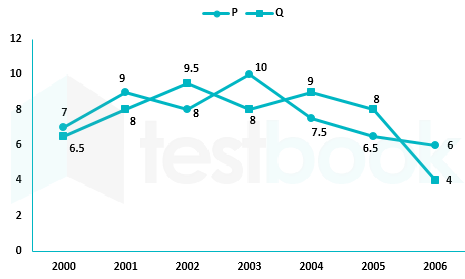
Two finance companies P and Q, declared fixed annual rates of interest on the amounts invested with them. The rates of interest offered by these companies may differ from year to year. Year-wise annual rates of interest offered by these companies are shown by the line graph provided below.

If the amounts invested in the companies, P and Q, in 2006 are in the ratio 8:9, then the amounts

received after one year as interests from companies P and Q would be in the ratio:

  1. ((a))

    2 : 3

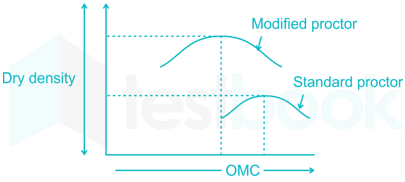
  2. ((b))

    3 : 4

  3. ((c))

    6 : 7

  4. ((d))

    4 : 3

Show Answer
Answer: ((d))

4 : 3

Concept:

SI = Simple interest = (P × r × t)

where,

P = principal amount

R = rate of interest in %

t = time for which money is lend (in days or months or years)

Calculation:

Rate of interest provided by company P in 2006 = rP = 6%

Rate of interest provided by company Q in 2006 = rQ = 4%

Time for which money was lend = t = tP = tQ = 1 year

Given, amounts invested in the companies, P and Q, in 2006 are in the ratio 8 : 9.

∴ PPPQ=89;\frac{{{P_P}}}{{{P_Q}}} = \frac{8}{9};

(S.I)P(S.I)Q=PP×rP×tPPQ×rQ×tQ;\frac{{{{\left( {S.I} \right)}_P}}}{{{{\left( {S.I} \right)}_Q}}} = \frac{{{P_P} \times {r_P} \times {t_P}}}{{{P_Q} \times {r_Q} \times {t_Q}}};

(S.I)P(S.I)Q=8×6×19×4×1=43\frac{{{{\left( {S.I} \right)}_P}}}{{{{\left( {S.I} \right)}_Q}}} = \frac{{8 \times 6 \times 1}}{{9 \times 4 \times 1}} = \frac{4}{3}

Amounts received after one year as interests from companies P and Q is in the ratio 4 : 3.

7

Today, we consider Ashoka as a great ruler because of the copious evidence he left behind in the form of stone carved edicts. Historians tend to correlate greatness of a king at his time with the availability of evidence today.

Which of the following can be logically inferred from the above sentences?

  1. ((a))

    Emperors who do not leave significant sculpted evidence are completely forgotten.

  2. ((b))

    Asoka produced stone carved edicts to ensure that later historians will respect him.

  3. ((c))

    Statues of kings are a reminder of their greatness.

  4. ((d))

    A king’s greatness, as we know him today, is interpreted by historians.

Show Answer
Answer: ((d))

A king’s greatness, as we know him today, is interpreted by historians.

Explanation:

In the given statement, it has been told that the availability of evidence helps the historians identify greatness of the king at their time.

Statement (A) In this statement it has been said that historians ‘tend’ to correlate the greatness of a king at his time with the availability of evidence today. This means that sculpted evidence is only one of the means to know about the greatness of a king. Hence this statement is wrong.

Statement (B) is incorrect as Ashoka, who lived thousands of years ago, must not have produced stone-carved edicts so that later historians will respect him but for the as a socio-cultural token for the contemporary time.

Statement (C) is incorrect as the statement not at all mentions ‘Statues of kings’.

Statement (D) is correct as it is the past evidence that historians take into account to conclude about their greatness. So it is through the historical remains that historians interpret about the kings’ greatness and it is through their interpretation that we know them.

8

Fact 1: Humans are mammals.

Fact 2: Some humans are engineers.

Fact 3: Engineers build houses.

If the above statements are facts, which of the following can be logically inferred?

I. All mammals build houses.

II. Engineers are mammals.

III. Some humans are not engineers.

  1. ((a))

    II only

  2. ((b))

    III only

  3. ((c))

    I, II and III

  4. ((d))

    I only

Show Answer
Answer: ((a))

II only

Let us consider each statement separately.

I. All mammals build houses.

This is clearly false as only some mammals (humans) are engineers.

II. Engineers are mammals.

All engineers are definitely humans, and all humans are mammals, therefore this is true.

III. Some humans are not engineers.

The given information states that ‘some humans are engineers’. Therefore, we cannot determine how many humans are engineers. There is the possibility of all humans being engineers as well, so this is definitely false.

Therefore, only II is true.

Mistake Points

1) If the statements are positive, then the negative conclusions will be false in definite cases and vice versa.

  1. "Some" does not say anything certain about "Some not".

3) The conclusion must be 100% true. The conclusions which are 99% true will be considered false.

For Example:

Statement: Some A are B  

Conclusion: some A are not B, It is possible, not definite. We can't say anything about the negative conclusion.

9

A square pyramid has a base perimeter x, and the slant height is half of the perimeter. What is the lateral surface area of the pyramid?

  1. ((a))

    x2

  2. ((b))

    0.75x2

  3. ((c))

    0.50x2

  4. ((d))

    0.25x2

Show Answer
Answer: ((d))

0.25x2

Concept:

For square pyramid

Lateral surface area of the pyramid = 4 × area of one of the triangles of the pyramid.

perimeter of a square  = 4 × Side of a square

Calculation:

Given,

Square pyramid has a base perimeter = X

perimeter of a square  = 4 × Side of a square

∴ Side of the square base = X/4

The slant height  = half of the perimeter.= X/2

we know that

Perpendicular height of the triangles = Slant height of the pyramid = X/2

Base of the triangle = Side of the square base = X/4

Lateral surface area of the pyramid = 4 × area of one of the triangles of the pyramid.

Lateral surface area of the pyramid = 4 × ½ × base × height

Lateral surface area of the pyramid = 2 × (x/4) × (x/2) = 0.25x2

10

Ananth takes 6 hours and Bharath takes 4 hours to read a book. Both started reading copies of the book at the same time. After how many hours is the number of pages remaining to be read by Ananth, twice that the number of pages remaining to read by Bharath? Assume Ananth and Bharath read all the pages with constant pace.

  1. ((a))

    1

  2. ((b))

    2

  3. ((c))

    3

  4. ((d))

    4

Show Answer
Answer: ((c))

3

Let the number of pages of the book be n.

Given,

Time needed To read a book

Ananth takes 6 hours

Bharath takes 4 hours 

∴ Number of pages read in 1 hour

Ananth reads n/6 pages

Bharath reads n/4 pages 

Number of pages remaining to be read

Number of pages remaining to be read by Ananth = nnt6n - \frac{{nt}}{6}

Number of pages remaining to read by Bharath = nnt4n - \frac{{nt}}{4}

Let after ‘t’ hours the number of pages remaining to be read by Ananth is twice that number of pages remaining to read by Bharath.

(Number of pages remaining to be read by Ananth) = 2 × (Number of pages remaining to read by Bharath)

nnt6=2(nnt4)\therefore n - \frac{{nt}}{6} = 2\left( {n - \frac{{nt}}{4}} \right)

⇒ 1 – t/6 = 2 – t/2

⇒ t/3 = 1

⇒ t = 3 hours

Civil Engineering (55 questions)

11

The spot speeds (expressed in km/hr) observed at a road section are 66, 62, 45, 79, 32, 51, 56, 60,

53, and 49. The median speed (expressed in km/hr) is _________

(Note: answer with one decimal accuracy)

12

The optimum value of the function f(x) = x2 – 4x + 2 is

  1. ((a))

    2 (maximum)

  2. ((b))

    2 (minimum)

  3. ((c))

    −2 (maximum)

  4. ((d))

    −2 (minimum)

Show Answer
Answer: ((d))

−2 (minimum)

Concept:

The method of finding Maxima and Minima of Y = f(x)

  1. Find f’(x) and f”(x) for given function Y = f(x)

  2. Equate f’(x) to zero to obtain stationary points x = a

  3. calculate f”(x) at each stationary points x = a (i.e f”(a))

  4. we obtain following three conditions

(i) If f”(a) > 0 then f(x) has a minimum at x = a and minimum value will be f(a)

(ii) If f”(a) < 0 then f(x) has a maximum at x = a and maximum value will be f(a)

(iii) If f”(a) = 0 then f(x) may or may not have a maximum or a minimum at x = a 

Calculation:

Given function f(x) = x2 – 4x + 2

1) f’(x) = 2x - 4, f”(x) = 2

2) f’(x) = 0, ∴ 2x - 4 = 0, x = 2(stationary point)

  1. f"(x) at stationary point x = 2, f”(x) = 2

  2. f"(x) > 0

∴ f(x) is minimum at x = 2

i.e.,f(2)= (2)2 – 4(2) + 2 = – 2 

∴ The optimum value of f(x) is – 2 (minimum)

13

The Fourier series of the function,

f(x) = 0, -π < x ≤ 0

= π - x, 0 < x < π

in the interval [= π, π] is

f(x)=π4+2π[cosx12+cos3x32]+[sinx1+sin2x2+sin3x3+]f\left( x \right) = \frac{\pi }{4} + \frac{2}{\pi }\left[ {\frac{{\cos x}}{1^2} + \frac{{\cos 3x}}{{{3^2}}} \ldots \ldots \ldots } \right] + \left[ {\frac{{\sin x}}{1} + \frac{{\sin 2x}}{2} + \frac{{\sin 3x}}{3} + \ldots \ldots \ldots } \right]

The convergence of the above Fourier series at 𝑥 = 0 gives

  1. ((a))

    \(\mathop \sum \limits_{n = 1}^\infty \frac{1}{{{n^2}}} = \frac{{{\pi ^2}}}{6}\)

  2. ((b))

    \(\mathop \sum \limits_{n = 1}^\infty \frac{{{{\left( { - 1} \right)}^{n + 1}}}}{{{n^2}}} = \frac{{{\pi ^2}}}{{12}}\)

  3. ((c))

    \(\mathop \sum \limits_{n = 1}^\infty \frac{1}{{\left( {2n - 1} \right)^2}} = \frac{{{\pi ^2}}}{8}\)

  4. ((d))

    \(\mathop \sum \limits_{n = 1}^\infty \frac{{{{\left( { - 1} \right)}^{n + 1}}}}{{2n - 1}} = \frac{\pi }{4}\)

Show Answer
Answer: ((c))

\(\mathop \sum \limits_{n = 1}^\infty \frac{1}{{\left( {2n - 1} \right)^2}} = \frac{{{\pi ^2}}}{8}\)

The given fourier series is,

f(x)=π4+2π[cosx12+cos3x32]+[sinx1+sin2x2+sin3x3+]f\left( x \right) = \frac{\pi }{4} + \frac{2}{\pi }\left[ {\frac{{\cos x}}{1^2} + \frac{{\cos 3x}}{{{3^2}}} \ldots \ldots \ldots } \right] + \left[ {\frac{{\sin x}}{1} + \frac{{\sin 2x}}{2} + \frac{{\sin 3x}}{3} + \ldots \ldots \ldots } \right]

f(0)=π4+2π[112+132+152]f\left( 0 \right) = \frac{\pi }{4} + \frac{2}{\pi }\left[ {\frac{{1}}{1^2} + \frac{{1}}{{{3^2}}} + \frac{{1}}{{{5^2}}} \ldots \ldots \ldots } \right]

The convergence of f(x) at x = 0 is valid if

f(0)=f(0)+f(0+)2f\left( 0 \right) = \frac{{f\left( {{0^ - }} \right) + f\left( {{0^ + }} \right)}}{2}

f(0)=f(0)+f(0+)2f\left( 0 \right) = \frac{{f\left( {{0^ - }} \right) + f\left( {{0^ + }} \right)}}{2}

where f(0)=limx0;(πx)=πf\left( {{0^ - }} \right) = \mathop {\lim }\limits_{x \to 0;} \left( {\pi - x} \right) = \pi

f(0)=π2f\left( 0 \right) = \frac{\pi}{2}

π2=π4+2π[112+132+]\frac{\pi }{2} = \frac{\pi }{4} + \frac{2 }{\pi} \left[ {\frac{1}{{{1^2}}} + \frac{1}{{{3^2}}} + \ldots } \right]

11+132+152+=π28 \frac{1}{1} + \frac{1}{{{3^2}}} + \frac{1}{{{5^2}}} + \ldots =\frac{{{\pi^2}}}{8}

\(\mathop \sum \limits_{n = 1}^\infty \frac{1}{{{{\left( {2n - 1} \right)}^2}}} = \frac{\pi^2 }{8}\)

14

X and Y are two random independent events. It is known that P(X ) = 0.40 and P(X ∪ YC ) = 0.7. Which one of the following is the value of P(X ∪ Y ) ?

  1. ((a))

    0.7

  2. ((b))

    0.5

  3. ((c))

    0.4

  4. ((d))

    0.3

Show Answer
Answer: ((a))

0.7

P(X ∪ YC) = 0.7 

P(X ∪ YC) = P(X) + P(YC) – P(X) P(YC)

∴ P(X) + P(YC) – P(X) P(YC)= 0.7

(Since C, Y are independent events)

P(X) + 1 – P(Y) – P(X) {1 – P(Y)} = 0.7

P(Y) – P(X ∩ Y) = 0.3    

Now we know that

P(X ∪ Y) = P(X) + P(Y) – P(X ∩ Y)

∴ P(X ∪ Y) = 0.4 + 0.3 = 0.7

15

What is the value of limx0 y0xyx2+y2?\mathop {\lim }\limits_{{{x \to 0}}\ {y \to 0}}\frac{{xy}}{{{x^2} + {y^2}}}?

  1. ((a))

    1

  2. ((b))

    -1

  3. ((c))

    0

  4. ((d))

    Limit does not exist.

Show Answer
Answer: ((d))

Limit does not exist.

Put x = 0 and then y = 0,

i) limx0xyx2+y2limy0(002+y2)=0\mathop {\lim }\limits_{x \to 0 } \frac{{xy}}{{{x^2} + {y^2}}}\mathop {\lim }\limits_{y \to0 } \left( {\frac{0}{{{0^2} + {y^2}}}} \right) = 0

Put y = 0 and then x = 0)

ii) \(\mathop {\lim }\limits_{\begin{array}{*{20}{c}} {x \to 0 } \end{array}} \frac{{xy}}{{{x^2} + {y^2}}}\mathop {\lim }\limits_{x \to 0} \left( {\frac{0}{{{x^2} + 0}}} \right) = 0\)

Put y = mx,

iii) \(\mathop {\lim }\limits_{\begin{array}{*{20}{c}} {x \to 0 } \end{array}} \frac{{xy}}{{{x^2} + {y^2}}}\mathop {\lim }\limits_{x \to 0} \frac{{x\left( {mx} \right)}}{{{x^2} + {m^2}{x^2}}}\)

limx0(m1+m2)=m1+m2\mathop {\lim }\limits_{x \to 0 } \left( {\frac{m}{{1 + {m^2}}}} \right) = \frac{m}{{1 + {m^2}}}

It does not depend on limits, it depends on m. 

∴ Limits do not exist

16

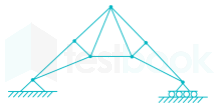
The kinematic indeterminacy of the plane truss shown in the figure is

  1. ((a))

    11

  2. ((b))

    8

  3. ((c))

    3

  4. ((d))

    0

Show Answer
Answer: ((a))

11

Concept:

The following table shows the kinematic indeterminacy for pin jointed and rigid frames

Type of frameKinematic indeterminacy (DK)
Pin jointed plane frameDK = 2J – r
Pin jointed space frameDK = 3J – r
Rigid jointed plane frameDK = 3J – r
Rigid jointed space frameDK = 6J – r

Where J = number of joints in the frame,  r = number of support reactions

Calculations:

J = 7

r = 3

Kinetic indeterminacy

DK = 2j – re

DK= 2 × 7 – 3 = 11

17

As per IS 456-2000 for the design of reinforced concrete beam, the maximum allowable shear stress (τcmax) depends on the:

  1. ((a))

    grade of concrete and grade of steel

  2. ((b))

    grade of concrete only

  3. ((c))

    grade of steel only

  4. ((d))

    grade of concrete and percentage of reinforcement

Show Answer
Answer: ((b))

grade of concrete only

Explanation:

If shear stress is greater than **τcmax **concrete will fail due to the crushing of concrete at the web in the diagonal direction prior to the yielding of stirrups, resulting in a brittle failure. This type of failure of concrete is known as diagonal compression. **τcmax **depends on grade of concrete only.

Table 20 of IS 456

Stipulates the maximum shear stress of reinforced concrete in beams τcmax as given below in Table. Under no circumstances, the nominal shear stress in beams τv shall exceed τcmax given in the table for different grades of concrete.

Grade of concreteM20M25M30M35M40 and above
τcmax (in MPa)2.83.13.53.74.0

Important Points

 When the shear stress in concrete exceeds these values it leads to brittle failure due to diagonal compression.

18

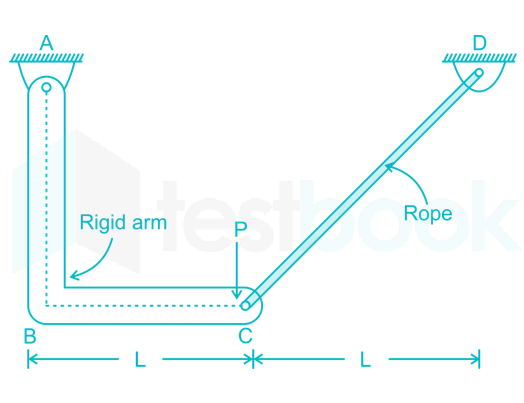
An assembly made of a rigid arm A-B-C hinged at end A and supported by an elastic rope C-D at end C is shown in the figure. The members may be assumed to be weightless and the lengths of the respective members are as shown in the figure.(Length of AB & BC are L)

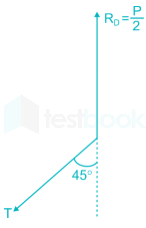
Under the action of a concentrated load P at C as shown, the magnitude of tension developed in the

rope is

  1. ((a))

    3P2\frac{{3P}}{{\sqrt 2 }}

  2. ((b))

    P2\frac{P}{{\sqrt 2 }}

  3. ((c))

    3P8\frac{{3P}}{8}

  4. ((d))

    2P\sqrt 2 P

Show Answer
Answer: ((b))

P2\frac{P}{{\sqrt 2 }}

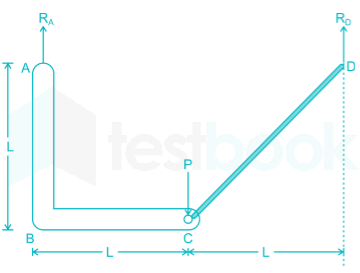
Taking moment about point B

RD × 2L – P × L = 0

RD = P/2

At joint D:

ΣFy = 0

T;cos45=P2 T=P2\begin{array}{l} T;cos45^\circ = \frac{P}{2}\ \therefore T = \frac{P}{{\sqrt 2 }} \end{array}

19

As per Indian standards for bricks, minimum acceptable compressive strength of any class of burnt clay bricks in dry state is

  1. ((a))

    10.0 MPa

  2. ((b))

    7.5 MPa

  3. ((c))

    5.0 MPa

  4. ((d))

    3.5 MPa

Show Answer
Answer: ((d))

3.5 MPa

As per IS 1077: 1992 clause 4.1,

  • The  acceptable minimum strength of burnt clay bricks is 3.5 MPa.
  • The maximum strength of burnt clay brick goes upto 35 MPa
20

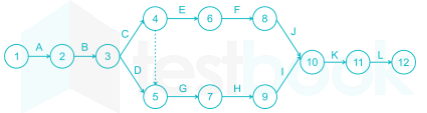
A construction project consists of twelve activities. The estimated duration (in days) required to complete each of the activities along with the corresponding network diagram is shown below.

ActivityDuration (days)ActivityDuration (days)
AInauguration1GFlooring25
BFoundation work7HElectrification7
CStructural construction - 130IPlumbing7
DStructural construction - 230JWoodwork7
EBrick masonry work25KColoring3
FPlastering7LHanding over function1


Total floats (in days) for the activities 5-7 and 11-12 for the project are, respectively:

  1. ((a))

    25 and 1

  2. ((b))

    1 and 1

  3. ((c))

    0 and 0

  4. ((d))

    81 and 0

Show Answer
Answer: ((c))

0 and 0

Explanation:

Total float can be determined once the activity times i.e. EST, EFT, LST, and LFT are known. Total float

FT = LST – EST= LFT – EFT

For activity 5 – 7,

EST = 38

EFT = 63

LFT = 63

LST = 38

FT = LST – EST = 38 - 38 = 0

For activity 11 – 12,

EST = 80

EFT = 81

LFT = 81

LST = 80

FT = LST – EST = 80 - 80 = 0

21

A strip footing is resting on the surface of a purely clayey soil deposit. If the width of the footing is doubled, the ultimate bearing capacity of the soil:

  1. ((a))

    Becomes double

  2. ((b))

    Becomes half

  3. ((c))

    Becomes four-times

  4. ((d))

    Remains the same

Show Answer
Answer: ((d))

Remains the same

Net ultimate bearing capacity of a footing embedded in a clay stratum is given by: 

qnu = cNc

Generally, net ultimate bearing capacity of a footing is independent of depth and size of footing as shown in the above formula.

qu=cNc + γDf{q_{u}} = c{N_c} \ +\ \gamma D_f

Hence, Ultimate bearing capacity of soil is also independent of width of footing and remains same if width is changed.

22

The relationship between the specific gravity of sand (G) and the hydraulic gradient (i) to initiate quick condition in the sand layer having porosity of 30% is

  1. ((a))

    G = 0.7i + 1

  2. ((b))

    G = 1.43i − 1

  3. ((c))

    G = 1.43i + 1

  4. ((d))

    G = 0.7i – 1

Show Answer
Answer: ((c))

G = 1.43i + 1

Concept:

The relation between porosity (n) and voids ratio (e) is given by,

n=e1+en = \frac{e}{{1 + e}}

The critical hydraulic gradient is given by,

i;=G11+ei; = \frac{{G - 1}}{{1 + e}}

Calculation:

n = 0.3

\(\begin{array}{l} e = \frac{n}{{1 - n}} = \frac{{0.3}}{{1 - 0.3}} = \frac{3}{7}\We \ know \ that\ i = \frac{{G - 1}}{{1 + e}}\ \therefore i = \frac{{G - 1}}{{1 + \frac{3}{7}}} \end{array}\)

G - 1 = 1.43i

G = 1.43i + 1

23

The results of a consolidation test on an undisturbed soil, sampled at a depth of 10 m below the ground level are as follows:

Saturated unit weight: 16 kN/m3

Pre-consolidation pressure: 90 kPa

The water table was encountered at the ground level. Assuming the unit weight of water as 10 kN/m3, the over-consolidation ratio of the soil is

  1. ((a))

    0.67

  2. ((b))

    1.50

  3. ((c))

    1.77

  4. ((d))

    2.00

Show Answer
Answer: ((b))

1.50

Concept:

Over Consolidation Ratios (O.C.R)

It is defined as the ratio of ‘maximum applied effective stress in the past’ to the ‘maximum applied effective stress in the present’

O.C.R=Maximum;applied;effective;stress;in;the;pastMaximum;applied;effective;stress;in;the;present=Past;σmaxPresent;σmax{\rm{O}}.{\rm{C}}.{\rm{R}} = \frac{{{\rm{Maximum;applied;effective;stress;in;the;past}}}}{{{\rm{Maximum;applied;effective;stress;in;the;present}}}} = \frac{{Past;{σ _{max}}}}{{Present;{σ _{max}}}}

For over consolidated soils, OCR > 1

Calculation:

γsat = 16 kN/m3 

Past σmax = 90 kN/m2 

\(\begin{array}{l} OCR = \frac{{{σ _{max;}}Past}}{{{ σ _{max}}; Present;}}\ {Present\ Effective\ σ _{max}}\ =({\gamma _{sat}} \times h) - \left( {{\gamma _w} \times h} \right) \{Present\ Effective\ σ _{max}}\ =16 \times 10 - 10 \times 10 = 60;kN/{m^2}\ OCR = \frac{{90}}{{60}} = 1.5 \end{array}\)

24

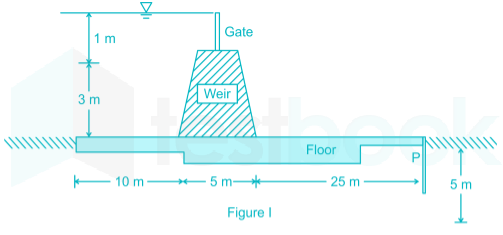
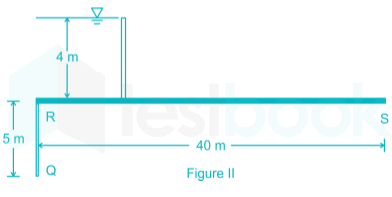
Profile of a weir on permeable foundation is shown in figure I and an elementary profile of upstream pile only case' according to Khosla's theory is shown in figure II. The uplift pressure heads at key points Q, R and S are 3.14 m, 2.75 m and 0 m, respectively (refer figure II).

What is the uplift pressure head at point P downstream of the weir (junction of floor and pile as shown in the figure I)?

  1. ((a))

    2.75 m

  2. ((b))

    1.25 m

  3. ((c))

    0.8 m

  4. ((d))

    Data not sufficient

Show Answer
Answer: ((b))

1.25 m

Concept:

The percentage of uplift pressure of the weir is given by,

ϕ=hH×100\phi = \frac{h}{H} \times 100

Where,

h = uplift pressure heads

H = operating head of weir

Calculation:

hQ = uplift pressure head at point Q = 3.14 m

hR = uplift pressure head at point R = 2.75 m

hS = uplift pressure head at point S = 0 m

we know that

ϕ=hH×100\phi = \frac{h}{H} \times 100

\(\begin{array}{l} {\phi _R} = \frac{{2.75}}{4} \times 100 = 68.75% \ {\phi _P} = 100 - {\phi _R} = 31.25% \{\phi _P} = \frac{{Pressure;head;at;point;P}}{{Total;head}} \times 100\ 31.25 = \frac{h}{4} \times 100 \end{array}\)

h = 1.25 m

∴ Uplift Pressure head at point P = 1.25 m

25

Water table of an aquifer drops by 100 cm over an area of 1000 km2. The porosity and specific retention of the aquifer material are 25% and 5%, respectively. The amount of water (expressed in km3) drained out from the area is _________

26

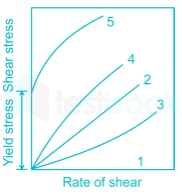
Group I contains the types of fluids while Group II contains the shear stress - rate of shear relationship of different types of fluids, as shown in the figure.

Group IGroup II
P. Newtonian fluid1. Curve 1
Q. Pseudo Plastic fluid2. Curve 2
R. Thixotropic3. Curve 3
S. Dialatant fluid4. Curve 4
5. Curve 5


The correct match between Group I and Group II is

  1. ((a))

    P-2, Q-4, R-1, S-5

  2. ((b))

    P-2, Q-5, R-4, S-1

  3. ((c))

    P-2, Q-4, R-5, S-3

  4. ((d))

    P-2, Q-1, R-3, S-4

Show Answer
Answer: ((c))

P-2, Q-4, R-5, S-3

Concept:

According to Newton’s law of viscosity,

τ;αdudy{\rm{\tau ;\alpha }}\frac{{{\rm{du}}}}{{{\rm{dy}}}}

τ=μ×dudy;{\rm{\tau }} = {\rm{\mu }} \times \frac{{{\rm{du}}}}{{{\rm{dy}}}}{\rm{;}}

μ = Dynamic viscosity in Pa.sec

According to Power-law model

τ=m×(dudy)n{\rm{\tau }} = {\rm{m}} \times {\left( {\frac{{{\rm{du}}}}{{{\rm{dy}}}}} \right)^{\rm{n}}}

where, where n = flow behavior index, m = consistency index.Explanation:


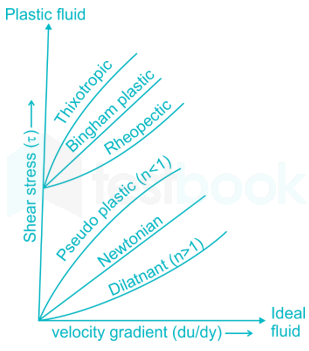
Type of BehaviorDescriptionExamples
NewtonianViscosity is independent of stressWater, mercury, glycerine, air, engineering oils
DilatantViscosity increases with increased stressQuicksand, Cornstarch, concentrated sugar solution
PseudoplasticViscosity decreases with increased stressMilk, blood
RheopecticViscosity increases with stress over timeGypsum
ThixotropicViscosity decreases with stress over timepaints
27

The atmospheric layer closest to the earth surface is

  1. ((a))

    The mesosphere

  2. ((b))

    The stratosphere

  3. ((c))

    The thermosphere

  4. ((d))

    The troposphere

Show Answer
Answer: ((d))

The troposphere

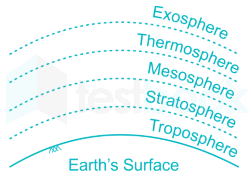
The lowest and closest layer of the atmosphere is called the troposphere as shown in the figure above.

Note:

Sr no.Troposphere characteristics
1The word troposphere is derived from the Greek word ‘tropo’, meaning turbulence. This layer subjects intense mixing due to both horizontal and vertical turbulence.
2This the lowermost layer of the atmosphere and is important because all weathering actions (fog, cloud, due frost, cloud thunder, lightning, etc)  takes place in this layer.
3This layer reaches up to 7 km above from the sea level at the poles and up to 17 km above from the sea level at the equator.
4The upper limit of the troposphere is called the tropopause.
28

A water supply board is responsible for treating 1500 m3/day of water. A settling column analysis indicates that an overflow rate of 20 m/day will produce satisfactory removal for a depth of 3.1 m. It is decided to have two circular settling tanks in parallel. The required diameter (expressed in m) of the settling tanks is __________

29

The hardness of a ground water sample was found to be 420 mg/L as CaCO3. A softener containing ion exchange resins was installed to reduce the total hardness to 75 mg/L as CaCO3 before supplying to 4 households. Each household gets treated water at a rate of 540 L/day. If the efficiency of the softener is 100%, the bypass flow rate (expressed in L/day) is _________

30

The sound pressure (expressed in μPa) of the faintest sound that a normal healthy individual can hear is:

  1. ((a))

    0.2

  2. ((b))

    2

  3. ((c))

    20

  4. ((d))

    55

Show Answer
Answer: ((c))

20

  1. The sound pressure of the faintest sound that a normal healthy individual can hear is 20 μPa.
  2. It is taken as reference sound pressure level.
  3. A 20 μPa pressure is 0 dB on the sound pressure level scale.
31

In the context of the IRC 58-2011 guidelines for rigid pavement design, consider the following pair

of statements.

I: Radius of relative stiffness is directly related to modulus of elasticity of concrete and inversely

related to Poisson's ratio.

II: Radius of relative stiffness is directly related to thickness of slab and modulus of subgrade

reaction.

Which one of the following combinations is correct?

  1. ((a))

    I: True; II: True

  2. ((b))

     I: False; II: False

  3. ((c))

    I: True; II: False

  4. ((d))

    I: False; II: True

Show Answer
Answer: ((b))

 I: False; II: False

Concept:

Radius of relative stiffness

l=[Eh312k(1μ2)]14l = {\left[ {\frac{{E{h^3}}}{{12k\left( {1 - {μ ^2}} \right)}}} \right]^{\frac{1}{4}}}

where,

E = modulus of elasticity of pavement in kg/cm2

μ = poisson's ratio of concrete = 0.15

h = slab thickness in cm

K = modulus of subgrade reaction in kg/cm3

Explanation:

Statement 1: Radius of relative stiffness is directly related to modulus of elasticity of concrete and inversely

related to Poisson's ratio.

  • As E increases, Relative thickness also increases because l α E1/4
  • But As μ increases then 1 – μ2 decreases and thus Relative stiffness also increases, because l;α 1(1μ2)14l;α \ \frac{1}{{{{\left( {1 - {\mu ^2}} \right)}^{\frac{1}{4}}}}}

Statements 1 is false

Statement 2: Radius of relative stiffness is directly related to thickness of slab and modulus of subgrade

reaction.

  • As thickness of slab increases , relative thickness also increases, because l α h3/4
  • As modulus of subgrade reaction increases, relative thickness decreases, because l;α 1(K)14l;α \ \frac{1}{{{{\left( {K} \right)}^{\frac{1}{4}}}}}

∴ Statement 2 is also false

32

If the total number of commercial vehicles per day ranges from 3000 to 6000, the minimum percentage of commercial traffic to be surveyed for axle load is:

  1. ((a))

    15

  2. ((b))

    20

  3. ((c))

    25

  4. ((d))

    30

Show Answer
Answer: ((a))

15

Sample size for axle load survey:

Total number of commercial vehicle per dayMinimum percentage of commercial traffic to be Surveyed
<300020 %
3000 to 600015 %
> 600010 %

Minimum percentage is 15 % for axle load determination when commercial vehicles are between 3000-6000

33

Optimal flight planning for a photogrammetric survey should be carried out considering

  1. ((a))

    only side-lap

  2. ((b))

    only end-lap

  3. ((c))

    either side-lap or end-lap

  4. ((d))

    both side-lap as well as end-lap

Show Answer
Answer: ((d))

both side-lap as well as end-lap

1.Side overlap (Lateral overlap):

  1. The overlap or common coverage between the photograph of two adjacent flights is called the side lap.
  2. It is required to prevent the gaps between flight strips.
  3. It also prevents us from using extreme edges of the photographs.

2.End overlap (Longitudinal overlap):

  1. The overlap or common coverage by two successive photos of the same flight in the direction of flight is called end overlap.
  2. It is done to prevent the gaps due to crib, tilt, flying height variations, terrain variations, etc

Hence the optimal flight planning is the one in which both the side overlap and end overlap are taken, to eliminate all the errors.

34

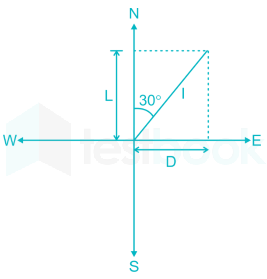
The reduced bearing of a 10 m long line is N30°E. The departure of the line is

  1. ((a))

    10.00 m

  2. ((b))

    8.66 m

  3. ((c))

    7.52 m

  4. ((d))

    5.00 m

Show Answer
Answer: ((d))

5.00 m

Concept:

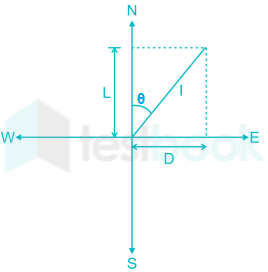
L = latitude is the projection on North-South meridian

D = departure is the projection on East-west meridian

θ = bearing angle

l = length of the line

L = l × Cos θ 

D = l × Sin θ 

Line;closure=L.C=(ΣL)2+(ΣD)2Line;closure = L.C = \sqrt {{{\left( {{\bf{\Sigma }}L} \right)}^2} + {{\left( {{\bf{\Sigma }}D} \right)}^2}}

Calculation:

Given,

l = 10 m

θ = 30° 

The departure of the line

D = l × sin θ

D = 10 sin 30° = 5 m

35

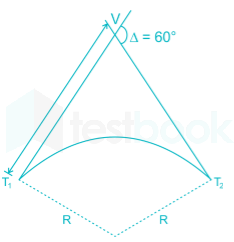
A circular curve of radius R connects two straights with a deflection angle of 60°. The tangent length is

  1. ((a))

    0.577 R

  2. ((b))

    1.155 R

  3. ((c))

    1.732 R

  4. ((d))

    3.464 R

Show Answer
Answer: ((a))

0.577 R

Concept:

The tangent length of the circular curve is given by,

VT1=RtanΔ2V{T_1} = R\tan \frac{{\rm{Δ }}}{2}

Where,

R = radius of the circular curve

Δ = Deflection angle = 180° - Intersection angle

Calculation:

Tangent length,

VT1=RtanΔ2V{T_1} = R\tan \frac{{\rm{Δ }}}{2}

VT1=Rtan602V{T_1} = R\tan \frac{{\rm{60^{} }}}{2}= 0.577 R

36

Consider the following linear system.

x + 2y - 3z = a

2x + 3y + 3z = b

5x + 9y - 6z = c

This system is consistent if a, b and c satisfy the equation

  1. ((a))

    7a - b - c = 0

  2. ((b))

    3a + b - c = 0

  3. ((c))

    3a - b + c = 0

  4. ((d))

    7a - b + c = 0

Show Answer
Answer: ((b))

3a + b - c = 0

Concept:

The system AX = B has

  1. A unique solution if and only if Rank of A = Rank of [A|B] = Number of variables
  2. Infinitely many solutions if Rank of A = Rank of [A|B] < Number of variables
  3. No solution (inconsistent) if Rank of A ≠ Rank of [A|B], i.e Rank of A < Rank of [A|B]

​Calculation:

The system of equations can be written in matrix form as

\(\left[ {\begin{array}{{20}{c}} 1&2&{ - 3}\ 2&3&3\ 5&9&{ - 6} \end{array};\left| {;\begin{array}{{20}{c}} a\ b\ c \end{array}} \right.} \right]\)

Applying R2R22R1{R_2} \to {R_2} - 2{R_1}

\(\begin{array}{{20}{l}} {{R_3} \to {R_3} - 5{R_1}}\ {\left[ {\begin{array}{{20}{c}} 1&2&{ - 3}\ 0&{ - 1}&9\ 0&{ - 1}&9 \end{array};\left| {;\begin{array}{{20}{c}} a\ {b - 2a}\ {c - 5a} \end{array}} \right.} \right]}\ {{R_3} \to {R_3} - {R_2}}\ {\left[ {\begin{array}{{20}{c}} 1&2&{ - 3}\ 0&{ - 1}&9\ 0&0&0 \end{array};\left| {;\begin{array}{*{20}{c}} a\ {b - 2a}\ {c - 3a - b} \end{array}} \right.} \right]} \end{array}\)

For system to be consistent,

Rank of [A] = Rank of [A|B]

∴  c – 3a – b = 0

It can be written as 3a + b – c = 0

37

If f(𝑥) and g(𝑥) are two probability density functions,

\(\begin{array}{l} f\left( x \right) = \left{ {\begin{array}{{20}{c}} {\frac{x}{a} + 1}&{: - a \le x < 0}\ { - \frac{x}{a} + 1}&{0 \le x \le a}\ 0&{otherwise} \end{array}} \right.\ g\left( x \right) = \left{ {\begin{array}{{20}{c}} { - \frac{x}{a}}&{:-a \le x \le 0}\ {\frac{x}{a}}&{:0 \le x \le a}\ 0&{:otherewise} \end{array}} \right. \end{array}\)

Which one of the following statements is true?

  1. ((a))

    Mean of f(𝑥) and g(𝑥) are same; Variance of f(𝑥) and g(𝑥) are same

  2. ((b))

    Mean of f(𝑥) and g(𝑥) are same; Variance of f(𝑥) and g(𝑥) are different

  3. ((c))

    Mean of f(𝑥) and g(𝑥) are different; Variance of f(𝑥) and g(𝑥) are same

  4. ((d))

    Mean of f(𝑥) and g(𝑥) are different; Variance of f(𝑥) and g(𝑥) are different

Show Answer
Answer: ((b))

Mean of f(𝑥) and g(𝑥) are same; Variance of f(𝑥) and g(𝑥) are different

E1(x)=xf(x)dxE_1(x)=\int^{\infty}_{-\infty}xf(x)dx

a0xf(x)dx+0aaf(x)dx⇒ \int^0_{-a}xf(x)dx+\int^a_0af(x)dx

a0x(xa+1)+0ax(xa+1)⇒ \int^0_{-a}x\left(\frac{x}{a}+1\right)+\int^a_{0}x\left(-\frac{x}{a}+1\right)

a0x2adx+a0xds+0ax2adx+0axdx⇒ \int^0_{-a}\frac{x^2}{a}dx+\int^0_{-a}xds+\int^a_{0}\frac{-x^2}{a}dx+\int^a_{0}xdx

⇒ 0

∴ [a0x2a=0ax2a]\left[\int^0_{-a}\frac{x^2}{a}=-\int^a_0-\frac{x^2}{a}\right]

∴ [a0xdx=0axdx]\left[\int^0_{-a}xdx=-\int^a_0xdx\right]

E2(x)=xg(x)dxE_2(x)=\int^{\infty}_{-\infty}xg(x)dx

⇒ a0x(xa)dx+a0x(xa)dx\int^0_{-a}x\left(-\frac{x}{a}\right)dx+\int^0_{a}x\left(\frac{x}{a}\right)dx

⇒ a0x2adx+a0x2adx\int^0_{-a}-\frac{x^2}{a}dx+\int^0_a\frac{x^2}{a}dx

⇒ 0

∴ [a0x2adx=a0x2adx]\left[\int^0_{-a}-\frac{x^2}{a}dx=-\int^0_a\frac{x^2}{a}dx\right]

Variance

E(x2) - {E(x)}2

E1(x2)=x2f(x)E_1(x^2)=\int^{\infty}_{-\infty}x^2f(x)

⇒ a0x2(xa+1)dx+0ax2(xa+1)dx\int^0_{-a}x^2\left(\frac{x}{a}+1\right)dx+\int^a_{0}x^2\left(-\frac{x}{a}+1\right)dx

a0x3adx+a0x2dx+0ax3adx+0ax2dx\Rightarrow \int^0_{-a}\frac{x^3}{a}dx+\int^0_{-a}x^2dx+\int^a_0-\frac{x^3}{a}dx+\int^a_0x^2dx

a34+a33a34+a33=a36\Rightarrow -\frac{a^3}{4}+\frac{a^3}{3}-\frac{a^3}{4}+\frac{a^3}{3}=\frac{a^3}{6}

E2(x2)=x2g(x)E_2(x^2)=\int^{\infty}_{-\infty}x^2g(x)

a0x2(xa)dx+0ax2(xa)dx\int^0_{-a}x^2\left(-\frac{x}{a}\right)dx+\int^a_0x^2\left(\frac{x}{a}\right)dx

a0x3adx+0ax3adx\int^0_{-a}\frac{-x^3}{a}dx+\int^a_0\frac{x^3}{a}dx

[x44a]a0+[x44a]0a\left[-\frac{x^4}{4a}\right]^0_{-a}+\left[\frac{x^4}{4a}\right]^a_{0}

\(\left{0-\left[\frac{-(a)^4}{4a}\right]\right}+\left{\frac{a^4}{4a}-0\right}\)

a34+a34=a32\frac{a^3}{4}+\frac{a^3}{4}=\frac{a^3}{2}

Mean of f(x) is E(x):

\(\begin{array}{l} = \mathop \smallint \limits_{ - a}^0 X \left( {\frac{X}{a} + 1} \right)dx + \mathop \smallint \limits_0^a X \left( {\frac{{ - X}}{a} + 1} \right)dx\ = \left( {\frac{{{X^3}}}{{3a}} + \frac{{{X^2}}}{2}} \right)_{ - a}^0 + \left( {\frac{{ - {X^3}}}{{3a}} + \frac{{{X^3}}}{3}} \right)_0^a = 0\end{array}\)

\(\begin{array}{l} = \mathop \smallint \limits_{ - a}^0 X^2 \left( {\frac{X}{a} + 1} \right)dx + \mathop \smallint \limits_0^a X^2 \left( {\frac{{ - X}}{a} + 1} \right)dx\ \end {array}\)

(X44a+X33)a0+(X44a+X33)0a=a36\left( {\frac{{{X^4}}}{{4a}} + \frac{{{X^3}}}{3}} \right)_{ - a}^0 + \left( {\frac{{ - {X^4}}}{{4a}} + \frac{{{X^3}}}{3}} \right)_0^a = \frac{a^3}{6}

⇒ Variance is a36\frac{{{a^3}}}{6}

Next, mean of g(x) is E(x)

\(= \mathop \smallint \limits_{-a}^0 x\left( {\frac{{ - x}}{a}} \right)dx + \mathop \smallint \limits_0^a x\times \left( {\frac{X}{a}} \right)dx = 0\)

Variance of g(x) is E(x2) – {E(X)}2, where

\(E\left( {{X^2}} \right) = \mathop \smallint \limits_{ - a}^0 {X^2}\left( {\frac{{ - X}}{a}} \right)dX + \mathop \smallint \limits_0^a {X^2}\left( {\frac{X}{a}} \right)dx = \frac{{{a^3}}}{2}\)

⇒ Variance is a32\frac{{{a^3}}}{2}

∴ Mean of f(x) and g(x) are same but variance of f(x) and g(x) are different

38

The angle of intersection of the curves 𝑥2 = 4𝑦 and 𝑦2 = 4𝑥 at point (0, 0) is

  1. ((a))

  2. ((b))

    30°

  3. ((c))

    45°

  4. ((d))

    90°

Show Answer
Answer: ((d))

90°

Given curve

x2 = 4y                                   ……(i)

y2 = 4x                                   ……(ii)

2x=4dydx2x = 4\frac{{dy}}{{dx}}

At point (0,0)

(dydx)(0,0)==m2{\left( {\frac{{dy}}{{dx}}} \right)_{\left( {0,0} \right)}} = \infty = {m_2}

Let m2=1m{m_2} = \frac{1}{{m'}} 

where m’ = 0

tanθ=m1m21+m1m2=m1m1m+m1=010+0\tan \theta = \left| {\frac{{{m_1} - {m_2}}}{{1 + {m_1}{m_2}}}} \right| = \left| {\frac{{{m_1}m' - 1}}{{m' + {m_1}}}} \right| = \left| {\frac{{0 - 1}}{{0 + 0}}} \right|

θ=π2=90;\Rightarrow \theta = \frac{\pi }{2} = 90^\circ ;

39

The area between the parabola 𝑥2 = 8𝑦 and the straight line y = 8 is _________.

40

The quadratic approximation of (x) = x- 3x- 5 at the point x = 0 is

  1. ((a))

    3x2 − 6x − 5

  2. ((b))

    −3x2 − 5

  3. ((c))

    −3x2 + 6x − 5

  4. ((d))

    3x2 – 5

Show Answer
Answer: ((b))

−3x2 − 5

Concept:

The Taylor's series expansion of f(x) about origin (i.e x = 0) is given by

f(x)=f(0)+x×f(0)+x22!×f"(0)+.....f\left( x \right) = f\left( 0 \right) + x × f'\left( 0 \right) + \frac{{{x^2}}}{{2!}} × f"\left( 0 \right) + .....

It is also called Maclaurin's series.

Calculation:

f(x) = x3 - 3x2-5

f(0) = 0- 3 × 0- 5 = - 5

f'(0) = 3x2 - 6x = 0

f"(0) = 6x - 6 = - 6

The quadratic approximation of f(x) at the point x = 0 is

\(\begin{array}{l} f\left( x \right) = f\left( 0 \right) + \frac{x}{{1!}}f'\left( 0 \right) + \frac{{{x^2}}}{{2!}}f''\left( 0 \right);\ f(x)= \left( { - 5} \right) + x\left{ 0 \right} + \frac{{{x^2}}}{2}\left{ { - 6} \right}\ f(x) = - 3{x^2} - 5 \end{array}\)

41

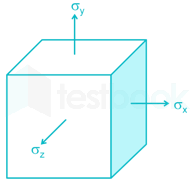
An elastic isotropic body is in a hydrostatic state of stress as shown in the figure. For no change in the volume to occur, what should be its Poisson's ratio?

  1. ((a))

    0.00

  2. ((b))

    0.25

  3. ((c))

    0.50

  4. ((d))

    1.00

Show Answer
Answer: ((c))

0.50

Given,

The elastic body is in hydrostatic state of stress

∴ According to Pascal's law the body has equal stresses on the body

i.e σx = σy = σz

We know that the Volumetric strain is given by

ϵv=(σx+σy+σzE)(12μ)ϵ{_v} = \left( {\frac{{{σ _x} + {σ _y} + {σ _z}}}{E}} \right)\left( {1 - 2\mu } \right)

ϵv = volumetric strain = δV/V  

δVV=(σx+σy+σzE)(12μ)\therefore \frac{{δ V}}{V} = \left( {\frac{{{σ _x} + {σ _y} + {σ _z}}}{E}} \right)\left( {1 - 2\mu } \right)

As no change in the volume is given

δV  = 0

Either σx+σy+σz=0 or;12μ=0{σ _x} + {σ _y} + {σ _z} = 0\ or;1 - 2\mu = 0

As stresses is not zero

1 – 2μ = 0

μ = 0.5

42

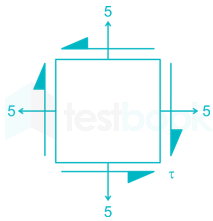
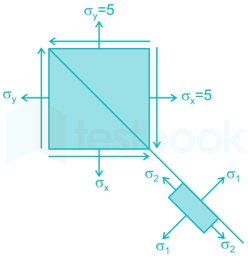
For the stress state (in MPa) shown in the figure, the major principal stress is 10 MPa.

The shear stress τ is

  1. ((a))

    10.0 MPa

  2. ((b))

    5.0 MPa

  3. ((c))

    2.5 MPa

  4. ((d))

    0.0 MPa

Show Answer
Answer: ((b))

5.0 MPa

Concept:

Principle stress equation is given by,

σ1,;σ2=σx+;σy2±(σx;σy2)2+(τxy)2{{\rm{σ }}_1},;{{\rm{σ }}_2} = \frac{{{{\rm{σ }}_x} + ;{{\rm{σ }}_y}}}{2} \pm \sqrt {{{\left( {\frac{{{{\rm{σ }}_x} - ;{{\rm{σ }}_y}}}{2}} \right)}^2} + {{\left( {{τ _{xy}}} \right)}^2}}

Where,

σ1 = maximum principal stress

σ2 = minimum principal stress

σx = stress in x direction

σy = stress in Y direction

τxy = shear stress in xy plane 

Calculation:

Given:

σx = 5 MPa

σy = 5 MPa

From the above figure

σx  + σy = σ1 + σ2

5 + 5 = σ1 + σ2

we know thatσ2 = 0

∴ σ1 = 10 MPa 

Now,

σ1/σ2=σx+σy2±(σxσy2)2+τxy2 σ1=5+52+(552)2+τxy2\begin{array}{l} {σ _{1}/σ_2} = \frac{{{σ _x} + {σ _y}}}{2} \pm \sqrt {{{\left( {\frac{{{σ _x} - {σ _y}}}{2}} \right)}^2} + τ _{xy}^2} \ ∴ {σ _1} = \frac{{5 + 5}}{2} + \sqrt {{{\left( {\frac{{5 - 5}}{2}} \right)}^2} + τ _{xy}^2} \end{array}

⇒ 10 = 5 + τ xy

∴ τxy = 5 MPa

43

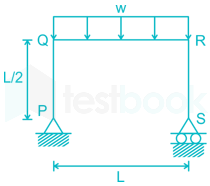
The portal frame shown in the figure is subjected to a uniformly distributed vertical load w (per unit length).

The bending moment in the beam at the joint ‘Q’ is

  1. ((a))

    zero

  2. ((b))

    wL224(hogging)\frac{{w{L^2}}}{{24}}\left( {hogging} \right)

  3. ((c))

    wL212(hogging)\frac{{w{L^2}}}{{12}}\left( {hogging} \right)

  4. ((d))

    wL28(sagging)\frac{{w{L^2}}}{8}\left( {sagging} \right)

Show Answer
Answer: ((a))

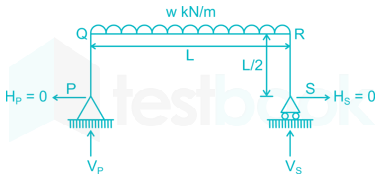
zero

As there is no horizontal force

Hence HP = HS = 0

Vp + Vs = wL

Symmetric structure Vp = wL/2 , VS = wL/2

ΣMQ=HP×L2+HS×L2wL×L2+wL2×L{\rm{\Sigma }}{M_Q} = - {H_P} \times \frac{L}{2} + {H_S} \times \frac{L}{2} - wL \times \frac{L}{2} + \frac{{wL}}{2} \times L

∴ BM at Q = 0

Note: This beam acts similarly to a simply supported beam. 

∴ BM at supports is zero.

44

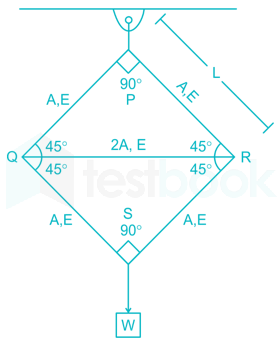
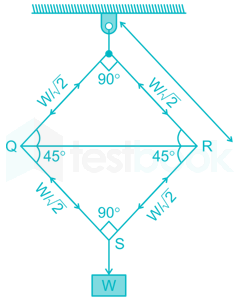
Consider the structural system shown in the figure under the action of weight W. All the joints are hinged. The properties of the members in terms of length (L), area (A) and the modulus of elasticity (E) are also given in the figure. Let L, A and E be 1 m, 0.05 m2 and 30 × 106 N/m2, respectively, and W be 100 kN.

Which one of the following sets gives the correct values of the force, stress and change in length of the horizontal member QR?

  1. ((a))

    Compressive force = 25 kN; Stress = 250 kN/m2; Shortening = 0.0118 m

  2. ((b))

    Compressive force = 14.14 kN; Stress = 141.4 kN/m2; Extension = 0.0118 m

  3. ((c))

    Compressive force = 100 kN; Stress = 1000 kN/m2; Shortening = 0.0417 m

  4. ((d))

    Compressive force = 100 kN; Stress = 1000 kN/m2; Extension = 0.0417 m

Show Answer
Answer: ((c))

Compressive force = 100 kN; Stress = 1000 kN/m2; Shortening = 0.0417 m

L = 1m, A = 0.05 m2,

E = 30 × 106 N/m2

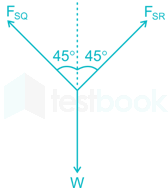
Consider joint S

FSQ = FSR

2FSQ cos 45° = W

FSQ=W2×2=W2\Rightarrow {F_{SQ}} = \frac{W}{2} \times \sqrt 2 = \frac{W}{{\sqrt 2 }}

FSQ=W2\therefore {F_{SQ}} = \frac{W}{{\sqrt 2 }}

As the truss is symmetrical

FQP=FPR=W2\therefore {F_{QP}} = {F_{PR}} = \frac{W}{{\sqrt 2 }}    (Tensile)

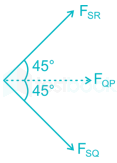
Now consider joint ‘Q’

FQP=FQS=W2 ΣFx=0\begin{array}{l} {F_{QP}} = {F_{QS}} = \frac{W}{{\sqrt 2 }}\ {\rm{\Sigma }}{F_x} = 0 \end{array}

FQP2+FQS2+FQR=0\Rightarrow \frac{{{F_{QP}}}}{{\sqrt 2 }} + \frac{{{F_{QS}}}}{{\sqrt 2 }} + {F_{QR}} = 0

⇒ FQR = W                           (Compressive)

∴ FQR = 100 kN                   (Compressive)

Stress in member QR

\(\begin{array}{l} {\sigma {QR}} = \frac{{{F{QR}}}}{{2A}}\ \Rightarrow {\sigma _{QR}} = \frac{{100}}{{2 \times 0.05}}\ = \frac{{100 \times 100}}{{2 \times 5}} = 1000;kN/{m^2} \end{array}\)

∴ σQR = 1000 kN/m2

As the member QR consist compressive load so it will go under shortening

Δ=PL2AE=FQR.LQR2AE LQR=L2+L2=2L Δ=100×103×2×12×0.05×30×106 =100×103×20.1×30×106=230\begin{array}{l} {\rm{\Delta }} = \frac{{PL}}{{2AE}} = \frac{{{F_{QR}}.{L_{QR}}}}{{2AE}}\ {L_{QR}} = \sqrt {{L^2} + {L^2}} = \sqrt 2 L\ \therefore {\rm{\Delta }} = \frac{{100 \times {{10}^3} \times \sqrt 2 \times 1}}{{2 \times 0.05 \times 30 \times {{10}^6}}}\ = \frac{{100 \times {{10}^3} \times \sqrt 2 }}{{0.1 \times 30 \times {{10}^6}}} = \frac{{\sqrt 2 }}{{30}} \end{array}

∴ Δ = 0.471 m

45

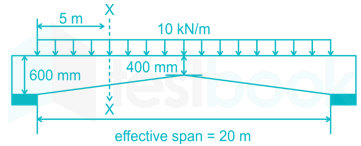
A haunched (varying depth) reinforced concrete beam is simply supported at both ends, as shown in the figure. The beam is subjected to a uniformly distributed factored load of intensity 10 kN/m.

The design shear force (expressed in kN) at the section X-X of the beam is ______

46

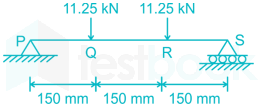
A 450 mm long plain concrete prism is subjected to the concentrated vertical loads as shown in the figure. Cross section of the prism is given as 150 mm × 150 mm. Considering linear stress distribution across the cross-section, the modulus of rupture (expressed in MPa) is ________

47

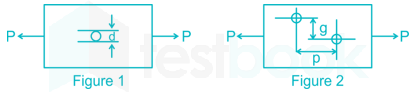
Two bolted plates under tension with alternative arrangement of bolt holes are shown in figures 1

and 2. The hole diameter, pitch, and gauge length are d, p and g, respectively.

Which one of the following conditions must be ensured to have higher net tensile capacity of

configuration shown in Figure 2 than that shown in Figure 1 ?

  1. ((a))

    p2 > 2gd

  2. ((b))

    p2<4gd{p^2} < \sqrt {4gd}

  3. ((c))

    p2 > 4gd

  4. ((d))

    p > 4gd

Show Answer
Answer: ((c))

p2 > 4gd

Concept:

The design tensile strength of bolt based on net section rupture is given by,

Tdb=0.9;Anetfuγm1T_{db}={0.9;{A_{net}}\frac{{{f_u}}}{{{\gamma _{m1}}}}}

Where,

Anet = net tensile area of bolt = 0.78 Asb

Asb = Nominal shank area of bolt

Calculation:

Given,

Tensile strength of plate in figure (2) will be greater than in figure (1)

\(\begin{array}{l} {\left( {0.9;{A_{net}}\frac{{{f_u}}}{{{\gamma _{m1}}}}} \right)2} > {\left( {0.9;{A{net}}\frac{{{f_u}}}{{{\gamma _{m1}}}}} \right)_1}\ \left( {B - 2d + \frac{{{p^2}}}{{4g}}} \right)t > \left( {B - d} \right)t\ {p^2} > 4gd \end{array}\)

48

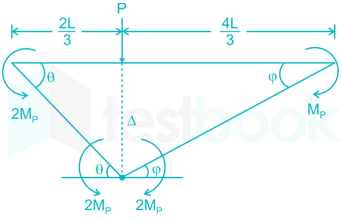
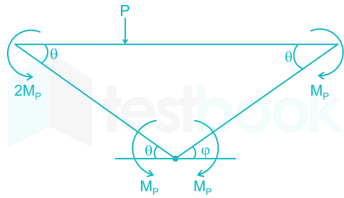
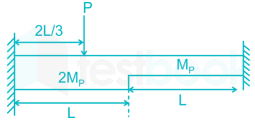
A fixed-end beam is subjected to a concentrated load (P) as shown in the figure. The beam has

two different segments having different plastic moment capacities (Mp, 2Mp) as shown.
The minimum value of load (P)at which the beam would collapse (ultimate load) is

  1. ((a))

    7.5 MP/L

  2. ((b))

    5.0MP/L

  3. ((c))

    4.5MP/L

  4. ((d))

    2.5MP/L

Show Answer
Answer: ((a))

7.5 MP/L

Ds = 2

∴ Number of plastic hinge required for complete collapse= Ds + 1 = 2 + 1 = 3

Mechanism 1:

Δ=2L3θ=4L3{\rm{\Delta }} = \frac{{2L}}{{3\theta }} = \frac{{4L}}{3}

⇒ θ = 2θ

For principal of virtual work done

2MPθ2MPθ2MPϕMPϕ+P(2L3θ)=0 4MPθ+3MPϕ=2PL3θ 8MPϕ+3MPϕ=4PL3ϕ 11MP=4PuL3 Pu=334MPL Pu=8.25MPL\begin{array}{l} - 2{M_P}\theta - 2{M_P}\theta - 2{M_P}\phi - {M_P}\phi + P\left( {\frac{{2L}}{3}\theta } \right) = 0\ \Rightarrow 4{M_P}\theta + 3{M_P}\phi = \frac{{2PL}}{3}\theta \ \Rightarrow 8{M_P}\phi + 3{M_P}\phi = \frac{{4PL}}{3}\phi \ \Rightarrow 11{M_P} = \frac{{4{P_u}L}}{3}\ \Rightarrow {P_u} = \frac{{33}}{4}\frac{{{M_P}}}{L}\ \therefore {P_u} = 8.25\frac{{{M_P}}}{L} \end{array}

Mechanism 2 :

2MPθ+MPθ+MPθ+MPθ=P(2L3) 5MP=2PL3 Pu=15MP2L Pu=7.5MPL\begin{array}{l} 2{M_P}\theta + {M_P}\theta + {M_P}\theta + {M_P}\theta = P\left( {\frac{{2L}}{3}} \right)\ \Rightarrow 5{M_P} = \frac{{2PL}}{3}\ \Rightarrow {P_u} = \frac{{15{M_P}}}{{2L}}\ \therefore {P_u} = 7.5\frac{{{M_P}}}{L} \end{array}

49

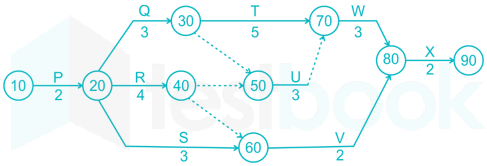
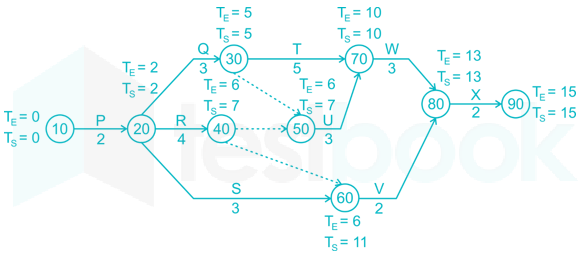
The activity-on-arrow network of activities for a construction project is shown in the figure. The

durations (expressed in days) of the activities are mentioned below the arrows.

The critical duration for this construction project is

  1. ((a))

    13 days

  2. ((b))

    14 days

  3. ((c))

    15 days

  4. ((d))

    16 days

Show Answer
Answer: ((c))

15 days

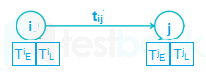
Concept:

TiE  = Early start time 

TjE = Early Finish time 

TiL  = Latest start time 

TjL = Latest Finish time - 

tij = Duration of the activity

TjE = TiE +​ tij  

TjL  = TiL + tij   

Calculation:

The critical duration is 15 days which is observed along the path P – Q – T – W – X which is the critical path of the project.

50

The seepage occurring through an earthen dam is represented by a flownet comprising of 10 equipotential drops and 20 flow channels. The coefficient of permeability of the soil is 3 mm/min and the head loss is 5 m. The rate of seepage (expressed in cm3/s per m length of the dam) through the earthen dam is _________

51

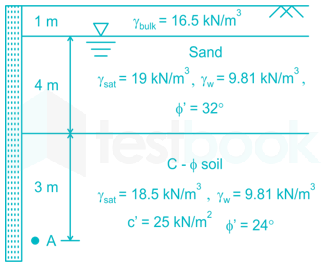
The soil profile at a site consists of a 5 m thick sand layer underlain by a c-φ soil as shown in figure. The water table is found 1 m below the ground level. The entire soil mass is retained by a concrete retaining wall and is in the active state. The back of the wall is smooth and vertical. The total active earth pressure (expressed in kN/m2) at point A as per Rankine's theory is _________

52

OMC-SP and MDD-SP denote the optimum moisture content and maximum dry density obtained from standard Proctor compaction test, respectively. OMC-MP and MDD-MP denote the optimum moisture content and maximum dry density obtained from the modified Proctor compaction test, respectively. Which one of the following is correct?

  1. ((a))

    OMC-SP < OMC-MP and MDD-SP < MDD-MP

  2. ((b))

    OMC-SP > OMC-MP and MDD-SP < MDD-MP

  3. ((c))

    OMC-SP < OMC-MP and MDD-SP > MDD-MP

  4. ((d))

    OMC-SP > OMC-MP and MDD-SP > MDD-MP

Show Answer
Answer: ((b))

OMC-SP > OMC-MP and MDD-SP < MDD-MP

OMC-SP > OMC-MP and MDD-SP < MDD-MP

53

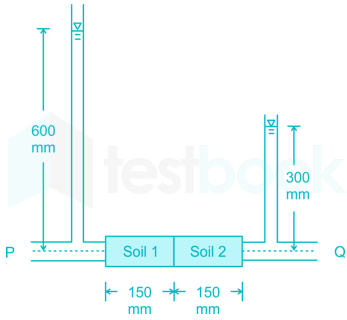
Water flows from P to Q through two soil samples, Soil 1 and Soil 2, having cross sectional area of 80 cm2 as shown in the figure. Over a period of 15 minutes, 200 ml of water was observed to pass through any cross section. The flow conditions can be assumed to be steady state. If the coefficient of permeability of Soil 1 is 0.02 mm/s, the coefficient of permeability of Soil 2 (expressed in mm/s) would be ________

54

A 4 m wide strip footing is founded at a depth of 1.5 m below the ground surface in a c-φ soil as shown in the figure. The water table is at a depth of 5.5 m below the ground surface. The soil properties are: c' = 35 kN/m2, φ' = 28.63°, γsat = 19 kN/m3, γbulk = 17 kN/m3 and γw = 9.81 kN/m3. The values of bearing capacity factors for different φ' are given below:
φ'NcNqNγ
15°12.94.42.5
20°17.77.45.0
25°25.112.79.7
30°37.222.519.7

Using Terzaghi's bearing capacity equation and a factor of safety Fs = 2.5, the net safe bearing capacity (expressed in kN/m2) for local shear failure of the soil is __________

55

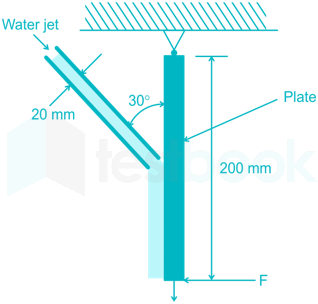
A square plate is suspended vertically from one of its edges using a hinge support as shown in figure. A water jet of 20 mm diameter having a velocity of 10 m/s strikes the plate at its mid-point, at an angle of 30° with the vertical. Consider g as 9.81 m/s2 and neglect the self-weight of the plate. The force F (expressed in N) required to keep the plate in its vertical position is _________

56

The ordinates of a one-hour unit hydrograph at sixty minute interval are 0, 3, 12, 8, 6, 3 and 0 m3/s.

A two-hour storm of 4 cm excess rainfall occurred in the basin from 10 AM. Considering constant

base flow of 20 m3/s, the flow of the river (expressed in m3/s) at 1 PM is _________

57

A 3 m wide rectangular channel carries a flow of 6 m3/s. The depth of flow at a section P is 0.5 m.

A flat-topped hump is to be placed at the downstream of the section P. Assume negligible energy

loss between section P and hump, and consider 𝑔 as 9.81 m/s2. The maximum height of the hump

(expressed in m) which will not change the depth of flow at section P is _________

58

A penstock of 1 m diameter and 5 km length is used to supply water from a reservoir to an impulse turbine. A nozzle of 15 cm diameter is fixed at the end of the penstock. The elevation difference between the turbine and water level in the reservoir is 500 m. Consider the head loss due to friction as 5% of the velocity head available at the jet. Assume unit weight of water = 10 kN/m3 and acceleration due to gravity (g) = 10 m/s2. If the overall efficiency is 80%, power generated (expressed in kW and rounded to nearest integer) is _______________

59

A tracer takes 100 days to travel from Well-1 to Well-2 which are 100 m apart. The elevation of water surface in Well-2 is 3 m below that in Well-1. Assuming porosity equal to 15%, the coefficient of permeability (expressed in m/day) is
  1. ((a))

    0.30

  2. ((b))

    0.45

  3. ((c))

    1.00

  4. ((d))

    5.00

Show Answer
Answer: ((d))

5.00

Concept:

According to Darcy’s law,

For laminar flow Vα i

V = K × i

Where,

V = velocity of water flowing in soil, K = coefficient of permeability
i=hydraulic gradient=hLL{\rm{i}} = hydraulic~ gradient= \frac{{{{\rm{h}}_{\rm{L}}}}}{{\rm{L}}}

hL = head difference, L = seepage length

Seepage velocity is given by,

VS = V/n

Where,

 n = porosity of the soil

Calculation:

T = Time = 100 days

D  = distance = 100 m

hL = head difference = 3 m

n = 15 % = 0.15

i = hL/L = 3/100

VS = D/T = 100/100 = 1 m/day

V = K × i

V = VS × n

∴ VS × n = K × i

K=Vs×ni=1×0.153100=5;m/dayK = \frac{{{V_s} \times n}}{i} = \frac{{1 \times 0.15}}{{\frac{3}{{100}}}} = 5;m/day

60

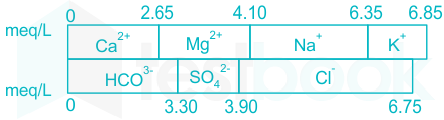
A sample of water has been analyzed for common ions and results are presented in the form of a

bar diagram as shown.

The non-carbonate hardness (expressed in mg/L as CaCO3) of the sample is:

  1. ((a))

    40

  2. ((b))

    165

  3. ((c))

    195

  4. ((d))

    205

Show Answer
Answer: ((a))

40

Concept:

The total hardness of water is given by,

TH=[Ca2+(in;mg/lit)×;eq;wt;of;CaCO3eq;wt;of;Ca2+]+[mg2+(in;mg/lit)×eq;wt;of;CaCO3eq;wt;of;mg2+];TH = \left[ {C{a^{2 + }}\left( {in;mg/lit} \right) \times ;\frac{{eq;wt;of;CaC{O_3}}}{{eq;wt;of;C{a^{2 + }}}}} \right] + \left[ {m{g^{2 + }}\left( {in;mg/lit} \right) \times \frac{{eq;wt;of;CaC{O_3}}}{{eq;wt;of;m{g^{2 + }}}}} \right];

The total alkalinity of water due to HCO­3 is given by,

TA=HCO3(in;mg/lit)×eq;wt;of;CaCO3eq;wt;of;HCO3TA = HC{O_3}\left( {in;mg/lit} \right) \times \frac{{eq;wt;of;CaC{O_3}}}{{eq;wt;of;HC{O_3}}}

We know that
Quantity;of;ions;(meq/lit)=quantity;of;ions;in(mg/lit)eq;wt;of;the;ionsQuantity;of;ions;\left( {meq/lit} \right) = \frac{{quantity;of;ions;in\left( {mg/lit} \right)}}{{eq;wt;of;the;ions}}

TH=[Ca2+(in;meq/lit)×eq;wt;of;CaCO3;]+[mg2+(in;meq/lit)×eq;wt;of;CaCO3]\therefore TH = \left[ {C{a^{2 + }}\left( {in;meq/lit} \right) \times eq;wt;of;CaC{O_3};} \right] + \left[ {m{g^{2 + }}\left( {in;meq/lit} \right) \times eq;wt;of;CaC{O_3}} \right]

TA=HCO3(in;meq/lit)×eq;wt;of;CaCO3\therefore TA = HC{O_3}\left( {in;meq/lit} \right) \times eq;wt;of;CaC{O_3}

Based on the relation between TH (total hardness) and TA (total alkalinity) estimation of Carbonaceous hardness (CH) and Non-carbonaceous hardness (NCH) is made.

Carbonate hardness = minimum of {total hardness, alkalinity}

When TH > TA then CH = TA, NCH = TH – CH

When TH ≤ TA then CH =TH, NCH = 0

Calculation:

Given:

Ca2+ = 2.65 meq/I, Mg2+ = 1.45 meq/I, Na+ = 2.25 meq/I

HCO-3 = 3.3 meq/I, SO2-4 = 0.6 meq/I, CI- = 2.85 meq/I

We know that

The equivalent weight of CaCO3 = 50

TH=[Ca2+(in;meq/lit)×eq;wt;of;CaCO3;]+[mg2+(in;meq/lit)×eq;wt;of;CaCO3]\therefore TH = \left[ {C{a^{2 + }}\left( {in;meq/lit} \right) \times eq;wt;of;CaC{O_3};} \right] + \left[ {m{g^{2 + }}\left( {in;meq/lit} \right) \times eq;wt;of;CaC{O_3}} \right]

TH=[2.65×50;]+[1.45×50]=205;mg/lit;as;CaCO3\therefore TH = \left[ {2.65 \times 50;} \right] + \left[ {1.45 \times 50} \right] = 205;mg/lit;as;CaC{O_3}

TA=HCO3(in;meq/lit)×eq;wt;of;CaCO3\therefore TA = HC{O_3}\left( {in;meq/lit} \right) \times eq;wt;of;CaC{O_3}

TA=3.3×50=165;mg/lit;as;CaCO3\therefore TA = 3.3 \times 50 = 165;mg/lit;as;CaC{O_3}

As we can see TH > TA

CH = TA = 165 mg/lit as CaCO3

NCH = TH – CH = 205 – 165 = 40 mg/lit as CaCO3

61

A noise meter located at a distance of 30 m from a point source recorded 74 dB. The reading at a distance of 60 m from the point source would be _________

62

For a wastewater sample, the three-day biochemical oxygen demand at incubation temperature of 20°C (BOD3day, 20°C) is estimated as 200 mg/L. Taking the value of the first order BOD reaction rate constant as 0.22 day-1, the five-day BOD (expressed in mg/L) of the wastewater at incubation temperature of 20°C (BOD5day, 20°c) would be _________

63

The critical flow ratios for a three-phase signal are found to be 0.30, 0.25, and 0.25. The total time lost in the cycle is 10 s. Pedestrian crossings at this junction are not significant. The respective Green times (expressed in seconds and rounded off to the nearest integer) for the three phases are

  1. ((a))

    34, 28, and 28

  2. ((b))

    40, 25, and 25

  3. ((c))

    40, 30, and 30

  4. ((d))

    50, 25, and 25

Show Answer
Answer: ((a))

34, 28, and 28

Concept:

Webster’s method for an optimum cycle time of a signal is given by

Co=1.5L+51Y{C_o} = \frac{{1.5L + 5}}{{1 - Y}}

Effective green time on ith lane

Gi=YiY×(CoL){G_i} = \frac{{{Y_i}}}{Y} \times \left( {{C_o} - L} \right)

L = lost time per cycle

Y = Sum of the ratios of normal to saturated flows

Calculation:

Given,

Y = y1 + y2 + y3

Y= 0.30 + 0.25 + 0.25 = 0.80

L = 10 sec (given)

∴ Optimum cycle time

C0=1.5L+51Y C0=(1.5×10)+510.80=15+50.20=200.2=100;sec\begin{array}{l} {C_0} = \frac{{1.5L + 5}}{{1 - Y}}\ {C_0} = \frac{{\left( {1.5 \times 10} \right) + 5}}{{1 - 0.80}} = \frac{{15 + 5}}{{0.20}} = \frac{{20}}{{0.2}} = 100;sec \end{array}

Now green times are calculated by,

G1=y1y(C0L)=0.300.80(10010){G_1} = \frac{{{y_1}}}{y}\left( {{C_0} - L} \right) = \frac{{0.30}}{{0.80}}\left( {100 - 10} \right) = 33.75 ≈  34 sec

G2=y2y(C0L)=0.250.80(10010){G_2} = \frac{{{y_2}}}{y}\left( {{C_0} - L} \right) = \frac{{0.25}}{{0.80}}\left( {100 - 10} \right) = 28.11 ≈  28 sec

G3=y3y(C0L)=0.250.80(10010){G_3} = \frac{{{y_3}}}{y}\left( {{C_0} - L} \right) = \frac{{0.25}}{{0.80}}\left( {100 - 10} \right) = 28.11 ≈  28 sec

64

A motorist traveling at 100 km/h on a highway needs to take the next exit, which has a speed limit of 50 km/h. The section of the roadway before the ramp entry has a downgrade of 3% and coefficient of friction ( f ) is 0.35. In order to enter the ramp at the maximum allowable speed limit, the braking distance (expressed in m) from the exit ramp is _________.

65

A tall tower was photographed from an elevation of 700 m above the datum. The radial distances of the top and bottom of the tower from the principal points are 112.50 mm and 82.40 mm, respectively. If the bottom of the tower is at an elevation 250 m above the datum, then the height (expressed in m) of the tower is _________

Attempt this paper under real exam conditions

Timed interface, section switching, instant scoring, and question-by-question analytics — free.

Start Timed Attempt