Official Paper

GATE CE 2014 Official Paper: Shift 2 (Previous Year Paper)

65 questions · 180 minutes · with answers · free

General Aptitude (10 questions)

1

Choose the most appropriate word from the options given below to complete the following sentence.

A person suffering from Alzheimer’s disease______ short-term memory loss.

  1. ((a))

    experienced

  2. ((b))

    has experienced

  3. ((c))

    is experiencing

  4. ((d))

    experiences

Show Answer
Answer: ((d))

experiences

The correct answer is option 4 i.e. ​experiences

Key Points    

  • As we know 'Present Indefinite Tense' is used to express habits, general truth, unchanging situations, emotions, etc
  • Thus, the given sentence expresses a general truth or experience; hence 'Present Indefinite tense' will be used in the sentence.
  • Structure of present indefinite tense:
  • Subject+ the first form of verb(s/es)
  • Example: He plays cricket.
  • As the subject is 'a person' is singular; hence, the verb should be used in singular form only according to subject-verb agreement.
  • By adding s/es with First form of verb we make the verb in singular form**; i.e. experience + s = experiences​**

​Correct Sentence- A person suffering from Alzheimer’s disease experiences short-term memory loss. 

Additional Information

  • Subject-verb agreement: It states that the verb corresponding to the singular subject will be singular and the verb corresponding to the plural subject will be plural.
  • Example:
  • He plays cricket.
  • They play cricket.
2

Choose the most appropriate word from the options given below to complete the following sentence.

____________ is the key to their happiness; they are satisfied with what they have.

  1. ((a))

    Contentment

  2. ((b))

    Ambition

  3. ((c))

    Perseverance

  4. ((d))

    Hunger

Show Answer
Answer: ((a))

Contentment

The correct answer is option 1 i.e. ​Contentment

Key Points  

  • Contentment denotes a state of happiness and satisfaction; ease of mind/ happiness/ fulfilment,etc
  • Let's see the meaning of other given options-


WORDSMEANING
AmbitionA strong desire to do or achieve something
PerseveranceContinued effort to do achieve something despite difficulty or failure
HungerHave a strong desire or craving for
  • Ambition, perseverance and hunger does not add a meaningful sense to the given context
  • As per the meaning of all given options only 'Contentment' goes with the blank appropriately to give a contextually and grammatically correct sentence

Correct Sentence- Contentment is the key to their happiness; they are satisfied with what they have.

3

Which of the following options is the closest in meaning to the sentence below?

“As a woman, I have no country.”

  1. ((a))

    Women have no country.

  2. ((b))

    Women are not citizens of any country.

  3. ((c))

    Women’s solidarity knows no national boundaries.

  4. ((d))

    Women of all countries have equal legal rights.

Show Answer
Answer: ((c))

Women’s solidarity knows no national boundaries.

The correct answer is Option 3 i.e Women's solidarity knows no national boundaries.

Key Points

  • The statement "As a woman, I have no country" means that:
  • Women don't consider women from other countries and places different.
  • Women identify with other women and the ideas of national boundaries are non-existent establishing a sense of solidarity.
  • Now let's explore the given options:
  • Option 1 is incorrect because nowhere does it say that women don't have a country. The speaker clearly states that "As a woman" she has no country. Here 'no country expresses' the idea of considering all women the same without national segregation.
  • Option 2 is incorrect because the statement does not say anything regarding citizens or citizenship of any country.
  • Option 3 is correct because it conveys the meaning of the sentence. It clearly puts forward the idea that women's solidarity knows no national boundaries which is exactly what the author is saying by expressing the fact that 'I have no country,' which means there are no segregating national boundaries.
  • Option 4 is incorrect because the statement does not touch upon the topic of rights nor does it convey or express anything related to it.
  • From the above-given explanation, we find Option 3 to be the correct answer as it expresses the meaning of the statement very well.
4

In any given year, the probability of an earthquake greater than Magnitude 6 occurring in the Garhwal Himalayas is 0.04. The average time between successive occurrences of such earthquakes is ____ years.

  1. ((a))
  2. ((b))
  3. ((c))
  4. ((d))
Show Answer
Answer: ((a))

Concept:

According to the Binomial distribution 

The mean is given by,

λ = np

n= Number of times event has occurred or repeated

p = Probability of success

Since the average time between successive occurrences has been asked.

Therefore, we need to find a recurrence interval.

The probability that a particular rainfall is equal or exceeded (n=1) is a given by

P=1T{\rm{P = }}\frac{{\rm{1}}}{{\rm{T}}}

where T = recurrence interval

Therefore, recurrence interval

T=1P{\rm{T = }}\frac{{\rm{1}}}{{\rm{P}}}

Calculation:

Given,

Probability of an earthquake greater than Magnitude 6 occurring in the Garhwal Himalayas = 0.04

i.e P = 0.04

T = 10.041\over 0.04

T = 25 years

Hence the average time between successive occurrences of such earthquakes is 25 years.

5

The population of a new city is 5 million and is growing at 20% annually. How many years would it take to double at this growth rate? 

  1. ((a))

    3-4 years

  2. ((b))

    4-5 years

  3. ((c))

    5-6 years

  4. ((d))

    6-7 years

Show Answer
Answer: ((a))

3-4 years

Concept:

The population of new city will be doubled when the population will be = 10 million

Calculation:

Given,

The population of new city = 5 million

It grows by 20% annually.

1) The increase in population for the 1st year.

Increase;in;population=20100×5=1;million{\rm{Increase;in;population}} = \frac{{20}}{{100}} \times 5 = 1{\rm{;million}}

Hence the population after 1 year = 6 million.

2) The increase in population for the 2nd year.

Increase;in;population=20100×6=1.2;million{\rm{Increase;in;population}} = \frac{{20}}{{100}} \times 6 = 1.2{\rm{;million}}

Hence the population after 2 year = 7.2 million.

3) The increase in population for the 3rd year.

Increase;in;population=20100×7.2=1.44;million{\rm{Increase;in;population}} = \frac{{20}}{{100}} \times 7.2 = 1.44{\rm{;million}}

Hence the population after 3 year = 8.64 million.

4) The increase in population for the 4th year.

Increase;in;population=20100×8.64=1.728;million{\rm{Increase;in;population}} = \frac{{20}}{{100}} \times 8.64 = 1.728{\rm{;million}}

Hence the population after 4 year = 10.368 million.

Hence it can be seen that the population of new city doubles in 3 to 4 years

6

In a group of four children, Som is younger to Riaz. Shiv is elder to Ansu. Ansu is youngest in the group. Which of the following statements is/are required to find the eldest child in the group?

Statements

  1. Shiv is younger to Riaz.
  2. Shiv is elder to Som.
  1. ((a))

    Statement 1 by itself determines the eldest child.

  2. ((b))

    Statement 2 by itself determines the eldest child.

  3. ((c))

    Statements 1 and 2 are both required to determine the eldest child.

  4. ((d))

    Statements 1 and 2 are not sufficient to determine the eldest child.

Show Answer
Answer: ((a))

Statement 1 by itself determines the eldest child.

Given,

​Som is younger to Riaz.

Riaz > Som

Shiv is elder to Ansu.

Shiv > Ansu

Ansu is the youngest in the group.

From the given statements,

Statement 1: Shiv is younger to Riaz.

It implies that Riaz > Shiv

We know that Riaz > Som and Shiv > Ansu

So the eldest child in the group is Riaz, which we can determine by only using statement 1.

Statement 2: Shiv is elder to Som. 

Shiv > Som

Than;

Riaz/Shiv > Som > Ansu (As Ansu is the youngest in the group)

But; we cannot find who is the eldest either Riaz or Shiv.

So, statement 2 cannot determine the answer.

Hence the correct answer is option 1.

7

Moving into a world of big data will require us to change our thinking about the merits of exactitude. To apply the conventional mindset of measurement to the digital, connected world of the twenty-first century is to miss a crucial point. As mentioned earlier, the obsession with exactness is an artifact of the information-deprived analog era. When data was sparse, every data point was critical, and thus great care was taken to avoid letting any point bias the analysis. From “BIG DATA” Viktor Mayer-Schonberger and Kenneth Cukier

The main point of the paragraph is:

  1. ((a))

    The twenty-first century is a digital world

  2. ((b))

    Big data is obsessed with exactness

  3. ((c))

    Exactitude is not critical in dealing with big data

  4. ((d))

    Sparse data leads to a bias in the analysis

Show Answer
Answer: ((c))

Exactitude is not critical in dealing with big data

The correct answer is Option 3 i.e Exactitude is not critical in dealing with big data.

Key Points

  • Let's look at the key points from the above paragraph:
  • Moving into a world of big data will demand us to change our conditioned attitude of being exact.
  • Exactness is a product of the old, an artefact of the information deprived analogue age.
  • In a world filled with big data being obsessed with exactness is unwanted.
  • Big data age is no longer deprived of data and thus there is no need to gather every crucial point and be exact.
  • Now looking at the points we find that:
  • Option 1 is incorrect as it is not the main point; the main point is about Big Data and the need to change Exactitude.
  • Option 2 is incorrect, the paragraph does not mention anywhere about Big Data's obsession with Exactness instead it states the opposite.
  • Option 3 is correct as it clearly puts forward the main point of the paragraph. The fact that Exactitude is not relevant nor critical in the Big Data age.
  • Option 4 is incorrect because the emphasis and of the paragraph is on Big Data and not Sparse data and bais.
  • Therefore from the above points, we find that Option 3 is the correct answer as it contains the main point of the paragraph.

Additional Information

  • Exactitude: the quality or an instance of being exact
8

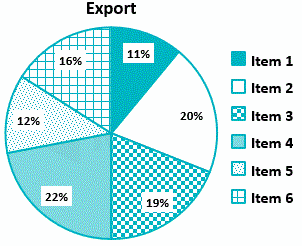
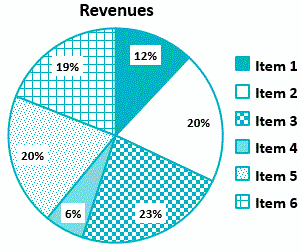
The total exports and revenues from the exports of a country are given in the two pie charts below. The pie chart for exports shows the quantity of each item as a percentage of the total quantity of exports. The pie chart for the revenues shows the percentage of the total revenue generated through export of each item. The total quantity of exports of all the items is 5 lakh tonnes and the total revenues are 250 crore rupees. What is the ratio of the revenue generated through export of Item 1 per kilogram to the revenue generated through export of Item 4 per kilogram? 

  1. ((a))

    1:2

  2. ((b))

    2:1

  3. ((c))

    1:4

  4. ((d))

    4:1

Show Answer
Answer: ((d))

4:1

Given,

The total quantity of exports of all the items = 5 lakh tonnes = 5 × 108 kg

The total revenues of all items = 250 crore rupees = 250 × 107 rupees

Now for item 1,

Item 1 exported in kg = (11/100) × (5 × 108) = 55 × 106 kg

Revenue of item 1 exported = (12/100) × (250 × 107) = 3 × 108 rupees

Revenue;of;item;1;exported;per;kg=3×10855×106=30055{\rm{Revenue;of;item;}}1{\rm{;exported;per;kg}} = \frac{{3 \times {{10}^8}}}{{55 \times {{10}^6}}} = \frac{{300}}{{55}}

Now for item 4,

Item 4 exported in kg = (22/100) × (5 × 108) = 11 × 107 kg

Revenue of item 4 exported = (6/100) × (250 × 107) = 15 × 107 rupees

Revenue;of;item;4;exported;per;kg=15×10711×107=1511{\rm{Revenue;of;item;}}4{\rm{;exported;per;kg}} = \frac{{15 \times {{10}^7}}}{{11 \times {{10}^7}}} = \frac{{15}}{{11}}

Now ratio of the revenue generated through export of Item 1 per kilogram to the revenue generated through export of Item 4 per kilogram

Revenue;of;item;1;exported;per;kgRevenue;of;item;4;exported;per;kg=30055×1115=41\frac{{{\rm{Revenue;of;item;}}1{\rm{;exported;per;kg}}}}{{{\rm{Revenue;of;item;}}4{\rm{;exported;per;kg}}}} = \frac{{300}}{{55}} \times \frac{{11}}{{15}} = \frac{4}{1}

Hence the ratio is 4 : 1

9

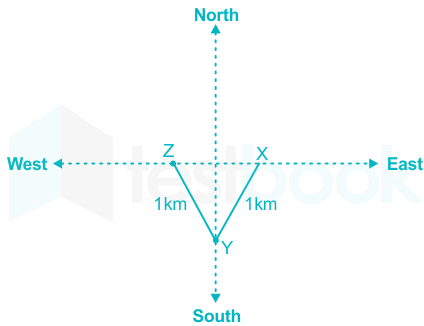
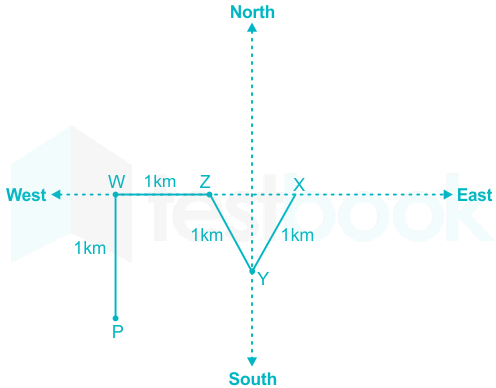
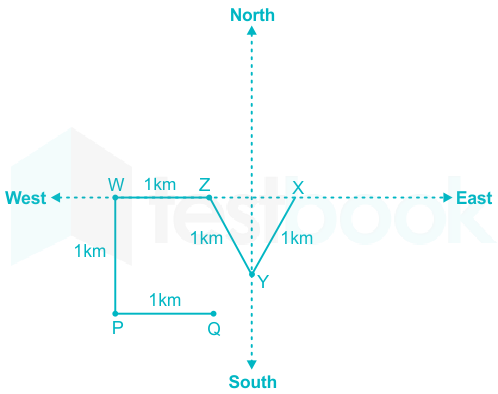
X is 1 km northeast of Y. Y is 1 km southeast of Z. W is 1 km west of Z. P is 1 km south of W. Q is 1 km east of P. What is the distance between X and Q in km?

  1. ((a))

    1

  2. ((b))

    √2

  3. ((c))

    √3 

  4. ((d))

    2

Show Answer
Answer: ((c))

√3 

Given, 

  1. X is 1 km northeast of Y.

  2. Y is 1 km southeast of Z.

  1. W is 1 km west of Z.

  2. P is 1 km south of W.

  1. Q is 1 km east of P

We can draw the following diagram according to the given conditions,

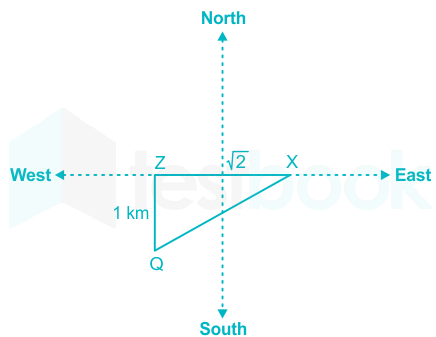
From the figure,

ZQ = 1 km

Now,

∠ZYX = 90° 

∴ By Pythagoras theorem in triangle ZYX

ZX=(ZY)2+(YX)2{\rm{ZX}} = \sqrt {{{\left( {{\rm{ZY}}} \right)}^2} + {{\left( {{\rm{YX}}} \right)}^2}}

ZX=;(1)2+(1)2{\rm{ZX}} = {\rm{;}}\sqrt {{{\left( 1 \right)}^2} + {{\left( 1 \right)}^2}}

ZX=2{\rm{ZX}} = \sqrt 2

In right-angle triangle ZQX,

QX=(ZQ)2+(ZX)2{\rm{QX}} = \sqrt {{{\left( {{\rm{ZQ}}} \right)}^2} + {{\left( {{\rm{ZX}}} \right)}^2}}

QX=;(1)2+(2)2{\rm{QX}} = {\rm{;}}\sqrt {{{\left( 1 \right)}^2} + {{\left( {\sqrt 2 } \right)}^2}}

ZX=3{\rm{ZX}} = \sqrt 3

Hence, "√3" is the correct answer.

10

​10% of the population in a town is HIV+ . A new diagnostic kit for HIV detection is available; this kit correctly identifies HIV+ individuals 95% of the time, and HIV− individuals 89% of the time. A particular patient is tested using this kit and is found to be positive. The probability that the individual is actually positive is _______

Civil Engineering (55 questions)

11

A fair (unbiased) coin was tossed four times in succession and resulted in the following outcomes: (i) Head (ii) Head (iii) Head (iv) Head. The probability of getting a ‘Tail’ when the coin is tossed again is 

  1. ((a))

    0

  2. ((b))

    1/2

  3. ((c))

    4/5

  4. ((d))

    1/5

Show Answer
Answer: ((b))

1/2

Probability of getting (H.H.H.H) = ½ × ½ × ½ × ½ = 1/16

Probability of getting (H.H.H.H.T) = ½ × ½ × ½ × ½ × ½ = 1/32

Given condition is that (H.H.H.H) is already realized conditional probability of getting next H after

Probability of getting (H,H,H,H,T) when (H,H,H,H) is already happend (It will be the conditional probability of getting (H,H,H,H,T) when (H,H,H,H) has already occured)

P(H,H,H,H,T / H,H,H,H) =132116=0.5= \frac{{\frac{1}{{32}}}}{{\frac{1}{16}}} = 0.5

12

The determinant of matrix \({\rm{}}\left| {\begin{array}{*{20}{c}} {\rm{0}}&{\rm{1}}&{\rm{2}}&{\rm{3}}\ {\rm{1}}&{\rm{0}}&{\rm{3}}&{\rm{0}}\ {\rm{2}}&{\rm{3}}&{\rm{0}}&{\rm{1}}\ {\rm{3}}&{\rm{0}}&{\rm{1}}&{\rm{2}} \end{array}} \right|\) is

13

Z=23i5+i{\rm{Z}} = \frac{{2 - 3{\rm{i}}}}{{ - 5 + {\rm{i}}}}  is expressed as

  1. ((a))

    − 0.5 − 0.5i 

  2. ((b))

    − 0.5 + 0.5i

  3. ((c))

    0.5 − 0.5i

  4. ((d))

    0.5 + 0.5i

Show Answer
Answer: ((b))

− 0.5 + 0.5i

Given that,

Z=23i5+i{\rm{Z}} = \frac{{2 - 3{\rm{i}}}}{{ - 5 + {\rm{i}}}}

Multiplying and dividing by (-5 - i)

Z=(23i)(5+i)×(5i)(5i){\rm{Z}} = \frac{{\left( {2 - 3{\rm{i}}} \right)}}{{\left( { - 5 + {\rm{i}}} \right)}} \times \frac{{\left( { - 5 - {\rm{i}}} \right)}}{{\left( { - 5 - {\rm{i}}} \right)}}

Z=102i+15i+3i225+5i5ii2{\rm{Z}} = \frac{{ - 10 - 2i + 15i + 3{i^2}}}{{25 + 5i - 5i - {i^2}}}

Here, i2 = -1

Z=1013i+3(1)25(1){\rm{Z}} = \frac{{ - 10 - 13i + 3\left( { - 1} \right)}}{{25 - \left( { - 1} \right)}}

Z=1313i26{\rm{Z}} = \frac{{ - 13 - 13i}}{{26}}

Z=1326+13i26;{\rm{Z}} = - \frac{{13}}{{26}} + \frac{{13i}}{{26}};

Z=12+i2;{\rm{Z}} = - \frac{1}{2} + \frac{i}{2};

Z = -0.5 + 0.5i

14

The integrating factor for the differential equation dPdt+K2P=K1L0eK1t\frac{{{\rm{dP}}}}{{{\rm{dt}}}} + {{\rm{K}}_2}{\rm{P}} = {{\rm{K}}_1}{{\rm{L}}_0}{{\rm{e}}^{ - {{\rm{K}}_1}{\rm{t}}}}

  1. ((a))

    e-k1t

  2. ((b))

    e-k2t

  3. ((c))

    ek1t

  4. ((d))

    ek2t

Show Answer
Answer: ((d))

ek2t

Concept: 

The standard form of a linear equation of the first order, commonly known as Leibnitz's linear equation, is

dydx+P.y=Q{\frac{{{\rm{dy}}}}{{{\rm{dx}}}}{\rm{ + P}}{\rm{.y = Q}}}

Where, P and Q are the functions of 'X'

The integrating factor is given as,

I.F=ePdx{\rm{I}}{\rm{.F}} = {{\rm{e}}^{{\rm{\smallint P}}{\rm{dx}}}}

The solution of the above equation is given as,

\(\begin{array}{*{20}{l}} {\left( {{\rm{I}}{\rm{.F}}} \right){\rm{y}} = {\rm{ \smallint}}\left( {{\rm{I}}{\rm{.F}}} \right){\rm{Q}}\ {\rm{dx}}}+C \end{array}\)

Calculation:

Given equation,

dPdt+K2P=K1L0eK1t\frac{{{\rm{dP}}}}{{{\rm{dt}}}} + {{\rm{K}}_2}{\rm{P}} = {{\rm{K}}_1}{{\rm{L}}_0}{{\rm{e}}^{ - {{\rm{K}}_1}{\rm{t}}}}

This equation is a linear equation of first order, therefore comparing it with the general equation

dydx+P.y=Q{\frac{{{\rm{dy}}}}{{{\rm{dx}}}}{\rm{ + P}}{\rm{.y = Q}}}

Hence P = K2

∴ I.F=ePdt{\rm{I}}{\rm{.F}} = {{\rm{e}}^{{\rm{\smallint P}}{\rm{dt}}}}

∴ I.F=eK2dt{\rm{I}}{\rm{.F}} = {{\rm{e}}^{{\rm{\smallint K_2}}{\rm{dt}}}}

∴ I.F=eK2t{\rm{I}}{\rm{.F}} = {{\rm{e}}^{{\rm{ K_2}}{\rm{t}}}}

15

If {x} is a continuous, real valued random variable defined over the interval (− ∞, + ∞) and its occurrence is defined by the density function given as: f(x)=12π;×b×e12(xab)2{\rm{ f}}\left( {\rm{x}} \right){\rm{ = }}\frac{{\rm{1}}}{{\sqrt {{\rm{2\pi }};} }{{\rm{\times b}}}}\times{{\rm{e}}^{{\rm{ - }}\frac{{\rm{1}}}{{\rm{2}}}{{\left( {\frac{{{\rm{x - a }}}}{{\rm{b }}}} \right)}^{\rm{2}}}}}where 'a' and 'b' are the statistical attributes of the random variable {x}. The value of the integral \( \mathop \smallint \limits_{-\infty}^a\frac{{\rm{1}}}{{\sqrt {{\rm{2\pi }};} }{{\rm{\times b}}}}\times{{\rm{e}}^{{\rm{ - }}\frac{{\rm{1}}}{{\rm{2}}}{{\left( {\frac{{{\rm{x - a }}}}{{\rm{b }}}} \right)}^{\rm{2}}}}}dx\) is

  1. ((a))

    1

  2. ((b))

    0.5

  3. ((c))

    π

  4. ((d))

    2 π

Show Answer
Answer: ((b))

0.5

Concept:

Normal/Gaussian/Bell distribution:

Probability distribution function (PDF) for a normal distribution is:

PDF=f(x)=12πσ2;e12(xμσ)2{\rm{PDF = f}}\left( {\rm{x}} \right){\rm{ = }}\frac{{\rm{1}}}{{\sqrt {{\rm{2\pi }}{{\rm{\sigma }}^{\rm{2}}};} }}{{\rm{e}}^{{\rm{ - }}\frac{{\rm{1}}}{{\rm{2}}}{{\left( {\frac{{{\rm{x - \mu }}}}{{\rm{\sigma }}}} \right)}^{\rm{2}}}}}

where,

x = normal random variable

μ = mean = mode = median

σ = standard deviation. σ2 = variance

Calculation:

\(\mathop \smallint \limits_{ - \infty }^\infty {\rm{f}}\left( {\rm{x}} \right){\rm{dx}} = 1\)

\(\mathop \smallint \limits_{ - \infty }^{\rm{a}} {\rm{f}}\left( {\rm{x}} \right){\rm{dx}} + \mathop \smallint \limits_{\rm{a}}^{ - \infty } {\rm{f}}\left( {\rm{x}} \right){\rm{dx}} = 1\)

\(\mathop \smallint \limits_{ - \infty }^a {\rm{f}}\left( {\rm{x}} \right){\rm{dx}} = 0.5\)

16

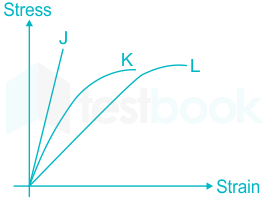
Group I contains representative stress-strain curves as shown in the figure, while Group II gives the list of materials. Match the stress-strain curves with the corresponding materials.

Group IGroup II
P. Curve J1. Cement paste
Q. Curve K2. Coarse aggregate
R. Curve L3. Concrete
  1. ((a))

    P - 1; Q - 3; R - 2

  2. ((b))

    P - 2; Q - 3; R - 1

  3. ((c))

    P - 3; Q - 1; R - 2

  4. ((d))

    P - 3; Q - 2; R - 1

Show Answer
Answer: ((b))

P - 2; Q - 3; R - 1

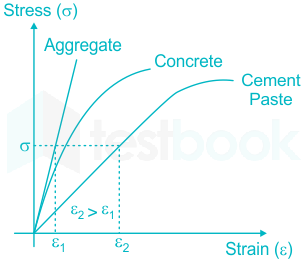
Stress strain for cement-paste:

The stress-strain curve for hardened cement paste is almost linear as shown in the figure.

Stress strain for aggregate:

The aggregate is more rigid than the cement paste and will therefore deform less (i.e. have a lower strain) under the same applied stress.

Stress strain for concrete:

The stress strain curve of concrete lies between those of the aggregate and the cement paste. However this relationship is non-linear over the most of the range.

17

The first moment of area about the axis of bending for a beam cross-section is

  1. ((a))

    Moment of inertia

  2. ((b))

    Section modulus

  3. ((c))

    Shape factor

  4. ((d))

    Polar moment of inertia

Show Answer
Answer: ((b))

Section modulus

Section modulus:

The section modulus (Z) of the cross-sectional shape is significant in designing beams. It is a direct measure of the strength of the beam.

A beam that has a larger section modulus than another will be stronger and capable of supporting greater loads.

To calculate Z, the distance (y) to the extreme fibres from the centroid (or neutral axis) must be found as that is where the maximum stress could cause failure.

\(\begin{array}{*{20}{l}} {\frac{{\rm{M}}}{{\rm{I}}}{\rm{ = }}\frac{{\rm{\sigma }}}{{\rm{y}}}{\rm{ = }}\frac{{\rm{E}}}{{\rm{R}}}}\ {{\rm{Z = }}\frac{{\rm{I}}}{{{{\rm{Y}}_{{\rm{max}}}}}}} \end{array}\)

where,

I = Second moment of inertia

Ymax = Distance of centroidal axis from the bottom

\({\rm{Z}} = \frac{{\rm{I}}}{{{{\rm{Y}}{{\rm{max}}}}}} = \frac{{{\rm{AY}}{{\rm{max}}}^2}}{{{{\rm{Y}}_{{\rm{max}}}}}}\)

Z = AYmax = First moment of inertia

Hence the first moment of area about the axis of bending for a beam cross-section is section modulus

18

Polar moment of inertia (Ip), in cm4, of a rectangular section having width, b = 2 cm and depth, d = 6 cm is

19

The target mean strength fm for concrete mix design obtained from the characteristic strength fck and standard deviation σ, as defined in IS:456-2000, is

  1. ((a))

    fck + 1.35σ

  2. ((b))

    fck + 1.45σ

  3. ((c))

    fck + 1.55σ

  4. ((d))

    fck + 1.65σ

Show Answer
Answer: ((d))

fck + 1.65σ

Explanation

The target mean strength (f­m) is taken as

fm = fck + 1.65 σ

where,

fck = characteristic compressive strength, and σ = standard deviation

The standard deviation for different grade of concrete as per Clause 9.2.4.2 IS:456-2000

Grade of ConcreteAssumed Standard Deviation (N/mm2)
M10, M153.5
M20, M254.0
M30, M35, M40, M45, M505.0
20

The flexural tensile strength of M25 grade of concrete, in N/mm2 , as per IS:456-2000 is

21

The modulus of elasticity, E=5000;fck{\rm{E}} = 5000{\rm{;}}\sqrt {{{\rm{f}}_{{\rm{ck}}}}} where fck is the characteristic compressive strength of concrete, specified in IS:456-2000 is based on

  1. ((a))

    Tangent modulus

  2. ((b))

    Initial tangent modulus

  3. ((c))

    Secant modulus

  4. ((d))

    Chord modulus

Show Answer
Answer: ((c))

Secant modulus

CONCEPT:

As per IS 456: 2000,

The Short term Static Modulus of elasticity of concrete Ec is given as-

\({{\rm{E}}{\rm{c}}} = 5000{\rm{;}}\sqrt {{{\rm{f}}{{\rm{ck}}}}} \)

Where,

fck = characteristic compressive strength of concrete,

fck and Ec are measured in MPa.


Initial tangent modulus:

  • It is a slope to curve from the origin.
  • The initial tangent modulus is applicable when material behaves linearly elastic

Secant Modulus

  • It is defined as the slope of a line connecting the point at the start of a stress-strain diagram to a point with stress 1/3 rd of ultimate stress.
  • It is also known as the static modulus of elasticity.
  • In concrete, the stress-strain curve is nonlinear (assumed to be parabolic till a strain of 0.002) so an average increase in stress with respect to an average increase in strain to find elasticity modulus
  • So we use the Secant modulus as the modulus of elasticity of concrete.

Important Points

As per IS 456: 2000,

Environmental conditionNominal cover (mm)A minimum grade of concrete (RCC)A minimum grade of concrete (PCC)
Mild20M – 20-
Moderate30M – 25M – 15
Severe45M – 30M – 20
Very severe50M – 35M – 20
Extreme75M – 40M - 25
22

​The static indeterminacy of the two-span continuous beam with an internal hinge, shown below, is

23

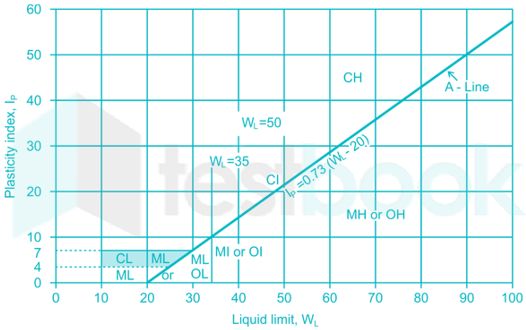
As per Indian Standard Soil Classification System (IS: 1498 - 1970), an expression for A-line is 

  1. ((a))

    Ip = 0.73 (wL − 20)

  2. ((b))

    Ip = 0.70 (wL − 20)

  3. ((c))

    Ip = 0.73 (wL − 10)

  4. ((d))

    Ip = 0.70 (wL − 10)

Show Answer
Answer: ((a))

Ip = 0.73 (wL − 20)

Fine grained soil are classified on the basis of plastic chart. Clay is found to exist above A-line whereas silt & organic soil found to exist below A-line.

The equation for A-line is,

IP = 0.73 (WL - 20) 

Suffix and prefix used in soil classification:

Soil TypePrefixSoil TypeSuffix
GravelGWell gradedW
SandSPoorly gradedP
SiltMClayeyC
ClayCSiltyM
OrganicOLow compressibilityL
PeatPtIntermediate compressibilityI
High compressibilityH
24

The clay mineral primarily governing the swelling behavior of Black Cotton soil is

  1. ((a))

    Halloysite

  2. ((b))

    Illite

  3. ((c))

    Kaolinite

  4. ((d))

    Montmorillonite

Show Answer
Answer: ((d))

Montmorillonite

Black cotton soil:

Black cotton soils have montmorillonite clay mineral which shows swelling and shrinkage behavior on wetting and drying.

Black Cotton Soil also consists of the excess of Montmorillonite mineral.

Bentonite clay shows swelling and shrinkage characteristics due to moisture content variation due to the presence of Montmorillonite mineral.

Bentonite clay is also called Montmorillonite clay.

Important point:

As black cotton soils are expansive soils i.e having swelling and shrinkage behavior and due to this Lightly loaded structures are more susceptible to damage as a result of volume changes in the soil. Therefore these soils need to be stabilized first before loading.

Investigation says that lime is a good stabilizing agent for the construction of a road in the black cotton soil.

Lime forms the bonding between the soil particles which is missing in black cotton soil and hence stabilizes.

25

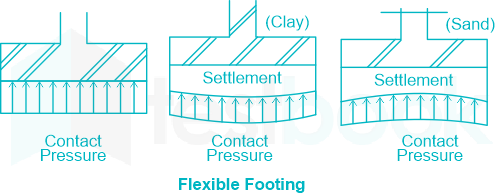
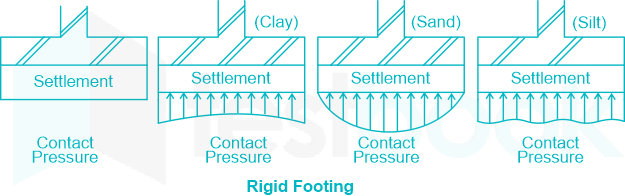
The contact pressure for a rigid footing resting on clay at the centre and the edges are respectively

  1. ((a))

    maximum and zero

  2. ((b))

    maximum and minimum

  3. ((c))

    zero and maximum

  4. ((d))

    minimum and maximum

Show Answer
Answer: ((d))

minimum and maximum

For flexible footing:  Contact pressure is uniform.

For Rigid footing:  Settlement is uniform


Type of Footing and SoilSettlement and contact pressure
Rigid footing and sandSettlement: Uniform Contact Pressure:  Zero at the edges and maximum at the center
Rigid footing and ClaySettlement: Uniform Contact Pressure:  maximum at the edges and minimum at the center.
Flexible footing and sandSettlement:  Maximum at edges and minimum at the center. Contact Pressure:   Uniform
Flexible footing and ClaySettlement:  Minimum at edges and maximum at the center Contact Pressure:  Uniform

Hence it can be seen that the contact pressure for a rigid footing resting on clay at the centre and the edges is minimum and maximum respectively

26

A certain soil has the following properties: Gs = 2.71, n = 40% and w = 20%. The degree of saturation of the soil (rounded off to the nearest percent) is

27

A plane flow has velocity components u=xT1{\rm{u}} = \frac{{\rm{x}}}{{{{\rm{T}}_1}}}, v=yT2{\rm{v}} = - \frac{{\rm{y}}}{{{{\rm{T}}_2}}}and w = 0 along x, y and z directions respectively, where T1 (≠ )0 and T2 ≠ )0( are constants having the dimension of time. The given flow is incompressible if

  1. ((a))

    T1 = - T2

  2. ((b))

    T1=T22{{\rm{T}}_1} = - \frac{{{{\rm{T}}_2}}}{2}

  3. ((c))

    T1=T22{{\rm{T}}_1} = \frac{{{{\rm{T}}_2}}}{2}

  4. ((d))

    T1 = T2

Show Answer
Answer: ((d))

T1 = T2

Concept: 

Continutiy equation in Three-Dimension

ρt+(ρU)X+(ρV)Y+(ρW)Z=0;\frac{{\partial {\rm{\rho }}}}{{\partial {\rm{t}}}} + \frac{{\partial \left( {{\rm{\rho U}}} \right)}}{{\partial {\rm{X}}}} + \frac{{\partial \left( {{\rm{\rho V}}} \right)}}{{\partial {\rm{Y}}}} + \frac{{\partial \left( {{\rm{\rho W}}} \right)}}{{\partial {\rm{Z}}}} = 0{\rm{;}}

Where,

U, V, and W are components of velocity in X, Y and Z direction respectively

When the flow is steady,;;ρt=0,;;\frac{{\partial {\bf{\rho }}}}{{\partial {\bf{t}}}} = 0

(ρU)X+(ρV)Y+(ρW)Z=0∴ \frac{{{\rm{\partial }}\left( {{\rm{\rho U}}} \right)}}{{{\rm{\partial X}}}} + \frac{{{\rm{\partial }}\left( {{\rm{\rho V}}} \right)}}{{{\rm{\partial Y}}}} + \frac{{{\rm{\partial }}\left( {{\rm{\rho W}}} \right)}}{{{\rm{\partial Z}}}} = 0

When flow is steady and incompressible, ρ = constant

UX+VY+WZ=0;∴ \frac{{\partial {\rm{U}}}}{{\partial {\rm{X}}}} + \frac{{\partial {\rm{V}}}}{{\partial {\rm{Y}}}} + \frac{{\partial {\rm{W}}}}{{\partial {\rm{Z}}}} = 0{\rm{;}}

When the flow is steady, incompressible and 2-D, WZ=0\frac{{\partial {\bf{W}}}}{{\partial {\bf{Z}}}} = 0

UX+VY=0;∴ \frac{{\partial {\rm{U}}}}{{\partial {\rm{X}}}} + \frac{{\partial {\rm{V}}}}{{\partial {\rm{Y}}}} = 0{\rm{;}}

Calculation:

Given,

u=xT1{\rm{u}} = \frac{{\rm{x}}}{{{{\rm{T}}_1}}}v=yT2{\rm{v}} = - \frac{{\rm{y}}}{{{{\rm{T}}_2}}} and w = 0

As per continuity equation, for two dimensional incompressible flow,

UX+VY=0;∴ \frac{{\partial {\rm{U}}}}{{\partial {\rm{X}}}} + \frac{{\partial {\rm{V}}}}{{\partial {\rm{Y}}}} = 0{\rm{;}}

(xT1)X+(yT2)Y=0;∴ \frac{{\partial {\rm{(\frac{{\rm{x}}}{{{{\rm{T}}_1}}})}}}}{{\partial {\rm{X}}}} + \frac{{\partial {\rm{(- \frac{{\rm{y}}}{{{{\rm{T}}_2}}})}}}}{{\partial {\rm{Y}}}} = 0{\rm{;}}

1T11T2=0\frac{1}{{{{\rm{T}}_1}}} - \frac{1}{{{{\rm{T}}_2}}} = 0

∴T1 = T2

Hence The given flow is incompressible if T1 = T2

28

Group I lists a few devices while Group II provides information about their uses. Match the devices with their corresponding use.

Group IGroup II
P. Anemometer1. Capillary potential of soil water
Q. Hygrometer2. Fluid velocity at a specific point in the flow stream
R. Pitot Tube3. Water vapour content of air
S. Tensiometer4. Wind speed
  1. ((a))

    P - 1; Q -2; R - 3; S - 4

  2. ((b))

    P - 2; Q - 1; R - 4; S- 3 

  3. ((c))

    P - 4; Q - 2; R - 1; S - 3 

  4. ((d))

    P - 4; Q - 3; R - 2; S - 1

Show Answer
Answer: ((d))

P - 4; Q - 3; R - 2; S - 1

Anemometer:

Anemometer is a device that is used to measure wind speed in the atmosphere. It is commonly used at weather stations.

Hygrometer:

Hygrometer is a device which is used to measure relative humidity (water vapour content).

Pitot Tube:

Pitot Tube is a device used calculating the velocity of flow at any point in a pipe or a channel. It is based on the principle that if the velocity of flow at a point becomes zero, the pressure there is increased due to the conversion of the kinetic energy into pressure energy. 

Tensiometer:

Tensiometers are used for the direct measurement of negative pore water pressures (rise of water due to capillarity) in the soils by establishing a continuous connection between soil pore water and the measuring system.

29

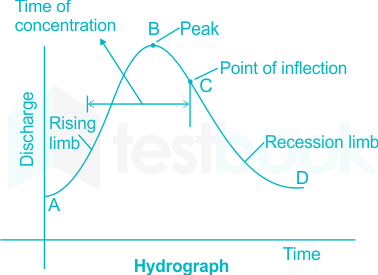
An isolated 3-h rainfall event on a small catchment produces a hydrograph peak and point of inflection on the falling limb of the hydrograph at 7 hours and 8.5 hours respectively, after the start of the rainfall. Assuming, no losses and no base flow contribution, the time of concentration (in hours) for this catchment is approximately

  1. ((a))

    8.5

  2. ((b))

    7.0

  3. ((c))

    6.5

  4. ((d))

    5.5

Show Answer
Answer: ((d))

5.5

Concept:

Time of concentration: 

It is the time required for surface runoff to travel from hydraulically most distant point of the basin to the outlet.

Time of concentration depends upon the slope, the catchment characteristics and the flow path.

For a hydrograph analysis, time of concentration is defined as the time duration from the end of excess rainfall to the point of inflection.

For small catchment areas, lag time (tp) is equal to time of concentration (tc)

tc = Hydrograph peak time - Half of rainfall duration

where,

tp = Lag time, tb = Base time

Qp = Peak ordinate, T = Storm duration

OA = Approach segment

AB = Rising limb

BC = Crest segment

DE = Recession limb

Calculation:

T hr rainfall = 3hr

Hydrograph peak at 7 hours

Point of inflection at 8.5 hours

Time of concentration is given by,

∴ tc = Hydrograph peak time - Half of rainfall duration

∴ tc = 7 - (3/2) = 5.5 hrs

Hence, the time of concentration (in hours) for this catchment is 5.5 hrs.

30

The Muskingum model of routing a flood through a stream reach is expressed as O= K0I2 + K1I1 + K2O1, where K0, K1 and K2 are the routing coefficients for the concerned reach, I1 and I2 are the inflows to the reach, and O1 and O2 are the outflows from the reach corresponding to time steps 1 and 2 respectively. The sum of KO, K1 and K2 of the model is

  1. ((a))

    -1

  2. ((b))

    -0.5

  3. ((c))

    0.5

  4. ((d))

    1

Show Answer
Answer: ((d))

1

Concept:

A common method of Hydrologic channel routing is Muskingum method, in which the channel storage in a reach is expressed as a function of both inflow and outflow discharge.

S = k [x Im – (1 - x)Qm]

Where, s = Storage in a channel reach

I = Inflow Discharge

Q = Outflow Discharge

k → Coefficient known as storage time coefficient. It was unit of time, it is approx. equal to time of travel of flood wave through the channel reach.

x → Weightage factor. Its range series from 0 to 0.5

  • For naturally occurring channels m = 1, Hence the equation becomes

S = k [x I – (1 - x)Q]

  • For x = 0, storage is only a function of outflow discharge. Such reservoirs are also known as Linear Reservoir.

Muskingum model of routing a flood through a stream reach is expressed as

O= K0I2 + K1I+ K2O1

where K0, K1and K2 = Routing coefficients for the concerned reach

I1 and I2 = Inflows to the reach 1 and 2

O1 and O2 = Outflows from the reach 1 and 2

K0 + K1 + K2 = 1.0

31

The dominating microorganisms in an activated sludge process reactor are

  1. ((a))

    Aerobic heterotrophs

  2. ((b))

    Anaerobic heterotrophs

  3. ((c))

    Autotrophs

  4. ((d))

    Phototrophs

Show Answer
Answer: ((a))

Aerobic heterotrophs

Concept:

Aerobic bacteria:

Bacteria that utilize oxygen for growth and oxygen-based metabolism is called aerobic bacteria.

Heterotrophs: 

It cannot produce organic compounds from inorganic sources and therefore rely on consuming other organisms in the food chain.

Anaerobic bacteria:

Bacteria that do not utilize oxygen for growth is called Anaerobic bacteria.

Autotrophs:

They store chemical energy in carbohydrate food molecules which they build themselves.

Explanation:

In activated sludge process, in the presence of food mass and oxygen heterotrophic bacteria converts food mass into biomass.

Hence the dominating microorganisms in an activated sludge process reactor are aerobic heterotrophs.

Important point:

Followings are the classification of secondary treatment units:

S.No.MethodContact MechanismDecomposition
1Trickling filterAttached growthAerobic
2Rotating biological contactorAttached growthAerobic
3Activated sludge processSuspended growthAerobic
4Oxidation pondSuspended growthAerobic
5Septic tankSuspended growthAnaerobic
6Imhoff tankSuspended growthAnaerobic
32

The two air pollution control devices that are usually used to remove very fine particles from the flue gas are 

  1. ((a))

    Cyclone and Venturi Scrubber

  2. ((b))

    Cyclone and Packed Scrubber

  3. ((c))

    Electrostatic Precipitator and Fabric Filter

  4. ((d))

    Settling Chamber and Tray Scrubber

Show Answer
Answer: ((c))

Electrostatic Precipitator and Fabric Filter

Concept:

1. Electrostatic Precipitators:-

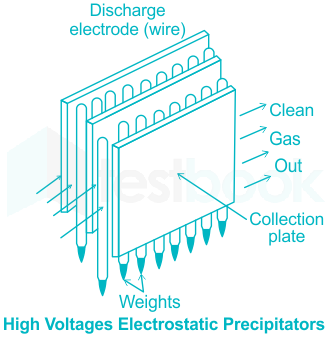
  • In electrostatic precipitators, the emitted gas flue gas is passed through a highly ionized atmosphere high-voltage field; and in that zone particulates get electrically charged and get separated from the gaseous stream with the help of electrostatic forces. Fine particles up to 1 μm wet or dry can be removed easily in an electrostatic pressure.
  • Four basic steps required in the operation of a high-voltage single-stage electrostatic precipitator:

a) electrical charging of the particulates

b) collection of charged particles on a grounded surface

c) neutralization of the charge at the collector

d) removal of the particulate for disposal.

2. Gravitational Settling Chambers:

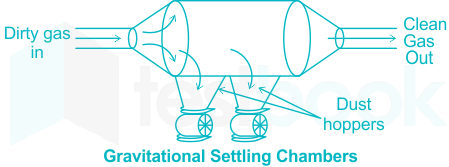
  • Settling chambers in air-pollution control systems provide enlarged areas to minimize horizontal velocities and allow time for the vertical velocity to carry the particle to the floor.
  • The emitted smokes, when made to pass through a settling chamber, drop some of their larger sized particles in the chamber as per Stoke’s Law. The largest size particle (d) that can be removed with 100% efficiency in such a chamber of length L and height H is given by

​\(d=C.\sqrt{\frac{18\mu .{{v}{h}}.H}{g.L.{{\rho }{p}}}}\)

Where, vh = Horizontal velocity of gas passing through the chamber

  • Simple to design and maintain, and low-pressure flow.
  • It requires larger space for installation and has low collection efficiency for small-sized particles.
  • Only larger sized particles are separated.
  • Although theoretically they should be able to remove particulates down to 5 or 10 μm, in actual, they are not practical for the removal of particles much less than 50 μm in size.

3. Fabric Filters

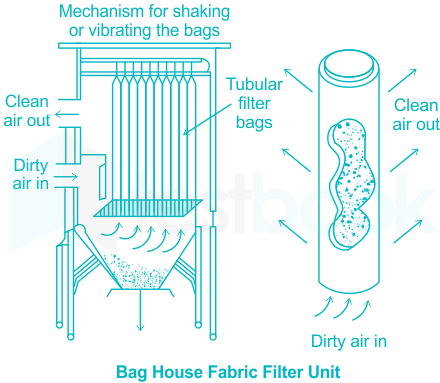
  • In fabric filters, the gas stream laden with particles is passed through a woven or felted fabric that filters out particulate matter, allowing the gaseous matter to flow on.
  • Small, particles are initially retained on the fabric by direct interception, inertial impaction, diffusion, electrostatic attraction, and gravitational settling.
  • The collection of sub-micron particles is accomplished by sieving after a mat of dust gets found on the fabric.
  • Filter bags, are capable of removing most particles as small as 0.5 μm and will remove substantial quantities of particles as small as 0.1 μm with an efficiency greater than 99%.


4. Wet Scrubbers:

  • Wet scrubbers remove the particulates from the incoming gaseous stream by allowing the flue gases to flow up against a falling water stream.
  • When aqueous chemical solutions, other than water, like lime, oil etc. it is used for the removal of gaseous pollutants also from the flue gases.
  • Generally, collectors operating at very low pressure loss remove only medium- to coarse-size particles, while collectors operating at higher pressure losses are highly efficient at removing fine particles.
  • Most commonly used wet collectors are— the spray tower, the wet cyclone scrubber, and the venturi scrubber.​

Explanation:

Hence the two air pollution control devices that are usually used to remove very fine particles from the flue gas are Electrostatic Precipitator and Fabric Filter

33

The average spacing between vehicles in a traffic stream is 50 m, then the density (in veh/km) of the stream is

34

A road is being designed for a speed of 110 km/hr on a horizontal curve with a super elevation of 8%. If the coefficient of side friction is 0.10, the minimum radius of the curve (in m) required for safe vehicular movement is

  1. ((a))

    115.0

  2. ((b))

    152.3

  3. ((c))

    264.3

  4. ((d))

    528.5

Show Answer
Answer: ((d))

528.5

Concept:

e+f=V2127R\text{e}+\text{f}=\frac{{{\text{V}}^{2}}}{127\text{R}}

Where

V = Speed of the vehicle, e = super elevation, f = coefficient of lateral friction and R = radius of curve

Calculation:

Given:

V = 110 kmph, e = 8% = 0.08 and f = 0.10

e+f=V2127R\text{e}+\text{f}=\frac{{{\text{V}}^{2}}}{127\text{R}}

0.08+0.10=1102127×R0.08+0.10=\frac{{{110}^{2}}}{127\times \text{R}}

R = 529.3 m

∴ The ruling design radius of the curve is 529.3 m

35

The survey carried out to delineate natural features, such as hills, rivers, forests and man-made features, such as towns, villages, buildings, roads, transmission lines and canals is classified as

  1. ((a))

    Engineering survey

  2. ((b))

    Geological survey

  3. ((c))

    Land survey

  4. ((d))

    Topographic survey

Show Answer
Answer: ((d))

Topographic survey

Concept:

Land Surveying: 

To determine the boundaries and areas of parcels of land, also known as property survey, boundary survey, or cadastral survey.

Engineering Survey: 

To collect requisite data for planning, design, and execution of engineering projects.

Topographic Surveying:  

It is used to identify and map the contours of the ground and existing features on the surface of the earth or slightly above or below the earth's surface (i.e. trees, buildings, streets, walkways, manholes, utility poles, retaining walls, etc.

36

The expression limα0xα1 α\mathop {\lim }\limits_{{\rm{\alpha }} \to {\rm{0}}} \frac{{{\rm{x^{\alpha}-1}} }}{{\ {\rm{\alpha}} }} is equal to

  1. ((a))

    log x

  2. ((b))

    0

  3. ((c))

    x log x 

  4. ((d))

    ∞ 

Show Answer
Answer: ((a))

log x

Concept:

L - Hospital's Rule:

If;limXaf(x)g(x);is;of;the;form00(or){\rm{If;}}\mathop {\lim }\limits_{{\rm{X}} \to {\rm{a}}} \frac{{{\rm{f}}\left( {\rm{x}} \right)}}{{{\rm{g}}\left( {\rm{x}} \right)}}{\rm{;is;of;the;form}}\frac{0}{0}\left( {{\rm{or}}} \right)\frac{\infty }{\infty }

then;limXaf(x)g(x)=limXaf(X)g(X)=f(a)g(a){\rm{then;}}\mathop {\lim }\limits_{{\rm{X}} \to {\rm{a}}} \frac{{{\rm{f}}\left( {\rm{x}} \right)}}{{{\rm{g}}\left( {\rm{x}} \right)}} = \mathop {\lim }\limits_{{\rm{X}} \to {\rm{a}}} \frac{{{\rm{f'}}\left( {\rm{X}} \right)}}{{{\rm{g'}}\left( {\rm{X}} \right)}} = \frac{{{\rm{f'}}\left( {\rm{a}} \right)}}{{{\rm{g'}}\left( {\rm{a}} \right)}}

When f’(a) = g’(a) ≠ 0

Calculation:

Given,

limα0xα1 α\mathop {\lim }\limits_{{\rm{\alpha }} \to {\rm{0}}} \frac{{{\rm{x^{\alpha}-1}} }}{{\ {\rm{\alpha}} }}

It is of 00\frac{0}{0} form

∴ By L – Hospital's rule,

L=d(xα1)dαd(α)dα{\rm{L}} = \frac{{\frac{{{\rm{d}}\left( {{{\rm{x}}^{{\rm{\alpha }}} - 1}} \right)}}{{{\rm{d\alpha }}}}}}{{\frac{{{\rm{d}}\left( {\rm{\alpha }} \right)}}{{{\rm{d\alpha }}}}}}

L=xαlogx1{\rm{L}} = \frac{{{{\rm{x}}^{\rm{\alpha }}}\log {\rm{x}}}}{1}

L = log x

37

An observer counts 240 veh/h at a specific highway location. Assume that the vehicle arrival at the location is Poisson distributed, the probability of having one vehicle arriving over a 30-second time interval is ____________

  1. ((a))

    0.27

  2. ((b))

    0.31

  3. ((c))

    0.29

  4. ((d))

    0.30

Show Answer
Answer: ((a))

0.27

Concept:

Poisson Distribution

The Poisson distribution can be used to model the vehicle arrival

P(n,t)=eλt(λt)nn!{\rm{P}}\left( {{\rm{n}},{\rm{t}}} \right) = \frac{{{{\rm{e}}^{ - {\rm{λ t}}}}{{\left( {{\rm{λ t}}} \right)}^{\rm{n}}}}}{{{\rm{n}}!}}

Where,

λ = Number of vehicles per second

t = Time interval

n = Number of vehicles

Calculation:

Given,

λ = 240 veh/hr = 240/3600 veh/sec = 0.0666 veh/sec

n = 1, t = 30sec

P(n,t)=eλt(λt)nn!{\rm{P}}\left( {{\rm{n}},{\rm{t}}} \right) = \frac{{{{\rm{e}}^{ - {\rm{λ t}}}}{{\left( {{\rm{λ t}}} \right)}^{\rm{n}}}}}{{{\rm{n}}!}}

P(1,30)=e0.0666×30(0.0666×30)11!{\rm{P}}\left( {{\rm{1}},{\rm{30}}} \right) = \frac{{{{\rm{e}}^{ - {\rm{0.0666× 30}}}}{{\left( {{\rm{0.0666× 30}}} \right)}^{\rm{1}}}}}{{{\rm{1}}!}}

P (1, 30) = e-2 × 2 = 0.27

38

The rank of matrix \(\left[ {\begin{array}{{20}{c}} 6&0&4\ { - 2}&{14}&8\ {14}&{ - 14}&0 \end{array};;\begin{array}{{20}{c}} 4\ {18}\ { - 10} \end{array}} \right]\) is

39

Water is flowing at a steady rate through a homogeneous and saturated horizontal soil strip of 10 m length. The strip is being subjected to a constant water head (H) of 5 m at the beginning and 1 m at the end. If the governing equation of flow in the soil strip is d2HdX2=0;\frac{{{{\rm{d}}^2}{\rm{H}}}}{{{\rm{d}}{{\rm{X}}^2}}} = 0{\rm{;}}(Where x is the distance along the soil strip), the value of H (in m) at the middle of the strip is ___________.

40

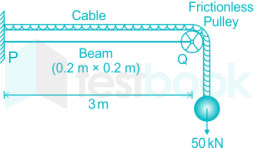
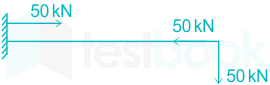
The values of axial stress (σ) in kN/m2 , bending moment (M) in kNm, and shear force (V) in kN acting at point P for the arrangement shown in the figure are respectively

  1. ((a))

    1000, 75 and 25

  2. ((b))

    1250, 150 and 50

  3. ((c))

    1500, 225 and 75

  4. ((d))

    1750, 300 and 100

Show Answer
Answer: ((b))

1250, 150 and 50

Loading after removing the cable

Axial;stress=Axial;forceArea;of;the;beam{\rm{Axial;stress}} = \frac{{{\rm{Axial;force}}}}{{{\rm{Area;of;the;beam}}}}

Axial;stress=σ=500.2×0.2=1250;kN/m2{\rm{Axial;stress}} = {\rm{σ }} = \frac{{50}}{{0.2 × 0.2}} = 1250{\rm{;kN}}/{{\rm{m}}^2}

Shear force = V = 50 kN

Bending moment = M = 50 × 3 = 150 kN

∴ Axial stress = σ = 1250 kN/m2, Bending moment = M = 150 kN, Shear force = V = 50 kN

41

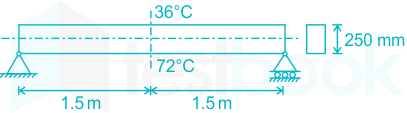
The beam of an overall depth of 250 mm (shown below) is used in a building subjected to two different thermal environments. The temperatures at the top and bottom surfaces of the beam are 36°C and 72°C respectively. Considering the coefficient of thermal expansion (α) as 1.50 × 10⁻⁵ per°C, the vertical deflection of the beam (in mm) at its mid-span due to temperature gradient is ________ 

42

The axial load (in kN) in the member PQ for the arrangement/assembly shown in the figure given below is _______________ 

43

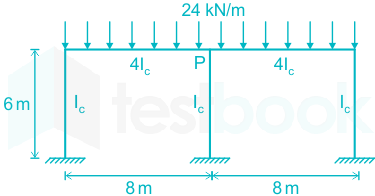
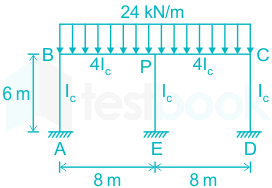
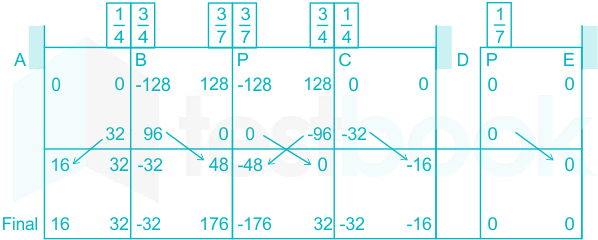
Considering the symmetry of a rigid frame as shown below, the magnitude of the bending moment (in kNm) at P (preferably using the moment distribution method) is 

  1. ((a))

    170

  2. ((b))

    172

  3. ((c))

    176

  4. ((d))

    178

Show Answer
Answer: ((c))

176

Calculation:

Given:

Distribution Factor:

JointMemberRelative stiffnessTotal relative stiffnessDistribution factor
BBAI/6;{\rm{I/6;}}2I/3;{\rm{2I/3;}}1/4
BP4I/8;{\rm{4I/8;}}3/4
PPB4I/8;{\rm{4I/8;}}7I/6{\rm{7I/6}}3/7
PEI/6;{\rm{I/6;}}1/7
PC4I/8;{\rm{4I/8;}}3/7
CCP4I/8;{\rm{4I/8;}}2I/3;{\rm{2I/3;}}3/4
CDI/6;{\rm{I/6;}}1/4

Fixed End Moments:

MAB = MBA = MPE = MEP = MCD = MDC = 0

MBP=WL212=24×8212=128;kN.m{{\rm{M}}_{{\rm{BP}}}} = - \frac{{{\rm{W}}{{\rm{L}}^2}}}{{12}} = - \frac{{24 \times {8^2}}}{{12}} = - 128{\rm{;kN}}.{\rm{m}}

MPB=WL212=24×8212=128;kN.m{{\rm{M}}_{{\rm{PB}}}} = \frac{{{\rm{W}}{{\rm{L}}^2}}}{{12}} = \frac{{24 \times {8^2}}}{{12}} = 128{\rm{;kN}}.{\rm{m}}

MPC=WL212=24×8212=128;kN.m{{\rm{M}}_{{\rm{PC}}}} = - \frac{{{\rm{W}}{{\rm{L}}^2}}}{{12}} = - \frac{{24 \times {8^2}}}{{12}} = - 128{\rm{;kN}}.{\rm{m}}

MCP=WL212=24×8212=128;kN.m{{\rm{M}}_{{\rm{CP}}}} = \frac{{{\rm{W}}{{\rm{L}}^2}}}{{12}} = \frac{{24 \times {8^2}}}{{12}} = 128{\rm{;kN}}.{\rm{m}}

Distribution Table:

Hence the magnitude of bending moment at P is 176 kNm

44

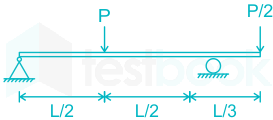
A prismatic beam (as shown below) has plastic moment capacity of MP, then the collapse load P of the beam is

  1. ((a))

    2MPL\frac{{2{{\rm{M}}_{\rm{P}}}}}{{\rm{L}}}

  2. ((b))

    4MPL\frac{{4{{\rm{M}}_{\rm{P}}}}}{{\rm{L}}}

  3. ((c))

    6MPL\frac{{6{{\rm{M}}_{\rm{P}}}}}{{\rm{L}}}

  4. ((d))

    8MPL\frac{{8{{\rm{M}}_{\rm{P}}}}}{{\rm{L}}}

Show Answer
Answer: ((c))

6MPL\frac{{6{{\rm{M}}_{\rm{P}}}}}{{\rm{L}}}

Degree of static indeterminancy = DS = 0

∴ Number of plastic hinges = DS + 1 = 1


Hence from the principal of virtual work

\(\left( { - {{\rm{M}}{\rm{P}}} \times {\rm{\theta }}} \right) - \left( {{{\rm{M}}{\rm{P}}} \times {\rm{\theta }}} \right) + \left( {{\rm{P}} \times \frac{{\rm{L}}}{2} \times {\rm{\theta }}} \right) - \left( {\frac{{\rm{P}}}{2} \times \frac{{\rm{L}}}{3} \times {\rm{\theta }}} \right) = 0\)

2MPθ+PLθ3=0 - 2{{\rm{M}}_{\rm{P}}}{\rm{\theta }} + \frac{{{\rm{PL\theta }}}}{3} = 0

P=6MPL{\rm{P}} = \frac{{6{{\rm{M}}_{\rm{P}}}}}{{\rm{L}}}

45

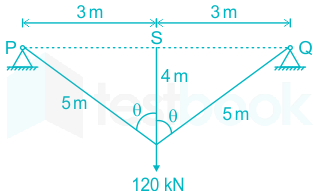
The tension (in kN) in a 10 m long cable, shown in the figure, neglecting its self-weight is 

  1. ((a))

    120

  2. ((b))

    75

  3. ((c))

    60

  4. ((d))

    45

Show Answer
Answer: ((b))

75

Given,

Length of the cable = 10 m

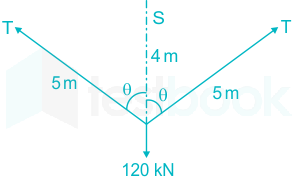
After resolving the forces in the cable, we get the following figure

ΣFY = 0

2T cos θ = 120

Where Cos θ = 4/5

2 × T × (4/5) = 120  

T = 75 kN

46

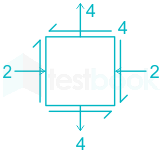
For the state of stresses (in MPa) shown in the figure below, the maximum shear stress (in MPa) is _____

  1. ((a))

    10

  2. ((b))

    -5

  3. ((c))

    -10

  4. ((d))

    5

Show Answer
Answer: ((d))

5

Concept:

Principle stress equation is given by,

σ1,;σ2=σx+;σy2±(σx;σy2)2+(τxy)2{{\rm{σ }}_1},;{{\rm{σ }}_2} = \frac{{{{\rm{σ }}_x} + ;{{\rm{σ }}_y}}}{2} \pm \sqrt {{{\left( {\frac{{{{\rm{σ }}_x} - ;{{\rm{σ }}_y}}}{2}} \right)}^2} + {{\left( {{τ _{xy}}} \right)}^2}}

Where,

σ1 = Maximum principal stress

σ2 = Minimum principal stress

σx = Stress in x direction

σy = Stress in Y direction

τxy = Shear stress in xy plane

Maximum shear stress is given by

\({{\rm{τ }}{{\rm{max}}}} = \sqrt {{{\left( {\frac{{{{\rm{σ }}{\bf{x}}} - ;{{\rm{σ }}{\bf{y}}}}}{2}} \right)}^2} + {{\left( {{{\bf{τ }}{{\bf{xy}}}}} \right)}^2}} \)

Calculation:

Given,

σx = -2 MPa, σy = 4 MPa, τxy = 4 Mpa

\({{\rm{τ }}{{\rm{max}}}} = \sqrt {{{\left( {\frac{{{{\rm{σ }}{\bf{x}}} - ;{{\rm{σ }}{\bf{y}}}}}{2}} \right)}^2} + {{\left( {{{\bf{τ }}{{\bf{xy}}}}} \right)}^2}} \)

\({{\rm{τ }}{{\rm{max}}}} = \sqrt {{{\left( {\frac{{{{\rm{-2 }}{\ }} - ;{{\rm{4 }}_{}}}}{2}} \right)}^2} + {{\left( {{{4}}} \right)}^2}} \)

τmax = 5 MPa

47

An infinitely long slope is made up of a c-φ soil having the properties: cohesion, C = 20 kPa, and dry unit weight, γd = 16 kN/m3 . The angle of inclination and critical height of the slope are 40° and 5 m, respectively. To maintain the limiting equilibrium, the angle of internal friction of the soil (in degrees) is _________________

  1. ((a))

    22.4° 

  2. ((b))

    20.8° 

  3. ((c))

    19.4° 

  4. ((d))

    None of the above

Show Answer
Answer: ((a))

22.4° 

Concept:

Stability analysis of an infinite slope of cohesive soils

Shear strength of cohesive soils is given by,

S = C + (γd H Cos2 i) tan ϕ

Shear stress of cohesive soil is given by,

τ = γd H cos i sin i

As the normal stress σ depends upon the height H of the slope, an expression for the height can be found by equating the shear stress and shear strength

C + (γd H Cos2 i) tan ϕ = γ H cos i sin i

γdHcos2i(sinicositanϕ)=C{\rm{\gamma_d H}}{\cos ^2}{\rm{i}}\left( {\frac{{\sin {\rm{i}}}}{{\cos {\rm{i}}}} - \tan ϕ } \right) = {\rm{C}}

HC=Cγd(tanitanϕ)cos2i{{\rm{H}}_{\rm{C}}} = \frac{{\rm{C}}}{{{\rm{\gamma_d }}\left( {\tan {\rm{i }} - \tan ϕ } \right){{\cos }^2}{\rm{i}}}}

This the height at which the slope is just stable and is known as critical height (HC)

Calculation:

Given,

C = 20 kPa, γd = 16 kN/m3

i = 40°, H = 5 m

HC=Cγd(tanitanϕ)cos2i{{\rm{H}}_{\rm{C}}} = \frac{{\rm{C}}}{{{\rm{\gamma_d }}\left( {\tan {\rm{i }} - \tan ϕ } \right){{\cos }^2}{\rm{i}}}}

5=2016(tan40tanϕ)cos240{{\rm{5}}} = \frac{{\rm{20}}}{{{\rm{16 }}\left( {\tan {\rm{40 }} - \tan ϕ } \right){{\cos }^2}{\rm{40}}}}

tan ϕ = 0.413

ϕ = 22.44°

48

Group I enlists in-situ field tests carried out for soil exploration, while Group II provides a list of parameters for sub-soil strength characterization. Match the type of tests with the characterization parameters.

Group IGroup II
P. Pressuremeter Test (PMT)1. Menard’s modulus (Em)
Q. Static Cone Penetration Test   (SCPT)2. Number of blows (N)
R. Standard Penetration Test (SPT)3. Skin resistance (fC)
S. Vane Shear Test (VST)4. Undrained cohesion       (CU)
  1. ((a))

    P - 1; Q - 3; R - 2; S - 4 

  2. ((b))

    P - 1; Q - 2; R - 3; S - 4 

  3. ((c))

    P - 2; Q - 3; R - 4; S - 1

  4. ((d))

    P - 4; Q - 1; R - 2; S - 3

Show Answer
Answer: ((a))

P - 1; Q - 3; R - 2; S - 4 

Concept:

Following are some of the methods for in-situ site exploration

1) Pressuremeter Test (PMT):

It is developed by Menard.

It is used to determine stress-deformation characteristics of the soil in natural condition.

2) Static Cone Penetration Test (SCPT):

Cone resistance (fC) is determined

The relation between resistance of cone (fC) and standard penetration number (N) is as follows

For Gravel fC = 800 N to 1000 N

For Sands fC = 500 N to 600 N

For silty sands fC = 300 N to 400 N

For silts and Clayey silts fC = 200 N

3) Standard Penetration Test (SPT):

It is specially used for cohesionless soils. It is used to determine the relative density and the angle of shearing resistance of cohesionless soils.

It can also be used to determine the unconfined compressive strength of cohesive soils.

The standard penetration number is equal to the number of blows required for 300 mm of penetration beyond a seating drive of 150 mm.

If the number of blows for 150 mm drive exceeds 50, it is taken as refusal and the test is discontinued.

4) Vane shear test (VST):

It is used to determine shear strength of a cohesive soil in its natural condition.

The undrained shear strength (CU) of the soil is determined.

The Vane-Shear test is extremely useful for determining the in-situ shear strength of very soft and sensitive clays. The method cannot be used for sandy soils.

Explanation:

Group IGroup II
P. Pressuremeter Test (PMT)1. Menard’s modulus (Em)
Q. Static Cone Penetration Test (SCPT)3. Skin resistance (fC)
R. Standard Penetration Test (SPT)2. Number of blows (N)
S. Vane Shear Test (VST)4. Undrained cohesion (CU)
49

A single vertical friction pile of diameter 500 mm and length 20 m is subjected to a vertical compressive load. The pile is embedded in a homogeneous sandy stratum where: angle of internal friction is = 30°, dry unit weight (γd)= 20 kN/m3 and angle of wall friction is 2ϕ/3. Considering the coefficient of lateral earth pressure (K) = 2.7 and the bearing capacity factor (Nq) = 25, the ultimate bearing capacity of the pile (in kN) is________

  1. ((a))

    196.56

  2. ((b))

    1965.6

  3. ((c))

    617.5

  4. ((d))

    6175

Show Answer
Answer: ((d))

6175

Concept:

Ultimate bearing capacity of a pile is given by,

QU = Qb + QS

Where,

Qb = End bearing resistance = Ab fb

QS = Skin frictional resistance or shaft resistance = AS fS

Ab = Base area of pile = π/4 d2

fb = Bearing capacity at the end of the pile

As = Surface area of pile = π d L

fS = Shear resistance between pile and soil

For sandy soils:

QU = Ab σ’V Nq + AS K σ’Vavg tan δ

σ’V = Effective vertical stress at pile base level

Nq = Depends on ϕ values

K = coefficient of lateral earth pressure

σ’Vavg = Effective vertical average stress along the pile length

δ = Angle of friction between pile and soil

Calculation:

Given,

d = 500 mm, L = 20 m, ϕ = 30°

γd = 20 kN/m3, δ = 2/3ϕ, K = 2.7

Nq = 25

For friction pile for sandy soils

QU = AS fS

\({{\rm{f}}{\rm{S}}} = \frac{1}{2}{\rm{;}}{{\rm{\bar \sigma }}{\rm{V}}}{\rm{K}}\tan {\rm{\delta }}\)

σV = γd × L = 20 × 20 = 400 kN/m2

tanδ=tan(23ϕ)=0.364\tan {\rm{\delta }} = \tan \left( {\frac{2}{3}\phi } \right) = 0.364

fS=12×;400×2.7×0.364=196.56;kN/m2{{\rm{f}}_{\rm{S}}} = \frac{1}{2} \times{\rm{;}}400 \times 2.7 \times 0.364 = 196.56{\rm{;kN}}/{{\rm{m}}^2}

 ∴ QU = 196.56 × π d L

∴ QU = 196.56 × π × 0.5 × 20 = 6175 kN

The ultimate bearing of capacity = 6175 kN

50

A circular raft foundation of 20 m diameter and 1.6 m thick is provided for a tank that applies a bearing pressure of 110 kPa on sandy soil with Young's modulus, ES' = 30 MPa and Poisson's ratio, υS = 0.3. The raft is made of concrete (EC = 30 GPa and υC = 0.15). Considering the raft as rigid, the elastic settlement (in mm) is

  1. ((a))

    50.96

  2. ((b))

    53.36

  3. ((c))

    63.72

  4. ((d))

    66.71

Show Answer
Answer: ((b))

53.36

Concept:

Immediate settlement of cohesive soils

The linear theory of elasticity is used to determine the elastic settelment of the footings on saturated clay.

\({{\rm{S}}{\rm{i}}} = {\rm{qB}}\left( {\frac{{1 - {{\rm{μ }}^2}}}{{{{\rm{E}}{\rm{S}}}}}} \right){\rm{I}}\)

Where,

q = Uniformly distributed load (kPa), B = Characteristic length of the loaded area

ES = Modulus of elasticity of the soil (MPa), μ = Poisson’s ratio

I = Influence factor

I = Influence factor for rigid footing = 0.8

Calculation:

Given,

q = 110 kPa, ES = 30 MPa

μ = 0.3, B = 20 m

I = For rigid footing = 0.8 

\({{\rm{S}}{\rm{i}}} = {\rm{qB}}\left( {\frac{{1 - {{\rm{μ }}^2}}}{{{{\rm{E}}{\rm{S}}}}}} \right){\rm{I}}\)

Si=110×20(10.3230)0.8{{\rm{S}}_{\rm{i}}} = {\rm{110\times 20}}\left( {\frac{{1 - {{\rm{0.3 }}^2}}}{{{{\rm{30}}}}}} \right){\rm{0.8}}

Si = 53.38 mm

51

A horizontal nozzle of 30 mm diameter discharges a steady jet of water into the atmosphere at a rate of 15 litres per second. The diameter of inlet to the nozzle is 100 mm. The jet impinges normal to a flat stationary plate held close to the nozzle end. Neglecting air friction and considering the density of water as 1000 kg/m3, the force exerted by the jet (in N) on the plate is _________

  1. ((a))

    318.3

  2. ((b))

    328.3

  3. ((c))

    338.3

  4. ((d))

    348.3

Show Answer
Answer: ((a))

318.3

Concept:

The force exerted by a horizontal jet normally on a vertical fixed plate is given by

In X-direction

FX = ρ A V2, where A and V is area and velocity of jet respectively.

In Y-direction

FY = 0

The force exerted by a horizontal jet normally on a vertical moving plate is given by

In X-direction

FX = ρ A (V – u)2, where A and V is area and velocity of jet respectively, and u is the velocity of the plate.

In Y-direction

FY = 0

Calculation:

Given,

Q = 15 litres/sec, ρ = 1000 kg/m3

d = dia of nozzle = dia of jet = 30 mm = 0.03 m

Velocity;of;jet;=QA=15×103π4×(0.03)2=21.22;m/sec{\rm{Velocity;of;jet;}} = \frac{{\rm{Q}}}{{\rm{A}}} = \frac{{15 \times {{10}^{ - 3}}}}{{\frac{{\rm{\pi }}}{4} \times {{\left( {0.03} \right)}^2}}} = 21.22{\rm{;m}}/{\rm{sec}}

Force on a fixed plate

FX = ρ A V2

FX = 1000 × (π/4 × 0.03 × 0.03) × (21.22)2

FX = 318.29 N

52

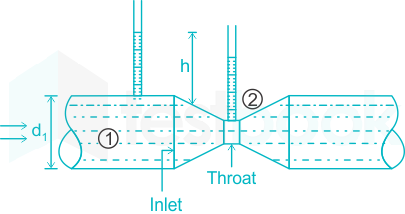
A venturimeter having a throat diameter of 0.1 m is used to estimate the flow rate of a horizontal pipe having a diameter of 0.2 m. For an observed pressure difference of 2 m of water head and coefficient of discharge equal to unity, assuming that the energy losses are negligible, the flow rate (in m3/s) through the pipe is approximately equal to

  1. ((a))

    0.500

  2. ((b))

    0.150

  3. ((c))

    0.050

  4. ((d))

    0.015

Show Answer
Answer: ((c))

0.050

Concept:

Venturimeter:

A venturimeter is the device used for measuring the rate of a flow of a fluid flowing through a pipe. It consists of three parts

(a) A short converging part, (b) Throat, and (c)  Diverging part

It is based on the principle of Bernoulli’s equation

The expression for the rate of flow throw venturimeter

\({{\rm{Q}}{{\rm{act}}}} = {{\rm{C}}{\rm{d}}} \times \frac{{{{\rm{a}}_1}{{\rm{a}}_2}}}{{\sqrt {{\rm{a}}_1^2 - {\rm{a}}_2^2} }} \times \sqrt {2{\rm{gh}}} \)

Where,

a1 and a2 = Area at section 1 and 2 respectively

Cd = Co-efficient of venturimeter and its value is less than 1

h = Difference of pressure head

Calculation:

Given,

d1 = Diameter at section 1 = 0.2 m

d2 = Diameter at section 2 = 0.1 m

h = 2 m, Cd = 1, g = 9.81 m/sec2

a1=π4×(0.2)2=0.0314;m2{{\rm{a}}_1} = \frac{{\rm{\pi }}}{4} \times {\left( {0.2} \right)^2} = 0.0314{\rm{;}}{{\rm{m}}^2}

a2=π4×(0.1)2=0.0078;m2{{\rm{a}}_2} = \frac{{\rm{\pi }}}{4} \times {\left( {0.1} \right)^2} = 0.0078{\rm{;}}{{\rm{m}}^2}

\({{\rm{Q}}{{\rm{act}}}} = {{\rm{C}}{\rm{d}}} \times \frac{{{{\rm{a}}_1}{{\rm{a}}_2}}}{{\sqrt {{\rm{a}}_1^2 - {\rm{a}}_2^2} }} \times \sqrt {2{\rm{gh}}} \)

Qact=1×0.0314×0.0078(0.0314)2(0.0078)2×2×9.81×2{{\rm{Q}}_{{\rm{act}}}} = 1 \times \frac{{0.0314 \times 0.0078}}{{\sqrt {{{\left( {0.0314} \right)}^2} - {{\left( {0.0078} \right)}^2}} }} \times \sqrt {2 \times 9.81 \times 2}

Qact = 0.050 m3/sec

Important point:

The expression for the rate of flow throw orifice meter

\({{\rm{Q}}{{\rm{act}}}} = {{\rm{C}}{\rm{d}}} \times \frac{{{{\rm{a}}_0}{{\rm{a}}_1}}}{{\sqrt {{\rm{a}}_1^2 - {\rm{a}}_0^2} }} \times \sqrt {2{\rm{gh}}} \)

Where,

Cd = Coeffecient of discharge for orifice meter

The Cd for orifice meter is much smaller than the venturimeter

53

A rectangular channel of 2.5 m width is carrying a discharge of 4 m3/s. Considering that acceleration due to gravity as 9.81 m/s2, the velocity of flow (in m/s) corresponding to the critical depth (at which the specific energy is minimum) is _______

  1. ((a))

    1.5

  2. ((b))

    0.5

  3. ((c))

    2.5

  4. ((d))

    1

Show Answer
Answer: ((c))

2.5

Concept:

Critical flow analysis:

  1. Specific energy is minimum for a given discharge.

  2. Specific force is minimum for a given discharge.

  3. Discharge is maximum for a given specific energy.

  4. Discharge is maximum for a given specific force.

  5. Froude number = Fr = 1

  6. Velocity head is equal to half of hydraulic depth, V22g=D2\frac{{{{\rm{V}}^2}}}{{2{\rm{g}}}} = \frac{{\rm{D}}}{2}

Relations for critical flow:

General equation valid for critical flow of any shape of channel

Q2TgA3=Fr2\frac{{{{\rm{Q}}^2}{\rm{T}}}}{{{\rm{g}}{{\rm{A}}^3}}} = {\rm{F}}_{\rm{r}}^2

For critical flow in reactangular channel

Yc=critical;depth=(Q2gb2)13{{\rm{Y}}_{\rm{c}}} = {\rm{critical;depth}} = {\left( {\frac{{{{\rm{Q}}^2}}}{{{\rm{g}}{{\rm{b}}^2}}}} \right)^{\frac{1}{3}}}

\({{\rm{E}}{\rm{c}}} = {\rm{Specific;energy}} = \frac{3}{2} × {{\rm{Y}}{\rm{c}}}\)

Calculation:

Given,

b = Width of channel = 2.5 m

Q = Discharge = 4 m3/sec

g = 9.81 m/sec2

Yc=(Q2gb2)13{{\rm{Y}}_{\rm{c}}} = {\left( {\frac{{{{\rm{Q}}^2}}}{{{\rm{g}}{{\rm{b}}^2}}}} \right)^{\frac{1}{3}}}

Yc=(429.81×2.52)13{{\rm{Y}}_{\rm{c}}} = {\left( {\frac{{{{\rm{4}}^2}}}{{{\rm{9.81× }}{{\rm{2.5}}^2}}}} \right)^{\frac{1}{3}}}

Yc = 0.64 m

Now,

Q = A × Vc

Vc=QA=4B×Yc=42.5×0.64=2.5;m/sec{\rm{V_c}} = \frac{{\rm{Q}}}{{\rm{A}}} = \frac{4}{{{\rm{B}} \times {{\rm{Y}}_{\rm{c}}}}} = \frac{4}{{2.5 \times 0.64}} = 2.5{\rm{;m}}/{\rm{sec}}

Hence the velocity of flow corresponding to critical depth = 2.5 m/sec

Important point:

For critical flow in parabolic channel

Yc=(27Q28gB)1/4{Y_c} = {\left( {\frac{{27{Q^2}}}{{8gB}}} \right)^{1/4}}

\({{\rm{E}}{\rm{c}}} = {\rm{Specific;energy}} = \frac{4}{3} × {{\rm{Y}}{\rm{c}}}\)

For critical flow in triangular channel

Yc=critical;depth=(2Q2gm2)15{{\rm{Y}}_{\rm{c}}} = {\rm{critical;depth}} = {\left( {\frac{{{{\rm{2Q}}^2}}}{{{\rm{g}}{{\rm{m}}^2}}}} \right)^{\frac{1}{5}}}

\({{\rm{E}}{\rm{c}}} = {\rm{Specific;energy}} = \frac{5}{4} × {{\rm{Y}}{\rm{c}}}\)

54

Irrigation water is to be provided to a crop in a field to bring the moisture content of the soil from the existing 18% to the field capacity of the soil at 28%. The effective root zone of the crop is 70 cm. If the densities of the soil and water are 1.3 g/cm3 and 1.0 g/cm3 respectively, the depth of irrigation water (in mm) required for irrigating the crop is ________

  1. ((a))

    9.1

  2. ((b))

    8.1

  3. ((c))

    7.1

  4. ((d))

    None of the above

Show Answer
Answer: ((d))

None of the above

Concept:

Field Capacity (F.C):

It is the amount of water held in the soil after excess water gets drained off to gravity and rate of downward movement has decreased.

In medium textured soil, F.C is about 50% of pore volume.

Soil moisture tension at F.C ranges between one-tenth to one-third atmosphere.

Permanent Wilting Point (P.W.P):

Water content at which plant is no longer able to extract water from the soil for its growth.

Soil moisture tension at P.W.P ranges between 7 to 32 atmosphere.

Depth of irrigation water (dw):

dW = G × d × (F.C – P.W.P)

where,

d = Effective root zone of the crop

\({\rm{G}} = {\rm{Specific;gravity;of;soil}} = \frac{{{{\rm{\gamma }}{\rm{d}}}}}{{{{\rm{\gamma }}{\rm{w}}}}}\)

Calculation:

Given,

F.C = 28% = 0.28, P.W.P = 18% = 0.18, d = 70 cm

γd = 1.3 g/cm3, γw = 1.0 g/cm3

∴ G = 1.3/1 = 1.3

dW = G × d × (F.C – P.W.P)

dW = 1.3 × 70 × (0.28 – 0.18)

dW = 9.1 cm 

We got dw = 9.1 cm, but we want answer in mm, therefore dw = 91 mm

But we have no such option, therefore answer is none of the above

55

With reference to a standard Cartesian (x, y) plane, the parabolic velocity distribution profile of fully developed laminar flow in x-direction between two parallel, stationary and identical plates that are separated by distance, h, is given by the expression 

U=h28μdpdx[14(yh)2]{{U}} = {\rm{}} - \frac{{{{{h}}^2}}}{{8{{\mu }}}}\frac{{{{dp}}}}{{{{dx}}}}\left[ {1 - 4{{\left( {\frac{{{y}}}{{{h}}}} \right)}^2}} \right]

In this equation, the y = 0 axis lies equidistant between the plates at a distance h/2 from the two plates, p is the pressure variable and µ is the dynamic viscosity term. The maximum and average velocities are, respectively

  1. ((a))

    \({{\rm{U}}{{\rm{max}}}} = - \frac{{{{\rm{h}}^2}}}{{8{\rm{\mu }}}}\frac{{{\rm{dp}}}}{{{\rm{dx}}}}\) and \({{\rm{U}}{{\rm{avg}}}} = \frac{2}{3}{{\rm{U}}_{{\rm{max}}}}\)

  2. ((b))

    \( {{\rm{U}}{{\rm{max}}}} = \frac{{{{\rm{h}}^2}}}{{8{\rm{\mu }}}}\frac{{{\rm{dp}}}}{{{\rm{dx}}}}\) and \({{\rm{U}}{{\rm{avg}}}} = \frac{2}{3}{{\rm{U}}_{{\rm{max}}}}\)

  3. ((c))

    \({{\rm{U}}{{\rm{max}}}} = - \frac{{{{\rm{h}}^2}}}{{8{\rm{\mu }}}}\frac{{{\rm{dp}}}}{{{\rm{dx}}}}\) and \({{\rm{U}}{{\rm{avg}}}} = \frac{3}{8}{{\rm{U}}_{{\rm{max}}}}\)

  4. ((d))

    \( {{\rm{U}}{{\rm{max}}}} = \frac{{{{\rm{h}}^2}}}{{8{\rm{\mu }}}}\frac{{{\rm{dp}}}}{{{\rm{dx}}}}\) and \({{\rm{U}}{{\rm{avg}}}} = \frac{3}{8}{{\rm{U}}_{{\rm{max}}}}\)

Show Answer
Answer: ((a))

\({{\rm{U}}{{\rm{max}}}} = - \frac{{{{\rm{h}}^2}}}{{8{\rm{\mu }}}}\frac{{{\rm{dp}}}}{{{\rm{dx}}}}\) and \({{\rm{U}}{{\rm{avg}}}} = \frac{2}{3}{{\rm{U}}_{{\rm{max}}}}\)

Given

U=;h28μdpdx[14(yh)2]{\rm{U}} = {\rm{;}} - \frac{{{{\rm{h}}^2}}}{{8{\rm{\mu }}}}\frac{{{\rm{dp}}}}{{{\rm{dx}}}}\left[ {1 - 4{{\left( {\frac{{\rm{y}}}{{\rm{h}}}} \right)}^2}} \right]

The maximum velocity occurs at y = 0

Umax=;h28μdpdx[14(0h)2]\therefore {{\rm{U}}_{{\rm{max}}}} = {\rm{;}} - \frac{{{{\rm{h}}^2}}}{{8{\rm{\mu }}}}\frac{{{\rm{dp}}}}{{{\rm{dx}}}}\left[ {1 - 4{{\left( {\frac{0}{{\rm{h}}}} \right)}^2}} \right]

Umax=;h28μdpdx\therefore {{\rm{U}}_{{\rm{max}}}} = {\rm{;}} - \frac{{{{\rm{h}}^2}}}{{8{\rm{\mu }}}}\frac{{{\rm{dp}}}}{{{\rm{dx}}}}

The average velocity is given by,

\({{\rm{U}}{{\rm{avg}}}} = \frac{{\rm{Q}}}{{\rm{A}}} = \frac{{\smallint {\rm{U}}.{\rm{dA}}}}{{\rm{A}}} = \frac{{\smallint {{\rm{U}}{{\rm{max}}}}\left( {1 - 4\frac{{{{\rm{y}}^2}}}{{{{\rm{h}}^2}}}} \right){\rm{dA}}}}{{\rm{A}}}\)

\({{\rm{U}}{{\rm{avg}}}} = \frac{{2\mathop \smallint \nolimits_0^{\frac{h}{2}} {{\rm{U}}{{\rm{max}}}}\left( {1 - 4\frac{{{{\rm{y}}^2}}}{{{{\rm{h}}^2}}}} \right){\rm{dy}} \times 1}}{{{\rm{h}} \times 1}}\)

\({{\rm{U}}{{\rm{avg}}}} = \frac{{2{{\rm{U}}{{\rm{max}}}}}}{{\rm{h}}}\left[ {{\rm{y}} - \frac{{4{{\rm{y}}^3}}}{{3{{\rm{h}}^2}}}} \right]_0^{\frac{{\rm{h}}}{2}}\)

\({{\rm{U}}{{\rm{avg}}}} = \frac{{2{{\rm{U}}{{\rm{max}}}}}}{{\rm{h}}}\left[ {\frac{{\rm{h}}}{2} - \frac{{4{{\rm{h}}^3}}}{{24{{\rm{h}}^2}}}} \right]\)

\({{\rm{U}}{{\rm{avg}}}} = \frac{2}{3}{{\rm{U}}{{\rm{max}}}}\)

56

A suspension of sand like particles in water with particles of diameter 0.10 mm and below is flowing into a settling tank at 0.10 m3/s. Assume g = 9.81 m/s2 , specific gravity of particles = 2.65, and kinematic vescosity of water = 1.0105 x 10⁻² cm2/s. The minimum surface area (in m2) required for this settling tank to remove particles of size 0.06 mm and above with 100% efficiency is_________

  1. ((a))

    30.21

  2. ((b))

    31.21

  3. ((c))

    32.21

  4. ((d))

    33.21

Show Answer
Answer: ((b))

31.21

Concept:

Settling velocity:

The settling velocity of discrete particles can be determined using appropriate Stokes equation depending on Reynolds number

By Stokes law,

Vs=g(G1)d218ν{{\rm{V}}_{\rm{s}}} = \frac{{{\rm{g}}\left( {{\rm{G}} - 1} \right){{\rm{d}}^2}}}{{18{\rm{\nu }}}}

Where,

G = Specific gravity of particles, d = Diameter of particle

ν = Kinematic viscosity

Stokes law holds good for Reynolds number, Re < 1

Calculation:

Given,

d = 0.06 mm, g = 9.81 m/s2, Q = 0.1 m3/sec

G = 2.65, ν = 1.0105 × 10⁻² cm2/sec = 1.0105 × 10⁻⁶ m2/sec

Vs=g(G1)d218ν{{\rm{V}}_{\rm{s}}} = \frac{{{\rm{g}}\left( {{\rm{G}} - 1} \right){{\rm{d}}^2}}}{{18{\rm{\nu }}}}

Vs=9.81×(2.651)(0.06×10³)218×1.0105×106{{\rm{V}}_{\rm{s}}} = \frac{{9.81 \times \left( {2.65 - 1} \right){{\left( {0.06 \times {{10}^{ - 3}}} \right)}^2}}}{{18 \times 1.0105 \times {{10}^{ - 6}}}}

VS = 3.20 × 10⁻³ m/sec

Surface;area=A=QVs=0.13.2×103=31.25;m2{\rm{Surface;area}} = {\rm{A}} = \frac{{\rm{Q}}}{{{{\rm{V}}_{\rm{s}}}}} = \frac{{0.1}}{{3.2 \times {{10}^{ - 3}}}} = 31.25{\rm{;}}{{\rm{m}}^2}

Hence the minimum surface area required to remove particles of diameter 0.06 mm = 31.25 m2

57

A surface water treatment plant operates round the clock with a flow rate of 35 m3/min. The water temperature is 15°C and jar testing indicated an alum dosage of 25 mg/l with flocculation at a Gt value of 4×10⁴ producing optimal results. The alum quantity required for 30 days (in kg) of operation of the plant is ____________

  1. ((a))

    378

  2. ((b))

    3780

  3. ((c))

    37800

  4. ((d))

    378000

Show Answer
Answer: ((c))

37800

Concept:

Aluminium sulphate (Alum):

  1. Alum is a universal coagulant. It is a very economical and cheap chemical compound.

  2. Alum produces effective floc in the water when the pH of water is between 6.5 to 8.5.

  3. Besides acting as a coagulant it also removes colour, odour and improves the taste of water.

  4. But it requires sufficient amount of alkalinity in water to produce floc and it also imparts non- carbonaceous hardness in water and thus water becomes corrosive.

Calculating any quantity in kg:

Quantity;(kg)=Flow;rate;(litreday)×No;of;days×Dosage;of;compound(kglitre){\rm{Quantity;}}\left( {{\rm{kg}}} \right) = {\rm{Flow;rate;}}\left( {\frac{{{\rm{litre}}}}{{{\rm{day}}}}} \right) \times {\rm{No;of;days}} \times {\rm{Dosage;of;compound}}\left( {\frac{{{\rm{kg}}}}{{{\rm{litre}}}}} \right)

Calculation:

Given,

Q = Flow rate = 35 m3/min

∴ Q (litre/day) = 35 × 103 × 60 × 24

Alum dosage = 25 mg/litre

∴ Dosage (kg/litre) = 25 × 10-6 kg/litre

Quantity;(kg)=Flow;rate;(litreday)×No;of;days×Dosage;of;compound(kglitre){\rm{Quantity;}}\left( {{\rm{kg}}} \right) = {\rm{Flow;rate;}}\left( {\frac{{{\rm{litre}}}}{{{\rm{day}}}}} \right) \times {\rm{No;of;days}} \times {\rm{Dosage;of;compound}}\left( {\frac{{{\rm{kg}}}}{{{\rm{litre}}}}} \right)

Quantity;(kg)=35×103×60×24×30×25×106{\rm{Quantity;}}\left( {{\rm{kg}}} \right) = 35 \times {10^3} \times 60 \times 24 \times 30 \times 25 \times {10^{ - 6}}

Quantity in kg = 37800 kg

∴ The quantity of alum required for 30 days operation of plant = 37800 kg

58

An effluent of a flow rate of 2670 m3/day from a sewage treatment plant is to be disinfected. The laboratory data of disinfection studies with a chlorine dosage of 15 mg/litre yield the model Nt = No e(-0.145t) where Nt = Number of organisms remained at any time t (in 'min')and No = Number of initial organisms at time t = 0. The volume of disinfection unit (in m3) required to achieve a 98 % kill of micro-organisms is ______________

  1. ((a))

    35

  2. ((b))

    50

  3. ((c))

    45

  4. ((d))

    85

Show Answer
Answer: ((b))

50

Concept:

Chick’s law for disinfection:

\({{\rm{N}}{\rm{t}}} = {{\rm{N}}{\rm{o}}}{{\rm{e}}^{ - {\rm{Kt}}}}\)

Where,

Nt = Number of organisms remained at any time t

No = Number of initial organisms at time t = 0

K = Disinfection rate constant

t = Contact time or detention time or time of exposure

Calculation:

Given,

To achieve a 98% kill of micro-organisms,

Effluent flow rate = Q = 2670 m3/day

Chlorine dosage = 15 mg/litre

\({{\rm{N}}{\rm{t}}} = {{\rm{N}}{\rm{o}}}{{\rm{e}}^{ - 0.145{\rm{t}}}}\)

Now, to achieve a kill of 98% micro-organisms that means 2% organisms are alive and at time t = 0 there will be 100% micro-orgainsms alive.

∴ Nt = 2% = 0.02 and No = 100% = 1

0.02=1×e0.145t0.02 = 1 \times {{\rm{e}}^{ - 0.145{\rm{t}}}}

loge0.02=0.145×t×logee{\log _{\rm{e}}}0.02 = - 0.145 \times {\rm{t}} \times {\log _{\rm{e}}}{\rm{e}}

∴ t = 26.98 min

Now we know that

Q=Volumetime;{\rm{Q}} = \frac{{{\rm{Volume}}}}{{{\rm{time}}}}{\rm{;}}

∴ Volume = Q × t

 Volume=2670×26.9824×60=50.02;m350;m3{\rm{Volume}} = 2670 \times \frac{{26.98}}{{24 \times 60}} = 50.02{\rm{;}}{{\rm{m}}^3} \approx 50{\rm{;}}{{\rm{m}}^3}

The volume of the disinfection unit required to achieve a 98% kill of micro-organisms = 50.02 m3

Important point:

The percentage removal of micro-organisms

\({\rm{% ;Removal}} = \frac{{{{\rm{N}}{\rm{o}}} - {{\rm{N}}{\rm{t}}}}}{{{{\rm{N}}_{\rm{o}}}}} \times 100\)

The relation between the dose of disinfectant ‘C’ and contact time ‘t’

Cnt = constant

Where n = Dilution factor

59

A waste water stream (flow = 2 m3/sec, ultimate BOD = 90 mg/litre) is joining a small river (flow = 12 m3/s, ultimate BOD = 5 mg/litre). Both water streams get mixed up instantaneously. Cross-sectional area of the river is 50 m2. Assuming the de-oxygenation rate constant, K = 0.25/day the BOD (in mg/litre) of the river water, 10 km downstream of the mixing point is

  1. ((a))

    1.68

  2. ((b))

    12.63

  3. ((c))

    15.46

  4. ((d))

    1.37

Show Answer
Answer: ((c))

15.46

Concept:

Biochemical oxygen demand (BOD):

BOD is defined as amount of oxygen demanded by the micro-organisms C5H7NO2 (Bacteria) present in it to decompose biodegradable organic matter in wastewater under aerobic conditions.

BOD is measure of strength of waste water

5 day BOD @ 20°c = [(DO) I - (DO) F] × D.F

(DO) I = Initial dissolved oxygen

(DO) F = Final dissolved oxygen

D.F = Dilution factor

D.F=300Vs=100%dilution{\rm{D}}.{\rm{F}} = \frac{{300}}{{{{\rm{V}}_{\rm{s}}}}} = \frac{{100}}{{{\rm{\% dilution}}}}

\({\rm{D}}{{\rm{O}}{{\rm{initial}}}} = \frac{{{{\rm{Q}}{\rm{S}}}{{\left( {{\rm{DO}}} \right)}{\rm{S}}} + {{\rm{Q}}{\rm{R}}}{{\left( {{\rm{DO}}} \right)}{\rm{R}}}}}{{{{\rm{Q}}{\rm{S}}} + {{\rm{Q}}_{\rm{R}}}}}\)

QS and QR is flow of water in stream and river respectively

(DO)S and (D)R is dissolved oxygen in stream and river respectively

Expression for BOD

Lo = Initial organic matter in waste water at time t =0

Lt = Organic matter remained in wastewater at any time t

Lo – Lt = Organic matter removed in time t

\({{\rm{L}}{\rm{t}}} = {{\rm{L}}{\rm{o}}}{{\rm{e}}^{ - {\rm{Kt}}}}\)

Where

K = BOD rate constant

Calculation:

Given,

QS = 2 m3/sec, (BOD)s = 90 mg/litre

QR = 12 m3/sec, (BOD)R = 5 mg/litre

Area = 50 m2, K = 0.25/day

Distance of downstream = 10 km

\({\rm{BO}}{{\rm{D}}{{\rm{mix}}}} = \frac{{{{\rm{Q}}{\rm{S}}}{{\left( {{\rm{BOD}}} \right)}{\rm{S}}} + {{\rm{Q}}{\rm{R}}}{{\left( {{\rm{BOD}}} \right)}{\rm{R}}}}}{{{{\rm{Q}}{\rm{S}}} + {{\rm{Q}}_{\rm{R}}}}}\)

BODmix=(2×90)+(12×5)2+12=17.14;mg/lit{\rm{BO}}{{\rm{D}}_{{\rm{mix}}}} = \frac{{\left( {2 \times 90} \right) + \left( {12 \times 5} \right)}}{{2 + 12}} = 17.14{\rm{;mg}}/{\rm{lit}}

Now we know that

Velocity=QmixA=2+1250=0.28;m3{\rm{Velocity}} = \frac{{{{\rm{Q}}_{{\rm{mix}}}}}}{{\rm{A}}} = \frac{{2 + 12}}{{50}} = 0.28{\rm{;}}{{\rm{m}}^3}

Time;taken;to;travel;10;km;distance;=Distancevelocity=100000.28=35714.28;sec=0.41;days{\rm{Time;taken;to;travel;}}10{\rm{;km;distance;}} = \frac{{{\rm{Distance}}}}{{{\rm{velocity}}}} = \frac{{10000}}{{0.28}} = 35714.28{\rm{;sec}} = 0.41{\rm{;days}}

\({{\rm{L}}{\rm{t}}} = {{\rm{L}}{\rm{o}}}{{\rm{e}}^{ - {\rm{Kt}}}}\)

Lt=17.14×e0.25×0.41=15.46;mg/litre{{\rm{L}}_{\rm{t}}} = 17.14 \times {{\rm{e}}^{ - 0.25 \times 0.41}} = 15.46{\rm{;mg}}/{\rm{litre}}

Hence the BOD of river water, 10 km downstream of the mixing point = 15.46 mg/litre

60

In a Marshall sample, the bulk specific gravity of mix and aggregates are 2.324 and 2.546 respectively. The sample includes 5% of bitumen (by total weight of mix) of specific gravity 1.10. The theoretical maximum specific gravity of mix is 2.441. The void filled with the bitumen (VFB) in the Marshall sample (in %) is _______

61

A student riding a bicycle on a 5 km one-way street takes 40 minutes to reach home. The student stopped for 15 minutes during this ride. 60 vehicles overtook the student (assume the number of vehicles overtaken by the student is zero) during the ride and 45 vehicles while the student stopped. The speed of vehicle stream on that road (in km/hr) is

  1. ((a))

    7.5

  2. ((b))

    12

  3. ((c))

    40

  4. ((d))

    60

Show Answer
Answer: ((d))

60

Concept:

Moving observer method:

Moving car or moving observer method of traffic stream measurement has been developed to provide simultaneous measurement of traffic stream variables. It has the advantage of obtaining the complete state with just three observers and a vehicle.

The mean speed by moving the observer method is given as follows

\({{\rm{V}}{\rm{s}}} = \frac{{\rm{L}}}{{{{\rm{t}}{\rm{w}}} - \frac{{{{\rm{m}}_{\rm{w}}}}}{{\rm{q}}}}}\)

tw = Observation time when the observer is moving with the stream

mw = Net vehicles overtake the observer when it is moving with the stream

q = Flow density when the observer is at rest in vehicles/min

Calculation:

Total time taken by the student to reach home = 40 min

Student’s stop time = 15 min

∴ tw = 40 – 15 = 25 min = 0.416 hr

L = 5 km

q=45;vehicles15;min=3vehminute=180;veh/hr{\rm{q}} = \frac{{45{\rm{;vehicles}}}}{{15{\rm{;min}}}} = 3\frac{{{\rm{veh}}}}{{{\rm{minute}}}} = 180{\rm{;veh}}/{\rm{hr}}

mw = 60 vehicles

\({{\rm{V}}{\rm{s}}} = \frac{{\rm{L}}}{{{{\rm{t}}{\rm{w}}} - \frac{{{{\rm{m}}_{\rm{w}}}}}{{\rm{q}}}}}\)

Vs=50.41660180=60.48;km/hr{{\rm{V}}_{\rm{s}}} = \frac{5}{{0.416 - \frac{{60}}{{180}}}} = 60.48{\rm{;km}}/{\rm{hr}}

Hence the speed of vehicle stream = 60 km/hr

62

On a section of a highway the speed-density relationship is linear and is given by V=[8023K]{\rm{V}} = \left[ {80 - \frac{2}{3}{\rm{K}}} \right]; where v is in km/h and k is in veh/km. The capacity (in veh/h) of this section of the highway would be

  1. ((a))

    1200

  2. ((b))

    2400

  3. ((c))

    4800

  4. ((d))

    9600

Show Answer
Answer: ((b))

2400

Concept:

Traffic density (K):

The number of vehicles occupying a unit length of road at a given instant.

It is expressed in vehicles/km

Traffic volume (q):

The number of vehicles occupying moving in a specified direction on a given road during specified.

It is expressed in vehicles/hr or vehicle/day

Traffic capacity (C):

It is the ability of road to accommodate traffic volume

C=1000×VS{\rm{C}} = \frac{{1000 × {\rm{V}}}}{{\rm{S}}}

where S = Average center to center spacing of a vehicle

It is expressed in vehicles/hr/road

The relation between traffic volume, traffic density and speed is given by

q = K × V

Capacity flow or maximum flow (qmax):

\({{\rm{q}}{{\rm{max}}}} = \frac{{{{\rm{V}}{\rm{f}}} × {{\rm{K}}_{\rm{j}}}}}{4}\)

Where,

Vf = Free mean speed i.e maximum speed at zero density

Kj = Jam density i.e maximum density at zero speed

Calculation:

Given,

V=[8023K]{\rm{V}} = \left[ {80 - \frac{2}{3}{\rm{K}}} \right]

Kj is at V = 0

∴ 0=[8023Kj]{\rm{0}} = \left[ {80 - \frac{2}{3}{\rm{K_j}}} \right]

∴ Kj = 120 veh/km

Vf is at K = 0

∴ Vf=[8023×0]{{\rm{V}}_{\rm{f}}} = \left[ {80 - \frac{2}{3} \times {\rm{0}}} \right]

∴ Vf = 80 km/hr

qmax=80×1204=2400{{\rm{q}}_{{\rm{max}}}} = \frac{{{\rm{80}} × {{\rm{120}}}}}{4} =2400

∴ Capacity on this section of highway would be 2400 veh/hr

63

A pre-timed four-phase signal has a critical lane flow rate for the first three phases as 200, 187 and 210 veh/hr with a saturation flow rate of 1800 veh/hr/lane for all phases. The lost time is given as 4 seconds for each phase. If the cycle length is 60 seconds, the effective green time (in seconds) of the fourth phase is ______________

  1. ((a))

    15.74

  2. ((b))

    15.84

  3. ((c))

    15.64

  4. ((d))

    15.94

Show Answer
Answer: ((a))

15.74

Concept:

Webster’s method for an optimum cycle time of a signal is given by

Co=1.5L + 51  Y{{\rm{C}}_{\rm{o}}}{\rm{ = }}\frac{{{\rm{1}}{\rm{.5L\ +\ 5}}}}{{{\rm{1\ -\ Y}}}}

Effective green time on ith lane

\({{\rm{G}}{\rm{i}}}{\rm{ = }}\frac{{{{\rm{Y}}{\rm{i}}}}}{{\rm{Y}}}{\rm{ × }}\left( {{{\rm{C}}_{\rm{o}}}{\rm{ - L}}} \right)\)

L = Lost time per cycle = 2N + R

N = Number of phase = Number of independent movements

R = All red time

Y = Sum of the ratios of normal to saturated flows

Y = Y1 + Y2 + Y3

Where,

Y1=q1s1{{\rm{Y}}_1} = \frac{{{{\rm{q}}_1}}}{{{{\rm{s}}_1}}}Y2=q2s2{{\rm{Y}}_2} = \frac{{{{\rm{q}}_2}}}{{{{\rm{s}}_2}}} and Y3=q3s3{{\rm{Y}}_3} = \frac{{{{\rm{q}}_3}}}{{{{\rm{s}}_3}}}

q1, q2 and q3 is normal flow in phase 1, 2 and 3 respectively

s1, s2 and s3 is saturated flow in phase 1, 2 and 3 respectively

Calculation:

Given,

q1 = 200 veh/hr, q2 = 187 veh/hr and q3 = 210 veh/hr

s = s1 = s2 = s3 = 1800 veh/hr/lane 

L = Total lost time = 4 × 4 = 16 seconds

Co = 60 seconds

Y = Y1 + Y2 + Y3 + Y4

Y=q1s1+q2s2+q3s3+Y4{\rm{Y}} = \frac{{{{\rm{q}}_1}}}{{{{\rm{s}}_1}}} + \frac{{{{\rm{q}}_2}}}{{{{\rm{s}}_2}}} + \frac{{{{\rm{q}}_3}}}{{{{\rm{s}}_3}}} + {Y_4}

Y=2001800+1871800+2101800+Y4{\rm{Y}} = \frac{{200}}{{1800}} + \frac{{187}}{{1800}} + \frac{{210}}{{1800}} + {Y_4}

Y = 0.332 + Y4

Now

Co=1.5L + 51  Y{{\rm{C}}_{\rm{o}}}{\rm{ = }}\frac{{{\rm{1}}{\rm{.5L\ +\ 5}}}}{{{\rm{1\ -\ Y}}}}

60=1.5×16 + 51  (0.332+Y4){{\rm{60}}}{\rm{ = }}\frac{{{\rm{1}}{\rm{.5× 16\ +\ 5}}}}{{{\rm{1\ -\ (0.332+Y_4)}}}}

Y4 = 0.185

∴ Y = 0.332 + 0.185 = 0.517

Effective green time for 4th phase

\({{\rm{G}}{\rm{4}}}{\rm{ = }}\frac{{{{\rm{Y}}{\rm{4}}}}}{{\rm{Y}}}{\rm{ × }}\left( {{{\rm{C}}_{\rm{o}}}{\rm{ - L}}} \right)\)

G4=0.1850.517×(6016)=15.74{{\rm{G}}_{\rm{4}}}{\rm{ = }}\frac{{{{\rm{0.185}}}}}{{\rm{0.517}}}{\rm{ × }}\left( {{{\rm{60}}}{\rm{ - 16}}} \right) = 15.74

Hence the effective green time for 4th phase = 15.74 seconds

64

A tacheometer was placed at point P to estimate the horizontal distances PQ and PR. The corresponding stadia intercepts with the telescope kept horizontal, are 0.320 m and 0.210 m, respectively. The ∠QPR is measured to be 61°30'30". If the stadia multiplication constant = 100 and stadia addition constant = 0.10 m, the horizontal distance (in m) between the points Q and R is

65

The chainage of the intersection point of two straights is 1585.60 m and the angle of intersection is 140°. If the radius of a circular curve is 600.00 m, the tangent distance (in m) and length of the curve (in m), respectively are 

  1. ((a))

    418.88 and 1466.08

  2. ((b))

    218.38 and 1648.49

  3. ((c))

    218.38 and 418.88

  4. ((d))

    418.88 and 218.38

Show Answer
Answer: ((c))

218.38 and 418.88

Concept:

Length of the curve is given by,

L=πRΔ180{\rm{L}} = \frac{{{\rm{\pi RΔ }}}}{{180}}

Tangent length of the curve is given by,

T=RtanΔ2;{\rm{T}} = {\rm{R}}\tan \frac{{\rm{Δ }}}{2}{\rm{;}}

Where,

Δ = Deviation or deflection angle in degrees

Δ = 180° - Angle of intersection

R = Radius of curve in m

Calculation:

Given,

Angle of intersection = 140° , R = 600 m

∴ Δ = 180° - 140° = 40° 

T=RtanΔ2;{\rm{T}} = {\rm{R}}\tan \frac{{\rm{Δ }}}{2}{\rm{;}}

T=600tan402;=218.3 m{\rm{T}} = {\rm{600}}\tan \frac{{\rm{40}}}{2}{\rm{;}}=218.3 {\rm{\ m}}

L=πRΔ180{\rm{L}} = \frac{{{\rm{\pi RΔ }}}}{{180}}

L=π×600×40180=418.8 m{\rm{L = }}\frac{{{\rm{\pi \times 600 \times 40}}}}{{{\rm{180}}}}{\rm{ = 418}}{\rm{.8\ m}}

Hence the tangent length and the length of the curve is 218.3 m and 418.8 m respectively.

Attempt this paper under real exam conditions

Timed interface, section switching, instant scoring, and question-by-question analytics — free.

Start Timed Attempt