Official Paper

GATE CE 2011 Official Paper (Previous Year Paper)

65 questions · 180 minutes · with answers · free

General Aptitude (10 questions)

1

If Log (P) = (1/2) Log (Q) = (1/3) Log (R), then which of the following options is TRUE?

  1. ((a))

    P= Q3R2

  2. ((b))

    Q= PR

  3. ((c))

    Q= R3P

  4. ((d))

    R = P2Q2

Show Answer
Answer: ((b))

Q= PR

Explanation:

Let Log (P) = (1/2) Log (Q) = (1/3) Log (R) = l

∴ P = 10k, Q = 102k, R = 103k

Now,

Option 1:

P2=Q3R2

(10k)2 = (102k)3 (103k)2 

102k ≠ 1012k

Option 2:

Q2 = PR

104k = (103k)(10k)

104k = 104k

∴Q2 = PR follows the given relation.

Option 3:

Q2 = R3P ⇒ 102k ≠ 107k

Option 4:

R=P2Q2 ⇒ 103k ≠ 106k

∴ Only option(2) is correct.

2

Which of the following options is the closest in the meaning to the word below:

Inexplicable

  1. ((a))

    Incomprehensible

  2. ((b))

    Indelible

  3. ((c))

    Inextricable

  4. ((d))

    Infallible

Show Answer
Answer: ((a))

Incomprehensible

The correct answer is option 1 i.e. Incomprehensible.

Explanation-

Inexplicable means incapable of being explained, interpreted or accounted for. 

  • Incomprehensible: impossible to comprehend: UNINTELLIGIBLE.
  • Indelible: that cannot be removed, washed away, or erased.
  • Inextricable: forming a maze or tangle from which it is impossible to get free
  • Infallible: incapable of error: UNERRING

Inexplicable means not explicable; that cannot be explained, understood, or accounted for. So the best synonym here is incomprehensible.

3

Choose the word from the options given below that is most nearly opposite in meaning to the given word: Amalgamate

  1. ((a))

    Merge

  2. ((b))

    Split

  3. ((c))

    Collect

  4. ((d))

    Separate

Show Answer
Answer: ((b))

Split

The correct answer is option 2 i.e. Split.

Explanation-

Amalgamate means to unite in or as if in an amalgam, let's have a look at all the given options. 

  • Merge: to cause to combine, unite, or coalesce.
  • Split: to divide lengthwise usually along a grain or seam or by layers
  • Collect: to bring together into one body or place
  • Separate:  to set or keep apart: DISCONNECT, SEVER

Amalgamate means to combine or unite to form one organization or structure. So the best option here is split. Separate on the other hand, although a close synonym, it is too general to be the best antonym in the given question while Merge is the synonym; Collect is not related.

4

Choose the most appropriate word from the options given below to complete the following sentence.

If you are trying to make a strong impression on your audience, you cannot do so by being understated, tentative or_____________.

  1. ((a))

    Hyperbolic

  2. ((b))

    Restrained

  3. ((c))

    Argumentative

  4. ((d))

    Indifferent

Show Answer
Answer: ((b))

Restrained

The correct answer is Option 2 i.e Restrained

Explanation:

Reading the above statement we find that:

  • The tone of the sentence clearly indicates a word similar to understated and tentative.
  • The word should also be an antonym of strong.

Let's look at the meaning of the marked option:

  • Restrained: Not excessively showy or ornate; understated and timid.

Hence from the above meaning, we find that restrained is similar in meaning to understated and tentative, and fits perfectly in the give sentence.

Thus, the correct answer is option 2 Restrained.

Additional Information 

Let's look at the meaning of the other given options. 

  • Hyperbolic: Delibrately; or exaggerated.
  • Argumentative: Given to arguing.
  • Indifferent: Having no particular interest; unconcerned.
5

Choose the most appropriate word (s) from the options given below to complete the following sentence.

I contemplated________Singapore for my vacation but decided against it.

  1. ((a))

    to visit

  2. ((b))

    having to visit

  3. ((c))

    visiting

  4. ((d))

    for a visit

Show Answer
Answer: ((c))

visiting

The correct answer is Option 3 i.e visiting 

Explanation:

Reading the given sentence we find that.

  • The word contemplated is a transitive verb.
  • A transitive verb always needs to transfer it's action on to something which is an object.
  • Hence, here after the transitive verb contemplated we need a noun that will be the object.
  • Out of the given options visiting is a gerund. And therefore it grammatically follows the verb contemplated.

Hence the correct answer is Option 3 i.e visiting.

Important Points

  • gerund is an -ing form of verb which acts as a noun.
  • In the above case, we need a noun after the verb contemplated.
  • And the gerund visiting is the appropriate option as it is a verb acting as a noun.
  • Therefore the action of the verb contemplated is transferred to the gerund visiting.

Thus the correct sentence will be: "I contemplated visiting Singapore for my vacation bu decided against it."

6

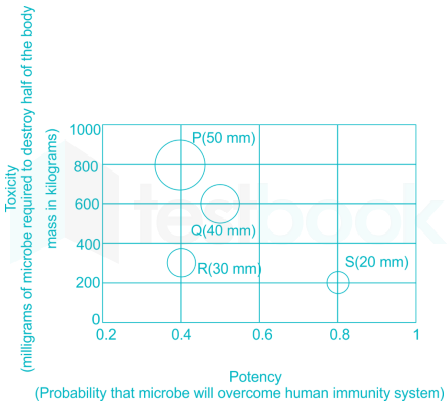
P, Q, R, and S are four types of dangerous microbes recently found in a human habitat. The area of each circle with its diameter printed in brackets represents the growth of a single microbe surviving human immunity system within 24 hours of entering the body. The danger to human beings varies proportionately with the toxicity, potency, and growth attributed to a microbe shown in the figure below.


A pharmaceutical company is contemplating the development of a vaccine against the most dangerous microbe. Which microbe should the company target in its first attempt?

  1. ((a))

    P

  2. ((b))

    Q

  3. ((c))

    R

  4. ((d))

    S

Show Answer
Answer: ((d))

S

Concept:

According to the given information:

Most dangerous microbe ∝ probability that microbe will overcome human immune system.

Most dangerous microbe ∝ area (growth of microbe)

Most dangerous microbe ∝ (quantity required)-1

So,the;most;dangerous;microbe;;Probability;×;AreaQuantity;requiredSo, the;most;dangerous;microbe;\propto;\frac{Probability;\times;Area}{Quantity;required}

So,the;most;dangerous;microbe;=;K;×;Probability;×;AreaQuantity;requiredSo, the;most;dangerous;microbe;=;\frac{K;\times;Probability;\times;Area}{Quantity;required}

So,the;most;dangerous;microbe;=;K;×;Probability;×;πd24;×;Quantity;requiredSo, the;most;dangerous;microbe;=;\frac{K;\times;Probability;\times;\pi{d^2}}{4;\times;Quantity;required}

Calculation:

Given:

For microbe P:

Probability (P) = 0.4, Diameter = 50 mm and Quantity required = 800 milligram of microbe/mass of body in kg.

The;most;dangerous;microbe;=πK4×0.4×502800πK4×54=1.25πK4The;most;dangerous;microbe;=\frac{\pi{K}}{4}\times\frac{0.4\times50^2}{800}\Rightarrow\frac{\pi{K}}{4}\times\frac{5}{4}=1.25\frac{\pi{K}}{4}

For microbe Q:

Probability (Q) = 0.5, Diameter = 40 mm and Quantity required = 600 milligram of microbe/mass of body in kg.

The;most;dangerous;microbe;=πK4×0.5×402600πK4×43=1.33πK4The;most;dangerous;microbe;=\frac{\pi{K}}{4}\times\frac{0.5\times40^2}{600}\Rightarrow\frac{\pi{K}}{4}\times\frac{4}{3}=1.33\frac{\pi{K}}{4}

For microbe R:

Probability (R) = 0.4, Diameter = 30 mm and Quantity required = 300 milligram of microbe/mass of body in kg.

The;most;dangerous;microbe;=πK4×0.4×302300πK4×65=1.2πK4The;most;dangerous;microbe;=\frac{\pi{K}}{4}\times\frac{0.4\times30^2}{300}\Rightarrow\frac{\pi{K}}{4}\times\frac{6}{5}=1.2\frac{\pi{K}}{4}

For microbe S:

Probability (S) = 0.8, Diameter = 20 mm and Quantity required = 200 milligram of microbe/mass of body in kg.

The;most;dangerous;microbe;=πK4×0.8×202200πK4×85=1.6πK4The;most;dangerous;microbe;=\frac{\pi{K}}{4}\times\frac{0.8\times20^2}{200}\Rightarrow\frac{\pi{K}}{4}\times\frac{8}{5}=1.6\frac{\pi{K}}{4}

Microbe S > Microbe Q > Microbe P > Microbe R.

∴ toxicity is more for microbe S and the company should target it in its first attempt.

7

Based on the given passage which topic would not be included in a unit on bereavement?

Few school curricula include a unit on how to deal with bereavement and grief, and yet all students at some point in their lives suffer from losses through death and parting.

  1. ((a))

    how to write a letter of condolence

  2. ((b))

    what emotional stages are passed through in the healing process

  3. ((c))

    what the leading causes of death are

  4. ((d))

    how to give support to a grieving friend

Show Answer
Answer: ((c))

what the leading causes of death are

The correct answer is Option 3 i.e what the leading causes of death are

Explanation:

Reading the above statement we find that.

  • The given sentence starts by stating how to deal with bereavement and grief after a tragedy occurs and not about precautions.
  • Therefore, irrespective of the causes of death, a school student rarely gets into details of causes
  • Hence it is very clear that the leading causes of death are not included in a unit on bereavement.

Hence, the correct answer is option 3 i.e what the leading causes of death are.

8

A container originally contains 10 litres of pure spirit. From this container 1 litre of spirit is replaced with 1 litre of water. Subsequently, 1 litre of the mixture is again replaced with 1 litre of water and this process is repeated one more time. How much spirit is now left in the container?

  1. ((a))

    7.58 litres

  2. ((b))

    7.84 litres

  3. ((c))

    7 litres

  4. ((d))

    7.29 litres

Show Answer
Answer: ((d))

7.29 litres

Concept:

Volume;of;liquid;left=x(x1x)n{\bf{Volume}};{\bf{of}};{\bf{liquid}};{\bf{left}} = {\bf{x}}{\left( {\frac{{{\bf{x}} - 1}}{{\bf{x}}}} \right)^{\bf{n}}}

where x = Original amount of liquid, n = Number of times replaced.

Calculation:

Given:

x = 10 litre, n = 3

Now, we know that

Volume;of;spirit;left=x(x1x)n{\bf{Volume}};{\bf{of}};{\bf{spirit}};{\bf{left}} = {\bf{x}}{\left( {\frac{{{\bf{x}} - 1}}{{\bf{x}}}} \right)^{\bf{n}}}

∴  Volume of spirit left = 10(10110)3=729100=7.2910{\left( {\frac{{10 - 1}}{{10}}} \right)^3} = \frac{{729}}{{100}} = 7.29  litres

9

A transporter receives the same number of orders each day. Currently, he has some pending orders (backlog) to be shipped. If he uses 7 trucks, then at the end of the 4th day he can clear all the orders. Alternatively, if he uses only 3 trucks, then all the orders are cleared at the end of the 10th day. What is the minimum number of trucks required so that there will be no pending order at the end of the 5th day?

  1. ((a))

    4

  2. ((b))

    5

  3. ((c))

    6

  4. ((d))

    7

Show Answer
Answer: ((c))

6

Concept:

The transporter receives the same number of order each day and he currently has pending orders.

Let 'x' be the number of daily orders and 'y' be the number of pending orders.

Calculation:

Given:

Condition I:

Use of 7 trucks each day finishes all orders in 4 days.

∴ total numbers of trucks used = 7 + 7 + 7 + 7 ⇒ 28.

Total orders received in 4 days = 4x.

Pending orders = y.

∴ 4x + y = 28      eq(1).

Condition II:

Use of 3 trucks each day finishes all orders in 10 days.

∴ total numbers of trucks used = 3 × 10 ⇒ 30.

Total orders received in 10 days = 10x.

Pending orders = y.

∴ 10x + y = 30      eq(2).

Solving eq (1) and eq (2).

x = 0.33 ⇒ Daily orders

y = 26.66 ⇒ Pending orders.

Condition III:

Use of 'n' trucks each day finishes all orders in 5 days.

∴ total numbers of trucks used = 5 × n ⇒ 5n.

Total orders received in 5 days = 5x.

Pending orders = y.

∴ 5x + y = 5n   

∴ (5 × 0.33)  + (26.66) = 5n

∴ n = 5.66 ≈ 6

∴ minimum 6 number of trucks required so that there will be no pending order at the end of the 5th day.

10

The variable cost (V) of manufacturing a product varies according to the equation V= 4q, where q is the quantity produced. The fixed cost (F) of production of same product reduces with q according to the equation F = 100/q. How many units should be produced to minimize the total cost (V+F)?

  1. ((a))

    5

  2. ((b))

    4

  3. ((c))

    7

  4. ((d))

    6

Show Answer
Answer: ((a))

5

Concept:

Total cost = Fixed cost + Variable cost

To find maxima and minima of a function y = f(x), follow these steps.

Step 1

Find;dydx,;and;putdydx=0.Find;\frac{{dy}}{{dx}},;and;put\frac{{dy}}{{dx}} = 0.

Find the value of x and this value is said to be the stationary point, this is a necessary condition to find the extremum value of a function.

Step 2

Find;d2ydx2;Find;\frac{{{d^2}y}}{{d{x^2}}};

Check the value at the stationary point obtained in Step 1.

A function f(x) has a maxima at x = a if f’(a) = 0 and f”(a) < 0

A function f(x) has a minima at x = a if f’(a) = 0 and f”(a) > 0

A function f(x) has no maxima and minima at x = a if f’(a) = 0 and f”(a) = 0.

Calculation:

Given:

F = 100/q, V = 4q

Total cost (TC) = Fixed cost + Variable cost

;TC=4q;+;100q∴;TC=4q;+;\frac{100}{q}

Step 1:

d(TC)dq=0\frac{{d(TC)}}{{dq}} = 0

d(TC)dq=4;;100q2\frac{d(TC)}{dq}=4;-;\frac{100}{q^2}

∴ q = ± 5

d2(TC)dq2=+ve;for;minima\frac{{d^2(TC)}}{{dq^2}} =+ve;for;minima

d2(TC)dq2=ve;for;maxima\frac{{d^2(TC)}}{{dq^2}} =-ve;for;maxima

d2(TC)dq2=200q3\frac{d^2(TC)}{dq^2}=\frac{200}{q^3}

At q = 5

d2(TC)dq2=200531.6;;(+ve;,;;minima)\frac{d^2(TC)}{dq^2}=\frac{200}{5^3}\Rightarrow1.6;;(+ve;,;∴;minima)

At q = -5

d2(TC)dq2=200531.6;;(ve;,;;maxima)\frac{d^2(TC)}{dq^2}=\frac{200}{5^3}\Rightarrow-1.6;;(-ve;,;∴;maxima)

∴ at q = 5, Total cost (TC) will be minimum.

Civil Engineering (55 questions)

11

[A] is a square matrix which is neither symmetric nor skew-symmetric and [A]T is its transpose. The sum and difference of these matrices are defined as [S] = [A] + [A]T and [D] = [A] - [A]T, respectively. Which of the following statements is true?

  1. ((a))

    Both [S] and [D] are symmetric

  2. ((b))

    Both[S] and [D] are skew-symmetric

  3. ((c))

    [S] is skew-symmetric and [D] is symmetric

  4. ((d))

    [S] is symmetric and [D] is skew-symmetric

Show Answer
Answer: ((d))

[S] is symmetric and [D] is skew-symmetric

Explanation:

Given,

[A] is a square matrix and it is neither symmetric nor skew-symmetric

Also given,

[AT]T = [A]

[S] = [A] + [A]T , [D] = [A] - [A]T

Lets take  Case (i)

[S]T = ( [A] + [A]T )T = [A]T + A = [S]

So [S] is a Symmetric Matrix

Now Case (ii)

[D]T = ([A] - [A]T)T = [A]T - [AT]T = [A]T - [A] = - ([A] - [A]T) = - [D]

So [D] is skew Symmetric Matrix

12

The square root of a number N is to be obtained by applying the Newton Raphson iterations to the equation x2 - N = 0, if i denotes the iteration index, the correct iterative scheme will be

  1. ((a))

    xi+1 = (xi + N/xi)/2

  2. ((b))

    xi+1 = (x2i + N/x2i)/2

  3. ((c))

    xi+1 = (xi + N2/xi)/2

  4. ((d))

    xi+1 = (xi - N/xi)/2

Show Answer
Answer: ((a))

xi+1 = (xi + N/xi)/2

Explanation:

Given

Now,

f(x) = x2 – N = 0

Differentiating,

f’(x) = 2x

Now,

Using Newton-Raphson Method,

xn+1=xnf(xn)f(xn){x_{n + 1}} = {x_n} - \frac{{f\left( {{x_n}} \right)}}{{f'\left( {{x_n}} \right)}}

xi+1=xi[xi2N]2xi{x_{i + 1}} = {x_i} - \frac{{\left[ {x_i^2 - N} \right]}}{{2x_i}}

xi+1=2xi2xi2+N2xi{x_{i + 1}} = \frac{{2x_i^2 - x_i^2 + N}}{{2x_i}}

xi+1=xi2+N2xi{x_{i + 1}} = \frac{{{x_i}}}{2} + \frac{N}{{2x_i}}

xi+1 = (xi + N/xi)/2

13

There are two containers, with one containing 4 Red and 3 Green balls and the other containing 3 Blue and 4 Green balls. One ball is drawn at random from each container. The probability that one of the balls is Red and the other is Blue will be

  1. ((a))

    1/7

  2. ((b))

    9/49

  3. ((c))

    12/49

  4. ((d))

    3/7

Show Answer
Answer: ((c))

12/49

Explanation:

Given,

There are 2 containers,

Container 1 has ( 4 Red and 3 Green Balls)

Probability of Red = 4/7

Container 2 has ( 3 Blue and 4 Green Balls)

Probability of being blue = 3/7

One Ball is Drawn from each container Randomly

Probability (One Red & another is Blue) = Probability (first is red & Second is Blue) 

= 4/7 x 3/7

= 12/49

14

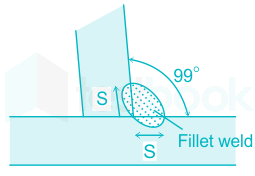
For the fillet weld of size 's' shown in the adjoining figure the effective throat thickness is

  1. ((a))

    0.61 s

  2. ((b))

    0.65 s

  3. ((c))

    0.7 s

  4. ((d))

    0.75 s

Show Answer
Answer: ((b))

0.65 s

Concept:

The value of Effective throat thickness either depends upon K values which depend on the angle between fusion faces or depend upon the size of the weld

Effective throat thickness (tt) = K × Size of the weld (s)

Angle between fusion faces60°-90°91°-100°101°-106°107°-113°114°-120°
Constant, K0.70.650.60.550.5

The angle between fusion faces is 99°, so K = 0.65

Throat Thickness (tt) = 0.65 × s

15

A 16 mm thick plate measuring 650 mm × 420 mm is used as a base plate for an ISHB 300 column subjected to a factored axial compressive load of 2000 kN. As per IS 456: 2000, the minimum grade of concrete that should be used below the base plate for safely carrying the load is:

  1. ((a))

    M15

  2. ((b))

    M20

  3. ((c))

    M30

  4. ((d))

    M40

Show Answer
Answer: ((b))

M20

Working axial load

=Factgored;axial;load1.5 =20001.5=1333.33;kN\begin{array}{l} = \frac{{Factgored;axial;load}}{{1.5}}\ = \frac{{2000}}{{1.5}} = 1333.33;kN \end{array}

The allowable bearing pressure on concrete may be given as

σall=Direct;loadArea;of;base;palte =1333.33×103650×420=4.88;N/mm2\begin{array}{l} {\sigma _{all}} = \frac{{Direct;load}}{{Area;of;base;palte}}\ = \frac{{1333.33 \times {{10}^3}}}{{650 \times 420}} = 4.88;N/m{m^2} \end{array}

The permissible stress in direct compression in various grades of concrete as per IS 456 : 2000 are tabulated below:

GradesM10M15M20M25M30M35M40M45M50
Stress2.54.05.06.08.09.010.011.012.0
<br>

The permissible stress in concrete should be more than the allowable bearing pressure. Thus the minimum grade of concrete which should be used is M 20.

16

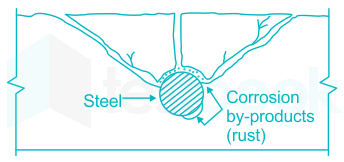
Consider a reinforcing bar embedded in concrete. In a marine environment this bar undergoes uniform corrosion, which leads to the deposition of corrosion products on its surface and an increase in the apparent volume of the bar. This subjects the surrounding concrete to expansive pressure. As a result, corrosion induced cracks appear at the surface of concrete. Which of the following statements is TRUE?

  1. ((a))

    Corrosion causes circumferential tensile stresses in concrete and the cracks will be parallel to the corroded reinforcing bar.

  2. ((b))

    Corrosion causes radial tensile stresses in concrete and the cracks will be parallel to the corroded reinforcing bar.

  3. ((c))

    Corrosion causes circumferential tensile stresses in concrete and the cracks will be perpendicular to the direction of the corroded reinforcing bar

  4. ((d))

    Corrosion causes radial tensile stresses in concrete and the cracks will be perpendicular to the direction of the corroded reinforcing bar

Show Answer
Answer: ((b))

Corrosion causes radial tensile stresses in concrete and the cracks will be parallel to the corroded reinforcing bar.

Concept:

Corrosion of reinforcing steel and other embedded metals is the leading cause of deterioration in concrete. When steel corrodes, the resulting rust occupies a greater volume than the steel. This expansion creates tensile stresses in the concrete, which can eventually cause cracking, delamination, and spalling

Corrosion in steel occupies a volume several times greater than the volume of reinforcing steel hence exerts radial pressure on adjoining concrete layer. Cracks can be seen developing in the radial direction from the reinforcing steel.

The expansion of corroding steel creates tensile stresses in the concrete

17

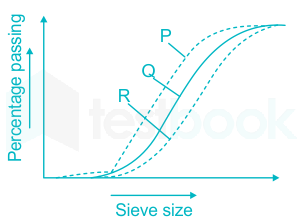
The results for sieve analysis carried out for three types of sand, P, Q, and R, are given in the adjoining figure. If the fineness modulus values of the three sands are given as FMP, FMQ, and FMR, it can be stated that

  1. ((a))

    FMQ=FMP×FMRF{M_Q} = \sqrt {F{M_P} \times F{M_R}}

  2. ((b))

    FMQ= 0.5 (FMP+ FMR)

  3. ((c))

    FMP > FMQ > FMR

  4. ((d))

    FMP < FMQ < FMR

Show Answer
Answer: ((a))

FMQ=FMP×FMRF{M_Q} = \sqrt {F{M_P} \times F{M_R}}

Concept:

Sieve grain analysis is done to classify the coarse-grained soils 

Fineness modulus is basically an Index that defines the coarseness and fineness of the aggregate. It is obtained by adding a cumulative percentage of aggregates retained on each of the standard sieves.

Fineness modulus of Q can be taken as the geometric mean of the fineness modulus of P and R.

FMQ=FMP×FMRF{M_Q} = \sqrt {F{M_P} \times F{M_R}}

18

The cross section of a thermo-mechanically treated (TMT) reinforcing bar has

  1. ((a))

    soft ferrite-pearlite throughout.

  2. ((b))

    hard martensitic throughout.

  3. ((c))

    a soft ferrite-pearlite core with a hard martensitic rim.

  4. ((d))

    a hard martensitic core with a soft pearlite-bainitic rim.

Show Answer
Answer: ((c))

a soft ferrite-pearlite core with a hard martensitic rim.

Concept:

  • The cross section of a thermo mechanically treated (TMT) reinforcing bar has a soft ferrite-pearlite core with a hard martensitic rim.
  • The sudden quenching and drastic change in temperature toughen the outer layer of the steel bar, thus making it super tough and durable.
  • The TMT bars are then subjected to atmospheric cooling to equalise the temperature difference between the inner core and the exterior. Once the TMT bar cools down, it slowly turns into a ferrite-pearlite mass.
  • The inner core remains soft giving the TMT bar tensile strength and ductility.
19

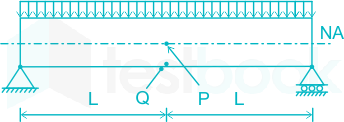
consider a simply supported beam with a uniformly distributed load having a neutral axis (NA) as shown. For points P (on the neutral axis) and Q (at the bottom of the beam) the state of stress is best represented by which of the following pairs?

  1. ((a))

  2. ((b))

  3. ((c))

  4. ((d))

Show Answer
Answer: ((b))

Explanation:

Given

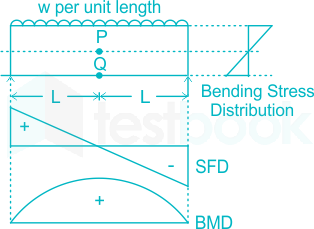
We know the bending stress varies linearly.

Also Along the neutral axis, Bending stress is Zero.

Here as Mentioned Point (P) is at the Centre of  the span and also along the neutral axis

So, it is evident that @ P there is neither Shear force nor Bending stress

As shear force is Zero. There exists no shear stress at Point P

The state of stress can be shown as 

@ Point Q

As mentioned Point Q is on the bottom of the member which is subjected to Tension

As we know when the beam is subjected to downward loading the top portion of fibers (above NA) is subjected to Compression and the bottom fibers (Below NA) are subjected to tension.

At Point Q the Bending stress is maximum (Tension side). Shear Force at Pont Q is also Zero.

So State of stress at point Q can be shown as 

20

For a saturated sand deposit, the void ratio and the specific gravity of solids are 0.70 and 2.67 respectively. The critical (upward) hydraulic gradient for the deposit would be 

  1. ((a))

    0.54

  2. ((b))

    0.98

  3. ((c))

    1.02

  4. ((d))

    1.87

Show Answer
Answer: ((b))

0.98

Concept:

Critical hydraulic gradient (icr): 

The quick condition occurs at a critical upward hydraulic gradient ic when the seepage force just balances the buoyant weight of an element of soil.

The critical hydraulic gradient is typically around 1.0 for many soils.

icr=Gs11+e{i_{cr}} = \frac{{{G_s} - 1}}{{1 + e}}

Gs - Specific gravity of soil solids, e - Void ratio

At the critical hydraulic gradient. the effective stress is equal to zero.

Calculation:

Given, e = 0.7, Gs = 2.67

icr=Gs11+e=2.6711+0.7=0.98\Rightarrow {i_{cr}} = \frac{{{G_s} - 1}}{{1 + e}} = \frac{{2.67 - 1}}{{1 + 0.7}} =0.98

 ∴ The critical hydraulic gradient is 0.98.

21

Likelihood of general shear failure for an isolated footing in sand decreases with

  1. ((a))

    decreasing footing depth

  2. ((b))

    decreasing inter-granular packing of the sand

  3. ((c))

    increasing footing width

  4. ((d))

    decreasing soil grain compressibility

Show Answer
Answer: ((b))

decreasing inter-granular packing of the sand

Explanation:

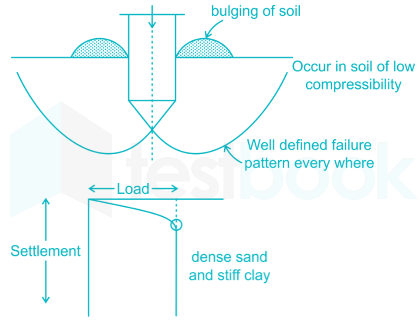
General shear failure

Occur in medium to dense sand and stiff clays and has the following properties:

a) A well – defined failure pattern

b) Sudden, catastrophic failure accompanied by tilting of foundation

c) Bulging of the ground surface adjacent to the foundation.

So if the intergranular packing of sand decreases then the sand will behave as loose sand. Hence likelihood of general shear failure will decrease

This occurs in soils that show brittle – type stress-strain behavior. In this, all 3 zone of failure fully develops.

22

For a sample of dry, cohesionless soil with friction angle ϕ, the failure plane will be inclined to the major principal plane by an angle equal to

  1. ((a))

    ϕ

  2. ((b))

    45°

  3. ((c))

    45° - ϕ/2

  4. ((d))

    45° + ϕ/2

Show Answer
Answer: ((d))

45° + ϕ/2

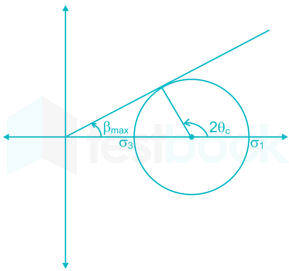
Failure plane is one at which angle of obliquity is maximum. 

Failure shear stress is one at which difference of shear stress and shear strength is minimum.

θc = Angle of the critical plane to the major principal plane

2θc=π2+βmaximum{{\rm{2\theta }}_{\rm{c}}} = \frac{\pi }{2} + {{{\beta _{maximum}}}}{}

θc=π4+βmaximum2{{\rm{\theta }}_{\rm{c}}} = \frac{\pi }{4} + \frac{{{\beta _{maximum}}}}{2}

where, βmax = Angle between resultant stress and normal stress on critical plane = Friction angle of soil = ϕ

23

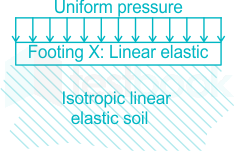
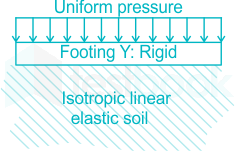
Two geometrically identical isolated footings, X (linear elastic) and Y (rigid), are loaded identically (shown alongside). The soil reactions will

  1. ((a))
    • be uniformly distributed for Y but not for X

  2. ((b))
    • be uniformly distributed for X but not for Y

  3. ((c))
    • be uniformly distributed for both X and Y

  4. ((d))

    not be uniformly distributed for both X and Y

Show Answer
Answer: ((b))
  • be uniformly distributed for X but not for Y

Explanation:

Contact Pressure

Loads from the structure are transferred to the soil through the footing. As a reaction to it, soil exerts upward pressure on the bottom surface of the footing which is termed as contact pressure.

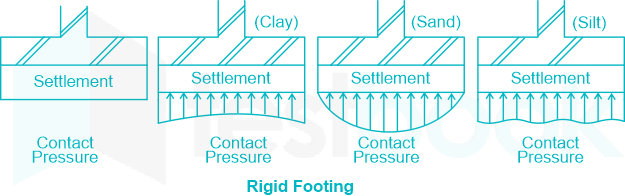
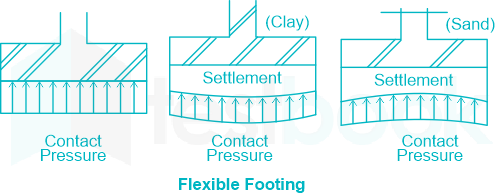
The distribution of contact pressure under different types of footings on different types of soils are given below:

Rigid Footing
Cohesionless soilCohesive soil
Contact pressure - Max at centre and zero at edges Settlement - UniformContact pressure - Min at centre and max at edges Settlement - Uniform
Flexible footing
Contact pressure  Uniform Settlement - Min at centre and Max at edgesContact pressure -Uniform Settlement - Max at centre and Min at edges


For Rigid footing:  Settlement is uniform

For flexible footing:  Contact pressure is uniform.

So For the Given case

In X (Flexible Footing) contact pressure is uniformly distributed.

In Y (Rigid Footing) Contact pressure is not uniformly distributed.

24

A soil is composed of solid spherical grains of identical specific gravity and diameter between 0.075 mm and 0.0075 mm. If the terminal velocity of largest particle falling through water without flocculation is 0.5 mm/sec then, that for the smallest particle would be 

  1. ((a))

    0.005

  2. ((b))

    0.05

  3. ((c))

    5

  4. ((d))

    50

Show Answer
Answer: ((a))

0.005

Concept:

The settling velocity of sand particles is given by Stoke's Law,

Vs=g×(G1)×d218;ν{{\rm{V}}_{\rm{s}}} = \frac{{g \times \left( {G - 1} \right) \times {d^2}}}{{18;ν }}...... (1)

G -Specific gravity of sand particles

ν - Kinematic viscosity

d - Diameter of sand particles

Calculation:

Given:

Let V1 and V2 be settling velocities of larger and smaller grain respectively

V1 = 0.5 mm/sec

Diameter of larger grain d1 = 0.075 mm

Diameter of smaller grain d2 = 0.0075 mm

g is constant, specific gravity identical for both grains, both the particles are falling through water hence ν remains same. Hence equation 1 becomes

⇒ V1V2;=;(d1d2)2\frac{{{V_1}}}{{{V_2}}}; = ;{\left( {\frac{{{d_1}}}{{{d_2}}}} \right)^2}

⇒ 0.5V2;=;(0.0750.0075)2\frac{{{0.5}}}{{{V_2}}}; = ;{\left( {\frac{{{0.075}}}{{{0.0075}}}} \right)^2}

V2 = 0.005 mm/sec

25

A watershed got transformed from rural to urban over a period of time. The effect of urbanization on storm runoff hydrograph from the watershed is to

  1. ((a))

    decrease the volume of runoff.

  2. ((b))

    increase the time to peak discharge.

  3. ((c))

    decrease the time base.

  4. ((d))

    decrease the peak discharge.

Show Answer
Answer: ((c))

decrease the time base.

Concept:

Factors affecting Hydrograph:

Shape of catchment: Hydrograph from a catchment with broader end near the outlet has higher and early peak.

(b) Compactness factors: It is defined as the ratio of perimeter of catchment to the perimeter of form circle. Form circle is the circle having the same area as that of the catchment.


As the compactness factors decreases, average length of travel to the outlet decreases, hence decreasing infiltration and increasing resultant discharge.

(c) Catchment slope:

In general as the slope of catchment increases, flow velocity increases, thereby decreasing the infiltration and decreasing base period and increasing runoff discharge. For small catchment when overland flow is more dominant, general land slope plays more important role, whereas for large catchment where channel flow is more dominant, main stream slope plays a more important Role.

(d) Drainage density: It is defined as the sum of lengths of all the stream divided by the catchment area.

In general as drainage density increases, flow velocity increases, infiltration decreases, base period decreases and peak discharge increases.

(e) Land use: Urbanisation reduces infiltration by increasing flow velocity, thereby decreasing the base period and increasing the peak of the hydrograph.

The effect of urbanization on storm runoff hydrograph from the watershed is to:

i. increase the volume of runoff-infiltration losses are less

ii. decrease the time to peak discharge-losses are less and runoff rate is more

iii. decrease the time base-time to reach the remote particles is less

iv. increases the peak discharge-losses due to infiltration is less

26

For a given discharge,In case of rectangular channel the critical flow depth in an open channel depends on

  1. ((a))

    channel geometry only

  2. ((b))

    channel geometry and bed slope

  3. ((c))

    channel geometry, bed slope and roughness

  4. ((d))

    channel geometry, bed slope, roughness and Reynold's number

Show Answer
Answer: ((a))

channel geometry only

Concept:

Critical depth of flow yc is given by (rectangular section)

yc=(q2g)13{{\rm{y}}_{\rm{c}}} = {\left( {\frac{{{q^2}}}{g}} \right)^{\frac{1}{3}}}

​q = discharge per unit width

Hence it can be said that the critical depth depends only on the geometry of the channel and the discharge through the channel.

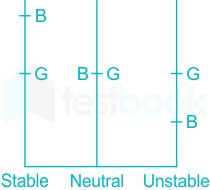
27

For a body completely submerged in a fluid, the centre of gravity (G) and centre of buoyancy (O) are known. The body is considered to be in stable equilibrium if

  1. ((a))

    O does not coincide with the centre of mass of the displaced fluid

  2. ((b))

    G coincides with the centre of mass of the displaced fluid

  3. ((c))

    O lies below G

  4. ((d))

    O lies above G

Show Answer
Answer: ((d))

O lies above G

Concept:

For a completely submerged body, the equilibrium is defined by the relative positions of centre of gravity (G) and centre of buoyancy (B) 

Stable Equilibrium: When the point B is above G, it is said to be in stable equilibrium

Unstable Equilibrium: When the point B is below G, it is said to be in unstable equilibrium

Neutral Equilibrium: When B and G are at same point, the body is said to be in neutral equilibrium.

28

The flow in a horizontal, frictionless rectangular open channel is supercritical. A smooth hump is built on the channel floor. As the height of hump is increased, choked condition is attained. With further increase in the height of the hump, the water surface will

  1. ((a))

    rise at a section upstream of the hump

  2. ((b))

    drop at a section upstream of the hump

  3. ((c))

    drop at the hump

  4. ((d))

    rise at the hump

Show Answer
Answer: ((b))

drop at a section upstream of the hump

Concept:

<sub>

</sub>

The flow is supercritical, so let us consider the Supercritical region.

As the height of the hump is increased, choked condition is reached. That is critical flow condition (choked condition) is reached at the hump.

Ehump = EC.

The minimum specific energy is reached at the hump location.

The critical flow condition at the hump cannot be changed and it continues to be critical. If we want to increase the height of the hump, the upstream flow conditions should be changed.

For the increase in hump height Δ z' > Δ zm, the point E1 is shifted to E1' which is at a lower level than E1

Hence there is a drop in water level at the upstream section of the hump.

29

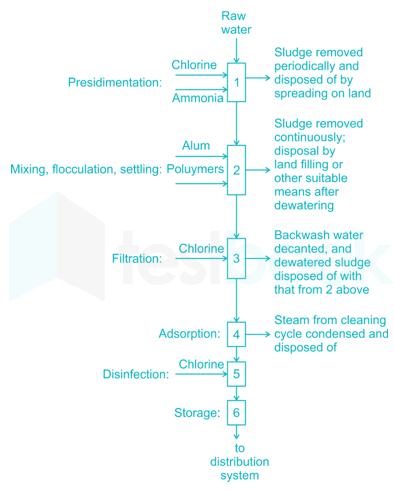
Consider the following unit processes commonly used in water treatment; rapid mixing (RM), flocculation (F), primary sedimentation (PS), secondary sedimentation (SS), chlorination (C), and rapid sand filtration (RSF). The order of these unit processes (first to last) in a conventional water treatment plant is

  1. ((a))

    PS → RSF→ F→ RM→ SS→ C

  2. ((b))

    PS →  F→ RM→ RSF→SS→ C

  3. ((c))

    ​PS →  F→ SS→ RSF→RM→ C

  4. ((d))

    ​PS → RM→ F→SS→RSF→ C

Show Answer
Answer: ((d))

​PS → RM→ F→SS→RSF→ C

Concept:

The sequence of purification of water is given by

  1. Screening
  2. Plain sedimentation
  3. Coagulant aided sedimentation
  4. Filtration
  5. Disinfection
  6. Aeration
  7. Softening
  8. Miscellaneous treatments like fluoridation, recarbonation, liming, and desalination.

For the water to be treated by secondary sedimentation, water has to be coagulated. Before coagulation Rapid mixing is done.

Rapid mixing is a process by which coagulant is thoroughly mixed with water after which flocculation will occur.

Before water is treated by a rapid sand filter it has to be coagulated. And the filtered water is disinfected with chlorine.The sequence of surface water treatment is given as

30

Anaerobically treated effluent has MPN of total coliform as 106/100 ml, After chlorination, the MPN declines to 102/100 ml as 104.The percent removal (%R) and log removal (log R) of total coliform MPN is

  1. ((a))

    %R = 99.90; log R = 4

  2. ((b))

    %R = 99.90; log R = 2

  3. ((c))

    %R = 99.99; log R = 4

  4. ((d))

    %R = 99.99; log R = 2

Show Answer
Answer: ((c))

%R = 99.99; log R = 4

Concept:

The removal of total coliform is given by

Percentage;removal(%R)=N0NtNt×100%Percentage;removal\left( {\% R} \right) = \frac{{{N_0} - {N_t}}}{{{N_t}}} \times 100\%

Log removal (log R) = log10(No) – log10(Nt)

Where, No = Initial no. of organisms

Nt = Number of organisms at time t.

Calculation:

Given - N0 =106, Nt = 102

Percentage;removal(%R)=106102106×100%=99.99%Percentage;removal\left( {\% R} \right) = \frac{{{10^6} - {10^2}}}{{{10^6}}} \times 100\%=99.99\%

Log removal (log R) = log10106 – log10102 = 4

31

Consider four common air pollutants found in urban environments NO, SO2, Soot and O3. Among these which one is the secondary air pollutant?

  1. ((a))

    O3

  2. ((b))

    NO

  3. ((c))

    SO2

  4. ((d))

    Soot

Show Answer
Answer: ((a))

O3

Explanation:

Primary PollutantsSecondary Pollutants
Carbon monoxide (CO) Oxides of nitrogen (NOx, NO) Sulfur oxides (SOx) Volatile organic compounds (VOCs) highly Particulate matter (dust, ash, salt particles)Ozone PAN Smog Formaldehyde Sulphuric Acid


Note:

Soot is a general term that refers to impure carbon particles resulting from the incomplete combustion of hydrocarbons.

Soot, as an airborne contaminant in the environment, has many different sources but they are all the result of some form of pyrolysis.

32

The probability that k number of vehicles arrive (i.e. cross a predefined line) in time t is given as (λt)k e-λt/k! where λ is the average vehicle arrival rate. What is the probability that the time headway is greater than or equal to time t1?

  1. ((a))

    λeλt1

  2. ((b))

    λe-t1

  3. ((c))

    eλt1

  4. ((d))

    e-λt1

Show Answer
Answer: ((d))

e-λt1

Concept:

The Poisson’s model that accounts for nonuniformity of flow which is derived by assuming the random pattern of vehicle arrivals at a specified point is given by

P(n)=(λt)n×eλtn!P\left( n \right) = \frac{{{{\left( {λ t} \right)}^n} \times {e^{ - λ t}}}}{{n!}}..... ( 1 )

where

P(n) = probability of having n vehicles arrive in time t,

n - Number of vehicles in time t

λ = average vehicle flow or arrival rate in vehicles per unit time,

t = time interval

e = base of the natural logarithm (e = 2.718)

Time headway is defined as the time difference between any two successive vehicles when they cross a given point.

Calculation:

Given:

Time Headway is greater than or equal to t1Number of vehicles arriving is zero in time t1 ( n = 0)

Equation 1 becomes

P(0)=(λt)0×eλt0!P\left( 0 \right) = \frac{{{{\left( {λ t} \right)}^0} \times {e^{ - λ t}}}}{{0!}}

P(0) = e-λt1

33

A vehicle negotiates a transition curve with uniform speed v. If the radius of the horizontal curve and the allowable jerk are R and J, respectively, the minimum length of the transition curve is

  1. ((a))

    R3(vJ)\frac{{{R^3}}}{{\left( {vJ} \right)}}

  2. ((b))

    J3(Rv)\frac{{{J^3}}}{{\left( {Rv} \right)}}

  3. ((c))

    v2R(J)\frac{{{v^2R}}}{{\left( {J} \right)}}

  4. ((d))

    v3(RJ)\frac{{{v^3}}}{{\left( {RJ} \right)}}

Show Answer
Answer: ((d))

v3(RJ)\frac{{{v^3}}}{{\left( {RJ} \right)}}

Concept:

Transition curve is provided to change the horizontal alignment from straight to circular curve gradually and has a radius that decreases from infinity at the straight end (tangent point) to the desired radius of the circular curve at the other end (curve point).

The rate of change of centrifugal acceleration is called jerk. The length of the transition curve depends on three criteria

  1. Rate of change of centrifugal acceleration
  2. Rate of change of superelevation
  3. Empirical formula's
  4. Rate of change of centrifugal acceleration:

L1=v3CR{{\rm{L}}_1} = \frac{{{{\rm{v}}^3}}}{{{\rm{CR}}}}

v - Design speed in m/sec;

R - Radius of the horizontal curve, C - Rate of change in centrifugal acceleration or jerk

IRC suggests that C=8075+3.6v{\rm{C}} = \frac{{80}}{{75 + 3.6{\rm{v}}}} [C ranges from 0.8 to 0.5]

Additional Information

Rate of change of super elevation:

L2=BeN{{\rm{L}}_2} = {\rm{Be'N}}

 e’ - Effective superelevation, N - The rate of change in super-elevation  

B - Total width of pavement including the widening if any

When the pavement is rotated about center e = e/2

When the pavement is rotated about the inner edge e = e

IRC Empirical Formula:

\({{\rm{L}}_3} = \left{ {\begin{array}{*{20}{c}} {\frac{{2.7{{\rm{V}}^2}}}{{\rm{R}}},;;For;plain;and;rolling;terrain}\ {\frac{{{{\rm{V}}^2}}}{{\rm{R}}},;;For;hilly;and;steep;terrain} \end{array}} \right.\)  where V is the speed in km/hr and R is the radius of horizontal curve

34

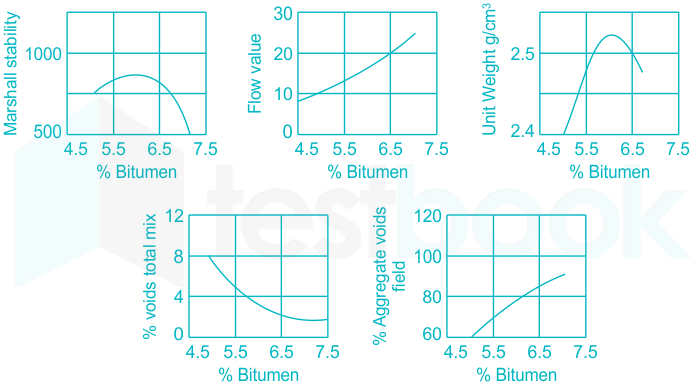
In Marshall testing of bituminous mixes, as the bitumen content increases the flow value

  1. ((a))

    remains constant

  2. ((b))

    decreases first and then increases

  3. ((c))

    increases monotonically

  4. ((d))

    increases first and then decreases

Show Answer
Answer: ((c))

increases monotonically

Concept:

Marshall stability and flow:

Marshall stability of a test specimen is the maximum load required to produce failure when the specimen is preheated to a prescribed temperature placed in a special test head and the load is applied at a constant strain (5 cm per minute). during the stability test, a dial gauge is used to measure the vertical deformation of the specimen. The deformation at the failure point expressed in units of 0.25 mm is called the marshall flow value of the specimen.

Graphical plot:

The average value of each of the above properties is found for each mix with the different bitumen contents. Graphs are plotted with the bitumen content on the x-axis and the following value on the y-axis.

(i) Marshall stability value

(ii) Flow value

(iii) Unit weight

(iv) Percent voids in the total mix

(v) Percent voids filled with bitumen

From the diagram, we can say as the bitumen content increases the flow value increases monotonically.

35

Curvature correction to a staff reading in a differential levelling survey is:

  1. ((a))

    Always subtractive.

  2. ((b))

    Always zero.

  3. ((c))

    Always additive.

  4. ((d))

    Dependent on latitude.

Show Answer
Answer: ((a))

Always subtractive.

Explanation:

Curvature:

  • The dumpy level provides a horizontal line of sight and the line of sight is not a level line.
  • The curvature makes the apparent staff reading more and the object appears lower than its real level on the ground.
  • Hence the curvature correction (Cc) is negative and applied to staff reading.

Important Points

Correction due to curvature

Cc = -0.0785 d2

Corrections due to refraction

Cr = +0.0112 d2

∴ Composite correction

C = –0.0785 d2 + 0.0112 d2

C = –0.0673 d2 

d - Horizontal distance from point of observation to the station where staff is kept.

where d is in km, C in m

Note: 

Correction due to refraction = 1/7(Correction due to curvature)

36

For an analytic function

f(x+iy)=μ(x,y)+iν(x,y),μf\left( {x + iy} \right) = \mu \left( {x,y} \right) + i\nu \left( {x,y} \right),\mu is given by

μ = 3x2 – 3y2

Then expression for ν (considering K to be constant) is

  1. ((a))

    3y2 – 3x2 + k

  2. ((b))

    6x – 6y + k

  3. ((c))

    6x + 6y + k

  4. ((d))

    6xy + k

Show Answer
Answer: ((d))

6xy + k

μ = 3x2 – 3y2

\(\frac{{\partial \mu }}{{\partial x}} = 6x\ &\ \frac{{\partial \mu }}{{\partial y}} = - 6y\) 

By Cauchy-Riemann equation

μx=νy  μy=νx νy=6x  νx=6y\begin{array}{l} \frac{{\partial \mu }}{{\partial x}} = \frac{{\partial \nu }}{{\partial y}}\ &\ \frac{{\partial \mu }}{{\partial y}} = - \frac{{\partial \nu }}{{\partial x}}\ \therefore \frac{{\partial \nu }}{{\partial y}} = 6x\ &\ \frac{{\partial \nu }}{{\partial x}} = 6y \end{array} 

We know

dv=νxdx+νydydv = \frac{{\partial \nu }}{{\partial x}}dx + \frac{{\partial \nu }}{{\partial y}}dy 

⇒ dv = 6ydx + 6xdy

On integration

ν = 6xy + k      where k is constant

37

What should be the value of λ such that the function defined below is continuous at x = π/2?

  \({\rm{f}}\left( {\rm{x}} \right) = \left{ {\begin{array}{*{20}{c}} {\frac{{{\rm{λ }}\cos {\rm{x}}}}{{\frac{{\rm{π }}}{2} - {\rm{x}}}}}&{{\rm{x}} \ne \frac{{\rm{π }}}{2}}\ 1&{{\rm{x}} = \frac{{\rm{π }}}{2}} \end{array}} \right.\)

38

What is the value of the definite integral

\(\mathop \smallint \limits_0^a \frac{{\sqrt x }}{{\sqrt x + \sqrt {a - x} }}dx\)

  1. ((a))

    0

  2. ((b))

    a2\frac{a}{2}

  3. ((c))

    a

  4. ((d))

    2a

Show Answer
Answer: ((b))

a2\frac{a}{2}

\(I = \mathop \smallint \limits_0^a \frac{{\sqrt x }}{{\sqrt x + \sqrt {a - x} }}dx\)

By property,

 \(\mathop \smallint \limits_0^a f\left( x \right) = \mathop \smallint \limits_0^a f\left( {a - x} \right)dx\)

\(I = \mathop \smallint \limits_0^a \frac{{\sqrt {a - x} }}{{\sqrt {a - x} + \sqrt x }}dx\)

Adding both integrals, We get

\(2I = \mathop \smallint \limits_0^a \frac{{\sqrt x }}{{\sqrt x + \sqrt {a - x} }}dx + \mathop \smallint \limits_0^a \frac{{\sqrt {a - x} }}{{\sqrt {a - x} + \sqrt x }}dx\)

\(2I = \mathop \smallint \limits_0^a dx \)

2I = a

I=a2I = \frac{a}{2}

39

If a{\rm{\vec a}} and b{\rm{\vec b}} are two arbitary vectors with magnitudes a and b,respectively, \(\left| {\begin{array}{*{20}{c}} {{\rm{\vec a}} \times }{{\rm{\vec b}}} \end{array}} \right|{;^2}\) is:

  1. ((a))

    a2b2 −( a{\rm{\vec a}}.b{\rm{\vec b}})2

  2. ((b))

    ab −  a{\rm{\vec a}}.b{\rm{\vec b}}

  3. ((c))

    a2b2 +( a{\rm{\vec a}}.b{\rm{\vec b}})2

  4. ((d))

    ab +  a{\rm{\vec a}}.b{\rm{\vec b}}

Show Answer
Answer: ((a))

a2b2 −( a{\rm{\vec a}}.b{\rm{\vec b}})2

Explanation:

Vectors can be multiplied in two ways – scalar product and vector product.

Vector product of two vectors (A̅ and B̅) results in a vector and the resultant vector is perpendicular to both  A̅ and B̅. It is denoted as  A̅ × B̅, and

A̅ × B̅ = |A̅||B̅| sin θ

Where, θ is the angle between the two vectors A̅ and B̅

Scalar product of of two vectors (A̅ and B̅) results in a scalar. It is denoted as  A̅ ⋅ B̅, and

 A̅ × B̅ = |A̅||B̅| cos θ

Where, θ is the angle between the two vectors A̅ and B̅.

Here asked \(\left| {\begin{array}{*{20}{c}} {{\rm{\vec a}} \times }{{\rm{\vec b}}} \end{array}} \right|{;^2}\)

It is given magnitudes of vectors are a and b

as  A̅ × B̅ = |A̅||B̅| sin θ

\(\left| {\begin{array}{*{20}{c}} {{\rm{\vec a}} \times }{{\rm{\vec b}}} \end{array}} \right|{;^2}\) = (absinθ)= a2b2sin2 θ

As we know sin2θ = 1 − cos2 θ

So a2b2sin2 θ is written as 

a2b2sin2 θ = a2b2 (1 − cos2 θ)

We know A̅ × B̅ = |A̅||B̅| cos θ

So this becomes a2b2  − a2b2cos2 θ  = a2b2 − ( a{\rm{\vec a}}.b{\rm{\vec b}})2

40

The solution of differential equation dydx+yx=x,\frac{{dy}}{{dx}} + \frac{y}{x} = x, with condition that y = 1 at x = 1, is

  1. ((a))

    y=23x2+x3y = \frac{2}{{3{x^2}}} + \frac{x}{3}

  2. ((b))

    y=x2+12xy = \frac{x}{2} + \frac{1}{{2x}}

  3. ((c))

    y=23+x3y = \frac{2}{3} + \frac{x}{3}

  4. ((d))

    y=23x+x23y = \frac{2}{{3x}} + \frac{{{x^2}}}{3}

Show Answer
Answer: ((d))

y=23x+x23y = \frac{2}{{3x}} + \frac{{{x^2}}}{3}

Given:

dydx+yx=x\frac{{dy}}{{dx}} + \frac{y}{x} = x

Comparing with

dydx+py=q\frac{{dy}}{{dx}} + py = q

We get,

p=1x;q=xp = \frac{1}{x};q = x

TF=epdx=e1xdx=elnx=xTF = {e^{\smallint pdx}} = {e^{\smallint \frac{1}{x}dx}} = {e^{\ln x}} = x

Now,

General solution can be written as,

Y (IF) = ∫ q (IF) dxt C

Y (x) = ∫ x (x) dxt C

xy = ∫ x2 dx + C

xy=x33+Cxy = \frac{{{x^3}}}{3} + C

At, x = 1 & y  =1

(1)(1)=(1)3+C\left( 1 \right)\left( 1 \right) = \frac{{\left( 1 \right)}}{3} + C

C=23\therefore C = \frac{2}{3}

xy=x33+23\therefore xy = \frac{{{x^3}}}{3} + \frac{2}{3}

y=x23+23x\therefore y = \frac{{{x^2}}}{3} + \frac{2}{{3x}}

41

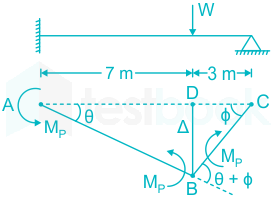
The value of W that results in the collapse of the beam shown in the adjoining figure and having a plastic moment capacity of Mp is

  1. ((a))

    (4/21)Mp

  2. ((b))

    (3/10)Mp

  3. ((c))

    (7/21)Mp

  4. ((d))

    (13/21)Mp

Show Answer
Answer: ((d))

(13/21)Mp

Concept:

Possible locations of Plastic Hinges:

  1. At the fixed end of a beam
  2. At the intermediate joint of a continuous beam
  3. At the rigid joint of a frame
  4. At the point of maximum bending moment (also at greatest curvature)
  5. At the point where the section of beam changes
  6. Under the external load
<br>

Number of independent mechanisms-

The number of independent mechanisms (i) is given as

i = N - r

N = Number of possible plastic hinges 

r = static indeterminacy

Calculation:

Given:

Number of the possible plastic hinges (N) = 2 (Under the load, at the fixed end)

r = 4 - 3 = 1

i = 2 - 1 = 1

From Δ ABD,

θ=Δ7{\rm{θ }} = \frac{{\rm{Δ }}}{7}

∴ Δ = 7 × θ     ...(1)

From Δ CBD

ϕ=Δ3ϕ = \frac{{\rm{Δ }}}{3}

∴ Δ = 3 × ϕ     ....(2)

From 1 and 2

7 × θ = 3 × ϕ 

External work done = W × Δ = W × 7 × θ (∵ Δ = 7× θ)

Internal work done = Mp × θ + Mp × (θ + ϕ)

\({\rm{Internal;work;done}} = {{\rm{M}}{\rm{p}}} × {\rm{θ }} + {{\rm{M}}{\rm{p}}} × \left( {{\rm{θ }} + \frac{{7 × {\rm{θ }}}}{3}} \right)\)     ...(∵ ϕ=7×θ3\phi = \frac{{7 × θ }}{3})

By the principle of virtual work, Equating external and internal work done

\({\rm{W × 7× θ }} = {{\rm{M}}{\rm{p}}} × {\rm{θ }} + {{\rm{M}}{\rm{p}}} × \left( {{\rm{θ }} + \frac{{7 × {\rm{θ }}}}{3}} \right)\)

W=13×Mp21\bf W = \frac{{13 \times {M_p}}}{{21}}

<br>

<br>


Plastic hinges:

If the cross-section of the beam is subjected to yield stresses throughout the depth, it cannot take further loads. If any additional load is applied, then the beam rotates at that section. Since the beam rotates due to moment, we call it a plastic moment, we say that a plastic hinge is formed at that section.

Plastic hinge means stress distribution becoming rectangular i.e. stress at every point is equal to yield stress.

42

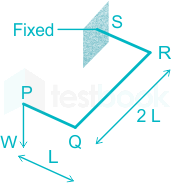
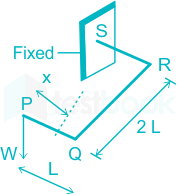
For the cantilever bracket, PQRS, loaded as shown in the adjoining figure(PQ=RS=L, and, QR=2L),which of the following statements is FALSE?

  1. ((a))

    the portion RS has a constant twisting moment with a value of 2WL.

  2. ((b))

    the portion QR has a varying twisting moment with a maximum value of WL

  3. ((c))

    The portion PQ has a varying bending moment with a maximum value of WL

  4. ((d))

    The portion PQ has no twisting moment

Show Answer
Answer: ((b))

the portion QR has a varying twisting moment with a maximum value of WL

Explanation:

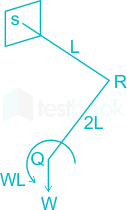
Given

Bending Moment at a distance x from P, Mx = Wx

So in the PQ part Bending Moment (BM) is varying linearly with x.

BM @ Q = WL & There is no twisting Moment in member PQ

Now the moment (WL) @ Q acts as a twisting moment (WL) for member QR (Not varying Twisting Moment)

Hence Option B is wrong

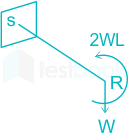
And because of Load W @ Q the bending moment in the member QR vary linearly. 

BM @ R = W(2L)

Now Moment 2WL acts as twisting Moment for member RS. and because of Load W Bending moment in the section RS varies linearly.

43

Consider a bar of Diameter ‘D’ of length (L) embedded in a large concrete block. If a pull out force P being applied. Let σb and σst be the bond strength (between the bar and concrete) and the tensile strength of the bar respectively. If the block is held in position and material of the block does not fall, which of the following options represents the maximum value of P?

  1. ((a))

    Maximum of (π4×D2×σb)\left( {\frac{\pi }{4} \times {D^2} \times {\sigma _b}} \right)and (π × D × L× σ st)

  2. ((b))

    Maximum of (π4×D2×σst)\left( {\frac{\pi }{4} \times {D^2} \times {\sigma _{st}}} \right)and (π × D × L× σb)


    duplicate options foud. English Question 1 options 1,4

  3. ((c))

    Minimum of (π4×D2×σst)\left( {\frac{\pi }{4} \times {D^2} \times {\sigma _{st}}} \right) and (π × D × L× σ b)

  4. ((d))

    Minimum of (π4×D2×σb)\left( {\frac{\pi }{4} \times {D^2} \times {\sigma _b}} \right) and (π × D × L× σ st)

Show Answer
Answer: ((c))

Minimum of (π4×D2×σst)\left( {\frac{\pi }{4} \times {D^2} \times {\sigma _{st}}} \right) and (π × D × L× σ b)

Concept

We know,

In an Anchorage bond

Maximum force resisted by bond strength = (π × D × L× σ b)

Maximum tensile force resisted by bar = (π4×D2×σst)\left( {\frac{\pi }{4} \times {D^2} \times {\sigma _{st}}} \right)

Where,

 L is development length

D is dia of bar,

σb is bond strength (between the bar and concrete)

σst is the tensile strength of the bar

P is pull out Force.

Maximum Pull should be minimum of both resistance for the safety of the bar. So it should not fail in any of the above case.

∴ Maximum value of P = Minimum ( (π × D × L× σ b) or (π4×D2×σst)\left( {\frac{\pi }{4} \times {D^2} \times {\sigma _{st}}} \right) )

44

Consider two RCC beams, P and Q, each of width 400 mm and effective depth 750 mm, made with concrete having a τc max = 2.0 MPa. For the reinforcement provided and the grade of concrete used, it may be assumed than τc max = 0.75 MPa. If the design shear for the beams P and Q is 400 kN and 750 kN, respectively, which of the following statements is true considering the provisions of IS 456-2000?

  1. ((a))

    Shear reinforcement should be designed for 175 kN for beam P and the section for beam Q should be revised 

  2. ((b))

    Nominal shear reinforcement is required for beam P and the shear reinforcement should be designed for 120 kN for beam Q

  3. ((c))

    Shear reinforcement should be designed for 175 kN for beam P and the section for beam Q should be designed for 525 kN for beam Q

  4. ((d))

    The sections for both beams, P and Q need to be revised 

Show Answer
Answer: ((a))

Shear reinforcement should be designed for 175 kN for beam P and the section for beam Q should be revised 

Concept:

As per IS 456:2000

Nominal shear stress = τv=Vbd{\tau _v} = \frac{V}{{bd}} 

Where, V = Ultimate shear force, b = width of beam, d = effective depth of beam

Nominal shear stress should never be greater than maximum shear stress with shear reinforcement.

Calculation:

Two Beams P & Q of B = 400 mm

d = 7.50 mm

τc, max = 2.0 MPa

τc = 0.75 Mpa

Design shear force for P = 400 kN

Design shear force for Q = 750 kN

For beam P,

Vu = 400 kN

τV=Vbd=400×103400×750=1.33;N/mm3<τc,;max=2.0{\tau _V} = \frac{V}{{bd}} = \frac{{400 \times {{10}^3}}}{{400 \times 750}} = 1.33;N/m{m^3} < {\tau _{c,;max}} = 2.0 N/mm2

⇒ Vus = (1.33 – 0.75) × 400 × 750 = 175 kN

For Beam Q,

Vu = 750 kN

τv=750×103400×750=2.5;N/mm2;>τc,;max{\tau _v} = \frac{{750 \times {{10}^3}}}{{400 \times 750}} = 2.5;N/m{m^2}; > {\tau _{c,;max}}

So, section for Beam Q should be revised.

45

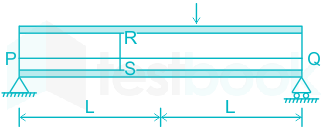
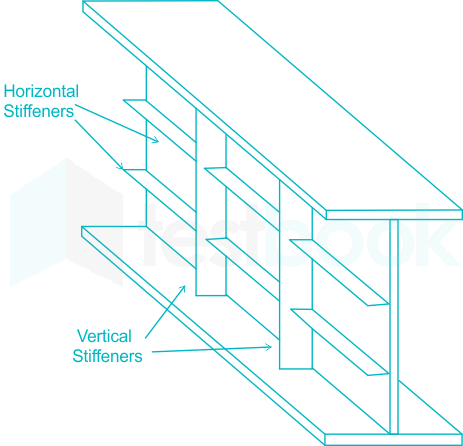
The adjoining figure shows a schematic representation of a steel plate girder to be used as a simply supported beam with a concentrated load. For stiffeners, PQ (running along the beam axis) and RS (running between the top and bottom flanges) which of the following pairs of statements will be TRUE?

  1. ((a))

    (i) RS should be provided under the concentrated load only.

    (ii) PQ should be placed in the tension side of the flange

  2. ((b))

    (i) RS helps to prevent local buckling of the web.

    (ii) PQ should be placed in the compression side of the flange.

  3. ((c))

    (i) RS should be provided at supports.

    (ii) PQ should be placed along the neutral axis.

  4. ((d))

    (i) RS should be provided away from points of action of concentrated loads.

    (ii) PQ should be provided on the compression side of the flange.

Show Answer
Answer: ((b))

(i) RS helps to prevent local buckling of the web.

(ii) PQ should be placed in the compression side of the flange.

Concept:


Intermediate Transverse stiffeners:

  1. These are also called vertical stiffeners.
  2. Vertical stiffener is not subjected to any load and is selected to provide lateral stiffness.
  3. These stiffeners increase the buckling resistance of the web caused by shear. So, these stiffeners should be sufficiently strong to withstand shear transmitted by the web and to prevent local buckling of the web.

Intermediate Longitudinal stiffeners:

  1. These are also called Horizontal stiffeners.
  2. Longitudinal stiffeners increase the buckling resistance considerably as compared to transverse stiffeners when the web is subjected to bending.
  3. These are provided in the compression zone of the web to reduce the chances of web buckling due to bending in compression.
  4. The first horizontal stiffener is provided at one-fifth of the distance from the compression flange to the tension flange.
  5. Longitudinal stiffeners are not continuous and are provided between vertical stiffeners.

Important Points

  • In plate girder, the flange is designed to resist bending moment

  • The web is designed to resist the shear resulting from loads

46

A singly under-reamed, 8-m long ,RCC pile(shown in the adjoining figure) weighing 20 kN with 350 mm shaft diameter and 750 mm under-ream diameter is installed within stiff, saturated silty clay(undrained shear strength is 50 kpa, adhesion factor is 0.3, and the applicable bearing capacity factor is 9) to counteract the impact of soil swelling on a structure constructed above. Neglecting suction and the contribution of the under-ream to the adhesive shaft capacity, what would be the estimated ultimate tensile capacity(rounded off to the nearest interger value of kN) of the pile?

  1. ((a))

    132 kN

  2. ((b))

    156 kN

  3. ((c))

    287 kN

  4. ((d))

    307 kN

Show Answer
Answer: ((d))

307 kN

Explanation:

The Tensile resistance of a pile is given by,

Qt = Qeb + Qsf + W

Qt = qbAb + qsAs

Where,

qb = unit end bearing resistance = cNc

Ab = Base area of the pile

Ab=π4(D2d2){A_b} = \frac{\pi }{4}({D^2 -d^2})

d = Diameter of the pile

qs = Unit adhesion of soil with pile on surface area = αC̅

α = Adhesion factor between clay and pile

c̅ = Average unit cohesion of clay over the depth of pile.

As = Surface area of pile = πDL

W is weight of pile, 

Given, 

α = 0.3, c = 50, W = 20 , D = 750 mm = 0.75 m,

d = 350 mm = 0.35 m, Nc = 9 

Qt = αC̅As + W + cNcAb 

= 0.3 × 50 × π×(0.35)×8 + 20 + 50 × 9 × π4(0.7520.352) \frac{\pi }{4}({0.75^2 -0.35^2})

= 307.408 kN

47

Identical surcharges are placed at ground surface at sites X and Y, with soil conditions shown alongside and water table at ground surface. The silty clay layers at X and Y are identical. The thin sand layer at Y is continuous and free draining with a very large discharge capacity. If the primary consolidation at X is estimated to complete in 36 months, What would be the corresponding time for completion of primary consolidation at Y?

  1. ((a))

    2.25 months

  2. ((b))

    4.5 months

  3. ((c))

    9 months

  4. ((d))

    36 months

Show Answer
Answer: ((c))

9 months

Concept:

The time required for any degree of consolidation is given by Taylor's formula

\(\left( {{{\rm{T}}{\rm{v}}}} \right) = \frac{{{{\rm{C}}{\rm{v}}}{\rm{t}}}}{{{{\rm{d}}^2}}}\)

Tv - Time factor

Cv - Coefficient of consolidation

t - Time taken for consolidation

d - Drainage path

Drainage path represents the maximum distance the water particles have to travel to reach the free drainage layer.

Calculation:

Given:

Let the subscript X denote parameters related to Site X and Y denote parameters related to Site Y

Site X

tX = 36 months

dX= 10 m

Site Y

dY = 5 m ( Sand layer is the free drainage layer)

Time factor is a function of degree of consolidation

Since identical surcharges are placed at both sites, both sites undergo the same consolidation, the time factor is the same in both the sites

∴ (Tv)  X = (Tv) Y 

Coefficient of consolidation is a function of the properties of soil and the magnitude of the load

Since the silt clay layer is identical in both the sites and identical surcharges are used at both the sites, Coefficient of consolidation is the same in both cases.

∴ (Cv) X = (Tv) Y

Since (Tv) X  = (Tv) Y

(Cv)X×tXdX2=(Cv)Y×tYdY2\frac{{{{\left( {{C_v}} \right)}_X} \times {t_X}}}{{d_X^2}} = \frac{{{{\left( {{C_v}} \right)}_Y} \times {t_Y}}}{{d_Y^2}}

36102=tY52\frac{{36}}{{{{10}^2}}} = \frac{{{t_Y}}}{{{5^2}}}

t= 9 months


Double drainage condition refers to the situation when both faces are permeable and pore water can dissipate through both faces but in single drainage only one face is permeable and hence it takes a longer time in single drainage.

Single drainage d = H

Double drainage d = H/2

48

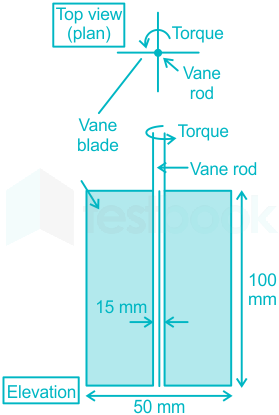
A field vane shear testing instrument (shown alongside) was inserted completely into a deposit of soft, saturated silty clay with the vane rod vertical such that the top of the blades were 500 mm below the ground surface. Upon application of a rapidly increasing torque about the vane rod, the soil was found to fail when the torque reached 4.6 N-m. Assuming mobilization of undrained shear strength on all failure surface to be uniform and the resistance mobilized on the surface of the vane rod to be negligible, what would be the peak undrained shear strength (rounded off to the nearest integer value of kPa) of the soil?

  1. ((a))

    5 kPa

  2. ((b))

    10 kPa

  3. ((c))

    15 kPa

  4. ((d))

    20 kPa

Show Answer
Answer: ((b))

10 kPa

Concept:

If both ends take part in shearing:

T= !!π!! d2 !!τ!! f[H2+d6]\text{T}=\text{ }!!\pi!!\text{ }{{\text{d}}^{2}}{{\text{ }!!τ!!\text{ }}_{\text{f}}}\left[ \frac{\text{H}}{2}+\frac{\text{d}}{6} \right]

Where

T = Torque (maximum moment), d = diameter of vane

H = height/length of vane, τf = shear strength of clay

Calculation:

Given:

T = 4.6 Nm, d = 50 mm = 0.05 m

H = 100 mm = 0.1 m

For saturated silty clay

τf = shear strength of clay

Since the instrument was inserted completely both ends take part in shearing

4.6= !!π×!! (0.05)2× !!τ!! f×[0.12+0.056]\text{4.6}=\text{ }!!\pi\times!!\text{ }{{\text{(0.05)}}^{2}}{{\times\text{ }!!τ!!\text{ }}_{\text{f}}}\times\left[\frac{\text{0.1}}{2}+\frac{\text{0.05}}{6} \right]

τf = 10 kPa

Additional Information

For vane shear test with one end in shearing

T= !!π!! d2 !!τ!! f[H2+d12]\text{T}=\text{ }!!\pi!!\text{ }{{\text{d}}^{2}}{{\text{ }!!τ!!\text{ }}_{\text{f}}}\left[ \frac{\text{H}}{2}+\frac{\text{d}}{12} \right]

49

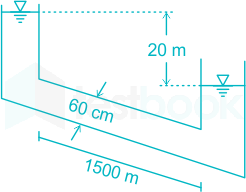
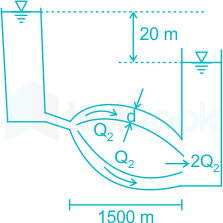
A single pipe of length 1500 m and diameter 60 cm connects two reservoirs having a difference of 20 m in their water levels. The pipe is to be replaced by two pipes of the same length and equal diameter d to convey 25% more discharge under the same head loss. If the friction factor is assumed to be the same for all the pipes, the value of d is approximately equal to which of the following options?

  1. ((a))

    37.5 cm

  2. ((b))

    40.0 cm

  3. ((c))

    45.0 cm

  4. ((d))

    50.0 cm

Show Answer
Answer: ((d))

50.0 cm

Explanation:

We know,

According to Darcy’s Weisbach equation:

Head;loss=hf=fLV22gD{\rm{Head;loss}} = {{\rm{h}}_{\rm{f}}} = \frac{{{\rm{fL}}{{\rm{V}}^2}}}{{2{\rm{gD}}}}

 Where,

f = friction factor of the pipe, L = Length of the pipe,

V = velocity of water through the pipe

g = gravitational acceleration, D = diameter of the pipe

Also can be written as,

Head;loss=hf=8fLQ2π2gD5{\rm{Head;loss}} = {{\rm{h}}_{\rm{f}}} = \frac{{{\rm{8fL}}{{\rm{Q}}^2}}}{{{\pi^2\rm{gD^5}}}}

Case 1

Given, 

Length = 1500 m, Dia of Pipe = 0.6 m, Head loss = 20 m

Head;loss=20=8f(1500)Q2π2g0.65{\rm{Head;loss}} = 20 = \frac{{{\rm{8f(1500)}}{{\rm{Q}}^2}}}{{{\pi^2\rm{g0.6^5}}}}

Qintial = 0.112/√f   --- (1)

Case 2:

Pipe is seperated into 2 pipes for 25% more discharge.

Let assume each pipe carries a discharge of Q

So now the equation become

2Q2 = 1.25×Qinitial

Q2 = 0.625×Qinitial

We know 

Head;loss=20=8f(1500)0.625Q2π2gd5{\rm{Head;loss}} = 20 = \frac{{{\rm{8f(1500)}}{{\rm{0.625Q}}^2}}}{{{\pi^2\rm{gd^5}}}}

0.413 = fQ2initial/d5 

Q2initial = 0.413d5/√f  

Qinitial = 0.642d5/√f   ---- (2)

Solving (1) and (2)

We get D = 49.7 cm ≈ 50 cm

50

A spillway discharges flood at a rate of 9 m3/s per meter width. If the depth of flow on the horizontal apron at the toe of the spillway is 46 cm, the tailwater depth needed to form a hydraulic jump is approximately given by which of the following?

  1. ((a))

    2.54 m

  2. ((b))

    4.90 m

  3. ((c))

    5.77 m

  4. ((d))

    6.23 m

Show Answer
Answer: ((c))

5.77 m

Concept:

Hydraulic Jump**:** 

In an open channel when a rapidly flowing stream abruptly changes into a slowly flowing stream, a distinct rise or jump in elevation of fluid surface happens, this phenomenon is known as Hydraulic Jump.

For a hydraulic jump, the height of the slow stream or subcritical stream is (y2) = y12+y124 +q2gy1- \frac{y_1}{2} + \sqrt{\frac{y_1^2}{4}\ + \frac{q^2}{gy_1}}

y1 = Height of the rapidly flowing stream or supercritical stream

g = Acceleration due to gravity

q = Discharge per metre width in m3/sec

Calculation:

Given:

y1 = height of horizontal apron = 46 cm = 0.46 m

q = 9 m3/sec

∴ y20.462+(0.46)24 +929.81×0.46- \frac{0.46}{2} + \sqrt{\frac{(0.46)^2}{4}\ + \frac{9^2}{9.81\times 0.46}}

y2 = 5.77 m.

51

In an aquifer extending 150 hectare, the water table was 20 m below ground level. Over a period of time the water table dropped to 23 m below the ground level. If the porosity of the aquifer is 0.40 and the specific retention is 0.15, what is the change in groundwater storage of the aquifer?

  1. ((a))

    67.5 ha. m

  2. ((b))

    112.5 ha. m

  3. ((c))

    180.0 ha. m

  4. ((d))

    450 ha. m

Show Answer
Answer: ((b))

112.5 ha. m

Concept:

Specific yield is the ratio of volume of water that drains from sample under gravity to the total volume of sample. Specific yield is the measure of storage change in an aquifer. 

Change in storage = Drop in water level x Area x specific yield

= 150 x 3 x 0.25 = 112.5 ha.m

52

Total suspended particulate matter (TSP) concentration in ambient air is to be measured using a high volume sampler. The filter used for this purpose had an initial dry weight of 9.787 gm. The filter was mounted in the sampler and the initial air flow rate through the filter was set at 1.5 m3/min. Sampling continued for24 hours. The airflow after 24 hours was measured to be 1.4 m3/min. The dry weight of the filter paper after 24 hours sampling was 10.283 gm. Assuming a linear decline in the air flow rate during sampling, what is the 24 hours average TSP concentration in the ambient air?

  1. ((a))

    59.2 μg/m3

  2. ((b))

    118.6 μg/m3

  3. ((c))

    237.5 μg/m3

  4. ((d))

    574.4 μg/m3

Show Answer
Answer: ((c))

237.5 μg/m3

Concept:

Average;TSP;concentration=Final;wt.;of;filter;paperInitial;wt.;of;filter;paperVolume;of;air;sampledAverage;TSP;concentration = \frac{{Final;wt.;of;filter;paper - Initial;wt.;of;filter;paper}}{{Volume;of;air;sampled}}

Calculation:

Initial air flow rate = 1.5 m3/min

Final air flow rate = 1.4 m3/min

The decline in air flow is linear.

So average air flow rate =1.5+1.42=1.45;m3/min= \frac{{1.5 + 1.4}}{2} = 1.45;{m^3}/min

TSP;conceutration=(10.2839.787)×1061.45×60×24=237.5;μg/m3\therefore TSP;conceutration = \frac{{\left( {10.283 - 9.787} \right) \times {{10}^6}}}{{1.45 \times 60 \times 24}} = 237.5;\mu g/{m^3}

53

Chlorine gas (8mg/L as Cl2) was added to a drinking water sample. If the free chlorine residual and pH was measured to be 2 mg/L (as Cl2) and 7.5, respectively, what is the concentration of residual OCI – ions in the water? Assume that the chlorine gas added to the water is completely converted to HOCI and OCI-. Atomic Weight of Cl: 35.5

Given: OCl- + H+→ HOCl, K = 107.5

  1. ((a))

    1.408 ×10⁻⁵ moles/L

  2. ((b))

    2.817 ×1 0-5 moles/L

  3. ((c))

    5.634 ×10⁻⁵ moles/L

  4. ((d))

    1.127 ×1 0-5 moles/L

Show Answer
Answer: ((a))

1.408 ×10⁻⁵ moles/L

Concept:

Chlorination is one of the major methods of disinfection, When chlorine is added to water, the reaction takes place between them.

At pH < 5, chlorine does not react with water and remains as free chlorine or unreacted chlorine.

Reaction of chlorine with water

Calculation:

Given:

pH = 7.5

[Free chlorine residual] = 2 mg/l as Cl2

Atomic Weight of Cl: 35.5

K = 107.5

pH = - log10 [H+]

7.5 = - log10 [H+]

∴ [H+] = 107.5

\({\rm{OC}}{{\rm{l}}^ - } + {{\rm{H}}^ + } \mathbin{\lower.3ex\hbox{$\buildrel\textstyle\rightarrow\over {\smash{\leftarrow}\vphantom{_{\vbox to.5ex{\vss}}}}$}} {\rm{;HOCL}}\)

K=[HOCL][OCl]×[H+];{\rm{K}} = \frac{{{\rm{[HOCL]}}}}{{\left[ {OC{l^ - }} \right] × \left[ {{H^ + }} \right]}}{\rm{;}}

107.5=[HOCL][OCl]×107.5;{10^{7.5}} = \frac{{{\rm{[HOCL]}}}}{{\left[ {OC{l^ - }} \right]× {{10}^{ - 7.5}}}}{\rm{;}}

1=[HOCL][OCl];1 = \frac{{{\rm{[HOCL]}}}}{{\left[ {OC{l^ - }} \right]}}{\rm{;}}

∴ [HOCl] = [OCl-]

The concentration of free chlorine residual is the sum of the concentration of HOCl and OCl-

[Free chlorine residual] =[HOCl] + [OCl-]

[Free;chlorine;residual]=2×1032×35.5;\left[ {{\rm{Free;chlorine;residual}}} \right] = \frac{{2 × {{10}^{ - 3}}}}{{2 × 35.5}}{\rm{;}}

⇒ 2.817 × 10-5 moles/l

  2.817 × 10-5 moles/l=[HOCl] + [OCl-]

[OCl-] + [OCl-]=  2.817 × 10-5 moles/l (∵  [HOCl] = [OCl-])

;;;;[OCl]=2.817×1052;;{\rm{;}};;\left[ {{\rm{OC}}{{\rm{l}}^ - }} \right] = \frac{{2.817 × {{10}^{ - 5}}}}{2}{\rm{;}}

[HOCl] = [OCl-] = 1.4084 × 10-4 moles/l

  • Out of all these forms of chlorine, HOCl- is the most destructive. It is 80% more effective than OCl- ion.
  • Hence pH is maintained just below 7 for most effective chlorination.
54

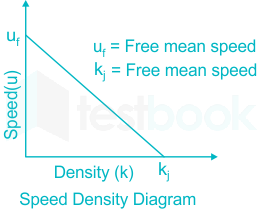
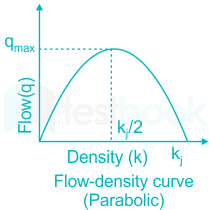
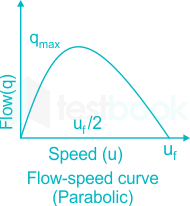
If the jam density is given as kj and the free flow speed is given as uf, the maximum flow for a linear traffic speed-density model is given by which of the following options?

  1. ((a))

    kfuf/4

  2. ((b))

    kfuf/3

  3. ((c))

    3kfuf/5

  4. ((d))

    2kfuf/3

Show Answer
Answer: ((a))

kfuf/4

Explanation:

Flow (q) = Density (k) × Velocity (V)

For Greenshields’s Model (Linear Traffic Speed Density Model)

V=Vf×(1kkj),V = {V_f} \times \left( {1 - \frac{k}{{{k_j}}}} \right),

Where,

V = Velocity at any instant

Vf = Free mean velocity

k = Density of the flow

kj = Jam density of the flow

Maximum capacity (qmax) = Vmax × Kmax

As per Greenshields’s model

\(Vmax; = ;\frac{{{V_f}}}{2};& ;{k_{max}} = \frac{{{k_j}}}{2};\)

Maximum capacity ⇒ (qmax)=Vf2×kj2=Vfkj4\left( {{q_{max}}} \right) = \frac{{{V_f}}}{2} \times \frac{{{k_j}}}{2} = \frac{{{V_f}{k_j}}}{4} 

Additional Information

Free Mean Speed:

From the speed-density diagram, it can be defined as the maximum speed at which the number of vehicles in a unit length is zero i.e. density is zero.

Density:: It can be defined as the number of vehicles per unit length. The unit of measurement is vehicles/km.

Jam Density: From speed-density relation and flow-density curve, it can also be seen that it is the maximum density at which there is no flow on the road.


Traffic Flow: The number of vehicles passing through a particular point in certain time interval is defined as traffic flow. Also, number of vehicles counted in one hour is called traffic flow (q).

55

If v is the initial speed of a vehicle, g is the gravitational acceleration, G is the upward longitudinal slope of the road and fr is the coefficient of rolling friction during braking the braking distance (measured horizontally) for the vehicle to stop is

  1. ((a))

    V2g(G+fr)\frac{{{\rm{V^2}}}}{{{\rm{g(G +f_r) }}}}

  2. ((b))

    V22g(G+fr)\frac{{{\rm{V^2}}}}{{2{\rm{g(G +f_r) }}}}

  3. ((c))

    Vg(G+fr)\frac{{{\rm{Vg}}}}{{{\rm{(G +f_r) }}}}

  4. ((d))

    Vfr(G+g)\frac{{{\rm{Vf_r}}}}{{{\rm{(G +g) }}}}

Show Answer
Answer: ((b))

V22g(G+fr)\frac{{{\rm{V^2}}}}{{2{\rm{g(G +f_r) }}}}

Explanation:

Braking distance at downgrade,

(Sb)downgrade=V2254(fG){\left( {{S_b}} \right)_{downgrade}} = \frac{{{V^2}}}{{254\left( {f - G} \right)}}

Where V = Design speed in kmph

f = Co-efficient of longitudinal friction, G = Grade

or 

(Sb)downgrade=V22g(fG){\left( {{S_b}} \right)_{downgrade}} = \frac{{{V^2}}}{{2g\left( {f - G} \right)}} v in (m/s)

Braking distance at upgrade,

(Sb)upgrade=V2254(f+N){\left( {{S_b}} \right)_{upgrade}} = \frac{{{V^2}}}{{254\left( {f + N} \right)}}

or 

(Sb)upgrade=V22g(f+G){\left( {{S_b}} \right)_{upgrade}} = \frac{{{V^2}}}{{2g\left( {f + G} \right)}}  v in (m/s)

56

The cumulative arrival and departure curve of one cycle of an approach lane of a signalized intersection is shown in the adjoining figure. The cycle time is 50s and the effective red time is 30s and the effective green time is 20s. What is the average delay?

  1. ((a))

    15 s

  2. ((b))

    25 s

  3. ((c))

    35 s

  4. ((d))

    45 s

Show Answer
Answer: ((a))

15 s

Concept:

The average delay is given by

Average;Delay=(Area;enclosed;by;arrival;curve)(Area;enclosed;by;arrival;curve)No;of;vehiclesAverage;Delay = \frac{{\left( {Area;enclosed;by;arrival;curve) - (Area;enclosed;by;arrival;curve} \right)}}{{No;of;vehicles}}

Calculation:

Given:

Cycle time = 50 s

Effective red time = 30 s

Effective green time = 20 s

Average;Delay=(Area;enclosed;by;arrival;curve)(Area;enclosed;by;arrival;curve)No;of;vehiclesAverage;Delay = \frac{{\left( {Area;enclosed;by;arrival;curve) - (Area;enclosed;by;arrival;curve} \right)}}{{No;of;vehicles}}

Area;of;triangle;formed;by;arrival;curve=12×40×50Area;of;triangle;formed;by;arrival;curve = \frac{1}{2} \times 40 \times 50

Area;of;triangle;formed;by;departure;curve=12×40×20Area;of;triangle;formed;by;departure;curve = \frac{1}{2} \times 40 \times 20

Average;Delay=(1000)(400)40Average;Delay = \frac{{\left( {1000) - (400} \right)}}{{40}}

Average Delay = 15 s

57

The observations from a closed-loop traverse around an obstacle are 

SegmentObservation from stationLength (m)Azimuth (clockwise from magnetic north)
PQPMissing33.7500°
QRQ300.00086.3847°
RSR354.524169.3819°
STS450.000243.9003°
TPT268.000317.5000°
<br>

What is the value of the missing measurement (rounded off to the nearest 10 mm)?

  1. ((a))

    396.86 m

  2. ((b))

    396.79 m

  3. ((c))

    396.05 m

  4. ((d))

    396.94 m

Show Answer
Answer: ((b))

396.79 m

Concept:

Latitude: Projection of a line on N - S direction called latitude.

Departure: Projection of a line on E - W direction is called Departure.

For a closed traverse

Σ L = 0, Σ D = 0

Where, Σ L = sum of all latitudes, Σ D is the sum of all departures.

Calculation:

Taking angles in the Quadrantal system

Sum of latitudes = L × cos 33.7500° + 300 × cos 86.3847° - 354.524 × cos 10.6181° - 450 × cos 63.9003° + 268 × cos 43.5° 

Sum of latitudes = L × cos 33.7500° - 329.9166

Σ L = 0,

L × cos 33.7500° =  329.9166

L = 396.79 m

A sand layer found at a seafloor under 20 m depth is characterized with relative density = 40% maximum void ratio = 1.0, minimum void ratio = 0.5, and specific gravity of soil solids = 2.67. Assume the specific gravity of seawater to be 1.03 and the unit weight of freshwater to be 9.81 kN/m3

58

What would be the effective stress (rounded off to the nearest integer value of kPa) at 30 m depth into sand layer?

  1. ((a))

    77 kPa

  2. ((b))

    273 kPa

  3. ((c))

    268 kPa

  4. ((d))

    281 kPa

Show Answer
Answer: ((d))

281 kPa

Concept:

Since the sand is saturated with seawater we need to use the unit weight of seawater for calculation.

Gsea=γSeaγW{G_{sea}} = \frac{{{γ _{Sea}}}}{{{γ _W}}}

Gsea - Specific gravity of seawater, γsea - Unit weight of seawater

γw - Unit weight of water

Relative density (ID) is given by

\({I_D} = \left( {\frac{{{{\rm{e}}{\max }} - ;e}}{{{{\rm{e}}{\max }} - ;{{\rm{e}}_{{\rm{min}}}}}}} \right) × 100\)

emax - void ratio at loosest state, emin - void ratio at densest state

e - void ratio at state

\({{\rm{γ }}{{\rm{sat}}}} = \left( {\frac{{{\rm{G}} + {\rm{e}}}}{{1 + {\rm{e}}}}} \right) × {{\rm{γ }}{\rm{sea}}}\)

γsat – Saturated unit weight of soil, G – Specific gravity of soil solids

e – Void ratio of soil, γ – Unit weight of seawater

Calculation:

Given:

Relative density = 40%, Maximum void ratio = 1.0, Minimum void ratio = 0.5

Specific gravity of seawater =1.03, Unit weight of water = 9.81 kN/m3

Specific gravity of soil solids = 2.67

Using the Eqn \({I_D} = \left( {\frac{{{{\rm{e}}{\max }} - ;e}}{{{{\rm{e}}{\max }} - ;{{\rm{e}}_{{\rm{min}}}}}}} \right) × 100\)

40=(1;e1;0.5)×10040 = \left( {\frac{{1 - ;e}}{{1 - ;0.5}}} \right) × 100

e = 0.8

1.03=γSea9.81{1.03} = \frac{{{γ _{Sea}}}}{{{9.81}}}

γsea = 10.1043 kN/m3

γsat=(2.67+0.81+0.8)×10.1043{{\rm{γ }}_{{\rm{sat}}}} = \left( {\frac{{{\rm{2.67}} + {\rm{0.8}}}}{{1 + {\rm{0.8}}}}} \right) × {{10.1043}}

γsat = 19.478 kN/m3

Total stress distribution:

σA = 20 × 10.1043 = 202.086 kN/m2

σB = 202.086 + 30 × 19.478 =786.426 kN/m2

Neutral stress distribution:

uA = 20 × 10.1043 = 202.086 kN/m2

uB = 202.086 + 30 × 10.1043 =505.215 kN/m2

Effective stress distribution: 

σ'A = σA - uA = 202.086 - 202.086 = 0

σ'B =  σ- uB = 786.426 - 505.215 = 281.211 ≈ 281 kN/m

59

What would be the change in effective stress (rounded off to nearest integer value of kPa) at 30 m depth into the sand layer if the sea water level permanently rises by 2 m?

  1. ((a))

    19 kPa

  2. ((b))

    0 kPa

  3. ((c))

    21 kPa

  4. ((d))

    22 kPa

Show Answer
Answer: ((b))

0 kPa

Concept:

The fluctuations in water level do not alter the effective stress because the total stress and neutral stress increase by the same amount hence nullifying the effect of each other. The change in effective stress is zero.

Calculation:

a) Total stress distribution:

σA = 22 × 10.1043 = 222.2946 kN/m2

σB = 222.2946 + 30 × 19.48 = 806.6946 kN/m2

b) Neutral stress distribution:

uA = 22 × 10.1043 = 222.2946 kN/m2

uB =  222.2946 + 30 × 10.1043 =525.4236 kN/m2

c) Effective stress distribution: 

σ'A = σA - uA = 222.2946 - 222.2946 = 0

σ'B =  σB - uB = 806.6946 - 525.4236 = 281.271≈ 281 kN/m2
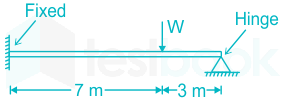
Hence the effective remains the same hence the change in effective stress is 0 kPa

Direction: The ordinates of a 2 hr hydrograph at 1 hr intervals starting from time t = 0 are 0, 3, 8, 6, 3, 2, and 0 m3/s. Use the trapezoidal rule for numerical integration if required

60

What is the catchment area represented by the unit hydrograph?

  1. ((a))

    1.00 km2
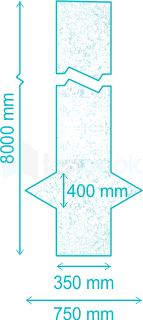
  2. ((b))

    2.00  km2
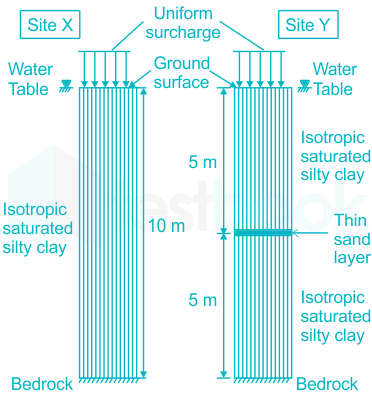
  3. ((c))

    7.92  km2

  4. ((d))

    8.64  km2

Show Answer
Answer: ((c))

7.92  km2

Concept:

  1. Area;of;catchment (A)=Area;of;unit;hydrograph(Runoff volume)Runoff;depth{\rm{Area;of;catchment~(A)}} =\rm \dfrac{{Area;of;unit;hydrograph(Runoff~ volume)}}{{Runoff;depth}}
<br>

In Unit hydrograph the runoff depth is 1cm

Area of the unit hydrograph is found by Trapezoidal rule

Calculation:

Given:

Ordintaes are  0, 3, 8, 6, 3, 2, and 0 

The area of unit hydrograph is given by,

\(\displaystyle\int_{\rm{a}}^{\rm{b}} {\rm{f}}\left( {\rm{x}} \right){\rm{dx}} = \frac{{\rm{h}}}{2}\left[ {{{\rm{y}}{\rm{o}}} + {{\rm{y}}{\rm{n}}} + 2\left( {{{\rm{y}}_1} + {{\rm{y}}_2} + {{\rm{y}}_3}{\rm{;}} \ldots } \right)} \right]\)

Here h = 1 hr


Area of unit hydrograph =12[0+0+2(3+8+6+3+2)]×60×60 = \dfrac{1}{2}\left[ {0 + 0 + 2\left( {3 + 8 + 6 + 3 + 2} \right)} \right] \times 60 \times 60

⇒ 79200 m3

Area;of;catchment=79200102{\rm{Area;of;catchment}} = \dfrac{{79200}}{{{{10}^{ - 2}}}}

A = 7920000 m2

A = 7.92 km2

<br>

Additional Information

In general for any given hydrograph,

  1. Run off volume = Area of Direct runoff hydrograph
  2. Runoff volume = Area of catchment × runoff depth
<br>

Trapezoidal rule is given by:

\(\displaystyle\int_{\rm{a}}^{\rm{b}} {\rm{f}}\left( {\rm{x}} \right){\rm{dx}} = \frac{{\rm{h}}}{2}\left[ {{{\rm{y}}{\rm{o}}} + {{\rm{y}}{\rm{n}}} + 2\left( {{{\rm{y}}_1} + {{\rm{y}}_2} + {{\rm{y}}_3}{\rm{;}} \ldots } \right)} \right]\)

Number;of;intervals(n)=bah;{\rm{Number;of;intervals(n)}} = \dfrac{{{\rm{b}} - {\rm{a}}}}{{\rm{h}}}{\rm{;}}

where b is the upper limit, a is the lower limit, h is the step size

61

A storm of 6.6 cm occurs uniformly over the catchment in 3 hours. If ϕ index is equal to 2 mm/h and base flow is 5 m3/s, What is the peak flow due to the storm?

  1. ((a))

    41.0  m3/s

  2. ((b))

    43.4  m3/s

  3. ((c))

    53.0  m3/s

  4. ((d))

    56.2 m3/s

Show Answer
Answer: ((a))

41.0  m3/s

Concept:

The ordinate of 't0' Unit hydrograph = Δy×T0t0{\rm{Δ }}y × \dfrac{{{T_0}}}{{{t_0}}}

Δy -  Difference between ordinates of  shifted S curve and S curve constructed for given ordinates

T0 - Duration of known given hydrograph

t0 - Duration of the new hydrograph

Calculation:

GIVEN:

T0  = 2 hr

ϕindex =  2 mm/hr

Rainfall P = 6.6 cm

Duration of storm = 3 hr, t0 = 3 hr

The duration of the storm is 3 hr, hence we need to construct a  3 hr Unit hydrograph

TimeOrdinates of 6 hr (T0) UHShifted by T0 hrsShifted by 2T0 hrsOrdinate of S curveOrdinate of S curve  shifted by 3 hr (t0)Δ yOrdinates of 3 hr UH =Δy× T0/t0
00000
13332
280885.33
3639096
438011385.33
526311832
603811921.33


Peak of 3 hr UH = 6 m3/s

ϕindex=Prt{\phi _{\rm index}} = \dfrac{{P - r}}{t}

2=66r32 = \dfrac{{66 - r}}{3}

r = 60 mm = 6 cm


Peak runoff of storm = Peak runoff of UH ×r(cm)1 cm × \dfrac{{{\bf{r}}(cm)}}{{1~cm}}

Peak runoff of storm = 6 × 6 = 36 m3/s

Peak flow due to storm = Runoff + Base flow = 36 + 5 = 41 m3/s

A rigid beam is hinged at one end and supported on linear elastic spring(both having a stiffness of (‘k’) at points '1' and '2', and an inclined load acts at '2', as shown.

62

Which of the following options represents the deflections δ1 and δ2 at points '1' and '2'?

  1. ((a))

    δ1=25×(2Pk);and;δ2=45×(2Pk){\delta _1} = \frac{2}{5} \times \left( {\frac{{2P}}{k}} \right);and;{\delta _2} = \frac{4}{5} \times \left( {\frac{{2P}}{k}} \right)

  2. ((b))

    δ1=25×(Pk);and;δ2=45×(Pk){\delta _1} = \frac{2}{5} \times \left( {\frac{P}{k}} \right);and;{\delta _2} = \frac{4}{5} \times \left( {\frac{P}{k}} \right)

  3. ((c))

    δ1=25×(P2k);and;δ2=45×(P2k){\delta _1} = \frac{2}{5} \times \left( {\frac{P}{{\sqrt 2 k}}} \right);and;{\delta _2} = \frac{4}{5} \times \left( {\frac{P}{{\sqrt 2 k}}} \right)

  4. ((d))

    δ1=25×(2Pk);and;δ2=45×(2Pk){\delta _1} = \frac{2}{5} \times \left( {\frac{{\sqrt 2 P}}{k}} \right);and;{\delta _2} = \frac{4}{5} \times \left( {\frac{{\sqrt 2 P}}{k}} \right)

Show Answer
Answer: ((b))

δ1=25×(Pk);and;δ2=45×(Pk){\delta _1} = \frac{2}{5} \times \left( {\frac{P}{k}} \right);and;{\delta _2} = \frac{4}{5} \times \left( {\frac{P}{k}} \right)

Concept:

Force acting in spring of stiffness k is

k=Pδk = \frac{P}{δ }

P - Force acting on spring

δ - Deflection in the spring

Calculation:

Given:

The free-body diagram showing the given set of forces is

From similar triangles 

Lδ1=2×Lδ2\frac{L}{{{δ _1}}} = \frac{{2 × L}}{{{δ _2}}}

δ2 = 2× δ1

Taking moment about hinge,∑M = 0 we get

P × 2 × L - k × δ× 2 × L - k × δ1 × L = 0 

P × 2 × L - k × 2 × δ× 2 × L - k × δ1 × L = 0 (∵ δ2 =2 × δ1)

δ1=2×P5×k{\delta _1} = \frac{{2 \times P}}{{5 \times k}}

δ2=2×2×P5×k{\delta _2} = \frac{{2\times 2 \times P}}{{5 \times k}}(∵ δ2 = 2× δ1)

δ2=4×P5×k{\delta _2} = \frac{{4 \times P}}{{5 \times k}}

63

If the load P equals 100 kN, which of the following options represents forces R1 and R2 in the springs at points '1' and  '2'?

  1. ((a))

    R1 = 20 kN and R2 = 40 kN

  2. ((b))

    R1 = 50 kN and R2 = 50 kN

  3. ((c))

    R1 = 30 kN and R2 = 60 kN

  4. ((d))

    R1 = 40 kN and R2 = 80 kN

Show Answer
Answer: ((d))

R1 = 40 kN and R2 = 80 kN

Concept:

Force acting in spring of stiffness k is

k=Pδk = \frac{P}{δ }

P - Force acting on spring

δ - Deflection in the spring

Calculation:

Given:

we know

δ1=2×P5×k{δ _1} = \frac{{2 × P}}{{5 × k}}

δ2=4×P5×k{δ _2} = \frac{{4 × P}}{{5 × k}}

From the free-body diagram 

Let R1 and R2 represent the force in spring 1 and spring 2

In spring 1

k=R1δ1k = \frac{R_1}{δ_1 }

R1 = k × δ1

R1=k×2×P5×k{R_1} = k \times \frac{{2 \times P}}{{5 \times k}}

R1=2×1005{R_1} = \frac{{2 \times 100}}{5}

R1 = 40 kN

In spring 2

R2= k × δ2

R2=k×4×P5×k{R_2} = k \times \frac{{4\times P}}{{5 \times k}}

R2=4×1005{R_2} = \frac{{4\times 100}}{5}

R1 = 80 kN

The sludge from the aeration tank of the activated sludge process (ASP) has solids content (by weight) of 2 %. This sludge is put in a sludge thickener, where sludge volume is reduced to half. Assume that the amount of  solids in supernatant from the thickener is negligible, the specific gravity of sludge solids is 2.2 and the density of water is 1000 kg/m3.

64

What is the density of the sludge removed from the aeration tank?

  1. ((a))

    990 kg/m3

  2. ((b))

    1000 kg/m3

  3. ((c))

    1011 kg/m3

  4. ((d))

    1022 kg/m3

Show Answer
Answer: ((c))

1011 kg/m3

Concept:

2% of solids (by weight) + 98% of water (by weight) = 100 % of sludge (by weight)

 Specific gravity(Gs)=ρsolidρwater{\rm Specific~gravity(G_s)} = \frac{{{\rho _{solid}}}}{{{\rho _{water}}}}

Equating the volume 

100x=981×ρw+2Gs×ρw\frac{{100}}{x} = \frac{{98}}{{1 \times {\rho _w}}} + \frac{2}{{{G_s} \times {\rho _w}}}

Calculation:

Given:

Solids content = 2 % by weight, Specific gravity of Sludge solid = 2.2

2 % of solids means there is 98% of water in sludge.

2% of solids + 98% of water = 100 % of sludge

Let ‘x’ be the density of sludge

Equating total volume 

 100x=981×ρw+2Gs×ρw\frac{{100}}{x} = \frac{{98}}{{1 \times {\rho _w}}} + \frac{2}{{{G_s} \times {\rho _w}}}

100x=981×1000+22.2×1000\frac{{100}}{x} = \frac{{98}}{{1 \times 1000}} + \frac{2}{{2.2 \times 1000}}

X = 1011 kg/m3

∴ Density of sludge = 1011 kg/m3

65

What is the sludge content (by weight) of the thickened sludge?

  1. ((a))

    3.96%

  2. ((b))

    4.00%

  3. ((c))

    4.04%

  4. ((d))

    4.10%

Show Answer
Answer: ((a))

3.96%

Concept:

2% of solids (by weight) + 98% of water (by weight) = 100 % of sludge (by weight)

Specific gravity(Gs)=ρsolidρwater{\rm Specific~ gravity (G_s)} = \frac{{{\rho _{solid}}}}{{{\rho _{water}}}}

Equating the volume 

100x=981×ρw+2Gs×ρw\frac{{100}}{x} = \frac{{98}}{{1 \times {\rho _w}}} + \frac{2}{{{G_s} \times {\rho _w}}}

Calculation:

Given:

Solids content = 2 % by weight, Specific gravity of Sludge solid = 2.2

2 % of solids means there is 98% of water in sludge.

2% of solids + 98% of water = 100 % of sludge

Let V1 = volume of sludge (Initial)

 V1 = Volume of water + Volume of solids

981×1000+22.2×1000 ⇒ \frac{{98}}{{1 \times 1000}} + \frac{2}{{2.2 \times 1000}}

⇒ 0.0989 m3

∴  V1 = 0.0989 m3

After sludge thickening (Volume of water changes)

New volume of sludge (V2) = V1/2

V2 = 0.04945m3

∴ 0.04945 = Vol. of solids + volume of water 

0.04945=22.2×1000+x10000.04945 = \frac{2}{{2.2 \times 1000}} + \frac{x}{{1000}}

 x = 48.545 % 

∴ Solids content by weight = 248.545;+2;×100\frac{{2}}{{48.545; + 2;}} \times 100

⇒ 3.96 % (by weight)

Attempt this paper under real exam conditions

Timed interface, section switching, instant scoring, and question-by-question analytics — free.

Start Timed Attempt