Official Paper

NIMCET 2020 Official Paper (Previous Year Paper)

120 questions · 120 minutes · with answers · free

Full Test (120 questions)

1

If (\rm \begin{pmatrix} 15\ 8\end{pmatrix}+\begin{pmatrix} 15\ 7\end{pmatrix}=\begin{pmatrix} \rm n\ \rm r\end{pmatrix})

then the values of n and r are:

Where, (\begin{pmatrix} \rm n\ \rm r\end{pmatrix} = {}^nC_r)

  1. ((a))

    16 and 7.

  2. ((b))

    16 and 8.

  3. ((c))

    16 and 9.

  4. ((d))

    30 and 15.

Show Answer
Answer: ((b))

16 and 8.

Concept:

  • nCr = nCn-r.
  • If nCx = nCy, then x = y or x + y = n.
  • nCr + nCr-1 = n+1Cr.


Calculations:

(\rm \begin{pmatrix} 15\ 8\end{pmatrix}+\begin{pmatrix} 15\ 7\end{pmatrix}=\begin{pmatrix} \rm n\ \rm r\end{pmatrix})

⇒ 15C8 + 15C7 = nCr

Using nCr + nCr-1 = n+1Cr:

⇒ ​15C8 + 15C8-1 = 15+1C8 = nCr

⇒ ​16C8 = nCr

n = 16 and r = 8.

2

In a class of 50 students, it was found that 30 students read "Hitavad", 35 students read "Hindustan" and 10 read neither. How many students read both "Hitavad" and "Hindustan" newpapers?

  1. ((a))

    25

  2. ((b))

    35

  3. ((c))

    15

  4. ((d))

    30

Show Answer
Answer: ((a))

25

Concept:

Let A and B denote two sets of elements.

  • n(A) and n(B) are the number of elements present in set A and B respectively.
  • n(A ⋃ B) is the total number of elements present in either set A or B.
  • n(A ⋂ B) is the number of elements present in both the sets A and B.
  • n(A ⋃ B) = n(A) + n(B) - n(A ⋂ B)


Calculations:

Let A be the set of students who read "Hitavad" and B the set of students who read "Hindustan".

From the given information:

n(A ⋃ B) = 50 - 10 = 40.

n(A) = 30.

n(B) = 35.

By using n(A ⋃ B) = n(A) + n(B) - n(A ⋂ B), we get:

40 = 30 + 35 - n(A ⋂ B)

⇒ n(A ⋂ B) = 25.

∴ The number of students who read both "Hitavad" and "Hindustan" newpapers is n(A ⋂ B) = 25.

3

If x = {4n - 3n - 1: n ϵ N} and Y = {9(n - 1) : n ϵ N}, where N is the set of natural numbers, then

  1. ((a))

    X ⊂ Y

  2. ((b))

    X (\subseteq) Y

  3. ((c))

    X (\supset) Y

  4. ((d))

    X (\supseteq) Y

Show Answer
Answer: ((a))

X ⊂ Y

Concept:

We know that a set of which all the elements are contained in another set is known as a subset

Calculations:

Given, X = {4n - 3n - 1: n ϵ N}, where N is the set of natural numbers so N =1, 2, 3, ....

After putting all these values of N, we will get the elements of X.

⇒ X = {0, 9, 54,....}

Similarly, Y = {9(n - 1) : n ϵ N}, where N is the set of natural numbers,

⇒ Y = {0, 9, 18, 27,....}

Here, all elements of X is contained in set Y. 

Hence, X is a subset of Y.

(\rm X \subset Y)

Hence, if x = {4n - 3n - 1: n ϵ N} and Y{9(n - 1) : n ϵ N}, where N is the set of natural numbers, then (\rm X \subset Y).

4

If A = {x, y, z}, then the number of subsets in powerset of A is

  1. ((a))

    6

  2. ((b))

    8

  3. ((c))

    7

  4. ((d))

    9

Show Answer
Answer: ((b))

8

Concept:

  • The power set (or powerset) of a Set A is defined as the set of all subsets of the Set A including the Set itself and the null or empty set.

Calculations:

Given, A = {x, y, z}. 

The power set (or powerset) of a Set A is defined as the set of all subsets of the Set A including the Set itself and the null or empty set.

Powerset of A = {ϕ,{x}, {y}, {z}, {x, y}, {y, z}, {x, z},{x, y, z}}.

Hence, the number of subsets in the powerset of A is 8.

5

How many words starting with letter D can be formed by taking all letters from word DELHI, so that the letters are not repeated?

  1. ((a))

    4

  2. ((b))

    12

  3. ((c))

    24

  4. ((d))

    120

Show Answer
Answer: ((c))

24

Concept:

Basic Principle of Counting:

If there are m ways for happening of an event A, and corresponding to each possibility there are n ways for happening of event B, then the total number of different possibilities for happening of events A and B are:

  • Either event A OR event B alone = m + n.
  • Both event A AND event B together = m × n.
  • A number is divisible by 2 if its units digit is either 0, 2, 4, 6 or 8.


Permutations/Arrangements:

  • The number of ways in which r objects can be arranged in n places is nPr = (\rm \dfrac{n!}{(n - r)!}).
  • The number of ways in which n objects can be arranged in n places is nPn = n!.
  • n! = 1 × 2 × 3 × ... × n.
  • 0! = 1.


Calculations:

The number of letters in the word DELHI = 5.

Since, D has to be the first letter, the number of ways in which the first letter can be written is 1.

The remaining 4 letters can be written in any order/arrangement of the remaining 4 letters (ELHI).

∴ The number of ways of writing the 4 letters = 4! = 4 × 3 × 2 × 1 = 24.

∴ The total number of ways of writing the 5 letters = 1 × 24 = 24.

6

Naresh has 10 friends, and he wants to invite 6 of them to a party. How many times will 3 particular friends never attend the party?

  1. ((a))

    8

  2. ((b))

    7

  3. ((c))

    720

  4. ((d))

    35

Show Answer
Answer: ((b))

7

Concept:

(\rm ^nC_r = \dfrac{n!}{r!(n-r)!})

Calculations:

Given, Naresh has 10 friends, and he wants to invite 6 of them to a party.

Remove the 3 particular friends and invite 6 friends from the remaining = 10 - 3 = 7 friends.

This can be done in 7C6 ways


Hence, required number of ways = 7C6 

⇒required number of ways = (\rm \dfrac{7!}{(7-6)!6!})

⇒required number of ways = 7 

Hence, Naresh has 10 friends, and he wants to invite 6 of them to a party. total number of ways that 3 particular friends never attend the party = 7

7

There is a young boy's birthday party which 3 friends have attended. The mother has arranged 10 games where a prize is awarded for winning a game. The prizes are identical. If each of the 4 children receives at least one prize, then how many distributions of prizes are possible?

  1. ((a))

    80

  2. ((b))

    84

  3. ((c))

    70

  4. ((d))

    72

Show Answer
Answer: ((b))

84

Concept:

  • The total number of ways in which n objects can be distributed in r people if any person can get 'any number of objects' = n+r-1Cr-1.
  • The total number of ways in which n objects can be distributed in r people if every person must get 'at least one object' = n-1Cr-1.
  • nCr = (\rm \dfrac{n!}{r!(n-r)!}).
  • n! = 1 × 2 × 3 × ... × n.
  • 0! = 1.


Calculations:

Here, the number of objects is n = 10 and the number of people is r = 4.

Since, every person must get at least one object, the total number of possible distributions is:

n-1Cr-1 = 10-1C4-1 = 9C3 

= (\rm \dfrac{9!}{3!(9-3)!}=\dfrac{7\times8\times9}{3\times2\times1}) 

= 84.

8

Three cities A, B and C are equidistant from each other. A motorist travels from A to B at 30 km/hr, from B to C at 40 km/hr and from C to A at 50 km/hr. Then the average speed is:

  1. ((a))

    39 km/hr

  2. ((b))

    40 km/hr

  3. ((c))

    38.3 km/hr

  4. ((d))

    37.6 km/hr

Show Answer
Answer: ((c))

38.3 km/hr

Concept:

  • If the 'Speed' is constant, then the 'Distance' and the 'Time' are directly proportional to each other. It means that, if one of the quantities becomes n times, the other will also become n times.
  • Speed = (\rm \dfrac{Distance}{Time}).
  • Average Speed = (\rm \dfrac{Total\ Distance}{Total\ Time}).


Calculations:

Let's say that the distance between each pair of cities is 600 km.

From A to B:

Distance = 600 km.

Time = (\rm \dfrac{Distance}{Speed}=\dfrac{600}{30}) = 20 hrs.

From B to C:

Distance = 600 km.

Time = (\rm \dfrac{Distance}{Speed}=\dfrac{600}{40}) = 15 hrs.

From C to A:

Distance = 600 km.

Time = (\rm \dfrac{Distance}{Speed}=\dfrac{600}{50}) = 12 hrs.

For overall journey:

Total distance = 600 + 600 + 600 = 1800 km.

Total time = 20 + 15 + 12 = 47 hrs.

Average Speed = (\rm \dfrac{Total\ Distance}{Total\ Time}=\dfrac{1800}{47}) = 38.29 km/hr.

Alternate Method 

Formula used:

Speed = (\rm \dfrac{Distance}{Time}).

Average Speed = (\rm \dfrac{Total\ Distance}{Total\ Time}).

Calculation:

Let's say that the distance between each pair of cities be x km

According to the question,

Distance = x km.

Time = (\rm \dfrac{Distance}{Speed}=\dfrac{x}{30}) 

Time = (\rm \dfrac{Distance}{Speed}=\dfrac{x}{40}) 

Time = (\rm \dfrac{Distance}{Speed}=\dfrac{x}{50})

Total distance = x/30 + x/40 + x/50 = 47x/600

Average Speed = Total distance/Total time = 3x × 600/47x = 38.29 km/hr.

9

A problem in Mathematics is given to 3 students A, B and C. If the probability of A solving the problem is (\dfrac{1}{2}) and B not solving it is (\dfrac{1}{4}) and the whole probability of the problem being solved is (\dfrac{63}{64}), then what is the probability of solving it by C?

  1. ((a))

    (\dfrac18)

  2. ((b))

    (\dfrac1{64})

  3. ((c))

    (\dfrac78)

  4. ((d))

    (\dfrac12)

Show Answer
Answer: ((c))

(\dfrac78)

Concept:

  • P(not E) = 1 - P(E).
  • Probability of a Compound Event [(A and B) or (B and C)] is calculated as:

P[(A and B) or (B and C)] = [P(A) × P(B)] + [P(C) × P(D)]

('and' means '×' and 'or' means '+')


Calculations:

It is given that P(A) = (\dfrac{1}{2}) and P(not B) = (\dfrac{1}{4}). Let's say that the probability of C solving the problem is P(C) = x.

∴ Probability of A not solving the problem = P(not A) = 1 - P(A) = (1-\dfrac{1}{2}) = (\dfrac{1}{2}).

And, probability of C not solving the problem = P(not C) = 1 - P(C) = 1 - x.

Now, the probability that the problem is not solved at all:

= P(not A) AND P(not B) AND P(not C)

= P(not A) × P(not B) × P(not C)

= (\rm \dfrac{1}{2}\times\dfrac{1}{4}\times(1-x))

= (\rm \dfrac{1-x}{8}).

And, the probability that the problem is solved = 1 - Probability that the problem is not solved at all = (\rm \dfrac{63}{64}).

⇒ (\rm 1-\dfrac{1-x}{8}=\rm \dfrac{63}{64})

⇒ (\rm \dfrac{1-x}{8}=1-\rm \dfrac{63}{64}=\dfrac{1}{64})

⇒ (\rm 1-x=\dfrac{1}{8})

⇒ (\rm x=1-\dfrac{1}{8}=\dfrac78).

∴ The probability of C solving the problem is P(C) = x = (\dfrac78).

10

A and B play a game where each is asked to select a number from 1 to 25. If the two numbers match, both win a prize. The probability that they will not win a prize in a single trial is

  1. ((a))

    (\frac{1}{25})

  2. ((b))

    (\frac{24}{25})

  3. ((c))

    (\frac{2}{25})

  4. ((d))

    (\frac{3}{25})

Show Answer
Answer: ((b))

(\frac{24}{25})

Concept:

The probability that they will not win a prize in a single trial = 1 - The probability that they will win a prize in a single trial

Calculations:

Given, A and B play a game where each is asked to select a number from 1 to 25. If the two numbers match, both win a prize.

Total number of possibilities = (\rm 25 \times 25)

Favourable number of their wining = 25

⇒ Probability of winning the prize = (\dfrac {1}{25})

The probability that they will not win a prize in a single trial = 1 - The probability that they will win a prize in a single trial

The probability that they will not win a prize in a single trial = 1 - (\dfrac {1}{25})

⇒The probability that they will not win a prize in a single trial = (\dfrac {24}{25})

11

A, B, C are three sets of values of x:

A : 2, 3, 7, 1, 3, 2, 3

B : 7, 5, 9, 12, 5, 3, 8

C : 4, 4, 11, 7, 2, 3, 4

Select the correct statement from the following:

  1. ((a))

    Mean of A is equal Mode of C.

  2. ((b))

    Mean of C is equal to Median of B.

  3. ((c))

    Median of B is equal to Mode of A.

  4. ((d))

    Mean, Median and Mode of A are same.

Show Answer
Answer: ((d))

Mean, Median and Mode of A are same.

Concept:

For a set x1, x2, ..., xn of n observations:

  • Mean: (\rm \bar{x} =\dfrac{x_{1}+x_{2}+\ ...\ +x_{n}}{n}).
  • Median: is the value at the central position when the data is arranged in ascending or descending order.

For odd n, median is the value at the (\rm \left(\dfrac{n+1}{2}\right)) position.

For even n, median is the mean of values at (\rm \left(\dfrac{n}{2}\right)) and (\rm \left(\dfrac{n}{2}+1\right)) position.

  • Mode: is the value which occurs the most number of times, i.e. the value with the highest frequency.

Calculation:

There are 7 observations in each set, so the Median will be the value of observation at the (\rm \left(\dfrac{7+1}{2}\right)) = 8th position, when they are arranged in ascending/descending order.

The values of Mean, Median and Mode for the given sets is summarized below:

Ascending OrderSumMeanMedianMode
A : 1, 2, 2, 3, 3, 3, 721333
B : 3, 5, 5, 7, 8, 9, 1249775
C : 2, 3, 4, 4, 4, 7, 1135544


'Mean, Median and Mode of A are same.' is correct.

12

Standard deviation for the following distribution is:

Size of Item6789101112
Frequency36913854
  1. ((a))

    1.6

  2. ((b))

    9.0

  3. ((c))

    5.0

  4. ((d))

    1.88

Show Answer
Answer: ((a))

1.6

Concept:

For a set x1, x2, ..., xn of n observations:

  • Mean: (\rm \bar{x} =\dfrac{x_{1}+x_{2}+\ ...\ +x_{n}}{n}).
  • Variance: (\rm \sigma^2 =\dfrac{(x_{1}-\bar{x})^2+(x_{2}-\bar{x})^2+...+(x_{n}-\bar{x})^2}{n}=\dfrac{\sum (x_i-\bar x)^2}{n}=\dfrac{\sum x_i^2}{n}-\bar x^2).
  • Standard Deviation: (\rm \sigma=\sqrt{\sigma^2}=\sqrt{Variance}).

Calculation:

Total number of items in the distribution = Σ fi = 3 + 6 + 9 + 13 + 8 + 5 + 4 = 48.

The Mean (x̅) of the given set = (\rm \dfrac{\sum f_i x_i}{\sum f_i}).

⇒ x̅ = (\rm \dfrac{6\times3+7\times6+8\times9+9\times13+10\times8+11\times5+12\times4}{48}=\dfrac{432}{48}) = 9.

Let's calculate the variance using the formula: (\rm \sigma^2 =\dfrac{\sum x_i^2}{n}-\bar x^2).

(\rm \dfrac{\sum {x_i}^2}{n}=\dfrac{6^2\times3+7^2\times6+8^2\times9+9^2\times13+10^2\times8+11^2\times5+12^2\times4}{48}=\dfrac{4012}{48}) = 83.58.

∴ σ2 = 83.58 - 92 = 83.58 - 81 = 2.58.

And, Standard Deviation (σ) = (\rm \sqrt{\sigma^2}=\sqrt{Variance}=\sqrt{2.58}) ≈ 1.607.

13

If  (\rm A= \begin{bmatrix}\ \ \ \cos\alpha & \sin \alpha \ -\sin \alpha & \cos \alpha \end{bmatrix}), then for any positive integer n, An is:

  1. ((a))

    (\rm \begin{bmatrix} \rm \sin n\alpha & \ \ \ \rm \cos n\alpha \ \rm \cos n\alpha & \rm -\sin n\alpha \end{bmatrix})

  2. ((b))

    (\rm \begin{bmatrix} \rm \cos n\alpha & \rm \sin n\alpha \ \rm \sin n\alpha & \rm \cos n\alpha \end{bmatrix})

  3. ((c))

    (\rm \begin{bmatrix} \rm \cos n\alpha & \ \ \ \rm \sin n\alpha \ \rm \sin n\alpha & \rm -\cos n\alpha \end{bmatrix})

  4. ((d))

    (\rm \begin{bmatrix} \ \ \ \rm \cos n\alpha & \rm \sin n\alpha \ \rm- \sin n\alpha & \rm \cos n\alpha \end{bmatrix})

Show Answer
Answer: ((d))

(\rm \begin{bmatrix} \ \ \ \rm \cos n\alpha & \rm \sin n\alpha \ \rm- \sin n\alpha & \rm \cos n\alpha \end{bmatrix})

Concept:

Matrix Multiplication:

  • Matrices are multiplied by multiplying each element of a row of the first m×n matrix with the corresponding elements of all the columns of the second n×p matrix to obtain the first row of the product matrix with p columns, and so on for all the m rows of the first matrix.
  • Multiplication is only possible when the number of columns of the first matrix is equal to the number of rows of the second matrix.
  • A m×n matrix multiplied by a n×p matrix results in a m×p matrix.


Trigonometric Identities:

  • cos (α ± β) = cos α cos β ∓ sin α sin β.
  • sin (α ± β) = sin α cos β ± sin β cos α.
  • cos 2θ = cos2 θ - sin2 θ.
  • sin 2θ = 2 sin θ cos θ.


Calculations:

Let (\rm M= \begin{bmatrix}\ \ \ \rm \cos \alpha & \rm \sin \alpha \ \rm -\sin \alpha & \rm \cos \alpha \end{bmatrix}) and (\rm N= \begin{bmatrix}\ \ \ \rm \cos \beta & \rm \sin \beta \ \rm -\sin \beta & \rm \cos \beta \end{bmatrix}).

⇒ (\rm M\times N= \begin{bmatrix}\ \ \ \cos\alpha & \sin \alpha \ -\sin \alpha & \cos \alpha \end{bmatrix}\times \begin{bmatrix}\ \ \ \cos \beta & \sin \beta \ -\sin \beta & \cos \beta \end{bmatrix})

⇒ (\rm M\times N = \begin{bmatrix}\cos \alpha \cos \beta - \sin \alpha \sin \beta & \cos \alpha \sin \beta+\sin \alpha \cos \beta \ -\sin \alpha \cos \beta - \cos \alpha \sin \beta & -\sin \alpha \sin \beta + \cos \alpha \cos \beta \end{bmatrix})

⇒ (\rm M\times N= \begin{bmatrix}\cos (\alpha +\beta) & \sin (\alpha +\beta) \ -\sin (\alpha +\beta) & \cos (\alpha +\beta) \end{bmatrix}).

∴ (\rm A\times A= A^2=\begin{bmatrix}\cos (\alpha +\alpha) & \sin (\alpha +\alpha) \ -\sin (\alpha +\alpha) & \cos (\alpha +\alpha) \end{bmatrix}=\begin{bmatrix}\ \ \ \rm \cos 2\alpha & \rm \sin 2\alpha \ \rm -\sin 2\alpha & \rm \cos 2\alpha \end{bmatrix})

⇒ (\rm A^2\times A= A^3=\begin{bmatrix}\cos (2\alpha +\alpha) & \sin (2\alpha +\alpha) \ -\sin (2\alpha +\alpha) & \cos (2\alpha +\alpha) \end{bmatrix}=\begin{bmatrix}\ \ \ \rm \cos 3\alpha & \rm \sin 3\alpha \ \rm -\sin 3\alpha & \rm \cos 3\alpha \end{bmatrix})

And so on.

Hence, An = (\rm \begin{bmatrix} \rm \cos n\alpha & \ \ \ \rm \sin n\alpha \ \rm -\sin n\alpha & \rm \cos n\alpha \end{bmatrix}).

14

If the roots of the equation ax2 - 2bx + c = 0 are n and m, then the value of (\rm \frac{b}{an^2+c}+\frac{b}{am^2+c}) is:

  1. ((a))

    (\rm \frac{c}{a})

  2. ((b))

    (\rm \frac{b}{a})

  3. ((c))

    (\rm \frac{a}{c})

  4. ((d))

    (\rm \frac{b}{c})

Show Answer
Answer: ((d))

(\rm \frac{b}{c})

Concept:

If α and β are the two roots of the quadratic equation Ax2 + Bx + C = 0, then α + β = (\rm -\frac{B}{A}) and αβ = (\rm \frac{C}{A}).

Calculation:

Given: ax2 - 2bx + c = 0

Using the formula for the sum and the product of the roots we get:

m + n = (\rm \frac{2b}{a})                ...(1)

mn = (\rm \frac{c}{a})                ...(2)

Now, the given expression (\rm \frac{b}{an^2+c}+\frac{b}{am^2+c}):

= (\rm \frac{\tfrac{2b}{a}}{2\left (n^2+\tfrac{c}{a} \right )}+\frac{\tfrac{2b}{a}}{2\left (m^2+\tfrac{c}{a} \right )})

= (\rm \frac{m+n}{2(n^2+mn)}+\frac{m+n}{2(m^2+mn)})

= (\rm \frac{m+n}{2n(n+m)}+\frac{m+n}{2m(m+n)})

= (\rm \frac{1}{2}\left (\frac{1}{m}+\frac{1}{n}\right ))

= (\rm \frac{1}{2}\left (\frac{m+n}{mn}\right ))

= (\rm \frac{1}{2}\left (\frac{\tfrac{2b}{a}}{\tfrac{c}{a}}\right ))

= (\rm \frac{b}{c}).

15

The number of non-zero values of k for which the linear equations

4x + ky + z = 0

kx + 4y + z = 0

2x + 2y + z = 0

possess a non-zero solution is:

  1. ((a))

    2

  2. ((b))

    1

  3. ((c))

    0

  4. ((d))

    3

Show Answer
Answer: ((b))

1

Concept:

Cramer's rule for Linear Equations of Three Variables:

a1x + b1y + c1z = d1

a2x + b2y + c2z = d2

a3x + b3y + c3z = d3

(\rm D=\begin{vmatrix} \rm a_{1} & \rm a_{2} & \rm a_{3}\ \rm b_{1} & \rm b_{2} & \rm b_{3}\ \rm c_{1} & \rm c_{2} & \rm c_{3}\end{vmatrix})

(\rm \rm D_{x}=\begin{vmatrix}\rm d_{1} & \rm d_{2} & \rm d_{3}\ \rm b_{1} & \rm b_{2} & \rm b_{3}\ \rm c_{1} & \rm c_{2} & \rm c_{3}\end{vmatrix}\quad \rm D_{y}=\begin{vmatrix}\rm a_{1} & \rm a_{2} & \rm a_{3}\ \rm d_{1} & \rm d_{2} & \rm d_{3}\ \rm c_{1} & \rm c_{2} & \rm c_{3}\end{vmatrix}\quad \rm D_{z}=\begin{vmatrix}\rm a_{1} & \rm a_{2} & \rm a_{3}\ \rm b_{1} & \rm b_{2} & \rm b_{3}\ \rm d_{1} & \rm d_{2} & \rm d_{3}\end{vmatrix})

If D ≠ 0: a unique solution (consistent).

The solution is: (\rm x=\frac{D_x}{D}\quad y=\frac{D_y}{D}\quad z=\frac{D_z}{D}).

If D = 0: either infinitely many solutions (consistent and dependent) or no solution (inconsistent). To find out if the system is dependent or inconsistent, another method, such as elimination or Rouché–Capelli theorem, will have to be used.

Calculation:

For the given set of equations:

4x + ky + z = 0

kx + 4y + z = 0

2x + 2y + z = 0

It can be observed that x = y = z = 0 is one solution of the system.

In order to have infinitely many (including non-zero) solutions, D must be zero.

⇒ (\rm D=\begin{vmatrix} 4 & \rm k & 2 \ \rm k & 4 & 2\ 1 & 1 & 1\end{vmatrix}) = 0

⇒ 4(4 - 2) + k(2 - k) + 2(k - 4) = 0

⇒ 8 + 2k - k2 + 2k - 8 = 0

⇒ k2 - 4k = 0

⇒ k(k - 4) = 0

⇒ k = 0 OR k - 4 = 0

⇒ k = 0 OR k = 4

Hence, there are 2 possible values of k but a non-zero solution is one.

16

Let A = [aij] and B = [bij] be two square matrices of order n and det(A) denote the determinant of A. Then, which of the following is not correct:

  1. ((a))

    If A is a diagonal matrix, then det(A) = a11 a22 ... ann.

  2. ((b))

    det(AB) = det(A) det(B).

  3. ((c))

    det(cA) = c [det(A)].

  4. ((d))

    det(A) = det(AT), where AT denotes the transpose of the matrix A.

Show Answer
Answer: ((c))

det(cA) = c [det(A)].

Concept:

Properties of determinants:

  • The determinant of a diagonal matrix is the product of the diagonal entries.
  • If A and B are both n×n matrices, then det(AB) = det(A) det(B).
  • For a n×n matrix A, det(kA) = kn det(A).
  • The determinant of a square matrix is the same as the determinant of its transpose.


Calculation:

From the properties of determinants stated above, it can be seen that det(cA) = c [det(A)] is not correct.

The correct statement would be det(cA) = c[det(A)].

17

The tangent to an ellipse x2 + 16y2 = 16 and making angle 60° with x-axis is:

  1. ((a))

    x - √3y + 7 = 0

  2. ((b))

    ​​x + √3y - 7 = 0

  3. ((c))

    ​√3x - y + 7 = 0

  4. ((d))

    √3x + y + 7 = 0

Show Answer
Answer: ((c))

​√3x - y + 7 = 0

Concept:

Straight Lines:

  • The general equation of a line is y = mx + c, where m is the slope of the line.
  • If the line y = mx + c makes an angle θ with the positive direction of the x-axis, then m = tan θ.


Tangents to an Ellipse:

  • If the line y = mx + c touches the ellipse (\rm \dfrac{x^2}{a^2}+\dfrac{y^2}{b^2}=1), then c2 = a2m2 + b2.
  • The straight lines (\rm y = mx \pm \sqrt{a^2m^2 + b^2}) represent the tangents to the ellipse.


Calculation:

The given tangent makes an angle of 60 with the positive direction of the x-axis.

∴ m = tan 60∘ = √3.

Converting the given equation of the ellipse into the standard form (\rm \dfrac{x^2}{a^2}+\dfrac{y^2}{b^2}=1 ):

x2 + 16y2 = 16

⇒ (\rm \dfrac{x^2}{4^2}+\dfrac{y^2}{1^2}=1 )

∴ a = 4 and b = 1.

Using the formula (\rm y = mx \pm \sqrt{a^2m^2 + b^2} ) for the tangents to the ellipse, the required equation is:

(\rm y = \sqrt3x + \sqrt{4^2({\sqrt3})^2 + 1^2} )

⇒ y = √3x + 7

⇒ ​**√3x - y + 7 = 0**.

18

Find the number of point(s) of intersection of the ellipse (\rm \dfrac{x^2}{4} + \dfrac{(y-1)^2}{9}=1) and the circle x2 + y2 = 4.

  1. ((a))

    4

  2. ((b))

    3

  3. ((c))

    2

  4. ((d))

    1

Show Answer
Answer: ((b))

3

Concept:

Two curves f(x, y) = 0 and g(x, y) = 0 cut/touch at a point (a, b) if f(a, b) = g(a, b) = 0.

Calculation:

Let f(x, y) = (\rm \dfrac{x^2}{4} + \dfrac{(y-1)^2}{9}-1) = 0 and g(x, y) = x2 + y2 - 4 = 0 intersect at a point (a, b).

∴ f(a, b) = g(a, b) = 0

⇒ (\rm \dfrac{a^2}{4} + \dfrac{(b-1)^2}{9}-1) = a2 + b2 - 4 = 0

⇒ (\rm a^2 + \dfrac{4(b-1)^2}{9}-4) = a2 + b2 - 4 = 0

⇒ (\rm \dfrac{4(b-1)^2}{9}) = b2

⇒ 4(b - 1)2 = 9b2

⇒ (2b - 2)2 - (3b)2 = 0

⇒ (2b - 2 + 3b)(2b - 2 - 3b) = 0

⇒ (5b - 2)(-b - 2) = 0

⇒ 5b - 2 = 0 OR -b - 2 = 0

⇒ b = (\dfrac25) OR b = -2.

Now, using a2 + b2 - 4 = 0, we get:

(\rm a^2+\left(\dfrac{2}{5}\right)^2-4=0) OR a2 + (-2)2 - 4 = 0

⇒ a2 = (\rm \dfrac{96}{25}) OR a2 = 0

⇒ a = (\rm \pm \dfrac{4\sqrt6}{5}) OR a = 0.

∴ The points of intersection are (\rm \left (\dfrac{4\sqrt6}{5}, \dfrac25 \right )), (\rm \left (-\dfrac{4\sqrt6}{5}, \dfrac25 \right )) and (0, -2).

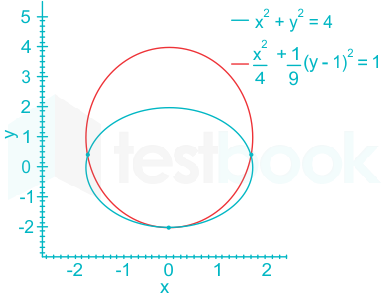
The given ellipse and the circle intersect at three points (intersect at two and touch at one) as shown below:

19

An arithmetic progression has 3 as its first term. Also, the sum of the first 8 terms is twice the sum of the first 5 terms. What is the common difference?

  1. ((a))

    (\dfrac34)

  2. ((b))

    (\dfrac12)

  3. ((c))

    (\dfrac14)

  4. ((d))

    (\dfrac43)

Show Answer
Answer: ((a))

(\dfrac34)

Concept:

Arithmetic Progression (AP): The series of numbers where the difference of any two consecutive terms is the same, is called an Arithmetic Progression.

  • An Arithmetic Progression of n terms, with first term a and common difference d, is represented as:

a, a + d, a + 2d, a + 3d, ..., a + (n - 2)d, a + (n - 1)d.

  • The sum of n terms of the above series is given by:

Sn = (\rm \dfrac{n}{2}[a+{a+(n-1)d}]=\left (\dfrac{First\ Term+Last\ Term}{2} \right )\times n).


Calculation:

It is given that first term a = 3. Let the common difference be d.

Also, the sum of the first 8 terms is twice the sum of the first 5 terms.

⇒ S8 = 2S5

⇒ (\rm \dfrac{8}{2}[3+{3+(8-1)d}]=2\times\dfrac{5}{2}[3+{3+(5-1)d}])

⇒ 4(6 + 7d) = 5(6 + 4d)

⇒ 24 + 28d = 30 + 20d

⇒ 8d = 6

⇒ d = (\dfrac 34).

∴ The common difference of the given arithmetic progression is (\dfrac 34).

20

if a + b + c = 0, then the value of (\rm \dfrac{a^2}{bc} + \dfrac{b^2}{ca} + \dfrac{c^2}{ab}) is:

  1. ((a))

    1

  2. ((b))

    0

  3. ((c))

    3

  4. ((d))

    -1

Show Answer
Answer: ((c))

3

Concept:

  • (a + b + c)(a2 + b2 + c2 - ab - bc - ca) = a3 + b3 + c3 - 3abc.
  • If a + b + c = 0, then a3 + b3 + c3 = 3abc.
<br>

Calculation:

Since, a + b + c = 0, we have a3 + b3 + c3 = 3abc.

∴ The given expression is:

(\rm \dfrac{a^2}{bc} + \dfrac{b^2}{ca} + \dfrac{c^2}{ab})

= (\rm \dfrac{a^3}{abc} + \dfrac{b^3}{bca} + \dfrac{c^3}{cab})

= (\rm \dfrac{3abc}{abc}) = 3.

21

What is the value of (\rm \displaystyle \lim_{x \to 0} {x^2}{e^{\sin \left( {\tfrac{1}{x}} \right)}})?

  1. ((a))

    1

  2. ((b))

    The limit does not exist.

  3. ((c))

  4. ((d))

    None of these.

Show Answer
Answer: ((d))

None of these.

Concept:

The Squeeze Theorem (The Sandwich Theorem): is used on a function where it will be almost impossible to differentiate.

  • The squeeze theorem states that if we define functions such that h(x) ≤ f(x) ≤ g(x) and if (\rm \displaystyle \lim_{x \to a}h(x) = \lim_{x \to a}g(x) = L), then (\rm \displaystyle \lim_{x \to a}f(x) = L).


Calculation:

We know that -1 ≤ sin θ ≤ 1.

⇒ -1 ≤ (\rm \sin \left(\dfrac1x\right)) ≤ 1

Since, ex is a strictly increasing function for all real values of x, we can say that:

⇒ e-1 ≤ (\rm e^{\sin \left(\tfrac1x\right)}) ≤ e1

Also, since x2 ≥ 0, we can say that:

⇒ x2e-1 ≤ (\rm x^2e^{\sin \left(\tfrac1x\right)}) ≤ x2e1

⇒ (\rm \dfrac{x^2}{e}\leq x^2e^{\sin \left(\tfrac1x\right)}\leq x^2e)

So, we can consider h(x) = (\rm \dfrac{x^2}{e}), f(x) = (\rm \displaystyle \lim_{x \to 0} {x^2}{e^{\sin \left( {\tfrac{1}{x}} \right)}}) and g(x) = x2e.

Now, (\rm \displaystyle \lim_{x \to 0}h(x) = \lim_{x \to 0}\dfrac{x^2}{e}=0).

And (\rm \displaystyle \lim_{x \to 0}g(x) = \lim_{x \to 0}x^2e=0).

Since, (\rm \displaystyle \lim_{x \to 0}h(x) =\lim_{x \to 0}g(x) =0), we must have (\rm \displaystyle \lim_{x \to 0}f(x) =0).

Hence, (\rm \displaystyle \lim_{x \to 0} {x^2}{e^{\sin \left( {\tfrac{1}{x}} \right)}}=0).

22

If (\rm f(x) = \left { \begin{matrix} \rm x^2; & \rm x \leq 0 \ \rm 2\sin x; & \rm x > 0 \end{matrix}\right.), then x = 0 is a point of:

  1. ((a))

    Minima.

  2. ((b))

    Maxima.

  3. ((c))

    Discontinuity.

  4. ((d))

    None of these.

Show Answer
Answer: ((a))

Minima.

Concept:

Continuity of a Function:

  • A function f(x) is said to be continuous at a point x = a in its domain, if (\rm \displaystyle \lim_{x\to a}f(x)) exists or or if its graph is a single unbroken curve at that point.
  • f(x) is continuous at x = a ⇔ (\rm \displaystyle \lim_{x\to a^+}f(x)=\lim_{x\to a^-}f(x)=\lim_{x\to a}f(x)=f(a)).


Differentiability of a Function:

  • A function f(x) is differentiable at a point x = a in its domain if its derivative is continuous at a.

This means that f'(a) must exist, or equivalently: (\rm \displaystyle \lim_{x\to a^+}f'(x)=\lim_{x\to a^-}f'(x)=\lim_{x\to a}f'(x)=f'(a)).


Maxima/Minima:

  • If f(x) has a local maximum or a local minimum at a point x = a, then it must be either a critical point [f'(a) = 0] or a point of non-differentiability.

Calculation:

Let us check for the continuity and differentiability (maxima/minima) of the function at x = 0.

Continuity:

(\rm f(x) = \left { \begin{matrix} \rm x^2; & \rm x \leq 0 \ \rm 2\sin x; & \rm x > 0 \end{matrix}\right.)

(\rm \displaystyle \lim_{x\to 0^-}f(x)=\lim_{x\to 0^-}x^2) = 02 = 0.

(\rm \displaystyle \lim_{x\to 0^+}f(x)=\lim_{x\to 0^+}2\sin x) = 2 sin 0 = 0.

f(0) = 02 = 0.

∵ (\rm \displaystyle \lim_{x\to 0^-}f(x)=\lim_{x\to 0^+}f(x)) = f(0), the function f(x) is continuous at x = 0.

Differentiability:

(\rm f'(x) = \left { \begin{matrix} \rm 2x; & \rm x \leq 0 \ \rm 2\cos x; & \rm x > 0 \end{matrix}\right.)

(\rm \displaystyle \lim_{x\to 0^-}f'(x)=\lim_{x\to 0^-}2x) = 2×0 = 0.

(\rm \displaystyle \lim_{x\to 0^+}f'(x)=\lim_{x\to 0^-}2\cos x) = 2 cos 0 = 2.

∵ (\rm \displaystyle \lim_{x\to 0^+}f'(x)\neq\lim_{x\to 0^-}f'(x)), the function is not differentiable at x = 0.

Since, the function is not differentiable at x = 0, let us examine the possibility of maximum/minimum at the point.

The function f(x) = x2 is strictly decreasing in (-∞, 0] and its minimum is 02 = 0 at x = 0.

The function f(x) = 2sin x is strictly increasing in (\rm \left(0,\dfrac{\pi}{2}\right]) and its minimum is 2 sin 0 = 0 at x = 0.

∴ The function f(x) has a local minimum at x = 0.

23

If (\rm f(x) = \left{ \begin{matrix} \rm \dfrac{x-x^2}{2x}; & \rm x \ne 0 \ \rm K; & \rm x = 0 \end{matrix}\right.) is a continuous function at x = 0, then the value of K is:

  1. ((a))

    2

  2. ((b))

    (\dfrac12)

  3. ((c))

    1

  4. ((d))

    None of these

Show Answer
Answer: ((b))

(\dfrac12)

Concept:

Definition:

  • A function f(x) is said to be continuous at a point x = a in its domain, if (\rm \displaystyle \lim_{x\to a}f(x)) exists or if its graph is a single unbroken curve at that point.
  • f(x) is continuous at x = a ⇔ (\rm \displaystyle \lim_{x\to a^+}f(x)=\lim_{x\to a^-}f(x)=\lim_{x\to a}f(x)=f(a)).


Calculation:

For x ≠ 0, the given function can be re-written as:

(\rm f(x) = \left{ \begin{matrix} \rm \dfrac{1-x}{2}; & \rm x \ne 0 \ \rm K; & \rm x = 0 \end{matrix}\right.)

Since the equation of the function is same for x < 0 and x > 0, we have:

(\rm \displaystyle \lim_{x\to 0^+}f(x)=\lim_{x\to 0^-}f(x)=\lim_{x\to 0}\dfrac{1-x}{2}= \dfrac{1-0}{2}=\dfrac{1}{2})

For the function to be continuous at x = 0, we must have:

(\rm \displaystyle \lim_{x\to 0}f(x)=f(0))

⇒ K = (\dfrac{1}{2}).

24

The interval(s) on which the graph y = 2x3ex is increasing are:

  1. ((a))

    (-3, 0) and (0, ∞).

  2. ((b))

    (-1.5, 0) and (0, ∞).

  3. ((c))

    (-3, ∞) only.

  4. ((d))

    None of these.

Show Answer
Answer: ((a))

(-3, 0) and (0, ∞).

Concept:

For a function y = f(x):

  • At the relative (local) extrema (maxima or minima), f'(x) = 0.
  • In the regions where f(x) is increasing, f'(x) > 0.
  • In the regions where f(x) is decreasing, f'(x) < 0.


Formula:

  • (\rm \dfrac{d}{dx}x^n=nx^{n-1}).
  • (\rm \dfrac{d}{dx}e^x=e^x).
  • (\rm \dfrac{d}{dx}(uv)=u\dfrac{dv}{dx}+v\dfrac{du}{dx}).


Calculation:

Let us first find (\rm \dfrac{dy}{dx}) for the given function y = 2x3ex.

(\rm \dfrac{d}{dx}(2x^3e^x)=2x^3\left (\dfrac{d}{dx}e^x \right )+2e^x\left (\dfrac{d}{dx}x^3 \right ))

= 2x3ex + 6x2ex

= 2x2ex(x + 3)

At the extrema, (\rm \dfrac{dy}{dx}) = 0.

⇒ 2x2ex(x + 3) = 0

Since, ex > 0 for all values of x, we get:

⇒ x2 = 0 OR x + 3 = 0

⇒ x = 0 OR x = -3.

So, we need to analyze the function in the intervals (-∞, -3), (-3, 0) and (0, ∞).

In the interval (0, ∞):

f'(1) = 2x2ex(x + 3) = 8e > 0.

∴ f(x) is increasing in (0, ∞).

In the interval (-3, 0):

f'(-1) = 2(-1)2e-1(-1 + 3) = (\rm \dfrac4e) > 0.

∴ f(x) is increasing in (-3, 0).

​In the interval (-∞, -3):

f'(-4) = 2(-4)2e-4(-4 + 3) = (\rm -\dfrac{32}{e^4}) < 0.

∴ f(x) is decreasing in (-∞, -3).

We can see that the function is increasing in the intervals (-3, 0) and (0, ∞).

25

If (\rm \displaystyle \int \sec^2 x \csc^4x\ dx = -\dfrac{1}{3} \cot^3 x + k\tan x -2\cot x+ C), then the value of k is:

  1. ((a))

    1

  2. ((b))

    2

  3. ((c))

    3

  4. ((d))

    4

Show Answer
Answer: ((a))

1

Concept:​

Derivatives of Trigonometric Functions:

  • (\rm \dfrac{d}{dx}\sin x=\cos x\ \ \ \ \ \ \ \ \ \ \ \ \ \dfrac{d}{dx}\cos x=-\sin x\ \dfrac{d}{dx}\tan x=\sec^2x\ \ \ \ \ \ \ \ \ \ \ \dfrac{d}{dx}\cot x=-\csc^2 x\ \dfrac{d}{dx}\sec x=\tan x\sec x\ \ \ \ \dfrac{d}{dx}\csc x=-\cot x\csc x)


Integration by Parts:

  • ∫ f(x) g(x) dx = f(x) ∫ g(x) dx - ∫ [f'(x) ∫ g(x) dx] dx.


Calculation:

Integrating by parts by taking csc4 x as the first function and sec2 x as the second function:

(\rm \displaystyle \int \sec^2 x \csc^4x\ dx)

= (\rm \displaystyle \csc^4 x\int \sec^2 x\ dx-\int \left [\left (\dfrac{d}{dx}\csc^4x \right )\left ( \int \sec^2 x\ dx \right ) \right ]dx+C)

= (\rm \displaystyle \csc^4 x\tan x-\int 4\csc^3x(-\cot x\csc x) \tan x\ dx+C)

= (\rm \displaystyle \csc^4 x\tan x+4\int \csc^4 x\ dx+C)

Integrating csc4 x by parts and taking csc2 x as the first and second functions:

(\rm \displaystyle\int (\csc^2 x)(\csc^2 x)\ dx)

= (\rm \displaystyle \csc^2 x\int \csc^2 x\ dx-\int \left [\left (\dfrac{d}{dx}\csc^2x \right )\left ( \int \csc^2 x\ dx \right ) \right ]dx+C)

= (\rm \displaystyle \csc^2 x(-\cot x)-\int 2\csc x(-\cot x\csc x)(-\cot x)\ dx+C)

= (\rm \displaystyle -\csc^2 x\cot x-2\int \csc^2 x \cot^2 x\ dx+C)

Integrating csc2 x cot2 x by parts and taking cot2 x as the first and csc2 x as the second function:

(\rm \displaystyle \int \csc^2 x \cot^2 x\ dx)

= (\rm \displaystyle \cot^2 x\int \csc^2 x\ dx-\int \left [\left (\dfrac{d}{dx}\cot^2x \right )\left ( \int \csc^2 x\ dx \right ) \right ]dx+C)

= (\rm \displaystyle \cot^2 x(-\cot x)-\int 2\cot x (-\csc^2 x)(-\cot x)dx+C)

= (\rm \displaystyle -\cot^3 x-2\int \csc^2 x\cot^2 x\ dx+C)

⇒ (\rm \displaystyle 3\int \csc^2 x \cot^2 x\ dx=-\cot^3 x+C)

⇒ (\rm \displaystyle \int \csc^2 x \cot^2 x\ dx=-\dfrac{\cot^3 x}{3}+C)

Finally, (\rm \displaystyle \int \sec^2 x \csc^4x\ dx)

= (\rm \csc^4 x\tan x+4\left[-\csc^2 x\cot x-2\left(-\dfrac{\cot^3 x}{3}\right)\right]+C)

= (\rm \csc^4 x\tan x-4\csc^2 x\cot x+\dfrac{8}{3}\cot^3 x+C)

= (\rm (1+\cot^2 x)^2\tan x-4(1+\cot^2 x)\cot x+\dfrac{8}{3}\cot^3 x+C)

= (\rm (1+2\cot^2 x+\cot^4 x)\tan x-4\cot x-4\cot^3 x+\dfrac{8}{3}\cot^3 x+C)

= (\rm \tan x+2\cot x+\cot^3 x-4\cot x-\dfrac{4}{3}\cot^3 x+C)

= (\rm -\dfrac{1}{3} \cot^3 x + \tan x -2\cot x+ C)

∴ Comparing (\rm \left(-\dfrac{1}{3} \cot^3 x + \tan x -2\cot x+ C\right)) with (\rm \left(-\dfrac{1}{3} \cot^3 x + k\tan x -2\cot x+ C\right)) we can say that k = 1.

26

The value of (\rm \displaystyle \int e^x \left(\dfrac{1+\sin x \cos x}{\cos^2 x}\right)dx) is:

  1. ((a))

    ex cos x + C

  2. ((b))

    ex sec x tanx + C

  3. ((c))

    ex tan x + C

  4. ((d))

    ex cos2 x + C

Show Answer
Answer: ((c))

ex tan x + C

Concept:

  • Derivatives of Trigonometric Functions:

(\rm \dfrac{d}{dx}\sin x=\cos x\ \ \ \ \ \ \ \ \ \ \ \ \ \dfrac{d}{dx}\cos x=-\sin x\ \dfrac{d}{dx}\tan x=\sec^2x\ \ \ \ \ \ \ \ \ \ \ \dfrac{d}{dx}\cot x=-\csc^2 x\ \dfrac{d}{dx}\sec x=\tan x\sec x\ \ \ \ \dfrac{d}{dx}\csc x=-\cot x\csc x)


  • ∫ ex [f'(x) ​+ f(x)] dx = ex f(x) + C.


Calculation:

(\rm \displaystyle \int e^x \left(\dfrac{1+\sin x \cos x}{\cos^2 x}\right)dx)

= (\rm \displaystyle \int e^x \left(\dfrac{1}{\cos^2 x}+\dfrac{\sin x \cos x}{\cos^2x}\right)dx)

= ∫ ex [sec2 x ​+ tan x] dx 

= ∫ ex [f'(x) ​+ f(x)] dx, where f(x) = tan x.

= ex f(x) + C

ex tan x + C.

27

If (\rm \displaystyle I_n = \int_0^a(a^2 - x^2)^n \ dx), where n is a positive integer, then the relation between In and In-1 is:

  1. ((a))

    (\rm I_n = \left(\dfrac{2na^2}{2n+1}\right)I_{n-1})

  2. ((b))

    (\rm I_n = \left(\dfrac{2n^2a^2}{2n+1}\right)I_{n-1})

  3. ((c))

    (\rm I_n = \left(\dfrac{2na^2}{2n-1}\right)I_{n-1})

  4. ((d))

    (\rm I_n = \left(\dfrac{2n^2a^2}{2n-1}\right)I_{n-1})

Show Answer
Answer: ((c))

(\rm I_n = \left(\dfrac{2na^2}{2n-1}\right)I_{n-1})

Concept:

Integration by Parts:

∫ f(x) g(x) dx = f(x) ∫ g(x) dx - ∫ [f'(x) ∫ g(x) dx] dx.


Calculation:

Let us first evaluate ∫ (a2 - x2)n dx by integrating it in parts. Let's say f(x) = (a2 - x2)n and g(x) = 1.
∴ I = ∫ [(a2 - x2)n × 1] dx

⇒ I = (a2 - x2)n ∫ 1 dx - ∫ [n(a2 - x2)n-1 × 2x ∫ 1 dx] dx

⇒ I = x(a2 - x2)n - 2n ∫ x2(a2 - x2)n-1 dx

⇒ I = x(a2 - x2)n + 2n ∫ (a2 - x2 - a2)(a2 - x2)n-1 dx

⇒ I = x(a2 - x2)n + 2n[ ∫ (a2 - x2)n dx - a2 ∫ (a2 - x2)n-1 dx]

Since I = ∫ (a2 - x2)n dx, we get:

⇒ I = x(a2 - x2)n + 2nI - 2na2 ∫ (a2 - x2)n-1 dx

⇒ (1 - 2n)I = x(a2 - x2)n - 2na2 ∫ (a2 - x2)n-1 dx

⇒ (\rm \displaystyle I = \dfrac{x(a^2 - x^2)^n}{1-2n} + \dfrac{2na^2}{2n-1}\int (a^2 - x^2)^{n-1}\ dx)

⇒ (\rm \displaystyle I_n = \left [\dfrac{x(a^2 - x^2)^n}{1-2n} \right ]_0^a + \dfrac{2na^2}{2n-1}\int_0^a (a^2 - x^2)^{n-1}\ dx)

⇒ (\rm I_n = \left(\dfrac{2na^2}{2n-1}\right)I_{n-1}).


Additional Information

Reduction formula:

  • (\rm \displaystyle \int (a^2 + x^2)^n \ dx=\dfrac{x(a^2 +x^2)^n}{1+2n} + \dfrac{2na^2}{1+2n}\int (a^2 + x^2)^{n-1}\ dx).
  • (\rm \displaystyle \int (a^2 - x^2)^n \ dx=\dfrac{x(a^2 -x^2)^n}{1-2n} - \dfrac{2na^2}{1-2n}\int (a^2 - x^2)^{n-1}\ dx).
28

The value of (\rm \int_{-2}^{\ \ 2}(ax^5 + bx^3 + c)\ dx) depends on the value of:

  1. ((a))

    b.

  2. ((b))

    c.

  3. ((c))

    a.

  4. ((d))

    a and b.

Show Answer
Answer: ((b))

c.

Concept:

For an odd function f(x): (\rm \int_{-a}^{\ \ a}f(x)\ dx=0).

Calculation:

We observe that ax5 and bx3 are odd functions of x, 

∵ a(-x)5 = -ax5 and b(-x)3 = -bx3.

∴ (\rm \int_{-2}^{\ \ 2}ax^5\ dx=0) and (\rm \int_{-2}^{\ \ 2}bx^3\ dx=0).

The value of (\rm \int_{-2}^{\ \ 2}(ax^5 + bx^3 + c)\ dx) depends on the value of c.

In fact, 

(\rm \int_{-2}^{\ \ 2}(ax^5 + bx^3 + c)\ dx=\int_{-2}^{\ \ 2}c\ dx).

= c [2 - (-2)]

= 4c

Additional Information

A function f(x) is:

  • Even, if f(-x) = f(x). And (\rm \int_{-a}^{\ \ a}f(x)\ dx=2\int_{0}^af(x)\ dx).
  • Odd, if f(-x) = -f(x). And (\rm \int_{-a}^{\ \ a}f(x)\ dx=0).
29

Find the area bounded by the line y = 3 - x, the parabola y = x2 - 9 and x ≥ -4, y ≥ 0.

  1. ((a))

    (\dfrac{7}{2})

  2. ((b))

    (\dfrac{11}{2})

  3. ((c))

    (\dfrac{9}{2})

  4. ((d))

    None of these

Show Answer
Answer: ((d))

None of these

Concept:


  • Two curves f(x, y) = 0 and g(x, y) = 0 cut/touch at a point (a, b) if f(a, b) = g(a, b) = 0.
  • The area under the function y = f(x) from x = a to x = b and the x-axis is given by the definite integral (\rm \displaystyle \left|\int_a^b f(x)\ dx\right|), for curves which are entirely on the same side of the x-axis in the given range.
  • If the curves are on both the sides of the x-axis, then we calculate the areas of both the sides separately and add them.
  • Definite integral: If ∫ f(x) dx = g(x) + C, then (\rm \displaystyle \int_a^b f(x)\ dx = [ g(x)]_a^b=g(b)-g(a).)
  • (\rm \displaystyle \int x^n\ dx = \dfrac{x^{n+1}}{n+1}+C).


Calculation:

Let's say that the two curves are f(x, y) = x + y - 3 = 0 and g(x, y) = x2 - y - 9 = 0.

The points of their intersection are the points where f(x, y) = g(x, y).

⇒ x + y - 3 = x2 - y - 9 = 0

⇒ -x - y + 3 = x2 - y - 9 = 0

⇒ x2 + x - 12 = 0

⇒ x2 + 4x - 3x - 12 = 0

⇒ x(x + 4) - 3(x + 4) = 0

⇒ (x + 4)(x - 3) = 0

⇒ x + 4 = 0 OR x - 3 = 0

⇒ x = -4 OR x = 3.

And, y = 3 - (-4) = 7 OR y = 3 - 3 = 0.

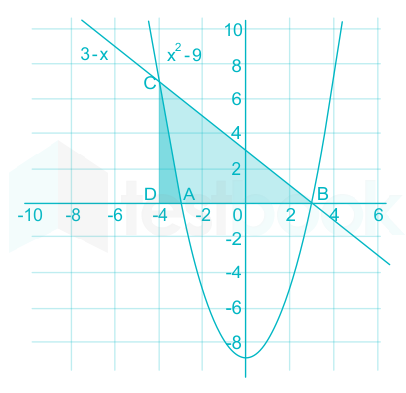
Hence, the curves intersect at the points B(3, 0) and C(-4, 7) as shown in the diagram below:

The points where y = x2 - 9 cuts the x-axis (y = 0) are A(-3, 0) and B(3, 0).

The required area is the shaded part ABC = Area of BDC - Area of ADC.

= (\rm \displaystyle \int_{-4}^3 (3-x)\ dx - \int_{-4}^{-3} (x^2-9)\ dx)

= (\rm 3[x]{-4}^{\ \ \ 3}-\left [ \dfrac{x^2}{2} \right ]{-4}^{\ \ \ 3}-\left [ \dfrac{x^3}{3} \right ]{-4}^{-3}+9[ x]{-4}^{-3})

= (\rm 3\left[3-(-4)\right]-\dfrac{1}{2}\left[3^2-(-4)^2\right]-\dfrac{1}{3}\left[(-3)^3-(-4)^3\right]+9[-3-(-4)])

= (\rm 3(7)-\dfrac{1}{2}(-7)-\dfrac{1}{3}(37)+9(1))

= (\rm 21+\dfrac{7}{2}-\dfrac{37}{3}+9)

= (\dfrac{127}6).

The answer is None of these.

30

If (\rm \vec{a},\vec{b},\vec{c}) are three non-coplanar vectors, then

(\rm (\vec{a}+\vec{b}+\vec{c}) \cdot[(\vec{a}+\vec{b}) \times( \vec{a}+\vec{c})]=)

  1. ((a))

    0

  2. ((b))

    (\rm [\vec{a}; \vec{b} ;\vec{c}])

  3. ((c))

    2(\rm [\vec{a}; \vec{b} ;\vec{c}])

  4. ((d))

    -(\rm [\vec{a}; \vec{b} ;\vec{c}])

Show Answer
Answer: ((d))

-(\rm [\vec{a}; \vec{b} ;\vec{c}])

Concept:

If (\rm \vec P, \vec Q, \vec R) are vectors, then

  • (\rm \vec P \times \vec P = 0)
  • (\rm \vec P\cdot(\rm \vec P \times \text{any vector}) =0)
  • (\rm \vec P\cdot (\vec Q\times\vec R) = \vec Q\cdot (\vec R\times\vec P)=\vec R\cdot( \vec P\times\vec Q) =[ \vec P, \vec Q, \vec R])
  • For dot product (\rm (\vec P + \vec Q) \cdot \vec R = (\vec P\cdot \vec R) +(\vec Q\cdot \vec R))
  • For cross product (\rm (\vec P + \vec Q) \times\vec R = (\vec P\times\vec R) + (\vec Q\times\vec R) )


Calculation:

 (\rm S=(\vec{a}+\vec{b}+\vec{c}) \cdot[(\vec{a}+\vec{b}) \times( \vec{a}+\vec{c})])

⇒ (\rm S=(\vec{a}+\vec{b}+\vec{c}) \cdot[(\vec{a}\times\vec{a}+\vec{a}\times\vec{c}+\vec{b}\times\vec{a}+\vec{b}\times\vec{c})])

⇒ (\rm S=(\vec{a}+\vec{b}+\vec{c}) \cdot[(0+\vec{a}\times\vec{c}+\vec{b}\times\vec{a}+\vec{b}\times\vec{c})])

(\rm S=\vec{a}\cdot[\vec{a}\times\vec{c}+\vec{b}\times\vec{a}+\vec{b}\times\vec{c}]+\vec{b}\cdot[\vec{a}\times\vec{c}+\vec{b}\times\vec{a}+\vec{b}\times\vec{c}]+\vec{c}\cdot[\vec{a}\times\vec{c}+\vec{b}\times\vec{a}+\vec{b}\times\vec{c}] )

(\rm S=\vec{a}\cdot(\vec{a}\times\vec{c})+\vec{a}\cdot(\vec{b}\times\vec{a})+\vec{a}\cdot(\vec{b}\times\vec{c})+\vec{b}\cdot(\vec{a}\times\vec{c})+\vec{b}\cdot(\vec{b}\times\vec{a})+\vec{b}\cdot(\vec{b}\times\vec{c})+\vec{c}\cdot(\vec{a}\times\vec{c})+\vec{c}\cdot(\vec{b}\times\vec{a})+\vec{c}\cdot(\vec{b}\times\vec{c}))

⇒ (\rm S=0+0+\vec{a}\cdot(\vec{b}\times\vec{c})+\vec{b}\cdot(\vec{a}\times\vec{c})+0+0+0+\vec{c}\cdot(\vec{b}\times\vec{a})+0)

⇒ (\rm S=\vec{a}\cdot(\vec{b}\times\vec{c})+\vec{b}\cdot(\vec{a}\times\vec{c})+\vec{c}\cdot(\vec{b}\times\vec{a}) )

⇒ (\rm S=\vec{a}\cdot(\vec{b}\times\vec{c})+\boldsymbol{\rm [-\vec{b}\cdot(\vec{c}\times\vec{a})]+[-\vec{c}\cdot(\vec{a}\times\vec{b})]})

⇒ (\rm S=[\vec{a}, \vec{b}, \vec{c}]-[\vec{a}, \vec{b}, \vec{c}]-[\vec{a}, \vec{b}, \vec{c}])

∴ (\boldsymbol{\rm S=-[\vec{a}, \vec{b}, \vec{c}]} )

31

Two forces F1 and F2 are used to pull a car, which met an accident. The angle between the two force is θ. Find the value of θ for the resultant force is equal to (\sqrt{(F_1^2 + F_2^2)})

  1. ((a))

    θ = 0

  2. ((b))

    θ = 45

  3. ((c))

    θ = 90

  4. ((d))

    θ = 125

Show Answer
Answer: ((c))

θ = 90

Concept:

If 2 forces are (\rm \vec {a}) and (\rm \vec {b})

Resultant of  (\rm \vec {a}) and (\rm \vec {b}):

(\rm \left|\vec a+\vec b\right| = \sqrt{a^2+b^2+2ab\cosθ})

Where a, b are magnitude of vectors (\rm \vec a \text{ and } \vec b) and θ is angle between them.

Calculation:

Given:

Resultant of forces F1 and F2 = (\rm \left|\vec F_1+\vec F_2\right|)

⇒ (\rm \sqrt{(F_1^2+F_2^2)}=\sqrt{F_1^2+F_2^2+2F_1F_2\cosθ})

⇒ (\rm F_1^2+F_2^2=F_1^2+F_2^2+2F_1F_2\cosθ)

⇒ (\rm 0=2F_1F_2\cosθ)

⇒ (\rm \cos θ=0)

⇒ θ = 90o

32

If (\rm \vec{a},\vec{b},\vec{c},\vec{d}) are four vectors such that (\rm \vec{a}+\vec{b}+\vec{c}) is collinear with (\rm \vec d) and (\rm \vec{b}+\vec{c}+\vec{d}) is collinear with (\rm \vec{a}), then (\rm \vec{a}+\vec{b}+\vec{c}+\vec{d}) is

  1. ((a))

    (\rm \vec{0})

  2. ((b))

    collinear with (\rm \vec{a}+\vec{d})

  3. ((c))

    collinear with (\rm \vec{a}-\vec{d})

  4. ((d))

    Both Option 2 and 3 are correct

Show Answer
Answer: ((d))

Both Option 2 and 3 are correct

Concept:

  • The cross product of vector to itself = 0
  • The cross product of collinear vectors = 0
  • The dot product of collinear vectors = Product of their Magnitudes
  • For dot product (\rm (\vec P + \vec Q) \cdot \vec R = (\vec P\cdot \vec R) +(\vec Q\cdot \vec R))
  • For cross product (\rm (\vec P + \vec Q) \times\vec R = (\vec P\times\vec R) + (\vec Q\times\vec R) )


Calculation:

Given:

(\rm \vec{a}+\vec{b}+\vec{c}) is collinear with (\rm \vec d)

⇒ (\rm (\vec{a}+\vec{b}+\vec{c})\times\vec d = 0)

⇒ (\rm (\vec{a}+\vec{b}+\vec{c})\times\vec d +\vec d\times\vec d = 0) (∵ (\rm \vec d\times\vec d = 0))

⇒ (\rm (\vec{a}+\vec{b}+\vec{c}+\vec d)\times\vec d = 0)                                     ...(i)

Also given:

(\rm \vec{b}+\vec{c}+\vec{d}) is collinear with (\rm \vec{a})

⇒ (\rm (\vec{b}+\vec{c}+\vec d)\times\vec{a} = 0)

⇒ (\rm \vec{a}\times\vec a+(\vec{b}+\vec{c}+\vec d)\times\vec a= 0) (∵ (\rm \vec a\times\vec a= 0))

⇒ (\rm (\vec{a}+\vec{b}+\vec{c}+\vec d)\times\vec a = 0)                                     ...(ii)

On adding (i) and (ii):

⇒ (\rm (\vec{a}+\vec{b}+\vec{c}+\vec d)\times\vec a +(\vec{a}+\vec{b}+\vec{c}+\vec d)\times\vec d= 0) 

⇒ (\rm (\vec{a}+\vec{b}+\vec{c}+\vec d)\times(\vec a+\vec d) = 0)                            ...(iii)

On subtracting (i) from (ii):

⇒ (\rm (\vec{a}+\vec{b}+\vec{c}+\vec d)\times\vec a -(\vec{a}+\vec{b}+\vec{c}+\vec d)\times\vec d= 0)

⇒ (\rm (\vec{a}+\vec{b}+\vec{c}+\vec d)\times(\vec a-\vec d) = 0)                            ...(iv)

From (iii) and (iv); it is clear that (\rm (\vec{a}+\vec{b}+\vec{c}+\vec d)) is collinear to (\rm (\vec a+\vec d)\text{ and }(\vec a-\vec d)) Both Option 2 and 3 are correct

33

Forces of magnitude 5, 3, 1 units acts in directions 6i + 2j + 3k, 3i -2j + 6k, 2i - 3j - 6k respectively on a particle which is displaced the point (2, -1, -3) to (5, -1, 1). The total work done by the force is

  1. ((a))

    21 units

  2. ((b))

    5 units

  3. ((c))

    33 units

  4. ((d))

    105 units

Show Answer
Answer: ((c))

33 units

Concept:

The work done (\rm W =(\vec{F_r})\cdot(\vec{dx})) 

where (\rm \vec{F_r}) is the resultant force, and  (\rm \vec{dx}) is the displacement 

The unit vector in the direction of a (\rm \vec P= \hat P={\vec P\over\left|\vec P\right|}) 

Calculation:

The initial position of the particle (A) = 2i - j - 3k

The initial position of the particle (B) = 5i - j + k

Displacement (\rm \vec{dx}) = B - A = (5i - j + k) - (2i - j - 3k) = 3i + 4k

First force F1 = magnitude of the 1st force × unit vector in the given direction

⇒ (\rm \vec {F_1}=5\times{6i+2j+3k\over\left|6i+2j+3k\right|}) 

⇒ (\boldsymbol{\rm \vec {F_1}={30i+10j+15k\over7}}) 

Second force F2 = magnitude of the 2nd force × unit vector in the given direction

⇒ (\rm \vec {F_2}=3\times{3i-2j+6k\over\left|3i-2j+6k\right|}) 

⇒ (\boldsymbol{\rm \vec {F_2}={9i-6j+18k\over7}}) 

Third force F3 = magnitude of the 3rd force × unit vector in the given direction

⇒ (\rm \vec {F_3}=1\times{2i-3j-6k\over\left|2i-3j-6k\right|}) 

⇒ (\boldsymbol{\rm \vec {F_3}={2i-3j-6k\over7}}) 

Resultant Force (\rm \vec{F_r} =\vec{F_1}+\vec{F_2}+\vec{F_3}) 

⇒ (\rm \vec{F_r} ={30i+10j+15k\over7}+{9i-6j+18k\over7}+{2i-3j-6k\over7})

⇒ (\boldsymbol{\rm \vec{F_r} ={41i+j+27k\over7}}) 

The work done by the forces:

(\rm W =(\vec{F_r})\cdot(\vec{dx}))

⇒ (\rm W =\left({41i+j+27k\over7}\right)\cdot(3i+4k)) 

⇒ (\rm W =\left({123+0+108\over7}\right)={231\over7}) 

⇒ (\boldsymbol{\rm W =33}) units

34

The position vectors of A and B are (\rm \vec{a}) and (\rm \vec{b})Then the position vector of point p dividing AB in the ration m : n is

  1. ((a))

    (\rm \frac{\rm n\vec{a} +m \vec{b}}{m+n})

  2. ((b))

    (\rm \frac{\rm n\vec{a} +m \vec{b}}{m-n})

  3. ((c))

    (\rm \frac{\rm n\vec{a} -m \vec{b}}{m+n})

  4. ((d))

    None of these

Show Answer
Answer: ((a))

(\rm \frac{\rm n\vec{a} +m \vec{b}}{m+n})

Concept:

If a point P divides a line joining points A(x1, y1, z1) and B(x2, y2, z2) in a ratio of m:n, then

(\rm x_P ={nx_1 + mx_2\over n+m}), (\rm y_P ={ny_1 + my_2\over n+m}) and (\rm z_P ={nz_1 + mz_2\over n+m})

Calculation:

Assuming,

(\rm \vec a =x_ai+y_aj+z_ak)

(\rm \vec b =x_bi+y_bj+z_bk)

Vector of point p is 

(\rm \vec p =x_pi+y_pj+z_pk)

∵ (\rm x_P ={nx_1 + mx_2\over n+m}), (\rm y_P ={ny_1 + my_2\over n+m}) and (\rm z_P ={nz_1 + mz_2\over n+m})

⇒ (\rm \vec p ={nx_a + mx_b\over n+m}i+{ny_a + my_b\over n+m}j+{nz_a + mz_b\over n+m}k)

⇒ (\rm \vec p ={n(x_ai + y_aj+z_ak)+m(x_bi+y_bj+z_bk)\over n+m})

⇒ (\boldsymbol{\rm \vec p ={n\vec a+m\vec b\over n+m}})

35

If (\rm \vec{a},\vec{b},\vec{c}) are three non-zero vectors with no two of which are collinear, (\rm \vec{a}+2\vec{b}) is collinear with (\rm \vec {c}) and (\rm \vec{b}+3\vec{c}) is collinear with (\rm \vec {a}), then (\rm |\vec{a} +2 \vec{b}+6\vec{c}|) will be equal to

  1. ((a))

    Zero

  2. ((b))

    9

  3. ((c))

    1

  4. ((d))

    None of the above

Show Answer
Answer: ((a))

Zero

Cocept:

If a vector A is collinear to other vector B, it can be written as:

(\rm \vec A = λ × \vec B) where λ is any scalar number

Calculation:

Given (\rm \vec{a}+2\vec{b}) is collinear with (\rm \vec {c}) 

⇒ (\rm \vec{a}+2\vec{b}) = λ1 × (\rm \vec {c})                      ...(i)

Also given (\rm \vec{b}+3\vec{c}) is collinear with (\rm \vec {a})

⇒ (\rm \vec{b}+3\vec{c}) = λ2 × (\rm \vec {a})                     ...(ii)

Subtracting 2×(ii) from (i)

⇒ (\rm \vec{a}-6\vec{c} = λ_1 \vec c-2λ_2 \vec a)

∴ λ1 = - 6, λ2 = (\rm {-1\over2}) 

From (ii)

⇒ (\rm \vec{b}+3\vec{c})= (\rm {-1\over2})(\rm \vec {a})

⇒ (\rm 2\vec{b}+6\vec{c})= (\rm -\vec {a})

⇒ (\rm \vec a+ 2\vec{b}+6\vec{c} = 0)

⇒ (\boldsymbol{\rm \left|\vec a+ 2\vec{b}+6\vec{c}\right| = 0})

36

Vertices with the position vectors î - 2ĵ + 2k̂, 2î + ĵ - k̂ and 3î - ĵ + 2k̂ form a triangle. This triangle is:

  1. ((a))

    Equilateral triangle.

  2. ((b))

    Right angle triangle.

  3. ((c))

    Two sides are equal in length.

  4. ((d))

    None of the above.

Show Answer
Answer: ((b))

Right angle triangle.

Concept:

  • The vector (\rm \vec {AB}) joining two points with position vectors (\rm \vec A) and (\rm \vec B) is given by (\rm \vec {AB}=\vec B-\vec A).
  • The length of a vector (\rm \vec A) = a1î + a2ĵ + a3k̂ is given by (\rm |\vec A|=\sqrt{a_1^2+a_2^2+a_3^2}).


Calculation:

Let's say that the vertices of the triangle are:

(\rm \vec A) = î - 2ĵ + 2k̂

(\rm \vec B) = 2î + ĵ - k̂

(\rm \vec C) = 3î - ĵ + 2k̂

∴ (\rm \vec {AB}=\vec B-\vec A) = (2î + ĵ - k̂) - (î - 2ĵ + 2k̂) = î + 3ĵ - 3k̂

(\rm |\vec{AB}|=\sqrt{1^2+3^2+(-3)^2}=\sqrt{19})

(\rm \vec {BC}=\vec C-\vec B) = (3î - ĵ + 2k̂) - (2î + ĵ - k̂) = î - 2ĵ + 3k̂

(\rm |\vec{BC}|=\sqrt{1^2+(-2)^2+3^2}=\sqrt{14})

(\rm \vec {CA}=\vec A-\vec C) = (î - 2ĵ + 2k̂) - (3î - ĵ + 2k̂) = -2î - ĵ + 0k̂

(\rm |\vec{CA}|=\sqrt{(-2)^2+(-1)^2+0^2}=\sqrt5)

Since, AB2 = 19 = BC2 + CA2 = 14 + 5, the triangle is right angled at C.

37

If the volume of a parallelepiped whose adjacent edges are

(\rm \vec a) = 2î + 3ĵ + 4k̂

(\rm \vec b) = î + αĵ + 2k̂

(\rm \vec c) = î + 2ĵ + αk̂

is 15 then α = ?

  1. ((a))

    1

  2. ((b))

    (\dfrac52)

  3. ((c))

    (\dfrac92)

  4. ((d))

    0

Show Answer
Answer: ((c))

(\dfrac92)

Concept:

For two vectors (\rm \vec A) and (\rm \vec B) at an angle θ to each other:

  • Dot Product is defined as (\rm \vec A.\vec B=|\vec A||\vec B|\cos \theta).
  • Cross Product is defined as (\rm \vec A\times \vec B=\vec n|\vec A||\vec B|\sin \theta) where (\rm \vec n) is the unit vector perpendicular to the plane containing (\rm \vec A) and (\rm \vec B).


For three vectors (\rm \vec A), (\rm \vec B) and (\rm \vec C):

  • Triple Cross Product: is defined as: (\rm \vec A\times(\vec B\times\vec C)=(\vec A.\vec C)\vec B-(\vec A.\vec B)\vec C).
  • Triple Scalar Product (Box Product): is defined as (\rm [\vec A\ \vec B\ \vec C]=\vec A.(\vec B\times\vec C)=\begin{vmatrix} \rm a_1 & \rm a_2 & \rm a_3 \ \rm b_1 & \rm b_2 & \rm b_3 \\rm c_1 & \rm c_2 & \rm c_3 \end{vmatrix}).


Volume of a parallelepiped, with vectors (\rm \vec a), (\rm \vec b) and (\rm \vec c) as its sides, is given by the box product of the three vectors.

  • Volume = (\rm [\vec a\ \vec b\ \vec c]).


Calculation:

The sides of the parallelepiped are:

(\rm \vec a) = 2î + 3ĵ + 4k̂

(\rm \vec b) = î + αĵ + 2k̂

(\rm \vec c) = î + 2ĵ + αk̂

∴ Volume = (\rm \rm [\vec a\ \vec b\ \vec c]=\begin{vmatrix} 2 & 3 & 4 \ 1 & \alpha & 2 \ 1 & 2 & \alpha \end{vmatrix}) = 15

⇒ 2(α2 - 4) + 3(2 - α) + 4(2 - α) = 15

⇒ 2α2 - 8 + 6 - 3α + 8 - 4α = 15

⇒ 2α2 - 7α - 9 = 0

⇒ 2α2 - 9α + 2α - 9 = 0

⇒ α(2α - 9) + (2α - 9) = 0

⇒ (2α - 9)(α + 1) = 0

⇒ 2α - 9 = 0 OR α + 1 = 0

⇒ α = (\dfrac92) OR α = -1.

38

Solve the equation sin2 x - sin x - 2 = 0, for x on the interval 0 ≤ x < 2π.

  1. ((a))

    (\dfrac{3\pi}{2})

  2. ((b))

    (\dfrac{\pi}{4},\dfrac{2\pi}{7})

  3. ((c))

    (\dfrac{2\pi}{3},\dfrac{2\pi}{5})

  4. ((d))

    None of these

Show Answer
Answer: ((a))

(\dfrac{3\pi}{2})

Concept:

The solution to the quadratic equation ax2 + bx + c = 0 is given by: (\rm x = \frac{-b \pm \sqrt{b^2-4ac}}{2a}).

  • sin (-θ) = -sin θ.
  • sin θ = sin (2nπ + θ).


Calculation:

sin2 x - sin x - 2 = 0

Using the formula for the roots of a quadratic equation: 

⇒ (\rm \sin x = \frac{-(-1) \pm \sqrt{(-1)^2-4(1)(-2)}}{2(1)})

⇒ (\rm \sin x = \dfrac{1 +\sqrt{9}}{2}) OR (\rm \sin x = \dfrac{1 -\sqrt{9}}{2})

⇒ sin x = 2 OR sin x = -1.

∵ -1 ≤ sin x ≤ 1, ∴ sin x = 2 is not possible.

sin x = -1 = (\rm -\sin\dfrac{\pi}{2}=\sin\left(-\dfrac{\pi}{2}\right)=\sin\left(2n\pi-\dfrac{\pi}{2}\right)), n ∈ Z.

For n = 0, x = (-\dfrac{\pi}{2}).

For n = 1, x = (\dfrac{3\pi}{2}).

For n = 2, x = (\dfrac{7\pi}{2}).

The only value of x on the interval 0 ≤ x < 2π is x = (\dfrac{3\pi}{2}).

Additional Information

  • Period of sin θ is 2π. ⇒ sin θ = sin (2nπ + θ).
  • Period of cos θ is 2π. ⇒ cos θ = cos (2nπ + θ).
  • Period of tan θ is π. ⇒ tan θ = tan (nπ + θ).
39

If (\rm \frac{\tan x}{2} = \frac{\tan y}{3} = \frac{\tan z}{5}) and x + y + z = π, then the value of tan2 x + tan2 y + tan2 z is:

  1. ((a))

    (\dfrac {38}3)

  2. ((b))

    (\dfrac {29}3)

  3. ((c))

    (\dfrac {11}3)

  4. ((d))

    None of these

Show Answer
Answer: ((a))

(\dfrac {38}3)

Concept:

Trigonometric Identities:

  • tan (A + B) = (\rm \frac{\tan A+\tan B}{1-\tan A \tan B}).
  • tan (nπ + θ) = tan θ.
  • tan (-θ) = -tan θ


Calculations:

It is given that (\rm \frac{\tan x}{2} = \frac{\tan y}{3} = \frac{\tan z}{5}) = k (say).

∴ tan x = 2k, tan y = 3k and tan z = 5k.

It is also given that x + y + z = π.

⇒ x + y = π - z

⇒ tan (x + y) = tan [π + (-z)]

⇒ (\rm \frac{\tan x+\tan y}{1-\tan x \tan x}=\tan (-z)=-\tan z)

⇒ tan x + tan y = - tan z + tan x tan y tan z

⇒ tan x + tan y + tan z = tan x tan y tan z

Substituting the values in terms of k from the above result, we get:

2k + 3k + 5k = (2k)(3k)(5k)

⇒ 10k = 30k3

⇒ (\rm k^2=\frac13).

Now, tan2 x + tan2 y + tan2 z

= (2k)2 + (3k)2 + (5k)2

= 4k2 + 9k2 + 25k2

= 38k2

= (\rm \dfrac{38}3).


Additional Information

Trigonometric Ratios for Allied Angles: 

  • sin (-θ) = -sin θ.
  • cos (-θ) = cos θ.
  • sin (nπ + θ) = (-1)n sin θ.
  • cos (nπ + θ) = (-1)n cos θ.
  • (\rm \sin \left [(2n+1)\frac{\pi}{2}+\theta \right ]) = (-1)n cos θ.
  • (\rm \cos \left [(2n+1)\frac{\pi}{2}+\theta \right ]) = (-1)n (-sin θ).
40

Find the value of sin 12° sin 48° sin 54°:

  1. ((a))

    (\dfrac18)

  2. ((b))

    (\dfrac16)

  3. ((c))

    (\dfrac12)

  4. ((d))

    (\dfrac14)

Show Answer
Answer: ((a))

(\dfrac18)

Concept:

Trigonometric Identities:​

  • cos (A ± B) = cos A cos B ∓ sin A sin B.
  • 2 cos A cos B = cos (A - B) + cos (A + B).
  • 2 sin A sin B = cos (A - B) - cos (A + B).


Trigonometric Values:

  • cos 60° = (\rm \dfrac{1}{2}).
  • cos 36° = (\rm \dfrac{\sqrt5+1}{4}).


Trigonometric Ratios for Allied Angles: 

  • sin (-θ) = -sin θ.
  • cos (-θ) = cos θ.
  • sin (nπ + θ) = (-1)n sin θ.
  • cos (nπ + θ) = (-1)n cos θ.
  • (\rm \sin \left [(2n+1)\dfrac{\pi}{2}+\theta \right ]) = (-1)n cos θ.
  • (\rm \cos \left [(2n+1)\dfrac{\pi}{2}+\theta \right ]) = (-1)n (-sin θ).


Calculation:

sin 12° sin 48° sin 54°

= (\rm \dfrac{2\sin 48^{\circ}\sin 12^{\circ}}{2} \sin 54^{\circ})

= (\rm \left [\dfrac{\cos (48^{\circ}-12^{\circ})-\cos (48^{\circ}+12^{\circ})}{2} \right ] \sin (90^{\circ}-36^{\circ}))

= (\rm \left (\dfrac{\cos 36^{\circ}-\cos 60^{\circ}}{2} \right ) \cos 36^{\circ})

= (\rm \left ( \dfrac{1}{2} \right )\left (\dfrac{\sqrt5+1}{4}-\dfrac{1}{2} \right )\left ( \dfrac{\sqrt5+1}{4} \right ))

= (\rm \left ( \dfrac{1}{2} \right )\left (\dfrac{\sqrt5-1}{4} \right )\left ( \dfrac{\sqrt5+1}{4} \right ))

= (\rm \left ( \dfrac{1}{2} \right )\left (\dfrac{5-1}{16} \right ))

= (\rm \dfrac{1}{8}).


Additional Information

  • sin 18° = (\rm \dfrac{\sqrt5-1}{4}).
  • cos 36° = (\rm \dfrac{\sqrt5+1}{4}).
  • sin 36° = (\rm \sqrt{\dfrac{5-\sqrt5}{8}}).
  • cos 18° = (\rm \sqrt{\dfrac{5+\sqrt5}{8}}).
41

If cos x = tan y, cot y = tan z and cot z = tan x, then sin x = ?

  1. ((a))

    (\dfrac{\sqrt{5}-1}{2})

  2. ((b))

    (\dfrac{\sqrt{5}+1}{2})

  3. ((c))

    (\dfrac{\sqrt{5}+1}{4})

  4. ((d))

    (\dfrac{\sqrt{5}-1}{4})

Show Answer
Answer: ((a))

(\dfrac{\sqrt{5}-1}{2})

Concept:

tan θ = (\rm \dfrac{\sin \theta}{\cos \theta})cot θ = (\rm \dfrac{\cos \theta}{\sin \theta})
csc θ = (\rm \dfrac{1}{\sin \theta})sec θ = (\rm \dfrac{1}{\cos \theta})cot θ = (\rm \dfrac{1}{\tan\theta})
sin2 θ + cos2 θ = 1


The solution to the quadratic equation ax2 + bx + c = 0 is given by: (\rm x = \dfrac{-b \pm \sqrt{b^2-4ac}}{2a}).


Calculation:

It is given that cos x = tan y, cot y = tan z and cot z = tan x.

∴ (\rm \cos x=\tan y=\dfrac{1}{\cot y}=\dfrac{1}{\tan z}=\cot z=\tan x=\dfrac{\sin x}{\cos x})

⇒ cos2 x = sin x

⇒ 1 - sin2 x = sin x

⇒ sin2 x + sin x - 1 = 0

Using the formula for the roots of a quadratic equation:

⇒ (\rm \sin x = \frac{-1 \pm \sqrt{1^2-4(1)(-1)}}{2(1)})

⇒ (\rm \sin x = \dfrac{-1 +\sqrt{5}}{2}) OR (\rm \sin x = \dfrac{-1 -\sqrt{5}}{2})

From the given answer options, (\rm \sin x = \dfrac{\sqrt{5}-1}{2}).

42

The value of (\rm \tan \left(45 + \frac{\theta}{2} \right )) is

  1. ((a))

    tan θ - sec θ 

  2. ((b))

    tan θ + sec θ 

  3. ((c))

    cot θ - sec θ 

  4. ((d))

    cot θ + sec θ 

Show Answer
Answer: ((b))

tan θ + sec θ 

Concept:

The identities of trigonometry are:

  • (\rm \tan a={\sin a\over \cos a})
  • (\rm \sin 2a = 2\sin a\cos a)
  • (\rm \tan (a+b)={\tan a +\tan b\over{1-\tan a \tan b}})
  • (\rm \cos 2a=(\cos^2 a- \sin^2 a)= (2\cos^2 a-1)=(1-2\sin^2 a))


Calculation:

Let (\rm \tan \left(45 + \frac{\theta}{2} \right ) =x)

(\rm ⇒ x ={\tan 45^o +\tan \frac{\theta}{2}\over{1-\tan 45^o\tan \frac{\theta}{2}}})

(\rm ⇒ x={1 +\tan \frac{\theta}{2}\over{1-\tan \frac{\theta}{2}}})                     (∵ tan 45o = 1)

(\rm⇒ x = {\cos \frac{\theta}{2}+\sin \frac{\theta}{2}\over \cos \frac{\theta}{2}-\sin \frac{\theta}{2}})

(\boldsymbol {\rm⇒ x = {\cos \frac{\theta}{2}+\sin \frac{\theta}{2}\over \cos \frac{\theta}{2}-\sin \frac{\theta}{2}}\times{\cos \frac{\theta}{2}+\sin \frac{\theta}{2}\over \cos \frac{\theta}{2}+\sin \frac{\theta}{2}}})

(\rm⇒ x = {(\cos \frac{\theta}{2}+\sin \frac{\theta}{2})^2\over \cos^2 \frac{\theta}{2}-\sin^2 \frac{\theta}{2}})

(\rm⇒ x = {\cos^2 \frac{\theta}{2}+\sin^2 \frac{\theta}{2}+2\cos\frac{\theta}{2}\sin\frac{\theta}{2}\over \cos\theta})

(\rm⇒ x = {1+\sin \theta\over \cos \theta})                       (∵ sin2 a + cos2 a = 1)

(\boldsymbol {\rm ⇒ x =\frac{1}{\cos\theta}+\frac{\sin\theta}{\cos\theta} =\sec\theta+\tan\theta})

43

The value of sin 10° sin 50° sin 70° is:

  1. ((a))

    (\dfrac14)

  2. ((b))

    (\dfrac12)

  3. ((c))

    (\dfrac34)

  4. ((d))

    (\dfrac18)

Show Answer
Answer: ((d))

(\dfrac18)

Concept:

**Trigonometric Identities:**​

  • sin 2θ = 2 sin θ cos θ


Trigonometric Ratios for Allied Angles: 

  • sin (-θ) = -sin θ.
  • cos (-θ) = cos θ.
  • sin (nπ + θ) = (-1)n sin θ.
  • cos (nπ + θ) = (-1)n cos θ.
  • (\rm \sin \left [(2n+1)\dfrac{\pi}{2}+\theta \right ]) = (-1)n cos θ.
  • (\rm \cos \left [(2n+1)\dfrac{\pi}{2}+\theta \right ]) = (-1)n (-sin θ).


Calculation:

sin 10° sin 50° sin 70°

= sin 10° sin (90∘ - 40°) sin (90∘ - 20°)

= sin 10° cos 40° cos 20°

= (\rm \left (\dfrac{2\sin 10^{\circ}\cos 10^{\circ}}{2\cos 10^{\circ}} \right ) \cos 40^{\circ}\cos 20^{\circ})

= (\rm \left (\dfrac{\sin 20^{\circ}}{2\cos 10^{\circ}} \right ) \cos 40^{\circ}\cos 20^{\circ})

= (\rm \left (\dfrac{2\sin 20^{\circ}\cos 20^{\circ}}{4\cos 10^{\circ}} \right ) \cos 40^{\circ})

= (\rm \dfrac{2\sin 40^{\circ}\cos 40^{\circ}}{8\cos 10^{\circ}})

= (\rm \dfrac{\sin 80^{\circ}}{8\cos 10^{\circ}})

= (\rm \dfrac{\sin (90^{\circ}-10^{\circ})}{8\cos 10^{\circ}})

= (\rm \dfrac{\cos 10^{\circ}}{8\cos 10^{\circ}})

= (\rm \dfrac{1}{8}).

44

The expression (\rm \dfrac{\tan A}{1-\cot A} + \dfrac{\cot A}{1-\tan A}) can be written as:

  1. ((a))

    sin A cos A + 1

  2. ((b))

    sec A csc A + 1

  3. ((c))

    tan A + cot A

  4. ((d))

    sec A + csc A

Show Answer
Answer: ((b))

sec A csc A + 1

Concept:

  • | csc θ = (\rm \dfrac{1}{\sin \theta}) | sec θ = (\rm \dfrac{1}{\cos \theta}) | | --- | --- | | tan θ = (\rm \dfrac{\sin \theta}{\cos \theta}) | cot θ = (\rm \dfrac{\cos \theta}{\sin \theta}) | | tan θ = (\rm \dfrac{1}{\cot \theta}) | |

  • sin2 θ + cos2 θ = 1.
  • a3 - b3 = (a - b)(a2 + ab + b2).


Calculation:

Let tan A = m ⇒ cot A = (\rm \dfrac{1}{m}).

∴ (\rm \dfrac{\tan A}{1-\cot A} + \dfrac{\cot A}{1-\tan A})

= (\rm \dfrac{m}{1-\tfrac{1}{m}} + \dfrac{\tfrac{1}{m}}{1-m})

= (\rm \dfrac{m^2}{m-1} - \dfrac{1}{m(m-1)})

= (\rm \dfrac{m^3-1}{m(m-1)})

= (\rm \dfrac{(m-1)(m^2+m+1)}{m(m-1)})

= (\rm \dfrac{m^2+m+1}{m})

= (\rm m+1+\dfrac{1}{m})

= (\rm \left (\dfrac{\sin A}{\cos A}+\dfrac{\cos A}{\sin A} \right )+1)

= (\rm \left (\dfrac{\sin^2 A+\cos^2 A}{\sin A\cos A}\right )+1)

= (\rm \left (\dfrac{1}{\sin A\cos A}\right )+1)

= sec A csc A + 1.

45

Angle of elevation of the top of the tower from 3 points (collinear) A, B and C on a road leading to the foot of the tower are 30° , 45° and 60° respectively. The ratio of AB and BC is

  1. ((a))
    (\sqrt{3} : 1)

  2. ((b))

    (\sqrt{3} : 2)

  3. ((c))

    1 : 2

  4. ((d))

    (2 : \sqrt{3})

Show Answer
Answer: ((a))

(\sqrt{3} : 1)

Concept:

If the angle of elevation from a point at distance D from tower of length L is θ 

tan θ = (\rm L\over D)

Calculation:

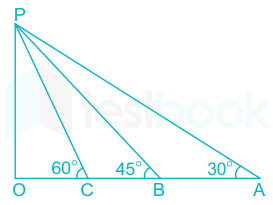
Let the length of the tower OP be x

From the figure,

OA = (\rm {x\over\tan30}=\sqrt{3}x)

OB = (\rm {x\over\tan45}=x)

OC = (\rm {x\over\tan60}={x\over√{3}})

∴ AB = OA - OB = (\rm \sqrt 3 x-x)

BC = OB - OC = (\rm x-\frac{x}{\sqrt 3})

⇒ (\rm {AB\over BC}={\sqrt 3 x-x\over\rm x-\frac{x}{\sqrt 3}})

⇒ (\rm {AB\over BC}={\sqrt 3(\sqrt 3 -1)\over \sqrt 3 -1} )

⇒ (\boldsymbol{\rm AB:BC=\sqrt{3} : 1})

46

The area enclosed between the curves y2 = x and y = |x| is:

  1. ((a))

    (\dfrac23) sq. units.

  2. ((b))

    1 sq. units.

  3. ((c))

    (\dfrac16) sq. units.

  4. ((d))

    (\dfrac13) sq. units.

Show Answer
Answer: ((c))

(\dfrac16) sq. units.

Concept:

  • Two curves f(x, y) = 0 and g(x, y) = 0 cut/touch at a point (a, b) if f(a, b) = g(a, b) = 0.
  • The area under the function y = f(x) from x = a to x = b and the x-axis is given by the definite integral (\rm \displaystyle \left|\int_a^b f(x)\ dx\right|), for curves which are entirely on the same side of the x-axis in the given range.
  • If the curves are on both the sides of the x-axis, then we calculate the areas of both the sides separately and add them.
  • Definite integral: If ∫ f(x) dx = g(x) + C, then (\rm \displaystyle \int_a^b f(x)\ dx = [ g(x)]_a^b) = g(b) - g(a).
  • (\rm \displaystyle \int x^n\ dx = \dfrac{x^{n+1}}{n+1}+C).


Calculations:

Let's first find the points of intersection/touching of the two curves y2 = x and y = |x|.

Using the condition for intersecting, we must have:

y2 - x = y - |x| = 0

CASE 1: For, x ≥ 0, |x| = x.

⇒ y2 - x = y - x = 0

⇒ y2 - y = 0

⇒ y(y - 1) = 0

⇒ y = 0 OR y - 1 = 0

⇒ y = 0 OR y = 1.

And, x = 02 = 0 OR x = 12 = 1.

The points of intersection are (0, 0) and (1, 1).

CASE 2: For x < 0, |x| = -x.

⇒ y2 - x = y - (-x) = 0

⇒ y2 - x = - y - x = 0

⇒ y2 + y = 0

⇒ y(y + 1) = 0

⇒ y = 0 OR y + 1 = 0

⇒ y = 0 OR y = -1.

∵ y = |x|, y cannot be negative.

∴ The only solution in this case y = 0 and x = 02 = 0.


Finally, the solutions (points of intersection/touching) of y2 = x and y = |x| are (0, 0) and (1, 1).


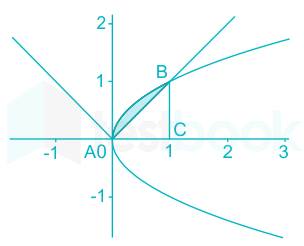
The graph of the curves is shown below:

The required (shaded) area is:

(Area under y2 = x from x = 0 to x = 1.) - (Area under y = |x| from x = 0 to x = 1.)

= (\rm \displaystyle \left|\int_0^1 \sqrt x\ dx\right| -\left|\int_0^1 x\ dx\right|)

= (\rm \left|\dfrac{2}{3}\left[x^{\tfrac{3}{2}} \right ]_0^1\right|-\left|\dfrac{1}{2}\left[x^{2} \right ]_0^1\right|)

= (\rm \left|\dfrac{2}{3}[1^{\tfrac{3}{2}}-0^{\tfrac{3}{2}}]\right|-\left|\dfrac{1}{2}[1^2-0^2]\right|)

= (\rm \dfrac 23 - \dfrac 12)

(\dfrac16) sq. units.

47

Test the continuity of a function at x = 2

(\left{ {\begin{array}{*{20}{c}} {\frac{5}{2} - \rm x;;;;;;x < 2}\ {1;;;;;;;;;;;;;\rm x = 2}\ {\rm x - ;\frac{3}{2};;;;;x > 2} \end{array}} \right.)

  1. ((a))

    Continuous at x = 2

  2. ((b))

    Discontinuous at x = 2

  3. ((c))

    Semicontinuous at x = 2

  4. ((d))

    None of the above

Show Answer
Answer: ((b))

Discontinuous at x = 2

Concept:

The function f(x) is continuous at an if all the below condition follows:

  1. f(a) is real and finite. 2. (\rm \lim_{\alpha \to 0}f(a-\alpha)\text{ and }\lim_{\alpha \to 0}f(a+\alpha)) are real and finite. 3. (\rm \lim_{\alpha \to 0}f(a-\alpha)=\lim_{\alpha \to 0}f(a+\alpha)=f(a))

Calculation:

f(x) = (\left{ {\begin{array}{*{20}{c}} {\frac{5}{2} - \rm x;;;;;;x < 2}\ {1;;;;;;;;;;;;;\rm x = 2}\ {\rm x - ;\frac{3}{2};;;;;x > 2} \end{array}} \right.) 

(\rm \lim_{\alpha \to 0}f(x-\alpha)={\frac{5}{2} - \rm x})

For x = 2,

⇒ (\rm \lim_{\alpha \to 0}f(2-\alpha)=\lim_{\alpha \to 0}\left[\frac{5}{2} - (2-\alpha)\right])

⇒ (\rm \lim_{\alpha \to 0}f(2-\alpha)=\rm \lim_{\alpha \to 0}\left(\frac{1}{2}+\alpha\right) =\boldsymbol{\rm \frac{1}{2}})

(\rm \lim_{\alpha \to 0}f(x+\alpha)=x-\frac{3}{2})

For x = 2,

⇒ (\rm \lim_{\alpha \to 0}f(2+\alpha)=\lim_{\alpha \to 0}\left[(2+\alpha)-\frac{3}{2}\right])

⇒ (\rm \lim_{\alpha \to 0}f(2+\alpha)=\rm \lim_{\alpha \to 0}\left(\frac{1}{2}+\alpha\right) = \boldsymbol{\rm \frac{1}{2}})

f(x) = f(2) = 1

(\rm \lim_{\alpha \to 0}f(2-\alpha)=\lim_{\alpha \to 0}f(2+\alpha)\neq f(2))

∴ The function is not continuous at x = 2

48

The value of 2tan-1[cosec(tan-1x) - tan(cot-1x)] is

  1. ((a))

    tan x

  2. ((b))

    cot x

  3. ((c))

    tan-1 x

  4. ((d))

    cosec-1 x

Show Answer
Answer: ((c))

tan-1 x

Concept:

Trigonometry Identities:

  • (\rm \tanθ ={1\over\cotθ}={\sinθ\over\cosθ})
  • cosec θ (\rm={1\over\sinθ} )
  • sec θ (\rm={1\over\cosθ} )
  • cos θ = sin (90 - θ)
  • cot θ = tan (90 - θ)
  • cos-1 x = 90o - sin-1 x
  • cot-1 x = 90o - tan-1 x
  • (\rm \sin 2θ = 2\sin θ\cos θ)
  • (\rm \cos 2θ=(\cos^2θ- \sin^2θ)= (2\cos^2θ-1)=(1-2\sin^2θ))


Calculation:

S = 2 tan-1[cosec(tan-1x) - tan(cot-1x)]

⇒ S = 2 tan-1[cosec(tan-1x) - tan(90 - tan-1x)]

Let tan-1x = θ

⇒ S = 2 tan-1[cosec θ - tan(90 - θ)]

⇒ S = 2 tan-1[cosec θ - cot θ]

⇒ (\rm S=2\tan^{-1}\left[{1\over\sinθ}-{\cosθ\over\sinθ}\right])

⇒ (\rm S=2\tan^{-1}\left[{1-\cosθ\over\sinθ}\right])

⇒ (\rm S=2\tan^{-1}\left[{2\sin^2{θ\over2}\over2\sin{θ\over2}\cos{θ\over2}}\right])

⇒ (\rm S=2 tan^{-1}\left[tan{θ\over2}\right])

⇒ S = θ = tan-1 x

49

If 3 sin x + 4 cos x = 5, then 6tan (\rm \frac{x}{2}) - 9tan2(\rm \frac{x}{2})=

  1. ((a))

    1

  2. ((b))

    3

  3. ((c))

    4

  4. ((d))

    6

Show Answer
Answer: ((a))

1

Concept:

The identities of trigonometry are:

  • (\rm \tan a={\sin a\over \cos a})
  • (\rm \sin 2a = 2\sin a\cos a)
  • (\rm \cos 2a=(\cos^2 a- \sin^2 a)= (2\cos^2 a-1)=(1-2\sin^2 a))


Calculation:

Given 3 sin x + 4 cos x = 5

(\boldsymbol{⇒ \rm 3(2 \sin {x\over2} \cos {x\over2}) + 4(1 - 2 \sin^2 {x\over2}) = 5})

(⇒ \rm 6 \sin {x\over2}\cos {x\over2}+ 4 - 8 \sin^2 {x\over2}= 5)

(\rm ⇒ 6 \sin {x\over2}\cos {x\over2}- 8 \sin^2 {x\over2}= 1)

(⇒ \rm 6 \sin {x\over2}\cos {x\over2}- 8 \sin^2{x\over2} = \sin^2{x\over2} + \cos^2{x\over2})  (∵ sin2 a + cos2 a = 1)

Dividing the equation by (\rm\cos^2{x\over2})

⇒ (\rm 6\frac{\sin {x\over2}\cos {x\over2}}{\cos^2 {x\over2}}-8\frac{\sin^2 {x\over2}}{\cos^2 {x\over2}}=\frac{\sin^2 {x\over2}+\cos^2 {x\over2}}{\cos^2 {x\over2}})

⇒ (\rm 6\tan {x\over2}-8\tan^2 {x\over2}=\tan^2 {x\over2}+1)

⇒ (\boldsymbol{\rm 6\tan {x\over2}-9\tan^2 {x\over2}=1})

50

If A is a subset of B and B is a subset of C, then the cardinality of A ∪ B ∪ C is equal to:

  1. ((a))

    Cardinality of C.

  2. ((b))

    Cardinality of B.

  3. ((c))

    Cardinality of A.

  4. ((d))

    None of the above.

Show Answer
Answer: ((a))

Cardinality of C.

Concept:

  • The cardinality of a set A is the measure of the "number of elements" of the set. It is denoted by n(A).

For example, a set containing 3 elements has a cardinality of 3.

  • If A ⊂ B, then A ∪ B = B.


Calculations:

Since, A ⊂ B and B ⊂ C, therefore A ∪ B ∪ C = C.

⇒ n(A ∪ B ∪ C) = n(C).

∴ The cardinality (number of elements) of A ∪ B ∪ C = cardinality (number of elements) of C.

51

A set of consecutive positive integers beginning with 1 is written on the blackboard. A student came along and erased one number. The average of the remaining numbers is (35 \dfrac{7}{17}). What was the number erased?

  1. ((a))

    7

  2. ((b))

    8

  3. ((c))

    9

  4. ((d))

    None of the above

Show Answer
Answer: ((a))

7

Given:

A set of consecutive positive integers beginning with 1 is written on the blackboard. A student came along and erased one number. The average of the remaining numbers is (35 \dfrac{7}{17}). 

Formula Used:

average = sum of observations/number of observation

average of n consecutive number = [n(n + 1)/2]n = (n + 1)/2

Calculation:

Since the average of the remaining numbers is (35 \dfrac{7}{17}) 

To get an average greater than 35, the value of n must be near 69.

Let initially number of terms be 69 and the number which was erased be 'x'

⇒ (69 × 35 - x)/68 = 602/17

⇒ 2415 - x = 2408

⇒ x = 7

∴ The number erased was 7

52

Four friends A, B, C and D need to cross a bridge in the night. A maximum of 2 people can cross at a time. They have only one lamp. A takes one minute to cross the bridge. B takes 2 minutes, C takes 8 minutes and D takes 11 minutes to cross the bridge respectively. A pair must walk together at the speed of the person who walks slowly. What is the minimum time required to cross the bridge by all four people? 

  1. ((a))

    23 minutes

  2. ((b))

    20 minutes

  3. ((c))

    18 minutes

  4. ((d))

    16 minutes

Show Answer
Answer: ((a))

23 minutes

FriendsTime taken to cross bridge
A1 minute
B2 minutes
C8 minutes
D11 minutes


Now,

A pair must walk together at the speed of the person who walks slowly.

As, A takes the shortest time, so each friend will walk with A.

Therefore:

A crossing the bridge with B and then retuning = 1 + 2 minutes = 3 minutes

A crossing the bridge with C and then retuning = 1 + 8 minutes = 9 minutes

A crossing the bridge with D = 11 minutes

A won’t return as none of the friend is left.

So, the minimum time required to cross the bridge by all the four people = (3 + 9 + 11) minute

= 23 minutes

Hence, ’23 minutes’ is the correct answer.

53

In a city, 40.1% of the adults are illiterate while 85.1% of the children are literate. If the ratio of the adults to that of the children is 2 ∶ 3, then find approximately what percent of the population is literate? 

  1. ((a))

    20%

  2. ((b))

    25%

  3. ((c))

    50%

  4. ((d))

    75%

Show Answer
Answer: ((d))

75%

Given:

Percentage of illiterate adults = 40.1% ≈ 40% 

Percentage of literate children = 85.1% ≈ 85% 

The ratio of the adults to that of children = 2 ∶ 3 

Calculations:

Let the total adult be 2x and children be 3x 

Total population = 2x + 3x = 5x

Total illiterate adults = 2x × 40/100 = 4x/5 

Total literate adults = 2x – 4x/5 = 6x/5

Total literate children = 3x × 85/100 = 51x/20

Total literate = (6x/5) + (51x/20)

⇒ (24x + 51x)/20 = 75x/20 

Percent of the literate population = ((75x/20) ÷ 5x) × 100 = 75% 

∴ Percent of the literate population is 75%


Let the total adult be 200 and children be 300

Total population = 200 + 300 = 500

Total illiterate adults = 200 × 40/100 = 80 

Total literate adults = 200 – 80 = 120

Total literate children = 300 × 85/100 = 255

Total literate = 120 + 255 = 375

Percent of the literate population = (375/500) × 100 = 75% 

∴ Percent of the literate population is 75%

54

A runs (1 \dfrac{2}{3}) times as fast as B. If A gives B a start of 80 m, how far must the winning post be so that A and B might reach it at the same time?

  1. ((a))

    200 m

  2. ((b))

    400 m

  3. ((c))

    300 m

  4. ((d))

    160 m

Show Answer
Answer: ((a))

200 m

Given:

A runs (1 \dfrac{2}{3}) times as fast as B 

A gives B a start of 80 m 

Concept used:

Time = Distance/Speed 

Calculations:

Let the speed of B be x 

So, speed of A = 5x/3 

Let the total distance be 'a' m 

So, time taken by A to complete the total distance = a/(5x/3) = 3a/5x 

A gives B a start of 80 m 

Required distance for B = a – 80 

Time taken by B to complete the distance = (a – 80)/x 

 A and B might reach at same time 

∴ Time taken by A to complete the total distance = Time taken by B to complete the distance

⇒ 3a/5x = (a – 80)/x 

⇒ 3a = 5x – 400 

⇒ 2a = 400 

⇒ a = 200 

∴ The winning post must be 200 m far so that A and B might reach it at the same time


Let the speed of A and B be 5x m/s and 3x m/s respectively 

A gives B a start of 80 m i.e. distance between them = 80 m

relative speed = (5x - 3x) = 2x m/s

time required = 80/2x = 40/x

distance traveled by A = 5x × 40/x = 200 m 

∴ The winning post must be 200 m far so that A and B might reach it at the same time

55

A person's present age is two fifth of the age of his mother. After 8 years, he will be one-half of the age of his mother. What is the present age of his mother? 

  1. ((a))

    60 years

  2. ((b))

    50 years

  3. ((c))

    40 years

  4. ((d))

    30 years

Show Answer
Answer: ((c))

40 years

Let the age of the person’s mother be ‘a’ units.

So, age of the person = (2/5)a

After 8 years, age of the person’s mother = ‘a + 8’ units.

So age of the person after 8 years = (a + 8)/2

According to question:

(2/5)a + 8 = (a + 8)/2

=> (2a + 40)/5 = (a + 8)/2

=> 4a + 80 = 5a + 40

=> a = 40

So, the present age of his mother is 40 years.

Hence, ’40 years’ is the correct answer.

56

Mr. Kumar drives to work at an average speed of 48 Km/hr. The time taken to cover the first 60% of the distance is 10 minutes more than the time taken to cover the remaining distance. How far is his office? 

  1. ((a))

    30 Kms

  2. ((b))

    40 Kms

  3. ((c))

    45 Kms

  4. ((d))

    48 Kms

Show Answer
Answer: ((b))

40 Kms

Given:

The average speed of Mr. Kumar = 48 km/h

The time taken to cover the first 60% of the distance is 10 minutes more than the time taken to cover the remaining distance 

Concept used:

Time = Distance/Speed 

Calculations:

Let the total distance be x 

60% of the distance = x × 60/100 = 3x/5 

Time taken by Mr. Kumar to cover 3x/5 distance = (\frac{{3x}}{{5 \times 48}}) = x/80

Remaining distance = x – 3x/5 = 2x/5 

Time taken by Mr. Kumar to cover 2x/5 distance = (\frac{{2x}}{{5 \times 48}}) = x/120 

According to the question,

⇒ (x/80) – (x/120) = 10/60 

⇒ (3x – 2x)/240 = 10/60 

⇒ x = 40 

∴ The distance of office is 40 kms

57

Two pipes A and B can fill the cistern in 37.5 minutes and 45 minutes respectively. Both pipes are opened. The cistern will be filled in just half an hour, if the B is turned off after: 

  1. ((a))

    5 minutes

  2. ((b))

    9 minutes

  3. ((c))

    10 minutes

  4. ((d))

    15 minutes

Show Answer
Answer: ((b))

9 minutes

Given:

A can fill the cistern = 37.5 minutes = 75/2 minutes

B can fill the cistern = 45 minutes

Concept used:

Total work = Efficiency of a person × Time

Calculation:

Taking the L.C.M. of 75/2 & 45 = 225 (which is total work)

Work done by A in 75/2 minutes = 225

Efficiency of A in 1 minute = (225 × 2)/75 = 6 

Work done by B in 45 minutes = 225

Efficiency of B in 1 minute = 225/45 = 5

Let the turned off time of B be x minutes.

Efficiency of A in 1 minute × Time + Efficiency of B in 1 minute × Time = Total work 

⇒ 6 × 30 + 5 × x = 225

⇒ 180 + 5x = 225

⇒ 5x = 225 – 180 

⇒ x = 45/5

⇒ x = 9 minutes

∴ B is turned off after 9 minutes.


Since pipe A has opened for 30 minutes, part of cistern filled = 30/37.5 = 4/5

part of cistern filled by B = (1 - 4/5) = 1/5

time taken by pipe B = 1/5 × 45 = 9 minutes

∴ B is turned off after 9 minutes.

58

In a certain code, DOES is written as 5$3% and SITE is written as %4#3. How is EDIT written in that code?

  1. ((a))

    3#4$

  2. ((b))

    %3#5

  3. ((c))

    354#

  4. ((d))

    4#5$

Show Answer
Answer: ((c))

354#

The logic is:

DOES
5$3%


SITE
%4#3

Similarly,

EDIT
354#

Hence, ‘354#’ is the correct answer.

59

In a shower, 5 cm of rain falls. The volume of water that falls on 1.5 hectares of ground is:

  1. ((a))

    75 cubic meter

  2. ((b))

    750 cubic meter

  3. ((c))

    7500 cubic meter

  4. ((d))

    75000 cubic meter

Show Answer
Answer: ((b))

750 cubic meter

Given:

Height of rain water = 5 cm

Area of ground = 1.5 hectares = 1.5 × 108 cm2

Concept used:

Volume = Area of base × Height

1 hectare = 100000000 cm2 = 108 cm2

1 cm = 1/100 m

Calculation:

Volume of water that falls on the ground = 1.5 × 108 × 5

⇒ 75 × 107 cm3

⇒ (75 × 107)/106 m3

⇒ 75 × 10 m3

⇒ 750 cubic meter

∴ The volume of water that falls on 1.5 hectares of ground is 750 cubic meter.

60

Eight friends A through H, are sitting around a circular table, playing a game of cards. They belong to two different teams X and Y. No two persons of the same team sit in adjacent seats. 

  • A sits neither opposite to D nor to H but is sitting in between C and G.
  • B sits neither opposite to A nor to G but is sitting in between F and D
  • B and H belong to team X and D sits opposite to E
<br>

Who are the members of team X?

  1. ((a))

    A, D, F and E

  2. ((b))

    B, H, C and E

  3. ((c))

    B, D, H and G

  4. ((d))

    B, H, C and G

Show Answer
Answer: ((d))

B, H, C and G

Persons: A, B, C, D, E, F, G and H

  1. A sits neither opposite to D nor to H but is sitting in between C and G. 

  2. B sits neither opposite to A nor to G but is sitting in between F and D 

  1. B and H belong to team X and D sits opposite to E 

As B and H belong to team X, so is C and G.

Remaining F, E, A and D belong to team Y.

Hence, ‘B, H, C and G’ is the correct answer.

61

Eight friends A through H, are sitting around a circular table, playing a game of cards. They belong to two different teams X and Y. No two persons of the same team sit in adjacent seats. 

  • A sits neither opposite to D nor to H but is sitting in between C and G.
  • B sits neither opposite to A nor to G but is sitting in between F and D
  • B and H belong to team X and D sits opposite to E
<br>

Who are sitting adjacent to E?

  1. ((a))

    B and H

  2. ((b))

    B and G

  3. ((c))

    H and G

  4. ((d))

    H and C

Show Answer
Answer: ((d))

H and C

  • A sits neither opposite to D nor to H but is sitting in between C and G.
  • B sits neither opposite to A nor to G but is sitting in between F and D


  • B and H belong to team X and D sits opposite to E

As B and H belong to team X, so is C and G.

Remaining F, E, A and D belong to team Y.

So, H and C are sitting adjacent to E.

Hence, ‘H and C’ is the correct answer.

62

Four students A, B, C and D distributed 30 marbles among themselves. No two students got equal number of marbles. No student got more than 10 marbles. No student got less than 5 marbles. A and C got odd number of marbles. B and D got even number of marbles. A got more marbles than B, C got more marbles than D, B got more marbles than D. 

What is the number of marbles with A?

  1. ((a))

    6

  2. ((b))

    7

  3. ((c))

    8

  4. ((d))

    9

Show Answer
Answer: ((d))

9

Four students: A, B, C and D

distributed 30 marbles among themselves  

  1. No two students got equal number of marbles.

  2. No student got more than 10 marbles.

  3. No student got less than 5 marbles.

  4. A and C got odd number of marbles. It can be 7 or 9

  5. B and D got even number of marbles.

It can be 6, 8 or 10

  1. A got more marbles than B**,** C got more marbles than D, B got more marbles than D. 

A > B > D, C > D

A (7, 9) > B (6, 8) > D (6, 8) , C (7,  9) > D (6, 8)

So, D got the least number of marbles.

∴ D got 6 marbles.

So, B got 8 marbles as B got more marbles than D.

A got 9 marbles as A got more marbles than B.

C got 7 marbles as C got more marbles than D.

StudentsPossible number of marblesDefinite number of marbles
A7 or 99
B6 or 88
C7 or 97
D6 or 86

The number of marbles with A is 9.

Hence, ‘9’ is the correct answer.

63

Four students A, B, C and 0 distributed 30 marbles among themselves. No two students got equal number of marbles. No student got more than 10 marbles. No student got less than 5 marbles. A and C got odd number of marbles. B and D got even number of marbles. A got more marbles than B, C got more marbles than D, B got more marbles than D.

Mean of number of marbles with B, C, D is:

  1. ((a))

    6

  2. ((b))

    7

  3. ((c))

    8

  4. ((d))

    None of the above

Show Answer
Answer: ((b))

7

Four students: A, B, C and D

distributed 30 marbles among themselves  

  1. No two students got equal number of marbles.

  2. No student got more than 10 marbles.

  3. No student got less than 5 marbles.

  4. A and C got odd number of marbles. It can be 7 or 9

  5. B and D got even number of marbles.

It can be 6, 8 or 10

  1. A got more marbles than B**,** C got more marbles than D, B got more marbles than D. 

A > B > D, C > D

A (7, 9) > B (6, 8) > D (6, 8) , C (7,  9) > D (6, 8)

So, D got the least number of marbles.

∴ D got 6 marbles.

So, B got 8 marbles as B got more marbles than D.

A got 9 marbles as A got more marbles than B.

C got 7 marbles as C got more marbles than D.

StudentsPossible number of marblesDefinite number of marbles
A7 or 99
B6 or 88
C7 or 97
D6 or 86

Mean of number of marbles with B, C, D is = (8 + 7 + 6) ÷ 3

= 21 ÷ 3

= 7

Hence, ‘7’ is the correct answer.

64

Nine individuals - Z, Y, X, W, V, U, T, S and R - are the only candidates, who can serve on three committees-K1, K2 and K3, and each candidate should serve on exactly one of the committees. Committee K1 should consist of exactly one member more than committee K2. It is possible that there are no members in committee K3. Among Z, Y and X none can serve on committee K1. Among W, V and U none can serve on committee K2. Among T, S and R none can serve on committee K3. In case committee K2 is served by T and Z only, how many of the nine individuals should serve on committee K3? 

  1. ((a))

    3

  2. ((b))

    4

  3. ((c))

    5

  4. ((d))

    6

Show Answer
Answer: ((b))

4

Nine individuals -: Z, Y, X, W, V, U, T, S and R

Three committees-K1, K2 and K3,

  1. Each candidate should serve on exactly one of the committees.

  2. Among Z, Y and X none can serve on committee K1.

  3. Among W, V and U none can serve on committee K2.

  4. Among T, S and R none can serve on committee K3

  5. It is possible that there are no members in committee K3

5) In case committee K2 is served by T and Z

CommitteesIndividuals who can serveIndividuals who cannot serve
K1Z, Y, X
K2T, ZW, V, U
K3T, S, R

K1 should consist of exactly one member more than committee K2.

So, K1 is served by three members as K2 is served by two members only.

So, remaining individuals will serve committee K3.

Remaining persons = 9 – (2 + 3)

= 9 – 5

= 4

Hence, ‘4’ is the correct answer.

65

Nine individuals - Z, Y, X, W, V, U, T, S and R - are the only candidates, who can serve on three committees-K1, K2 and K3, and each candidate should serve on exactly one of the committees. Committee K1 should consist of exactly one member more than committee K2. It is possible that there are no members in committee K3. Among Z, Y and X none can serve on committee 10. Among W, V and U none can serve on committee K2. Among T, S and R none can serve on committee K3. In case committee K2 is served by T and Z only, how many of the nine individuals should serve on committee K3? 

Of the nine individuals, the largest number that can serve together on committee K3 is:

  1. ((a))

    8

  2. ((b))

    7

  3. ((c))

    6

  4. ((d))

    5

Show Answer
Answer: ((c))

6

Nine individuals -: Z, Y, X, W, V, U, T, S and R

Three committees-K1, K2 and K3,

  1. Each candidate should serve on exactly one of the committees.

  2. Among Z, Y and X none can serve on committee K1.

  3. Among W, V and U none can serve on committee K2.

  4. Among T, S and R none can serve on committee K3

  5. It is possible that there are no members in committee K3

CommitteesIndividuals who can serveIndividuals who cannot serve
K1Z, Y, X
K2W, V, U
K3T, S, R

Of the nine individuals, the largest number that can serve together on committee K3 = 9 – Number of members who cannot serve K3

= 9 – 3

= 6

Hence, ‘6’ is the correct answer.

66

Fill in the blank in the series : ELFA, GLHA, ILJA, _____, MLNA :

  1. ((a))

    OLPA

  2. ((b))

    KLMA

  3. ((c))

    LLMA

  4. ((d))

    KLLA

Show Answer
Answer: ((d))

KLLA

The pattern followed here is:

According to the alphabetical positions of the letters,

Hence, ‘KLLA’ is the correct answer.

67

Pointing to a gentleman, Mohan said, 'His only brother is the father of my daughter's father'. The gentleman is Mohan's _____.

  1. ((a))

    Brother

  2. ((b))

    Father

  3. ((c))

    Uncle

  4. ((d))

    None of the above

Show Answer
Answer: ((c))

Uncle

According to given conditions,

So, the gentleman is Mohan's Uncle.

Hence, ‘Uncle’ is the correct answer.

68

It was 9.35 AM in Garvita's watch, which kept correct time, when Manya informed her that the last bus left the bus stop at 9.25 am. Manya's watch is 5 min fast. The frequency of the bus is every 20 min. For how long Garvita must wait to catch the next bus? 

  1. ((a))

    5 min

  2. ((b))

    10 min

  3. ((c))

    15 min

  4. ((d))

    20 min

Show Answer
Answer: ((a))

5 min

It was 9.35 AM in Garvita's watch, which kept correct time.

Manya informed her that the last bus left the bus stop at 9.25 am. Manya's watch is 5 min fast.

So, the actual time when the bus left the bus stop = 9:25 – 0:05 AM

= 9:20 AM

The frequency of the bus is every 20 min.

So, the next bus will arrive at bus stop at 9:40 AM.

As it was 9.35 AM in Garvita's watch, she should wait 5 more minutes to catch the next bus.

Hence, ‘5 min’ is the correct answer.

69

A total of 324 notes comprising of Rs. 20 and Rs. 50 denominations make a sum of Rs. 12450. The number of Rs. 20 notes is

  1. ((a))

    200

  2. ((b))

    144

  3. ((c))

    125

  4. ((d))

    110

Show Answer
Answer: ((c))

125

Given:

Total number of notes of Rs. 20 and Rs. 50 = 324

Total Sum = Rs. 12450

Concept used:

Value of note × Number of total notes = Total amount

Calculation:

Let the number of Rs. 20 notes be x.

No. of Rs. 50 notes = 324 – x

⇒ 20 × x + 50 × (324 – x) = 12450 

⇒ 20x + 16200 – 50x = 12450

⇒ -30x = 12450 – 16200

⇒ 30x = 3750

⇒ x = 125

∴ The number of Rs. 20 notes is 125.

70

Rishabh stops after going 10 Km towards west from his office. Then he goes 8 Km turning to his left. After this he goes 4 Km turning to his left. How far is he from the fixed point? 

  1. ((a))

    18 Km

  2. ((b))

    8 Km

  3. ((c))

    10 Km

  4. ((d))

    None of these

Show Answer
Answer: ((c))

10 Km

According to given conditions,

Distance between his starting point and final point = (\sqrt {{8^2} + {6^2}} ) km

= (\sqrt {64 + 36} ) km

= (\sqrt {100} ) km

= 10 km

Hence, ’10 km’ is the correct answer.

71

Which of the four options should fill the missing cell?

  1. ((a))

    1

  2. ((b))

    2

  3. ((c))

    3

  4. ((d))

    4

Show Answer
Answer: ((a))

1

Let us divide the given set of images in a systematic manner.

Along the rows and columns we can see a particular pattern is maintained.

It makes our task easy to figure out which of the given options will fill the missing cell.

  1. Three color code is maintained, white, blue, yellow

  2. 3 pattern are maintained thrice throughout the diagram with

  3. Each pattern has yellow , blue and white in the behind one lines in diff diagrams.

So, from the given options, ‘option 1’ will fill the missing cell.

Hence, ‘option 1’ is the correct answer.

72

In the following questions, the symbols $, #, @, % and * illustrate the following meanings.

  • P $ Q - P is not smaller than Q
  • P # Q - P is neither greater than nor equal to Q.
  • P @ Q - P is neither smaller than nor equal to Q.
  • P % Q - P not greater than Q
  • P * Q - P is neither greater than nor smaller than Q

Statements:

K # L, L % M, M * N, N # O

Conclusions:

I. K # M

II. K * M

III. L % O

  1. ((a))

    I only

  2. ((b))

    Either I or II only

  3. ((c))

    III only

  4. ((d))

    All I, II and III

Show Answer
Answer: ((a))

I only

P is
$#@%*
<>=
To Q
<br>

K # L → K < L

L % M → L ≤ M

M * N → M = N

N # O → N < O

Combining all the statements together, we get:

K < L ≤ M = N < O

I. K # M → K < M → True (As, K < L ≤ M → K < M)

II. K * M → K = M → False (As, K < L ≤ M → K < M)

III. L % O → L ≤ O → False (As, L ≤ M = N < O → L < O)

Hence, ‘I only’ is the correct answer.

73

Study the following arrangement carefully and answer the question given below:

W 1 R % 4 J E # 7 M T 2 I 9 B H 3 A $ 9 F Q 5 D G 6 U S P

Three of the following are alike in a certain way on the basis of above arrangement and hence form a group. Which one does not belong to that group?

  1. ((a))

    R W 4

  2. ((b))

    9 Q A

  3. ((c))

    3 B $

  4. ((d))

    5 F G

Show Answer
Answer: ((b))

9 Q A

In all except, 9 Q A the second element is second to the left of first element and and third element is second to the right of first element.

W 1 R % 4 J E # 7 M T 2 I 9 B H 3 A $ 9 F Q 5 D G 6 U S P

All options except ‘9 Q A’ follows the same pattern of arrangement as highlighted in the above series.

Hence, ‘9 Q A’ is the odd one out.

74

If there are no dancers that aren't slim and no singers that aren't dancers, then which statements are always true? Choose the correct answer.

  1. ((a))

    There is not one slim person that isn't a dancer.

  2. ((b))

    All singers are slim

  3. ((c))

    Anybody slim is also a singer

  4. ((d))

    None of the above. 

Show Answer
Answer: ((b))

All singers are slim

If there are no dancers that aren't slim → Implies all dancers are slim.

No singers that aren't dancers → All singers are dancers.

Thus from the above two it can be concluded that all singers are dancers and all dancers are slim, so all singers are slim.

1) There is not one slim person that isn't a dancer. → False (It is possible but not definite)

2) All singers are slim → True (It is definite)

3) Anybody slim is also a singer → False (It is possible but not definite)

4) None of the above. → False (As option 2 is true)

Hence, ‘All singers are slim’ is the correct answer.

75

If in a certain language, ITNIETAM is the code for INTIMATE, which word has the code TREVNIETARBI?

  1. ((a))

    INVRETIBRATE

  2. ((b))

    INVERTIBARTE

  3. ((c))

    INVERTIBRATE

  4. ((d))

    INVERTIBRETA

Show Answer
Answer: ((c))

INVERTIBRATE

The logic is:

Similarly,

Hence, ‘INVERTIBRATE’ is the correct answer.

76

Sum of ages of Anu and Bhanu is 10 years more than sum of ages of Bhanu, Chanu and Dhanu. Average age of Chanu and Dhanu is 19 years. Find the average age of Anu and Dhanu if Dhanu is 10 years elder than Chanu. 

  1. ((a))

    36 years

  2. ((b))

    30 years

  3. ((c))

    25 years

  4. ((d))

    31 years

Show Answer
Answer: ((a))

36 years

Sum of ages of Anu and Bhanu is 10 years more than sum of ages of Bhanu, Chanu and Dhanu.

Bhanu + Chanu + Dhanu + 10 = Anu + Bhanu

=> Chanu + Dhanu + 10 = Anu _____ <i>

Average age of Chanu and Dhanu is 19 years.

(Chanu + Dhanu) / 2 = 19

Chanu + Dhanu = 19 × 2 years

Chanu + Dhanu = 38 years _____ <ii>

Putting the value of <ii> in <i>, we get:

38 + 10 = Anu

So, age of Anu is 48 years

Dhanu is 10 years elder than Chanu.

Dhanu – 10 = Chanu ____ <iii>

Putting the value of <iii> in <ii>, we get:

Dhanu – 10 + Dhanu = 38

=> 2Dhanu = 38 + 10

=> 2Dhanu = 48

=> Dhanu = 24 years

Average age of Anu and Dhanu = (48 + 24) ÷ 2 years

= 72 ÷ 2 years

= 36 years

Hence, ’36 years’ is the correct answer.

77

In a competitive examination in Maharashtra state, 9% candidates got selected from the total appeared candidates. Tripura state had an equal number of candidates appeared and 12% candidates got selected with 102 more candidates got selected than Maharashtra state. What was the number of candidates appeared from each state? 

  1. ((a))

    3400

  2. ((b))

    3000

  3. ((c))

    2850

  4. ((d))

    3200

Show Answer
Answer: ((a))

3400

Given:

Selected candidate in Maharashtra from the total appeared candidates = 9%

Selected candidate in Tripura from the total appeared candidates = 12%

In Tripura number of selected candidates more than that of Maharashtra = 102 

Calculation:

Let total number of candidates from each state be 100 unit.

Selected candidate in Maharashtra from the total appeared candidates = (9/100) × 100 = 9 unit.

Selected candidate in Tripura from the total appeared candidates = (12/100) × 100 = 12 unit.

In Tripura number of selected candidates more than that of Maharashtra = 102 

⇒ (12 – 9) unit = 102

⇒ 3 unit = 102

⇒ 1 unit = 102/3

⇒ 1 unit = 34

⇒ (1 × 100) unit = 34 × 100

⇒ 100 unit = 3400

∴ The number of candidates appeared from each state was 3400.

78

Shiva gave 40% of his monthly salary to his mother from the remaining he used 7% for electronic gadgets and 23% he kept aside for his monthly expenses. The remaining amount he transferred to his friend's account. The sum of the amount he gave to his mother and he transferred to his friend account was 41000. What was Shiva's monthly salary? 

  1. ((a))

    50500

  2. ((b))

    49000

  3. ((c))

    50000

  4. ((d))

    45000

Show Answer
Answer: ((c))

50000

Given:

Salary given to his mother = 40% = 2/5

From the remaining, he used for electronic gadgets and monthly expenses = (7 + 23)% = 30% = 3/10

Sum of the amount he gave to his mother and transferred to his friend account = Rs 41000

Calculation:

Let the sum of amount be 50 unit. (where 50 = product of denominator of given fraction 5 × 10)

Salary given to his mother = (2/5) × 50 = 20 unit.

Remaining salary after gave to his mother = 50 – 20 = 30 unit.

Electronics gadgets and monthly expenses from the remaining = (3/10) × 30 = 9 unit.

Remaining amount which transferred to his friend's account = 30 – 9 = 21 unit

Sum of amount he gave to his mother and his friend's account = 41000

⇒ (20 + 21) unit = 41000

⇒ 41 unit = 41000

⇒ 1 unit = 41000/41

⇒ 1 unit = 1000

⇒ (1 × 50) unit = 1000 × 50

⇒ 50 unit = 50000

∴ The monthly salary of Shiva is Rs. 50000 .

79

Read the information given below and answer the questions that follow:

i. A * B means -> A and B are of the same age

ii. A - B means -> is younger than A

iii. A + B means -> A is younger than B

Sachin * Madan - Reena means?

  1. ((a))

    Reena is youngest

  2. ((b))

    Reena is oldest

  3. ((c))

    Madan is younger than Reena

  4. ((d))

    Madan is the youngest

Show Answer
Answer: ((a))

Reena is youngest

i. A * B means -> A and B are of the same age

ii. A - B means -> B is younger than A → A is older than B

iii. A + B means -> A is younger than B

A is
*+-
=<>
To B

Sachin * Madan - Reena means?

Sachin = Madan > Reena means Reena is the youngest.

Hence, ‘Reena is youngest’ is the correct answer.

80

Read the information given below and answer the questions that follow:

i. A * B means -> A and B are of the same age

ii. A - B means -> is younger than A

iii. A + B means -> A is younger than B

X + Y + Z is same as _____?

  1. ((a))

    Y - X - Z

  2. ((b))

    Z - Y - X

  3. ((c))

    Z - X - Y

  4. ((d))

    X - Y - Z

Show Answer
Answer: ((b))

Z - Y - X

i. A * B means -> A and B are of the same age

ii. A - B means -> B is younger than A → A is older than B

iii. A + B means -> A is younger than B

A is
*+-
=<>
To B

X + Y + Z → X < Y < Z

1) Y - X – Z → Y > X > Z → Z < X < Y

2) Z - Y – X → Z > Y > X → X < Y < Z

3) Z - X – Y → Z > X > Y → Y < X < Z

4) X - Y – Z → X > Y > Z → X > Y > Z

So, X + Y + Z is same as Z - Y – X.

Hence, ‘Z - Y – X’ is the correct answer.

81

Find out the wrong number in the following number series:

56, 58, 62, 70, 84, 118, 182

  1. ((a))

    58

  2. ((b))

    62

  3. ((c))

    84

  4. ((d))

    118

Show Answer
Answer: ((c))

84

The logic is:

Hence, ‘84’ is the correct answer.

82

Find out the missing number:

  1. ((a))

    2

  2. ((b))

    6

  3. ((c))

    4

  4. ((d))

    16

Show Answer
Answer: ((c))

4

The logic is:

Similarly,

Hence, ‘4’ is the correct answer.

83

In an examination, 78% of the total students who appeared were successful. If the total number of failures was 176 and 34% got first-class out of total students, then how many students got first class? 

  1. ((a))

    272

  2. ((b))

    112

  3. ((c))

    210

  4. ((d))

    254

Show Answer
Answer: ((a))

272

Given:

Students who were successful = 78%

Total number of failures = 176

Students who got first class = 34%

Calculation:

Students who failed = (100 – 78)% = 22%

22% of total students = 176

1% of total students = 176/22 = 8

34% of total students = 8 × 34 = 272

∴ The number of students who got first class are 272.

84

Which number should come in place of the question mark (?) in the following chart :

179
214?
3105117
  1. ((a))

    16

  2. ((b))

    26

  3. ((c))

    20

  4. ((d))

    12

Show Answer
Answer: ((d))

12

The logic is:

Column 1: 2 × 1 + 1 = 3

Column 2: 14 × 7 + 7 = 105

Similarly,

Column 3: ? × 9 + 9 = 117

=> ? × 9 = 117 – 9

=> ? × 9 = 108

=> ? = 108 ÷ 9

=> ? = 12

Hence, ‘12’ is the correct answer.

85

Find the missing number:

  1. ((a))

    21

  2. ((b))

    16

  3. ((c))

    10

  4. ((d))

    8

Show Answer
Answer: ((b))

16

The logic is:

96 ÷ 2 = 48; 48 ÷ 2 = 24

Similarly,

64 ÷ 2 = 32; 32 ÷ 2 = 16

Hence, ‘16’ is the correct answer.

86

How many minimum numbers of colours will be required to paint all the sides of a cube without the adjacent sides having the same colours? 

  1. ((a))

    3

  2. ((b))

    4

  3. ((c))

    5

  4. ((d))

    6

Show Answer
Answer: ((a))

3

As no two adjacent faces can have the same colour, the pair of two opposite faces can have the same colour.

∴ Minimum numbers of colours required = 6 ÷ 2 = 3

Hence, ‘3’ is the correct answer.

87

If a man walks at the rate of 4 km/hr, he misses a train by only 6 minutes. However, if he walks at the rate of 5 km/hr, he reaches the station 6 minutes before the arrival of the train. The distance covered by him to reach the station is: 

  1. ((a))

    4 km

  2. ((b))

    7 km

  3. ((c))

    9 km

  4. ((d))

    5 km

Show Answer
Answer: ((a))

4 km

Given:

Speed of the man when he is 6 minutes late = 4 km/hr

Speed of the man when he is 6 minutes before = 5 km/hr

Concept used:

Distance = Speed × Time

1 min = 1/60 hrs

Calculation:

Let the correct time of train arrival be t and distance to reach the station be d.

⇒ d = 4 × (t + 6)/60      ----(1)

⇒ d = 5 × (t – 6)/60      ----(2)

From equations (1) and (2),

⇒ 4 × (t + 6)/60 = 5 × (t – 6)/60

⇒ 4t + 24 = 5t – 30

⇒ 5t – 4t = 30 + 24

⇒ t = 54 min

Putting the value of t in equation (1),

⇒ d = 4 × (54 + 6)/60

⇒ 4 × 60/60

⇒ 4 km

 The distance covered by him to reach the station is 4 km.

88

If the numerator of a fraction is increased by 25% and denominator decreased by 20%, the new value is 5/4. What is the original value?

  1. ((a))

    3/5

  2. ((b))

    4/5

  3. ((c))

    7/8

  4. ((d))

    3/7

Show Answer
Answer: ((b))

4/5

Given: 

Increase in numerator = 25%

Decrease in denominator = 20%

New value = 5/4

Concept used:

x% increase = (100 + x)/100

x% decrease = (100 – x)/100

Calculation:

Let the original fraction be x/y.

Change in numerator = (100 + 25)/100 = 5/4

Change in denominator = (100 – 20)/100 = 4/5

⇒ (x × 5/4)/(y × 4/5) = 5/4

⇒ (5x × 5)/(4y × 4) = 5/4

⇒ 25x/16y = 5/4

⇒ x/y = 4/5

∴ The original value of the fraction is 4/5.

89

Read the following information carefully and answer the questions given below:

i. Five friends Amar, Kapil, Sarvesh, Rohan and Nagesh put on five shirts of different colours, i.e., Red, Yellow, Blue, White, and Green, while they were going to attend a party. These colours are not in the order.

ii. They have different hobbies as reading, playing, outing, singing and writing.

iii. Kapil, who likes singing, does not wear Yellow shirt. Sarvesh wears Red shirt and he does not like reading or writing. Nagesh likes playing and he does not wear Blue or Yellow shirt. Amar likes writing and Rohan does not wear Yellow or Green shirt.

What is the colour of Kapil's shirt?

  1. ((a))

    White

  2. ((b))

    Green

  3. ((c))

    Blue

  4. ((d))

    Insufficient data to answer

Show Answer
Answer: ((d))

Insufficient data to answer

Five friends:  Amar, Kapil, Sarvesh, Rohan and Nagesh

Different colours: Red, Yellow, Blue, White, and Green, while they were going to attend a party. These colours are not in the order.

Different hobbies: reading, playing, outing, singing and writing.

  1. Kapil, who likes singing, does not wear Yellow shirt.

  2. Sarvesh wears Red shirt and he does not like reading or writing.

  3. Nagesh likes playing and he does not wear Blue or Yellow shirt.

  4. Amar likes writing and Rohan does not wear Yellow or Green shirt.

FriendsColourHobbies
AmarWriting
KapilYellowSinging
SarveshRedReading, Writing
RohanYellow, Green
NageshBlue, YellowPlaying

Amar wears Yellow shirt and Rohan likes Reading.

Sarvesh likes outing.

FriendsColourHobbies
AmarYellowWriting
KapilYellowSinging
SarveshRedOuting
RohanYellow, GreenReading
NageshBlue, YellowPlaying

The colour of Kapil’s shirt may be Green or Blue or White.

The colour of Rohan’s shirt may be White or Blue.

The colour of Nagesh’s shirt may be White or Green.

FriendsColourHobbies
AmarYellowWriting
KapilGreen/Blue/ WhiteSinging
SarveshRedOuting
RohanBlue/ WhiteReading
NageshGreen/WhitePlaying

The colour of Kapil's shirt cannot be answered as data is insufficient.

Hence, ‘Insufficient data to answer’ is the correct answer.

90

Read the following information carefully and answer the questions given below:

i. Five friends Amar, Kapil, Sarvesh, Rohan and Nagesh put on five shirts of different colours, i.e., Red, Yellow, Blue, White, and Green, while they were going to attend a party. These colours are not in the order.

ii. They have different hobbies as reading, playing, outing, singing and writing.

iii. Kapil, who likes singing, does not wear Yellow shirt. Sarvesh wears Red shirt and he does not like reading or writing. Nagesh likes playing and he does not wear Blue or Yellow shirt. Amar likes writing and Rohan does not wear Yellow or Green shirt. 

Who likes writing?

  1. ((a))

    Rohan

  2. ((b))

    Amar

  3. ((c))

    Kapil

  4. ((d))

    Insufficient data to answer

Show Answer
Answer: ((b))

Amar

Five friends:  Amar, Kapil, Sarvesh, Rohan and Nagesh

Different colours: Red, Yellow, Blue, White, and Green, while they were going to attend a party. These colours are not in the order.

Different hobbies: reading, playing, outing, singing and writing.

  1. Kapil, who likes singing, does not wear Yellow shirt.

  2. Sarvesh wears Red shirt and he does not like reading or writing.

  3. Nagesh likes playing and he does not wear Blue or Yellow shirt.

  4. Amar likes writing and Rohan does not wear Yellow or Green shirt.

FriendsColourHobbies
AmarWriting
KapilYellowSinging
SarveshRedReading, Writing
RohanYellow, Green
NageshBlue, YellowPlaying

Amar wears Yellow shirt and Rohan likes Reading.

Sarvesh likes outing.

FriendsColourHobbies
AmarYellowWriting
KapilYellowSinging
SarveshRedOuting
RohanYellow, GreenReading
NageshBlue, YellowPlaying

The colour of Kapil’s shirt may be Green or Blue or White.

The colour of Rohan’s shirt may be White or Blue.

The colour of Nagesh’s shirt may be White or Green.

FriendsColourHobbies
AmarYellowWriting
KapilGreen/Blue/ WhiteSinging
SarveshRedOuting
RohanBlue/ WhiteReading
NageshGreen/WhitePlaying


So, Amar likes Writing.

Hence, ‘Amar’ is the correct answer.

91

Assume x' represents negation of x the Boolean function x'y' + xy + x'y is equivalent to?

  1. ((a))

    x' + y

  2. ((b))

    x + y

  3. ((c))

    x + y'

  4. ((d))

    x' + y'

Show Answer
Answer: ((a))

x' + y

The correct answer is x' + y.

To find the equivalent of  x'y' + xy + x'y,

First take x' common from x'y' + x'y

= xy + x'(y + y')

Use A + A' = 1

= xy + x'. 1 

Use (A+BC)= (A+B)(A+C)

= (x + x’)(y + x') 

Use A + A' = 1

= 1.(x’ + y) 

  • Hence (x’ + y) is the answer.
92

The memory unit which directly communicates with the CPU is known as

  1. ((a))

    Primary Memory

  2. ((b))

    Secondary Memory

  3. ((c))

    Shared Memory

  4. ((d))

    Auxiliary Memory

Show Answer
Answer: ((a))

Primary Memory

The correct answer is Primary Memory

  • The memory unit which directly communicates with the CPU is known as Primary Memory.

Key Points

  • Primary memory is computer memory that a processor or computer accesses first or directly.
  • It allows a processor to access running execution applications and services that are temporarily stored in a specific memory location.
  • Primary memory is also known as primary storage or main memory.
  • Random Access Memory (RAM) is an example of primary memory.

Additional Information

  • Auxiliary Memory:-
  • Also known as secondary storage or external memory.
  • It is a non-volatile memory (does not lose stored data when the device is powered down).
  • It is not directly accessed by the CPU, because it is not accessed via input/output channels.
  • Secondary memory:-
  • It works slower as compared to the main memory.
  • These are installed for holding data/information permanently.
  • CPU does not access these memories directly, rather they are accessed through input-output routines.
  • The data hold in secondary memories are transferred to the main memory, and then the CPU can access that data.
  • For instance, disk, CD-ROM, DVD, etc.
93

Dynamic RAM consumes_______ Power and is _______ than Static RAM

  1. ((a))

    More, Faster

  2. ((b))

    More, Slower

  3. ((c))

    Less, Slower

  4. ((d))

    Less, Faster

Show Answer
Answer: ((b))

More, Slower

The correct answer is More, Slower.

Key Points

  • Static RAM is fast and expensive, and dynamic RAM is less expensive and slower. Therefore static RAM is used to create the CPU's speed-sensitive cache, while dynamic RAM forms the larger system RAM space.
  • SRAM module consumes less power than a DRAM module. This is because SRAM only requires a small steady current while DRAM requires bursts of power every few milliseconds to refresh. This refresh current is several orders of magnitude greater than the low SRAM standby current. Thus, SRAM is used in most portable and battery-operated equipment.

Important Points

  • Dynamic RAM is the most common type of memory in use today. Inside a dynamic RAM chip, each memory cell holds one bit of information and is made up of two parts: a transistor and a capacitor. These are, of course, extremely small transistors and capacitors so that millions of them can fit on a single memory chip. The capacitor holds the bit of information -- a 0 or a 1. The transistor acts as a switch that lets the control circuitry on the memory chip read the capacitor or change its state.
  • Static RAM uses a completely different technology. In static RAM, a form of flip-flop holds each bit of memory. A flip-flop for a memory cell takes 4 or 6 transistors along with some wiring but never has to be refreshed. This makes static RAM significantly faster than dynamic RAM. However, because it has more parts, a static memory cell takes a lot more space on a chip than a dynamic memory cell. Therefore you get less memory per chip, and that makes static RAM a lot more expensive.
94

The binary equivalent of (234.125)10?

  1. ((a))

    (11101010.101)2

  2. ((b))

    (10101010.011)2

  3. ((c))

    (11101010.001)2

  4. ((d))

    (10101110.011)2

Show Answer
Answer: ((c))

(11101010.001)2

The correct answer is (11101010.001)2

CONCEPT:

  • Conversion steps (for the non-Fraction part):
  1. Divide the number by 2.
  2. Get the integer quotient for the next iteration.
  3. Get the remainder for the binary digit.
  4. Repeat the steps until the quotient is equal to 0.
  • Conversion steps (for the Fraction part):
  1. Multiply the decimal number by 2.
  2. Get the result for the next iteration.
  3. Get the number received before decimal for the binary digit.
  4. Repeat the steps until the result is equal to 1.

Explanation:

  • First Convert 23410 to binary:
Division
by 2
QuotientRemainderBit #
234/211700
117/25811
58/22902
29/21413
14/2704
7/2315
3/2116
1/2017
  • Here, 23410 = 11101010  (Writing remainders from bottom to top)
  • Now Convert 0.12510 to Binary:
Multiply
by 2
QuotientCarryBit #
0.125x20.25000
0.250x20.50001
0.500x21.00012
  • Here, 0.12510 = .001 (Writing Carry from top to bottom)
  • Now after combining the number and its fraction part, we get 11101010.001.
  • Hence, (234.125)10 = (11101010.001)2
95

Determine the octal equivalent of (432267)10?

  1. ((a))

    (432267)8

  2. ((b))

    (346731)8

  3. ((c))

    (2164432)8

  4. ((d))

    None of the above

Show Answer
Answer: ((d))

None of the above

The correct answer is None of the above

CONCEPT:

  • Following are the steps to convert decimal to octal:
  1. If the provided decimal number is less than the number 8 then the octal number is the same.
  2. If the provided decimal number is larger than 7 then divide it by number 8.
  3. take a note of the remainder, received after division
  4. Repeat step 2 and 3 with the quotient until it is less than 8
  5. Now, note the remainders in the reverse order (bottom to top)
  6. The resultant thus received is the equivalent octal number to the provided decimal number.

Explanation:

Decimal NumberOperationQuotientRemainderOctal Number
432267÷ 85403333
54033÷ 86754113
6754÷ 88442213
844÷ 810544213
105÷ 813114213
13÷ 815514213
1÷ 8011514213
  • Hence, (432267)10 = (1514213)8
96

One Exabyte is equal to ______.

  1. ((a))

    1018 Bytes

  2. ((b))

    1 Zetta Bytes divided (/) by one thousand

  3. ((c))

    1 Peta Bytes multiplied (×) by one thousand

  4. ((d))

    All of the above

Show Answer
Answer: ((d))

All of the above

The correct answer is All of the above.

One Exabyte is equal to: 

= 1018 Bytes.

= 1000 x 1 PB

= 1 ZB / 1000

Additional Information

Data Measurement Chart
UnitExpansion
1 BitSingle Binary Digit (0 or 1)
1 Nibble4 bits (half a byte)
1 Byte (1B)8 bits
1 Kilobyte (1KB)1024 Bytes
1 Megabyte (1MB)1024 Kilobytes
1 Gigabyte (1GB)1024 Megabytes (1024 × 1024 KB)
1 Terabyte (1GB)1024 Gigabytes (1024 × 1024 × 1024 KB)
1 Petabyte (1PB)1024 Terabytes
1 Exabyte (1EB)1024 Petabytes
1 Zettabyte (1ZB)1024 Exabytes
1 Yottabyte (1YB)1024 Zettabytes
97

Consider the following circuit.

How many minimum numbers of two inputs NAND gates are required to design the above circuit?

  1. ((a))

    6

  2. ((b))

    4

  3. ((c))

    5

  4. ((d))

    3

Show Answer
Answer: ((b))

4

The correct answer is 4

EXPLANATION:

  • As per the question, we need to create a NOR gate (Question Diagram) using NAND gates.
  • The boolean expression for NAND is (Y = \widehat {A.B})
  • The boolean expression for NOR is (Y = \widehat{A+B})
  • So, using the above boolean expression, the following is the possible diagram:

Important Points

  • If inputs are joined together, then it acts like a NOT gate.
98

The time required for fetching and execution of one simple machine instruction is known as

  1. ((a))

    Delay time

  2. ((b))

    CPU cycle

  3. ((c))

    Real Time

  4. ((d))

    Seek Time

Show Answer
Answer: ((b))

CPU cycle

The correct answer is CPU cycle.

  • The time required for the fetching and execution of one simple machine instruction is CPU cycle time.
  • The fundamental sequence of steps that a CPU performs is called CPU Cycle, it is also known as the "fetch-execute cycle,".
  • In simpler CPUs, the instruction cycle is executed sequentially, each instruction being processed before the next one is started.
  • In most modern CPUs, the instruction cycles are instead executed concurrently, and often in parallel, through an instruction pipeline
  • A clock cycle, or simply a "cycle," is a single electronic pulse of a CPU.
  • During each cycle, a CPU can perform a basic operation such as fetching an instruction, accessing memory, or writing data.

Additional Information

  • Real-time is a level of computer responsiveness that a user senses as sufficiently immediate or that enables the computer to keep up with some external process.
  • Seek time is the time which is required by the drive to pick the read/write head and take it to the proper track of the disk.
  • The seek time is a part of the access time where the latter also includes latency time and overhead time.
  • Delay time is the time required for a digital signal to travel from the input(s) of a logic gate to the output.
99

The equivalence of given expression x + x'y with Boolean theorem is ______.

  1. ((a))

    x

  2. ((b))

    x + y

  3. ((c))

    x'

  4. ((d))

    0

Show Answer
Answer: ((b))

x + y

The correct answer is ​x + y.

To solve X+X'Y

Use X.1 = X, 

= X.1 + X'Y 

Use 1 + Y = 1

= X(1 + Y) + X'Y 

= X + XY + X'Y

= X + Y(X + X')

Use X + X' = 1 

= X + Y.1

Use Y.1 = Y

= X + Y

  • Hence answer is X+Y.
100

The logic XOR operation of (4AC0)16 and (B53F)16 results________

  1. ((a))

    AACB

  2. ((b))

    0000

  3. ((c))

    FFFF

  4. ((d))

    ABCD

Show Answer
Answer: ((c))

FFFF

The correct answer is FFFF

Explanation:

  • Here we have to perform an XOR operation on two Hexadecimal numbers.

  • The boolean expression for XOR is A (\bigoplus) B = (A\bar B) + (\bar AB)

  • The truth table for XOR is:

  • | Symbol | Truth Table | | | | --- | --- | --- | --- | | 2-input exclusive-or gate 2-input Ex-OR Gate | B | A | Q | | 0 | 0 | 0 | | | 0 | 1 | 1 | | | 1 | 0 | 1 | | | 1 | 1 | 0 | | | Boolean Expression Q = A ⊕ B | A OR B but NOT BOTH gives Q | | |

  • Means A and B are the expressions given to us in Hex code. So, we need to find the binary equivalent of the Hexadecimal numbers. This is because these codes will be executed in 1 and 0 in the CPU.

  • The following table is to be memorized in order to convert Hexadecimal to Binary:

  • | Hex | Binary | | --- | --- | | 0 | 0000 | | 1 | 0001 | | 2 | 0010 | | 3 | 0011 | | 4 | 0100 | | 5 | 0101 | | 6 | 0110 | | 7 | 0111 | | 8 | 1000 | | 9 | 1001 | | A | 1010 | | B | 1011 | | C | 1100 | | D | 1101 | | E | 1110 | | F | 1111 |

  • Therefore, (4AC0)16 = 0100101011000000

  • And (B53F)16 = 1011010100111111

  • Now follow the Truth Table to perform the operation on every bit in XOR gate:

  • (4AC0)16   (\bigoplus)  (B53F)16  = 0100101011000000   (\bigoplus)   1011010100111111

  • 0100101011000000   (\bigoplus)   1011010100111111   =  1111111111111111

  • So the result obtained is (1111111111111111)2 which is the Binary Equivalent of (FFFF)16 (using the table given above).

  • Hence the correct answer is FFFF.

101

Directions: Choose the correct expression of approval:

  1. ((a))

    Super!

  2. ((b))

    Rotten!

  3. ((c))

    Damn!

  4. ((d))

    Hell!

Show Answer
Answer: ((a))

Super!

The correct answer is "Super!"

Key Points

  • Let us explore the given options:
  • Super! is used as a generalized term of approval.
  • Rotten! means extremely unpleasant or inferior.
  • Damn! means to condemn to a punishment or fate.
  • Hell! is an extremely unpleasant and often inescapable situation.
  • Hence, the correct answer is option 1.
102

Directions: Which of the following is a Noun?

  1. ((a))

    Carelessness

  2. ((b))

    Careless

  3. ((c))

    Carelessly

  4. ((d))

    Caring

Show Answer
Answer: ((a))

Carelessness

The correct answer is "Carelessness".

Key Points

  • Let us explore the given options:
  • Carelessness is a noun meaning failure to give sufficient attention to avoiding harm or errors; negligence.
  • Careless is an adjective which means not giving sufficient attention or thought to avoid harm or errors.
  • Carelessly is an adverb which means in a casual or reckless way; inattentively.
  • Caring is a verb which means to feel concerned or interested; attach importance to something.
  • Hence, the correct answer is option 1.

Additional Information

  • A noun is a word that names something, such as a person, place, thing, or idea. In a sentence, nouns can play the role of subject, direct object, indirect object, subject complement, object complement, appositive, or adjective.
103

Directions: Choose the word that accurately signifies a student who avoids attending classes.

  1. ((a))

    Diligent

  2. ((b))

    Callous

  3. ((c))

    Morose

  4. ((d))

    Truant

Show Answer
Answer: ((d))

Truant

The correct answer is "Truant".

Key Points

  • Let us explore the given options:
  • Diligent means having or showing care and conscientiousness in one's work or duties.
  • Callous means showing or having an insensitive and cruel disregard for others.
  • Morose means sullen and ill-tempered.
  • Truant is a pupil who stays away from school without leave or explanation.
  • Hence, the correct answer is option 4.
104

Directions: Identify the type of error in the following sentence:

Some of the books, were destroyed.

  1. ((a))

    Syntactical error

  2. ((b))

    Punctuation error

  3. ((c))

    Grammatical error

  4. ((d))

    Conflicting error

Show Answer
Answer: ((b))

Punctuation error

The correct answer is "Punctuation error".

Key Points

In the given sentence, the excessive use of the punctuation (,) is incorrect.

  • Let us explore the given options:
  • Syntactical error is a mistake in using the language. Examples of syntax errors are missing a comma or a quotation mark, or misspelling a word.
  • Punctuation error is an error in the act or practice of inserting standardized marks or signs in the written matter to clarify the meaning and separate structural units also.
  • The grammatical error is a term used in prescriptive grammar to describe an instance of faulty, unconventional, or controversial usage, such as a ​misplaced modifier or an inappropriate verb tense. Also called a usage error.
  • The conflicting error happens as a result of a breakdown in communication: what the speaker meant and what the hearer heard.
  • Hence, the correct answer is option 4.

Correct Sentence: Some of the books were destroyed.

105

Directions: Pick the word similar in meaning:

ALLEVIATE

  1. ((a))

    Clear

  2. ((b))

    Lessen

  3. ((c))

    Match

  4. ((d))

    Incite

Show Answer
Answer: ((b))

Lessen

The correct answer is "Lessen".

<br>

Key Points  

  • The word 'Alleviate' means make (suffering, deficiency, or a problem) less severe. (बनाओ (पीड़ित, कमी, या एक समस्या) कम गंभीर।)
  • The synonyms of the word 'Alleviate' are "lessen​, ease, help, mitigate".
  • From the synonym of the given word, we can say that the word 'Lessen' is the same in meaning.
  • The word 'Lessen' means to make or become less; diminish. (बनाने या कम करने के लिए; घटाना)

Hence, the correct answer is option 2. Let's see the meaning of other given options-

WORDSMEANING
Clearremove (an obstruction or unwanted item) from somewhere (कहीं से हटाओ)
Matchbe equal to (something) in quality or strength (गुणवत्ता या शक्ति में (कुछ) के बराबर होना)
Inciteurge or persuade (someone) to act in a violent or unlawful way (किसी को हिंसक या गैरकानूनी तरीके से कार्य करने के लिए उकसाना या राजी करना)


Additional Information

  • The antonyms of the word 'Alleviate' are "aggravate, exacerbate".
  • Example of 'Alleviate' in a sentence:
  • We propose a multi-scale modelling approach to alleviate this problem.
106

Directions: Pick the word similar in meaning:

ABSURD

  1. ((a))

    Cruel

  2. ((b))

    Sensible

  3. ((c))

    Calm

  4. ((d))

    Sturdy

Show Answer
Answer: ((a))

Cruel

The correct answer is "Cruel".

<br>

Key Points  

  • The word 'Absurd' means ridiculously unreasonable, unsound, or incongruous.
  • The synonyms of the word 'Absurd' are "cruel​, bizarre, crazy, insane".
  • From the synonym of the given word, we can say that the word 'Cruel' is the same in meaning.
  • The word 'Cruel' means wilfully causing pain or suffering to others, or feeling no concern about it.

Hence, the correct answer is option 1. Let's see the meaning of other given options-

WORDSMEANING
Sensibledone or chosen in accordance with wisdom or prudence; likely to be of benefit
Calmnot showing or feeling nervousness, anger, or other strong emotions
Sturdyshowing confidence and determination


Additional Information

  • The antonyms of the word 'Absurd' are "realistic, reasonable".
  • Example of 'Absurd' in a sentence:
  • The question seems absurd.
107

Directions: Identify the meaning of the following:

It was all Greek to me.

  1. ((a))

    Difficult to speak

  2. ((b))

    Difficult to write

  3. ((c))

    Difficult to arrange

  4. ((d))

    Difficult to understand

Show Answer
Answer: ((d))

Difficult to understand

The correct answer is 'Difficult to understand'.

<br>

Key Points  

  • Given Idiom: It was all Greek to me is used for expressing that something is difficult to understand.
  • Example: Can you make sense of these instructions? It's all Greek to me!
  • From the given options, the fourth option is the most appropriate meaning of the given idiom.
  • Hence, the correct answer is option 4.

Additional Information

  • The idiom/phrase originates from: This phrase was increasingly used by monk scribes in the Middle Ages, as knowledge of the Greek alphabet and language was dwindling among those who were copying manuscripts in monastic libraries.
108

Select the option that means the same as the given idiom.

To Vouch for

  1. ((a))

    To confirm

  2. ((b))

    To degrade

  3. ((c))

    To follow

  4. ((d))

    To supersede

Show Answer
Answer: ((a))

To confirm

The correct answer is "To confirm".

<br>

Key Points  

  • Given Idiom: To vouch for means to give personal assurances of something or someone; give a guarantee of something or someone.
  • Example: Regulators rely on contractors own accountants to vouch for billing.
  • From the given options, the first option is the most appropriate meaning of the given idiom.
  • Hence, the correct answer is option 1.
109

Select the option that means the same as the given idiom.

To hold your horses

  1. ((a))

    To be ready

  2. ((b))

    To be patient

  3. ((c))

    To be eager

  4. ((d))

    To be impatient

Show Answer
Answer: ((b))

To be patient

Key Points

  • Given Idiom: To hold your horses means to be patient.
  • Example: This might seem obvious, but hold your horses before you go spouting off about it.
  • From the given options, the second option is the most appropriate meaning of the given idiom.
  • Hence, the correct answer is option 2.

Additional Information

  • The idiom/phrase originates from: This phrase originated in the USA during the 1800s. It was originally written as "hold your hosses" in keeping with the American slang term "hoss" for a horse. The current form came in 1939.

The correct answer is Option 2: "To be patient".

110

Directions: Choose the right option.

Blessing in disguise is ________?

  1. ((a))

    Something good

  2. ((b))

    Something unrecognised

  3. ((c))

    Something known to all

  4. ((d))

    Something good but not recognized at first

Show Answer
Answer: ((d))

Something good but not recognized at first

The correct answer is "Something good but not recognised at first".

<br>

Key Points  

  • Given Idiom: Blessing in disguise means something that is bad at first, but later results in something good.
  • Example: The injury was probably a blessing in disguise.
  • From the given options, the fourth option is the most appropriate meaning of the given idiom.
  • Hence, the correct answer is option 4.

Additional Information

  • The idiom/phrase originates from: This phrase originated in the mid-1700s. The earliest usage in print was in the 1746 book "Reflections on a Flower-Garden" by James Hervey.
111

Directions: Fill in the blanks with the appropriate word:

He was accused ______ theft.

  1. ((a))

    on

  2. ((b))

    about

  3. ((c))

    in

  4. ((d))

    of

Show Answer
Answer: ((d))

of

The correct answer is "of".

Key Points

  • Let us explore the given options:
  • The preposition 'on' means physically in contact with and supported.
  • The preposition 'about' means on the subject of; concerning.
  • The preposition 'in' is used as an integral part of (an activity).
  • The preposition 'of' is used to indicate relating to, belonging to.
  • Hence, the correct answer is option 4.

Complete Sentence: He was accused of theft.

Additional Information

  • A preposition is a word used to link nouns, pronouns, or phrases to other words within a sentence.
  • They act to connect the people, objects, time and locations of a sentence.
  • Prepositions are usually short words, and they are normally placed directly in front of nouns.
112

Directions: Fill in the blanks with the appropriate word:

I never listen ______ the radio.

  1. ((a))

    to 

  2. ((b))

    of

  3. ((c))

    about

  4. ((d))

    in

Show Answer
Answer: ((a))

to 

The correct answer is "to".

Key Points

  • Let us explore the given options:
  • The preposition 'to' is used for identifying the person or thing affected by or receiving something.
  • The preposition 'of' is used to indicate relating to, belonging to.
  • The preposition 'about' means on the subject of; concerning.
  • The preposition 'in' is used for expressing the situation of something that is or appears to be enclosed or surrounded by something else.
  • Hence, the correct answer is option 1.

Complete Sentence: I never listen to the radio.

Additional Information

  • A preposition is a word used to link nouns, pronouns, or phrases to other words within a sentence.
  • They act to connect the people, objects, time and locations of a sentence.
  • Prepositions are usually short words, and they are normally placed directly in front of nouns.
113

Directions: Fill in the blanks with the appropriate word:

I don't think I've ever _______ on that sofa.

  1. ((a))

    been sitting

  2. ((b))

    sat

  3. ((c))

    sit

  4. ((d))

    sitting

Show Answer
Answer: ((b))

sat

The correct answer is "sat".

Key Points

  • The given sentence is in the present perfect tense. Therefore the form of the verb should be in past participle form.
  • Let us explore the given options:
  • Been sitting is used in the present perfect continuous tense.
  • Sat is the past participle form of the verb.
  • Sit is the base form of the verb.
  • Sitting is the present participle/gerund form of the verb.
  • Hence, the correct answer is option 2.

Complete Sentence: I don't think I've ever sat on that sofa.

114

Directions: Name the letter that is sent along with the CV (Curriculum Vitae).

  1. ((a))

    Formal letter

  2. ((b))

    Covering letter

  3. ((c))

    Introductory letter

  4. ((d))

    Business letter

Show Answer
Answer: ((b))

Covering letter

The correct answer is "Covering letter".

Key Points

  • A cover letter, covering letter, motivation letter, motivational letter or a letter of motivation is a letter of introduction attached to or accompanying another document such as a resume or a curriculum vitae.
  • Job seekers frequently send a covering letter along with their curriculum vitae or applications for employment as a way of introducing themselves to potential employers and explaining their suitability for the desired positions.
  • Employers may look for individualized and thoughtfully written cover letters as one method of screening out applicants who are not sufficiently interested in their positions and/or lack the necessary basic skills.
  • Hence, the correct answer is option 2.

Additional Information

  • Covering letters are typically categorized according to two purposes:
  • Applying for a specific, advertised opening (letter of application).
  • Expressing interest in an organization when the job seeker is uncertain whether there are current openings (letter of inquiry).
115

Directions: What is not included in a resume?

  1. ((a))

    Work experience

  2. ((b))

    Education

  3. ((c))

    Projects

  4. ((d))

    Family history

Show Answer
Answer: ((d))

Family history

The correct answer is "Family history".

Key Points

  • The “date of birth, family status or history, personal interests etc." should be avoided on a resume.
  • These items do not pertain to the qualifications of an individual for a position.”
  • Hence, the correct answer is option 4.

Additional Information

  • A resume is a document created and used by a person to present their background, skills, and accomplishments.
  • Resumes can be used for a variety of reasons, but most often they are used to secure new employment.
116

Directions: Choose the correct sentence among the following:

  1. ((a))

    I prefer coffee to tea.

  2. ((b))

    I prefer coffee for tea

  3. ((c))

    I prefer coffee than tea

  4. ((d))

    I prefer coffee by tea

Show Answer
Answer: ((a))

I prefer coffee to tea.

The correct answer is "I prefer coffee to tea".

Key Points

  • In the given sentence, the two things "coffee and tea" are compared.
  • The sentence clearly shows the subject's interest in Coffee over tea and hence Coffee is the preferred drink of the subject 'I'.
  • When we have to compare two actions or things, we always use the preposition "to".
  • The phrase "prefer to" means to choose, or tend to choose, someone or something as more desirable or valuable than someone or something else.
  • Hence, the correct answer is option 1.

Correct Sentence: I prefer coffee to tea.

Directions: Read the following passage and answer the questions:

A Lichen is a composite organism that arises from algae living among filaments of multiple fungi in a symbiotic relationship. The combined lichen has properties different from those of its component organisms. Lichens come in many colours, sizes and forms. The properties are sometimes plant-like, but lichens are not plants. Lichens may have tiny leafless branches, flat leaflike structures or flakes that lie on the surface like peeling paint or other growth forms.

Lichens occur from sea level to high alpine elevations, in many environmental conditions and can grow on almost any surface. Different kinds of lichens have adapted to survive in some of the most extreme environments on earth such as Arctic, Tundra, hot dry deserts, rocky coasts, and toxic slag heaps. They can even live inside solid rocks, growing between the grains.

It is estimated that 6% of the earth's land surface is covered by lichens. Some of them are considered to be the oldest living things. They are among the first living things to grow on fresh rock exposed after an event such as a landslide. The long-life span and slow but regular growth rate of some lichens can be used to date events.

117

Identify the one word opposite to SPAN in meaning:

  1. ((a))

    Stretch

  2. ((b))

    Length

  3. ((c))

    Duration

  4. ((d))

    Compress

Show Answer
Answer: ((d))

Compress

The correct answer is "Compress".

Key Points

  • Span means the full extent of something from end to end; the amount of space that something covers.
  • Let us explore the given options:
  • Stretch means (of something soft or elastic) be made or be capable of being made longer or wider without tearing or breaking.
  • Length means the measurement or extent of something from end to end.
  • Duration means until the end of something.
  • Compress means flatten by pressure; squeeze or press.
  • Hence, the correct answer is option 4.
118

Choose the one which best expresses the meaning of the word FLAKES:

  1. ((a))

    Peeling

  2. ((b))

    Pip

  3. ((c))

    Loaf

  4. ((d))

    Whole

Show Answer
Answer: ((a))

Peeling

The correct answer is "Peeling".

Key Points

  • Flakes are small, flat, very thin pieces of something, typically one which has broken away or been peeled off from a larger piece.
  • Let us explore the given options:
  • Peeling means (of an outer layer) come off in strips or small pieces.
  • Pip is a small hard seed in a fruit.
  • The loaf is an item of food formed into an oblong shape and sliced into portions.
  • Whole means in an unbroken or undamaged state; in one piece.
  • Hence, the correct answer is option 1.
119

The passage aims at the view.

  1. ((a))

    that Lichens are toxic in nature.

  2. ((b))

    that sharing of things help easy growth.

  3. ((c))

    that Lichens should be excluded from Botany

  4. ((d))

    how plants use solar energy.

Show Answer
Answer: ((b))

that sharing of things help easy growth.

The correct answer is "that sharing of things help easy growth".

Key Points

  • The last sentence of the first paragraph says "Lichens may have tiny leafless branches, flat leaflike structures or flakes that lie on the surface like peeling paint or other growth forms".
  • The first sentence of the second paragraph says "Lichens occur from sea level to high alpine elevations, in many environmental conditions and can grow on almost any surface".
  • The third sentence of the last paragraph says "They are among the first living things to grow on fresh rock exposed after an event such as a landslide".
  • From this sentence of the passage, we can say that the passage aims at the view that sharing of things help easy growth.
  • Hence, the correct answer is option 2.

Important Points

  • ​Given below are the points, we should keep in mind while solving questions of reading comprehension-
  • Identify the purpose of reading. Try to go through the question first then the passage so that you can just focus on the things you need to look in the passage.
  • Anticipate what may lie ahead. Look out for specific information in the passage.
  • Read the passage quickly to get a general idea of meaning or to find specific information, e.g. figures or names.
120

The passage states all the following about Lichens EXCEPT:

  1. ((a))

    Lichen is an independent plant

  2. ((b))

    Lichens have different properties.

  3. ((c))

    Lichens can grow in exotic conditions.

  4. ((d))

    Lichens can be used to date events.

Show Answer
Answer: ((a))

Lichen is an independent plant

The correct answer is "Lichen is an independent plant​".

Key Points

  • The first sentence of the passage says "A Lichen is a composite organism that arises from algae living among filaments of multiple fungi in a symbiotic relationship". From this sentence of the passage, we can say that Lichen is not an independent plant.
  • The third sentence of the first paragraph says "Lichens come in many colours, sizes and forms". From this sentence of the passage, we can say that Lichens have different properties.
  • The second sentence of the second paragraph says "Different kinds of lichens have adapted to survive in some of the most extreme environments on earth such as Arctic, Tundra, hot dry deserts, rocky coasts, and toxic slag heaps". From this sentence of the passage, we can say that Lichens can grow in exotic conditions.
  • The last sentence of the passage says "The long-life span and slow but regular growth rate of some lichens can be used to date events". From this sentence of the passage, we can say that Lichens can be used to date events.
  • Hence, the correct answer is option 1.

Important Points

  • ​Given below are the points, we should keep in mind while solving questions of reading comprehension-
  • Identify the purpose of reading. Try to go through the question first then the passage so that you can just focus on the things you need to look in the passage.
  • Anticipate what may lie ahead. Look out for specific information in the passage.
  • Read the passage quickly to get a general idea of meaning or to find specific information, e.g. figures or names.

Attempt this paper under real exam conditions

Timed interface, section switching, instant scoring, and question-by-question analytics — free.

Start Timed Attempt