Official Paper

CIL MT Systems: 2017 Official Paper (Previous Year Paper)

200 questions · 180 minutes · with answers · free

General Knowledge/Awareness (25 questions)

1

Which of the following is NOT an example of Biomass Material?

  1. ((a))

    Wood

  2. ((b))

    Animal Waste

  3. ((c))

    Coal

  4. ((d))

    Garbage

Show Answer
Answer: ((c))

Coal

  • Biomass refers to the total organic matter present in the environment. It includes both plants and animal matter and is used as fuel, source of heat, and raw material in various industries.
  • Biomass is one kind of fuel developed from organic matters.
  • It is a renewable and sustainable source of energy helpful to produce electricity or other forms of power.
  • Scrap lumber, forest debris, certain crops, manures and different kinds of residues are the materials that make up biomass fuels.
  • Coal is not an example of biomass material.

2

What does RAM in a computer stands for?

  1. ((a))

    Random Access Memory

  2. ((b))

    Rapid Applied Memory

  3. ((c))

    Rapid Action Machine

  4. ((d))

    Random Application Mapping

Show Answer
Answer: ((a))

Random Access Memory

  • RAM is an acronym used for Random Access Memory.
  • A RAM can be accessed randomly and it is found in servers, computers, tablets, smartphones and printers.
  • A RAM makes it possible for the users to find specific information very quickly.
  • It acts as volatile storage used as the main memory in computer systems. All information that was stored in RAM is lost when the computer is turned off.
  • There are two main types of RAM: dynamic random access memory (DRAM), or Dynamic RAM, and static random access memory (SRAM).
3

Asia's first and longest cycle highway runs between __________.

  1. ((a))

    Etawah and Agra in Uttar Pradesh

  2. ((b))

    Mumbai and Pune in Maharashtra

  3. ((c))

    Bengaluru and Mysuru in Karnataka

  4. ((d))

    Hyderabad and Secunderabad in Telangana

Show Answer
Answer: ((a))

Etawah and Agra in Uttar Pradesh

  • Asia's first and longest cycle highway runs between Etawah and Agra in Uttar Pradesh.
  • It is 207-km-long and 7-feet-wide.
  • It was inaugurated by then  Chief Minister, Akhilesh Yadav.
4

Whom among the following stepped down as the Chairman of International Cricket Council (ICC) on 15th March 2017?

  1. ((a))

    Zaheer Abbas

  2. ((b))

    N. Srinivasan

  3. ((c))

    David Richardson

  4. ((d))

    Shashank Manohar

Show Answer
Answer: ((d))

Shashank Manohar

  • On March 15, 2017**, Shashank Manohar** has stepped down as the Chairman of International Cricket Council (ICC).
  • He was serving his second term as a chairman of the International Cricket Council (ICC).
  • The post of ICC President was abolished in April 2016 and Shashank Manohar became the first independent chairman of ICC after replacing the ICC President M. Srinivasan.
  • At present, Anil Kumble is the Chairman of the International Cricket Council.
5

Who among the following has received Dronacharya Award in August 2017? 

  1. ((a))

    Brij Bhushan Mohanty 

  2. ((b))

    Prashant Singh 

  3. ((c))

    Jasvir Singh 

  4. ((d))

    Sumarai Tete

Show Answer
Answer: ((a))

Brij Bhushan Mohanty 

  • Brij Bhushan Mohanty has received Dronacharya Award in August 2017.
  • He has served the Army Sports Institute (ASI) for thirteen years.
  • He coached the Jharkhand Boxing Association for two years.
  • Presently he is training the boxers at the National Boxing Academy.
6

Who has been awarded the 2016 IAAF World Athlete of the Year Award in male category for sixth time?

  1. ((a))

    Andre De Grasse

  2. ((b))

    Usain Bolt

  3. ((c))

    Michael Phelps

  4. ((d))

    Patrik Sjoberg

Show Answer
Answer: ((b))

Usain Bolt

  • The Jamaican athlete and the sprint king, Usain Bolt has been awarded the 2016 IAAF World Athlete of the Year Award in the male category for the sixth time.
  • Alma Ayana, the Ethiopian athlete won the same ward for the year 2016 in the women category.
  • Usain Bolt earlier won the same award in 2008, 2009, 2011, 2012 and 2013.
  • Bolt has won gold in 100 meters, 200 meters and 4x100 meters at the Rio Olympics 2016.
7

Who was the Chief Justice of India as of February 2017?

  1. ((a))

    Justice T. S. Thakur

  2. ((b))

    Justice C. S. Karnan

  3. ((c))

    Justice Jagdish Singh Khehar

  4. ((d))

    Justice H. L. Dattu

Show Answer
Answer: ((c))

Justice Jagdish Singh Khehar

  • At present, Sharad Arvind Bobde is the 47th Chief Justice of India.
  • Justice Jagdish Singh Khehar was the Chief Justice of India in February 2017.
  • Justice Jagdish Singh Khehar was appointed as the Chief Justice of India on January 4, 2017, till August 27, 2017, by the then President of India, Pranab Mukherjee.
8

Who is the Chief Executive Officer (CEO) of the Wipro Group?

  1. ((a))

    Vishal Sikka

  2. ((b))

    Abidali Z. Neemuchwala

  3. ((c))

    Rishad Premji

  4. ((d))

    Azim H. Premji

Show Answer
Answer: ((b))

Abidali Z. Neemuchwala

  • Abidali Neemuchwala is the Chief Executive Officer (CEO) of the Wipro Group.
  • He is an Indian-American business executive, also the managing director (MD) of Wipro since February 2016.
  • He holds an engineering degree in Electronics and Communication from National Institute of Technology, Raipur and a master's degree in Industrial Management from the IIT Bombay.
  • Rishad Premji is Chairman of Wipro Group.
9

Whom did Chandragupta Maurya overthrow to take over the reins of the Magadha Empire?

  1. ((a))

    Mahapadma Nanda

  2. ((b))

    Bimbisara

  3. ((c))

    Ajatshatru

  4. ((d))

    Dhana Nanda

Show Answer
Answer: ((d))

Dhana Nanda

  • Chandragupta Maurya overthrew Dhana Nanda to take over the reins of the Magadha Empire.
  • Dhana Nanda was the contemporary of Alexander the Great who invaded India in 326 BCE.
  • India's first subcontinental empire came after the establishment of the kingdom of Magadha.
  • Chandragupta Maurya established the Mauryan empire in the Magadha Kingdom. Kautilya was the mentor of Chandragupta Maurya.

In his later years, Chandragupta Maurya became a Jain Monk.

10

A physical balance is an example of:

  1. ((a))

    Inclined plane

  2. ((b))

    Wedge

  3. ((c))

    Lever

  4. ((d))

    Composite machine

Show Answer
Answer: ((c))

Lever

  • A physical balance is an example of a lever.
  • A lever is a physical device used to translate the application point of a force by a distance.
  • A lever is a device consisting of a beam or rigid rod pivoted at a fixed fulcrum. The level used in Physical balances is pivoted at the centre of gravity of the beam and hence are very accurate to calculate the weight on both sides of the scale.
  • Lever has been in practice from the ancient period for simple balance scale. There are other levels used such as spanners, screwdrivers.
  • The law of lever was proven by Archimedes using geometric reasoning.
11

All executive action of the Government of India is taken in the name of the ________.

  1. ((a))

    Prime Minister of India

  2. ((b))

    Vice President of India

  3. ((c))

    President of India

  4. ((d))

    Speaker of Lok Sabha

Show Answer
Answer: ((c))

President of India

  • All executive actions and functions of the Government of India shall be expressed to be taken in the name of the President.
  • The President shall make rules for the more convenient transaction of the business of the Government of India, and the allocation among Ministers of the said business.
  • The validity of such orders and rules authenticated by the President of India cannot be questioned on the ground.
12

Who wrote the medieval-era epic poem "Padmavat"?

  1. ((a))

    Mulla Daud

  2. ((b))

    Malik Muhammad Jayasi

  3. ((c))

    Abu'l-Fazl ibn Mubarak

  4. ((d))

    Amir Khusro

Show Answer
Answer: ((b))

Malik Muhammad Jayasi

The correct answer is option 2 i.e., Malik Muhammad Jayasi

Key Points

  • Malik Muhammad Jayasi wrote the medieval-era epic poem Padmavat.
  • It was written in the Hindustani language of Awadhi, but the original script of Padmavat is in the Persian Nastaʿlīq script.
  • It is an allegorical fictional story about the Delhi Sultan Alauddin Khalji's desire for the gorgeous Padmavati, the Queen of Chittor.
13

Which country is the world leader in the population of bovine animals?

  1. ((a))

    USA

  2. ((b))

    Spain

  3. ((c))

    India

  4. ((d))

    Denmark

Show Answer
Answer: ((c))

India

  • As per the data released by the Food and Agriculture Organization (FAO), a United Nations agency, Brazil has the largest inventory of cattle in the world.
  • India is on the second rank followed by China while the USA is on the fourth rank having the largest cattle inventory in the world.
  • Globally, around more than 100 countries have cattle over 1 million head.
14

Which of the following countries first invented the idea of "Gross National Happiness" to use happiness as a measure of good governance?

  1. ((a))

    Great Britain

  2. ((b))

    Taiwan

  3. ((c))

    Norway

  4. ((d))

    Bhutan

Show Answer
Answer: ((d))

Bhutan

  • Bhutan was the first country to invent the idea of "Gross National Happiness" (GNH) to use happiness as a measure of good governance.
  • The phrase was first coined by the 4th King of Bhutan, Jigme Singye Wangchuck in 1972 when he declared, “Gross National Happiness is more important than Gross Domestic Product.”
  • Since its inception, Bhutan considers GNH in its economic and social policy and set a benchmark tool for other countries of the world.
15

Which film won the 70th British Academy of Film and Television Arts (BAFTA) Award in the Best Special Visual Effects category?

  1. ((a))

    The Jungle Book

  2. ((b))

    Manchester by the Sea

  3. ((c))

    La La Land

  4. ((d))

    Lion

Show Answer
Answer: ((a))

The Jungle Book

  • The Jungle Book has won the 70th British Academy of Film and Television Arts (BAFTA) award in the Best Special Visual Effects category.
  • The 70th BAFTA awards ceremony was held at the Royal Albert Hall in London, United Kingdom.
  • La La Land with five awards won the most awards at the events.
  • BAFTA award was founded by the British Film Academy in 1947.
16

What type of energy does "a batsman hitting a ball" use?

  1. ((a))

    Kinetic Energy

  2. ((b))

    Potential Energy

  3. ((c))

    Frictional Energy

  4. ((d))

    Gravitational Energy

Show Answer
Answer: ((a))

Kinetic Energy

  • When a batsman hitting a ball, the kinetic energy been used on the ball.
  • When the fielder fields the moving ball on the ground, the fielder uses the potential energy to lift the ball from the ground against the gravity.
  • If an object or a particle is in motion, it possesses kinetic energy.
  • If an object is placed at a height, it possesses Gravitational Potential energy.
  • Water stored in a dam is an example of pure potential energy.
17

Mr. Reddy is running for the Vice-President's post. Which of the following qualities of Mr. Reddy make him an ineligible candidate to contest election for the post of Vice-President of India?

  1. ((a))

    Mr. Reddy has completed the age of thirty-five years.

  2. ((b))

    Mr. Reddy is the District Commissioner of Guntur, which is an office of profit under the Government of Andhra Pradesh.

  3. ((c))

    Mr. Reddy is qualified for election as a member of the Council of States.

  4. ((d))

    Mr. Reddy is a citizen of India.

Show Answer
Answer: ((b))

Mr. Reddy is the District Commissioner of Guntur, which is an office of profit under the Government of Andhra Pradesh.

  • A position that brings to the person holding it for some financial gains, or advantages, or benefits will be termed as the office of profit.
  • In India, as per the Article 102(1) of the Indian Constitution, a member of either house of the Indian Parliament barred from holding any office that would give its occupant the chance to gain a financial advantage or benefit.
  • In case of appointment of the President of India, a person shall not be eligible for presidential election if he/she holds any office of profit under the Government of India or Governments of any States or any local or other authority subject to the control of either Government.
PostsThe minimum age for elections in years
President35
Governor35
Rajya Sabha member30
Lok Sabha member25
Member of Legislative Assembly (MLA)25
Member of Legislative Council (MLC)30
18

Who became the first woman to win the Jnanpith Award in 1976 for her 1965-novel Pratham Pratisruti (The First Promise)?

  1. ((a))

    Ashapoorna Devi

  2. ((b))

    Lily Ray

  3. ((c))

    Mahasweta Devi

  4. ((d))

    Amrita Pritam

Show Answer
Answer: ((a))

Ashapoorna Devi

  • Ashapoorna Devi became the first woman to win the Jnanpith Award in 1976 for her 1965-novel Pratham Pratisruti(The First Promise).
  • Jnanpith Award is the highest literary honour in India, was instituted in 1961.
  • The Jnanpith award was established by the Sahu Shanti Prasad Jain family, the family who owns the Times of India group.
19

Which statement about the Gobi Desert is NOT correct?

  1. ((a))

    Gobi desert is the most expansive arid region in Asia.

  2. ((b))

    Most of Gobi's rain is blocked by the Himalayas.

  3. ((c))

    Gobi is a cold desert.

  4. ((d))

    It never rains in the Gobi desert.

Show Answer
Answer: ((d))

It never rains in the Gobi desert.

  • The Gobi Desert is also known as the rain shadow desert.
  • As its name suggests, Gobi means 'water-less'.
  • The Gobi Desert is the sixth-largest desert in the world and Asia's second-largest desert.
  • It covers the parts of Southern Mongolia and Northern and Northeastern China.
  • . It is known for its dunes, mountains and rare animals such as snow leopards and Bactrian camels.
20

__________ has the largest coal reserves in India.

  1. ((a))

    Chhattisgarh

  2. ((b))

    Odisha

  3. ((c))

    West Bengal

  4. ((d))

    Jharkhand

Show Answer
Answer: ((d))

Jharkhand

  • Jharkhand has the largest coal reserves in India.
  • Jharia coalfield in Jharkhand is one of the oldest and richest coalfields of India.
  • Odisha has the second-largest coal reserves in India.
  • Chhattisgarh registered the highest coal production of 158.409 MT, followed by Odisha, Madhya Pradesh, and Jharkhand.
  • Raniganj, Jharia, Chandrapura, Bokaro, Ramgarh, S. Karanpura, N. Karanpura, Auranga, Hutar, Daltonganj, Itkhori, Chope, Giridih, Jainti, Sahajori, Kunditkaria, Brahmani, Pachwara, Chuperbhita, Jilwari, Hura. Main Coal Field at Jharkhand state.
21

Who is the current Speaker of Lok Sabha?

  1. ((a))

    S. M. Krishna

  2. ((b))

    Sumitra Mahajan

  3. ((c))

    Meira Kumar

  4. ((d))

    Mohammad Hamid Ansari

Show Answer
Answer: ((b))

Sumitra Mahajan

  • The current Speaker of Lok Sabha is Om Birla.
  • Om Birla is the 17th Lok Sabha Speaker appointed on June 19, 2019.

Note According to the Previous year Paper of CIL CE 2017, the below answer is mentioned

  • Sumitra Mahajan was the 16th Lok Sabha Speaker served the office from June 6, 2014, to June 16, 2019.
  • In the first meeting after the general election, the Speaker in the Lok Sabha is elected for a five years term.
22

What does IDBI in IDBI Bank stand for?

  1. ((a))

    Investment Development Board of India

  2. ((b))

    Industrial Divestment Board of India

  3. ((c))

    Infrastructure and Development Board of India

  4. ((d))

    Industrial Development Bank  of India

Show Answer
Answer: ((d))

Industrial Development Bank  of India

  • The full form of the abbreviation IDBI is the Industrial Development Bank of India.
  • IDBI was established in 1964 and came into operation on July 1, 1964.
  • It was established to provide credit and other financial facilities for the development of industries in India.
  • IDBI Bank has been categorised as a private sector bank by the Reserve Bank of India, with effect from January 21, 2019.

The move came following the acquisition by Life Insurance Corporation of India (LIC) having 51%  stake in the bank.

23

Who won the Men's Final Australian Open Tennis Championship 2017?

  1. ((a))

    Rafael Nadal

  2. ((b))

    Stanislas Wawrinka

  3. ((c))

    Roger Federer

  4. ((d))

    Novak Djokovic

Show Answer
Answer: ((c))

Roger Federer

  • Roger Federer had won the men's singles Australian Open Tennis Championship 2017 in which he beat Rafael Nadal.

  • It was his 18th grand slam title at the age of 35.
  • It was his 6th Australian Open Tennis Championship.
  • Presently Roger Federer with 20 Grand Slam singles titles has become the world's first male player having such a record title.
  • Roger Federer belongs to Switzerland.
24

Which of the following Governor Generals of India earned the title, "Maker of the Modern India"?

  1. ((a))

    Lord Mountbatten

  2. ((b))

    Lord Canning

  3. ((c))

    Lord Dalhousie

  4. ((d))

    Lord Bentick

Show Answer
Answer: ((c))

Lord Dalhousie

  • Lord Dalhousie, the Governor Generals of India earned the title of "Maker of Modern India".
  • He introduced several reforms in India which led the way for the modernisation of India, the reason due to which he gets the title of "Maker of Modern India".
  • According to him, promotion of civilisation meant the promotion of reforms done by the West because Western administration and institutions were the superior to the administration and institutions existed in India and Indian subcontinents. Some developments done by Lord Dalhousie were as follows
  1. Lord Dalhousie (1848-1856) the Governor-General of India under whom the first railway line connecting Bombay to Thane was laid in 1853.
  2. Lord Dalhousie (1848-1856) also passed the Post office Act in 1854.
  3. During Lord Dalhousie (1848-1856) tenure Widow Remarriage Act was taken place in 1856.
25

Which of the following does the 7th Schedule of the Constitution of India comprise?

i. State List

ii. Union List

iii. Concurrent List

  1. ((a))

    All i), ii) and iii)

  2. ((b))

    Both ii) and iii)

  3. ((c))

    Only i)

  4. ((d))

    Both i) and ii)

Show Answer
Answer: ((a))

All i), ii) and iii)

The correct answer is All i), ii) and iii).

  • The Seventh Schedule of the Constitution of India is about the subject of the distribution of legislative powers between the Union and the States are defined under several articles.
  • The Articles 245 and 246 of the Indian Constitution have been defined in Seventh Schedule of Indian Constitution.
  • The Seventh Schedule of Indian Constitution consists of three lists i.e. Union List, State List and Concurrent List.

Numerical Ability (25 questions)

26

The total number of odd factors of 25 × 33 × 52 is:

  1. ((a))

    10

  2. ((b))

    12

  3. ((c))

    15

  4. ((d))

    6

Show Answer
Answer: ((b))

12

We know that, any factor of the (25 × 33 × 52) can be expressed as 2a × 3b × 5c, where a ranges from 0 to 5, b ranges from 0 to 3 and c ranges from 0 to 2.

Here, we need to find odd factors of 25 × 33 × 52, so there will be no factor of 2 in the given number. So, a will be 0.

As a result, a can take only 1 value, b can take 4 values and c can take 3 values.

∴ total number of odd factors = 1 × 4 × 3 = 12

27

The average of 7 numbers is 29. The average of first three of them is 23 and the last three of them is 42. Then the fourth number is:

  1. ((a))

    8

  2. ((b))

    12

  3. ((c))

    10

  4. ((d))

    9

Show Answer
Answer: ((a))

8

We know that, Average = Sum of all quantities/number of quantities

Average of 7 numbers = 29

∴ sum of all numbers = 29 × 7 = 203

Average of first 3 numbers is 23.

Sum of first 3 numbers = 3 × 23 = 69

Average of last 3 numbers is 42.

Sum of last 3 numbers = 3 × 42 = 126

4th number = 203 – 69 – 126 = 8

28

Mr. Shiva invested equal amount of money in two private firms which gives 15% simple interest per annum for 3.5 years and 5 years respectively. If the difference in their interests is Rs. 270. The amount invested by Mr. Shiva is:

  1. ((a))

    Rs. 1500

  2. ((b))

    Rs. 1200

  3. ((c))

    Rs. 1250

  4. ((d))

    Rs. 1205

Show Answer
Answer: ((b))

Rs. 1200

Let’s assume he invested Rs. x each in both firms.

We know that Simple interest = (P × R × T)/100

Where, P = principal, R = % rate of interest, T = time in years

For both investments, P = x, R = 15

T = 3.5 for first investment and T = 5 for second investment.

As per given information:

(\begin{array}{l} \frac{{x \times 15 \times 5}}{{100}} - \frac{{x \times 15 \times 3.5}}{{100}} = 270\ \Rightarrow \frac{{x \times 15 \times 1.5}}{{100}} = 270 \end{array})

⇒ x = 270 × 100/22.5 = 1200

∴ He invested Rs. 1200 in each firm.

Therefore, he invested Rs. 1200 + Rs. 1200 = Rs. 2400 in total.
29

An army post with 1800 men has provision of food for 50 days. After 10 days, some of the men go back to the base camp due to injuries. The remaining food is now enough for the next 50 days for the remaining men. What is the number of men who went back to the base camp?

  1. ((a))

    360 Men

  2. ((b))

    250 Men

  3. ((c))

    350 Men

  4. ((d))

    310 Men

Show Answer
Answer: ((a))

360 Men

Let’s assume that every person consumes x units of food every day.

Initially, army of 1800 men has provision for 50 days.

∴ total supplies = 1800 × 50 × x

Let’s assume n men left after 10 days. So for first 10 days, there were 1800 men, but for next 50 days, there were (1800 – n) men.

∴ 1800 × 50 × x = 1800 × 10 × x + (1800 – n) × 50 × x

⇒ 1800 × 40 = (1800 – n) × 50

⇒ 1800 – n = 1440

⇒ n = 360

30

A can finish the work in 25 days and B in 25 days. They both work together for 5 days and then B leaves. How many days will A take to complete the remaining work?

  1. ((a))

    17 days

  2. ((b))

    15 days

  3. ((c))

    20 days

  4. ((d))

    18 days

Show Answer
Answer: ((b))

15 days

A finishes the work in 25 days, so A does 1/25th part of work in one day.

B finishes the work in 25 days, so B does 1/25th part of work in one day.

A and B together work for 5 days.

∴ Part of work finished by both in 5 days (= 5 \times \left( {\frac{1}{{25}} + \frac{1}{{25}}} \right) = \frac{{10}}{{25}} = \frac{2}{5})

Part of work remaining (= 1 - \frac{2}{5} = \frac{3}{5})

Number of days taken by A to finish remaining work (= \frac{3}{5} \div \frac{1}{{25}} = 15)

31

Find x, given (5{\left( {\sqrt 5 } \right)^{x + 5}} = {\left( {\sqrt 5 } \right)^{2x + 7}});

  1. ((a))

    x = - 2

  2. ((b))

    x = 1

  3. ((c))

    x = 0

  4. ((d))

    x = - 1

Show Answer
Answer: ((c))

x = 0

(\begin{array}{l} 5{\left( {\sqrt 5 } \right)^{x + 5}} = {\left( {\sqrt 5 } \right)^{2x + 7}}\ {\left( {\sqrt 5 } \right)^2}{\left( {\sqrt 5 } \right)^{x + 5}} = {\left( {\sqrt 5 } \right)^{2x + 7}}\ {\left( {\sqrt 5 } \right)^{x + 7}} = {\left( {\sqrt 5 } \right)^{2x + 7}} \end{array}) 

From laws of indices: x + 7 = 2x + 7

⇒ x = 0

32

A train 130 meters long travelling at 36 km/hr crosses the bridge in 30 sec. Then the length of the bridge is :

  1. ((a))

    125 meters

  2. ((b))

    175 meters

  3. ((c))

    196 meters

  4. ((d))

    170 meters

Show Answer
Answer: ((d))

170 meters

Speed of train = 36 km/hr = 36000/3600 m/s = 10 m/s

When a train crosses a bridge, it travels a distance equal to its own length and the length of the bridge.

Since the train crosses a bridge in 30 sec,

Distance traveled by train = 30 × 10 = 300 m

∴ Length of train + Length of bridge = 300

⇒ Length of bridge = 300 – 130 = 170 m

33

Mr. Deep divides Rs. 1833 such that 4 times the 1st share, thrice the 2nd share and twice the third share amount to the same. Then the value of the 2nd share is:

  1. ((a))

    Rs. 560

  2. ((b))

    Rs. 564

  3. ((c))

    Rs. 546

  4. ((d))

    Rs. 654

Show Answer
Answer: ((b))

Rs. 564

Let the three shares be a, b and c.

As per given information, 4a = 3b = 2c = k

⇒ a = k/4, b = k/3 and c = k/2

Now, a + b + c = 1833

(\Rightarrow \frac{k}{4} + \frac{k}{3} + \frac{k}{2} = 1833) 

(\Rightarrow \frac{{\left( {3 + 4 + 6} \right)k}}{{12}} = 1833) 

⇒ k = 1833 × 12/13 = 1692

∴ 2nd share = b = k/3 = 1692/3 = 564

34

Mr. Vijay rows a boat with the stream at 8 km/hr and against the stream at 4 km/hr. In still water, his rate of rowing in km/hr is:

  1. ((a))

    4 km/h

  2. ((b))

    2 km/h

  3. ((c))

    3 km/h

  4. ((d))

    6 km/h

Show Answer
Answer: ((d))

6 km/h

Let’s assume the speed in still water is x km/hr and speed of the stream is y km/hr.

Now, speed with the stream = x + y km/hr

And speed against the stream = x – y km/hr

As per given information, x + y = 8 and x – y = 4

Solving the two equations simultaneously, we get: x = 6 and y = 2

Hence, speed of boat in still water = 6 km/hr

35

If y exceeds x by 10% then x is less than y by what percent?

  1. ((a))

    (9\frac{1}{{11}})

  2. ((b))

    (9\frac{1}{{14}})

  3. ((c))

    (9\frac{1}{{13}})

  4. ((d))

    (9\frac{1}{{12}})

Show Answer
Answer: ((a))

(9\frac{1}{{11}})

y exceeds x by 10%.

∴ y = 1.1x

x = y/1.1

Required percentage (= \frac{{y - \frac{y}{{1.1}}}}{y} \times 100 = \frac{{1.1 - 1}}{{1.1}} \times 100 = 9\frac{1}{{11}})

36

A flight has to travel between 2 cities A and B, 3000 km apart. The flight was slowed down due to bad weather. Its average speed for the trip reduced by 200 km/hr and the time of flight increased by 30 min. The duration of the flight with original speed is :

  1. ((a))

    2.6 hrs

  2. ((b))

    2.25 hrs

  3. ((c))

    2.5 hrs

  4. ((d))

    2.75 hrs

Show Answer
Answer: ((c))

2.5 hrs

Let’s assume that the original speed is x km/hr.

∴ Original time taken = 3000/x hrs

When the speed reduces by 200 km/hr, its speed = (x – 200) km/hr

This time, the flight takes 30 more minutes, i.e. ½ hour more.

(\begin{array}{l} \frac{{3000}}{{x - 200}} - \frac{{3000}}{x} = \frac{1}{2}\ \Rightarrow \frac{{3000\left[ {x - \left( {x - 200} \right)} \right]}}{{x\left( {x - 200} \right)}} = \frac{1}{2}\ \Rightarrow \frac{{3000 \times 200}}{{{x^2} - 200x}} = \frac{1}{2} \end{array})

⇒ x2 – 200x – 1200000 = 0

⇒ (x – 1200)(x + 1000) = 0

⇒ x = 1200 or x = -1000

Taking only positive value, x = 1200 km/hr

Original time taken = 3000/1200 = 2.5 hours

37

For a positive integer n, 36n – 63n is divisible by:

  1. ((a))

    513

  2. ((b))

    3

  3. ((c))

    6

  4. ((d))

    Both options 1 and 2

Show Answer
Answer: ((d))

Both options 1 and 2

We know that, (ab)c = abc

∴ 36n – 63n = (36)n – (63)n = 729n – 216n

We also know that, from binomial expansion: (an – bn) is divisible by (a – b).

∴ Here, 729n – 216n is divisible by (729 – 216) = 513

Also, 3 is a factor of 513, hence the given number is also divisible by 3.

38

If two is added to the denominator of a rational number it becomes 1/3 and if 4 is added to the numerator it becomes ½. Then the sum of the numerator and the denominator of the rational number is:

  1. ((a))

    18

  2. ((b))
    • 18
  3. ((c))
    • 38
  4. ((d))

    38

Show Answer
Answer: ((d))

38

Let the rational number be p/q.

As per the given condition: if 2 is added to the denominator, it becomes 1/3.

(\therefore \frac{p}{{q + 2}} = \frac{1}{3})

⇒ 3p – q = 2        ----(i)

Also, if 4 is added to the numerator it becomes ½.

(\therefore \frac{{p + 4}}{q} = \frac{1}{2})

⇒ 2p – q = - 8        ----(ii)

Solving (i) and (ii), we get:

p = 10 and q = 28

sum of the numerator and the denominator of the rational number = p + q = 10 + 28 = 38

39

If three sides of the triangle are given as 32 cm, 34 cm and 34 cm, then the area of the triangle is:

  1. ((a))

    500 cm2

  2. ((b))

    450 cm2

  3. ((c))

    480 cm2

  4. ((d))

    475 cm2

Show Answer
Answer: ((c))

480 cm2

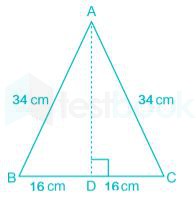
As we can see, the given triangle is an isosceles triangle. The altitude in this triangle divides the triangle in two equal parts, as show in figure.

In right angled triangle ADC, AD2 + DC2 = AC2

AD2 = 342 – 162 = 900

AD = 30 cm

∴ Area of triangle ABC = ½ × BC × AD = ½ × 32 × 30 = 480 cm2

40

In a bio gas plant the population of yeast bacteria increases at a rate of 9% per annum, but there is an additional annual increase of 1% in population due to various other inputs in the system. The percentage increase in the yeast population after 2 years is:

  1. ((a))

    21%

  2. ((b))

    25%

  3. ((c))

    20%

  4. ((d))

    22%

Show Answer
Answer: ((a))

21%

The population of bacteria increases by 9% per annum and 1% due to additional factors, so every year, there is a net increase of 10% in yeast population.

Let’s assume that the population today is x.

∴ Population after 2 years (= x \times \frac{{110}}{{100}} \times \frac{{110}}{{100}} = \frac{{121x}}{{100}} = 1.21x)

% increase in population = (1.21x – x)/x × 100 = 21

41

If -5 ≤ x ≤ 1 and -1 ≤ y ≤ 5, then the minimum value of 2y – 3x is:

  1. ((a))

    -5

  2. ((b))

    -9

  3. ((c))

    -8

  4. ((d))

    -10

Show Answer
Answer: ((a))

-5

The given expression 2y – 3x will be minimum when y is minimum and x is maximum.

Minimum value of y = -1

Maximum value of x = 1

Minimum value of given expression = 2 × (-1) – 3 × (1) = -2 – 3 = -5

42

The curved surface area of a hemisphere is 8π cm2, then its radius is:

  1. ((a))

    2.5 cm

  2. ((b))

    3 cm

  3. ((c))

    2 cm

  4. ((d))

    1 cm

Show Answer
Answer: ((c))

2 cm

The curved surface area of hemisphere with radius r is given as:

CSA = 2πr2

∴ 8π = 2πr2

⇒ r = 2 cm

43

If the sum of 2 numbers is 175, their LCM is 300 and HCF is 25. Then the difference between 2 numbers is:

  1. ((a))

    25

  2. ((b))

    10

  3. ((c))

    15

  4. ((d))

    20

Show Answer
Answer: ((a))

25

Since their HCF is 25, let the two numbers be 25x and 25y, where x and y are coprime numbers.

We know that, product of numbers = LCM × HCF

∴ 25x × 25y = 300 × 25

⇒ xy = 12 ⇒ y = 12/x

Also, 25x + 25y = 175 ⇒ x + y = 7

⇒ x + 12/x = 7

⇒ x2 – 7x + 12 = 0

⇒ (x – 3)(x – 4) = 0

⇒ x = 3 and y = 4 OR x = 4 and y = 3

∴ the two numbers are: 25 × 3 = 75 and 25 × 4 = 100

∴ difference of two numbers = 100 – 75 = 25

44

Pipe A can fill the tank 2 times faster than pipe B. If pipe A and B together fill the tank in 24 minutes, then pipe B alone can fill the tank in:

  1. ((a))

    75 minutes

  2. ((b))

    72 minutes

  3. ((c))

    71 minutes

  4. ((d))

    70 minutes

Show Answer
Answer: ((b))

72 minutes

Let’s assume that pipe B alone can the tank in x minutes, so pipe B fills 1/xth part of tank in one minute.

Pipe A can fill the tank 2 times faster than pipe B, so pipe A fills 2/xth part of tank in one minute.

Together, the two pipes fill the tank in 24 minutes, so together they fill 1/24th part in one minute.

(\therefore \frac{1}{x} + \frac{2}{x} = \frac{1}{{24}}) 

⇒ 3/x = 24

⇒ x = 72 minutes

∴ Pipe B alone fills the tank in 72 minutes.

45

If x1 and x2 are the roots of the equation x2 + 2x – 15 = 0 then the quadratic equation which has the roots 1/x1 and 1/x2 is :

  1. ((a))

    15x2 - 2x – 1 = 0

  2. ((b))

    15x2 + 2x – 1 = 0

  3. ((c))

    -15x2 – 2x – 1 = 0

  4. ((d))

    15x2 – 2x + 1 = 0

Show Answer
Answer: ((a))

15x2 - 2x – 1 = 0

We know that, for a quadratic equation ax2 + bx + c,

Sum of its roots = -b/a and product of roots = c/a

For x2 + 2x – 15 = 0:

x1 + x2 = -2 and x1x2 = -15

For the equation whose roots are 1/x1 and 1/x2,

Sum of roots (= \frac{1}{{{x_1}}} + \frac{1}{{{x_2}}} = \frac{{{x_1} + {x_2}}}{{{x_1}{x_2}}} = \frac{{ - 2}}{{ - 15}}; = \frac{2}{{15}})

Product of roots ( = \frac{1}{{{x_1}{x_2}}} = - \frac{1}{{15}})

∴ the quadratic equation becomes: ({x^2} - \frac{2}{{15}}x - \frac{1}{{15}} = 15{x^2} - 2x - 1)

46

The number of terms in the sequence 5, 20, 80, 320, ………., 81920 is:

  1. ((a))

    8

  2. ((b))

    9

  3. ((c))

    6

  4. ((d))

    7

Show Answer
Answer: ((a))

8

The given sequence is 5, 20, 80, 320, ………., 81920

We can see that, the given series is is a geometric progression with common ratio 4.

nth term of a geometric progression is given as: arn – 1

Where, a = first term, r = common ratio

∴ 5 × 4n – 1 = 81920

⇒ 4n – 1 = 81920/5 = 16384

⇒ n – 1 = 7

⇒ n = 8

47

The number of terms in the sequence 20, 25, 30, …………., 150 is:

  1. ((a))

    26

  2. ((b))

    27

  3. ((c))

    22

  4. ((d))

    23

Show Answer
Answer: ((b))

27

As we can see, the given series is an arithmetic progression, with first term 20 and common difference 5.

nth term of an arithmetic progression is given as: a + (n – 1)d

150 = 20 + (n – 1) × 5

⇒ n – 1 = 130/5 = 26

⇒ n = 27

48

In a chemistry lab two beakers A and B contain 62% and 84% of sprit respectively. If two liters from A is mixed with 4 liters of B, the ratio of sprit and water in the resulting mixture is:

  1. ((a))

    23 : 7

  2. ((b))

    17 : 19

  3. ((c))

    58 : 19

  4. ((d))

    17 : 21

Show Answer
Answer: ((a))

23 : 7

A has 62% spirit.

Amount of spirit in 2 liters of A = 0.62 × 2 = 1.24 liters

B has 84% spirit.

Amount of spirit in 4 liters of B = 0.84 × 4 = 3.36 liters

Total amount of mixture = 2 + 4 = 6 liters

Amount of spirit in the final mixture = 1.24 + 3.36 = 4.6 liters

Amount of water in the final mixture = 6 – 4.6 = 1.4

Required ratio = 4.6 : 1.4 = 23 : 7

49

Due to economic surges the price of eggs suddenly reduced by 40%. This enabled a woman to buy 64 more eggs for $ 50. Then the reduced price per dozen is:

  1. ((a))

    $ 3.5

  2. ((b))

    $ 3.75

  3. ((c))

    $ 3.25

  4. ((d))

    $ 4

Show Answer
Answer: ((b))

$ 3.75

Let’s assume that the original price of eggs is $x per dozen.

Now, the reduced price = x – 40% of x = $ 0.6x per dozen

As per given condition, reduced price enabled a woman to buy 64 more eggs for $50

(\begin{array}{l} \therefore \frac{{50}}{{0.6x}} - \frac{{50}}{x} = \frac{{64}}{{12}}\ \Rightarrow \frac{{50}}{{0.6x}} - \frac{{30}}{{0.6x}} = \frac{{20}}{{0.6x}} = \frac{{64}}{{12}} \end{array})

⇒ 0.6x = 20 × 12/64 = 3.75

∴ Reduced price = $ 3.75 per dozen

50

Shivangi invests Rs. 4000 for six months at 20% per annum compounded quarterly. The total amount she gets after 6 months is :

  1. ((a))

    Rs. 4440

  2. ((b))

    Rs. 4410

  3. ((c))

    Rs. 4401

  4. ((d))

    Rs. 4411

Show Answer
Answer: ((b))

Rs. 4410

We know that, (A = P{\left( {1 + \frac{R}{{100}}} \right)^T})

Where, A = total amount, P = Principal, R = % interest rate; T = time period

Here, the interest rate is 20% per annum, and interest is compounded quarterly.

∴ interest rate per interest period is 20/4 = 5%.

Also, the interest is calculated after six months, number of periods = 6/3 = 2

∴ Amount (= 4000 \times {\left( {1 + \frac{5}{{100}}} \right)^2} = 4000 \times \frac{{21}}{{20}} \times \frac{{21}}{{20}} = 4410)

Reasoning (25 questions)

51

If ‘+’ means ‘ × ’, ‘ - ‘ means ‘÷’, ‘ × ’ means ‘ - ‘ and ‘÷’ means ‘+’, then what will be the value of 16 ÷ 36 – 6 × 2 + 3 = ?

  1. ((a))

    26

  2. ((b))

    16

  3. ((c))

    14

  4. ((d))

    20

Show Answer
Answer: ((b))

16

16 ÷ 36 – 6 × 2 + 3 = ?

‘+’ means ‘ × ’

‘ - ‘ means ‘÷’

‘ × ’ means ‘ - ‘

‘÷’ means ‘+’

⇒ 16 + 36 ÷ 6 – 2 × 3 = ?

⇒ 16 + 6 – 6 = ?

⇒ 16 = ?

Hence, 16 is value of given equation.

52

In the given letter series, which one set of letters when sequentially placed in the gaps shall complete it?

p _ n n m _ p m n _ m p _ m n _ m p

  1. ((a))

    n m n p p

  2. ((b))

    m n p n p

  3. ((c))

    m p n p n

  4. ((d))

    n p m p n

Show Answer
Answer: ((c))

m p n p n

p _ n n m _ p m n _ m p _ m n _ m p

  1. n m n p p ⇒ p nnn m m p m n n m p p m n p m p

2.m n p n p ⇒ p m n n m n p m n p m p n m n p m p

3.m p n p n ⇒ p m n/n m p/ p m n/n m p/p m n/n m p

4.n p m p n ⇒ p nnn m pp m n m m p p m n n m p

Here in option 3) we can have repeated pattern of “pmn” and **‘’nmp’’**alternatively.

53

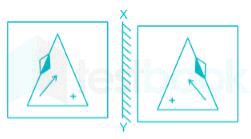
Which of the answer figure is exactly the mirror image of the question figure, when the mirror is held on the line X Y?

  1. ((a))

  2. ((b))

  3. ((c))

  4. ((d))

Show Answer
Answer: ((b))

Hence above image shows question figure.

54

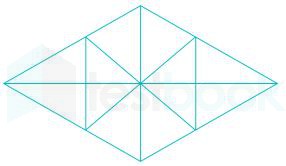
How many triangles are there in the following figure?

  1. ((a))

    20

  2. ((b))

    28

  3. ((c))

    24

  4. ((d))

    12

Show Answer
Answer: ((b))

28

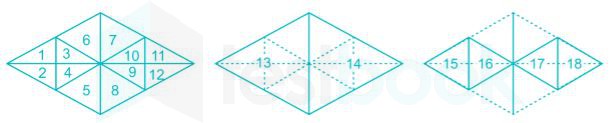
Hence, There will be total 28 triangles in given diagram.

55

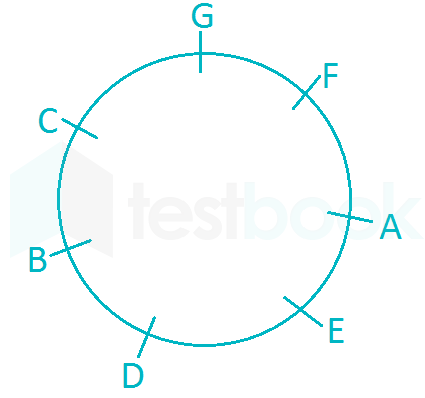
Seven friends – A, B, C, D, E, F and G are sitting in a circle facing at the center. ‘E’ is neighbor of A and D. ‘G’ is between ‘F’ and ‘C’, ‘F’ is to the immediate right of ‘A’. Who is sitting to the right of ‘G’?

  1. ((a))

    C

  2. ((b))

    A

  3. ((c))

    F

  4. ((d))

    D

Show Answer
Answer: ((a))

C

Seven friends – A, B, C, D, E, F and G are sitting in a circle facing at the center. ‘E’ is neighbor of A and D. ‘G’ is between ‘F’ and ‘C’, ‘F’ is to the immediate right of ‘A’.

Note – Where nothing mention about position of position then we consider right as immediate right.

Hence, right(Immediate ) of G is C is sitting.

56

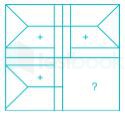
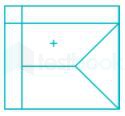
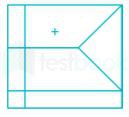
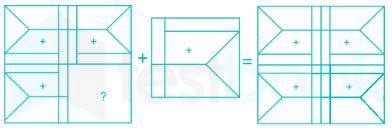
Select the figure from the alternatives which will complete the pattern in given question figure.

  1. ((a))

  2. ((b))

  3. ((c))

  4. ((d))

Show Answer
Answer: ((a))

Hence aboge diagram show complete pattern.

57

What is related to ‘Courage’ in the same way as ‘Kindness’ is related to ‘Cruelty’?

  1. ((a))

    Bravery

  2. ((b))

    Cowardice

  3. ((c))

    Fear

  4. ((d))

    Valour

Show Answer
Answer: ((b))

Cowardice

“Kindness” is antonym of “Cruelty”. In similar way “Cowardice” is antonym of “Kindness”

58

Select the related letter from the given alternatives.

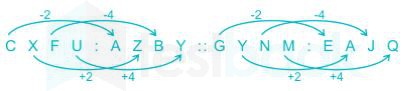
CXFU : AZBY ∷ GYNM : ?

  1. ((a))

    RIIP

  2. ((b))

    EROP

  3. ((c))

    EAJQ

  4. ((d))

    IRRD

Show Answer
Answer: ((c))

EAJQ

Hence, “EAJQ” is correct option.

59

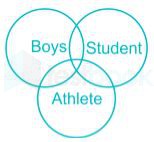
Identify the diagram that best represents the relationship among classes given below. Boys, Students, Athletes

  1. ((a))

  2. ((b))

  3. ((c))

  4. ((d))

Show Answer
Answer: ((a))

Some of the Boys can be athlete as well as Student. Student can be a Boy or Athlete and similarly an Athlete can be Boy and Student.

Above diagram represent best relationship among Boys, Student and Athlete.

60

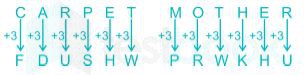
In a certain code language CARPET is written as FDUSHW. How will MOTHER be coded in that code language?

  1. ((a))

    REHTOM

  2. ((b))

    PRWHUK

  3. ((c))

    OPUIFS

  4. ((d))

    PRWKHU

Show Answer
Answer: ((d))

PRWKHU

Hence, “MOTHER” will be coded as “PRWKHU”

61

Some equations are solved on the basis of a certain system. Find the correct value for ‘?’ on that basis.

8 * 6 = 28

11 * 5 = 96

15 * 7 = ?

  1. ((a))

    208

  2. ((b))

    176

  3. ((c))

    105

  4. ((d))

    147

Show Answer
Answer: ((b))

176

Logic: a * b = a2 – b2

⇒ 8 * 6 = 64 – 36 = 28

⇒ 11 * 5 = 121 – 25 = 96

⇒ 15 * 7 = 225 – 49 = 176

Hence, 176 is missing term.

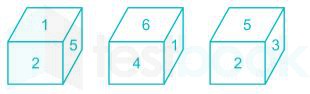
62

Three positions of a cube are shown below. Which number will be opposite to the face containing 3?

  1. ((a))

    1

  2. ((b))

    4

  3. ((c))

    5

  4. ((d))

    6

Show Answer
Answer: ((a))

1

As we can see 5, 2, 4 and 6 are adjacent to 1 and 5 and 2 are adjacent to 3

Therefore 1 will be opposite side of ‘3’

63

Select the related number from the given alternatives.

23 : 35 : : 47 : ?

  1. ((a))

    62

  2. ((b))

    65

  3. ((c))

    70

  4. ((d))

    59

Show Answer
Answer: ((d))

59

In 23 : 35

⇒ (4 × 6) – 1 : (4 × 9) – 1

Similarly,

⇒ (4 × 12) – 1 : (4 × 15) – 1

⇒ 47 : 59

Therefore 59 will be correct option.

64

Identify the word which belongs to the class of given words.

Grams, Kilograms, Quintal

  1. ((a))

    Kilometer

  2. ((b))

    Yard

  3. ((c))

    Litre

  4. ((d))

    Tonnes

Show Answer
Answer: ((d))

Tonnes

Grams, Kilograms, Quintal are units of measuring Weight. Similarly;

Tonnes is also used to measure Weight.

Hence, "Tonnes" is the correct answer.

Units of weight: Grams, Kilograms, Quintal, Tonnes, etc

Units of length: Meter, Decimeter, Kilometer, Foot, Inch, Mile, Yard, etc.

1) Grams: The gram is a metric system unit of mass.

  1. Kilograms: The SI unit of mass (equivalent to approximately 2.205 lb), first introduced as a unit of mass for the metric system.

1 Kilogram = 1000 Grams

3) Quintal: The quintal or centner is a historical unit of mass in many countries which is usually defined as 100 base units, such as pounds or kilograms.

1 Qunital = 100 kg

4) Tonnes: a unit of weight in the metric system 

1 Tonnes = 1000 kg

65

Select the one which is different from other three.

  1. ((a))

    IRJQ

  2. ((b))

    GHST

  3. ((c))

    EVFU

  4. ((d))

    KPLO

Show Answer
Answer: ((b))

GHST

IRJQ, HGST and KPLO contain atleast one vowel but “GHST” does not contain any vowel.

66

Alok is older than Malvika. Gyan is older than Malvika but younger than Alok. Kamal is younger than Rashmi and Malvika. Malvika is older than Rashmi. Whose age is exactly in the middle of the five?

  1. ((a))

    Malvika

  2. ((b))

    Gyan

  3. ((c))

    Alok

  4. ((d))

    Rashmi

Show Answer
Answer: ((a))

Malvika

  1. Alok is older than Malvika. (Alok > Malvika)

  2. Gyan is older than Malvika but younger than Alok. (Alok > Gyan > Malvika)

  3. Kamal is younger than Rashmi and Malvika. (Rashmi, Malvika > Kamal)

  4. Malvika is older than Rashmi. (Malvika > Rashmi)

Alok > Gyan > Malvika > Rashmi > Kamal

Hence, Malvika age is Middle of five.

67

From the given alternatives select the word which cannot be formed using the letters of the given word

ORGANISATION

  1. ((a))

    STRONG

  2. ((b))

    ORANGE

  3. ((c))

    NOTION

  4. ((d))

    GROAN

Show Answer
Answer: ((b))

ORANGE

A) STRONG → can be format as ORGANISATION.

B) ORANGE → can’t be format as ORGANISATION.(Since there is no ‘E’)

C) NOTION → can be format as ORGANISATION.

D) GROAN → can be format as ORGANISATION.

Hence the word ORANGE cannot be formed.

68

Mother’s age is twice her daughter’s age. The son is older than daughter by one year and father is five years older than mother. If son has completed 18 years, find father’s age.

  1. ((a))

    41 years

  2. ((b))

    39 years

  3. ((c))

    40 years

  4. ((d))

    42 years

Show Answer
Answer: ((b))

39 years

Let age of daughter = X years.

Age of Mother = 2X years

Age of Son = X + 1 years.

Age of Father = 2X + 5 years

Now son has completed 18 years ⇒ X + 1 = 18 ⇒ X = 17 years.

Father age = 2X + 5 = 2(17) + 5 = 39 years.

Hence, age of Father is 39 year.

69

In a row of boys, Vivek stands thirteenth from the left and Ravi is thirteenth from the right. If they interchange their places, Ravi would be eighteenth from the right. How many boys are there in the row?

  1. ((a))

    30

  2. ((b))

    32

  3. ((c))

    29

  4. ((d))

    31

Show Answer
Answer: ((a))

30

Vivek stands thirteenth from the left and Ravi is thirteenth from the right.

If they interchange their places, Ravi would be eighteenth from the right.

Hence there will be total 30 student in row.

Alternative Method:

As we know that

Total no. of boys in row = boys from left + boys from right – 1

Total no. of boys = 18 + 13 – 1 = 30

70

Choose the correct alternative that will complete the given number series.

9, 17, 31, 57, ?, 205

  1. ((a))

    107

  2. ((b))

    109

  3. ((c))

    104

  4. ((d))

    102

Show Answer
Answer: ((a))

107

⇒ 9 × 2 – 1 = 17

⇒ 17 × 2 – 3 = 34 – 3 = 31.

⇒ 31 × 2 – 5 = 62 – 5 = 57

⇒ 57 × 2 – 7 = 114 – 7 = 107

⇒ 107 × 2 – 9 = 214 – 9 = 205

Hence, 107 will complete the series.

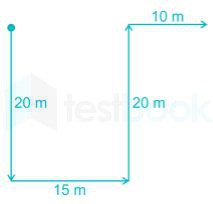
71

Shyam walked 20 metres towards south. Then he turned to his left and walked 15 meters. He again turned to his left and walked 20 metres. He then turned to his right and walked 10 metres. How far and in which direction is Shyam from the starting point?

  1. ((a))

    25 Metres, East

  2. ((b))

    35 Metres, West

  3. ((c))

    25 Metres, North

  4. ((d))

    35 Metres, East

Show Answer
Answer: ((a))

25 Metres, East

From given information can be traced in diagram shown below.

Hence, Shyam is 25 east with respect to his starting position.

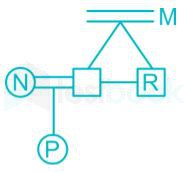
72

‘R’ is the paternal uncle of ‘P’, who is the daughter of ‘N’ and ‘N’ is the daughter - in - law of ‘M’. How is ‘R’ related to ‘M’?

  1. ((a))

    Son - in - law

  2. ((b))

    Cousin

  3. ((c))

    Son

  4. ((d))

    Brother

Show Answer
Answer: ((c))

Son

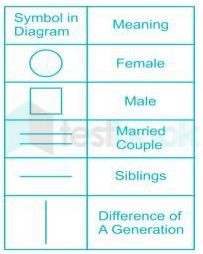
Table is drawn describing symbols and their meanings :

‘R’ is the paternal uncle of ‘P’, who is the daughter of ‘N’ and ‘N’ is the daughter - in - law of ‘M’

Hence, R is son of M.

73

Find the missing number from the given alternatives.

  1. ((a))

    43

  2. ((b))

    42

  3. ((c))

    41

  4. ((d))

    45

Show Answer
Answer: ((a))

43

⇒ (8 + 6) × (3 +2) – 2 = 14 × 5 – 2 = 70 – 2 = 68

⇒ (7 + 3) × (5 +4) – 2 = 10 × 9 – 2 = 90 – 2 = 88

⇒ (4 + 5) × (3 +2) – 2 = 9 × 5 – 2 = 45 – 2 = 43

Hence, 43 is missing number.

74

Find the odd number pair from the given alternative.

  1. ((a))

    42 – 33

  2. ((b))

    46 – 10

  3. ((c))

    12 – 91

  4. ((d))

    25 – 43

Show Answer
Answer: ((c))

12 – 91

  1. 42 – 33 ⇒ 42 – 33 = 9
  2. 46 – 10 ⇒ 46 – 10 = 36
  3. 12 – 91 ⇒ 91 – 12 = 79
  4. 25 – 43 ⇒ 43 – 25 = 18

Except “12 – 91” all other has difference between them as multiple of 9.

75

Four sets of three statements each are given below. Take these statements to be true even if they look factually absurd. Select one alternative in which third statement is implied by the first two statements.

  1. ((a))

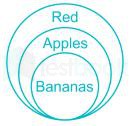
    All apples are red. All bananas are apples. So, all bananas are red.

  2. ((b))

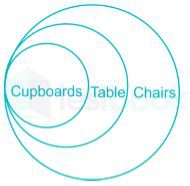
    All tables are chairs. All cupboards are tables. So, all chairs are cupboards.

  3. ((c))

    All J’s are K’s. All K’s are M’s. So, all M’s are J’s.

  4. ((d))

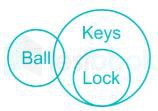
    All locks are keys. Some ball are keys. So, all locks are balls.

Show Answer
Answer: ((a))

All apples are red. All bananas are apples. So, all bananas are red.

  1. All apples are red. All bananas are apples. So, all bananas are red.

Here, Third statement is implied by the first two statements.

  1. All tables are chairs. All cupboards are tables. So, all chairs are cupboards.

Here, Third statement does not implied by the first two statements.

3.All J’s are K’s. All K’s are M’s. So, all M’s are J’s.

Here, Third statement does not implied by the first two statements.

  1. All locks are keys. Some ball are keys. So, all locks are balls.

Here, Third statement does not implied by the first two statements.

General English (25 questions)

76

Select the option that completes the sentence CORRECTLY.

My cousin felt annoyed with __________ when he saw what had happened due to his ignorance.

  1. ((a))

    myself

  2. ((b))

    oneself

  3. ((c))

    itself

  4. ((d))

    himself

Show Answer
Answer: ((d))

himself

The correct answer is option 4.

Myself is used when the subject is 'I'. Oneself is used as the object of a verb or preposition when this is the same as the subject of the clause and the subject is stated or understood as ‘one’. Itself is used for things. Himself is used as the object of a verb or preposition to refer to a male person or animal previously mentioned as the subject of the clause. Here, the subject is a male i.e 'my cousin'. So, option 4 is correct.

77

Select the ANTONYM of the given word.

DESPAIR

  1. ((a))

    Detest

  2. ((b))

    Hope

  3. ((c))

    Reject

  4. ((d))

    Abandon

Show Answer
Answer: ((b))

Hope

The correct answer is option 2.

Despair means the complete loss or absence of hope.

For eg; I heard a voice full of despair.

Detest means dislike intensely.

Hope means a feeling of expectation and desire for a particular thing to happen.

For eg; He had hope that she would return.

Abandon means cease to support or look after (someone).

78

Select the word that is spelt INCORRECTLY.

  1. ((a))

    moist

  2. ((b))

    molest

  3. ((c))

    moltan

  4. ((d))

    molecule

Show Answer
Answer: ((c))

moltan

The correct answer is option 3.

The correct spelling of the word is molten.

Moist means slightly wet.

Molest means assault or abuse (a person, especially a woman or child) sexually.

Molten means liquefied by heat.

Molecule means a group of atoms bonded together, representing the smallest fundamental unit of a chemical compound that can take part in a chemical reaction.

79

Select the word that is spelt INCORRECTLY.

  1. ((a))

    Access

  2. ((b))

    Expell

  3. ((c))

    Excess

  4. ((d))

    Excel

Show Answer
Answer: ((b))

Expell

The correct answer is Option 2.

Key Points

  • The correct spelling of the word is expel.
  • Meaning of the words given are:
  • Expel means officially make (someone) leave a school or other organization.

For eg: They had to expel him from the school.

  • Access means the means or opportunity to approach or enter a place.
  • Excess means an amount of something that is more than necessary, permitted, or desirable.
  • Excel means be exceptionally good at or proficient in an activity or subject.
80

In the following sentence, four words or phrase have been underlined. One of them is incorrect. Select the INCORRECT word or phrase from the given options.

A time came when Gautam Buddha began to feel weary with the luxuries surrounding him.

  1. ((a))

    came

  2. ((b))

    with

  3. ((c))

    when

  4. ((d))

    began to

Show Answer
Answer: ((b))

with

The correct answer is option 2.

The statement is talking about past. So, came, when and began are correct.Weary means tired of. The most appropriate preposition to be used after weary is 'of'. 'With' means accompanied by.

81

Select the word that best expresses the meaning of the given word.

COMPLIMENT

  1. ((a))

    Please

  2. ((b))

    Admire

  3. ((c))

    Agree

  4. ((d))

    Criticize

Show Answer
Answer: ((b))

Admire

The correct answer is Option 2.

Key Points

  • Let's look at the meaning of the given word:-
  • Compliment means a polite expression of praise or admiration. (प्रशंसा की विनम्र अभिव्यक्ति)
  • For Example - She gave me a compliment yesterday.
  • Let's look at the meaning of the correct answer:-
  • Admire means regard with respect or warm approval. (सम्मान या गर्मजोशी से स्वीकृति)
  • For Example - They admired his courage.
  • Thus, the correct answer is Option 2.

Additional Information

  • Let's look at the meaning of the other words given in the options:-
  • Criticize - the expression of disapproval of someone or something on the basis of perceived faults or mistakes. (कथित दोषों या गलतियों के आधार पर किसी की या किसी चीज की अस्वीकृति की अभिव्यक्ति)
  • Agree - have the same opinion about something; concur. (क��सी बात के बारे में एक ही राय रखना; सहमत होना)
  • Please - cause to feel happy and satisfied. (खुश और संतुष्ट महसूस करने का कारण)
82

Select the option that completes the sentence CORRECTLY.

Next week I __________ to visit my cousin.

  1. ((a))

    will intend

  2. ((b))

    intending

  3. ((c))

    intended

  4. ((d))

    intend

Show Answer
Answer: ((d))

intend

The correct answer is option 4.

The given statement is being said in the present tense. So, we will use 'intend'. Intend means have (a course of action) as one's purpose or intention; plan.

83

In the following sentence, four words or phrases have been underlined. One of them is incorrect. Select the INCORRECT word or phrase from the given options.

This is one of the five books that was launched yesterday at five Vigyan Bhawan.

  1. ((a))

    at

  2. ((b))

    that was

  3. ((c))

    This

  4. ((d))

    one of the

Show Answer
Answer: ((b))

that was

The correct answer is option 2.

Since the speaker is pointing towards one book among five, the use of singular pronoun 'this' is correct. Instead of 'that' , 'which' should be used to make the sentence grammatically correct as 'which' is used with non-restrictive clause i.e the statement which can be removed without changing the meaning of the sentence.

84

Select the word that is spelt INCORRECTLY.

  1. ((a))

    fault

  2. ((b))

    fauna

  3. ((c))

    favaur

  4. ((d))

    faucet

Show Answer
Answer: ((c))

favaur

The correct answer is option 3 i.e. 'favaur'.

Key Points       

  • The incorrectly spelled word is 'favaur'. The correct spelling of the word is 'favour'.
  • All other words are correctly spelled. Lets' look at the meaning of the given options:
  • Fault means an unattractive or unsatisfactory feature, especially in a piece of work or in a person's character.
  • Fauna means the animals of a particular region, habitat, or geological period.
  • Favaur is the incorrect spelling of 'Favour' means approval, support, or liking for someone or something.
  • Faucet means a tap.

From the above, we can say that the correct answer is 'favaur'.

85

Select the word that best expresses the meaning of the given word.

CONCEAL

  1. ((a))

    Deceive

  2. ((b))

    Hide

  3. ((c))

    Free

  4. ((d))

    Detest

Show Answer
Answer: ((b))

Hide

The correct answer is option 2.

Conceal means not allow to be seen; hide.

For eg; The clouds concealed the view.

Deceive means deliberately cause (someone) to believe something that is not true, especially for personal gain.

Hide means put or keep out of sight.

For eg; She hid the money in the house.

Detest means dislike intensely.

86

Find the appropriate meaning of the underlined idiom.

A true friend will stand by you through thick and thin.

  1. ((a))

    at the last moment

  2. ((b))

    under all circumstances

  3. ((c))

    in difficult times

  4. ((d))

    during summer time

Show Answer
Answer: ((b))

under all circumstances

The correct answer is option 2.

Through thick and thin means under all circumstances. 

For eg; Her friends always stood by her through thick and thin.

87

Select the word that best expresses the meaning of the given word.

TRANQUIL

  1. ((a))

    Silent

  2. ((b))

    Calm

  3. ((c))

    Tired

  4. ((d))

    Active

Show Answer
Answer: ((b))

Calm

The correct answer is option 2.

Tranquil means free from disturbance; calm.

For eg; I could feel his tranquil gaze.

Silent means not making or accompanied by any sound.

Calm means not showing or feeling nervousness, anger, or other strong emotions.

For eg; It is important to stay calm in such situations.

88

Select the ANTONYM of the given word.

STRAIGHT

  1. ((a))

    Long

  2. ((b))

    Weak

  3. ((c))

    Crooked

  4. ((d))

    Short

Show Answer
Answer: ((c))

Crooked

The correct answer is option 3.

Straight means extending or moving uniformly in one direction only; without a curve or bend.

For eg; We were travelling on a straight road.

Crooked means bent or twisted out of shape or out of place.

For eg; His teeth were crooked.

89

In the following sentence, four words or phrases have been underlined. One of them is incorrect. Select the INCORRECT word or phrase from the given options.

If Antarctica has a very cold climate, a variety of sea birds are found there.

  1. ((a))

    has

  2. ((b))

    a variety

  3. ((c))

    are found

  4. ((d))

    If

Show Answer
Answer: ((d))

If

The correct answer is option 4.

'Has' is used for singular nouns. Here 'Antarctica' is singular. 'A' is used before singular, countable nouns which begin with consonants. So, 'a variety' is correct. The use of past participle form 'found' is correct. 'If' is used to introduce a condition. Here there is no condition but a general statement. So, 'if' is incorrect.

90

Select the option that completes the sentence CORRECTLY.

I don't think you will have ___________ difficulty in obtaining your driving license.

  1. ((a))

    some

  2. ((b))

    any

  3. ((c))

    a great deal

  4. ((d))

    many

Show Answer
Answer: ((b))

any

The correct answer is option 2.

Some is mostly used in affirmative sentences whereas any is used in negative sentences. A great deal is incorrect with respect to the context. Many is used with countable things. So, option 2 is correct.

91

Select the phrase that best expresses the meaning of the underline word.

It was a serious offence but he was allowed to go with a warning.

  1. ((a))

    let off

  2. ((b))

    let down

  3. ((c))

    let aside

  4. ((d))

    let out

Show Answer
Answer: ((a))

let off

The correct answer is option 1.

Let off means a chance to escape.

Let down means a disappointment.

Let aside means To refuse to think about, believe or accept something

Let out means finish, so that those attending are able to leave.

So, 'let off' is most appropriate.

92

Select the ANTONYM of the given word.

PRECIOUS

  1. ((a))

    Loved

  2. ((b))

    Costly

  3. ((c))

    Valued

  4. ((d))

    Worthless

Show Answer
Answer: ((d))

Worthless

The correct answer is option 4.

Precious means of great value

For eg; He had some precious works of art.

Costly means costing a lot; expensive.

Worthless means having no real value or use.

For eg; I was not interested in buying worthless things.

93

In the following sentence, four words or phrases have been underlined. One of them is incorrect. Select the INCORRECT word or phrase from the given options.

You can be exempt from games only while you produce a medical certificate.

  1. ((a))

    from

  2. ((b))

    only while

  3. ((c))

    produce

  4. ((d))

    can be

Show Answer
Answer: ((b))

only while

The correct answer is option 2.

'Can' is used to denote a possibility. Here, it is correct. 'From' is used to indicate a specific thing or point of action. So, it is correct. 'While' is used to denote a period of time.

For eg; Stop talking while studying.

'When' is used to denote a particular circumstance.

Here, 'when' should be used instead of 'while'.

The use of 'produce' is correct as it means to present.

94

Select the phrase that best expresses the meaning of the underlined word.

I am grateful to my teacher who persistently scolded me for poor spelling.

  1. ((a))

    pulled me off

  2. ((b))

    pulled me up

  3. ((c))

    pulled me out

  4. ((d))

    pulled me through

Show Answer
Answer: ((b))

pulled me up

The correct answer is option 2.

Pulled me off means to succeed in something.

Pulled me up means criticize me for not doing well.

Pulled me out means to stop me from doing something.

Pulled me through means manage to stay alive after an incident.

In the given sentence, 'scolded' is closest in meaning to 'pulled me up' as the teacher criticized him for poor spelling.

95

Select the option that completes the sentences CORRECTLY.

If you have any queries to raise __________ please let me know now.

  1. ((a))

    along

  2. ((b))

    no word required

  3. ((c))

    up

  4. ((d))

    about

Show Answer
Answer: ((b))

no word required

The correct answer is option 2.

The sentence does not require any preposition as the sentence conveys the required meaning and is grammatically correct.

Direction: Read the following passage and answer the given questions.

A desert is basically a wilderness or a wasteland. There is little moisture and poor soil such as sand gravel or rock. There are few plants to offer shade. Deserts can be described as harsh places. Many are burning hot by day and cold by night.

Every continent has deserts. Much of the western United States is a desert. A desert region called The Outback covers Central Australia. The southern tip of South America is largely desert. Northern Africa is covered by the Sahara, a desert as big as the mainland United States. The Arabian Peninsula, between the Persian Gulf and the Red Sea, is almost entirely desert. A large part of central Asia, from China to the Caspian Sea, is mostly desert. Deserts cover 1/8 of our planet.

The popular belief is that a desert is dry, hot, waterless and without shelter. But this is not entirely correct. For those who have studied it, the desert can be a beautiful place. It is home to a variety of people, animals and plants that have learnt to live under hot and dry conditions. A desert is not always a flat, unchanging wasteland of dry sand. It may have mountains and hills. It may have an oasis, big or small. An oasis is like a green island in the middle of a desert where a spring of a well gives plants and trees a better chance to grow.

All living things need water in order to survive. The few plants and animals that live in deserts have developed the ability to require less water than most plants and animals. Desert plants have adapted to heat and dryness of the desert. Plants such as cacti have special means of storing and conserving water. They often have few or no leaves. Some plants have gotten used to arid environments by growing extremely long roots, allowing them to acquire moisture at or by the water table.

The desert animals also have found a way to solve the heat and water problems the dessert environment creates. Camels can drink a lot of water at one time. They can live without water for days together. The reason is they sweat very little. We sweat because we must keep our body temperature constant. We sweat when it gets hot, and this cools the body. Camels can stand a high body temperature. They don't need to sweat and can therefore retain the water they drink for long periods of time.

96

Certain plants are able to survive in deserts because they:

  1. ((a))

    have adapted to survive in hot and dry climate.

  2. ((b))

    develop especially long roots.

  3. ((c))

    have thick stems and few leaves.

  4. ((d))

    require less water than animals.

Show Answer
Answer: ((a))

have adapted to survive in hot and dry climate.

The correct answer is option 1.

It is mentioned that ''The few plants and animals that live in deserts have developed the ability to require less water than most plants and animals.'' So, plants have adapted themselves to survive in hot and dry climate.

97

The desert region called 'The Outback' is located in:

  1. ((a))

    North Africa

  2. ((b))

    South America

  3. ((c))

    Central Asia

  4. ((d))

    Central Australia

Show Answer
Answer: ((d))

Central Australia

The correct answer is option 4.

It is mentioned that '' A desert region called The Outback covers Central Australia.'' So, option 4 is correct.

98

Why has an oasis been called 'green' island?

  1. ((a))

    It is in the middle of a vast desert.

  2. ((b))

    The sand here is conducive for the vegetation.

  3. ((c))

    It is surrounded by green hills and mountains.

  4. ((d))

    It has a source of water that supports vegetation.

Show Answer
Answer: ((d))

It has a source of water that supports vegetation.

The correct answer is option 4.

It is mentioned that ''An oasis is like a green island in the middle of a desert where a spring of a well gives plants and trees a better chance to grow.'' So, option 4 is correct.

99

Which of the following statements is not true according to the passage?

  1. ((a))

    Camels can retain water for a long time because they do not sweat.

  2. ((b))

    About 1/8 area of the earth is covered by deserts.

  3. ((c))

    The Arabian Peninsula between the Persian Gulf and Caspian Sea is entirely desert.

  4. ((d))

    In a desert region there is little moisture and poor soil.

Show Answer
Answer: ((c))

The Arabian Peninsula between the Persian Gulf and Caspian Sea is entirely desert.

The correct answer is option 3.

It is mentioned that '' Camels can drink a lot of water at one time. They can live without water for days together. The reason is they sweat very little. '' Option 1 is true.

Also, ''Deserts cover 1/8 of our planet.'' ''The Arabian Peninsula, between the Persian Gulf and the Red Sea, is almost entirely desert. ''

So, option 3 is incorrect.

100

What is the popular belief about the climatic conditions of a desert?

  1. ((a))

    It is sandy where no rain falls and no vegetation grow.

  2. ((b))

    It has vast land which is used for cultivation of flowers.

  3. ((c))

    A variety of animals and plants live there.

  4. ((d))

    It is a region surrounded by mountains and hills.

Show Answer
Answer: ((a))

It is sandy where no rain falls and no vegetation grow.

The correct answer is option 1.

It is mentioned that ''The popular belief is that a desert is dry, hot, waterless and without shelter.'' So, option 1 is correct.

Professional Knowledge (100 questions)

101

If L = {ab, c} is aa language over the set A = {a, b, c}, then L3 is:

  1. ((a))

    {ababc, abcab, abc2, cabab, cabc, c2ab, c3}

  2. ((b))

    {ababab, ababc, abcab, abc2, cabab, cabc, c2ab, c3}

  3. ((c))

    {ababab, ababc, abcab, abc2abab, cabab, cabc, c2ab, c3}

  4. ((d))

    {ababab, ababc, abcab, abc2, cabab, c2ab, c3}

Show Answer
Answer: ((b))

{ababab, ababc, abcab, abc2, cabab, cabc, c2ab, c3}

L = {ab, c}

L2 = {ab, c} × {ab, c}

= {abab, abc, cab, c2}

L3 = {abab, abc, cab, c2} × {ab, c}

= {ababab, ababc, abcab, abc2, cabab, cabc, c2ab, c3}

102

Which of the following protocols is built on client-server architecture and uses separate control and data connections between the client and the server?

  1. ((a))

    TELNET

  2. ((b))

    SMTP

  3. ((c))

    FTP

  4. ((d))

    POP

Show Answer
Answer: ((c))

FTP

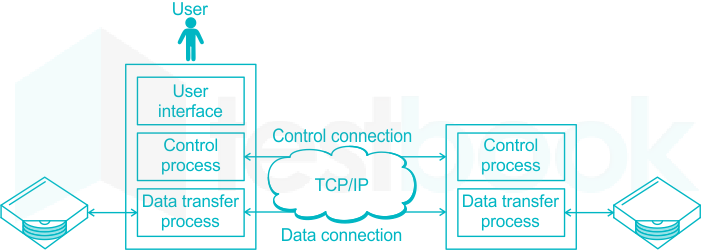
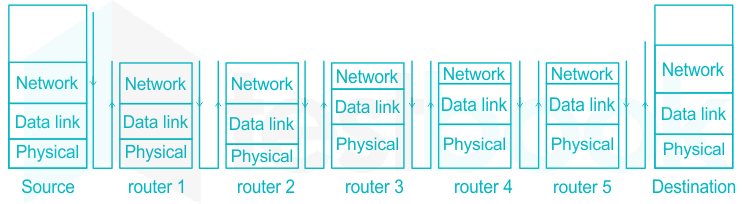
File transfer protocol (FTP) is the mechanism provided by TCP/IP for copying a file from one host to another. It is built on the client- server architecture and uses separate control and data connections between the client and the server.

Explanation:

FTP is different from other client/ server applications as it uses two connections to transfer the file. One is control connection and other is data connection. In this only a line of command or a line of response is transferred at a time. Here is the basic model of FTP.

Communication in FTP is achieved through commands and responses. Using control connection, only one command is sent at a time.  Purpose of data connection is different from control connection. File transfer occurs over the data connection under the control connection. FTP can transfer a file across the data connection by using one of the three modes: stream mode, block mode and compressed mode.

Telnet:

Telnet stands for terminal network. It is a standard TCP/IP protocol for virtual terminal service. It enables the establishment of a connection to a remote system in such a way that the local terminal appears to be a terminal at the remote system.

SMTP:

SMTP stands for simple mail transfer protocol. SMTP simply defines how commands and responses must be sent back and forth between client and server.

POP:

POST office protocol is a protocol that extracts and retrieves email from a remote mail server for access by the host machine. It provides end user the ability to fetch and receive mail.

103

Which of the following constraints enforces that the value of the primary key cannot be Null?

  1. ((a))

    Entity integrity constraint

  2. ((b))

    Key constraint

  3. ((c))

    Domain constraint

  4. ((d))

    Foreign key constraint 

Show Answer
Answer: ((a))

Entity integrity constraint

Concept:   

A primary key is a field in a table which uniquely identifies each row/record in a database table.

Explanation:

Primary key must contain unique values and cannot contain NULL values. A table can have only one primary key. It can consist of single or multiple fields.

Entity integrity constraint enforces that the value of the primary key cannot be NULL because it is used to identify the rows in a relation and if it contains NULL value, then it cannot identify the rows. Allowing a primary key as NULL will cause a potential conflict with uniqueness constraint.

Candidate key column can have null value.

104

Which of the following declares ‘pf’ as a pointer to a function, which returns an integer quantity and requires two integer arguments?

  1. ((a))

    (int *) pf(int, int);

  2. ((b))

    int *pf(int, int);

  3. ((c))

    int (int *pf(int, int));

  4. ((d))

    int (*pf) (int, int);

Show Answer
Answer: ((d))

int (*pf) (int, int);

Option 4: int (*pf) (int, int);

It means that pf is a pointer to a function which takes two integer arguments and returns an integer.

Option 1: (int *) pf(int, int);

It means that pf is a function with two integer arguments and returns an integer as pointer.

Option 2: int *pf(int, int);

It means that pf is a function with two integer arguments and returns a pointer to an integer.

Option 3: int (int *pf(int, int));

It is incorrect.  It is a pointer which takes two integer arguments and returns a pointer to an integer to integer.

105

Which of the following represents the function of a Multiplexer? 

  1. ((a))

    Y = S ? A : B

  2. ((b))

    Y = A & B

  3. ((c))

    Y = A | B

  4. ((d))

    Y = A + B

Show Answer
Answer: ((a))

Y = S ? A : B

Concept:

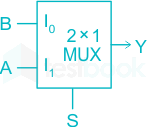
Multiplexer is also known as data selector that selects between several analogy or digital input signals and forwards it to a single output line.

Explanation:

Multiplexer with n select line contains 2n inputs and a single output. A multiplexer is also known as parallel to serial converter or many to one circuit. A multiplexer can be used to implement if-else statements. So, here selection line is used to select the inputs for the output.

Y = S̅ B + SA

if S = 1

then Y = A

else Y = B

Hence option 1 is correct here.

106

Interrupt generated due to which of the following operations does not belong to program-related interrupt category?

  1. ((a))

    Division by zero

  2. ((b))

    Attempt to execute an illegal machine instruction

  3. ((c))

    Reference outside a user’s allowed memory space 

  4. ((d))

    Memory parity error

Show Answer
Answer: ((d))

Memory parity error

Interrupt generated by memory parity error does not belong to program – related interrupt category.

Explanation:

Memory parity errors are due to hardware failure or external elements. It means that one or more stored data values carries a different value when it’s recalled than when it was stored. Parity errors are caused by data corruption. Parity errors can bring back invalid commands for the computer.

107

Which of the following statements is TRUE?

  1. ((a))

    The cardinality ratio for a binary relationship specifies the maximum number of relationship instances that an entity can participate in.

  2. ((b))

    The cardinality ratio for a binary relationship specifies the minimum number of relationship instances that an entity can participate in.

  3. ((c))

    The cardinality ratio for a binary relationship specifies the average number of relationship instances that an entity can participate in.

  4. ((d))

    The partial participation constraint is also called existence dependency.

Show Answer
Answer: ((a))

The cardinality ratio for a binary relationship specifies the maximum number of relationship instances that an entity can participate in.

Cardinality ratio:

It is a concept that describes binary relationship set and its types. (Binary relationship is that which connects two entities). Number of relationship instances in which the entity can participate is defined as cardinality ratio.

Four type of cardinality ratio can be possible:

  1. One to one

  2. One to many  

  3. Many to one         

  4. Many to many

Cardinality ratio is about the maximum number of entities of one entity set that are associated with the maximum number of entities of other set.

Participation: It specifies the minimum number of relationship instances that an entity can participate in.

Partial participation specifies that each entity in the entity set may or may not participate in the relationship instance. It is also called as optional participation.

108

Considering the process details given in the following table. What will be the completion order of the processes under the policies FCFS and RR (with CPU quantum of 2 time units)?

Process IDCPU BurstArrival Time
P153
P272
P350
  1. ((a))

    FCFS: P1, P2, P3 and RR: P1, P2, P3

  2. ((b))

    FCFS: P3, P2, P1 and RR: P3, P2, P1

  3. ((c))

    FCFS: P1, P3, P2 and RR: P1, P2, P3

  4. ((d))

    FCFS: P3, P2, P1 and RR: P3, P1, P2

Show Answer
Answer: ((d))

FCFS: P3, P2, P1 and RR: P3, P1, P2

Completion order in case of FCFS: P3 P2 P1

Completion order in case of round- robin: P3 P1 P2

109

Which of the following statements about Secure shell Protocol is FALSE?

  1. ((a))

    SSH is network protocol

  2. ((b))

    SSH cannot be used for file transfer and e-mail tasks

  3. ((c))

    SSH provides a secure client/server communication

  4. ((d))

    SSH runs on top of the TCP/IP layer

Show Answer
Answer: ((b))

SSH cannot be used for file transfer and e-mail tasks

Concept:

Secure shell protocol is a method for secure remote login from one computer to another. It provides the communication security and integrity with strong encryption.

Explanation:

It is a secure alternative to non – protected login protocols and insecure file transfer methods. It is a cryptographic network protocol. It provides a secure client/server communication and can be used for secure transfer of files and e-mails also.

So, given statement 2) SSH cannot be used for file transfer and e-mail tasks is false.

110

The counter implemented by the following circuit diagram where inputs to the NAND gate are the outputs of the B and C flip-flops. Is:

  1. ((a))

    MOD -8 Counter

  2. ((b))

    MOD-6 Counter 

  3. ((c))

    MOD-7 Counter 

  4. ((d))

    MOD-4 Counter

Show Answer
Answer: ((b))

MOD-6 Counter 

CLR is an asynchronous input pin.

If CLR = 1, all flip flop outputs become 0.

(\overline {CLR} = 0) 

As output of NAND gate is to CLR which is negative triggered i.e.

(\overline {CLR = CB} )  

A is not as input here,

(\overline {CLR} = \overline {CB\bar A} ) 

i.e. (CLR = CB\bar A)

in term of binary representation, it is CLR = 110

i.e. counter will count from 0 to 5 and at 6th clock flip flop output will be cleared.

So, it is a MOD – 6 counter.

111

Which of the following relationships holds for non-random-access memory, where Tn = average time to read or write n bits ta – average access time, n – number of bits and r – transfer rate in bits per second?

  1. ((a))

    Tn = Ta + n/r

  2. ((b))

    Tn = Ta + r/n

  3. ((c))

    Ta = Tn + r/n

  4. ((d))

    Ta = Tn + n/r

Show Answer
Answer: ((a))

Tn = Ta + n/r

Average time to read or write n bits in a non – random access memory is :

Tn = Ta + n/r

where,

Tn = Average time to read or write n bits

Ta = average access time

n = number of bits

r = transfer rate in bits per second

112

Which of the following represents the language over the set A = {a, b} consisting of all words beginning with one or more a’s and followed by the same number of b’s?

  1. ((a))

    L = {ambm : m > 0}

  2. ((b))

    L = {a, ab, ab2, …}

  3. ((c))

    L = {am bn : m > 0, n > 0}

  4. ((d))

    L = {bm abn : m ≥ 0, n ≥ 0}

Show Answer
Answer: ((a))

L = {ambm : m > 0}

Language over the set A = {a, b} consisting of all words beginning with one or more a’s and followed by the same number of b’s is number of a’s equal to number of b’s beginning with a.

Consider all the options one by one:

Option 1:   L = {ambm :m > 0}

It represents the required language. Number of a’s are equal to number of b’s where language always begins with a.

Option 2:  L = {a, ab, ab2, …}

In this, number of a’s are not equal to number of b’s

Option 3:  L = {am bn: m > 0, n > 0}

It also represents a language in which we have no relation between number of a and number of b.

Option 4:  L = {bmabn : m ≥ 0, n ≥ 0}

This language is starting with b which is not required. So, it is incorrect.

113

State TRUE or FALSE for the following.

i) A sine wave with a phase of 180° starts at time 0 with a zero amplitude. The amplitude is decreasing.

ii) If a signal changes instantaneously, its frequency is zero.

iii) In bipolar encoding. We use three voltage levels: positive, negative and zero,

iv) Infrared signals can be used for short-range communication in a closed area using ground propagation.

  1. ((a))

    i) TRUE, ii) FALSE, iii) TRUE, iv) FALSE

  2. ((b))

    i) FALSE, ii) TRUE, iii) FALSE, iv) FALSE

  3. ((c))

    i) TRUE, ii) TRUE, iii) TRUE, iv) FALSE

  4. ((d))

    i) TRUE, ii) TRUE, iii) FALSE, iv) FALSE

Show Answer
Answer: ((a))

i) TRUE, ii) FALSE, iii) TRUE, iv) FALSE

Option 1: This statement is correct.

A sine wave with a phase of 180° starts at time 0 with zero amplitude and amplitude is decreasing. Sin wave is the most fundamental form of periodic analog signal.

Option 2: This statement is false.

Frequency is the rate of change with respect to time. Change in a short span of time means high frequency.

Option 3:  This statement is true. Bipolar encoding is a type of return – to – zero line code where two non-zero values are used. Three voltage levels are: positive, negative and zero.

Option 4: This statement is false.

Infrared signals can be used for short – range communication in a closed area using line of sight propagation.

114

In order to sort list of numbers using radix sort algorithm we need to get the individual digits of each number ‘n’ of the list. If n is a positive decimal integer. Then ith digit, from right, of the number n is:

  1. ((a))

    (\left\lceil {\frac{n}{{{{10}^i} - 1;}}} \right\rceil % 10)

  2. ((b))

    (\left\lfloor {\frac{n}{{{{10}^i};}}} \right\rfloor % 10)

  3. ((c))

    (\left\lfloor {\frac{n}{{{{10}^{i - 1}}}}} \right\rfloor % 10)

  4. ((d))

    (\left\lceil {\frac{n}{{{{10}^i};}}} \right\rceil % 10)

Show Answer
Answer: ((c))

(\left\lfloor {\frac{n}{{{{10}^{i - 1}}}}} \right\rfloor % 10)

Radix sort algorithm performs digit to digit sort starting from least significant digit to most significant digit.

In radix sort algorithm, if we consider an array

We have to find the (a[i]/divisor) % 10.

If we have to get individual digit of each number n of the list and n is a positive decimal integer.

Then ith digit from right of the number n is:

(\left\lfloor {\frac{n}{{{{10}^{i - 1}}}}} \right\rfloor % 10) 

Suppose we have the number 542. Then we have to find the 3rd digit from the right end is :

(\left\lfloor {\frac{{542}}{{{{10}^{3 - 1}}}}} \right\rfloor % 10)  = 5

115

Which of the following is an NP-complete problem?

  1. ((a))

    CNF-Satisfiability problem

  2. ((b))

    Turing’s Halting problem

  3. ((c))

    Number of Hamiltonian circuits in a complete graph of ‘n’ vertices with n > 2

  4. ((d))

    Presburger Arithmetic problem 

Show Answer
Answer: ((a))

CNF-Satisfiability problem

Concept:

NP complete problem is a class of computational problems for which no efficient solution algorithm has been found. No polynomial time algorithm is there for NP complete problem.

NP complete problem examples:

Travelling salesman problem, Hamiltonian cycle problem, clique problem, Subset set problem, CNF – Satisfiability problem.

116

The prefix equivalent of the following infix expression is:

a/b – c + d * e – a * c

  1. ((a))
        • / a b c * d e * a c
  2. ((b))
        • / a b c * d e * a c
  3. ((c))
        • / a b c * d e * a c
  4. ((d))
      • / a b c - * d e * a c 
Show Answer
Answer: ((a))
      • / a b c * d e * a c

Algorithm for conversion from prefix to infix:

STEP 1:

Start scanning the expression from RHS. Push the operators on the top of the stack by ensuring that only high priority operator can be pushed over a low priority operator.

STEP 2:

If a low priority operator is encountered in expression and if top of stack is high priority operator, then pop it and after that push low priority operator on the top of stack.

STEP 3:

Print each operand.

Given expression is : a/b – c + d * e – a * c

⇒ /ab-c+de-ac

⇒ -/abc+de-a

⇒ +-/abcde-ac

⇒ +-/abcde-ac

⇒ +-/abc*de-*ac

⇒ -+-/abcdeac

117

Match the following.

List-1List -2
(I) (X’)’(A) De Morgan law
(II) (X + Y)’=X’.Y’(B) Involution
(III) X(X+Y) = X(C) Distributive
(IV) X + YZ = (X +Y) (X+Z)(D) Absorption
  1. ((a))

    I – D, II – A, III – B, IV - C

  2. ((b))

    I – B, II – A, III –D, IV - C

  3. ((c))

    I – B, II – D, III – A, IV - C

  4. ((d))

    I – C, II – A, III – D, IV - B

Show Answer
Answer: ((b))

I – B, II – A, III –D, IV - C

(X’)’ = X involution law.

X + Y)’=X’.Y’ De Morgan Law

X(X+Y) = X + XY = X Absorption law

X + YZ = (X +Y) (X+Z) Distributive law

118

Which of the following attributes can be considered as composite, single-valued and key attribute?

  1. ((a))

    Age

  2. ((b))

    Date of birth

  3. ((c))

    Enrolment number 

  4. ((d))

    Gender 

Show Answer
Answer: ((c))

Enrolment number 

Simple attribute:

These are atomic values which cannot be divided further.

Composite attribute:

These are made up of more than one simple attribute.

Single valued:

These attributes contain only single value.

Key – attribute:

Attribute that uniquely identifies an entity among entity set. Here, enrolment number can be considered as composite, single- valued and key attribute.

119

Which of the following is the every-case time complexity of dynamic programming algorithm for ‘Traversing salesperson’ problem to traverse ‘n’ cities?

  1. ((a))

    Θ(n2 22)

  2. ((b))

    Θ(2n)

  3. ((c))

    Θ(log n2n)

  4. ((d))

    Θ(n2n)

Show Answer
Answer: ((d))

Θ(n2n)

Travelling salesman problem is to find the shortest possible route that visits every city exactly once and returns to the starting point.

To calculate the cost of TSP using dynamic programming algorithm, there are some recursive relation in terms of sub problems.

Recurrence relation for this problem:

C(S,j)=minC(S−{j},i)+d(i,j)where i∈S and i≠j

C(S,j)=minC(s−{j},i)+d(i,j) where i∈ S and i≠j

In case of dynamic programming approach, there are at most 2n.n subproblems and each problem takes linear time to solve.

So, overall time complexity for this is O(2n.n2).

But we have to find the every case time complexity which will be: O(2n.n)

120

Maximum number of edges in a simple graph with ‘n’ vertices and ‘k’ components is:

  1. ((a))

    n2

  2. ((b))

    (\frac{{\left( {n - k} \right)\left( {n - k + 1} \right)}}{2})

  3. ((c))

    (\frac{{\left( n \right)\left( {n - 1} \right)}}{2})

  4. ((d))

    (\frac{{\left( {n - 2} \right)\left( {n - 1} \right)}}{2} + 1)

Show Answer
Answer: ((b))

(\frac{{\left( {n - k} \right)\left( {n - k + 1} \right)}}{2})

Let G be a graph with k components. Let ni  be the number of vertices in the ith component., where 1<=i<=k, then the number of edges in the graph is equal to the sum of the edges in each of its components. Thus, G has the maximum number of edges if each component is a complete graph.

Hence, the maximum possible number of edges in the graph is (\mathop \sum \limits_{i = 1}^k \frac{{{n_i}\left( {{n_i} - 1} \right)}}{2})

After expanding, the maximum number of edges: (\frac{{\left( {n - k} \right)\left( {n - k + 1} \right)}}{2})

Example:

n = 6 and k = 3

maximum number of edges = 6

Using Formula:

(\frac{{\left( {n - k} \right)\left( {n - k + 1} \right)}}{2} = \frac{(6 -3)(6-3+1)}{2}= 6)

121

Consider a memory unit of size 96 K × 16, where first component represents the number of words and that the second component represents the number of bits per word. What will be the number of address lines and input-output data lines?

  1. ((a))

    16 address lines, 17 data lines

  2. ((b))

    7 address lines, 16 data lines

  3. ((c))

    17 address lines, 16 data lines

  4. ((d))

    16 address lines, 7 data lines

Show Answer
Answer: ((c))

17 address lines, 16 data lines

Concept:

Address line: An address line is basically refers to a physical connection between a CPU/Chipset and memory. They specify which addresses to access in memory. When there are k address lines, then 2k memory word can be accessed.

Data line: Data lines provides the information to be stored in memory. It represents the number of bits in the word.

Calculation:

Here, it is given that memory unit size = 96 K × 16

Where, 96 K represents the number of words.

16 represents the number of bits per word.

As, 96 > 128 so, we have to take 128 i.e. 27.

Number of words = 96 K = 27 × 210 = 2 17

It means address line to access those words are 17.

Number of input – output data lines = number of bits in a word = 16

122

If T is a binary tree with N nodes, then the numbers of levels is at least;

  1. ((a))

    ⌈log2 (N + 1)⌉

  2. ((b))

    N

  3. ((c))

    N - 1

  4. ((d))

    ⌊log2 (N + 1)⌋

Show Answer
Answer: ((a))

⌈log2 (N + 1)⌉

Let us consider a full binary tree with 3 levels:

Here, at level 0 we have only 1 node.

At level 1, maximum 2 nodes are possible.

At level 2, maximum 4 nodes are possible.

i.e. for every level k, there are no more than 2k nodes possible.

Also, total nodes in the tree are 7. With 3 levels, maximum 7 nodes are possible.

i.e. with h levels maximum 2h-1 nodes are possible.

Here, we have given n nodes, and we have to find the number of levels.

Number of levels is at least (\left\lceil {{{\log }_2}\left( {N; + ;1} \right)} \right\rceil )

123

Match the following.

List-1List-2
I) Class - A IP addressA) 8 bit host id and 24 bit network id
II) Class - B IP addressB) 16 bit host id and 16 bit network id
III) Class - C IP addressC) 24 bit host id and 8 bit network id
  1. ((a))

    I – B, II – C, III – A

  2. ((b))

    I – C, II – B, III – A

  3. ((c))

    I – A, II – B, III – C

  4. ((d))

    I – C, II – A, III – B

Show Answer
Answer: ((b))

I – C, II – B, III – A

IP address is an address having information about how to reach a specific host. The 32 bit IP address is divided into five sub classes. These are:

  1. Class A

  2. Class B

  3. Class C

  4. Class D

  5. Class E

Class D and E are reserved for multicast and experimental purposes.

IPv4 addresses are divided into two parts: a) Network ID b) Host ID

124

Total number of spanning tree of a complete graph of 4 vertices K4 is:

  1. ((a))

    15

  2. ((b))

    3

  3. ((c))

    16

  4. ((d))

    17

Show Answer
Answer: ((c))

16

Concept:

A spanning tree is a subset of Graph G, which has all the vertices covered with minimum possible number of edges. Spanning tree doesn’t have cycles and it cannot be disconnected.

Formula:

Number of spanning trees possible with n nodes = nn-2

Calculation:

Here, number of vertices are 4.

So, number of spanning trees possible = 44-2 = 42 = 16

125

If every production is of the form α → β where |α| ≤ |β| or of the form α → λ, then the grammar is said to be of:

  1. ((a))

    Type 1

  2. ((b))

    Type 3

  3. ((c))

    Type 0

  4. ((d))

    Type 2

Show Answer
Answer: ((a))

Type 1

Type 3 grammar: These generate regular languages. These languages are accepted by a finite state automaton. Type 3 is the most restricted form of grammar.

Type 2 grammars: These grammars generate the context-free languages. These are accepted by pushdown automata. In type 2, the Left-hand side of the production must have only one variable. Grammar production is in the form of α → β where |α| = 1 for type 2 grammar. No restriction on β.

Type 1 grammar: This type of grammar generates context-sensitive language. These languages are accepted by linear bounded automata. Grammar production is in the form of α → β where |α| ≤ |β| or α → λ

Type 0 grammar: These are Turing recognizable language. These languages are also called recursively enumerable languages.

Production is of the form of α → β where α is (V + T)+  and β is (V + T)*, V is variable and T is terminal.

126

Which of the following statements about the following binary tree is FALSE?

  1. ((a))

    Nodes ‘J’ and ‘K’ are siblings.

  2. ((b))

    Node ‘B’ is the ancestor of node ‘J’

  3. ((c))

    It is a binary search tree.

  4. ((d))

    It is a complete binary tree. 

Show Answer
Answer: ((c))

It is a binary search tree.

Concept:

Binary search tree: A BST is a tree in which all the nodes follow the two properties.

  1. The left sub tree of a node has a key less than or equal to its parent node’s key.

  2. The right sub tree of a node has a key greater than its parent’s key.

Complete binary tree: A complete binary tree is a binary tree in which every level except possibly the last level is completely filled and all nodes are as left as possible.

Explanation:

In this tree, it is clearly showing that node J and K are siblings.

Also, given tree is satisfying the property of a complete binary tree.

But it is not following the property of binary search tree. So, option 3) it is a binary search tree is incorrect here.

127

Suppose that we have an ordered file with r = 30000 records stored on a disk with block size B = 1024 bytes. If file records are of fixed size and are unspanned with record length R = 100 bytes, the blocking factor for the file and the number of blocks needed for the file are _____ and _____ respectively.

  1. ((a))

    110, 3000

  2. ((b))

    10, 300

  3. ((c))

    10, 3000

  4. ((d))

    110, 30000

Show Answer
Answer: ((c))

10, 3000

Concept:

Blocking factor: Number of records that can be stored in one block. It is calculated by dividing the block size by the length of each record.

Calculation:

Block size = 1024 bytes

Number of records = 30000

Record length or size = 100 bytes

File records are of fixed size and unspanned.

So, blocking factor = 1024/ 100 = ⌊10.24⌋ = 10

To find number of blocks needed:

10 records require = 1 block

1 record requires = 1/ 10 block

30000 records require = (\frac{1}{{10}}; \times ;30000 = 3000) blocks

128

A flip-flop has a 20-nano second delay from the time its CP input goes from 1 to 0 to the time the output is complimented. What is the maximum delay in a 16-bit binary ripple counter that user these flip-flops?

  1. ((a))

    16 ns

  2. ((b))

    320 ns

  3. ((c))

    36 ns

  4. ((d))

    20 ns

Show Answer
Answer: ((b))

320 ns

Concept: A ripple counter is an asynchronous counter where only the first flip – flop is clocked by an external clock. All subsequent flip –f lops are clocked by the output of the preceding flip – flop.

Calculation:

Given that delay of one flip- flop = 20 ns

Here, we have to find the maximum delay before the output of the counter has settled to the next value. This will happen when all the bits will change.

As, it is a ripple counter, next bit cannot change until the previous is set.

So, the worst case will be when we multiply the number of flip flops with delay of one flip flop.

So, maximum delay in a 16- bit ripple counter = 20 × 16 = 320 ns

129

Match the following.

List IList II
I) AttenuationP) Loss of energy
II) ShannonQ) Changes in shape of the signal
III) Nyquist bit rateR) Noisy channel
IV) DistortionS) Noiseless channel
  1. ((a))

    I – Q, II – P, III – S, IV - R

  2. ((b))

    I – P, II – Q, III – R, IV - S

  3. ((c))

    I – S, II – R, III – Q, IV - P

  4. ((d))

    I – P, II – R, III – S, IV - Q

Show Answer
Answer: ((d))

I – P, II – R, III – S, IV - Q

Attenuation: Attenuation is the loss of communication signal strength. It means loss of energy. When a signal travels through a medium, it loses some of its energy in overcoming the resistance of the medium.

Distortion: It means that the signal changes its form or shape. Distortion can occur in a composite signal made up of different frequencies. Signal components at the receiver have phases different from what they has at the sender. The shape of the signal is not the same.

Nquist Bit rate: Nquist bit rate is used for noiseless channels. It defines the bit rate as:

Bit rate = 2 × bandwidth × log2L, where L is the number of signal levels.

Shannon capacity: Shannon capacity is used for noisy channels. Bit rate in this case:

Bit rate = bandwidth × log2(1 + SNR), where SNR is signal to noise ratio.

130

Match the following.

List - 1List - 2
I) Independent accessA) RAID 0
II) Parallel accessB) RAID 3
III) MirroringC) RAID 5
IV) StripingD) RAID 1
  1. ((a))

    I – C, II – B, III – D, IV - A

  2. ((b))

    I – B, II – A, III – D, IV - C

  3. ((c))

    I – A, II – D, III – B, IV - C

  4. ((d))

    I – B, II – C, III – D, IV - A

Show Answer
Answer: ((a))

I – C, II – B, III – D, IV - A

RAID (Redundant array of inexpensive disks or drives) is a technology that is used to increase the performance and reliability of data storage. It consists of two or more drives working in parallel. There are different RAID levels, each optimized for a specific situation.

RAID 0 – Striping

RAID 1 – mirroring

RAID 5 - distributed parity

RAID 3 – parallel access

RAID 6 – Double distributed parity

RAID 10 – combining mirroring and striping

The software to perform the RAID- functionality and control the drives can either be located on a separate controller or it can simply be a driver.

131

The output of the following ‘C’ language code is:

void main()

{

            char arr[10];

            arr = “world”;

            printf(“%s”,arr);

}

  1. ((a))

    L-value required error

  2. ((b))

    world

  3. ((c))

    world10

  4. ((d))

    world5

Show Answer
Answer: ((a))

L-value required error

Here, arr is the starting address of the array.

arr = “world” will give the error     // L- value required error.

Because, it doesn’t allow you to do the assignment since arr is an array not a free pointer.

This statement is to assign the pointer value of world to arr but cannot change the arr since nothing is pointing to the array. This can work if arr is a char* .

132

Which of the following data structures allows both addition and deletion of items from either end?

  1. ((a))

    Double Ended Queue

  2. ((b))

    priority Queue

  3. ((c))

    Stack 

  4. ((d))

    Queue 

Show Answer
Answer: ((a))

Double Ended Queue

Double ended queue:

it is queue data structure in which deletion and insertion can be possible from either end. We can insert at both front and rear end and can delete from both the ends.

Priority queue:

A priority queue is a special type of queue in which each element is associated with a priority and is served according to its priority.

Stack:

Stack is a data structure which follows a particular order in which the operations are performed. The order stack follows is LIFO (Last in first out).

Queue:

Queue is a data structure which follows the order FIFO (First in First out).

133

Considering the relation schemas R (A, B, C, D) and S (C, D, E, F), what will be the degree of the resultant relation of the following Relational Algebra expression, Where “*” represents the “natural join” operation?

(\left( {{\sigma _{c1}}\left( {{\pi _{A,B,C}}\left( R \right)} \right)} \right)*\left( {{\sigma _{c2}}\left( {{\pi _{C,D,E}}\left( S \right)} \right)} \right))

  1. ((a))

    5

  2. ((b))

    3

  3. ((c))

    6

  4. ((d))

    4

Show Answer
Answer: ((a))

5

Concept:

A natural join compares two relational schemas and is structured in such a way that columns with the same name of associated tables will appear only once.

Rules for natural join:

  1. The tables have one or more pairs of identically named columns.

  2. The columns must be same data type

Explanation:

The degree of a relation is the number of attributes in the table or the number of columns.

Here given two relational schemas R (A, B, C, D) and S (C, D, E, F).

Given expression is:

In this first we take the attribute A, B, C and apply the condition and then select the tuples, but number of attributes will remain same as A, B, C.

Similarly, for relational schema S according to the relational expression we will consider only attribute C, D, E.

So, when we do the natural join of these two results, we will find total 5 attributes in the final table.

So, degree of resultant relation = 5

134

Consider the list of numbers 1, 2, 3 …….. 1000 is stored in a [0 ... 999]. what will be the total number of comparisons to search x = 501 using the following binary search () function?

int binary search(int a [], int n, int x} {int low = 0, high = n-1;

while (low <= high) {int m = (low + high)/2;

if(x > a[m]) low = m + 1;

else if(x < a[m]) high = m – 1;

else return m;

}

return –1;

}

Note:- [only include if-else comparison to conclude the answer]

  1. ((a))

    17

  2. ((b))

    1

  3. ((c))

    2

  4. ((d))

    15

Show Answer
Answer: ((a))

17

Initially low = 0, high = n-1

n = 1000, So, high = 999

x = 501

1)while (0 <= 999) ---------------true

m = (0 + 999)/2 = 499

if(501 > a[m]), i.e. if (501 > a[499] )i.e. if (501 > 500) ----------true      [1st comparison]

low = 499 + 1 = 500

  1. while(500 < = 999) -----------------true

m = (500 + 999)/2 = 749

if(501 > 749 ) --------------false   [2nd comparison]

elseif(501 < 749) ---------true         [3rd comparison]

high = 749 – 1 = 748

  1. while (500 <= 748) ----------------true

m = (500 + 748)/ 2 = 624

if (501 > 624) ------------false     [4th comparison]

elseif(501 < 624) -------------true    [5th comparison]

high = 624 -1 = 623

  1. while (500 < = 623) ---------------true

m = (500 + 623)/2 = 581

if(501 > 581) -------------false     [6th comparison]

elseif( 501 < 581)--------------true   [7th comparison]

high = 581 - 1 = 580

  1. while (500 < = 580) ---------true

m = (500 + 580)/ 2 = 540

if ( 501 > 540)---------false       [8th comparison]

else if (501 < 540) --------------true   [9th comparsion]

high = 539

  1. while (500<= 539) -----------true

m = (500 + 539)/2 = 519

if (501 > 519) ---------------false    [10th comparison]

elseif (501 < 519) ----------------true   [11th comparison]

high = 519 - 1 = 518

  1. while (500 < = 518) --------------true

m = (500 + 518)/ 2 = 509

if( 501 > 509 ) ---------------false    [12th comparison]

elseif( 501 < 509) --------------true    [13th comparison]

high = 509 – 1 = 508

  1. while(500 <= 508) -----------true

m = (500 + 508)/2 = 504

if(501 > 504)------------false     [14th comparison]

elseif(501 < 504 ) ----------true    [15th comparison]

high = 503

  1. while (500 <= 503) ---------------true

m = (500 + 503)/2 = 501

if(501 > 501) ----------false                [16th comparison]

elseif( 501 < 501 )----------false              [17th comparison]

else part will be executed and it will return m i.e. location where the required element is present.

So, total 17 comparisons are required in this case.

135

If T is a binary tree with number of levels as L, then the number of leaf nodes in the binary tree is at most:

  1. ((a))

    2L

  2. ((b))

    2L-1

  3. ((c))

    2L + 1

  4. ((d))

    2L

Show Answer
Answer: ((b))

2L-1

Concept:

Level is the number of nodes on path from root to the node.

Explanation:

If T is a binary tree with number of levels as L, then number of leaf nodes in the binary tree is at most 2L-1.

Consider, tree has only one level, then number of nodes = 21-1 = 20 = 1

It means tree will have only one node i.e. root

If tree has two levels, then maximum nodes possible at that level = 22-1 = 2

i.e. maximum 2 leafs are possible and 3 total nodes are possible with 2 levels.

Similarly, if we take 3 levels, number of nodes that level = 23-1 = 4

i.e. maximum leaf nodes possible = 4 and total nodes = 7

So, if we take level as L, total leaf nodes possible are atmost 2L-1.

136

Which of the following is the best-case time complexity of Floyd’s algorithm for finding shortest paths in a graph with ‘n’ vertices?

  1. ((a))

    Θ(n)

  2. ((b))

    Θ(n3)

  3. ((c))

    Θ(n2)

  4. ((d))

    Θ(1)

Show Answer
Answer: ((b))

Θ(n3)

Floyd’s warshall algorithm is used find the shortest path between every pair of nodes. It is used for all pair shortest path problem.

Algorithm:

N= w.rows

D0 = w

For k = 1 to n

Let Dk = dijk be new n × n matrix

For i = 1 to n

For j = 1 to n

Dijk = min (dijk-1, dikk-1 + dkjk-1)

Returns Dn.

So, in Floyd warshall to calculate the shortest path three for loops are used which goes upto n, so time complexity will be Θ(n3).

137

Let each process Pi, i = 1 to 7 executes the following code.

repeat

P(mutex);

CS

V(mutex);

forever

The process P8 executes the following code:

repeat

V(mutex);

CS

V(mutex);

forever

What is the maximum number of processes that can be present in the critical section at any point of time? Given that the initial value of binary semaphore variable “mutex” is 1.

  1. ((a))

    1

  2. ((b))

    8

  3. ((c))

    10

  4. ((d))

    7

Show Answer
Answer: ((b))

8

Here mutex = 1

first, take Process 1, that is, P1

P(mutex);

CS

V(mutex);

This code will run. mutex = 0 and P1 will move into the critical section.

After this, try to enter the P8 in the critical section, it will run the code :

V(mutex);

CS

V(mutex);

In this case, it will changes mutex into 1, and P8 will enter into the critical section. After this, exit the P8 from the critical section, it will change mutex to 2. Then again enter P8. In this way, it increases the mutex value always.

In this way, if Mutex becomes 8 then all the 8 processes can simultaneously enter the critical section.

So, the maximum number of processes that can be present in the critical section at any point in time = 8.

138

Which of the following statements is TRUE for the function prototype declaration given below?

int * (*P) (char * Q[]);

  1. ((a))

    P is a function that accepts an argument which is a character array and returns a pointer to an integer quantity.

  2. ((b))

    P is a pointer to a function that accepts an argument which is an array of character pointers and returns a pointer to an integer quantity.

  3. ((c))

    P is pointer to function that accepts an argument which is a character array returns a pointer to an integer quantity.

  4. ((d))

    P is function that accepts an argument which is a pointer to a character array and returns a pointer to an integer quantity.

Show Answer
Answer: ((b))

P is a pointer to a function that accepts an argument which is an array of character pointers and returns a pointer to an integer quantity.

Given declaration is:

int * (*P) (char * Q[]);

This expression states that:

P is a pointer to a function that accepts an argument which is an array of character pointers and returns a pointer to an integer.

139

An organization has a Class B Network and wishes to form subnets for 60 departments. The subnet mask would be:

  1. ((a))

    255.255.0.0

  2. ((b))

    255.255.64.0

  3. ((c))

    255.255.252.0

  4. ((d))

    255.255.255.0

Show Answer
Answer: ((c))

255.255.252.0

Concept:

Class B has 16 bits for network id part and 16 bit for host id part.

Explanation:

Given that, organization have 60 departments and has a class B network. As class B network has 16 bits for network id, so, for subnet mask all 16 bits for network id will be 1.

Now 60 departments will require 6 bits for subnet.

First 16 bits are 1. We take first 6 bits of third octet in class B network and make them 1 for subnet mask.

So, subnet mask will be: 11111111.11111111.11111100.00000000

i.e. 255. 255. 252. 0

140

Which of the following statements related to Cache memory organization is FALSE?

  1. ((a))

    In “write through” approach, main memory content is always invalid.

  2. ((b))

    Least Recently Used(LRU) replacement algorithm can be used in associative and set associative mappings. 

  3. ((c))

    In “write back” approach, updates are made only in the cache and it minimizes memory writes.

  4. ((d))

    None of these

Show Answer
Answer: ((a))

In “write through” approach, main memory content is always invalid.

A cache is a hardware or software component that stores data so future requests for that data can be served faster.

Write-through approach:

Using this approach, data is written to the cache and memory store location at the same time. It is not compulsory here that in which order it happens. Main point is that i/o completion is only confirmed once the data has been written to both places. It ensures fast retrieval while making sure the data is in the backing store.

Write back approach:

Using this approach, data is written to the cache and then i/o is confirmed. In this updates are made only in the cache and it minimizes memory writes.

LRU replacement algorithm can be used in associative and set associative mappings.

So, here option 1) is incorrect.

141

Consider an information exchange scenario where Anthony is the sender and Bomb is the intended recipient of the data. Match the following appropriately.

List IList II
I) Message authenticationA) Anthony must not be able to deny sending a message that he or she.in fact, did send
II) Message confidentialityB) The message must arrive at the Bond’s side exactly as it was sent
III) Message integrityC) Bond needs to be sure of Anthony’s identity and that an imposter has not sent the message
IV) Message non-repudiationD) The transmitted message must make sense to only Bond. And to all others it must be garbage.
  1. ((a))

    I – C, II – D, III –A, IV - B

  2. ((b))

    I – C, II – B, III –D, IV - A

  3. ((c))

    I – C, II – D, III –B, IV - A

  4. ((d))

    I – A, II – D, III –B, IV - C

Show Answer
Answer: ((c))

I – C, II – D, III –B, IV - A

Network security provides the following services:

Message authentication:

It ensures that message has been sent by a genuine identity and not by an imposter. In this, receiver needs to be sure of the sender’s identity. It is a service beyond message integrity.

Message integrity:

It means that data must arrive at the receiver exactly as they were sent. There must be no changes during the transmission, neither accidentally nor maliciously.

Message non- repudiation:

It means that a sender must not be able to deny sending a message that he or she in fact did send. For example, when a customer sends a message to transfer money from one account to another, the bank must have proof that the customer actually requested this transaction.

Message confidentiality:

It means that the sender and the receiver expect confidentiality. The transmitted message must make sense to only the intended receiver. To all others, message must be garbage.

142

Which of the following is used to specify whether the existence of an entity depends on its being related to another entity via the relationship type?

  1. ((a))

    Entity integrity constraint

  2. ((b))

    Cardinality ration

  3. ((c))

    Participation constraint

  4. ((d))

    Foreign key constraint 

Show Answer
Answer: ((c))

Participation constraint

Entity integrity constraint:

It states that primary key value cannot be NULL. This is because the primary key value is used to identify individual rows in relation and if the primary key has a NULL value, then we cannot identify those rows.

Cardinality ratio:

It is a concept that describes binary relationship set and its types. It is about the maximum number of entities of one entity set that are associated with the maximum number of entities of other entity set.

Foreign key constraint:

A foreign key joins a table to another table by referencing its primary key. A foreign key constraint specifies that the key can only contain values that are in the referenced primary key and ensures the referential integrity of data that is joined on the two keys.

Participation constraint:

It specifies the presence or existence of an entity when it is related to another entity in a relationship type. It is also called as minimum cardinality constraint.

143

A _____ takes a directed ______ graph G and produces a linear ordering of all its vertices such that for every directed edge <v, w> in G, the vertex v comes before the vertex w in the ordering.

  1. ((a))

    Topological sort; acyclic

  2. ((b))

    Topological sort; cyclic

  3. ((c))

    Breadth first search; acyclic

  4. ((d))

    Breadth first search; cyclic

Show Answer
Answer: ((a))

Topological sort; acyclic

Topological sorting for directed acyclic graph (DAG) is a linear ordering of vertices such that for every directed edge <v, w>, vertex v comes before vertex w in the ordering.

There can be more than one topological sorting for a graph.

Algorithm to find topological sort:

  1. Use a temporary stack

  2. recursive call topological sort for all the adjacent vertices one by one

  3. then push them to the stack.

  4. Finally print the content of the stack.

Consider an example:

Topological sort for this one: 1 2 3 4 5

Another topological sort possible: 1 2 3 5 4

144

Which of the following addressing modes is more appropriate for accessing elements of an array?

  1. ((a))

    Displacement mode

  2. ((b))

    Register mode

  3. ((c))

    Auto increment mode

  4. ((d))

    Index mode 

Show Answer
Answer: ((d))

Index mode 

Concept:

Addressing modes refers to the way in which the operand of an instruction is specified. They specify a rule for modifying the address field of an instruction before the operand is executed.

Explanation:

Register addressing mode:

It is the simplest addressing mode in which the source or destination is a data register or an address register. Content of the register provides the operand. Here, only one register reference is required to access the data.

Displacement addressing mode:

In this content of indexed register is added to the address part of the instruction to obtain the effective address of the operand.

Effective address = base value + displacement

Auto increment mode:

Effective address of the operand is the contents of a register specified in the instruction. After accessing the operand, contents of register are automatically incremented to point to next memory location. Useful in a loop.

Index mode:

The address of the operand is obtained by adding to the contents of the general register (index register) a constant value. Index mode is used to access an array whose elements are in successive memory locations.

145

What will be the minimum Hamming distance for the following coding scheme?

Data WordCode Word
0000111
0101001
1010101
1111100
  1. ((a))

    4

  2. ((b))

    2

  3. ((c))

    3

  4. ((d))

    1

Show Answer
Answer: ((b))

2

Concept:

Hamming distance is for comparing two binary data strings. Hamming distance is the number of bit positions in which the two bits are different.

Explanation:

It can be calculated by performing XOR operation on two binary strings and then count the number of 1’s in the result.

Take two pairs one by one and find hamming distance between them.

  1. take data word “00” and “01”

00111 XOR 01001 = 01110, hamming distance = 3

  1. take data word “00” and “10”

00111 XOR 10101 = 10010, hamming distance = 2

  1. take data word “00” and “11”

00111 XOR 11100 = 11011, hamming distance = 4

  1. take data word “01” and “10”

01001 XOR 10101 = 11100, hamming distance = 3

  1. take data word “01” and “11”

01001 XOR 11100 = 10101, hamming distance = 3

  1. take data word “10” and “11”

10101 XOR 11100 = 01001, hamming distance = 2

As, we have checked all the possibilities, so minimum hamming distance for given coding scheme = 2

146

Logical data independence is the ability to change ______ schema without having to change _____schema.

  1. ((a))

    Conceptual; internal 

  2. ((b))

    Conceptual; external 

  3. ((c))

    Internal; external

  4. ((d))

    internal; conceptual

Show Answer
Answer: ((b))

Conceptual; external 

Concept:

Data independence is defined as a property of DBMS that helps you to change the database schema at one level of a database system without requiring to higher level.

Explanation:

Database has 3 levels:

  1. Physical level

  2. Conceptual level

  3. External level

Two types of data independence

a) logical data independence b) physical data independence

Logical data independence:

Logical data is data about database. It is a kind of mechanism which liberalizes itself from actual data stored on the disk. It is the ability to change the conceptual scheme without changing external view or APIs.

Any change made will be absorbed by the mapping between external and conceptual levels.

Physical data independence:

It is mainly concerned with the storage of the data. A change in the physical level usually does not need change at application program level.

147

In clustering index, the number of index entries is same as the number of:

  1. ((a))

    attributes in data file 

  2. ((b))

    blocks in data file

  3. ((c))

    distinct index field values

  4. ((d))

    records in data file 

Show Answer
Answer: ((c))

distinct index field values

A clustered index is an ordered file with two fields, the first field is the same as the clustering field is called monkey, and the second is the block pointer.

It is created on a data file whose file records are physically ordered on a non-key field which does not have a distinct value for each record that field is called the clustering field.

Some important points:

  1. Index entry is created for each distinct value of a clustering field

  2. block pointer points to the first block in which key is available.

  3. type of index is sparse index

148

The 9’s compliment of the decimal number 139452 is:

  1. ((a))

    860547

  2. ((b))

    860548

  3. ((c))

    971658

  4. ((d))

    971659

Show Answer
Answer: ((a))

860547

9’s complement can be find out by subtracting the given number from 9.

Subtract each and every digit of a given number by digit 9.

i.e. 999999 – 139452 = 860547

149

Which of the following statements is INCORRECT with respect to pointers declared in the following ‘C’ language code?

void main()

{

            int a[10], *p, *q;

            p=&a[5];

            q=&a[7];

}

  1. ((a))

    q-3

  2. ((b))

    p+1

  3. ((c))

    q-p

  4. ((d))

    p+q

Show Answer
Answer: ((d))

p+q

A pointer in C language is an address which is a numeric value. We can perform arithmetic operations on a pointer just as on a numeric value. But there are some restrictions in case of pointers:

Valid pointer operations are:

  1. assignment of pointers of same type

  2. adding or subtracting a pointer or an int

  3. subtracting or comparing two pointers to members of same array

  4. assigning or comparing to zero

We cannot add two pointers. Because if we add two pointers, then in case of array it can go out of the scope.

150

If P is a two-dimensional array having 10 rows and 20 columns, then which of the following cannot be used to access the element in row 2 and column 5?

  1. ((a))

    P[2][5]

  2. ((b))

    ((P+2)+5)

  3. ((c))

    *(P + 2 + 5)

  4. ((d))

    *(P [2] + 5)

Show Answer
Answer: ((c))

*(P + 2 + 5)

Consider all the options one by one:

  1. P[2][5]

It represents the element present in 2nd row and 5th column.

  1. ((P+2) + 5)

*(P+2) ---- it leads to enter 2nd row

*(P+2)+5 ------- will give address of element present at 5th column of 2nd row.

((P+2) + 5) ------- it will represent at 5th column of 2nd row.

  1. *(P + 2 + 5)

*(P+7) ------- will return starting address of 7th row.

  1. *(P [2] + 5)

It will also return the element present at 5th column of 2nd row.

151

Two schedules are said to be ________, if the order of any two conflicting operations is same in both the schedules. 

  1. ((a))

    Conflict equivalent

  2. ((b))

    View equivalent

  3. ((c))

    schema equivalent 

  4. ((d))

    result equivalent 

Show Answer
Answer: ((a))

Conflict equivalent

Conflict equivalent: Two schedules are said to be conflict equivalent when one can be transformed to another by swapping non – conflicting operations. Two schedules are conflict equivalent if the order of any two conflicting operations is same in both the schedules.

Example:

T1T2
Read(A)
Write(A)
Read(B)
Write(B)
Read(A)
Write(A)
Read(B)
Write(B)


View equivalent: Two schedules are said to be view equivalent if they satisfy these conditions:

1)  Initial read: Initial read of each data item must match in both schedules.

  1. Final write: it means if a data item X is last written by transaction T1 in schedule S1 then in S2, the last write operation on X should be performed by the transaction T1.

  2. Update read: If in schedule S1, the transaction T1 is reading a data item updated by T2 then in schedule S2, T1 should read the value after the write operation of T2 on same data item.

152

Which of the following is the time complexity of dynamic programming algorithm to compute the Binomial coefficient nCk?

  1. ((a))

    Θ(n + k)

  2. ((b))

    Θ(nk)

  3. ((c))

    Θ(Kn)

  4. ((d))

    Θ(nk)

Show Answer
Answer: ((d))

Θ(nk)

A binomial coefficient nCk gives us the number of ways that k objects can be chose among n objects. WE have to find k element subset from n element set.

To calculate the value of binomial coefficient we call it recursively as :

nCk = n-1Ck-1 + n-1Ck for n> k> 0

nC0 = nCn = 1            (Base case)

It is computed by constructing a table.

Cost of the algorithm is the cost of filling the table.  Because k< = n, this sum is to be splitted into two parts.

T(n,k) = sum for upper triangle + sum for lower triangle

(= \mathop \sum \limits_{i = 1}^k \mathop \sum \limits_{j = 1}^k 1 + \mathop \sum \limits_{i = 1}^n \mathop \sum \limits_{j = 1}^k 1)

(= \mathop \sum \limits_{i = 1}^k \left( {i - 1} \right) + \mathop \sum \limits_{i = 1}^n k)

= (k-1)k/2 + k (n-k) = nk

So, time complexity to compute the binomial coefficient is : Θ(nk)

153

Which of the following problem cannot be solved using greedy approach?

  1. ((a))

    Huffman code

  2. ((b))

    Minimum spanning tree

  3. ((c))

    Job scheduling

  4. ((d))

    0 -1 knapsack

Show Answer
Answer: ((d))

0 -1 knapsack

Concept:

A greedy approach tries to find a localized optimum solution, which may eventually lead to globally optimized solutions. It also makes the choice that seems to be the best at that moment.

Some of the problems which use a greedy approach:

  • Traveling salesman problem
  • Prim’s algorithm (Minimum spanning tree)
  • Huffman code
  • Graph – map colouring
  • Fractional knapsack problem
  • Job scheduling problem

Explanation:

For 0-1 knapsack, dynamic programming approach is used. It cannot be solved using greedy approach.

In 0-1 knapsack, items cannot be broken which means you should take the item as whole or should leave it.

154

Consider the following relation schema R and S along with their tuple sets.

R(A, B) = {<a1, b1 >, <a2, b1>, <a3, b1>, <a4, b1>, <a1, b2>, <a3, b2>, <a2, b3>, <a3, b3>, <a4, b3>, <a1, b4>, <a2, b4>, <a3, b4>}

S(A) = {a1, a2, a3}

What is the value of T ← R/S, where “/” represents the Relational Algebra “division” operation?

  1. ((a))

    T(B) = {b1, b2, b4}

  2. ((b))

    T(B) = {b1, b3, b4}

  3. ((c))

    T(B) = {b1, b4)

  4. ((d))

    T(B) = {b1, b3}

Show Answer
Answer: ((c))

T(B) = {b1, b4)

The relation returned by the division operator between two relations A and B are those tuples from relation A which are associated to every B’s tuple.

R:

AB
a1b1
a2b1
a3b1
a4b1
a1b2
a3b2
a2b3
a3b3
a4b3
a1b4
a2b4
a3b4


S:

A
a1
a2
a3

Now check which values of A in S is associated with B in R.

a1 is associated with [b1, b2, b4]

a2 is associated with [b1, b3, b4]

a3 is associated with [b1, b2, b3, b4]

Now, [b1, b4] are the common elements that are associated with values of A in S.

T = R/S

T:

B
b1
b4
155

Which of the following statements is FALSE?

  1. ((a))

    A counter may count up or count down but cannot both up and down

  2. ((b))

    Asynchronous counters are slower than synchronous counters

  3. ((c))

    Johnson counter is a synchronous counter

  4. ((d))

    Ripple counter is an asynchronous counter

Show Answer
Answer: ((a))

A counter may count up or count down but cannot both up and down

A counter is a device which tells about the number of times an event has occurred. Two types of counters are: Asynchronous counter and synchronous counter

Asynchronous counter: in this different flip- flops have different clock cycles. It is also known as ripple counter. Also known as parallel counter. Asynchronous counter operates in a fixed count sequence. Example of asynchronous counter: ripple counter etc.

Synchronous counter: All flip flops are triggered with same clock simultaneously. These types of counters are faster than asynchronous.  These are also known as serial counter. Examples of synchronous counter: ring counter, Johnson counter etc.

156

Two concurrent processes P and Q execute the following code.

Process P:

While (True){

W:_____

Print(‘0’); print(‘0’);

X:____

}

Process q;

While (True){

Y;

print(‘1’); print(‘1’);

Z:_____

}

Given S and T are binary semaphore variables, and P() and V() as standard “wait” and “signal” functions respectively. What should be the semaphore operations W, X, Y, and Z for the output string: 11001100…?

  1. ((a))

    W = P (T), X = V(S), Y = P(S), Z = V (T), S = T = 1

  2. ((b))

    W = P (T), X = V(T), Y = P(S), Z = V(S), S = T = 1

  3. ((c))

    W = P (T), X = V (T), Y = P(S), Z = V(S), S = 1, T = 0

  4. ((d))

    W = P(T), X = V(S), Y = P(S), Z = V(T), S = 1, T = 0

Show Answer
Answer: ((d))

W = P(T), X = V(S), Y = P(S), Z = V(T), S = 1, T = 0

For the output string: 11001100…….

We have to take,

For process P:

W = P(T)

X = V (S)

For process q:

Y = P(S)

Z = V (T), where, S = 1 and T = 0

So, in this when we try to execute process P, it will go to P(T) as T = 0, it cannot enter into critical section.

So, we try to execute process Q.

It will go to P(S), As S = 1, so process q will enter into critical section and make S = 0 and print 11, then after its exit from critical section only, we can execute process P and print 00.

So, both process P and Q depends on each other to enter the critical section. In this way, it prints the sequence 11001100……

157

Consider the following segment of codes related to process creation. How many times the message “child process created” will be printed?

#include<stdio.h>

void main() {

fork(); fork(); fork();

printf(“child process created”);

}

  1. ((a))

    3

  2. ((b))

    7

  3. ((c))

    9

  4. ((d))

    8

Show Answer
Answer: ((d))

8

Concept:

Fork system call is used to create a new process also called as child processes.

Formula:

With n fork system calls, number of child processes created are 2n – 1.

Printf statement will be executed 2n times with n system calls.

Explanation:

Here there are 3 fork system calls in the given program.

So, 23 times printf statement will be executed.

i.e. 8 times “child process created” will be printed.

158

Consider a cache memory organization with m lines in which the cache is divided into v sets, each of which consists of k lines. The set associative mapping technique reduces to direct mapping when:

  1. ((a))

    v = m and k = 1

  2. ((b))

    v = 1 and k = m

  3. ((c))

    v = m and k = m

  4. ((d))

    v = 1 and k = 1

Show Answer
Answer: ((a))

v = m and k = 1

Answer: Option 1

Explanation

We have given a cache memory organization with m lines in which the cache is divided into v sets, each of which consists of k lines.

Consider m = 8, v = 4, k = 2

Representation for this organization is:

To reduce it to direct mapping:

Make v = m, because in both direct mapping and set associative mapping, we have to take the mod operation to find the line number and set number respectively.

Also, make k = 1, because each set starts behaving like a line as in the case of direct mapping.

159

If a connected graph G does not contain any vertex whose removal disconnects the rest of the graph, then G is called;

  1. ((a))

    Diagraph

  2. ((b))

    Separable graph

  3. ((c))

    Biconnected graph

  4. ((d))

    Forest

Show Answer
Answer: ((c))

Biconnected graph

An undirected graph is called biconnected if there are two vertex – disjoint paths between any two vertices. A biconnected graph is connected and non-separable graph means, there is no vertex in the graph whose removal disconnects the graph.

Example:

This graph doesn’t have any vertex whose removal disconnects this graph.

160

The data type of the variable “var 1” declared in the following ‘C’ language statement is:

unsigned var1;

  1. ((a))

    float

  2. ((b))

    int

  3. ((c))

    double

  4. ((d))

    char

Show Answer
Answer: ((b))

int

When we declare a variable as unsigned, it doesn’t mean that data type is invalid. It means that the data type contains only positive values. Negative values are not allowed in that data type.

Unsigned data types include:

int, char, short, long.

In C programming language, unsigned is a shortcut to unsigned int data type. That is when we declare a variable as unsigned var; in C language then it by default consider it as int.

161

In a B-tree of order m (m >1), every non-leaf node (except root node) has the number of children between:

  1. ((a))

    |m/2| and m

  2. ((b))

    m/2 and m

  3. ((c))

    (\left\lfloor {m/2} \right\rfloor ,,and,,m)

  4. ((d))

    (\left\lfloor {m/2} \right\rfloor ,,and;\left| {m/2} \right|)

Show Answer
Answer: ((a))

|m/2| and m

Concept:

B- Trees provide a multilevel access structure that is a balanced tree structure in which each node is at-least half full. Each node in a B- tree of order p can have at most p – 1 search values.

Explanation:

Each node in a B- Tree contains a number of ascending values {k1, k2, k3, ……..km-1} and pointers {p1, p2, …..pm} where m determines the maximum number of children a node can point to. Value m is the order of the tree.

To maintain the binary search tree property, B- Tree nodes store key values such that all values in the subtree pointed to by p1 are smaller than k1.All values in the subtree pointed to by pi are greater than or equal to ki and smaller than ki-1.

Properties of a m- way B – Tree:

  1. All leaf nodes must be at same level

  2. All nodes except root node must have at-least [m/2]-1 keys and maximum m-1 keys.

  3. All non – leaf nodes except the root node must have at least m/2 children.

  4. Every node contains at most m children.

  5. root must have at least 2 nodes.

Example:

162

What is the output when the following segment of ‘C’ code is executed?

void main(){

float a = 123.456;

printf(“%7.2f, %7.3f, %12e”,a,a,a);

}

  1. ((a))

    123.450, 123.4560, 1.234560e +02

  2. ((b))

    123.45, 123.4560, 1.234560e +02

  3. ((c))

    123.456000, 123.456, 0.1234560e +03

  4. ((d))

    123.45, 123.456, 1.234560e +02

Show Answer
Answer: ((d))

123.45, 123.456, 1.234560e +02

In case of C programming language,

%f stands for float.

%7.2f means to print a float in a field atleast 7 spaces wide but have two digits only after decimal point. So, it will display 123.45.

%7.3f means to print a float in a field atleast 7 spaces wide but after decimal point must have only 3 digits. So, it will display 123.456

%12e – e is used for scientific notation. One digit before the decimal point and must have exponent for scaling purpose. So, it will display 1.234560e +02

163

Let K2, 2 be a complete bipartite graph given below. Which of the following is the total number of paths of length 3 from vertex 1 to vertex 4?

  1. ((a))

    1

  2. ((b))

    2

  3. ((c))

    3

  4. ((d))

    4

Show Answer
Answer: ((d))

4

Concept:

  • A graph G is bipartite if its vertex set can be partitioned into two sets X and Y in such a way that every edge of G has one end vertex in X and the other in Y. In this case, X and Y are called the partite sets.
  • A complete bipartite graph is a graph whose vertices can be partitioned into two subsets X and Y such that no edge has both endpoints in the same subset, and every possible edge that could connect vertices in different subsets is part of the graph

K2,2

1 → 3 → 2 → 4

1 → 4 → 2 → 3

2 → 3 → 1 → 4

3 → 1 → 4 → 2

There are four distinct paths from vertex 1 to vertex 4 which has length 3:

Important point:

Since starting and ending vertex is not specified and very path from vertex 1 to vertex 4 is valid. There 1 → 4 → 2 → 3, 2 → 3 → 1 → 4

and 3 → 1 → 4 → 2 are valid path from vertex 1 to vertex 4 which has length 3.

A path should have distinct edge and vertex.

164

The number of tokens in the following ‘C’ language statement is:

printf(“The number of tokens are %d”, &tcount);

  1. ((a))

    8

  2. ((b))

    11

  3. ((c))

    10

  4. ((d))

    9

Show Answer
Answer: ((a))

8

Tokens are the smallest elements of a program, which are meaningful to the compiler. Tokens types are keywords, identifiers, constant, strings, operators etc.

Number of tokens in the given C language statement is:

Total 8 tokens are possible in this.

1- printf

2- (

3- “The number of tokens are %d”

4- ,

5-&

6- tcount

7-)

8- ;

165

Which of the following file-type arguments is used in fopen() library function to open a new file for both reading and writing, and destroys the file if a file with the specified file-name already exists in the current directory?

  1. ((a))

    “a+”

  2. ((b))

    “r+”

  3. ((c))

    “w”

  4. ((d))

    “w+”

Show Answer
Answer: ((d))

“w+”

fopen() opens the file whose pathname is the string pointed to by filename.

There are two parameters in this:

Filename- this is name of the file to be opened

Mode or file type argument – it contains a file access mode.

Various type of file access methods or arguments are:

“r” – opens a file for reading. That file must exist.

“w” – it creates an empty text file for writing. If the file already exists, its contents are destroyed, and file is considered as new file.

“a”- appends to a file. File created if it does not exist.

“r+” – opens a file to update both reading and writing. File must exist

“a+” – Opens a file for reading and append at the end of the file.

“w+” – creates a new file for both reading and writing and destroys the file if a file with the specified file-name already exists in the current directory.

166

Given the Burst Time (BT) of 4 processes P1, P2, P3, and P4 as BT(t1, t2, t3, t4) – (4, 8, 6, 7), smoothening factor(α) – 0.5, and T1 = 10, what will be the burst time of process P5 for shortest Job first scheduling, using the technique of exponential averaging?

  1. ((a))

    5.785 unit time

  2. ((b))

    6.25 unit time

  3. ((c))

    5.5 unit time

  4. ((d))

    6.875 unit time

Show Answer
Answer: ((d))

6.875 unit time

In case of exponential averaging, formula used is:

T’ = αt1 + (1 - α)T

Here processes are given as:

ProcessesBurst time(t)
P14
P28
P36
P47
<br>

Here α = 0.5, T1 = 10

T2 = 0.5 × 4 + (1 – 0.5) × 10

= 2 + 5 = 7

T3 = 0.5 × 8 + 0.5 × 7

= 4 + 3.5 = 7.5

T4 = 0.5 × 6 + 0.5 × 7.5

= 3 + 3. 75 = 6.75

T5 = 0.5 × 7 + 0.5 × 6.75

= 3.5 + 3.375 = 6.875

Required burst time = 6.875 time units

167

Under normal circumstances, the cardinality ration of the binary relationship “Write” relating “Author” and “Book” entities is:

  1. ((a))

    1 : 1

  2. ((b))

    M : N

  3. ((c))

    1 : N

  4. ((d))

    N : 1

Show Answer
Answer: ((b))

M : N

Cardinality ratio:

It specifies the maximum number of entities of one entity set that are associated with maximum number of entities of another entity set.

There are four type of cardinality ratio:

One to one (1 : 1) - It means only one entity of one entity set is associated with one entity of another entity set.

One to many (1 : M) - It means only one entity of one entity set is associated with more than one entity of another entity set.

Many to one (M : 1) - It means more than one entity of one entity set is associated with one entity of another entity set.

Many to many (M : M) - It means more than one entity of one entity set is associated with more than one entity of another entity set.

Here, relationship write states that one author can write many books and one book can be written by many authors. So, it is representing a many to many relations here.

168

Which of the following statements about IPv6 is FALSE?

  1. ((a))

    IPSec support is an integral part of IPv6.

  2. ((b))

    In comparison to IPv4, IPv6, has improved header structure with less processing overhead.

  3. ((c))

    IPv6 routers no longer have to fragment packets.

  4. ((d))

    IPv6 has no way to distinguish delay-sensitive packets form bulk data transfers.

Show Answer
Answer: ((d))

IPv6 has no way to distinguish delay-sensitive packets form bulk data transfers.

Ipv6 is a network layer protocol that enables data communication over a packet switched network.

Main advantage of IPv6 over IPv4 is its increased address space. It can support a larger payload than IPv4 packets.

Option 1:

This statement is true. IPsec is mandatory in IPv6.

Option 2:

This statement is true. IPv6 has a simpler header structure which is designed to minimize the time and efforts thus reducing the overhead.

Option 3:

IPv6 routers are no longer required to perform packet fragmentation and reassembly. So, this is statement is correct.

Option 4:

This statement is false. IPv6 has a way to distinguish delay- sensitive packets form bulk data transfers. They may choose larger packet size to increase the carriage efficiency.

169

Assume that source s and destination D are connected through five intermediate routers R1, R2, R3, R4 and R5, determine how many times, each packet has to visit the Network layer and the data Link during transmission from S to D?

  1. ((a))

    Network Layer: 5 times, Data Link Laye1: 12 times 

  2. ((b))

    Network Layer: 12 times, Data Link Layer: 12 times

  3. ((c))

    Network Layer: 7 times, Data Link Layer: 12 times

  4. ((d))

    Network Layer: 7 times, Data Link Layer: 7 times

Show Answer
Answer: ((c))

Network Layer: 7 times, Data Link Layer: 12 times

Network layer is visited 7 times. One is source and destination and 5 times at each router.

Data link layer is visited 12 times. One is for each source and destination and then two times at each router.

This process is as follows:

170

If the address of the operand is embedded in the instruction code itself, then the addressing mode is termed as;

  1. ((a))

    Immediate mode

  2. ((b))

    Register mode

  3. ((c))

    Direct mode 

  4. ((d))

    Displacement mode 

Show Answer
Answer: ((c))

Direct mode 

Concept:

Addressing modes refers to the way in which the operand of an instruction is specified. They specify a rule for modifying the address field of an instruction before the operand is actually executed.

Explanation:

Register addressing mode: It is the simplest addressing mode in which the source or destination is a data register or an address register. Content of the register provides the operand. Here, only one register reference is required to access the data.

Displacement addressing mode: In this content of indexed register is added to the address part of the instruction to obtain the effective address of the operand.

Effective address = base value + displacement

Direct addressing mode: In direct addressing mode, the address of the operand is embedded in the instruction code.

Immediate addressing mode: In this, the operand is an immediate value is stored explicitly in the instruction.

171

Which of the following is a seven-bit code

  1. ((a))

    BCD code

  2. ((b))

    Excess -3 code

  3. ((c))

    2421 code

  4. ((d))

    Biquinary code

Show Answer
Answer: ((d))

Biquinary code

Concept:

In coding, digital data is represented in a group of binary bits. This is known as binary code.

Explanation:

BCD (Binary coded decimal): In binary coded decimal, we have representation from 0 to 9. A decimal number is represented into four bits for each decimal digit.  In binary terms, it goes from 0000(0) to 1001 (9). For example: if we have to represent 345 in BCD. Then it becomes 0011 0100 0101.

Excess 3 code: It is a non-weighted code and a self - complimentary code. It is represented by adding 3 to each digit and then replacing each digit by newly found digit’s binary equivalent.

For example,

Excess -3 code for 34 is: Add (34 + 33) = 67, Binary equivalent = 0110 0111

2421 code: This is also a 4-bit code where binary weights carry 2, 4, 2 ,1. For example if we have to represent 8 in 2421 code. Then it becomes 1110.

Biquinary code: A code in which decimal digit is represented in form 5a+b, where a and b are numerals. It is a seven bit weighted code, two bits are used to indicate whether the encoded number is atleast 5 or not. Remaining 5 bits are used to determine the number completely. Weights of the bits are 5, 0, 4, 3, 2, 1, 0 from left to right.

172

Which of the following ‘C’ language arithmetic expressions has logical error?

  1. ((a))

    -5% 3/13;

  2. ((b))

    3/(-13% -5) / 3;

  3. ((c))

    4/(-10% -2)/3;

  4. ((d))

    -13% -5 + 3;

Show Answer
Answer: ((c))

4/(-10% -2)/3;

Concept:

Logical error is a bug or mistake in C programming language that results in unexpected behaviour. It is a type of run time error. Examples of run time error are divide by zero, referencing missing files, invalid function calls etc.

Explanation:

Option 3: 4/(-10% -2)/3;

In this, -10% -2 results in 0. (% stands for mod operation and gives the remainder)

Then it becomes 4/0/3 and 4/0 (divide by zero) which is a run time error.

173

Given total number of instances of a resource to be 18, three processes (P1, P2, and P3) and the resource requirement and allocation table are given below. Which of the following orders of process execution forms a sage (deadlock free sequence)?

ProcessMax. NeedCurrent Allocation
P1127
P2105
P354
  1. ((a))

    <P3, P1, P2>

  2. ((b))

    <P1, P3, P2>

  3. ((c))

    <P2, P1, P3>

  4. ((d))

    <P1, P2, P3>

Show Answer
Answer: ((a))

<P3, P1, P2>

ProcessMax. NeedCurrent AllocationNeed = Max – current allocation
P11275
P21055
P3541
<br>

Total resources that are currently allocated = 7 + 5 + 4 = 16

Total available = 18

Current available = 18 – 16 = 2 resources

With 2 resources, we can satisfy the need of P3.

After this, resources allocated to P3 added to current available.

New current available = 2 + 4 = 6

With 6 resources we can fulfil need of P1 and P3 both.

Suppose we take P1 first, Then new current available = 6 + 7 = 13,

With 13 resources need of P2 can be easily satisfied.

So, correct order is <P3, P1, P2> or <P3, P2, P1>

But, <P3, P1, P2> This is available in the options.

174

Which of the following statements about “total specialization” constraint is TRUE?

  1. ((a))

    Every entity in the subclass must be a member of the superclass.

  2. ((b))

    Every entity in the superclass must be a member of least one subclass in the specialization.

  3. ((c))

    Every entity in the superclass must be a member of all subclasses in the specialization

  4. ((d))

    At least one entity in the superclass must be a member of at least one subclass in the specialization.

Show Answer
Answer: ((b))

Every entity in the superclass must be a member of least one subclass in the specialization.

Specialization is a process in which an entity is divided into sub- entities.

There are two classes in specialization: super class and sub class

Super class: An entity type that represents a general concept at a high level

Sub class: An entity type that represents a specific concept at lower level. A subclass is said to be inherited from super class. It can inherit from many super classes and can inherit all their attributes.

Example:

In this example, Africa holds many artefacts in different locations. Each artefact is kept in specific location. Location can be point, province, country, sub – region. There is a specialization relation between Location and types (point, province, country, sub - region)

Two types of specialization in database management system are there:

  1. Total specialization – This is when every instance of a superclass must be a member of atleast one subclass in the specialization.

  2. Partial specialization – Partial specialization is when every instance of a superclass need not have an instance of subclass.

175

Which of the following statements about the “DELETE” command is FALSE?

  1. ((a))

    Depending on the number of tuples selected by the condition in the WHERE clause, zero, one or several tuples can be deleted by a single DELETE command,

  2. ((b))

    It removes tuples as well as the relation (table)

  3. ((c))

    A missing WHERE clause specifies that all tuples in the relation are to be deleted.

  4. ((d))

    It removes tuples from a relation (table)

Show Answer
Answer: ((b))

It removes tuples as well as the relation (table)

Concept:

“DELETE” command is used to delete existing records in the table.

It follows the syntax:

DELETE FROM table_name [WHERE condition];

Example:

Suppose we have a relation table student having attributes Name, Rollno, Age

NameRollnoAge
Asha320
Sumedha415
Neha517
Atul718
<br>

Query: DELETE FROM student WHERE Name =”Neha”;

Result:

NameRollnoAge
Asha320
Sumedha415
Atul718
<br>

Important Point:

Drop command is used to remove tuples as well as the relation (table).

176

The number of elements in a one-dimensional array with lowest and highest index values as – 1024 and 1024 is:

  1. ((a))

    2048

  2. ((b))

    2049

  3. ((c))

    0

  4. ((d))

    1024

Show Answer
Answer: ((b))

2049

Formula:

Number of element in a one dimensional array in range [-n : n] = n + n + 1 = 2n + 1

Calculation: 

Lowest index: -1024

Highest index: 1024

Range [-1024 : 1024]

Number of elements = 2 × 1024 + 1 = 2048 + 1 = 2049

In this indexes are like, {-1024, -1023, -1022, …………0, 1, 2,…….1022, 1023, 1024}

177

Match the following.

List -1List-2
A. Moves suspended process to secondary storageI. Short-Term Scheduler
B. Loads the processes into memory for executionII. dispatcher
C. Moves one of the processes to Running stateIII. Medium-Term Scheduler
D. Allocates CPU to a processIV. Long-Term Scheduler
  1. ((a))

    A – III, B – IV, C – I, D - II

  2. ((b))

    A – III, B – I, C – II, D - IV

  3. ((c))

    A – II, B – I, C – IV, D - III

  4. ((d))

    A – II, B – IV, C – I, D - III

Show Answer
Answer: ((a))

A – III, B – IV, C – I, D - II

Process scheduling is the activity of selecting one process from ready state for scheduling it on the running state. Process scheduling process:

Three types of schedulers are there in this process:

  • Short-term scheduler: It changes the state of processes from ready to running. It moves one of the processes from the ready state to running state.
  • Long-term scheduler:  It selects processes from the queue and loads them into memory for execution.
  • Mid-term scheduler: It is the process of swapping. It removes processes from memory that need i/o and makes space for other processes.
<br>

Dispatcher: The dispatcher helps in the allocation of CPU to the processes i.e. restoring the state of a process and storing the state of another process in memory.

178

Match the following.

List-IList-II
I) Dijkstra’s AlgorithmP) Divide and Conquer Approach
II) Tower of HanoiQ) Greedy Approach
III) Floyd-Warshall AlgorithmR) Dynamic Approach
IV) Merge SortS) Recursion
  1. ((a))

    I – Q, II – S, III – R, IV - P

  2. ((b))

    I – Q, II – S, III – P, IV - R

  3. ((c))

    I – S, II – Q, III – R, IV - P

  4. ((d))

    I – S, II – Q, III – P, IV - R

Show Answer
Answer: ((a))

I – Q, II – S, III – R, IV - P

Dijkstra’s algorithm:

  • It is a single source shortest path problem. It helps in finding the shortest path between nodes in a graph. It is a greedy approach.
  • Some restrictions in Dijkstra’s algorithm is that all edges must have non – negative weights and graph must be connected. It’s time complexity is O((E + V)log V), where V is vertices and E are edges.
<br>

Tower of Hanoi:

  • It is a recursion-based problem consists of three towers with n disks placed one over the other. Objective is to move the stack to another tower with three restrictions:
  • Only one disk can be moved at a time. No disk can be placed on top of smaller disk. Time complexity for such type of problem is O(2n).
<br>

Floyd – Warshall algorithm:

  • It is an algorithm for finding the shortest path between all pair of vertices. It is based on dynamic programming approach.
  • It also doesn’t work for the negative weight cycles but specifies that negative weight cycle is present. Its time complexity is O(n3).
<br>

Merge sort:

  • Merge sort is based on divide and conquer approach.
  • It is based on dividing a large unsorted list into sub-lists until the list is sorted. It’s time complexity is O(nlogn).
179

Considering the following key using a block of five characters, encryption of the message “NETWORKING” using the Transposition Cipher is:

Plaintext: 5 4 3 2 1

Ciphertext: 1 2 3 4 5

  1. ((a))

    OGWNTIEKNR

  2. ((b))

    NREKTIWNOG

  3. ((c))

    GNIKROWTEN

  4. ((d))

    OWTENGNIKR

Show Answer
Answer: ((d))

OWTENGNIKR

Concept:

Transposition cipher: In this type of encryption technique, position of plain text characters are shifted according to some regular system. Cipher text is a permutation of plain text in this case.

Explanation:

Message: NETWORKING

Plain text: 5 4 3 2 1

Divide the message as:

54321
NETWO
RKING
<br>

Cipher text: 1 2 3 4 5

It means select the message characters column wise i.e. 1st row (column with 1, column having 2...column having 5) and then second row.

So, encrypted message will become: OWTEN GNIKR

180

Which of the following recurrence relation can be solved using Master Theorem?

  1. ((a))

    T(n) = 64T(n/8) - n 

  2. ((b))

    T(n) = 2T(n/2) + n/(log n)

  3. ((c))

    T(n) = 2T (n/2) + 1

  4. ((d))

    T(n) = 2nT(n/2) +n

Show Answer
Answer: ((c))

T(n) = 2T (n/2) + 1

Masters theorem is used to solve a recurrence relation. It is in the form of

T(n) = aT(n/b) + f(n) where a> = 1 and b > 1

Check the options one by one:

  1. T(n) = 64T(n/8) – n

Master’s theorem doesn’t support negative sign recurrence relation.

  1. T(n) = 2T(n/2) + n/(log n)

This recurrence relation can’t be solved using master’s theorem. It is violating non polynomial difference.

  1. T(n) = 2T(n/2) + 1

It can be solved using master’s theorem easily. Here a = 2 and b = 2, f(n) = 1

({n^{{{\log }_b}a}} = {n^{{{\log }_2}2}} = n)

T(n) = O(n)

  1. T(n) = 2nT(n/2) + n

Here, a value is in exponential form. It cannot be solved using master’s theorem.

181

Consider the following relation schema R along with the tuples.

Employee(name, salary) = {<e1, 10000>, <e2, 5000>, <e3, 2500>, <e4, 7500>, <e5, 8900>, <e6, 9800>}

What is the output of following SQL query?

SELECT name, MAX (salary) FROM Employee WHERE salary < (SELECT MAX (salary) FROM Employee);

  1. ((a))

    <e3, 2500>

  2. ((b))

    <e5, 8900>

  3. ((c))

    <e1, 10000>

  4. ((d))

    <e6, 9800>

Show Answer
Answer: ((d))

<e6, 9800>

Employee relation in table form:

namesalary
e110000
e25000
e32500
e47500
e58900
e69800
<br>

Inner query: (SELECT MAX(salary) FROM Employee;

It selects the maximum salary from above table i.e. 10000

Now for outer query, first we have to find all the employee name having salary less than 10000.

Then select the maximum from them i.e. indirectly whole query is selecting the employee having second highest salary.

It will result in:

NameSalary
e69800
182

Which of the following is the Postorder traversal of the binary tree whose Inorder and Preorder traversals are as follows?

In-order: OLCHJBEKNGMADFI

Pre-order: KHLOCBJEAGNMFDI

  1. ((a))

    ADFLIBNMGJCEHOK

  2. ((b))

    ADFLIBNCJEMGHOK

  3. ((c))

    OCLJEBHNMGDIFAK

  4. ((d))

    OCLJEBGDIAFNMHK

Show Answer
Answer: ((c))

OCLJEBHNMGDIFAK

Concept:

When we have to make a tree using inorder and pre-order. Then in that leftmost element of the pre- order is taken as root.

Explanation:

In-order: OLCHJBEKNGMADFI

Pre – order: KHLOCBJEAGNMFDI

Here K is the root,

Now, anything in left of K in In – order make the left subtree of tree and anything in right of K in In-order makes the right subtree of tree.

In this way, binary tree will be:

Now, for post-order traversal, steps are:

  1. Traverse left subtree

  2. Traverse right subtree

  3. Visit root node.

So, post order traversal for above tree is: O C L J E B H N M G D I F A K

183

What will be the “First” and “Follow” of E and F for the following grammar?

E → TE’

E’ → +TE’/ε

T → FT’

T’ → *FT’/ε

F → id/(E)

  1. ((a))

    First(E) = {id, (}, Follow(E) = {$, )}, First(F) = {id, (}, Follow(F) = {*, $, ), +}

  2. ((b))

    First(E) = {id, (, ε), Follow(E) = {ε, )}, First(F) = {id, ), $}, Follow(F) = {*, $, (} 

  3. ((c))

    First(E) = {id,), ε}, Follow(E) = {ε,)}, First(F) = {id,)}, Follow(F) = {*, $, (, +}

  4. ((d))

    First(E) = {id, )}, Follow(E)={$, )}, First(F)={id, (, $}, Follow(F) = {*, $, ), +}

Show Answer
Answer: ((a))

First(E) = {id, (}, Follow(E) = {$, )}, First(F) = {id, (}, Follow(F) = {*, $, ), +}

First (E) = First (T)

First (T) = First (F)

First (F) = id, (

So, First (E) = {id, (}

First (F) = {id, (}

Now, Follow (E) = $                     // As E is the start symbol

Follow (E) = )

Now, Follow (F) = First (T’)

First (T’) = First (T) = {+}

Also, First(T’) = {*, ε}. But when we put ε in place of T’ then

Follow (F) = Follow(T) = First (E’) = {+, ε }. But when we put ε in place of E’

Then Follow(t) = Follow(E’) = Follow(E) = {$, )}

So, Follow (F) = {+, *, $, )}

184

Which of the following does not represent the total number of multiplications for multiplying four matrices of orders 20 × 2, 2 × 30, 30 × 12 and 12 × 8?

  1. ((a))

    8850

  2. ((b))

    1232

  3. ((c))

    10320

  4. ((d))

    3680

Show Answer
Answer: ((a))

8850

Consider

A = 20 × 2

B = 2 × 30

C = 30 × 12

D = 12 × 8

Pairs possible are:

A(B(CD)), (AB)(CD), ((AB)C)D, (A(BC))D), (A((BC)D))

Consider

Multiplication for A(B(CD)):

Multiplication for CD = 30 × 12 × 8 = 2880 (Order 30 × 8)

Multiplication for B(CD) = 2 × 30 × 8 = 480 (order 2 × 8)

Multiplication for A(B(CD)) = 20 × 2 × 8 = 320

Total multiplications = 480 + 320 + 2880 = 3680

Similarly, multiplication for (AB)(CD) = 1200 + 2800 + 4800 = 8800

Multiplication for (A(BC))D) = 720 + 480 + 1920 = 3120

Multiplication for (A((BC)D)) = 1232

Multiplications for ((AB)C)D = 1200 + 7200 + 1920 = 10320

SO, total number of multiplications that are not possible are 8850.

185

The listing of nodes after applying the preorder traversal over the following binary tree is:

  1. ((a))

    A, B, D, H, I, E, J, K, C, F, L, G

  2. ((b))

    H, I, D, J, K, E, B, L, F, G, C, A

  3. ((c))

    H, D, I, B, J, E, K, A, L, F, C, G

  4. ((d))

    A, B, D, H, I, E, J, K, C, F, G, L

Show Answer
Answer: ((a))

A, B, D, H, I, E, J, K, C, F, L, G

Concept:

Algorithm for pre – order traversal is:

  1. Visit the root node

  2. traverse the left subtree

  3. traverse the right subtree

Explanation:

Here, first visit root node i.e. A

Then traverse its left subtree, (root of left subtree i.e. B). Then again go to its left subtree until all the left nodes are visited.

When all left nodes i.e. B, D, H are visited, move to right nodes of left subtree.

i.e. I → E → J → K

After this, traverse the right subtree of A in similar way.

Right subtree will be visited in this way: C → F → L → G

Complete pre order traversal of given tree:  A, B, D, H, I, E, J, K, C, F, L, G

186

The output of the following ‘C’ language code is:

void main() {

   int x=1, i, y = 2;

   for (i=0;i<10;i++)

   {

            x≪1;

            y=x+i;

   }

   printf(“%d, %d”,x,y);

}

  1. ((a))

    1, 1

  2. ((b))

    10, 11

  3. ((c))

    10, 1

  4. ((d))

    1, 10

Show Answer
Answer: ((d))

1, 10

Initially x = 1,

Y = 2;

Here in for loop x value is left shifted by 1 but it will not change original value of x . because it is not written like x = x << 1;

For loop will run from 0 to 9,

Every time i value is incremented it is added with x value (1) and y gets changed.

So, when I value reaches to 9, in that case y = x + i = 1 + 9 = 10

Finally, x remains 1 and y changes to 10.

187

Which of the following operators can be used if a portion of a given bit patterns needs to be copied to a new word, while the remainder of the new word is filled with 0s?

  1. ((a))

    Bitwise OR 

  2. ((b))

    Bitwise XOR

  3. ((c))

    Logical AND

  4. ((d))

    Bitwise AND

Show Answer
Answer: ((d))

Bitwise AND

It is bit wise AND operator that is used if a portion of a given bit patterns needs to be copied to a new word, while the remainder of the new word is filled with 0’s.

Bitwise AND operator works on two equal length bit patterns and returns a 1 only when both the inputs are 1 and 0 otherwise.

So, only those bits are copied to new word which are equal to other input, all other becomes 0.

i.e.

consider two

Input A = 0110 0011 (copy pattern 0011 from LSB)

Input B = 0000 1111 (make all 1’s of bits that need to be copied and rest 0)

A AND B = 0000 0011

Hence bitwise AND is the answer.

188

Which of the following statements is TRUE for the grammar given below?

S->(L)/a

L->L,S/S

  1. ((a))

    The grammar can be parsed by LL(1) and LR(0) parsers

  2. ((b))

    The grammar can be parsed by LR(0) and SLR(1) parsers

  3. ((c))

    The grammar can be parsed by LR(0) parser only

  4. ((d))

    The grammar can be parsed by LL(1) parser only

Show Answer
Answer: ((b))

The grammar can be parsed by LR(0) and SLR(1) parsers

S → (L)/a

L → L,S/S

To check LL(1):

First ((L)) ꓵ First (a) = Ø

Here ( ꓵ a =Ø [True]

Also, First (L, S) ꓵ First (S) = ( ꓵ ( = Ø       [False]

So, given grammar is not LL(1).

To check LR(0):

DFA for above grammar is:

As there is no S – R and R – R conflict in any state. So, this grammar is LR(0).

It is SLR (1) also. Because of no conflict in any state.

189

If D = {R1, R2} is a decomposition of R, and F is the set of functional dependencies on R, then which of the following ensures that the decomposition D is lossless (nonadditive)?

  1. ((a))

    ((R1 ∩ R2) → (R1 – R2)) ∈ F+

  2. ((b))

    ((R1 ∩ R2) → (R1 – R2)) ∉ F+

  3. ((c))

    ((R1 ∩ R2) → R1) ∈ F+

  4. ((d))

    ((R1 ∪ R2) → (R1 – R2)) ∈ F+

Show Answer
Answer: ((c))

((R1 ∩ R2) → R1) ∈ F+

Concept:

Lossless join or non-additive join property guarantees that the spurious tuple generation problem does not occur when a natural join operation is applied to the relations in the decomposition.

Explanation:

The term non additive join describes the situation more accurately. If the property holds on a decomposition, we are guaranteed that no spurious tuples having wrong information are added to the result after the natural join operation applied.

A decomposition D = {R1, R2} of R has the lossless join property with respect to functional dependencies F on R if and only if either of these two conditions holds true:

  1. ((R1 ∩ R2) → (R1) ∈ F+

  2. ((R1 ∩ R2) → (R2) ∈ F+

Here, option 3) matches with the conditions.

190

Which of the following is/are FALSE?

I) Operator precedence parser works on ambiguous grammar

II) Top-down parser works on left recursive, unambiguous and deterministic grammar

III) LL(1) is a non-recursive descent parser

IV) CLR(1) is the most powerful parser

  1. ((a))

    I, III and IV

  2. ((b))

    Only II

  3. ((c))

    I, II, III and IV

  4. ((d))

    II and IV

Show Answer
Answer: ((b))

Only II

Option 1: This option is TRUE.

  • Operator precedence parser is a bottom up parser that uses the method of shift reduce parsing. It can parse all the grammar of LR(1) type.
  • Operator precedence parser can work on ambiguous grammar. Operator precedence grammar is the grammar where no production grammar contains ϵ on RHS. Also, no two non-terminals should be adjacent to each other on RHS.
<br>

Option 2: This option is FALSE.

A top down parser requirement is that it should free from left recursion, should be unambiguous.

Option 3: This option is TRUE.

  • It is a top down parser having one look ahead symbol where first L reads input from left to right and second L produces left to right derivation.
  • It is also known as non- recursive decent parser.
<br>

Option 4: This statement is TRUE.

CLR is canonical look ahead.  Power of all parsers are in the order of:

LR(0) < SLR < LALR < CLR

191

Consider the following Adjacency matrix corresponding to some weight Graph ‘G’

Vertex12345
1050102
250462
304010
4106107
522070


The wight of the minimum spanning tree for the graph is ‘G’ is

  1. ((a))

    9

  2. ((b))

    10

  3. ((c))

    8

  4. ((d))

    11

Show Answer
Answer: ((a))

9

Concept:

A minimum spanning tree (MST) or minimum weight spanning tree is a subset of the edges(V – 1 ) of a connected, edge-weighted undirected graph G(V, E) that connects all the vertices together, without any cycles and with the minimum possible total edge weight.

Graph from the Adjacency matrix:

Minimum spanning tree:

Weight of Minimum spanning tree = 1 + 2 + 2 + 4 = 9

The wight of the minimum spanning tree for the graph is ‘G’ is 9

192

Consider the process details given in the following table.

Process IDCPU BurstArrival TimePriority
P0301
P1924
P2743
P3632
<br>

A new pre-emptive scheduling algorithm is proposed, that is, the Longest Remaining Time Next (LRTN), wherein ties are broken by giving priority to the process with the highest priority. Calculate the following.

i. Turnaround time for process P2

ii. Response time for Process P3

  1. ((a))

    (i) 20, (ii) 3

  2. ((b))

    (i) 19, (ii) 3

  3. ((c))

    (i) 20, (ii) 7

  4. ((d))

    (i) 19, (ii) 8

Show Answer
Answer: ((a))

(i) 20, (ii) 3

Process IDCPU BurstArrival TimePriority
P0301
P1924
P2743
P3632
<br>

Gantt chart:

(i) Turnaround time for P2 = completion time of P2 – arrival time of P2

= 24 – 4 = 20

(ii) Response time = Amount of time it takes from when a request was submitted until the first response is produced.

Response time of P3 = 6 – 3 = 3

193

Consider the characters and their frequency counts given in the following table.

abcdef
Frequency (in 1000s)2416122084
<br>

Using the Huffman coding technique, which of the following is the valid code for character ‘c’?

  1. ((a))

    11110

  2. ((b))

    11111

  3. ((c))

    1110

  4. ((d))

    110

Show Answer
Answer: ((d))

110

Start merging two smaller frequencies at a time:

Step 1: merge 4 and 8

Step 2: merge 12 (c) and 12 (ef)

Step 3: Merge b(16) and 20(d)

Step 4: Merge 24(cfe) and a(24)

Step 5: merge 48(acfe) and bd(36) and assign 0 to all left edges and 1 to all right edges.

From here, we get the code for each character i.e.

Code for a = 10

Code for b = 00

Code for c = 110

Code for d = 01

Code for e = 1111

Code for f = 1110

194

Match the following.

List IList II
I)StackP)Non-linear
II)Heap treeQ)Complete binary tree
III)TreeR)Ordered list
IV)Binary searchS)Linear
  1. ((a))

    I – S, II – Q, III – P, IV - R

  2. ((b))

    I – S, II – P, III – Q, IV - R

  3. ((c))

    I – S, II – R, III – P, IV - Q

  4. ((d))

    I – P, II – Q, III – R, IV - S

Show Answer
Answer: ((a))

I – S, II – Q, III – P, IV - R

Stack

  • Stack is a linear data structure in which insertion and deletion takes place from one side only.
  • It follows LIFO rule. (Last in First out).
<br>

Tree

  • Tree is a non-linear data structure.
  • A tree with n vertices can contain at most n-1 edges.
<br>

Heap tree

  • Heap tree is like a complete binary tree. Two types of heap tree are max – heap and min – heap.
  • Max heap is in which root key is greater than all of its children. Min heap is in which minimum value is present at the root.
<br>

Binary search:

  • Binary search works on the ordered or sorted list.
  • It works on divide and conquer approach.
195

Which of the following relation schema is always in BCNF?

  1. ((a))

    R(A, B, C)

  2. ((b))

    R(A, B, C, D)

  3. ((c))

    R(A, B)

  4. ((d))

    R(A, B, C, D, E)

Show Answer
Answer: ((c))

R(A, B)

BCNF (Boyce Codd Normal Form):

  • A relation R is in BCNF whenever a non – trivial functional dependency X → A holds in R, where X is the super-key of R.
  • A binary relation is always in BCNF. A binary relation contains only two attributes.
  • Functional dependency that is possible from a binary relation is one.
<br>

Example:

Consider R(A, B), in this only one functional dependency is possible either A → B or B → A

In both the cases, left hand side will be the super key. In this way R(A, B) is always in BCNF.

196

A block of addresses is granted to a small organization. If one of the addresses is 210.32.64.79/26, then what will be the values of the following?

(i) First address

(ii) Last address

(iii) Total number of addresses

  1. ((a))

    (i) 210.32.64.79, (ii) 210.32.64.255, (iii) 64

  2. ((b))

    (i) 210.32.64.64, (ii) 210.32.64.127, (iii) 64

  3. ((c))

    (i) 210.32.64.64, (ii) 210.32.64.79, (iii) 128

  4. ((d))

    (i) 210.32.64.64, (ii) 210.32.64.255, (iii) 32

Show Answer
Answer: ((b))

(i) 210.32.64.64, (ii) 210.32.64.127, (iii) 64

IP address is 210. 32. 64. 79/26

Comparing with a.b.c.d/n

where n is number of bits in network id.

0 ≤ a, b, c, d ≤ 255

Network ID + Host ID = 32

∴ Host ID = 32 – 26 = 6

First address:

First address is obtained by making right most 32 – n bits to 0. Here n is 26

32 – 26 = 6, make right most 6 bits to 0.

      1. 79 = 11010010.00100000.01000000.01001111

First address = 11010010. 00100000. 01000000. 01000000

In decimal form = 210.32.64. 64

Last address

It is obtained by making rightmost 32 – n bits to 1. Make rightmost 6 bits to 1

It becomes: 11010010. 00100000. 01000000. 01111111

In decimal form = 210. 32. 64. 127

Total number of address

Total number of addresses possible are: 232-n

232-26 = 26 = 64

197

Which of the following will be the encoding of string “aabaabaca” using Huffman’s coding?

  1. ((a))

    110111011001

  2. ((b))

    110111111001

  3. ((c))

    110111011111

  4. ((d))

    110011011011

Show Answer
Answer: ((a))

110111011001

String: aabaabaca

Count the number of occurrences of each character, that is, frequency of each character:

Frequency of a = 6

Frequency of b = 2

Frequency of c = 1

Now combine first two smaller frequencies first and then next two smaller and assign 0 to all left edges and 1 to all right edges.

Tree will become: 

Code for a = 1

Code for b = 01

Code for c = 00

Code for string “aabaabaca” = 110111011001

198

The default storage class for functions in ‘C’ language is:

  1. ((a))

    Auto

  2. ((b))

    Register

  3. ((c))

    Static

  4. ((d))

    Extern

Show Answer
Answer: ((d))

Extern

Like variables, functions also have storage classes in C programming language.

Default storage class for a variable in c language is: Auto

While default storage class for a function in C: Extern

199

Let L be the language on A = {a, b, c} which consists of all words of form w = arbsct where r, s, t > 0. Which of the following is valid regular expression ‘r’ such that L = L(r)?

  1. ((a))

    r = abc*

  2. ((b))

    r = aabbcc*

  3. ((c))

    r = aabcc*

  4. ((d))

    r = aabc*

Show Answer
Answer: ((b))

r = aabbcc*

Option 1:

If L = { w = ar bs ct  | r, s, t ≥ 0 }

then L(r) = a</sup>b<sup>c*

Option 2:

If L = { w = ar bs ct  | r, s, t > 0 }

then L(r) = aa</sup>bb<sup>cc

DFA for Language L:

Option 3:

If L = { w = ar bs ct  | s ≥ 0 and r, t > 0 }

then L(r) = aa</sup>b<sup>cc*

Option 4:

If L = { w = ar bs ct  | s, t ≥ 0 and r > 0 }

then L(r) = aa</sup>b<sup>c*

200

The decimal number 395, when converted into binary occupies _____ binary digits, where when it is represented using BCD codes, occupies _____ binary digits.

  1. ((a))

    7; 12

  2. ((b))

    9; 12

  3. ((c))

    12, 7

  4. ((d))

    12, 9

Show Answer
Answer: ((b))

9; 12

(395)2 = (1 1000 1101)2 \9 bits

(395)10 = (0011 1001 0101)BCD \12 bits

Important Points:

In BCD every decimal number is represented in 4 bits

Attempt this paper under real exam conditions

Timed interface, section switching, instant scoring, and question-by-question analytics — free.

Start Timed Attempt