Previous Year Paper

EMRS TGT Math Official Paper Held On: 24 Dec, 2023 (Previous Year Paper)

150 questions · 180 minutes · with answers · free

General Awareness (10 questions)

1

According to the Economic Survey of India 2022-23, the Gross Enrolment Ratio in schools has seen a decline in 2021-22 in comparison with 2013-14 for which of the following levels?

(a) Primary

(b) Upper primary

(c) Secondary

Choose the correct answer from the codes given below.

  1. ((a))

    Only (c)

  2. ((b))

    Only (b) and (c)

  3. ((c))

    Only (a)

  4. ((d))

    Only (b)

Show Answer
Answer: ((d))

Only (b)

The correct answer is Only (b).

Key Points

  • Gross Enrolment Ratio (GER) is a statistical measure used in the education sector to determine the number of students enrolled in a specific level of education, regardless of age, expressed as a percentage of the official school-age population for that level.
  • According to the Economic Survey of India 2022-23, the GER in schools has shown varied trends across different levels of education when comparing 2021-22 to 2013-14.
  • Primary level: The GER at the primary level did not witness a decline in 2021-22 compared to 2013-14. Instead, it remained stable or improved. Hence, statement (a) is incorrect.
  • Upper primary level: The GER at the upper primary level saw a decline in 2021-22 compared to 2013-14, as highlighted in the survey. This indicates challenges in retaining students beyond the primary level of education. Hence, statement (b) is correct.
  • Secondary level: The GER at the secondary level has generally improved over the years due to increased focus on secondary education policies, infrastructure development, and incentives for retention. Hence, statement (c) is incorrect.

Additional Information

  • Gross Enrolment Ratio (GER):
  • GER is calculated as the total enrolment of students at a particular level of education divided by the population of the age group that officially corresponds to that level. It is expressed as a percentage.
  • A GER above 100% indicates that there are students outside the official age group enrolled in education, which is a positive indicator of inclusivity.
  • Trends in GER in India:
  • The primary level has seen consistent enrolment rates due to government initiatives like the Mid-Day Meal Scheme and the Right to Education Act, 2009, which focus on universal access to primary education.
  • The upper primary level has witnessed a decline in GER, indicating challenges such as dropout rates due to socio-economic factors or lack of access to higher grades in rural areas.
  • The secondary level has shown improvement, with the GER increasing significantly due to programs like Rashtriya Madhyamik Shiksha Abhiyan (RMSA) and scholarships for students from marginalized communities.
  • Challenges in GER:
  • Dropout rates at the upper primary level are influenced by factors such as poverty, lack of awareness, and gender-based disparities.
  • Geographical and infrastructural barriers in rural and remote areas contribute to lower GER at higher education levels.

Important Points

  • Government Initiatives to Improve GER:
  • Samagra Shiksha Abhiyan: An integrated scheme for school education that aims to improve enrolment, retention, and quality of education at all levels.
  • Mid-Day Meal Scheme: Provides free meals to children in schools to enhance enrolment and retention, especially at the primary level.
  • Kasturba Gandhi Balika Vidyalaya: Focuses on improving GER for girls at the upper primary level in rural areas.
  • Digital Education Initiatives: Programs like DIKSHA and e-learning platforms aim to increase accessibility to education resources and reduce dropout rates.
2

Which of the following women's hockey teams won the Torneo del Centenario 2023 title?

  1. ((a))

    People's Republic of China

  2. ((b))

    India

  3. ((c))

    Spain

  4. ((d))

    England

Show Answer
Answer: ((b))

India

The correct answer is India.

Key Points

  • Torneo del Centenario 2023: The Torneo del Centenario is an international hockey tournament organized to celebrate the centenary of the sport. It attracts top teams from across the globe to compete for the title.
  • India's Victory: The Indian women's hockey team clinched the Torneo del Centenario 2023 title, showcasing their exceptional skills and teamwork throughout the tournament. This win highlights the growing prowess of Indian women in international hockey.
  • Performance Highlights: India displayed a series of stellar performances against teams like Spain, England, and others. Their strategic gameplay, focused defense, and attacking prowess played a vital role in securing the championship.
  • Historical Achievement: Winning the Torneo del Centenario 2023 is a significant achievement for Indian women's hockey, further strengthening their position in the global rankings and boosting morale for future tournaments.
  • This victory is a testament to the hard work and dedication of the players, coaching staff, and support systems. It reflects the efforts to promote women's hockey in India.

Additional Information

  • Indian Women's Hockey Team:
  • Formation: The Indian women's hockey team has a rich history and has emerged as a strong contender in international tournaments over the years.
  • Achievements: The team has consistently delivered exceptional performances, including qualifying for the Tokyo Olympics and finishing fourth, marking one of their best performances on a global stage.
  • Role of Government and Federations:
  • The Sports Authority of India (SAI) and Hockey India have been instrumental in providing infrastructure, training, and resources to improve the team's competitiveness.
  • Under various schemes like Khelo India, players are nurtured from grassroots levels, ensuring a steady pipeline of talent for national teams.
  • Global Competitors:
  • Spain: Known for their aggressive playing style, Spain has been a strong contender in international hockey.
  • England: England's women's hockey team has traditionally been a dominant force, often competing at the top levels in tournaments like the Olympics and World Cup.
  • China: China's women’s hockey team is also regarded as a competitive team on the global stage, focusing heavily on strategic gameplay.

Important Points

  • Significance of the Victory:
  • This victory is a morale booster for Indian women's hockey, inspiring young players and promoting the sport in the country.
  • It highlights the importance of teamwork, strategy, and resilience, serving as an example for upcoming athletes.
  • Future Prospects:
  • India's win at the Torneo del Centenario 2023 lays the foundation for better performances in tournaments like the Asian Games and World Cup.
  • With continued support and investment in women's hockey, India aims to achieve greater success on international platforms.
3

Alamgir Nama' is the chronicle of the reign of which of the following Mughal emperors?

  1. ((a))

    Aurangzeb

  2. ((b))

    Bahadur Shah Zafar

  3. ((c))

    Jahangir

  4. ((d))

    Shah Jahan

Show Answer
Answer: ((a))

Aurangzeb

The correct answer is Aurangzeb.

Key Points

  • Alamgir Nama is a historical chronicle that provides a detailed account of the reign of the Mughal Emperor Aurangzeb, who ruled India from 1658 to 1707.
  • The book was written by Mirza Muhammad Kazim, a court historian during Aurangzeb’s reign. It documents the events, policies, and achievements of the emperor.
  • Aurangzeb was also known as Alamgir, which means "Conqueror of the World," and the chronicle is named after this title.
  • The Alamgir Nama is considered an important historical source for understanding the political and administrative systems during Aurangzeb's rule.
  • It covers key aspects of Aurangzeb’s reign, including his military campaigns, religious policies, and governance style.
  • The chronicle ends in the 10th year of Aurangzeb's reign, as the author passed away before completing the full account of his rule.

Additional Information

  • Aurangzeb’s Reign:
  • Aurangzeb was the sixth Mughal Emperor, who ascended the throne in 1658 after defeating his brothers in a bitter succession war.
  • He is known for his strict adherence to Islamic principles and his efforts to enforce Sharia law across his empire.
  • Aurangzeb expanded the Mughal Empire to its greatest territorial extent, covering almost the entire Indian subcontinent.
  • He implemented policies that were often criticized for being intolerant towards non-Muslims, such as the reimposition of the Jizya tax on non-Muslims.
  • Other Mughal Chronicles:
  • The Mughal dynasty is known for its rich historical chronicles, such as the Baburnama (memoirs of Babur), Akbarnama (chronicle of Akbar), and Shah Jahan Nama (chronicle of Shah Jahan).
  • These works provide valuable insights into the reigns of different emperors, including their administrative systems, military campaigns, cultural achievements, and personal lives.
  • Mirza Muhammad Kazim:
  • Mirza Muhammad Kazim, the author of Alamgir Nama, was a prominent historian and writer of the Mughal court.
  • His work is regarded as an authoritative account of the early years of Aurangzeb’s rule, offering detailed insights into the emperor’s policies and governance.

Important Points

  • Key Features of Alamgir Nama:
  • The chronicle provides detailed descriptions of Aurangzeb’s military campaigns, particularly in the Deccan region, against rulers like the Marathas and the Bijapur Sultanate.
  • It documents the administrative reforms introduced by Aurangzeb, including his efforts to curb corruption and enforce Islamic law.
  • The book also sheds light on Aurangzeb’s personal character, portraying him as a devout and disciplined ruler.
  • Significance in Indian History:
  • The Alamgir Nama serves as a vital source for historians studying the Mughal Empire, especially the transitional period leading to its decline.
  • It highlights the challenges faced by Aurangzeb, such as internal dissent and external threats, which eventually contributed to the weakening of the Mughal dynasty.
4

Which of the following is an example of a permanent executive in India?

  1. ((a))

    A Civil Servant

  2. ((b))

    The Prime Minister of India

  3. ((c))

    A Central Cabinet Minister

  4. ((d))

    The Governor of a State

Show Answer
Answer: ((a))

A Civil Servant

The correct answer is A Civil Servant.

Key Points

  • A permanent executive refers to individuals who are part of the administrative machinery of the government and serve irrespective of changes in political leadership.
  • Civil servants are the backbone of the permanent executive. They are career bureaucrats who work in various government departments and are responsible for implementing policies, programs, and laws enacted by the legislature.
  • Unlike the political executive (e.g., Prime Minister, Governor, and Cabinet Ministers), civil servants continue to serve across different governments and are not affected by elections or changes in ruling parties.
  • Civil servants are selected through competitive exams like the Union Public Service Commission (UPSC) and state-level public service commissions. They are appointed based on merit and serve for a fixed tenure until retirement or resignation.
  • The political executives, such as the Prime Minister, Governors, and Cabinet Ministers, are temporary executives because they hold office only as long as they retain political power or until their term ends. Hence, the correct answer is A Civil Servant.

Additional Information

  • Permanent Executive:
  • The permanent executive is responsible for the day-to-day administration of the country. They ensure the smooth functioning of government machinery by implementing laws, policies, and programs efficiently.
  • Civil servants remain impartial and apolitical. Their role is to serve the government of the day without being influenced by political ideologies or biases.
  • Selection and Functions of Civil Servants:
  • Civil servants are selected through competitive exams like the UPSC Civil Services Examination, which recruits candidates for prestigious posts such as IAS, IPS, and IFS.
  • Their functions include policy formulation, implementation, managing public resources, and advising political executives on administrative matters.
  • Political Executives:
  • The Prime Minister, Cabinet Ministers, and Governors are part of the political executive. They are temporary executives who hold office as long as they have political power or until the tenure of the government ends.
  • Their role is to make decisions, set policies, and guide the administration. However, they rely on the permanent executive for effective implementation of these decisions.
  • Examples of Permanent Executive:
  • The Indian Administrative Service (IAS) and Indian Police Service (IPS) are prime examples of civil servants who are part of the permanent executive.
  • Other examples include officers working in state-level administrative services, revenue departments, and other government agencies.

Important Points

  • Difference Between Permanent and Temporary Executives:
  • Permanent executives (civil servants) are selected based on merit and serve irrespective of changes in government, while temporary executives (political leaders) are elected for a fixed term and depend on electoral outcomes.
  • Permanent executives focus on implementation and administration, while temporary executives focus on decision-making and policy formulation.
  • Significance of Civil Servants:
  • Civil servants ensure continuity and stability in governance, especially during political transitions.
  • They act as a link between the government and the citizens, ensuring that public resources are managed efficiently.
5

In which country is the first ever Indian Institute of Technology (IIT) campus outside India going to be set up?

  1. ((a))

    Ghana

  2. ((b))

    Nigeria

  3. ((c))

    South Africa

  4. ((d))

    Tanzania

Show Answer
Answer: ((d))

Tanzania

The correct answer is Tanzania.

Key Points

  • Indian Institute of Technology (IIT) is an internationally recognized institution established to promote technical education and innovation in India.
  • In 2023, India announced plans to set up the first-ever IIT campus outside the country in Tanzania. This marks a significant step in extending Indian higher education globally.
  • The campus will be established in Zanzibar, Tanzania, as part of the India-Tanzania bilateral agreement. This decision reflects India's commitment to fostering international academic cooperation. Hence, statement is correct.
  • This initiative aligns with India's New Education Policy (NEP) 2020, which emphasizes internationalization of Indian education.
  • The establishment aims to provide quality technical education to students in Africa and build stronger ties between India and Tanzania. Hence, statement is correct.
  • The IIT Zanzibar campus will offer a variety of programs including undergraduate, postgraduate, and doctoral studies in engineering, technology, science, and mathematics.
  • This campus is expected to foster research collaborations in emerging fields like Artificial Intelligence, Data Science, and Renewable EnergyHence, statement is correct.
  • The decision reflects India's growing emphasis on soft diplomacy through educational and cultural exchanges, strengthening its image as a global leader in education. Hence, statement is correct.
  • Hence, the correct answer is Tanzania.

Additional Information

  • Indian Institute of Technology (IIT):
  • IITs are globally renowned for their quality education, research, and innovation. They are ranked among the top engineering institutions worldwide.
  • Currently, India has 23 IITs, which specialize in diverse fields such as engineering, technology, science, and management.
  • The establishment of an IIT campus in Tanzania will mark the first-ever expansion of IITs outside India.
  • Why Tanzania?
  • Tanzania is strategically located in East Africa, making it an accessible education hub for African nations.
  • Zanzibar is known for its cultural and economic significance, attracting investment and partnerships in education, trade, and tourism.
  • By setting up the IIT campus in Zanzibar, India aims to provide affordable and quality education to African students.
  • India-Tanzania Relations:
  • India and Tanzania share long-standing diplomatic, economic, and cultural ties.
  • India has been actively involved in promoting developmental cooperation in Africa through projects in education, healthcare, and infrastructure.
  • The IIT campus is part of a broader effort to enhance bilateral relations and contribute to the African continent's development.

Important Points

  • Key Features of IIT Zanzibar Campus:
  • The campus will offer programs in engineering, technology, and science to students from Africa and other regions.
  • It aims to establish research facilities in emerging technologies and promote collaborative projects.
  • The campus is designed to foster cultural exchange and strengthen India's image as a global leader in education.
  • Significance of IIT Expansion:
  • The move aligns with India's New Education Policy (NEP) 2020, which emphasizes internationalization.
  • It contributes to global access to quality education and promotes India's diplomatic outreach through education.
6

When an ant bites a human, what does it inject into the human skin?

  1. ((a))

    Calamine solution

  2. ((b))

    Formic acid

  3. ((c))

    Sodium hydrogencarbonate

  4. ((d))

    Zinc carbonate

Show Answer
Answer: ((b))

Formic acid

The correct answer is Formic acid.

Key Points

  • When an ant bites a human, it injects formic acid into the skin through its sting.
  • Formic acid, also known as methanoic acid, is a chemical compound that causes a stinging or burning sensation upon injection. This is why ant bites often result in pain, redness, and swelling around the affected area.
  • The acidic nature of formic acid irritates the skin, leading to inflammation and discomfort. Hence, the correct answer is Formic acid.
  • In some cases, individuals may experience allergic reactions to formic acid, causing more severe symptoms such as excessive swelling, itching, or even anaphylaxis (in rare cases).
  • Formic acid is not harmful in small quantities but can be neutralized by applying a basic substance, such as sodium bicarbonate, to the affected area to reduce irritation. This helps alleviate the pain and redness caused by the ant bite.
  • The primary function of formic acid in ants is as a defense mechanism to protect themselves and their colonies from predators or threats.

Additional Information

  • Formic Acid:
  • Formic acid is a naturally occurring compound found in ants and some other insects. It is one of the simplest carboxylic acids, with the chemical formula HCOOH.
  • It is used by ants as a defense mechanism and as a way to subdue prey. This acid is secreted through the ant's sting or bite, causing pain to the victim.
  • Other Substances Mentioned in the Question:
  • Calamine solution: This is a soothing lotion containing zinc oxide and ferric oxide, typically used to relieve itching and discomfort caused by insect bites or skin irritations. It is not injected by ants.
  • Sodium hydrogencarbonate (baking soda): This is a basic compound that can neutralize acids, such as formic acid, to reduce irritation. It is used as a remedy, not injected by ants.
  • Zinc carbonate: This is an inorganic compound used in industrial applications and as a treatment for skin conditions. It is unrelated to ant bites.
  • Reactions to Ant Bites:
  • The irritation and pain caused by an ant bite are due to the acidic nature of formic acid. This can be alleviated by applying a cold compress or a basic substance.
  • Individuals allergic to ant bites may require medical attention if symptoms persist or worsen.

Important Points

  • Neutralizing Formic Acid:
  • Applying sodium bicarbonate (baking soda) to the site of the bite can neutralize the acidic effect of formic acid and reduce irritation.
  • Over-the-counter antihistamines or hydrocortisone creams may also help alleviate symptoms.
  • Role of Formic Acid in Ants:
  • Apart from being a defense mechanism, formic acid helps ants in hunting or subduing prey. Some ant species also use it to mark territories or communicate with fellow ants.
7

Which of the following statements is correct in relation to the Right of Children to Free and Compulsory Education Act, 2009 (RTE)?

  1. ((a))

    No child is denied admission in a school according to this Act, for the lack of age proof.

  2. ((b))

    The Act applies to the whole of India except the state of Jammu and Kashmir.

  3. ((c))

    Elementary Education in this Act is defined as education from class 1 to 6.

  4. ((d))

    The Act provides for free education to all children upto the age of 16.

Show Answer
Answer: ((a))

No child is denied admission in a school according to this Act, for the lack of age proof.

The correct answer is No child is denied admission in a school according to this Act, for the lack of age proof..

Key Points

  • Statement 1: The Right of Children to Free and Compulsory Education Act (RTE), 2009, mandates that no child shall be denied admission to a school for the lack of age proof. Schools are required to ensure that every child has access to education without imposing unnecessary restrictions. This statement is correct.
  • Statement 2: The Act applies to the whole of India except the state of Jammu and Kashmir. However, after the abrogation of Article 370 in August 2019, the Act became applicable to Jammu and Kashmir as well. This statement is incorrect.
  • Statement 3: Elementary education, as defined under the Act, refers to education from Class 1 to 8, not Class 1 to 6. This statement is incorrect.
  • Statement 4: The Act provides for free education to all children aged 6 to 14 years, not up to the age of 16. This provision is in alignment with Article 21A of the Constitution of India. This statement is incorrect.
  • Hence, the correct answer is "No child is denied admission in a school according to this Act, for the lack of age proof.".

Additional Information

  • Right of Children to Free and Compulsory Education Act, 2009:
  • The Act was enacted to provide free and compulsory education to children aged between 6 to 14 years as a fundamental right under Article 21A of the Constitution.
  • It ensures that every child has access to education without discrimination based on gender, caste, religion, or socio-economic background.
  • Schools are required to reserve 25% of seats for children from economically weaker sections (EWS) and disadvantaged groups.
  • Key Features of the Act:
  • The Act prohibits schools from charging any form of fees, ensuring that education is truly free for eligible children.
  • It mandates the establishment of a neighborhood school within a certain distance to ensure accessibility.
  • The Act prescribes norms for infrastructure, teacher qualifications, and pupil-teacher ratios to maintain quality education.
  • Age and Coverage:
  • The Act covers children aged 6 to 14 years, focusing on elementary education (Class 1 to 8).
  • It applies to all government schools and aided schools, while unaided private schools are required to reserve seats for children from EWS and disadvantaged groups.

Important Points

  • Prohibition of Discrimination:
  • Schools are prohibited from denying admission based on age, gender, caste, or economic background.
  • They cannot subject children to screening procedures or entrance tests for admission.
  • Role of Local Authorities:
  • Local authorities are responsible for identifying children who are out of school and ensuring their enrollment.
  • They must ensure the availability of adequate infrastructure and trained teachers.
  • Impact of the Act:
  • The Act has significantly improved enrollment rates and reduced dropout rates among children in the target age group.
  • It has empowered economically weaker sections and disadvantaged groups by ensuring access to quality education.
8

The longitudinal valley lying between lesser Himalaya and the Shivaliks are known as _______

  1. ((a))

    Kullus

  2. ((b))

    Pir Panjal Range

  3. ((c))

    Purvanchals

  4. ((d))

    Duns

Show Answer
Answer: ((d))

Duns

The correct answer is Duns.

Key Points

  • Duns are elongated valleys located between the Lesser Himalayas (Middle Himalayas) and the Shivalik Hills.
  • These valleys are formed due to the folding and faulting of the Earth’s crust during the process of Himalayan orogeny.
  • Dehradun, Kotli Dun, and Patli Dun are prominent examples of duns in India. They serve as significant geographical and ecological features.
  • The duns are characterized by their rich soil, making them suitable for agriculture. They are largely fertile plains surrounded by hills.
  • These valleys are also important for human settlements due to their favorable climatic conditions and natural resources. Hence, the term "Duns" correctly refers to the longitudinal valleys lying between the Lesser Himalayas and Shivaliks.

Additional Information

  • Formation of Duns:
  • Duns are formed as a result of tectonic activity, specifically the collision between the Indian Plate and the Eurasian Plate.
  • The folding and faulting during this collision created depressions or valleys between the mountain ranges.
  • Characteristics of Duns:
  • Duns are typically narrow and elongated, with fertile soil suitable for crops like rice, wheat, and sugarcane.
  • They are surrounded by rugged terrain, making them distinct geographical features.
  • The valleys have rich biodiversity, serving as habitats for various flora and fauna.
  • Other Options Explained:
  • Kullus: Refers to the Kullu Valley, located in Himachal Pradesh, and is not associated with the longitudinal valleys between the Lesser Himalayas and Shivaliks.
  • Pir Panjal Range: A mountain range in the Himalayas, located in Jammu and Kashmir, and not a valley.
  • Purvanchals: Refers to the hills located in northeastern India, which are not related to the Shivalik Hills or Lesser Himalayas.

Important Points

  • Dehradun: The most famous dun valley in India, known for its scenic beauty, educational institutions, and tourist attractions.
  • Human Settlements: Duns are preferred for settlements due to their fertile lands, availability of water, and pleasant climate.
  • Geographical Importance: These valleys act as a transition zone between the mountainous regions and plains, influencing both climate and ecology.
9

Which of the following pairs of the places of historical significance and the countries within which they fall, is matched correctly?

  1. ((a))

    Nuremberg-  France

  2. ((b))

    Rivonia - South Africa

  3. ((c))

    Versailles - Germany

  4. ((d))

    St. Petersburg - England

Show Answer
Answer: ((b))

Rivonia - South Africa

The correct answer is Rivonia - South Africa.

Key Points

  • Nuremberg - France: This statement is incorrect. Nuremberg is a city located in Germany, not France. It is historically significant due to the Nuremberg Trials, conducted after World War II to prosecute prominent leaders of Nazi Germany for war crimes.
  • Rivonia - South Africa: This statement is correct. Rivonia is a suburb in South Africa. It is historically significant as the location where key leaders of the African National Congress (ANC), including Nelson Mandela, were arrested in 1963 during apartheid. The Rivonia Trial that followed led to Mandela's imprisonment for 27 years.
  • Versailles - Germany: This statement is incorrect. Versailles is located in France, not Germany. It is historically significant for the Treaty of Versailles signed in 1919, which ended World War I and imposed harsh conditions on Germany.
  • St. Petersburg - England: This statement is incorrect. St. Petersburg is located in Russia, not England. It is historically significant as a cultural hub, the former capital of Imperial Russia, and the site of significant events during the Russian Revolution.
  • Hence, the correct answer is Rivonia - South Africa.

Additional Information

  • Rivonia Trial:
  • Year: Conducted in 1963-1964.
  • Purpose: The trial targeted leaders of the ANC who were accused of sabotage against the apartheid government.
  • Outcome: Key figures like Nelson Mandela, Walter Sisulu, and Govan Mbeki were convicted and sentenced to life imprisonment.
  • Impact: The trial highlighted global opposition to apartheid and made Mandela a symbol of the anti-apartheid struggle.
  • Nuremberg Trials:
  • Location: Conducted in Nuremberg, Germany.
  • Year: Held between 1945-1946.
  • Purpose: To prosecute Nazi leaders for war crimes, crimes against humanity, and crimes of aggression during World War II.
  • Significance: Established principles of international law and accountability for leaders committing atrocities.
  • Versailles Treaty:
  • Location: Signed at the Palace of Versailles, France.
  • Year: 1919.
  • Purpose: To formally end World War I and impose reparations and territorial losses on Germany.
  • Impact: The treaty is considered one of the causes of World War II due to its harsh terms on Germany.
  • St. Petersburg:
  • Location: A city in Russia.
  • Historical Significance: Served as the capital of Imperial Russia until 1918.
  • Events: Key events include the October Revolution of 1917 and the siege during World War II.
  • Current Status: Renamed from Leningrad to St. Petersburg in 1991 and remains a cultural and historical center in Russia.

Important Points

  • Significance of Rivonia:
  • The Rivonia Trial was pivotal in raising awareness about the oppression under apartheid in South Africa.
  • It led to international condemnation of apartheid policies and increased support for the ANC.
  • Nelson Mandela’s statement from the dock during the trial became a defining moment in the struggle for freedom.
  • Other Historical Places:
  • Nuremberg: Symbolizes justice and accountability in international law.
  • Versailles: Represents the consequences of war and the challenges of international diplomacy.
  • St. Petersburg: Reflects Russia's cultural and political history through centuries.
10

Which of the following industrialists was awarded the Padma Bhushan 2023 in the field of Trade and Industry?

  1. ((a))

    Adar Poonawalla

  2. ((b))

    Gautam Adani

  3. ((c))

    Mukesh Ambani

  4. ((d))

    Kumar Mangalam Birla

Show Answer
Answer: ((d))

Kumar Mangalam Birla

The correct answer is Kumar Mangalam Birla.

Key Points

  • Kumar Mangalam Birla is a renowned Indian industrialist and the chairman of the Aditya Birla Group, one of India's largest multinational conglomerates.
  • He was awarded the prestigious Padma Bhushan in 2023 for his exceptional contribution to the field of Trade and Industry.
  • The Padma Bhushan is India's third-highest civilian award, conferred for distinguished service of high order in various fields including art, public affairs, science, and trade and industry. Hence, Kumar Mangalam Birla's recognition is highly significant.
  • Kumar Mangalam Birla has been instrumental in transforming the Aditya Birla Group into a global entity, driving innovation and growth across diverse sectors such as metals, cement, textiles, financial services, and telecom.
  • The group operates in over 100 countries with more than 140,000 employees, showcasing Kumar Mangalam Birla's visionary leadership. Hence, his award is a recognition of his immense contributions.

Additional Information

  • About Kumar Mangalam Birla:
  • Kumar Mangalam Birla was born on June 14, 1967, in Mumbai, Maharashtra, India.
  • He succeeded his father, Aditya Vikram Birla, as chairman of the Aditya Birla Group at the young age of 28, following his father's untimely demise.
  • Under his leadership, the group expanded globally, entering sectors like telecom, financial services, and retail.
  • He is also known for his philanthropic contributions, particularly in education and healthcare, through initiatives like the Aditya Birla Centre for Community Initiatives and Rural Development.
  • About the Padma Bhushan Award:
  • The Padma Bhushan was established in 1954 and is awarded by the Government of India on Republic Day.
  • It recognizes individuals for their distinguished contributions in various fields, including trade and industry, sports, arts, and science.
  • Recipients are selected based on their achievements, irrespective of nationality, reflecting the award's global recognition.
  • Other Notable Industrialists Considered:
  • Adar Poonawalla: CEO of the Serum Institute of India, known for its contributions to vaccine manufacturing, especially during the COVID-19 pandemic.
  • Gautam Adani: Chairman of the Adani Group, a leading infrastructure conglomerate in India.
  • Mukesh Ambani: Chairman of Reliance Industries, one of India's largest corporations with a significant presence in energy, retail, and telecom.

Important Points

  • Achievements of Kumar Mangalam Birla:
  • Under his leadership, the Aditya Birla Group became one of India's first multinational corporations, with operations across Asia, Europe, America, and Africa.
  • He pioneered expansions into high-growth sectors such as telecom, financial services, and luxury retail.
  • He has been recognized with numerous awards, including the International Advertising Association’s CEO of the Year and the Ernst & Young Entrepreneur of the Year Award.
  • Significance of the Padma Bhushan:
  • The award highlights outstanding contributions to India’s growth and development, celebrating achievements that inspire the nation.
  • It underscores the importance of leadership, vision, and innovation in driving progress across industries.

Reasoning Ability, (10 questions)

11

In this question, a question is followed by two statements numbered (I) and (II). You have to decide whether the data provided in the statements are sufficient to answer the question. Read both the statements and decide the appropriate answer.

How many students of class 11th have got e×actly 80% marks in Physics in annual e×amination, if total number of students in the class is 80 ?

(I) 45 students of class 11th have got more than 80% marks in Physics in annual e×amination.

(II) 30 students of class 11th have got less than 80% marks in Physics in annual e×amination.

  1. ((a))

    Either statement (I) or (II) alone is sufficient to answer the question

  2. ((b))

    Both statements (I) and (II) together are necessary to answer the question

  3. ((c))

    Statement (I) alone is sufficient while (II) alone is not sufficient to answer the question

  4. ((d))

    Statement (II) alone is sufficient while (I) alone is not sufficient to answer the question

Show Answer
Answer: ((b))

Both statements (I) and (II) together are necessary to answer the question

Given: Total number of students in the class is 80.

(I) 45 students of class 11th have got more than 80% marks in Physics in annual e×amination.

Here, the number of students who got e×actly 80% marks in Physics in annual e×amination cannot be determined.

(II) 30 students of class 11th have got less than 80% marks in Physics in annual e×amination.

Here, the number of students who got more than 80% marks in Physics in annual e×amination cannot be determined.

Combining (I) and (II): 45 students of class 11th have got more than 80% marks in Physics in annual e×amination. 30 students of class 11th have got less than 80% marks in Physics in annual e×amination.

Number of students who got e×actly 80% marks in Physics in annual e×amination = Total students - Students of class 11th have got more than 80% marks in Physics in annual e×amination - Students of class 11th have got less than 80% marks in Physics in annual e×amination 

→ 80 - 45 - 30 = 5

Here, the number of students who got e×actly than 80% marks in Physics in annual e×amination can be determined.

Thus, Both statements (I) and (II) together are necessary to answer the question.

Hence, "Option 2" is the correct answer.

12

Three statements have been given, which are | 1 followed by two conclusions (1) and (II). Assuming that the given statements are true, find out which of the conclusion(s) is/are definitely true.

Statements:

P < T, Y > W, P ≥ Y

Conclusions:

(I) W ≤ P

(II) T > Y

  1. ((a))

    Both conclusions (I) and (II) are true. 

  2. ((b))

    Neither conclusion (I) nor (II) is true.

  3. ((c))

    Only conclusion (I) is true.

  4. ((d))

    Only conclusion (II) is true.

Show Answer
Answer: ((d))

Only conclusion (II) is true.

Given statement: 

P < T

Y > W

P ≥ Y

Combining the statements: T > P ≥ Y > W

Conclusions:

I. W ≤ P → False (As T > P ≥ Y > W. So, we get P > W but not P = W, therefore is false.)

II. T > Y → True (As T > P ≥ Y > W. So, we get T > Y, therefore is true.)

Thus, Only conclusion (II) is true.

Hence, the correct answer is "Option 4".

13

In this question, three statements are given, followed by two conclusions numbered (I) and (II). Assuming that the information given in the statements are true, even if they seem to be at variance with commonly known facts, decide which of the conclusion(s) logically follows/follow from the statements.

Statements:

All caps are socks.

All frocks are masks.

All masks are socks.

Conclusions:

(I) Some frocks are caps.

(II) Some masks are caps.

  1. ((a))

    Both conclusions (I) and (II) follow

  2. ((b))

    Neither conclusion (I) nor (II) follows

  3. ((c))

    Only conclusion (I) follows

  4. ((d))

    Only conclusion (II) follows

Show Answer
Answer: ((b))

Neither conclusion (I) nor (II) follows

The least possible Venn diagram for the given statements is as shown below :

Conclusions:

(I) Some frocks are caps. → Does not follow (As all caps are socks, all frocks are masks and all masks are socks. So it is possible but not definite.)

(II) Some masks are caps. → Does not follow (As all caps are socks and all masks are socks. So it is possible but not definite.)

∴ Here, Neither conclusion (I) nor (II) follows.​

Hence, the correct answer is "Option 2".

14

Study the given diagram carefully and answer the question. The number in different sections indicate the number of persons in an area who buy different magazines.

<br>

What is the number of persons who buy both Champak and Nandan but not Sarita ?

  1. ((a))

    9

  2. ((b))

    12

  3. ((c))

    3

  4. ((d))

    6

Show Answer
Answer: ((c))

3

According to the given Venn diagram:

The shaded area represents the number of persons who buy both Champak and Nandan but not Sarita → 3

Hence, the correct answer is "Option 3".

15

A+B means 'A is the father of B

A-B means 'A is the mother of B

AxB means 'A is the sister of B'

A÷B means 'A is the brother of B

Based on the above, if 'S - G ÷ T - M × P + R',

then how is 'S' related to 'P'?

  1. ((a))

    Father's mother

  2. ((b))

    Sister

  3. ((c))

    Mother

  4. ((d))

    Mother's mother

Show Answer
Answer: ((d))

Mother's mother

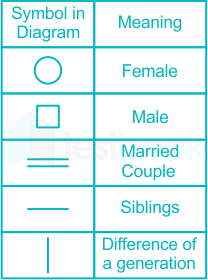
A simple family tree diagram showing different relations.

A is
Symbol+-×÷
MeaningFatherMotherSisterBrother
of B

Given Expression: S - G ÷ T - M × P + R

S - G → S is the mother of G

G ÷ T → G is the brother of T

T - M → T is the mother of M.

M × P → M is the sister of P

P + R → P is the father of R.

Thus, S is P's mother's mother.

Hence, "Option 4" is the correct answer.

16

Eight girls G, K, P, A, D, Q, S and M are sitting around a square table but not necessarily in the same order. Four of them sit at four corners of the table while four sit in the middle of each of four sides. The one who sits at the four corners face outside the center while those who sit in the middle of the sides face inside.

'Q' is sitting at one of the corners and she is third to the right of 'K'. 'A' is not sitting at any of the corners. 'P' is sitting second to the left of 'K' and immediately right of 'S'. 'K' and 'D' are facing each other. Who is sitting immediately left of 'Q'?

  1. ((a))

    K

  2. ((b))

    G

  3. ((c))

    D

  4. ((d))

    A

Show Answer
Answer: ((c))

D

Given: Eight girls G, K, P, A, D, Q, S and M are sitting around a square table but not necessarily in the same order. Four of them sit at four corners of the table while four sit in the middle of each of four sides. The one who sits at the four corners face outside the center while those who sit in the middle of the sides face inside.

1) 'Q' is sitting at one of the corners and she is third to the right of 'K'.

  1. 'P' is sitting second to the left of 'K' and immediately right of 'S'.

3) 'K' and 'D' are facing each other. 

  1. 'A' is not sitting at any of the corners.

After positioning D and A only two positions are left which will be occupied by the only two people left i.e. G and M.

Thus, D is sitting immediately left of 'Q'.

The correct answer is "Option 3".

17

Two statements are labelled below as Assertion (A) and Reason (R)

Assertion (A): Government of India has banned more than 10 years old Diesel Vehicles on the roads of Delhi.

Reason (R): Diesel prices have increased in the past few years.

Select correct answer with the help of code.

  1. ((a))

    (A) is true but (R) is false

  2. ((b))

    ​(A) is false but (R) is true

  3. ((c))

    Both (A) and (R) are true and (R) is correct explanation of (A)

  4. ((d))

    Both (A) and (R) are true but (R) is not correct explanation of (A)

Show Answer
Answer: ((d))

Both (A) and (R) are true but (R) is not correct explanation of (A)

According to the question:

Assertion (A): Government of India has banned more than 10 years old Diesel Vehicles on the roads of Delhi. → True

Reason (R): Diesel prices have increased in the past few years. → True

The government of India has banned diesel vehicles older than 10 years in Delhi to reduce air pollution and control harmful emissions, not because diesel prices have increased. while the assertion is true, the stated reason about fuel prices is unrelated.

Both (A) and (R) are true but (R) is not correct explanation of (A)

Hence, "Option 4" is the correct answer.

18

Tanya wears T-shirts of seven different colours Red, Green, Yellow, Blue, Purple, Orange and Magenta on seven different days of the week starting from Monday. She wears green T-shirt on Thursday. She does not wear yellow or purple colour T-shirts on Friday. She wears red colour T-shirt after the green colour T-shirt. She wears only purple colour T-shirt on the day between the days on which she wears Blue and Magenta colour T-shirts. She wears orange colour T-shirt after yellow colour T-shirt.

On which day she wears orange colour T-shirt?

  1. ((a))

    Saturday

  2. ((b))

    Wednesday

  3. ((c))

    Tuesday

  4. ((d))

    Sunday

Show Answer
Answer: ((d))

Sunday

Given: Tanya wears T-shirts of seven different colours Red, Green, Yellow, Blue, Purple, Orange and Magenta on seven different days of the week starting from Monday.

1) She wears green T-shirt on Thursday.

2) She does not wear yellow or purple colour T-shirts on Friday.

WeekdaysColour
Monday
Tuesday
Wednesday
ThursdayGreen
FridayYellow / Purple
Saturday
Sunday

3) She wears red colour T-shirt after the green colour T-shirt.

4) She wears only purple colour T-shirt on the day between the days on which she wears Blue and Magenta colour T-shirts.

  1. She wears orange colour T-shirt after yellow colour T-shirt.
WeekdaysColour
MondayBlue / Magenta
TuesdayPurple
WednesdayBlue / Magenta
ThursdayGreen
FridayRed
SaturdayYellow
SundayOrange

Thus, Tanya wears orange colour T-shirt on Sunday.

The correct answer is "Option 4".

19

Bhairav started from his home and travelled 50 meters towards East then turned to his right and travelled 150 meters from there he turned to his left and travelled 100 meters to reach a temple. From the temple he moved 250 meters towards North and then turned left and travelled 100 meters. Finally, he turned to his left and moved 100 meters to reach a point 'P. What is the direction and shortest distance of his home from the point 'P'?

  1. ((a))

    North, 150 meters

  2. ((b))

    West, 50 meters

  3. ((c))

    East, 100 meters

  4. ((d))

    North East, 90 meters

Show Answer
Answer: ((b))

West, 50 meters

Given:

Bhairav started from his home and travelled 50 meters towards East

then turned to his right and travelled 150 meters

from there he turned to his left and travelled 100 meters to reach a temple.

From the temple he moved 250 meters towards North and

then turned left and travelled 100 meters.

Finally, he turned to his left and moved 100 meters to reach a point 'P.

Thus, the shortest distance of Bhairav's home from the point 'P' is 50 m in the west direction.

Hence, "Option 2" is the correct answer.

20

If the first half of the following sequence is made the second half, which letter/number/ symbol will come at seventh place towards the left of the fifth place from the right end?

L, X, J, K, L, 1, U, A, 5, 9, H, 2, T, %, 9, @, 1, #

  1. ((a))

  2. ((b))

    1

  3. ((c))

    U

  4. ((d))

    @

Show Answer
Answer: ((d))

@

Given series: L, X, J, K, L, 1, U, A, 5, 9, H, 2, T, %, 9, @, 1, #

According to the question, the first half is made the second half.

New Sequence: 9, H, 2, T, %, 9, @, 1, #, L, X, J, K, L, 1, U, A, 5

Thus, the letter/number/ symbol that will come at seventh place towards the left of the fifth place from the right end → 9, H, 2, T, %, 9, @, 1, #, L, X, J, K, L, 1, U, A, 5 → @

The correct answer is "Option 4".

Alternate MethodNew Sequence: 9, H, 2, T, %, 9, @, 1, #, L, X, J, K, L, 1, U, A, 5

Fifth place from the right end : This is the 5th element from the end, which is L (at position 14).

Seventh place towards the left of L: Moving left means moving towards the beginning (subtracting positions).

Target Position = 14 - 7 = 7th position.

Find the element at the 7th position in the New Sequence:

9, H, 2, T, %, 9, @, 1, #, L, X, J, K, L, 1, U, A, 5.

The 7th element is @

Knowledge of ICT (10 questions)

21

Out of the following, which software you suggest most to develop and present a multimedia presentation on Cyber Security?

  1. ((a))

    Microsoft Word

  2. ((b))

    Microsoft PowerPoint

  3. ((c))

    Microsoft Edge

  4. ((d))

    Microsoft Excel

Show Answer
Answer: ((b))

Microsoft PowerPoint

The correct answer is Microsoft PowerPoint.

Key Points

  • Microsoft PowerPoint is a software application that is specifically designed for creating and presenting multimedia presentations.
  • It allows users to include text, images, videos, animations, and other multimedia elements to enhance the presentation.
  • PowerPoint offers features such as slide transitions, audio integration, and visual effects to make presentations engaging and interactive.
  • For a topic like Cyber Security, PowerPoint can help create structured slides with diagrams, visuals, and key points to effectively convey information.

Additional Information

  • Microsoft Word: This software is primarily used for word processing and creating text-based documents. It is not ideal for multimedia presentations.
  • Microsoft Edge: A web browser used for accessing the internet, not suitable for creating presentations.
  • Microsoft Excel: A spreadsheet software designed for data analysis, calculations, and charts, not for multimedia presentations.
22

The computer hardware device Switch is an example of:

  1. ((a))

    Networking device

  2. ((b))

    Output device

  3. ((c))

    Input device

  4. ((d))

    Storage device

Show Answer
Answer: ((a))

Networking device

The correct answer is Networking device.

Key Points

  • A switch is a networking device used to connect multiple devices on a local area network (LAN).
  • It operates at the Data Link Layer (Layer 2) of the OSI model and sometimes at the Network Layer (Layer 3).
  • Switches use MAC addresses to forward data to the correct device within the network, ensuring efficient communication.
  • They are essential in modern networks for managing traffic, reducing collisions, and improving overall network performance.

Additional Information

  • Output device: An output device is hardware that conveys information from a computer to the user, such as a monitor, printer, or speaker.
  • Input device: An input device is hardware used to provide data to a computer, such as a keyboard, mouse, or scanner.
  • Storage device: A storage device is hardware used to store digital data, such as a hard drive, SSD, or USB drive.
  • Switches: Unlike input, output, or storage devices, switches are specifically designed to connect devices within a network, enabling efficient data transfer.
23

Which of the following is the least threat for virus infection?

  1. ((a))

    Downloaded free software

  2. ((b))

    Downloaded email attachment

  3. ((c))

    Online printer

  4. ((d))

    Portable storage devices

Show Answer
Answer: ((c))

Online printer

The correct answer is Online Printer.

Key Points

  • Online printers are generally less likely to be sources of virus infections compared to other options like downloaded free software, email attachments, or portable storage devices.
  • This is because online printers typically do not execute files or programs that could carry malicious code.
  • However, it’s important to ensure the printer firmware is updated and secured to avoid vulnerabilities.
  • Other methods, like downloaded software or email attachments, are more prone to carrying viruses as they may contain executable files or malicious code.

Additional Information

  • Downloaded Free Software: Free software from unreliable sources can often contain hidden malware or viruses that infect your system when installed.
  • Downloaded Email Attachments: Email attachments are a common method for spreading viruses. Malicious actors often disguise malware as legitimate attachments.
  • Portable Storage Devices: USB drives and external hard drives can carry viruses that automatically execute once connected to a computer.
  • Online Printer: While less likely to be a direct threat, printers connected to the internet can still be exploited if not properly secured, but this risk is minimal compared to other options.
24

Which of the following set contains only input devices?

  1. ((a))

    Printer, Speaker, Monitor

  2. ((b))

    Keyboard, Mouse, Printer

  3. ((c))

    Keyboard, Mouse, Scanner

  4. ((d))

    Printer, Scanner, Speaker

Show Answer
Answer: ((c))

Keyboard, Mouse, Scanner

The correct answer is Option 3

Key Points

  • Input devices are hardware components that allow users to send data or instructions to a computer system.
  • Examples of input devices include the keyboard, mouse, scanner, microphone, and webcam.
  • Option 3 contains only input devices:
  • Keyboard: Used for typing and providing textual input to the computer.
  • Mouse: Used for pointing, clicking, and interacting with graphical user interfaces.
  • Scanner: Used for digitizing physical documents and images into electronic format.
  • Other options include output devices like printers, speakers, and monitors, which are not input devices.

Additional Information

  • Output Devices: These devices are used to display, project, or print information from the computer. Examples include printers, monitors, and speakers.
  • Hybrid Devices: Some devices, like touchscreens, can function as both input and output devices.
  • Understanding Input vs. Output: Input devices take user data and send it to the computer, while output devices take processed data from the computer and present it to the user.
25

Select the shortcut key, out of the following, which is popularly used to paste a selected (and copied) text or image in most of the MS Office applications.

  1. ((a))

    Ctrl+'X'

  2. ((b))

    Ctrl+'Z'

  3. ((c))

    Ctrl+'P'

  4. ((d))

    Ctrl+'V'

Show Answer
Answer: ((d))

Ctrl+'V'

The correct answer is Ctrl+'V'

Key Points

  • Ctrl+'V' is the universal shortcut key used for pasting content in most MS Office applications, including Word, Excel, and PowerPoint.
  • It is part of the standard keyboard shortcuts designed for copy-paste operations, where Ctrl+'C' is used for copying and Ctrl+'X' is used for cutting.
  • Using Ctrl+'V' allows users to quickly paste copied or cut text, images, or other content into the desired location.
  • This shortcut is widely recognized and utilized across various platforms and software applications.

Additional Information

  • Ctrl+'X': This shortcut key is used to cut selected content, removing it from its original location and copying it to the clipboard.
  • Ctrl+'Z': This shortcut key is used to undo the last action performed in most MS Office applications.
  • Ctrl+'P': This shortcut key is used to open the print dialog box in MS Office applications, allowing users to print the current document.
26

Which type of network, generally we establish, when we connect 20 computers in our school's computer lab, using some additional networking devices and wired cable?

  1. ((a))

    MAN

  2. ((b))

    WAN

  3. ((c))

    PAN

  4. ((d))

    LAN

Show Answer
Answer: ((d))

LAN

The correct answer is LAN (Local Area Network).

Key Points

  • LAN (Local Area Network): A LAN is generally used to connect computers and devices within a small geographical area, such as a school computer lab, office, or home.
  • It provides high-speed connectivity using wired or wireless methods, enabling efficient data sharing and communication among connected devices.
  • Networking devices: Devices such as switches, routers, and hubs are commonly used for establishing a LAN.
  • LANs are cost-effective and provide secure communication within the network.

Additional Information

  • MAN (Metropolitan Area Network): MAN covers a larger area than LAN, typically a city or campus, and is often used for interconnecting LANs within the same region.
  • WAN (Wide Area Network): WAN spans large geographical areas, such as countries or continents, connecting multiple LANs and MANs. The internet is an example of a WAN.
  • PAN (Personal Area Network): PAN is a small network used for connecting personal devices, such as smartphones, tablets, and laptops, typically within a few meters range.
27

In computer terminology, https stands for:

  1. ((a))

    Hyper Text Transfer Protocol Scheme

  2. ((b))

    Hyper Text Transfer Protocol Storage

  3. ((c))

    Hyper Text Transfer Protocol Server

  4. ((d))

    Hyper Text Transfer Protocol Secure

Show Answer
Answer: ((d))

Hyper Text Transfer Protocol Secure

The correct answer is Hyper Text Transfer Protocol Secure.

Key Points

  • HTTPS stands for Hyper Text Transfer Protocol Secure.
  • It is an extension of HTTP and uses a secure protocol to encrypt data transferred over the internet.
  • HTTPS ensures data security by using SSL (Secure Sockets Layer) or TLS (Transport Layer Security).
  • It protects users' sensitive information like passwords, credit card numbers, and other personal data from being intercepted by unauthorized parties.
  • Websites with HTTPS can be identified by the padlock icon in the browser's address bar and the "https://" prefix in the URL.

Additional Information

  • HTTP vs HTTPS: HTTP (Hyper Text Transfer Protocol) does not encrypt the communication between the client and server, making it less secure. HTTPS, on the other hand, provides encryption and ensures secure communication.
  • SSL/TLS: Secure Sockets Layer (SSL) and Transport Layer Security (TLS) are cryptographic protocols used to provide secure communications over computer networks.
  • Importance of HTTPS: It is essential for websites that handle sensitive user data, such as online shopping websites, banking portals, and other secure services.
  • SEO Benefits: Search engines like Google prioritize HTTPS-enabled websites in their rankings, as they provide a secure browsing experience to users.
28

Which of the following is not an example of web browser ?

  1. ((a))

    Edge

  2. ((b))

    Firefox

  3. ((c))

    Android

  4. ((d))

    Opera

Show Answer
Answer: ((c))

Android

The correct answer is Android.

Key Points

  • Web browsers are software applications used to access and view websites on the internet.
  • Examples of popular web browsers include Edge, Firefox, and Opera, which are specifically designed for this purpose.
  • Android, however, is an operating system designed for mobile devices, not a web browser.
  • While Android devices can run web browsers, Android itself is not a browser.

Additional Information

  • Edge: A web browser developed by Microsoft, known for its integration with Windows operating systems.
  • Firefox: A free and open-source web browser developed by the Mozilla Foundation.
  • Opera: A web browser known for its built-in features like ad-blocking and VPN services.
  • Android: An operating system for mobile devices, developed by Google, which provides a platform for running applications, including web browsers.
29

Arrange the following memory units in ascending order of their capacities.

Giga Byte, Kilo Byte, Mega Byte, Tera Byte

  1. ((a))

    Kilo Byte < Giga Byte < Mega Byte < Tera Byte

  2. ((b))

    Kilo Byte Mega Byte < Tera Byte < Giga Byte

  3. ((c))

    Giga Byte < Kilo Byte < Mega Byte < Tera Byte

  4. ((d))

    Kilo Byte < Mega Byte < Giga Byte < Tera Byte

Show Answer
Answer: ((d))

Kilo Byte < Mega Byte < Giga Byte < Tera Byte

The correct answer is Option 4

Key Points

  • Memory units are hierarchical in terms of their storage capacity.
  • Ascending order implies arranging memory units from smallest to largest capacity.
  • The correct order is: Kilo Byte < Mega Byte < Giga Byte < Tera Byte.
  • Explanation:
  • Kilo Byte (KB): The smallest unit among the options, equivalent to 1,024 bytes.
  • Mega Byte (MB): Larger than KB, equivalent to 1,024 KB.
  • Giga Byte (GB): Larger than MB, equivalent to 1,024 MB.
  • Tera Byte (TB): The largest among the options, equivalent to 1,024 GB.

Additional Information

  • Memory Hierarchy: Memory hierarchy includes various storage units like bit, byte, kilobyte, megabyte, gigabyte, terabyte, petabyte, and beyond. It is structured to optimize speed and capacity for different use cases.
  • Binary System: Memory units follow the binary system, where each level is 1,024 times larger than the previous unit (e.g., 1 KB = 1,024 Bytes).
  • Understanding memory hierarchy is important for computer storage, data processing, and optimizing system performance.
30

Which of the following is not a popular file  extension of an audio file?

  1. ((a))

    wav

  2. ((b))

    flac

  3. ((c))

    mp3

  4. ((d))

    pdf

Show Answer
Answer: ((d))

pdf

The correct answer is pdf.

Key Points

  • Popular audio file extensions include: wav, flac, and mp3.
  • pdf is not an audio file extension. It stands for Portable Document Format and is used for documents, not audio files.
  • wav: A popular uncompressed audio file format often used for high-quality sound recordings.
  • flac: A lossless audio compression format that provides high-quality sound while reducing file size.
  • mp3: A common audio file format that compresses sound while maintaining acceptable quality.

Additional Information

  • pdf files are primarily used to share documents that preserve their formatting across different devices.
  • Audio files are typically used for music, podcasts, sound effects, and other sound-based media, while pdf files are used for textual and graphical document sharing.

Teaching Aptitude (10 questions)

31

Which one of the following is least likely a factor affecting, learning?

  1. ((a))

    Readiness

  2. ((b))

    Co-curricular activities

  3. ((c))

    Imitation

  4. ((d))

    Maturation

Show Answer
Answer: ((b))

Co-curricular activities

Learning is a continuous process influenced by several internal and external factors such as motivation, interest, maturation, environment, and readiness. These factors determine how effectively an individual can acquire, retain, and apply knowledge or skills.

Key Points

  • Co-curricular activities are organized beyond classroom learning to promote holistic development, social interaction, and practical exposure.
  • Although they contribute to personality growth and life skills, they do not directly determine the process or pace of learning academic content.
  • Learning is primarily affected by internal psychological and biological factors, while co-curricular activities serve as supportive, not decisive, elements.
  • They enhance learning indirectly by fostering interest and motivation but are not fundamental determinants of learning outcomes. Hence, they are least likely to be considered a core factor affecting learning.

Hint

  • Readiness is a crucial factor because learning occurs best when the learner is mentally, physically, and emotionally prepared to acquire new knowledge.
  • Imitation strongly influences learning, especially in children, as they model behaviors and skills by observing others.
  • Maturation plays a vital role as certain levels of physical and mental growth are necessary before specific learning tasks can be mastered effectively.

Hence, the correct answer is co-curricular activities.

32

Which kind of ICT tools is not useful in learner centred approach?

  1. ((a))

    Constructive

  2. ((b))

    Communicative

  3. ((c))

    Informative 

  4. ((d))

    Situating

Show Answer
Answer: ((c))

Informative 

Information and Communication Technology (ICT) tools play a vital role in modern education by supporting different teaching-learning approaches. In a learner-centered approach, ICT is used to promote active participation, collaboration, exploration, and self-directed learning.

Key Points

  • Informative ICT tools mainly provide information in a one-way manner such as through digital textbooks, videos, or presentations.
  • They do not promote interaction, exploration, or problem-solving. In a learner-centered approach, students are expected to engage, discuss, and construct understanding rather than just receive facts.
  • Hence, informative tools are more teacher-directed and less participatory, making them less useful in learner-centered learning environments.

Hint

  • Constructive tools such as concept mapping or simulation software allow learners to build their own understanding and apply knowledge creatively.
  • Communicative tools like emails, discussion forums, or chats promote collaboration and sharing of ideas among learners and teachers.
  • Situating tools, such as virtual reality or interactive environments, place learners in realistic contexts to explore and apply knowledge meaningfully.

Hence**, the correct answer is informative.**

33

Identify the statement which is not correct: 

  1. ((a))

    Matching type of item is a form of multiple choice item.

  2. ((b))

    Every supply type item can be converted into selection type of item.

  3. ((c))

    ​Extended response item is an essay type item.

  4. ((d))

    Objective type of items are more preferable in measuring creative ability of the students.

Show Answer
Answer: ((d))

Objective type of items are more preferable in measuring creative ability of the students.

Assessment items in education are designed in different formats such as objective, subjective, and essay-type to measure various learning outcomes. Objective tests like multiple-choice or matching type are used to assess recall and understanding, while essay or extended response items evaluate higher-order skills like analysis and creativity.

Key Points

  • Objective type questions generally assess factual knowledge, comprehension, and application in a structured form with fixed answers.
  • Creativity, however, requires open-ended expression, originality, and elaboration, which cannot be effectively measured through fixed-response formats.
  • To evaluate creativity, essay-type or project-based assessments are more suitable. Hence, objective tests are not preferable for measuring students' creative ability.

Hint

  • Matching type items indeed belong to the category of multiple-choice items since they involve selecting correct responses from given options.
  • Supply type items, where learners generate answers, can often be converted into selection type by providing choices, although not always perfectly.
  • Extended response items allow students to write detailed answers and express ideas freely, making them a form of essay-type assessment.

Hence, the correct answer is objective type of items are more preferable in measuring creative ability of the students.

34

Which one of the following is not associated with unit test?

  1. ((a))

    Use of standardised achievement tests. 

  2. ((b))

    Results shared with parents.

  3. ((c))

    Confined to limited number of competencies.

  4. ((d))

    Totally controlled by the teacher.

Show Answer
Answer: ((a))

Use of standardised achievement tests. 

A unit test is a teacher-made assessment tool designed to evaluate learners’ understanding of a specific unit or topic taught in class. It helps teachers identify students’ strengths and weaknesses, provide feedback, and plan remedial teaching accordingly.

Key Points

  • Standardized achievement tests are developed by experts at a broader level to compare students’ performance across schools or regions.
  • These tests are not specific to a single unit and are not prepared or controlled by individual teachers.
  • Unit tests, on the other hand, are teacher-made, flexible, and focus on limited competencies within a unit. Therefore, the use of standardized achievement tests is not associated with unit testing, as their purpose and nature are entirely different.

Hint

  • Results of unit tests are usually shared with parents to keep them informed about their child’s progress.
  • Unit tests are confined to a limited number of competencies as they cover only a specific portion of the syllabus.
  • They are completely controlled by the teacher in terms of preparation, administration, and evaluation.

Thus, the correct answer is use of standardised achievement tests.

35

A creative student is one who has:

  1. ((a))

    Memorization ability

  2. ((b))

    Ability to solve problems

  3. ((c))

    Originality and flexibility of ideas

  4. ((d))

    Above average IQ

Show Answer
Answer: ((c))

Originality and flexibility of ideas

Creativity refers to the ability to generate new, original, and valuable ideas or solutions. In education, creative students are those who go beyond rote memorization and demonstrate imagination, flexibility, and innovation in thinking.

Key Points

  • A creative learner shows originality in thought, meaning they can come up with ideas that are new or different from the usual.
  • Flexibility allows them to view a situation from multiple perspectives and adapt their thinking to find various possible solutions.
  • Such students often express imagination and innovation in their work, demonstrating divergent rather than convergent thinking. Hence, creativity is best reflected through originality and flexibility of ideas rather than mere intelligence or memorization.

Hint

  • Memorization ability involves recalling facts, which reflects rote learning, not creativity.
  • Ability to solve problems is related to intelligence or reasoning but may not necessarily involve innovative or original approaches.
  • Above-average IQ supports learning efficiency but does not ensure creativity, as creative thinking requires imagination and risk-taking beyond logical reasoning.

Hence, the correct answer is originality and flexibility of ideas.

36

Which principle of play way method helps in cultivating self discipline?

  1. ((a))

    Principle of creativity 

  2. ((b))

    Principle of responsibility

  3. ((c))

    Principle of complete freedom 

  4. ((d))

    Principle of activity

Show Answer
Answer: ((b))

Principle of responsibility

The Play Way Method, developed by H. Caldwell Cook, emphasizes learning through play, activity, and joyful experiences rather than rote memorization. It is based on principles that promote natural development, freedom of expression, creativity, and self-learning.

Key Points

  • When learners are given freedom in play-based activities, they also learn to take responsibility for their actions and decisions.
  • This sense of responsibility gradually develops self-discipline, as children learn to follow rules, cooperate with peers, and manage their own behavior.
  • Through responsible participation, they understand the balance between freedom and discipline, which is essential for social and emotional growth.
  • Thus, the principle of responsibility helps cultivate self-discipline naturally through guided independence.

Hint

  • Principle of creativity focuses on developing imagination and innovation rather than discipline.
  • Principle of complete freedom may lead to lack of control if not guided properly, and does not necessarily build self-discipline.
  • Principle of activity emphasizes learning by doing but does not directly aim at fostering responsibility or discipline.

Hence, the correct answer is principle of responsibility.

37

Complete the statement:

In teaching if nothing has been learned, nothing has been

  1. ((a))

    examined

  2. ((b))

    observed

  3. ((c))

    taught 

  4. ((d))

    studied

Show Answer
Answer: ((c))

taught 

Teaching and learning are two interdependent processes. The effectiveness of teaching is judged not by what the teacher delivers but by what the learner understands, internalizes, and applies. Hence, the learning outcome is the true measure of successful teaching.

Key Points

  • If students have not learned anything, it means the teaching process has failed to achieve its purpose.
  • Teaching is meaningful only when it results in learning, comprehension, or change in behavior.
  • Therefore, if no learning takes place, it cannot be considered that real teaching has occurred.
  • This idea emphasizes that teaching is not about transmission of information but about facilitating understanding and growth.

Hint

  • Examined refers to assessment or evaluation, which comes after learning, not during the teaching process.
  • Observed relates to watching or noticing, which is not directly connected with the success of teaching.
  • Studied refers to the learner’s effort but does not ensure that effective teaching has taken place.

Hence, the correct answer is taught.

38

Which is not an advantage of integrated textbooks?

  1. ((a))

    These may not suit student's individual learning styles.

  2. ((b))

    Such textbooks provide support to inexperienced teachers.

  3. ((c))

    Textbook can be used as a syllabus.

  4. ((d))

    These provide readymade materials.

Show Answer
Answer: ((a))

These may not suit student's individual learning styles.

Integrated textbooks combine content from various subjects or themes into a single book to promote holistic learning. They are designed according to child-centered and activity-based approaches, making learning more meaningful and interconnected.

Key Points

  • Integrated textbooks follow a common structure designed for all learners, which may not align with every student’s preferred way of learning.
  • Some students may require more subject-specific depth or different learning approaches that integrated materials do not always address.
  • Hence, while they promote connected learning, they might not cater equally to individual learning differences, making this statement not an advantage of integrated textbooks.

 Hint

  • They provide support to inexperienced teachers by offering structured lesson plans and integrated activities for effective classroom delivery.
  • They can serve as a syllabus since they cover multiple subjects and align with curriculum objectives.
  • They offer readymade materials like activities, worksheets, and stories that simplify lesson planning for teachers.

Hence, the correct answer is these may not suit student's individual learning styles.

39

A teacher first tells the rule and principle and then cites examples to explain the concept. Which approach she/he is adopting? 

  1. ((a))

    Explanatory

  2. ((b))

    Investigatory

  3. ((c))

    Inductive

  4. ((d))

    Deductive

Show Answer
Answer: ((d))

Deductive

In teaching, different approaches are used to help students understand concepts. The deductive approach begins with a general rule, principle, or theory and then illustrates it with specific examples. In contrast, the inductive approach starts with observations or examples and leads learners to infer the general principle.

Key Points

  • When a teacher first presents a rule or principle and then provides examples to explain it, the method follows a deductive approach.
  • This approach helps learners understand the general concept first and then see how it applies in specific situations. It is particularly effective when students need clear guidance or when the rule is complex and requires structured explanation.
  • By showing examples after the principle, learners can easily relate abstract concepts to practical applications.

Hint

  • Investigatory approach involves learners actively exploring, experimenting, and discovering concepts themselves rather than being told the rule.
  • Inductive approach works from specific examples or observations to derive a general principle, opposite to the deductive method.
  • Explanatory can be seen as a general description but specifically matches the deductive method of teaching rather than exploration or induction.

Hence**, the correct answer is deductive.**

40

Which one of the following is not a characteristics of 'Assessment for Learning'?

  1. ((a))

    It is judgmental and hence evaluative.

  2. ((b))

    It provides continuous feedback.

  3. ((c))

    It helps in identifying strengths and weaknesses of every student.

  4. ((d))

    It allows students to reflect upon their work so as to take specific-actions to improve upon.

Show Answer
Answer: ((a))

It is judgmental and hence evaluative.

Assessment for Learning (AfL) is a formative approach aimed at improving learning rather than merely judging it. It focuses on providing continuous feedback, guiding students to identify their strengths and weaknesses, and enabling them to take corrective actions.

Key Points

  • Assessment for Learning is not primarily judgmental.
  • Its goal is to support learning by giving constructive feedback and helping students improve.
  • Being judgmental or evaluative focuses on ranking or grading, which aligns more with Assessment of Learning.
  • AfL seeks to create a supportive environment where mistakes are opportunities for growth rather than reasons for judgment, fostering self-reflection and active learning.

Hint

  • Providing continuous feedback helps learners understand what they have mastered and where they need improvement.
  • Identifying strengths and weaknesses allows teachers to tailor instruction according to individual learner needs.
  • Allowing students to reflect on their work encourages self-regulation and the development of strategies to improve performance.

Hence**, the correct answer is it is judgmental and hence evaluative.**

Domain Knowledge (80 questions)

41

The chairman of the Committee for Draft National Education Policy 2020, was:

  1. ((a))

    Dr. K. Kasturirangan

  2. ((b))

    Prof. Manjul Bhargava

  3. ((c))

    Prof. M.K. Sridhar

  4. ((d))

    Prof. Vasudha Kamat

Show Answer
Answer: ((a))

Dr. K. Kasturirangan

The National Education Policy (NEP) 2020 was formulated to overhaul and modernize India’s education system. A high-level committee was set up to draft the policy, bringing together experts from diverse fields of education, research, and administration to provide a comprehensive framework for school and higher education reforms.

Key Points

  • Dr. K. Kasturirangan, a renowned space scientist and former chairman of ISRO, was appointed as the chairman of the committee for drafting NEP 2020.
  • Under his leadership, the committee consulted experts, conducted public discussions, and reviewed global best practices to design a policy that emphasizes holistic, flexible, and inclusive education.
  • His guidance was instrumental in integrating scientific, technological, and educational perspectives into the policy framework.

Hint

  • Prof. Manjul Bhargava – A mathematician, not associated with chairing the NEP 2020 committee.
  • Prof. M.K. Sridhar – Served as a member of the drafting committee, not as chairman.
  • Prof. Vasudha Kamat – Was part of educational discussions but did not chair the NEP 2020 committee.

Hence, the correct answer is Dr. K. Kasturirangan.

42

In the new National Education Policy Draft the period of Foundational stage in school education was for: 

  1. ((a))

    3 years

  2. ((b))

    4 years

  3. ((c))

    5 years

  4. ((d))

    2 years

Show Answer
Answer: ((c))

5 years

The National Education Policy (NEP) 2020 restructured school education into the 5 + 3 + 3 + 4 system, aligning teaching with the cognitive and developmental stages of children. The Foundational Stage is the first stage, focusing on early childhood care and education (ECCE) and the initial years of formal schooling, emphasizing play-based and activity-oriented learning.

Key Points

  • The Foundational Stage spans 5 years, which includes 3 years of pre-primary education (ages 3–6) and 2 years of Grades 1–2 (ages 6–8).
  • This stage prioritizes developing literacy, numeracy, motor, socio-emotional, and language skills through interactive and experiential learning.
  • Extending this stage ensures children build a strong base before moving to the Preparatory Stage, promoting holistic growth and readiness for formal academics.

Hint

  • 3 years – Covers only pre-primary education and excludes Grades 1–2.
  • 4 years – Shorter than the recommended 5 years for foundational development.
  • 2 years – Insufficient to cover early childhood care and initial primary education adequately.

Hence, the correct answer is 5 years.

43

In the new National Education Policy draft, what grades were proposed for Secondary School Education ? 

  1. ((a))

    grad. 10th, 11th and 12th

  2. ((b))

    grad. 9th, 10th, 11th and 12th

  3. ((c))

    grad. 9th and 10th

  4. ((d))

    grad. 9th, 10th and 11th

Show Answer
Answer: ((b))

grad. 9th, 10th, 11th and 12th

The National Education Policy (NEP) 2020 restructured school education into the 5 + 3 + 3 + 4 system: Foundational (5 years), Preparatory (3 years), Middle (3 years), and Secondary (4 years). The Secondary Stage aims to prepare students for higher education, vocational training, and life skills, focusing on multidisciplinary learning, critical thinking, and flexible subject choices.

Key Points

  • The Secondary Stage in NEP 2020 spans grades 9 to 12. This 4-year stage builds on foundational and preparatory learning and provides opportunities for specialization in subjects of interest.
  • Students are encouraged to pursue multidisciplinary curricula, including academic, vocational, and skill-based learning, preparing them for higher education or employment.
  • The policy emphasizes experiential learning, critical thinking, and holistic development during these grades.

Hence, the correct answer is grades 9th, 10th, 11th and 12th.

44

In the new National Education Policy draft the period of middle or upper primary school education was: 

  1. ((a))

    3 years

  2. ((b))

    4 years

  3. ((c))

    5 years

  4. ((d))

    2 years

Show Answer
Answer: ((a))

3 years

Under the National Education Policy (NEP) 2020, school education has been restructured into the 5 + 3 + 3 + 4 system. The Middle Stage, also called Upper Primary, follows the Foundational and Preparatory Stages and is designed to build on foundational skills while introducing more formal learning and higher-order thinking skills.

Key Points

  • The Middle or Upper Primary Stage spans 3 years, typically covering grades 6 to 8 (ages 11–14). This stage focuses on experiential learning, conceptual understanding, and critical thinking, preparing students for secondary education.
  • Students are encouraged to engage in interactive, activity-based, and multidisciplinary learning, which bridges the gap between foundational/preparatory knowledge and secondary school rigor.

Hint

  • 4 years – Longer than the NEP-recommended middle stage duration.
  • 5 years – Refers to the Foundational Stage, not middle school.
  • 2 years – Too short to cover grades 6–8 and the developmental needs of early adolescents.

Hence, the correct answer is 3 years.

45

Which age group of children was suggested for the Foundational stage in school education, in the National Education Policy?

  1. ((a))

    3 to 8 years

  2. ((b))

    4 to 9 years

  3. ((c))

    5 to 10 years

  4. ((d))

    2 to 7 years

Show Answer
Answer: ((a))

3 to 8 years

The National Education Policy (NEP) 2020 restructured school education into a 5 + 3 + 3 + 4 system, with the Foundational Stage as the first stage. This stage focuses on early childhood care and education (ECCE) and the first years of formal schooling, emphasizing play-based, activity-oriented learning to develop literacy, numeracy, socio-emotional, and cognitive skills.

Key Points

  • The Foundational Stage covers children aged 3 to 8 years, including 3 years of pre-primary education (ages 3–6) and Grades 1–2 (ages 6–8).
  • This age range ensures that children acquire basic skills, socialization, and readiness for formal education.
  • Play-based and experiential learning during this stage provides a strong foundation for future academic success and holistic development.

Hint

  • 4 to 9 years – Slightly older age range; does not align with the NEP 3–8 years recommendation.
  • 5 to 10 years – Excludes early childhood years critical for foundational learning.
  • 2 to 7 years – Starts too early and ends before completing Grades 1–2, missing part of early formal education.

Hence, the correct answer is 3 to 8 years.

Case Study

For travelling from one place to another, transport is needed, which can be metro, bus, car, auto, taxi, train etc.

But if one has to use metro or bus, a person has to either walk or take a cycle ricksha or auto etc.

In a city auto fare is as follows:

For the first two kilometers, the fare is Rs. 25 and for subsequent kilometer it is Rs. 8 per km.

Based on this information answer the following questions.

46

Taking the distance covered as x km and fare as Rs. y, a linear equation for the information will be:

  1. ((a))

    8x - y + 17 = 0

  2. ((b))

    25 + 8x = y

  3. ((c))

    8x - y + 15 = 0

  4. ((d))

    8x - y + 9 = 0

Show Answer
Answer: ((d))

8x - y + 9 = 0

Calculation:

Given data:

Total distance covered, d=x kmd = x \text{ km}

Total fare, y=Rs.y = \text{Rs.}

Fare for first 2 km2 \text{ km} = Rs. 25\text{Rs. } 25

Rate for subsequent distance = Rs. 8/km\text{Rs. } 8/\text{km}

Subsequent distance =x2= x - 2

Total Fare yy is calculated for x2x \ge 2:

y=(Fixed Fare)+(Rate×Subsequent Distance)y = (\text{Fixed Fare}) + (\text{Rate} \times \text{Subsequent Distance})

y=25+8(x2)\Rightarrow y = 25 + 8(x - 2)

Simplifying the linear equation:

y=25+8x16\Rightarrow y = 25 + 8x - 16

y=8x+9\Rightarrow y = 8x + 9

∴ The linear equation for the information is 8x - y + 9 = 0

47

Anubhav went to his office in an auto and paid Rs. 169 as fare. Distance covered by him (in km) is: 

  1. ((a))

    22

  2. ((b))

    21

  3. ((c))

    19

  4. ((d))

    20

Show Answer
Answer: ((d))

20

Calculation:

Given data:

Total Fare paid, y=Rs. 169y = \text{Rs. } 169

Total distance covered, x=?x = \text{?}

The total fare equation is:

y=25+8(x2)y = 25 + 8(x - 2)

Substitute the value of yy:

169=25+8(x2)169 = 25 + 8(x - 2)

Subtract 25 from both sides:

16925=8(x2)\Rightarrow 169 - 25 = 8(x - 2)

144=8(x2)\Rightarrow 144 = 8(x - 2)

Divide by 8:

1448=x2\Rightarrow \frac{144}{8} = x - 2

18=x2\Rightarrow 18 = x - 2

Solve for xx:

x=18+2\Rightarrow x = 18 + 2

x=20\Rightarrow x = 20

∴ The distance covered by him is 20 km.

Three schools A, B and C decided to organise a fair for collecting money for helping the flood victims. They sold handmade fans, mats and plates from recycled material at a cost of Rs. 25, Rs. 100 and Rs. 50 respectively. The number of articles sold are given as:

School/ArticlesABC
Handmade fans402535
Mats504050
Plates203040
<br>

Based on the above information, answer the following questions.

48

What is the total amount of money (in Rs.) collected by all the three schools A, B and C ?

  1. ((a))

    14000

  2. ((b))

    21000

  3. ((c))

    17125

  4. ((d))

    15775

Show Answer
Answer: ((b))

21000

Calculation:

  1. Money Collected by School A (MA)(M_A) (Quantities: 40, 50, 20):

MA=(40×25)+(50×100)+(20×50)M_A = (40 \times 25) + (50 \times 100) + (20 \times 50)

MA=1000+5000+1000\Rightarrow M_A = 1000 + 5000 + 1000

MA=Rs. 7,000\Rightarrow M_A = \text{Rs. } 7,000

  1. Money Collected by School B (MB)(M_B) (Quantities: 25, 40, 30):

MB=(25×25)+(40×100)+(30×50)M_B = (25 \times 25) + (40 \times 100) + (30 \times 50)

MB=625+4000+1500\Rightarrow M_B = 625 + 4000 + 1500

MB=Rs. 6,125\Rightarrow M_B = \text{Rs. } 6,125

  1. Money Collected by School C (MC)(M_C) (Quantities: 35, 50, 40):

MC=(35×25)+(50×100)+(40×50)M_C = (35 \times 25) + (50 \times 100) + (40 \times 50)

MC=875+5000+2000\Rightarrow M_C = 875 + 5000 + 2000

MC=Rs. 7,875\Rightarrow M_C = \text{Rs. } 7,875

  1. Total Money Collected by All Schools (MT)(M_T):

MT=MA+MB+MCM_T = M_A + M_B + M_C

MT=7,000+6,125+7,875\Rightarrow M_T = 7,000 + 6,125 + 7,875

MT=7,000+14,000\Rightarrow M_T = 7,000 + 14,000

MT=Rs. 21,000\Rightarrow M_T = \text{Rs. } 21,000

∴ The total amount of money collected by all three schools A, B and C is Rs. 21,000.

49

What is the total money (in Rs.) collected by School A?

  1. ((a))

    7000

  2. ((b))

    6125

  3. ((c))

    7875

  4. ((d))

    700

Show Answer
Answer: ((a))

7000

Calculation:

Given data for School A:

Handmade fans sold = 40

Mats sold = 50

Plates sold = 20

The total money collected by School A (MA)(M_A) is:

MA=(Fans×25)+(Mats×100)+(Plates×50)M_A = (\text{Fans} \times 25) + (\text{Mats} \times 100) + (\text{Plates} \times 50)

MA=(40×25)+(50×100)+(20×50)\Rightarrow M_A = (40 \times 25) + (50 \times 100) + (20 \times 50)

MA=1000+5000+1000\Rightarrow M_A = 1000 + 5000 + 1000

MA=Rs. 7,000\Rightarrow M_A = \text{Rs. } 7,000

∴ The total money collected by School A is Rs. 7,000.

50

If the number of handmade fans and plates are interchanged for all the schools in that order, then what is the total money (in Rs.) collected by these schools?

  1. ((a))

    6750

  2. ((b))

    5000

  3. ((c))

    21250

  4. ((d))

    18000

Show Answer
Answer: ((c))

21250

Calculation:

1. New Money Collected by School A (MA)(M_A): (New Fans=20, Mats=50, New Plates=40)

MA=(20×25)+(50×100)+(40×50)M_A = (20 \times 25) + (50 \times 100) + (40 \times 50)

MA=500+5000+2000\Rightarrow M_A = 500 + 5000 + 2000

MA=Rs. 7,500\Rightarrow M_A = \text{Rs. } 7,500

2. New Money Collected by School B (MB)(M_B): (New Fans=30, Mats=40, New Plates=25)

MB=(30×25)+(40×100)+(25×50)M_B = (30 \times 25) + (40 \times 100) + (25 \times 50)

MB=750+4000+1250\Rightarrow M_B = 750 + 4000 + 1250

MB=Rs. 6,000\Rightarrow M_B = \text{Rs. } 6,000

3. New Money Collected by School C (MC)(M_C): (New Fans=40, Mats=50, New Plates=35)

MC=(40×25)+(50×100)+(35×50)M_C = (40 \times 25) + (50 \times 100) + (35 \times 50)

MC=1000+5000+1750\Rightarrow M_C = 1000 + 5000 + 1750

MC=Rs. 7,750\Rightarrow M_C = \text{Rs. } 7,750

4. Total Money Collected by All Schools (MT)(M_T):

MT=MA+MB+MCM_T = M_A + M_B + M_C

MT=7,500+6,000+7,750\Rightarrow M_T = 7,500 + 6,000 + 7,750

MT=Rs. 21,250\Rightarrow M_T = \text{Rs. } 21,250

∴ The total money collected by these schools after the interchange is Rs. 21,250.

51

What is the total money (in Rs.) collected by school B and school C? 

  1. ((a))

    15725

  2. ((b))

    21000

  3. ((c))

    13125

  4. ((d))

    14000

Show Answer
Answer: ((d))

14000

Calculation:

  1. Money Collected by School B (MB)(M_B):

MB=(Fans×25)+(Mats×100)+(Plates×50)M_B = (\text{Fans} \times 25) + (\text{Mats} \times 100) + (\text{Plates} \times 50)

MB=(25×25)+(40×100)+(30×50)M_B = (25 \times 25) + (40 \times 100) + (30 \times 50)

MB=625+4000+1500\Rightarrow M_B = 625 + 4000 + 1500

MB=Rs. 6,125\Rightarrow M_B = \text{Rs. } 6,125

  1. Money Collected by School C (MC)(M_C):

MC=(Fans×25)+(Mats×100)+(Plates×50)M_C = (\text{Fans} \times 25) + (\text{Mats} \times 100) + (\text{Plates} \times 50)

MC=(35×25)+(50×100)+(40×50)M_C = (35 \times 25) + (50 \times 100) + (40 \times 50)

MC=875+5000+2000\Rightarrow M_C = 875 + 5000 + 2000

MC=Rs. 7,875\Rightarrow M_C = \text{Rs. } 7,875

  1. Total Money Collected by School B and School C (MT)(M_T):

MT=MB+MCM_T = M_B + M_C

MT=6,125+7,875\Rightarrow M_T = 6,125 + 7,875

MT=Rs. 14,000\Rightarrow M_T = \text{Rs. } 14,000

∴ The total money collected by school B and school C is Rs. 14,000.

Case Study

A construction company is required to build a godown. The company has to make the cuboidal godown with square base of side x and height y. Three times as much cost per square meter is to be incurred for constructing the roof of the godown, as compared to the walls. Assume that volume of godown is V, answer the following questions.

52

Construction company got another order for making a godown in which length of base is 2 times of the old one and height is 3 times of the old one. Ratio of volume of new and old godown is : 

  1. ((a))

    4 ∶ 1

  2. ((b))

    6 ∶ 1

  3. ((c))

    12 ∶ 1

  4. ((d))

    8 ∶ 1

Show Answer
Answer: ((c))

12 ∶ 1

Calculation:

Given data for the Old godown:

Base side, xo=xx_o = x

Height, ho=yh_o = y

Volume of the old godown, VoV_o:

Vo=xo2×hoV_o = x_o^2 \times h_o

Vo=x2y\Rightarrow V_o = x^2y

Given conditions for the New Godown:

New base side, xn=2xo=2xx_n = 2x_o = 2x

New height, hn=3ho=3yh_n = 3h_o = 3y

Volume of the new godown, VnV_n:

Vn=xn2×hnV_n = x_n^2 \times h_n

Vn=(2x)2×(3y)\Rightarrow V_n = (2x)^2 \times (3y)

Vn=4x2×3y\Rightarrow V_n = 4x^2 \times 3y

Vn=12x2y\Rightarrow V_n = 12x^2y

Ratio of volume of new and old godown (VnVo)\left(\frac{V_n}{V_o}\right):

VnVo=12x2yx2y\frac{V_n}{V_o} = \frac{12x^2y}{x^2y}

VnVo=121\Rightarrow \frac{V_n}{V_o} = \frac{12}{1}

∴ The ratio of volume of new and old godown is 12 : 1.

53

Let Rs. 5 be the cost incurred for walls per square meter, then the cost C of constructing the godown is: 

  1. ((a))

    C = Rs. 5(4x2 + 3xy)

  2. ((b))

    C = Rs. (3x2 + 4xy)

  3. ((c))

    C = Rs. (4x2 + 3xy)

  4. ((d))

    C = Rs. 5(3x2 + 4xy)

Show Answer
Answer: ((d))

C = Rs. 5(3x2 + 4xy)

Calculation:

Given data for the godown with square base side xx and height yy:

Area of walls, Aw=4xyA_w = 4xy

Area of roof, Ar=x2A_r = x^2

Cost incurred for walls per square meter, Cw=Rs. 5C_w = \text{Rs. } 5

Cost incurred for roof per square meter, CrC_r, is 3 times the cost of the walls:

Cr=3×CwC_r = 3 \times C_w

Cr=3×Rs. 5=Rs. 15\Rightarrow C_r = 3 \times \text{Rs. } 5 = \text{Rs. } 15

The total cost of constructing the godown, CC, is:

C=(Cost for Walls)+(Cost for Roof)C = (\text{Cost for Walls}) + (\text{Cost for Roof})

C=(Aw×Cw)+(Ar×Cr)\Rightarrow C = (A_w \times C_w) + (A_r \times C_r)

C=(4xy×5)+(x2×15)\Rightarrow C = (4xy \times 5) + (x^2 \times 15)

C=20xy+15x2\Rightarrow C = 20xy + 15x^2

Factoring out the common term 5:

C=5(4xy+3x2)\Rightarrow C = 5(4xy + 3x^2)

C=Rs. 5(3x2+4xy)\Rightarrow C = \text{Rs. } 5(3x^2 + 4xy)

∴ The cost of constructing the godown is Rs. 5(3x2 + 4xy).

54

Which of the following is the correct relation between V, x and y ? 

  1. ((a))

    V = x2y

  2. ((b))

    V = xy

  3. ((c))

    V = x2y2

  4. ((d))

    V = xy2

Show Answer
Answer: ((a))

V = x2y

Concept:

Volume of a Cuboid:

  • The volume (V)(V) of a three-dimensional object is the space it occupies. The SI unit of volume is the cubic meter (m3)(m^3).
  • A cuboid is a solid figure with length ll, width ww, and height hh.
  • The formula for the Volume of a cuboid is: V=l×w×hV = l \times w \times h.
  • For a cuboid with a square base of side xx, the length ll is xx and the width ww is xx.
  • The Volume formula specific to this godown is V=x×x×hV = x \times x \times h.


Calculation:

Given dimensions for the cuboidal godown:

Length of base, l=xl = x

Width of base, w=xw = x

Height of godown, h=yh = y

The Volume VV of the godown is:

V=l×w×hV = l \times w \times h

V=x×x×y\Rightarrow V = x \times x \times y

V=x2y\Rightarrow V = x^2y

∴ The correct relation between VVxx and yy is V = x2y.

55

Which of the following represents the cost (C) of constructing the godown in terms of x?

  1. ((a))

    C=Rs.5[3x2+4Vx]\rm C=Rs. 5\left[3 x^2+\frac{4 V}{x}\right]

  2. ((b))

    C=Rs.[3x2+4xV]\rm C=Rs.\left[3 x^2+\frac{4 x}{V}\right]

  3. ((c))

    C=Rs.5(3x2+4xV)\rm C=Rs. 5\left(3 x^2+\frac{4 x}{V}\right)

  4. ((d))

    C=Rs.(3x2+4Vx)\rm C=Rs.\left(3 x^2+\frac{4 V}{x}\right)

Show Answer
Answer: ((a))

C=Rs.5[3x2+4Vx]\rm C=Rs. 5\left[3 x^2+\frac{4 V}{x}\right]

Calculation:

The expression for the cost CC is:

C=Rs. 5(3x2+4xy)C = \text{Rs. } 5(3x^2 + 4xy)

The relation between Volume VV, base side xx, and height yy is:

V=x2yV = x^2y

Expressing yy in terms of VV and xx:

y=Vx2\Rightarrow y = \frac{V}{x^2}

Substitute yy into the cost equation:

C=Rs. 5[3x2+4x(Vx2)]C = \text{Rs. } 5 \left[3x^2 + 4x \left(\frac{V}{x^2}\right)\right]

Simplify the second term 4x(Vx2)4x \left(\frac{V}{x^2}\right):

C=Rs. 5[3x2+4xVx2]\Rightarrow C = \text{Rs. } 5 \left[3x^2 + \frac{4xV}{x^2}\right]

C=Rs. 5[3x2+4Vx]\Rightarrow C = \text{Rs. } 5 \left[3x^2 + \frac{4V}{x}\right]

56

A square circumscribes a circle and another square is inscribed in the circle such that one vertex is at the point of contact. The ratio of the areas of the circumscribed and the inscribed squares is: 

  1. ((a))

    2 ∶ 1

  2. ((b))

    3 ∶ 1

  3. ((c))

    4 ∶ 1

  4. ((d))

    1 ∶ 1

Show Answer
Answer: ((a))

2 ∶ 1

Calculation:

Let the radius of the circle be R

The diameter of the circle is D=2RD = 2R.

1. Circumscribed Square (AcA_c):

The circle is tangent to all four sides of the circumscribed square.

The side length of the circumscribed square, scs_c, is equal to the diameter D of the circle.

sc=D=2Rs_c = D = 2R

The area of the circumscribed square, AcA_c, is:

Ac=sc2=(2R)2=4R2A_c = s_c^2 = (2R)^2 = 4R^2

2. Inscribed Square (AiA_i):

The vertices of the inscribed square lie on the circle.

The diagonal of the inscribed square, did_i, is equal to the diameter D of the circle.

di=D=2Rd_i = D = 2R

The area of the inscribed square, AiA_i, in terms of its diagonal is:

Ai=di22A_i = \frac{d_i^2}{2}

Ai=(2R)22=4R22=2R2\Rightarrow A_i = \frac{(2R)^2}{2} = \frac{4R^2}{2} = 2R^2

The ratio of the areas of the circumscribed and the inscribed squares is AcAi\frac{A_c}{A_i}.

AcAi=4R22R2\frac{A_c}{A_i} = \frac{4R^2}{2R^2}

AcAi=42=21\Rightarrow \frac{A_c}{A_i} = \frac{4}{2} = \frac{2}{1}

Ac:Ai=2:1\Rightarrow A_c : A_i = 2 : 1

∴ The ratio of the areas of the circumscribed and the inscribed squares is 2 : 1.

57

A ladder 14 m long just reaches the top of a vertical wall. If the ladder makes an angle of 60° with the wall, then the height of the wall is: 

  1. ((a))

    7 m

  2. ((b))

    14 m

  3. ((c))

    7√3 m

  4. ((d))

    14√3 m

Show Answer
Answer: ((a))

7 m

Calculation:

Given,

Length of the ladder (Hypotenuse) = 14m

Angle the ladder makes with the wall, θ = 60° 

Let the height of the wall Adjacent side be H

Using the cosine ratio:

cosθ=BaseHypotenuse=BHcosθ = \frac{Base}{ Hypotenuse} = \frac{B}{H}

cos(60)=B14\Rightarrow \text{cos}(60^{\circ}) = \frac{B}{14}

12=B14\Rightarrow \frac{1}{2} = \frac{B}{14}

B=142\Rightarrow B = \frac{14}{2}

Base=7m\Rightarrow Base= 7m

 ∴The height of the wall  is 7m

∴ The Correct Answer is 7m

58

In a right circular cone, the cross-section made by a plane parallel to the base is a:  

  1. ((a))

    frustum of a cone

  2. ((b))

    sphere

  3. ((c))

    hemisphere

  4. ((d))

    circle

Show Answer
Answer: ((d))

circle

Concept:

Cross-section of a Right Circular Cone:

  • A right circular cone is a three-dimensional figure with a circular base and an apex directly above the center of the base.
  • A cross-section is the two-dimensional shape formed when a plane slices through a solid.
  • When a plane intersects a right circular cone and is parallel to the base, the resulting cross-section is a shape that retains the circular symmetry of the base.
  • The shape formed by this specific cut is a circle. This circle is smaller than the base circle, with its radius decreasing as the plane moves closer to the apex.
  • The frustum of a cone is the 3D portion of the cone that remains after a smaller cone is cut off by a plane parallel to the base; it is not the 2D cross-section itself.


Calculation:

The question asks for the shape of the cross-section.

Given the cutting plane is parallel to the base of a right circular cone.

When a plane cuts a right circular cone parallel to its base, the intersection surface is a circle.

The resultant two-dimensional shape is a circle.

∴ The cross-section made by a plane parallel to the base is a circle.

59

The area of a sector of a circle of radius 16 cm cut off by an arc of length 18.5 cm, is: 

  1. ((a))

    148 cm2

  2. ((b))

    154 cm2

  3. ((c))

    176 cm2

  4. ((d))

    168 cm2

Show Answer
Answer: ((a))

148 cm2

Calculation:

Given,

Radius of the circle, r = 16cm

Arc length, l = 18.5cm

The area of the sector A is given by the formula:

A=12×r×lA = \frac{1}{2} \times r \times l

Area=12×16 cm×18.5 cm\Rightarrow \text{Area} = \frac{1}{2} \times 16\text{ cm} \times 18.5\text{ cm}

Area=8 cm×18.5 cm\Rightarrow \text{Area} = 8\text{ cm} \times 18.5\text{ cm}

Area=148 cm2\Rightarrow \text{Area} = 148\text{ cm}^2

The area of a sector of a circle of radius 16 cm is 148 cm2

60

If sin θ + cos θ = √2, then the value of tan θ + cot θ is:  

  1. ((a))

    2

  2. ((b))

    12\frac{1}{2}

  3. ((c))

    0

  4. ((d))

    1

Show Answer
Answer: ((a))

2

Given:

sinθ + cosθ = √2

Formula used:

(sinθ + cosθ)2 = sin2θ + cos2θ + 2sinθcosθ

sin2θ + cos2θ = 1

tanθ + cotθ =

Calculation:

sinθ + cosθ = √2

⇒ (sinθ + cosθ)2 = 2

⇒ sin2θ + cos2θ + 2sinθcosθ = 2

⇒ 1 + 2sinθcosθ = 2

⇒ 2sinθcosθ = 1

⇒ sinθcosθ = 1/2

⇒ tanθ + cotθ =

⇒tanθ + cotθ = 1 ÷ (1/2)

⇒ tanθ + cotθ = 2

∴ The correct answer is option (1).

61

ABCD is a cyclic quadrilateral such that AB is a diameter of the circle circumscribing it and ∠ADC = 140°, then ∠BAC is equal to : 

  1. ((a))

    50°

  2. ((b))

    40°

  3. ((c))

    30°

  4. ((d))

    80°

Show Answer
Answer: ((a))

50°

Calculation:

Given data:

ABCD is acyclic quadrilateral

AB is a diameter

ADC=140 \mathbf{\angle ADC = 140^{\circ}} .

ABC+ADC=180 \mathbf{\angle ABC + \angle ADC = 180^{\circ}}

ABC+140=180 \Rightarrow \mathbf{\angle ABC + 140^{\circ} = 180^{\circ}}

ABC=180140=40 \Rightarrow \mathbf{\angle ABC = 180^{\circ} - 140^{\circ} = 40^{\circ}}

Since AB is the diameter, the angle subtended by the diameter at any point on the circumference is 90 \mathbf{90^{\circ}} .

ACB=90 \Rightarrow \mathbf{\angle ACB = 90^{\circ}}

BAC+ACB+ABC=180 \mathbf{\angle BAC + \angle ACB + \angle ABC = 180^{\circ}}

BAC+90+40=180 \Rightarrow \mathbf{\angle BAC + 90^{\circ} + 40^{\circ} = 180^{\circ}}

BAC+130=180 \Rightarrow \mathbf{\angle BAC + 130^{\circ} = 180^{\circ}}

BAC=180130 \Rightarrow \mathbf{\angle BAC = 180^{\circ} - 130^{\circ}}

BAC=50 \Rightarrow \mathbf{\angle BAC = 50^{\circ}}

\therefore The measure of ∠BAC is equal to 50°

62

The ratio in which the line segment joining the points (5, -2) and (0, 7) is divided by the point (53,4)\left(\frac{5}{3}, 4\right)  is:

  1. ((a))

    1 ∶ 3

  2. ((b))

    2 ∶ 1

  3. ((c))

    3 ∶ 2

  4. ((d))

    1 ∶ 2

Show Answer
Answer: ((b))

2 ∶ 1

Calculation:

Given points:

A(x1,y1)=(5,2) \mathbf{A(x_1, y_1) = (5, -2)}

B(x2,y2)=(0,7) \mathbf{B(x_2, y_2) = (0, 7)}

Dividing point: P(x,y)=(53,4) \mathbf{P(x, y) = (\frac{5}{3}, 4)}

Assume the point P divides the line segment AB in the ratio k:1 \mathbf{k : 1} .

Using the x-coordinate section formula:

x=kx2+x1k+1 \mathbf{x = \frac{k x_2 + x_1}{k + 1}}

53=k(0)+5k+1 \mathbf{\frac{5}{3} = \frac{k(0) + 5}{k + 1}}

53=5k+1 \Rightarrow \mathbf{\frac{5}{3} = \frac{5}{k + 1}}

5(k+1)=3(5) \Rightarrow \mathbf{5(k + 1) = 3(5)}

5k+5=15 \Rightarrow \mathbf{5k + 5 = 15}

5k=155 \Rightarrow \mathbf{5k = 15 - 5}

5k=10 \Rightarrow \mathbf{5k = 10}

k=105=2 \Rightarrow \mathbf{k = \frac{10}{5} = 2}

Using the y-coordinate section formula (to verify):

y=ky2+y1k+1 \mathbf{y = \frac{k y_2 + y_1}{k + 1}}

4=k(7)+(2)k+1 \mathbf{4 = \frac{k(7) + (-2)}{k + 1}}

4(k+1)=7k2 \Rightarrow \mathbf{4(k + 1) = 7k - 2}

4k+4=7k2 \Rightarrow \mathbf{4k + 4 = 7k - 2}

4+2=7k4k \Rightarrow \mathbf{4 + 2 = 7k - 4k}

6=3k \Rightarrow \mathbf{6 = 3k}

k=63=2 \Rightarrow \mathbf{k = \frac{6}{3} = 2}

Since k=2 \mathbf{k = 2} , the ratio k:1 \mathbf{k : 1} is 2:1 \mathbf{2 : 1} .

\therefore The ratio in which the line segment is divided is 2:1 \mathbf{2 : 1} .

63

If p > 0 and q < 0, then: 

  1. ((a))

    p - q ≤ p

  2. ((b))

    p - q > P

  3. ((c))

    p - q ≥ p

  4. ((d))

    p - q < p

Show Answer
Answer: ((b))

p - q > P

Calculation:

Given conditions:

p>0 \mathbf{p > 0}

q<0 \mathbf{q < 0}

Multiply both sides by 1 \mathbf{-1} and reverse the inequality sign:


q>0 \Rightarrow \mathbf{-q > 0}

This shows that the term q \mathbf{-q} is a positive value.

Add p \mathbf{p} to both sides of the inequality q>0 \mathbf{-q > 0} :

pq>p+0 \Rightarrow \mathbf{p - q > p + 0}

pq>p \Rightarrow \mathbf{p - q > p}

64

If in two triangles DEF and PQR, ∠D =∠Q and ∠R = ∠E, then which of the following is not true?  

  1. ((a))

    DEPQ=EFRP\rm \frac{{DE}}{{PQ}}=\frac{{EF}}{{RP}}

  2. ((b))

    DEQR=DFPQ\rm \frac{{DE}}{{QR}}=\frac{{DF}}{{PQ}}

  3. ((c))

    EFRP=DEQR\rm \frac{{EF}}{{RP}}=\frac{{DE}}{{QR}}

  4. ((d))

    EFPR=DFPQ\rm\frac{{EF}}{{PR}}=\frac{{DF}}{{PQ}}

Show Answer
Answer: ((a))

DEPQ=EFRP\rm \frac{{DE}}{{PQ}}=\frac{{EF}}{{RP}}

Calculation:

Given: In DEF \mathbf{\triangle DEF} and PQR \mathbf{\triangle PQR} ,

D=Q \mathbf{\angle D = \angle Q}

E=R \mathbf{\angle E = \angle R}

By AAA similarity criterion, the triangles are similar, and the correspondence of vertices is DQ \mathbf{D \leftrightarrow Q} , ER \mathbf{E \leftrightarrow R} , FP \mathbf{F \leftrightarrow P} .

The ratio of corresponding sides is:

Side opposite to FSide opposite to P=Side opposite to DSide opposite to Q=Side opposite to ESide opposite to R \mathbf{\frac{\text{Side opposite to F}}{\text{Side opposite to P}} = \frac{\text{Side opposite to D}}{\text{Side opposite to Q}} = \frac{\text{Side opposite to E}}{\text{Side opposite to R}}}

DEQR=EFRP=DFQP \mathbf{\frac{DE}{QR} = \frac{EF}{RP} = \frac{DF}{QP}}


\therefore The statement which is not true is DEPQ=EFRP \mathbf{\frac{DE}{PQ} = \frac{EF}{RP}} .

65

The matrix which describe the reflection of point P(x, y) through the origin is :

  1. ((a))

    [01 10]\left[\begin{array}{cc}0 & -1 \ -1 & 0\end{array}\right]

  2. ((b))

    [10 01]\left[\begin{array}{cc}-1 & 0 \ 0 & -1\end{array}\right]

  3. ((c))

    [10 01]\left[\begin{array}{cc}1 & 0 \ 0 & -1\end{array}\right]

  4. ((d))

    [01 10]\left[\begin{array}{ll}0 & 1 \ 1 & 0\end{array}\right]

Show Answer
Answer: ((b))

[10 01]\left[\begin{array}{cc}-1 & 0 \ 0 & -1\end{array}\right]

Calculation:

The reflection of P(x,y) \mathbf{P(x, y)} through the origin is P(x,y) \mathbf{P'(-x, -y)} .

We are looking for the matrix T \mathbf{T} such that:

T(x y)=(x y) \mathbf{T \begin{pmatrix} x \ y \end{pmatrix} = \begin{pmatrix} -x \ -y \end{pmatrix}}

Let T=(ab cd) \mathbf{T = \begin{pmatrix} a & b \ c & d \end{pmatrix}} :

(ab cd)(x y)=(ax+by cx+dy) \mathbf{\begin{pmatrix} a & b \ c & d \end{pmatrix} \begin{pmatrix} x \ y \end{pmatrix} = \begin{pmatrix} ax + by \ cx + dy \end{pmatrix}}

We must have:

ax+by=x \mathbf{ax + by = -x} (1)

cx+dy=y \mathbf{cx + dy = -y} (2)

These equations must hold for all\mathbf{all} values of x \mathbf{x} and y \mathbf{y} .

From equation (1):

ax+by=1x+0y \mathbf{ax + by = -1x + 0y}

a=1 \Rightarrow \mathbf{a = -1} and b=0 \mathbf{b = 0}

From equation (2):

cx+dy=0x1y \mathbf{cx + dy = 0x - 1y}

c=0 \Rightarrow \mathbf{c = 0} and d=1 \mathbf{d = -1}

The transformation matrix T is:

T=(10 01) \mathbf{T = \begin{pmatrix} -1 & 0 \ 0 & -1 \end{pmatrix}}

\therefore The matrix which describes the reflection of point P(x, y) through the origin is (10 01) \mathbf{\begin{pmatrix} -1 & 0 \ 0 & -1 \end{pmatrix}} .

66

If a parallelogram circumscribes a circle, then the parallelogram is a : 

  1. ((a))

    square

  2. ((b))

    rectangle

  3. ((c))

    rhombus

  4. ((d))

    trapezium

Show Answer
Answer: ((c))

rhombus

Calculation:

Let ABCD be the parallelogram that circumscribes a circle.

By the property of a parallelogram, opposite sides are equal:

AB=CD \mathbf{AB = CD} and BC=DA \mathbf{BC = DA}

By Pitot's Theorem for a circumscribed quadrilateral, the sums of opposite sides are equal:

AB+CD=BC+DA \mathbf{AB + CD = BC + DA}

Substitute the parallelogram property into Pitot's Theorem:

AB+AB=BC+BC \Rightarrow \mathbf{AB + AB = BC + BC}

2×AB=2×BC \Rightarrow \mathbf{2 \times AB = 2 \times BC}

AB=BC \Rightarrow \mathbf{AB = BC}

Since AB = BC, and opposite sides are equal (AB=CD \mathbf{AB = CD} , BC=DA \mathbf{BC = DA} ):

AB=BC=CD=DA \Rightarrow \mathbf{AB = BC = CD = DA}

A parallelogram with all four sides equal is a rhombus.

\therefore If a parallelogram circumscribes a circle, then the parallelogram is a rhombus \mathbf{rhombus} .

67

The diameters of the two circular ends of a bucket are 44 cm and 24 cm. The height of the bucket is 35 cm. The capacity of the bucket is:

  1. ((a))

    34.7 litre

  2. ((b))

    30.7 litre

  3. ((c))

    35.7 litre

  4. ((d))

    32.7 litre

Show Answer
Answer: ((d))

32.7 litre

Calculation:

Given data:

Height, h=35 cm \mathbf{h = 35 \text{ cm}} .

Diameter of the larger end, D=44 cm \mathbf{D = 44 \text{ cm}} .

Diameter of the smaller end, d=24 cm \mathbf{d = 24 \text{ cm}} .

Calculate the radii:

Larger radius: R=D2=442=22 cm \mathbf{R = \frac{D}{2} = \frac{44}{2} = 22 \text{ cm}}

Smaller radius: r=d2=242=12 cm \mathbf{r = \frac{d}{2} = \frac{24}{2} = 12 \text{ cm}}

V=13πh(R2+r2+Rr) \mathbf{V = \frac{1}{3} \pi h (R^2 + r^2 + Rr)}

V=13×227×35×(222+122+22×12) \Rightarrow \mathbf{V = \frac{1}{3} \times \frac{22}{7} \times 35 \times (22^2 + 12^2 + 22 \times 12)}

V=13×22×5×(484+144+264) \Rightarrow \mathbf{V = \frac{1}{3} \times 22 \times 5 \times (484 + 144 + 264)}

V=1103×(892) \Rightarrow \mathbf{V = \frac{110}{3} \times (892)}

V=981203 cm3 \Rightarrow \mathbf{V = \frac{98120}{3} \text{ cm}^3}

V32706.67 cm3 \Rightarrow \mathbf{V \approx 32706.67 \text{ cm}^3}

Capacity in litres=Volume in cm31000 \mathbf{\text{Capacity in litres} = \frac{\text{Volume in cm}^3}{1000}}

Capacity=32706.671000 \Rightarrow \mathbf{\text{Capacity} = \frac{32706.67}{1000}}

Capacity32.7067 litre \Rightarrow \mathbf{\text{Capacity} \approx 32.7067 \text{ litre}}

\therefore The capacity of the bucket is approximately 32.7 litre \mathbf{32.7 \text{ litre}} .

68

A triangle with vertices (4, 0), (-1, -1) and (3, 5) is: 

  1. ((a))

    Isosceles but not right angled triangle.

  2. ((b))

    right angled but not isosceles triangle.

  3. ((c))

    neither right angled nor isosceles triangle.

  4. ((d))

    isosceles right triangle.

Show Answer
Answer: ((d))

isosceles right triangle.

Calculation:

Let the vertices of the triangle be A(4,0) \mathbf{A(4, 0)} , B(1,1) \mathbf{B(-1, -1)} , and C(3,5) \mathbf{C(3, 5)} .

Length AB2:

AB2=(14)2+(10)2 \mathbf{AB^2 = (-1 - 4)^2 + (-1 - 0)^2}

AB2=(5)2+(1)2 \Rightarrow \mathbf{AB^2 = (-5)^2 + (-1)^2}

AB2=25+1=26 \Rightarrow \mathbf{AB^2 = 25 + 1 = 26}

BC2=(3(1))2+(5(1))2 \mathbf{BC^2 = (3 - (-1))^2 + (5 - (-1))^2}

BC2=(3+1)2+(5+1)2 \Rightarrow \mathbf{BC^2 = (3 + 1)^2 + (5 + 1)^2}

BC2=42+62 \Rightarrow \mathbf{BC^2 = 4^2 + 6^2}

BC2=16+36=52 \Rightarrow \mathbf{BC^2 = 16 + 36 = 52}

CA2=(43)2+(05)2 \mathbf{CA^2 = (4 - 3)^2 + (0 - 5)^2}

CA2=12+(5)2 \Rightarrow \mathbf{CA^2 = 1^2 + (-5)^2}

CA2=1+25=26 \Rightarrow \mathbf{CA^2 = 1 + 25 = 26}

Since AB2=26 \mathbf{AB^2 = 26} and CA2=26 \mathbf{CA^2 = 26} ,

AB=CA \Rightarrow \mathbf{AB = CA}

\Rightarrow The triangle is Isosceles.

The side with the largest square length is BC2 = 52 

Sum of squares of the other two sides:

AB2+CA2=26+26=52 \mathbf{AB^2 + CA^2 = 26 + 26 = 52}

Since AB2+CA2=BC2 \mathbf{AB^2 + CA^2 = BC^2} ,

52=52 \Rightarrow \mathbf{52 = 52}

\Rightarrow The triangle is Right Angled at vertex A.

\therefore The triangle is an isosceles \mathbf{isosceles} right \mathbf{right} triangle \mathbf{triangle} .

69

Two circles touch each other externally at P. AB is a direct common tangent touching them respectively at A and B, then ∠APB is:  

  1. ((a))

    60°

  2. ((b))

    90°

  3. ((c))

    45°

  4. ((d))

    30°

Show Answer
Answer: ((b))

90°

Calculation:

Let C1 \mathbf{C_1} and C2 \mathbf{C_2} be the two circles, touching externally at P.

Let AB \mathbf{AB} be the direct common tangent, touching C1 \mathbf{C_1} at A \mathbf{A} and C2 \mathbf{C_2} at B \mathbf{B} .

Let T \mathbf{T} be the point where the common tangent through P intersects AB.

For circle C1 \mathbf{C_1} , TA and TP are tangents from T.

TA=TP \Rightarrow \mathbf{TA = TP} (1)

For circle C2 \mathbf{C_2} , TB and TP are tangents from T.

TB=TP \Rightarrow \mathbf{TB = TP} (2)

From (1) and (2):

TA=TB=TP \Rightarrow \mathbf{TA = TB = TP}

In APB \mathbf{\triangle APB} , T \mathbf{T} is the midpoint of AB \mathbf{AB} and TP=TA=TB \mathbf{TP = TA = TB}

Consider triangle ATP:

Since TA = TP, ATP \mathbf{\triangle ATP} is isosceles.

TPA=TAP=α \Rightarrow \mathbf{\angle TPA = \angle TAP = \alpha}

Consider triangle BTP:

Since TB = TP, BTP \mathbf{\triangle BTP} is isosceles

TPB=TBP=β \Rightarrow \mathbf{\angle TPB = \angle TBP = \beta}

The angle APB} is:

APB=TPA+TPB=α+β \mathbf{\angle APB = \angle TPA + \angle TPB = \alpha + \beta}

The sum of angles in APB \mathbf{\triangle APB} is 180 \mathbf{180^{\circ}} :

APB+PAB+PBA=180 \mathbf{\angle APB + \angle PAB + \angle PBA = 180^{\circ}}

(α+β)+α+β=180 \Rightarrow \mathbf{(\alpha + \beta) + \alpha + \beta = 180^{\circ}}

2α+2β=180 \Rightarrow \mathbf{2\alpha + 2\beta = 180^{\circ}}

2(α+β)=180 \Rightarrow \mathbf{2(\alpha + \beta) = 180^{\circ}}

α+β=90 \Rightarrow \mathbf{\alpha + \beta = 90^{\circ}}

Thus, APB=90 \mathbf{\angle APB = 90^{\circ}} .

\therefore The angle APB \mathbf{\angle APB} is 90 \mathbf{90^{\circ}} .

70

If P and Q are the points with coordinates (-3, 4) and (2, 1) respectively, then the coordinates of the point R on PQ produced such that PR = 2QR are:

  1. ((a))

    (3, 7)

  2. ((b))

    (7, -2)

  3. ((c))

    (12,52)\left(-\frac{1}{2}, \frac{5}{2}\right)

  4. ((d))

    (2, 4)

Show Answer
Answer: ((b))

(7, -2)

Calculation:

Given data:

Point P(x1,y1)=(3,4) \mathbf{P(x_1, y_1) = (-3, 4)}

Point Q(x2,y2)=(2,1) \mathbf{Q(x_2, y_2) = (2, 1)}

PQ produced such that PR=2QR \mathbf{PR = 2QR} .

The ratio of division is PR:QR=2:1 \mathbf{PR : QR = 2 : 1} .

m1=2 \Rightarrow \mathbf{m_1 = 2} and m2=1 \mathbf{m_2 = 1}

The x-coordinate of R \mathbf{R}  is:.

x=m1x2m2x1m1m2 \mathbf{x = \frac{m_1 x_2 - m_2 x_1}{m_1 - m_2}}

x=2(2)1(3)21 \Rightarrow \mathbf{x = \frac{2(2) - 1(-3)}{2 - 1}}

x=4+31=7 \Rightarrow \mathbf{x = \frac{4 + 3}{1} = 7}

The y-coordinate of R \mathbf{R} is:

y=m1y2m2y1m1m2 \mathbf{y = \frac{m_1 y_2 - m_2 y_1}{m_1 - m_2}}

y=2(1)1(4)21 \Rightarrow \mathbf{y = \frac{2(1) - 1(4)}{2 - 1}}

y=241=2 \Rightarrow \mathbf{y = \frac{2 - 4}{1} = -2}

The coordinates of point R \mathbf{R} are (7,2) \mathbf{(7, -2)} .

71

If \((1+x)^{{n}}=\displaystyle \sum_{r=0}^{{n}} {C}{{r}} x^{{r}}\), then (1+C1C0)(1+C2C1)\left(1+\frac{C_1}{C_0}\right)\left(1+\frac{C_2}{C_1}\right)(\left(1+\frac{C_3}{C_2}\right) \ldots\left(1+\frac{C_n}{C{n-1}}\right)\) is equal to :

  1. ((a))

    (n+1)n1(n1)!\frac{({n}+1)^{{n}-1}}{({n}-1) !}

  2. ((b))

    (n+1)nn!\frac{({n}+1)^{{n}}}{{n} !}

  3. ((c))

    (n+1)n+1n!\frac{({n}+1)^{{n}+1}}{{n} !}

  4. ((d))

    nn1(n1)!\frac{n^{n-1}}{(n-1) !}

Show Answer
Answer: ((b))

(n+1)nn!\frac{({n}+1)^{{n}}}{{n} !}

Calculation:

P=(1+C1C0)(1+C2C1)(1+C3C2)(1+CnCn1) \mathbf{P = (1 + \frac{C_1}{C_0}) (1 + \frac{C_2}{C_1}) (1 + \frac{C_3}{C_2}) \ldots (1 + \frac{C_n}{C_{n-1}})}

CkCk1=nk+1k \mathbf{\frac{C_k}{C_{k-1}} = \frac{n-k+1}{k}}

1+CkCk1=1+nk+1k \mathbf{1 + \frac{C_k}{C_{k-1}} = 1 + \frac{n-k+1}{k}}

1+CkCk1=k+(nk+1)k \Rightarrow \mathbf{1 + \frac{C_k}{C_{k-1}} = \frac{k + (n-k+1)}{k}}

1+CkCk1=n+1k \Rightarrow \mathbf{1 + \frac{C_k}{C_{k-1}} = \frac{n+1}{k}}

P=k=1n(1+CkCk1) \mathbf{P = \prod_{k=1}^{n} (1 + \frac{C_k}{C_{k-1}})}

P=k=1nn+1k \Rightarrow \mathbf{P = \prod_{k=1}^{n} \frac{n+1}{k}}

P=(n+11)×(n+12)×(n+13)××(n+1n) \Rightarrow \mathbf{P = (\frac{n+1}{1}) \times (\frac{n+1}{2}) \times (\frac{n+1}{3}) \times \ldots \times (\frac{n+1}{n})}

P=(n+1)n1×2×3××n \Rightarrow \mathbf{P = \frac{(n+1)^n}{1 \times 2 \times 3 \times \ldots \times n}}

P=(n+1)nn! \Rightarrow \mathbf{P = \frac{(n+1)^n}{n!}}

\therefore The expression is equal to (n+1)nn! \mathbf{\frac{(n+1)^n}{n!}} .

72

The area of the figure formed by joining the mid-points of the adjacent sides of a rhombus with diagonals 12 cm and 16 cm is:

  1. ((a))

    64 cm2

  2. ((b))

    96 cm2

  3. ((c))

    192 cm2

  4. ((d))

    48 cm2

Show Answer
Answer: ((d))

48 cm2

Calculation:

Given data:

Diagonals of the rhombus are d1 = 12cm and d2 = 16cm

Arhombus=12×d1×d2 \mathbf{A_{\text{rhombus}}} = \frac{1}{2} \times \mathbf{d_1} \times \mathbf{d_2}

Arhombus=12×12×16 \Rightarrow \mathbf{A_{\text{rhombus}}} = \frac{1}{2} \times 12 \times 16

Arhombus=6×16 \Rightarrow \mathbf{A_{\text{rhombus}}} = 6 \times 16

Arhombus=96 cm2 \Rightarrow \mathbf{A_{\text{rhombus}}} = 96 \text{ cm}^2

The area of the figure formed by joining the mid-points (Ainner \mathbf{A_{\text{inner}}} ) is half the area of the rhombus:

Ainner=12×Arhombus \mathbf{A_{\text{inner}}} = \frac{1}{2} \times \mathbf{A_{\text{rhombus}}}

Ainner=12×96 \Rightarrow \mathbf{A_{\text{inner}}} = \frac{1}{2} \times 96

Ainner=48 cm2 \Rightarrow \mathbf{A_{\text{inner}}} = 48 \text{ cm}^2

\therefore The area of the figure formed is 48 cm2 \mathbf{48 \text{ cm}^2} .

73

Solution of x2x+5>2\frac{x-2}{x+5}>2 is:

  1. ((a))

    x ∈ (5, 12)

  2. ((b))

    x ∈ [-12, -5]

  3. ((c))

    x ∈ (-12, -5)

  4. ((d))

    x ∈ (-12, 5)

Show Answer
Answer: ((c))

x ∈ (-12, -5)

Calculation:

Given inequality:

x2x+5>2 \mathbf{\frac{x-2}{x+5} > 2}

x2x+52>0 \Rightarrow \mathbf{\frac{x-2}{x+5} - 2 > 0}

x22(x+5)x+5>0 \Rightarrow \mathbf{\frac{x-2 - 2(x+5)}{x+5} > 0}

x22x10x+5>0 \Rightarrow \mathbf{\frac{x-2 - 2x - 10}{x+5} > 0}

x12x+5>0 \Rightarrow \mathbf{\frac{-x - 12}{x+5} > 0}

x+12x+5<0 \Rightarrow \mathbf{\frac{x + 12}{x+5} < 0}

Find the critical points by setting the numerator and denominator to zero:

x+12=0x=12 \Rightarrow \mathbf{x + 12 = 0 \Rightarrow x = -12}

x+5=0x=5 \Rightarrow \mathbf{x + 5 = 0 \Rightarrow x = -5}

The critical points 12 \mathbf{-12} and 5 \mathbf{-5} divide the number line into three intervals: (,12),(12,5), and (5,) \mathbf{(-\infty, -12), (-12, -5), \text{ and } (-5, \infty)} .

We test the sign of f(x)=x+12x+5 \mathbf{f(x) = \frac{x + 12}{x+5}} in each interval:

For x>5 \mathbf{x > -5}

f(0)=125>0 \mathbf{f(0) = \frac{12}{5} > 0} (Positive)

For 12<x<5 \mathbf{-12 < x < -5}

f(10)=10+1210+5=25<0 \mathbf{f(-10) = \frac{-10 + 12}{-10 + 5} = \frac{2}{-5} < 0} (Negative)

For x<12 \mathbf{x < -12}

f(13)=13+1213+5=18=18>0 \mathbf{f(-13) = \frac{-13 + 12}{-13 + 5} = \frac{-1}{-8} = \frac{1}{8} > 0} (Positive)

We are looking for x+12x+5<0 \mathbf{\frac{x + 12}{x+5} < 0} (the interval where the function is negative).

\Rightarrow The solution is the interval (12,5) \mathbf{(-12, -5)} .

\therefore The solution is x(12,5) \mathbf{x \in (-12, -5)} .

74

The area of a triangle is 5 square units. Two of its vertices are (2, 1) and (3, -2). The third vertex which lies on the line y = x + 3 is given by:

  1. ((a))

    (32,32)\left(\frac{-3}{2}, \frac{3}{2}\right) and (72,132)\left(\frac{7}{2}, \frac{13}{2}\right)

  2. ((b))

    (32,92)\left(\frac{3}{2}, \frac{9}{2}\right)

  3. ((c))

    (132,92) \left(\frac{13}{2}, \frac{9}{2}\right)

  4. ((d))

    (72,132)\left(-\frac{7}{2}, \frac{13}{2}\right) and (32,32)\left(\frac{3}{2}, \frac{-3}{2}\right)

Show Answer
Answer: ((a))

(32,32)\left(\frac{-3}{2}, \frac{3}{2}\right) and (72,132)\left(\frac{7}{2}, \frac{13}{2}\right)

Calculation:

Given data:

Area of triangle, A = 5 square units.

Vertices: (x1, y1) = (2, 1)} and (x2, y2) = (3, -2)

Let the third vertex be (x3, y3)

The third vertex lies on the line y = x + 3}

\Rightarrow We have y3=x3+3 \mathbf{y_3 = x_3 + 3} .

The area of the triangle is:

A=12x1(y2y3)+x2(y3y1)+x3(y1y2) \mathbf{A = \frac{1}{2} |x_1(y_2 - y_3) + x_2(y_3 - y_1) + x_3(y_1 - y_2)|}

5=122(2y3)+3(y31)+x3(1(2)) \mathbf{5 = \frac{1}{2} |2(-2 - y_3) + 3(y_3 - 1) + x_3(1 - (-2))|}

10=2(2y3)+3(y31)+x3(3) \Rightarrow \mathbf{10 = |2(-2 - y_3) + 3(y_3 - 1) + x_3(3)|}

10=42y3+3y33+3x3 \Rightarrow \mathbf{10 = |-4 - 2y_3 + 3y_3 - 3 + 3x_3|}

10=y3+3x37 \Rightarrow \mathbf{10 = |y_3 + 3x_3 - 7|}

Using y3=x3+3 \mathbf{y_3 = x_3 + 3} in the equation:

10=(x3+3)+3x37 \Rightarrow \mathbf{10 = |(x_3 + 3) + 3x_3 - 7|}

10=4x34 \Rightarrow \mathbf{10 = |4x_3 - 4|}

10=4(x31) \Rightarrow \mathbf{10 = |4(x_3 - 1)|}

This gives two possibilities:

Case 1: 4(x31)=10 \mathbf{4(x_3 - 1) = 10}

x31=104=52 \Rightarrow \mathbf{x_3 - 1 = \frac{10}{4} = \frac{5}{2}}

x3=1+52=22+52=72 \Rightarrow \mathbf{x_3 = 1 + \frac{5}{2} = \frac{2}{2} + \frac{5}{2} = \frac{7}{2}}

y3=x3+3=72+3=72+62=132 \Rightarrow \mathbf{y_3 = x_3 + 3 = \frac{7}{2} + 3 = \frac{7}{2} + \frac{6}{2} = \frac{13}{2}}

\Rightarrow The first vertex is (72,132) \mathbf{(\frac{7}{2}, \frac{13}{2})} .

Case 2: 4(x31)=10 \mathbf{4(x_3 - 1) = -10}

x31=104=52 \Rightarrow \mathbf{x_3 - 1 = \frac{-10}{4} = -\frac{5}{2}}

x3=152=2252=32 \Rightarrow \mathbf{x_3 = 1 - \frac{5}{2} = \frac{2}{2} - \frac{5}{2} = -\frac{3}{2}}

y3=x3+3=32+3=32+62=32 \Rightarrow \mathbf{y_3 = x_3 + 3 = -\frac{3}{2} + 3 = -\frac{3}{2} + \frac{6}{2} = \frac{3}{2}}

\Rightarrow The second vertex is (32,32) \mathbf{(-\frac{3}{2}, \frac{3}{2})} .

The third vertex can be (32,32) \mathbf{(-\frac{3}{2}, \frac{3}{2})} and (72,132) \mathbf{(\frac{7}{2}, \frac{13}{2})} .

\therefore The third vertex is (32,32) \mathbf{(-\frac{3}{2}, \frac{3}{2})} and (72,132) \mathbf{(\frac{7}{2}, \frac{13}{2})} .

75

If n is a positive integer and C= nCk, then k=1nk3(CkCk1)2\rm \displaystyle \sum_{k=1}^n k^3\left(\frac{C_k}{C_{k-1}}\right)^2 equals :

  1. ((a))

    112n(n+1)2(n+2)\rm \frac{1}{12} n(n+1)^2(n+2)

  2. ((b))

    112n(n+1)(n+2)2\rm \frac{1}{12} {n}({n}+1)({n}+2)^2

  3. ((c))

    112n2(n+1)(n+2)\rm \frac{1}{12} n^2(n+1)(n+2)

  4. ((d))

    112n(n+1)(n+2)\rm \frac{1}{12} {n}({n}+1)({n}+2)

Show Answer
Answer: ((a))

112n(n+1)2(n+2)\rm \frac{1}{12} n(n+1)^2(n+2)

Calculation:

Given the expression: S=k=1nk3(CkCk1)2S = \sum_{k=1}^{n}k^3 \left(\frac{C_k}{C_{k-1}}\right)^2

First, simplify the ratio CkCk1\frac{C_k}{C_{k-1}}:

CkCk1=nk+1k\frac{C_k}{C_{k-1}} = \frac{n - k + 1}{k}

Substitute this into the summation expression:

S=k=1nk3(nk+1k)2S = \sum_{k=1}^{n} k^3 \left(\frac{n - k + 1}{k}\right)^2

S=k=1nk3(nk+1)2k2\Rightarrow S = \sum_{k=1}^{n} k^3 \frac{(n - k + 1)^2}{k^2}

S=k=1nk(nk+1)2\Rightarrow S = \sum_{k=1}^{n} k (n - k + 1)^2

Expand the squared term (nk+1)2(n - k + 1)^2:

(nk+1)2=((n+1)k)2(n - k + 1)^2 = ((n + 1) - k)^2

(nk+1)2=(n+1)22k(n+1)+k2\Rightarrow (n - k + 1)^2 = (n + 1)^2 - 2k(n + 1) + k^2

Substitute the expansion back into the summation:

S=k=1nk[(n+1)22k(n+1)+k2]S = \sum_{k=1}^{n} k [(n + 1)^2 - 2k(n + 1) + k^2]

S=k=1n[k(n+1)22k2(n+1)+k3]\Rightarrow S = \sum_{k=1}^{n} [k(n + 1)^2 - 2k^2(n + 1) + k^3]

Separate the summation and factor out constants (terms not depending on kk):

S=(n+1)2k=1nk2(n+1)k=1nk2+k=1nk3\Rightarrow S = (n + 1)^2 \sum_{k=1}^{n} k - 2(n + 1) \sum_{k=1}^{n} k^2 +\sum_{k=1}^{n} k^3

Substitute the standard summation formulas:

S=(n+1)2[n(n+1)2]2(n+1)[n(n+1)(2n+1)6]+[n(n+1)2]2S = (n + 1)^2 \left[\frac{n(n + 1)}{2}\right] - 2(n + 1) \left[\frac{n(n + 1)(2n + 1)}{6}\right] + \left[\frac{n(n + 1)}{2}\right]^2

Simplify the terms:

S=n(n+1)32n(n+1)2(2n+1)3+n2(n+1)24S = \frac{n(n + 1)^3}{2} - \frac{n(n + 1)^2(2n + 1)}{3} + \frac{n^2(n + 1)^2}{4}

Factor out the common term n(n+1)212\frac{n(n + 1)^2}{12} (using LCM of 2, 3, 4 is 12):

S=n(n+1)212[6(n+1)4(2n+1)+3n]S = \frac{n(n + 1)^2}{12} \left[ 6(n + 1) - 4(2n + 1) + 3n \right]

Simplify the expression inside the brackets:

6n+68n4+3n\Rightarrow 6n + 6 - 8n - 4 + 3n

(6n8n+3n)+(64)\Rightarrow (6n - 8n + 3n) + (6 - 4)

n+2\Rightarrow n + 2

Substitute back into the expression for SS:

S=n(n+1)212(n+2)S = \frac{n(n + 1)^2}{12} (n + 2)

76

If P'(x', y') is the reflection of the point P(x, y) on the x-axis, then the matrix which describe the reflection of point P(x, y), in the x-axis is : 

  1. ((a))

    [01 10]\left[\begin{array}{cc}0 & -1 \ -1 & 0\end{array}\right]

  2. ((b))

    [10 01]\left[\begin{array}{cc}-1 & 0 \ 0 & -1\end{array}\right]

  3. ((c))

    [10 01]\left[\begin{array}{cc}1 & 0 \ 0 & -1\end{array}\right]

  4. ((d))

    [01 10]\left[\begin{array}{ll}0 & 1 \ 1 & 0\end{array}\right]

Show Answer
Answer: ((c))

[10 01]\left[\begin{array}{cc}1 & 0 \ 0 & -1\end{array}\right]

Calculation:

The reflection of point P(x,y)P(x, y) on the x-axis is P(x,y)=(x,y)P'(x', y') = (x, -y).

The transformation can be written as:

(x y)=(x y)\begin{pmatrix} x' \ y' \end{pmatrix} = \begin{pmatrix} x \ -y \end{pmatrix}

We need to find the matrix M\mathbf{M} such that (x y)=M(x y)\begin{pmatrix} x' \ y' \end{pmatrix} = \mathbf{M} \begin{pmatrix} x \ y \end{pmatrix}.

For the x'-component:

x=1x+0yx' = 1x + 0y

For the y'-component:

y=0x+(1)yy' = 0x + (-1)y

The matrix M\mathbf{M} formed by the coefficients is:

M=[10 01]\mathbf{M} = \begin{bmatrix} 1 & 0 \ 0 & -1 \end{bmatrix}

The correct answer is option 3.

77

The matrix which describes the rotation of x and y-axis through an angle θ about the origin is given by : 

  1. ((a))

    [cosθsinθ sinθcosθ]\left[\begin{array}{cc}\cos \theta & \sin \theta \ -\sin \theta & \cos \theta\end{array}\right]

  2. ((b))

    [cosθsinθ sinθcosθ]\left[\begin{array}{cc}\cos \theta & -\sin \theta \ -\sin \theta & \cos \theta\end{array}\right]

  3. ((c))

    [cos2θsin2θ sin2θcos2θ]\left[\begin{array}{cc}\cos 2 \theta & \sin 2 \theta \ \sin 2 \theta & -\cos 2 \theta\end{array}\right]

  4. ((d))

    [cosθsinθ sinθcosθ]\left[\begin{array}{cc}\cos \theta & -\sin \theta \ \sin \theta & \cos \theta\end{array}\right]

Show Answer
Answer: ((d))

[cosθsinθ sinθcosθ]\left[\begin{array}{cc}\cos \theta & -\sin \theta \ \sin \theta & \cos \theta\end{array}\right]

Calculation:

The matrix that describes the standard counter-clockwise rotation of a point by an angle θ\theta is:

M=[cosθsinθ sinθcosθ]M = \begin{bmatrix} \cos \theta & -\sin \theta \ \sin \theta & \cos \theta \end{bmatrix}


The standard rotation matrix for a point matches Option 4.

78

If x and a are real numbers and a > 0, |x| > a, then: 

  1. ((a))

    x ∈ [-∞, a)

  2. ((b))

    x ∈ (-a, a)

  3. ((c))

    x ∈ (-∞, -a) ∪ (a, ∞)

  4. ((d))

    x ∈ (-a, ∞)  

Show Answer
Answer: ((c))

x ∈ (-∞, -a) ∪ (a, ∞)

Calculation:

Given the inequality, where xx and aa are real numbers and a>0a > 0:

x>a|x| > a

Apply the rule for absolute value inequalities of the form f(x)>c|f(x)| > c:

x<aORx>a\Rightarrow x < -a \quad \text{OR} \quad x > a

Convert the first inequality x<ax < -a to interval notation:

x(,a)\Rightarrow x \in (-\infty, -a)

Convert the second inequality x>ax > a to interval notation:

x(a,)\Rightarrow x \in (a, \infty)

The solution set is the union of these two intervals:

x(,a)(a,)\Rightarrow x \in (-\infty, -a) \cup (a, \infty)

79

The solution set of |3 - 4x| ≥ 9 is :

  1. ((a))

    x ∈ (-∞, 3] ∪ [3, ∞)

  2. ((b))

    x(,32)(32,)\rm x \in(-\infty, \frac{-3}{2})\cup {(\frac{3}{2}}, \infty)

  3. ((c))

    x ∈(-∞, 3) ∪ (3, ∞)

  4. ((d))

    x(,32][3,)\rm x \in(-\infty, \frac{-3}{2}] \cup[3, \infty)

Show Answer
Answer: ((d))

x(,32][3,)\rm x \in(-\infty, \frac{-3}{2}] \cup[3, \infty)

Calculation:

Given the absolute value inequality:

34x9|3 - 4x| \geq 9

This is equivalent to the two inequalities:

34x9OR34x93 - 4x \leq -9 \quad \text{OR} \quad 3 - 4x \geq 9

Solve the first inequality:

34x93 - 4x \leq -9

4x93\Rightarrow -4x \leq -9 - 3

4x12\Rightarrow -4x \leq -12

x124\Rightarrow x \geq \frac{-12}{-4}

x3\Rightarrow x \geq 3

In interval notation: x[3,)x \in [3, \infty)

Solve the second inequality:

34x93 - 4x \geq 9

4x93\Rightarrow -4x \geq 9 - 3

4x6\Rightarrow -4x \geq 6

x64\Rightarrow x \leq \frac{6}{-4}

x32\Rightarrow x \leq -\frac{3}{2}

In interval notation: x(,32]x \in \left(-\infty, -\frac{3}{2}\right]

The solution set is the union of the two intervals:

x(,32][3,)x \in \left(-\infty, -\frac{3}{2}\right] \cup [3, \infty)

80

The rank of the matrix [125 24a4 12a+1]\left[\begin{array}{ccc}-1 & 2 & 5 \ 2 & -4 & a-4 \ 1 & -2 & a+1\end{array}\right] is

  1. ((a))

    2 if a = 1

  2. ((b))

    3 if a = 2

  3. ((c))

    1, if a = -6

  4. ((d))

    1, if a = 6

Show Answer
Answer: ((c))

1, if a = -6

Calculation:

Let the given matrix be AA:

A=[125 24a4 12a+1]A = \begin{bmatrix} -1 & 2 & 5 \ 2 & -4 & a - 4 \ 1 & -2 & a + 1 \end{bmatrix}

We use Elementary Row Operations to find the Echelon Form.

Apply R2R2+2R1R_2 \to R_2 + 2R_1 and R3R3+1R1R_3 \to R_3 + 1R_1:

A[125 00a+6 00a+6]\Rightarrow A \sim \begin{bmatrix} -1 & 2 & 5 \ 0 & 0 & a + 6 \ 0 & 0 & a + 6 \end{bmatrix}

Apply R3R3R2R_3 \to R_3 - R_2:

A[125 00a+6 000]\Rightarrow A \sim \begin{bmatrix} -1 & 2 & 5 \ 0 & 0 & a + 6 \ 0 & 0 & 0 \end{bmatrix}

The rank of AA is the number of non-zero rows in this echelon form.

The rank is 2 if there are exactly two non-zero rows. This requires the second row to be non-zero, which means a+60a + 6 \neq 0.

a+60\Rightarrow a + 6 \neq 0

a6\Rightarrow a \neq -6

Thus, the rank is 2 if a6a \neq -6.

But this is not given in the Option .So  the rank is 1 if a= - 6

\therefore The rank is 1 if a = - 6,

81

If x+ 2x + k is a factor of 2x+ x- 14x+ 5x + 6, then the value of k is:

  1. ((a))

    2

  2. ((b))

    -2

  3. ((c))

    -3

  4. ((d))

    3

Show Answer
Answer: ((c))

-3

Calculation:

Let P(x)=2x4+x314x2+5x+6P(x) = 2x^4 + x^3 - 14x^2 + 5x + 6 and G(x)=x2+2x+kG(x) = x^2 + 2x + k.

Divide P(x)P(x) by G(x)G(x) using long division:

Step 1: First term of the quotient is 2x4x2=2x2\frac{2x^4}{x^2} = 2x^2.

2x2(x2+2x+k)=2x4+4x3+2kx2\quad \quad \quad \quad \quad 2x^2(x^2 + 2x + k) = 2x^4 + 4x^3 + 2kx^2

Subtract this from P(x)P(x):

(2x4+x314x2)(2x4+4x3+2kx2)=3x3+(142k)x2\Rightarrow (2x^4 + x^3 - 14x^2) - (2x^4 + 4x^3 + 2kx^2) = -3x^3 + (-14 - 2k)x^2

New dividend: 3x3+(142k)x2+5x+6-3x^3 + (-14 - 2k)x^2 + 5x + 6

Step 2: Second term of the quotient is 3x3x2=3x\frac{-3x^3}{x^2} = -3x.

3x(x2+2x+k)=3x36x23kx\quad \quad \quad \quad \quad -3x(x^2 + 2x + k) = -3x^3 - 6x^2 - 3kx

Subtract this from the new dividend:

[3x3+(142k)x2+5x][3x36x23kx]\Rightarrow [-3x^3 + (-14 - 2k)x^2 + 5x] - [-3x^3 - 6x^2 - 3kx]

(142k+6)x2+(5+3k)x\Rightarrow (-14 - 2k + 6)x^2 + (5 + 3k)x

(82k)x2+(5+3k)x\Rightarrow (-8 - 2k)x^2 + (5 + 3k)x

New dividend: (82k)x2+(5+3k)x+6(-8 - 2k)x^2 + (5 + 3k)x + 6

Step 3: Third term of the quotient is (82k)x2x2=82k\frac{(-8 - 2k)x^2}{x^2} = -8 - 2k.

Let A=82kA = -8 - 2k.

A(x2+2x+k)=Ax2+2Ax+Ak\quad \quad \quad \quad \quad A(x^2 + 2x + k) = Ax^2 + 2Ax + Ak

Subtract this from the new dividend:

R(x)=[(82k)x2+(5+3k)x+6][Ax2+2Ax+Ak]R(x) = [(-8 - 2k)x^2 + (5 + 3k)x + 6] - [Ax^2 + 2Ax + Ak]

R(x)=(5+3k2A)x+(6Ak)\Rightarrow R(x) = (5 + 3k - 2A)x + (6 - Ak)

Substitute A=82kA = -8 - 2k back into R(x)R(x):

R(x)=[5+3k2(82k)]x+[6(82k)k]\Rightarrow R(x) = [5 + 3k - 2(-8 - 2k)]x + [6 - (-8 - 2k)k]

R(x)=[5+3k+16+4k]x+[6+8k+2k2]\Rightarrow R(x) = [5 + 3k + 16 + 4k]x + [6 + 8k + 2k^2]

R(x)=(21+7k)x+(2k2+8k+6)\Rightarrow R(x) = (21 + 7k)x + (2k^2 + 8k + 6)

Since G(x)G(x) is a factor, the remainder must be R(x)=0R(x) = 0. This means both coefficients must be zero:

Coefficient of xx: 21+7k=021 + 7k = 0

7k=21\Rightarrow 7k = -21

k=217=3\Rightarrow k = \frac{-21}{7} = -3

Constant term: 2k2+8k+6=02k^2 + 8k + 6 = 0

Divide by 2: k2+4k+3=0k^2 + 4k + 3 = 0

Factor the quadratic: (k+1)(k+3)=0(k + 1)(k + 3) = 0

This gives k=1k = -1 or k=3k = -3.

For R(x)R(x) to be zero, kk must satisfy both conditions. The common value is k=3k = -3.

\therefore The value of $ is -3, which corresponds to option 3.

82

A two digit number is 4 times the sum of its digits and twice the product of the digits. The number is:

  1. ((a))

    45

  2. ((b))

    36

  3. ((c))

    54

  4. ((d))

    63

Show Answer
Answer: ((b))

36

Calculation:

Let xx be the tens digit and yy be the units digit.

The number is N=10x+yN = 10x + y.

From the first condition:

10x+y=4(x+y)10x + y = 4(x + y)

10x+y=4x+4y\Rightarrow 10x + y = 4x + 4y

10x4x=4yy\Rightarrow 10x - 4x = 4y - y

6x=3y\Rightarrow 6x = 3y

y=2x\Rightarrow y = 2x \quad (Equation 1)

From the second condition:

10x+y=2xy10x + y = 2xy \quad (Equation 2)

Substitute y=2xy = 2x from Equation 1 into Equation 2:

10x+(2x)=2x(2x)\Rightarrow 10x + (2x) = 2x(2x)

12x=4x2\Rightarrow 12x = 4x^2

4x212x=0\Rightarrow 4x^2 - 12x = 0

4x(x3)=0\Rightarrow 4x(x - 3) = 0

This gives two possible solutions for xx: x=0x = 0 or x=3x = 3.

Since xx is the tens digit of a two-digit number, xx cannot be 0.

x=3\Rightarrow x = 3

Substitute x=3x = 3 back into Equation 1 to find yy:

y=2xy = 2x

y=2(3)=6\Rightarrow y = 2(3) = 6

The tens digit is 3 and the units digit is 6. The number is:

N=10x+y=10(3)+6N = 10x + y = 10(3) + 6

N=30+6=36\Rightarrow N = 30 + 6 = 36

\therefore The number is 36, which corresponds to option 2.

83

If x + 1 is a factor of 2x+ ax+ 2bx + 1, and 2a - 3b = 4, then the value of a + 2b is:

  1. ((a))

    12

  2. ((b))

    9

  3. ((c))

    14

  4. ((d))

    7

Show Answer
Answer: ((b))

9

Calculation:

Given the polynomial P(x)=2x3+ax2+2bx+1P(x) = 2x^3 + ax^2 + 2bx + 1.

Given that x+1x + 1 is a factor, by the Factor Theorem, P(1)=0P(-1) = 0.

Substitute x=1x = -1 into P(x)P(x):

P(1)=2(1)3+a(1)2+2b(1)+1=0P(-1) = 2(-1)^3 + a(-1)^2 + 2b(-1) + 1 = 0

2(1)+a(1)2b+1=0\Rightarrow 2(-1) + a(1) - 2b + 1 = 0

2+a2b+1=0\Rightarrow -2 + a - 2b + 1 = 0

a2b1=0\Rightarrow a - 2b - 1 = 0

a2b=1\Rightarrow a - 2b = 1 \quad (Equation 1)

The second given equation is:

2a3b=42a - 3b = 4 \quad (Equation 2)

Now, solve the system of equations using the Elimination Method. Multiply Equation 1 by 2:

2(a2b)=2(1)\Rightarrow 2(a - 2b) = 2(1)

2a4b=2\Rightarrow 2a - 4b = 2 \quad (Equation 3)

Subtract Equation 3 from Equation 2 (2 - 3):

(2a3b)(2a4b)=42\Rightarrow (2a - 3b) - (2a - 4b) = 4 - 2

2a2a3b+4b=2\Rightarrow 2a - 2a - 3b + 4b = 2

b=2\Rightarrow b = 2

Substitute b=2b = 2 into Equation 1:

a2b=1a - 2b = 1

a2(2)=1\Rightarrow a - 2(2) = 1

a4=1\Rightarrow a - 4 = 1

a=1+4\Rightarrow a = 1 + 4

a=5\Rightarrow a = 5

a+2b=5+2(2)a + 2b = 5 + 2(2)

a+2b=5+4\Rightarrow a + 2b = 5 + 4

a+2b=9\Rightarrow a + 2b = 9

\therefore The value of a + 2b is 9, which corresponds to option 2.

84

The solution of the pair of equations bax+aby=a2+b2\frac{b}{a} x+\frac{a}{b} y=a^2+b^2 and x + y = 2ab is :

  1. ((a))

    x = ab2, y = a2b

  2. ((b))

    x = b, y = a

  3. ((c))

    x = ab, y = ab

  4. ((d))

    x=ab,y=bax=\frac{{a}}{{b}}, y=\frac{{b}}{{a}}

Show Answer
Answer: ((c))

x = ab, y = ab

Calculation:

Given the pair of equations:

  1. bax+aby=a2+b2\frac{b}{a}x + \frac{a}{b}y = a^2 + b^2
  2. x+y=2abx + y = 2ab

Simplify Equation 1 by multiplying by abab:

ab(bax+aby)=ab(a2+b2)\Rightarrow ab \left(\frac{b}{a}x + \frac{a}{b}y\right) = ab(a^2 + b^2)

b2x+a2y=a3b+ab3\Rightarrow b^2x + a^2y = a^3b + ab^3 \quad (Equation A)

From Equation 2, prepare for elimination of yy by multiplying by a2a^2:

a2(x+y)=a2(2ab)\Rightarrow a^2(x + y) = a^2(2ab)

a2x+a2y=2a3b\Rightarrow a^2x + a^2y = 2a^3b \quad (Equation B)

Subtract Equation B from Equation A (A - B):

(b2x+a2y)(a2x+a2y)=(a3b+ab3)(2a3b)\Rightarrow (b^2x + a^2y) - (a^2x + a^2y) = (a^3b + ab^3) - (2a^3b)

b2xa2x=a3b2a3b+ab3\Rightarrow b^2x - a^2x = a^3b - 2a^3b + ab^3

x(b2a2)=a3b+ab3\Rightarrow x(b^2 - a^2) = -a^3b + ab^3

x(b2a2)=ab(b2a2)\Rightarrow x(b^2 - a^2) = ab(b^2 - a^2)

x=ab\Rightarrow x = ab

Substitute the value of xx into Equation 2:

x+y=2abx + y = 2ab

ab+y=2ab\Rightarrow ab + y = 2ab

y=2abab\Rightarrow y = 2ab - ab

y=ab\Rightarrow y = ab

\therefore The solution is x = ab and y = ab.

85

If (x1, y1) is the solution of pair of equations x10+y51=0\frac{x}{10}+\frac{y}{5}-1=0 and x8+y6=15\frac{x}{8}+\frac{y}{6}=15 and y= λx+ 5, then value of λ is :

  1. ((a))

    12\frac{1}{2}

  2. ((b))

    12-\frac{1}{2}

  3. ((c))

    -2

  4. ((d))

    2

Show Answer
Answer: ((b))

12-\frac{1}{2}

Calculation:

Given the pair of equations:

  1. x10+y51=0\frac{x}{10} + \frac{y}{5} - 1 = 0
  2. x8+y6=15\frac{x}{8} + \frac{y}{6} = 15

The solution is (x1,y1)(x_1, y_1).

Simplify equation 1 (multiply by 10):

10×(x10+y5)=1×10\Rightarrow 10 \times \left(\frac{x}{10} + \frac{y}{5}\right) = 1 \times 10

x+2y=10\Rightarrow x + 2y = 10 \quad (Equation A)

Simplify equation 2 (multiply by 24, LCM of 8 and 6):

24×x8+24×y6=15×24\Rightarrow 24 \times \frac{x}{8} + 24 \times \frac{y}{6} = 15 \times 24

3x+4y=360\Rightarrow 3x + 4y = 360 \quad (Equation B)

Use the Elimination Method. Multiply Equation A by 2:

2×(x+2y)=2×10\Rightarrow 2 \times (x + 2y) = 2 \times 10

2x+4y=20\Rightarrow 2x + 4y = 20 \quad (Equation C)

Subtract Equation C from Equation B (B - C):

(3x+4y)(2x+4y)=36020\Rightarrow (3x + 4y) - (2x + 4y) = 360 - 20

3x2x+4y4y=340\Rightarrow 3x - 2x + 4y - 4y = 340

x=340\Rightarrow x = 340

Since (x1,y1)(x_1, y_1) is the solution, x1=340x_1 = 340.

Substitute x1=340x_1 = 340 into Equation A to find y1y_1:

x1+2y1=10x_1 + 2y_1 = 10

340+2y1=10\Rightarrow 340 + 2y_1 = 10

2y1=10340\Rightarrow 2y_1 = 10 - 340

2y1=330\Rightarrow 2y_1 = -330

y1=3302=165\Rightarrow y_1 = \frac{-330}{2} = -165

The solution is (x1,y1)=(340,165)(x_1, y_1) = (340, -165).

The values x1x_1 and y1y_1 satisfy the relation y1=λx1+5y_1 = \lambda x_1 + 5:

165=λ(340)+5-165 = \lambda (340) + 5

1655=340λ\Rightarrow -165 - 5 = 340 \lambda

170=340λ\Rightarrow -170 = 340 \lambda

λ=170340\Rightarrow \lambda = \frac{-170}{340}

λ=12\Rightarrow \lambda = -\frac{1}{2}

86

The mean of the probability distribution of the number obtained on throwing a die having written 1 on three faces, 2 on two faces and 5 on one face is :

  1. ((a))

    2

  2. ((b))

    5

  3. ((c))

    83\frac{8}{3}

  4. ((d))

    1

Show Answer
Answer: ((a))

2

Calculation:

The die has 6 faces with the following numbers and frequencies:

Number 11 is on 33 faces.

Number 22 is on 22 faces.

Number 55 is on 11 face.

Total faces =3+2+1=6= 3 + 2 + 1 = 6.

P(X=1)=36=12\Rightarrow P(X=1) = \frac{3}{6} = \frac{1}{2}

P(X=2)=26=13\Rightarrow P(X=2) = \frac{2}{6} = \frac{1}{3}

P(X=5)=16\Rightarrow P(X=5) = \frac{1}{6}

E(X)=(1)P(X=1)+(2)P(X=2)+(5)P(X=5)E(X) = (1)P(X=1) + (2)P(X=2) + (5)P(X=5)

E(X)=1×12+2×13+5×16\Rightarrow E(X) = 1 \times \frac{1}{2} + 2 \times \frac{1}{3} + 5 \times \frac{1}{6}

E(X)=12+23+56\Rightarrow E(X) = \frac{1}{2} + \frac{2}{3} + \frac{5}{6}

E(X)=1×36+2×26+56\Rightarrow E(X) = \frac{1 \times 3}{6} + \frac{2 \times 2}{6} + \frac{5}{6}

E(X)=36+46+56\Rightarrow E(X) = \frac{3}{6} + \frac{4}{6} + \frac{5}{6}

E(X)=3+4+56\Rightarrow E(X) = \frac{3 + 4 + 5}{6}

E(X)=126\Rightarrow E(X) = \frac{12}{6}

E(X)=2\Rightarrow E(X) = 2

∴ The mean of the probability distribution is 22.

87

An experiment succeeds twice as often as it fails. The probability that in the next six trials there will be at least 4 successes, is :

  1. ((a))

    (23)4.289\left(\frac{2}{3} \right)^4 .\frac{28}{9}

  2. ((b))

    (23)5.299\left(\frac{2}{3}\right)^5.\frac{29}{9}

  3. ((c))

    1881.139\frac{18}{81}.\frac{13}{9}

  4. ((d))

    (23)4.319\left(\frac{2}{3}\right)^4 .\frac{31}{9}

Show Answer
Answer: ((d))

(23)4.319\left(\frac{2}{3}\right)^4 .\frac{31}{9}

Calculation:

The experiment succeeds twice as often as it fails.

Let pp be the probability of success and qq be the probability of failure.

p=2q\Rightarrow p = 2q

We know p+q=1p + q = 1.

2q+q=1\Rightarrow 2q + q = 1

3q=1\Rightarrow 3q = 1

q=13\Rightarrow q = \frac{1}{3}

p=1q=113=23\Rightarrow p = 1 - q = 1 - \frac{1}{3} = \frac{2}{3}

Given fixed trials n=6n = 6. We need P(X4)=P(X=4)+P(X=5)+P(X=6)P(X \ge 4) = P(X=4) + P(X=5) + P(X=6).

P(X=4)=6C4p4q64=6!4!2!(23)4(13)2=152434132=151636=240729P(X=4) = \text{}^6 C_4 \cdot p^4 \cdot q^{6-4} = \frac{6!}{4!2!} \cdot \left(\frac{2}{3}\right)^4 \cdot \left(\frac{1}{3}\right)^2 = 15 \cdot \frac{2^4}{3^4} \cdot \frac{1}{3^2} = 15 \cdot \frac{16}{3^6} = \frac{240}{729}

P(X=5)=6C5p5q65=6!5!1!(23)5(13)1=6253513=63236=192729P(X=5) = \text{}^6 C_5 \cdot p^5 \cdot q^{6-5} = \frac{6!}{5!1!} \cdot \left(\frac{2}{3}\right)^5 \cdot \left(\frac{1}{3}\right)^1 = 6 \cdot \frac{2^5}{3^5} \cdot \frac{1}{3} = 6 \cdot \frac{32}{3^6} = \frac{192}{729}

P(X=6)=6C6p6q66=6!6!0!(23)6(13)0=126361=64729P(X=6) = \text{}^6 C_6 \cdot p^6 \cdot q^{6-6} = \frac{6!}{6!0!} \cdot \left(\frac{2}{3}\right)^6 \cdot \left(\frac{1}{3}\right)^0 = 1 \cdot \frac{2^6}{3^6} \cdot 1 = \frac{64}{729}

P(X4)=P(X=4)+P(X=5)+P(X=6)P(X \ge 4) = P(X=4) + P(X=5) + P(X=6)

P(X4)=240729+192729+64729\Rightarrow P(X \ge 4) = \frac{240}{729} + \frac{192}{729} + \frac{64}{729}

P(X4)=240+192+64729=496729\Rightarrow P(X \ge 4) = \frac{240 + 192 + 64}{729} = \frac{496}{729}


P(X4)=16×31729=1681×319\Rightarrow P(X \ge 4) = \frac{16 \times 31}{729} = \frac{16}{81} \times \frac{31}{9}

P(X4)=(23)4319\Rightarrow P(X \ge 4) = \left(\frac{2}{3}\right)^4 \cdot \frac{31}{9}


∴ The probability that in the next six trials there will be at least 4 successes is (23)4319\left(\frac{2}{3}\right)^4 \cdot \frac{31}{9}.

88

For a Poisson distribution model, if the arrival rate of passengers at an airport is recorded as 30 per hour on a given day, the probability of exactly 4 arrivals in the first 10 minutes of an hour, is : 

  1. ((a))

    54e54!\frac{5^4 \cdot e^{-5}}{4 !}

  2. ((b))

    44e44!\frac{4^4 \cdot e^{-4}}{4 !}

  3. ((c))

    45e54!\frac{4^5 \cdot e^{-5}}{4 !}

  4. ((d))

    304e304!\frac{30^4 \cdot e^{-30}}{4 !}

Show Answer
Answer: ((a))

54e54!\frac{5^4 \cdot e^{-5}}{4 !}

Calculation:

Given data:

Arrival rate (per hour) =30= 30 arrivals/hour

Time interval =10= 10 minutes

Exact number of arrivals required k=4k = 4

The mean rate (λ\lambda) for 10 minutes:

λ=30×10 min60 min\lambda = 30 \times \frac{10 \text{ min}}{60 \text{ min}}

λ=30×16\Rightarrow \lambda = 30 \times \frac{1}{6}

λ=5\Rightarrow \lambda = 5

P(X=4)=e5(5)44!P(X=4) = \frac{e^{-5} (5)^4}{4!}

P(X=4)=54e54!\Rightarrow P(X=4) = \frac{5^4 e^{-5}}{4!}

∴ The probability of exactly 4 arrivals in the first 10 minutes of an hour is 54e54!\frac{5^4 e^{-5}}{4!}.

89

If one of the zeroes of a cubic polynomial x+ ax+ bx + c is 1, then the product of other two zeroes is:

  1. ((a))

    a - b + 1

  2. ((b))

    a + b + 1

  3. ((c))

    a + b - 1

  4. ((d))

    a - b - 1

Show Answer
Answer: ((b))

a + b + 1

Calculation:

Let the three zeroes of the polynomial P(x)=x3+ax2+bx+cP(x) = x^3 + ax^2 + bx + c be α,β,and γ\alpha, \beta, and \ \gamma.

Given that one of the zeroes is 11. Let α=1\alpha = 1.

The remaining two zeroes are β\beta and γ\gamma, and we need to find their product, βγ\beta\gamma.

Since α=1\alpha=1 is a zero, it must satisfy P(1)=0P(1) = 0:

Substitute x=1x=1 into the polynomial:

P(1)=(1)3+a(1)2+b(1)+cP(1) = (1)^3 + a(1)^2 + b(1) + c

0=1+a+b+c\Rightarrow 0 = 1 + a + b + c

c=1ab\Rightarrow c = -1 - a - b

αβγ=DA=c1=c\alpha\beta\gamma = -\frac{D}{A} = -\frac{c}{1} = -c

Substitute the known zero α=1\alpha=1:

(1)βγ=c(1)\beta\gamma = -c

βγ=c\Rightarrow \beta\gamma = -c

βγ=(1ab)\Rightarrow \beta\gamma = -(-1 - a - b)

βγ=1+a+b\Rightarrow \beta\gamma = 1 + a + b

βγ=a+b+1\Rightarrow \beta\gamma = a + b + 1

∴ The product of the other two zeroes is a+b+1a + b + 1.

90

When a random variable can take on any values within a given range where the probability distribution is continuous, it is called: 

  1. ((a))

    Poisson's distribution

  2. ((b))

    Normal distribution

  3. ((c))

    Bernoulli's distribution

  4. ((d))

    Binomial distribution

Show Answer
Answer: ((b))

Normal distribution

Concept:

The question asks to identify the type of probability distribution where the random variable can take any values within a given range and the probability distribution is continuous.

  • A continuous probability distribution is one where the random variable can take on any value within a specified interval. Probability is represented by the area under the Probability Density Function (PDF).
  • A discrete probability distribution is one where the random variable can only take on a finite or countably infinite number of specific values (usually integers or counts).
  • Normal Distribution: This is the most common example of a continuous probability distribution. Its random variable can take any real value, and it is defined by its mean (μ\mu) and standard deviation (σ\sigma).
  • Poisson's Distribution: This is a discrete probability distribution for the number of events occurring in a fixed interval of time or space. The random variable takes only integer values (0,1,2,0, 1, 2, \dots).
  • Bernoulli's Distribution: This is a discrete probability distribution for a single trial with only two possible outcomes (success or failure, typically 1 or 0).
  • Binomial Distribution: This is a discrete probability distribution for the number of successes in a fixed number of independent Bernoulli trials. The random variable takes only integer values (0,1,2,,n0, 1, 2, \dots, n).


Calculation:

The criteria are: a random variable takes any value within a range AND the probability distribution is continuous.

\Rightarrow Among the options, Poisson's, Bernoulli's, and Binomial distributions are all discrete distributions.

\Rightarrow Only the Normal distribution is a continuous distribution whose random variable can take any value within a range.

∴ The correct term is Normal distribution.

91

In the following distribution

Monthly income Rs.More than 10,000More than 15,000More than 20,000More than 25,000More than 30,000More than 35,000
Number of Families1008569503315
<br>

the number of families having income in the range Rs. 20,000 - Rs. 25,000 is:

  1. ((a))

    17

  2. ((b))

    18

  3. ((c))

    19

  4. ((d))

    16

Show Answer
Answer: ((c))

19

Calculation:

Given data

Number of families with income More than Rs. 20,00020,000 =69= 69

Number of families with income More than Rs. 25,00025,000 =50= 50

The number of families with income in the range Rs. 20,00025,00020,000 - 25,000 is the difference between these two cumulative frequencies:

Frequency(20,00025,000)=(Families with income>20,000)(Families with income>25,000)\Rightarrow \text{Frequency}(20,000 - 25,000) = (\text{Families with income} > 20,000) - (\text{Families with income} > 25,000)

Frequency=6950\Rightarrow \text{Frequency} = 69 - 50

Frequency=19\Rightarrow \text{Frequency} = 19

We can also construct the full frequency table for context:

Monthly Income (Rs.)Number of Families (More than LL)Frequency (ff)
10,000 - 15,000100 (More than 10,000)10085=15100 - 85 = 15
15,000 - 20,00085 (More than 15,000)8569=1685 - 69 = 16
20,000 - 25,00069 (More than 20,000)6950=1969 - 50 = \mathbf{19}
25,000 - 30,00050 (More than 25,000)5033=1750 - 33 = 17
30,000 - 35,00033 (More than 30,000)3315=1833 - 15 = 18
35,000 and above15 (More than 35,000)150=1515 - 0 = 15

∴ The number of families having income in the range Rs. 20,00025,00020,000 - 25,000 is 1919.

92

A bag contains 5 white and 3 black balls. Two balls are drawn at random one after the other, without replacement. The probability that both balls are black, is:

  1. ((a))

    332\frac{3}{32}

  2. ((b))

    328\frac{3}{28}

  3. ((c))

    956\frac{9}{56}

  4. ((d))

    964\frac{9}{64}

Show Answer
Answer: ((b))

328\frac{3}{28}

Calculation:

Given data:

Number of white balls =5= 5

Number of black balls =3= 3

Total number of balls T=5+3=8T = 5 + 3 = 8

  1. Probability of the first ball being black (P(Black1)P(\text{Black}_1)):

P(Black1)=Number of black ballsTotal number of balls=38P(\text{Black}_1) = \frac{\text{Number of black balls}}{\text{Total number of balls}} = \frac{3}{8}

  1. Probability of the second ball being black, given the first was black (P(Black2Black1)P(\text{Black}_2|\text{Black}_1)):

After the first black ball is drawn and not replaced:

Remaining black balls =31=2= 3 - 1 = 2

Remaining total balls =81=7= 8 - 1 = 7

P(Black2Black1)=Remaining black ballsRemaining total balls=27P(\text{Black}_2|\text{Black}_1) = \frac{\text{Remaining black balls}}{\text{Remaining total balls}} = \frac{2}{7}

P(Both Black)=P(Black1)×P(Black2Black1)P(\text{Both Black}) = P(\text{Black}_1) \times P(\text{Black}_2|\text{Black}_1)

P(Both Black)=38×27\Rightarrow P(\text{Both Black}) = \frac{3}{8} \times \frac{2}{7}

P(Both Black)=3×28×7\Rightarrow P(\text{Both Black}) = \frac{3 \times 2}{8 \times 7}

P(Both Black)=656\Rightarrow P(\text{Both Black}) = \frac{6}{56}

P(Both Black)=6÷256÷2=328\Rightarrow P(\text{Both Black}) = \frac{6 \div 2}{56 \div 2} = \frac{3}{28}

∴ The probability that both balls are black is 328\frac{3}{28}.

93

If the probability that an individual suffers a bad reaction from an injection of a given serum is 0.001, then using Poisson's distribution, the probability that out of 2000 individuals, exactly 3 will suffer a bad reaction, is:

  1. ((a))

    92e2 \frac{9}{2} e^{-2}

  2. ((b))

    23e3\frac{2}{3} e^{-3}

  3. ((c))

    43e3 \frac{4}{3} e^{-3}

  4. ((d))

    43e2 \frac{4}{3} e^{-2}

Show Answer
Answer: ((d))

43e2 \frac{4}{3} e^{-2}

Calculation:

Given data:

Number of individuals, n=2000n = 2000

Probability of a bad reaction, p=0.001p = 0.001

Number of individuals to suffer a bad reaction, k=3k = 3

λ=n×p\lambda = n \times p

λ=2000×0.001\Rightarrow \lambda = 2000 \times 0.001

λ=2\Rightarrow \lambda = 2

P(X=3)=eλλkk!P(X=3) = \frac{e^{-\lambda} \lambda^k}{k!}

P(X=3)=e2(2)33!\Rightarrow P(X=3) = \frac{e^{-2} (2)^3}{3!}

Since 3!=3×2×1=63! = 3 \times 2 \times 1 = 6 and 23=82^3 = 8:

P(X=3)=e2×86\Rightarrow P(X=3) = \frac{e^{-2} \times 8}{6}

P(X=3)=43e2\Rightarrow P(X=3) = \frac{4}{3} e^{-2}

∴ The probability that out of 2000 individuals, exactly 3 will suffer a bad reaction is 43e2\frac{4}{3}e^{-2}.

94

The median and mode of a frequency distribution are 26 and 29 respectively. Then the mean is: 

  1. ((a))

    24.5

  2. ((b))

    28.4

  3. ((c))

    25.8

  4. ((d))

    27.5

Show Answer
Answer: ((a))

24.5

Concept:

Mode3×Median2×Mean\text{Mode} \approx 3 \times \text{Median} - 2 \times \text{Mean}

Calculation:

Given data:

Median =26= 26

Mode =29= 29

The empirical formula is:

Mode=3×Median2×Mean\text{Mode} = 3 \times \text{Median} - 2 \times \text{Mean}

Rearrange the formula to solve for the Mean:

2×Mean=3×MedianMode\Rightarrow 2 \times \text{Mean} = 3 \times \text{Median} - \text{Mode}

Mean=3×MedianMode2\Rightarrow \text{Mean} = \frac{3 \times \text{Median} - \text{Mode}}{2}

Substitute the given values:

Mean=(3×26)292\Rightarrow \text{Mean} = \frac{(3 \times 26) - 29}{2}

Mean=78292\Rightarrow \text{Mean} = \frac{78 - 29}{2}

Mean=492\Rightarrow \text{Mean} = \frac{49}{2}

Mean=24.5\Rightarrow \text{Mean} = 24.5

∴ The mean of the frequency distribution is 24.524.5.

95

In the following frequency distribution

Height (in cm):140 - 145145 - 150150 - 155155 - 160160 - 165165 - 170
Number of students:131591085
<br>

The sum of the upper limit of modal class and the lower limit of the median class is:

  1. ((a))

    295

  2. ((b))

    305

  3. ((c))

    300

  4. ((d))

    310

Show Answer
Answer: ((c))

300

Calculation:

Height (in cm)Number of students (fif_i)Cumulative Frequency (CFCF)
140 - 1451313
145 - 1501513+15=2813 + 15 = 28
150 - 155928+9=3728 + 9 = \mathbf{37}
155 - 1601037+10=4737 + 10 = 47
160 - 165847+8=5547 + 8 = 55
165 - 170555+5=6055 + 5 = 60

The highest frequency is 1515.

\Rightarrow Modal Class =145150= 145 - 150

Upper limit of modal class =150= 150

Total frequency N=60N = 60.

Median position =N2=602=30= \frac{N}{2} = \frac{60}{2} = 30

The CFCF just greater than 3030 is 3737, corresponding to the class 150155150 - 155.

Median Class =150155= 150 - 155

Lower limit of median class =150= 150

Sum =(Upper limit of modal class)+(Lower limit of median class)= (\text{Upper limit of modal class}) + (\text{Lower limit of median class})

\Rightarrow Sum =150+150= 150 + 150

\Rightarrow Sum =300= 300

∴ The sum of the upper limit of the modal class and the lower limit of the median class is 300300.

96

The value of the expression [cosec(75° + A) - sec(15° - A) - tan(55° + A) + cot(35° - A)] is:

  1. ((a))

    0

  2. ((b))

    1

  3. ((c))

    32\frac{3}{2}

  4. ((d))

    -1

Show Answer
Answer: ((a))

0

Concept:

Two angles are called complementary if their sum is 90°.

The trigonometric identities for complementary angles allow us to express a trigonometric function of an angle in terms of the co-function of its complementary angle. The general formulas are:

sin(90A)=cos(A)\text{sin}(90^\circ - \text{A}) = \text{cos}(\text{A})

cos(90A)=sin(A)\text{cos}(90^\circ - \text{A}) = \text{sin}(\text{A})

tan(90A)=cot(A)\text{tan}(90^\circ - \text{A}) = \text{cot}(\text{A})

cot(90A)=tan(A)\text{cot}(90^\circ - \text{A}) = \text{tan}(\text{A})

sec(90A)=cosec(A)\text{sec}(90^\circ - \text{A}) = \text{cosec}(\text{A})

cosec(90A)=sec(A)\text{cosec}(90^\circ - \text{A}) = \text{sec}(\text{A})


Calculation:

The given expression E is:

E=cosec(75+A)sec(15A)tan(55+A)+cot(35A)E = \text{cosec}(75^\circ + \text{A}) - \text{sec}(15^\circ - \text{A}) - \text{tan}(55^\circ + \text{A}) + \text{cot}(35^\circ - \text{A})

Consider the first term, cosec(75+A)\text{cosec}(75^\circ + \text{A}):

cosec(75+A)=cosec(90(90(75+A)))\Rightarrow \text{cosec}(75^\circ + \text{A}) = \text{cosec}(90^\circ - (90^\circ - (75^\circ + \text{A})))

cosec(90(15A))\Rightarrow \text{cosec}(90^\circ - (15^\circ - \text{A}))

Using the identity cosec(90θ)=sec(θ)\text{cosec}(90^\circ - \theta) = \text{sec}(\theta), where θ=15A\theta = 15^\circ - \text{A}:

sec(15A)\Rightarrow \text{sec}(15^\circ - \text{A})

The first part of the expression becomes:

cosec(75+A)sec(15A)=sec(15A)sec(15A)=0\Rightarrow \text{cosec}(75^\circ + \text{A}) - \text{sec}(15^\circ - \text{A}) = \text{sec}(15^\circ - \text{A}) - \text{sec}(15^\circ - \text{A}) = 0

Now consider the third term, tan(55+A)\text{tan}(55^\circ + \text{A}):

tan(55+A)=tan(90(90(55+A)))\Rightarrow \text{tan}(55^\circ + \text{A}) = \text{tan}(90^\circ - (90^\circ - (55^\circ + \text{A})))

tan(90(35A))\Rightarrow \text{tan}(90^\circ - (35^\circ - \text{A}))

Using the identity tan(90ϕ)=cot(ϕ)\text{tan}(90^\circ - \phi) = \text{cot}(\phi), where ϕ=35A\phi = 35^\circ - \text{A}:

cot(35A)\Rightarrow \text{cot}(35^\circ - \text{A})

The second part of the expression (last two terms) becomes:

tan(55+A)+cot(35A)=cot(35A)+cot(35A)=0\Rightarrow -\text{tan}(55^\circ + \text{A}) + \text{cot}(35^\circ - \text{A}) = -\text{cot}(35^\circ - \text{A}) + \text{cot}(35^\circ - \text{A}) = 0

Substitute these results back into the expression E:

E=0+0\Rightarrow E = 0 + 0

E=0\Rightarrow E = 0

∴ The value of the expression is 00.

97

The mean marks of boys in a class is 52 and that of girls is 42. The mean marks of boys and girls combined is 50. The percentage of boys in the class is: 

  1. ((a))

    60

  2. ((b))

    40

  3. ((c))

    20

  4. ((d))

    80

Show Answer
Answer: ((d))

80

Concept:

The Mean (or average) of a set of data is the sum of all values divided by the number of values.

For two groups (Group 1: Boys, Group 2: Girls) with individual means XˉB\bar{X}_B and XˉG\bar{X}_G, and number of observations NBN_B and NGN_G, the Combined Mean XˉC\bar{X}_C is calculated as:

XˉC=NBXˉB+NGXˉGNB+NG\bar{X}_C = \frac{N_B \bar{X}_B + N_G \bar{X}_G}{N_B + N_G}

The percentage of boys in the class is PB=NBNB+NG×100P_B = \frac{N_B}{N_B + N_G} \times 100.

Alternatively, the Rule of Alligation provides a direct ratio of the two groups based on the distance of their individual means from the combined mean:

NBNG=XˉCXˉGXˉBXˉC\frac{N_B}{N_G} = \frac{|\bar{X}_C - \bar{X}_G|}{|\bar{X}_B - \bar{X}_C|}

Calculation:

Given Data:

Mean marks of boys, XˉB=52\bar{X}_B = 52

Mean marks of girls, XˉG=42\bar{X}_G = 42

Combined mean marks, XˉC=50\bar{X}_C = 50

Let NBN_B and NGN_G be the number of boys and girls, respectively.

Using the Combined Mean formula:

XˉC=NBXˉB+NGXˉGNB+NG\bar{X}_C = \frac{N_B \bar{X}_B + N_G \bar{X}_G}{N_B + N_G}

50=NB(52)+NG(42)NB+NG\Rightarrow 50 = \frac{N_B(52) + N_G(42)}{N_B + N_G}

50(NB+NG)=52NB+42NG\Rightarrow 50(N_B + N_G) = 52N_B + 42N_G

50NB+50NG=52NB+42NG\Rightarrow 50N_B + 50N_G = 52N_B + 42N_G

Group terms for NBN_B and NGN_G:

50NG42NG=52NB50NB\Rightarrow 50N_G - 42N_G = 52N_B - 50N_B

8NG=2NB\Rightarrow 8N_G = 2N_B

Find the ratio NBNG\frac{N_B}{N_G}:

NBNG=82=41\Rightarrow \frac{N_B}{N_G} = \frac{8}{2} = \frac{4}{1}

The total number of students is NB+NGN_B + N_G. From the ratio, if NB=4kN_B = 4k and NG=1kN_G = 1k, Total Students =5k= 5k.

Calculate the percentage of boys in the class:

Percentage of Boys=NBNB+NG×100\Rightarrow \text{Percentage of Boys} = \frac{N_B}{N_B + N_G} \times 100

Percentage of Boys=4k5k×100\Rightarrow \text{Percentage of Boys} = \frac{4k}{5k} \times 100

Percentage of Boys=45×100\Rightarrow \text{Percentage of Boys} = \frac{4}{5} \times 100

Percentage of Boys=4×20=80\Rightarrow \text{Percentage of Boys} = 4 \times 20 = 80

∴ The percentage of boys in the class is 80.

98

The median of a set of 9 distinct observations is 20.5. If each of the largest four observations of the set is increased by 2, then the median of the new set: 

  1. ((a))

    is two times the original median.

  2. ((b))

    remains the same as that of the original median.

  3. ((c))

    is increased by 2.

  4. ((d))

    is decreased by 2.

Show Answer
Answer: ((b))

remains the same as that of the original median.

Calculation:

Given data:

Number of distinct observations, n=9n = 9

Original Median, M=20.5M = 20.5

The observations are sorted as x1,x2,x3,x4,x5,x6,x7,x8,x9x_1, x_2, x_3, x_4, x_5, x_6, x_7, x_8, x_9.

The position of the Median is the (9+12)\left(\frac{9+1}{2}\right)-th term, which is the 55-th term.

The largest four observations of the set are x6,x7,x8,x9x_6, x_7, x_8, x_9.

These four observations are increased by 22 to form the new set xix'_i:

  • x1=x1x'_1 = x_1
  • x2=x2x'_2 = x_2
  • x3=x3x'_3 = x_3
  • x4=x4x'_4 = x_4
  • x5=x5x'_5 = x_5 (Median position)
  • x6=x6+2x'_6 = x_6 + 2
  • x7=x7+2x'_7 = x_7 + 2
  • x8=x8+2x'_8 = x_8 + 2
  • x9=x9+2x'_9 = x_9 + 2

Since x5x_5 is not changed, x5=x5x'_5 = x_5.

Since the four largest observations x6,x7,x8,x9x_6, x_7, x_8, x_9 are increased, they remain greater than the new x5x'_5 (i.e., x6+2>x6>x5x_6 + 2 > x_6 > x_5). Thus, their order relative to x5x_5 and the smaller observations is preserved.

The new sorted set is still x1,x2,x3,x4,x5,x6,x7,x8,x9x'_1, x'_2, x'_3, x'_4, x'_5, x'_6, x'_7, x'_8, x'_9.

The 55-th term (the median position) is still x5x'_5.

New Median=x5\Rightarrow \text{New Median} = x'_5

Since x5=x5x'_5 = x_5, the new median is the same as the original median.

∴ The median of the new set remains the same as that of the original median.

99

If cos 9θ = sin θ, (9θ < 90°), then the value of tan 5θ is: 

  1. ((a))

    √3

  2. ((b))

    1

  3. ((c))

    0

  4. ((d))

    13\frac{1}{\sqrt3}

Show Answer
Answer: ((b))

1

Calculation:

The given equation is:

cos9θ=sinθ\cos 9\theta = \sin \theta

Given the condition 9θ<909\theta < 90^\circ, all angles are in the first quadrant.

Use the Complementary Angle Identity: sinθ=cos(90θ)\sin \theta = \cos(90^\circ - \theta)

cos9θ=cos(90θ)\Rightarrow \cos 9\theta = \cos(90^\circ - \theta)

Equate the angles since the cosine values are equal (and the angles are acute):

9θ=90θ\Rightarrow 9\theta = 90^\circ - \theta

Solve for θ\theta:

9θ+θ=90\Rightarrow 9\theta + \theta = 90^\circ

10θ=90\Rightarrow 10\theta = 90^\circ

θ=9010\Rightarrow \theta = \frac{90^\circ}{10}

θ=9\Rightarrow \theta = 9^\circ

tan5θ=tan(5×9)\Rightarrow \tan 5\theta = \tan(5 \times 9^\circ)

tan5θ=tan45\Rightarrow \tan 5\theta = \tan 45^\circ

tan5θ=1\Rightarrow \tan 5\theta = 1


∴ The value of tan5θ\tan 5\theta is 1.

100

If cos2A + cos4A = 1, then the value of the expression sin A + sin2A is:

  1. ((a))

    1

  2. ((b))

    2

  3. ((c))

    3

  4. ((d))

    12\frac{1}{2}

Show Answer
Answer: ((a))

1

Calculation:

The given equation is:

cos2A+cos4A=1\cos^2 A + \cos^4 A = 1

cos4A=1cos2A\Rightarrow \cos^4 A = 1 - \cos^2 A

Use the Pythagorean identity sin2A=1cos2A\sin^2 A = 1 - \cos^2 A:

cos4A=sin2A\Rightarrow \cos^4 A = \sin^2 A

Take the square root of both sides,

cos2A=sinA\Rightarrow \cos^2 A = \sin A

Substitute sinA\sin A with cos2A\cos^2 A from the derived relation in the expression:

sinA+sin2A=cos2A+sin2A\Rightarrow \sin A + \sin^2 A = \cos^2 A + \sin^2 A

sinA+sin2A=1\Rightarrow \sin A + \sin^2 A = 1

∴ The value of the expression sinA+sin2A\sin A + \sin^2 A is 1.

101

One root of the quadratic equation x2 + αx + 1 = 0 lies inside a unit circle with centre at origin, then the other root:

  1. ((a))

    lies outside the circle.

  2. ((b))

    lies at the origin.

  3. ((c))

    is equal to 1.

  4. ((d))

    also lies inside the circle.

Show Answer
Answer: ((a))

lies outside the circle.

Concept:

A quadratic equation has the form Ax2+Bx+C=0Ax^2 + Bx + C = 0. If the coefficients AA, BB, and CC are real, the roots are either two real numbers or a pair of conjugate complex numbers. In the given equation, x2+αx+1=0x^2 + \alpha x + 1 = 0, where α\alpha is assumed to be a real constant (as is standard unless specified otherwise).

The Unit Circle in the complex plane is the set of all complex numbers zz such that z=1|z| = 1.

A root zz lies inside the unit circle if z<1|z| < 1.

A root zz lies outside the unit circle if z>1|z| > 1.

The Product of the roots (α1×α2\alpha_1 \times \alpha_2) of the quadratic equation Ax2+Bx+C=0Ax^2 + Bx + C = 0 is given by CA\frac{C}{A}.

Calculation:

The given quadratic equation is:

x2+αx+1=0x^2 + \alpha x + 1 = 0

The coefficients are A=1A = 1, B=αB = \alpha, C=1C = 1.

Let the two roots be x1x_1 and x2x_2.

Using the Product of the roots relation:

x1×x2=CA\Rightarrow x_1 \times x_2 = \frac{C}{A}

x1×x2=11\Rightarrow x_1 \times x_2 = \frac{1}{1}

x1x2=1\Rightarrow x_1 x_2 = 1

Take the modulus (absolute value) on both sides:

x1x2=1\Rightarrow |x_1 x_2| = |1|

Using the property z1z2=z1z2|z_1 z_2| = |z_1| |z_2|:

x1x2=1\Rightarrow |x_1| |x_2| = 1

Given that one root (say x1x_1) lies inside a unit circle with center at the origin.

x1<1\Rightarrow |x_1| < 1

From the product of moduli:

x2=1x1\Rightarrow |x_2| = \frac{1}{|x_1|}

Since x1<1|x_1| < 1, the reciprocal 1x1\frac{1}{|x_1|} must be greater than 11.

x2=1x1>1\Rightarrow |x_2| = \frac{1}{|x_1|} > 1

Since x2>1|x_2| > 1, the other root x2x_2 lies outside the unit circle.

∴ The other root lies outside the circle.

102

The interior angles of a polygon are in arithmetic progression. The smallest angle is 120° and the common difference is 5°. The number of sides of the polygon is:

  1. ((a))

    9

  2. ((b))

    11

  3. ((c))

    16

  4. ((d))

    7

Show Answer
Answer: ((a))

9

Concept:

The sum of the first nn terms of an AP, where the first term is aa and the common difference is dd, is given by the formula: Sn=n2[2a+(n1)d]S_n = \frac{n}{2}[2a + (n-1)d].

The sum of the interior angles of a polygon with nn sides is given by the formula: Sn=(n2)×180S_n = (n - 2) \times 180^\circ.

Calculation:

Given data for the AP of the interior angles:

First term (smallest angle), a=120a = 120^\circ

Common difference, d=5d = 5^\circ

Let nn be the number of sides (and also the number of angles).

The sum of the interior angles of the polygon using the polygon formula is:

Sn=(n2)×180S_n = (n - 2) \times 180^\circ                                        ... (i)

The sum of the interior angles using the AP formula is:

Sn=n2[2a+(n1)d]S_n = \frac{n}{2}[2a + (n-1)d]

Sn=n2[2(120)+(n1)5]\Rightarrow S_n = \frac{n}{2}[2(120^\circ) + (n-1)5^\circ]

Sn=n2[240+5n5]\Rightarrow S_n = \frac{n}{2}[240 + 5n - 5]^\circ

Sn=n2[5n+235]\Rightarrow S_n = \frac{n}{2}[5n + 235]^\circ                                        ... (ii)

Equating (i) and (ii):

(n2)×180=n2(5n+235)\Rightarrow (n - 2) \times 180 = \frac{n}{2}(5n + 235)

(n2)×360=n(5n+235)\Rightarrow (n - 2) \times 360 = n(5n + 235)

(n2)×72=n(n+47)\Rightarrow (n - 2) \times 72 = n(n + 47)

72n144=n2+47n\Rightarrow 72n - 144 = n^2 + 47n

n2+47n72n+144=0\Rightarrow n^2 + 47n - 72n + 144 = 0

n225n+144=0\Rightarrow n^2 - 25n + 144 = 0

n216n9n+144=0\Rightarrow n^2 - 16n - 9n + 144 = 0

n(n16)9(n16)=0\Rightarrow n(n - 16) - 9(n - 16) = 0

(n9)(n16)=0\Rightarrow (n - 9)(n - 16) = 0

Possible values for nn are:

n=9\Rightarrow n = 9 or n=16n = 16

Case 1: n=16n = 16

a16=120+(161)5\Rightarrow a_{16} = 120^\circ + (16 - 1)5^\circ

a16=120+15×5\Rightarrow a_{16} = 120^\circ + 15 \times 5^\circ

a16=120+75=195\Rightarrow a_{16} = 120^\circ + 75^\circ = 195^\circ

Since 195>180195^\circ > 180^\circ, n=16n = 16 is not a valid solution for a convex polygon.

Case 2: n=9n = 9

a9=120+(91)5\Rightarrow a_9 = 120^\circ + (9 - 1)5^\circ

a9=120+8×5\Rightarrow a_9 = 120^\circ + 8 \times 5^\circ

a9=120+40=160\Rightarrow a_9 = 120^\circ + 40^\circ = 160^\circ

Since 160<180160^\circ < 180^\circ, n=9n = 9 is the valid solution.

∴ The number of sides of the polygon is 9.

103

The value of 'a' for which one root of the quadratic equation (a- 5a + 3)x+ (3a - 1) x + 2 = 0 is twice the other, is:

  1. ((a))

    13\frac{1}{3}

  2. ((b))

    13-\frac{1}{3}

  3. ((c))

    23\frac{2}{3}

  4. ((d))

    23-\frac{2}{3}

Show Answer
Answer: ((c))

23\frac{2}{3}

Concept:

A quadratic equation is an equation of the form Ax2+Bx+C=0Ax^2 + Bx + C = 0, where xx is the variable, and AA, BB, and CC are constants with A0A \neq 0.

If α\alpha and β\beta are the roots of the quadratic equation, the following relations hold:

Sum of the roots: α+β=BA\alpha + \beta = -\frac{B}{A}

Product of the roots: α×β=CA\alpha \times \beta = \frac{C}{A}

Calculation:

The given quadratic equation is:

(a25a+3)x2+(3a1)x+2=0(a^2 - 5a + 3)x^2 + (3a - 1)x + 2 = 0

The coefficients are:

A=a25a+3A = a^2 - 5a + 3

B=3a1B = 3a - 1

C=2C = 2

Let the roots of the equation be α\alpha and β\beta.

It is given that one root is twice the other. Let β=2α\beta = 2\alpha.

Using the Sum of the roots relation:

α+β=BA\alpha + \beta = -\frac{B}{A}

α+2α=(3a1)a25a+3\Rightarrow \alpha + 2\alpha = -\frac{(3a - 1)}{a^2 - 5a + 3}

3α=13aa25a+3\Rightarrow 3\alpha = \frac{1 - 3a}{a^2 - 5a + 3}                                            ... (i)

Using the Product of the roots relation:

α×β=CA\alpha \times \beta = \frac{C}{A}

α×(2α)=2a25a+3\Rightarrow \alpha \times (2\alpha) = \frac{2}{a^2 - 5a + 3}

2α2=2a25a+3\Rightarrow 2\alpha^2 = \frac{2}{a^2 - 5a + 3}

α2=1a25a+3\Rightarrow \alpha^2 = \frac{1}{a^2 - 5a + 3}

α=±1a25a+3\Rightarrow \alpha = \pm \sqrt{\frac{1}{a^2 - 5a + 3}}

α=±1a25a+3\Rightarrow \alpha = \frac{\pm 1}{\sqrt{a^2 - 5a + 3}}                                            ... (ii)

Square equation (i) and equate it to 9×9 \times equation (ii):

From (i): (3α)2=(13aa25a+3)2(3\alpha)^2 = \left( \frac{1 - 3a}{a^2 - 5a + 3} \right)^2

9α2=(13a)2(a25a+3)2\Rightarrow 9\alpha^2 = \frac{(1 - 3a)^2}{(a^2 - 5a + 3)^2}                                 ... (iii)

Substitute α2\alpha^2 from (ii) into (iii):

9(1a25a+3)=(13a)2(a25a+3)2\Rightarrow 9 \left( \frac{1}{a^2 - 5a + 3} \right) = \frac{(1 - 3a)^2}{(a^2 - 5a + 3)^2}

Since the roots are real, a25a+30a^2 - 5a + 3 \neq 0. Multiply by (a25a+3)2(a^2 - 5a + 3)^2:

9(a25a+3)=(13a)2\Rightarrow 9 (a^2 - 5a + 3) = (1 - 3a)^2

9a245a+27=122(1)(3a)+(3a)2\Rightarrow 9a^2 - 45a + 27 = 1^2 - 2(1)(3a) + (3a)^2

9a245a+27=16a+9a2\Rightarrow 9a^2 - 45a + 27 = 1 - 6a + 9a^2

Subtract 9a29a^2 from both sides:

45a+27=16a\Rightarrow - 45a + 27 = 1 - 6a

271=45a6a\Rightarrow 27 - 1 = 45a - 6a

26=39a\Rightarrow 26 = 39a

a=2639\Rightarrow a = \frac{26}{39}

a=13×213×3\Rightarrow a = \frac{13 \times 2}{13 \times 3}

a=23\Rightarrow a = \frac{2}{3}

∴ The value of aa for which one root is twice the other is 23\frac{2}{3}.

104

The number of real solutions of the equation x- 3|x| + 2 = 0, is:

  1. ((a))

    3

  2. ((b))

    2

  3. ((c))

    1

  4. ((d))

    4

Show Answer
Answer: ((d))

4

Calculation:

The given equation is:

x23x+2=0x^2 - 3|x| + 2 = 0

Use the property x2=x2x^2 = |x|^2:

x23x+2=0\Rightarrow |x|^2 - 3|x| + 2 = 0

Let u=xu = |x|

u23u+2=0\Rightarrow u^2 - 3u + 2 = 0

u22u1u+2=0\Rightarrow u^2 - 2u - 1u + 2 = 0

u(u2)1(u2)=0\Rightarrow u(u - 2) - 1(u - 2) = 0

(u1)(u2)=0\Rightarrow (u - 1)(u - 2) = 0

u=1\Rightarrow u = 1 or u=2u = 2

Substitute back u=xu = |x|:

x=1\Rightarrow |x| = 1 or x=2|x| = 2

Case 1: x=1|x| = 1

x=1\Rightarrow x = 1 or x=1x = -1 (2 real solutions)

Case 2: x=2|x| = 2

x=2\Rightarrow x = 2 or x=2x = -2 (2 real solutions)

The total number of distinct real solutions is the sum of solutions from both cases, as the solutions are all different: 2,1,1,2{-2, -1, 1, 2}.

Total number of real solutions=2+2=4\Rightarrow \text{Total number of real solutions} = 2 + 2 = 4

∴ The number of real solutions of the equation is 4.

105

Both the roots of the equation (x - a)(x - b) + (x - b)(x - c) + (x - c) (x - a) = 0 are always : 

  1. ((a))

    Negative

  2. ((b))

    Real

  3. ((c))

    Zero

  4. ((d))

    Positive

Show Answer
Answer: ((b))

Real

Calculation:

The given equation is:

(xa)(xb)+(xb)(xc)+(xc)(xa)=0(x-a)(x-b) + (x-b)(x-c) + (x-c)(x-a) = 0

Expanding the terms:

(x2(a+b)x+ab)+(x2(b+c)x+bc)+(x2(c+a)x+ca)=0(x^2 - (a+b)x + ab) + (x^2 - (b+c)x + bc) + (x^2 - (c+a)x + ca) = 0

3x2((a+b)+(b+c)+(c+a))x+(ab+bc+ca)=0\Rightarrow 3x^2 - ((a+b)+(b+c)+(c+a))x + (ab+bc+ca) = 0

3x2(2a+2b+2c)x+(ab+bc+ca)=0\Rightarrow 3x^2 - (2a+2b+2c)x + (ab+bc+ca) = 0

A=3A = 3

B=2(a+b+c)B = -2(a+b+c)

C=ab+bc+caC = ab+bc+ca

The Discriminant DD is B24ACB^2 - 4AC:

D=(2(a+b+c))24(3)(ab+bc+ca)D = \left(-2(a+b+c)\right)^2 - 4(3)(ab+bc+ca)

D=4(a+b+c)212(ab+bc+ca)\Rightarrow D = 4(a+b+c)^2 - 12(ab+bc+ca)

D=4a2+4b2+4c2+8ab+8bc+8ca12ab12bc12ca\Rightarrow D = 4a^2 + 4b^2 + 4c^2 + 8ab + 8bc + 8ca - 12ab - 12bc - 12ca

D=4a2+4b2+4c24ab4bc4ca\Rightarrow D = 4a^2 + 4b^2 + 4c^2 - 4ab - 4bc - 4ca

D=2(2a2+2b2+2c22ab2bc2ca)\Rightarrow D = 2(2a^2 + 2b^2 + 2c^2 - 2ab - 2bc - 2ca)

D=2[(a22ab+b2)+(b22bc+c2)+(c22ca+a2)]\Rightarrow D = 2[(a^2 - 2ab + b^2) + (b^2 - 2bc + c^2) + (c^2 - 2ca + a^2)]

Applying the algebraic identity (xy)2=x22xy+y2(x-y)^2 = x^2 - 2xy + y^2:

D=2[(ab)2+(bc)2+(ca)2]\Rightarrow D = 2[(a-b)^2 + (b-c)^2 + (c-a)^2]

Since the square of any real number is non-negative, (ab)20(a-b)^2 \ge 0, (bc)20(b-c)^2 \ge 0, and (ca)20(c-a)^2 \ge 0.

D0\Rightarrow D \ge 0

∴ Since the discriminant is non-negative, both the roots of the equation are always Real.

106

Let S = (x : x is a positive multiple of 3 less than 100}

P = (x : x is a prime number less than 20} 

then, n(S) + n(P) is:

  1. ((a))

    41

  2. ((b))

    33

  3. ((c))

    30

  4. ((d))

    34

Show Answer
Answer: ((a))

41

Calculation:

Set S: Positive multiples of 3 less than 100.

S=3,6,9,,99S = {3, 6, 9, \dots, 99}

The elements are of the form 3k. The condition is 3k<1003k < 100.

k<1003\Rightarrow k < \frac{100}{3}

k<33.33\Rightarrow k < 33.33\dots

Since k must be a natural number, the largest value for k is 33.

n(S)=33\therefore n(S) = 33

Set P: Prime numbers less than 20.

Prime numbers are: 2, 3, 5, 7, 11, 13, 17, 19.

P=2,3,5,7,11,13,17,19P = {2, 3, 5, 7, 11, 13, 17, 19}

n(P)=8\therefore n(P) = 8

n(S)+n(P)=33+8n(S) + n(P) = 33 + 8

n(S)+n(P)=41\Rightarrow n(S) + n(P) = 41

The value of n(S)+n(P)n(S) + n(P) is 4141, which corresponds to option 1.

107

If in an AP, S= qn2 and Sm = qm2, where Sr denotes the sum of first r terms of the AP, then Sq equals:

  1. ((a))

    mnq

  2. ((b))

    q3

  3. ((c))

    (m + n)q2

  4. ((d))

    q32\frac{q^3}{2}

Show Answer
Answer: ((b))

q3

Calculation:

Given sums of first r terms:

Sn=qn2(1)S_n = qn^2 \quad \dots(1)

Sm=qm2(2)S_m = qm^2 \quad \dots(2)

Assume the formula for Sr has the general form Sr=Ar2+BrS_r = Ar^2 + Br

Substitute r=n into the general formula:

Sn=An2+BnS_n = An^2 + Bn

Comparing with given (1): An2+Bn=qn2An^2 + Bn = qn^2

n(An+B)=qn2\Rightarrow n(An + B) = qn^2

An+B=qn(3)\Rightarrow An + B = qn \quad \dots(3)

Substitute r=m into the general formula:

Sm=Am2+BmS_m = Am^2 + Bm

Comparing with given (2): Am2+Bm=qm2Am^2 + Bm = qm^2

m(Am+B)=qm2\Rightarrow m(Am + B) = qm^2

Am+B=qm(4)\Rightarrow Am + B = qm \quad \dots(4)

Subtract equation (4) from equation (3):

(An+B)(Am+B)=qnqm(An + B) - (Am + B) = qn - qm

A(nm)=q(nm)\Rightarrow A(n - m) = q(n - m)

A=q\Rightarrow A = q

Substitute A = q back into equation (3):

(q)n+B=qn(q)n + B = qn

qn+B=qn\Rightarrow qn + B = qn

B=0\Rightarrow B = 0

The general formula for the sum of r terms is thus:

Sr=Ar2+Br=qr2+0×rS_r = Ar^2 + Br = qr^2 + 0 \times r

Sr=qr2\Rightarrow S_r = qr^2

Sq=q(q2)S_q = q(q^2)

Sq=q3\Rightarrow S_q = q^3

The sum of the first q terms, SqS_q, equals q3q^3, which corresponds to option 2.

108

If X = {8- 7n - 1 : n ∈ N} and Y = (49n - 49; n ∈ N), then :

  1. ((a))

    Y ⊂ X

  2. ((b))

    X = Y

  3. ((c))

    X ∩ Y = ϕ

  4. ((d))

    X ⊂ Y

Show Answer
Answer: ((d))

X ⊂ Y

Calculation:

Given sets:

X=8n7n1:nNX = {8^n - 7n - 1 : n \in \mathbb{N}}

Y=49n49:nNY = {49n - 49 : n \in \mathbb{N}}

8n7n1=(1+7)n7n18^n - 7n - 1 = (1 + 7)^n - 7n - 1

Using the Binomial Theorem:

(1+7)n=(n0)1n+(n1)1n171+(n2)1n272++(nn)7n(1 + 7)^n = \binom{n}{0} 1^n + \binom{n}{1} 1^{n-1} 7^1 + \binom{n}{2} 1^{n-2} 7^2 + \dots + \binom{n}{n} 7^n

(1+7)n=1+7n+(n2)72+(n3)73+\Rightarrow (1 + 7)^n = 1 + 7n + \binom{n}{2} 7^2 + \binom{n}{3} 7^3 + \dots

Substitute this back into the expression for X:

8n7n1=(1+7n+(n2)72+(n3)73+)7n1\Rightarrow 8^n - 7n - 1 = (1 + 7n + \binom{n}{2} 7^2 + \binom{n}{3} 7^3 + \dots) - 7n - 1

8n7n1=(11)+(7n7n)+[(n2)72+(n3)73+]\Rightarrow 8^n - 7n - 1 = (1 - 1) + (7n - 7n) + \left[ \binom{n}{2} 7^2 + \binom{n}{3} 7^3 + \dots \right]

8n7n1=(n2)49+(n3)49×7+\Rightarrow 8^n - 7n - 1 = \binom{n}{2} 49 + \binom{n}{3} 49 \times 7 + \dots

8n7n1=49[(n2)+7(n3)+]\Rightarrow 8^n - 7n - 1 = 49 \left[ \binom{n}{2} + 7 \binom{n}{3} + \dots \right]

For Set X, substitute n=1,2,3,n = 1, 2, 3, \dots:

n=1: 81 - 7(1) - 1 = 8 - 7 - 1 = 0

n=2: 82 - 7(2) - 1 = 64 - 14 - 1 = 49

n=3: 83 - 7(3) - 1 = 512 - 21 - 1 = 490 = 49×1049 \times 10

n=4: 84 - 7(4) - 1 = 4096 - 28 - 1 = 4067 = 49×8349 \times 83

X=0,49,490,4067,=49k:k0,1,10,83,X = {0, 49, 490, 4067, \dots} = {49k : k \in {0, 1, 10, 83, \dots} }

For Set Y, substitute n=1,2,3,n = 1, 2, 3, \dots:

Y=49(n1):nNY = {49(n - 1) : n \in \mathbb{N}}

n=1: 49(1 - 1) = 0

n=2: 49(2 - 1) = 49

n=3: 49(3 - 1) = 49×249 \times 2 = 98

n=4: 49(4 - 1) = 49×349 \times 3 = 147

Y=0,49,98,147,196,Y = {0, 49, 98, 147, 196, \dots} (Set of all non-negative multiples of 49)

X is the set of some multiples of 49.

Y is the set of all non-negative multiples of 49.

Since every element of X is a multiple of 49 (which is the condition for membership in Y), we have XYX \subset Y (or XYX \subseteq Y).

The relationship is XYX \subset Y, which corresponds to option 4.

109

If the roots of the of the equation x- 12x+ 39x - 28 = 0 are in AP, then their common difference is:

  1. ((a))

    ± 2

  2. ((b))

    ±3

  3. ((c))

    ±4

  4. ((d))

    ±1

Show Answer
Answer: ((b))

±3

Concept:

Vieta's Formulas (Relation between Roots and Coefficients):

For a cubic equation Ax3+Bx2+Cx+D=0Ax^3 + Bx^2 + Cx + D = 0 with roots r1, r2, r3:

Sum of the roots: r1+r2+r3=BAr_1 + r_2 + r_3 = -\frac{B}{A}.

Sum of the product of roots taken two at a time: r1r2+r2r3+r3r1=CAr_1 r_2 + r_2 r_3 + r_3 r_1 = \frac{C}{A}.

Product of the roots: r1r2r3=DAr_1 r_2 r_3 = -\frac{D}{A}

Calculation:

Given equation: x312x2+39x28=0x^3 - 12x^2 + 39x - 28 = 0

Coefficients: A=1, B=-12, C=39, D=-28.

Let the roots be r1 = α - d, r2 = α, and r3 = α + d.

Sum of roots: r1+r2+r3=BAr_1 + r_2 + r_3 = -\frac{B}{A}

(αd)+α+(α+d)=(12)1\Rightarrow (α - d) + α + (α + d) = -\frac{(-12)}{1}

3α=12\Rightarrow 3α = 12

α=4\Rightarrow α = 4

The roots are 4 - d, 4, and 4 + d.

Product of roots: r1r2r3=DAr_1 r_2 r_3 = -\frac{D}{A}

(4d)×4×(4+d)=(28)1\Rightarrow (4 - d) \times 4 \times (4 + d) = -\frac{(-28)}{1}

4(4d)(4+d)=28\Rightarrow 4 (4 - d)(4 + d) = 28

4(42d2)=28\Rightarrow 4 (4^2 - d^2) = 28

4(16d2)=28\Rightarrow 4 (16 - d^2) = 28

Divide by 4:

16d2=284\Rightarrow 16 - d^2 = \frac{28}{4}

16d2=7\Rightarrow 16 - d^2 = 7

d2=167\Rightarrow d^2 = 16 - 7

d2=9\Rightarrow d^2 = 9

Take the square root:

d=±3\Rightarrow d = \pm 3

The common difference of the roots is ±3\pm 3, which corresponds to option 2.

110

If in an AP, the pth term is q and the (p + q)th term is 0 (zero), then the qth term is:

  1. ((a))

    p

  2. ((b))

    p + q

  3. ((c))

    p - q

  4. ((d))

    -p

Show Answer
Answer: ((a))

p

Calculation:

Given data:

The pth term is q: Tp=qT_p = q

The (p + q)th term is 0: Tp+q=0T_{p+q} = 0

Let a be the first term and d be the common difference of the AP.

Using the formula Tn=a+(n1)dT_n = a + (n - 1)d, we get two equations:

For TP= q

a+(p1)d=q(1)a + (p - 1)d = q \quad \dots(1)

For Tp+q = 0:

a+(p+q1)d=0(2)a + (p + q - 1)d = 0 \quad \dots(2)

Subtract equation (1) from equation (2):

[a+(p+q1)d][a+(p1)d]=0q[a + (p + q - 1)d] - [a + (p - 1)d] = 0 - q

a+(p+q1)da(p1)d=q\Rightarrow a + (p + q - 1)d - a - (p - 1)d = -q

d[(p+q1)(p1)]=q\Rightarrow d [(p + q - 1) - (p - 1)] = -q

d[p+q1p+1]=q\Rightarrow d [p + q - 1 - p + 1] = -q

d[q]=q\Rightarrow d [q] = -q

d=1\Rightarrow d = -1

Substitute d = -1 into equation (1) to find a:

a+(p1)(1)=qa + (p - 1)(-1) = q

ap+1=q\Rightarrow a - p + 1 = q

a=p+q1\Rightarrow a = p + q - 1

Tq=a+(q1)dT_q = a + (q - 1)d

Substitute the values of a and d:

Tq=(p+q1)+(q1)(1)\Rightarrow T_q = (p + q - 1) + (q - 1)(-1)

Tq=p+q1q+1\Rightarrow T_q = p + q - 1 - q + 1

Tq=p\Rightarrow T_q = p

The qth term of the AP is pp, which corresponds to option 1.

111

If ddx(f(x))=4x33x4\frac{\mathrm{d}}{\mathrm{d} x}(f(x))=4 x^3-\frac{3}{x^4} such that f(2) = 0, then f(x) is :

  1. ((a))

    x4+1x31298x^4+\frac{1}{x^3}-\frac{129}{8}

  2. ((b))

    x3+1x4+1298x^3+\frac{1}{x^4}+\frac{129}{8}

  3. ((c))

    x3+1x41298x^3+\frac{1}{x^4}-\frac{129}{8}

  4. ((d))

    x4+1x3+1298x^4+\frac{1}{x^3}+\frac{129}{8}

Show Answer
Answer: ((a))

x4+1x31298x^4+\frac{1}{x^3}-\frac{129}{8}

Concept:

  • The main concept is Integration, which is the reverse process of differentiation. The function f(x)f(x) is the antiderivative of f(x)f'(x).
  • f(x)=f(x),dxf(x) = \int f'(x) , dx
  • Power Rule for Integration:
  • xn,dx=xn+1n+1+C\int x^n , dx = \frac{x^{n+1}}{n+1} + C,

Calculation:

Given derivative: ddx(f(x))=4x33x4\frac{d}{dx} (f(x)) = 4x^3 - \frac{3}{x^4}

Given boundary condition: f(2)=0f(2) = 0

f(x)=4x33x4f'(x) = 4x^3 - 3x^{-4}

Integrate f'(x) 

f(x)=(4x33x4),dxf(x) = \int \left( 4x^3 - 3x^{-4} \right) , dx

Apply the Power Rule for Integration:

f(x)=4(x3+13+1)3(x4+14+1)+C\Rightarrow f(x) = 4 \left( \frac{x^{3+1}}{3+1} \right) - 3 \left( \frac{x^{-4+1}}{-4+1} \right) + C

f(x)=4(x44)3(x33)+C\Rightarrow f(x) = 4 \left( \frac{x^4}{4} \right) - 3 \left( \frac{x^{-3}}{-3} \right) + C

Simplify the expression:

f(x)=x4+x3+C\Rightarrow f(x) = x^4 + x^{-3} + C

f(x)=x4+1x3+C\Rightarrow f(x) = x^4 + \frac{1}{x^3} + C

Use the boundary condition f(2)=0f(2) = 0 

f(2)=(2)4+1(2)3+C=0f(2) = (2)^4 + \frac{1}{(2)^3} + C = 0

16+18+C=0\Rightarrow 16 + \frac{1}{8} + C = 0

16×88+18+C=0\Rightarrow \frac{16 \times 8}{8} + \frac{1}{8} + C = 0

1288+18+C=0\Rightarrow \frac{128}{8} + \frac{1}{8} + C = 0

1298+C=0\Rightarrow \frac{129}{8} + C = 0

C=1298\Rightarrow C = - \frac{129}{8}

Substitute C back into the expression for f(x):

f(x)=x4+1x31298f(x) = x^4 + \frac{1}{x^3} - \frac{129}{8}

The function f(x)f(x) is x4+1x31298x^4 + \frac{1}{x^3} - \frac{129}{8}, which corresponds to option 1.

112

ddx[log2x2+1]\frac{d}{d x}\left[\log _2 \sqrt{x^2+1}\right] equals :

  1. ((a))

    log2ex2+1\frac{\log _2 \mathrm{e}}{x^2+1}

  2. ((b))

    x(x2+1)log2\frac{x}{\left(x^2+1\right) \log 2}

  3. ((c))

    xlog2x2+1\frac{x \cdot \log 2}{x^2+1}

  4. ((d))

    1x2+1\frac{1}{\sqrt{x^2+1}}

Show Answer
Answer: ((b))

x(x2+1)log2\frac{x}{\left(x^2+1\right) \log 2}

Concept:

  • Logarithm Properties:
  • Power Rule: loga(Mn)=nlogaM\log_{a} (M^n) = n \log_{a} M. This is used to simplify the square root term x2+1=(x2+1)1/2\sqrt{x^2 + 1} = (x^2 + 1)^{1/2}.
  • Change of Base Formula:
  • To differentiate, the logarithm must be converted to the natural logarithm (base e): logaM=lnMlna\log_{a} M = \frac{\ln M}{\ln a}.
  • Therefore, log2u=lnuln2\log_{2} u = \frac{\ln u}{\ln 2}.
  • Chain Rule of Differentiation:
  • If y = f(g(x)), then the derivative is dydx=f(g(x))×g(x)\frac{dy}{dx} = f'(g(x)) \times g'(x).
  • Standard Derivatives:
  • Derivative of natural logarithm: ddu(lnu)=1u\frac{d}{du} (\ln u) = \frac{1}{u}.
  • Derivative of power function: ddx(xn)=nxn1\frac{d}{dx} (x^n) = n x^{n-1}.

Calculation:

Let y be the given expression: y=log2x2+1y = \log_{2} \sqrt{x^2 + 1}

Rewrite the square root as a power:

y=log2(x2+1)1/2y = \log_{2} (x^2 + 1)^{1/2}

Use the Logarithm Power Rule:

y=12log2(x2+1)\Rightarrow y = \frac{1}{2} \log_{2} (x^2 + 1)

Use the Change of Base Formula to convert to natural logarithm

y=12ln(x2+1)ln2\Rightarrow y = \frac{1}{2} \frac{\ln (x^2 + 1)}{\ln 2}

Differentiate with respect to x using the Chain Rule:

dydx=ddx[12ln2ln(x2+1)]\frac{dy}{dx} = \frac{d}{dx} \left[ \frac{1}{2 \ln 2} \ln (x^2 + 1) \right]

dydx=12ln2×ddx[ln(x2+1)]\Rightarrow \frac{dy}{dx} = \frac{1}{2 \ln 2} \times \frac{d}{dx} \left[ \ln (x^2 + 1) \right]

Apply the Chain Rule:ddx(ln(u))=1u×dudx\frac{d}{dx} (\ln(u)) = \frac{1}{u} \times \frac{du}{dx}, where u=x2+1u = x^2 + 1

dydx=12ln2×1x2+1×ddx(x2+1)\Rightarrow \frac{dy}{dx} = \frac{1}{2 \ln 2} \times \frac{1}{x^2 + 1} \times \frac{d}{dx} (x^2 + 1)

dydx=12ln2×1x2+1×(2x)\Rightarrow \frac{dy}{dx} = \frac{1}{2 \ln 2} \times \frac{1}{x^2 + 1} \times (2x)

dydx=x(x2+1)ln2\Rightarrow \frac{dy}{dx} = \frac{x}{(x^2 + 1) \ln 2}

The derivative ddx[log2x2+1]\frac{d}{dx} \left[ \log_{2} \sqrt{x^2 + 1} \right] is x(x2+1)ln2\frac{x}{(x^2 + 1) \ln 2}, which corresponds to option 2.

113

The function f(x) = |x| + |x - 1| is: 

  1. ((a))

    continuous at x = 0 but not at x = 1.

  2. ((b))

    continuous at x = 1 but not at x = 0.

  3. ((c))

    discontinuous at x = 0 as well as at x = 1.

  4. ((d))

    continuous at x = 0 as well as at x = 1.

Show Answer
Answer: ((d))

continuous at x = 0 as well as at x = 1.

Concept:

The problem deals with the continuity of a function involving the absolute value. A function f(x) is continuous at a point x=c if the following three conditions are met:

f(c) is defined (The function value exists at x=c).

limxcf(x)\lim_{x \to c} f(x) exists (The limit exists at x=c, meaning the left-hand limit equals the right-hand limit).

limxcf(x)=limxc+f(x)\lim_{x \to c^-} f(x) = \lim_{x \to c^+} f(x)

limxcf(x)=f(c)\lim_{x \to c} f(x) = f(c) (The limit equals the function value).

Calculation:


Given function: f(x)=x+x1f(x) = |x| + |x - 1|

We define f(x) piece-wise by considering the critical points x=0 and x=1:

  • Case 1: x < 0

f(x)=(x)+((x1))=xx+1=12xf(x) = (-x) + (-(x - 1)) = -x - x + 1 = 1 - 2x

  • Case 2: 0x<10 \le x < 1

f(x)=(x)+((x1))=xx+1=1f(x) = (x) + (-(x - 1)) = x - x + 1 = 1

  • Case 3: x1x \ge 1

f(x)=(x)+(x1)=2x1f(x) = (x) + (x - 1) = 2x - 1

The piece-wise function is: f(x)={12xif x<0 1if 0x<1 2x1if x1f(x) = \begin{cases} 1 - 2x & \text{if } x < 0 \ 1 & \text{if } 0 \le x < 1 \ 2x - 1 & \text{if } x \ge 1 \end{cases}

Checking Continuity at x=0x = 0:

Function value:

f(0)=1f(0) = 1 (from Case 2)

Left-hand limit (LHL):

limx0f(x)=limx0(12x)=12(0)=1\lim_{x \to 0^-} f(x) = \lim_{x \to 0^-} (1 - 2x) = 1 - 2(0) = 1 (from Case 1)

Right-hand limit (RHL):

limx0+f(x)=limx0+(1)=1\lim_{x \to 0^+} f(x) = \lim_{x \to 0^+} (1) = 1 (from Case 2)

limx0f(x)=limx0+f(x)=f(0)=1\Rightarrow \lim_{x \to 0^-} f(x) = \lim_{x \to 0^+} f(x) = f(0) = 1

∴  The function f(x)f(x) is continuous at x=0x=0.

Checking Continuity at x=1x = 1:

Function value:

f(1)=2(1)1=1f(1) = 2(1) - 1 = 1 (from Case 3)

Left-hand limit (LHL):

limx1f(x)=limx1(1)=1\lim_{x \to 1^-} f(x) = \lim_{x \to 1^-} (1) = 1 (from Case 2)

Right-hand limit (RHL):

limx1+f(x)=limx1+(2x1)=2(1)1=1\lim_{x \to 1^+} f(x) = \lim_{x \to 1^+} (2x - 1) = 2(1) - 1 = 1 (from Case 3)

limx1f(x)=limx1+f(x)=f(1)=1\Rightarrow \lim_{x \to 1^-} f(x) = \lim_{x \to 1^+} f(x) = f(1) = 1

∴ The function f(x)f(x) is continuous at x=1x=1.

The function f(x)f(x) is continuous at x=0x=0 as well as at x=1x=1.

114

If log(x + y) - 2xy = 0, and y(0) = 1, then y'(0) is:

  1. ((a))

    -1

  2. ((b))

    2

  3. ((c))

    0

  4. ((d))

    1

Show Answer
Answer: ((d))

1

Concept:

Derivative Rules:

Chain Rule for logarithm: ddx(log(u))=1u×dudx\frac{d}{dx} (\log(u)) = \frac{1}{u} \times \frac{du}{dx}.  so ddx(ln(u))=1u×dudx\frac{d}{dx} (\ln(u)) = \frac{1}{u} \times \frac{du}{dx}.

Product Rule: ddx(u×v)=uv+uv\frac{d}{dx} (u \times v) = u'v + uv'

Calculation:

Given equation: log(x+y)2xy=0\log(x + y) - 2xy = 0

Given condition: y(0)=1y(0) = 1

Differentiate both sides with respect to x using implicit differentiation:

ddx(log(x+y))ddx(2xy)=ddx(0)\frac{d}{dx} (\log(x + y)) - \frac{d}{dx} (2xy) = \frac{d}{dx} (0)

Apply Chain Rule on the first term and Product Rule on the second term:

1x+y×ddx(x+y)2(ddx(x)×y+x×ddx(y))=0\Rightarrow \frac{1}{x + y} \times \frac{d}{dx}(x + y) - 2 \left( \frac{d}{dx}(x) \times y + x \times \frac{d}{dx}(y) \right) = 0

1x+y×(1+dydx)2(1×y+x×dydx)=0\Rightarrow \frac{1}{x + y} \times \left( 1 + \frac{dy}{dx} \right) - 2 \left( 1 \times y + x \times \frac{dy}{dx} \right) = 0

Substitute y=dydxy' = \frac{dy}{dx}:

1+yx+y2y2xy=0\Rightarrow \frac{1 + y'}{x + y} - 2y - 2xy' = 0

Substitute x=0 and y=1 

1+y(0)0+12(1)2(0)y(0)=0\Rightarrow \frac{1 + y'(0)}{0 + 1} - 2(1) - 2(0)y'(0) = 0

1+y(0)120=0\Rightarrow \frac{1 + y'(0)}{1} - 2 - 0 = 0

1+y(0)2=0\Rightarrow 1 + y'(0) - 2 = 0

y(0)1=0\Rightarrow y'(0) - 1 = 0

y(0)=1\Rightarrow y'(0) = 1

The value of y(0)y'(0) is 11, which corresponds to option 4.

115

If y = log√e(sin x), then dydx\frac{d y}{d x} is :

  1. ((a))

    1ecotx\frac{1}{\sqrt{\mathrm{e}}} \cot x

  2. ((b))

    2 cot x

  3. ((c))

    12cotx\frac{1}{2} \cot x

  4. ((d))

    √e cot x

Show Answer
Answer: ((b))

2 cot x

Concept:

  • Change of Base Formula for Logarithms:
  • The logarithm of a number M to a base a can be converted to any new base b using the formula: logaM=logbMlogba\log_{a} M = \frac{\log_{b} M}{\log_{b} a}.
  • For differentiation, it is typically easiest to convert to the natural logarithm (base e): logaM=lnMlna\log_{a} M = \frac{\ln M}{\ln a}.
  • Power Rule for Logarithms:
  • loga(Mn)=nlogaM\log_{a} (M^n) = n \log_{a} M and loganM=1nlogaM\log_{a^n} M = \frac{1}{n} \log_{a} M.
  • Chain Rule of Differentiation:
  • If y = f(g(x)), then the derivative is dydx=f(g(x))×g(x)\frac{dy}{dx} = f'(g(x)) \times g'(x). This rule is used when differentiating a composite function.
  • Standard Derivatives:
  • Derivative of natural logarithm: ddx(lnx)=1x\frac{d}{dx} (\ln x) = \frac{1}{x}.
  • Derivative of sine function: ddx(sinx)=cosx\frac{d}{dx} (\sin x) = \cos x.
  • Trigonometric Identity:
  • cotx=cosxsinx\cot x = \frac{\cos x}{\sin x}.

Calculation:

Given function: y=loge(sinx)y = \log_{\sqrt{e}}(\sin x)

y=11/2loge(sinx)\Rightarrow y = \frac{1}{1/2} \log_{e}(\sin x)

y=2ln(sinx)\Rightarrow y = 2 \ln(\sin x)

Differentiate y with respect to x using the Chain Rule:

dydx=ddx(2ln(sinx))\frac{dy}{dx} = \frac{d}{dx} \left( 2 \ln(\sin x) \right)

dydx=2×ddx(ln(sinx))\Rightarrow \frac{dy}{dx} = 2 \times \frac{d}{dx} \left( \ln(\sin x) \right)

dydx=2×1sinx×ddx(sinx)\Rightarrow \frac{dy}{dx} = 2 \times \frac{1}{\sin x} \times \frac{d}{dx} (\sin x)

dydx=2×1sinx×cosx\Rightarrow \frac{dy}{dx} = 2 \times \frac{1}{\sin x} \times \cos x

Using the identity cotx=cosxsinx\cot x = \frac{\cos x}{\sin x}:

dydx=2cotx\Rightarrow \frac{dy}{dx} = 2 \cot x

The derivative dydx\frac{dy}{dx} is 2cotx2 \cot x, which corresponds to option 2.

116

dxsin2xcos2x\int \frac{d x}{\sin ^2 x \cdot \cos ^2 x} equals :

  1. ((a))

    tan x . cot x + c 

  2. ((b))

    tan x - cot x + c

  3. ((c))

    tan x - cot 2x + c

  4. ((d))

    tan x + cot x + c

Show Answer
Answer: ((b))

tan x - cot x + c

Concept:

  • The problem involves finding the integral of a trigonometric function. The key to solving this integral is the use of trigonometric identities.
  • One important identity is the Pythagorean identity:
  • sin2x+cos2x=1\sin^2 x + \cos^2 x = 1
  • The fundamental trigonometric ratios are:
  • tanx=sinxcosx\tan x = \frac{\sin x}{\cos x}
  • cotx=cosxsinx=1tanx\cot x = \frac{\cos x}{\sin x} = \frac{1}{\tan x}
  • secx=1cosx\sec x = \frac{1}{\cos x}
  • cscx=1sinx\csc x = \frac{1}{\sin x}
  • The standard integration formulas needed are:
  • sec2x,dx=tanx+C\int \sec^2 x , dx = \tan x + C
  • csc2x,dx=cotx+C\int \csc^2 x , dx = -\cot x + C

 Calculation:

The integral to be evaluated is I=dxsin2xcos2xI = \int \frac{dx}{\sin^2 x \cos^2 x}

Using the identity sin2x+cos2x=1\sin^2 x + \cos^2 x = 1 in the numerator:

I=sin2x+cos2xsin2xcos2x,dxI = \int \frac{\sin^2 x + \cos^2 x}{\sin^2 x \cos^2 x} , dx

I=(sin2xsin2xcos2x+cos2xsin2xcos2x),dx\Rightarrow I = \int \left( \frac{\sin^2 x}{\sin^2 x \cos^2 x} + \frac{\cos^2 x}{\sin^2 x \cos^2 x} \right) , dx

I=(1cos2x+1sin2x),dx\Rightarrow I = \int \left( \frac{1}{\cos^2 x} + \frac{1}{\sin^2 x} \right) , dx

Using the reciprocal identities 1cos2x=sec2x\frac{1}{\cos^2 x} = \sec^2 x and 1sin2x=csc2x\frac{1}{\sin^2 x} = \csc^2 x:

I=(sec2x+csc2x),dx\Rightarrow I = \int \left( \sec^2 x + \csc^2 x \right) , dx

Separating the integral using the sum rule:

I=sec2x,dx+csc2x,dx\Rightarrow I = \int \sec^2 x , dx + \int \csc^2 x , dx

Applying the standard integral formulas:

I=tanx+C1+(cotx)+C2\Rightarrow I = \tan x + C_1 + (-\cot x) + C_2

Combining the constants of integration C=C1+C2C = C_1 + C_2:

I=tanxcotx+C\Rightarrow I = \tan x - \cot x + C

∴ The value of the integral is tanxcotx+C\tan x - \cot x + C, which corresponds to option 2.

117

If a and b are two odd prime numbers such that a > b, then a2 - b2 is:

  1. ((a))

    an odd prime number

  2. ((b))

    an odd number

  3. ((c))

    an even number

  4. ((d))

    a prime number

Show Answer
Answer: ((c))

an even number

Given:

aa and bb are two odd prime numbers.

a>ba > b.

Expression to evaluate: a2b2a^{2} - b^{2}.

Concept Used:

Odd and Even Numbers:

An odd number squared is an odd number (Odd×Odd=OddOdd \times Odd = Odd).

The difference between two odd numbers is always an even number (OddOdd=EvenOdd - Odd = Even).

Calculation:

a\Rightarrow a is odd, so a2a^{2} is odd.

b\Rightarrow b is odd, so b2b^{2} is odd.

a2b2=OddOdd\Rightarrow a^{2} - b^{2} = Odd - Odd

a2b2\Rightarrow a^{2} - b^{2} is an even number.

The expression a2b2a^{2} - b^{2} is an even number.

118

3.13113111311113... is: 

  1. ((a))

    an irrational number

  2. ((b))

    a whole number

  3. ((c))

    an integer

  4. ((d))

    a rational number

Show Answer
Answer: ((a))

an irrational number

Given:

Number: 3.13113111311113...3.13113111311113...

Concept Used:

Rational Number: A number that can be expressed as a fraction pq\frac{p}{q} where pp and qq are integers and q0q \neq 0. In decimal form, a rational number is either terminating or non-terminating but repeating.

Irrational Number: A number that cannot be expressed as a fraction pq\frac{p}{q}. In decimal form, an irrational number is non-terminating and non-repeating.

Calculation:

Examine the decimal representation of the given number:

3.13113111311113...3.1 \quad 3 \quad 11 \quad 3 \quad 111 \quad 3 \quad 1111 \quad 3 \quad ...

1. Termination:

The ellipsis (......) indicates that the decimal goes on forever, so it is non-terminating.

2. Repetition:

The sequence of digits after the decimal point is 1,3,11,3,111,3,1111,3,...1, 3, 11, 3, 111, 3, 1111, 3, .... The number of 11's between the 33's increases by one in each step (1,2,3,4,...1, 2, 3, 4, ...).

Since there is no fixed block of digits that repeats periodically, the decimal is non-repeating.

Since the decimal representation is non-terminating and non-repeating, the number 3.13113111311113...3.13113111311113... is an irrational number

∴The number is an irrational number.

119

The largest number that will divide 789, 861 and 1069 leaving the remainders 7, 11 and 15 respectively, is: 

  1. ((a))

    51

  2. ((b))

    34

  3. ((c))

    85

  4. ((d))

    17

Show Answer
Answer: ((b))

34

Given:

Numbers to be divided: 789789, 861861, and 10691069.

Respective remainders: 77, 1111, and 1515.

Concept Used:

The largest number that will divide a,b,ca, b, c leaving remainders p,q,rp, q, r respectively is the Highest Common Factor (HCF) of the numbers (ap)(a - p), (bq)(b - q), and (cr)(c - r).

Calculation:

First number: 7897=782789 - 7 = 782

Second number: 86111=850861 - 11 = 850

Third number: 106915=10541069 - 15 = 1054


782=21×171×231782 = 2^{1} \times 17^{1} \times 23^{1}

850=21×52×171850 = 2^{1} \times 5^{2} \times 17^{1}

1054=21×171×3111054 = 2^{1} \times 17^{1} \times 31^{1}

HCF is the product of common prime factors raised to the lowest power:

Common prime factors are 22 and 1717.

HCF=21×171\Rightarrow \text{HCF} = 2^{1} \times 17^{1}

HCF=2×17\Rightarrow \text{HCF} = 2 \times 17

HCF=34\Rightarrow \text{HCF} = 34

The largest number is 34.

120

If the remainder on division of x+ 2x+ kx + 3 by x - 3 is 21, then the value of k is:

  1. ((a))

    -9

  2. ((b))

    2

  3. ((c))

    -2

  4. ((d))

    9

Show Answer
Answer: ((a))

-9

Given:

Polynomial P(x)=x3+2x2+kx+3P(x) = x^{3} + 2x^{2} + kx + 3.

Divisor D(x)=x3D(x) = x - 3.

Remainder R=21R = 21.

Concept Used:

Remainder Theorem: If a polynomial P(x)P(x) is divided by a linear polynomial (xa)(x - a), the remainder is P(a)P(a).

Calculation:

The divisor is x3x - 3. To find aa, set the divisor to zero:

x3=0\Rightarrow x - 3 = 0

x=3\Rightarrow x = 3. So, a=3a = 3.

By the Remainder Theorem, the remainder is P(3)P(3).

P(3)=(3)3+2(3)2+k(3)+3\Rightarrow P(3) = (3)^{3} + 2(3)^{2} + k(3) + 3

The remainder is given as 2121.

P(3)=21\Rightarrow P(3) = 21

(3)3+2(3)2+k(3)+3=21\Rightarrow (3)^{3} + 2(3)^{2} + k(3) + 3 = 21

27+2×9+3k+3=21\Rightarrow 27 + 2 \times 9 + 3k + 3 = 21

27+18+3k+3=21\Rightarrow 27 + 18 + 3k + 3 = 21

(27+18+3)+3k=21\Rightarrow (27 + 18 + 3) + 3k = 21

48+3k=21\Rightarrow 48 + 3k = 21

Subtract 48 from both sides:

3k=2148\Rightarrow 3k = 21 - 48

3k=27\Rightarrow 3k = -27

Divide by 3:

k=273\Rightarrow k = \frac{-27}{3}

k=9\Rightarrow k = -9

\therefore The value of kk is 9-9.

General English & Hindi (20 questions)

121

Fill in the given blanks with correct options.

Bread and butter ______ to be provided.

  1. ((a))

    have

  2. ((b))

    are going

  3. ((c))

    are

  4. ((d))

    has

Show Answer
Answer: ((d))

has

The correct answer is 'has'.


Key Points

  • The phrase "bread and butter" is considered singular because it refers to a single dish, hence it requires a singular verb.
  • The correct verb to use in this sentence is "has."
  • Options 1, 2, and 3 are grammatically incorrect as they do not match the singular subject.

Therefore, the correct answer is Option 4.


Complete Sentence: "Bread and butter has to be provided."


Additional Information

  • Option 1: "have" is incorrect because the subject is singular.
  • Option 2: "are going" is incorrect; it does not fit the sentence context.
  • Option 3: "are" is incorrect because the verb does not agree with the singular subject.
122

Fill in the given blanks with correct options.

I _____ your letter yesterday."

  1. ((a))

    had received

  2. ((b))

    would receive

  3. ((c))

    received

  4. ((d))

    have received

Show Answer
Answer: ((c))

received

The correct answer is 3) received.


Key Points

  • The sentence refers to an action that was completed in the past, and thus the simple past tense "received" is the correct choice.
  • "Yesterday" indicates a specific time in the past, so we use the simple past tense, "received," to describe the action.
  • Option 1: "had received" is incorrect because the past perfect tense is used for actions completed before another past event, which isn't the case here.
  • Option 2: "would receive" is incorrect because "would" is used for future or hypothetical situations, not for past completed actions.
  • Option 4: "have received" is incorrect because the present perfect tense is used for actions that started in the past and continue into the present, which doesn't fit this context.

Therefore, the correct answer is Option 3.


Complete Sentence: "I received your letter yesterday."


Additional Information

  • Option 1: "had received" is used when two past events occur, one before the other. Example: "I had received your letter before the meeting."
  • Option 2: "would receive" is typically used for hypothetical or future events, not for actions completed in the past.
  • Option 4: "have received" is used for present perfect tense, but this refers to an action completed yesterday, not something ongoing.
123

Choose the sequence in which the following words/phrases can be rearranged to form a correct sentence.

(A) whether

(B) be true

(C) she

(D) it could

(E) wondered

  1. ((a))

    (C) (E) (A) (D) (B)

  2. ((b))

    (D) (E) (A) (B) (C)

  3. ((c))

    (B) (C) (D) (E) (A) 

  4. ((d))

    (A) (D) (E) (B) (C)

Show Answer
Answer: ((a))

(C) (E) (A) (D) (B)

The correct answer is Option (1) i.e. (C) (E) (A) (D) (B)


Key Points

  • The sentence begins with (C) "she," which is the subject of the sentence.
  • Following the subject, (E) "wondered" continues the logical sequence, indicating the action performed by the subject.
  • The word (A) "whether" then introduces the object of the wonder or thought.
  • Next, (D) "it could" logically follows, forming a conditional clause.
  • Finally, (B) "be true" completes the sentence with the predicate.

Therefore, the correct rearrangement of the sequence is (C) (E) (A) (D) (B).


Additional Information

  • Option 2 (D) (E) (A) (B) (C): This sequence does not begin with the subject "she," making the sentence grammatically incorrect.
  • Option 3 (B) (C) (D) (E) (A): This sequence starts with "be true," which is not appropriate as it fails to introduce the subject and action first.
  • Option 4 (A) (D) (E) (B) (C): This sequence begins with "whether," which is incomplete and does not introduce the subject or action.
124

Identify the part of the sentence that has an error in it.

This is the only one of (D) /  his novels (B) / that are (C) / not worth reading. (A)

  1. ((a))

    C

  2. ((b))

    D

  3. ((c))

    A

  4. ((d))

    B

Show Answer
Answer: ((a))

C

The correct answer is Option 1.


Key Points

  • The primary issue in the sentence lies in part C, where the verb "are" is incorrect.
  • The antecedent of "that" is "the only one," which is singular. Therefore, the verb should be singular as well.
  • The correct verb to use here is "is" instead of "are."
  • Thus, the error is located in part C of the sentence.

Therefore, the correct answer is C.


Correct Sentence: "This is the only one of his novels that is not worth reading."

125

Identify the Tense in the given sentence.

Ram should have gone to the market.

  1. ((a))

    Future Indefinite

  2. ((b))

    Present Perfect 

  3. ((c))

    Past Indefinite

  4. ((d))

    Past Perfect

Show Answer
Answer: ((d))

Past Perfect

The correct answer is Option 4 i.e 'Past Perfect'.


Key Points

  • The sentence "Ram should have gone to the market" is in the Past Perfect Tense.
  • The structure of the sentence includes "should have" followed by the past participle of the verb "gone," which is a key indicator of Past Perfect Tense.
  • Past Perfect Tense expresses actions that were completed before some point in the past or before another past action.
  • The auxiliary verb "should" suggests a recommendation or obligation that existed in the past but was not fulfilled.

Therefore, the correct answer is- Option 4.


Additional Information

  • Future Indefinite: Refers to actions that will take place in the future. It is formed using "will/shall" + base verb. The given sentence does not fit this pattern.
  • Present Perfect: Refers to actions completed at the present time. It is formed using "has/have" + past participle. This is not applicable here.
  • Past Indefinite: Refers to actions completed in the past. It is formed using the base verb + "-ed" or irregular past forms. The sentence does not fit this tense.
126

Choose the word nearly similar in meaning to the given one.

COURAGE

  1. ((a))

    Hesitation

  2. ((b))

    Cowardice

  3. ((c))

    Fortitude

  4. ((d))

    Virtue

Show Answer
Answer: ((c))

Fortitude

The correct answer is: Fortitude.

Key Points

  • The word "COURAGE" means the ability to face fear, danger, or adversity with bravery and determination. (साहस)
  • Example: She showed great courage by standing up for what she believed in, despite the opposition.
  • "Fortitude" refers to mental and emotional strength in facing difficulties, adversity, or danger with resolve and endurance. (धैर्य)
  • Example: He displayed remarkable fortitude by overcoming all the challenges during the tough times.
  • Hence, we can infer that the word nearly similar in meaning to "COURAGE" is "Fortitude".

Therefore, the correct answer is: Fortitude.

Additional Information

Here are the other options explained along with their Hindi meanings and example sentences:

  • Hesitation (हिचकिचाहट): The act of pausing or delaying due to uncertainty or fear.
  • Example: His hesitation to speak in public was evident during the meeting.
  • Cowardice (कायरता): Lack of bravery or courage; timidity in the face of danger.
  • Example: His cowardice prevented him from confronting the bully.
  • Virtue (पुण्य): Behavior showing high moral standards or excellence.
  • Example: Honesty is considered a virtue that everyone should practice.
127

Choose the option which nearly means the same as the underlined idiom.

He bids fair to rival his father as a lawyer.

  1. ((a))

    trying very hard

  2. ((b))

    seems likely

  3. ((c))

    much opposed

  4. ((d))

    not qualified

Show Answer
Answer: ((b))

seems likely

The correct answer is: Option 2 (seems likely).

Key Points

  • The idiom "bids fair" means something or someone that seems likely to achieve or succeed in a particular area. (संभावना है कि सफल होगा)
  • Example: The young athlete bids fair to become the next champion in her field.
  • "Seems likely" indicates a strong probability or appearance that something is true or may occur. (संभावना है)
  • Example: From the current trends, it seems likely that the event will be a huge success.
  • Hence, the idiom 'bids fair' aligns with the meaning of "seems likely."

Therefore, the correct answer is: Option 2 (seems likely).

Additional Information

Here are the other options explained along with their Hindi meanings and example sentences:

  • Option 1 (trying very hard) (कड़ी मेहनत करना): Refers to putting in a lot of effort to achieve something.
  • Example: He is trying very hard to finish his project before the deadline.
  • Option 3 (much opposed) (कड़ी विरोध): Refers to having strong resistance or disapproval toward something.
  • Example: The community was much opposed to the new construction plan.
  • Option 4 (not qualified) (अयोग्य): Refers to lacking the necessary skills or credentials for a particular role or task.
  • Example: She felt she was not qualified for the managerial position.
128

Choose the word nearly opposite in meaning to the given one.

DAMAGE

  1. ((a))

    Compensation

  2. ((b))

    Wrong

  3. ((c))

    Rupture

  4. ((d))

    Mayhem.

Show Answer
Answer: ((a))

Compensation

The correct answer is: Compensation.

Key Points

  • The word "damage" means harm or injury caused to something, reducing its value or usefulness. (नुकसान)
  • Example: The storm caused extensive damage to the crops in the village.
  • "Compensation" refers to something, such as money, given to make up for loss, harm, or damage. It is essentially a remedy for a wrong done. (क्षतिपूर्ति)
  • Example: The company offered monetary compensation to the employees affected by the layoffs.
  • Hence, we can infer that the opposite of 'damage' is 'compensation'.

Therefore, the correct answer is: Compensation.

Additional Information

Here are the other options explained along with their Hindi meanings and example sentences:

  • Wrong (गलत): Incorrect or unjust action or decision.
  • Example: It is wrong to make assumptions without knowing the facts.
  • Rupture (फटना): A break or split in something, often sudden or violent.
  • Example: The rupture in the pipeline caused a water leakage.
  • Mayhem (अराजकता): Violent or chaotic disorder.
  • Example: The protest turned into mayhem as tensions escalated.
129

Choose the option in which VOICE in the given sentence has been changed correctly.

Who is knocking at the door?

  1. ((a))

    By whom is the door being knocked at?

  2. ((b))

    The door is knocked at by whom?

  3. ((c))

    By whom is the door being knocked? 

  4. ((d))

    By whom is the door being knocked at.

Show Answer
Answer: ((a))

By whom is the door being knocked at?

The correct answer is Option 1.


Key Points

  • Passive voice structure: The object of the active voice sentence becomes the subject of the passive voice sentence.
  • In the active voice, the sentence is: "Who is knocking at the door?"
  • To convert to passive voice: Place the object "the door" at the beginning.
  • Change the active verb form "is knocking" to "is being knocked" (present continuous passive).
  • Add the preposition "by" followed by "whom" (subject in question form).
  • Ensure the preposition "at" remains correctly placed after "knocked" for grammatical accuracy.

Therefore, the correct answer is Option 1.


Correct Sentence: "By whom is the door being knocked at?"


Additional Information

  • Option 2: "The door is knocked at by whom?" – Incorrect as the tense is not continuous (present simple passive is used).
  • Option 3: "By whom is the door being knocked?" – Incorrect as the preposition "at" is omitted.
  • Option 4: "By whom is the door being knocked at." – Incorrect punctuation (missing question mark).
130

Fill in the blank in the given sentence by choosing one of the given options. useful metal.

Copper is _____ useful metal.

  1. ((a))

    the

  2. ((b))

    no article

  3. ((c))

    a

  4. ((d))

    an

Show Answer
Answer: ((c))

a

The correct answer is 'a'.


Key Points

  • The article "a" is used before singular countable nouns that begin with a consonant sound. (एक)
  • In the given sentence, the word "useful" starts with a consonant sound, not a vowel sound, so we use "a" instead of "an".
  • The article "a" is appropriate here as it introduces the noun phrase "useful metal" in a general sense.
  • Hence, the correct sentence is: "Copper is a useful metal."

Therefore, the correct answer is Option 3.


Complete Sentence: "Copper is a useful metal."


Additional Information

  • Option 1: "the" – Incorrect, as "the" is used to refer to specific or previously mentioned nouns, not general ones.
  • Option 2: "no article" – Incorrect, because "useful metal" is singular countable; it requires an article.
  • Option 4: "an" – Incorrect, because "useful" starts with a consonant sound, not a vowel sound.

निम्नलिखित गद्यांश को ध्यानपूर्वक पढ़कर उस पर आधारित प्रश्नों के सटीक उत्तर दीजिए

दूसरों को उपदेश देना बहुत ही सरल है, मगर उन उपदेशों को व्यवहार में लाना कठिन है। बहुत से लोग ऐसे हैं जो मंच पर खड़े होकर लोगों को सदाचार, ईमानदारी और कर्तव्यनिष्ठा पर लंबे-लंबे उपदेश देते हैं, पर स्वयं कभी उन पर आचरण नहीं करते। यदि उपदेशकर्ता की कथनी और करनी में अंतर न हो अर्थात् वह जो कुछ कहे, उस पर अमल करके दिखाए तब उसकी बात का प्रभाव भाषण से कहीं अधिक पड़ेगा। ऐसी स्थिति में लोग उपदेशक का अनुसरण करने में प्रसन्नता का अनुभव करेंगे। यदि वह केवल उपदेश देने का ही लक्ष्य रखता है, और उस उपदेश को अपने आचरण में नहीं लाता, तब उसका उपदेश कोई प्रभाव नहीं डालता।

131

निम्नलिखित में क्या करना आसान नहीं है ?

  1. ((a))

    उपदेश पर अमल न करना

  2. ((b))

    उपदेश न देना

  3. ((c))

    उपदेश पर अमल करना 

  4. ((d))

    उपदेश देना

Show Answer
Answer: ((c))

उपदेश पर अमल करना 

उपदेश पर अमल करना सबसे आसान नहीं है।

Key Pointsविश्लेषण-

  • गद्यांश में कहा गया है: "दूसरों को उपदेश देना बहुत ही सरल है, मगर उन उपदेशों को व्यवहार में लाना कठिन है।"
  • यह स्पष्ट करता है कि उपदेश देना आसान है, लेकिन उस पर अमल करना (व्यवहार में लाना) कठिन है।

Additional Information

  • विकल्प 1: उपदेश पर अमल न करना - यह आसान है, क्योंकि कई लोग उपदेश देते हैं लेकिन उस पर अमल नहीं करते।
  • विकल्प 2: उपदेश न देना - यह भी आसान हो सकता है, लेकिन गद्यांश का केंद्र उपदेश देने और उसके अमल पर है।
  • विकल्प 3: उपदेश पर अमल करना - गद्यांश में इसे कठिन माना गया है, क्योंकि यह अनुशासन और प्रयास की मांग करता है।
  • विकल्प 4: उपदेश देना - गद्यांश में इसे सरल बताया गया है।
132

लोग किस पर उपदेश नहीं देते ?

  1. ((a))

    ईमानदारी 

  2. ((b))

    कर्तव्यनिष्ठा

  3. ((c))

    ​सदाचार

  4. ((d))

    धर्मपरायणता

Show Answer
Answer: ((d))

धर्मपरायणता

लोग धर्मपरायणता पर उपदेश नहीं देते।

Key Pointsविश्लेषण-

  • गद्यांश में उल्लेख है कि लोग "सदाचार, ईमानदारी और कर्तव्यनिष्ठा" पर उपदेश देते हैं, लेकिन "धर्मपरायणता" का कोई उल्लेख नहीं है।
  • गद्यांश में केवल इन तीन गुणों (सदाचार, ईमानदारी, कर्तव्यनिष्ठा) को उपदेश का विषय माना गया है, और अन्य गुणों (जैसे धर्मपरायणता) पर उपदेश देने का उल्लेख नहीं है।

Additional Information

  • ईमानदारी - सत्यनिष्ठा, निष्ठा और ईमानदारी का भाव
  • कर्तव्यनिष्ठा - जिम्मेदारी, सावधानी और संगठित तरीके से काम करने का गुण
  • सदाचार - अच्छा आचरण या व्यवहार
  • धर्मपरायणता - ईश्वर या धर्म के प्रति समर्पण, भक्ति और निष्ठा
133

बात का प्रभाव भाषण से अधिक कब पड़ता है ?

  1. ((a))

    जब आप उस पर अमल करके दिखाएँ 

  2. ((b))

    जब आप किसी अन्य की बात करें

  3. ((c))

    ​जब उपदेश प्रभावी हो

  4. ((d))

    जब आपकी बात में सच्चाई हो

Show Answer
Answer: ((a))

जब आप उस पर अमल करके दिखाएँ 

बात का प्रभाव भाषण से अधिक तब पड़ता है जब आप उस पर अमल करके दिखाएँ।

Key Pointsविश्लेषण-

  • गद्यांश में कहा गया है: "यदि उपदेशकर्ता की कथनी और करनी में अंतर न हो अर्थात् वह जो कुछ कहे, उस पर अमल करके दिखाए तब उसकी बात का प्रभाव भाषण से कहीं अधिक पड़ेगा।"
  • यह स्पष्ट करता है कि जब कोई व्यक्ति अपने उपदेश पर अमल करके दिखाता है, तभी उसकी बात का प्रभाव भाषण से अधिक पड़ता है।
134

निम्नलिखित में जातिवाचक संज्ञा शब्द है:

  1. ((a))

    नदी

  2. ((b))

    गंगा

  3. ((c))

    राम

  4. ((d))

    काशी

Show Answer
Answer: ((a))

नदी

जातिवाचक संज्ञा शब्द नदी है।

Key Pointsविश्लेषण-

  • हिंदी व्याकरण में संज्ञा को उनके अर्थ और प्रयोग के आधार पर वर्गीकृत किया जाता है।
  • जातिवाचक संज्ञा वह होती है जो किसी वर्ग, जाति, या समूह की सामान्य संज्ञा को दर्शाती है, जैसे मनुष्य, पशु, नदी, पेड़ आदि। यह किसी विशिष्ट व्यक्ति, स्थान, या वस्तु को नहीं, बल्कि उसकी प्रजाति या वर्ग को संदर्भित करती है।

Additional Information

  • विकल्प 1: नदी
  • विश्लेषण: "नदी" एक जातिवाचक संज्ञा है, क्योंकि यह सभी नदियों (जैसे गंगा, यमुना) के वर्ग या प्रजाति को दर्शाती है। यह किसी विशिष्ट नदी का नाम नहीं, बल्कि नदियों की समग्रता को संदर्भित करती है।
  • निष्कर्ष: यह जातिवाचक संज्ञा है।
  • विकल्प 2: गंगा
  • विश्लेषण: "गंगा" एक व्यक्तिवाचक संज्ञा है, क्योंकि यह एक विशिष्ट नदी (गंगा नदी) का नाम है, जो एक निश्चित पहचान रखती है।
  • निष्कर्ष: यह जातिवाचक नहीं है।
  • विकल्प 3: राम
  • विश्लेषण: "राम" एक व्यक्तिवाचक संज्ञा है, क्योंकि यह एक विशिष्ट व्यक्ति (भगवान राम) का नाम है, जो एक निश्चित पहचान रखता है।
  • निष्कर्ष: यह जातिवाचक नहीं है।
  • विकल्प 4: काशी
  • विश्लेषण: "काशी" एक व्यक्तिवाचक संज्ञा है, क्योंकि यह एक विशिष्ट स्थान (वाराणसी शहर) का नाम है, जो एक निश्चित पहचान रखता है।
  • निष्कर्ष: यह जातिवाचक नहीं है।
135

निम्नलिखित में तत्पुरुष समास नहीं है:

  1. ((a))

    जलपिपासु

  2. ((b))

    मदांध

  3. ((c))

    नराधम

  4. ((d))

    स्वर्गप्राप��त

Show Answer
Answer: ((c))

नराधम

तत्पुरुष समास नहीं है- नराधम

Key Pointsविश्लेषण-

  • नराधम का समास विग्रह "नर है जो अधम" या "नरों में अधम" है।
  • इस शब्द में कर्मधारय समास होता है क्योंकि इसमें विशेषण-विशेष्य का संबंध है ('नर' और 'अधम')।

Important Points

  • तत्पुरुष समास वह होता है जिसमें दो या अधिक शब्द मिलकर एक नई संज्ञा बनाते हैं, और इसका विग्रह करने पर संबंधसूचक अव्यय (जैसे "का", "के", "की") का प्रयोग होता है।
  • इसमें उत्तरपद (दूसरा शब्द) प्रधान होता है।

Additional Information

  • जलपिपासु का समास विग्रह है "जल को पीने की इच्छा रखने वाला" या "जल की प्यास" और यह शब्द तत्पुरुष समास (विशेष रूप से कर्म तत्पुरुष) का उदाहरण है, क्योंकि इसमें 'को' कारक चिह्न का लोप है, जो किसी कार्य (पीने की इच्छा) को दर्शा रहा है, जो प्यास लगने का भाव है, यानी जो पानी पीना चाहता है।
  • मदांध का समास विग्रह है 'मद से अंधा'। यह करण तत्पुरुष समास का उदाहरण है, क्योंकि इसमें 'से' कारक चिह्न का लोप हुआ है।
  • स्वर्गप्राप्त का समास विग्रह स्वर्ग को प्राप्त है, और इसमें कर्म तत्पुरुष समास है।
136

निम्नलिखित में स्वर संधि वाला शब्द नहीं है :

  1. ((a))

    वार्तालाप

  2. ((b))

    तल्लीन

  3. ((c))

    परमार्थ

  4. ((d))

    कुशासन

Show Answer
Answer: ((b))

तल्लीन

स्वर संधि वाला शब्द नहीं है- तल्लीन

Key Pointsविश्लेषण-

  • तल्लीन का संधि विच्छेद तत् + लीन है, और यह एक व्यंजन संधि का उदाहरण है। इस संधि में, 'त्' के बाद 'ल' आने पर 'त्' का 'ल्' में परिवर्तन हो जाता है।

Important Points

  • 'वार्तालाप' का सही संधि विच्छेद वार्ता + आलाप है, और इसमें दीर्घ संधि होती है, जहाँ 'वार्ता' के अंत का 'आ' और 'आलाप' के आरंभ का 'आ' मिलकर दीर्घ 'आ' बनाते हैं, जिससे 'वार्तालाप' शब्द बनता है।
  • परमार्थ का संधि विच्छेद परम + अर्थ है, और यह दीर्घ स्वर संधि का उदाहरण है, जिसमें 'अ' और 'अ' मिलकर 'आ' बनाते हैं (अ + अ = आ)। इसका अर्थ परोपकार या दूसरों का भला होता है।
  • कुशासन का सही संधि-विच्छेद कुश + आसन है, जिसका अर्थ 'कुश (एक प्रकार की घास) से बना आसन' होता है और यह दीर्घ स्वर संधि का उदाहरण है, जहाँ 'अ' (कुश के अंत में) और 'आ' (आसन के आदि में) मिलकर 'आ' बनाते हैं, लेकिन यह शब्द कई बार 'कु' (बुरा) + शासन (शासन) के रूप में भी प्रयोग होता है और इसमें अव्ययीभाव समास होता है, जिसका अर्थ 'बुरा शासन' होता है।
137

'इन्द्र' शब्द का पर्यायवाची शब्द नहीं है:

  1. ((a))

    पुरंदर

  2. ((b))

    सुरपति

  3. ((c))

    सुरेन्द्र

  4. ((d))

    मनोज

Show Answer
Answer: ((d))

मनोज

'इन्द्र' शब्द का पर्यायवाची शब्द नहीं है- मनोज

Key Pointsविश्लेषण-

  • हिंदी में पर्यायवाची शब्द (Synonyms) वे शब्द होते हैं जो समान या निकटतम अर्थ रखते हों।

Important Pointsइन्द्र के पर्यायवाची है-

  • देवराज, सुरपति, शचीपति, देवराज, पुरंदर, वज्रधर, सहस्राक्ष, सुरेश, मघवा, और वासव।

मनोज के पर्यायवाची है-

  • कामदेव, मदन, मन्मथ, अनंग, कंदर्प, मार, मनसिज और आत्मभू।

Additional Informatio

  • कुछ महत्वपूर्ण पर्यायवाची शब्द:-
  • पानी - जल, वारि, नीर, तोय, सलिल, अंबु, सर।
  • आकाश - व्योम, शून्य, गगन, अम्बर, आसमान, अंतरिक्ष, नभ, अनंत।
  • हवा - पवन, वायु, समीर, अनिल, वात, मरुत्, पवमान, बयार, प्रकंपन।
  • साँप - सर्प, नाग, विषधर, व्याल, भुजंग, उरग, अहि पन्नग।
  • जंगल - वन, कानन, बीहड़, विटप, विपिन।
  • घर - गृह, सदन, आवास, आलय, गेह, निवास, निलय, मंदिर।
  • अमृत - सुधा, सोम, पीयूष, अमिय, जीवनोदक
  • असुर - राक्षस, दैत्य, दानव, निशाचर, दनुज, यातुधान, निशिचर, रजनीचर।
  • अश्व - घोड़ा, हय, तुरंग, वाजी, घोटक, सैंधव, तुरंग।
  • आँख - नेत्र, दृग, नयन, लोचन, चक्षु, अक्षि, अंबक, दृष्टि, विलोचन।
138

'सोने में सुहागा' मुहावरे का सटीक अर्थ है :

  1. ((a))

    सोने में सुहाग मिलाना

  2. ((b))

    किसी को अत्यधिक लाभ पहुँचाना 

  3. ((c))

    अच्छी चीज का और अच्छा हो जाना

  4. ((d))

    लाभ का दो गुना हो जाना

Show Answer
Answer: ((c))

अच्छी चीज का और अच्छा हो जाना

'सोने में सुहागा' मुहावरे का सटीक अर्थ है- अच्छी चीज का और अच्छा हो जाना

Key Pointsसोने में सुहागा-

  • अर्थ- अच्छी चीज का और अच्छा हो जाना
  • वाक्य प्रयोग-
  • "दीवाली पर तुषार ने कार खरीदी और उसे माइक्रोवेव भी मुफ़्त मिला, यह तो सोने पर सुहागा हो गया।"

Important Pointsमुहावरे की परिभाषा-

  • मुहावरे वे स्थायी वाक्यांश होते हैं जिनका अर्थ सामान्य शब्दों से भिन्न और प्रतीकात्मक होता है।
  • इन्हें रोजमर्रा की भाषा में प्रयोग करके, भाषाई प्रभाव और अभिव्यक्ति को रोचक बनाया जाता है।

Additional Informationमुहावरे- उदाहरण, अर्थ और वाक्य प्रयोग-

मुहावराअर्थवाक्य प्रयोग
नाक में दम करनाबहुत परेशान करनाछोटे बच्चे ने अपनी शरारतों से सबकी नाक में दम कर दिया।
आसमान सर पर उठानाबहुत शोर करना या हंगामा करनाउसने छोटी सी बात पर ही घर का आसमान सर पर उठा लिया।
दिल पर हाथ रखनाबहुत डर या चिंता महसूस होनापरीक्षा के परिणाम सुनकर छात्र ने दिल पर हाथ रख लिया।
हाथ-पाँव फूलनाघबराना या परेशान होनापहले मैच की बल्लेबाजी करते हुए उसके हाथ-पाँव फूल गए।
खून का प्यासा होनाबहुत ज्यादा दुश्मनी रखनावह व्यक्ति मेरे खून का प्यासा बन गया है।
139

निम्नलिखित में अशुद्ध शब्द है:

  1. ((a))

    दुष्कर

  2. ((b))

    सीधा-साधा

  3. ((c))

    धोखा

  4. ((d))

    हिन्दुस्तान

Show Answer
Answer: ((b))

सीधा-साधा

अशुद्ध शब्द है- सीधा-साधा

Key Pointsविश्लेषण-

  • 'सीधा साधा' का शुद्ध रूप सीधा-सादा है, जिसमें दोनों शब्दों के बीच हाइफ़न (-) लगता है, क्योंकि यह एक युग्म शब्द (जोड़े वाला शब्द) है जिसका अर्थ 'सरल', 'निष्कपट' या 'भोला-भाला' होता है, और इसे इस तरह हाइफ़न के साथ ही प्रयोग किया जाता है, जैसे 'वह सीधा-सादा आदमी है'।

Important Points

  • विकल्प 1: दुष्कर
  • विश्लेषण: "दुष्कर" का अर्थ है "कठिन" या "संकटपूर्ण"। यह शब्द दुष् (उपसर्ग, अर्थ: बुरा) + कर (क्रिया, अर्थ: करना) से बना है, और यह मानक हिंदी में सही वर्तनी और प्रयोग वाला शब्द है।
  • निष्कर्ष: यह शुद्ध है।
  • विकल्प 3: धोखा
  • विश्लेषण: "धोखा" का अर्थ है- "छल" या "धोखाधड़ी"। यह एक मानक हिंदी शब्द है, जो फारसी से तद्भव रूप में आया है, और इसकी वर्तनी व उच्चारण सही है।
  • निष्कर्ष: यह शुद्ध है।
  • विकल्प 4: हिन्दुस्तान
  • विश्लेषण: "हिन्दुस्तान" भारत के लिए एक प्रचलित नाम है, जो फारसी से लिया गया है (हिंद + स्थान = हिन्दुस्तान)।
  • निष्कर्ष: यह शुद्ध है।
140

विलोम शब्द के आधार पर असंगत शब्द युग्म है:

  1. ((a))

    दुर्लभ - सुलभ

  2. ((b))

    उन्नति - अवनति 

  3. ((c))

    निंदा - प्रार्थना

  4. ((d))

    तीव्र - मंद

Show Answer
Answer: ((c))

निंदा - प्रार्थना

विलोम शब्द के आधार पर असंगत शब्द युग्म है- निंदा - प्रार्थना

  • निंदा का विलोम शब्द प्रशंसा है।
  • प्रार्थना का विलोम आज्ञा है।

Key Pointsविलोम - 

  • जो शब्द किसी एक शब्द के विपरीत अर्थ को व्यक्त करते हैं, वे विलोम शब्द कहलाते हैं।

Important Pointsकुछ अन्य महत्वपूर्ण विलोम शब्द-

शब्दविलोम
उन्नतिअवनति
सफलताअसफलता
आरोहणअवरोहण
विकासविनाश
उदयअस्त
प्रगतिपतन
सृजनसंहार
आदरनिरादर

Regional Hindi (10 questions)

141

निम्नलिखित में स्वर की मात्राओं की दृष्टि से अशुद्ध शब्द है:

  1. ((a))

    सिंधूर्मी

  2. ((b))

    पत्नी

  3. ((c))

    मृग

  4. ((d))

    आहार

Show Answer
Answer: ((a))

सिंधूर्मी

स्वर की मात्राओं की दृष्टि से अशुद्ध शब्द सिंधूर्मी है।

Key Pointsविश्लेषण-

  • हिंदी व्याकरण में स्वर की मात्राएँ (दीर्घ और ह्रस्व) शब्दों के सही उच्चारण और वर्तनी के लिए महत्वपूर्ण होती हैं।
  • अशुद्ध शब्द वह है जिसमें स्वर की मात्रा (दीर्घता या ह्रस्वता) गलत हो या मानक रूप से मेल न खाए।

Important Points

  • विकल्प 1: सिंधूर्मी
  • विश्लेषण: "सिंधू" का अर्थ है समुद्र, और "र्मी" एक संभावित प्रत्यय या संधि हो सकता है। लेकिन "सिंधूर्मी" एक मानक हिंदी शब्द नहीं है। सही शब्द "सिंधुर्मि" या "सिंधुरमी" नहीं हो सकता, क्योंकि "र्मी" में "ृ" (ह्रस्व स्वर) और "ी" (दीर्घ स्वर) का संयोजन अस्वाभाविक और व्याकरणिक रूप से गलत है। मानक रूप में "सिंधु" (दीर्घ "ु") के बाद "र्मी" का प्रयोग अनुचित है। संभवतः यह "सिंधुर्मणि" (समुद्र का मणि) का अपभ्रंश हो सकता है, लेकिन वर्तमान रूप में यह अशुद्ध है।
  • निष्कर्ष: यह अशुद्ध है।
  • विकल्प 2: पत्नी
  • विश्लेषण: "पत्नी" एक मानक हिंदी शब्द है, जिसका अर्थ है पति की पत्नी। इसमें स्वर "अ" (ह्रस्व), "ी" (दीर्घ) हैं, जो सही उच्चारण और वर्तनी के अनुरूप हैं। यह संस्कृत से तत्सम शब्द है और व्याकरणिक रूप से सही है।
  • निष्कर्ष: यह शुद्ध है।
  • विकल्प 3: मृग
  • विश्लेषण: "मृग" का अर्थ है हिरण, और यह एक मानक हिंदी शब्द है। इसमें "ृ" (ह्रस्व स्वर) और "ग" (व्यंजन) हैं, जो संस्कृत से तत्सम रूप में सही हैं। स्वर की मात्राएँ सही हैं।
  • निष्कर्ष: यह शुद्ध है।
  • विकल्प 4: आहार
  • विश्लेषण: "आहार" का अर्थ है भोजन या पोषण। इसमें "आ" (दीर्घ स्वर) और "अ" (ह्रस्व स्वर) हैं, जो सही उच्चारण और वर्तनी के अनुरूप हैं। यह संस्कृत से तत्सम शब्द है और व्याकरणिक रूप से सही है।
  • निष्कर्ष: यह शुद्ध है।
142

अनेक शब्दों के लिए एक शब्द के युग्मों में असंगत है:

  1. ((a))

    अधिक दिनों तक जीने वाला - चिरंजीवी

  2. ((b))

    बुरा आचरण करने वाला - दुराचारी

  3. ((c))

    आदि से अंत तक - आद्योपांत

  4. ((d))

    आयोजन करने वाला - प्रायोजक

Show Answer
Answer: ((d))

आयोजन करने वाला - प्रायोजक

अनेक शब्दों के लिए एक शब्द के युग्मों में असंगत है- आयोजन करने वाला-प्रायोजक

  • आयोजन करने वाला- आयोजक

Key Points

  • वाक्यांश के लिए उपयुक्त शब्द - अनेक शब्दों के लिए एक शब्द को प्रयुक्त करना ही वाक्यांश के लिए एक शब्द कहलाता है।

Important Pointsकुछ महत्वपूर्ण वाक्यांश के लिए एक शब्द -

वाक्यांशशब्द
जिसका कोई मूल्य न होअमूल्य
जो निन्दा के योग्य होनिन्दनीय
किसी विषय का पूर्ण ज्ञातापारंगत
जीवित रहने की इच्छाजिजीविषा
जिसका पति परदेश जाने वाला होप्रवत्स्यत्पतिका
कनक जैसी आभा वालाकनकाय
दूसरों के दोष को खोजने वालाछिद्रान्वेषी

Additional Information

  • 'आयोजन करने वाला' वह व्यक्ति या संस्था है जो किसी कार्यक्रम की योजना बनाता, उसे व्यवस्थित करता और उसे क्रियान्वित करता है, जबकि 'प्रायोजक' वह व्यक्ति, व्यवसाय या संगठन है जो उस आयोजन को वित्तीय सहायता, उत्पाद, सेवाएँ या मीडिया कवरेज प्रदान करता है, जिसके बदले में उसे प्रचार, ब्रांड प्रदर्शन और अन्य व्यावसायिक लाभ मिलते हैं; संक्षेप में, आयोजक कार्यक्रम बनाता है और प्रायोजक उसे संभव बनाने में मदद करता है।
143

निम्नलिखित अनेक शब्दों के लिए एक शब्द के युग्मों में असंगत है।

  1. ((a))

    अचानक होने वाला - आकस्मिक

  2. ((b))

    आवश्यकता से अधिक वर्षा - अतिवृष्टि

  3. ((c))

    आशा से अधिक - आशातीत

  4. ((d))

    आँखों के सामने -प्रत्यक्षदर्शी

Show Answer
Answer: ((d))

आँखों के सामने -प्रत्यक्षदर्शी

अनेक शब्दों के लिए एक शब्द के युग्मों में असंगत है- आँखों के सामने -प्रत्यक्षदर्शी

  • आँखों के सामने -प्रत्यक्ष

Key Points

  • वाक्यांश के लिए उपयुक्त शब्द - अनेक शब्दों के लिए एक शब्द को प्रयुक्त करना ही वाक्यांश के लिए एक शब्द कहलाता है।

Important Pointsकुछ महत्वपूर्ण वाक्यांश के लिए एक शब्द -

वाक्यांशशब्द
जिसका कोई मूल्य न होअमूल्य
जो निन्दा के योग्य होनिन्दनीय
किसी विषय का पूर्ण ज्ञातापारंगत
जीवित रहने की इच्छाजिजीविषा
जिसका पति परदेश जाने वाला होप्रवत्स्यत्पतिका
कनक जैसी आभा वालाकनकाय
दूसरों के दोष को खोजने वालाछिद्रान्वेषी

निम्नलिखित गद्यांश को ध्यानपूर्वक पढ़कर उस पर आधारित प्रश्नों (144-146) के सटीक उत्तर दीजिए।

भाषा का मौखिक प्रयोग ही भाषा का मूल रूप है। इसलिए बोलचाल की भाषा को ही भाषा का वास्तविक रूप माना जाता है। यद्यपि भाषा का लिखित रूप सभ्यता और संस्कृति के विकास के साथ ही विकसित हो गया है, परंतु मानव जीवन में लिखित भाषा की अपेक्षा मौखिक भाषा ही अधिक महत्वपूर्ण होती है। इसका प्रमुख कारण है कि हम अपने दैनिक जीवन के अधिकांश कार्य मौखिक भाषा द्वारा ही संपन्न करते हैं। हास-परिहास, वार्तालाप, विचार विमर्श, प्रवचन और भाषण में मौखिक भाषा का उपयोग होता है।

144

भाषा का वास्तविक रूप है:

  1. ((a))

    मौखिक भाषा

  2. ((b))

    जन भाषा

  3. ((c))

    लिखित भाषा

  4. ((d))

    लोकभाषा

Show Answer
Answer: ((a))

मौखिक भाषा

भाषा का वास्तविक रूप मौखिक भाषा है।

Key Pointsविश्लेषण-

  • गद्यांश में स्पष्ट रूप से कहा गया है: "भाषा का मौखिक प्रयोग ही भाषा का मूल रूप है। इसलिए बोलचाल की भाषा को ही भाषा का वास्तविक रूप माना जाता है।" यह दर्शाता है कि भाषा का मूल और वास्तविक रूप मौखिक भाषा है, जो दैनिक जीवन में सबसे अधिक प्रचलित और उपयोगी है।

Additional Information

  • विकल्प 2: जन भाषा: यह कोई मानक शब्द नहीं है और गद्यांश में इसका उल्लेख नहीं है।
  • विकल्प 3: लिखित भाषा: गद्यांश में लिखित भाषा को सभ्यता और संस्कृति के विकास के साथ विकसित माना गया है, लेकिन इसे वास्तविक रूप नहीं कहा गया।
  • विकल्प 4: लोकभाषा: यह क्षेत्रीय बोलियों को दर्शाती है, लेकिन गद्यांश में इसे वास्तविक रूप के रूप में परिभाषित नहीं किया गया।
145

भाषा का लिखित रूप विकसित हो जाता है:

  1. ((a))

    शास्त्रीय भाषा के द्वारा

  2. ((b))

    सभ्यता और संस्कृति के विकास के द्वारा

  3. ((c))

    मौखिक भाषा के द्वारा

  4. ((d))

    लोकभाषा के द्वारा

Show Answer
Answer: ((b))

सभ्यता और संस्कृति के विकास के द्वारा

भाषा का लिखित रूप सभ्यता और संस्कृति के विकास के द्वारा विकसित होता है।

Key Pointsविश्लेषण-

  • गद्यांश में कहा गया है: "यद्यपि भाषा का लिखित रूप सभ्यता और संस्कृति के विकास के साथ ही विकसित हो गया है।" यह स्पष्ट करता है कि लिखित भाषा का विकास सभ्यता और संस्कृति के प्रगति के साथ हुआ।

Additional Information

  • विकल्प 1: शास्त्रीय भाषा के द्वारा: शास्त्रीय भाषाएँ लिखित रूप का हिस्सा हो सकती हैं, लेकिन गद्यांश में यह कारण नहीं बताया गया।
  • विकल्प 3: मौखिक भाषा के द्वारा: मौखिक भाषा मूल रूप है, लेकिन लिखित रूप का विकास इसके कारण नहीं, बल्कि सभ्यता के कारण हुआ।
  • विकल्प 4: लोकभाषा के द्वारा: लोकभाषाएँ मौखिक रूप से प्रचलित हो सकती हैं, लेकिन लिखित रूप का विकास इसके कारण नहीं है।
146

निम्नलिखित में से किसमें मौखिक भाषा का उपयोग नही होता है?

  1. ((a))

    लेखन

  2. ((b))

    भाषण

  3. ((c))

    हास परिहास

  4. ((d))

    वार्तालाप

Show Answer
Answer: ((a))

लेखन

मौखिक भाषा का उपयोग "लेखन" में होता है।

Key Pointsविश्लेषण-

  • : लेखन - लेखन लिखित भाषा का हिस्सा है, न कि मौखिक।

Additional Information

  • भाषण - गद्यांश में स्पष्ट रूप से "भाषण" को मौखिक भाषा के उपयोग का उदाहरण माना गया है।
  • हास परिहास - गद्यांश में यह मौखिक भाषा का उदाहरण है, लेकिन विकल्पों में से "भाषण" अधिक प्रचलित और संदर्भ-विशिष्ट है।
  • वार्तालाप - गद्यांश में यह भी मौखिक भाषा का उदाहरण है, लेकिन "भाषण" को प्राथमिकता दी जा सकती है क्योंकि यह एक विशिष्ट और औपचारिक संदर्भ है।
147

निम्नलिखित में संधि नियमों की दृष्टि से अशुद्ध श

  1. ((a))

    अनधिकार

  2. ((b))

    दुरवस्था

  3. ((c))

    जगतगुरु

  4. ((d))

    उपर्युक्त

Show Answer
Answer: ((c))

जगतगुरु

संधि नियमों की दृष्टि से अशुद्ध शब्द जगतगुरु है।

Key Pointsविश्लेषण-

  • हिंदी व्याकरण में संधि वह प्रक्रिया है जिसमें दो शब्दों के मेल से उत्पन्न होने पर उनके स्वरों या व्यंजनों में परिवर्तन होता है।
  • संधि के तीन मुख्य प्रकार हैं: स्वर संधि, व्यंजन संधि, और विसर्ग संधि
  • यदि संधि के नियमों का पालन नहीं होता या शब्द का निर्माण संधि के बिना गलत है, तो वह अशुद्ध माना जाता है।

Important Points

  • विकल्प 1: अनधिकार
  • विश्लेषण: यह शब्द अन (उपसर्ग) + अधिकार (मूल शब्द) से बना है।
  • अन (स्वर "अ") और अधिकार (स्वर "अ") के मेल में स्वर संधि होती है। नियम के अनुसार, दो समान ह्रस्व स्वरों ("अ" + "अ") के मिलने पर संधि नहीं होती, और शब्द अनधिकार ही रहता है, जो सही है।
  • निष्कर्ष: यह संधि नियमों के अनुसार शुद्ध है।
  • विकल्प 2: दुरवस्था
  • विश्लेषण: यह शब्द दुर् (उपसर्ग) + अवस्था (मूल शब्द) से बना है।
  • दुर् (स्वर "उ") और अवस्था (स्वर "अ") के मेल में स्वर संधि के नियम लागू होते हैं। दो भिन्न स्वरों ("उ" + "अ") के मिलने पर संधि नहीं होती, और शब्द दुरवस्था ही सही रहता है, जो मानक है।
  • निष्कर्ष: यह संधि नियमों के अनुसार शुद्ध है।
  • विकल्प 3: जगतगुरु
  • विश्लेषण: यह शब्द जगत् + गुरु से बना प्रतीत होता है।
  • जगत् (विसर्ग संधि के साथ समाप्त) और गुरु (स्वर "गु") के मेल में विसर्ग संधि लागू होनी चाहिए। नियम के अनुसार:
  • यदि विसर्ग ("ः") के बाद कंठ्य वर्ण (क, ख, ग, घ, ङ) आए, तो विसर्ग "ो" में बदलता है (जगतो गुरु)।
  • लेकिन जगत् + गुरु से सही संधि "जगद्गुरु" होनी चाहिए, क्योंकि विसर्ग के बाद "ग" (कंठ्य वर्ण) होने पर "द्" जुड़ता है (जगत् + ग → जगद्ग)।
  • जगतगुरु में "द्" का अभाव और सीधा "ग" का प्रयोग संधि नियमों का उल्लंघन है। सही रूप जगद्गुरु होना चाहिए।
  • निष्कर्ष: यह संधि नियमों के अनुसार अशुद्ध है।
  • विकल्प 4: उपर्युक्त
  • विश्लेषण: यह शब्द उपरि + युक्त से बना है।
  • उपरि (स्वर "इ") और युक्त (स्वर "यु") के मेल में गुण संधि होनी चाहिए। नियम के अनुसार, "इ" + "यु" → "ई" (दीर्घ स्वर) + "युक्त" → उपरीयुक्त, लेकिन मानक रूप में उपर्युक्त स्वीकार्य है, क्योंकि "रि" और "य" के बीच संधि में "य" का लोप होकर "उपर्युक्त" बनता है, जो प्रचलित और सही है।
  • निष्कर्ष: यह संधि नियमों के अनुसार शुद्ध है।
148

निम्नलिखित में बहुब्रीहि समास है-

  1. ((a))

    कालीमिर्च

  2. ((b))

    ध्यानमग्न

  3. ((c))

    मुखचंद्र

  4. ((d))

    गिरिधर

Show Answer
Answer: ((d))

गिरिधर

बहुब्रीहि समास है- गिरिधर

Key Pointsविश्लेषण-

  • हिंदी व्याकरण में समास शब्दों के संक्षिप्त रूप को कहते हैं, और इसके विभिन्न भेद हैं, जैसे तत्पुरुष, कर्मधारय, द्विगु, बहुब्रीहि आदि।

Important Points

  • बहुब्रीहि समास वह होता है जिसमें दो या अधिक शब्द मिलकर एक नई संज्ञा बनाते हैं, जो किसी वस्तु, व्यक्ति, या गुण को उसके किसी विशेष लक्षण या संबंध से दर्शाती है, और यह समस्तपद (पूर्ण शब्द) किसी अन्य वस्तु का विशेषण बन जाता है।
  • इसमें मूल शब्दों का विग्रह करने पर संबंधसूचक अव्यय (जैसे "जिसका", "जिनका") का प्रयोग होता है।

Additional Information

शब्दविग्रहसमास का प्रकार
कालीमिर्चकाली है जो मिर्चकर्मधारय समास
ध्यानमग्नध्यान में मग्नतत्पुरुष समास
मुखचंद्रमुख के समान चंद्रकर्मधारय समास
गिरिधरगिरि को धारण करने वालाबहुव्रीहि समास
149

निम्नलिखित में भौंरा का पर्यायवाची नहीं है:

  1. ((a))

    मनोभव

  2. ((b))

    षट्पद

  3. ((c))

    मधुप

  4. ((d))

    मधुकर

Show Answer
Answer: ((a))

मनोभव

भौंरा का पर्यायवाची नहीं है- मनोभव

Key Pointsविश्लेषण-

  • हिंदी में पर्यायवाची शब्द (Synonyms) वे शब्द होते हैं जो समान या निकटतम अर्थ रखते हों। भौंरा एक कीट है, जो मधुमक्खी या भ्रमर के समान होता है और शहद इकट्ठा करता है।

Important Points

  • विकल्प 1: मनोभव
  • विश्लेषण: "मनोभव" का अर्थ है "मन से उत्पन्न" या "कामदेव" (प्रेम का देवता, जो मन से संबंधित है)। यह भौंरा (एक कीट) का पर्यायवाची नहीं है, क्योंकि इसका अर्थ पूर्णतः भिन्न है।
  • निष्कर्ष: यह भौंरा का पर्यायवाची नहीं है।
  • अन्य पर्यायवाची: मनोभव का पर्यायवाची हो सकता है "कामदेव", "मदन", "अनंग" आदि (प्रेम या मन से संबंधित शब्द)।
  • विकल्प 2: षट्पद
  • विश्लेषण: "षट्पद" का अर्थ है "छह पैरों वाला", जो मधुमक्खी या भौंरा जैसे कीटों के लिए प्रयोग होता है, क्योंकि ये कीट छह पैरों वाले होते हैं। यह भौंरा का पर्यायवाची है।
  • निष्कर्ष: यह भौंरा का पर्यायवाची है।
  • अन्य पर्यायवाची: मधुमक्खी, भ्रमर, मधुप आदि।
  • विकल्प 3: मधुप
  • विश्लेषण: "मधुप" का अर्थ है "मधु (शहद) पीने वाला", जो भौंरा या मधुमक्खी के लिए प्रयोग होता है। यह भौंरा का पर्यायवाची है।
  • निष्कर्ष: यह भौंरा का पर्यायवाची है।
  • अन्य पर्यायवाची: मधुकर, भ्रमर, षट्पद आदि।
  • विकल्प 4: मधुकर
  • विश्लेषण: "मधुकर" का अर्थ है "शहद बनाने वाला" या "शहद इकट्ठा करने वाला", जो भौंरा या मधुमक्खी के लिए प्रयोग होता है। यह भौंरा का पर्यायवाची है।
  • निष्कर्ष: यह भौंरा का पर्यायवाची है।
  • अन्य पर्यायवाची: मधुप, भ्रमर, षट्पद आदि।

Additional Informationपर्यायवाची शब्द-

  • जो शब्द समान अर्थ के कारण किसी दूसरे शब्द की जगह ले लेते हैं उन्हें पर्यायवाची शब्द कहते है।
  • कुछ महत्वपूर्ण पर्यायवाची शब्द:-
  • पानी - जल, वारि, नीर, तोय, सलिल, अंबु, सर।
  • आकाश - व्योम, शून्य, गगन, अम्बर, आसमान, अंतरिक्ष, नभ, अनंत।
  • हवा - पवन, वायु, समीर, अनिल, वात, मरुत्, पवमान, बयार, प्रकंपन।
  • साँप - सर्प, नाग, विषधर, व्याल, भुजंग, उरग, अहि पन्नग।
  • जंगल - वन, कानन, बीहड़, विटप, विपिन।
  • घर - गृह, सदन, आवास, आलय, गेह, निवास, निलय, मंदिर।
  • अमृत - सुधा, सोम, पीयूष, अमिय, जीवनोदक
  • असुर - राक्षस, दैत्य, दानव, निशाचर, दनुज, यातुधान, निशिचर, रजनीचर।
  • अश्व - घोड़ा, हय, तुरंग, वाजी, घोटक, सैंधव, तुरंग।
  • आँख - नेत्र, दृग, नयन, लोचन, चक्षु, अक्षि, अंबक, दृष्टि, विलोचन।
150

निम्नलिखित विलोमार्थी शब्द-युग्मों में असंगत है।

  1. ((a))

    कुटिल - सरल

  2. ((b))

    जीवित - मृत 

  3. ((c))

    आविर्भाव - प्रादुर्भाव

  4. ((d))

    आगत - निर्गत

Show Answer
Answer: ((c))

आविर्भाव - प्रादुर्भाव

दिए गए विकल्पों में असंगत (गलत) युग्म है: 3) आविर्भाव - प्रादुर्भाव

Key Points

यह युग्म असंगत है क्योंकि ये दोनों शब्द एक-दूसरे के विलोम नहीं, बल्कि समानार्थी (पर्यायवाची) हैं।

  • आविर्भाव और प्रादुर्भाव दोनों का अर्थ होता है - प्रकट होना, उत्पन्न होना या उदय होना।
  • आविर्भाव का सही विलोम शब्द 'तिरोभाव' (गायब होना या ओझल होना) होता है।

अन्य विकल्पों का विश्लेषण:

  • कुटिल - सरल: यह सही विलोम युग्म है। (कुटिल = टेढ़ा/चालाक, सरल = सीधा/आसान)
  • जीवित - मृत: यह सही विलोम युग्म है।
  • आगत - निर्गत: यह सही विलोम युग्म है। (आगत = आया हुआ, निर्गत = निकला हुआ या गया हुआ)

Additional Informationकुछ अन्य महत्वपूर्ण विलोम शब्द-

शब्दविलोम
उन्नतिअवनति
सफलताअसफलता
आरोहणअवरोहण
विकासविनाश
उदयअस्त
प्रगतिपतन
सृजनसंहार
आदरनिरादर

Attempt this paper under real exam conditions

Timed interface, section switching, instant scoring, and question-by-question analytics — free.

Start Timed Attempt