Official Paper

NVS Lab Attendant 2018 Official Paper. (Previous Year Paper)

100 questions · 150 minutes · with answers · free

Hindi (10 questions)

1

निम्नलिखित शब्दों में से 'तत्सम' शब्द को पहचानिए।

  1. ((a))

    दही

  2. ((b))

    उष्ट्र

  3. ((c))

    रात

  4. ((d))

    बन्दर

Show Answer
Answer: ((b))

उष्ट्र

'तत्सम' शब्द: उष्ट्र

  • तद्भव: ऊँट

Key Points

  • दही का तत्सम: दधि
  • रात का तत्सम: रात्रि
  • बन्दर का तत्सम: वानर

Additional Information

तत्समतद्भव
उज्ज्वलउजला
उद्गतउगना
उलूकउल्लू
उच्चऊँचा
ऊषरऊसर
उपाध्यायओझा
ऊर्णाऊन
कंकणकंगन
कच्छपकछुआ
कृत्यगृहकचहरी
कर्तनकतरन
कुपुत्रकपूत
कर्पासकपास
कल्लोलकलोल
क्लेशकलेश
काष्ठकाठ
कार्यकाज, कारज
कज्जलकाजल
कर्णकान
केतककेवड़ा
2

निम्नलिखित शब्दों में से 'तद्भव' शब्द को पहचानिए।

  1. ((a))

    आलोचक

  2. ((b))

    चाँद

  3. ((c))

    सूर्य

  4. ((d))

    अग्नि

Show Answer
Answer: ((b))

चाँद

'चाँद' 'तद्भव' शब्द है।

  • चाँद का तत्सम:  चन्द्र / चन्द्रमा

Key Points

  • आलोचक = आलोचना/समीक्षा करने वाला
  • सूर्य का तद्भव : सूरज
  • अग्नि का तद्भव : आग

Additional Information 

तत्समतद्भव
कुठारकुल्हाङा
कर्कटकेकड़ा
कैवर्तकेवट
कफोणीकोहनी
कुक्कुरकुत्ता
कदलीकेला
कोणकोना
कुष्ठकोढ़
ईदृशऐसा
उत्साहउछाह
उद्घाटनउघाड़ना
उद्गलनउगलना
उपालंभउलाहना
उद्वर्तनउबटन
उष्ट्रऊँट
ओष्ठओंठ
उलूखलओखली
ऋक्षरीछ
कंकतीकंघी
कमलकँवल
कटुकड़ुआ
कर्पटकपड़ा
3

सरोवर में कमल खिले हैं। रेखांकित शब्द का पर्यायवाची शब्द बताइए।

  1. ((a))

    काक

  2. ((b))

    राजीव

  3. ((c))

    विष्णुप्रिया

  4. ((d))

    वनप्रिय

Show Answer
Answer: ((b))

राजीव

यहाँ कमल का पर्यायवाची: राजीव है।

  • कमल के अन्य पर्याय
  • पंकज, नीरज, सरोज, जलज, अंबुज, अब्ज, अरविंद, इंदीवर, उत्पल, कंज, कँवल, किंजल्क, कोकनद, जलजात, तामरस
  • नलिन, पद्म, पाथोज, पुंडरीक, पुष्कर, राजीव, वनज, वारिज, शतदल, शतपत्र, सरसिज, सरोरुह, कुशेशय।

Key Points

  • काक के पर्याय: कौआ, वायस, काग, करठ, पिशुन।
  • विष्णुप्रिया के पर्याय: पद्मा, रमा, हरिप्रिया, श्री, इंदिरा, लक्ष्मी
  • वनप्रिय: कोकिल,परभृत, पिक, कोयल, कोकिला, काकपाली, बसन्तदूत

Additional Information

  • कुबेरः किन्नरेशः, नरवाहनः श्रीदः, यक्षराट, धनदः,
  • आकाश: व्योम, पुस्कर, अम्बर, गगन, अनन्त
  • दिशा: काष्ठा, आशा, हरित्दि, क्, ककुप,
  • मेघः वारिवाहः, जलधरः. घनः, बलाहकः, धाराधरः,
  • विद्युत्: तडित्. चञ्चला, शम्पा, ऐरावती, क्षणप्रभा.
  • चन्द्रमा: सुधांशु. मृगाङ्कः, शशधरः, हिमांशु, चन्द्रः, विधुः
  • चाँदनी: ज्योत्स्ना, कौमुदी, चन्द्रिका,
4

कौन सा शब्द 'घर' का पर्यायवाची नहीं है?

  1. ((a))

    सुधाकर

  2. ((b))

    सदन

  3. ((c))

    निकेतन

  4. ((d))

    आवास

Show Answer
Answer: ((a))

सुधाकर

सुधाकर चन्द्रमा को बोलते है, यह घर का पर्याय नहीं है।

Key Points

  • सुधाकर: कलानिधि, निशापति, शशांक, चंद्रमा, चन्द्र, शशि, हिमकर, राकेश, रजनीश, हिमांशु, चाँद, मयंक, विधु
  • घर: घर, गृह, मकान, निवास-स्थान, आवास।

Additional Information

शब्दनिनादः ध्वनिः, ध्वानः, रवः, निर्घोषः
नृत्यनटन, नाट्य, लास्य, नर्तन
अपमानअनादरः, परिभव, रीठा, अवमानना, अवज्ञा, अवहेलन
लज्जामन्दाक्ष, त्रपा, व्रीडा, ही
क्रोधकोपः, अमर्षः, रोषः, प्रतिधा
इच्छाकाङ्क्षा, स्पृहा, ईहा, वाञ्च्छा, लिप्सा, मनोरथः
सरस्वतीभाषा, गी, वाक्, वाणी, ब्राह्मी, भारती
5

'सूर्योदय' शब्द का विलोम बताइए।

  1. ((a))

    प्रात: काल

  2. ((b))

    साँझ

  3. ((c))

    शाम

  4. ((d))

    सूर्यास्त

Show Answer
Answer: ((d))

सूर्यास्त

'सूर्योदय' शब्द का विलोम: सूर्यास्त

  • सूर्यदय: सूर्य का उगना/उदय होना
  • सूर्यास्त: सूर्य का डूबना, अस्त होना

Key Points

  • प्रात: काल :  सायंकाल
  • साँझ : सवेरा
  • शाम : सुबह

Additional Information

  • अभिमान – निरभिमान
  • अन्य – अनन्य
  • अद्भुत – साधारण
  • अघ – अनघ
  • असार – संसार
  • अर्जन – विसर्जन
  • अधीन – स्वाधीन
  • अथ – इति
  • अभय – भयभीत
  • अवकाश – व्यस्तता
  • अनुभवी – नौसिखिया
  • अंतः – बाह्य
  • अल्प – अति
6

'मोहन ने मोहक मुस्कान से अपनी माँ का दिल मोह लिया'। प्रस्तुत पंक्ति में कौन सा अलंकार है?

  1. ((a))

    उत्प्रेक्षा

  2. ((b))

    श्लेष

  3. ((c))

    अनुप्रास

  4. ((d))

    उपमा

Show Answer
Answer: ((c))

अनुप्रास

उक्त पंक्ति में 'म' वर्ण की बार-बार आवृत्ति हो रही है, इसलिए यहाँ अनुप्रास अलंकार होगा।

  • म, क,ख... :- वर्ण
  • मोहक, मनोज.... :- शब्द

Key Points

  • अनुप्रास अलंकार के उदाहरण:
  • मुदित महिपति मंदिर आए। ...
  • बंदौ गुरु पद पदुम परगा। ...
  • चारु चंद्र की चंचल किरणें खेल रही थी जल थल में ( 'च' की आवृत्ति )

Additional Information

  • श्लेष अलंकार:
  • एक ही शब्द के कई अर्थ निकलते हैं तो वहां श्‍लेष अलंकार होता है ध्यान रखने योग्य बात यह है कि यमक के शब्द आवृत्ति होती है,
  • और एकाधिक अर्थ होते हैं जबकि श्‍लेष में बिना शब्द की आवृत्ति ही शब्द के एकाधिक अर्थ होते हैं।
  • उत्प्रेक्षा अलंकार:
  • जब समानता होने के कारण उपमेय में उपमान के होने कि कल्पना की जाए या संभावना हो तब वहां उत्प्रेक्षा अलंकार होता है।
  • यदि पंक्ति में -मनु, जनु, जनहु, जानो, मानहु मानो, निश्चय, ईव, ज्यों आदि आता है वहां उत्प्रेक्षा अलंकार होता है। जैसे :
  • ले चला साथ मैं तुझे कनक। ज्यों भिक्षुक लेकर स्वर्ण।।
  • उपमा अलंकार:
  • जहाँ उपमे और उपमान में तुलना की जाए
  • हरि पद कोमल कमल इस उदाहरण में हरि के पैरों कि तुलना कमल के फूल से की गयी है। हरि के चरणों को कमल के फूल के जैसे कोमल बताया गया है।
7

'राज्याभिषेक' का संधि विच्छेद होगा:

  1. ((a))

    राज्या + भिषक

  2. ((b))

    राज + अभिषेक

  3. ((c))

    राज्य + अभीषेक

  4. ((d))

    राज्य + अभिषेक

Show Answer
Answer: ((d))

राज्य + अभिषेक

'राज्याभिषेक' का संधि विच्छेद होगा: राज्य + अभिषेक

  • अ+अ =
  • दीर्घ संधि

Key Points

  • जब दो शब्दों की संधि करते समय (अ, आ) के साथ (अ, आ) हो तो 'आ' बनता है, जब (इ, ई) के साथ (इ, ई) हो तो 'ई' बनता है, जब (उ, ऊ) के साथ (उ, ऊ) हो तो 'ऊ' बनता है।
  • इस संधि को हम ह्रस्व संधि भी कह सकते हैं।
  • जैसे: पुस्तक + आलय : पुस्तकालय बनता है। यहाँ अ+आ मिलकर आ बनाते हैं।

Additional Information

संधिपरिभाषा
स्वर संधिस्वर वर्ण के साथ स्वर वर्ण के मेल से विकार उत्पन्न होता है। जैसे – विद्या + अर्थी = विद्यार्थी, महा + ईश = महेश।
व्यंजन संधिएक व्यंजन से दूसरे व्यंजन या स्वर के मेल से विकार उत्पन्न होता है। जैसे - अहम् + कार = अहंकार, उत् + लास = उल्लास।
विसर्ग संधिविसर्ग के साथ स्वर या व्यंजन के मेल से विकार उत्पन्न होता है। जैसे – दुः + आत्मा =दुरात्मा, निः + कपट =निष्कपट।
8

'महाभारत की लड़ाई में श्रीकृष्ण अर्जुन के रथचालक थे।' प्रस्तुत पंक्ति में रेखांकित शब्द का समास होगा:

  1. ((a))

    अव्ययीभाव समास

  2. ((b))

    द्विगु समास

  3. ((c))

    तत्पुरुष समास

  4. ((d))

    कर्मधारय समास

Show Answer
Answer: ((c))

तत्पुरुष समास

रथचालक = रथ को चलाने वाला/वाले

  • 'रथचालक' शब्‍द में तत्पुरुष समास है। 'रथचालक' का समास विग्रह होगा 'रथ को चलाने वाला'। ...

Key Points

  • 'रथचालक' शब्‍द में तत्पुरुष समास है।
  • 'रथचालक' का समास विग्रह होगा 'रथ को चलाने वाला'।
  • इसमें 'को' कारक का प्रयोग हुआ है।
  • अतः इसमें 'तत्पुरुष समास' है।
तत्पुरुष समासजिस समास में उत्तरपद प्रधान हो तथा समास करने के उपरांत विभक्ति (कारक चिन्ह) का लोप हो।धर्म का ग्रन्थ = धर्मग्रन्थ, तुलसीदास द्वारा कृत = तुलसीदासकृत।

Additional Information 

समास - समास उस प्रक्रिया को कहते हैं, जिसमें दो शब्द मिलाकर उनके बीच के संबंधसूचक आदि का लोप करके नया शब्द बनाया जाता है। समास से तात्पर्य 'संक्षिप्तीकरण' से है। समास के माध्यम से कम शब्दों में अधिक अर्थ प्रकट किया जाता है। जैसे - राजा का पुत्र – राजपुत्र, समास के छःप्रकार हैं -
समास का नामपरिभाषाउदाहरण
तत्पुरुष समासजिस समास में उत्तरपद प्रधान हो तथा समास करने के उपरांत विभक्ति (कारक चिन्ह) का लोप हो।धर्म का ग्रन्थ = धर्मग्रन्थ, तुलसीदास द्वारा कृत = तुलसीदासकृत।
बहुव्रीहि समासजिस समास में दोनों पद प्रधान नहीं होते हैं और दोनों पद मिलकर किसी अन्य विशेष अर्थ की ओर संकेत कर रहे होते हैं।जो महान वीर है = महावीर अर्थात हनुमान, तीन आँखों वाला = त्रिलोचन अर्थात शिव।
कर्मधारय समासजिस समास के दोनों शब्दों के बीच विशेषण-विशेष्य अथवा उपमान-उपमेय का सम्बन्ध हो, पहचान: विग्रह करने पर दोनों पद के मध्य में 'है जो', 'के समान' आदि आते हैं।कमल के समान नयन = कमलनयन, महान है जो देव = महादेव।
द्विगु समासजिस समास में पूर्वपद (पहला पद) संख्यावाचक विशेषण हो।दो पहरों का समूह = दोपहर, तीनों लोकों का समाहार = त्रिलोक।
अव्यययीभाव समासजिस समास में पहला पद प्रधान हो और समस्त शब्द अव्यय का काम करे।प्रति + दिन = प्रतिदिन, एक + एक = एकाएक
द्वंद्व समासद्वन्द्व समास में समस्तपद के दोनों पद प्रधान हों या दोनों पद सामान हों एवं दोंनों पदों को मिलाते समय "और, अथवा, या, एवं" आदि योजक लुप्त हो जाएँ, वह समास द्वंद्व समास कहलाता है।माता- पिता = माता और पिता, हाँ- न = हाँ या न
9

'जो बहुत जानता है' के लिए एक शब्द होगा:

  1. ((a))

    बहुज्ञ

  2. ((b))

    अज्ञ

  3. ((c))

    अल्पज्ञ

  4. ((d))

    अनभिज्ञ

Show Answer
Answer: ((a))

बहुज्ञ

'जो बहुत जानता है' के लिए एक शब्द होगा: बहुज्ञ

Key Points

  • अज्ञ : जो कुछ न जानी
  • अल्पज्ञ: जिसको कम ज्ञान हो
  • अनभिज्ञ: किसी बात से अनजान हो

Additional Information

  • • अत्यधिक बढ़ा–चढ़ा कर कही गई बात— अतिशयोक्ति
  • • सबसे आगे रहने वाला— अग्रणी
  • • जो पहले जन्मा हो— अग्रज
  • • जो बाद मेँ जन्मा हो— अनुज
  • • जो इंद्रियोँ द्वारा न जाना जा सके— अगोचर
  • • जिसका पता न हो— अज्ञात
  • • आगे आने वाला— आगामी
  • • अण्डे से जन्म लेने वाला— अण्डज
  • • जो छूने योग्य न हो— अछूत
  • • जो छुआ न गया हो— अछूता
  • • जो अपने स्थान या स्थिति से अलग न किया जा सके— अच्युत
  • • जो अपनी बात से टले नहीँ— अटल
  • • जिस पुस्तक मेँ आठ अध्याय होँ— अष्टाध्यायी
10

'मैं और मेरी माँ घूमने का गया था।' प्रस्तुत पंक्ति में अशुद्ध अंश होगा:

  1. ((a))

    मैं

  2. ((b))

    और मेरी माँ

  3. ((c))

    घूमने

  4. ((d))

    का गया था

Show Answer
Answer: ((d))

का गया था

'मैं और मेरी माँ घूमने का गया था।' प्रस्तुत पंक्ति में अशुद्ध अंश होगा: "का गया था"

  • यहाँ मै और मेरी माँ के सन्दर्भ में बहुवचन शब्द "गये थे" शुद्ध होगा।
  • शुद्ध: 'मैं और मेरी माँ घूमने गये थे।'

Additional Information

  • अशुद्ध रूप – भारत में अनेकों राज्य हैं।
  • शुद्ध रूप – भारत में अनेक राज्य हैं।
  • अशुद्ध रूप – प्रत्येक वृक्ष फल नहीं देते हैं।
  • शुद्ध रूप – प्रत्येक वृक्ष फल नहीं देता है।
  • अशुद्ध रूप – इस समय चार बजा है।
  • शुद्ध रूप – इस समय चार बजे हैं।
  • अशुद्ध रूप – मैं तो आपका दर्शन करने आया हूँ।
  • शुद्ध रूप – मैं तो आपके दर्शन करने आया हूँ।

English (10 questions)

11

Fill in the blanks in the sentence below with suitable articles. Choose your answer from the given options.

________ few miles south of the U.S.-Canadian border, ________ Brule River flows through Minnesota's Judge C. R. Magney State Park, where it drops 800 feet in ________ 8-mile span, creating several waterfalls.

  1. ((a))

    A, a, an

  2. ((b))

    A, the, an

  3. ((c))

    The, a, an

  4. ((d))

    A, the, a

Show Answer
Answer: ((b))

A, the, an

The correct answer is A, the, an.

Key Points 

Articles are the words that are used to describe a noun or pronoun. There are two types of articles.

  • Indefinite article: They are used before a noun which is unspecific or gives a general idea. Article 'A' and 'An' are indefinite articles and are used with singular nouns. Article 'A' is used before a noun having consonant sound whereas article 'an' is used before a noun having vowel sound.
  • Example: 1.He is a boy. 2.Seychelles is an archipelago.
  • Definite article: It is used before a noun which is specific or gives a particular idea. Article 'the' is a definite article. It can be used with both singular and plural noun. 
  • Example: Please give me the green hammer.

​​Blank 1: Few and a few are both used in front of nouns, but they do not have the same meaning. You use a few simply to show that you are talking about a small number of people or things.

  • Example: I'm having a dinner party for a few close friends.
  • Example: Here are a few ideas that might help you.

Thus, a few miles is the correct usage.

<br>

Blank 2: Brule River is the name of a particular river, thus, article 'the' should be used.

Blank 3: Eight begins with a vowel sound 'a', thus, the article 'an' should be used.(refer to the confusion point given below)

Confusion Points

  • The choice between a and an is determined by the sound.
  • When a noun begins with a consonant sound article 'a' is used.
  • For example:​ A boy, a woman, a yard, etc.
  • When a noun begins with a vowel sound the indefinite article 'an' is used.
  • For example:​ An apple, an engineer, an architect, etc.​
12

Fill in the blanks in the sentence below with suitable articles. Choose your answer from the given options.

________ mile and ________ half north of the shore of Lake Superior, ________ thick knuckle of rhyolite rock juts out, dividing the river dramatically at the crest of the falls.

  1. ((a))

    A, a, a

  2. ((b))

    A, an, a

  3. ((c))

    A, the, a

  4. ((d))

    A, a, the

Show Answer
Answer: ((a))

A, a, a

The correct answer is A, a, a.

Key Points

  • Articles are the words that are used to describe a noun or pronoun. There are two types of articles.
  • Indefinite article: They are used before a noun which is unspecific or gives a general idea. Article 'A' and 'An' are indefinite articles and are used with singular nouns. Article 'A' is used before a noun having consonant sound whereas article 'an' is used before a noun having vowel sound.
  • Example:
  • He is a boy.
  • Seychelles is an archipelago.
  • Definite article: It is used before a noun which is specific or gives a particular idea. Article 'the' is a definite article. It can be used with both singular and plural noun.
  • Example: Please give me the green hammer.

  • In the given sentence, mile doesn't refer to a particular or specific place, thus, a should be used. Half also starts with a consonant sound thus, 'a' is used.
  • Rock mentioned in the latter part of the sentence isn't a particular or specific rock, thus, a should be used.

Correct sentence: A mile and a half north of the shore of Lake Superior, a thick knuckle of rhyolite rock juts out, dividing the river dramatically at the crest of the falls.

Important Points

<br>


  • The choice between a and an is determined by the sound.
  • When a noun begins with a consonant sound article 'a' is used.
  • For example:
  • A boy, a woman, a yard, etc.
  • When a noun begins with a vowel sound the indefinite article 'an' is used.
  • For example:
  • An apple, an engineer, an architect, etc.
13

Fill in the blank in the sentence below with a suitable preposition. Choose your answer from the given options.

With the tiny screen bouncing around in front of us, tinny sound quality and frequent interruptions, watching a movie ________ a flight is hardly an immersive experience.

  1. ((a))

    from

  2. ((b))

    within

  3. ((c))

    while

  4. ((d))

    during

Show Answer
Answer: ((d))

during

The correct answer is during.

Key PointsLet's discuss the given options:

  • From: It is a preposition indicating the point in time at which a particular process, event, or activity starts
  • Example: The show will run from 10 to 2.
  • Within: It is a preposition meaning inside (something).
  • Example: The spread of fire within the building was increasing every second.
  • While: It is a conjunction meaning during the time that.
  • Example: Take a nap while I'm out.
  • During: It is a preposition meaning throughout the course or duration of (a period of time); at a point in the course of.
  • Example: She was offered a job during a visit to the capital.

Confusion Points

  • Though both means two things are happening at the same time, during is a preposition and while is a conjunction. During is followed by a noun and while is followed by a sentence.


Thus, during is the apt. word for the blank.

Correct sentence: With the tiny screen bouncing around in front of us, tinny sound quality and frequent interruptions, watching a movie during a flight is hardly an immersive experience.

14

Fill in the blank in the sentence below with a suitable preposition. Choose your answer from the given options.

In April 1972, a poodle in Canada produced a litter ________ four.

  1. ((a))

    of

  2. ((b))

    on

  3. ((c))

    off

  4. ((d))

    with

Show Answer
Answer: ((a))

of

The correct answer is of.

Key PointsLet's look at the marked option:

  • Litter of something: a group of animals that are born at the same time and have the same mother
  • Example: Can a litter of puppies have more than one father?
<br>

Let's understand the meaning of the given word 'poodle'.

  • Poodle: a dog of a breed (of which there are several varieties) with a curly coat that is often ornamentally clipped. Poodle breeds are classified by size
<br>

Thus, it can be inferred that the given sentence talks about a breed of dogs that were born together. Four dogs were born together.

So, of is the apt. word for the blank.

Additional InformationLet's discuss the remaining options:

  • On: It is a preposition which means physically in contact with and supported by (a surface).
  • Example: On the table was a jug of water.
  • Off: It means away from the place in question; to or at a distance.
  • Example: The man ran off.
  • With: It is a preposition which means accompanied by (another person or thing).
  • Example: He's impossible to work with.
15

Fill in the blank in the sentence below with a suitable modal verb. Choose your answer from the given options.

A new survey by Gatwick Airport in London found that 15% of men and 6% of women said they were more likely to cry when watching a film on a flight than they ________ if seeing it at home.

  1. ((a))

    could

  2. ((b))

    may

  3. ((c))

    would

  4. ((d))

    can

Show Answer
Answer: ((c))

would

The correct answer is would.

Key Points

  • Would is the past form of will. One of the main uses of will is to refer to things in the future that we think are certain.
  • ​Example: He would lose his job if he were identified.
<br>

In the given sentence, it is being said that it is certain that people were more likely to cry watching a film on a flight than they cry if they see it at home.

Thus, would should be used in the blank.

Correct sentence: A new survey by Gatwick Airport in London found that 15% of men and 6% of women said they were more likely to cry when watching a film on a flight than they would if seeing it at home.

Important PointsLet's discuss the other options:

  • Could: is used to show that something is possible, but not certain.
  • For example: Could you repair my laptop?
  • May: is used to express permission, to express possibility, wish. 'May' is used in subordinate clauses that expresses a purpose.
  • For example: She may come.
  • Can: is used to express ability, opportunity, request, to grant permission.
  • For example: Andy can help us prepare the meal today.
16

A sentence is given in four parts as options. One of the parts has an error of grammar or syntax. Choose the option that has the error.

  1. ((a))

    In the middle of a Russian swampland,

  2. ((b))

    not far from the city of St Petersburg, is a rectangular iron gate

  3. ((c))

    and beyond its rusted bars is a collection of radio towers,

  4. ((d))

    abandoning buildings and power lines bordered by a dry-stone wall.

Show Answer
Answer: ((d))

abandoning buildings and power lines bordered by a dry-stone wall.

The correct answer is abandoning buildings and power lines bordered by a dry-stone wall.

Key Points

  • The error is in option 4 i.e. abandoning buildings and power lines bordered by a dry-stone wall.
  • The doer of the verb is somebody else hence, we need to use past participle. A past participle indicates a completed action. For most verbs, the past participle is the same as the past tense and is created by adding ad, ed or ied at the end of the word. 
  • ​Example: He was behaving like an amazed person.
  • Thus, abandoning will be replaced by abandoned.

Important Points

  • Abandon means left in a particular place or condition, usually forever.
  • Example: An abandoned baby was found in a box on the hospital steps.
<br>

Correct sentence: In the middle of a Russian swampland, not far from the city of St Petersburg, is a rectangular iron gate and beyond its rusted bars is a collection of radio towers, abandoned buildings and power lines bordered by a dry-stone wall.

17

In the sentences given below, choose the one where the pronoun is used correctly.

  1. ((a))

    The Indian Khichdi, whomever we eat at least twice a week, is now one of the favourite meals of many all over the world.

  2. ((b))

    The Indian Khichdi, which we eat at least twice a week, is now one of the favourite meals of many all over the world.

  3. ((c))

    The Indian Khichdi, who we eat at least twice a week, is now one of the favourite meals of many all over the world.

  4. ((d))

    The Indian Khichdi, whom we eat at least twice a week, is now one of the favourite meals of many all over the world.

Show Answer
Answer: ((b))

The Indian Khichdi, which we eat at least twice a week, is now one of the favourite meals of many all over the world.

The correct answer is The Indian Khichdi, which we eat at least twice a week, is now one of the favourite meals of many all over the world.

Key PointsThe difference in the given sentences is because of the pronouns used in the sentences; they are whomever, which, who, whom.

Let's look at the usage of each of these:

  • Whomever: It is generally used used instead of ‘whoever’ as the object of a verb or preposition.
  • Example: I'll sing whatever I like to whomever I like.
  • Which: As per the general rule, we use 'which' in relative clauses to refer to animals and things, to introduce defining and non-defining relative clauses.
  • Example: You need to tick the box which says yes.
  • Who: As per the general rule, we use 'who' in relative clauses to refer to a person (as the verb’s subject).
  • Example: The woman who came to the door left flowers for you.
  • Whom: As per the general rule, we use 'whom' in relative clauses to refer to a person (as the verb’s object).
  • Example: ​I am not sure whom this book belongs to.


The sentences talks about Indian Khichdi, which is a thing and not a person. Thus, we can negate all pronouns except which as it is used for things.

Thus, option 2 is the correct answer choice.

18

From the options given below, fill in the blank with the correct relative pronoun.

I am looking for someone ________ can water my garden while I go on holiday.

  1. ((a))

    whomever

  2. ((b))

    that

  3. ((c))

    who

  4. ((d))

    whichever

Show Answer
Answer: ((c))

who

The correct answer is who.

Key Points

  • As per the general rule, we use 'who' in relative clauses to refer to a person (as the verb’s subject).
  • Example: 
  • The woman who came to the door left flowers for you.
  • The relative pronoun 'who' is used to add information about a person just mentioned. It is used for people, not things.
  • Example: She's one of those people who love to be the centre of attention.
  • In the given sentence, someone indicates of a person about whom it is being said that he will water the garden. Thus, who should be the correct relative pronoun to be used in the blank.
<br>

Correct sentence: I am looking for someone who can water my garden while I go on holiday.

Confusion Points

  • We use 'who' in relative clauses to refer to people, and sometimes to pet animals.
  • If the verb is mentioned, 'the same + noun' is followed by 'that'.
  • Example:
  • She is the same girl that I met yesterday.
19

From the options given below, fill in the blank with the correct adjective.

Ashutosh has come up with some ________ new ideas to save the earth from being polluted.

  1. ((a))

    creativity

  2. ((b))

    creation

  3. ((c))

    creative

  4. ((d))

    create

Show Answer
Answer: ((c))

creative

The correct answer is creative.

Key Points

  • Ideas is a noun, so, we need a word which modifies the word 'ideas' in the given sentence.
  • Thus, the word should be an adjective.
  • Creative is an adjective which means relating to or involving the use of the imagination or original ideas to create something.
<br>

Here, Ashutosh had used his imagination and has come up with ideas on how to stop pollution.

Thus, creative is the apt. word.

Correct sentence: Ashutosh has come up with some creative new ideas to save the earth from being polluted.

Additional InformationLet's discuss the remaining options:

  • Creativity(noun): the use of the imagination or original ideas, especially in the production of an artistic work
  • Creation(noun): the action or process of bringing something into existence
  • Create(verb): bring (something) into existence
20

From the options given below choose the correct idiom to fill in the blank.

The issue of paying GST is a political ________ all over India.

  1. ((a))

    hot soup

  2. ((b))

    hot coal

  3. ((c))

    hot potato

  4. ((d))

    hot temper

Show Answer
Answer: ((c))

hot potato

The correct answer is hot potato.

Key PointsLet's discuss the idiom:

  • Hot potato: a controversial issue or situation which is awkward to deal with(एक विवादास्पद मुद्दा या स्थिति जिससे निपटने के लिए अजीब है)
  • Example: The abortion issue is a political hot potato in the United States.


The given sentence conveys the meaning: The issue of paying GST is a political issue with has a lot of controversies.

Correct sentence: The issue of paying GST is a political hot potato all over India.

Additional InformationAll the other stated options are not idioms.

Mental Ability or Reasoning (15 questions)

21

Select the option that is related to the third term in the same way as the second term is related to the first term.

Bird : Wings :: Fish : ?

  1. ((a))

    Fins

  2. ((b))

    Gills

  3. ((c))

    Scales

  4. ((d))

    Swims

Show Answer
Answer: ((a))

Fins

For,

Bird: Wings →

Birds use them to move in the air that is to fly.

For,

Fish: ??? →

Option 1:

Fins →

Fins are used by fish to move in water that is to swim.

Option 2:

Gills →

Gills are used for breathing.

Option 3:

Scales →

It is a part of a fish's skin.

Option 4:

Swims →

Fish do swim in the water.

As it can be seen that "Option (1)" is analogous to the question.

Hence, the correct answer should be "Fins".

22

Select the option that is related to the third term in the same way as the second term is related to the first term.

Summer : Day :: Winter : ?

  1. ((a))

    Morning

  2. ((b))

    Fog

  3. ((c))

    Cold

  4. ((d))

    Night

Show Answer
Answer: ((d))

Night

For,

Summer : Day →

Summer is analogous to day as days are longer in the summer season than nights.

For,

Winter : ? →

For,

Option (1):

Morning →

Mornings are short in winter.

Option 2:

Fog →

Fog is a feature of winter.

Option 3:

Cold →

Cold is also a feature of winter.

Option 4:

Night →

Nights are longer in winter as compared to days.

So, Night is analogous to winter.

Hene, the correct should be "Night".

23

In a row of girls, Nanda is eighth from the left and Chanda is nineteenth from the right. When Nanda and Chanda interchange their positions, Chanda becomes twenty-third from the right. How many girls are there in the row?

  1. ((a))

    21

  2. ((b))

    27

  3. ((c))

    30

  4. ((d))

    31

Show Answer
Answer: ((c))

30

Given:

The position of Nanda from the left is 8.

The position of Chanda from the right is 19.

After changing the positions Chanda should become 23rd from the right end.

Formula used:

Total number of person = Position of the person from the left end + Position of the same person from the right end - 1

Position of the person from the left end = 8

Position of the same person from the right end = 23

Therefore,

Total number of person = 8 + 23 -1

Total number of person = 31 - 1

The total number of person  = 30 

As the total number of girls is "30".

Hence, the correct answer should be "30".

24

Select the option that is related to the third term in the same way as the second term is related to the first term.

GIKM : HJLN :: PRTV : ?

  1. ((a))

    QSTU

  2. ((b))

    QSUW

  3. ((c))

    NOSW

  4. ((d))

    QSUX

Show Answer
Answer: ((b))

QSUW

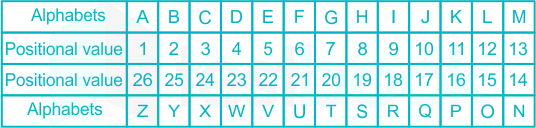
The positions of the letters according to the English alphabet series:

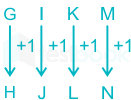
Logic:

One is added to the letter for the next letter in the same position.

For,

In GIKM: HJLN →

Similarly; 

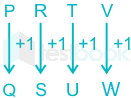
In PRTV : ???? →

As it can be seen that applying logic the obtained letters are "QSUW".

Hence, the correct answer should be "QSUW".

25

Select the option that is related to the third term in the same way as the second term is related to the first term.

9637 : 6488 :: 5408 : ?

  1. ((a))

    8756

  2. ((b))

    8567

  3. ((c))

    5678

  4. ((d))

    8765

Show Answer
Answer: ((b))

8567

Logic:

Multiplication of First and Fourth Digit of Number = Middle Two Digits of Same Number

In 9637: 6488 →

Consider 9637 →

= 9 × 7

= 63 (MIddle number of 9637).

Consider 6488 →

= 6 × 8

= 48 (MIddle number of 6488).

Similarly;

In 5408 : ???? →

= 5 × 8

= 40 MIddle number of 5408).

Now,

Option 1: 8756 →

= 8 × 6

= 48 (Not a middle number of 8756).

Option 2: 8567 →

= 8 × 7

= 56 (Middle number of 8567).

Option 3: 5678 →

= 5 × 8

= 40 (Not a middle number of 5678).

Option 4: 8765 →

= 8 × 5

= 40 (Not a middle number of 8765).

As it can be seen that "8567" follows the required pattern.

Hence, the correct answer should be "8567".

26

Select the option that is related to the third term in the same way as the second term is related to the first term.

12 : 30 :: 16 : ?

  1. ((a))

    48

  2. ((b))

    32

  3. ((c))

    40

  4. ((d))

    36

Show Answer
Answer: ((c))

40

Logic:

First Number + 3/2 × First Number = Second Number

In 12: 30 →

= 12 + 3/2 × 12

= 12 + 6 × 3 

= 12 + 18

= 30

Similarly;

In 16 : ?? →

= 16 + 3/2 × 16

= 16 + 8 × 3 

= 16 + 24

= 40

As the obtained number is "40".

Hence, the correct answer should be "40".

Alternate MethodLogic:

(First Number × 2) + (First Number ÷ 2) = Second Number 

In 12: 30 →

= (12 × 2) + (12 ÷ 2)

= 24 + 6

= 30

Similarly;

In 16 : ?? →

= (16 × 2) + (16 ÷ 2)

= 32 + 8

= 40

As the obtained number is "40".

Hence, the correct answer should be "40".

27

The difference between the place values of '4' and '2' in the number 833749502 is:

  1. ((a))

    39098

  2. ((b))

    39998

  3. ((c))

    49998

  4. ((d))

    30098

Show Answer
Answer: ((b))

39998

The given number is 833749502

The place value of 4 = 4 × 10000 = 40000

⇒ 833749502

The place value of 2 = 2 × 1 = 2

⇒ 833749502

Therefore, The difference between the place values of '4' and '2'

⇒ 40000 - 2

⇒ 39998

Hence, the correct answer is 39998.

28

Select the option that is different from the remaining three options.

  1. ((a))

    Tea

  2. ((b))

    Coffee

  3. ((c))

    Lemonade

  4. ((d))

    Cheese

Show Answer
Answer: ((d))

Cheese

Option 1:

Tea →

Tea is a beverage i.e. tea is in a liquid state.

Option 2:

Coffee →

Coffee is also a beverage that is in a liquid state.

Option 3:

Lemonade →

It is also a beverage and it is in a liquid state as well.

Option 4:

Cheese →

Cheese is obtained by processing milk and it is in a solid state.

As it can be noted that all the items except Cheese are in a liquid state.

Hence, the correct answer should be "Cheese".

29

Select the option that is different from the remaining three options.

  1. ((a))

    AYBZ

  2. ((b))

    CXWD

  3. ((c))

    EVUF

  4. ((d))

    GTSH

Show Answer
Answer: ((a))

AYBZ

The positions of the letters according to the English alphabet series:

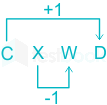
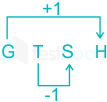
The pattern follows here is:

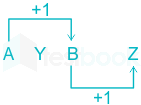
In AYBZ →

In CXWD →

In EVUF →

In GTSH →

As it can be seen that "AYBZ" is different from all.

Therefore, the correct answer should be "AYBZ".

30

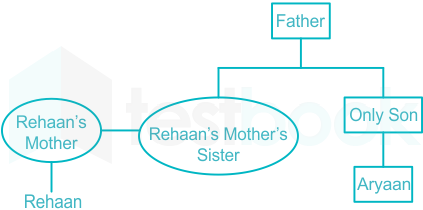
Ayaan is Rehaan's mother's sister's father's only son's son. How is Ayaan related to Rehaan?

  1. ((a))

    Uncle

  2. ((b))

    Nephew

  3. ((c))

    Cousin

  4. ((d))

    Son

Show Answer
Answer: ((c))

Cousin

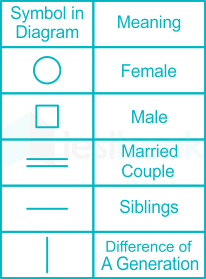
Consider the following symbols:

The family tree for the above condition is given as follows:

Hence, the correct answer should be "Cousion".

31

Take the given statements as true even if they seem to be at variance with commonly known facts and decide which of the conclusions logically follow(s) from the statements.

Statements: 

All socks are shoes.

Some shoes are black.

Conclusions: 

I. Some shoes are socks.

II. No socks is black.

  1. ((a))

    Only conclusion I can be drawn.

  2. ((b))

    Only conclusion II can be drawn.

  3. ((c))

    Both conclusions I and II can be drawn.

  4. ((d))

    Neither conclusion I nor conclusion II can be drawn.

Show Answer
Answer: ((a))

Only conclusion I can be drawn.

The least possible Venn diagram for the given statement will be:

Conclusions:

I. Some shoes are socks. → True (As some part of shoes is overlapping with socks)

II. No socks is black. → False (As there is no direct relation between socks and black. Hence, it does not follow)

<br>

As it can be seen only conclusion 1 is true.

<br>

Hence, the correct answer is "Only conclusion I can be drawn".

Additional Information

32

From the given options, select the one that does exact reproduction of the name and address given below.

Shri. Pratham Shetty

N-31, Riviera Apartment,

Sea Bay Road, Panvel,

New Mumbai

PIN - 400 178

  1. ((a))

    Shri. Partham Shetty

    N-31, Riviera Apartment,

    Sea Bay Road, Penvel,

    New Mumbai

    PIN - 400 178

  2. ((b))

    Shri. Pratham Shetly

    N-31, Riviera Apartment,

    Sea Bay Road, Panvel,

    New Mumbra

    PIN - 400 178

  3. ((c))

    Shri. Pratham Shetty

    N-31, Riviera Apartment,

    Sea Bay Road, Panvel,

    New Mumbai

    PIN - 400 178

  4. ((d))

    Shri. Pratham Shetty

    N-31, Riveira Appartment,

    Sea Bay Road, Panvel,

    New Mumbai

    PIN - 400 178

Show Answer
Answer: ((c))

Shri. Pratham Shetty

N-31, Riviera Apartment,

Sea Bay Road, Panvel,

New Mumbai

PIN - 400 178

Option 1:

Shri. Partham Shetty

N-31, Riviera Apartment,

Sea Bay Road, Penvel,

New Mumbai

PIN - 400 178

The word "Pratham" is written as "Partham".

Therefore, this is not exactly copied.

Option 2:

Shri. Pratham Shetly

N-31, Riviera Apartment,

Sea Bay Road, Panvel,

New Mumbra

PIN - 400 178

The word "Mumbai" is written as "Mumbra".

Therefore, this is not an exact copy of the given address.

Option 3:

Shri. Pratham Shetty

N-31, Riviera Apartment,

Sea Bay Road, Panvel,

New Mumbai

PIN - 400 178

The given address and name is an exact copy of the given address.

Option 4:

Shri. Pratham Shetty

N-31, Riveira Appartment,

Sea Bay Road, Panvel,

New Mumbai

PIN - 400 178

The word "Riviera" is written as "Riveira".

Therefore, this is not exactly copied.

As can be seen that only "Option (3)" is exactly as the given address

Hence, the correct answer should be "Option (3)".

33

Some equations given below are solved on the basis of a certain system. On the same basis find out the correct answer from among the four options for the unsolved equation.

12 × 4 = 64

14 × 5 = 95

16 × 7 = ?

  1. ((a))

    112

  2. ((b))

    161

  3. ((c))

    159

  4. ((d))

    81

Show Answer
Answer: ((b))

161

Logic:

Both the number should be added and then multiplied by the smaller number to get the required number.

For, 

12 × 4 = 64

= 12 + 4

= 16

= 16 × 4 (As 4 is the smaller number between 12 and 4)

= 64

For, 

14 × 5 = 95 

= 14 + 5

= 19

= 19 × 5 (As 5 is the smaller number between 14 and 5)

95

For,

16 × 7 = ?

= 16 + 7

= 23

= 23 × 7 (As 7 is the smaller number between 16 and 7)

161

As, the obtained number is 161

Hence, the correct answer should be "161".

34

Arrange the given words in a logical sequence, from smallest to biggest (according to their size), and then choose the most appropriate sequence from among the options provided below.

  1. Jug
  2. Mug
  3. Bucket
  4. Drum
  5. Cup
  1. ((a))

    5, 2, 1, 3, 4

  2. ((b))

    1, 5, 3, 2, 4

  3. ((c))

    5, 2, 3, 1, 4

  4. ((d))

    5, 2, 4, 3, 1

Show Answer
Answer: ((a))

5, 2, 1, 3, 4

Logic:

We need to arrange the given objects as per their size from smallest to largest.

The correct sequence is given below:

Cup → Mug  → Jug → Bucket → Drum

Therefore, the correct answer should be "5, 2, 1, 3, 4."

35

If in a certain code language, 'PRINT' is written as '34825' and 'TRUE' is written as '5479'. Then, how will 'TENURE' be written in that language?

  1. ((a))

    592849

  2. ((b))

    572947

  3. ((c))

    592749

  4. ((d))

    524742

Show Answer
Answer: ((c))

592749

Logic:

The number at the same position as the letter is taken as code.

'PRINT' →  '34825'

LetterCode
P3
R4
I8
N2
T5

'TRUE' → '5479'

LetterCode
T5
R4
U7
E9

Now, 

For, "TENURE"

The code will be "592749".

Hence, the correct the correct answer should be "592749".

Arithmetical Ability (15 questions)

36

A natural number, when divided by 3, 4, 5, 6 and 7 respectively, leaves corresponding remainders of 2, 3, 4, 5 and 6. What is the smallest of all such numbers fulfilling the above condition?

  1. ((a))

    2519

  2. ((b))

    419

  3. ((c))

    209

  4. ((d))

    839

Show Answer
Answer: ((b))

419

Calculation:

The LCM of the numbers 3, 4, 5, 6 and 7 is 3 × 5 × 2 × 2 × 7 = 420

The first number to satisfy the given conditions is LCM - 1 

⇒ 420 - 1

419

⇒ 419 ÷ 3 gives remainders of 2.

Now, the number will follow the arithmetic progression having the common difference = 420

The second number = 420 + 419 = 839

⇒ 839 ÷ 4 gives remainders of 3.

The third number = 420 + 839 = 1259

⇒ 1259 ÷ 5 gives remainders of 4.

The fourth number = 420 + 1259 = 1679

⇒ 1679 ÷ 6 gives remainders of 5.

The fifth number = 420 + 1679 = 2099

⇒ 2099 ÷ 7 gives remainders of 6.

Therefore, the smallest of all such numbers fulfilling the above condition is 419.

Hence, the correct answer is 419.

37

44 pipes can fill a large water tank in 27 hours. How many hours will it take for 66 pipes to fill four such tanks?

  1. ((a))

    72

  2. ((b))

    54

  3. ((c))

    63

  4. ((d))

    84

Show Answer
Answer: ((a))

72

Shortcut Trick

Using the chain rule formula: M1 × H1 / W1 = M2 × H2 / W2

⇒ 44 × 27 / 1 = 66 × H2 / 4

⇒ H2 = (44 × 27 × 4) ÷ 66

⇒ H2 = 72

∴ The correct answer is 72 hours.

Alternate Method

Given:

Initial number of pipes (M1) = 44

Time to fill 1 tank (H1) = 27 hours

New number of pipes (M2) = 66

Number of tanks to fill (W2) = 4

Calculations:

⇒ Time taken by 44 pipes to fill 1 tank = 27 hours

⇒ Total time taken by 1 pipe to fill 1 tank = 44 × 27 = 1188 hours

⇒ Time taken by 66 pipes to fill 1 tank = 1188 ÷ 66 = 18 hours

⇒ Time taken by 66 pipes to fill 4 such tanks = 18 × 4 = 72 hours

∴ The correct answer is 72 hours.

Additional Information

Unitary Method in Time & Work

If more resources (pipes) are used, less time is taken to do the same amount of work (Inverse Proportion). If more work (tanks) is done, more time is taken (Direct Proportion).

MDH Formula

A direct shortcut to compare two scenarios of work: (M1 × D1 × H1) ÷ W1 = (M2 × D2 × H2) ÷ W2, where M is workers or identical machines, and W is the total work done.

Pipes & Cisterns

All pipes of identical size fill a tank at the exact same rate. Their combined efficiency is directly proportional to the total number of active pipes.

38

The average of the marks obtained by three girls in a test was twice the average of the marks obtained by eight boys in that test. If the total marks obtained by all these examinees was 168, find the average marks each of the girls obtained.

  1. ((a))

    25

  2. ((b))

    12

  3. ((c))

    24

  4. ((d))

    14

Show Answer
Answer: ((c))

24

Given:

The average of the marks obtained by three girls = 2 × the average marks obtained by eight boys

The marks obtained by all boys and girls = 168

Formula Use:

Average = Sum of marks scored by all the candidates/Number of candidates

Calculation:

It is given that,

The average of the marks obtained by three girls = 2 × the average marks obtained by eight boys

⇒ (Sum of marks obtained by all girls / Number of girls) = 2 × (Sum of marks obtained by all boys / Number of boys)

⇒ (Sum of marks obtained by all girls/3) = 2 × (Sum of marks obtained by all boys/8)

⇒ (Sum of marks obtained by all girls/3) = (Sum of marks obtained by all boys/4)     

⇒ Sum of marks obtained by all boys = 434\over3 × Sum of marks obtained by all girls       ----(1)

It is also given in the question that, 

The marks obtained by all boys and girls = 168

⇒ Sum of marks obtained by all boys + Sum of marks obtained by all girls = 168

From equation (1),

⇒ 434\over3 × Sum of marks obtained by all girls + Sum of marks obtained by all girls = 168

⇒ (43+1{4\over3} + 1) Sum of marks obtained by all girls = 168

⇒ 737\over3 × Sum of marks obtained by all girls = 168

⇒ Sum of marks obtained by all girls = 168×37168×3\over7

⇒ Sum of marks obtained by all girls = 5047504\over7

⇒ Sum of marks obtained by all girls = 72

Now,

The average marks obtained by each girl = Sum of marks obtained by all girls / Number of girls

⇒ The average marks obtained by each girl = 72/3

⇒ The average marks obtained by each girl = 24

Hence, the correct answer is 24.

39

23% of a bucket full of diluted milk was water. If the quantity of pure milk in the bucket was 15.4 l, then the capacity of the bucket was:

  1. ((a))

    20 l

  2. ((b))

    22 l

  3. ((c))

    20.9 l

  4. ((d))

    19.8 l

Show Answer
Answer: ((a))

20 l

Shortcut Trick

Identify the percentage of pure milk: 100% − 23% = 77%.

Given that 77% of the bucket capacity is 15.4 l.

Total Capacity = (15.4 ÷ 77) × 100

Total Capacity = 0.2 × 100 = 20 l.

∴ The correct answer is 20 l.

Alternate Method

Given:

Percentage of water in the bucket = 23%

Quantity of pure milk = 15.4 l

Formula Used:

Total Percentage = 100%

Pure Milk Percentage = 100% − Water Percentage

Total Capacity = (Quantity of Milk ÷ Percentage of Milk) × 100

Calculations:

⇒ Percentage of pure milk = 100% − 23% = 77%

⇒ Let the total capacity of the bucket be 'X' litres.

⇒ 77% of X = 15.4

⇒ (77 ÷ 100) × X = 15.4

⇒ X = (15.4 × 100) ÷ 77

⇒ X = 1540 ÷ 77

⇒ X = 20 l

∴ The correct answer is 20 l.

Additional Information

Percentage to Value Conversion

To find the total value when a percentage part is known, use the formula: Total = (Part Value ÷ Part Percentage) × 100.

Complementary Percentages

In any mixture involving two components, if one component is x%, the other component is always (100 − x)%.

Decimal Multiplication Trick

When dividing decimals like 15.4 by 77, it is often easier to treat it as 154 ÷ 77 = 2, and then adjust the decimal point to get 0.2.

40

Selling a pack of incense sticks for Rs. 136 resulted in a loss of 15%. To make a profit of 10%, the selling price should be:

  1. ((a))

    Rs. 160

  2. ((b))

    Rs. 176

  3. ((c))

    Rs. 170

  4. ((d))

    Rs. 149.60

Show Answer
Answer: ((b))

Rs. 176

Let, 'x' be the cost price of a pack of incense sticks.

We know that,

The loss is always incurred on the cost price.

Therefore,

⇒ x - (0.15 x) = 136

⇒ 0.85 x = 136

⇒ x = 1360.85136\over0.85

⇒ x = Rs. 160

Therefore, the cost price of a pack of incense sticks = 160 Rs.

Now, 

Selling Price = Cost Price + Profit

To make a profit of 10%, the selling price will be

Selling Price = 160 + (0.1 × 160)

Selling Price = 160 + 16

Selling Price = Rs. 176

Therefore, to make a profit of 10%, the selling price should be Rs. 176.

Hence, the correct answer is Rs. 176.

41

A bag contains red, blue and black balls. The ratio of red to blue balls is 3 : 5. The ratio of black to red balls is 3 : 4. What is the ratio of blue to black balls?

  1. ((a))

    5 : 3

  2. ((b))

    4 : 5

  3. ((c))

    9 : 20

  4. ((d))

    20 : 9

Show Answer
Answer: ((d))

20 : 9

Given:

Red : Blue = 3 : 5

Black : Red = 3 : 4

Calculation:

We have,

  1. Red : Blue = 3 : 5

Multiply the above ratio with '4'

Red : Blue = 12 : 20

2) Black : Red = 3 : 4

Multiply the above ratio with '3'

Black : Red = 9 : 12

Therefore the ratio among Black, Red, and Blue balls is 9 : 12 : 20

The ratio of blue to black balls is 20 : 9.

Hence, the correct answer is 20 : 9.

42

A sum of money was invested at a certain rate of simple interest for 4 years. Had the sum been invested at a rate 3% higher than the actual rate, the interest earned would have been Rs. 720 more. Find the sum initially invested.

  1. ((a))

    Rs. 24000

  2. ((b))

    Rs. 18000

  3. ((c))

    Rs. 6000

  4. ((d))

    Rs. 5400

Show Answer
Answer: ((c))

Rs. 6000

Formula used:

Simple Interest (SI) = PNR / 100

Where P = Principal

N = Period in years

R = Rate of Interest

Calculation:

We have given,

SI=4PR100SI = {4PR \over 100 }      ----(1)

Now, 

⇒ SI+720=4P×(R+3)100SI + 720 = {{4P × (R + 3)}\over 100}      ----(2)

Put the value of SI from equation (1) in equation (2),

⇒ 4PR100+720=4P×(R+3)100{4PR \over 100} + 720 = {{4P × (R + 3)}\over100}

⇒ 4PR+72000100=4P×(R+3)100{{{4PR} + 72000}\over100} = {{4P × (R + 3)}\over100}

⇒ 4PR+72000=4PR+12P{{{4PR} + 72000}} = {{4PR + 12P}}

⇒ 72000 = 12P

P = Rs. 6000

Therefore, the sum initially invested was Rs. 6000.

Hence, the correct answer is Rs. 6000.

43

Starting from the same point at the same time, Ruhan and Yuvan had to reach the same destination. While Ruhan drove at 45 km/hr, Yuvan was slower by 5 km/hr. If Yuvan arrived at the destination an hour after Ruhan did, the distance covered by each, in kilometres, was:

  1. ((a))

    180

  2. ((b))

    420

  3. ((c))

    225

  4. ((d))

    360

Show Answer
Answer: ((d))

360

Given:

Speed of Ruhan = 45 km/hr

Speed of Yuvan = Speed of Ruhan - 5 km/hr

Speed of Yuvan = 45 - 5 = 40 km/hr

Time taken by Yuvan to reach the destination (TY) = Time taken by Ruhan to reach the destination (TR) + 1 hr

Formula Use:

Speed = Distance/Time

Calculation:

Here, starting point and the destination point are the same for both Ruhan and Yuvan.

Therefore, the distance covered by both of them will be the same.

We know,

Speed = Distance/Time

Where S = Speed

D = Distance

T = Time 

As distance covered is the same, therefore,

⇒ S × TR = S × TY

⇒ 45 × TR = 40 × (TR + 1)

⇒ 9TR = 8 (TR + 1)

⇒ 9TR - 8TR = 8

TR = 8 hours

Therefore, Time is taken by Ruhan to reach the destination (TR) = 8 hours and 

Time taken by Yuvan to reach the destination (TY) = 8 + 1 = 9 hours

Now,

The distance covered by each = Speed × Time

The distance covered by Ruhan = 45 × 8 = 360 km

The distance covered by Yuvan = 40 × 9 = 360 km

Therefore, the distance covered by each is 360 km.

Hence, the correct answer is 360 km.

44

Raman mixed 8 kg of one variety of wheat with 12 kg of another. If the cost per kg of the two varieties were in the ratio 3 : 2, what should be the ratio of the selling price of the blended wheat per kg to that of the cost price of the superior variety of wheat per kg so that Raman makes an overall profit of 25%?

  1. ((a))

    1 : 1

  2. ((b))

    5 : 4

  3. ((c))

    4 : 3

  4. ((d))

    4 : 5

Show Answer
Answer: ((a))

1 : 1

Shortcut Trick

Ratio of Quantities = 8 : 12 = 2 : 3

Ratio of Cost Prices = 3 : 2

Average CP of Blend = [(2 × 3) + (3 × 2)] ÷ (2 + 3) = 12 ÷ 5 = 2.4 units

Selling Price of Blend (at 25% profit) = 2.4 × 1.25 = 3 units

Required Ratio = SP of Blend : CP of Superior = 3 : 3 = 1 : 1

∴ The correct option is A.

Alternate Method

Given:

Quantity of Superior Wheat (Q1) = 8 kg

Quantity of Inferior Wheat (Q2) = 12 kg

Ratio of CPs (Superior : Inferior) = 3 : 2

Profit Percentage = 25%

Formula Used:

Total CP = (Q1 × CP1) + (Q2 × CP2)

SP = CP × (1 + Profit/100)

CP Inf (2x)

CP Blend (2.4x)

CP Sup (3x)

+25% Profit SP Blend = 3x

Calculations:

⇒ Let CP of superior variety = 3x per kg

⇒ Let CP of inferior variety = 2x per kg

⇒ Total CP of 20 kg mixture = (8 × 3x) + (12 × 2x) = 24x + 24x = 48x

⇒ CP per kg of mixture = 48x ÷ 20 = 2.4x

⇒ Required SP per kg of mixture = 2.4x × (125 ÷ 100)

⇒ SP per kg of mixture = 2.4x × 1.25 = 3x

⇒ Required Ratio = SP per kg of blend : CP per kg of superior wheat

⇒ Ratio = 3x : 3x = 1 : 1

∴ The correct option is A.

Additional Information

Weighted Average Rule

The average price of a mixture is given by (n1c1 + n2c2) ÷ (n1 + n2), where n is quantity and c is cost per unit.

Alligation Method

The ratio of quantities mixed is inversely proportional to the difference between their individual costs and the mean cost: Q1/Q2 = (CP2 − CPm) / (CPm − CP1).

Profit and Selling Price

Selling Price (SP) = CP × [ (100 + Profit%) ÷ 100 ]. For a 25% profit, SP = 1.25 × CP.

45

The difference in the lengths of the shadows of a 10 m high pole when the angles of elevation of the sun are 30° and 60° is:

  1. ((a))

    2033\frac{20\sqrt3}{3} m

  2. ((b))

    10310\sqrt{3} m

  3. ((c))

    1033\frac{10\sqrt3}{3} m

  4. ((d))

    10 m

Show Answer
Answer: ((a))

2033\frac{20\sqrt3}{3} m

Shortcut Trick

For a pole of height h, the difference in shadow lengths for angles θ1 and θ2 is h(cotθ1 − cotθ2).

Here, h = 10 m, θ1 = 30°, and θ2 = 60°.

Difference = 10 × (cot 30° − cot 60°) = 10 × (√3 − 1/√3) = 10 × (2/√3) = 20/√3 m.

Rationalizing: (20/√3) × (√3/√3) = 20√3/3 m.

∴ The correct answer is 20√3/3 m.

Alternate Method

Given: Height of pole (AB) = 10 m. Angles of elevation α = 60° and β = 30°.

Formula Used: tan θ = Perpendicular / Base

⇒ In ΔABC, tan 60° = AB / BC

⇒ √3 = 10 / BC ⇒ BC = 10 / √3 m

⇒ In ΔABD, tan 30° = AB / BD

⇒ 1 / √3 = 10 / BD ⇒ BD = 10√3 m

⇒ Difference in shadows = BD − BC = 10√3 − 10/√3

⇒ Difference = (30 − 10) / √3 = 20 / √3 m

⇒ Difference = 20√3 / 3 m

∴ The correct answer is 20√3/3 m.

Additional Information

Trigonometric Ratios

For standard angles: tan 30° = 1/√3, tan 60° = √3, cot 30° = √3, and cot 60° = 1/√3.

Shadow and Elevation Relation

As the angle of elevation increases, the length of the shadow of an object decreases.

Distance Formula

The distance d between two shadow points for a height h is given by d = h |cot θ1 − cot θ2|.

46

The number of natural numbers less than 100 which have exactly 3 factors is:

  1. ((a))

    10

  2. ((b))

    4

  3. ((c))

    12

  4. ((d))

    33

Show Answer
Answer: ((b))

4

Shortcut Trick

Exactly 3 factors occur only when a number is a square of a prime number (p2).

Factors of p2 are 1, p, and p2.

Prime numbers (p) such that p2 < 100 are 2, 3, 5, and 7.

Squares: 22=4, 32=9, 52=25, 72=49.

The numbers are {4, 9, 25, 49}.

∴ The correct answer is 4.

Alternate Method

Given: Numbers less than 100 with exactly 3 factors.

Formula Used: If N = p1a × p2b, total factors = (a + 1)(b + 1).

Numbers with Exactly 3 Factors (Squares of Primes) 2²=4 3²=9 5²=25 7²=49 Total such numbers = 4

⇒ Total factors required = 3

⇒ (a + 1) = 3 ⇒ a = 2

⇒ The number must be of the form p2, where p is a prime number.

⇒ List squares of prime numbers:

⇒ 22 = 4 (Factors: 1, 2, 4)

⇒ 32 = 9 (Factors: 1, 3, 9)

⇒ 52 = 25 (Factors: 1, 5, 25)

⇒ 72 = 49 (Factors: 1, 7, 49)

⇒ 112 = 121 (This is greater than 100)

⇒ Total count = 4

∴ The correct answer is 4.

Additional Information

Number of Factors Formula

If N = pa × qb × rc, total factors = (a+1)(b+1)(c+1), where p, q, r are prime factors.

Perfect Squares

A perfect square always has an odd number of factors (e.g., 16 has factors 1, 2, 4, 8, 16 which counts to 5).

Prime Numbers

A prime number has exactly 2 factors: 1 and itself.

Composite Numbers

Composite numbers have more than 2 factors. 1 is neither prime nor composite.

47

Ram could complete a job alone in 6 days but Sunil would take thrice the time to do it alone. They started the work together but Ram had to leave a few days before the completion of the work and Sunil had to complete the remaining task by himself. If, as a result, it took 6.75 days in all to complete the job, for how many days did the duo work together?

  1. ((a))

    4.50

  2. ((b))

    3.75

  3. ((c))

    3

  4. ((d))

    5.25

Show Answer
Answer: ((b))

3.75

Given:

Ram's 1-day work = 161\over6

Sunil = 3 × Ram

Sunil = 3 × 6 = 18 days

Sunil's 1-day work = 1181\over18

Calculations:

Together their 1-day work would be = 161\over6 + 1181\over18

⇒ 292\over9

Suppose Ram leaves in 'x' days, then

⇒ x×16+(6.75×118)=1{x×{1\over6}+{(6.75×{1\over18})}} = 1

⇒ x6+38=1{{x\over6}+{{3\over8}}} = 1

⇒ x6=138{{x\over6}} = {1-{3\over8}}

⇒ x6=58{{x\over6}} = {5\over8}

⇒ x=308x={30\over8}

⇒ x=3.75x=3.75

So, Ram left the job in 3.75 days.

Therefore, the duo worked together for 3.75 days.

Hence, the correct answer is 3.75.

48

While going from A to B, Rahman drove at 40 km an hour but while coming back he drove at only 24 km an hour. What was the average speed (in km/hr) at which he drove?

  1. ((a))

    31

  2. ((b))

    30

  3. ((c))

    32

  4. ((d))

    33

Show Answer
Answer: ((b))

30

Given:

Speed of Rahman going from A to B (x) = 40 kmph

Speed of Rahman going from B to A (y) = 24 kmph

Formula Use:

Average Speed = 2xyx+y2xy\over{x+y}

Where x is the speed from A to B

y is the speed from B to A

Calculation:

We know,

Average Speed = 2xyx+y2xy\over{x+y}

⇒ Average Speed = 2×40×2440+242×40×24\over{40+24}

⇒ Average Speed = 2×40×24642×40×24\over{64}

⇒ Average Speed = 30 kmph

Therefore, the average speed at which Rahman drove is 30 kmph.

Hence, the correct answer is 30 kmph.

Alternate MethodGiven:

Speed of Rahman going from A to B (x) = 40 kmph

Speed of Rahman going from B to A (y) = 24 kmph

Formula Use:

Speed(S)=Distance(D)Time(T)Speed (S) = {Distance (D)\over Time (T)}

Where S = Average Speed

D = Distance

T = Time

Calculation:

The distance covered by Rahman from A to B and from B to A is the same.

Let the distance between A to B be 'D'

Therefore,

⇒ Speed(S)=Distance(D)Time(T)Speed (S) = {Distance (D)\over Time (T)}

⇒ S=D+DDx+DyS = {D + D\over {{D\over x}+{D\over y}}}

⇒ S=2DDx+DyS = {2D\over {{D\over x}+{D\over y}}}

⇒ S=2DD(1x+1y)S = {2D\over {D({1\over x}+{1\over y})}}

⇒ S=21x+1yS = {2\over {{1\over x}+{1\over y}}}

⇒ S=2×x×yx+yS = {2×x×y\over x+y}

⇒ S=2×40×2440+24S = {2×40×24\over{40+24}}

⇒ S=2×40×2464S = {2×40×24\over{64}}

⇒ Average Speed (S) = 30 kmph

Therefore, the average speed at which Rahman drove is 30 kmph.

Hence, the correct answer is 30 kmph.

49

If x is 15% of y and y is 40% of z, then x + y is ________ % of z.

  1. ((a))

    6

  2. ((b))

    21

  3. ((c))

    46

  4. ((d))

    55

Show Answer
Answer: ((c))

46

Given:

x = 15% of y

y = 40% of z

Formula Used:

Percentage = PartWhole×100\frac{Part}{Whole} \times 100

Calculation:

Let z = 100

⇒ y = 40% of 100 = 40

⇒ x = 15% of 40

⇒ x = 15×40100\frac{15 \times 40}{100}

⇒ x = 6

⇒ x + y = 6 + 40 = 46

⇒ Required % = x+yz×100\frac{x + y}{z} \times 100

⇒ Required % = 46100×100\frac{46}{100} \times 100

⇒ Required % = 46%

∴ The correct answer is option (3).

50

The cost price of 20 articles is equal to the selling price of 16 articles. Find the gain or loss percent.

  1. ((a))

    20% gain

  2. ((b))

    20% loss

  3. ((c))

    25% loss

  4. ((d))

    25% gain

Show Answer
Answer: ((d))

25% gain

Given:

CP of 20 articles = SP of 16 articles

Concept used:

SP = CP × (100 ± P or L)%

Calculation:

Let the selling price of one articles be SP and the cost price of one articles be CP.

20 × CP = 16 × SP

SP/CP = 20/16 = 5/4

P = SP - CP 

Profit percentage = (P/CP) × 100

Profit percentage = (5 - 4)/4 × 100 = 25% gain

∴ Profit percentage is 25%.

General Awareness (20 questions)

51

Who among the following former Judges of Supreme Court has been re-elected as a Judge of International Court of Justice?

  1. ((a))

    Vikramajit Sen

  2. ((b))

    M. Y. Eqbal

  3. ((c))

    Dalveer Bhandari

  4. ((d))

    C. K. Prasad

Show Answer
Answer: ((c))

Dalveer Bhandari

The Correct Answer is Dalveer Bhandari.

Key Points

  • India’s nominee to the International Court of Justice (ICJ) Dalveer Bhandari (70) was re-elected to fifth and the last seat of world court.
  • Bhandari received 183-193 votes in United Nations General Assembly and secured all 15 votes in UN Security Council (UNSC).
  • He was elected after Britain withdrew its candidate from the election.
  • This is the first time since the ICJ was established in 1945 that there will be no British judge in ICJ.
  • Bhandari is the fourth Indian judge to be elected to ICJ after B.N. Rau, Nagendra Singh and RS Pathak.
  • Dalveer Bhandari (born 1 October 1947) is an Indian member of the International Court of Justice.
  • He is a former Judge of the Supreme Court of India.​

Additional Information

  • International Court of Justice (ICJ):
  • ICJ is principal judicial body of UN.
  • It was established in 1945 via UN Charter and its jurisdiction is worldwide.
  • It is located in “The Hague” in the Netherlands and has 193 state parties.
  • The major functions of the ICJ are to settle legal disputes submitted to it by states and to provide advisory opinions on legal questions submitted to it by duly authorized international organs, agencies, and UN General Assembly.
  • ICJ is composed of 15 judges elected to nine-year terms of office by UNGA and the UN Security Council.
  • These organs vote simultaneously but separately.
  • In order to be elected, a candidate must receive absolute majority of votes in both bodies.
  • In order to ensure a measure of continuity, one-third of ICJ is elected every three years.
  • Judges are eligible for re-election.
  • President and Vice-President are also elected by the court, but for three-year periods.
52

Who among the following has been appointed as the Chairman of the Film and Television Institute of India (FTII), Pune?

  1. ((a))

    Kailash Kher

  2. ((b))

    Sikandar Kher

  3. ((c))

    Kirron Kher

  4. ((d))

    Anupam Kher

Show Answer
Answer: ((d))

Anupam Kher

The Correct Answer is Anupam Kher.

Key Points

  • Actor Anupam Kher has been appointed as the chairman of the Film and Television Institute of India (FTTI) in Pune on October 11 2017.
  • He has previously held the posts of chairman of the Central Board of Film Certification and the National School of Drama.
  • He will replace Gajendra Chauhan.
  • He was conferred the Padma Shri in 2004 and the Padma Bhushan in 2016 by the Indian government.
  • He has also been a part of international projects such as **Bend It Like Beckham, Lust, Caution, and David O Russell’s 2013 Oscar-winning Silver Linings Playbook.**​

Additional Information

  • Film and Television Institute of India:
  • FTII is a premier institute in the country that provides training for acting, filmmaking, video editing, direction and production.
  • It is an autonomous body under the Ministry of Information and Broadcasting.
  • It was established in 1960 and is situated in Pune on the premises of the erstwhile Prabhat Film Company.
  • Since its inception, FTII has become India’s premier film and television institute.
53

Who among the following has been appointed as the Governor of Assam in September 2017?

  1. ((a))

    Praful Khoda Patel

  2. ((b))

    Mridula Sinha

  3. ((c))

    Jagdish Mukhi

  4. ((d))

    N. N. Vohra

Show Answer
Answer: ((c))

Jagdish Mukhi

The Correct Answer is Jagdish Mukhi.

Key Points

  • Jagdish Mukhi was sworn in as new Governor of Assam.
  • He was administered oath of office by Gauhati High Court Chief Justice Ajit Singh.
  • Mr. Mukhi succeeded Banwarilal Purohit who has been appointed as the Governor of Tamil Nadu.
  • In his previous assignment, he had served as lieutenant governor of Andaman and Nicobar Islands.
  • Mukhi is former member of **BJP and RSS.**​

Additional Information

  • He had started his political career with Janata Party in September of 1977.
  • His first election success was in a 1980 by-election for the advisory Delhi Metropolitan Council.
  • He had represented Janak Puri constituency in Delhi Assembly continuously from 1980 and has won seven continuous Vidhan Sabha elections from the same constituency until losing the 2014.
  • He has held important ministerial positions including minister of Finance, Planning, Excise and Taxation and Higher Education in Delhi government.
  • He was awarded as best planning minister of nation by then Union planning minister Pranab Mukherjee in 1997.
  • Two times he was awarded with best MLA award in Delhi Vidhan Sabha.
54

Which of the following is the only classical dance of India having links with Muslim culture and represents a unique synthesis of Hindu and Muslim genius in art?

  1. ((a))

    Bharatnatyam

  2. ((b))

    Kathak

  3. ((c))

    Kathakali

  4. ((d))

    Kuchipudi

Show Answer
Answer: ((b))

Kathak

The Correct Answer is Kathak.

Key Points

  • The nineteenth-century saw the golden age of Kathak under the patronage of Wajid Ali Shah, the last Nawab of Oudh.
  • He established the Lucknow Gharana with its strong accent on bhava, the expression of moods and emotions.
  • The Jaipur Gharana is known for its layakari or rhythmic virtuosity and the Benaras Gharana is another prominent school of Kathak dance.
  • The technique of movement in Kathak is unique to it.
  • Today, Kathak has emerged as a distinct dance form.
  • Being the only classical dance of India having links with Muslim culture, it represents a unique synthesis of Hindu and Muslim genius in art.
  • Further, Kathak is the only form of classical dance wedded to **Hindustani or North Indian music.**​

Additional Information

  • Kathak dance is a combination of music, dance and narrative.
  • The name Kathak is derived from the Sanskrit word katha meaning story.
  • This dance form traces its origins to the nomadic bards of ancient northern India, known as Kathaks, or storytellers.
  • The present-day Kathak dance mainly depends on the medieval period Ras Lila, a local dance in the Braj region of Uttar Pradesh.
  • **List of classical dances of India:**​
List of Classical dances in IndiaState of Origin
BharatnatyamTamil Nadu
KathakUttar Pradesh
KuchipudiAndhra Pradesh
OdissiOdisha
KathakaliKerala
SattriyaAssam
ManipuriManipur
MohiniyattamKerala
55

Which of the following dance forms was introduced by the great Vaishnava saint and reformer Mahapurusha Sankaradeva?

  1. ((a))

    Mohiniyattam

  2. ((b))

    Odissi

  3. ((c))

    Sattriya

  4. ((d))

    Manipuri

Show Answer
Answer: ((c))

Sattriya

The Correct Answer is Sattriya.

Key Points

  • The Sattriya dance form was introduced in the 15th century A.D by the great Vaishnava saint and reformer of Assam, Mahapurusha Sankaradeva as a powerful medium for the propagation of the Vaishnava faith.
  • It is one of the eight classical dance forms of India.
  • Sankaradeva introduced this dance form by incorporating different elements from various treatises, then prevalent dance forms and local folk dances combined with his own rare outlook.
  • Sattriya dance is a clear indication of the influence of the former on the latter.
  • Other visible influences on Sattriya dance are those from Assamese folk dances namely Bihu, Bodos etc Many hand gestures and rhythmic syllables are strikingly similar in these dance forms.​

Additional Information

  • Classical dance forms of India:
List of Classical dances in IndiaState of Origin
BharatnatyamTamil Nadu
KathakUttar Pradesh
KuchipudiAndhra Pradesh
OdissiOdisha
KathakaliKerala
SattriyaAssam
ManipuriManipur
MohiniyattamKerala
56

Atmospheric pressure at sea level equals:

  1. ((a))

    1.01 × 107 Pascal

  2. ((b))

    1.01 × 10⁵ Pascal

  3. ((c))

    1.01 × 106 Pascal

  4. ((d))

    1.01 × 109 Pascal

Show Answer
Answer: ((b))

1.01 × 10⁵ Pascal

The Correct Answer is 1.01 × 10⁵ Pascal.

Key Points

  • Atmospheric pressure, also called barometric pressureforce per unit area exerted by an atmospheric column (that is, the entire body of air above the specified area).
  • Atmospheric pressure can be measured with a mercury barometer which indicates the height of a column of mercury that exactly balances the weight of the column of atmosphere over the barometer.
  • Atmospheric pressure is also measured using an aneroid barometer.
  • Atmospheric pressure is expressed in several different systems of units: millimetres (or inches) of mercury, pounds per square inch (psi), dynes per square centimetre, millibars (mb), standard atmospheres, or kilopascals.
  • Standard sea-level pressure, by definition, equals 760 mm (29.92 inches) of mercury, 14.70 pounds per square inch, 1,013.25 × 103 dynes per square centimetre, 1,013.25 millibars, one standard atmosphere, or 101.325 kilopascals.
57

Which among the following is the SI unit of Force?

  1. ((a))

    Mole

  2. ((b))

    Newton

  3. ((c))

    Kelvin

  4. ((d))

    Ampere

Show Answer
Answer: ((b))

Newton

The Correct Answer Newton.

Key Points

  • Force: It is defined as an external cause that changes or tends to change the body’s state once applied.
  • If the body is in motion, it comes to rest, and if at rest, it will come to motion.
  • When there’s an interaction between two objects, they exert a force on each lot.
  • These exerted forces are equal in size but opposite in direction.
  • Characteristics of Force:
  • Forces are due to an interaction of at least two objects.
  • It may change the state of motion of an object.
  • It may change the shape of an object
  • The S.I. unit of force is Newton.
  • F = ma
  • 1 Newton = 1 kg x 1 m/s2
58

Who among the following was the first recipient of Nobel Prize in Physics?

  1. ((a))

    Hendrik Antoon Lorentz and Pieter Zeeman

  2. ((b))

    Wilhelm Conrad Röntgen

  3. ((c))

    Antoine Henri Becquerel

  4. ((d))

    Pierre Curie and Marie Curie

Show Answer
Answer: ((b))

Wilhelm Conrad Röntgen

The Correct Answer is Wilhelm Conrad Röntgen.

Key Points

  • First Nobel prize in physics was awarded to Wilhelm Rontgen in 1901 for his discovery of X rays.
  • November 8 is observed annually as World Radiography Day to commemorate the discovery of X-rays, on November 8, 1895, by German scientist Wilhelm Conrad Rontgen.
  • The objective behind World Radiography Day is to raise public awareness of radiographic imaging and therapy.
  • The first World Radiography Day was celebrated in 2012.
  • It was celebrated by Radiological Society of North America, European Society of Radiology and American College of Radiology.
  • Earlier to this, the European Day of Radiology was celebrated on February 10, 2011.
  • This coincided with the death anniversary of Wilhelm Rontgen.
  • Rontgen died in February 10, 1923.

Additional Information

  • World Radiography Day in India:
  • In India, the World Radiography Day is celebrated by the Radiographers Association of Madhya Pradesh.
  • It is being observed since 1996.
59

Who among the following was the first recipient of INSA Vainu Bappu Memorial Award?

  1. ((a))

    Vikram Vishal

  2. ((b))

    S Venkatraman

  3. ((c))

    S Chandrasekhar

  4. ((d))

    Asim Punia

Show Answer
Answer: ((c))

S Chandrasekhar

The Correct Answer is 

Key Points

  • Sivaramakrishna was an Indian physicist who won the Royal Medal in 1994.
  • S Chandrasekhar the following was the first recipient of INSA Vainu Bappu Memorial Award.
  • He was the founder-president of the International Liquid Crystal Society.​

Additional Information

  • INSA Vainu Bappu Memorial Award: The award is to be given to a Astronomer / Astrophysicist of international recognition.
  • Scientists from all nations are eligible for consideration.
  • The award consists of a bronze Medal, an honorarium of Rs. 25,000/- and a citation.
  • In the case of the award being given to a foreign Scientist, the international airfare would be met and he/she would be provided with the cash equivalent of the honorarium in US dollars.
  • The award was established in 1985 from an endowment by the mother of late Dr. Manali Vainu Bappu, an eminent Astronomer and a Fellow of the Academy.
60

The GST slab for food services and restaurants (except those in star hotels) has been revised to ________ at the 23rd meeting of the GST Council.

  1. ((a))

    18%

  2. ((b))

    12%

  3. ((c))

    5%

  4. ((d))

    21%

Show Answer
Answer: ((c))

5%

The Correct Answer is 5%.

Key Points

  • With the implementation of Goods and Service Tax, from 1st July, 2017, as prevailing under the earlier tax regime, the restaurants were bifurcated into the category of AC restaurants and Non-AC restaurants.
  • GST payable on the food being served by the AC restaurants was higher i.e. 18%, however, GST payable on the food being served by the non-AC restaurants was comparatively lower i.e. 12%.
  • However, the entire tax structure of the restaurant service underwent a change from November, 2017.
  • The reason for the change in the tax structure and the current tax structure is being explained in the below paras.
  • In the 23rd GST council meeting, the entire GST levy on the restaurant service underwent a transformation thereby benefiting the customer at large.
  • The GST rate was slashed down from 18% to 5%, however, with the reduced in GST rate the input tax credit (ITC) benefit was withdrawn from the restaurant owner.

Additional Information

  • Goods and Services Tax is a comprehensive indirect tax which is to be levied on the manufacture, sale and consumption of goods and services in India.
  • This is so far the biggest tax reform in the country.
  • GST eliminates the cascading effect of taxes because it is taxed at every point of business and the input credit is available in the value chain.
  • France was the first country to introduce GST system in 1954.
  • More than 140 countries have implemented the GST.
  • Genesis of GST occurred during the previous NDA Government under Atal Bihari Vajpayee Government when it set up the Asim Dasgupta committee to design a model for GST.
  • All the GST bills including Constitution (101st Amendment) Act have been passed and GST is came into force from July 1, 2017.
61

Who among the following is responsible for preparation of National Income estimates in India?

  1. ((a))

    NITI Ayog

  2. ((b))

    Planning Commission

  3. ((c))

    Central Statistical Organisation

  4. ((d))

    IRDA

Show Answer
Answer: ((c))

Central Statistical Organisation

The Correct Answer is Central Statistical Organisation.

Key Points

  • The Central Statistics Office (CSO) is a governmental agency in India under the Ministry of Statistics and Programme Implementation.
  • It is responsible for estimating National Income, Index of Industrial Production, and Consumer Price Indices.
  • Before independence, there was no independent body to estimate National Income numbers.
  • It was, then, pioneered by Dadabhai Naoroji.
  • Since 1955, the estimates have been prepared by Central Statistical Organisation.
  • The estimates are based on value created in primary, secondary, and tertiary sectors.
62

Which of the following players has the distinction of scoring most number of runs (as of December 2017) as the Captain of India's Test Team?

  1. ((a))

    Sunil Gavaskar

  2. ((b))

    Sourav Ganguly

  3. ((c))

    Rahul Dravid

  4. ((d))

    M. S. Dhoni

Show Answer
Answer: ((d))

M. S. Dhoni

The correct answer is M. S. Dhoni.

Key Points

  • In the given options the correct answer is M S Dhoni ( as of Dec 2017) .
  • Test career
  • Dhoni played his first Test match against Sri Lanka at M A Chidambaram Stadium in Chennai on December 2, 2005.
  • He was named the captain of the Indian cricket team in the longest format of the game after the retirement of Anil Kumble in 2008.
  • Under his captaincy, India became the number one side in Test cricket for the first time, in 2009.
  • He was also the first Indian wicketkeeper-batsman to complete 4,000 runs in Test cricket.
  • Dhoni announced his retirement from Tests after the Boxing Day Test against Australia in 2014.
  • One record that that Captain Cool holds but would not like to is that of the most number of overseas Test defeats (15) by an Indian captain.

Important Points

PlayerCareerMatInnsNORunsHS100s50sAvg
V Kohli*2011-20226811365864254*201854.8
M S Dhoni2005-2014609611345422452440.64
S M Gavaskar1971-1987477463449205111450.72
M Azharuddin1984-20004768328561929943.94
63

Who among the following tennis players (men) has won the maximum number of Grand Slam singles title?

  1. ((a))

    Rafael Nadal

  2. ((b))

    Roger Federer

  3. ((c))

    Pete Sampras

  4. ((d))

    Andre Agassi

Show Answer
Answer: ((a))

Rafael Nadal

The correct answer is Rafael Nadal.

  • Rafael Nadal won 21 Grand Slam titles in singles.

Additional Information

  • In the history of tennis, 151 players won Grand Slam tournaments. Among them, 66 were champions just once, 29 did it 5 or more times and just 8 got 10 or more titles.
  • Note: The French Open became and international event in 1925 and only from that year it's considered a Grand Slam tournament.

Important Points

PlayerTotalAustralian OpenFrench OpenUS OpenWimbledon
Rafael Nadal2121342
Novak Djokovic209236
Roger Federer206158
Pete Sampras142-57
Roy Emerson126222
Björn Borg11-6-5
Rod Laver113224
Bill Tilden10--73
Andre Agassi84121
64

Who among the following social reformers had founded the Ramakrishna Mission?

  1. ((a))

    Sahajanand Saraswati

  2. ((b))

    Swami Vivekananda

  3. ((c))

    Jyotirao Phule

  4. ((d))

    Dayananda Saraswati

Show Answer
Answer: ((b))

Swami Vivekananda

The correct answer is Swami Vivekananda.

Key Points

  • Ramakrishna Mission (RKM) is a Hindu religious and spiritual organization that forms the core of a worldwide spiritual movement known as the Ramakrishna Movement or the Vedanta Movement.
  • The mission is named after and inspired by the Indian saint Ramakrishna Paramahamsa and founded by Ramakrishna's chief disciple Swami Vivekananda on 1 May 1897.
  • The mission bases its work on the principles of karma yoga, the principle of selfless work done with a dedication to God.
  • The Ramakrishna Mission has centered around the world and publishes many important Hindu texts.

Additional Information

  • Hindu reform society was founded by Dayananda Sarasvati in 1875.
  • Sahajanand Saraswati was considered a peasant leader of India. He along with other Hindi literary ran the Hindi weekly Hunkar from Patna.
  • In 1929, He formed the Bihar Provincial Kisan Sabha to mobilize peasant grievances against the zamindari attacks on their occupancy rights.
  • He organized the Bakasht Movement in Bihar during 1937-1938. Here, "Bakasht" means self-cultivated.
  • ​Jyotirao Govindrao Phule (11 April 1827 – 28 November 1890) was an Indian social activist, thinker, anti-caste social reformer, and writer from Maharashtra.
  • Atmaram Pandurang founded the Prarthana Samaj.
  • Debendranath Tagore was a Hindu philosopher and religious reformer, active in the Brahmo Samaj.
  • Brahmo Samaj was founded by Raja Ram Mohan Roy.
65

On August 8, ________, the Quit India Resolution was passed at the Bombay session of the All India Congress Committee (AICC).

  1. ((a))

    1941

  2. ((b))

    1942

  3. ((c))

    1944

  4. ((d))

    1943

Show Answer
Answer: ((b))

1942

The correct answer is 1942.

Key Points

  • Quit India Movement:
  • On 8th August 1942, Mahatma Gandhi gave a clarion call to end British rule and launched the Quit India Movement at the session of the All-India Congress Committee in Mumbai.
  • The 'Quit India’ resolution was moved in the Bombay Session of the Congress in the year 1942 by Jawaharlal Nehru.
  • Gandhiji gave the call “Do or Die” in his speech delivered at the Gowalia Tank Maidan, now popularly known as August Kranti Maidan.
  • Aruna Asaf Ali popularly known as the 'Grand Old Lady' of the Independence Movement is known for hoisting the Indian flag at the Gowalia Tank Maidan in Mumbai during the Quit India Movement.
  • The slogan ‘Quit India’ was coined by Yusuf Meherally, a socialist and trade unionist who also served as Mayor of Mumbai.
  • Meherally had also coined the slogan “Simon Go Back”.
66

Total number of fundamental duties in the Constitution of India is:

  1. ((a))

    11

  2. ((b))

    8

  3. ((c))

    13

  4. ((d))

    15

Show Answer
Answer: ((a))

11

The correct answer is 11.

Key Points

  • Originally ten in number, the fundamental duties were increased to eleven by the 86th Amendment in 2002, which added a duty on every parent or guardian to ensure that their child or ward was provided opportunities for education between the ages of six and fourteen years.
  • 42nd Amendment Act of 1976 added 10 Fundamental Duties to the Indian Constitution.
  • Swaran Singh Committee in 1976 recommended Fundamental Duties, the necessity of which was felt during the internal emergency of 1975-77.

Additional Information

  • The Fundamental Duties are dealt with under Part-IV A of the Indian Constitution.
  • Fundamental Duties were taken from USSR/Russia.
  • Fundamental Duties covered under Article 51A.
67

Which of the following parts of the Constitution of India provides Fundamental Rights?

  1. ((a))

    Part III

  2. ((b))

    Part II

  3. ((c))

    Part V

  4. ((d))

    Part IV

Show Answer
Answer: ((a))

Part III

The correct answer is Part III.

Key Points

  • ​Fundamental rights come under Part 3rd of the constitution, these fundamental rights are covered from article 12-35 (Except article 31).
  • In the case of violation of Fundamental Rights, the citizen of India can go to SC (Supreme court) or HC (High court).
  • The feature of Fundamental rights was borrowed from the constitution of the USA (United States of America ).
  • There are 11 fundamental duties in the constitution. Right to education finds a place in fundamental duties as well as fundamental rights.
  • In the case of violation of Fundamental rights, any citizen of India can go to the Supreme court or High court.

Important Points

  • There are 6 fundamental rights provided by the constitution to its citizens.
  • Right to Equality (art 14-18)
  • Right to freedom (art 19-22)
  • Right against exploitation (art 23-24)
  • Right to freedom of religion (art 25-28)
  • Cultural and educational rights (art 29-30)
  • Right to constitutional remedies (art 32)
68

How many members from the Anglo-Indian community are nominated to the Lok Sabha?

  1. ((a))

    Three

  2. ((b))

    Four

  3. ((c))

    Two

  4. ((d))

    Five

Show Answer
Answer: ((c))

Two

The correct answer is Two. 

Key Points

  • Lok Sabha is composed of representatives of the people chosen by direct election on the basis of adult suffrage.
  • The maximum strength of the House envisaged by the Constitution is 552, which is made up by the election of upto 530 members to represent the States, upto 20 members to represent the Union Territories, and not more than two members of the Anglo-Indian Community to be nominated by the Hon'ble President, if, in her/his opinion, that community is not adequately represented in the House.
  • After coming into effect of The Constitution (One Hundred and Fourth Amendment) Act, 2019, the provision of special representation of the Anglo-Indian community in the House of the People by nomination has not been extended further.
  • The total elective membership is distributed among the States in such a way that the ratio between the number of seats allotted to each State and the population of the State is, so far as practicable, the same for all States.

The solution is according to 2018.

Additional Information

  • In January 2020, the Anglo-Indian reserved seats in the Parliament and State Legislatures of India were discontinued by the 126th Constitutional Amendment Bill of 2019, when enacted as the 104th Constitutional Amendment Act, 2019.

https://loksabha.nic.in/

https://www.india.gov.in/my-government/indian-parliament/lok-sabha

69

Which of the following boundary lines is a subject of dispute between India and Pakistan?

  1. ((a))

    17th Parallel

  2. ((b))

    24th Parallel

  3. ((c))

    30th Parallel

  4. ((d))

    26th Parallel

Show Answer
Answer: ((b))

24th Parallel

The correct answer is 24th Parallel. 

Key Points

  • The line that Pakistan claims should be the actual demarcation between India and Pakistan is called 24th Parallel.
  • Hence in the following options, 24th parallel is the correct answer.

Additional Information

1Boundary line between Pakistan and Afghanistan demarcated by Sir Mortimer Durand in the year 1893Durand Line
2Boundary line between India and China demarcated by Sir Henry McMohan in the year 1914McMohan Line
3Boundary line between India and Pakistan demarcated by Sir Cyril Radcliffe in the year 1947Radcliffe Line
4Line of fortification drawn by Germany on its border with FranceSeigfried Line
5The line which defined the boundary between North Vietnam and South Vietnam before the two were united in the year 1976 is called?17th Parallel
6Boundary line between Libya and Sudan20th Parallel North
7Boundary line between Egypt and Sudan22nd Parallel North
8Boundary line between North Korea and South Korea38th Parallel
9Boundary line between USA and Canada49th Parallel
10Boundary line between France and GermanyMaginot Line
70

In terms of area, India is the ________ largest country in the world.

  1. ((a))

    sixth

  2. ((b))

    seventh

  3. ((c))

    ninth

  4. ((d))

    eighth

Show Answer
Answer: ((b))

seventh

The correct answer is seventh.

Key Points

Sr.NoCountryTot. Area
(Km²)
Land Area
(Km²)
% of world
landmass
1Russia17,098,24216,376,87011.0 %
2Canada9,984,6709,093,5106.1 %
3United States9,372,6109,147,4206.1 %
4China9,706,9619,388,2116.3 %
5Brazil8,515,7678,358,1405.6 %
6Australia7,692,0247,682,3005.2 %
7India3,287,2632,973,1902.0 %
8Argentina2,780,4002,736,6901.8 %
9Kazakhstan2,724,9002,699,7001.8 %
10Algeria2,381,7412,381,7401.6 %

General Science (30 questions)

71

The ratio of the SI units to CGS units of acceleration is:

  1. ((a))

    1000

  2. ((b))

    1/100

  3. ((c))

    100

  4. ((d))

    10

Show Answer
Answer: ((c))

100

Concept:

  • Acceleration is defined as the rate of change of velocity.
  • The SI unit of acceleration is m/s2.

Acceleration, a = dvdt\frac{dv}{dt}

Where v is the velocity during the time period t.

  • CGS system of units: It is a standard system that measures length in terms of the centimetre, mass in terms of the gram, and time in terms of the second.
  • MKS system of units: It is a standard system that measures length in terms of meter, mass in terms of the kilogram, and time in terms of the second.
<br>

Explanation:

The unit of acceleration according to:

  • MKS system - m/s2
  • CGS system - cm/s2

​Ratio = m/s2cm/s2=mcm=1001\frac{m/s^2}{cm/s^2} = \frac{m}{cm} = \frac{100}{1}   (∵ 1 m = 100 cm)

The ratio of the SI units to CGS units of acceleration is 100:1.

72

Work done is said to be zero when an object moves at an angle of ________ with respect to the force applied.

  1. ((a))

    90° 

  2. ((b))

    45°

  3. ((c))

  4. ((d))

    180°

Show Answer
Answer: ((a))

90° 

Concept:

  • Work is said to be done by a force when the body is displaced actually through some distance in the direction of the applied force.
  • Since the body is being displaced in the direction of F, therefore work done by the force in displacing the body through a distance s is given by:

W=FsW = \vec F \cdot \vec s

Or, W = Fs cos θ

  • Thus work done by a force is equal to the scalar or dot product of the force and the displacement of the body.
  • If the direction of force and displacement is opposite then the work done will always be negative, since angle θ between force and displacement is 180°

;Work;done,;W;=;Fdxcos180=Fdx;(1)=Fdx\therefore ;Work;done,;W; = ;Fdx\cos 180^\circ = Fdx;\left( { - 1} \right) = - Fdx

So, from this, we can conclude that

  • Work done is positive when the direction of both force and displacement are the same
  • Work done is negative when the direction of force and displacement are the opposite.
  • Whereas work is done is zero when direction force (Centripetal force) and displacement are perpendiculars this case is true for an object moving in a circular motion.

Explanation:

When the displacement is perpendicular to the direction of applied force, so θ = 90° 

Work done by the man (W) = F.s cos θ = F × s × cos 90° 

W = 0

73

The physical quantity corresponding to the rate of change of displacement is ________.

  1. ((a))

    motion

  2. ((b))

    velocity

  3. ((c))

    acceleration

  4. ((d))

    speed

Show Answer
Answer: ((b))

velocity

Concept:

  • Speed: The rate of change of distance is called speed. It is a scalar quantity.
  • Velocity: The rate of change of displacement is called velocity. 
  • It is a vector quantity-has magnitude as well as direction both.
  • Acceleration: The rate of change in velocity is called acceleration.
  • Displacement (S’): The minimum path length between the starting point to the final point is called displacement.

  • Displacement is a vector quantity.
  • It can be positive, negative, or zero.
  • The SI unit of displacement is the meter (m).

Explanation:

  • The rate of change of displacement of an object is velocity.
  • SI unit of velocity = m/s.
  • Velocity is a vector quantity.
74

What is conserved when a bullet hits and gets embedded in a solid frictionless surface?

  1. ((a))

    Potential energy

  2. ((b))

    Kinetic energy

  3. ((c))

    Momentum

  4. ((d))

    Kinetic energy and momentum

Show Answer
Answer: ((c))

Momentum

Concept:

  • Momentum: A property of a body in motion that is equal to the product of the body's mass and velocity is called momentum.

P = mv

where m is the mass of the body, P is the momentum of the body, and v is the velocity of the body.

  • Momentum Conservation: When in a system, there is no external force then the total momentum (P) of the system will be conserved.

Calculation:

  • Since there is no external force in the system of the gun and the bullet, all forces are internal. So the momentum of the system will be conserved.
  • According to the law of conservation of momentum, 
  • The initial momentum of the system is zero (as there is no motion initial). So the final momentum of the system will also be zero.
  • This implies that the recoil momentum of the gun must be equal and opposite to that of the bullet (proved below).

Pinitial = Pfinal 

0 = Pbullet + Pgun

Pgun = - Pbullet

  • Here negative sign says the momentum of the gun is opposite to the momentum of the bullet, and the magnitude is the same.

So, we can say that momentum is conserved when a bullet hits and gets embedded in a solid frictionless surface.

75

If the time taken for hearing the echo of a girl's voice after reflection from a cliff is 6 seconds, calculate the distance of the girl from the cliff. (Speed of the sound is 330 m/s.)

  1. ((a))

    660 m

  2. ((b))

    1,980 m

  3. ((c))

    330 m

  4. ((d))

    990 m

Show Answer
Answer: ((d))

990 m

Concept:

  • Echo: If we shout or clap near a suitable reflecting object such as a tall building or a mountain, we will hear the same sound again a little later. This sound that we hear is called an echo.
  • Echoes are heard due to the phenomenon of Reflection of sound waves.
  • To hear the echo clearly, the reflecting object must be more than 17.2 m from the sound source for the echo to be heard by a person standing at the source.

Calculation:

Given that,

 An echo is returned after time (t) = 6s

Speed of the sound (v) = 330 m/s

Now according to the law's of motion distance travelled by sound waves can be given as 

Distance travelled (d) = v x t

          = 330 × 6

          = 1980m

Distance covered by the sound will double, as the sound will have to travel and source to reflecting surface and back from it hence distance will be ‘d’ is ‘2d.

  • Now replacing ‘d’ with ‘2d’ we get

          2d = 1980

          d = 990 m

  • The distance from the reflecting surface to the source is 990 m.
76

If a glass rod is rubbed with a silk cloth and an inflated balloon is rubbed with woollen cloth, which of the two will acquire a negative charge?

  1. ((a))

    Glass rod and woollen cloth

  2. ((b))

    Silk cloth and rubber balloon

  3. ((c))

    Silk cloth and woollen cloth

  4. ((d))

    Glass rod and rubber balloon

Show Answer
Answer: ((b))

Silk cloth and rubber balloon

Concept:

Charging By Friction - 

  • Since charges are produced in pairs, rubbing creates charges of equal magnitude but opposite nature on the two bodies.
  • This charging phenomenon is known as charging by friction.
  • This rubbing of two objects leads to the creation of static electricity.

Static Electricity - 

  • Static electricity is described as an imbalance of electric charges in a body, specifically the imbalance of negative and positive charges on a body.
  • The charge imbalance is caused by physical means.
  • Contact between solid objects is one of the most common causes of static electricity.
  • Rubbing produces the spark that you get when you step on a wool carpet, for example.
  • Rubbing can also trigger static cling in a clothes dryer. Similarly, lightning occurs as a result of air movement in some weather conditions. You may also rub a balloon against your hair, and the static electricity produced would cause the balloon to adhere to a wall, similar is rubbing a glass rod against a silk cloth.
  • The net charge on the two rubbed bodies device is zero.
  • Role of electrons - 
  • Electrons are the only electric charge moving in static electricity.
  • Electrons in materials are kept extremely loosely, which means they can be exchanged through simple touches, such as rubbing.
  • These charges may accumulate on the surface of an object until they are released or discharged.
  • The electric field generated by stationary charges is referred to as static electricity.
  • The material's surface thus contains several electric charges that combine the static electricity on that material. These static charges can form on the surface or by interaction with one of the most charged bodies, or they can form as a result of extra ions in the air.

Explanation-

Due to rubbing a glass rod with a silk cloth,  

  • The glass rod has free electrons that are lost and given to the silk cloth
  • Thus, the glass rod loses electrons and hence becomes positively charged
  • The silk cloth is now having extra electrons hence gains a negative charge

Due to rubbing a rubber balloon with woollen cloth,

  • An inflated rubber balloon can be charged by rubbing it against the woollen cloth.
  • Upon rubbing, the wool loses electrons and it causes the electrons to move from the wool to the balloon's surface.

So, Silk cloth and rubber balloon both become negatively charged.

77

A dynamo converts ________.

  1. ((a))

    electrical energy to mechanical energy

  2. ((b))

    electrical energy to magnetic energy

  3. ((c))

    chemical energy to electrical energy

  4. ((d))

    mechanical energy to electrical energy

Show Answer
Answer: ((d))

mechanical energy to electrical energy

Dynamo converts mechanical energy into electrical energy.

  • Its work is based on Faraday’s law of Induction.
  • The stator provides a magnetic field and armature (rotating windings) turns in a magnetic field. This magnetic field produces an electromotive force that pushes electrons thus generating current.
  • Earlier Dynamos were equipped with permanent magnets for magnetic field generation but later replaced by electromagnets.
  • They were the first generators to supply power to the industries.

Key Points

  • Cell – device which produces current by chemical reaction where positive charge flow from positive to negative terminal thus generating current.
  • Electric motor – reverse working of a Dynamo as converts electrical energy into mechanical energy. The interaction between the magnetic field and current generates force in form of torque.
  • Electromagnet - An electromagnet is a temporary magnet that should ideally have the property to behave as a magnet when current passes through it and lose magnetism as soon as the current is stopped.
78

If the angle of incidence formed by a ray of light on a plane mirror is 37°, then the angle of reflection is ________.

  1. ((a))

    53°

  2. ((b))

    143°

  3. ((c))

    37°

  4. ((d))

    90°

Show Answer
Answer: ((c))

37°

Concept:

Reflection: 

  • The phenomenon in which light ray is sent back into the same medium from which it is coming, on interaction with boundary, is called reflection.
  • Laws of reflection: it states that angle of incident will be equal to angle of reflection for a ray of light reflected from plain polished surface

 i.e., The angle of incidence (θ i ) = Angle of reflection (θ r )

Note:

The incident ray, the reflected ray, and normal to the surface of incidence always lies in the same plane as shown above.

Calculation:

As per question, 

Incident angle formed by mirror is 37°,

According to the law of reflection, the angle of reflection must equal the angle of incidence for each ray.

The angle of incidence (θ i) = Angle of reflection (θ r)

So,  the angle of reflection is 37°.

79

During electrolysis, which of the given solutions will not deflect the magnetic needle kept in its vicinity in closed circuit?

  1. ((a))

    Sugar solution

  2. ((b))

    Vinegar

  3. ((c))

    Lemon juice

  4. ((d))

    Sulphuric acid solution

Show Answer
Answer: ((a))

Sugar solution

The correct answer is Sugar solution.

Concept:

  • Good conductors of electricity are materials that allow an electric current to pass through them.
  • Materials that do not easily allow an electric current to pass through them are poor conductors of electricity.

Explanation:

  • ​Electricity cannot be conducted by all liquids. However, some of them are considered good conductors of electricity, while others are considered poor conductors of electricity.
  • Water with dissolved salts and minerals always conducts electricity. For example, water obtained from taps, hand pumps, wells, and ponds.
  • Electricity cannot be conducted by distilled water that does not contain any salts.
  • Any acid or base solution can conduct electricity.
  • During electrolysis, Sugar solution will not deflect the magnetic needle kept in its vicinity in a closed circuit.

Good/Poor Conducting Liquids:

S. No.MaterialCompass Needle Shows Deflection Yes/NoGood Conductor/Poor Conductor
1.Lemon juiceYesGood Conductor
2.VinegarYesGood Conductor
3.Tap waterYesGood Conductor
4.Vegetable oilNoPoor Conductor
5.MilkYesGood Conductor
6.HoneyNoPoor Conductor
7.Sugar solutionNoPoor Conductor
8.Distilled waterNoPoor Conductor
9.Sulphuric acid solutionYesGood Conductor
10.SaltwaterYesGood Conductor
80

Which of the following is NOT a chemical change?

  1. ((a))

    Rotting of bananas

  2. ((b))

    Metabolism of food in the body

  3. ((c))

    Conversion of steam to water droplets

  4. ((d))

    Cooking an egg

Show Answer
Answer: ((c))

Conversion of steam to water droplets

The correct answer is Conversion of steam to water droplets.

Concept:

Changes can be of two types, physical and chemical.

Chemical change:

  • When one chemical substance is transformed into one or more different substances, this is referred to as a chemical change.
  • A chemical reaction is another term for a chemical change.
  • In most cases, a chemical change is irreversible.
  • Rotting of bananas, Metabolism of food in the body, and Cooking an egg are all examples of chemical changes that are irreversible.

Physical change:

  • A change in which a substance's physical properties change is referred to as a physical change.
  • In most cases, a physical change can be reversed.
  • No new substances are formed in these changes.
  • The conversion of steam to water droplets is a physical change because it is reversible.

Explanation:

  • The rotting of fruit is a chemical change. This is due to an enzymatic reaction that occurs when fruit spoils.
  • Rotting is a chemical reaction because an enzymatic reaction causes molecules to change when it rots. Thus, the Rotting of bananas is a chemical change.
  • Metabolism is the chemical process by which food and liquid are converted into energy. Thus, the Metabolism of food in the body is a chemical change.
  • During the steam condensation, there is only a change in state from gaseous to a liquid state, but no new substance is formed. Thus, the Conversion of steam to water droplets is a physical change.
  • When the egg is cooked, the heat denatures the proteins changing their properties and composition. Thus, Cooking an egg is a chemical change.

Thus, the conversion of steam to water droplets is not a chemical change.

81

The number of atoms present in the molecule of an element is known as its:

  1. ((a))

    Atomic number

  2. ((b))

    Molecular mass

  3. ((c))

    Atomicity

  4. ((d))

    Atomic mass

Show Answer
Answer: ((c))

Atomicity

The correct answer is Atomicity.

Explanation:

  • The atom is the smallest unit of matter, and a molecule is made up of two or more atoms.
  • The number of atoms present in the molecule of an element is known as its Atomicity.
  • Example:
  • In the H2O molecule, its atomicity is 3 as it has 2 molecules of hydrogen and 1 molecule of oxygen i.e., triatomic.
  • In O2, its atomicity is 2 as it has 2 molecules of oxygen i.e., diatomic.

Additional Information

  • Atomic number: It is the number of protons in an atom's nucleus.
  • Molecular mass: The molecular mass of a substance is the sum of the atomic masses of all the atoms in the substance's molecule.
  • Atomic mass: The mass of a single atom is defined as its atomic mass.
82

Which of the following is an example of a mixture?

  1. ((a))

    Glucose

  2. ((b))

    Brass

  3. ((c))

    Common salt

  4. ((d))

    Rust

Show Answer
Answer: ((b))

Brass

The correct answer is Brass.

Key Points

  • A mixture is made up of more than one type of pure form of matter, known as a substance.
  • No physical process can separate a substance from other types of matter.
  • Alloys are mixtures of two or more metals or a metal and non-metal that cannot be physically separated into their constituents. However, an alloy is still considered a mixture because it demonstrates the properties of its constituents and can have a variable composition.
  • Brass is an alloy composed of copper and zinc, and the proportions of copper (approximately 70%) and zinc (30%) can be varied to produce a variety of brasses with varying properties. As a result, it is a mixture.
83

The cathode of a dry cell is made of ________.

  1. ((a))

    Carbon (graphite)

  2. ((b))

    Manganese

  3. ((c))

    Copper

  4. ((d))

    Zinc

Show Answer
Answer: ((a))

Carbon (graphite)

The correct answer is Carbon (graphite).

Explanation:

  • A dry cell is a type of electric battery that is commonly used in homes and portable electronic devices.
  • The cathode is a central carbon (graphite) rod surrounded by a carbon-manganese (IV) dioxide mixture (MnO2) and the dry cell is made up of a zinc container that also acts as an anode.
  • The cathode of a dry cell is made of Carbon (graphite).
  • Graphite is used in the cathode of dry cells because it conducts electricity without participating in a chemical reaction.

Reference: Click.

84

The acid present in soft drinks is:

  1. ((a))

    Carbonic acid

  2. ((b))

    Tartaric acid

  3. ((c))

    Malic acid

  4. ((d))

    Salicylic acid

Show Answer
Answer: ((a))

Carbonic acid

The correct answer is Carbonic acid.

Explanation:

  • Citric, carbonic, and phosphoric acids are the three most common acids found in soft drinks.
  • Carbonic acid is formed from dissolved carbon dioxide, which is found in nearly all soft drinks.
  • The chemical formula is simply a mixture of H2O and CO2, resulting in H2CO3.

    CO2 (g) + H2O (l) →  H2CO3(aq)

  • To make soft drinks fizzy, carbonic acid is added. When the bottle is opened, the pressure drops and the carbonic acid dissolves into carbon dioxide and water, causing it to fizz.

Thus, the acid present in soft drinks is Carbonic acid.

85

Which of the following compounds is NOT a fraction of petroleum?

  1. ((a))

    Natural gas

  2. ((b))

    Bitumen

  3. ((c))

    Lubricating oil

  4. ((d))

    Paraffin wax

Show Answer
Answer: ((a))

Natural gas

The correct answer is Natural gas.

Concept:

  • The word petroleum is derived from petra (rock) and oleum (oil) as it is mined from between the rocks under Earth's surface.
  • Petroleum was formed by organisms found in the sea. As these organisms died, their bodies sank to the seafloor and were covered with layers of sand and clay.
  • Over millions of years, in the absence of air, high temperature, and high pressure transformed the dead organisms into petroleum and natural gas.

Explanation:

  • Petroleum is a mixture composed of various constituents such as petroleum gas, Bitumen, petrol, diesel, paraffin wax, lubricating oil, etc.
  • Natural gas is not a fraction of petroleum.
  • Natural gas is important fossil fuel because it is easily transported via pipelines. Like compressed natural gas, natural gas is stored under high pressure (CNG).
  • CNG is used to generate electricity.

Various Constituents of Petroleum and their Uses

S. No.Constituents of PetroleumUses
1.Petroleum Gas in Liquid form (LPG)Fuel for home and industry
2.PetrolMotor fuel, aviation fuel, solvent for dry cleaning
3.KeroseneFuel for stoves, lamps, and for jet aircrafts
4.DieselFuel for heavy motor vehicles, electric generators
5.Lubricating oilLubrication
6.Paraffin waxOintments, candles, vaseline, etc
7.BitumenPaints, road surfacing

Thus, Natural gas is NOT a fraction of petroleum.

86

Which of the following fuels has the highest calorific value?

  1. ((a))

    Kerosene

  2. ((b))

    Hydrogen

  3. ((c))

    Methane

  4. ((d))

    Liquefied petroleum gas (LPG)

Show Answer
Answer: ((b))

Hydrogen

The correct answer is Hydrogen.

Explanation:

  • Combustion is a chemical reaction that produces heat when a substance reacts with oxygen.
  • Combustible refers to a substance that can be burned. It is also known as a fuel. The fuel can be either solid, liquid, or gas.
  • The amount of heat energy produced by the complete combustion of one kilogram of fuel is referred to as its calorific value.
  • The calorific value of a fuel is expressed in kilojoule per kilogram (kJ/kg).
  • Hydrogen has the highest caloric value and is highly combustible. Minor contact with a burning agent can result in a blast.

Calorific Values of Fuels

FuelsCalorific Value (kJ/Kg)
Cow dung cake6000-8000
Wood17000-22000
Coal25000-33000
Petrol45000
Kerosene45000
Diesel45000
Methane50000
CNG50000
LPG55000
Biogas35000-40000
Hydrogen150000

Hence, Hydrogen has highest calorific value.

87

The formation of sulphurous acid involves:

  1. ((a))

    Sulphur

  2. ((b))

    Sulphuric acid

  3. ((c))

    Sulphur dioxide

  4. ((d))

    Sulphur trioxide

Show Answer
Answer: ((c))

Sulphur dioxide

The correct answer is Sulphur dioxide.

Explanation:

  • The chemical formula of sulphurous acid is H2SO3.
  • Sulphurous acid is an aqueous solution of water and sulphur dioxide that is typically a dibasic or weak acid. It is colourless and has a strong odour.
  • The formation of sulphurous acid involves sulphur dioxide (SO2).
  • When sulphur dioxide is dissolved in water, it forms an acidic solution. This has long been referred to as a sulphurous acid, H2SO3, solution.
  • Sulfurous acids, in particular, are critical to the chemical industry.
  • Structure of sulphurous acid:

88

Which gas is fixed by Rhizobium bacteria present in the root nodules of a pea plant?

  1. ((a))

    Nitrogen

  2. ((b))

    Carbon dioxide

  3. ((c))

    Oxygen

  4. ((d))

    Helium

Show Answer
Answer: ((a))

Nitrogen

The correct answer is Nitrogen.

Explanation:

  • Rhizobium is a biofertiliser. Biofertilisers are the microorganisms that enrich the nutrient (nitrogen, phosphorous, etc.) quality of the soil.
  • Rhizobium is a symbiotic bacterium that lives in the root nodules of pea plants and fixes atmospheric nitrogen into organic compound (ammonia) and it also fertilises the soil.
  • It causes the formation of special structures known as nodules within the cell, which fix atmospheric nitrogen.
  • It accomplishes this with the help of the nitrogenase enzyme, which converts nitrogen to ammonium, a necessary factor for plant growth.
  • Rhizobium bacteria form symbiotic associations with plants.
  • Plants provide them with food and shelter, and these bacteria fix nitrogen in the soil.

Thus, Nitrogen gas is fixed by Rhizobium bacteria present in the root nodules of a pea plant.

89

The paddy crop cannot be grown in winter since:

  1. ((a))

    it is too cold in winter

  2. ((b))

    water available is much less compared to rainy season

  3. ((c))

    it is a rabi crop

  4. ((d))

    there is not enough sunlight

Show Answer
Answer: ((b))

water available is much less compared to rainy season

The correct answer is water available is much less compared to rainy season.

Key Points

  • The paddy crop cannot be grown in winter since the water available is much less compared to the rainy season.
  • Paddy crop requires a large amount of water.
  • As a result, it is only grown during the rainy season.
  • Paddy crop is a type of Kharif Crops.
  • Kharif Crops:
  • Kharif crops are crops that are planted during the rainy season.
  • In India, the rainy season lasts from June to September.
  • Paddy, maize, groundnut, soybean, and cotton are examples of Kharif crops.

Additional Information

  • Rabi Crops:
  • Rabi crops are those grown during the winter season (October to March).
  • Wheat, gram, mustard, pea, and linseed are examples of rabi crops.
90

Name the microorganism which converts alcohol into acetic acid.

  1. ((a))

    Rhizobium bacteria

  2. ((b))

    Acetobacter bacteria

  3. ((c))

    Yeast

  4. ((d))

    Lactobacillus

Show Answer
Answer: ((b))

Acetobacter bacteria

The correct answer is Acetobacter bacteria.

Concept:

Microorganism

  • Microorganisms are too small and are not visible to naked eyes.
  • Microorganisms are found in air, water, and in the bodies of plants and animals.
  • They may be unicellular or multicellular.
  • Microorganisms are classified into four major groups.
  • Bacteria, Fungi, Protozoa, Algae.

Explanation:

  • Acetobacter bacteria (acetic acid bacteria) are Gram-negative bacteria that can convert alcohol into acetic acid during fermentation.
  • Several Acetobacter bacteria species are used in industry to produce various foods and chemicals.
  • These bacteria are common in nature and play an important role in beverage and food production.
  • Acetobacter has no spores, has both aerobic and anaerobic strains, and forms a membrane easily on the liquid medium surface.

Additional Information

  • Rhizobium bacteria:
  • Rhizobium is a Gram-negative soil bacteria.
  • It is a symbiotic bacterium that lives in legume root nodules and converts atmospheric nitrogen into organic compounds.
  • Lactobacillus:
  • Lactobacillus bacteria are responsible for the fermentation of milk into curd.
  • Lactobacillus and lactic acid bacteria (LAB) in the starter multiply at a suitable temperature and convert milk to curd.
  • It is primarily used in the production of lactic acid.
  • Yeast:
  • Yeast ferments glucose, converting it to ethanol, carbon dioxide, and other metabolic byproducts.
91

Which microorganism, found in the aedes mosquito, causes dengue?

  1. ((a))

    Protozoan

  2. ((b))

    Fungus

  3. ((c))

    Bacterium

  4. ((d))

    Virus

Show Answer
Answer: ((d))

Virus

The correct answer is Virus.

Explanation:

  • Dengue fever is a mosquito-borne viral disease caused by the virus Flavivirus, which is spread by several mosquito species in the genus Aedes, most notably Aedes aegypti.
  • Female Aedes mosquitos are dengue virus carriers.
  • Dengue mosquitos typically bite during the day and can be found almost anywhere. These mosquitos are most active in the early morning and late evening.
  • There is no specific medicine or any vaccine to treat dengue fever. People who have dengue fever should rest and drink plenty of fluids.
  • Symptoms: 
  • High fever
  • Severe Headache
  • Loss of appetite.
  • Pain behind the eyes
  • Diarrhoea, and vomiting
  • Muscle and joint pains, and
  • Skin rash.
  • Prevention:
  • Wear long pants and long-sleeved shirts to cover your skin.
  • Use of mosquito nets.
  • Close all doors and windows, especially morning, and early evening, to keep Dengue mosquitos out.
  • Eradication of vectors and their breeding places.
92

Unicellular organisms like amoeba breathe through the:

  1. ((a))

    Cell wall

  2. ((b))

    Cell membrane

  3. ((c))

    Pseudopodia

  4. ((d))

    Vacuole

Show Answer
Answer: ((b))

Cell membrane

The correct answer is Cell membrane.

Explanation:

  • Breathing means taking in oxygen-rich air and giving out carbon dioxide-rich air with the help of respiratory organs.
  • Amoeba is a single-celled microscopic organism found in pond water.
  • In its cytoplasm, amoeba has a cell membrane, a rounded, dense nucleus, and numerous small bubble-like vacuoles.
  • Amoeba constantly changes their shape and position.
  • Unicellular organisms like amoeba breathe through the cell membrane.
  • Amoeba respiration occurs through simple diffusion, in which oxygen gas dissolved in water or the surrounding environment diffuses into the cell via the cell membrane. This oxygen is used in the respiratory and metabolic processes.
  • The cell membrane is thin and gas permeable.
93

The pituitary gland secretes the ________ hormone.

  1. ((a))

    follicle stimulating

  2. ((b))

    testosterone

  3. ((c))

    oestrogen

  4. ((d))

    melatonin

Show Answer
Answer: ((a))

follicle stimulating

The correct answer is follicle-stimulating.

Explanation:

  • It is the smallest endocrine gland but serves a very important role in the human endocrine system.
  • It has direct or indirect control over almost all of the body's endocrine glands. It is also referred to as the master gland.
  • The pituitary gland is located in the sella tursica, a small bony cavity in the brain.
  • The pituitary gland secretes follicle-stimulating hormone (FSH), growth hormone (GH), prolactin (PRL), thyroid-stimulating hormone (TSH), adrenocorticotrophic hormone (ACTH), and luteinizing hormone (LH).
  • Hormones are non-nutrient chemicals produced in trace amounts that act as intercellular messengers.
  • In males, follicle-stimulating hormone and androgens together regulate spermatogenesis. In females, the follicle-stimulating hormone stimulates the development and growth of ovarian follicles.

Additional Information

Testosterone: 

  • Testosterone hormone is secreted by the Testes.
  • It controls the maturation, development, and function of male accessory sex organs such as the vas deferens, epididymis, seminal vesicles, urethra, prostate gland, etc.

Oestrogen:

  • Oestrogen hormone is secreted by the Ovary.
  • It promotes the development of the uterine endometrium layer during each menstrual cycle.

Melatonin:

  • The Pineal gland secretes melatonin hormone.
  • Melatonin plays a very important role in the regulation of a 24hrs (diurnal) rhythm of our body and melatonin also helps in maintaining the normal rhythms of sleep-wake cycle, body temperature.
94

________ is a plant diseases caused by fungi.

  1. ((a))

    Citrus canker

  2. ((b))

    Yellow vein mosaic

  3. ((c))

    Rust of wheat

  4. ((d))

    Aster yellows

Show Answer
Answer: ((c))

Rust of wheat

The correct answer is Rust of wheat.

Explanation:

  • Plant diseases (wheat, sugarcane, rice, potato, apple, orange, and others) are caused by a variety of microorganisms.
  • Rust of wheat is a plant disease caused by fungi.
  • Rust of wheat disease reduces the yield of crops.
  • Their mode of transmission is through air and seeds.
  • They can be controlled by using chemicals that kill the microbes.
  • Wheat rust is a destructive fungal disease of wheat caused by a fungus (such as Puccinia graminis).
  • Because the pathogen overwinters in temperate zones, it is damaging to winter wheat.
  • Infections can cause up to a 20% yield loss, which is exacerbated by dying leaves that feed the fungus.

Some common plant diseases caused by microorganisms:

Plant diseaseMicro-organismMode of transmission
Citrus cankerBacteriaAir
Yellow vein mosaicVirusInsect
Rust of wheatFungiAir, seeds
Aster yellowsBacterialeafhoppers
95

Which is the part of the male reproductive system where male gametes are produced?

  1. ((a))

    Ovary

  2. ((b))

    Penis

  3. ((c))

    Testes

  4. ((d))

    Vas deferens

Show Answer
Answer: ((c))

Testes

The correct answer is Testes.

Explanation:

  • The male reproductive system is located in the pelvis region
  • A pair of testes (singular, testis), two sperm ducts, and a penis are the male reproductive organs.
  • In males, the testis is the primary sex organ.
  • Each testis is oval in shape, about 4-5 cm long, and about 2-3 cm wide.
  • The testes are responsible for the production of male gametes known as sperms. The testis produces millions of sperms.
  • Seminiferous tubules are highly coiled tubules found within the testes. These tubules are responsible for producing sperm cells through a process known as spermatogenesis.
  • Sperm is a single cell that contains all of the normal cell components. It is the human body's smallest cell.

Free Vector | Sperm cell structure

96

Which are smokeless fuels controlling air pollution?

  1. ((a))

    Carbon dioxide

  2. ((b))

    Methane

  3. ((c))

    Piped natural gas (PNG)

  4. ((d))

    Nitrous oxide

Show Answer
Answer: ((c))

Piped natural gas (PNG)

The correct answer is Piped natural gas (PNG).

Concept:

  • Any undesirable change in the physical, chemical and biological characteristics of air that exert adverse effects on human beings is defined as air pollution.
  • Causes of air pollution:
  • Smoke from forest fires, volcanic eruptions, etc.
  • Garbage decomposition results in the release of unwanted gases into the atmosphere.
  • Particulate and air pollutants are released when fossil fuels are burned in automobiles and industries.
  • Use of leaded petrol.
  • Gaseous wastes or particulate by-products of various industries.

Explanation:

  • Smokeless fuel is a type of solid fuel that emits no or very little visible smoke during combustion.
  • Smokeless fuels are becoming increasingly popular in areas where coal and other high-smoke-producing fuels, such as unseasoned or wet wood, are prohibited.
  • Piped Natural Gas (PNG) is an environmentally friendly fuel for domestic households, such as kitchens, industries, and commercial units.
  • Piped Natural Gas has several distinctions to its credit, including being a pollution-free, cost-effective, and safer fuel.
  • Piped Natural Gas (PNG) is a smokeless fuel that helps to reduce air pollution.
97

What is the amount of force exerted on the piston of area 0.4 sq.m, if the pressure of the gas in the cylinder with this piston is 240 Pa?

  1. ((a))

    96 N

  2. ((b))

    60 N

  3. ((c))

    600 N

  4. ((d))

    9.6 N

Show Answer
Answer: ((a))

96 N

Concept:

  • Pressure is the force applied perpendicular to the surface of an object per unit area over which that force is distributed.
  • Pressure is inversely proportional to area, if the area is less then the pressure will be more.

P=FAP ={ F \over{A}}

If the area is more then the pressure will be less.

Pressure is directly proportional to force, if the force increases then the pressure also increases vice versa.

Calculation:

Given: Area = 0.4 sq.m, Pressure = 240 Pa,

P=FAP ={ F \over{A}}

240=F0.4240 ={ F \over{0.4}}

F = 96 N

98

A cylinder having nozzles at A, B, C and D is filled with water. From which nozzle will the water spurt out to a greater extent?

  1. ((a))

    Nozzle A

  2. ((b))

    Nozzle B

  3. ((c))

    Nozzle C

  4. ((d))

    Nozzle D

Show Answer
Answer: ((d))

Nozzle D

Concept:

Torricelli's Theorem:

  • The law states that the speed v of efflux of a fluid through a sharp-edged hole at the bottom of a tank filled to a depth 'h' is the same as the speed that a body (in this case a drop of water) would acquire in falling freely from a height h.

v=2gh{\rm{v}} = \sqrt {2{\rm{gh}}}

Where g = acceleration due to gravity, v = velocity of efflux, and h = height

Explanation:

  • The hydrostatic pressure increases linearly with depth. In the diagram below, the container has three nozzles located at different depths.
  • As we can see in the diagram, the water jet ejecting from the lowest nozzle reaches the farthest of all.

Hydrostatic pressure increases with depth.

  • This can be explained by the hydrostatic pressure which is the highest for the lowest nozzle.
  • Similarly, for the nozzle located at the top, the water jet hardly moves in compared to others.

There are 4 nozzle A, B, C, D are given, and the highest pressure exerted on the lowest nozzle 'D'.

So, from nozzle 'D' will the water spurt out to a greater extent.

99

A cultivator, which is a tractor driven agricultural implement, is used for ________.

  1. ((a))

    removing weeds from the soil

  2. ((b))

    loosening and turning the soil

  3. ((c))

    watering the crops

  4. ((d))

    sowing the seeds in the soil

Show Answer
Answer: ((b))

loosening and turning the soil

The correct answer is loosening and turning the soil.

Explanation:

  • A cultivator, which is a tractor driven agricultural implement, is used for loosening and turning the soil.
  • Using a cultivator saves labour and time.
  • It has multiple ploughs attached to a single frame that is driven by a tractor in order to complete ploughing in a short period of time.
  • The top layer of soil promotes plant growth, and turning and loosening the soil brings nutrient-rich soil to the surface so that plants can use these nutrients for growth.
  • Thus, turning and loosening the soil is essential for crop cultivation.
  • The process of loosening and turning the soil is called ploughing or tilling.
100

What products are formed when magnesium reacts with water?

  1. ((a))

    Magnesium hydroxide and hydrogen

  2. ((b))

    Magnesium oxide and hydrogen

  3. ((c))

    Magnesium hydroxide and water

  4. ((d))

    Magnesium hydroxide and oxygen

Show Answer
Answer: ((a))

Magnesium hydroxide and hydrogen

The correct answer is Magnesium hydroxide and hydrogen.

Explanation:

  • Magnesium hydroxide and hydrogen are formed when magnesium reacts with hot water.

​\(Mg(s)+2H_{2}O(I)\rightarrow Mg(OH){2}(aq)+H{2}(g)\)

  • Magnesium does not react with cold water because it is coated with insoluble Magnesium hydroxide, which keeps water from contacting it.
  • Magnesium hydroxide is the inorganic compound having chemical formula Mg(OH)2.
  • It is also known as Magnesium(2+) hydroxide or Milk of Magnesia.
  • Magnesium hydroxide is a white solid with a low water solubility (Ksp = 5.611012).
  • We take an antacid, such as milk of magnesia, which contains magnesium hydroxide, to relieve indigestion.
  • It neutralizes the effects of excess acid.

Attempt this paper under real exam conditions

Timed interface, section switching, instant scoring, and question-by-question analytics — free.

Start Timed Attempt