Official Paper

DSSSB PRT Official Paper (Held On: 19 Feb, 2026 Shift 1) (Previous Year Paper)

200 questions · 120 minutes · with answers · free

General Intelligence and Reasoning Ability (20 questions)

1

Refer to the following letter series and answer the question. (Counting to be done from left to right only)

(Left) F W N V N F A S A C P A H H W X J J Z (Right)

How many such vowels are there each of which is immediately preceded by a consonant and also immediately followed by a consonant?

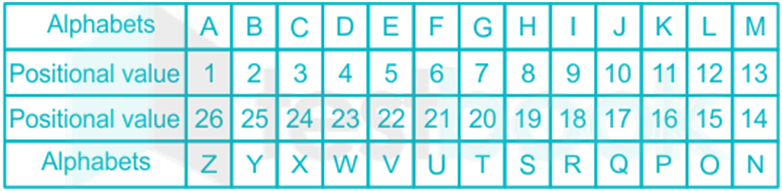
  1. ((a))

    1

  2. ((b))

    2

  3. ((c))

    3

  4. ((d))

    4

Show Answer
Answer: ((c))

3

Given Series : (Left) F W N V N F A S A C P A H H W X J J Z (Right)

Required Condition: Consonant — Vowel — Consonant

(Left) F W N V N F A S A C P A H H W X J J Z (Right)

F A S  S A C P A H

Hence, the correct answer is "option 3"

2

Seven boxes, F, I, L, T, E, R and S, are kept one over the other but not necessarily in the same order. Only S is kept above I. Only F is kept between I and E. Only L is kept below T.

How many boxes are kept between R and L?

  1. ((a))

    One

  2. ((b))

    Four

  3. ((c))

    Three

  4. ((d))

    Two

Show Answer
Answer: ((a))

One

Given: Seven boxes, F, I, L, T, E, R and S, are kept one over the other but not necessarily in the same order.

  1. Only S is kept above I.
  2. Only F is kept between I and E.
  3. Only L is kept below T.

Final Arrangement:

7S
6I
5F
4E
3R
2T
1L
  • The boxes between R  and L  is T .
  • Thus, only one box is kept between R and L.

Hence, the correct answer is "Option 1".

3

Select the option figure in which the given figure (X) is embedded as its part (rotation is NOT allowed).

  1. ((a))

  2. ((b))

  3. ((c))

  4. ((d))

Show Answer
Answer: ((b))

The logic followed here is,

Hence, the correct answer is "Option 2"

4

Faisal ranked 22nd from the top and 20th from the bottom in his class. How many students are there in his class?

  1. ((a))

    40

  2. ((b))

    39

  3. ((c))

    38

  4. ((d))

    41

Show Answer
Answer: ((b))

39

The logic followed here is:

  • Position of Faisal from the top = 20th
  • Position of Faisal from the bottom = 20th

Total number of students in the class = (Position of Faisal from the top + Position of Faisal from the bottom) − 1

= 20 + 20 − 1

= 39

Hence, the correct answer is 'Option 2'.

5

In a row of people all facing north, Piyush is 11th from the right end. Krishna is 20th from the right end. Krishna is exactly between Piyush and Jackie. If Jackie is 4th from the left end of the line, how many people are there in the row?

  1. ((a))

    30

  2. ((b))

    33

  3. ((c))

    31

  4. ((d))

    32

Show Answer
Answer: ((d))

32

The logic followed here is:

  • Position of Piyush from the right end = 11th
  • Position of Krishna from the right end = 20th
  • Number of person between Piyush and Krishna = 20 − 11 = 9
  • Krishna is exactly between Piyush and Jackie, number of person between Krishna and Jackie must also be 9 units.
  • Position of Jackie from the right end = Position of Krishna from the right + 9
  • 20 + 9
  • 29th from the right end.
  • Total number of people in the row = (Position of Jackie from the right end + Position of Jackie from the left end) − 1
  • 29 + 4 − 1
  • 32

Hence, the correct answer is "Option 4**"**.

6

If ‘A’ stands for ‘÷’, ‘B’ stands for ‘x’, ‘C’ stands for ‘+’ and ‘D’ stands for ‘-’, what will come in place of question mark ‘?’ in the following equation?

15 B 3 D 6 A 3 C 7 = ?

  1. ((a))

    50

  2. ((b))

    60

  3. ((c))

    55

  4. ((d))

    45

Show Answer
Answer: ((a))

50

BODMAS Rule:

Given equation: 16 ÷ 4 + 8 - 3 × 2 = 31

LetterABCD
Operator÷×+


After replacing the letters with their respective operators and applying BODMAS rule, the expression becomes:

=15 × 3 − 6 ÷ 3 + 7

= 15 × 3 − 2 + 7

= 45 − 2 + 7

= 45 + 7 − 2

= 52 − 2

= 50

The final value of the expression is 50.

Hence, the correct answer is "option 1"

7

Select the correct mirror image of the given combination when the mirror is placed at PQ as shown below.

  1. ((a))

  2. ((b))

  3. ((c))

  4. ((d))

Show Answer
Answer: ((d))

The correct mirror image of the given combination when the mirror is placed at PQ as shown below.

Hence, the correctv answer is "Option 4"

8

Based on the English alphabetical order, three of the following four are alike in a certain way and thus form a group. Which is the one that does not belong to that group?

(Note: The odd one out is not based on the number of consonants/vowels or their position in the letter cluster)

  1. ((a))

    EGJ

  2. ((b))

    LNQ

  3. ((c))

    QST

  4. ((d))

    TVY

Show Answer
Answer: ((c))

QST

The logic followed here is:

626a871a13e02eef2fcd3cd5 16564998081491

Option 1) EGJ

Option 2) LNQ

Option 3) QST

Option 4) TVY

Therefore, the letter cluster that is different from the others is QST.

Hence, the correct answer is 'Option 3'.

9

Based on the English alphabetical order, three of the following four letter-cluster pairs are alike in a certain way and thus form a group. Which is the one that does not belong to that group?

(Note: The odd one out is not based on the number of consonants/vowels or their position in the letter-cluster.)

  1. ((a))

    RK - LE

  2. ((b))

    UN - OH

  3. ((c))

    OH - IB

  4. ((d))

    QJ - LP

Show Answer
Answer: ((d))

QJ - LP

The logic followed here is:

626a871a13e02eef2fcd3cd5 16564998081491

Logic: Second letter-cluster = First letter-cluster letters − 6 (positional values).

Option 1)  RK - LE,

Option 2) UN - OH,

Option 3) OH - IB,

Option 4) QJ - LP

This pair does not follow the rule.

Therefore, the letter-cluster pair that is different from the others is QJ - LP.

Hence, the correct answer is 'Option 4'.

10

What should come in place of ‘?’ in the given series?

4 ? 32 95 284 851

  1. ((a))

    8

  2. ((b))

    19

  3. ((c))

    24

  4. ((d))

    11

Show Answer
Answer: ((d))

11

The logic follows here,

Pattern:

  • 4 × 3 − 1 = 11
  • 11 × 3 − 1 = 32
  • 32 × 3 − 1 = 95
  • 95 × 3 − 1 = 284
  • 284 × 3 − 1 = 851


The missing term is 11

Hence, the correct answer is "Option 4"

11

Below are given two sets of numbers. In each set of numbers, a certain mathematical operation on the first number results in the second number. Similarly, certain mathematical operation on the second number results in the third number and so on. Which of the given options follows the same set of operations as in the question?

(NOTE – A two/three-digit number cannot be broken into individual digits for operations e.g. if 37 is followed by 10, the operation cannot be 3+7 as a two-digit number cannot be broken into individual digits)

21 - 29 - 232 - 225

18 - 26 - 208 - 201

  1. ((a))

    17 - 25 - 250 - 244

  2. ((b))

    46 - 53 - 371 - 364

  3. ((c))

    39 - 47 - 376 - 369

  4. ((d))

    26 - 35 - 280 - 274

Show Answer
Answer: ((c))

39 - 47 - 376 - 369

The logic followed here is:

Logic: (First Number + 8) = Second Number; (Second Number × 8) = Third Number; (Third Number − 7) = Fourth Number

For the first set 21 − 29 − 232 − 225

⇒ 21 + 8 = 29

⇒ 29 × 8 = 232

⇒ 232 − 7 = 225

For the second set 18 − 26 − 208 − 201

⇒ 18 + 8 = 26

⇒ 26 × 8 = 208

⇒ 208 − 7 = 201

Applying the same logic to Option 3 (39 − 47 − 376 − 369)

⇒ 39 + 8 = 47

⇒ 47 × 8 = 376

⇒ 376 − 7 = 369

Hence, the correct answer is 'Option 3'.

12

Refer to the following letter, symbol series and answer the question. Counting to be done from left to right only.

(Left) £ B % K H & @ & J © J € O X N N J @ & P O (Right)

How many such letters are there each of which is immediately preceded by a letter and also immediately followed by a symbol?

  1. ((a))

    4

  2. ((b))

    1

  3. ((c))

    3

  4. ((d))

    2

Show Answer
Answer: ((d))

2

Given Series:  (Left) £ B % K H & @ & J © J € O X N N J @ & P O (Right)

Required pattern: Letter → Letter → Symbol

(Left)   £ B % K H & @ & J © J € O X N N J @ & P O    (Right)


There is only 2 such letter in the series.

Hence, the correct answer is "option 4"

13

This question is based on the five, three-digit numbers given below.

(Left) 287 846 241 726 468 (Right)

(Example: 697 – First digit = 6, second digit = 9 and third digit = 7)

(NOTE : All operations to be done from left to right.)

<br>

What will be the resultant if the second digit of the second-highest number is multiplied by the second digit of the third-lowest number?

  1. ((a))

    21

  2. ((b))

    12

  3. ((c))

    22

  4. ((d))

    10

Show Answer
Answer: ((b))

12

Given: (left) 287 846 241 726 468 (right)

  • The second digit of the second-highest number is: 2 (726)
  • The second digit of the third-lowest number is: 6 (468)
  • So, the multiplication of the second digit of the second-highest number and the second digit of the third-lowest number is: 2 × 6 = 12.

Hence, the correct answer is 'Option 2'.

14

In a certain code language, ‘HARM’ is coded as ‘4871’ and ‘RAMP’ is coded as ‘8137’. What is the code for ‘P’ in the given code language?

  1. ((a))

    3

  2. ((b))

    1

  3. ((c))

    4

  4. ((d))

    8

Show Answer
Answer: ((a))

3

The logic follows here ,

Therefore, the code for P is 3.

Hence ,the correct answer is "option 1"

15

Each vowel in the word AWAITING is changed to the letter immediately following it in the English alphabetical order and each consonant is changed to the letter immediately preceding it in the English alphabetical order. How many letters will appear exactly twice in the new group of letters thus formed?

  1. ((a))

    Three

  2. ((b))

    Two

  3. ((c))

    Four

  4. ((d))

    One

Show Answer
Answer: ((b))

Two

Logic followed here is:

For the word AWAITING:

LetterAWAITING
TypeVowelConsonantVowelVowelConsonantVowelConsonantConsonant
Change+ 1− 1+ 1+ 1− 1+ 1− 1− 1
New LetterBVBJSJMF


  • The new group of letters formed is: B, V, B, J, S, J, M, F
  • There are Two such letters that appear exactly twice are B and J.

Hence, the correct answer is "option 2"

16

S is the brother of A. A is the father of Y. B is the father of W. W is the son of Y. How is S related to W?

  1. ((a))

    Mother's father's father

  2. ((b))

    Mother's father's brother

  3. ((c))

    Mother's father

  4. ((d))

    Mother's brother

Show Answer
Answer: ((b))

Mother's father's brother

S is the brother of A.

A is the father of Y.

B is the father of W.

W is the son of Y

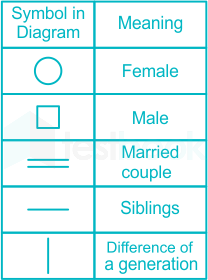
The Family tree Diagram,

From the family tree, it is clear that Y is the mother of W, A is the father of Y, and S is the brother of A. Therefore, S is the Mother's father's brother of W.

Hence, the correct answer is "Option 2".

17

HIKH is related to LMOL in a certain way based on the English alphabetical order. In the same way, DEGD is related to HIKH. To which of the following is ABDA related, following the same logic?

  1. ((a))

    EFHE

  2. ((b))

    EEGE

  3. ((c))

    EFGE

  4. ((d))

    EGGO

Show Answer
Answer: ((a))

EFHE

The logic followed in this pattern is a consistent alphabetical shift for each letter in the sequence.

For 'HIKH' related to 'LMOL':

For 'DEGD' related to 'HIKH':

Applying the same logic to 'ABDA':

Thus, ABDA is related to EFHE.

Hence, the correct answer is 'Option 1'.

18

Which of the following letter-number clusters will replace the question mark (?) in the given series to make it logically complete?

GHJ51 , JKM67 , MNP83 , PQS99 , ?

  1. ((a))

    KTV115

  2. ((b))

    STV115

  3. ((c))

    STU115

  4. ((d))

    SIV115

Show Answer
Answer: ((b))

STV115

The logic followed here is:

626a871a13e02eef2fcd3cd5 16564998081491

By combining the letters and the number, the cluster that replaces the question mark is STV115.

Hence,the correct answer is "option 2"

19

Each of the digits in the number 46812597 is arranged in ascending order from left to right. What will be the sum of the digits which are third from the left and fourth from the right in the number thus formed?

  1. ((a))

    11

  2. ((b))

    12

  3. ((c))

    13

  4. ((d))

    10

Show Answer
Answer: ((d))

10

Given number: 46812597

Arranged in ascending order from left to right, the number thus formed is:

Left 1  2  4  5  6  7  8  9 Right 

  • Third digit from the left of the new number is: 4
  • Fourth digit from the right of the new number is: 6
  • So, the sum of the digit which is third from the left and the digit which is fourth from the right is: 4 + 6 = 10.

Hence .the correct answer is  'Option 4'.

20

Seven people, R, O, A, M, I, N and G, are sitting in a row, facing north. Only two people sit to the left of N. Only three people sit between N and A. Only one person sits between A and R. O sits to the immediate left of I. G is not an immediate neighbor of A. How many people sit to the right of M?

  1. ((a))

    Two

  2. ((b))

    Three

  3. ((c))

    Four

  4. ((d))

    One

Show Answer
Answer: ((d))

One

Given: Seven people, R, O, A, M, I, N and G, are sitting in a row, facing north.

  1. Only two people sit to the left of N.
  2. Only three people sit between N and A.
  3. Only one person sits between A and R.
  4. O sits to the immediate left of I.
  5. G is not an immediate neighbor of A.

The Final Arrangement is,

Therefore, one person sits to the right of M.

Hence, the correct answer is "Option 4"

General Awareness (20 questions)

21

Which of the following CORRECTLY illustrates the long-term constitutional consequence of the Kesavananda Bharati judgment in the context of parliamentary attempts at asserting supremacy?

  1. ((a))

    The constitutional review exercise post-1980 successfully removed all restrictions on amending fundamental rights

  2. ((b))

    The 42nd Amendment annulled the basic structure doctrine, making Parliament sovereign in all constitutional matters.

  3. ((c))

    Despite the 42nd Amendment, the Supreme Court in Minerva Mills reaffirmed the basic structure doctrine, limiting constitutional amendments.

  4. ((d))

    The Minerva Mills judgment overturned Kesavananda and declared the Preamble non justiciable.

Show Answer
Answer: ((c))

Despite the 42nd Amendment, the Supreme Court in Minerva Mills reaffirmed the basic structure doctrine, limiting constitutional amendments.

The correct answer is Despite the 42nd Amendment, the Supreme Court in Minerva Mills reaffirmed the basic structure doctrine, limiting constitutional amendments..

Key Points

  • The Kesavananda Bharati v. State of Kerala (1973) judgment established the Basic Structure Doctrine, asserting that while Parliament has wide powers to amend the Constitution under Article 368, it cannot alter its 'basic structure' or essential features.
  • The 42nd Amendment Act, 1976, was a direct attempt by Parliament to assert supremacy by inserting clauses (4) and (5) into Article 368, which declared that there shall be no limitation on the constituent power of Parliament and barred Judicial Review of such amendments.
  • In the Minerva Mills v. Union of India (1980) case, the Supreme Court struck down these specific clauses, ruling that Parliament’s power to amend is a 'limited power' and it cannot use that limited power to grant itself 'unlimited power' to destroy the Constitution.
  • The long-term consequence was the restoration of the balance of power, ensuring that the Basic Structure Doctrine remains a permanent check on legislative overreach and safeguarding the supremacy of the Constitution over Parliament.

 Additional Information

  • Article 368:
  • This article outlines the procedure for amending the Constitution of India. Post-1980, it is interpreted as granting a power that is restricted by the judicial oversight of the 'basic features'.
  • Constitutional Supremacy vs. Parliamentary Sovereignty:
  • Unlike the British system of Parliamentary Sovereignty, India follows Constitutional Supremacy, where the judiciary acts as the guardian of the document.
  • Waman Rao v. Union of India (1981):
  • This case further clarified the application of the doctrine, establishing a 'cut-off' date of April 24, 1973 (the date of the Kesavananda judgment), for testing the validity of laws placed in the Ninth Schedule.
22

The Governor of a State shall be appointed by the ___________ by warrant under his hand and seal.

  1. ((a))

    Prime Minister of India

  2. ((b))

    Chief Justice of India

  3. ((c))

    Respective State's Chief Minister

  4. ((d))

    President of India

Show Answer
Answer: ((d))

President of India

The correct answer is President of India.

Key Points

  • According to Article 155 of the Constitution of India, the Governor of a State is appointed by the President of India by warrant under his hand and seal. This means the appointment is made directly by the Executive Head of the Union.
  • The Governor serves as the Constitutional Head of the State and acts as a vital bridge between the Central Government and the State Government, ensuring the state administration follows constitutional norms.
  • Although the Governor is the executive head, the Supreme Court ruled in 1979 that the office of the Governor is an independent constitutional office and is not subordinate to or under the control of the Central Government.
  • The Governor exercise powers based on the aid and advice of the State Council of Ministers headed by the Chief Minister, except in specific situations where they exercise discretionary powers.
  • India adopted the Canadian model of appointing Governors through the Centre, rather than the American model of direct elections, to maintain national unity and avoid potential conflicts between a popularly elected Governor and the Chief Minister.

 Additional Information

  • Constitutional Framework:
  • Article 153: Mandates a Governor for each state. The 7th Constitutional Amendment Act of 1956 allows one person to be the Governor of two or more states simultaneously.
  • Article 156: Specifies that the Governor holds office during the pleasure of the President. The usual term is five years, but they can be removed or resign earlier.
  • Article 157 and 158: Define qualifications, including being a citizen of India and at least 35 years of age. They must not be members of any Legislature or hold an office of profit.
  • Article 159: Clarifies that the Oath of Office is administered by the Chief Justice of the High Court of the respective state, not by the President.
  • Other Entities:
  • Prime Minister of India: Heads the Union Council of Ministers which advises the President on the appointment but does not hold the formal power of appointment.
  • Chief Justice of India: Heads the Judiciary; while they administer the oath to the President, they have no constitutional role in the Governor's appointment.
  • Chief Minister: The head of the elected state government who is himself appointed by the Governor under Article 164.
23

Which nation served as the host for COP30 Climate Summit in 2025?

  1. ((a))

    Germany

  2. ((b))

    India

  3. ((c))

    Brazil

  4. ((d))

    Canada

Show Answer
Answer: ((c))

Brazil

The correct answer is Brazil.

Key Points

  • The 30th Conference of the Parties (COP30) to the United Nations Framework Convention on Climate Change (UNFCCC) is scheduled to be held in November 2025.
  • The city of Belém, which is the capital of the state of Pará in Brazil, has been officially designated as the host city. This marks a symbolic choice as Belém is located at the mouth of the Amazon River, placing the preservation of the Amazon Rainforest at the heart of the summit.
  • The proposal for Brazil to host the summit was led by President Luiz Inácio Lula da Silva, who emphasized the importance of discussing climate solutions while physically present in the biome most critical to the world's biodiversity and carbon cycle.
  • The COP30 summit is considered a critical milestone for the Paris Agreement, as countries are expected to present their updated and more ambitious Nationally Determined Contributions (NDCs) for 2035 to meet the global goal of limiting temperature rise to 1.5 degrees Celsius.

 Additional Information

  • Germany:
  • Germany hosted COP23 in 2017 in the city of Bonn. Bonn is significant because it houses the UNFCCC Secretariat and serves as a recurring venue for technical climate negotiations.
  • India:
  • India hosted COP8 in New Delhi in 2002, which resulted in the Delhi Ministerial Declaration. Recently, at COP28, India proposed hosting COP33 in 2028.
  • Canada:
  • Canada was the host for COP11 in 2005, held in Montreal. This summit was particularly important as it included the first meeting of the parties to the Kyoto Protocol.
24

The Great Indian Plains were primarily formed by which geological process?

  1. ((a))

    Glacial erosion

  2. ((b))

    Volcanic eruption

  3. ((c))

    Sediment deposition

  4. ((d))

    Tectonic uplift

Show Answer
Answer: ((c))

Sediment deposition

The correct answer is Sediment deposition.

Key Points

  • The Great Indian Plains, also known as the Indo-Gangetic-Brahmaputra Plains, were formed due to the filling of a deep geosyncline or depression that was created during the upliftment of the Himalayas.
  • This vast depression was located between the rising Himalayan mountains to the north and the stable Peninsular Plateau to the south.
  • The primary geological process involved was the continuous sediment deposition by the three major river systems—the Indus, the Ganga, and the Brahmaputra—and their numerous tributaries.
  • Over millions of years, these perennial rivers transported massive quantities of alluvium (silt, sand, and clay) from the mountains and deposited them in the basin, gradually transforming it into a level and fertile land.
  • The thickness of these alluvial deposits varies across the region, reaching depths of 1,000 to 2,000 meters in some parts, making it one of the world's largest and most fertile alluvial tracts.

 Additional Information

  • Glacial Erosion
  • This process involves the wearing away of the Earth's surface by moving ice. While it shaped the U-shaped valleys and peaks of the high Himalayas, it did not contribute to the creation of the massive southern plains.
  • Volcanic Eruption
  • This geological process is associated with the formation of the Deccan Plateau in Southern India, where fissure-based eruptions created the Deccan Traps composed of basaltic rocks, rather than the sedimentary northern plains.
  • Tectonic Uplift
  • This refers to the rising of the Earth's crust due to plate movements. It was the fundamental process behind the birth of the Himalayan Mountain Range through the collision of the Indian Plate and the Eurasian Plate.
  • Geographical Extent
  • The plains span approximately 2,400 kilometers in length and cover an area of nearly 7 lakh square kilometers, supporting a high population density due to water availability and rich soil.
25

Article 359A of the Indian constitution is related to which of the following states?

  1. ((a))

    Meghalaya

  2. ((b))

    Punjab

  3. ((c))

    Jammu & Kashmir

  4. ((d))

    Assam

Show Answer
Answer: ((b))

Punjab

The correct answer is Punjab.

Key Points

  • Article 359A was a special, temporary provision inserted into the Indian Constitution specifically to deal with the extraordinary situation of militancy in the state of Punjab.
  • The article was introduced via the 59th Amendment Act, 1988, which authorized the President of India to proclaim a National Emergency in Punjab on the grounds of internal disturbance.
  • A critical and controversial feature of Article 359A was that it permitted the suspension of the Right to Life and Personal Liberty (Article 21) within the territory of Punjab during an emergency.
  • This provision deviated from the 44th Amendment Act, 1978, which had previously ensured that Article 20 and Article 21 could never be suspended, even during a National Emergency.

 Additional Information

  • The 63rd Amendment Act, 1989:
  • Following significant legal and political opposition, the 63rd Amendment Act was enacted in 1989 to repeal Article 359A.
  • This amendment restored the Constitution to the state it was in prior to the 59th Amendment, ensuring that Article 21 remains non-suspendable across all states.
  • Constitutional Context of Other States:
  • Jammu & Kashmir: Was historically governed by the special provisions of Article 370 and Article 35A, but never Article 359A.
  • Assam and Meghalaya: Are primarily associated with the Sixth Schedule of the Constitution, which provides for Autonomous District Councils to protect tribal interests.
  • Emergency Provisions:
  • The general Article 359 empowers the President to suspend the enforcement of Fundamental Rights during a National Emergency declared under Article 352.
  • The 59th Amendment was unique because it reintroduced the ground of internal disturbance specifically for Punjab, a term that had been replaced by armed rebellion for the rest of the country.
26

Which AI tool was launched in November 2025 by Indian researchers to analyze cancer?

  1. ((a))

    MedAI

  2. ((b))

    GeneTrack

  3. ((c))

    OncoMark

  4. ((d))

    BioScan

Show Answer
Answer: ((c))

OncoMark

The correct answer is OncoMark.

Key Points

  • The artificial intelligence tool OncoMark was officially launched in November 2025 by a dedicated team of Indian researchers specializing in computational oncology and bioinformatics.
  • This sophisticated AI-driven platform was primarily developed by scientists at the Satyendra Nath Bose National Centre for Basic Sciences (SNBNCBS) in Kolkata to address the critical need for rapid and affordable cancer screening and prognostic analysis.
  • The tool utilizes advanced machine learning algorithms to analyze complex biological data, including histopathological images and genomic sequences, to detect malignancy with high precision.
  • It is designed to identify specific biomarkers that indicate the stage and aggressiveness of various cancers, significantly reducing the turnaround time for diagnostic reports from days to just a few minutes.
  • By leveraging deep learning models trained on diverse Indian patient datasets, OncoMark aims to provide personalized treatment recommendations and predict the likelihood of cancer recurrence.

 Additional Information

  • The Satyendra Nath Bose National Centre for Basic Sciences (SNBNCBS) is an autonomous research institute under the Department of Science and Technology (DST), Government of India.
  • Core Objectives: It focuses on fundamental research in mathematical sciences, chemical sciences, and biological physics.
  • Technological Impact: The development of OncoMark represents a major milestone in integrating quantum computing principles and artificial intelligence into the healthcare sector under the Digital India initiative.
  • Healthcare Significance: The tool is expected to be integrated into the Ayushman Bharat digital mission to enhance early detection at primary health centers across rural India.
  • Other concepts relevant to cancer AI in India:
  • Precision Medicine: AI tools help in tailoring medical treatment to the individual characteristics of each patient.
  • Biomarker Discovery: Identifying protein signatures or genetic mutations that serve as early warning signs of cellular abnormalities.
27

Which monument, built by Shah Jahan in memory of his wife Mumtaz Mahal, is a UNESCO World Heritage Site?

  1. ((a))

    Red Fort

  2. ((b))

    Taj Mahal

  3. ((c))

    Qutub Minar

  4. ((d))

    Humayun's Tomb

Show Answer
Answer: ((b))

Taj Mahal

The correct answer is Taj Mahal.

Key Points

  • The Taj Mahal was commissioned by the Mughal Emperor Shah Jahan in 1632 to house the tomb of his beloved wife, Mumtaz Mahal (Arjumand Banu Begum).
  • Located on the southern bank of the Yamuna River in Agra, Uttar Pradesh, it is widely recognized as the pinnacle of Mughal architecture, blending Persian, Islamic, and Indian styles.
  • It was designated as a UNESCO World Heritage Site in 1983 and is cited as 'the jewel of Muslim art in India' and a universally admired masterpiece.
  • The project employed roughly 20,000 artisans and was led by a board of architects, with Ustad Ahmad Lahauri generally credited as the principal designer.
  • The main mausoleum was completed in 1648, utilizing white marble inlaid with semi-precious stones (pietra dura), while the entire complex was finished around 1653.

 Additional Information

  • Red Fort:
  • Constructed by Shah Jahan in 1638 when he moved the capital from Agra to Shahjahanabad (Delhi).
  • It is a UNESCO World Heritage Site characterized by its massive enclosing walls of red sandstone.
  • Qutub Minar:
  • A 73-meter tall tapering tower built in Delhi, started by Qutb-ud-din Aibak in 1192 and completed by his successors Iltutmish and Firoz Shah Tughlaq.
  • It is the tallest brick minaret in the world and part of the Qutb Complex, a UNESCO World Heritage Site.
  • Humayun's Tomb:
  • Built in 1570, it was commissioned by Empress Bega Begum for her husband, Emperor Humayun.
  • It was the first garden-tomb on the Indian subcontinent and served as an architectural inspiration for the Taj Mahal.
28

What was the initial aim of the Indian National Congress when it was founded in 1885?

  1. ((a))

    Religious unity

  2. ((b))

    Full independence

  3. ((c))

    Armed rebellion

  4. ((d))

    Limited reforms

Show Answer
Answer: ((b))

Full independence

The correct answer is Full independence.

Key Points

  • The Indian National Congress (INC) was established in December 1885 at Gokuldas Tejpal Sanskrit College in Bombay, under the foundational leadership of A. O. Hume, Dinshaw Wacha, and Dadabhai Naoroji.
  • From its foundational roots, the ultimate and definitive driving ambition of the organization was to initiate a unified political movement aimed at achieving Full independence for India from colonial rule.
  • Although early strategies involved moderate petitions, the long-term vision of organizing diverse regional factions under one national platform was designed to foster the collective consciousness necessary to demand complete sovereignty.

 Additional Information

  • Limited reforms:
  • This term refers to the early administrative and constitutional demands raised by the Moderate faction of the Congress, serving as initial tactical steps toward eventual self-rule.
  • Armed rebellion:
  • This method of active militant resistance was pursued by revolutionary nationalist groups, distinct from the constitutional and peaceful political avenues prioritized by the early Congress.
  • Religious unity:
  • While the Congress maintained a secular outlook to bring all Indian communities together, its primary mission was political liberation and national sovereignty.
29

The missile tested by DRDO & Indian Navy on 27th February, 2025, from Chandipur was:

  1. ((a))

    NASM-SR naval anti-ship missile

  2. ((b))

    BrahMos II

  3. ((c))

    Pralay tactical missile

  4. ((d))

    Agni-P

Show Answer
Answer: ((a))

NASM-SR naval anti-ship missile

The correct answer is NASM-SR naval anti-ship missile.

Key Points

  • On February 27, 2025, the Defence Research and Development Organisation (DRDO) and the Indian Navy successfully carried out a flight test of the indigenous Naval Anti-Ship Missile-Short Range (NASM-SR).
  • The flight trial was conducted from the Integrated Test Range (ITR), Chandipur, off the coast of Odisha, validating the missile's advanced flight control and guidance systems.
  • The mission achieved all objectives, confirming the performance of the imaging infrared (IIR) seeker, which allows the missile to identify and strike maritime targets with extreme precision.
  • This test represents a significant step towards achieving Aatmanirbharta (self-reliance) in naval warfare technology, as it is the first indigenously developed air-launched anti-ship missile system for the Indian Navy.

 Additional Information

  • NASM-SR Characteristics:
  • It is designed to be launched from naval helicopters such as the MH-60R and the Sea King.
  • The missile has an operational range of approximately 55 kilometers and travels at high subsonic speeds.
  • It utilizes a solid propellant rocket motor and is equipped with state-of-the-art avionics and Indigenous Navigation Systems.
  • BrahMos II:
  • A hypersonic cruise missile currently under joint development by India and Russia, expected to reach speeds of Mach 7 to 8.
  • Pralay tactical missile:
  • A surface-to-surface short-range ballistic missile (SRBM) developed by DRDO for battlefield use, with a range of 150 to 500 km.
  • Agni-P (Agni-Prime):
  • A two-stage canisterized solid propellant ballistic missile with a range of 1,000 to 2,000 km, designed for high mobility and rapid deployment.
30

What does BPO commonly refer to?

  1. ((a))

    Business Process Outsourcing

  2. ((b))

    Banking Process Order

  3. ((c))

    Basic Product Outsourcing

  4. ((d))

    Business Private Operations

Show Answer
Answer: ((a))

Business Process Outsourcing

The correct answer is Business Process Outsourcing.

Key Points

  • Business Process Outsourcing (BPO) is a strategic management practice where an organization contracts specific business processes or operations to an external third-party service provider.
  • The primary objective of BPO is to achieve cost reduction, improve operational efficiency, and allow the core management to focus on primary business strategies rather than routine administrative tasks.
  • BPO is broadly categorized into two types: Back-office outsourcing, which involves internal functions like finance, accounting, and human resources, and Front-office outsourcing, which includes customer-facing services like technical support and telemarketing.
  • The industry relies heavily on Information Technology (IT) infrastructure, which is why it is often referred to as Information Technology Enabled Services (ITES).
  • BPO services can be offshore (contracted to a company in a different country), nearshore (contracted to a neighboring country), or onshore (contracted within the same country).

 Additional Information

  • Knowledge Process Outsourcing (KPO):
  • A higher-end subset of BPO involving the outsourcing of core information-related activities that require specialized domain expertise.
  • Common examples include legal research, intellectual property services, market research, and data analytics.
  • India as a BPO Hub:
  • India is a global leader in the BPO sector due to its vast pool of English-speaking graduates and competitive labor costs.
  • Major IT-BPO hubs include Bengaluru, Pune, Gurugram, and Hyderabad, contributing significantly to India's GDP and foreign exchange earnings.
  • Benefits of BPO:
  • Scalability: Companies can quickly scale their operations up or down based on market demand without heavy capital investment.
  • Specialization: Outsourcing to experts ensures that specific tasks are handled with higher precision and advanced technology that the parent company might not possess.
31

Which of the following best describes the EOS-05 mission by ISRO?

  1. ((a))

    An Earth observation satellite for environmental monitoring.

  2. ((b))

    A deep space exploration mission targeting Mars.

  3. ((c))

    A communication satellite for global connectivity.

  4. ((d))

    A satellite designed for space docking experiments.

Show Answer
Answer: ((a))

An Earth observation satellite for environmental monitoring.

The correct answer is An Earth observation satellite for environmental monitoring.

Key Points

  • EOS-05, also known as GISAT-2 (Geo-Imaging Satellite-2), is an advanced Earth Observation Satellite developed by the Indian Space Research Organisation (ISRO) to provide near real-time imaging of the Indian subcontinent.
  • The satellite is designed to be placed in a Geostationary Orbit (GEO), allowing it to maintain a fixed position relative to the Earth and provide continuous surveillance of specific geographical regions.
  • The primary objective of this mission is to facilitate environmental monitoring, including the tracking of natural disasters like floods and cyclones, monitoring of agriculture health, and assessment of forest cover changes.
  • It utilizes high-resolution cameras and sensors to capture data across various spectral bands, which is critical for disaster management, oceanography, and climatology research.

 Additional Information

  • EOS Naming Convention:
  • In 2020, ISRO shifted to a generic naming system for its remote sensing satellites, moving away from thematic names like RISAT, CARTOSAT, and RESOURCESAT to the EOS (Earth Observation Satellite) series.
  • EOS-01 was the first in this series, launched in November 2020 for applications in agriculture, forestry, and disaster management support.
  • EOS-03 (GISAT-1) was intended for similar purposes but faced a mission failure during launch in August 2021 due to a cryogenic stage anomaly.
  • Mission Capabilities:
  • Unlike satellites in Low Earth Orbit (LEO) that pass over a location periodically, EOS-05 provides high-frequency imaging, making it indispensable for rapid response during emergencies.
  • It aids in mineralogy, spectral signatures analysis, and monitoring dynamic land-use changes across the Indian mainland.
32

Which of the following is NOT a key area of urban development under the Atal Mission for Rejuvenation and Urban Transformation (AMRUT)?

  1. ((a))

    Non-Motorised Urban Transport

  2. ((b))

    Promotion of transshipment hubs

  3. ((c))

    Sewerage and septage management

  4. ((d))

    Green spaces and parks

Show Answer
Answer: ((b))

Promotion of transshipment hubs

The correct answer is Promotion of transshipment hubs.

Key Points

  • The Atal Mission for Rejuvenation and Urban Transformation (AMRUT) was launched by the Ministry of Housing and Urban Affairs (MoHUA) in June 2015 to improve the quality of life in 500 selected cities.
  • The mission is designed to ensure that every household has access to a tap with an assured supply of water and a sewerage connection.
  • The project focuses on five thrust areas: Water Supply, Sewerage and Septage Management, Storm Water Drainage, Non-Motorised Urban Transport, and the creation of Green Spaces and Parks.
  • Promotion of transshipment hubs is not a component of AMRUT; instead, it is a strategic priority for the maritime and logistics sectors, primarily under initiatives like the Sagarmala Programme or the National Logistics Policy to enhance port-led development.

 Additional Information

  • Non-Motorised Urban Transport:
  • Includes construction of footpaths, pedestrian crossings, and cycling tracks.
  • Aims to reduce urban pollution and traffic congestion by promoting eco-friendly commuting.
  • Sewerage and Septage Management:
  • Focuses on the decentralization of sewage treatment plants (STPs) and mechanical cleaning of sewers.
  • Ensures efficient waste disposal to prevent the contamination of water bodies.
  • Green spaces and parks:
  • Mandates the development of open spaces specifically designed for children and senior citizens.
  • Helps in improving the micro-climate and increasing the aesthetic value of urban centers.
  • AMRUT 2.0:
  • Launched in October 2021, it targets making cities water secure and aims for 100% water supply coverage in all 4,700 statutory towns.
33

In April 2025, Klaus Schwab resigned as Chairman of the World Economic Forum after how many years of service in the Geneva-based institution?

  1. ((a))

    43

  2. ((b))

    59

  3. ((c))

    36

  4. ((d))

    55

Show Answer
Answer: ((d))

55

The correct answer is 55.

Key Points

  • Klaus Schwab, the founder and Executive Chairman of the World Economic Forum (WEF), announced his transition to a non-executive role in 2025, concluding a historic tenure of 55 years.
  • He founded the institution in January 1971, originally named the European Management Forum, and served as its leader for over five decades.
  • The tenure of 55 years spans from the organization's inception in 1971 to the formal leadership handover in April 2025, during which the forum evolved from a regional management meeting to a global powerhouse.
  • Under his stewardship, the Geneva-based institution became the primary global platform for public-private cooperation, famously hosting its annual summit in Davos, Switzerland.
  • Schwab is widely recognized for developing the Stakeholder Capitalism theory, which postulations that companies should be accountable to all stakeholders, including employees, customers, and the environment, rather than just shareholders.

 Additional Information

  • World Economic Forum (WEF):
  • Founding and Headquarters: Established in 1971 as a non-profit foundation, it is headquartered in Cologny, Geneva.
  • Evolution: It was renamed the World Economic Forum in 1987 to reflect its broader global mission and role in mediating international disputes.
  • Major Reports: The forum is responsible for publishing key global indices, including the Global Risks Report, the Global Gender Gap Report, and the Global Competitiveness Report.
  • Klaus Schwab's Contributions:
  • Academic Background: He holds doctorates in Economics and Engineering and served as a professor of business policy at the University of Geneva.
  • The Davos Manifesto: Authored in 1973, it set the ethical standards for modern corporate governance.
  • Fourth Industrial Revolution: Schwab popularized this term in 2016 to describe the current era of technological convergence between physical, digital, and biological spheres.
34

The 'Dumhal' dance is performed by which tribe in Jammu and Kashmir?

  1. ((a))

    Gujjar

  2. ((b))

    Bhil

  3. ((c))

    Wattal

  4. ((d))

    Bakarwal

Show Answer
Answer: ((c))

Wattal

The correct answer is Wattal.

Key Points

  • The Dumhal is a famous folk dance originating from the Kashmir Valley in the Union Territory of Jammu and Kashmir.
  • This traditional dance is exclusively performed by the men of the Wattal tribe, who have historically preserved this art form as part of their cultural heritage.
  • The performance is typically held on special occasions and at shrines (Ziarats) to offer prayers, celebrate harvest festivals, or seek divine intervention.
  • A central feature of the Dumhal dance involves a long banner that is ceremoniously dug into the ground; the dancers then form a circle and perform rhythmic movements around it.
  • The dancers wear striking costumes consisting of long, colorful robes and tall conical caps that are elaborately decorated with beads, shells, and small mirrors.

 Additional Information

  • Gujjars and Bakarwals:
  • These are the two largest nomadic tribes of Jammu and Kashmir.
  • The Gujjars are primarily cattle herders, while the Bakarwals are traditional nomadic pastoralists who migrate with their flocks of sheep and goats across the Himalayan ranges.
  • Bhil Tribe:
  • The Bhil is one of the most populous tribal groups in India, predominantly found in the central and western states such as Madhya Pradesh, Gujarat, and Rajasthan.
  • They are well-known for folk dances like Ghoomar and Gair, but they are not the practitioners of the Dumhal dance.
  • Musical Elements of Dumhal:
  • The dance is accompanied by the rhythmic beat of the Nagada (a drum) and traditional Kashmiri folk songs sung by the performers themselves.
  • The choreography is characterized by high energy, jumps, and synchronized clapping that accelerates as the music reaches its crescendo.
35

Which of the following is a key feature of the tertiary sector in advanced economies?

  1. ((a))

    Overproduction of manufactured goods for export

  2. ((b))

    Reliance on large-scale primary industries

  3. ((c))

    Growth of highly specialized and knowledge-based services

  4. ((d))

    Dominance of low-skilled labor

Show Answer
Answer: ((c))

Growth of highly specialized and knowledge-based services

The correct answer is Growth of highly specialized and knowledge-based services.

Key Points

  • In advanced economies, the tertiary sector undergoes a significant transformation from providing basic consumer services to complex knowledge-based services that require high levels of human capital.
  • This sector comprises the Quaternary and Quinary activities, which focus on information technology, Research and Development (R&D), financial services, and specialized consultancy.
  • The growth of this sector is driven by the Information Revolution, where data processing and technical expertise become the primary drivers of economic value rather than physical labor or manufacturing output.
  • Advanced nations like the United States, Germany, and Japan typically see the tertiary sector contributing over 70 percent of their total Gross Domestic Product (GDP).
  • This stage of economic development is often referred to as a Post-Industrial Economy, where the demand for high-end professional services like software engineering, legal advice, and biotechnology outweighs traditional services like retail or personal grooming.

 Additional Information

  • Primary and Secondary Sectors:
  • The Primary Sector involves raw material extraction such as agriculture and mining. In advanced economies, its share of employment is usually less than 5 percent due to extreme mechanization.
  • The Secondary Sector involves manufacturing and construction. While advanced economies still produce goods, they often experience Deindustrialization, shifting factory-based jobs to developing nations with lower labor costs.
  • Labor Characteristics:
  • Unlike developing economies that may rely on low-skilled labor in the service sector (e.g., street vending or basic domestic work), advanced economies prioritize White-Collar and Gold-Collar professionals who possess advanced degrees and technical certifications.
  • The Clark-Fisher Model describes this structural shift where labor moves from agriculture to manufacturing and eventually dominates the service sector as per capita income rises.
36

Who among the following led the anti-partition movement under the moderates?

  1. ((a))

    Bhagat Singh

  2. ((b))

    Surendranath Banerjee

  3. ((c))

    Jawaharlal Nehru

  4. ((d))

    Mahatma Gandhi

Show Answer
Answer: ((b))

Surendranath Banerjee

The correct answer is Surendranath Banerjee.

Key Points

  • The Anti-Partition Movement was launched in response to the decision of Lord Curzon to partition Bengal, which was officially announced in July 1905.
  • During the initial phase of the movement (1903−1905), the leadership was provided by Moderates like Surendranath Banerjee, Krishna Kumar Mitra, and Ananda Mohan Bose.
  • Surendranath Banerjee, a prominent leader of the Indian National Association, used his newspaper, The Bengalee, to mobilize public opinion and organize protests against the division.
  • The formal proclamation of the Swadeshi Movement was made on August 7, 1905, at a massive meeting held in the Calcutta Town Hall, where the Boycott Resolution was passed under the guidance of moderate leaders.
  • The Moderates relied on constitutional methods, including petitions to the government, public meetings, and propaganda through pamphlets and newspapers to pressure the British authorities to rescind the partition.

 Additional Information

  • Bhagat Singh
  • He was a prominent Revolutionary Socialist who founded the Naujawan Bharat Sabha in 1926.
  • He was a key member of the Hindustan Socialist Republican Association (HSRA) and was not active during the 1905 movement.
  • Mahatma Gandhi
  • In 1905, he was actively leading the struggle against racial discrimination in South Africa.
  • He returned to India in January 1915 and took command of the nationalist movement much later during the Non-Cooperation Movement.
  • Jawaharlal Nehru
  • He entered active Indian politics in the 1910s and rose to prominence during the late 1920s.
  • He presided over the historic Lahore Session of the Indian National Congress in 1929, where the resolution for Purna Swaraj (Complete Independence) was passed.
37

When did the ruler of Iran, Nadir Shah, sacked and plundered the city of Delhi and took away immense amounts of wealth?

  1. ((a))

    1839 AD

  2. ((b))

    1639 AD

  3. ((c))

    1739 AD

  4. ((d))

    1539 AD

Show Answer
Answer: ((c))

1739 AD

The correct answer is 1739 AD.

Key Points

  • Nadir Shah, the founder of the Afsharid dynasty of Persia (modern-day Iran), launched an invasion of the Mughal Empire during the winter of 1738−1739.
  • The invasion culminated in the Battle of Karnal on February 24, 1739, where Nadir Shah's smaller but technologically superior force defeated the massive army of the Mughal Emperor Muhammad Shah.
  • Nadir Shah entered Delhi in March 1739; following a local riot that resulted in the death of some Persian soldiers, he ordered the infamous Qatl-e-Aam (general massacre) of the city's inhabitants.
  • The city was systematically plundered for several weeks, resulting in the seizure of an enormous treasury that effectively drained the Mughal Empire of its centuries-old accumulated wealth.

 Additional Information

  • Impact of the Invasion:
  • The loot carried back to Iran was so massive that Nadir Shah halted taxation for his subjects for a period of three years.
  • The most famous items taken included the Peacock Throne (Takht-i-Taus) and the legendary Koh-i-Noor and Darya-i-Noor diamonds.
  • The invasion dealt a terminal blow to the Mughal Empire's prestige, leaving it vulnerable to subsequent invasions by Ahmad Shah Abdali and the expansion of the Maratha Empire.
  • Muhammad Shah, often called Rangeela for his leisure-loving nature, was forced to cede all territories west of the Indus River to the Persian ruler.
  • Military Superiority:
  • Nadir Shah utilized Zamburaks (swivel guns mounted on camels) and advanced musketry, which proved far more effective than the Mughals' traditional reliance on war elephants.
38

Which natural substance is used to produce litmus?

  1. ((a))

    Algae

  2. ((b))

    Bacteria

  3. ((c))

    Fungi

  4. ((d))

    Lichens

Show Answer
Answer: ((d))

Lichens

CONCEPT:

Litmus is a natural acid-base indicator used in chemistry to determine the acidity or alkalinity of a substance. It is a water-soluble mixture of different dyes that changes color depending on the pH level of the solution it is placed in.

EXPLANATION:

  • Litmus is extracted from Lichens, which are unique organisms arising from a symbiotic relationship between a fungus and an alga (or cyanobacterium).
  • The most common species of lichens used for extracting litmus include Roccella tinctoria, Lecanora tartarea, and Roccella fuciformis.
  • The extraction process typically involves crushing the lichens and fermenting them in the presence of ammonia, potassium carbonate, and lime, which results in the characteristic dye.
  • Functioning as an Indicator:
  • In acidic conditions (pH below 4.5), litmus paper or solution turns red.
  • In basic or alkaline conditions (pH above 8.3), litmus paper or solution turns blue.
  • In neutral conditions, litmus is generally purple in color.
  • While algae and fungi are components of lichens, it is the combined organism known as the Lichen that is specifically harvested and processed to produce litmus dye.

Therefore, the natural substance used to produce litmus is Lichens.

39

The last amino acid in a protein sequence is called the _______.

  1. ((a))

    N-terminal

  2. ((b))

    Beta-end

  3. ((c))

    C-terminal

  4. ((d))

    Omega group

Show Answer
Answer: ((c))

C-terminal

The correct answer is - C-terminal

Key Points

  • C-terminal
  • The C-terminal (also known as the carboxyl-terminus) is the end of an amino acid chain (protein or polypeptide) that is terminated by a free carboxyl group (-COOH).
  • In any protein sequence, the last amino acid added during the process of translation is the one that contains this free carboxyl group.
  • By chemical and biological convention, a polypeptide sequence is always written and read from the N-terminal (start) to the C-terminal (end).

Additional Information

  • N-terminal (Amino-terminal)
  • The N-terminal is the beginning of a polypeptide chain, characterized by a free amino group (-NH2).
  • The first amino acid of a protein corresponds to the N-terminal end.
  • Peptide Bond Formation
  • Proteins are formed when amino acids link together via peptide bonds.
  • This bond forms between the carboxyl group of one amino acid and the amino group of the next amino acid.
  • Because of this specific bonding pattern, the resulting chain always has one end with a free amino group and the other end with a free carboxyl group.
  • Protein Synthesis (Translation)
  • During translation in the ribosome, proteins are synthesized in the direction from the N-terminus to the C-terminus.
  • The primary structure of a protein is defined by this specific linear sequence of amino acids.
40

What was the expected outcome of the trade and investment policy reforms of 1991?

  1. ((a))

    Increased adoption of modern technologies

  2. ((b))

    Reduced efficiency of local industries

  3. ((c))

    Decreased foreign investment

  4. ((d))

    Increased trade barriers

Show Answer
Answer: ((a))

Increased adoption of modern technologies

The correct answer is Increased adoption of modern technologies.

Key Points

  • The Trade and Investment Policy Reforms were initiated in July 1991 as a core component of the New Economic Policy (NEP) to address the Balance of Payments crisis and stimulate economic growth.
  • A primary objective of these reforms was to facilitate the transfer of technology from developed nations to India by encouraging Foreign Direct Investment (FDI) and removing restrictions on foreign collaborations.
  • By relaxing import licensing and reducing customs duties, the government enabled domestic industries to import sophisticated capital goods and machinery, which were essential for upgrading production processes.
  • The reforms aimed to increase the international competitiveness of Indian goods, ensuring that local manufacturers could match global standards through the modernization of their infrastructure.
  • The liberalization of the investment regime was designed to shift the economy from a state-led model to a market-driven model, where technological innovation acts as a catalyst for industrial efficiency.

 Additional Information

  • Foreign Direct Investment (FDI):
  • Refers to investment made by a firm or individual in one country into business interests located in another country.
  • It serves as a major channel for technological spillover and enhances managerial expertise within the host nation.
  • Trade Barriers:
  • These include tariffs, quotas, and non-tariff barriers used to restrict imports.
  • The 1991 reforms focused on the dismantling of these barriers to integrate the Indian economy with the global market.
  • Industrial Efficiency:
  • The removal of the License Raj and the introduction of global competition forced local industries to improve their operational efficiency and cost-effectiveness.
  • This contradicts the notion of reduced efficiency, as exposure to global players typically drives innovation and productivity.
  • Economic Liberalization:
  • Involves the deregulation of government restrictions in the economy to allow for greater participation by private entities and foreign investors.

Arithmetical and Numerical Ability (20 questions)

41

A shopkeeper offers two successive discounts of 15% and 20% on an article marked at ₹4,000. What is the final selling price?

  1. ((a))

    ₹3,200

  2. ((b))

    ₹2,720

  3. ((c))

    ₹2,600

  4. ((d))

    ₹2,880

Show Answer
Answer: ((b))

₹2,720

Shortcut Trick

Equivalent discount = [d1 + d2 − (d1 × d2 / 100)]%

Net Discount = [15 + 20 − (15 × 20 / 100)]% = [35 − 3]% = 32%

Selling Price = (100 − 32)% of 4000 = 68% of 4000

SP = 0.68 × 4000 = 2720

∴ The correct answer is ₹2,720.

Alternate Method

Given:

Marked Price (MP) = ₹4,000

First Discount (d1) = 15%

Second Discount (d2) = 20%

Step 1: Calculate the price after the first 15% discount.

⇒ Discount 1 = 15% of 4000 = (15/100) × 4000 = 600

⇒ Price after first discount = 4000 − 600 = ₹3,400

Step 2: Calculate the final selling price after the second 20% discount.

⇒ Discount 2 = 20% of 3400 = (20/100) × 3400 = 680

Final Selling Price = 3400 − 680 = ₹2,720

∴ The correct answer is ₹2,720.

Additional Information

Successive Discounts Formula

For two successive discounts of a% and b%, the single equivalent discount is given by [a + b − (ab/100)]%.

Relationship between MP and SP

Selling Price (SP) = Marked Price (MP) × [ (100 − d1)/100 ] × [ (100 − d2)/100 ] for successive discounts.

Successive Percentage Change

The concept of successive discounts is an application of the general successive percentage change rule where values decrease over time.

42

The average runs scored by a batsman in 21 matches is 40 runs. In the next 15 matches, the batsman scored an average of 13 runs. Find his average (in runs, rounded off to two decimals) in all the 36 matches.

  1. ((a))

    30.75

  2. ((b))

    28.75

  3. ((c))

    27.75

  4. ((d))

    29.75

Show Answer
Answer: ((b))

28.75

Shortcut Trick

Ratio of matches = 21 : 15 = 7 : 5.

Assume a base average of 13 runs.

Deviation in average = (7 × (40 − 13)) ÷ (7 + 5)

Deviation = (7 × 27) ÷ 12 = 189 ÷ 12 = 15.75 runs.

Final Average = 13 + 15.75 = 28.75 runs.

∴ The correct answer is 28.75 runs.

Alternate Method

Given:

Number of matches (n1) = 21, Average runs (A1) = 40

Number of matches (n2) = 15, Average runs (A2) = 13

Formula Used:

Combined Average = (n1 × A1 + n2 × A2) ÷ (n1 + n2)

Calculations:

⇒ Total runs in first 21 matches = 21 × 40 = 840

⇒ Total runs in next 15 matches = 15 × 13 = 195

⇒ Total runs in all 36 matches = 840 + 195 = 1035

⇒ Total matches = 21 + 15 = 36

⇒ Average runs = 1035 ÷ 36

⇒ Average runs = 28.75

∴ The correct answer is 28.75 runs.

Additional Information

Weighted Average Formula

It is calculated as Aweighted = (n1x1 + n2x2 + ...) ÷ (n1 + n2 + ...), where n represents frequency and x represents values.

Alligation Rule

The ratio of quantities is inversely proportional to the deviation of their averages from the mean: (n1 / n2) = (A2 − Amean) / (Amean − A1).

Average Property

If every value in a set is increased or decreased by a constant k, the mean also increases or decreases by k.

43

During the first year the population of a village increased by 8% and in the second year it diminished by 8%. At the end of the second year, its population was 34776. What was the population at the beginning of the first year?

  1. ((a))

    34200

  2. ((b))

    34000

  3. ((c))

    34900

  4. ((d))

    35000

Show Answer
Answer: ((d))

35000

Shortcut Trick

Apply the successive percentage change formula: x + y + (xy/100).

Net Change = 8 − 8 − (8 × 8)/100 = −0.64% (Decrease).

Remaining population percentage = 100% − 0.64% = 99.36%.

If 99.36% = 34776, then 100% = (34776 ÷ 99.36) × 100 = 35000.

∴ The correct answer is 35000.

Alternate Method

Given:

Increase in 1st year = 8% | Decrease in 2nd year = 8% | Final population = 34776

Formula Used:

Final Value = Initial Value × (1 + R1/100) × (1 − R2/100)

Calculations:

⇒ Let the initial population be P.

⇒ P × (1 + 8/100) × (1 − 8/100) = 34776

⇒ P × (108/100) × (92/100) = 34776

⇒ P × (27/25) × (23/25) = 34776

⇒ P × (621 / 625) = 34776

⇒ P = (34776 × 625) ÷ 621

⇒ P = 56 × 625

⇒ P = 35000

∴ The correct answer is 35000.

Additional Information

Successive Percentage Rule

When a value is changed by x% and then by y%, the net change is given by (x + y + xy/100)%.

Equal Increase and Decrease

If a quantity increases by x% and then decreases by x%, there is always a net decrease of (x/10)2 %.

Population Growth Formula

Future population Pn = P(1 ± R/100)n, where P is the initial population and R is the rate of change.

44

The diameter of a metallic sphere is 6 cm. It is melted and drawn into a wire with a cross-sectional diameter of 0.2 cm. Find the length (in metres) of the wire.

  1. ((a))

    0.36

  2. ((b))

    36

  3. ((c))

    3.6

  4. ((d))

    360

Show Answer
Answer: ((b))

36

Shortcut Trick

Volume of metallic sphere = Volume of cylindrical wire.

(4/3) × R3 = r2 × L (where π cancels out).

R = 3 cm, r = 0.1 cm ⇒ (4/3) × 27 = 0.01 × L.

36 = 0.01 × L ⇒ L = 3600 cm.

L = 3600 ÷ 100 = 36 m.

∴ The correct answer is 36 m.

Alternate Method

Given:

Diameter of the metallic sphere = 6 cm ⇒ Radius (R) = 3 cm.

Diameter of the wire (cylinder) = 0.2 cm ⇒ Radius (r) = 0.1 cm.

Formula Used:

Volume of Sphere = (4/3) × π × R3

Volume of Cylinder = π × r2 × L

Calculations:

⇒ Volume of sphere = (4/3) × π × 33 = (4/3) × π × 27

⇒ Volume of sphere = 36π cm3

⇒ Volume of wire = π × (0.1)2 × L = 0.01πL cm3

⇒ 36π = 0.01πL

⇒ L = 36 ÷ 0.01

⇒ L = 3600 cm

⇒ Length in metres = 3600 ÷ 100 = 36 m

∴ The correct answer is 36 m.

Additional Information

Conservation of Volume

When a solid object is melted and recast into a different shape, its total volume remains constant, provided there is no wastage during the process.

Volume of Cylinder

For a cylinder (wire) with radius r and length (or height) h, the volume is given by V = πr2h.

Unit Conversion

Always ensure all dimensions are in the same unit. To convert centimetres to metres, divide by 100 (1 m = 100 cm).

Radius vs Diameter

Radius is always half of the diameter (r = d/2). Using the diameter directly in volume formulas instead of the radius is a common error.

45

In what ratio (cheaper to dearer) should a grocer mix two varieties of pulses costing ₹18 and ₹22 per kg, respectively, to obtain a mixture worth ₹19.50 per kg?

  1. ((a))

    5 : 3

  2. ((b))

    4 : 3

  3. ((c))

    2 : 5

  4. ((d))

    3 : 7

Show Answer
Answer: ((a))

5 : 3

Shortcut Trick

Apply the Rule of Alligation to find the ratio directly.

Ratio of Cheaper Pulses to Dearer Pulses = (Dearer CP − Mean Price) : (Mean Price − Cheaper CP)

Ratio = (22 − 19.50) : (19.50 − 18)

Ratio = 2.50 : 1.50 = 25 : 15 = 5 : 3

∴ The correct answer is 5 : 3.

Alternate Method

Given:

Cost Price of cheaper pulses (C) = ₹18/kg

Cost Price of dearer pulses (D) = ₹22/kg

Mean Price of the mixture (M) = ₹19.50/kg

Using the Alligation formula:

⇒ Quantity of Cheaper / Quantity of Dearer = (D − M) / (M − C)

⇒ Ratio = (22 − 19.50) / (19.50 − 18)

⇒ Ratio = 2.50 / 1.50

⇒ Ratio = 25 / 15

⇒ Ratio = 5 / 3

∴ The correct answer is 5 : 3.

Additional Information

Alligation Rule

It is a rule that enables us to find the ratio in which two or more ingredients at the given price must be mixed to produce a mixture of a specified price.

Mean Price

The cost price of a unit quantity of the mixture is called the mean price. It always lies between the price of the cheaper and the dearer variety.

Ratio Formula

Quantity of Cheaper / Quantity of Dearer = (CP of Dearer − Mean Price) / (Mean Price − CP of Cheaper).

46

Three cubes with sides in the ratio 2 : 3 : 4 are melted to form a single cylinder whose radius is 6 cm and height is 7 cm. What are the sides of the cubes?
(Given: π=227 \pi = \frac{22}{7} )

  1. ((a))

    2 cm, 3 cm and 4 cm

  2. ((b))

    8 cm, 12 cm and 16 cm

  3. ((c))

    4 cm, 6 cm and 8 cm

  4. ((d))

    6 cm, 9 cm and 12 cm

Show Answer
Answer: ((c))

4 cm, 6 cm and 8 cm

Shortcut Trick

Sum of the cubes of the side ratios: 23 + 33 + 43 = 8 + 27 + 64 = 99 units3.

Volume of the cylinder: πr2h = (22/7) × 6 × 6 × 7 = 792 cm3.

Equating the volumes: 99 units3 = 792 cm3 ⇒ 1 unit3 = 8 cm3.

Taking the cube root: 1 unit = 2 cm.

Sides of the cubes: 2 × 2 = 4 cm, 3 × 2 = 6 cm, and 4 × 2 = 8 cm.

∴ The correct answer is 4 cm, 6 cm and 8 cm.

Alternate Method

Given:

Ratio of sides of three cubes = 2 : 3 : 4

Radius of cylinder (r) = 6 cm, Height of cylinder (h) = 7 cm

Formula Used:

Volume of cube = a3 | Volume of cylinder = πr2h

Calculations:

⇒ Let the sides of the cubes be 2x, 3x, and 4x.

⇒ Total volume of the three cubes = (2x)3 + (3x)3 + (4x)3

⇒ Total volume = 8x3 + 27x3 + 64x3 = 99x3

⇒ Volume of the cylinder = (22/7) × 62 × 7

⇒ Volume of the cylinder = 22 × 36 = 792 cm3

⇒ 99x3 = 792

⇒ x3 = 792 ÷ 99 = 8

⇒ x = √8 (cube root) = 2

⇒ Side 1 = 2 × 2 = 4 cm

⇒ Side 2 = 3 × 2 = 6 cm

⇒ Side 3 = 4 × 2 = 8 cm

∴ The correct answer is 4 cm, 6 cm and 8 cm.

Additional Information

Melting and Recasting

When solid objects are melted and recast into a different shape, the total volume remains unchanged provided there is no wastage during the process.

Volume of Basic Solids

For a cube with side a, Volume = a3. For a cylinder with radius r and height h, Volume = πr2h.

Cube Root Calculation

If x3 = V, then x = V(1/3). For example, if x3 = 8, then x = 2 since 2 × 2 × 2 = 8.

47

A group of 5 workers can complete a task in 12 days. After 4 days, 2 more workers join the group. In how many more days will the remaining work be completed?

  1. ((a))

    535 5\frac{3}{5}

  2. ((b))

    557 5\frac{5}{7}

  3. ((c))

    723 7\frac{2}{3}

  4. ((d))

    559 5\frac{5}{9}

Show Answer
Answer: ((b))

557 5\frac{5}{7}

Shortcut Trick

Remaining work duration for 5 workers = 12 − 4 = 8 days.

Total units of remaining work = 5 × 8 = 40 units.

New group size = 5 + 2 = 7 workers.

Time for remaining work = 40 ÷ 7 = 5(5)/(7) days.

∴ The correct answer is 5(5)/(7) days.

Alternate Method

Given: Initial workers = 5, Total planned days = 12, Workers added = 2, Days passed = 4.

Formula: Total Work = Number of Workers × Time

⇒ Total work capacity = 5 × 12 = 60 units

⇒ Work completed in 4 days = 5 × 4 = 20 units

Remaining work = 60 − 20 = 40 units

⇒ New number of workers = 5 + 2 = 7

⇒ Time to finish remaining work = 40 ÷ 7 = 5(5/7) days

∴ The correct answer is 5(5)/(7) days.

Additional Information

Work-Worker Relationship

Total work is directly proportional to the product of the number of workers and the time spent (M × D = Constant for the same work).

The Chain Rule

For varying workers, days, and hours, the relation is M1D1H1 / W1 = M2D2H2 / W2, where W is the amount of work.

Efficiency and Time

The time taken to complete a task is inversely proportional to the efficiency or the number of people working on it (Time ∝ 1/Efficiency).

48

A metallic rod is divided into four equal parts. These parts are then used to form four cubes, each with a side length of 5 m. What is the total length (in m) of the rod?

  1. ((a))

    32

  2. ((b))

    36

  3. ((c))

    34

  4. ((d))

    38

Show Answer
Answer: ((c))

34

Shortcut Trick

Length of one part of the rod = Body Diagonal of a cube

Body Diagonal = Side × √3

Using the approximation √3 ≈ 1.7 for exam calculations:

Length of each part = 5 × 1.7 = 8.5 m

Total Length of rod = 4 × 8.5 = 34 m

∴ The correct answer is 34 m.

Alternate Method

Given:

⇒ Number of equal parts of the rod = 4

⇒ Number of cubes formed = 4

⇒ Side length of each cube (a) = 5 m

Formula Used:

⇒ Distance between the two most distant vertices of a cube (Body Diagonal) = √(a2 + a2 + a2) = a√3

Calculations:

⇒ In these types of practical geometry problems, the length of a rod part required to span the internal framework of a cube is its body diagonal.

⇒ Length of 1 part = 5 × √3

⇒ Taking the standard numerical value √3 ≈ 1.7 for integer-based options:

⇒ Length of 1 part = 5 × 1.7 = 8.5 m

⇒ Total length of the rod = 4 × Length of one part

⇒ Total length = 4 × 8.5 = 34 m

∴ The correct answer is 34 m.

Additional Information

Cube Diagonals

A cube has two types of diagonals: the face diagonal (a√2) and the body diagonal (a√3), which is the longest possible distance within the cube.

Surface Area and Volume

For a cube of side 'a', the Total Surface Area = 6a2 and the Volume = a3.

Common Approximations

In competitive exams, √2 is often approximated as 1.4 and √3 as 1.7 to arrive at simplified integer options.

49

A shopkeeper sold a book at a loss of 7%. If the selling price had been increased by ₹120, there would have been a gain of 18%. What was the cost price (in ₹) of the book?

  1. ((a))

    475

  2. ((b))

    490

  3. ((c))

    485

  4. ((d))

    480

Show Answer
Answer: ((d))

480

Shortcut Trick

Total percentage difference between 7% loss and 18% gain = 7% + 18% = 25%.

According to the question, this 25% gap is equal to the price increase of ₹120.

25% of Cost Price (CP) = ₹120

100% of Cost Price (CP) = 120 × 4 = ₹480

∴ The correct answer is ₹480.

Alternate Method

Given:

Initial Loss = 7%

Required Gain = 18%

Increase in Selling Price (SP) = ₹120

Formula Used:

SP = CP × (100 ± Profit or Loss %)/100

CP = (Difference in SP ÷ Difference in % Profit/Loss) × 100

Let the Cost Price of the book be ₹100x.

⇒ Initial Selling Price (SP1) = 100x − 7% of 100x = ₹93x

⇒ New Selling Price (SP2) = 100x + 18% of 100x = ₹118x

⇒ Difference in Selling Prices = 118x − 93x = 25x

⇒ Given, 25x = ₹120

⇒ x = 120 ÷ 25 = 4.8

Cost Price (100x) = 100 × 4.8 = ₹480

∴ The correct answer is ₹480.

Additional Information

Percentage Change in SP

If an item is shifted from a loss of L% to a profit of P%, the total change in SP is (P + L)% of the CP.

Cost Price and Selling Price

CP is the base (100%) for calculating profit and loss. SP = CP + Profit or SP = CP − Loss.

Marked Price and Discount

Discount is always calculated on the Marked Price (MP). SP = MP − Discount.

50

A shopkeeper bought a chair for ₹2,400 and spent ₹100 on its transportation. He sold it for ₹3,000. What is his profit percentage?

  1. ((a))

    20%

  2. ((b))

    18%

  3. ((c))

    15%

  4. ((d))

    25%

Show Answer
Answer: ((a))

20%

Shortcut Trick Total Cost Price (CP) = 2400 + 100 = ₹2,500 Ratio of CP : SP = 2500 : 3000 = 5 : 6 Profit = 6 − 5 = 1 unit Profit % = (Profit ÷ CP units) × 100 = (1 ÷ 5) × 100 = 20% ∴ The correct answer is 20%.

Alternate Method Given: Purchase Price = ₹2,400 Overhead (Transportation) = ₹100 Selling Price (SP) = ₹3,000

Formula: Total CP = Purchase Price + Overhead Expenses Profit % = [(SP − CP) ÷ CP] × 100 Calculations: ⇒ Total CP = 2400 + 100 = ₹2,500 ⇒ Profit = 3000 − 2500 = ₹500 ⇒ Profit % = (500 ÷ 2500) × 100 ⇒ Profit % = (1 ÷ 5) × 100 = 20% ∴ The correct answer is 20%.

Additional Information Total Cost Price The Total Cost Price includes the actual price paid plus all additional overhead expenses like transportation, repairs, tax, or labor costs. Profit and Loss Percentage Both Profit and Loss percentages are always calculated on the Total Cost Price unless specified otherwise. Profit % = (Profit/CP) × 100. Relationship between SP and CP If SP > CP, there is a profit. If SP < CP, there is a loss. If SP = CP, it is a break-even point (no profit, no loss).

51

What sum (in ₹) will earn a simple interest of ₹1560 in 2 years at 16% per year rate of interest?1359

  1. ((a))

    4875

  2. ((b))

    9750

  3. ((c))

    499.2

  4. ((d))

    2437.5

Show Answer
Answer: ((a))

4875

Shortcut Trick

Total interest percentage = Rate × Time

Total Interest = 16% × 2 = 32%

Given, 32% of Principal = ₹1560

100% (Principal) = (1560 ÷ 32) × 100 = 48.75 × 100 = ₹4875

∴ The correct answer is ₹4875.

Alternate Method

Given:

Simple Interest (SI) = ₹1560

Time (T) = 2 years

Rate (R) = 16% per annum

Formula Used:

Principal (P) = (SI × 100) ÷ (R × T)

Calculations:

⇒ P = (1560 × 100) ÷ (16 × 2)

⇒ P = 156000 ÷ 32

⇒ P = 19500 ÷ 4

⇒ P = ₹4875

∴ The correct answer is ₹4875.

Additional Information

Simple Interest Components

The formula for Simple Interest is SI = (P × R × T) ÷ 100, where P is Principal, R is Rate, and T is Time.

Amount Calculation

Total Amount (A) is the sum of the Principal and the interest earned: A = P + SI = P × (1 + (R × T) ÷ 100).

Rate and Time Relationship

If the Rate is given per annum, the Time must be in years. If time is in months, divide by 12; if in days, divide by 365.

52

Which of the following exactly divides 281 × 926 × 2007?

  1. ((a))

    7

  2. ((b))

    5

  3. ((c))

    9

  4. ((d))

    11

Show Answer
Answer: ((c))

9

Shortcut Trick

To check if a product is divisible by a number, check if any of its individual factors are divisible by that number.

For divisibility by 9, the sum of the digits must be a multiple of 9.

Sum of digits of 2007 = 2 + 0 + 0 + 7 = 9 (which is divisible by 9).

Since one factor is divisible by 9, the entire product is exactly divisible by 9.

∴ The correct answer is 9.

Alternate Method

Given: Expression = 281 × 926 × 2007

Property Used: A product A × B × C is divisible by n if any factor or the product of their remainders is divisible by n.

Checking each option for the expression 281 × 926 × 2007:

⇒ For Option (1) - 7: 2007 ÷ 7 = 286 with remainder 5. None of the factors are divisible by 7.

⇒ For Option (2) - 5: Last digits are 1, 6, and 7. Since none end in 0 or 5, the product is not divisible by 5.

⇒ For Option (3) - 9: Sum of digits of 2007 = 9. Since 9 is divisible by 9, 2007 is divisible by 9.

⇒ ∴ 281 × 926 × 2007 is exactly divisible by 9.

⇒ For Option (4) - 11: For 2007, (7+0) − (0+2) = 5 (Not divisible by 11).

∴ The correct answer is 9.

Additional Information

Divisibility Rule of 9

A number is divisible by 9 if the sum of its digits is a multiple of 9.

Divisibility Rule of 3

Similar to 9, a number is divisible by 3 if the sum of its digits is divisible by 3.

Divisibility Rule of 11

The difference between the sum of digits at odd places and the sum of digits at even places must be 0 or a multiple of 11.

Divisibility Rule of 7

Double the last digit and subtract it from the remaining number; the result should be divisible by 7.

53

The value of (5+26)+1(526)(10+46) (5 + 2\sqrt{6}) + \frac{1}{(5 - 2\sqrt{6})} - (10 + 4\sqrt{6}) is:

  1. ((a))

    4

  2. ((b))

    2

  3. ((c))

    0

  4. ((d))

    1

Show Answer
Answer: ((c))

0

Shortcut Trick

Note that for 5 − 2√6, the difference of squares is 52 − (2√6)2 = 25 − 24 = 1.

When the difference of squares is 1, the reciprocal 1/(a − b) is simply the conjugate (a + b).

Thus, 1/(5 − 2√6) = 5 + 2√6.

Substituting this: (5 + 2√6) + (5 + 2√6) − (10 + 4√6) = 10 + 4√6 − 10 − 4√6 = 0.

∴ The correct answer is 0.

Alternate Method

Given: (5 + 2√6) + 1/(5 − 2√6) − (10 + 4√6)

Formula Used: Rationalization of 1/(a − b) = (a + b) / (a2 − b2)

⇒ First, we rationalize the term 1/(5 − 2√6) by multiplying numerator and denominator by (5 + 2√6):

⇒ 1/(5 − 2√6) × (5 + 2√6)/(5 + 2√6) = (5 + 2√6) / [52 − (2√6)2]

⇒ (5 + 2√6) / (25 − 24) = (5 + 2√6) / 1 = 5 + 2√6

⇒ Now, substitute this result back into the original expression:

⇒ (5 + 2√6) + (5 + 2√6) − (10 + 4√6)

⇒ (5 + 5 + 2√6 + 2√6) − (10 + 4√6)

⇒ (10 + 4√6) − (10 + 4√6) = 0

∴ The correct answer is 0.

Additional Information

Rationalizing Factor

If the product of two surds is a rational number, then each surd is called the rationalizing factor of the other. For (a + √b), the factor is (a − √b).

Algebraic Identity

The identity (a − b)(a + b) = a2 − b2 is used to eliminate square roots from the denominator during rationalization.

Conjugate Surds

Surds like (a + √b) and (a − √b) are called conjugate surds. Their sum and product are always rational numbers.

54

A and B can do a piece of work in 12 days and 28 days, respectively. Both work for 3 days and then A goes away. How long (in days) will B take to complete the remaining work?

  1. ((a))

    18

  2. ((b))

    19

  3. ((c))

    17

  4. ((d))

    20

Show Answer
Answer: ((a))

18

Shortcut Trick

Total work (LCM of 12, 28) = 84 units.

Efficiency of A = 84 ÷ 12 = 7 units/day; Efficiency of B = 84 ÷ 28 = 3 units/day.

Work done by A and B in 3 days = (7 + 3) × 3 = 30 units.

Remaining work = 84 − 30 = 54 units.

Time taken by B to finish = 54 ÷ 3 = 18 days.

∴ The correct answer is 18 days.

Alternate Method

Given:

Time taken by A = 12 days

Time taken by B = 28 days

Work duration together = 3 days

Formula used:

Total Work = Efficiency × Time

Efficiency = Total Work ÷ Time

PersonDaysTotal WorkEfficiency
A12847
B283

Calculations:

⇒ Combined efficiency of A and B = 7 + 3 = 10 units/day

⇒ Work completed in 3 days = 10 × 3 = 30 units

⇒ Remaining work to be done by B = 84 − 30 = 54 units

⇒ Time taken by B = 54 ÷ 3 = 18 days

∴ The correct answer is 18 days.

Additional Information

Efficiency and Time Relationship

Efficiency is inversely proportional to the time taken to complete the work (E ∝ 1/T).

Total Work Calculation

Total work is generally assumed to be the Least Common Multiple (LCM) of the individual days to simplify efficiency calculations.

Work and Wages

When people work together, the total wage is distributed in the ratio of the total work done by each individual (Efficiency × Time).

55

The table given below shows the number of cycles sold by five showr
Study the table and answer the question that follows.

YEAR/SHOWROOMPQR
2019360380340
2020320350380
2021410400480
2022480470420
2023520410500
<br> Find the number of cycles sold by showroom Q during the years 2020
  1. ((a))

    1630

  2. ((b))

    1720

  3. ((c))

    1580

  4. ((d))

    1370

Show Answer
Answer: ((a))

1630

Given:

YEAR / SHOWROOMPQR
2019360380340
2020320350380
2021410400480
2022480470420
2023520410500

Formula Used:

Total cycles sold by Showroom Q (2020−2023) = Cycles in 2020 + Cycles in 2021 + Cycles in 2022 + Cycles in 2023

Calculation:

According to the data provided in the table for Showroom Q:

⇒ Number of cycles sold in 2020 = 350

⇒ Number of cycles sold in 2021 = 400

⇒ Number of cycles sold in 2022 = 470

⇒ Number of cycles sold in 2023 = 410

To find the total number of cycles sold by Showroom Q during these years:

⇒ Total = 350 + 400 + 470 + 410

⇒ Total = 750 + 470 + 410

⇒ Total = 1220 + 410

⇒ Total = 1630

∴ The correct answer is 1630.

56

There are three types of drinks in which the ratios of juice to water are 2 : 3, 3 : 7, and 4 : 5. Container M is completely filled with the first type of drink, container N is completely filled with the second type of drink, and container O is completely filled with the third type of drink. If the capacities of these containers are in the ratio 6 : 5 : 4, which containers contains the least amount of juice?

  1. ((a))

    N

  2. ((b))

    All have equal amount of juice.

  3. ((c))

    M

  4. ((d))

    O

Show Answer
Answer: ((a))

N

Shortcut Trick Compare the amount of juice by multiplying the capacity ratio with the juice fraction for each container. Container M juice = 6 × (2/5) = 2.4 units Container N juice = 5 × (3/10) = 1.5 units Container O juice = 4 × (4/9) = 1.77 units Comparing 2.4, 1.5, and 1.77, the value 1.5 is the least. ∴ The correct answer is N.

Alternate Method Given: Juice : Water in M = 2 : 3 (Total = 5) Juice : Water in N = 3 : 7 (Total = 10) Juice : Water in O = 4 : 5 (Total = 9) Ratio of Capacities (M : N : O) = 6 : 5 : 4

Formula Used: Amount of Juice = Total Capacity × (Juice parts / Total parts) Calculations: ⇒ Juice in M = 6 × (2 / (2 + 3)) = 6 × (2 / 5) = 12 / 5 = 2.4 units ⇒ Juice in N = 5 × (3 / (3 + 7)) = 5 × (3 / 10) = 15 / 10 = 1.5 units ⇒ Juice in O = 4 × (4 / (4 + 5)) = 4 × (4 / 9) = 16 / 9 ≈ 1.78 units ⇒ Comparing the quantities: 1.5 < 1.78 < 2.4 ⇒ The least amount of juice is in container N. ∴ The correct answer is N.

Additional Information Ratio Comparison To compare fractions like a/b and c/d, cross-multiply: if a×d < b×c, then a/b < c/d. Mixture Concentration The concentration of a component is given by (Specific Part / Total Mixture Parts). Total quantity = Concentration × Total Volume. LCM Method for Ratios When combining multiple ratios, making the sum of ratio parts equal to the LCM of all sums helps in easier calculation across different containers.

57

Two trains of lengths 200 m and 400 m are 150 m apart. They
In how much time (in seconds) will the trains cross each other?

  1. ((a))

    15

  2. ((b))

    5

  3. ((c))

    10

  4. ((d))

    20

Show Answer
Answer: ((c))

10

Shortcut Trick

Total distance to cover = Length of Train 1 + Length of Train 2 + Distance apart

⇒ Total Distance = 200 m + 400 m + 150 m = 750 m

Given relative speed of the trains = 75 m/s

Time taken = Total Distance ÷ Relative Speed = 750 ÷ 75 = 10 sec

∴ The correct answer is 10 sec.

Alternate Method

Given:

Length of the first train (L1) = 200 m

Length of the second train (L2) = 400 m

Distance apart (d) = 150 m

Combined relative speed of the trains (Vrel) = 75 m/s

Formula Used:

Total Distance = L1 + L2 + d

Time = Total Distance ÷ Relative Speed

Calculations:

⇒ Total Distance to cover = 200 + 400 + 150 = 750 m

⇒ Time taken = 750 ÷ 75 = 10 sec

∴ The correct answer is 10 sec.

Additional Information

Relative Speed (Opposite Direction)

When two objects move in opposite directions, their relative speed is the sum of their individual speeds: Relative Speed = S1 + S2.

Relative Speed (Same Direction)

When two objects move in the same direction, their relative speed is the difference of their individual speeds: Relative Speed = |S1 − S2|.

Speed Unit Conversion

To convert speed from km/h to m/s, multiply by 5 ÷ 18. To convert m/s to km/h, multiply by 18 ÷ 5.

58

Find the fourth proportional to the number 24, 32 and 42.

  1. ((a))

    28

  2. ((b))

    42

  3. ((c))

    56

  4. ((d))

    63

Show Answer
Answer: ((c))

56

Shortcut Trick

To find the Fourth Proportional (d) of three numbers a, b, and c, use the direct relation: d = (b × c) ÷ a.

Given numbers: a = 24, b = 32, c = 42

Fourth Proportional = (32 × 42) ÷ 24

Fourth Proportional = (4 × 42) ÷ 3 = 4 × 14 = 56

∴ The correct answer is 56.

Alternate Method

Given: Three numbers are 24, 32, and 42.

Formula Used: If four numbers a, b, c, and x are in proportion, then a : b = c : x, which implies a × x = b × c.

Let the fourth proportional be x.

⇒ 24 : 32 :: 42 : x

⇒ 24 ÷ 32 = 42 ÷ x

⇒ 3 ÷ 4 = 42 ÷ x

⇒ 3 × x = 42 × 4

⇒ x = (42 × 4) ÷ 3

⇒ x = 14 × 4

⇒ x = 56

∴ The correct answer is 56.

Additional Information

Mean Proportional

The mean proportional between two numbers a and b is calculated as √(a × b).

Third Proportional

If a, b, and c are in continued proportion (a:b = b:c), then c is the third proportional, where c = b2 ÷ a.

Basic Property of Proportion

In any proportion a : b :: c : d, the product of extremes (a × d) is always equal to the product of means (b × c).

59

The population of a city increases by 5% annually. The present population of the city is 1,86,102. The population of this city two years ago was ________.

  1. ((a))

    1,88,600

  2. ((b))

    1,68,800

  3. ((c))

    1,86,800

  4. ((d))

    84,400

Show Answer
Answer: ((b))

1,68,800

Shortcut Trick

Rate of 5% in fraction = 1/20. Population becomes 21/20 each year.

For 2 years, population becomes (21/20)2 = 441/400 of the original.

Population 2 years ago = 1,86,102 × (400/441)

Population 2 years ago = 422 × 400 = 1,68,800

∴ The correct answer is 1,68,800.

Alternate Method

Given:

Present population (P) = 1,86,102

Annual growth rate (R) = 5%

Time period (n) = 2 years

Formula Used:

P = P0 × (1 + R/100)n

Where P = Present Population and P0 = Population n years ago.

Calculations:

⇒ 1,86,102 = P0 × (1 + 5/100)2

⇒ 1,86,102 = P0 × (1 + 1/20)2

⇒ 1,86,102 = P0 × (21/20) × (21/20)

⇒ 1,86,102 = P0 × (441 / 400)

⇒ P0 = (1,86,102 × 400) / 441

⇒ P0 = 422 × 400

⇒ P0 = 1,68,800

∴ The correct answer is 1,68,800.

Additional Information

Population Increase Formula

When population increases at rate R% annually, Population after n years = P(1 + R/100)n.

Population Decrease Formula

When population decreases at rate R% annually, Population after n years = P(1 − R/100)n.

Successive Percentage Change

If population changes by a% and then b%, the net effective change is (a + b + ab/100)%.

60

Ajay takes 46 hours to row 130 km upstream and 260 km downstream. Additionally, he takes 34 hours to swim 90 km upstream and 208 km downstream. What is the speed of Ajay in still water?

  1. ((a))

    9 km/hr

  2. ((b))

    7 km/hr

  3. ((c))

    12 km/hr

  4. ((d))

    10 km/hr

Show Answer
Answer: ((a))

9 km/hr

Shortcut Trick

Identify common factors for the downstream distances (260 and 208): HCF(260, 208) is 52. Try divisors of 52 like 13.

If Downstream Speed (v) = 13 km/hr, then 260/13 = 20 hours.

Remaining time for upstream = 46 − 20 = 26 hours. So, Upstream Speed (u) = 130/26 = 5 km/hr.

Verify with second case: 90/5 + 208/13 = 18 + 16 = 34 hours. (Condition Satisfied)

Speed in still water = (v + u) ÷ 2 = (13 + 5) ÷ 2 = 9 km/hr.

∴ The correct answer is 9 km/hr.

Alternate Method

Given:

Case 1: Upstream distance = 130 km, Downstream distance = 260 km, Total time = 46 hr

Case 2: Upstream distance = 90 km, Downstream distance = 208 km, Total time = 34 hr

Formula Used:

Time = Distance ÷ Speed

Upstream Speed (u) = x − y | Downstream Speed (v) = x + y

Speed in still water (x) = (v + u) ÷ 2

Calculations:

Let 1/u = a and 1/v = b.

⇒ 130a + 260b = 46 → (Eq. 1)

⇒ 90a + 208b = 34 → (Eq. 2)

Divide Eq. 1 by 2: 65a + 130b = 23

Divide Eq. 2 by 2: 45a + 104b = 17

Multiplying Eq. 1 simplified by 4 and Eq. 2 simplified by 5 to equate 'b' coefficients:

⇒ 260a + 520b = 92

⇒ 225a + 520b = 85

Subtracting the equations:

⇒ 35a = 7

⇒ a = 7/35 = 1/5 ∴ u = 5 km/hr

Substitute a = 1/5 in 65a + 130b = 23:

⇒ 65(1/5) + 130b = 23

⇒ 13 + 130b = 23

⇒ 130b = 10 ⇒ b = 1/13 ∴ v = 13 km/hr

⇒ Speed in still water (x) = (13 + 5) ÷ 2

⇒ x = 18 ÷ 2 = 9 km/hr

∴ The correct answer is 9 km/hr.

Additional Information

Upstream and Downstream Velocities

Downstream speed (v) is the sum of the boat speed (x) and stream speed (y), whereas upstream speed (u) is the difference: v = x + y and u = x − y.

Speed of Still Water and Stream

The speed of the object in still water is x = (v + u) ÷ 2 and the speed of the stream is y = (v − u) ÷ 2.

Average Speed in Boats

If a boat travels a certain distance and returns to the starting point, the average speed is given by (u × v) ÷ x, where u is upstream and v is downstream speed.

English Language and Comprehension (20 questions)

61

Choose the option that shows the same kind of relationship/connection as the given sentence.

The thief broke the lock to enter the house.

  1. ((a))

    The player trained hard for the match.

  2. ((b))

    The author revised the manuscript again.

  3. ((c))

    The gardener watered the plants in the morning.

  4. ((d))

    The spy hacked the system to steal data.

Show Answer
Answer: ((d))

The spy hacked the system to steal data.

The correct answer is The spy hacked the system to steal data..

Key Points

  • The original sentence follows a specific logical structure: Agent (Thief) + Subversive Action (Broke) + Security Barrier (Lock) + Illicit Purpose (to enter the house). It describes an unauthorized individual bypassing a physical security measure to achieve a specific, often illegal, objective.
  • In the sentence The spy hacked the system to steal data, the relationship is identical. The Agent (Spy) performs a Subversive Action (Hacked) on a Digital Security Barrier (System) with the Illicit Purpose of obtaining information (to steal data).
  • Both sentences utilize a transitive verb expressing force or technical subversion (broke/hacked) to overcome an obstacle (lock/system). The motive in both cases is clandestine in nature, involving unauthorized access.
  • The grammatical construction in both sentences employs an infinitive phrase (to enter/to steal) to indicate the ultimate intent behind the primary action.

 Additional Information

  • The other options do not share this specific adversarial relationship:
  • The player trained hard for the match: This describes preparation and dedication for a legitimate sporting event rather than bypassing security.
  • The author revised the manuscript again: This indicates improvement or iteration of a creative work, lacking any element of conflict or unauthorized entry.
  • The gardener watered the plants in the morning: This is a routine maintenance task and does not involve a motive of overcoming a barrier.
  • In linguistic analogies, it is crucial to match the semantic roles (Agent, Patient, Goal) and the connotation (positive, negative, or neutral) of the actions described.
  • The terms Thief and Spy are both roles associated with stealth and secrecy, further strengthening the connection between the base sentence and the correct option.
62

Select the most appropriate article to fill in the blank. If no article is needed, select 'No article required'.

She read about _____ theory of relativity in the physics textbook.

  1. ((a))

    a

  2. ((b))

    No article required

  3. ((c))

    the

  4. ((d))

    an

Show Answer
Answer: ((c))

the

The correct answer is 'the'.


Key Points

  • The definite article 'the' is used before singular or plural nouns when the noun is specific or particular.
  • In this sentence, 'theory of relativity' refers to a specific, well-known scientific theory established by Albert Einstein.
  • When a noun is followed by a qualifying phrase (often starting with 'of'), it usually becomes definite and requires the article 'the'.
  • Since we are talking about a unique and specific theory, 'the' is the correct choice.

Therefore, the correct answer is Option 3.


Complete Sentence: 'She read about the theory of relativity in the physics textbook.'


Additional Information

  • Option 1: 'a' is an indefinite article used for non-specific singular countable nouns starting with a consonant sound.
  • Option 4: 'an' is an indefinite article used for non-specific singular countable nouns starting with a vowel sound.
  • Option 2: 'No article required' is incorrect because the specificity of the scientific theory necessitates a definite article.
63

Select the option that is the most appropriate antonym of the underlined word in the given sentence.

He was criticised for his insolent behaviour.

  1. ((a))

    courteous

  2. ((b))

    unethical

  3. ((c))

    aggressive

  4. ((d))

    warranted

Show Answer
Answer: ((a))

courteous

The correct answer is courteous.

Key Points

  • The word insolent is an adjective used to describe behavior that is boldly disrespectful, impudent, or arrogant. It originates from the Latin term insolens, which initially meant unaccustomed or excessive, eventually evolving to describe a lack of social deference or civility.
  • The term courteous serves as the direct antonym, signifying behavior that is polite, respectful, and considerate. It is derived from the Old French word corteis, which referred to the refined manners and etiquette expected within a royal court.
  • In the given sentence, the individual was criticised because their behavior lacked decency or respect (insolent). Therefore, a behavior that is the exact opposite would be one characterized by graciousness and proper manners (courteous).

 Additional Information

    • Unethical: This refers to actions that violate moral principles or professional codes of conduct. While insolence is a matter of poor manners, unethical behavior involves a lack of integrity or honesty.
  • Aggressive: This describes a hostile or violent attitude characterized by a readiness to attack or confront. It focuses on the intensity and forcefulness of an action rather than the disrespectful nature of it.
  • Warranted: This is a participial adjective meaning justified or sanctioned. It indicates that a particular reaction (like criticism) was deserved based on the circumstances, but it does not describe a personality trait or mannerism.
64

In the given question, a statement divided into different segments is given. The first segment is fixed. Rearrange the other segments to form a coherent statement.

1)The innovative scientist conducted a series of experiments
A) that could change the future of medicine
B) with meticulous attention to detail
C) in her state-of-the-art laboratory
D) leading to ground breaking discoveries

  1. ((a))

    1-B-A-C-D

  2. ((b))

    1-C-A-D-B

  3. ((c))

    1-C-B-D-A

  4. ((d))

    1-D-B-A-C

Show Answer
Answer: ((c))

1-C-B-D-A

The correct answer is 1-C-B-D-A.

Key Points

  • The fixed segment 1 introduces the subject (The innovative scientist) and the principal action (conducted a series of experiments), establishing the narrative foundation of the statement.
  • Segment C provides the spatial context by specifying the location (in her state-of-the-art laboratory) where the experiments took place, creating a logical transition from the action to the environment. Hence, statement C is correct.
  • Segment B functions as an adverbial phrase of manner, describing the methodology and precision (with meticulous attention to detail) applied during the conduct of the experiments. Hence, statement B is correct.
  • Segment D utilizes a present participle phrase (leading to ground breaking discoveries) to indicate the direct outcome or consequence of the scientific process described in the previous segments. Hence, statement D is correct.
  • Segment A acts as a relative clause modified by the relative pronoun that, which identifies the significance and potential impact of the discoveries mentioned in segment D. Hence, statement A is correct.

 Additional Information

  • Sentence Rearrangement Fundamentals:
  • Subject-Verb-Object (SVO): Most coherent sentences in English follow a structure where the subject and verb are followed by prepositional phrases or adverbs that define where, how, and why.
  • Modifier Placement: Adjectival clauses or relative clauses (like segment A) must be placed immediately after the noun they modify (discoveries) to avoid syntactic ambiguity.
  • Logical Progression: A professional scientific statement typically moves from the actor to the action, then the environment, the method, and finally the result.
  • Grammatical Clues: The use of the participle 'leading' in segment D provides a bridge between the action and the resultant noun phrase, which is then further qualified by the clause in segment A.
65

Substitute with one word
The term that refers to the systematic study of religion and religious beliefs.

  1. ((a))

    Sociology

  2. ((b))

    Theology

  3. ((c))

    Anthropology

  4. ((d))

    Mythology

Show Answer
Answer: ((b))

Theology

The correct answer is Theology.

Key Points

  • Theology is defined as the systematic and rational study of the nature of the divine, religious truths, and faith traditions. It focuses on understanding God or the ultimate reality through intellectual inquiry and scriptural analysis.
  • The term is derived from the Greek words theos (meaning God) and logos (meaning discourse or study), effectively translating to the science of things divine.
  • Historically, theologians use logic and philosophical methods to explain, justify, or critique religious doctrines, ethics, and spiritual experiences within a specific belief system.
  • Unlike the purely secular observation of religions, theology often bridges the gap between reason and revelation, seeking to provide a coherent framework for religious life.

 Additional Information

  • Sociology
  • It is the scientific study of society, including patterns of social relationships, social interaction, and culture that surrounds everyday life.
  • Anthropology
  • This field involves the holistic study of humanity, focusing on human biological characteristics, evolutionary history, and cultural diversity across different civilizations.
  • Mythology
  • It refers to a collection of myths, especially those belonging to a particular religious or cultural tradition, which often feature supernatural beings and explain the origins of the world.
66

Select the option that is the most appropriate antonym of the underlined word in the given sentence.

The government’s response to the disaster was expeditious and effective.

  1. ((a))

    coordinated

  2. ((b))

    haphazard

  3. ((c))

    decentralised

  4. ((d))

    lagging

Show Answer
Answer: ((d))

lagging

The correct answer is lagging.

Key Points

  • The word expeditious is an adjective derived from the Latin expeditio, meaning characterized by promptness, speed, and efficiency. When applied to a disaster response, it implies that actions were taken swiftly to mitigate the crisis.
  • The term lagging refers to the act of falling behind, moving slowly, or failing to maintain a prescribed pace. It denotes a temporal delay or a gap between an event and the subsequent reaction.
  • In linguistic semantics, an antonym must represent the opposite quality of the target word. While expeditious emphasizes quickness, lagging emphasizes sluggishness or retardation in progress, making it the most appropriate antonym.
  • The context of the sentence highlights a positive attribute of the government (being fast); therefore, the opposite must reflect a negative attribute regarding the timing of the intervention.

 Additional Information

  • Coordinated:
  • Refers to the organization of different elements of a complex body or activity so as to enable them to work together effectively.
  • It focuses on structural harmony rather than the speed of execution.
  • Haphazard:
  • Defines something that lacks any obvious principle of organization or is characterized by randomness.
  • While it can be a critique of a response, it refers to the manner of work rather than the velocity.
  • Decentralised:
  • A political or administrative term where authority is transferred from a central government to local or regional administrations.
  • It describes the hierarchy or distribution of power and is unrelated to the concept of speed or delay.
67

Complete the sentence with the appropriate word.
The team worked ______ to finish the project before the deadline.

  1. ((a))

    reluctantly

  2. ((b))

    rarely

  3. ((c))

    randomly

  4. ((d))

    tirelessly

Show Answer
Answer: ((d))

tirelessly

The correct answer is 'tirelessly'.


Key Points

  • The word 'tirelessly' is an adverb that means working with great effort and energy without getting tired.
  • In the context of a team trying to finish a project before a deadline, it implies a high level of dedication and hard work.
  • The other options do not fit the context: 'reluctantly' implies unwillingness, 'rarely' implies it almost never happened, and 'randomly' implies a lack of organization.

​Therefore, the correct answer is 'Option 4'.

Complete Sentence: The team worked tirelessly to finish the project before the deadline.

Additional Information

  • Reluctantly: means doing something in an unwilling or hesitant way.
  • Rarely: means not often; seldom.
  • Randomly: means in a way that lacks a definite plan, purpose, or pattern.
68

Choose the option that can replace the highlighted text with the correct proverb.
After losing the match, the team realized that there was no point worrying about what had already happened hence they started to focus on preparing for the next game.

  1. ((a))

    A stitch in time saves nine

  2. ((b))

    It’s no use crying over spilt milk

  3. ((c))

    Actions speak louder than words

  4. ((d))

    Empty vessels make

Show Answer
Answer: ((b))

It’s no use crying over spilt milk

The correct answer is: It’s no use crying over spilt milk.

Key Points

  • The phrase 'there was no point worrying about what had already happened' suggests that once an event has occurred and cannot be changed, being anxious or regretful about it is futile. (जो बीत गया उस पर चिंता करने का कोई लाभ नहीं होना)
  • Example: After failing to catch the flight, he sat down and realized there was no point worrying about what had already happened.
  • 'It’s no use crying over spilt milk' is a proverb which means it is useless to feel sorry or complain about a mistake or misfortune that has already happened and cannot be undone. (बीती बातों पर पछताना या दुखी होना व्यर्थ है)
  • Example: I know you are upset about breaking the vase, but it’s no use crying over spilt milk; let’s just clean it up.
  • Hence, the highlighted text can be perfectly replaced by this proverb as it carries the exact same sentiment of moving forward after a loss.

Therefore, the correct answer is- It’s no use crying over spilt milk.

Additional Information

Here are the other options explained along with their Hindi meanings and example sentences:

  • A stitch in time saves nine (समय पर किया गया सुधार भविष्य की बड़ी परेशानियों से बचाता है): It means that dealing with a problem immediately will save a lot of work and trouble later.
  • Example: You should fix that small leak in the roof now because a stitch in time saves nine.
  • Actions speak louder than words (कथनी से करनी भली): What someone actually does is more important and more revealing than what they say they will do.
  • Example: He keeps promising to help the poor, but actions speak louder than words.
  • Empty vessels make [the most noise] (ओछा आदमी बहुत दिखावा करता है / थोथा चना बाजे घना): People who have the least knowledge or least substance often talk the most or the loudest.
  • Example: Don’t be fooled by his constant boasting; we all know that empty vessels make the most noise.
69

Parts of a sentence are given below in jumbled order. The first part of the sentence is fixed, followed by P, Q, R, S, and T. Arrange the jumbled parts in the correct order to form a meaningful sentence.
The cleanliness drive in India
P: for spreading awareness
Q: under the Swachh Bharat Abhiyan
R: has become a nationwide movement
S: among school and college students
T: led by enthusiastic volunteers

  1. ((a))

    Q R T P S

  2. ((b))

    S Q T P R

  3. ((c))

    T R P S Q

  4. ((d))

    P S Q T R

Show Answer
Answer: ((a))

Q R T P S

The correct answer is Q R T P S.

Key Points

  • The sentence begins with the fixed subject phrase The cleanliness drive in India, which establishes the central topic regarding sanitation efforts within the country.
  • Segment Q (under the Swachh Bharat Abhiyan) serves as a prepositional phrase that provides specific context by identifying the national mission under which this drive is organized. Hence, statement Q is the first logical part.
  • Segment R (has become a nationwide movement) provides the main verb phrase has become and the subject complement. It describes the current status and scale of the drive. Hence, statement R follows Q.
  • Segment T (led by enthusiastic volunteers) is a participial phrase that modifies the noun movement. It explains the driving force behind the campaign's success. Hence, statement T follows R.
  • Segment P (for spreading awareness) introduces the purpose or objective of the initiative led by these volunteers. Hence, statement P follows T.
  • Segment S (among school and college students) is a prepositional phrase that identifies the target audience for the awareness efforts, completing the logical flow of the sentence. Hence, statement S is the final part.

 Additional Information

  • Swachh Bharat Abhiyan (Clean India Mission):
  • It was officially launched on October 2, 2014, at Rajghat, New Delhi, to commemorate the birth anniversary of Mahatma Gandhi.
  • The mission is divided into two sub-missions: SBM (Gramin) for rural areas and SBM (Urban) for cities.
  • Its primary goals include achieving Open Defecation Free (ODF) status and implementing scientific solid waste management across all statutory towns.
  • The campaign is considered the largest behavioral change program in the world, relying heavily on community mobilization and public participation.
  • Role of Volunteers and Students:
  • Swachhagrahis are the grassroots level volunteers who motivate communities to build and use toilets.
  • Educational institutions play a critical role through National Service Scheme (NSS) and National Cadet Corps (NCC) units in promoting hygiene and environmental sustainability.
70

Parts of the given sentence have been underlined. One of them contains a spelling error. The underlined parts are given as options with some changes. Select the option that correctly rectifies the error.
If someone priorritizes something over others, he treats it as more important than other things.

  1. ((a))

    Thinngs

  2. ((b))

    Somaone

  3. ((c))

    Immportant

  4. ((d))

    Prioritizes

Show Answer
Answer: ((d))

Prioritizes

The correct answer is Prioritizes.

Key Points

  • The original sentence contains an orthographic error in the word priorritizes, where an unnecessary double r was used.
  • The word is a verb derived from the noun Priority, which refers to the state of being more important than others.
  • To form the third-person singular present tense, the suffix -ize is added to the root, followed by -s. The correct spelling maintains the single r found in the root word.
  • The spelling Prioritizes follows standard English lexicon rules, ensuring the word remains phonetically and structurally accurate.
  • By replacing the misspelled word with Prioritizes, the sentence becomes grammatically and orthographically sound.

 Additional Information

  • Analysis of other underlined terms:
  • Someone: A singular indefinite pronoun used to refer to an unspecified person; it is correctly spelled in the original sentence.
  • Important: An adjective used to describe something of great significance or value; the spelling provided in the sentence is correct.
  • Things: The plural form of the noun thing, referring to objects or entities; it is correctly spelled.
  • Incorrect options like Thinngs, Somaone, and Immportant introduce new spelling errors by adding or changing letters unnecessarily.
71

Select the misspelt word.

  1. ((a))

    Casualty

  2. ((b))

    Deterreed

  3. ((c))

    Binocular

  4. ((d))

    Cowardice

Show Answer
Answer: ((b))

Deterreed

The correct answer is: Deterreed.

Key Points

  • The word 'Deterreed' is incorrectly spelled in the given options. The extra 'e' before the final 'd' makes it a misspelt word. (गलत वर्तनी)
  • Example: The student realized he had written deterreed instead of the correct spelling in his essay.
  • 'Deterred' is the correct spelling, which is the past tense of the verb 'deter', meaning to discourage someone from doing something by instilling doubt or fear of the consequences. (रोकना या हतोत्साहित करना)
  • Example: The high cost of the project deterred the committee from moving forward with the plan.
  • Hence, we can infer that the misspelt word among the choices is 'Deterreed'.

Therefore, the correct answer is- Deterreed.

Additional Information

Here are the other options explained along with their Hindi meanings and example sentences:

  • Casualty (हताहत / दुर्घटना में घायल या मृत व्यक्ति): A person killed or injured in a war or accident.
  • Example: There was only one minor casualty reported after the building was evacuated.
  • Binocular (दूरबीन संबंधी / दो आँखों वाला): Involving or adapted for or using both eyes at once.
  • Example: The birdwatcher adjusted his binocular focus to get a clearer view of the eagle.
  • Cowardice (कायरता): Lack of bravery or courage to face danger or pain.
  • Example: He was accused of cowardice for abandoning his teammates during the crisis.
72

A sentence has been given with highlighted text. You are required to replace it with the correct idiom from the options.
By rebuking the protestors, you will only aggravate the situation and perhaps cause more problems.

  1. ((a))

    kick up a row

  2. ((b))

    add fuel to the fire

  3. ((c))

    break loose

  4. ((d))

    break the ice

Show Answer
Answer: ((b))

add fuel to the fire

The correct answer is: add fuel to the fire.

Key Points

  • The phrase 'aggravate the situation' means to make a problem, a bad situation, or a negative feeling worse or more serious. (स्थिति को और अधिक बिगाड़ना)
  • Example: His refusal to apologize will only aggravate the situation between the two families.
  • The idiom 'add fuel to the fire' refers to saying or doing something that makes an already difficult situation, argument, or bad mood even worse. (आग में घी डालना)
  • Example: The manager's harsh criticism only added fuel to the fire during the heated discussion.
  • Hence, we can infer that 'add fuel to the fire' is the correct idiomatic replacement for 'aggravate the situation'.

Therefore, the correct answer is: add fuel to the fire.

Additional Information

Here are the other options explained along with their Hindi meanings and example sentences:

  • Kick up a row (हंगामा खड़ा करना): To make a great deal of noise, fuss, or cause a scene by complaining loudly.
  • Example: The customer kicked up a row when he found out the item was out of stock.
  • Break loose (छूट जाना): To escape from confinement, restraint, or someone's hold.
  • Example: The horse broke loose from the stable and ran into the fields.
  • Break the ice (चुप्पी तोड़ना): To say or do something that makes people feel more relaxed in a social setting.
  • Example: He told a funny story to break the ice at the beginning of the dinner party.
73

Complete the sentence with the appropriate word.
The students ______ their notebooks during the lecture.

  1. ((a))

    narrated

  2. ((b))

    opened

  3. ((c))

    discarded

  4. ((d))

    published

Show Answer
Answer: ((b))

opened

The correct answer is 'opened'.


Key Points

  • The word 'opened' means to move a cover or part of something so that it is no longer closed, making the contents accessible.
  • In the context of a lecture, it is natural for students to have opened their notebooks to take notes or read existing material.
  • The verb 'opened' correctly describes the action performed on a notebook to facilitate writing or reading during a session.

Therefore, the correct answer is 'Option 2'.

Complete Sentence: The students opened their notebooks during the lecture.

Additional Information

  • Narrated: This means to give a spoken or written account of a story or event. (बयान करना)
  • Discarded: This means to get rid of someone or something as no longer useful or desirable. (निकाल देना)
  • Published: This means to prepare and issue a book, journal, or piece of music for public sale. (प्रकाशित करना)
74

Select the most appropriate option to fill in the blank.
The novel offers a _____ portrayal of rural life, neither idealising nor condemning it.

  1. ((a))

    balanced

  2. ((b))

    superficial

  3. ((c))

    distorted

  4. ((d))

    sentimental

Show Answer
Answer: ((a))

balanced

The correct answer is 'balanced'.


Key Points

  • The word 'balanced' refers to something that is treated in a fair and objective way, considering all aspects without bias.
  • The sentence states that the portrayal of rural life neither idealises (presents as perfect) nor condemns (expresses complete disapproval of) it.
  • Since it avoids both extremes, the portrayal is fair and neutral, making 'balanced' the most appropriate fit for the blank.

​Therefore, the correct answer is 'Option 1'.

Complete Sentence: The novel offers a balanced portrayal of rural life, neither idealising nor condemning it.

Additional Information

  • Superficial: Lacking depth or thoroughness; shallow.
  • Distorted: Giving a misleading or false account or impression; warped.
  • Sentimental: Prompted by feelings of tenderness, sadness, or nostalgia, often in an exaggerated way.
75

Choose the appropriate option to complete the sentence.
Meera narrated ___ incredible story about her travels and shared ___ amusing incident from her childhood.

  1. ((a))

    an / an

  2. ((b))

    a / a

  3. ((c))

    the / a

  4. ((d))

    the / the

Show Answer
Answer: ((a))

an / an

The correct answer is 'an / an'.


Key Points

  • The indefinite article 'an' is used before singular countable nouns that begin with a vowel sound (a, e, i, o, u).
  • In the first part of the sentence, the word 'incredible' starts with the vowel sound 'i', so 'an' is the appropriate article.
  • In the second part of the sentence, the word 'amusing' starts with the vowel sound 'a', so 'an' is required there as well.
  • The sentence is describing a non-specific story and a non-specific incident for the first time, hence the use of indefinite articles.

Therefore, the correct answer is Option 1.


Complete Sentence: 'Meera narrated an incredible story about her travels and shared an amusing incident from her childhood.'


Additional Information

  • Article 'A': Used before words beginning with a consonant sound (e.g., a book, a university, a European).
  • Article 'An': Used before words beginning with a vowel sound (e.g., an apple, an hour, an honest man).
  • Article 'The': The definite article is used when we refer to a specific noun that is already known to the speaker and the listener.

Read the given passage and answer the questions that follow.

<br>

The night was routine, the sky clear, as Malaysia Airlines Flight MH370 soared above the South China Sea. The Boeing 777, carrying 239 passengers and crew, had just begun its journey from Kuala Lumpur to Beijing. Inside the cabin, travellers settled in—some asleep, others watching movies, unaware that they were part of what would become one of aviation’s greatest mysteries.

<br>

At 1:19 a.m., the pilot’s calm voice radioed air traffic control: “Good night, Malaysian three-seven zero.” Minutes later, the plane vanished from radar. No distress signal. No final call. Just silence. As confusion turned to panic, search teams scrambled across vast oceans, chasing scattered leads. Satellite data suggested the aircraft had veered off course, flying for hours into the remote Indian Ocean.

<br>

Despite the largest and most expensive search effort in aviation history, only a few debris pieces were ever found. Theories arose—mechanical failure, pilot intervention, hijacking—but the truth remained elusive. Families waited for answers that never came.

<br>

Even today, the fate of MH370 haunts the world. It is a chilling reminder of how, in an age of technology, a massive aircraft can simply disappear—leaving behind only questions, grief and an endless sky.

76

What made the disappearance of MH370 unusual?

  1. ((a))

    It vanished from radar without any warning or final communication.

  2. ((b))

    It was found shortly after crashing into the sea.

  3. ((c))

    The flight was never scheduled to take off that day.

  4. ((d))

    The aircraft sent multiple distress signals before vanishing.

Show Answer
Answer: ((a))

It vanished from radar without any warning or final communication.

The correct answer is Option 1.


Key Points

  • According to the passage, the disappearance of Flight MH370 was highly unusual because it occurred without any prior indication of trouble or emergency.
  • The pilot provided a calm, routine sign-off at 1:19 a.m., saying, 'Good night, Malaysian three-seven zero.'
  • Immediately following this routine communication, the aircraft vanished from radar without sending any distress signal or final call, leaving only silence.
  • This complete lack of communication during a catastrophic event is a primary reason why the incident remains one of aviation’s greatest mysteries.
  • Thus, the correct answer is that it vanished from radar without any warning or final communication.

Therefore, the correct answer is Option 1.


Additional Information

  • Option 2 is incorrect because the passage states that despite a massive and expensive search, only a few debris pieces were ever found, not the entire plane shortly after crashing.
  • Option 3 is incorrect because the text clearly mentions the plane had begun its scheduled journey from Kuala Lumpur to Beijing.
  • Option 4 is incorrect because the passage explicitly emphasizes that there was 'No distress signal' sent before the plane disappeared.
77

What is one of the biggest challenges in solving the MH370 mystery?

  1. ((a))

    The absence of eyewitnesses in the cockpit

  2. ((b))

    The clear recordings of the final moments of the flight

  3. ((c))

    The remote location where the plane is believed to have crashed

  4. ((d))

    The overwhelming amount of evidence collected

Show Answer
Answer: ((c))

The remote location where the plane is believed to have crashed

The correct answer is Option 3.


Key Points

  • According to the passage, satellite data suggested that MH370 veered off course and flew for hours into the remote Indian Ocean.
  • The text explicitly mentions that despite the largest and most expensive search effort in aviation history, the vastness and isolation of this location resulted in only a few pieces of debris being recovered.
  • The remote location is presented as a primary factor that prevented search teams from locating the main wreckage or the flight recorders (black boxes).
  • Thus, the difficulty in accessing and scanning the deep, remote waters of the Indian Ocean is identified as a significant challenge in solving the mystery.

Therefore, the correct answer is The remote location where the plane is believed to have crashed.


Additional Information

  • The absence of eyewitnesses in the cockpit: While the lack of visual evidence from inside the cockpit adds to the mystery, the passage focuses on the physical search in the ocean as the primary logistical hurdle.
  • The clear recordings of the final moments of the flight: This is factually incorrect according to the passage, which states there was no distress signal and only silence after the final radio call.
  • The overwhelming amount of evidence collected: This is also incorrect as the passage states that the truth remained elusive and only a few debris pieces were ever found, indicating a severe lack of evidence.
78

What does the search for MH370 highlight about modern aviation?

  1. ((a))

    The challenges of tracking planes over vast oceans

  2. ((b))

    The ability of technology to prevent aircraft disappearances

  3. ((c))

    The efficiency of aviation safety protocols

  4. ((d))

    The importance of passenger cooperation during flights

Show Answer
Answer: ((a))

The challenges of tracking planes over vast oceans

The correct answer is Option 1.


Key Points

  • The passage emphasizes that despite living in an age of technology, the disappearance of Flight MH370 remains a mystery, highlighting the limitations of current tracking systems.
  • It mentions that the aircraft veered off course and flew into the remote Indian Ocean, an area so vast that the plane simply vanished from radar.
  • The fact that the largest and most expensive search effort in aviation history recovered only a few debris pieces underscores the extreme difficulty of locating aircraft in deep, open waters.
  • Therefore, the incident serves as a chilling reminder of the significant challenges of tracking planes across the world's vast oceans.

Therefore, the correct answer is Option 1.


Additional Information

  • Option 2: This is incorrect because the passage explicitly states that technology failed to prevent the plane from disappearing or to track its final location effectively.
  • Option 3: This is incorrect as the disappearance of MH370 exposed vulnerabilities and gaps in aviation safety protocols rather than demonstrating their efficiency.
  • Option 4: This is incorrect because the passage focuses on technical tracking and search efforts; passenger cooperation was not mentioned as a factor in the disappearance or the subsequent search.
79

Select the most appropriate ANTONYM of the word 'elusive' in the context of the MH370 investigation.

  1. ((a))

    Hidden

  2. ((b))

    Obvious

  3. ((c))

    Unclear

  4. ((d))

    Mysterious

Show Answer
Answer: ((b))

Obvious

The correct answer is Option 2.


Key Points

  • In the context of the passage, the word elusive is used to describe the truth regarding the disappearance of Flight MH370.
  • Elusive is defined as something that is difficult to find, catch, achieve, or remember. Because search teams and investigators could not find a definitive answer for years, the truth remained elusive.
  • An antonym is a word that has the opposite meaning of another word.
  • Obvious means easily perceived or understood; quite self-evident or apparent. This is the direct opposite of something that is difficult to find or pin down.
  • Therefore, while the MH370 investigation remains a mystery, if the cause were easily known or evident, it would be described as obvious.

Therefore, the correct answer is Option 2.


Additional Information

  • Hidden: This is a synonym for elusive in certain contexts, meaning kept out of sight or concealed.
  • Unclear: This is a synonym; it refers to something that is not easy to see, hear, or understand.
  • Mysterious: This is also a synonym in this context; it refers to something that is difficult or impossible to understand or explain, much like the fate of MH370.
80

What is the overall tone of the passage?

  1. ((a))

    Hopeful and optimistic

  2. ((b))

    Mysterious and tragic

  3. ((c))

    Aggressive and confrontational

  4. ((d))

    Humorous and lighthearted

Show Answer
Answer: ((b))

Mysterious and tragic

The correct answer is Mysterious and tragic.

Key Points

  • The tone of a passage reflects the author's attitude toward the subject matter. In this text, the author describes the disappearance of Flight MH370 using evocative descriptors like greatest mysteries, vanished, and elusive, which immediately establish a mysterious atmosphere. Hence, the mysterious aspect is correct.
  • The tragic element is emphasized through the poignant description of the 239 passengers and crew, the sudden panic that ensued after the silence, and the profound grief of families who waited for answers that never came. Hence, the tragic aspect is correct.
  • The concluding lines, mentioning how the event haunts the world and remains a chilling reminder of a massive aircraft disappearing, solidify the somber, sorrowful, and haunting nature of the narrative. Hence, the overall tone is Mysterious and tragic.
  • Hopeful and optimistic is incorrect because the passage focuses on a lack of answers and the finality of the disappearance. Aggressive and confrontational is incorrect as the writing is reflective and investigative rather than accusatory. Humorous and lighthearted is entirely inappropriate given the context of a major aviation disaster. Hence, these statements are incorrect.

 Additional Information

  • Malaysia Airlines Flight 370:
  • The flight disappeared on March 8, 2014, while flying from Kuala Lumpur International Airport to Beijing Capital International Airport.
  • The search for the aircraft became the most expensive search in the history of aviation, involving multiple countries and advanced underwater technology.
  • The incident led to significant changes in aviation safety regulations, including requirements for more frequent position reporting for aircraft traveling over remote oceans.

Hindi Language and Comprehension (20 questions)

81

निम्नलिखित वाक्यों को ध्यान से पढ़कर दिए गए विकल्पों में से उचित क्रम चुनिए –

  1. दूसरी मस्तिष्क की
  2. मनुष्य की समस्याएँ दो प्रकार की हैं
  3. किन्तु प्रत्येक मनुष्य की अंतिम परिणति मृत्यु है
  4. एक समस्या शरीर की है
  1. ((a))

    4, 1, 3, 2

  2. ((b))

    2, 4, 1, 3

  3. ((c))

    1, 3, 4, 2

  4. ((d))

    3, 2, 4, 1

Show Answer
Answer: ((b))

2, 4, 1, 3

सही उत्तर है- 2, 4, 1, 3

Key Points

  • दिए गए वाक्यों का तार्किक और सार्थक क्रम '2, 4, 1, 3' है।
  • वाक्य व्यवस्था (Sentence Rearrangement) में सबसे पहले विषय प्रवेश करने वाले वाक्य को रखा जाता है, उसके बाद उससे संबंधित विवरण और अंत में निष्कर्ष आता है।
  • इस क्रम का विश्लेषण इस प्रकार है:
  • वाक्य 2: 'मनुष्य की समस्याएँ दो प्रकार की हैं' - यह मुख्य विषय का परिचय देता है।
  • वाक्य 4: 'एक समस्या शरीर की है' - यह पहली समस्या का विवरण देता है।
  • वाक्य 1: 'दूसरी मस्तिष्क की' - यह दूसरी समस्या का उल्लेख करता है।
  • वाक्य 3: 'किन्तु प्रत्येक मनुष्य की अंतिम परिणति मृत्यु है' - यह अंत में एक सार्वभौमिक सत्य के साथ बात समाप्त करता है।

अन्य विकल्प -

विकल्पतर्क/दोषस्थिति
4, 1, 3, 2इसमें परिचय वाक्य (2) अंत में है, जो अनुचित है।गलत
1, 3, 4, 2क्रम में प्रवाह की कमी है और अर्थ स्पष्ट नहीं होता।गलत
3, 2, 4, 1निष्कर्ष वाक्य (3) से शुरुआत तार्किक नहीं है।गलत

Important Points 
 वाक्य संरचना के मुख्य अंग-

  1. आकांक्षा: पद के अर्थ को जानने की इच्छा।
  2. योग्यता: पदों में अर्थबोध की क्षमता।
  3. आसक्ति (समीपता): पदों का निरंतर उच्चारण।
  4. पदक्रम: वाक्यों में शब्दों का निश्चित स्थान।

Additional Information

प्रकारपरिभाषाविशेषता
सार्थक वाक्यशब्दों का वह व्यवस्थित समूह जिससे पूर्ण अर्थ प्रकट हो।क्रमबद्धता अर्थपूर्णता
82

निम्नलिखित वाक्य के रेखांकित शब्द का पर्यायवाची कौन-सा नहीं है?
'मेरी माँ मुझे बहुत प्रेम करती है।'

  1. ((a))

    पूजनीय

  2. ((b))

    मैया

  3. ((c))

    माता

  4. ((d))

    जननी

Show Answer
Answer: ((a))

पूजनीय

'माँ' का पर्यायवाची शब्द नहीं है: पूजनीय

Key Points

  • 'माँ' शब्द का पर्यायवाची शब्द 'पूजनीय' नहीं होगा क्योंकि पूजनीय का अर्थ 'पूजा के योग्य' या 'आदरणीय' होता है।
  • 'माँ' के प्रमुख पर्यायवाची शब्द - माता, जननी, मैया, अम्बा, जनयित्री, धात्री, प्रसू, प्रसूता, अम्मा, अम्ब
  • पर्यायवाची - ऐसे शब्द जिनके अर्थ समान हों, पर्यायवाची शब्द कहलाते हैं।

अन्य विकल्प-

शब्दपर्यायवाची शब्द
मैयामाँ, माता, अम्मा, अम्बा, जननी, प्रसू, धात्री, अम्ब।
माताजननी, माँ, प्रसू, अम्बा, धात्री, जनयित्री, अम्मा, प्रसूता।
जननीमाँ, माता, जनयित्री, प्रसूता, अम्बा, धात्री, अम्ब, जनयन्ती।

Additional Information कुछ महत्वपूर्ण पर्यायवाची शब्द -

शब्दपर्यायवाची शब्द
अमृतसुधा, पीयूष, सोम, अमिय, सुरभोग, मधु।
आँखनयन, नेत्र, चक्षु, लोचन, दृग, अक्षि, विलोचन।
कोयलकोकिल, पिक, परभृत, कोकिला, वसंतदूत, श्यामा।
तालाबसर, सरोवर, तड़ाग, जलाशय, पुष्कर, सरसी, पद्याकर।
पृथ्वीधरा, धरती, वसुधा, भूमि, अचला, वसुंधरा, मेदिनी।
पक्षीखग, विहग, पखेरू, नभचर, द्विज, अण्डज, शकुनि।
महादेवशिव, शंकर, शंभु, पशुपति, त्रिलोचन, गिरीश, नीलकंठ।
सिंहशेर, वनराज, शार्दूल, मृगराज, केसरी, महावीर, केहरी।
83

दिये गए वाक्य के रेखांकित शब्द का विलोम शब्द चुनिए -
साहित्यकार ने कहानी के माध्यम से सामाजिक व्यवस्था की आलोचना परोक्ष रूप से की।

  1. ((a))

    अप्रत्यक्ष

  2. ((b))

    प्रत्यक्ष

  3. ((c))

    प्रमाण

  4. ((d))

    साक्ष्य

Show Answer
Answer: ((b))

प्रत्यक्ष

परोक्ष का सही उत्तर है: प्रत्यक्ष

Key Points

  • 'परोक्ष' शब्द का समानार्थी शब्द 'अप्रत्यक्ष' या 'अगोचर' है।
  • 'परोक्ष' शब्द का विलोम शब्द 'प्रत्यक्ष' होगा।
  • 'परोक्ष' शब्द का अर्थ है — जो आँखों से ओझल हो या जो प्रत्यक्ष न हो
  • 'प्रत्यक्ष' शब्द का अर्थ — जो आँखों के सामने हो या साक्षात्
  • विलोम - जो शब्द किसी एक शब्द के विपरीत अर्थ को व्यक्त करते हैं, वे विलोम शब्द कहलाते हैं।

अन्य विकल्प-

शब्दविलोम
अप्रत्यक्षप्रत्यक्ष
प्रमाणअप्रमाण
साक्ष्यअसाक्ष्य

Additional Information कुछ अन्य महत्वपूर्ण विलोम शब्द -

शब्दविलोम
अवनतिउन्नति
आकर्षणविकर्षण
आलस्यस्फूर्ति
उत्थानपतन
उग्रसौम्य
जड़चेतन
दातायाचक
नूतनपुरातन
वरदानअभिशाप
हर्षशोक
84

दिए गए वाक्य को सही क्रम में लगाइए-
(1)रोज (2)करना (3)व्यायाम (4)हमें (5)चाहिए

  1. ((a))

    4 1 3 2 5

  2. ((b))

    1 2 3 4 5

  3. ((c))

    5 1 3 2 4

  4. ((d))

    3 4 5 1 2

Show Answer
Answer: ((a))

4 1 3 2 5

सही उत्तर है- 4 1 3 2 5

Key Points

  • दिए गए शब्दों को सही क्रम में व्यवस्थित करने पर सार्थक वाक्य 'हमें रोज व्यायाम करना चाहिए' प्राप्त होता है।
  • हिंदी व्याकरण में वाक्य रचना का मूलभूत नियम कर्ता + कर्म + क्रिया होता है। इस वाक्य में 'हमें' कर्ता है, 'व्यायाम' कर्म है और 'करना चाहिए' क्रिया पद है।
  • वाक्य में 'रोज' शब्द क्रियाविशेषण के रूप में प्रयुक्त हुआ है जो क्रिया की समय संबंधी विशेषता को दर्शाता है।

अन्य विकल्प -

विकल्पवाक्य रचनापरिणाम
1 2 3 4 5रोज करना व्यायाम हमें चाहिएअशुद्ध वाक्य
5 1 3 2 4चाहिए रोज व्यायाम करना हमेंअशुद्ध वाक्य
3 4 5 1 2व्यायाम हमें चाहिए रोज करनाअशुद्ध वाक्य

Important Points 
 वाक्य संरचना के मुख्य अंग-

  1. उद्देश्य (Subject): वाक्य में जिसके बारे में कुछ कहा जाता है।
  2. विधेय (Predicate): वाक्य में उद्देश्य के बारे में जो कुछ कहा जाता है।

Additional Information

प्रकार/भेदपरिभाषाउदाहरण
वाक्य (Sentence)सार्थक शब्दों का वह व्यवस्थित समूह जिससे वक्ता का भाव पूरी तरह स्पष्ट हो जाए, वाक्य कहलाता है।राम पढ़ता है। वह घर गया।
85

निम्न में से 'ताल ठोकना' मुहावरे का सही अर्थ कौन-सा है ?

  1. ((a))

    नष्ट-भ्रष्ट होना

  2. ((b))

    बुरे दिन आना

  3. ((c))

    लड़ने के लिए ललकार देना

  4. ((d))

    इशारों पर चलना

Show Answer
Answer: ((c))

लड़ने के लिए ललकार देना

सही उत्तर है - लड़ने के लिए ललकार देना

Key Points

  • 'ताल ठोकना' का अर्थ - लड़ने के लिए ललकार देना अथवा चुनौती देना।
  • वाक्य प्रयोग - अखाड़े में उतरते ही भारतीय पहलवान ने विदेशी पहलवान के सामने 'ताल ठोक' दी।
  • मुहावरा - ऐसे वाक्यांश, जो अपने सामान्य अर्थ को छोड़कर किसी विशेष अर्थ को प्रकट करते हैं, उन्हें मुहावरा कहते हैं। मुहावरा पूर्ण वाक्य नहीं होता, इसलिए इसका प्रयोग स्वतंत्र रूप से नहीं किया जा सकता।
  • उदाहरण - 'नाक रगड़ना' का अर्थ - दीनतापूर्वक प्रार्थना करना। वाक्य प्रयोग - चोरी पकड़े जाने पर चोर पुलिस के सामने 'नाक रगड़ने' लगा।

अन्य विकल्प-

मुहावराअर्थवाक्य प्रयोग
नष्ट-भ्रष्ट होनापूरी तरह बर्बाद हो जानाभूकंप के कारण पूरा शहर "नष्ट-भ्रष्ट हो गया"
बुरे दिन आनाविपत्ति का समय आनाअचानक नौकरी चले जाने से रमेश के "बुरे दिन आ गए" हैं।
इशारों पर चलनाकिसी के पूर्ण नियंत्रण में होनावह इतना डरपोक है कि हर काम में अपने मालिक के "इशारों पर चलता" है।

Additional Information

मुहावराअर्थवाक्य प्रयोग
ईंट से ईंट बजानाविनाश कर देनाभारतीय सेना ने दुश्मन देश की "ईंट से ईंट बजा दी"
खून पसीना एक करनाकठोर परिश्रम करनापरीक्षा में प्रथम आने के लिए छात्र ने "खून पसीना एक कर दिया"
गागर में सागर भरनाकम शब्दों में बहुत कुछ कहनाबिहारी लाल के दोहे "गागर में सागर भरने" के समान हैं।
कलेजा ठंडा होनासंतोष प्राप्त होनाबेटे की सफलता की खबर सुनकर माँ का "कलेजा ठंडा हो गया"
आस्तीन का साँप होनाकपटी मित्रमैं उसे अपना सबसे अच्छा दोस्त समझता था, लेकिन वह तो "आस्तीन का साँप" निकला।
श्री गणेश करनाकार्य का आरम्भ करनाआज शुभ मुहूर्त देखकर ही हमने नई दुकान का "श्री गणेश किया" है।
86

निम्नलिखित वाक्य में से वर्तनी त्रुटि की पहचान कर वाक्य को शुद्ध कीजिए।
'भरथ, अपने बड़े भाई श्री राम के प्रति गहरी निष्ठा और सम्मान का भाव रखते थे।'

  1. ((a))

    भरथ

  2. ((b))

    निष्ठा

  3. ((c))

    सम्मान

  4. ((d))

    प्रति

Show Answer
Answer: ((a))

भरथ

दिए गए वाक्य में वर्तनी की दृष्टि से अशुद्ध शब्द और उसका शुद्ध रूप है- भरत (अशुद्ध: भरथ)

Key Points

  • दिए गए वाक्य में 'भरथ' शब्द की वर्तनी अशुद्ध है। भगवान श्री राम के भाई का नाम 'भरत' है, जिसमें 'थ' के स्थान पर 'त' वर्ण का प्रयोग होता है।
  • वाक्य शुद्धि का अर्थ है वाक्य को व्याकरण और वर्तनी के नियमों के अनुसार दोषरहित बनाना। शुद्ध वाक्य में शब्दों का वर्तनीगत और व्याकरणिक रूप सही होना चाहिए।
  • उदाहरण 1: 'कालिदास' (शुद्ध) - 'कालीदास' (अशुद्ध)।
  • उदाहरण 2: 'कवयित्री' (शुद्ध) - 'कवियत्री' (अशुद्ध)।

अन्य विकल्प -

विकल्पविग्रह/अर्थअशुद्धि का प्रकार
भरथयह शब्द अशुद्ध है; इसका शुद्ध रूप 'भरत' होगा।वर्तनी संबंधी अशुद्धि
निष्ठायह शब्द वर्तनी की दृष्टि से पूर्णतः शुद्ध है।कोई त्रुटि नहीं
सम्मानयह शब्द वर्तनी की दृष्टि से पूर्णतः शुद्ध है।कोई त्रुटि नहीं
प्रतियह शब्द वर्तनी की दृष्टि से पूर्णतः शुद्ध है।कोई त्रुटि नहीं

Important Pointsवाक्य अशुद्धि के मुख्य भेद-

  1. वर्तनी संबंधी अशुद्धि
  2. संज्ञा संबंधी अशुद्धि
  3. लिंग संबंधी अशुद्धि
  4. वचन संबंधी अशुद्धि
  5. कारक संबंधी अशुद्धि

Additional Information

प्रकार/भेदपरिभाषाउदाहरण
वर्तनी संबंधी अशुद्धिजब शब्द के वर्णों या मात्राओं को लिखने में त्रुटि की जाती है।अतिथी = अतिथि आशिर्वाद = आशीर्वाद
उच्चारण दोषअशुद्ध उच्चारण के कारण शब्दों को गलत तरीके से लिखना।प्रसाद = प्रसाद (शुद्ध) घनिष्ट = घनिष्ठ (शुद्ध)
87

नीचे दिए गए वाक्यों में से वर्तनी की दृष्टि से शुद्ध वाक्य का चयन कीजिए।

  1. ((a))

    अत्यधिक दुःख सहा नहीं जाता ।

  2. ((b))

    संसारिक समस्या क्या है ?

  3. ((c))

    मालिन ताजा फूल लाई है।

  4. ((d))

    यह नेता मंत्रीपरिषद् म नहीं है।

Show Answer
Answer: ((a))

अत्यधिक दुःख सहा नहीं जाता ।

दिए गए विकल्पों में वर्तनी की दृष्टि से शुद्ध वाक्य का सही उदाहरण है- अत्यधिक दुःख सहा नहीं जाता ।

Key Points

  • 'अत्यधिक दुःख सहा नहीं जाता' वाक्य वर्तनी और व्याकरण की दृष्टि से पूर्णतः शुद्ध है। इसमें 'अत्यधिक' (अति + अधिक) शब्द में यण् स्वर संधि का सही प्रयोग हुआ है और 'दुःख' की वर्तनी भी मानक है।
  • वाक्य शुद्धि का तात्पर्य वाक्य को व्याकरणिक नियमों, सही वर्तनी और उचित पदक्रम के अनुसार लिखने से है। शुद्ध वाक्य में शब्दों का वर्तनी दोष रहित होना अनिवार्य है।
  • उदाहरण 1: 'उज्ज्वल भविष्य के लिए परिश्रम करो।'
  • उदाहरण 2: 'कवयित्री ने सुंदर कविता सुनाई।'

अन्य विकल्प -

विकल्पविग्रह/अर्थअशुद्धि का प्रकार
संसारिक समस्या क्या है ?'संसारिक' गलत है; शुद्ध रूप 'सांसारिक' होगा।वर्तनी संबंधी
मालिन ताजा फूल लाई है।फूलों के लिए बहुवचन विशेषण 'ताजे' का प्रयोग अधिक उपयुक्त होता है।विशेषण/वचन संबंधी
यह नेता मंत्रीपरिषद् म नहीं है।'मंत्रीपरिषद्' गलत है; शुद्ध रूप 'मंत्रिपरिषद्' होगा और 'म' के स्थान पर 'में' आएगा।वर्तनी/कारक संबंधी

Important Points वाक्य अशुद्धि के मुख्य भेद-

  1. वर्तनी संबंधी अशुद्धि
  2. संधि संबंधी अशुद्धि
  3. समास संबंधी अशुद्धि
  4. उपसर्ग और प्रत्यय संबंधी अशुद्धि
  5. लिंग और वचन संबंधी अशुद्धि

Additional Information

प्रकार/भेदपरिभाषाउदाहरण
वर्तनी संबंधी दोषजब वाक्य में शब्दों को अशुद्ध वर्तनी के साथ लिखा जाता है।अशुद्ध: आर्शीवाद शुद्ध: आशीर्वाद
प्रत्यय संबंधी दोषशब्द में अनुचित प्रत्यय लगाने से हुई अशुद्धि।अशुद्ध: पूजनीय शुद्ध: पूज्य या पूजनीय
88

उपर्युक्त 'क्रिया-विशेषण' का चयन कर रिक्त स्थान की पूर्ति कीजिए।
'कल .........................से बारिश होने लगी थी।'

  1. ((a))

    अचानक

  2. ((b))

    घर-घर

  3. ((c))

    दिन-रात

  4. ((d))

    ठीक

Show Answer
Answer: ((a))

अचानक

'कल अचानक से बारिश होने लगी थी' वाक्य उदाहरण है: रीतिवाचक क्रिया-विशेषण का

Key Points

  • 'कल अचानक से बारिश होने लगी थी' वाक्य में 'अचानक' रीतिवाचक क्रिया-विशेषण है। यह क्रिया (होने लगी थी) के होने के ढंग या आकस्मिकता को प्रकट करता है।
  • जिस क्रिया-विशेषण शब्द से क्रिया के होने की रीति या विधि का ज्ञान होता है, उसे रीतिवाचक क्रिया-विशेषण कहते हैं।
  • जैसे- एकाएक, सहसा, कदाचित, अवश्य, शांतिपूर्वक, सुखपूर्वक, यथाशक्ति, फटाफट, तेजी से, ध्यानपूर्वक आदि।
  • उदाहरण - बस एकाएक रुक गई।

Important Pointsअर्थ के आधार पर क्रिया-विशेषण के भेद-

  • स्थानवाचक क्रिया-विशेषण
  • कालवाचक क्रिया-विशेषण
  • परिमाणवाचक क्रिया-विशेषण
  • रीतिवाचक क्रिया-विशेषण

Additional Information

क्रियाविशेषणपरिभाषाउदाहरण
स्थानवाचक क्रिया-विशेषणजिन शब्दों से क्रिया के होने के स्थान या दिशा का बोध हो।यहाँ, वहाँ, किधर, बाहर, भीतर। जैसे- तुम अंदर बैठो।
कालवाचक क्रिया-विशेषणजिन शब्दों से क्रिया के होने के समय का बोध हो।कल, आज, प्रतिदिन, अभी, सायं। जैसे- वह अभी आया है।
परिमाणवाचक क्रिया-विशेषणजिन शब्दों से क्रिया की मात्रा या माप-तोल का बोध हो।बहुत, अधिक, अल्प, थोड़ा, पर्याप्त। जैसे- तुम कम खाया करो।
89

निम्नलिखित में से किस मुहावरे का अर्थ संगत नहीं है?

  1. ((a))

    फट पड़ना - एकदम गुस्से में हो जाना

  2. ((b))

    सिट्टी-पिट्टी गुम हो जाना - होश उड़ जाना

  3. ((c))

    सोने का घर मिट्टी कर देना - आने-जाने की जल्दी मचाना

  4. ((d))

    हवा के घोड़े पर सवार होना - आने-जाने की जल्दी मचाना

Show Answer
Answer: ((c))

सोने का घर मिट्टी कर देना - आने-जाने की जल्दी मचाना

सही उत्तर है - सोने का घर मिट्टी कर देना - आने-जाने की जल्दी मचाना

Key Points

  • 'सोने का घर मिट्टी कर देना' मुहावरे का अर्थ 'बनी-बनाई गृहस्थी या धन-संपत्ति को नष्ट कर देना' होता है, न कि 'आने-जाने की जल्दी मचाना'।
  • वाक्य प्रयोग - आलसी और व्यसनी पुत्र ने अपने पिता के 'सोने के घर को मिट्टी कर दिया'
  • मुहावरा - जब कोई वाक्यांश अपने सामान्य अर्थ को छोड़कर किसी विशेष और लाक्षणिक अर्थ को व्यक्त करने लगता है, तो उसे मुहावरा कहते हैं।
  • उदाहरण - 'गागर में सागर भरना' का अर्थ - थोड़े शब्दों में बहुत कुछ कह देना। वाक्य प्रयोग - बिहारी कवि ने अपने दोहों के माध्यम से 'गागर में सागर भर दिया' है।

अन्य विकल्प-

मुहावराअर्थवाक्य प्रयोग
फट पड़नाएकदम गुस्से में हो जानाजैसे ही नौकर से कांच का गिलास टूटा, मालिक उस पर 'फट पड़ा'
सिट्टी-पिट्टी गुम हो जाना��ोश उड़ जाना या बहुत घबरा जानाअचानक सामने पुलिस को देखकर चोर की 'सिट्टी-पिट्टी गुम हो गई'
हवा के घोड़े पर सवार होनाआने-जाने की जल्दी मचानातुम तो हमेशा 'हवा के घोड़े पर सवार रहते हो', दो मिनट चैन से बैठो।

Additional Information

मुहावराअर्थवाक्य प्रयोग
अंगूठा दिखानासमय पर धोखा देना या मना करनाजब पैसे लौटाने की बारी आई, तो उसने मुझे 'अंगूठा दिखा दिया'
आँखों का ताराबहुत प्यारा होनाछोटा बच्चा अपने माता-पिता की 'आँखों का तारा' होता है।
कलेजा ठंडा होनासंतोष प्राप्त होनाअपने शत्रु की पराजय सुनकर सोहन का 'कलेजा ठंडा हो गया'
खून पसीना एक करनाकड़ी मेहनत करनापरीक्षा में प्रथम आने के लिए छात्र ने 'खून पसीना एक कर दिया'
घी के दीये जलानाखुशियाँ मनानाराम के वनवास से लौटने पर अयोध्यावासियों ने 'घी के दीये जलाए'
लोहे के चने चबानाबहुत कठिन कार्य करनाभारतीय सेना के सामने दुश्मनों को 'लोहे के चने चबाने' पड़े।
90

सही क्रिया का चयन कर वाक्य को पूर्ण कीजिए।
सानिया पिंजड़े से तोता ............देती है।

  1. ((a))

    खिला

  2. ((b))

    बैठा

  3. ((c))

    उड़ा

  4. ((d))

    खिला

Show Answer
Answer: ((c))

उड़ा

सही उत्तर है- उड़ा

Key Points

  • दिए गए वाक्य में रिक्त स्थान के लिए 'उड़ा' सबसे उपयुक्त क्रिया है।
  • यहाँ 'उड़ा देना' एक संयुक्त क्रिया के रूप में प्रयुक्त हुआ है, जिसका अर्थ है किसी पक्षी को स्वतंत्र करना या पिंजड़े से मुक्त करना।
  • वाक्य के संदर्भ में, सानिया द्वारा तोते को पिंजड़े से बाहर निकालने की क्रिया का बोध हो रहा है, इसलिए 'उड़ा' शब्द व्याकरण की दृष्टि से शुद्ध है।
  • उदाहरण:
  1. उसने सारे कबूतर उड़ा दिए।
  2. पिंजड़ा खुलते ही पक्षी उड़ गया।

अन्य विकल्प -

शब्द/विकल्पविग्रह/अर्थभेद/प्रकार
खिलाभोजन कराने की क्रियासकर्मक क्रिया
बैठाआसन ग्रहण करनाअकर्मक क्रिया

Important Points 
 क्रिया के मुख्य भेद-

  1. सकर्मक क्रिया
  2. अकर्मक क्रिया

Additional Information

प्रकार/भेदपरिभाषाउदाहरण
सकर्मक क्रियाजिस क्रिया का फल कर्म पर पड़ता है, उसे सकर्मक क्रिया कहते हैं।राम फल खाता है। सीता पत्र लिखती है।
अकर्मक क्रियाजिस क्रिया का फल सीधे कर्ता पर पड़ता है, उसे अकर्मक क्रिया कहते हैं।बच्चा रोता है। पक्षी उड़ते हैं।
91

निम्नलिखित वाक्य में रेखांकित शब्द के पर्यायवाची शब्द का चयन दिए गए विकल्पों में से कीजिए-
शरद पूर्णिमा के ‘चाँद’ की छटा ही निराली होती है।

  1. ((a))

    दिवाकर

  2. ((b))

    इन्दु

  3. ((c))

    मोहिनी

  4. ((d))

    रत्नेश

Show Answer
Answer: ((b))

इन्दु

दिए गए वाक्य में रेखांकित शब्द ‘चाँद’ का पर्यायवाची शब्द इन्दु होगा।

Key Points

  • वाक्य में 'चाँद' का पर्यायवाची शब्द 'इन्दु' है।
  • 'चाँद' के अन्य प्रमुख पर्यायवाची शब्द - चंद्रमा, शशि, मयंक, विधु, सुधांशु, राकेश, हिमांशु, निशाकर, सोम, रजनीश, शशांक
  • पर्यायवाची शब्द: वे शब्द जिनका अर्थ समान होता है, उन्हें पर्यायवाची शब्द कहा जाता है।
  • अतः, वाक्य के अनुसार इन्दु सही विकल्प है।

अन्य विकल्प-

शब्दपर्यायवाची शब्द
दिवाकरसूर्य, रवि, दिनकर, प्रभाकर, आदित्य, भास्कर, भानु, मार्तंड।
मोहिनीआकर्षक, मोहक, सुंदर, मनमोहक, दिलकश, लुभावनी।
रत्नेशसमुद्र, सागर, रत्नाकर, जलधि, उदधि, वारिधि, अर्णव, पारावार।

Additional Information कुछ महत्वपूर्ण पर्यायवाची शब्द -

शब्दपर्यायवाची शब्द
आकाशव्योम, नभ, गगन, अंबर, अनंत, शून्य, अंतरिक्ष।
वनजंगल, कानन, अरण्य, विपिन, कांतार, अटवी।
अग्निआग, अनल, पावक, दहन, हुताशन, कृशानु, वैश्वानर।
वायुपवन, समीर, अनिल, वात, मारुत, प्रकंपन।
नदीसरिता, तटिनी, तरंगिणी, आपगा, निर्झरिणी, कूलंकषा।
पृथ्वीधरती, धरा, भू, भूमि, वसुधा, अचला, इला, मेदिनी।
अमृतसुधा, पीयूष, सोम, अमी, सुरभोग, मधु।
तालाबसरोवर, जलाशय, सर, पुष्कर, तड़ाग, पदमाकर।
92

निम्न में से 'अंगारों पर पैर रखना' मुहावरे का सही अर्थ बताइए -

  1. ((a))

    अपने को होशियार समझना

  2. ((b))

    कुछ दिनों की शानोशौकत

  3. ((c))

    जान-बूझकर हानिकारक कार्य करना

  4. ((d))

    रहने का संयोग न होना

Show Answer
Answer: ((c))

जान-बूझकर हानिकारक कार्य करना

सही उत्तर है - जान-बूझकर हानिकारक कार्य करना

Key Points

  • 'अंगारों पर पैर रखना' का अर्थ - जान-बूझकर हानिकारक कार्य करना अथवा स्वयं को संकट में डालना।
  • वाक्य प्रयोग - उस भ्रष्ट अधिकारी के खिलाफ गवाही देना 'अंगारों पर पैर रखने' के समान है।
  • मुहावरा - मुहावरा एक ऐसा वाक्यांश होता है जो अपने सामान्य अर्थ को छोड़कर किसी विशेष और लाक्षणिक अर्थ को प्रकट करता है।
  • उदाहरण - 'आसमान सिर पर उठाना' का अर्थ - बहुत शोर करना। वाक्य प्रयोग - अध्यापक के कक्षा से बाहर जाते ही बच्चों ने 'आसमान सिर पर उठा लिया'

अन्य विकल्प-

मुहावरा/विकल्पअर्थवाक्य प्रयोग
अपने को होशियार समझनास्वयं को बहुत चतुर माननातुम सदा 'अपने को होशियार समझते' हो, कभी दूसरों की राय भी लिया करो।
कुछ दिनों की शानोशौकतअल्पकालिक सुख या वैभवदिखावे की यह 'शानोशौकत बस कुछ ही दिनों की' है, असली पूंजी तो सादगी है।
रहने का संयोग न होनाकिसी स्थान से विदा लेने का समय आनानौकरी छूटते ही अब इस शहर में मेरे 'रहने का संयोग नहीं रहा'

Additional Information

मुहावराअर्थवाक्य प्रयोग
आँखें खुलनासजग होना या होश आनाव्यापार में भारी घाटा सहने के बाद ही उसकी 'आँखें खुलीं'
आस्तीन का साँपकपटी मित्रमैं उसे अपना शुभचिंतक समझता था, पर वह तो 'आस्तीन का साँप' निकला।
ईंट से ईंट बजानापूरी तरह नष्ट कर देनावीर जवानों ने सीमा पर दुश्मनों की 'ईंट से ईंट बजा दी'
कमर कसनादृढ़ संकल्प के साथ तैयार होनाप्रतियोगी परीक्षा में सफल होने के लिए छात्रों ने 'कमर कस ली' है।
खरी-खोटी सुनानाभला-बुरा कहना या स्पष्ट बात करनाजब उसने काम में लापरवाही की, तो अधिकारी ने उसे खूब 'खरी-खोटी सुनाई'
चैन की बंसी बजानासुख और निश्चिंतता से जीवन बितानाअपनी सारी जिम्मेदारियों से मुक्त होकर अब वे 'चैन की बंसी बजा रहे' हैं।
93

निम्नांकित विकल्पों में से उचित कारक चिन्ह का चयन करके वाक्य पूर्ण करें-
सभी बच्चों ........... मिलकर अपने विद्यालय के मैदान की सफाई की।

  1. ((a))

    से

  2. ((b))

    को

  3. ((c))

    के

  4. ((d))

    ने

Show Answer
Answer: ((d))

ने

सही उत्तर है- ने

Key Points

  • रिक्त स्थान के लिए सही विकल्प 'ने' है। पूरा वाक्य: 'सभी बच्चों ने मिलकर अपने विद्यालय के मैदान की सफाई की।'
  • यहाँ कर्ता कारक की विभक्ति 'ने' का प्रयोग किया गया है। नियम के अनुसार, जब वाक्य की क्रिया सकर्मक हो और वह सामान्य भूत, आसन्न भूत, पूर्ण भूत या संदिग्ध भूतकाल में हो, तो कर्ता के साथ 'ने' चिह्न का प्रयोग किया जाता है।
  • उदाहरण 1: राम ने पत्र लिखा।
  • उदाहरण 2: बच्चों ने पाठ याद किया।

अन्य विकल्प -

शब्द/विकल्पविग्रह/अर्थभेद/प्रकार
सेक्रिया के साधन या अलगाव हेतुकरण/अपादान कारक
कोजिस पर क्रिया का फल पड़ेकर्म कारक
केदो शब्दों के बीच संबंध बताने हेतुसंबंध कारक

Important Points 
 कारक के भेद-

  1. कर्ता कारक (ने)
  2. कर्म कारक (को)
  3. करण कारक (से, के द्वारा)
  4. संप्रदान कारक (को, के लिए)
  5. अपादान कारक (से - अलग होना)
  6. संबंध कारक (का, की, के, रा, री, रे)
  7. अधिकरण कारक (में, पर)
  8. संबोधन कारक (हे, अरे, ओ)

Additional Information

प्रकार/भेदपरिभाषाउदाहरण
कर्ता कारकवाक्य में जो शब्द काम करने वाले के अर्थ में आता है, उसे कर्ता कहते हैं। इसका विभक्ति चिह्न 'ने' है।मोहन ने पढ़ा। लड़के ने खेला।
94

उचित विशेषण शब्द चुनकर वाक्य पूरा कीजिए।
' _____ गधा भागा जा रहा है। '

  1. ((a))

    वह

  2. ((b))

    वे

  3. ((c))

    जिस

  4. ((d))

    जितना

Show Answer
Answer: ((a))

वह

सही उत्तर है- वह

Key Points

  • दिए गए वाक्य 'वह गधा भागा जा रहा है' में 'वह' शब्द सार्वनामिक विशेषण का उदाहरण है।
  • जब कोई सर्वनाम शब्द संज्ञा से ठीक पहले आकर उसकी विशेषता बताता है या उसकी ओर संकेत करता है, तो उसे सार्वनामिक विशेषण कहते हैं।
  • यहाँ 'गधा' एक एकवचन संज्ञा है, इसलिए इसके साथ एकवचन सर्वनाम 'वह' का प्रयोग विशेषण के रूप में हुआ है।
  • अन्य उदाहरण: यह किताब मेरी है, कोई आदमी रो रहा है।

अन्य विकल्प -

शब्द/विकल्पविग्रह/अर्थभेद/प्रकार
वेयह 'वह' का बहुवचन रूप है।सार्वनामिक विशेषण
जिसयह संबंध प्रकट करने के लिए प्रयुक्त होता है।संबंधवाचक विशेषण
जितनायह मात्रा या परिमाण का बोध कराता है।परिमाणवाचक विशेषण

Important Points 
 विशेषण के मुख्य भेद-

  1. गुणवा��क विशेषण
  2. संख्यावाचक विशेषण
  3. परिमाणवाचक विशेषण
  4. सार्वनामिक विशेषण

Additional Information

प्रकार/भेदपरि परिभाषाउदाहरण
सार्वनामिक विशेषणजो सर्वनाम शब्द संज्ञा की विशेषता बताने के लिए विशेषण के रूप में प्रयुक्त होते हैं।यह फूल सुंदर है। कौन छात्र आया है?
95

उपयुक्त अधिकरण कारक के प्रयोग से वाक्य को पूर्ण कीजिए।
बच्चा पलंग …………. सोया है।

  1. ((a))

    पर

  2. ((b))

    के लिए

  3. ((c))

    से

  4. ((d))

    में

Show Answer
Answer: ((a))

पर

सही उत्तर है- पर

Key Points

  • दिए गए वाक्य 'बच्चा पलंग पर सोया है' में रिक्त स्थान के लिए 'पर' सबसे उपयुक्त शब्द है। यहाँ पलंग सोने की क्रिया का आधार है।
  • संज्ञा या सर्वनाम के जिस रूप से क्रिया के आधार (स्थान, समय, अवसर) का बोध होता है, उसे अधिकरण कारक कहते हैं। इसके विभक्ति चिह्न 'में' और 'पर' हैं।
  • उदाहरण: पुस्तक मेज पर रखी है। पक्षी आकाश में उड़ रहे हैं।

अन्य विकल्प -

शब्द/विकल्पविग्रह/अर्थभेद/प्रकार
के लिएजिसके वास्ते क्रिया की जाए।संप्रदान कारक
सेक्रिया का साधन या अलगावकरण/अपादान
मेंआधार के भीतर होने का भाव।अधिकरण कारक

Important Points 
 कारक के भेद-

  1. कर्ता (ने)
  2. कर्म (को)
  3. करण (से/के द्वारा)
  4. संप्रदान (को/के लिए)
  5. अपादान (से - अलग होना)
  6. संबंध (का/की/के)
  7. अधिकरण (में/पर)
  8. संबोधन (हे/अरे)

Additional Information

प्रकार/भेदपरिभाषाउदाहरण
अधिकरण कारकजहाँ संज्ञा शब्द से क्रिया के आधार या स्थान का बोध हो। इसके मुख्य चिह्न में और पर हैं।वह घर में है। छत पर खेलो।

निम्नलिखित गद्यांश के आधार पर पूछे गए प्रश्नों के सही विकल्प का चयन कर-

हमारी सर्वोच्च प्राथमिकता जनसंख्या वृद्धि रोकना है। यह स्पष्ट है कि परिवार के आकार पर आर्थिक विकास और शिक्षा का बहुत प्रभाव पड़ता है। यहाँ आर्थिक विकास का मतलब पाश्चात्य भौतिकवाद नहीं जहाँ बच्चों को बोझ माना जाता है। हमारे लिए तो यह सम्मानपूर्वक जीने के स्तर से सम्बन्धित है। यह मौजूदा सम्पत्ति के समतामूलक विवरण पर ही निर्भर नहीं है वरन् ऐसी शैली अपनाने से सम्बन्धित है जिसमें अस्सी करोड़ लोगों की ऊर्जा का बेहतर इस्तेमाल हो सके। इसी प्रकार स्त्री-शिक्षा भी है। यह समाज में एक नए प्रकार का चिन्तन पैदा करेगी जिससे सामाजिक और आर्थिक विकास के नए आयाम खुलेंगे और साथ ही बच्चों के विकास का नया रास्ता भी खुलेगा। अतः जनसंख्या की समस्या सामाजिक है। यह अकेले सरकार नहीं सुलझा सकती। केन्द्रीकरण से हटकर इसे ग्राम-ग्राम, व्यक्ति-व्यक्ति तक पहुँचाना होगा। जब तक यह जन आन्दोलन नहीं बन जाता तब तक सफलता मिलना संदिग्ध है।

96

परिवार के आकार को मुख्य रूप से कौन से दो कारक प्रभावित करते हैं?

  1. ((a))

    सरकारी कानून और दंड

  2. ((b))

    शहरीकरण और आधुनिकता

  3. ((c))

    आर्थिक विकास और शिक्षा

  4. ((d))

    धार्मिक मान्यताएँ और परंपराएँ

Show Answer
Answer: ((c))

आर्थिक विकास और शिक्षा

इसका सही उत्तर 'आर्थिक विकास और शिक्षा' है।

Key Points

गद्यांश के अनुसार:

  • लेखक ने स्पष्ट किया है कि परिवार के आकार को निर्धारित करने में मुख्य रूप से दो कारक, आर्थिक विकास और शिक्षा, अत्यंत प्रभावशाली होते हैं।
  • यहाँ आर्थिक विकास का तात्पर्य केवल पाश्चात्य भौतिकवाद नहीं है, बल्कि यह सम्मानपूर्वक जीने के स्तर और मानवीय ऊर्जा (अस्सी करोड़ लोगों) के कुशल उपयोग से संबंधित है।
  • शिक्षा, विशेष रूप से स्त्री-शिक्षा, समाज में एक नया चिंतन पैदा करती है, जो सामाजिक और आर्थिक विकास के नए आयाम खोलती है और जनसंख्या नियंत्रण में सहायक होती है।
  • इसलिए, सही उत्तर आर्थिक विकास और शिक्षा है।

Additional Information अन्य विकल्पों का विश्लेषण:

सरकारी कानून और दंड:

  • लेखक का तर्क है कि जनसंख्या की समस्या एक सामाजिक समस्या है जिसे अकेले सरकार या केवल कानूनों के माध्यम से नहीं सुलझाया जा सकता; इसके लिए इसे एक जन आंदोलन बनाना होगा।

शहरीकरण और आधुनिकता:

  • गद्यांश में शहरीकरण की चर्चा नहीं की गई है, बल्कि योजना को ग्राम-ग्राम और व्यक्ति-व्यक्ति तक पहुँचाने (विकेंद्रीकरण) पर जोर दिया गया है।

धार्मिक मान्यताएँ और परंपराएँ:

  • यद्यपि ये समाज का हिस्सा हो सकती हैं, लेकिन गद्यांश विशेष रूप से आर्थिक और शैक्षिक सुधारों को ही जनसंख्या वृद्धि रोकने के प्राथमिक कारकों के रूप में रेखांकित करता है।
97

लेखक के अनुसार 'आर्थिक विकास' का भारतीय संदर्भ में क्या अर्थ है?

  1. ((a))

    विदेशी निवेश में वृद्धि करना

  2. ((b))

    केवल संपत्ति का समान वितरण करना

  3. ((c))

    पाश्चात्य भौतिकवाद को अपनाना

  4. ((d))

    सम्मानपूर्वक जीने के स्तर को प्राप्त करना

Show Answer
Answer: ((d))

सम्मानपूर्वक जीने के स्तर को प्राप्त करना

इसका सही उत्तर 'सम्मानपूर्वक जीने के स्तर को प्राप्त करना' है।

Key Points

गद्यांश के अनुसार,

  • लेखक ने स्पष्ट किया है कि भारत के लिए आर्थिक विकास का अर्थ पाश्चात्य भौतिकवाद नहीं है, जहाँ बच्चों को बोझ समझा जाता है।
  • भारतीय संदर्भ में आर्थिक विकास का वास्तविक अर्थ सम्मानपूर्वक जीने के स्तर को प्राप्त करने से संबंधित है।
  • यह न केवल मौजूदा संपत्ति के समतामूलक वितरण पर निर्भर करता है, बल्कि एक ऐसी जीवनशैली अपनाने से भी संबंधित है जिससे देश की विशाल जनसंख्या (अस्सी करोड़ लोगों) की ऊर्जा का सही उपयोग हो सके।
  • अतः, सही उत्तर सम्मानपूर्वक जीने के स्तर को प्राप्त करना है।

Additional Information अन्य विकल्पों का विश्लेषण:

विदेशी निवेश में वृद्धि करना -

  • गद्यांश में आर्थिक विकास के लिए विदेशी निवेश का कोई उल्लेख नहीं किया गया है।

केवल संपत्ति का समान वितरण करना -

  • गद्यांश के अनुसार, विकास केवल संपत्ति के वितरण पर ही निर्भर नहीं है, बल्कि यह एक जीवन शैली और ऊर्जा के इस्तेमाल से भी जुड़ा है।

पाश्चात्य भौतिकवाद को अपनाना -

  • लेखक ने इसे स्पष्ट रूप से नकार दिया है और कहा है कि हमारा विकास पाश्चात्य भौतिकवाद जैसा नहीं होना चाहिए।
98

स्त्री-शिक्षा को जनसंख्या नियंत्रण में क्यों महत्त्वपूर्ण माना गया है?

  1. ((a))

    यह समाज में नया चिंतन पैदा करती है

  2. ((b))

    यह सरकारी बोझ कम करती है

  3. ((c))

    इससे जनसंख्या का केन्द्रीकरण रुकता है

  4. ((d))

    इससे स्त्रियाँ केवल नौकरी कर सकेंगी

Show Answer
Answer: ((a))

यह समाज में नया चिंतन पैदा करती है

इसका सही उत्तर 'यह समाज में नया चिंतन पैदा करती है' है।

Key Points

गद्यांश के अनुसार,

  • लेखक ने स्पष्ट किया है कि स्त्री-शिक्षा जनसंख्या नियंत्रण और सामाजिक सुधार की दिशा में एक क्रांतिकारी कदम है।
  • गद्यांश के अनुसार, स्त्री-शिक्षा समाज में एक नए प्रकार का चिंतन (सोच) पैदा करती है।
  • यह नया चिंतन न केवल सामाजिक और आर्थिक विकास के नए आयाम खोलता है, बल्कि इससे बच्चों के विकास का भी नया रास्ता प्रशस्त होता है।
  • इसलिए, सही उत्तर 'यह समाज में नया चिंतन पैदा करती है' है।

Additional Information अन्य विकल्पों का विश्लेषण:

सरकारी बोझ कम करना -

  • गद्यांश में जनसंख्या समस्या को किसी सरकारी बोझ के रूप में नहीं, बल्कि एक सामाजिक समस्या के रूप में प्रस्तुत किया गया है जिसे जन आंदोलन की आवश्यकता है।

जनसंख्या का केन्द्रीकरण -

  • लेखक ने 'केन्द्रीकरण' शब्द का प्रयोग योजना के क्रियान्वयन के संदर्भ में किया है, न कि जनसंख्या के जमाव या भौगोलिक स्थिति के संदर्भ में।

स्त्रियाँ केवल नौकरी कर सकेंगी -

  • गद्यांश में शिक्षा का उद्देश्य व्यापक मानसिक और सामाजिक परिवर्तन बताया गया है। इसे केवल रोजगार या नौकरी तक सीमित नहीं रखा गया है।
99

जनसंख्या नियंत्रण में सफलता मिलने की संभावना कब तक संदिग्ध है?

  1. ((a))

    जब तक सरकार कड़े नियम न बनाए

  2. ((b))

    जब तक अस्सी करोड़ लोग शिक्षित न हो जाएँ

  3. ((c))

    जब तक नई तकनीक न आ जाए

  4. ((d))

    जब तक यह एक जन आंदोलन नहीं बन जाता

Show Answer
Answer: ((d))

जब तक यह एक जन आंदोलन नहीं बन जाता

इसका सही उत्तर 'जब तक यह एक जन आंदोलन नहीं बन जाता' है।

Key Points

गद्यांश के अनुसार:

  • लेखक ने स्पष्ट किया है कि जनसंख्या की समस्या एक सामाजिक समस्या है जिसे अकेले सरकार नहीं सुलझा सकती।
  • गद्यांश के अनुसार, जनसंख्या नियंत्रण की योजना को केंद्रीकरण (Centralization) से हटाकर ग्राम-ग्राम और व्यक्ति-व्यक्ति तक पहुँचाना अनिवार्य है।
  • लेखक ने इस बात पर जोर दिया है कि जब तक यह अभियान एक जन आंदोलन (People's Movement) का रूप नहीं ले लेता, तब तक इसमें पूर्ण सफलता मिलना संदिग्ध है।
  • इसलिए, सही उत्तर 'जब तक यह एक जन आंदोलन नहीं बन जाता' है।

Additional Informationअन्य विकल्पों का विश्लेषण:

जब तक सरकार कड़े नियम न बनाए:

  • गद्यांश में लेखक ने इसे सरकारी नियमों के बजाय एक सामाजिक जिम्मेदारी और विकेंद्रीकृत योजना के रूप में देखा है।

जब तक अस्सी करोड़ लोग शिक्षित न हो जाएँ:

  • यद्यपि गद्यांश में शिक्षा और अस्सी करोड़ लोगों की ऊर्जा के इस्तेमाल की बात की गई है, लेकिन सफलता की अंतिम कसौटी इसे जन आंदोलन बनाने को माना गया है।

जब तक नई तकनीक न आ जाए:

  • गद्यांश में जनसंख्या नियंत्रण के संदर्भ में किसी तकनीकी विकास या नई तकनीक की चर्चा नहीं की गई है।

निम्नलिखित गद्यांश के आधार पर पूछे गए प्रश्नों के सही विकल्प का चयन कर-

हमारी सर्वोच्च प्राथमिकता जनसंख्या वृद्धि रोकना है। यह स्पष्ट है कि परिवार के आकार पर आर्थिक विकास और शिक्षा का बहुत प्रभाव पड़ता है। यहाँ आर्थिक विकास का मतलब पाश्चात्य भौतिकवाद नहीं जहाँ बच्चों को बोझ माना जाता है। हमारे लिए तो यह सम्मानपूर्वक जीने के स्तर से सम्बन्धित है। यह मौजूदा सम्पत्ति के समतामूलक विवरण पर ही निर्भर नहीं है वरन् ऐसी शैली अपनाने से सम्बन्धित है जिसमें अस्सी करोड़ लोगों की ऊर्जा का बेहतर इस्तेमाल हो सके। इसी प्रकार स्त्री-शिक्षा भी है। यह समाज में एक नए प्रकार का चिन्तन पैदा करेगी जिससे सामाजिक और आर्थिक विकास के नए आयाम खुलेंगे और साथ ही बच्चों के विकास का नया रास्ता भी खुलेगा। अतः जनसंख्या की समस्या सामाजिक है। यह अकेले सरकार नहीं सुलझा सकती। केन्द्रीकरण से हटकर इसे ग्राम-ग्राम, व्यक्ति-व्यक्ति तक पहुँचाना होगा। जब तक यह जन आन्दोलन नहीं बन जाता तब तक सफलता मिलना सं��िग्ध है।

100

लेखक ने 'केंद्रीकरण' के विरुद्ध क्या सुझाव दिया है?

  1. ((a))

    सिर्फ शहरों में अस्पताल खोलना

  2. ((b))

    विदेशी मॉडल को पूर्णतः लागू करना

  3. ((c))

    सभी शक्तियाँ केंद्र सरकार को देना

  4. ((d))

    योजना को ग्राम और व्यक्ति स्तर तक पहुँचाना

Show Answer
Answer: ((d))

योजना को ग्राम और व्यक्ति स्तर तक पहुँचाना

इसका सही उत्तर 'योजना को ग्राम और व्यक्ति स्तर तक पहुँचाना' है।

Key Points

गद्यांश के अनुसार:

  • लेखक ने स्पष्ट किया है कि जनसंख्या वृद्धि को रोकना हमारी सर्वोच्च प्राथमिकता होनी चाहिए।
  • गद्यांश के अनुसार, जनसंख्या की समस्या मूलतः एक सामाजिक समस्या है, जिसे केवल सरकार के माध्यम से हल नहीं किया जा सकता।
  • लेखक ने 'केंद्रीकरण' के विरुद्ध यह ठोस सुझाव दिया है कि इस योजना को ग्राम-ग्राम और व्यक्ति-व्यक्ति तक पहुँचाना होगा।
  • इसका अर्थ है कि शक्तियों का विकेंद्रीकरण आवश्यक है ताकि समाज का हर स्तर और हर व्यक्ति इस मुहिम से जुड़ सके।
  • जब तक यह एक जन आंदोलन का रूप नहीं लेता, तब तक जनसंख्या नियंत्रण में सफलता मिलना संदिग्ध है।
  • इसलिए, सही उत्तर 'योजना को ग्राम और व्यक्ति स्तर तक पहुँचाना' है।

Additional Informationअन्य विकल्पों का विश्लेषण:

सिर्फ शहरों में अस्पताल खोलना -

  • यह विकल्प केंद्रीकरण को बढ़ावा देता है, जबकि लेखक ने इसे ग्राम स्तर तक ले जाने पर जोर दिया है।

विदेशी मॉडल को पूर्णतः लागू करना -

  • लेखक ने पाश्चात्य भौतिकवाद (विदेशी मॉडल का एक रूप) को अपनाने के बजाए भारतीय संदर्भ में सम्मानपूर्वक जीवन स्तर की बात की है।

सभी शक्तियाँ केंद्र सरकार को देना -

  • यह पूर्णतः केंद्रीकरण है, जिसके विरुद्ध लेखक ने सुझाव दिया है कि योजना को निचले स्तर (ग्राम और व्यक्ति) तक पहुँचाना चाहिए।

Discipline1 (20 questions)

101

Which principle of growth and development explains why children gain control of their head and upper body movements before they can control their legs and feet?

  1. ((a))

    Proximodistal principle

  2. ((b))

    Maturation

  3. ((c))

    Principle of individual differences

  4. ((d))

    Cephalocaudal principle

Show Answer
Answer: ((d))

Cephalocaudal principle

The correct answer is Cephalocaudal principle.

Key Points

  • The Cephalocaudal principle of development describes the direction of growth and motor control proceeding from the head to the tail (top-down).
  • The term is derived from the Greek word kephale (head) and the Latin word cauda (tail), indicating that physical maturation and muscular control occur first in the upper body.
  • According to this principle, an infant first gains control over their neck and head movements, followed by the arms and trunk, and eventually the legs and feet.
  • This pattern is evident when a baby learns to hold their head up before they can sit unsupported, and sit before they can stand or walk.
  • It reflects the neurological development of the brain and spinal cord, where the upper regions mature faster than the lower regions.

 Additional Information

  • Proximodistal principle:
  • This principle states that development proceeds from the center of the body outward toward the extremities.
  • It explains why a child develops gross motor control of the shoulders and torso before the fine motor skills of the fingers and toes.
  • Maturation:
  • Refers to the biological unfolding of the individual according to their genetic blueprint.
  • It involves the natural progression of physical and behavioral changes that occur relatively independent of environmental experience.
  • Principle of individual differences:
  • Suggests that while the sequence of development is universal, the rate and timing differ for every child.
  • Factors such as heredity, nutrition, and environment cause variations in when a child reaches specific developmental milestones.
102

How did the implementation of the Universalization of Elementary Education (UEE) impact the demand for secondary education in India?

  1. ((a))

    It had no impact on secondary education

  2. ((b))

    It decreased household interest in education

  3. ((c))

    It reduced the need for secondary schools

  4. ((d))

    It increased the demand for secondary education

Show Answer
Answer: ((d))

It increased the demand for secondary education

The correct answer is It increased the demand for secondary education.

Key Points

  • The Universalization of Elementary Education (UEE) is a national goal in India aimed at providing free and compulsory education to all children in the 6 to 14 years age group, covering classes I to VIII.
  • The implementation of the Sarva Shiksha Abhiyan (SSA), the flagship program for UEE, led to a massive surge in the Gross Enrolment Ratio (GER) and completion rates at the primary and upper primary levels.
  • As a significantly larger cohort of students successfully graduated from the elementary level, it created a pipeline effect or push-up effect, where these students naturally sought admission into secondary schools to continue their studies.
  • This massive influx of elementary-pass students placed immense pressure on the existing secondary school infrastructure, thereby necessitating the expansion of the secondary education sector.
  • To manage this increased demand, the Government of India had to launch the Rashtriya Madhyamik Shiksha Abhiyan (RMSA) in March 2009 to enhance access and improve the quality of education at the secondary stage.

 Additional Information

  • Sarva Shiksha Abhiyan (SSA):
  • Launched in 2001, it was designed to achieve universal elementary education in a time-bound manner.
  • It was mandated by the 86th Constitutional Amendment Act, 2002, which made the right to education a Fundamental Right under Article 21A.
  • Rashtriya Madhyamik Shiksha Abhiyan (RMSA):
  • Its primary objective was to achieve a GER of 75% for secondary education within five years.
  • The scheme aimed to provide a secondary school within a reasonable distance of 5 kilometers from any habitation.
  • Samagra Shiksha:
  • In 2018, the government integrated SSA, RMSA, and Teacher Education into a single overarching program called Samagra Shiksha to ensure a seamless continuum from pre-school to Class XII.
103

During which stage do children develop the ability to understand that objects continue to exist even when out of sight?

  1. ((a))

    Formal operational stage

  2. ((b))

    Pre-operational stage

  3. ((c))

    Concrete operational stage

  4. ((d))

    Sensorimotor stage

Show Answer
Answer: ((d))

Sensorimotor stage

The correct answer is Sensorimotor stage.

Key Points

  • The Sensorimotor stage represents the first phase of Jean Piaget's Theory of Cognitive Development, which typically lasts from birth to 2 years of age.
  • The primary developmental milestone of this stage is Object Permanence, which is the understanding that objects continue to exist even when they are hidden from view or cannot be perceived through other senses.
  • According to Piaget, infants younger than 8 months generally lack this ability, behaving as if an object has vanished once it is covered. Between 8 and 12 months, they begin to search for objects, demonstrating the development of mental representations.
  • During this period, children learn about the world primarily through their senses (seeing, hearing) and motor interactions (grasping, sucking, and stepping), establishing the foundation for later symbolic thought.

 Additional Information

  • Pre-operational stage:
  • Occurs between 2 and 7 years of age.
  • Children develop symbolic function and language but exhibit egocentrism, meaning they struggle to see perspectives other than their own.
  • Thinking at this stage is irreversible and lacks the concept of conservation.
  • Concrete operational stage:
  • Spans from 7 to 11 years.
  • Marked by the beginning of logical thought concerning concrete, physical objects.
  • Children master conservation, classification, and seriation (arranging items in order).
  • Formal operational stage:
  • Begins at 12 years and continues into adulthood.
  • Characterized by abstract reasoning, the ability to formulate hypotheses, and metacognition (thinking about thinking).
  • Individuals can perform hypothetical-deductive reasoning to solve complex problems.
104

A teacher in Varanasi wants to promote motor development in infants. Which activity would best support the development of both gross and fine motor skills in children under one year?

  1. ((a))

    Encouraging group games that involve running and jumping

  2. ((b))

    Providing tummy time and offering colorful blocks to grasp

  3. ((c))

    Teaching children to button shirts and tie shoelaces

  4. ((d))

    Reading picture books aloud and singing lullabies daily

Show Answer
Answer: ((b))

Providing tummy time and offering colorful blocks to grasp

The correct answer is Providing tummy time and offering colorful blocks to grasp.

Key Points

  • In the context of infant development, tummy time is a fundamental activity that facilitates gross motor skills by strengthening the neck, shoulder, and core muscles, which are essential for reaching milestones such as rolling, sitting, and crawling.
  • The act of grasping colorful blocks specifically targets fine motor development, encouraging the transition from primitive reflexes to purposeful palmar grasping and eventually pincer grasp coordination.
  • For children under one year, motor development follows the cephalocaudal principle (growth from head to toe) and the proximodistal principle (growth from the center of the body outward), making trunk-strengthening and hand-reaching activities age-appropriate.
  • Incorporating high-contrast or colorful objects provides the necessary visual stimuli to engage an infant's attention, thereby promoting hand-eye coordination through the reach-and-grasp mechanism.
  • These activities align with the sensorimotor stage of development, where infants learn about their environment through physical actions and sensory perceptions.

 Additional Information

  • Stages of Motor Development:
  • Gross Motor Skills: These involve large muscle movements. For infants, this includes lifting the head (2 months), sitting without support (6 months), and pulling to stand (9 months). Activities like running and jumping are only developmentally appropriate for toddlers and older children (typically 2 years and above).
  • Fine Motor Skills: These involve small muscle coordination. While grasping blocks is suitable for infants, complex tasks such as buttoning shirts or tying shoelaces require advanced dexterity and bilateral coordination usually developed during the preschool years (3 to 5 years).
  • Cognitive vs. Motor Stimulation:
  • Activities like reading picture books or singing lullabies primarily support language acquisition and socio-emotional bonding rather than the physical strengthening of muscle groups required for motor skill mastery.
105

According to Piaget’s theory, which cognitive ability marks the preoperational stage in children?

  1. ((a))

    Ability to solve complex logical problems

  2. ((b))

    Ability to use symbols and language

  3. ((c))

    Ability to understand conservation of mass

  4. ((d))

    Ability to think in abstract terms

Show Answer
Answer: ((b))

Ability to use symbols and language

The correct answer is Ability to use symbols and language.

Key Points

  • Jean Piaget defined the Preoperational Stage as the second stage of Cognitive Development, which typically occurs in children aged 2 to 7 years.
  • A primary characteristic of this stage is the emergence of Symbolic Function, where children develop the mental capacity to use a symbol, word, or object to represent something that is not physically present.
  • Language Acquisition is the most prominent feature of this stage, as children rapidly expand their vocabulary to express internal thoughts and describe their environment.
  • Children engage in Symbolic Play, often referred to as pretend or make-believe play, where they assign new identities to objects (e.g., using a box as a spaceship).
  • Cognition at this level is characterized by Egocentrism, where the child assumes others see, hear, and feel exactly as they do, and Centration, which is the tendency to focus on only one aspect of a situation at a time.

 Additional Information

  • Complex Logical Problems:
  • This ability is a hallmark of the Formal Operational Stage (starting around age 11 or 12), where individuals apply deductive logic to systematic problem-solving.
  • Conservation of Mass:
  • This concept refers to the understanding that physical quantities remain the same despite changes in shape or appearance, a milestone achieved during the Concrete Operational Stage (ages 7 to 11).
  • Abstract Thinking:
  • The capacity to reason about hypothetical scenarios and philosophical concepts belongs to the Formal Operational Stage, as preoperational children are still tied to concrete and perceptual experiences.
106

What does 'socialization' primarily refer to in the context of education?

  1. ((a))

    The process of learning a new language for communication in diverse settings.

  2. ((b))

    The process of teaching only academic subjects like math and science in classrooms.

  3. ((c))

    The act of forming friendships only in school environments with peer groups.

  4. ((d))

    The process by which individuals learn and adopt the norms, values, and behaviors of their society.

Show Answer
Answer: ((d))

The process by which individuals learn and adopt the norms, values, and behaviors of their society.

The correct answer is The process by which individuals learn and adopt the norms, values, and behaviors of their society..

Key Points

  • Socialization is the fundamental sociological process through which a person interacts with others and learns the cultural patterns, social norms, and behavioral expectations of their community.
  • In the context of education, it refers to how educational institutions serve as secondary agents of socialization, teaching children how to function in a regulated society outside the home.
  • The process involves the internalization of social values such as cooperation, competition, and discipline, which are essential for maintaining social order and cohesion.
  • It includes both the formal curriculum (subject knowledge) and the hidden curriculum, where students learn unspoken rules like respect for authority, time management, and interpersonal skills.
  • Through socialization, individuals develop a social identity and acquire the linguistic and cognitive tools necessary to navigate various social structures and institutional frameworks.

 Additional Information

  • Forms of Socialization:
  • Primary Socialization: This is the most critical stage, occurring during infancy and early childhood, primarily through the family where the child first learns language and basic social roles.
  • Secondary Socialization: Occurs as the individual grows and enters formal organizations like schools, peer groups, religious institutions, and mass media.
  • Anticipatory Socialization: This involves learning the norms and values of a group that an individual aspires to join in the future, such as preparing for a professional career.
  • Resocialization: The process of discarding old behavior patterns and accepting new ones as part of a life transition, often seen in military training or corporate restructuring.
  • Key Agents:
  • Schools: Acts as a bridge between the particularistic values of the family and the universalistic values of society.
  • Peer Groups: Allow individuals to explore independence and develop egalitarian relationships outside the control of adult authority.
107

Which of the following best defines a curriculum in the context of education?

  1. ((a))

    A schedule of school holidays and events

  2. ((b))

    A list of textbooks used in a school

  3. ((c))

    A collection of exam papers

  4. ((d))

    A planned set of learning experiences

Show Answer
Answer: ((d))

A planned set of learning experiences

The correct answer is A planned set of learning experiences.

Key Points

  • The term Curriculum is derived from the Latin word currere, which literally translates to 'a racecourse' or 'to run'. In education, this signifies the specific path or course that a student follows to reach their learning objectives and educational goals.
  • A curriculum is defined as a planned set of learning experiences because it encompasses the totality of student experiences that occur within the educational process, ranging from classroom instruction to extracurricular activities.
  • It serves as a comprehensive blueprint for an educational institution, detailing not just 'what' is taught, but also the instructional strategies, pedagogical approaches, and learning activities used to facilitate knowledge acquisition.
  • Unlike a static list of topics, a dynamic curriculum is designed for the holistic development of the learner, integrating cognitive, affective, and psychomotor domains through systematically organized interactions.
  • The development of a curriculum involves several stages, including needs assessment, formulation of objectives, selection of content, and the design of evaluation strategies to measure student progress.

 Additional Information

  • Syllabus vs. Curriculum:
  • A Syllabus is a descriptive list of subjects or topics to be covered in a specific course, making it a subset of the broader curriculum framework.
  • Instructional Materials (Textbooks):
  • Textbooks and digital resources are tools used for curriculum implementation; they provide the content required to fulfill the learning experiences but do not constitute the curriculum itself.
  • Assessment Tools (Exam Papers):
  • Exam papers and standardized tests are components of the evaluation phase of a curriculum, used to determine the efficacy of the learning experiences provided to the students.
  • Academic Management:
  • A schedule of school holidays and events is part of the academic calendar, which deals with time management and administrative logistics rather than the educational substance of the curriculum.
108

As stated in its report, a major focus of the Mudaliar Commission was ____.

  1. ((a))

    Extending preschool

  2. ((b))

    Expanding universities

  3. ((c))

    Reforming textbooks

  4. ((d))

    Improving secondary education

Show Answer
Answer: ((d))

Improving secondary education

The correct answer is Improving secondary education.

Key Points

  • The Secondary Education Commission, popularly known as the Mudaliar Commission, was appointed by the Government of India in September 1952.
  • Under the chairmanship of Dr. A. Lakshmanaswami Mudaliar, the then Vice-Chancellor of Madras University, the commission was tasked with examining the prevailing system of secondary education in the country.
  • The commission primary focus was to suggest measures for the reorganization and improvement of secondary education to make it a self-contained and complete stage for students.
  • It recommended the establishment of Multipurpose Schools to provide varied courses according to the different aptitudes and interests of pupils.
  • The report emphasized the diversification of curriculum, suggesting the inclusion of vocational training, technical education, and manual labor to enhance the employability of youth.
  • It aimed to produce democratic citizens by developing qualities like leadership, discipline, and social efficiency through a reformed school environment.

 Additional Information

  • Structural Recommendations:
  • The commission proposed a three-year secondary and a four-year higher secondary stage.
  • It suggested the abolition of the Intermediate stage, merging it partly with the high school and partly with the university.
  • Language Policy:
  • It advocated for the use of the mother tongue or regional language as the medium of instruction at the school level.
  • Evaluation and Examination:
  • The commission highlighted the need to reduce the burden of external examinations and introduced the concept of Internal Assessment and Cumulative Record Cards.
  • Teacher Welfare:
  • It recommended the improvement of teachers service conditions and the implementation of a Triple Benefit Scheme (Pension, Provident Fund, and Insurance).
109

Which factors contribute to the development of personality according to Cole and Bruce?

  1. ((a))

    Genetic endowment and cultural environment

  2. ((b))

    Physical health and intelligence

  3. ((c))

    Social interactions and environment

  4. ((d))

    Economic status and education

Show Answer
Answer: ((a))

Genetic endowment and cultural environment

The correct answer is Genetic endowment and cultural environment.

Key Points

  • Psychologists Lawrence E. Cole and William F. Bruce proposed that personality is a dynamic product of the interaction between an individual’s internal biological makeup and their external social world.
  • Genetic endowment refers to the biological inheritance received from parents at the time of conception. It includes hereditary factors such as physical structure, the nervous system, and the endocrine system, which provide the raw material for personality development.
  • Cultural environment encompasses the social surroundings, cultural norms, traditions, and societal values that influence an individual from birth. It acts as the mold that shapes the behavioral patterns and psychological traits of the person.
  • According to their socio-biological perspective, no person can be understood in isolation from their cultural milieu, nor can they be understood without considering their biological potential.
  • The synthesis of these two forces ensures that every individual develops a unique personality profile, as the same genetic potential may manifest differently in different cultural contexts.

 Additional Information

  • The debate regarding personality development often centers on Nature vs. Nurture:
  • Nature (Heredity):
  • Consists of chromosomes and genes that determine physical traits and temperament.
  • Sets the upper limit for various cognitive abilities and physical growth.
  • Nurture (Environment):
  • Includes primary socialization within the family and secondary socialization in schools and peer groups.
  • Cultural factors determine the ego-ideals and moral standards an individual internalizes.
  • Other prominent psychologists like R.S. Woodworth also supported this view, famously stating that personality is the product of heredity × environment.
  • While physical health, intelligence, and economic status are significant variables, they are considered subsets of the broader categories of genetic endowment and environment.
110

Which principle of growth and development is demonstrated when a child learns to control movements from the head downward?

  1. ((a))

    Cephalocaudal principle

  2. ((b))

    Equifinality principle

  3. ((c))

    Proximal-distal principle

  4. ((d))

    Reciprocal principle

Show Answer
Answer: ((a))

Cephalocaudal principle

The correct answer is Cephalocaudal principle.

Key Points

  • The Cephalocaudal principle describes the direction of growth and development where control and coordination progress from the head (cephalo) toward the tail or lower extremities (caudal).
  • This principle explains why an infant first learns to control their head and neck movements, followed by the upper torso, and eventually the lower body and legs.
  • During prenatal development, the head of the embryo represents a significant portion of the total body length, emphasizing the top-down prioritization of physical maturation.
  • In terms of motor skills, a child will typically be able to see and track objects before they can reach for them, and they will sit up before they gain the stability needed to stand or walk.
  • This biological sequence is consistent across humans and reflects the maturation of the central nervous system, which develops more rapidly at the cranial end.

 Additional Information

  • Proximal-distal principle:
  • Refers to development proceeding from the center of the body outward to the periphery or extremities.
  • It dictates that gross motor skills, like moving the arms and shoulders, develop before fine motor skills, such as the pincer grasp used by fingers.
  • Equifinality principle:
  • A concept in systems theory and developmental psychology stating that a specific end state can be reached through many different potential paths.
  • It suggests that children starting from diverse environments or developmental stages can eventually achieve the same maturational outcomes.
  • Reciprocal principle:
  • Relates to Reciprocal Interweaving, a term coined by Arnold Gesell to describe the coordinated development of opposing neural functions or muscle groups.
  • It emphasizes the integration of dualities, such as the balance between right-handedness and left-handedness or the synergy between flexion and extension.
111

Which provision of the RTE Act, 2009 most directly represents the core intent of Universalisation of Elementary Education (UEE)?

  1. ((a))

    Requiring periodic evaluation and qualification norms for teachers to improve instructional quality

  2. ((b))

    Extending nutritional support through school-based welfare schemes to enhance retention

  3. ((c))

    Encouraging infrastructure development and partnerships to expand educational capacity

  4. ((d))

    Mandating the State to provide free and compulsory education to all children aged 6-14 years

Show Answer
Answer: ((d))

Mandating the State to provide free and compulsory education to all children aged 6-14 years

The correct answer is Mandating the State to provide free and compulsory education to all children aged 6-14 years.

Key Points

  • The Right of Children to Free and Compulsory Education (RTE) Act, 2009, represents the consequential legislation envisaged under Article 21A of the Indian Constitution.
  • The core intent of Universalisation of Elementary Education (UEE) is to ensure that every child in the country, irrespective of their gender, caste, or socio-economic status, has access to elementary education (Class 1 to 8).
  • By mandating free education, the Act ensures that no child is liable to pay any fee or charges that might prevent them from pursuing and completing their schooling.
  • The term compulsory education casts a legal obligation on the State and local authorities to provide and ensure admission, attendance, and completion of elementary education for all children in the 6-14 years age group.
  • This provision directly addresses the constitutional goal of social justice by making the right to education a justiciable Fundamental Right, which is the cornerstone of UEE.

 Additional Information

  • 86th Constitutional Amendment Act, 2002:
  • This landmark amendment inserted Article 21A, which made free and compulsory education a Fundamental Right for children aged 6 to 14.
  • It also modified Article 45 (Directive Principles) and added a new Fundamental Duty under Article 51A(k) for parents and guardians.
  • Key Features of the RTE Act:
  • Neighborhood Schools: The Act mandates the establishment of schools within a walking distance of 1 km for primary and 3 km for upper primary levels.
  • Zero Tolerance for Discrimination: It prohibits physical punishment, mental harassment, and screening procedures for admission.
  • Reservation: It mandates a 25 percent reservation for children from Economically Weaker Sections (EWS) and disadvantaged groups in private unaided schools.
  • Teacher Norms: It sets specific Pupil-Teacher Ratios (PTR), such as 30:1 for primary classes, to maintain the quality of instruction.
112

During the evaluation of an educational reform proposal, critics argue it fails to uphold the 'democratic' values stated in the Preamble. Which reform measure would most clearly contradict the democratic ethos of the Constitution?

  1. ((a))

    Introducing transparent financial audits for school funds

  2. ((b))

    Allowing periodic feedback from parents and teachers

  3. ((c))

    Centralizing all decision making without stakeholder involvement

  4. ((d))

    Setting up student councils for school activities

Show Answer
Answer: ((c))

Centralizing all decision making without stakeholder involvement

The correct answer is Centralizing all decision making without stakeholder involvement.

Key Points

  • The Preamble of the Constitution of India describes the nation as a Democratic Republic, implying that power is derived from the people and exercised through their participation.
  • Democracy as a value necessitates decentralization, transparency, and collaborative decision-making. Any measure that restricts authority to a single point without consulting affected parties directly opposes this ethos.
  • Stakeholder involvement in education includes the participation of teachers, parents, and students. Excluding them creates an authoritarian structure, which contradicts the principle of Social Justice and Equality mentioned in the Preamble.
  • The process of Centralizing decision-making removes the checks and balances necessary for a functional democracy, leading to a lack of Public Accountability.
  • Democratic reforms are expected to empower the community at the grassroots level, whereas centralization concentrates power, mirroring autocratic governance models rather than the Constitutional vision.

 Additional Information

  • Democratic Education Reforms:
  • Transparent Financial Audits: These promote the value of integrity and public trust. They ensure that school funds are used for their intended purpose, aligning with the Right to Education Act, 2009.
  • Periodic Feedback: This mechanism allows for Social Audit and ensures that the system remains responsive to the needs of the local community.
  • Student Councils: Establishing these bodies fosters leadership and civic sense among the youth, serving as a practical application of Democratic Values within school premises.
  • School Management Committees (SMCs): Under the RTE Act, these committees are mandated to involve parents and local residents, further emphasizing the importance of decentralized school governance.
113

A state government is reviewing pupil-teacher ratios in its upper primary schools to comply with RTE standards. Which ratio should the state aim for, according to the Act?

  1. ((a))

    A pupil-teacher ratio of 35:1 in upper primary schools

  2. ((b))

    A pupil-teacher ratio of 25:1 in upper primary schools

  3. ((c))

    A pupil-teacher ratio of 20:1 in upper primary schools

  4. ((d))

    A pupil-teacher ratio of 50:1 in upper primary schools

Show Answer
Answer: ((a))

A pupil-teacher ratio of 35:1 in upper primary schools

The correct answer is A pupil-teacher ratio of 35:1 in upper primary schools.

Key Points

  • The Right of Children to Free and Compulsory Education (RTE) Act, 2009, defines specific norms and standards for schools to ensure a conducive learning environment and individual attention to students.
  • According to the Schedule of the RTE Act, the mandated Pupil-Teacher Ratio (PTR) for Upper Primary level (classes 6 to 8) is 35:1.
  • The Act further stipulates that there must be at least one subject teacher available for Science and Mathematics, Social Studies, and Languages in every upper primary school.
  • These regulations are designed to maintain quality education and ensure that teachers are not overburdened, allowing for better pedagogical interaction.

 Additional Information

  • Primary Level Standards (Classes 1 to 5):
  • The standard PTR for Primary Schools is 30:1.
  • For enrollment between 151 and 200, the school must have five teachers and one Head Teacher.
  • If the number of children exceeds 200, the PTR (excluding the Head Teacher) must not exceed 40:1.
  • Infrastructure and Staffing in Upper Primary:
  • If the enrollment in an Upper Primary school exceeds 100 students, a Full-time Head Teacher must be appointed.
  • The school must also provide part-time instructors for Art Education, Health and Physical Education, and Work Education.
  • The RTE Act mandates a minimum of 200 working days for primary and 220 working days for upper primary per academic year.
  • Teachers are required to maintain a minimum of 45 teaching hours per week, including preparation hours.
114

What learning context distinguishes primary socialization?

  1. ((a))

    Formal institutional rules

  2. ((b))

    Specialized curriculum input

  3. ((c))

    Affective familial orientation

  4. ((d))

    Objective competitive thinking

Show Answer
Answer: ((c))

Affective familial orientation

The correct answer is Affective familial orientation.

Key Points

  • Primary socialization refers to the initial phase of the socialization process that occurs during infancy and early childhood, where a child learns the foundational norms, values, and language of their culture.
  • The hallmark of this stage is its affective orientation, meaning the learning process is deeply rooted in emotional bonds, intimacy, and personal relationships rather than impersonal rules.
  • The family serves as the primary agency, acting as the child's first window to the world and providing a sense of identity and belonging through unconditional support.
  • Unlike later stages, primary socialization is characterized by an informal environment where the child internalizes the generalized other and builds a stable internal reality.
  • This context is distinct because the child has no choice in their significant others (parents/guardians), making the emotional internalization of their world-view incredibly powerful and long-lasting.

 Additional Information

  • Secondary Socialization:
  • This process typically begins in later childhood and continues through adulthood, involving agents like schools, peer groups, and workplaces.
  • It involves formal institutional rules and specialized curriculum input, focusing on training individuals for specific roles within the social structure.
  • Unlike the affective nature of the family, secondary socialization often emphasizes objective competitive thinking and meritocratic performance.
  • It requires the individual to interact with impersonal agencies where relationships are based on status and function rather than deep emotional attachment.
115

Which developmental process best explains why fine motor skills typically mature later than gross motor skills in early childhood?

  1. ((a))

    Social learning

  2. ((b))

    Cephalocaudal development

  3. ((c))

    Proximodistal development

  4. ((d))

    Cognitive maturation

Show Answer
Answer: ((c))

Proximodistal development

The correct answer is Proximodistal development.

Key Points

  • The Proximodistal development principle describes the physical growth and motor control pattern that starts at the central axis of the body and moves outward toward the periphery or extremities.
  • Under this biological rule, gross motor skills, which involve large muscle groups located near the midline (such as the trunk, shoulders, and upper arms), reach maturity and functional control before fine motor skills.
  • Gross motor skills enable foundational movements like sitting, crawling, and balancing, which are essential for physical stability in early childhood.
  • Fine motor skills require the coordination of small muscles in the wrists, hands, and fingers; because these areas are distal (farther from the center), they develop later according to the proximodistal trend.
  • This developmental sequence explains why a child can swing their arms to reach for an object long before they have the dexterity to pick up a small item using a pincer grasp.

 Additional Information

  • Cephalocaudal development:
  • This refers to the head-to-toe sequence of growth where the brain and head develop more rapidly than the lower parts of the body.
  • It explains why infants gain neck control and can lift their heads before they can sit up or walk using their legs.
  • Social learning:
  • Proposed by Albert Bandura, this theory suggests that children acquire new behaviors and skills through observation, imitation, and modeling within a social context rather than through biological maturation alone.
  • Cognitive maturation:
  • This involves the biological and structural changes in the brain that allow for advanced information processing, logic, and memory capabilities, as highlighted in Jean Piaget's theories.
116

A teacher forms mixed groups to help students from different languages and religions work together. What societal feature is she addressing?

  1. ((a))

    Structural functional interdependence

  2. ((b))

    Normative social control mechanisms

  3. ((c))

    Cultural and social diversity within society

  4. ((d))

    Social stratification through institutional roles

Show Answer
Answer: ((c))

Cultural and social diversity within society

The correct answer is Cultural and social diversity within society.

Key Points

  • The teacher is actively engaging with the presence of multiple linguistic and religious identities, which are the fundamental pillars of Cultural and social diversity.
  • By forming mixed groups, the educator acknowledges that society is pluralistic, meaning it contains a variety of distinct ethnic, religious, and social groups that coexist within a single community.
  • The primary objective of this exercise is to foster social cohesion and intercultural dialogue, allowing students to move beyond their own cultural bubbles and develop empathy and tolerance.
  • Addressing diversity in a classroom setting helps in dismantling stereotypes and prejudices, as students learn to value the unique perspectives that different backgrounds bring to a collective task.
  • This practice reflects the societal feature where the coexistence of various social units is recognized as a functional reality rather than a source of conflict.

 Additional Information

  • Structural functional interdependence:
  • This concept, rooted in the theories of Emile Durkheim and Talcott Parsons, suggests that different parts of society (like organs in a body) work together to maintain social stability.
  • While the students are working together, the focus here is on their cultural identities rather than their specific economic or institutional roles within a system.
  • Normative social control mechanisms:
  • These refer to the sanctions, laws, and norms used by a society to regulate individual behavior and ensure conformity.
  • The teacher's inclusive activity is a pedagogical strategy for growth rather than a mechanism of discipline or behavior regulation.
  • Social stratification:
  • This involves the hierarchical ranking of individuals based on wealth, power, and prestige.
  • The scenario describes a horizontal mix of cultures (diversity) rather than a vertical arrangement of social classes or institutional status.
117

Which stage of childhood is typically marked by increased peer interaction and the development of basic social skills?

  1. ((a))

    Middle childhood

  2. ((b))

    Early childhood

  3. ((c))

    Adolescence

  4. ((d))

    Infancy

Show Answer
Answer: ((b))

Early childhood

The correct answer is Early childhood.

Key Points

  • Early childhood, typically spanning from ages 2 to 6 years, is a critical period often referred to as the preschool years where children transition from home-centered life to social environments.
  • During this stage, children undergo a shift from parallel play, where they play near others without interaction, to associative and cooperative play, which involves direct peer interaction and shared goals.
  • The development of basic social skills such as sharing, turn-taking, and cooperation occurs as children begin to understand social norms and the perspectives of others.
  • Significant language development during these years serves as a primary tool for social engagement, allowing children to negotiate, express feelings, and establish early friendships.
  • Psychologically, this stage aligns with Erik Erikson’s stage of Initiative vs. Guilt, where children assert power and control over the world through directing play and other social interactions.

 Additional Information

  • Middle Childhood:
  • Occurs between ages 6 and 12 years.
  • Focuses on academic achievement, refined motor skills, and the development of complex social circles or 'peer groups' governed by formal rules.
  • Infancy:
  • Spans from birth to approximately 2 years.
  • Social development is primarily centered on attachment with caregivers and basic sensory-motor exploration rather than peer-based social skills.
  • Adolescence:
  • Spans from ages 12 to 18 years.
  • Characterized by identity seeking, puberty, and highly sophisticated social interactions influenced heavily by peer pressure and abstract reasoning.
118

What is the most important aspect of socialization during infancy?

  1. ((a))

    Learning social rules and norms

  2. ((b))

    Development of language skills

  3. ((c))

    Secure attachment with the caregiver

  4. ((d))

    Formation of peer relationships

Show Answer
Answer: ((c))

Secure attachment with the caregiver

The correct answer is Secure attachment with the caregiver.

Key Points

  • Infancy, generally defined as the period from birth to two years, is a critical window for social-emotional development where the primary focus is establishing trust and security.
  • The concept of Secure attachment was pioneered by John Bowlby in his Attachment Theory, which suggests that infants are biologically predisposed to form bonds with others for survival and comfort.
  • A Secure base is created when the primary caregiver is consistently responsive to the infant's needs, allowing the child to feel safe while exploring the environment.
  • The Internal Working Model developed through this attachment serves as a mental template for all future social interactions, influencing the child's later ability to form healthy relationships.
  • Scientific studies, including longitudinal research, show that securely attached infants tend to exhibit higher emotional intelligence, better stress regulation, and more effective social competence during their school years and adulthood.

 Additional Information

  • Other aspects of socialization include:
  • Learning social rules and norms: This is a hallmark of Early Childhood (ages 3 to 6) and Middle Childhood, where children begin to understand the societal expectations and moral reasoning through secondary socialization.
  • Development of language skills: While language acquisition begins in infancy, its role as a primary vehicle for complex social exchange becomes more dominant after the sensorimotor stage.
  • Formation of peer relationships: Although infants show interest in others, reciprocal peer interaction and collaborative play become the central focus of socialization during the preschool and elementary years.
  • Mary Ainsworth: Known for the Strange Situation procedure, her work classified attachment into four styles: Secure, Anxious-Avoidant, Anxious-Resistant, and Disorganized, highlighting the qualitative differences in infant-caregiver bonds.
119

A situation where more people are working than required is termed as ______.

  1. ((a))

    Seasonal unemployment

  2. ((b))

    Structural unemployment

  3. ((c))

    Disguised unemployment

  4. ((d))

    Cyclic unemployment

Show Answer
Answer: ((c))

Disguised unemployment

The correct answer is Disguised unemployment.

Key Points

  • Disguised unemployment is a scenario where more people are employed in a specific task than what is strictly necessary for its completion.
  • The defining characteristic of this situation is that the marginal productivity of the additional labor is zero; essentially, their contribution does not increase the total output.
  • If the surplus workers are removed from the workflow, the total production remains completely unaffected, indicating that their labor is redundant.
  • This type of unemployment is most prevalent in the agricultural sector of developing nations like India, where large families often work on small land holdings due to a lack of alternative job opportunities.
  • It is also referred to as hidden unemployment because the individuals appear to be employed, but their labor power is not being utilized effectively to add economic value.

 Additional Information

  • Seasonal Unemployment:
  • Happens when people are out of work during specific periods of the year when the demand for labor decreases.
  • Commonly seen in agriculture (during off-seasons), holiday-resorts, and agro-based industries like sugar mills.
  • Structural Unemployment:
  • Arises from a long-term mismatch between the skills that workers offer and the skills demanded by employers.
  • Often triggered by technological shifts, such as automation replacing manual labor, or shifts in the economic structure of a country.
  • Cyclic Unemployment:
  • Relates directly to the business cycle of an economy.
  • It increases significantly during economic recessions or depressions when aggregate demand falls, forcing businesses to downsize their workforce.
120

A child learns what behaviour is approved or disapproved through:

  1. ((a))

    Heredity

  2. ((b))

    Socialisation

  3. ((c))

    Punishment only

  4. ((d))

    Physical growth

Show Answer
Answer: ((b))

Socialisation

The correct answer is Socialisation.

Key Points

  • Socialisation is a lifelong process through which individuals learn the values, beliefs, customs, and norms of their society.
  • It is the mechanism by which a child internalises the social expectations of their community, allowing them to function as a productive member of the group.
  • Through social interaction with agents such as family, peers, and teachers, children receive feedback on their actions, helping them identify which behaviours are socially acceptable and which are not.
  • This process involves social reinforcement, where approval (praise or rewards) encourages desirable behaviour and disapproval (corrections or sanctions) discourages undesirable behaviour.
  • Primary socialisation occurs during infancy and childhood, primarily within the family, where the foundation for social habits and moral development is laid.
  • Secondary socialisation happens as the child moves into wider society, interacting with educational institutions, religious groups, and media, further refining their understanding of social roles.

 Additional Information

  • Heredity:
  • Involves the biological transmission of traits from parents to children via genes.
  • It determines physical characteristics and predispositions but does not teach cultural or social codes of conduct.
  • Physical Growth:
  • Refers to quantitative changes in the body, such as height, weight, and brain development.
  • While it provides the biological capacity to learn, growth itself does not provide the content of social norms.
  • Punishment:
  • This is a specific negative reinforcement strategy used within the broader context of discipline.
  • Learning behaviour is not restricted to punishment alone; it also requires positive reinforcement, observation, and imitation.

Discipline2 (20 questions)

121

After participating in a simulated social studies debate, students are encouraged to connect their experience to academic concepts and apply these to a new community project. Which steps from Kolb’s Experiential Learning Cycle does this most clearly illustrate?

  1. ((a))

    Abstract conceptualization and active experimentation

  2. ((b))

    Concrete experience and final assessment

  3. ((c))

    Reflective observation and direct instruction

  4. ((d))

    Memorization and passive note-taking

Show Answer
Answer: ((a))

Abstract conceptualization and active experimentation

The correct answer is Abstract conceptualization and active experimentation.

Key Points

  • Abstract Conceptualization (AC) is the stage in David Kolb’s Experiential Learning Cycle where learners move from reflection to theory. In this scenario, when students connect their experience to academic concepts, they are engaging in the 'thinking' phase by forming logical generalizations and internalizing abstract ideas from the simulated social studies debate.
  • Active Experimentation (AE) constitutes the 'doing' phase where learners apply their newly acquired knowledge to the world around them. By planning to apply these concepts to a new community project, students are testing their theories in a practical, real-world setting, which is the final stage of the four-part cycle.
  • The transition described illustrates the transformation of experience into knowledge. According to Kolb (1984), learning is a process whereby knowledge is created through the grasping and transforming of experience; AC represents the 'grasping' through logic, while AE represents 'transforming' through action.
  • This specific sequence ensures that the learning is not just a one-time event but a continuous spiral of development, allowing students to use critical thinking to bridge the gap between classroom simulations and civic engagement.

 Additional Information

  • The other two stages of Kolb’s Cycle include:
  • Concrete Experience (CE): The initial stage where the learner encounters a new experience or situation, such as the debate simulation itself.
  • Reflective Observation (RO): The stage where the learner reflects on the experience personally before moving to abstract conceptualization.
  • In contrast to experiential learning:
  • Direct Instruction and Passive Note-taking are characteristics of teacher-centered models where information is transmitted unidirectionally, lacking the active application phase essential to Kolb’s theory.
  • Memorization focuses on rote learning rather than the conceptual understanding required to initiate a community-based project.
122

How does language function differently inside and outside the classroom in relation to the curriculum?

  1. ((a))

    Language serves the same purpose regardless of the setting.

  2. ((b))

    Language outside the classroom is only used for entertainment.

  3. ((c))

    Inside the classroom, language is informal; outside, it is always formal.

  4. ((d))

    Language supports classroom learning and social communication.

Show Answer
Answer: ((d))

Language supports classroom learning and social communication.

The correct answer is Language supports classroom learning and social communication..

Key Points

  • Language serves as the fundamental vehicle for Knowledge Acquisition within the school, where it is used to decode the curriculum, understand complex theories, and engage in Academic Discourse.
  • Inside the classroom, the focus is often on Cognitive Academic Language Proficiency (CALP), which requires students to use formal, technical, and abstract language to master various subjects like Mathematics, Science, and Social Studies.
  • Outside the classroom, language shifts toward Basic Interpersonal Communication Skills (BICS), facilitating Social Interaction, emotional expression, and the development of interpersonal relationships in less structured environments.
  • The Curriculum is not just a set of facts but a linguistic experience; therefore, language proficiency directly impacts a student ability to transition between Formal Learning and Informal Socializing.
  • By supporting both academic and social domains, language ensures the Holistic Development of the learner, enabling them to succeed in assessments while also integrating into their Social Community.
  • Therefore, the statement that language supports classroom learning and social communication is the correct answer.

 Additional Information

  • Functional Aspects of Language:
  • Heuristic Function: Used inside the classroom for inquiry, seeking information, and exploring the curriculum-based concepts.
  • Interactional Function: Predominantly used outside the classroom to establish social bonds and maintain peer-group dynamics.
  • Representational Function: Crucial for classroom learning as it involves conveying facts, propositions, and disciplinary knowledge.
  • Language Across the Curriculum (LAC):
  • This pedagogical approach highlights that Language Learning occurs in every lesson, and language use is central to constructing meaning in all Academic Disciplines.
  • It bridges the gap between the specialized Technical Vocabulary of a subject and the General Language used in daily life.
123

When designing a peer tutoring program for a classroom, which method most effectively promotes mutual academic benefit for both tutors and tutees?

  1. ((a))

    Focusing solely on group work

  2. ((b))

    Assigning only high achievers as tutors

  3. ((c))

    Rotating tutor and tutee roles regularly

  4. ((d))

    Using only fixed student pairs

Show Answer
Answer: ((c))

Rotating tutor and tutee roles regularly

The correct answer is Rotating tutor and tutee roles regularly.

Key Points

  • Peer tutoring is an organized collaborative learning strategy where students are paired to assist one another in mastering academic content or skills.
  • The practice of rotating roles is formally known as Reciprocal Peer Tutoring (RPT), which ensures that every participant experiences both the teaching and learning phases of instruction.
  • When students take on the tutor role, they engage in elaborative rehearsal, which involves organizing, simplifying, and explaining complex information; this process significantly enhances the tutor's own cognitive retention and mastery.
  • When acting as the tutee, students receive personalized support and immediate feedback from a peer, which often reduces performance anxiety compared to traditional teacher-led instruction.
  • Regular rotation prevents the formation of academic hierarchies and avoids labeling students as either 'high' or 'low' performers, thereby promoting an equitable learning environment and boosting self-esteem for all participants.
  • Research in educational psychology suggests that the Protégé Effect (learning by teaching) is most effective when students know they will have to switch roles, as it increases their engagement and accountability during the session.

 Additional Information

  • Alternative Peer Tutoring Models:
  • Fixed Student Pairs: While these can build long-term rapport, they lack the diverse perspectives and dynamic interaction provided by role rotation or partner switching.
  • High Achievers as Tutors: This is a non-reciprocal model that can lead to passive learning for the tutee and may miss the opportunity to develop the metacognitive skills of struggling students through teaching.
  • Group Work: While a form of cooperative learning, general group work often lacks the specific structured accountability and one-on-one focus inherent in a dedicated peer tutoring program.
  • Impact on Classroom Culture:
  • Implementing Reciprocal Peer Tutoring fosters pro-social behavior and improves the overall social-emotional climate by encouraging students to support their peers as equals.
124

Which function does language serve outside the classroom environment?

  1. ((a))

    Enabling communication, social interaction, and the sharing of ideas in everyday life.

  2. ((b))

    Functioning solely as a tool for talking to oneself without involving others.

  3. ((c))

    Serving primarily as a method for writing your feelings

  4. ((d))

    Preserving cultural heritage without supporting interaction or understanding among people

Show Answer
Answer: ((a))

Enabling communication, social interaction, and the sharing of ideas in everyday life.

The correct answer is Enabling communication, social interaction, and the sharing of ideas in everyday life.

Key Points

  • Language acts as the fundamental bridge for human communication, enabling individuals to articulate complex intentions, abstract thoughts, and immediate needs within their community.
  • It serves a vital social interaction function, allowing people to build interpersonal relationships, establish social hierarchies, and maintain the social fabric of a society through shared symbols.
  • Outside academic settings, language is utilized for transactional purposes, where the primary goal is the efficient exchange of information to achieve specific outcomes in daily life activities like trade or navigation.
  • The sharing of ideas through language fosters collective intelligence and collaborative problem-solving, which are essential for the survival and progress of any human group.
  • Language is a dynamic system that adapts to various social contexts, ensuring that individuals can navigate different environments such as workplaces, family units, and public gatherings effectively.

 Additional Information

  • Intrapersonal Communication: This refers to the concept of talking to oneself; while it is a significant cognitive process for internal reflection and self-regulation, it is not the primary functional role of language in a social environment.
  • Expressive Function: While language is a tool for writing feelings and self-expression, its role in the real world is far broader, encompassing bi-directional interaction rather than just solitary emotional release.
  • Cultural Preservation: Language is essential for preserving cultural heritage; however, this function is inherently linked to social interaction, as heritage is passed down through intergenerational understanding and active use.
  • Halliday's Functions of Language:
  • Interactional Function: Used to define and maintain social relationships (e.g., greetings).
  • Instrumental Function: Language used as a tool to fulfill material needs or desires.
  • Regulatory Function: Employed to influence or control the behavior and actions of others.
  • Heuristic Function: Used to investigate and acquire knowledge about the surrounding environment.
125

Which approach is a common method of a school’s attempt to positively impact students' character by list of positive characteristics?

  1. ((a))

    Value statement approach

  2. ((b))

    Service learning

  3. ((c))

    Social and emotional learning

  4. ((d))

    Cognitive approach

Show Answer
Answer: ((a))

Value statement approach

The correct answer is Value statement approach.

Key Points

  • The Value statement approach is a fundamental strategy in Character Education where schools explicitly identify and promote a specific set of positive traits or virtues.
  • This method involves the creation of a formalized list of core values, such as honesty, integrity, respect, responsibility, and empathy, which serve as the school's moral compass.
  • Implementation typically includes displaying these values on posters throughout the campus, incorporating them into daily announcements, and dedicating assemblies to discuss their importance in personal development.
  • The primary goal is to establish a shared moral vocabulary among students, teachers, and administrators, thereby fostering a consistent ethical environment and encouraging prosocial behavior.
  • This approach is often criticized for being didactic, as it focuses on the direct transmission of values from the institution to the student rather than through critical inquiry or experiential learning.

 Additional Information

  • Service learning:
  • An educational methodology that integrates community service with academic instruction.
  • It emphasizes active participation and reflection to teach civic responsibility and strengthen community ties through real-world application.
  • Social and emotional learning (SEL):
  • A framework developed to help individuals acquire competencies in self-awareness, self-management, and social awareness.
  • It focuses on building interpersonal skills and emotional intelligence rather than just adhering to a list of traits.
  • Cognitive approach:
  • Based on the theories of Lawrence Kohlberg and Jean Piaget, focusing on the development of moral reasoning.
  • It encourages students to process ethical dilemmas through various stages of judgment to reach higher levels of logical thinking and justice.
126

A teacher in a multilingual classroom encourages students to share personal experiences in their home languages while discussing a science topic. Which characteristic of pedagogy is BEST demonstrated in this scenario?

  1. ((a))

    Pedagogy is Goal-Oriented

  2. ((b))

    Pedagogy is Reflective

  3. ((c))

    Pedagogy is Contextual

  4. ((d))

    Pedagogy is Value-Based

Show Answer
Answer: ((c))

Pedagogy is Contextual

The correct answer is Pedagogy is Contextual.

Key Points

  • Contextual Pedagogy refers to a teaching approach where learning is situated within the sociocultural, linguistic, and physical environment of the students.
  • In a multilingual classroom, encouraging the use of home languages validates the learners' identity and recognizes their linguistic capital as a tool for understanding complex subjects like science.
  • By integrating personal experiences, the teacher connects abstract scientific concepts to the students' lived realities, which is a core tenet of Contextualized Teaching and Learning (CTL).
  • This method facilitates Constructivism, as students build new knowledge upon the foundation of their existing prior knowledge and cultural background.
  • The practice of using multilingualism as a resource ensures that the pedagogical process is not isolated from the student's cultural context, making the lesson more inclusive and meaningful.

 Additional Information

  • Pedagogy is Goal-Oriented:
  • This characteristic emphasizes that every instructional activity is designed to meet specific learning outcomes or behavioral objectives.
  • It focuses on the systematic progression toward achieving curriculum standards and academic benchmarks.
  • Pedagogy is Reflective:
  • It involves Reflective Practice, where educators and students critically examine their own teaching and learning processes.
  • It encourages metacognition, allowing learners to think about how they learn and how to improve their cognitive strategies.
  • Pedagogy is Value-Based:
  • This aspect focuses on the holistic development of the child, incorporating moral, social, and ethical values into the curriculum.
  • It aims to instill empathy, responsibility, and citizenship alongside academic knowledge.
127

In peer tutoring, the tutor and tutee are usually ______.

  1. ((a))

    Learners grouped randomly without planning

  2. ((b))

    Students and school administrators

  3. ((c))

    Students with varied levels of competence

  4. ((d))

    Teachers and students of the same class

Show Answer
Answer: ((c))

Students with varied levels of competence

The correct answer is Students with varied levels of competence.

Key Points

  • Peer tutoring is an organized and structured instructional strategy where one student, acting as the tutor, assists another student, the tutee, in mastering specific academic content or skills.
  • The core mechanism of this strategy relies on varied levels of competence; the tutor must possess a higher degree of proficiency or understanding in the subject matter to effectively guide the tutee.
  • This pedagogical approach is rooted in Lev Vygotsky’s concept of the Zone of Proximal Development (ZPD), which identifies the gap between what a learner can do alone and what they can achieve with the help of a More Knowledgeable Other (MKO).
  • Unlike traditional teaching, peer tutoring allows for individualized instruction and immediate feedback, which are difficult to provide in large, teacher-led classroom settings.
  • The pairing is a deliberate process focused on matching a student who has achieved mastery with a peer who requires additional remediation or support.

 Additional Information

  • Forms of Peer Tutoring:
  • Cross-Age Tutoring: Older students (the experts) work with younger students, ensuring a clear competence gap and fostering a mentorship dynamic.
  • Same-Age Peer Tutoring: Students from the same class are paired based on differentiated skill levels to work on specific curriculum goals.
  • Reciprocal Peer Tutoring (RPT): Students take turns being the tutor and tutee, which enhances their metacognitive awareness and self-regulatory skills.
  • Comparison with Other Methods:
  • Direct Instruction: Typically involves teachers and students, representing a formal authority-based transfer of knowledge rather than a peer-based collaboration.
  • Random Grouping: Unlike peer tutoring, random grouping lacks the strategic intent to pair varying expertise, which can often lead to less effective cooperative learning outcomes.
  • Psychological Impact: Peer tutoring reduces performance anxiety for the tutee and builds leadership skills and self-efficacy for the tutor.

Therefore, the correct answer is option 3.

128

What is a characteristic of mindfulness that distinguishes it from relaxation exercises?

  1. ((a))

    Mindfulness involves active engagement with present experiences

  2. ((b))

    Mindfulness is inherently religious and ritualistic

  3. ((c))

    Mindfulness aims at achieving a state of no thoughts

  4. ((d))

    Mindfulness focuses exclusively on physical relaxation

Show Answer
Answer: ((a))

Mindfulness involves active engagement with present experiences

The correct answer is Mindfulness involves active engagement with present experiences.

Key Points

  • Mindfulness is defined as the psychological process of purposely bringing one’s attention to experiences occurring in the present moment without judgment.
  • While relaxation exercises (such as deep breathing or progressive muscle relaxation) aim specifically to reduce physiological arousal and induce a state of calm, mindfulness focuses on the quality of awareness.
  • A distinguishing feature is active engagement; a mindful individual remains fully present with their thoughts, sensations, and emotions, even if those experiences are unpleasant or stressful.
  • Mindfulness emphasizes non-reactivity. Instead of trying to change a state (which is often the goal of relaxation), the practitioner observes the state as it is, fostering metacognitive awareness.
  • The practice requires sustained attention and the intentional redirection of focus back to the present whenever the mind wanders, which is a more cognitively active process than simple physical relaxation.

 Additional Information

  • Conceptual Breakdown of Mindfulness:
  • Origin and Secularization: Although rooted in Vipassana and Zen Buddhist traditions, modern mindfulness was secularized for clinical use by Jon Kabat-Zinn through the Mindfulness-Based Stress Reduction (MBSR) program in 1979.
  • The 'No-Thought' Myth: A common misconception is that mindfulness aims to stop all thinking. In reality, it involves observing the stream of consciousness without becoming attached to specific thoughts.
  • Neurobiological Impact: Regular practice has been linked to increased gray matter density in the hippocampus and reduced activity in the amygdala, which helps in better emotional regulation.
  • Clinical Applications: It is a core component of Third-Wave Cognitive Behavioral Therapies, including Dialectical Behavior Therapy (DBT) and Acceptance and Commitment Therapy (ACT).
129

Which of the following statements best captures the role of literature in developing language skills among young learners?

  1. ((a))

    Literature provides exposure to rich vocabulary, diverse structures, and cultural settings that support comprehension and critical thinking skills.

  2. ((b))

    Literature is primarily a source of entertainment and contributes only minimally to meaningful language growth and development.

  3. ((c))

    Literature is limited to grammar drills and memorization, offering little opportunity for contextual or creative language practice.

  4. ((d))

    Literature can function as a complete substitute for guided instruction in reading, writing, and other essential language skills.

Show Answer
Answer: ((a))

Literature provides exposure to rich vocabulary, diverse structures, and cultural settings that support comprehension and critical thinking skills.

The correct answer is Literature provides exposure to rich vocabulary, diverse structures, and cultural settings that support comprehension and critical thinking skills..

Key Points

  • Literature serves as an authentic medium for language acquisition by providing a natural context for vocabulary development and complex syntax, moving far beyond isolated memorization or rote learning. Hence, statement 1 is correct.
  • It offers substantial growth in meaningful language by engaging students emotionally and cognitively, refuting the claim that it serves only as a source of entertainment with minimal impact. Hence, statement 2 is incorrect.
  • Authentic literary texts encourage creative language practice and contextual learning, which directly contradicts the notion that literature is limited to mechanical grammar drills. Hence, statement 3 is incorrect.
  • While literature is a foundational pedagogical resource, it is designed to complement rather than substitute for systematic guided instruction in reading and writing. Hence, statement 4 is incorrect.

 Additional Information

  • Linguistic Development:
  • Lexical Richness: Literature introduces low-frequency words and idiomatic expressions that are essential for achieving advanced proficiency in a language.
  • Syntactic Maturity: Frequent exposure to varied literary genres helps young learners internalize sophisticated sentence structures and cohesive devices.
  • Cognitive and Social Impact:
  • Critical Thinking: Analyzing plots and character arcs develops inferential comprehension and higher-order thinking skills as per Bloom’s Taxonomy.
  • Cultural Competence: Literature acts as a sociolinguistic tool, fostering empathy and global awareness by presenting diverse worldviews and social contexts.
130

Which of the following is considered the primary and basic social group in society?

  1. ((a))

    Office

  2. ((b))

    Family

  3. ((c))

    School

  4. ((d))

    Club

Show Answer
Answer: ((b))

Family

The correct answer is Family.

Key Points

  • The Family is universally recognized as the most fundamental and primary social group because it is the first social unit into which an individual is born and nurtured.
  • In sociology, Charles Horton Cooley identified the family as a primary group due to its intimate, face-to-face association and cooperation, which are essential in forming the social nature and ideals of individuals.
  • It serves as the foundation of the social structure, performing critical functions such as the procreation and upbringing of children, ensuring the continuity of the human race.
  • The family is the principal agency of primary socialization, where a child first learns the language, norms, values, and moral codes of their culture.
  • Unlike other social institutions, the family provides emotional security and a sense of belonging through deep affective ties and blood relationships.

 Additional Information

  • The other options represent secondary social groups, which are typically larger, more formal, and impersonal in nature:
  • Office: A secondary group characterized by contractual relationships and specific professional goals within a bureaucratic framework.
  • School: A formal institution that acts as a secondary agent of socialization, focusing on the transmission of specialized knowledge and academic skills.
  • Club: A voluntary association formed around shared interests, hobbies, or recreational activities, where interaction is often limited to specific contexts.
  • Key Characteristics of Primary Groups:
  • Small Size: Allows for personal and frequent interaction.
  • Durability: Relationships are usually long-term or permanent.
  • Intrinsic Value: The relationship is an end in itself, rather than a means to achieve a specific task.
131

A university designs a mandatory life skills course emphasizing selfless action (nishkama karma). Which traditional Indian self-direction goal is the course primarily applying?

  1. ((a))

    Achieving individual financial security

  2. ((b))

    Realizing collective community strength

  3. ((c))

    Eliminating subjective inner conflicts

  4. ((d))

    Developing complex identity structures

Show Answer
Answer: ((c))

Eliminating subjective inner conflicts

The correct answer is Eliminating subjective inner conflicts.

Key Points

  • Nishkama Karma is a fundamental ethical and psychological concept rooted in the Bhagavad Gita, representing action performed without any expectation of personal gain or attachment to results.
  • Traditional Indian systems of self-direction emphasize that the primary source of human suffering and mental agitation is the attachment to the 'fruits' of one's labor, which creates a cycle of anxiety and ego-driven desire.
  • By focusing on the performance of Dharma (duty) for its own sake, an individual effectively resolves the subjective inner conflicts that arise between personal cravings and moral obligations.
  • The practice leads to a state of Samatva (equanimity), where the mind remains stable amidst dualities like success and failure, pleasure and pain, or gain and loss.
  • In the context of a life skills course, this philosophy is applied to enhance emotional regulation and volitional control, allowing students to navigate life's challenges without being paralyzed by internal contradictions.

 Additional Information

  • Philosophical Context:
  • Karma Yoga: This is the path of action where Nishkama Karma serves as the central methodology for spiritual and psychological liberation.
  • Ahamkara (Ego): The concept suggests that by removing the 'I-ness' from the action, the practitioner diminishes the Ego, which is the root of all internal psychological conflict.
  • Verse 2.47: The most famous scriptural reference for this is found in the Gita: 'Karmanye vadhikaraste ma phaleshu kadachana', meaning you have the right to work, but never to the fruit of work.
  • Relevance to Life Skills:
  • Mental Resilience: Detachment from outcomes builds a psychological buffer against depression and stress when results do not meet expectations.
  • Focus and Productivity: By eliminating subjective inner conflicts regarding future rewards, the practitioner can achieve a flow state, where complete concentration is placed on the present task.
  • Value-Based Decision Making: It shifts the focus from extrinsic motivation (financial security or social status) to intrinsic motivation and moral integrity.
132

A 5-year-old can form 5-word sentences, tell simple stories, and understand over 1,000 words. According to the key milestones, which supporting factor most likely contributed to this achievement?

  1. ((a))

    Responsive talk, play, and access to books

  2. ((b))

    Formal grammar drills and rote learning

  3. ((c))

    Exclusive use of digital devices for reading

  4. ((d))

    Peer group discussions on advanced literature

Show Answer
Answer: ((a))

Responsive talk, play, and access to books

The correct answer is Responsive talk, play, and access to books.

Key Points

  • Language acquisition in early childhood is primarily driven by social interaction and a stimulating environment, rather than formal instruction.
  • Responsive talk, frequently described as serve and return interaction, involves an adult responding to a child's cues, which is essential for strengthening neural pathways in the brain's language centers.
  • By the age of 5 years, a child typically reaches a developmental milestone where they can use complex sentences and possess a vocabulary exceeding 1,000 words due to consistent exposure to high-quality linguistic input.
  • Play-based learning provides a natural context for children to experiment with narrative structures and storytelling, helping them master the transition from simple phrases to 5-word sentences.
  • Access to picture books and shared reading sessions enhances phonological awareness and introduces a breadth of vocabulary that is rarely encountered in everyday oral conversation.

 Additional Information

  • Factors influencing Linguistic Proficiency:
  • Socio-Emotional Context: Meaningful engagement during play fosters a safe environment for a child to practice expressive language skills.
  • Environmental Print: A print-rich environment reinforces the connection between spoken words and written symbols, supporting emergent literacy.
  • Limitations of alternative approaches:
  • Rote Learning: Focusing on grammar drills is developmentally inappropriate for preschoolers and fails to encourage the spontaneous communication seen in a 5-year-old.
  • Digital Devices: While technology can be a tool, exclusive use lacks the reciprocal feedback necessary for healthy cognitive development and may lead to speech delays.
  • Advanced Literature: Discussing complex literature is far beyond the Pre-operational stage (defined by Jean Piaget) of children in the 3 to 6-year age bracket.
133

According to MacSwan's minimalist approach, what constrains code-switching?

  1. ((a))

    Exclusive use of formal language

  2. ((b))

    Universal prohibition of mixing languages

  3. ((c))

    The requirements of the mixed grammars

  4. ((d))

    Personal preference for one language

Show Answer
Answer: ((c))

The requirements of the mixed grammars

The correct answer is The requirements of the mixed grammars.

Key Points

  • Jeff MacSwan developed a formal model of code-switching based on the Minimalist Program in generative linguistics, which argues that no specific constraints exist that are unique to language mixing.
  • Under this approach, the constraints on code-switching are simply the results of the internal requirements of the lexical items and grammars of the languages being used by the speaker.
  • MacSwan posits that the computational system is uniform across languages; therefore, any constraints observed in intra-sentential code-switching arise from the morphosyntactic features of the participating grammars.
  • The theory emphasizes that for a mixed sentence to be grammatical, the syntactic features (such as person, number, gender, or case) from the lexical items of Language A and Language B must be successfully 'checked' or satisfied according to their respective rules.
  • This framework effectively removes the need for language-specific 'switch' rules, placing the regulatory burden entirely on the mixed grammars involved in the interaction.

 Additional Information

  • Minimalist Program:
  • Originating from Noam Chomsky in the 1990s, it seeks to explain Universal Grammar through the most efficient and parsimonious operations like Merge and Move.
  • In the context of bilingualism, it suggests that the brain does not distinguish between 'mixing rules' and 'regular rules' of syntax.
  • Feature Checking:
  • A core concept in Minimalism where formal features of words must be matched for a derivation to 'converge' at the interfaces of Sound (PF) and Meaning (LF).
  • In MacSwan's model, code-switching fails only if the lexical features of the two languages are incompatible during this checking process.
  • Constraints in Code-Switching:
  • While older models like the Matrix Language Frame (MLF) model suggest a dominant language controls the syntax, MacSwan argues that both mixed grammars contribute their requirements equally to the derivation.
134

While reviewing academic records, an administrator notices that all students are learning the same set of topics in mathematics across different schools. Which feature of the syllabus does this scenario highlight?

  1. ((a))

    Promoting holistic development through activities

  2. ((b))

    Maintaining uniform content standards for all students

  3. ((c))

    Focusing on values and attitudes

  4. ((d))

    Encouraging flexible learning experiences

Show Answer
Answer: ((b))

Maintaining uniform content standards for all students

The correct answer is Maintaining uniform content standards for all students.

Key Points

  • A syllabus is a structured document that outlines the scope and sequence of topics to be covered in an academic course. When students across different schools follow the same mathematical topics, it signifies the implementation of a standardized curriculum.
  • Uniform content standards are established to ensure equity in education, providing every learner with access to the same foundational knowledge and mathematical competencies regardless of their geographical location or school type.
  • This uniformity is a core principle of the National Curriculum Framework (NCF) 2005, which aims to provide a cohesive educational experience and maintain benchmarks for academic achievement across a diverse nation.
  • By maintaining these standards, educational boards like the CBSE or various state boards can conduct fair assessments and standardized examinations, ensuring that the evaluation is based on a common set of learning objectives.

 Additional Information

  • Holistic Development:
  • Focuses on the all-round growth of the child, including cognitive, affective, and psychomotor domains.
  • Prioritizes experiential learning and life skills over purely academic or topical uniformity.
  • Values and Attitudes:
  • Emphasizes the development of moral character, social responsibility, and ethical reasoning.
  • Involves internalizing values such as integrity, empathy, and secularism as part of the hidden and explicit curriculum.
  • Flexible Learning Experiences:
  • Refers to learner-centered pedagogy where the pace and method of instruction can be adapted to individual learning styles.
  • Contrasts with rigid standardization by allowing autonomy in how students engage with and demonstrate mastery of content.
135

Which term best describes the shared beliefs and values of a group that influence teaching approaches?

  1. ((a))

    Classroom management

  2. ((b))

    Curriculum design

  3. ((c))

    Cultural world view

  4. ((d))

    Contemporary icon

Show Answer
Answer: ((c))

Cultural world view

The correct answer is Cultural world view.

Key Points

  • A Cultural world view represents the comprehensive framework of ideas, beliefs, and values through which an individual or a specific group interprets and interacts with the world.
  • In educational settings, this worldview acts as a societal lens that dictates what constitutes legitimate knowledge and defines the ethical purpose of schooling.
  • It directly influences pedagogical approaches by shaping preferences for certain instructional styles, such as holistic learning, oral traditions, or empirical inquiry.
  • These shared beliefs determine the interpersonal dynamics between educators and learners, establishing norms for authority, respect, and communication patterns within the classroom.
  • Research in educational sociology suggests that teaching methods are rarely neutral; they are deeply embedded in the cultural identity and historical context of the community.

 Additional Information

  • Classroom management:
  • Refers to the procedural skills and behavioral strategies teachers employ to maintain a productive learning environment.
  • Focuses on physical organization, discipline protocols, and engagement techniques rather than broad philosophical beliefs.
  • Curriculum design:
  • Defined as the deliberate organization of learning objectives, syllabus content, and assessment strategies within an academic program.
  • It serves as the technical blueprint for education, focusing on the 'what' and 'when' of teaching.
  • Contemporary icon:
  • Represents a person or symbol that is highly influential or widely recognized as a representative of modern trends or popular culture.
  • This term pertains to media and semiotics rather than the foundational sociological constructs that drive teaching methodologies.
136

A local government is evaluating the long-term impact of education on its community. Using sociological insights, which evaluation method would best capture the broader effects of education on society?

  1. ((a))

    Reviewing improvements in school facilities and learning resources

  2. ((b))

    Analyzing longitudinal trends in standardized academic performance

  3. ((c))

    Examining changes in social mobility and life opportunities across generations

  4. ((d))

    Monitoring patterns of teacher attendance and workforce stability

Show Answer
Answer: ((c))

Examining changes in social mobility and life opportunities across generations

The correct answer is Examining changes in social mobility and life opportunities across generations.

Key Points

  • Sociological insights prioritize the study of how institutions like education influence the social structure and the distribution of resources within a community over time.
  • Social mobility is a core sociological metric used to track the movement of individuals or groups between different levels of the socio-economic hierarchy, indicating whether education serves as a catalyst for social change.
  • The term life opportunities, often linked to Max Weber’s concept of life chances, describes the probability that individuals will achieve a certain quality of life based on their access to resources like education.
  • By analyzing these changes across generations, governments can measure intergenerational mobility, which reveals if educational policies are effectively breaking cycles of intergenerational poverty or social reproduction.

 Additional Information

  • Standardized Academic Performance
  • This focuses on cognitive outputs and narrow learning objectives, but it does not account for the distal outcomes of how those academic skills translate into occupational prestige or income stability in adult life.
  • Social Stratification
  • Refers to the hierarchical arrangement of individuals into social classes; evaluating mobility helps determine if the education system is meritocratic or if it reinforces existing class boundaries.
  • Functionalist Perspective
  • In sociology, the functionalist view suggests that education prepares individuals for specific roles in society; monitoring life opportunities helps assess if the system is successfully performing its allocative function.
137

A teacher notices a shy student repeatedly avoiding eye contact during formal class questions. Applying observation principles, what immediate action should the teacher prioritize?

  1. ((a))

    Prompting immediate vocal responses

  2. ((b))

    Introducing immediate group work

  3. ((c))

    Analyzing non-verbal communication cues

  4. ((d))

    Interpreting cues as inherent traits

Show Answer
Answer: ((c))

Analyzing non-verbal communication cues

The correct answer is Analyzing non-verbal communication cues.

Key Points

  • Observation principles in education dictate that a teacher should first gather and interpret data before implementing a corrective or instructional intervention.
  • Non-verbal communication, which includes body language, posture, and eye contact, provides critical insights into a student’s affective state and comfort level.
  • Avoiding eye contact is a specific non-verbal cue that often indicates shyness, anxiety, or a high affective filter rather than a lack of academic preparation.
  • By analyzing these cues, the teacher can determine the root cause of the behavior, allowing for a more empathetic and inclusive pedagogical response.
  • This step prevents the teacher from making erroneous assumptions and ensures that the subsequent action supports the student’s emotional well-being.

 Additional Information

  • Oculesics:
  • This refers to the study of eye behavior and its role in communication; in a classroom, it helps teachers gauge engagement and confidence levels.
  • Affective Filter Hypothesis:
  • Developed by Stephen Krashen, this theory suggests that anxiety or self-consciousness can act as a barrier to learning and participation.
  • Labeling Theory:
  • Interpreting temporary behaviors as inherent traits can lead to stigmatization and a fixed mindset, which negatively impacts student growth.
  • Differentiated Instruction:
  • Once the teacher analyzes the cues, they might use strategies like scaffolding or low-stakes questioning to gradually build the student’s self-efficacy.
138

In a multilingual classroom, how can literature be used to support language development?

  1. ((a))

    Choosing literature from a single cultural tradition exclusively.

  2. ((b))

    Using only texts written in the national language for all students.

  3. ((c))

    Selecting texts that reflect students’ diverse linguistic backgrounds.

  4. ((d))

    Avoiding stories that include code-switching or translanguaging.

Show Answer
Answer: ((c))

Selecting texts that reflect students’ diverse linguistic backgrounds.

The correct answer is Selecting texts that reflect students’ diverse linguistic backgrounds..

Key Points

  • In a multilingual classroom, utilizing literature that mirrors the linguistic diversity of the students serves as a bridge between their home language (L1) and the target language (L2), facilitating smoother language acquisition.
  • Selecting inclusive texts validates cultural identities, which significantly boosts student motivation and creates a safe learning environment by lowering the affective filter.
  • This pedagogical approach supports Culturally Responsive Teaching, allowing students to use their prior linguistic knowledge and schemas as a foundation for understanding new concepts and vocabulary.
  • Exposure to multicultural literature helps students develop metalinguistic awareness, as they compare and contrast different grammatical structures and narrative styles across languages.
  • Literature reflecting diverse backgrounds encourages empathy and cross-cultural understanding, essential components of a holistic language development curriculum in globalized settings.

 Additional Information

  • Translanguaging and Code-switching:
  • Translanguaging is the cognitive process where multilingual speakers utilize their entire linguistic repertoire to process information and communicate effectively.
  • Code-switching involves alternating between two or more languages; modern applied linguistics views this as a sophisticated communicative strategy rather than a deficit.
  • Texts that include these practices reflect authentic communication patterns found in multilingual communities.
  • Language Policy and Pedagogy:
  • Subtractive Bilingualism occurs when the national language is promoted at the expense of the student’s native tongue, often leading to a loss of the primary language.
  • Additive Bilingualism is achieved when the curriculum supports the maintenance of the student's first language while successfully adding a second language.
  • Monocultural approaches often fail to engage students because they ignore the sociolinguistic realities of the classroom, potentially leading to cognitive dissonance.
139

What purpose does journal writing fulfil in the process of self-understanding?

  1. ((a))

    To prepare for competitive exams

  2. ((b))

    To write creative stories for entertainment

  3. ((c))

    To reflect on personal experiences and thoughts

  4. ((d))

    To memorize facts and figures

Show Answer
Answer: ((c))

To reflect on personal experiences and thoughts

The correct answer is To reflect on personal experiences and thoughts.

Key Points

  • Journal writing is a fundamental tool for metacognition, which involves the conscious monitoring and regulation of one's own cognitive processes.
  • The primary function of a journal is to provide a private space for introspection, allowing individuals to translate abstract emotions and fleeting thoughts into concrete written language.
  • Scientific research in psychology, notably by James Pennebaker, suggests that expressive writing helps in emotional processing and cognitive reorganization, leading to better mental health and self-clarity.
  • By documenting personal experiences, the writer can identify behavioral patterns, triggers, and values, which are essential components for developing a coherent narrative identity.
  • It serves as a feedback loop where the individual acts as both the observer and the observed, fostering a deeper objective understanding of the subjective self.

 Additional Information

  • Self-Awareness:
  • It is the capacity for introspection and the ability to recognize oneself as an individual separate from the environment and other individuals.
  • High levels of self-awareness through journaling are correlated with increased emotional intelligence (EQ) and improved decision-making capabilities.
  • Contrast with Academic Writing:
  • Unlike competitive exams or memorization, which prioritize rote learning and objective data, journal writing is an open-ended and divergent thinking exercise.
  • While creative stories focus on external entertainment and fiction, journals focus on autobiographical truth and internal reflection.
  • Therapeutic Value:
  • Journaling is often used in Cognitive Behavioral Therapy (CBT) to track mood swings and challenge negative thought patterns.
  • It facilitates catharsis, the process of releasing, and thereby providing relief from, strong or repressed emotions.
140

According to Piaget's theory, which stage is most relevant for understanding how children begin to grasp fundamental mathematical concepts such as number conservation and ordering?

  1. ((a))

    Formal operational stage

  2. ((b))

    Concrete operational stage

  3. ((c))

    Preoperational stage

  4. ((d))

    Sensorimotor stage

Show Answer
Answer: ((b))

Concrete operational stage

The correct answer is Concrete operational stage.

Key Points

  • The Concrete operational stage is the third phase in Jean Piaget’s theory of cognitive development, occurring typically between the ages of 7 and 11 years.
  • During this stage, children begin to think logically rather than intuitively, though their reasoning remains limited to concrete, physical objects and direct experiences.
  • A primary milestone of this stage is Conservation, which is the logical understanding that the quantity, mass, or number of items remains identical even when their outward appearance or spatial arrangement changes.
  • Children develop the ability of Seriation, allowing them to arrange objects in a logical series based on a specific dimension such as length, weight, or numerical value, which is fundamental for ordering concepts.
  • The concept of Reversibility is established, enabling the child to understand that certain processes or mathematical operations (like addition and subtraction) can be reversed to return to the original state.
  • Classification skills also emerge, allowing children to group objects into multiple categories and sub-categories based on various attributes simultaneously.

 Additional Information

  • Sensorimotor stage (Birth to 2 years):
  • Infants build an understanding of the world through sensory perceptions and motor activities.
  • The central achievement is Object Permanence, the awareness that objects continue to exist even when hidden.
  • Preoperational stage (2 to 7 years):
  • Thinking is characterized by Egocentrism and Centration, where the child focuses on only one aspect of a situation.
  • Children lack logical mental operations and cannot grasp conservation tasks.
  • Formal operational stage (12 years and above):
  • Individuals develop the capacity for Abstract Reasoning and Hypothetico-deductive logic.
  • They can solve complex problems involving unseen variables and hypothetical possibilities.

Discipline3 (20 questions)

141

Which of the following best explains why individuals differ in their learning?

  1. ((a))

    Learning depends solely on the learner’s intelligence.

  2. ((b))

    Learning is influenced by both personal and environmental factors.

  3. ((c))

    Learning is entirely determined by the curriculum.

  4. ((d))

    Learning differences are caused only by the teaching methods.

Show Answer
Answer: ((b))

Learning is influenced by both personal and environmental factors.

The correct answer is Learning is influenced by both personal and environmental factors.

Key Points

  • Learning is recognized in Educational Psychology as a complex interaction between the individual and their surroundings, rather than a result of a single isolated variable.
  • Personal factors encompass the biological and psychological attributes of the learner, including intelligence, aptitude, motivation, physical health, and previous experiences.
  • Environmental factors involve the external stimuli that provide the context for learning, such as the socio-economic background, school infrastructure, teacher-student relationship, and cultural influences.
  • The interactionist perspective suggests that while personal traits determine the potential for learning, environmental conditions determine the extent to which that potential is realized.
  • Differences in learning occur because each individual possesses a unique combination of genetic makeup and exposure to diverse environments, leading to varied learning styles and cognitive development.
  • Therefore, the holistic explanation that accounts for both internal and external determinants makes this the correct answer.

 Additional Information

  • Personal Determinants:
  • Cognitive Factors: Includes mental capacity, critical thinking, and memory retention abilities.
  • Affective Factors: Involves the emotional state, interest levels, and attitude toward the subject matter.
  • Physiological Factors: Relates to age, nutrition, and the functioning of sensory organs.
  • Environmental Determinants:
  • Social Environment: The influence of peers, family support, and community values.
  • Instructional Factors: The quality of pedagogy, curriculum relevance, and availability of learning resources.
  • Physical Environment: Factors like lighting, noise levels, and seating comfort in a classroom setting.
  • Critique of Other Perspectives:
  • Intelligence: Focusing solely on intelligence ignores the impact of persistence and quality instruction.
  • Curriculum and Teaching Methods: While vital, these environmental inputs cannot produce uniform results without considering the learner’s readiness and individual capacity.
142

After a student incorrectly adds 5 + 3 as 9, the teacher discusses the student’s reasoning and encourages exploration of the error. According to Piaget, what learning mechanism does this practice support?

  1. ((a))

    Equilibration through self-regulation and reflection

  2. ((b))

    Direct instruction for immediate correction

  3. ((c))

    Mastery of hypothetical-deductive reasoning

  4. ((d))

    Adoption of rote memorization strategies

Show Answer
Answer: ((a))

Equilibration through self-regulation and reflection

The correct answer is Equilibration through self-regulation and reflection.

Key Points

  • Equilibration is a central mechanism in Jean Piaget’s theory of cognitive development, representing the process by which children transition from a state of confusion or error to a state of mental balance.
  • When a student provides an incorrect answer like 5 + 3 = 9, they are in a state of disequilibrium (cognitive conflict), as their existing mental structures do not match the logical reality.
  • By facilitating a discussion on the student’s reasoning rather than providing an immediate fix, the teacher encourages self-regulation, allowing the learner to internally monitor and correct their own thought processes.
  • Through reflection on the error, the student undergoes accommodation, which involves modifying their internal schemas (mental frameworks) to accurately grasp mathematical logic.
  • This approach aligns with Constructivism, emphasizing that true learning occurs when students actively build and reorganize their understanding through interaction and internal cognitive adjustment.

 Additional Information

  • Jean Piaget’s Cognitive Processes:
  • Assimilation: The process of taking in new information and fitting it into pre-existing schemas without altering the structure.
  • Accommodation: The process of changing or creating new schemas when new information contradicts existing knowledge.
  • Schema: A cohesive, repeatable action sequence possessing component actions that are tightly interconnected and governed by a core meaning.
  • Stages of Development:
  • Concrete Operational Stage (7–11 years): This is where basic arithmetic errors are typically addressed; children begin to use logical thought and understand reversibility.
  • Formal Operational Stage (11+ years): Involves hypothetical-deductive reasoning, which allows individuals to think about abstract concepts and test hypotheses systematically.
  • Contrasting Educational Approaches:
  • Direct Instruction: A teacher-centered method focusing on explicit teaching and immediate correction, which lacks the Piagetian emphasis on internal cognitive growth.
  • Rote Memorization: Involves learning through repetition without understanding the underlying logic, which Piaget argued does not lead to true cognitive development.
143

Which type of play is characterized by active interaction and organized activities among children aged five to six?

  1. ((a))

    Parallel play

  2. ((b))

    Onlooker play

  3. ((c))

    Cooperative play

  4. ((d))

    Associative play

Show Answer
Answer: ((c))

Cooperative play

The correct answer is Cooperative play.

Key Points

  • Cooperative play represents the highest level of social maturity in Mildred Parten’s stages of social play, typically manifesting in children between 5 and 6 years of age.
  • It is distinguished by active interaction where children are organized around a unified goal or a collective project, such as constructing a complex LEGO city or engaging in a team sport.
  • During this stage, children exhibit a clear division of labor, where individual roles are assigned (e.g., one child is the doctor, another is the patient) to ensure the group’s activity functions effectively.
  • This play type facilitates the development of advanced social-emotional skills, including negotiation, leadership, and the ability to subordinate individual desires for the benefit of the group objective.
  • The child’s behavior is strictly oriented toward the group identity, and there is a conscious effort to include or exclude certain members based on the needs of the organized activity.

 Additional Information

  • Parallel play:
  • Commonly observed in toddlers aged 2 to 3 years.
  • Children play with similar toys or perform similar activities in close proximity to others but do not attempt to influence or join the other child’s play.
  • Onlooker play:
  • Occurs when a child observes others playing without joining the physical activity.
  • The child may engage in verbal communication or ask questions, but their primary role remains that of a spectator rather than a participant.
  • Associative play:
  • Typically develops around 3 to 4 years of age.
  • Children interact by swapping toys and talking, but their play is unorganized and lacks a common goal or a formal structure.
144

Which sentence correctly follows the rules of subject-verb agreement?

  1. ((a))

    He go to college every morning.

  2. ((b))

    Students walks to college every morning.

  3. ((c))

    She walks to college every morning.

  4. ((d))

    They walks to college every morning.

Show Answer
Answer: ((c))

She walks to college every morning.

The correct answer is She walks to college every morning..

Key Points

  • Subject-verb agreement is a fundamental rule in English grammar which states that the verb must match the number and person of the subject. In the Simple Present Tense, a singular subject requires a singular verb form, while a plural subject requires a plural verb form.
  • The sentence 'He go to college every morning.' is grammatically incorrect because the subject He is a third-person singular pronoun, which requires the verb to end in -s or -es (i.e., goes). Hence, statement 1 is incorrect.
  • The sentence 'Students walks to college every morning.' is incorrect because Students is a plural noun. In the present tense, plural subjects must be paired with the base form of the verb (i.e., walk) without the -s suffix. Hence, statement 2 is incorrect.
  • The sentence 'She walks to college every morning.' follows the rule perfectly. The subject She is third-person singular, and the verb walks correctly includes the -s suffix to maintain agreement. Hence, statement 3 is correct.
  • The sentence 'They walks to college every morning.' is incorrect because the pronoun They is plural. Plural subjects require the verb walk rather than the singular form walks. Hence, statement 4 is incorrect.

 Additional Information

  • Third-Person Singular Rule:
  • This rule applies only to the Simple Present Tense when the subject is He, She, It, or any singular noun (e.g., The bus, John).
  • For most verbs, you simply add -s (e.g., runs, sings). For verbs ending in -ch, -sh, -s, -x, or -z, you add -es (e.g., watches, fixes).
  • Exceptions: The pronouns I and You are treated as plural in terms of verb conjugation, meaning they take the base form (e.g., I walk, You walk).
  • Habitual Actions: The phrase every morning acts as a frequency marker, indicating that the action is a routine, which necessitates the use of the Simple Present Tense.
145

Which option is an example of using correct grammar but inappropriate language in a classroom setting?

  1. ((a))

    Would you mind repeating that?

  2. ((b))

    Could you please explain that again?

  3. ((c))

    Dude, could you explain that again?

  4. ((d))

    May I ask for clarification?

Show Answer
Answer: ((c))

Dude, could you explain that again?

The correct answer is Dude, could you explain that again?.

Key Points

  • The sentence Dude, could you explain that again? is syntactically and grammatically accurate, as it correctly utilizes the modal verb could for a polite request followed by a subject and a base verb.
  • Appropriateness in communication is determined by the socio-linguistic context and the register used between the speaker and the listener.
  • The term 'Dude' is an informal vocative or slang primarily used in casual conversations among peers, friends, or within specific subcultures.
  • In a classroom setting, a student is expected to observe a formal or semi-formal register when addressing an instructor to maintain professional decorum and show respect.
  • Despite the grammatical correctness of the question, the inclusion of slang makes the language socially inappropriate for an academic environment, creating a mismatch between the structure and the setting.

 Additional Information

  • Pragmatics: This is the study of how context influences the interpretation of meaning; it distinguishes between the literal meaning of a sentence and its communicative intent within a social hierarchy.
  • Language Registers:
  • Formal Register: Characterized by standard English, complex sentences, and polite address terms (e.g., May I ask for clarification?), which is standard for classrooms and workplaces.
  • Informal Register: Utilizes colloquialisms, slang, and shorthand, suitable for personal interactions but often viewed as unprofessional in institutional contexts.
  • Polite Modals: Words like 'May', 'Would', and 'Could' are essential tools in English for making requests softer and more respectful, but their impact is neutralized if paired with inappropriate address terms.
146

In a co-educational school, a male teacher feels uncomfortable discussing attendance issues privately with female students, leading to less support for them. Which aspect of teacher identity is influencing this classroom dynamic?

  1. ((a))

    Personal gender identity shaping interactions

  2. ((b))

    Curriculum content provided by textbooks

  3. ((c))

    Peer influence among students

  4. ((d))

    Strict adherence to classroom rules

Show Answer
Answer: ((a))

Personal gender identity shaping interactions

The correct answer is Personal gender identity shaping interactions.

Key Points

  • Teacher Identity is a multifaceted construct shaped by personal experiences, socialization, and cultural norms, which significantly impacts how an educator engages with different student groups. Hence, statement 1 is correct.
  • The discomfort felt by the male teacher reflects his personal gender identity and the perceived social boundaries associated with cross-gender interactions, which can inadvertently create a gender bias in the classroom.
  • In co-educational environments, teachers often bring their own internalized stereotypes and societal conditioning into their professional practice, which can lead to unequal distribution of support and guidance.
  • This specific dynamic is an example of how subjective identities override professional obligations, resulting in a lack of equitable educational support for female students due to the teacher's internal hesitations.

 Additional Information

  • Components of Teacher Identity:
  • Professional Dimension: This involves pedagogical skills, subject matter expertise, and adherence to institutional codes of conduct.
  • Personal Dimension: This encompasses gender, ethnicity, and socio-economic background, which act as a filter through which teachers interpret their roles.
  • Social Dimension: Relates to how teachers perceive their status in society and their relationships with the community and students.
  • Strategies to Mitigate Gender Bias:
  • Gender-Responsive Pedagogy: Encouraging teachers to undergo sensitivity training to recognize and dismantle their intrinsic biases.
  • Reflective Practice: A process where educators critically analyze their own behavioral patterns and interactions to ensure inclusivity and neutrality in classroom management.
147

Read the Assertion (A) and Reason (R) given below and choose the correct option.
Assertion (A): Understanding place value is essential for developing arithmetic skills in young learners.
Reason (R): Place value helps students distinguish between tens and units when solving addition problems.

  1. ((a))

    Both A and R are incorrect.

  2. ((b))

    A is correct, but R is incorrect.

  3. ((c))

    Both A and R are correct, and R is the correct explanation of A.

  4. ((d))

    Both A and R are correct, but R is not the correct explanation of A.

Show Answer
Answer: ((c))

Both A and R are correct, and R is the correct explanation of A.

The correct answer is Both A and R are correct, and R is the correct explanation of A.

Key Points

  • Place value is a foundational mathematical concept where the position of a digit in a number determines its value. This understanding is essential for mastering arithmetic operations like addition, subtraction, and multiplication, as it forms the basis of the Hindu-Arabic numeral system. Hence, statement A is correct.
  • In addition problems, especially those involving multi-digit numbers, students must accurately distinguish between tens and units (ones) to perform regrouping or carrying. Without this distinction, students cannot correctly align digits or understand why ten units are converted into one ten. Hence, statement R is correct.
  • The reason (R) provides a specific functional example of how place value is applied during computational tasks, thereby justifying why it is considered an essential prerequisite for developing broader arithmetic skills as stated in the assertion. Hence, R is the correct explanation of A.

 Additional Information

  • Base-10 System Characteristics:
  • The decimal system uses ten digits (0-9) and relies on powers of ten to define position.
  • The placeholder zero is a critical component of place value, allowing us to distinguish numbers like 102 from 12.
  • Cognitive Development in Mathematics:
  • According to educational frameworks, students progress from concrete manipulatives (like Base-Ten blocks or Abacus) to abstract numerical representations.
  • A strong grasp of place value is highly correlated with proficiency in mental math, estimation, and higher-level algebraic reasoning.
  • Common errors in early childhood education, such as '34 + 12 = 46' being solved without understanding that the '3' and '1' represent 30 and 10 respectively, highlight the necessity of this concept.
148

What does 'school effectiveness' primarily refer to?

  1. ((a))

    Student enrollment

  2. ((b))

    Goal achievement

  3. ((c))

    Physical infrastructure

  4. ((d))

    Teacher salary

Show Answer
Answer: ((b))

Goal achievement

The correct answer is Goal achievement.

Key Points

  • School effectiveness refers to the capacity of an educational institution to maximize student outcomes and reach its predetermined educational objectives.
  • The concept is rooted in the Effective Schools Movement, which posits that certain characteristics of a school can positively influence student performance regardless of their socioeconomic background.
  • It emphasizes output-based measures, focusing on the degree to which a school successfully delivers its curriculum and fosters academic excellence and personal growth.
  • Researchers like Ronald Edmonds and Lawrence Lezotte identified that effective schools possess a clear instructional mission and a focus on learning mastery for all students.
  • A school is deemed effective when there is a strong alignment between the instructional strategies used and the final learning goals achieved by the student body.

 Additional Information

  • Core Correlates of Effective Schools:
  • Strong Leadership: Effective schools usually feature instructional leadership where the principal actively promotes academic standards.
  • Safe and Orderly Environment: A purposeful and disciplined atmosphere is a prerequisite for reaching academic goals.
  • Frequent Monitoring: Regular assessment of student progress is used to improve instruction and ensure goal attainment.
  • Context of Other Factors:
  • Physical Infrastructure: Items like smart classrooms and laboratories are facilitating factors but do not define effectiveness unless they lead to better learning outcomes.
  • Student Enrollment: This reflects access to education and institutional popularity rather than the qualitative success of the teaching process.
  • Teacher Salary: This is an input or incentive factor; while it impacts recruitment, it is an administrative variable rather than a measure of educational effectiveness.
149

When learners display curiosity toward a topic, they engage more actively and achieve a deeper understanding. This illustrates the importance of:

  1. ((a))

    Enforcing classroom rules

  2. ((b))

    Fostering learner interest

  3. ((c))

    Using punitive measures

  4. ((d))

    Maintaining behavioural discipline

Show Answer
Answer: ((b))

Fostering learner interest

The correct answer is Fostering learner interest.

Key Points

  • Learner interest is a psychological state of engagement that occurs when a student finds a topic personally meaningful or relevant, serving as a powerful form of Intrinsic Motivation.
  • When curiosity is triggered, students enter a state of Cognitive Fluency, allowing them to process information more efficiently and transition from surface-level memorization to Conceptual Mastery.
  • The process of fostering interest involves Pedagogical Strategies like relating content to real-world scenarios, which heightens Attention Span and promotes Persistent Effort in problem-solving.
  • Active engagement driven by curiosity leads to Deep Understanding because the learner is self-directed to explore nuances, ask higher-order questions, and synthesize complex information autonomously.
  • In modern Educational Psychology, prioritizing interest over rigid control is seen as essential for developing Lifelong Learners and improving long-term Academic Outcomes.

 Additional Information

  • Comparison of Educational Approaches:
  • Enforcing classroom rules: This refers to Bureaucratic Management aimed at maintaining order. While it creates structure, it focuses on External Compliance rather than the cognitive or emotional growth associated with curiosity.
  • Using punitive measures: This involves Negative Reinforcement or punishment (such as detention or reprimands) to deter undesirable behavior. Research indicates that such measures often increase Anxiety and suppress the psychological safety needed for curiosity to flourish.
  • Maintaining behavioural discipline: This is centered on Extrinsic Control of student actions. Although discipline is necessary for a functional classroom, it does not inherently stimulate the Intellectual Inquiry required for deep conceptual understanding.
  • Constructivist Learning: This theory suggests that when interest is fostered, students act as Active Agents in their own education, facilitating the Social Construction of Knowledge.
150

Which of the following alternatives in education emphasizes on learning from within and complete freedom of choice of mode of learning in early years?

  1. ((a))

    Unschooling

  2. ((b))

    Waldorf method

  3. ((c))

    Democratic schooling

  4. ((d))

    Montessori method

Show Answer
Answer: ((a))

Unschooling

The correct answer is Unschooling.

Key Points

  • Unschooling is an educational philosophy and form of homeschooling that advocates for learner-chosen activities as the primary means for learning, rather than a prescribed curriculum.
  • It is rooted in the belief that children are naturally curious and possess an innate desire to learn; therefore, they should be granted complete freedom to pursue their own interests and passions.
  • The concept was pioneered and popularized by the educator John Holt in the 1970s, who argued that children do not need to be forced to learn if they are provided with a rich and stimulating environment.
  • Unlike traditional schooling, there are no fixed schedules, standardized tests, or formal grades; learning occurs through life experiences, play, household responsibilities, and social interactions.
  • In this model, the role of the adult shifts from a traditional teacher to a facilitator or mentor who provides resources and support based on the child's self-initiated inquiries.

 Additional Information

  • Montessori Method:
  • Developed by Dr. Maria Montessori, this approach uses a prepared environment and specific self-correcting materials to encourage independence.
  • While it emphasizes child-led activities, it still operates within a structured framework and uses specific pedagogical tools.
  • Waldorf Method:
  • Founded by Rudolf Steiner, this method focuses on holistic development integrating the 'head, heart, and hands.'
  • It follows a specific developmental curriculum that emphasizes imagination, arts, and nature, often delaying formal academic instruction until age seven.
  • Democratic Schooling:
  • This model, exemplified by schools like Summerhill or Sudbury Valley, treats students as equal partners in school governance.
  • Students and staff have equal voting rights on school rules and operations, focusing on civic participation and self-governance.
151

Which of the following is an essential psychological attitude for a good facilitator in education?

  1. ((a))

    Being indifferent

  2. ((b))

    Being impatient

  3. ((c))

    Being strict

  4. ((d))

    Being open-minded

Show Answer
Answer: ((d))

Being open-minded

The correct answer is Being open-minded.

Key Points

  • A facilitator in an educational context is an educator who shifts the focus from teacher-centered instruction to learner-centered exploration, guiding students through the process of discovery.
  • Open-mindedness is a fundamental psychological attitude that allows a facilitator to accept diverse perspectives, varied learning styles, and unexpected questions without bias or immediate judgment.
  • By being open-minded, an educator creates a safe psychological space where students feel empowered to take risks, voice their thoughts, and engage in critical thinking.
  • This attitude facilitates collaborative learning, as the educator is willing to learn from students and adapt instructional strategies based on the evolving needs of the classroom group.
  • An open-minded facilitator promotes inclusivity and equity by valuing every student's background and unique contribution to the learning environment.

 Additional Information

  • Other traits often contrasted with effective facilitation include:
  • Being indifferent: This attitude reflects a lack of empathy and concern, which results in poor student-teacher rapport and reduced learner motivation.
  • Being impatient: Facilitation requires patience to allow learners to process information at their own pace; impatience can cause performance anxiety and hinder the development of problem-solving skills.
  • Being strict: While classroom management is necessary, excessive rigidity or strictness can stifle creativity and discourage students from expressing their true ideas.
  • Core conditions for facilitation (inspired by Carl Rogers):
  • Empathy: Understanding the learner's world from their internal perspective.
  • Genuineness (Congruence): Being authentic and transparent in interpersonal interactions.
  • Acceptance: Providing unconditional positive regard to help students realize their full potential.
152

In educational discourse, the conventional concept of 'schooling' is fundamentally defined as a:

  1. ((a))

    Structured learning process

  2. ((b))

    Social environment

  3. ((c))

    Community resource center

  4. ((d))

    Unregulated open forum

Show Answer
Answer: ((a))

Structured learning process

The correct answer is Structured learning process.

Key Points

  • Schooling is fundamentally defined as the formalized and institutionalized method of education that operates within a structured framework.
  • It is characterized by a systematic curriculum, which is a planned sequence of instruction designed to meet specific learning outcomes at various developmental stages.
  • The process is strictly regulated by educational authorities, ensuring that instruction is delivered by certified educators using standardized pedagogical techniques.
  • Graded progression is a hallmark of conventional schooling, where students advance through sequential levels (such as primary and secondary cycles) based on the mastery of subjects.
  • Evaluation is a core component, utilizing summative assessments and standardized testing to provide credentials and formal recognition of academic achievement.

 Additional Information

  • Social Environment:
  • While schools facilitate peer interaction and socialization, this is considered a latent function rather than the primary definition of the schooling process itself.
  • Community Resource Center:
  • Modern schools may serve as multi-purpose facilities, providing community services, but these are extensions of the institutional role and do not define the academic core of schooling.
  • Unregulated Open Forum:
  • This concept contradicts the organizational nature of conventional schooling, which requires regulatory compliance, fixed schedules, and structured oversight.
  • Bureaucratic Structure:
  • Schooling involves a hierarchical organization including administrators, teachers, and students, all working within a defined legal and policy framework established by the State.
153

What is an important role of principals as pedagogic leaders?

  1. ((a))

    Empowering teachers with professional responsibility and supportive judgments

  2. ((b))

    Designing or determining the national curriculum independently

  3. ((c))

    Focusing solely on administrative duties

  4. ((d))

    Directly managing and controlling all classroom instruction

Show Answer
Answer: ((a))

Empowering teachers with professional responsibility and supportive judgments

The correct answer is Empowering teachers with professional responsibility and supportive judgments.

Key Points

  • Pedagogic Leadership signifies a shift from the traditional managerial role to one where the principal focuses primarily on the academic core, enhancing the relationship between teachers, students, and the curriculum.
  • A principal acts as a lead learner by fostering an environment of professional autonomy, allowing teachers to take ownership of their instructional methods and classroom decisions.
  • Empowering teachers involves moving away from top-down control and instead providing them with the professional responsibility to innovate and adapt their teaching to meet diverse student needs.
  • The use of supportive judgments implies a formative approach to supervision, where feedback is geared toward continuous improvement and capacity building rather than punitive assessment or administrative monitoring.
  • Effective leaders build Professional Learning Communities (PLCs) within the school, encouraging collaborative inquiry and the sharing of best practices among the faculty.

 Additional Information

  • Instructional vs. Administrative Roles:
  • While administrative duties like budgeting, scheduling, and facility management are essential for school operations, they do not directly impact the pedagogical quality of the institution.
  • Pedagogic leaders integrate these managerial tasks with a clear vision for instructional excellence and student development.
  • Curriculum Contextualization:
  • Principals typically do not design the National Curriculum independently, as these are formulated by bodies like NCERT under the National Curriculum Framework (NCF).
  • However, they are responsible for curriculum implementation and ensuring it is contextualized to the local sociocultural environment of the school.
  • Distributed Leadership:
  • Instead of directly managing and controlling every classroom detail, effective principals practice distributed leadership, where leadership roles are shared with department heads and senior teachers to improve collective efficacy.
154

A student fails an exam and claims the test was unfair, refusing to accept their own lack of preparation. Which defence mechanism does this illustrate?

  1. ((a))

    Denial

  2. ((b))

    Sublimation

  3. ((c))

    Rationalization

  4. ((d))

    Projection

Show Answer
Answer: ((c))

Rationalization

The correct answer is Rationalization.

Key Points

  • Rationalization is a defense mechanism identified in psychoanalytic theory where an individual justifies behaviors or feelings that are otherwise unacceptable through logical reasoning or plausible excuses.
  • In the given scenario, the student protects their ego from the anxiety of failure by creating an external justification—claiming the test was unfair—rather than admitting to a lack of preparation.
  • This process involves cognitive distortion, allowing the individual to maintain self-esteem and avoid guilt or feelings of inadequacy by shifting the cause of failure from internal factors to external circumstances.
  • According to Sigmund Freud and later Anna Freud, rationalization helps bridge the gap between the Id’s impulses and the Superego’s demands, providing a socially acceptable narrative for personal shortcomings.

 Additional Information

  • Denial:
  • It involves the total refusal to acknowledge a painful reality or obvious truth; if the student were in denial, they might insist they did not actually fail the exam despite seeing the grade report.
  • Sublimation:
  • Regarded as a mature defense mechanism, it involves redirecting unacceptable impulses or frustrations into constructive and socially productive activities, such as turning academic frustration into intensive athletic training.
  • Projection:
  • This occurs when an individual attributes their own unacceptable traits, emotions, or motives onto someone else; for instance, a student who is angry at themselves might claim the teacher is angry with them.
155

In a reflective session, Mr. Singh notices that some students are hesitant to express their opinions during debates. He decides to adopt storytelling and exploratory questioning in his teaching. What facilitation skills is Mr. Singh primarily utilising to foster engagement?

  1. ((a))

    Strict classroom management and discipline

  2. ((b))

    Assigning repetitive worksheet tasks

  3. ((c))

    Active listening and exploratory questioning

  4. ((d))

    Emphasizing rote memorization techniques

Show Answer
Answer: ((c))

Active listening and exploratory questioning

The correct answer is Active listening and exploratory questioning.

Key Points

  • Facilitation in a classroom context involves the teacher acting as a guide to promote active learning and peer-to-peer interaction. By noticing student hesitation, Mr. Singh identifies a barrier to collaborative engagement.
  • Active listening is a critical facilitation skill where the educator pays full attention to students, acknowledging their perspectives and validating their feelings. This builds trust and lowers the affective filter, encouraging hesitant students to speak up.
  • Exploratory questioning involves the use of open-ended questions that prompt students to probe deeper into their own thoughts. Unlike closed questions, these encourage critical thinking and allow students to elaborate without the fear of being 'wrong'.
  • Storytelling serves as a pedagogical tool to make abstract concepts relatable and emotionally engaging. It provides a narrative framework that can help students find their voice by connecting personal or fictional experiences to the debate topic.
  • By combining these techniques, the facilitator shifts the classroom from a teacher-centered model to a learner-centered environment, fostering autonomy and agency among students during debates.

 Additional Information

  • Analysis of Alternative Strategies:
  • Strict Classroom Management and Discipline: While structure is necessary, a primary focus on authoritarian discipline can stifle creativity and increase student anxiety, making them less likely to participate in spontaneous debates.
  • Repetitive Worksheet Tasks: These are typically associated with behaviorist drills and procedural knowledge. They do not foster the interpersonal communication or analytical skills required for effective facilitation.
  • Rote Memorization Techniques: This approach emphasizes the mechanical repetition of facts. It is the opposite of inquiry-based learning and does not provide the cognitive flexibility needed for students to express original opinions.
  • Constructivist Approach: Mr. Singh’s method aligns with Social Constructivism, where dialogue and social interaction are seen as fundamental to the development of higher-order thinking skills and conceptual understanding.
156

After a challenging term with mixed student results, Mr. Singh takes time to analyze his teaching methods and seeks feedback from students to improve his practice. Which aspect of teacher identity is he most demonstrating?

  1. ((a))

    Learner-centred and inclusive

  2. ((b))

    Reflective practitioner

  3. ((c))

    Agent of change

  4. ((d))

    Democratic and collaborative

Show Answer
Answer: ((b))

Reflective practitioner

The correct answer is Reflective practitioner.

Key Points

  • A reflective practitioner is an educator who utilizes their own professional experiences and observations to engage in a process of continuous learning and self-improvement.
  • The concept was famously advanced by Donald Schön in his 1983 work, emphasizing that professionals should engage in reflection-on-action (post-event analysis) and reflection-in-action (real-time adjustment).
  • In this scenario, Mr. Singh is demonstrating metacognitive awareness by systematically evaluating his pedagogical strategies after observing mixed student results.
  • Seeking student feedback is a fundamental aspect of reflective practice, as it provides qualitative data that helps a teacher understand the gap between their instructional intent and the students' actual learning experience.
  • This process is a core component of Action Research, where the teacher acts as a researcher within their own classroom to drive pedagogical innovation and improve learning outcomes.
  • By identifying specific teaching challenges and actively looking for ways to improve his practice, Mr. Singh ensures his identity is defined by professional growth rather than static instruction.

 Additional Information

  • Learner-centred and inclusive:
  • Learner-centred education prioritizes the individual needs, interests, and active participation of the student over the teacher's delivery.
  • Inclusive identity focuses on ensuring equitable access to learning for students of all backgrounds and diverse abilities.
  • Agent of change:
  • This identity characterizes teachers as transformative intellectuals who seek to improve the educational system and promote social justice.
  • They go beyond the curriculum to influence community reform and empower students to become critical citizens.
  • Democratic and collaborative:
  • Democratic identity involves sharing authority with students and fostering a participatory environment for decision-making.
  • Collaborative practice emphasizes teamwork and networking with colleagues, parents, and educational stakeholders.
157

Which sentence is grammatically correct and contextually appropriate for a business email?

  1. ((a))

    I wants to discuss the project details with you tomorrow.

  2. ((b))

    I would like to discuss the project details with you tomorrow.

  3. ((c))

    I want discuss project details with you tomorrow.

  4. ((d))

    I like discussing the project details with you tomorrow.

Show Answer
Answer: ((b))

I would like to discuss the project details with you tomorrow.

The correct answer is I would like to discuss the project details with you tomorrow..

Key Points

  • Politeness and Modality: The phrase would like to utilizes the modal verb would to soften the tone of the request. In Linguistic Politeness Theory, this is categorized as a negative politeness strategy, which is essential for maintaining professional distance and showing respect to the recipient in formal correspondence.
  • Syntactic Structure: The construction would like + to-infinitive is the standard grammatical form in Standard English. The use of the base verb 'discuss' immediately following the particle 'to' ensures the sentence adheres to the correct rules of English infinitive phrases.
  • Professional Context: Business English prioritizes clarity and courtesy. Expressing intent for a specific engagement tomorrow using this structure conveys professional urgency while remaining tactful and appropriate for a corporate environment.

 Additional Information

  • Linguistic Constraints:
  • Subject-Verb Agreement: The phrase I wants constitutes a concord error. In English grammar, the first-person singular pronoun I must be followed by the base form of the verb want, as the suffix -s is exclusively reserved for third-person singular subjects (e.g., He/She/It).
  • Verb Complementation: The verb want is typically followed by a to-infinitive when indicating an action. Omitting the 'to' results in a syntactic fragment that is considered ungrammatical in formal writing.
  • Gerund vs. Infinitive: The use of I like discussing implies a general preference or a continuous habit. When a sentence refers to a specific future instance, such as an event occurring tomorrow, the to-infinitive is the required form to express volition or specific intent.
158

What is a primary responsibility of a teacher in a school setting?

  1. ((a))

    Facilitating learning

  2. ((b))

    Publishing textbooks

  3. ((c))

    Managing school finances

  4. ((d))

    Designing building layouts

Show Answer
Answer: ((a))

Facilitating learning

The correct answer is Facilitating learning.

Key Points

  • The primary responsibility of a teacher is facilitating learning, a process rooted in Educational Psychology and Lev Vygotsky’s theory of the Zone of Proximal Development (ZPD), where the educator provides necessary scaffolding to bridge the gap between a student's current ability and their potential.
  • Modern education systems, including those guided by UNESCO’s Education 2030 Framework, emphasize the shift from a teacher-centric model to a student-centered approach, where the teacher acts as a mediator of knowledge rather than a mere lecturer.
  • Teachers utilize Pedagogical Content Knowledge (PCK), a framework introduced by Lee Shulman, to transform complex subject matter into formats that are accessible and intellectually stimulating for diverse learners.
  • Effective facilitation includes the implementation of formative assessments and differentiation strategies to ensure that instructional objectives are met across various cognitive domains, as categorized in Bloom’s Taxonomy.
  • Beyond academic instruction, teachers are responsible for classroom management and fostering a socio-emotional environment that encourages critical thinking, collaboration, and lifelong learning skills.

 Additional Information

  • School Administration and Finance:
  • Managing school finances is an administrative function typically overseen by the Principal, School Management Committee (SMC), or specialized financial bursars. It involves budgetary allocation, resource procurement, and financial auditing.
  • Content Creation and Publication:
  • Publishing textbooks is the domain of educational publishers and subject matter experts (SMEs). While teachers may contribute as curriculum consultants, it is not a primary duty within the school setting.
  • Infrastructure and Design:
  • Designing building layouts falls under the professional expertise of architects and civil engineers, focusing on structural integrity, ergonomics, and compliance with safety regulations.
159

Which stage involves the ability to reason using pure symbols without perceptive data?

  1. ((a))

    Sensorimotor

  2. ((b))

    Preoperational

  3. ((c))

    Formal Operational

  4. ((d))

    Concrete Operational

Show Answer
Answer: ((c))

Formal Operational

The correct answer is Formal Operational.

Key Points

  • The Formal Operational stage is the fourth and final stage of Jean Piaget's Theory of Cognitive Development, which typically begins at approximately 11 to 12 years of age and continues into adulthood.
  • At this stage, adolescents gain the ability to think in abstract ways, moving beyond concrete experiences to manipulate ideas and mental constructs without relying on perceptive data or physical objects.
  • It is characterized by hypothetico-deductive reasoning, where individuals can develop hypotheses about logical possibilities and systematically deduce the best path to follow for problem-solving.
  • Thinking involves propositional logic, meaning individuals can evaluate the logical validity of verbal statements (propositions) without needing to observe the physical reality described by those statements.
  • The capacity to reason using pure symbols is essential for mastering high-level subjects like algebra, geometry, and philosophical ethics, as it allows for the manipulation of variables that represent abstract concepts.

 Additional Information

  • Sensorimotor Stage (Birth to 2 years):
  • Infants explore the world through sensory perceptions and motor activities.
  • The primary achievement is object permanence, the understanding that objects continue to exist even when out of sight.
  • Preoperational Stage (2 to 7 years):
  • Children begin to use symbolic thought (language and images) but are limited by egocentrism.
  • Thinking is irreversible and lacks the logic of conservation.
  • Concrete Operational Stage (7 to 11 years):
  • Marked by the development of logical thought applied to physical, concrete events.
  • Children master classification and reversibility but struggle with purely hypothetical or abstract reasoning.
160

Which factor best supports the status of English as a global language?

  1. ((a))

    Its wide use in global trade and technology.

  2. ((b))

    Its complex grammar and extensive vocabulary.

  3. ((c))

    Its use is limited to native English nations.

  4. ((d))

    Its ancient origin in early European history.

Show Answer
Answer: ((a))

Its wide use in global trade and technology.

The correct answer is Its wide use in global trade and technology.

Key Points

  • English serves as the primary Lingua Franca of the modern era, acting as a bridge language for speakers of different native tongues in Diplomacy, Aviation, and International Relations.
  • The dominance of the language in Global Trade is evidenced by its mandatory use in International Maritime communication and as the standard for Financial Markets and Legal Contracts worldwide.
  • In the field of Technology, English is the foundation of the Digital Revolution; it is the primary language for Coding, Software Engineering, and the development of Internet Protocols.
  • The majority of Scientific Journals and Peer-Reviewed Research papers are published in English, making it essential for Global Knowledge Sharing and innovation in STEM fields.
  • Over 1.5 Billion people speak English globally, with Non-Native Speakers significantly outnumbering native speakers, highlighting its utility as a tool for Cross-Border Communication rather than just a national identity.

 Additional Information

  • Economic and Geopolitical Factors:
  • The status of English was solidified by the Industrial Revolution in the United Kingdom and the subsequent Technological Hegemony of the United States in the 20th century.
  • The Entertainment Industry, including Hollywood and Global Pop Culture, has played a crucial role in the informal spread and Cultural Influence of the language.
  • Linguistic Characteristics:
  • Unlike some other global languages, English is characterized by its Linguistic Flexibility and a relatively simple Grammatical Structure (lack of noun genders), which facilitates easier Second-Language Acquisition.
  • A language becomes global not through Ancient Origins or Complex Vocabulary, but through its Practical Utility in Global Governance and Economic Connectivity.

Discipline4 (20 questions)

161

Which is the first step in effective lesson planning according to the principles of lesson planning?

  1. ((a))

    Selecting teaching aids

  2. ((b))

    Deciding assessment methods

  3. ((c))

    Preparing student activities

  4. ((d))

    Setting clear objectives

Show Answer
Answer: ((d))

Setting clear objectives

The correct answer is Setting clear objectives.

Key Points

  • Lesson Planning is a teacher's detailed description of the course of instruction for an individual lesson, and its effectiveness hinges on having a clear sense of direction from the outset.
  • Setting clear objectives is recognized as the fundamental first step because it defines the Learning Outcomes—precisely what the students should know, understand, or be able to do by the end of the session.
  • According to Bloom's Taxonomy, instructional objectives provide the framework for the entire teaching-learning process, ensuring that the teacher's efforts are aligned with student growth.
  • Objectives are often developed using the SMART criteria, ensuring they are Specific, Measurable, Achievable, Relevant, and Time-bound.
  • Establishing goals first allows for Instructional Alignment, where the chosen activities, materials, and assessments directly support the achievement of the intended educational purpose.

 Additional Information

  • Selecting teaching aids:
  • This involves choosing Instructional Materials such as audio-visual tools, charts, or digital resources to facilitate learning.
  • These are selected only after the objectives are set to ensure they are appropriate for the specific concepts being taught.
  • Deciding assessment methods:
  • This refers to the planning of Formative or Summative Assessments to evaluate student progress.
  • Assessment strategies are secondary to objectives because the nature of the objective dictates how student performance should be measured.
  • Preparing student activities:
  • These are the Pedagogical Strategies or hands-on tasks that engage students during the lesson.
  • Activities are designed as the means to reach the end goal, making them a subsequent step to defining the objectives themselves.
162

What is a primary significance of Environmental Studies in the context of pedagogy?

  1. ((a))

    It centers solely on historical facts about nature.

  2. ((b))

    It builds environmental awareness and responsibility.

  3. ((c))

    It promotes economic growth through industrialization.

  4. ((d))

    It only provides technical skills for laboratory analysis.

Show Answer
Answer: ((b))

It builds environmental awareness and responsibility.

The correct answer is It builds environmental awareness and responsibility..

Key Points

  • Environmental Studies (EVS) is a multidisciplinary academic field that explores the complex relationships between humans and their environment, integrating perspectives from the natural sciences, social sciences, and humanities.
  • The primary pedagogical goal of Environmental Studies is to develop Environmental Literacy, which empowers students to understand ecological systems and the impact of human actions on the planet.
  • It goes beyond theoretical knowledge to instill a sense of social responsibility and ethical stewardship, encouraging learners to adopt sustainable lifestyles and participate in conservation efforts.
  • In the context of National Curriculum Frameworks, EVS is designed to help children internalize values such as equity, justice, and respect for human dignity by examining real-world environmental and social issues.
  • By fostering critical thinking and problem-solving skills, it enables individuals to address global challenges like climate change, deforestation, and pollution at local and global levels.

 Additional Information

  • Historical facts about nature:
  • While EVS incorporates historical context regarding natural evolution, focusing 'solely' on history ignores the contemporary scientific and behavioral components necessary for environmental protection.
  • Economic growth through industrialization:
  • Pedagogically, EVS often critiques the traditional model of rapid industrialization that disregards ecological limits, instead promoting the concept of Sustainable Development.
  • Technical skills for laboratory analysis:
  • While specialized Environmental Science involves technical laboratory work, the broader pedagogical scope of EVS focuses on value education and community awareness rather than just technical or vocational training.
163

What is the main focus of the Grammar Translation Method in teaching English?

  1. ((a))

    Encouraging students to speak English fluently in everyday situations

  2. ((b))

    Translating sentences and learning grammar rules using native language

  3. ((c))

    Using games and interactive activities to teach vocabulary and grammar

  4. ((d))

    Integrating multimedia tools for listening and reading practice effectively

Show Answer
Answer: ((b))

Translating sentences and learning grammar rules using native language

The correct answer is Translating sentences and learning grammar rules using native language.

Key Points

  • The Grammar Translation Method (GTM) is one of the oldest pedagogical approaches, focusing primarily on the deductive study of grammar rules followed by the translation of texts from the target language into the mother tongue.
  • The fundamental unit of teaching in this method is the sentence, where students are required to master the syntax and morphology of the foreign language by comparing it directly with their native language.
  • The medium of instruction is the native language, which is used to explain complex grammatical concepts, define new vocabulary, and provide instructions, ensuring students understand the literal meaning of the text.
  • Instructional priority is heavily weighted toward reading and writing skills, with the ultimate goal of enabling students to explore and appreciate classical literature in the target language.
  • Accuracy is emphasized over fluency; students are expected to attain high standards in translation accuracy, often memorizing long lists of vocabulary and intricate grammatical paradigms.

 Additional Information

  • Communicative Language Teaching (CLT):
  • Unlike GTM, this approach focuses on oral proficiency and functional communication in everyday social contexts.
  • It prioritizes fluency and meaningful interaction rather than the rote memorization of formal linguistic rules.
  • Direct Method:
  • This method bans the use of the native language in the classroom, teaching the target language through demonstration, visual aids, and direct association without translation.
  • Computer-Assisted Language Learning (CALL):
  • This involves the integration of multimedia tools, such as interactive software and audio-visual aids, to facilitate receptive skills like listening and reading in a modern digital environment.
  • Classical Method:
  • GTM is also known as the Classical Method because it was originally designed for the study of Latin and Greek, focusing on intellectual development through mental discipline.
164

English is placed in the school curriculum mainly because it:

  1. ((a))

    Replaces all other languages in schooling

  2. ((b))

    Is culturally neutral and context-free

  3. ((c))

    Serves as a link language

  4. ((d))

    Functions only as an examination subject

Show Answer
Answer: ((c))

Serves as a link language

The correct answer is Serves as a link language.

Key Points

  • English serves as a vital link language (Lingua Franca) in India, facilitating effective communication between the Central Government and Non-Hindi speaking states, as well as between people of different regional identities.
  • The Official Language Act of 1963 designated English as the Associate Official Language of the Union, ensuring its continued use for parliamentary proceedings, judicial communication, and inter-state administration.
  • In the school curriculum, English is recognized as a window on the world, providing students with access to global scientific knowledge, international literature, and technological advancements that are primarily documented in English.
  • The Three-Language Formula, first proposed by the National Policy on Education (1968), integrates English to balance linguistic diversity and promote national integration while maintaining global competitiveness.

 Additional Information

  • Contextual Importance of English:
  • Library Language: English functions as a library language in higher education, where a significant majority of scholarly journals, research papers, and reference books are available only in this medium.
  • Employability: Proficiency in English is often viewed as a soft skill essential for the service sector, Information Technology (IT), and international trade.
  • National Education Policy (NEP) 2020: While NEP 2020 promotes multilingualism and the use of the mother tongue for primary instruction, English continues to be a crucial second language for academic mobility and professional growth.
  • Historical Background: The introduction of English through Macaulay’s Minute (1835) initially aimed at creating a class of interpreters, but it eventually evolved into a tool for nationalism and legal unification across the subcontinent.
165

A teacher instructs students to submit the edited and final version of a report and awards 90% of the grade based strictly on grammatical errors and spelling accuracy. This assessment philosophy primarily aligns with viewing writing as a:

  1. ((a))

    Critical cognitive process.

  2. ((b))

    Holistic communication objective.

  3. ((c))

    Discourse construction task.

  4. ((d))

    Mechanical skill and product.

Show Answer
Answer: ((d))

Mechanical skill and product.

The correct answer is Mechanical skill and product.

Key Points

  • When an assessment awards 90% of a grade based on grammatical errors and spelling accuracy, it primarily treats writing as a mechanical skill. This philosophy emphasizes the technical execution of orthography and syntax over the quality of the ideas presented.
  • This approach is aligned with the Product Approach to writing, which focuses on the end result or the final output. The goal is to produce a flawless document that adheres to standardized linguistic rules, often involving the imitation of model texts.
  • The evaluation criteria suggest that the teacher views writing as a linear process of producing correct sentences, where formal accuracy is the ultimate measure of proficiency rather than the ability to synthesize complex information or engage an audience.
  • By focusing on surface-level features, the teacher prioritizes linguistic competence at the expense of rhetorical strategy or the cognitive development involved in drafting and revision.

 Additional Information

  • Critical cognitive process:
  • Associated with the Flower-Hayes model, this view treats writing as a non-linear problem-solving task involving stages like planning, organizing, and goal-setting.
  • Assessment here would typically focus on the process of thinking and the structural logic of the arguments rather than just technical precision.
  • Holistic communication objective:
  • Rooted in Communicative Language Teaching (CLT), this approach evaluates whether the writer successfully conveys the intended message to the reader.
  • It prioritizes pragmatic success and fluency, often using a rubric that balances content, organization, and language use.
  • Discourse construction task:
  • This perspective views writing as an act of social interaction within a specific genre or community.
  • The focus is on how a writer uses cohesion, coherence, and register to build a text that fulfills a specific social or professional purpose.
166

Which teaching approach in Environmental Studies emphasizes connecting different subjects to provide a holistic understanding?

  1. ((a))

    Inclusive approach

  2. ((b))

    Conceptual process approach

  3. ((c))

    Scientific approach

  4. ((d))

    Integrated approach

Show Answer
Answer: ((d))

Integrated approach

The correct answer is Integrated approach.

Key Points

  • The Integrated approach in Environmental Studies (EVS) is a pedagogical strategy that blends various disciplines to help students perceive their environment as a unified whole rather than fragmented parts.
  • According to the National Curriculum Framework (NCF) 2005, EVS at the primary level (Classes III to V) is designed to integrate concepts and issues from Science, Social Science, and Environmental Education.
  • This approach moves away from compartmentalized subject boundaries, ensuring that children can relate their classroom learning to their real-life experiences and immediate natural surroundings.
  • It utilizes Thematic Learning, where topics like Family and Friends, Food, Shelter, and Water serve as central anchors to explore biological, social, and cultural dimensions simultaneously.
  • The primary objective is to foster a holistic understanding, encouraging students to develop critical thinking and sensitivity toward environmental issues by seeing the interconnections between different fields of study.

 Additional Information

  • Inclusive approach:
  • This refers to an educational philosophy where students with diverse learning needs, including those with disabilities, are taught together in a common classroom with appropriate support.
  • Scientific approach:
  • This method emphasizes the use of the scientific method, including observation, experimentation, and logical reasoning, to understand specific phenomena or solve problems.
  • Conceptual process approach:
  • This focuses on developing cognitive skills such as classification, measurement, and inference to help students master the underlying processes of how knowledge is constructed.
167

A city plans to develop a new park by integrating local culture, community needs, and natural resources. Which approach to environmental studies does this best illustrate?

  1. ((a))

    Systems approach

  2. ((b))

    Teleological approach

  3. ((c))

    Environmental deterministic approach

  4. ((d))

    Holistic approach

Show Answer
Answer: ((d))

Holistic approach

Concept:

The Holistic approach in environmental studies is a perspective that views the environment as an integrated whole. It emphasizes that the physical, biological, social, and cultural components of a system are interdependent and cannot be fully understood if studied in isolation. This approach seeks to balance ecological health with human needs and cultural values.

Given

A city planning a new park project that integrates three key pillars: local culture, community needs, and natural resources.

Calculation

To determine the correct approach, we analyze how the different components of the park plan interact:

  • Natural Resources: This involves the conservation and sustainable use of the ecosystem and physical landscape.
  • Community Needs: This addresses the social and functional requirements of the people who will use the park.
  • Local Culture: This incorporates the identity, history, and heritage of the local population into the design.

The integration of these diverse elements—environmental, social, and cultural—into a single developmental strategy avoids a narrow or reductionist view. By considering how these different domains overlap and support one another, the city is treating the park as a complete system. This comprehensive and all-encompassing strategy is the hallmark of the Holistic approach. Therefore, the planning process described is a prime example of this methodology.

Final Answer:Holistic approach

168

In Riverdale School, the administration wishes to measure school effectiveness beyond student test scores. Which approach best reflects comprehensive measurement as described in the context?

  1. ((a))

    Focusing solely on annual board examination results

  2. ((b))

    Increasing the number of summative tests each year

  3. ((c))

    Ranking students publicly based on exam marks

  4. ((d))

    Utilizing portfolios, peer feedback, and value-added models

Show Answer
Answer: ((d))

Utilizing portfolios, peer feedback, and value-added models

The correct answer is Utilizing portfolios, peer feedback, and value-added models.

Key Points

  • Measuring school effectiveness beyond standardized test scores requires a multidimensional assessment framework that captures diverse aspects of student growth and institutional performance.
  • Portfolios serve as a comprehensive collection of student work over a period, showcasing their progress, critical thinking, and creative outputs, providing a qualitative measure of learning that quantitative scores often miss.
  • Peer feedback fosters a collaborative learning environment and encourages self-reflection, offering valuable insights into social-emotional development and interpersonal skills within the school community.
  • Value-added models (VAMs) are statistical tools used to estimate the specific contribution of a school or teacher to student progress by comparing current achievement against predicted performance based on prior academic history.
  • By integrating these diverse data points, a school can move towards a growth-oriented evaluation system that prioritizes continuous improvement and holistic education over static, high-stakes outcomes.

 Additional Information

  • Summative Assessment:
  • Refers to evaluations conducted at the end of an instructional period, such as Annual Board Examinations.
  • While they measure terminal proficiency, they do not account for the learning process or individual student trajectories throughout the year.
  • Formative Assessment:
  • Includes ongoing processes like peer review and feedback loops that help educators adjust teaching strategies in real-time to meet student needs.
  • Social and Emotional Learning (SEL):
  • Comprehensive effectiveness models often track the development of soft skills, such as empathy, leadership, and resilience, which are vital indicators of a healthy school climate.
  • Accountability Frameworks:
  • Modern educational systems are shifting away from public ranking and purely result-based metrics to avoid the narrowing of the curriculum and to promote inclusive excellence.
169

A school syllabus removes separate Science and Social Science sections and organises lessons under themes like “Water” and “Fuel” from daily life. This mainly shows a focus on:

  1. ((a))

    Increasing classroom periods

  2. ((b))

    Listing separate subject facts

  3. ((c))

    Writing more exam questions

  4. ((d))

    Holistic content integration

Show Answer
Answer: ((d))

Holistic content integration

The correct answer is Holistic content integration.

Key Points

  • The removal of rigid boundaries between Science and Social Science in favor of themes like Water and Fuel represents an interdisciplinary approach to education. This method ensures that knowledge is presented as a unified whole rather than in fragmented compartments.
  • By organizing lessons around daily life themes, the syllabus facilitates Holistic content integration, allowing students to understand the biological, geographical, and social implications of a topic simultaneously.
  • This strategy aligns with the National Curriculum Framework (NCF) 2005, which emphasizes that Environmental Studies (EVS) at the primary level should integrate concepts from both science and social studies to provide a comprehensive worldview to the child.
  • Thematic organization helps in contextual learning, where students can relate classroom lessons to their immediate environment, thereby enhancing critical thinking and meaningful understanding instead of rote memorization.

 Additional Information

  • Holistic content integration:
  • Core Objective: To develop a composite perspective of the environment in young learners, preventing the cognitive load of managing disconnected subject facts.
  • Pedagogical Benefit: It encourages spiral learning, where a single theme is explored with increasing complexity, touching upon economics, health, and conservation.
  • Real-world Application: Using themes like Fuel allows a student to learn about Natural Resources (Geography), Combustion (Science), and Pollution (Social/Environmental issues) in a single, cohesive unit.
  • Critique of Incorrect Approaches:
  • Listing separate subject facts: This promotes rote learning and fails to show the interconnectedness of human life and the natural world.
  • Increasing classroom periods: This is an administrative change rather than a pedagogical shift in how content is delivered or structured.
170

Carroll College's approach to education emphasizes engaging many perspectives. What outcome does this support, based on the mission-centered values and strategic plan?

  1. ((a))

    An environment closed to outside ideas

  2. ((b))

    A focus on competition over cooperation

  3. ((c))

    A culture of empathy and authentic dialogue

  4. ((d))

    A separation of faith and reason

Show Answer
Answer: ((c))

A culture of empathy and authentic dialogue

The correct answer is A culture of empathy and authentic dialogue.

Key Points

  • Carroll College, a private Catholic institution in Helena, Montana, centers its educational philosophy on the liberal arts tradition, which prioritizes the integration of diverse viewpoints to foster a holistic understanding of the world.
  • The college's mission-centered values emphasize that the pursuit of truth is a collaborative journey; by engaging with many perspectives, the community moves beyond individual biases toward authentic dialogue, which is characterized by openness, honesty, and mutual respect.
  • According to the strategic plan, the primary goal of this pluralistic approach is to cultivate empathy in students, allowing them to understand and share the feelings of others, which is essential for leadership and service in a diverse global society.
  • This pedagogical framework ensures that education is not merely the transfer of information but the formation of the whole person through interdisciplinary engagement and the constructive reconciliation of differing ideas.

 Additional Information

  • Carroll College Mission Components:
  • Catholic Intellectual Tradition: Rather than a separation of faith and reason, the college upholds the 1998 encyclical Fides et Ratio, viewing both as complementary tools for discovering truth.
  • Vocation and Service: Students are encouraged to find their vocation, or calling, which requires an empathetic response to the needs of the human family.
  • Global Citizenship: By avoiding a closed environment, the curriculum prepares students to interact with different cultures and belief systems effectively.
  • Ethical Leadership: The focus remains on cooperation and communal growth rather than individualistic competition, aligning with the college's motto, Non scholae, sed vitae (Not for school, but for life).
171

Which micro teaching skill is most directly associated with giving clear and precise instructions to students during a lesson?

  1. ((a))

    Skill of reinforcement

  2. ((b))

    Skill of explaining

  3. ((c))

    Skill of questioning

  4. ((d))

    Skill of stimulus variation

Show Answer
Answer: ((b))

Skill of explaining

The correct answer is Skill of explaining.

Key Points

  • Micro-teaching is a specialized teacher training technique developed by Dwight W. Allen at Stanford University in 1963, aimed at simplifying the complexities of regular teaching by focusing on specific skills.
  • The Skill of explaining is fundamentally concerned with the teacher's ability to communicate complex concepts, procedures, or instructions in a manner that is clear, precise, and logical.
  • This skill involves the effective use of explaining links, which are connective words or phrases (such as 'consequently', 'because', or 'therefore') that clarify the relationships between different ideas or steps in an instruction.
  • To master this skill, a teacher must eliminate irrelevant statements and lack of continuity, ensuring that the flow of information is structured systematically to facilitate student comprehension.
  • It is the most direct skill used for giving instructional commands or outlining the steps of a classroom activity, as it emphasizes clarity of thought and expression.

 Additional Information

  • Skill of reinforcement:
  • Focuses on increasing student participation by providing feedback.
  • Involves Positive Reinforcers (e.g., verbal praise like 'excellent' or non-verbal cues like a smile) to encourage desirable classroom behavior.
  • Skill of questioning:
  • Involves the strategic use of probing questions to stimulate thinking and check for understanding.
  • Helps in shifting from lower-order cognitive skills (recall) to higher-order skills (analysis and evaluation).
  • Skill of stimulus variation:
  • Focuses on maintaining pupil attention through deliberate changes in the teacher's behavior.
  • Includes techniques like voice modulation, gestural changes, teacher movement, and varying the sensory focus of the learners.
172

Lesson planning is primarily executed during which phase of teaching?

  1. ((a))

    Evaluative phase

  2. ((b))

    Interactive phase

  3. ((c))

    Pre-active phase

  4. ((d))

    Post-active phase

Show Answer
Answer: ((c))

Pre-active phase

The correct answer is Pre-active phase.

Key Points

  • The teaching process is traditionally divided into three distinct stages or phases as proposed by Philip W. Jackson: the Pre-active phase, the Interactive phase, and the Post-active phase.
  • The Pre-active phase is essentially the planning stage of teaching, taking place before the teacher actually enters the classroom to interact with students.
  • During this phase, the teacher makes critical decisions regarding the selection of objectives, determining the scope of content, and organizing the sequence of learning experiences.
  • Lesson planning is the primary activity of this phase, where the teacher prepares the instructional design, selects teaching strategies, and chooses appropriate audiovisual aids to facilitate learning.
  • It involves mental preparation and the creation of a written roadmap to ensure that the educational process is systematic, goal-oriented, and efficient.

 Additional Information

  • Interactive Phase:
  • This phase represents the actual implementation of the plan within the classroom.
  • It focuses on teacher-student interaction, verbal and non-verbal communication, and the management of learning activities in real-time.
  • Post-active Phase:
  • Also known as the evaluative phase, this occurs after the lesson is delivered.
  • The teacher assesses the learning outcomes and the effectiveness of the teaching methods used.
  • It involves analyzing student feedback and performance data to refine future lesson plans.
  • Evaluative Phase:
  • While often a part of the post-active phase, it focuses specifically on summative and formative assessments to measure the achievement of instructional goals.

Therefore, the correct answer is the Pre-active phase.

173

Which of the following uses different leadership styles depending on the situation and the type of employee that is being supervised?

  1. ((a))

    A leadership approach that modifies behavior according to context and follower capability

  2. ((b))

    A leadership approach centered on meeting employees’ personal needs first

  3. ((c))

    A leadership approach focused primarily on relationship-building and morale

  4. ((d))

    A leadership approach that prioritizes long-term organizational culture

Show Answer
Answer: ((a))

A leadership approach that modifies behavior according to context and follower capability

The correct answer is A leadership approach that modifies behavior according to context and follower capability.

Key Points

  • The concept described is known as Situational Leadership, a framework developed by Paul Hersey and Ken Blanchard. It suggests that leaders must be flexible enough to adjust their style to fit the maturity and readiness of their followers.
  • The readiness of an employee is determined by two factors: Job Readiness (skills, knowledge, and experience) and Psychological Readiness (confidence, commitment, and motivation).
  • The model identifies four leadership styles: Telling (S1) for low-maturity followers, Selling (S2) for medium-low maturity, Participating (S3) for medium-high maturity, and Delegating (S4) for high-maturity followers.
  • Unlike fixed leadership traits, this approach emphasizes that the context and the specific task at hand dictate whether a leader should be more directive or more supportive.
  • By matching leadership behavior to the specific developmental level of the employee, organizations can maximize productivity, enhance employee engagement, and foster a more adaptive work environment.

 Additional Information

  • Servant Leadership:
  • Coined by Robert K. Greenleaf, this philosophy posits that the leader's primary role is to serve others.
  • It focuses on empathy, listening, and healing, aiming to help subordinates grow professionally and personally.
  • Relationship-Oriented Leadership:
  • This approach prioritizes interpersonal connections, mutual trust, and morale over specific tasks.
  • It is highly effective in creative environments where collaboration and team cohesion are essential for success.
  • Transformational Leadership:
  • This style focuses on long-term vision and shifting the organizational culture by inspiring followers.
  • It uses the Four Is: Idealized Influence, Inspirational Motivation, Intellectual Stimulation, and Individualized Consideration to drive change.
174

Social justice is mainly concerned with _____.

  1. ((a))

    Uniform application of punishments

  2. ((b))

    Fair distribution of opportunities

  3. ((c))

    Strict enforcement of criminal laws

  4. ((d))

    Elimination of all social conflicts

Show Answer
Answer: ((b))

Fair distribution of opportunities

The correct answer is Fair distribution of opportunities.

Key Points

  • Social Justice is a fundamental political and philosophical concept aimed at creating a society based on equality and solidarity, ensuring that every individual has the same rights and civil liberties.
  • The primary concern of social justice is the equitable distribution of resources, wealth, and life chances, ensuring that marginalized communities are not hindered by structural barriers such as systemic racism, casteism, or economic deprivation.
  • It shifts the focus from formal legal equality to substantive equality, where the state actively intervenes to provide level playing fields for those historically excluded from the mainstream socio-economic fabric.
  • In the Indian context, social justice is a core pillar of the Constitution, as highlighted in the Preamble and Article 38, which directs the state to minimize inequalities in income and eliminate inequalities in status, facilities, and opportunities.
  • It involves the protection of human rights and the promotion of social welfare, ensuring that no individual is discriminated against on the grounds of religion, race, caste, sex, or place of birth.

 Additional Information

  • Distributive Justice:
  • Popularized by the philosopher John Rawls in his work A Theory of Justice, this concept argues that societal benefits should be distributed to favor the least advantaged.
  • It contrasts with Retributive Justice, which focuses primarily on the uniform application of punishments for crimes.
  • Legal and Procedural Justice:
  • This relates to the strict enforcement of criminal laws and the fair application of legal procedures, ensuring that the judiciary remains impartial and consistent in its rulings.
  • While related, it differs from Social Justice, which looks at outcome-based fairness rather than just procedural adherence.
  • Affirmative Action:
  • This is a policy mechanism used to achieve social justice by providing preferential treatment or reservations in education and employment to correct historical wrongs.
175

A principal wants to foster a culture of continuous professional development among teachers. Which action most effectively reflects the role of a pedagogical leader in this context?

  1. ((a))

    Organizing peer observation sessions with reflective discussions

  2. ((b))

    Assigning external trainers to conduct isolated workshops

  3. ((c))

    Focusing professional development only on administrative skills

  4. ((d))

    Purchasing professional development materials for the staffroom

Show Answer
Answer: ((a))

Organizing peer observation sessions with reflective discussions

The correct answer is Organizing peer observation sessions with reflective discussions.

Key Points

  • Pedagogical leadership marks a transition from traditional administrative oversight to a focus on instructional improvement and the enhancement of student learning outcomes.
  • Peer observation is a powerful collaborative tool where teachers visit each other’s classrooms to observe instructional delivery, classroom management, and student engagement in a non-evaluative setting.
  • The inclusion of reflective discussions ensures that the observation is not just a passive act but a metacognitive process where educators analyze teaching choices and their impact on learning.
  • This approach fosters a professional learning community (PLC), where knowledge is shared horizontally among staff, leading to the sustainability of professional growth within the school culture.
  • Such actions align with modern educational frameworks, including the National Education Policy (NEP) 2020, which emphasizes continuous professional development (CPD) that is modular and school-based.

 Additional Information

  • Concepts in Professional Development:
  • Job-embedded Learning: This refers to learning that occurs in the authentic context of the teacher’s daily work, making it more relevant and immediately applicable than external training.
  • Reflective Practice: A concept popularized by Donald Schön, it involves 'reflection-on-action' to bridge the gap between theory and practice.
  • Instructional Coaching: A leadership style where the principal or a lead teacher provides targeted feedback to improve specific pedagogical skills.
  • Limitations of Other Approaches:
  • Isolated Workshops: Often described as 'sit and get' sessions, these lack contextual relevance and rarely result in long-term changes in teacher behavior.
  • Administrative Focus: While necessary for school management, focusing solely on administrative skills does not directly impact the quality of teaching or student achievement.
176

An educator is designing a lesson plan that incorporates Bloom's Taxonomy to foster higher-order thinking and aligns with the principle of flexibility. Which step is crucial to ensure adaptability in instructional delivery?

  1. ((a))

    Setting fixed objectives for all learners

  2. ((b))

    Relying solely on one assessment method

  3. ((c))

    Following a rigid instructional sequence

  4. ((d))

    Providing alternate strategies for diverse needs

Show Answer
Answer: ((d))

Providing alternate strategies for diverse needs

The correct answer is Providing alternate strategies for diverse needs.

Key Points

  • The principle of flexibility in instructional design necessitates that educators move away from a one-size-fits-all approach to accommodate the varying cognitive abilities and learning styles of students.
  • By providing alternate strategies, an educator ensures that the lesson is adaptable, allowing students at different stages of Bloom’s Taxonomy to progress from lower-order thinking skills (LOTS) to higher-order thinking skills (HOTS).
  • Instructional delivery becomes truly adaptable when it incorporates differentiated instruction, which involves modifying the process, content, or product based on student readiness and interest.
  • Aligning flexibility with Bloom’s Taxonomy ensures that while the ultimate goal is complex cognition (like evaluating or creating), the pathways to reach those goals remain pluralistic and inclusive.

 Additional Information

  • Bloom’s Taxonomy consists of six levels of cognitive processing:
  • Remembering and Understanding: Focusing on recall and basic comprehension of facts.
  • Applying and Analyzing: Using information in new situations and breaking down components.
  • Evaluating and Creating: Justifying a stand or decision and producing new or original work.
  • Rigid Instructional Sequences and Fixed Objectives are antithetical to Universal Design for Learning (UDL), as they do not account for learner variability or diverse needs.
  • Assessment Methods should ideally be multimodal, utilizing both formative and summative evaluations to provide a comprehensive view of student competency.
177

Which of the following best explains a key principle behind integrating English language instruction in a postgraduate curriculum?

  1. ((a))

    It focuses mainly on grammar development for advanced students.

  2. ((b))

    It prioritizes literature appreciation over functional language use.

  3. ((c))

    It supports academic discourse and critical thinking across disciplines.

  4. ((d))

    It emphasizes rote memorization of vocabulary lists.

Show Answer
Answer: ((c))

It supports academic discourse and critical thinking across disciplines.

The correct answer is It supports academic discourse and critical thinking across disciplines..

Key Points

  • Postgraduate education demands high-level Cognitive Academic Language Proficiency (CALP), where English serves as a tool for knowledge construction rather than just a subject of study.
  • Integrating English facilitates Academic Discourse, enabling students to engage with complex research, participate in scholarly debates, and master the specific rhetorical structures of their respective fields.
  • The curriculum focuses on Critical Thinking, allowing students to synthesize information from diverse sources, evaluate arguments, and produce original academic writing like theses and dissertations.
  • English acts as a lingua franca in the global research community, ensuring that students can access peer-reviewed journals and collaborate across interdisciplinary boundaries.

 Additional Information

  • English for Academic Purposes (EAP)
  • This approach prioritizes the development of skills such as critical reading, data commentary, and abstract writing, which are vital for success in higher education.
  • Functional vs. Rote Learning
  • Unlike rote memorization of vocabulary, which is common in foundational stages, postgraduate instruction emphasizes functional language use to achieve specific academic goals.
  • Grammar and Literature
  • While grammar development and literature appreciation have merit, they do not address the immediate analytical needs of researchers who must communicate findings in scientific or technical environments.
178

Which type of language assessment is most appropriate for evaluating a learner’s ability to organize ideas coherently and express them in written form?

  1. ((a))

    Oral assessment

  2. ((b))

    Writing assessment

  3. ((c))

    Listening assessment

  4. ((d))

    Reading assessment

Show Answer
Answer: ((b))

Writing assessment

The correct answer is Writing assessment.

Key Points

  • A Writing assessment is a productive skill evaluation specifically designed to measure a learner’s ability to generate, organize, and present ideas in a textual format.
  • This assessment type focuses on discourse competence, which involves the ability to arrange sentences into a logical sequence to achieve coherence and cohesion.
  • It allows examiners to evaluate syntactic maturity, lexical diversity, and the correct application of grammatical rules and orthographic conventions like spelling and punctuation.
  • Unlike other modes, writing provides a permanent record that can be analyzed for structural integrity and the effective use of rhetorical devices to express complex thoughts.
  • It is the primary tool for testing formal communication skills, which are essential for academic and professional success, emphasizing the encoding process of language.

 Additional Information

  • Other Language Assessments:
  • Oral assessment: Evaluates verbal fluency, pronunciation, and phonological accuracy through spoken interaction, focusing on immediate communicative competence.
  • Listening assessment: A receptive skill task that measures the ability to decode auditory input, identify phonemes, and comprehend spoken instructions or narratives.
  • Reading assessment: Focuses on the decoding of written symbols and reading comprehension, testing the learner’s ability to extract meaning from an existing text rather than producing one.
  • Holistic Scoring: A method often used in writing assessments where a single score is given based on the overall quality of the writing piece.
  • Analytical Rubrics: These provide detailed feedback on specific components such as organization, vocabulary, and grammar within a writing task.
179

How are social sciences and social studies related?

  1. ((a))

    Social sciences are only taught at the elementary school level

  2. ((b))

    Social studies and social sciences are unrelated disciplines

  3. ((c))

    Social studies originated from social sciences for school curriculum

  4. ((d))

    Social sciences are a subset of social studies at universities

Show Answer
Answer: ((c))

Social studies originated from social sciences for school curriculum

The correct answer is Social studies originated from social sciences for school curriculum.

Key Points

  • Social sciences serve as the foundational source from which the content of social studies is derived; they represent the primary body of knowledge regarding human society and relationships.
  • Social studies is an integrated and simplified version of various social sciences, specifically designed for instructional purposes within the school curriculum to meet the pedagogical needs of younger learners.
  • While social sciences focus on specialization, empirical research, and the discovery of new truths at the university level, social studies focus on the dissemination of information and character building.
  • The relationship is one of origin and application; social studies selects and organizes relevant portions of social sciences to foster civic competence and effective citizenship among students.

 Additional Information

  • Social Sciences:
  • Comprises specialized academic disciplines such as Sociology, Anthropology, Economics, Political Science, and Geography.
  • It is research-oriented and aims to provide an objective analysis of social phenomena through scientific methods.
  • Commonly taught at the higher education or university level.
  • Social Studies:
  • It is interdisciplinary in nature, combining elements of history, geography, and civics into a holistic learning experience.
  • It is normative, meaning it emphasizes values, social responsibilities, and the appreciation of cultural heritage.
  • The scope is limited to the developmental capacity of school-age children, making the content instructional rather than exploratory.
  • Conceptual Distinctions:
  • Social sciences represent the whole, while social studies is a functional part adapted for basic education.
  • The target audience for social sciences is adult professionals/researchers, whereas for social studies, it is school students.
180

A school ensures that every child gets equal learning opportunities regardless of background. This practice promotes:

  1. ((a))

    Preference for high achievers

  2. ((b))

    Grouping by social background

  3. ((c))

    Classroom competition

  4. ((d))

    Values of equality and justice

Show Answer
Answer: ((d))

Values of equality and justice

The correct answer is Values of equality and justice.

Key Points

  • Providing equal learning opportunities regardless of a student's socio-economic status, caste, or gender is the fundamental definition of inclusive education, which seeks to accommodate all children in a single learning environment.
  • This practice directly upholds the principle of Equality, ensuring that no child is denied the right to progress due to circumstances of birth, thereby fulfilling the egalitarian goals of modern education.
  • By fostering an environment where every background is respected, schools promote Social Justice, which aims to rectify historical imbalances and provide marginalized groups with the tools necessary for upward social mobility.
  • Institutionalizing these values helps in dismantling systemic biases and prevents the formation of prejudices, creating a classroom culture based on mutual respect and fairness.
  • Educational researchers emphasize that equitable access leads to better social cohesion and prepares students to function effectively in a pluralistic society.

 Additional Information

  • Constitutional and Legal Framework:
  • Article 21A of the Indian Constitution makes the Right to Education (RTE) a fundamental right, ensuring free and compulsory education for children aged 6 to 14.
  • The RTE Act of 2009 specifically mandates a 25 percent reservation for students from Economically Weaker Sections (EWS) in private schools to promote social integration.
  • Equity vs. Equality:
  • While equality means providing everyone with the same resources, equity involves providing specific support to those who need it most to ensure equal outcomes.
  • The practice of 'equal opportunities' in schools often encompasses both, ensuring that the learning environment is adaptable to diverse student needs.
  • Socialization Function:
  • Schools act as a microcosm of society; by practicing equality, they perform the role of secondary socialization, instilling democratic temperaments in future citizens.
  • This approach reduces the achievement gap and fosters a sense of belongingness, which is a psychological prerequisite for effective learning.

Discipline5 (20 questions)

181

How does the nature of mathematics as a discipline influence its perceived importance in education?

  1. ((a))

    Mathematics minimizes cooperative learning in favor of individual drill practice

  2. ((b))

    Mathematics is mainly concerned with chronological facts and descriptive narratives

  3. ((c))

    Mathematics primarily stresses rote procedural recall rather than creative thinking

  4. ((d))

    Mathematics cultivates analytical reasoning and systematic problem solving

Show Answer
Answer: ((d))

Mathematics cultivates analytical reasoning and systematic problem solving

The correct answer is Mathematics cultivates analytical reasoning and systematic problem solving.

Key Points

  • Mathematics is defined as a discipline centered on logical rigor, structure, and the study of patterns, which naturally promotes the development of cognitive faculties.
  • The study of mathematics enhances analytical reasoning by requiring students to break down complex problems into smaller, logical components to identify underlying structures.
  • It fosters systematic problem solving through the application of deductive and inductive reasoning, where a solution is derived through a verifiable sequence of logical steps.
  • The nature of mathematics as an objective science ensures that conclusions are based on axioms and theorems, training the mind to seek evidence-based solutions rather than relying on intuition alone.
  • By engaging with abstract concepts, learners develop higher-order thinking skills that are transferable to various real-world domains, including economics, engineering, and strategic planning.

 Additional Information

  • Analytical Reasoning
  • Refers to the capacity to visualize, articulate, and solve both complex and uncomplicated problems by making decisions that are sensible based on available data.
  • It is a fundamental component of mathematical literacy, which is essential for understanding the quantifiable aspects of the world.
  • Systematic Problem Solving
  • Involves the use of algorithms and logical frameworks to arrive at a solution in a consistent and repeatable manner.
  • Encourages precision and accuracy, minimizing errors through self-correction and verification of results.
  • Cognitive Development in Mathematics
  • Promotes abstract thinking, allowing individuals to process information beyond physical reality.
  • Lays the foundation for computational thinking, which is critical for success in Information Technology and Data Science.
182

Which of the following best explains the nature of mathematics?

  1. ((a))

    It deals only with theoretical proofs with no practical implication

  2. ((b))

    It is limited only to numerical calculations and assumptions

  3. ((c))

    It develops from concrete experiences to abstract concepts

  4. ((d))

    It is unrelated to daily life activities and is used in classroom only

Show Answer
Answer: ((c))

It develops from concrete experiences to abstract concepts

The correct answer is It develops from concrete experiences to abstract concepts.

Key Points

  • Mathematics is a systematic study of patterns, structures, and relationships that originates from the human experience of the physical world.
  • The nature of mathematics is fundamentally hierarchical; it begins with concrete experiences where learners interact with physical objects to understand concepts like quantity, size, and shape.
  • As cognitive development progresses, these tangible observations are transformed into abstract concepts through generalization and the use of symbolic representation.
  • Mathematics relies on logical reasoning, primarily deductive reasoning, to move from established axioms and postulates to proven theorems and principles.
  • The subject is characterized by its exactness and precision, providing a unique language of symbols and signs that are used to represent complex mathematical ideas clearly.

 Additional Information

  • Breadth of Mathematics:
  • Practical Implications: Far from being purely theoretical, mathematics is essential for scientific advancements, technological innovations, and economic modeling.
  • Beyond Calculation: While numerical calculations are a part of it, mathematics also involves spatial logic, set theory, topology, and abstract algebra.
  • Real-World Application: It is deeply integrated into daily life activities, ranging from simple arithmetic in commerce to geometry in architecture and statistical analysis in social sciences.
  • Universal Language: It utilizes a standardized system of operations such as addition (+), subtraction (−), multiplication (×), and division (÷) that allows for global communication of scientific facts.
183

Which of the following is an example of recreational mathematics?

  1. ((a))

    Memorizing multiplication tables

  2. ((b))

    Solving puzzles like Sudoku

  3. ((c))

    Practicing handwriting

  4. ((d))

    Reading a history book

Show Answer
Answer: ((b))

Solving puzzles like Sudoku

The correct answer is Solving puzzles like Sudoku.

Key Points

  • Recreational mathematics refers to mathematical activities, puzzles, and games performed for entertainment and self-discovery rather than strictly for academic or professional purposes.
  • Sudoku is a classic example of this field as it is a logic-based, combinatorial number-placement puzzle. The objective is to fill a 9×9 grid with digits so that each column, row, and nine 3×3 subgrids contain all numbers from 1 to 9.
  • Although Sudoku does not require arithmetic calculations like addition or multiplication, it relies heavily on deductive reasoning, pattern recognition, and logical analysis, which are fundamental pillars of mathematical thought.
  • Engagement in such puzzles promotes critical thinking and mental agility, making it a popular form of mathematical recreation across all age groups.

 Additional Information

  • Characteristics of Recreational Mathematics:
  • It often involves mathematical games (like Chess or Go), logic riddles, and magic squares.
  • It prioritizes the playful exploration of concepts rather than rote learning or mechanical drills.
  • Prominent figures like Martin Gardner and Raymond Smullyan significantly popularized this field through their writings on puzzles and logic.
  • Distinction from Other Options:
  • Memorizing multiplication tables is a form of pedagogical drill or rote memorization used for basic arithmetic fluency, not recreation.
  • Practicing handwriting is a fine motor skill activity related to linguistics and calligraphy.
  • Reading a history book belongs to the humanities and social sciences, lacking the structural and logical framework of mathematical inquiry.
184

Which statement reflects a key concept of the nature of science as taught in science education?

  1. ((a))

    Scientific knowledge is subject to change with new evidence

  2. ((b))

    Science never changes once established

  3. ((c))

    Science education avoids discussing new discoveries

  4. ((d))

    Science is based on unchangeable facts

Show Answer
Answer: ((a))

Scientific knowledge is subject to change with new evidence

The correct answer is Scientific knowledge is subject to change with new evidence.

Key Points

  • The Nature of Science (NOS) is a fundamental concept in science education that describes the epistemological underpinnings of scientific activities and the characteristics of scientific knowledge.
  • A core principle of NOS is that scientific knowledge is tentative; while it is reliable and durable, it is never absolute or certain. Hence, the statement reflects a key concept of the nature of science.
  • Scientific claims are always open to revision when new evidence, made possible by advancing technology or better instrumentation, contradicts previous findings.
  • The process of science involves the reinterpretation of existing data through new theoretical frameworks, which can lead to shifts in scientific consensus.
  • This self-correcting nature distinguishes science from other belief systems or dogma, ensuring that scientific understanding evolves as more information about the natural world becomes available.

 Additional Information

  • Scientific Theories and Laws:
  • Scientific Laws describe observable patterns or relationships in nature under specific conditions, often expressed mathematically.
  • Scientific Theories are deeply substantiated explanations that integrate facts, laws, and tested hypotheses to explain 'why' phenomena occur.
  • Both laws and theories are subject to modification; for example, Newtonian Physics was refined by Einstein’s Theory of General Relativity to account for high-gravity environments.
  • Empirical Evidence:
  • Science is grounded in empirical observation, meaning it relies on data gathered via the senses or specialized equipment.
  • It involves inferential logic, where scientists draw conclusions based on observations that are not always directly visible (e.g., the structure of an atom).
  • Social and Cultural Embeddedness:
  • Science is a human endeavor influenced by social, cultural, and political contexts, which guide what research is prioritized and how results are interpreted.
185

A private school reserves 25% of its seats for children from economically weaker sections and children with special needs, as per government mandate. This is an example of which inclusion strategy in Indian education?

  1. ((a))

    Provision of scholarships based on academic performance

  2. ((b))

    Enforcement of RTE-mandated private school reservations

  3. ((c))

    Adoption of multilingual classroom instruction

  4. ((d))

    Implementation of flexible curricula for diverse learners

Show Answer
Answer: ((b))

Enforcement of RTE-mandated private school reservations

The correct answer is Enforcement of RTE-mandated private school reservations.

Key Points

  • The reservation mentioned is a direct result of the Right of Children to Free and Compulsory Education (RTE) Act, 2009, which enacted the fundamental right to education for children aged 6 to 14 years in India.
  • Under Section 12(1)(c) of the RTE Act, private unaided and non-minority schools are mandated to reserve at least 25% of their seats in the entry-level class (Pre-school or Class 1) for children from Economically Weaker Sections (EWS) and Disadvantaged Groups (DG).
  • This provision serves as a vital social inclusion strategy, aiming to reduce the divide between different socio-economic strata by providing marginalized children access to high-quality private educational institutions.
  • The legislation stems from Article 21-A of the Indian Constitution, which was inserted via the 86th Amendment Act, 2002, making free and compulsory education a Fundamental Right.
  • The government provides reimbursement to these private schools for the cost of educating these students, calculated based on the per-child expenditure incurred by the state in government schools.

 Additional Information

  • Economically Weaker Sections (EWS) & Disadvantaged Groups (DG):
  • EWS refers to children whose parents have an annual income below a limit specified by the appropriate government (often 1 lakh INR).
  • Disadvantaged Groups include Scheduled Castes (SC), Scheduled Tribes (ST), and Children with Special Needs (CWSN).
  • Multilingual Classroom Instruction: This involves using the student's mother tongue alongside the medium of instruction to facilitate better understanding and maintain cultural identity, as recommended by the National Education Policy (NEP) 2020.
  • Flexible Curricula: Refers to an educational framework that allows for modifications and accommodations in teaching methods and assessment to suit the individual learning paces of diverse learners.
  • Scholarships: These are financial grants usually awarded based on merit (academic performance) or socio-economic criteria to help students continue their education without financial burden.
186

For a research project, graduate students design a rubric to assess peers’ intercultural communication. This task best exemplifies which aspect of Bloom’s domains?

  1. ((a))

    Receiving in the affective domain

  2. ((b))

    Applying knowledge in the cognitive domain

  3. ((c))

    Applying evaluation in the cognitive domain

  4. ((d))

    Creating in the psychomotor domain

Show Answer
Answer: ((c))

Applying evaluation in the cognitive domain

The correct answer is Applying evaluation in the cognitive domain.

Key Points

  • The Cognitive Domain, formulated by Benjamin Bloom in 1956, focuses on intellectual skills ranging from basic recall to complex evaluation and creation.
  • The Evaluation level is characterized by the ability to make judgments about the value or quality of ideas, products, or materials based on specific criteria or standards.
  • Designing a rubric is a high-level cognitive task because it requires the developer to establish measurable criteria and performance benchmarks to judge a peer's work effectively.
  • Since the objective of the task is to assess intercultural communication, the students are directly engaged in the evaluative process, determining what constitutes effective or ineffective communication.
  • The act of applying evaluation principles to create an assessment tool aligns with the synthesis of evaluative judgment within the cognitive hierarchy.

 Additional Information

  • Bloom's Taxonomy Hierarchy (Cognitive):
  • Knowledge: Remembering specific facts and terminology.
  • Comprehension: Demonstrating an understanding of meaning and interpretation.
  • Application: Using abstract concepts or rules in concrete situations.
  • Analysis: Breaking down complex information into component parts to understand the overall structure.
  • Synthesis: Putting parts together to form a new, coherent whole (often replaced by 'Creating' in revised versions).
  • Evaluation: Making judgments based on internal evidence or external criteria.
  • Other Learning Domains:
  • Affective Domain: Deals with emotional aspects like feelings, values, and attitudes. Receiving is the first level, involving awareness and willingness to attend.
  • Psychomotor Domain: Focuses on physical movement and coordination. It ranges from perception to origination (creating new movement patterns).
187

Which approach best supports working towards gender equality in schools?

  1. ((a))

    Assigning tasks based on gender roles

  2. ((b))

    Ignoring gender differences in classroom

  3. ((c))

    Implementing gender-sensitive policies and practices

  4. ((d))

    Promoting single-gender classrooms exclusively

Show Answer
Answer: ((c))

Implementing gender-sensitive policies and practices

The correct answer is Implementing gender-sensitive policies and practices.

Key Points

  • Gender equality in schools aims to provide equal rights, responsibilities, and opportunities for all students, ensuring that their gender does not limit their educational attainment or aspirations.
  • Gender-sensitive policies are proactive measures that recognize the social construction of gender and address the specific barriers that prevent equal participation, such as gender-based violence or cultural biases.
  • Implementing these policies involves adopting a gender-responsive pedagogy, which ensures that teaching methods, classroom interactions, and the learning environment are inclusive and free from discrimination.
  • Effective implementation include the critical evaluation of textbooks and curricula to remove gender stereotypes and replace them with diverse representations of roles and achievements for all genders.
  • This approach aligns with the National Education Policy (NEP) 2020, which emphasizes the creation of a Gender Inclusion Fund to assist in providing quality education to all girls and transgender students.

 Additional Information

  • Core Concepts in Gender Studies:
  • Gender Role Assignment: This approach is counterproductive as it reinforces traditional stereotypes (e.g., boys leading physical tasks), which limits student potential and maintains societal inequalities.
  • Gender Blindness: Ignoring gender differences is often problematic because it overlooks the social and structural disadvantages that specific genders face, thereby failing to provide the necessary support for true equity.
  • Sustainable Development Goal 5 (SDG 5): Established by the United Nations, this goal focuses specifically on achieving gender equality and empowering all women and girls, which is a core objective of modern educational reforms globally.
  • Hidden Curriculum: This refers to the unspoken lessons students learn through teacher expectations or school organization that might subtly favor one gender over another if gender-sensitive practices are not applied.
188

A teacher uses group activities where children from diverse backgrounds work together. This helps in:

  1. ((a))

    Creating barriers

  2. ((b))

    Avoiding diversity

  3. ((c))

    Addressing inequality in classrooms

  4. ((d))

    Increasing competition

Show Answer
Answer: ((c))

Addressing inequality in classrooms

The correct answer is Addressing inequality in classrooms.

Key Points

  • Group activities involving children from diverse backgrounds facilitate social integration and help dismantle social hierarchies that often exist within a traditional classroom setting.
  • By working together, students develop social skills and empathy, which are critical for inclusive education as outlined in pedagogical frameworks like the National Curriculum Framework (NCF).
  • This collaborative approach promotes peer learning, allowing students to benefit from various cultural perspectives and linguistic diversity, thereby leveling the playing field for students from marginalized communities.
  • According to Lev Vygotsky’s Social Constructivism, learning is a social process; when teachers encourage heterogeneous grouping, it directly challenges educational inequality by ensuring every child has equal access to collective knowledge and participation.
  • Interacting with diverse peers helps in reducing implicit biases and stereotypes, fostering a classroom environment rooted in equity and mutual respect.

 Additional Information

  • Creating barriers:
  • This refers to the obstruction of communication or access to learning, which usually occurs through segregation or discriminatory practices rather than cooperative group work.
  • Avoiding diversity:
  • This involves homogenizing the classroom or ignoring the unique identities of students; group activities specifically utilize diversity as a learning resource rather than avoiding it.
  • Increasing competition:
  • While individual assessment may lead to rivalry, collaborative learning focuses on cooperation and shared goals, which typically lowers unhealthy competition and promotes collective achievement.
189

What is one main goal of working towards gender equality in schools?

  1. ((a))

    Allowing only one gender to participate

  2. ((b))

    Providing equal opportunities to all genders

  3. ((c))

    Focusing only on academic subjects

  4. ((d))

    Encouraging competition among students

Show Answer
Answer: ((b))

Providing equal opportunities to all genders

The correct answer is Providing equal opportunities to all genders.

Key Points

  • The fundamental objective of gender equality in schools is to ensure that all students, regardless of their gender identity, have access to the same educational resources, facilities, and learning experiences.
  • It involves the removal of gender-based barriers that historically limited participation in specific subjects, such as steering boys toward technical fields and girls toward domestic or humanities-based studies.
  • By fostering an environment of equal opportunity, schools help to dismantle harmful societal stereotypes, allowing children to develop their individual talents based on merit and interest.
  • Promoting equality in the classroom encourages mutual respect among students, which is critical for developing healthy social relationships and a sense of social justice within the community.

 Additional Information

  • Gender-Sensitive Pedagogy:
  • This refers to teaching methods where educators are aware of gender nuances and actively work to ensure their instructional techniques do not reinforce biases.
  • It includes using gender-neutral language and ensuring that leadership roles in group activities are distributed equitably among all students.
  • Global Initiatives and Frameworks:
  • Sustainable Development Goal 4 (SDG 4) aims to ensure inclusive and equitable quality education, specifically highlighting the need to eliminate gender disparities by 2030.
  • The UNESCO Global Education Monitoring reports emphasize that gender equality in education is a prerequisite for achieving broader economic growth and sustainable development.
  • Legislative Support:
  • Many nations have adopted laws, such as Title IX in the United States or the Right to Education (RTE) Act in India, to protect students from discrimination and guarantee equitable access to school programs.
  • These policies often mandate that school infrastructure, such as sanitation facilities, be designed to support the specific needs of different genders to prevent dropouts.
190

What is a key strategy for addressing inequality and diversity in Indian classrooms?

  1. ((a))

    Ignoring cultural backgrounds in lessons

  2. ((b))

    Implementing differentiated instruction

  3. ((c))

    Using a single teaching method for all students

  4. ((d))

    Assigning students to separate classrooms for diversity

Show Answer
Answer: ((b))

Implementing differentiated instruction

The correct answer is Implementing differentiated instruction.

Key Points

  • Differentiated instruction is a pedagogical framework where teachers proactively modify curriculum content, instructional processes, and learning products to cater to the diverse needs of students.
  • In Indian classrooms, diversity is prevalent across socio-economic backgrounds, languages, and cognitive abilities; differentiation ensures that every child, including first-generation learners, receives equitable opportunities.
  • This strategy aligns with the National Education Policy (NEP) 2020, which advocates for equitable and inclusive education to ensure that no child is left behind due to their circumstances of birth or background.
  • By utilizing formative assessments, educators can determine a student’s Zone of Proximal Development (ZPD), allowing them to provide scaffolded support tailored to individual learning paces.
  • Effective implementation involves flexible grouping, tiered assignments, and the use of multimodal resources (visual, auditory, and kinesthetic) to address different learning styles within a single classroom.

 Additional Information

  • Inclusive Education Frameworks:
  • Rights of Persons with Disabilities (RPwD) Act, 2016: Mandates that schools provide inclusive environments where students with and without disabilities learn together.
  • Universal Design for Learning (UDL): A scientific framework that guides the development of flexible learning environments to accommodate individual learning differences.
  • Analysis of Non-Inclusive Strategies:
  • Ignoring cultural backgrounds: This approach leads to marginalization and fails to recognize the cultural capital that students bring to the classroom, which is essential for meaningful learning.
  • Single teaching method: Often referred to as a 'one-size-fits-all' approach, it fails to engage students with varied multiple intelligences and reinforces existing educational inequalities.
  • Separate classrooms: Promoting segregation instead of integration hinders the development of social empathy and violates the principles of social justice in education.
191

A school introduces early screening and remedial classes for children with reading and writing difficulties. Which educational policy framework directly encourages this approach?

  1. ((a))

    RPWD Act 2016

  2. ((b))

    IEP

  3. ((c))

    NIMHANS/DALI

  4. ((d))

    NCF 2005/RTE

Show Answer
Answer: ((d))

NCF 2005/RTE

The correct answer is NCF 2005/RTE.

Key Points

  • The National Curriculum Framework (NCF) 2005 advocates for Inclusive Education as a core philosophy, emphasizing that schools must adapt their pedagogical practices to meet the diverse needs of all learners, including those with reading and writing difficulties.
  • It highlights the importance of early identification and intervention to ensure that children do not fall behind, suggesting that a child-centered approach is essential for holistic development.
  • The Right to Education (RTE) Act 2009 provides the legal mandate for schools to provide remedial coaching and special training to children who are not at the age-appropriate learning level.
  • Under Section 29 of the RTE Act, the curriculum and evaluation procedures are designed to ensure all-round development, which necessitates support systems like screening and remedial classes to bridge learning gaps in foundational literacy.
  • These frameworks collectively encourage schools to transition from a one-size-fits-all model to a more supportive learning environment that proactively addresses Specific Learning Disabilities (SLD).

 Additional Information

  • RPWD Act 2016:
  • The Rights of Persons with Disabilities Act replaced the 1995 legislation and expanded the recognized disabilities from 7 to 21.
  • It mandates reasonable accommodation and inclusive education for children with benchmark disabilities in all government-funded institutions.
  • Individualized Education Program (IEP):
  • A tailored educational plan designed for a specific student with a disability to meet their unique learning needs.
  • It involves collaboration between teachers, parents, and specialists to set measurable learning goals and track academic progress.
  • NIMHANS/DALI:
  • The Dyslexia Assessment for Languages of India (DALI) is a standardized tool for screening and diagnosing dyslexia in Indian languages.
  • NIMHANS provides clinical assessment batteries used by professionals to identify various neurodevelopmental disorders.
192

In Bloom's taxonomy, which domain focuses primarily on the development of physical skills and coordination?

  1. ((a))

    Affective

  2. ((b))

    Psychomotor

  3. ((c))

    Cognitive

  4. ((d))

    Theoretical

Show Answer
Answer: ((b))

Psychomotor

The correct answer is Psychomotor.

Key Points

  • The Psychomotor domain is one of the three primary domains of Bloom's Taxonomy, specifically addressing learning that involves physical movement, coordination, and the use of motor-skill areas.
  • Development within this domain requires repetitive practice and is assessed in terms of speed, precision, distance, procedures, or execution techniques.
  • While the original 1956 taxonomy focused heavily on the cognitive aspect, researchers like Elizabeth Simpson (1972) and Anita Harrow (1972) later expanded the Psychomotor domain to include levels such as Perception, Set, Guided Response, Mechanism, and Complex Overt Response.
  • It encompasses a wide range of activities, from basic reflex movements to highly skilled tasks like playing a musical instrument, surgical procedures, or athletic performance.
  • The domain effectively bridges the gap between mental intent and physical action, ensuring that learners can perform manual tasks with increasing levels of autonomy and fluidity.

 Additional Information

  • Cognitive Domain:
  • Introduced by Benjamin Bloom in 1956, this domain focuses on mental skills and intellectual knowledge.
  • It follows a hierarchy from Remembering and Understanding to higher-order skills like Analyzing, Evaluating, and Creating.
  • Affective Domain:
  • This domain relates to growth in feelings, emotions, values, enthusiasm, and attitudes.
  • Key levels include Receiving, Responding, Valuing, Organization, and Characterization.
  • Theoretical:
  • This is not a recognized domain within the Bloom's Taxonomy framework, which is strictly categorized into the Cognitive (Head), Affective (Heart), and Psychomotor (Hand) categories.
193

When assessing language skills, why is a combination of observation, oral tests, and written assignments recommended?

  1. ((a))

    It limits assessment to factual recall

  2. ((b))

    It evaluates multiple competencies

  3. ((c))

    It ensures only advanced grammar is tested

  4. ((d))

    It focuses exclusively on handwriting practice

Show Answer
Answer: ((b))

It evaluates multiple competencies

The correct answer is It evaluates multiple competencies.

Key Points

  • Language learning is a complex process involving Four Fundamental Skills: Listening, Speaking, Reading, and Writing, commonly known as LSRW. A single mode of assessment cannot accurately measure all these dimensions simultaneously.
  • Observation allows educators to evaluate Listening and Spontaneous Speech in natural settings. It captures Non-verbal Communication, Social Interaction, and Pragmatic Usage of language that standard tests might miss.
  • Oral Tests are specifically designed to assess Communicative Competence, Pronunciation, Intonation, and Fluency. These are critical components of Basic Interpersonal Communication Skills (BICS).
  • Written Assignments focus on Cognitive Academic Language Proficiency (CALP), testing a student's ability to use complex Syntax, Grammar, and Lexical Diversity to organize and convey abstract ideas.
  • Integrating these diverse methods ensures a Holistic Evaluation, moving away from Rote Memorization and focusing on the student's functional ability to use the language in various real-world contexts.

 Additional Information

  • Continuous and Comprehensive Evaluation (CCE):
  • This pedagogical framework, introduced in India through the Right to Education Act (2009), advocates for a multi-pronged assessment approach to cover both Scholastic and Co-scholastic areas.
  • It utilizes Formative Assessments like journals and oral presentations to provide immediate feedback and support Individualized Learning Paths.
  • Validity and Reliability in Testing:
  • Using multiple tools increases Construct Validity, ensuring the test measures what it intends to (the whole language) rather than just a narrow slice of memory.
  • It mitigates the Washback Effect, where classroom teaching becomes limited to the specific format of a single high-stakes written exam.
194

A doctor reviews a partial list of symptoms and selects the most likely diagnosis. Which type of reasoning is applied?

  1. ((a))

    Abductive reasoning

  2. ((b))

    Inductive reasoning

  3. ((c))

    Deductive reasoning

  4. ((d))

    Tautological reasoning

Show Answer
Answer: ((a))

Abductive reasoning

The correct answer is Abductive reasoning.

Key Points

  • Abductive reasoning is a method of logical inference that starts with an observation or a set of observations and then seeks to find the simplest and most likely explanation for them.
  • In the medical field, this reasoning is the standard approach for clinical diagnosis, where a physician evaluates a partial list of symptoms and selects the most probable cause or ailment.
  • Unlike other forms of logic, abduction acknowledges that the information is incomplete, thus the conclusion is the best available guess rather than a mathematical certainty.
  • This process is often referred to as inference to the best explanation, as it prioritizes the most plausible hypothesis among various competing alternatives based on the evidence at hand.

 Additional Information

  • Deductive reasoning:
  • It moves from a general premise to a specific, necessary conclusion.
  • If the premises are true and the logic is valid, the conclusion is guaranteed to be true.
  • Inductive reasoning:
  • It involves making broad generalizations from specific observations.
  • It moves from the specific to the general, where the conclusion is probable but not certain, often used in scientific data trends.
  • Tautological reasoning:
  • This is a logical fallacy or a redundant statement where the conclusion is a restatement of the premise.
  • It does not provide new knowledge and is often considered circular logic.
195

A teacher wants to encourage critical thinking during a science lesson. Which use of a science kit would best achieve this goal?

  1. ((a))

    Asking students to copy answers from the kit manual

  2. ((b))

    Guiding students to design their own experiments using the kit

  3. ((c))

    Limiting students to pre-written instructions only

  4. ((d))

    Demonstrating experiments without student participation

Show Answer
Answer: ((b))

Guiding students to design their own experiments using the kit

The correct answer is Guiding students to design their own experiments using the kit.

Key Points

  • Critical thinking in a science context is the ability to analyze information, evaluate evidence, and construct logical arguments rather than just accepting facts at face value.
  • When students design their own experiments, they engage in Inquiry-Based Learning. This process requires them to formulate a hypothesis, identify variables, and determine the necessary controls, which are fundamental components of the scientific method.
  • Using a science kit creatively allows for active learning. Instead of following a prescriptive manual, students must synthesize their existing knowledge to solve problems, facilitating Higher-Order Thinking Skills (HOTS) as defined in Bloom's Taxonomy.
  • This approach encourages trial and error. When an experiment does not yield the expected results, students must engage in troubleshooting and deductive reasoning to understand why, which deeply reinforces conceptual understanding.
  • By guiding rather than dictating, the teacher shifts the classroom from a teacher-centered environment to a student-centered one, fostering metacognition and scientific literacy.

 Additional Information

  • Levels of Scientific Inquiry:
  • Structured Inquiry: Students follow lead instructions to reach a known conclusion; this is less effective for deep critical thinking.
  • Guided Inquiry: The teacher provides the problem, but students design the method, which is the approach described in the correct option.
  • Open Inquiry: Students define both the question and the method, providing the highest level of cognitive engagement.
  • Comparison of Other Methods:
  • Rote Learning: Copying answers or following pre-written instructions leads to superficial understanding and poor long-term retention.
  • Passive Observation: Demonstrations without participation (Teacher-led) do not activate the kinesthetic or analytical pathways necessary for developing a scientific temperament.
  • Constructivist Theory: Proposed by theorists like Jean Piaget and Lev Vygotsky, this framework suggests that learners construct knowledge through hands-on experience and reflection, which is best achieved through experimental design.
196

Which tool is commonly used in recreational mathematics to create patterns?

  1. ((a))

    Calculator

  2. ((b))

    Protractor

  3. ((c))

    Tangram

  4. ((d))

    Abacus

Show Answer
Answer: ((c))

Tangram

The correct answer is Tangram.

Key Points

  • A Tangram is a traditional Chinese dissection puzzle consisting of seven flat geometric shapes, known as tans, which are rearranged to form various silhouettes and intricate patterns.
  • The set includes precisely seven pieces: two large right triangles, one medium right triangle, two small right triangles, one square, and one parallelogram.
  • In the context of recreational mathematics, the primary goal is to arrange all seven pieces to match a specific outline or figure without any pieces overlapping.
  • The tool is widely used to develop spatial reasoning, visual-spatial skills, and an understanding of geometric properties such as area, congruence, and symmetry.
  • Historically, the puzzle originated in China during the Song Dynasty and gained immense popularity worldwide in the early 19th century as both a game and a mathematical curiosity.

 Additional Information

  • Calculator:
  • An electronic device primarily used for performing numerical calculations, ranging from basic arithmetic to complex algebraic and statistical computations.
  • Protractor:
  • A measuring instrument, usually semi-circular or circular, used to measure or draw angles in degrees on a flat surface.
  • Abacus:
  • An ancient calculating tool featuring beads on rods, used for performing arithmetic operations such as addition, subtraction, and multiplication through physical movement.
197

Effective listening in educational settings most directly contributes to which outcome?

  1. ((a))

    Faster delivery of instructional content by teachers

  2. ((b))

    Accurate interpretation of verbal and non-verbal messages

  3. ((c))

    Reduced dependence on written communication materials

  4. ((d))

    Increased authority of the speaker over the listener

Show Answer
Answer: ((b))

Accurate interpretation of verbal and non-verbal messages

The correct answer is Accurate interpretation of verbal and non-verbal messages.

Key Points

  • Effective listening is a critical psychological process in educational environments that involves actively receiving, processing, and retaining information rather than just hearing sounds.
  • It serves as the foundation for transactional communication, where the listener (student) must decode the encoding performed by the speaker (teacher) to ensure shared meaning.
  • The process facilitates the accurate interpretation of verbal messages, which consist of the spoken content, technical vocabulary, and the logical sequence of the curriculum.
  • Beyond words, effective listening encompasses the observation of non-verbal messages, such as paralanguage (pitch, volume, and intonation) and kinesics (facial expressions and hand gestures), which often provide the metacommunication necessary to understand the urgency or importance of a topic.
  • Scientific studies in pedagogy suggest that students who practice active listening have significantly lower rates of semantic noise, leading to higher cognitive engagement and better academic performance.

 Additional Information

  • Theoretical Models of Listening:
  • HURIER Model: Developed by Judi Brownell, this model breaks down listening into six stages: Hearing, Understanding, Remembering, Interpreting, Evaluating, and Responding.
  • Active Listening: A concept popularized by Carl Rogers, emphasizing empathy and the suspension of judgment to facilitate deeper understanding between parties.
  • Dimensions of Non-Verbal Communication:
  • Chronemics: The use of time in communication, such as the duration of a teacher's pause, which can signal a transition between important concepts.
  • Proxemics: The study of personal space; in a classroom, the distance between the educator and students can impact the receptivity and intimacy of the message.
  • Artifacts: Physical objects or the learning environment setup that can influence how messages are perceived and prioritized by the listener.
198

Students create posters on saving water and conduct tree-planting drives. This activity belongs to:

  1. ((a))

    Debate elimination rounds

  2. ((b))

    Sports competitions

  3. ((c))

    Science and eco-club activities

  4. ((d))

    Assembly routine

Show Answer
Answer: ((c))

Science and eco-club activities

The correct answer is Science and eco-club activities.

Key Points

  • Eco-clubs are specialized student groups formed in schools to create environmental awareness and promote sustainable practices through hands-on activities.
  • The tree-planting drive is a core ecological activity aimed at increasing green cover, preventing soil erosion, and fostering a sense of biodiversity conservation among students.
  • Creating posters on saving water serves as a powerful medium for environmental communication, helping students visualize and spread the message of water resource management and conservation.
  • These activities align with the National Green Corps (NGC) initiative, which encourages students to go beyond textbooks and engage in environmental protection through 'learning by doing'.
  • Science clubs often integrate these tasks to apply scientific knowledge, such as understanding the hydrological cycle and botany, to solve real-world ecological problems.

 Additional Information

  • Other Curricular Activities:
  • Debate elimination rounds: These are focused on developing oratory skills, logical reasoning, and critical thinking; while the topic could be environmental, the primary mode is verbal argumentation rather than physical conservation drives.
  • Sports competitions: These activities are designed to improve physical fitness, motor skills, team coordination, and competitive spirit through various indoor and outdoor games.
  • Assembly routine: This typically involves the daily morning gathering for prayers, national anthem, and general announcements, which does not provide the duration or platform for complex projects like tree plantation.
  • Objectives of Science and Eco-clubs:
  • To facilitate environmental sensitization regarding local and global issues like global warming and pollution.
  • To encourage the 3Rs (Reduce, Reuse, Recycle) and efficient waste management within the school campus.
  • To build leadership qualities and social responsibility by involving students in community outreach programs.
199

What is the first step in the assessment process for identifying a child with special needs in an inclusive classroom?

  1. ((a))

    Assigning special curriculum immediately

  2. ((b))

    Observing the child's learning and behavior

  3. ((c))

    Informing the parents about placement

  4. ((d))

    Conducting a formal medical diagnosis

Show Answer
Answer: ((b))

Observing the child's learning and behavior

The correct answer is Observing the child's learning and behavior.

Key Points

  • The assessment process in an inclusive classroom begins with initial screening, where the teacher plays a pivotal role in identifying students who deviate from the expected developmental or academic milestones.
  • Systematic observation of a child's learning patterns and classroom behavior is the most non-intrusive and effective first step to gather baseline data.
  • Teachers observe how a student interacts with peers, follows instructions, and processes information to determine if there are persistent difficulties that warrant further specialized evaluation.
  • This step helps in distinguishing between temporary academic lags and potential special educational needs (SEN), ensuring that the student is not prematurely or incorrectly labeled.
  • Information gathered through observation forms the documented evidence required for the referral process to a multidisciplinary team.

 Additional Information

  • Conducting a formal medical diagnosis:
  • This is a clinical step involving pediatricians or psychologists that occurs only after the school-based screening and referral phase.
  • It focuses on identifying specific physiological or neurological conditions like Autism Spectrum Disorder (ASD) or Attention Deficit Hyperactivity Disorder (ADHD).
  • Assigning special curriculum:
  • Curriculum modification or the creation of an Individualized Education Program (IEP) happens after the assessment is complete and the child is found eligible for services.
  • Prematurely changing the curriculum can hinder a child's access to the Least Restrictive Environment (LRE).
  • Informing parents about placement:
  • Placement decisions are made at the end of the evaluation cycle once the specific nature of the disability and the necessary support systems are identified.
  • In an inclusive setup, the goal is always to keep the child in the general classroom as much as possible with accommodations.
200

A teacher consciously eliminates gendered derogatory remarks and avoids sex-role behavior cues in classroom interaction. Which primary mechanism of gender construction is being challenged?

  1. ((a))

    Productive labor division

  2. ((b))

    Sex-role rigidity

  3. ((c))

    Gender socialization

  4. ((d))

    Biological determination

Show Answer
Answer: ((c))

Gender socialization

The correct answer is Gender socialization.

Key Points

  • Gender socialization is the process through which individuals learn the societal expectations, norms, and behaviors associated with their sex. This process begins at birth and is reinforced by primary agents like family and secondary agents like schools.
  • Teachers often act as significant socializing agents who may unintentionally transmit gender biases through their language and differential treatment of students.
  • By consciously avoiding sex-role behavior cues, the teacher disrupts the hidden curriculum, which refers to the unwritten lessons that students learn regarding gender hierarchies and appropriate 'feminine' or 'masculine' conduct.
  • Eliminating gendered derogatory remarks directly challenges the internalization of stereotypes, preventing students from adopting restrictive social constructs that limit their potential based on gender.
  • This pedagogical approach promotes gender equity in the classroom, encouraging students to develop self-concept and interests independent of traditional sex-typed expectations.

 Additional Information

  • Sex-role rigidity:
  • Refers to the degree of inflexibility in adhering to traditional gender roles.
  • While the teacher's actions address this, socialization is the broader mechanism that produces this rigidity.
  • Biological determination:
  • The belief that human behavior is purely a result of biological factors such as genes or hormones.
  • The teacher’s intervention supports social constructivism, arguing that gender roles are learned rather than innate.
  • Productive labor division:
  • Relates to the economic and functional distribution of work based on sex, often seen in workforce participation.
  • This is a structural outcome of gender construction rather than the interactive mechanism found in a classroom.

Attempt this paper under real exam conditions

Timed interface, section switching, instant scoring, and question-by-question analytics — free.

Start Timed Attempt