Official Paper

DSSSB PRT Official Paper (Held On: 18 Feb, 2026 Shift 2) (Previous Year Paper)

200 questions · 120 minutes · with answers · free

General Intelligence and Reasoning Ability (20 questions)

1

In a certain code language, ‘WIFE’ is coded as ‘6957’ and ‘FLEW’ is coded as ‘9763’. What is the code for ‘L’ in the given code language?

  1. ((a))

    3

  2. ((b))

    6

  3. ((c))

    7

  4. ((d))

    9

Show Answer
Answer: ((a))

3

Logic followed here is

By comparing the words and their respective codes, we can identify the code for each letter.

Thus, the code for L is 3.

Hence, the correct answer is "option 1"

2

In a row of 63 students facing North, Ashna is 22nd from the right end. If Sona is 28th to the left of Ashna, what is Sona's position from the left end of the row?

  1. ((a))

    12th

  2. ((b))

    14th

  3. ((c))

    11th

  4. ((d))

    13th

Show Answer
Answer: ((b))

14th

The logic followed here is:

  • Total number of students in the row = 63
  • Position of Ashna from the right end = 22nd
  • Sona is 28th to the left of Ashna. Since the students are facing North, moving to the left from a position already measured from the right increases the rank from the right end.

Position of Sona from the right end = Position of Ashna from the right end + 28

= 22 + 28

= 50th

Position from the left end = Total number of students − Position from the right end + 1

= 63 − 50 + 1

= 13 + 1

= 14th

So, Sona is 14th from the left end.

Hence, the correct answer is '14th'.

3

Each vowel in the word POLARISE is changed to the letter immediately following it in the English alphabetical order and each consonant is changed to the second letter preceding it in the English alphabetical order. How many letters will appear exactly twice in the new group of letters thus formed?

  1. ((a))

    One

  2. ((b))

    Two

  3. ((c))

    Three

  4. ((d))

    Four

Show Answer
Answer: ((b))

Two

Given Word: POLARISE

According to the given conditions:

  • Each vowel - changed to the letter immediately following it.
  • Each consonant - changed to the second letter preceding it.
Given WordPOLARISE
Condition−2+1−2+1−2+1−2+1
New LetterNPJBPJQF


  • New group of letters: N, P, J, B, P, J, Q, F
  • Therefore, 2 letters appear exactly twice.

​Hence, the correct answer is "Option 2"

4

What should come in place of ‘?’ in the given series?

<br>

17 33 65 129 ? 513

  1. ((a))

    257

  2. ((b))

    260

  3. ((c))

    290

  4. ((d))

    250

Show Answer
Answer: ((a))

257

The logic followed in this series is that each subsequent term is calculated based on the previous term using a specific mathematical operation.

Logic: (Previous number × 2) − 1 = Next number

17 × 2 − 1 =33
33 × 2 − 1 =65
65 × 2 − 1 =129
129 × 2 − 1 =257
257 × 2 − 1 =513

The missing number in the series is 257.

Hence, he correct answer is option 1

5

Below are given two sets of numbers. In each set of numbers, a certain mathematical operation on the first number results in the second number. Similarly, certain mathematical operation on the second number results in the third number and so on. Which of the given options follows the same set of operations as in the question?

(NOTE – A two/three-digit number cannot be broken into individual digits for operations e.g. if 37 is followed by 10, the operation cannot be 3+7 as a two-digit number cannot be broken into individual digits)

31 - 217 - 434 - 436

11 - 77 - 154 - 156

  1. ((a))

    22 - 154 - 770 - 772

  2. ((b))

    20 - 125 - 375 - 378

  3. ((c))

    20 - 140 - 280 - 282

  4. ((d))

    25 - 200 - 600 - 602

Show Answer
Answer: ((c))

20 - 140 - 280 - 282

The logic followed here is:

Logic: (First Number × 7) = Second Number; (Second Number × 2) = Third Number; (Third Number + 2) = Fourth Number

For the first set 31 − 217 − 434 − 436

⇒ 31 × 7 = 217

⇒ 217 × 2 = 434

⇒ 434 + 2 = 436

For the second set 11 − 77 − 154 − 156

⇒ 11 × 7 = 77

⇒ 77 × 2 = 154

⇒ 154 + 2 = 156

Applying the same logic to **Option 3 (**20 − 140 − 280 − 282)

20 − 140 − 280 − 282

⇒ 20 × 7 = 140

⇒ 140 × 2 = 280

⇒ 280 + 2 = 282

Hence, the correct answer is 'Option 3'.

6

Seven people C, D, E, F, G, H and I are sitting in a straight row, facing north. D sits fifth to the left of I. C sits fifth to the left of H. Only three people sit to the right of F. H sits second to the right of F. E sits third to the left of H. Who sits third to the right of D?

  1. ((a))

    F

  2. ((b))

    G

  3. ((c))

    H

  4. ((d))

    E

Show Answer
Answer: ((b))

G

Given: Seven people C, D, E, F, G, H and I are sitting in a straight row, facing north.

  1. D sits fifth to the left of I.
  2. C sits fifth to the left of H.
  3. Only three people sit to the right of F.
  4. H sits second to the right of F.
  5. E sits third to the left of H

The final arrangement is, 

Thus, G sits third to the right of D.

Hence, the correct answer is "option 2".

7

What will come in the place of '?' in the following equation if '+' and '-' are interchanged and 'x' and '÷' are interchanged?

14 ÷ 6 + 9 x 3 - 2 = ?

  1. ((a))

    81

  2. ((b))

    83

  3. ((c))

    79

  4. ((d))

    78

Show Answer
Answer: ((b))

83

BODMAS Rule:

Signs to be interchanged:

  • + and
  • × and ÷

Given Equation: 14 ÷ 6 + 9 × 3 − 2 = ?

Equation after interchanging the signs and using BODMAS rule:14 × 6 − 9 ÷ 3 + 2 = ?

= 14 × 6 − 9 ÷ 3 + 2 

= 14 × 6 − 3 + 2 

84 − 3 + 2

= 84 + 2 − 3

86 − 3

= 83

Hence, the correct answer is "option 2"

8

In the following triad, each group of letters is related to the subsequent one following a certain logic. Select from the given options, the one which follows the same logic.

WALK - AWLK - WLKA

SLIT - LSIT - SITL

  1. ((a))

    BUSH - UBSH - BSHU

  2. ((b))

    NEAR - ENAR - EARN

  3. ((c))

    VANS - VNAS - SNAV

  4. ((d))

    OPTS - POTS - SPTO

Show Answer
Answer: ((a))

BUSH - UBSH - BSHU

The logic follows here,

For WALK − AWLK − WLKA

<br>


For SLIT − LSIT − SITL,

Applying the same logic For BUSH − UBSH − BSHU

Hence, the correct answer is "option 1"

9

Q, U, I, L, T and S live on six different floors of the same building. The lowermost floor in the building is numbered 1, the floor above it is numbered 2 and so on till the topmost floor is numbered 6. Q lives on the topmost floor. Only three people live between Q and L. T lives on a floor below L. U lives on an even numbered floor. I lives on an odd numbered floor but not on floor number 5. How many people live between S and L?

  1. ((a))

    Two

  2. ((b))

    Three

  3. ((c))

    Four

  4. ((d))

    One

Show Answer
Answer: ((a))

Two

Given: Q, U, I, L, T and S live on six different floors of the same building. The lowermost floor in the building is numbered 1, the floor above it is numbered 2 and so on till the topmost floor is numbered 6.

  1. Q lives on the topmost floor.
  2. Only three people live between Q and L.
  3. T lives on a floor below L.
  4. U lives on an even numbered floor.
  5. I lives on an odd numbered floor but not on floor number 5

The Final Arrangement is,

FloorPerson
6Q
5S
4U
3I
2L
1T

Thus, there are two people living between S and L.

Hence, the correct answer is 'Option 1'.

10

Refer to the following letter and symbol series and answer the question. Counting to be done from left to right only.

(Left) * I $ @ K @ M & Q L L * I V & L # E Z * & E (Right)

How many such letters are there, each of which is immediately preceded by a letter and also immediately followed by a symbol?

  1. ((a))

    3

  2. ((b))

    5

  3. ((c))

    2

  4. ((d))

    4

Show Answer
Answer: ((a))

3

Given:  (Left) * I $ @ K @ M & Q L L * I V & L # E Z * & E (Right)

Required Condition: LetterLetter − Symbol 

(Left) *** I $ @ K @ M & Q L L * I V & L # E Z * & E** (Right)

There are exactly 3 such letters in the given series that satisfy the criteria.

Hence, the correct answer is "option 1"

11

Refer to the following letter and symbol series and answer the question. Counting to be done from left to right only.

(Left) 1 ^ 4 6 * ? * 5 1 & ?+% ? ^ + \% ? ^ % 1 & (Right)

<br>

How many such symbols are there, each of which is immediately preceded by another symbol and also immediately followed by a number?

  1. ((a))

    Three

  2. ((b))

    None

  3. ((c))

    One

  4. ((d))

    Two

Show Answer
Answer: ((d))

Two

Given Series:  (Left) 1 ^ 4 6 * ? * 5 1 & ?+% ? ^ + \% ? ^ % 1 & (Right)

Required pattern : Symbol-Symbol-Number

(Left) 1 ^ 4 6 * ? * 5 1 & ?+% ? ^ + \% ? ^ % 1 & (Right)

There are two such symbols there, each of which is immediately preceded by another symbol and also immediately followed by a number

Hence, the correct answer is "Option 4"

12

Select the option in which the given figure is embedded  (rotation is NOT allowed)

  1. ((a))

  2. ((b))

  3. ((c))

  4. ((d))

Show Answer
Answer: ((d))

The logic followed here is,

The correct answer is option 4

13

F is the father of I. I is the brother of G. W is the father of Z. Z is the son of G. How is Z related to F?

  1. ((a))

    Father

  2. ((b))

    Brother

  3. ((c))

    Daughter's son

  4. ((d))

    Daughter's husband

Show Answer
Answer: ((c))

Daughter's son

F is the father of I. I is the brother of G. W is the father of Z. Z is the son of G

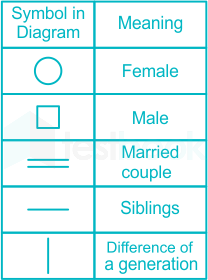
The Family Tree Diagram,

Based on the tree, G is the daughter of F, and Z is the son of G. Therefore, Z is the Daughter's son of F.

Hence, the correct answer is "Option 3"

14

Based on the alphabetical order, three of the following four are alike in a certain way and thus form a group. Which is the one that does not belong to that group? (Note: The odd one out is not based on the number of consonants/vowels or their position in the letter cluster)

  1. ((a))

    NQV

  2. ((b))

    KNT

  3. ((c))

    EHM

  4. ((d))

    BEJ

Show Answer
Answer: ((b))

KNT

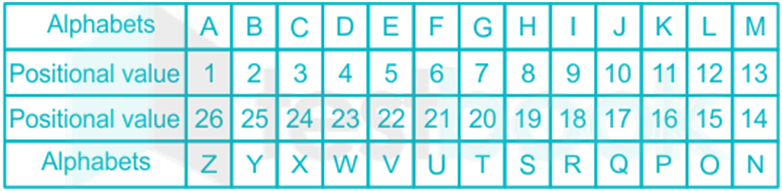
The logic followed here is:

626a871a13e02eef2fcd3cd5 16564998081491

Logic: Second letter − First letter = 3 and Third letter − Second letter = 5.

Option 1) NQV,

Option 2) KNT,

This cluster does not follow the rule of +3, +5.

Option 3) EHM,

Option 4) BEJ,

Therefore, the letter cluster that is different from the others is KNT.

Hence, the correct answer is "Option 2".

15

Each of E, F, G, I, K, L and M has an exam on a different day of a week, starting from Monday and ending on Sunday of the same week. F has an exam on Friday. Only two people have exams between K and F. Only four people have exams between E and K. L has an exam immediately after G. I does not have an exam on Monday. How many people have exams between I and M?

  1. ((a))

    Three

  2. ((b))

    Four

  3. ((c))

    Two

  4. ((d))

    One

Show Answer
Answer: ((b))

Four

Given: Each of E, F, G, I, K, L and M has an exam on a different day of a week, starting from Monday and ending on Sunday of the same week.

  1. F has an exam on Friday.
  2. Only two people have exams between K and F.
  3. Only four people have exams between E and K.
  4. L has an exam immediately after G.
  5. I does not have an exam on Monday

Final arrangement table:


DayPerson
MondayM
TuesdayK
WednesdayG
ThursdayL
FridayF
SaturdayI
SundayE

Thus, there are four people between I and M.

Hence, the correct answer is "Option 2".

16

In the word PRONOUNS, each vowel is replaced by the letter immediately following it in the English alphabetical order and each consonant is replaced by the letter immediately following it in the English alphabetical order, except the one immediately preceding it. Which of the following letters will appear exactly twice in the new group of letters thus formed?

  1. ((a))

    L

  2. ((b))

    P

  3. ((c))

    W

  4. ((d))

    Q

Show Answer
Answer: ((a))

L

Given Word: PRONOUNS

Condition

  • Each vowel → replaced by the letter immediately following it.
  • Each consonant → replaced by the letter 2 places preceding it (i.e., the letter immediately preceding the consonant is skipped).
Given WordPRONOUNS
Condition−2−2+1−2+1+1−2−2
New LetterNPPLPVLQ

The letter that appears exactly twice is L.

Hence, the correct answer is "option 1".

17

Which of the following letter-number clusters will replace the question mark (?) in the given series to make it logically complete?

<br>

DUS18, IZX34, NEC50, SJH66, ?

  1. ((a))

    XOM82

  2. ((b))

    XIM82

  3. ((c))

    XON82

  4. ((d))

    YOM82

Show Answer
Answer: ((a))

XOM82

The logic followed here is:

626a871a13e02eef2fcd3cd5 16564998081491

Hence, the correct answer is Option 1

18

Based on the English alphabetical order, three of the following four letter-cluster pairs are alike in a certain way and thus form a group. Which of the following letter-cluster pairs does not belong to that group?

(Note: The odd letter-cluster pair is not based on the number of consonants/vowels or their position.)

  1. ((a))

    RQ - UT

  2. ((b))

    ON - RQ

  3. ((c))

    TS - BH

  4. ((d))

    ED - HG

Show Answer
Answer: ((c))

TS - BH

The logic followed here is:

626a871a13e02eef2fcd3cd5 16564998081491

Option 1) RQ - UT,

Option 2) ON - RQ,

Option 4) ED - HG,

Option 3) TS - BH,

This pair does not follow the rule.

Therefore, the letter-cluster pair that is different from the others is TS - BH.

Hence, the correct answer is 'Option 3'.

19

Select the option figure in which the given figure is embedded as its part  (rotation is NOT allowed).

  1. ((a))

  2. ((b))

  3. ((c))

  4. ((d))

Show Answer
Answer: ((c))

The loigc follows here, 

Hence, the correct asnswer is "Option 3"

20

If ‘A’ stands for ‘÷’, ‘B’ stands for ‘x’, ‘C’ stands for ‘+’ and ‘D’ stands for ‘-’, what will be come in place of question mark ‘?’ in the following equation?

<br>

143 C 208 A 13 B 4 D 125 = ?

  1. ((a))

    87

  2. ((b))

    84

  3. ((c))

    89

  4. ((d))

    82

Show Answer
Answer: ((d))

82

BODMAS Rule:

Given Operator Mapping:

  • A stands for Division (÷)
  • B stands for Multiplication (×)
  • C stands for Addition (+)
  • D stands for Subtraction ()

**Given :**143 C 208 A 13 B 4 D 125 = ?

Replace the letters with operators and apply the BODMAS rule:

= 143 + 208 ÷ 13 × 4 − 125


= 143 + 16 × 4 − 125

= 143 + 64 − 125

= 207 − 125

= 82

Hence, the correct answer is "Option 4"

General Awareness (20 questions)

21

'Dhamar' is a style in Hindustani classical music associated with which deity and festival?

  1. ((a))

    Vishnu and Diwali

  2. ((b))

    Krishna and Holi

  3. ((c))

    Shiva and Maha Shivratri

  4. ((d))

    Durga and Navratri

Show Answer
Answer: ((b))

Krishna and Holi

The correct answer is Krishna and Holi.

Key Points

  • Dhamar is a prominent vocal genre of Hindustani Classical Music that is structurally and stylistically related to the ancient Dhrupad tradition.
  • The lyrical content of Dhamar compositions almost exclusively centers on the playful and romantic descriptions of Lord Krishna and his celebrations of the Holi festival in the region of Braj.
  • The style is characterized by the use of the Dhamar Taal, a rhythmic cycle consisting of 14 beats (divided into sections of 5, 2, 3, and 4 beats).
  • Unlike the more somber and spiritual Dhrupad, Dhamar focuses on Shringar Rasa (the aesthetic of love and beauty), depicting the throwing of colors, the playing of the flute, and the interaction between Krishna and the Gopis.
  • It is often referred to as Hori-Dhamar because of its thematic dedication to the spring festival of Holi.

 Additional Information

  • Musical Context:
  • Dhrupad: The oldest surviving form of Hindustani Classical Music, known for its austere, devotional, and meditative character, usually set to Chautal (12 beats).
  • Braj Bhasha: The literary dialect of Hindi used in Dhamar lyrics, which is traditionally associated with the Krishna bhakti movement.
  • Nom-Tom Alap: Before singing the Dhamar composition, performers typically execute a rhythmic Alap using abstract syllables, similar to the Dhrupad style.
  • Hori: While Dhamar is the strictly classical version, Hori is a semi-classical genre (often sung in Thumri style) that also celebrates Holi and Krishna but allows for more melodic flexibility and ornamentation.
22

सन् 1206 ईस्वी में मुहम्मद गोरी की मृत्यु के बाद, भारतीय क्षेत्रों पर उसके आधिपत्य को निम्नलिखित में से किस शासक को सौंपा गया था?

  1. ((a))

    बलबन

  2. ((b))

    कुतुबुद्दीन ऐबक

  3. ((c))

    अलाउद्दीन खिलजी

  4. ((d))

    इल्तुतमिश

Show Answer
Answer: ((b))

कुतुबुद्दीन ऐबक

The correct answer is कुतुबुद्दीन ऐबक.

Key Points

  • सन् 1206 ईस्वी में मुहम्मद गोरी की मृत्यु के बाद, उसके साम्राज्य का कोई स्पष्ट उत्तराधिकारी नहीं था, जिसके कारण उसके वफादार तुर्क गुलाम जनरलों ने अलग-अलग क्षेत्रों पर नियंत्रण प्राप्त कर लिया।
  • कुतुबुद्दीन ऐबक, जो गोरी का सबसे विश्वसनीय सेनापति और उसके भारतीय अभियानों का मुख्य वास्तुकार था, ने भारतीय विजित क्षेत्रों पर अपना आधिपत्य स्थापित किया।
  • ऐबक ने भारत में ममलुक वंश या गुलाम वंश की स्थापना की, जो दिल्ली सल्तनत का पहला राजवंश बना।
  • उसका औपचारिक राज्याभिषेक 24 जून 1206 को लाहौर में हुआ था, जिसे उसने अपनी शुरुआती राजधानी बनाया।
  • यद्यपि उसने कभी 'सुल्तान' की उपाधि धारण नहीं की और स्वयं को 'मलिक' और 'सिपहसालार' के रूप में ही संतुष्ट रखा, लेकिन वह भारत में मुस्लिम शासन का वास्तविक संस्थापक माना जाता है।

 Additional Information

  • कुतुबुद्दीन ऐबक:
  • उसे उसकी अत्यधिक उदारता के कारण लाख बख्श (लाखों का दान देने वाला) के नाम से जाना जाता था।
  • उसने दिल्ली में कुव्वत-उल-इस्लाम मस्जिद और अजमेर में अढ़ाई दिन का झोंपड़ा का निर्माण करवाया।
  • उसने सूफी संत ख्वाजा कुतुबुद्दीन बख्तियार काकी की याद में कुतुब मीनार का निर्माण शुरू करवाया था।
  • शमशुद्दीन इल्तुतमिश:
  • यह ऐबक का दामाद और उत्तराधिकारी था, जिसे दिल्ली सल्तनत का वास्तविक संस्थापक माना जाता है क्योंकि उसने राजधानी को दिल्ली स्थानांतरित किया था।
  • गियासुद्दीन बलबन:
  • यह गुलाम वंश का एक शक्तिशाली शासक था जिसने 'लौह और रक्त' की नीति अपनाई और सिजदा और पाइबोस जैसी प्रथाएं शुरू कीं।
  • अलाउद्दीन खिलजी:
  • यह खिलजी वंश का सबसे शक्तिशाली शासक था, जिसने 1296 से 1316 ईस्वी तक शासन किया और अपने बाजार नियंत्रण सुधारों के लिए प्रसिद्ध था।
23

Elements from atomic number 90 to 103 are classified as _______.

  1. ((a))

    Actinoids

  2. ((b))

    Lanthanoids

  3. ((c))

    Transition metals

  4. ((d))

    Alkali metals

Show Answer
Answer: ((a))

Actinoids

CONCEPT:

  • The f-block elements consist of two series of elements placed at the bottom of the periodic table: the lanthanoids and the actinoids.
  • The actinoid series (or actinides) consists of elements where the 5f orbitals are being progressively filled.
  • These elements are typically radioactive and include well-known elements like Uranium and Plutonium.

EXPLANATION:

  • The elements with atomic numbers 90 to 103 belong to the actinoid series.
  • Atomic number 90 is Thorium (Th).
  • Atomic number 103 is Lawrencium (Lr).
  • Other classifications mentioned in the options:
  • Lanthanoids: These are the elements from atomic number 58 (Cerium) to 71 (Lutetium).
  • Transition metals: These are the d-block elements located in Groups 3 to 12 of the periodic table.
  • Alkali metals: These are the Group 1 elements (excluding Hydrogen), such as Lithium (Li), Sodium (Na), and Potassium (K).
  • Therefore, based on the specific range of atomic numbers provided (90 to 103), the correct classification is Actinoids.

Therefore, elements from atomic number 90 to 103 are classified as Actinoids.

24

Jhoori is the folk music of which state?

  1. ((a))

    Bihar

  2. ((b))

    Himachal Pradesh

  3. ((c))

    Gujarat

  4. ((d))

    Rajasthan

Show Answer
Answer: ((b))

Himachal Pradesh

The correct answer is Himachal Pradesh.

Key Points

  • Jhoori is a celebrated form of folk music traditional to the state of Himachal Pradesh, specifically popular in the Sirmaur and Mahasu (Shimla) regions.
  • The word Jhoori literally refers to a couplet or a short poem; the music is characterized by its rhythmic delivery and lyrical depth.
  • The primary theme of this music is romance and extramarital love, often expressing the intense feelings of longing, beauty, and the emotional connection between lovers.
  • It is typically performed in an open-air setting, frequently accompanied by a dance of the same name, where the performers move in a circular motion.
  • The songs are composed in a question-and-answer format or as direct addresses to a beloved, making it a unique lyrical poetry tradition of the Himalayan foothills.

 Additional Information

  • Bihar folk music:
  • Includes Sohar, which is sung during childbirth, and Chaita, performed during the month of Chait.
  • Bideshiya is another famous form, created by Bhikhari Thakur, focusing on social issues and migration.
  • Gujarat folk music:
  • Known for Garba and Doha, which are integral to cultural festivals like Navratri.
  • Sugam Sangeet and Dayro are also significant oral traditions in the state.
  • Rajasthan folk music:
  • Famous for the Maand style, which is a sophisticated form of folk singing developed in the royal courts.
  • Instruments like the Kamayacha, Sarangi, and Khartal are extensively used by communities like the Manganiyars and Langas.
  • Other Folk Songs of Himachal Pradesh:
  • Laman: A distinctive folk song from the Kullu Valley dedicated to romantic themes.
  • Chhanjoti: A traditional song often associated with the Chamba district.
25

On 26 July 1876, Surendranath Banerjea along with Ananda Mohan Bose initiated which of the following political organizations in Kolkata?

  1. ((a))

    Indian National Congress

  2. ((b))

    Hindoo Patriotic Association

  3. ((c))

    Bengal Political Society

  4. ((d))

    Indian Association

Show Answer
Answer: ((d))

Indian Association

The correct answer is Indian Association.

Key Points

  • The Indian Association was the first avowedly nationalist organization founded in British India, established on 26 July 1876 at Albert Hall in Calcutta (now Kolkata).
  • It was co-founded by Surendranath Banerjea and Ananda Mohan Bose with the primary objective of creating a powerful public opinion on political issues and unifying Indians under a common political program.
  • The organization served as a more democratic and representative alternative to the British Indian Association, which was largely seen as a body representing the interests of the landed aristocracy and Zamindars.
  • The association played a significant role in organizing the All-India Civil Services Agitation after the British Government reduced the maximum age for appearing in the Indian Civil Service (ICS) exam from 21 to 19 years in 1877.
  • It was instrumental in mobilizing opposition against repressive colonial legislations such as the Vernacular Press Act and the Arms Act of 1878, which restricted the freedom of the Indian press and public.

 Additional Information

  • Indian National Congress (INC):
  • Founded in December 1885 by retired officer A.O. Hume, the Indian Association eventually merged with the INC in 1886 during its second session in Calcutta.
  • The merger was intended to consolidate nationalist forces and avoid a split in the burgeoning political movement.
  • Surendranath Banerjea:
  • Known as the Indian Burke or Rashtraguru, he was a teacher, journalist, and the first Indian to pass the ICS exam (though later dismissed), and he edited the newspaper The Bengalee.
  • Ananda Mohan Bose:
  • He was the first Indian Wrangler at the University of Cambridge and later served as the President of the Indian National Congress at the Madras session in 1898.
26

What is the key objective of the Digital India initiative launched in 2015?

  1. ((a))

    To reduce the number of online services available in villages

  2. ((b))

    To provide extensive internet access in urban and semi-urban regions

  3. ((c))

    To transform India into a digitally empowered society and economy

  4. ((d))

    To promote traditional farming practices in rural communities

Show Answer
Answer: ((c))

To transform India into a digitally empowered society and economy

The correct answer is To transform India into a digitally empowered society and economy.

Key Points

  • Launched on July 1, 2015, by the Ministry of Electronics and Information Technology (MeitY), the Digital India initiative is a flagship program designed to prepare India for a knowledge-based transformation.
  • The core vision focuses on Digital Infrastructure as a Core Utility, ensuring that high-speed internet and a digital identity like Aadhaar are accessible to every citizen as a basic right.
  • It emphasizes Governance and Services on Demand, aiming to integrate services across various government departments and make them available in real-time on mobile and online platforms.
  • The initiative targets the Digital Empowerment of Citizens by promoting digital literacy and making digital resources and collaborative platforms available in diverse Indian languages to bridge the socio-economic gap.
  • The program acts as an umbrella scheme that covers multiple government ministries and departments, weaving together a large number of ideas and thoughts into a single, comprehensive vision.

 Additional Information

  • The initiative is structured around Nine Pillars that define its scope and implementation:
  • Broadband Highways: Implementing the National Optical Fibre Network (NOFN), now BharatNet, to connect 2.5 lakh Gram Panchayats.
  • e-Kranti: Focuses on the Electronic Delivery of Services, covering domains such as e-Education, e-Healthcare, Technology for Farmers, and e-Courts.
  • IT for Jobs: Aims to train 1 crore students in smaller towns and villages for Information Technology sector jobs.
  • Electronics Manufacturing: Targets Net Zero Imports by incentivizing domestic production of electronics, including mobile phones and medical devices.
  • Early Harvest Programmes: Includes immediate impact projects like Biometric Attendance in government offices and Wi-Fi in all Universities.
27

What does a current account surplus in the Balance of Payments signify for an open economy?

  1. ((a))

    It indicates low borrowing from foreign countries.

  2. ((b))

    It indicates heavy borrowing from foreign countries.

  3. ((c))

    The country is importing more goods and services than it is exporting.

  4. ((d))

    The country is exporting more goods and services than it is importing.

Show Answer
Answer: ((d))

The country is exporting more goods and services than it is importing.

The correct answer is The country is exporting more goods and services than it is importing..

Key Points

  • The Balance of Payments (BoP) is a comprehensive statistical statement that summarizes all economic transactions between residents of a country and the rest of the world over a specific period, typically a year or a quarter.
  • The Current Account is a major component of the BoP that records the net flow of money arising from visible trade (merchandise goods), invisible trade (services like shipping and banking), primary income (interest and dividends), and secondary income (transfers).
  • A Current Account Surplus specifically indicates that the total value of exports (credits) of goods and services is greater than the total value of its imports (debits).
  • In macroeconomic terms, a surplus signifies that the country is a net lender to the rest of the world, as it earns more foreign currency through trade and income than it spends.
  • The fundamental identity for the current account can be represented as: Current Account = (Exports − Imports) + Net Income + Net Transfers. A positive result confirms a surplus.

 Additional Information

  • Current Account Deficit (CAD):
  • This occurs when the value of goods and services imported exceeds the value of those exported.
  • A CAD implies that the nation is a net borrower, requiring a surplus in the Capital Account (such as through Foreign Direct Investment or external loans) to balance the overall BoP.
  • Borrowing and the Capital Account:
  • Borrowing from foreign countries is recorded in the Capital and Financial Account, not the current account.
  • Heavy borrowing (as mentioned in incorrect options) is usually a result of a Current Account Deficit, as the country needs to finance its excess consumption and investment.
  • Economic Implications:
  • A consistent Current Account Surplus leads to an accumulation of Foreign Exchange Reserves.
  • It reflects a high level of National Savings relative to domestic investment, indicating that domestic production exceeds domestic absorption (Consumption + Investment + Government Spending).
  • Common components of invisible trade include Software Services, Tourism, and Remittances from workers abroad.
28

Among the following tentatively named missions, which ones is ISRO planning to launch for exploring Venus?

  1. ((a))

    Shukrayaan-1

  2. ((b))

    Chandrayaan-3

  3. ((c))

    Aditya L-1

  4. ((d))

    Mangalyaan-2

Show Answer
Answer: ((a))

Shukrayaan-1

The correct answer is Shukrayaan-1.

Key Points

  • Shukrayaan-1 is the tentative name for the Venus Orbiter Mission (VOM), a proposed interplanetary mission by the Indian Space Research Organisation (ISRO) to explore Venus, the hottest planet in our solar system.
  • The mission aims to study the Venusian atmosphere, which is thick and dominated by carbon dioxide, and to examine the planet's surface for volcanic activity and stratigraphy.
  • Key scientific instruments planned for the orbiter include a Synthetic Aperture Radar (SAR) for high-resolution mapping and a Ground Penetrating Radar (GPR) to study the subsurface layers.
  • The mission is scheduled for a potential launch window in 2028 or 2031, coinciding with the optimal planetary alignment between Earth and Venus to minimize fuel consumption.

 Additional Information

  • Chandrayaan-3:
  • It was India's third Lunar mission, which successfully executed a soft landing on the Lunar South Pole on August 23, 2023, making India the first nation to achieve this feat.
  • The mission included the Vikram lander and the Pragyan rover to conduct on-site chemical analysis of the lunar surface.
  • Aditya L-1:
  • This is India's first dedicated solar mission, launched in September 2023 to study the Sun from the Lagrange Point 1 (L1).
  • It carries seven payloads to observe the photosphere, chromosphere, and the corona of the Sun.
  • Mangalyaan-2:
  • Also known as Mars Orbiter Mission 2 (MOM-2), it is a planned follow-up mission to further explore Mars with advanced scientific payloads.
  • It aims to build upon the success of the first Mangalyaan mission launched in 2013.
29

According to the Coffee Board of India, 2020-21, which country was the largest importer of coffee?

  1. ((a))

    Russian Federation

  2. ((b))

    Italy

  3. ((c))

    Germany

  4. ((d))

    Poland

Show Answer
Answer: ((b))

Italy

The correct answer is Italy.

Key Points

  • India is the sixth-largest producer of coffee in the world, and according to the Coffee Board of India data for the year 2020-21, Italy was the leading destination for Indian coffee exports.
  • During the fiscal year 2020-21, Italy imported the highest quantity of coffee from India, amounting to approximately 60,453 metric tonnes.
  • The export value to Italy accounted for a significant portion of India's total coffee export earnings, driven by the high demand for Indian Robusta and Arabica varieties in the European espresso market.
  • The Coffee Board of India, which functions under the Ministry of Commerce and Industry, tracks these export shipments to monitor trade patterns and support domestic growers.
  • While global demand fluctuated during the pandemic, the trade relationship with Italy remained robust, solidifying its position as the top importer ahead of other European and Asian nations.

 Additional Information

  • Germany:
  • Historically the second-largest importer of Indian coffee, Germany primarily imports raw green coffee for high-tech processing and re-exporting purposes within the European Union.
  • Russian Federation:
  • This market is a major consumer of Indian Instant Coffee (Soluble coffee). It frequently ranks among the top three destinations due to the high preference for processed coffee over green beans.
  • Poland:
  • A significant emerging market in Eastern Europe for Indian exporters, focusing largely on Robusta beans used in commercial blends and local retail brands.
  • Coffee Varieties in India:
  • India produces two main varieties: Arabica (grown at higher altitudes like Baba Budan Giri) and Robusta (which constitutes the majority of the export volume due to its strong flavor and body).
30

Which of the following statements is NOT correct with respect to Eastern and Western Ghats?

  1. ((a))

    Eastern Ghats are discontinuous, irregular and dissected by rivers

  2. ((b))

    Western Ghat's average elevation is 900-1600 metres

  3. ((c))

    Eastern Ghats stretch from the Mahanadi Valley to the Nilgiris

  4. ((d))

    Eastern Ghats are higher in elevation than the Western Ghats

Show Answer
Answer: ((d))

Eastern Ghats are higher in elevation than the Western Ghats

The correct answer is Eastern Ghats are higher in elevation than the Western Ghats.

Key Points

  • The Eastern Ghats are described as discontinuous and irregular because they have been eroded and dissected by several major rivers like the Mahanadi, Godavari, Krishna, and Kaveri that drain into the Bay of Bengal. Hence, statement 1 is correct.
  • The Western Ghats are significantly higher than the Eastern Ghats, with an average elevation ranging between 900 and 1600 metres, compared to the much lower average of the Eastern Ghats. Hence, statement 2 is correct.
  • The Eastern Ghats form the eastern edge of the Deccan Plateau and stretch geographically from the Mahanadi Valley in the north to the Nilgiris in the south. Hence, statement 3 is correct.
  • The Western Ghats have a higher elevation than the Eastern Ghats, which average only about 600 metres in height; therefore, the claim that the Eastern Ghats are higher is factually inaccurate. Hence, statement 4 is incorrect.

 Additional Information

  • Western Ghats (Sahyadri):
  • They are continuous and can be crossed through passes like the Thal, Bhor, and Pal Ghats.
  • The height of these mountains increases from north to south, with Anai Mudi (2,695 m) being the highest peak.
  • They cause orographic rain by facing the rain-bearing moist winds from the Arabian Sea.
  • Eastern Ghats:
  • The highest peak in the Eastern Ghats is Mahendragiri, which stands at an elevation of 1,501 metres.
  • They are older than the Western Ghats and have a complex geological structure featuring Charnockites and Khondalites.
  • The Shevaroy Hills and the Javadi Hills are important mountain ranges located to the southeast of the Eastern Ghats.
31

Who won the Best Leading Role (Female) at IIFA 2025?

  1. ((a))

    Nitanshi Goel

  2. ((b))

    Pratibha Ranta

  3. ((c))

    Alia Bhatt

  4. ((d))

    Janki Bodiwala

Show Answer
Answer: ((a))

Nitanshi Goel

The correct answer is Nitanshi Goel.

Key Points

  • Nitanshi Goel secured the award for Best Leading Role (Female) at the 25th International Indian Film Academy (IIFA) Awards, which was celebrated as the Silver Jubilee edition in 2025.
  • She won this prestigious accolade for her lead performance as Phool Kumari in the satirical comedy-drama film Laapataa Ladies, directed by Kiran Rao and produced by Aamir Khan.
  • The 2025 IIFA Awards ceremony was held in Jaipur, Rajasthan, marking a significant return of the event to India to honor cinematic excellence from the year 2024.
  • At approximately 17 years of age, Nitanshi Goel became one of the youngest actresses in the history of the IIFA Awards to win in the Best Actress category, following the film's massive success on streaming platforms and at the box office.

 Additional Information

  • Laapataa Ladies:
  • The film was officially announced as India's official entry for the 97th Academy Awards (Oscars) in the Best International Feature Film category.
  • It tells the story of two young brides who get swapped during a train journey, exploring themes of women's empowerment and social reform.
  • Pratibha Ranta:
  • A talented actress who co-starred with Nitanshi Goel in Laapataa Ladies, portraying the character of Jaya/Pushpa Rani, and also gained fame for her role in the series Heeramandi: The Diamond Bazaar.
  • Janki Bodiwala:
  • An actress primarily known for her work in Gujarati cinema, she made her significant Bollywood debut in 2024 with the supernatural thriller Shaitaan, starring alongside Ajay Devgn.
  • IIFA Awards:
  • First held in London in 2000, the International Indian Film Academy Awards aim to promote Indian Cinema globally and have been hosted across various continents.
32

Which of the following is an example of an open system?

  1. ((a))

    A sealed pressure cooker

  2. ((b))

    Hot coffee held in a cup

  3. ((c))

    A thermos flask with a tight lid

  4. ((d))

    A closed bottle of soda

Show Answer
Answer: ((b))

Hot coffee held in a cup

CONCEPT:

Thermodynamic systems are classified into three types based on the exchange of matter and energy with their surroundings:

  • Open System: A system that can exchange both matter and energy (usually in the form of heat or work) with its surroundings.
  • Closed System: A system that can exchange energy with its surroundings but cannot exchange matter.
  • Isolated System: A system that can exchange neither matter nor energy with its surroundings.

EXPLANATION:

  • In the case of hot coffee held in a cup:
  • Matter exchange: Since the cup is open at the top, water molecules can escape into the air as steam/water vapor.
  • Energy exchange: The coffee loses heat to the cooler surrounding air through the surface and the walls of the cup.
  • Because it exchanges both matter and energy, it is a classic example of an open system.
  • Other examples provided for context:
  • A sealed pressure cooker and a closed bottle of soda are closed systems because the lids prevent matter from escaping, though heat can still pass through the containers.
  • A thermos flask with a tight lid is designed to act as an isolated system by minimizing the transfer of both heat and matter.

Therefore, hot coffee held in a cup is an example of an open system.

33

Which principle ensures equal access to opportunities for all in the context of sustainable development?

  1. ((a))

    Productivity

  2. ((b))

    Sustainability

  3. ((c))

    Equity

  4. ((d))

    Empowerment

Show Answer
Answer: ((c))

Equity

The correct answer is Equity.

Key Points

  • Equity is one of the four essential pillars of human development, fundamentally concerned with the concept of distributive justice.
  • It dictates that every individual must have equal access to opportunities, ensuring that systemic barriers such as gender, race, income, or caste do not prevent people from realizing their potential.
  • In the context of sustainable development, equity ensures that the benefits of progress are shared fairly across all segments of society, particularly reaching marginalized communities.
  • By promoting an even playing field, equity seeks to eliminate the structural inequalities that historically limit the choices available to certain groups of people.

 Additional Information

  • Sustainability:
  • Refers to the continuity in the availability of opportunities over time.
  • It implies that current resources must be used responsibly so that future generations are not deprived of the same opportunities.
  • Productivity:
  • Focuses on human labor productivity and the enrichment of human capital.
  • It involves increasing the capabilities and efficiency of people through continuous investments in education and healthcare.
  • Empowerment:
  • Refers to the power to make choices and the ability to influence one's own destiny.
  • It is achieved through capacity building, good governance, and policies that increase the freedom of the individual.
34

Which of the following leaders was known as the 'Frontier Gandhi' for his efforts to promote peace and Hindu-Muslim unity in the North-West Frontier Province?

  1. ((a))

    Khan Abdul Ghaffar Khan

  2. ((b))

    Subhas Chandra Bose

  3. ((c))

    Maulana Abul Kalam Azad

  4. ((d))

    Sardar Vallabhbhai Patel

Show Answer
Answer: ((a))

Khan Abdul Ghaffar Khan

The correct answer is Khan Abdul Ghaffar Khan.

Key Points

  • Khan Abdul Ghaffar Khan (1890−1988) was a prominent Pashtun leader and a close associate of Mahatma Gandhi, which led to him being widely known as the Frontier Gandhi or Sarhadi Gandhi.
  • He was a devout practitioner of non-violence (Ahimsa) and successfully applied Gandhian principles in the tribal regions of the North-West Frontier Province (NWFP).
  • In 1929, he founded the Khudai Khidmatgar (Servants of God), a non-violent movement that played a significant role in the Civil Disobedience Movement against British rule.
  • The members of the Khudai Khidmatgar were also known as the Red Shirts because they wore uniforms dyed in a distinct brick-red color.
  • In 1987, he became the first non-Indian citizen to be honored with the Bharat Ratna, India's highest civilian award, in recognition of his lifelong struggle for freedom and Hindu-Muslim unity.

 Additional Information

  • Subhas Chandra Bose:
  • Popularly known as Netaji, he led the Indian National Army (INA) and founded the All India Forward Bloc in 1939 to secure India's independence.
  • Maulana Abul Kalam Azad:
  • A distinguished scholar and leader of the Indian National Congress, he served as the first Education Minister of independent India.
  • Sardar Vallabhbhai Patel:
  • Known as the Iron Man of India, he was the first Deputy Prime Minister and played a pivotal role in the political integration of the princely states into the Indian Union.
35

Who created history by running the fastest women’s 400 metres in 47.78 seconds to win world championship gold in Tokyo on 18 September 2025?

  1. ((a))

    Serena Williams

  2. ((b))

    Nadia Comaneci

  3. ((c))

    Sydney McLaughlin-Levrone

  4. ((d))

    Martina Navratilova

Show Answer
Answer: ((c))

Sydney McLaughlin-Levrone

The correct answer is Sydney McLaughlin-Levrone.

Key Points

  • Sydney McLaughlin-Levrone made history at the World Athletics Championships held in Tokyo, Japan, by winning the gold medal in the women’s 400 metres flat event.
  • On September 18, 2025, she recorded a sensational time of 47.78 seconds, which stands as one of the fastest times ever clocked in the history of the event.
  • This performance brought her remarkably close to the long-standing world record of 47.60 seconds set by Marita Koch in 1985, further cementing her legacy as a versatile sprint sensation.
  • The victory marked a successful expansion of her dominance from the 400m hurdles, where she had previously set multiple world records and won gold at both the Tokyo 2020 Olympics and the Paris 2024 Olympics.
  • Her achievement in Tokyo 2025 underscored her athletic transition, proving her ability to dominate both the hurdles and the flat 400m discipline at the highest international level.

 Additional Information

  • Serena Williams:
  • She is a legendary American professional tennis player who has won 23 Grand Slam singles titles, the most by any player in the Open Era. She is not associated with track and field sprinting.
  • Nadia Comaneci:
  • A famous Romanian gymnast, she became the first person in Olympic history to be awarded a perfect score of 10.0 at the 1976 Montreal Olympics.
  • Martina Navratilova:
  • A Czech-American former professional tennis player and coach, she is widely considered one of the greatest all-format tennis players with 18 Grand Slam singles titles and 31 major women’s doubles titles.
36

Which of the following Indian states is the largest producer of bauxite, according to the Indian Minerals Yearbook 2023?

  1. ((a))

    Jharkhand

  2. ((b))

    Odisha

  3. ((c))

    Madhya Pradesh

  4. ((d))

    Gujarat

Show Answer
Answer: ((b))

Odisha

The correct answer is Odisha.

Key Points

  • According to the Indian Minerals Yearbook 2023, Odisha continues to be the leading producer of bauxite in India, accounting for over 70% of the total domestic production.
  • The state possesses the largest reserves of bauxite in the country, predominantly concentrated in the East Coast Bauxite deposits.
  • Major mining operations are centered in the Koraput, Rayagada, Kalahandi, and Bolangir districts.
  • The Panchpatmali bauxite mine, operated by NALCO (National Aluminium Company Limited) in the Koraput district, is one of the most significant and largest bauxite mines in Asia.
  • The high concentration of aluminum refineries and smelters in the region, such as those belonging to Hindalco and Vedanta, is directly linked to the abundance of this mineral resource.

 Additional Information

  • Bauxite:
  • It is the primary ore used for the commercial production of aluminum.
  • It is a sedimentary rock formed by the leaching of silica from rocks containing aluminum silicates in tropical and subtropical regions.
  • Main constituent minerals include gibbsite, boehmite, and diaspore.
  • Gujarat:
  • It is the second-largest producer, contributing approximately 9% to 10% of national output, with major deposits in Jamnagar, Kachchh, and Devbhumi Dwarka.
  • Jharkhand:
  • Significant production occurs in the Lohardaga and Gumla districts, which are known for high-grade bauxite used in chemical and refractory industries.
  • Madhya Pradesh:
  • Major bauxite reserves are located in the Amarkantak plateau and the Katni-Jabalpur region.

Therefore, the correct option is 2.

37

Match the following Directive Principles of State Policy (DPSP) with their Articles.

DPSP Article
A. Right to work, to education and to public assistance in certain cases i. Article 48
B. Organisation of agriculture and animal husbandry ii. Article 41
C. Living wage, etc., for workers iii. Article 43
D. Promotion of international peace and security iv. Article 51

  1. ((a))

    A-i, B-iii, C-ii, D-iv

  2. ((b))

    A-iii, B-i, C-ii, D-iv

  3. ((c))

    A-ii, B-i, C-iii, D-iv

  4. ((d))

    A-i, B-ii, C-iii, D-iv

Show Answer
Answer: ((c))

A-ii, B-i, C-iii, D-iv

The correct answer is A-ii, B-i, C-iii, D-iv.

Key Points

  • Right to work, to education and to public assistance in certain cases: As per Article 41, the State shall, within the limits of its economic capacity and development, make effective provision for securing the right to work, education, and assistance in cases of unemployment, old age, and sickness. Hence, A matches with ii.
  • Organisation of agriculture and animal husbandry: Article 48 directs the State to organize agriculture and animal husbandry on modern and scientific lines, specifically focusing on preserving breeds and prohibiting the slaughter of cows and calves. Hence, B matches with i.
  • Living wage, etc., for workers: Article 43 mandates that the State shall endeavour to secure a living wage, decent working conditions, and full enjoyment of leisure and social-cultural opportunities for all workers in the agricultural or industrial sectors. Hence, C matches with iii.
  • Promotion of international peace and security: Article 51 outlines the State’s responsibility to promote international peace, maintain just relations between nations, foster respect for international law, and encourage the settlement of disputes by arbitration. Hence, D matches with iv.

 Additional Information

  • Directive Principles of State Policy (DPSP):
  • Contained in Part IV of the Constitution of India, spanning from Article 36 to Article 51.
  • The concept was borrowed from the Irish Constitution of 1937, which had copied it from the Spanish Constitution.
  • These principles are non-justiciable, meaning they are not enforceable by any court, but they are fundamental in the governance of the country.
  • The 42nd Constitutional Amendment Act of 1976 added four new DPSPs: Article 39 (opportunities for healthy development of children), Article 39A (equal justice and free legal aid), Article 43A (participation of workers in management), and Article 48A (protection of environment).
  • The 86th Amendment Act of 2002 changed the subject matter of Article 45 to provide early childhood care and education for all children until they complete the age of six years.
38

When was the Mobile World Congress (MWC), 2025, held?

  1. ((a))

    February 10–13, 2025

  2. ((b))

    April 5–8, 2025

  3. ((c))

    March 3–6, 2025

  4. ((d))

    January 15–18, 2025

Show Answer
Answer: ((c))

March 3–6, 2025

The correct answer is March 3-6, 2025.

Key Points

  • The Mobile World Congress (MWC) 2025 is scheduled to be held from March 3 to March 6, 2025.
  • The event is recognized as the largest and most influential gathering for the connectivity ecosystem, attracting over 2,400 exhibitors and approximately 100,000 attendees from around the globe.
  • It is traditionally hosted at the Fira Gran Via exhibition center in Barcelona, Spain, which provides over 240,000 square meters of space across multiple halls for technology showcases.
  • The GSMA (Global System for Mobile Communications Association) serves as the primary organizer, utilizing this platform to define the future of mobile technology and digital transformation.
  • The 2025 dates represent a slight shift in the calendar compared to the 2024 edition, which took place in late February, reflecting the scheduling logistics of the global trade show circuit.

 Additional Information

  • GSMA Organization:
  • The GSMA represents the interests of nearly 800 mobile operators worldwide and more than 400 companies in the broader mobile ecosystem, including software firms and equipment providers.
  • Beyond Barcelona, the association organizes regional events such as MWC Shanghai, MWC Kigali, and MWC Las Vegas.
  • Core Themes and Features:
  • The 2025 edition is expected to focus on 5G-Advanced, Humanising AI, Manufacturing DX (Digital Transformation), and the Game Changers in the tech industry.
  • The event hosts the prestigious GLOMO Awards (Global Mobile Awards), which recognize extraordinary achievements and innovations within the telecommunications sector.
  • It incorporates 4YFN (Four Years From Now), a dedicated space for startups, investors, and entrepreneurs to foster growth in the digital economy.
  • The Ministerial Programme brings together government ministers and regulatory heads to discuss telecom policy and digital legislation.
39

Which of the following is NOT one of the four categories under which the Directive Principles of State Policy are classified?

  1. ((a))

    Cultural heritage principles

  2. ((b))

    Gandhian principles

  3. ((c))

    Economic and social principles

  4. ((d))

    Principles and Policies relating to international peace and security

Show Answer
Answer: ((a))

Cultural heritage principles

The correct answer is Cultural heritage principles.

Key Points

  • The Directive Principles of State Policy (DPSP) are enumerated in Part IV of the Constitution of India under Articles 36 to 51. These principles are fundamental in the governance of the country and are used as guidelines for the State to create laws and policies.
  • The Constitution does not explicitly classify these principles into specific categories; however, based on their content and direction, they are academically classified into three main ideologies: Socialistic Principles, Gandhian Principles, and Liberal-Intellectual Principles.
  • Economic and Social Principles (Socialistic): These aim at providing social and economic justice and establishing a welfare state. Key articles include Article 38 (promoting social order), Article 39 (securing livelihoods), and Article 41 (right to work and education).
  • Gandhian Principles: These are based on the ideology of Mahatma Gandhi and his program of reconstruction during the national movement. They include Article 40 (organization of village panchayats), Article 43 (promotion of cottage industries), and Article 46 (promotion of interests of SCs, STs, and other weaker sections).
  • Principles relating to International Peace and Security: This specific category is derived from Article 51, which mandates the State to promote international peace, maintain honorable relations between nations, and encourage settlement of international disputes by arbitration.
  • There is no distinct category known as Cultural heritage principles. While Article 49 directs the State to protect monuments and places of national importance, it is classified under the Liberal-Intellectual Principles rather than a standalone cultural category.

 Additional Information

  • Constitutional Significance:
  • The concept of DPSP was borrowed from the Irish Constitution of 1937, which had itself borrowed it from the Spanish Constitution.
  • Dr. B.R. Ambedkar described these principles as Novel Features of the Indian Constitution, emphasizing their role in achieving Economic Democracy.
  • Unlike Fundamental Rights, DPSPs are non-justiciable, meaning they are not legally enforceable by the courts for their violation as per Article 37.
  • The Sapru Committee in 1945 suggested two categories of individual rights: justiciable (Fundamental Rights) and non-justiciable (Directive Principles).
  • The 42nd Amendment Act of 1976 added four new Directive Principles: Article 39 (opportunities for healthy development of children), Article 39A (equal justice and free legal aid), Article 43A (participation of workers in management), and Article 48A (protection of environment).
40

National Education Day, observed on 11 November 2025, is celebrated in honor of the birth anniversary of __________.

  1. ((a))

    A.P.J. Abdul Kalam

  2. ((b))

    Rabindranath Tagore

  3. ((c))

    Maulana Abul Kalam Azad

  4. ((d))

    Dr. S. Radhakrishnan

Show Answer
Answer: ((c))

Maulana Abul Kalam Azad

The correct answer is Maulana Abul Kalam Azad.

Key Points

  • National Education Day is celebrated every year on 11 November in India to commemorate the birth anniversary of Maulana Abul Kalam Azad.
  • The Ministry of Human Resource Development (now the Ministry of Education) declared 11 November as National Education Day on 11 September 2008.
  • Maulana Abul Kalam Azad was a renowned scholar, freedom fighter, and the first Education Minister of independent India, serving from 1947 to 1958.
  • He played a pivotal role in shaping the modern Indian education system and was instrumental in the establishment of the University Grants Commission (UGC) and the Indian Institutes of Technology (IITs).
  • He was posthumously awarded India's highest civilian honor, the Bharat Ratna, in 1992 for his invaluable contributions to the nation.

 Additional Information

  • A.P.J. Abdul Kalam:
  • Commonly known as the Missile Man of India, he served as the 11th President of India.
  • His birth anniversary on 15 October is celebrated as World Students' Day.
  • Dr. S. Radhakrishnan:
  • He was the first Vice-President and the second President of India.
  • His birth anniversary on 5 September is observed as Teachers' Day in India to honor his contribution as a philosopher and teacher.
  • Rabindranath Tagore:
  • A Nobel laureate in Literature (1913) and a polymath who reshaped Bengali literature and music.
  • He established Visva-Bharati University in Shantiniketan, focusing on an education system deeply rooted in nature and humanism.

Arithmetical and Numerical Ability (20 questions)

41

If the 8-digit number 16131p13 is divisible by 9, then the minimum value of p is:

  1. ((a))

    3

  2. ((b))

    2

  3. ((c))

    4

  4. ((d))

    7

Show Answer
Answer: ((b))

2

Shortcut Trick

The Divisibility Rule of 9 states that the sum of the digits must be a multiple of 9.

Sum of digits of 16131p13 = 1 + 6 + 1 + 3 + 1 + p + 1 + 3 = 16 + p.

The smallest multiple of 9 greater than 16 is 18.

For divisibility, 16 + p = 18 ⇒ p = 2.

∴ The correct answer is 2.

Alternate Method

Given: The 8-digit number is 16131p13 and it is divisible by 9.

Formula Used: A number is divisible by 9 if the sum of its digits is exactly divisible by 9.

⇒ Sum of digits = 1 + 6 + 1 + 3 + 1 + p + 1 + 3

⇒ Sum of digits = 16 + p

⇒ For the number to be divisible by 9, (16 + p) mod 9 = 0

⇒ Possible values for (16 + p) are 18, 27, 36, ...

⇒ Case 1: 16 + p = 18 ⇒ p = 18 − 16 = 2

⇒ Case 2: 16 + p = 27 ⇒ p = 27 − 16 = 11 (Not possible as p is a single digit)

⇒ The minimum value of p is 2.

∴ The correct answer is 2.

Additional Information

Divisibility by 3

A number is divisible by 3 if the sum of its digits is a multiple of 3.

Divisibility by 11

The difference between the sum of digits at odd positions and even positions must be 0 or a multiple of 11.

Divisibility by 8

A number is divisible by 8 if its last three digits are divisible by 8.

Digit Sum Concept

The remainder when a number is divided by 9 is the same as the remainder when the sum of its digits is divided by 9.

42

A solid is in the shape of a cone standing on a hemisphere with both their radii being equal to 1 cm and the height of the cone is equal to its radius, the volume of solid in terms of π is:

  1. ((a))

    2π cm3

  2. ((b))

    4π cm3

  3. ((c))

    3π cm3

  4. ((d))

    π cm3

Show Answer
Answer: ((d))

π cm3

Shortcut Trick

Total Volume = Volume of Cone + Volume of Hemisphere

Given radius (r) = 1 cm and height (h) = 1 cm.

Volume = (1/3)πr2h + (2/3)πr3

Since h = r = 1, Volume = (1/3)π(1)3 + (2/3)π(1)3 = (1/3 + 2/3)π = 1π

∴ The correct answer is π cm3.

Alternate Method

Given:

Radius of the hemisphere (r) = 1 cm

Radius of the cone (r) = 1 cm

Height of the cone (h) = 1 cm

Formula Used:

Volume of Cone = (1/3) × π × r2 × h

Volume of Hemisphere = (2/3) × π × r3

Calculations:

⇒ Volume of Cone = (1/3) × π × (1)2 × 1 = π/3 cm3

⇒ Volume of Hemisphere = (2/3) × π × (1)3 = 2π/3 cm3

⇒ Total Volume of Solid = Volume of Cone + Volume of Hemisphere

⇒ Total Volume = π/3 + 2π/3

⇒ Total Volume = (1 + 2)π / 3

⇒ Total Volume = 3π / 3 = π cm3

∴ The correct answer is π cm3.

Additional Information

Volume of a Sphere

The total volume of a full sphere is twice that of a hemisphere, given by V = (4/3)πr3.

Slant Height of a Cone

The slant height (l) is the distance from the apex to any point on the base circle: l = √(r2 + h2).

Surface Area of Solid

Total Surface Area = Curved Surface Area of Cone (πrl) + Curved Surface Area of Hemisphere (2πr2).

43

A person bought a used bike for ₹18,000, spent ₹2,000 on repairs, and sold it for ₹23,000. What is the profit percentage on the whole transaction?

  1. ((a))

    10%

  2. ((b))

    12.5%

  3. ((c))

    11%

  4. ((d))

    15%

Show Answer
Answer: ((d))

15%

Shortcut Trick

Effective Cost Price (CP) = 18,000 + 2,000 = ₹20,000.

Selling Price (SP) = ₹23,000.

Profit = 23,000 − 20,000 = ₹3,000.

Profit % = (3,000 ÷ 20,000) × 100 = 15%.

∴ The correct answer is 15%.

Alternate Method

Given: Buying Price = ₹18,000, Repair Cost = ₹2,000, Selling Price (SP) = ₹23,000.

Formula Used: Total CP = Buying Price + Repairs; Profit % = (Profit ÷ Total CP) × 100.

Total Cost Price (CP) = ₹18,000 + ₹2,000 = ₹20,000

Profit = Selling Price − Total Cost Price

Profit = ₹23,000 − ₹20,000 = ₹3,000

Profit Percentage = (3,000 ÷ 20,000) × 100

Profit Percentage = 3/20 × 100 = 15%

∴ The correct answer is 15%.

Additional Information

Overhead Expenses

Any extra expenditure incurred on an item like repairs, freight, or transportation is added to the original purchase price to calculate the effective Cost Price.

Profit and Loss Calculation

Both Profit % and Loss % are always calculated on the Total Cost Price. Profit % = (Profit ÷ CP) × 100 and Loss % = (Loss ÷ CP) × 100.

Selling Price for Desired Profit

To find the SP for a required profit percentage P, the formula is SP = CP × (100 + P) ÷ 100.

44

M and N begin a business venture. M invests ₹89,000 more than N for a period of 7 months, while N invests for 5 months. Out of a total profit of ₹3,175, M’s share exceeds N’s by ₹635. Determine the amount invested by M.

  1. ((a))

    ₹1335150

  2. ((b))

    ₹1334915

  3. ((c))

    ₹1334937

  4. ((d))

    ₹1335000

Show Answer
Answer: ((d))

₹1335000

Shortcut Trick

Profit Ratio (M : N) = (3175 + 635) : (3175 − 635) = 1905 : 1270 = 3 : 2

Investment Ratio = (Profit / Time) = (3 / 7) : (2 / 5) = 15 : 14

Difference in investment ratio = 15 − 14 = 1 unit → ₹89,000

M’s investment = 15 units = 15 × 89,000 = ₹13,35,000

∴ The correct answer is ₹1335000.

Alternate Method

Given:

Total profit = ₹3,175

Difference in profit (M − N) = ₹635

Time for M (TM) = 7 months, Time for N (TN) = 5 months

Difference in investment = ₹89,000

Formula Used:

Profit Ratio = (Investment1 × Time1) : (Investment2 × Time2)

Calculations:

⇒ M’s share (PM) = (Total Profit + Difference) / 2 = (3175 + 635) / 2 = 1905

⇒ N’s share (PN) = Total Profit − PM = 3175 − 1905 = 1270

⇒ PM : PN = 1905 : 1270 = 3 : 2

⇒ (IM × 7) / (IN × 5) = 3 / 2

⇒ 14 × IM = 15 × IN

⇒ IM / IN = 15 / 14

⇒ Let IM = 15k and IN = 14k

⇒ Difference = 15k − 14k = k = 89,000

M’s investment = 15k = 15 × 89,000

M’s investment = ₹13,35,000

∴ The correct answer is ₹1335000.

Additional Information

Partnership Basic Law

The profit earned by partners is always distributed in the ratio of the product of their capital and time: P1 : P2 = (C1 × T1) : (C2 × T2).

Investment Calculation

If profits and time periods are known, the ratio of investments can be found as: C1 : C2 = (P1 / T1) : (P2 / T2).

Active vs Sleeping Partner

An active partner receives a fixed percentage or amount from the total profit for managing the business before the remaining profit is divided among all partners.

45

When Manisha and Seema work together, they can finish a project in 60 days. In 80 days, Seema and Reena can finish the same task, and in 48 days, Reena and Manisha can finish the same task. In what number of days will the three of them finish the task?

  1. ((a))

    45 days

  2. ((b))

    30 days

  3. ((c))

    40 days

  4. ((d))

    35 days

Show Answer
Answer: ((c))

40 days

Shortcut Trick

Identify Total Work as LCM of 60, 80, and 48 = 240 units.

Calculate combined efficiencies: (M+S) = 4, (S+R) = 3, (R+M) = 5.

Total efficiency of 2(M+S+R) = 4 + 3 + 5 = 12 units/day.

Efficiency of (M+S+R) = 12 ÷ 2 = 6 units/day.

Required Time = 240 ÷ 6 = 40 days.

∴ The correct answer is 40 days.

Alternate Method

Given:

Time for Manisha and Seema = 60 days

Time for Seema and Reena = 80 days

Time for Reena and Manisha = 48 days

Formula Used:

Efficiency = Total Work ÷ Time Taken

Total Work = LCM of the time taken by different groups.

PersonDaysTotal WorkEfficiency
Manisha + Seema602404
Seema + Reena803
Reena + Manisha485

Calculations:

⇒ Adding the efficiencies: (M + S) + (S + R) + (R + M) = 4 + 3 + 5

⇒ 2 × (Manisha + Seema + Reena) = 12

⇒ Efficiency of (Manisha + Seema + Reena) = 12 ÷ 2 = 6 units/day

⇒ Time taken by all three = Total Work ÷ Combined Efficiency

⇒ Time = 240 ÷ 6 = 40 days

∴ The correct answer is 40 days.

Additional Information

Total Work and Efficiency

The Total Work is always assumed to be a constant value, usually the LCM of given time intervals, to simplify efficiency calculations.

Paired Work Rule

When people work in pairs (A+B, B+C, C+A), the sum of their efficiencies is 2 × (A+B+C) because each individual is counted twice in the summation.

Work and Wages Relationship

If multiple people work together for the same duration, their Wages are distributed in the direct ratio of their individual Efficiencies.

46

The population of a village was 1,80,000. It increased by 15% in the first year and by 30% in the second year. Its population after two years is _____.

  1. ((a))

    2,34,000

  2. ((b))

    2,61,000

  3. ((c))

    2,07,000

  4. ((d))

    2,69,100

Show Answer
Answer: ((d))

2,69,100

Shortcut Trick

Net percentage increase = a + b + (a × b / 100)

Net % increase = 15 + 30 + (15 × 30 / 100) = 45 + 4.5 = 49.5%

Final Population = 1,80,000 × (100 + 49.5)% = 1,80,000 × 149.5 / 100

Final Population = 1,800 × 149.5 = 2,69,100

∴ The correct answer is 2,69,100.

Alternate Method

Given:

Initial Population (P) = 1,80,000

Increase in first year (r1) = 15%

Increase in second year (r2) = 30%

Calculations:

⇒ Population after 1st year = 1,80,000 × (115 / 100)

⇒ Population after 1st year = 1,800 × 115 = 2,07,000

⇒ Population after 2nd year = 2,07,000 × (130 / 100)

⇒ Population after 2nd year = 2,070 × 130

⇒ Final Population = 2,69,100

∴ The correct answer is 2,69,100.

Additional Information

Successive Percentage Change

When a value changes by a% and then by b%, the effective change is [a + b + (ab/100)]%.

Population Growth Formula

Population after 'n' years is Pn = P0(1 + r1/100)(1 + r2/100)... where r is the rate of increase.

Percentage to Fraction

15% = 3/20 and 30% = 3/10. Multiplying factors become 23/20 and 13/10 respectively.

47

A cuboid has a surface area of 292 cm2. If the length and breadth of the cuboid are 8 cm and 6 cm, respectively, find its height.

  1. ((a))

    7 cm

  2. ((b))

    9 cm

  3. ((c))

    7.5 cm

  4. ((d))

    5 cm

Show Answer
Answer: ((a))

7 cm

Shortcut Trick

In a cuboid, the sum of products of adjacent sides equals half the total surface area.

(Length × Breadth) + Height × (Length + Breadth) = Surface Area ÷ 2

(8 × 6) + h × (8 + 6) = 292 ÷ 2

48 + 14h = 146 ⇒ 14h = 98 ⇒ h = 7 cm.

∴ The correct answer is 7 cm.

Alternate Method

Given:

Total Surface Area (TSA) of cuboid = 292 cm2

Length (l) = 8 cm

Breadth (b) = 6 cm

Formula Used:

Total Surface Area = 2(lb + bh + hl)

Calculations:

⇒ 2 × (l × b + b × h + h × l) = 292

⇒ 2 × (8 × 6 + 6 × h + 8 × h) = 292

⇒ 48 + 14h = 292 ÷ 2

⇒ 48 + 14h = 146

⇒ 14h = 146 − 48

⇒ 14h = 98

⇒ h = 98 ÷ 14

⇒ h = 7 cm

∴ The correct answer is 7 cm.

Additional Information

Volume of Cuboid

The total space occupied by the cuboid is calculated as V = l × b × h.

Lateral Surface Area

The area of the four side walls of the cuboid is given by LSA = 2h(l + b).

Diagonal of a Cuboid

The longest rod that can be placed inside a cuboid is d = √(l2 + b2 + h2).

48

Two taps can fill a cistern in 3 hours and 32 hours, respectively. A third tap can empty it in 3 hours. How long (in hours) will it take to fill three-fourth of the empty cistern, if all of them are opened together?

  1. ((a))

    48

  2. ((b))

    24

  3. ((c))

    96

  4. ((d))

    72

Show Answer
Answer: ((b))

24

Shortcut Trick

Tap 1 (fills in 3 hr) and Tap 3 (empties in 3 hr) have the same rate and cancel each other out.

Net filling rate = Rate of Tap 2 = 1/32 of the cistern per hour.

Time to fill the full cistern = 32 hours.

Time to fill three-fourth of the cistern = 32 × (3/4) = 24 hours.

∴ The correct answer is 24 hr.

Alternate Method

Given:

Time taken by Tap 1 = 3 hr (Inlet)

Time taken by Tap 2 = 32 hr (Inlet)

Time taken by Tap 3 = 3 hr (Outlet)

Formula Used:

Efficiency = Total Work ÷ Time Taken

Time = Work ÷ Net Efficiency

PersonDaysTotal WorkEfficiency
Tap 139632
Tap 2323
Tap 33−32

Calculations:

⇒ Let the total capacity of the cistern (LCM of 3 and 32) = 96 units.

⇒ Net efficiency when all taps are open = 32 + 3 − 32 = 3 units/hr.

Three-fourth of the empty cistern = 96 × (3/4) = 72 units.

⇒ Time required to fill 72 units = 72 ÷ 3 = 24 hours.

⇒ Therefore, the time required to fill the specified part is 24 hours, which corresponds to option (2).

∴ The correct answer is 24 hr.

Additional Information

Pipes and Cisterns

Inlet pipes fill the tank (positive efficiency), while outlet pipes empty the tank (negative efficiency).

Net Efficiency Rule

If an inlet pipe fills a tank in x hours and an outlet empties it in y hours (y > x), the net part filled in 1 hour is (1/x − 1/y).

Work-Efficiency Relation

Total Work = Time taken × Efficiency. For pipes, work is often represented by the volume or capacity of the cistern.

49

Two trains 319 m and 377 m long are running in same direction with the speeds 25 m/s and 37 m/s, respectively. In what time (in seconds) will they be clear to each other from the moment they meet?

  1. ((a))

    60

  2. ((b))

    52

  3. ((c))

    56

  4. ((d))

    58

Show Answer
Answer: ((d))

58

Shortcut Trick

Total distance to cover is the sum of train lengths: 319 + 377 = 696 m.

Relative speed in same direction is the difference: 37 − 25 = 12 m/s.

Time = Total Distance ÷ Relative Speed.

Time = 696 ÷ 12 = 58 sec.

∴ The correct answer is 58 sec.

Alternate Method

Given:

Length of first train (L1) = 319 m

Length of second train (L2) = 377 m

Speed of first train (V1) = 25 m/s

Speed of second train (V2) = 37 m/s

Formula Used:

Time = (Sum of Lengths) ÷ (Relative Speed in same direction)

Relative Speed (Same Direction) = |V1 − V2|

Calculations:

⇒ Total Distance = L1 + L2 = 319 + 377 = 696 m

⇒ Relative Speed = 37 − 25 = 12 m/s

⇒ Time required to clear each other = 696 ÷ 12

⇒ Time = 58 sec

∴ The correct answer is 58 sec.

Additional Information

Relative Speed Concepts

When two objects move in the same direction, relative speed is the difference (u − v). When they move in opposite directions, it is the sum (u + v).

Train Crossing Logic

To completely clear/cross each other, two trains must cover a total distance equal to the sum of their lengths (L1 + L2).

Unit Conversion

To convert Speed from km/hr to m/s, multiply by 5/18. To convert m/s to km/hr, multiply by 18/5.

50

The given table shows the different activities and the number of students who participated in it.

ActivitySportsMusicArtScience Club
Number of Students45302540

How many students participated in Music and Art together?

  1. ((a))

    45

  2. ((b))

    40

  3. ((c))

    55

  4. ((d))

    50

Show Answer
Answer: ((c))

55

Given:

ActivityNumber of Students
Sports45
Music30
Art25
Science Club40

Formula Used:

Total participants = Number of students in Music + Number of students in Art

Calculation:

According to the given table,

⇒ Number of students who participated in Music = 30

⇒ Number of students who participated in Art = 25

To find the total number of students who participated in Music and Art together:

⇒ Total students = 30 + 25

⇒ Total students = 55

∴ The correct answer is 55, which corresponds to Option (3).

51

Anand purchased an item and incurred ₹97 in repair expenses. Subsequently, he sold it to Bharath with a 25% profit. Eventually, Bharath sold the item for ₹3,133, making a 35% loss. What was the total cost price (in ₹) of the item for Anand?

  1. ((a))

    3,855

  2. ((b))

    3,857

  3. ((c))

    3,856

  4. ((d))

    3,853

Show Answer
Answer: ((c))

3,856

Shortcut Trick

Work backward from the Final Selling Price to the Initial Cost Price.

Total CP × 125/100 × 65/100 = 3133

Total CP × 5/4 × 13/20 = 3133

Total CP × 13/16 = 3133

Total CP = (3133 × 16) ÷ 13 = 241 × 16 = 3856

∴ The correct answer is ₹3,856.

Alternate Method

Given:

Repair Expenses = ₹97

Anand Profit = 25%

Bharath Selling Price = ₹3,133

Bharath Loss = 35%

Calculating Bharath's Cost Price (CPB):

⇒ SP = CPB × (100 − Loss %)/100

⇒ 3,133 = CPB × (100 − 35)/100

⇒ 3,133 = CPB × 65/100

⇒ CPB = (3,133 × 100) ÷ 65 = ₹4,820

Calculating Anand's Total Cost Price (CPA):

⇒ Anand's Selling Price = Bharath's Cost Price = ₹4,820

⇒ SP = CPA × (100 + Profit %)/100

⇒ 4,820 = CPA × (100 + 25)/100

⇒ 4,820 = CPA × 1.25

⇒ CPA = 4,820 ÷ 1.25 = ₹3,856

∴ The correct answer is ₹3,856.

Additional Information

Total Cost Price Concept

The Total Cost Price includes the actual purchase price plus all overhead expenses like repairs, transportation, and taxes. Profit or Loss is always calculated on this total value.

Successive Profit and Loss

When an item passes through multiple hands, the final value is found by: Final SP = Initial CP × (100 ± r1)/100 × (100 ± r2)/100... where r is the profit or loss percentage.

Effective Percentage Change

For two successive changes a% and b%, the effective change is [a + b + (a × b)/100]%. Use positive for profit and negative for loss.

52

The sum of 10 numbers is 576. Find their average.

  1. ((a))

    58.6

  2. ((b))

    55.6

  3. ((c))

    57.6

  4. ((d))

    56.6

Show Answer
Answer: ((c))

57.6

Shortcut Trick

To find the average of a set of numbers, simply divide the Total Sum by the Total Count of numbers.

Since we are dividing by 10, we just need to shift the decimal point of 576 one place to the left.

Calculation: 576 ÷ 10 = 57.6.

∴ The correct answer is 57.6.

Alternate Method

Given:

Sum of 10 numbers = 576

Total count (n) = 10

Formula Used:

Average = (Sum of all observations) ÷ (Total number of observations)

Calculations:

⇒ Average = 576 ÷ 10

⇒ Average = 57.6

By calculating the result, we find that the average is exactly 57.6, which corresponds to Option (3).

∴ The correct answer is 57.6.

Additional Information

Properties of Average (Arithmetic Mean)

If every observation in a data set is multiplied by a constant k, the new average will be the old average × k.

Relationship between Sum and Average

The total Sum can always be calculated if the average and the number of items are known: Sum = Average × Number of items.

Average of First 'n' Natural Numbers

The average of the first n natural numbers is given by the formula: (n + 1) ÷ 2.

53

मोहन के दो पौत्र - प्रमोद और आशीष हैं। 16 वर्षीय प्रमोद को मोहन की संपत्ति से कुछ धनराशि प्राप्त होती है और 17 वर्षीय आशीष को शेष धनराशि प्राप्त होती है। लेकिन प्रमोद और आशीष को ये धनराशि तभी प्राप्त होगी जब वे 25 वर्ष के हो जाएंगे। तब तक ये धनराशि बैंक में रहेगी, जिस पर 10% वार्षिक ब्याज की दर से ब्याज प्राप्त होगा, जहाँ ब्याज वार्षिक रूप से संयोजित होता है। जब दोनों 25 वर्ष के हो जाते हैं, तो उन्हें समान धनराशि प्राप्त होती है। यदि मोहन के पास कुल ₹25,200 थे, तो प्रारंभ में मोहन ने आशीष को कितनी धनराशि (₹ में) दी थी?

  1. ((a))

    12,000

  2. ((b))

    13,200

  3. ((c))

    13,550

  4. ((d))

    11,750

Show Answer
Answer: ((b))

13,200

Shortcut Trick

आशीष और प्रमोद की आयु का अंतर 17 − 16 = 1 वर्ष है।

चूंकि उन्हें 25 वर्ष की आयु में समान धनराशि प्राप्त होती है, उनके हिस्सों का अनुपात = (1 + 10/100)1 : 1 = 11 : 10 होगा।

बड़ा व्यक्ति (आशीष) अधिक हिस्सा प्राप्त करेगा क्योंकि उसके पास ब्याज के लिए 1 वर्ष कम समय है।

अनुपात का योग = 11 + 10 = 21 इकाई ⇒ ₹25,200 | 1 इकाई = ₹1,200

आशीष का हिस्सा = 11 × 1,200 = ₹13,200

∴ The correct answer is ₹13,200.

Alternate Method

दिया गया है:

कुल धनराशि = ₹25,200

ब्याज दर (R) = 10% वार्षिक चक्रवृद्धि ब्याज

प्रमोद की वर्तमान आयु = 16 वर्ष | समय (t1) = 25 − 16 = 9 वर्ष

आशीष की वर्तमान आयु = 17 वर्ष | समय (t2) = 25 − 17 = 8 वर्ष

सूत्र: मिश्रधन (A) = P(1 + R/100)n

माना प्रमोद का हिस्सा P और आशीष का हिस्सा A है।

⇒ P(1 + 10/100)9 = A(1 + 10/100)8

⇒ P(1.1)9 = A(1.1)8

⇒ P(1.1) = A

⇒ A / P = 1.1 / 1 = 11 / 10

⇒ कुल भाग = 11 + 10 = 21

⇒ 21 भाग = ₹25,200

⇒ 1 भाग = 25,200 ÷ 21 = ₹1,200

⇒ आशीष का हिस्सा = 11 × 1,200 = ₹13,200

∴ The correct answer is ₹13,200.

Additional Information

चक्रवृद्धि ब्याज (Compound Interest)

यह वह ब्याज है जो मूलधन और पिछले अवधियों के संचित ब्याज दोनों पर गणना किया जाता है। सूत्र: A = P(1 + r/n)nt

समान मिश्रधन का वितरण

यदि दो व्यक्तियों को अलग-अलग समय (t1, t2) के लिए समान मिश्रधन मिलता है, तो उनके मूलधन का अनुपात (1 + r/100)t2 : (1 + r/100)t1 होता है।

प्रभावी दर (Effective Rate)

यदि ब्याज वार्षिक के बजाय अर्धवार्षिक संयोजित होता है, तो दर आधी (r/2) और समय दोगुना (2t) हो जाता है।

54

A wholesaler offers a trade discount of 20% on the listed price of a machine. A retailer buys the machine and is allowed an additional cash discount of 5% on the reduced price if he pays immediately. If the listed price is ₹10,000, what is the final amount paid by the retailer?

  1. ((a))

    ₹7,200

  2. ((b))

    ₹8,000

  3. ((c))

    ₹7,600

  4. ((d))

    ₹7,800

Show Answer
Answer: ((c))

₹7,600

Shortcut Trick

Effective Multiplier = (1 − 20/100) × (1 − 5/100)

Effective Multiplier = 0.80 × 0.95 = 0.76

Final Amount = Listed Price × 0.76

Final Amount = 10,000 × 0.76 = ₹7,600

∴ The correct answer is ₹7,600.

Alternate Method

Given:

Listed Price (LP) = ₹10,000

Trade Discount = 20%

Cash Discount = 5% (on reduced price)

Formula Used:

Final Price = Listed Price × (100 − d1)/100 × (100 − d2)/100

Calculations:

⇒ Price after Trade Discount = 10,000 − (20% of 10,000)

⇒ Price after Trade Discount = 10,000 − 2,000 = ₹8,000

Cash Discount is applied on the reduced price (₹8,000)

⇒ Cash Discount = 5% of 8,000 = (5/100) × 8,000 = ₹400

⇒ Final amount paid by retailer = 8,000 − 400

⇒ Final amount paid = ₹7,600

∴ The correct answer is ₹7,600.

Additional Information

Successive Discounts Formula

The single equivalent discount for two successive discounts d1% and d2% is given by [d1 + d2 − (d1 × d2)/100]%.

Trade Discount vs Cash Discount

Trade discount is deducted from the catalog/listed price to determine the actual selling price, while cash discount is offered on the net price to encourage prompt payment.

Successive Percentage Change

When a value is decreased by a% and then further decreased by b%, the final value = Initial Value × (1 − a/100) × (1 − b/100).

55

A class of 75 students took a Physics test. 17 students had an average score of 70. The other students had an average score of 74. What is the average score (rounded off to one decimal place) of the whole class?

  1. ((a))

    70.2

  2. ((b))

    63.5

  3. ((c))

    82.4

  4. ((d))

    73.1

Show Answer
Answer: ((d))

73.1

Shortcut Trick

Assume the base average is 74.

Deviation of 17 students from assumed average = 70 − 74 = −4 per student.

Total deviation = 17 × (−4) = −68.

Average correction = −68 ÷ 75 ≈ −0.906.

Actual Average = 74 − 0.906 = 73.094 ≈ 73.1.

∴ The correct answer is 73.1.

Alternate Method

Given:

Total students = 75

Group 1 = 17 students with average 70

Group 2 = 75 − 17 = 58 students with average 74

Formula Used:

Average = (Sum of all observations) ÷ (Total number of observations)

Calculations:

⇒ Sum of scores of 17 students = 17 × 70 = 1190

⇒ Sum of scores of 58 students = 58 × 74 = 4292

⇒ Total sum of scores for the class = 1190 + 4292 = 5482

⇒ Average score of the class = 5482 ÷ 75

⇒ Average score ≈ 73.0933...

⇒ Rounding off to one decimal place, we get 73.1.

∴ The correct answer is 73.1.

Additional Information

Weighted Average Formula

Weighted Average = (n1x1 + n2x2 + ... + nkxk) ÷ (n1 + n2 + ... + nk), where n is the number of items and x is the average of those items.

Deviation Method for Averages

New Average = Assumed Average + (Net Deviation ÷ Total Number of items). This method simplifies calculations with large numbers.

Rounding Rule

To round to one decimal place, look at the second decimal digit. If it is 5 or more, round up; if less than 5, keep the first decimal digit as it is.

56

Two trains, each 162-m long, moving in opposite directions, cross each other in 12 seconds. If one is moving twice as fast as the other, then the speed of the faster train is:

  1. ((a))

    63.5 km/hr

  2. ((b))

    62.6 km/hr

  3. ((c))

    64.8 km/hr

  4. ((d))

    65.7 km/hr

Show Answer
Answer: ((c))

64.8 km/hr

Shortcut Trick

Relative speed when moving in opposite directions = Sum of speeds.

Relative speed = (Length1 + Length2) ÷ Time = (162 + 162) ÷ 12 = 324 ÷ 12 = 27 m/s.

Divide relative speed in ratio 1 : 2 (since one is twice as fast): 27 × (2 ÷ 3) = 18 m/s.

Convert 18 m/s to km/hr: 18 × 18 ÷ 5 = 324 ÷ 5 = 64.8 km/hr.

∴ The correct answer is 64.8 km/hr.

Alternate Method

Given:

Length of each train = 162 m

Time taken to cross = 12 seconds

Speed of faster train = 2 × Speed of slower train

Formula Used:

Relative Speed (Opposite Direction) = Speed1 + Speed2

Speed = Distance ÷ Time

Calculations:

⇒ Total distance to be covered = 162 + 162 = 324 m

⇒ Let the speed of the slower train be v m/s.

⇒ Speed of the faster train = 2v m/s.

⇒ Relative speed = v + 2v = 3v m/s.

⇒ 3v = 324 ÷ 12

⇒ 3v = 27

⇒ v = 9 m/s

⇒ Speed of faster train = 2v = 2 × 9 = 18 m/s.

⇒ Speed in km/hr = 18 × (18 ÷ 5) = 324 ÷ 5 = 64.8 km/hr.

∴ The correct answer is 64.8 km/hr.

Additional Information

Relative Speed in Opposite Direction

When two objects move toward each other, the relative speed is the sum of their individual speeds (S1 + S2).

Crossing Distance

When two trains of lengths L1 and L2 cross each other, the total distance covered is always L1 + L2, regardless of direction.

Unit Conversion

To convert speed from m/s to km/hr, multiply by 18/5. To convert from km/hr to m/s, multiply by 5/18.

57

A cone of radius 8 cm and height 51 cm is melted and made into a cylinder of height 17 cm. The diameter (in cm) of the cylinder is:

  1. ((a))

    12

  2. ((b))

    24

  3. ((c))

    16

  4. ((d))

    10

Show Answer
Answer: ((c))

16

Shortcut Trick

When a solid is melted and recast, its volume remains constant.

Volume ratio: (1/3) × rcone2 × hcone = rcylinder2 × hcylinder

(1/3) × 82 × 51 = r2 × 17

64 × 17 = r2 × 17 ⇒ r = 8 cm

Diameter = 2 × 8 = 16 cm

∴ The correct answer is 16 cm.

Alternate Method

Given:

Radius of cone (r) = 8 cm

Height of cone (h) = 51 cm

Height of cylinder (H) = 17 cm

Formula Used:

Volume of cone = (1/3) × π × r2 × h

Volume of cylinder = π × R2 × H

Calculations:

⇒ Volume of cone = Volume of cylinder

⇒ (1/3) × π × (8)2 × 51 = π × R2 × 17

⇒ (1/3) × 64 × 51 = R2 × 17

⇒ 64 × (51 ÷ 3) = R2 × 17

⇒ 64 × 17 = R2 × 17

⇒ R2 = 64

⇒ R = √64 = 8 cm

Diameter of cylinder = 2 × R = 2 × 8 = 16 cm

∴ The correct answer is 16 cm.

Additional Information

Volume of Sphere

The amount of space occupied by a sphere is given by V = (4/3) × π × r3.

Total Surface Area of Cone

The total area including the base and slanted side is A = πr(r + l), where l is the slant height √(r2 + h2).

Curved Surface Area of Cylinder

The area of the curved part of a cylinder is CSA = 2 × π × r × h.

58

Three numbers are in the ratio 2 : 3 : 5. If the sum of the first and the third number is 156 more than the second number, find the sum of all three numbers.

  1. ((a))

    390

  2. ((b))

    424

  3. ((c))

    364

  4. ((d))

    340

Show Answer
Answer: ((a))

390

Shortcut Trick

Ratio of numbers = 2 : 3 : 5

Condition: (1st + 3rd) − 2nd = (2 + 5) − 3 = 4 units

Equating units to value: 4 units = 156 ⇒ 1 unit = 39

Total sum of three numbers = (2 + 3 + 5) = 10 units

Total Sum = 10 × 39 = 390

∴ The correct answer is 390.

Alternate Method

Given:

Ratio of three numbers = 2 : 3 : 5

Condition: Sum of first and third number = Second number + 156

Let the three numbers be 2x, 3x, and 5x respectively.

According to the question:

⇒ (2x + 5x) = 3x + 156

⇒ 7x = 3x + 156

⇒ 7x − 3x = 156

⇒ 4x = 156

⇒ x = 156 ÷ 4

⇒ x = 39

The numbers are:

⇒ 2 × 39 = 78

⇒ 3 × 39 = 117

⇒ 5 × 39 = 195

Sum of all three numbers = 2x + 3x + 5x = 10x

⇒ Sum = 10 × 39 = 390

∴ The correct answer is 390.

Additional Information

Ratio and Proportion

A ratio indicates how many times one number contains another. If a : b = c : d, then a, b, c, d are in proportion, and a × d = b × c.

Mean Proportional

The mean proportional between two numbers a and b is calculated as √(a × b).

Duplicate and Triplicate Ratio

Duplicate ratio of a : b is a2 : b2, and the triplicate ratio is a3 : b3.

Componendo and Dividendo

If a/b = c/d, then by Componendo and Dividendo, (a + b)/(a − b) = (c + d)/(c − d).

59

Three numbers are in the ratio 3 : 2 : 13 and their LCM is 6318. Their HCF is:

  1. ((a))

    124

  2. ((b))

    128

  3. ((c))

    80

  4. ((d))

    81

Show Answer
Answer: ((d))

81

Shortcut Trick

Ratio of three numbers = 3 : 2 : 13

Since 3, 2, and 13 are co-prime to each other, we use the property:

LCM = HCF × (Product of ratio parts)

6318 = HCF × (3 × 2 × 13) ⇒ 6318 = HCF × 78

HCF = 6318 ÷ 78 = 81

∴ The correct answer is 81.

Alternate Method

Given:

Ratio of numbers = 3 : 2 : 13

LCM of numbers = 6318

Formula Used:

If numbers are in ratio a : b : c, they can be written as ax, bx, and cx, where x is their HCF.

Calculations:

⇒ Let the numbers be 3x, 2x, and 13x.

⇒ LCM (3x, 2x, 13x) = x × LCM (3, 2, 13)

⇒ Since 3, 2, and 13 have no common factors other than 1, their LCM is their product.

⇒ LCM = x × 3 × 2 × 13 = 78x

⇒ According to the question: 78x = 6318

⇒ x = 6318 ÷ 78

⇒ x = 81

∴ The correct answer is 81.

Additional Information

HCF and LCM Relation

For any two numbers A and B: A × B = HCF(A, B) × LCM(A, B). This rule does not directly apply to more than two numbers in the same way.

Co-prime Numbers

Two or more numbers are said to be co-prime if their HCF is 1. For co-prime numbers, the LCM is always equal to their product.

HCF of Fractions

HCF of Fractions = (HCF of Numerators) ÷ (LCM of Denominators).

LCM of Fractions

LCM of Fractions = (LCM of Numerators) ÷ (HCF of Denominators).

60

What sum (in ₹) will earn a simple interest of ₹1680 in 2 years at 4% per year rate of interest?

  1. ((a))

    42000

  2. ((b))

    10500

  3. ((c))

    134.4

  4. ((d))

    21000

Show Answer
Answer: ((d))

21000

Shortcut Trick

The effective rate of simple interest for 2 years at 4% per annum is 4% × 2 = 8%.

Given that this 8% corresponds to the interest of ₹1680.

The Principal (100%) can be calculated as: (1680 ÷ 8) × 100.

Principal = 210 × 100 = 21000.

∴ The correct answer is ₹21000.

Alternate Method

Given:

Simple Interest (SI) = ₹1680

Time (T) = 2 years

Rate of Interest (R) = 4% per year

Formula Used:

Simple Interest (SI) = (P × R × T) ÷ 100

Calculations:

⇒ 1680 = (P × 4 × 2) ÷ 100

⇒ 1680 = (8 × P) ÷ 100

⇒ 8 × P = 1680 × 100

⇒ 8 × P = 168000

⇒ P = 168000 ÷ 8

⇒ P = 21000

∴ The correct answer is ₹21000.

Additional Information

Total Amount Formula

The total amount (A) after T years is the sum of Principal and Simple Interest: A = P + SI = P(1 + RT/100).

Effective Rate of Interest

In Simple Interest, the effective rate for the entire period is simply the product of the annual rate and the number of years (R × T).

Simple Interest vs Compound Interest

Unlike Compound Interest, Simple Interest is calculated only on the initial Principal amount for every year of the term.

English Language and Comprehension (20 questions)

61

Select the option that can be used as a one-word substitute for the given group of words.

A man who dislikes women in particular

  1. ((a))

    Misogamist

  2. ((b))

    Misogynist

  3. ((c))

    Mishandle

  4. ((d))

    Misologist

Show Answer
Answer: ((b))

Misogynist

Question 1: Select the option that can be used as a one-word substitute for the given group of words. A man who dislikes women in particular

The correct answer is: Misogynist.

Key Points

  • The phrase 'A man who dislikes women in particular' refers to an individual who harbors a strong prejudice, contempt, or deep-seated hatred toward females. (एक व्यक्ति जो विशेष रूप से महिलाओं से घृणा करता है)
  • Example: The antagonist in the play was a man who dislikes women in particular, which led him to treat his sisters with utter disrespect.
  • 'Misogynist' is a person who dislikes, despises, or is strongly prejudiced against women. (स्त्री-द्वेषी)
  • Example: His misogynist attitude was evident when he claimed that women were not suited for leadership roles.
  • Hence, we can infer that the one-word substitute for the given phrase is 'misogynist'.

Therefore, the correct answer is: Misogynist.

Additional Information

Here are the other options explained along with their Hindi meanings and example sentences:

  • Misogamist (विवाह-द्वेषी): A person who has an aversion to or hates marriage.
  • Example: Being a confirmed misogamist, he never intended to settle down or have a wedding ceremony.
  • Mishandle (गलत तरीके से संभालना): To manage or deal with something in a wrong, neglectful, or ineffective way.
  • Example: The authorities were criticized for the way they continued to mishandle the investigation.
  • Misologist (तर्क-द्वेषी): A person who has a distrust or hatred of logic, reasoning, or enlightenment.
  • Example: The debate became impossible because the opponent acted like a misologist, ignoring all rational facts presented to him.
62

Choose the most appropriate option to fill in the given blank.

By the time we arrived, the movie ______.

  1. ((a))

    have already been starting

  2. ((b))

    had already started

  3. ((c))

    has already started

  4. ((d))

    was already starting

Show Answer
Answer: ((b))

had already started

The correct answer is 'had already started'.


Key Points

  • The phrase 'By the time' followed by a verb in the simple past tense ('arrived') indicates a sequence of events where one action was completed before another occurred in the past.
  • To describe the action that happened earlier, the past perfect tense (had + past participle) must be used.
  • In this sentence, the movie starting is the earlier event, making 'had already started' the grammatically appropriate choice.
  • Options 1, 3, and 4 are incorrect because they do not follow the rules of past perfect narrative structure.

Therefore, the correct answer is Option 2.


Complete Sentence: 'By the time we arrived, the movie had already started.'


Additional Information

  • Option 1: 'have already been starting' is the present perfect continuous tense, which cannot be used to describe a sequence set entirely in the past.
  • Option 3: 'has already started' is the present perfect tense; it is used for past actions with a connection to the present, not for actions preceding another past event.
  • Option 4: 'was already starting' is the past continuous tense, which would imply the action was in progress at that moment, but 'by the time' typically requires the completion of the action (perfect tense).
63

In the given question, a statement divided into different segments is given. Rearrange all the segments to form a coherent statement.

(A) across cultures, rituals mark transitions in life
(B) embedding values through symbolic acts
(C) which reinforce communal bonds and shared identity
(D) often combining myth, music, and movement

  1. ((a))

    CBAD

  2. ((b))

    ACBD

  3. ((c))

    ABCD

  4. ((d))

    DBAC

Show Answer
Answer: ((b))

ACBD

The correct answer is ACBD.

Key Points

  • Segment A acts as the independent clause and the logical starting point of the statement. It introduces the central subject, rituals, and provides a universal context by stating they occur across cultures to mark significant transitions in life.
  • Segment C follows segment A to provide a functional description of the rituals. By using the relative pronoun 'which', it creates a direct link to the preceding noun phrase, explaining that these practices serve to reinforce communal bonds and a shared identity within a group.
  • Segment B serves as a participial phrase that elaborates on the internal mechanism of these rituals. It describes the active process of embedding values into the participants through the medium of symbolic acts.
  • Segment D concludes the sentence by offering descriptive details regarding the composition of the symbolic acts mentioned in segment B. It highlights the multidisciplinary nature of rituals, which typically integrate myth, music, and movement to achieve their intended purpose.

 Additional Information

  • Syntactic Cohesion:
  • The sentence follows a hierarchical structure, moving from a general premise (rituals mark transitions) to a sociological effect (reinforcement of bonds), followed by a methodological explanation (embedding values), and ending with artistic components.
  • The use of punctuation and modifiers (like 'which' and 'often combining') ensures that each segment expands upon the noun or idea immediately preceding it, a hallmark of coherent sentence construction.
  • Sociological Context:
  • In anthropology, these rituals are often referred to as rites of passage, a term coined by Arnold van Gennep in 1909 to describe ceremonies that move individuals from one social status to another.
  • The inclusion of myth and music emphasizes the cultural transmission aspect of rituals, which helps in maintaining social stability and intergenerational continuity.
64

Parts of a sentence are given below. While the first part is in the correct place, the remaining parts (labelled P, Q, R and S) are jumbled up. Arrange the parts in the correct order to form a meaningful and coherent sentence.

  1. The solar system is made up of the Sun,
    P. and other celestial objects,
    Q. eight planets with their moons, dwarf planets, asteroids, comets, meteoroids,
    R. which keeps everything in balance and order
    S. all orbiting the Sun due to its strong gravitational pull,
  1. ((a))

    PQRS

  2. ((b))

    PQSR

  3. ((c))

    QPSR

  4. ((d))

    QPRS

Show Answer
Answer: ((b))

PQSR

The correct answer is PQSR.

Key Points

  • The sentence begins with an introductory clause defining the components of the Solar System. Part P acts as a direct continuation by using the conjunction and to connect the Sun with other celestial objects. Hence, statement P is correct.
  • Part Q functions as an appositive or a detailed list that specifies exactly what the celestial objects mentioned in P consist of, including eight planets, moons, asteroids, and comets. Hence, statement Q is correct.
  • Part S provides a participial phrase, all orbiting, which describes the state of all the entities listed in P and Q. It introduces the strong gravitational pull of the Sun as the governing force. Hence, statement S is correct.
  • Part R concludes the sentence by using the relative pronoun which to refer back to the gravitational pull mentioned in S, explaining its ultimate function in maintaining balance and order within the system. Hence, statement R is correct.

 Additional Information

  • Composition of the Solar System:
  • The Sun is a Yellow Dwarf star that contains approximately 99.8% of the system's mass.
  • The Eight Planets are divided into Terrestrial (Mercury, Venus, Earth, Mars) and Jovian or Gas Giants (Jupiter, Saturn, Uranus, Neptune).
  • Gravity is the fundamental force defined by Newton's Law of Universal Gravitation, which states that every mass exerts an attractive force on every other mass.
  • Celestial Objects: This category encompasses Natural Satellites (moons), Dwarf Planets (like Pluto), and Small Solar System Bodies such as Meteoroids and Kuiper Belt objects.
65

In the sentence 'Arun decided to face the music after making the mistake', replace the underlined idiom with the option that conveys a similar meaning.

  1. ((a))

    confront the consequences

  2. ((b))

    avoid all responsibility

  3. ((c))

    escape the situation

  4. ((d))

    start celebrating

Show Answer
Answer: ((a))

confront the consequences

The correct answer is: confront the consequences.

Key Points

  • The idiom 'face the music' means to accept the unpleasant consequences of one's actions, especially to face criticism or punishment for something wrong that has been done. (परिणाम भुगतना / गलती स्वीकार करना)
  • Example: After failing the exam because he didn't study, he had to face the music when his parents saw the report card.
  • 'Confront the consequences' means to deal with the results of a situation or action, typically an unpleasant one, in a direct way without trying to avoid them. (परिणामों का सामना करना)
  • Example: Since he accidentally broke the window, he decided to confront the consequences and offered to pay for the repairs.
  • Hence, we can infer that the phrase that conveys a similar meaning to 'face the music' is 'confront the consequences'.

Therefore, the correct answer is- confront the consequences.

Additional Information

Here are the other options explained along with their Hindi meanings and example sentences:

  • Avoid all responsibility (पूरी जिम्मेदारी से बचना): To refuse to take accountability for one's actions or duties.
  • Example: By blaming his team, the manager tried to avoid all responsibility for the project's failure.
  • Escape the situation (स्थिति से भागना): To get away from a difficult, dangerous, or unpleasant set of circumstances.
  • Example: He tried to escape the situation by leaving the room as soon as the argument started.
  • Start celebrating (उत्सव मनाना): To begin performing joyful activities or festivities in honor of an event.
  • Example: Once the final whistle blew, the fans started celebrating their team's victory.
66

In the following question, a statement has been given with highlighted text. You are required to replace the highlighted text with the correct idiom given in the options.

I don’t want to get into trouble at all by advising others.

  1. ((a))

    Come to a standstill

  2. ((b))

    Burn my fingers

  3. ((c))

    Dig the grave

  4. ((d))

    Blow hot and cold

Show Answer
Answer: ((b))

Burn my fingers

The correct answer is: Burn my fingers.

Key Points

  • The phrase 'get into trouble' means to find oneself in a difficult, unpleasant, or dangerous situation where one might be punished or face problems. (मुसीबत में पड़ना)
  • Example: He often gets into trouble with his teachers for not completing his assignments on time.
  • The idiom 'Burn my fingers' (or 'get one's fingers burnt') means to suffer unpleasant results or financial loss as a consequence of one's own actions, especially by meddling in something or taking a risk. (स्वयं का नुकसान कर बैठना)
  • Example: I burnt my fingers by investing all my savings in the stock market without any research.
  • Therefore, the correct answer is- Burn my fingers.

Additional Information

Here are the other options explained along with their Hindi meanings and example sentences:

  • Come to a standstill (ठप हो जाना): A situation in which all movement or activity has completely stopped.
  • Example: Traffic came to a standstill due to the heavy snowfall.
  • Dig the grave (विनाश का कारण बनना): To do something that will eventually cause the failure or downfall of oneself or someone else.
  • Example: By refusing to adapt to new technology, the company was digging its own grave.
  • Blow hot and cold (अनिश्चित रहना): To keep changing one's mind or feelings about something; to be inconsistent.
  • Example: She keeps blowing hot and cold about the wedding, which is making her partner very anxious.
67

Complete the following sentence with correct articles.

_____ pencil is no good. You need ________ pen to write neatly.

  1. ((a))

    Those / a

  2. ((b))

    A / an

  3. ((c))

    A / a

  4. ((d))

    An / a

Show Answer
Answer: ((c))

A / a

The correct answer is Option 3.


Key Points

  • The sentence requires the use of indefinite articles to precede the singular countable nouns pencil and pen.
  • The article 'a' is used before words that begin with a consonant sound.
  • The word 'pencil' starts with the consonant sound /p/, so it is preceded by 'A' (capitalized as the first word of the sentence).
  • The word 'pen' also starts with the consonant sound /p/, so it is preceded by 'a'.
  • Thus, the correct combination to complete the sentence is A / a.

Therefore, the correct answer is A / a.


Correct Sentence: 'A pencil is no good. You need a pen to write neatly.'


Additional Information

  • 'A' vs 'An': While both are indefinite articles, 'an' is used specifically before words starting with a vowel sound (e.g., an apple, an hour), which does not apply to pencil or pen.
  • 'Those': This is a plural demonstrative and cannot be used with the singular noun 'pencil'. If the noun were 'pencils', then 'those' could be appropriate.
  • The choice of article depends on the phonetic sound at the beginning of the word, not just the letter. Since both objects in this sentence start with a consonant sound, 'a' is the only grammatically correct choice for both.
68

Choose the correct spelling to replace the misspelt word in the given sentence.

The manager appreciated her dilligence in completing the project on time.

  1. ((a))

    dilligence → diligance

  2. ((b))

    dilligence → deligence

  3. ((c))

    dilligence → diligense

  4. ((d))

    dilligence → diligence

Show Answer
Answer: ((d))

dilligence → diligence

The correct answer is: dilligence → diligence.

Key Points

  • The word 'dilligence' as used in the given sentence is misspelt; it incorrectly includes a double 'l' where only a single 'l' is required. (अशुद्ध वर्तनी)
  • Example: The editor circled the word 'dilligence' in the draft as it was a spelling error.
  • 'Diligence' is the correct spelling, which refers to the quality of working carefully and with steady, earnest effort. (परिश्रम/लगन)
  • Example: The student’s diligence in his studies was evident from his excellent grades.
  • Hence, we can infer that the misspelt word 'dilligence' should be replaced by its correct form 'diligence'.

Therefore, the correct answer is: dilligence → diligence.

Additional Information

Here are the other options explained along with their Hindi meanings and example sentences:

  • diligance (अशुद्ध वर्तनी): This is an incorrect spelling of diligence where the letter 'e' is wrongly replaced with 'a'.
  • Example: Writing 'diligance' in your application may leave a poor impression on the recruiter.
  • deligence (अशुद्ध वर्तनी): This is an incorrect spelling where the first 'i' is replaced by 'e'.
  • Example: The auto-correct feature often fixes common mistakes like 'deligence'.
  • diligense (अशुद्ध वर्तनी): This is an incorrect spelling where the 'c' is replaced by 's'.
  • Example: Phonetically, 'diligense' might sound correct, but it is orthographically wrong.
69

Identify the misspelt word in the following sentence.

Arjun's persistance and diligence in his research eventually led to a breakthrough in the field.

  1. ((a))

    breakthrough

  2. ((b))

    persistance

  3. ((c))

    eventually

  4. ((d))

    diligence

Show Answer
Answer: ((b))

persistance

The correct answer is: persistance.

Key Points

  • The word 'persistance' is misspelt in the given sentence. In English, the correct spelling of this noun uses the suffix '-ence' rather than '-ance'. (गलत वर्तनी)
  • Example: The student was corrected for writing 'persistance' instead of the correct form in his essay.
  • 'Persistence' is the correct spelling, which refers to the quality of continuing firmly in a course of action in spite of difficulty or opposition. (दृढ़ता)
  • Example: His persistence in his studies despite many obstacles finally led to his graduation.
  • Hence, we can infer that the misspelt word in the sentence is 'persistance'.

Therefore, the correct answer is- persistance.

Additional Information

Here are the other options explained along with their Hindi meanings and example sentences:

  • Breakthrough (महत्वपूर्ण खोज): A sudden, dramatic, and important discovery or development.
  • Example: The scientists celebrated a major breakthrough in cancer research.
  • Eventually (अंततः): In the end, especially after a long delay, dispute, or series of problems.
  • Example: Although it took several years, they eventually finished building the bridge.
  • Diligence (परिश्रम): Careful and persistent work or effort.
  • Example: The teacher praised the student for the diligence shown in her science project.
70

Select the word that has the same meaning as the underlined phrase in the given sentence.

At the conference, the speaker was not only knowledgeable but also pleasant and at ease when talking to others, which made the session engaging.

  1. ((a))

    affable

  2. ((b))

    arbitrary

  3. ((c))

    ideological

  4. ((d))

    immoral

Show Answer
Answer: ((a))

affable

The correct answer is: Affable.

Key Points

  • The phrase 'pleasant and at ease when talking to others' refers to someone who is friendly, sociable, and approachable in their interactions. (दूसरों से बात करने में सुखद और सहज)
  • Example: Despite his fame, the actor was pleasant and at ease when talking to others, making him very popular with his fans.
  • 'Affable' is an adjective used to describe a person who is friendly, good-natured, and easy to talk to. (मिलनसार)
  • Example: The affable manager always took the time to listen to his employees' concerns and offer support.
  • Hence, we can infer that the word 'affable' is the most suitable synonym for the given phrase.

Therefore, the correct answer is: Affable.

Additional Information

Here are the other options explained along with their Hindi meanings and example sentences:

  • Arbitrary (मनमाना): Based on random choice or personal whim, rather than any reason or system.
  • Example: The company's decision to fire several employees seemed arbitrary and lacked a clear explanation.
  • Ideological (वैचारिक): Based on or relating to a system of ideas and ideals, especially concerning political or economic policy.
  • Example: The debate was fueled by deep ideological differences between the two political factions.
  • Immoral (अनैतिक): Not conforming to accepted standards of morality or honesty.
  • Example: It is considered immoral to cheat others for personal gain.
71

Choose the correct verb form to complete the sentence.

The team ______ a new strategy for the upcoming match.

  1. ((a))

    devise

  2. ((b))

    devises

  3. ((c))

    devising

  4. ((d))

    devised

Show Answer
Answer: ((d))

devised

The correct answer is 'devised'.


Key Points

  • The verb 'devised' is the simple past tense form of the verb 'devise,' which means to plan or invent a complex procedure, system, or mechanism.
  • In the given sentence, the action of creating a new strategy was completed in preparation for the upcoming match, making the past tense the most appropriate choice.
  • The sentence structure indicates a finished action that serves as the foundation for a future event.

Therefore, the correct answer is Option 4.


Complete Sentence: 'The team devised a new strategy for the upcoming match.'


Additional Information

  • Option 1: 'devise' is the base form or present tense plural; it does not fit here as the subject 'team' usually takes a singular verb or requires a modal like 'will' for future context.
  • Option 2: 'devises' is the simple present tense (third-person singular); while grammatically possible for habitual actions, it is less common than the past tense for describing a specific preparation.
  • Option 3: 'devising' is the present participle; it cannot function as the main verb without an auxiliary verb like 'is' or 'was.'
72

Choose the synonym of the highlighted word from the options given below.
The speaker’s trenchant remarks revealed the depth of her insight on the issue.

  1. ((a))

    vague

  2. ((b))

    pungent

  3. ((c))

    mild

  4. ((d))

    hesitant

Show Answer
Answer: ((b))

pungent

The correct answer is: pungent.

Key Points

  • The word 'trenchant' refers to something that is vigorous or incisive in expression or style; it describes remarks that are sharp, biting, or very effective. (तीखा/प्रभावशाली)
  • Example: The professor offered a trenchant critique of the new economic policy.
  • 'Pungent' refers to something that has a sharp and caustic quality, especially when describing comments, criticism, or humor. It is a synonym for trenchant as both imply a sharp, biting nature. (कटु/मर्मभेदी)
  • Example: Her pungent satire often targeted the social injustices of the era.
  • Hence, we can infer that the synonym of 'trenchant' is 'pungent'.

Therefore, the correct answer is: pungent.

Additional Information

Here are the other options explained along with their Hindi meanings and example sentences:

  • Vague (अस्पष्ट): Thinking or communicating in an unfocused or imprecise way.
  • Example: The instructions provided by the manager were too vague to follow.
  • Mild (सौम्य): Not sharp, pungent, or strong; gentle in nature or effect.
  • Example: The curry had a mild flavor that everyone enjoyed.
  • Hesitant (हिचकिचानेवाला): Tentative, unsure, or slow in acting or speaking.
  • Example: She was hesitant to sign the contract without reading the fine print.
73

Choose the article that correctly completes the sentence.

She is ___ best student in the class.

  1. ((a))

    an

  2. ((b))

    No article

  3. ((c))

    the

  4. ((d))

    a

Show Answer
Answer: ((c))

the

The correct answer is 'the'.


Key Points

  • The word 'best' is the superlative degree of the adjective 'good' (good - better - best).
  • In English grammar, the definite article 'the' must be used before superlative adjectives when they are followed by a noun or refer to a specific person or thing within a group.
  • The phrase 'in the class' specifies the group being compared, indicating that she is a specific, unique individual at the top of that group.

Therefore, the correct answer is Option 3.


Complete Sentence: 'She is the best student in the class.'


Additional Information

  • Options 1 (an) and 4 (a) are indefinite articles. They are used to refer to non-specific nouns and are never used with superlative forms like 'best'.
  • Option 2 (No article) is incorrect because singular countable nouns like 'student' require a determiner, and superlative adjectives specifically require 'the' in this context.
74

Select the most appropriate ANTONYM of the highlighted word in the given sentence.

The Professor admonished the students for plagiarising their essay assignments from the internet.

  1. ((a))

    Inspired

  2. ((b))

    Endorsed

  3. ((c))

    Slammed

  4. ((d))

    Reprimanded

Show Answer
Answer: ((b))

Endorsed

The correct answer is: Endorsed.

Key Points

  • The word 'admonished' means to warn or reprimand someone firmly; to express formal disapproval or criticism of someone's actions. (धिक्कारना / डांटना)
  • Example: The coach admonished the players for their lack of discipline during the training session.
  • 'Endorsed' refers to the act of declaring one's public approval or support for something; to support or sanction an action or idea, which is the opposite of criticizing or reprimanding. (समर्थन करना)
  • Example: The committee endorsed the new policy after a long discussion about its benefits.
  • Hence, we can infer that the opposite of 'admonished' is 'endorsed'.

Therefore, the correct answer is: Endorsed.

Additional Information

Here are the other options explained along with their Hindi meanings and example sentences:

  • Inspired (प्रेरित करना): To fill someone with the urge or ability to do or feel something, especially to do something creative.
  • Example: The artist was inspired by the beautiful landscapes of the countryside.
  • Slammed (कड़ी आलोचना करना): To criticize someone or something severely.
  • Example: The movie was slammed by critics for its poor plot and acting.
  • Reprimanded (फटकारना): To express sharp disapproval or criticism of someone because of their behavior or actions.
  • Example: He was reprimanded by his boss for failing to meet the project deadline.
75

Choose the option that best completes the sentence using an appropriate adjective.

The movie had a ______ ending that made everyone smile.

  1. ((a))

    thoughtful

  2. ((b))

    ironical

  3. ((c))

    joyful

  4. ((d))

    painful

Show Answer
Answer: ((c))

joyful

The correct answer is 'joyful'.


Key Points

  • The word joyful is an adjective used to describe something that causes or shows great happiness and pleasure.
  • In the given sentence, the phrase made everyone smile is a clear contextual clue that the movie ending was happy and positive.
  • Therefore, joyful is the most suitable adjective to fill the blank as it logically connects the nature of the ending to the reaction of the audience.
  • Options 1, 2, and 4 do not fit the context of causing a universal smile as effectively as joyful.

Therefore, the correct answer is Option 3.


Complete Sentence: "The movie had a joyful ending that made everyone smile."


Additional Information

  • Option 1: thoughtful refers to showing consideration for others or being absorbed in serious reflection.
  • Option 2: ironical refers to something characterized by irony or happening in a way opposite to what is expected, often in a sharp or funny way, but not necessarily leading to a happy smile.
  • Option 4: painful describes something that causes physical or emotional distress, which would likely make people cry rather than smile.

Read the given passage carefully and answer the questions that follow.

Cataract is the major cause of blindness, which is also caused by a damage to the cornea. It occurs more often in old age. As one starts growing old, the lens of the eye hardens, loses its transparency and becomes opaque. It obstructs the light rays from entering the eye. The onset of cataract blurs the vision. Sometimes, the cataract patient sees multiple images instead of a single object image. Because of the gradual development of cataract, the afflicted person loses his/her vision, and the world becomes dark to him/her.
The development of cataract is a complex process. However, the following factors can be attributed to its formation. Cataract generally develops in old age but sometimes, children are born with cataract because of hereditary defect. Eye injuries too, can cause cataract. People exposed to sunrays for longer periods develop cataract earlier than others. Researchers opine that the smoke inhaled while smoking, carries substances internally damaging the eyes.
Ultraviolet radiation, invisible to the human eye, is linked to skin cancer. The victim loses vision and the world becomes dark to him.

76

According to the passage, what type of cancer is caused by ultraviolet radiation?

  1. ((a))

    Liver

  2. ((b))

    Skin

  3. ((c))

    Blood

  4. ((d))

    Bone

Show Answer
Answer: ((b))

Skin

The correct answer is Option 2.


Key Points

  • According to the passage, ultraviolet radiation is specifically linked to skin cancer.
  • The text mentions that this radiation is invisible to the human eye and is one of the environmental factors that can damage the eyes and the body.
  • The other types of cancer listed, such as liver, blood, and bone, are not mentioned anywhere in the provided text.
  • Thus, based strictly on the passage, the correct type of cancer caused by ultraviolet radiation is skin cancer.

Therefore, the correct answer is Skin.


Additional Information

  • Cataract Overview: It is a major cause of blindness where the lens of the eye hardens and becomes opaque, obstructing light rays.
  • Aging: Cataracts occur more frequently in old age as the eye lens loses its transparency over time.
  • Smoking: Researchers believe that inhaled smoke contains substances that internally damage the eyes.
  • Symptoms: The onset leads to blurred vision, and sometimes the patient sees multiple images instead of a single object.
  • Other Causes: Besides UV rays and age, cataracts can be caused by eye injuries or hereditary defects (present in children at birth).
77

Select the most appropriate antonym of the given word.

Complex

  1. ((a))

    adjustable

  2. ((b))

    gradual

  3. ((c))

    simple

  4. ((d))

    enhance

Show Answer
Answer: ((c))

simple

The correct answer is Option 3.


Key Points

  • The word Complex is used in the passage to describe a process that is intricate, complicated, or consisting of many interconnected parts.
  • An antonym is a word that expresses the opposite meaning of a given word.
  • The word Simple refers to something that is basic, uncomplicated, or easy to understand, making it the direct antonym of Complex.
  • In the text, the development of cataract is identified as a complex process, implying it involves multiple factors and stages.

Therefore, the correct answer is simple.


Correct Sentence: 'The development of cataract is a simple process.'


Additional Information

  • Adjustable: This refers to something that is capable of being modified or adapted to suit different conditions or requirements.
  • Gradual: This term describes a change or progression that happens slowly or by degrees; the passage uses this to describe the gradual development of vision loss.
  • Enhance: This word means to improve, increase, or further the quality, value, or extent of something.
78

Select the most appropriate tone of the passage.

  1. ((a))

    Pensive

  2. ((b))

    Boring

  3. ((c))

    Informative

  4. ((d))

    Fictitious

Show Answer
Answer: ((c))

Informative

The correct answer is Informative.

Key Points

  • The tone of a passage refers to the author's attitude or the general character of the writing style. An Informative tone is utilized when the primary objective is to provide facts, data, and logical explanations to educate the reader on a specific subject. Hence, the statement regarding an Informative tone is correct.
  • The provided text offers detailed medical and physiological information about Cataracts, explaining technical aspects such as how the eye lens becomes opaque and hardens, obstructing light. Hence, the factual nature of the text supports an informative classification.
  • It systematically lists symptoms like blurred vision or the perception of multiple images, and categorizes various causes including aging, hereditary defects, eye injuries, and environmental triggers like smoking. Hence, the structured explanation of causes and effects is correct.
  • The passage also draws scientific links between Ultraviolet radiation and skin cancer, further establishing its purpose as a source of health-related information rather than personal reflection or imagination. Hence, the inclusion of scientific correlations confirms the tone.

 Additional Information

  • Pensive:
  • This tone describes writing that is deeply or dreamily thoughtful, often reflecting melancholy or serious meditation.
  • The passage lacks personal emotions or philosophical reflections, focusing instead on biological processes.
  • Fictitious:
  • This relates to fiction, imaginary stories, or fabricated events.
  • Since the passage discusses real health conditions and documented environmental risks, it cannot be classified as fictitious.
  • Boring:
  • This is a subjective judgment of interest level rather than a formal literary tone used to describe an author’s objective methodology.
  • Cataract Characteristics:
  • It is the major cause of blindness globally.
  • Development is described as a complex process resulting in the lens losing transparency.
  • Ultraviolet radiation is noted as an invisible environmental factor damaging both the eyes and the skin.
79

Select the most appropriate title for the passage.

  1. ((a))

    Current Trends in Pharmacotherapy of Cataracts

  2. ((b))

    Cortical Cataracts: Problems & Solutions

  3. ((c))

    Advances in Cataract Surgery

  4. ((d))

    Beyond Vision: Cataract and Health Status

Show Answer
Answer: ((d))

Beyond Vision: Cataract and Health Status

The correct answer is Option 4.


Key Points

  • The passage provides a comprehensive overview of cataracts, detailing how the eye lens hardens and loses transparency, which leads to blindness or blurred vision.
  • It explores multiple causative factors including aging, hereditary defects, eye injuries, and environmental factors like ultraviolet radiation and smoking.
  • The mention of skin cancer in relation to UV radiation and the internal damage caused by inhaled smoke indicates that the text connects eye health with broader health status and systemic risks.
  • Therefore, the title Beyond Vision: Cataract and Health Status is the most appropriate as it encompasses the biological, environmental, and broader health aspects discussed in the text.

Therefore, the correct answer is Beyond Vision: Cataract and Health Status.


Additional Information

  • Option 1 & 3: These options are incorrect because the passage does not discuss medical treatments like pharmacotherapy or surgical techniques and advances in surgery.
  • Option 2: This is incorrect because the text does not specifically focus on Cortical Cataracts, nor does it provide a detailed list of medical solutions; it focuses primarily on causes and symptoms.
  • The passage highlights that the lens becomes opaque, obstructing light, which eventually leads to a complex process where the world becomes dark for the individual.
80

What is the correct order of information given below?

I. A person with cataract sees multiple images.
II. In cataract, the lens hardens and becomes opaque.
III. Smoking results in cataract.
IV. Children can be born with cataract.

  1. ((a))

    IV, II, III, I

  2. ((b))

    II, I, IV, III

  3. ((c))

    III, I, IV, II

  4. ((d))

    I, IV, III, II

Show Answer
Answer: ((b))

II, I, IV, III

The correct answer is Option 2.


Key Points

  • The passage presents information about cataracts in a specific logical and chronological order, starting from its physical development to symptoms and then to specific causes.
  • Statement II: 'In cataract, the lens hardens and becomes opaque' is found in the third sentence of the first paragraph. This describes the initial physical change in the eye.
  • Statement I: 'A person with cataract sees multiple images' is found in the sixth sentence of the first paragraph. This is described as a symptom following the initial blurring of vision.
  • Statement IV: 'Children can be born with cataract' appears in the second paragraph (tenth sentence) when the author begins discussing specific factors like hereditary defects.
  • Statement III: 'Smoking results in cataract' is mentioned towards the end of the passage (thirteenth sentence), where researchers explain the internal damage caused by inhaled smoke.
  • By tracking the flow of the text, the sequence of these facts is II, I, IV, and then III.

Therefore, the correct answer is II, I, IV, III.


Correct Order: 'II. Lens hardens/opaque → I. Multiple images → IV. Children born with cataract → III. Smoking impact.'


Additional Information

  • Cataract Symptoms: The passage highlights that the gradual development of the condition leads to blurred vision and eventually a total loss of sight where the world becomes dark.
  • Causative Factors: Apart from old age and smoking, the text mentions eye injuries and prolonged exposure to sunrays (ultraviolet radiation) as significant risks.
  • Ultraviolet Radiation: The text also links UV radiation, which is invisible to the human eye, to skin cancer.

Hindi Language and Comprehension (20 questions)

81

निम्नलिखित विकल्पों में कौन-से वाक्य में वर्तनी से सम्बन्धित त्रुटि नहीं है?

  1. ((a))

    संजय अमेरिका से वापिस आ गया।

  2. ((b))

    संजय अमेरिका से वापिश आ गया।

  3. ((c))

    संजय अमेरिका से वपास आ गया।

  4. ((d))

    संजय अमेरि��ा से वापस आ गया।

Show Answer
Answer: ((a))

संजय अमेरिका से वापिस आ गया।

दिए गए विकल्पों में वर्तनी की दृष्टि से शुद्ध वाक्य है- संजय अमेरिका से वापस आ गया

Key Points

  • 'संजय अमेरिका से वापस आ गया' वाक्य वर्तनी की दृष्टि से पूर्णतः शुद्ध है क्योंकि इसमें 'वापस' शब्द का मानक रूप में प्रयोग किया गया है।
  • वाक्य शुद्धि के अंतर्गत शब्दों की वर्तनी, लिंग, वचन, कारक और पदक्रम का सही होना अनिवार्य है। बोलचाल में अक्सर लोग 'वापिस' का प्रयोग करते हैं, जो व्याकरणिक रूप से अशुद्ध है।
  • उदाहरण 1: 'क्या तुम कल वापस जाओगे?'
  • उदाहरण 2: 'पुस्तकालय से ली गई पुस्तक समय पर वापस कर देनी चाहिए।'

अन्य विकल्प -

विकल्पविग्रह/अर्थअशुद्धि का प्रकार
संजय अमेरिका से वापिस आ गयाशब्द 'वापिस' अशुद्ध है; शुद्ध रूप 'वापस' होगा।वर्तनी संबंधी
संजय अमेरिका से वापिश आ गयाशब्द 'वापिश' में 'श' का प्रयोग गलत है; शुद्ध रूप 'वापस' होगा।वर्तनी संबंधी
संजय अमेरिका से वपास आ गयाशब्द 'वपास' में मात्रात्मक त्रुटि है; शुद्ध रूप 'वापस' होगा।वर्तनी संबंधी

Important Pointsवाक्य अशुद्धि के मुख्य भेद-

  1. वर्तनी संबंधी अशुद्धि
  2. स्वर/मात्रा संबंधी अशुद्धि
  3. उच्चारण संबंधी अशुद्धि
  4. व्यंजन संबंधी अशुद्धि

Additional Information

प्रकार/भेदपरिभाषाउदाहरण
वर्तनी अशुद्धिजब शब्द में वर्णों या मात्राओं का प्रयोग व्याकरण के नियमों के विरुद्ध किया जाता है।अशुद्ध: अगामी शुद्ध: आगामी
स्वर संबंधी दोषशब्दों में हस्व या दीर्घ स्वर की मात्रा का गलत चुनाव करना।अशुद्ध: अशिर्वाद शुद्ध: आशीर्वाद
82

निम्नलिखित में से किस मुहावरे का अर्थ संगत नहीं है?

  1. ((a))

    नकेल हाथ में होना - ज्ञान और अनुभव न होना

  2. ((b))

    ऊँचे-नीचे पैर पड़ना - बुराई में पड़ जाना

  3. ((c))

    ज़मीन में गड़ना - लज्जा से सिर नीचा होना

  4. ((d))

    अक्ल के पीछे लट्ठ लिए फिरना - मूर्खता का काम करना

Show Answer
Answer: ((a))

नकेल हाथ में होना - ज्ञान और अनुभव न होना

सही उत्तर है - नकेल हाथ में होना - ज्ञान और अनुभव न होना

Key Points

  • 'नकेल हाथ में होना' का सही अर्थ - 'पूर्ण नियंत्रण में होना' या 'वश में होना' होता है। प्रश्न में दिया गया अर्थ (ज्ञान और अनुभव न होना) गलत है।
  • वाक्य प्रयोग - इस विभाग की पूरी 'नकेल अब मुख्य सचिव के हाथ में है', इसलिए काम समय पर हो रहे हैं।
  • मुहावरा - मुहावरा एक ऐसा वाक्यांश होता है जो अपने साधारण अर्थ को छोड़कर किसी विशेष या विलक्षण अर्थ को व्यक्त करता है। इसका प्रयोग भाषा को प्रभावशाली और आकर्षक बनाने के लिए किया जाता है।
  • उदाहरण - 'गागर में सागर भरना' का अर्थ - थोड़े शब्दों में बहुत बड़ी बात कहना। वाक्य प्रयोग - बिहारी जी ने अपने दोहों के माध्यम से 'गागर में सागर भर दिया' है।

अन्य विकल्प-

मुहावराअर्थवाक्य प्रयोग
ऊँचे-नीचे पैर पड़नाबुराई में पड़ जाना या गलत रास्ते पर चलनाबुरी संगत के कारण आज उसके 'ऊँचे-नीचे पैर पड़ने' लगे हैं।
ज़मीन में गड़नाबहुत अधिक लज्जित होनाजब पिता जी ने बेटे को झूठ बोलते पकड़ा, तो वह शर्म से 'ज़मीन में गड़ गया'
अक्ल के पीछे लट्ठ लिए फिरनामूर्खतापूर्ण कार्य करना या बुद्धि का प्रयोग न करनातुम उसे कितना भी समझाओ, वह तो हमेशा 'अक्ल के पीछे लट्ठ लिए फिरता' है।

Additional Information

मुहावराअर्थवाक्य प्रयोग
अंगारे उगलनाक्रोध में कटु वचन कहनानौकर की लापरवाही देखकर मालिक 'अंगारे उगलने' लगा।
कलम तोड़नाअत्यंत प्रभावशाली लेखन करनालेखक ने अपनी नई कहानी में 'कलम तोड़' दी है।
खून पसीना एक करनाकठोर परिश्रम करनाकिसान फसल उगाने के लिए 'खून पसीना एक' कर देता है।
घी के दिए जलानाबहुत अधिक खुशियाँ मनानाराम के घर लौटते ही माता-पिता ने 'घी के दिए जलाए'
लोहा लेनाडटकर मुकाबला करनाभारतीय सेना ने सीमा पर घुसपैठियों से जमकर 'लोहा लिया'
नाक का बाल होनाअत्यधिक प्रिय होनाछोटा बेटा अपनी दादी की 'नाक का बाल' बना हुआ है।
83

‘जिसके पास कुछ भी न हो’ वाक्यांश के लिए एक सार्थक शब्द क्या होगा?

  1. ((a))

    असाध्य

  2. ((b))

    अप्राप्य

  3. ((c))

    अग्राह्य

  4. ((d))

    अकिंचन

Show Answer
Answer: ((d))

अकिंचन

‘जिसके पास कुछ भी न हो’ वाक्यांश के लिए सार्थक शब्द है - अकिंचन

Key Points

  • ‘जिसके पास कुछ भी न हो’ वाक्यांश के लिए सही एक शब्द ‘अकिंचन’ है।
  • ‘अकिंचन’ का अर्थ है — अत्यंत दरिद्र, निर्धन या वह व्यक्ति जिसके पास आजीविका का कोई साधन या धन-संपत्ति उपलब्ध न हो।
  • जब किसी विस्तृत वाक्यांश, कथन या भाव को कम से कम शब्दों में व्यक्त किया जाता है, तो उसे ‘वाक्यांश के लिए एक शब्द’ या ‘अनेक शब्दों के लिए एक शब्द’ कहा जाता है।
  • यह शब्द ‘किंचन’ (कुछ) में ‘अ’ (नहीं) उपसर्ग जुड़ने से बना है, जो पूर्ण अभाव की स्थिति को दर्शाता है।

अन्य विकल्प-

वाक्यांशशब्द
जो साधा न जा सके या जिसका उपचार न हो सकेअसाध्य
जिसे प्राप्त न किया जा सकेअप्राप्य
जिसे ग्रहण न किया जा सके या जो पकड़ने योग्य न होअग्राह्य

Additional Information

कुछ महत्वपूर्ण वाक्यांश के लिए एक शब्द -

वाक्यांशएक शब्द
जिसका कोई शत्रु न जन्मा होअजातशत्रु
जो दिखाई न देअदृश्य
जिसकी उपमा न दी जा सकेअनुपम
जो पहले कभी न हुआ होअभूतपूर्व
जिसकी गहराई का पता न लग सकेअथाह
बिना वेतन के काम करने वालाअवैतनिक
जिसकी कोई सीमा न होअसीमित
जो खाने योग्य न होअखाद्य
जो इंद्रियों द्वारा न जाना जा सकेअगोचर
84

उपयुक्त 'विशेषण' का चयन कर रिक्त स्थान की पूर्ति कीजिए ।
'पंखुरी की शर्ट....................... है।'

  1. ((a))

    उद्यमी

  2. ((b))

    न्यायी

  3. ((c))

    गोल

  4. ((d))

    नीली

Show Answer
Answer: ((d))

नीली

इसका सही उत्तर 'नीली' है।

Key Points

दिए गए वाक्य के अनुसार:

  • वाक्य 'पंखुरी की शर्ट नीली है' में रिक्त स्थान के लिए सबसे उपयुक्त शब्द 'नीली' है।
  • विशेषण: वे शब्द जो संज्ञा या सर्वनाम की विशेषता बताते हैं। यहाँ 'नीली' शब्द शर्ट (संज्ञा) के रंग की विशेषता बता रहा है।
  • 'नीली' एक गुणवाचक विशे���ण है, जो रंग का बोध कराता है।
  • हिंदी व्याकरण में 'शर्ट' एक स्त्रीलिंग शब्द है, इसलिए इसके साथ विशेषण का स्त्रीलिंग रूप 'नीली' प्रयुक्त हुआ है।
  • अतः सही विकल्प 'नीली' है।

Additional Information अन्य विकल्प:

उद्यमी:

  • इसका अर्थ परिश्रमी होता है। यह अक्सर किसी व्यक्ति या सजीव प्राणी की विशेषता बताने के लिए उपयोग किया जाता है।

न्यायी:

  • इसका अर्थ न्याय करने वाला होता है। यह किसी व्यक्ति के चारित्रिक या नैतिक गुण को दर्शाता है, निर्जीव वस्तु के लिए इसका प्रयोग अनुचित है।

गोल:

  • यह किसी वस्तु के आकार को दर्शाता है। यद्यपि यह भी एक विशेषण है, लेकिन शर्ट जैसी पोशाक के वर्णन के लिए रंगबोधक विशेषण अधिक सटीक और सार्थक है।
85

‘पर न मारना’ मुहावरे का सही अर्थ क्या होगा?

  1. ((a))

    पहुँच न सकना

  2. ((b))

    अधर में लटकना

  3. ((c))

    जगह छोड़ना

  4. ((d))

    हटा देना

Show Answer
Answer: ((a))

पहुँच न सकना

सही उत्तर है - पहुँच न सकना

Key Points

  • 'पर न मारना' का अर्थ - पहुँच न सकना अथवा किसी स्थान पर प्रवेश की अनुमति न होना।
  • वाक्य प्रयोग - इस भवन की सुरक्षा व्यवस्था इतनी अभेद्य है कि यहाँ परिंदा भी 'पर नहीं मार सकता'
  • मुहावरा - जब कोई वाक्यांश अपने सामान्य अर्थ को छोड़कर किसी विशेष या विलक्षण अर्थ को व्यक्त करता है, तो उसे मुहावरा कहते हैं।
  • उदाहरण - 'लोहे के चने चबाना' का अर्थ - कठिन संघर्ष करना। वाक्य प्रयोग - भारतीय सेना के सामने टिकना दुश्मनों के लिए 'लोहे के चने चबाने' जैसा है।

अन्य विकल्प-

मुहावराअर्थवाक्य प्रयोग
अधर में लटकनाअनिश्चित स्थिति में होनाबजट न मिलने के कारण पुल बनाने का काम अभी तक 'अधर में लटका' है।
जगह छोड़नास्थान त्याग देनाजैसे ही बड़े बुजुर्ग आए, बच्चों ने सम्मान में अपनी 'जगह छोड़ दी'
हटा देनादूर करना या पदच्युत करनालापरवाही के चलते मैनेजर ने उसे तुरंत नौकरी से 'हटा दिया'

Additional Information

मुहावराअर्थवाक्य प्रयोग
अक्ल पर पत्थर पड़नाबुद्धि भ्रष्ट होनाविनाश के समय रावण की 'अक्ल पर पत्थर पड़ गए' थे।
आँखें फेर लेनाप्रतिकूल होना या उपेक्षा करनामुसीबत पड़ते ही पुराने मित्रों ने भी मुझसे 'आँखें फेर लीं'
कलेजा ठंडा होनासंतोष मिलनादुश्मन की हार की खबर सुनकर मेरा 'कलेजा ठंडा हो गया'
खाई पाटनाभेदभाव या दूरी मिटानादोनों परिवारों ने पुरानी दुश्मनी भुलाकर आपसी 'खाई पाट ली'
जहर का घूँट पीनाकड़वी बात सह लेनाअपमान सहने के बाद भी वह 'जहर का घूँट पीकर' चुप रह गया।
टेढ़ी खीर होनाकठिन कार्य होनाबिना तैयारी के लोक सेवा आयोग की परीक्षा पास करना 'टेढ़ी खीर' है।
86

‘’वह________समय पर विद्यालय जाता है।‘’ रिक्त स्थान की पूर्ति उचित क्रिया-विशेषण से करें।

  1. ((a))

    तेज

  2. ((b))

    हमेशा

  3. ((c))

    अधिक

  4. ((d))

    अब

Show Answer
Answer: ((b))

हमेशा

'वह हमेशा समय पर विद्यालय जाता है' वाक्य में रिक्त स्थान के लिए सही विकल्प है: हमेशा

Key Points

  • 'वह हमेशा समय पर विद्यालय जाता है' वाक्य में 'हमेशा' एक कालवाचक क्रिया-विशेषण है। यह क्रिया (जाना) के होने के समय या निरंतरता का बोध करा रहा है।
  • जिन अविकारी शब्दों से क्रिया के होने के समय का पता चलता है, उन्हें कालवाचक क्रिया-विशेषण कहते हैं। इसके ���्वारा यह पता चलता है कि क्रिया कब हुई या कितनी बार हुई।
  • जैसे- आज, कल, परसों, अभी, सदा, प्रतिदिन, अक्सर, बार-बार, निरंतर, सायंकाल, रोज, कभी-कभी आदि।
  • उदाहरण - वह प्रतिदिन व्यायाम करता है।
  • अतः, दिए गए वाक्य के संदर्भ में 'हमेशा' शब्द क्रिया की नियमितता को दर्शाने के लिए सबसे उपयुक्त है। इसलिए, सही उत्तर विकल्प (2) है।

Important Pointsअर्थ के आधार पर क्रिया-विशेषण के भेद-

  • स्थानवाचक क्रिया-विशेषण
  • कालवाचक क्रिया-विशेषण
  • परिमाणवाचक क्रिया-विशेषण
  • रीतिवाचक क्रिया-विशेषण

Additional Information

क्रियाविशेषणपरिभाषाउदाहरण
रीतिवाचकजो शब्द क्रिया के होने के तरीके या ढंग को बताते हैं।अचानक, सुखपूर्वक, ध्यानपूर्वक।
वाक्य: वह ध्यानपूर्वक पढ़ता है।
स्थानवाचकजो शब्द क्रिया के होने के स्थान या दिशा का बोध कराते हैं।यहाँ, वहाँ, इधर, उधर, बाहर।
वाक्य: तुम वहाँ बैठो।
परिमाणवाचकजो शब्द क्रिया की मात्रा या परिमाण की जानकारी देते हैं।थोड़ा, बहुत, कम, पर्याप्त, अधिक।
वाक्य: वह कम बोलता है।
87

'महात्मा जी -----------------------------खड़े थे' वाक्य के रिक्त स्थान के लिए सर्वाधिक उपयुक्त क्रिया-विशेषण शब्द क्या है?

  1. ((a))

    मंदिर में

  2. ((b))

    सामने

  3. ((c))

    जल में

  4. ((d))

    छत पर

Show Answer
Answer: ((a))

मंदिर में

'महात्मा जी सामने खड़े थे' वाक्य के रिक्त स्थान के लिए सर्वाधिक उपयुक्त क्रिया-विशेषण शब्द सामने है।

Key Points

  • "महात्मा जी सामने खड़े थे" वाक्य में "सामने" शब्द स्थानवाचक क्रिया-विशेषण का उदाहरण है। यह शब्द क्रिया (खड़े होना) के होने के स्थान या स्थिति का बोध करा रहा है।
  • जो अविकारी शब्द क्रिया के होने के स्थान, दिशा या स्थिति का बोध कराते हैं, उन्हें स्थानवाचक क्रिया-विशेषण कहते हैं।
  • जैसे- यहाँ, वहाँ, कहाँ, जहाँ, ऊपर, नीचे, बाहर, भीतर, इधर, उधर, सर्वत्र, पास, दूर, अन्यत्र आदि।
  • उदाहरण - बालक बाहर खेल रहा है।

Important Pointsअर्थ के आधार पर क्रिया-विशेषण के भेद-

  • स्थानवाचक क्रिया-विशेषण
  • कालवाचक क्रिया-विशेषण
  • परिमाणवाचक क्रिया-विशेषण
  • रीतिवाचक क्रिया-विशेषण

Additional Information

क्रियाविशेषणपरिभाषाउदाहरण
कालवाचकजिन शब्दों से क्रिया के होने के समय का बोध हो।आज, कल, अभी, तुरंत, सदा।
वाक्य- वह अभी आया है।
परिमाणवाचकजिन शब्दों से क्रिया की मात्रा या परिमाण का बोध हो।बहुत, थोड़ा, अधिक, कम, पर्याप्त।
वाक्य- तुम कम खाया करो।
रीतिवाचकजिन शब्दों से क्रिया के होने की रीति या विधि का बोध हो।अचानक, तेज, धीरे, सहसा, सुखपूर्वक।
वाक्य- चीता तेज दौड़ता है।
88

निम्न में से 'अंगूठा दिखाना ' मुहावरे का सही अर्थ बताइए -

  1. ((a))

    क्रुद्ध होना

  2. ((b))

    समय पर धोखा देना

  3. ((c))

    थकान का दर्द

  4. ((d))

    दुःख सहना

Show Answer
Answer: ((b))

समय पर धोखा देना

सही उत्तर है - समय पर धोखा देना

Key Points

  • 'अंगूठा दिखाना' का अर्थ - ऐन वक्त पर मना कर देना या समय पर धोखा देना
  • वाक्य प्रयोग - जब मैंने अपने मित���र से उधार माँगा, तो उसने मुझे 'अंगूठा दिखा दिया'
  • मुहावरा - मुहावरा एक ऐसा वाक्यांश है जो अपने साधारण अर्थ को छोड़कर किसी विशेष अर्थ को व्यक्त करता है।
  • उदाहरण - 'अपना उल्लू सीधा करना' का अर्थ - अपना स्वार्थ सिद्ध करना। वाक्य प्रयोग - आजकल के नेता केवल अपना 'उल्लू सीधा करना' जानते हैं।

अन्य विकल्प-

मुहावराअर्थवाक्य प्रयोग
क्रुद्ध होनालाल-पीला होनानौकर से शीशा टूटने पर मालिक 'लाल-पीला होने' लगा।
थकान का दर्दअंग-अंग ढीला होनापहाड़ की चढ़ाई चढ़ने के बाद मेरा 'अंग-अंग ढीला' हो गया।
दुःख सहनाछाती पर पत्थर रखनाउसने 'छाती पर पत्थर रखकर' अपने इकलौते बेटे को विदा किया।

Additional Information

मुहावराअर्थवाक्य प्रयोग
आँखों का ताराबहुत प्रिय होनाहर बच्चा अपने माता-पिता की 'आँखों का तारा' होता है।
ईंट से ईंट बजानापूरी तरह से नष्ट कर देनाभारतीय सेना ने दुश्मन देश की 'ईंट से ईंट बजा दी'
गागर में सागर भरनाकम शब्दों में बड़ी बात कहनाकवि बिहारी ने अपने दोहों में 'गागर में सागर भर दिया' है।
चिकना घड़ा होनाकिसी बात का असर न होनाउसे कितना भी समझाओ, वह तो 'चिकना घड़ा' है।
घी के दीये जलानाखुशियाँ मनानाराम के वनवास से लौटने पर अयोध्यावासियों ने 'घी के दीये जलाए'
दाँतों तले उँगली दबानाअत्यंत चकित होनाछोटे बच्चे का अद्भुत कौशल देखकर सभी ने 'दाँतों तले उँगली दबा ली'
89

‘अटका बनिया देय उधार’ लोकोक्ति का क्या अर्थ है?

  1. ((a))

    अवसर आने पर वित्तीय सहायता देना

  2. ((b))

    विपरीत कार्य करना

  3. ((c))

    दबाव पड़ने पर सब कुछ करना पड़ता है

  4. ((d))

    सामर्थ्य के अंदर कार्य करना

Show Answer
Answer: ((c))

दबाव पड़ने पर सब कुछ करना पड़ता है

सही उत्तर है - दबाव पड़ने पर सब कुछ करना पड़ता है

Key Points

  • 'अटका बनिया देय उधार' का अर्थ - जब व्यक्ति किसी मजबूरी में होता है या उस पर दबाव होता है, तब वह अपनी इच्छा के विरुद्ध भी कार्य करने के लिए तैयार हो जाता है।
  • वाक्य प्रयोग - जब मकान मालिक ने रामू को घर खाली करने की धमकी दी, तब उसे न चाहते हुए भी पुराना कर्ज चुकाना पड़ा, सच ही कहा है- 'अटका बनिया देय उधार'
  • लोकोक्ति - लोकोक्ति का शाब्दिक अर्थ है 'लोक में प्रचलित उक्ति'। यह किसी विशेष प्रसंग या घटना पर आधारित एक पूर्ण कथन होता है जो जीवन के अनुभवों को संक्षिप्त रूप में व्यक्त करता है।
  • उदाहरण - 'ऊँट के मुँह में जीरा' का अर्थ - आवश्यकता से बहुत कम। वाक्य प्रयोग - बड़े पहलवान की खुराक के आगे एक रोटी तो "ऊँट के मुँह में जीरे" के समान है।

अन्य विकल्प-

विकल्पअर्थवाक्य प्रयोग
अवसर आने पर वित्तीय सहायता देनासमय पड़ने पर आर्थिक मदद करनारवि ने अपने मित्र के संकट के समय "वित्तीय सहायता दी", जिससे उसकी लाज बच गई।
विपरीत कार्य करनाउलटा काम करनाउसे शांत रहने को कहा गया था, लेकिन वह चिल्लाने लगा, वह हमेशा "विपरीत कार्य ही करता है"
सामर्थ्य के अंदर कार्य करनाअपनी हैसियत के अनुसार काम करनाबुद्धिमानी इसी में है कि व्यक्ति हमेशा अपने "सामर्थ्य के अंदर कार्य करे" ताकि कर्ज न लेना पड़े।

Additional Information

लोकोक्तिअर्थवाक्य प्रयोग
चिराग तले अंधेराअपनी बुराई न दिखनाशिक्षक का अपना बेटा ही अनपढ़ रह गया, इसे कहते हैं "चिराग तले अंधेरा"
कोयले की दलाली में हाथ कालेबुरे काम का फल बुराअपराधियों के साथ रहोगे तो बदनामी मिलेगी ही, क्योंकि "कोयले की दलाली में हाथ काले" होते ही हैं।
आम के आम गुठलियों के दामदोहरा लाभ होनापुराने अखबार बेचकर पैसे भी मिल गए और सफाई भी हो गई, यह तो "आम के आम गुठलियों के दाम" वाली बात हुई।
घर का जोगी जोगड़ा आन गाँव का सिद्धनिकट के विद्वान का आदर न होनागाँव के लोग शहर के डॉक्टर को मानते हैं पर अपने यहाँ के वैद्य को नहीं, सच है "घर का जोगी जोगड़ा आन गाँव का सिद्ध"
ढाक के तीन पातसदा एक सी स्थिति रहनाउसे कितना भी समझाओ, उसका स्वभाव नहीं बदलता, वह तो हमेशा "ढाक के तीन पात" जैसा ही रहता है।
एक तो करेला दूजे नीम चढ़ाबुरे में और बुराई आनावह पहले ही झगड़ालू था, अब उसने शराब भी पीना शुरू कर दिया, यह तो वही हुआ "एक तो करेला दूजे नीम चढ़ा"
90

“आसमान के तारे तोड़ना”- मुहावरे का क्या अर्थ है?

  1. ((a))

    अत्यन्त कठिन काम करना

  2. ((b))

    बचपन की मीठी यादों में खोया रहना

  3. ((c))

    काल्पनिक बातें करना

  4. ((d))

    चकित रह जाना

Show Answer
Answer: ((a))

अत्यन्त कठिन काम करना

सही उत्तर है - अत्यन्त कठिन काम करना

Key Points

  • 'आसमान के तारे तोड़ना' का अर्थ - असंभव या अत्यन्त कठिन काम करना।
  • वाक्य प्रयोग - माउंट एवरेस्ट की चोटी पर तिरंगा फहराना 'आसमान के तारे तोड़ने' जैसा दुष्कर कार्य है।
  • मुहावरा - ऐसा पद या वाक्यांश जो अपने साधारण अर्थ को छोड़कर किसी विशेष या विलक्षण अर्थ को व्यक्त करता है, उसे मुहावरा कहते हैं।
  • उदाहरण - 'लोहा लेना' का अर्थ - डटकर मुकाबला करना। वाक्य प्रयोग - भारतीय सेना ने सीमा पर घुसपैठियों से 'लोहा लिया'

अन्य विकल्प-

मुहावराअर्थवाक्य प्रयोग
काल्पनिक बातें करनाकोरी कल्पना में डूबे रहनासफलता परिश्रम से मिलती है, केवल 'काल्पनिक बातें करने' से कुछ हासिल नहीं होता।
चकित रह जानाहैरान होना (दाँतों तले उँगली दबाना)जादूगर का अद्भुत खेल देखकर सभी दर्शक 'चकित रह गए'
बचपन की यादों में खोनाअतीत के सुखद पलों को याद करनापुराने विद्यालय को देखते ही मोहन 'बचपन की मीठी यादों में खो' गया।

Additional Information

मुहावराअर्थवाक्य प्रयोग
अँगारे उगलनाक्रोध में कठोर शब्द कहनानौकर की लापरवाही देखकर मालिक 'अँगारे उगलने' लगा।
आँखों का ताराबहुत प्यारा होनाछोटा बच्चा अपने माता-पिता की 'आँखों का तारा' होता है।
ईद का चाँद होनाबहुत दिनों बाद ��िखाई देनातुम तो शहर जाकर 'ईद का चाँद' हो गए हो, मिलते ही नहीं।
कलेजा ठंडा होनासंतोष या शांति मिलनादुश्मन को पराजित देख सेनापति का 'कलेजा ठंडा' हो गया।
घी के दिए जलानाबहुत खुशी मनानाबेटे की सरकारी नौकरी लगते ही पूरे परिवार ने 'घी के दिए जलाए'
तिल का ताड़ बनानाछोटी सी बात को बढ़ा-चढ़ाकर कहनाउसकी तो आदत ही है हर छोटी बात का 'तिल का ताड़ बनाना'
91

उपयुक्त 'क्रिया' का चयन कर रिक्त स्थान की पूर्ति कीजिए ।
'सुरेश पतंग ..........................रहा है।'

  1. ((a))

    जगा

  2. ((b))

    चला

  3. ((c))

    लिखा

  4. ((d))

    उड़ा

Show Answer
Answer: ((d))

उड़ा

इसका सही उत्तर 'उड़ा' है।

Key Points

दिए गए वाक्य के अनुसार:

  • वाक्य 'सुरेश पतंग ..........................रहा है' में रिक्त स्थान की पूर्ति के लिए सबसे सार्थक और सटीक क्रिया 'उड़ा' है।
  • पतंग के संदर्भ में हमेशा 'उड़ाना' क्रिया का प्रयोग किया जाता है, क्योंकि यह हवा में उड़ने वाली वस्तु है।
  • व्याकरणिक दृष्टि से, 'उड़ा रहा है' वर्तमान काल की निरंतरता (Present Continuous) को दर्शाता है।
  • इसलिए, सही पूर्ण वाक्य 'सुरेश पतंग उड़ा रहा है' होगा।

Additional Informationअन्य विकल्पों का विश्लेषण:

जगा -

  • इसका अर्थ है नींद से उठाना। पतंग एक निर्जीव वस्तु है जिसे जगाया नहीं जा सकता, इसलिए यह विकल्प अनुचित है।

चला -

  • यह क्रिया सामान्यतः वाहन चलाने (जैसे कार, साइकिल) या पैदल चलने के लिए प्रयोग की जाती है। पतंग के लिए यह शब्द सटीक नहीं है।

लिखा -

  • इसका संबंध लेखन कार्य या कलम से है। पतंग के साथ 'लिखना' क्रिया का कोई तार्किक संबंध नहीं बैठता है।
92

'उतर गई लोई तो क्या करेगा कोई' लोकोक्ति का सही अर्थ क्या होगा ?

  1. ((a))

    इज्जत न रहने पर आदमी निर्लज्ज हो जाता है।

  2. ((b))

    जिम्मेदारी से भागना।

  3. ((c))

    जीवन संग्राम को आत्मसात करना।

  4. ((d))

    रसोईया होने में दक्ष होना।

Show Answer
Answer: ((a))

इज्जत न रहने पर आदमी निर्लज्ज हो जाता है।

सही उत्तर है - इज्जत न रहने पर आदमी निर्लज्ज हो जाता है।

Key Points

  • 'उतर गई लोई तो क्या करेगा कोई' का अर्थ - जब व्यक्ति की प्रतिष्ठा या सम्मान समाप्त हो जाता है, तो उसे किसी की परवाह नहीं रहती और वह निर्लज्ज हो जाता है।
  • वाक्य प्रयोग - जब रमेश की चोरी का सारा शहर में पता चल गया, तो वह सरेआम लोगों से बदतमीजी करने लगा; ठीक ही कहा गया है - 'उतर गई लोई तो क्या करेगा कोई'
  • लोकोक्ति - 'लोकोक्ति' शब्द 'लोक + उक्ति' से मिलकर बना है, जिसका अर्थ है - लोक में प्रचलित कथन। यह अपने आप में पूर्ण वाक्य होती है और अनुभव पर आधारित होती है।
  • उदाहरण - 'हाथ कंगन को आरसी क्या' का अर्थ - प्रत्यक्ष को प्रमाण की आवश्यकता नहीं होती। वाक्य प्रयोग - उसकी विद्वता की जाँच की जरूरत नहीं, 'हाथ कंगन को आरसी क्या'।

अन्य विकल्प-

मुहावराअर्थवाक्य प्रयोग
पल्ला झाड़नाजिम्मेदारी से भागनाजब मुसीबत आई, तो उसने सहायता करने के बजाय 'पल्ला झाड़ लिया'
मैदान में डटे रहनाजीवन संग्राम या संघर्ष को स्वीकार कर संघर्ष करनाकठिनाइयों के बाद भी वह हार नहीं माना और 'मैदान में डटा रहा'
हाथ का हुनर होनाकिसी कार्य (जैसे रसोई) में दक्ष होनाउसके 'हाथ में ऐसा हुनर है' कि वह साधारण सब्जी भी स्वादिष्ट बना देता है।

Additional Information

मुहावरा/लोकोक्तिअर्थवाक्य प्रयोग
आँखें फेर लेनाप्रतिकूल होना या उपेक्षा करनामतलब निकल जाने के बाद उसने मित्र से 'आँखें फेर लीं'
कलाई खुलनाभेद प्रकट हो जानाजाँच होते ही उस भ्रष्ट नेता की 'कलाई खुल गई'
गागर में सागर भरनाथोड़े शब्दों में बहुत कुछ कहनाकवि बिहारी ने अपने दोहों में 'गागर में सागर भर' दिया है।
चमड़ी जाय पर दमड़ी न जायअत्यंत कंजूस होनासेठ जी बीमार हैं पर दवा नहीं खरीदते, उनके लिए 'चमड़ी जाय पर दमड़ी न जाय'
नाक का बाल होनाबहुत प्रिय होनाअपने अच्छे व्यवहार के कारण वह मैनेजर की 'नाक का बाल' बन गया है।
लकीर का फकीर होनापुरानी बातों पर अडिग रहनाआज के युग में भी वह 'लकीर का फकीर' बना हुआ है।
हवा से बातें करनाबहुत तेज दौड़नामहाराणा प्रताप का घोड़ा चेतक 'हवा से बातें करता था'
93

‘एक अनार सौ बीमार’ लोकोक्ति का सही अर्थ क्या होगा?

  1. ((a))

    दुविधा में पड़ना

  2. ((b))

    मुसीबत मोल लेना

  3. ((c))

    अलगाव की स्थिति

  4. ((d))

    चीज़ कम और चाहने वाले ज्यादा

Show Answer
Answer: ((d))

चीज़ कम और चाहने वाले ज्यादा

सही उत्तर है - चीज़ कम और चाहने वाले ज्यादा

Key Points

  • 'एक अनार सौ बीमार' का अर्थ - किसी वस्तु की आपूर्ति कम होना और उसकी माँग अधिक होना।
  • वाक्य प्रयोग - इस पद के लिए रिक्त स्थान केवल एक है और आवेदन करने वाले हजारों, यह तो वही बात हुई कि 'एक अनार सौ बीमार'
  • लोकोक्ति - जब कोई पूरा कथन किसी प्रसंग विशेष में उद्धृत किया जाता है, तो उसे लोकोक्ति कहते हैं। इसे 'कहावत' भी कहा जाता है।
  • उदाहरण - 'अधजल गगरी छलकत जाए' का अर्थ - ओछा या कम गुण वाला व्यक्ति अधिक दिखावा करता है। वाक्य प्रयोग - मोहन को थोड़ा सा ज्ञान क्या मिला, वह विद्वान बनने का ढोंग करने लगा; सच है 'अधजल गगरी छलकत जाए'

अन्य विकल्प-

मुहावरा/लोकोक्तिअर्थवाक्य प्रयोग
इधर कुआँ उधर खाईदुविधा में पड़ना या दोनों ओर संकट होनानौकरी छोड़ूँ तो पैसा नहीं और करूँ तो अपमान, मेरे लिए तो 'इधर कुआँ उधर खाई' है।
आ बैल मुझे मारस्वयं मुसीबत मोल लेनादूसरे के झगड़े में हस्तक्षेप करके तुमने 'आ बैल मुझे मार' वाली स्थिति पैदा कर ली है।
अपनी खिचड़ी अलग पकानाअलगाव की स्थिति या सबसे अलग रहनावह परिवार के किसी भी काम में हाथ नहीं बँटाता, हमेशा 'अपनी खिचड़ी अलग पकाता' है।

Additional Information

मुहावरा/लोकोक्तिअर्थवाक्य प्रयोग
काला अक्षर भैंस बराबरबिल्कुल अनपढ़ होनाराजू को पत्र पढ़ना नहीं आता, उसके लिए तो 'काला अक्षर भैंस बराबर' है।
चिराग तले अंधेराअपनी बुराई स्वयं न देखनाशिक्षक का अपना बेटा ही चोरी करते पकड़ा गया, इसे कहते हैं 'चिराग तले अंधेरा'
मान न मान मैं तेरा मेहमानजबरदस्ती गले पड़नाबिना बुलाए ही वह शादी में पहुँच गया, यह तो वही हुआ - 'मान न मान मैं तेरा मेहमान'
ऊँट के मुँह में जीराजरूरत से बहुत कम मिलनाइतने बड़े पहलवान को तुम मा��्र एक गिलास दूध दे रहे हो, यह तो 'ऊँट के मुँह में जीरा' है।
नाच न जाने आँगन टेढ़ाअपनी कमी छिपाने के लिए बहाना बनानाकाम तो आता नहीं और कहता है औजार खराब हैं, सच है 'नाच न जाने आँगन टेढ़ा'
हाथ कंगन को आरसी क्याप्रत्यक्ष को प्रमाण की आवश्यकता नहीं होतीउसकी बुद्ध��मानी तो सबके सामने है, फिर सफाई क्यों? 'हाथ कंगन को आरसी क्या'
94

निम्नलिखित वाक्यों को ध्यान से पढ़कर दिए गए विकल्पों में से उचित क्रम चुनिए –

<br>
  1. इसके द्वारा विश्वसनीयता प्राप्त होती है
  2. जिससे अंततः सफलता का मार्ग प्रशस्त होता है
  3. यह विश्वसनीयता अनुशासन में ढल जाती है
  4. तत्परता हमारी सबसे मूल्यवान संपत्ति है
  1. ((a))

    3, 1, 4, 2

  2. ((b))

    4, 1, 3, 2

  3. ((c))

    1, 3, 4, 2

  4. ((d))

    2, 3, 1, 4

Show Answer
Answer: ((b))

4, 1, 3, 2

सही उत्तर है- 4, 1, 3, 2

Key Points

  • दिए गए वाक्यों को तार्किक आधार पर जोड़ने पर एक अर्थपूर्ण अनुच्छेद प्राप्त होता है। इस क्रम में सबसे पहले विषय का परिचय दिया जाता है, फिर उसके लाभ और अंत में निष्कर्ष।
  • वाक्यों का सही क्रम इस प्रकार है:
  • वाक्य 4: तत्परता हमारी सबसे मूल्यवान संपत्ति है (यह वाक्य मुख्य विषय 'तत्परता' का परिचय देता है)।
  • वाक्य 1: इसके द्वारा विश्वसनीयता प्राप्त होती है (यहाँ 'इसके' सर्वनाम 'तत्परता' के लिए प्रयुक्त हुआ है)।
  • वाक्य 3: यह विश्वसनीयता अनुशासन में ढल जाती है (यह पिछले वाक्य में प्राप्त 'विश्वसनीयता' को आगे बढ़ाता है)।
  • वाक्य 2: जिससे अंततः सफलता का मार्ग प्रशस्त होता है (यह पूरे घटनाक्रम का निष्कर्ष या परिणाम है)।

अन्य विकल्प -

क्रमतार्किकतास्थिति
3, 1, 4, 2बिना परिचय के सर्वनाम का प्रयोगअनुचित
1, 3, 4, 2वाक्यों में संबद्धता का अभावअनुचित

Important Points 
 वाक्य पुनर्व्यवस्था (Sentence Rearrangement) के चरण-

  1. विषय परिचय: प्रथम वाक्य हमेशा मुख्य विचार या संज्ञा से शुरू होता है।
  2. संयोजन: सर्वनाम और योजक शब्द (जैसे- जिससे, क्योंकि, इसके) वाक्यों को जोड़ते हैं।
  3. तार्किक प्रवाह: विचारों का क्रम सरल से जटिल या कारण से परिणाम की ओर होना चाहिए।

Additional Information

महत्वपूर्ण शब्दअर्थविलोम
तत्परताकिसी कार्य को करने के लिए तैयार रहना।अकर्मण्यता
विश्वसनीयताभरोसे के योग्य होने का भाव।अविश्वसनीयता
95

निम्न���ंकित विकल्पों में से उचित विशेषण का चयन करके वाक्य पूर्ण करें-
गायक की .........वाणी ने सभा में बैठे सभी लोगों का मन मोह लिया।

  1. ((a))

    कर्कश

  2. ((b))

    मधुर

  3. ((c))

    तीखी

  4. ((d))

    विषैली

Show Answer
Answer: ((b))

मधुर

सही उत्तर है- मधुर

Key Points

  • रिक्त स्थान के लिए मधुर शब्द सबसे उपयुक्त है क्योंकि यह गायक की 'वाणी' की विशेषता बता रहा है जिसने सभा का मन मोह लिया।
  • जो शब्द किसी संज्ञा या सर्वनाम के गुण, दोष, स्वभाव आदि की विशेषता बताते हैं, उन्हें गुणवाचक विशेषण कहते हैं। यहाँ 'वाणी' की मधुरता उसके गुण को दर्शाती है।
  • उदाहरण: कोयल की मीठी आवाज़, बाग में सुंदर फूल खिले हैं।

अन्य विकल्प -

शब्द/विकल्पविग्रह/अर्थभेद/प्रकार
कर्कशजो कान को चुभने वाली या कठोर होगुणवाचक विशेषण
तीखीजो बहुत तेज या पैनी होगुणवाचक विशेषण
विषैलीजो जहर से युक्त होगुणवाचक विशेषण

Important Points 
 विशेषण के भेद-

  1. गुणवाचक विशेषण
  2. संख्यावाचक विशेषण
  3. परिमाणवाचक विशेषण
  4. सार्वनामिक विशेषण

Additional Information

प्रकार/भेदपरिभाषाउदाहरण
गुणवाचक विशेषणजो शब्द संज्ञा या सर्वनाम के गुण, रूप, रंग, आकार आदि का बोध कराते हैं।काला घोड़ा = काला (रंग) पुराना घर = पुराना (अवस्था)

गद्यांश को पढ़कर निम्नलिखित प्रश्नों के उत्तर दीजिए।
हरगोबिन को अचरज हुआ—तो आज भी किसी को संवदिया की ज़रूरत पड़ सकती है। इस ज़माने में जबकि गाँव-गाँव में डाकघर खुल गए हैं, संवदिया के मारफ़त संवाद क्यों भेजेगा कोई? आज तो आदमी घर बैठे ही लंका तक ख़बर भेज सकता है और वहाँ का कुशल संवाद मँगा सकता है। फिर उसकी बुलाहट क्यों हुई? हरगोबिन बड़ी हवेली की टूटी ड्योढ़ी पारकर अंदर गया। सदा की भाँति उसने वातावरण को सूँघकर संवाद का अंदाज़ लगाया।...निश्चय ही कोई गुप्त समाचार ले जाना है। चाँद-सूरज को भी नहीं मालूम हो। परेवा पँछी तक न जाने। पाँव लागी, बड़ी बहुरिया। बड़ी हवेली की बड़ी बहुरिया ने हरगोबिन को पीढ़ी दी और आँख के इशारे से कुछ देर चुपचाप बैठने को कहा। बड़ी हवेली अब नाममात्र को ही बड़ी हवेली है। जहाँ दिन-रात नौकर-नौकरानियों और जन-मज़दूरों की भीड़ लगी रहती थी, वहाँ आज हवेली की बड़ी बहुरिया अपने हाथ से सूपा में अनाज लेकर फटक रही है। इन हाथों में सिर्फ़ मेहँदी लगाकर ही गाँव की नाइन परिवार पालती थी। कहाँ गए वे दिन? हरगोबिन ने लंबी साँस ली।

96

गद्यांश के लिए उपयुक्त शीर्षक का चयन कीजिए।

  1. ((a))

    संवदिया

  2. ((b))

    बड़ी बहू

  3. ((c))

    डाकिया

  4. ((d))

    हवेली

Show Answer
Answer: ((a))

संवदिया

इसका सही उत्तर 'संवदिया' है।

Key Points

गद्यांश के अनुसार,

  • प्रस्तुत गद्यांश का मुख्य केंद्र संवदिया और उसकी प्रासंगिकता है।
  • गद्यांश में हरगोबिन नामक पात्र का उल्लेख है जो एक संवदिया (पारंपरिक संदेशवाहक) का कार्य करता है।
  • यह गद्यांश प्रसिद्ध हिंदी साहित्यकार फणीश्वरनाथ 'रेणु' द्वारा रचित कहानी 'संवदिया' से उद्धृत है।
  • चूँकि पूरा वृत्तांत संवदिया की सोच, उसके कार्य और बड़ी बहुरिया द्वारा उसे बुलाए जाने के इर्द-गिर्द घूमता है, इसलिए 'संवदिया' सबसे सटीक शीर्षक है।

Additional Information अन्य विकल्प:

बड़ी बहू -

  • बड़ी बहुरिया गद्यांश की एक प्रमुख पात्र है, लेकिन वह कहानी का मुख्य विषय नहीं है।

डाकिया -

  • डाकिया का उपयोग गद्यांश में केवल संवदिया की तुलना में आधुनिक डाक व्यवस्था को दर्शाने के लिए किया गया है।

हवेली -

  • हवेली वह स्थान है जहाँ घटना घटती है, यह कहानी की केंद्रीय वस्तु या विचार नहीं है।
97

संवदिया का नाम क्या था ?

  1. ((a))

    डाक बाबू

  2. ((b))

    चंद्ररेज

  3. ((c))

    सेवाराम

  4. ((d))

    हरगोबिन

Show Answer
Answer: ((d))

हरगोबिन

इसका सही उत्तर 'हरगोबिन' है।

Key Points

गद्यांश के अनुसार:

  • गद्यांश की प्रथम पंक्ति 'हरगोबिन को अचरज हुआ' से यह स्पष्ट होता है कि मुख्य पात्र और संवदिया का नाम हरगोबिन है।
  • बड़ी हवेली की बड़ी बहुरिया ने संवाद भेजने के लिए हरगोबिन को ही बुलाया था।
  • वह एक अनुभवी संवदिया है जो वातावरण को सूँघकर ही संवाद का अंदाज़ा लगा लेता है।
  • यह कहानी प्रसिद्ध साहित्यकार फणीश्वरनाथ 'रेणु' द्वारा रचित है, जिसमें हरगोबिन एक संवेदनशील संदेशवाहक की भूमिका निभाता है।
  • इसलिए, संवदिया का सही नाम हरगोबिन है।

Additional Information

अन्य विकल्पों का विश्लेषण:

  • डाक बाबू - गद्यांश में उल्लेख है कि गाँव-गाँव में डाकघर खुल गए हैं, जहाँ डाक बाबू होते हैं, लेकिन यह किसी विशिष्ट पात्र का नाम नहीं है।
  • चंद्ररेज - प्रस्तुत गद्यांश में इस नाम का कोई उल्लेख नहीं मिलता है।
  • सेवाराम - गद्यांश के संदर्भ में इस नाम का कहीं भी वर्णन नहीं किया गया है।
98

हरगोबिन को बैठने के लिए पीढ़ी किसने दी ?

  1. ((a))

    सुखिया ने

  2. ((b))

    नाइन ने

  3. ((c))

    नौकर ने

  4. ((d))

    बड़ी बहुरिया ने

Show Answer
Answer: ((d))

बड़ी बहुरिया ने

इसका सही उत्तर 'बड़ी बहुरिया ने' है।

Key Points

गद्यांश के अनुसार,

  • जब हरगोबिन संवाद (संदेश) लेने के लिए बड़ी हवेली पहुँचा, तो वहाँ की बड़ी बहुरिया ने उसका स्वागत किया।
  • गद्यांश में स्पष्ट उल्लेख है कि 'बड़ी हवेली की बड़ी बहुरिया ने हरगोबिन को पीढ़ी दी और आँख के इशारे से कुछ देर चुपचाप बैठने को कहा।'
  • पीढ़ी बैठने के लिए इस्तेमाल किया जाने वाला एक छोटा लकड़ी का आसन या स्टूल होता है।
  • चूँकि गद्यांश सीधे तौर पर बड़ी बहुरिया को यह कार्य करते हुए दर्शाता है, इसलिए सही उत्तर 'बड़ी बहुरिया ने' है।

Additional Information अन्य विकल्पों का विश्लेषण:

नाइन -

  • गद्यांश के अनुसार, नाइन वह है जो बड़ी बहुरिया के हाथों में मेहँदी लगाकर अपना परिवार पालती थी। उसका संबंध बैठने की व्यवस्था करने से नहीं बताया गया है।

नौकर -

  • गद्यांश में उल्लेख है कि हवेली में पहले नौकर-नौकरानियों की भीड़ रहती थी, लेकिन वर्तमान में हवेली की स्थिति खराब है और बड़ी बहुरिया स्वयं सारा काम कर रही हैं।

सुखिया -

  • प्रस्तुत गद्यांश के संदर्भ में सुखिया नामक किसी पात्र द्वारा पीढ़ी दिए जाने का कोई उल्लेख नहीं मिलता है।
99

गद्यांश में प्रयुक्त 'अन्दर' का विलोम शब्द कौन है ?

  1. ((a))

    आगमन

  2. ((b))

    बाहर

  3. ((c))

    नजदीक

  4. ((d))

    अभिवादन

Show Answer
Answer: ((b))

बाहर

अन्दर का सही उत्तर है: बाहर

Key Points

  • गद्यांश की पंक्ति 'हरगोबिन बड़ी हवेली की टूटी ड्योढ़ी पारकर अन्दर गया' में 'अन्दर' शब्द का प्रयोग प्रवेश के संदर्भ में हुआ है।
  • 'अन्दर' शब्द का समानार्थी शब्द 'भीतर' होता है।
  • 'अन्दर' शब्द का सही विलोम शब्द 'बाहर' होगा।
  • 'अन्दर' शब्द का अर्थ है — किसी स्थान या सीमा के भीतर का भाग
  • 'बाहर' शब्द का अर्थ है — किसी स्थान या सीमा से परे या दूसरी ओर
  • विलोम शब्द - जो शब्द किसी दूसरे शब्द का विपरीत अर्थ प्रकट करते हैं, उन्हें विलोम या विपरीतार्थक शब्द कहा जाता है।

अन्य विकल्प-

शब्दविलोम
आगमनप्रस्थान
नजदीकदूर
अभिवादनअनादर

Additional Information कुछ अन्य महत्वपूर्ण विलोम शब्द -

शब्दविलोम
प्रत्यक्षपरोक्ष
उपकारअपकार
उत्थानपतन
अनिवार्यवैकल्पिक
दयालुनिर्दयी
प्राचीनअर्वाचीन
मौखिकलिखित
सार्थकनिरर्थक
हर्षशोक
संक्षेपविस्तार
100

गद्यांश में प्रयुक्त 'ख़बर' का पर्यायवाची शब्द कौन नहीं है ?

  1. ((a))

    समाचार

  2. ((b))

    खीझना

  3. ((c))

    वृत्तांत

  4. ((d))

    सूचना

Show Answer
Answer: ((b))

खीझना

गद्यांश में प्रयुक्त 'ख़बर' का पर्यायवाची शब्द नहीं है: खीझना

Key Points

  • प्रस्तुत गद्यांश में 'ख़बर' शब्द का प्रयोग किसी को कोई संदेश या जानकारी देने के संदर्भ में किया गया है।
  • 'ख़बर' शब्द के प्रमुख पर्यायवाची शब्द - समाचार, सूचना, वृत्तांत, संदेश, हाल-चाल, जानकारी, विवरण, प्रतिवेदन, संदेशा, इत्तला
  • 'खीझना' का अर्थ चिढ़ना, झुंझलाना अथवा क्रोधित होना होता है। यह किसी सूचना या समाचार का बोध नहीं कराता है, इसलिए यह 'ख़बर' का पर्यायवाची नहीं है।
  • पर्यायवाची - वे शब्द जो एक-दूसरे के समान अर्थ प्रकट करते हैं, उन्हें पर्यायवाची या समानार्थी शब्द कहते हैं।

अन्य विकल्प-

शब्दपर्यायवाची शब्द
समाचारखबर, सूचना, संदेश, वृत्तांत, हाल, जानकारी, इतिवृत्त, रिर्पोट।
वृत्तांतविवरण, वर्णन, हाल, समाचार, वृत्तांत, कथन, वृत्तांत, वाकया।
सूचनाइत्तला, जानकारी, खबर, समाचार, ज्ञापन, निर्देश, नोटिस, संदेश।

Additional Information कुछ महत्वपूर्ण पर्यायवाची शब्द -

शब्दपर्यायवाची शब्द
अग्निआग, अनल, पावक, दहन, वह्नि, कृशानु।
आकाशनभ, गगन, अंबर, व्योम, अनंत, शून्य, अंतरिक्ष।
कमलपंकज, नीरज, सरोज, जलज, राजीव, अरविंद, पद्म।
पर्वतशैल, नग, भूधर, पहाड़, अचल, गिरी, महीधर।
पृथ्वीधरा, धरती, वसुधा, भूमि, अवनि, मेदिनी, अचला।
नदीसरिता, तटिनी, तरंगिणी, निर्झरिणी, आपगा, कूलंकषा।
वनजंगल, कानन, विपिन, अरण्य, कांतार, अटवी।
हवावायु, समीर, पवन, अनिल, मारुत, वात।

Discipline1 (20 questions)

101

Various occupational groups came into existence, and these occupational groups of individuals engaged in the same occupation came to be known as _________.

  1. ((a))

    Caste

  2. ((b))

    Jati

  3. ((c))

    Class

  4. ((d))

    Varna

Show Answer
Answer: ((b))

Jati

सही उत्तर जाति (Jati) है।

मुख्य बिंदु

  • जैसे-जैसे अर्थव्यवस्था और समाज की जरूरतें बढ़ीं, नए कौशल वाले लोगों की आवश्यकता हुई, जिसके परिणामस्वरूप वर्णों के भीतर छोटी-छोटी जातियों का उदय हुआ।
  • मध्यकालीन भारत में, समाज में नए समूहों को शामिल किया गया और उन्हें ब्राह्मणों द्वारा व्यावसायिक पृष्ठभूमि के आधार पर जातियों का दर्जा दिया गया।
  • विशेषज्ञता प्राप्त शिल्पकार जैसे सुनार (Goldsmiths), लोहार (Blacksmiths), बढ़ई (Carpenters) और राजमिस्त्री (Masons) को भी अलग जातियों के रूप में मान्यता दी गई।
  • समाज के संगठन के आधार के रूप में वर्ण के स्थान पर जाति का प्रभुत्व स्थापित हुआ, जिससे सामाजिक गतिशीलता और पहचान अधिक स्थानीय और विशिष्ट हो गई।
  • प्रत्येक जाति का अपना नियम और कानून होता था जो उनके सदस्यों के व्यवहार को नियंत्रित करता था, और इन नियमों को अक्सर जाति पंचायतों द्वारा लागू किया जाता था।

 अतिरिक्त जानकारी

  • वर्ण (Varna):
  • यह हिंदू धर्मग्रंथों में वर्णित समाज का प्राचीन चार-स्तरीय वर्गीकरण है: ब्राह्मण, क्षत्रिय, वैश्य और शूद्र
  • यह व्यवस्था काफी हद तक स्थिर थी और मुख्य रूप से धार्मिक और अनुष्ठानिक कर्तव्यों पर केंद्रित थी।
  • क्लास (Class):
  • यह एक आर्थिक वर्गीकरण है जो जन्म के बजाय व्यक्ति की आय, संपत्ति और भौतिक संसाधनों पर आधारित होता है।
  • इसमें सामाजिक गतिशीलता संभव है, जबकि पारंपरिक जाति व्यवस्था जन्म पर आधारित और कठोर थी।
  • कास्ट (Caste):
  • यह शब्द पुर्तगाली मूल के 'कास्टा' (Casta) शब्द से आया है, जिसका अर्थ है वंश या नस्ल की शुद्धता।
  • यूरोपीय यात्रियों और विद्वानों ने भारत की सामाजिक संरचना (जाति और वर्ण) को परिभाषित करने के लिए इस शब्द का प्रयोग किया था।
102

Which of the following is not an objective of peace education?

  1. ((a))

    Peace for regionalism

  2. ((b))

    Peace for security

  3. ((c))

    Peace for human survival

  4. ((d))

    Peace for development

Show Answer
Answer: ((a))

Peace for regionalism

The correct answer is Peace for regionalism.

Key Points

  • Peace education is a transformative process that promotes the values, knowledge, and skills necessary to live in harmony with others and the environment while preventing violence and conflict.
  • Regionalism involves a strong identity or loyalty to a specific geographic area, which can lead to parochialism or inter-state tensions; because peace education emphasizes universal brotherhood and global unity over narrow territorial interests, this is not considered a valid objective. Hence, statement 1 is incorrect.
  • Security in peace education refers to human security, focusing on the protection of individuals from physical threats, human rights violations, and structural violence. Hence, statement 2 is correct.
  • Human survival is a core objective, as peace education seeks to address global catastrophes such as nuclear war and ecological destruction that threaten the existence of the human race. Hence, statement 3 is correct.
  • Development and peace are intrinsically linked; peace education teaches that sustainable economic and social progress cannot occur in the presence of armed conflict and instability. Hence, statement 4 is correct.

 Additional Information

  • Core Dimensions of Peace Education:
  • Global Citizenship: Encourages students to see themselves as part of a global community rather than just a specific region or nation.
  • Conflict Resolution: Provides tools for negotiation, mediation, and dialogue to settle disputes without resorting to force.
  • Environmental Stewardship: Recognizes that peace with nature is essential for long-term resource security and survival.
  • Social Justice: Focuses on eliminating discrimination, poverty, and inequality, which are the root causes of most social unrest.
  • Democracy and Human Rights: Aims to build societies based on democratic participation and respect for the Universal Declaration of Human Rights.
103

Which activity best demonstrates the development of fine motor skills in children?

  1. ((a))

    Tying shoelaces

  2. ((b))

    Climbing stairs

  3. ((c))

    Running

  4. ((d))

    Skipping

Show Answer
Answer: ((a))

Tying shoelaces

The correct answer is Tying shoelaces.

Key Points

  • Fine motor skills involve the precise movements of the small muscles in the hands, fingers, and wrists to perform intricate tasks.
  • Tying shoelaces is a complex task that requires significant manual dexterity, hand-eye coordination, and bilateral integration, where both hands work together to achieve a goal.
  • Developmentally, children typically master the ability to tie their shoes between 5 and 7 years of age, as their neuromuscular control matures to handle delicate manipulation.
  • These skills are distinct from large-body movements and are essential for academic success, including handwriting, using scissors, and manipulating small objects like beads or buttons.
  • The task requires pincer grasp refinement and the ability to maintain visual-spatial focus on small, overlapping components (the laces).

 Additional Information

  • Gross Motor Skills:
  • Climbing stairs: A gross motor activity that utilizes large muscle groups in the legs and gluteals, focusing on balance and gravitational transit.
  • Running: Involves the cardiovascular system and the synchronization of limbs to propel the body forward, characterizing locomotor development.
  • Skipping: A high-level gross motor skill that requires rhythmic coordination, proprioception, and alternating motor patterns of the lower body.
104

The term 'Sovereign Socialist Secular Democratic Republic' in the Preamble primarily relates to which aspect of the Indian Constitution?

  1. ((a))

    Judicial procedures in courts

  2. ((b))

    Structure of the governance

  3. ((c))

    Economic development plans

  4. ((d))

    Objectives of education system

Show Answer
Answer: ((b))

Structure of the governance

The correct answer is Structure of the governance.

Key Points

  • The Preamble of the Constitution of India serves as an introductory statement that outlines the basic philosophy and fundamental values upon which the Constitution is built.
  • The phrase Sovereign Socialist Secular Democratic Republic describes the Nature of the Indian State, which fundamentally defines the Structure of the governance of the country.
  • Sovereign indicates that India is an independent nation with the absolute power to manage its internal and external affairs without foreign interference.
  • Socialist, added by the 42nd Constitutional Amendment Act, 1976, signifies the state's aim to achieve social and economic equality through democratic means.
  • Secular, also incorporated in 1976, establishes that the state has no official religion and accords equal respect to all faiths, reflecting the principle of Sarva Dharma Sambhava.
  • Democratic implies that the government derives its authority from the will of the people, exercised through Universal Adult Franchise and periodic elections.
  • Republic denotes that the head of state, the President of India, is an elected official and not a hereditary monarch, ensuring that political sovereignty is vested in the people.
  • Therefore, these terms collectively establish the foundational framework and political character of the Indian polity.

 Additional Information

  • The Preamble was amended only once in history by the 42nd Amendment Act during the Emergency in 1976, which added the words Socialist, Secular, and Integrity.
  • While the five words define the state's nature, the Preamble also sets forth four primary Objectives:
  • Justice: Encompassing social, economic, and political dimensions.
  • Liberty: Pertaining to thought, expression, belief, faith, and worship.
  • Equality: Ensuring status and opportunity for all citizens.
  • Fraternity: Promoting brotherhood and the dignity of the individual.
  • The concept of the Preamble in India was inspired by the Constitution of the USA, but the Objective Resolution moved by Jawaharlal Nehru on December 13, 1946, formed its actual basis.
105

During which stage of development do children typically begin to recognize emotions in themselves and others and show early signs of empathy?

  1. ((a))

    The period of infancy and early emotional bonding

  2. ((b))

    The phase of middle childhood and peer adjustment

  3. ((c))

    The stage of adolescence with identity formation

  4. ((d))

    The stage of early childhood with social interaction

Show Answer
Answer: ((d))

The stage of early childhood with social interaction

The correct answer is The stage of early childhood with social interaction.

Key Points

  • Early childhood, spanning approximately from 2 to 6 years, is a foundational period where children transition from egocentrism to a more sophisticated social awareness.
  • During this stage, children develop a Theory of Mind, which is the scientific capacity to recognize that other people possess desires, beliefs, and emotions that are different from their own.
  • The emergence of empathy is a hallmark of this period; children begin to provide prosocial responses, such as comforting a peer or sharing a toy, showing they understand the emotional distress of others.
  • Social interaction in preschool and playgroups provides the essential context for children to practice emotional regulation and decode non-verbal cues like facial expressions and body language.
  • According to Jean Piaget, as children move through the Pre-operational stage, they start to decenter their perspective, which allows for the identification of complex feelings in both themselves and their playmates.

 Additional Information

  • Infancy and Early Emotional Bonding:
  • This phase focuses on Attachment Theory (as described by John Bowlby and Mary Ainsworth), where the primary goal is establishing a secure base.
  • Emotions are basic and primarily biological, such as reflexive smiling or stranger anxiety, rather than cognitively understood empathy.
  • Middle Childhood and Peer Adjustment:
  • Covers ages 6 to 11 and is characterized by Erik Erikson’s stage of Industry vs. Inferiority.
  • Children focus on social comparison, logical reasoning, and developing self-esteem based on their competencies and peer acceptance.
  • Adolescence and Identity Formation:
  • This stage involves the search for a personal identity and autonomy during the transition to adulthood.
  • Cognitive development reaches the Formal Operational stage, allowing for abstract reasoning and the exploration of ideological values.
106

A teacher plans activities such as building blocks, drawing, and cycling for her students. According to developmental patterns, what is the main benefit of including this combination of tasks?

  1. ((a))

    They solely encourage social interaction among children

  2. ((b))

    They only improve children's academic readiness

  3. ((c))

    They support both gross and fine motor development

  4. ((d))

    They mainly develop language and communication skills

Show Answer
Answer: ((c))

They support both gross and fine motor development

The correct answer is They support both gross and fine motor development.

Key Points

  • Cycling is an activity that engages the large muscle groups of the legs, arms, and torso. It is a fundamental exercise for gross motor development, as it improves physical balance, core strength, and bilateral coordination.
  • Drawing focuses on the refined movements of the wrists, hands, and fingers. By holding a pencil and controlling strokes, children strengthen their fine motor skills and improve their hand-eye coordination, which is essential for future literacy tasks like writing.
  • Building blocks involve the manipulation of small objects to create structures. This task bridges the gap between different motor functions by requiring precision, finger dexterity, and spatial reasoning, further reinforcing fine motor control.
  • The combination of these activities follows the holistic developmental pattern of a child, ensuring that both large-scale physical movements and small-scale intricate tasks are practiced simultaneously.
  • By integrating diverse tasks, a teacher facilitates well-rounded physical growth, ensuring that the musculoskeletal system develops the strength and control necessary for both athletic and academic performance.

 Additional Information

  • Gross Motor Skills
  • Focuses on large body movements such as running, jumping, and climbing.
  • Depends on muscle tone and vestibular systems for maintaining equilibrium.
  • Crucial for the development of stamina and cardiovascular health in early childhood.
  • Fine Motor Skills
  • Involves small muscle synchronization, particularly in the hands and fingers, often in coordination with the eyes.
  • Vital for self-care tasks such as fastening buttons, tying shoelaces, and using cutlery.
  • Directly impacts a childs ability to perform artistic and technical tasks like scissoring or keyboarding.
  • Developmental Principles
  • Proximodistal Development: Physical control moves from the center of the body outward toward the extremities.
  • Cephalocaudal Development: Growth and motor control typically progress from the head downward to the feet.
107

Which strategy best addresses the challenges of universalizing elementary education under RTE-2009 in rural communities?

  1. ((a))

    Strengthening community-school partnerships

  2. ((b))

    Increasing state-level policy reviews

  3. ((c))

    Enhancing urban-focused teacher training

  4. ((d))

    Expanding centralized curriculum design

Show Answer
Answer: ((a))

Strengthening community-school partnerships

The correct answer is Strengthening community-school partnerships.

Key Points

  • The Right of Children to Free and Compulsory Education (RTE) Act, 2009, establishes education as a Fundamental Right under Article 21A of the Indian Constitution for children aged 6 to 14 years.
  • In rural communities, universalizing education faces specific challenges such as teacher absenteeism, high dropout rates, and socio-economic barriers that require localized solutions rather than top-down approaches.
  • Strengthening community-school partnerships is the most effective strategy as it empowers School Management Committees (SMCs), which are mandated under Section 21 of the RTE Act to monitor school functioning.
  • Active community participation ensures accountability and transparency, allowing parents and local stakeholders to oversee the utilization of grants and the implementation of the Mid-Day Meal scheme.
  • Partnerships with the community help in identifying out-of-school children and facilitating their enrollment through social mobilization and local awareness drives.
  • By fostering local ownership, schools can adapt to cultural contexts, thereby improving student retention and ensuring the quality of education meets the specific needs of rural learners.

 Additional Information

  • School Management Committee (SMC) Features:
  • Consists of 75 percent parents or guardians, with 50 percent representation for women, ensuring grassroots democratic governance.
  • Responsible for creating the School Development Plan (SDP), which acts as the blueprint for infrastructure and academic requirements.
  • Limitations of Other Options:
  • Centralized Curriculum Design: Often ignores regional languages and local environmental contexts, making learning less relatable for rural children.
  • Urban-focused Teacher Training: Fails to equip educators with skills for multi-grade teaching and resource-constrained environments prevalent in remote villages.
  • State-level Policy Reviews: While important for macro-level planning, these reviews often lack the granularity needed to address daily operational hurdles in rural schools.
108

Which emotional development is most critical in adolescence according to Erikson?

  1. ((a))

    Achieving autonomy

  2. ((b))

    Building initiative

  3. ((c))

    Establishing identity

  4. ((d))

    Developing basic trust

Show Answer
Answer: ((c))

Establishing identity

The correct answer is Establishing identity.

Key Points

  • Erik Erikson, a prominent developmental psychologist, proposed the Theory of Psychosocial Development, which identifies eight distinct stages of human life, each characterized by a specific psychological crisis.
  • The stage corresponding to Adolescence (approximately 12 to 18 years) is the fifth stage, known as Identity vs. Role Confusion.
  • The primary emotional and developmental goal during this period is Establishing identity, where adolescents struggle to integrate their personal values, social roles, and sexual orientation into a consistent sense of self.
  • During this phase, individuals often experience what Erikson termed a Psychosocial Moratorium, a period of exploration and experimentation before committing to a definitive identity.
  • Success in this stage leads to the ego strength of Fidelity, which is characterized by the ability to sustain loyalties despite inevitable contradictions in value systems.
  • Failure to successfully navigate this stage results in Role Confusion, leading to uncertainty about one’s future, social status, and personal beliefs.

 Additional Information

  • Developing basic trust:
  • This is the focus of the first stage, Trust vs. Mistrust, occurring from birth to 18 months (Infancy).
  • It centers on the infant’s relationship with the primary caregiver and the development of a sense of world security.
  • Achieving autonomy:
  • This belongs to the second stage, Autonomy vs. Shame and Doubt, occurring during early childhood (1.5 to 3 years).
  • It involves the child’s discovery of their body and the development of physical control and independence.
  • Building initiative:
  • This is the central task of the third stage, Initiative vs. Guilt, occurring during the preschool years (3 to 6 years).
  • It focuses on children asserting power and control over their environment through play and social interactions.
109

According to the Mudaliar Commission (1952-53), what was the main goal of introducing vocational education in secondary schools?

  1. ((a))

    To promote only academic excellence

  2. ((b))

    To prepare for various careers to meet the needs of the economy

  3. ((c))

    To extend the duration of secondary education to ten years

  4. ((d))

    To increase competition among students

Show Answer
Answer: ((b))

To prepare for various careers to meet the needs of the economy

The correct answer is To prepare for various careers to meet the needs of the economy.

Key Points

  • The Secondary Education Commission (1952-53), famously known as the Mudaliar Commission, was established under the chairmanship of Dr. A. Lakshmanaswami Mudaliar to reform the post-independence school system.
  • One of its primary recommendations was the diversification of the curriculum to move away from a purely academic or bookish education toward a more practical and vocational orientation.
  • The commission observed that the prevailing system was too focused on university preparation, neglecting the majority of students who needed vocational efficiency to enter the workforce directly.
  • By introducing vocational education, the commission aimed to equip students with specialized skills in areas like agriculture, technical trades, and commerce, thereby addressing the economic needs of the nation and reducing unemployment.
  • This initiative was intended to make secondary education a terminal stage for many, allowing them to become self-reliant and productive members of the industrial and agricultural sectors.

 Additional Information

  • Multipurpose Schools:
  • The commission recommended the establishment of Multipurpose Schools to provide a variety of courses catering to the diverse aptitudes and interests of students.
  • These schools aimed to integrate general education with practical training, allowing students to transition easily into professional careers.
  • Aims of Secondary Education:
  • The commission emphasized the development of democratic citizenship, improvement of vocational efficiency, and the development of personality and leadership.
  • It suggested that the duration of secondary education should be seven years, comprising a three-year junior stage and a four-year higher secondary stage.
  • Academic Excellence:
  • While the commission did not ignore scholastic standards, it argued that academic excellence alone was insufficient for national development without character building and practical skills.
110

During which stage of social and emotional development do children begin to develop a sense of right and wrong and understand that actions have consequences?

  1. ((a))

    Early childhood

  2. ((b))

    Adolescence

  3. ((c))

    Middle childhood

  4. ((d))

    Infancy

Show Answer
Answer: ((a))

Early childhood

The correct answer is Early childhood.

Key Points

  • Early childhood, generally defined as the period between ages 2 and 6 years, is the stage where children undergo significant socio-emotional milestones including the development of a basic moral compass.
  • According to Jean Piaget’s Theory of Moral Development, children in this phase are often in the Heteronomous Morality stage, where they perceive rules as fixed and handed down by authority figures like parents or teachers.
  • During this time, the brain’s prefrontal cortex begins to mature, allowing children to start connecting their actions with outcomes, thereby understanding that behavior has consequences (punishment or reward).
  • This stage corresponds with Lawrence Kohlberg’s Pre-conventional level of moral reasoning, specifically Stage 1 (Obedience and Punishment Orientation), where the physical consequences of an action determine its goodness or badness.
  • The development of Theory of Mind (typically by age 4 or 5) enables children to realize that others have different perspectives, which facilitates the growth of empathy and prosocial behavior.

 Additional Information

  • Infancy:
  • Spans from birth to approximately 2 years.
  • Focuses on Erik Erikson’s stage of Trust vs. Mistrust, where the primary emotional task is establishing a sense of security rather than moral judgment.
  • Middle childhood:
  • Occurs from ages 6 to 12 years.
  • Children transition to Autonomous Morality, understanding that rules are social agreements and intentions matter more than just the physical damage caused.
  • Adolescence:
  • Begins at puberty and extends to early adulthood.
  • Involves Post-conventional morality, where individuals reason based on abstract principles, social contracts, and universal ethics.
111

Which major reform related to the diversification of secondary education was recommended by the Mudaliar Commission (1952–53)?

  1. ((a))

    Abolishing examinations at the secondary stage

  2. ((b))

    Implementing a 5+3+4 pattern across all states

  3. ((c))

    Reducing the duration of secondary schooling to four years

  4. ((d))

    Introducing the multi-purpose secondary school system

Show Answer
Answer: ((d))

Introducing the multi-purpose secondary school system

The correct answer is Introducing the multi-purpose secondary school system.

Key Points

  • The Secondary Education Commission, popularly known as the Mudaliar Commission, was appointed by the Government of India in September 1952 under the chairmanship of Dr. A. Lakshmanaswami Mudaliar, the then Vice-Chancellor of Madras University.
  • The commission’s primary mandate was to examine the existing system of secondary education and suggest measures for its reorganization and improvement, leading to the submission of its detailed report in August 1953.
  • A core recommendation was the diversification of courses at the secondary stage to cater to the varying aptitudes, interests, and abilities of students, moving away from a rigid, purely academic curriculum.
  • To achieve this diversification, the commission proposed the establishment of Multi-purpose Schools, which were designed to provide instruction in various streams such as Science, Humanities, Commerce, Agriculture, Fine Arts, and Technical subjects.
  • The Multi-purpose Secondary School system aimed to provide a terminal stage for students who did not wish to pursue higher university education, equipping them with vocational efficiency and practical skills for immediate employment.
  • The commission emphasized that these schools would help in removing the distinction between academic and vocational education, thereby promoting a more holistic and democratic educational environment.

 Additional Information

  • Aims of Secondary Education:
  • Development of Democratic Citizenship: Training students to exercise their rights and responsibilities in a democratic society.
  • Improvement of Vocational Efficiency: Focusing on increasing the productive capacity of the country through skilled manpower.
  • Development of Personality: Encouraging literary, artistic, and cultural interests to ensure the all-round growth of the individual.
  • Training for Leadership: Preparing students to take up leadership roles in various social, political, and industrial fields.
  • Structural and Curricular Recommendations:
  • The commission suggested a Higher Secondary Stage of three years after a middle or senior basic stage of three years.
  • It recommended the Three-Language Formula, which included the mother tongue, a federal language (Hindi), and an international language (English).
  • It advocated for the use of Dynamic Methods of Teaching to replace rote learning and suggested the implementation of Cumulative Records to track student progress instead of relying solely on external examinations.
112

A teacher aims to cultivate international solidarity and critical thinking in students as part of classroom peace education. Which classroom task is best suited for this objective?

  1. ((a))

    Having students write short stories about local customs

  2. ((b))

    Conducting multiple-choice quizzes on peace-related vocabulary

  3. ((c))

    Organizing collaborative projects addressing global social issues

  4. ((d))

    Assigning textbook summaries on conflict theories

Show Answer
Answer: ((c))

Organizing collaborative projects addressing global social issues

The correct answer is Organizing collaborative projects addressing global social issues.

Key Points

  • Collaborative projects serve as a dynamic pedagogical tool that shifts the focus from passive learning to active engagement, encouraging students to work toward a common goal which naturally builds international solidarity.
  • By focusing on global social issues such as climate change, poverty, or human rights violations, students are pushed to analyze complex systems, identifying root causes and interconnectedness between different regions of the world.
  • This task facilitates critical thinking as students must evaluate diverse perspectives, challenge their own biases, and synthesize information from various global sources to propose viable solutions.
  • Engagement with global issues fosters a sense of global citizenship, moving beyond local perspectives to understand the structural violence and systemic challenges that affect peace on a worldwide scale.
  • The peace education framework emphasizes dialogue and cooperation; therefore, a collaborative approach ensures that students practice the very values of peace and negotiation they are studying in theory.

 Additional Information

  • Peace Education:
  • It is a holistic process designed to empower individuals with the values, knowledge, and skills necessary to live in harmony and resolve conflicts non-violently.
  • It aligns with the UNESCO goals of fostering a culture of peace and sustainable development across international borders.
  • Critical Thinking in Peace Pedagogy:
  • It involves the ability to deconstruct propaganda, recognize injustice, and imagine alternative futures that prioritize human dignity over conflict.
  • In contrast, tasks like multiple-choice quizzes or textbook summaries focus on rote memorization and lower-order thinking skills, which do not sufficiently prepare students for the complexities of real-world peacebuilding.
  • International Solidarity:
  • This concept refers to a shared responsibility among people of different nations to support one another in achieving social justice and global equity.
  • Writing stories about local customs may build cultural awareness, but it lacks the critical action component required to address global power imbalances or systemic inequality.
113

In modern digital societies, which development most profoundly transforms traditional modes of socialisation?

  1. ((a))

    Increased use of printed textbooks

  2. ((b))

    Elimination of mass media

  3. ((c))

    Strict religious codes replacing social norms

  4. ((d))

    Peer interaction shifting to virtual spaces

Show Answer
Answer: ((d))

Peer interaction shifting to virtual spaces

The correct answer is Peer interaction shifting to virtual spaces.

Key Points

  • Socialisation is the lifelong process through which individuals learn the values, norms, and behaviors appropriate for their society. Traditional socialisation occurred primarily through face-to-face contact in physical settings like schools, playgrounds, and homes.
  • The shift of peer interaction to virtual spaces represents a profound transformation because it replaces physical proximity with digital interconnectedness. This is facilitated by Social Networking Sites (SNS), instant messaging, and Virtual Reality (VR) environments.
  • In these virtual environments, the nature of communication changes from synchronous, face-to-face cues to mediated interactions, allowing for Asynchronous Communication and the curation of a Digital Identity.
  • This development has expanded the Social Sphere beyond local boundaries, creating a Global Village where Secondary Socialisation is increasingly influenced by global trends, algorithms, and Online Communities rather than just local peer groups.
  • The Internalization of social norms now happens through digital feedback loops, such as 'likes', 'shares', and 'comments', which fundamentally alter how self-esteem and social validation are constructed in modern societies.

 Additional Information

  • Mass Media:
  • Contrary to being eliminated, Mass Media has evolved into Digital Media. It remains a powerful Agent of Socialisation, but it is now interactive rather than unidirectional, transforming the audience from passive consumers to Prosumers.
  • Social Norms vs. Religious Codes:
  • While Religious Codes provide a framework for moral behavior, Modern Digital Societies often see a rise in Secularisation or the adaptation of religious practices to digital platforms, rather than a total replacement of social norms by strict codes.
  • Educational Tools:
  • The use of Printed Textbooks is a pedagogical method. The digital transformation in education is marked by E-Learning and Digital Literacy, which change the Tools of Socialisation but are subsets of the broader shift toward virtual interaction.
  • Agents of Socialisation:
  • Primary Agents: Family and kin who provide the first stage of social learning.
  • Secondary Agents: Schools, Peer Groups, and the Workplace that help individuals integrate into the wider public sphere.
114

What is the primary focus of Stage 1 (Obedience and Punishment) in Kohlberg's theory of moral development?

  1. ((a))

    Judging actions based on individual needs

  2. ((b))

    Adhering to ethical principles

  3. ((c))

    Maintaining social order

  4. ((d))

    Avoiding punishment

Show Answer
Answer: ((d))

Avoiding punishment

The correct answer is Avoiding punishment.

Key Points

  • Lawrence Kohlberg developed a comprehensive theory of moral development consisting of three levels and six distinct stages, focusing on how children and adults reason through moral dilemmas.
  • Stage 1, titled Obedience and Punishment Orientation, is the first stage within the Pre-conventional Level of moral reasoning, primarily observed in young children.
  • The primary focus of this stage is the physical consequences of an action; if an action is followed by punishment, the child perceives that action as morally 'bad.'
  • Individuals at this level do not internalize social norms or ethics; their behavior is driven by the desire to avoid negative consequences imposed by authority figures like parents or teachers.
  • Moral judgment is highly egocentric, meaning the individual follows rules strictly to escape pain or reprimand rather than understanding the underlying social contract.

 Additional Information

  • Pre-conventional Level:
  • Individual Needs (Stage 2): Also known as Individualism and Exchange, where children realize that different individuals have different viewpoints and moral actions are based on self-interest and reciprocity.
  • Conventional Level:
  • Maintaining Social Order (Stage 4): This stage involves following laws and rules to ensure the smooth functioning of society and fulfilling one's duty within the legal system.
  • Post-conventional Level:
  • Ethical Principles (Stage 6): This final stage involves reasoning based on universal ethical principles and abstract reasoning, where justice and human rights transcend specific laws.
115

A school in a linguistically diverse region wants to improve literacy rates among early learners. Which intervention is most likely to yield sustainable literacy improvement?

  1. ((a))

    Introducing bilingual literacy programs in early grades

  2. ((b))

    Using only the regional dominant language for all lessons

  3. ((c))

    Emphasizing oral storytelling without reading and writing

  4. ((d))

    Starting literacy instruction only in upper grades

Show Answer
Answer: ((a))

Introducing bilingual literacy programs in early grades

The correct answer is Introducing bilingual literacy programs in early grades.

Key Points

  • Bilingual literacy programs utilize the Mother Tongue-Based Multilingual Education (MTB-MLE) framework, which is scientifically proven to enhance cognitive development by bridging the gap between the student's home language and the school's instructional language.
  • Learners demonstrate significantly higher phonemic awareness and reading comprehension when they first acquire literacy in a language they speak fluently, as they can map familiar sounds to written symbols more efficiently.
  • This approach aligns with the National Education Policy (NEP) 2020 in India, which advocates for the home language or local vernacular as the medium of instruction until at least Grade 5 to ensure inclusive education.
  • Sustainable literacy is achieved through scaffolding, where the L1 (First Language) serves as a robust foundation for the gradual acquisition of L2 (Second Language) literacy skills, preventing learning poverty.
  • Research indicates that metalinguistic awareness gained in a bilingual environment allows children to compare and contrast linguistic structures, leading to superior analytical thinking and problem-solving abilities.

 Additional Information

  • Linguistic Dynamics and Education:
  • Monolingual Instruction: Relying solely on a dominant regional language can lead to subtractive bilingualism, where minority learners lose their native tongue, often resulting in high dropout rates and emotional alienation.
  • Oral Storytelling: While vital for auditory processing and vocabulary expansion, it is insufficient on its own because it does not address orthographic processing or grapheme-phoneme correspondence.
  • Delayed Literacy: Starting instruction only in upper grades misses the critical period for language acquisition, characterized by high neural plasticity in early childhood.
  • Interdependence Hypothesis: Proposed by Jim Cummins, this theory suggests that Cognitive Academic Language Proficiency (CALP) developed in one language is transferable to another, supporting the efficacy of bilingual models.
116

In Piaget’s view, the stage when children begin using symbols to represent objects is _____

  1. ((a))

    Concrete operational

  2. ((b))

    Sensorimotor

  3. ((c))

    Formal operational

  4. ((d))

    Preoperational

Show Answer
Answer: ((d))

Preoperational

The correct answer is Preoperational.

Key Points

  • The Preoperational Stage is the second stage in Jean Piaget’s Theory of Cognitive Development, typically occurring between the ages of 2 and 7 years.
  • A primary characteristic of this stage is the development of the symbolic function, which allows a child to use a symbol, object, or word to represent something that is not physically present.
  • Symbolic representation is clearly visible in pretend play (or make-believe play), where children use objects to stand for other things, such as using a stick as a sword or a box as a house.
  • During this period, language development becomes a vital tool for symbolic thought, as children begin to understand that vocal sounds and written words are symbols for people, objects, and actions.
  • Despite the ability to use symbols, cognitive processing is still limited by egocentrism, where the child finds it difficult to perceive a situation from another person’s point of view.
  • Children also demonstrate animism, the belief that inanimate objects, such as toys or dolls, have lifelike qualities, feelings, and intentions.

 Additional Information

  • Sensorimotor Stage (Birth to 2 years):
  • Infants explore the world through sensory perceptions and motor activities.
  • The most significant achievement is object permanence, the understanding that an object exists even when it is out of sight.
  • Concrete Operational Stage (7 to 11 years):
  • Children develop logical thought regarding physical or concrete objects.
  • Key milestones include conservation (understanding that quantity remains constant despite changes in shape) and mathematical transformations.
  • Formal Operational Stage (11 years and older):
  • This final stage involves the capacity for abstract reasoning and hypothetical thinking.
  • Individuals can use systematic logic and deductive reasoning to solve complex problems and contemplate philosophical concepts.
117

Which concept is most closely linked to peace education?

  1. ((a))

    Physical competition

  2. ((b))

    Strict discipline

  3. ((c))

    Technical innovation

  4. ((d))

    Non-violent communication

Show Answer
Answer: ((d))

Non-violent communication

The correct answer is Non-violent communication.

Key Points

  • Peace Education is defined by UNICEF as the process of promoting the knowledge, skills, attitudes, and values needed to bring about behavior changes that enable people to prevent conflict and violence.
  • Non-violent communication (NVC) is a communication process developed by Marshall Rosenberg in the 1960s that focuses on three aspects: self-empathy, empathy, and honest self-expression.
  • The core philosophy of NVC is deeply rooted in Ahimsa (non-injury), which is the foundational principle of peace studies and Gandhian philosophy.
  • NVC provides the pedagogical framework for peace education by teaching individuals how to identify their needs and feelings without using evaluative language or moralistic judgments.
  • Implementing NVC in educational settings helps in reducing bullying, improving classroom management, and fostering a culture of peace as envisioned by UNESCO.

 Additional Information

  • Core Components of Non-violent Communication:
  • Observation: Clearly describing what is happening in a situation without adding judgment or evaluation.
  • Feeling: Identifying and naming internal emotional states resulting from the observation.
  • Needs: Connecting feelings to the universal human needs (e.g., safety, belonging, autonomy) that are being met or not met.
  • Request: Formulating a specific, positive action to address the unmet need without using demands.
  • Pillars of Peace Education:
  • Conflict Resolution: Teaching techniques such as mediation and negotiation to resolve differences constructively.
  • Human Rights Education: Understanding the Universal Declaration of Human Rights (1948) as a basis for global harmony.
  • Environmental Peace: Recognizing the link between sustainability and the reduction of resource-based conflicts.
  • Global Citizenship: Encouraging students to see themselves as part of a global community beyond nationalistic boundaries.
118

Two infants in a rural setting achieve walking at different ages despite similar family routines. One starts walking at ten months, while the other does so at fourteen months. What does this observation best demonstrate about development?

  1. ((a))

    Integration

  2. ((b))

    Orthogenetic Principle

  3. ((c))

    Cephalocaudal Progression

  4. ((d))

    Individual Differences

Show Answer
Answer: ((d))

Individual Differences

The correct answer is Individual Differences.

Key Points

  • The principle of Individual Differences states that while the sequence of developmental milestones is universal, the rate and pace of growth vary significantly from one child to another.
  • In this scenario, infants reaching the walking stage at 10 months versus 14 months is a classic example of variation in maturational timing, even when environmental factors like family routines are similar.
  • The typical window for walking is generally between 9 to 15 months; therefore, both children are progressing within the normal developmental range despite their differences in speed.
  • These differences are primarily driven by biological factors, genetic predispositions, and neuromuscular development, highlighting that no two individuals grow at the exact same tempo.

 Additional Information

  • Cephalocaudal Progression:
  • Refers to the direction of growth that proceeds from head to toe, meaning a child gains control over neck muscles and head movements before their trunk or legs.
  • Orthogenetic Principle:
  • Suggested by Heinz Werner, this principle posits that development moves from a global, undifferentiated state to a state of increasing differentiation and hierarchic integration.
  • Integration:
  • A developmental process where separate motor skills are combined to perform complex, coordinated movements, such as the synergy required between vision and hand movement for grasping.
119

The caste system in India is best characterized by which of the following features?

  1. ((a))

    Open class mobility

  2. ((b))

    Absence of social hierarchy

  3. ((c))

    Complete gender equality

  4. ((d))

    Hereditary social stratification

Show Answer
Answer: ((d))

Hereditary social stratification

The correct answer is Hereditary social stratification.

Key Points

  • The caste system is a form of ascribed status, meaning an individual's social position is fixed at birth and cannot be changed through personal effort or achievement. This makes the system inherently hereditary.
  • It organizes society into a rigid hierarchy based on the four-fold Varna system: Brahmins (priests), Kshatriyas (warriors), Vaishyas (merchants), and Shudras (laborers), along with those outside the system formerly known as Untouchables or Dalits.
  • A primary characteristic is Endogamy, where individuals are strictly required to marry within their own caste or sub-caste (Jati), ensuring the biological and social continuity of the group.
  • The system is maintained through notions of Ritual Purity and Pollution, which dictate rules regarding social interaction, shared dining, and professional occupations.
  • The division of labor is traditionally tied to caste, where specific occupational roles are passed down through generations, reinforcing the stratification.

 Additional Information

  • Open Class Mobility
  • Unlike the caste system, a class system is based on achieved status (wealth, education, and occupation).
  • In open systems, individuals can move between social strata, whereas the caste system is a closed system of social stratification.
  • Social Hierarchy
  • The caste system is the fundamental example of graded inequality, a term used by Dr. B.R. Ambedkar to describe how each caste is superior to some and inferior to others.
  • The Constitution of India seeks to dismantle this through Article 17, which abolished Untouchability, and Article 15, which prohibits discrimination.
  • Sanskritization
  • Coined by sociologist M.N. Srinivas, this term describes a process where lower castes attempt to move up the hierarchy by adopting the customs and rituals of higher castes, though the hereditary label often remains.
120

The University Education Commission (1948–49) was chaired by:

  1. ((a))

    Dr. Meghnad Saha

  2. ((b))

    Dr. Zakir Hussain

  3. ((c))

    Dr. S. Radhakrishnan

  4. ((d))

    Dr. J. P. Naik

Show Answer
Answer: ((c))

Dr. S. Radhakrishnan

The correct answer is Dr. S. Radhakrishnan.

Key Points

  • The University Education Commission was the first major education commission appointed by the Government of India after independence in 1948.
  • It was established under the chairmanship of Dr. Sarvepalli Radhakrishnan, a distinguished scholar and the first Vice-President of India, and is popularly known as the Radhakrishnan Commission.
  • The commission was tasked with inquiring into the conditions and prospects of University Education in India and suggesting improvements to suit the needs of the newly independent nation.
  • Key recommendations included the establishment of the University Grants Commission (UGC), the introduction of a three-year degree course, and the creation of Rural Universities.
  • The commission submitted its report in 1949, emphasizing the importance of higher education in promoting democracy, social justice, and secularism.

 Additional Information

  • Dr. Meghnad Saha:
  • He was a world-renowned Astrophysicist famous for the Saha ionization equation.
  • While he was a prominent member of the University Education Commission (1948-49), he was not its chairman.
  • Dr. Zakir Hussain:
  • He served as the third President of India and was a key figure in the Jamia Millia Islamia.
  • He chaired the Zakir Hussain Committee in 1937, which formulated the Wardha Scheme of Basic Education (Nai Talim).
  • Dr. J. P. Naik:
  • Known as a visionary educationist, he served as the Member-Secretary of the Kothari Commission (1964-66).
  • He played a vital role in drafting the National Policy on Education (1968).

Discipline2 (20 questions)

121

Which of the following is a primary purpose of maintaining a reflective journal in self-awareness?

  1. ((a))

    Recording daily schedule for administrative reporting

  2. ((b))

    Documenting students' performance for evaluation

  3. ((c))

    Monitoring personal growth and reflecting on experiences for deeper clarity

  4. ((d))

    Replacing peer discussion solely with independent reflection

Show Answer
Answer: ((c))

Monitoring personal growth and reflecting on experiences for deeper clarity

आत्म-बोध में चिंतनपरक जर्नल (reflective journal) को बनाए रखने का सही उत्तर है- व्यक्तिगत वृद्धि की निगरानी करना और गहन स्पष्टता के लिए अनुभवों पर पुनर्विचार करना

Key Points

  • चिंतनपरक जर्नल (Reflective Journal) एक ऐसी प्रक्रिया है जहाँ व्यक्ति अपने दैनिक अनुभवों, विचारों और भावनाओं को लिखित रूप में दर्ज करता है ताकि वह स्वयं के व्यवहार को बेहतर ढंग से समझ सके।
  • यह आत्म-जागरूकता (Self-awareness) विकसित करने का एक सशक्त माध्यम है, क्योंकि यह व्यक्ति को अपने सीखने के पैटर्न और व्यक्तिगत विकास की निगरानी करने में सक्षम बनाता है।
  • यह अनुभवों पर पुनर्विचार करने का अवसर प्रदान करता है, जिससे भविष्य में आने वाली चुनौतियों के लिए गहन स्पष्टता प्राप्त होती है।
  • उदाहरण के लिए, एक शिक्षक कक्षा में हुई किसी कठिन परिस्थिति को जर्नल में लिखकर यह समझ सकता है कि वह अगली बार और बेहतर तरीके से कैसे प्रतिक्रिया दे सकता है।

अन्य विकल्प -

Important Points
 चिंतनपरक अभ्यास (Reflective Practice) के मुख्य लाभ-

  1. आलोचनात्मक सोच का विकास होता है।
  2. समस्या समाधान कौशल में वृद्धि होती है।
  3. निरंतर सीखने की प्रवृत्ति को बढ़ावा मिलता है।

Additional Information

विकल्पअर्थउद्देश्य
प्रशासनिक ���िपोर्टिंगदैनिक कार्यों और शेड्यूल का लेखा-जोखा रखना।प्रबंधन
विद्यार्थी कार्यप्रदर्शनकेवल अंकों और ग्रेड का दस्तावेजीकरण करना।मूल्यांकन
समकक्षी परिचर्चा प्रतिस्थापनसामूहिक चर्चा को स्वतंत्र चिंतन से पूरी तरह हटा देना।सीमित शिक्षण
अवधारणापरिभाषाविशेषता
आत्म-बोधअपने स्वयं के चरित्र, भावनाओं और क्षमताओं को समझना।सकारात्मक बदलाव = आत्म-चिंतन गहन समझ = स्पष्टता
122

Which approach most effectively promotes both national integration and international understanding in school curricula?

  1. ((a))

    Celebrating only national festivals

  2. ((b))

    Integrating multicultural perspectives

  3. ((c))

    Teaching only local history

  4. ((d))

    Focusing solely on standardized testing

Show Answer
Answer: ((b))

Integrating multicultural perspectives

The correct answer is Integrating multicultural perspectives.

Key Points

  • Integrating multicultural perspectives involves the deliberate inclusion of diverse cultural histories, viewpoints, and contributions within the educational curriculum. This approach moves beyond a single-culture narrative to reflect the pluralistic nature of modern society.
  • For National Integration, this method helps students understand and appreciate the varied cultural, linguistic, and religious identities that exist within their own country. By learning about different communities, students develop a sense of unity in diversity and mutual respect, which reduces communal bias.
  • To promote International Understanding, multiculturalism exposes learners to global traditions, worldviews, and challenges. It fosters empathy and global citizenship, helping students recognize the interdependence of nations in a globalized world.
  • Educational frameworks like the National Curriculum Framework (NCF) emphasize that curricula should encourage a balanced worldview. Reducing ethnocentrism through diverse content prepares students to collaborate effectively across international borders.
  • This approach facilitates critical thinking by encouraging students to analyze historical and social issues from multiple angles, which is essential for conflict resolution and social cohesion.

 Additional Information

  • Limitations of other approaches:
  • Celebrating only national festivals: While it builds patriotism, it is often too narrow in scope. It may ignore global contexts and minority cultural contributions necessary for comprehensive integration.
  • Teaching only local history: This can lead to regionalism or parochialism. It fails to bridge the gap between local identities and the broader national movement or global historical shifts.
  • Focusing solely on standardized testing: This is a quantitative assessment strategy that prioritizes rote learning over the affective domain of education required for values like peace and understanding.
  • UNESCO Pillars of Education: Integrating multiculturalism aligns with the pillar of learning to live together, which is critical for fostering intercultural dialogue and sustainable peace.
123

Which of the following is an objective related to skill development in mathematics?

  1. ((a))

    Understanding the development of mathematics over the centuries

  2. ((b))

    Developing skill in drawing, reading, and interpreting graphs and statistical tables

  3. ((c))

    Developing a love for mathematics

  4. ((d))

    Preparing for higher education in sciences

Show Answer
Answer: ((b))

Developing skill in drawing, reading, and interpreting graphs and statistical tables

The correct answer is Developing skill in drawing, reading, and interpreting graphs and statistical tables.

Key Points

  • In the context of mathematics education, the skill objective focuses on the learner's ability to execute tasks with precision, speed, and procedural accuracy.
  • Drawing graphs is a practical competency that integrates the psychomotor domain, requiring the correct use of mathematical instruments like scales and coordinate systems to represent data.
  • Reading and interpreting statistical data involves high-level cognitive processing where students translate visual or tabular information into logical conclusions, which is a vital functional skill.
  • The ability to interpret statistical tables allows learners to identify patterns, trends, and anomalies, forming the basis for data literacy in various professional fields.
  • Skill development differs from mere rote memorization as it emphasizes the application of techniques to organize and visualize complex numerical information efficiently.

 Additional Information

  • Classification of Mathematical Objectives:
  • Cognitive Domain: This includes the Knowledge and Understanding objectives. Understanding the historical development of mathematics over centuries belongs here as it involves conceptual awareness and chronological facts.
  • Affective Domain: This focuses on feelings and attitudes. Developing a love for mathematics is an affective objective aimed at fostering an appreciation for the beauty and logic of the subject.
  • Application Domain: This involves using mathematical concepts in real-life or academic contexts. Preparing for higher education in sciences is a broader functional goal that utilizes both application and theoretical knowledge.
  • Psychomotor Domain: Specifically targets the physical handling of tools and the execution of geometrical constructions, making it the primary domain for skill-based mathematical tasks.
124

What does the concept of positive peace primarily involve?

  1. ((a))

    Total disarmament

  2. ((b))

    Removal of structural violence

  3. ((c))

    Suppression of conflict through force

  4. ((d))

    Absence of war only

Show Answer
Answer: ((b))

Removal of structural violence

The correct answer is Removal of structural violence.

Key Points

  • Positive peace is a concept developed by the Norwegian sociologist Johan Galtung, often considered the father of Peace and Conflict Studies, in the 1960s.
  • Unlike traditional definitions, positive peace is not merely the absence of war; it is the presence of social justice, equality, and a just social order.
  • The concept primarily involves the removal of structural violence, which refers to the systematic ways in which social, economic, or political structures harm people or prevent them from meeting their basic needs.
  • It addresses the root causes of conflict, such as poverty, discrimination, and unequal access to resources, ensuring that peace is sustainable and self-reinforcing.
  • The Institute for Economics and Peace (IEP) identifies eight pillars of positive peace, including a well-functioning government, sound business environment, and high levels of human capital.

 Additional Information

  • Negative Peace:
  • This refers specifically to the absence of direct physical violence or active military conflict.
  • It is often achieved through diplomacy, ceasefires, or military deterrence, but it does not necessarily resolve the underlying grievances of the population.
  • Structural Violence:
  • Examples include institutionalized racism, gender inequality, and extreme economic disparity.
  • When these structures are dismantled, society moves toward positive peace, creating an environment where human rights are naturally protected.
  • Total Disarmament:
  • This is a policy-oriented mechanism aimed at reducing the tools of violence (weapons) but does not address the sociological triggers of conflict.
  • Suppression of conflict through force:
  • This is generally categorized as authoritarian stability or enforced order, which lacks the consensual harmony required for true peace.
125

Why is it recommended to use different tools and methods for assessing early literacy skills?

  1. ((a))

    To capture diverse aspects of children's learning

  2. ((b))

    To assess only one skill in depth

  3. ((c))

    To reduce the teacher's workload

  4. ((d))

    To focus only on group performance

Show Answer
Answer: ((a))

To capture diverse aspects of children's learning

The correct answer is To capture diverse aspects of children's learning.

Key Points

  • Early Literacy is a complex, multidimensional construct that encompasses various domains such as phonological awareness, alphabet knowledge, vocabulary acquisition, and narrative competence. A single tool cannot adequately measure all these distinct components.
  • Children in the early childhood stage (typically ages 3 to 8 years) exhibit significant developmental variability. Utilizing multiple methods like anecdotal records, checklists, and work samples ensures a holistic and accurate representation of their unique learning trajectories.
  • Different tools allow educators to observe children in various contexts, such as during peer interactions, individual play, or teacher-led instruction. This approach improves the ecological validity of the assessment, capturing skills that might not be visible in a formal testing environment.
  • Using varied assessment strategies helps in the early identification of learning gaps or developmental delays, such as dyslexia or language processing disorders, facilitating timely early intervention and support.
  • Multiple assessment methods reduce measurement bias and provide a more comprehensive data set, which is essential for designing differentiated instruction tailored to each child's specific strengths and needs.

 Additional Information

  • Core Components of Early Literacy:
  • Print Awareness: The understanding that written language carries meaning and follows specific conventions, such as directionality (left-to-right).
  • Phonemic Awareness: The ability to identify and manipulate individual phonemes (sounds) in spoken words, which is a critical predictor of later reading success.
  • Oral Language: The foundational system of listening and speaking that supports the development of reading and writing.
  • Assessment Categories:
  • Formative Assessment: Ongoing, low-stakes evaluations used to monitor student progress and inform daily pedagogical decisions.
  • Summative Assessment: Periodic evaluations used to measure cumulative learning against established curricular standards or benchmarks.
  • Authentic Assessment: Evaluating skills through real-world tasks that reflect a child's actual ability to apply knowledge in natural settings.
126

Which of the following is not the nature of language?

  1. ((a))

    Unique

  2. ((b))

    System of symbols

  3. ((c))

    Arbitrary

  4. ((d))

    Dictatorial

Show Answer
Answer: ((d))

Dictatorial

The correct answer is Dictatorial.

Key Points

  • Language is a socially shared system of symbols used for communication. It is Arbitrary because there is no inherent or logical connection between the signifier (the word) and the signified (the concept). For example, the word 'water' has no physical likeness to the liquid itself.
  • It is described as a System of symbols where vocal sounds or written marks represent specific meanings. These symbols are arranged according to a set of grammatical rules and phonological patterns to convey complex ideas.
  • Language is Unique to the human species and each specific language possesses its own distinctive structure, vocabulary, and phonetic inventory. No two languages function exactly the same way, making each a unique cultural artifact.
  • The term Dictatorial does not describe the nature of language. While language follows conventions and rules, it is not an authoritarian imposition. Instead, it is democratic and evolutionary, changing naturally through the collective usage of its speakers over generations.

 Additional Information

  • Core Characteristics of Language:
  • Productivity: The ability of humans to produce an infinite number of novel sentences using a finite set of rules and symbols.
  • Displacement: A unique feature allowing speakers to talk about things that are not present in the immediate environment, such as the past, future, or abstract concepts.
  • Cultural Transmission: Unlike biological traits, language is acquired and passed down from one generation to another through social learning within a community.
  • Dynamic Nature: Language is constantly in a state of flux, with new words (neologisms) being added and older meanings shifting through semantic change.
  • Duality of Patterning: Language consists of discrete units (sounds) that are meaningless on their own but combine to form meaningful units (words).
127

Which stage initiates the experiential learning cycle process?

  1. ((a))

    Concrete experience through direct engagement

  2. ((b))

    Abstract conceptualization without practice

  3. ((c))

    Assimilative theory building first

  4. ((d))

    Divergent observation without action

Show Answer
Answer: ((a))

Concrete experience through direct engagement

The correct answer is Concrete experience through direct engagement.

Key Points

  • David Kolb published his Experiential Learning Theory (ELT) in 1984, which defines learning as the process whereby knowledge is created through the transformation of experience.
  • The cycle initiates with Concrete Experience (CE), where a learner encounters a new experience or reinterprets an existing experience through direct engagement or "feeling." Hence, statement 1 is correct.
  • Abstract Conceptualization (AC) is the third stage of the cycle, where the learner creates theories or models based on their reflections; it cannot initiate the cycle as it requires prior observation. Hence, statement 2 is incorrect.
  • Assimilative learning is a specific learning style that combines Reflective Observation and Abstract Conceptualization, rather than being the first stage of the cycle. Hence, statement 3 is incorrect.
  • Reflective Observation (RO), which involves divergent thinking (watching and reflecting), is the second stage that follows the initial experience. Hence, statement 4 is incorrect.

 Additional Information

  • The Kolb Learning Cycle consists of four distinct stages:
  • Concrete Experience: The doing stage where the individual is physically or emotionally involved in an activity.
  • Reflective Observation: The watching stage where the individual steps back to review what has been done and experienced.
  • Abstract Conceptualization: The thinking stage where the individual makes sense of the events and develops generalizations or principles.
  • Active Experimentation: The planning stage where the learner applies their new theories to the real world to see if they work.
  • Kolb also identified four Learning Styles based on how individuals prefer to enter the cycle:
  • Diverging: Sensitive individuals who prefer to look at things from different perspectives (CE and RO).
  • Assimilating: Individuals who prefer a concise, logical approach and are more interested in ideas than people (AC and RO).
  • Converging: Learners who like to find practical uses for ideas and theories (AC and AE).
  • Accommodating: People-oriented learners who prefer "hands-on" experience and rely on intuition rather than logic (CE and AE).
128

Which principle of teaching is best applied when a teacher uses real-life objects?

  1. ((a))

    Easy to difficult

  2. ((b))

    Analysis to synthesis

  3. ((c))

    Simple to complex

  4. ((d))

    Concrete to abstract

Show Answer
Answer: ((d))

Concrete to abstract

सही उत्तर मूर्त से अमूर्त है।

मुख्य बिंदु

  • शिक्षण का मूर्त से अमूर्त (Concrete to Abstract) सिद्धांत यह प्रतिपादित करता है कि शिक्षण की शुरुआत उन भौतिक वस्तुओं से होनी चाहिए जिन्हें छात्र अपनी ज्ञानेंद्रियों द्वारा महसूस कर सकते हैं।
  • जब एक शिक्षक वास्तविक जीवन की वस्तुओं (जैसे फल, खिलौने, या कक्षा की सामग्री) का उपयोग करता है, तो वह छात्रों को एक ठोस आधार प्रदान करता है, जिससे मानसिक अवधारणाओं का निर्माण आसान हो जाता है।
  • यह सिद्धांत छात्रों की कल्पना शक्ति और तार्किक सोच को विकसित करने में मदद करता है क्योंकि बच्चे पहले भौतिक दुनिया के साथ अंतःक्रिया करते हैं और बाद में उन अनुभवों के आधार पर अमूर्त विचार विकसित करते हैं।
  • मनोवैज्ञानिक जीन पियाजे के अनुसार, बच्चे विशेष रूप से प्राथमिक स्तर पर मूर्त संक्रियात्मक अवस्था में होते हैं, जहाँ वे भौतिक वस्तुओं के माध्यम से सबसे प्रभावी ढंग से सीखते हैं।
  • शिक्षण में इस पद्धति का उपयोग करने से स्थायी अधिगम सुनिश्चित होता है क्योंकि छात्र रटने के बजाय अवधारणाओं को अपने परिवेश से जोड़कर समझते हैं।

 अतिरिक्त जानकारी

  • शिक्षण के अन्य महत्वपूर्ण सिद्धांत जो अधिगम प्रक्रिया को सुगम बनाते हैं:
  • सरल से जटिल: शिक्षक पहले आसान तथ्यों को प्रस्तुत करता है और धीरे-धीरे कठिन विषयों की ओर बढ़ता है ताकि छात्र का आत्मविश्वास बना रहे।
  • ज्ञात से अज्ञात: शिक्षण की शुरुआत उस जानकारी से की जाती है जो छात्र पहले से जानते हैं, और फिर उसे नई जानकारी से जोड़ा जाता है।
  • संश्लेषण के लिए विश्लेषण: किसी विषय को पूर्ण रूप से समझने के लिए पहले उसे छोटे भागों में विभाजित किया जाता है (विश्लेषण) और फिर उन्हें एकीकृत किया जाता है (संश्लेषण)।
  • विशेष से सामान्य: पहले विशिष्ट उदाहरण दिए जाते हैं और फिर उनके आधार पर सामान्य नियम या सिद्धांत बनाए जाते हैं (आगमन विधि)।
129

While viewing a film with social and educational content, what is a practical way to ensure students engage critically with the material?

  1. ((a))

    Having students write a summary without reflection.

  2. ((b))

    Allowing students to watch the film without discussion.

  3. ((c))

    Encouraging students to discuss key themes after viewing.

  4. ((d))

    Testing students immediately on factual details.

Show Answer
Answer: ((c))

Encouraging students to discuss key themes after viewing.

The correct answer is Encouraging students to discuss key themes after viewing.

Key Points

  • Critical engagement refers to the process where students do not just passively receive information but actively analyze, question, and evaluate the content presented to them.
  • Films with social and educational content often contain layered meanings, cultural nuances, and ethical dilemmas. Discussing these themes allows students to bridge the gap between visual stimuli and conceptual understanding.
  • Encouraging thematic discussion promotes higher-order thinking. It requires students to synthesize what they have seen with their existing knowledge and articulate their own perspectives.
  • Dialogue in a classroom setting fosters collaborative learning. By hearing different interpretations of the same film, students develop empathy and a broader understanding of diverse viewpoints.
  • This approach aligns with constructivist pedagogy, which suggests that learners construct knowledge through social interaction and reflection rather than simple memorization.

 Additional Information

  • Bloom's Taxonomy:
  • Methods like factual testing or summarization without reflection target lower cognitive levels such as Remembering.
  • In contrast, thematic discussion engages levels such as Analyzing, Evaluating, and Creating, which are necessary for critical literacy.
  • Media Literacy:
  • A key objective in modern education is Media Literacy, which teaches students to deconstruct media messages.
  • Critical engagement helps students identify bias, propaganda, or specific narrative techniques used by filmmakers to influence the audience.
  • Limitations of Alternative Methods:
  • Writing a summary without reflection often leads to rote reproduction of the plot rather than an understanding of the underlying message.
  • Watching without discussion often results in passive consumption, where the educational potential of the film remains untapped.
130

An educator designs a lesson where students analyze the structure of a play to identify how dialogues contribute to the story’s coherence. Which language learning outcome is being prioritized in this activity?

  1. ((a))

    Memorizing lists of new words

  2. ((b))

    Practicing spelling conventions only

  3. ((c))

    Focusing on literal comprehension alone

  4. ((d))

    Developing discourse and text awareness

Show Answer
Answer: ((d))

Developing discourse and text awareness

The correct answer is Developing discourse and text awareness.

Key Points

  • Discourse awareness refers to the ability of a learner to understand how language is organized beyond the sentence level. In the context of a play, this involves understanding how individual exchanges between characters build a larger, meaningful narrative structure.
  • The concept of coherence is central to this activity, as it explores the semantic connections that make a text logically consistent. By analyzing how dialogues contribute to this coherence, students learn how meaning is sustained across a text through logical sequencing and thematic continuity.
  • Analyzing the structure of a play requires students to look at functional language. Instead of focusing on isolated words, they examine how interactional patterns and contextual clues within the dialogue facilitate the progression of the story.
  • This learning outcome emphasizes textual competence, which is a key component of communicative language teaching. It shifts the focus from mechanical drills to a deeper understanding of linguistic organization and the communicative purpose of literary genres.

 Additional Information

  • Literal Comprehension
  • This refers to the most basic level of understanding, where a reader identifies facts and information explicitly stated in the text. It does not involve the structural analysis or cohesion mapping required to understand discourse.
  • Spelling Conventions
  • This focuses on the orthographic rules and the mechanics of writing at the word level. It is a foundational literacy skill but is unrelated to the high-level narrative analysis of story coherence.
  • Vocabulary Memorization
  • This involves rote learning of lexical items in isolation. While vocabulary acquisition is necessary for language learning, it does not address how those words function within the broader context of a dramatic text or discourse structure.
131

What is pedagogy primarily focused on?

  1. ((a))

    A student-led discovery process

  2. ((b))

    A teacher-led learning process

  3. ((c))

    A collaborative project-based process

  4. ((d))

    A technology-driven learning process

Show Answer
Answer: ((b))

A teacher-led learning process

The correct answer is A teacher-led learning process.

Key Points

  • Pedagogy is defined as the method and practice of teaching, specifically focusing on the theoretical and practical aspects of how an educator delivers instruction to learners.
  • In a teacher-led learning process, the educator serves as the primary authority and source of knowledge, directing the flow of information, setting the curriculum, and managing the learning environment.
  • The etymology of the term comes from the Greek words 'paidi' (child) and 'agogos' (leader), which historically signifies the role of an adult 'leading the child' through their educational development.
  • It involves the systematic application of instructional strategies and pedagogical content knowledge to ensure that students achieve specific learning outcomes defined by the teacher.
  • This approach emphasizes structured guidance, where the teacher evaluates student progress and adjusts teaching techniques to facilitate effective knowledge transmission.

 Additional Information

  • Understanding Different Educational Models:
  • Student-led discovery process: This refers to Heuristic or Inquiry-based learning, where students take agency over their learning path and explore concepts with minimal teacher interference.
  • Collaborative project-based process: Rooted in Social Constructivism, this focuses on group dynamics and peer interaction to solve complex, real-world problems.
  • Technology-driven learning process: Involves the integration of Information and Communication Technology (ICT) tools, such as Adaptive Learning software and Digital Classrooms, to mediate the educational experience.
  • Andragogy: A related concept that focuses on adult learning, which is typically more self-directed and autonomous compared to traditional child-centered pedagogy.
  • Didactics: A subset of pedagogy specifically concerned with the scientific theory and practical application of teaching and learning techniques.
132

Who among the following philosophers quoted the statement “An experience, a very humble experience, is capable of generating and carrying any amount of theory (or intellectual content), but a theory apart from experience cannot be definitely grasped even as a theory"?

  1. ((a))

    B. F. Skinner

  2. ((b))

    Jean Piaget

  3. ((c))

    John Dewey

  4. ((d))

    Lev Vygotsky

Show Answer
Answer: ((c))

John Dewey

The correct answer is John Dewey.

Key Points

  • The quote originates from the seminal work Democracy and Education: An Introduction to the Philosophy of Education, published in 1916 by John Dewey.
  • John Dewey was an American philosopher and educational reformer who became the leading figure in the Pragmatist school of thought, specifically Instrumentalism.
  • The statement underscores his belief in Experiential Learning, where he argues that theory must emerge from practical experience to be truly meaningful and understandable.
  • Dewey posited that knowledge is not just abstract information but an instrument used to solve problems; hence, he promoted the Learning by Doing methodology in classrooms.
  • He critiqued traditional education for treating theories as isolated facts, asserting that intellectual content only becomes significant when it is linked to a child's personal experiences and social environment.

 Additional Information

  • B. F. Skinner:
  • A prominent psychologist in the field of Behaviorism who focused on Operant Conditioning.
  • He theorized that learning occurs through reinforcement (positive or negative) and punishment, rather than the philosophical generation of theory from experience.
  • Jean Piaget:
  • A Swiss psychologist known for his Theory of Cognitive Development, which outlines how children progress through four distinct mental stages.
  • His work emphasized biological maturation and schemas, focusing on internal mental structures like assimilation and accommodation.
  • Lev Vygotsky:
  • A Soviet psychologist famous for Social Constructivism and the Sociocultural Theory of development.
  • He introduced the concept of the Zone of Proximal Development (ZPD) and emphasized that social interaction and language are primary drivers of cognitive growth.
133

Which statement best describes the role of language outside the classroom?

  1. ((a))

    It is not required for daily life outside school

  2. ((b))

    It is used only for formal communication by teachers

  3. ((c))

    It is limited to written communication outside school

  4. ((d))

    It helps individuals interact in various social situations

Show Answer
Answer: ((d))

It helps individuals interact in various social situations

The correct answer is It helps individuals interact in various social situations.

Key Points

  • Language functions as the primary vehicle for socialization and interpersonal communication beyond the structured academic environment.
  • It allows individuals to navigate real-world challenges and perform daily tasks, such as seeking information, participating in community events, and engaging in professional networking.
  • The use of language in various social contexts enables people to build social bonds, express their cultural identity, and share personal experiences with others.
  • Outside the classroom, language is functional and dynamic; it involves negotiating meaning and adapting to different social settings to achieve specific goals and maintain harmony.
  • Mastering language for social use is critical for social integration, as it helps individuals understand societal norms, etiquettes, and the implicit rules of conversation.

 Additional Information

  • Basic Interpersonal Communication Skills (BICS):
  • Coined by Jim Cummins, BICS refers to the language skills needed for social interaction.
  • This type of language is typically context-embedded, relying on non-verbal cues like gestures, facial expressions, and situational context.
  • It is usually acquired within six months to two years of exposure to a new language environment.
  • Communicative Competence:
  • Proposed by Dell Hymes, this concept suggests that language proficiency involves not just grammatical knowledge but also the ability to use language appropriately in different social contexts.
  • It includes sociolinguistic competence, which is the knowledge of social rules and the ability to vary speech registers.
  • Pragmatics:
  • This is the study of how context influences the interpretation of meaning. In social situations, pragmatic competence allows a speaker to understand sarcasm, implicature, and politeness strategies.
134

What is the generic term for a person who knows and uses multiple languages?

  1. ((a))

    Polyglot

  2. ((b))

    Interpreter

  3. ((c))

    Monoglot

  4. ((d))

    Diglossia

Show Answer
Answer: ((a))

Polyglot

The correct answer is Polyglot.

Key Points

  • The term Polyglot is derived from the Greek words poly (meaning many) and glotta (meaning tongue or language). It serves as a generic descriptor for an individual who possesses the ability to read, write, or speak in several languages.
  • A polyglot is distinct from a bilingual person (who speaks two languages) or a trilingual person (who speaks three), as the term typically implies a mastery of four or more languages.
  • Unlike professional roles, being a polyglot refers to the personal capacity and intellectual skill of linguistic diversity rather than a specific job function.
  • History is filled with famous polyglots, such as Elizabeth I and Sir William Jones, who used their multilingual skills for diplomacy, literature, and philology.

 Additional Information

  • Interpreter:
  • A professional who facilitates communication between users of different languages by converting spoken or signed messages from one language to another.
  • Unlike a translator who works with written text, an interpreter must process and relay information instantaneously or consecutively in real-time settings like international conferences or legal proceedings.
  • Monoglot:
  • An individual who is proficient in or restricted to the use of only one language.
  • This state is also referred to as monolingualism, which is common in geographically isolated or linguistically dominant societies.
  • Diglossia:
  • A sociolinguistic term describing a situation where a single language community uses two distinct varieties of the same language depending on the social context.
  • It usually involves a High (H) variety used for formal literature, education, and government, and a Low (L) variety used for daily conversation and informal interactions.
135

Which type of rules governs the arrangement of symbols in a sentence?

  1. ((a))

    Syntactic rules

  2. ((b))

    Phonological rules

  3. ((c))

    Pragmatic rules

  4. ((d))

    Semantic rules

Show Answer
Answer: ((a))

Syntactic rules

The correct answer is Syntactic rules.

Key Points

  • Syntactic rules, or syntax, refer to the set of principles and guidelines that govern how words and symbols are organized to form phrases, clauses, and grammatically correct sentences.
  • These rules provide the structural framework for a language, ensuring that the linear arrangement of components follows a logical and acceptable sequence, such as the Subject-Verb-Object (SVO) pattern common in English.
  • In the field of Linguistics and Computer Science, syntax focuses purely on the formal properties and the correct ordering of symbols rather than the underlying meaning or the sound of the communication.
  • According to Noam Chomsky’s theory of Universal Grammar, syntactic structures are often viewed as hierarchical, where small units combine into larger constituents like noun phrases and verb phrases.
  • Without Syntactic rules, language would lack cohesion, making it impossible to distinguish between a random string of words and a meaningful proposition.

 Additional Information

  • Phonological rules
  • These rules determine the systematic organization of sounds in languages.
  • They describe how phonemes (the smallest units of sound) interact, such as the aspiration of certain consonants or vowel harmony.
  • Semantic rules
  • These rules focus on the interpretation of meaning within words, sentences, and symbols.
  • They govern the literal sense (denotation) and the suggested meanings (connotation) of language elements.
  • Pragmatic rules
  • These rules deal with the contextual use of language in social interactions.
  • They help individuals understand implied meanings, politeness, and how to adapt communication based on the audience or situation.
136

A graduate student analyzes the career conflict of Farhan Qureshi in Three Idiots (2009). Which identity status is Farhan attempting to break away from?

  1. ((a))

    Identity Foreclosure

  2. ((b))

    Identity Achievement

  3. ((c))

    Identity Diffusion

  4. ((d))

    Psychosocial Moratorium

Show Answer
Answer: ((a))

Identity Foreclosure

The correct answer is Identity Foreclosure.

Key Points

  • Identity Foreclosure is one of the four identity statuses identified by psychologist James Marcia, occurring when an individual commits to an identity without exploring other options.
  • This status is characterized by a high level of commitment but a low level of exploration, where the person typically adopts the goals, values, and expectations of parents or authority figures.
  • In the film 3 Idiots (2009), the character Farhan Qureshi represents this state because his career as an engineer was decided by his father at his birth, a path he followed without question for years.
  • Farhan's internal conflict and eventual decision to confront his father to pursue wildlife photography illustrate his attempt to break away from this pre-assigned identity to achieve self-actualization.

 Additional Information

  • James Marcia's other identity statuses include:
  • Identity Achievement: The status where an individual has successfully explored different identities and made a firm commitment to their own self-chosen goals and values.
  • Identity Diffusion: A state in which an individual has not yet experienced an identity crisis or made any commitment to a specific identity, often appearing aimless or unconcerned about the future.
  • Psychosocial Moratorium: A period of active exploration and searching for an identity, where the individual experiments with various roles but has not yet made a definitive commitment.
137

In the context of self-understanding, why is it valuable to acknowledge uncomfortable emotions during observation?

  1. ((a))

    Suppressing emotions for the sake of control

  2. ((b))

    Overanalyzing emotions to the point of confusion

  3. ((c))

    Ignoring uncomfortable emotions to stay positive

  4. ((d))

    It allows for honest self-assessment and growth

Show Answer
Answer: ((d))

It allows for honest self-assessment and growth

The correct answer is It allows for honest self-assessment and growth.

Key Points

  • Self-observation is a fundamental process in psychology and mindfulness that involves observing one's thoughts and feelings without immediate judgment or suppression.
  • Acknowledging uncomfortable emotions like fear, jealousy, or anger acts as a diagnostic tool, helping individuals identify the root causes of their distress and underlying psychological triggers.
  • By facing these emotions, an individual reduces cognitive dissonance, creating a more accurate and authentic self-concept that is necessary for genuine behavioral change.
  • This transparency with oneself is the foundation of emotional intelligence (EQ), as it allows for the development of self-regulation and resilience through the processing of difficult experiences.
  • Ultimately, the willingness to be vulnerable with oneself facilitates sustainable growth, as it moves the individual from a state of emotional reactivity to one of proactive self-management.

 Additional Information

  • Suppressing emotions:
  • This is an avoidant coping strategy where an individual consciously inhibits the expression of feelings.
  • Research indicates that chronic suppression can lead to increased sympathetic nervous system activity and potential cardiovascular issues.
  • Overanalyzing emotions:
  • Often termed rumination, this involves a repetitive focus on the symptoms and causes of one's distress.
  • Unlike healthy self-reflection, it lacks a solution-oriented approach and can exacerbate depressive symptoms.
  • Ignoring uncomfortable emotions:
  • Commonly associated with toxic positivity, this practice involves dismissing negative feelings in favor of a perpetually optimistic outlook.
  • It prevents the integration of experience, often causing the ignored emotions to manifest later as unconscious biases or sudden outbursts.
138

What is the specific therapeutic goal of MBCT concerning unpleasant thoughts?

  1. ((a))

    Detaching self from inner feelings

  2. ((b))

    Cultivating non-striving acceptance

  3. ((c))

    Reducing all cognitive distortions

  4. ((d))

    Achieving skillful behavioral choice

Show Answer
Answer: ((b))

Cultivating non-striving acceptance

The correct answer is Cultivating non-striving acceptance.

Key Points

  • Mindfulness-Based Cognitive Therapy (MBCT) was developed by Zindel Segal, Mark Williams, and John Teasdale to prevent relapse in individuals suffering from Major Depressive Disorder (MDD).
  • The specific therapeutic goal regarding unpleasant thoughts is cultivating non-striving acceptance, which involves allowing thoughts to come and go without trying to change, evaluate, or suppress them.
  • Non-striving is a core mindfulness principle that discourages the habitual effort to achieve a specific mental state, such as relaxation or the removal of pain, thereby reducing the pressure that fuels depressive rumination.
  • By practicing acceptance, patients learn to relate differently to their experiences, moving away from a 'fixing' mindset to an 'observing' mindset, which is crucial for emotional regulation.
  • Statistically, MBCT has been shown to reduce the risk of depressive relapse by approximately 50 percent for those with recurrent depression, as it breaks the link between dysphoric mood and negative thinking.

 Additional Information

  • Core MBCT Components:
  • Decentering: A cognitive shift where thoughts are viewed as transient mental events rather than objective facts or aspects of the self.
  • Being Mode: Unlike the 'Doing Mode', which focuses on closing the gap between how things are and how we want them to be, the 'Being Mode' focuses on accepting things as they are in the present moment.
  • Metacognitive Awareness: The ability to experience thoughts as 'just thoughts' rather than getting entangled in their content, which is a key protective factor against cognitive distortions.
  • Comparison with CBT: While traditional Cognitive Behavioral Therapy (CBT) emphasizes challenging the content of irrational beliefs, MBCT emphasizes changing the awareness of and relationship to those thoughts.
139

Why is it important to study the contemporary relevance of an iconic cultural figure?

  1. ((a))

    It enables an individual to memorize historical facts about the icon.

  2. ((b))

    It helps to learn personal stories about the early life of an iconic cultural figure.

  3. ((c))

    It is just to celebrate the icon through traditional events.

  4. ((d))

    It helps connect past contributions to current societal issues.

Show Answer
Answer: ((d))

It helps connect past contributions to current societal issues.

The correct answer is It helps connect past contributions to current societal issues..

Key Points

  • Contemporary relevance refers to the enduring significance and applicability of a historical figure’s ideas, values, or actions in a modern context.
  • Studying iconic cultural figures allows society to bridge the gap between historical milestones and modern challenges like social justice, equality, and ethical leadership.
  • Icons like Mahatma Gandhi or Dr. B.R. Ambedkar left behind philosophies that provide frameworks for addressing current societal issues such as discrimination and non-violent conflict resolution.
  • It encourages critical thinking by requiring individuals to analyze how past contributions can be adapted to solve 21st-century problems, moving beyond mere rote memorization of facts.
  • Connecting the past to the present helps in identity formation and ensures that the cultural fabric of a nation evolves while remaining rooted in foundational values.

 Additional Information

  • Historical Facts and Memorization:
  • Focuses on chronological data and specific events which, while informative, do not necessarily provide a functional solution for modern dilemmas.
  • Biographical Narratives:
  • Early life stories provide psychological context and inspiration but often focus on the individual rather than the systemic impact of their contributions on society.
  • Traditional Celebrations:
  • These are symbolic acts of remembrance that honor a figure’s legacy but may lack the analytical depth required to implement their teachings in public policy or social reform.
140

Which principle emphasizes moving from simple ideas to complex ones?

  1. ((a))

    Principle of revision

  2. ((b))

    Principle of activity

  3. ((c))

    Principle of progression

  4. ((d))

    Principle of motivation

Show Answer
Answer: ((c))

Principle of progression

The correct answer is Principle of progression.

Key Points

  • The Principle of progression is a core pedagogical strategy that mandates the systematic arrangement of educational material, moving from simple concepts to complex ideas to facilitate better cognitive processing.
  • It is deeply rooted in the maxims of teaching, specifically following the logical flow of known to unknown, concrete to abstract, and particular to general, which ensures that the learner's existing knowledge serves as a base for new information.
  • This principle is essential in Curriculum Design and Instructional Scaffolding, as it prevents cognitive overload by breaking down sophisticated tasks into manageable, incremental steps.
  • In educational psychology, progression ensures that foundational skills are mastered before higher-order thinking skills are introduced, directly aligning with Bloom’s Taxonomy where basic knowledge and comprehension precede analysis and synthesis.
  • Effective application of this principle enhances self-efficacy in students, as gradual success in simpler tasks builds the confidence required to tackle more difficult academic challenges.

 Additional Information

  • Principle of activity:
  • Commonly known as Learning by Doing, this principle emphasizes that students should be active participants in the learning process rather than passive recipients.
  • It involves hands-on experiences, physical movement, and mental engagement to ensure deep-rooted understanding and retention.
  • Principle of motivation:
  • This principle focuses on the psychological drive of the learner, identifying intrinsic and extrinsic motivation as catalysts for learning.
  • It highlights the teacher's role in creating curiosity and interest through reinforcement, rewards, and relevant real-world applications.
  • Principle of revision:
  • This emphasizes recapitulation and repetition to strengthen memory pathways and prevent the forgetting curve.
  • Regular periodic reviews and summaries help in the long-term consolidation of newly acquired knowledge and skills.

Discipline3 (20 questions)

141

What best describes the core aspect of teacher identity?

  1. ((a))

    Physical appearance

  2. ((b))

    Professional attire

  3. ((c))

    Personal values and beliefs

  4. ((d))

    Subject expertise

Show Answer
Answer: ((c))

Personal values and beliefs

The correct answer is Personal values and beliefs.

Key Points

  • Teacher identity is a complex, multi-faceted construct that represents how teachers perceive themselves professionally and how they are perceived by others within the educational ecosystem.
  • According to research by Beijaard, Meijer, and Verloop (2004), teacher identity is not a fixed attribute but a dynamic process of integrating personal experiences with professional roles, where personal values and beliefs serve as the foundational anchor.
  • These internal values dictate a teacher's pedagogical philosophy, influencing how they interpret curriculum frameworks, manage classroom social dynamics, and respond to ethical dilemmas.
  • Studies in Educational Psychology emphasize that while skills can be acquired, the core identity is rooted in an individual's moral purpose and their commitment to student growth, which are expressions of their deepest belief systems.
  • Professional identity is often shaped by the intersectionality of a teacher's private life and their public role, making personal convictions the primary driver of their long-term professional commitment and resilience.

 Additional Information

  • Distinction from other aspects:
  • Subject Expertise: While essential for instructional efficacy and professional credibility, it is an external knowledge base rather than the internal self-concept that defines a teacher's identity.
  • Professional Attire and Physical Appearance: These are superficial or external factors that may influence first impressions or satisfy institutional dress codes, but they do not constitute the psychological core of what it means to be a teacher.
  • Reflective Practice: This is the mechanism through which teachers align their classroom actions with their personal values, further reinforcing that beliefs are the core of the identity.
  • Agency: This refers to the teacher's capacity to act intentionally, which is fueled by their personal values and helps in navigating institutional constraints within schools.
142

A teacher wants to design a classroom activity that aligns with the objectives of teaching mathematics at the elementary stage. Which approach should the teacher prioritize to fulfill these objectives?

  1. ((a))

    Requiring rote recitation of mathematical tables

  2. ((b))

    Assigning repetitive worksheets for practice

  3. ((c))

    Facilitating exploration of patterns and relationships through discussion

  4. ((d))

    Teaching calculation tricks for quick answers

Show Answer
Answer: ((c))

Facilitating exploration of patterns and relationships through discussion

The correct answer is Facilitating exploration of patterns and relationships through discussion.

Key Points

  • The primary goal of mathematics education at the elementary stage is the mathematization of the child's thought process, moving beyond mechanical computation to logical thinking.
  • Exploring patterns and relationships allows students to understand the underlying structure of mathematics, which is essential for developing algebraic reasoning and generalization skills.
  • Discussion-based learning fosters a constructivist environment where children articulate their ideas, engage in mathematical talk, and build conceptual clarity through social interaction.
  • Prioritizing exploration over rote methods helps students perceive mathematics as a way of thinking and a problem-solving tool rather than a collection of isolated facts or rules.
  • This approach aligns with the National Curriculum Framework (NCF) 2005, which emphasizes that math should be taught in a way that children learn to enjoy the subject and use it in real-life contexts.

 Additional Information

  • Shortcomings of Traditional Methods:
  • Rote Recitation: Focusing on memorizing tables leads to rote learning, where students may recall facts without understanding the multiplicative properties involved.
  • Repetitive Worksheets: While useful for fluency, excessive drill and practice can cause mathematics anxiety and reduce a child's intrinsic interest in the subject.
  • Calculation Tricks: While they provide quick answers, they often bypass the logical steps necessary for deep understanding, making it difficult for students to apply concepts to unfamiliar problems.
  • Cognitive Development: According to Piaget and Vygotsky, elementary students benefit from concrete experiences and collaborative dialogue to bridge the gap between abstract symbols and physical reality.
  • National Education Policy (NEP) 2020: Advocates for experiential learning and a shift towards competency-based education, where the focus is on how a child thinks rather than what they have memorized.
143

According to Thorndike's Law of Effect, learning is most likely to occur when an action:

  1. ((a))

    Is forced repeatedly

  2. ((b))

    Occurs without feedback

  3. ((c))

    Results in happiness or satisfaction

  4. ((d))

    Is followed by punishment

Show Answer
Answer: ((c))

Results in happiness or satisfaction

The correct answer is Results in happiness or satisfaction.

Key Points

  • Edward Lee Thorndike, an American psychologist often called the father of modern educational psychology, formulated the Law of Effect in 1905 as a fundamental principle of connectionism.
  • The law states that learning is a process of forming a Stimulus-Response (S-R) bond, and the strength of this bond is directly influenced by the consequence of the action.
  • When an action is followed by a satisfying state of affairs or happiness, the neural connection between the stimulus and the response is strengthened, making the behavior more likely to recur.
  • Thorndike proved this scientifically using Puzzle Box experiments with cats; he observed that successful behaviors (like pulling a lever to escape) were learned rapidly when they resulted in the reward of food.
  • Conversely, responses that produce discomfort or annoyance result in the weakening of the S-R bond, decreasing the probability of that behavior being repeated in the future.

 Additional Information

  • Law of Exercise:
  • This law relates to repetition (Option 1) and suggests that connections are strengthened through the Law of Use (practice) and weakened through the Law of Disuse.
  • Law of Readiness:
  • This emphasizes that learning is most effective when an individual is physically and mentally prepared to act; failing to act when ready or being forced when not ready leads to frustration.
  • Punishment (Option 4):
  • In his later research, Thorndike revised his theory to suggest that punishment does not weaken connections as effectively as reward strengthens them, a finding that heavily influenced B.F. Skinner and Operant Conditioning.
  • Feedback (Option 2):
  • While modern theories of Cognitive Psychology emphasize the role of informational feedback, Thorndike specifically focused on the affective state (satisfaction) as the primary reinforcer.
144

A Grade 3 teacher designs an activity where students use handspans to measure classroom objects and then compare results in groups. Which core objective of mathematics teaching does this scenario best exemplify?

  1. ((a))

    Promoting practical measurement skills through experiential learning

  2. ((b))

    Introducing advanced mathematical theories through lectures

  3. ((c))

    Focusing exclusively on textbook exercises

  4. ((d))

    Emphasizing rote memorization of measurement units

Show Answer
Answer: ((a))

Promoting practical measurement skills through experiential learning

The correct answer is Promoting practical measurement skills through experiential learning.

Key Points

  • Experiential Learning is a pedagogical approach where students learn by doing and reflecting on their experiences. By using their handspans to measure objects, students engage in a hands-on activity that bridges the gap between abstract mathematical concepts and physical reality.
  • In Grade 3 mathematics, introducing non-standard units like handspans, footsteps, or cubits is a crucial step for developing an intuitive understanding of length and spatial awareness before transitioning to standardized units like centimeters or meters.
  • The process of comparing results in groups fosters a social constructivist environment. It allows students to realize that non-standard units vary from person to person, which naturally leads to a discussion on the necessity of standardization in measurement.
  • This activity aligns with the National Curriculum Framework (NCF) objectives, which advocate for mathematization of the child's mind through contextualized learning rather than mechanical procedures.

 Additional Information

  • Mathematics Pedagogy for Primary Grades:
  • Concrete to Abstract: Children first interact with concrete objects (classroom furniture) before moving to abstract symbols and formulas.
  • Collaborative Learning: Group discussions encourage mathematical communication, helping students articulate their reasoning and verify their findings through peer interaction.
  • Developmental Stages: According to Jean Piaget, children in the concrete operational stage learn best when they can manipulate objects and perform physical actions to understand logical principles.
  • Concept of Estimation:
  • Using body parts for measurement teaches students the skill of estimation, which is a vital component of number sense and practical problem-solving in daily life.
145

Read the Assertion (A) and Reason (R) given below and choose the correct option.

Assertion (A): Using real-life contexts in math lessons can help students relate to the subject.
Reason (R): Real-life examples make abstract concepts more meaningful for students.

  1. ((a))

    A is true, but R is false.

  2. ((b))

    A is false, but R is true.

  3. ((c))

    Both A and R are true, but R is not the correct explanation of A.

  4. ((d))

    Both A and R are true, and R is the correct explanation of A.

Show Answer
Answer: ((d))

Both A and R are true, and R is the correct explanation of A.

The correct answer is Both A and R are true, and R is the correct explanation of A.

Key Points

  • Assertion (A) highlights that integrating real-life contexts into math lessons facilitates better student engagement and relatability. By applying mathematical operations to everyday activities such as shopping, cooking, or sports statistics, the subject becomes a practical tool rather than a set of isolated rules. Hence, statement A is correct.
  • Reason (R) explains that mathematical concepts are inherently abstract (e.g., variables, functions, or spatial geometry). Using tangible, real-world examples serves as a cognitive bridge that provides these concepts with clarity and significance, making them more accessible to the learner. Hence, statement R is correct.
  • The relationship between the two is direct; the reason why students relate to the subject (A) is precisely because the abstract nature of math is mitigated by the meaningful context provided by real-life examples (R). Hence, R is the correct explanation of A.

 Additional Information

  • Contextualized Learning:
  • Promotes higher-order thinking by requiring students to filter and apply data in non-standardized scenarios.
  • Reduces mathematics anxiety by replacing intimidating symbols with familiar, everyday logic.
  • Aligns with Constructivist Pedagogy, which posits that learners build new knowledge upon the foundation of their existing real-world experiences.
  • Cognitive Load Theory:
  • Suggests that when information is presented within a known schema (real-life scenario), the working memory can process complex new ideas more efficiently.
  • Improves long-term retention because the information is encoded through meaningful associations rather than rote memorization.
146

For a school created from scratch, which action ensures effective resource utilization?

  1. ((a))

    Establishing transparent budgeting and monitoring systems

  2. ((b))

    Procuring the latest technological resources in bulk

  3. ((c))

    Deferring major resource decisions until student enrollment numbers stabilize

  4. ((d))

    Allocating equal funds to each department to maintain transparency

Show Answer
Answer: ((a))

Establishing transparent budgeting and monitoring systems

The correct answer is Establishing transparent budgeting and monitoring systems.

Key Points

  • Building an educational institution from the ground up requires a robust framework of Financial Governance to ensure that limited initial capital is utilized with maximum efficiency.
  • Transparent budgeting serves as a strategic roadmap that aligns financial outlays with the school's Vision and Mission, allowing for clear prioritization of essential infrastructure and instructional resources.
  • Implementing Monitoring systems provides essential oversight and Accountability, ensuring that expenditures are tracked in real-time and any deviations from the planned budget are addressed immediately to prevent wastage.
  • Transparency fosters Stakeholder Trust among investors, parents, and staff, as it demonstrates that the school’s leadership is committed to ethical financial practices and the long-term Sustainability of the institution.
  • Effective resource utilization is not about the quantity of resources but about the Strategic Alignment of those resources with the school's specific pedagogical goals and operational needs.

 Additional Information

  • Limitations of Inefficient Approaches:
  • Bulk Procurement Risks: Purchasing Latest Technological Resources in bulk without a thorough Needs Assessment can lead to high maintenance costs and rapid Obsolescence of unused equipment.
  • Equal Funding Inefficiency: Allocating Equal Funds to every department is fundamentally flawed as departments like Science and Technology or Physical Education have significantly higher capital and operational requirements compared to others.
  • Decision Deferral: Delaying major resource decisions until Enrollment Stabilizes can result in poor Operational Readiness, negatively impacting the learning experience for the foundation batch of students.
  • Core Management Concepts:
  • Cost-Benefit Analysis: A critical process used in school management to determine the value of an investment relative to its educational impact.
  • Resource Optimization: The process of using available resources—including Human Capital, time, and finances—in the most effective way possible to achieve Learning Outcomes.
147

How do prior knowledge and experience contribute to the learning process?

  1. ((a))

    They eliminate the need for motivation

  2. ((b))

    They act as a foundation for new information

  3. ((c))

    They replace the need for teaching

  4. ((d))

    They only help with memorization

Show Answer
Answer: ((b))

They act as a foundation for new information

The correct answer is They act as a foundation for new information.

Key Points

  • Learning is a cumulative process where new data is integrated into existing cognitive structures, a concept known as Schema Theory.
  • Jean Piaget, a pioneer in developmental psychology, identified that learners utilize Assimilation to fit new information into their current mental categories and Accommodation to adjust those categories when new information challenges them.
  • Prior knowledge serves as a scaffold, a term linked to Lev Vygotsky’s social development theory, which allows individuals to reach higher levels of understanding by anchoring new concepts to familiar ones.
  • The Constructivist approach to education posits that learners are not passive recipients but active builders of knowledge, using their previous experiences and cultural background as the primary tools for sense-making.
  • From a neuroscience perspective, prior knowledge facilitates synaptic plasticity, making it physically easier for the brain to form and strengthen neural pathways when new information relates to established networks.

 Additional Information

  • Cognitive Load Theory:
  • This theory suggests that prior knowledge significantly reduces the burden on the working memory.
  • Experts in a subject can process complex information more efficiently than novices because they have automated schemas stored in their long-term memory.
  • Motivation and Pedagogy:
  • While prior knowledge is vital, it does not eliminate the need for motivation; instead, self-efficacy often increases when learners feel their previous experiences are relevant to the task.
  • Prior knowledge does not replace the need for teaching; rather, it requires teachers to act as facilitators who identify and correct misconceptions that students may have brought with them.
  • Meaningful Learning vs. Rote Memorization:
  • David Ausubel argued that meaningful learning occurs only when new material is related to existing concepts in the learner’s cognitive structure.
  • Without a foundation, students often resort to rote memorization, which results in poor retention and an inability to apply knowledge in different contexts.
148

Who is primarily responsible for ensuring that schools understand and implement a new teaching-learning programme introduced at the primary level across a state?

  1. ((a))

    Class teacher in the school

  2. ((b))

    Headmaster of the school

  3. ((c))

    School clerk in the office

  4. ((d))

    Director of Primary Education

Show Answer
Answer: ((d))

Director of Primary Education

The correct answer is Director of Primary Education.

Key Points

  • The Director of Primary Education serves as the highest executive and administrative head of the Directorate of Primary Education at the state level.
  • When a teaching-learning programme is introduced across a state, the Director is primarily responsible for the overall policy implementation, ensuring that guidelines are disseminated to every educational district.
  • The role involves coordinating with the State Council of Educational Research and Training (SCERT) to develop materials and providing instructional leadership to maintain a uniform standard of education.
  • They supervise the functioning of District Institutes of Education and Training (DIET) and monitor the performance of Block Education Officers (BEO) to ensure that teachers are properly trained in the new methodologies.

 Additional Information

  • Class teacher:
  • Acts at the micro-level within a specific classroom to deliver lessons to students.
  • They focus on pedagogical execution but do not have the authority to manage state-wide administrative programs.
  • Headmaster:
  • Serves as the institutional head of a single school, responsible for the day-to-day administration and discipline of that specific unit.
  • While they ensure their specific school follows government orders, they are not responsible for the state-wide understanding of the program.
  • School clerk:
  • An administrative staff member responsible for record-keeping, managing correspondence, and handling school accounts.
  • They do not participate in the academic or instructional implementation of teaching-learning initiatives.
149

Which type of play involves children using objects to represent something else, such as pretending a block is a car?

  1. ((a))

    Solitary play

  2. ((b))

    Constructive play

  3. ((c))

    Functional play

  4. ((d))

    Symbolic play

Show Answer
Answer: ((d))

Symbolic play

The correct answer is Symbolic play.

Key Points

  • Symbolic play, often referred to as pretend play or imaginative play, is a developmental milestone where children use objects, actions, or ideas to represent something else. This cognitive shift allows a child to treat a wooden block as if it were a car, a boat, or even a telephone.
  • According to the renowned psychologist Jean Piaget, symbolic play emerges during the Pre-operational stage of cognitive development, typically between the ages of 2 and 7 years. It signifies the transition from literal understanding to abstract thinking.
  • This type of play involves the semiotic function, which is the ability to use a signifier (the actual object) to stand for a signified (the mental concept). This mental representation is a fundamental precursor to mastering complex systems like language, mathematics, and writing.
  • Engaging in symbolic play enhances executive functions, including cognitive flexibility and working memory, as children must simultaneously navigate the real world and their created fictional narrative.
  • It also fosters socio-emotional development. By pretending to be different characters, such as a doctor or a parent, children practice empathy, perspective-taking, and the Theory of Mind.

 Additional Information

  • Solitary play:
  • This is the earliest form of play, most common in infants and toddlers aged 0 to 2 years.
  • In this stage, children play alone and are completely engrossed in their own activity, showing little to no interest in the toys or actions of children nearby, which helps build self-reliance and concentration.
  • Constructive play:
  • This involves the goal-oriented use of materials to create or build something tangible, such as using Lego bricks, sand, or clay.
  • It helps children develop fine motor skills, spatial reasoning, and problem-solving abilities through trial and error.
  • Functional play:
  • Also known as practice play, it consists of repetitive muscular movements and the exploration of objects' physical properties.
  • Common during the Sensorimotor stage, activities include shaking a rattle, banging spoons, or rolling a ball to understand cause-and-effect relationships.
150

An educator who consistently reflects on classroom practices and modifies strategies demonstrates which core professional characteristic?

  1. ((a))

    Administrative efficiency

  2. ((b))

    Reflective professionalism

  3. ((c))

    Instructional compliance

  4. ((d))

    Procedural consistency

Show Answer
Answer: ((b))

Reflective professionalism

The correct answer is Reflective professionalism.

Key Points

  • Reflective professionalism is a core pedagogical characteristic where an educator critically evaluates their teaching methodology, classroom interactions, and student outcomes to drive continuous improvement.
  • This concept is rooted in the work of Donald Schön (1983), who identified the importance of reflection-on-action (analyzing events after they occur) and reflection-in-action (adjusting strategies in real-time during instruction).
  • By consistently modifying strategies, the educator demonstrates pedagogical agility, ensuring that the instruction remains responsive to the diverse learning needs and evolving dynamics of the classroom.
  • It transforms teaching from a routine application of techniques into a dynamic inquiry process, often involving action research and the use of formative assessment data to validate instructional shifts.
  • Practicing this characteristic helps bridge the gap between educational theory and classroom practice, leading to higher levels of teacher efficacy and improved student achievement levels.

 Additional Information

  • Administrative efficiency:
  • Relates to the organizational competence of a teacher in managing non-instructional tasks.
  • Key functions include resource allocation, maintaining accurate student records, and meeting institutional deadlines effectively.
  • Instructional compliance:
  • Involves strictly following the prescribed curriculum, state mandates, or standardized teaching protocols.
  • While it ensures uniformity across educational systems, it often prioritizes fidelity to the plan over flexible adaptation based on student feedback.
  • Procedural consistency:
  • Focuses on maintaining stable classroom routines and the uniform application of behavioral expectations.
  • Its primary goal is to create a predictable learning environment, which is distinct from the iterative modification of pedagogical strategies.
151

Which combination best reflects a graduate facilitator's psychological skills and attitudes for supporting lifelong learning among students?

  1. ((a))

    Curiosity and adaptability

  2. ((b))

    Passivity and strictness

  3. ((c))

    Skepticism and passivity

  4. ((d))

    Rigidity and dominance

Show Answer
Answer: ((a))

Curiosity and adaptability

The correct answer is Curiosity and adaptability.

Key Points

  • Curiosity serves as the primary psychological catalyst for a graduate facilitator, enabling them to model a Growth Mindset that encourages students to pursue knowledge beyond the prescribed syllabus.
  • A facilitator with high levels of epistemic curiosity creates a spirit of inquiry in the classroom, which is a core component of Lifelong Learning as defined by UNESCO and other educational frameworks.
  • Adaptability or cognitive flexibility is essential for adjusting instructional design and pedagogical strategies to meet the diverse learning styles and socio-emotional needs of students in a rapidly changing technological landscape.
  • These two traits allow the facilitator to move away from traditional lecturing toward a constructivist approach, where the focus is on self-directed learning and the development of metacognitive skills.
  • By demonstrating openness to new experiences, the facilitator helps students build resilience and the ability to unlearn and relearn, which are critical for survival in the 21st-century workforce.

 Additional Information

  • Barriers to Lifelong Learning
  • Rigidity: A psychological state characterized by a fixed mindset and resistance to change, which prevents a facilitator from adopting innovative teaching methods and limits student creativity.
  • Passivity: Reflects a lack of engagement or proactive involvement; a passive facilitator fails to motivate students or provide the scaffolding necessary for autonomous learning.
  • Dominance: Involves authoritarian control over the learning process, which undermines student agency and discourages the independent critical thinking required for lifelong education.
  • Strictness: Excessive focus on rigid rules and conformity can create a stressful environment that inhibits the natural curiosity and exploratory behavior of learners.
  • Skepticism: While critical in scientific inquiry, when applied in a dismissive manner toward new educational paradigms, it can hinder the collaborative growth between the facilitator and the student.
152

Which perspective suggests that masculine and feminine gender roles are learned and not necessarily linked to biological traits?

  1. ((a))

    Sociological perspective

  2. ((b))

    Biological perspective

  3. ((c))

    Traditional perspective

  4. ((d))

    Ecological perspective

Show Answer
Answer: ((a))

Sociological perspective

The correct answer is Sociological perspective.

Key Points

  • The Sociological perspective posits that masculine and feminine gender roles are a product of social construction rather than biological determinism, meaning they are created, defined, and maintained by society.
  • This view emphasizes the role of socialization, a lifelong process where individuals internalize the expectations, behaviors, and norms of their culture through interactions with agents of socialization like family and peers.
  • It draws a sharp distinction between biological sex, which refers to physical attributes like chromosomes and anatomy, and gender, which refers to the socially acquired identities and roles.
  • Sociologists argue that because gender roles vary significantly across different cultures and historical periods, they cannot be purely biological; instead, they are learned behaviors reinforced by societal structures.
  • Theoretical frameworks such as Social Learning Theory suggest that children learn gendered behaviors by observing, imitating, and receiving reinforcement from their environment.

 Additional Information

  • Biological Perspective:
  • Attributes differences between men and women to physiological factors, including hormonal influences (like testosterone and estrogen) and brain structure.
  • Suggests that evolutionary adaptations have created natural predispositions for certain behaviors based on reproductive roles.
  • Traditional Perspective:
  • Relies on historical customs, religious beliefs, and long-standing cultural values to define rigid roles for men and women.
  • Often views these roles as essential for maintaining social stability and the nuclear family structure.
  • Ecological Perspective:
  • Proposed by Urie Bronfenbrenner, it examines human development within the context of multiple environmental systems.
  • It looks at how the Microsystem (immediate surroundings) and Macrosystem (broad cultural values) interact to influence the acquisition of gendered identities.
153

A school seeks help from local NGOs to conduct health-awareness programs. This reflects:

  1. ((a))

    Relationship with support organizations

  2. ((b))

    Personal teacher initiative

  3. ((c))

    Only government dependency

  4. ((d))

    School’s internal evaluation

Show Answer
Answer: ((a))

Relationship with support organizations

The correct answer is Relationship with support organizations.

Key Points

  • A school’s collaboration with Non-Governmental Organizations (NGOs) represents a strategic school-community partnership aimed at enhancing the quality of education and student welfare through external expertise.
  • Such entities are classified as support organizations because they provide specialized knowledge, instructional materials, and field-tested strategies in areas like preventive healthcare, sanitation, and nutrition that may exceed the school's standard academic resources.
  • Seeking external assistance reflects an integrated approach to education, where the school serves as a hub for social development and community outreach rather than an isolated academic island.
  • This relationship ensures the holistic development of students by bridging the gap between theoretical classroom learning and practical, real-world health literacy.

 Additional Information

  • Personal teacher initiative:
  • While individual educators often drive these connections, a school-wide program involving NGOs is considered an institutional collaboration governed by administrative policy rather than just a solitary effort.
  • Non-Governmental Organizations (NGOs):
  • These are non-profit, voluntary groups organized on local, national, or international levels to address specific social issues, such as public health, environmental protection, or human rights.
  • In the context of Right to Education (RTE) and similar frameworks, schools are encouraged to engage with the civil society to enrich the learning environment.
  • Resource Mobilization:
  • This process involves the school identifying and utilizing community assets to meet educational goals, reducing total government dependency while fostering local stakeholder engagement.
154

How can words move from a learner’s passive vocabulary to active vocabulary?

  1. ((a))

    By ignoring them and  hoping for natural use

  2. ((b))

    Through continual review, reuse and recycling

  3. ((c))

    Only by memorizing their dictionary meanings

  4. ((d))

    By focusing exclusively on reading, not speaking or writing

Show Answer
Answer: ((b))

Through continual review, reuse and recycling

The correct answer is Through continual review, reuse and recycling.

Key Points

  • Passive vocabulary consists of words that a learner understands when encountered in reading or listening but is unable to produce spontaneously in speaking or writing.
  • The transition to active vocabulary requires cognitive reinforcement, where the learner moves from mere recognition to retrieval and production.
  • Continual review utilizes the principle of Spaced Repetition, which ensures that a word is moved from short-term memory to long-term memory by revisiting it at increasing intervals.
  • Reuse involves the intentional application of new words in meaningful sentences, helping the learner master the syntax and collocations (words that naturally go together) associated with the term.
  • Recycling refers to the practice of encountering and using the word in diverse contexts and across different language skills, which builds the lexical depth necessary for fluent communication.
  • This process shifts the learner from receptive skills to productive skills, ensuring the word is readily available for real-time communication.

 Additional Information

  • Limitations of other methods:
  • Ignoring words: This leads to lexical attrition, where the learner eventually forgets the word entirely rather than internalizing it.
  • Memorizing dictionary meanings: While this provides denotative knowledge, it lacks the contextual nuances and connotations required for active, natural usage in conversation.
  • Exclusively reading: Reading is an input-driven activity that builds passive knowledge; without output-driven practice like writing or speaking, words remain dormant.
  • Active Recall:
  • This is a metacognitive strategy where the brain is challenged to produce a word from scratch, which is significantly more effective for language acquisition than passive recognition.
  • Productive mastery is the final stage of vocabulary acquisition, following the stages of form recognition and meaning association.
155

Which sentence is grammatically correct and appropriate in a research paper conclusion?

  1. ((a))

    These findings contribute to a deeper understanding of the topic.

  2. ((b))

    Findings are contributing for deeper understanding topic

  3. ((c))

    This findings contributes to more understandings

  4. ((d))

    These finding contribute to deeper understand of topic

Show Answer
Answer: ((a))

These findings contribute to a deeper understanding of the topic.

The correct answer is These findings contribute to a deeper understanding of the topic..

Key Points

  • The sentence adheres to the fundamental rules of Subject-Verb Agreement. The plural subject 'findings' is correctly paired with the plural verb form 'contribute', ensuring grammatical consistency.
  • It utilizes the appropriate Demonstrative Adjective 'these' to modify the plural noun 'findings'. This maintains a clear and logical reference to data previously presented in the Research Paper.
  • The phrase 'contribute to' is the standard Idiomatic Expression used in academic literature to describe the impact of a study on a specific field or Theoretical Framework.
  • The structure 'a deeper understanding' effectively uses a Gerund-Noun (understanding) modified by a comparative adjective, which is a hallmark of formal Academic Writing and analytical clarity.
  • The sentence maintains Syntactic Precision by including necessary articles (a, the) and prepositions (of), which are essential for defining the relationship between the findings and the Research Topic.

 Additional Information

  • Analysis of Grammatical Inconsistencies:
  • Number Discord: Option 3 fails because it uses a singular determiner ('this') with a plural noun ('findings'), while Option 4 uses a plural determiner ('these') with a singular noun ('finding').
  • Prepositional Errors: Option 2 uses 'contributing for', which is non-standard; the verb 'contribute' requires the preposition 'to' to indicate the recipient of the contribution.
  • Omission of Articles: Option 2 and 4 suffer from Article Omission before the noun 'topic', which creates a 'telegraphic' or informal tone unsuitable for the Conclusion Section of a formal paper.
  • Part of Speech Errors: Option 4 incorrectly uses the verb 'understand' instead of the required noun/gerund 'understanding' following the adjective 'deeper'.
156

Which of the following is identified as a core characteristic of an effective teacher?

  1. ((a))

    Strict discipline and authority

  2. ((b))

    Warmth and enthusiasm

  3. ((c))

    Rigid instructional planning

  4. ((d))

    Emphasis on examinations

Show Answer
Answer: ((b))

Warmth and enthusiasm

The correct answer is Warmth and enthusiasm.

Key Points

  • Warmth is a fundamental affective characteristic where a teacher demonstrates empathy, approachability, and genuine care for students, which fosters a safe and supportive learning environment.
  • Enthusiasm refers to the teacher’s passion and energy toward the subject matter and the act of teaching, which significantly boosts student motivation and interest levels.
  • According to Ryans’ Teacher Characteristic Schedule, effective teachers often exhibit Pattern X traits, which include being warm, understanding, and friendly, as opposed to being aloof or restricted.
  • Research in Educational Psychology suggests that a teacher’s emotional state is contagious; thus, enthusiasm acts as a catalyst for higher student engagement and persistence in difficult tasks.
  • These characteristics help in building a strong teacher-student rapport, which is a key predictor of positive behavioral outcomes and academic achievement.

 Additional Information

  • Strict discipline and authority:
  • While classroom management is necessary, an over-reliance on authoritarianism can create a climate of fear, stifling creativity and student voice.
  • Rigid instructional planning:
  • Effective teaching requires pedagogical flexibility and adaptive expertise to cater to the individual differences and diverse learning speeds of students.
  • Emphasis on examinations:
  • A narrow focus on summative assessments often leads to rote learning and 'teaching to the test', neglecting the holistic development and deep conceptual understanding of the learner.
157

What is a likely effect of television advertising on both children and adults?

  1. ((a))

    Television advertising never impacts family decision-making.

  2. ((b))

    Television advertising only affects children, not adults.

  3. ((c))

    Television advertising shapes consumer preferences across ages.

  4. ((d))

    Television advertising always leads to better critical thinking.

Show Answer
Answer: ((c))

Television advertising shapes consumer preferences across ages.

The correct answer is Television advertising shapes consumer preferences across ages..

Key Points

  • Television advertising serves as a potent tool of mass communication that utilizes audio-visual stimuli to create a lasting impact on the subconscious mind of viewers, regardless of their demographic background.
  • For children, commercials often use vibrant colors, catchy tunes, and relatable characters to foster early brand recognition and stimulate demand for toys, snacks, and apparel.
  • In the case of adults, advertisers employ sophisticated techniques such as social proof, emotional appeal, and celebrity endorsements to align products with lifestyle aspirations and status symbols.
  • The primary function of these advertisements is to influence the buyer decision process by creating a perceived need or preference for a specific brand over its competitors.
  • By consistently broadcasting tailored messages, mass media successfully molds the tastes and purchasing habits of a broad spectrum of the population, bridging the gap between different age groups through shared commercial culture.

 Additional Information

  • Analysis of Incorrect Perspectives:
  • Family Decision-Making: The assertion that advertising never impacts family choices is statistically incorrect, as market research highlights the role of 'pester power' and shared viewing experiences in directing household expenditures.
  • Target Demographics: Marketing strategies are rarely exclusive to one age group; prime-time advertising specifically targets adults with high purchasing power for automobiles, insurance, and household technology.
  • Critical Thinking: While some educational content exists, the primary goal of persuasive advertising is often to bypass critical analysis in favor of impulse buying and emotional connection.
  • Marketing Concepts:
  • AIDA Model: Stands for Attention, Interest, Desire, and Action; a fundamental framework used to explain how television commercials guide a consumer through the purchasing journey.
  • Subliminal Messaging: The use of subtle cues that influence consumer behavior without the viewer being consciously aware of the persuasive intent.
158

What is subject-verb agreement in English grammar?

  1. ((a))

    The verb always comes before the subject

  2. ((b))

    The subject and verb must rhyme

  3. ((c))

    The subject and verb must match in number

  4. ((d))

    The subject and verb must match in tense

Show Answer
Answer: ((c))

The subject and verb must match in number

The correct answer is The subject and verb must match in number.

Key Points

  • Subject-verb agreement, also known as concord, is a foundational rule in English grammar requiring the verb to align with the grammatical number of its subject.
  • The singular subject rule dictates that if a subject represents one entity, the verb must be in its singular form. For example, in the third-person singular, the verb typically adds an -s or -es suffix (e.g., 'The author writes').
  • The plural subject rule requires that if the subject refers to more than one entity, the verb must remain in its base form without the singular suffix (e.g., 'The authors write').
  • This syntactic relationship ensures that the sentence is logically consistent and meaningfully structured, preventing ambiguity for the reader.
  • In English, this rule is most prominent in the present simple tense; however, the verb 'to be' displays agreement in both the present (am, is, are) and past (was, were) tenses.

 Additional Information

  • Compound Subjects:
  • When two or more subjects are connected by the conjunction 'and', the subject is usually plural and requires a plural verb (e.g., 'Reading and writing are essential skills').
  • If subjects are joined by 'or' or 'nor', the verb must agree with the closest noun or pronoun in the sequence.
  • Indefinite Pronouns:
  • Words like 'everyone', 'each', 'someone', and 'nobody' are grammatically singular even if they imply a group, and they always take a singular verb.
  • Collective Nouns:
  • Nouns such as 'committee', 'team', and 'family' can take a singular verb if the group is acting as a single unit, or a plural verb if the individuals within the group are acting separately.
  • Exclusion of Other Options:
  • Tense: While a subject and verb must exist within a specific timeframe, agreement specifically refers to quantity (number) rather than chronology.
  • Rhyme: This is a literary device related to phonetics and has no governing role in grammatical correctness.
159

A teacher assesses a student's report on a heated debate about curriculum changes where board members held conflicting views. Which verb form correctly indicates internal disagreement within the board?

  1. ((a))

    Is

  2. ((b))

    Were

  3. ((c))

    Has

  4. ((d))

    Was

Show Answer
Answer: ((b))

Were

The correct answer is Were.

Key Points

  • In English grammar, a collective noun (such as board, committee, jury, or staff) can take either a singular or plural verb depending on the context of the sentence.
  • When the members of a collective noun act as a single, unanimous unit, a singular verb (like Was or Is) is used to indicate collective agreement.
  • Conversely, when the members of the group are acting individually, experiencing internal disagreement, or holding conflicting views, the noun is treated as plural.
  • The passage explicitly mentions a heated debate and that board members held conflicting views, which confirms that the group was not acting in unison but as divided individuals.
  • Therefore, the plural past tense verb Were is the grammatically correct form to indicate this multiplicity of thought and lack of consensus within the Board.

 Additional Information

  • Subject-Verb Agreement:
  • Notional Agreement: This is the use of a verb based on the meaning or idea of the subject rather than its formal grammatical number. In British English, notional agreement is very common with collective nouns.
  • Singular Context: If the sentence were 'The board was unanimous in its decision,' the singular verb would be required because there is no division.
  • Plural Context: If the sentence implies individuality (e.g., 'The committee were arguing over the budget'), the plural verb is standard.
  • Was vs. Were: Both are past tense forms of the verb 'to be'. Was is used for first and third-person singular subjects, while Were is used for second-person singular/plural and first/third-person plural subjects.
160

A student consistently struggles to retain complex concepts despite repeated practice. Considering cognitive and environmental factors, which intervention is most likely to improve long-term understanding?

  1. ((a))

    Repeating practice drills without contextual variation

  2. ((b))

    Scaffolding tasks using prior knowledge and contextual examples

  3. ((c))

    Increasing extrinsic rewards for correct answers

  4. ((d))

    Adding additional memorization exercises to daily routine

Show Answer
Answer: ((b))

Scaffolding tasks using prior knowledge and contextual examples

The correct answer is Scaffolding tasks using prior knowledge and contextual examples.

Key Points

  • Scaffolding is a instructional technique derived from Lev Vygotsky’s sociocultural theory, specifically the Zone of Proximal Development (ZPD), which provides temporary support to help students master complex tasks.
  • Connecting new information to Prior Knowledge allows for Schema Activation, a cognitive process where the brain hooks new data onto existing mental structures, significantly improving Long-term Memory encoding.
  • Using Contextual Examples provides a meaningful framework for abstract concepts, moving the learner from Rote Memorization to Conceptual Understanding, which is essential for the transfer of learning to new situations.
  • By adjusting the level of support based on student performance, scaffolding reduces Extraneous Cognitive Load, allowing the learner to focus mental resources on the core Schema Construction.

 Additional Information

  • Limitations of Alternative Methods:
  • Drill Practice: Repeated practice without variation leads to Inert Knowledge, where a student can recall facts in isolation but cannot apply them in diverse or real-world contexts.
  • Extrinsic Rewards: Increasing rewards targets External Motivation but does not fix cognitive processing issues; it can also lead to the Overjustification Effect, where interest in the subject itself diminishes.
  • Memorization Exercises: Adding more rote tasks often increases Cognitive Overload and fatigue without addressing the root cause of poor retention, which is often a lack of Meaningful Learning.
  • Educational Psychology Foundations:
  • Constructivism: This philosophy posits that knowledge is actively built by the learner. Scaffolding is the primary tool that facilitates this Active Learning process.
  • Encoding Specificity: Contextual examples help in better Retrieval Cues, making it easier for the student to access the information later.

Discipline4 (20 questions)

161

In the context of primary education, how does a School Head Teacher typically foster collaboration among educational functionaries?

  1. ((a))

    Tracking attendance records

  2. ((b))

    Overseeing facility maintenance

  3. ((c))

    Assigning administrative duties

  4. ((d))

    Holding regular staff meetings

Show Answer
Answer: ((d))

Holding regular staff meetings

The correct answer is Holding regular staff meetings.

Key Points

  • Holding regular staff meetings serves as the primary interactive platform where a School Head Teacher transitions from a top-down administrator to a collaborative leader by encouraging open communication.
  • These meetings facilitate participatory decision-making, allowing educational functionaries to contribute to the school's Annual Work Plan and pedagogical strategies, which increases professional accountability and ownership.
  • Regular staff interaction encourages the formation of Professional Learning Communities (PLCs), where teachers share innovative teaching methodologies and address challenges in Inclusive Education collectively.
  • From a school management perspective, meetings ensure a healthy horizontal communication flow, reducing information asymmetry and aligning all staff members with the vision and mission of the institution.
  • It provides a structured environment for conflict resolution and peer support, which are essential for maintaining a positive organizational culture within a primary education setting.

 Additional Information

  • Dimensions of School Leadership
  • Supervisory Functions: Tasks such as Tracking attendance records and Overseeing facility maintenance are classified as routine administrative tasks aimed at operational efficiency and regulatory compliance rather than team collaboration.
  • Administrative Directives: Assigning administrative duties is often a unilateral delegation process that defines individual responsibilities but does not inherently foster the synergy or interdependence required for true collaboration.
  • Relational Leadership: Modern educational leadership theories emphasize relational leadership over transactional management to improve the academic climate and enhance student learning outcomes through collective teacher efficacy.
162

When evaluating student progress through ICT-based activities, which method provides the most reliable assessment in a primary English classroom?

  1. ((a))

    Peer discussion

  2. ((b))

    Printed worksheets

  3. ((c))

    Interactive quizzes

  4. ((d))

    Oral questioning

Show Answer
Answer: ((c))

Interactive quizzes

The correct answer is Interactive quizzes.

Key Points

  • Interactive quizzes serve as a highly effective formative assessment tool in a primary English classroom, offering a direct and reliable way to measure individual progress during ICT-based activities.
  • These quizzes provide real-time data analytics and immediate feedback, allowing teachers to quickly identify learning gaps in vocabulary, grammar, and comprehension skills without manual grading delays.
  • The digital nature of interactive quizzes ensures standardization and objectivity, reducing assessment bias and ensuring that every student's understanding is evaluated under uniform conditions.
  • For primary school students, the gamified elements of ICT quizzes maintain high engagement and motivation levels, leading to more authentic demonstrations of their language acquisition progress.

 Additional Information

  • Other assessment methods:
  • Peer discussion: While beneficial for collaborative learning and communicative competence, it is highly subjective and lacks the structured tracking necessary for reliable progress evaluation at the primary level.
  • Printed worksheets: These represent traditional offline assessment tools that fail to leverage the interactive, dynamic, and automated data-tracking benefits of ICT-based learning.
  • Oral questioning: Although useful for diagnostic purposes, it can be time-consuming, difficult to document systematically for a large classroom, and may induce anxiety in younger learners.
163

Which statement best describes the alignment  of instructional materials?

  1. ((a))

    They must be identical across all courses.

  2. ((b))

    They should replace all other course elements.

  3. ((c))

    They are only aligned with the instructor's preferences.

  4. ((d))

    They should be aligned with learning objectives, assessments, and activities.

Show Answer
Answer: ((d))

They should be aligned with learning objectives, assessments, and activities.

The correct answer is They should be aligned with learning objectives, assessments, and activities..

Key Points

  • The alignment of instructional materials refers to the concept of Constructive Alignment, a theory developed by John Biggs which suggests that the components of a teaching system should be coordinated to ensure effective learning.
  • Learning Objectives define what students should know or be able to do by the end of a course. Instructional materials must provide the specific content, data, and theoretical frameworks necessary to reach these milestones. Hence, the statement is correct.
  • Assessments are the tools used to measure student progress. Alignment ensures that the materials used during instruction directly prepare students for the types of questions and tasks they will face during evaluation, ensuring Content Validity. Hence, the statement is correct.
  • Learning Activities are the interactive processes through which students engage with the content. Instructional materials (such as workbooks, software, or case studies) must be tailored to support these specific active learning strategies. Hence, the statement is correct.
  • Properly aligned materials create a Coherent Learning Experience, reducing ambiguity and ensuring that every resource serves a clear pedagogical purpose within the Curriculum Framework.

 Additional Information

  • Analysis of incorrect instructional approaches:
  • Uniformity vs. Differentiation: Materials cannot be identical across all courses because different subjects require unique Pedagogical Approaches and resources (e.g., a laboratory manual for Physics vs. a literary anthology for English).
  • Supplements vs. Replacements: Instructional materials are intended to facilitate the learning process, but they cannot replace Social Interaction, teacher feedback, or experiential learning elements.
  • Objectivity in Selection: While an instructor selects materials, the choice must be guided by Student Learning Outcomes (SLOs) rather than subjective personal preference to maintain academic rigor.
  • Quality Rubrics: Standards like the Quality Matters (QM) rubric are often used in Higher Education to verify that materials, activities, and objectives are integrated and support one another effectively.
164

What is a key benefit of using ICT in teaching English at the primary level?

  1. ((a))

    It focuses only on rote memorization of vocabulary and grammar rules

  2. ((b))

    It replaces the teacher entirely and allows students to learn without guidance

  3. ((c))

    It helps engage learners through interactive and multimedia-based learning activities

  4. ((d))

    It is used solely for administrative tasks and record-keeping in the classroom

Show Answer
Answer: ((c))

It helps engage learners through interactive and multimedia-based learning activities

The correct answer is It helps engage learners through interactive and multimedia-based learning activities.

Key Points

  • Information and Communication Technology (ICT) in primary education refers to the integration of digital tools like interactive whiteboards, tablets, and educational software to facilitate the teaching-learning process.
  • The primary benefit of ICT is its ability to foster active engagement among young learners who typically have shorter attention spans; it shifts the classroom dynamic from passive listening to participatory learning.
  • Multimedia elements such as audio, video, and animations provide a multisensory experience, which is crucial for English Language Teaching (ELT) as it helps children associate sounds with visual imagery, improving phonemic awareness and vocabulary.
  • ICT tools enable gamified learning, where students practice grammar and syntax through digital games and puzzles, making the acquisition of a second language less intimidating and more enjoyable.
  • By using ICT, teachers can provide authentic language input through global digital resources, allowing students to hear various accents and see the language used in real-life contexts, which is essential for developing communicative competence.

 Additional Information

  • Rote Memorization:
  • This is a traditional method based on repetition without necessarily understanding the underlying concept. Modern ICT applications aim to move away from this by promoting critical thinking and constructivist learning.
  • Teacher Facilitation:
  • Contrary to the idea of replacing educators, ICT is designed to be a supplementary tool. The teacher remains the facilitator who guides students, provides emotional support, and manages the learning environment, which technology cannot replicate.
  • Computer-Assisted Language Learning (CALL):
  • This is the broader academic term for using ICT in language education. It emphasizes learner autonomy and provides immediate feedback, which is vital for primary students to correct their mistakes in real-time.
  • Administrative vs. Pedagogical Use:
  • While ICT helps in data management and attendance tracking, its most significant impact in a classroom setting is pedagogical, specifically in enhancing instructional delivery and student outcomes.
165

How has liberalization most significantly influenced higher education access and quality in society?

  1. ((a))

    Restriction of cross-border educational exchanges

  2. ((b))

    Decreased diversity of courses offered to students

  3. ((c))

    State monopoly on higher education provision

  4. ((d))

    Expansion of private institutions and competition

Show Answer
Answer: ((d))

Expansion of private institutions and competition

The correct answer is Expansion of private institutions and competition.

Key Points

  • Liberalization in higher education refers to the policy shift that reduced government regulations and opened the sector to private participation and market forces, particularly gaining momentum after the 1991 Economic Reforms.
  • The entry of private players led to a massive surge in the number of universities and colleges, significantly improving access to higher education for a larger segment of the population by creating more seats than the state could provide alone.
  • The introduction of competition forced institutions to focus on quality enhancement, modern infrastructure, and industry-aligned curricula to attract students and maintain institutional prestige.
  • Liberalization facilitated the growth of Self-Financed Institutions, which focus heavily on professional and technical fields like Engineering, Management, and Information Technology, catering to the global market demand.
  • This shift moved the higher education framework from a state-funded monopoly toward a market-driven model, where institutional autonomy and accountability became central to survival and growth.

 Additional Information

  • Regulatory Frameworks:
  • To ensure quality amidst private expansion, bodies like the National Assessment and Accreditation Council (NAAC) and the National Board of Accreditation (NBA) were empowered to evaluate institutional standards.
  • The University Grants Commission (UGC) and AICTE play critical roles in monitoring the proliferation of Deemed Universities and private technical colleges.
  • Incorrect Options Breakdown:
  • Restriction of cross-border exchanges: Liberalization actually encourages Internationalization, allowing for Foreign Direct Investment (FDI) and partnerships with overseas universities.
  • Decreased diversity of courses: Market competition encourages the introduction of niche and interdisciplinary programs to meet diverse employment needs.
  • State monopoly: Liberalization is the direct antithesis of a monopoly; it promotes a pluralistic educational ecosystem involving NGOs, trusts, and corporate entities.
166

Which classroom outcome is associated with open-ended problems?

  1. ((a))

    Development of higher-order thinking

  2. ((b))

    Uniform answers produced by all learners

  3. ((c))

    Dependence on teacher-provided solutions

  4. ((d))

    Mechanical application of taught procedures

Show Answer
Answer: ((a))

Development of higher-order thinking

The correct answer is Development of higher-order thinking.

Key Points

  • Open-ended problems are tasks that do not have a single pre-determined solution or a fixed method of resolution, encouraging students to explore various mathematical or logical paths.
  • These problems stimulate Higher-Order Thinking Skills (HOTS), which include analysis, synthesis, and evaluation. Instead of basic recall, learners must engage in divergent thinking to generate unique strategies.
  • By working on such tasks, students develop metacognition, as they must monitor their reasoning process and justify their conclusions based on logical evidence rather than rote formulas.
  • Engagement with open-ended questions fosters conceptual understanding and intellectual flexibility, allowing students to apply their knowledge to novel situations or real-world contexts.

 Additional Information

  • Closed-Ended Problems:
  • These result in uniform answers where all learners are expected to arrive at the same result using a specific algorithm.
  • They often involve the mechanical application of procedures, focusing on computational speed and accuracy rather than deep reasoning.
  • Classroom Dynamics:
  • Open-ended tasks reduce dependence on teacher-provided solutions, shifting the role of the teacher from an information provider to a facilitator.
  • They support active learning by requiring students to take ownership of the problem-solving cycle, which is essential for developing critical thinking.
  • Cognitive Impact:
  • While rote learning focuses on the Remembering level of Bloom’s Taxonomy, open-ended tasks target the Creating and Evaluating stages.
167

A school wishes to redesign its social studies curriculum to maximize relevance and depth. Which strategy best exemplifies the application of the nature and scope of social science education for this purpose?

  1. ((a))

    Teaching political science, sociology, and economics as entirely autonomous and discipline-specific modules

  2. ((b))

    Structuring the curriculum around discrete, decontextualized facts from each social science discipline, emphasizing rote memorization

  3. ((c))

    Structuring thematic units that connect political, economic, and environmental issues through case studies and inquiry-based learning

  4. ((d))

    Using only textbook summaries as the primary material for all classroom instruction and learning activities

Show Answer
Answer: ((c))

Structuring thematic units that connect political, economic, and environmental issues through case studies and inquiry-based learning

The correct answer is Structuring thematic units that connect political, economic, and environmental issues through case studies and inquiry-based learning.

Key Points

  • The nature of social science is inherently interdisciplinary and integrative. It seeks to provide a holistic understanding of human society by exploring the complex relationships between individuals, groups, and their environments.
  • Thematic units allow for the synthesis of different disciplines like political science, economics, and geography. This approach ensures that students see the interconnectedness of societal challenges rather than viewing them in isolation.
  • Inquiry-based learning shifts the classroom dynamic from a teacher-centric model to a student-centric one. It promotes critical thinking, analytical skills, and the ability to formulate questions, which are the core objectives of the social science curriculum.
  • The application of case studies provides contextualized learning. By analyzing real-world scenarios, students can apply theoretical concepts to practical situations, thereby achieving greater depth of understanding and relevance.

 Additional Information

  • Limitations of Traditional Approaches:
  • Autonomous Modules: Teaching disciplines as entirely separate entities fails to reflect the interdependent nature of social phenomena, leading to fragmented knowledge that lacks real-world application.
  • Rote Memorization: Focusing on discrete, decontextualized facts contradicts modern pedagogical standards, such as those outlined in the National Curriculum Framework (NCF), which emphasizes conceptual clarity over memorization.
  • Textbook Centricity: Relying solely on summaries restricts the scope of learning. Social science education thrives on diverse resources, including primary sources, data sets, and field observations, to foster comprehensive inquiry.
  • Curriculum Redesign Goals:
  • To maximize depth, a curriculum must move beyond 'what' happened to explore 'why' and 'how' social structures evolve.
  • To maximize relevance, it must link academic content with contemporary socio-economic and environmental realities faced by the community and the global population.
168

Which of the following is a major content area commonly  included in the primary environmental studies curriculum?

  1. ((a))

    Family, school, and neighbourhood

  2. ((b))

    Advanced environmental chemistry

  3. ((c))

    Industrial management systems

  4. ((d))

    Statistical analysis of climate data

Show Answer
Answer: ((a))

Family, school, and neighbourhood

The correct answer is Family, school, and neighbourhood.

Key Points

  • At the primary level (Classes III to V), Environmental Studies (EVS) is taught as an integrated subject that removes the boundaries between science, social science, and environmental education.
  • The curriculum is organized around thematic areas rather than abstract theories, ensuring that children learn through their immediate experiences and surroundings.
  • The content area of Family, school, and neighbourhood corresponds to the primary theme of Family and Friends, which serves as the starting point for a child's understanding of the world.
  • This area focuses on social relationships, community roles, and the physical environment the child interacts with daily, fostering a sense of belonging and social awareness.
  • The National Curriculum Framework (NCF) 2005 emphasizes a child-centered approach, where the local environment of the child is used as a laboratory for learning.

 Additional Information

  • The NCERT EVS syllabus is built upon six interconnected themes to provide a holistic perspective:
  • Family and Friends: Includes sub-themes like relationships, work and play, animals, and plants.
  • Food: Covers nutrition, sources of food, and cooking methods.
  • Shelter: Discusses different habitats and housing styles across various regions.
  • Water: Focuses on the importance, conservation, and sources of water.
  • Travel: Encourages exploration of different places and modes of transportation.
  • Things We Make and Do: Promotes hands-on activities and understanding of human creativity and labor.
  • Options such as Advanced environmental chemistry and Statistical analysis of climate data involve abstract concepts and complex mathematical modeling, which are pedagogically introduced at the Senior Secondary or Tertiary levels.
  • Industrial management systems is a specialized field of study generally found in professional vocational courses or higher management degrees, far beyond the scope of a primary learner's cognitive development.
169

A historian asks students to write diary entries for a hypothetical person in the 1890s, covering economics, social class, and technology. What is the primary benefit of this assignment type?

  1. ((a))

    It requires no prior knowledge

  2. ((b))

    It encourages students

  3. ((c))

    It focuses on economic knowledge

  4. ((d))

    It shortens grading time

Show Answer
Answer: ((b))

It encourages students

The correct answer is It encourages students.

Key Points

  • Writing diary entries for a person in the 1890s is a pedagogical strategy designed to foster historical empathy, which allows students to personally connect with the human experience of the past.
  • By requiring students to integrate economics, social class, and technology into a narrative, the assignment prompts them to synthesize complex data into a coherent story, which encourages students to engage with the material more deeply than rote memorization.
  • This method is rooted in constructivist learning theory, which suggests that students learn more effectively when they actively construct their own understanding of historical events and daily life through creative expression.
  • In the context of the late 19th century, a period marked by rapid industrialization and significant socio-economic shifts, creating a persona helps students visualize the direct impact of technological change on different societal layers.
  • This type of assignment prioritizes student agency and active participation, making history feel relevant and alive rather than a series of disconnected dates and facts.

 Additional Information

  • Historical Context of the 1890s:
  • Economics: This decade included the Panic of 1893, a severe economic depression in the United States that influenced labor movements and the Populist Party.
  • Social Class: Often referred to as the Gilded Age, the era was characterized by extreme wealth inequality between the industrialist elite (Robber Barons) and the urban working class.
  • Technology: The 1890s saw the expansion of the telephone, the incandescent light bulb, and early motion pictures, which fundamentally altered social interaction.
  • Why other options are less relevant:
  • The assignment actually requires significant prior knowledge of historical facts to be executed accurately, making the first option incorrect.
  • While it involves economic knowledge, the scope is multidisciplinary, including sociological and technological facets.
  • Creative assignments typically increase grading time because they require qualitative and subjective assessment rather than simple objective scoring.
170

Which of the following is the first step in the procedure of microteaching?

  1. ((a))

    Defining a skill

  2. ((b))

    Re-planning

  3. ((c))

    Re-teaching

  4. ((d))

    Discussion

Show Answer
Answer: ((a))

Defining a skill

The correct answer is Defining a skill.

Key Points

  • Microteaching is a teacher training technique developed by Dwight W. Allen at Stanford University in 1963 to simplify the complexities of the regular teaching process.
  • The entire procedure of microteaching begins with Defining a skill. In this initial stage, the supervisor or teacher educator explains the theoretical aspects and specific components of a particular teaching skill (such as Stimulus Variation, Reinforcement, or Probing Questions) to the trainees.
  • This step ensures that the trainee understands the behavioral objectives and the pedagogical value of the skill before moving to observation or practice.
  • Following the definition, the trainee typically observes a Demonstration of the skill and then proceeds to the Micro-lesson Planning phase.
  • In the NCERT model of microteaching, the total duration for one complete cycle is 36 minutes, though the preparatory steps like defining the skill occur before the practice cycle begins.

 Additional Information

  • Discussion:
  • Also known as the Feedback session, this takes place immediately after the Teach phase.
  • The supervisor and peer observers provide critical evaluation and suggestions for 6 minutes.
  • Re-planning:
  • Based on the Discussion/Feedback received, the trainee modifies their original micro-lesson plan to rectify errors.
  • This stage is the longest part of the active cycle, lasting 12 minutes in the Indian model.
  • Re-teaching:
  • The trainee teaches the same content to a different group of students (usually 5 to 10 pupils) using the revised plan.
  • This step is designed to ensure the mastery of the specific skill through repeated practice and lasts for 6 minutes.
171

Which of the following best describes the relationship between learning objectives and teaching activities in lesson planning?

  1. ((a))

    Learning objectives determine the teaching activities

  2. ((b))

    Teaching activities determine learning objectives

  3. ((c))

    Student interests determine both

  4. ((d))

    Assessments determine the activities

Show Answer
Answer: ((a))

Learning objectives determine the teaching activities

The correct answer is Learning objectives determine the teaching activities.

Key Points

  • Learning Objectives are the intended outcomes of a lesson, specifying what students should know, understand, or be able to do. They serve as the primary blueprint for the entire Instructional Design process.
  • In the Backward Design framework, developed by Grant Wiggins and Jay McTighe, teachers identify the desired results first and then derive the Teaching Activities and assessments from those goals to ensure Curricular Alignment.
  • Teaching Activities include strategies like Direct Instruction, Collaborative Learning, or Inquiry-Based Learning. These are selected specifically because they are the most effective vehicles to reach the predefined Learning Goals.
  • The principle of Constructive Alignment, proposed by John Biggs, emphasizes that teaching methods and assessment tasks must be directly linked to the Intended Learning Outcomes (ILOs) to maximize student achievement.
  • Selecting activities before objectives often leads to Activity-Oriented Instruction, which may be engaging but lacks Pedagogical Purpose and fails to meet specific Academic Standards.

 Additional Information

  • Bloom’s Taxonomy:
  • A hierarchical classification of Cognitive Skills used to define learning objectives at various levels, such as Knowledge, Application, and Synthesis.
  • It helps educators select activities that match the required Cognitive Load of the objective.
  • SMART Goals:
  • An acronym ensuring objectives are Specific, Measurable, Achievable, Relevant, and Time-bound, which provides clarity when planning daily Lesson Plans.
  • Formative Assessment:
  • Ongoing evaluations during the teaching process that help determine if the Instructional Activities are successfully meeting the Learning Objectives.
  • Pedagogical Content Knowledge (PCK):
  • The specialized knowledge that allows teachers to transform Subject Matter into forms that are accessible to students, always guided by the lesson's Terminal Objectives.
172

Faced with an unpredictable, statewide health crisis threatening school operations, which phase requires the Director to proactively develop standard operating procedures and assess vulnerabilities?

  1. ((a))

    Post-crisis analysis activities.

  2. ((b))

    Conflict resolution negotiation.

  3. ((c))

    Pre-crisis prevention phase.

  4. ((d))

    Crisis-response communication.

Show Answer
Answer: ((c))

Pre-crisis prevention phase.

The correct answer is Pre-crisis prevention phase.

Key Points

  • The Pre-crisis prevention phase is the primary stage in the crisis management lifecycle where leaders focus on mitigation and preparedness to reduce the probability of a crisis occurring or to minimize its impact.
  • Developing Standard Operating Procedures (SOPs) during this phase allows a Director to establish a clear, documented framework for action, ensuring that school operations remain resilient during a statewide health crisis.
  • Vulnerability assessment is a core activity within this phase, involving the systematic identification of physical, operational, or logistical weaknesses that could be exploited by an unpredictable event.
  • Proactive planning ensures that resource allocation, early warning systems, and command structures are defined well before the onset of actual crisis triggers, adhering to the Comprehensive Emergency Management (CEM) model.
  • According to risk management principles, every unit of effort invested in prevention significantly reduces the operational downtime and recovery costs associated with the response phase.

 Additional Information

  • Conceptual breakdown of alternative crisis phases:
  • Post-crisis analysis activities: These are conducted after an event has concluded to perform a debriefing, identify lessons learned, and update existing emergency protocols through an After-Action Report (AAR).
  • Crisis-response communication: This involves the tactical dissemination of information during the emergency to manage stakeholder expectations, maintain transparency, and provide life-safety instructions.
  • Conflict resolution negotiation: This is a behavioral intervention or managerial technique used to resolve disputes between individuals or groups, rather than a systemic disaster management strategy.
173

The main advantage of using ICT in teaching English at the primary level is:

  1. ((a))

    Reducing student participation

  2. ((b))

    Making learning more interactive, and personalized

  3. ((c))

    Replacing textbooks entirely

  4. ((d))

    Eliminating the need for teacher guidance

Show Answer
Answer: ((b))

Making learning more interactive, and personalized

The correct answer is Making learning more interactive, and personalized.

Key Points

  • Information and Communication Technology (ICT) in primary education transforms the traditional classroom into a dynamic environment by utilizing multimedia tools like videos, animations, and interactive software.
  • The use of ICT promotes interactive learning, allowing students to engage directly with digital content through touchscreens, educational games, and simulations, which increases student engagement compared to passive listening.
  • ICT facilitates personalized learning by providing adaptive platforms that adjust the difficulty level based on the individual progress and performance of each child, catering to different learning styles.
  • In the context of English Language Teaching (ELT), ICT tools help develop the LSRW (Listening, Speaking, Reading, and Writing) skills by offering authentic audio-visual exposure and immediate automated feedback.
  • Research indicates that the visual and auditory stimuli provided by ICT help primary learners retain vocabulary and grammatical structures more effectively than traditional textbook-only methods.

 Additional Information

  • Technological Tools in ELT
  • Interactive Whiteboards: These allow teachers to demonstrate language concepts visually and allow students to manipulate text and images physically.
  • Language Learning Apps: Platforms like Duolingo or Kahoot use gamification to motivate children through rewards, levels, and instant corrections.
  • Digital Storytelling: Encourages creativity and literacy by allowing students to combine narratives with images and sound.
  • Educational Frameworks
  • The National Education Policy (NEP) 2020 in India emphasizes the integration of technology to reduce the language gap and make education more inclusive and learner-centric.
  • ICT is viewed as a scaffolding tool that supports the teacher rather than replacing the teacher, ensuring that human guidance remains central to the child's social development.
174

What is the primary focus of social sciences?

  1. ((a))

    Integration of unrelated social science subjects

  2. ((b))

    Human affairs within socio-cultural systems

  3. ((c))

    Development of democratic citizenship

  4. ((d))

    Physical sciences and their applications

Show Answer
Answer: ((b))

Human affairs within socio-cultural systems

The correct answer is Human affairs within socio-cultural systems.

Key Points

  • Social Sciences represent a vast field of academic study dedicated to examining human behavior, social interactions, and the functional dynamics of human society.
  • The primary focus lies in human affairs, which refers to the collective activities, experiences, and social interactions of individuals as they navigate their daily lives within a community.
  • These affairs are studied within the context of socio-cultural systems, which are complex structures comprising social institutions (such as family, education, and government) and cultural frameworks (including traditions, language, and shared belief systems).
  • The discipline seeks to understand how social norms and cultural identities influence individual choices and how these choices, in turn, shape the evolution of civilization over time.
  • By analyzing interpersonal relationships and institutional structures, social sciences provide a comprehensive framework for addressing contemporary societal challenges and policy-making.

 Additional Information

  • Physical sciences and their applications:
  • These disciplines focus on the inanimate natural world and the fundamental laws of matter and energy.
  • Key branches include Physics, Chemistry, and Geology, which rely on empirical observation and mathematical modeling of the universe.
  • Development of democratic citizenship:
  • This is a specific pedagogical goal often associated with social studies in school curricula.
  • It emphasizes the moral and civic education of students to ensure they become active, informed, and responsible participants in a democratic society.
  • Interdisciplinary Nature of Social Sciences:
  • Contrary to being 'unrelated', subjects like Sociology, Anthropology, Economics, and Political Science are deeply interconnected.
  • They utilize diverse methodologies, such as ethnography and statistical analysis, to explore the multi-faceted nature of the human condition.
175

What is the primary role of textbooks in the teaching-learning process?

  1. ((a))

    Replace the need for teacher explanations

  2. ((b))

    Serve only as a set of practice exercises

  3. ((c))

    Limit students’ thinking to memorized facts

  4. ((d))

    Provide structured content to guide learning

Show Answer
Answer: ((d))

Provide structured content to guide learning

The correct answer is Provide structured content to guide learning.

Key Points

  • Textbooks serve as the primary instructional tool that translates a broad curriculum into a structured sequence of lessons, ensuring that specific learning objectives are met systematically.
  • They provide a standardized knowledge base, which is crucial for maintaining academic consistency across diverse geographical locations and various educational institutions.
  • According to guidelines like the National Curriculum Framework (NCF), textbooks help in creating a systematic learning environment by organizing content based on cognitive levels and age-appropriateness.
  • By presenting information in a logical and hierarchical manner, textbooks support scaffolded learning, helping students transition from basic concepts to complex analytical tasks.

 Additional Information

  • Educational Importance:
  • Resource for Teachers: Textbooks act as a pedagogical guide for educators, helping them plan lesson sequences and manage time effectively within the academic calendar.
  • Self-Study and Revision: They are essential for fostering student autonomy, providing a reliable reference for revision and deepening understanding through illustrative examples and summaries.
  • Quality and Standards:
  • Textbooks are often developed by subject matter experts to ensure they align with National Education Policies (NEP) and promote evidence-based learning.
  • They facilitate both formative and summative assessments by providing standardized practice questions and evaluative exercises at the conclusion of each unit.
176

Which of the following is a renewable resource commonly used for generating electricity in rural areas of India?

  1. ((a))

    Nuclear energy is generated from uranium in reactors.

  2. ((b))

    Coal is burned in power plants for electricity production.

  3. ((c))

    Natural gas is extracted from underground reserves for fuel.

  4. ((d))

    Solar energy is harnessed through panels for rural electrification.

Show Answer
Answer: ((d))

Solar energy is harnessed through panels for rural electrification.

The correct answer is Solar energy is harnessed through panels for rural electrification..

Key Points

  • Solar energy is a renewable resource derived from sunlight, making it an inexhaustible source of power suitable for long-term energy needs in India.
  • In rural areas, decentralized Solar Photovoltaic (SPV) systems are highly effective because they do not require the extensive infrastructure of a centralized national grid, which is often difficult to install in remote terrains.
  • The Government of India promotes solar energy through initiatives like the PM-KUSUM scheme, which encourages farmers to use solar pumps for irrigation and install solar plants on barren lands.
  • Rural electrification via solar panels provides a reliable power supply for street lighting, domestic usage, and small-scale industries, reducing the dependency on kerosene and firewood.

 Additional Information

  • Comparison with Non-Renewable Sources:
  • Coal: It is a fossil fuel and the primary source of thermal power in India. However, it is non-renewable and its combustion releases significant greenhouse gases.
  • Nuclear Energy: This involves the fission of Uranium or Thorium in reactors. While it produces high energy density, it relies on finite mineral ores and requires sophisticated technology not typically used for localized rural electrification.
  • Natural Gas: Extracted from sedimentary basins, it is used as a cleaner alternative to coal but remains a depletable fossil fuel.
  • Institutional Support:
  • The Ministry of New and Renewable Energy (MNRE) oversees the expansion of solar projects to meet India’s target of 500 GW of non-fossil fuel capacity by 2030.
  • The International Solar Alliance (ISA), headquartered in Gurugram, was launched to foster global cooperation in utilizing solar energy among 'sunshine' countries.
177

Social studies is best described as an applied field that integrates which considerations while making social decisions?

  1. ((a))

    Isolated factual information from different social science disciplines

  2. ((b))

    Abstract theories studied independently of social realities

  3. ((c))

    Discrete academic subjects taught without practical linkage

  4. ((d))

    Knowledge, skills, and values in real-life social contexts

Show Answer
Answer: ((d))

Knowledge, skills, and values in real-life social contexts

The correct answer is Knowledge, skills, and values in real-life social contexts.

Key Points

  • Social Studies is fundamentally an interdisciplinary field that draws upon various social sciences such as History, Geography, Economics, and Political Science to foster effective citizenship.
  • The term applied field signifies that the subject is not merely for academic contemplation but is intended for practical application in navigating the complexities of human society and governance.
  • The integration of knowledge ensures that individuals have a factual foundation of how social systems and institutions function globally and locally.
  • Development of skills, including critical thinking, data analysis, and effective communication, enables individuals to evaluate diverse perspectives before making informed social decisions.
  • The inclusion of values such as empathy, justice, and democratic principles ensures that decision-making is ethically grounded and socially responsible.
  • By focusing on real-life social contexts, the field moves beyond classroom theory to address contemporary issues, community challenges, and the pluralistic nature of modern society.

 Additional Information

  • Understanding the limitations of alternative pedagogical approaches:
  • Isolated factual information: This represents rote memorization, which lacks the holistic perspective required to solve multi-dimensional social problems.
  • Abstract theories: While relevant in higher academia, focusing solely on theoretical frameworks without practical linkage fails to prepare learners for active civic participation.
  • Discrete academic subjects: Traditional compartmentalization of subjects often ignores the interconnectedness of social phenomena, whereas Social Studies promotes curricular integration.
  • National Curriculum Framework (NCF): Modern educational guidelines emphasize that Social Studies should empower students to observe and analyze social change rather than just absorbing static information.
178

At which level is policy planning and programme formulation primarily managed in the Education Department?

  1. ((a))

    Block Level

  2. ((b))

    District Level

  3. ((c))

    Secretariat Level

  4. ((d))

    School Level

Show Answer
Answer: ((c))

Secretariat Level

The correct answer is Secretariat Level.

Key Points

  • The Secretariat Level functions as the apex administrative body within the State Government or Central Government, acting as the primary hub for Policy Formulation and Strategic Planning.
  • It is headed by a Secretary, typically a senior officer from the Indian Administrative Service (IAS), who assists the Education Minister in translating political objectives into formal administrative policies and Legislative Acts.
  • Programme Formulation at this level involves the conceptualization of large-scale initiatives, such as Samagra Shiksha or literacy missions, and determining the Financial Outlays required for their implementation.
  • This level serves as the Advisory Body to the government, ensuring that educational programmes align with the Constitutional Mandates and national frameworks like the National Education Policy.
  • The Secretariat also maintains Inter-departmental Coordination and manages Budgetary Control, ensuring that resources are allocated effectively before the executive branch begins the implementation phase.

 Additional Information

  • District Level:
  • Managed by the District Education Officer (DEO), this level focuses on the Administrative Supervision and general management of secondary and elementary education within a specific district.
  • It serves as the Monitoring Unit that ensures state policies are being followed by local institutions and handles personnel management like teacher transfers and local grievances.
  • Block Level:
  • Headed by the Block Education Officer (BEO), this tier acts as a bridge between the district administration and individual schools.
  • It is primarily responsible for Inspection, Cluster-level Resource Management, and ensuring the delivery of schemes like the Mid-Day Meal at the grassroots level.
  • School Level:
  • This is the Operational Unit where the actual Instructional Delivery and Curriculum Implementation take place.
  • The Principal or Headmaster manages the day-to-day academic activities, student evaluations, and School Management Committee (SMC) meetings.
179

Which teaching approach most effectively enables graduate students to critically examine environmental problems from multiple perspectives, ensuring both scientific accuracy and inclusivity?

  1. ((a))

    Conceptual approach

  2. ((b))

    Process approach

  3. ((c))

    Integrated and inclusive approach

  4. ((d))

    Scientific approach

Show Answer
Answer: ((c))

Integrated and inclusive approach

The correct answer is Integrated and inclusive approach.

Key Points

  • The Integrated approach refers to a pedagogical strategy that blends multiple disciplines such as Ecology, Economics, Law, and Ethics. This is critical for environmental studies because environmental problems are multifaceted and cannot be solved through a single lens.
  • An Inclusive approach ensures that the curriculum incorporates diverse perspectives, including those of Indigenous communities, marginalized groups, and stakeholders from the Global South. This promotes social justice and ensures that solutions are equitable and culturally sensitive.
  • For graduate students, this combined methodology fosters high-order thinking skills (HOTS). It allows them to maintain scientific accuracy by using rigorous data from the natural sciences while simultaneously considering the socio-political impacts and human values associated with environmental changes.
  • By utilizing this approach, learners can critically examine the interconnectedness of global systems, such as the relationship between industrialization, greenhouse gas emissions, and their disproportionate impact on vulnerable populations.

 Additional Information

  • Conceptual approach
  • Focuses primarily on understanding the core theories and abstract principles of a subject, such as Systems Theory or Thermodynamics.
  • While it builds a strong theoretical foundation, it may lack the interdisciplinary breadth required to address real-world inclusivity.
  • Process approach
  • Prioritizes the development of skills and the 'how-to' of learning, emphasizing scientific inquiry, data collection, and experimentation.
  • It centers on the methodology of science rather than the multi-perspective synthesis needed for complex environmental governance.
  • Scientific approach
  • Relies strictly on the empirical method, quantitative analysis, and logical reasoning to reach conclusions.
  • While it ensures high levels of technical accuracy, it often excludes qualitative human experiences and ethical dimensions, making it less inclusive than a combined approach.
180

A teacher divides the topic 'Describing People' in English into a series of lessons that build from basic vocabulary to constructing complete sentences. Which planning process is she following to ensure a logical progression over several weeks?

  1. ((a))

    Creating a daily schedule for classroom routines

  2. ((b))

    Developing a unit plan that sequences interrelated competencies

  3. ((c))

    Preparing a single-period lesson plan focused on objectives

  4. ((d))

    Designing a remedial worksheet for struggling students

Show Answer
Answer: ((b))

Developing a unit plan that sequences interrelated competencies

The correct answer is Developing a unit plan that sequences interrelated competencies.

Key Points

  • A unit plan is a high-level instructional design strategy that organizes curriculum content into a cohesive structure, typically spanning several weeks or an entire month.
  • The process of sequencing interrelated competencies involves breaking down a broad topic, such as Describing People, into smaller, scaffolded learning objectives that build upon one another incrementally.
  • In this specific scenario, the teacher follows a logical progression by starting with foundational vocabulary (lexical stage) and advancing toward the construction of complete sentences (syntactic stage), which is a hallmark of effective long-term planning.
  • This approach ensures pedagogical continuity, allowing students to integrate prior knowledge with new information, thereby facilitating language acquisition and cognitive development.
  • Unlike a daily routine, a unit plan focuses on the scope and sequence of academic skills, ensuring that every lesson contributes to a comprehensive understanding of the overarching theme.

 Additional Information

  • Single-period lesson plan:
  • Focuses on the micro-level of instruction, covering a single 40 to 60-minute session.
  • While it includes specific objectives, it does not account for the multi-week progression required for a series of lessons.
  • Daily schedule for classroom routines:
  • Relates to classroom management and operational logistics, such as time allocated for lunch, transitions, or attendance.
  • It does not dictate the pedagogical structure or the logical flow of subject-specific content.
  • Remedial worksheet:
  • A supplementary tool used in Differentiated Instruction to provide targeted support for students who have not mastered specific competencies.
  • It is a reactive intervention rather than a proactive planning framework for an entire topic.

Discipline5 (20 questions)

181

Which of the following is the primary goal when selecting textbooks and learning resources for a diverse classroom?

  1. ((a))

    To focus only on content that is easy for all students to understand.

  2. ((b))

    To ensure the resources cater to the academic interests of the most genius students.

  3. ((c))

    To match the teacher’s personal preferences while selecting the content.

  4. ((d))

    To ensure the resources are inclusive and representative of all students.

Show Answer
Answer: ((d))

To ensure the resources are inclusive and representative of all students.

The correct answer is To ensure the resources are inclusive and representative of all students..

Key Points

  • A diverse classroom encompasses students from various socio-economic backgrounds, cultural identities, ethnicities, genders, and varying cognitive abilities; hence, instructional materials must serve as both mirrors and windows.
  • The concept of Curriculum as Mirrors and Windows, introduced by Emily Style in 1988, posits that textbooks should reflect a student’s own experience (mirror) while providing a view into the experiences of others (window) to foster empathy and global awareness.
  • Inclusivity in learning resources helps in mitigating implicit biases and stereotypes, ensuring that students from marginalized communities see their histories and contributions accurately represented, which directly impacts their academic self-efficacy.
  • Selection of representative resources aligns with the National Curriculum Framework (NCF) and the National Education Policy (NEP) 2020, which emphasize equitable and inclusive education to ensure no child is left behind due to their background.
  • Providing inclusive content is a core component of Social-Emotional Learning (SEL), as it validates student identities and promotes a sense of belonging, which is statistically linked to higher retention rates and classroom engagement.

 Additional Information

  • Foundational Pedagogical Concepts:
  • Culturally Responsive Teaching (CRT): A pedagogy that recognizes the importance of including students' cultural references in all aspects of learning to enhance cognitive processing.
  • Universal Design for Learning (UDL): An educational framework based on neuroscience that guides the development of flexible learning environments and accessible resources to accommodate individual learning differences.
  • Equity vs. Equality: While equality provides everyone with the same resource, equity ensures that resources are inclusive of specific needs (like multilingual texts or braille) to provide equal opportunity for success.
  • Critique of Ineffective Resource Selection:
  • Teacher Preference: Selecting content based on personal bias ignores learner-centered approaches and can lead to cultural hegemony within the classroom.
  • Focus on 'Genius' Students: This approach promotes elitism and violates the Right to Education (RTE) Act principles, which mandate inclusive environments for all learners regardless of their starting aptitude.
182

A textbook review panel notices that male characters are always depicted as heroes, while female characters are portrayed as caregivers. According to strategies for deconstructing gender stereotypes, what is the most effective first step for the panel?

  1. ((a))

    Increase the number of male characters

  2. ((b))

    Retain existing stories but add more illustrations

  3. ((c))

    Audit the textbook images and language for gender neutrality

  4. ((d))

    Swap character names without changing their roles

Show Answer
Answer: ((c))

Audit the textbook images and language for gender neutrality

The correct answer is Audit the textbook images and language for gender neutrality.

Key Points

  • Gender Stereotyping in educational materials refers to the biased representation of social roles, where male characters are assigned dynamic or heroic traits and females are restricted to nurturing or caregiving roles.
  • An audit of textbook images and language is the foundational step in curriculum deconstruction, aiming to identify implicit biases and gender-role fixity within the learning content.
  • Language auditing focuses on identifying sexist terminology, pronoun usage, and the proportional representation of genders in subject-specific examples and historical narratives.
  • Visual auditing evaluates illustrations to ensure characters are shown in non-traditional roles, such as female engineers or male caregivers, to break the visual reinforcement of stereotypes.
  • This systematic process provides the qualitative and quantitative data necessary for review panels to implement structural changes and ensure pedagogical integrity.

 Additional Information

  • Gender-Responsive Curriculum:
  • Refers to a curriculum that actively considers gender perspectives and promotes equality through instructional materials and classroom interactions.
  • It aligns with Sustainable Development Goal (SDG) 4, which targets inclusive and equitable quality education for all.
  • It addresses the Hidden Curriculum, which includes unspoken lessons and visual cues that students internalize regarding social hierarchies.
  • National Curriculum Framework (NCF):
  • Mandates the removal of gender-based exclusions as per the principles of equality enshrined in Article 15 of the Indian Constitution.
  • Emphasizes that textbooks must reflect social diversity and challenge patriarchal norms to provide a democratic learning space.
183

Dyslexia is primarily associated with difficulties in:

  1. ((a))

    Social interaction and communication skills

  2. ((b))

    Motor coordination and balance control

  3. ((c))

    Mathematical reasoning and problem solving

  4. ((d))

    Reading accuracy, fluency, and comprehension

Show Answer
Answer: ((d))

Reading accuracy, fluency, and comprehension

The correct answer is Reading accuracy, fluency, and comprehension.

Key Points

  • Dyslexia is a specific learning disability that is neurobiological in origin, primarily affecting the skills required for accurate and fluent word recognition.
  • The core deficit in dyslexia is typically found in the phonological component of language, which involves the ability to identify and manipulate the individual sounds (phonemes) that make up words.
  • Individuals with dyslexia struggle with decoding, the process of mapping letters (graphemes) to their corresponding sounds, which leads to frequent errors in reading accuracy.
  • Because decoding is not automatic, reading becomes slow and labored, significantly reducing reading fluency and placing a heavy load on cognitive resources.
  • As a result of poor fluency and word-level struggles, reading comprehension is often compromised because the reader cannot focus enough attention on the meaning of the text.
  • According to scientific research, dyslexia is lifelong; however, with targeted multisensory instruction and early intervention, individuals can develop effective coping strategies.

 Additional Information

  • Social interaction and communication skills:
  • Difficulties in these areas are primary characteristics of Autism Spectrum Disorder (ASD), a developmental disorder that impacts how people perceive and socialize with others.
  • Motor coordination and balance control:
  • This is associated with Dyspraxia, also known as Developmental Coordination Disorder (DCD), which affects fine and gross motor skills.
  • Mathematical reasoning and problem solving:
  • This is a hallmark of Dyscalculia, a specific learning disorder that affects an individual's ability to understand numbers, learn math facts, and perform calculations.
184

A student with confirmed visual impairment has completed the multi-tiered assessment process and received certification. According to Samagra Shiksha and RTE guidelines, which step must the school now ensure to support the student’s inclusive education?

  1. ((a))

    Wait for household survey data before offering classroom support

  2. ((b))

    Conduct only behavioral checklists each term for progress tracking

  3. ((c))

    Develop an Individualized Education Plan and provide aids or appliances

  4. ((d))

    Refer the student for repeat PRASHAST screening annually

Show Answer
Answer: ((c))

Develop an Individualized Education Plan and provide aids or appliances

The correct answer is Develop an Individualized Education Plan and provide aids or appliances.

Key Points

  • Once a student is officially certified with a disability such as visual impairment, the Right to Education (RTE) Act, 2009 and the Samagra Shiksha scheme mandate that the school must provide reasonable accommodation to ensure the child’s participation in the learning process.
  • The development of an Individualized Education Plan (IEP) is the primary step to tailor the curriculum, teaching methodologies, and assessment patterns to suit the specific requirements of the child, moving beyond a one-size-fits-all approach.
  • The provision of aids and appliances, such as Braille books, magnifiers, or talking calculators, is a core component of the Inclusive Education component under Samagra Shiksha, intended to remove physical and instructional barriers.
  • Effective implementation of these steps ensures that the student achieves functional literacy and is integrated into the mainstream classroom environment with dignity and equity.

 Additional Information

  • Samagra Shiksha Scheme:
  • It is an integrated scheme for school education covering Pre-school to Senior Secondary levels, emphasizing the Inclusive Education for Children with Special Needs (CwSN).
  • The scheme provides a dedicated annual stipend for girl students with disabilities and financial support for assistive devices through ALIMCO or other agencies.
  • PRASHAST Tool:
  • The Pre-assessment Holistic Screening Tool (PRASHAST) is an Android-based app and booklet used by teachers for the preliminary screening of students; once a student is already certified, repeated screening is unnecessary.
  • RPwD Act, 2016:
  • The Rights of Persons with Disabilities Act, 2016 mandates that every child with a benchmark disability between the ages of 6 and 18 years has the right to free education in a neighborhood school or special school of their choice.
185

Which two examples are both types of learning difficulties?

  1. ((a))

    Dyslexia and dyscalculia

  2. ((b))

    Color blindness and asthma

  3. ((c))

    ADHD and color blindness

  4. ((d))

    Asthma and dyslexia

Show Answer
Answer: ((a))

Dyslexia and dyscalculia

The correct answer is Dyslexia and dyscalculia.

Key Points

  • Learning difficulties, often referred to as learning disabilities, are neurological conditions that interfere with a persons ability to store, process, or produce information. They primarily affect the development of fundamental skills such as reading, writing, and mathematics.
  • Dyslexia is a specific learning difficulty that is neurobiological in origin. It is characterized by difficulties with accurate or fluent word recognition and by poor spelling and decoding abilities. It specifically impacts the phonological component of language.
  • Dyscalculia is a learning difficulty that involves a persistent struggle to understand numbers and mathematical facts. Individuals often have trouble with number sense, arithmetic calculations, and mathematical reasoning.
  • Unlike physical or sensory impairments, these conditions are cognitive in nature and typically occur in individuals with at least average intelligence. They are recognized globally under frameworks such as the DSM-5 and the RPwD Act, 2016.

 Additional Information

  • ADHD (Attention-Deficit/Hyperactivity Disorder):
  • It is a neurodevelopmental disorder characterized by persistent patterns of inattention, hyperactivity, and impulsivity.
  • While it frequently co-occurs with learning disabilities, it is primarily an executive function disorder rather than a specific difficulty in learning a subject like reading or math.
  • Color Blindness:
  • This is a sensory impairment or a visual deficiency where an individual cannot distinguish between certain colors, most commonly red and green.
  • It is a physiological condition related to the photoreceptors in the retina, not a cognitive learning difficulty.
  • Asthma:
  • It is a chronic respiratory disease affecting the airways of the lungs, causing inflammation and obstruction.
  • It is a physical health condition and has no direct relationship to the neurological mechanisms of learning.
186

Which concept explains how society shapes expectations for behaviours and roles based on whether a person is identified as male or female?

  1. ((a))

    Cultural relativism

  2. ((b))

    Social construction of gender

  3. ((c))

    Biological determinism

  4. ((d))

    Gender essentialism

Show Answer
Answer: ((b))

Social construction of gender

The correct answer is Social construction of gender.

Key Points

  • The Social construction of gender is a sociological theory suggesting that the differences between men and women are not solely biological but are shaped by cultural and social contexts.
  • This concept differentiates between sex, which refers to biological attributes such as chromosomes and anatomy, and gender, which encompasses the socially prescribed roles and behaviors.
  • Societal expectations are reinforced through gender socialization, a process where individuals learn to perform their gender through interaction with family, peers, education, and the media.
  • The theory highlights that because gender is a social construct, the definitions of masculinity and femininity are fluid and vary significantly across different historical periods and global cultures.
  • Prominent scholars like West and Zimmerman described this phenomenon as doing gender, emphasizing that gender is an ongoing activity managed through social interaction rather than an internal state.

 Additional Information

  • Cultural relativism:
  • A principle established by Franz Boas, it argues that an individual's beliefs and activities should be understood through the lens of their own culture rather than being judged by the standards of another society.
  • Biological determinism:
  • The belief that human behavior, intelligence, and social roles are controlled by biological factors like genetics or hormonal levels, often used to argue that gender roles are natural and unchangeable.
  • Gender essentialism:
  • A theory that attributes fixed, intrinsic characteristics to men and women, suggesting that gender differences are innate and universal across all human societies.
187

In an inclusive education setting, what is a primary challenge teachers face when addressing the diverse range of learning difficulties among children with special needs?

  1. ((a))

    Ignoring learning differences to maintain order

  2. ((b))

    Focusing only on gifted students

  3. ((c))

    Providing identical resources to everyone

  4. ((d))

    Adapting teaching methods to suit varied individual needs

Show Answer
Answer: ((d))

Adapting teaching methods to suit varied individual needs

The correct answer is Adapting teaching methods to suit varied individual needs.

Key Points

  • Inclusive Education is a system where students with and without disabilities learn together in the same classroom, requiring a shift from a one-size-fits-all approach to student-centered learning.
  • The primary challenge lies in Differentiated Instruction, which involves modifying the curriculum, teaching strategies, and learning materials to match the cognitive abilities and learning styles of diverse learners.
  • Teachers must balance the requirements of Individualized Education Programs (IEP) for children with special needs while ensuring the learning objectives of the general classroom are met effectively.
  • Successfully addressing neurodiversity, such as Dyslexia, ADHD, or Autism Spectrum Disorder, requires continuous monitoring and the application of pedagogical flexibility.

 Additional Information

  • Universal Design for Learning (UDL):
  • It is a framework used to minimize barriers and maximize learning for all students by providing multiple means of engagement, representation, and action/expression.
  • It helps teachers move beyond identical resources to provide equitable access to education.
  • Equity vs. Equality:
  • Equality provides the same resources to everyone, which is ineffective in Inclusive Education.
  • Equity ensures that resources and pedagogical methods are distributed based on individual student needs to achieve fair outcomes.
  • Legal Frameworks:
  • In India, the Rights of Persons with Disabilities (RPwD) Act, 2016 mandates inclusive education and requires schools to provide reasonable accommodations for students with disabilities.
  • The National Education Policy (NEP) 2020 further emphasizes equitable and inclusive education for all children, particularly those from Socio-Economically Disadvantaged Groups (SEDGs).
188

Which of the following is not one of the components represented by the acronym LSRW in language education?

  1. ((a))

    Reading

  2. ((b))

    Remembering

  3. ((c))

    Listening

  4. ((d))

    Speaking

Show Answer
Answer: ((b))

Remembering

The correct answer is Remembering.

Key Points

  • The acronym LSRW stands for Listening, Speaking, Reading, and Writing. These are the four fundamental skills required for language proficiency and effective communication.
  • The LSRW framework is the standard model used in language pedagogy to ensure a balanced approach to language acquisition, covering both input and output processes.
  • Remembering is a cognitive process often associated with Bloom's Taxonomy (specifically the knowledge level), but it is not formally recognized as one of the four macro-skills of language.
  • In the LSRW sequence, Listening and Reading are categorized as receptive skills, while Speaking and Writing are categorized as productive skills.
  • The skills are typically developed in a specific natural order: a learner first listens to sounds, then attempts speaking, followed by reading symbols, and finally writing them.

 Additional Information

  • LSRW Components Breakdown:
  • Listening (L): A receptive skill that involves the auditory processing of language. It is the primary way individuals acquire phonology and rhythm.
  • Speaking (S): A productive skill involving vocal articulation. It requires the learner to use grammar, vocabulary, and pronunciation to convey meaning.
  • Reading (R): A receptive skill that involves decoding written text. It helps in developing comprehension and cognitive mapping.
  • Writing (W): A productive skill involving graphical representation. It is often considered the most complex as it requires mastery over syntax, spelling, and structure.
  • Classification of Skills:
  • Primary Skills: Listening and Speaking are considered primary as they are developed naturally in one's mother tongue.
  • Secondary Skills: Reading and Writing are usually taught through formal literacy instruction and are secondary to oral communication.
189

Which of the following best describes the observation technique used in student assessment?

  1. ((a))

    It relies only on students’ written responses to assess learning

  2. ((b))

    It is an unplanned activity based on casual watching of students

  3. ((c))

    It involves systematic, pre-planned recording of students’ behaviour

  4. ((d))

    It can be used only outside the classroom setting

Show Answer
Answer: ((c))

It involves systematic, pre-planned recording of students’ behaviour

The correct answer is It involves systematic, pre-planned recording of students’ behaviour.

Key Points

  • Observation is a core qualitative assessment technique used to evaluate a student’s progress by watching their actions in real-time within a natural or controlled educational environment.
  • The process is considered systematic because it follows a structured framework where the teacher defines specific behavioral indicators and learning outcomes to be monitored, ensuring the data collected is purposeful.
  • It involves pre-planned recording, meaning that educators prepare tools such as checklists, rating scales, or anecdotal record forms prior to the session to document observations accurately and minimize subjective bias.
  • This technique is essential for assessing the affective domain (attitudes and values) and psychomotor skills, which cannot be effectively measured through traditional pen-and-paper examinations.
  • Effective observation provides a holistic view of a student’s social interactions, emotional maturity, and problem-solving strategies, allowing for more precise formative feedback.

 Additional Information

  • Types of Observation:
  • Structured Observation: Involves a high degree of planning with specific categories of behavior recorded at set time intervals.
  • Unstructured Observation: More flexible and open-ended, often used to capture unexpected but significant behavioral patterns.
  • Participant Observation: The educator actively engages in the activity with students while monitoring their cooperative learning skills.
  • Key Tools for Documentation:
  • Anecdotal Records: Brief, factual descriptions of significant incidents or behaviors observed in a student.
  • Rating Scales: Used to judge the quality or frequency of a behavior along a predefined continuum (e.g., 1 to 5).
  • Checklists: Simple 'yes/no' instruments used to verify the presence or absence of specific technical skills or traits.
  • Contextual Versatility:
  • Observation is not limited to outside the classroom; it is extensively used during group discussions, laboratory experiments, and individual seatwork to gauge student engagement and understanding.
190

Which of the following is an example of inclusion in the Indian education system?

  1. ((a))

    Separating boys and girls for all activities

  2. ((b))

    Refusing admission to students from certain backgrounds

  3. ((c))

    Teaching only in the local language

  4. ((d))

    Admitting children with disabilities into regular classrooms

Show Answer
Answer: ((d))

Admitting children with disabilities into regular classrooms

The correct answer is Admitting children with disabilities into regular classrooms.

Key Points

  • Inclusive Education is a fundamental principle in the Indian Education System that ensures all students, regardless of their physical, intellectual, or social differences, learn together in the same mainstream environment.
  • The Rights of Persons with Disabilities (RPwD) Act, 2016 mandates that the government shall ensure that children with disabilities have access to inclusive education, providing them with equal opportunities for participation and social integration.
  • Under the Right to Education (RTE) Act, 2009 and Article 21A of the Indian Constitution, every child has the right to free and compulsory education in a neighborhood school, which prohibits the exclusion of children based on disability or socio-economic background.
  • The National Education Policy (NEP) 2020 emphasizes Equitable and Inclusive Education, aiming to bridge gaps in access and participation for Socially and Economically Disadvantaged Groups (SEDGs) and children with special needs.
  • Effective inclusion involves providing reasonable accommodations, such as accessible infrastructure, specialized teaching aids, and trained educators, to support the diverse needs of all learners in a regular classroom setting.

 Additional Information

  • Exclusionary and Discriminatory Practices:
  • Segregation: Dividing students based on gender or specific characteristics (like separating boys and girls) is a form of segregation that limits social interaction and diversity.
  • Discrimination: Refusing admission based on background is a direct violation of Article 15 of the Constitution, which prohibits discrimination on grounds of religion, race, caste, sex, or place of birth.
  • Language Barriers: While the Three-Language Formula encourages local language instruction, inclusion specifically focuses on bringing marginalized groups into the general educational fold rather than linguistic restrictions.
  • Core Concepts of Inclusion:
  • Universal Design for Learning (UDL): A framework to improve and optimize teaching and learning for all people based on scientific insights into how humans learn.
  • Individualized Education Program (IEP): A document developed for each public school child who needs special education to ensure they reach their educational goals within the inclusive setup.
191

Which activity is most commonly organized by a science club to promote scientific curiosity among students?

  1. ((a))

    Organizing student-led exhibitions

  2. ((b))

    Hosting technology awareness workshops

  3. ((c))

    Arranging environmental field investigations

  4. ((d))

    Conducting interschool academic quiz competitions

Show Answer
Answer: ((a))

Organizing student-led exhibitions

The correct answer is Organizing student-led exhibitions.

Key Points

  • Science clubs are extracurricular organizations in educational institutions that aim to nurture scientific curiosity and promote an inquiry-based approach to learning outside the traditional classroom setting.
  • Organizing student-led exhibitions, often referred to as science fairs, is the most common activity because it provides a platform for project-based learning and creative expression.
  • These exhibitions encourage the Learning by Doing philosophy, where students move beyond rote memorization to engage in practical experimentation, data collection, and the demonstration of scientific laws.
  • By selecting their own topics and building working models, students develop critical thinking and problem-solving skills, which are the foundational pillars of scientific temperament.
  • The process of presenting a project to an audience enhances scientific communication and self-confidence, allowing students to explain complex theoretical concepts through visual aids and live demonstrations.

 Additional Information

  • While the other options are also relevant, they serve more specialized or structured purposes within a science club framework:
  • Technology awareness workshops: Focus on teaching specific technical skills or introducing modern tools such as robotics, software coding, or 3D printing.
  • Environmental field investigations: Specialized activities involving on-site observations of natural ecosystems, pollution monitoring, or biological diversity mapping.
  • Interschool academic quiz competitions: Designed to test factual recall, speed, and retention of scientific data within a competitive, time-bound format rather than open-ended discovery.
192

Which material is BEST suited for developing reading skills in young learners?

  1. ((a))

    Storybooks with simple sentences

  2. ((b))

    Grammar worksheets

  3. ((c))

    Audio recordings of stories

  4. ((d))

    Vocabulary flashcards

Show Answer
Answer: ((a))

Storybooks with simple sentences

The correct answer is Storybooks with simple sentences.

Key Points

  • Storybooks with simple sentences are the most effective material for early literacy because they provide contextualized language, helping learners understand how words function within a meaningful narrative.
  • They facilitate visual-verbal association by using illustrations to provide context clues, which is a critical scaffolding technique for young children who are developing decoding skills.
  • The use of repetitive patterns and high-frequency words in these books helps build reading fluency and sight word recognition without causing cognitive overload.
  • By engaging with a plot, learners develop reading comprehension and critical thinking skills, fostering an intrinsic motivation to read that is often missing in rote drills.

 Additional Information

  • Comparison of Instructional Materials:
  • Grammar worksheets: These focus on abstract syntax and formal rules, which are often too complex for young learners who need to focus on phonological awareness and basic word recognition first.
  • Audio recordings: While excellent for listening comprehension and pronunciation, they do not require the child to look at orthographic symbols (letters), which is essential for actual reading development.
  • Vocabulary flashcards: These are useful for isolated memorization of lexical items but fail to teach sentence structure or how meaning changes based on linguistic context.
  • Pedagogical Approach: This selection aligns with the Balanced Literacy Approach, which integrates phonics instruction with authentic reading experiences to ensure holistic language acquisition.
193

Why is the activity-based and constructivist approach effective in teaching mathematics?

  1. ((a))

    It discourages questions and group discussions

  2. ((b))

    It requires memorization without practical examples

  3. ((c))

    It helps to build knowledge through hands-on experiences

  4. ((d))

    It restricts students to individual desk work only

Show Answer
Answer: ((c))

It helps to build knowledge through hands-on experiences

The correct answer is It helps to build knowledge through hands-on experiences.

Key Points

  • The constructivist approach in mathematics education is based on the principle that learners are not passive recipients but active builders of their own knowledge.
  • An activity-based approach utilizes mathematical manipulatives and real-world problem-solving tasks to help students transition from concrete operations to abstract reasoning.
  • Hands-on experiences allow students to engage in discovery learning, where they explore patterns and logical relationships, leading to a robust conceptual understanding rather than mere procedural knowledge.
  • This methodology aligns with the National Curriculum Framework (NCF) 2005, which emphasizes child-centered pedagogy and active engagement to foster a positive attitude toward mathematics.

 Additional Information

  • Theoretical Foundations:
  • Jean Piaget: Proposed that children construct knowledge through assimilation and accommodation as they interact physically with their environment.
  • Lev Vygotsky: Introduced the Zone of Proximal Development (ZPD), highlighting that social interaction and collaborative learning are vital for cognitive development.
  • Contrasting Educational Approaches:
  • Rote Memorization: Unlike the constructivist framework, rote learning focuses on mechanical repetition and drill-and-practice, which fails to build logical-mathematical structures.
  • Inquiry-Based Learning: Constructivism encourages questioning and dialogue, which is the direct opposite of discouraging questions or group discussions.
  • Collaborative Learning: Effective math teaching often involves group work and peer interaction, contradicting the idea of restricting students to individual desk work.
194

Which approach emphasizes learners constructing their own understanding in mathematics?

  1. ((a))

    Procedural

  2. ((b))

    Behaviorist

  3. ((c))

    Traditional

  4. ((d))

    Constructivist

Show Answer
Answer: ((d))

Constructivist

The correct answer is Constructivist.

Key Points

  • The Constructivist approach is an educational philosophy which posits that learners are not empty vessels but active builders of their own knowledge based on their previous experiences.
  • In Mathematics, this approach emphasizes that students should discover mathematical principles through active engagement, inquiry, and problem-solving rather than just memorizing facts or formulas.
  • This methodology is heavily influenced by the cognitive theories of Jean Piaget and Lev Vygotsky, suggesting that learning occurs as students reconcile new information with existing mental frameworks known as schemas.
  • Teachers in a constructivist setting act as facilitators or guides, providing tasks that challenge students to think critically and articulate their unique mathematical reasoning and logical deductions.
  • This paradigm promotes relational understanding, where students see the internal connections between different mathematical concepts, leading to more sustainable learning and better application in real-world scenarios.

 Additional Information

  • Behaviorist Approach:
  • Associated with psychologists like B.F. Skinner, this approach focuses on observable behavior, conditioning, and positive reinforcement.
  • In mathematics, it often manifests as repetitive drill-and-practice and stimulus-response learning, where correct answers are immediately rewarded.
  • Procedural Approach:
  • This focuses on the mechanical aspects of mathematics, prioritizing the mastery of computational rules, algorithms, and step-by-step sequences.
  • While it aids in computational speed, it often lacks the conceptual depth regarding why specific mathematical operations function the way they do.
  • Traditional Approach:
  • Characterized as a teacher-centered model where the transmission of knowledge is primarily one-way from the teacher to the student.
  • It relies heavily on standardized textbooks, rote memorization, and the demonstration of methods by the authority figure followed by student imitation.
195

A science educator wants to promote both conceptual understanding and practical skills. Which strategy best utilizes science kits for this dual purpose?

  1. ((a))

    Assigning kits for independent student self-study only

  2. ((b))

    Separating theory instruction from practical exercises

  3. ((c))

    Integrating kit-based experiments with theoretical discussions

  4. ((d))

    Focusing exclusively on kit instruction manuals

Show Answer
Answer: ((c))

Integrating kit-based experiments with theoretical discussions

The correct answer is Integrating kit-based experiments with theoretical discussions.

Key Points

  • The integration of hands-on activities with classroom dialogue ensures that students do not perceive science as two separate entities but as a unified process of inquiry and validation.
  • By connecting science kits directly to theoretical discussions, educators facilitate meaningful learning, where students use physical materials to test the abstract laws and hypotheses discussed in textbooks.
  • This strategy promotes conceptual understanding by providing concrete evidence for theoretical claims, which helps in addressing and correcting student misconceptions in real-time.
  • Development of practical skills, such as data collection, experimental design, and precision measurement, becomes more purposeful when students understand the scientific rationale behind their actions.
  • This approach follows the Constructivist Pedagogical Model, encouraging students to actively construct knowledge through a cycle of action and reflection.

 Additional Information

  • Science Kits:
  • They serve as portable laboratories containing essential components for specialized experiments in biology, chemistry, or physics.
  • These kits are designed to promote Experiential Learning (learning by doing) and improve scientific literacy.
  • Alternative Strategies Analysis:
  • Independent Self-Study: Often leads to a lack of structural guidance, making it difficult for students to relate the experiment to complex scientific theories without instructor intervention.
  • Separation of Theory and Practice: This creates a cognitive gap, where students may master the 'how' (skills) and 'what' (theory) independently but fail to understand the 'why' (conceptual link).
  • Focusing on Manuals: Exclusively following instructions encourages rote execution or 'cookbook science', which stifles critical thinking and genuine scientific discovery.
196

Which two key characteristics of mathematics are emphasized as essential for precision and problem-solving?

  1. ((a))

    Creative expression and personal interpretation of concepts

  2. ((b))

    Historical development and cultural context of mathematics

  3. ((c))

    Speed of calculation and memorisation of standard procedures

  4. ((d))

    Logical reasoning and systematic use of symbols and language

Show Answer
Answer: ((d))

Logical reasoning and systematic use of symbols and language

The correct answer is Logical reasoning and systematic use of symbols and language.

Key Points

  • Logical reasoning is the fundamental deductive framework of mathematics that allows for the derivation of conclusions from established axioms and postulates. Unlike empirical sciences that rely on observation, mathematical truth is established through rigorous proofs and syllogistic chains, ensuring that if the premises are true, the conclusion is indisputably certain.
  • The systematic use of symbols provides a universal shorthand that facilitates the manipulation of abstract concepts. Symbols like (summation), (infinity), and δ (change) allow for the representation of complex quantitative relationships in a concise manner that natural language cannot achieve without significant ambiguity.
  • Mathematical language is characterized by its structural precision. Every term, such as prime number, limit, or integral, has a single, rigid definition within its formal system. This eliminates semantic variations, ensuring that a mathematical statement holds the same meaning regardless of the cultural or linguistic background of the practitioner.
  • In problem-solving, these two characteristics enable the modeling of real-world phenomena into logical structures. By translating a problem into symbolic notation, one can apply algorithmic procedures to find solutions that are both scalable and accurate, which is essential in fields like engineering, cryptography, and quantum mechanics.
  • Historical developments, such as Peano’s Axioms for arithmetic or Euclid’s Elements for geometry, demonstrate that mathematics relies on logical consistency and symbolic rigor to build its hierarchical knowledge base.

 Additional Information

  • Analysis of Secondary Mathematical Attributes
  • Creative Expression: While intuition and creative leaps are vital during the discovery phase, they do not constitute mathematical validity until they are justified by formal logic.
  • Cultural Context: The evolution of mathematics is deeply tied to civilizations (e.g., Vedic mathematics or Greek geometry), but the internal logic of a theorem remains transcultural and independent of its origin.
  • Computational Skills: Speed of calculation and rote memorisation are often emphasized in early education, but they are arithmetic tools rather than the conceptual core of mathematical problem-solving.
  • Ambiguity vs. Precision: Natural languages are often polysemic (words having multiple meanings), whereas mathematical symbols are strictly monosemic, which is the primary reason for the high precision of the discipline.
197

When applying constructivist and activity-based methods to teach mathematical modeling, which classroom practice is most consistent with these approaches?

  1. ((a))

    Instructor solves a real-world modeling problem on the board for students to observe

  2. ((b))

    Students read a textbook chapter on modeling and answer end-of-chapter questions individually

  3. ((c))

    Instructor delivers a detailed lecture on different mathematical models used in industry

  4. ((d))

    Students design and test mathematical models for a real-world problem using group collaboration

Show Answer
Answer: ((d))

Students design and test mathematical models for a real-world problem using group collaboration

The correct answer is Students design and test mathematical models for a real-world problem using group collaboration.

Key Points

  • Constructivism is a learning theory which suggests that learners actively construct their own knowledge and meaning from their experiences. In a mathematical modeling context, this means students must be the primary agents in formulating and refining mathematical representations of reality.
  • The Activity-based method emphasizes 'learning by doing.' By designing and testing models, students engage in an iterative cycle of mathematization, interpretation, and validation, which is far more effective than passive observation for developing higher-order thinking skills.
  • Group collaboration aligns with Social Constructivism, a concept largely attributed to Lev Vygotsky. It posits that cognitive development is enhanced through social interaction and the negotiation of ideas within the Zone of Proximal Development (ZPD).
  • This approach transforms the classroom into a student-centered environment where the instructor acts as a facilitator rather than a lecturer, allowing students to tackle open-ended problems that mirror real-life complexities.

 Additional Information

  • Inconsistency of alternative pedagogical practices:
  • Instructor-led demonstrations and detailed lectures are hallmarks of Direct Instruction or Behaviorism, where the student is a passive recipient of information, contradicting constructivist tenets.
  • Individual textbook exercises often focus on procedural fluency and rote application of pre-defined formulas, failing to provide the exploratory freedom required in activity-based modeling.
  • The Mathematical Modeling Cycle involves several critical stages:
  • Identifying the problem: Defining the real-world question to be answered.
  • Making Assumptions: Simplifying complex systems by identifying key variables and constants.
  • Validating: Comparing the mathematical results back to the original real-world situation to ensure the model’s reliability and accuracy.
198

What does deductive reasoning start with?

  1. ((a))

    General principle

  2. ((b))

    Particular instance

  3. ((c))

    Specific observation

  4. ((d))

    Experiment

Show Answer
Answer: ((a))

General principle

The correct answer is General principle.

Key Points

  • Deductive reasoning, also known as top-down logic, is a formal process of thinking where a conclusion is reached by applying a general principle or law to a specific case.
  • The workflow of deduction moves strictly from the general to the specific. It starts with an established theory or premise and narrows down to a specific logical conclusion.
  • In this reasoning style, if the general premises are true and the logical rules are followed correctly, the resulting conclusion is certain and logically necessary.
  • A standard format for this is the Syllogism, popularized by Aristotle, which consists of a major premise (broad rule), a minor premise (specific fact), and a conclusion.
  • For instance: All metals conduct electricity (General Principle); Copper is a metal (Specific Fact); therefore, Copper conducts electricity (Conclusion).

 Additional Information

  • Inductive Reasoning:
  • Contrary to deduction, inductive reasoning starts with specific observations or particular instances to develop a generalization.
  • It is often called bottom-up logic and focuses on probability rather than absolute certainty.
  • Specific Observation and Particular Instance:
  • These are the foundational units of empirical research and the inductive method, where researchers collect data to identify patterns and formulate new theories.
  • Experiment:
  • An experiment is a controlled procedure used to test the predictions of a hypothesis.
  • While it can provide the specific observations for induction, it also serves as a tool in the deductive process to verify whether a general theory holds true in practice.
199

Which characteristic is essential for something to be considered scientific knowledge?

  1. ((a))

    It must be written in textbooks.

  2. ((b))

    It must be old and traditional.

  3. ((c))

    It must be based on evidence and observation.

  4. ((d))

    It must be agreed upon by everyone.

Show Answer
Answer: ((c))

It must be based on evidence and observation.

The correct answer is It must be based on evidence and observation..

Key Points

  • Scientific knowledge is defined by its reliance on Empiricism, the theory that knowledge is primarily derived from sensory experience and measurable data.
  • The Scientific Method dictates that any claim must be supported by Empirical Evidence, which is information gathered through systematic Observation and Experimentation.
  • A core requirement for scientific validity is Objectivity, meaning the results must be independent of the researcher's personal beliefs, biases, or cultural background.
  • Replicability is an essential feature; for knowledge to be accepted as scientific, other researchers must be able to perform the same procedures and observe the same results under identical conditions.
  • Scientific claims must be Falsifiable, a concept popularized by Karl Popper, which means there must be a theoretical way to prove the claim false through new Observation or evidence.
  • Unlike dogmatic or traditional beliefs, scientific knowledge is Tentative and Self-Correcting, evolving as more precise data and Advanced Technology allow for deeper investigation.

 Additional Information

  • Analysis of scientific misconceptions:
  • Textbooks: Being written in a Textbook is a method of dissemination, not a criterion for truth; scientific knowledge originates from Peer-Reviewed Journals and primary research.
  • Tradition: While Traditional Knowledge may contain practical truths, it is not considered scientific unless it is validated through the Rigorous Testing typical of modern science.
  • Consensus: Scientific truth is not determined by Universal Agreement or a majority vote; for example, the Heliocentric Model was scientifically accurate even when the majority of people disagreed with it.
  • Stages of Scientific Inquiry:
  • Hypothesis: Formulating a testable and grounded prediction.
  • Data Collection: Using Quantifiable Metrics to record physical phenomena.
  • Verification: Confirming the Reliability of data through repeated trials.
200

What does formative assessment in language evaluation focus on?

  1. ((a))

    Final grading

  2. ((b))

    Setting curriculum

  3. ((c))

    Ongoing feedback

  4. ((d))

    Awarding certificates

Show Answer
Answer: ((c))

Ongoing feedback

The correct answer is Ongoing feedback.

Key Points

  • Formative assessment is fundamentally defined as assessment for learning, which occurs continuously throughout the instructional process rather than at the end.
  • In the context of language evaluation, it focuses on monitoring how a student is acquiring linguistic competencies such as syntax, vocabulary, and phonetics in real-time.
  • The core objective is to provide ongoing feedback that allows educators to modify their pedagogical strategies and helps learners identify their specific strengths and areas for improvement.
  • It serves a diagnostic function, helping to uncover learning gaps and misconceptions while the material is still being taught, ensuring that no student falls behind.
  • Unlike high-stakes testing, it is low-stakes and process-oriented, prioritizing the development of communicative competence over a final numerical score.

 Additional Information

  • Final grading:
  • This is a characteristic of Summative Assessment, which aims to evaluate student learning at the end of an instructional unit by comparing it against a standard or benchmark.
  • Awarding certificates:
  • This involves certification or credentialing, which typically follows a summative evaluation to provide formal proof of a student's achievement or proficiency level.
  • Setting curriculum:
  • This refers to Curriculum Design or Instructional Planning, which is the foundational stage where educational goals and content are determined before any evaluation takes place.

Attempt this paper under real exam conditions

Timed interface, section switching, instant scoring, and question-by-question analytics — free.

Start Timed Attempt