Official Paper

DSSSB PRT Official Paper (Held On: 10 Apr, 2026 Shift 1) (Previous Year Paper)

200 questions · 120 minutes · with answers · free

General Intelligence and Reasoning Ability (20 questions)

1

Based on the English alphabetical order, three of the following four letter-clusters are alike in a certain way and thus form a group. Which letter-cluster DOES NOT belong to that group?

(Note: The odd one out is not based on the number of consonants/vowels or their position in the letter-cluster.)

  1. ((a))

    USN

  2. ((b))

    FCY

  3. ((c))

    LIE

  4. ((d))

    OLH

Show Answer
Answer: ((a))

USN

The logic followed here is:
626a871a13e02eef2fcd3cd5 16564998081491

For USN,

For FCY,

For LIE,

For OLH

<br>


The pattern for USN is −2 and −5, which does not match the other three letter-clusters (−3 and −4).

Hence, the correct answer is "option 1"

2

Each of L, A, Y, E, R, S and T has an exam on a different day of a week starting from Monday and ending on Sunday of the same week. Only three people have exam between A and Y. Only three people have exam between T and S. L has exam on some day before Y and on some day after E. Only R has exam before S. How many people have exam after A?

  1. ((a))

    One

  2. ((b))

    Two

  3. ((c))

    Three

  4. ((d))

    Four

Show Answer
Answer: ((d))

Four

Given: L, A, Y, E, R, S and T each have their exam on a different day of the same week starting from Monday and ending on Sunday.

  1. Only three persons have exam between A and Y.
  2. Only three persons have exam between T and S.
  3. L has his exam on a day before Y and on a day after E.
  4. Only R has his exam before S

The Final Arrangement is,

DayPerson
MondayR
TuesdayS
WednesdayA
ThursdayE
FridayL
SaturdayT
SundayY

There are 4 (Four) persons who have their exam after A.

Hence, the correct answer is 'Option 1'.

3

If 1 is added to each odd digit and 2 is subtracted from each even digit in the number 3754826, what will be the difference between the highest and the lowest digits in the number thus formed?

  1. ((a))

    7

  2. ((b))

    8

  3. ((c))

    9

  4. ((d))

    6

Show Answer
Answer: ((b))

8

Given number: 3754826

According to the question,

Number given3754826
Odd digit → (+1) Even digit → (-2)(-2)(+1)(+1)(-2)(+1)(+1)(-2)
Resultant number1862934
  • The new digits formed are: 1 8 6 2 9 3 4
  • The highest digit is: 9
  • The lowest digit is: 1
  • So, the difference between the highest and the lowest digits is: 9 − 1 = 8.

Hence, the correct answer is  'Option 2'.

4

If the water source is placed along M-N, as shown in the figure, which of the  given options will be the water reflection of the given figure?

<br>

  1. ((a))

  2. ((b))

  3. ((c))

  4. ((d))

Show Answer
Answer: ((d))

The water image of the given figure :

Hence, the correct answer is "Option 4"

5

Refer to the following letter series and answer the question. (Counting to be done from left to right only)

(Left) B G N T A P Q E K I S M J W Y X D F O R U (Right)

How many such consonants are there, each of which is immediately preceded by a vowel and also immediately followed by a vowel?

  1. ((a))

    Three

  2. ((b))

    None

  3. ((c))

    One

  4. ((d))

    Two

Show Answer
Answer: ((d))

Two

Logic followed here is.

Given Letter Series:  Left  B G N T A P Q E K I S M J W Y X D F O R U  Right 

Required Pattern: Vowel − Consonant − Vowel

​Left  B G N T A P Q E K I S M J W Y X D F O R U  Right 

There are exactly two such consonants that satisfy the condition.

Hence, the correct answer is "option 2"

6

Seven people, H, I, S, T, O, R and Y, are sitting in a row, facing north. Only O sits to the left of T. Only four people sit between O and Y. Only H sits between I and R, and I is not an immediate neighbor of Y. Who sits at the extreme right of the row?

  1. ((a))

    T

  2. ((b))

    I

  3. ((c))

    S

  4. ((d))

    H

Show Answer
Answer: ((c))

S

Given:  Seven people, H, I, S, T, O, R and Y, are sitting in a row, facing north.

  1. Only O sits to the left of T.
  2. Only four people sit between O and Y.
  3. Only H sits between I and R, and I is not an immediate neighbor of Y

The Final Arrangement is, 

According to the final arrangement, S sits at the extreme right of the row.

Hence, the correct answer is "option 1".

7

S is the brother of A. A is the father of Y. B is the father of W. W is the son of Y. How is W related to S?

  1. ((a))

    Brother's son

  2. ((b))

    Brother's daughter's husband

  3. ((c))

    Brother's daughter's son

  4. ((d))

    Daughter's son

Show Answer
Answer: ((c))

Brother's daughter's son

image (17)

The Family Tree Diagram,

  • S is the brother of A.
  • A is the father of Y, so Y is S's niece (Brother's daughter).
  • W is the son of Y.

Therefore, W is the son of S's brother's daughter. In other words, W is the Brother's daughter's son of S.

Hence, the correct answer is "Option 2"

8

Each vowel in the word BRIQUET is changed to the letter immediately following it in the English alphabetical order and each consonant is changed to the letter immediately preceding it in the English alphabetical order. How many letters will appear exactly twice in the group of letters thus formed?

  1. ((a))

    Three

  2. ((b))

    None

  3. ((c))

    One

  4. ((d))

    Two

Show Answer
Answer: ((b))

None

The logic followed here is to modify each letter based on whether it is a vowel or a consonant.

Given word : BRIQUET.

  • Vowels: I, U, E
  • Consonants: B, R, Q, T
Original LetterBRIQUET
Rule Applied−1−1+1−1+1+1−1
New LetterAQJPVFS

All letters in the group AQJPVFS appear only once. There are no letters that appear exactly twice.

Hence, the correct answer is "Option 4".

9

The position(s) of how many letters will remain unchanged if each letter in the word CREATING is arranged in the English alphabetical order?

  1. ((a))

    Three

  2. ((b))

    Zero

  3. ((c))

    One

  4. ((d))

    Two

Show Answer
Answer: ((c))

One

The logic follows here, 

Given word is: CREATING

Original WordCREATING
Alphabetical OrderACEGINRT

The only letter that remains at the same position is E.

Hence, the correct answer is "Option 1"

10

Select the correct mirror image of the given figure when the mirror is placed at MN as shown below.

  1. ((a))

  2. ((b))

  3. ((c))

  4. ((d))

Show Answer
Answer: ((a))

The mirror image of the given figure,

Hence, the correct answer is "Option 4"

11

Each of H, U, S, B, A, N and D has an exam on a different day of a week starting from Monday and ending on Sunday of the same week. No one has an exam before U. Only three people have exams between U and H. Only one person has an exam between H and B. A has an exam on Wednesday. D has an exam on one of the days after N but on one of the days before S. On which day of the week does H have an exam?

  1. ((a))

    Tuesday

  2. ((b))

    Thursday

  3. ((c))

    Monday

  4. ((d))

    Friday

Show Answer
Answer: ((d))

Friday

Given: H, U, S, B, A, N and D each have their exam on a different day of the same week starting from Monday and ending on Sunday.

  1. No one has an exam before U.
  2. Only three people have an exam between U and H.
  3. Only one person has an exam between H and B.
  4. A has an exam on Wednesday.
  5. D has an exam one of the days after N but before S.

The Final Arrangement is,

DayPerson
MondayU
TuesdayN
WednesdayA
ThursdayD
FridayH
SaturdayS
SundayB

H has his exam on Friday.

Hence, the correct answer is "Option 1".

12

What should come in place of the question mark (?) in the given series?

11, 18, 32, 53, 81, ?

  1. ((a))

    118

  2. ((b))

    116

  3. ((c))

    112

  4. ((d))

    114

Show Answer
Answer: ((b))

116

Given Series: 11, 18, 32, 53, 81, ?

  • 11 + 7 = 18
  • 18 + 14 = 32
  • 32 + 21 = 53
  • 53 + 28 = 81
  • 81 + 35 = 116

Hence, the correct answer is "Option 3"

13

9 is related to 55 following a certain logic. Following the same logic, 13 is related to 83. To which of the following is 15 related to, following the same logic?

(NOTE : Operations should be performed on the whole numbers, without breaking down the numbers into its constituent digits.

E.g. 13 – Operations on 13 such as adding /subtracting /multiplying etc. to 13 can be performed. Breaking down 13 into 1 and 3 and then performing mathematical operations on 1 and 3 is not allowed.)

  1. ((a))

    85

  2. ((b))

    95

  3. ((c))

    100

  4. ((d))

    97

Show Answer
Answer: ((d))

97

The logic followed here is:

Logic: Second Number = (First Number × 7) − 8

For the first pair 9 : 55

⇒ (9 × 7) − 8

⇒ 63 − 8 = 55.

For the second pair 13 : 83

⇒ (13 × 7) − 8

⇒ 91 − 8 = 83.

Applying the same logic to the third pair

15 : ?

⇒ (15 × 7) − 8

⇒ 105 − 8 = 97.

Hence, the correct answer is 'Option 4'.

14

QPRO is related to MLNK in a certain way based on the English alphabetical order. In the same way, HGIF is related to DCEB. To which of the following is XWYV related, following the same logic?

  1. ((a))

    TSUR

  2. ((b))

    TTTD

  3. ((c))

    TRTR

  4. ((d))

    TSTR

Show Answer
Answer: ((a))

TSUR

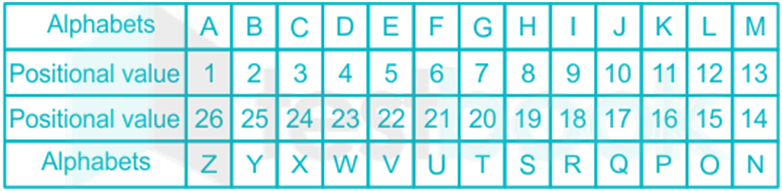
Positional value Table

The logic followed in this pattern is a consistent alphabetical shift where each letter is moved backward by 4 positions in the English alphabetical order.

For 'QPRO' related to 'MLNK':

For 'HGIF' related to 'DCEB':

Applying the same logic to 'XWYV':

Thus, XWYV is related to TSUR.

Hence, the correct answer is 'Option 1'.

15

Each vowel in the word SINGULAR is changed to the letter immediately following it in the English alphabetical order and each consonant is changed to the second letter preceding it in the English alphabetical order. Which of the following letters will appear exactly twice in the new group of letters thus formed?

  1. ((a))

    B

  2. ((b))

    L

  3. ((c))

    E

  4. ((d))

    J

Show Answer
Answer: ((d))

J

The logic follows here,

LetterSINGULAR
TypeConsonantVowelConsonantConsonantVowelConsonantVowelConsonant
Logic−2+1−2−2+1−2+1−2
New LetterQJLEVJBP
  • The new group of letters formed is: Q, J, L, E, V, J, B, P.
  • J will appear exactly twice in the new group of letters thus formed

Hence, the correct answer is "Option 2"

16

What will come in the place of ‘?’ in the following equation, if ‘+’ and ‘×’ are interchanged and ‘-’ and ‘÷’ are interchanged?

<br>

30 - 3 × 12 + 2 ÷ 18 = ?

  1. ((a))

    13

  2. ((b))

    20

  3. ((c))

    16

  4. ((d))

    10

Show Answer
Answer: ((c))

16

Given Expression: 30 − 3 × 12 + 2 ÷ 18

Signs Interchange:

  • '+' and '−' are interchanged.
  • '×' and '÷' are interchanged.

After Expression and Applying BODMAS rule,

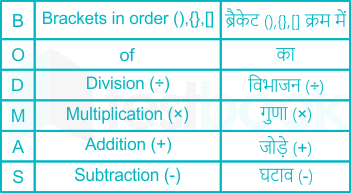
BODMAS

= 30 ÷ 3 + 12 × 2 − 18

= 10 + 12 × 2 − 18

= 10 + 24 − 18

= 34 − 18

= 16

Therefore, the value that will come in the place of ‘?’ is 16.

Hence, the correct answer is "Option 2"

17

In a certain code language, ‘SOIL’ is coded as ‘6759’ and ‘IDOL’ is coded as ‘7649’. What is the code for ‘D’ in that language?

  1. ((a))

    6

  2. ((b))

    7

  3. ((c))

    9

  4. ((d))

    4

Show Answer
Answer: ((d))

4

The logic followed here

The code for D is 4.

Hence, the correct answer is "option 4"

18

Based on the alphabetical order, three of the following four are alike in a certain way and thus form a group. Which is the one that does not belong to that group? (Note: The odd one out is not based on the number of consonants/vowels or their position in the letter cluster)

  1. ((a))

    LPN

  2. ((b))

    BFD

  3. ((c))

    QUR

  4. ((d))

    GKI

Show Answer
Answer: ((c))

QUR

The logic followed here is:

626a871a13e02eef2fcd3cd5 16564998081491

Logic: Second letter = First letter + 4; Third letter = Second letter − 2.

 For GKI,

For  BFD,

For  QUR

This cluster does not follow the rule.

For  LPN,

Therefore, the letter cluster that is different from the others is QUR.

Hence, the correct answer is 'Option 3'.

19

Each of E, F, G, H, Q, R and S has an exam on a different day of a week starting from Monday and ending on Sunday of the same week. F has exam on Thursday. E has exam on one of the days after Q and on one of the days before G. H has exam on one of the days after R but on one of the days before S. R has exam on one of the days after F. How many people have exam between H and E?

  1. ((a))

    Four

  2. ((b))

    Three

  3. ((c))

    One

  4. ((d))

    Two

Show Answer
Answer: ((b))

Three

Given: E, F, G, H, Q, R and S each have their exam on a different day of the same week starting from Monday and ending on Sunday.

  1. F has his exam on Thursday.
  2. E has his exam on one of the days after Q and before G.
  3. H has his exam on one of the days after R and before S.
  4. R has his exam on one of the days after F

The Final Arrangement is,

DayPerson
MondayQ
TuesdayE
WednesdayG
ThursdayF
FridayR
SaturdayH
SundayS

Three people have their exam between H and E

Hence, the correct answer is " Option 3"

20

What should come in place of the question mark (?) in the given series based on the English alphabetical order?

<br>

BET, DIZ, FMF, HQL, ?

  1. ((a))

    JTO

  2. ((b))

    JVS

  3. ((c))

    JSN

  4. ((d))

    JUR

Show Answer
Answer: ((d))

JUR

The logic followed here is:

Combining the results, the next term in the series is JUR.

Hence, the correct answer is "option 4

General Awareness (20 questions)

21

Where was Exercise Desert Hunt 2025 conducted?

  1. ((a))

    Rajasthan

  2. ((b))

    Gujarat

  3. ((c))

    Punjab

  4. ((d))

    Haryana

Show Answer
Answer: ((a))

Rajasthan

The correct answer is Rajasthan.

Key Points

  • Exercise Desert Hunt 2025 was an integrated Tri-Service Special Forces training exercise conducted in the state of Rajasthan.
  • This high-intensity drill was held at the strategically vital Air Force Station Jodhpur from February 24 to 28, 2025.
  • The exercise was organized by the Indian Air Force to evaluate joint operational readiness and maximize interoperability, coordination, and synergy among India's elite commandos in desert terrains.
  • It witnessed active participation from three premier special operations units: the Indian Army's Para (Special Forces), the Indian Navy's Marine Commandos (MARCOS), and the Indian Air Force's Garud Special Forces.
  • Critical operations tested during the exercise included airborne insertion, precision strikes, hostage rescue, counter-terrorism drills, combat free falls, and urban warfare simulations under realistic combat scenarios.

 Additional Information

  • Elite Participating Units:
  • Para (SF): The tactical special forces unit of the Indian Army, highly trained for unconventional warfare, hostage rescue, and direct tactical action.
  • MARCOS: The marine commando unit of the Indian Navy, specialized in amphibious warfare, maritime counter-terrorism, and special reconnaissance.
  • Garud Commandos: The specialized unit of the Indian Air Force, primarily trained for airfield defense, combat search and rescue, and counter-insurgency operations.
  • Air Force Station Jodhpur:
  • Located in the Thar desert of Rajasthan, this airbase serves as a crucial strategic hub for defending India's western airspace.
  • Key Desert Exercises in India:
  • Exercise Desert Cyclone: A bilateral military exercise between India and the UAE, focusing on joint desert operations.
  • Exercise Al Najah: A joint military exercise conducted between the armies of India and Oman.
22

Which of the following is not a factor considered under the locational setting of iron and steel industries in India?

  1. ((a))

    Market accessibility

  2. ((b))

    Availability of cheap land in deserts

  3. ((c))

    Access to navigable rivers

  4. ((d))

    Nearness to iron ore and coal mines

Show Answer
Answer: ((b))

Availability of cheap land in deserts

The correct answer is Availability of cheap land in deserts.

Key Points

  • The Iron and Steel Industry is categorized as a weight-losing industry because the raw materials used are bulky and heavy, losing weight during the smelting process. Consequently, these industries are traditionally located near Iron Ore and Coal Mines to minimize logistics expenses.
  • Water Supply is an indispensable requirement for the industrial process, used extensively for cooling Blast Furnaces and steam generation. Deserts are characterized by extreme water scarcity, making them geographically unsuitable for such water-intensive operations.
  • The Chota Nagpur Plateau serves as the primary hub for this industry in India, encompassing states like Jharkhand, West Bengal, Odisha, and Chhattisgarh, where raw materials and water from rivers like the Damodar and Subarnarekha are abundant.
  • Market Accessibility and Infrastructure play secondary but crucial roles, ensuring that finished products reach manufacturing sectors like automobiles, construction, and heavy machinery efficiently via Railways and Navigable Rivers.

 Additional Information

  • Core Locational Factors:
  • Raw Material Proximity: Most Indian steel plants like TISCO (Jamshedpur) and Bhilai Steel Plant are situated close to Hematite iron ore deposits and Coking Coal fields of Jharia and Raniganj.
  • Transport Network: Integration with the Indian Railways and proximity to ports (e.g., Visakhapatnam Steel Plant) allows for the import of high-quality coal and the export of finished steel.
  • Power Resources: Reliable electricity from thermal power plants located near coal belts or hydroelectric projects is a prerequisite for operating electric arc furnaces.
  • Constraints of Desert Regions:
  • Arid regions like the Thar Desert lack the integrated transport connectivity and the perennial water bodies (like the Kharkai or Brahmani rivers) that are foundational to the Metallurgical Industry.
23

Which country hosted the ICC U19 Women’s T20 World Cup 2025?

  1. ((a))

    South Africa

  2. ((b))

    India

  3. ((c))

    Australia

  4. ((d))

    Malaysia

Show Answer
Answer: ((d))

Malaysia

The correct answer is Malaysia.

Key Points

  • The ICC U19 Women’s T20 World Cup 2025 is the second edition of the premier international cricket tournament for women under the age of 19, organized by the International Cricket Council (ICC).
  • Malaysia was officially designated as the host for this event, scheduled to take place in January and February 2025, marking a significant milestone for cricket in the Southeast Asian region.
  • The tournament will feature 16 national teams competing in 41 matches across several venues, providing a global platform for young female cricketers to showcase their talent.
  • The selection of Malaysia as the host aligns with the ICC’s objective to globalize the sport and promote women's cricket within Associate Member nations.
  • This edition follows the success of the inaugural tournament, maintaining the biennial cycle established for the U19 World Cup format.

 Additional Information

  • South Africa:
  • Served as the host for the inaugural ICC U19 Women’s T20 World Cup in 2023.
  • The final of the first edition was held at Potchefstroom, where India defeated England to become the first-ever champions.
  • India:
  • Enters the 2025 tournament as the defending champions after winning the title in January 2023.
  • The Indian team, led by Shafali Verma in the first edition, historically secured the trophy by 7 wickets.
  • Future Hosting:
  • The 2027 edition is scheduled to be co-hosted by Bangladesh and Nepal, further expanding the footprint of women's youth cricket in Asia.
  • Tournament Structure:
  • The competition utilizes a format involving Group Stages, followed by a Super Six round, and concluding with Semi-finals and a Final match.
24

Which of the following schemes related to employment was launched on 1 October 2020 by the Ministry of Labour and Employment, GOI?

  1. ((a))

    Garib Kalyan Rojgar Abhiyaan

  2. ((b))

    Aatmanirbhar Bharat Rojgar Yojana

  3. ((c))

    Prime Minister’s Employment Generation Programme

  4. ((d))

    Pradhan Mantri Mudra Yojana

Show Answer
Answer: ((b))

Aatmanirbhar Bharat Rojgar Yojana

The correct answer is Aatmanirbhar Bharat Rojgar Yojana.

Key Points

  • The Aatmanirbhar Bharat Rojgar Yojana (ABRY) was launched by the Ministry of Labour and Employment to incentivize employers for the creation of new employment opportunities and the restoration of loss of employment during the COVID-19 pandemic.
  • The scheme was operationalized with effect from 1 October 2020 and the registration for beneficiaries was open until 31 March 2022.
  • It was introduced as a part of the Aatmanirbhar Bharat Package 3.0 stimulus to boost the formal sector economy and provide social security benefits.
  • Under the scheme, the Government of India provides a subsidy for two years for new employees who joined during the eligibility period and earned a monthly wage of less than 15,000 rupees.
  • For establishments having up to 1000 employees, the central government pays both the 12% employee contribution and the 12% employer contribution (total 24% of wages) towards EPF.
  • For establishments with more than 1000 employees, the government pays only the 12% employee contribution to the EPF account of the new employees.

 Additional Information

  • Garib Kalyan Rojgar Abhiyaan:
  • Launched on 20 June 2020 to provide immediate employment and livelihood opportunities to migrant workers who returned to their villages during the lockdown.
  • The scheme focused on 116 districts across 6 states for a duration of 125 days.
  • Prime Minister’s Employment Generation Programme (PMEGP):
  • A credit-linked subsidy scheme launched in 2008 by the Ministry of Micro, Small and Medium Enterprises (MSME).
  • It was formed by merging the Prime Minister’s Rozgar Yojana (PMRY) and the Rural Employment Generation Programme (REGP).
  • Pradhan Mantri Mudra Yojana (PMMY):
  • Launched on 8 April 2015 to provide loans up to 10 lakh rupees to non-corporate, non-farm small/micro enterprises.
  • Loans are classified as Shishu (up to 50,000), Kishore (50,001 to 5 lakh), and Tarun (5,00,001 to 10 lakh).

Therefore, the correct option is 2.

25

Which was the first state in India to enact the Right to Public Service Act 2010?

  1. ((a))

    Punjab

  2. ((b))

    Madhya Pradesh

  3. ((c))

    Rajasthan

  4. ((d))

    Bihar

Show Answer
Answer: ((b))

Madhya Pradesh

The correct answer is Madhya Pradesh.

Key Points

  • Madhya Pradesh became the first state in India to enact and implement the Right to Public Service Act.
  • The legislation, officially titled the Madhya Pradesh Lok Sewaon Ke Pradan Ki Guarantee Adhiniyam, 2010, was passed by the state assembly and received the Governor’s assent on August 18, 2010.
  • The primary objective of this landmark legislation is to ensure the time-bound delivery of essential government services to the citizens, thereby enhancing administrative accountability and reducing corruption.
  • The act provides a legal guarantee for services such as caste certificates, income certificates, domicile certificates, and land records within a stipulated period.
  • A critical feature of the act is the provision for monetary penalties on designated officers if they fail to provide the requested service within the prescribed timeline without a valid justification.
  • Therefore, the correct option is 2.

 Additional Information

  • Following the success of the Madhya Pradesh model, several other Indian states introduced similar citizen-centric laws:
  • Bihar: Enacted the Bihar Right to Public Services Act, 2011, which came into effect on August 15, 2011, making it the second state to adopt such a framework.
  • Rajasthan: Implemented the Rajasthan Guaranteed Delivery of Public Services Act, 2011, covering various departments including Police, Revenue, and Medical Health.
  • Punjab: Passed the Punjab Right to Service Act, 2011, and established a Right to Service Commission to monitor the implementation of the act.
  • Purpose: These acts empower citizens by creating a statutory right to receive services and provide a two-tier grievance redressal mechanism through appellate authorities.
26

Which of the following is included as a Fundamental Duty under Article 51A of the Indian Constitution?

  1. ((a))

    To maintain just and honourable relations between nations

  2. ((b))

    To vote in public elections

  3. ((c))

    To ensure the right to an adequate means of livelihood

  4. ((d))

    To defend the country and render national service when called upon to do so

Show Answer
Answer: ((d))

To defend the country and render national service when called upon to do so

The correct answer is To defend the country and render national service when called upon to do so.

Key Points

  • The concept of Fundamental Duties is enshrined in Part IV-A of the Indian Constitution under Article 51A. This specific provision was not part of the original Constitution but was added later to balance citizens’ rights with their obligations toward the state.
  • According to Article 51A(d), it is the duty of every citizen of India to defend the country and render national service when called upon to do so. This implies a moral and civic obligation to prioritize national security and contribute to the country’s needs during emergencies or required service periods.
  • The 42nd Constitutional Amendment Act, 1976 introduced these duties based on the recommendations of the Sardar Swaran Singh Committee. The committee suggested that citizens should be aware that while they enjoy fundamental rights, they also have certain duties to perform.
  • These duties are non-justiciable in nature, meaning they cannot be directly enforced by courts through writs, though they serve as a guide for interpreting laws and determining the constitutionality of legislative acts.

 Additional Information

  • Directive Principles of State Policy (DPSP) vs. Fundamental Duties:
  • To maintain just and honourable relations between nations is a principle found under Article 51, which is part of the DPSP in Part IV, guiding the state’s foreign policy rather than citizen duties.
  • To ensure the right to an adequate means of livelihood is covered under Article 39(a) of the DPSP, emphasizing the state’s responsibility to ensure economic justice.
  • Legal and Political Rights:
  • To vote in public elections is a constitutional/legal right under Article 326 but is not explicitly listed as a Fundamental Duty under Article 51A, despite suggestions by the Swaran Singh Committee to include it.
  • Growth of Fundamental Duties:
  • Initially, 10 duties were added in 1976. The 11th Fundamental Duty, which pertains to providing opportunities for education to children aged 6−14 years, was added by the 86th Constitutional Amendment Act, 2002.
27

Which of the following mountain ranges is classified as youngest in terms of geological formation?

  1. ((a))

    Satpura Range

  2. ((b))

    Himalayas

  3. ((c))

    Eastern Ghats

  4. ((d))

    Aravalli Hills

Show Answer
Answer: ((b))

Himalayas

The correct answer is Himalayas.

Key Points

  • The Himalayas are geologically classified as young fold mountains because they were formed during the most recent phase of mountain building in Earth's history, known as the Alpine orogeny.
  • The formation of this range began approximately 50 to 65 million years ago during the Cenozoic Era, resulting from the massive collision between the Indo-Australian Plate and the Eurasian Plate.
  • Due to the ongoing northward movement of the Indian Plate, the Himalayas are still rising in height and are considered tectonically active, which explains the high frequency of earthquakes in the region.
  • Unlike ancient ranges that have been leveled by millions of years of erosion, the Himalayas exhibit high topographic relief, sharp peaks, and deep V-shaped valleys, which are characteristic features of geologically young landscapes.

 Additional Information

  • Aravalli Hills
  • These are among the oldest fold mountain systems in the world, having formed during the Pre-Cambrian era over 2 billion years ago.
  • Located primarily in Rajasthan, they have been significantly reduced in height due to prolonged weathering and erosion processes.
  • Eastern Ghats
  • This range consists of ancient, discontinuous hills along India's eastern coast, dating back to the assembly of the ancient supercontinent Rodinia.
  • They are much older than the Himalayas and have been extensively eroded by major peninsular rivers like the Godavari, Krishna, and Kaveri.
  • Satpura Range
  • Situated in central India, these are primarily block mountains (horsts) formed between the rift valleys of the Narmada and Tapti rivers.
  • While younger than the Aravallis, they predate the final Himalayan uplift and represent an older structural feature of the Indian Peninsular Plateau.
28

Which theory did Bohr challenge to explain atomic spectra?

  1. ((a))

    Theory of relativity

  2. ((b))

    Gravitational theory

  3. ((c))

    Thermodynamic theory

  4. ((d))

    Classical electromagnetic theory

Show Answer
Answer: ((d))

Classical electromagnetic theory

CONCEPT:

Bohr’s Atomic Model

  • In 1913, Niels Bohr proposed a model for the atom to explain why atoms are stable and why they emit discrete spectra.
  • This model was a modification of the Rutherford model and incorporated Quantum Theory.
  • The primary challenge Bohr addressed was the failure of Classical Physics to explain the behavior of subatomic particles.

EXPLANATION:

  • According to Classical Electromagnetic Theory (Maxwell’s theory), any accelerated charged particle must continuously emit energy in the form of electromagnetic radiation.
  • In the planetary model of the atom, an electron moving in a circular orbit undergoes centripetal acceleration.
  • If Classical Electromagnetic Theory were applied, the electron would lose energy constantly, its orbital radius would decrease, and it would eventually spiral into the nucleus, making the atom highly unstable.
  • Additionally, the continuous loss of energy would result in a continuous emission spectrum, which contradicted the observed line spectra of elements like Hydrogen.
  • Niels Bohr challenged these classical views by postulating that:
  • Electrons revolve in specific discrete orbits (stationary states) without radiating energy.
  • Radiation is only emitted or absorbed when an electron jumps from one orbit to another.

Therefore, the theory that Bohr challenged to explain atomic spectra is Classical electromagnetic theory.

29

According to the Constitution of India, a person who has held office as a permanent Judge of a High Court after the commencement of the Constitution is restricted from pleading or acting:

  1. ((a))

    In any court or before any authority except the Supreme Court and other High Courts

  2. ((b))

    In the Supreme Court and other High Courts only

  3. ((c))

    In legal proceedings conducted in any court or before any designated authority in India

  4. ((d))

    Only in the High Court where they last served

Show Answer
Answer: ((a))

In any court or before any authority except the Supreme Court and other High Courts

The correct answer is In any court or before any authority except the Supreme Court and other High Courts.

Key Points

  • The restriction on the legal practice of retired permanent judges is governed by Article 220 of the Constitution of India.
  • According to this article, any person who has held office as a permanent Judge of a High Court after the commencement of the Constitution (January 26, 1950) is prohibited from pleading or acting in any court or before any authority within the territory of India.
  • However, an explicit exception is provided: such individuals are permitted to practice in the Supreme Court and in High Courts other than the one(s) where they served as a permanent judge.
  • This provision was substituted by the 7th Constitutional Amendment Act, 1956. Prior to this amendment, there was a complete ban on practice for retired judges to ensure the independence of the judiciary and prevent potential bias or influence in the courts where they formerly presided.
  • The term other High Courts refers to any High Court in India where the individual did not hold the post of a permanent judge, thereby maintaining the dignity of the judicial office.

 Additional Information

  • Article 124(7) of the Constitution:
  • This article imposes a much stricter restriction on judges of the Supreme Court.
  • A person who has been a Judge of the Supreme Court is barred from pleading or acting in any court or before any authority within the territory of India, with no exceptions.
  • Additional and Acting Judges:
  • The restrictions mentioned in Article 220 apply strictly to permanent judges.
  • Individuals who served only as Additional Judges or Acting Judges (under Articles 223 and 224) and did not become permanent are not subject to these practice restrictions.
  • Judicial Independence:
  • These constitutional bars are designed to prevent the 'reasonable apprehension of bias' and to ensure that retired judges do not use their former status to influence the subordinate judiciary or administrative authorities.
30

Which of the following is a famous dance form of Gujarat?

  1. ((a))

    Charba

  2. ((b))

    Garba

  3. ((c))

    Bhangra

  4. ((d))

    Kalbelia

Show Answer
Answer: ((b))

Garba

The correct answer is Garba.

Key Points

  • Garba is a vibrant and devotional folk dance originating from the state of Gujarat, India, performed to honor the feminine form of divinity.
  • The term is derived from the Sanskrit word Garbha (meaning womb) and is traditionally performed around a centrally placed perforated earthenware lamp called the Garbha Deep or an image of Goddess Shakti.
  • This dance is the hallmark of the Navratri festival, which spans nine nights of worship and celebration, symbolizing the cyclical nature of life from birth to death to rebirth.
  • The performance involves participants moving in concentric circles, clapping in rhythm, and sometimes using Dandiya (sticks), though the circular motion remains the core structural element.
  • In December 2023, Garba of Gujarat was inscribed on the UNESCO Representative List of the Intangible Cultural Heritage of Humanity, highlighting its role as a unifying social force.

 Additional Information

  • Charba:
  • It is a traditional folk dance performed in Himachal Pradesh.
  • The dance is specifically associated with the celebration of the Dussehra festival in the region.
  • Bhangra:
  • A high-energy folk dance that originated in the Majha region of Punjab.
  • It was traditionally performed by farmers to celebrate the Baisakhi festival and the arrival of the harvest season.
  • Kalbelia:
  • An ancient dance form from Rajasthan performed by the Kalbelia tribe, traditionally known as snake charmers.
  • The dance involves sensuous movements that mimic the swaying of a cobra and was recognized by UNESCO as intangible heritage in 2010.
31

Bindrai Manki was a prominent leader during which of the following tribal revolts in the Chotanagpur region of Singhbhum district in 1831–32?

  1. ((a))

    Kol Insurrection

  2. ((b))

    Munda Uprising

  3. ((c))

    Santhal Rebellion

  4. ((d))

    Rangpur Peasant Revolt

Show Answer
Answer: ((a))

Kol Insurrection

The correct answer is Kol Insurrection.

Key Points

  • The Kol Insurrection of 1831-32 was a major tribal uprising against the British East India Company and oppressive Zamindars in the Chotanagpur plateau, covering regions like Singhbhum, Ranchi, Palamau, and Hazaribagh.
  • Bindrai Manki, along with Sui Munda, provided pivotal leadership during the revolt. The movement was triggered when traditional land rights of tribal Manki (village heads) and Munda chiefs were transferred to Dikus (outsiders), specifically Sikh and Muslim farmers.
  • The revolt was a response to the dispossession of land, high taxation, and the exploitation of tribal women by outsiders. The rebels utilized traditional weapons like bows and arrows to target the property of moneylenders and government officials.
  • Other notable leaders included Buddhu Bhagat, who led the resistance in Sillay and sacrificed his life alongside hundreds of followers during a fierce battle against British troops led by Captain Impey.

 Additional Information

  • Santhal Rebellion (1855-56):
  • Led by Sidhu Murmu and Kanhu Murmu in the Daman-i-Koh region (Rajmahal Hills).
  • It was directed against the Zamindari system and the Mahajans (moneylenders) who exploited the Santhal tribal community.
  • Munda Uprising (Ulgulan):
  • The most significant phase occurred between 1899-1900 under the leadership of Birsa Munda.
  • It aimed at establishing Munda Raj and regaining Khuntkatti land rights against the intrusion of colonial authorities and missionaries.
  • Rangpur Peasant Revolt (1783):
  • Occurred in Bengal against the harsh revenue collection methods of Debi Singh.
  • It saw unity between Hindu and Muslim peasants to oppose the East India Company's revenue demands.
32

Which of the following is one of the most striking structures studded with pietra dura decoration in Agra designed by Noor Jahan in the 17th century?

  1. ((a))

    Safdarjung Tomb

  2. ((b))

    Itimad-ud- Daula Tomb

  3. ((c))

    Khan-i-Khana Tomb

  4. ((d))

    Isa Khan Tomb

Show Answer
Answer: ((b))

Itimad-ud- Daula Tomb

The correct answer is Itimad-ud- Daula Tomb.

Key Points

  • The Itimad-ud-Daula Tomb was commissioned by Empress Nur Jahan between 1622 and 1628 AD in memory of her father, Mirza Ghiyas Beg, who served as the Wazir (Chief Minister) under Emperor Jahangir.
  • Located on the eastern bank of the Yamuna River in Agra, it is famously known as the Baby Taj because its design and ornamentation served as a prototype for the Taj Mahal.
  • This structure is historically significant for being the first Mughal building constructed entirely of white marble, marking a major shift from the red sandstone architectural tradition of the Akbar era.
  • The tomb is most renowned for its extensive use of pietra dura (parchin kari), a decorative technique where highly polished semi-precious stones like lapis lazuli, cornelian, jasper, and onyx are inlaid into marble to form delicate floral and geometric motifs.
  • The layout follows the Charbagh (four-gardens) pattern, with the central tomb structure featuring four hexagonal minarets at the corners, reflecting a refined transition in Indo-Islamic architecture.

 Additional Information

  • Safdarjung Tomb
  • Built in 1754 in Delhi, this tomb was constructed for Nawab Safdarjung of Awadh during the late Mughal Empire period.
  • It is often described as the last monumental garden-tomb of the Mughals, though it lacks the precision and scale of 17th-century architecture.
  • Khan-i-Khana Tomb
  • Located in Nizamuddin, Delhi, it is the resting place of Abdul Rahim Khan-i-Khana, one of the Navaratnas (nine gems) in Akbar’s court.
  • The tomb’s design originally inspired the structure of the Taj Mahal, though much of its original marble was later stripped for other buildings.
  • Isa Khan Tomb
  • This tomb is part of the Humayun’s Tomb complex in Delhi and was built in 1547-48 AD for Isa Khan Niyazi, a noble in the court of Sher Shah Suri.
  • It features an octagonal architectural style, which was characteristic of the Lodi and Suri dynasties.
33

Where did DRDO successfully test a 30-kilowatt laser-based Directed Energy Weapon (DEW) in April 2025?

  1. ((a))

    Chandipur, Odisha

  2. ((b))

    Kurnool, Andhra Pradesh

  3. ((c))

    Pokhran, Rajasthan

  4. ((d))

    Balasore, Odisha

Show Answer
Answer: ((b))

Kurnool, Andhra Pradesh

The correct answer is Kurnool, Andhra Pradesh.

Key Points

  • In April 2025, the Defence Research and Development Organisation (DRDO) achieved a significant milestone by successfully testing a 30-kilowatt (kW) laser-based Directed Energy Weapon (DEW).
  • The test was conducted in Kurnool, Andhra Pradesh, utilizing a specialized testing range developed to facilitate advanced trials for electronic warfare and precision energy-based systems.
  • The 30kW laser is designed to provide point-defense capabilities against Unmanned Aerial Vehicles (UAVs), loitering munitions, and other small aerial threats by focusing intense thermal energy to incinerate or disable the target.
  • The success of this trial validates India's progress in non-kinetic weaponry, which allows for engagement at the speed of light with extreme precision and minimal collateral damage.
  • This indigenous technology is part of a broader roadmap to integrate high-power lasers into mobile platforms, such as tanks and naval destroyers, for real-time battlefield protection.

 Additional Information

  • Directed Energy Weapons (DEW):
  • These systems utilize concentrated electromagnetic energy, including High-Energy Lasers (HEL) and High-Power Microwaves (HPM), to damage or destroy enemy equipment.
  • Advantages include a low cost-per-shot compared to traditional missiles and a virtually infinite magazine as long as power is supplied.
  • LASTEC (Laser Science and Technology Centre):
  • Based in Delhi, this DRDO laboratory is the lead agency responsible for the conceptualization and development of laser-based weapon systems like DURGA II.
  • Geographic Context:
  • While Chandipur and Balasore in Odisha are primary sites for missile testing (ITR), Kurnool has emerged as a strategic hub for drone and electronic warfare testing due to its vast, open topography.
  • Pokhran in Rajasthan remains the primary site for nuclear and heavy artillery trials.
34

In which of the following valleys of Himachal Pradesh is an experimental geothermal project located?

  1. ((a))

    Parvati Valley

  2. ((b))

    Kangra Valley

  3. ((c))

    Solang Valley

  4. ((d))

    Spiti Valley

Show Answer
Answer: ((a))

Parvati Valley

The correct answer is Parvati Valley.

Key Points

  • The experimental geothermal power project in Himachal Pradesh is located in the Parvati Valley at a place called Manikaran, situated in the Kullu district.
  • Manikaran is famous for its natural hot springs, where the surface temperature of water reaches nearly 96°C, making it a primary site for geothermal energy exploration in India.
  • The Geological Survey of India (GSI) and the National Hydroelectric Power Corporation (NHPC) have conducted extensive studies in this region to establish the feasibility of a pilot geothermal plant.
  • The Parvati Valley geothermal field is part of the North-West Himalayan geothermal belt, characterized by high heat flow and tectonic activity that allows magmatic heat to warm the subsurface aquifers.
  • The project aims to utilize the thermal energy from the earth's interior to generate clean electricity, providing a sustainable alternative to traditional fossil fuels in the Himalayan region.

 Additional Information

  • Geothermal Energy:
  • It is a non-conventional energy source that taps into the heat stored beneath the Earth's surface.
  • Apart from Manikaran, the Puga Valley in Ladakh and Tattapani in Chhattisgarh are other major potential sites for geothermal energy in India.
  • Kangra Valley:
  • Located in the Dhauladhar range, it is primarily known for Kangra Tea, the historical Kangra Fort, and Dharamshala, the seat of the Dalai Lama.
  • Solang Valley:
  • Situated near Manali, it is a renowned destination for adventure tourism, including skiing, paragliding, and mountaineering.
  • Spiti Valley:
  • Known as the Cold Desert, it is a high-altitude valley famous for its Tibetan Buddhist culture and the Key Monastery.
35

The Mughal Empire during Akbar’s early teenage rule (1556–1560) was directed by which of the following regents after Humayun’s death?

  1. ((a))

    Abul Fazl

  2. ((b))

    Munim Khan

  3. ((c))

    Mirza Hakim

  4. ((d))

    Bairam Khan

Show Answer
Answer: ((d))

Bairam Khan

The correct answer is Bairam Khan.

Key Points

  • Bairam Khan was a brilliant military commander and statesman who served as the Regent (Vakil) of the Mughal Empire from 1556 to 1560.
  • Following the accidental death of Emperor Humayun in January 1556, Akbar was crowned at Kalanaur, Punjab, at the young age of 13.
  • Due to Akbar's minority, Bairam Khan was appointed as his guardian and Ataliq (tutor-preceptor), exercising supreme civil and military authority.
  • Bairam Khan led the Mughal forces to a decisive victory against Hemu (the commander of the Sur dynasty) at the Second Battle of Panipat on November 5, 1556, which saved the fledgling Mughal state from collapse.
  • During his four-year regency, he consolidated the empire's boundaries and suppressed various internal rebellions, effectively acting as the de facto ruler until Akbar dismissed him in 1560 to take personal charge of the government.

 Additional Information

  • Abul Fazl:
  • He was the Grand Vizier and a close friend of Akbar, but he joined the court much later, around 1574.
  • He is famous for writing the Akbarnama and the Ain-i-Akbari, which are the primary historical accounts of Akbar's reign.
  • Munim Khan:
  • A prominent Mughal general who served under both Humayun and Akbar.
  • He was appointed as the Vakil (Prime Minister) in 1560 after the downfall of Bairam Khan and later served as the Governor of Bengal.
  • Mirza Hakim:
  • He was the half-brother of Akbar and the ruler of Kabul.
  • Instead of acting as a regent, he often posed a challenge to Akbar's authority and even supported a major rebellion against him in 1581.
36

Which law states that if systems A and B are both in thermal equilibrium with system C, then A and B are in equilibrium with each other?

  1. ((a))

    Law of conservation of energy

  2. ((b))

    Second law of thermodynamics

  3. ((c))

    Zeroth law of thermodynamics

  4. ((d))

    First law of thermodynamics

Show Answer
Answer: ((c))

Zeroth law of thermodynamics

CONCEPT:

Zeroth Law of Thermodynamics

  • The Zeroth Law of Thermodynamics states that if two thermodynamic systems are each in thermal equilibrium with a third system, then they are in thermal equilibrium with each other.
  • This law is fundamental because it allows us to define the concept of temperature as a measurable property of a system.
  • Thermal equilibrium means there is no net flow of heat between the systems when they are brought into thermal contact.

EXPLANATION:

  • According to the statement:
  • If system A is in thermal equilibrium with system C, they both have the same temperature (TA = TC).
  • If system B is also in thermal equilibrium with system C, they both have the same temperature (TB = TC).
  • Consequently, it follows that TA = TB, meaning system A and B are in thermal equilibrium with each other.
  • This principle is the basis for the construction and use of thermometers. If the thermometer (System C) shows the same reading for two different objects (Systems A and B), those objects are at the same temperature.
  • Other laws of thermodynamics focus on different aspects:
  • First Law: Deals with the conservation of energy (Internal energy, heat, and work).
  • Second Law: Deals with the entropy and the direction of spontaneous processes.
  • Third Law: States that the entropy of a perfect crystal at absolute zero is zero.

Therefore, the law described is the Zeroth law of thermodynamics.

37

When did Admiral Van der Hagen establish the first Dutch factory in Masulipattanam in present-day Andhra Pradesh?

  1. ((a))

    1635 AD

  2. ((b))

    1615 AD

  3. ((c))

    1605 AD

  4. ((d))

    1625 AD

Show Answer
Answer: ((c))

1605 AD

The correct answer is 1605 AD.

Key Points

  • The Dutch East India Company, known as Vereenigde Oost-Indische Compagnie (VOC), was formed in 1602 through a charter granted by the Dutch Parliament.
  • Admiral Steven van der Hagen reached the Coromandel Coast and established the first Dutch factory at Masulipattanam in 1605 AD.
  • The port of Masulipattanam (modern-day Machilipatnam) was situated in the kingdom of Golkonda and served as a vital hub for the textile trade.
  • The Dutch received trade privileges and permission from the Qutb Shahi ruler to set up their commercial base to export Indian textiles to the Malay Archipelago.
  • The establishment at Masulipattanam marked the beginning of Dutch commercial expansion in India, specifically targeting the profitable spice and cloth trade.

 Additional Information

  • Dutch Settlements in India:
  • Following Masulipattanam, the Dutch founded factories at Pulicat (1610), Surat (1616), Bimilipatnam (1641), and Chinsura (1653).
  • Pulicat served as the Dutch headquarters until 1690, after which Negapatam became their main center.
  • The Dutch were the first to introduce Gold Pagoda coins in India at their Pulicat mint.
  • Their primary exports from India included indigo, saltpetre, raw silk, and cotton textiles.
  • The Dutch power in India was significantly diminished after their defeat by the British in the Battle of Bedara (also known as the Battle of Hooghly) in 1759.
38

Who among the following hosted the Asmita Khelo India Wushu League 2025?

  1. ((a))

    Rashtriya Raksha University

  2. ((b))

    Indian Olympic Association

  3. ((c))

    Ministry of Education

  4. ((d))

    Sports Authority of India

Show Answer
Answer: ((a))

Rashtriya Raksha University

The correct answer is Rashtriya Raksha University.

Key Points

  • The Asmita Khelo India Wushu League 2025 was hosted by Rashtriya Raksha University (RRU) at its main campus located in Lavad, Gandhinagar, Gujarat.
  • The ASMITA initiative stands for Achieving Stride in Milestones by Inspiring Women Through Action, which is a dedicated component of the Khelo India program aimed at promoting women's participation in competitive sports.
  • The league was organized in collaboration with the Wushu Association of India and received technical and financial support from the Sports Authority of India (SAI).
  • The primary objective of hosting this league at Rashtriya Raksha University was to provide a professional platform for female Wushu athletes to improve their national rankings and prepare for international events like the Asian Games and World Championships.
  • As an Institution of National Importance under the Ministry of Home Affairs, RRU utilized its specialized sports infrastructure and School of Physical Education and Sports to facilitate the event.

 Additional Information

  • Rashtriya Raksha University (RRU):
  • It is India's first internal security university, established to meet the needs of the Police, Security Forces, and Paramilitary agencies.
  • The university was upgraded to an Institution of National Importance through an Act of Parliament in 2020.
  • It hosts various national-level combat sports competitions due to the synergy between martial arts and security training.
  • Sports Authority of India (SAI):
  • Established in 1984, SAI is the nodal agency for promoting excellence in sports in India.
  • It implements the Khelo India Scheme, which includes the Asmita Women's League across various sporting disciplines like Wushu, Judo, and Archery.
  • Wushu:
  • Wushu is a hard and soft and complete martial art, as well as a full-contact sport derived from traditional Chinese martial arts.
  • In India, the sport is governed by the Wushu Association of India, which is recognized by the International Wushu Federation (IWUF).
39

Which organisation, in July 2025, formally recognised the pivotal role played by heads of state and government in securing the adoption of the "Pandemic Agreement" in May 2025?

  1. ((a))

    International Monetary Fund

  2. ((b))

    World Health Organization

  3. ((c))

    World Bank

  4. ((d))

    United Nations Educational, Scientific and Cultural Organization

Show Answer
Answer: ((b))

World Health Organization

The correct answer is World Health Organization.

Key Points

  • The World Health Organization (WHO) is the specialized agency of the United Nations responsible for international public health, and it has been the primary facilitator for the development of a global pandemic treaty.
  • The Pandemic Agreement, formally known as the WHO Pandemic Accord, was envisioned to strengthen global prevention, preparedness, and response to future health emergencies following the lessons learned from the COVID-19 pandemic.
  • In May 2025, during the 78th World Health Assembly (WHA), the member states reached a consensus to adopt this landmark agreement after years of deliberations by the Intergovernmental Negotiating Body (INB).
  • The WHO leadership, in July 2025, specifically lauded the Heads of State and Government for their high-level political intervention, which was crucial in resolving complex issues related to pathogen access and benefit-sharing (PABS).
  • The recognition highlighted that without the direct involvement of national leaders, the treaty could have faced further delays beyond the 2025 deadline established by the 77th World Health Assembly.

 Additional Information

  • The World Health Organization (WHO):
  • Founded on April 7, 1948, which is celebrated annually as World Health Day.
  • Headquartered in Geneva, Switzerland, and currently led by Director-General Dr. Tedros Adhanom Ghebreyesus.
  • Its primary mandate includes coordinating international health responses, setting health standards, and monitoring global health trends.
  • Other organizations mentioned in the options:
  • The International Monetary Fund (IMF) focuses on global monetary cooperation, financial stability, and international trade, rather than health-related legal frameworks.
  • The World Bank provides loans and grants to low- and middle-income countries for developmental projects, including health infrastructure, but does not govern international health treaties.
  • UNESCO focuses on building peace through international cooperation in Education, the Sciences, and Culture.
40

Which of the following aggregates represents the net value of all final goods and services produced by the normal residents of a country during a year?

  1. ((a))

    NDP at Market Price

  2. ((b))

    GDP at Market Price

  3. ((c))

    NNP at Factor Cost

  4. ((d))

    GNP at Market Price

Show Answer
Answer: ((c))

NNP at Factor Cost

The correct answer is NNP at Factor Cost.

Key Points

  • Net National Product at Factor Cost (NNP FC) is traditionally defined as the National Income of a country, representing the total value of final goods and services produced by normal residents after accounting for capital wear and tear.
  • The component Net indicates that the Consumption of Fixed Capital (Depreciation) has been subtracted from the Gross National Product (GNP) to reflect the true addition to the economy.
  • The term National signifies that the aggregate includes income earned by normal residents of a country, regardless of whether they are located within the domestic territory or abroad, by adding Net Factor Income from Abroad (NFIA).
  • Factor Cost refers to the total payments made to factors of production (Land, Labor, Capital, and Entrepreneurship) in the form of rent, wages, interest, and profit.
  • It is calculated by deducting Net Indirect Taxes (Indirect Taxes − Subsidies) from the Net National Product at Market Price to arrive at the actual cost of production.

 Additional Information

  • GDP at Market Price:
  • It is the Gross market value of all final goods and services produced within the domestic boundary of a country during a specific period.
  • It does not account for Depreciation or the nationality of the producers, focusing solely on the geographical territory.
  • NDP at Market Price:
  • It represents the Net Domestic Product, which is derived by subtracting Depreciation from the GDP at Market Price.
  • It focuses on the net output generated strictly within the domestic borders.
  • GNP at Market Price:
  • This aggregate measures the Gross value of goods and services produced by normal residents, including income from abroad.
  • Unlike NNP, it remains a Gross concept because it still includes the cost of capital consumption.

Arithmetical and Numerical Ability (20 questions)

41

The value of 2.4ˉ+1.271.7ˉ 2.\bar{4} + 1.\overline{27} - 1.\bar{7} is

  1. ((a))

    5833\frac{58}{33}

  2. ((b))

    6733\frac{67}{33}

  3. ((c))

    6133\frac{61}{33}

  4. ((d))

    6433\frac{64}{33}

Show Answer
Answer: ((d))

6433\frac{64}{33}

Given:

Expression = 2.4̅ + 1.27̅ − 1.7̅

Formula used:

For a repeating decimal with one digit: x.y̅ = (xy − x) / 9

For a repeating decimal with two digits: x.yz̅ = (xyz − x) / 99

Calculation:

Convert the bar decimals into fractions:

2.4̅ = (24 − 2) / 9 = 22/9

1.27̅ = (127 − 1) / 99 = 126/99

1.7̅ = (17 − 1) / 9 = 16/9

Now, substitute these fractional values into the given expression:

⇒ 22/9 + 126/99 − 16/9

Group the fractions with the same denominator:

⇒ (22/9 − 16/9) + 126/99

⇒ 6/9 + 126/99

Simplify the first fraction 6/9 to 2/3:

⇒ 2/3 + 126/99

To add the fractions, find the LCM of 3 and 99, which is 99:

⇒ (2 × 33) / 99 + 126 / 99

⇒ 66/99 + 126/99

⇒ (66 + 126) / 99

⇒ 192/99

Divide both the numerator and the denominator by their common factor 3:

⇒ 192 ÷ 3 = 64

⇒ 99 ÷ 3 = 33

⇒ 64/33

∴ The correct answer is option (4).

42

Mansi and Neha started a partnership business investing some amount in the ratio of 8 : 7. Utsavi joined then after six months with an amount equal to that of Neha. In what ratio should the profit at the end of one year be distributed among Mansi, Neha and Utsavi?

  1. ((a))

    15 : 13 : 6

  2. ((b))

    16 : 14 : 7

  3. ((c))

    13 : 22 : 11

  4. ((d))

    24 : 29 : 15

Show Answer
Answer: ((b))

16 : 14 : 7

Shortcut Trick

Ratio of Profit = (Capital × Time) for each partner.

Mansi : Neha : Utsavi = (8 × 12) : (7 × 12) : (7 × 6)

Divide the entire ratio by 6 ⇒ (8 × 2) : (7 × 2) : (7 × 1)

Simplified Profit Ratio = 16 : 14 : 7.

∴ The correct answer is 16 : 14 : 7.

Alternate Method

Given:

Investment ratio of Mansi and Neha = 8 : 7

Investment of Utsavi = Investment of Neha = 7 units

Total time duration of business = 12 months (1 year)

Mansi and Neha invested for 12 months.

Utsavi joined after 6 months, so her investment time = 12 − 6 = 6 months.

Formula Used: Profit Share Ratio = (Investment1 × Time1) : (Investment2 × Time2) : (Investment3 × Time3)

⇒ Profit Ratio (Mansi : Neha : Utsavi) = (8 × 12) : (7 × 12) : (7 × 6)

⇒ Profit Ratio = 96 : 84 : 42

⇒ Dividing by the greatest common divisor (6):

⇒ Mansi's share = 96 ÷ 6 = 16

⇒ Neha's share = 84 ÷ 6 = 14

⇒ Utsavi's share = 42 ÷ 6 = 7

⇒ Resultant Ratio = 16 : 14 : 7

∴ The correct answer is 16 : 14 : 7.

Additional Information

Partnership Investment Rule

Profit is distributed based on the weighted investment (Capital × Time). If investments are C1, C2 for times T1, T2, then Profit Ratio = C1T1 : C2T2.

Active vs. Sleeping Partner

An active partner manages the business and may receive a salary/commission before profit distribution, while a sleeping partner only contributes capital.

Ratio Simplification

A ratio a : b : c can be simplified by dividing all terms by their Highest Common Factor (HCF) to represent it in the simplest form.

43

By how much is 30% of 80 greater than 25% of 35?

  1. ((a))

    17.25

  2. ((b))

    12.25

  3. ((c))

    15.25

  4. ((d))

    10.25

Show Answer
Answer: ((c))

15.25

Shortcut Trick

Direct Calculation: (30 × 80) − (25 × 35)

Step 1: 30% of 80 = 24

Step 2: 25% of 35 = 1/4 of 35 = 8.75

Step 3: Difference = 24 − 8.75 = 15.25

∴ The correct answer is 15.25.

Alternate Method

Given:

First value = 30% of 80

Second value = 25% of 35

Formula Used:

Percentage value = (Percentage / 100) × Number

Calculations:

⇒ First value = (30 / 100) × 80

⇒ First value = 0.3 × 80 = 24

⇒ Second value = (25 / 100) × 35

⇒ Second value = 0.25 × 35 = 8.75

⇒ Required difference = 24 − 8.75

⇒ Required difference = 15.25

∴ The correct answer is 15.25.

Additional Information

Percentage to Fraction Conversion

Standard percentages can be simplified as fractions: 25% = 1/4, 50% = 1/2, 75% = 3/4, and 20% = 1/5.

Commutative Property of Percentage

x% of y is always equal to y% of x. For example, 30% of 80 is the same as 80% of 30, both equaling 24.

Percentage Change Formula

To find the percentage increase or decrease: Percentage Change = [(New Value − Original Value) / Original Value] × 100.

44

A motorist covers a distance of 30 km in 50 minutes by moving at a speed of x kmph for the first 16 minutes, then moving at double the speed for the next 22 minutes and then again moving at his original speed for the rest of the journey. Then, x is equal to:

  1. ((a))

    28

  2. ((b))

    25

  3. ((c))

    22

  4. ((d))

    30

Show Answer
Answer: ((b))

25

Shortcut Trick

Total weighted time in terms of original speed x (in minutes) = (16 × 1) + (22 × 2) + (12 × 1) = 16 + 44 + 12 = 72 speed-minutes.

Since Distance = (Speed × Time) / 60, we have: 30 = (72 × x) / 60.

⇒ 72x = 1800

⇒ x = 1800 ÷ 72 = 25 kmph.

∴ The correct answer is 25 kmph.

Alternate Method

Given:

Total Distance = 30 km

Total Time = 50 min

Phase 1: Speed = x kmph, Time = 16 min

Phase 2: Speed = 2x kmph, Time = 22 min

Phase 3: Speed = x kmph, Time = 50 − (16 + 22) = 12 min

Formula: Distance = Speed × Time

To use kmph and minutes together, Time must be divided by 60.

⇒ Total Distance = (x × 16/60) + (2x × 22/60) + (x × 12/60)

⇒ 30 = (16x/60) + (44x/60) + (12x/60)

⇒ 30 = (16x + 44x + 12x) ÷ 60

⇒ 30 × 60 = 72x

⇒ 1800 = 72x

⇒ x = 1800 ÷ 72

⇒ x = 25

∴ The correct answer is 25 kmph.

Additional Information

Speed-Distance-Time Relationship

Basic formula: Speed = Distance ÷ Time. Ensure units are consistent (e.g., convert minutes to hours by dividing by 60).

Average Speed

Average Speed = Total Distance ÷ Total Time. For this journey, Average Speed = 30 / (50/60) = 36 kmph.

Unit Conversion

To convert kmph to m/s, multiply by 5/18. To convert m/s to kmph, multiply by 18/5.

45

A company wanted to manufacture 1000 hemispherical basins from a thin steel sheet. If the radius of each hemispherical basin is 21 cm, find the area (in m²) of the steel sheet required to manufacture the aforementioned hemispherical basins. (use π=227 \pi = \frac{22}{7} )

  1. ((a))

    277.2

  2. ((b))

    27720

  3. ((c))

    2772

  4. ((d))

    27.72

Show Answer
Answer: ((a))

277.2

Shortcut Trick

Total steel sheet area = Number of basins × Curved surface area of one basin

Curved Surface Area = 2 × π × r2

Total Area = 1000 × 2 × (22/7) × 21 × 21 = 27,72,000 cm2

Conversion: 1 m2 = 10,000 cm2 → 27,72,000 ÷ 10,000 = 277.2 m2

∴ The correct answer is 277.2 m2.

Alternate Method

Given:

Number of hemispherical basins (n) = 1000

Radius (r) = 21 cm

Value of π = 22/7

Formula Used:

The surface area of a thin hemispherical basin is its Curved Surface Area (CSA) = 2πr2

Calculations:

⇒ Surface area of one basin = 2 × (22/7) × 21 × 21

⇒ Surface area of one basin = 2 × 22 × 3 × 21

⇒ Surface area of one basin = 44 × 63 = 2772 cm2

⇒ Total area for 1000 basins = 1000 × 2772 = 27,72,000 cm2

⇒ Area in m2 = Total Area in cm2 ÷ 10,000

⇒ Area in m2 = 27,72,000 ÷ 10,000 = 277.2 m2

∴ The correct answer is 277.2 m2.

Additional Information

Surface Area of a Sphere

The total surface area of a full sphere is 4πr2.

Total Surface Area (TSA) of a Solid Hemisphere

For a solid hemisphere, the total area includes the curved surface and the flat circular base: TSA = 3πr2.

Volume of a Hemisphere

The space occupied by a hemisphere is given by the formula: Volume = (2/3)πr3.

Unit Conversion for Area

To convert cm2 to m2, divide by 10,000 (since 1 m = 100 cm, 1 m2 = 1002 cm2).

46

What is the difference between the average of prime numbers between 50 and 70 and the average of multiples of 2 between 20 and 80?

  1. ((a))

    9

  2. ((b))

    17

  3. ((c))

    10

  4. ((d))

    8

Show Answer
Answer: ((c))

10

Shortcut Trick Prime numbers between 50 and 70 are 53, 59, 61, 67 → Average = 240 ÷ 4 = 60. Multiples of 2 between 20 and 80 are 22, 24, ..., 78 → Average = (22 + 78) ÷ 2 = 50. Required Difference = 60 − 50 = 10. ∴ The correct answer is 10.

Alternate Method Given: Range 1: Prime numbers between 50 and 70. Range 2: Multiples of 2 (even numbers) between 20 and 80. Formula Used: Average = (Sum of all observations) ÷ (Total number of observations) Average of an Arithmetic Progression (AP) = (First term + Last term) ÷ 2

Calculations: ⇒ Prime numbers between 50 and 70: 53, 59, 61, 67 ⇒ Sum = 53 + 59 + 61 + 67 = 240 ⇒ Average1 = 240 ÷ 4 = 60 ⇒ Multiples of 2 between 20 and 80: 22, 24, 26, ..., 78 ⇒ This is an Arithmetic Progression with first term (a) = 22 and last term (l) = 78 ⇒ Average2 = (22 + 78) ÷ 2 = 100 ÷ 2 = 50 ⇒ Required Difference = Average1 − Average2 ⇒ Difference = 60 − 50 = 10 ∴ The correct answer is 10.

Additional Information Prime Numbers A prime number is a natural number greater than 1 that has no positive divisors other than 1 and itself. Example: 2, 3, 5, 7, 11... Arithmetic Progression (AP) Average For any series with a constant difference, the average is simply the mean of the first and last terms: (a + l) ÷ 2. Range Interpretation The term between X and Y typically excludes the boundary values X and Y themselves, considering only values n such that X < n < Y.

47

The radius and height of a cylinder are 14 cm and 50 cm, respectively. Find its volume (in cm3). (Use π=227 \pi = \frac{22}{7} )

  1. ((a))

    20800

  2. ((b))

    10800

  3. ((c))

    11800

  4. ((d))

    30800

Show Answer
Answer: ((d))

30800

Shortcut Trick

Identify given values: Radius (r) = 14 cm and Height (h) = 50 cm.

Apply the direct Volume formula: V = πr2h.

V = (22/7) × 14 × 14 × 50 = 22 × 2 × 14 × 50 = 44 × 700 = 30800 cm3.

∴ The correct answer is 30800 cm3.

Alternate Method

Given:

Radius of the cylinder (r) = 14 cm

Height of the cylinder (h) = 50 cm

Formula Used:

Volume of a cylinder = πr2h

Calculations:

⇒ Volume = (22/7) × (14)2 × 50

⇒ Volume = (22/7) × 14 × 14 × 50

⇒ Volume = 22 × 2 × 14 × 50

⇒ Volume = 44 × 700

⇒ Volume = 30800 cm3

∴ The correct answer is 30800 cm3.

Additional Information

Curved Surface Area (CSA)

The area of the side surface of the cylinder, excluding the bases, is given by 2πrh.

Total Surface Area (TSA)

The sum of the area of the two circular bases and the curved surface area: 2πr(r + h).

Volume of a Cone

A cone with the same radius and height as a cylinder has exactly one-third of its volume: (1/3)πr2h.

48

A shopkeeper bought an article for ₹1,200. At what price (in ₹) should he sell the article to make a 24% profit?

  1. ((a))

    1,488

  2. ((b))

    1,500

  3. ((c))

    1,476

  4. ((d))

    912

Show Answer
Answer: ((a))

1,488

Shortcut Trick

Net multiplier for 24% Profit = 1 + 24/100 = 1.24

Selling Price (SP) = 1200 × 1.24

⇒ 12 × 124 = 1488

∴ The correct answer is ₹1488.

Alternate Method

Given:

Cost Price (CP) = ₹1,200

Profit Percentage = 24%

Formula Used:

Selling Price (SP) = CP × (100 + Profit%) ÷ 100

Calculations:

⇒ SP = 1200 × (100 + 24) ÷ 100

⇒ SP = 1200 × (124 ÷ 100)

⇒ SP = 1200 × 1.24

⇒ SP = 1488

∴ The correct answer is ₹1488.

Additional Information

Profit and Loss Calculation

Profit is realized when SP > CP. Profit = SP − CP. Profit % = (Profit ÷ CP) × 100.

Marked Price and Discount

Discount is always calculated on the Marked Price (MP). SP = MP × (100 − Discount%) ÷ 100.

Successive Discounts

Equivalent discount for two successive discounts a% and b% is given by (a + b − ab/100)%.

49

On a marked price of ₹10,000, what is the difference in the selling price between a single discount of 40% and two successive discounts of 30% and 10%?

  1. ((a))

    ₹300

  2. ((b))

    ₹350

  3. ((c))

    ₹400

  4. ((d))

    ₹250

Show Answer
Answer: ((a))

₹300

Shortcut Trick

The difference between a single discount of (x + y)% and successive discounts of x% and y% is always (xy/100)% of the Marked Price.

Here, x = 30 and y = 10 (Note: 30 + 10 = 40, which matches the single discount).

Difference in Percentage = (30 × 10) ÷ 100 = 3%

Difference in Amount = 3% of ₹10,000 = ₹300

∴ The correct answer is ₹300.

Alternate Method

Given:

Marked Price (MP) = ₹10,000

Case 1: Single Discount = 40%

Case 2: Successive Discounts = 30% and 10%

Formula Used:

Selling Price (SP) = MP × (100 − Discount%) ÷ 100

Effective Successive Discount = x + y − (xy ÷ 100)

Calculations:

Selling Price in Case 1 (SP1) = 10,000 × (100 − 40) ÷ 100

⇒ SP1 = 10,000 × 0.60 = ₹6,000

⇒ Effective Discount in Case 2 = 30 + 10 − (30 × 10 ÷ 100)

⇒ Effective Discount = 40 − 3 = 37%

Selling Price in Case 2 (SP2) = 10,000 × (100 − 37) ÷ 100

⇒ SP2 = 10,000 × 0.63 = ₹6,300

⇒ Difference in SP = SP2 − SP1 = 6,300 − 6,000

⇒ Difference = ₹300

∴ The correct answer is ₹300.

Additional Information

Successive Discount Formula

For two successive discounts x% and y%, the net discount is x + y − (xy ÷ 100)%.

Successive vs Single Discount

A single discount of (x+y)% is always greater than the successive discounts of x% and y% by the amount (xy/100)% of the MP.

Selling Price and Marked Price

The Selling Price is the final amount paid after subtracting the Discount from the Marked Price: SP = MP − Discount.

50

The average weight (in kg) of a family of five members whose weights are 40 kg, 49 kg, 57 kg, 76 kg and 39 kg is:

  1. ((a))

    51.2

  2. ((b))

    54.2

  3. ((c))

    52.2

  4. ((d))

    53.2

Show Answer
Answer: ((c))

52.2

Shortcut Trick

Assume a base value (Assumed Mean) as 50 kg.

Calculate deviations from 50: (40−50), (49−50), (57−50), (76−50), (39−50) → −10, −1, +7, +26, −11.

Net Deviation = −10 − 1 + 7 + 26 − 11 = +11.

Average Deviation = +11 ÷ 5 = +2.2.

Actual Average = Assumed Mean + Average Deviation = 50 + 2.2 = 52.2 kg.

∴ The correct answer is 52.2 kg.

Alternate Method

Given: Weights of five members are 40 kg, 49 kg, 57 kg, 76 kg, and 39 kg.

Formula Used: Average = (Sum of all observations) ÷ (Total number of observations)

Calculations:

⇒ Sum of weights = 40 + 49 + 57 + 76 + 39

⇒ Sum of weights = 261 kg

⇒ Number of members = 5

⇒ Average weight = 261 ÷ 5

⇒ Average weight = 52.2 kg

∴ The correct answer is 52.2 kg.

Additional Information

Average of First n Natural Numbers

The average of the first n natural numbers is calculated as (n + 1) ÷ 2.

Weighted Average

When groups have different sizes, the combined average is (∑nixi) ÷ ∑ni, where n is the number of items and x is the average of each group.

Change in Average

If every observation is increased or decreased by a constant 'k', the new average also increases or decreases by 'k'.

51

What sum (in ₹) will earn a simple interest of ₹1680 in 2 years at 20% per year rate of interest?

  1. ((a))

    672

  2. ((b))

    2100

  3. ((c))

    4200

  4. ((d))

    8400

Show Answer
Answer: ((c))

4200

Shortcut Trick

Total Simple Interest percentage for 2 years = 20% × 2 = 40%.

According to the question, 40% of the Principal = ₹1680.

1% of the Principal = 1680 ÷ 40 = 42.

100% (Total Sum) = 42 × 100 = ₹4200.

∴ The correct answer is ₹4200.

Alternate Method

Given Data:

Simple Interest (SI) = ₹1680

Time (T) = 2 years

Rate of Interest (R) = 20% per annum

Formula Used:

Principal (P) = (SI × 100) ÷ (R × T)

Calculation:

⇒ P = (1680 × 100) ÷ (20 × 2)

⇒ P = 168000 ÷ 40

⇒ P = 16800 ÷ 4

⇒ P = 4200

∴ The correct answer is ₹4200.

Additional Information

Amount in Simple Interest

The total amount (A) is the sum of the Principal and the Simple Interest. Formula: A = P + SI = P(1 + RT/100).

SI vs CI for 2 Years

The difference between Compound Interest and Simple Interest for 2 years is given by the formula: Diff = P(R/100)2.

Rate of Interest

The Rate of interest is the percentage of the principal charged as interest for a specific period, usually a year (per annum).

52

A pipe can fill a tank in 12 hours. Another pipe can empty the filled tank in 18 hours. If both the pipes are opened simultaneously, then the time (in hours) in which the tank will be filled is:

  1. ((a))

    36

  2. ((b))

    37

  3. ((c))

    39

  4. ((d))

    38

Show Answer
Answer: ((a))

36

Shortcut Trick

Net filling time = (x × y) ÷ (y − x), where x = filling time and y = emptying time.

Net time = (12 × 18) ÷ (18 − 12)

Net time = 216 ÷ 6 = 36 hr

∴ The correct answer is 36 hr.

Alternate Method

Given: Filling pipe time = 12 hr, Emptying pipe time = 18 hr

To find the total capacity, we take the LCM of 12 and 18.

Total capacity of the tank = LCM(12, 18) = 36 units.

PipeTime (hr)Total WorkEfficiency
Inlet Pipe (Fill)1236+3
Outlet Pipe (Empty)18−2

Net Efficiency when both pipes are open = 3 + (−2) = 1 unit/hr

Time taken to fill the tank = Total Work ÷ Net Efficiency

⇒ Time = 36 ÷ 1 = 36 hr

∴ The correct answer is 36 hr.

Additional Information

Inlet and Outlet Pipes

An inlet pipe fills the tank (positive work), while an outlet pipe empties the tank (negative work).

Combined Rate Formula

If pipe A fills in 'a' hours and pipe B empties in 'b' hours (where a), the tank is filled in (a × b) ÷ (b − a) hours.

Pipes and Cisterns Basics

Efficiency is inversely proportional to time: Efficiency = Total Work ÷ Time.

53

If 1+29196=1+x14 \sqrt{1 + \frac{29}{196}} = 1 + \frac{x}{14} , then x = ?

  1. ((a))

    1

  2. ((b))

    3

  3. ((c))

    2

  4. ((d))

    0

Show Answer
Answer: ((a))

1

Shortcut Trick

First, simplify the LHS: √(1 + 29/196) = √(225/196) = 15/14.

Now, write 15/14 as a mixed fraction: 1 + 1/14.

By comparing 1 + 1/14 with the RHS (1 + x/14), we directly see that x = 1.

∴ The correct answer is 1.

Alternate Method

Given: √(1 + 29/196) = 1 + x/14

Formula Used: √(a/b) = √a / √b and basic algebraic simplification.

⇒ √((196 + 29) / 196) = 1 + x/14

⇒ √(225 / 196) = 1 + x/14

⇒ 15 / 14 = (14 + x) / 14

⇒ 15 = 14 + x

⇒ x = 15 − 14

⇒ x = 1

∴ The correct answer is 1.

Additional Information

Square Root of Fractions

The square root of a fraction is calculated by taking the square root of the numerator and denominator separately: √(a/b) = √a / √b.

Important Squares

Memorizing squares like 142 = 196 and 152 = 225 is essential for solving simplification problems in competitive exams.

BODMAS in Algebra

Always prioritize operations inside a radical sign or bracket before performing addition or subtraction outside it.

54

During a sale, 36% of the goods are sold at a profit of 36%. 25% of the remaining goods are sold at a profit of 11%, and the rest are sold at a loss of 14%. If there is an overall profit of x%, then what is the value of x?

  1. ((a))

    8

  2. ((b))

    7.5

  3. ((c))

    9

  4. ((d))

    10

Show Answer
Answer: ((a))

8

Shortcut Trick

Ratio of goods: 36% : (25% of 64%) : (Rest) → 36 : 16 : 48 → 9 : 4 : 12 (Total units = 25).

Apply Weighted Average: Overall % = (9 × 36% + 4 × 11% − 12 × 14%) ÷ 25

Overall % = (324 + 44 − 168) ÷ 25 = 200 ÷ 25 = 8%

The value of x is the magnitude of the overall profit percentage.

∴ The correct answer is 8.

Alternate Method

Given:

First part of goods = 36%

Second part = 25% of (100% − 36%) = 25% of 64% = 16%

Third part (Rest) = 100% − 36% − 16% = 48%

Let the total cost price (CP) of the goods be ₹100.

⇒ CP of first part = ₹36; Profit1 = 36% of 36 = 12.96

⇒ CP of second part = ₹16; Profit2 = 11% of 16 = 1.76

⇒ CP of third part = ₹48; Loss3 = 14% of 48 = 6.72

⇒ Total Net Profit = 12.96 + 1.76 − 6.72

⇒ Total Net Profit = 14.72 − 6.72 = ₹8

⇒ Overall Profit % = (Total Profit ÷ Total CP) × 100

⇒ Overall Profit % = (8 ÷ 100) × 100 = 8%

⇒ x = 8

∴ The correct answer is 8.

Additional Information

Weighted Average Profit

When different parts of goods are sold at different profit/loss rates, the overall profit % = (w1p1 + w2p2 + ... + wnpn) ÷ (w1 + w2 + ... + wn), where w is the weight/quantity and p is the profit rate.

Profit and Loss Basics

Profit = SP − CP; Profit % = (Profit/CP) × 100. Always remember that profit and loss percentages are calculated on the Cost Price (CP) unless stated otherwise.

Successive Percentage Application

If the remaining quantity is mentioned, multiply the percentages sequentially: Remaining = Total × (1 − first fraction).

55

The following bar graph reveals number of tourist arrivals from USA and Canada to India.

<br>

<br> <br>

From which country does India have the maximum yearly percentage decline in the number of tourists arrival and in which year?

  1. ((a))

    USA, 2020

  2. ((b))

    Canada, 2020

  3. ((c))

    USA, 2021

  4. ((d))

    Canada, 2021

Show Answer
Answer: ((a))

USA, 2020

Given:

YearUSA (Arrivals in Lakhs)Canada (Arrivals in Lakhs)
201814.573.51
201915.123.51
20203.941.22
20214.290.80
202213.732.77

Formula Used:

Percentage Decline = [(Previous Year Value − Current Year Value) ÷ Previous Year Value] × 100

Calculation:

We need to identify the years where there was a decline in tourist arrivals and calculate the Percentage Decline for both USA and Canada.

For USA:

Decline occurred only in 2020 (relative to 2019).

⇒ Percentage Decline in 2020 = [(15.12 − 3.94) ÷ 15.12] × 100

⇒ Percentage Decline in 2020 = [11.18 ÷ 15.12] × 100 ≈ 73.94%

For Canada:

Decline occurred in 2020 and 2021.

  1. Percentage Decline in 2020 (relative to 2019):

⇒ Percentage Decline = [(3.51 − 1.22) ÷ 3.51] × 100

⇒ Percentage Decline = [2.29 ÷ 3.51] × 100 ≈ 65.24%

  1. Percentage Decline in 2021 (relative to 2020):

⇒ Percentage Decline = [(1.22 − 0.80) ÷ 1.22] × 100

⇒ Percentage Decline = [0.42 ÷ 1.22] × 100 ≈ 34.43%

Comparing the calculated percentage declines:

USA (2020): 73.94%

Canada (2020): 65.24%

Canada (2021): 34.43%

The maximum percentage decline is 73.94%, which occurred for the USA in the year 2020.

∴ The correct answer is USA, 2020.

56

Water flows out through a circular pipe whose internal diameter is 2 cm, at the rate of 5 metres per second into a cylindrical tank, the radius of whose base is 100 cm. By how much will the level of water rise in 26 minutes?

  1. ((a))

    78 cm

  2. ((b))

    72 cm

  3. ((c))

    88 cm

  4. ((d))

    69 cm

Show Answer
Answer: ((a))

78 cm

Shortcut Trick

Rise in water level (h) = (Speed of flow × Time × r2) ÷ R2

Speed = 5 m/s = 500 cm/s | Time = 26 × 60 = 1560 s

Pipe radius (r) = 1 cm | Tank radius (R) = 100 cm

h = (500 × 1560 × 12) ÷ 1002 ⇒ 780000 ÷ 10000 = 78 cm

∴ The correct answer is 78 cm.

Alternate Method

Given:

Internal diameter of pipe = 2 cm ⇒ Radius (r) = 1 cm

Speed of water = 5 m/sec = 500 cm/sec

Radius of cylindrical tank (R) = 100 cm

Time (t) = 26 min = 26 × 60 = 1560 seconds

Formula Used:

Volume of cylinder = πR2h

Volume of water flowing through pipe = Area of cross-section × Speed × Time

Calculations:

⇒ Volume of water from pipe = π × r2 × Speed × t

⇒ Volume = π × (1)2 × 500 × 1560 cm3

⇒ Let the rise in water level in the tank be h cm.

⇒ Volume of water in the tank = π × R2 × h

⇒ Volume = π × (100)2 × h

⇒ Equating both volumes:

⇒ π × 10000 × h = π × 1 × 500 × 1560

⇒ 10000 × h = 780000

⇒ h = 780000 ÷ 10000

⇒ h = 78 cm

∴ The correct answer is 78 cm.

Additional Information

Volume of Cylinder

The volume of a cylinder with radius R and height h is given by V = πR2h.

Flow Rate Principle

The volume of liquid flowing through a pipe per unit time is the Area of Cross-section × Velocity of the liquid.

Unit Conversion

Always ensure all dimensions (radius, speed, time) are in the same system of units (e.g., all in cm and seconds) before calculation. 1 m = 100 cm.

57

Sachin invested ₹57,500 in a bank. In two years how much compound interest (in ₹) will he get, considering annual compounding, if the rate of interest for the first year was 4% per annum and the rate for the second year was 4% per annum more than the first year?

  1. ((a))

    7,334

  2. ((b))

    7,084

  3. ((c))

    6,884

  4. ((d))

    6,734

Show Answer
Answer: ((b))

7,084

Shortcut Trick

Rate for Year 1 (R1) = 4% and Rate for Year 2 (R2) = 4 + 4 = 8%.

Effective interest rate for 2 years = R1 + R2 + (R1 × R2)/100

Effective Rate = 4 + 8 + (4 × 8)/100 = 12 + 0.32 = 12.32%

Compound Interest = 12.32% of ₹57,500 = 57,500 × 0.1232 = ₹7,084

∴ The correct answer is ₹7,084.

Alternate Method

Given:

Principal (P) = ₹57,500

Time (n) = 2 years

First year rate (R1) = 4%

Second year rate (R2) = 4% + 4% = 8%

Formula Used:

Amount (A) = P × (1 + R1/100) × (1 + R2/100)

Compound Interest (CI) = Amount − Principal

Calculations:

⇒ A = 57,500 × (1 + 4/100) × (1 + 8/100)

⇒ A = 57,500 × (104/100) × (108/100)

⇒ A = 57,500 × 1.04 × 1.08

⇒ A = 57,500 × 1.1232

⇒ A = ₹64,584

⇒ CI = 64,584 − 57,500

⇒ CI = ₹7,084

∴ The correct answer is ₹7,084.

Additional Information

Compound Interest with Variable Rates

When the rate of interest changes every year, the amount is calculated as A = P(1 + r1/100)(1 + r2/100)...(1 + rn/100).

Effective Rate Method

For two years with rates x% and y%, the total effective interest rate is (x + y + xy/100)%.

Difference between SI and CI

The difference between CI and SI for 2 years is P(R/100)2 when the rate is constant.

58

A pipe can fill a tank in 6 hours. Another pipe can empty the filled tank in 24 hours. If both the pipes are opened simultaneously, then the time (in hours) in which the tank will be filled is:

  1. ((a))

    10

  2. ((b))

    11

  3. ((c))

    8

  4. ((d))

    9

Show Answer
Answer: ((c))

8

Shortcut Trick

Assume Total Capacity of the tank = LCM of 6 and 24 = 24 units.

Efficiency of filling pipe = 24 ÷ 6 = 4 units/hr.

Efficiency of emptying pipe = 24 ÷ 24 = 1 unit/hr.

Combined Efficiency (when both open) = 4 − 1 = 3 units/hr.

Total Time required = Total Capacity ÷ Combined Efficiency = 24 ÷ 3 = 8 hr.

∴ The correct answer is 8 hr.

Alternate Method

Given:

Time taken by Filling Pipe = 6 hr

Time taken by Emptying Pipe = 24 hr

Formula Used:

If a pipe can fill a tank in x hours and another can empty it in y hours, the net work done in 1 hour = (1/x) − (1/y).

Pipe TypeTime (hr)Total Work (LCM)Efficiency
Filling Pipe6244
Emptying Pipe24−1

⇒ Total Capacity of the tank = LCM(6, 24) = 24 units

⇒ Rate of filling = 24 ÷ 6 = 4 units/hr

⇒ Rate of emptying = 24 ÷ 24 = 1 unit/hr

⇒ Net rate when both pipes are open = 4 − 1 = 3 units/hr

⇒ Time to fill the tank = 24 ÷ 3 = 8 hr

∴ The correct answer is 8 hr.

Additional Information

Net Filling Time Formula

For a filling pipe (x) and an emptying pipe (y), the time taken is (x × y) ÷ (y − x). Here, (6 × 24) ÷ (24 − 6) = 144 ÷ 18 = 8 hr.

Inlet and Outlet Pipes

An Inlet pipe performs positive work, while an Outlet pipe performs negative work in terms of tank volume.

Efficiency and Time Relation

Efficiency is the reciprocal of the time taken to complete the work. Efficiency = 1 ÷ Time.

59

If 18 : 30 :: 30 : x, then find the value of x.

  1. ((a))

    35

  2. ((b))

    45

  3. ((c))

    40

  4. ((d))

    50

Show Answer
Answer: ((d))

50

Shortcut Trick

For the proportion a : b :: c : x, the product of extremes equals the product of means.

Formula: x = (b × c) ÷ a

Given: a = 18, b = 30, c = 30

x = (30 × 30) ÷ 18 = 900 ÷ 18 = 50

∴ The correct answer is 50.

Alternate Method

Given: The terms are in proportion 18 : 30 :: 30 : x.

Formula Used: If four quantities are in proportion (a : b :: c : d), then a/b = c/d.

⇒ 18 / 30 = 30 / x

⇒ 18 × x = 30 × 30

⇒ 18x = 900

⇒ x = 900 ÷ 18

⇒ x = 50

∴ The correct answer is 50.

Additional Information

Mean Proportional

The mean proportional between two numbers a and b is √(a × b).

Third Proportional

If a : b :: b : c, then c is called the third proportional to a and b, where c = b2 ÷ a.

Fourth Proportional

If a : b :: c : d, then d is called the fourth proportional, calculated as d = (b × c) ÷ a.

Continued Proportion

Three numbers a, b, and c are in continued proportion if a/b = b/c.

60

A train is travelling at the rate of 69 km/hr. How much time (in minutes) it will take to cover a distance of 4600 metres?

  1. ((a))

    8 minutes

  2. ((b))

    28 minutes

  3. ((c))

    12 minutes

  4. ((d))

    4 minutes

Show Answer
Answer: ((d))

4 minutes

Shortcut Trick

Convert Speed from km/hr to m/min directly.

Speed = 69 × (1000 ÷ 60) = 69 × (50 ÷ 3) = 1150 m/min.

Time = Distance ÷ Speed = 4600 ÷ 1150 = 4 min.

∴ The correct answer is 4 min.

Alternate Method

Given:

Speed (S) = 69 km/hr

Distance (D) = 4600 m = 4.6 km

Formula Used:

Time = Distance ÷ Speed

Calculations:

Time in hours = 4.6 ÷ 69

Time in hours = 46 ÷ 690 = 1 ÷ 15 hours

⇒ To convert hours to minutes, multiply by 60:

Time = (1 ÷ 15) × 60

Time = 4 min

∴ The correct answer is 4 min.

Additional Information

Unit Conversion for Speed

To convert km/hr to m/s, multiply by 5/18. To convert km/hr to m/min, multiply by 50/3.

Basic Relation

Speed = Distance ÷ Time | Distance = Speed × Time | Time = Distance ÷ Speed.

Average Speed

Average Speed = Total Distance ÷ Total Time. For two equal distances at speeds x and y, Average Speed = 2xy ÷ (x + y).

English Language and Comprehension (20 questions)

61

Choose the correct preposition to complete the sentence.

<br>

She is deeply interested ______ learning foreign languages and cultures.

  1. ((a))

    about

  2. ((b))

    at

  3. ((c))

    in

  4. ((d))

    for

Show Answer
Answer: ((c))

in

The correct answer is 'in'.


Key Points

  • The word interested is an adjective that is typically followed by the fixed preposition in.
  • The phrase interested in means having a desire to know or learn about a particular subject, activity, or person.
  • In the given sentence, the subject is expressing a curiosity or passion for learning foreign languages and cultures, making in the grammatically correct choice.

Therefore, the correct answer is Option 3.


Complete Sentence: "She is deeply interested in learning foreign languages and cultures."


Additional Information

  • Option 1: about is incorrect because interested does not collocate with about (though one can be 'curious about' something).
  • Option 2: at is incorrect as it is used for skills or locations (e.g., 'good at', 'staying at').
  • Option 4: for is incorrect because it is used to indicate purpose or duration (e.g., 'waiting for'), not interest.
62

Select the option that is the most appropriate antonym of the highlighted word in the given sentence.
It is wrong to belittle someone's achievements.

  1. ((a))

    praise

  2. ((b))

    demand

  3. ((c))

    belief

  4. ((d))

    insist

Show Answer
Answer: ((a))

praise

The correct answer is: praise.

Key Points

  • The word 'belittle' means to make a person or an action seem as if they are not important or not worth much. (छोटा समझना/कम आंकना)
  • Example: It is unkind to belittle her efforts when she has worked so hard on the project.
  • 'Praise' means to express warm approval, admiration, or commendation for someone's achievements or qualities. (प्रशंसा करना)
  • Example: The principal was happy to praise the students for their excellent performance in the exams.
  • Hence, we can infer that the opposite of 'belittle' is 'praise'.

Therefore, the correct answer is: praise.

Additional Information

Here are the other options explained along with their Hindi meanings and example sentences:

  • Demand (मांग करना): To ask for something forcefully, in a way that shows that you do not expect to be refused.
  • Example: The customers demand a full refund for the faulty product.
  • Belief (विश्वास): An acceptance that a statement is true or that something exists.
  • Example: His belief in honesty guided him throughout his career.
  • Insist (आग्रह करना): To state or demand something forcefully, especially in spite of opposition.
  • Example: They insist that all visitors must wear a mask inside the building.
63

Identify the correct idiom that can replace the underlined phrase in the sentence below.

She took charge of the failing business and successfully improved it despite the odds.

  1. ((a))

    turned it around

  2. ((b))

    went the extra mile

  3. ((c))

    turned the tables

  4. ((d))

    burned the midnight oil

Show Answer
Answer: ((a))

turned it around

The correct answer is Option(1) i.e. turned it around.

Key Points

  • The phrase 'successfully improved it despite the odds' means to take a situation, business, or project that was failing and make it successful again through effort. (कठिन परिस्थितियों के बावजूद स्थिति को सुधारना)
  • Example: After many failures, the scientist successfully improved the formula and achieved the desired result.
  • 'Turned it around' is an idiom that means to cause a situation or organization to change from a state of failure or decline to a state of success and growth. (किसी असफल स्थिति को सफलता में बदलना)
  • Example: The new coach turned the team around, leading them to a victory after a long losing streak.
  • Hence, we can infer that the correct idiom to replace the underlined phrase is 'turned it around'.

Therefore, the correct answer is- turned it around.

Additional Information

Here are the other options explained along with their Hindi meanings and example sentences:

  • Went the extra mile (अतिरिक्त प्रयास करना): To do more than what is expected or required in order to help someone or achieve something.
  • Example: The hotel staff went the extra mile to ensure that our anniversary celebration was perfect.
  • Turned the tables (पासा पलट देना): To reverse a situation so that you now have an advantage over someone who previously had an advantage over you.
  • Example: She was being bullied, but she turned the tables by reporting the behavior to the principal.
  • Burned the midnight oil (देर रात तक कड़ी मेहनत करना): To work or study very late into the night.
  • Example: I had to burn the midnight oil for an entire week to prepare for my final exams.
64

Select the most appropriate option that can substitute the underlined segment in the given proverb.

They must take action on this small leak now, because a stitch in clothes saves time.

  1. ((a))

    timely saves mine

  2. ((b))

    time saves the leak

  3. ((c))

    time saves nine

  4. ((d))

    morning saves time

Show Answer
Answer: ((c))

time saves nine

The correct answer is time saves nine.

Key Points

  • The underlined segment must be replaced with the standard English proverb 'A stitch in time saves nine' to ensure the sentence is idiomatically correct.
  • This proverb emphasizes the principle of preventative maintenance; it suggests that fixing a small tear in a garment immediately with one stitch prevents the hole from growing, which would eventually require nine stitches to repair.
  • Historically, this expression was first recorded in Thomas Fuller’s Gnomologia in 1732 and has since become a fundamental aphorism regarding efficiency and proactive problem-solving.
  • In the given context, the 'small leak' is the minor issue that requires immediate intervention to avoid a larger, more costly failure, making the phrase 'time saves nine' the only logically and linguistically sound choice.

 Additional Information

  • Functions of Proverbs
  • Proverbs act as cultural artifacts that transmit communal wisdom and moral values through concise, rhythmic language.
  • They often employ metaphors—in this case, sewing—to represent broader life situations involving procrastination and consequence.
  • Analysis of Incorrect Phrases
  • 'Timely saves mine': This is a nonsensical variation that lacks the necessary rhyming scheme and numerical contrast (1 vs 9) essential to the original idiom.
  • 'Time saves the leak': This phrase is contextually contradictory; time does not save a leak, rather, taking action in time stops a leak from worsening.
  • 'Morning saves time': While 'morning' implies an early start, it is not part of the established literary canon of English proverbs and fails to complete the stitch metaphor.
65

Select the option that can be used as a one-word substitute for the given group of words.

A person who studies the stars and planets

  1. ((a))

    Geologist

  2. ((b))

    Astronomer

  3. ((c))

    Meteorologist

  4. ((d))

    Biologist

Show Answer
Answer: ((b))

Astronomer

The correct answer is: Astronomer.

Key Points

  • The phrase 'A person who studies the stars and planets' describes a scientist who observes and interprets celestial phenomena and the physical universe beyond the Earth atmosphere. (सितारों और ग्रहों का अध्ययन करने वाला व्यक्ति)
  • Example: Throughout history, any person who studies the stars and planets has helped humanity understand our place in the cosmos.
  • 'Astronomer' refers to an expert in the branch of science that deals with celestial objects, space, and the physical universe. (खगोलशास्त्री)
  • Example: The astronomer spent years tracking the trajectory of the newly discovered planet.
  • Hence, we can infer that the one-word substitute for the given group of words is 'Astronomer'.

Therefore, the correct answer is: Astronomer.

Additional Information

Here are the other options explained along with their Hindi meanings and example sentences:

  • Geologist (भूवैज्ञानिक): A scientist who studies the solid, liquid, and gaseous matter that constitutes the Earth and other terrestrial planets.
  • Example: The geologist examined the layers of rock to understand the volcanic history of the region.
  • Meteorologist (मौसम विज्ञानी): A specialist who uses scientific principles to explain, understand, observe, or forecast the Earth atmospheric phenomena and how the atmosphere affects the Earth and life on the planet.
  • Example: According to the meteorologist, there is a high probability of heavy rainfall tomorrow.
  • Biologist (जीवविज्ञानी): A scientist who studies life and living organisms, including their physical structure, chemical processes, molecular interactions, physiological mechanisms, development, and evolution.
  • Example: The biologist conducted a study on the migration patterns of local bird species.
66

Parts of a sentence are given below in jumbled order. The first segment (S1) is fixed but the remaining segments are in jumbled order. Arrange the parts in the correct order to form a meaningful sentence.

<br>

(S1) At the end of

<br>

the meeting with the employees, (P) /t he manager asked a few (Q) / of them to leave (R) / while the rest stayed back for further discussion. (S)

  1. ((a))

    PSRQ

  2. ((b))

    PRSQ

  3. ((c))

    PSQR

  4. ((d))

    PQRS

Show Answer
Answer: ((d))

PQRS

The correct answer is PQRS.

Key Points

  • The fixed segment S1 ends with the preposition of, which necessitates a noun phrase to function as its object. Segment P ('the meeting with the employees,') immediately fulfills this requirement, completing the introductory prepositional phrase that establishes the temporal context. Hence, statement P is correct.
  • Following the comma in segment P, the sentence requires an independent clause. Segment Q ('the manager asked a few') introduces the subject ('the manager') and a transitive verb ('asked') in the simple past tense, which sets up the main action. Hence, statement Q is correct.
  • The verb 'asked' in segment Q needs an object. Segment R ('of them to leave') completes the partitive phrase 'a few of them' and provides the infinitive complement ('to leave') that defines the specific request made by the manager. Hence, statement R is correct.
  • Segment S ('while the rest stayed back for further discussion.') begins with the subordinating conjunction 'while', which is used here to show contrast or simultaneous action between the group that left and the group that remained. Hence, statement S is correct.

 Additional Information

  • The sentence follows a logical narrative flow typical of professional or formal communication:
  • Prepositional Openers: Starting a sentence with a phrase like 'At the end of' is a common stylistic choice to provide background information before the main clause.
  • Verb Patterns: The verb 'ask' often follows the pattern Verb + Object + To-infinitive (e.g., 'asked them to leave'), which is precisely what is formed by segments Q and R.
  • Pronoun Antecedents: The pronoun 'them' in segment R refers back to the 'employees' mentioned in segment P, ensuring cohesion within the sentence structure.
  • Clausal Balance: The use of the conjunction 'while' creates a balanced structure, allowing the speaker to describe the fate of two different subsets of the original group ('a few' vs 'the rest').
67

Select the most appropriate option to fill in the blank.

Digital Literacy refers to the ability to ____________ navigate, understand and utilise digital tools and information.

  1. ((a))

    effectively

  2. ((b))

    eventually

  3. ((c))

    sarcastically

  4. ((d))

    particularly

Show Answer
Answer: ((a))

effectively

The correct answer is 'effectively'.


Key Points

  • The sentence defines Digital Literacy as a set of skills required to use digital technology.
  • The adverb 'effectively' means in a way that is successful in producing a desired result. (प्रभावी रूप से)
  • In the context of literacy or a skill set, one must be able to navigate and use tools successfully and efficiently to be considered literate in that field.
  • Therefore, 'effectively' is the most appropriate fit for describing the ability to utilize digital tools.

​Therefore, the correct answer is 'Option 1'.

Complete Sentence: Digital Literacy refers to the ability to effectively navigate, understand and utilise digital tools and information.

Additional Information

  • Eventually (अंततः): means in the end, especially after a long delay or series of problems.
  • Sarcastically (व्यंग्यात्मक रूप से): means in a way that uses irony to mock or convey contempt.
  • Particularly (विशेष रूप से): means to a higher degree than is usual or average; especially.
68

Rectify the given sentence by selecting the correct spelling of the misspelt word from the options.

The employees were informed that the company would provide reimbusment for all travel expenses incurred during the official training program.

  1. ((a))

    reimbursement

  2. ((b))

    companey

  3. ((c))

    programe

  4. ((d))

    expences

Show Answer
Answer: ((a))

reimbursement

The correct answer is: reimbursement.

Key Points

  • The word 'reimbusment' as used in the original sentence is misspelt. It is intended to refer to the act of paying back money to someone who has spent it for a particular purpose. (प्रतिपूर्ति का अशुद्ध रूप)
  • Example: The draft document was sent back for correction because the word 'reimbusment' was written incorrectly.
  • 'reimbursement' is the correct spelling of the word, which refers to the compensation or repayment for money already spent or losses incurred. (प्रतिपूर्ति)
  • Example: The school offers reimbursement for any supplies the teachers buy for their classrooms.
  • Hence, we can infer that the correct spelling to rectify the sentence is 'reimbursement'.

Therefore, the correct answer is: reimbursement.

Additional Information

Here are the other options explained along with their Hindi meanings and example sentences:

  • companey (कंपनी): This is an incorrect spelling. The correct spelling is company, which refers to a commercial business or organization.
  • Example: He has been working for the same company for over twenty years.
  • programe (कार्यक्रम): This is an incorrect spelling. The correct spellings are program (American English) or programme (British English).
  • Example: The government has launched a new program to improve literacy in rural areas.
  • expences (खर्चों): This is an incorrect spelling. The correct spelling is expenses, which refers to the costs required for something or the money spent on something.
  • Example: Business expenses such as travel and meals are usually tax-deductible.
69

In the given question, a statement divided into different segments is given. The first segment is fixed. Rearrange the other segments to form a coherent statement.

  1. Mount Everest is best
    A) making it the tallest peak on Earth
    B) of more than 29,000 feet above sea level
    C) boasting an impressive elevation
    D) known as the highest mountain in the world
  1. ((a))

    1-A-D-C-B

  2. ((b))

    1-D-C-B-A

  3. ((c))

    1-D-B-C-A

  4. ((d))

    1-C-D-A-B

Show Answer
Answer: ((b))

1-D-C-B-A

The correct answer is 1-D-C-B-A.

Key Points

  • The fixed segment 1 ends with the word best, which creates an idiomatic opening for the superlative phrase best known as. Segment D contains the word known and establishes the primary subject of the sentence, which is the status of Mount Everest as the highest mountain globally. Hence, statement D is correct.
  • Segment C follows Segment D by using a present participle phrase boasting an impressive elevation. This phrase acts as a modifier for the mountain mentioned in the preceding segment, transitioning the focus from its general reputation to its specific physical attributes. Hence, statement C is correct.
  • Segment B provides the quantitative detail for the elevation introduced in Segment C. The preposition of connects the noun to its measurement of 29,000 feet, while the phrase above sea level provides the standard geographical reference point for altitude. Hence, statement B is correct.
  • Segment A serves as the concluding resultative clause. By using the phrase making it, it links the massive height described in Segment B to the logical conclusion that the mountain is the tallest peak on Earth, effectively completing the statement. Hence, statement A is correct.

 Additional Information

  • Mount Everest:
  • It is located in the Mahalangur Himal sub-range of the Himalayas, spanning the international border between Nepal and China.
  • The official elevation of Mount Everest was recently revised to 8,848.86 meters (approximately 29,031.7 feet) following a joint survey by both nations in 2020.
  • In Nepal, the mountain is known as Sagarmatha, while in Tibet, it is called Chomolungma.
  • The peak is named after Sir George Everest, a British Surveyor General of India, despite his initial objections to the honor.
  • It is classified as an eight-thousand-meter peak and attracts numerous professional climbers and tourists, contributing significantly to the economy of the Himalayan region.
70

Complete the following sentence using the most appropriate option.

Priyansh fixed ……… projector that we use in the office.

  1. ((a))

    no article

  2. ((b))

    a

  3. ((c))

    the

  4. ((d))

    an

Show Answer
Answer: ((c))

the

The correct answer is 'the'.


Key Points

  • The definite article 'the' is used to refer to a specific or particular noun that is already known to the listener or has been clearly identified.
  • In the given sentence, the noun 'projector' is not just any general projector; it is specified by the relative clause 'that we use in the office.'
  • Since the identity of the projector is defined and specific, the definite article 'the' is the most appropriate choice.

Therefore, the correct answer is Option 3.


Complete Sentence: "Priyansh fixed the projector that we use in the office."


Additional Information

  • Option 2: 'a' is an indefinite article used for non-specific, singular countable nouns starting with a consonant sound. It does not fit here because the projector is specific.
  • Option 4: 'an' is an indefinite article used for non-specific, singular countable nouns starting with a vowel sound. 'Projector' starts with a consonant sound (/p/).
  • Option 1: 'no article' is incorrect because singular countable nouns generally require an article when they are being identified.
71

Choose the most appropriate option to fill in the given blanks.

Although he answered ______, he reacted ______ to criticism.

  1. ((a))

    correct, defensive

  2. ((b))

    correct, defensively

  3. ((c))

    correctly, defensive

  4. ((d))

    correctly, defensively

Show Answer
Answer: ((d))

correctly, defensively

The correct answer is 'correctly, defensively'.


Key Points

  • In the given sentence, both blanks require adverbs because they modify the verbs 'answered' and 'reacted' respectively.
  • An adverb is a word that modifies a verb, an adjective, or another adverb, typically expressing manner, place, time, or degree.
  • The word 'correctly' is the adverb form of the adjective 'correct,' and it describes the manner in which he answered.
  • The word 'defensively' is the adverb form of the adjective 'defensive,' and it describes the manner in which he reacted to criticism.
  • Since both parts of the sentence describe actions (answering and reacting), the adverb-adverb pair is grammatically necessary.

Therefore, the correct answer is Option 4.


Complete Sentence: "Although he answered correctly, he reacted defensively to criticism."


Additional Information

  • Adjectives like 'correct' and 'defensive' are used to modify nouns or pronouns (e.g., 'a correct answer' or 'a defensive player').
  • Option 1: Both words are adjectives, which cannot modify the verbs in this context.
  • Option 2: 'Correct' is an adjective, while the first blank requires an adverb.
  • Option 3: 'Defensive' is an adjective, while the second blank requires an adverb.
72

Select the option that can be used as a one-word substitute for the given group of words.

A person who believes in the total abolition of war

  1. ((a))

    Pacifist

  2. ((b))

    Anarchist

  3. ((c))

    Fatalist

  4. ((d))

    Narcissist

Show Answer
Answer: ((a))

Pacifist

The correct answer is: Option (1) i.e. Pacifist.

Key Points

  • The phrase 'a person who believes in the total abolition of war' refers to an individual who opposes the use of military force and war as a means of resolving conflicts. (शांतिवादी)
  • Example: During the height of the conflict, he remained a committed pacifist, preaching non-violence to all who would listen.
  • 'Pacifist' means a person who believes that war and violence are unjustifiable and that all disputes should be settled by peaceful means. (शांतिवादी)
  • Example: As a pacifist, she refused to take up arms even when her country was under threat.
  • Hence, we can infer that the one-word substitute for the given group of words is 'pacifist'.

Therefore, the correct answer is- Pacifist.

Additional Information

Here are the other options explained along with their Hindi meanings and example sentences:

  • Anarchist (अराजकतावादी): A person who believes in or tries to bring about anarchy, typically by seeking to abolish all forms of government.
  • Example: The anarchist argued that society would function better without the constraints of centralized authority.
  • Fatalist (भाग्यवादी): A person who believes that all events are predetermined by fate and are therefore inevitable.
  • Example: Being a fatalist, he didn't worry about the outcome of the surgery, believing it was already decided.
  • Narcissist (आत्ममुग्ध): A person who has an excessive interest in or admiration of themselves and their physical appearance.
  • Example: The narcissist spent hours in front of the mirror, ignoring the needs of everyone around him.
73

Select the option that is the most appropriate antonym of the highlighted word in the given sentence.
He is likely to deny all accusations without hesitation.

  1. ((a))

    admit

  2. ((b))

    refuse

  3. ((c))

    overlook

  4. ((d))

    reject

Show Answer
Answer: ((a))

admit

The correct answer is: admit.

Key Points

  • The word deny means to state that one refuses to admit the truth or existence of something; it is the act of declaring something to be untrue. (अस्वीकार करना)
  • Example: He will likely deny any involvement in the scandal to protect his reputation.
  • admit refers to acknowledging or confessing that something is true, especially when it is embarrassing or difficult to accept; it is the direct antonym of deny. (स्वीकार करना)
  • Example: It took a lot of courage for him to admit his mistake in front of the whole team.
  • Hence, we can infer that the opposite of deny is admit.

Therefore, the correct answer is- admit.

Additional Information

Here are the other options explained along with their Hindi meanings and example sentences:

  • refuse (मना करना): To indicate that one is not willing to do something or to accept something.
  • Example: She had to refuse the job offer because the commute was too long.
  • overlook (अनदेखा करना): To fail to notice something or to choose to ignore a mistake or fault.
  • Example: A good leader should not overlook the small contributions of their employees.
  • reject (अस्वीकार करना): To dismiss as inadequate, inappropriate, or not meeting the requirements.
  • Example: The committee decided to reject the proposal due to a lack of funding.
74

Select the most appropriate article to fill in the blank. If no article is needed, select 'No article required'.

I need to buy _______ few groceries for dinner.

  1. ((a))

    No article required

  2. ((b))

    an

  3. ((c))

    the

  4. ((d))

    a

Show Answer
Answer: ((d))

a

The correct answer is 'a'.


Key Points

  • The phrase 'a few' is an idiomatic quantifier used with plural countable nouns (like groceries) to mean 'some' or 'a small number of'.
  • In this context, the speaker expresses a need to buy a small quantity of items for dinner, making the positive quantifier 'a few' necessary.
  • Options 1, 2, and 3 are grammatically or contextually incorrect.

Therefore, the correct answer is Option 4.


Complete Sentence: 'I need to buy a few groceries for dinner.'


Additional Information

  • Option 1: 'No article required' is incorrect because using 'few' alone conveys a negative meaning (hardly any), which does not fit the context of needing to buy something.
  • Option 2: 'an' is used before words that begin with a vowel sound. Since 'few' starts with a consonant sound (/f/), 'an' cannot be used.
  • Option 3: 'the' is the definite article used for specific items known to both the speaker and listener. Here, the groceries are not specific or previously mentioned.
75

Out of the four alternatives, choose the incorrectly spelt word.

  1. ((a))

    Harassment

  2. ((b))

    Connoisseur

  3. ((c))

    Rendezvous

  4. ((d))

    Manoevre

Show Answer
Answer: ((d))

Manoevre

The correct answer is: Manoevre.

Key Points

  • The word 'Manoevre' is the incorrectly spelled word in the given options as it is missing the letter 'u' in its British English spelling. (गलत वर्तनी)
  • Example: He noticed a spelling error in the word 'manoevre' while proofreading the document.
  • 'Manoeuvre' (correct spelling) refers to a movement or series of moves requiring skill and care, or a carefully planned scheme. (पैंतरेबाज़ी)
  • Example: The pilot had to perform a difficult manoeuvre to avoid the storm clouds.
  • Hence, we can infer that the incorrectly spelt word is 'Manoevre'.

Therefore, the correct answer is- Manoevre.

Additional Information

Here are the other options explained along with their Hindi meanings and example sentences:

  • Harassment (उत्पीड़न): Subjecting someone to aggressive pressure or intimidation.
  • Example: The company has strict policies in place to prevent any form of workplace harassment.
  • Connoisseur (विशेषज्ञ/पारखी): An expert judge in matters of taste, especially in fine arts, cuisines, or music.
  • Example: As a connoisseur of Italian cuisine, he could distinguish between different regional olive oils.
  • Rendezvous (मिलन स्थल): A meeting at an agreed time and place, typically between two people.
  • Example: They decided that the local cafe would be their rendezvous point for the afternoon.

Read the following passage carefully and answer the questions based on it.

We are happier than our forefathers. Life is comfortable and worth living in the world of today. If our forefathers were to visit us today, they would be wonderstruck to notice the significant changes brought about by the advancement in science and technology. In the absence of medical facilities, our forefathers died premature deaths. Their movement was restricted, as there were no means of communication and conveyance. Being superstitious and illiterate, they believed that calamities happened as a result of the fury of gods. Today, with the advancement of science, we are leading a luxurious life and enjoying all the amenities like television, air-conditioners, refrigerators, etc., which are a gift of science. With the invention of fast-moving planes, the entire world has become easily accessible to us. Education has enabled man to think rationally so that he can easily solve any problem related to life. Medical science and hygienic conditions are helping him to enjoy a longer span of life. Thus, the man of today is definitely in a better position and is far happier than his forefathers.

76

Read the following passage carefully and answer the questions based on it.

We are happier than our forefathers. Life is comfortable and worth living in the world of today. If our forefathers were to visit us today, they would be wonderstruck to notice the significant changes brought about by the advancement in science and technology. In the absence of medical facilities, our forefathers died premature deaths. Their movement was restricted, as there were no means of communication and conveyance. Being superstitious and illiterate, they believed that calamities happened as a result of the fury of gods. Today, with the advancement of science, we are leading a luxurious life and enjoying all the amenities like television, air-conditioners, refrigerators, etc., which are a gift of science. With the invention of fast-moving planes, the entire world has become easily accessible to us. Education has enabled man to think rationally so that he can easily solve any problem related to life. Medical science and hygienic conditions are helping him to enjoy a longer span of life. Thus, the man of today is definitely in a better position and is far happier than his forefathers.

What would be the most suitable title for the passage?

  1. ((a))

    Development of Human Civilization

  2. ((b))

    The Progress of Medical Science

  3. ((c))

    Modern Life vs. Life of Forefathers

  4. ((d))

    Comforts of Modern Living

Show Answer
Answer: ((c))

Modern Life vs. Life of Forefathers

The correct answer is Option 3.


Key Points

  • The central theme of the passage is a direct comparison between the lives of modern humans and those of their forefathers.
  • The author highlights how advancements in science and technology have made contemporary life more comfortable, rational, and longer through better medical facilities.
  • Conversely, the passage describes the ancestors' era as one marked by superstition, illiteracy, and restricted movement due to a lack of communication and conveyance.
  • Since the passage consistently weighs the advantages of the present against the limitations of the past, the title Modern Life vs. Life of Forefathers best encapsulates the content.

Therefore, the correct answer is Modern Life vs. Life of Forefathers.


Additional Information

  • Development of Human Civilization – This title is too broad; the passage focuses specifically on the technological and lifestyle shift rather than the entire history of civilization.
  • The Progress of Medical Science – This is a sub-point mentioned in the text but does not cover other aspects like transportation, education, and household amenities.
  • Comforts of Modern Living – While the passage discusses modern comforts, it primarily uses them as a point of contrast against the hardships faced by previous generations.

Read the following passage carefully and answer the questions based on it... (Passage omitted for brevity)

77

Read the following passage carefully and answer the questions based on it.

We are happier than our forefathers. Life is comfortable and worth living in the world of today. If our forefathers were to visit us today, they would be wonderstruck to notice the significant changes brought about by the advancement in science and technology. In the absence of medical facilities, our forefathers died premature deaths. Their movement was restricted, as there were no means of communication and conveyance. Being superstitious and illiterate, they believed that calamities happened as a result of the fury of gods. Today, with the advancement of science, we are leading a luxurious life and enjoying all the amenities like television, air-conditioners, refrigerators, etc., which are a gift of science. With the invention of fast-moving planes, the entire world has become easily accessible to us. Education has enabled man to think rationally so that he can easily solve any problem related to life. Medical science and hygienic conditions are helping him to enjoy a longer span of life. Thus, the man of today is definitely in a better position and is far happier than his forefathers.

Choose the correct antonym of the word 'luxurious' as used in the passage.

  1. ((a))

    Miserable

  2. ((b))

    Lavish

  3. ((c))

    Elegant

  4. ((d))

    Extravagant

Show Answer
Answer: ((a))

Miserable

The correct answer is Option 1.


Key Points

  • In the passage, the word luxurious is used to describe a life that is highly comfortable, convenient, and filled with modern amenities provided by science.
  • An antonym is a word that has the opposite meaning of another word.
  • Miserable refers to a state of being wretchedly unhappy, uncomfortable, or living in poor conditions.
  • Because luxurious represents a high standard of living and comfort, while miserable represents a lack of it, they are direct antonyms.

Therefore, the correct answer is Miserable.


Word Usage in Context: 'Today, with the advancement of science, we are leading a luxurious life and enjoying all the amenities...'


Additional Information

  • Lavish – This means sumptuously rich, elaborate, or luxurious; it serves as a synonym.
  • Elegant – This means graceful and stylish in appearance or manner; it is a related term (synonym) for high quality.
  • Extravagant – This means lacking restraint in spending money or using resources; it is also a synonym in terms of high-cost living.

Read the following passage... (Passage omitted for brevity)

78

Read the following passage carefully and answer the questions based on it.

We are happier than our forefathers. Life is comfortable and worth living in the world of today. If our forefathers were to visit us today, they would be wonderstruck to notice the significant changes brought about by the advancement in science and technology. In the absence of medical facilities, our forefathers died premature deaths. Their movement was restricted, as there were no means of communication and conveyance. Being superstitious and illiterate, they believed that calamities happened as a result of the fury of gods. Today, with the advancement of science, we are leading a luxurious life and enjoying all the amenities like television, air-conditioners, refrigerators, etc., which are a gift of science. With the invention of fast-moving planes, the entire world has become easily accessible to us. Education has enabled man to think rationally so that he can easily solve any problem related to life. Medical science and hygienic conditions are helping him to enjoy a longer span of life. Thus, the man of today is definitely in a better position and is far happier than his forefathers.

Which of the following best describes the tone of the passage?

  1. ((a))

    Doubtful and ironic

  2. ((b))

    Reflective and appreciative

  3. ((c))

    Humorous and sarcastic

  4. ((d))

    Harsh and judgmental

Show Answer
Answer: ((b))

Reflective and appreciative

The correct answer is Reflective and appreciative.

Key Points

  • The passage is Reflective because the author contemplates the life of our forefathers, contrasting their struggles with the luxurious life enjoyed by the modern generation.
  • The tone is Appreciative as the author acknowledges the significant changes brought by the advancement in science and technology, labeling them as a gift of science that makes life worth living.
  • The author expresses a positive outlook by highlighting how medical science and hygienic conditions have prevented premature deaths and extended the human life span.
  • By mentioning that education has enabled rational thinking and solved life-related problems, the author shows deep gratitude for the amenities and rationality of the contemporary era.
  • The conclusion that the man of today is definitely in a better position and far happier reinforces a tone of admiration and satisfaction with modern progress.

 Additional Information

  • Doubtful and ironic:
  • A doubtful tone expresses uncertainty or lack of conviction, while ironic involves using language that normally signifies the opposite. The passage is direct and certain about the benefits of science, making this option incorrect.
  • Humorous and sarcastic:
  • Humorous content aims to amuse, and sarcastic tone uses irony to mock or convey contempt. The passage is serious and factual in its comparison, lacking any intent to mock.
  • Harsh and judgmental:
  • A harsh tone is unpleasantly rough or cruel, often being judgmental by expressing critical opinions. Although the author notes superstition and illiteracy of the past, the overall focus is on the positive evolution of society rather than a condemning critique.
79

Read the following passage carefully and answer the questions based on it.

We are happier than our forefathers. Life is comfortable and worth living in the world of today. If our forefathers were to visit us today, they would be wonderstruck to notice the significant changes brought about by the advancement in science and technology. In the absence of medical facilities, our forefathers died premature deaths. Their movement was restricted, as there were no means of communication and conveyance. Being superstitious and illiterate, they believed that calamities happened as a result of the fury of gods. Today, with the advancement of science, we are leading a luxurious life and enjoying all the amenities like television, air-conditioners, refrigerators, etc., which are a gift of science. With the invention of fast-moving planes, the entire world has become easily accessible to us. Education has enabled man to think rationally so that he can easily solve any problem related to life. Medical science and hygienic conditions are helping him to enjoy a longer span of life. Thus, the man of today is definitely in a better position and is far happier than his forefathers.

What is the overall structure of the passage?

  1. ((a))

    Comparative and expository

  2. ((b))

    Narrative

  3. ((c))

    Descriptive

  4. ((d))

    Argumentative

Show Answer
Answer: ((a))

Comparative and expository

The correct answer is Option 1.


Key Points

  • The overall structure of the passage is Comparative because it systematically draws parallels and contrasts between the lives of modern humans and their forefathers.
  • It highlights differences in medical facilities, modes of communication, rational thinking, and general comfort to show how life has evolved over time.
  • The passage is also Expository as its primary purpose is to inform and explain the impact of science and technology on human life.
  • The author uses factual comparisons to explain why the present generation is in a better position and leads a more luxurious life.

Therefore, the correct answer is Comparative and expository.


Additional Information

  • Narrative: This structure is used for storytelling, involving characters, a setting, and a plot sequence. The given passage does not follow a story format.
  • Descriptive: A descriptive structure focuses on vividly portraying a person, place, or thing using sensory details. While the passage mentions amenities, its core is comparison, not just description.
  • Argumentative: This structure seeks to persuade the reader through logic and evidence to accept a particular point of view, often addressing counterclaims. The passage is more of a factual explanation (expository) than a formal debate.
80

Read the following passage carefully and answer the questions based on it.

We are happier than our forefathers. Life is comfortable and worth living in the world of today. If our forefathers were to visit us today, they would be wonderstruck to notice the significant changes brought about by the advancement in science and technology. In the absence of medical facilities, our forefathers died premature deaths. Their movement was restricted, as there were no means of communication and conveyance. Being superstitious and illiterate, they believed that calamities happened as a result of the fury of gods. Today, with the advancement of science, we are leading a luxurious life and enjoying all the amenities like television, air-conditioners, refrigerators, etc., which are a gift of science. With the invention of fast-moving planes, the entire world has become easily accessible to us. Education has enabled man to think rationally so that he can easily solve any problem related to life. Medical science and hygienic conditions are helping him to enjoy a longer span of life. Thus, the man of today is definitely in a better position and is far happier than his forefathers.

What is the central theme of the passage?

  1. ((a))

    Modern man's life is easier, longer, and more rational due to scientific and technological progress.

  2. ((b))

    Education has completely removed all the problems of mankind.

  3. ((c))

    Science has made human life more complicated and stressful.

  4. ((d))

    Our forefathers were happier because they lived close to nature.

Show Answer
Answer: ((a))

Modern man's life is easier, longer, and more rational due to scientific and technological progress.

The correct answer is Option 1.


Key Points

  • The passage primarily focuses on the advancement in science and technology and its role in making modern life significantly better than that of our forefathers.
  • It highlights that modern man is happier because of improved medical facilities, fast-moving planes, and luxurious amenities like air-conditioners and refrigerators.
  • The text also emphasizes the role of education, which has enabled man to think rationally and solve life-related problems more effectively.
  • The conclusion drawn is that the man of today is in a better position, enjoying a longer span of life and greater comfort.

Therefore, the correct answer is Option 1.


Additional Information

  • Option 2: This is incorrect because the passage states that education helps solve problems rationally, but it does not claim that education has completely removed all problems.
  • Option 3: This is incorrect as it contradicts the passage, which argues that science has made life comfortable and worth living, not stressful.
  • Option 4: This is incorrect because the passage describes the life of forefathers as restricted by superstition, illiteracy, and a lack of communication.

Hindi Language and Comprehension (20 questions)

81

‘’वह एक_______ नेता है।‘’ रिक्त स्थान की पूर्ति उचित विशेषण से करें।

  1. ((a))

    ईमानदार

  2. ((b))

    गाना

  3. ((c))

    देखना

  4. ((d))

    बोलना

Show Answer
Answer: ((a))

ईमानदार

सही उत्तर है - ईमानदार

Key Points

  • वह एक ईमानदार नेता है।
  • वाक्य में 'ईमानदार' शब्द का प्रयोग 'नेता' (संज्ञा) की विशेषता बताने के लिए किया गया है, जो व्याकरणिक रूप से एक गुणवाचक विशेषण है।
  • 'ईमानदार' का अर्थ - जो अपने कर्तव्यों के प्रति सच्चा और निष्ठावान हो; जैसे- लाल बहादुर शास्त्री एक ईमानदार व्यक्ति थे।

Additional Informationगाना-

  • अर्थ: स्वर, लय और ताल के साथ शब्दों का उच्चारण करना।
  • जैसे - कोयल का मधुर गाना सभी को अच्छा लगता है।

देखना-

  • अर्थ: आँखों से किसी वस्तु या दृश्य का अवलोकन करना।
  • जैसे - हमें प्रतिदिन सूर्योदय देखना चाहिए।

बोलना-

  • अर्थ: मुख से शब्दों का उच्चारण कर अपने विचार व्यक्त करना।
  • जैसे - सभा में स्पष्ट बोलना एक कला है।
82

दिए गए वाक्य में सम्बन्ध कारक का चयन करके रिक्त स्थान की पूर्ति करें -
समाजशास्त्र --------नवीनतम अवधारणाएँ ग्रामीण समुदायों के व्यवहार को समझने में सहायक हैं ।

  1. ((a))

    ने

  2. ((b))

    से

  3. ((c))

    में

  4. ((d))

    की

Show Answer
Answer: ((d))

की

सही उत्तर है - की

Key Points

  • समाजशास्त्र की नवीनतम अवधारणाएँ ग्रामीण समुदायों के व्यवहार को समझने में सहायक हैं।
  • प्रस्तुत वाक्य में 'समाजशास्त्र' और 'नवीनतम अवधारणाएँ' के बीच सम्बन्ध स्थापित करने के लिए सम्बन्ध कारक की विभक्ति 'की' का प्रयोग किया गया है।
  • 'की' का अर्थ - यह सम्बन्ध कारक का एक चिन्ह है जिसका प्रयोग तब किया जाता है जब सम्बन्धित संज्ञा (यहाँ 'अवधारणाएँ') स्त्रीलिंग हो।

Additional Informationने-

  • अर्थ: यह कर्ता कारक की विभक्ति है, जो क्रिया को करने वाले के साथ प्रयुक्त होती है।
  • जैसे - विकास ने अपना गृहकार्य समय पर पूरा कर लिया।

से-

  • अर्थ: यह करण कारक (साधन) या अपादान कारक (अलगाव) की विभक्ति है।
  • जैसे - मजदूर शहर से गाँव की ओर लौट रहे हैं।

में-

  • अर्थ: यह अधिकरण कारक की विभक्ति है, जो क्रिया के आधार या स्थान का बोध कराती है।
  • जैसे - पुस्तक अलमारी में रखी हुई है।
83

'उकताने से गूलर नहीं पकता है' लोकोक्ति किस अर्थ को ध्वनित कर रही है?

  1. ((a))

    जल्दीबाजी करने से कोई कार्य नहीं होता है।

  2. ((b))

    अनायास परेशान करना

  3. ((c))

    क्षणभंगुरता को बिम्बित करना।

  4. ((d))

    जीवन के सार को समझ जाना

Show Answer
Answer: ((a))

जल्दीबाजी करने से कोई कार्य नहीं होता है।

सही उत्तर है - जल्दीबाजी करने से कोई कार्य नहीं होता है।

Key Points

  • 'उकताने से गूलर नहीं पकता है' का अर्थ - किसी भी कार्य को सिद्ध होने में एक निश्चित समय लगता है, केवल व्याकुलता या जल्दीबाजी दिखाने से फल की प्राप्ति नहीं होती है।
  • वाक्य प्रयोग - फसल को पकने में समय लगेगा, तुम चाहे जितना शोर मचाओ, पर याद रखो 'उकताने से गूलर नहीं पकता'
  • लोकोक्ति - जब कोई पूरा कथन किसी प्रसंग विशेष में उद्धृत किया जाता है, तो उसे लोकोक्ति या कहावत कहते हैं। यह स्वतंत्र वाक्य के रूप में प्रयुक्त होती है।
  • उदाहरण - 'हथेली पर सरसों नहीं जमती' का अर्थ - प्रत्येक कार्य पूर्ण होने में समय लेता है। वाक्य प्रयोग - रातों-रात अमीर बनने का सपना मत देखो, क्योंक�� 'हथेली पर सरसों नहीं जमती'

अन्य विकल्प-

विकल्पअर्थवाक्य प्रयोग
अनायास परेशान करनाबिना किसी कारण के कष्ट पहुँचानाकिसी निर्दोष व्यक्ति को 'अनायास परेशान करना' मानवता के विरुद्ध है।
क्षणभंगुरता को बिम्बित करनानश्वरता या अस्थायित्व को प्रदर्शित करनाशमशान का दृश्य मनुष्य को जीवन की 'क्षणभंगुरता को बिम्बित' करा देता है।
जीवन के सार को समझ जानाजीवन की वास्तविक सच्चाई या रहस्य को जान लेनासाधु-संत वर्षों की तपस्या के बाद ही 'जीवन के सार को समझ जाते हैं'

Additional Information

लोकोक्ति / मुहावराअर्थवाक्य प्रयोग
सहज पके सो मीठा होयधैर्य से किया गया काम अच्छा होता हैपढ़ाई में निरंतरता रखो, क्योंकि 'सहज पके सो मीठा होय'
काठ की हाँडी बार-बार नहीं चढ़तीछल-कपट का व्यवहार हमेशा नहीं चलतातुमने एक बार झूठ बोलकर पैसे ले लिए, पर अब नहीं मिलेंगे क्योंकि 'काठ की हाँडी बार-बार नहीं चढ़ती'
आम के आम गुठलियों के दामदोहरा लाभ प्राप्त होनापुराने अखबार बेचकर पैसे भी मिले और घर भी साफ हो गया, इसे कहते हैं 'आम के आम गुठलियों के दाम'
ऊँट के मुँह में जीराआवश्यकता की तुलना में बहुत कम मिलनादस किलो अनाज की जरूरत वाले परिवार को आधा किलो देना 'ऊँट के मुँह में जीरा' है।
अकेला चना भाड़ नहीं फोड़ताएक व्यक्ति बड़ा कार्य नहीं कर सकतागाँव की सफाई के लिए सबको मिलना होगा, क्योंकि 'अकेला चना भाड़ नहीं फोड़ता'
नाच न जाने आँगन टेढ़ाअपनी अयोग्यता छिपाने के लिए बहाने बनानाकंप्यूटर चलाना आता नहीं और कहते हो बिजली कम है, यह तो वही हुआ 'नाच न जाने आँगन टेढ़ा'
84

दिए गये वाक्यांश के लिए निम्नलिखित विकल्पों में से सार्थक शब्द का चयन करें-
अवसर के अनुरूप बदल जाने वाला

  1. ((a))

    असीम

  2. ((b))

    अनुपम

  3. ((c))

    अवसरवादी

  4. ((d))

    असीमित

Show Answer
Answer: ((c))

अवसरवादी

‘अवसर के अनुरूप बदल जाने वाला’ वाक्यांश के लिए सार्थक शब्द है - अवसरवादी

Key Points

  • ‘अवसर के अनुरूप बदल जाने वाला’ वाक्यांश के लिए सही सार्थक शब्द ‘अवसरवादी’ है।
  • ‘अवसरवादी’ का अर्थ होता है — वह व्यक्ति जो अपने स्वार्थ की सिद्धि के लिए किसी भी स्थिति या अवसर का लाभ उठाने हेतु अपनी विचारधारा या पक्ष को बदल लेता है।
  • जब किसी विस्तृत वाक्यांश या विचार को एक शब्द में व्यक्त किया जाता है, तो उसे ‘वाक्यांश के लिए एक शब्द’ या ‘अनेक शब्दों के लिए एक शब्द’ कहते हैं।
  • इससे भाषा संक्षिप्��, प्रभावशाली और सटीक बनती है।

अन्य विकल्प-

वाक्यांशशब्द
जिसकी कोई सीमा न होअसीम
जिसकी उपमा न दी जा सकेअनुपम
जो सीमा से रहित होअसीमित

Additional Information

कुछ महत्वपूर्ण वाक्यांश के लिए एक शब्द -

वाक्यांशएक शब्द
जो सब कुछ जानता होसर्वज्ञ
जो कम बोलता होमितभाषी
जिसका कोई शत्रु न जन्मा होअजातशत्रु
जो उपकार मानता होकृतज्ञ
जो आँखों के सामने होप्रत्यक्ष
जो भविष्य की सोचता होदूरदर्शी
हाथ से लिखा हुआहस्तलिखित
जिसे जीता न जा सकेअजेय
जो बहुत बोलता होवाचाल
85

निम्न में से 'थाली का बैंगन' मुहावरे का सही अर्थ कौन-सा है ?

  1. ((a))

    कंगाल हो जाना

  2. ((b))

    बिना सिद्धांत का आदमी

  3. ((c))

    डरकर काँपना

  4. ((d))

    सहारा पाना

Show Answer
Answer: ((b))

बिना सिद्धांत का आदमी

सही उत्तर है - बिना सिद्धांत का आदमी

Key Points

  • 'थाली का बैंगन' मुहावरे का सही अर्थ बिना सिद्धांत का आदमी होता है।
  • इसका प्रयोग ऐसे व्यक्ति के लिए किया जाता है जिसका विचार या पक्ष स्थिर नहीं रहता और वह अपनी सुविधानुसार बदलता रहता है।
  • वाक्य प्रयोग - उस नेता का कोई भरोसा नहीं किया जा सकता, वह तो 'थाली का बैंगन' है।
  • मुहावरा - मुहावरा एक ऐसा वाक्यांश है जो अपने साधारण अर्थ को छोड़कर किसी विशेष और विलक्षण अर्थ को व्यक्त करता है।
  • उदाहरण - 'अपने पैरों पर खड़ा होना' का अर्थ - स्वावलंबी होना। वाक्य प्रयोग - प्रत्येक युवक को विवाह से पूर्व 'अपने पैरों पर खड़ा' होना चाहिए।

अन्य विकल्प-

मुहावराअर्थवाक्य प्रयोग
कौड़ी-कौड़ी को मुहताज होनाकंगाल हो जानाजुए की लत के कारण वह आज 'कौड़ी-कौड़ी को मुहताज' हो गया है।
भीगी बिल्ली बननाडरकर काँपना या सहम जानामालिक के सामने आते ही नौकर 'भीगी बिल्ली' बन जाता है।
डूबते को तिनके का सहारामुसीबत में थोड़ी सहायता मिलनासंकट के समय मित्र द्वारा दी गई सलाह 'डूबते को तिनके का सहारा' साबित हुई।

Additional Information

मुहावराअर्थवाक्य प्रयोग
अंगारों पर लोटनाईर्ष्या से जलनापड़ोसी की नई गाड़ी देखकर मोहन 'अंगारों पर लोटने' लगा।
आसमान सिर पर उठानाबहुत अधिक शोर करनाशिक्षक के कक्षा से बाहर जाते ही बच्चों ने 'आसमान सिर पर उठा लिया'
कलेजा ठंडा होनासंतोष मिलनादुश्मन की हार की खबर सुनकर उसका 'कलेजा ठंडा' हो गया।
खयाली पुलाव पकानाकेवल कल्पना करनाबिना मेहनत किए सफल होने के लिए 'खयाली पुलाव' पकाने से कुछ नहीं होगा।
गागर में सागर भरनाकम शब्दों में बड़ी बात कहनाबिहारी लाल ने अपने दोहों में 'गागर में सागर' भर दिया है।
जहर का घूँट पीनाअपमान सहनासत्य की खातिर उसे सभा में 'जहर का घूँट पीना' पड़ा।
86

उपयुक्त परिमाणवाचक क्रिया-विशेषण से वाक्य को पूर्ण कीजिए।

............ दौड़ो।

  1. ((a))

    अधिक

  2. ((b))

    धीरे-धीरे

  3. ((c))

    जल्दी

  4. ((d))

    हमेशा

Show Answer
Answer: ((a))

अधिक

'अधिक दौड़ो' वाक्य में उपयुक्त परिमाणवाचक क्रिया-विशेषण शब्द है: अधिक

Key Points

  • 'अधिक दौड़ो' वाक्य में 'अधिक' शब्द परिमाणवाचक क्रिया-विशेषण है। यह 'दौड़ना' क्रिया की मात्रा या परिमाण का बोध करा रहा है।
  • जिन अविकारी शब्दों से क्रिया के परिमाण, नाप-तोल या मात्रा का ज्ञान होता है, उन्हें परिमाणवाचक क्रिया-विशेषण कहते हैं।
  • जैसे- कम, पर्याप्त, काफी, थोड़ा, बहुत, तनिक, जरा, इतना, उतना, कितना, जितना, भारी, केवल आदि।
  • उदाहरण - रमेश कम बोलता है।

Important Pointsअर्थ के आधार पर क्रिया-विशेषण के भेद-

  • स्थानवाचक क्रिया-विशेषण
  • कालवाचक क्रिया-विशेषण
  • परिमाणवाचक क्रिया-विशेषण
  • रीतिवाचक क्रिया-विशेषण

Additional Information

क्रियाविशेषणपरिभाषाउदाहरण
कालवाचकजिन शब्दों से क्रिया के होने के समय का बोध होता है।आज, कल, अभी, तुरंत, रातभर।
वाक्य: वह कल आएगा।
स्थानवाचकजिन शब्दों से क्रिया के होने के स्थान या दिशा का ज्ञान होता है।यहाँ, वहाँ, नीचे, बाहर, सर्वत्र।
वाक्य: तुम वहाँ बैठो।
रीतिवाचकजिन शब्दों से क्रिया के होने के तरीके या ढंग का पता चलता है।अचानक, सुखपूर्वक, ध्यानपूर्वक, एकाएक।
वाक्य: वह शांतिपूर्वक पढ़ रहा है।
87

‘’रंगमंच के पर्दे के पीछे का स्थान’’ वाक्यांश के लिए निम्न में से कौनसा सार्थक शब्द है?

  1. ((a))

    अग्रभाग

  2. ((b))

    दर्शकदीर्घा

  3. ((c))

    मंच

  4. ((d))

    नेपथ्य

Show Answer
Answer: ((d))

नेपथ्य

‘रंगमंच के पर्दे के पीछे का स्थान’ वाक्यांश के लिए सार्थक शब्द है - नेपथ्य

Key Points

  • ‘रंगमंच के पर्दे के पीछे का स्थान’ वाक्यांश के लिए सही एक शब्द ‘नेपथ्य’ है।
  • ‘नेपथ्य’ वह गुप्त स्थान होता है जहाँ कलाकार अभिनय से पूर्व अपनी वेशभूषा और साज-सज्जा करते हैं।
  • जब किसी विस्तृत कथन या भाव को व्यक्त करने के लिए एक प्रभावशाली संक्षिप्त शब्द का प्रयोग किया जाता है, तो उसे ‘वाक्यांश के लिए एक शब्द’ कहा जाता है।
  • यह शब्द भाषा में संक्षिप्तता, स्पष्टता और सुंदरता लाने में सहायक होते हैं।

अन्य विकल्प-

वाक्यांशशब्द
किसी वस्तु या स्थान का आगे का हिस्साअग्रभाग
वह स्थान जहाँ बैठकर दर्शक कार्यक्रम देखते हैंदर्शकदीर्घा
वह उठा हुआ स्थान जहाँ नाटक या प्रस्तुति दी जाती हैमंच

Additional Information

कुछ महत्वपूर्ण वाक्यांश के लिए एक शब्द -

वाक्यांशएक शब्द
दोपहर के बाद का समयअपराह्न
जिसे क्षमा न किया जा सकेअक्षम्य
जिसकी तुलना न की जा सकेअतुलनीय
जो आंखों के सामने होप्रत्यक्ष
जो इंद्रियों से परे होअगोचर
जानने की इच्छा रखने व��लाजिज्ञासु
शिव की उपासना करने वालाशैव
हित चाहने वालाहितैषी
88

उपयुक्त कारक चिह्न का चयन कर वाक्य को पूर्ण कीजिए।
माँ ने मोहन .....................खीर बनायी है।

  1. ((a))

    के द्वारा

  2. ((b))

    के

  3. ((c))

    से

  4. ((d))

    के लिए

Show Answer
Answer: ((d))

के लिए

सही उत्तर है- के लिए

Key Points

  • दिए गए वाक्य 'माँ ने मोहन के लिए खीर बनायी है' में 'के लिए' सही कारक चिह्न है क्योंकि यहाँ कार्य किसी अन्य (मोहन) के लाभ के लिए किया जा रहा है।
  • वाक्य में जिस संज्ञा या सर्वनाम के लिए कुछ किया जाए या जिसे कुछ दिया जाए, वहाँ संप्रदान कारक होता है। इसका मुख्य विभक्ति चिह्न 'के लिए' है।
  • उदाहरण 1: पिताजी बालकों के लिए फल लाए।
  • उदाहरण 2: वह पढ़ने के लिए शहर गया।

अन्य विकल्प -

शब्द/विकल्पविग्रह/अर्थभेद/प्रकार
के द्वारासाधन के रूप में उपयोगकरण कारक
केसंबंध जोड़ने के लिएसंबंध कारक
सेसाधन या अलगाव हेतुकरण/अपादान

Important Points 
 कारक के भेद-

  1. कर्ता कारक (ने)
  2. कर्म कारक (को)
  3. करण कारक (से, के द्वारा)
  4. संप्रदान कारक (के लिए, को)
  5. अपादान कारक (से - अलग होने में)
  6. संबंध कारक (का, के, की)
  7. अधिकरण कारक (में, पर)
  8. संबोधन कारक (हे, अरे)

Additional Information

प्रकार/भेदपरिभाषाउदाहरण
कारकसंज्ञा या सर्वनाम के जिस रूप से उसका संबंध वाक्य के अन्य शब्दों (विशेषकर क्रिया) से ज्ञात हो, उसे कारक कहते हैं।राम ने = कर्ता चाकू से = करण
89

‘छछूंदर के सिर चमेली का तेल’ लोकोक्ति का क्या अर्थ है?

  1. ((a))

    अयोग्य व्यक्ति के पास स्तरीय वस्तु का होना

  2. ((b))

    संसाधन की कमी से अयोग्य बनना

  3. ((c))

    आपत्ति के आने पर प्रयत्न करना

  4. ((d))

    इच्छित वस्तु का प्राप्त होना

Show Answer
Answer: ((a))

अयोग्य व्यक्ति के पास स्तरीय वस्तु का होना

सही उत्तर है - अयोग्य व्यक्ति के पास स्तरीय वस्तु का होना

Key Points

  • 'छछूंदर के सिर चमेली का तेल' लोकोक्ति का अर्थ - किसी अयोग्य व्यक्ति को बहुत मूल्यवान अथवा श्रेष्ठ वस्तु प्राप्त हो जाना।
  • वाक्य प्रयोग - अनपढ़ रामू का विवाह एक उच्च शिक्षित कन्या से हो गया, इसे कहते हैं 'छछूंदर के सिर चमेली का तेल'
  • लोकोक्ति - लोकोक्ति का अर्थ है 'लोक में प्रचलित उक्ति'। जब कोई पूरा कथन किसी प्रसंग विशेष में उद्धृत किया जाता है, तो उसे लोकोक्ति कहते हैं। इसे 'कहावत' भी कहा जाता है।
  • उदाहरण - 'अधजल गगरी छलकत जाए' का अर्थ - ओछा या कम गुण वाला व्यक्ति बहुत दिखावा करता है। वाक्य प्रयोग - सुरेश को थोड़ा सा ज्ञान क्या हुआ, वह तो सबको उपदेश देने लगा; सच है 'अधजल गगरी छलकत जाए'

अन्य विकल्प-

मुहावरा / लोकोक्तिअर्थवाक्य प्रयोग
न नौ मन तेल होगा, न राधा नाचेगीसंसाधन की कमी का बहाना बनाकर कार्य न करनाउसने ऐसी कठिन शर्त रखी है कि कार्य कभी शुरू ही नहीं होगा, इसे कहते हैं 'न नौ मन तेल होगा, न राधा नाचेगी'
आग लगने पर कुआँ खोदनाआपत्ति के आने पर प्रयत्न करनापरीक्षा के दिन आने पर अ��� तुम पुस्तकें खोज रहे हो, यह तो 'आग लगने पर कुआँ खोदने' जैसा है।
मुँह माँगी मुराद मिलनाइच्छित वस्तु का प्राप्त होनासत्यम को मनचाही नौकरी मिल गई, उसे तो जैसे 'मुँह माँगी मुराद मिल गई'

Additional Information

मुहावरा / लोकोक्तिअर्थवाक्य प्रयोग
आम के आम गुठलियों के दामदोहरा लाभ होनापुराने अखबार बेचकर पैसे भी मिल गए और घर भी साफ हो गया, इसे कहते हैं 'आम के आम गुठलियों के दाम'
ऊँट के मुँह में जीराआवश्यकता से बहुत कम मिलनापहलवान के लिए एक गिलास दूध तो 'ऊँट के मुँह में जीरे' के समान है।
काला अक्षर भैंस बराबरबिल्कुल अनपढ़ होनारामू के लिए यह चिट्ठी पढ़ना व्यर्थ है, क्योंकि उसके लिए 'काला अक्षर भैंस बराबर' है।
नाच न जाने आँगन टेढ़ाअपनी कमी छिपाने के लिए दूसरों में दोष निकालनागाना आता नहीं और माइक को खराब बता रहे हो, यह तो वही हुआ 'नाच न जाने आँगन टेढ़ा'
घर का भेदी लंका ढाएआपसी फूट से हानि होनाशत्रु को घर की गुप्त बातें बताकर तुमने अपनों का ही नुकसान किया, सच है 'घर का भेदी लंका ढाए'
खोदा पहाड़ निकली चुहियाकठिन परिश्रम के बाद बहुत कम लाभ होनादिन भर की कड़ी मेहनत के बाद उसे मात्र दस रुपये मिले, यह तो 'खोदा पहाड़ निकली चुहिया' वाली बात हुई।
90

निम्नलिखित वाक्य में रेखांकित शब्द के विलोम शब्द का चयन दिए गए विकल्पों में से कीजिए-

सज्जन ‘मृदुभाषी’ होते हैं।

  1. ((a))

    मधुरभाषी

  2. ((b))

    बहुभाषी

  3. ((c))

    स्निग्ध

  4. ((d))

    कटुभाषी

Show Answer
Answer: ((d))

कटुभाषी

सही उत्तर है: कटुभाषी

Key Points

  • 'मृदुभाषी' शब्द का समानार्थी शब्द 'मधुरभाषी' है।
  • 'मृदुभाषी' शब्द का सही विलोम शब्द 'कटुभाषी' होगा।
  • 'मृदुभाषी' शब्द का अर्थ है — मीठी या कोमल वाणी बोलने वाला
  • 'कटुभाषी' शब्द का अर्थ — कड़वी या अप्रिय वाणी बोलने वाला
  • विलोम - जो शब्द किसी एक शब्द के विपरीत अर्थ का बोध कराते हैं, उन्हें विलोम या विपरीतार्थक शब्द कहा जाता है।

अन्य विकल्प-

शब्दविलोम
मधुरभाषीकटुभाषी
बहुभाषीअल्पभाषी/मितभाषी
स्निग्धरूक्ष

Additional Information कुछ अन्य महत्वपूर्ण विलोम शब्द -

शब्दविलोम
आदानप्रदान
उन्नतिअवनति
उत्कर्षअपकर्ष
आकर्षणविकर्षण
स्थावरजंगम
निर्मलमलिन
प्रत्यक्षपरोक्ष
संयोगवियोग
सगुणनिर्गुण
अल्पायुदीर्घायु
91

दिए गए वाक्यों में से वर्तनी की दृष्टि से शुद्ध वाक्य का चयन कीजिए।

  1. ((a))

    सूरज कितने बजे डूबता है ?

  2. ((b))

    सूरज कितने बजे डुबता है ?

  3. ((c))

    सुरज कितने बजे डूबता है ?

  4. ((d))

    सूरज कितने वजे डूबता है ?

Show Answer
Answer: ((a))

सूरज कितने बजे डूबता है ?

दिए गए विकल्पों में वर्तनी की दृष्टि से शुद्ध वाक्य है- सूरज कितने बजे डूबता है ?

Key Points

  • 'सूरज कितने बजे डूबता है ?' वाक्य पूर्णतः शुद्ध है क्योंकि इसमें सभी शब्दों की वर्तनी (मात्रा एवं वर्ण) और व्याकरणिक संरचना सही है।
  • वाक्य शुद्धि का अर्थ है वाक्य को व्याकरण और वर्तनी के नियमों के अनुसार लिखना। वर्तनी की शुद्धता में मात्राओं का सही प्रयोग और सटीक वर्णों का चयन अनिवार्य होता है।
  • उदाहरण 1: 'वह प्रतिदिन विद्यालय जाता है।'
  • उदाहरण 2: 'वृक्षों पर फल लगे हैं।'

अन्य विकल्प -

विकल्पविग्रह/अर्थअशुद्धि का प्रकार
सूरज कितने बजे डुबता है ?'डूबता' में दीर्घ 'ऊ' की मात्रा आती है, 'डुबता' अशुद्ध है।वर्तनी संबंधी (मात्रा)
सुरज कितने बजे डूबता है ?'सूरज' में दीर्घ 'ऊ' की मात्रा आती है, 'सुरज' अशुद्ध है।वर्तनी संबंधी (मात्रा)
सूरज कितने वजे डूबता है ?'बजे' में 'ब' वर्ण का प्रयोग होता है, 'वजे' अशुद्ध है।वर्तनी संबंधी (वर्ण)

Important Pointsवाक्य अशुद्धि के मुख्य भेद-

  1. वर्तनी संबंधी अशुद्धि
  2. मात्रा संबंधी अशुद्धि
  3. वर्ण संबंधी अशुद्धि
  4. कारक संबंधी अशुद्धि
  5. विराम चिह्न संबंधी अशुद्धि

Additional Information

प्रकार/भेदपरिभाषाउदाहरण
मात्रा संबंधी अशुद्धिशब्दों में ह्रस्व (छोटी) या दीर्घ (बड़ी) मात्राओं का गलत प्रयोग करना।अशुद्ध: अशिर्वाद, शुद्ध: आशीर्वाद अशुद्ध: पूज्यनीय, शुद्ध: पूजनीय
वर्ण संबंधी अशुद्धिमिलते-जुलते उच्चारण वाले गलत वर्णों का प्रयोग करना (जैसे ब/व, श/स)।अशुद्ध: नवाव, शुद्ध: नवाब अशुद्ध: बन , शुद्ध: वन
92

निम्नलिखित विकल्पों में से रेखांकित शब्द का पर्यायवाची पहचानिए।

'हमारे बचपन में गर्मियों के मौसम में पेड़ों पर लगे पके आम और जामुन सबसे बड़े आकर्षण का केंद्र होते थे।'

  1. ((a))

    रसाल

  2. ((b))

    कंदर्प

  3. ((c))

    कगार

  4. ((d))

    हारीत

Show Answer
Answer: ((a))

रसाल

दिए गए वाक्य में रेखांकित शब्द 'आम' का पर्यायवाची रसाल होगा।

Key Points

  • वाक्य में प्रयुक्त 'आम' शब्द का सही पर्यायवाची शब्द- 'रसाल' है।
  • 'आम' के अन्य प्रमुख पर्यायवाची शब्द - आम्र, रसाल, अमृतफल, अतिसौरभ, पिकबंधु, अंब, फलश्रेष्ठ।
  • पर्यायवाची शब्द - वे शब्द जो एक-दूसरे के समान अर्थ प्रकट करते हैं, उन्हें पर्यायवाची या समानार्थी शब्द कहा जाता है।

अन्य विकल्प-

शब्दपर्यायवाची शब्द
कंदर्पकामदेव, मदन, मनोज, अनंग, पंचशर, मन्मथ, रतिपति, कुसुमायुध, स्मर, पुष्पधन्वा।
कगारतट, किनारा, तीर, कूल, पुलिन, पर्यंत।
हारीतकबूतर, कपोत, रक्तलोचन, पारावत।

Additional Information कुछ महत्वपूर्ण पर्यायवाची शब्द -

शब्दपर्यायवाची शब्द
अग्निआग, पावक, अनल, वह्नि, कृशानु, दहन, हुताशन।
अमृतसुधा, सोम, पीयूष, अमिय, सुरभोग, मधु।
आकाशनभ, गगन, अंबर, व्योम, अनंत, शून्य, खगोल।
इच्छाअभिलाषा, चाह, कामना, लालसा, मनोरथ, ईप्सा।
कमलजलज, पंकज, नीरज, वारिज, सरोज, पद्म, राजीव।
गंगाभागीरथी, मंदाकिनी, सुरसरि, देवपगा, विष्णुपदी।
चंद्रमाशशि, मयंक, राकेश, हिमांशु, सुधांशु, इंदु, विधु।
तालाबसरोवर, जलाशय, सर, पुष्कर, तड़ाग, पदमाकर।
93

दिए गए वाक्य के रिक्त स्थान में रंगबोधक विशेषण शब्द का प्रयोग करें -
'रीता ने आज कुर्ता पहना है।

  1. ((a))

    लाल

  2. ((b))

    भूत

  3. ((c))

    भला

  4. ((d))

    सीधा

Show Answer
Answer: ((a))

लाल

इसका सही उत्तर 'लाल' है।

Key Points

दिए गए वाक्य के संदर्भ में:

  • 'रंगबोधक विशेषण' वे शब्द होते हैं जो किसी संज्ञा या सर्वनाम के रंग का बोध कराते हैं।
  • विकल्पों में से 'लाल' एक रंग का नाम है, जो कुर्ते की विशेषता बता रहा है।
  • अतः रिक्त स्थान के लिए सबसे उपयुक्त शब्द 'लाल' है। वाक्य होगा: 'रीता ने आज लाल कुर्ता पहना है।'

Additional Information अन्य विकल्पों का विश्लेषण:

भूत:

  • यह शब्द रंग का बोध नहीं कराता। यह काल (बीता हुआ समय) या किसी संज्ञा के रूप में प्रयोग होता है।

भला:

  • यह एक 'गुणवाचक विशेषण' है जो किसी व्यक्ति के स्वभाव या चरित्र की अच्छाई को दर्शाता है, रंग को नहीं।

सीधा:

  • यह भी एक 'गुणवाचक विशेषण' है जो दिशा, आकार या सरल स्वभाव का बोध कराता है।
94

निम्न में से 'किताब का कीड़ा होना ' मुहावरे का सही अर्थ क्या होगा ?

  1. ((a))

    पढ़ने के सिवा कुछ न करना

  2. ((b))

    गुप्त बात प्रकट करना

  3. ((c))

    एक का दूसरे से कुछ अच्छा होना

  4. ((d))

    बहुत अलग रहना

Show Answer
Answer: ((a))

पढ़ने के सिवा कुछ न करना

सही उत्तर है - पढ़ने के सिवा कुछ न करना

Key Points

  • 'किताब का कीड़ा होना' का अर्थ - हर समय पढ़ने में ही लगे रहना या पढ़ने के सिवा कुछ न करना
  • वाक्य प्रयोग - सोहन तो पूरा 'किताब का कीड़ा' है, उसे खेल-कूद से कोई मतलब ही नहीं है।
  • मुहावरा - ऐसे पदबंध जो अपने साधारण अर्थ को छोड़कर किसी विशेष अर्थ को व्यक्त करते हैं, उन्हें मुहावरा कहा जाता है।
  • उदाहरण - 'ऊँट के मुँह में जीरा' का अर्थ - आवश्यकता से बहुत कम वस्तु। वाक्य प्रयोग - पहलवान के लिए दो रोटी 'ऊँट के मुँह में जीरा' के समान है।

अन्य विकल्प-

मुहावराअर्थवाक्य प्रयोग
कलई खुलनागुप्त बात प्रकट करना या भेद खुलनाझूठ बोलने पर सबके सामने उसकी 'कलई खुल' गई।
इक्कीस होनाएक का दूसरे से कुछ अच्छा या बढ़कर होनादोनों सहेलियाँ सुंदर हैं, पर बड़ी बहन छोटी से 'इक्कीस' है।
अपनी खिचड़ी अलग पकानाबहुत अलग रहना या मिलकर न रहनावह किसी के साथ बैठता नहीं, बस 'अपनी खिचड़ी अलग पकाता' है।

Additional Information

मुहावराअर्थवाक्य प्रयोग
आसमान सिर पर उठानाबहुत शोर मचानाअध्यापक के जाते ही बच्चों ने 'आसमान सिर पर उठा लिया'
घी के दिए जलानाखुशियाँ मनानाबेटे की सरकारी नौकरी लगते ही माँ ने घर में 'घी के दिए जलाए'
तिल का ताड़ बनानाछोटी सी बात को बढ़ा देनाजरा सी बात पर झगड़ा करके उसने 'तिल का ताड़ बना' दिया।
हवा से बातें करनाबहुत तेज दौड़नामहाराणा प्रताप का घोड़ा चेतक 'हवा से बातें करता' था।
अंगारे उगलनाक्रोध में कड़वी बातें कहनानौकर की गलती पर मालिक गुस्से में 'अंगारे उगलने' लगा।
नाकों चने चबवानाबहुत तंग करनाभारतीय सेना ने दुश्मनों को 'नाकों चने चबवा' दिए।
95

निम्नलिखित वा���्य के रेखांकित शब्द का विलोम बताएं -
'माँ हमेशा अपने बच्चों को प्रेम करती है।'

  1. ((a))

    प्रणय

  2. ((b))

    प्यार

  3. ((c))

    घृणा

  4. ((d))

    वात्सल्य

Show Answer
Answer: ((c))

घृणा

प्रेम का सही उत्तर है: घृणा

Key Points

  • 'प्रेम' शब्द का समानार्थी शब्द 'प्यार' या 'अनुराग' है।
  • 'प्रेम' शब्द का विलोम शब्द 'घृणा' होगा।
  • 'प्रेम' शब्द का अर्थ है — किसी के प्रति गहरा लगाव, स्नेह या प्रीति का भाव
  • 'घृणा' शब्द का अर्थ — किसी के प्रति होने वाली नफरत, अरुचि या तिरस्कार का भाव
  • विलोम - जो शब्द किसी एक शब्द के विपरीत अर्थ को व्यक्त करते हैं, वे विलोम शब्द कहलाते हैं।

अन्य विकल्प-

शब्दविलोम
प्रणयविरक्ति
प्यारनफरत
वात्सल्यद्वेष

Additional Information कुछ अन्य महत्वपूर्ण विलोम शब्द -

शब्दविलोम
अल्पज्ञबहुज्ञ
अर्वाचीनप्राचीन
कृत्रिमप्राकृतिक
ज्येष्ठकनिष्ठ
निंदास्तुति
बंधनमुक्ति
रक्षकभक्षक
विशिष्टसामान्य
स्थावरजंगम
क्षणिकशाश्वत

निम्नलिखित गद्यांश को ध्यानपूर्वक पढ़कर पूछे गये प्रश्नों के सही उत्तर दीजिए।
सामाजिक न्याय समाज का वह सिद्धांत है जो हर व्यक्ति को गरिमा, समानता तथा अवसर प्रदान करता है... (Passage abbreviated)

96

निम्नलिखित गद्यांश को ध्यानपूर्वक पढ़कर पूछे गये प्रश्नों के सही उत्तर दीजिए।

सामाजिक न्याय समाज का वह सिद्धांत है जो हर व्यक्ति को गरिमा, समानता तथा अवसर प्रदान करता है, भले ही उसकी जाति, लिंग, धर्म या आर्थिक स्थिति कुछ भी हो। यह असमानता के विरुद्ध संघर्ष का प्रतीक है जो वंचित वर्गों को मुख्यधारा से जोड़ता है। भारतीय संविधान निर्माताओं ने मौलिक अधिकारों तथा नीति निदेशक तत्वों के माध्यम से सामाजिक न्याय को संस्थागत बनाया। सामाजिक न्याय से दलित उत्थान, महिला अधिकार तथा अल्पसंख्यक सुरक्षा सुनिश्चित होती है। महात्मा ज्योतिबा फुले तथा पेरियार जैसे समाज सुधारकों ने अस्पृश्यता के विरुद्ध क्रांति की। आधुनिक चुनौतियाँ जैसे जातिवाद, लैंगिक भेदभाव तथा आर्थिक असमानता अभी भी विद्यमान हैं। आरक्षण नीति तथा समावेशी विकास योजनाएँ इनका समाधान प्रस्तुत करती हैं। शिक्षा तथा स्वास्थ्य सेवाओं का समान वितरण आवश्यक है। सामाजिक न्याय के बिना लोकतंत्र पंगु रहता है तथा सामाजिक तनाव बढ़ता है। यह राष्ट्रीय एकता को सुदृढ़ बनाता है तथा उत्पादकता बढ़ाता है। अंततः सामाजिक न्याय ही सच्ची प्रगति का आधार है जो समाज को न्यायपूर्ण तथा समृद्ध बनाता है तथा मानवीय मूल्यों को पुनर्स्थापित करता है।

सामाजिक न्याय किसके विरुद्ध संघर्ष का प्रतीक है?

  1. ((a))

    असमानता के

  2. ((b))

    एकता के

  3. ((c))

    समानता के

  4. ((d))

    विकास के

Show Answer
Answer: ((a))

असमानता के

इसका सही उत्तर 'असमानता के' है।

Key Points

गद्यांश के अनुसार:

  • सामाजिक न्याय वह सिद्धांत है जो समाज के प्रत्येक व्यक्ति को जाति, धर्म, लिंग या आर्थिक स्थिति के भेदभाव के बिना गरिमा, समानता और अवसर प्रदान करने पर बल देता है।
  • गद्यांश में स्पष्ट रूप से उल्लेख किया गया है कि सामाजिक न्याय असमानता के विरुद्ध संघर्ष का प्रतीक है।
  • इसका मुख्य उद्देश्य समाज के वंचित वर्गों को सशक्त बनाना और उन्हें विकास की मुख्यधारा से जोड़ना है।
  • इसलिए, सही उत्तर असमानता के है।

Additional Information अन्य विकल्पों का विश्लेषण:

एकता के -

  • गद्यांश बताता है कि सामाजिक न्याय राष्ट्रीय एकता को सुदृढ़ (मजबूत) बनाता है, यह इसके विरुद्ध नहीं है।

समानता के -

  • सामाजिक न्याय का लक्ष्य समानता स्थापित करना है। यह समानता के विरुद्ध नहीं, बल्कि उसे प्राप्त करने का एक साधन है।

विकास के -

  • सामाजिक न्याय समावेशी विकास का समर्थन करता है और इसे सच्ची प्रगति का आधार मानता है। यह विकास की प्रक्रिया में बाधक नहीं बल्कि सहायक है।

निम्नलिखित गद्यांश को ध्यानपूर्वक पढ़कर पूछे गये प्रश्नों के सही उत्तर दीजिए... (Passage abbreviated)

97

निम्नलिखित गद्यांश को ध्यानपूर्वक पढ़कर पूछे गये प्रश्नों के सही उत्तर दीजिए।

सामाजिक न्याय समाज का वह सिद्धांत है जो हर व्यक्ति को गरिमा, समानता तथा अवसर प्रदान करता है, भले ही उसकी जाति, लिंग, धर्म या आर्थिक स्थिति कुछ भी हो। यह असमानता के विरुद्ध संघर्ष का प्रतीक है जो वंचित वर्गों को मुख्यधारा से जोड़ता है। भारतीय संविधान निर्माताओं ने मौलिक अधिकारों तथा नीति निदेशक तत्वों के माध्यम से सामाजिक न्याय को संस्थागत बनाया। सामाजिक न्याय से दलित उत्थान, महिला अधिकार तथा अल्पसंख्यक सुरक्षा सुनिश्चित होती है। महात्मा ज्योतिबा फुले तथा पेरियार जैसे समाज सुधारकों ने अस्पृश्यता के विरुद्ध क्रांति की। आधुनिक चुनौतियाँ जैसे जातिवाद, लैंगिक भेदभाव तथा आर्थिक असमानता अभी भी विद्यमान हैं। आरक्षण नीति तथा समावेशी विकास योजनाएँ इनका समाधान प्रस्तुत करती हैं। शिक्षा तथा स्वास्थ्य सेवाओं का समान वितरण आवश्यक है। सामाजिक न्याय के बिना लोकतंत्र पंगु रहता है तथा सामाजिक तनाव बढ़ता है। यह राष्ट्रीय एकता को सुदृढ़ बनाता है तथा उत्पादकता बढ़ाता है। अंततः सामाजिक न्याय ही सच्ची प्रगति का आधार है जो समाज को न्यायपूर्ण तथा समृद्ध बनाता है तथा मानवीय मूल्यों को पुनर्स्थापित करता है।

भारतीय संविधान ने सामाजिक न्याय को किस माध्यम से संस्थागत बनाया?

  1. ((a))

    सैन्य शक्ति से

  2. ((b))

    नीति निदेशक तत्वों से

  3. ((c))

    आर्थिक नीतियों से

  4. ((d))

    केवल आरक्षण से

Show Answer
Answer: ((b))

नीति निदेशक तत्वों से

इसका सही उत्तर 'नीति निदेशक तत्वों से' है।

Key Points

गद्यांश के अनुसार,

  • भारतीय संविधान के निर्माताओं ने सामाजिक न्याय को समाज की मुख्यधारा में लाने के लिए इसे संवैधानिक आधार प्रदान किया।
  • गद्यांश में स्पष्ट रूप से उल्लेखित है कि मौलिक अधिकारों तथा नीति निदेशक तत्वों के माध्यम से सामाजिक न्याय को संस्थागत बनाया गया है।
  • ये तत्व राज्य को निर्देशित करते हैं कि वह समाज में समानता, गरिमा और अवसर सुनिश्चित करने वाली नीतियां लागू करे।
  • इसलिए, सही उत्तर नीति निदेशक तत्वों से है।

Additional Information अन्य विकल्पों का विश्लेषण:

सैन्य शक्ति से -

  • सामाजिक न्याय एक लोकतांत्रिक और नैतिक प्रक्रिया है, जिसे सैन्य शक्ति द्वारा नहीं बल्कि कानून और संवैधानिक प्रावधानों द्वारा स्थापित किया जाता है।

आर्थिक नीतियों से -

  • यद्यपि आर्थिक नीतियां सामाजिक न्याय का एक महत्वपूर्ण हिस्सा हैं, लेकिन गद्यांश विशेष रूप से संविधान द्वारा इसे संस्थागत बनाने के लिए नीति निदेशक तत्वों को श्रेय देता है।

केवल आरक्षण से -

  • आरक्षण नीति सामाजिक असमानता को दूर करने का एक महत्वपूर्ण समाधान है, लेकिन संविधान ने सामाजिक न्याय के व्यापक लक्ष्य को मौलिक अधिकारों और नीति निदेशक तत्वों के एक बड़े ढांचे में समाहित किया है।
98

निम्नलिखित गद्यांश को ध्यानपूर्वक पढ़कर पूछे गये प्रश्नों के सही उत्तर दीजिए।

सामाजिक न्याय समाज का वह सिद्धांत है जो हर व्यक्ति को गरिमा, समानता तथा अवसर प्रदान करता है, भले ही उसकी जाति, लिंग, धर्म या आर्थिक स्थिति कुछ भी हो। यह असमानता के विरुद्ध संघर्ष का प्रतीक है जो वंचित वर्गों को मुख्यधारा से जोड़ता है। भारतीय संविधान निर्माताओं ने मौलिक अधिकारों तथा नीति निदेशक तत्वों के माध्यम से सामाजिक न्याय को संस्थागत बनाया। सामाजिक न्याय से दलित उत्थान, महिला अधिकार तथा अल्पसंख्यक सुरक्षा सुनिश्चित होती है। महात्मा ज्योतिबा फुले तथा पेरियार जैसे समाज सुधारकों ने अस्पृश्यता के विरुद्ध क्रांति की। आधुनिक चुनौतियाँ जैसे जातिवाद, लैंगिक भेदभाव तथा आर्थिक असमानता अभी भी विद्य���ान हैं। आरक्षण नीति तथा समावेशी विकास योजनाएँ इनका समाधान प्रस्तुत करती हैं। शिक्षा तथा स्वास्थ्य सेवाओं का समान वितरण आवश्यक है। सामाजिक न्याय के बिना लोकतंत्र पंगु रहता है तथा सामाजिक तनाव बढ़ता है। यह राष्ट्रीय एकता को सुदृढ़ बनाता है तथा उत्पादकता बढ़ाता है। अंततः सामाजिक न्याय ही सच्ची प्रगति का आधार है जो समाज को न्यायपूर्ण तथा समृद्ध बनाता है तथा मानवीय मूल्यों को पुनर्स्थापित करता है।

सामाजिक न्याय से क्या सुनिश्चित होता है?

  1. ((a))

    धनी वर्गों का विस्तार

  2. ((b))

    जातिवाद वृद्धि

  3. ((c))

    सामाजिक पतन

  4. ((d))

    अल्पसंख्यक सुरक्षा

Show Answer
Answer: ((d))

अल्पसंख्यक सुरक्षा

इसका सही उत्तर 'अल्पसंख्यक सुरक्षा' है।

Key Points

गद्यांश के अनुसार,

  • सामाजिक न्याय समाज का वह सिद्धांत है जो हर व्यक्ति को गरिमा, समानता और अवसर प्रदान करता है।
  • गद्यांश में स्पष्ट रूप से कहा गया है कि सामाजिक न्याय से दलित उत्थान, महिला अधिकार तथा अल्पसंख्यक सुरक्षा सुनिश्चित होती है।
  • यह सिद्धांत वंचित वर्गों को समाज की मुख्यधारा से जोड़ने और उनकी सुरक्षा सुनिश्चित करने का कार्य करता है।
  • इसलिए, सही उत्तर अल्पसंख्यक सुरक्षा है।

Additional Information अन्य विकल्प:

धनी वर्गों का विस्तार -

  • गद्यांश के अनुसार, सामाजिक न्याय आर्थिक असमानता को कम करने और वंचित वर्गों के उत्थान पर बल देता है, न कि धनी वर्गों के विस्तार पर।

जातिवाद वृद्धि -

  • सामाजिक न्याय जातिवाद और लैंगिक भेदभाव जैसी सामाजिक बुराइयों के विरुद्ध एक संघर्ष का प्रतीक है।

सामाजिक पतन -

  • गद्यांश में उल्लेख है कि सामाजिक न्याय सच्ची प्रगति का आधार है और यह राष्ट्रीय एकता को सुदृढ़ बनाता है, जो पतन के विपरीत है।
99

निम्नलिखित गद्यांश को ध्यानपूर्वक पढ़कर पूछे गये प्रश्नों के सही उत्तर दीजिए।

सामाजिक न्याय समाज का वह सिद्धांत है जो हर व्यक्ति को गरिमा, समानता तथा अवसर प्रदान करता है, भले ही उसकी जाति, लिंग, धर्म या आर्थिक स्थिति कुछ भी हो। यह असमानता के विरुद्ध संघर्ष का प्रतीक है जो वंचित वर्गों को मुख्यधारा से जोड़ता है। भारतीय संविधान निर्माताओं ने मौलिक अधिकारों तथा नीति निदेशक तत्वों के माध्यम से सामाजिक न्याय को संस्थागत बनाया। सामाजिक न्याय से दलित उत्थान, महिला अधिकार तथा अल्पसंख्यक सुरक्षा सुनिश्चित होती है। महात्मा ज्योतिबा फुले तथा पेरियार जैसे समाज सुधारकों ने अस्पृश्यता के विरुद्ध क्रांति की। आधुनिक चुनौतियाँ जैसे जातिवाद, लैंगिक भेदभाव तथा आर्थिक असमानता अभी भी विद्यमान हैं। आरक्षण नीति तथा समावेशी विकास योजनाएँ इनका समाधान प्रस्तुत करती हैं। शिक्षा तथा स्वास्थ्य सेवाओं का समान वितरण आवश्यक है। सामाजिक न्याय के बिना लोकतंत्र पंगु रहता है तथा सामाजिक तनाव बढ़ता है। यह राष्ट्रीय एकता को सुदृढ़ बनाता है तथा उत्पादकता बढ़ाता है। अंततः सामाजिक न्याय ही सच्ची प्रगति का आधार है जो समाज को न्यायपूर्ण तथा समृद्ध बनाता है तथा मानवीय मूल्यों को पुनर्स्थापित करता है।

सामाजिक न्याय के बिना लोकतंत्र क्या रहता है?

  1. ((a))

    एकजु

  2. ((b))

    मजबूत

  3. ((c))

    समृद्ध

  4. ((d))

    पंगु

Show Answer
Answer: ((d))

पंगु

इसका सही उत्तर 'पंगु' है।

Key Points

गद्यांश के अनुसार:

  • दिए गए गद्यांश में सामाजिक न्याय के महत्व पर प्रकाश डाला गया है, जो समाज में समानता और गरिमा सुनिश्चित करता है।
  • गद्यांश की अंतिम पंक्तियों में स्पष्ट रूप से कहा गया है कि 'सामाजिक न्याय के बिना लोकतंत्र पंगु रहता है तथा सामाजिक तनाव बढ़ता है।'
  • यहाँ 'पंगु' शब्द का अर्थ है कि सामाजिक न्याय के अभाव में लोकतंत्र अपनी प्रभावशीलता खो देता है और कमजोर या अक्षम हो जाता है।
  • इसलिए, सही उत्तर पंगु है।

Additional Information अन्य विकल्प:

एकजुट -

  • सामाजिक न्याय राष्ट्रीय एकता को सुदृढ़ बनाता है, जिससे समाज एकजुट होता है, जबकि इसके अभाव में तनाव बढ़ता है।

मजबूत -

  • लोकतंत्र तब मजबूत होता है जब समाज में समावेशी विकास और न्यायपूर्ण अवसर उपलब्ध हों।

समृद्ध -

  • गद्यांश के अनुसार, सामाजिक न्याय ही समाज को समृद्ध बनाता है और मानवीय मूल्यों को पुनर्स्थापित करता है।
100

निम्नलिखित गद्यांश को ध्यानपूर्वक पढ़कर पूछे गये प्रश्नों के सही उत्तर दीजिए।

सामाजिक न्याय समाज का वह सिद्धांत है जो हर व्यक्ति को गरिमा, समानता तथा अवसर प्रदान करता है, भले ही उसकी जाति, लिंग, धर्म या आर्थिक स्थिति कुछ भी हो। यह असमानता के विरुद्ध संघर्ष का प्रतीक है जो वंचित वर्गों को मुख्यधारा से जोड़ता है। भारतीय संविधान निर्माताओं ने मौलिक अधिकारों तथा नीति निदेशक तत्वों के माध्यम से सामाजिक न्याय को संस्थागत बनाया। सामाजिक न्याय से दलित उत्थान, महिला अधिकार तथा अल्पसंख्यक सुरक्षा सुनिश्चित होती है। महात्मा ज्योतिबा फुले तथा पेरियार जैसे समाज सुधारकों ने अस्पृश्यता के विरुद्ध क्रांति की। आधुनिक चुनौतियाँ जैसे जातिवाद, लैंगिक भेदभाव तथा आर्थिक असमानता अभी भी विद्यमान हैं। आरक्षण नीति तथा समावेशी विकास योजनाएँ इनका समाधान प्रस्तुत करती हैं। शिक्षा तथा स्वास्थ्य सेवाओं का समान वितरण आवश्यक है। सामाजिक न्याय के बिना लोकतंत्र पंगु रहता है तथा सामाजिक तनाव बढ़ता है। यह राष्ट्रीय एकता को सुदृढ़ बनाता है तथा उत्पादकता बढ़ाता है। अंततः सामाजिक न्याय ही सच्ची प्रगति का आधार है जो समाज को न्यायपूर्ण तथा समृद्ध बनाता है तथा मानवीय मूल्यों को पुनर्स्थापित करता है।

निम्नलिखित में से किसे सामाजिक न्याय सुदृढ़ बनाता है?

  1. ((a))

    जातिवाद

  2. ((b))

    सामाजिक तनाव

  3. ((c))

    राष्ट्रीय एकता

  4. ((d))

    असमानता

Show Answer
Answer: ((c))

राष्ट्रीय एकता

इसका सही उत्तर 'राष्ट्रीय एकता' है।

Key Points

गद्यांश के अनुसार:

  • सामाजिक न्याय एक ऐसा सिद्धांत है जो समाज के हर व्यक्ति को गरिमा, समानता और अवसर प्रदान करता है।
  • गद्यांश में स्पष्ट रूप से उल्लेख किया गया है कि सामाजिक न्याय के बिना लोकतंत्र पंगु रहता है और सामाजिक तनाव में वृद्धि होती है।
  • सामाजिक न्याय राष्ट्रीय एकता को सुदृढ़ बनाने के साथ-साथ समाज की उत्पादकता को भी बढ़ाता है।
  • इसलिए, सही उत्तर राष्ट्रीय एकता है।

Additional Information अन्य विकल्पों का विश्लेषण:

जातिवाद:

  • गद्यांश के अनुसार, जातिवाद एक आधुनिक चुनौती है। सामाजिक न्याय इसके विरुद्ध संघर्ष करता है, इसे सुदृढ़ नहीं करता।

सामाजिक तनाव:

  • सामाजिक न्याय के अभाव में सामाजिक तनाव बढ़ता है। सामाजिक न्याय तो समाज में शांति और सामंजस्य स्थापित करने का साधन है।

असमानता:

  • सामाजिक न्याय असमानता के विरुद्ध संघर्ष का प्रतीक है। यह समाज के वंचित वर्गों को मुख्यधारा से जोड़कर विषमता को समाप्त करने का प्रयास करता है।

Discipline1 (20 questions)

101

The persistent portrayal of doctors predominantly as men and nurses predominantly as women in career examples within textbooks is best understood as an instance of:

  1. ((a))

    Patriarchal inversion

  2. ((b))

    Structural diversity

  3. ((c))

    Formal curriculum neutrality

  4. ((d))

    Hidden curriculum gender bias

Show Answer
Answer: ((d))

Hidden curriculum gender bias

The correct answer is Hidden curriculum gender bias.

Key Points

  • The term Hidden Curriculum, first coined by Philip Jackson in 1968, refers to the unwritten, unofficial, and often unintended lessons, values, and perspectives that students learn in school. While the formal curriculum consists of explicit subjects, the hidden curriculum is transmitted through social environment and instructional materials.
  • The portrayal of doctors as men and nurses as women in textbooks is a classic example of gender bias within this hidden framework. These visual representations and narrative examples function as subliminal messages that shape a child’s understanding of gender-appropriate roles and societal hierarchies.
  • Research by organizations like UNESCO and NCERT has frequently highlighted that educational media often underrepresents women in STEM or leadership roles while over-representing them in domestic or supportive professions. This creates a psychological barrier known as internalized stereotyping, which can limit a student’s career aspirations and perpetuate occupational segregation.
  • By consistently depicting men in authoritative roles and women in subservient ones, schools inadvertently reinforce the patriarchal social order. This process is called gender socialization, where textbooks act as a primary agent in teaching students the norms and expectations associated with their biological sex.

 Additional Information

  • Formal Curriculum:
  • Refers to the explicit syllabus, lesson plans, and learning objectives sanctioned by educational boards.
  • It includes measurable goals like mastering mathematical formulas, historical dates, or scientific laws.
  • Bias in this area would involve the exclusion of certain historical figures or scientific contributions based on gender.
  • Gender Stereotyping:
  • The practice of ascribing specific attributes, characteristics, or roles to an individual based on their gender.
  • It leads to prejudice and discrimination, often manifesting in workplace inequality and wage gaps.
  • Structural Diversity:
  • Refers to the demographic composition of an organization or institution.
  • In education, it focuses on the physical presence of different groups (race, gender, ethnicity) rather than the ideological content of the books.
102

If a person can reorganize their mental structure due to new experiences, which fundamental quality of personality does this illustrate?

  1. ((a))

    Consistency

  2. ((b))

    Potentiality for change

  3. ((c))

    Disorganisation

  4. ((d))

    Stagnation

Show Answer
Answer: ((b))

Potentiality for change

The correct answer is Potentiality for change.

Key Points

  • Personality is defined as a dynamic organization of psychophysical systems. The ability to reorganize mental structures signifies that personality is not a fixed state but a continuous process of growth and adaptation.
  • The concept of Potentiality for change refers to the inherent capacity of a human being to modify their cognitive schemas, attitudes, and behaviors based on environmental feedback and new learning experiences.
  • In psychological terms, this is supported by the theory of neuroplasticity, which suggests that the brain can form new neural connections and reorganize itself throughout life in response to new information.
  • Renowned psychologist Gordon Allport emphasized that personality is in a state of becoming. This means that as individuals encounter diverse situations, their internal mental structure adjusts to maintain a sense of equilibrium and functional efficiency.
  • This quality allows for resilience and self-actualization, as it provides the foundation for an individual to overcome past conditioning and evolve their personality traits over time.

 Additional Information

  • Consistency:
  • Refers to the stability and predictability of an individual’s behavior across different contexts. While it is a hallmark of personality traits, it focuses on what remains the same rather than the ability to undergo structural reorganization.
  • Stagnation:
  • This term, often used in Erik Erikson’s Psychosocial Development theory (Stage 7: Generativity vs. Stagnation), represents a lack of psychological growth and a failure to find ways to contribute to the world, essentially the opposite of dynamic change.
  • Disorganisation:
  • Describes a state where the mental processes and personality components lack integration or cohesion. It is typically associated with psychological distress or disorders rather than a constructive and healthy reorganization of the mind.
103

Which one of the following is a principle of growth and development in children?

  1. ((a))

    Development occurs only in childhood

  2. ((b))

    Growth and development are unrelated

  3. ((c))

    Development is a continuous process

  4. ((d))

    All children grow at the same rate

Show Answer
Answer: ((c))

Development is a continuous process

The correct answer is Development is a continuous process.

Key Points

  • The Principle of Continuity states that development is a lifelong process that begins at the moment of conception and continues until death.
  • It is a gradual and orderly process where changes do not occur in sudden jumps but through a constant accumulation of quantitative and qualitative shifts.
  • This principle emphasizes a womb to tomb journey, suggesting that an individual is never static but is always undergoing some form of physical, cognitive, or socio-emotional evolution.
  • Developmental changes in early life provide the essential foundation for later growth, meaning that childhood experiences significantly influence adult behavior and capabilities.
  • While the speed of growth may fluctuate during different stages—such as rapid growth in infancy and adolescence—the process of development itself remains uninterrupted.

 Additional Information

  • Principle of Individual Differences:
  • Every child is unique and develops at their own pace; therefore, it is incorrect to assume that all children grow at the same rate.
  • Variations occur due to the complex interaction between a childs genetic inheritance and their environmental surroundings.
  • Principle of Interrelation:
  • Growth and development are highly interconnected; a childs physical health often impacts their mental agility and emotional stability.
  • Direction of Development:
  • Development follows a predictable pattern, specifically the Cephalocaudal (head-to-toe) sequence and the Proximodistal (center-to-periphery) sequence.
  • General to Specific:
  • Children first develop generalized responses and large motor movements before refining them into specific, coordinated actions.
104

In constitutional terms, the amendment that inserted Article 21-A into the Indian Constitution is the _____.

  1. ((a))

    93rd Amendment

  2. ((b))

    91st Amendment

  3. ((c))

    86th Amendment

  4. ((d))

    80th Amendment

Show Answer
Answer: ((c))

86th Amendment

The correct answer is 86th Amendment.

Key Points

  • The 86th Amendment Act, enacted in 2002, is a landmark legislation that fundamentally altered the educational landscape of India by inserting Article 21-A.
  • Article 21-A declares that the State shall provide free and compulsory education to all children of the age of six to fourteen years in such manner as the State may, by law, determine.
  • This amendment transitioned the right to education from a Directive Principle of State Policy to a justiciable Fundamental Right under Part III of the Constitution.
  • It also modified Article 45, which now directs the State to endeavor to provide early childhood care and education for all children until they complete the age of six years.
  • The act further introduced a Fundamental Duty under Article 51A (k), requiring parents or guardians to provide opportunities for education to their child or ward between 6 and 14 years.

 Additional Information

  • 93rd Amendment (2005):
  • This amendment enabled the provision of reservations for Socially and Educationally Backward Classes (OBCs), Scheduled Castes, and Scheduled Tribes in private unaided educational institutions.
  • 91st Amendment (2003):
  • It restricted the size of the Council of Ministers to 15 percent of the total strength of the Lok Sabha or the State Legislative Assembly.
  • It also strengthened Anti-Defection provisions by disqualifying members who defect from their party from holding any remunerative political post.
  • 80th Amendment (2000):
  • This dealt with the alternative scheme of devolution of taxes between the Union and the States, following the Tenth Finance Commission recommendations.
105

Which aspect of the caste system most directly contributes to its inflexibility in Indian society?

  1. ((a))

    Occupational association by family

  2. ((b))

    Religious sanction of social roles

  3. ((c))

    Prevalence of internal subclans

  4. ((d))

    Ascriptive status based on birth

Show Answer
Answer: ((d))

Ascriptive status based on birth

The correct answer is Ascriptive status based on birth.

Key Points

  • The caste system in India is a classic example of a closed system of social stratification, where an individual's status is determined entirely by the family and social group into which they are born.
  • Ascriptive status refers to a social position that is assigned at birth and is generally unchangeable throughout a person's life. Unlike achieved status, which is based on merit, skills, or education, ascriptive status leaves no room for vertical social mobility.
  • Because birth is a biological fact that cannot be altered, this ascription acts as the primary mechanism that maintains the rigidity and inflexibility of the hierarchy.
  • Sociologists like M.N. Srinivas have noted that while some groups attempt Sanskritization to improve their local standing, the fundamental Varna or Jati identity remains fixed due to its birth-based origin.

 Additional Information

  • Occupational association by family:
  • This refers to the hereditary nature of trades, often managed through the Jajmani system.
  • While traditional occupations (e.g., weaving, smithing) once defined a caste, modernization and industrialization have allowed individuals to pursue diverse careers, yet the caste identity persists.
  • Religious sanction of social roles:
  • The system finds ideological support in ancient texts like the Purusha Sukta of the Rig Veda and the Manusmriti.
  • Concepts like Karma (actions) and Dharma (duty) provide a theological justification for one's position in the hierarchy, linking ritual purity to social standing.
  • Prevalence of internal subclans:
  • These are known as Gotras or Jatis, which are smaller, endogamous units within the broader Varna framework.
  • They regulate marriage and social interaction through strict rules of commensality (eating together) and endogamy (marrying within the group).
106

Which of the following is a guiding principle stated in the Preamble of the Indian Constitution?

  1. ((a))

    Colonialism

  2. ((b))

    Justice

  3. ((c))

    Monarchy

  4. ((d))

    Theocracy

Show Answer
Answer: ((b))

Justice

The correct answer is Justice.

Key Points

  • The Preamble to the Constitution of India is an introductory statement that sets out the guiding purpose, principles, and philosophy of the document, based on the Objectives Resolution moved by Jawaharlal Nehru on December 13, 1946.
  • Justice is one of the four core objectives mentioned in the Preamble, aimed at securing Social, Economic, and Political justice for every citizen of the country.
  • Social Justice denotes the equal treatment of all citizens without any social distinction based on caste, color, race, religion, or sex, ensuring the welfare of backward classes and women.
  • Economic Justice refers to the non-discrimination between people based on economic factors, focusing on the elimination of inequalities in wealth, income, and property.
  • Political Justice implies that all citizens have equal political rights, equal access to all political offices, and an equal voice in the functioning of the government.
  • The ideal of Justice (social, economic, and political) in the Indian Preamble has been taken from the Russian Revolution of 1917.

 Additional Information

  • Apart from Justice, the other guiding principles in the Preamble include:
  • Liberty: Freedom of thought, expression, belief, faith, and worship.
  • Equality: Ensuring status and opportunity for all citizens while abolishing discrimination.
  • Fraternity: Promoting a sense of brotherhood and assuring the dignity of the individual and the unity and integrity of the nation.
  • Sovereign, Socialist, Secular, Democratic, Republic: These define the nature of the Indian State.
  • Explanation of incorrect options:
  • Colonialism: This is a system where a nation establishes its rule over foreign territories. India fought against British Colonialism to achieve its sovereignty and it is not a guiding principle of the Constitution.
  • Monarchy: A form of government where the head of state is a hereditary ruler (King or Queen). India is a Republic, meaning the head of state (the President) is elected, not hereditary.
  • Theocracy: A system of government in which priests rule in the name of God or a particular religion. India is a Secular state as per the 42nd Amendment Act (1976), meaning it has no official state religion.
107

A process of social mobility in caste whereby a low caste may change its customs, lifestyle, rituals and ideology in the direction of high castes is called:

  1. ((a))

    Reverse-sanskritization

  2. ((b))

    Sanskritization

  3. ((c))

    Secularization

  4. ((d))

    Westernization

Show Answer
Answer: ((b))

Sanskritization

The correct answer is Sanskritization.

Key Points

  • Sanskritization is a sociological concept introduced by the eminent Indian sociologist M.N. Srinivas in his 1952 study, 'Religion and Society among the Coorgs of South India'.
  • It defines a specific process of social mobility where a 'low' Hindu caste, tribal group, or other community changes its customs, rituals, ideology, and way of life in the direction of a high and frequently 'twice-born' (Dwija) caste.
  • This process involves the adoption of Brahmanical values, such as practicing vegetarianism, wearing the sacred thread, and performing specific religious ceremonies to claim a higher status in the caste hierarchy.
  • According to Srinivas, Sanskritization leads to a positional change for the group within the system, but it does not result in a structural change of the caste system itself.
  • The process is often preceded by an improvement in the economic or political power of the group, which then seeks to translate that power into higher social status through cultural emulation.

 Additional Information

  • Westernization:
  • Coined by M.N. Srinivas, it refers to the changes brought about in Indian society and culture as a result of over 150 years of British rule.
  • It encompasses changes at various levels including technology, institutions, ideology, and values such as secularism and humanism.
  • Secularization:
  • This is a process where religious beliefs, practices, and institutions lose their social significance.
  • It involves the transition of a society toward rationality and scientific outlooks, where the state remains neutral in religious matters.
  • Reverse-sanskritization:
  • Also known as De-sanskritization, it is a process where higher castes adopt the traits or lifestyles of lower castes, sometimes to gain political or legal benefits reserved for lower-tier communities.
108

An 18-month-old child looks for a toy hidden under a blanket after watching an adult hide it, demonstrating an understanding that the toy still exists even when not visible. Which concept is illustrated here?

  1. ((a))

    Symbolic representation in the Preoperational Stage

  2. ((b))

    Seriation in the Concrete Operational Stage

  3. ((c))

    Object permanence in the Sensorimotor Stage

  4. ((d))

    Hypothetical reasoning in the Formal Operational Stage

Show Answer
Answer: ((c))

Object permanence in the Sensorimotor Stage

The correct answer is Object permanence in the Sensorimotor Stage.

Key Points

  • The Sensorimotor Stage is the first phase in Jean Piaget’s theory of cognitive development, occurring from birth to approximately 2 years of age.
  • Object permanence refers to a child’s ability to understand that objects continue to exist even when they are no longer visible or detectable through the senses.
  • An 18-month-old child searching for a toy hidden under a blanket demonstrates that they have moved past the out of sight, out of mind stage, which is characteristic of younger infants.
  • The development of this concept is a major cognitive milestone; Piaget observed that it typically begins to emerge around 8 months and is fully consolidated by the end of the sensorimotor period (18-24 months).
  • The child’s behavior of looking for the hidden toy signifies the use of internal mental representations to remember the object and its last known location.

 Additional Information

  • Symbolic representation:
  • Associated with the Preoperational Stage (ages 2 to 7).
  • It involves the ability to use symbols, such as words, images, or gestures, to represent objects and events that are not present.
  • Commonly seen in pretend play, where a child might use a banana as a telephone.
  • Seriation:
  • Develops during the Concrete Operational Stage (ages 7 to 11).
  • It is the ability to sort objects or situations according to any characteristic, such as size, color, shape, or type.
  • Hypothetical reasoning:
  • A hallmark of the Formal Operational Stage (beginning around age 11/12).
  • It enables individuals to think about abstract concepts, form hypotheses, and use deductive logic to systematically solve complex problems.
109

Under RTE-2009, what is the mandated pupil-teacher ratio at the primary level?

  1. ((a))

    50:1

  2. ((b))

    10:1

  3. ((c))

    60:1

  4. ((d))

    30:1

Show Answer
Answer: ((d))

30:1

The correct answer is 30:1.

Key Points

  • The Right of Children to Free and Compulsory Education (RTE) Act, 2009, was enacted to provide a legislative framework that guarantees every child aged 6 to 14 years the right to free and compulsory education.
  • According to the Schedule appended to the RTE Act, the mandated Pupil-Teacher Ratio (PTR) for the primary level (Classes 1 to 5) is strictly maintained at 30:1.
  • The act specifies that for an enrollment up to 60 children, two teachers are required; for 61 to 90 children, three teachers; and for 91 to 120 children, four teachers are mandatory.
  • In primary schools where student enrollment exceeds 150, the provision mandates five teachers plus one full-time Head Teacher.
  • When the number of students at the primary level exceeds 200, the Pupil-Teacher Ratio (excluding the Head Teacher) is regulated so as not to exceed 40:1.

 Additional Information

  • Upper Primary Level (Classes 6 to 8):
  • The mandated Pupil-Teacher Ratio at this level is 35:1.
  • There must be at least one teacher per class so that there is a teacher for Science and Mathematics, Social Studies, and Languages.
  • A full-time Head Teacher is required where admission of children is above 100.
  • Working Hours and Days:
  • Minimum working days per academic year are 200 for primary and 220 for upper primary.
  • Minimum instructional hours per academic year are 800 for primary and 1000 for upper primary.
  • The minimum number of working hours per week for a teacher is 45 hours, which includes preparation hours.
110

Under the RTE Act, private unaided schools must reserve what percentage of entry-level seats for disadvantaged groups?

  1. ((a))

    35 percent

  2. ((b))

    5 percent

  3. ((c))

    25 percent

  4. ((d))

    15 percent

Show Answer
Answer: ((c))

25 percent

The correct answer is 25 percent.

Key Points

  • The Right of Children to Free and Compulsory Education (RTE) Act, 2009, was enacted to provide a legal framework for the fundamental right to education in India.
  • Under Section 12(1)(c) of the Act, all private unaided schools are mandated to reserve at least 25 percent of their seats at the entry-level class (Class 1 or pre-primary) for children belonging to disadvantaged groups and weaker sections.
  • Disadvantaged groups typically include children from Scheduled Castes (SC), Scheduled Tribes (ST), and other socially or educationally backward classes as defined by the government.
  • Weaker sections refer to children whose parents or guardians have an annual income below a specific limit notified by the State or Central Government.
  • The primary objective of this reservation is to foster social inclusion and reduce the educational gap between different socio-economic strata of society.
  • Schools providing this education are reimbursed by the government, with the amount being the lower of either the actual tuition fee charged by the school or the per-child expenditure incurred by the state in government schools.

 Additional Information

  • Constitutional Foundation
  • The RTE Act stems from Article 21-A, which was added to the Indian Constitution via the 86th Constitutional Amendment Act, 2002.
  • It makes education a Fundamental Right for every child in the age group of 6 to 14 years.
  • The Act officially came into force on April 1, 2010, making India one of the few countries to ensure education through a rights-based approach.
  • Key Norms and Standards
  • The Act specifies norms for infrastructure (like classrooms, drinking water, and separate toilets for boys and girls) and a fixed Pupil-Teacher Ratio (PTR).
  • It prohibits capitation fees, screening procedures for admission, and physical punishment or mental harassment.
  • The National Commission for Protection of Child Rights (NCPCR) is responsible for monitoring the implementation of the Act across the country.
111

Which of the following is an example of a fine motor skill?

  1. ((a))

    Running in a straight line

  2. ((b))

    Holding a crayon and scribbling

  3. ((c))

    Throwing a ball

  4. ((d))

    Jumping with both feet

Show Answer
Answer: ((b))

Holding a crayon and scribbling

The correct answer is Holding a crayon and scribbling.

Key Points

  • Fine motor skills involve the use of small muscles in our hands, fingers, and wrists to perform precise movements.
  • Holding a crayon and scribbling is a classic example of a fine motor activity because it requires the coordination of intrinsic hand muscles and the development of manual dexterity.
  • This skill marks a critical developmental milestone in early childhood, progressing from a palmar supinate grasp to a more controlled tripod grasp as the child gains strength and control.
  • The act of scribbling necessitates hand-eye coordination, where the brain processes visual data to guide the small, intricate movements of the hand across a surface.
  • Successful fine motor development is foundational for later academic tasks such as writing, drawing, and using tools like scissors.

 Additional Information

  • Gross Motor Skills: These refer to movements that require the use of large muscle groups like the arms, legs, and torso.
  • Running in a straight line: This involves the quadriceps, hamstrings, and gluteal muscles to maintain posture and propulsion.
  • Throwing a ball: This action utilizes the shoulder girdle, upper arm muscles, and core stability to generate force and trajectory.
  • Jumping with both feet: This requires bilateral coordination and explosive power from the lower limb muscles and calf muscles.
  • Developmental Progression: Motor development typically follows the Proximodistal Principle, where children gain control over their torso and large limbs (gross motor) before mastering the fine movements of their fingers (fine motor).
112

According to Piaget, at which stage does the child acquire coordination of his reflexes, motor movements and actions?

  1. ((a))

    Formal operation stage

  2. ((b))

    Pre-operation stage

  3. ((c))

    Sensori-motor stage

  4. ((d))

    Concrete operation stage

Show Answer
Answer: ((c))

Sensori-motor stage

The correct answer is Sensori-motor stage.

Key Points

  • The Sensori-motor stage is the first phase of Jean Piaget’s theory of cognitive development, occurring from birth to approximately 2 years of age.
  • During this stage, infants primarily understand the world through their senses (seeing, hearing, touching) and motor activities (reaching, grasping, moving).
  • At the start of this stage, the infant’s behavior is characterized by innate reflexes such as sucking and rooting; however, they gradually learn to coordinate these reflexes into intentional actions.
  • The hallmark of this stage is the development of goal-directed behavior, where the child begins to combine various motor movements to achieve a specific result, like pulling a string to move a toy.
  • By the end of this period, the child develops Object Permanence, the realization that objects continue to exist even when they are hidden from view.
  • The transition from reflexive action to symbolic thought marks the conclusion of this stage as the child starts using primitive symbols to represent objects.

 Additional Information

  • Pre-operation stage:
  • Spans from 2 to 7 years.
  • Children develop language skills and symbolic play but cannot perform mental operations.
  • Characterized by egocentrism (inability to see others' perspectives) and centration (focusing on one aspect of a situation).
  • Concrete operation stage:
  • Spans from 7 to 11 years.
  • Children begin to think logically about concrete objects and events.
  • Key cognitive milestones include conservation, reversibility, and classification.
  • Formal operation stage:
  • Starts at 11 years and continues into adulthood.
  • Individuals develop the capacity for abstract reasoning and hypothetical-deductive logic.
  • Allows for the systematic solving of complex problems and thinking about future possibilities.
113

A study finds that rural children in Bihar and West Bengal have much lower gross enrollment ratios and literacy rates than urban children. What does this most strongly indicate about educational inequality?

  1. ((a))

    Urban poverty is the main cause of low enrollment.

  2. ((b))

    Regional disparities reinforce access and quality gaps.

  3. ((c))

    Private schools are equally distributed.

  4. ((d))

    Language policy has no effect in rural regions.

Show Answer
Answer: ((b))

Regional disparities reinforce access and quality gaps.

The correct answer is Regional disparities reinforce access and quality gaps..

Key Points

  • The data showing lower Gross Enrollment Ratio (GER) and literacy rates in rural areas of Bihar and West Bengal compared to urban areas highlights a systemic Urban-Rural Divide.
  • Regional disparities suggest that the geographic location of a child acts as a primary determinant of their educational opportunities, where rural regions often lack the institutional density found in urban centers.
  • Access gaps are reinforced by the physical distance to schools and lack of reliable transportation infrastructure in rural sectors, which disproportionately affects enrollment numbers for younger children.
  • The quality gap is evident through the unequal distribution of qualified teachers, laboratory facilities, and digital learning tools, which are typically concentrated in urban hubs due to better connectivity and funding.
  • Lower literacy rates in these specific states indicate that educational inequality is not just a matter of individual poverty but is deeply embedded in the regional planning and resource allocation of the state.

 Additional Information

  • Educational Indicators:
  • Gross Enrollment Ratio (GER): This is the total enrollment in a specific level of education, regardless of age, expressed as a percentage of the eligible official school-age population.
  • Literacy Rate: Refers to the percentage of the population aged 7 years and above who can read and write with understanding in any language.
  • Factors impacting Rural Education:
  • Infrastructure: Many rural schools in Eastern India face challenges like lack of functional toilets, clean drinking water, and electricity, which hampers retention.
  • Economic Dependence: In rural Bihar and West Bengal, children are often pulled into agricultural labor during peak seasons, leading to irregular attendance.
  • Private School Distribution: Unlike the suggested option, private schools are heavily skewed toward urban areas where the middle class can afford tuition fees, further widening the quality gap between the two regions.
114

An 11-year-old faces a dilemma: return a lost wallet or keep it. The child reasons that returning it is right because 'if I lost something, I’d want someone to do the same for me.' Which moral concept is most evident in this child’s thinking?

  1. ((a))

    Obedience to authority and punishment avoidance

  2. ((b))

    Universal Ethical Principles

  3. ((c))

    Immanent justice and moral realism

  4. ((d))

    Reciprocity and the Golden Rule

Show Answer
Answer: ((d))

Reciprocity and the Golden Rule

The correct answer is Reciprocity and the Golden Rule.

Key Points

  • The reasoning provided by the 11-year-old child is a classic illustration of Reciprocity, which involves the mutual exchange of fairness and favors between individuals.
  • The child's statement, 'if I lost something, I’d want someone to do the same for me', directly aligns with the Golden Rule, an ethical principle stating that one should treat others as they would like to be treated themselves.
  • In Lawrence Kohlberg’s Theory of Moral Development, this stage of thinking marks a transition from Stage 2 (Individualism and Exchange) toward Stage 3 (Good Interpersonal Relationships), where moral reasoning is guided by empathy and the maintenance of social trust.
  • At age 11, children typically operate within the Conventional Level of morality, moving away from purely egoistic motives to consider the feelings and expectations of others.
  • This concept emphasizes perspective-taking, a cognitive development milestone that allows the child to understand the reciprocal nature of human interactions and the importance of prosocial behavior.

 Additional Information

  • Obedience to authority and punishment avoidance:
  • Found in Stage 1 of the Pre-conventional level, where morality is driven by the fear of physical punishment and absolute deference to authority figures.
  • Universal Ethical Principles:
  • Representing Stage 6 of the Post-conventional level, this involves following self-chosen ethical principles like justice and human rights, which may transcend existing laws.
  • Immanent justice and moral realism:
  • Concepts introduced by Jean Piaget; moral realism views rules as fixed and unchangeable, while immanent justice is the belief that breaking a rule will automatically result in supernatural or natural punishment.
115

What is the primary purpose of socialisation in society?

  1. ((a))

    To transmit culture and ensure societal continuity

  2. ((b))

    To create economic systems

  3. ((c))

    To invent new technologies

  4. ((d))

    To establish political boundaries

Show Answer
Answer: ((a))

To transmit culture and ensure societal continuity

The correct answer is To transmit culture and ensure societal continuity.

Key Points

  • Socialisation is the lifelong process through which individuals learn and internalize the values, beliefs, norms, and customs of their society.
  • The primary purpose of this process is cultural transmission, ensuring that the collective knowledge and heritage of a group are passed from one generation to the next without interruption.
  • By teaching new members the expectations of the group, socialisation facilitates societal continuity, allowing the social structure to remain stable even as individual members change or pass away.
  • It acts as a bridge between the individual and society, transforming a biological organism into a social being capable of participating in complex social interactions.
  • Socialisation also promotes social control by encouraging individuals to conform to established standards of behavior, which reduces conflict and promotes order within the community.

 Additional Information

  • Agents of Socialisation: These are the groups or institutions that contribute to the socialisation process:
  • Family: Recognized as the primary agent of socialisation, responsible for early childhood development and the foundation of personality.
  • Schools: Introduce individuals to formal knowledge and the hidden curriculum, which teaches social hierarchies and discipline.
  • Peer Groups: Allow individuals to engage in egalitarian relationships and explore roles outside of family supervision.
  • Mass Media: Plays a significant role in modern society by shaping public opinion and disseminating global cultural trends.
  • Types of Socialisation:
  • Primary Socialisation: The initial learning during childhood that builds the core of the individual’s identity.
  • Secondary Socialisation: The learning that occurs outside the home in specialized environments like workplaces or universities.
  • Anticipatory Socialisation: The process by which individuals practice and learn for future social roles (e.g., medical students learning professional etiquette).
116

Which constitutional amendment made the Right to Education a fundamental right for children aged 6 to 14 years in India?

  1. ((a))

    84th Amendment Act, 2001

  2. ((b))

    90th Amendment Act, 2003

  3. ((c))

    86th Amendment Act, 2002

  4. ((d))

    92nd Amendment Act, 2004

Show Answer
Answer: ((c))

86th Amendment Act, 2002

The correct answer is 86th Amendment Act, 2002.

Key Points

  • The 86th Amendment Act, 2002 is a transformative piece of legislation that inserted Article 21-A into the Constitution of India to make the Right to Education a Fundamental Right.
  • The amendment provides for free and compulsory education to all children in the age group of 6 to 14 years in such a manner as the State may determine.
  • It replaced Article 45 in the Directive Principles of State Policy, which now directs the State to provide early childhood care and education for all children until they complete the age of six years.
  • The act also added a new Fundamental Duty under Article 51-A(k), making it the responsibility of every parent or guardian to provide opportunities for education to their child or ward between the ages of six and fourteen years.
  • To operationalize this right, the Parliament enacted the Right of Children to Free and Compulsory Education (RTE) Act, 2009, which came into effect on April 1, 2010.

 Additional Information

  • 84th Amendment Act, 2001:
  • This amendment extended the freeze on the readjustment of seats in the Lok Sabha and the State Legislative Assemblies until 2026.
  • The objective was to ensure that states do not lose representation due to successful population stabilization measures.
  • 92nd Amendment Act, 2004:
  • This amendment added four languages to the Eighth Schedule of the Constitution: Bodo, Dogri, Maithili, and Santhali.
  • This inclusion increased the total number of officially recognized languages in India to 22.
  • 90th Amendment Act, 2003:
  • It ensured the maintenance of existing representation levels for Scheduled Tribes and non-Scheduled Tribes in the Assam Legislative Assembly within the Bodoland Territorial Areas District.
117

Which factor strongly shapes early personality?

  1. ((a))

    Random events in neighbourhood

  2. ((b))

    Seasonal changes in weather

  3. ((c))

    Daily classroom seating plans

  4. ((d))

    Family atmosphere and parenting

Show Answer
Answer: ((d))

Family atmosphere and parenting

The correct answer is Family atmosphere and parenting.

Key Points

  • The family is universally recognized as the Primary Agent of Socialization. During the Early Childhood stage (typically ages 2 to 6), the home environment is the most consistent and influential setting where a child’s basic personality structure is formed.
  • Parenting Styles, a concept extensively studied by Diana Baumrind, play a critical role. For instance, Authoritative Parenting, characterized by high warmth and firm boundaries, is scientifically linked to higher self-esteem and emotional maturity in children.
  • The Atmosphere of the home, including the level of Parental Conflict or cohesion, directly impacts a child's Temperament. Constant exposure to a supportive environment fosters Emotional Intelligence, while high-stress environments can lead to anxiety or behavioral issues.
  • According to John Bowlby’s Attachment Theory, the quality of the bond between a child and their primary caregiver determines their internal working model for future relationships and their overall Psychological Security.
  • Early cognitive and social development are reinforced through Direct Reinforcement and Modeling within the family, establishing long-term traits such as empathy, resilience, and curiosity.

 Additional Information

  • Psychosocial Development:
  • Erik Erikson proposed that the first stage of development, Trust vs. Mistrust, occurs in infancy and is entirely dependent on the caregiver's consistency, which forms the bedrock of the child's personality.
  • Social Learning Theory, developed by Albert Bandura, suggests that children learn social behaviors through the observation and imitation of their parents, a process known as Observational Learning.
  • While Secondary Socialization agents like School Environments, Peer Groups, and Neighbourhoods become important as the child grows, they generally refine the personality traits already established by the family.
  • Transient factors such as Seasonal Weather or Seating Arrangements are environmental variables that may influence immediate mood or behavior but lack the permanent structural impact required to shape Early Personality.
118

Students share cultural traditions during school events. What does this activity promote?

  1. ((a))

    Segregation based on traditions

  2. ((b))

    Linguistic uniformity across the country

  3. ((c))

    National Integration

  4. ((d))

    Competition among regions

Show Answer
Answer: ((c))

National Integration

The correct answer is National Integration.

Key Points

  • Sharing cultural traditions in schools creates a platform for inter-cultural dialogue, enabling students to understand the diverse values and beliefs of their peers from different regions.
  • These activities promote the core concept of Unity in Diversity, which is a foundational principle of the Indian Constitution, ensuring that different ethnic and cultural groups coexist harmoniously.
  • By celebrating diverse festivals and traditions, schools help reduce communalism and regionalism, fostering a sense of belonging to one single nation rather than fragmented groups.
  • This practice strengthens social harmony and emotional integration, helping students transcend local or parochial identities to embrace a broader national identity.
  • Cultural exchange in educational settings encourages mutual respect and tolerance, which are essential for maintaining the secular and democratic fabric of a country.

 Additional Information

  • National Integration:
  • It is the psychological and educational process by which a feeling of unity, solidarity, and cohesion is developed in the hearts of the people.
  • The National Integration Council (NIC) was established in India to address threats like casteism and linguicism that hinder the country's progress.
  • Factors such as the National Flag, National Anthem, and historical struggle for independence act as symbols that unify the citizenry.
  • Incorrect Options Analysis:
  • Segregation: This refers to the forced separation of different groups in daily life, often based on race or religion, which leads to social fragmentation and conflict.
  • Linguistic Uniformity: This implies the imposition of a single language across the nation, which contradicts the multilingual heritage of India and can lead to cultural erosion.
  • Competition among regions: While economic or athletic competition exists, promoting cultural traditions aims for collaboration and appreciation rather than rivalry.
119

Which commission is known as the University Education Commission in independent India?

  1. ((a))

    Mudaliar Commission

  2. ((b))

    Radha Krishnan Commission

  3. ((c))

    Hunter Commission

  4. ((d))

    Kothari Commission

Show Answer
Answer: ((b))

Radha Krishnan Commission

The correct answer is Radha Krishnan Commission.

Key Points

  • The Radha Krishnan Commission, officially designated as the University Education Commission, was established in November 1948.
  • It was the first major educational commission appointed by the Government of India after attaining independence in 1947.
  • The commission was chaired by the eminent philosopher and statesman Dr. Sarvepalli Radhakrishnan, who later served as the second President of India.
  • The primary objective of the commission was to examine the conditions and prospects of University Education in India and suggest improvements to suit the needs of the newly independent nation.
  • A landmark recommendation of this commission was the establishment of the University Grants Commission (UGC) to oversee and provide funds to universities across the country.
  • It emphasized the importance of Higher Education in fostering democratic values, social justice, and national development.

 Additional Information

  • Mudaliar Commission:
  • Appointed in 1952 under the chairmanship of Dr. A. Lakshmanswami Mudaliar.
  • It is widely known as the Secondary Education Commission as it focused on the reorganization of secondary schooling.
  • Kothari Commission:
  • Formed in 1964 under Dr. D.S. Kothari, it is also called the National Education Commission.
  • It recommended the famous 10+2+3 pattern of education and aimed at a comprehensive review of all levels of education.
  • Hunter Commission:
  • Established in 1882 during the British colonial period under the chairmanship of Sir William Hunter.
  • It was the first commission to look into the implementation of Wood's Despatch and primarily focused on Primary Education.
120

Which activity best demonstrates the development of fine motor coordination in preschool children?

  1. ((a))

    Catching a large ball

  2. ((b))

    Running across the playground

  3. ((c))

    Drawing shapes with crayons

  4. ((d))

    Jumping on one foot

Show Answer
Answer: ((c))

Drawing shapes with crayons

The correct answer is Drawing shapes with crayons.

Key Points

  • Fine motor coordination involves the synchronization of small muscle movements, specifically those in the hands, fingers, and wrists, often in conjunction with the eyes.
  • Drawing shapes with crayons is a complex task for preschoolers (ages 3 to 5) as it requires the development of a tripod grasp, allowing for precise control and manipulation of the drawing tool.
  • This activity demonstrates dexterity and manual control because the child must apply appropriate pressure to the paper while following a specific visual path to form a circle, square, or triangle.
  • The ability to draw shapes signifies that the child has moved beyond reflexive movements to volitional control, a key milestone in neuromuscular development during early childhood.
  • Unlike whole-body movements, fine motor tasks require higher levels of concentration and eye-hand coordination to achieve accuracy in small spaces.

 Additional Information

  • Gross Motor Skills:
  • Activities such as running across the playground and jumping on one foot involve the large muscle groups of the legs, core, and arms.
  • Catching a large ball primarily utilizes gross motor coordination and bilateral integration of the arms and torso to secure the object.
  • These skills typically develop before fine motor skills as per the proximodistal trend of development, which states that growth and control proceed from the center of the body outward.
  • Developmental Milestones:
  • By age 4, most children can use safety scissors to cut along a line, which is another significant fine motor indicator.
  • Development of these skills is crucial for self-care activities like buttoning shirts, using utensils, and eventually legible handwriting in primary school.

Discipline2 (20 questions)

121

एक शिक्षक शिक्षार्थियों को विद्यालय की भाषा (School language) अपनाने से पूर्व अपने विचारों को अभिव्यक्त करने के लिए अपनी घरेलू भाषाओं का उपयोग करने के लिए आमंत्रित करता है। यह शिक्षण उपागम __________।

  1. ((a))

    बहुभाषावाद के एक योगात्मक रूप को बढ़ावा देता है

  2. ((b))

    भाषा की मूलभूत प्रकृति का खंडन करता है

  3. ((c))

    विद्यार्थियों को अपनी प्रथम भाषा छोड़ने के लिए विवश करता है

  4. ((d))

    सार्थक अधिगम के अवसरों को सीमित करता है

Show Answer
Answer: ((a))

बहुभाषावाद के एक योगात्मक रूप को बढ़ावा देता है

The correct answer is बहुभाषावाद के एक योगात्मक रूप को बढ़ावा देता है.

Key Points

  • जब एक शिक्षक विद्यार्���ियों को विद्यालय की भाषा सीखने से पहले अपनी घरेलू भाषाओं का उपयोग करने के लिए प्रोत्साहित करता है, तो वह छात्र के भाषाई कौशल को एक संपत्ति (Asset) के रूप में स्वीकार करता है। Hence, this approach promotes an additive form of multilingualism.
  • योगात्मक बहुभाषावाद (Additive Multilingualism) वह स्थिति है जहाँ एक नई भाषा को छात्र की मातृभाषा को प्रतिस्थापित किए बिना या उसे नुकसान पहुँचाए बिना सीखा जाता है। Hence, statement 1 is correct.
  • यह प्रक्रिया शिक्षार्थियों को अपनी सांस्कृतिक पहचान बनाए रखने और अपने पूर्व ज्ञान को नई जानकारी के साथ जोड़ने में मदद करती है, जिससे अधिगम अधिक सुगम होता है। Hence, statement 1 is correct.
  • यह शिक्षण पद्धति छात्रों के आत्म-सम्मान और आत्मविश्वास को बढ़ाती है क्योंकि उनकी मूल भाषा को कक्षा में सम्मान दिया जाता है। Hence, statement 1 is correct.
  • यह दृष्टिकोण संज्ञानात्मक लचीलेपन (Cognitive Flexibility) को बढ़ावा देता है, जिससे छात्र विभिन्न भाषाओं के बीच वैचारिक संबंध स्थापित करने में सक्षम होते हैं। Hence, statement 1 is correct.

 Additional Information

  • बहुभाषावाद (Multilingualism):
  • यह एक ऐसी रणनीति है जहाँ शिक्षक कक्षा में शिक्षण-अधिगम की प्रक्रिया के लिए विद्यार्थियों की विविध भाषाओं का उपयोग करता है।
  • राष्ट्रीय शिक्षा नीति (NEP) 2020 और NCF 2005 दोनों ही कक्षा में बहुभाषावाद को एक संसाधन (Resource) के रूप में उपयोग करने पर जोर देते हैं।
  • यह बच्चों को बहुसांस्कृतिक जागरूकता विकसित करने और समाज के प्रति अधिक सहिष्णु बनने में मदद करता है।
  • अन्य अवधारणाएं:
  • व्यवकलनात्मक बहुभाषावाद (Subtractive Multilingualism): यह तब होता है जब विद्यालय की भाषा (L2) सीखने के दौरान छात्र की मातृभाषा (L1) पिछड़ जाती है या उसे छोड़ने के लिए मजबूर किया जाता है।
  • सार्थक अधिगम (Meaningful Learning): घरेलू भाषा का उपयोग अधिगम के अवसरों को विस्तृत करता है, न कि सीमित, क्योंकि छात्र अवधारणाओं को अपनी समझ की भाषा में बेहतर तरीके से समझ सकते हैं।
122

When utilizing films like Taare Zameen Par or Tamasha in reflection exercises, what key prerequisite for personal growth is the viewer analyzing?

  1. ((a))

    Developing cinematic appreciation

  2. ((b))

    Realizing inherent inner self

  3. ((c))

    Recognizing assigned social roles

  4. ((d))

    Evaluating external life choices

Show Answer
Answer: ((b))

Realizing inherent inner self

The correct answer is Realizing inherent inner self.

Key Points

  • Films such as Taare Zameen Par and Tamasha are frequently used in psychological reflection exercises because they depict the profound journey of individuals breaking away from normative social constraints to discover their true nature.
  • In Taare Zameen Par, the narrative centers on Ishaan Awasthi, whose struggle with dyslexia serves as a metaphor for how societal expectations can mask a child's inherent inner self and unique artistic brilliance.
  • The film Tamasha explores the life of Ved, who suffers from a fragmented identity due to mechanical conformity; his ultimate catharsis occurs when he stops playing a role and embraces his intrinsic identity as a storyteller.
  • Analyzing these cinematic narratives requires the viewer to engage in metacognition, identifying the difference between socially constructed roles and their own authentic essence, which is a fundamental prerequisite for sustainable personal growth.
  • By observing the internal conflicts of these characters, viewers are encouraged to peel back layers of extrinsic conditioning to realize their inner potential and core values.

 Additional Information

  • Inherent Inner Self:
  • It refers to the Self-Actualization needs identified in Maslow’s Hierarchy, where an individual seeks to realize their full creative and intellectual potential.
  • In Humanistic Psychology, this represents the Real Self, which stands in contrast to the Ideal Self (who we think we should be based on society).
  • Realizing this inner self involves Self-Awareness, which is the foundational pillar of Emotional Intelligence (EQ).
  • Cinema-based Reflection:
  • This is a form of Bibliotherapy or Movie Therapy where media is used as a mirror for the viewer’s own internal struggles and emotional growth.
  • It facilitates vicarious learning, allowing viewers to process complex traumas or identity crises through the safety of a fictional narrative.
123

Which of the following best explains why using multiple sources enhances the validity of an assessment?

  1. ((a))

    It guarantees that standardized tests alone determine overall performance.

  2. ((b))

    It ensures that only quantitative data is prioritized over qualitative insights.

  3. ((c))

    It eliminates the need for professional judgment in interpreting results.

  4. ((d))

    It reduces reliance on a single perspective and incorporates diverse evidence.

Show Answer
Answer: ((d))

It reduces reliance on a single perspective and incorporates diverse evidence.

The correct answer is It reduces reliance on a single perspective and incorporates diverse evidence..

Key Points

  • The primary goal of using multiple sources in assessment is to achieve Triangulation, a method used to increase the credibility and validity of findings by cross-verifying information from different perspectives.
  • Validity refers to the extent to which an assessment accurately measures the targeted constructs (skills, knowledge, or abilities). Relying on a single source often introduces Measurement Bias, where the limitations of one tool—such as a written test—might overlook a student’s actual competence.
  • By incorporating diverse evidence, such as formative assessments, summative evaluations, observations, and portfolios, educators can capture a holistic view of performance that accounts for different learning styles and situational variables.
  • This multi-source approach effectively reduces Subjective Bias and Information Bias. It ensures that the final evaluation is not skewed by an outlier result or an unrepresentative performance during a single Standardized Testing session.
  • In educational psychology, Construct Validity is strengthened when different methods (e.g., quantitative scores and qualitative feedback) converge to support the same conclusion regarding a learner’s progress.

 Additional Information

  • Standardized Tests:
  • These are uniform assessments designed to provide consistent measurement across different populations, but they often lack the contextual depth required for a comprehensive individual assessment.
  • Quantitative vs. Qualitative Data:
  • Quantitative data involves numerical results like percentiles and raw scores, whereas Qualitative insights include descriptive narratives and behavioral observations. A valid assessment integrates both to explain the 'how' and 'why' behind the numbers.
  • Professional Judgment:
  • This involves the expert application of knowledge by educators to interpret complex data. It is essential for making sense of conflicting evidence and cannot be eliminated without compromising the individualized nature of modern education.
124

How does an observer address the influence of their own background and culture in observation?

  1. ((a))

    By choosing random observation timings

  2. ((b))

    By increasing the sample size for generalizability

  3. ((c))

    By planning to collect factual data objectively

  4. ((d))

    By using only quantitative data collection methods

Show Answer
Answer: ((c))

By planning to collect factual data objectively

The correct answer is By planning to collect factual data objectively.

Key Points

  • Observation bias or observer effect occurs when a researcher's cultural background, personal values, or preconceived notions unintentionally influence how they perceive, record, and interpret data.
  • To address these subjective influences, researchers must prioritize objectivity, which involves focusing on empirical evidence and observable facts that can be verified by independent parties.
  • Planning for objective data collection requires the development of a standardized observation protocol or coding system before the study begins to ensure that the same criteria are applied across all scenarios.
  • By focusing on factual data, the observer creates a descriptive record of what is happening rather than why they think it is happening, thereby mitigating the risk of cultural prejudice.
  • Effective planning often includes operationalizing variables, which means defining specific, measurable actions that count as the behavior being studied, leaving less room for subjective interpretation.

 Additional Information

  • Sample Size and Generalizability:
  • Increasing the sample size improves the external validity and statistical power of a study but does not solve the problem of systematic bias within the observer's own perception.
  • Quantitative Methods:
  • While quantitative data uses numerical values, bias can still occur during the design phase or when researchers decide which categories are important to measure based on their own cultural lens.
  • Reflexivity in Research:
  • This is the process where researchers engage in self-reflection to acknowledge their own social position and potential biases, which works in tandem with objective planning to ensure research integrity.
  • Inter-rater Reliability:
  • A common technique to ensure objectivity where two or more observers record the same event; a high correlation between their reports suggests that personal background influences were successfully minimized.
125

According to the maxims of teaching, what is the recommended approach when introducing new topics to students?

  1. ((a))

    Move from unknown to known.

  2. ((b))

    Begin with difficult content.

  3. ((c))

    Move from known to unknown.

  4. ((d))

    Start with theoretical concepts only.

Show Answer
Answer: ((c))

Move from known to unknown.

The correct answer is Move from known to unknown..

Key Points

  • The maxim Move from known to unknown is a fundamental pedagogical principle that suggests teaching should always commence by activating the learner's previous knowledge or entry behavior.
  • This approach is rooted in Cognitive Psychology, particularly the Schema Theory, which posits that new information is better retained when it can be anchored to existing mental frameworks.
  • By starting with familiar concepts, a teacher can build a bridge to new topics, thereby reducing cognitive load and preventing learning anxiety among students.
  • Educational philosophers like John Amos Comenius and Herbert Spencer emphasized this maxim to ensure that learning is a continuous, logical progression rather than a series of isolated facts.
  • In practice, this involves asking introductory questions at the start of a lesson to gauge what students already understand, then using those insights to introduce novel content.

 Additional Information

  • Apart from the known-to-unknown approach, other essential Maxims of Teaching include:
  • Simple to Complex: Teachers should present elementary ideas first to build student confidence before tackling intricate theories.
  • Concrete to Abstract: This involves using physical objects, visual aids, or real-world examples before discussing symbolic or conceptual frameworks.
  • Whole to Part: Based on Gestalt Psychology, this principle suggests giving an overview of the entire topic before breaking it down into specific segments.
  • Particular to General: Learning often starts with specific instances which then lead to the formulation of general principles or laws, often referred to as inductive learning.
  • The approach of starting with difficult content or moving from unknown to known is generally avoided as it leads to rote memorization and a lack of conceptual clarity.
126

Which of the following best describes pedagogy in the modern context?

  1. ((a))

    Rules of discipline

  2. ((b))

    Art of memorization

  3. ((c))

    Collection of textbooks

  4. ((d))

    Science of Teaching

Show Answer
Answer: ((d))

Science of Teaching

The correct answer is Science of Teaching.

Key Points

  • Pedagogy is fundamentally defined as the science and art of teaching. It involves the study of how knowledge and skills are imparted in an educational context and the interactions that take place during learning.
  • The term originates from the Greek words pais (child) and agogos (leader); however, in modern education, it has transitioned into a scientific discipline that utilizes evidence-based strategies to improve learning outcomes.
  • As a science, it incorporates educational psychology, sociology, and cognitive science to understand how students process information, the impact of the environment on learning, and the development of instructional designs.
  • Modern pedagogy emphasizes student-centered learning, where the teacher acts as a facilitator. It moves beyond simple instruction to include curriculum development, classroom management, and assessment techniques.
  • It identifies the methodological approach of a teacher, ensuring that teaching is not just a random act but a systematic process tailored to the diverse needs of learners.

 Additional Information

  • Pedagogical Approaches:
  • Constructivism: A theory suggesting that learners construct knowledge rather than just passively taking in information.
  • Andragogy: Distinct from pedagogy, this refers specifically to the methods and principles used in adult education, popularized by Malcolm Knowles.
  • Social Pedagogy: Focuses on social development and well-being, integrating education with social welfare.
  • Components of Modern Pedagogy:
  • Rules of discipline: While part of classroom management, this is only a small subset of the broader science of teaching and does not define pedagogy entirely.
  • Art of memorization: Also known as rote learning; modern pedagogy often critiques this in favor of deep conceptual understanding and critical thinking.
  • Instructional Materials: Items like textbooks are tools used within a pedagogical framework but are not the science itself.
127

When designing literature-based classroom activities for early learners, which instructional approach most effectively integrates the development of oral language proficiency with cultural understanding, while remaining developmentally appropriate?

  1. ((a))

    Local-culture texts with teacher questions

  2. ((b))

    Multicultural stories with guided sharing

  3. ((c))

    Classic stories with solo journaling

  4. ((d))

    Neutral stories with vocabulary drills

Show Answer
Answer: ((b))

Multicultural stories with guided sharing

The correct answer is Multicultural stories with guided sharing.

Key Points

  • Multicultural stories serve as 'windows and mirrors', allowing early learners to see their own experiences reflected while gaining insights into the lives of others, which is fundamental for building cultural understanding.
  • The guided sharing component facilitates a social learning environment where children can practice expressive language, articulate their thoughts, and engage in active listening, thereby boosting oral language proficiency.
  • This instructional strategy is developmentally appropriate because it leverages storytelling and social interaction, which are more aligned with the cognitive needs of young children than isolated or abstract tasks.
  • By discussing diverse narratives, teachers can scaffold critical thinking and empathy, ensuring that linguistic development occurs within a meaningful and inclusive context.

 Additional Information

  • Oral Language Proficiency:
  • It encompasses phonology, grammar, lexicon, and pragmatics, forming the bedrock for future literacy and reading comprehension.
  • Interactive methods like guided sharing are superior to rote memorization for internalizing sentence structures and vocabulary.
  • Developmentally Appropriate Practice (DAP):
  • DAP emphasizes methods that account for a child's age, individual interests, and social-cultural context.
  • Solo journaling and vocabulary drills often fail the DAP criteria for early learners due to their reliance on fine motor skills or decontextualized learning.
  • Socio-Constructivist Theory:
  • Based on Lev Vygotsky's work, this theory posits that language is acquired through social mediation and interaction within the Zone of Proximal Development (ZPD).
  • Multicultural literature provides the cultural tools necessary for children to construct knowledge about the world collaboratively.
128

When evaluating a film with social and educational themes, what is the most effective way to connect the film’s messages to students’ real-life experiences?

  1. ((a))

    Analyzing only the director’s intent

  2. ((b))

    Encouraging personal reflection and shared narratives

  3. ((c))

    Ignoring students’ backgrounds during discussion

  4. ((d))

    Memorizing key scenes for factual recall

Show Answer
Answer: ((b))

Encouraging personal reflection and shared narratives

The correct answer is Encouraging personal reflection and shared narratives.

Key Points

  • Personal reflection serves as a cognitive bridge that allows students to internalize educational themes by relating cinematic conflicts or messages to their own lived experiences and values.
  • The use of shared narratives within a classroom setting promotes collaborative learning, where students hear diverse interpretations of the same social issues, thereby broadening their sociocultural perspective.
  • This pedagogical approach is rooted in Constructivist Learning Theory, which suggests that meaningful learning occurs when students actively integrate new information with their prior knowledge and personal history.
  • By focusing on reflection, educators move beyond surface-level viewing to deep learning, ensuring that the film acts as a catalyst for behavioral change or social awareness rather than just entertainment.
  • Empathy development is significantly enhanced through this method, as students are encouraged to find emotional resonance between the film's characters and real people in their own communities.

 Additional Information

  • Analyzing Director's Intent:
  • While Auteur Theory focuses on the creative vision and technical choices of the filmmaker, it often prioritizes the producer's perspective over the student's application of the message to their own life.
  • Media Literacy and Critical Thinking:
  • Effective media literacy involves moving from passive consumption to active critique. Factual recall (memorizing scenes) represents a lower-order thinking skill in Bloom's Taxonomy, whereas reflection and evaluation represent higher-order cognitive processes.
  • Contextualized Learning:
  • Ignoring students' backgrounds is counterproductive in social education, as cultural context dictates how students decode symbols, dialogue, and moral dilemmas presented on screen.
129

Which strategy best combines mindfulness and observation for student teachers during classroom practice?

  1. ((a))

    Taking notes without watching classroom interactions.

  2. ((b))

    Relying solely on administrative feedback.

  3. ((c))

    Focusing only on lesson content delivery.

  4. ((d))

    Observing student responses with deep listening.

Show Answer
Answer: ((d))

Observing student responses with deep listening.

The correct answer is Observing student responses with deep listening..

Key Points

  • Mindfulness in an educational context involves maintaining a moment-by-moment awareness of classroom interactions without judgment, which allows student teachers to respond thoughtfully to learners rather than reacting impulsively.
  • Deep listening is an advanced communication skill that requires the observer to focus entirely on the speaker, capturing both explicit verbal information and implicit socio-emotional cues such as tone and hesitation.
  • The combination of observation and deep listening facilitates active presence, enabling teachers to identify learning gaps and understand the nuances of classroom dynamics that are often missed during superficial monitoring.
  • By prioritizing student responses, teachers engage in formative assessment in real-time, using visual cues and auditory feedback to adjust their pedagogical strategies to meet the immediate needs of the learners.
  • Research in educational psychology suggests that mindful observation improves instructional sensitivity, which is the teacher's ability to be responsive to the academic and emotional needs of students.

 Additional Information

  • Theoretical Frameworks:
  • Mindfulness-Based Stress Reduction (MBSR): Principles developed by Jon Kabat-Zinn emphasize non-judgmental attention, which helps teachers manage cognitive load during complex classroom practice.
  • Reflective Practice: This strategy aligns with Donald Schön’s concept of reflection-in-action, where educators analyze and adapt their behavior while the teaching-learning process is still occurring.
  • Alternative Strategy Analysis:
  • Administrative Feedback: While helpful for professional development, it is often a summative or external process that occurs after the lesson, lacking the real-time mindfulness required during teaching.
  • Content Delivery Focus: A narrow focus on curriculum delivery creates a teacher-centered environment, often neglecting the constructivist principle that learning is a dialogue between teacher and student.
  • Note-taking without watching: This method fails the observation criteria as it disconnects the teacher from non-verbal communication, which constitutes a significant portion of classroom interaction.

Therefore, observing student responses with deep listening is the correct strategy.

130

During a group activity, children estimate the weight of classroom objects using non-standard units, discuss their findings, and revise their estimates. Which combination of domains is being developed in this approach?

  1. ((a))

    Only the psychomotor domain involving doing is developed here

  2. ((b))

    Only the cognitive domain involving thinking is developed here

  3. ((c))

    Cognitive, affective, and psychomotor domains are all developed together

  4. ((d))

    Only the affective domain involving feelings is developed here

Show Answer
Answer: ((c))

Cognitive, affective, and psychomotor domains are all developed together

The correct answer is Cognitive, affective, and psychomotor domains are all developed together.

Key Points

  • The Cognitive Domain involves mental processes such as thinking, reasoning, and problem-solving. In this activity, children exercise cognitive skills when they estimate the weight of objects and revise their estimates based on observation and logical reasoning.
  • The Psychomotor Domain relates to physical movement, coordination, and the use of motor-skill areas. Handing classroom objects and manipulating non-standard units for measurement requires fine motor skills and tactile exploration.
  • The Affective Domain encompasses emotions, attitudes, and social values. Engaging in a group activity and discussing findings fosters collaborative learning, social interaction, and the willingness to accept different perspectives during the revision process.
  • Holistic Development occurs when these domains function interdependently. The physical act of measurement provides the data for cognitive analysis, which is then refined through social mediation in the group setting.

 Additional Information

  • Bloom's Taxonomy:
  • Proposed by Benjamin Bloom in 1956, this framework categorizes educational goals into the Cognitive (Head), Affective (Heart), and Psychomotor (Hand) domains, often referred to as KSA (Knowledge, Skills, and Attitude).
  • The Cognitive domain includes levels such as knowledge, application, analysis, and evaluation, all of which are utilized when revising estimates.
  • The Psychomotor domain, later expanded by Simpson and Harrow, focuses on reflex movements and skilled movements.
  • Mathematics Pedagogy:
  • Using non-standard units (like clips, blocks, or hand-spans) is a crucial developmental step in measurement education before children move to standard units like grams or kilograms.
  • Social Constructivism, as advocated by Lev Vygotsky, suggests that learning is enhanced through peer discussion and collaborative problem-solving.
131

Which of the following best evaluates how integrating conflict resolution skills into a curriculum supports the objectives of peace education?

  1. ((a))

    It encourages competition among students to resolve conflicts quickly.

  2. ((b))

    It relies on memorization of peace-related terms without practical application.

  3. ((c))

    It empowers learners to address disagreements constructively, reducing violence.

  4. ((d))

    It focuses solely on academic excellence, disregarding interpersonal relations.

Show Answer
Answer: ((c))

It empowers learners to address disagreements constructively, reducing violence.

The correct answer is It empowers learners to address disagreements constructively, reducing violence.

Key Points

  • Peace Education is defined by UNESCO as the process of acquiring values and knowledge and developing attitudes and skills to live in harmony with oneself, others, and the natural environment.
  • The integration of Conflict Resolution Skills into the curriculum transitions peace education from a theoretical concept to a practical Social-Emotional Learning (SEL) framework, enabling students to manage their emotions and interpersonal relations.
  • By teaching techniques such as Active Listening, Mediation, and Empathetic Communication, the curriculum provides learners with tools to navigate disputes without resorting to physical or verbal Aggression.
  • This approach aligns with the National Curriculum Framework (NCF) 2005, which advocates for school environments that function as nurseries for peace by promoting Democratic Values and Constructive Dialogue.
  • Empowering students to handle disagreements constructively directly supports the reduction of School-Based Violence and Bullying, creating a conducive atmosphere for both academic and personal growth.

 Additional Information

  • Global Citizenship Education (GCED):
  • This is a strategic pillar of UNESCO’s Education Sector, aiming to empower learners to become proactive contributors to a more Peaceful, tolerant, and secure world.
  • It emphasizes Sustainable Development Goal (SDG) 4.7, which ensures all learners acquire the skills needed to promote Non-violence and Human Rights.
  • Affective Domain of Learning:
  • Conflict resolution focuses on the Affective Domain of Bloom's Taxonomy, which involves the growth in feelings or emotional areas such as Attitude and Self-regulation.
  • This contrasts with purely Cognitive approaches that prioritize Memorization over the internalisation of peaceful behaviors.
  • Interpersonal Intelligence:
  • As identified in Howard Gardner's Theory of Multiple Intelligences, the ability to understand and interact effectively with others is vital for resolving conflicts and maintaining social harmony.
132

In a classroom group, one student consistently initiates ideas, others follow their suggestions, and communication mainly flows from this individual to others. Which group structure does this diagram illustrate?

  1. ((a))

    Group-centred structure

  2. ((b))

    Peer-directed collaborative structure

  3. ((c))

    Leader-centred structure

  4. ((d))

    Decentralised network structure

Show Answer
Answer: ((c))

Leader-centred structure

The correct answer is Leader-centred structure.

Key Points

  • A leader-centred structure, also known as a centralized communication network, occurs when authority, decision-making power, and the flow of information are concentrated in one individual.
  • In this specific classroom dynamic, the student who initiates ideas acts as the central hub (the leader), while the other members act as nodes that primarily receive and follow directions.
  • This structure is often characterized by unidirectional communication or a radial flow, where the interaction density is highest around the leader and lowest between the remaining peers.
  • Such groups operate under a vertical hierarchy, making them highly efficient for simple task execution and rapid coordination, although they may limit the creative input of other members.
  • The psychological foundation of this structure often involves expert power or referent power, where the group voluntarily yields to the influence of a single dominant participant.

 Additional Information

  • Group-centred structure:
  • Focuses on collective participation where leadership roles are fluid and shared among members.
  • Encourages multidirectional communication and emphasizes group cohesion over individual dominance.
  • Decentralised network structure:
  • Commonly referred to as an all-channel network, where every member can communicate directly with everyone else.
  • It is superior for complex problem-solving and results in higher member satisfaction due to the democratic distribution of information.
  • Peer-directed collaborative structure:
  • Involves horizontal interaction where students work as equals to achieve a common goal.
  • This structure is rooted in collaborative learning theories, promoting mutual adjustment rather than following a centralized command.
133

How does systematic lesson planning help in tackling learning difficulties?

  1. ((a))

    By enabling teachers to foresee and address challenges in advance.

  2. ((b))

    By reducing the time spent on preparation for examination.

  3. ((c))

    By disregarding the learning needs of children in schools.

  4. ((d))

    By making teaching informal and unsystematic.

Show Answer
Answer: ((a))

By enabling teachers to foresee and address challenges in advance.

The correct answer is By enabling teachers to foresee and address challenges in advance.

Key Points

  • Systematic lesson planning serves as a proactive pedagogical strategy that allows educators to map out instructional objectives and align them with the diverse needs of students before instruction begins.
  • It enables teachers to perform a task analysis of the curriculum, helping them identify conceptual bottlenecks or complex topics where students are most likely to experience learning difficulties.
  • By foreseeing challenges, a teacher can integrate scaffolding techniques, prepare teaching-learning materials (TLM), and design alternative explanations to simplify difficult concepts in advance.
  • This structured approach facilitates differentiated instruction, ensuring that potential gaps in understanding are addressed through planned interventions rather than reactive measures.

 Additional Information

  • Core Components of Effective Planning:
  • Learning Outcomes: Defining specific, measurable goals that students should achieve by the end of the instructional period.
  • Anticipatory Set: Engaging students at the start of a lesson to bridge the gap between prior knowledge and new information.
  • Formative Assessment: Integrating continuous checks for understanding to monitor student progress and adjust the teaching pace.
  • Common Pedagogical Errors:
  • Informal Teaching: Moving away from a systematic approach often leads to cognitive overload and fragmented knowledge acquisition.
  • Disregarding Needs: Failing to account for individual differences results in academic lag and increased learning disabilities symptoms in the classroom.
134

Imagine you are asked to explain why people in Banaras and Delhi speak Hindi differently. Which factor would you most likely mention?

  1. ((a))

    Written language influences spoken language

  2. ((b))

    All individuals have the same language patterns

  3. ((c))

    Personal interests lead to different dialects

  4. ((d))

    Regional separation leads to dialectal differences

Show Answer
Answer: ((d))

Regional separation leads to dialectal differences

The correct answer is Regional separation leads to dialectal differences.

Key Points

  • Geographic Separation: Banaras and Delhi are separated by a distance of approximately 800 kilometers. In linguistics, physical distance acts as a barrier to frequent social interaction, which is essential for linguistic uniformity.
  • Dialectal Evolution: When communities are regionally isolated, their speech patterns undergo independent evolution. Over generations, this results in distinct variations in phonetics, morphology, and syntax, leading to the formation of regional dialects.
  • Substratum Influence: The Hindi spoken in Banaras is heavily influenced by the Bhojpuri language, a member of the Bihari group. In contrast, Delhi Hindi is rooted in Khari Boli and has significant historical influences from Persian, Urdu, and Punjabi due to migration and its status as a political capital.
  • Linguistic Isoglosses: These variations are mapped using isoglosses, which define the boundaries of specific linguistic features. The divergence between Eastern Hindi (influenced by Ardhamagadhi Prakrit) and Western Hindi (influenced by Shauraseni Prakrit) explains the fundamental differences between these two regions.

 Additional Information

  • Sociolinguistic Concepts:
  • Dialect: A regional or social variety of a language distinguished by pronunciation, grammar, or vocabulary. Unlike Standard Hindi, regional dialects are often used in informal settings and reflect local cultural identity.
  • Mutual Intelligibility: Despite the differences, speakers from Banaras and Delhi can usually understand each other because they share a common linguistic root, though intonation and colloquialisms vary significantly.
  • Idiolect: While dialects are regional, an idiolect refers to the unique language pattern of an individual, though it is not the primary factor for large-scale regional variation.
  • Language Contact: The presence of multilingualism in metropolitan hubs like Delhi often leads to code-switching, whereas Banaras retains more traditional linguistic structures associated with Awadhi and Bhojpuri traditions.
135

A teacher notices that her students can effortlessly form new sentences they have never heard before, such as 'The cat will jump over the fence tomorrow'. Which characteristic of language, as a rule-governed system, does this scenario best illustrate?

  1. ((a))

    Language’s dependence on memorized phrases

  2. ((b))

    Language’s fixed and unchangeable structure

  3. ((c))

    Language’s reliance on rote repetition

  4. ((d))

    Language’s productivity through systematic rules

Show Answer
Answer: ((d))

Language’s productivity through systematic rules

The correct answer is Language’s productivity through systematic rules.

Key Points

  • Language is fundamentally a rule-governed system that exhibits productivity (also known as creativity or open-endedness), which is the ability of speakers to produce and understand an infinite number of novel sentences.
  • The teacher’s observation that students can form sentences they have never heard before, such as 'The cat will jump over the fence tomorrow', directly demonstrates the generative capacity of human language.
  • This process relies on systematic rules of syntax and morphology; instead of memorizing every possible sentence, individuals internalize a set of principles that allow them to combine lexical items (words) in unique ways.
  • The use of the future tense ('will jump') and prepositional phrases ('over the fence') shows how learners apply grammatical frameworks to new contexts to express specific meanings.
  • This characteristic distinguishes human communication from rote repetition, proving that language is a dynamic system where finite components produce infinite variations.

 Additional Information

  • Generative Grammar:
  • Conceptualized by Noam Chomsky, this theory posits that humans are born with an innate Language Acquisition Device (LAD) that helps them master the complex systematic rules of their native tongue.
  • It explains why children can generate unique utterances they have never been exposed to, rather than just imitating adult speech.
  • Design Features of Language:
  • Linguist Charles Hockett identified productivity as a core design feature that separates human language from animal communication systems, which are typically closed systems.
  • Discrete Infinity: This refers to the property where a finite set of discrete elements (phonemes/morphemes) can be combined using rules to create infinite structures.
  • Linguistic Competence vs. Performance:
  • Competence refers to the underlying knowledge of the rule system, while performance is the actual production of sentences. The ability to create new sentences is a hallmark of high linguistic competence.
  • The rule-governed nature of language ensures that while sentences are novel, they remain intelligible to other speakers of the same language.
136

Key "way" of educating for national integration via curriculum, emphasized by Kothari Commission, involves integrating themes into existing subjects alongside co-curricular activities to promote:​

  1. ((a))

    Competitive cultural festivals highlighting inter-group rivalries rather than shared constitutional value appreciations

  2. ((b))

    Isolationist history teachings glorifying singular narratives ignoring pluralistic contributions to nation-building processes

  3. ((c))

    Awareness of sub-cultural diversities through objective discussions on common problems transcending regional divides

  4. ((d))

    Centralized language imposition replacing mother tongues with Hindi English for uniform national identity formation

Show Answer
Answer: ((c))

Awareness of sub-cultural diversities through objective discussions on common problems transcending regional divides

The correct answer is Awareness of sub-cultural diversities through objective discussions on common problems transcending regional divides.

Key Points

  • The Kothari Commission (1964-66), also known as the Education Commission, was established under the chairmanship of Dr. D.S. Kothari to formulate a coherent National Policy on Education.
  • A primary objective of the commission was to use education as a tool for national integration and social cohesion, bridging the gaps created by caste, religion, and regionalism.
  • The commission emphasized that the curriculum should foster an awareness of sub-cultural diversities to help students understand that India's unity lies in its pluralism rather than in forced uniformity.
  • By promoting objective discussions on common problems such as socio-economic inequality, poverty, and environmental issues, the curriculum encourages students to think beyond regional divides and identify with national goals.
  • This approach involves a multi-disciplinary integration where themes of secularism, democracy, and social justice are woven into existing academic subjects and co-curricular activities.

 Additional Information

  • Core Recommendations of Kothari Commission:
  • The commission proposed the 10+2+3 structure of education to bring a uniform educational pattern across the country.
  • It advocated for the Three-Language Formula, which involves the study of a modern Indian language (preferably a South Indian language for Hindi-speaking states) alongside Hindi and English to promote inter-state communication.
  • The Common School System was suggested to provide equal opportunities to all children regardless of their social or economic background, preventing segregation in education.
  • Critique of Incorrect Approaches:
  • Isolationist Narratives: The commission explicitly rejected singular narratives in history, preferring a holistic view of the freedom struggle and cultural evolution.
  • Language Imposition: While promoting national languages, the commission emphasized the importance of Mother Tongue as the medium of instruction at the primary level to ensure pedagogical effectiveness.
  • Cultural Rivalries: Rather than inter-group rivalries, the focus was placed on cultural exchange programs and inter-regional camps to build emotional integration.
137

In the context of self-understanding, which practice helps learners become more aware of their thoughts, feelings, and surroundings?

  1. ((a))

    Listening only to the teacher’s explanations

  2. ((b))

    Memorizing definitions from textbooks

  3. ((c))

    Observing experiences carefully without immediate judgment

  4. ((d))

    Repeating tasks mechanically for speed

Show Answer
Answer: ((c))

Observing experiences carefully without immediate judgment

The correct answer is Observing experiences carefully without immediate judgment.

Key Points

  • Self-understanding is a foundational process in psychology and education that involves the capacity to monitor and reflect upon one's own mental states, emotional responses, and interactions with the environment.
  • The practice of observing experiences without immediate judgment is often referred to as mindfulness or present-moment awareness, which allows a learner to view their internal and external world with objectivity.
  • By suspending judgment, learners can identify cognitive patterns and emotional triggers that might otherwise lead to reactive behavior, thereby fostering emotional intelligence and self-regulation.
  • This approach facilitates metacognition, enabling individuals to understand the nature of their thoughts and feelings as temporary events rather than absolute truths, which improves mental clarity.
  • Careful observation of surroundings enhances sensory perception and situational awareness, making the learner more grounded and receptive to new information.

 Additional Information

  • Passive Learning vs. Active Reflection:
  • Listening only to the teacher represents a passive learning model where information flows in one direction, often bypassing the learner's own introspective capacity.
  • Memorizing definitions focuses on rote learning and the cognitive domain of knowledge retrieval, which does not necessarily correlate with self-awareness or personal growth.
  • Repeating tasks mechanically may improve procedural memory or physical speed but often results in habituation, where the individual performs actions without conscious thought or awareness.
  • Benefits of Non-Judgmental Observation:
  • It reduces stress and anxiety by preventing the mind from spiraling into negative self-evaluation during the learning process.
  • It encourages a growth mindset, as learners become more open to constructive feedback and personal experience as a source of knowledge.
138

A lesson plan is considered essential primarily because it:

  1. ((a))

    Allows teachers to avoid all classroom management responsibilities

  2. ((b))

    Ensures that students can learn independently without teacher support

  3. ((c))

    Provides teachers with structured guidance for achieving daily learning goals

  4. ((d))

    Eliminates the need for assessment or evaluation in the classroom

Show Answer
Answer: ((c))

Provides teachers with structured guidance for achieving daily learning goals

The correct answer is Provides teachers with structured guidance for achieving daily learning goals.

Key Points

  • A lesson plan is a teacher's detailed description of the course of instruction or 'learning trajectory' for a lesson, acting as a logical and systematic roadmap.
  • It is essential because it provides structured guidance, ensuring that the teacher remains focused on specific learning objectives and avoids deviating into irrelevant topics.
  • It helps in time management by allocating specific durations to various activities such as introduction, content delivery, and recapitulation, making the teaching process efficient.
  • A well-constructed plan allows teachers to anticipate student queries and prepare appropriate instructional materials or teaching aids in advance.
  • By defining daily learning goals, it ensures that every classroom session contributes meaningfully to the broader curriculum standards.

 Additional Information

  • Core Components of an Effective Lesson Plan:
  • Learning Objectives: These are the SMART (Specific, Measurable, Achievable, Relevant, and Time-bound) goals that describe what students will achieve.
  • Instructional Procedures: A step-by-step sequence of events including direct instruction, modeling, and guided practice.
  • Formative Assessment: Techniques like questioning or exit tickets used during the lesson to monitor student understanding.
  • Differentiation: Strategies to modify instruction to meet the diverse needs of individual learners within the classroom.
  • Resources: A list of textbooks, digital tools, or manipulatives required for the session.
  • Pedagogical Benefits:
  • Reduces instructional anxiety and boosts teacher confidence by providing a clear plan of action.
  • Improves classroom management because students remain engaged when activities are well-organized and transition smoothly.
  • Serves as a reflective tool for teachers to evaluate their performance and make improvements for future lessons.
139

At what stage do children typically begin to acquire language according to the context?

  1. ((a))

    Pre-school years

  2. ((b))

    Adolescence

  3. ((c))

    Early school years

  4. ((d))

    Adulthood

Show Answer
Answer: ((a))

Pre-school years

The correct answer is Pre-school years.

Key Points

  • Language acquisition is a natural process that occurs most rapidly and effectively during the Pre-school years, which generally span from birth to age five.
  • During this stage, children progress through several milestones, including the holophrastic stage (one-word stage) and the telegraphic stage (two-word stage), eventually mastering complex syntax and morphology.
  • The Critical Period Hypothesis, supported by linguists like Eric Lenneberg, suggests that there is a specific biological window in early childhood where the human brain is uniquely predisposed to acquire linguistic competence.
  • By the age of three or four, most children have already internalized the fundamental rules of their native language (L1) through social interaction and environmental exposure, long before they receive formal instruction.

 Additional Information

  • Stages of Development:
  • Adolescence: While individuals can learn new languages during this phase, it is characterized by conscious learning rather than the effortless subconscious acquisition seen in younger children.
  • Early school years: This period (ages 6 to 8) focuses more on the development of literacy skills, such as reading and writing, rather than the initial acquisition of spoken language structures.
  • Adulthood: Language learning in adults often involves cognitive heavy-lifting and rarely results in the same level of native-like phonological accuracy achieved during the Pre-school years.
  • Neuroplasticity: The Broca's area and Wernicke's area of the brain are highly adaptable in early childhood, allowing for the rapid formation of neural pathways dedicated to speech and comprehension.
140

A mathematics teacher institutionalizes same-age tutoring where high-achieving students teach concepts they have recently mastered to slower peers. The primary pedagogical benefit specifically reaped by the "tutor" student is enhanced:

  1. ((a))

    Social conformity recognition

  2. ((b))

    Compliance with rules/norms

  3. ((c))

    Factual recall speed

  4. ((d))

    Conceptual mastery through teaching

Show Answer
Answer: ((d))

Conceptual mastery through teaching

The correct answer is Conceptual mastery through teaching.

Key Points

  • Peer tutoring, particularly same-age tutoring, is a collaborative instructional strategy where a high-achieving student assists a peer. The primary cognitive benefit for the tutor is known as the Protege Effect, which suggests that teaching others is one of the most effective ways to solidify one's own understanding.
  • To teach a concept, a student must engage in cognitive restructuring. This involves organizing mathematical information logically, identifying core principles, and translating complex ideas into simpler, accessible language, which deepens the tutor's own conceptual framework.
  • The act of explaining requires active retrieval practice. Instead of passively reviewing notes, the tutor must retrieve information from long-term memory to answer the tutee's questions, which significantly improves knowledge retention and metacognitive awareness.
  • According to educational psychology, teaching moves a student from the level of understanding to the higher-order levels of Bloom's Taxonomy, such as analysis and evaluation. By navigating the peer's misconceptions, the tutor gains a nuanced mastery of the subject matter that transcends simple factual recall.

 Additional Information

  • Conceptual Mastery:
  • Involves a deep understanding of the why and how behind mathematical rules, rather than just the what.
  • It allows the tutor to apply mathematical logic to new, unfamiliar problems with greater flexibility and accuracy.
  • Distinction from Other Options:
  • Social conformity and compliance are related to behavioral psychology and classroom management rather than cognitive pedagogical gains.
  • Factual recall speed refers to rote memory or fluency, which is a lower-level cognitive skill compared to the holistic understanding gained through teaching.
  • Vygotsky's Social Constructivism: Peer tutoring aligns with this theory, suggesting that social interaction and verbalization are critical for the internal development of higher mental functions.

Discipline3 (20 questions)

141

Which combination of factors is likely to most strongly influence a child’s learning process?

  1. ((a))

    Teaching strategies, instructional methods, and classroom management

  2. ((b))

    Learner motivation, supportive learning environment, and prior knowledge

  3. ((c))

    Textbooks, learning materials, and classroom resources

  4. ((d))

    Family socio-cultural background, community traditions, and social status

Show Answer
Answer: ((b))

Learner motivation, supportive learning environment, and prior knowledge

The correct answer is Learner motivation, supportive learning environment, and prior knowledge.

Key Points

  • Learner Motivation: This is the intrinsic or extrinsic drive that directs a child's behavior toward achieving educational goals. According to Self-Determination Theory, motivation is the most critical internal factor because it determines the level of persistence, effort, and engagement a student applies to complex tasks.
  • Supportive Learning Environment: A child's ability to process information is heavily influenced by their surroundings. A safe, inclusive, and positive atmosphere reduces the Affective Filter, a psychological barrier that can block learning when anxiety is high. Social Constructivism emphasizes that learning is a social process requiring emotional security and collaborative support.
  • Prior Knowledge: Educational theorists like Jean Piaget and David Ausubel argue that new learning is always built upon existing mental structures called Schemas. Prior knowledge acts as a foundational anchor; without it, new information cannot be meaningfully assimilated or accommodated, leading to rote memorization rather than deep understanding.
  • Interdependency: These three factors work in synergy. Motivation provides the energy, prior knowledge provides the cognitive framework, and a supportive environment provides the necessary context for the learning process to occur effectively.

 Additional Information

  • Teaching Strategies and Instructional Methods:
  • While pedagogical techniques and classroom management are important, they are considered external facilitators. Their effectiveness is ultimately dependent on the child's readiness and willingness to learn.
  • Textbooks and Resources:
  • Classroom resources and learning materials are secondary tools. They serve as instructional aids but do not fundamentally alter the cognitive mechanics of learning if the learner lacks motivation or foundational knowledge.
  • Socio-cultural Background:
  • Factors like social status and community traditions influence a learner's perspective and access to education, but they are distal factors compared to the proximal variables of motivation and prior knowledge that directly impact the brain's ability to acquire new skills.
142

How does Piaget’s theory explain children’s process of learning mathematical concepts?

  1. ((a))

    Children build concepts through active exploration

  2. ((b))

    Children memorize concepts from teachers directly

  3. ((c))

    Children develop concepts through passive listening

  4. ((d))

    Children learn best through repeated drills

Show Answer
Answer: ((a))

Children build concepts through active exploration

The correct answer is Children build concepts through active exploration.

Key Points

  • Jean Piaget, a pioneer in Developmental Psychology, proposed the theory of Cognitive Constructivism, which posits that children are active participants in their own learning process rather than passive vessels.
  • In the context of Mathematics, Piaget argued that logico-mathematical knowledge is not inherent in objects but is constructed through the internalized actions a child performs upon those objects.
  • The learning process is driven by the search for Equilibration, which occurs through two complementary processes: Assimilation (fitting new mathematical information into existing mental schemas) and Accommodation (modifying existing schemas to incorporate new complex concepts).
  • Children progress through distinct stages, most notably the Concrete Operational Stage (ages 7–11), where they develop the ability to perform mental operations such as Conservation, Classification, and Seriation through physical manipulation of materials.
  • According to Piaget, true understanding of concepts like number, volume, or area cannot be achieved through verbal instruction alone but requires self-initiated activity and hands-on interaction with the environment.

 Additional Information

  • Constructivism vs. Traditional Methods:
  • Direct Memorization and Passive Listening: These methods are rejected by Piagetian theory as they lead to rote learning. Piaget believed that if a child is told a mathematical truth, they are prevented from re-inventing it and thus from understanding it fundamentally.
  • Repeated Drills: While associated with Behaviorist theories (like those of B.F. Skinner), Piaget viewed mechanical drills as insufficient for developing the cognitive structures necessary for higher-order mathematical reasoning.
  • Educational Implications:
  • The teacher's role in a Piagetian classroom is to act as a facilitator or guide, creating situations that challenge the child's current level of thinking and encourage discovery learning.
  • Instructional materials like manipulatives (e.g., blocks, beads, or geometric shapes) are essential tools that allow children to explore mathematical relationships through active engagement.
143

What distinguishes trial-and-error learning from classical conditioning?

  1. ((a))

    Learning by reflex response

  2. ((b))

    Learning by stimulus association

  3. ((c))

    Learning through repeated attempts

  4. ((d))

    Learning through imitation

Show Answer
Answer: ((c))

Learning through repeated attempts

The correct answer is Learning through repeated attempts.

Key Points

  • Trial-and-error learning is a fundamental concept in behavioral psychology, primarily developed by Edward Thorndike, which involves finding a solution through multiple attempts and eliminating unsuccessful actions.
  • The core distinction lies in the active nature of the learner; whereas Classical Conditioning involves involuntary reflexive responses to stimuli, trial-and-error requires the organism to engage in voluntary behaviors to achieve a goal.
  • In this learning model, the organism performs various actions, and through repeated attempts, it slowly discards errors and retains the specific behavior that leads to a positive outcome or reward.
  • This process is governed by the Law of Effect, which posits that responses followed by satisfaction are more likely to occur again, strengthening the connection between the situation and the response.

 Additional Information

  • Classical Conditioning:
  • Founded by Ivan Pavlov, this method focuses on stimulus association.
  • It involves pairing a neutral stimulus (like a bell) with an unconditioned stimulus (like food) to produce a conditioned response.
  • It explains reflexive behaviors rather than complex, goal-oriented problem-solving.
  • Learning through Imitation:
  • Part of Social Learning Theory proposed by Albert Bandura.
  • It emphasizes observational learning where an individual acquires new behaviors by watching a model rather than through their own direct trial and error.
  • Comparison of Mechanisms:
  • Thorndike’s Puzzle Box experiments demonstrated that cats escaped faster over time through repeated attempts, proving that learning is incremental rather than insightful or purely associative.
144

A teacher plans an activity where children are encouraged to use building blocks to create various structures, allowing them to express creativity and develop fine motor skills. Which two types of play does this activity most closely combine?

  1. ((a))

    Physical/Motor Play and Games with Rules

  2. ((b))

    Exploratory Play and Dramatic Play

  3. ((c))

    Solitary Play and Onlooker Play

  4. ((d))

    Manipulative/Constructive Play and Creative Play

Show Answer
Answer: ((d))

Manipulative/Constructive Play and Creative Play

The correct answer is Manipulative/Constructive Play and Creative Play.

Key Points

  • Manipulative or Constructive Play occurs when children use materials to build, create, or assemble something. The activity of using building blocks is a primary example, as it involves the physical manipulation of objects to achieve a tangible outcome or structure.
  • This form of play is essential for developing Fine Motor Skills, which require the synchronization of small muscle movements in the hands and fingers with visual perception. Handling and balancing blocks enhances a child's hand-eye coordination and manual dexterity.
  • Creative Play is characterized by the use of materials to express original ideas, imagination, and emotions. By encouraging children to create 'various structures' rather than following a specific blueprint, the teacher facilitates divergent thinking and artistic expression.
  • The combination of these play types bridges the gap between functional play (repetitive muscle movements) and symbolic play, allowing children to plan, problem-solve, and execute a mental concept into a three-dimensional form.

 Additional Information

  • Physical/Motor Play and Games with Rules:
  • Physical Play typically refers to gross motor skills involving large muscle groups for activities like climbing, jumping, or running.
  • Games with Rules involve structured play with predetermined regulations, logic, and social competition, usually seen in older children.
  • Exploratory and Dramatic Play:
  • Exploratory Play is the initial stage where children use their senses to learn about the properties of objects like texture, weight, and sound.
  • Dramatic Play, also known as pretend play, involves taking on social roles and acting out imaginary scenarios.
  • Social Categories (Parten's Stages of Play):
  • Solitary Play occurs when a child plays independently without making any effort to interact with others nearby.
  • Onlooker Play is when a child observes others playing without participating, though they may engage in social communication.
145

Which of the following is a key psychological attitude of a good facilitator in education?

  1. ((a))

    Open-mindedness

  2. ((b))

    Rigidity

  3. ((c))

    Assertiveness

  4. ((d))

    Indifference

Show Answer
Answer: ((a))

Open-mindedness

The correct answer is Open-mindedness.

Key Points

  • In educational psychology, a facilitator is defined through the Humanistic Theory of learning, notably advanced by Carl Rogers, which emphasizes a move from teacher-directed instruction to student-centered facilitation.
  • Open-mindedness is a psychological attribute that enables a facilitator to remain receptive to diverse perspectives, cognitive differences, and innovative ideas without being constrained by personal biases.
  • This attitude is a cornerstone of Constructivist Pedagogy, allowing the facilitator to adapt the curriculum to the prior knowledge and unique mental schemas of each learner.
  • Scientific research in pedagogy indicates that open-minded facilitators foster Higher-Order Thinking Skills (HOTS) by encouraging exploration, critical thinking, and the validation of multiple problem-solving approaches.
  • An open-minded facilitator creates a psychologically safe environment (or holding environment), which is statistically linked to higher student engagement and lowered affective filters in learning.

 Additional Information

  • Core Facilitative Qualities: Carl Rogers identified three essential attitudes for facilitation: Empathy, Congruence (Genuineness), and Unconditional Positive Regard.
  • Analysis of Other Attitudes:
  • Rigidity: This represents a Fixed Mindset (as defined by Carol Dweck), which restricts pedagogical flexibility and discourages student participation.
  • Assertiveness: While useful for classroom management, excessive assertiveness can lead to an authoritarian climate, which suppresses learner autonomy.
  • Indifference: A lack of emotional or professional investment (apathy) disrupts the teacher-student rapport and negatively impacts the self-efficacy of learners.
  • Social-Emotional Learning (SEL): Facilitators with high Emotional Intelligence (EI) use open-mindedness to navigate cultural sensitivities and support inclusive education practices.
146

The words a learner understands while reading or listening, but cannot confidently produce in their own output, constitute what is known as:

  1. ((a))

    Passive vocabulary

  2. ((b))

    Core vocabulary

  3. ((c))

    Function words

  4. ((d))

    Content lexicon

Show Answer
Answer: ((a))

Passive vocabulary

The correct answer is Passive vocabulary.

Key Points

  • Passive vocabulary refers to the set of words that a language learner recognizes and understands when they encounter them in written text or spoken discourse but does not use in their own active communication.
  • This type of vocabulary is associated with receptive skills, specifically reading and listening, where the context often aids in decoding the meaning of the words.
  • In language acquisition, a person's receptive lexicon is almost always significantly larger than their productive lexicon, as it takes more cognitive effort and practice to retrieve and use a word correctly than to simply recognize it.
  • Transitioning a word from the passive to the active category requires repeated meaningful exposure and intentional practice in speaking or writing tasks.

 Additional Information

  • Core vocabulary:
  • Consists of high-frequency words that form the foundation of a language and are used in everyday communication.
  • Includes basic pronouns, verbs, and nouns that are essential for functional literacy.
  • Function words:
  • Also known as grammatical words, these have little lexical meaning but express grammatical relationships.
  • Examples include prepositions (in, at), conjunctions (and, but), articles (the, a), and auxiliary verbs.
  • Content lexicon:
  • Refers to content words or lexical words that carry the primary semantic weight or meaning of a sentence.
  • This category includes nouns, lexical verbs, adjectives, and adverbs.
147

Which of the following best describes the 'notion of correctness' in English grammar?

  1. ((a))

    Following social conventions of appropriateness based on context and audience

  2. ((b))

    Observance of patterns in actual language use without value judgments

  3. ((c))

    Adherence to unconscious syntactic rules internalized by native speakers

  4. ((d))

    Following established grammatical rules regardless of context and structure

Show Answer
Answer: ((d))

Following established grammatical rules regardless of context and structure

The correct answer is Following established grammatical rules regardless of context and structure.

Key Points

  • The notion of correctness in English grammar is rooted in prescriptive linguistics, which emerged strongly during the 18th century. Grammarians like Robert Lowth sought to regularize the language by applying the logic of Latin syntax to English, establishing a set of rigid norms.
  • This perspective asserts that there is a fixed standard of language that must be followed. It prioritizes formal adherence to rules—such as the avoidance of split infinitives or double negatives—regardless of the communicative intent or the situational context of the speaker.
  • The idea of correctness often ignores the structural flexibility inherent in natural language. It views any deviation from the standardized dialect (often Standard British English or General American English) as an error rather than a variation.
  • In this framework, grammatical rules are treated as absolute laws. This means that even if a sentence is perfectly understandable within a specific social group or regional dialect, it is deemed incorrect if it violates the codified rules found in authoritative style guides and dictionaries.
  • By following rules regardless of structure, the notion of correctness focuses on the surface level of language, often neglecting the underlying logic or pragmatic efficiency of actual speech patterns used by native speakers.

 Additional Information

  • Linguistic Frameworks:
  • Prescriptive Grammar: Focuses on the imposition of rules. It is often used as a tool for social gatekeeping, where grammatical proficiency is linked to educational status and professionalism.
  • Descriptive Grammar: A scientific approach used by modern linguists. It involves the objective observation of how language is actually used across different geographical locations and social contexts without assigning moral or intellectual value to specific forms.
  • Communicative Competence: A concept introduced by Dell Hymes in 1966, which suggests that knowing the formal rules of a language is insufficient. A speaker must also know the social conventions of when and how to use language appropriately.
  • Standardization: The historical process by which one variety of language is codified through dictionaries and grammar books, eventually being adopted as the prestige variety for governance and education.
148

Which practice in Indian society often contributes to the reinforcement of traditional gender roles from an early age?

  1. ((a))

    Eating meals together

  2. ((b))

    Assigning chores by gender

  3. ((c))

    Celebrating events together

  4. ((d))

    Wearing uniforms

Show Answer
Answer: ((b))

Assigning chores by gender

The correct answer is Assigning chores by gender.

Key Points

  • Gender socialization is the process through which individuals learn the values, behaviors, and roles associated with their sex in a given society, and the home is the primary site for this learning.
  • By assigning chores by gender, such as asking girls to assist with cooking or cleaning while asking boys to handle mechanical repairs or outdoor errands, families reinforce the sexual division of labor.
  • This practice leads to the internalization of stereotypes, where children begin to perceive domesticity as a feminine trait and agency or physical strength as masculine traits.
  • The private vs. public sphere dichotomy is established early; girls are conditioned for the private domestic sphere, while boys are prepared for the public economic sphere, which later impacts their career choices and economic independence.
  • Social scientists argue that these everyday practices are more influential than formal education in shaping patriarchal mindsets, as they normalize inequality as a natural biological difference rather than a social construct.

 Additional Information

  • Traditional Gender Roles:
  • These are cultural expectations that dictate how males and females should speak, dress, and interact.
  • In Indian society, these roles often prioritize male dominance and restrict female mobility.
  • Practices like gender-neutral parenting aim to dismantle these barriers by encouraging children to explore all skills regardless of sex.
  • Impact of Other Social Practices:
  • Wearing uniforms: Primarily used in educational institutions to foster discipline, uniformity, and a sense of belonging, effectively bridging the gap between different socio-economic backgrounds.
  • Eating meals together: Traditionally a communal ritual that strengthens family bonds and social cohesion, though in some orthodox settings, the sequence of eating (men before women) may also reflect gender hierarchy.
  • Celebrating events: Acts as a mechanism for cultural transmission and community solidarity, though the roles performed during these celebrations (e.g., women managing food) can sometimes subtly reflect existing norms.
149

What is one main benefit of a school partnering with local NGOs?

  1. ((a))

    Access to additional resources and support

  2. ((b))

    Improved exam grades automatically

  3. ((c))

    Increased teacher salaries

  4. ((d))

    Fewer parent meetings

Show Answer
Answer: ((a))

Access to additional resources and support

The correct answer is Access to additional resources and support.

Key Points

  • Non-Governmental Organizations (NGOs) act as vital external partners that supplement the existing educational framework by providing human capital, technical expertise, and financial subsidies that schools might otherwise lack due to budgetary constraints.
  • Partnering with local NGOs enables schools to implement extracurricular modules, such as vocational training, environmental awareness, and life skills workshops, which enrich the standard pedagogical curriculum.
  • NGOs often facilitate the provision of tangible assets, including information technology (IT) equipment, library books, and laboratory kits, thereby upgrading the school infrastructure to meet modern educational standards.
  • These collaborations promote holistic student development by offering specialized support systems like mental health counseling, nutritional programs, and remedial coaching for students from marginalized backgrounds.
  • By bridging the gap between the institution and the local community, NGOs help foster a collaborative ecosystem that encourages civic engagement and provides students with real-world exposure through service-learning projects.

 Additional Information

  • Types of Educational Collaborations:
  • Operational NGOs: These organizations focus on service delivery, such as the construction of sanitation facilities or the distribution of mid-day meals to improve student retention.
  • Advocacy NGOs: These groups work on systemic reforms and help schools align with legislative mandates like the Right to Education (RTE) Act.
  • Corporate Social Responsibility (CSR): Many NGOs serve as intermediaries that channel corporate funding into school projects specifically aimed at digital literacy and STEM education.
  • Public-Private Partnerships (PPP): This model involves a contract between a government-run school and a private entity or NGO to improve the quality of education through shared accountability and resource management.
150

In the overall teaching-learning process, the teacher’s primary function during the pre-teaching phase is characterized fundamentally as that of a:

  1. ((a))

    Instructional input

  2. ((b))

    Knowledge transmitter

  3. ((c))

    Designer or manager

  4. ((d))

    Classroom disciplinarian

Show Answer
Answer: ((c))

Designer or manager

The correct answer is Designer or manager.

Key Points

  • The teaching process is categorized into three distinct sequential phases: the Pre-active phase, the Interactive phase, and the Post-active phase, as conceptualized by Philip W. Jackson in 1968.
  • The Pre-teaching (Pre-active) phase is essentially the planning stage where the teacher prepares for the classroom session without the presence of students.
  • During this phase, the primary function is that of a Designer because the teacher must architect the instructional design, determine learning objectives, and select appropriate content sequences.
  • The teacher also acts as a Manager by organizing pedagogical resources, allocating time durations for various topics, and deciding on the methodology of evaluation before the lesson begins.
  • This phase involves critical decision-making regarding the entry behavior of learners and the creation of a strategy blueprint to ensure effective knowledge acquisition.

 Additional Information

  • Roles in the Teaching-Learning Cycle:
  • Knowledge transmitter: This role is predominantly associated with the Interactive phase, where the teacher facilitates the direct delivery of information and manages verbal stimuli in the classroom.
  • Classroom disciplinarian: This involves behavioral management and maintaining classroom decorum, which occurs primarily during the Interactive phase to ensure a conducive learning environment.
  • Instructional input: While the teacher provides inputs, this term usually refers to the curriculum content, textbooks, and multimedia resources utilized during the teaching process rather than the teacher's functional role.
151

जब लड़के किसी सहपाठी का मज़ाक उड़ाते हुए कहते हैं, "लड़की जैसा मत बनो," तो यह ���्यवहार ____________।

  1. ((a))

    मुक्त संवेगात्मक संचार का समर्थन करने वाले समावेशी व्यवहार को दर्शाता है

  2. ((b))

    सख्त और पारंपरिक जेंडर अपेक्षाओं को सुदृढ़ करने वाले सहपाठी प्रतिमानों को दर्शाता है

  3. ((c))

    कक्षा में जेंडर रूढ़ियों को समाप्त करने का प्रयास करने वाली प्रथाओं को दर्शाता है

  4. ((d))

    सहपाठियों के बीच खुली संवेगात्मक अभिव्यक्ति को बढ़ावा देने वाली अंतःक्रियाओं को दर्शाता है

Show Answer
Answer: ((b))

सख्त और पारंपरिक जेंडर अपेक्षाओं को सुदृढ़ करने वाले सहपाठी प्रतिमानों को दर्शाता है

The correct answer is सख्त और पारंपरिक जेंडर अपेक्षाओं को सुदृढ़ करने वाले सहपाठी प्रतिमानों को दर्शाता है.

Key Points

  • जब लड़के किसी सहपाठी को 'लड़की जैसा मत बनो' कहकर चिढ़ाते हैं, तो यह जेंडर रूढ़िवादिता (Gender Stereotyping) की गहरी जड़ों को प्रदर्शित करता है, जो संवेदनशीलता को केवल महिलाओं से जोड़ती है।
  • यह व्यवहार पारंपरिक जेंडर अपेक्षाओं को सुदृढ़ करता है, जहाँ पुरुषों से अपेक्षा की जाती है कि वे हमेशा कठोर, निडर और संवेगात्मक रूप से स्थिर रहें।
  • सहपाठी प्रतिमान (Peer Norms) बच्चों के सामाजिक विकास में एक 'जेंडर पुलिस' की तरह कार्य करते हैं, जो किसी भी ऐसे व्यवहार को हतोत्साहित करते हैं जो पारंपरिक पुरुषत्व के दायरे से बाहर होता है।
  • यह व्यवहार समाज में प्रचलित पितृसत्तात्मक मानदंडों को दर्शाता है, जहाँ स्त्रीत्व से जुड़ी विशेषताओं को पुरुषत्व की तुलना में 'कमतर' या 'कमजोर' माना जाता है।
  • इस प्रकार की अंतःक्रियाएँ लड़कों के बीच संवेगात्मक दमन को बढ़ावा देती हैं, जिससे उनका पूर्ण मनोवैज्ञानिक और सामाजिक विकास बाधित होता है।

 Additional Information

  • जेंडर सामाजीकरण (Gender Socialization):
  • यह वह प्रक्रिया है जिसके माध्यम से बच्चे सीखते हैं कि समाज में उनके लिंग के आधार पर उनसे क्या अपेक्षाएँ की जाती हैं।
  • इसमें सहपाठी समूह (Peer Groups) एक शक्तिशाली एजेंसी के रूप में कार्य करते हैं जो व्यवहार संबंधी मानकों को लागू करते हैं।
  • जेंडर रूढ़ियों का उन्मूलन:
  • शिक्षा का एक मुख्य उद्देश्य छात्रों को लैंगिक संवेदनशीलता सिखाना है ताकि वे 'लड़की जैसा मत बनो' जैसे पूर्वाग्रहों को चुनौती दे सकें।
  • समावेशी व्यवहार और मुक्त संवेगात्मक संचार को बढ़ावा देने से कक्षा में जेंडर पूर्वाग्रह कम होते हैं।
  • विषाक्त पुरुषत्व (Toxic Masculinity):
  • यह उन सामाजिक मानकों को संदर्भित करता है जो पुरुषों को संवेगात्मक अभिव्यक्ति करने से रोकते हैं, जो अंततः उनके मानसिक स्वास्थ्य के लिए हानिकारक हो सकता है।
152

Which of the following factors does NOT usually determine gender role in the household?

  1. ((a))

    Economic resources

  2. ((b))

    Age of the child

  3. ((c))

    Number of children

  4. ((d))

    Hobbies and interests

Show Answer
Answer: ((d))

Hobbies and interests

The correct answer is Hobbies and interests.

Key Points

  • Gender roles are defined as the social and behavioral norms that are generally considered appropriate for men and women in a specific social system or household.
  • Economic resources significantly influence gender roles because the distribution of income and assets often determines bargaining power and the division of labor between partners. Hence, economic resources is a determining factor.
  • The age of the child often dictates the intensity of caregiving requirements; for example, the presence of infants usually reinforces traditional caregiving roles within the family structure. Hence, age of the child is a determining factor.
  • The number of children directly impacts the total volume of unpaid domestic work, which frequently leads to a more rigid or traditional division of tasks to manage household efficiency. Hence, number of children is a determining factor.
  • Hobbies and interests represent personal preferences, leisure activities, and individual inclinations that do not establish the structural socio-economic expectations or the functional distribution of responsibilities based on gender. Hence, hobbies and interests is NOT a determining factor.

 Additional Information

  • Gender Socialization:
  • This is the process by which individuals learn the cultural values and social norms associated with their sex from a young age.
  • The family serves as the primary agent of socialization where children observe and internalize domestic hierarchies.
  • Structural factors such as education levels and occupational status also play a pivotal role in evolving or reinforcing traditional roles.
  • In modern egalitarian households, roles are increasingly determined by time availability and skill sets rather than biological sex or personal hobbies.
153

A Class 2 teacher notices that when she pours water from a short, wide glass into a tall, thin one, her students insist that the taller glass holds more water. Based on Piaget’s theory, which stage of cognitive development are these students most likely in, and what mathematical concepts are they struggling with?

  1. ((a))

    Concrete operational stage; struggling with seriation

  2. ((b))

    Preoperational stage; struggling with conservation

  3. ((c))

    Concrete operational stage; struggling with reversibility

  4. ((d))

    Preoperational stage; struggling with classification

Show Answer
Answer: ((b))

Preoperational stage; struggling with conservation

The correct answer is Preoperational stage; struggling with conservation.

Key Points

  • The Preoperational stage is the second stage in Jean Piaget's theory of cognitive development, typically occurring between the ages of 2 and 7 years. Students in Class 2 generally fall within this age bracket.
  • The concept of Conservation refers to the logical thinking ability to understand that a certain quantity will remain the same despite adjustment of the container, shape, or apparent size.
  • Students in this stage demonstrate Centration, which is the tendency to focus on only one perceptual feature of an object (the height of the water) while ignoring other relevant dimensions (the width of the glass).
  • The inability to recognize that the volume remains constant when poured from a wide glass to a thin glass indicates that the children have not yet mastered operational logic or reversibility.

 Additional Information

  • Concrete Operational Stage:
  • Spans from 7 to 11 years. Children in this stage begin to think logically about concrete events and successfully master conservation tasks.
  • Cognitive Limitations in Preoperational Stage:
  • Egocentrism: The difficulty in seeing a situation from another person's perspective.
  • Irreversibility: The inability to mentally reverse a sequence of events, such as understanding that water poured into a new glass can be poured back to its original state.
  • Mathematical Concepts:
  • Seriation: The ability to arrange objects in order based on a quantitative value like length, weight, or volume.
  • Classification: The process of identifying and grouping objects based on shared properties or criteria.
154

A teacher believes that education should empower learners to think critically and participate actively in society. This belief is most closely associated with which characteristic of an educator?

  1. ((a))

    Preference for standardized testing

  2. ((b))

    Focus on Content mastery

  3. ((c))

    Emphasis on classroom control

  4. ((d))

    Commitment to social responsibility

Show Answer
Answer: ((d))

Commitment to social responsibility

The correct answer is Commitment to social responsibility.

Key Points

  • Education focused on social responsibility aims to develop students into active citizens who understand their roles, rights, and obligations within a democratic society.
  • Empowering learners to think critically involves moving beyond rote memorization to help them analyze, evaluate, and challenge existing social norms, biases, and systemic inequalities.
  • This educator characteristic is deeply rooted in Progressive Education and Critical Pedagogy, which advocate for the classroom to be a training ground for social change and collective problem-solving.
  • By encouraging active participation, the teacher fosters civic engagement, ensuring that students apply their learning to improve their communities and address real-world challenges.
  • The ultimate goal of this approach is transformative learning, where education serves as a tool for emancipation and the promotion of social justice.

 Additional Information

  • Other characteristics mentioned in the options represent different pedagogical focuses:
  • Preference for standardized testing: This prioritizes quantitative assessment and uniformity, often focusing on academic benchmarks rather than social awareness.
  • Focus on Content mastery: This emphasizes the deep acquisition of subject knowledge and technical skills, which, while essential, does not inherently require social or critical application.
  • Emphasis on classroom control: This centers on behavioral management and maintaining a structured environment through discipline, which may prioritize order over active student discourse.
155

Which sentence best demonstrates the difference between grammatical correctness and appropriateness in a formal email?

  1. ((a))

    I would be grateful if you could send the report by Friday.

  2. ((b))

    Send me the report by Friday.

  3. ((c))

    Give the report by Friday.

  4. ((d))

    I want the report by Friday, please.

Show Answer
Answer: ((a))

I would be grateful if you could send the report by Friday.

The correct answer is I would be grateful if you could send the report by Friday..

Key Points

  • Grammatical Correctness refers to the adherence to the structural rules of a language, such as Syntax, Morphology, and Punctuation. In this question, all four options are grammatically correct as they follow standard English sentence structures.
  • Appropriateness, or Pragmatic Competence, refers to the suitability of language within a specific social context or Register. In a Formal Email, the tone must be polite, respectful, and professional to maintain workplace decorum.
  • The selected sentence uses Modal Verbs (would, could) and Conditionals (if) to create an indirect request. This Indirectness is a hallmark of formal English, as it minimizes the imposition on the recipient while remaining clear in its objective.
  • Options like 'Send me the report' or 'Give the report' utilize the Imperative Mood. While these are grammatically perfect, they are often considered blunt, demanding, or rude in a professional hierarchy, thus failing the test of Appropriateness.
  • Option 4, 'I want the report...', focuses on the speaker's Subjective Desire. Even with the addition of 'please', it lacks the sophisticated Professional Etiquette found in the correct option, which frames the request as a favor the sender would appreciate.

 Additional Information

  • Register and Tone:
  • Register: Refers to the variety of language used in specific social settings (Formal, Informal, Neutral). Formal Register is mandatory for official correspondence, legal documents, and academic writing.
  • Linguistic Politeness: Involves the use of Hedging and Honorifics to manage social distance. In the correct answer, 'grateful' serves as a positive politeness marker.
  • Communicative Competence: A term coined by Dell Hymes, it emphasizes that knowing how to use language in context is as important as knowing the rules of grammar (Chomsky's Linguistic Competence).
  • Form vs. Function: While the 'form' of all sentences is correct, the 'function' of the chosen sentence is best suited for Professional Communication because it balances authority with courtesy.
156

Which factor primarily influences learning by shaping individual cognitive processes in the socio-cultural context?

  1. ((a))

    Teacher expectations in instruction

  2. ((b))

    Family involvement in education

  3. ((c))

    Community support for schools

  4. ((d))

    Peer collaboration in classrooms

Show Answer
Answer: ((d))

Peer collaboration in classrooms

The correct answer is Peer collaboration in classrooms.

Key Points

  • According to Lev Vygotsky’s Socio-cultural Theory, learning is fundamentally a social process where cognitive development is mediated by social interactions within a specific cultural context.
  • Peer collaboration is a critical factor because it facilitates the Zone of Proximal Development (ZPD), which is the distance between what a learner can do independently and what they can achieve with guidance from a More Knowledgeable Other (MKO) or capable peers.
  • In a collaborative classroom, learners engage in intersubjectivity, where they co-construct knowledge and arrive at a shared understanding, directly influencing how individual cognitive processes are structured.
  • The process of internalization allows these external social dialogues and collective problem-solving strategies to be transformed into an individual’s internal mental functions and higher-order thinking skills.
  • Research in educational psychology suggests that peer-led discussions promote metacognition, as students must articulate their thoughts, listen to diverse perspectives, and negotiate meanings.

 Additional Information

  • Teacher expectations in instruction:
  • This relates to the Pygmalion Effect, where higher expectations lead to an increase in performance due to improved student self-efficacy and motivation.
  • While influential, it primarily acts as an instructional catalyst rather than the direct mechanism of social-cognitive construction found in peer interaction.
  • Family and Community Involvement:
  • Family involvement represents the Microsystem in Bronfenbrenner’s Ecological Systems Theory, providing the foundational emotional and physical support for learning.
  • Community support constitutes the broader Exosystem, ensuring that schools have the necessary resources and cultural alignment to function effectively, but it does not directly shape cognitive processing during the task-learning phase.
157

According to Piaget's stages of cognitive development, which mathematical ability primarily develops during the concrete operational stage in children aged roughly 7 to 11 years?

  1. ((a))

    The ability to think abstractly and hypothesize about unseen variables and concepts

  2. ((b))

    The facility for sensorimotor coordination involving physical interaction without symbolic thought

  3. ((c))

    The skill to perform logical operations on concrete objects, including classification and seriation

  4. ((d))

    The capacity to use symbolic language creatively without understanding logical connections

Show Answer
Answer: ((c))

The skill to perform logical operations on concrete objects, including classification and seriation

The correct answer is The skill to perform logical operations on concrete objects, including classification and seriation.

Key Points

  • According to Jean Piaget, the Concrete Operational Stage spans from approximately 7 to 11 years of age and represents a major turning point in cognitive development.
  • Children during this stage begin to think logically about concrete events and objects, moving away from the magical and egocentric thinking of the previous stage.
  • Classification is the cognitive ability to identify the properties of categories, relate those categories to one another, and use categorical information to solve problems.
  • Seriation involves the ability to sort objects or situations according to any characteristic, such as size, color, shape, or type; for example, arranging sticks by length.
  • The child also develops Conservation, which is the understanding that the quantity, mass, or volume of an object remains the same despite changes in its physical appearance or container.
  • Reversibility is established during this period, allowing the child to understand that some things that have been changed can be returned to their original state.

 Additional Information

  • Sensorimotor Stage
  • Age Range: Birth to 2 years.
  • Key Characteristics: Learning through sensory experiences and motor actions; development of Object Permanence.
  • Pre-operational Stage
  • Age Range: 2 to 7 years.
  • Key Characteristics: Growth in Symbolic Thought and language; thinking remains Egocentric and lacks logical operations.
  • Formal Operational Stage
  • Age Range: 11 years and older.
  • Key Characteristics: Ability to think about Abstract Concepts and use Hypothetico-deductive Reasoning to solve complex problems.
158

Vocabulary consisting of words a learner uses accurately and readily in speaking or writing is termed as:

  1. ((a))

    Receptive lexicon

  2. ((b))

    Function vocabulary

  3. ((c))

    Active vocabulary

  4. ((d))

    Contextual words

Show Answer
Answer: ((c))

Active vocabulary

The correct answer is Active vocabulary.

Key Points

  • Active vocabulary refers to the set of words that a language learner understands thoroughly and can use spontaneously and correctly when speaking or writing.
  • These words are also known as productive vocabulary because they are used to produce language rather than just understand it; they represent the most functional part of an individual's mental lexicon.
  • The process involves high-level cognitive retrieval where the learner chooses the exact word to match their communicative intent, ensuring correct grammatical form and pronunciation or orthography.
  • In applied linguistics, the development of active vocabulary is considered a key indicator of fluency, as it allows for the seamless encoding of thoughts into verbal or written messages.
  • Research in second language acquisition suggests that active vocabulary is significantly smaller than receptive vocabulary, as it requires deeper semantic and syntactic mastery of each word.

 Additional Information

  • Receptive Lexicon:
  • Also known as passive vocabulary, these are words that a learner recognizes and understands when reading or listening but does not use in their own production.
  • It typically forms the largest portion of a person's vocabulary knowledge, as recognition is cognitively less demanding than recall.
  • Function Vocabulary:
  • Consists of grammatical words or closed-class words like prepositions, articles, and conjunctions that have little lexical meaning but define relationship structures.
  • Examples include terms like 'the', 'and', or 'of', which are essential for syntactic coherence.
  • Contextual Words:
  • Refers to words whose meaning depends heavily on the surrounding text or situational environment.
  • Understanding these involves inferencing skills where the learner uses context clues to decipher ambiguous or unfamiliar terms.
159

A teacher adapts teaching methods based on students’ learning needs. This reflects the teacher’s role as a/an:

  1. ((a))

    Administrator

  2. ((b))

    Facilitator

  3. ((c))

    Evaluator

  4. ((d))

    Disciplinarian

Show Answer
Answer: ((b))

Facilitator

The correct answer is Facilitator.

Key Points

  • In a learner-centered educational environment, a teacher acts as a facilitator by moving away from traditional lecturing to a role that supports and guides the learning process.
  • Adapting teaching methods according to individual learning needs demonstrates flexibility and differentiation, ensuring that every student can access the curriculum effectively based on their cognitive abilities and learning styles.
  • The role of a facilitator is rooted in the Constructivist Theory of learning, where the teacher provides scaffolding to help students build upon their prior knowledge and achieve mastery.
  • By identifying learning gaps and adjusting pedagogical strategies, the teacher empowers students to take ownership of their education, fostering a more engaging and inclusive classroom climate.
  • This approach prioritizes student-teacher interaction and active participation over the passive reception of information, making the teacher a guide rather than just a source of information.

 Additional Information

  • Administrator
  • Involves managing the classroom environment, planning schedules, maintaining attendance records, and organizing instructional materials.
  • Focuses on the logistical and organizational aspects of the school setting to ensure smooth operations.
  • Evaluator
  • Involves the systematic process of assessment to measure student progress through formative and summative tools.
  • The primary focus is on grading, providing feedback, and determining if educational objectives have been met.
  • Disciplinarian
  • Focuses on maintaining order and decorum within the classroom by enforcing rules and regulations.
  • Aims to create a structured environment where behavioral standards are upheld to prevent disruptions.
160

What is one main role of NGOs in supporting schools?

  1. ((a))

    Providing resources and programs

  2. ((b))

    Grading students

  3. ((c))

    Setting the curriculum

  4. ((d))

    Managing school policies

Show Answer
Answer: ((a))

Providing resources and programs

The correct answer is Providing resources and programs.

Key Points

  • Non-Governmental Organizations (NGOs) serve as vital partners in the education sector by supplementing government efforts to achieve Universal Elementary Education and improve literacy rates.
  • One of their primary roles is the provision of infrastructure and material resources, including the donation of textbooks, stationery, furniture, and sanitation facilities to schools in underserved regions.
  • NGOs implement specialized educational programs such as remedial coaching for slow learners, bridge courses for out-of-school children, and vocational training to enhance employability.
  • They facilitate Teacher Training workshops to introduce innovative pedagogical methods, such as Activity-Based Learning (ABL), which helps in improving the quality of classroom transactions.
  • In many regions, NGOs like the Akshaya Patra Foundation partner with the government to manage Midday Meal programs, ensuring that nutritional support acts as an incentive for school attendance.
  • They play a crucial role in community mobilization, working with School Management Committees (SMCs) to ensure parental involvement and accountability in school functioning.

 Additional Information

  • Grading students:
  • This is an internal academic process conducted by teachers and school authorities to assess student performance based on set standards.
  • Standardized grading and certification are regulated by national or state examination boards like CBSE or ICSE.
  • Setting the curriculum:
  • The development of the National Curriculum Framework (NCF) and specific syllabi is the statutory responsibility of government bodies such as NCERT or SCERT.
  • NGOs may provide suggestions, but they do not have the legal authority to mandate what is taught in the formal schooling system.
  • Managing school policies:
  • Administrative policies and legal frameworks are governed by the Ministry of Education and legislative acts like the Right to Education (RTE) Act, 2009.
  • School Principals and District Education Officers are responsible for the daily administrative management and policy adherence of institutions.

Discipline4 (20 questions)

161

Which is an example of a low-cost, no-cost material suitable for an environmental studies lesson?

  1. ((a))

    Commercial science kits bought from stores.

  2. ((b))

    Tablets distributed to every student.

  3. ((c))

    Old newspapers reused for classroom activities.

  4. ((d))

    Interactive whiteboards for smart classrooms.

Show Answer
Answer: ((c))

Old newspapers reused for classroom activities.

The correct answer is Old newspapers reused for classroom activities.

Key Points

  • Low-cost, no-cost (LCNC) materials refer to teaching aids that are either developed from waste products or items available in the local environment at little to no financial expense.
  • Old newspapers are a prime example of such materials as they are easily accessible in most households and schools, requiring no additional budget to acquire for educational purposes.
  • In the context of Environmental Studies (EVS), reusing newspapers aligns with the pedagogical goal of teaching sustainability and the 3Rs (Reduce, Reuse, and Recycle).
  • Using these materials fosters creativity and innovation among students, allowing them to engage in hands-on learning by creating maps, collage work, paper bags, or models.
  • Such resources make education more equitable and inclusive, as they do not place a financial burden on students from varied socio-economic backgrounds.

 Additional Information

  • High-Cost Educational Tools:
  • Commercial science kits: These are ready-made sets purchased from stores that often involve significant expenditure and may not always be contextually relevant to the local environment.
  • Tablets and Interactive Whiteboards: These represent Information and Communication Technology (ICT) tools. They require high capital investment, specialized infrastructure, and regular maintenance, making them the opposite of low-cost materials.
  • Advantages of LCNC in EVS:
  • Promotes active participation and the 'Learning by Doing' approach advocated by the National Curriculum Framework (NCF).
  • Helps in the conceptualization of abstract ideas into concrete experiences using familiar, everyday objects.
  • Reduces the school's dependence on expensive, factory-made laboratory equipment.
162

Which two components are essential for structured content delivery in lesson planning?

  1. ((a))

    Breaking down complex concepts and using practical examples

  2. ((b))

    Focusing only on written assessments and ignoring discussion

  3. ((c))

    Assigning random group activities and skipping summaries

  4. ((d))

    Memorizing textbook definitions and reciting facts

Show Answer
Answer: ((a))

Breaking down complex concepts and using practical examples

The correct answer is Breaking down complex concepts and using practical examples.

Key Points

  • Structured Content Delivery is a systematic approach to instructional design that ensures information is organized logically to maximize Student Comprehension and Knowledge Retention.
  • Concept Decomposition, often referred to as Chunking, is essential to manage Cognitive Load. By breaking complex ideas into smaller, manageable units, educators prevent overwhelming the learner's Working Memory.
  • The integration of Practical Examples facilitates Meaningful Learning by creating a bridge between Abstract Theory and Real-World Application. This helps students anchor new information into their existing Cognitive Schemas.
  • Effective Lesson Planning follows a pedagogical sequence of Simple to Complex, ensuring that students master foundational building blocks before progressing to intricate topics.
  • These components support Instructional Scaffolding, a technique derived from Vygotsky's Zone of Proximal Development (ZPD), where structured guidance helps learners achieve independence in their understanding.

 Additional Information

  • Limitations of Other Approaches:
  • Assessment-Centric Models: Focusing exclusively on Written Assessments while ignoring Discussion limits Social Constructivism and fails to provide Formative Feedback necessary during the delivery phase.
  • Unstructured Activities: Assigning Random Group Activities without a clear Summary or Closure phase prevents Cognitive Consolidation, leaving students without a clear understanding of the lesson's Core Objectives.
  • Rote Learning: Prioritizing Memorization and Reciting Facts targets the lowest level of Bloom's Taxonomy (Knowledge/Remembering) and fails to promote Higher-Order Thinking Skills such as Analysis and Synthesis.
163

Why should an English teacher prioritize skill-based assessment over content-based testing?

  1. ((a))

    Evaluate functional language use.

  2. ((b))

    Simplify the examination process.

  3. ((c))

    Measure factual text knowledge.

  4. ((d))

    Ensure rote text memorization.

Show Answer
Answer: ((a))

Evaluate functional language use.

The correct answer is Evaluate functional language use.

Key Points

  • Skill-based assessment prioritizes the learner's ability to apply language in practical contexts, focusing on the four core competencies: Listening, Speaking, Reading, and Writing (LSRW).
  • The primary objective of English Language Teaching (ELT) is to achieve communicative competence, which allows students to perform tasks such as negotiating meaning, expressing opinions, and interacting in diverse social settings.
  • By focusing on functional language use, teachers can measure a student's proficiency in using grammar and vocabulary as tools for communication rather than as isolated sets of rules.
  • Unlike content-centric models, skill-based evaluation provides a more accurate reflection of a student's readiness for real-world interaction and academic success in English-medium environments.

 Additional Information

  • Content-based testing:
  • Focuses heavily on factual knowledge, such as identifying characters in a story or recalling specific dates in literary history.
  • Often encourages rote memorization, which limits the student's ability to use the language spontaneously or creatively.
  • Primarily measures declarative knowledge (knowing 'what') rather than procedural knowledge (knowing 'how').
  • Functional Language Use:
  • Involves pragmatic competence, helping learners understand how to adapt their language based on the context, purpose, and audience.
  • Includes discourse competence, where students learn to organize ideas logically to produce coherent and cohesive speech or writing.
  • Supports learner autonomy by equipping students with transferable skills applicable beyond the specific textbook content.
164

A principal regularly reviews attendance data, maintenance reports, and student progress to make informed decisions for school improvement. Which administrative leadership quality does this practice most exemplify?

  1. ((a))

    Delegating all monitoring to administrative staff

  2. ((b))

    Using systematic monitoring for informed decision-making

  3. ((c))

    Focusing solely on policy formation without data

  4. ((d))

    Making decisions based on informal feedback

Show Answer
Answer: ((b))

Using systematic monitoring for informed decision-making

The correct answer is Using systematic monitoring for informed decision-making.

Key Points

  • The process of reviewing attendance data, maintenance reports, and student progress signifies a move from reactive to proactive administration through Systematic Monitoring.
  • Informed decision-making allows a Principal to justify administrative actions using objective evidence, ensuring that interventions for School Improvement are targeted and effective.
  • Systematic review ensures Resource Optimization by identifying specific areas like facility repairs or student remediation that require immediate attention.
  • This practice exemplifies Evidence-Based Management, where leadership quality is defined by the ability to interpret data patterns to improve the overall educational environment.
  • By relying on structured reports rather than intuition, the leader ensures Accountability and Transparency in the school's administrative processes.

 Additional Information

  • Data-Driven Decision Making (DDDM):
  • It involves collecting multiple types of data, such as demographic, perception, and student learning metrics, to provide a comprehensive view of school health.
  • It is a core component of Strategic Leadership, helping to align daily operations with long-term institutional goals.
  • Limitations of Alternative Approaches:
  • Informal Feedback: While useful for climate assessment, relying solely on anecdotes can lead to Cognitive Bias and inconsistent policy application.
  • Delegating All Monitoring: Total delegation without personal review by the leader can lead to a lack of oversight and a breakdown in the Feedback Loop necessary for school growth.
  • Policy Formation Without Data: This often results in 'top-down' mandates that fail to address the actual needs of the students or the Infrastructure of the school.
165

What is one primary function of textbooks in the teaching-learning process?

  1. ((a))

    Serving as entertainment material

  2. ((b))

    Focusing only on extracurricular activities

  3. ((c))

    Replacing the need for teachers

  4. ((d))

    Providing structured content for lessons

Show Answer
Answer: ((d))

Providing structured content for lessons

The correct answer is Providing structured content for lessons.

Key Points

  • Textbooks serve as a fundamental pedagogical resource that organizes vast amounts of information into a logical and systematic sequence, facilitating effective instruction and comprehension.
  • They provide a standardized curriculum framework, ensuring that the teaching-learning process adheres to specific learning objectives and educational standards within a classroom setting.
  • By offering a pre-defined scope of study, textbooks assist teachers in lesson planning and time management, allowing for consistent delivery of academic content across different regions.
  • In the context of Indian education, the National Council of Educational Research and Training (NCERT) develops textbooks based on the National Curriculum Framework (NCF) to ensure that content is structured, age-appropriate, and scientifically accurate.
  • Textbooks act as a primary source of reference for students, providing scaffolded content that includes definitions, illustrative examples, and exercises designed to reinforce core concepts.

 Additional Information

  • Functions and Misconceptions:
  • Teacher vs. Textbook: While textbooks are essential tools, they are intended to supplement instruction rather than replace the interactive role of a teacher, who provides critical contextual adaptation and emotional support.
  • Academic Focus: The primary intent of a textbook is cognitive development and summative assessment preparation; therefore, they are not designed to serve as entertainment material.
  • Curricular Scope: Textbooks are specifically tailored to the academic syllabus; while they may touch upon extracurricular themes, their core function remains the delivery of foundational knowledge.
  • Standardization: Textbooks play a critical role in educational equity, providing a uniform baseline of information for all students, which is vital for competitive examinations and national level evaluations.
166

Which of the following is a primary objective of teaching English at the primary level?

  1. ((a))

    To memorize grammar rules and translate sentences

  2. ((b))

    To prioritize literature analysis over oral communication

  3. ((c))

    To develop basic communication skills in learners

  4. ((d))

    To focus exclusively on preparing students for competitive exams

Show Answer
Answer: ((c))

To develop basic communication skills in learners

The correct answer is To develop basic communication skills in learners.

Key Points

  • At the primary level, the fundamental objective of English language teaching is to equip children with Basic Interpersonal Communication Skills (BICS), enabling them to express their needs and interact socially.
  • The National Curriculum Framework (NCF) 2005 highlights that language teaching should aim at creating multilingualism and ensuring that English serves as a bridge for communication in a diverse linguistic landscape.
  • Instruction focuses on the integrated development of Listening, Speaking, Reading, and Writing (LSRW) skills, prioritizing comprehensible input and oral fluency over structural perfection.
  • The Right to Education (RTE) Act 2009 and pedagogical guidelines suggest that the medium of instruction should foster a child-centered environment where language is acquired naturally through meaningful contexts.
  • Developing communication skills helps in building the affective domain of the learner, reducing the anxiety associated with learning a second language (L2) and fostering confidence.

 Additional Information

  • Grammar Translation Method (GTM):
  • This traditional approach focuses on rote memorization of rules and literal translation, which often hinders the natural acquisition-poor environment of a primary classroom.
  • Cognitive Academic Language Proficiency (CALP):
  • Unlike BICS, CALP involves formal academic learning and literature analysis, which are higher-order cognitive tasks more suited for secondary and higher secondary stages.
  • Learner-Centered Pedagogy:
  • Modern education rejects exam-centric approaches at the primary level, emphasizing holistic development and the functional utility of English as a global link language.
167

Which of the following is a key characteristic of a good textbook?

  1. ((a))

    It should be designed as per the syllabus and learning objectives

  2. ((b))

    It should contain lengthy text with minimal illustrations

  3. ((c))

    It should focus only on examination-oriented content

  4. ((d))

    It should be useful only for students and not for teachers

Show Answer
Answer: ((a))

It should be designed as per the syllabus and learning objectives

The correct answer is It should be designed as per the syllabus and learning objectives.

Key Points

  • A fundamental characteristic of a Textbook is its alignment with the Syllabus prescribed by educational authorities such as NCERT or State Boards, ensuring that the academic requirements of a specific grade are met.
  • It serves as a roadmap for achieving Learning Objectives, which are the specific knowledge, skills, and attitudes that students are expected to acquire by the end of an instructional unit.
  • The content must be structured logically, following the Psychological Principles of learning, moving from Known to Unknown and from Simple to Complex concepts.
  • A good textbook provides a Standardized Framework that helps maintain Educational Equity, ensuring that all students, regardless of their location, have access to the same core information.
  • It acts as a primary Pedagogical Tool for Teachers to plan their lessons and for Students to engage in self-paced learning and review.

 Additional Information

  • Quality of Presentation:
  • Contrary to having Lengthy Text, a modern textbook should prioritize Conciseness and use Illustrations, Diagrams, and Flowcharts to explain abstract ideas.
  • The Font Size, layout, and paper quality should be suitable for the Cognitive Level and age group of the learners to prevent eye strain and maintain interest.
  • Content Beyond Exams:
  • While Examination Preparation is a function, a textbook should primarily focus on Conceptual Clarity and Critical Thinking rather than just rote memorization for tests.
  • It should include Formative Assessment tools like Checkpoints, In-text Questions, and Activity-based Tasks to encourage Active Learning.
  • Language and Inclusivity:
  • The Vocabulary should be age-appropriate, and the content should be free from Biases related to gender, religion, or caste, promoting Constitutional Values.
168

Which factor is most critical when selecting which chapters to cover from a textbook for effective lesson planning?

  1. ((a))

    Popularity of the book among teachers

  2. ((b))

    Number of exercises in the book

  3. ((c))

    Expected outcomes of the course

  4. ((d))

    Availability of teaching aids

Show Answer
Answer: ((c))

Expected outcomes of the course

The correct answer is Expected outcomes of the course.

Key Points

  • Expected outcomes represent the specific knowledge, competencies, and skills that students are intended to achieve by the end of an academic program or lesson.
  • When performing Lesson Planning, the primary focus is Alignment, ensuring that the selected instructional materials directly support the Curricular Goals.
  • Textbooks often contain vast amounts of information; however, an effective educator must filter chapters based on their relevance to the Learning Objectives defined in the Syllabus.
  • The process of selecting content based on outcomes is central to the Backward Design model, where teachers first identify the desired results and then determine the evidence and instruction needed to reach them.
  • Prioritizing Course Outcomes ensures that the teaching process remains purposeful and that students are not overwhelmed with Extraneous Cognitive Load from irrelevant chapters.

 Additional Information

  • Secondary Factors in Resource Selection:
  • Popularity of the book: While a widely used book may suggest Reliability, it does not guarantee that its structure fits the Contextual Needs or specific Academic Standards of a particular institution.
  • Number of exercises: This refers to Drill and Practice opportunities. Although useful for reinforcement, the quantity of exercises is a secondary structural feature that does not dictate the Core Content selection.
  • Availability of teaching aids: These include Instructional Scaffolding tools such as PowerPoint presentations, Videos, or Laboratory kits. These facilitate Pedagogical Delivery but are subordinate to the actual Subject Matter defined by the outcomes.
  • Pedagogical Efficiency: Instructional Design emphasizes that selecting content without clear Behavioral Objectives leads to fragmented learning and poor Student Assessment results.
169

What is one main purpose of introducing (EVS) at the primary level?

  1. ((a))

    To prepare children for becoming environmentalist of the future

  2. ((b))

    To help children connect with their natural and human-made environment

  3. ((c))

    To focus only on burning environmental issues like water and air pollution

  4. ((d))

    To teach scientific concepts related to environmental Studies in class

Show Answer
Answer: ((b))

To help children connect with their natural and human-made environment

The correct answer is To help children connect with their natural and human-made environment.

Key Points

  • As per the National Curriculum Framework (NCF) 2005, the primary objective of Environmental Studies (EVS) is to help children explore and connect with their immediate surroundings to develop a holistic understanding of the world.
  • The subject is designed to bridge the gap between classroom learning and the real-life experiences of the child, moving away from rote memorization toward contextual learning.
  • It encourages children to identify and appreciate the interdependence between the natural environment (such as plants, animals, and water bodies) and the human-made environment (such as families, neighborhoods, and community resources).
  • At the primary level, EVS integrates concepts from Science, Social Science, and Environmental Education so that children do not view these subjects in isolation but as a unified whole.
  • By focusing on their surroundings, children develop essential skills like observation, recording, classification, and critical thinking regarding local environmental issues.

 Additional Information

  • The NCERT EVS curriculum is structured around six broad themes:
  • Family and Friends: Focuses on social relationships and immediate community.
  • Food: Explores nutrition, sources, and cultural diversity in eating habits.
  • Shelter: Discusses different types of houses and habitats across regions.
  • Water: Highlights the importance of conservation and accessibility.
  • Travel: Encourages exploration of different places and modes of transport.
  • Things We Make and Do: Promotes experiential learning through hands-on activities and creativity.
  • EVS avoids the use of technical jargon or complex scientific definitions, using simple language to make the content accessible to children in Classes 3 to 5.
  • The focus is on child-centered pedagogy, where the teacher acts as a facilitator rather than a mere source of information.
170

What is the most effective way to use textbooks for supporting students with diverse learning needs?

  1. ((a))

    Treating the textbook as a flexible resource rather than a fixed script

  2. ((b))

    Relying strictly on the textbook sequence for all learners

  3. ((c))

    Using the textbook only for examination preparation

  4. ((d))

    Asking all students to memorize the textbook very well

Show Answer
Answer: ((a))

Treating the textbook as a flexible resource rather than a fixed script

The correct answer is Treating the textbook as a flexible resource rather than a fixed script.

Key Points

  • According to the National Curriculum Framework (NCF 2005), textbooks should be treated as suggestive resources rather than the sole authority of knowledge, allowing teachers to integrate local knowledge and students' lived experiences into the classroom.
  • Treating the textbook as a flexible resource is essential for inclusive education, as it enables educators to perform content adaptation and pedagogical modification to meet the unique cognitive profiles of diverse learners.
  • A fixed script approach creates learning barriers for students with special needs or different learning styles, whereas flexibility allows for differentiated instruction where the pace and depth of content are adjusted.
  • The Constructivist approach to learning suggests that children construct knowledge actively; therefore, the textbook must serve as a facilitator or a scaffold rather than a rigid set of instructions to be followed blindly.
  • By viewing the textbook as malleable, teachers can utilize multimodal representations—such as tactile materials, visual organizers, and simplified summaries—ensuring that the curriculum is accessible to all students regardless of their disabilities or socio-economic backgrounds.

 Additional Information

  • The limitations of traditional, rigid textbook usage include:
  • Rote Memorization: Encouraging students to memorize the textbook promotes surface-level learning and ignores higher-order thinking skills (HOTS) like analysis and synthesis.
  • Exam-Oriented Learning: Using books solely for summative assessments narrows the scope of holistic development and creates performance anxiety among diverse learners.
  • Linear Sequencing: Relying strictly on the book's sequence ignores the non-linear way in which many children, especially those with neurodivergent conditions, process information.
  • Universal Design for Learning (UDL):
  • This framework emphasizes flexibility in the way information is presented (Representation), the way students respond (Action and Expression), and the way students are challenged (Engagement).
  • It identifies that educational exclusion often stems from inflexible curricula, making it vital for teachers to pivot and supplement textbook content with diverse instructional strategies.
171

From a learner’s perspective, a textbook is important because it:

  1. ((a))

    Replaces classroom teaching

  2. ((b))

    Can be revisited for reinforcement

  3. ((c))

    Makes memorization unnecessary

  4. ((d))

    Limits learning to only one perspective

Show Answer
Answer: ((b))

Can be revisited for reinforcement

The correct answer is Can be revisited for reinforcement.

Key Points

  • A textbook serves as a permanent record of information that allows students to engage in self-paced learning. Unlike oral instructions, which are transient, printed or digital text provides a stable source that can be accessed multiple times to clarify complex concepts.
  • From the perspective of educational psychology, revisiting material is a core component of reinforcement. This process helps in shifting information from the short-term memory to the long-term memory through repeated exposure and active recall.
  • Textbooks provide a structured framework of the curriculum. By returning to the text after a classroom session, learners can bridge the gap between their initial understanding and the comprehensive depth required for academic proficiency.
  • The revisitability of a textbook ensures that learners can focus on specific learning objectives they find challenging, allowing for targeted remedial study without the immediate presence of a teacher.
  • It facilitates systematic revision during exam periods. The presence of summaries, glossaries, and practice questions at the end of chapters reinforces the core principles taught in the academic syllabus.

 Additional Information

  • Supplementary Tool vs. Replacement:
  • A textbook is designed to supplement pedagogy, not to replace classroom teaching. Effective education requires social interaction, immediate feedback, and the scaffolding provided by an educator.
  • While textbooks provide facts, they do not inherently make memorization unnecessary; rather, they should be used to foster conceptual clarity and critical thinking.
  • Role in Cognitive Development:
  • Cognitive Load Theory: By having a physical or digital reference, students can reduce their intrinsic cognitive load because they do not have to rely solely on their memory of a lecture.
  • Instructional Design: Modern textbooks often incorporate multimodal elements like charts and maps to cater to different learning styles, including visual and linguistic learners.
  • Standardization: They ensure a uniformity of content across different regions, providing a baseline of knowledge that aligns with national educational standards.
172

During a classroom debate, students are asked to consider whether reservations for marginalized communities are just. This activity most closely aligns with which pedagogical imperative?

  1. ((a))

    Curriculum Integration

  2. ((b))

    Formal Assessment

  3. ((c))

    Values Clarification

  4. ((d))

    Resource Distribution

Show Answer
Answer: ((c))

Values Clarification

The correct answer is Values Clarification.

Key Points

  • Values Clarification is an educational strategy that helps students identify, communicate, and examine their personal beliefs and moral principles when addressing complex societal dilemmas.
  • By debating whether reservations for marginalized communities are just, students are forced to engage with the ethical dimensions of social justice, meritocracy, and historical disadvantage.
  • This pedagogical approach shifts focus from rote memorization of laws to the subjective evaluation of fairness and equity, encouraging students to define their own stance in a pluralistic society.
  • The process involves critical self-reflection, where learners prioritize different conflicting values (such as individual rights versus collective welfare) to arrive at a reasoned personal conclusion.
  • It aligns with the affective domain of learning, aiming to develop a student’s emotional and ethical maturity by challenging their existing biases and prejudices through open dialogue.

 Additional Information

  • Curriculum Integration:
  • Refers to the interdisciplinary approach of linking different subject areas, such as History and Civics, to provide a holistic understanding of a topic.
  • While the debate integrates social studies content, its primary pedagogical imperative remains the exploration of personal values rather than just structural integration.
  • Formal Assessment:
  • Consists of systematic, data-driven evaluations like standardized tests or graded examinations used to measure academic proficiency.
  • A classroom debate is typically a formative tool for engagement rather than a summative formal assessment of mastery.
  • Resource Distribution:
  • A socio-economic concept regarding how goods, services, and opportunities (like seats in educational institutions) are allocated among various groups.
  • This is the subject matter of the debate, not the teaching method or imperative itself.
173

What is the primary distinction between leadership and management in schools?

  1. ((a))

    Leadership is linked to change, while management is seen as a maintenance activity.

  2. ((b))

    Leadership and management have no overlap in schools.

  3. ((c))

    Leadership is about following rules, while management is about breaking them.

  4. ((d))

    Leadership deals only with paperwork, while management deals with people.

Show Answer
Answer: ((a))

Leadership is linked to change, while management is seen as a maintenance activity.

The correct answer is Leadership is linked to change, while management is seen as a maintenance activity..

Key Points

  • Leadership in an educational context is fundamentally proactive and focused on vision, innovation, and strategic transformation. It involves identifying the need for reform and motivating stakeholders to move toward a new future state.
  • Management is primarily reactive or administrative, focusing on maintenance, consistency, and the efficient execution of established protocols to keep the school running smoothly on a day-to-day basis.
  • Renowned experts like John Kotter argue that while management handles complexity through planning and budgeting, leadership handles change by aligning people and inspiring them to overcome barriers.
  • In a school setting, a Leader might introduce a new Pedagogical Framework or a Digital Literacy Initiative (driving change), whereas a Manager ensures that the Timetable is followed and School Records are accurately maintained (maintenance).
  • Though distinct, these functions are complementary; a school with strong leadership but poor management may have a great vision but fail in operational delivery, while a well-managed but poorly led school may stagnate and fail to adapt to educational trends.

 Additional Information

  • Educational Leadership Dimensions:
  • Transformational Leadership: Focuses on building high levels of commitment to organizational goals and empowering staff.
  • Instructional Leadership: Prioritizes the improvement of teaching and learning by monitoring classroom practices and teacher development.
  • Visionary Thinking: Involves the ability to look beyond the status quo to anticipate future challenges in the education sector.
  • Educational Management Dimensions:
  • Resource Management: The procurement and allocation of physical infrastructure and financial assets.
  • Human Resource Management: Handling staff recruitment, contractual obligations, and performance appraisals.
  • Compliance and Accountability: Ensuring the institution adheres to educational laws, safety standards, and government mandates.
174

An NGO collaborates with a school to introduce vocational training for older students, while the PTA monitors attendance. After six months, the program sees improved student engagement and skill development. What explains this outcome in light of the context?

  1. ((a))

    Skill development is unrelated to community partnerships.

  2. ((b))

    NGO involvement alone is sufficient for student engagement not for community

  3. ((c))

    PTA monitoring without external partners ensures better outcomes.

  4. ((d))

    Synergistic roles of NGOs and PTAs foster holistic student development and community ties.

Show Answer
Answer: ((d))

Synergistic roles of NGOs and PTAs foster holistic student development and community ties.

The correct answer is Synergistic roles of NGOs and PTAs foster holistic student development and community ties.

Key Points

  • The partnership between Non-Governmental Organizations (NGOs) and Parent-Teacher Associations (PTAs) creates a multifaceted support system that addresses both instructional quality and administrative oversight.
  • NGOs contribute external expertise and specialized resources, such as Vocational Training frameworks and industry-specific equipment, which schools might not possess internally.
  • The PTA provides essential local governance by monitoring Student Attendance and ensuring parental buy-in, which significantly increases the accountability and sustainability of the program.
  • The combination of these roles creates a Synergy where the program benefits from professional training delivery and consistent community-led supervision, resulting in higher Student Engagement.
  • This collaborative model ensures Holistic Development by equipping Older Students with practical skills while strengthening the bonds between the educational institution and the wider Community.

 Additional Information

  • Roles of NGOs in Education:
  • Providing Technical and Vocational Education and Training (TVET) to bridge the gap between academic learning and employability.
  • Conducting Teacher Training Workshops to introduce innovative pedagogical methods into the classroom.
  • Offering financial and material support for Skill Development projects through corporate social responsibility funds.
  • PTA and Community Oversight:
  • Promoting Parental Involvement, which is a statistically significant predictor of student academic success and disciplined behavior.
  • Creating a Feedback Mechanism where community concerns are integrated into the school’s operational strategy.
  • Holistic Student Development:
  • Encompasses cognitive, emotional, social, and Vocational Growth, preparing learners for the complexities of the modern workforce.
  • Focuses on the Practical Application of knowledge through hands-on experience and real-world projects.
175

Which concept best describes the 'scope' of Social Studies?

  1. ((a))

    Range of topics

  2. ((b))

    Fixed period

  3. ((c))

    Single event

  4. ((d))

    Only theory

Show Answer
Answer: ((a))

Range of topics

The correct answer is Range of topics.

Key Points

  • In educational pedagogy, the term scope refers to the breadth, variety, and extent of the subject matter, skills, and experiences included within a curriculum.
  • The scope of Social Studies is characterized as a range of topics because it is an interdisciplinary field that integrates multiple disciplines to study human society and social relationships.
  • It encompasses a vast array of themes including human evolution, governance systems, economic activities, spatial distributions, and cultural heritage.
  • Unlike specialized social sciences that might focus on a narrow aspect, Social Studies draws from History, Geography, Political Science, and Economics to provide a holistic understanding of the world.
  • The objective of this broad scope is to equip students with the critical thinking skills and social competence necessary to function effectively in a diverse and interdependent global society.

 Additional Information

  • Nature of the Scope in Social Studies:
  • Vast and Dynamic: The scope is not limited to a fixed period or a single event; it evolves to include contemporary issues like environmental sustainability, human rights, and globalization.
  • Functional Approach: It goes beyond only theory by emphasizing the practical application of social concepts in real-life situations, such as exercising voting rights or participating in community service.
  • Local to Global: The curriculum typically expands from the immediate environment (family and neighborhood) to national and international perspectives.
  • Temporal and Spatial Dimensions: It covers the study of time (history), place (geography), and continuity and change within civilizations.
  • Value Education: A significant portion of the scope is dedicated to instilling democratic values, social justice, and secularism.
176

What is a primary responsibility of the teacher in a learner-centered EVS classroom?

  1. ((a))

    Delivering verbal lectures

  2. ((b))

    Promoting rote memory

  3. ((c))

    Facilitating active learning

  4. ((d))

    Restricting student participation

Show Answer
Answer: ((c))

Facilitating active learning

The correct answer is Facilitating active learning.

Key Points

  • In a learner-centered EVS classroom, the teacher transitions from being a traditional instructor to a facilitator who supports children in constructing their own knowledge through exploration and direct experiences.
  • Facilitating active learning involves designing activities that encourage critical thinking, inquiry, and problem-solving, allowing students to investigate environmental phenomena independently or in groups.
  • The National Curriculum Framework (NCF) 2005 emphasizes that the primary responsibility of a teacher is to create a fear-free environment where the child’s voice and active participation are prioritized over passive reception of facts.
  • This pedagogical approach aligns with constructivism, where learning is viewed as an active process of making sense of the world, specifically through hands-on activities, field visits, and interdisciplinary projects.
  • Teachers must organize the classroom to allow for peer learning and social interaction, ensuring that the curriculum remains flexible and responsive to the diverse needs and prior knowledge of every student.

 Additional Information

  • Analysis of Other Pedagogical Methods:
  • Delivering verbal lectures: This represents a teacher-centered or authoritarian approach where students are passive listeners; it is generally discouraged in primary education because it fails to engage children’s natural curiosity.
  • Rote memory: This refers to learning through repetition without understanding; the NCF 2005 aims to reduce the curriculum load to shift away from rote-based testing toward conceptual mastery.
  • Restricting student participation: This creates a rigid classroom structure that stifles creative expression and scientific inquiry, which are essential for developing a deep understanding of Environmental Studies.
  • Role of the Teacher: Key functions include scaffolding (providing temporary support), monitoring progress, and acting as a co-learner rather than just a source of information.
177

Which approach to the medium of instruction is considered most effective for promoting linguistic inclusivity in a diverse, multireligious society?

  1. ((a))

    Use only regional languages for instruction.

  2. ((b))

    Follow a mixed medium of instruction.

  3. ((c))

    Teach all subjects in Hindi.

  4. ((d))

    Teach all subjects in English.

Show Answer
Answer: ((b))

Follow a mixed medium of instruction.

The correct answer is Follow a mixed medium of instruction..

Key Points

  • A mixed medium of instruction refers to the pedagogical practice of using more than one language, typically the mother tongue or regional language alongside a link language like English, to facilitate learning.
  • In a multireligious and multicultural society, this approach ensures linguistic inclusivity by preventing the dominance of a single language, which might otherwise marginalize minority groups or specific religious communities.
  • This method aligns with the Three-Language Formula, which aims to balance the socio-cultural identity of a student with the practical needs of national integration and global communication.
  • Instruction in the mother tongue during early years significantly improves cognitive development and conceptual clarity, while the gradual introduction of a second language ensures students remain competitive in the global job market.
  • A mixed medium fosters a pluralistic environment where different linguistic heritages are respected, reducing the social divide and promoting secularism and mutual tolerance among diverse populations.

 Additional Information

  • Educational Policies and Frameworks:
  • National Education Policy (NEP) 2020: It emphasizes the use of local languages or mother tongues as the medium of instruction at least until Grade 5, while promoting multilingualism to bridge the gap between home and school languages.
  • Article 350A: The Indian Constitution provides that every state should endeavor to provide adequate facilities for instruction in the mother tongue at the primary stage of education to children belonging to linguistic minority groups.
  • Monolingual Instruction: Using only English or only Hindi can create barriers to learning for students from non-native backgrounds, potentially leading to higher dropout rates and a lack of social mobility.
  • Global Context: Organizations like UNESCO advocate for Multilingual Education (MLE) as a means to achieve sustainable development goals related to quality education and reduced inequalities.
178

Inclusion of activities and questions in Social Studies textbooks is important mainly because they _______.

  1. ((a))

    Reduce teacher involvement in classrooms

  2. ((b))

    Ensure uniform learner responses

  3. ((c))

    Serve only examination purposes

  4. ((d))

    Encourage inquiry and critical thinking

Show Answer
Answer: ((d))

Encourage inquiry and critical thinking

The correct answer is Encourage inquiry and critical thinking.

Key Points

  • The inclusion of activities and questions in Social Studies textbooks is a core component of the Constructivist Approach to education, which posits that learners build their own knowledge through experience and reflection.
  • According to the National Curriculum Framework (NCF) 2005, the primary goal of Social Science is to develop a critical understanding of society and to enable students to observe and interpret social reality rather than merely memorizing facts.
  • These activities are designed to move students away from rote learning and toward enquiry-based learning, where they are encouraged to ask 'why' and 'how' regarding historical events, geographical phenomena, and civic structures.
  • By engaging with open-ended questions, students develop analytical skills and divergent thinking, allowing them to examine multiple perspectives on sensitive social and political issues.
  • Activities bridge the gap between the classroom and the outside world, helping students relate theoretical concepts to their own lived experiences and local environments.

 Additional Information

  • Teacher's Role:
  • Contrary to reducing involvement, activities transform the teacher into a facilitator who guides discussions and scaffolds the learning process.
  • Diversity of Responses:
  • Social Studies aims to acknowledge subjectivity and plurality; therefore, seeking uniform learner responses is avoided to respect different cultural and social backgrounds.
  • Assessment Perspective:
  • While questions assist in evaluation, their scope is broader than summative examinations; they serve as tools for Formative Assessment to track the continuous development of a child's cognitive abilities.
  • Skill Development:
  • These pedagogical tools foster Higher Order Thinking Skills (HOTS), such as evaluation and synthesis, which are essential for active citizenship in a democratic society.
179

Which commission is for language education policy?

  1. ((a))

    Kothari Commission (1964-66)

  2. ((b))

    Education Commission (2005)

  3. ((c))

    National Knowledge Commission

  4. ((d))

    Planning Commission (1991)

Show Answer
Answer: ((a))

Kothari Commission (1964-66)

The correct answer is Kothari Commission (1964-66).

Key Points

  • The Kothari Commission, officially known as the Education Commission (1964-66), was chaired by Dr. Daulat Singh Kothari, the then chairman of the University Grants Commission (UGC).
  • It was the first commission in post-independence India to examine the entire education sector systematically, leading to the formulation of the National Policy on Education (1968).
  • The commission is most notable for recommending the Three-Language Formula, which aimed to promote linguistic harmony and national integration across different states.
  • This formula suggested that in Hindi-speaking states, students should learn Hindi, English, and a modern Indian language (preferably a southern one), while in non-Hindi-speaking states, the curriculum should include the regional language, Hindi, and English.
  • The commission also emphasized the importance of Mother Tongue as the medium of instruction at the Primary Level to improve cognitive development and learning outcomes.
  • It proposed a 10+2+3 pattern of education and recommended that 6 percent of the Gross Domestic Product (GDP) should be invested in education to improve quality and access.

 Additional Information

  • National Knowledge Commission (NKC):
  • Established in June 2005 under the chairmanship of Sam Pitroda to advise the Prime Minister's Office.
  • Its primary focus was on access, concepts, creation, applications, and services related to knowledge in the 21st century.
  • While it discussed English language teaching as a tool for global competitiveness, it was a high-level advisory body for knowledge infrastructure rather than a specific language education commission.
  • Planning Commission:
  • Established in 1950 to formulate India's Five-Year Plans for economic development.
  • The reference to 1991 usually pertains to the New Economic Policy and Liberalization, which influenced vocational education but did not create a specific language policy.
  • It was replaced by NITI Aayog on January 1, 2015.
  • Education Commission (2005):
  • This term often mistakenly refers to the National Curriculum Framework (NCF 2005) drafted by NCERT.
  • The NCF 2005 focuses on constructivist learning and reducing the burden of rote learning, supporting the multilingual nature of the Indian classroom.
180

A teacher encourages students to explore plants and animals around them. This shows:

  1. ((a))

    Inquiry-based approach to EVS concepts

  2. ((b))

    Experiential learning in environmental awareness

  3. ((c))

    Contextual teaching of ecological relationships

  4. ((d))

    Promotion of outdoor social interaction

Show Answer
Answer: ((a))

Inquiry-based approach to EVS concepts

The correct answer is Inquiry-based approach to EVS concepts.

Key Points

  • Inquiry-based learning is a student-centered pedagogical strategy that prioritizes exploration, questioning, and critical thinking over the passive reception of information.
  • By encouraging students to explore plants and animals in their immediate surroundings, the teacher facilitates the discovery phase, allowing learners to make first-hand observations and develop a scientific temperament.
  • This approach aligns with the National Curriculum Framework (NCF) 2005, which emphasizes that Environmental Studies (EVS) should be taught through active engagement with the local environment to build meaningful conceptual links.
  • Such activities transform the learner from a recipient of knowledge into an active constructor of knowledge, fostering a deep understanding of biological diversity and ecological systems through direct evidence collection.
  • The process of exploration encourages students to formulate their own questions, which is the cornerstone of the inquiry cycle in science and environmental education.

 Additional Information

  • Experiential learning:
  • Focuses on the cycle of learning through reflection on doing.
  • Involves concrete experience, reflective observation, abstract conceptualization, and active experimentation.
  • Contextual teaching:
  • Aims to link classroom theory with real-world ecological relationships.
  • Helps students see the relevance of their studies by placing them in the context of their daily lives and local geography.
  • Social interaction:
  • While outdoor activities promote collaboration and peer learning, the primary objective of exploring flora and fauna in an EVS context is cognitive development and awareness of the natural world.

Discipline5 (20 questions)

181

A teacher observes a child over time, checks classroom performance, and consults specialists when needed. This process shows:

  1. ((a))

    Peer comparison only

  2. ((b))

    Random labeling

  3. ((c))

    Systematic disability identification

  4. ((d))

    Attendance monitoring

Show Answer
Answer: ((c))

Systematic disability identification

The correct answer is Systematic disability identification.

Key Points

  • Systematic disability identification is a multi-step, evidence-based process designed to differentiate between temporary learning lags and persistent neurodevelopmental disorders.
  • The act of observing a child over time ensures that the assessment captures longitudinal data, filtering out external factors like temporary illness or emotional stress that might mimic a learning disability.
  • Monitoring classroom performance involves analyzing formative assessments and work samples to pinpoint specific deficits in cognitive processing, literacy, or numerical reasoning.
  • Engaging specialists such as clinical psychologists or occupational therapists adds a layer of professional diagnostic validity, ensuring the student receives an accurate clinical profile.
  • This structured approach is a core component of the Response to Intervention (RTI) framework, which emphasizes early screening and progress monitoring before formalizing a diagnosis.

 Additional Information

  • Peer comparison:
  • Involves norm-referenced evaluation relative to a group.
  • While it helps identify outliers, it does not constitute a comprehensive diagnosis or involve specialist consultation.
  • Random labeling:
  • Refers to the unscientific categorization of students without formal data or clinical protocols.
  • It is discouraged in inclusive education as it leads to stigmatization and lacks pedagogical utility.
  • Attendance monitoring:
  • A logistical function focused on tracking student presence in the school register.
  • It provides no insight into cognitive development or the presence of Special Educational Needs (SEN).

Therefore, the teacher's holistic and structured approach to evaluating the child is a clear example of systematic disability identification.

182

Which teaching approach encourages students to learn mathematics through hands-on activities and exploration?

  1. ((a))

    Textbook-only approach

  2. ((b))

    Activity-based approach

  3. ((c))

    Lecture-based approach

  4. ((d))

    Rote memorization approach

Show Answer
Answer: ((b))

Activity-based approach

The correct answer is Activity-based approach.

Key Points

  • The activity-based approach is a pedagogical method rooted in constructivism, which posits that learners actively construct their own knowledge through physical and mental engagement.
  • In mathematics education, this approach emphasizes learning by doing, where students use manipulatives like tangrams, beads, or geometry kits to visualize and solve complex problems.
  • It promotes discovery learning and exploration, allowing students to identify mathematical patterns and logical relationships through trial and error rather than following fixed algorithmic steps.
  • According to the National Curriculum Framework (NCF) 2005, mathematics teaching should move away from rote methods toward creating an environment where children can mathematize their thoughts through various activities.
  • This method enhances critical thinking and spatial reasoning, as students transition from concrete experiences to abstract reasoning, leading to a more profound and permanent understanding of mathematical concepts.

 Additional Information

  • Lecture-based approach:
  • Characterized as a teacher-centric model where information is delivered via one-way communication.
  • Often leads to passive learning, where students focus on taking notes rather than engaging in mathematical inquiry.
  • Rote memorization approach:
  • Focuses on the mechanical repetition of formulas, theorems, and multiplication tables.
  • While it helps in short-term recall, it severely limits a student's ability to apply math to real-world problem-solving or non-routine tasks.
  • Textbook-only approach:
  • Relies exclusively on printed curriculum and standardized exercises provided in books.
  • This method lacks multisensory stimulation and fails to accommodate students with kinesthetic or visual-spatial learning preferences.
183

What is the primary purpose of developing LSRW skills in language education?

  1. ((a))

    To help learners communicate effectively

  2. ((b))

    To increase vocabulary only

  3. ((c))

    To improve memory

  4. ((d))

    To memorize grammar rules

Show Answer
Answer: ((a))

To help learners communicate effectively

The correct answer is To help learners communicate effectively.

Key Points

  • LSRW is the fundamental framework of language education, standing for Listening, Speaking, Reading, and Writing, which are the four essential skills for total linguistic proficiency.
  • The primary objective of developing these skills is to foster Communicative Competence, which refers to a learner ability to use language correctly and appropriately in various social contexts.
  • Listening and Reading are categorized as Receptive Skills (input), where learners internalize meaning from audio or text, providing the foundation for understanding.
  • Speaking and Writing are known as Productive Skills (output), where learners articulate their own thoughts and convey information to others.
  • Effective language acquisition involves moving beyond the structural knowledge of a language to achieve Functional Literacy, ensuring that the learner can navigate real-life interactions.

 Additional Information

  • Communicative Language Teaching (CLT):
  • This approach prioritizes interaction as both the means and the ultimate goal of learning a language.
  • It shifts the focus from grammatical accuracy alone to fluency and the successful delivery of a message.
  • Grammar-Translation Method:
  • In contrast to LSRW integration, older methods focused heavily on memorizing grammar rules and translating text, which often failed to produce students who could speak the language fluently.
  • While vocabulary and grammar are critical components, they are considered secondary tools that support the primary goal of effective communication.
  • Cognitive Benefits:
  • While memory improvement and vocabulary expansion are positive byproducts of language learning, they are not the central purpose of the LSRW pedagogical model.
184

What is the primary purpose of using a science kit in science education?

  1. ((a))

    To increase homework load

  2. ((b))

    To replace textbooks entirely

  3. ((c))

    To memorize scientific facts

  4. ((d))

    To provide hands-on learning experiences

Show Answer
Answer: ((d))

To provide hands-on learning experiences

The correct answer is To provide hands-on learning experiences.

Key Points

  • Science kits are curated sets of materials and equipment designed to facilitate practical experimentation and exploration of scientific concepts.
  • The primary goal of using these kits is to promote experiential learning, which allows students to interact directly with materials to understand physical phenomena.
  • By engaging in hands-on activities, students move away from rote memorization toward active learning, where they can observe results and draw logical conclusions.
  • These kits align with the National Curriculum Framework (NCF) 2005, which advocates for a discovery-based approach to science education to foster a scientific temper.
  • Utilizing kits helps in the development of process skills such as observation, measurement, data collection, and hypothesis testing.
  • They bridge the gap between abstract theory found in textbooks and concrete reality, making complex scientific principles more accessible and engaging for learners.

 Additional Information

  • Learning Theories:
  • Constructivism: This pedagogical theory, supported by Jean Piaget and Lev Vygotsky, suggests that learners construct their own understanding through real-world experiences.
  • Kinesthetic Learning: Science kits cater specifically to kinesthetic learners who process information best through physical movement and tactile manipulation.
  • Skill Acquisition:
  • Psychomotor Skills: Regular use of scientific tools improves fine motor skills and coordination required for technical tasks.
  • Critical Thinking: Students develop problem-solving abilities when experimental outcomes differ from their initial expectations.
  • Curriculum Integration:
  • Science kits are intended as supplementary resources that enhance the standard curriculum, ensuring that theoretical education is grounded in empirical evidence.
  • They make STEM (Science, Technology, Engineering, and Mathematics) education more inclusive by providing standardized materials to all students regardless of their school's laboratory infrastructure.
185

A school in India places students from marginalized communities in separate classes with fewer resources. What form of exclusion does this represent?

  1. ((a))

    Mainstreaming

  2. ((b))

    Integration

  3. ((c))

    Assimilation

  4. ((d))

    Segregation

Show Answer
Answer: ((d))

Segregation

The correct answer is Segregation.

Key Points

  • Segregation refers to the practice of physically and socially separating a group of people based on specific characteristics such as caste, race, religion, or socio-economic status.
  • In the context of the Indian education system, placing students from marginalized communities in separate classrooms is a systemic form of exclusion that denies them equal opportunity and social interaction with the peer group.
  • This practice is often characterized by inequality, where the segregated group is provided with fewer resources, inadequate infrastructure, and lower-quality teaching compared to the dominant group.
  • Such acts of separation violate the fundamental rights guaranteed under Article 15 of the Constitution of India, which prohibits discrimination on grounds of religion, race, caste, sex, or place of birth.
  • Segregation reinforces social hierarchies and creates deep-seated psychological impacts, fostering a sense of inferiority and alienation among students from disadvantaged backgrounds.

 Additional Information

  • Mainstreaming:
  • It is the practice of placing students with special needs or diverse backgrounds into regular classrooms during specific periods based on their skills.
  • The goal is to provide a Least Restrictive Environment while ensuring they receive necessary support services.
  • Integration:
  • This involves placing diverse learners into existing mainstream school structures without necessarily changing the curriculum or teaching methods.
  • Unlike Inclusion, the burden of adjustment in integration lies with the student rather than the school system.
  • Assimilation:
  • This is a process where individuals from minority groups are expected to adopt the customs, language, and behaviors of the dominant culture.
  • It often leads to the loss of the original cultural identity and heritage of the marginalized group.
186

A teacher states, 'All metals expand on heating. Iron is a metal. Therefore, iron will expand on heating.' What type of reasoning is being demonstrated?

  1. ((a))

    Random guessing

  2. ((b))

    Inductive reasoning

  3. ((c))

    Experimental observation

  4. ((d))

    Deductive reasoning

Show Answer
Answer: ((d))

Deductive reasoning

The correct answer is Deductive reasoning.

Key Points

  • Deductive reasoning is a top-down logical process in which a conclusion is drawn from the concordance of multiple premises that are generally assumed to be true.
  • The statement provided follows the structure of a categorical syllogism, a logical argument that applies deductive reasoning to arrive at a conclusion based on two propositions.
  • The major premise is the general rule: All metals expand on heating. This establishes a universal characteristic for a broad category.
  • The minor premise identifies a specific instance: Iron is a metal. This links a specific object to the previously defined broad category.
  • The logical conclusion is the necessary result of the premises: Therefore, iron will expand on heating. In deductive logic, if the premises are true, the conclusion must be certain.
  • This type of reasoning is essential in scientific methodology for generating hypotheses and applying general laws of physics or chemistry to specific experimental subjects.

 Additional Information

  • Inductive reasoning:
  • Unlike deduction, this is a bottom-up approach where specific observations (e.g., observing that iron, gold, and copper expand) are used to form a generalization (all metals expand).
  • The conclusions in induction are probabilistic rather than certain.
  • Experimental observation:
  • This involves the empirical process of using senses or scientific instruments to gather data.
  • It is the act of actually heating the iron and measuring its thermal expansion to verify a claim.
  • Logical Validity:
  • In formal logic, a deductive argument is valid if the conclusion follows logically from the premises, regardless of whether the premises are factually true in the real world.
187

An audit shows that disabled learners struggle mainly due to inaccessible spaces and biased attitudes. Which framework best explains these challenges?

  1. ((a))

    Medical impairment focus

  2. ((b))

    Social barriers perspective

  3. ((c))

    Full inclusion approach

  4. ((d))

    Classroom integration view

Show Answer
Answer: ((b))

Social barriers perspective

The correct answer is Social barriers perspective.

Key Points

  • The Social barriers perspective, rooted in the Social Model of Disability, posits that disability is caused by the way society is organized rather than by a person’s impairment or difference. It shifts the focus from the individual’s medical condition to the systemic barriers present in the environment.
  • According to this framework, inaccessible spaces (such as buildings without ramps or narrow doorways) are seen as a failure of architectural design and infrastructure to be inclusive of all citizens, effectively disabling the learner through environmental exclusion.
  • Biased attitudes and societal prejudices are identified as attitudinal barriers that create social distance and limit the opportunities of disabled learners, reinforcing the idea that disability is a socially constructed disadvantage.
  • The framework argues that if these external barriers were removed, people with impairments would be able to participate fully in educational activities on an equal basis with others. It advocates for Universal Design for Learning (UDL) and policy reforms to dismantle these obstacles.

 Additional Information

  • Medical impairment focus:
  • Commonly referred to as the Medical Model of Disability, this view defines disability as a biological deficit or a physical/mental abnormality that requires rehabilitation or a medical cure.
  • It places the "problem" within the individual, emphasizing clinical diagnosis and the restoration of "normal" functioning rather than addressing environmental hurdles.
  • Full inclusion approach:
  • This is an educational philosophy where all students, regardless of their disabilities or challenges, are placed in age-appropriate general education classes in their neighborhood schools.
  • It emphasizes a sense of belonging and the provision of support services within the mainstream classroom rather than in segregated special education settings.
  • Classroom integration view:
  • Integration involves placing students with disabilities into existing mainstream classrooms, often with the expectation that the student will assimilate or adapt to the existing structures.
  • Unlike inclusion, which changes the system to fit the student, integration often maintains the standard curriculum and requires the learner to keep up with minimal adjustments.
188

According to the RPwD Act, 2016, what is the defining feature of Multiple Disabilities?

  1. ((a))

    A combination of blindness and deafness only

  2. ((b))

    Any physical disability

  3. ((c))

    More than one of the specified disabilities

  4. ((d))

    Only intellectual and mental disabilities together

Show Answer
Answer: ((c))

More than one of the specified disabilities

The correct answer is More than one of the specified disabilities.

Key Points

  • The Rights of Persons with Disabilities (RPwD) Act, 2016, defines Multiple Disabilities as the occurrence of more than one of the disabilities specified in the Schedule of the Act in a single individual.
  • This classification is essential because individuals with multiple impairments require specialized support, customized educational interventions, and unique rehabilitation strategies that differ from those with a single disability.
  • The RPwD Act, 2016, replaced the older 1995 Act to expand the scope of recognized disabilities and ensure the fundamental rights and dignity of individuals facing complex challenges.
  • Under this legal framework, any combination of the 21 categories of disabilities—such as a combination of locomotor disability and blindness, or intellectual disability and hearing impairment—qualifies as multiple disabilities.

 Additional Information

  • The RPwD Act, 2016:
  • It was enacted to give effect to the United Nations Convention on the Rights of Persons with Disabilities (UNCRPD), which India ratified in 2007.
  • The number of recognized disabilities was increased from 7 to 21, including new additions like Acid Attack Victims, Parkinson’s Disease, and Specific Learning Disabilities.
  • It mandates a reservation of not less than 4% in government establishments for persons with benchmark disabilities (those with at least 40% of a specified disability).
  • Specific Categories in the Act:
  • Physical Disability: Includes Locomotor Disability, Visual Impairment (Blindness and Low Vision), and Hearing Impairment (Deaf and Hard of Hearing).
  • Intellectual Disability: A condition characterized by significant limitations in both intellectual functioning and adaptive behavior, including Autism Spectrum Disorder.
  • Mental Behaviour: Refers to Mental Illness, defined as a substantial disorder of thinking, mood, perception, or memory that affects judgment and behavior.
  • Chronic Neurological Conditions: Includes conditions like Multiple Sclerosis and Parkinson’s Disease.
189

Which of the following best demonstrates the use of irrational numbers in constructing a proof about the density of real numbers?

  1. ((a))

    Demonstrating closure under addition for natural numbers

  2. ((b))

    Constructing a repeating decimal from a rational number

  3. ((c))

    Showing an irrational number lies between two rational numbers

  4. ((d))

    Proving the sum of two rational numbers is rational

Show Answer
Answer: ((c))

Showing an irrational number lies between two rational numbers

The correct answer is Showing an irrational number lies between two rational numbers.

Key Points

  • The Density Property of Real Numbers asserts that between any two distinct rational numbers, there is always at least one irrational number. This concept is fundamental in understanding the structure of the real number line.
  • To prove this density, a common mathematical construction involves taking two rationals, x and y (where x < y), and identifying a number such as x+yx2 x + \frac{y - x}{\sqrt{2}} . Because √2 is irrational, this resulting value is also irrational and falls strictly within the interval (x, y).
  • This specific demonstration proves that the real numbers are not merely a collection of discrete points but form a dense continuum where rational and irrational numbers are inextricably interspersed.
  • By showing the existence of an irrational number between any two rationals, mathematicians establish that the set of irrational numbers is dense in R, which is a critical step in formalizing mathematical analysis and topology.

 Additional Information

  • Density Property:
  • A set is considered dense if, for any two elements in the larger space, there is an element of that set between them.
  • The Rational Numbers (Q) and Irrational Numbers (I) are both dense subsets of the Real Numbers (R).
  • This implies that there is no 'next' rational number or 'next' irrational number on the number line.
  • Irrational Numbers:
  • These are real numbers that cannot be written as a ratio of two integers p/q.
  • Characterized by non-terminating and non-repeating decimal expansions.
  • Key examples include π (Pi), the Euler number (e), and square roots of non-perfect squares like √3 or √5.
  • The set of irrationals is uncountable, making them 'more numerous' than the countable set of rational numbers, despite both being dense.
190

When evaluating writing skills in language education, why might analytic scoring be preferred over holistic scoring?

  1. ((a))

    Analytic scoring gives detailed feedback across multiple criteria.

  2. ((b))

    Trait-based scoring evaluates specific aspects of writing quality.

  3. ((c))

    Holistic scoring assigns a single overall writing score.

  4. ((d))

    Criterion-referenced scoring measures performance against set standards.

Show Answer
Answer: ((a))

Analytic scoring gives detailed feedback across multiple criteria.

The correct answer is Analytic scoring gives detailed feedback across multiple criteria.

Key Points

  • Analytic scoring is a method of evaluating writing where separate scores are assigned to different components or dimensions of the text, such as vocabulary, grammar, organization, and content.
  • In language education, this approach is preferred because it provides diagnostic information. It allows both the teacher and the learner to identify specific strengths and weaknesses, rather than just receiving a single, vague grade.
  • This method enhances reliability in assessment. By using a detailed rubric with specific descriptors for each criterion, different raters are more likely to arrive at consistent scores for a student’s work.
  • Analytic scoring is particularly beneficial for formative assessment, as the detailed feedback helps guide future instruction and targeted practice for second language learners.
  • It ensures that a student who is excellent at creative expression but poor at grammatical mechanics is evaluated fairly across both categories, providing a more balanced profile of their writing proficiency.

 Additional Information

  • Holistic scoring:
  • Focuses on a global impression of the writing, assigning a single score to the entire piece.
  • It is often used for large-scale summative assessments like standardized tests because it is faster to implement.
  • Trait-based scoring:
  • Evaluates specific writing traits (e.g., ideas, voice, word choice) to determine quality.
  • While similar to analytic scoring, it often focuses more on the rhetorical qualities of the writing rather than just linguistic accuracy.
  • Criterion-referenced scoring:
  • Measures a student’s performance against a fixed set of predetermined standards or learning objectives.
  • It determines whether a student has mastered specific curriculum goals, regardless of how other students in the class performed.
191

निम्नलिखित में से कौन-सा विकल्प सर्वोत्‍तम रूप से वर्णित करता है कि स्कूली पाठ्यचर्या और पाठ्यपुस्तकों में लैंगिक भूमिकाओं (gender roles) को कैसे सुदृढ़ किया जाता है?

  1. ((a))

    पाठों में रूढ़िवादी लिंग भूमिकाओं को प्रस्तुत करके

  2. ((b))

    किसी भी विषय में लिंग का उल्लेख न करके

  3. ((c))

    सभी लिंगों के समान प्रतिनिधित्व को शामिल करके

  4. ((d))

    केवल गणित और विज्ञान पढ़ाकर

Show Answer
Answer: ((a))

पाठों में रूढ़िवादी लिंग भूमिकाओं को प्रस्तुत करके

The correct answer is पाठों में रूढ़िवादी लिंग भूमिकाओं को प्रस्तुत करके.

Key Points

  • स्कूली पाठ्यपुस्तकों में लैंगिक रूढ़िवादिता (Gender Stereotyping) तब प्रबल होती है जब पात्रों को उनके लिंग के आधार पर विशिष्ट और सीमित पारंपरिक कार्यों में दिखाया जाता है।
  • अक्सर शैक्षिक सामग्री और कहानियों में महिलाओं को घरेलू कार्यों, देखभाल करने वाली भूमिकाओं (जैसे नर्स या माँ) और पुरुषों पर निर्भर दिखाया जाता है, जो बच्चों के मन में लिंग-आधारित पूर्वाग्रह पैदा करता है।
  • इसके विपरीत, पुरुषों को अक्सर साहसी, निर्णय लेने वाले, वैज्ञानिक, डॉक्टर या नेतृत्व की भूमिकाओं में चित्रित किया जाता है, जो यह संदेश देता है कि सार्वजनिक और आर्थिक क्षेत्र मुख्य रूप से पुरुषों के लिए हैं।
  • यह पक्षपातपूर्ण चित्रण छात्रों की भविष्य की आकांक्षाओं को संकुचित कर देता है और उन्हें अपनी स्वाभाविक क्षमता के बजाय सामाजिक रूप से निर्धारित लिंग भूमिकाओं के अनुसार व्यवहार करने के लिए प्रोत्साहित करता है।
  • पाठ्यचर्या में इस प्रकार का सुदृढ़ीकरण समाज में व्याप्त लैंगिक असमानता को निरंतर बनाए रखने में मदद करता है।

 Additional Information

  • लैंगिक संवेदनशीलता (Gender Sensitivity):
  • इसका उद्देश्य शिक्षा के माध्यम से उन पूर्वग्रहों को दूर करना है जो किसी एक लिंग को दूसरे से कमतर आंकते हैं।
  • इसमें लिंग-तटस्थ भाषा (Gender-neutral language) और सभी लिंगों के संतुलित प्रतिनिधित्व पर जोर दिया जाता है।
  • राष्ट्रीय पाठ्यचर्या की रूपरेखा (NCF 2005):
  • यह रूपरेखा पाठ्यपुस्तकों से लैंगिक पूर्वाग्रह को हटाने और ऐसी सामग्री विकसित करने की सिफारिश करती है जो सभी बच्चों के लिए समावेशी और न्यायसंगत हो।
  • छिपा हुआ पाठ्यक्रम (Hidden Curriculum):
  • यह स्कूल के उस अघोषित वातावरण को संदर्भित करता है जहाँ शिक्षक के व्यवहार या स्कूल के नियमों के माध्यम से अनजाने में लैंगिक भेदभाव को बढ़ावा मिल सकता है।
192

In science, even established laws are considered:

  1. ((a))

    Unrelated to new observations

  2. ((b))

    Fixed and permanent

  3. ((c))

    Absolute truths

  4. ((d))

    Provisional and modifiable

Show Answer
Answer: ((d))

Provisional and modifiable

The correct answer is Provisional and modifiable.

Key Points

  • Science is defined as a dynamic and self-correcting process of inquiry where knowledge is built through empirical evidence and logical reasoning.
  • A Scientific Law describes a recurring natural phenomenon or relationship, often expressed mathematically, such as Newton’s Law of Universal Gravitation or the Laws of Thermodynamics.
  • Unlike dogmatic beliefs, scientific laws are never considered absolute truths; they are held as the best possible explanations based on current observations and data.
  • The provisional nature of science means that if new, verified evidence contradicts an established law, the law must be modified or replaced to remain accurate.
  • A classic historical example is the transition from Newtonian Mechanics to Einstein’s General Relativity, which proved that Newton’s Laws were approximations that did not hold true at the speed of light or near massive gravitational fields.
  • The philosopher Karl Popper emphasized the principle of falsifiability, stating that for a theory or law to be scientific, it must be testable and capable of being proven wrong by future discoveries.

 Additional Information

  • Scientific Concepts vs. Dogma:
  • Absolute Truths: This term is generally avoided in scientific discourse because it implies a finality that discourages further experimentation and critical questioning.
  • Fixed and Permanent: Viewing laws as unchangeable would have prevented major scientific revolutions, such as the shift from Geocentrism to Heliocentrism or the development of Quantum Mechanics.
  • Empirical Basis: Asserting that laws are unrelated to new observations is incorrect, as all scientific progress relies on the synthesis of new sensory data and experimental results to refine existing models.
193

A student shows difficulty in handwriting, cutting shapes, and coordinating movements due to neurological conditions. This difficulty is best addressed as:

  1. ((a))

    Language delay

  2. ((b))

    Physical deviation

  3. ((c))

    Learning disability

  4. ((d))

    Behavioural disorder

Show Answer
Answer: ((b))

Physical deviation

The correct answer is Physical deviation.

Key Points

  • Physical deviation refers to a condition where a student’s physical abilities or motor functions significantly differ from the typical developmental milestones due to neurological, orthopedic, or sensory factors.
  • The difficulty in handwriting and cutting shapes is a manifestation of impaired fine motor skills. These tasks require complex neuromuscular coordination where the motor cortex in the brain must send precise signals to the small muscles in the hands and fingers.
  • Coordinating movements involves gross motor skills and proprioception (the body’s ability to perceive its position in space). Neurological conditions can disrupt synaptic transmission, leading to clumsiness or ataxia, which are categorized under physical deviations.
  • In educational psychology, such deviations often stem from conditions like Cerebral Palsy or Developmental Coordination Disorder (Dyspraxia), where the brain struggle to plan and process physical tasks.
  • The identification of these difficulties allows for the implementation of an Individualized Education Program (IEP), focusing on Occupational Therapy to improve visual-motor integration and manual dexterity.

 Additional Information

  • Language delay:
  • Primarily involves a lag in speech production or linguistic comprehension.
  • It is associated with the Broca’s area or Wernicke’s area of the brain rather than the motor strip responsible for physical coordination.
  • Learning disability:
  • A broad umbrella term for information-processing disorders such as Dyslexia (reading) or Dyscalculia (mathematics).
  • While Dysgraphia is a type of learning disability affecting writing, the prompt specifically highlights neurological conditions and broad coordination issues, making physical deviation a more comprehensive term for the physical aspect of the impairment.
  • Behavioural disorder:
  • Refers to persistent patterns of hostile, defiant, or disruptive behaviors.
  • Common examples include Attention Deficit Hyperactivity Disorder (ADHD) and Oppositional Defiant Disorder (ODD), which impact social and emotional regulation rather than the physiological ability to cut shapes or write.
194

A school wishes to integrate science kits into group projects. What should the teacher prioritize for effective collaboration?

  1. ((a))

    Selecting advanced students only

  2. ((b))

    Working as fast as possible

  3. ((c))

    One student handling kits

  4. ((d))

    Role assignment

Show Answer
Answer: ((d))

Role assignment

The correct answer is Role assignment.

Key Points

  • Role assignment is a foundational strategy in Collaborative Learning that ensures Individual Accountability and Positive Interdependence among group members.
  • By assigning specific responsibilities such as Materials Manager, Recorder, Timekeeper, and Observer, teachers ensure that every student is actively engaged with the science kits rather than remaining a passive spectator.
  • This structured approach mitigates the Free-Rider Effect, where certain students may dominate the task while others disengage, ensuring a equitable distribution of hands-on experience.
  • Effective collaboration in a scientific inquiry context requires coordinated efforts; role assignment provides the necessary framework for students to practice social skills and teamwork while exploring complex concepts.
  • It aligns with constructivist pedagogy, where the teacher facilitates learning by structuring the environment to promote peer-to-peer interaction and shared problem-solving.

 Additional Information

  • Limitations of alternative approaches:
  • Selecting advanced students only: This contradicts the principles of Inclusive Education and Heterogeneous Grouping, which suggest that mixed-ability groups enhance learning outcomes for all students through Peer Tutoring.
  • One student handling kits: This creates a monopolized learning environment, preventing other students from developing essential Psychomotor Skills and Experimental Techniques.
  • Working as fast as possible: Prioritizing speed over process-oriented learning often leads to cognitive superficiality, where students skip critical observations and fail to document empirical data accurately.
  • Benefits of structured collaboration:
  • Promotes Self-Regulation as students manage their specific tasks within a set timeframe.
  • Enhances Communication Skills as group members must synthesize their individual findings into a cohesive project report.
195

During a project-based class, a teacher integrates group discussions, reading assignments, and writing tasks. According to LSRW principles, why is it important for students to complete reading activities before engaging in writing?

  1. ((a))

    Reading builds the comprehension and vocabulary necessary for producing meaningful writing.

  2. ((b))

    Writing first helps teachers identify and address underlying reading difficulties in students.

  3. ((c))

    Group discussions become more structured and effective when conducted after writing tasks.

  4. ((d))

    Reading can be entirely skipped as a step if listening activities are completed satisfactorily.

Show Answer
Answer: ((a))

Reading builds the comprehension and vocabulary necessary for producing meaningful writing.

The correct answer is Reading builds the comprehension and vocabulary necessary for producing meaningful writing..

Key Points

  • The LSRW (Listening, Speaking, Reading, and Writing) framework represents the natural order of language acquisition, where receptive skills (Listening and Reading) provide the foundation for productive skills (Speaking and Writing).
  • Reading serves as a critical input mechanism that exposes students to specialized vocabulary, diverse syntactic structures, and formal rhetorical patterns that are essential for high-quality composition.
  • By engaging with texts before writing, students develop thematic comprehension and background knowledge, ensuring they have substantial content to draw upon during the writing process.
  • In a Project-Based Learning (PBL) environment, reading acts as a scaffolding tool that bridges the gap between understanding a concept and articulating it creatively on paper.
  • Completing reading activities first prevents 'writing in a vacuum' by providing the contextual framework and semantic depth required to produce coherent and meaningful text.

 Additional Information

  • LSRW Principles:
  • Receptive Skills: These include Listening and Reading. They are the input channels through which a learner internalizes language rules, lexicon, and phonetics.
  • Productive Skills: These include Speaking and Writing. These are the output channels where the learner actively applies internalized knowledge to communicate.
  • Stephen Krashen's Input Hypothesis: Suggests that comprehensible input (reading/listening) is the primary driver of language proficiency; without sufficient input, output remains stagnant.
  • Cognitive Load: Reading first reduces the cognitive burden on students during writing, as they do not have to struggle simultaneously with content generation and linguistic structure.
  • Vocabulary Acquisition: Research indicates that incidental vocabulary learning through reading is more effective for long-term retention than isolated word lists.
196

ब्लूम के अनुसार कौन-सा क्षेत्र, मुख्य रूप से हस्तकृत या शारीरिक कौशल से संबंधित है?

  1. ((a))

    गुणदोष-निर्धारक (Evaluative)

  2. ((b))

    मनोचालक (Psychomotor)

  3. ((c))

    संज्ञानात्मक (Cognitive)

  4. ((d))

    भावपरक (Affective)

Show Answer
Answer: ((b))

मनोचालक (Psychomotor)

The correct answer is मनोचालक (Psychomotor).

Key Points

  • बेंजामिन ब्लूम और उनके सहयोगियों द्वारा 1956 में शैक्षिक उद्देश्यों का वर्गीकरण प्रस्तावित किया गया था, जिसे मुख्य रूप से तीन क्षेत्रों में विभाजित किया गया है: संज्ञानात्मक, भावात्मक और मनोचालक।
  • मनोचालक (Psychomotor) क्षेत्र का सीधा संबंध शारीरिक कौशल (Physical Skills), हस्तकृत कार्यों (Manual Tasks) और मोटर-कौशल के विकास से है।
  • इस क्षेत्र के अंतर्गत उन गतिविधियों को रखा जाता है जिनमें शारीरिक समन्वय, गति और शारीरिक अंगों के उपयोग की आवश्यकता होती है, जैसे कि प्रयोगशाला में उपकरणों का संचालन करना या हस्तशिल्प कार्य।
  • मनोचालक क्षेत्र के वर्गीकरण को बाद में ई.जे. सिम्पसन (1972) और ए.जे. हैरो (1972) जैसे मनोवैज्ञानिकों द्वारा अधिक विस्तार से समझाया गया था।
  • इसमें सीखने के विभिन्न स्तर शामिल हैं, जैसे अनुकरण (Imitation), हेरफेर (Manipulation), शुद्धता (Precision), स्पष्ट अभिव्यक्ति (Articulation) और स्वाभाविकरण (Naturalization)

 Additional Information

  • संज्ञानात्मक क्षेत्र (Cognitive Domain):
  • यह क्षेत्र बौद्धिक क्षमताओं, ज्ञान के अर्जन और मानसिक कौशल से संबंधित है।
  • इसमें याद रखने, समझने, विश्लेषण करने और नई जानकारी के सृजन जैसे मानसिक स्तर शामिल हैं।
  • भावपरक क्षेत्र (Affective Domain):
  • यह शिक्षार्थी के भावनात्मक दृष्टिकोण, मूल्यों, रुचियों और भावनाओं के विकास पर केंद्रित होता है।
  • इसमें ग्रहण करना (Receiving), प्रतिक्रिया करना (Responding) और मूल्य निर्धारण (Valuing) जैसे चरण होते हैं।
  • गुणदोष-निर्धारक/मूल्यांकन (Evaluative):
  • यह वास्तव में संज्ञानात्मक क्षेत्र का एक उच्चतम स्तर है, जहाँ तथ्यों और विचारों के बारे में निर्णय लेने की क्षमता का परीक्षण किया जाता है।
197

Which method is most appropriate for identifying disabilities in children within schools?

  1. ((a))

    Using standardized assessment tools

  2. ((b))

    Relying on teacher assumptions alone

  3. ((c))

    Using peer feedback as the sole method

  4. ((d))

    Basing decisions on family opinions only

Show Answer
Answer: ((a))

Using standardized assessment tools

The correct answer is Using standardized assessment tools.

Key Points

  • Identifying disabilities in a school environment requires the use of standardized assessment tools, which are scientifically designed instruments that ensure objectivity, reliability, and validity in results.
  • These tools provide norm-referenced data, allowing educators and psychologists to compare a child's performance in areas like cognition, communication, and motor skills against a statistically representative sample of their age-equivalent peers.
  • Standardized testing minimizes subjective bias and ensures that the identification process meets the legal requirements established by frameworks such as the Rights of Persons with Disabilities (RPwD) Act, 2016 or the Individuals with Disabilities Education Act (IDEA).
  • The data gathered from these assessments is essential for developing a customized Individualized Education Program (IEP), which outlines the specific special education services and accommodations a student needs to succeed.
  • Professional assessments often involve psychometric testing conducted by qualified school psychologists or special educators to distinguish between general learning gaps and specific neurodevelopmental disorders.

 Additional Information

  • Teacher Assumptions:
  • While observational data and anecdotal records from teachers are valuable for initial screening, relying on assumptions alone is problematic due to potential implicit bias and lack of clinical depth.
  • Peer Feedback:
  • Peers can provide insight into social-emotional development and peer acceptance, but this method is not scientifically rigorous enough to serve as a diagnostic tool for identifying disabilities.
  • Family Opinions:
  • Family input is a critical component of a holistic assessment and provides developmental history; however, clinical decisions cannot be based solely on opinions as they require evidence-based verification through medical or psychological evaluations.
198

If you add two odd numbers together, what type of number do you always get?

  1. ((a))

    Prime number

  2. ((b))

    Even number

  3. ((c))

    Odd number

  4. ((d))

    Whole number

Show Answer
Answer: ((b))

Even number

The correct answer is Even number.

Key Points

  • An odd number is defined as any integer that cannot be divided exactly by 2. In the decimal system, these numbers always terminate with the digits 1, 3, 5, 7, or 9.
  • Mathematically, any odd number can be represented by the formula 2n + 1, where n represents any integer (0, 1, 2, ...).
  • When performing addition on two odd numbers, let the first be 2k + 1 and the second be 2p + 1. The resulting sum is (2k + 1) + (2p + 1), which simplifies to 2k + 2p + 2.
  • By applying the distributive property, the expression 2k + 2p + 2 can be factored as 2(k + p + 1). Since any number multiplied by 2 is an even number, the sum is always even.
  • Practical verification using arithmetic confirms this: 3 + 7 = 10, 15 + 21 = 36, and 1 + 9 = 10. In every instance, the resulting value is divisible by 2 without a remainder.

 Additional Information

  • Prime Number:
  • A prime number is a natural number greater than 1 that has exactly two factors: 1 and itself. While some sums might be prime (e.g., 1 + 2, but 2 is even), the sum of two odd numbers is rarely prime because it is always even, and the only even prime number is 2.
  • Parity Laws:
  • Addition of integers follows strict parity rules:
  • Odd + Odd = Even
  • Even + Even = Even
  • Odd + Even = Odd
  • Odd Numbers:
  • The sum cannot be odd because the addition of the two +1 remainders from the odd number formula (2n + 1) always creates an additional 2, eliminating the remainder and resulting in divisibility by 2.
199

जो विद्यार्थी प्रायः अक्षरों को उल्टा लिखता है, जिसकी लिखावट लगातार खराब रहती है और जिसे लिखित कार्यों को व्यवस्थित करने में कठिनाई होती है, वह _________ के लक्षण प्रदर्शित कर सकता है।

  1. ((a))

    गिफ्टेडनेस (Giftedness)

  2. ((b))

    डिसग्राफिया (Dysgraphia)

  3. ((c))

    डिस्लेक्सिया (Dyslexia)

  4. ((d))

    डिसकैलकुलिया (Dyscalculia)

Show Answer
Answer: ((b))

डिसग्राफिया (Dysgraphia)

The correct answer is डिसग्राफिया (Dysgraphia).

Key Points

  • डिसग्राफिया (Dysgraphia) एक ऐसी अधिगम अक्षमता (Learning Disability) है, जो मुख्य रूप से किसी व्यक्ति की लेखन अभिव्यक्ति और लिखने के कौशल को प्रभावित करती है।
  • इस स्थिति में विद्यार्थी प्रायः अक्षरों को उल्टा लिखते हैं (जैसे 'b' को 'd' लिखना), अक्षरों का आकार असंगत रखते हैं और उनकी लिखावट अत्यधिक अस्पष्ट या खराब होती है।
  • डिसग्राफिया से पीड़ित छात्रों को अपने विचारों को संगठित करने और उन्हें लिखित रूप में व्यवस्थित करने में कठिनाई होती है, क्योंकि उनका मस्तिष्क और हाथों की मांसपेशियों के बीच समन्वय धीमा होता है।
  • यह विकार केवल हाथ की बनावट तक सीमित नहीं है, बल्कि इसमें वर्तनी (Spelling) संबंधी त्रुटियां और वाक्य संरचना की जटिलताएं भी शामिल होती हैं।

 Additional Information

  • अन्य संबंधित अवधारणाएँ:
  • डिस्लेक्सिया (Dyslexia): यह एक पठन विकार है जहाँ व्यक्ति को शब्दों को पढ़ने, पहचानने और ध्वनियों के साथ उनके संबंध को समझने में कठिनाई होती है।
  • डिसकैलकुलिया (Dyscalculia): यह गणितीय गणनाओं से संबंधित विकार है, जिसमें विद्यार्थी को अंकों, मात्राओं और गणितीय सूत्रों को समझने में समस्या आती है।
  • गिफ्टेडनेस (Giftedness): यह किसी विकार के बजाय उच्च बौद्धिक क्षमता, रचनात्मकता और सामान्य से बहुत अधिक सीखने की गति को संदर्भित करता है।
  • सूक्ष्म गत्यात्मक कौशल (Fine Motor Skills): लेखन कार्य के लिए इन कौशलों का विकास अनिवार्य है; डिसग्राफिया में अक्सर इन्हीं कौशलों की कमी देखी जाती है।
200

Which set contains only whole numbers?

  1. ((a))

    -3, 2, 5, 6

  2. ((b))

    0, 4, 7, 12

  3. ((c))

    1.5, 3, 7, 10

  4. ((d))

    8.6, 9, 2, 1

Show Answer
Answer: ((b))

0, 4, 7, 12

The correct answer is 0, 4, 7, 12.

Key Points

  • Whole numbers are defined as the set of numbers that includes all natural numbers (counting numbers) and the number zero.
  • The set is mathematically represented as W = {0, 1, 2, 3, 4, ...}, extending infinitely in the positive direction on the number line.
  • A primary characteristic of whole numbers is that they are non-negative and do not contain any fractional or decimal parts.
  • In the set 0, 4, 7, 12, every single digit is an integer that is either zero or a positive value, making it a perfect subset of W.
  • Unlike other numerical categories, whole numbers are the simplest form of discrete data used for counting entire objects without division or negation.

 Additional Information

  • Integers and Negative Numbers:
  • Option 1 includes −3, which belongs to the set of integers (Z) but is not a whole number because it is less than zero.
  • Decimals and Rational Numbers:
  • Options 3 and 4 contain values like 1.5 and 8.6. These are rational numbers or decimals.
  • Whole numbers cannot have remainders or parts of a unit; they must represent complete units.
  • Natural Numbers:
  • While similar, Natural Numbers (N) start from 1. The inclusion of 0 is what specifically distinguishes the Whole Number set from the Natural Number set.
  • Closure Property:
  • Whole numbers follow the closure property under addition and multiplication, meaning adding or multiplying any elements from the correct set (e.g., 4 + 7 = 11) will always result in another whole number.

Attempt this paper under real exam conditions

Timed interface, section switching, instant scoring, and question-by-question analytics — free.

Start Timed Attempt