Official Paper

Navik GD 26 April 2025 Memory-Based Paper (Section I + II) (Previous Year Paper)

110 questions · 75 minutes · with answers · free

Section I (60 questions)

1

The Non-Cooperation Movement started in which year?

  1. ((a))

    1900

  2. ((b))

    1920

  3. ((c))

    1940

  4. ((d))

    1935

Show Answer
Answer: ((b))

1920

The correct answer is 1920.

Key Points

  • The Non-Cooperation Movement started in 1920.
  • The Non-Cooperation Movement is the first mass political movement under Gandhiji.
  • The Non-Cooperation movement was approved by the Nagpur session of the Indian National Congress in 1920.
  • The main Incidents that leads to Non-Cooperation movements are:
  • Jallianwala Bagh Massacre.
  • Rowlatt Act.
  • Khilafat Agitation.
  • The attainment of 'Swaraj' by peaceful means was the main goal of the Non-Cooperation Movement.
  • The Non-Cooperation Movement was called off Gandhiji due to the Chauri Chaura incident in 1922.

2

What is the Capital of Uganda ?

  1. ((a))

    Kampala

  2. ((b))

    Malabo

  3. ((c))

    Bangkok

  4. ((d))

     Kuala Lumpur 

Show Answer
Answer: ((a))

Kampala

CountryCapital
Equatorial GuineaMalabo
ChinaBeijing
UgandaKampala
ThailandBangkok
MalaysiaKuala Lumpur
3

Who amongst the following discovered Radium?

  1. ((a))

    Albert Einstein

  2. ((b))

    Michael Faraday

  3. ((c))

    Marie Curie

  4. ((d))

    Richard Feynmann

Show Answer
Answer: ((c))

Marie Curie

  • Radium is a chemical element with symbol Ra and atomic number 88.
  • All isotopes of radium are highly radioactive, with the most stable isotope being radium-226.
  • Radium was discovered by Marie Curie(Poland) and Pierre Curie(France) in 1898.
4

Which of the following is an input device?

  1. ((a))

    Projector

  2. ((b))

    Scanner

  3. ((c))

    Monitor

  4. ((d))

    Speaker

Show Answer
Answer: ((b))

Scanner

The correct answer is Scanner.

Key Points

  • The scanner is an input device, which works more like a photocopy machine.
  • It is a device that captures images from photographic prints, posters, magazine pages.
  • The scanner captures images from the source which are then converted into a digital form that can be stored on the disk.
  • These images can be edited before they are printed.​

Additional Information

  • A monitor: 
  • It is an output device that is used to display images, text, video, and graphics information generated by a connected computer.
  • It is an output device that displays information in pictorial form.
  • It is also known as a video display terminal (VDT) or a video display unit (VDU).
  • The first computer monitor was introduced on 1 March 1973, which was part of the Xerox Alto computer system.
  • Projector:
  • A projector or image projector is an optical device that projects an image onto a surface, commonly a projection screen.
5

Who among the following is one of the recipients of the Major Dhyan Chand Khel Ratna Award 2024 for outstanding contribution to sports?

  1. ((a))

    Virat Kohli

  2. ((b))

    Neeraj Chopra

  3. ((c))

    Manika Batra

  4. ((d))

    Harmanpreet Singh

Show Answer
Answer: ((d))

Harmanpreet Singh

The correct answer is Harmanpreet Singh

In News

  • Ministry of Youth Affairs & Sports announced the National Sports Awards 2024.

Key Points

  • National Sports Awards 2024 Announced
  • Ministry of Youth Affairs & Sports announced the National Sports Awards 2024.
  • Awardees will receive their awards from the President of India on 17th January 2025, at Rashtrapati Bhavan.
  • Major Dhyan Chand Khel Ratna Award 2024
  • Gukesh D (Chess)
  • Harmanpreet Singh (Hockey)
  • Praveen Kumar (Para-Athletics)
  • Manu Bhaker (Shooting)
  • Arjuna Awards 2024 (Outstanding performance in sports)
  • Athletics: Jyothi Yarraji, Annu Rani
  • Boxing: Nitu, Saweety
  • Chess: Vantika Agrawal
  • Hockey: Salima Tete, Abhishek, Sanjay, Jarmanpreet Singh, Sukhjeet Singh
  • Para-Athletics: Rakesh Kumar, Preeti Pal, Jeevanji Deepthi, Ajeet Singh, Sachin Sarjerao Khilari, Dharambir, Pranav Soorma, Hokato Sema, Simran, Navdeep
  • Para-Badminton: Nitesh Kumar, Thulasimathi Murugesan, Nithya Sre Sumathy Sivan, Manisha Ramadass
  • Para-Judo: Kapil Parmar
  • Para-Shooting: Mona Agarwal, Rubina Francis
  • Shooting: Swapnil Suresh Kusale, Sarabjot Singh
  • Squash: Abhay Singh
  • Swimming: Sajan Prakash
  • Wrestling: Aman
  • Arjuna Award (Lifetime)
  • Athletics: Sucha Singh
  • Para-Swimming: Murlikant Rajaram Petkar
  • Dronacharya Award for Outstanding Coaches
  • Regular Category:
  • Subhash Rana (Para-Shooting)
  • Deepali Deshpande (Shooting)
  • Sandeep Sangwan (Hockey)
  • Lifetime Category:
  • S Muralidharan (Badminton)
  • Armando Agnelo Colaco (Football)
  • Rashtriya Khel Protsahan Puraskar
  • Awarded to Physical Education Foundation of India
  • Maulana Abul Kalam Azad (MAKA) Trophy 2024
  • Overall Winner University: Chandigarh University
  • 1st Runner-Up: Lovely Professional University (PB)
  • 2nd Runner-Up: Guru Nanak Dev University, Amritsar
6

What is the unit of Torque?

  1. ((a))

    kg/cm2

  2. ((b))

    Kg/cm

  3. ((c))

    Kg-cm

  4. ((d))

    gm/cc

Show Answer
Answer: ((c))

Kg-cm

The unit of torque is determined by multiplying force and distance. While the SI unit is Newton-meters (N·m), in contexts using kilogram-force (kgf), torque can be expressed as kgf·cm. Among the options provided:

  • kg/cm² (pressure/stress)
  • kg/cm (linear measure)
  • kg-cm (force × distance, representing torque)
  • gm/cc (density)

Option 3 (Kg-cm) correctly represents torque as a product of force (kgf) and distance (cm). 

Answer: Option 3) Kg-cm.

7

An object A with a mass m and velocity v has a kinetic energy of 100 J. Then the kinetic energy of an object B with a mass of 2 m and velocity v is:

  1. ((a))

    300 J

  2. ((b))

    200 J

  3. ((c))

    50 J

  4. ((d))

    400 J

Show Answer
Answer: ((b))

200 J

The Correct answer is 200 J.

Key Points

  • The kinetic energy (K.E.) of an object is given by the formula, (KE=\frac{1}{2}mv^2) where m is the mass and v is the velocity of the object.
  • Given: Object A has a kinetic energy of 100 J with mass m and velocity v.
  • The kinetic energy of object A is calculated as (KE_A=\frac{1}{2}mv^2=100J)
  • For object B, the mass is 2m and the velocity remains v.
  • Substitute these values into the kinetic energy formula for object B: (KE_B=\frac{1}{2}\times2m\times v^2=2KE_A)
  • Thus, (KE_B=2\times100=200J).
  • Therefore, the correct answer is 200 J.

 Additional Information

  • Kinetic Energy
  • Kinetic energy is the energy that an object possesses due to its motion.
  • It is directly proportional to the mass of the object and the square of its velocity.
  • The standard unit for measuring kinetic energy is the Joule (J).
  • Mass and Velocity
  • In the given problem, the mass m and velocity v are crucial factors that determine the kinetic energy.
  • Doubling the mass while keeping the velocity constant doubles the kinetic energy.
8

What is the SI unit for electric flux?

  1. ((a))

    N m C-1

  2. ((b))

    N C-1 m2

  3. ((c))

    N-1 m C2

  4. ((d))

    None of the above

Show Answer
Answer: ((b))

N C-1 m2

CONCEPT:

  • Electric flux (ΦE): The electric flux through a given area held inside an electric field is the measure of the total number of electric lines of force passing normally through that area i.e.,

ΔΦE = EΔS

Where E = Electric field and ΔS = area element

  • It is a scalar quantity.

EXPLANATION:

As electric flux is defined as

ΔΦE = EΔS

As we know that the SI unit of electric filed intensity = NC-1

SI unit of surface area = m2

∴ SI unit of electric flux (ΦE) = NC-1 m2

So option 2 is correct.

9

Electron-Volt (eV) is the unit of ______.

  1. ((a))

    electric potential

  2. ((b))

    electric power

  3. ((c))

    electric energy

  4. ((d))

    electric force

Show Answer
Answer: ((c))

electric energy

The correct answer is "option 3"

Concept:

  • The electron volt is the unit of energy commonly used in atomic and nuclear physics.
  • The amount of energy gained by the charge of a single electron moved across an electric potential difference of 1 volt is called an electron volt.
  • The electron volt equals 1.602 × 10⁻¹² erg, or 1.602 × 10⁻¹⁹ joule.

Important Points

  • Unit of Power is Watt (W):
  •  In other terms, we spent one Watt of Power while completing one Joule of Work in one second.
  • 1 Watt = 1 Joule / 1 second.
  • Other units of Power are Kilowatt (kW), Megawatt (MW) and Gigawatt (GW)
  • Unit of electric potential is volt (V)**:**and it can also be written as Joule per Coulomb.
  • Unit of electric Force is newton(N):
  • The electric force is the term for the attracting or repulsive forces that exist between two charges apart.
  • The SI unit of electric force is Newton denoted as N
10

What is the dimensional formula of the universal gravitational constant?

  1. ((a))

    M-1 L3 T-2

  2. ((b))

    M-1 L3 T-1

  3. ((c))

    M-1 L2 T-2

  4. ((d))

    M0 L0 T0

Show Answer
Answer: ((a))

M-1 L3 T-2

CONCEPT:

Newton's law of Gravitation: It states that everybody in this universe attracts every other body with a force, which is directly proportional to the product of their masses and inversely proportional to the square of the distance between their centers.

The direction of the force is along the line joining the particles.

The magnitude of the gravitational force F is given by:

(F = G\frac{{{M_1}{M_2}}}{{{R^2}}})

Where G = universal gravitational constant, M1 = mass of 1st body, M2 = mass of 2nd body and R = distance between the two bodies.

EXPLANATION:

  • The dimensional formula is defined as the expression of the physical quantity in terms of mass, length, time and ampere.

The above equation can be written as,

(G = \frac{{F \times {R^2}}}{{{M_1}{M_2}}})

Now,

Force = mass × acceleration

∴ Dimensional formula of force (F) = [M] × [LT-2] = [MLT-2]

Dimensional formula of radius (R2) = [L2]

Dimensional formula of radius (M) = [M]

Dimensional formula of universal gravitational constant (G)

(G = \frac{{ML{T^{ - 2}} \times {L^2}}}{{{M^2}}} = \frac{{M{L^3}{T^{ - 2}}}}{{{M^2}}} = {M^{ - 1}}{L^3}{T^{ - 2}})

∴ The dimensional formula of universal gravitational constant G is [M-1L3T-2].

11

Unit of power is _______

  1. ((a))

    Watt

  2. ((b))

    Kilowatt

  3. ((c))

    Horsepower

  4. ((d))

    All of the above

Show Answer
Answer: ((d))

All of the above

Concept**:**

  • Power (P): The rate of work done is called power. 
  • The SI unit of power is the watt (W).
  • Power is also measured in Kilowatt (kW).
  • Horsepower**:** The unit of measurement of power or the rate at which work is done is called Horsepower.
  • 1 horsepower = 746 W = 0.746 kW. So option 4 is correct.
12

________ does not obey newton's law of motion.

  1. ((a))

    Real force 

  2. ((b))

    Pseudo force 

  3. ((c))

    Both Real and Pseudo force 

  4. ((d))

    None of the above

Show Answer
Answer: ((b))

Pseudo force 

CONCEPT:

  • Pseudo forces: It is basically an unreal force, which is not actually applied to anybody but yet the body feels it.
  • Pseudo force is acted on a body due to acceleration i.e., the non-inertial frame of reference, hence Newton's law is not valid for such force.
  • For example, You all must have experienced that, when you sit in your car which is at rest initially and then if the car starts moving suddenly, you experience a backward push.
  • These pushes are not really applied by any physical object on you, yet you experience it every time. So these types of force are known as pseudo force.


Explanation:

From the above explanation, we can see that pseudo force is the cause because of the accelerating frame of reference or non-inertial frame and we know that newton law of motion is not valid for the non-inertial frame of reference.

Hence pseudo force does not obey newton's law of motion.

Extra point:

  • Frame of reference: If we are observing any moving body or anybody at rest with respect to any moving object or from any object at rest then the object is called frame of reference.
<br>

There are two types of frame of reference:

  • Inertial frame of reference: The frame of reference having zero acceleration is called Inertial frame of reference.
  • This frame of reference will be either in rest or will be moving with a constant velocity.
  • The newton’s law is valid in this frame of reference.
  • Non-inertial frame of reference: The frame of reference having non-zero acceleration is called the non-inertial frame of reference.
  • The newton’s law is not valid in this frame of reference.
  • For example: If we are observing an object from a freely falling object then this will be a non-inertial frame of reference because the freely falling body has some acceleration.


The below table shows the difference between real and pseudo force

Real ForcePseudo force
i.A  real force. is a force  produced due to interaction between the objectsA pseudo force is a force which causes due to the acceleration of the observer’s frame of reference.
ii.It obeys Newton’s laws of motionIt does not obey Newton’s laws of motion
iii.Example: The earth revolves around the sun in circular path due to the gravitational force of attraction between the sun and the earth.Example: Bus is moving with an acceleration (a) on a straight road in the forward direction, a person of mass ‘m’ experiences a backward
13

Which of the following instruments is used to measure pressure?

  1. ((a))

    Barometer

  2. ((b))

    Anemometer

  3. ((c))

    Thermometer

  4. ((d))

    Hygrometer

Show Answer
Answer: ((a))

Barometer

The correct answer is Barometer.

Key Points

  • A barometer is an instrument used to measure atmospheric pressure.
  • It is essential in weather forecasting and determining altitude.
  • Barometers come in two main types: mercury barometers and aneroid barometers.
  • Mercury barometers use mercury in a glass tube, while aneroid barometers use a small, flexible metal box called an aneroid cell.

Additional Information

  • Atmospheric Pressure
  • It is the force exerted onto a surface by the weight of the air above that surface in the atmosphere of Earth (or that of another planet).
  • It is measured in units such as Pascals (Pa), millibars (mb), or inches of mercury (inHg).
  • Mercury Barometer
  • Invented by Evangelista Torricelli in 1643.
  • Consists of a long glass tube filled with mercury, with one end open to the atmosphere.
  • Aneroid Barometer
  • Does not use liquid; instead, it uses a small, flexible metal box (aneroid cell).
  • The cell expands or contracts with changes in atmospheric pressure, and this movement drives a mechanical pointer on a dial.
  • Uses of Barometers
  • Weather forecasting by measuring atmospheric pressure changes to predict short-term changes in the weather.
  • Altitude determination, as atmospheric pressure decreases with an increase in altitude.
14

The atomic mass of carbon-12 isotope is:

  1. ((a))

    12 u

  2. ((b))

    14 u

  3. ((c))

    6 u

  4. ((d))

    16 u

Show Answer
Answer: ((a))

12 u

The correct answer is 12 u.

Key Points

  • Carbon-12 is the most common isotope of carbon, consisting of 6 protons and 6 neutrons.
  • The atomic mass unit (u) is a standard unit of mass that quantifies mass on an atomic or molecular scale (atomic mass).
  • The atomic mass of an atom is defined relative to the atomic mass of Carbon-12, which is set at 12 u.
  • This standardization helps in comparing the masses of different atoms.
  • The mass of Carbon-12 is exactly 12 u because it is the reference from which atomic masses are calculated.

 Additional Information

  • 14 u
  • This value is closer to the atomic mass of the isotope Carbon-14, which has 6 protons and 8 neutrons.
  • Carbon-14 is used in radiocarbon dating to determine the age of ancient objects.
  • 6 u
  • This is incorrect as it does not match the atomic mass of any naturally occurring carbon isotope.
  • 16 u
  • This value is closer to the atomic mass of the isotope Oxygen-16, which has 8 protons and 8 neutrons.
  • Oxygen-16 is the most abundant isotope of oxygen.
15

The SI unit of Luminous intensity is ___________.

  1. ((a))

    Mole

  2. ((b))

    Candela

  3. ((c))

    Kelvin

  4. ((d))

    Ampere

Show Answer
Answer: ((b))

Candela

The correct answer is Candela.

Key Points

  • Fundamental units: The fundamental units are those units that are derived from fundamental quantities, as they can describe by the(SI unit) International unit.
  • They are basically not dependent on any other units, and all other units are created and derived from them. 

There are 7 fundamental units that are present in nature.

  • which are as follows-
7 FUNDAMENTAL UNITS
Physical QuantitySI unitSymbol
Lengthmeterm
MassKilogramkg
Timeseconds
Electric currentampereA
TemperatureKelvinK
Luminous intensityCandelaCd
Amount of substanceMolemol

Additional Information

  • From the above table, we can say that
  • Mole is the SI unit of the amount of substance. So option 1 does not follow.
  • Candela is the SI unit of luminous intensity. So option 2 follows.
  • Kelvin is the SI unit of temperature. So option 3 does not follow.
  • Ampere is the SI unit of electric current. So option 4 does not follow.
16

Select the option that is related to the third number in the same way as the second number is related to the first number.

356 : 21 :: 269 : ?

  1. ((a))

    25

  2. ((b))

    23

  3. ((c))

    39

  4. ((d))

    21

Show Answer
Answer: ((d))

21

The logic here is as follows:

356 : 21 → 356 : 3 × 5 + 6 = 21

Similarly,

269 : ? → 269 : 2 × 6 + 9 = 21

Hence, the correct answer is 21.

17

In a family of seven with two married couples, M is the brother of N and the cousin of R. P and Q are brothers. N is the niece of S and T is the aunt of R. How is T related to M?

  1. ((a))

    Mother

  2. ((b))

    Sister

  3. ((c))

    Aunt

  4. ((d))

    Grandmother

Show Answer
Answer: ((a))

Mother

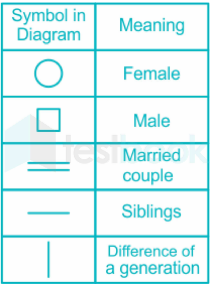
Preparing the family tree using the following symbols:

A possible family tree diagram will be:

Therefore, T is the mother of M.

Hence, the correct answer is "Mother".

18

Select the option that is related to the third number in the same way as the second number is related to the first number.

9 : 107 :: 8 : ?

  1. ((a))

    112

  2. ((b))

    100

  3. ((c))

    98

  4. ((d))

    96

Show Answer
Answer: ((d))

96

The logic followed here is:

Logic: 1st Number × 11 + 8 = 2nd Number

  • 9 : 107 → 9 × 11 + 8 = 99 + 8 = 107

Similarly,

  • 8 : ? → 8 × 11 + 8 = 88 + 8 = 96

Hence, '96' is the correct answer.

19

A series is given with one term missing. Choose the correct alternatives from the given ones that will complete the series.

15, 26, 48, 81, 125, ?

  1. ((a))

    160

  2. ((b))

    150

  3. ((c))

    170

  4. ((d))

    180

Show Answer
Answer: ((d))

180

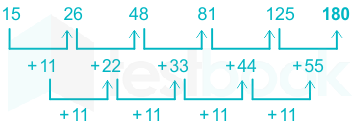
The logic follows here is;

Hence, "180" is the correct answer.

20

What will come in the place of '?' in the following equation, if '+' and '-' are interchanged and '×' and '÷' are interchanged?

109 - 55 × 605 ÷ 77 + 93 = ?

  1. ((a))

    82

  2. ((b))

    23

  3. ((c))

    42

  4. ((d))

    53

Show Answer
Answer: ((b))

23

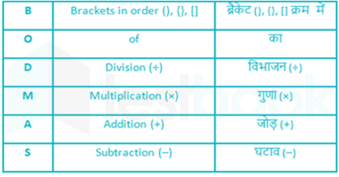
BODMAS Table: 

Given equation: 109 - 55 × 605 ÷ 77 + 93 = ?

Now, if ‘+’ and ‘-‘ and ‘×' and '÷’ are interchanged, then:

⇒ 109 + 55 ÷ 605 × 77 - 93 = ?

⇒ 109 + ({55 \times 77\over 605}) - 93 = ?

⇒ 109 + 7 - 93 = ?

⇒ 116 - 93 = 23.

Hence, the correct answer is "Option 2".

21

In a certain code language, ‘ALPINE’ is coded as ‘171’ and ‘SPRING’ is coded as ‘83’. How will ‘CAPITAL’ be coded in that language?

  1. ((a))

    93

  2. ((b))

    124

  3. ((c))

    186

  4. ((d))

    62

Show Answer
Answer: ((c))

186

Given: ‘ALPINE’ is coded as ‘171’ and ‘SPRING’ is coded as ‘83’. 

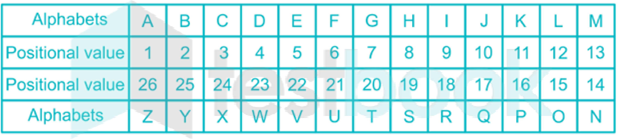
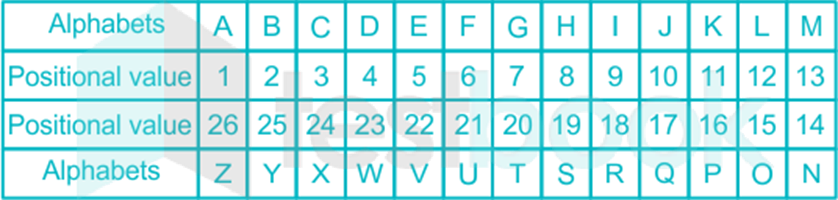
The logic follow here is: Addition of place value of given Letter × number of Vowel


LettersALPINE
Positional Values112169145
Sum of Positional Values1 + 12 + 16 + 9 + 14 + 5 = 57

Now, number of vowels = 3

= 57 × 3

= 171

And,


LettersSPRING
Positional Values1916189147
Sum of Positional Values19 + 16 + 18 + 9 + 14 + 7 = 83

Now, number of vowels = 1

= 83 × 1

= 83

Similarly,

LettersCAPITAL
Positional Values3116920112
Sum of Positional Values3 + 1 + 16 + 9 + 20 + 1 + 12 = 62


Now, number of vowels = 3

= 62 × 3

= 186

Hence, 186 is the correct answer.

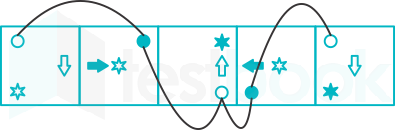
22

Select the figure that will replace the question mark (?) in the following figure series.

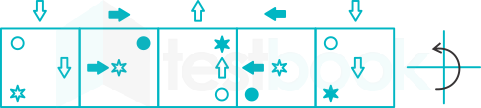
  1. ((a))

  2. ((b))

  3. ((c))

  4. ((d))

Show Answer
Answer: ((d))

In the following figure, we need to observe the 4 different kinds of patterns, which are running through each figure.

  • Pattern of circle 

: In the consecutive boxes the circle is transferred to the consecutive corner in a clockwise manner, Thus, in the following box the circle will be in the upper left corner.


  • Pattern of arrow 

: In each consecutive box, the direction of the arrow changes in an anticlockwise manner. Thus, in the following box, the arrow will face downwards.


  • Pattern of star 

: In each consecutive box, the star is moving diagonally upwards and then coming back to its origin diagonally. Thus, in the following box the star will be placed at the lower left corner.


  • Pattern of color: In consecutive boxes, one box has black colored star, whereas in the next box the arrow and circle are black colored. Thus, in the following box the star will be black colored, and the arrow and circle will not be colored.

​              

  • Thus, the following box will contain the pattern made in Option 4.

  Hence, the correct answer is "Option 4".

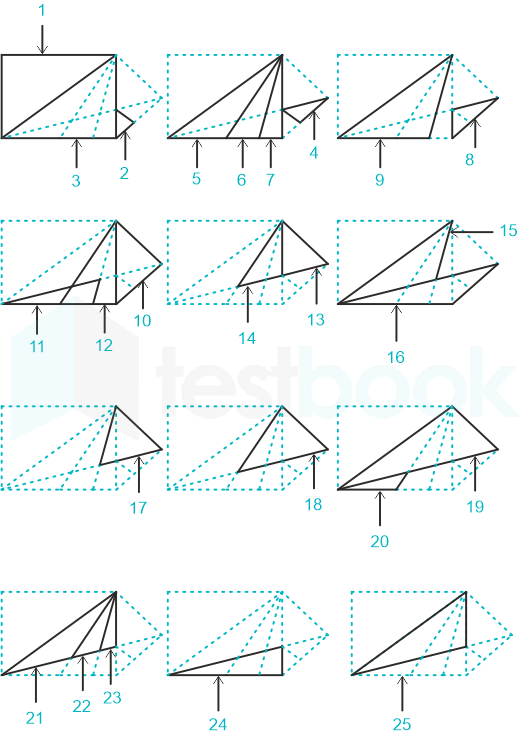
23

How many triangles are there in the given figure ?

  1. ((a))

    23

  2. ((b))

    24

  3. ((c))

    25

  4. ((d))

    27

Show Answer
Answer: ((c))

25

The number of triangles in the given figure is:

Here, the number of triangles is '25'.

Hence, the correct answer is "Option (3)".

24

In a certain code language, MAGIC is coded as NZTHX and FLUID is coded as UOTHW. How will be HORSE coded in that language?

  1. ((a))

    SLIHV

  2. ((b))

    SNIHV

  3. ((c))

    SNIHD

  4. ((d))

    SLIHD

Show Answer
Answer: ((c))

SNIHD

The logic followed here is :-

  1. Vowels - Immediate previous letter according to English alphabetic series is written.
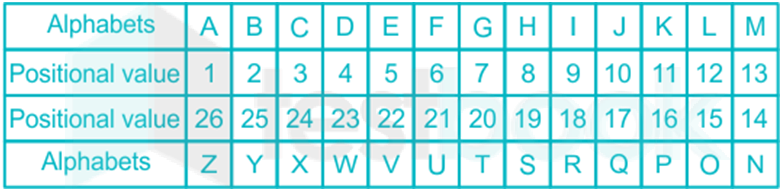
  2. Consonants - Opposite letter according to English alphabetic series is written.

So,

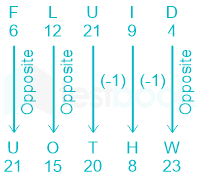
  • MAGIC is coded as :​

  • FLUID is coded as :​

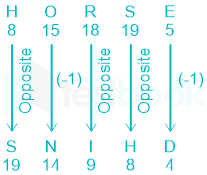
Similarly,

  • HORSE is coded as :​

Hence, "SNIHD" is the correct answer.

25

Which of the following terms will replace the question mark (?) in the given series?

AXY, EZW, ICU, OHS, ?

  1. ((a))

    UOQ

  2. ((b))

    UPQ

  3. ((c))

    UNQ

  4. ((d))

    VOQ

Show Answer
Answer: ((a))

UOQ

The logic followed here is:

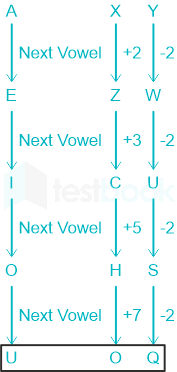
The middle letter is increasing by prime number order(2, 3, 5, 7).

​Hence, "UOQ" is the correct answer.

26

The ratio of the monthly incomes of Radha and Rani is 3 : 2 and their expenditure ratio is 8 : 5 if each of them is saving Rs. 9,000 per month, then find the sum of the monthly incomes of Radha and Rani?

  1. ((a))

    Rs. 132,000

  2. ((b))

    Rs. 145,000

  3. ((c))

    Rs. 135,000

  4. ((d))

    Rs. 119,000

Show Answer
Answer: ((c))

Rs. 135,000

Given:

The ratio of monthly incomes of Radha and Rani is 3 : 2 and that their expenditure is 8 : 5 if each of them saves Rs. 9,000 per month

Formula used

Total Sum of the monthly incomes of Radha and Rani = Radha income + Rani income

Calculation

Let Income of Radha and Rani be 3x and 2x and Expenditure be 8y and 5y

Saving = 3x – 8y = 2x – 5y

⇒ x = 3y

According to the question, Saving = 9,000

⇒ 3x – 8y = 9,000

⇒ 3(3y) – 8y = 9,000

⇒ 9y – 8y = 9,000

⇒ y = 9,000

Then, total incomes of Radha and Rani = 5x = 5 × 3 × 9,000 = 1,35,000

27

The HCF of two numbers is 9 and their LCM is 252. The sum of numbers is: 

  1. ((a))

    108

  2. ((b))

    78

  3. ((c))

    90

  4. ((d))

    99

Show Answer
Answer: ((d))

99

Shortcut Trick

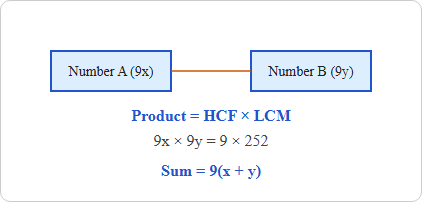
Let the two numbers be 9x and 9y, where x and y are co-prime.

Product of numbers = HCF × LCM ⇒ 9x × 9y = 9 × 252.

81xy = 2268 ⇒ xy = 28.

Possible co-prime pairs for xy = 28 are (1, 28) and (4, 7).

For (4, 7), Sum = 9 × (4 + 7) = 9 × 11 = 99.

∴ The correct answer is 99.

Alternate Method

Given:

HCF of two numbers = 9

LCM of two numbers = 252

Formula Used:

Product of two numbers = HCF × LCM

Calculations:

Let the numbers be a and b.

⇒ a = 9x and b = 9y (where HCF(x, y) = 1)

⇒ 9x × 9y = 9 × 252

⇒ 81xy = 2268

⇒ xy = 28

⇒ The factors of 28 that are co-prime are (4, 7).

⇒ x = 4 and y = 7

⇒ a = 9 × 4 = 36

⇒ b = 9 × 7 = 63

Sum = a + b = 36 + 63 = 99

∴ The correct answer is 99.

Additional Information

LCM and HCF Relationship

For any two numbers 'a' and 'b', a × b = HCF(a, b) × LCM(a, b).

HCF of Fractions

HCF = (HCF of Numerators) ÷ (LCM of Denominators).

LCM of Fractions

LCM = (LCM of Numerators) ÷ (HCF of Denominators).

Co-prime Property

Two numbers are co-prime if their Highest Common Factor is 1.

28

If a - b = 4 and a3 - b3 = 88, then find the value of a2 - b2.

  1. ((a))

    (8\sqrt{6})

  2. ((b))

    (6\sqrt{6})

  3. ((c))

    (7\sqrt{2})

  4. ((d))

    (9\sqrt{6})

Show Answer
Answer: ((a))

(8\sqrt{6})

Given:

a - b = 4 and a3 - b3 = 88

Formula: ∴

(a3 - b3) = (a - b) (a2 + b2 + ab)

(a3 - b3) = (a - b) [(a - b)2 + 3ab]

(a + b)2 = a2 + b2 + 2ab

(a + b)(a - b) = a2 - b2

Calculation:

According to the formula

88 = 4 × (42 + 3ab)

⇒ 22 = 16 + 3ab

⇒ 3ab = 22 - 16

⇒ ab = 6/3

⇒ ab = 2

(a - b)2 = a2 + b2 - 2ab

⇒ 42 = a2 + b2 - 2 × 2

⇒ a2 + b2 = 16 + 4 

⇒ a2 + b2 = 20

(a + b)2 = 20 + 2 × 2

⇒ a + b = √24 = 2√6

Then (a + b)(a - b) = 2√6 × 4

⇒ 8√6 

∴ (a2 - b2) = 8√6

29

What is the least number that leaves 7 as the remainder in each case, when divided by 10, 14, 12 and 8?

  1. ((a))

    821

  2. ((b))

    847

  3. ((c))

    842

  4. ((d))

    829

Show Answer
Answer: ((b))

847

Shortcut Trick

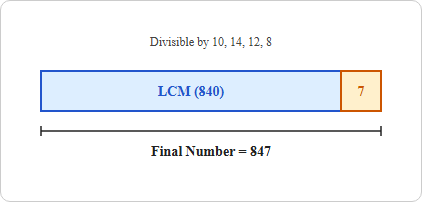
Required number = LCM (10, 14, 12, 8) + Common Remainder

Prime factors of 10, 14, 12, 8 are used to find LCM.

LCM (10, 14, 12, 8) = 840

Required number = 840 + 7 = 847

∴ The correct answer is 847.

Alternate Method

Given: Divisors are 10, 14, 12, and 8. The remainder in each case is 7.

Formula Used: The least number which when divided by x, y, and z leaves the same remainder 'r' is (LCM of x, y, z) + r.

Step 1: Find the Prime Factorization of the given numbers:

⇒ 10 = 2 × 5

⇒ 14 = 2 × 7

⇒ 12 = 22 × 3

⇒ 8 = 23

Step 2: Calculate the LCM (highest power of each factor):

⇒ LCM = 23 × 3 × 5 × 7

⇒ LCM = 8 × 3 × 5 × 7 = 840

Step 3: Add the constant remainder to the LCM:

⇒ Required number = 840 + 7

⇒ Required number = 847

∴ The correct answer is 847.

Additional Information

LCM Property for Same Remainder

When a number leaves the same remainder r when divided by a, b, and c, the general form is N = k × LCM(a, b, c) + r, where k is an integer.

LCM Property for Different Remainders

If divisors are a, b, c and remainders are r1, r2, r3 such that (a−r1) = (b−r2) = (c−r3) = k, then the number is LCM(a, b, c) − k.

HCF vs LCM

HCF is the largest number that divides the given numbers, while LCM is the smallest number divisible by the given numbers.

30

Sum of the digits of a two-digit number is 10. If 18 is added to the number, then the digits are reversed. What is the number?

  1. ((a))

    46

  2. ((b))

    27

  3. ((c))

    37

  4. ((d))

    62

Show Answer
Answer: ((a))

46

Let the digit on one’s place be y and the digit in ten’s place be x

∴ The number is = 10x + y

Sum of the digits is 10

∴ x + y = 10

Now, when 18 is added, the digits are reversed

∴ New number = 10y + x

∴ (10x + y) + 18 = 10y + x

⇒ 9x + 18 = 9y

⇒ x + 2 = y

∴ x + y = 10

⇒ x + (x + 2) = 10

⇒ 2x + 2 = 10

⇒ 2x = 8

⇒ x = 4

∴ y = 10 – x = 10 – 4 = 6

∴ The number is 10x + y = (10 × 4) + 6 = 46


By option test, we can easily get the answer of the question.

From the given options only (4 + 6) = 10 and (3 + 7) = 10

So, our possible answer is either 46 or 37

Now, 37 + 18 = 55, which is not the number formed by changing the positions of the digits of the original number. So, it is also not our desire number.

Now, 46 + 18 = 64, which is the number formed by interchanging the positions of the digits of the original number.

∴ The desired answer is 46.

31

Simple interest on a sum for 10 years is equal to 5% of the principle. In how many years interest will be equal to the principle?

  1. ((a))

    100

  2. ((b))

    150

  3. ((c))

    200

  4. ((d))

    250

Show Answer
Answer: ((c))

200

Given:

Simple interest on a sum for 10 years is equal to 5% of the principle.

Concept used:

SI = (\frac{P \times R \times T}{{100}})

Where, P = Principle, R = Rate, T = Time 

Calculation:

Let the principal be Rs. P

According to the above concept

SI = (\frac{P \times R \times 10}{{100}}) = 5% of P

⇒ (\frac{P \times R \times 10}{{100}}) = (\frac{5P}{{100}})

⇒ R = 0.5%

Now, let in t years the simple interest is equal to the principle

⇒ SI = (\frac{P \times 0.5 \times t}{{100}})

⇒ P = (\frac{P \times t}{{200}})

⇒ t = 200 years

∴ The required time is 200 years.

32

What are the values of k for which the equation 4x2 - kx + 9 = 0 has real roots?

  1. ((a))

    k ≤ -12 and k ≥ 12

  2. ((b))

    -12 < k < 12

  3. ((c))

    12 < k < -12

  4. ((d))

    -12 ≤ k ≤ 12

Show Answer
Answer: ((a))

k ≤ -12 and k ≥ 12

Shortcut Trick For a quadratic equation to have real roots, the discriminant (D) must be greater than or equal to zero (D ≥ 0). Equation: 4x2 − kx + 9 = 0 ⇒ a = 4, b = −k, c = 9. Apply D ≥ 0: (−k)2 − 4(4)(9) ≥ 0 k2 − 144 ≥ 0 ⇒ k2 ≥ 144. This implies k ≤ −12 or k ≥ 12. ∴ The correct answer is k ≤ −12 and k ≥ 12. Alternate Method Given: Quadratic equation 4x2 − kx + 9 = 0. Formula Used: For real roots of ax2 + bx + c = 0, Discriminant D = b2 − 4ac ≥ 0.

Comparing the given equation with ax2 + bx + c = 0: ⇒ a = 4, b = −k, c = 9 For roots to be real: ⇒ b2 − 4ac ≥ 0 ⇒ (−k)2 − 4 × 4 × 9 ≥ 0 ⇒ k2 − 144 ≥ 0 ⇒ (k − 12)(k + 12) ≥ 0 Using the method of intervals (Wavy Curve method): ⇒ k belongs to the region (−∞, −12] ∪ [12, ∞) ⇒ k ≤ −12 or k ≥ 12 ∴ The correct answer is k ≤ −12 and k ≥ 12. Additional Information Nature of Roots based on Discriminant (D) If D > 0, roots are real and unequal. If D = 0, roots are real and equal. If D < 0, roots are imaginary/complex. Quadratic Inequality Rule For an inequality x2 ≥ a2, the solution is always x ≤ −a or x ≥ a. For x2 ≤ a2, the solution is −a ≤ x ≤ a. Perfect Square Condition A quadratic equation is a perfect square if its discriminant D = 0, meaning it has two identical real roots.

33

Simplify: (\frac{5}{{28}} \div \frac{{28}}{{35}} \div \frac{{20}}{{112}})

  1. ((a))

    4/5

  2. ((b))

    5/4

  3. ((c))

    4/7

  4. ((d))

    7/4

Show Answer
Answer: ((b))

5/4

Calculation:

(5/28) ÷ (28/35) ÷ (20/112)

⇒ [(5/28) × (35/28)] ÷ (20/112)

⇒ (25/112) ÷ (20/112)

⇒ (25/112) × (112/20)

⇒ 5/4

∴ The required value is 5/4

34

A wheel travels a distance of 44 km in 5000 revolutions. What is radius (in meter) of the wheel?

  1. ((a))

    1.4

  2. ((b))

    1.2

  3. ((c))

    1.5

  4. ((d))

    1.8

Show Answer
Answer: ((a))

1.4

Shortcut Trick

Distance = Number of Revolutions × Circumference

44000 = 5000 × 2 × (22/7) × Radius

44 = 5 × 2 × (22/7) × Radius

Radius = (44 × 7) ÷ (10 × 22) = 1.4 m

∴ The correct answer is 1.4 m.

Alternate Method

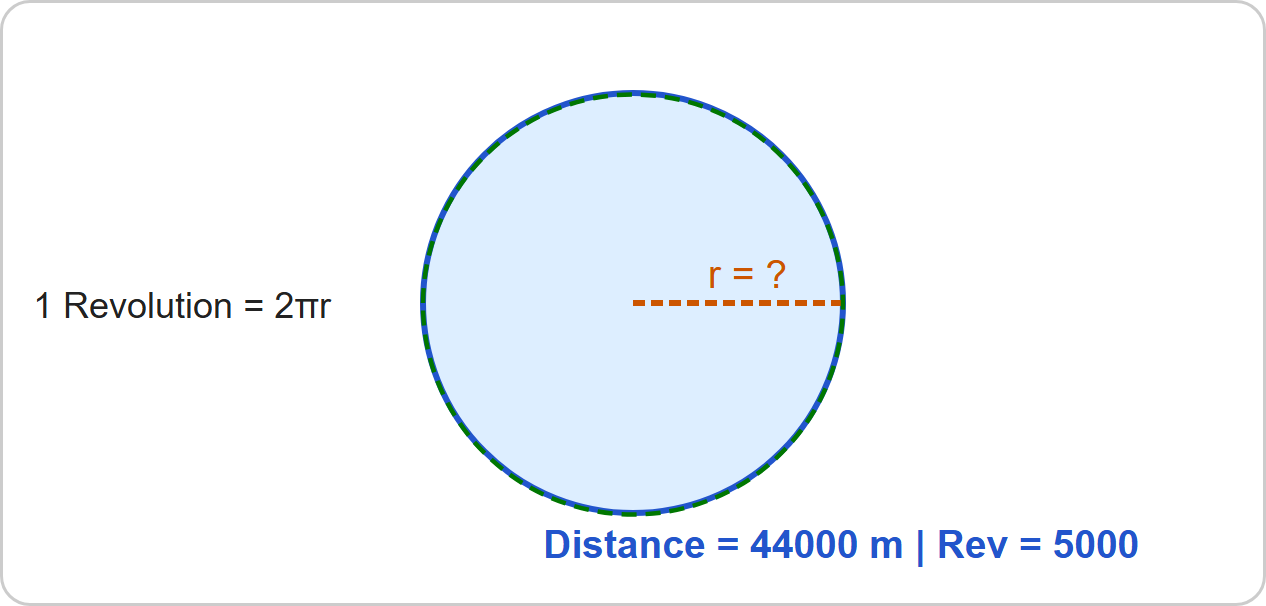
Given:

Total Distance = 44 km = 44000 m

Number of Revolutions (n) = 5000

Formula Used:

Distance = n × 2πr

Calculations:

⇒ 44000 = 5000 × 2 × (22/7) × r

⇒ 44 = 5 × 2 × (22/7) × r

⇒ 44 = (220/7) × r

⇒ r = (44 × 7) ÷ 220

⇒ r = 308 ÷ 220

⇒ r = 1.4 m

∴ The correct answer is 1.4 m.

Additional Information

Circumference of a Circle

The distance around a circular wheel is its circumference, calculated as 2 × π × r or π × d.

Unit Conversion

Always ensure units are consistent; 1 km = 1000 m. If the distance is in km and radius is required in meters, convert km to m first.

Revolution Concept

In one complete revolution, a wheel covers a linear distance equal to its outer circumference.

35

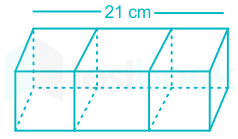
Three cubes each of sides 7 cm are joined end to end. Find the surface area of the resulting solid.

  1. ((a))

    686 cm2

  2. ((b))

    686 cm

  3. ((c))

    882 cm2

  4. ((d))

    882 cm

Show Answer
Answer: ((a))

686 cm2

Given:

Three cubes each of sides 7 cm are joined end to end

Concept:

When 3 cubes of same side are joined end to end, the resulting solid will be a cuboid

Formula used:

Surface area of Cuboid = 2 × ((l × b) + (l × h) + (b × h))

Calculation:

Length of the Cuboid, l = 7 + 7 + 7 = 21 cm

Breadth of the Cuboid, b = Same as the side of the given Cube = 7 cm

Height of the Cuboid, h = Same as the side of the given Cube = 7 cm

Now,

Surface area of Cuboid = 2 × ((l × b) + (l × h) + (b × h))

⇒ S.A = 2 × ((21 × 7) + (21 × 7) + (7 × 7))

⇒ S.A = 2 × (147 + 147 + 49) = 686

∴  The surface area of the resulting solid = 686 cm2

36

A train passes a platform in 48 seconds and a passenger standing on the platform in 30 seconds. If the speed of the train is 72 km/hr, what is the length of the platform?

  1. ((a))

    440m

  2. ((b))

    380m

  3. ((c))

    360m

  4. ((d))

    400m

Show Answer
Answer: ((c))

360m

Given:

Speed of the train = 72km/hr

The train passes the platform in 48 sec and the passenger in 30 sec

Concept used:

Speed = distance/time

While a train crossing a man it actually crossing it's own length.

Calculation:

Speed of the train is 72 km/hr = 72 × (5/18) = 20 m/sec

Length of train = speed × time

⇒ 20 × 30 = 600 m

Now, accordingly

(20 = ;\frac{{x + 600}}{{48}})

⇒ (20 × 48 = x + 600)

⇒ x = 960 - 600

⇒ x = 360

∴ The length of the platform is 360 meter.

37

A shopkeeper decides to raise the marked price of an article by 10%, How much discount should he allow so as to be able to sell the article at the original marked price?

  1. ((a))

    19/2%

  2. ((b))

    73/9%

  3. ((c))

    100/11% 

  4. ((d))

    10%

Show Answer
Answer: ((c))

100/11% 

Let the Cost price of an article be Rs. 100.

Marked price = 100 × 110/100 = 110

Required discount = Rs. 10

Required discount percentage = 10 × 100/110 = 100/11%

38

A and B working together can complete a job in 30 days. The ratio of their efficiencies is 3 : 2. In how many days can the faster person complete the job?

  1. ((a))

    50

  2. ((b))

    30

  3. ((c))

    40

  4. ((d))

    60

Show Answer
Answer: ((a))

50

Given:

A and B working together can complete a job in 30 days. The ratio of their efficiencies is 3 : 2.

Calculation

Let total work to be done = 150 units

Let efficiency of A and B respectively be 3x and 2x units/day

⇒ (3x + 2x) × 30 = 150

⇒ x = 1

Time taken by faster person, i.e A = (\frac{150}{3 × 1} = 50) days

∴ The time taken by faster person is 50 days


Time is taken by A alone = 30 × (\frac{3 + 2}{3} = 50 ) days

∴ The time taken by faster person is 50 days

39

A man covers a certain distance by scooter at 64 km/h and he returns to the starting place riding a bicycle at 16 km/h. Find the average speed for the whole journey.

  1. ((a))

    25.6 km/h

  2. ((b))

    26.5 km/h

  3. ((c))

    40 km/h

  4. ((d))

    51.2 km/h

Show Answer
Answer: ((a))

25.6 km/h

Given:

A man covers a certain distance on a scooter driving at 64 km/h.

He returns to the starting point riding on a bicycle at 16 km/h.

Formula used:

Formula:

Average speed = 2s1s2/(s1+s2)

Solution:

Average speed = 2s1s2/(s1+s2)

(2 × 64 × 16)/(64 + 16)

25.6 km/h

∴ The answer is 25.6 km/h.

40

Twenty workers finish a piece of work in 30 days. After how many days should 5 workers leave the job so that the work is completed in 35 days?

  1. ((a))

    15 days

  2. ((b))

    20 days

  3. ((c))

    10 days

  4. ((d))

    5 days

Show Answer
Answer: ((a))

15 days

Given:

The number of days in which 20 workers finish the work = 30 days.

Formula used:

MDH/W = constant

Where M = number of men or machine

D = number of days

H = number of hours or minute

W = Total work 

Calculation:

When 20 workers finish the work in 30 days,

20 workers × 30 days = 600 workers days.

Let the number of days after which 5 workers leave the job be x, then

(20 workers × x days) + (15 workers × (35 - x) days) = 600 workers days

⇒ 20x + 525 - 15x = 600

⇒ 5x = 600 - 525

⇒ 5x = 75

⇒ x = 75 / 5

⇒ x = 15 days

∴ For the work to be completed in 35 days, 5 workers should leave after working for 15 days.

41

If x + 1/x = 1, then, find the value of x2 + 1/x2 + 6 is-

  1. ((a))

    4

  2. ((b))

    5

  3. ((c))

    6

  4. ((d))

    8

Show Answer
Answer: ((b))

5

Given:

x + 1/x = 1

Formula used:

(a + b)2 = a2 + b2 + 2ab

Calculation:

x + 1/x = 1

Squaring both sides, we have –

⇒ x2 + 1/x2 + 2 = 1

After adding 4 on both side

⇒ x2 + 1/x2 + 2 + 4 = 1 + 4

⇒ x2 + 1/x2 + 6 = 5

42

Three successive discounts of 20%, 25% and 15% are given. What will be the net discount (in percentage)?

  1. ((a))

    60

  2. ((b))

    49

  3. ((c))

    55

  4. ((d))

    65

Show Answer
Answer: ((b))

49

Given:

The successive discount are 20%, 25% and 15%.

Formula:

Successive discount = X + Y - (XY)/100

Where,

X = First discount

Y = Second discount

Calculation:

Successive discount = X + Y - (XY)/100

⇒ 20 + 25 - 500/100

⇒ 45 - 5 = 40

Now, again

Successive discount = X + Y - (XY)/100

X = 40%, Y = 15%

⇒ 40 + 15 - (40 × 15)/100

⇒ 55 - 600/100

⇒ 55 - 6 = 49%

∴ The net discount is 49%.


Let, marked price = x

After first discount of 20%, price = x - x × 20/100 = 0.8x

After second discount of 25%, price = 0.8x - 0.8x × 25/100 = 0.6x

After third discount of 15%, price = 0.6x - 0.6x × 15/100 = 0.51x

∴ Net discount percentage,

(\Rightarrow \frac{{x - 0.51x}}{x} × 100%)

⇒ 49%

43

If sinθ = 5/13, then find the value of (cotθ - tanθ)/2cotθ ?

  1. ((a))

    143/195

  2. ((b))

    119/254

  3. ((c))

    173/288

  4. ((d))

    119/288

Show Answer
Answer: ((d))

119/288

Given:

sinθ = 5/13

Concept used:

Using the concept of trigonometric ratios.

Calculation:

sinθ = 5/13

cosθ = √(1 - sin2θ)

⇒ cosθ = √(1 - 25/169)

⇒ cosθ = 12/13

tanθ = sinθ/cosθ 

⇒ tanθ = (5/13)/(12/13)

⇒ tanθ = 5/12

cotθ = 1/tanθ 

⇒ cotθ = 12/5

(cotθ - tanθ)/2cotθ

⇒ (12/5 - 5/12)/(2 × 12/5)

⇒ (119/60)/(24/5)

⇒ 119/288

∴ The value of (cotθ - tanθ)/2cotθ is 119/288.

44

If Rs. 25,000 is to be divided between A, B and C in the ratio 1/10 : 1/6 : 1/15, then how much will C get (in Rs)?

  1. ((a))

    5000

  2. ((b))

    7500

  3. ((c))

    10000

  4. ((d))

    12500

Show Answer
Answer: ((a))

5000

Shortcut Trick

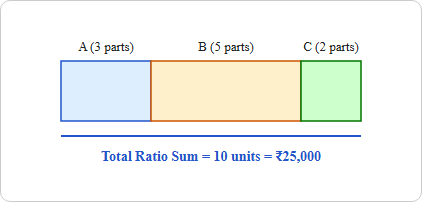
LCM of denominators (10, 6, 15) = 30.

Multiply the ratio by 30 → A : B : C = 3 : 5 : 2.

Total units = 3 + 5 + 2 = 10 units.

10 units = ₹25,000 ⇒ 1 unit = ₹2,500.

C's share = 2 units = 2 × ₹2,500 = ₹5,000.

∴ The correct answer is ₹5000.

Alternate Method

Given:

Total Amount = ₹25,000

Ratio of A : B : C = 1/10 : 1/6 : 1/15

Formula:

Share of a person = (Personal Ratio Part ÷ Sum of all Ratio Parts) × Total Amount

Calculations:

⇒ First, convert the fractional ratio into an integer ratio by multiplying with the LCM of 10, 6, and 15.

⇒ LCM(10, 6, 15) = 30.

⇒ A : B : C = (1/10 × 30) : (1/6 × 30) : (1/15 × 30)

⇒ A : B : C = 3 : 5 : 2

⇒ Sum of ratio parts = 3 + 5 + 2 = 10

⇒ Share of C = (2 ÷ 10) × 25000

⇒ Share of C = 1/5 × 25000

⇒ Share of C = ₹5000

∴ The correct answer is ₹5000.

Additional Information

Ratio Simplification

To convert a ratio in the form of fractions 1/a : 1/b : 1/c to integers, multiply each term by the Least Common Multiple (LCM) of a, b, and c.

Share Distribution

When a value X is divided in the ratio a:b:c, the shares are calculated as [a/(a+b+c)]×X, [b/(a+b+c)]×X, and [c/(a+b+c)]×X respectively.

Invertendo

If a : b = c : d, then b : a = d : c. This property is useful when dealing with reciprocal proportions in work or speed problems.

45

A seller gives 1 item free on purchase of every 4 articles. If the seller also gives a 10% discount and still earns 10% profit then find the ratio of marked price and cost price.

  1. ((a))

    55 : 36

  2. ((b))

    13 : 8

  3. ((c))

    12 : 7

  4. ((d))

    13 : 9

Show Answer
Answer: ((a))

55 : 36

Given

% D = 10%

% P = 10%

Concept used

In this type of question find overall discount percent and change percentage into fraction form and with comparing and analysing solve the question

Calculation

Let marked price = MP, selling price = SP, cost price = CP, profit = P discount = D

Since 1 article is free on 4 article so discount percentage = (1/5) × 100 = 20%

Also another discount of 10% so overall discount percentage = 10 + 20 - 10 × 20/100 = 28%

If Marked Price = 100 Discount = 28 and Selling price = 72

Still earn a profit of 10% = 1/10

So if CP = 10 units, Profit = 1 unit

Selling price = 10 + 1 = 11 units

And 11 units = 72

⇒ CP (10) = 720/11

Ratio of Marked price : Cost Price = 100 : 720/11 = 55 : 36

46

Direction: Select the most appropriate synonym of the given word.

Wealthy

  1. ((a))

    Affluent

  2. ((b))

    Depressed

  3. ((c))

    Poor

  4. ((d))

    Lacking

Show Answer
Answer: ((a))

Affluent

The correct answer is "Affluent."

<br>

 Key Points

  • "Wealthy" means having a lot of money, property, etc. (धनी, अमीर, संपन्‍न)
  • ExampleHe's a very wealthy man.
  • "Affluent" means having a lot of money and being wealthy. (धनवान, समृद्घ)
  • ExampleWe live in an affluent neighbourhood.
  • "Affluent" is a synonym of the word 'wealthy.'
  • The correct answer is Option 1.
<br>

 Additional Information

  • Option 2 - Depressed: feeling sad and unhappy. (बहुत उदास (प्रायः लंबे समय तक))
  • Option 3 - Poor: having little or no money. (आरामदायक जीवन के लिए पर्याप्त धन का अभाव; ग़रीब, निर्धन)
  • Option 4 - Lacking: not having enough of something. (जिसमें किसी बात की कमी हो, किसी बात में कम या न्‍यून)
47

Select the most appropriate word to fill in the blank.

He _____ for me when I reached office,

  1. ((a))

    had waited

  2. ((b))

    waited

  3. ((c))

    was waiting

  4. ((d))

    waits

Show Answer
Answer: ((c))

was waiting

The correct answer is 'was waiting'.

Key Points

  • When there are two actions in progress at the same time, we use Past continuous tense to represent the action that was already in progress while the other one that happened takes Simple past tense.
  • For example, 'I was doing the laundry when you rang the doorbell.'
  • The subject-verb agreement indicates that the verb here will be singular.
  • Correct sentence: 'He was waiting for me when I reached office.'

Hence, the correct answer is Option 3.

48

Choose the appropriate preposition for the given sentence.

We are pleased to offer it to you ______ a discounted price.

  1. ((a))

    at

  2. ((b))

    over

  3. ((c))

    in 

  4. ((d))

    on

Show Answer
Answer: ((a))

at

The correct answer is at.

Key Points

  • ​There are some fixed prepositional phrases given below:
  • ​by the dint of, out of jealousy, on sale, at a discounted price, by the dozen, owing to, on a trip, for a change, etc.
  • For example:
  • ​There are many websites that sell designer brands at discounted prices.
  • ​The phrase 'at a discounted price' means cheaper than usual.
  • Thus the preposition 'at' will be the correct choice.

Correct Sentence: We are pleased to offer it to you at a discounted price.

Additional Information

  • There are some verbs/nouns/adjectives which are followed by fixed preposition given below:
  • ​Exonerate from, refrain from, suspicious of, interested in, inured to, accused of, a predilection for, a respite from, vexed at, etc.
  • Example:
  • After spending some time on the island, they became inured to the hardships.
49

Select the most appropriate ANTONYM of the given word.

Hesitate

  1. ((a))

    Reform

  2. ((b))

    Vacillate

  3. ((c))

    Imitate

  4. ((d))

    Resolve

Show Answer
Answer: ((d))

Resolve

The correct answer is 'Option 4' i.e. 'Resolve'.

Key Points

  • The word "Hesitate" in English means to pause before saying or doing something, often because of uncertainty or insecurity (हिचकिचाना).
  • Example: He hesitated for a moment before jumping into the pool.
  • The word "Resolve" is an antonym of "Hesitate", meaning to come to a definite decision about; to determine (निश्चय करना).
  • Example: Sarah had a firm resolve to complete her assignment on time.

Therefore, the correct answer is - 'Resolve'.

Additional Information

  • 'Reform' (Option 1) means to make changes in something in order to improve it (सुधारना).
  • 'Vacillate' (Option 2) similar to hesitate, it means to keep changing your opinion or thoughts, usually in a situation of uncertainty (अनिश्चित रहना).
  • **'Imitate' (**Option 3) means to copy or mimic the behavior or actions of another (नकल करना).
50

Fill in the blank with appropriate modal verb :

When I was a boy, I ___________ walk forty miles in a day.

  1. ((a))

    should 

  2. ((b))

    can 

  3. ((c))

    could 

  4. ((d))

    must

Show Answer
Answer: ((c))

could 

The correct answer is 'could'.

Key Points

  • In this context, "could" is the correct choice because it is used to express ability or possibility in the past, which is the purpose of this sentence.
  • It indicates that the speaker had the ability to walk forty miles in a day when he was a boy.
  • Let's break down the options:
  • "should" - This modal verb is used to express obligation, advice, expectation, or speculation. It does not denote ability or possibility, which is required in this context.
  • "can" - This modal verb is used to express present ability or possibility, not past ability or possibility, which is the focus of this sentence.
  • "could" - This is the correct choice. It's often used to express an ability or possibility in the past, which fits the context of this sentence. In this case, "could" suggests that when the speaker was a boy, he had the ability to walk forty miles in a day.
  • "must" - This modal verb is used to express obligation, necessity, or strong certainty. It does not express past ability or possibility, which is required in this context.
51

Select the most appropriate meaning of the given idiom.

Red-letter day

  1. ((a))

    a very special day

  2. ((b))

    a frightful day

  3. ((c))

    a very cold day

  4. ((d))

    a very hot day

Show Answer
Answer: ((a))

a very special day

Key Points

  • The meaning of the given idiom 'Red letter day' means 'any day of special significance or opportunity'.
  • Therefore, option 1 'a very special day' satisfies the meaning of the given idiom.
  • Example: Tomorrow is her red-letter day, she always celebrates it with a big party.

Additional Information

  • Origin: The term came into wider use in 1549 when the first Book of Common Prayer included a calendar with holy days marked in red ink; for example, Annunciation (Lady Day), 25th March, was designated in the book as a red-letter day.

The correct answer is Option 1.

52

Select the correct direct form of the given sentence.

He said that he was sorry for all that.

  1. ((a))

    “I am sorry for all then.” He says.

  2. ((b))

    “I was sorry for all this.” He said.

  3. ((c))

    “I am sorry for all that.” He says.

  4. ((d))

    “I am sorry for all this.” He said.

Show Answer
Answer: ((d))

“I am sorry for all this.” He said.

Here the correct answer is “I am sorry for all this.” He said.

Key Points

  • The given sentence is in indirect speech. We need to change it into direct speech.
  • The reported verb remains the same.
  • Commas and inverted commas are added.
  • Simple past tense 'was' changes to simple present tense 'am'.
  • 'that' changes to 'this'.
  • The pronoun 'he' changes to 'I'.
  • Thus, the correct answer is Option 4.
<br>

Correct Direct Speech“I am sorry for all this.” He said.

53

Choose the correct active voice of the given sentence from the options below:

The decision was taken by me.

  1. ((a))

    I have taken the decision.

  2. ((b))

    I had taken the decision.

  3. ((c))

    I took the decision.  

  4. ((d))

    I take decision.

Show Answer
Answer: ((c))

I took the decision.  

The correct answer is "I took the decision."

Key Points

  • The given Passive Voice is in Simple Past Tense.

  • Look at the basic rule for this type of conversion: 

  • | Passive | Active | | --- | --- | | Object+ was/were V3+ by + subject | Subject + V2+ object | | She was caught by the police. | The police caught her. |

  • Look at the following example:

  • Passive: The chick was stolen by the eagle.

  • Active: The eagle stole the chick.

  • Hence, the correct Active voice of the given Passive voice is: I took the decision.

  • Therefore option 3 is correct.

54

Select the most appropriate synonym of the given word.

CATASTROPHE

  1. ((a))

    restraint

  2. ((b))

    calamity

  3. ((c))

    expansion

  4. ((d))

    prosperity

Show Answer
Answer: ((b))

calamity

The correct answer is 'calamity'. 

Key Points

  • The most appropriate synonym of the given word 'Catastrophe' is 'Calamity'.
  • Let's look at the meaning and examples of the given options:
Catastrophea sudden event that causes very great trouble or destructionThey were warned of the ecological catastrophe to come.
Calamitya serious accident or bad event causing damage or sufferingA series of calamities ruined them - floods, a failed harvest, and the death of a son.
Restraintcalm and controlled behaviourHe showed admirable restraint and refused to be provoked.
Expansionthe increase of something in size, number, or importanceExpansion into new areas of research is possible.
Prosperitythe state of being successful and having a lot of moneyThe war was followed by a long period of peace and prosperity.
  • Therefore, by reading the above explanation we find that the correct answer is Option 2.
55

Select the most appropriate option to improve the underlined segment in the given sentence. If there is no need to improve it, select 'no improvement required'.

The first step in making a kite is to fasten two sticks of bamboo together in the form of a cross.

  1. ((a))

    in making a kite is to be fastened

  2. ((b))

    in making a kite is to fastening

  3. ((c))

    into making a kite is fasten

  4. ((d))

    no improvement required

Show Answer
Answer: ((d))

no improvement required

The correct answer is no improvement required.

Key Points

  • The infinitive 'to fasten' has been used correctly.
  • Infinitives are a form of the verb that allow the word or a group of words to be used as a noun, adjective, or adverb.
  • 'In making' is also used correctly.
  • The given sentence is grammatically correct in all aspects.
  • Hence, the most appropriate answer is option 4.
  • The correct sentence is The first step in making a kite is to fasten two sticks of bamboo together in the form of a cross.
56

Direction: In the following question, find out which part of the sentence has an error. If there is no error, (d) is the answer. 

No sooner had the hockey match started (a)/ when it began (b)/ to rain. (c)/ No Error. (d)

  1. ((a))

    a

  2. ((b))

    b

  3. ((c))

    c

  4. ((d))

    d

Show Answer
Answer: ((b))

b

The error lies in part b.

Key Points

  • The given sentence uses the conjunction 'when' incorrectly.
  • The sentence starts with the conjunction no sooner.
  • If we are to join the clause '... it began to rain', we need to use the proper correlative conjunction to no sooner.
  • The correct correlative conjunction for no sooner is 'than' and not when.
  • Hence, the error lies in part b of the given sentence.
  • So, option 2 is the correct answer. 

Correct sentence - No sooner had the hockey match started (a)/ than it began (b)/ to rain. (c)

57

Select the word which means the same as the group of words given.

One who walks on street

  1. ((a))

    On-looker

  2. ((b))

    Bystander

  3. ((c))

    Motorist

  4. ((d))

    Pedestrian

Show Answer
Answer: ((d))

Pedestrian

The correct answer is 'Pedestrian'.

Key Points

  • The phrase 'One who walks on street' refers to a person who is walking, rather than driving or riding, on the street. This is the definition of the word 'Pedestrian'.
  • For example, you might say, "The city center is quite walkable, and you'll often see many pedestrians there."
  • Hence, the correct answer will be Option 4.

Additional Information

  • Option 1: An 'On-looker' is someone who watches an event or situation but does not participate in it. It doesn't necessarily imply that the person is walking on a street.
  • Option 2: A 'Bystander' is similar to an on-looker, it's a person who is present at an event or incident but does not take part. It doesn't specifically refer to someone walking on a street.
  • Option 3: A 'Motorist' is a driver, specifically of an automobile. This term does not refer to someone who is walking on a street.
  • Therefore, Options 1, 2, and 3 cannot be the answer because they do not accurately define a person who is walking on the street.
58

A sentence has been given with a blank to be filled with an appropriate option. Choose the correct alternative.

I always try to _______ chocolates for you.

  1. ((a))

    brought

  2. ((b))

    bought

  3. ((c))

    bringing

  4. ((d))

    bring

Show Answer
Answer: ((d))

bring

The correct answer is 'Option 4'. i.e. 'Bring'.

Key Points

  • The sentence indicates a continuous action or habit of someone trying to do something with chocolates.
  • "Bring" is the correct verb that fits in this context.
  • The verb "bring" (लाना) means to carry or transport something to a place.
  • Thus, the complete sentence is, "I always try to bring chocolates for you."

Therefore, the correct sentence is: 'I always try to bring chocolates for you'.

 Additional Information

  • "Brought" is the past tense of "bring" and does not fit the present tense context.
  • "Bought" (खरीदा) refers to purchasing something.
  • "Bringing" is the continuous form of "bring," but the sentence does not need a continuous form here.

Read the following passage and answer the question that follows:

With Manuel Neuer's unexpected injury, Bayern Munich has recruited Borussia Mönchengladbach's Yann Sommer, who will be the leading man until the season's end. But how appealing is being the backup goalkeeper for Germany? Manuel Neuer's injury during a post-World Cup ski trip put Bayern Munich in a precarious spot.

The 36-year-old is expected to miss the remainder of the current season after breaking his leg in a skiing accident. Though perhaps not the keeper he once was, Neuer's loss is not ideal for a club with consistently high aspirations, winning the Champions League among them.

Bayern's goalkeeper situation was a frequent news topic over the holidays, with the defending league champions linked with various big names before eventually recruiting Yann Sommer from Borussia Mönchengladbach—the Swiss goalkeeper has signed a contract until June 2025.

"Yann Sommer is a valuable addition for us because he has a wealth of international experience and has already played in the Bundesliga for many years," Bayern CEO and former goalkeeper Oliver Kahn said as part of a club statement. "He has everything required to contribute immediately to our success." "We're certain we can achieve our goals with Yann Sommer."

59

How did the Bayern Munich goalkeeper get injured?

  1. ((a))

    He met with a car accident

  2. ((b))

    He fell down during training session

  3. ((c))

    because of a skiing accident

  4. ((d))

    None of the above

Show Answer
Answer: ((c))

because of a skiing accident

The correct answer is "because of a skiing accident".

Key Points  

  • In the 1st paragraph of the passage, you will find the following line:
  • The 36-year-old is expected to miss the remainder of the current season after breaking his leg in a skiing accident. Though perhaps not the keeper he once was, Neuer's loss is not ideal for a club with consistently high aspirations, winning the Champions League among them.

Hence, the correct answer is "option 3".

60

Which is the former team of Yann Sommer?

  1. ((a))

    Bayern Munich

  2. ((b))

    Borussia Dortmund

  3. ((c))

    Borussia Mönchengladbach

  4. ((d))

    None of the above

Show Answer
Answer: ((c))

Borussia Mönchengladbach

The correct answer is "He has international experience."

Key Points  

  • In the 1st paragraph of the passage, you will find the following line:
  • With Manuel Neuer's unexpected injury, Bayern Munich has recruited Borussia Mönchengladbach's Yann Sommer, who will be the leading man until the season's end. But how appealing is being the backup goalkeeper for Germany? Manuel Neuer's injury during a post-World Cup ski trip put Bayern Munich in a precarious spot.

Hence, the correct answer is "option 3".

Section II (50 questions)

61

Find the value of cos (-1740°)?

  1. ((a))

    0

  2. ((b))

    √3 / 2

  3. ((c))

    1 / 2

  4. ((d))

    1

Show Answer
Answer: ((c))

1 / 2

Concept:

  • sin (2nπ ± θ) = ±  sin θ, where n ∈ Z.
  • cos (2nπ ± θ) = cos θ , where n ∈ Z.
  • cos (-θ) = cos θ
  • cos (2nπ - θ) = cos θ


Angles in degrees30°45°60°90°
Sin01/21/√2√3/21
Cos1√3/21/√21/20
Tan01/√31√3Not defined


Calculation:

As we know that, the value of cos θ repeats after an interval of 2π or 360°.

⇒ cos (-1740°) = cos (1740°)               (∵ cos (-θ) = cos θ)

We know that cos (2nπ - θ) = cos θ 

cos (1740°)= cos (5 × 360° - 1740°) = cos (1800° - 1740°) = cos (60°)

As we know that, cos 60° = 1 / 2.

⇒ cos (-1740°) = 1 / 2.

62

If A = {1, 2, 3, 4, 5}, then the number of subsets of A which contain element 2 but not 4, is

  1. ((a))

    2

  2. ((b))

    4

  3. ((c))

    6

  4. ((d))

    8

Show Answer
Answer: ((d))

8

Given:

Set A = {1, 2, 3, 4, 5}

Concept:

Subset - Set A is said to be a subset of Set B if all the elements of Set A are also present in Set B.

Solution:

A subset of A which contains element 2 but not 4 as follows,

{1, 2, 3, 5}, {1, 2, 5}, {1, 2, 3}, {1, 2}, {2}, {2, 3}, {2, 5}, {2, 3, 5}

The total numbers of the subset are 8.

63

What is the value of tan 15°?

  1. ((a))

    (1-\sqrt3)

  2. ((b))

    (2+\sqrt3)

  3. ((c))

    (2-\sqrt3)

  4. ((d))

    None of the above

Show Answer
Answer: ((c))

(2-\sqrt3)

Concept

(\tan (x-y) = \frac{\tan x - \tan y}{1+\tan x\tan y})

Calculation:

We have to find the value of tan 15°

⇒ tan 15° = tan (45° -  30°)

 ( = \frac{\tan 45 - \tan 30}{1+\tan 45\tan 30})                   [∵ (\tan (x-y) = \frac{\tan x - \tan y}{1+\tan x\tan y})]

(=\frac{1 - \frac{1}{\sqrt3}}{1+1\times\frac{1}{\sqrt3}})

(=\frac{\frac{\sqrt{3}-1}{\sqrt{3}}}{\frac{\sqrt{3}+1}{\sqrt{3}}})

(=\frac{\sqrt{3}-1}{\sqrt{3}+1})

(=\frac{\sqrt{3}-1}{\sqrt{3}+1} \times \frac{\sqrt{3}-1}{\sqrt{3}-1})

(=\frac{(\sqrt{3}-1)^2}{(\sqrt{3})^2-1^2} )

(=\frac{3+1-2\sqrt3}{3-1}= \frac{4-2\sqrt3}{2}=2-\sqrt3)

64

The middle term of ({\left( {1 - \frac{{{x^2}}}{2}} \right)^{14}}) is

  1. ((a))

    ( - \frac{{423}}{{16}}{x^{13}})

  2. ((b))

    ( - \frac{{429}}{{16}}{x^{16}})

  3. ((c))

    ( - \frac{{429}}{{16}}{x^{14}})

  4. ((d))

    ( - \frac{{423}}{{16}}{x^{14}})

Show Answer
Answer: ((c))

( - \frac{{429}}{{16}}{x^{14}})

We have n = 14, then the number of terms would be 15.

(\therefore \left( {\frac{{14}}{2} + 1} \right)) i.e 8th will be middle term

(a = 1,b = \frac{{{x^2}}}{2},n = 14,r = 7)

({T_{r + 1}} = {}_;^n{C_r}{a^{n - r}}{b^r})

({T_{7 + 1}} = {}_;^{14}{C_7}{\left( 1 \right)^{14 - 7}}{\left( { - \frac{{{x^2}}}{2}} \right)^7})

( = \frac{{14!}}{{7!7!}}{\left( { - 1} \right)^7}\frac{{{x^{14}}}}{{{2^7}}})

( = \frac{{14 \times 13 \times 12 \times 11 \times 10 \times 9 \times 8 \times 7!}}{{7 \times 6 \times 5 \times 4 \times 3 \times 2 \times 7!}}\left( {\frac{{\left( { - 1} \right)}}{{128}}{x^{14}}} \right))

( = - \frac{{429}}{{16}}{x^{14}})

65

Evaluate: 2 tan2 45° + cos2 30° - sin2 60°

  1. ((a))

    1/2

  2. ((b))

    2

  3. ((c))

    0

  4. ((d))

    1

Show Answer
Answer: ((b))

2

Given:

We have to evalute 2 tan2 45° + cos2 30° - sin2 60°

Formula Used:

tan45° = 1 

Cos30° = √3/2

Sin60° = √3/2

Calculation:

2 tan2 45° + cos2 30° - sin2 60°

⇒ 2 × 12 + (√3/2)2 – (√3/2)2

⇒ 2 + 3/4 – 3/4

⇒ 2

∴ The value of 2 tan2 45° + cos2 30° - sin2 60° is 2.

66

Square root of 4 + 3i is

  1. ((a))

    (\pm \left( {\frac{1}{{\sqrt 2 }} + {\rm{i}}\frac{3}{{\sqrt 2 }}} \right))

  2. ((b))

    (\pm \left( {\frac{3}{{\sqrt 2 }} - {\rm{i}}\frac{1}{{\sqrt 2 }}} \right))

  3. ((c))

    (\pm \left( {\frac{5}{{\sqrt 2 }} + {\rm{i}}\frac{3}{{\sqrt 2 }}} \right))

  4. ((d))

    (\pm \left( {\frac{3}{{\sqrt 2 }} + {\rm{i}}\frac{1}{{\sqrt 2 }}} \right))

Show Answer
Answer: ((d))

(\pm \left( {\frac{3}{{\sqrt 2 }} + {\rm{i}}\frac{1}{{\sqrt 2 }}} \right))

Concept:

  • Let, (a ± ib) be a complex number then the square root of a ± ib is given by

(\sqrt {{\rm{a}} + {\rm{ib}}} = \pm \left( {\sqrt {\frac{{\sqrt {{{\rm{a}}^2} + {{\rm{b}}^2}} + {\rm{a}}}}{2}} \pm i{\rm{;}}\sqrt {\frac{{\sqrt {{{\rm{a}}^2} + {{\rm{b}}^2}} - {\rm{a}}}}{2}} } \right))

Calculation:

Here, 4 + 3i

Comparing with standard form a + bi, we get

a = 4, b = 3

(\sqrt {{\rm{a}} + {\rm{ib}}} = \pm \left( {\sqrt {\frac{{\sqrt {{{\rm{a}}^2} + {{\rm{b}}^2}} + {\rm{a}}}}{2}} + {\rm{i;}}\sqrt {\frac{{\sqrt {{{\rm{a}}^2} + {{\rm{b}}^2}} - {\rm{a}}}}{2}} } \right))

(\therefore \sqrt {4 + 3{\rm{i}}} = {\rm{;}} \pm \left( {\sqrt {\frac{{\sqrt {{4^2} + {3^2}} + 4}}{2}} + {\rm{i}}\sqrt {\frac{{\sqrt {{4^2} + {3^2}} - 4}}{2}} } \right))

(\Rightarrow \pm \left( {\sqrt {\frac{{\sqrt {25} + 4}}{2} }\ + \ {\rm{i}}\sqrt {\frac{{\sqrt {25} - 4}}{2}} } \right))

(\Rightarrow \pm \left( {\sqrt {\frac{{5 + 4}}{2}}\ + \ {\rm{i}}\sqrt {\frac{{5 - 4}}{2}} } \right) = \pm \left( {\sqrt {\frac{9}{2}} \ +\ {\rm{i}}\sqrt {\frac{1}{2}} } \right))

(\therefore \sqrt {4 + 3{\rm{i}}} = \pm \left( {\frac{3}{{\sqrt 2 }} + {\rm{i}}\frac{1}{{\sqrt 2 }}} \right))

Hence, option (4) is correct.

67

The conjugate of the complex number (\rm 3i+4\over2-3i) is:

  1. ((a))

    (\rm {-1\over13}-{18\over13}i)

  2. ((b))

    (\rm {18\over13}i+{1\over13})

  3. ((c))

    (\rm {18\over13}i-{1\over13})

  4. ((d))

    (\rm {1\over13}-{18\over13}i)

Show Answer
Answer: ((a))

(\rm {-1\over13}-{18\over13}i)

Concept: 

Let z = x + iy be a complex number.

  • Modulus of z = (\left| {\rm{z}} \right| = {\rm{}}\sqrt {{{\rm{x}}^2} + {{\rm{y}}^2}} = {\rm{}}\sqrt {{\rm{Re}}{{\left( {\rm{z}} \right)}^2} + {\rm{Im;}}{{\left( {\rm{z}} \right)}^2}})
  • arg (z) = arg (x + iy) = ({\tan ^{ - 1}}\left( {\frac{y}{x}} \right))
  • Conjugate of z = z̅ = x – iy
<br>

Calculation:

Given complex number is z = (\rm 3i+4\over2-3i)

z = (\rm {3i+4\over2-3i}\times{2+3i\over2+3i})

z = (\rm 6i+8-9+12i\over2^2-(3i)^2)

z = (\rm 18i-1\over13)

z = (\rm {-1\over13}+{18\over13}i)

Conjugate of z = (z̅) = (\rm {-1\over13}-{18\over13}i)

68

If A = {2, 3, 4} and B = {3, 5} then A ∪ B will be:

  1. ((a))

    {3, 5}

  2. ((b))

    ϕ

  3. ((c))

    {2, 3, 4, 5}

  4. ((d))

    {2, 3}

Show Answer
Answer: ((c))

{2, 3, 4, 5}

Calculation:

Given that

A = {2, 3, 4}

B = {3, 5}

Union of A and B 

A ∪ B = {2, 3, 4, 5}

Therefore, A ∪ B = {2, 3, 4, 5}.

69

(n+2) ! = 2550 × n !, then n is:

  1. ((a))

    50

  2. ((b))

    49

  3. ((c))

    52

  4. ((d))

    48

Show Answer
Answer: ((b))

49

Calculation:

(n+2) ! = 2550 × n !

(n + 2).(n + 1).n ! = 2550 n!

(n + 2).(n + 1) = 51 × 50

On comparing both sides

n + 1 = 50

∴ n = 49

70

The number of three English letter words, having at least one consonant, but not having two consecutive consonants, is 

  1. ((a))

    2205

  2. ((b))

    3780

  3. ((c))

    2730

  4. ((d))

    3360

Show Answer
Answer: ((b))

3780

The correct answer is 3780

Explanation:

  • Number of vowels = 5
  • Number of consonant = 21

Here, our condition is to take atleast one consonant, but not consecutive, so we are left with two cases

Case I: Only one consonant

Number of ways 3 × 21 × 5 × 5 = 1575

= 21 × 5 × 4 × 3 = 1260

Case II: Two consonants, but at alternate positions,

Number of ways = 21 × 21 × 5 = 2205

Therefore, total number of ways = 1575 + 2205 = 3780

71

If the direction ratios a, b, c of a line L satisfy the relations ab + bc + ca = 0 and 6 ab + 9 bc + 8 ca = 0, then the direction cosines of the line L are

  1. ((a))

    (\frac{1}{\sqrt{3}}, \frac{1}{\sqrt{3}}, \frac{1}{\sqrt{3}})

  2. ((b))

    (\frac{2}{\sqrt{7}}, \frac{1}{\sqrt{7}}, \frac{-2}{\sqrt{7}})

  3. ((c))

    (\frac{-1}{\sqrt{6}}, \frac{\sqrt{3}}{\sqrt{6}}, \frac{\sqrt{2}}{\sqrt{6}})

  4. ((d))

    (\frac{-3}{7}, \frac{2}{7}, \frac{-6}{7})

Show Answer
Answer: ((d))

(\frac{-3}{7}, \frac{2}{7}, \frac{-6}{7})

Calculation:

Given ab + bc + ca = 0      ...(1)

6ab + 9bc + 8ca = 0          ...(2)

6 × eq(1) - eq(2)

⇒ 6(ab + bc + ca) - (6ab + 9bc + 8ca) = 0

⇒ - 3bc - 2ac = 0

⇒ 3b + 2a = 0           ...(3)

Similarly eliminating ab from eq(1) and eq(2), we get:

2a - c = 0           ...(4)

From eq(3) and eq(4)

2a = - 3b = c

⇒ (\rm \frac{a}{-3/7}=\frac{b}{2/7}=\frac{c}{-6/7})

∴ Direction cosines of L is (\left<-\frac{3}{7},\frac{2}{7},-\frac{6}{7}\right>)

72

If A = (\begin{bmatrix} 4 & -3\ 1 & 0 \end{bmatrix}) then A + AT is equal to ?

  1. ((a))

    ( \begin{bmatrix} 4 & -2\ -3 & 0 \end{bmatrix} )

  2. ((b))

    ( \begin{bmatrix} 8 & -2\ -3 & 0 \end{bmatrix} )

  3. ((c))

    ( \begin{bmatrix} 8 & -2\ -2 & 0 \end{bmatrix} )

  4. ((d))

    ( \begin{bmatrix} 8 & -2\ -2 & 3 \end{bmatrix} )

Show Answer
Answer: ((c))

( \begin{bmatrix} 8 & -2\ -2 & 0 \end{bmatrix} )

Concept:

Transpose of a Matrix:

The new matrix obtained by interchanging the rows and columns of the original matrix is called the transpose of the matrix.

It is denoted by A′ or AT

Calculation:

Given:

A = (\begin{bmatrix} 4 & -3\ 1 & 0 \end{bmatrix})

Now find the transpose of a matrix A,

AT = (\begin{bmatrix} 4 & 1\ -3 & 0 \end{bmatrix} )

Now,

A + AT = (\begin{bmatrix} 4 & -3\ 1 & 0 \end{bmatrix}+ \begin{bmatrix} 4 & 1\ -3 & 0 \end{bmatrix})

(= \begin{bmatrix} 4+4 &-3+1 \ 1+(-3)&0+0 \end{bmatrix})

(= \begin{bmatrix} 8 & -2\ -2 & 0 \end{bmatrix} )

73

Suppose A and B are two independent events such that P(B) = 0.4 and P(AUB) = 0.8. The value of P(A) is:

  1. ((a))

    (\frac{1}{2})

  2. ((b))

    (\frac{2}{3})

  3. ((c))

    (\frac{1}{3})

  4. ((d))

    (\frac{3}{4})

Show Answer
Answer: ((b))

(\frac{2}{3})

Given:

P(B) = 0.4, P(A ∪ B) = 0.8

Formula used:

A and B are independent events, P(A∩B) = P(A). P(B)

P(AUB) = P(A)+ P(B) – P(A)P(B)

Calculation:

0.8 = P(A) + 0.4 – 0.4 × P(A)

⇒ 0.4 = 0.6P(B)

⇒ P(B) = 0.4/0.6 = 4/6 = 2/3

A and B are independent then P(A) is 2/3.

Option 2 is correct

74

If y = esin x, then what is (\rm \frac{dy}{dx}) equal to ?

  1. ((a))

    cos x esin x

  2. ((b))

    sin x ecos x

  3. ((c))
    • cos x esin x
  4. ((d))

    -sin x ecos x

Show Answer
Answer: ((a))

cos x esin x

Formula used:

(\frac{d}{dx}e^x = e^x)

(\frac{d}{dx}sin\ x = cos\ x)

Calculation:

Given,  y =esin x

⇒  y = esin x

⇒ (\rm \frac{dy}{dx}) = esin x (\frac{d}{dx}sin\ x )

⇒ (\rm \frac{dy}{dx}) = esin x (cos x)

∴ (\rm \frac{dy}{dx}) = cos x esin x

75

If y = (xx)x, then what is the value of (\frac{dy}{dx}) at x = 1?

  1. ((a))

    (\frac{1}{2})

  2. ((b))

    1

  3. ((c))

    2

  4. ((d))

    4

Show Answer
Answer: ((b))

1

Formula used : 

  1. log mn = n log m
  2. Differentiation by part: (\frac{d}{dx}(uv) = v\frac{du}{dx}+u\frac{dv}{dx})
  3. (\frac{d}{dx}x^n=nx^{n-1})
  4. (\frac{d}{dx}log\ x= \frac{1}{x})


Calculation :

Given that y = (xx)x,

Taking log on both sides

log y = log (xx)x

Using the formula (1)

⇒ log y = x log xx

⇒ log y = x2 log x

Diff. with respect to x 

(\frac{d}{dx})(log y) = (\frac{d}{dx})(x2log x)

Doing diff. by part as discussed in formula (2)

⇒ (\frac{1}{y}\frac{dy}{dx} = x^2\frac{d}{dx}log\ x+ log \ x\frac{d}{dx}x^2)

Since, (\frac{d}{dx}x^n=nx^{n-1}) & (\frac{d}{dx}log\ x= \frac{1}{x})

⇒ (\frac{1}{y}\frac{dy}{dx} = \frac{x^2}{x}+2x\ log \ x)

⇒ (\frac{1}{(x^x)^x}\frac{dy}{dx} = \frac{x^2}{x}+2x\ log \ x)       (∵ y = (xx)x)

Put x = 1 in above equation

⇒ (\frac{dy}{dx} ) = 1 + 2 × 1 log 1

⇒ (\frac{dy}{dx} ) = 1          (∵ log 1 = 0)

∴ (\frac{dy}{dx}) at x = 1 is 1.

76

Find the value of (\rm \int{ {cos2x}\over {cosx} }dx)

  1. ((a))

    2sinx - ln(sec x + tan x) + C

  2. ((b))

    2sinx + ln(sec x - tan x) + C

  3. ((c))

    2sinx + ln(sec x + tan x) + C

  4. ((d))

    2sinx - ln(sec x - tan x) + C

Show Answer
Answer: ((a))

2sinx - ln(sec x + tan x) + C

Concept:

Some useful formulas are:

∫cosx dx = sinx + c

∫ secx dx = ln(sec x + tan x) + c

cos2θ = 2cos2θ - 1

(\rm 1\over cos θ )= secθ 

Calculation:

Given integration is, (\rm ∫{ {cos2x}\over {cosx} }dx)

= (\rm ∫{ {2cos^2x-1}\over {cosx} }dx)

= (\rm ∫({ {{2cos^2x}\over {cosx}}-{{1}\over {cosx} }})dx)

= (\rm ∫({ {{2cosx}}-{secx} })dx)

= 2sinx - ln(sec x + tan x) + C, C = constant of integration

77

Solution of (\frac{dy}{dx}) = 1 + tan (y - x) is

  1. ((a))

    sin(y + x) = e-x + C

  2. ((b))

    sin(y - x) = ex + C

  3. ((c))

    cos(y - x) = e-x + C

  4. ((d))

    cos(y - x) = ex + C

Show Answer
Answer: ((b))

sin(y - x) = ex + C

Calculation:

Given:

 (\frac{dy}{dx}=1+tan(y-x))      ------(i)

let y - x = v 

on differentiating w.r.t x we get 

⇒ (\frac{dy}{dx}-1=\frac{dv}{dx} )

⇒ (\frac{dy}{dx}=\frac{dv}{dx}+1 )

equation (i) become

⇒ (\frac{dv}{dx}+1=1+tan(v) )

⇒ (\frac{dv}{tanv}=dx )

⇒ (\frac{cosv}{sinv}dv=dx)

On integrating both the side we get, 

⇒ log sin v = x + c

taking exponential both sides 

⇒ sin v = ex + C

sin (y - x) = ex + C

78

(\int {\sqrt {{\rm{1 + }},{\rm{sec}},{\rm{x}}} ,{\rm{dx}}} ) equals

  1. ((a))

    sin-1(\left[ {\sqrt {\rm{2}} ,{\rm{sin}},\frac{{\rm{x}}}{{\rm{2}}}} \right]) + C

  2. ((b))

    (\frac{1}{{\sqrt 2 }}) sin-1(\left[ {\sqrt {\rm{2}} ,{\rm{sin}},\frac{{\rm{x}}}{{\rm{2}}}} \right]) + C

  3. ((c))

    2 sin-1(\left[ {\sqrt {\rm{2}} ,{\rm{sin}},\frac{{\rm{x}}}{{\rm{2}}}} \right]) + C

  4. ((d))

    (\sqrt {\rm{2}} ,{\rm{co}}{{\rm{s}}^{{\rm{ - 1}}}}\left[ {\sqrt {\rm{2}} ,{\rm{cos}}\frac{{\rm{x}}}{{\sqrt {\rm{2}} }}} \right]) + C

Show Answer
Answer: ((c))

2 sin-1(\left[ {\sqrt {\rm{2}} ,{\rm{sin}},\frac{{\rm{x}}}{{\rm{2}}}} \right]) + C

Given:

The given integral is (\int {\sqrt {{\rm{1 + }},{\rm{sec}},{\rm{x}}} ,{\rm{dx}}} )

Formula Used:

1 + cos x = 2cos2x/2

1 - 2sin2x/2 = cos x 

(\int \frac{1}{\sqrt{a^2 \ - \ x^2}}dx = sin^{-1} \left(\frac{x}{a} \right) + c)

Calculation:

Let I = (\int {\sqrt {{\rm{1 + }},{\rm{sec}},{\rm{x}}} ,{\rm{dx}}} )

⇒ I = (\int \sqrt{ 1 + \frac{1}{cosx} } dx)

⇒ I = (\int \sqrt{ \frac{1 \ + \ cosx}{cosx}})

⇒ I = (\int \sqrt{\frac{2cos^2\frac{x}{2}}{1 - 2sin^2\frac{x}{2}}} dx )

⇒ I = (\int \frac{\sqrt2 cos \frac{x}{2}}{\sqrt{1 - 2sin^2 \frac{x}{2}}}dx)

Let t = (sin\frac{x}{2})

⇒ (dt = \frac{1}{2} . cos\frac{x}{2} dx)

⇒ (2dt = cos\frac{x}{2} dx)

⇒ I = ( 2\sqrt2 \int \frac{dt}{\sqrt{1 \ - \ 2t^2}})

⇒ I = (2\sqrt2\times \int \frac{dt}{\sqrt{ 2 \left(\frac{1}{2} \ - \ t^2 \right)}})

⇒ I = (2 \int \frac{dt}{\sqrt{ \left(\frac{1}{\sqrt2}\right)^2 \ -\ t^2}})

⇒ I = (2 \times sin^{-1} \left( \frac{t}{\frac{1}{\sqrt2}} \right) + c)

⇒ I = (2 \times sin^{-1} (\sqrt{2}t) + c)

⇒ I = (2 \times sin^{-1} \left(\sqrt{2} sin \frac{x}{2} \right) + c)

∴ The value of (\int {\sqrt {{\rm{1 + }},{\rm{sec}},{\rm{x}}} ,{\rm{dx}}} ) equals to (2 \times sin^{-1} \left(\sqrt{2} sin \frac{x}{2} \right) + c)

79

The mean of n observations

1, 4, 9, 16 ...., n2 is 130. What is the value of n?

  1. ((a))

    18

  2. ((b))

    19

  3. ((c))

    20

  4. ((d))

    21

Show Answer
Answer: ((b))

19

Explanation:

Mean  = (\frac{1+ 4+ 9 ... n^2}{n})

⇒ 130 = (\frac{(n(n+1)(2n+1)}{6n})

⇒ 780 = 2n+ 3n + 1

⇒ 2n2 + 3n – 779 =0

⇒ 2n2 + 41n – 38n – 779 = 0

⇒ n(2n + 41) – 19(2n + 41) = 0 

⇒ (2n + 41) (n – 19) = 0

⇒ x = 19 ..... ( n = (-\frac{41}{2}) is not possible)

∴ Option (b) is correct.

80

Find the cofactor matrix for the matrix (A = \left[ {\begin{array}{*{20}{c}} { - 1}&2&3\ { - 2}&3&5\ 4&{ - 2}&1 \end{array}} \right]) ?

  1. ((a))

    (\left[ {\begin{array}{*{20}{c}} {13}&{22}&{8}\ {8}&{ - 13}&6\ 1&{ - 1}&1 \end{array}} \right])

  2. ((b))

    (\left[ {\begin{array}{*{20}{c}} {13}&{22}&{ - 8}\ { - 8}&{ - 13}&6\ 1&{ - 1}&1 \end{array}} \right])

  3. ((c))

    (\left[ {\begin{array}{*{20}{c}} {13}&{22}&{8}\ { 8}&{13}&6\ 1&{ 1}&1 \end{array}} \right])

  4. ((d))

    None of these

Show Answer
Answer: ((b))

(\left[ {\begin{array}{*{20}{c}} {13}&{22}&{ - 8}\ { - 8}&{ - 13}&6\ 1&{ - 1}&1 \end{array}} \right])

CONCEPT**:**

In order to find the minor of an element of a determinant, we need to delete the row and column passing through the element aij , thus obtained is called the minor of aij and is usually denoted by Mij .

The co-factor of an element aij is given by (-1)i + j ⋅ Mij, where Mij is the minor of element aij and it is denoted by Cij.

Thus ({C_{ij}} = ;\left{ {\begin{array}{*{20}{c}} {{M_{ij}},;when;i + j;is;even}\ { - ;{M_{ij}},;when;i + j;is;odd} \end{array}} \right.)

CALCULATION**:**

Given: (A = \left[ {\begin{array}{*{20}{c}} { - 1}&2&3\ { - 2}&3&5\ 4&{ - 2}&1 \end{array}} \right])

Here, we have to find the cofactor matrix for the given matrix A

As we know that, the cofactor of an element aij is given by: ({C_{ij}} = ;\left{ {\begin{array}{*{20}{c}} {{M_{ij}},;when;i + j;is;even}\ { - ;{M_{ij}},;when;i + j;is;odd} \end{array}} \right.)

⇒ ({C_{11}} = {\left( { - 1} \right)^2} \times \left| {\begin{array}{*{20}{c}} 3&5\ { - 2}&1 \end{array}} \right| = 13)

⇒ ({C_{12}} = {\left( { - 1} \right)^3} \times \left| {\begin{array}{*{20}{c}} { - 2}&5\ 4&1 \end{array}} \right| = ;22)

⇒ ({C_{13}} = {\left( { - 1} \right)^4} \times \left| {\begin{array}{*{20}{c}} { - 2}&3\ 4&{ - 2} \end{array}} \right| = ; - 8)

Similarly, we can say that C21 = - 8, C22 = - 13 and C23 = 6

Similarly, we can also say that, C31 = 1, C32 = - 1 and C33 = 1

So, the required cofactor matrix is (\left[ {\begin{array}{*{20}{c}} {13}&{22}&{ - 8}\ { - 8}&{ - 13}&6\ 1&{ - 1}&1 \end{array}} \right])

Hence, option B is the correct answer.

81

Determine the value of p for which  (p(\hat{i}+\hat{j}+\hat{k})) is a unit vector?

  1. ((a))

    (\pm\frac{1}{{\sqrt 3 }})

  2. ((b))

    (\pm\frac{2}{{\sqrt 3 }})

  3. ((c))

    (\pm\frac{1}{{ 3 }})

  4. ((d))

    ({{\sqrt 3 }})

Show Answer
Answer: ((a))

(\pm\frac{1}{{\sqrt 3 }})

Given:

 (p(\hat{i}+\hat{j}+\hat{k})) is a unit vector.

Concept:

A unit vector of a vector is a vector of unit magnitude and direction as that of the original vector.

Formula:

The magnitude of a vector aî + bĵ + ck̂ is given by √(a2 + b2 +c2)

Calculation:

The magnitude of given vector  (p(\hat{i}+\hat{j}+\hat{k})) can be calculated as;

| (p(\hat{i}+\hat{j}+\hat{k}))|= |p|√(12 + 12 + 12)

= |p|√3

∵ it is a unit vector:

⇒ |p|√3 = 1

⇒ |p| = 1/√3

or p = ±1/√3

82

Find the scalar triple product of vectors (\vec a = \hat i + \hat j + \hat k;,;\vec b = 6\hat i + 6\hat j + 6\hat k;and;\vec c = 2\hat i + 3\hat j + \hat k)

  1. ((a))

    1

  2. ((b))

    0

  3. ((c))

    2

  4. ((d))

    3

Show Answer
Answer: ((b))

0

Concept:

Scalar Triple Product: 

If (\vec a = {a_1}\hat i + {a_2}\hat j + {a_3}\hat k), (\vec b = {b_1}\hat i + {b_2}\hat j + {b_3}\hat k) and (\vec c = {c_1}\hat i + {c_2}\hat j + {c_3}\hat k) then their scalar triple product is defined as (\vec a \cdot \left( {\vec b \times ;\vec c} \right) = \left| {\begin{array}{*{20}{c}} {{a_1}}&{{a_2}}&{{a_3}}\ {{b_1}}&{{b_2}}&{{b_3}}\ {{c_1}}&{{c_2}}&{{c_3}} \end{array}} \right| = \left[ {a;b;c} \right])

Calculation:

Given: (\vec a = \hat i + \hat j + \hat k;,;\vec b = 6\hat i + 6\hat j + 6\hat k;and;\vec c = 2\hat i + 3\hat j + \hat k)

As we know that, the scalar triple product of three vectors is (\vec a \cdot \left( {\vec b \times ;\vec c} \right) = \left| {\begin{array}{*{20}{c}} {{a_1}}&{{a_2}}&{{a_3}}\ {{b_1}}&{{b_2}}&{{b_3}}\ {{c_1}}&{{c_2}}&{{c_3}} \end{array}} \right| = \left[ {a;b;c} \right])

⇒ (\vec a \cdot \left( {\vec b \times ;\vec c} \right) = \left| {\begin{array}{*{20}{c}} {{1}}&{{1}}&{{1}}\ {{6}}&{{6}}&{{6}}\ {{2}}&{{3}}&{{1}} \end{array}} \right|)

⇒ (\vec a \cdot \left( {\vec b \times ;\vec c} \right) = 1 \times (6 - 18) - 1 \times (6 - 12) + 1 \times (18 - 12) = 0)

Hence, the correct option is 2.

83

The equation of the circle passing through the foci of the ellipse (\dfrac{x^{2}}{16}+\dfrac{y^{2}}{9}=1), and having centre at ((0,3)) is

  1. ((a))

    (x^{2}+y^{2}-6y+7=0)

  2. ((b))

    (x^{2}+y^{2}-6y-5=0)

  3. ((c))

    (x^{2}+y^{2}-6y+5=0)

  4. ((d))

    (x^{2}+y^{2}-6y-7=0)

Show Answer
Answer: ((d))

(x^{2}+y^{2}-6y-7=0)

Calculation

All given equation of circle in option have same center at ((0,3)).

Now,  eccentricity of ellipse,e (=\sqrt {1-\dfrac {b^2}{a^2}})

⇒ e (=\sqrt{1-(9/16)}=\sqrt {7}/4 )

(⇒ ) foci of ellipse (=(\pm ae,0)=(4\times \sqrt{7}/4, 0)=(\pm\sqrt{7},0))

The center of the circle is ((0,3))

Radius (=\sqrt{(\sqrt{7}-0)^{2}+(0-3)^{2}}=\sqrt{7+9} =4 ).

Hence, the equation of the circle is :

⇒ ((x-0)^2 +(y-3)^2 = 4^2 =16 )

⇒ (x^2 +y^2-6y-7=0)

Hence option 4 is correct

84

What is the value of (\rm \displaystyle \lim_{x\rightarrow \infty} \frac{\sin x}{x})?

  1. ((a))

    1

  2. ((b))

    0

  3. ((c))

    ∞ 

  4. ((d))

    -1

Show Answer
Answer: ((b))

0

Calculation: 

By squeeze theorem-

Since, ∀x > 0, 0 ≤ (\rm\left|\frac{\sin x}{x}\right| ≤\left|\frac{1}{x}\right|), ∀x ≥ (\rm\frac{1}{x})

and since, (\rm\displaystyle\lim_{x \rightarrow \infty} \frac{1}{x}) = 0

⇒ (\rm\displaystyle\lim_{x \rightarrow \infty} \sin x \times \frac{1}{x} = \lim_{x \rightarrow \infty} \frac{\sin x}{x}) = 0.

Alternate solution-

y = sin x, x ∈ R

−1 ≤ sin x ≤ 1

(\rm\displaystyle\lim_{x \rightarrow \infty} \frac{\sin x}{x} = \frac{\sin \infty}{\infty} = \frac{[−1, 1]}{\infty}) = 0

The correct answer is option "2"

85

Integral of sec2 x with respect to sec x is

  1. ((a))

    tan x + C

  2. ((b))

    sec x + C

  3. ((c))

    (\rm\frac{{ta{n^3}x}}{{3 }} + c)

  4. ((d))

    (\rm\frac{{sec{^3}x}}{{3 }} + c)

Show Answer
Answer: ((d))

(\rm\frac{{sec{^3}x}}{{3 }} + c)

Concept:

( \rm \int x^n dx = \frac{x^{n+1}}{n+1}+c)


Calculation:

To Find: Integral of sec2 x with respect to sec x

(\rm \int \sec^2 x; d(\sec x))

Replace sec x = t, we get

(= \rm \int t^2 dt\= \frac{t^3}{3}+c\=\frac{\sec^3 x}{3}+c)

86

The percentage error in the measurement of the mass of a body is 1% and the percentage error in the measurement of velocity is 2%. Find the percentage error in the estimation of the kinetic energy of a body.

  1. ((a))

    2 %

  2. ((b))

    3 %

  3. ((c))

    4 %

  4. ((d))

    5 %

Show Answer
Answer: ((d))

5 %

CONCEPT:

  • Percentage error is the difference between theoretical value and an experimental, divided by the theoretical value, multiplied by 100 to give a percent.
  • To calculate percentage error in the expression A = xmyn / zp . We use formula

(\frac{{\Delta A}}{A} × 100 = m\frac{{\Delta x}}{x}× 100 + n\frac{{\Delta y}}{y} × 100+ p\frac{{\Delta z}}{z}× 100)

where (\frac{{\Delta A}}{A} × 100) is the percentage error in A and (\frac{{\Delta x}}{x} × 100) is the percentage error in x.

  • The Kinetic Energy (E) of an object due to its linear speed is given by:

​​E = 1/2 (m × v2) 

where m is the mass of a body and v is the speed.

CALCULATION:

Given in the question:

(\frac{{\Delta m}}{m}× 100 = 1%)

(\frac{{\Delta v}}{v}× 100 = 2%)

Now we have to find the error in ​​E = 1/2 (m × v2) 

(\frac{{\Delta E}}{E} × 100 = \frac{{\Delta M}}{M}× 100 + 2\frac{{\Delta v}}{v} × 100)

(\frac{{\Delta E}}{E} × 100 =1 + 2\times 2=5 %)

∴ % error in the estimation of the kinetic energy of the body is = 5%

  • So the correct answer will option 4.
87

A constant retarding force of 50 N is applied to a body of mass 20 kg moving initially with a speed of 15 ms-1. How long does the body take to stop?

  1. ((a))

    6 s

  2. ((b))

    2.5 s

  3. ((c))

    15 s

  4. ((d))

    50 s

Show Answer
Answer: ((a))

6 s

CONCEPT:

  • Force: The interaction which after applying on a body changes or try to change the state of rest or state of motion of the body is called force.

Force (F) = Mass (m) × acceleration (a) 

  • Retardation: The force acting in the opposite direction to the motion of a body is called the retarding force. This force produces negative acceleration for the body which is called retardation or deacceleration.

Retardation (a) = Force/Mass

  • The equation of motion is given below:

V = u + a t

Where V is final velocity, u is initial velocity, a is acceleration and t is time

CALCULATION:

Given: m = 20 kg, u = 15 m/s, F = - 50 N, v = 0 m/s​

  • The acceleration of the body under the retarding force F,

⇒ a = F/m = - 50/20 = - 2.5 m/s2

  • We know that body is stopped, it means the final velocity is 0.
  • Using equation 1,

⇒ 0 = 15 + (- 2.5)t

⇒ t = 6 sec

  • Time taken by the body to stop will be 6 seconds.

So option 1 is correct.

88

The velocity (v) – time (t) plot of the motion of a body is shown below:

The acceleration (a) – time (t) graph that best suits this motion is :

  1. ((a))

  2. ((b))

  3. ((c))

  4. ((d))

Show Answer
Answer: ((c))

Explanation:

Initially, the body has zero velocity and zero slope.

Thus,the acceleration would be zero initially.

Afterthat, the slope of v-t curve is constant and positive.

After some time, velocity becomes constant and acceleration is zero.

After that, the slope of v-t curve is constant and negative.

Thus the correct option is 3)

89

If |P̅ + Q̅| = |P̅| = |Q̅| then the angle between P̅ and Q̅ is

  1. ((a))

  2. ((b))

    120°

  3. ((c))

    60°

  4. ((d))

    90°

Show Answer
Answer: ((b))

120°

Calculation:

Given: |P + Q| = |P| = |Q|

Let the magnitude of both vectors be P (since |P| = |Q|).

Now use the formula for magnitude of the sum of two vectors:

|P + Q|² = P² + Q² + 2PQ cosθ

Since |P + Q| = P, we have:

P² = P² + P² + 2P² cosθ

Simplifying:

P² = 2P² + 2P² cosθ

⇒ P² = P² (2 + 2 cosθ) 

⇒ 2 + 2 cosθ = 1

⇒ 2cosθ = -1

⇒ θ = 120°

Correct Answer: Option (2) → 120°

90

A balloon and its content having mass M is moving up with an acceleration 'a'. The mass that must be released from the content so that the balloon starts moving up with an acceleration '3a' will be : (Take 'g' as acceleration due to gravity)

  1. ((a))

    (\frac{3 \mathrm{Ma}}{2 \mathrm{a}-\mathrm{g}})

  2. ((b))

    (\frac{3 \mathrm{Ma}}{2 \mathrm{a}+\mathrm{g}})

  3. ((c))

    (\frac{2 \mathrm{Ma}}{3 \mathrm{a}+\mathrm{g}})

  4. ((d))

    (\frac{2 \mathrm{Ma}}{3 \mathrm{a}-\mathrm{g}})

Show Answer
Answer: ((c))

(\frac{2 \mathrm{Ma}}{3 \mathrm{a}+\mathrm{g}})

Calcultion:

F – mg = ma

F = ma + mg

F – (m – x)g = (m – x) 3a

Put F

ma + mg – mg + xg = 3ma – 3xa

(x=\frac{2 m a}{g+3 a} )

91

When the displacement of a spring is reduced to half its original value, and the spring constant remains unchanged, what happens to the spring's potential energy?

  1. ((a))

    It decreases to 1/2 of its original value

  2. ((b))

    It decreases to 1/4 of its original value

  3. ((c))

    It increases to 2 times its original value

  4. ((d))

    It remains unchanged

Show Answer
Answer: ((b))

It decreases to 1/4 of its original value

Explanation:

Spring Potential Energy

Definition: The potential energy stored in a spring is due to its displacement from its equilibrium position. This energy is a form of mechanical energy and is given by the formula:

Potential Energy (U) = 1/2 * k * x2

where:

  • k is the spring constant (a measure of the stiffness of the spring)
  • x is the displacement of the spring from its equilibrium position

Working Principle: When a spring is displaced from its equilibrium position, it stores energy. This energy is due to the work done to compress or stretch the spring. The potential energy in the spring increases with the square of the displacement. This quadratic relationship means that even small changes in displacement can lead to significant changes in the potential energy stored in the spring.

Correct Option Analysis:

The correct option is:

Option 2: It decreases to 1/4 of its original value

To understand why this is the correct option, let’s delve into the details:

Using the formula for the potential energy of a spring:

U = 1/2 * k * x2

If the original displacement is x, the original potential energy (Uoriginal) is:

Uoriginal = 1/2 * k * x2

When the displacement is reduced to half its original value, the new displacement (xnew) is:

xnew = x / 2

The new potential energy (Unew) is:

Unew = 1/2 * k * (x / 2)2

Unew = 1/2 * k * (x2 / 4)

Unew = (1/4) * (1/2 * k * x2)

Unew = (1/4) * Uoriginal

Therefore, when the displacement is reduced to half its original value, the potential energy stored in the spring decreases to 1/4 of its original value.

92

The initial angular velocity of an object is 10 rad/s. After 10 seconds the angular velocity becomes 20 rad/s. Find the angular acceleration of the object.

  1. ((a))

    1 rad/s2

  2. ((b))

    1 rad/s

  3. ((c))

    10 rad/s2

  4. ((d))

    10 rad/s

Show Answer
Answer: ((a))

1 rad/s2

The correct answer is option 1) i.e. 1 rad/s2.

CONCEPT:

  • Angular acceleration: It is the rate of change angular velocity of an object with respect to time i.e.

(α = \frac{ω_{f}-ω_{i}}{t})

where,α = angular acceleration, ωf = final angular velocity, ωi = initial angular velocity, and t = time

CALCULATION:

Given,

initial angular velocity, ωi = 10 rad/s

final angular velocity, ωf = 20 rad/s

time, t = 10 second

Hence,

angular acceleration, α = (20-10)/10 rad/s2

⇒ α = 1 rad/s2.

93

A car of mass 500 kg and maximum velocity 50 m/s can safely take a turn around a banked road without slip, what should be the maximum velocity of a truck with mass 750 kg taking the same turn?

  1. ((a))

    100 m/s

  2. ((b))

    75 m/s

  3. ((c))

    50 m/s

  4. ((d))

    35 m/s

Show Answer
Answer: ((c))

50 m/s

CONCEPT

For rounding along the level curve a body require some centripetal force.

Centripetal Force: It is a force required to move a body uniformly in a circular motion. This force acts along the radius and towards the centre of the circle.

  • When a body moves in a circle, its direction of motion at any instant is along the tangent of a circle. But according to Newton’s first law of motion, A body cannot change its direction of itself an external force is required for this purpose. This external force is centripetal force

({\bf{Centripetal}};{\bf{Force}};\left( {\bf{F}} \right) = \frac{{m{v^2}}}{r};\left[ {{\rm{m}} = {\rm{mass}},{\rm{;v}} = {\rm{velocity}},{\rm{;r}} = {\rm{radius}}} \right])

  • The centripetal force required for circular motion along the surface of the road, towards the centre of the turn. The Static friction between tyre and road provides the necessary centripetal force.

  • For the turn on-level curve of a moving object, maximum velocity is

(\frac{{m{v^2}}}{r} \le F \Rightarrow \frac{{m{v^2}}}{r} \le {\mu _s};N)

(\therefore \frac{{m{v^2}}}{r} \le {\mu _s};mg)

(\Rightarrow {V_{maximum}} \le \sqrt {{\mu _s}rg})

Where, m = mass of the object, Vmaximum = maximum velocity of an object in a circular motion, r = radius of the circle, μs = static friction between object and surface, g = gravity of earth

Calculation

Given that,

Mass of car, Mcar = 500 kg

Mass of truck, Mtruck = 1000 kg

From the above explanation, we can see that the maximum permissible speed of any vehicle can be expressed as

(\Rightarrow {V_{maximum}} \le \sqrt {{\mu _s}rg})

And from the above equation, we can conclude that the maximum safe speed is independent of mass, thus it will be same for any vehicle with the same coefficient of friction.

Hence option 3 is correct among all

94

A ball falling from height h m rebounces to 9 m height. If coefficient of restitution e = 0.5, then value of h will be:

  1. ((a))

    6 m

  2. ((b))

    9 m

  3. ((c))

    18 m

  4. ((d))

    36 m

Show Answer
Answer: ((d))

36 m

Concept:

  • We have a ball that is dropped from a height. The ball reaches the ground and rebounds. We need to find the height to which the ball rebounds. We know the equation for the velocity of a body falling from a height and the relation between velocity and coefficient of restitution. Substituting values in these equations we get the required solution.
  • The ratio of the final velocity to the initial velocity between two objects after their collision is known as the coefficient of restitution.
  • The restitution coefficient is denoted as 'e' and is a unitless quantity, and its values range between 0 and 1.

Explanation:

The velocity of a body falling from a height ‘H’ is given by,

(v = { \sqrt{2gH} })

Coefficient of restitution and velocity,

v= ev ; v =  Final velocity, v = initial velocity, e = coefficient of restitution

(v = {v_f \over e} )

({\sqrt{2gh} } = {{\sqrt{2g\times 9}} \over 0.5})

(\sqrt h= {3 \over0.5} = 6)

h = 36 m

95

The mass of man is 72 kg at earth. The value of g at the moon's surface is 1/6 of that on the earth. The mass of man at the moon will be

  1. ((a))

    12 kg

  2. ((b))

    120 kg

  3. ((c))

    72 kg

  4. ((d))

    432 kg

Show Answer
Answer: ((c))

72 kg

Concept:

  • Acceleration due to gravity: The acceleration achieved by any object due to the gravitational force of attraction by any planet is called acceleration due to gravity by the earth.
  • As each planet has a different mass and radius so the acceleration due to gravity will be different for a different planet.
  • Weight: The weight(w) of an object is the force of gravity on the object and may be defined as the mass(m) times the acceleration of gravity(g).
  • Weight is a force, the SI unit of weight is Newton.

Weight (W) = m g

Where m is mass and g is the acceleration due to gravity.

  • Mass of the moon is 1/100 times and the radius of the moon is 1/4 times that of the earth.
  • Since the acceleration due to the gravity of the moon is one-sixth of that of the earth.
  • So Weight of any object on Moon = 1/6 × Weight of any object on the Earth surface.

Important Points

MassWeight
Mass is a fundamental measure of the amount of matter in the object.The weight of an object is the force of gravity acting on the object.
It is measured in Kilograms and grams.It is measured in Newtons.
Mass of an object does not vary or change depending upon the location.The weight of an object changes based on the location. The gravitational force changes with location, and so does the weight.
The mass of an object can never be zero.Weight can be zero. For example, in space, with no gravity acting on objects, the weight becomes zero.
Mass is not related to gravity, centrifugal force, etc and these forces have no effect whatsoever on the mass of the object.The weight of any given object can go up or down depending on the amount of gravity acting on it. More gravity - the heavier the object. Less gravity - the lighter the object.

Explanation:

We know that weight of the body changes at different planets but the mass all over the universe is the same.

Given the mass of the body on earth is 72 kg.

Therefore the mass of the body on the moon is the same as the earth i.e. 72 kg.

  • Mass of an object remains the same on the earth and on the moon.
  • Weight is the measurement of the pull of gravity on an object.
  • Since the gravity is different on the Earth and on the moon, therefore the weight of an object is different on the earth and on the moon.

Mistake Points

The weight changes by 1/6 of original on moon not the mass of the body.

96

The Earth revolves around the Sun in an elliptical orbit, its speed

  1. ((a))

    Is greatest when it is farthest from the Sun

  2. ((b))

    Is greatest when it is closest to the Sun

  3. ((c))

    Remains the same at all points on the orbit.

  4. ((d))

    Goes on decreasing continuously

Show Answer
Answer: ((b))

Is greatest when it is closest to the Sun

CONCEPT:

  • Kepler's Law of area/second law: The line joining the sun to the planet sweeps out equal areas in equal interval of time i.e. areal velocity is constant.
  • According to this law, the planet will move slowly when it is farthest from the sun and more rapidly, when it is nearest to the sun. it is similar to the law of conservation of angular momentum.

EXPLANATION:

  • According to Kepler's second law, the planet will move slowly when it is farthest from the sun and more rapidly when nearer to the sun.
  • When the earth is at perihelion then the distance is minimum so velocity will be maximum.
  • And when the earth is at aphelion the distance is maximum so velocity is minimum.

⇒ Option 2 is correct.

97

The de Broglie wavelengths of a proton and an α particle are λ and 2λ respectively. The ratio of the velocities of proton and α particle will be :

  1. ((a))

    1 : 8

  2. ((b))

    1 : 2

  3. ((c))

    4 : 1

  4. ((d))

    8 : 1

Show Answer
Answer: ((d))

8 : 1

Concept: 

The de Broglie wavelength is given by 

λ = (\frac{\mathrm{h}}{\mathrm{p}}) = (\frac{\mathrm{h}}{\mathrm{mv}} ) ​...(1)

The de Broglie wavelengths of the proton and alpha particles are λ and 2λ respectively. The mass of an alpha particle (mα)  is 4 times the mass of a proton (mp

Calculation: 

⇒ v = (\frac{\mathrm{h}}{\mathrm{m} \lambda})....... (from 1)

(\frac{v_p}{v_α}) = (\frac{m_α}{m_p} ) × (\frac{\lambda_α}{\lambda_p})

⇒ 4 × 2 = 8

∴ the ratio of the velocities of the proton to the alpha particle is 8 : 1

98

What percent of the total volume of an iceberg floats above the water surface? Assume the density of ice to be 920 kg/m3 and the density of water to be 1000 kg/m3 .

  1. ((a))

    6

  2. ((b))

    8

  3. ((c))

    92

  4. ((d))

    20

Show Answer
Answer: ((b))

8

Concept:

When a body is either wholly or partially immersed in a fluid, a lift is generated due to the net vertical component of hydrostatic pressure forces experienced by the body. This lift is called the buoyant force and the phenomenon is called buoyancy.

The Archimedes principle states that the buoyant force on a submerged body is equal to the weight of the liquid displaced by the body and acts vertically upward through the centroid of the displaced volume.

Thus, the net weight of the submerged body, (the net vertical downward force experienced by it) is reduced from its actual weight by an amount that equals the buoyant force.

FB = ρghA = ρgV

Weight of cube = buoyancy force

ρiceViceg = ρwVVDg

Calculation:

Given:

ρice = 920 kg/m3, ρw =1000 kg/m3

Let the x be the volume of iceberg floats above the water surface.

ρiceVg = ρwg(V - x)

920 × V × g = 1000 × g × (V - x)

0.92V = (V - x)

x = 8%

99

A Carnot engine whose efficiency is 40% takes in heat from a source at a temperature 500 K. If it is desired to have a Carnot engine of efficiency 60%, then the source temperature for the same sink temperature must be:

  1. ((a))

    600 K

  2. ((b))

    750 K

  3. ((c))

    1000 K

  4. ((d))

    1200 K

Show Answer
Answer: ((b))

750 K

CONCEPT:

The efficiency of the Carnot cycle (η):

  • It is defined as the ratio of net mechanical work done per cycle the gas (W) to the amount of heat energy absorbed per cycle from the source (Q1) i.e.,

(η =\frac{W}{{{Q}_{1}}}~)

As work done by the engine per cycle  is

⇒ W = Q1 – Q2

Where Q1 = amount of heat energy absorbed per cycle from the source and Q2 = energy absorbed per cycle from the sink.

(⇒ η =\frac{{{Q}{1}}-{{Q}{2}}}{{{Q}{1}}}=1-\frac{{{Q}{2}}}{{{Q}_{1}}})

As (\frac{{{Q}{2}}}{{{Q}{1}}}=\frac{{{T}{2}}}{{{T}{1}}})

(⇒ η =1-\frac{{{T}{2}}}{{{T}{1}}})

Where T1 = temperature of the source and T2 = temperature of the sink.

  • First, we need to find the sink temperature.
  • after obtaining the sink temperature we have to put its value in the efficiency formula and find the new source temperature.

EXPLANATION:

Given - η = 40 % = 0.4 and temperature of the source (T1) = 500 K

  • The efficiency of the Carnot engine:

(⇒ η =1-\frac{{{T}{2}}}{{{T}{1}}})

⇒ T2 = (1 - η) × T1

⇒ T2 = (1 - 0.4) × 500

⇒ T2 = 0.6 × 500

⇒ T2 = 300 K

  • The temperature of the sink is 300 K.


Now Step: 2

Desired - ηD = 40 % = 0.4 and temperature of the sink (T2) = 833 K

Let's say T'is the new source temperature.

  • The efficiency of the Carnot engine:

(⇒ η =1-\frac{{{T}{2}}}{{{T}{1}}})

(⇒ T^{'}_1=\frac{T_2}{1-η}=\frac{300}{1-0.6}=\frac{300}{0.4}=750, K)

  • The temperature of the new source is 750 K.
100

A child swinging on a swing in sitting position, stands up. Then the time period of swing will:

  1. ((a))

    decrease

  2. ((b))

    remain same

  3. ((c))

    increase

  4. ((d))

    None of these

Show Answer
Answer: ((a))

decrease

Concept:

Simple Pendulum

  • An ideal simple pendulum consists of a heavy point mass body (bob) suspended by a weightless, inextensible, and perfectly flexible string from rigid support about which it is free to oscillate.
  • For a simple pendulum, the time period of swing of a pendulum depends on the length of the string and acceleration due to gravity,

(\Rightarrow T=2\pi\sqrt{\frac{l}{g}},)

  • The above formula is only valid for small angular displacements.

Where, T = Time period of oscillation, l = Effective length of the pendulum, and g = gravitational acceleration

Explanation:

  • The swinging girl can be considered as a simple pendulum.

The time period of oscillation of the simple pendulum is,

(\Rightarrow T=2\pi\sqrt{\frac{l}{g}},)

where l is the effective length of the simple pendulum.

  • The length of the simple pendulum is equal to the distance from point of suspension to the centre of gravity (CG) of the oscillating body.
  • When the girl stands up, the distance of CG from the point of suspension decreases.
  • Therefore, the time period of oscillation also decreases.

101

The electric field at a distance (\frac{3R}{2}) from the center of a charged conducting spherical shell of radius R is E. The electric field at a distance (\frac R2) from the center of the sphere is

  1. ((a))

    Zero

  2. ((b))

    E

  3. ((c))

    (\frac{E}{2})

  4. ((d))

    (\frac{E}{3})

Show Answer
Answer: ((a))

Zero

CONCEPT:

  • For a charged Spherical conducting shell, the Electric field inside the shell is zero.
  • The electric field at point P distance r from the center of charged conducting shell (at a point outside the shell)  of radius R having charge q is given as

(E = \frac{q}{4\pi \epsilon _0 r^2})

  • Overall the Electric Field due to charged conducting shell is given as

E = 0, ( r < R )

(E = \frac{q}{4\pi \epsilon _0 R^2}) ( r = R)

(E = \frac{q}{4\pi \epsilon _0 r^2}) (r > R)

where r is the distance of the point from the center of the shell, and R is the radius of the Shell.

EXPLANATION:

  • It has been asked to find the electric field at a distance R /2 from the center, Clearly, the point R /2 from the center lies inside the shell.
  • Electric Field inside the shell is zero. So, the electric field at distance R/2 will be zero.

  • Aspirants may make mistakes by considering the distance R/2  from the outer of shell.

Additional Information

  • The expression for the electric field due to charged spherical conducting shell has been obtained from Gauss Law.
  • The expression will remain the same for insulating charged spherical shell and solid conducting sphere.
102

Consider the following electric circuit:

<br>

The current in the above electric circuit is:

  1. ((a))

    1 A

  2. ((b))

    (10/15) A

  3. ((c))

    2 A

  4. ((d))

    1.5A

Show Answer
Answer: ((a))

1 A

CONCEPT:

There are mainly two ways of combining resistances:

  1. Resistances in series combination
  2. Resistances in parallel combination

  • When two or more resistances are connected one after another such that the same current flows through them- this system is called series combination

The net resistance/equivalent resistance (R) of resistances in series is given by:

Equivalent resistance, R = R1 + R2

  • When the terminals of two or more resistances are connected at the same two points and the potential difference across them is equal is called as resistances in parallel.

The net resistance/equivalent resistance(R) of resistances in parallel is given by:

(\frac{1}{R} = \frac{1}{{{R_1}}} + \frac{1}{{{R_2}}})


Calculation:

The 10Ω and 0Ω resistors are in parallel:

⇒ 1/Rparallel = 1/10 + 1/0

⇒ Since 1/0 is undefined, the parallel combination results in 0Ω for practical purposes.

⇒ The total resistance in the circuit is the sum of the series of resistances:

⇒ Rtotal = 5Ω + 0Ω + 5Ω

⇒ Rtotal = 10Ω

⇒ Using Ohm's Law to find the current:

⇒ I = V / Rtotal

⇒ I = 10V / 10Ω

⇒ I = 1A

∴ The current in the given electric circuit is 1A.

103

For which one of the following, 'Diodes' are generally used for?

  1. ((a))

    Rectification

  2. ((b))

    Amplification

  3. ((c))

    Modulation

  4. ((d))

    Filtration

Show Answer
Answer: ((a))

Rectification

EXPLANATION:

Rectifier:

  • A rectifier is a device which converts an alternating current into a direct current. A p-n junction can be used as a rectifier because it permits current in one direction only.

Amplification:

  • A device which increases the amplitude of the input signal is called amplifier. An n-p-n or p-n-p transistor is used as a transistor to increase the amplitude of the input signal.

Modulation:

  • Modulation is the process by which some characteristic, usually amplitude, frequency or phase angle of a high frequency carrier wave is varied in accordance with the instantaneous value of the low frequency audio signal called the modulating signal.

Filtration:

  • Filtration or a filter circuit is a device to remove the A.C components of the rectified output, but allows the D.C components to reach the load. A filter circuit is in general a combination of inductor (L) and Capacitor (C) called LC filter circuit.
  • Out of all these only rectifier is a device which uses diode.
104

What is the name of the device used to convert AC to DC?

  1. ((a))

    Inverter

  2. ((b))

    Rectifier

  3. ((c))

    Transformer

  4. ((d))

    Generator

Show Answer
Answer: ((b))

Rectifier

correct answer is Rectifier

Key Points

Rectifier: It is an electrical device that converts alternating current (AC), to direct current (DC). 

Rectifiers are widely used in electronics systems because most of our equipment runs on direct current (DC), but the supply we get into our households is alternating current.

Diode: It is a two-terminal electronic component that allows current to flow in a single direction. 

Half wave rectifier.


Full-wave rectifier.


Center tap full-wave rectifier.

105

A proton and an alpha particle moving with same kinetic energy enter in the region of uniform magnetic field perpendicular to it. The ratio of radii of their trajectories will be:

  1. ((a))

    1 ∶ 1

  2. ((b))

    √2 ∶ 1

  3. ((c))

    4 ∶ 1

  4. ((d))

    1 ∶ √2

Show Answer
Answer: ((a))

1 ∶ 1

Concept:

The radius of the circular path of a charged particle moving perpendicular to a uniform magnetic field is given by:

r = mv / (qB)

Here, m is the mass, v is the speed, q is the charge, and B is the magnetic field strength.

The ratio of radii for a proton and an alpha particle is:

rp / rα = (mpvp/qp) ÷ (mαvα/qα)

Both particles have the same kinetic energy:

K = (1/2)mv² ⇒ v = √(2K/m)

Substituting v into the ratio:

rp / rα = (mp/qp)√(1/mp) ÷ (mα/qα)√(1/mα)

Using mα = 4mp and qα = 2qp:

rp / rα = [(1/4) × (2/1)] × √(4) = 1

Final Answer: The radii of the proton and alpha particle trajectories are equal (ratio = 1).

106

A 220-volt input is supplied to a transformer. The output circuit draws a current of 2.0 ampere at 440 volts. If the efficiency of the transformer is 80%, the current drawn by the primary windings of the transformer is

  1. ((a))

    5.0 ampere

  2. ((b))

    3.6 ampere

  3. ((c))

    2.8 ampere

  4. ((d))

    2.5 ampere

Show Answer
Answer: ((a))

5.0 ampere

CONCEPT:

  • A Transformer is used to convert low voltage (or high current) to high voltage (or low current) and high voltage to low voltage.
  • It works on the principle of electromagnetic induction.
  • The primary coil has Np turns. The other coil, called a secondary coil, has Ns turns.
  • Generally, the primary coil works as the input coil, and the secondary coil works as the output coil of the transformer.
  • When an AC voltage is applied to the primary coil, the resulting current produces an alternating magnetic flux that links the secondary coil and induces an emf in it. The value of this emf depends on the number of turns in the secondary.

  • In a transformer, the voltage in secondary is calculated by

​(\frac{N_{s}}{N_{p}}=\frac{V_{s}}{V_{p}})

Here, Np and Ns are the numbers of turns in the primary and the secondary coils respectively and Vp and Vs are the rms voltages across the primary and secondary respectively.

  • In the transformer, the load is connected to the secondary coil while the primary coil of a transformer is connected to an AC source.

CALCULATION: 

Given - η = 80%, V= 440 V, I= 2A, and V= 220V

  • The output and input power of the transformer is given by

Input Power (PI) = V× IP = 220 × IP 

Output power (Po) = V× Is= 440 × 2 = 880 W

  • The efficiency (η) of the transformer is given by

(\Rightarrow \eta=\frac{Output, power}{Input, power})

(\Rightarrow \eta=\frac{P_0}{P_i} )

(\Rightarrow 80=\frac{880}{220\times I_p}\times 100)

(\Rightarrow I_{P} =5A)

107

A chock coil of negligible resistance connected to 220 volt A.C. source- The 5 mA current flows through it. The average power consumed by chock coil is:

  1. ((a))

    zero

  2. ((b))

    11 watt

  3. ((c))

    44×103 watt

  4. ((d))

    1.1 watt

Show Answer
Answer: ((a))

zero

CONCEPT:

  • A choke coil is a low resistance inductor coil used to suppress or limit the flow of alternating current without affecting the flow of direct current, as in applications that require conversions of AC to DC.
  • Thus a choke can be represented by a series RL circuit.

  • In a tube light, a choke is an inductor that is used to induce a high voltage across the tube light.
  • Then gas inside the starter gets ionized due to this full voltage and heats the bimetallic strips that are caused to bent to connect to the fixed contact.
  • The power consumed by a choke coil is given by

P = V I Cosϕ

Where V = Voltage, I = Current, Φ = Phase angle

EXPLANATION :

  • The average power consumed by an inductor is given by

⇒ Pav =  I2rms R

Since the Resistance is negligible then Pav can be written as

⇒ Pav = 0 

  • Hence, option 1 is the answer
108

A setting sun appears at a higher altitude than its real position due to

  1. ((a))

    diffraction of light

  2. ((b))

    dispersion of light

  3. ((c))

    scattering of light

  4. ((d))

    refraction of light

Show Answer
Answer: ((d))

refraction of light

Concept:

Refraction of Light –

  • The bending of the ray of light passing from one medium to the other medium is called the refraction of light.
  • The refraction of light takes place on going from one medium to another because the speed of light is different in the two media.
  • When a ray of light goes from a rarer medium to a denser medium, it bends towards the normal.
  • When a ray of light goes from a denser medium to a rarer medium, it bends away from the normal.


Explanation:

  • The refraction of light through the atmosphere is responsible for many interesting phenomena. For example, the Sun is visible a little before the actual sunrise and until a little after the actual sunset due to refraction of light through the atmosphere.
  • The layers of air nearer to earth are denser than those above it.
  • At sunrise and sunset when the sun is below the horizon, the light rays starting from the sun are incident on these layers.
  • They pass through successively denser layers and thus get bent more and more towards the normal until they fall upon the eye of the observer.
  • To the observer, these rays appear to come from S’ which is above the horizon. It is for this reason that the sun is visible to us a little before it rises above the horizon and so also till a little later it sets below the horizon.
  • The difference of time is about 2 minutes each for an early rise and late setting of the Sun.
109

Two lenses of power -15D and +5D are in contact with each other. The focal length of the combination is

  1. ((a))

    -0.1 cm

  2. ((b))

    -10 cm

  3. ((c))

    -20 cm

  4. ((d))

    +10 cm

Show Answer
Answer: ((b))

-10 cm

Concept:

Power of Lenses in Combination:

  • The power of a lens is the reciprocal of its focal length:
  • P = 1 / f (where P is the power in diopters (D) and f is the focal length in meters)
  • When two lenses are in contact, the total power of the combination is the sum of the individual powers:
  • P_total = P₁ + P₂
  • Where P₁ and P₂ are the powers of the individual lenses.
  • The focal length of the combination can be found using: f_total = 1 / P_total


Calculation:

Given,

Power of the first lens, P₁ = -15D

Power of the second lens, P₂ = +5D

Total power of the combination,

P_total = P₁ + P₂

P_total = -15D + 5D = -10D

Now, the focal length of the combination is given by:

f_total = 1 / P_total

f_total = 1 / (-10) = -0.1 m

∴ The focal length of the combination is -10 cm. Hence, the correct option is 2) -10 cm.

110

Which of the following waves CANNOT be polarised?

  1. ((a))

    Acoustic waves

  2. ((b))

    Light waves

  3. ((c))

    X - rays

  4. ((d))

    Radio waves

Show Answer
Answer: ((a))

Acoustic waves

  • Polarization refers to the direction of the electric field in an electromagnetic wave.
  • A wave whose electric field is oscillating in the vertical direction is said to be polarized in the vertical direction.
  • The photons of such a wave would interact with matter differently than the photons of a wave polarized in the horizontal direction.
  • The electric field in light waves from the sum vibrates in all directions, so direct sunlight is unpolarized.
  • Sunlight reflected from a surface is partially polarized, parallel to the surface.
  • Radio waves, x-rays, and light waves can be polarized, but the acoustic wave cannot be polarized because it can not propagate through a vacuum.

Attempt this paper under real exam conditions

Timed interface, section switching, instant scoring, and question-by-question analytics — free.

Start Timed Attempt