Official Paper

BSF HC RO (Radio Operator) 20 Nov 2022 Official Paper (Previous Year Paper)

100 questions · 120 minutes · with answers · free

Physics (40 questions)

1

If a clock based on oscillating pendulum is taken from the earth to moon, it will

  1. ((a))

    Become slow

  2. ((b))

    Become fast

  3. ((c))

    Give same time as on the earth

  4. ((d))

    Stop working

Show Answer
Answer: ((a))

Become slow

Concept:

  • The time period of the simple pendulum is given by, (T=2\pi √{\frac{l}{g}} ), Where, l =  length of the string, T = time period, g = acceleration due to gravity.
  • The acceleration on the moon is one-sixth of the acceleration due to gravity on the earth.
  • The time period of the pendulum is inversely proportional to the acceleration due to gravity, (T\propto \frac{1}{√{g}})

Explanation:

The time period of the pendulum is given by, (T=2\pi √{\frac{l}{g}} ) 

From the above expression, the time period of the pendulum is inversely proportional to the acceleration due to gravity,

(T\propto \frac{1}{√{g}})

We know that the acceleration on the moon's surface is one-sixth of the acceleration due to gravity on the earth.

(g'=\frac{g}{6} )

(\frac{T}{T'}= √\frac{\frac{g}{6}}{{g}} )

(\frac{T}{T'}= √\frac16)

T' √6 T 

So, when the pendulum is taken on the moon the value of g will decrease. Hence, the pendulum takes more time to complete one vibration. It will become slow.

2

Which one among the following waves bats use to detect the obstacles in their flying path?

  1. ((a))

    Infrared waves

  2. ((b))

    Electromagnetic waves

  3. ((c))

    Ultrasonic waves

  4. ((d))

    Radio waves

Show Answer
Answer: ((c))

Ultrasonic waves

Concept:

  • Bats detect obstacles in their flying path by a process called echolocation.
  • Echolocation: It is a Phsicilgical process for locating distant objects or obstacles by sound waves reflected back to the emitter.
  • The bats emit Ultrasonic waves in the echolocation process.
  • The frequency range of the Ultrasonic wave is 20 kHz to 200 kHz.

Explanation:

  • Baths detect obstacles in their flying path by a process called echolocation.
  • In this process, a bat emits ultrasonic waves of frequency range 20 kHz to 200 kHz.
  • If there are any obstacles in their path, these waves strike and bounce back, sending them back to the bat.
  • Then, the bat process this information to determine the size of the object and how far it is.
3

The velocity of sound in air is affected by change in the

I. Moisture content of air

II. Temperature of air

III. Composition of air

IV. Atmospheric pressure

Choose the correct answer.

  1. ((a))

    I, II and III

  2. ((b))

    II, III and IV

  3. ((c))

    I, II and IV

  4. ((d))

    I, III and IV

Show Answer
Answer: ((a))

I, II and III

Concept:

  • During the day the sun heats up the earth's surface, warming the air close to the ground.
  • Sound travels faster in warmer air. So the sound travels faster in the air close to the ground.
  • The reverse happens at night.
  • The speed of the sound in air is given by, (v=\sqrt{\frac{γ RT}{M}}) where M = molecular mass of the air, R = Universal gas constant, T = temperature, γ = adiabatic index
  • In terms of density, speed, (v=\sqrt{\frac{β}{ρ}}), where β = bulk modulus, ρ = density

Explanation:

The speed of the sound in air is given by, (v=\sqrt{\frac{γ RT}{M}})

In terms of density and bulk modulus, (v=\sqrt{\frac{β}{ρ}}) 

From the above expression, the speed of the sound is depended on the following factors,

  • The temperature
  • density: The composition of the air and the humidity(moisture) change the density
  • The speed is almost independent of the atmospheric pressure.
4

Decibel is used to measure the intensity of

  1. ((a))

    Magnetic field

  2. ((b))

    Sound

  3. ((c))

    Light

  4. ((d))

    Heat

Show Answer
Answer: ((b))

Sound

Concept: 

  • All mechanical waves that occur in nature are called Sound waves.
  • The sound wave cannot travel in a vacuum.
  • The SI unit of the sound is Decibel
  • The speed of the sound in air is, (v=\sqrt{\frac{\gamma RT}{M}}) where, M = molecular mass of the air, R = Universal gas constant,  T =  temperature
  • Intensity formula, (I(dB)= 10 log _{10} (\frac{I}{I_0}))
  • The Decibel is used to measure the intensity of sound.

Additional Information

  • Magnetic field
  • A magnetic field is a vector field that describes the magnetic influence on moving electric charges, electric currents, and magnetic materials.

  • The SI unit of the magnetic field is Tesla, denoted by the capital T.
  • Light
  • Light is a form of energy that makes us see.
  • The intensity of the light can be measured with the help of a photometer.
  • The speed of light in the air is 3 ×10⁸ m/s
  • Heat
  • ​​Heat is a form of energy that produces the sensation of warmth.
  • Its SI unit is Joule,
  • The heat flows from a higher-temperature body to lower temperature body.
5

A device which is used in our TV set, computer, radio set for storing the electric charge is

  1. ((a))

    Resistor

  2. ((b))

    Inductor

  3. ((c))

    Capacitor

  4. ((d))

    Conductor

Show Answer
Answer: ((c))

Capacitor

Concept:

  • capacitor, a device for storing electrical energy, consisting of two conductors in close proximity and insulated from each other.
  • It is used to store the energy in presence of an electric field.
  • It is a device used to store an electric charge between two plates.
  • It consists of one or more pairs of conductors separated by an insulator.
  • The SI unit of capacitance is Farads (F).

Explanation:

A capacitor is used in our TV set, computer, and radio set for storing the electric charge.

Hence, the correct option is 3.

Additional Information

  • Inductor
  • A component in an electric circuit that possesses an inductance.
  • A two-terminal passive component, store energy in a magnetic field.
  • Resistor​​​​
  • A device having resistance to the passage of electric current.
  • The SI unit of resistance is the ohm.
  • Conductor
  • A material that conducts heat and electricity through it is called a conductor.
  • For example, Silver, aluminum,
6

When a soap bubble is charged,

  1. ((a))

    Its radius increases

  2. ((b))

    Its radius decreases

  3. ((c))

    Its radius remains unchanged

  4. ((d))

    It collapses

Show Answer
Answer: ((a))

Its radius increases

Concept:

  • Electric charge: It is an intrinsic property of the elementary particle of matter which gives rise to electric force between various objects.
  • It is a scalar quantity.
  • The total charge on the conductor is given by, q = It, when an electric current is flowing in the conductor for some time.
  • Here, I = Electric current, t = time
  • The SI unit of electric charge is Coulomb denoted by C.

Explanation:

  • When a soap bubble is charged, an electric charge particle will be distributed over the surface of the soap bubbles.
  • It expands to decrease the surface tension or minimize the surface tension.
  • The soap bubble is expanded means an increase in size, so its radius also increases.
7

'Farad' is the unit of 

  1. ((a))

    Resistance

  2. ((b))

    Conductance

  3. ((c))

    Capacitance

  4. ((d))

    Inductance

Show Answer
Answer: ((c))

Capacitance

Concept:

Capacitance

  • Capacitance is a property of the electric conductor measured by the amount of separated electric charge that can be stored on it per unit change in electrical potential.
  • In capacitor, amount of charge, Q = CV, where, C = Capacitance, V = electrical potential
  • A capacitance in an electric circuit is introduced by a device called a capacitor.
  • The SI unit of the capacitance is Farad and is denoted by the F.

Explanation:

The SI unit of capacitance is Farad denoted by F.

Additional Information

  • Resistance
  • ​​Resistance in an electric circuit is introduced by a device called a resistor.
  • Formula, V = IR, where I = electric current flowing in the circuit, V =  supplied voltage, R = Resistance
  • The SI unit of resistance is Ohm denoted by Ω.
  • Conductance
  • ​The reciprocal of the resistance In a conductor is called conductance.
  • Relation, (Conductance=\frac{1}{Resistance})
  • The SI unit of conductance is Ohm-1.
  • Inductance
  • The inductance in an electric circuit is introduced by a device called an inductor.
  • The SI unit of the inductance is Henery denoted by H.
8

Assertion (A): The coulomb force is the dominating force in the universe.

Reason (R): The coulomb force is weaker than the gravitational force.

  1. ((a))

    If both Assertion and Reason are true and Reason is the correct explanation of Assertion.

  2. ((b))

    Both Assertion and Reason are true but Reason is not the correct explanation of Assertion.

  3. ((c))

    If Assertion is true but Reason is false.

  4. ((d))

    Both Assertion and Reason are false.

Show Answer
Answer: ((d))

Both Assertion and Reason are false.

Concept:

  • Gravitational Force:
  • ​It is the force responsible for holding planets in their orbits and this is possible only because of their infinitely long range.
  • It is the weakest force.
  • It is also the attractive force that arises from the gravitational interaction.
  • Coulomb Force:
  • An electrostatic force is also known as the Coulombic force.
  • It is the force of attraction between two opposing charges, i.e., protons and electrons.

Explanation:

  • The dominating force in the universe is the gravitational force, not a coulomb force because the gravitational force is applied on the macroscopic level, between stars or planets.
  • The gravitational force is weaker than the coulomb force.

Hence, the assertion and reason both are incorrect.

Additional Information

  • Nuclear strong force:
  • The nuclear force is a force that acts between the protons and neutrons of atoms.
  • This force can exist between protons and protons, neutrons and protons, or neutrons and neutrons.
  • The nuclear force is the force that binds the protons and neutrons in a nucleus together.
  • This force is what holds the nucleus together.
  • ​Weak force:
  • ​The weak force is the force existing between the elementary particles which are responsible for certain processes to take place at a low probability.
  • The Weak nuclear force is responsible for the change in quark into other forms.
9

Consider following statements

I. A comb moving through dry hair get electrically charged.

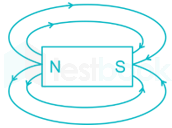
II. Electric lines of force are not closed but magnetic lines of force are closed.

Which of the statement(s) given above is/are correct?

  1. ((a))

    Only I

  2. ((b))

    Only II

  3. ((c))

    Both I and II

  4. ((d))

    Neither I nor II

Show Answer
Answer: ((c))

Both I and II

Concept:

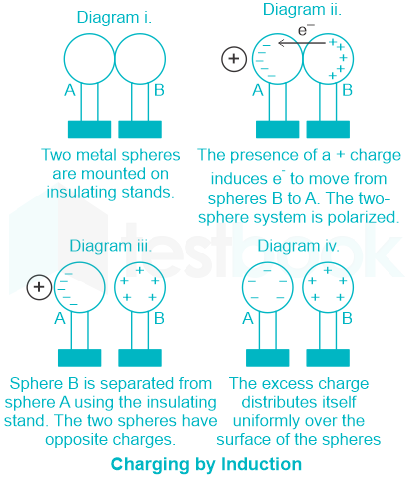
  • A comb moving through dry hair gets electrically charged through induction.
  • Induction charging is a charging method that charges an object without actually touching the object to any other charged object.
  • The charging by induction process is where the charged particle is held near an uncharged conductive material that is grounded on a neutrally charged material.

Explanation:

  • When a comb is moved through dry air, charge transfer takes place between the comb and hair and so the comb becomes electrically charged.
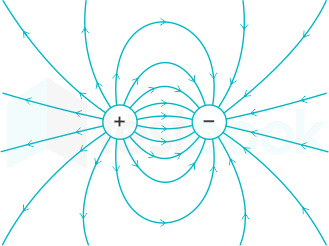
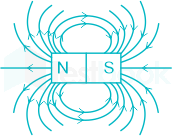
  • Electric field lines of force always originate at the positive charge and terminate at the negative charge.
  • So, they do not form a closed loop.
  • Whereas the magnetic field lines of force always form a closed loop.

Hence, both statements are correct.

10

If two conducting spheres are separately charged and then brought in contact

  1. ((a))

    The total energy of the two spheres is conserved.

  2. ((b))

    The total charge on the two spheres is conserved

  3. ((c))

    Both the total energy and the total charge are conserved

  4. ((d))

    The final potential is always the mean of the original potential of the two spheres

Show Answer
Answer: ((b))

The total charge on the two spheres is conserved

Concept:

  • Conducting sphere can be electrically charged through induction.
  • Induction charging is a charging method that charges an object without actually touching the object to any other charged object.
  • The charging by induction process is where the charged particle is held near an uncharged conductive material that is grounded on a neutrally charged material.

  • Charge:
  • It is the property of matter that is responsible for the electrical phenomenon.
  • Two- types: Positive charge and negative charge.
  • Law of conservation of charge:
  • ​The charge can neither be created nor destroyed.
  • It can be only transferred from one system to another system.

Explanation:

  • If two conducting spheres are separately charged and then brought in contact.
  • Then, the total charge on the two-sphere is conserved by the law of conservation of charge.
  • But, energy may not conserved because of the different sizes or having different charges then some of the energy might losses in the distribution of the charge.
  • In the case of final potential, the final potential is not always the mean of the original potential of the two spheres because of the distribution of the charge and some losses occur but, the final potential of both spheres is equal.
11

Which of the following pairs of physical quantities has the same dimensions?

  1. ((a))

    Work and power

  2. ((b))

    Momentum and energy

  3. ((c))

    Force and power

  4. ((d))

    Work and energy

Show Answer
Answer: ((d))

Work and energy

Concept:

Work:

  • Work is the product of the component of the force in the direction of the displacement and the magnitude of this displacement.
  • Formula, W = F× d, where F = component of force, d = magnitude of the displacement, W =  work done
  • The SI unit of the work is Joule or N-m.
  • The dimensional formula of the work, [W] = [M1L2T-2].

​Energy:

  • It is defined as the ability to do work.
  • The SI unit of the energy is Joule.
  • The dimensional formula of the energy, [E] = [M1L2T-2].

Explanation:

The dimensional formula of the energy and work is the same.

[W] = [E] = [M1L2T-2].

Additional Information 

Power: 

  • Power is the amount of energy transferred or converted per unit of time.
  • Formula, (P=\frac{E}{t}), where P = power, E = energy transferred, t = time.
  • The SI unit of the power is Joule/s.
  • The dimensional formula of the power,  [W] = [M1L2T-3].

Force:

  • Force is defined as the product of mass and acceleration.
  • It is a vector quantity because it has both magnitude and direction.
  • Formula, F =  ma, where, F = force, m = mass, a = acceleration
  • The SI unit of force is N or kg ms-2.
  • The dimensional formula of the force, [F] = [M1L1T-2]

Momentum:

  • Momentum is defined as the product of the mass and velocity of an object.
  • It is a vector quantity because it has both magnitude and direction.
  • Formula, P = mv, where m = mass of the object, v = velocity, P = momentum
  • The SI unit of momentum is kg ms-1.
  • The dimensional formula of the momentum is [P] = [M1L1T-1].
12

A passenger in a moving train tosses a five rupees coin. If the coin falls behind him, then the train must be moving with a uniform

  1. ((a))

    Acceleration

  2. ((b))

    Deceleration

  3. ((c))

    Speed

  4. ((d))

    Velocity

Show Answer
Answer: ((a))

Acceleration

Concept:

  • Acceleration: It is defined as the rate of change of velocity with respect to time.
  • It is a vector quantity because it has both magnitude and direction.
  • The SI unit of acceleration is ms-2.

Explanation:

  • A passenger in a moving train tosses a five rupees coin.
  • The coin has the same velocity as the velocity of the train, but during the time, the coin is in the air, the train keeps moving forward and the coin falls behind the passenger.
  • Hence, the train must be moving with uniform acceleration.

Additional Information

Deceleration:

  • ​​When the velocity of the body decreases with time, then the acceleration becomes negative.
  • The negative acceleration is also known as deceleration or retardation.

Velocity:

  • It is defined as the rate of change of displacement with respect to time.
  • It is a vector quantity because it has both magnitude and direction.
  • The SI unit velocity is ms-1.

Speed:

  • It is defined as the rate of change of distance with respect to time.
  • It is a scalar quantity because it has only magnitude but not direction.
  • The SI unit velocity is ms-1.
13

Newton's first law is also called as

  1. ((a))

    Law of moment

  2. ((b))

    Law of inertia

  3. ((c))

    Law of energy

  4. ((d))

    Law of momentum

Show Answer
Answer: ((b))

Law of inertia

Concept:

Newton's First Law of motion

  • This law implies that things cannot start, stop, or change direction all by themself, it requires some external force.
  • It states that a body that is at rest or uniform motion will continue to be at rest or uniform motion until or unless a net external force is applied to it.
  • It is also known as the law of inertia.

Additional Information

Newton's second law of motion

  • It describes what happened to the massive body when acted upon by an external force.
  • This law states that the net external force acting on the object is equal to the product of mass and acceleration.
  • Formula, F = ma, where, m = mass, a = acceleration

Newton's third law of motion

  • It describes what happened to the body when it exerts a force on another body.
  • This law states that there is an equal and opposite reaction for every action.
14

In which case does the potential energy decrease?

I. On compressing a spring

II. On stretching a spring

III. On moving a body against gravitational force

IV. On the rising of an air bubble in water

Select the correct answer.

  1. ((a))

    I and II

  2. ((b))

    Only IV

  3. ((c))

    III and IV

  4. ((d))

    All of these

Show Answer
Answer: ((b))

Only IV

Concept:

Potential energy

  • It is the energy possessed due to the position of the object is called potential energy
  • The potential energy due to gravitation, P.E = mgh, where m = mass, g = acceleration due to gravity, h = height
  • Potential energy due to spring, (P.E=\frac{1}{2}kx^2), where k = spring constant, x = displacement
  • In the case of spring, the potential energy increases when a spring is stretched or squeezed.

Explanation:

  • In the case of the spring, the potential energy increases when a spring is stretched or squeezed.
  • Work is done against the gravitational force of attraction when moving a body against gravity. It indicated that the potential energy of the system has increased.
  • When the bubble rises in the direction of the upthrust force, the potential energy of the system gets vanished.

Hence, the correct option is 2.

Additional Information

  • Kinetic energy
  • The energy possessed due to the motion of an object is called kinetic energy.
  • Formula, (K.E=\frac{1}{2}mv^2), where m = mass, v =v velocity
15

Which of the following statements is true?

  1. ((a))

    g is the same at all places on the surface of the earth.

  2. ((b))

    g is less at the earth's surface than at a height above or at a depth below it.

  3. ((c))

    g has its maximum value at the equator.

  4. ((d))

    g is greater at the poles than at the equator.

Show Answer
Answer: ((d))

g is greater at the poles than at the equator.

Concept:

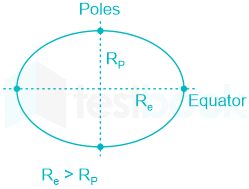
  • The acceleration due to gravity on the earth's surface, (g=\frac{GM}{R^2}) where, G = universal gravitational constant, M = mass of the earth, and R =  radius of the earth.
  • We know that Re > Rp, where Re =  radius of the earth on the equator side, Rp = radius of the earth on the pole side.

  • The acceleration due to gravity is inversely proportional to the square of the radius of the earth.
  • Relation, (g\propto \frac{1}{R^2})
  • In case of rotation. (g'=g(1-Rω^2cos^2\phi)), where, R = radius of the earth, ω = angular velocity of the earth.
  • g is decreasing at the earth's surface than at a height above or at a depth below it.

Explanation:

  • The acceleration due to gravity is not the same at all places on the surface of the earth due to the elliptical size of the earth.
  • The acceleration due to gravity at the equator is less than that of a pole.
  • That means g is greater at the poles than at the equator.
  • At the equator, θ = 0º ()the value of g is minimum.
  • At the pole, θ = 90º, the value of g is maximum.
  • g decreases at the earth's surface than at a height above or at a depth below it.
16

Consider the following statements.

I. Young's modulus of elasticity is defined as the ratio of normal stress to the longitudinal strain within the elastic limit.

II. Bulk modulus of elasticity is defined as the ratio of normal stress to the volumetric strain, within the elastic limit. 

Which of the statement(s) given above is/are correct?

  1. ((a))

    Only I

  2. ((b))

    Only II

  3. ((c))

    Both I and II

  4. ((d))

    Neither I nor II

Show Answer
Answer: ((c))

Both I and II

Concept:

Young's modulus of elasticity 

  • It is defined as the ratio of normal stress to the longitudinal strain within the elastic limit.
  • (Y=\frac{\sigma}{\epsilon})
  • It represents the longitudinal elasticity.
  • Formula, (Y=\frac{F/A}{Δ l/l}) where, F =  force, A = area, Δl = change in length, l = original length

The bulk modulus of elasticity

  •  It is defined as the ratio of normal stress to the volumetric strain, within the elastic limit.
  • It represents the volumetric elasticity.
  • Formula, (K=-\frac{P}{\Delta V/V}) where, P = pressure, Δ V =  change in volume, V =  volume

Additional Information

  • Shear modulus of elasticity
  • It is defined as the ratio of shear stress to shear strain.
  • Shear modulus, also known as Modulus of rigidity.
17

At normal temperatures due to a puncture, the compressed air inside the tube of a car wheel suddenly starts coming out. Then, the air inside the tube

  1. ((a))

    Starts becoming hotter

  2. ((b))

    Starts becoming cooler

  3. ((c))

    Remains at the same temperature

  4. ((d))

    May become hotter or cooler depending on the amount of water vapour present in the air

Show Answer
Answer: ((b))

Starts becoming cooler

Concept:

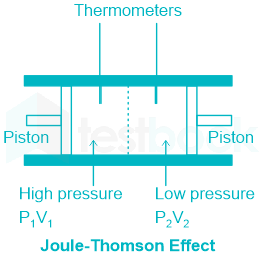
Joule-Thomson effect: 

  • The Joule-Thomson effect also known as Kelvin–Joule effect or Joule-Kelvin effect is the change in fluid’s temperature as it flows from a higher pressure region to lower pressure.
  • The basic principle of the Joule-Thomson effect is based on the transfer of heat.
  • The cooling produced in the Joule-Thomson expansion has made it a very valuable tool in refrigeration.

Explanation:

  • When a puncture happens, the air flows from the high-pressure region inside to the low-pressure region outside.
  • As air gains kinetic energy, it gains this energy from the internal heat of the air.
  • So it will use the internal energy of the compressed air, so it uses up internal heat and temperature falls.
  • This phenomenon is referred to as, the Joule-Thomson effect.
18

The specific heat of a gas at constant pressure is greater than the specific heat at constant volume because

  1. ((a))

    Work is done in the expansion of the gas at constant volume.

  2. ((b))

    Work is done in the expansion of the gas at constant pressure.

  3. ((c))

    The molecular collision increases at constant pressure.

  4. ((d))

    The attraction between the molecules increases at constant pressure.

Show Answer
Answer: ((b))

Work is done in the expansion of the gas at constant pressure.

Concept:

Specific heat at constant pressure

  • If the heat transfer to the sample is done when it is held at constant pressure.
  • Then the specific heat obtain using such a method is called Molar Specific Heat Capacity at Constant Pressure.
  • It is denoted by CP.

Specific heat at constant volume

  • If the heat transfer to the sample is done when the volume of the sample is held constant.
  • Then the specific heat obtain using such a method is called Molar Specific Heat Capacity at Constant Volume.
  • It is denoted by CV.
  • Work done in thermodynamics is given by, W = PΔV
  • At constant pressure, work is done in the expansion of gas.
  • At constant volume, there is no work done in the gas expansion. Or simply means, work done is zero.

Explanation:

  • When a gas is heated at constant volume, the whole heat supplied to the gas is used up in raising its temperature.

  • When a gas is heated at constant pressure, the gas is allowed to expand under constant pressure, heat supplied is used up in raising the temperature as well as in doing external work against expansion.

  • Therefore, the specific heat of a gas at constant pressure is greater than the specific heat at constant volume.

  • The specific heat of a gas at constant pressure is greater than the specific heat at constant volume because work is done in the expansion of the gas at constant pressure.

Hence, the correct option is 2.

19

A slow-running pendulum clock can be speeded up by

  1. ((a))

    Increasing the length of the rod

  2. ((b))

    Increasing the weight of the bob

  3. ((c))

    Reducing the length of the rod

  4. ((d))

    Reducing the weight of the bob

Show Answer
Answer: ((c))

Reducing the length of the rod

Concept:

  • The time period of the pendulum is given by, (T=2\pi \sqrt{\frac{l}{g}}) where g = acceleration due to gravity, l = length of the rod.
  • The time period of the pendulum is directly proportional to the square root of the length of the rod.
  • Relation, (T\propto\sqrt{l})
  • The SI unit of time period is second.

Explanation:

The time period of the pendulum is given by, (T=2\pi \sqrt{\frac{l}{g}})

From the above expression, the time period of the pendulum is directly proportional to the square root of the length of the rod.

  • For speeding up, in a pendulum clock, the time period should be decreased.
  • and it can be achieved by reducing the length of the rod.
  • Hence, the slow-running pendulum clock can be speeded up by reducing the length of the rod.
20

When a wave goes from one medium to another, there is unchange in the

  1. ((a))

    Velocity

  2. ((b))

    Amplitude

  3. ((c))

    Frequency

  4. ((d))

    Wavelength

Show Answer
Answer: ((c))

Frequency

Concept:

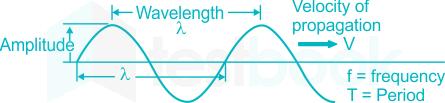
  • The basic properties of the waves are wavelength, frequency, velocity, and amplitude.

  • Wavelength is defined as the distance between the crest or troughs of a wave motion.
  • Frequency is defined as the number of oscillations per unit of time.
  • The relation between the frequency, wavelength, and velocity is given by, v =  fλ  where v = velocity,  f = frequency, λ = wavelength
  • The velocity of the sound in a solid, (v=\sqrt{\frac{β}{ρ}}) where, β = bulk modulus, ρ = density

Explanation:

  • When a sound goes from one medium to another medium, the wavelength changes but the frequency remains the same because the frequency of the sound depends on the source of the sound.
  • The relation between the frequency, wavelength, and velocity is given by, v =  fλ, where v = velocity,  f = frequency, λ = wavelength
  • The velocity of the sound depends on the elasticity and the inertia of the medium. Hence, the velocity also changes when the sound wave goes from one medium to another medium.
  • When a particle moves from one medium to another medium, its amplitude increases or decreases depending on the medium.

Hence, when a wave goes from one level to another, there is a change in amplitude, velocity, and wavelength, but the frequency of sound remains constant.

Important PointsThe given question in Official paper is 

When a wave goes from one level to another, there is change in the ___. 

Which is found to be wrong. therefore we corrected the question and modified it.

21

If the rotational velocity of a dynamo armature is doubled, then the induced emf will

  1. ((a))

    become half

  2. ((b))

    become double

  3. ((c))

    remain unchanged

  4. ((d))

    None of the above

Show Answer
Answer: ((b))

become double

Concept:

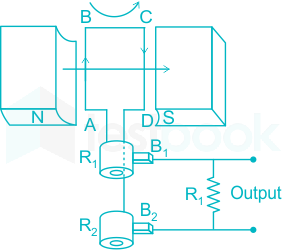
  • An electric generator is generated emf by rotating a coil inside a magnetic field.
  • When a coil is rotated in a magnetic field, magnetic energy and magnetic flux change through a coil.

  • The magnitude of emf produced in the armature by the electric generator is given as,
  • e = NABωsin(ωt), where N = number of turns, A = cross-sectional area, B = magnetic field, ω = angular velocity
  • The emf is induced in the coil that produces induced current.

Calculation:

Given,

The rotational velocity of the dynamo, ω' = 2ω  

The magnitude of emf produced in the armature by the electric generator is given as  

e = NABω. . . . . . . . . .(1)

The new emf produced in the armature when the angular velocity is double,

e' = NAB(2ω)

e' = 2 NABω 

e' = 2e

Hence, If the rotational velocity of a dynamo armature is doubled, then the induced emf will become double.

22

Magnetic Resonance Imaging (MRI) is used in medical diagnosis to obtain images of our internal body organs. This is primarily possible, because 

  1. ((a))

    our body possesses a permanent magnet

  2. ((b))

    MRI uses an external magnet to generate a magnetic field in our body

  3. ((c))

    MRI uses an external electric field to generate magnetic field in our body

  4. ((d))

    ions motion along our nerve cells generates magnetic fields

Show Answer
Answer: ((d))

ions motion along our nerve cells generates magnetic fields

Concept:

Magnetism In Human Beings

  • Extremely weak electric currents are produced in the human body by the movement of charged particles called ions. These are called ionic currents.
  • Now, we have studied that whenever there is an electric current, a magnetic field is produced.
  • So, when weak ionic currents flow along the nerve cells, they produce a magnetic field in our body.
  • For example, when we try to touch something with our hand, our nerves carry the electric impulse to the appropriate muscles.
  • And this electric impulse creates a temporary magnetism in the body.
  • The magnetism produced in the human body is very, very weak as compared to the earth's magnetism.
  • The two main organs of the human body where the magnetic field produced is quite significant are **the heart and the brain.**​
  • The magnetism produced inside the human body (by the flow of ionic currents) forms the basis of a technique called Magnetic Resonance Imaging (MRI) which is used to obtain images (or pictures) of the internal parts of our body.
  • It is obvious that magnetism has an important use in medical diagnosis because, through MRI scans, it enables doctors to see inside the body.
  • For example, MRI can detect cancerous tissue inside the body of a person.
  • Please note that the magnetism in the human body is actually electromagnetism (which is produced by the flow of ionic currents inside the human body).
  • Before we go further and describe the force acting on a current-carrying conductor placed in a magnetic field, please
23

The phenomenon of electromagnetic induction implies the production of induced

  1. ((a))

    resistance in a coil when the magnetic field changes with time

  2. ((b))

    current in a coil when an electric field changes with time

  3. ((c))

    current in a coil when a magnetic field changes with time

  4. ((d))

    voltage in a coil when an electric field changes with time

Show Answer
Answer: ((c))

current in a coil when a magnetic field changes with time

Concept:

  • Electromagnetic Induction was discovered by Michael Faraday in 1831.
  • And James Clerk Maxwell mathematically described it as Faraday's law of induction.
  • Electromagnetic induction is defined as the process of production of emf or current by changing the magnetic flux with time.
  • Formula, emf, (e=-N\frac{dϕ}{dt}) where ϕ = magnetic flux, N = number of turns in a coil.
  • Magnetic flux is defined as the number of magnetic field lines passing through a given closed surface.
  • The formula of magnetic flux, ϕ = BAcosθ, where B = magnetic field, A = closed surface, θ = angle between the magnetic field and the closed surface area vector.

Explanation:

  • When a magnetic field linked to a coil changes with time, then the magnetic flux also changes.
  • Due to the change in magnetic flux, the emf induced in the coil.
  • When we attach a resistor of resistance in the circuit, then the current flow in the circuit, and that current is called induced current.
  • The phenomenon of electromagnetic induction implies the production of induced current in a coil when a magnetic field changes with time.

​Hence, the correct option is 3.

24

By inserting a soft iron piece into the solenoid, the strength of the magnetic field

  1. ((a))

    decrease

  2. ((b))

    increase

  3. ((c))

    first increase then decrease

  4. ((d))

    remains unchanged

Show Answer
Answer: ((b))

increase

Concept:

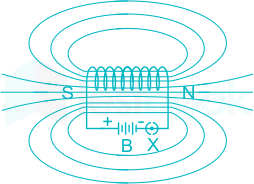
  • Electromagnets are the kind of magnet where the wire is wrapped around an iron core
  • A solenoid is a device that produces a uniform magnetic field inside it.

  • The magnetic field at any point beyond the solenoid is very thin.
  • The magnetic field inside the solenoid is parallel to its axis at all times.
  • The magnetic field produced by a solenoid can be defined using the Law of the Ampere, B = μ0nI, where, n = number of turns per unit length, I = current flowing

​​Explanation:

  • When a soft iron piece is introduced inside the solenoid, this iron core is magnetized thereby increasing the magnetic field inside a solenoid.
  • Therefore, a soft iron core inserted inside a solenoid increases the strength of the magnetic field.

Hence, the correct option is 2.

25

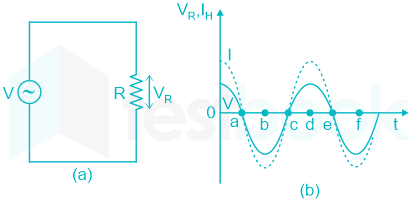
When an AC source is connected across a resistor

  1. ((a))

    the current lags behind the voltage in phase

  2. ((b))

    the current and the voltage are in same phase

  3. ((c))

    the current-leads the voltage in phase

  4. ((d))

    None of the above

Show Answer
Answer: ((b))

the current and the voltage are in same phase

Concept:

Alternating current:

  • An alternating current is produced by switching the potential between two terminals in a fixed time interval—the frequency.

Resistance:

  • Resistance is a measure of the opposition to current flow in an electrical circuit.
  • A resistor is a passive two-terminal electrical component that implements electrical resistance as a circuit element.
  • The SI unit of resistance is Ohm.

​Curre​nt:

  • ​It is defined as the charge per unit of time.
  • Its SI unit is Ampere and it is denoted by A.

Voltage:

  • Voltage is the pressure from an electrical circuit's power source that pushes charged electrons (current) through a conducting loop, enabling them to do work such as illuminating a light
  • An electromotive force is expressed as a volt.
  • Ohm's law gives the relation between the current, voltage, and resistance.
  • Ohm's law: V = IR, where V =  voltage, I = current, R = resistance.
  • An alternating source in a resistor:
  • When a constant voltage source or battery is applied across a resistor current is developed in resister.

  • Applied ac voltage, V = V0 sinωt
  • Current flowing in the circuit, (i= \frac{V_0}{R} sin\omega t)

Explanation:

  • The direction of current flowing through the resistor in an AC circuit has no effect on their behavior.
  • Therefore, they will rise and falls as the voltage rises and falls.
  • At the same time, the current and voltage hit the maximum, decrease through zero, and reach the maximum.
  • In a resistor, the current and voltage are in the same phase.
  • In the inductor, the current lags voltage by 90 degrees.
  • Whereas, in a capacitor, the current leads voltage by 90 degrees.

Hence, the correct option is 2.

26

Fibre optics cable used in communication works on the principle of

  1. ((a))

    regular reflection of light

  2. ((b))

    diffuse reflection of light

  3. ((c))

    refraction of light

  4. ((d))

    total internal reflection of light

Show Answer
Answer: ((d))

total internal reflection of light

Concept:

Total internal reflection of light:

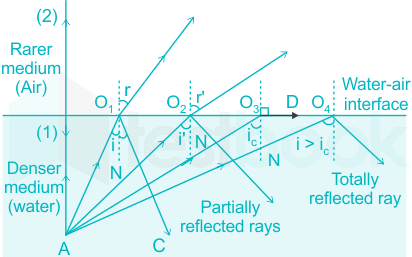
  • The phenomenon occurs when the light rays travel from a more optically denser medium to a less optical denser medium.

  • The two conditions of total internal reflection: 
  • The light ray moves from a more dense medium to a less dense medium.
  • The angle of incidence must be greater than the critical angle.
  • The expression for the refractive index in the total internal reflection, (μ= \frac{1}{sin C}), where C = critical angle, μ = refractive index.

Practical application of the total internal reflection:

  • ​The working of optical fiber is based on the total internal reflection of light.
  • Mirage is formed due to total internal reflection.
  • The brilliance of the diamond.

Explanation:

Fiber optics cable used in communication works on the principle of the total internal reflection of light.

 Additional Information

  • Reflection of light:
  • ​When a ray of light approaches a smooth polished surface and the light ray bounces back.
  • This phenomenon usually occurs in mirrors.
  • The light entering the medium returns to the same medium.
  • The angle of incidence of the light is equal to the angle of reflection.​
  • Refraction of light:
  • Refraction is the process by which light shifts its path as it travels through a material, causing the light to bend.
  • This phenomenon usually occurs in lenses.
  • During refraction, the light waves pass through the surface while simultaneously changing both direction and medium.
  • The angle of incidence is not equal to the angle of refraction.
27

When a CD (Compact disc used in audio and video system) is seen in sunlight, rainbow-like colors are seen. This can be explained on the basis of the phenomenon of

  1. ((a))

    reflection and diffraction

  2. ((b))

    reflection and transmission

  3. ((c))

    diffraction and transmission

  4. ((d))

    refraction, diffraction and transmission

Show Answer
Answer: ((d))

refraction, diffraction and transmission

Concept:

Transmission:

  • The transmission of light occurs when light hits an object that is transparent or translucent and light can penetrate the material to travel all the way through.
  • When light transmission happens, it can be scattered or refracted.
  • For example, sunlight moving through windows glass or flashlight moving through car windows

Diffraction:

  • ​​Diffraction is the spreading out of waves as they pass through an aperture or around objects.
  • It occurs when the size of the aperture or obstacle is of the same order of magnitude as the wavelength of the incident wave.

Refraction:

  • Refraction is the bending of light (it also happens with sound, water and other waves) as it passes from one transparent substance into another.
  • This bending by refraction makes it possible for us to have lenses, magnifying glasses, prisms and rainbows.
  • Even our eyes depend upon this bending of light..

Explanation:

  • The reason CDs reflect rainbow colors is that they have a clear plastic coating on top of a mirrored surface.
  • Light refracts when it moves from one medium to another with a different optical density (such as the clear plastic surface of a CD).
  • Different wavelengths of light (every color has a different wavelength) travel at different speeds so that full spectrum appears when white light passes from the air through the plastic surface of a CD, separated light rays which are then reflected back to us by the mirrored center surface of a CD.
  • Here diffraction and transmission also take place because diffraction of light rays occurs when it strikes the surface of CD and transmission is obvious when light enters from one medium to another.
  • The thickness of the different optical media, angle of source light, and brightness of source light all affect which rainbow patterns are visible on a CD.​

Hence, the correct option is 4.

28

Lights travels slower in glass than in air because

  1. ((a))

    refractive index of air is less than that of glass

  2. ((b))

    refractive index of air is greater than that of glass

  3. ((c))

    density of glass is greater than that of air

  4. ((d))

    density of glass is less than that of air

Show Answer
Answer: ((a))

refractive index of air is less than that of glass

Concept:

  • When a wave travels from one medium to another medium, wavelength, and speed amplitude change.
  • But the frequency remains constant because it is a property of the source and it only deepened on the source of the wave.
  • The speed of light depends on the optical density (refractive index) of the medium.

Refractive index: 

  • It is defined as the ratio of the speed of light in air to the speed of light in the medium.
  • Formula, refractive index, (\mu=\frac{c}{v}) where, c = speed of light in air, v = speed of light in the medium.
  • It is a dimensionless physical quantity.
  • Whereas, density is defined as the mass per unit volume.
  • The refractive index of air is 1 and the refractive index of glass is 1.5.

Explanation:

  • The speed of light depends on the optical density (refractive index) of the medium.
  • Light travels faster in a medium with a lower refractive index than in one with a higher refractive index.
  • As glass is optically denser than air, light travels slower in glass than in air.
  • Or the refractive index of air is less than that of glass.

​Hence, the correct option is 1.

29

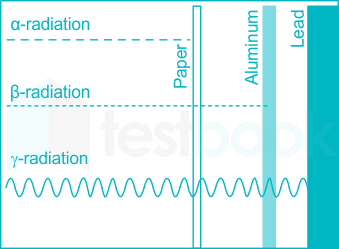
The penetrating powers of α, β, and γ radiations, in decreasing order, are:-

  1. ((a))

    α, β, γ

  2. ((b))

    γ, β, α

  3. ((c))

    β, α, γ

  4. ((d))

    γ, α, β

Show Answer
Answer: ((b))

γ, β, α

Concept:

Penetrating power:

  • ​The ability of each type of radiation to pass through matter is expressed in terms of penetration power.
  • The more material the radiation can pass through, the greater the penetration power and the more dangerous they are
  • Beta particles have a higher penetration power when compared to alpha particles
  • The penetrating power of the alpha rays is minimum

Explanation:

The alpha rays are the least penetrating, followed by beta rays, and gamma rays are the most penetrating.

Hence, the correct option is 2.

Additional Information 

Alpha (α) rays:

  • An alpha ray is a stream of alpha particles.
  • An alpha particle consists of two protons and two neutrons bound together into a particle identical to a helium nucleus.
  • It is a positively charged particle with charge +2e.
  • It is radioactive and is produced in the process of alpha decay.
  • Alpha particles, like helium nuclei, have a net spin of zero..

Beta (β) rays:

  • ​Beta particles are extremely energetic electrons that are liberated from the inner nucleus.
  • They bear negligible mass and carry a negative charge.
  • A neutron in the nucleus splits into a proton and an electron on the emission of a beta particle.
  • Hence, it is the electron that is emitted by the nucleus at a rapid pace.

​Gamma radiation(γ):  

  • It was first discovered by a French chemist and physicist, Paul Villard, in 1900.
  • It was named gamma ray by Ernest Rutherford in 1903.
  • Gamma radiation or gamma ray is an extremely high-frequency radioactive radiation consisting of high-energy photons.
  • Gamma rays are ionizing in nature, which means that they are capable enough of releasing electrons from atoms.
  • Detecting gamma rays is not as easy as detecting other ray types, such as x-ray or light.
30

In an atomic explosion, the release of a large amount of energy due to the conversion of 

  1. ((a))

    chemical energy into nuclear energy

  2. ((b))

    nuclear energy into heat

  3. ((c))

    mass into energy

  4. ((d))

    chemical energy into heat

Show Answer
Answer: ((c))

mass into energy

Concept:

Atomic explosion:

  • A nuclear explosion is an explosion that occurs as a result of the rapid release of energy from a high-speed nuclear reaction.
  • can cause significant damage and casualties from blasts, heat, and radiation.

Mass:

  • A quantitative measure of inertia.
  • A fundamental property of all matter.
  • It is the resistance that a body of matter offers to a change in its speed or position upon the application of a force.
  • The greater the mass of a body, the smaller the change produced by an applied force.
  • Its SI unit is the kilogram (kg).

Energy:

  • The capacity of doing work is called energy.
  • It may exist in potential, kinetic, thermal, electrical, chemical, nuclear, or other various forms.
  • Its SI unit is Joule (J).

Explanation:

  • The atomic explosion is carried out via nuclear reaction in which there is a net change in mass of the product and reactant and this change in mass.
  • And gets converted into energy due to which a huge amount of energy in the form of heat is released.

​Hence, In an atomic explosion, the release of a large amount of energy is due to the conversion of mass into energy.

Additional Information

Heat:

  • Heat is the transfer of kinetic energy from one medium or object to another, or from an energy source to a medium or object.
  • The SI unit of heat is the same as that of energy.

Chemical energy:

  • ​the energy which is stored in the bonds of chemical compounds (molecules and atoms).
  • It is released in the chemical reaction and mostly produces heat as a by-product, known as an exothermic reaction

Nuclear energy:

  • It is a form of energy released from the nucleus, the core of atoms, made up of protons and neutrons.
  • Nuclear energy can be used to create electricity**.​**
31

Which of the following is not correctly matched?

  1. ((a))

    Voltameter - Potential Difference

  2. ((b))

    Ammeter - Electric current

  3. ((c))

    Potentiometer - Emf

  4. ((d))

    Meter bridge - Electrical resistance

Show Answer
Answer: ((a))

Voltameter - Potential Difference

Concept:

Voltameter:

  • ​​A voltameter or coulometer is a scientific instrument used for measuring electric charge (quantity of electricity) through electrolytic action.
  • The SI unit of electric charge is the coulomb.

Potential difference:

  • It is the difference in the amount of energy that charge carriers have between two points in a circuit.
  • It is measured by the voltmeter.
  • Its SI unit is Volt.

Explanation:

  • A voltameter is used to measure electric charges.
  • An ammeter is used to measure electrical current.
  • The Potentiometer is used to measure emf.
  • A Meter bridge is used to measure the electrical resistance.

Hence, the correct option is 1.

Additional Information 

  • Ammeter:
  • ​It is an electrical instrument used to measure the amount of current in the electric circuit.
  • Potentiometer:
  • It is a device used to measure the emf of the cell, the potential difference across two terminals, unknown resistance, and internal resistance of the cell.
  • It is also used as a voltage divider in the circuit to bring down the voltage to the desired value.
  • Meter Bridge:
  • It is an electrical instrument based on the principle of the Wheatstone bridge.
  • It is used to measure unknown electrical resistance.
32

Two bulbs are fitted in a room in the domestic electrical installation. One of them glows brighter than the other. Then

  1. ((a))

    The brighter bulb has smaller resistance

  2. ((b))

    The brighter bulb has larger resistance

  3. ((c))

    Both the bulbs have the same resistance

  4. ((d))

    None of the above

Show Answer
Answer: ((a))

The brighter bulb has smaller resistance

Concept:

Electric power:

  • It is the rate at which electrical energy is transferred by an electric circuit.
  • Formula, Power, (P=VI=I^2R=\frac{V^2}{R}) where V = voltage, I = current, R = resistance
  • The electrical power is inversely proportional to the electrical resistance.

Resistance: 

  • It is the ratio between the voltage applied to the current flowing through it.
  • The SI unit of electrical resistance is ohms.

Explanation:

  • All home appliances are connected in parallel combination, so, the voltage in each bulb is equal.
  • We know that electrical power is inversely proportional to electrical resistance, (Power\propto\frac{1}{Resistance})
  • Therefore, the brighter bulb emitted more power and less resistance and the dimmer bulb had low power and more resistance.

Hence, the correct option is 1.

33

A current I flows through a potential difference V in an electrical circuit containing a resistance R. The product of V and I i.e. VI may be understood as 

  1. ((a))

    Resistance R

  2. ((b))

    Heat generated by the circuit

  3. ((c))

    Thermal power radiated by the circuit

  4. ((d))

    Rate of change of resistance

Show Answer
Answer: ((c))

Thermal power radiated by the circuit

Concept:

  • Electrical power: It is the rate at which electrical energy is transferred by an electric circuit.
  • Formula, Power, (P=VI=I^2R=\frac{V^2}{R}) where V = voltage, I = current, R = resistance
  • The electrical power is inversely proportional to the electrical resistance.

Explanation:

  • ​A current I flows through a potential difference V in an electrical circuit containing a resistance R.
  • The product of V and I i.e. VI may be understood as thermal power radiated by the circuit.

Additional Information

  • Resistance (R): 
  • ​It is the ratio between the voltage applied to the current flowing through it.
  • The SI unit of electrical resistance is ohms.
  • Current (I):
  • It is defined as the charge flowing in the conductor per unit of time.
  • Formula, current (I=\frac{q}{t})  where, q = charge, t = time
  • The SI unit of current is Ampere.
  • Potential difference:
  • It is the difference in the amount of energy that charge carriers have between two points in a circuit.
  • It is measured in volts (V) and is also called voltage.
34

Ohm's law defines

  1. ((a))

    a resistance

  2. ((b))

    current only

  3. ((c))

    voltage only

  4. ((d))

    both current and voltage

Show Answer
Answer: ((d))

both current and voltage

Concept:

  • Ohm’s law states that at a constant temperature, the current through a conductor between two points is directly proportional to the voltage across the two points.
  • Voltage = Current × Resistance
  • V = I × R
  • V = voltage, I = current and R = resistance


Explanation:

  • Hence according to ohm’s law voltage is directly proportional to current and resistance of a material
  • Therefore, we can say that ohm’s law defines all three voltage, current, and resistance.
  • Which means only option 4 is correct
  • The SI unit of resistance is ohms and is denoted by Ω.
  • It helps to calculate the power, efficiency, current, voltage, and resistance of an element of an electrical circuit.


Limitations of ohms law

  • Ohm’s law does not apply to unilateral networks. Unilateral networks allow the current to flow in one direction. Such types of networks consist of elements like a diode, transistor, etc.
  • Ohm’s law is also not applicable to non - linear elements. Non-linear elements are those which do not have current exactly proportional to the applied voltage that means the resistance value of those elements’ changes for different values of voltage and current. An example of a non-linear element is a thyristor.
  • Ohm’s law is also not applicable to vacuum tubes.
35

The material used for electric fuse is an alloy of tin and lead. This alloy should have

  1. ((a))

    high specific resistance and low melting point

  2. ((b))

    low specific resistance and high melting point

  3. ((c))

    low specific resistance and low melting point

  4. ((d))

    high specific resistance and high melting point

Show Answer
Answer: ((a))

high specific resistance and low melting point

Concept:

  • Fuse: It is an electrical safety device that operates to provide overcurrent protection of an electrical circuit.
  • The material used for the fuse element must be of:
  • ​Low melting point.
  • Low Ohmic loss.
  • High Resistivity
  • The current rating of the fuse is the maximum value of current due to which the fuse does not get melt.
  • The current carrying capacity of a fuse depends on
  • The material used for it.
  • The dimensions of the fuse.
  • Surrounding of the fuse.

Explanation:

  • The material used for the electric fuse is an alloy of tin and lead. This alloy should have high resistivity to avoid loss of current.
  • And the low melting point, so that in case of short-circuit, the fuse wire will melt with a slight change in temperature.
<br>

Mistake point:

When we use, metals like copper or silver in the fuse wire, its resistivity w.r.t tin and lead alloy is low.

But in this question, the material used in lead tin alloy, and the important feature of this is that it has a high specific resistance so that the heat generated when the high current flow is high and it gets melts quickly.

36

Consider the following statements. A magnetic field 

I. never exerts a force on a charged particle.

II. always exerts a force on a charged particle.

III. exerts a force an a charged particle if it is moving across the magnetic lines of force.

IV. exerts a force an a charged particle if it is moving along the magnetic lines of force.

Which of the statement(s) given above is/are correct?

  1. ((a))

    Only III

  2. ((b))

    Only IV

  3. ((c))

    I and II

  4. ((d))

    I, II, III and IV

Show Answer
Answer: ((a))

Only III

Concept:

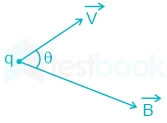
  • When a charged particle is moving in a magnetic field, then the force applied on the charge is F = qvB sinθ , where, F = force, q = charge of the particle, v = velocity, B = magnetic field, θ = the angle between the velocity and the magnetic field.

(\bar F_B=q(\bar V \times \bar B))

(|\bar F| = qvB sinθ)

Explanation:

Force on the charged particle is given by, F = qvB sinθ

From the above expression, we can conclude the following statement:

  • The magnetic field does not always exert a force on a charged particle.
  • The magnetic field exerts a force on the particle in a particular condition.
  • When the charged particle is moving in the same direction as the magnetic field, then the force is zero.
  • The magnetic field exerts a force on a charged particle if it is moving across the magnetic lines of force
37

All the magnetic materials lose their magnetic properties when 

  1. ((a))

    dipped in oil

  2. ((b))

    dipped in water

  3. ((c))

    strongly heated

  4. ((d))

    brought near a piece of iron

Show Answer
Answer: ((c))

strongly heated

Concept:

  • The magnetic property of a material is the atomic or subatomic response material to an applied magnetic field wherein the electron spin and charge create a dipole moment and a magnetic field.
  • Ferromagnetic materials tend to lose their magnetism permanently if they are heated above a temperature. This temperature is known as Curie temperature.

Explanation:

  • Every magnet has the capacity to sustain its magnetic properties.
  • When we start heating the magnet, it starts losing its magnetic property.
  • If the magnet is strongly heated, then it can not hold its magnetic property under that high temperature.
  • Thus, it gets demagnetized losing all of its magnetic properties.
38

A magnetic needle is kept in a non-uniform magnetic field. It experiences

  1. ((a))

    a force but not a torque

  2. ((b))

    a force and a torque

  3. ((c))

    a torque but not a force

  4. ((d))

    None of the above

Show Answer
Answer: ((b))

a force and a torque

Concept:

  • Force:
  • The push or pull on an object with mass causes it to change its velocity.
  • It is defined as the product of mass and acceleration.
  • Formula, F = ma, where m = mass, a = acceleration
  • Its SI unit is Newton N.
  • Torque:
  • It is a cross-product of displacement and force.
  • Formula, (\vec \tau= \vec r\times \vec F)
  • It SI unit is N-m,

Explanation:

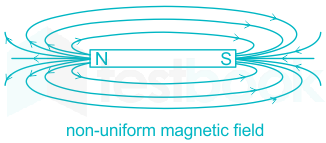
  • When a magnetic needle is kept in a non-uniform magnetic field.
  • It experiences both force and torque due to unequal force acting on the pole.

Additional Information

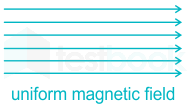
  • Uniform magnetic field:
  • A uniform magnetic field is one that has the same strength and direction at all points.
  • It is represented by a set of parallel lines that are equally spaced apart.
  • The direction of the magnetic field line points in the same direction as a north-south pole of a magnet point.

  • Non-Uniform magnetic field:
  • ​​​If the magnetic field lines in a particular magnetic field range are not uniform, the field at all the points is non-uniform.
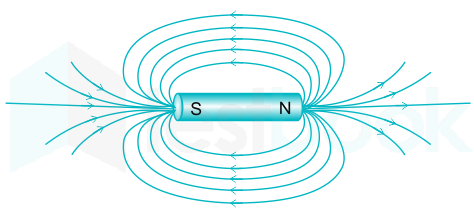
  • The magnetic field generated due to a bar magnet is non-uniform.

39

In terms of magnetic properties, oxygen belongs to

  1. ((a))

    magnetic materials

  2. ((b))

    ferromagnetic materials

  3. ((c))

    paramagnetic materials

  4. ((d))

    diamagnetic materials

Show Answer
Answer: ((c))

paramagnetic materials

Concept:

  • A material or object that produces a magnetic field is called magnetic material.
  • In physics, there are three types of magnetic materials: Paramagnetic materials, Diamagnetic materials, and ferromagnetic materials.
  • Paramagnetic materials:
  • Materials that tend to get weakly magnetized in the direction of the magnetizing field when placed in a magnetic field.
  • Materials have a permanent dipole moment or permanent magnetic moment.
  • However, if we remove the applied field the materials tend to lose their magnetism.
  • For example Aluminium, sodium, magnesium, and oxygen

Explanation:

In terms of magnetic properties, oxygen belongs to paramagnetic materials.

Additional Information

  • Ferromagnetic material:
  • Ferromagnetic materials are those materials that exhibit a spontaneous net magnetization at the atomic level, even in the absence of an external magnetic field.
  • For example Iron, Cobalt, Nickel.
  • Diamagnetic material:
  • Diamagnetic materials are those materials that are freely magnetized when placed in a magnetic field.
  • However, the magnetization is in the direction opposite to that of the magnetic field.
  • For example superconductors, copper, carbon, and water.
40

When a bar magnet is cut into two equal halves perpendicular to its length, the pole strength of each piece

  1. ((a))

    becomes double

  2. ((b))

    becomes half

  3. ((c))

    becomes zero

  4. ((d))

    remains the same

Show Answer
Answer: ((d))

remains the same

Concept:

  • When a bar magnet is cut into equal parts, each part becomes a bar magnet.
  • Bar magnet:
  • A bar magnet is a rectangular piece of an object, made up of iron, steel, or any other ferromagnetic substance or ferromagnetic composite, that shows permanent magnetic properties.
  • It has a north pole and a south pole at two ends. Even if you break a bar magnet from the middle, both the pieces will still have a north pole and a south pole, no matter how many pieces you break it in.
  • Its magnetic force of it is the strongest at the poles.
  • A bar magnet will attract all ferromagnetic materials such as iron, nickel, and cobalt.

  • Pole strength:
  • ​It is defined as the strength of a magnetic pole to attract magnetic materials toward itself.
  • Pole strength is a scalar quantity.

Explanation:

  • When a bar magnet is cut into two equal halves perpendicular to its length.
  • Then, the pole strength of each piece is the same as the pole strength of the original bar magnet.

Chemistry (20 questions)

41

Glass is

  1. ((a))

    Supercooled liquid

  2. ((b))

    Crystalline solid

  3. ((c))

    Liquid crystal

  4. ((d))

    None of the above

Show Answer
Answer: ((a))

Supercooled liquid

Explanation:

Glass:

As the material does not develop a crystalline structure, the amorphous solids are known as supercooled liquids because they allow molecules to continue to move within them for very very short periods of time. Because of this tendency to flow like liquids, they are also known as pseudo solids or supercooled liquids.

When silica is used to make glass, it is cooled from a liquid condition; yet, even at temperatures under freezing, silica does not solidify. Glass is therefore a super-cooled liquid.

Thus, Glass is considered a supercooled liquid.

Additional InformationCrystalline Solid:

  • Crystalline solids typically have sharp melting points, well-defined edges, and faces, and exhibit x-ray diffractive.
  • Amorphous solids, on the other hand, have wavy or uneven surfaces, poorly resolved x-ray diffraction patterns, and a wide temperature range for melting.
  • Due to the short-range order or the lack of regularity in the arrangement of its molecular constituents, glass is an amorphous solid material.

Liquid Crystal:

  • The phrase "liquid crystal" refers to a thermodynamically stable phase that is a process change, or between the solid and isotropic liquid phases, and is characterized by anisotropy of characteristics without the presence of a three-dimensional crystal lattice.
  • In essence, glass is an amorphous solid.
  • It does not take the shape of crystals.
  • The glass's component parts can therefore move.
  • Under normal circumstances, the constituent particles of ordinary solids do not move.
42

Preparation of 'Dalda or Vanaspati' ghee from vegetable oil utilizes the following process

  1. ((a))

    Hydrolysis

  2. ((b))

    Oxidation

  3. ((c))

    Hydrogenation

  4. ((d))

    Ozonolysis

Show Answer
Answer: ((c))

Hydrogenation

Explanation:

Hydrogenation:

  • A chemical reaction known as hydrogenation occurs when molecular hydrogen interacts with another substance or element, typically in the presence of a catalyst made of nickel, palladium, or platinum.
  • The method is frequently used to saturate or decrease organic molecules.
  • A chemical reaction between a substance or element and molecular hydrogen usually takes place with the aid of a catalyst.
  • Vanaspati is solidified and hydrogenated vegetable ghee from India. It costs a lot less than desi ghee.
  • Palm or palm olein oil is used to make all varieties of Vanaspati.
  • Nickel is used as a catalyst in reactors operating at low to medium pressure to produce hydrogenation.

Additional Information

Hydrolysis:

  • The term "hydrolysis" refers to the breaking of chemical bonds by the addition of water and describes the reaction of an organic compound with water to produce two or more new chemicals.
  • Some instances of hydrolysis include the formation of hydronium and bisulfate compounds when sulphuric acid is dissolved in water or a salt of a weak acid or base is dissolved in water.

Oxidation:

  • A chemical process that occurs when an object comes into contact with oxygen or another oxidizer.
  • Rust and an apple's brown color are examples of oxidation.

Ozonolysis:

  • When ozone is used in an organic chemical reaction to break the unsaturated bonds in alkenes, alkynes, and azo compounds, this process is known as ozonolysis.
  • The reaction is an organic redox one.
  • The two phases of ozonolysis reactions are as follows: Alkene molecules are initially attacked by ozone to create ozonide, and after that, hydrolysis occurs, causing bond cleavage.
43

The quality of petrol is expressed in terms of

  1. ((a))

    Cetane number

  2. ((b))

    Gold number

  3. ((c))

    Octane number

  4. ((d))

    Added unleaded compounds

Show Answer
Answer: ((c))

Octane number

Explanation:

Petrol:

  • Petroleum-derived clear flammable liquid known as gasoline or petrol is the main fuel for the majority of spark-ignited internal combustion engines.
  • It primarily comprises organic chemicals derived from petroleum fractional distillation, supplemented with a number of additions.

Types of Petrol:

  • Regular unleaded has the lowest octane level of the three categories with a RON of 91.
  • When comparing gasoline prices liter for liter, it is frequently the least expensive.
  • The majority of locally made and Japanese automobiles are built to run on normal unleaded fuel.
  • The lowest RON rating for premium fuels is Premium 95, which is often in the center of the pricing range.
  • The majority of European automobiles demand at least 95RON.
  • The fuel with the highest octane rating, premium 98, is typically the most expensive.
  • This gasoline, according to some experts, is the most fuel-efficient.

Quality of Petrol:

  • The octane number is used to measure gasoline's ignition quality and the cetane number is used to measure diesel's.
  • The ignition quality of gas is typically measured by the octane rating or octane number (gasoline or petrol).
  • The higher this value, the less likely it is that the gas would "knock"—an explosion brought on by its early burning in the combustion chamber.
  • When burned in a typical internal combustion engine with spark ignition.
44

Which of the following is responsible for the conduction of electricity through the electrolytic solution?

  1. ((a))

    Movement of ions of electrolyte

  2. ((b))

    Movement of only positive charges

  3. ((c))

    Movement of particles

  4. ((d))

    Movement of molecules

Show Answer
Answer: ((a))

Movement of ions of electrolyte

Explanation:

Electrolytic Solution:

The electrolyte solution is made up of an ionizable material, such as a salt or an acid, which is referred to as the electrolyte, and a liquid or solid phase that contains at least one component, such as water.

Factors responsible for the conduction of electricity in an electrolytic solution:

  • The ions that are present in electrolytes are the only factors contributing to their conductivity.
  • As there are more charge carriers if the ion concentration is higher, the conductivity of electrolytes will be high.
  • This is because the conductivity of electrolytes increases with an increase in ion concentration.
  • The electrolytic solution's ability to conduct electricity is due to the solvent's particle mobility.
  • The concentration of ions, the kind of ions present, and the solution's temperature are the three key variables that influence a solution's conductivity.
45

Which one of the following pairs of materials serves as electrodes in chargeable batteries commonly used in devices such as torch lights, electric shavers, etc.?

  1. ((a))

    Nickel and cadmium

  2. ((b))

    Zinc and carbon

  3. ((c))

    Lead peroxide and lead

  4. ((d))

    Iron and cadmium

Show Answer
Answer: ((a))

Nickel and cadmium

Explanation:

Chargeable Batteries: 

In contrast to a disposable or main battery, which is delivered fully charged and thrown away after use, a rechargeable battery, storage battery, or secondary cell can be charged, discharged into a load, and recharged numerous times.

Electrodes:

  • Conductors used to make electrical contact with a non-metallic component of the circuit are known as electrodes.
  • An electrode is a conductor that establishes electrical contact with nonmetallic circuit components such as an electrolyte, a semiconductor, or a vacuum.
  • This can also be referred to as an anode or a cathode if it is in an electrochemical cell.
  • In rechargeable batteries, the negative electrode functions as the cathode during discharge and as the anode during charge.
  • Lead-acid, zinc-air, nickel-cadmium (NiCd), nickel-metal hydride (NiMH), lithium-ion (Li-ion), lithium iron phosphate (LiFePO4), and lithium-ion polymer are among the several electrode materials and electrolytes that are utilized (Li-ion polymer).
  • In contrast to other varieties of rechargeable cells the ability to deliver almost their entire rated capacity at high discharge rates is a key benefit of nickel-cadmium cells, which also have fair cycle life and performance at low temperatures (discharging in one hour or less).
46

Atomic theory of matter was given by

  1. ((a))

    Avogadro

  2. ((b))

    Dalton

  3. ((c))

    Newton

  4. ((d))

    Pascal

Show Answer
Answer: ((b))

Dalton

Explanation:

The atomic theory of matter:

  • The atomic theory of matter, first proposed by JOHN DALTON, holds that each chemical element is composed of basic building blocks termed ATOMS.
  • An element's atoms are identical in every way.
  • All of these distinct elements—gold, copper, iron, and zinc—are composed of the same atoms.
  • The English chemist John Dalton put forward the modern atomic theory in about 1803.
  • The idea that all elements are made up of atoms is a fundamental one.

Postulates:

  1. Atoms make up all matter.
  2. Atoms are unbreakable and undividable.
  3. Two or more different types of atoms combine to create compounds.
  4. Atoms are rearranged during a chemical process.

Additional Information

  • The laws of motion were created by Newton.
  • According to the first law, until a force acts on an item, it will not alter its motion.
  • According to the second law, an object's force is determined by multiplying its mass by its acceleration.
  • According to the third law, when two objects interact, they exert equal-sized and opposite-direction pressures upon one another.
  • According to Avogadro's law, equal volumes of various gases each contain an equal number of molecules at the same temperature and pressure.
  • Under the presumption of an ideal (perfect) gas, this empirical relation can be deduced from the kinetic theory of gases.
  • Pascal's principle or the fluid pressure transfer principle are other names for Pascal's law.
  • Blaise Pascal, a French mathematician, formulated Pascal's law in 1653.
  • According to Pascal's law, pressure applied to a fluid inside of a container will be transmitted without a change in magnitude to every point within the fluid as well as the container's walls.
  • Any spot in the fluid experiences equal pressure in all directions.
47

Consider the following statements,

I. Atom consists of nucleus and shell.

II. Nucleus consists of protons and electrons.

III. Neutrons are present in atoms.

Which of the above statement(s) is/are correct?

  1. ((a))

    I and II

  2. ((b))

    I and III

  3. ((c))

    Only II

  4. ((d))

    I, II and III

Show Answer
Answer: ((b))

I and III

Explanation:

Atoms:

  • A chemical element is uniquely defined by its atoms, which are tiny pieces of substance.
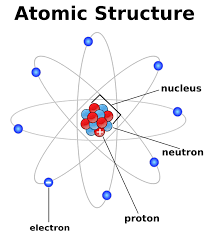
  • An atom is made up of a core nucleus and one or more negatively charged electrons that orbit it.

Atomic Structure:

  • An atom is a complicated configuration of negatively charged electrons grouped around a positively charged nucleus in certain shells.
  • Protons and neutrons make up the majority of the atom's mass in this nucleus (except for common hydrogen which has only one proton).
  • For instance, the nucleus of hydrogen is made up of a positively charged proton and a negatively charged electron.
  • On the periodic table of elements, the atomic structure is also depicted.
  • Every atom's nucleus has a neutron, with the exception of plain hydrogen, which does not.
  • The fact that the particle has no electrical charge—it is neutral—gives it its name.
  • Neutrons have a very high density.

STRUCTURE OF THE ATOM...WAEC. TUTORIALS ONLINE - INSIDE CHEMISTRY

48

Which of the following theory said that bond is formed between two atoms either by sharing or transfer of valence electrons?

  1. ((a))

    Valence shell electron pair repulsion.

  2. ((b))

    Molecular orbital theory

  3. ((c))

    Valence bond theory

  4. ((d))

    Electronic theory of chemical bonding

Show Answer
Answer: ((d))

Electronic theory of chemical bonding

Explanation:

Valency:

The valence or valency of an element in chemistry is a measurement of how well it can combine with other atoms to form chemical compounds or molecules.

Types of Bonds:

Chemical bonds, also known as electrical forces, can be categorized into five different groups: ionic, covalent, metallic, van der Waals, and hydrogen bonds.

Valence Shell Electron Pair Repulsion Theory:

  • Based on the number of valence shell electron bond pairs between the atoms in a molecule or ion, the valence shell electron pair repulsion (VSEPR) theory is a model used to predict 3-D molecular shape.
  • According to this hypothesis, electron pairs will position themselves to reduce the consequences of their mutual repulsion.
  • In a molecule, electrons remain as far away from one another. Covalent bonds also contain electrons in addition to lone pairs.
  • To reduce repulsion and increase molecular stability, electron pairs will repel away from one another.

Valance Bond Theory:

  • The electrical structure of molecules is described by the valence bond theory.
  • According to the hypothesis, electrons fill each of an atom's atomic orbitals inside a molecule, and the nucleus of one atom is drawn to the electrons of another atom.

Molecular Orbital Theory:

  • According to the molecular orbital hypothesis, every atom has a tendency to group together to create molecular orbitals.
  • As a result of this configuration, electrons can be found in a variety of atomic orbitals and are frequently linked to diverse nuclei.

Electronic Theory of Chemical Bonding:

  • The electronic theory of valence was created by Kossel and Lewis to explain how chemical bonds are formed between two atoms.
  • By losing, acquiring, or sharing electrons, every atom strives to achieve octet configuration (the presence of eight electrons in its valence shell).
49

Which one among the following statements about an atom is not correct?

  1. ((a))

    Atoms always combine to form molecules.

  2. ((b))

    Atoms are the basic units from which molecules and ions are formed.

  3. ((c))

    Atoms are always neutral in nature.

  4. ((d))

    Atoms aggregate in large numbers to form the matter that we can see, feel and touch.

Show Answer
Answer: ((a))

Atoms always combine to form molecules.

The correct answer is Atoms always combine to form molecules.

Key Points

  • Atoms are the smallest units of an element that retain its chemical properties.
  • The statement “Atoms always combine to form molecules” is not correct because some atoms can exist independently without forming molecules.
  • Noble gases such as Helium (He), Neon (Ne), and Argon (Ar) exist as single atoms due to their stable electronic configuration.
  • Atoms are the basic units from which molecules and ions are formed. Hence, statement 2 is correct.
  • Atoms are electrically neutral because they contain equal numbers of protons and electrons. Hence, statement 3 is correct.
  • Large numbers of atoms combine to form substances or matter that can be seen and touched. Hence, statement 4 is correct.
  • Statement-wise Analysis:
  • Atoms always combine to form molecules – Incorrect.
  • Atoms are the basic units from which molecules and ions are formed – Correct.
  • Atoms are always neutral in nature – Correct.
  • Atoms aggregate in large numbers to form matter – Correct.
  • Hence, the correct answer is Atoms always combine to form molecules.

Additional Information

  • Atom: Consists of protons, neutrons, and electrons.
  • Molecule: Formed when two or more atoms chemically combine together.
  • Ion: A charged particle formed by gain or loss of electrons.
  • Noble Gases: Known as inert gases because they are chemically less reactive.
  • John Dalton proposed the modern atomic theory in the early 19th century.

Important Points

  • Examples of Molecules:
  • O₂ – Oxygen molecule
  • H₂O – Water molecule
  • CO₂ – Carbon dioxide molecule
  • Examples of Monatomic Elements:
  • Helium (He)
  • Neon (Ne)
  • Argon (Ar)
50

In deep-sea diving, divers use a mixture of gases consisting of oxygen and

  1. ((a))

    Hydrogen

  2. ((b))

    Nitrogen

  3. ((c))

    Argon

  4. ((d))

    Helium

Show Answer
Answer: ((d))

Helium

Explanation:

Deep-Sea Diving:

  • The act of going below the water's surface to engage with the environment is known as underwater diving.
  • It is also frequently referred to as "diving," a word that can indicate many things depending on the context.
  • Since deep sea diving permits divers to dive deeper than the 40-meter limit of scuba diving, it necessitates specialized training from diving professionals.
  • It is crucial to check that your oxygen analyzers are fully functional and equipped for dives deeper than you had planned.
  • Divers occasionally utilize heliox, a mixture of helium and oxygen, or trimix, which combines all three gases, in place of nitrox.
  • Both nitrogen and oxygen can sometimes cause a state that is akin to intoxication during dives.

Concept:

  1. Helium is added to the mixture to lessen the toxication, allowing divers to think more clearly.
  2. Additionally, using helium may allow divers to surface more quickly and without experiencing decompression sickness.
51

CO2 when passed in excess, in lime water turns colourless again because of:

  1. ((a))

    Calcium Carbonate

  2. ((b))

    Calcium Bicarbonate

  3. ((c))

    Calcium Chloride

  4. ((d))

    Copper Carbonate

Show Answer
Answer: ((b))

Calcium Bicarbonate

Explanation:

  • Calcium carbonate, which is insoluble in water and becomes milky, is created when CO2 is carried through lime water.
  • The milkiness, however, disappears when too much CO2 is added to the solution.
  • This results from the production of colorless, water-soluble calcium bicarbonate.
  • When too much CO2 is added, it combines with water (H2O) and calcium carbonate (CaCO3) to generate calcium bicarbonate (Ca(HCO3)2), which dissolves in water to make the solution clear once more.

Give reason why: Lime water turns milky when CO3 is passed through it? -  Sarthaks eConnect | Largest Online Education Community

Additional InformationCalcium Chloride:

  1. The term "lime chloride" refers to calcium chloride.
  2. Calcium chloride has the chemical formula CaCl2.
  3. Lime water has the chemical formula Ca(OH)2.
  4. When lime water and chlorine interact, CaOCl2, or bleaching powder, is created (chloride of lime).

Copper Carbonate:

  1. While copper oxide is dark, copper carbonate is green.
  2. During the response, we can notice color a shift from green to black.
  3. By shaking the gas produced in a container containing lime water, we can demonstrate this.
  4. It is evident that this gas causes the lime water to turn milky.
52

Arrange the following elements in the increasing order of their metallic property

Li, Na, K, Rb, Cs

  1. ((a))

    Na, Li, Rb, K, Cs

  2. ((b))

    Cs, Rb, K, Na, Li

  3. ((c))

    Li, Na, K, Rb, Cs

  4. ((d))

    Li, Na, K, Cs, Rb

Show Answer
Answer: ((c))

Li, Na, K, Rb, Cs

Explanation:

Metallic Properties of Elements:

  • Thin sheets of metal can be pounded out.
  • It indicates that they have the quality of malleability.
  • Metals can bend easily.
  • They are able to be drawn into wires.
  • Metals are efficient heat and electrical conductors.
  • Metals have a glossy appearance because they are lustrous.
  • The tensile strength of metals is high.
  • It implies that they can support large weights.
  • Metals have a resonant sound.
  • It indicates that they produce a ringing sound.
  • Except for mercury, which is a liquid at ambient temperature, metals are solids at that temperature.
  • Metals are brittle. It implies that they are difficult to cut.

Metal Reactivity Series:

Metals are included in the Reactivity Series in decreasing order of Reactivity. The topmost metals are the most reactive, whereas the bottommost metals are the least reactive. Any two metals in the series can have their salt solutions replaced by the metal that is higher in the series for any two metals in the series.

Concept:

Since the group atomic radius grows as we descend, the metallic character also grows.

53

The most electronegative elements among the following is

  1. ((a))

    sodium

  2. ((b))

    chlorine

  3. ((c))

    oxygen

  4. ((d))

    fluorine 

Show Answer
Answer: ((d))

fluorine 

Explanation:

Electronegativity:

  1. The ability of an atom to draw an electron-binding pair determines its electronegativity.
  2. The propensity of an atom of a certain chemical element to draw shared electrons when forming a chemical connection is known as electronegativity.
  3. The atomic number and the separation of the valence electrons from the charged nucleus have an impact on an atom's electronegativity.

Factors responsible for electronegativity of elements:

  • The atomic number and the separation of the valence electrons from the charged nucleus have an impact on an atom's electronegativity.
  • An atom or a substituent group will draw electrons in greater amounts the higher the associated electronegativity.
  • The number of protons in the nucleus, the distance from the nucleus, and the degree of inner electron screening all have an impact on electronegativity.

Concept:

Fluorine is the most electronegative element in the current periodic table because of its tiny atomic radius and significant nuclear charge, which have the strongest pull for the shared pair of electrons in a covalent connection with any other element.

54

Highly reactive metals are found in combined state in nature. The natural substances containing metal in combined form are known as minerals. A mineral is called ore if

  1. ((a))

    the metal present in the mineral is costly

  2. ((b))

    a metal can be extracted from it

  3. ((c))

    a metal can be profitably extracted from it

  4. ((d))

    a metal cannot be extracted from it

Show Answer
Answer: ((c))

a metal can be profitably extracted from it

Explanation:

Minerals:

  • In terms of geology and mineralogy, a mineral or mineral species is, generally speaking, a pure, naturally occurring solid chemical compound with a fairly well-defined chemical makeup.
  • Minerals are those substances found in meals and in the ground that our bodies require for healthy growth and development.
  • Calcium, phosphorus, potassium, sodium, chloride, magnesium, iron, zinc, iodine, chromium, copper, fluoride, molybdenum, manganese, and selenium are among the nutrients that are crucial for good health.
  • Leaching methods such as tank leaching, heap leaching, dump leaching, and pressured leaching are typically used in the commercial extraction of metals from minerals.
  • A leaching solution is percolated through mined ore that has low concentrations (low grade) of the target components to perform dump leaching.
  • There are three primary techniques for removing metals from their ore.
  • These include reducing the ore with carbon, electrolyzing the molten ore, and reducing it with a more reactive metal.
  • Minerals are created when different elements are layered on top of one another.
  • Minerals are merely a grouping of one or more elements arranged in a shape known as a crystal structure.

Confusion Points

  • A mineral is called ore if a metal can be profitably extracted from it, in the option you might get confused with options 2 and 3, which looks the same, but we need to get an accurate answer, so option 3 is correct.
55

Consider the following statements,

I. In Mendeleev's Periodic Table, position of the isotopes was not fixed.

II. In the 19th Century, Mendeleev propounded periodic law is based on atomic mass.

Which of the above statement(s) is/are correct?

  1. ((a))

    Only I

  2. ((b))

    Only II

  3. ((c))

    Both a and b

  4. ((d))

    Either of them

Show Answer
Answer: ((c))

Both a and b

Explanation:

Mendeleev's Periodic Table:

  1. A Russian scientist named Dmitri Mendeleev presented a paper on the Law of Octaves in 1869, just five years after John Newlands first proposed it.
  2. Mendeleev stated that "Element characteristics are a periodic function of their atomic weight" in his renowned periodic law.
  3. The Periodic Table of Mendeleev is a table that Mendeleev created to list elements in the order of their atomic weights.
  4. Isotopes of an element must be given distinct locations in the periodic table because they have various atomic masses, according to Mendeleev's Periodic Law.
  5. Because Mendeleev's periodic chart was structured in increasing order of atomic number, which is not how isotopes are arranged, and because isotopes share the same atomic number, no one isotope can fit into a single box in the periodic table.

Periodic Table

56

When a spoon is to be electroplated with nickel the spoon is

  1. ((a))

    Dipped in a nickel sulphate solution

  2. ((b))

    made anode and a pure nickel rod, the cathode

  3. ((c))

    made cathode and a pure nickel rod, the anode

  4. ((d))

    coated with nickel sulphate and dried

Show Answer
Answer: ((c))

made cathode and a pure nickel rod, the anode

Explanation:

Electroplating:

  • The technique of using electrodeposition to cover an object in a layer of metal is known as electroplating.
  • The required metal coating is transferred from an anode (a component that contains the metal that will be plated) to a cathode via controlled electrolysis (the part to be plated).
  • Use good electrical conductors, such as gold and silver, in integrated circuits that are used in computers, smartphones, and other electronic devices.
  • The many electroplating processes include rack plating, continuous plating, in-line plating, and mass plating (also known as barrel plating).
  • Electroplating is the technique of utilizing electrolysis to create a layer of one metal on top of another metal.
  • This thin coating aids in both improving the metal's look and shielding it from corroding.
  • The method of nickel electroplating involves plating metal components with a thin layer of nickel.
  • In a galvanic cell, a spoon is used as the cathode, while nickel is used as the anode to deposit Ni+ ions across the cathode to prepare for plating.

Concept:

Sulfamate nickel is used in the majority of engineering applications, however, a nickel chloride/nickel sulfate bath is used for nickel-plated strip steel. The Watts baths, which combine nickel sulfate, nickel chloride, and boric acid, are the most often used nickel baths.

57

Alcohol obtained in the saponification process is

  1. ((a))

    Ethyl alcohol

  2. ((b))

    Methyl alcohol

  3. ((c))

    Wood spirit

  4. ((d))

    Glycerol

Show Answer
Answer: ((d))

Glycerol

Explanation:

Saponification:

Esters are transformed into soaps and alcohols through the process of saponification, which uses an aqueous alkali. Fatty acids, which are long-chain carboxylic acids, are the building blocks of soaps.

Preparation of Alcohols:

  1. Alkenes can be hydrated to produce alcohol, or aldehydes, ketones, acids, and esters can be reduced to produce alcohol.
  2. An alkene's double-bonded carbons can be added to using either a Markovnikov's or an anti-method.
  3. Markovnikov's e is created by reducing aldehydes, ketones, acids, and esters or hydrating alkenes.
  4. In the process of saponification, an ester and an inorganic base combine to create soap and alcohol.
  5. In most cases, it happens when triglycerides react with potassium or sodium hydroxide (lye) to create glycerol and fatty acid salt, sometimes known as "soap," from triglycerides.
  6. Ethyl Alcohol speeds up the saponification process by making the catalyst more soluble in the oil-ethyl ester phase.
58

Which one among the following statements is correct?

  1. ((a))

    All bases are alkalis

  2. ((b))

    None of the bases is alkali

  3. ((c))

    There are no more bases except the alkalis

  4. ((d))

    All alkalis are bases but all bases are not alkalis

Show Answer
Answer: ((d))

All alkalis are bases but all bases are not alkalis

Explanation:

Alkali:

  1. Alkalis are substances that can dissolve in water, produce salts when combined with acids, and lessen the acidity of acids.
  2. Alkalis have an unpleasant taste and render some colors blue.
  3. Some alkalis can support the body's normal functioning.
  4. The alkali is sodium hydroxide, for instance.
  5. A basic, ionic salt of an alkali metal or an alkaline earth metal is referred to as an alkali in chemistry.
  6. A base that dissolves in water is another definition of an alkali.
  7. A soluble base solution has a pH higher than 7.0.
  8. While all alkalis are bases, not all bases are alkalis.
  9. Only those bases which are water soluble are alkalis.
  10. Bases known as alkalis dissolve in water.
  11. Lyes, ammonia, hair relaxers, nonphosphate detergents, dishwasher soaps, and disc batteries are examples of common alkali-containing materials.
  12. Sodium hydroxide (NaOH), potassium hydroxide (KOH), or calcium hydroxide (Ca(OH)2) are the main components of lyes, which are alkaline substances.
59

The pH of fresh ground water slightly decreases upon exposure to air because 

  1. ((a))

    carbon dioxide from air is dissolved in the water

  2. ((b))

    oxygen from air is dissolved in the water

  3. ((c))

    the dissolved carbon dioxide of the ground water escapes into air

  4. ((d))

    the dissolved oxygen of the ground water escapes into air

Show Answer
Answer: ((a))

carbon dioxide from air is dissolved in the water

Explanation:

pH Value:

  • The pH scale determines how acidic or basic water is.
  • The range is 0 to 14, with 7 representing neutrality.
  • Acidity is indicated by pH values below 7, whereas baseness is shown by pH values above 7.
  • In reality, pH is a measurement of the proportion of free hydrogen and hydroxyl ions in water.

pH (Potential Hydrogen) - Chemistry Review (Video)

Factors Affecting pH Value:

  1. A water supply's inherent pH of 7 will typically become unbalanced when chemicals, minerals, pollutants, soil or bedrock composition, and other impurities interact with it.
  2. In summary, environmental conditions play a major role in determining the pH of water, whether it is high or low.
  3. Temperature increases cause a drop in pH.
  4. However, this does not imply that as the temperature rises, water's acidity does as well.
  5. If there are more hydrogen ions present in a solution than hydroxide ions, it is said to be acidic.
60

Complete the following chemical reaction:

Al2O+ NaOH → ______ +H2O

  1. ((a))

    Al(OH)3

  2. ((b))

    Na2O

  3. ((c))

    NaAlO2

  4. ((d))

    AlNaO2

Show Answer
Answer: ((c))

NaAlO2

Explanation:

  • Sodium aluminate and water are produced when aluminum oxide Al2O3 interacts with sodium hydroxide solution.
  • Between 900 and 1100 °C is the temperature at which this reaction occurs.
  • Aluminum oxide behaves as an acid in this reaction.

Reaction:

Mathematics (20 questions)

61

The parallel sides of a trapezium are 20 cm and 10cm and its non-parallel sides are equal to each other. If its area is 180cm2, then what is the length (in cm) of each non-parallel side?

  1. ((a))

    11

  2. ((b))

    13

  3. ((c))

    12

  4. ((d))

    15

Show Answer
Answer: ((b))

13

Shortcut Trick

Height of trapezium = (2 × Area) ÷ Sum of parallel sides = (2 × 180) ÷ (20 + 10) = 12 cm.

Base of the right-angled triangle formed at the ends = (20 − 10) ÷ 2 = 5 cm.

Length of each non-parallel side = √(122 + 52) = √(144 + 25) = √169 = 13 cm.

∴ The correct answer is 13 cm.

Alternate Method

Given:

Parallel sides of the trapezium are 20 cm and 10 cm.

Area of the isosceles trapezium = 180 cm2.

Formula Used:

Area of Trapezium = 1/2 × (Sum of parallel sides) × Height

Pythagoras Theorem: Hypotenuse2 = Base2 + Perpendicular2

Calculations:

⇒ Area = 1/2 × (AB + CD) × Height

⇒ 180 = 1/2 × (10 + 20) × h

⇒ 180 = 1/2 × 30 × h

⇒ 180 = 15 × h

⇒ h = 12 cm

So, the height of the trapezium (AM = BN) is 12 cm.

In isosceles trapezium ABCD, dropping perpendiculars AM and BN to CD constructs a rectangle ABMN.

⇒ MN = AB = 10 cm

Since it is an isosceles trapezium, the remaining base segments are equal:

⇒ DM = NC = (CD − MN) ÷ 2

⇒ DM = (20 − 10) ÷ 2 = 5 cm

Now, applying Pythagoras theorem in right-angled ΔAMD:

⇒ AD2 = AM2 + DM2

⇒ AD2 = 122 + 52

⇒ AD = √(144 + 25)

⇒ AD = √169 = 13 cm

∴ The correct answer is 13 cm.

Additional Information

Isosceles Trapezium Properties

In an isosceles trapezium, the non-parallel sides are equal in length, the base angles are equal, and the lengths of the diagonals are identical.

Area of a Trapezium

The area is calculated as Area = 1/2 × (a + b) × h, where 'a' and 'b' are the lengths of the parallel sides and 'h' is the perpendicular distance (height) between them.

Median of a Trapezium

The median is the line segment joining the midpoints of the non-parallel sides. Its length is the average of the parallel sides: m = (a + b) ÷ 2, and Area = m × h.

62

What is the area of a rhombus (in cm2) whose side is 10 cm and the smaller diagonal is 12cm?

  1. ((a))

    120

  2. ((b))

    192

  3. ((c))

    96

  4. ((d))

    50

Show Answer
Answer: ((c))

96

Concept-

  • Diagonals of a rhombus bisect each other at 90°
  • Area of rhombus = ( {1} \over {2}) × Product of diagonals


Calculation-

The area of a rhombus having one side 10 cm and one diagonal

BD = 12 cm 

⇒ BO = 6 cm (half of diagonal)

Using Pythagoras theorem in ΔAOB right angle at O.

AB= BO2 + OA2

⇒ OA = (\sqrt{AB^{2}-BO^{2}})

⇒ OA = (\sqrt{10^{2}-6^{2}}) = 8 cm.

AC = 2 OA = 16 cm

Area of rhombus = 1/2 × 12 × 16 

⇒ 96 cm2.

∴ The area of a rhombus is 96 cm2.

63

The area of a triangle is 15 sq cm and the radius of its incircle is 3 cm. Its perimeter is equal to?

  1. ((a))

    12 cm

  2. ((b))

    20 cm

  3. ((c))

    5 cm

  4. ((d))

    10 cm

Show Answer
Answer: ((d))

10 cm

Concept- 

(Inradius = \frac {Area \ of \ triangle \ } {Semiperimeter})

Calculation

The area of a triangle is 15 sq cm and the radius of its incircle is 3 cm. Its  perimeter is equal to - Brainly.in

(r = \frac{\Delta }{s})

⇒ (3 = \frac{15 }{s}) 

⇒ s = 5 cm

Now perimeter will be 2 × semiperimeter

Perimeter = 2 × (5 )

Perimeter = 10 cm.

∴ the perimeter of a triangle is 10 cm.

64

If one of the zeros of the quadratic Polynomial (k - 1)x+ kx + 1 is -3, then the value of k is:

  1. ((a))

    (\frac{-2}{3})

  2. ((b))

    (\frac{4}{3})

  3. ((c))

    (\frac{-4}{3})

  4. ((d))

    (\frac{2}{3})

Show Answer
Answer: ((b))

(\frac{4}{3})

Calculation-

As -3 is the zeros of the quadratic polynomial  (k - 1)x2 + kx + 1 

On substitute -3 in the equation, we get 0 

⇒ (k - 1)(-3)2 + k(-3) + 1 = 0

⇒ 9k - 9 - 3k + 1 = 0

⇒ 6k = 8

⇒ k = 4/3 

∴ the value of k is 4/3.

65

In the figure, 'G' is the centre of the circle. Find the angle ACB when ∠AGB=150°

  1. ((a))

    50°

  2. ((b))

    60°

  3. ((c))

    65°

  4. ((d))

    75°

Show Answer
Answer: ((d))

75°

Concept-

The angle subtended by the chord at the centre is double the angle subtended by it at any point on the circle.

Calculation-

∠ AGB = 2 × ∠ ACB

⇒ 150° = 2 × ∠ ACB

⇒ ∠ ACB = 75° 

∴ the value of ∠ ACB is 75°

66

The number 2143251 is divisible by 

  1. ((a))

    13

  2. ((b))

    17

  3. ((c))

    3

  4. ((d))

    7

Show Answer
Answer: ((c))

3

Calculation-

The divisibility rule of 3 - the sum of the digits is divisible by 3.

In 2143251 sum of digits will be 18 which is divisible by 3

∴ The number 2143251 is divisible by 3.

67

The average of the first 43 natural numbers is

  1. ((a))

    33

  2. ((b))

    44

  3. ((c))

    43

  4. ((d))

    22

Show Answer
Answer: ((d))

22

Shortcut Trick

The average of the first n natural numbers is given by the formula: (n + 1) ÷ 2.

Here, n = 43.

Average = (43 + 1) ÷ 2 = 44 ÷ 2 = 22.

∴ The correct answer is 22.

Alternate Method

Given: The first 43 natural numbers are 1, 2, 3, ..., 43.

Formula Used: Sum of first n natural numbers = [n(n + 1)] ÷ 2 | Average = Sum ÷ n

⇒ Sum = [43 × (43 + 1)] ÷ 2

⇒ Sum = [43 × 44] ÷ 2 = 43 × 22 = 946

⇒ Average = Total Sum ÷ Total count

⇒ Average = 946 ÷ 43 = 22

∴ The correct answer is 22.

Additional Information

Average of Even Numbers

The average of the first n even natural numbers is (n + 1).

Average of Odd Numbers

The average of the first n odd natural numbers is n.

Average of AP

For any Arithmetic Progression, the average is exactly the middle term, or (First term + Last term) ÷ 2.

68

If sin θ = (\frac{\sqrt3}{2}), and θ is an acute angle, find the value of cos 3θ

  1. ((a))

    (\frac{1}{2})

  2. ((b))

    1

  3. ((c))

    -1

  4. ((d))

    0

Show Answer
Answer: ((c))

-1

Calculation- 

sin θ = (\frac{\sqrt3}{2})

⇒ θ = 60° 

Now, cos3θ will be 

⇒ cos 180° = -1 ----(cos nπ = (-1)n)

∴ The value of cos 3θ is -1.

69

tan (π + θ) = ?

  1. ((a))

    sec θ

  2. ((b))

    cosec θ

  3. ((c))

    cot θ

  4. ((d))

    tan θ

Show Answer
Answer: ((d))

tan θ

Concept-

  • tan (A + B) = ( {tan A + tan B} \over 1 - {tan A tan B})
  • tan nπ = 0


Calculation-

tan (π + θ) = ( {tan \pi + tan θ } \over 1 - {tan \pi tan θ})

tan (π + θ) = ( \frac{0+tan\theta } {1-0})

tan (π + θ) = tan θ 

∴ the value of tan (π + θ) is tan θ .

70

A wire is bent to form a square of area 169 cm2. If the same wire is bent to form a circle, then what is its area(in cm2)? (to the nearest whole number)

  1. ((a))

    215

  2. ((b))

    227

  3. ((c))

    532

  4. ((d))

    531

Show Answer
Answer: ((a))

215

Shortcut Trick

The length of the wire remains constant, meaning the perimeter of the square equals the circumference of the circle.

Perimeter = 4 × √(Area of square) = 4 × √169 = 52 cm.

The area of a circle in terms of its circumference (C) is given by Area = C2 ÷ 4π.

Area = (52 × 52) ÷ (4 × 22/7) = (2704 × 7) ÷ 88 = 215.09 cm2.

Rounding to the nearest whole number, we get 215.

∴ The correct answer is 215 cm2.

Alternate Method

Given:

Area of the square = 169 cm2

Area = 169 sq. cm Square: P = 52

Bent into L = 52 cm

r Area = ? Circle: C = 52

Formula Used:

Area of square = a2

Perimeter of square = 4a

Circumference of circle = 2πr

Area of circle = πr2

Calculations:

⇒ Area of square = a2 = 169

⇒ a = √169 = 13 cm

⇒ Perimeter of square = 4 × 13 = 52 cm

⇒ Since the same wire is bent to form a circle, Circumference of circle = 52 cm

⇒ 2 × (22/7) × r = 52

⇒ r = (52 × 7) ÷ 44

⇒ r = 91 ÷ 11 cm

⇒ Area of circle = πr2

⇒ Area = (22/7) × (91/11) × (91/11)

⇒ Area = (2 × 13 × 91) ÷ 11

⇒ Area = 2366 ÷ 11 = 215.09 cm2

⇒ Rounding off to the nearest whole number, we get 215 cm2.

∴ The correct answer is 215 cm2.

Additional Information

Isoperimetric Property

Among all planar shapes having the same perimeter, the circle always encloses the maximum area. This is why a wire forms a larger area when bent into a circle than a square.

Conservation of Perimeter

When a wire is reshaped from one figure into another, its total length strictly remains constant. The perimeter of the initial shape equals the perimeter (or circumference) of the newly formed shape.

Area and Perimeter Formula Ratio

For a circle, Area = Circumference2 ÷ 4π. For a square, Area = Perimeter2 ÷ 16. Using these relationships directly can significantly speed up calculations in competitive exams.

71

The table below gives the numbers of students from five different colleges who participated in olympiads of five different subjects during a given year.

SubjectsCollege ACollege BCollege CCollege DCollege E
Hindi110100125103112
English9812080122105
Maths130110250160180
Science10010015020080
GK182200120130183

Find the difference between 'the range of the numbers of participants in the different olympiads from college C' and 'the average number of participants in all olympiads from college E' during the given year.

  1. ((a))

    38

  2. ((b))

    13

  3. ((c))

    37

  4. ((d))

    36

Show Answer
Answer: ((a))

38

Concept -

Range = highest value - lowest value

(Average = \frac{Sum \ of\ observation } {total\ no\ of\ observation})

Calculation - 

Range of C = 250 - 80 = 170

The average of participants from E will be

( \frac{112+105+180+80+183 } {5}=132)

The difference is 170 - 132 = 38.

∴ the difference between 'the range of C and average of E participants is 38.

72

Solve the inequality: (\rm \begin {vmatrix}\frac{2}{x-4} \end{vmatrix}) > 1, x ≠ 4

  1. ((a))

    x ϵ (4, 6)

  2. ((b))

    x ϵ 4

  3. ((c))

    x ϵ (-6, 2)

  4. ((d))

    x ϵ 0

Show Answer
Answer: ((a))

x ϵ (4, 6)

Calculation-

(\rm \begin {vmatrix}\frac{2}{x-4} \end{vmatrix}) > 1 ⇒(\rm \begin {vmatrix}\frac{x-4}{2} \end{vmatrix}) < 1 ⇒|x - 4| < 2

⇒ -2 < x - 4 < 2 ⇒ 2 < x < 6 

As x ≠ 4 hence x ϵ (2, 4) ∪ (4, 6) 

Since, (4, 6) is lying in the interval for all the acceptable values of x ϵ (2, 4) ∪ (4, 6) so this will be the best option.  

∴ The solution of the equality (\rm \begin {vmatrix}\frac{2}{x-4} \end{vmatrix}) > 1 is x ϵ (4, 6).

73

(\rm \displaystyle \int _2^3 \frac{1}{x} dx=)

  1. ((a))

    (\log \rm \begin {vmatrix}\frac{3}{2} \end{vmatrix})

  2. ((b))

    0

  3. ((c))

    (\log \rm \begin {vmatrix}\frac{2}{3} \end{vmatrix})

  4. ((d))

    None of these

Show Answer
Answer: ((a))

(\log \rm \begin {vmatrix}\frac{3}{2} \end{vmatrix})

Concept-

log a - log b = (log\frac{a}{b})

Calculation-

(\int_{2}^{3}\frac{1}{x}dx)

⇒(\left [ logx \right ]_{2}^{3})

⇒ log 3 - log 2 

⇒ (log\left| \frac{3}{2} \right|)

∴ (\int_{2}^{3}\frac{1}{x}dx = log\left| \frac{3}{2} \right| )

74

(\rm \displaystyle \int _1^2x^2 \ dx)

  1. ((a))

    (\frac{3}{7})

  2. ((b))

    (\frac{5}{6})

  3. ((c))

    (\frac{7}{3})

  4. ((d))

    (\frac{6}{5})

Show Answer
Answer: ((c))

(\frac{7}{3})

Concept-

(\int x^{n} = \frac{x^{n+1}}{n+1} )

Calculation-

(\int_{1}^{2}x^{2}dx)

⇒(\left[\frac{x^{3}}{3} \right]_{1}^{2})

⇒(\left[\frac{2^{3}}{3}-\frac{1^{3}}{3} \right])

⇒( {7} \over {3})

75

The total number of terms in the expansion of (x + a)100 + (x − a)100 after simplification is

  1. ((a))

    202

  2. ((b))

    51

  3. ((c))

    50

  4. ((d))

    None of these

Show Answer
Answer: ((b))

51

Concept-

(x + y)n + (x - y)n

  1. ( {n+1} \over {2}) if n is odd
  2. ( {n} \over {2} )+1 if n is even.


Calculation-

(x + a)100 + (x − a)100

⇒( {100} \over {2}) + 1

⇒ 51

∴The total number of terms in the expansion of (x + a)100 + (x - a)100 is 51

76

In the given figure, the measure of ∠BAC is: 

  1. ((a))

    56°

  2. ((b))

    62°

  3. ((c))

    48°

  4. ((d))

    58° 

Show Answer
Answer: ((c))

48°

Concept-

Sum of the angles of a triangle is 180° 

If a side of a triangle is produced, then the exterior angle so formed is equal to the sum of the two interior opposite angles.

Calculation-

By linear angle property

∠ ACB + 110° = 180° 

∠ ACB = 70° 

Now in Δ ABC

∠ BAC + ∠ ABC + ∠ ACB = 180°

∠ BAC + 62° + 70° = 180° 

∠ BAC = 48° 

Alternate Method

By exterior angle property in ΔABC

∠ BAC + 62° = 110° 

⇒ ∠ BAC = 48° 

∴ the measure of ∠ BAC is 48°.

77

3x + 5y = 14 and xy = 6, then what is the value of 9x2 + 25y2 =  ?

  1. ((a))

    16

  2. ((b))

    14

  3. ((c))

    20

  4. ((d))

    182

Show Answer
Answer: ((a))

16

Concept-

  • (a + b)2 = a2 + b2 + 2ab


Calculation-

We have 3x + 5y = 14 and xy = 6

Now 3x + 5y = 14

On squaring both sides we get

⇒ 9x2 + 25y2 + 30xy = 196

⇒ 9x2 + 25y2 + 30(6) = 196  

⇒ 9x2 + 25y2 = 16

∴ the value of 9x2 + 25y2 is 16

78

What is solution of the differential equation (dy - dx) + cos x (dy + dx) = 0 ? 

  1. ((a))

    (\rm y = \tan \left(\frac{x}{2}\right) -x+c)

  2. ((b))

    (\rm y =\frac{1}{2} \tan \left(\frac{x}{2}\right) -x+c)

  3. ((c))

    (\rm y =2 \tan \left(\frac{x}{2}\right) -x+c)

  4. ((d))

    (\rm y = \tan \left(\frac{x}{2}\right) -2x+c )

Show Answer
Answer: ((c))

(\rm y =2 \tan \left(\frac{x}{2}\right) -x+c)

Concept-

Use the method of Variable separable-

The general form of separable differential equation will be (\frac{dy}{dx} = g(x)\times h(y))

Write the equation in a form such that one side only involves x and the other only has y ( (g(x)dx = \frac{dy}{h(y)}) )

Integrate each side with respect to its own variable. Combine results to get the solution.

  1. 1 - cos x = 2 sin2 x/2.
  2. 1 + cos x = 2 cos2 x/2
  3. 1 + tan2 x = sec2 x


Calculation-

(dy - dx) + cos x(dy + dx) = 0 

⇒ dy - dx + cos x dy + cos x dx = 0  ⇒ dy(1 + cos x) - dx(1 - cos x) = 0 

⇒ dy = ( {1-cosx} \over {1+cosx}) dx ⇒ dy = ( {2sin^{2}\frac{x}{2} \over 2cos^{2}\frac{x}{2}}dx)

⇒ dy = ( tan^{2} \frac{x} {2}) dx ⇒ dy = (sec^{2}\frac{x}{2}-1)

⇒ (\int dy = \int \left ( sec^{2}\frac{x}{2}-1 \right )dx)  ⇒ y = 2 (tan{x\over {2}} ) - x + c

∴solution of the differential equation (dy - dx) + cos x (dy + dx) = 0 is y = 2 (tan{x\over {2}} ) - x + c .

Hence option (3) is correct.

79

If (\rm 5x +\frac{1}{3x}=4), then what is the value of (\rm 9x^2+\frac{1}{25x^2})?

  1. ((a))

    (\frac{174}{125})

  2. ((b))

    (\frac{144}{125})

  3. ((c))

    (\frac{114}{25})

  4. ((d))

    (\frac{119}{25})

Show Answer
Answer: ((c))

(\frac{114}{25})

Concept-

  • (a + b)2 = a2 + b2 + 2ab

Calculation-

(\rm 5x +\frac{1}{3x}=4)

Multiply the equation by 3/5 we get 

(\rm 3x +\frac{1}{5x}= \frac{12}{5})

Now squaring both sides 

(\rm 9x^{2} +\frac{1}{25x^{2}}+ 2 \times 3x \times \frac{1}{5x} =\frac{144}{25})

⇒(\rm 9x^{2} +\frac{1}{25x^{2}} + \frac{6}{5}=\frac{144}{25})

⇒ (\rm 9x^{2} +\frac{1}{25x^{2}} =\frac{114}{25})

∴ The value of (\rm 9x^{2} +\frac{1}{25x^{2}} \ is\ \frac{114}{25})

80

The solution of the differential equation dy = (1 + y2)dx

  1. ((a))

    y = tan + c

  2. ((b))

    y = tan(x + c)

  3. ((c))

    tan-1 (y + c) = x

  4. ((d))

    tan-1 (y + c) = 2x

Show Answer
Answer: ((b))

y = tan(x + c)

Concept-

Use the method of Variable separable-

The general form of separable differential equation will be (\frac{dy}{dx} = g(x)\times h(y))

Write the equation in a form such that one side only involves x and the other only has y ( (g(x)dx = \frac{dy}{h(y)}) )

Integrate each side with respect to its own variable. Combine results to get the solution.

  • (\int {{dx} \over {1+x^{2}}} ) = tan-1x


Calculation-

dy = (1 + y2)dx  ⇒ ( {dy} \over {1+y^{2}} ) = dx

on integrating both side we get 

⇒ tan-1y = x + c ⇒ y = tan(x + c)

∴ The solution of the equation dy = (1 + y2) dx is y = tan(x + c).

English & GK (20 questions)

81

Commercial vehicles are not produced by which of the following companies in India?

  1. ((a))

    TELCO

  2. ((b))

    Ashok Leyland

  3. ((c))

    DCM Daewoo

  4. ((d))

    Birla Yamaha

Show Answer
Answer: ((d))

Birla Yamaha

The correct answer is Birla Yamaha.

Key Points:

  • In 1984, Birla Yamaha opened its doors in Mumbai.
  • It manufactures multipurpose engines and portable generators.
  • Indra Power the two multipurpose engines produced by the business in 1995 are called Birla Power Plus.
  • There are no commercial vehicles made there.

Additional Information:

  • Any motor vehicle used to deliver goods or paying passengers qualifies as a commercial vehicle.
  • TELCO stands for Tata Engineering and Locomotive Company.
  • Tata Engineering and Locomotive Company has been renamed and is presently known as Tata Motors.
  • Ashok Leyland is a leading commercial vehicle manufacturer in India.
  • In 1983 DCM Daewoo Company, formerly known as DCM Toyota Ltd., was incorporated as a Public Limited Comp. on August 1, & obtained a Certificate of Commencement of Business on October 1.
82

When was the Reserve Bank of India nationalised?

  1. ((a))

    1947

  2. ((b))

    1949

  3. ((c))

    1950

  4. ((d))

    1951

Show Answer
Answer: ((b))

1949

The correct answer is 1949.

Key Points:

  • The country's monetary policy was completely under the supervision of the Deposit Insurance and Credit Guarantee Corporation up until the establishment of the Monetary Policy Committee in 2016.
  • In compliance with the Reserve Bank of India Act, 1934, it began operating on April 1st, 1935.
  • The initial share capital was divided in 100 fully paid shares.
  • The RBI was nationalized on 1 January 1949, following India's independence on August 15, 1947.

Additional Information:

  • The Reserve Bank of India, or RBI, is both the nation's central bank and the regulatory body in charge of policing the nation's banking sector.
  • The proprietor is the Ministry of Finance of the Government of India.
  • Its responsibilities include the control, issue, and supply maintenance of the Indian rupee.
  • In addition, it controls the nation's main payment systems and seeks to promote economic development.
  • The Reserve Bank of India (RBI) manufactures and mints Indian Rupee (INR) currency notes in two of its currency printing presses located in Nashik (Western India) and Dewas (BRBNM).
83

The blood vessels with the smallest diameter are called _______.

  1. ((a))

    Capillaries

  2. ((b))

    Arterioles

  3. ((c))

    Venules

  4. ((d))

    Lymphatics

Show Answer
Answer: ((a))

Capillaries

The correct answer is Capillaries.

Key Points:

  • The smallest and most abundant blood vessels, capillaries, connect the arteries that take blood away from the heart and the veins that bring blood back to the heart (veins).
  • The exchange of materials between the blood and tissue cells is the main purpose of capillaries.
  • The metabolic activity of bodily tissues affects how capillaries are distributed.
  • Because they are metabolically active and need a lot of oxygen and nutrients, tissues including skeletal muscle, the liver, and the kidney have vast capillary networks.

Additional Information:

  • Blood arteries, which serve as conduits or channels, transport blood to human tissues.
  • At the heart, two closed systems that resemble tubes begin and end.
  • The pulmonary arteries are a single system that carry blood from the right ventricle to the lungs and back to the left atrium.
  • The secondary system that moves blood from the left ventricle to the tissues all throughout the body before returning it to the right atrium is called the systemic veins.
  • Based on their shape and purpose, blood vessels are categorised as arteries, capillaries, or veins.
84

Who composed the song "Zara Yaad Karo Kurbani' ?

  1. ((a))

    Javed Akhtar

  2. ((b))

    Pradeep

  3. ((c))

    Nusrat Fateh Ali Khan

  4. ((d))

    Raghupati Sahay 'Firaq'

Show Answer
Answer: ((b))

Pradeep

The correct answer is Pradeep.

Key Points:

  • Aye Mere Watan Ke Logo is a Hindi nationalist song written by Kavi Pradeep, performed by Lata Mangeshkar, and composed by C. Ramchandra.
  • This song honours Indian soldiers who lost their lives in the Sino-Indian War.
  • Mangeshkar gave the song its first live performance on January 26, 1963, in New Delhi's National Stadium.
  • Along with the national anthem, "Jana Gana Mana", "Vande Mataram", and "Sare Jahan Se Accha", the song is frequently performed at public events and gatherings in India.
  • It is regarded as one of the most well-known patriotic songs.
85

Who among the following Indian nationals got the 'Legion of Merit' Award 2020 from the US?

  1. ((a))

    Dr Manmohan Singh

  2. ((b))

    Narendra Modi

  3. ((c))

    Dr K Sivan

  4. ((d))

    General Bipin Rawat

Show Answer
Answer: ((b))

Narendra Modi

The correct answer is Narendra Modi.

Key Points

  • President Donald Trump of the United States presented Prime Minister Narendra Modi with the "Legion of Merit" for his contributions to strengthening the ties between the two countries in 2020.
  • Shinzo Abe, the former prime minister of Japan, and Scott Morrison, the former prime minister of Australia, also received the honour.
  • The "Quad" group of nations comprised of Australia, the United States, Japan, and India is considered as a challenge to Chinese hegemony in the Indo-Pacific area.

Additional Information:

  • ​The United States Armed Forces bestow the Legion of Merit (LOM), a military honour, for extremely meritorious actions in the course of providing outstanding services and accomplishments.
  • Members of the United States' eight uniformed services as well as military and political leaders from other countries are given the award.
  • Members of the United States uniformed services are given the Legion of Merit without consideration of their academic standing.
  • For senior officers at the O-6 level and above, the requirements are for extremely meritorious behaviour in the performance of outstanding services and achievements.
86

In which of the following years did Telangana become the 29th State of India after the reorganisation of the State of Andhra Pradesh?

  1. ((a))

    2014

  2. ((b))

    2015

  3. ((c))

    2013

  4. ((d))

    2012

Show Answer
Answer: ((a))

2014

The correct answer is 2014.

Key Points:

  • The Indian government proclaimed 2 June 2014 as Telangana Formation Day on March 4.
  • Hyderabad serves as the capital of Telangana, which was formed as 29th State of India, but after making Jammu Kashmir and Ladakh the UTs, it is currently the 28th state in the Indian Union.
  • For ten years, the capital will be split between the two states until Seemandhra can build its own.
  • However, Telangana will be the only state to receive Hyderabad's earnings and state authority.
  • Despite hints in the Telangana Bill, Seemandhra did not receive a unique status.

Additional Information:

  • The former princely state of Hyderabad was amalgamated with Andhra Pradesh in 1956, which sparked the Mulki Agitations, and the new state corresponds to those Telugu-speaking regions.
  • After decades of demonstrations and agitations, the United Progressive Alliance-led federal government chose to split the current Andhra Pradesh state into two, and on 2 June 2014, the Union Cabinet unilaterally approved the bill to establish Telangana.
87

The High Court comes under:

  1. ((a))

    State List

  2. ((b))

    Union List

  3. ((c))

    Concurrent List

  4. ((d))

    None of the above

Show Answer
Answer: ((b))

Union List

The correct answer is Union List.

Key Points:

  • The highest court in a state is known as the High Court.
  • Every state in India is required to have a High Court, as stated in Article 214.
  • A joint High Court, however, may exist for two or more States or for two or more States plus a union territory, according to Article 231.
  • In India, there are total 25 High Courts, six of which have jurisdiction over several States or UTs.
  • Delhi has a High Court of its own, among the Union Territories.
  • A Chief Justice and any other judges chosen by the President of India make up each High Court.

Additional Information:

  • Each High Court has a Chief Justice and additional judges who have been chosen by the President.
  • The High Courts might have as few or as many judges as they choose.
  • From court to court and state to state, it differs.
  • To be appointed as a judge on the High Court, a person must be an Indian citizen.
  • He was supposed to have served in a judicial capacity in India for ten years.
  • He has represented one or more High Courts for at least ten years.
88

__________ is not soluble in water.

  1. ((a))

    Vitamin A

  2. ((b))

    Vitamin B

  3. ((c))

    Vitamin C

  4. ((d))

    None of the above

Show Answer
Answer: ((a))

Vitamin A

The correct answer is Vitamin A.

Key Points:

  • Micronutrients including vitamins and minerals are required by the body for a variety of regular bodily functions.
  • Vitamins fall into two categories: fat-soluble and water-soluble.
  • They are stored in the hepatic and adipose tissues.
  • The vitamins A, D, E, and K are soluble in fat but insoluble in water.
  • Vitamins B and C can be dissolved in water.

Additional Information:

  • | Name of the vitamin | Source | Need | Deficiency | | --- | --- | --- | --- | | Fat-soluble vitamins | | | | | Vitamin A | Milk, butter, egg | Normal growth and to keep eyes and skin healthy | Night blindness, Irregular growth of teeth | | Vitamin D | Cheese, butter, milk, green vegetables, fish liver oil, sunlight | Formation of strong bones and teeth | Rickets | | Vitamin E | vegetable oils, spinach, lettuce, turnip leaves, butter, milk, whole grains, nuts, seeds, leafy vegetables | Protection of cell membrane, formation of red blood cells (RBC) | Not yet confirmed | | Vitamin K | Cabbage, cauliflower, spinach and other green leafy vegetables, cereals, soybeans | Clotting of blood | Excessive bleeding from wounds | | Water-soluble vitamins | | | | | Vitamin B1 | Seafood, milk, meat, peas, cereals, green vegetables | Growth and development, releasing energy from carbohydrates | Beriberi | | Vitamin B2 | Yeast, egg, meat, peas | Body growth and red cell production, releasing energy from carbohydrates | Skin diseases, retarded growth | | Vitamin B3 | Whole cereals, tomatoes, potatoes, meat and fish | Healthy skin, digestion and nervous system | Pellagra (affects the skin, alimentary canal and nervous system) | | Vitamin B12 | Liver, milk, eggs, fish | Forming RBC | Anaemia | | Vitamin C | Indian gooseberry (amla), lemons, lime, pineapple, oranges, watermelon, green peppers, tomatoes, cabbage, turnip, carrots, green mint, guava | Maintenance of ligaments, tendons, other supportive tissues and blood vessels | Scurvy (gums swell and bleed) |
89

Dyarchy means:

  1. ((a))

    Double government

  2. ((b))

    a government in which the centre is very powerful.

  3. ((c))

    a government based on division of power between centre and provinces.

  4. ((d))

    None of the above

Show Answer
Answer: ((a))

Double government

The correct answer is a Double government.

Mistake Points

  • Federalism - Dividing powers between the Centre and the states.

Key Points

  • Dyarchy means a system of double rules or government.
  • For the British Indian provinces, the Government of India Act (1919) established the dyarchy, which is also spelled diarchy.
  • The Governor was the executive head of the province.

The subjects were divided into two lists – reserved and transferred

  • Dyarchy was introduced, i.e., there were two classes of administrators – Executive councillors and ministers
  • The British-run executive branch of India's government was subjected for the first time to the democratic ideal.
  • It was much criticised, yet it marked a turning point in British Indian administration and was a precursor to India's eventual independence (1935) and total provincial autonomy (1947).
  • The dyarchy constitutional change was advocated by Edwin Samuel Montagu and Lord Chelmsford while he served as India's secretary of state (1917–1922).

Additional Information:

  • The splitting of each provincial executive branch into sections that were both dictatorial and answerable to the people formed the basis of dyarchy.
  • The first was composed of representatives from the executive council, who were once more picked by the monarch.
  • The governor chose the ministers for the second group from among the elected members of the provincial assembly.
90

Which country is called the 'sugar bowl' of the world?

  1. ((a))

    Cuba

  2. ((b))

    India

  3. ((c))

    Argentina

  4. ((d))

    U.S.A

Show Answer
Answer: ((a))

Cuba

The correct answer is Cuba.

Key Points

  • Cuba is called the ‘Sugar Bowl of the World’.
  • It has the largest sugar industry which is now decaying and its position is now taken up by Brazil followed by India.
  • It is an island in the Caribbean region.
  • The Cuban sugar economy is the principal agricultural economy in Cuba.
  • Until 1960 Cuba was the largest Sugar Exporter in the world hence, the name Sugar Bowl of the World. But in the year 2017-18 Year Brazil started its lead in Sugar production which was about 38.9 million metric tons.
  • Cuba
  • Capital: Havana
  • Currency: Cuban Peso
91

Direction:- Select the option you consider most appropriate for the blank space.

When calamity __________ the family, he faced it boldly.

  1. ((a))

    fell

  2. ((b))

    fall

  3. ((c))

    befell

  4. ((d))

    falled

Show Answer
Answer: ((c))

befell

The correct answer is "befell".

Key Points

  • Let's look at the meaning of the given words.
  • Fell: to cut, knock, or bring down(past simple of fall).
  • Fall: (of a person) losing one's balance and collapse.
  • Befell: (especially of something bad) happens to (someone).
  • ​As per the meaning of the given words, "befell" is the appropriate word choice for the blank.
  • Options 1,2 and 4 are grammatically incorrect for the given blank.
  • The implied meaning of the given sentence is that when the calamity struck the family, the person faced it boldly.
  • Only option 3 captures the meaning implied in the given sentence.

The complete sentence isWhen Calamity befell the family, he faced it boldly.

Hence, the correct answer is option 3.

92

Direction:- Select the option you consider most appropriate for the blank space.

_______ are tiny, wingless, parasitic insects that feed on human blood.

  1. ((a))

    Vice

  2. ((b))

    Rice

  3. ((c))

    House

  4. ((d))

    Lice

Show Answer
Answer: ((d))

Lice

The correct answer is "Lice"

Key Points

  • From the given options, only option 4 is an insect.
  • Vice is a quality that means immoral or wicked behavior
  • Rice is a swamp grass that is widely cultivated as a source of food, especially in Asia.
  • House is a building for human habitation, especially one that consists of a ground floor and one or more upper floors.
  • Lice(plural) are small insects that live on the bodies of people or animals

Hence, the correct answer is option 4 i.e lice.

The correct sentence isLice are tiny, wingless, parasitic insects that feed on human blood.

93

Direction:- Select the option you consider most appropriate for the blank space.

I really like watching old movies. _________ are some of the best things on TV.

  1. ((a))

    Those

  2. ((b))

    That

  3. ((c))

    This

  4. ((d))

    These

Show Answer
Answer: ((a))

Those

The correct answer is "Those".

Key Points

  • Let's look at the usage of the given demonstratives:
  • Those: We use those with plural nouns. It is also used to convey the emotional distance that the speaker feels from a thing.
  • That: We use that for the singular noun. It is used to identify things that are distant from the speaker.
  • This: We use this for the singular noun. It is also used to point to people or things near the speaker.
  • These: We use these for plural nouns. It is also used to point to people or things near the speaker.
  • ​In the given sentence, the speaker is stating that he/she/they really like watching old movies.
  • So as per the above-mentioned usage of the demonstrations, "those" is the correct demonstrative to express the fondness that the speaker has for old movies.

​The complete sentence is: I really like watching old movies. Those are some of the best things on TV.

Hence, the correct answer is option 1.

Directions:- Read the following passage carefully and answer the questions given below them.

Mountain is now looked upon as the king of sports But men have lived amongst the mountains since prehistoric times and in some parts of the world, as in the Andes and Himalayas, difficult mountain journeys have inevitably been part of their everyday life.

However, some of the peaks there, were easily accessible from most of the cities of Europe. It is quite interesting that while modern mountaineers prefer difficult routes for the greater enjoyment of sport, the early climbers looked for the easiest ones, for the summit was the prize they all set their eyes on.

94

Mountaineering is different from other sports because.

  1. ((a))

    it is risky and dangerous.

  2. ((b))

    it can be fatal.

  3. ((c))

    it is most thrilling and exciting, there is no competition between individuals.

  4. ((d))

    There is competition between individuals

Show Answer
Answer: ((c))

it is most thrilling and exciting, there is no competition between individuals.

The correct answer is "it is most thrilling and exciting, there is no competition between individuals."

Key Points

  • It is mentioned in the last sentence of the given passage that while modern mountaineers prefer difficult routes for the greater enjoyment of the sport, the early climbers looked for the easiest ones, for the summit was the prize they all set their eyes on
  • In the above-mentioned sentence, the first clause of the sentence implies modern mountaineers prefer difficult routes for greater enjoyment. The reader can infer from this sentence that mountaineering due to its difficulty generates thrill and excitement for its participant compared to other sports.
  • In the above-mentioned sentence, the second clause of the sentence states the early climbers looked for the easiest ones, for the summit was the prize they all set their eyes on. The readers can infer from this that early climbers did not compete against each other but chose easier peaks as the final prize was to reach the summit.
  • Only option 3 captures the idea expressed in the given passage.
  • Options 1,2 and 4 are not sufficiently addressed in the given passage.

Hence, the correct answer is option 3.

95

People living in the Andes and the Himalayas made mountain journeys because.

  1. ((a))

    it was a kind of sport

  2. ((b))

    they had to undertake them in their day to day life.

  3. ((c))

    they lived in pre-historic time

  4. ((d))

    of the challenge offered by the difficult journey.

Show Answer
Answer: ((b))

they had to undertake them in their day to day life.

The correct answer is "they had to undertake them in their day to day life."

Key Points

  • It is mentioned in the second sentence of the given passage that in the Andes and Himalayas, difficult mountain journeys have inevitably been part of their everyday life.
  • As per the above-mentioned sentence from the passage, we can infer that only option 2 has the correct reason for the given question.
  • As per the above-mentioned sentence, options 1,3, and 4 are not the correct reasons for the given question.

Hence, the correct answer is option 2.

96

From the following find which tense is this.

"It was still raining when I reached there."

  1. ((a))

    Past Continuous Tense

  2. ((b))

    Past Perfect Tense

  3. ((c))

    Present Continous Tense

  4. ((d))

    Present Perfect Tense

Show Answer
Answer: ((a))

Past Continuous Tense

The correct answer is "Past Continous Tense".

Key Points

  • The given sentence is in the past continuous as we can observe the helping verb "was" (used for past tense) after the pronoun 'it'.
  • The main verb "raining" is in the gerund form and the second verb "reached" is in the past tense form.
  • The given sentence has the adverb "still" which is used to talk about actions that continue up to a time in the past, present, and future. It is used before the main verb in a sentence.
  • We use the past continuous tense to talk about ongoing actions in the past.
  • The speaker is stating that it was still raining(ongoing action) when he reached that place.

Hence, the correct answer is option 1.

97

Below sentence is given in active/passive voice. From the given alternatives, select one which best expresses the same sentence in passive / active voice.

"They will laugh at you."

  1. ((a))

    You can be laughed at by them

  2. ((b))

    You may be laughed at by them.

  3. ((c))

    You will be laughed at by them

  4. ((d))

    You will have been laughed at by them.

Show Answer
Answer: ((c))

You will be laughed at by them

The correct answer is "You will be laughed at by them"

Key Points

  • The given sentence is in the active voice which has to be changed to the passive voice.
  • There are a few rules to remember when hanging a sentence from active to passive voice.
  • The second-person pronoun "you" is the object in the active voice which will become the subject clause in the passive voice.
  • The passive voice constructions use the "to be" form of the verb which is "be" in the given passive voice sentence.
  • The third-person subject pronoun "they" in the active voice will change to the third-person object pronoun "them" in the passive voice.
  • The main verb "laugh"(V1) in the active voice will take the past participle form(V3) which is "laughed".
  • Only option 3 has the correct passive voice sentence.

Hence, the correct answer is option 3.

98

Choose the alternative that best expresses the meaning of the expression.

"Make no bones about"

  1. ((a))

    to make no effort

  2. ((b))

    to admit something readily.

  3. ((c))

    to make fuss about

  4. ((d))

    to create no hindrance

Show Answer
Answer: ((b))

to admit something readily.

The correct answer is "to admit something readily.".

Key Points

  • The meaning of the idiom "make no bones about" is to have no hesitation in stating or dealing with (something), however unpleasant or awkward it is.
  • We use the given idiom in a situation where a person speaks the truth about something frankly or unapologetically.
  • Example: She makes no bones about the fact that she is bad at keeping in touch with her friends.

Hence, the correct answer is option 1.

99

Out of the given four alternatives, Select the one which best expresses the meaning of the given word:

Proximal

  1. ((a))

    Frontier

  2. ((b))

    obscure

  3. ((c))

    Remote

  4. ((d))

    Adjacent

Show Answer
Answer: ((d))

Adjacent

The correct answer is "Adjacent"

Key Points

  • Let's look at the meaning of the given word:
  • Proximal: situated close to the center, median line, or point of attachment or origin. (समीपस्थ)
  • ​Let's look at the meaning of the given options:
  • ​Frontier: a border between two countries, especially one with official points where people or vehicles cross. (सरहद)
  • Obscure: not clear and difficult to understand or see
  • Remote: (of a place) situated far from the main centers of population; distant. (दूरवर्ती)
  • Adjacent: next to or adjoining something else. (किसी के निकट या बग़ल में स्थित; आसन्‍न)
  • ​As per the meaning of the given words, "adjacent" is the one that best expresses the meaning of the given word.
  • Example: The plot adjacent to your house is up for sale.

​Hence, the correct answer is option 4.

100

Select the one, which best expresses the same sentence in Indirect / Direct speech.

Teacher said to children, "Have you prepared well for the finals?"

  1. ((a))

    Teacher asked the children whether they have prepared well for the finals.

  2. ((b))

    Teacher asked the children whether they have been preparing well for the finals.

  3. ((c))

    Teacher asked the children if they did prepare well for the finals.

  4. ((d))

    Teacher asked the children if they had prepared well for the finals.

Show Answer
Answer: ((d))

Teacher asked the children if they had prepared well for the finals.

The correct answer is "Teacher asked the children if they had prepared well for the finals."

Key Points

  • The given sentence is in direct speech so it will be changed to indirect speech.
  • There are a few rules when changing a sentence from direct to indirect speech.
  • If the reporting verb is in the past tense of the direct speech, the tense of the sentence will change in indirect speech.
  • The given sentence is in the present tense in direct speech so it will change to the past tense in indirect speech.
  • The auxiliary verb "have" in direct speech will change to "had" in indirect speech.
  • The interrogative sentence in the direct speech will have the conjunction "if or whether" in the direct speech.
  • The second-person pronoun "you" in direct speech will change to the third-person pronoun "they" in indirect speech.
  • Only option 4 has the correct indirect speech sentence.

Hence, the correct answer is option 4.

Attempt this paper under real exam conditions

Timed interface, section switching, instant scoring, and question-by-question analytics — free.

Start Timed Attempt